EP3944387B1 - Rechargeable battery - Google Patents
Rechargeable battery Download PDFInfo
- Publication number
- EP3944387B1 EP3944387B1 EP21179265.0A EP21179265A EP3944387B1 EP 3944387 B1 EP3944387 B1 EP 3944387B1 EP 21179265 A EP21179265 A EP 21179265A EP 3944387 B1 EP3944387 B1 EP 3944387B1
- Authority
- EP
- European Patent Office
- Prior art keywords
- electrode
- terminal
- cap plate
- electrode assembly
- angle
- Prior art date
- Legal status (The legal status is an assumption and is not a legal conclusion. Google has not performed a legal analysis and makes no representation as to the accuracy of the status listed.)
- Active
Links
Images


Classifications
-
- H—ELECTRICITY
- H01—ELECTRIC ELEMENTS
- H01M—PROCESSES OR MEANS, e.g. BATTERIES, FOR THE DIRECT CONVERSION OF CHEMICAL ENERGY INTO ELECTRICAL ENERGY
- H01M10/00—Secondary cells; Manufacture thereof
- H01M10/04—Construction or manufacture in general
- H01M10/0422—Cells or battery with cylindrical casing
- H01M10/0427—Button cells
-
- H—ELECTRICITY
- H01—ELECTRIC ELEMENTS
- H01M—PROCESSES OR MEANS, e.g. BATTERIES, FOR THE DIRECT CONVERSION OF CHEMICAL ENERGY INTO ELECTRICAL ENERGY
- H01M50/00—Constructional details or processes of manufacture of the non-active parts of electrochemical cells other than fuel cells, e.g. hybrid cells
- H01M50/50—Current conducting connections for cells or batteries
- H01M50/528—Fixed electrical connections, i.e. not intended for disconnection
-
- H—ELECTRICITY
- H01—ELECTRIC ELEMENTS
- H01M—PROCESSES OR MEANS, e.g. BATTERIES, FOR THE DIRECT CONVERSION OF CHEMICAL ENERGY INTO ELECTRICAL ENERGY
- H01M50/00—Constructional details or processes of manufacture of the non-active parts of electrochemical cells other than fuel cells, e.g. hybrid cells
- H01M50/10—Primary casings; Jackets or wrappings
- H01M50/172—Arrangements of electric connectors penetrating the casing
- H01M50/174—Arrangements of electric connectors penetrating the casing adapted for the shape of the cells
- H01M50/181—Arrangements of electric connectors penetrating the casing adapted for the shape of the cells for button or coin cells
-
- H—ELECTRICITY
- H01—ELECTRIC ELEMENTS
- H01M—PROCESSES OR MEANS, e.g. BATTERIES, FOR THE DIRECT CONVERSION OF CHEMICAL ENERGY INTO ELECTRICAL ENERGY
- H01M10/00—Secondary cells; Manufacture thereof
- H01M10/05—Accumulators with non-aqueous electrolyte
- H01M10/052—Li-accumulators
- H01M10/0525—Rocking-chair batteries, i.e. batteries with lithium insertion or intercalation in both electrodes; Lithium-ion batteries
-
- H—ELECTRICITY
- H01—ELECTRIC ELEMENTS
- H01M—PROCESSES OR MEANS, e.g. BATTERIES, FOR THE DIRECT CONVERSION OF CHEMICAL ENERGY INTO ELECTRICAL ENERGY
- H01M50/00—Constructional details or processes of manufacture of the non-active parts of electrochemical cells other than fuel cells, e.g. hybrid cells
- H01M50/10—Primary casings; Jackets or wrappings
- H01M50/102—Primary casings; Jackets or wrappings characterised by their shape or physical structure
- H01M50/109—Primary casings; Jackets or wrappings characterised by their shape or physical structure of button or coin shape
-
- H—ELECTRICITY
- H01—ELECTRIC ELEMENTS
- H01M—PROCESSES OR MEANS, e.g. BATTERIES, FOR THE DIRECT CONVERSION OF CHEMICAL ENERGY INTO ELECTRICAL ENERGY
- H01M50/00—Constructional details or processes of manufacture of the non-active parts of electrochemical cells other than fuel cells, e.g. hybrid cells
- H01M50/10—Primary casings; Jackets or wrappings
- H01M50/116—Primary casings; Jackets or wrappings characterised by the material
- H01M50/117—Inorganic material
- H01M50/119—Metals
-
- H—ELECTRICITY
- H01—ELECTRIC ELEMENTS
- H01M—PROCESSES OR MEANS, e.g. BATTERIES, FOR THE DIRECT CONVERSION OF CHEMICAL ENERGY INTO ELECTRICAL ENERGY
- H01M50/00—Constructional details or processes of manufacture of the non-active parts of electrochemical cells other than fuel cells, e.g. hybrid cells
- H01M50/10—Primary casings; Jackets or wrappings
- H01M50/14—Primary casings; Jackets or wrappings for protecting against damage caused by external factors
- H01M50/143—Fireproof; Explosion-proof
-
- H—ELECTRICITY
- H01—ELECTRIC ELEMENTS
- H01M—PROCESSES OR MEANS, e.g. BATTERIES, FOR THE DIRECT CONVERSION OF CHEMICAL ENERGY INTO ELECTRICAL ENERGY
- H01M50/00—Constructional details or processes of manufacture of the non-active parts of electrochemical cells other than fuel cells, e.g. hybrid cells
- H01M50/10—Primary casings; Jackets or wrappings
- H01M50/147—Lids or covers
-
- H—ELECTRICITY
- H01—ELECTRIC ELEMENTS
- H01M—PROCESSES OR MEANS, e.g. BATTERIES, FOR THE DIRECT CONVERSION OF CHEMICAL ENERGY INTO ELECTRICAL ENERGY
- H01M50/00—Constructional details or processes of manufacture of the non-active parts of electrochemical cells other than fuel cells, e.g. hybrid cells
- H01M50/10—Primary casings; Jackets or wrappings
- H01M50/147—Lids or covers
- H01M50/148—Lids or covers characterised by their shape
- H01M50/153—Lids or covers characterised by their shape for button or coin cells
-
- H—ELECTRICITY
- H01—ELECTRIC ELEMENTS
- H01M—PROCESSES OR MEANS, e.g. BATTERIES, FOR THE DIRECT CONVERSION OF CHEMICAL ENERGY INTO ELECTRICAL ENERGY
- H01M50/00—Constructional details or processes of manufacture of the non-active parts of electrochemical cells other than fuel cells, e.g. hybrid cells
- H01M50/10—Primary casings; Jackets or wrappings
- H01M50/147—Lids or covers
- H01M50/148—Lids or covers characterised by their shape
- H01M50/154—Lid or cover comprising an axial bore for receiving a central current collector
-
- H—ELECTRICITY
- H01—ELECTRIC ELEMENTS
- H01M—PROCESSES OR MEANS, e.g. BATTERIES, FOR THE DIRECT CONVERSION OF CHEMICAL ENERGY INTO ELECTRICAL ENERGY
- H01M50/00—Constructional details or processes of manufacture of the non-active parts of electrochemical cells other than fuel cells, e.g. hybrid cells
- H01M50/10—Primary casings; Jackets or wrappings
- H01M50/147—Lids or covers
- H01M50/155—Lids or covers characterised by the material
- H01M50/157—Inorganic material
- H01M50/159—Metals
-
- H—ELECTRICITY
- H01—ELECTRIC ELEMENTS
- H01M—PROCESSES OR MEANS, e.g. BATTERIES, FOR THE DIRECT CONVERSION OF CHEMICAL ENERGY INTO ELECTRICAL ENERGY
- H01M50/00—Constructional details or processes of manufacture of the non-active parts of electrochemical cells other than fuel cells, e.g. hybrid cells
- H01M50/10—Primary casings; Jackets or wrappings
- H01M50/183—Sealing members
- H01M50/186—Sealing members characterised by the disposition of the sealing members
- H01M50/188—Sealing members characterised by the disposition of the sealing members the sealing members being arranged between the lid and terminal
-
- H—ELECTRICITY
- H01—ELECTRIC ELEMENTS
- H01M—PROCESSES OR MEANS, e.g. BATTERIES, FOR THE DIRECT CONVERSION OF CHEMICAL ENERGY INTO ELECTRICAL ENERGY
- H01M50/00—Constructional details or processes of manufacture of the non-active parts of electrochemical cells other than fuel cells, e.g. hybrid cells
- H01M50/30—Arrangements for facilitating escape of gases
- H01M50/342—Non-re-sealable arrangements
-
- H—ELECTRICITY
- H01—ELECTRIC ELEMENTS
- H01M—PROCESSES OR MEANS, e.g. BATTERIES, FOR THE DIRECT CONVERSION OF CHEMICAL ENERGY INTO ELECTRICAL ENERGY
- H01M50/00—Constructional details or processes of manufacture of the non-active parts of electrochemical cells other than fuel cells, e.g. hybrid cells
- H01M50/50—Current conducting connections for cells or batteries
- H01M50/531—Electrode connections inside a battery casing
-
- H—ELECTRICITY
- H01—ELECTRIC ELEMENTS
- H01M—PROCESSES OR MEANS, e.g. BATTERIES, FOR THE DIRECT CONVERSION OF CHEMICAL ENERGY INTO ELECTRICAL ENERGY
- H01M50/00—Constructional details or processes of manufacture of the non-active parts of electrochemical cells other than fuel cells, e.g. hybrid cells
- H01M50/50—Current conducting connections for cells or batteries
- H01M50/531—Electrode connections inside a battery casing
- H01M50/533—Electrode connections inside a battery casing characterised by the shape of the leads or tabs
-
- H—ELECTRICITY
- H01—ELECTRIC ELEMENTS
- H01M—PROCESSES OR MEANS, e.g. BATTERIES, FOR THE DIRECT CONVERSION OF CHEMICAL ENERGY INTO ELECTRICAL ENERGY
- H01M50/00—Constructional details or processes of manufacture of the non-active parts of electrochemical cells other than fuel cells, e.g. hybrid cells
- H01M50/50—Current conducting connections for cells or batteries
- H01M50/543—Terminals
- H01M50/545—Terminals formed by the casing of the cells
-
- H—ELECTRICITY
- H01—ELECTRIC ELEMENTS
- H01M—PROCESSES OR MEANS, e.g. BATTERIES, FOR THE DIRECT CONVERSION OF CHEMICAL ENERGY INTO ELECTRICAL ENERGY
- H01M50/00—Constructional details or processes of manufacture of the non-active parts of electrochemical cells other than fuel cells, e.g. hybrid cells
- H01M50/50—Current conducting connections for cells or batteries
- H01M50/543—Terminals
- H01M50/547—Terminals characterised by the disposition of the terminals on the cells
-
- H—ELECTRICITY
- H01—ELECTRIC ELEMENTS
- H01M—PROCESSES OR MEANS, e.g. BATTERIES, FOR THE DIRECT CONVERSION OF CHEMICAL ENERGY INTO ELECTRICAL ENERGY
- H01M50/00—Constructional details or processes of manufacture of the non-active parts of electrochemical cells other than fuel cells, e.g. hybrid cells
- H01M50/50—Current conducting connections for cells or batteries
- H01M50/543—Terminals
- H01M50/547—Terminals characterised by the disposition of the terminals on the cells
- H01M50/548—Terminals characterised by the disposition of the terminals on the cells on opposite sides of the cell
-
- H—ELECTRICITY
- H01—ELECTRIC ELEMENTS
- H01M—PROCESSES OR MEANS, e.g. BATTERIES, FOR THE DIRECT CONVERSION OF CHEMICAL ENERGY INTO ELECTRICAL ENERGY
- H01M50/00—Constructional details or processes of manufacture of the non-active parts of electrochemical cells other than fuel cells, e.g. hybrid cells
- H01M50/50—Current conducting connections for cells or batteries
- H01M50/543—Terminals
- H01M50/552—Terminals characterised by their shape
- H01M50/559—Terminals adapted for cells having curved cross-section, e.g. round, elliptic or button cells
-
- H—ELECTRICITY
- H01—ELECTRIC ELEMENTS
- H01M—PROCESSES OR MEANS, e.g. BATTERIES, FOR THE DIRECT CONVERSION OF CHEMICAL ENERGY INTO ELECTRICAL ENERGY
- H01M50/00—Constructional details or processes of manufacture of the non-active parts of electrochemical cells other than fuel cells, e.g. hybrid cells
- H01M50/50—Current conducting connections for cells or batteries
- H01M50/572—Means for preventing undesired use or discharge
- H01M50/574—Devices or arrangements for the interruption of current
- H01M50/581—Devices or arrangements for the interruption of current in response to temperature
-
- H—ELECTRICITY
- H01—ELECTRIC ELEMENTS
- H01M—PROCESSES OR MEANS, e.g. BATTERIES, FOR THE DIRECT CONVERSION OF CHEMICAL ENERGY INTO ELECTRICAL ENERGY
- H01M2200/00—Safety devices for primary or secondary batteries
- H01M2200/10—Temperature sensitive devices
-
- Y—GENERAL TAGGING OF NEW TECHNOLOGICAL DEVELOPMENTS; GENERAL TAGGING OF CROSS-SECTIONAL TECHNOLOGIES SPANNING OVER SEVERAL SECTIONS OF THE IPC; TECHNICAL SUBJECTS COVERED BY FORMER USPC CROSS-REFERENCE ART COLLECTIONS [XRACs] AND DIGESTS
- Y02—TECHNOLOGIES OR APPLICATIONS FOR MITIGATION OR ADAPTATION AGAINST CLIMATE CHANGE
- Y02E—REDUCTION OF GREENHOUSE GAS [GHG] EMISSIONS, RELATED TO ENERGY GENERATION, TRANSMISSION OR DISTRIBUTION
- Y02E60/00—Enabling technologies; Technologies with a potential or indirect contribution to GHG emissions mitigation
- Y02E60/10—Energy storage using batteries
-
- Y—GENERAL TAGGING OF NEW TECHNOLOGICAL DEVELOPMENTS; GENERAL TAGGING OF CROSS-SECTIONAL TECHNOLOGIES SPANNING OVER SEVERAL SECTIONS OF THE IPC; TECHNICAL SUBJECTS COVERED BY FORMER USPC CROSS-REFERENCE ART COLLECTIONS [XRACs] AND DIGESTS
- Y02—TECHNOLOGIES OR APPLICATIONS FOR MITIGATION OR ADAPTATION AGAINST CLIMATE CHANGE
- Y02P—CLIMATE CHANGE MITIGATION TECHNOLOGIES IN THE PRODUCTION OR PROCESSING OF GOODS
- Y02P70/00—Climate change mitigation technologies in the production process for final industrial or consumer products
- Y02P70/50—Manufacturing or production processes characterised by the final manufactured product
Definitions
- the present invention relates to a rechargeable battery.
- a rechargeable battery differs from a primary battery in that it can be repeatedly charged and discharged, while the latter is incapable of being recharged.
- a low-capacity rechargeable battery is used in a portable electronic device, such as a mobile phone, a notebook computer, and a camcorder, and a large-capacity rechargeable battery is widely used as a power source for driving a motor of a hybrid vehicle and the like.
- the Li-ion rechargeable battery As typical rechargeable batteries, there are a nickel-cadmium (Ni-Cd) battery, a nickel-hydrogen (Ni-MH) battery, a lithium (Li) battery, a lithium ion (Li-ion) rechargeable battery, etc.
- the Li-ion rechargeable battery has an operating voltage that is three times as high as those of the Ni-Cd battery and the Ni-MH battery that are widely used as a power supply of portable electronic devices.
- the Li-ion rechargeable battery has been widely used because an energy density per unit weight thereof is high.
- the ultra-small rechargeable battery may include a coin cell or a button cell. Since an entire height of the coin cell or button cell is low, a difference in battery capacity may occur depending on an inner structure thereof.
- an electrolyte solution may not be easily supplied into an electrode assembly.
- CN 204596910 U discloses a rechargeable battery comprising electrode tabs having an inclined portion.
- an ultra-small rechargeable battery in which an electrolyte solution may easily flow into an electrode assembly is provided.
- a rechargeable battery is provided as defined in claim 1.
- the first angle may be 10 degrees or less, preferably 5 degrees or less.
- the at least one electrode tab may include a first electrode tab connecting the first electrode and the bottom surface of the case; and a second electrode tab connecting the second electrode and the electrode terminal, and the first electrode may be a negative electrode and the second electrode may be a positive electrode.
- the inclined portion of the first electrode tab may be connected to the bottom surface of the case at a second angle
- the inclined portion of the second electrode tab may be connected to a lower surface of the electrode terminal at a third angle
- the second angle and the third angle may be the same as the first angle
- a length of the at least one electrode tab may be larger than half of a diameter of the electrode assembly, and may be smaller than the diameter of the electrode assembly.
- the electrode terminal may include a flange portion covering the terminal hole and overlapping the cap plate, and a protrusion integrally formed with the flange portion and protruding from the flange portion toward the terminal hole.
- An outer surface of the protrusion may have a curved surface and an inclined surface, and a distance from the curved surface to an end portion of the cap plate exposed by the terminal hole may be shorter than a distance from the inclined surface to the end portion of the cap plate exposed by the terminal hole, and the distance to the end portion of the cap plate exposed by the terminal hole may become longer moving closer to an end portion of the inclined portion.
- the rechargeable battery may further include a thermal-fusion layer between the cap plate and the flange portion and insulation-bonding the cap plate and the flange portion.
- the thermal-fusion layer may melt at a predetermined temperature.
- an electrode tab is obliquely connected to an electrode assembly, such that the electrode tab does not prevent the electrolyte solution from moving into the electrode assembly and electrolyte solution may be easily supplied into the electrode assembly due to the electrode tab.
- first electrode 12 second electrode 13: separator 30: step portion 41: flange portion 42: protrusion 100: electrode assembly 200: case 300: cap plate 400: electrode terminal 500: thermal-fusion layer
- a rechargeable battery according to the present invention is an ultra-small rechargeable battery, and may include a coin cell or a button cell, but the present invention is not limited thereto, and may include a cylindrical or pin-type cell.
- the coin cell or the button cell is a thin coin-type or button-type cell, and may mean a battery having a ratio (height/diameter) of a height to a diameter of 1 or less, but is not limited thereto.
- the coin cell or the button cell is cylindrical, and a horizontal cross-section is circular, but the present invention is not limited thereto, and a horizontal cross-section may be oval or polygonal.
- the diameter may mean a maximum distance of the cell based on a horizontal direction of the cell
- the height may mean a maximum distance (distance from a flat bottom surface thereof to a flat uppermost surface) of the cell based on a vertical direction of the cell.
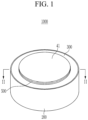
- FIG. 1 is a perspective view of a rechargeable battery according to an embodiment of the present invention
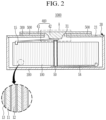
- FIG. 2 is a cross-sectional view taken along the line II-II of FIG. 1
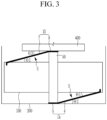
- FIG. 3 is a schematic view illustrating an electrode tab according to an embodiment of the present invention.
- a rechargeable battery 1000 includes an electrode assembly 100, a case 200 having an inner space accommodating the electrode assembly 100, a cap plate 300 coupled to the case 200 to seal the inner space, and an electrode terminal 400 penetrating through the cap plate to be electrically connected to the electrode assembly 100.
- a lower surface of the electrode assembly 100 faces an inner bottom surface of the case 200, and an upper surface of the electrode assembly 100 faces a lower surface of the cap plate 300 covering an opening 21 of the case 200.
- the electrode assembly 100 includes a first electrode 11, a second electrode 12, and a separator 13, and the first electrode 11 and the second electrode 12 are positioned on both sides of the separator 13, which is an electrically insulating material.
- the first electrode 11 includes an electrode active region, which is an area in which an active material is applied to a thin plate formed of a long strip-shaped metal foil, and an electrode uncoated region, which is an area to which no active material is applied; and a first electrode tab 14 may be connected to the electrode uncoated region.
- the electrode uncoated region may be respectively formed at opposite end portions of the electrode active region, that is, at respective end portions of the first electrode 11 in a length direction thereof, but is not limited thereto, and, in an embodiment, may be formed only at one end portion.
- the first electrode 11 may be a negative electrode, and in the electrode active region, an active material, such as graphite or carbon, may be coated on a metal foil, such as copper or nickel.
- the first electrode tab 14 is electrically connected to the electrode uncoated region of the first electrode 11 of the electrode assembly 100, and protrudes to the outside of the electrode assembly 100 to be welded to a bottom surface of the case 200 to electrically connect the first electrode 11 to the case 200. Accordingly, the case 200 connected to the first electrode 11 with the first electrode tab 14 has the same polarity as the first electrode 11.
- a length of the first electrode tab 14 may be longer than half of a diameter, or longer than a radius, of the electrode assembly 100, and may be shorter than the diameter such that the first electrode tab 14 may facilitate a welding process and may not be wrinkled.
- the first electrode tab 14 may have an inclined portion 4 obliquely connected to the electrode assembly 100 at an angle of 10 degrees or less. That is, a surface of the inclined portion 4 facing the electrode assembly 100 may have a first angle ⁇ 1 of 10 degrees or less with respect to a lower surface of the electrode assembly 100.
- the lower surface of the electrode assembly 100 is a virtual horizontal surface on which an end portion of a protruding membrane is positioned and that is parallel to an inner surface of the case 200.
- the first electrode tab 14 may have a flat portion 5 that extends from the inclined portion 4 and is attached to the bottom surface of the case 200.
- a surface of the flat portion 5 is parallel to and attached to the bottom surface of the case 200
- the inclined portion 4 may be connected to the bottom surface of the case 200 at a second angle ⁇ 2.
- the second angle ⁇ 2 may be the same as the first angle ⁇ 1.
- the flat portion 5 may be connected to the inclined portion 4 at an obtuse angle, and, in an embodiment, the flat portion 5 may be pressed by a center pin 50.
- the electrode assembly 100 is spaced apart from the inclined portion by a space S, such that an electrolyte solution may not be obstructed by the first electrode tab 14 to easily flow into the electrode assembly 100.
- the second electrode 12 includes an electrode active region, which is an area in which an active material is applied to a thin plate formed of a long strip-shaped metal foil, and an electrode uncoated region, which is an area to which no active material is applied; and a second electrode tab 15 may be connected to the electrode uncoated region.
- the electrode uncoated region may be respectively formed at opposite end portions of the electrode active region, that is, at respective end portions of the second electrode 12 in a length direction thereof, but is not limited thereto, and, in an embodiment, may be formed only at one end portion.
- the second electrode tab 15 may be connected to the electrode uncoated region of the second electrode 12, and the second electrode tab 15 may protrude from the second electrode 12 to be electrically connected to the electrode terminal 400.
- the second electrode tab 15 may be made of an electrically conductive material, such as nickel or copper, and may be connected to the electrode uncoated region by welding. In an embodiment, the welding may be laser welding.
- the second electrode 12 may be a positive electrode, and in the electrode active region, an active material, such as a transition metal oxide, may be coated on a metal foil, such as aluminum.
- the second electrode tab 15 is electrically connected to the electrode uncoated region of the second electrode 12 of the electrode assembly 100, and protrudes to the outside of the electrode assembly 100 to be welded to a lower surface of the electrode terminal 400 to electrically connect the second electrode 12 to the electrode terminal 400.
- the electrode terminal 400 has the same polarity as that of the second electrode 12.
- a length of the second electrode tab 15 may be longer than half of a diameter, or longer than a radius, of the electrode assembly 100, and may be shorter than the diameter such that the second electrode tab 15 may facilitate a welding process and may not be wrinkled.
- the second electrode tab 15 may have an inclined portion 7 obliquely connected to the electrode assembly 100 at an angle of 10 degrees or less. That is, a surface of the inclined portion 7 facing the electrode assembly 100 may have a first angle ⁇ 1 of 10 degrees or less with respect to an upper surface of the electrode assembly 100.
- the upper surface of the electrode assembly 100 is a virtual horizontal surface on which an end portion of a protruding membrane is positioned and that is parallel to an inner surface of the cap plate 300.
- the second electrode tab 15 may have a flat portion 8 that extends from the inclined portion 7 and is attached to a lower surface of a protrusion of the terminal electrode 400.
- a surface of the flat portion 8 is attached to a lower surface of the terminal electrode 400 in parallel, and the inclined portion 8 may be connected to the lower surface of the terminal electrode 400 at a third angle ⁇ 3.
- the third angle ⁇ 3 may be the same as the first angle ⁇ 1.
- the flat portion 8 may be pressed by the center pin 50.
- the flat portion 8 may be connected to the inclined portion 7 at an obtuse angle.
- the electrode assembly 100 is spaced apart from the inclined portion by a space S, such that an electrolyte solution may not be obstructed by the second electrode tab 15 to easily flow into the electrode assembly 100.
- the separator 13 is positioned between the first electrode 11 and the second electrode 12 to prevent or substantially prevent a short circuit therebetween, and allows lithium ions to move.
- the separator 13 may be made of, for example, any of polyethylene, polypropylene, and a composite film of polyethylene and polypropylene.
- a width of the separator 13 may be equal to or larger than that of the first electrode 11 or the second electrode 12, and the width of first electrode 11 may be larger than that of the second electrode 12.
- the width is a length in a direction in which the electrode assembly 100 is inserted into the case.
- the electrode assembly 100 may have a jelly roll shape in which the first electrode 11, the separator 13, and the second electrode 12 overlap to be wound around a rotation axis, but is not limited thereto, and may have a structure (not shown) in which a sheet-type first electrode, a separator, and a second electrode are repeatedly stacked.
- the electrode assembly 100 may be covered with an insulating tape (not shown) along a diameter-direction external circumferential surface.
- the insulating tape electrically insulates the external circumferential surface of the electrode assembly 100 from the inner surface of the case 200, while protecting the outside of the electrode assembly 100.
- the electrode assembly 100 may be housed in the case 200 with an electrolyte solution in a direction parallel to the rotation axis of the electrode assembly 100.
- the electrolyte solution may be composed of an organic solvent, such as any of EC, PC, DEC, and EMC, and a Li salt, such as LiPF 6 and LiBF 4 .
- the electrolyte solution may be in a liquid, solid, or gel state.
- the center pin 50 penetrating through a center of the electrode assembly 100 in a vertical direction may be positioned at the center of the electrode assembly 100, and the center pin 50 may support the first electrode tab 14 and the second electrode tab 15.
- a diameter of the center pin 50 may be approximately 1.2 mm.
- the case 200 has a space in which the electrode assembly 100 and an electrolyte solution are accommodated, and an opening 21 of which one side is open.
- the electrode assembly 100 may be inserted through the opening 21 to be accommodated in the inner space of the case 200.
- the case 200 may have a cylindrical shape having a low height, but is not limited thereto, and may have any of various known shapes.
- the case 200 may accommodate any of various known electrolyte solutions along with the electrode assembly 100, and, in an embodiment, may be made of stainless steel.
- the inner bottom surface of the case 200 is connected to the first electrode 11 of the electrode assembly 100 by the first electrode tab 14, such that the case 200 has the same polarity as that of the first electrode 11.
- An outer surface of the case 200 may be a first electrode terminal of the rechargeable battery 1000, and an outer surface of the electrode terminal 400 may be a second electrode terminal of the rechargeable battery 1000.
- the cap plate 300 closes and seals the inner space of the case 200, the electrode terminal 400 may be coupled to the opening 21 of the case 200, and the cap plate 300 may be coupled to the opening 21 by welding.
- the cap plate 300 may be formed to have a shape corresponding to the opening 21, and a step portion 30 may be formed in the opening 21 such that the cap plate 300 may be easily mounted.
- the cap plate 300 is coupled to the case 200 and has the same polarity as that of the first electrode 11, and an outer surface of the cap plate 300 may be the first electrode terminal of the rechargeable battery 1000.
- the cap plate 300 includes stainless steel, but is not limited thereto, and may include a metal such as aluminum, nickel, or copper.
- the electrode terminal 400 is insulated from and bonded to the cap plate 300 having a different polarity from that of the electrode terminal 400, and may be electrically connected to the second electrode 12 of the electrode assembly 100 through the terminal hole 31 of the cap plate 300. Therefore, the electrode terminal 400 may be the second electrode terminal of the rechargeable battery 1000.
- the electrode terminal 400 may include stainless steel, but is not limited thereto, and may include a metal such as aluminum, nickel, or copper.
- case 200 and the cap plate 300 may be made of a same material.
- the electrode terminal 400 may include a flange portion 41 and a protrusion 42, the flange portion 41 may have a wider area (or diameter) than the protrusion 42, and the flange portion 41 has a thinner thickness than the protrusion 42.
- the protrusion 42 and the flange portion 41 may be integrally formed.
- the protrusion 42 of the electrode terminal 400 is inserted into the terminal hole 31, and covers the terminal hole 31 of the cap plate 300 together with the flange portion 41 to seal the inside of the case 200.
- the protrusion 42 of the electrode terminal 400 is electrically connected to the second electrode tab 15 of the electrode assembly 100, such that the electrode terminal 400 has the same polarity as the second electrode 12.
- the outer surface of the flange part 41 may be the second electrode terminal of the rechargeable battery 1000.
- FIG. 4 is an enlarged view of a region "A" of FIG. 2 .
- an outer surface of the protrusion 42 includes a curved surface CS and an inclined surface IS.
- the protrusion 42 includes the curved surface CS extending from a lower surface of the flange portion 41, and the inclined surface IS extending from the curved surface CS to pass through the terminal hole 31.
- the curved surface CS may have a curvature radius (e.g., a predetermined curvature radius), and the inclined surface IS may have a slope (e.g., a predetermined slope). Accordingly, as the surface of the protrusion 42 proceeds from the curved surface CS to an end portion of the inclined surface IS, it is farther away from the end portion of the cap plate 300 exposed by the terminal hole 31. The end portion of the inclined surface IS is positioned at the farthest from the curved surface (CS).
- a curvature radius e.g., a predetermined curvature radius
- the inclined surface IS may have a slope (e.g., a predetermined slope). Accordingly, as the surface of the protrusion 42 proceeds from the curved surface CS to an end portion of the inclined surface IS, it is farther away from the end portion of the cap plate 300 exposed by the terminal hole 31. The end portion of the inclined surface IS is positioned at the farthest from the curved surface (CS).
- a lower surface of the flange part 41 of the electrode terminal 400 may be attached to a surface of the cap plate 300 through a thermal-fusion layer 500. Since the cap plate 300 and the electrode terminal 400 are bonded by the thermal-fusion layer 500, the opening 21 of the case 200 in which the electrode assembly 100 is accommodated is completely sealed by the cap plate 300, the electrode terminal 400, and the thermal-fusion layer 500.
- the thermal-fusion layer 500 is thermally fusion-bonded between the cap plate 300 and the flange portion 41 of the electrode terminal 400 by heat or a laser beam.
- the thermal-fusion layer 500 is made of an insulating material to insulate the electrode terminal 400 from the cap plate 300.
- the thermal-fusion layer 500 may include any of various known materials that insulation-bond the cap plate 300 and the electrode terminal 400.
- the thermal-fusion layer 500 is cured by heat, but may be melted at a predetermined temperature.
- the predetermined temperature at which the thermal-fusion layer 500 melts may be a temperature exceeding a temperature of heat for curing the thermal-fusion layer 500, but is not limited thereto.
- the thermal-fusion layer 500 may include a thermosetting resin and a thermoplastic resin.
- the thermosetting resin and the thermoplastic resin of the thermal-fusion layer 500 may be stacked in a plurality of layers, but are not limited thereto.
- the thermosetting resin of the thermal-fusion layer 500 is in a state of being cured by heat, and may include any of various known thermosetting resins such as a phenol resin, a urea resin, a melamine resin, an epoxy resin, and a polyester resin.
- the thermoplastic resin of the thermal-fusion layer 500 includes a polypropylene resin that melts at a predetermined temperature, but is not limited thereto, and may include any of various known thermoplastic resins such as polystyrene, polyethylene, and polyvinyl chloride resins.
- the thermal-fusion layer 500 melts at a predetermined temperature, and a portion from which the thermal-fusion layer 500 is removed becomes a ventilation channel through which gas is discharged.
- FIG. 5 is a cross-sectional view of a rechargeable battery according to another embodiment of the present invention.
- FIG. 6 is an enlarged view of a region "B" of FIG. 5 .
- a rechargeable battery 1002 according to an embodiment of the present invention shown in FIG. 5 and FIG. 6 is generally the same as the rechargeable battery shown in FIG. 1 to FIG. 3 , and different parts will now be described.
- the rechargeable battery 1002 includes the electrode assembly 100, the case 200, the cap plate 300, the terminal plate 400, and the thermal-fusion layer 500.
- the electrode assembly 100 includes the first electrode 11, the second electrode 12, and the separator 13, and the first electrode 11 may be electrically connected to the bottom surface of the case 200 through the first electrode tab 14.
- the first electrode tab 14 may have the inclined portion 4 and the flat portion 5, and the inclined portion 4 may be obliquely connected to a virtual lower horizontal surface of the electrode assembly 100 at an angle of 10 degrees or less, and the flat portion 5 may be connected to the bottom surface of the case 200.
- the flat portion 5 may be pressed by the center pin 50.
- a length of the first electrode tab 14 may be longer than half of a diameter, or longer than a radius, of the electrode assembly 100, and may be shorter than the diameter such that the first electrode tab 14 may facilitate a welding process and may not be wrinkled.
- the electrode terminal 400 is electrically connected to the second electrode 12, and is insulated and bonded to the cap plate 300 through the thermal-fusion layer 500.
- the electrode terminal 400 covers the terminal hole 31 of the cap plate 300.
- the electrode terminal 400 is positioned between the cap plate 300 and the electrode assembly 100.
- the electrode terminal 400 covers the central area of the opening 21 of the case 200 exposed by the terminal hole 31 of the cap plate 300.
- the electrode terminal 400 covers the central area of the opening 21, and the cap plate 300 covers the outer area of the opening 21, and, thus, the opening 21 of the case 200 is completely sealed by the electrode terminal 400 and the cap plate 300.
- the electrode terminal 400 is coupled to the second electrode tab 15 of the electrode assembly 100 to be electrically connected to the second electrode 12 of the electrode assembly 100.
- the second electrode tab 15 may have the inclined portion 7 and the flat portion 8, and the inclined portion 7 may be obliquely connected to a virtual upper horizontal surface of the electrode assembly 100 at an angle of 10 degrees or less, and the flat portion 8 may be connected to the electrode terminal 400.
- the flat portion 8 may be pressed by the center pin 50.
- a length of the second electrode tab 15 may be longer than half of a diameter, or longer than a radius, of the electrode assembly 100, and may be shorter than the diameter such that the second electrode tab 15 may facilitate a welding process and may not be wrinkled.
- the electrode terminal 400 includes the flange portion 41 and the protrusion 42.
- the flange portion 41 is positioned between the cap plate 300 and the electrode assembly 100 in the case 200, and overlaps the cap plate 300 to cover the terminal hole 31.
- An upper surface of the flange portion 41 is in contact with the thermal-fusion layer 500, and the flange portion 41 is insulation-bonded to the cap plate 300 by the thermal-fusion layer 500.
- a lower surface of the flange portion 41 is electrically connected to the second electrode tab 15. As the flange portion 41 is connected to the second electrode tab 15, the protrusion 42 and the flange portion 41 of the electrode terminal 400 have the same polarity as that of the second electrode 12.
- the outer surface of the protrusion 42 may be positioned on a same plane or on a different plane from the outer surface of the cap plate 300.
- a height of the outer surface of the protrusion 42 may be the same as that of the outer surface of the cap plate 300, but is not limited thereto, and the height of the outer surface of the protrusion 42 may be higher or lower than that of the outer surface of the cap plate 300.
- the outer surface of the protrusion 42 includes the curved surface CS and the inclined surface IS.
- the protrusion 42 includes the curved surface CS extending from a lower surface of the flange portion 41, and the inclined surface IS extending from the curved surface CS to pass through the terminal hole 31.
- the curved surface CS may have a curvature radius (e.g., a predetermined curvature radius), and the inclined surface IS may have a slope (e.g., a predetermined slope). Accordingly, as the surface of the protrusion 42 proceeds from the curved surface CS to an end portion of the inclined surface IS, the surface of the protrusion 42 is farther away from the cap plate 300, which is an edge of the terminal hole 31. As described above, when the inclined surface IS is formed, a distance of the protrusion 42 positioned in the horizontal direction between the cap plate 300 and the electrode terminal 400 is increased, such that even if an alignment error occurs, a short circuit between the cap plate 300 and the protrusion 42, which have different polarities, may be avoided.
- a curvature radius e.g., a predetermined curvature radius
- the inclined surface IS may have a slope (e.g., a predetermined slope). Accordingly, as the surface of the protrusion 42 proceeds from the curved surface CS to an end portion
- the flange portion 41 when the flange portion 41 is connected through the thermal-fusion portion 500 within the case 200, and when a temperature inside the case 200 increases due to occurrence of an event and the thermal-fusion portion 500 melts, the flange portion 41 is separated from the cap plate 300 to move in the direction of gravity, such that the terminal hole 31 may be opened. Therefore, it is possible to prevent or substantially prevent explosion by more quickly discharging the inner gas to the outside compared with the embodiment of FIG. 1 .
Landscapes
- Chemical & Material Sciences (AREA)
- Chemical Kinetics & Catalysis (AREA)
- Electrochemistry (AREA)
- General Chemical & Material Sciences (AREA)
- Engineering & Computer Science (AREA)
- Manufacturing & Machinery (AREA)
- Inorganic Chemistry (AREA)
- Materials Engineering (AREA)
- Connection Of Batteries Or Terminals (AREA)
- Secondary Cells (AREA)
- Sealing Battery Cases Or Jackets (AREA)
Description
- The present invention relates to a rechargeable battery.
- A rechargeable battery differs from a primary battery in that it can be repeatedly charged and discharged, while the latter is incapable of being recharged. A low-capacity rechargeable battery is used in a portable electronic device, such as a mobile phone, a notebook computer, and a camcorder, and a large-capacity rechargeable battery is widely used as a power source for driving a motor of a hybrid vehicle and the like.
- As typical rechargeable batteries, there are a nickel-cadmium (Ni-Cd) battery, a nickel-hydrogen (Ni-MH) battery, a lithium (Li) battery, a lithium ion (Li-ion) rechargeable battery, etc. Particularly, the Li-ion rechargeable battery has an operating voltage that is three times as high as those of the Ni-Cd battery and the Ni-MH battery that are widely used as a power supply of portable electronic devices. In addition, the Li-ion rechargeable battery has been widely used because an energy density per unit weight thereof is high.
- Particularly, as demand for wearable devices, such as a headphone, an earphone, a smartwatch, and a body-worn medical device using Bluetooth, has increased, a need for a rechargeable battery having a high energy density and an ultra-small size has increased.
- The ultra-small rechargeable battery may include a coin cell or a button cell. Since an entire height of the coin cell or button cell is low, a difference in battery capacity may occur depending on an inner structure thereof.
- In addition, due to its ultra-small size, an electrolyte solution may not be easily supplied into an electrode assembly.
- The above information disclosed in this Background section is only for enhancement of understanding of the background of the invention, and, therefore, it may contain information that does not form the prior art that is already known in this country to a person of ordinary skill in the art.
-
CN 204596910 U ,US 20170207491 A1 andEP 3836269 A1 discloses a rechargeable battery comprising electrode tabs having an inclined portion. - According to an aspect of the present invention, an ultra-small rechargeable battery in which an electrolyte solution may easily flow into an electrode assembly is provided.
- According to the present invention, a rechargeable battery is provided as defined in claim 1.
- The first angle may be 10 degrees or less, preferably 5 degrees or less.
- The at least one electrode tab may include a first electrode tab connecting the first electrode and the bottom surface of the case; and a second electrode tab connecting the second electrode and the electrode terminal, and the first electrode may be a negative electrode and the second electrode may be a positive electrode.
- The inclined portion of the first electrode tab may be connected to the bottom surface of the case at a second angle, the inclined portion of the second electrode tab may be connected to a lower surface of the electrode terminal at a third angle, and the second angle and the third angle may be the same as the first angle.
- A length of the at least one electrode tab may be larger than half of a diameter of the electrode assembly, and may be smaller than the diameter of the electrode assembly.
- The electrode terminal may include a flange portion covering the terminal hole and overlapping the cap plate, and a protrusion integrally formed with the flange portion and protruding from the flange portion toward the terminal hole.
- An outer surface of the protrusion may have a curved surface and an inclined surface, and a distance from the curved surface to an end portion of the cap plate exposed by the terminal hole may be shorter than a distance from the inclined surface to the end portion of the cap plate exposed by the terminal hole, and the distance to the end portion of the cap plate exposed by the terminal hole may become longer moving closer to an end portion of the inclined portion.
- The rechargeable battery may further include a thermal-fusion layer between the cap plate and the flange portion and insulation-bonding the cap plate and the flange portion.
- The thermal-fusion layer may melt at a predetermined temperature. According to the present invention, an electrode tab is obliquely connected to an electrode assembly, such that the electrode tab does not prevent the electrolyte solution from moving into the electrode assembly and electrolyte solution may be easily supplied into the electrode assembly due to the electrode tab.
-
-
FIG. 1 is a perspective view of a rechargeable battery according to an embodiment of the present invention. -
FIG. 2 is a cross-sectional view taken along the line II-II ofFIG. 1 . -
FIG. 3 is a schematic view illustrating an electrode tab according to an embodiment of the present invention. -
FIG. 4 is an enlarged view of a region "A" ofFIG. 2 . -
FIG. 5 is a cross-sectional view of a rechargeable battery according to another embodiment of the present invention. -
FIG. 6 is an enlarged view of a region "B" ofFIG. 5 . -
11: first electrode 12: second electrode 13: separator 30: step portion 41: flange portion 42: protrusion 100: electrode assembly 200: case 300: cap plate 400: electrode terminal 500: thermal-fusion layer - The present invention will be described more fully herein with reference to the accompanying drawings, in which some example embodiments of the invention are shown. The drawings and description are to be regarded as illustrative in nature and not restrictive. Like reference numerals designate like elements throughout the specification.
- In addition, unless explicitly described to the contrary, it is to be understood that terms such as "comprises," "includes," or "have" used in the present specification specify the presence of stated features, numerals, steps, operations, components, parts, or a combination thereof, but do not preclude the presence or addition of one or more other features, numerals, steps, operations, components, parts, or a combination thereof.
- Also, in this specification, it is to be understood that when one component is referred to as being "connected" or "coupled" to another component, it may be connected or coupled directly to the another component or connected or coupled to the another component with one or more other components intervening therebetween.
- In addition, terms such as "below," "lower," "above," "upper," and the like are used to describe the relationship of the configurations shown in the drawings. However, the terms are used as a relative concept and are described with reference to the direction indicated ir the drawings.
- Herein, a rechargeable battery according to one or more embodiments will be described with reference to the accompanying drawings.
- A rechargeable battery according to the present invention is an ultra-small rechargeable battery, and may include a coin cell or a button cell, but the present invention is not limited thereto, and may include a cylindrical or pin-type cell.
- Here, the coin cell or the button cell is a thin coin-type or button-type cell, and may mean a battery having a ratio (height/diameter) of a height to a diameter of 1 or less, but is not limited thereto.
- In an embodiment, the coin cell or the button cell is cylindrical, and a horizontal cross-section is circular, but the present invention is not limited thereto, and a horizontal cross-section may be oval or polygonal. In this case, the diameter may mean a maximum distance of the cell based on a horizontal direction of the cell, and the height may mean a maximum distance (distance from a flat bottom surface thereof to a flat uppermost surface) of the cell based on a vertical direction of the cell.
-
FIG. 1 is a perspective view of a rechargeable battery according to an embodiment of the present invention;FIG. 2 is a cross-sectional view taken along the line II-II ofFIG. 1 ; andFIG. 3 is a schematic view illustrating an electrode tab according to an embodiment of the present invention. - Referring to
FIG. 1 andFIG. 2 , arechargeable battery 1000 according to an embodiment of the present invention includes anelectrode assembly 100, acase 200 having an inner space accommodating theelectrode assembly 100, acap plate 300 coupled to thecase 200 to seal the inner space, and anelectrode terminal 400 penetrating through the cap plate to be electrically connected to theelectrode assembly 100. - A lower surface of the
electrode assembly 100 faces an inner bottom surface of thecase 200, and an upper surface of theelectrode assembly 100 faces a lower surface of thecap plate 300 covering anopening 21 of thecase 200. - The
electrode assembly 100 includes afirst electrode 11, asecond electrode 12, and aseparator 13, and thefirst electrode 11 and thesecond electrode 12 are positioned on both sides of theseparator 13, which is an electrically insulating material. - The
first electrode 11 includes an electrode active region, which is an area in which an active material is applied to a thin plate formed of a long strip-shaped metal foil, and an electrode uncoated region, which is an area to which no active material is applied; and afirst electrode tab 14 may be connected to the electrode uncoated region. - The electrode uncoated region may be respectively formed at opposite end portions of the electrode active region, that is, at respective end portions of the
first electrode 11 in a length direction thereof, but is not limited thereto, and, in an embodiment, may be formed only at one end portion. In an embodiment, thefirst electrode 11 may be a negative electrode, and in the electrode active region, an active material, such as graphite or carbon, may be coated on a metal foil, such as copper or nickel. - In an embodiment, the
first electrode tab 14 is electrically connected to the electrode uncoated region of thefirst electrode 11 of theelectrode assembly 100, and protrudes to the outside of theelectrode assembly 100 to be welded to a bottom surface of thecase 200 to electrically connect thefirst electrode 11 to thecase 200. Accordingly, thecase 200 connected to thefirst electrode 11 with thefirst electrode tab 14 has the same polarity as thefirst electrode 11. - Referring to
FIG. 3 , in an embodiment, a length of thefirst electrode tab 14 may be longer than half of a diameter, or longer than a radius, of theelectrode assembly 100, and may be shorter than the diameter such that thefirst electrode tab 14 may facilitate a welding process and may not be wrinkled. - In an embodiment, the
first electrode tab 14 may have an inclined portion 4 obliquely connected to theelectrode assembly 100 at an angle of 10 degrees or less. That is, a surface of the inclined portion 4 facing theelectrode assembly 100 may have a first angle θ1 of 10 degrees or less with respect to a lower surface of theelectrode assembly 100. In this case, the lower surface of theelectrode assembly 100 is a virtual horizontal surface on which an end portion of a protruding membrane is positioned and that is parallel to an inner surface of thecase 200. - The
first electrode tab 14 may have a flat portion 5 that extends from the inclined portion 4 and is attached to the bottom surface of thecase 200. In an embodiment, a surface of the flat portion 5 is parallel to and attached to the bottom surface of thecase 200, the inclined portion 4 may be connected to the bottom surface of thecase 200 at a second angle θ2. In an embodiment, the second angle θ2 may be the same as the first angle θ1. - The flat portion 5 may be connected to the inclined portion 4 at an obtuse angle, and, in an embodiment, the flat portion 5 may be pressed by a
center pin 50. - As described above, when the
first electrode tab 14 is provided with the inclined portion 4 obliquely connected to theelectrode assembly 100, theelectrode assembly 100 is spaced apart from the inclined portion by a space S, such that an electrolyte solution may not be obstructed by thefirst electrode tab 14 to easily flow into theelectrode assembly 100. - The
second electrode 12 includes an electrode active region, which is an area in which an active material is applied to a thin plate formed of a long strip-shaped metal foil, and an electrode uncoated region, which is an area to which no active material is applied; and asecond electrode tab 15 may be connected to the electrode uncoated region. - The electrode uncoated region may be respectively formed at opposite end portions of the electrode active region, that is, at respective end portions of the
second electrode 12 in a length direction thereof, but is not limited thereto, and, in an embodiment, may be formed only at one end portion. - The
second electrode tab 15 may be connected to the electrode uncoated region of thesecond electrode 12, and thesecond electrode tab 15 may protrude from thesecond electrode 12 to be electrically connected to theelectrode terminal 400. Thesecond electrode tab 15 may be made of an electrically conductive material, such as nickel or copper, and may be connected to the electrode uncoated region by welding. In an embodiment, the welding may be laser welding. - In an embodiment, the
second electrode 12 may be a positive electrode, and in the electrode active region, an active material, such as a transition metal oxide, may be coated on a metal foil, such as aluminum. - The
second electrode tab 15 is electrically connected to the electrode uncoated region of thesecond electrode 12 of theelectrode assembly 100, and protrudes to the outside of theelectrode assembly 100 to be welded to a lower surface of theelectrode terminal 400 to electrically connect thesecond electrode 12 to theelectrode terminal 400. By thesecond electrode tab 15, theelectrode terminal 400 has the same polarity as that of thesecond electrode 12. - In an embodiment, a length of the
second electrode tab 15 may be longer than half of a diameter, or longer than a radius, of theelectrode assembly 100, and may be shorter than the diameter such that thesecond electrode tab 15 may facilitate a welding process and may not be wrinkled. After thesecond electrode tab 15 is fixed to theelectrode terminal 400 by welding, thecap plate 300 may be welded to thecase 200. - In an embodiment, the
second electrode tab 15 may have an inclined portion 7 obliquely connected to theelectrode assembly 100 at an angle of 10 degrees or less. That is, a surface of the inclined portion 7 facing theelectrode assembly 100 may have a first angle θ1 of 10 degrees or less with respect to an upper surface of theelectrode assembly 100. In this case, the upper surface of theelectrode assembly 100 is a virtual horizontal surface on which an end portion of a protruding membrane is positioned and that is parallel to an inner surface of thecap plate 300. - The
second electrode tab 15 may have aflat portion 8 that extends from the inclined portion 7 and is attached to a lower surface of a protrusion of theterminal electrode 400. In an embodiment, a surface of theflat portion 8 is attached to a lower surface of theterminal electrode 400 in parallel, and theinclined portion 8 may be connected to the lower surface of theterminal electrode 400 at a third angle θ3. In an embodiment, the third angle θ3 may be the same as the first angle θ1. - In an embodiment, the
flat portion 8 may be pressed by thecenter pin 50. Theflat portion 8 may be connected to the inclined portion 7 at an obtuse angle. - As described above, when the
second electrode tab 15 is provided with the inclined portion 7 obliquely connected to theelectrode assembly 100, theelectrode assembly 100 is spaced apart from the inclined portion by a space S, such that an electrolyte solution may not be obstructed by thesecond electrode tab 15 to easily flow into theelectrode assembly 100. - Referring back to
FIG. 1 andFIG. 2 , theseparator 13 is positioned between thefirst electrode 11 and thesecond electrode 12 to prevent or substantially prevent a short circuit therebetween, and allows lithium ions to move. Theseparator 13 may be made of, for example, any of polyethylene, polypropylene, and a composite film of polyethylene and polypropylene. - In an embodiment, a width of the
separator 13 may be equal to or larger than that of thefirst electrode 11 or thesecond electrode 12, and the width offirst electrode 11 may be larger than that of thesecond electrode 12. In this case, the width is a length in a direction in which theelectrode assembly 100 is inserted into the case. - The
electrode assembly 100 may have a jelly roll shape in which thefirst electrode 11, theseparator 13, and thesecond electrode 12 overlap to be wound around a rotation axis, but is not limited thereto, and may have a structure (not shown) in which a sheet-type first electrode, a separator, and a second electrode are repeatedly stacked. - In an embodiment, the
electrode assembly 100 may be covered with an insulating tape (not shown) along a diameter-direction external circumferential surface. The insulating tape electrically insulates the external circumferential surface of theelectrode assembly 100 from the inner surface of thecase 200, while protecting the outside of theelectrode assembly 100. - The
electrode assembly 100 may be housed in thecase 200 with an electrolyte solution in a direction parallel to the rotation axis of theelectrode assembly 100. The electrolyte solution may be composed of an organic solvent, such as any of EC, PC, DEC, and EMC, and a Li salt, such as LiPF6 and LiBF4. The electrolyte solution may be in a liquid, solid, or gel state. - The
center pin 50 penetrating through a center of theelectrode assembly 100 in a vertical direction may be positioned at the center of theelectrode assembly 100, and thecenter pin 50 may support thefirst electrode tab 14 and thesecond electrode tab 15. In an embodiment, a diameter of thecenter pin 50 may be approximately 1.2 mm. - The
case 200 has a space in which theelectrode assembly 100 and an electrolyte solution are accommodated, and anopening 21 of which one side is open. Theelectrode assembly 100 may be inserted through theopening 21 to be accommodated in the inner space of thecase 200. Thecase 200 may have a cylindrical shape having a low height, but is not limited thereto, and may have any of various known shapes. Thecase 200 may accommodate any of various known electrolyte solutions along with theelectrode assembly 100, and, in an embodiment, may be made of stainless steel. - The inner bottom surface of the
case 200 is connected to thefirst electrode 11 of theelectrode assembly 100 by thefirst electrode tab 14, such that thecase 200 has the same polarity as that of thefirst electrode 11. - An outer surface of the
case 200 may be a first electrode terminal of therechargeable battery 1000, and an outer surface of theelectrode terminal 400 may be a second electrode terminal of therechargeable battery 1000. - The
cap plate 300 closes and seals the inner space of thecase 200, theelectrode terminal 400 may be coupled to theopening 21 of thecase 200, and thecap plate 300 may be coupled to theopening 21 by welding. - The
cap plate 300 may be formed to have a shape corresponding to theopening 21, and astep portion 30 may be formed in theopening 21 such that thecap plate 300 may be easily mounted. - A
terminal hole 31 is formed in a center of thecap plate 300, and theterminal hole 31 corresponds to the center of theelectrode assembly 100 to expose the upper portion of theelectrode assembly 100. Thecap plate 300 may have a ring shape due to theterminal hole 31 formed in the center thereof. - The
cap plate 300 is coupled to thecase 200 and has the same polarity as that of thefirst electrode 11, and an outer surface of thecap plate 300 may be the first electrode terminal of therechargeable battery 1000. In an embodiment, thecap plate 300 includes stainless steel, but is not limited thereto, and may include a metal such as aluminum, nickel, or copper. - The
electrode terminal 400 is insulated from and bonded to thecap plate 300 having a different polarity from that of theelectrode terminal 400, and may be electrically connected to thesecond electrode 12 of theelectrode assembly 100 through theterminal hole 31 of thecap plate 300. Therefore, theelectrode terminal 400 may be the second electrode terminal of therechargeable battery 1000. - In an embodiment, the
electrode terminal 400 may include stainless steel, but is not limited thereto, and may include a metal such as aluminum, nickel, or copper. - In an embodiment, the
case 200 and thecap plate 300 may be connected to thefirst electrode 11, which is a negative electrode, such that the first electrode terminal may be a negative terminal, and theelectrode terminal 400 may be electrically connected to thesecond electrode 12, which is a positive electrode, such that the second electrode terminal may be a positive terminal. - In an embodiment, the
case 200 and thecap plate 300 may be made of a same material. - The
electrode terminal 400 may include aflange portion 41 and aprotrusion 42, theflange portion 41 may have a wider area (or diameter) than theprotrusion 42, and theflange portion 41 has a thinner thickness than theprotrusion 42. Theprotrusion 42 and theflange portion 41 may be integrally formed. - The
protrusion 42 of theelectrode terminal 400 is inserted into theterminal hole 31, and covers theterminal hole 31 of thecap plate 300 together with theflange portion 41 to seal the inside of thecase 200. Theprotrusion 42 of theelectrode terminal 400 is electrically connected to thesecond electrode tab 15 of theelectrode assembly 100, such that theelectrode terminal 400 has the same polarity as thesecond electrode 12. The outer surface of theflange part 41 may be the second electrode terminal of therechargeable battery 1000. -
FIG. 4 is an enlarged view of a region "A" ofFIG. 2 . - Referring to
FIG. 4 , in an embodiment, an outer surface of theprotrusion 42 includes a curved surface CS and an inclined surface IS. Theprotrusion 42 includes the curved surface CS extending from a lower surface of theflange portion 41, and the inclined surface IS extending from the curved surface CS to pass through theterminal hole 31. - The curved surface CS may have a curvature radius (e.g., a predetermined curvature radius), and the inclined surface IS may have a slope (e.g., a predetermined slope). Accordingly, as the surface of the
protrusion 42 proceeds from the curved surface CS to an end portion of the inclined surface IS, it is farther away from the end portion of thecap plate 300 exposed by theterminal hole 31. The end portion of the inclined surface IS is positioned at the farthest from the curved surface (CS). As described above, when the inclined surface IS is formed, a distance of theprotrusion 42 positioned in the horizontal direction between thecap plate 300 and theelectrode terminal 400 is increased, such that even if an alignment error occurs, a short circuit between thecap plate 300 and theprotrusion 42, which have different polarities, may be avoided. - Referring back to
FIG. 1 andFIG. 2 , a lower surface of theflange part 41 of theelectrode terminal 400 may be attached to a surface of thecap plate 300 through a thermal-fusion layer 500. Since thecap plate 300 and theelectrode terminal 400 are bonded by the thermal-fusion layer 500, theopening 21 of thecase 200 in which theelectrode assembly 100 is accommodated is completely sealed by thecap plate 300, theelectrode terminal 400, and the thermal-fusion layer 500. - The thermal-
fusion layer 500 is thermally fusion-bonded between thecap plate 300 and theflange portion 41 of theelectrode terminal 400 by heat or a laser beam. - The thermal-
fusion layer 500 is made of an insulating material to insulate theelectrode terminal 400 from thecap plate 300. The thermal-fusion layer 500 may include any of various known materials that insulation-bond thecap plate 300 and theelectrode terminal 400. - In an embodiment, the thermal-
fusion layer 500 is cured by heat, but may be melted at a predetermined temperature. In an embodiment, the predetermined temperature at which the thermal-fusion layer 500 melts may be a temperature exceeding a temperature of heat for curing the thermal-fusion layer 500, but is not limited thereto. - For example, the thermal-
fusion layer 500 may include a thermosetting resin and a thermoplastic resin. The thermosetting resin and the thermoplastic resin of the thermal-fusion layer 500 may be stacked in a plurality of layers, but are not limited thereto. The thermosetting resin of the thermal-fusion layer 500 is in a state of being cured by heat, and may include any of various known thermosetting resins such as a phenol resin, a urea resin, a melamine resin, an epoxy resin, and a polyester resin. In an embodiment, the thermoplastic resin of the thermal-fusion layer 500 includes a polypropylene resin that melts at a predetermined temperature, but is not limited thereto, and may include any of various known thermoplastic resins such as polystyrene, polyethylene, and polyvinyl chloride resins. - As described above, in an embodiment, the thermal-
fusion layer 500 melts at a predetermined temperature, and a portion from which the thermal-fusion layer 500 is removed becomes a ventilation channel through which gas is discharged. - When an unintended event (for example, a short circuit between both electrodes) occurs in the inner space of the
rechargeable battery 1000, a temperature increases, and the thermal-fusion layer 500 melts due to the increased temperature, and a volume thereof is reduced, such that a ventilation channel through which gas GA generated inside the rechargeable battery is discharged to the outside is formed. The inner gas is guided from the inner space of therechargeable battery 1000 along the curved surface CS of theelectrode terminal 400 to the space between theflange portion 41 and thecap plate 300, which is the ventilation channel, to be quickly discharged to the outside, thereby suppressing a risk of explosion of therechargeable battery 1000. -
FIG. 5 is a cross-sectional view of a rechargeable battery according to another embodiment of the present invention; andFIG. 6 is an enlarged view of a region "B" ofFIG. 5 . - A
rechargeable battery 1002 according to an embodiment of the present invention shown inFIG. 5 andFIG. 6 is generally the same as the rechargeable battery shown inFIG. 1 to FIG. 3 , and different parts will now be described. - Referring to
FIG. 5 andFIG. 6 , therechargeable battery 1002 according to an embodiment of the present invention includes theelectrode assembly 100, thecase 200, thecap plate 300, theterminal plate 400, and the thermal-fusion layer 500. - The
electrode assembly 100 includes thefirst electrode 11, thesecond electrode 12, and theseparator 13, and thefirst electrode 11 may be electrically connected to the bottom surface of thecase 200 through thefirst electrode tab 14. - The
first electrode tab 14 may have the inclined portion 4 and the flat portion 5, and the inclined portion 4 may be obliquely connected to a virtual lower horizontal surface of theelectrode assembly 100 at an angle of 10 degrees or less, and the flat portion 5 may be connected to the bottom surface of thecase 200. The flat portion 5 may be pressed by thecenter pin 50. A length of thefirst electrode tab 14 may be longer than half of a diameter, or longer than a radius, of theelectrode assembly 100, and may be shorter than the diameter such that thefirst electrode tab 14 may facilitate a welding process and may not be wrinkled. - The
electrode terminal 400 is electrically connected to thesecond electrode 12, and is insulated and bonded to thecap plate 300 through the thermal-fusion layer 500. Theelectrode terminal 400 covers theterminal hole 31 of thecap plate 300. Theelectrode terminal 400 is positioned between thecap plate 300 and theelectrode assembly 100. - The
electrode terminal 400 covers the central area of theopening 21 of thecase 200 exposed by theterminal hole 31 of thecap plate 300. Theelectrode terminal 400 covers the central area of theopening 21, and thecap plate 300 covers the outer area of theopening 21, and, thus, theopening 21 of thecase 200 is completely sealed by theelectrode terminal 400 and thecap plate 300. Theelectrode terminal 400 is coupled to thesecond electrode tab 15 of theelectrode assembly 100 to be electrically connected to thesecond electrode 12 of theelectrode assembly 100. - The
second electrode tab 15 may have the inclined portion 7 and theflat portion 8, and the inclined portion 7 may be obliquely connected to a virtual upper horizontal surface of theelectrode assembly 100 at an angle of 10 degrees or less, and theflat portion 8 may be connected to theelectrode terminal 400. Theflat portion 8 may be pressed by thecenter pin 50. A length of thesecond electrode tab 15 may be longer than half of a diameter, or longer than a radius, of theelectrode assembly 100, and may be shorter than the diameter such that thesecond electrode tab 15 may facilitate a welding process and may not be wrinkled. - The
electrode terminal 400 includes theflange portion 41 and theprotrusion 42. Theflange portion 41 is positioned between thecap plate 300 and theelectrode assembly 100 in thecase 200, and overlaps thecap plate 300 to cover theterminal hole 31. - An upper surface of the
flange portion 41 is in contact with the thermal-fusion layer 500, and theflange portion 41 is insulation-bonded to thecap plate 300 by the thermal-fusion layer 500. A lower surface of theflange portion 41 is electrically connected to thesecond electrode tab 15. As theflange portion 41 is connected to thesecond electrode tab 15, theprotrusion 42 and theflange portion 41 of theelectrode terminal 400 have the same polarity as that of thesecond electrode 12. - The
protrusion 42 penetrates through theterminal hole 31 to be exposed to the outside of thecase 200. An outer surface of theprotrusion 42 may be the second electrode terminal of therechargeable battery 1002. - The outer surface of the
protrusion 42 may be positioned on a same plane or on a different plane from the outer surface of thecap plate 300. For example, a height of the outer surface of theprotrusion 42 may be the same as that of the outer surface of thecap plate 300, but is not limited thereto, and the height of the outer surface of theprotrusion 42 may be higher or lower than that of the outer surface of thecap plate 300. - In an embodiment, the outer surface of the
protrusion 42 includes the curved surface CS and the inclined surface IS. - The
protrusion 42 includes the curved surface CS extending from a lower surface of theflange portion 41, and the inclined surface IS extending from the curved surface CS to pass through theterminal hole 31. - The curved surface CS may have a curvature radius (e.g., a predetermined curvature radius), and the inclined surface IS may have a slope (e.g., a predetermined slope). Accordingly, as the surface of the
protrusion 42 proceeds from the curved surface CS to an end portion of the inclined surface IS, the surface of theprotrusion 42 is farther away from thecap plate 300, which is an edge of theterminal hole 31. As described above, when the inclined surface IS is formed, a distance of theprotrusion 42 positioned in the horizontal direction between thecap plate 300 and theelectrode terminal 400 is increased, such that even if an alignment error occurs, a short circuit between thecap plate 300 and theprotrusion 42, which have different polarities, may be avoided. - As described above, when the
flange portion 41 is connected through the thermal-fusion portion 500 within thecase 200, and when a temperature inside thecase 200 increases due to occurrence of an event and the thermal-fusion portion 500 melts, theflange portion 41 is separated from thecap plate 300 to move in the direction of gravity, such that theterminal hole 31 may be opened. Therefore, it is possible to prevent or substantially prevent explosion by more quickly discharging the inner gas to the outside compared with the embodiment ofFIG. 1 . - While the present invention has been described in connection with what are presently considered to be some practical embodiments, it is to be understood that the invention is not limited to the disclosed embodiments, but, on the contrary, is intended to cover various modifications and equivalent arrangements included within the scope of the appended claims.
Claims (9)
- A rechargeable battery, wherein the rechargeable battery is a button cell, comprising:an electrode assembly (100) comprising a first electrode (11), a second electrode (12), and a separator (13) between the first electrode and the second electrode;a case (200) comprising an inner space accommodating the electrode assembly (100), and an opening;a cap plate (300) coupled to the case at the opening and comprising a terminal hole exposing the inner space;an electrode terminal (400) electrically connected to the electrode assembly (100) through the terminal hole and overlapping the cap plate;electrode tabs (14, 15) respectively connected to the first electrode and the second electrode; andan electrolyte solution in the inner space,wherein at least one electrode tab of the electrode tabs (14, 15) comprises an inclined portion (4, 7) that is inclined at a first angle (θ1) with respect to a surface of the electrode assembly (100) facing the at least one electrode tab,wherein the at least one electrode tab (14, 15) further comprises a flat portion (5, 8) extending from the inclined portion (4,7) and is electrically connected to a bottom surface of the case or to the electrode terminal (400),whereinthe electrode assembly (100) further comprises a center pin (50) at a center of the electrode assembly (100), andthe flat portion overlaps the center pin (50), andwherein the inclined portion (4, 7) and the flat portion (5, 8) are connected to each other at an obtuse angle.
- The button cell of claim 1, wherein the first angle (θ1) is 10 degrees or less.
- The button cell of any of the preceding claims, wherein the at least one electrode tab (14, 15) comprises:a first electrode tab (14) connecting the first electrode (11) and the bottom surface of the case (200); anda second electrode tab (15) connecting the second electrode (12) and the electrode terminal (400), andthe first electrode is a negative electrode and the second electrode is a positive electrode.
- The button cell of claim 3, whereinthe inclined portion (4) of the first electrode tab (14) is connected to the bottom surface of the case at a second angle (θ2),the inclined portion (7) of the second electrode tab (15) is connected to a lower surface of the electrode terminal (400) at a third angle (θ3), andthe second angle (θ2) and the third angle (θ3) are the same as the first angle (θ1).
- The button cell of any of claims 1, 3 or 4, whereinthe electrode assembly (100) is of a cylinder shape, anda length of the at least one electrode tab (14, 15) is larger than half of a diameter of the electrode assembly (100) and smaller than the diameter of the electrode assembly (100).
- The button cell of any of the preceding claims, wherein the electrode terminal (400) comprises:a flange portion (41) covering the terminal hole and overlapping the cap plate; anda protrusion (42) integrally formed with the flange portion (41) and protruding from the flange portion (41) toward the terminal hole.
- The button cell of claim 6, whereinan outer surface of the protrusion (42) has a curved surface (CS) and an inclined surface (IS), andthe protrusion (42) includes the curved surface (CS) extending from a lower surface of the flange portion (41), and the inclined surface (IS) extending from the curved surface (CS),the inclined surface (IS) includes an end portion positioned at the farthest from the curved surface (CS), andthe inclined surface (IS) has a slope such that a distance between the inclined surface (IS) and an end portion of the cap plate (300) exposed by the terminal hole (31) in a horizontal direction, namely the direction parallel to the widest dimension of the flange portion (41), increases as the surface of the protrusion (42) proceeds from the curved surface (CS) to the end portion of the inclined surface (IS).
- The button cell of claim 6 or 7, further comprising a thermal-fusion layer (500) disposed between the cap plate and the flange portion and insulation-bonding the cap plate and the flange portion (41).
- The button cell of claim 8, wherein the thermal-fusion layer (500) is configured to melt at a predetermined temperature.
Applications Claiming Priority (1)
| Application Number | Priority Date | Filing Date | Title |
|---|---|---|---|
| KR1020200081158A KR20220003395A (en) | 2020-07-01 | 2020-07-01 | Rechargeable battery |
Publications (2)
| Publication Number | Publication Date |
|---|---|
| EP3944387A1 EP3944387A1 (en) | 2022-01-26 |
| EP3944387B1 true EP3944387B1 (en) | 2023-12-13 |
Family
ID=76444332
Family Applications (1)
| Application Number | Title | Priority Date | Filing Date |
|---|---|---|---|
| EP21179265.0A Active EP3944387B1 (en) | 2020-07-01 | 2021-06-14 | Rechargeable battery |
Country Status (6)
| Country | Link |
|---|---|
| US (2) | US11695180B2 (en) |
| EP (1) | EP3944387B1 (en) |
| KR (1) | KR20220003395A (en) |
| CN (1) | CN113889716B (en) |
| HU (1) | HUE065182T2 (en) |
| PL (1) | PL3944387T3 (en) |
Families Citing this family (5)
| Publication number | Priority date | Publication date | Assignee | Title |
|---|---|---|---|---|
| USD1096608S1 (en) * | 2020-06-29 | 2025-10-07 | Zhuhai Cosmx Battery Co., Ltd. | Button cell |
| KR20220003395A (en) * | 2020-07-01 | 2022-01-10 | 삼성에스디아이 주식회사 | Rechargeable battery |
| USD1093278S1 (en) * | 2021-01-25 | 2025-09-16 | Zhuhai Cosmx Battery Co., Ltd. | Battery |
| USD1104945S1 (en) * | 2021-02-23 | 2025-12-09 | Zhuhai Cosmx Battery Co., Ltd. | Battery |
| KR102797992B1 (en) * | 2022-01-25 | 2025-04-22 | 주식회사 엘지에너지솔루션 | Current collector plate and cylindrical secondary battery including the same |
Family Cites Families (19)
| Publication number | Priority date | Publication date | Assignee | Title |
|---|---|---|---|---|
| JP4812173B2 (en) | 2001-02-02 | 2011-11-09 | パナソニック株式会社 | Battery sealing structure, battery and manufacturing method thereof |
| US6586134B2 (en) * | 2001-03-29 | 2003-07-01 | Wilson Greatbatch Ltd. | Electrode lead to case and header, laser/electron beam welding |
| JP2006134770A (en) * | 2004-11-08 | 2006-05-25 | Sony Corp | Positive electrode and battery |
| CN104919617A (en) * | 2012-11-09 | 2015-09-16 | 瓦尔达微电池有限责任公司 | Button cell with electrode coil |
| CN204596910U (en) | 2015-04-27 | 2015-08-26 | 深圳金山电池有限公司 | A kind of coin shape lithium rechargeable battery |
| US10366844B2 (en) * | 2016-01-15 | 2019-07-30 | Seiko Instruments Inc. | Electrochemical cell |
| JPWO2018061381A1 (en) * | 2016-09-30 | 2019-07-18 | パナソニックIpマネジメント株式会社 | Non-aqueous electrolyte secondary battery |
| JP7102674B2 (en) * | 2018-08-16 | 2022-07-20 | エルジー エナジー ソリューション リミテッド | Secondary battery |
| CN109192889B (en) * | 2018-08-22 | 2024-01-26 | 珠海微矩实业有限公司 | Micro battery |
| JP7379380B2 (en) * | 2018-12-28 | 2023-11-14 | パナソニックエナジー株式会社 | sealed battery |
| CN110224172B (en) * | 2019-05-28 | 2025-03-25 | 东莞超霸电池有限公司深圳创新中心 | Button-type lithium-ion battery and preparation method thereof |
| CN110364676A (en) * | 2019-07-12 | 2019-10-22 | 昆山兴能能源科技有限公司 | A kind of button lithium secondary battery |
| KR102909245B1 (en) | 2019-12-13 | 2026-01-06 | 삼성에스디아이 주식회사 | Rechargeable battery |
| JP7330955B2 (en) * | 2020-02-07 | 2023-08-22 | 寧徳新能源科技有限公司 | BATTERY AND ELECTRICAL DEVICE HAVING SAME BATTERY |
| CN212303778U (en) * | 2020-05-06 | 2021-01-05 | 广东微电新能源有限公司 | Button cell or column cell |
| JP7381569B2 (en) * | 2020-05-18 | 2023-11-15 | 寧徳新能源科技有限公司 | Batteries and electrical devices equipped with said batteries |
| CN111682129A (en) * | 2020-06-05 | 2020-09-18 | 重庆市紫建电子股份有限公司 | A metal shell button lithium ion battery |
| KR102927441B1 (en) * | 2020-06-23 | 2026-02-12 | 삼성에스디아이 주식회사 | Secondary battery |
| KR20220003395A (en) * | 2020-07-01 | 2022-01-10 | 삼성에스디아이 주식회사 | Rechargeable battery |
-
2020
- 2020-07-01 KR KR1020200081158A patent/KR20220003395A/en not_active Ceased
-
2021
- 2021-04-07 US US17/224,419 patent/US11695180B2/en active Active
- 2021-06-07 CN CN202110630943.2A patent/CN113889716B/en active Active
- 2021-06-14 HU HUE21179265A patent/HUE065182T2/en unknown
- 2021-06-14 PL PL21179265.0T patent/PL3944387T3/en unknown
- 2021-06-14 EP EP21179265.0A patent/EP3944387B1/en active Active
-
2023
- 2023-05-08 US US18/313,633 patent/US20230275293A1/en active Pending
Also Published As
| Publication number | Publication date |
|---|---|
| CN113889716A (en) | 2022-01-04 |
| CN113889716B (en) | 2025-07-11 |
| US20230275293A1 (en) | 2023-08-31 |
| PL3944387T3 (en) | 2024-04-08 |
| KR20220003395A (en) | 2022-01-10 |
| US20220006147A1 (en) | 2022-01-06 |
| EP3944387A1 (en) | 2022-01-26 |
| HUE065182T2 (en) | 2024-05-28 |
| US11695180B2 (en) | 2023-07-04 |
Similar Documents
| Publication | Publication Date | Title |
|---|---|---|
| EP3944387B1 (en) | Rechargeable battery | |
| US8709649B2 (en) | Electrode tab for secondary battery and secondary battery using the same | |
| US8986871B2 (en) | Electrode assembly and secondary battery having the same | |
| KR102885284B1 (en) | Rechargeable battery | |
| EP3930064A1 (en) | Rechargeable battery | |
| US11289782B2 (en) | Secondary battery | |
| US8945758B2 (en) | Secondary battery having cap plate assembly with short circuit safety member | |
| KR102593582B1 (en) | Rechargeable battery | |
| US11387528B2 (en) | Secondary battery | |
| CN101546820B (en) | Protective circuit board and battery pack using the same | |
| US20250030096A1 (en) | Rechargeable battery | |
| CN113903967B (en) | Rechargeable battery | |
| US12573696B2 (en) | Secondary battery | |
| EP3836269A1 (en) | Rechargeable battery | |
| CN101459229B (en) | Insulating case for secondary battery and secondary battery using the same | |
| KR20210158163A (en) | Secondary battery | |
| KR102960974B1 (en) | Rechargeable battery | |
| US12362396B2 (en) | Secondary battery | |
| US20250183419A1 (en) | Battery cell and battery module including the same | |
| EP4290673A1 (en) | Secondary battery |
Legal Events
| Date | Code | Title | Description |
|---|---|---|---|
| PUAI | Public reference made under article 153(3) epc to a published international application that has entered the european phase |
Free format text: ORIGINAL CODE: 0009012 |
|
| STAA | Information on the status of an ep patent application or granted ep patent |
Free format text: STATUS: REQUEST FOR EXAMINATION WAS MADE |
|
| 17P | Request for examination filed |
Effective date: 20210614 |
|
| AK | Designated contracting states |
Kind code of ref document: A1 Designated state(s): AL AT BE BG CH CY CZ DE DK EE ES FI FR GB GR HR HU IE IS IT LI LT LU LV MC MK MT NL NO PL PT RO RS SE SI SK SM TR |
|
| GRAP | Despatch of communication of intention to grant a patent |
Free format text: ORIGINAL CODE: EPIDOSNIGR1 |
|
| STAA | Information on the status of an ep patent application or granted ep patent |
Free format text: STATUS: GRANT OF PATENT IS INTENDED |
|
| INTG | Intention to grant announced |
Effective date: 20230711 |
|
| GRAS | Grant fee paid |
Free format text: ORIGINAL CODE: EPIDOSNIGR3 |
|
| GRAA | (expected) grant |
Free format text: ORIGINAL CODE: 0009210 |
|
| STAA | Information on the status of an ep patent application or granted ep patent |
Free format text: STATUS: THE PATENT HAS BEEN GRANTED |
|
| AK | Designated contracting states |
Kind code of ref document: B1 Designated state(s): AL AT BE BG CH CY CZ DE DK EE ES FI FR GB GR HR HU IE IS IT LI LT LU LV MC MK MT NL NO PL PT RO RS SE SI SK SM TR |
|
| REG | Reference to a national code |
Ref country code: GB Ref legal event code: FG4D |
|
| REG | Reference to a national code |
Ref country code: CH Ref legal event code: EP |
|
| REG | Reference to a national code |
Ref country code: DE Ref legal event code: R096 Ref document number: 602021007608 Country of ref document: DE |
|
| REG | Reference to a national code |
Ref country code: IE Ref legal event code: FG4D |
|
| REG | Reference to a national code |
Ref country code: SE Ref legal event code: TRGR |
|
| PG25 | Lapsed in a contracting state [announced via postgrant information from national office to epo] |
Ref country code: GR Free format text: LAPSE BECAUSE OF FAILURE TO SUBMIT A TRANSLATION OF THE DESCRIPTION OR TO PAY THE FEE WITHIN THE PRESCRIBED TIME-LIMIT Effective date: 20240314 |
|
| REG | Reference to a national code |
Ref country code: LT Ref legal event code: MG9D |
|
| PG25 | Lapsed in a contracting state [announced via postgrant information from national office to epo] |
Ref country code: LT Free format text: LAPSE BECAUSE OF FAILURE TO SUBMIT A TRANSLATION OF THE DESCRIPTION OR TO PAY THE FEE WITHIN THE PRESCRIBED TIME-LIMIT Effective date: 20231213 |
|
| REG | Reference to a national code |
Ref country code: NL Ref legal event code: MP Effective date: 20231213 |
|
| PG25 | Lapsed in a contracting state [announced via postgrant information from national office to epo] |
Ref country code: ES Free format text: LAPSE BECAUSE OF FAILURE TO SUBMIT A TRANSLATION OF THE DESCRIPTION OR TO PAY THE FEE WITHIN THE PRESCRIBED TIME-LIMIT Effective date: 20231213 |
|
| PG25 | Lapsed in a contracting state [announced via postgrant information from national office to epo] |
Ref country code: LT Free format text: LAPSE BECAUSE OF FAILURE TO SUBMIT A TRANSLATION OF THE DESCRIPTION OR TO PAY THE FEE WITHIN THE PRESCRIBED TIME-LIMIT Effective date: 20231213 Ref country code: GR Free format text: LAPSE BECAUSE OF FAILURE TO SUBMIT A TRANSLATION OF THE DESCRIPTION OR TO PAY THE FEE WITHIN THE PRESCRIBED TIME-LIMIT Effective date: 20240314 Ref country code: ES Free format text: LAPSE BECAUSE OF FAILURE TO SUBMIT A TRANSLATION OF THE DESCRIPTION OR TO PAY THE FEE WITHIN THE PRESCRIBED TIME-LIMIT Effective date: 20231213 Ref country code: BG Free format text: LAPSE BECAUSE OF FAILURE TO SUBMIT A TRANSLATION OF THE DESCRIPTION OR TO PAY THE FEE WITHIN THE PRESCRIBED TIME-LIMIT Effective date: 20240313 |
|
| REG | Reference to a national code |
Ref country code: AT Ref legal event code: MK05 Ref document number: 1641248 Country of ref document: AT Kind code of ref document: T Effective date: 20231213 |
|
| PG25 | Lapsed in a contracting state [announced via postgrant information from national office to epo] |
Ref country code: NL Free format text: LAPSE BECAUSE OF FAILURE TO SUBMIT A TRANSLATION OF THE DESCRIPTION OR TO PAY THE FEE WITHIN THE PRESCRIBED TIME-LIMIT Effective date: 20231213 |
|
| REG | Reference to a national code |
Ref country code: HU Ref legal event code: AG4A Ref document number: E065182 Country of ref document: HU |
|
| PG25 | Lapsed in a contracting state [announced via postgrant information from national office to epo] |
Ref country code: RS Free format text: LAPSE BECAUSE OF FAILURE TO SUBMIT A TRANSLATION OF THE DESCRIPTION OR TO PAY THE FEE WITHIN THE PRESCRIBED TIME-LIMIT Effective date: 20231213 Ref country code: NO Free format text: LAPSE BECAUSE OF FAILURE TO SUBMIT A TRANSLATION OF THE DESCRIPTION OR TO PAY THE FEE WITHIN THE PRESCRIBED TIME-LIMIT Effective date: 20240313 Ref country code: NL Free format text: LAPSE BECAUSE OF FAILURE TO SUBMIT A TRANSLATION OF THE DESCRIPTION OR TO PAY THE FEE WITHIN THE PRESCRIBED TIME-LIMIT Effective date: 20231213 Ref country code: LV Free format text: LAPSE BECAUSE OF FAILURE TO SUBMIT A TRANSLATION OF THE DESCRIPTION OR TO PAY THE FEE WITHIN THE PRESCRIBED TIME-LIMIT Effective date: 20231213 Ref country code: HR Free format text: LAPSE BECAUSE OF FAILURE TO SUBMIT A TRANSLATION OF THE DESCRIPTION OR TO PAY THE FEE WITHIN THE PRESCRIBED TIME-LIMIT Effective date: 20231213 |
|
| PG25 | Lapsed in a contracting state [announced via postgrant information from national office to epo] |
Ref country code: IS Free format text: LAPSE BECAUSE OF FAILURE TO SUBMIT A TRANSLATION OF THE DESCRIPTION OR TO PAY THE FEE WITHIN THE PRESCRIBED TIME-LIMIT Effective date: 20240413 |
|
| PG25 | Lapsed in a contracting state [announced via postgrant information from national office to epo] |
Ref country code: CZ Free format text: LAPSE BECAUSE OF FAILURE TO SUBMIT A TRANSLATION OF THE DESCRIPTION OR TO PAY THE FEE WITHIN THE PRESCRIBED TIME-LIMIT Effective date: 20231213 Ref country code: AT Free format text: LAPSE BECAUSE OF FAILURE TO SUBMIT A TRANSLATION OF THE DESCRIPTION OR TO PAY THE FEE WITHIN THE PRESCRIBED TIME-LIMIT Effective date: 20231213 |
|
| PG25 | Lapsed in a contracting state [announced via postgrant information from national office to epo] |
Ref country code: SK Free format text: LAPSE BECAUSE OF FAILURE TO SUBMIT A TRANSLATION OF THE DESCRIPTION OR TO PAY THE FEE WITHIN THE PRESCRIBED TIME-LIMIT Effective date: 20231213 |
|
| PG25 | Lapsed in a contracting state [announced via postgrant information from national office to epo] |
Ref country code: SM Free format text: LAPSE BECAUSE OF FAILURE TO SUBMIT A TRANSLATION OF THE DESCRIPTION OR TO PAY THE FEE WITHIN THE PRESCRIBED TIME-LIMIT Effective date: 20231213 Ref country code: SK Free format text: LAPSE BECAUSE OF FAILURE TO SUBMIT A TRANSLATION OF THE DESCRIPTION OR TO PAY THE FEE WITHIN THE PRESCRIBED TIME-LIMIT Effective date: 20231213 Ref country code: RO Free format text: LAPSE BECAUSE OF FAILURE TO SUBMIT A TRANSLATION OF THE DESCRIPTION OR TO PAY THE FEE WITHIN THE PRESCRIBED TIME-LIMIT Effective date: 20231213 Ref country code: IT Free format text: LAPSE BECAUSE OF FAILURE TO SUBMIT A TRANSLATION OF THE DESCRIPTION OR TO PAY THE FEE WITHIN THE PRESCRIBED TIME-LIMIT Effective date: 20231213 Ref country code: IS Free format text: LAPSE BECAUSE OF FAILURE TO SUBMIT A TRANSLATION OF THE DESCRIPTION OR TO PAY THE FEE WITHIN THE PRESCRIBED TIME-LIMIT Effective date: 20240413 Ref country code: EE Free format text: LAPSE BECAUSE OF FAILURE TO SUBMIT A TRANSLATION OF THE DESCRIPTION OR TO PAY THE FEE WITHIN THE PRESCRIBED TIME-LIMIT Effective date: 20231213 Ref country code: CZ Free format text: LAPSE BECAUSE OF FAILURE TO SUBMIT A TRANSLATION OF THE DESCRIPTION OR TO PAY THE FEE WITHIN THE PRESCRIBED TIME-LIMIT Effective date: 20231213 Ref country code: AT Free format text: LAPSE BECAUSE OF FAILURE TO SUBMIT A TRANSLATION OF THE DESCRIPTION OR TO PAY THE FEE WITHIN THE PRESCRIBED TIME-LIMIT Effective date: 20231213 |
|
| PG25 | Lapsed in a contracting state [announced via postgrant information from national office to epo] |
Ref country code: PT Free format text: LAPSE BECAUSE OF FAILURE TO SUBMIT A TRANSLATION OF THE DESCRIPTION OR TO PAY THE FEE WITHIN THE PRESCRIBED TIME-LIMIT Effective date: 20240415 |
|
| PG25 | Lapsed in a contracting state [announced via postgrant information from national office to epo] |
Ref country code: PT Free format text: LAPSE BECAUSE OF FAILURE TO SUBMIT A TRANSLATION OF THE DESCRIPTION OR TO PAY THE FEE WITHIN THE PRESCRIBED TIME-LIMIT Effective date: 20240415 |
|
| REG | Reference to a national code |
Ref country code: DE Ref legal event code: R097 Ref document number: 602021007608 Country of ref document: DE |
|
| PG25 | Lapsed in a contracting state [announced via postgrant information from national office to epo] |
Ref country code: DK Free format text: LAPSE BECAUSE OF FAILURE TO SUBMIT A TRANSLATION OF THE DESCRIPTION OR TO PAY THE FEE WITHIN THE PRESCRIBED TIME-LIMIT Effective date: 20231213 |
|
| PLBE | No opposition filed within time limit |
Free format text: ORIGINAL CODE: 0009261 |
|
| STAA | Information on the status of an ep patent application or granted ep patent |
Free format text: STATUS: NO OPPOSITION FILED WITHIN TIME LIMIT |
|
| PG25 | Lapsed in a contracting state [announced via postgrant information from national office to epo] |
Ref country code: SI Free format text: LAPSE BECAUSE OF FAILURE TO SUBMIT A TRANSLATION OF THE DESCRIPTION OR TO PAY THE FEE WITHIN THE PRESCRIBED TIME-LIMIT Effective date: 20231213 |
|
| PG25 | Lapsed in a contracting state [announced via postgrant information from national office to epo] |
Ref country code: SI Free format text: LAPSE BECAUSE OF FAILURE TO SUBMIT A TRANSLATION OF THE DESCRIPTION OR TO PAY THE FEE WITHIN THE PRESCRIBED TIME-LIMIT Effective date: 20231213 Ref country code: DK Free format text: LAPSE BECAUSE OF FAILURE TO SUBMIT A TRANSLATION OF THE DESCRIPTION OR TO PAY THE FEE WITHIN THE PRESCRIBED TIME-LIMIT Effective date: 20231213 |
|
| 26N | No opposition filed |
Effective date: 20240916 |
|
| PG25 | Lapsed in a contracting state [announced via postgrant information from national office to epo] |
Ref country code: MC Free format text: LAPSE BECAUSE OF FAILURE TO SUBMIT A TRANSLATION OF THE DESCRIPTION OR TO PAY THE FEE WITHIN THE PRESCRIBED TIME-LIMIT Effective date: 20231213 |
|
| REG | Reference to a national code |
Ref country code: CH Ref legal event code: PL |
|
| PG25 | Lapsed in a contracting state [announced via postgrant information from national office to epo] |
Ref country code: LU Free format text: LAPSE BECAUSE OF NON-PAYMENT OF DUE FEES Effective date: 20240614 |
|
| PG25 | Lapsed in a contracting state [announced via postgrant information from national office to epo] |
Ref country code: IE Free format text: LAPSE BECAUSE OF NON-PAYMENT OF DUE FEES Effective date: 20240614 |
|
| PG25 | Lapsed in a contracting state [announced via postgrant information from national office to epo] |
Ref country code: CH Free format text: LAPSE BECAUSE OF NON-PAYMENT OF DUE FEES Effective date: 20240630 Ref country code: BE Free format text: LAPSE BECAUSE OF NON-PAYMENT OF DUE FEES Effective date: 20240630 |
|
| REG | Reference to a national code |
Ref country code: BE Ref legal event code: MM Effective date: 20240630 |
|
| PGFP | Annual fee paid to national office [announced via postgrant information from national office to epo] |
Ref country code: PL Payment date: 20250602 Year of fee payment: 5 Ref country code: DE Payment date: 20250604 Year of fee payment: 5 |
|
| PGFP | Annual fee paid to national office [announced via postgrant information from national office to epo] |
Ref country code: GB Payment date: 20250529 Year of fee payment: 5 |
|
| PGFP | Annual fee paid to national office [announced via postgrant information from national office to epo] |
Ref country code: HU Payment date: 20250630 Year of fee payment: 5 Ref country code: FR Payment date: 20250610 Year of fee payment: 5 |
|
| PGFP | Annual fee paid to national office [announced via postgrant information from national office to epo] |
Ref country code: SE Payment date: 20250610 Year of fee payment: 5 |
|
| PG25 | Lapsed in a contracting state [announced via postgrant information from national office to epo] |
Ref country code: FI Free format text: LAPSE BECAUSE OF FAILURE TO SUBMIT A TRANSLATION OF THE DESCRIPTION OR TO PAY THE FEE WITHIN THE PRESCRIBED TIME-LIMIT Effective date: 20231213 |
|
| PG25 | Lapsed in a contracting state [announced via postgrant information from national office to epo] |
Ref country code: CY Free format text: LAPSE BECAUSE OF FAILURE TO SUBMIT A TRANSLATION OF THE DESCRIPTION OR TO PAY THE FEE WITHIN THE PRESCRIBED TIME-LIMIT; INVALID AB INITIO Effective date: 20210614 |