EP3944149A1 - Data classification method, and classifier training method and system - Google Patents
Data classification method, and classifier training method and system Download PDFInfo
- Publication number
- EP3944149A1 EP3944149A1 EP21759226.0A EP21759226A EP3944149A1 EP 3944149 A1 EP3944149 A1 EP 3944149A1 EP 21759226 A EP21759226 A EP 21759226A EP 3944149 A1 EP3944149 A1 EP 3944149A1
- Authority
- EP
- European Patent Office
- Prior art keywords
- quantum
- index information
- training
- computer
- data
- Prior art date
- Legal status (The legal status is an assumption and is not a legal conclusion. Google has not performed a legal analysis and makes no representation as to the accuracy of the status listed.)
- Pending
Links
Images


Classifications
-
- G—PHYSICS
- G06—COMPUTING OR CALCULATING; COUNTING
- G06N—COMPUTING ARRANGEMENTS BASED ON SPECIFIC COMPUTATIONAL MODELS
- G06N10/00—Quantum computing, i.e. information processing based on quantum-mechanical phenomena
- G06N10/60—Quantum algorithms, e.g. based on quantum optimisation, quantum Fourier or Hadamard transforms
-
- G—PHYSICS
- G06—COMPUTING OR CALCULATING; COUNTING
- G06F—ELECTRIC DIGITAL DATA PROCESSING
- G06F15/00—Digital computers in general; Data processing equipment in general
- G06F15/16—Combinations of two or more digital computers each having at least an arithmetic unit, a program unit and a register, e.g. for a simultaneous processing of several programs
-
- G—PHYSICS
- G06—COMPUTING OR CALCULATING; COUNTING
- G06F—ELECTRIC DIGITAL DATA PROCESSING
- G06F18/00—Pattern recognition
- G06F18/20—Analysing
- G06F18/21—Design or setup of recognition systems or techniques; Extraction of features in feature space; Blind source separation
- G06F18/214—Generating training patterns; Bootstrap methods, e.g. bagging or boosting
-
- G—PHYSICS
- G06—COMPUTING OR CALCULATING; COUNTING
- G06F—ELECTRIC DIGITAL DATA PROCESSING
- G06F18/00—Pattern recognition
- G06F18/20—Analysing
- G06F18/24—Classification techniques
- G06F18/241—Classification techniques relating to the classification model, e.g. parametric or non-parametric approaches
- G06F18/2411—Classification techniques relating to the classification model, e.g. parametric or non-parametric approaches based on the proximity to a decision surface, e.g. support vector machines
-
- G—PHYSICS
- G06—COMPUTING OR CALCULATING; COUNTING
- G06N—COMPUTING ARRANGEMENTS BASED ON SPECIFIC COMPUTATIONAL MODELS
- G06N10/00—Quantum computing, i.e. information processing based on quantum-mechanical phenomena
-
- G—PHYSICS
- G06—COMPUTING OR CALCULATING; COUNTING
- G06N—COMPUTING ARRANGEMENTS BASED ON SPECIFIC COMPUTATIONAL MODELS
- G06N20/00—Machine learning
- G06N20/10—Machine learning using kernel methods, e.g. support vector machines [SVM]
-
- G—PHYSICS
- G06—COMPUTING OR CALCULATING; COUNTING
- G06N—COMPUTING ARRANGEMENTS BASED ON SPECIFIC COMPUTATIONAL MODELS
- G06N3/00—Computing arrangements based on biological models
- G06N3/02—Neural networks
- G06N3/08—Learning methods
-
- G—PHYSICS
- G06—COMPUTING OR CALCULATING; COUNTING
- G06V—IMAGE OR VIDEO RECOGNITION OR UNDERSTANDING
- G06V10/00—Arrangements for image or video recognition or understanding
- G06V10/70—Arrangements for image or video recognition or understanding using pattern recognition or machine learning
Definitions
- Embodiments of the present disclosure relate to the field of artificial intelligence, cloud technologies, and quantum technologies, and in particular, to a data classification method and system, and a classifier training method and system.
- a support vector machine is a supervised learning model for classifying data, and is widely applied in the technical field of artificial intelligence (AI).
- to-be-classified data is inputted into the SVM, and the SVM outputs a classification result of the to-be-classified data.
- a data classification method and system and a classifier training method and system are provided, to improve accuracy of a final classification result.
- the technical solution is as follows.
- a data classification method is provided according to an embodiment of the present disclosure.
- the method includes:
- a classifier training method is provided according to an embodiment of the present disclosure.
- the method includes:
- a data classification system in another aspect, includes a classical computer and a quantum computer.
- the classical computer is configured to obtain to-be-classified data, and provide the to-be-classified data to the quantum computer.
- the quantum computer is configured to perform feature mapping on the to-be-classified data by using a quantum circuit to obtain a quantum state of the to-be-classified data, determine an estimation result according to a boundary vector of a classifier, the quantum state of the to-be-classified data, and a quantum state of index information corresponding to the boundary vector, and transmit the estimation result to the classical computer.
- the quantum state of the index information corresponding to the boundary vector represents superposition of feature maps of training data used by the classifier during training.
- the classical computer is further configured to determine a classification result of the to-be-classified data according to the estimation result.
- a classifier training system includes a classical computer and a quantum computer.
- the classical computer is configured to obtain a training data set.
- the training data set includes m pieces of training data and standard labels of the training data, and m is a positive integer.
- the quantum computer is configured to calculate an inner product of quantum states of every two pieces of index information in a working set, to generate an inner product set.
- the working set includes at least two pieces of index information, the index information indicates training data used in current training, and the quantum state of the index information represents superposition of feature maps of the training data used in the current training.
- the classical computer is further configured to generate an optimization problem of a classifier according to the inner product set, and train the classifier according to the optimization problem of the classifier to obtain a boundary vector of the classifier.
- the quantum computer determines an estimation result according to a boundary vector of a classifier, a quantum state of to-be-classified data, and a quantum state of index information corresponding to the boundary vector, so that the classical computer determines a classification result of the to-be-classified data according to the estimation result.
- the quantum state of the index information corresponding to the boundary vector represents the superposition of the feature maps of the training data used by the classifier during training. Because the classifier in the present disclosure is not limited to use feature maps corresponding to shift-invariant kernels, and the feature space is not limited, a better feature space can be found by the classifier in the present disclosure to classify the to-be-classified data. That is, the boundary vector obtained in the present disclosure is more accurate, and the classification precision of the classifier is higher, thereby obtaining a more accurate final classification result.
- FIG. 1 is a schematic diagram of an implementation environment according to an embodiment of the present disclosure.
- the implementation environment includes: a quantum computer 11, a classical computer 12, and a QRAM 13.
- the classical computer 12 is configured to obtain to-be-classified data, and transmit the to-be-classified data to the QRAM 13.
- the QRAM 13 stores a boundary vector of a classifier, m (m being a positive integer) pieces of training data, and a target parameter corresponding to index information of the boundary vector.
- the quantum computer 11 obtains, from the QRAM 13, the to-be-classified data, the boundary vector of the classifier, training data corresponding to the index information of the boundary vector, and the target parameter corresponding to the index information of the boundary vector, obtains an estimation result according to the foregoing four pieces of information, and transmits the estimation result to the classical computer 12.
- the classical computer 12 is configured to obtain a classification result of the to-be-classified data according to the estimation result.
- the QRAM 13 is arranged inside the quantum computer 11, and is a component of the quantum computer 11. In another example, the QRAM 13 is arranged outside the quantum computer 11, and is not a component of the quantum computer 11.
- the quantum computer 11 may serve as optional special hardware under cloud computing.
- a quantum classification algorithm provided in the embodiment of the present disclosure may be an artificial intelligence service performed on the quantum computer.
- the solution provided in the embodiment of the present disclosure relates to application of a machine learning technology of the artificial intelligence in the field of cloud technologies.
- the cloud technology is a collective name of a network technology, an information technology, an integration technology, a management platform technology, an application technology, and the like that are applied based on a cloud computing business mode, and may form a resource pool, which is used based on requirements and is flexible and convenient.
- a cloud computing technology becomes an important support.
- a backend service of a technical network system requires a large amount of computing and storage resources, such as a video website, an image website, and more portal websites.
- each article may have a unique identifier in the future and the identifier needs to be transmitted to a backend system for logical processing. Data at different levels is separately processed, and data for various industries requires strong system support, which can be implemented through cloud computing.
- Cloud computing refers to the delivery and use mode of Internet technology (IT) infrastructure, and indicates obtaining required resources through a network in an on-demand and scalable manner.
- Generalized cloud computing refers to the delivery and use mode of services, and indicates obtaining required services through a network in an on-demand and scalable manner.
- the services may be related to IT and software, or the Internet, or may be other services.
- the cloud computing is a product of integration of traditional computer and network technologies such as grid computing, distributed computing, parallel computing, utility computing, network storage technologies, virtualization, and load balance.
- the cloud computing may be performed on a cloud server, and the cloud server may provide basic cloud computing services such as a cloud service, cloud computing, and an artificial intelligence platform.
- the artificial intelligence cloud service is also generally referred to as AI as a service (AIaaS).
- AIaaS AI as a service
- an AlaaS platform splits several types of common AI services and provides independent or packaged services on cloud.
- Such a service mode is similar to opening an AI theme mall, in which all developers can access, through API interfaces, one or more artificial intelligence services provided by the platform, and some senior developers can also deploy and operate their own cloud artificial intelligence services by using an AI framework and AI infrastructure provided by the platform.
- FIG. 2 is a flowchart of a data classification method according to an embodiment of the present disclosure. The method may include the following steps 201 to 206.
- step 201 a classical computer obtains to-be-classified data.
- the to-be-classified data may be any data.
- the to-be-classified data is data that needs to be classified, and the to-be-classified data is data without a label.
- the to-be-classified data may include a character, a medical diagnostic image, text information, molecular information, material information, or the like.
- the character refers to a letter or a number;
- the medical diagnosis image refers to an image of a patient for diagnosing whether the patient has a disease;
- the text information refers to information in a form of text;
- the molecular information refers to information used for describing molecules;
- the material information refers to information used for describing a material.
- the classical computer locally obtains the to-be-classified data.
- an electronic device transmits to-be-classified data to the classical computer, and the classical computer receives the to-be-classified data from the electronic device.
- the electronic device may be a mobile phone, a tablet computer, a smart wearable device, an electron microscope, or the like.
- step 202 the classical computer provides the to-be-classified data to a quantum computer.
- the classical computer transmits to-be-classified data to a QRAM, and the quantum computer obtains the to-be-classified data from the QRAM.
- the classical computer and the quantum computer may communicate with each other through a network.
- the network may be a wired network or a wireless network.
- a type of the network is not limited in the embodiment of the present disclosure.
- the classical computer transmits the to-be-classified data to the quantum computer through the network.
- step 203 the quantum computer performs feature mapping on the to-be-classified data by using a quantum circuit to obtain a quantum state of the to-be-classified data.
- the quantum circuit may be user-defined, and the quantum circuit is configured to map the to-be-classified data to the corresponding quantum state.
- the foregoing step 203 may be implemented by: determining, by the quantum computer, the quantum state of the to-be-classified data according to a sum of products of each feature value in a feature map of the to-be-classified data and a quantum state corresponding to the feature value by using the quantum circuit.
- the quantum state of the to-be-classified data is calculated by using the following formula:
- ⁇ x ⁇ 1 ⁇
- ⁇ ⁇ x ⁇ ⁇ ⁇ j 1 n ⁇ x j
- ⁇ j a j
- ⁇ (x) ⁇ a quantum state corresponding to the j-th feature value (also referred to as a quantum state of j)
- ⁇ (x) ⁇ represents the quantum state of the to-be-classified data
- ⁇ (x) ⁇ represents the sum of the products of each feature value in the feature map of the to-be-classified data and the quantum state corresponding to the feature value
- ⁇ (x) ⁇ represents a modul
- the quantum computer determines an estimation result according to a boundary vector of a classifier, the quantum state of the to-be-classified data, and a quantum state of index information corresponding to the boundary vector.
- the classifier also referred to as a classification model, is a tool configured to classify data.
- the classifier is a classifier for a binary classification task, for example, the SVM.
- the classifier may be a classifier for a multi-classification task. In this case, the classifier for the multi-classification task may perform multiple times of binary classification on the to-be-classified data to obtain a final classification result.
- the boundary vector of the classifier is used for distinguishing a first category from a second category (the first category and the second category are two different categories).
- the classifier obtains data of the first category and data of the second category (for example, in FIG. 3 , black circles 31 represent data of the first category and white circles 32 represent data of the second category), maps the data of the first category and the data of the second category to a higher-dimensional feature space, and calculates a boundary vector (for example, in FIG. 3 , a horizontal stripe 33 represents a boundary vector), so that the data of the first category and the data of the second category are arranged on two sides of the boundary vector respectively.
- the to-be-classified data is mapped to the feature space, and a classification result is determined according to a side of the classifier on which the to-be-classified data is arranged.
- Different classifiers may have different boundary vectors, and may also have different classification precisions.
- the classical computer transmits an obtained boundary vector to the QRAM, and the quantum computer obtains the boundary vector from the QRAM.
- the quantum state of the index information corresponding to the boundary vector represents superposition of feature maps of training data used by the classifier during training.
- the index information indicates the training data used during training
- the index information corresponding to the boundary vector indicates training data used when the classifier finally obtains the boundary vector during training.
- the boundary vector of the classifier is a vector obtained by the classical computer during last training
- the quantum state of the index information corresponding to the boundary vector represents superposition of feature maps of training data used by the quantum computer during the last training.
- the QRAM stores the training data and the target parameter corresponding to the index information of the boundary vector (the target parameter corresponding to the index information of the boundary vector is generated based on the index information corresponding to the boundary vector, an amount m of training data, and a preset constant. For description of determining the target parameter, one may refer to the following embodiments, and details are not described herein).
- the quantum computer subsequently obtains the foregoing data from the QRAM, and quickly obtains the quantum state of the index information corresponding to the boundary vector according to the foregoing data.
- the estimation result may be used for determining the classification result of the to-be-classified data.
- the quantum computer first calculates a product between the quantum state of the index information corresponding to the boundary vector and the boundary vector, and then calculates an inner product between the product and the quantum state of the to-be-classified data, to obtain an estimation result.
- step 205 the quantum computer transmits the estimation result to the classical computer.
- the quantum computer transmits the estimation result to the classical computer through a network.
- the network may be a wired network or a wireless network.
- a type of the network is not limited in the embodiment of the present disclosure.
- step 206 the classical computer determines a classification result corresponding to the to-be-classified data according to the estimation result.
- the classical computer determines that the to-be-classified data pertains to a first category, in a case that the estimation result is a positive value; and the classical computer determines that the to-be-classified data pertains to a second category, in a case that the estimation result is a negative value.
- the first category and the second category are two different categories.
- the classification result corresponds to a label
- the first category corresponds to a first label
- the second category corresponds to a second label.
- the classical computer may annotate the to-be-classified data with a corresponding label. For example, if it is determined that the to-be-classified data pertains to the first category, the classical computer annotates the to-be-classified data with the first label. In another example, if it is determined that the to-be-classified data pertains to the second category, the classical computer annotates the to-be-classified data with the second label.
- the first label is represented by + 1
- the second label is represented by -1.
- the first label and the second label may be represented in other forms. Representation of the first and second labels is not limited in this embodiment of the present disclosure.
- the quantum computer determines an estimation result according to a boundary vector of a classifier, a quantum state of to-be-classified data, and a quantum state of index information corresponding to the boundary vector, so that the classical computer determines a classification result of the to-be-classified data according to the estimation result.
- the quantum state of the index information corresponding to the boundary vector represents the superposition of the feature maps of the training data used by the classifier during training.
- the estimation result is determined by the quantum computer, and the quantum computer has a relatively high processing speed, thereby ensuring the classification efficiency.
- step 204 may include steps 204a and 204b in the following.
- step 204a the quantum computer determines a sum of products of each first vector element in the boundary vector and a quantum state of index information corresponding to the first vector element, as a first quantum state.
- the first vector element is any element in the boundary vector, or may be referred to as any vector value in the boundary vector.
- step 204b the quantum computer determines an inner product between the first quantum state and the quantum state of the to-be-classified data to obtain an estimation result.
- the boundary vector is obtained by the classical computer during last training
- the first vector element is related to index information included in a working set used during the last training
- the working set used during the last training includes the index information corresponding to the first vector element.
- the index information may be represented by c, and the index information is a binary vector of m dimensions (m being a quantity of pieces of training data).
- the estimation result is calculated by using the following formula: ⁇ c ⁇ c ⁇ ⁇ c , ⁇ x ⁇
- ⁇ c represents a c-th vector element in a boundary vector (the c-th vector element is located at a position corresponding to a decimal number value of c, that is, the first vector element)
- ⁇ c represents a quantum state of index information corresponding to the first vector element
- ⁇ ( x ) represents the quantum state of the to-be-classified data.
- the first quantum state is represented by ⁇ c ⁇ c ⁇ c .
- subscripts of vector elements in a boundary vector in the following are represented by decimal numbers. It is to be understood that, the decimal numbers correspond to the index information.
- ⁇ c ⁇ is defined below by the following formula
- feature mapping is implemented by using the quantum circuit. That is, for each input vector, the quantum computer encodes, by using the quantum circuit, the vector into a probability amplitude of a quantum state (or a higher-dimensional quantum state, which depends on physical implementation of the quantum computer) formed by one or more quantum bits. For detailed description of obtaining the quantum state of the index information, one may refer to the following embodiments.
- ⁇ c and ⁇ ( x ) in the foregoing formula are merely used for causing the inner product expression more intuitive and concise, but essentially mean the quantum states, and are actually expressed as
- a training data set includes two pieces of training data, that is, m is 2; a working set used in the last training includes the following index information: 01, 10, and 11.
- the first vector element in a boundary vector is represented by ⁇ 1 ( ⁇ 01 ), index information corresponding to ⁇ 1 is 01, and a quantum state of 01 is represented by
- the second vector element in the boundary vector is represented by ⁇ 2 ( ⁇ 10 ), index information corresponding to ⁇ 2 is 10, and a quantum state of 10 is represented by
- the third vector element in the boundary vector is represented by ⁇ 3 ( ⁇ 11 ), index information corresponding to ⁇ 3 is 11, and a quantum state of 11 is represented by
- an estimation result is ⁇ 1 ⁇ ⁇ 01 , ⁇ x ⁇ + ⁇ 2 ⁇ ⁇ 10 , ⁇ x ⁇ + ⁇ 3 ⁇ ⁇ 11 , ⁇ x ⁇ .
- the quantum computer includes a QRAM, and the QRAM stores the boundary vector of the classifier, m pieces of training data, and the target parameter corresponding to the index information of the boundary vector.
- FIG. 5 is a schematic diagram of a data classification method according to another embodiment of the present disclosure.
- the classical computer obtains to-be-classified data, and transmits the to-be-classified data to the QRAM.
- the quantum computer performs feature mapping on the to-be-classified data by using a quantum circuit to obtain a quantum state of the to-be-classified data.
- the quantum computer determines, according to training data corresponding to index information of the boundary vector and a target parameter that are stored in the QRAM, a quantum state of the index information corresponding to the boundary vector; determines an estimation result according to a boundary vector of the classifier, the quantum state of the to-be-classified data, and the quantum state of the index information corresponding to the boundary vector that are stored in the QRAM; and transmits the estimation result to the classical computer.
- the classical computer determines a classification result of the to-be-classified data according to the estimation result.
- the present disclosure is applicable to any classification scenario.
- the present disclosure is applicable to a character recognition scenario, a medical image scenario, an emotion analysis scenario, molecular and material property testing scenarios, or the like.
- the specific application scenario is not limited in the embodiment of the present disclosure.
- the to-be-classified data includes a character
- the classification result includes a character recognition result of the character
- the character refers to a letter or a number.
- the character refers to a handwritten letter or a handwritten number.
- the character recognition result indicates whether the character matches a preset standard. For example, the character recognition result indicates whether the letter is a vowel. In another example, the character recognition result indicates whether the number is greater than 5.
- the embodiments of the present disclosure may be applied to classify handwritten samples, and provide a character recognition result.
- the to-be-classified data includes a medical diagnosis image
- the classification result includes an image recognition result of the medical diagnosis image
- the medical diagnosis image is an image of a patient for diagnosing whether the patient has a disease.
- the medical diagnosis image may be an X-ray image or a magnetic resonance imaging (MRI) image, and the image recognition result indicates whether the patient has a disease.
- MRI magnetic resonance imaging
- the accuracy of medical diagnosis can be improved and a proper treatment solution is provided.
- the to-be-classified data includes text information in a social application
- the classification result includes an emotion recognition result of the text information
- the text information in the social application includes a tweet, a social media post, and the like.
- the emotion recognition result indicates whether the text information expresses positive emotion or negative emotion.
- the to-be-classified data includes molecular information
- the classification result includes a property recognition result corresponding to the molecular information
- the molecular information is used for describing the molecule, and the property recognition result is used for indicating whether the molecule has a preset property.
- the molecular information and the property recognition result are useful in bioinformatics, biochemistry, and drug design.
- the to-be-classified data includes material information
- the classification result includes a property recognition result corresponding to the material information
- the material information is used for describing the material, and the property recognition result is used for indicating whether the material has a preset property.
- the material may be a magnetic material.
- the property recognition result is used for indicating whether the material has magnetism or whether magnetism is higher than a threshold.
- a crystal lattice model composed of quantum spins is established according to the material information, and a property recognition result corresponding to the material information is determined.
- the technical solution in the present disclosure can be used for predicting the magnetic property of the material, and thus is useful in advanced material design. A specific classification problem example in which the present disclosure is superior than the related art is provided below.
- Each to-be-classified data in this classification problem is a parameter required for defining a generalized Ising chain: ( J j , ⁇ j , ⁇ j ).
- the classification is performed to predict whether the Ising chain has magnetism for a given to-be-classified data ( J j , ⁇ j , ⁇ j ).
- FIG. 6 is a flowchart of a classifier training method according to an embodiment of the present disclosure. The method may include the following steps 601 to 604.
- step 601 a classical computer obtains a training data set.
- the training data set includes m pieces of training data and standard labels of the training data, m being a positive integer.
- the standard label is used for indicating a standard classification result.
- the standard label is represented by + 1 or - 1. In a case that the standard label is + 1, it is indicated that the training data pertains to the first category. In a case that the standard label is -1, it is indicated that the training data pertains to a second category. In an implementation, the standard label is manually annotated.
- a quantum computer calculates an inner product of quantum states of every two pieces of index information in a working set, to generate an inner product set.
- the working set includes at least two pieces of index information.
- the index information is used for indicating training data used in current training, and the quantum state of the index information represents superposition of feature maps of the training data used in the current training.
- the index information is a binary vector with a length m.
- the index information may be represented by c
- the quantum state of the index information may be represented by
- the inner product of the quantum states of the two pieces of index information may be represented by ⁇ ⁇ c , ⁇ c ' ⁇ , where c and c' may be two pieces of different index information or two pieces of same index information.
- the working set may be represented by W.
- the quantum computer is mainly configured to predict an inner product in a form of ⁇ ⁇ c , ⁇ c' ⁇ .
- m is consistent with the quantity of pieces of training data
- an element of an i-th dimension in the binary vector with the length m is used for indicating whether i-th piece of training data is used in the current training, i being a positive integer less than or equal to m.
- the classical computer ranks training data in the training data set and allocates labels for the training data. For example, assuming that the training data set includes three pieces of training data, the classical computer ranks the three pieces of training data as follows: training data 1, training data 2, and training data 3.
- the training data set includes three pieces of training data: training data 1, training data 2, and training data 3, and the working set includes the following index information: 001, 011, and 110, 001 is used for indicating the training data 3 used in the current training, and a quantum state
- the quantum computer calculates the inner product of the quantum states of every two pieces of index information in the working set, to generate the inner product set. Still using the foregoing example, the quantum computer calculates ⁇ 001 , ⁇ 011 >, ⁇ 001 , ⁇ 110 >, and ⁇ 011 , ⁇ 110 > to obtain three inner products, thereby generating an inner product set.
- the quantum computer transmits the inner product set to the classical computer.
- the quantum computer transmits the inner product to the classical computer.
- step 603 the classical computer generates an optimization problem of a classifier according to the inner product set.
- the process of generating the optimization problem of the classifier by the classical computer includes: generating, by the classical computer, a matrix according to the inner product set; mapping the matrix to a positive semidefinite cone to obtain a positive semidefinite matrix; and generating the optimization problem of the classifier according to the positive semidefinite matrix and the amount m of training data.
- a matrix element in the matrix is determined according to the inner product of the quantum states of the two pieces of index information.
- the foregoing example is still used for description.
- the classical computer may determine a matrix element in the first row and third column in the matrix according to ⁇ 001 , ⁇ 011 >.
- the classical computer performs estimation value processing on each inner product in the inner product set to obtain an estimation value corresponding to each inner product; and determines the estimation value corresponding to the each inner product as a matrix element of the matrix.
- a matrix element J cc' Est ( ⁇ c , ⁇ c' >), where J cc' represents a matrix element in a c-th row and a (c')-th column (the c-th row refers to a row number corresponding to a decimal number value of c, and the (c')-th column refers to a column number corresponding to a decimal number value of c'), and Est () represents an estimation value. That is, after multiple operations are performed on ⁇ c , ⁇ c' >, an average value is obtained.
- the classical computer projects the matrix onto a nearest (same dimensional) positive semidefinite cone to obtain a positive semidefinite matrix.
- the optimization problem of the classifier is expressed by using the following formula: arg max ⁇ ⁇ 0 ⁇ 1 2 c , ⁇ c ′ ⁇ W ⁇ c ⁇ c , J ⁇ cc ′ + ⁇ c ⁇ W ⁇ c ⁇ 1 m ⁇ c s . t .
- argmax () represents searching for a parameter with a maximum score
- the foregoing formula indicates searching for a boundary vector within a range in which a sum of ⁇ c is less than or equal to C, so that ⁇ 1 2 ⁇ c , c ′ ⁇ W ⁇ c ⁇ c ′ J ⁇ cc ′ + ⁇ c ⁇ W ⁇ c ⁇ 1 m ⁇ c is maximized
- ⁇ represents a boundary vector
- ⁇ c represents a c-th vector element in the boundary vector
- ⁇ c' represents a (c')-th vector element in the boundary vector
- J ⁇ cc' is a matrix element in a c-th row and a (c')-th column in a positive semidefinite matrix
- c represents index information
- C represents a penalty factor
- step 604 the classical computer trains the classifier according to the optimization problem of the classifier to obtain a boundary vector of the classifier.
- the classical computer solves the optimization problem of the classifier to obtain an optimal answer, that is, to obtain the boundary vector of the classifier.
- the quantum computer is not limited to use feature maps corresponding to shift-invariant kernels to perform efficient data classification on a large data set, and a required training time is proportional to (only differs by a factor of one logarithmic polynomial) a data amount. Because the quantum computer is not limited to use the feature maps corresponding to the shift-invariant kernels, efficient and accurate classification can be implemented on a wider variety of data types according to the embodiment of the present disclosure.
- the date is classified based on the index information and the quantum state of the data. Because the quantum state of the data corresponds to the data, and the quantum state of the data represents various different feature maps.
- the embodiments of the present disclosure are not limited to the feature maps corresponding to the shift-invariant kernels, and the feature space is not limited. Therefore, a better feature space can be more easily found, so that a finally obtained result of the classifier is more optimized, and thus the classification result is more accurate.
- the computing amount can be reduced by classifying the index information, thereby ensuring the training efficiency.
- the classical computer obtains a training data set; the quantum computer calculates an inner product of quantum states of every two pieces of index information in a working set, to generate an inner product set; the classical computer generates an optimization problem of a classifier according to the inner product set, and trains the classifier according to the optimization problem to obtain a boundary vector of the classifier.
- the quantum state of the index information represents the superposition of the feature maps of the training data used by the classifier during training. Because the classifier in the present disclosure is not limited to use feature maps corresponding to shift-invariant kernels, and a feature space is not limited, a better feature space can be found according to the classifier in the present disclosure to classify the to-be-classified data. That is, the boundary vector obtained in the present disclosure is more accurate, and the classification precision of the classifier is higher, so that the final classification result is more accurate.
- the quantum computer calculates the inner product, and the quantum computer has a relatively high processing speed, thereby ensuring the classification efficiency.
- the training time required by the classifier in the present disclosure is proportional to (only differs by a factor of one logarithmic polynomial) the amount m of training data.
- the classifier is an SVM, for example.
- SVM training method in the embodiment of the present disclosure ⁇ (m) is proportional to (at most differs by a factor of one logarithmic polynomial) m.
- Classical SVM training method in the related art ⁇ (m 3 ) is at least proportional to a cube of m.
- Quantum SVM training algorithm in the related art ⁇ (m 3 ) is at least proportional to a cube of m.
- a classical computer performs classification by using feature maps that do not need to correspond to shift-invariant kernels in a standard (non-simplified) SVM.
- a classical computer and a quantum computer perform classification by using feature maps that do not need to correspond to shift-invariant kernels in a standard (non-simplified) SVM.
- m represents the quantity of pieces of training data used during training.
- ⁇ (m) indicates that the training time (running time) is proportional to (at most differs by a factor of one logarithmic polynomial) m.
- ⁇ (m 3 ) indicates that the training time is proportional to the cube of m, that is, time complexity is proportional to the cube of m. It can be seen from Table 1 that, in a case that the amount of training data (data amount for short) is relative large, the training time required in the embodiment of the present disclosure is relatively short.
- the foregoing step 602 may include the following steps 602a to 602d.
- step 602a the classical computer selects first index information and second index information from the working set.
- the first index information is any index information in the working set
- the second index information is any index information in the working set
- the first index information is different from the second index information.
- the working set includes the following index information: 001, 011, and 110
- the first index information may be 011
- the second index information may be 110.
- step 602b the classical computer transmits m pieces of training data to a QRAM.
- the classical computer obtains a training data set, and the training data set includes m pieces of training data.
- the classical computer transmits the m pieces of training data to the quantum computer.
- the classical computer transmits the m pieces of training data to the QRAM in the quantum computer.
- the classical computer may first perform step 602b and then perform step 602a, or may first perform step 602a and then perform step 602b; or may perform step 602a and step 602b simultaneously.
- An execution order of step 602a and step 602b is not limited in the embodiment of the present disclosure.
- step 602c the quantum computer determines, according to the first index information, first training data from the m pieces of training data stored in the QRAM, and determines, according to the second index information, second training data from the m pieces of training data stored in the QRAM.
- the first index information is used for indicating the first training data used in current training
- the second index information is used for indicating the second training data used in the current training.
- the first index information is 011
- the first training data includes training data 2 and training data 3
- the second index information is 110
- the second training data includes training data 1 and training data 2.
- step 602d the quantum computer generates an inner product between a quantum state of the first index information and a quantum state of the second index information according to the first training data, the second training data, the first index information, and the second index information.
- the quantum state of the first index information represents superposition of feature maps of the first training data
- the quantum state of the second index information represents superposition of feature maps of the second training data
- step 602d includes the following substeps 1 to 3.
- the quantum computer generates the quantum state of the first index information according to the first training data and the first index information.
- the step 1 includes the following substeps 1.1 to 1.4.
- the classical computer calculates a target parameter according to the first index information, a standard label corresponding to the first training data, an amount m of training data, and a preset constant.
- the target parameter is represented by c i y i m A i , where c i represents an i-th element in the first index information, y i represents a standard label corresponding to an i-th piece of training data, and A i is a preset constant.
- a i is a user-defined non-negative value, and A i is set to ensure the stability of calculation. (A i )s corresponding to different i may be the same or different.
- substep 1.2 the classical computer transmits the target parameter to the QRAM.
- the classical computer transmits both the m pieces of training data in the training data set and target parameters corresponding to all the index information in the working set to the QRAM.
- the quantum computer performs feature mapping on the first training data by using a quantum circuit to obtain a quantum state of the first training data.
- the quantum computer performs feature mapping on the multiple pieces of training data by using the quantum circuit to obtain respective quantum states of the multiple pieces of training data.
- the quantum computer performs feature mapping on the multiple pieces of training data in parallel by using the quantum circuit to obtain respective quantum states of the multiple pieces of training data.
- the quantum state of the training data is generated in a similar manner as the quantum state of the to-be-classified data. For description of generating the quantum state of the training data, one may refer to the foregoing description of generating the quantum state of the to-be-classified data, and details are not described herein again.
- step 1.4 a quantum state of the first index information is determined according to the quantum state of the first training data and the target parameter.
- the quantum state of the first index information is determined by using the following formula:
- ⁇ c ⁇ 1 ⁇
- ⁇ ⁇ c ⁇ ⁇ i c i y i m A i
- ⁇ (x i ) represents a feature map of the i-th piece of training data
- the training data set includes two pieces of training data: training data 1 and training data 2, m is 2.
- the first index information is 11, the first training data includes the training data 1 and the training data 2, the target parameter includes 1 ⁇ y 1 2 A 1 and 1 ⁇ y 2 2 A 2 , and
- ⁇ 11 ⁇ may be determined through
- ⁇ ⁇ 11 ⁇ 1 ⁇ y 1 2 A 1
- the quantum computer generates the quantum state of the second index information according to the second training data and the second index information.
- the quantum state of the second index information is generated in a similar manner as the quantum state of the first index information.
- description of generating the quantum state of the second index information one may refer to the foregoing description of generating the quantum state of the first index information, and details are not described herein again.
- the quantum computer generates the inner product between the quantum state of the first index information and the quantum state of the second index information.
- the inner product of the quantum states of every two pieces of index information in the working set is calculated in a same manner as the inner product between the quantum state of the first index information and the quantum state of the second index information.
- the classifier updates the working set during each training, so that training data used in different training is different.
- the training method of the foregoing classifier further includes the following steps 1 to 5.
- step 1 in t-th training of the classifier, the classical computer determines an initial boundary vector of the classifier, t being a positive integer.
- the initial boundary vector is an initial answer to the optimization problem of the classifier, and is a boundary vector of the classifier that does not finish training.
- the classical computer obtains an initial boundary vector corresponding to the training. For example, in the t-th training, the classical computer obtains the initial boundary vector corresponding to the t-th training.
- step 2 the classical computer provides the initial boundary vector to the quantum computer.
- the classical computer stores the initial boundary vector in the QRAM.
- the quantum computer obtains the initial boundary vector from the QRAM.
- step 3 the quantum computer determines a prediction estimation result of each round of cycle in the i-th training according to a quantum state of training data of each round of cycle in the t-th training, the initial boundary vector, and a quantum state of index information in a working set used in the t-th training.
- the step includes the following substeps 1 and 2.
- the quantum computer determines a sum of products of each second vector element in the initial boundary vector and a quantum state of index information corresponding to the second vector element in the working set used in the t-th training as a second quantum state.
- the quantum computer determines an inner product between the second quantum state and the quantum state of the training data of each round of cycle in the t-th training to obtain the prediction estimation result of each round of cycle in the t-th training.
- a prediction estimation result of an i-th round of cycle in the t-th training may be determined in the following formula: ⁇ c ⁇ W ⁇ c ⁇ ⁇ c , ⁇ x i ⁇
- the second quantum state is represented by ⁇ c ⁇ W ⁇ c ⁇ c .
- Each training includes m rounds of cycles, i being a positive integer less than or equal to m.
- the training data of each round of cycle is related to the number of cycles. For example, for the i-th round of cycle, training data of the i-th round of cycle is the i-th piece of training data.
- a prediction estimation result of the first round of cycle may be calculated by using the following formula: ⁇ 1 ⁇ ⁇ 01 , ⁇ ( x 1 ) ⁇ + ⁇ 2 ⁇ ⁇ 10 , ⁇ ( x 1 ) ⁇ + ⁇ 3 ⁇ ⁇ 11 , ⁇ ( x 1 ) ⁇ .
- step 4 the classical computer generates newly added index information according to the prediction estimation result of each round of cycle in the t-th training.
- the classical computer determines that an i-th element in the newly added index information is 1, in a case that a prediction estimation result of an i-th round of cycle in the t-th training is less than a preset threshold,.
- the classical computer determines that the i-th element in the newly added index information is 0, in a case that the prediction estimation result of the i-th round of cycle in the t-th training is greater than or equal to the preset threshold, i being a positive integer.
- the preset threshold is 1. In a case that the prediction estimation result of the i-th round of cycle in the t-th training is less than 1, the classical computer determines that the i-th element in the newly added index information is 1. In a case that the prediction estimation result of the i-th round of cycle in the t-th training is greater than or equal to 1, the classical computer determines that the i-th element in the newly added index information is 0.
- each training includes three rounds of cycles. If the prediction estimation result of the first round of cycle is 1.1, the first element in the newly added index information is 0. If a prediction estimation result of the second round of cycle is 0.6, the second element in the newly added index information is 1. If a prediction estimation result of the third round of cycle is 0.8, the third element in the newly added index information is 1, that is, the newly added index information is 011.
- step 5 the classical computer adds the newly added index information to the working set.
- an updated working set is used for next training of the classifier.
- the classical computer transmits a target parameter corresponding to the newly added index information to the QRAM, so that the quantum computer obtains, from the QRAM, training data corresponding to the newly added index information and the target parameter corresponding to the newly added index information.
- the classical computer adds 011 to the working set, and performs (t+1)-th training of the classifier by using the updated working set.
- the classical computer stops training, and determines the boundary vector obtained during the last training as the boundary vector of the classifier.
- FIG. 8 is a schematic diagram of a classifier classification method according to another embodiment of the present disclosure.
- the quantum computer includes a QRAM.
- the classical computer obtains a training data set.
- the training data set includes m pieces of training data and standard labels of the training data.
- the classical computer initializes the working set, and the working set includes at least one piece of index information. That is, the classical computer randomly selects index information from the working set, and transmits a target parameter corresponding to the index information and m pieces of training data to the QRAM.
- the quantum computer calculates an inner product of the quantum states of every two pieces of index information in the working set according to the data stored in the QRAM, to generate an inner product set.
- the classical computer generates a matrix according to the inner product set, and maps the matrix to a positive semidefinite cone to obtain a positive semidefinite matrix; generates an optimization problem of a classifier according to the positive semidefinite matrix and the amount of training data, processes the optimization problem, and transmits an obtained initial boundary vector to the QRAM.
- the quantum computer determines a prediction estimation result according to the data and the initial boundary vector stored in the QRAM.
- the classical computer updates the working set according to the prediction estimation result, and detects whether a training ending condition is met. When the ending condition is met, the classical computer outputs a final classifier (a boundary vector) to the QRAM. When the ending condition is not met, the classical computer stores the training data corresponding to the newly added index information in the QRAM, and performs training again.
- a final classifier a boundary vector
- FIG. 9 is a schematic diagram of a data classification system according to an embodiment of the present disclosure.
- the system 900 includes a classical computer 910 and a quantum computer 920.
- the classical computer 910 is configured to obtain to-be-classified data, and provide the to-be-classified data to the quantum computer.
- the quantum computer 920 is configured to perform feature mapping on the to-be-classified data by using a quantum circuit to obtain a quantum state of the to-be-classified data; determine an estimation result according to a boundary vector of a classifier, the quantum state of the to-be-classified data, and a quantum state of index information corresponding to the boundary vector; and transmit the estimation result to the classical computer 910.
- the quantum state of the index information corresponding to the boundary vector represents superposition of feature maps of training data used by the classifier during training.
- the classical computer 910 is further configured to determine a classification result of the to-be-classified data according to the estimation result.
- the quantum computer 920 is configured to determine a sum of products of each first vector element in the boundary vector and a quantum state of index information corresponding to the first vector element as a first quantum state.
- the quantum computer 920 is configured to determine an inner product between the first quantum state and the quantum state of the to-be-classified data to obtain the estimation result.
- the quantum computer 920 is configured to determine the quantum state of the to-be-classified data according to a sum of products of each feature value in a feature map of the to-be-classified data and a quantum state corresponding to the feature value by using the quantum circuit.
- the classical computer 910 is configured to determine that the to-be-classified data pertains to a first category, in a case that the estimation result is a positive value.
- the classical computer 910 is configured to determine that the to-be-classified data pertains to a second category, in a case that the estimation result is a negative value.
- the to-be-classified data includes a character
- the classification result includes a character recognition result of the character
- the to-be-classified data includes a medical diagnosis image
- the classification result includes an image recognition result of the medical diagnosis image
- the to-be-classified data includes text information in a social application
- the classification result includes an emotion recognition result of the text information
- the to-be-classified data includes molecular information
- the classification result includes a property recognition result of the molecular information
- the to-be-classified data includes material information
- the classification result includes a property recognition result of the material information
- the quantum computer determines an estimation result according to a boundary vector of a classifier, a quantum state of to-be-classified data, and a quantum state of index information corresponding to the boundary vector, so that the classical computer determines a classification result of the to-be-classified data according to the estimation result.
- the quantum state of the index information corresponding to the boundary vector represents the superposition of the feature maps of the training data used by the classifier during training.
- FIG. 10 is a schematic diagram of a classifier training system according to an embodiment of the present disclosure.
- the system 1000 includes a classical computer 1010 and a quantum computer 1020.
- the classical computer 1010 is configured to obtain a training data set.
- the training data set includes m pieces of training data and standard labels of the training data, and m is a positive integer.
- the quantum computer 1020 is configured to determine an inner product of quantum states of every two pieces of index information in a working set, to generate an inner product set.
- the working set includes at least two pieces of index information, the index information indicates training data used in current training, and the quantum state of the index information represents superposition of feature maps of the training data used in the current training.
- the classical computer 1010 is further configured to generate an optimization problem of a classifier according to the inner product set, and train the classifier according to the optimization problem of the classifier to obtain a boundary vector of the classifier.
- the classical computer 1010 is configured to select first index information and second index information from the working set, and transmit the m pieces of training data to a quantum random access memory (QRAM).
- QRAM quantum random access memory
- the quantum computer 1020 is configured to determine, according to the first index information, first training data from the m pieces of training data stored in the QRAM; determine, according to the second index information, second training data from the m pieces of training data stored in the QRAM; and generate an inner product between a quantum state of the first index information and a quantum state of the second index information according to the first training data, the second training data, the first index information, and the second index information.
- the first index information is used for indicating the first training data used in current training
- the second index information is used for indicating the second training data used in the current training.
- the quantum computer 1020 is configured to generate the quantum state of the first index information according to the first training data and the first index information.
- the quantum computer 1020 is configured to generate the quantum state of the second index information according to the second training data and the second index information.
- the quantum computer 1020 is configured to generate the inner product between the quantum state of the first index information and the quantum state of the second index information.
- the classical computer 1010 is configured to calculate a target parameter according to the first index information, a standard label of the first training data, an amount m of training data, and a preset constant, and transmit the target parameter to the QRAM.
- the quantum computer 1020 is configured to perform feature mapping on the first training data by using a quantum circuit to obtain a quantum state of the first training data, and determine a quantum state of the first index information according to the quantum state of the first training data and the target parameter.
- the classical computer 1010 is configured to generate a matrix according to the inner product set, and map the matrix to a positive semidefinite cone to obtain a positive semidefinite matrix.
- the classical computer 1010 is further configured to generate an optimization problem of the classifier according to the positive semidefinite matrix and the amount m of training data.
- the classical computer 1010 is further configured to determine an initial boundary vector of the classifier in t-th training of the classifier, and provide the initial boundary vector to the quantum computer, t being a positive integer, and the initial boundary vector being an initial answer to the optimization problem of the classifier.
- the quantum computer 1020 is further configured to determine a prediction estimation result of each round of cycle in the t-th training according to a quantum state of training data of each round of cycle in the t-th training, the initial boundary vector, and a quantum state of index information in a working set used in the t-th training.
- the classical computer 1010 is further configured to generate newly added index information according to the prediction estimation result of each round of cycle in the t-th training; and add the newly added index information to the working set. An updated working set is used for next training of the classifier.
- the quantum computer 1020 is configured to determine a sum of products of each second vector element in the initial boundary vector and a quantum state of index information corresponding to the second vector element in the working set used in the t-th training, as a second quantum state.
- the quantum computer 1020 is configured to determine an inner product between the second quantum state and the quantum state of the training data of each round of cycle in the t-th training to obtain the prediction estimation result of each round of cycle in the t-th training.
- the classical computer 1010 is configured to determine that an i-th element in the newly added index information is 1, in a case that a prediction estimation result of an i-th round of cycle in the t-th training is less than a preset threshold.
- the classical computer 1010 is configured to determine that the i-th element in the newly added index information is 0, in a case that the prediction estimation result of the i-th round of cycle in the t-th training is greater than or equal to the preset threshold, i being a positive integer.
- the classical computer obtains a training data set; the quantum computer calculates an inner product of quantum states of every two pieces of index information in a working set, to generate an inner product set; the classical computer generates an optimization problem of a classifier according to the inner product set, and trains the classifier according to the optimization problem to obtain a boundary vector of the classifier.
- the quantum state of the index information represents the superposition of the feature maps of the training data used by the classifier during training. Because the classifier in the present disclosure is not limited to use feature maps corresponding to shift-invariant kernels, and the feature space is not limited, a better feature space can be found according to the classifier in the present disclosure to classify the to-be-classified data. That is, the boundary vector obtained in the present disclosure is more accurate, and the classification precision of the classifier is higher, thereby obtaining a more accurate final classification result.
- the program may be stored in a computer-readable storage medium.
- the storage medium may be: a read only memory, a magnetic disk, or an optical disc.
Landscapes
- Engineering & Computer Science (AREA)
- Theoretical Computer Science (AREA)
- Physics & Mathematics (AREA)
- Data Mining & Analysis (AREA)
- General Physics & Mathematics (AREA)
- Artificial Intelligence (AREA)
- Evolutionary Computation (AREA)
- General Engineering & Computer Science (AREA)
- Software Systems (AREA)
- Computer Vision & Pattern Recognition (AREA)
- Computing Systems (AREA)
- Life Sciences & Earth Sciences (AREA)
- Mathematical Physics (AREA)
- Evolutionary Biology (AREA)
- Bioinformatics & Computational Biology (AREA)
- Bioinformatics & Cheminformatics (AREA)
- Medical Informatics (AREA)
- Computational Mathematics (AREA)
- Mathematical Optimization (AREA)
- General Health & Medical Sciences (AREA)
- Pure & Applied Mathematics (AREA)
- Health & Medical Sciences (AREA)
- Condensed Matter Physics & Semiconductors (AREA)
- Mathematical Analysis (AREA)
- Computer Hardware Design (AREA)
- Databases & Information Systems (AREA)
- Multimedia (AREA)
- Biomedical Technology (AREA)
- Biophysics (AREA)
- Computational Linguistics (AREA)
- Molecular Biology (AREA)
- Information Retrieval, Db Structures And Fs Structures Therefor (AREA)
Abstract
Description
- This application claims priority to
Chinese Patent Application No. 202010446946.6, titled "DATA CLASSIFICATION METHOD AND SYSTEM, AND CLASSIFIER TRAINING METHOD AND SYSTEM" and filed on May 25, 2020 - Embodiments of the present disclosure relate to the field of artificial intelligence, cloud technologies, and quantum technologies, and in particular, to a data classification method and system, and a classifier training method and system.
- A support vector machine (SVM) is a supervised learning model for classifying data, and is widely applied in the technical field of artificial intelligence (AI).
- During training, to improve the efficiency of processing a large data set, technicians train the SVM by using feature maps corresponding to shift-invariant kernels. The shift-invariant kernel indicates that a kernel function obtained by moving two pieces of training data by a same distance maintains unchanged. During actual application, to-be-classified data is inputted into the SVM, and the SVM outputs a classification result of the to-be-classified data.
- However, due to the use of the feature maps corresponding to the shift-invariant kernels in the SVM, a feature space is limited, and the classification precision of the SVM is relatively low, resulting in an inaccurate final classification result.
- According to embodiments of the present disclosure, a data classification method and system, and a classifier training method and system are provided, to improve accuracy of a final classification result. The technical solution is as follows.
- In an aspect, a data classification method is provided according to an embodiment of the present disclosure. The method includes:
- obtaining, by a classical computer, to-be-classified data, and providing, by the classical computer, the to-be-classified data to a quantum computer;
- performing, by the quantum computer, feature mapping on the to-be-classified data by using a quantum circuit to obtain a quantum state of the to-be-classified data, determining an estimation result according to a boundary vector of a classifier, the quantum state of the to-be-classified data, and a quantum state of index information corresponding to the boundary vector, and transmitting the estimation result to the classical computer, where the quantum state of the index information corresponding to the boundary vector represents superposition of feature maps of training data used by the classifier during training; and
- determining, by the classical computer, a classification result of the to-be-classified data according to the estimation result.
- In another aspect, a classifier training method is provided according to an embodiment of the present disclosure. The method includes:
- obtaining, by a classical computer, a training data set, where the training data set includes m pieces of training data and standard labels of the training data, m is a positive integer;
- calculating, by a quantum computer, an inner product of quantum states of every two pieces of index information in a working set, to generate an inner product set, where the working set includes at least two pieces of index information, the index information indicates training data used in current training, the quantum state of the index information represents superposition of feature maps of the training data used in the current training; and
- generating, by the classical computer, an optimization problem of a classifier according to the inner product set, and training the classifier according to the optimization problem of the classifier to obtain a boundary vector of the classifier.
- In another aspect, a data classification system is provided according to an embodiment of the present disclosure. The system includes a classical computer and a quantum computer. The classical computer is configured to obtain to-be-classified data, and provide the to-be-classified data to the quantum computer. The quantum computer is configured to perform feature mapping on the to-be-classified data by using a quantum circuit to obtain a quantum state of the to-be-classified data, determine an estimation result according to a boundary vector of a classifier, the quantum state of the to-be-classified data, and a quantum state of index information corresponding to the boundary vector, and transmit the estimation result to the classical computer. The quantum state of the index information corresponding to the boundary vector represents superposition of feature maps of training data used by the classifier during training. The classical computer is further configured to determine a classification result of the to-be-classified data according to the estimation result.
- In still another aspect, a classifier training system is provided according to an embodiment of the present disclosure. The system includes a classical computer and a quantum computer. The classical computer is configured to obtain a training data set. The training data set includes m pieces of training data and standard labels of the training data, and m is a positive integer. The quantum computer is configured to calculate an inner product of quantum states of every two pieces of index information in a working set, to generate an inner product set. The working set includes at least two pieces of index information, the index information indicates training data used in current training, and the quantum state of the index information represents superposition of feature maps of the training data used in the current training. The classical computer is further configured to generate an optimization problem of a classifier according to the inner product set, and train the classifier according to the optimization problem of the classifier to obtain a boundary vector of the classifier.
- The technical solution provided in the embodiments of the present disclosure can achieve the following beneficial effects. The quantum computer determines an estimation result according to a boundary vector of a classifier, a quantum state of to-be-classified data, and a quantum state of index information corresponding to the boundary vector, so that the classical computer determines a classification result of the to-be-classified data according to the estimation result. The quantum state of the index information corresponding to the boundary vector represents the superposition of the feature maps of the training data used by the classifier during training. Because the classifier in the present disclosure is not limited to use feature maps corresponding to shift-invariant kernels, and the feature space is not limited, a better feature space can be found by the classifier in the present disclosure to classify the to-be-classified data. That is, the boundary vector obtained in the present disclosure is more accurate, and the classification precision of the classifier is higher, thereby obtaining a more accurate final classification result.
- To describe the technical solution in the embodiments of the present disclosure clearer, the accompanying drawings required for describing the embodiments are described briefly hereinafter. Apparently, the accompanying drawings in the following description show only some embodiments of the present disclosure, and a person of ordinary skill in the art may still derive other accompanying drawings from these accompanying drawings without creative efforts.
-
FIG. 1 is a schematic diagram of an implementation environment according to an embodiment of the present disclosure. -
FIG. 2 is a flowchart of a data classification method according to an embodiment of the present disclosure. -
FIG. 3 is a schematic diagram of a classifier according to an embodiment of the present disclosure. -
FIG. 4 is a flowchart of a data classification method according to another embodiment of the present disclosure. -
FIG. 5 is a schematic diagram of a data classification method according to another embodiment of the present disclosure. -
FIG. 6 is a flowchart of a classifier training method according to an embodiment of the present disclosure. -
FIG. 7 is a flowchart of a classifier training method according to another embodiment of the present disclosure. -
FIG. 8 is a schematic diagram of a classifier training method according to another embodiment of the present disclosure. -
FIG. 9 is a schematic diagram of a data classification system according to an embodiment of the present disclosure. -
FIG. 10 is a schematic diagram of a classifier training system according to an embodiment of the present disclosure. - To make objectives, technical solutions, and advantages of the present disclosure clearer, embodiments of the present disclosure are described in detail with reference to the accompanying drawings hereinafter.
- Before embodiments of the present disclosure are described, some terms involved in the present disclosure are explained first.
- 1. A quantum computer is a device that performs computation by controlling a state of a quantum system. It is assumed that the quantum computer is fault tolerant, that is, the quantum computer can perform computation of an arbitrary length to achieve user-specified precision. The quantum computer is a physical apparatus that performs high-speed mathematical and logical operations, and stores and processes quantum information by following the laws of quantum mechanics. An apparatus processing and computing quantum information and running a quantum algorithm is the quantum computer.
- 2. A classical computer is an ordinary non-quantum computer.
- 3. An SVM is a supervised learning model for classifying data, and can be applied to multiple scenarios such as image, pattern and handwriting recognition, emotion analysis, face and object detection, voice verification, and bioinformatics.
- 4. A quantum circuit refers to a series of operations performed by a quantum computer to convert one inputted quantum state into another quantum state for output. The quantum circuit is a circuit acting on quantum bits, and the quantum bits may be implemented as a quantum chip.
- 5. In mathematics, an inner product refers to mapping from two vectors to a scalar, and defines an overlapping part between one vector and another vector. An inner product of a vector x and a vector y is represented by <x, y>.
- 6. A feature map refers to performing a mathematical operation for mapping one vector space to another vector space (generally a higher dimensional space). The feature map is commonly used in machine learning.
- 7. A quantum random access memory (QRAM) is a device configured to store data vectors, so that a quantum computer can efficiently read and encode a probability amplitude of a quantum state. For example, if a data vector z∈Rn is stored in the QRAM, a quantum state ∑i zi |i〉 proportional to a quantum state of a log (n) quantum bit can be efficiently prepared. The QRAM is mainly configured to store proper data in a specific manner, so that the quantum computer can effectively create a quantum state required for inner product estimation.
- 8. A classifier divides a feature space into two parts of surfaces.
- 9. A quantum state ρ is used for representing all information of a quantum system. ρ is a d×d complex matrix, where d is a quantity of dimensions of the quantum system.
-
FIG. 1 is a schematic diagram of an implementation environment according to an embodiment of the present disclosure. The implementation environment includes: aquantum computer 11, aclassical computer 12, and aQRAM 13. - The
classical computer 12 is configured to obtain to-be-classified data, and transmit the to-be-classified data to theQRAM 13. TheQRAM 13 stores a boundary vector of a classifier, m (m being a positive integer) pieces of training data, and a target parameter corresponding to index information of the boundary vector. Thequantum computer 11 obtains, from theQRAM 13, the to-be-classified data, the boundary vector of the classifier, training data corresponding to the index information of the boundary vector, and the target parameter corresponding to the index information of the boundary vector, obtains an estimation result according to the foregoing four pieces of information, and transmits the estimation result to theclassical computer 12. Theclassical computer 12 is configured to obtain a classification result of the to-be-classified data according to the estimation result. - In an example, the
QRAM 13 is arranged inside thequantum computer 11, and is a component of thequantum computer 11. In another example, theQRAM 13 is arranged outside thequantum computer 11, and is not a component of thequantum computer 11. - The
quantum computer 11 may serve as optional special hardware under cloud computing. A quantum classification algorithm provided in the embodiment of the present disclosure may be an artificial intelligence service performed on the quantum computer. The solution provided in the embodiment of the present disclosure relates to application of a machine learning technology of the artificial intelligence in the field of cloud technologies. - The cloud technology is a collective name of a network technology, an information technology, an integration technology, a management platform technology, an application technology, and the like that are applied based on a cloud computing business mode, and may form a resource pool, which is used based on requirements and is flexible and convenient. A cloud computing technology becomes an important support. A backend service of a technical network system requires a large amount of computing and storage resources, such as a video website, an image website, and more portal websites. With the intensive development and application of the Internet industry, each article may have a unique identifier in the future and the identifier needs to be transmitted to a backend system for logical processing. Data at different levels is separately processed, and data for various industries requires strong system support, which can be implemented through cloud computing.
- Cloud computing refers to the delivery and use mode of Internet technology (IT) infrastructure, and indicates obtaining required resources through a network in an on-demand and scalable manner. Generalized cloud computing refers to the delivery and use mode of services, and indicates obtaining required services through a network in an on-demand and scalable manner. The services may be related to IT and software, or the Internet, or may be other services. The cloud computing is a product of integration of traditional computer and network technologies such as grid computing, distributed computing, parallel computing, utility computing, network storage technologies, virtualization, and load balance.
- With the diversified development of Internet, real-time data streams, and connection devices, as well as the emerging requirements such as a search services, social networks, mobile commerce, and open collaboration, the cloud computing is developed rapidly. Unlike conventional parallel distributed computing, the cloud computing theoretically promotes revolutionary changes to the whole Internet mode and the enterprise management mode. The cloud computing may be performed on a cloud server, and the cloud server may provide basic cloud computing services such as a cloud service, cloud computing, and an artificial intelligence platform.
- The artificial intelligence cloud service is also generally referred to as AI as a service (AIaaS). This is currently a mainstream service mode of the artificial intelligence platform. Specifically, an AlaaS platform splits several types of common AI services and provides independent or packaged services on cloud. Such a service mode is similar to opening an AI theme mall, in which all developers can access, through API interfaces, one or more artificial intelligence services provided by the platform, and some senior developers can also deploy and operate their own cloud artificial intelligence services by using an AI framework and AI infrastructure provided by the platform.
- Next, the present disclosure is described by using several embodiments.
-
FIG. 2 is a flowchart of a data classification method according to an embodiment of the present disclosure. The method may include the followingsteps 201 to 206. - In
step 201, a classical computer obtains to-be-classified data. - The to-be-classified data may be any data. In the embodiment of the present disclosure, the to-be-classified data is data that needs to be classified, and the to-be-classified data is data without a label. Exemplarily, the to-be-classified data may include a character, a medical diagnostic image, text information, molecular information, material information, or the like. The character refers to a letter or a number; the medical diagnosis image refers to an image of a patient for diagnosing whether the patient has a disease; the text information refers to information in a form of text; the molecular information refers to information used for describing molecules; the material information refers to information used for describing a material.
- In an embodiment, the classical computer locally obtains the to-be-classified data.
- In an embodiment, an electronic device transmits to-be-classified data to the classical computer, and the classical computer receives the to-be-classified data from the electronic device. Exemplarily, the electronic device may be a mobile phone, a tablet computer, a smart wearable device, an electron microscope, or the like.
- In step 202, the classical computer provides the to-be-classified data to a quantum computer.
- In an embodiment, the classical computer transmits to-be-classified data to a QRAM, and the quantum computer obtains the to-be-classified data from the QRAM.
- In an embodiment, the classical computer and the quantum computer may communicate with each other through a network. The network may be a wired network or a wireless network. A type of the network is not limited in the embodiment of the present disclosure. The classical computer transmits the to-be-classified data to the quantum computer through the network.
- In step 203, the quantum computer performs feature mapping on the to-be-classified data by using a quantum circuit to obtain a quantum state of the to-be-classified data.
- The quantum circuit may be user-defined, and the quantum circuit is configured to map the to-be-classified data to the corresponding quantum state.
- In an exemplary embodiment, the foregoing step 203 may be implemented by: determining, by the quantum computer, the quantum state of the to-be-classified data according to a sum of products of each feature value in a feature map of the to-be-classified data and a quantum state corresponding to the feature value by using the quantum circuit.
- In an embodiment, the quantum state of the to-be-classified data is calculated by using the following formula:


- In
step 204, the quantum computer determines an estimation result according to a boundary vector of a classifier, the quantum state of the to-be-classified data, and a quantum state of index information corresponding to the boundary vector. - The classifier, also referred to as a classification model, is a tool configured to classify data. In an embodiment, the classifier is a classifier for a binary classification task, for example, the SVM. In an embodiment, the classifier may be a classifier for a multi-classification task. In this case, the classifier for the multi-classification task may perform multiple times of binary classification on the to-be-classified data to obtain a final classification result.
- The boundary vector of the classifier is used for distinguishing a first category from a second category (the first category and the second category are two different categories). As shown in
FIG. 3 , during training, the classifier obtains data of the first category and data of the second category (for example, inFIG. 3 ,black circles 31 represent data of the first category andwhite circles 32 represent data of the second category), maps the data of the first category and the data of the second category to a higher-dimensional feature space, and calculates a boundary vector (for example, inFIG. 3 , ahorizontal stripe 33 represents a boundary vector), so that the data of the first category and the data of the second category are arranged on two sides of the boundary vector respectively. During classification, the to-be-classified data is mapped to the feature space, and a classification result is determined according to a side of the classifier on which the to-be-classified data is arranged. Different classifiers may have different boundary vectors, and may also have different classification precisions. In an implementation, after finishing training of the classifier, the classical computer transmits an obtained boundary vector to the QRAM, and the quantum computer obtains the boundary vector from the QRAM. - In the embodiment of the present disclosure, the quantum state of the index information corresponding to the boundary vector represents superposition of feature maps of training data used by the classifier during training. The index information indicates the training data used during training, and the index information corresponding to the boundary vector indicates training data used when the classifier finally obtains the boundary vector during training. In an embodiment, if the boundary vector of the classifier is a vector obtained by the classical computer during last training, the quantum state of the index information corresponding to the boundary vector represents superposition of feature maps of training data used by the quantum computer during the last training. The QRAM stores the training data and the target parameter corresponding to the index information of the boundary vector (the target parameter corresponding to the index information of the boundary vector is generated based on the index information corresponding to the boundary vector, an amount m of training data, and a preset constant. For description of determining the target parameter, one may refer to the following embodiments, and details are not described herein). The quantum computer subsequently obtains the foregoing data from the QRAM, and quickly obtains the quantum state of the index information corresponding to the boundary vector according to the foregoing data.
- The estimation result may be used for determining the classification result of the to-be-classified data. The quantum computer first calculates a product between the quantum state of the index information corresponding to the boundary vector and the boundary vector, and then calculates an inner product between the product and the quantum state of the to-be-classified data, to obtain an estimation result.
- In
step 205, the quantum computer transmits the estimation result to the classical computer. - In an embodiment, the quantum computer transmits the estimation result to the classical computer through a network. The network may be a wired network or a wireless network. A type of the network is not limited in the embodiment of the present disclosure.
- In
step 206, the classical computer determines a classification result corresponding to the to-be-classified data according to the estimation result. - In an example, the classical computer determines that the to-be-classified data pertains to a first category, in a case that the estimation result is a positive value; and the classical computer determines that the to-be-classified data pertains to a second category, in a case that the estimation result is a negative value. The first category and the second category are two different categories.
- In an embodiment, the classification result corresponds to a label, the first category corresponds to a first label, and the second category corresponds to a second label. After determining the classification result of the to-be-classified data, the classical computer may annotate the to-be-classified data with a corresponding label. For example, if it is determined that the to-be-classified data pertains to the first category, the classical computer annotates the to-be-classified data with the first label. In another example, if it is determined that the to-be-classified data pertains to the second category, the classical computer annotates the to-be-classified data with the second label. In an embodiment, the first label is represented by + 1, and the second label is represented by -1. Certainly, in another implementation, the first label and the second label may be represented in other forms. Representation of the first and second labels is not limited in this embodiment of the present disclosure.
- In summary, in the technical solution provided in the embodiment of the present disclosure, the quantum computer determines an estimation result according to a boundary vector of a classifier, a quantum state of to-be-classified data, and a quantum state of index information corresponding to the boundary vector, so that the classical computer determines a classification result of the to-be-classified data according to the estimation result. The quantum state of the index information corresponding to the boundary vector represents the superposition of the feature maps of the training data used by the classifier during training. Because the classifier in the present disclosure is not limited to use feature maps corresponding to shift-invariant kernels, and the feature space is not limited, a better feature space can be found according to the classifier in the present disclosure to classify the to-be-classified data. That is, the boundary vector obtained in the present disclosure is more accurate, and the classification precision of the classifier is higher, thereby obtaining a more accurate final classification result.
- In addition, in the embodiment of the present disclosure, the estimation result is determined by the quantum computer, and the quantum computer has a relatively high processing speed, thereby ensuring the classification efficiency.
- In an exemplary embodiment, as shown in
FIG. 4 , the foregoingstep 204 may include steps 204a and 204b in the following. - In step 204a, the quantum computer determines a sum of products of each first vector element in the boundary vector and a quantum state of index information corresponding to the first vector element, as a first quantum state.
- The first vector element is any element in the boundary vector, or may be referred to as any vector value in the boundary vector.
- In step 204b, the quantum computer determines an inner product between the first quantum state and the quantum state of the to-be-classified data to obtain an estimation result.
- In an implementation, the boundary vector is obtained by the classical computer during last training, the first vector element is related to index information included in a working set used during the last training, and the working set used during the last training includes the index information corresponding to the first vector element. The index information may be represented by c, and the index information is a binary vector of m dimensions (m being a quantity of pieces of training data).
- In an implementation, the estimation result is calculated by using the following formula:


- In an embodiment, |ψc 〉 is defined below by the following formula

- It should be noted that ψc and φ(x) in the foregoing formula are merely used for causing the inner product expression more intuitive and concise, but essentially mean the quantum states, and are actually expressed as |ψc 〉 and |φ(x)〉. Therefore, in the embodiment of the present disclosure, all parameters in the inner product formula are generally quantum states.
- Exemplarily, it is assumed that a training data set includes two pieces of training data, that is, m is 2; a working set used in the last training includes the following index information: 01, 10, and 11. The first vector element in a boundary vector is represented by α1(α01), index information corresponding to α1 is 01, and a quantum state of 01 is represented by |ψ 01〉 ; the second vector element in the boundary vector is represented by α2(α10), index information corresponding to α2 is 10, and a quantum state of 10 is represented by |ψ 10〉; if the third vector element in the boundary vector is represented by α3(α11), index information corresponding to α3 is 11, and a quantum state of 11 is represented by |ψ 11〉 , an estimation result is

- In an implementation, the quantum computer includes a QRAM, and the QRAM stores the boundary vector of the classifier, m pieces of training data, and the target parameter corresponding to the index information of the boundary vector.
FIG. 5 is a schematic diagram of a data classification method according to another embodiment of the present disclosure. The classical computer obtains to-be-classified data, and transmits the to-be-classified data to the QRAM. The quantum computer performs feature mapping on the to-be-classified data by using a quantum circuit to obtain a quantum state of the to-be-classified data. The quantum computer determines, according to training data corresponding to index information of the boundary vector and a target parameter that are stored in the QRAM, a quantum state of the index information corresponding to the boundary vector; determines an estimation result according to a boundary vector of the classifier, the quantum state of the to-be-classified data, and the quantum state of the index information corresponding to the boundary vector that are stored in the QRAM; and transmits the estimation result to the classical computer. The classical computer determines a classification result of the to-be-classified data according to the estimation result. - The present disclosure is applicable to any classification scenario. For example, the present disclosure is applicable to a character recognition scenario, a medical image scenario, an emotion analysis scenario, molecular and material property testing scenarios, or the like. The specific application scenario is not limited in the embodiment of the present disclosure.
- In an example, the to-be-classified data includes a character, and the classification result includes a character recognition result of the character.
- The character refers to a letter or a number. Exemplarily, the character refers to a handwritten letter or a handwritten number. The character recognition result indicates whether the character matches a preset standard. For example, the character recognition result indicates whether the letter is a vowel. In another example, the character recognition result indicates whether the number is greater than 5. The embodiments of the present disclosure may be applied to classify handwritten samples, and provide a character recognition result.
- In another example, the to-be-classified data includes a medical diagnosis image, and the classification result includes an image recognition result of the medical diagnosis image.
- The medical diagnosis image is an image of a patient for diagnosing whether the patient has a disease. For example, the medical diagnosis image may be an X-ray image or a magnetic resonance imaging (MRI) image, and the image recognition result indicates whether the patient has a disease. According to the embodiments of the present disclosure, the accuracy of medical diagnosis can be improved and a proper treatment solution is provided.
- In an example, the to-be-classified data includes text information in a social application, and the classification result includes an emotion recognition result of the text information.
- The text information in the social application includes a tweet, a social media post, and the like. The emotion recognition result indicates whether the text information expresses positive emotion or negative emotion.
- In another example, the to-be-classified data includes molecular information, and the classification result includes a property recognition result corresponding to the molecular information.
- The molecular information is used for describing the molecule, and the property recognition result is used for indicating whether the molecule has a preset property. The molecular information and the property recognition result are useful in bioinformatics, biochemistry, and drug design.
- In another example, the to-be-classified data includes material information, and the classification result includes a property recognition result corresponding to the material information.
- The material information is used for describing the material, and the property recognition result is used for indicating whether the material has a preset property. For example, the material may be a magnetic material. In this case, the property recognition result is used for indicating whether the material has magnetism or whether magnetism is higher than a threshold. For predicting a magnetic property of the material, a crystal lattice model composed of quantum spins is established according to the material information, and a property recognition result corresponding to the material information is determined. The technical solution in the present disclosure can be used for predicting the magnetic property of the material, and thus is useful in advanced material design. A specific classification problem example in which the present disclosure is superior than the related art is provided below. Considering that a physical system is a generalized Ising chain formed based on N quantum spins, the physical system is described by using the following Hamiltonian HN:


- Such a problem not only has great significance from the perspective of fundamental physics, but also has potential significance for design and analysis of materials with some required characteristics.
-
FIG. 6 is a flowchart of a classifier training method according to an embodiment of the present disclosure. The method may include the followingsteps 601 to 604. - In
step 601, a classical computer obtains a training data set. - In the embodiment of the present disclosure, the training data set includes m pieces of training data and standard labels of the training data, m being a positive integer. In an embodiment, the standard label is used for indicating a standard classification result. Exemplarily, the standard label is represented by + 1 or - 1. In a case that the standard label is + 1, it is indicated that the training data pertains to the first category. In a case that the standard label is -1, it is indicated that the training data pertains to a second category. In an implementation, the standard label is manually annotated.
- In
step 602, a quantum computer calculates an inner product of quantum states of every two pieces of index information in a working set, to generate an inner product set. - In the embodiment of the present disclosure, the working set includes at least two pieces of index information. The index information is used for indicating training data used in current training, and the quantum state of the index information represents superposition of feature maps of the training data used in the current training. In an embodiment, the index information is a binary vector with a length m. The index information may be represented by c, the quantum state of the index information may be represented by |ψ c〉 , and the inner product of the quantum states of the two pieces of index information may be represented by 〈ψ c, ψ c' 〉, where c and c' may be two pieces of different index information or two pieces of same index information. The working set may be represented by W.
- In the embodiment of the present disclosure, the quantum computer is mainly configured to predict an inner product in a form of 〈ψ c, ψ c'〉.
- In an implementation, m is consistent with the quantity of pieces of training data, an element of an i-th dimension in the binary vector with the length m is used for indicating whether i-th piece of training data is used in the current training, i being a positive integer less than or equal to m. In an implementation, the classical computer ranks training data in the training data set and allocates labels for the training data. For example, assuming that the training data set includes three pieces of training data, the classical computer ranks the three pieces of training data as follows: training data 1, training data 2, and training data 3.
- Assuming that the training data set includes three pieces of training data: training data 1, training data 2, and training data 3, and the working set includes the following index information: 001, 011, and 110, 001 is used for indicating the training data 3 used in the current training, and a quantum state |ψ 001〉 of 001 refers to a feature map of the training data 3; 011 is used for indicating the training data 2 and the training data 3 used in the current training, and a quantum state |ψ 011〉 of 011 refers to superposition of feature maps of the training data 2 and the training data 3; 110 is used for indicating the training data 1 and the training data 2 used in the current training, and a quantum state |ψ 110〉 of 110 refers to superposition of feature maps of the training data 1 and the training data 2.
- Exemplarily, the quantum computer calculates the inner product of the quantum states of every two pieces of index information in the working set, to generate the inner product set. Still using the foregoing example, the quantum computer calculates <ψ001, ψ011>, <ψ001, ψ110>, and <ψ011, ψ110> to obtain three inner products, thereby generating an inner product set.
- After the inner product set is generated, the quantum computer transmits the inner product set to the classical computer. In an implementation, once the quantum computer generates an inner product, the quantum computer transmits the inner product to the classical computer.
- In
step 603, the classical computer generates an optimization problem of a classifier according to the inner product set. - In an exemplary embodiment, the process of generating the optimization problem of the classifier by the classical computer includes: generating, by the classical computer, a matrix according to the inner product set; mapping the matrix to a positive semidefinite cone to obtain a positive semidefinite matrix; and generating the optimization problem of the classifier according to the positive semidefinite matrix and the amount m of training data.
- In an embodiment, a matrix element in the matrix is determined according to the inner product of the quantum states of the two pieces of index information. The foregoing example is still used for description. The classical computer may determine a matrix element in the first row and third column in the matrix according to <ψ001, ψ011>. Exemplarily, the classical computer performs estimation value processing on each inner product in the inner product set to obtain an estimation value corresponding to each inner product; and determines the estimation value corresponding to the each inner product as a matrix element of the matrix. That is, a matrix element Jcc' = Est (<ψc, ψc'>), where Jcc' represents a matrix element in a c-th row and a (c')-th column (the c-th row refers to a row number corresponding to a decimal number value of c, and the (c')-th column refers to a column number corresponding to a decimal number value of c'), and Est () represents an estimation value. That is, after multiple operations are performed on <ψc, ψc'>, an average value is obtained. In an embodiment, the classical computer projects the matrix onto a nearest (same dimensional) positive semidefinite cone to obtain a positive semidefinite matrix.
- In an embodiment, the optimization problem of the classifier is expressed by using the following formula:


- In
step 604, the classical computer trains the classifier according to the optimization problem of the classifier to obtain a boundary vector of the classifier. - The classical computer solves the optimization problem of the classifier to obtain an optimal answer, that is, to obtain the boundary vector of the classifier.
- In the present disclosure, the quantum computer is not limited to use feature maps corresponding to shift-invariant kernels to perform efficient data classification on a large data set, and a required training time is proportional to (only differs by a factor of one logarithmic polynomial) a data amount. Because the quantum computer is not limited to use the feature maps corresponding to the shift-invariant kernels, efficient and accurate classification can be implemented on a wider variety of data types according to the embodiment of the present disclosure.
- In the present disclosure, the date is classified based on the index information and the quantum state of the data. Because the quantum state of the data corresponds to the data, and the quantum state of the data represents various different feature maps. The embodiments of the present disclosure are not limited to the feature maps corresponding to the shift-invariant kernels, and the feature space is not limited. Therefore, a better feature space can be more easily found, so that a finally obtained result of the classifier is more optimized, and thus the classification result is more accurate. In addition, the computing amount can be reduced by classifying the index information, thereby ensuring the training efficiency.
- In summary, in the technical solution provided in the embodiment of the present disclosure, the classical computer obtains a training data set; the quantum computer calculates an inner product of quantum states of every two pieces of index information in a working set, to generate an inner product set; the classical computer generates an optimization problem of a classifier according to the inner product set, and trains the classifier according to the optimization problem to obtain a boundary vector of the classifier. The quantum state of the index information represents the superposition of the feature maps of the training data used by the classifier during training. Because the classifier in the present disclosure is not limited to use feature maps corresponding to shift-invariant kernels, and a feature space is not limited, a better feature space can be found according to the classifier in the present disclosure to classify the to-be-classified data. That is, the boundary vector obtained in the present disclosure is more accurate, and the classification precision of the classifier is higher, so that the final classification result is more accurate.
- In addition, in the embodiment of the present disclosure, the quantum computer calculates the inner product, and the quantum computer has a relatively high processing speed, thereby ensuring the classification efficiency. The training time required by the classifier in the present disclosure is proportional to (only differs by a factor of one logarithmic polynomial) the amount m of training data. The classifier is an SVM, for example. For comparison between a training time of the SVM in the embodiment of the present disclosure and a training time of the SVM in the related art, one may refer to Table 1.
Table 1 SVM training method in the embodiment of the present disclosure Õ(m) is proportional to (at most differs by a factor of one logarithmic polynomial) m. Classical SVM training method in the related art Ω(m3) is at least proportional to a cube of m. Quantum SVM training algorithm in the related art Ω(m3) is at least proportional to a cube of m. - In the classical SVM training method in the related art, only a classical computer performs classification by using feature maps that do not need to correspond to shift-invariant kernels in a standard (non-simplified) SVM. In the quantum SVM training method in the related art, a classical computer and a quantum computer perform classification by using feature maps that do not need to correspond to shift-invariant kernels in a standard (non-simplified) SVM. m represents the quantity of pieces of training data used during training. Õ(m) indicates that the training time (running time) is proportional to (at most differs by a factor of one logarithmic polynomial) m. Ω(m3) indicates that the training time is proportional to the cube of m, that is, time complexity is proportional to the cube of m. It can be seen from Table 1 that, in a case that the amount of training data (data amount for short) is relative large, the training time required in the embodiment of the present disclosure is relatively short.
- An example in which the classifier is an SVM, and a classification problem is the generalized Ising chain (N=6,


Table 2 m (data amount) 102 103 104 Classification precision % (the present disclosure) 93.3 99.3 99.0 Classification precision (related art) 86.7 96.0 99.0 - In an exemplary embodiment, as shown in
FIG. 7 , the foregoingstep 602 may include the followingsteps 602a to 602d. - In
step 602a, the classical computer selects first index information and second index information from the working set. - The first index information is any index information in the working set, the second index information is any index information in the working set, and the first index information is different from the second index information. The foregoing example is still used. Assuming that the working set includes the following index information: 001, 011, and 110, the first index information may be 011, and the second index information may be 110.
- In step 602b, the classical computer transmits m pieces of training data to a QRAM.
- The classical computer obtains a training data set, and the training data set includes m pieces of training data. The classical computer transmits the m pieces of training data to the quantum computer.
- In an implementation, if the quantum computer includes the QRAM, the classical computer transmits the m pieces of training data to the QRAM in the quantum computer.
- The classical computer may first perform step 602b and then perform
step 602a, or may first performstep 602a and then perform step 602b; or may performstep 602a and step 602b simultaneously. An execution order ofstep 602a and step 602b is not limited in the embodiment of the present disclosure. - In
step 602c, the quantum computer determines, according to the first index information, first training data from the m pieces of training data stored in the QRAM, and determines, according to the second index information, second training data from the m pieces of training data stored in the QRAM. - In the embodiment of the present disclosure, the first index information is used for indicating the first training data used in current training, and the second index information is used for indicating the second training data used in the current training. The foregoing example is still used. In a case that the first index information is 011, the first training data includes training data 2 and training data 3; and in case that the second index information is 110, the second training data includes training data 1 and training data 2.
- In step 602d, the quantum computer generates an inner product between a quantum state of the first index information and a quantum state of the second index information according to the first training data, the second training data, the first index information, and the second index information.
- The quantum state of the first index information represents superposition of feature maps of the first training data, and the quantum state of the second index information represents superposition of feature maps of the second training data.
- In an embodiment, step 602d includes the following substeps 1 to 3.
- In substep 1, the quantum computer generates the quantum state of the first index information according to the first training data and the first index information.
- In an embodiment, the step 1 includes the following substeps 1.1 to 1.4.
- In substep 1.1, the classical computer calculates a target parameter according to the first index information, a standard label corresponding to the first training data, an amount m of training data, and a preset constant.
- In an implementation, the target parameter is represented by

- In substep 1.2, the classical computer transmits the target parameter to the QRAM.
- In an implementation, the classical computer transmits both the m pieces of training data in the training data set and target parameters corresponding to all the index information in the working set to the QRAM.
- In substep 1.3, the quantum computer performs feature mapping on the first training data by using a quantum circuit to obtain a quantum state of the first training data.
- In an implementation, in a case that the first training data includes multiple pieces of training data, the quantum computer performs feature mapping on the multiple pieces of training data by using the quantum circuit to obtain respective quantum states of the multiple pieces of training data. Certainly, in an implementation, the quantum computer performs feature mapping on the multiple pieces of training data in parallel by using the quantum circuit to obtain respective quantum states of the multiple pieces of training data. The quantum state of the training data is generated in a similar manner as the quantum state of the to-be-classified data. For description of generating the quantum state of the training data, one may refer to the foregoing description of generating the quantum state of the to-be-classified data, and details are not described herein again.
- In step 1.4, a quantum state of the first index information is determined according to the quantum state of the first training data and the target parameter.
- In an implementation, the quantum state of the first index information is determined by using the following formula:
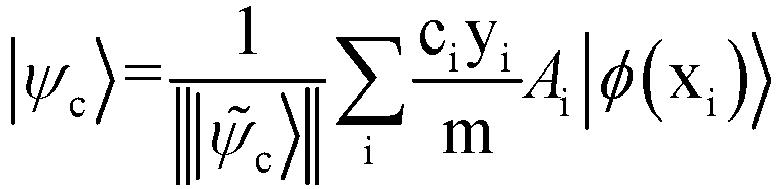

- Exemplarily, assuming that the training data set includes two pieces of training data: training data 1 and training data 2, m is 2. Assuming that the first index information is 11, the first training data includes the training data 1 and the training data 2, the target parameter includes


- In substep 2, the quantum computer generates the quantum state of the second index information according to the second training data and the second index information.
- The quantum state of the second index information is generated in a similar manner as the quantum state of the first index information. For description of generating the quantum state of the second index information, one may refer to the foregoing description of generating the quantum state of the first index information, and details are not described herein again.
- In substep 3, the quantum computer generates the inner product between the quantum state of the first index information and the quantum state of the second index information.
- The inner product of the quantum states of every two pieces of index information in the working set is calculated in a same manner as the inner product between the quantum state of the first index information and the quantum state of the second index information.
- In an exemplary embodiment, the classifier updates the working set during each training, so that training data used in different training is different. The training method of the foregoing classifier further includes the following steps 1 to 5.
- In step 1, in t-th training of the classifier, the classical computer determines an initial boundary vector of the classifier, t being a positive integer.
- In the embodiment of the present disclosure, the initial boundary vector is an initial answer to the optimization problem of the classifier, and is a boundary vector of the classifier that does not finish training. During each training, the classical computer obtains an initial boundary vector corresponding to the training. For example, in the t-th training, the classical computer obtains the initial boundary vector corresponding to the t-th training.
- In step 2, the classical computer provides the initial boundary vector to the quantum computer.
- In an embodiment, the classical computer stores the initial boundary vector in the QRAM. The quantum computer obtains the initial boundary vector from the QRAM.
- In step 3, the quantum computer determines a prediction estimation result of each round of cycle in the i-th training according to a quantum state of training data of each round of cycle in the t-th training, the initial boundary vector, and a quantum state of index information in a working set used in the t-th training.
- In an embodiment, the step includes the following substeps 1 and 2.
- In substep 1, the quantum computer determines a sum of products of each second vector element in the initial boundary vector and a quantum state of index information corresponding to the second vector element in the working set used in the t-th training as a second quantum state.
- In substep 2, the quantum computer determines an inner product between the second quantum state and the quantum state of the training data of each round of cycle in the t-th training to obtain the prediction estimation result of each round of cycle in the t-th training.
- A prediction estimation result of an i-th round of cycle in the t-th training may be determined in the following formula:

- The second quantum state is represented by

- Exemplarily, for a first round of cycle in the t-th training, if the working set used in the t-th training includes the following index information: 01, 10, and 11, where 01 represents 1, 10 represents 2, and 11 represents 3, the second vector elements are the first, second, and third vector elements in the initial boundary vector, and a prediction estimation result of the first round of cycle may be calculated by using the following formula: α 1〈ψ 01, φ(x 1)〉+α 2〈ψ10, φ(x 1)〉+α 3〈ψ 11, φ(x 1)〉.
- In step 4, the classical computer generates newly added index information according to the prediction estimation result of each round of cycle in the t-th training.
- In an example, the classical computer determines that an i-th element in the newly added index information is 1, in a case that a prediction estimation result of an i-th round of cycle in the t-th training is less than a preset threshold,.
- In another example, the classical computer determines that the i-th element in the newly added index information is 0, in a case that the prediction estimation result of the i-th round of cycle in the t-th training is greater than or equal to the preset threshold, i being a positive integer.
- In an implementation, the preset threshold is 1. In a case that the prediction estimation result of the i-th round of cycle in the t-th training is less than 1, the classical computer determines that the i-th element in the newly added index information is 1. In a case that the prediction estimation result of the i-th round of cycle in the t-th training is greater than or equal to 1, the classical computer determines that the i-th element in the newly added index information is 0.
- The foregoing example is still used. Assuming that the training data set includes three pieces of training data, each training includes three rounds of cycles. If the prediction estimation result of the first round of cycle is 1.1, the first element in the newly added index information is 0. If a prediction estimation result of the second round of cycle is 0.6, the second element in the newly added index information is 1. If a prediction estimation result of the third round of cycle is 0.8, the third element in the newly added index information is 1, that is, the newly added index information is 011.
- In step 5, the classical computer adds the newly added index information to the working set.
- In the embodiment of the present disclosure, an updated working set is used for next training of the classifier. In an embodiment, after the newly added index information is determined, the classical computer transmits a target parameter corresponding to the newly added index information to the QRAM, so that the quantum computer obtains, from the QRAM, training data corresponding to the newly added index information and the target parameter corresponding to the newly added index information.
- The foregoing example is still used. The classical computer adds 011 to the working set, and performs (t+1)-th training of the classifier by using the updated working set. In an implementation, when the number of times of training reaches a preset number, the classical computer stops training, and determines the boundary vector obtained during the last training as the boundary vector of the classifier.
- In an implementation,
FIG. 8 is a schematic diagram of a classifier classification method according to another embodiment of the present disclosure. The quantum computer includes a QRAM. - The classical computer obtains a training data set. The training data set includes m pieces of training data and standard labels of the training data. The classical computer initializes the working set, and the working set includes at least one piece of index information. That is, the classical computer randomly selects index information from the working set, and transmits a target parameter corresponding to the index information and m pieces of training data to the QRAM.
- The quantum computer calculates an inner product of the quantum states of every two pieces of index information in the working set according to the data stored in the QRAM, to generate an inner product set.
- The classical computer generates a matrix according to the inner product set, and maps the matrix to a positive semidefinite cone to obtain a positive semidefinite matrix; generates an optimization problem of a classifier according to the positive semidefinite matrix and the amount of training data, processes the optimization problem, and transmits an obtained initial boundary vector to the QRAM.
- The quantum computer determines a prediction estimation result according to the data and the initial boundary vector stored in the QRAM.
- The classical computer updates the working set according to the prediction estimation result, and detects whether a training ending condition is met. When the ending condition is met, the classical computer outputs a final classifier (a boundary vector) to the QRAM. When the ending condition is not met, the classical computer stores the training data corresponding to the newly added index information in the QRAM, and performs training again.
- In the following system embodiments of the present disclosure, for details not disclosed, one may refer to the method embodiments of the present disclosure.
-
FIG. 9 is a schematic diagram of a data classification system according to an embodiment of the present disclosure. Thesystem 900 includes aclassical computer 910 and aquantum computer 920. - The
classical computer 910 is configured to obtain to-be-classified data, and provide the to-be-classified data to the quantum computer. - The
quantum computer 920 is configured to perform feature mapping on the to-be-classified data by using a quantum circuit to obtain a quantum state of the to-be-classified data; determine an estimation result according to a boundary vector of a classifier, the quantum state of the to-be-classified data, and a quantum state of index information corresponding to the boundary vector; and transmit the estimation result to theclassical computer 910. The quantum state of the index information corresponding to the boundary vector represents superposition of feature maps of training data used by the classifier during training. - The
classical computer 910 is further configured to determine a classification result of the to-be-classified data according to the estimation result. - In an exemplary embodiment, the
quantum computer 920 is configured to determine a sum of products of each first vector element in the boundary vector and a quantum state of index information corresponding to the first vector element as a first quantum state. - The
quantum computer 920 is configured to determine an inner product between the first quantum state and the quantum state of the to-be-classified data to obtain the estimation result. - In an exemplary embodiment, the
quantum computer 920 is configured to determine the quantum state of the to-be-classified data according to a sum of products of each feature value in a feature map of the to-be-classified data and a quantum state corresponding to the feature value by using the quantum circuit. - In an exemplary embodiment, the
classical computer 910 is configured to determine that the to-be-classified data pertains to a first category, in a case that the estimation result is a positive value. - The
classical computer 910 is configured to determine that the to-be-classified data pertains to a second category, in a case that the estimation result is a negative value. - In an exemplary embodiment, the to-be-classified data includes a character, and the classification result includes a character recognition result of the character.
- Alternatively, the to-be-classified data includes a medical diagnosis image, and the classification result includes an image recognition result of the medical diagnosis image.
- Alternatively, the to-be-classified data includes text information in a social application, and the classification result includes an emotion recognition result of the text information.
- Alternatively, the to-be-classified data includes molecular information, and the classification result includes a property recognition result of the molecular information.
- Alternatively, the to-be-classified data includes material information, and the classification result includes a property recognition result of the material information.
- In summary, in the technical solution provided in the embodiment of the present disclosure, the quantum computer determines an estimation result according to a boundary vector of a classifier, a quantum state of to-be-classified data, and a quantum state of index information corresponding to the boundary vector, so that the classical computer determines a classification result of the to-be-classified data according to the estimation result. The quantum state of the index information corresponding to the boundary vector represents the superposition of the feature maps of the training data used by the classifier during training. Because the classifier in the present disclosure is not limited to use feature maps corresponding to shift-invariant kernels, and the feature space is not limited, a better feature space can be found according to the classifier in the present disclosure to classify the to-be-classified data. That is, the boundary vector obtained in the present disclosure is more accurate, and the classification precision of the classifier is higher, thereby obtaining a more accurate final classification result.
-
FIG. 10 is a schematic diagram of a classifier training system according to an embodiment of the present disclosure. Thesystem 1000 includes aclassical computer 1010 and aquantum computer 1020. - The
classical computer 1010 is configured to obtain a training data set. The training data set includes m pieces of training data and standard labels of the training data, and m is a positive integer. - The
quantum computer 1020 is configured to determine an inner product of quantum states of every two pieces of index information in a working set, to generate an inner product set. The working set includes at least two pieces of index information, the index information indicates training data used in current training, and the quantum state of the index information represents superposition of feature maps of the training data used in the current training. - The
classical computer 1010 is further configured to generate an optimization problem of a classifier according to the inner product set, and train the classifier according to the optimization problem of the classifier to obtain a boundary vector of the classifier. - In an exemplary embodiment, the
classical computer 1010 is configured to select first index information and second index information from the working set, and transmit the m pieces of training data to a quantum random access memory (QRAM). - The
quantum computer 1020 is configured to determine, according to the first index information, first training data from the m pieces of training data stored in the QRAM; determine, according to the second index information, second training data from the m pieces of training data stored in the QRAM; and generate an inner product between a quantum state of the first index information and a quantum state of the second index information according to the first training data, the second training data, the first index information, and the second index information. The first index information is used for indicating the first training data used in current training, and the second index information is used for indicating the second training data used in the current training. - In an exemplary embodiment, the
quantum computer 1020 is configured to generate the quantum state of the first index information according to the first training data and the first index information. - The
quantum computer 1020 is configured to generate the quantum state of the second index information according to the second training data and the second index information. - The
quantum computer 1020 is configured to generate the inner product between the quantum state of the first index information and the quantum state of the second index information. - In an exemplary embodiment, the
classical computer 1010 is configured to calculate a target parameter according to the first index information, a standard label of the first training data, an amount m of training data, and a preset constant, and transmit the target parameter to the QRAM. - The
quantum computer 1020 is configured to perform feature mapping on the first training data by using a quantum circuit to obtain a quantum state of the first training data, and determine a quantum state of the first index information according to the quantum state of the first training data and the target parameter. - In an exemplary embodiment, the
classical computer 1010 is configured to generate a matrix according to the inner product set, and map the matrix to a positive semidefinite cone to obtain a positive semidefinite matrix. - The
classical computer 1010 is further configured to generate an optimization problem of the classifier according to the positive semidefinite matrix and the amount m of training data. - In an exemplary embodiment, the
classical computer 1010 is further configured to determine an initial boundary vector of the classifier in t-th training of the classifier, and provide the initial boundary vector to the quantum computer, t being a positive integer, and the initial boundary vector being an initial answer to the optimization problem of the classifier. - The
quantum computer 1020 is further configured to determine a prediction estimation result of each round of cycle in the t-th training according to a quantum state of training data of each round of cycle in the t-th training, the initial boundary vector, and a quantum state of index information in a working set used in the t-th training. - The
classical computer 1010 is further configured to generate newly added index information according to the prediction estimation result of each round of cycle in the t-th training; and add the newly added index information to the working set. An updated working set is used for next training of the classifier. - In an exemplary embodiment, the
quantum computer 1020 is configured to determine a sum of products of each second vector element in the initial boundary vector and a quantum state of index information corresponding to the second vector element in the working set used in the t-th training, as a second quantum state. - The
quantum computer 1020 is configured to determine an inner product between the second quantum state and the quantum state of the training data of each round of cycle in the t-th training to obtain the prediction estimation result of each round of cycle in the t-th training. - In an exemplary embodiment, the
classical computer 1010 is configured to determine that an i-th element in the newly added index information is 1, in a case that a prediction estimation result of an i-th round of cycle in the t-th training is less than a preset threshold. Theclassical computer 1010 is configured to determine that the i-th element in the newly added index information is 0, in a case that the prediction estimation result of the i-th round of cycle in the t-th training is greater than or equal to the preset threshold, i being a positive integer. - In summary, in the technical solution provided in the embodiment of the present disclosure, the classical computer obtains a training data set; the quantum computer calculates an inner product of quantum states of every two pieces of index information in a working set, to generate an inner product set; the classical computer generates an optimization problem of a classifier according to the inner product set, and trains the classifier according to the optimization problem to obtain a boundary vector of the classifier. The quantum state of the index information represents the superposition of the feature maps of the training data used by the classifier during training. Because the classifier in the present disclosure is not limited to use feature maps corresponding to shift-invariant kernels, and the feature space is not limited, a better feature space can be found according to the classifier in the present disclosure to classify the to-be-classified data. That is, the boundary vector obtained in the present disclosure is more accurate, and the classification precision of the classifier is higher, thereby obtaining a more accurate final classification result.
- The system and method embodiments provided described above share the same concept. For the specific implementation process, one may refer to description of the method embodiments, and details are not described herein again.
- A person of ordinary skill in the art may understand that all or some of the steps of the foregoing embodiments may be implemented by hardware, or may be implemented a program instructing related hardware. The program may be stored in a computer-readable storage medium. The storage medium may be: a read only memory, a magnetic disk, or an optical disc.
- Exemplary embodiments of the present disclosure are described above, and are not intended to limit the present disclosure. Any modification, equivalent replacement, or improvement and the like made within the spirit and principle of the present disclosure fall within the protection scope of the present disclosure.
Claims (15)
- A data classification method, comprising:obtaining, by a classical computer, to-be-classified data, and providing, by the classical computer, the to-be-classified data to a quantum computer;performing, by the quantum computer, feature mapping on the to-be-classified data by using a quantum circuit to obtain a quantum state of the to-be-classified data, determining an estimation result according to a boundary vector of a classifier, the quantum state of the to-be-classified data, and a quantum state of index information corresponding to the boundary vector, and transmitting the estimation result to the classical computer, wherein the quantum state of the index information corresponding to the boundary vector represents superposition of feature maps of training data used by the classifier during training; anddetermining, by the classical computer, a classification result of the to-be-classified data according to the estimation result.
- The method according to claim 1, wherein the determining, by the quantum computer, an estimation result according to a boundary vector of a classifier, the quantum state of the to-be-classified data, and a quantum state of index information corresponding to the boundary vector comprises:calculating, by the quantum computer, a sum of products of each first vector element in the boundary vector and a quantum state of index information corresponding to the first vector element, as a first quantum state; andcalculating, by the quantum computer, an inner product between the first quantum state and the quantum state of the to-be-classified data to obtain the estimation result.
- The method according to claim 1, wherein the performing, by the quantum computer, feature mapping on the to-be-classified data by using a quantum circuit to obtain a quantum state of the to-be-classified data comprises:
determining, by the quantum computer, the quantum state of the to-be-classified data according to a sum of products of each feature value in a feature map of the to-be-classified data and a quantum state corresponding to the feature value by using the quantum circuit. - The method according to claim 1, wherein the determining, by the classical computer, a classification result of the to-be-classified data according to the estimation result comprises:determining, by the classical computer, that the to-be-classified data pertains to a first category, in a case that the estimation result is a positive value; anddetermining, by the classical computer, that the to-be-classified data pertains to a second category, in a case that the estimation result is a negative value.
- The method according to any one of claims 1 to 4, whereinthe to-be-classified data comprises a character, and the classification result comprises a character recognition result of the character;
orthe to-be-classified data comprises a medical diagnosis image, and the classification result comprises an image recognition result of the medical diagnosis image;
orthe to-be-classified data comprises text information in a social application, and the classification result comprises an emotion recognition result of the text information;
orthe to-be-classified data comprises molecular information, and the classification result comprises a property recognition result of the molecular information;
orthe to-be-classified data comprises material information, and the classification result comprises a property recognition result of the material information. - A classifier training method, comprising:obtaining, by a classical computer, a training data set, wherein the training data set comprises m pieces of training data and standard labels of the training data, m is a positive integer;calculating, by a quantum computer, an inner product of quantum states of every two pieces of index information in a working set, to generate an inner product set, wherein the working set comprises at least two pieces of index information, the index information indicates training data used in current training, the quantum state of the index information represents superposition of feature maps of the training data used in the current training; andgenerating, by the classical computer, an optimization problem of a classifier according to the inner product set, and training the classifier according to the optimization problem of the classifier to obtain a boundary vector of the classifier.
- The method according to claim 6, wherein the determining, by a quantum computer, an inner product of quantum states of every two pieces of index information in a working set, to generate an inner product set comprises:selecting, by the classical computer, first index information and second index information from the working set, and transmitting the m pieces of training data to a quantum random access memory ,QRAM,; anddetermining, by the quantum computer according to the first index information, first training data from the m pieces of training data stored in the QRAM, determining, by the quantum computer according to the second index information, second training data from the m pieces of training data stored in the QRAM; and generating an inner product between a quantum state of the first index information and a quantum state of the second index information according to the first training data, the second training data, the first index information, and the second index information, wherein the first index information indicates the first training data used in the current training, and the second index information indicates the second training data used in the current training.
- The method according to claim 7, wherein the generating, by the quantum computer, an inner product between a quantum state of the first index information and a quantum state of the second index information according to the first training data, the second training data, the first index information, and the second index information comprises:generating, by the quantum computer, the quantum state of the first index information according to the first training data and the first index information;generating, by the quantum computer, the quantum state of the second index information according to the second training data and the second index information; andgenerating, by the quantum computer, the inner product between the quantum state of the first index information and the quantum state of the second index information.
- The method according to claim 8, wherein the generating, by the quantum computer, the quantum state of the first index information according to the first training data and the first index information comprises:calculating, by the classical computer, a target parameter according to the first index information, standard labels of the first training data, the number m of the training data, and a preset constant, and transmitting the target parameter to the QRAM; andperforming, by the quantum computer, feature mapping on the first training data by using a quantum circuit to obtain a quantum state of the first training data, and determining a quantum state of the first index information according to the quantum state of the first training data and the target parameter.
- The method according to claim 6, wherein the generating, by the classical computer, an optimization problem of a classifier according to the inner product set comprises:generating, by the classical computer, a matrix according to the inner product set, and mapping the matrix to a positive semidefinite cone to obtain a positive semidefinite matrix; andgenerating, by the classical computer, the optimization problem of the classifier according to the positive semidefinite matrix and the number m of training data.
- The method according to any one of claims 6 to 10, further comprising:determining, by the classical computer, an initial boundary vector of the classifier in a t-th training of the classifier, and providing the initial boundary vector to the quantum computer, wherein t is a positive integer, the initial boundary vector is an initial answer to the optimization problem of the classifier;determining, by the quantum computer, a prediction estimation result of each round of cycle in the t-th training according to a quantum state of training data of each round of cycle in the t-th training, the initial boundary vector, and a quantum state of index information in a working set used in the t-th training; andgenerating, by the classical computer, newly added index information according to the prediction estimation result of each round of cycle in the t-th training, and adding the newly added index information to the working set, wherein an updated working set is used for next training of the classifier.
- The method according to claim 11, wherein the determining, by the quantum computer, a prediction estimation result of each round of cycle in the t-th training according to a quantum state of training data of each round of cycle in the t-th training, the initial boundary vector, and a quantum state of index information in a working set used in the t-th training comprises:calculating, by the quantum computer, a sum of products of each second vector element in the initial boundary vector and a quantum state of index information corresponding to the second vector element in the working set used in the t-th training, as a second quantum state; andcalculating, by the quantum computer, an inner product between the second quantum state and the quantum state of the training data of each round of cycle in the t-th training to obtain the prediction estimation result of each round of cycle in the t-th training.
- The method according to claim 11, wherein the generating, by the classical computer, newly added index information according to the prediction estimation result of each round of cycle in the t-th training comprises:determining, by the classical computer, that an i-th element in the newly added index information is 1, in a case that a prediction estimation result of an i-th round of cycle in the t-th training is less than a preset threshold; anddetermining, by the classical computer, that the i-th element in the newly added index information is 0, in a case that the prediction estimation result of the i-th round of cycle in the t-th training is greater than or equal to the preset threshold,wherein i is a positive integer.
- A data classification system, comprising a classical computer and a quantum computer, whereinthe classical computer is configured to obtain to-be-classified data, and provide the to-be-classified data to the quantum computer;the quantum computer is configured to perform feature mapping on the to-be-classified data by using a quantum circuit to obtain a quantum state of the to-be-classified data, determine an estimation result according to a boundary vector of a classifier, the quantum state of the to-be-classified data, and a quantum state of index information corresponding to the boundary vector, and transmit the estimation result to the classical computer, wherein the quantum state of the index information corresponding to the boundary vector represents superposition of feature maps of training data used by the classifier during training; andthe classical computer is further configured to determine a classification result of the to-be-classified data according to the estimation result.
- A classifier training system, comprising a classical computer and a quantum computer, whereinthe classical computer is configured to obtain a training data set, wherein the training data set comprises m pieces of training data and standard labels of the training data, m is a positive integer;the quantum computer is configured to calculate an inner product of quantum states of every two pieces of index information in a working set, to generate an inner product set, wherein the working set comprises at least two pieces of index information, the index information indicates training data used in current training, the quantum state of the index information represents superposition of feature maps of the training data used in the current training; andthe classical computer is further configured to generate an optimization problem of a classifier according to the inner product set, and train the classifier according to the optimization problem of the classifier to obtain a boundary vector of the classifier.
Applications Claiming Priority (2)
| Application Number | Priority Date | Filing Date | Title |
|---|---|---|---|
| CN202010446946.6A CN112651418B (en) | 2020-05-25 | 2020-05-25 | Data classification method, classifier training method and system |
| PCT/CN2021/073645 WO2021238279A1 (en) | 2020-05-25 | 2021-01-25 | Data classification method, and classifier training method and system |
Publications (2)
| Publication Number | Publication Date |
|---|---|
| EP3944149A1 true EP3944149A1 (en) | 2022-01-26 |
| EP3944149A4 EP3944149A4 (en) | 2022-06-01 |
Family
ID=75346257
Family Applications (1)
| Application Number | Title | Priority Date | Filing Date |
|---|---|---|---|
| EP21759226.0A Pending EP3944149A4 (en) | 2020-05-25 | 2021-01-25 | DATA CLASSIFICATION METHODS AND METHODS AND SYSTEM FOR TRAINING CLASSIFIERS |
Country Status (6)
| Country | Link |
|---|---|
| US (1) | US12099573B2 (en) |
| EP (1) | EP3944149A4 (en) |
| JP (1) | JP7293387B2 (en) |
| KR (1) | KR102618916B1 (en) |
| CN (1) | CN112651418B (en) |
| WO (1) | WO2021238279A1 (en) |
Families Citing this family (13)
| Publication number | Priority date | Publication date | Assignee | Title |
|---|---|---|---|---|
| CN112651418B (en) * | 2020-05-25 | 2022-03-08 | 腾讯科技(深圳)有限公司 | Data classification method, classifier training method and system |
| CA3196122A1 (en) * | 2020-10-19 | 2022-04-28 | Jarrod Ryan MCCLEAN | Quantum computing with kernel methods for machine learning |
| WO2023125857A1 (en) * | 2021-12-30 | 2023-07-06 | 本源量子计算科技(合肥)股份有限公司 | Model training method based on machine learning framework system and related device |
| CN114372539B (en) * | 2022-03-22 | 2022-07-15 | 合肥本源量子计算科技有限责任公司 | Classification method and related equipment based on machine learning framework |
| CN114419380A (en) * | 2022-03-31 | 2022-04-29 | 苏州浪潮智能科技有限公司 | Image identification method and device, electronic equipment and storage medium |
| CN116933879B (en) * | 2022-04-02 | 2025-08-12 | 本源量子计算科技(合肥)股份有限公司 | Quantum state determination method and device |
| US12579459B2 (en) | 2022-07-13 | 2026-03-17 | International Business Machines Corporation | Quantum circuit for transformation of mixed state vectors |
| US12561594B2 (en) | 2022-07-13 | 2026-02-24 | International Business Machines Corporation | Quantum circuits for matrix trace estimation |
| US12505370B2 (en) | 2022-07-13 | 2025-12-23 | International Business Machines Corporation | Linear-depth quantum system for topological data analysis |
| WO2024182883A1 (en) | 2023-03-06 | 2024-09-12 | Qoherent Inc. | Quantum modulation classifier system and method |
| CN116821341B (en) * | 2023-06-29 | 2025-08-12 | 本源量子计算科技(合肥)股份有限公司 | Text classification method and device, medium and electronic device |
| JP7651759B1 (en) | 2024-05-15 | 2025-03-26 | ソフトバンク株式会社 | Quantum computer, computer system, control method thereof, and control program |
| CN120508864B (en) * | 2025-07-22 | 2025-11-14 | 中国电信股份有限公司 | Data classification method, device, equipment, medium and product |
Family Cites Families (16)
| Publication number | Priority date | Publication date | Assignee | Title |
|---|---|---|---|---|
| US7448724B2 (en) * | 2005-12-05 | 2008-11-11 | Silverbrook Research Pty Ltd | Method of maintaining a printhead using a maintenance belt |
| US7895142B2 (en) * | 2007-09-27 | 2011-02-22 | Siemens Aktiengesellschaft | Method and apparatus for quantum adiabatic pattern recognition |
| US11295207B2 (en) | 2014-12-05 | 2022-04-05 | Microsoft Technology Licensing, Llc | Quantum deep learning |
| CN104504601B (en) * | 2015-01-15 | 2015-10-28 | 曹东 | Based on the quantum information feature extracting method of CTP finance data |
| CN106650808A (en) * | 2016-12-20 | 2017-05-10 | 北京工业大学 | Image classification method based on quantum nearest-neighbor algorithm |
| CN107092931B (en) * | 2017-04-24 | 2020-07-03 | 河北工业大学 | Method for identifying dairy cow individuals |
| GB201801627D0 (en) * | 2018-02-01 | 2018-03-21 | Siemens Healthcare Ltd | Image autoencoding for quantum machine learning |
| CN108414923A (en) | 2018-02-05 | 2018-08-17 | 武汉大学 | A kind of analog-circuit fault diagnosis method based on the extraction of depth confidence network characterization |
| CN108921049B (en) * | 2018-06-14 | 2021-08-03 | 华东交通大学 | Tumor cell image recognition device and equipment based on quantum gate circuit neural network |
| CN109242223B (en) * | 2018-11-26 | 2021-09-21 | 武汉理工光科股份有限公司 | Quantum support vector machine evaluation and prediction method for urban public building fire risk |
| US11748665B2 (en) * | 2019-04-03 | 2023-09-05 | International Business Machines Corporation | Quantum feature kernel alignment |
| US11906309B2 (en) * | 2019-09-27 | 2024-02-20 | Here Global B.V. | Method and apparatus for providing a map matcher tolerant to wrong map features |
| CN110909796B (en) * | 2019-11-22 | 2022-05-17 | 浪潮电子信息产业股份有限公司 | A kind of image classification method and related device |
| CN111079704A (en) * | 2019-12-31 | 2020-04-28 | 厦门理工学院 | A face recognition method and device based on quantum computing |
| TWI808317B (en) * | 2020-04-01 | 2023-07-11 | 阿證科技股份有限公司 | Quantum Resistant System for Key Management Mechanism |
| CN112651418B (en) * | 2020-05-25 | 2022-03-08 | 腾讯科技(深圳)有限公司 | Data classification method, classifier training method and system |
-
2020
- 2020-05-25 CN CN202010446946.6A patent/CN112651418B/en active Active
-
2021
- 2021-01-25 JP JP2021553843A patent/JP7293387B2/en active Active
- 2021-01-25 EP EP21759226.0A patent/EP3944149A4/en active Pending
- 2021-01-25 WO PCT/CN2021/073645 patent/WO2021238279A1/en not_active Ceased
- 2021-01-25 KR KR1020217028002A patent/KR102618916B1/en active Active
- 2021-09-16 US US17/476,754 patent/US12099573B2/en active Active
Also Published As
| Publication number | Publication date |
|---|---|
| US20220058435A1 (en) | 2022-02-24 |
| EP3944149A4 (en) | 2022-06-01 |
| JP7293387B2 (en) | 2023-06-19 |
| CN112651418A (en) | 2021-04-13 |
| WO2021238279A1 (en) | 2021-12-02 |
| CN112651418B (en) | 2022-03-08 |
| KR102618916B1 (en) | 2023-12-27 |
| US12099573B2 (en) | 2024-09-24 |
| KR20210148095A (en) | 2021-12-07 |
| JP2022537618A (en) | 2022-08-29 |
Similar Documents
| Publication | Publication Date | Title |
|---|---|---|
| EP3944149A1 (en) | Data classification method, and classifier training method and system | |
| US12039012B2 (en) | Systems and methods for heterogeneous federated transfer learning | |
| US11593458B2 (en) | System for time-efficient assignment of data to ontological classes | |
| US11636314B2 (en) | Training neural networks using a clustering loss | |
| US20210295166A1 (en) | Partitioned machine learning architecture | |
| CN109564575A (en) | Classified using machine learning model to image | |
| US11663397B1 (en) | Digital posting match recommendation apparatus and method | |
| US20190065899A1 (en) | Distance Metric Learning Using Proxies | |
| WO2024118603A1 (en) | Methods and systems for fast inference from machine learning models | |
| US20250148280A1 (en) | Techniques for learning co-engagement and semantic relationships using graph neural networks | |
| WO2024192210A1 (en) | Apparatus and method for generating an educational action datum using machine-learning | |
| Gao et al. | Generative adversarial network–assisted image classification for imbalanced tire X-ray defect detection | |
| Don et al. | A fusion of supervised contrastive learning and variational quantum classifiers | |
| Shahid et al. | Enhancing movie recommendations using quantum support vector machine (QSVM) M. Shahid et al. | |
| US10380480B2 (en) | Changeover from one neural network to another neural network | |
| Yan et al. | Facial expression recognition (FER) system using deep learning | |
| Li et al. | Graph-based vision transformer with sparsity for training on small datasets from scratch | |
| Wu et al. | A multi-topology quantum convolutional neural network with qubit-measurement attention for image classification | |
| CN113486202B (en) | A method for few-shot image classification | |
| Nayak et al. | Fostering synergy: Exploring the intersection of operations and human resources management through an RF-SVM approach | |
| CN114898184A (en) | Model training method, data processing method and device and electronic equipment | |
| US20260087326A1 (en) | Generating synthetic data | |
| Stow et al. | Interpreting Machine Learning Predictions with SHAP and LIME for Transparent Decision Making | |
| CN117609761A (en) | Abnormality detection method and device for time sequence data, electronic equipment and storage medium | |
| CN110348485A (en) | A kind of generation method, device and the storage medium of more classification samples classifiers |
Legal Events
| Date | Code | Title | Description |
|---|---|---|---|
| STAA | Information on the status of an ep patent application or granted ep patent |
Free format text: STATUS: UNKNOWN |
|
| STAA | Information on the status of an ep patent application or granted ep patent |
Free format text: STATUS: THE INTERNATIONAL PUBLICATION HAS BEEN MADE |
|
| PUAI | Public reference made under article 153(3) epc to a published international application that has entered the european phase |
Free format text: ORIGINAL CODE: 0009012 |
|
| STAA | Information on the status of an ep patent application or granted ep patent |
Free format text: STATUS: REQUEST FOR EXAMINATION WAS MADE |
|
| 17P | Request for examination filed |
Effective date: 20210903 |
|
| AK | Designated contracting states |
Kind code of ref document: A1 Designated state(s): AL AT BE BG CH CY CZ DE DK EE ES FI FR GB GR HR HU IE IS IT LI LT LU LV MC MK MT NL NO PL PT RO RS SE SI SK SM TR |
|
| REG | Reference to a national code |
Ref country code: DE Ref legal event code: R079 Free format text: PREVIOUS MAIN CLASS: G06K0009620000 Ipc: G06N0010600000 |
|
| A4 | Supplementary search report drawn up and despatched |
Effective date: 20220503 |
|
| RIC1 | Information provided on ipc code assigned before grant |
Ipc: G06V 10/70 20220101ALI20220426BHEP Ipc: G06N 20/10 20190101ALI20220426BHEP Ipc: G06N 10/60 20220101AFI20220426BHEP |
|
| RAP3 | Party data changed (applicant data changed or rights of an application transferred) |
Owner name: TENCENT TECHNOLOGY (SHENZHEN) COMPANY LIMITED |
|
| DAV | Request for validation of the european patent (deleted) | ||
| DAX | Request for extension of the european patent (deleted) | ||
| STAA | Information on the status of an ep patent application or granted ep patent |
Free format text: STATUS: EXAMINATION IS IN PROGRESS |
|
| 17Q | First examination report despatched |
Effective date: 20250526 |