EP3944147A1 - Target detection method, model training method, device, apparatus and storage medium - Google Patents
Target detection method, model training method, device, apparatus and storage medium Download PDFInfo
- Publication number
- EP3944147A1 EP3944147A1 EP20772861.9A EP20772861A EP3944147A1 EP 3944147 A1 EP3944147 A1 EP 3944147A1 EP 20772861 A EP20772861 A EP 20772861A EP 3944147 A1 EP3944147 A1 EP 3944147A1
- Authority
- EP
- European Patent Office
- Prior art keywords
- image
- domain
- loss function
- trained
- network model
- Prior art date
- Legal status (The legal status is an assumption and is not a legal conclusion. Google has not performed a legal analysis and makes no representation as to the accuracy of the status listed.)
- Pending
Links
Images





Classifications
-
- G—PHYSICS
- G06—COMPUTING OR CALCULATING; COUNTING
- G06V—IMAGE OR VIDEO RECOGNITION OR UNDERSTANDING
- G06V10/00—Arrangements for image or video recognition or understanding
- G06V10/20—Image preprocessing
- G06V10/255—Detecting or recognising potential candidate objects based on visual cues, e.g. shapes
-
- G—PHYSICS
- G06—COMPUTING OR CALCULATING; COUNTING
- G06F—ELECTRIC DIGITAL DATA PROCESSING
- G06F18/00—Pattern recognition
- G06F18/20—Analysing
- G06F18/21—Design or setup of recognition systems or techniques; Extraction of features in feature space; Blind source separation
- G06F18/214—Generating training patterns; Bootstrap methods, e.g. bagging or boosting
-
- G—PHYSICS
- G06—COMPUTING OR CALCULATING; COUNTING
- G06F—ELECTRIC DIGITAL DATA PROCESSING
- G06F18/00—Pattern recognition
- G06F18/20—Analysing
- G06F18/21—Design or setup of recognition systems or techniques; Extraction of features in feature space; Blind source separation
- G06F18/217—Validation; Performance evaluation; Active pattern learning techniques
-
- G—PHYSICS
- G06—COMPUTING OR CALCULATING; COUNTING
- G06N—COMPUTING ARRANGEMENTS BASED ON SPECIFIC COMPUTATIONAL MODELS
- G06N3/00—Computing arrangements based on biological models
- G06N3/02—Neural networks
- G06N3/04—Architecture, e.g. interconnection topology
- G06N3/045—Combinations of networks
-
- G—PHYSICS
- G06—COMPUTING OR CALCULATING; COUNTING
- G06N—COMPUTING ARRANGEMENTS BASED ON SPECIFIC COMPUTATIONAL MODELS
- G06N3/00—Computing arrangements based on biological models
- G06N3/02—Neural networks
- G06N3/08—Learning methods
-
- G—PHYSICS
- G06—COMPUTING OR CALCULATING; COUNTING
- G06N—COMPUTING ARRANGEMENTS BASED ON SPECIFIC COMPUTATIONAL MODELS
- G06N7/00—Computing arrangements based on specific mathematical models
- G06N7/01—Probabilistic graphical models, e.g. probabilistic networks
-
- G—PHYSICS
- G06—COMPUTING OR CALCULATING; COUNTING
- G06V—IMAGE OR VIDEO RECOGNITION OR UNDERSTANDING
- G06V10/00—Arrangements for image or video recognition or understanding
- G06V10/70—Arrangements for image or video recognition or understanding using pattern recognition or machine learning
- G06V10/764—Arrangements for image or video recognition or understanding using pattern recognition or machine learning using classification, e.g. of video objects
-
- G—PHYSICS
- G06—COMPUTING OR CALCULATING; COUNTING
- G06V—IMAGE OR VIDEO RECOGNITION OR UNDERSTANDING
- G06V10/00—Arrangements for image or video recognition or understanding
- G06V10/70—Arrangements for image or video recognition or understanding using pattern recognition or machine learning
- G06V10/82—Arrangements for image or video recognition or understanding using pattern recognition or machine learning using neural networks
-
- G—PHYSICS
- G06—COMPUTING OR CALCULATING; COUNTING
- G06V—IMAGE OR VIDEO RECOGNITION OR UNDERSTANDING
- G06V20/00—Scenes; Scene-specific elements
- G06V20/50—Context or environment of the image
- G06V20/56—Context or environment of the image exterior to a vehicle by using sensors mounted on the vehicle
- G06V20/58—Recognition of moving objects or obstacles, e.g. vehicles or pedestrians; Recognition of traffic objects, e.g. traffic signs, traffic lights or roads
Definitions
- the present disclosure relates to the field of artificial intelligence, and in particular, relates to a target detection method and apparatus, a model training method and apparatus, a device, and a storage medium.
- samples usually need to be divided into two independent parts, respectively being a training set and a test set
- the training set is used for supervised learning
- the supervision learning refers to a process of adjusting a parameter of a classifier by using a group of samples in a known class, to cause the classifier to achieve required performance, and is also referred to as supervised training.
- the test set is used for evaluating how well a finally selected model performs.
- a case that a domain difference between a training image and a test image is relatively large is easy to occur.
- a feature extracted by a network model is usually constrained in dependence on an adversarial loss function, so that the network model cannot identify a domain from which the training set image comes, thereby being insensitive to feature distribution domains.
- the training set image and the test set image have a natural domain distribution difference. Therefore, it is quite difficult to force the network model to blur features of the training set image and the test set image. As a result, predicting a test set image in a domain B by using a network model obtained through training with a training set image in a domain A causes a relatively poor prediction effect.
- Embodiments of the present disclosure provide a target detection method and apparatus, a model training method and apparatus, a device, and a storage medium, to perform target localization without purposely using a to-be-detected image in a style the same as that of a test set image, but convert the style of the to-be-detected image into the style of the test set image by using a cross-domain image detection model, and then perform target localization on an image obtained after conversion, thereby improving accuracy of image localization and enhancing a model prediction effect.
- a first aspect of the present disclosure provides an image-based target detection method, including:
- a second aspect of the present disclosure provides a model training method, including:
- a third aspect of the present disclosure provides a target detection apparatus, including:
- a fourth aspect of the present disclosure provides a model training apparatus, including:
- the model training apparatus further includes a detection module
- a fifth aspect of the present disclosure provides a terminal device, including: a memory, a transceiver, a processor, and a bus system,
- a sixth aspect of the present disclosure provides a server, including a memory, a transceiver, a processor, and a bus system,
- a seventh aspect of the present disclosure provides a computer-readable storage medium, the computer-readable storage medium storing program code, the program code, when run on a computer, causing the computer to perform the following model training operations:
- an image-based target detection method is provided.
- a first to-be-detected image is first obtained, the first to-be-detected image belonging to a first domain, a second to-be-detected image corresponding to the first to-be-detected image is then obtained through a cross-domain image detection model, the second to-be-detected image belonging to a second domain, and a detection result corresponding to the second to-be-detected image is finally obtained through the cross-domain image detection model, the detection result including target localization information and target class information of a target object, and the target object belonging to the first to-be-detected image.
- target localization is performed without purposely using a to-be-detected image in a style the same as that of a test set image, but the style of the to-be-detected image is converted into the style of the test set image by using the cross-domain image detection model, and then target localization is performed on an image obtained after conversion, thereby improving accuracy of image localization and enhancing a model prediction effect.
- Embodiments of the present disclosure provide an image-based target detection method and apparatus, and a model training method and apparatus, to perform target localization without purposely using a to-be-detected image in a style the same as that of a test set image, but convert the style of the to-be-detected image into the style of the test set image by using a cross-domain image detection model, and then perform target localization on an image obtained after conversion, thereby improving accuracy of image localization and enhancing a model prediction effect.
- the present disclosure proposes a cross-domain image target detection method based on adversarial learning, which is applicable to resolving a problem of low test precision caused when a deep convolutional neural network faces different distribution of training set data and test set data.
- the present disclosure may be widely used for an image target detection task, and in particular, is more significant for a case that domain distribution of a training set image and that of a test set image are different in actual application. Actually, domain distribution of a training set image and that of a test set image are different in most cases.
- a training set image used during training comes from a scenario picture of a city A, while a test set image used during an actual test comes from a scenario picture of a city B. It can be seen that scenario pictures of two cities are usually inconsistent in domain distribution.
- a training set image used during training comes from an indoor scenario picture, while a test set image used during a test comes from an outdoor scenario picture. It can be seen that indoor and outdoor scenario pictures are also inconsistent in domain distribution.
- a brand and a color of an automobile in a training set image used during training may alternatively be different from a brand and a color of an automobile in a test set image used during a test. Referring to FIG. 1, FIG.
- FIG. 1 is a schematic comparison diagram of cross-domain target detection according to an embodiment of the present disclosure.
- An image (a) and an image (b) of FIG. 1 respectively come from two types of domain distribution.
- an object as "automobile” can be detected in both of the two images, the two images differ greatly in style.
- a deep network is usually poor in generalization performance on the test set image and low in test precision, and a deep network model for target detection similarly cannot avoid the problem.
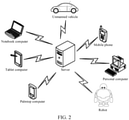
- FIG. 2 is a schematic architectural diagram of a target detection system according to an embodiment of the present disclosure.
- the model training method proposed by the present disclosure is implemented in a server, that is, two sub-network models are introduced into the server in a process of training a cross-domain image detection model.
- the first sub-network model is a pixel domain adaptation (PDA) network model
- the second sub-network model is a feature domain adaptation (FDA) network model.
- PDA pixel domain adaptation
- FDA feature domain adaptation
- the PDA network converts an original training set image into an image in a test set style, and a training set image in the test set style obtained after conversion is used as input during model training, thereby being more helpful for the cross-domain image detection model to adapt to the image in the test set style.
- the FDA network learns a feature of the image in the test set style at a feature-level constraint model. After the server obtains the cross-domain image detection model through training, a client obtains a to-be-detected image. The to-be-detected image herein and the training set image belong to the same domain distribution.
- the client inputs the to-be-detected image to the cross-domain image detection model obtained by the server through training, the cross-domain image detection model converts a style of the to-be-detected image into a style of a test set image, and ensures a realistic effect of the conversion by using an adversarial learning method, thereby generating the to-be-detected image in the style of the test set image, and enhancing a prediction effect of the cross-domain image detection model on an image in a test set domain.
- a discriminator is further introduced into the cross-domain image detection model.
- the discriminator is used for determining whether a feature learned by the cross-domain image detection model comes from the domain of the test set image. Then, it is ensured through adversarial learning that a feature learned by the to-be-detected image through the cross-domain image detection model is sufficiently similar to a feature of the test set image, so that the discriminator cannot differentiate, thereby further ensuring that the style of the to-be-detected image is fully convert into the style of the test set image during detection.
- the client may be deployed on a terminal device.
- the terminal device includes, but is not limited to, an unmanned vehicle, a robot, a tablet computer, a notebook computer, a palmtop computer, a mobile phone, a speech interaction device, and a personal computer (PC), and is not limited herein.
- Target detection aims to allocate localization information (for example, bounding box) and class information (for example, class label) to each object (such as a person, a bicycle, a motorcycle, or an automobile). It is vital to detect other transportation participants in a contemporary automated driving process, and therefore target detection plays an important role in a contemporary automated driving system. The reason is as follows: Referring to FIG. 3, FIG. 3 is a schematic diagram of a target detection effect based on an automated driving system according to an embodiment of the present disclosure. As shown in the figure, a terminal device may label an image corresponding to FIG. 3 with localization information (that is, bounding box) and class information (that is, "automobile ”) of an automobile. Referring to FIG. 4, FIG.
- a terminal device may label an image corresponding to FIG. 4 with localization information (that is, bounding box) and class information (that is, "automobile” and "pedestrian”) of an automobile and a pedestrian.
- localization information that is, bounding box
- class information that is, "automobile” and "pedestrian”
- the present disclosure is further applicable to other scenarios such as a scenario in which a robot performs a task.
- a scenario in which a robot performs a task it may be very difficult to directly obtain a real test set image in a dangerous scenario, and therefore training needs to be performed through a training set image simulated in the dangerous scenario.
- the terminal device may convert the style of the training set image into the style of the test set image through adversarial learning, so that it can be ensured, before the cross-domain image detection model learns the feature, that the training set image and the test set image come from the same domain distribution as much as possible, and then under the constraint of the adversarial loss function, the feature learned by the cross-domain image detection model based on the training set image may be closer to the feature of the test set image.
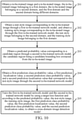
- an embodiment of the image-based target detection method in the embodiments of the present disclosure includes the following steps:
- a target detection apparatus obtains a first to-be-detected image belonging to a first domain.
- the target detection apparatus obtains the first to-be-detected image
- the target detection apparatus may be deployed on a terminal device such as a robot or an unmanned vehicle.
- the first to-be-detected image belongs to the first domain, where the first domain may refer to a specific scenario such as an indoor scenario, or may refer to distribution of a dataset such as a SimlOk dataset.
- the first to-be-detected image may be an image obtained in real time, for example, captured in real time through a camera of the terminal device, or may be an image extracted from an image database, which is not limited herein.
- the target detection apparatus obtains a second to-be-detected image corresponding to the first to-be-detected image, the second to-be-detected image belonging to a second domain, and the first domain and the second domain being different domains.
- the target detection apparatus may input the first to-be-detected image to a cross-domain image detection model, and a PDA network in the cross-domain image detection model outputs the corresponding second to-be-detected image, the second to-be-detected image belonging to the second domain, and the first domain and the second domain being different domains. That is to say, the second to-be-detected image and the first to-be-detected image belong to two different styles.
- FIG. 6 is a schematic diagram of an embodiment of a first to-be-detected image according to an embodiment of the present disclosure.
- the first to-be-detected image may be specifically a real image sampled from the Sim10k dataset.
- FIG. 7 is a schematic diagram of an embodiment of a second to-be-detected image according to an embodiment of the present disclosure.
- the second to-be-detected image and the first to-be-detected image are different in style, that is, belong to two domains.
- the to-be-trained cross-domain image detection model may include two parts, that is, a first to-be-trained network model and a second to-be-trained network model, and the two parts are trained by using a target loss function, to separately obtain a first network model corresponding to the first to-be-trained network model and a second network model corresponding to the second to-be-trained network model, where the first network model may include the PDA network, and the second network model may include an FDA network and an object detection network.
- the PDA network may be used for converting an image in the training style (that is, the first domain) into an image in the test style (that is, the second domain).
- the FDA network may be used for constraining the style of the image (that is, constraining the style of the image in the second domain after conversion), and the object detection network may be used for performing object detection on the image in the test style.
- the target detection apparatus obtains a detection result corresponding to the second to-be-detected image through a cross-domain image detection model, the detection result including target localization information and target class information of a target object, the target object being a detected object in the first to-be-detected image, the cross-domain image detection model being capable of including a first network model and a second network model, the first network model being used for converting an image from the first domain into an image in the second domain, and the second network model being used for performing region localization on the image in the second domain.
- the target detection apparatus may output the second to-be-detected image through the PDA network in the cross-domain image detection model, then the FDA network in the cross-domain image detection model may convert the second to-be-detected image into an image on which target localization is to be performed, and then the image is detected through the object detection network in the cross-domain image detection model, thereby obtaining the detection result.
- an image shown in FIG. 8 may be obtained. Referring to FIG. 8, FIG. 8 is a schematic diagram of an embodiment of an image on which target localization is to be performed according to an embodiment of the present disclosure.
- FIG. 9 is a schematic flowchart of deployment of a cross-domain image detection model according to an embodiment of the present disclosure.
- the cross-domain image detection model is pre-trained on a training set image, to obtain a relatively good model initialization weight, where the training set image belongs to a domain 1.
- training continues by using an adversarial learning method and by using both the labeled training set image and an unknown labeled test set image, where the test set image belongs to a domain 2.
- the cross-domain image detection model provided in the present disclosure has relatively high recognition precision on images in the domain 2.
- a preliminary test result indicates that, with a VGG16 convolutional neural network (CNN) structure, when the training set image comes from the Sim10k dataset and the test set image comes from the Kitti dataset, precision of performing prediction by using a related solution is about 52.7%, while precision of performing prediction by using the present disclosure may be up to 59.3%.
- the cross-domain image detection model with higher precision is obtained, the cross-domain image detection model may be directly applied to prediction of the test set image.
- the image-based target detection method first obtains the first to-be-detected image belonging to the first domain; then obtains the second to-be-detected image corresponding to the first to-be-detected image through the cross-domain image detection model, the second to-be-detected image belonging to the second domain; and finally obtains the detection result corresponding to the second to-be-detected image through the cross-domain image detection model, the detection result including the target localization information and the target class information of the target object, and the target object belonging to the first to-be-detected image.
- target localization is performed without purposely using a to-be-detected image in a style the same as that of a test set image, but the style of the to-be-detected image is converted into the style of the test set image by using the cross-domain image detection model, and then target localization is performed on an image obtained after conversion, thereby improving accuracy of image localization and enhancing a model prediction effect.
- an embodiment of the model training method in the embodiments of the present disclosure includes the following steps:
- a model training apparatus obtains a to-be-trained image and a to-be-tested image, the to-be-trained image belonging to a first domain, the to-be-tested image belonging to a second domain, and the first domain and the second domain being different domains.
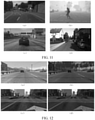
- FIG. 11 is a schematic diagram of comparing images in different domains according to an embodiment of the present disclosure. As shown in the figure, the figure provides images in four different domains, where in FIG.
- an image (a) represents an image from a Cityscapes dataset
- an image (b) represents an image from a Foggy-Cityscapes dataset
- an image (c) represents an image from a Sim10k dataset
- an image (d) represents an image from a Kitti dataset
- both the Foggy-Cityscapes dataset and the Sim10k dataset are synthetic datasets for simulating a driving scenario.
- the Foggy-Cityscapes dataset performs rendering based on a real Cityscapes dataset, to simulate a foggy weather situation.
- the Kitti dataset is used for performing a benchmark test on different vision tasks in automated driving, for example, deep estimation, three-dimensional matching, scenario or optical estimation, and object detection.
- the first domain may be the Sim10k dataset
- the second domain may be the Kitti dataset
- the first domain may alternatively be the Foggy-Cityscapes dataset, the Cityscapes dataset or the Kitti dataset
- the second domain may alternatively be the Foggy-Cityscapes dataset, the Sim10k dataset or the Cityscapes dataset, as long as it is ensured the first domain and the second domain are different. Description is made below by using an example in which the first domain is the SimlOk dataset and the second domain is the Kitti dataset. Referring to FIG. 12, FIG. 12, FIG. 12
- FIG. 12 is a schematic diagram of comparing two classes of images that may be used for training a cross-domain image detection model according to an embodiment of the present disclosure. As shown in the figure, in FIG. 12 , an image (a) and an image (c) represent images from the Sim10k dataset, and an image (b) and an image (d) represent images from the Kitti dataset.
- the model training apparatus obtains a test style image corresponding to the to-be-trained image through a first to-be-trained network model, and obtains a training style image corresponding to the to-be-tested image through the first to-be-trained network model, the test style image belonging to the second domain, and the training style image belonging to the first domain.
- the model training apparatus may input the to-be-trained image to the first to-be-trained network model (which may be, for example, a to-be-trained PDA network), the first to-be-trained network model outputs the test style image; and similarly, the model training apparatus inputs the to-be-tested image to the first to-be-trained network model, and the first to-be-trained network model outputs the training style image.
- the first to-be-trained network model which may be, for example, a to-be-trained PDA network
- the model training apparatus inputs the to-be-tested image to the first to-be-trained network model, and the first to-be-trained network model outputs the training style image.
- FIG. 13 is a schematic structural diagram of a cross-domain image detection model according to an embodiment of the present disclosure.
- a left part is a model structure of a PDA network
- the model structure is used for converting an image in a source domain style into an image in a target domain style before an FDA network is trained, and a cycle generative adversarial network (CycleGAN) may be used as the PDA network.
- CycleGAN cycle generative adversarial network
- a right part is a model structure of the FDA network, the model structure is used for feature-level adversarial training, and an object detection part enhances several additional neural layers.
- a to-be-trained image (real_s) is converted through the first to-be-trained network model (the to-be-trained PDA network) into a test style image (fake t); and a to-be-tested image (real_t) is converted through the first to-be-trained network model (the to-be-trained PDA network) into a training style image (fake_s), where the test style image (fake t) and the to-be-tested image (real t) belong to the same domain, and the training style image (fake_s) and the to-be-trained image (real_s) belong to the same domain.
- the model training apparatus obtains a predicted probability value corresponding to a candidate region through a second to-be-trained network model, the candidate region being a candidate bounding box extracted from the to-be-tested image or the test style image.
- the model training apparatus inputs the test style image (fake t) and the to-be-tested image (real t) to a discriminator in the FDA network, to determine features in all locations in the test style image (fake t) and the to-be-tested image (real t), that is, predict a probability value for a candidate bounding box (bbox) from the to-be-tested image or from the test style image, thereby obtaining a predicted probability value corresponding to a candidate region.
- bbox candidate bounding box
- the model training apparatus obtains a first prediction class probability value, a first prediction localization value, a second prediction class probability value, and a second prediction localization value that correspond to the test style image through the second to-be-trained network model.
- the model training apparatus may input the test style image (fake t) to the second to-be-trained network model, and the first prediction class probability value, the first prediction localization value, the second prediction class probability value, and the second prediction localization value are outputted through the second to-be-trained network model, where an object detection network in the cross-domain image detection model may include two parts, namely, a region proposal network (RPN) and a target detection network, the first prediction class probability value and the first prediction localization value are prediction values outputted by the RPN, and the second prediction class probability value and the second prediction localization value are prediction values outputted by the target detection network.
- RPN region proposal network
- the object detection network is used for performing feature learning and target detection.
- the object detection network may be a faster region-based convolutional neural network (R-CNN), a region-based fully convolutional network (R-FCN), or the like.
- the model training apparatus trains the first to-be-trained network model and the second to-be-trained network model by using a target loss function and according to the predicted probability value, the test style image, the training style image, the first prediction class probability value, the first prediction localization value, the second prediction class probability value, and the second prediction localization value, to obtain a cross-domain image detection model.
- the model training apparatus may train the first to-be-trained network model and the second to-be-trained network model by using the target loss function and with reference to the predicted probability value, the test style image, the training style image, the first prediction class probability value, the first prediction localization value, the second prediction class probability value, and the second prediction localization value, to obtain the cross-domain image detection model, and the cross-domain image detection model may convert the image in the first domain into the image in the second domain and then perform training, or may detect localization information and class information for the image in the first domain.
- the first to-be-trained network model may include the to-be-trained PDA network
- the second to-be-trained network model may include the FDA network and the object detection network
- the object detection network may include the RPN and the target detection network.
- FIG. 14 is a schematic diagram of an image comparison detected in an experimental result according to an embodiment of the present disclosure.
- an image (a) shows a vehicle obtained through conversion of the PDA network
- an image (b) shows a vehicle obtained through conversion of the PDA network and the FDA network. It is not difficult to see that, reproducibility and definition of the vehicle in the image (b) are higher than reproducibility and definition of the vehicle in the image (a).
- FIG. 15 is a schematic diagram of another image comparison detected in an experimental result according to the present disclosure. As shown in the figure, in FIG.
- an image (a) shows a vehicle obtained through conversion of the PDA network
- an image (b) shows a vehicle obtained through conversion of the PDA network and the FDA network. It is not difficult to see that, reproducibility and definition of the vehicle in the image (b) are likewise higher than reproducibility and definition of the vehicle in the image (a).
- the model training method first obtains the to-be-trained image and the to-be-tested image; then obtains the test style image corresponding to the to-be-trained image through the first to-be-trained network model, obtains the training style image corresponding to the to-be-tested image through the first to-be-trained network model, obtains the predicted probability value corresponding to the candidate region through the second to-be-trained network model, and obtains the first prediction class probability value, the first prediction localization value, the second prediction class probability value, and the second prediction localization value corresponding to the test style image through the second to-be-trained network model; and finally trains the first to-be-trained network model and the second to-be-trained network model by using the target loss function, to obtain the cross-domain image detection model.
- the cross-domain image detection model obtained through training may implement cross-domain image conversion, the style of the training set image can be converted into the style of the test set image by using the cross-domain image detection model, and then target localization is performed on an image obtained after conversion, thereby improving accuracy of image localization and enhancing a model prediction effect.
- the training, by the model training apparatus, the first to-be-trained network model and the second to-be-trained network model by using a target loss function and according to the predicted probability value, the test style image, the training style image, the first prediction class probability value, the first prediction localization value, the second prediction class probability value, and the second prediction localization value may include:
- the first loss function may be determined according to the to-be-trained image, the to-be-tested image, the test style image, and the training style image.
- the model training apparatus may determine the second loss function according to the predicted probability value corresponding to the to-be-tested image or the test style image.
- the model training apparatus may train the RPN according to the first prediction class probability value, the first real class probability value, the first prediction localization value, and the first real localization value generated by the RPN, and meanwhile train the target detection network according to the second prediction class probability value, the second real class probability value, the second prediction localization value, and the second real localization value generated by the target detection network. That is, the model training apparatus generates the third loss function according to the first prediction class probability value, the first real class probability value, the first prediction localization value, the first real localization value, the second prediction class probability value, the second real class probability value, the second prediction localization value, and the second real localization value.
- the model training apparatus may obtain the target loss function with reference to the first loss function, the second loss function, and the third loss function, and train the first to-be-trained network model and the second to-be-trained network model by using the target loss function.
- a method for obtaining the target loss function is provided, that is, determining the first loss function according to the test style image and the training style image; then determining the second loss function according to the predicted probability value; then determining the third loss function according to the first prediction class probability value, the first prediction localization value, the second prediction class probability value, and the second prediction localization value; and finally generating the target loss function, and training the first to-be-trained network model and the second to-be-trained network model by using the target loss function.
- a model training process may be divided into three parts which are correspondingly trained by using three loss functions respectively, thereby improving flexibility and operability of training.
- the determining, by the model training apparatus, a first loss function according to the test style image and the training style image may include:
- the first to-be-trained network model may be trained based on learning from the CycleGAN.
- a conventional GAN is unidirectionally generated, while the CycleGAN is mutually generated and the network is a ring.
- the CycleGAN is actually a unidirectional GAN from A to B plus a unidirectional GAN from B to A.
- the two GANs share two generators and are each provided with a discriminator, and therefore there are a total of two discriminators and two generators.
- One unidirectional GAN has two losses, while the CycleGAN has a total of four losses.
- G t - s and G s - t are specifically used transformation networks, which may be any deep convolutional neural network model such as a VGG network or a residual neural network (ResNet).
- a generator may be divided into two parts such as G s - t and G t - s shown in FIG. 13 , where the first generator G s - t is used for converting the original to-be-trained image into the test style image, and the second generator G t - s is used for converting the to-be-tested image into the training style image.
- a GAN may alternatively learn mapping functions G t - s and G s - t , to generate images sampled from data distribution of the to-be-tested image and data distribution of the to-be-trained image.
- structure information of a source image may be lost.
- an image generated by G s - t may be forced, by using the first loss function with cycle consistency, to have the same image effect as that of an image generated by G t - s , and vice versa.
- a specific manner of determining a first loss function according to the test style image and the training style image is provided.
- the image style can be migrated from the source domain to the target domain without paired training data, and when the first to-be-trained network model is trained, it is only required that the image in the source domain and the image in the target domain are used as input, and it is not required that image content in the source domain matches that in the target domain, thereby having flexibility.
- use of the first loss function may ensure that the training set image after two times of conversion is the same as the initial training set image as much as possible, and the test set image after two times of conversion is also the same as the initial test set image as much as possible.
- the method may further include:
- the discriminator may be used for determining a result generated by a generator and a real result, aiming to make the generated result closer to the real result, to achieve an objective of "mixing the false with the genuine ".
- the first discriminator determines that a label thereof is 1, and for the test style image, the first discriminator determines that a label thereof is 0, where 1 represents that the image determined by the first discriminator is an image in a real test set, and 0 represents that the image determined by the first discriminator is an image into which a training set picture is converted.
- the second discriminator determines that a label thereof is 1, and for the training style image, the second discriminator determines that a label thereof is 0, where 1 represents that the image determined by the second discriminator is an image in the original training set, and 0 represents that the image determined by the second discriminator is an image into which a test set picture is converted.
- the first discriminator may be used for distinguishing whether the image obtained through conversion is the real test set image, or the test style image into which the to-be-trained image is converted.
- the second discriminator may be used for distinguishing whether the image is the original training set image, or the training style image obtained through conversion.
- a manner may be further provided as follows: Reality detection is performed on the test style image through a first discriminator, and reality detection is performed on the training style image through a second discriminator.
- the model training apparatus can perform, by using discriminators, reality recognition on images generated by generators, thereby facilitating an improvement in a model training effect.
- the method may further include:
- two discriminators that is, the first discriminator D t and the second discriminator D s need to be trained, to distinguish between real images and fake images.
- the generators always attempt to generate images from which the discriminators cannot distinguish real images, and the trained discriminators can classify real images and fake images.
- L GAN D t G s ⁇ t E t ⁇ X t log D t x + E s ⁇ X s log 1 ⁇ D t G s ⁇ t s
- L GAN ( D t , G s - t ) represents the first adversarial loss function
- E s ⁇ X ( s ) represents calculating an expected value of each to-be-trained image in a to-be-trained image set
- E t ⁇ X ( t ) represents calculating an expected value of each to-be-tested image in a to-be-tested image set
- D t ( ) represents the first discriminator
- s represents an image in the first domain
- G s - t ( ) represents a network for converting the image in the first domain into an image in the second domain
- x represents an inputted image.
- a manner may be further provided as follows: The first adversarial loss function is obtained, and a model effect is determined through the first adversarial loss function.
- the method before the performing, by the model training apparatus, reality detection on the training style image through a second discriminator, the method may further include:
- two discriminators that is, the first discriminator D t and the second discriminator D s need to be trained, to distinguish between real images and fake images.
- the generators always attempt to generate images from which the discriminators cannot distinguish real images, and the trained discriminators can classify real images and fake images.
- L GAN D s G t ⁇ s E s ⁇ X s log D s x + E t ⁇ X t log 1 ⁇ D s G t ⁇ s t
- L GAN ( D s , G t - s ) represents the second adversarial loss function
- E s ⁇ X ( s ) represents calculating an expected value of each to-be-trained image in a to-be-trained image set
- E t ⁇ X ( t ) represents calculating an expected value of each to-be-tested image in a to-be-tested image set
- D s ( ) represents the second discriminator
- t represents an image in the second domain
- G t - s ( ) represents a network for converting the image in the second domain into an image in the first domain
- x represents an inputted image.
- a manner may be further provided as follows: The second adversarial loss function is obtained, and a model effect is determined through the second adversarial loss function.
- the determining, by the model training apparatus, a second loss function according to the predicted probability value may include:
- the test style image is inputted to the object detection network to perform feature learning and target detection.
- a feature learned by an intermediate layer of the object detection network is inputted to a discriminator corresponding to an FDA network, and the discriminator is used for determining whether the feature comes from the real to-be-tested image, or the test style image into which the to-be-trained image is converted.
- a specific manner of determining the second loss function according to the predicted probability value is provided.
- the determining a third loss function according to the first prediction class probability value, the first prediction localization value, the second prediction class probability value, and the second prediction localization value may include:
- a real value t m is predicted for each possible class through a bounding box regression layer.
- a method for determining a third loss function according to the first prediction class probability value, the first prediction localization value, the second prediction class probability value, and the second prediction localization value is provided.
- the generating, by the model training apparatus, the target loss function according to the first loss function, the second loss function, and the third loss function may include:
- the model training apparatus may scale the height of an image to 512 pixels, and then crop the scaled image into 512 ⁇ 512 image blocks, to implement pixel-level self-adaptation.
- the model training apparatus may replace an adversarial loss log-likelihood target with a least squares GAN target.
- the model training apparatus may perform end-to-end training based on the first to-be-trained network model and the second to-be-trained network model.
- the first to-be-trained network model the to-be-trained PDA network
- most generated images have relatively large noise.
- the first to-be-trained network model (the to-be-trained PDA network) may be trained by using an Adam optimizer, an initial learning rate thereof may be set to 0.0002, and after 30 times of iterative training, the learning rate is reduced to 0 during the 30 times of iterative training.
- the model training apparatus may train the second to-be-trained network model (to-be-trained the FDA network) by using a standard stochastic gradient descent (SGD) algorithm, an initial learning rate thereof may be set to 0.001. After 6 times of iterative training, the learning rate is reduced to 0.0001, and 3 times of iterative training continue to be performed.
- SGD stochastic gradient descent
- Table 1 shows an analysis detection result obtained by using SimlOk as a training dataset and using Cityscapes as a test dataset.
- the target loss function generated with reference to three loss functions can better control training of the cross-domain image detection model, thereby improving reliability and operability of training.
- FIG. 16 is a schematic diagram of an effect of conversion from a Sim 10k dataset to a Kitti dataset in an experimental result according to the present disclosure.
- an image (a) and an image (c) in FIG. 16 come from the Sim10k dataset
- an image (b) and an image (d) in FIG. 16 come from the Kitti dataset.
- Table 2 shows an evaluation detection result obtained by using the Sim10k dataset as a source dataset on the Kitti dataset.
- the model performance indicator of the Faster R-CNN may reach 52.67%, and the model performance indicator can be improved to 58.4% through the independent PDA network, the model performance indicator may be improved to 55.3% through the independent FDA network, and through end-to-end training, the model performance indicator of 59.3% can be obtained.
- accuracy of the model can be improved by using the PDA network and the FDA network.
- FIG. 17 is a schematic diagram of an effect of conversion from a Cityscapes dataset to a Foggy-Cityscapes dataset in an experimental result according to the present disclosure.
- an image (a) and an image (c) in FIG. 17 come from the Cityscapes dataset
- an image (b) and an image (d) in FIG. 17 come from the Foggy-Cityscapes dataset
- Table 3 shows an evaluation detection result obtained by using the Cityscapes dataset as a source dataset on the Foggy-Cityscapes dataset.
- model provided in the present disclosure can make a performance improvement by more than 10.1% over the result of the oracle teacher network, and make an improvement by more than 1.8% over the state of the art (SOTA), that is, the PDA network and the FDA network can both improve detection performance to a great extent.
- SOTA state of the art
- FIG. 18 is a schematic diagram of an embodiment of a target detection apparatus according to an embodiment of the present disclosure.
- the target detection apparatus 30 includes:
- the obtaining module 301 obtains the first to-be-detected image belonging to the first domain, and the obtaining module 301 obtains the second to-be-detected image corresponding to the first to-be-detected image, the second to-be-detected image belonging to the second domain, and the first domain and the second domain being the different domains.
- the detection module 302 obtains, through the cross-domain image detection model, the detection result corresponding to the second to-be-detected image obtained by the obtaining module 301, the detection result including the target localization information and the target class information of the target object, the target object being the detected object in the first to-be-detected image, the cross-domain image detection model including the first network model and the second network model, the first network model being used for converting the image from the first domain into the image in the second domain, and the second network model being used for performing region localization on the image in the second domain.
- the image-based target detection apparatus first obtains the first to-be-detected image belonging to the first domain; then obtains the second to-be-detected image corresponding to the first to-be-detected image through the cross-domain image detection model, the second to-be-detected image belonging to the second domain; and finally obtains the detection result corresponding to the second to-be-detected image through the cross-domain image detection model, the detection result including the target localization information and the target class information of the target object, and the target object belonging to the first to-be-detected image.
- target localization is performed without purposely using a to-be-detected image in a style the same as that of a test set image, but the style of the to-be-detected image is converted into the style of the test set image by using the cross-domain image detection model, and then target localization is performed on an image obtained after conversion, thereby improving accuracy of image localization and enhancing a model prediction effect.
- FIG. 19 is a schematic diagram of an embodiment of a model training apparatus according to an embodiment of the present disclosure.
- the model training apparatus 40 includes:
- the obtaining module 401 obtains the to-be-trained image and the to-be-tested image, the to-be-trained image belonging to the first domain, the to-be-tested image belonging to the second domain, and the first domain and the second domain being the different domains.
- the obtaining module 401 obtains the test style image corresponding to the to-be-trained image through the first to-be-trained network model, and obtains the training style image corresponding to the to-be-tested image through the first to-be-trained network model, the test style image belonging to the second domain, and the training style image belonging to the first domain.
- the obtaining module 401 obtains the predicted probability value corresponding to the candidate region through the second to-be-trained network model, the candidate region being the candidate bounding box extracted from the to-be-tested image or the test style image.
- the obtaining module obtains the first prediction class probability value, the first prediction localization value, the second prediction class probability value, and the second prediction localization value that correspond to the test style image through the second to-be-trained network model.
- the training module 402 trains the first to-be-trained network model and the second to-be-trained network model by using the target loss function and according to the predicted probability value, the test style image, the training style image, the first prediction class probability value, the first prediction localization value, the second prediction class probability value, and the second prediction localization value that are obtained by the obtaining module 401, to obtain the cross-domain image detection model.
- the model training apparatus first obtains the to-be-trained image and the to-be-tested image; then obtains the test style image corresponding to the to-be-trained image through the first to-be-trained network model, obtains the training style image corresponding to the to-be-tested image through the first to-be-trained network model, obtains the predicted probability value corresponding to the candidate region through the second to-be-trained network model, and obtains the first prediction class probability value, the first prediction localization value, the second prediction class probability value, and the second prediction localization value corresponding to the test style image through the second to-be-trained network model; and finally trains the first to-be-trained network model and the second to-be-trained network model by using the target loss function, to obtain the cross-domain image detection model.
- the cross-domain image detection model obtained through training may implement cross-domain image conversion, the style of the training set image can be converted into the style of the test set image by using the cross-domain image detection model, and then target localization is performed on an image obtained after conversion, thereby improving accuracy of image localization and enhancing a model prediction effect.
- a process of obtaining the target loss function is provided, that is, determining the first loss function according to the test style image and the training style image; then determining the second loss function according to the predicted probability value; then determining the third loss function according to the first prediction class probability value, the first prediction localization value, the second prediction class probability value, and the second prediction localization value; and finally generating the target loss function, and training the first to-be-trained network model and the second to-be-trained network model by using the target loss function.
- a specific manner of determining a first loss function according to the test style image and the training style image is provided.
- the image content can be migrated from the source domain to the target domain without paired training data, and when the first to-be-trained network model is trained, it is only required that the image in the source domain and the image in the target domain are used as input, and it is not required that image content in the source domain matches that in the target domain, thereby having flexibility.
- use of the first loss function may ensure that the training set image after two times of conversion is the same as the initial training set image as much as possible, and the test set image after two times of conversion is also the same as the initial test set image as much as possible.
- the model training apparatus 40 further includes a detection module 403.
- the detection module 403 is configured to perform, after the obtaining module 401 obtains the test style image corresponding to the to-be-trained image through the first to-be-trained network model and obtains the training style image corresponding to the to-be-tested image through the first to-be-trained network model, reality detection on the test style image through a first discriminator that is obtained based on training by using a first adversarial loss function; and the detection module 403 is further configured to perform, after the obtaining module 401 obtains the test style image corresponding to the to-be-trained image through the first to-be-trained network model and obtains the training style image corresponding to the to-be-tested image through the first to-be-trained network model, reality detection on the training style image through a second discriminator that is obtained based on training by using a second adversarial loss function.
- a manner may be further provided as follows: Reality detection is performed on the test style image through a first discriminator, and reality detection is performed on the training style image through a second discriminator.
- Reality recognition can be performed, by using discriminators, on images generated by generators, thereby facilitating an improvement in a model training effect.
- a manner may be further provided as follows: The first adversarial loss function is obtained, and a model effect is determined through the first adversarial loss function.
- a manner may be further provided as follows: The second adversarial loss function is obtained, and a model effect is determined through the second adversarial loss function.
- a specific manner of determining the second loss function according to the predicted probability value is provided.
- a method for determining a third loss function according to the first prediction class probability value, the first prediction localization value, the second prediction class probability value, and the second prediction localization value is provided.
- the target loss function generated with reference to three loss functions can better control training of the cross-domain image detection model, thereby improving reliability and operability of training.
- An embodiment of the present disclosure further provides another target detection apparatus.
- the terminal device may be any terminal device including a mobile phone, a tablet computer, a personal digital assistant (PDA), a point of sales (POS), and an on-board computer, and the terminal device being a mobile phone is used as an example.
- PDA personal digital assistant
- POS point of sales
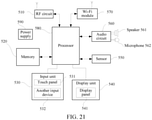
- FIG. 21 shows a block diagram of the structure of a part of a mobile phone related to a terminal device according to an embodiment of the present disclosure.
- the mobile phone includes components such as a radio frequency (RF) circuit 510, a memory 520, an input unit 530, a display unit 540, a sensor 550, an audio circuit 560, a wireless fidelity (Wi-Fi) module 570, a processor 580, and a power supply 590.
- RF radio frequency
- the RF circuit 510 may be configured to receive and send signals during an information receiving and sending process or a call process. Specifically, the RF circuit receives downlink information from a base station, then delivers the downlink information to the processor 580 for processing, and sends designed uplink data to the base station.
- the RF circuit 510 includes, but is not limited to, an antenna, at least one amplifier, a transceiver, a coupler, a low noise amplifier (LNA), and a duplexer.
- the RF circuit 510 may alternatively communicate with a network and another device through wireless communication.
- the wireless communication may use any communication standard or protocol, including but not limited to Global System for Mobile Communications (GSM), general packet radio service (GPRS), Code Division Multiple Access (CDMA), Wideband Code Division Multiple Access (WCDMA), Long Term Evolution (LTE), email, Short Messaging Service (SMS), and the like.
- GSM Global System for Mobile Communications
- GPRS general packet radio service
- CDMA Code Division Multiple Access
- WCDMA Wideband Code Division Multiple Access
- LTE Long Term Evolution
- email Short Messaging Service
- SMS Short Messaging Service
- the memory 520 may be configured to store a software program and module.
- the processor 580 runs the software program and module stored in the memory 520, to implement various functional applications and data processing of the mobile phone.
- the memory 520 may include a program storage area and a data storage area.
- the program storage area may store an operating system, an application program required by at least one function (for example, a sound playback function and an image display function), and the like.
- the data storage area may store data (for example, audio data and an address book) created according to the use of the mobile phone, and the like.
- the memory 520 may include a high speed random-access memory, and may alternatively include a non-volatile memory, for example, at least one magnetic disk storage device, a flash memory, or another volatile solid-state storage device.
- the input unit 530 may be configured to receive input digit or character information, and generate a key signal input related to the user setting and function control of the mobile phone.
- the input unit 530 may include a touch panel 531 and another input device 532.
- the touch panel 531 which may alternatively be referred to as a touch screen, may collect a touch operation of a user on or near the touch panel (such as an operation of a user on the touch panel 531 or near the touch panel 531 by using any suitable object or accessory such as a finger or a stylus), and drive a corresponding connection apparatus according to a preset program.
- the touch panel 531 may include two parts: a touch detection apparatus and a touch controller.
- the touch detection apparatus detects a touch position of the user, detects a signal generated by the touch operation, and transfers the signal to the touch controller.
- the touch controller receives the touch information from the touch detection apparatus, converts the touch information into touch point coordinates, and transmits the touch point coordinates to the processor 580. Moreover, the touch controller can receive and execute a command transmitted from the processor 580.
- the touch panel 531 may be implemented by using various types, such as a resistive type, a capacitive type, an infrared type, and a surface acoustic wave type.
- the input unit 530 may further include the another input device 532.
- the another input device 532 may include, but is not limited to, one or more of a physical keyboard, a functional key (such as a volume control key or a switch key), a track ball, a mouse, and a joystick.
- the display unit 540 may be configured to display information inputted by the user or information provided for the user, and various menus of the mobile phone.
- the display unit 540 may include a display panel 541.
- the display panel 541 may be configured in the form of a liquid crystal display (LCD), an organic light-emitting diode (OLED), or the like.
- the touch panel 531 may cover the display panel 541. After detecting a touch operation on or near the touch panel, the touch panel 531 transfers the operation to the processor 580 to determine a touch event type. Then the processor 580 provides corresponding visual output on the display panel 541 according to the touch event type.
- the touch panel 531 and the display panel 541 are used as two separate parts to implement input and output functions of the mobile phone, in some embodiments, the touch panel 531 and the display panel 541 may be integrated to implement the input and output functions of the mobile phone.
- the mobile phone may further include at least one sensor 550 such as an optical sensor, a motion sensor, and other sensors.
- the optical sensor may include an ambient light sensor and a proximity sensor.
- the ambient light sensor may adjust luminance of the display panel 541 according to brightness of the ambient light.
- the proximity sensor may switch off the display panel 541 and/or backlight when the mobile phone is moved to the ear.
- an acceleration sensor can detect magnitude of accelerations in various directions (generally on three axes), may detect magnitude and a direction of the gravity when static, and may be applied to an application that recognizes the attitude of the mobile phone (for example, switching between landscape orientation and portrait orientation, a related game, and magnetometer attitude calibration), a function related to vibration recognition (such as a pedometer and a knock), and the like.
- Other sensors such as a gyroscope, a barometer, a hygrometer, a thermometer, and an infrared sensor, which may be configured in the mobile phone, are not further described herein.
- the audio circuit 560, a speaker 561, and a microphone 562 may provide audio interfaces between a user and the mobile phone.
- the audio circuit 560 may convert received audio data into an electrical signal and transmit the electrical signal to the speaker 561.
- the speaker 561 converts the electrical signal into a sound signal for output.
- the microphone 562 converts a collected sound signal into an electrical signal.
- the audio circuit 560 receives the electrical signal, converts the electrical signal into audio data, and outputs the audio data to the processor 580 for processing. Then, the processor sends the audio data to, for example, another mobile phone by using the RF circuit 510, or outputs the audio data to the memory 520 for further processing.
- Wi-Fi is a short distance wireless transmission technology.
- the mobile phone may help, by using the Wi-Fi module 570, a user to receive and send an email, browse a web page, access streaming media, and the like, which provides wireless broadband Internet access for the user.
- FIG. 21 shows the Wi-Fi module 570, it may be understood that the Wi-Fi module is not a necessary component of the mobile phone, and the Wi-Fi module 1070 may be omitted as required provided that the scope of the essence of the present disclosure is not changed.
- the processor 580 is a control center of the mobile phone, and is connected to various parts of the entire mobile phone by using various interfaces and lines. By running or executing a software program and/or module stored in the memory 520, and invoking data stored in the memory 520, the processor executes various functions of the mobile phone and performs data processing, thereby monitoring the entire mobile phone.
- the processor 580 may include one or more processing units.
- the processor 580 may integrate an application processor and a modem processor.
- the application processor can process an operating system, a user interface, an application program, and the like.
- the modem processor can process wireless communication. It may be understood that the foregoing modem may alternatively not be integrated into the processor 580.
- the mobile phone further includes the power supply 590 (such as a battery) for supplying power to the components.
- the power supply may be logically connected to the processor 580 by using a power management system, thereby implementing functions such as charging, discharging, and power consumption management by using the power management system.
- the mobile phone may further include a camera, a Bluetooth module, and the like. Details are not described herein again.
- the processor 580 included in the terminal device further has the following functions:
- the processor 580 included in the terminal device further has the following functions:
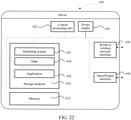
- FIG. 22 is a schematic structural diagram of a server according to an embodiment of the present disclosure.
- the server 600 may vary greatly due to different configurations or performance, and may include one or more central processing units (CPUs) 622 (for example, one or more processors) and a memory 632, and one or more storage media 630 (for example, one or more mass storage devices) that store an application program 642 or data 644.
- the memory 632 and the storage medium 630 may implement transient storage or permanent storage.
- the program stored in the storage medium 630 may include one or more modules (not shown in the figure), and each module may include a series of instruction operations on the server.
- the CPU 622 may be configured to communicate with the storage medium 630 to perform the series of instruction operations in the storage medium 630 on the server 600.
- the server 600 may further include one or more power supplies 626, one or more wired or wireless network interfaces 650, one or more input/output interfaces 658, and/or one or more operating systems 641 such as Windows Server TM , Mac OS X TM , Unix TM , Linux TM or FreeBSD TM .
- operating systems 641 such as Windows Server TM , Mac OS X TM , Unix TM , Linux TM or FreeBSD TM .
- the steps performed by the server in the foregoing embodiments may be based on the server structure shown in FIG. 22 .
- the CPU 622 included in the server further has the following functions:
- the CPU 622 included in the server is specifically configured to perform the following steps:
- the CPU 622 included in the server further has the following functions:
- the embodiments of the present disclosure further provide a computer-readable storage medium, configured to store program code, the program code being used for performing the following model training steps:
- program code may be used for performing the following steps:
- program code may be used for performing the following steps:
- program code may be used for performing the following steps:
- the method before the performing reality detection on the test style image through a first discriminator, the method further includes:
- program code may be used for performing the following steps:
- program code may be used for performing the following steps:
- program code may be used for performing the following steps:
- program code may be used for performing the following steps:
- the disclosed system, apparatus, and method may be implemented in other manners.
- the described apparatus embodiment is merely an example.
- the unit division is merely a logical function division and may be other division during actual implementation.
- a plurality of units or components may be combined or integrated into another system, or some features may be ignored or not performed.
- the displayed or discussed mutual couplings or direct couplings or communication connections may be implemented by using some interfaces.
- the indirect couplings or communication connections between the apparatuses or units may be implemented in electronic, mechanical, or other forms.
- the units described as separate components may or may not be physically separated, and the components displayed as units may or may not be physical units, and may be located in one place or may be distributed over a plurality of network units. Some or all of the units may be selected according to actual needs to achieve the objectives of the solutions of the embodiments.
- functional units in the embodiments of the present disclosure may be integrated into one processing unit, or each of the units may be physically separated, or two or more units may be integrated into one unit.
- the integrated unit may be implemented in the form of hardware, or may be implemented in a form of a software functional unit.
- the integrated unit When the integrated unit is implemented in the form of a software functional unit and sold or used as an independent product, the integrated unit may be stored in a computer-readable storage medium. Based on such an understanding, the technical solutions of the present disclosure essentially, or the part contributing to the related art, or all or some of the technical solutions may be implemented in the form of a software product.
- the computer software product is stored in a storage medium and includes several pieces of program code for instructing a computer device (which may be a personal computer, a server, a network device, or the like) to perform all or some of the steps of the methods described in the embodiments of the present disclosure.
- the foregoing storage medium includes: any medium that can store program code, such as a USB flash drive, a removable hard disk, a read-only memory (read-only memory, ROM), a random access memory (random access memory, RAM), a magnetic disk or an optical disc.
- program code such as a USB flash drive, a removable hard disk, a read-only memory (read-only memory, ROM), a random access memory (random access memory, RAM), a magnetic disk or an optical disc.
Landscapes
- Engineering & Computer Science (AREA)
- Theoretical Computer Science (AREA)
- Physics & Mathematics (AREA)
- General Physics & Mathematics (AREA)
- Evolutionary Computation (AREA)
- Artificial Intelligence (AREA)
- Multimedia (AREA)
- Data Mining & Analysis (AREA)
- Computer Vision & Pattern Recognition (AREA)
- Software Systems (AREA)
- Computing Systems (AREA)
- Health & Medical Sciences (AREA)
- General Health & Medical Sciences (AREA)
- General Engineering & Computer Science (AREA)
- Medical Informatics (AREA)
- Databases & Information Systems (AREA)
- Life Sciences & Earth Sciences (AREA)
- Bioinformatics & Computational Biology (AREA)
- Bioinformatics & Cheminformatics (AREA)
- Evolutionary Biology (AREA)
- Mathematical Physics (AREA)
- Biomedical Technology (AREA)
- Molecular Biology (AREA)
- Computational Linguistics (AREA)
- Biophysics (AREA)
- Probability & Statistics with Applications (AREA)
- Algebra (AREA)
- Computational Mathematics (AREA)
- Mathematical Analysis (AREA)
- Mathematical Optimization (AREA)
- Pure & Applied Mathematics (AREA)
- Image Analysis (AREA)
Abstract
Description
- This application claims priority to
Chinese Patent Application No. 201910218444.5 - The present disclosure relates to the field of artificial intelligence, and in particular, relates to a target detection method and apparatus, a model training method and apparatus, a device, and a storage medium.
- In the field of machine learning, samples usually need to be divided into two independent parts, respectively being a training set and a test set, the training set is used for supervised learning, and the supervision learning refers to a process of adjusting a parameter of a classifier by using a group of samples in a known class, to cause the classifier to achieve required performance, and is also referred to as supervised training. The test set is used for evaluating how well a finally selected model performs. In the field of image processing, a case that a domain difference between a training image and a test image is relatively large is easy to occur.
- Currently, when a training set image and a test set image come from different domains, a feature extracted by a network model is usually constrained in dependence on an adversarial loss function, so that the network model cannot identify a domain from which the training set image comes, thereby being insensitive to feature distribution domains.
- However, the training set image and the test set image have a natural domain distribution difference. Therefore, it is quite difficult to force the network model to blur features of the training set image and the test set image. As a result, predicting a test set image in a domain B by using a network model obtained through training with a training set image in a domain A causes a relatively poor prediction effect.
- Embodiments of the present disclosure provide a target detection method and apparatus, a model training method and apparatus, a device, and a storage medium, to perform target localization without purposely using a to-be-detected image in a style the same as that of a test set image, but convert the style of the to-be-detected image into the style of the test set image by using a cross-domain image detection model, and then perform target localization on an image obtained after conversion, thereby improving accuracy of image localization and enhancing a model prediction effect.
- In view of this, a first aspect of the present disclosure provides an image-based target detection method, including:
- obtaining a first to-be-detected image belonging to a first domain;
- obtaining a second to-be-detected image corresponding to the first to-be-detected image, the second to-be-detected image belonging to a second domain, and the first domain and the second domain being different domains; and
- obtaining a detection result corresponding to the second to-be-detected image through a cross-domain image detection model, the detection result including target localization information and target class information of a target object, the target object being a detected object in the first to-be-detected image, the cross-domain image detection model including a first network model and a second network model, the first network model being used for converting an image from the first domain into an image in the second domain, and the second network model being used for performing region localization on the image in the second domain.
- A second aspect of the present disclosure provides a model training method, including:
- obtaining a to-be-trained image and a to-be-tested image, the to-be-trained image belonging to a first domain, the to-be-tested image belonging to a second domain, and the first domain and the second domain being different domains;
- obtaining a test style image corresponding to the to-be-trained image through a first to-be-trained network model, and obtaining a training style image corresponding to the to-be-tested image through the first to-be-trained network model, the test style image belonging to the second domain, and the training style image belonging to the first domain;
- obtaining a predicted probability value corresponding to a candidate region through a second to-be-trained network model, the candidate region being a candidate bounding box extracted from the to-be-tested image or the test style image;
- obtaining a first prediction class probability value, a first prediction localization value, a second prediction class probability value, and a second prediction localization value that correspond to the test style image through the second to-be-trained network model; and
- training the first to-be-trained network model and the second to-be-trained network model by using a target loss function and according to the predicted probability value, the test style image, the training style image, the first prediction class probability value, the first prediction localization value, the second prediction class probability value, and the second prediction localization value, to obtain a cross-domain image detection model.
- A third aspect of the present disclosure provides a target detection apparatus, including:
- an obtaining module, configured to obtain a first to-be-detected image belonging to a first domain;
- the obtaining module being further configured to obtain a second to-be-detected image corresponding to the first to-be-detected image, the second to-be-detected image belonging to a second domain, and the first domain and the second domain being different domains; and
- a detection module, configured to obtain, through a cross-domain image detection model, a detection result corresponding to the second to-be-detected image obtained by the obtaining module, the detection result including target localization information and target class information of a target object, the target object being a detected object in the first to-be-detected image, the cross-domain image detection model including a first network model and a second network model, the first network model being used for converting an image from the first domain into an image in the second domain, and the second network model being used for performing region localization on the image in the second domain.
- A fourth aspect of the present disclosure provides a model training apparatus, including:
- an obtaining module, configured to obtain a to-be-trained image and a to-be-tested image, the to-be-trained image belonging to a first domain, the to-be-tested image belonging to a second domain, and the first domain and the second domain being different domains;
- the obtaining module being further configured to obtain a test style image corresponding to the to-be-trained image through a first to-be-trained network model, and obtain a training style image corresponding to the to-be-tested image through the first to-be-trained network model, the test style image belonging to the second domain, and the training style image belonging to the first domain;
- the obtaining module being further configured to obtain a predicted probability value corresponding to a candidate region through a second to-be-trained network model, the candidate region being a candidate bounding box extracted from the to-be-tested image or the test style image;
- the obtaining module being further configured to obtain a first prediction class probability value, a first prediction localization value, a second prediction class probability value, and a second prediction localization value that correspond to the test style image through the second to-be-trained network model; and
- a training module, configured to train the first to-be-trained network model and the second to-be-trained network model by using a target loss function and according to the predicted probability value, the test style image, the training style image, the first prediction class probability value, the first prediction localization value, the second prediction class probability value, and the second prediction localization value that are obtained by the obtaining module, to obtain a cross-domain image detection model.
- In a possible design, in a first implementation of the fourth aspect of the embodiments of the present disclosure,
- the training module is specifically configured to determine a first loss function according to the test style image and the training style image;
- determine a second loss function according to the predicted probability value;
- determine a third loss function according to the first prediction class probability value, the first prediction localization value, the second prediction class probability value, and the second prediction localization value;
- generate the target loss function according to the first loss function, the second loss function, and the third loss function; and
- train the first to-be-trained network model and the second to-be-trained network model by using the target loss function.
- In a possible design, in a second implementation of the fourth aspect of the embodiments of the present disclosure,
- the training module is specifically configured to determine the first loss function in the following manner:

- where Lcyc (G t-s ,G s-t ) represents the first loss function, xt represents the to-be-tested image, xs represents the to-be-trained image, G s-t represents a generator for converting the to-be-trained image into the test style image, G t-s represents a generator for converting the to-be-tested image into the training style image, G t-s (xt ) represents the training style image, G s-t (xs ) represents the test style image, E s∼X(s) represents calculating an expected value of each to-be-trained image in a to-be-trained image set, and E t∼X(t) represents calculating an expected value of each to-be-tested image in a to-be-tested image set.
- In a possible design, in a third implementation of the fourth aspect of the embodiments of the present disclosure, the model training apparatus further includes a detection module;
- the detection module is configured to perform, after the obtaining module obtains the test style image corresponding to the to-be-trained image through the first to-be-trained network model and obtains the training style image corresponding to the to-be-tested image through the first to-be-trained network model, reality detection on the test style image through a first discriminator, where the first discriminator is obtained based on training by using a first adversarial loss function; and
- the detection module is further configured to perform, after the obtaining module obtains the test style image corresponding to the to-be-trained image through the first to-be-trained network model and obtains the training style image corresponding to the to-be-tested image through the first to-be-trained network model, reality detection on the training style image through a second discriminator, where the second discriminator is obtained based on training by using a second adversarial loss function.
- In a possible design, in a fourth implementation of the fourth aspect of the embodiments of the present disclosure,
- the obtaining module is further configured to obtain, before the detection module performs reality detection on the test style image through the first discriminator, the first adversarial loss function in the following manner:

- where LGAN (Dt ,G s-t ) represents the first adversarial loss function, E s∼X(s) represents calculating an expected value of each to-be-trained image in a to-be-trained image set, E t∼X(t) represents calculating an expected value of each to-be-tested image in a to-be-tested image set, Dt ( ) represents the first discriminator, s represents an image in the first domain, G s-t ( ) represents a network for converting the image in the first domain into an image in the second domain, and x represents an inputted image.
- In a possible design, in a fifth implementation of the fourth aspect of the embodiments of the present disclosure,
- the obtaining module is further configured to obtain, before the detection module performs reality detection on the test style image through the first discriminator, the second adversarial loss function in the following manner:

- where LGAN (Ds ,G t-s ) represents the second adversarial loss function, E s∼X(s) represents calculating an expected value of each to-be-trained image in a to-be-trained image set, E t∼X(t) represents calculating an expected value of each to-be-tested image in a to-be-tested image set, Ds ( ) represents the second discriminator, t represents an image in the second domain, G t-s ( ) represents a network for converting the image in the second domain into an image in the first domain, and x represents an inputted image.
- In a possible design, in a sixth implementation of the fourth aspect of the embodiments of the present disclosure,
- the training module is specifically configured to determine the second loss function in the following manner:

- where Ldomain represents the second loss function, p i,j represents a predicted probability value of an ith candidate region on a jth class, and d represents an image source value.
- In a possible design, in a seventh implementation of the fourth aspect of the embodiments of the present disclosure,
- the training module is specifically configured to determine the third loss function in the following manner:


- where L(p, u, tm , v) det represents the third loss function, L rpn-cls represents a classification loss function of a region proposal network (RPN) in the second to-be-trained network model, prpn represents the first prediction class probability value of the RPN, urpn represents a first real class probability value of the RPN, L rpn-loc represents a localization loss function of the RPN in the second to-be-trained network model,


- In a possible design, in an eighth implementation of the fourth aspect of the embodiments of the present disclosure,
- the training module is specifically configured to determine the target loss function in the following manner:

- where L represents the target loss function, Lcyc (G t-s ,G s-t ) represents the first loss function, Ldomain represents the second loss function, and Ldet represents the third loss function.
- A fifth aspect of the present disclosure provides a terminal device, including: a memory, a transceiver, a processor, and a bus system,
- the memory being configured to store a program;
- the processor being configured to execute the program in the memory to perform the following operations:
- obtaining a first to-be-detected image belonging to a first domain;
- obtaining a second to-be-detected image corresponding to the first to-be-detected image, the second to-be-detected image belonging to a second domain, and the first domain and the second domain being different domains; and
- obtaining a detection result corresponding to the second to-be-detected image through a cross-domain image detection model, the detection result including target localization information and target class information of a target object, the target object being a detected object in the first to-be-detected image, the cross-domain image detection model including a first network model and a second network model, the first network model being used for converting an image from the first domain into an image in the second domain, and the second network model being used for performing region localization on the image in the second domain; and
- the bus system being configured to connect the memory and the processor to cause the memory and the processor to perform communication.
- A sixth aspect of the present disclosure provides a server, including a memory, a transceiver, a processor, and a bus system,
- the memory being configured to store a program;
- the processor being configured to execute the program in the memory to perform the following operations:
- obtaining a to-be-trained image and a to-be-tested image, the to-be-trained image belonging to a first domain, the to-be-tested image belonging to a second domain, and the first domain and the second domain being different domains;
- obtaining a test style image corresponding to the to-be-trained image through a first to-be-trained network model, and obtaining a training style image corresponding to the to-be-tested image through the first to-be-trained network model, the test style image belonging to the second domain, and the training style image belonging to the first domain;
- obtaining a predicted probability value corresponding to a candidate region through a second to-be-trained network model, the candidate region being a candidate bounding box extracted from the to-be-tested image or the test style image;
- obtaining a first prediction class probability value, a first prediction localization value, a second prediction class probability value, and a second prediction localization value that correspond to the test style image through the second to-be-trained network model; and
- training the first to-be-trained network model and the second to-be-trained network model by using a target loss function and according to the predicted probability value, the test style image, the training style image, the first prediction class probability value, the first prediction localization value, the second prediction class probability value, and the second prediction localization value, to obtain a cross-domain image detection model.
- the bus system being configured to connect the memory and the processor to cause the memory and the processor to perform communication.
- A seventh aspect of the present disclosure provides a computer-readable storage medium, the computer-readable storage medium storing program code, the program code, when run on a computer, causing the computer to perform the following model training operations:
- obtaining a to-be-trained image and a to-be-tested image, the to-be-trained image belonging to a first domain, the to-be-tested image belonging to a second domain, and the first domain and the second domain being different domains;
- obtaining a test style image corresponding to the to-be-trained image through a first to-be-trained network model, and obtaining a training style image corresponding to the to-be-tested image through the first to-be-trained network model, the test style image belonging to the second domain, and the training style image belonging to the first domain;
- obtaining a predicted probability value corresponding to a candidate region through a second to-be-trained network model, the candidate region being a candidate bounding box extracted from the to-be-tested image or the test style image;
- obtaining a first prediction class probability value, a first prediction localization value, a second prediction class probability value, and a second prediction localization value that correspond to the test style image through the second to-be-trained network model; and
- training the first to-be-trained network model and the second to-be-trained network model by using a target loss function and according to the predicted probability value, the test style image, the training style image, the first prediction class probability value, the first prediction localization value, the second prediction class probability value, and the second prediction localization value, to obtain a cross-domain image detection model;
- or causing the computer to perform the following target detection operations:
- obtaining a first to-be-detected image belonging to a first domain;
- obtaining a second to-be-detected image corresponding to the first to-be-detected image, the second to-be-detected image belonging to a second domain, and the first domain and the second domain being different domains; and
- obtaining a detection result corresponding to the second to-be-detected image through a cross-domain image detection model, the detection result including target localization information and target class information of a target object, the target object being a detected object in the first to-be-detected image, the cross-domain image detection model including a first network model and a second network model, the first network model being used for converting an image from the first domain into an image in the second domain, and the second network model being used for performing region localization on the image in the second domain.
- It can be seen from the foregoing technical solutions that the embodiments of the present disclosure have the following advantages:
- In the embodiments of the present disclosure, an image-based target detection method is provided. A first to-be-detected image is first obtained, the first to-be-detected image belonging to a first domain, a second to-be-detected image corresponding to the first to-be-detected image is then obtained through a cross-domain image detection model, the second to-be-detected image belonging to a second domain, and a detection result corresponding to the second to-be-detected image is finally obtained through the cross-domain image detection model, the detection result including target localization information and target class information of a target object, and the target object belonging to the first to-be-detected image. Through the foregoing manner, target localization is performed without purposely using a to-be-detected image in a style the same as that of a test set image, but the style of the to-be-detected image is converted into the style of the test set image by using the cross-domain image detection model, and then target localization is performed on an image obtained after conversion, thereby improving accuracy of image localization and enhancing a model prediction effect.
-
-
FIG. 1 is a schematic comparison diagram of cross-domain target detection according to an embodiment of the present disclosure. -
FIG. 2 is a schematic architectural diagram of a target detection system according to an embodiment of the present disclosure. -
FIG. 3 is a schematic diagram of a target detection effect based on an automated driving system according to an embodiment of the present disclosure. -
FIG. 4 is a schematic diagram of another target detection effect based on an automated driving system according to an embodiment of the present disclosure. -
FIG. 5 is a schematic diagram of an embodiment of an image-based target detection method according to an embodiment of the present disclosure. -
FIG. 6 is a schematic diagram of an embodiment of a first to-be-detected image according to an embodiment of the present disclosure. -
FIG. 7 is a schematic diagram of an embodiment of a second to-be-detected image according to an embodiment of the present disclosure. -
FIG. 8 is a schematic diagram of an embodiment of an image on which target localization is to be performed according to an embodiment of the present disclosure. -
FIG. 9 is a schematic flowchart of deployment of a cross-domain image detection model according to an embodiment of the present disclosure. -
FIG. 10 is a schematic diagram of an embodiment of a model training method according to an embodiment of the present disclosure. -
FIG. 11 is a schematic diagram of comparing images in different domains according to an embodiment of the present disclosure. -
FIG. 12 is a schematic diagram of comparing two classes of images that may be used for training a cross-domain image detection model according to an embodiment of the present disclosure. -
FIG. 13 is a schematic structural diagram of a cross-domain image detection model according to an embodiment of the present disclosure. -
FIG. 14 is a schematic diagram of an image comparison detected in an experimental result according to an embodiment of the present disclosure. -
FIG. 15 is a schematic diagram of another image comparison detected in an experimental result according to the present disclosure. -
FIG. 16 is a schematic diagram of an effect of conversion from a SimlOk dataset to a Kitti dataset in an experimental result according to the present disclosure. -
FIG. 17 is a schematic diagram of an effect of conversion from a Cityscapes dataset to a Foggy-Cityscapes dataset in an experimental result according to the present disclosure. -
FIG. 18 is a schematic diagram of an embodiment of a target detection apparatus according to an embodiment of the present disclosure. -
FIG. 19 is a schematic diagram of an embodiment of a model training apparatus according to an embodiment of the present disclosure. -
FIG. 20 is a schematic diagram of another embodiment of a model training apparatus according to an embodiment of the present disclosure. -
FIG. 21 is a schematic structural diagram of a terminal device according to an embodiment of the present disclosure. -
FIG. 22 is a schematic structural diagram of a server according to an embodiment of the present disclosure. - Embodiments of the present disclosure provide an image-based target detection method and apparatus, and a model training method and apparatus, to perform target localization without purposely using a to-be-detected image in a style the same as that of a test set image, but convert the style of the to-be-detected image into the style of the test set image by using a cross-domain image detection model, and then perform target localization on an image obtained after conversion, thereby improving accuracy of image localization and enhancing a model prediction effect.
- The terms "first", "second", "third", "fourth", and the like (if any) in the specification and the claims of the present disclosure and the foregoing accompanying drawings are used for distinguishing similar objects, and are not necessarily used for describing a particular sequence or order. It may be understood that the data termed in such a way is interchangeable in proper circumstances, so that the embodiments of the present disclosure described herein for example, can be implemented in other orders than the order illustrated or described herein. In addition, the terms "include", "corresponding to" and any other variants are intended to cover the non-exclusive inclusion. For example, a process, method, system, product, or device that includes a series of steps or units is not necessarily limited to those expressly listed steps or units, but may include other steps or units not expressly listed or inherent to such a process, method, product, or device.
- It is to be understood that, the present disclosure proposes a cross-domain image target detection method based on adversarial learning, which is applicable to resolving a problem of low test precision caused when a deep convolutional neural network faces different distribution of training set data and test set data. The present disclosure may be widely used for an image target detection task, and in particular, is more significant for a case that domain distribution of a training set image and that of a test set image are different in actual application. Actually, domain distribution of a training set image and that of a test set image are different in most cases. For example, in a target detection scenario of an unmanned vehicle, a training set image used during training comes from a scenario picture of a city A, while a test set image used during an actual test comes from a scenario picture of a city B. It can be seen that scenario pictures of two cities are usually inconsistent in domain distribution. In another example, a training set image used during training comes from an indoor scenario picture, while a test set image used during a test comes from an outdoor scenario picture. It can be seen that indoor and outdoor scenario pictures are also inconsistent in domain distribution. In another example, a brand and a color of an automobile in a training set image used during training may alternatively be different from a brand and a color of an automobile in a test set image used during a test. Referring to
FIG. 1, FIG. 1 is a schematic comparison diagram of cross-domain target detection according to an embodiment of the present disclosure. An image (a) and an image (b) ofFIG. 1 respectively come from two types of domain distribution. Very evidently, although such an object as "automobile" can be detected in both of the two images, the two images differ greatly in style. It is well known that, when facing a relatively large difference between domain distribution of a training set image and that of a test set image, a deep network is usually poor in generalization performance on the test set image and low in test precision, and a deep network model for target detection similarly cannot avoid the problem. - For ease of understanding, the present disclosure proposes an image-based target detection method, and the method is applicable to a target detection system shown in
FIG. 2 . Referring toFIG. 2, FIG. 2 is a schematic architectural diagram of a target detection system according to an embodiment of the present disclosure. As shown in the figure, the model training method proposed by the present disclosure is implemented in a server, that is, two sub-network models are introduced into the server in a process of training a cross-domain image detection model. The first sub-network model is a pixel domain adaptation (PDA) network model, and the second sub-network model is a feature domain adaptation (FDA) network model. The PDA network converts an original training set image into an image in a test set style, and a training set image in the test set style obtained after conversion is used as input during model training, thereby being more helpful for the cross-domain image detection model to adapt to the image in the test set style. The FDA network learns a feature of the image in the test set style at a feature-level constraint model. After the server obtains the cross-domain image detection model through training, a client obtains a to-be-detected image. The to-be-detected image herein and the training set image belong to the same domain distribution. Then, the client inputs the to-be-detected image to the cross-domain image detection model obtained by the server through training, the cross-domain image detection model converts a style of the to-be-detected image into a style of a test set image, and ensures a realistic effect of the conversion by using an adversarial learning method, thereby generating the to-be-detected image in the style of the test set image, and enhancing a prediction effect of the cross-domain image detection model on an image in a test set domain. - Moreover, a discriminator is further introduced into the cross-domain image detection model. The discriminator is used for determining whether a feature learned by the cross-domain image detection model comes from the domain of the test set image. Then, it is ensured through adversarial learning that a feature learned by the to-be-detected image through the cross-domain image detection model is sufficiently similar to a feature of the test set image, so that the discriminator cannot differentiate, thereby further ensuring that the style of the to-be-detected image is fully convert into the style of the test set image during detection.
- It is to be noted that, the client may be deployed on a terminal device. The terminal device includes, but is not limited to, an unmanned vehicle, a robot, a tablet computer, a notebook computer, a palmtop computer, a mobile phone, a speech interaction device, and a personal computer (PC), and is not limited herein.
- Target detection aims to allocate localization information (for example, bounding box) and class information (for example, class label) to each object (such as a person, a bicycle, a motorcycle, or an automobile). It is vital to detect other transportation participants in a contemporary automated driving process, and therefore target detection plays an important role in a contemporary automated driving system. The reason is as follows: Referring to
FIG. 3, FIG. 3 is a schematic diagram of a target detection effect based on an automated driving system according to an embodiment of the present disclosure. As shown in the figure, a terminal device may label an image corresponding toFIG. 3 with localization information (that is, bounding box) and class information (that is, "automobile ") of an automobile. Referring toFIG. 4, FIG. 4 is a schematic diagram of another target detection effect based on an automated driving system according to an embodiment of the present disclosure. As shown in the figure, a terminal device may label an image corresponding toFIG. 4 with localization information (that is, bounding box) and class information (that is, "automobile" and "pedestrian") of an automobile and a pedestrian. - It is to be understood that, in addition to an unmanned vehicle scenario, the present disclosure is further applicable to other scenarios such as a scenario in which a robot performs a task. For example, when a robot performs a dangerous task, it may be very difficult to directly obtain a real test set image in a dangerous scenario, and therefore training needs to be performed through a training set image simulated in the dangerous scenario. By using the model training method provided in the present disclosure, the terminal device may convert the style of the training set image into the style of the test set image through adversarial learning, so that it can be ensured, before the cross-domain image detection model learns the feature, that the training set image and the test set image come from the same domain distribution as much as possible, and then under the constraint of the adversarial loss function, the feature learned by the cross-domain image detection model based on the training set image may be closer to the feature of the test set image.
- The image-based target detection method in the present disclosure is introduced below with reference to the foregoing introduction. Referring to
FIG. 5 , an embodiment of the image-based target detection method in the embodiments of the present disclosure includes the following steps: - 101. A target detection apparatus obtains a first to-be-detected image belonging to a first domain.
- In this embodiment, first, the target detection apparatus obtains the first to-be-detected image, and the target detection apparatus may be deployed on a terminal device such as a robot or an unmanned vehicle. The first to-be-detected image belongs to the first domain, where the first domain may refer to a specific scenario such as an indoor scenario, or may refer to distribution of a dataset such as a SimlOk dataset. The first to-be-detected image may be an image obtained in real time, for example, captured in real time through a camera of the terminal device, or may be an image extracted from an image database, which is not limited herein.
- 102. The target detection apparatus obtains a second to-be-detected image corresponding to the first to-be-detected image, the second to-be-detected image belonging to a second domain, and the first domain and the second domain being different domains.
- In this embodiment, the target detection apparatus may input the first to-be-detected image to a cross-domain image detection model, and a PDA network in the cross-domain image detection model outputs the corresponding second to-be-detected image, the second to-be-detected image belonging to the second domain, and the first domain and the second domain being different domains. That is to say, the second to-be-detected image and the first to-be-detected image belong to two different styles. For ease of understanding, referring to
FIG. 6, FIG. 6 is a schematic diagram of an embodiment of a first to-be-detected image according to an embodiment of the present disclosure. As shown in the figure, the first to-be-detected image may be specifically a real image sampled from the Sim10k dataset. After conversion through the PDA network, as shown inFIG. 7 , referring toFIG. 7, FIG. 7 is a schematic diagram of an embodiment of a second to-be-detected image according to an embodiment of the present disclosure. The second to-be-detected image and the first to-be-detected image are different in style, that is, belong to two domains. - The to-be-trained cross-domain image detection model may include two parts, that is, a first to-be-trained network model and a second to-be-trained network model, and the two parts are trained by using a target loss function, to separately obtain a first network model corresponding to the first to-be-trained network model and a second network model corresponding to the second to-be-trained network model, where the first network model may include the PDA network, and the second network model may include an FDA network and an object detection network. The PDA network may be used for converting an image in the training style (that is, the first domain) into an image in the test style (that is, the second domain). The FDA network may be used for constraining the style of the image (that is, constraining the style of the image in the second domain after conversion), and the object detection network may be used for performing object detection on the image in the test style.
- 103. The target detection apparatus obtains a detection result corresponding to the second to-be-detected image through a cross-domain image detection model, the detection result including target localization information and target class information of a target object, the target object being a detected object in the first to-be-detected image, the cross-domain image detection model being capable of including a first network model and a second network model, the first network model being used for converting an image from the first domain into an image in the second domain, and the second network model being used for performing region localization on the image in the second domain.
- In this embodiment, the target detection apparatus may output the second to-be-detected image through the PDA network in the cross-domain image detection model, then the FDA network in the cross-domain image detection model may convert the second to-be-detected image into an image on which target localization is to be performed, and then the image is detected through the object detection network in the cross-domain image detection model, thereby obtaining the detection result. After the first to-be-trained image is converted through the PDA network and the FDA network, an image shown in
FIG. 8 may be obtained. Referring toFIG. 8, FIG. 8 is a schematic diagram of an embodiment of an image on which target localization is to be performed according to an embodiment of the present disclosure. - An application process of the target detection method based on the foregoing introduction is shown in
FIG. 9. FIG. 9 is a schematic flowchart of deployment of a cross-domain image detection model according to an embodiment of the present disclosure. First, the cross-domain image detection model is pre-trained on a training set image, to obtain a relatively good model initialization weight, where the training set image belongs to adomain 1. Then, training continues by using an adversarial learning method and by using both the labeled training set image and an unknown labeled test set image, where the test set image belongs to adomain 2. After features between the training set image belonging to thedomain 1 and the test set image belonging to thedomain 2 are aligned, features in the same domain may be shared, to complete prediction on the cross-domain image detection model (model in the domain 2). The cross-domain image detection model provided in the present disclosure has relatively high recognition precision on images in thedomain 2. A preliminary test result indicates that, with a VGG16 convolutional neural network (CNN) structure, when the training set image comes from the Sim10k dataset and the test set image comes from the Kitti dataset, precision of performing prediction by using a related solution is about 52.7%, while precision of performing prediction by using the present disclosure may be up to 59.3%. After the cross-domain image detection model with higher precision is obtained, the cross-domain image detection model may be directly applied to prediction of the test set image. - In this embodiment of the present disclosure, the image-based target detection method is provided. The target detection apparatus first obtains the first to-be-detected image belonging to the first domain; then obtains the second to-be-detected image corresponding to the first to-be-detected image through the cross-domain image detection model, the second to-be-detected image belonging to the second domain; and finally obtains the detection result corresponding to the second to-be-detected image through the cross-domain image detection model, the detection result including the target localization information and the target class information of the target object, and the target object belonging to the first to-be-detected image. Through the foregoing manner, target localization is performed without purposely using a to-be-detected image in a style the same as that of a test set image, but the style of the to-be-detected image is converted into the style of the test set image by using the cross-domain image detection model, and then target localization is performed on an image obtained after conversion, thereby improving accuracy of image localization and enhancing a model prediction effect.
- The model training method in the present disclosure is introduced below with reference to the foregoing introduction. Referring to
FIG. 10 , an embodiment of the model training method in the embodiments of the present disclosure includes the following steps: - 201. A model training apparatus obtains a to-be-trained image and a to-be-tested image, the to-be-trained image belonging to a first domain, the to-be-tested image belonging to a second domain, and the first domain and the second domain being different domains.
- In this embodiment, before model training is performed, the to-be-trained image and the to-be-tested image need to be obtained, where the to-be-trained image and the to-be-tested image belong to two different domains, that is, the to-be-trained image belongs to the first domain, and the to-be-tested image belongs to the second domain. For ease of understanding, referring to
FIG. 11, FIG. 11 is a schematic diagram of comparing images in different domains according to an embodiment of the present disclosure. As shown in the figure, the figure provides images in four different domains, where inFIG. 11 , an image (a) represents an image from a Cityscapes dataset, an image (b) represents an image from a Foggy-Cityscapes dataset, an image (c) represents an image from a Sim10k dataset, and an image (d) represents an image from a Kitti dataset, where both the Foggy-Cityscapes dataset and the Sim10k dataset are synthetic datasets for simulating a driving scenario. The Foggy-Cityscapes dataset performs rendering based on a real Cityscapes dataset, to simulate a foggy weather situation. The Kitti dataset is used for performing a benchmark test on different vision tasks in automated driving, for example, deep estimation, three-dimensional matching, scenario or optical estimation, and object detection. - It may be understood that, the first domain may be the Sim10k dataset, and the second domain may be the Kitti dataset However, this is not to be understood as a limitation on the present disclosure. The first domain may alternatively be the Foggy-Cityscapes dataset, the Cityscapes dataset or the Kitti dataset, and the second domain may alternatively be the Foggy-Cityscapes dataset, the Sim10k dataset or the Cityscapes dataset, as long as it is ensured the first domain and the second domain are different. Description is made below by using an example in which the first domain is the SimlOk dataset and the second domain is the Kitti dataset. Referring to
FIG. 12, FIG. 12 is a schematic diagram of comparing two classes of images that may be used for training a cross-domain image detection model according to an embodiment of the present disclosure. As shown in the figure, inFIG. 12 , an image (a) and an image (c) represent images from the Sim10k dataset, and an image (b) and an image (d) represent images from the Kitti dataset. - 202. The model training apparatus obtains a test style image corresponding to the to-be-trained image through a first to-be-trained network model, and obtains a training style image corresponding to the to-be-tested image through the first to-be-trained network model, the test style image belonging to the second domain, and the training style image belonging to the first domain.
- In this embodiment, the model training apparatus may input the to-be-trained image to the first to-be-trained network model (which may be, for example, a to-be-trained PDA network), the first to-be-trained network model outputs the test style image; and similarly, the model training apparatus inputs the to-be-tested image to the first to-be-trained network model, and the first to-be-trained network model outputs the training style image.
- In a possible implementation, for ease of description, referring to
FIG. 13, FIG. 13 is a schematic structural diagram of a cross-domain image detection model according to an embodiment of the present disclosure. As shown in the figure, inFIG. 13 , a left part is a model structure of a PDA network, the model structure is used for converting an image in a source domain style into an image in a target domain style before an FDA network is trained, and a cycle generative adversarial network (CycleGAN) may be used as the PDA network. A right part is a model structure of the FDA network, the model structure is used for feature-level adversarial training, and an object detection part enhances several additional neural layers. It is assumed that a to-be-trained image (real_s) is converted through the first to-be-trained network model (the to-be-trained PDA network) into a test style image (fake t); and a to-be-tested image (real_t) is converted through the first to-be-trained network model (the to-be-trained PDA network) into a training style image (fake_s), where the test style image (fake t) and the to-be-tested image (real t) belong to the same domain, and the training style image (fake_s) and the to-be-trained image (real_s) belong to the same domain. - 203. The model training apparatus obtains a predicted probability value corresponding to a candidate region through a second to-be-trained network model, the candidate region being a candidate bounding box extracted from the to-be-tested image or the test style image.
- In this embodiment, based on the foregoing introduction, after the first to-be-trained network model (the to-be-trained PDA network) converts the to-be-trained image (real_s) into the test style image (fake t), the test style image is directly fed into the FDA network in the second to-be-trained network model, the model training apparatus inputs the test style image (fake t) and the to-be-tested image (real t) to a discriminator in the FDA network, to determine features in all locations in the test style image (fake t) and the to-be-tested image (real t), that is, predict a probability value for a candidate bounding box (bbox) from the to-be-tested image or from the test style image, thereby obtaining a predicted probability value corresponding to a candidate region.
- 204. The model training apparatus obtains a first prediction class probability value, a first prediction localization value, a second prediction class probability value, and a second prediction localization value that correspond to the test style image through the second to-be-trained network model.
- In this embodiment, based on the foregoing introduction, the model training apparatus may input the test style image (fake t) to the second to-be-trained network model, and the first prediction class probability value, the first prediction localization value, the second prediction class probability value, and the second prediction localization value are outputted through the second to-be-trained network model, where an object detection network in the cross-domain image detection model may include two parts, namely, a region proposal network (RPN) and a target detection network, the first prediction class probability value and the first prediction localization value are prediction values outputted by the RPN, and the second prediction class probability value and the second prediction localization value are prediction values outputted by the target detection network.
- The object detection network is used for performing feature learning and target detection. The object detection network may be a faster region-based convolutional neural network (R-CNN), a region-based fully convolutional network (R-FCN), or the like.
- 205. The model training apparatus trains the first to-be-trained network model and the second to-be-trained network model by using a target loss function and according to the predicted probability value, the test style image, the training style image, the first prediction class probability value, the first prediction localization value, the second prediction class probability value, and the second prediction localization value, to obtain a cross-domain image detection model.
- In this embodiment, the model training apparatus may train the first to-be-trained network model and the second to-be-trained network model by using the target loss function and with reference to the predicted probability value, the test style image, the training style image, the first prediction class probability value, the first prediction localization value, the second prediction class probability value, and the second prediction localization value, to obtain the cross-domain image detection model, and the cross-domain image detection model may convert the image in the first domain into the image in the second domain and then perform training, or may detect localization information and class information for the image in the first domain. Specifically, the first to-be-trained network model may include the to-be-trained PDA network, the second to-be-trained network model may include the FDA network and the object detection network, and the object detection network may include the RPN and the target detection network.
- For ease of description, referring to
FIG. 14, FIG. 14 is a schematic diagram of an image comparison detected in an experimental result according to an embodiment of the present disclosure. As shown in the figure, inFIG. 14 , an image (a) shows a vehicle obtained through conversion of the PDA network, and an image (b) shows a vehicle obtained through conversion of the PDA network and the FDA network. It is not difficult to see that, reproducibility and definition of the vehicle in the image (b) are higher than reproducibility and definition of the vehicle in the image (a). Referring toFIG. 15, FIG. 15 is a schematic diagram of another image comparison detected in an experimental result according to the present disclosure. As shown in the figure, inFIG. 15 , an image (a) shows a vehicle obtained through conversion of the PDA network, and an image (b) shows a vehicle obtained through conversion of the PDA network and the FDA network. It is not difficult to see that, reproducibility and definition of the vehicle in the image (b) are likewise higher than reproducibility and definition of the vehicle in the image (a). - In this embodiment of the present disclosure, the model training method is provided. The model training apparatus first obtains the to-be-trained image and the to-be-tested image; then obtains the test style image corresponding to the to-be-trained image through the first to-be-trained network model, obtains the training style image corresponding to the to-be-tested image through the first to-be-trained network model, obtains the predicted probability value corresponding to the candidate region through the second to-be-trained network model, and obtains the first prediction class probability value, the first prediction localization value, the second prediction class probability value, and the second prediction localization value corresponding to the test style image through the second to-be-trained network model; and finally trains the first to-be-trained network model and the second to-be-trained network model by using the target loss function, to obtain the cross-domain image detection model. Through the foregoing manner, the cross-domain image detection model obtained through training may implement cross-domain image conversion, the style of the training set image can be converted into the style of the test set image by using the cross-domain image detection model, and then target localization is performed on an image obtained after conversion, thereby improving accuracy of image localization and enhancing a model prediction effect.
- Optionally, based on the embodiment corresponding to
FIG. 10 , in a first optional embodiment of the model training method according to the embodiments of the present disclosure, the training, by the model training apparatus, the first to-be-trained network model and the second to-be-trained network model by using a target loss function and according to the predicted probability value, the test style image, the training style image, the first prediction class probability value, the first prediction localization value, the second prediction class probability value, and the second prediction localization value may include: - determining a first loss function according to the test style image and the training style image;
- determining a second loss function according to the predicted probability value;
- determining a third loss function according to the first prediction class probability value, the first prediction localization value, the second prediction class probability value, and the second prediction localization value;
- generating the target loss function according to the first loss function, the second loss function, and the third loss function; and
- training the first to-be-trained network model and the second to-be-trained network model by using the target loss function.
- In this embodiment, formation content of the target loss function is introduced. First, after the model training apparatus obtains the test style image and the training style image, the first loss function may be determined according to the to-be-trained image, the to-be-tested image, the test style image, and the training style image. Next, the model training apparatus may determine the second loss function according to the predicted probability value corresponding to the to-be-tested image or the test style image. Finally, the model training apparatus may train the RPN according to the first prediction class probability value, the first real class probability value, the first prediction localization value, and the first real localization value generated by the RPN, and meanwhile train the target detection network according to the second prediction class probability value, the second real class probability value, the second prediction localization value, and the second real localization value generated by the target detection network. That is, the model training apparatus generates the third loss function according to the first prediction class probability value, the first real class probability value, the first prediction localization value, the first real localization value, the second prediction class probability value, the second real class probability value, the second prediction localization value, and the second real localization value.
- The model training apparatus may obtain the target loss function with reference to the first loss function, the second loss function, and the third loss function, and train the first to-be-trained network model and the second to-be-trained network model by using the target loss function.
- Secondly, in this embodiment of the present disclosure, a method for obtaining the target loss function is provided, that is, determining the first loss function according to the test style image and the training style image; then determining the second loss function according to the predicted probability value; then determining the third loss function according to the first prediction class probability value, the first prediction localization value, the second prediction class probability value, and the second prediction localization value; and finally generating the target loss function, and training the first to-be-trained network model and the second to-be-trained network model by using the target loss function. Through the foregoing manner, a model training process may be divided into three parts which are correspondingly trained by using three loss functions respectively, thereby improving flexibility and operability of training.
- Optionally, based on the first embodiment corresponding to
FIG. 10 , in a second optional embodiment of the model training method according to the embodiments of the present disclosure, the determining, by the model training apparatus, a first loss function according to the test style image and the training style image may include: - determining the first loss function in the following manner:

- where Lcyc (G t-s , G s-t ) represents the first loss function, xt represents the to-be-tested image, xs represents the to-be-trained image, G s-t represents a generator for converting the to-be-trained image into the test style image, G t-s represents a generator for converting the to-be-tested image into the training style image, G t-s (xt ) represents the training style image, G s-t (xs ) represents the test style image, E s∼X(s) represents calculating an expected value of each to-be-trained image in a to-be-trained image set, and E t∼X(t) represents calculating an expected value of each to-be-tested image in a to-be-tested image set.
- In this embodiment, the first to-be-trained network model may be trained based on learning from the CycleGAN. A conventional GAN is unidirectionally generated, while the CycleGAN is mutually generated and the network is a ring. The CycleGAN is actually a unidirectional GAN from A to B plus a unidirectional GAN from B to A. The two GANs share two generators and are each provided with a discriminator, and therefore there are a total of two discriminators and two generators. One unidirectional GAN has two losses, while the CycleGAN has a total of four losses. In the present disclosure, losses of the discriminators may be separately calculated, and losses of the generators may be calculated in combination, thereby obtaining the following first loss function:

- It may be understood that, G t-s and G s-t are specifically used transformation networks, which may be any deep convolutional neural network model such as a VGG network or a residual neural network (ResNet). In the present disclosure, a generator may be divided into two parts such as G s-t and G t-s shown in
FIG. 13 , where the first generator G s-t is used for converting the original to-be-trained image into the test style image, and the second generator G t-s is used for converting the to-be-tested image into the training style image. - In actual application, a GAN may alternatively learn mapping functions G t-s and G s-t , to generate images sampled from data distribution of the to-be-tested image and data distribution of the to-be-trained image. However, if the GAN is used, structure information of a source image may be lost. To resolve the foregoing problem, an image generated by G s-t may be forced, by using the first loss function with cycle consistency, to have the same image effect as that of an image generated by G t-s , and vice versa.
- Next, in this embodiment of the present disclosure, a specific manner of determining a first loss function according to the test style image and the training style image is provided. Through the foregoing manner, the image style can be migrated from the source domain to the target domain without paired training data, and when the first to-be-trained network model is trained, it is only required that the image in the source domain and the image in the target domain are used as input, and it is not required that image content in the source domain matches that in the target domain, thereby having flexibility. Moreover, use of the first loss function may ensure that the training set image after two times of conversion is the same as the initial training set image as much as possible, and the test set image after two times of conversion is also the same as the initial test set image as much as possible.
- Optionally, based on
FIG. 10 and the first or second embodiment corresponding toFIG. 10 , in a third optional embodiment of the model training method according to the embodiments of the present disclosure, after the obtaining, by the model training apparatus, a test style image corresponding to the to-be-trained image through a first to-be-trained network model, and obtaining a training style image corresponding to the to-be-tested image through the first to-be-trained network model, the method may further include: - performing reality detection on the test style image through a first discriminator that is obtained based on training by using a first adversarial loss function; and
- performing reality detection on the training style image through a second discriminator that is obtained based on training by using a second adversarial loss function.
- In this embodiment, how to train the first to-be-trained network model by using a discriminator is introduced. The discriminator may be used for determining a result generated by a generator and a real result, aiming to make the generated result closer to the real result, to achieve an objective of "mixing the false with the genuine ". For example, for the to-be-tested image, the first discriminator determines that a label thereof is 1, and for the test style image, the first discriminator determines that a label thereof is 0, where 1 represents that the image determined by the first discriminator is an image in a real test set, and 0 represents that the image determined by the first discriminator is an image into which a training set picture is converted. In another example, for the to-be-trained image, the second discriminator determines that a label thereof is 1, and for the training style image, the second discriminator determines that a label thereof is 0, where 1 represents that the image determined by the second discriminator is an image in the original training set, and 0 represents that the image determined by the second discriminator is an image into which a test set picture is converted.
- That is to say, the first discriminator may be used for distinguishing whether the image obtained through conversion is the real test set image, or the test style image into which the to-be-trained image is converted. The second discriminator may be used for distinguishing whether the image is the original training set image, or the training style image obtained through conversion.
- Further, in this embodiment of the present disclosure, after the obtaining a test style image corresponding to the to-be-trained image through a first to-be-trained network model, and obtaining a training style image corresponding to the to-be-tested image through the first to-be-trained network model, a manner may be further provided as follows: Reality detection is performed on the test style image through a first discriminator, and reality detection is performed on the training style image through a second discriminator. Through the foregoing manner, the model training apparatus can perform, by using discriminators, reality recognition on images generated by generators, thereby facilitating an improvement in a model training effect.
- Optionally, based on the third embodiment corresponding to
FIG. 10 , in a fourth optional embodiment of the model training method according to the embodiments of the present disclosure, before the performing, by the model training apparatus, reality detection on the test style image through a first discriminator, the method may further include: - obtaining the first adversarial loss function in the following manner:

- where LGAN (Dt ,G s-t ) represents the first adversarial loss function, E s∼X(s) represents calculating an expected value of each to-be-trained image in a to-be-trained image set, E t∼X(t) represents calculating an expected value of each to-be-tested image in a to-be-tested image set, Dt ( ) represents the first discriminator, s represents an image in the first domain, G s-t ( ) represents a network for converting the image in the first domain into an image in the second domain, and x represents an inputted image.
- In this embodiment, for ease of introduction, still referring to
FIG. 13 , after fake images are generated in two domains respectively by using G s-t and G t-s , two discriminators, that is, the first discriminator Dt and the second discriminator Ds need to be trained, to distinguish between real images and fake images. The generators always attempt to generate images from which the discriminators cannot distinguish real images, and the trained discriminators can classify real images and fake images. - Therefore, training is performed by using the following first adversarial loss function of the first discriminator:

- Still further, in this embodiment of the present disclosure, before the performing reality detection on the test style image through a first discriminator, a manner may be further provided as follows: The first adversarial loss function is obtained, and a model effect is determined through the first adversarial loss function. Through the foregoing manner, an image transformed from the first domain to the second domain may be made closer to an image in the second domain, thereby improving feasibility of the solution.
- Optionally, based on the third embodiment corresponding to
FIG. 10 , in a fifth optional embodiment of the model training method according to the embodiments of the present disclosure, before the performing, by the model training apparatus, reality detection on the training style image through a second discriminator, the method may further include: - obtaining the second adversarial loss function in the following manner:

- where LGAN (Ds ,G t-s ) represents the second adversarial loss function, E s∼X(s) represents calculating an expected value of each to-be-trained image in a to-be-trained image set, E t∼X(t) represents calculating an expected value of each to-be-tested image in a to-be-tested image set, Ds ( ) represents the second discriminator, t represents an image in the second domain, G t-s ( ) represents a network for converting the image in the second domain into an image in the first domain, and x represents an inputted image.
- In this embodiment, for ease of introduction, still referring to
FIG. 13 , after fake images are generated in two domains respectively by using G s-t and G t-s , two discriminators, that is, the first discriminator Dt and the second discriminator Ds need to be trained, to distinguish between real images and fake images. The generators always attempt to generate images from which the discriminators cannot distinguish real images, and the trained discriminators can classify real images and fake images. - Therefore, training is performed by using the following second adversarial loss function of the first discriminator:

- Still further, in this embodiment of the present disclosure, before the performing reality detection on the training style image through a second discriminator, a manner may be further provided as follows: The second adversarial loss function is obtained, and a model effect is determined through the second adversarial loss function. Through the foregoing manner, an image transformed from the second domain to the first domain may be made closer to an image in the first domain, thereby improving feasibility of the solution.
- Optionally, based on the first embodiment corresponding to
FIG. 10 , in a sixth optional embodiment of the model training method according to the embodiments of the present disclosure, the determining, by the model training apparatus, a second loss function according to the predicted probability value may include: - determine the second loss function in the following manner:

- where Ldomain represents the second loss function, p i,j represents a predicted probability value of an ith candidate region on a jth class, and d represents an image source value.
- In this embodiment, after the to-be-trained image is converted into the test style image, the test style image is inputted to the object detection network to perform feature learning and target detection. A feature learned by an intermediate layer of the object detection network is inputted to a discriminator corresponding to an FDA network, and the discriminator is used for determining whether the feature comes from the real to-be-tested image, or the test style image into which the to-be-trained image is converted. The second loss function used during training is:

- Further, in this embodiment, a specific manner of determining the second loss function according to the predicted probability value is provided. Through the foregoing manner, whether a feature of an image comes from the real test set image, or the test style image into which the training set image is converted may be determined, thereby making the image outputted by the model closer to the actual image.
- Optionally, based on the first embodiment corresponding to
FIG. 10 , in a seventh optional embodiment of the model training method according to the embodiments of the present disclosure, the determining a third loss function according to the first prediction class probability value, the first prediction localization value, the second prediction class probability value, and the second prediction localization value may include: - determining the third loss function in the following manner:

- where L(p, u, tm , v) det represents the third loss function, L rpn-cls represents a classification loss function of a region proposal network (RPN) in the second to-be-trained network model, prpn represents the first prediction class probability value of the RPN, urpn represents a first real class probability value of the RPN, L rpn-loc represents a localization loss function of the RPN in the second to-be-trained network model,


- In this embodiment, the training manner of the object detection network is introduced. The object detection network being a faster R-CNN is used as an example for description, and a detection loss function of the faster R-CNN is as follows:


- In a possible implementation, assuming that there are m classes of target detection tasks, a region classification layer outputs (m+1)-dimensional probability distribution, p=(p0, p1, ... pm), where a class used for the background is included. A real value tm is predicted for each possible class through a bounding box regression layer. A classification loss may be calculated and a loss L1 may be smoothed by using cross entropy, and through domain class learning, it is assumed that through classification, a label of the test style image (fake t) is set to d=0 and a label of the to-be-tested image (real t) is set to d=1.
- Further, in this embodiment of the present disclosure, a method for determining a third loss function according to the first prediction class probability value, the first prediction localization value, the second prediction class probability value, and the second prediction localization value is provided. Through the foregoing manner, a specific implementation can be provided for model training, thereby improving feasibility and operability of the solution.
- Optionally, based on the first embodiment corresponding to
FIG. 10 , in an eighth optional embodiment of the model training method according to the embodiments of the present disclosure, the generating, by the model training apparatus, the target loss function according to the first loss function, the second loss function, and the third loss function may include: - determining the target loss function in the following manner:

- where L represents the target loss function, Lcyc (G t-s ,G s-t ) represents the first loss function, Ldomain represents the second loss function, and Ldet represents the third loss function.
- In this embodiment, based on the foregoing introduction to the first loss function, the second loss function, and the third loss function, the target loss function may be obtained:

- to be more understandable, and to better control importance between loss functions, the following completely trained target loss function may be obtained:

- based on the foregoing formula, Lƒull represents the completely trained target loss function, and λ 1, λ 2, and λ 3 respectively represent three weight coefficients, used for balancing different losses.
- Under the constraint from an internal memory of a graphics processing unit (GPU), at a training stage, the model training apparatus may scale the height of an image to 512 pixels, and then crop the scaled image into 512×512 image blocks, to implement pixel-level self-adaptation. In consideration of stability of the training process and quality of the image, the model training apparatus may replace an adversarial loss log-likelihood target with a least squares GAN target. In a possible implementation, the model training apparatus may perform end-to-end training based on the first to-be-trained network model and the second to-be-trained network model. At an initial training stage of the first to-be-trained network model (the to-be-trained PDA network), most generated images have relatively large noise. Therefore, the first to-be-trained network model (the to-be-trained PDA network) may be trained by using an Adam optimizer, an initial learning rate thereof may be set to 0.0002, and after 30 times of iterative training, the learning rate is reduced to 0 during the 30 times of iterative training. The model training apparatus may train the second to-be-trained network model (to-be-trained the FDA network) by using a standard stochastic gradient descent (SGD) algorithm, an initial learning rate thereof may be set to 0.001. After 6 times of iterative training, the learning rate is reduced to 0.0001, and 3 times of iterative training continue to be performed.
- For end-to-end training, the aforementioned learning rates are both reduced 10 times, then the PDA network and the FDA network are fine-tuned in a quantity of iteration times, λ 1 = 130, λ 2 = 0.5, λ 3 = 0.5, a Tesla M40 GPU with a 24-gigabyte (GB) internal memory is used for network training in the present disclosure, and the following result may be obtained. Referring to Table 1, Table 1 shows an analysis detection result obtained by using SimlOk as a training dataset and using Cityscapes as a test dataset.
Table 1 PDA Network FDA Network PDA+FDA Network Model Performance Indicator (%) Faster R-CNN - - - 30.1 State Of The Art - - - 38.97 Model in the present disclosure √ - - 37.8 Model in the present disclosure - √ - 33.8 Model in the present disclosure √ √ √ 39.6 Oracle Teacher Network - - 48.3 - It can be seen from above that, because oracle refers to a model obtained by directly performing training in a
domain 2 corresponding to a test set, the model performance indicator is highest, and the model performance of the PDA network+FDA network provided in the present disclosure is best. - Further, in this embodiment of the present disclosure, a specific manner of determining the target loss function is provided. Through the foregoing manner, the target loss function generated with reference to three loss functions can better control training of the cross-domain image detection model, thereby improving reliability and operability of training.
- For ease of introduction, a model provided in the present disclosure is introduced below with reference to an experimental result in an automated driving environment. Referring to
FIG. 16, FIG. 16 is a schematic diagram of an effect of conversion from a Sim 10k dataset to a Kitti dataset in an experimental result according to the present disclosure. As shown in the figure, an image (a) and an image (c) inFIG. 16 come from the Sim10k dataset, and an image (b) and an image (d) inFIG. 16 come from the Kitti dataset. Referring to Table 2, Table 2 shows an evaluation detection result obtained by using the Sim10k dataset as a source dataset on the Kitti dataset.Table 2 PDA Network FDA Network PDA+FDA Network Model Performance Indicator (%) Faster R-CNN - - - 52.7 Model in the present disclosure √ - - 58.4 Model in the present disclosure - √ - 55.3 Model in the present disclosure √ √ √ 59.3 - It can be seen from above that, the model performance indicator of the Faster R-CNN may reach 52.67%, and the model performance indicator can be improved to 58.4% through the independent PDA network, the model performance indicator may be improved to 55.3% through the independent FDA network, and through end-to-end training, the model performance indicator of 59.3% can be obtained. Evidently, accuracy of the model can be improved by using the PDA network and the FDA network.
- Referring to
FIG. 17, FIG. 17 is a schematic diagram of an effect of conversion from a Cityscapes dataset to a Foggy-Cityscapes dataset in an experimental result according to the present disclosure. As shown in the figure, an image (a) and an image (c) inFIG. 17 come from the Cityscapes dataset, and an image (b) and an image (d) inFIG. 17 come from the Foggy-Cityscapes dataset Referring to Table 3, Table 3 shows an evaluation detection result obtained by using the Cityscapes dataset as a source dataset on the Foggy-Cityscapes dataset.Table 3 PDA Network FDA Network PDA+FDA Network Model Performance Indicator (%) Faster R-CNN - - - 18.8 State Of The Art - - - 27.6 Model in the present disclosure √ - - 27.1 Model in the present disclosure - √ - 23.6 Model in the present disclosure √ √ √ 28.9 Oracle Teacher Network - - - 35.0 - It can be seen from above that, use of the model provided in the present disclosure can make a performance improvement by more than 10.1% over the result of the oracle teacher network, and make an improvement by more than 1.8% over the state of the art (SOTA), that is, the PDA network and the FDA network can both improve detection performance to a great extent. Based on wide experiments performed on several different datasets, the result proves that the model provided in the present disclosure has relatively good robustness and superiority.
- A target detection apparatus in the present disclosure is described below in detail. Referring to
FIG. 18, FIG. 18 is a schematic diagram of an embodiment of a target detection apparatus according to an embodiment of the present disclosure. Thetarget detection apparatus 30 includes: - an obtaining
module 301, configured to obtain a first to-be-detected image belonging to a first domain; - the obtaining
module 301 being further configured to obtain a second to-be-detected image corresponding to the first to-be-detected image, the second to-be-detected image belonging to a second domain, and the first domain and the second domain being different domains; and - a
detection module 302, configured to obtain, through a cross-domain image detection model, a detection result corresponding to the second to-be-detected image obtained by the obtainingmodule 301, the detection result including target localization information and target class information of a target object, the target object being a detected object in the first to-be-detected image, the cross-domain image detection model including a first network model and a second network model, the first network model being used for converting an image from the first domain into an image in the second domain, and the second network model being used for performing region localization on the image in the second domain. - In this embodiment, the obtaining
module 301 obtains the first to-be-detected image belonging to the first domain, and the obtainingmodule 301 obtains the second to-be-detected image corresponding to the first to-be-detected image, the second to-be-detected image belonging to the second domain, and the first domain and the second domain being the different domains. Thedetection module 302 obtains, through the cross-domain image detection model, the detection result corresponding to the second to-be-detected image obtained by the obtainingmodule 301, the detection result including the target localization information and the target class information of the target object, the target object being the detected object in the first to-be-detected image, the cross-domain image detection model including the first network model and the second network model, the first network model being used for converting the image from the first domain into the image in the second domain, and the second network model being used for performing region localization on the image in the second domain. - In this embodiment of the present disclosure, the image-based target detection apparatus is provided. The apparatus first obtains the first to-be-detected image belonging to the first domain; then obtains the second to-be-detected image corresponding to the first to-be-detected image through the cross-domain image detection model, the second to-be-detected image belonging to the second domain; and finally obtains the detection result corresponding to the second to-be-detected image through the cross-domain image detection model, the detection result including the target localization information and the target class information of the target object, and the target object belonging to the first to-be-detected image. Through the foregoing manner, target localization is performed without purposely using a to-be-detected image in a style the same as that of a test set image, but the style of the to-be-detected image is converted into the style of the test set image by using the cross-domain image detection model, and then target localization is performed on an image obtained after conversion, thereby improving accuracy of image localization and enhancing a model prediction effect.
- A model training apparatus in the present disclosure is described below in detail. Referring to
FIG. 19, FIG. 19 is a schematic diagram of an embodiment of a model training apparatus according to an embodiment of the present disclosure. Themodel training apparatus 40 includes: - an obtaining
module 401, configured to obtain a to-be-trained image and a to-be-tested image, the to-be-trained image belonging to a first domain, the to-be-tested image belonging to a second domain, and the first domain and the second domain being different domains; - the obtaining
module 401 being further configured to obtain a test style image corresponding to the to-be-trained image through a first to-be-trained network model, and obtain a training style image corresponding to the to-be-tested image through the first to-be-trained network model, the test style image belonging to the second domain, and the training style image belonging to the first domain; - the obtaining
module 401 being further configured to obtain a predicted probability value corresponding to a candidate region through a second to-be-trained network model, the candidate region being a candidate bounding box extracted from the to-be-tested image or the test style image; - the obtaining module being further configured to obtain a first prediction class probability value, a first prediction localization value, a second prediction class probability value, and a second prediction localization value that correspond to the test style image through the second to-be-trained network model; and
- a
training module 402, configured to train the first to-be-trained network model and the second to-be-trained network model by using a target loss function and according to the predicted probability value, the test style image, the training style image, the first prediction class probability value, the first prediction localization value, the second prediction class probability value, and the second prediction localization value that are obtained by the obtainingmodule 401, to obtain a cross-domain image detection model. - In this embodiment, the obtaining
module 401 obtains the to-be-trained image and the to-be-tested image, the to-be-trained image belonging to the first domain, the to-be-tested image belonging to the second domain, and the first domain and the second domain being the different domains. The obtainingmodule 401 obtains the test style image corresponding to the to-be-trained image through the first to-be-trained network model, and obtains the training style image corresponding to the to-be-tested image through the first to-be-trained network model, the test style image belonging to the second domain, and the training style image belonging to the first domain. The obtainingmodule 401 obtains the predicted probability value corresponding to the candidate region through the second to-be-trained network model, the candidate region being the candidate bounding box extracted from the to-be-tested image or the test style image. The obtaining module obtains the first prediction class probability value, the first prediction localization value, the second prediction class probability value, and the second prediction localization value that correspond to the test style image through the second to-be-trained network model. Thetraining module 402 trains the first to-be-trained network model and the second to-be-trained network model by using the target loss function and according to the predicted probability value, the test style image, the training style image, the first prediction class probability value, the first prediction localization value, the second prediction class probability value, and the second prediction localization value that are obtained by the obtainingmodule 401, to obtain the cross-domain image detection model. - In this embodiment of the present disclosure, the model training apparatus is provided. The model training apparatus first obtains the to-be-trained image and the to-be-tested image; then obtains the test style image corresponding to the to-be-trained image through the first to-be-trained network model, obtains the training style image corresponding to the to-be-tested image through the first to-be-trained network model, obtains the predicted probability value corresponding to the candidate region through the second to-be-trained network model, and obtains the first prediction class probability value, the first prediction localization value, the second prediction class probability value, and the second prediction localization value corresponding to the test style image through the second to-be-trained network model; and finally trains the first to-be-trained network model and the second to-be-trained network model by using the target loss function, to obtain the cross-domain image detection model. Through the foregoing manner, the cross-domain image detection model obtained through training may implement cross-domain image conversion, the style of the training set image can be converted into the style of the test set image by using the cross-domain image detection model, and then target localization is performed on an image obtained after conversion, thereby improving accuracy of image localization and enhancing a model prediction effect.
- Optionally, based on the embodiment corresponding to
FIG. 19 , in another embodiment of themodel training apparatus 40 according to the embodiments of the present disclosure, - the
training module 402 is specifically configured to determine a first loss function according to the test style image and the training style image; - determine a second loss function according to the predicted probability value;
- determine a third loss function according to the first prediction class probability value, the first prediction localization value, the second prediction class probability value, and the second prediction localization value;
- generate the target loss function according to the first loss function, the second loss function, and the third loss function; and
- train the first to-be-trained network model and the second to-be-trained network model by using the target loss function.
- Secondly, in this embodiment of the present disclosure, a process of obtaining the target loss function is provided, that is, determining the first loss function according to the test style image and the training style image; then determining the second loss function according to the predicted probability value; then determining the third loss function according to the first prediction class probability value, the first prediction localization value, the second prediction class probability value, and the second prediction localization value; and finally generating the target loss function, and training the first to-be-trained network model and the second to-be-trained network model by using the target loss function. Through the foregoing manner, a model training process is divided into three parts which are correspondingly trained by using three loss functions respectively, thereby improving flexibility and operability of training.
- Optionally, based on the embodiment corresponding to
FIG. 19 , in another embodiment of themodel training apparatus 40 according to the embodiments of the present disclosure, - the
training module 402 is specifically configured to determine the first loss function in the following manner:
- where Lcyc (Gt-s ,G s-t ) represents the first loss function, xt represents the to-be-tested image, xs represents the to-be-trained image, G s-t represents a generator for converting the to-be-trained image into the test style image, G t-s represents a generator for converting the to-be-tested image into the training style image, G t-s (xt ) represents the training style image, G s-t (xs ) represents the test style image, E s∼X(s) represents calculating an expected value of each to-be-trained image in a to-be-trained image set, and E t∼X(t) represents calculating an expected value of each to-be-tested image in a to-be-tested image set.
- Next, in this embodiment of the present disclosure, a specific manner of determining a first loss function according to the test style image and the training style image is provided. Through the foregoing manner, the image content can be migrated from the source domain to the target domain without paired training data, and when the first to-be-trained network model is trained, it is only required that the image in the source domain and the image in the target domain are used as input, and it is not required that image content in the source domain matches that in the target domain, thereby having flexibility. Moreover, use of the first loss function may ensure that the training set image after two times of conversion is the same as the initial training set image as much as possible, and the test set image after two times of conversion is also the same as the initial test set image as much as possible.
- Optionally, based on the embodiment corresponding to
FIG. 19 , referring toFIG. 20 , in another embodiment of themodel training apparatus 40 provided in the embodiments of the present disclosure, themodel training apparatus 40 further includes adetection module 403. - The
detection module 403 is configured to perform, after the obtainingmodule 401 obtains the test style image corresponding to the to-be-trained image through the first to-be-trained network model and obtains the training style image corresponding to the to-be-tested image through the first to-be-trained network model, reality detection on the test style image through a first discriminator that is obtained based on training by using a first adversarial loss function; and
thedetection module 403 is further configured to perform, after the obtainingmodule 401 obtains the test style image corresponding to the to-be-trained image through the first to-be-trained network model and obtains the training style image corresponding to the to-be-tested image through the first to-be-trained network model, reality detection on the training style image through a second discriminator that is obtained based on training by using a second adversarial loss function. - Further, in this embodiment of the present disclosure, after the obtaining a test style image corresponding to the to-be-trained image through a first to-be-trained network model, and obtaining a training style image corresponding to the to-be-tested image through the first to-be-trained network model, a manner may be further provided as follows: Reality detection is performed on the test style image through a first discriminator, and reality detection is performed on the training style image through a second discriminator. Through the foregoing manner, reality recognition can be performed, by using discriminators, on images generated by generators, thereby facilitating an improvement in a model training effect.
- Optionally, based on the embodiment corresponding to
FIG. 20 , in another embodiment of themodel training apparatus 40 according to the embodiments of the present disclosure, - the obtaining
module 401 is further configured to obtain, before thedetection module 403 performs reality detection on the test style image through the first discriminator, the first adversarial loss function in the following manner:
- where LGAN (Dt ,G s-t ) represents the first adversarial loss function, E s∼X(s) represents calculating an expected value of each to-be-trained image in a to-be-trained image set, E t∼X(t) represents calculating an expected value of each to-be-tested image in a to-be-tested image set, Dt ( ) represents the first discriminator, s represents an image in the first domain, G s-t ( ) represents a network for converting the image in the first domain into an image in the second domain, and x represents an inputted image.
- Still further, in this embodiment of the present disclosure, before the performing reality detection on the test style image through a first discriminator, a manner may be further provided as follows: The first adversarial loss function is obtained, and a model effect is determined through the first adversarial loss function. Through the foregoing manner, an image transformed from the first domain to the second domain may be made closer to an image in the second domain, thereby improving feasibility of the solution.
- Optionally, based on the embodiment corresponding to
FIG. 20 , in another embodiment of themodel training apparatus 40 according to the embodiments of the present disclosure, - the obtaining
module 401 is further configured to obtain, before thedetection module 403 performs reality detection on the test style image through the first discriminator, the second adversarial loss function in the following manner:
- where LGAN (Ds ,G t-s ) represents the second adversarial loss function, E s∼X(s) represents calculating an expected value of each to-be-trained image in a to-be-trained image set, E t∼X(t) represents calculating an expected value of each to-be-tested image in a to-be-tested image set, Ds ( ) represents the second discriminator, t represents an image in the second domain, G t-s ( ) represents a network for converting the image in the second domain into an image in the first domain, and x represents an inputted image.
- Still further, in this embodiment of the present disclosure, before the performing reality detection on the training style image through a second discriminator, a manner may be further provided as follows: The second adversarial loss function is obtained, and a model effect is determined through the second adversarial loss function. Through the foregoing manner, an image transformed from the second domain to the first domain may be made closer to an image in the first domain, thereby improving feasibility of the solution.
- Optionally, based on the embodiment corresponding to
FIG. 19 or FIG. 20 , in another embodiment of themodel training apparatus 40 according to the embodiments of the present disclosure, - the
training module 402 is specifically configured to determine the second loss function in the following manner:
- where Ldomain represents the second loss function, p i,j represents a predicted probability value of an ith candidate region on a jth class, and d represents an image source value.
- Further, in this embodiment, a specific manner of determining the second loss function according to the predicted probability value is provided. Through the foregoing manner, whether a feature of an image comes from the real test set image, or the test style image into which the training set image is converted may be determined, thereby making the image outputted by the model closer to the actual image.
- Optionally, based on the embodiment corresponding to
FIG. 19 or FIG. 20 , in another embodiment of themodel training apparatus 40 according to the embodiments of the present disclosure, - the
training module 402 is specifically configured to determine the third loss function in the following manner:
- where L(p, u, tm , v) det represents the third loss function, L rpn-cls represents a classification loss function of a region proposal network (RPN) in the second to-be-trained network model, prpn represents the first prediction class probability value of the RPN, urpn represents a first real class probability value of the RPN, L rpn-loc represents a localization loss function of the RPN in the second to-be-trained network model,


- Further, in this embodiment of the present disclosure, a method for determining a third loss function according to the first prediction class probability value, the first prediction localization value, the second prediction class probability value, and the second prediction localization value is provided. Through the foregoing manner, a specific implementation can be provided for model training, thereby improving feasibility and operability of the solution.
- Optionally, based on the embodiment corresponding to
FIG. 19 or FIG. 20 , in another embodiment of themodel training apparatus 40 according to the embodiments of the present disclosure, - the
training module 402 is specifically configured to determine the target loss function in the following manner:
- where L represents the target loss function, Lcyc (G t-s ,G s-t ) represents the first loss function, Ldomain represents the second loss function, and Ldet represents the third loss function.
- Further, in this embodiment of the present disclosure, a specific manner of determining the target loss function is provided. Through the foregoing manner, the target loss function generated with reference to three loss functions can better control training of the cross-domain image detection model, thereby improving reliability and operability of training.
- An embodiment of the present disclosure further provides another target detection apparatus. As shown in
FIG. 21 , for ease of description, only parts related to the embodiments of the present disclosure are shown. For specific technical details that are not disclosed, refer to the method part in the embodiments of the present disclosure. The terminal device may be any terminal device including a mobile phone, a tablet computer, a personal digital assistant (PDA), a point of sales (POS), and an on-board computer, and the terminal device being a mobile phone is used as an example. -
FIG. 21 shows a block diagram of the structure of a part of a mobile phone related to a terminal device according to an embodiment of the present disclosure. Referring toFIG. 21 , the mobile phone includes components such as a radio frequency (RF)circuit 510, amemory 520, aninput unit 530, adisplay unit 540, asensor 550, anaudio circuit 560, a wireless fidelity (Wi-Fi)module 570, aprocessor 580, and apower supply 590. Persons skilled in the art may understand that the structure of the mobile phone shown inFIG. 21 does not constitute a limitation on the mobile phone, and the mobile phone may include more or fewer components than those shown in the figure, or some components may be combined, or a different component deployment may be used. - The following makes a specific description of the components of the mobile phone with reference to
FIG. 21 . - The
RF circuit 510 may be configured to receive and send signals during an information receiving and sending process or a call process. Specifically, the RF circuit receives downlink information from a base station, then delivers the downlink information to theprocessor 580 for processing, and sends designed uplink data to the base station. Usually, theRF circuit 510 includes, but is not limited to, an antenna, at least one amplifier, a transceiver, a coupler, a low noise amplifier (LNA), and a duplexer. In addition, theRF circuit 510 may alternatively communicate with a network and another device through wireless communication. The wireless communication may use any communication standard or protocol, including but not limited to Global System for Mobile Communications (GSM), general packet radio service (GPRS), Code Division Multiple Access (CDMA), Wideband Code Division Multiple Access (WCDMA), Long Term Evolution (LTE), email, Short Messaging Service (SMS), and the like. - The
memory 520 may be configured to store a software program and module. Theprocessor 580 runs the software program and module stored in thememory 520, to implement various functional applications and data processing of the mobile phone. Thememory 520 may include a program storage area and a data storage area. The program storage area may store an operating system, an application program required by at least one function (for example, a sound playback function and an image display function), and the like. The data storage area may store data (for example, audio data and an address book) created according to the use of the mobile phone, and the like. In addition, thememory 520 may include a high speed random-access memory, and may alternatively include a non-volatile memory, for example, at least one magnetic disk storage device, a flash memory, or another volatile solid-state storage device. - The
input unit 530 may be configured to receive input digit or character information, and generate a key signal input related to the user setting and function control of the mobile phone. Specifically, theinput unit 530 may include atouch panel 531 and anotherinput device 532. Thetouch panel 531, which may alternatively be referred to as a touch screen, may collect a touch operation of a user on or near the touch panel (such as an operation of a user on thetouch panel 531 or near thetouch panel 531 by using any suitable object or accessory such as a finger or a stylus), and drive a corresponding connection apparatus according to a preset program. Optionally, thetouch panel 531 may include two parts: a touch detection apparatus and a touch controller. The touch detection apparatus detects a touch position of the user, detects a signal generated by the touch operation, and transfers the signal to the touch controller. The touch controller receives the touch information from the touch detection apparatus, converts the touch information into touch point coordinates, and transmits the touch point coordinates to theprocessor 580. Moreover, the touch controller can receive and execute a command transmitted from theprocessor 580. In addition, thetouch panel 531 may be implemented by using various types, such as a resistive type, a capacitive type, an infrared type, and a surface acoustic wave type. In addition to thetouch panel 531, theinput unit 530 may further include the anotherinput device 532. Specifically, the anotherinput device 532 may include, but is not limited to, one or more of a physical keyboard, a functional key (such as a volume control key or a switch key), a track ball, a mouse, and a joystick. - The
display unit 540 may be configured to display information inputted by the user or information provided for the user, and various menus of the mobile phone. Thedisplay unit 540 may include adisplay panel 541. Optionally, thedisplay panel 541 may be configured in the form of a liquid crystal display (LCD), an organic light-emitting diode (OLED), or the like. Further, thetouch panel 531 may cover thedisplay panel 541. After detecting a touch operation on or near the touch panel, thetouch panel 531 transfers the operation to theprocessor 580 to determine a touch event type. Then theprocessor 580 provides corresponding visual output on thedisplay panel 541 according to the touch event type. Although inFIG. 21 , thetouch panel 531 and thedisplay panel 541 are used as two separate parts to implement input and output functions of the mobile phone, in some embodiments, thetouch panel 531 and thedisplay panel 541 may be integrated to implement the input and output functions of the mobile phone. - The mobile phone may further include at least one
sensor 550 such as an optical sensor, a motion sensor, and other sensors. Specifically, the optical sensor may include an ambient light sensor and a proximity sensor. The ambient light sensor may adjust luminance of thedisplay panel 541 according to brightness of the ambient light. The proximity sensor may switch off thedisplay panel 541 and/or backlight when the mobile phone is moved to the ear. As one type of motion sensor, an acceleration sensor can detect magnitude of accelerations in various directions (generally on three axes), may detect magnitude and a direction of the gravity when static, and may be applied to an application that recognizes the attitude of the mobile phone (for example, switching between landscape orientation and portrait orientation, a related game, and magnetometer attitude calibration), a function related to vibration recognition (such as a pedometer and a knock), and the like. Other sensors, such as a gyroscope, a barometer, a hygrometer, a thermometer, and an infrared sensor, which may be configured in the mobile phone, are not further described herein. - The
audio circuit 560, aspeaker 561, and amicrophone 562 may provide audio interfaces between a user and the mobile phone. Theaudio circuit 560 may convert received audio data into an electrical signal and transmit the electrical signal to thespeaker 561. Thespeaker 561 converts the electrical signal into a sound signal for output. On the other hand, themicrophone 562 converts a collected sound signal into an electrical signal. Theaudio circuit 560 receives the electrical signal, converts the electrical signal into audio data, and outputs the audio data to theprocessor 580 for processing. Then, the processor sends the audio data to, for example, another mobile phone by using theRF circuit 510, or outputs the audio data to thememory 520 for further processing. - Wi-Fi is a short distance wireless transmission technology. The mobile phone may help, by using the Wi-
Fi module 570, a user to receive and send an email, browse a web page, access streaming media, and the like, which provides wireless broadband Internet access for the user. AlthoughFIG. 21 shows the Wi-Fi module 570, it may be understood that the Wi-Fi module is not a necessary component of the mobile phone, and the Wi-Fi module 1070 may be omitted as required provided that the scope of the essence of the present disclosure is not changed. - The
processor 580 is a control center of the mobile phone, and is connected to various parts of the entire mobile phone by using various interfaces and lines. By running or executing a software program and/or module stored in thememory 520, and invoking data stored in thememory 520, the processor executes various functions of the mobile phone and performs data processing, thereby monitoring the entire mobile phone. Optionally, theprocessor 580 may include one or more processing units. Optionally, theprocessor 580 may integrate an application processor and a modem processor. The application processor can process an operating system, a user interface, an application program, and the like. The modem processor can process wireless communication. It may be understood that the foregoing modem may alternatively not be integrated into theprocessor 580. - The mobile phone further includes the power supply 590 (such as a battery) for supplying power to the components. Optionally, the power supply may be logically connected to the
processor 580 by using a power management system, thereby implementing functions such as charging, discharging, and power consumption management by using the power management system. - Although not shown in the figure, the mobile phone may further include a camera, a Bluetooth module, and the like. Details are not described herein again.
- In this embodiment of the present disclosure, the
processor 580 included in the terminal device further has the following functions: - obtaining a first to-be-detected image belonging to a first domain;
- obtaining a second to-be-detected image corresponding to the first to-be-detected image, the second to-be-detected image belonging to a second domain, and the first domain and the second domain being different domains; and
- obtaining a detection result corresponding to the second to-be-detected image through a cross-domain image detection model, the detection result including target localization information and target class information of a target object, the target object being a detected object in the first to-be-detected image, the cross-domain image detection model including a first network model and a second network model, the first network model being used for converting an image from the first domain into an image in the second domain, and the second network model being used for performing region localization on the image in the second domain.
- In this embodiment of the present disclosure, the
processor 580 included in the terminal device further has the following functions: - obtaining a to-be-trained image and a to-be-tested image, the to-be-trained image belonging to a first domain, the to-be-tested image belonging to a second domain, and the first domain and the second domain being different domains;
- obtaining a test style image corresponding to the to-be-trained image through a first to-be-trained network model, and obtaining a training style image corresponding to the to-be-tested image through the first to-be-trained network model, the test style image belonging to the second domain, and the training style image belonging to the first domain;
- obtaining a predicted probability value corresponding to a candidate region through a second to-be-trained network model, the candidate region being a candidate bounding box extracted from the to-be-tested image or the test style image;
- obtaining a first prediction class probability value, a first prediction localization value, a second prediction class probability value, and a second prediction localization value that correspond to the test style image through the second to-be-trained network model; and
- training the first to-be-trained network model and the second to-be-trained network model by using a target loss function and according to the predicted probability value, the test style image, the training style image, the first prediction class probability value, the first prediction localization value, the second prediction class probability value, and the second prediction localization value, to obtain a cross-domain image detection model.
-
FIG. 22 is a schematic structural diagram of a server according to an embodiment of the present disclosure. Theserver 600 may vary greatly due to different configurations or performance, and may include one or more central processing units (CPUs) 622 (for example, one or more processors) and amemory 632, and one or more storage media 630 (for example, one or more mass storage devices) that store anapplication program 642 ordata 644. Thememory 632 and thestorage medium 630 may implement transient storage or permanent storage. The program stored in thestorage medium 630 may include one or more modules (not shown in the figure), and each module may include a series of instruction operations on the server. Still further, theCPU 622 may be configured to communicate with thestorage medium 630 to perform the series of instruction operations in thestorage medium 630 on theserver 600. - The
server 600 may further include one ormore power supplies 626, one or more wired or wireless network interfaces 650, one or more input/output interfaces 658, and/or one ormore operating systems 641 such as Windows Server™, Mac OS X™, Unix™, Linux™ or FreeBSD™. - The steps performed by the server in the foregoing embodiments may be based on the server structure shown in
FIG. 22 . - In this embodiment of the present disclosure, the
CPU 622 included in the server further has the following functions: - obtaining a to-be-trained image and a to-be-tested image, the to-be-trained image belonging to a first domain, the to-be-tested image belonging to a second domain, and the first domain and the second domain being different domains;
- obtaining a test style image corresponding to the to-be-trained image through a first to-be-trained network model, and obtaining a training style image corresponding to the to-be-tested image through the first to-be-trained network model, the test style image belonging to the second domain, and the training style image belonging to the first domain;
- obtaining a predicted probability value corresponding to a candidate region through a second to-be-trained network model, the candidate region being a candidate bounding box extracted from the to-be-tested image or the test style image;
- obtaining a first prediction class probability value, a first prediction localization value, a second prediction class probability value, and a second prediction localization value that correspond to the test style image through the second to-be-trained network model; and
- training the first to-be-trained network model and the second to-be-trained network model by using a target loss function and according to the predicted probability value, the test style image, the training style image, the first prediction class probability value, the first prediction localization value, the second prediction class probability value, and the second prediction localization value, to obtain a cross-domain image detection model.
- Optionally, the
CPU 622 included in the server is specifically configured to perform the following steps: - determining a first loss function according to the test style image and the training style image;
- determining a second loss function according to the predicted probability value;
- determining a third loss function according to the first prediction class probability value, the first prediction localization value, the second prediction class probability value, and the second prediction localization value;
- generating the target loss function according to the first loss function, the second loss function, and the third loss function; and
- training the first to-be-trained network model and the second to-be-trained network model by using the target loss function.
- In this embodiment of the present disclosure, the
CPU 622 included in the server further has the following functions: - obtaining a first to-be-detected image belonging to a first domain;
- obtaining a second to-be-detected image corresponding to the first to-be-detected image, the second to-be-detected image belonging to a second domain, and the first domain and the second domain being different domains; and
- obtaining a detection result corresponding to the second to-be-detected image through a cross-domain image detection model, the detection result including target localization information and target class information of a target object, the target object being a detected object in the first to-be-detected image, the cross-domain image detection model including a first network model and a second network model, the first network model being used for converting an image from the first domain into an image in the second domain, and the second network model being used for performing region localization on the image in the second domain.
- The embodiments of the present disclosure further provide a computer-readable storage medium, configured to store program code, the program code being used for performing the following model training steps:
- obtaining a to-be-trained image and a to-be-tested image, the to-be-trained image belonging to a first domain, the to-be-tested image belonging to a second domain, and the first domain and the second domain being different domains;
- obtaining a test style image corresponding to the to-be-trained image through a first to-be-trained network model, and obtaining a training style image corresponding to the to-be-tested image through the first to-be-trained network model, the test style image belonging to the second domain, and the training style image belonging to the first domain;
- obtaining a predicted probability value corresponding to a candidate region through a second to-be-trained network model, the candidate region being a candidate bounding box extracted from the to-be-tested image or the test style image;
- obtaining a first prediction class probability value, a first prediction localization value, a second prediction class probability value, and a second prediction localization value that correspond to the test style image through the second to-be-trained network model; and
- training the first to-be-trained network model and the second to-be-trained network model by using a target loss function and according to the predicted probability value, the test style image, the training style image, the first prediction class probability value, the first prediction localization value, the second prediction class probability value, and the second prediction localization value, to obtain a cross-domain image detection model.
- In a possible implementation, the program code may be used for performing the following steps:
- determining a first loss function according to the test style image and the training style image;
- determining a second loss function according to the predicted probability value;
- determining a third loss function according to the first prediction class probability value, the first prediction localization value, the second prediction class probability value, and the second prediction localization value;
- generating the target loss function according to the first loss function, the second loss function, and the third loss function; and
- training the first to-be-trained network model and the second to-be-trained network model by using the target loss function.
- In a possible implementation, the program code may be used for performing the following steps:
- determining the first loss function in the following manner:

- where Lcyc (G t-s , G s-t ) represents the first loss function, xt represents the to-be-tested image, xs represents the to-be-trained image, G s-t represents a generator for converting the to-be-trained image into the test style image, G t-s represents a generator for converting the to-be-tested image into the training style image, G t-s (xt ) represents the training style image, G s-t (xs ) represents the test style image, E s∼X(s) represents calculating an expected value of each to-be-trained image in a to-be-trained image set, and E t∼X(t) represents calculating an expected value of each to-be-tested image in a to-be-tested image set.
- In a possible implementation, the program code may be used for performing the following steps:
- performing reality detection on the test style image through a first discriminator that is obtained based on training by using a first adversarial loss function; and
- performing reality detection on the training style image through a second discriminator that is obtained based on training by using a second adversarial loss function.
- In a possible implementation, before the performing reality detection on the test style image through a first discriminator, the method further includes:
- obtaining the first adversarial loss function in the following manner:

- where LGAN (Dt ,G s-t ) represents the first adversarial loss function, E s∼X(s) represents calculating an expected value of each to-be-trained image in a to-be-trained image set, E t∼X(t) represents calculating an expected value of each to-be-tested image in a to-be-tested image set, Dt ( ) represents the first discriminator, s represents an image in the first domain, G s-t ( ) represents a network for converting the image in the first domain into an image in the second domain, and x represents an inputted image.
- In a possible implementation, the program code may be used for performing the following steps:
- obtaining the second adversarial loss function in the following manner:

- where LGAN (Ds ,G t-s ) represents the second adversarial loss function, E s∼X(s) represents calculating an expected value of each to-be-trained image in a to-be-trained image set, E t∼X(t) represents calculating an expected value of each to-be-tested image in a to-be-tested image set, Ds ( ) represents the second discriminator, t represents an image in the second domain, G t-s ( ) represents a network for converting the image in the second domain into an image in the first domain, and x represents an inputted image.
- In a possible implementation, the program code may be used for performing the following steps:
- determining the second loss function in the following manner:

- where Ldomain represents the second loss function, p i,j represents a predicted probability value of an ith candidate region on a jth class, and d represents an image source value.
- In a possible implementation, the program code may be used for performing the following steps:
- determining the third loss function in the following manner:

- where L(p, u, tm , v) det represents the third loss function, L rpn-cls represents a classification loss function of a region proposal network (RPN) in the second to-be-trained network model, prpn represents the first prediction class probability value of the RPN, urpn represents a first real class probability value of the RPN, L rpn-loc represents a localization loss function of the RPN in the second to-be-trained network model,


- In a possible implementation, the program code may be used for performing the following steps:
- determining the target loss function in the following manner:

- where L represents the target loss function, Lcyc (G t-s ,G s-t ) represents the first loss function, Ldomain represents the second loss function, and Ldet represents the third loss function.
- A person skilled in the art can clearly understand that for convenience and conciseness of description, for specific working processes of the foregoing systems, devices and units, reference may be made to the corresponding processes in the foregoing method embodiments, and details are not described herein again.
- In the several embodiments provided in the present disclosure, it is to be understood that the disclosed system, apparatus, and method may be implemented in other manners. For example, the described apparatus embodiment is merely an example. For example, the unit division is merely a logical function division and may be other division during actual implementation. For example, a plurality of units or components may be combined or integrated into another system, or some features may be ignored or not performed. In addition, the displayed or discussed mutual couplings or direct couplings or communication connections may be implemented by using some interfaces. The indirect couplings or communication connections between the apparatuses or units may be implemented in electronic, mechanical, or other forms.
- The units described as separate components may or may not be physically separated, and the components displayed as units may or may not be physical units, and may be located in one place or may be distributed over a plurality of network units. Some or all of the units may be selected according to actual needs to achieve the objectives of the solutions of the embodiments.
- In addition, functional units in the embodiments of the present disclosure may be integrated into one processing unit, or each of the units may be physically separated, or two or more units may be integrated into one unit. The integrated unit may be implemented in the form of hardware, or may be implemented in a form of a software functional unit.
- When the integrated unit is implemented in the form of a software functional unit and sold or used as an independent product, the integrated unit may be stored in a computer-readable storage medium. Based on such an understanding, the technical solutions of the present disclosure essentially, or the part contributing to the related art, or all or some of the technical solutions may be implemented in the form of a software product. The computer software product is stored in a storage medium and includes several pieces of program code for instructing a computer device (which may be a personal computer, a server, a network device, or the like) to perform all or some of the steps of the methods described in the embodiments of the present disclosure. The foregoing storage medium includes: any medium that can store program code, such as a USB flash drive, a removable hard disk, a read-only memory (read-only memory, ROM), a random access memory (random access memory, RAM), a magnetic disk or an optical disc.
- The foregoing embodiments are merely intended for describing the technical solutions of the present disclosure, but not for limiting the present disclosure. Although the present disclosure is described in detail with reference to the foregoing embodiments, a person of ordinary skill in the art is to understand that they may still make modifications to the technical solutions described in the foregoing embodiments or make equivalent replacements to some technical features thereof, without departing from the spirit and scope of the technical solutions of the embodiments of the present disclosure.
Claims (20)
- A model training method, comprising:obtaining a to-be-trained image and a to-be-tested image, the to-be-trained image belonging to a first domain, the to-be-tested image belonging to a second domain, and the first domain and the second domain being different domains;obtaining a test style image corresponding to the to-be-trained image through a first to-be-trained network model, and obtaining a training style image corresponding to the to-be-tested image through the first to-be-trained network model, the test style image belonging to the second domain, and the training style image belonging to the first domain;obtaining a predicted probability value corresponding to a candidate region through a second to-be-trained network model, the candidate region being a candidate bounding box extracted from the to-be-tested image or the test style image;obtaining a first prediction class probability value, a first prediction localization value, a second prediction class probability value, and a second prediction localization value that correspond to the test style image through the second to-be-trained network model; andtraining the first to-be-trained network model and the second to-be-trained network model by using a target loss function and according to the predicted probability value, the test style image, the training style image, the first prediction class probability value, the first prediction localization value, the second prediction class probability value, and the second prediction localization value, to obtain a cross-domain image detection model.
- The method according to claim 1, wherein the training the first to-be-trained network model and the second to-be-trained network model by using the target loss function and according to the predicted probability value, the test style image, the training style image, the first prediction class probability value, the first prediction localization value, the second prediction class probability value, and the second prediction localization value comprises:determining a first loss function according to the test style image and the training style image;determining a second loss function according to the predicted probability value;determining a third loss function according to the first prediction class probability value, the first prediction localization value, the second prediction class probability value, and the second prediction localization value;generating the target loss function according to the first loss function, the second loss function, and the third loss function; andtraining the first to-be-trained network model and the second to-be-trained network model by using the target loss function.
- The method according to claim 2, wherein the determining the first loss function according to the test style image and the training style image comprises:determining the first loss function in the following manner:
 wherein Lcyc (Gt-s, Gs-t ) represents the first loss function, xt represents the to-be-tested image, xs represents the to-be-trained image, Gs-t represents a generator for converting the to-be-trained image into the test style image, Gt-s represents a generator for converting the to-be-tested image into the training style image, Gt-s (xt ) represents the training style image, Gs-t (xs ) represents the test style image, E s~X(s) represents calculating an expected value of each to-be-trained image in a to-be-trained image set, and E t~X(t) represents calculating an expected value of each to-be-tested image in a to-be-tested image set.
 - The method according to any one of claims 1 to 3, wherein after the obtaining the test style image corresponding to the to-be-trained image through the first to-be-trained network model, and obtaining the training style image corresponding to the to-be-tested image through the first to-be-trained network model, the method further comprises:performing reality detection on the test style image through a first discriminator that is obtained based on training by using a first adversarial loss function; andperforming reality detection on the training style image through a second discriminator that is obtained based on training by using a second adversarial loss function.
- The method according to claim 4, wherein before the performing reality detection on the test style image through the first discriminator, the method further comprises:obtaining the first adversarial loss function in the following manner:
 wherein LGAN (Dt, Gs-t ) represents the first adversarial loss function, E s~X(s) represents calculating an expected value of each to-be-trained image in a to-be-trained image set, E t~X(t) represents calculating an expected value of each to-be-tested image in a to-be-tested image set, Dt ( ) represents the first discriminator, s represents an image in the first domain, Gs-t ( ) represents a network for converting the image in the first domain into an image in the second domain, and x represents an inputted image.
 - The method according to claim 4, wherein before the performing reality detection on the training style image through the second discriminator, the method further comprises:obtaining the second adversarial loss function in the following manner:
 wherein LGAN (Ds,Gt-s ) represents the second adversarial loss function, E s~X(s) represents calculating an expected value of each to-be-trained image in a to-be-trained image set, E t~X(t) represents calculating an expected value of each to-be-tested image in a to-be-tested image set, Ds ( ) represents the second discriminator, t represents an image in the second domain, Gt-s ( ) represents a network for converting the image in the second domain into an image in the first domain, and x represents an inputted image.
 - The method according to claim 2, wherein the determining the second loss function according to the predicted probability value comprises:determining the second loss function in the following manner:
 wherein Ldomain represents the second loss function, p i,j represents a predicted probability value of an ith candidate region on a jth class, and d represents an image source value.
 - The method according to claim 2, wherein the determining the third loss function according to the first prediction class probability value, the first prediction localization value, the second prediction class probability value, and the second prediction localization value comprises:determining the third loss function in the following manner:
 wherein L(p, u, tm, v) det represents the third loss function, Lrpn-cls represents a classification loss function of a region proposal network (RPN) in the second to-be-trained network model, prpn represents the first prediction class probability value of the RPN, urpn represents a first real class probability value of the RPN, L rpn-loc represents a localization loss function of the RPN in the second to-be-trained network model,

- The method according to claim 2, wherein the generating the target loss function according to the first loss function, the second loss function, and the third loss function comprises:determining the target loss function in the following manner:
 wherein L represents the target loss function, Lcyc (Gt-s,Gs-t ) represents the first loss function, Ldomain represents the second loss function, and Ldet represents the third loss function.
 - An image-based target detection method, comprising:obtaining a first to-be-detected image belonging to a first domain;obtaining a second to-be-detected image corresponding to the first to-be-detected image, the second to-be-detected image belonging to a second domain, and the first domain and the second domain being different domains; andobtaining a detection result corresponding to the second to-be-detected image through a cross-domain image detection model, the detection result comprising target localization information and target class information of a target object, the target object being a detected object in the first to-be-detected image, the cross-domain image detection model comprising a first network model and a second network model, the first network model being used for converting an image from the first domain into an image in the second domain, and the second network model being used for performing region localization on the image in the second domain.
- A target detection apparatus, comprising:an obtaining module, configured to obtain a first to-be-detected image belonging to a first domain;the obtaining module being further configured to obtain a second to-be-detected image corresponding to the first to-be-detected image, the second to-be-detected image belonging to a second domain, and the first domain and the second domain being different domains; anda detection module, configured to obtain, through a cross-domain image detection model, a detection result corresponding to the second to-be-detected image obtained by the obtaining module, the detection result comprising target localization information and target class information of a target object, the target object being a detected object in the first to-be-detected image, the cross-domain image detection model comprising a first network model and a second network model, the first network model being used for converting an image from the first domain into an image in the second domain, and the second network model being used for performing region localization on the image in the second domain.
- A model training apparatus, comprising:an obtaining module, configured to obtain a to-be-trained image and a to-be-tested image, the to-be-trained image belonging to a first domain, the to-be-tested image belonging to a second domain, and the first domain and the second domain being different domains;the obtaining module being further configured to obtain a test style image corresponding to the to-be-trained image through a first to-be-trained network model, and obtain a training style image corresponding to the to-be-tested image through the first to-be-trained network model, the test style image belonging to the second domain, and the training style image belonging to the first domain;the obtaining module being further configured to obtain a predicted probability value corresponding to a candidate region through a second to-be-trained network model, the candidate region being a candidate bounding box extracted from the to-be-tested image or the test style image;the obtaining module being further configured to obtain a first prediction class probability value, a first prediction localization value, a second prediction class probability value, and a second prediction localization value that correspond to the test style image through the second to-be-trained network model; anda training module, configured to train the first to-be-trained network model and the second to-be-trained network model by using a target loss function and according to the predicted probability value, the test style image, the training style image, the first prediction class probability value, the first prediction localization value, the second prediction class probability value, and the second prediction localization value that are obtained by the obtaining module, to obtain a cross-domain image detection model.
- A terminal device, comprising a memory, a transceiver, a processor, and a bus system, whereinthe memory is configured to store a program;the processor is configured to execute the program in the memory to perform the following operations:obtaining a first to-be-detected image belonging to a first domain;obtaining a second to-be-detected image corresponding to the first to-be-detected image, the second to-be-detected image belonging to a second domain, and the first domain and the second domain being different domains; andobtaining a detection result corresponding to the second to-be-detected image through a cross-domain image detection model, the detection result comprising target localization information and target class information of a target object, the target object being a detected object in the first to-be-detected image, the cross-domain image detection model comprising a first network model and a second network model, the first network model being used for converting an image from the first domain into an image in the second domain, and the second network model being used for performing region localization on the image in the second domain; andthe bus system is configured to connect the memory and the processor to cause the memory and the processor to perform communication.
- The terminal device according to claim 13, wherein the processor is configured to execute the program in the memory to perform the following operations:determining a first loss function according to the test style image and the training style image;determining a second loss function according to the predicted probability value;determining a third loss function according to the first prediction class probability value, the first prediction localization value, the second prediction class probability value, and the second prediction localization value;generating the target loss function according to the first loss function, the second loss function, and the third loss function; andtraining the first to-be-trained network model and the second to-be-trained network model by using the target loss function.
- The terminal device according to claim 14, wherein the processor is configured to execute the program in the memory to perform the following operations:determining the first loss function in the following manner:
 wherein Lcyc (Gt-s, Gs-t ) represents the first loss function, xt represents the to-be-tested image, xs represents the to-be-trained image, Gs-t represents a generator for converting the to-be-trained image into the test style image, Gt-s represents a generator for converting the to-be-tested image into the training style image, Gt-s (xt ) represents the training style image, Gs-t (xs ) represents the test style image, E s~X(s) represents calculating an expected value of each to-be-trained image in a to-be-trained image set, and E t~X(t) represents calculating an expected value of each to-be-tested image in a to-be-tested image set.
 - The terminal device according to any one of claims 13 to 15, wherein the processor is configured to execute the program in the memory to perform the following operations:performing reality detection on the test style image through a first discriminator that is obtained based on training by using a first adversarial loss function; andperforming reality detection on the training style image through a second discriminator that is obtained based on training by using a second adversarial loss function.
- The terminal device according to claim 16, wherein the processor is configured to execute the program in the memory to perform the following operations:obtaining the first adversarial loss function in the following manner:
 wherein LGAN (Dt, Gs-t ) represents the first adversarial loss function, E s~X(s) represents calculating an expected value of each to-be-trained image in a to-be-trained image set, E t~X(t) represents calculating an expected value of each to-be-tested image in a to-be-tested image set, Dt ( ) represents the first discriminator, s represents an image in the first domain, Gs-t ( ) represents a network for converting the image in the first domain into an image in the second domain, and x represents an inputted image.
 - A server, comprising a memory, a transceiver, a processor, and a bus system, whereinthe memory is configured to store a program;the processor is configured to execute the program in the memory to perform the following operations:obtaining a to-be-trained image and a to-be-tested image, the to-be-trained image belonging to a first domain, the to-be-tested image belonging to a second domain, and the first domain and the second domain being different domains;obtaining a test style image corresponding to the to-be-trained image through a first to-be-trained network model, and obtaining a training style image corresponding to the to-be-tested image through the first to-be-trained network model, the test style image belonging to the second domain, and the training style image belonging to the first domain;obtaining a predicted probability value corresponding to a candidate region through a second to-be-trained network model, the candidate region being a candidate bounding box extracted from the to-be-tested image or the test style image;obtaining a first prediction class probability value, a first prediction localization value, a second prediction class probability value, and a second prediction localization value that correspond to the test style image through the second to-be-trained network model; andtraining the first to-be-trained network model and the second to-be-trained network model by using a target loss function and according to the predicted probability value, the test style image, the training style image, the first prediction class probability value, the first prediction localization value, the second prediction class probability value, and the second prediction localization value, to obtain a cross-domain image detection model; andthe bus system is configured to connect the memory and the processor to cause the memory and the processor to perform communication.
- A computer-readable storage medium having stored therein a program code that, when executed by a computer, causes the computer to perform the following model training operations:obtaining a to-be-trained image and a to-be-tested image, the to-be-trained image belonging to a first domain, the to-be-tested image belonging to a second domain, and the first domain and the second domain being different domains;obtaining a test style image corresponding to the to-be-trained image through a first to-be-trained network model, and obtaining a training style image corresponding to the to-be-tested image through the first to-be-trained network model, the test style image belonging to the second domain, and the training style image belonging to the first domain;obtaining a predicted probability value corresponding to a candidate region through a second to-be-trained network model, the candidate region being a candidate bounding box extracted from the to-be-tested image or the test style image;obtaining a first prediction class probability value, a first prediction localization value, a second prediction class probability value, and a second prediction localization value that correspond to the test style image through the second to-be-trained network model; andtraining the first to-be-trained network model and the second to-be-trained network model by using a target loss function and according to the predicted probability value, the test style image, the training style image, the first prediction class probability value, the first prediction localization value, the second prediction class probability value, and the second prediction localization value, to obtain a cross-domain image detection model.
- A computer-readable storage medium having stored therein a program code that, when executed by a computer, causes the computer to perform the following target detection operations:obtaining a first to-be-detected image belonging to a first domain;obtaining a second to-be-detected image corresponding to the first to-be-detected image, the second to-be-detected image belonging to a second domain, and the first domain and the second domain being different domains; andobtaining a detection result corresponding to the second to-be-detected image through a cross-domain image detection model, the detection result comprising target localization information and target class information of a target object, the target object being a detected object in the first to-be-detected image, the cross-domain image detection model comprising a first network model and a second network model, the first network model being used for converting an image from the first domain into an image in the second domain, and the second network model being used for performing region localization on the image in the second domain.
Applications Claiming Priority (2)
| Application Number | Priority Date | Filing Date | Title |
|---|---|---|---|
| CN201910218444.5A CN109919251B (en) | 2019-03-21 | 2019-03-21 | Image-based target detection method, model training method and device |
| PCT/CN2020/079218 WO2020187153A1 (en) | 2019-03-21 | 2020-03-13 | Target detection method, model training method, device, apparatus and storage medium |
Publications (2)
| Publication Number | Publication Date |
|---|---|
| EP3944147A1 true EP3944147A1 (en) | 2022-01-26 |
| EP3944147A4 EP3944147A4 (en) | 2022-06-01 |
Family
ID=66966179
Family Applications (1)
| Application Number | Title | Priority Date | Filing Date |
|---|---|---|---|
| EP20772861.9A Pending EP3944147A4 (en) | 2019-03-21 | 2020-03-13 | TARGET DETECTION METHOD, MODEL TRAINING METHOD, DEVICE, DEVICE AND STORAGE MEDIA |
Country Status (6)
| Country | Link |
|---|---|
| US (2) | US11763541B2 (en) |
| EP (1) | EP3944147A4 (en) |
| JP (1) | JP7265003B2 (en) |
| KR (1) | KR102881487B1 (en) |
| CN (1) | CN109919251B (en) |
| WO (1) | WO2020187153A1 (en) |
Families Citing this family (47)
| Publication number | Priority date | Publication date | Assignee | Title |
|---|---|---|---|---|
| CN109919251B (en) * | 2019-03-21 | 2024-08-09 | 腾讯科技(深圳)有限公司 | Image-based target detection method, model training method and device |
| EP3731154A1 (en) * | 2019-04-26 | 2020-10-28 | Naver Corporation | Training a convolutional neural network for image retrieval with a listwise ranking loss function |
| CN110097130B (en) * | 2019-05-07 | 2022-12-13 | 深圳市腾讯计算机系统有限公司 | Training method, device and equipment for classification task model and storage medium |
| CN110516707B (en) * | 2019-07-19 | 2023-06-02 | 深圳力维智联技术有限公司 | An image tagging method, its device, and storage medium |
| CN110363709B (en) * | 2019-07-23 | 2025-05-30 | 腾讯科技(深圳)有限公司 | Image processing method, image display method, model training method and device |
| US12217139B2 (en) | 2019-10-15 | 2025-02-04 | Siemens Aktiengesellschaft | Transforming a trained artificial intelligence model into a trustworthy artificial intelligence model |
| US11455531B2 (en) * | 2019-10-15 | 2022-09-27 | Siemens Aktiengesellschaft | Trustworthy predictions using deep neural networks based on adversarial calibration |
| CN110738211B (en) * | 2019-10-17 | 2024-09-03 | 腾讯科技(深圳)有限公司 | A method, device and apparatus for object detection |
| CN111061890B (en) * | 2019-12-09 | 2023-04-07 | 腾讯云计算(北京)有限责任公司 | Method for verifying labeling information, method and device for determining category |
| CN111091127B (en) * | 2019-12-16 | 2025-03-07 | 腾讯科技(深圳)有限公司 | Image detection method, network model training method and related device |
| CN111209947A (en) * | 2019-12-31 | 2020-05-29 | 歌尔股份有限公司 | Image recognition method, device, storage medium and device |
| CN113191378A (en) * | 2020-01-14 | 2021-07-30 | 阿里巴巴集团控股有限公司 | Prediction method, device and system for image search |
| CN111368878B (en) * | 2020-02-14 | 2023-02-28 | 北京电子工程总体研究所 | Optimization method based on SSD target detection, computer equipment and medium |
| CN111401138B (en) * | 2020-02-24 | 2023-11-07 | 上海理工大学 | Adversarial optimization method for generative adversarial neural network training process |
| US11544503B2 (en) * | 2020-04-06 | 2023-01-03 | Adobe Inc. | Domain alignment for object detection domain adaptation tasks |
| CN111881884B (en) * | 2020-08-11 | 2021-05-28 | 中国科学院自动化研究所 | Face anti-counterfeiting detection method, system and device based on cross-modal transformation assistance |
| CN114281926A (en) * | 2020-09-27 | 2022-04-05 | 株式会社Ntt都科摩 | Training method, device, equipment and computer readable storage medium |
| US12327188B2 (en) | 2020-10-16 | 2025-06-10 | Adobe Inc. | Direct regression encoder architecture and training |
| CN112333155B (en) * | 2020-10-16 | 2022-07-22 | 济南浪潮数据技术有限公司 | Abnormal flow detection method and system, electronic equipment and storage medium |
| CN112464461B (en) * | 2020-11-20 | 2021-09-28 | 北京赛目科技有限公司 | Method and device for constructing automatic driving test scene |
| CN112528862B (en) * | 2020-12-10 | 2023-02-10 | 西安电子科技大学 | Object Detection Method of Remote Sensing Image Based on Improved Cross Entropy Loss Function |
| US12567173B2 (en) * | 2021-05-07 | 2026-03-03 | Northeastern University | Infant 2D pose estimation and posture detection system |
| CN113139500B (en) * | 2021-05-10 | 2023-10-20 | 重庆中科云从科技有限公司 | Smoke detection method, system, medium and equipment |
| CN113065614B (en) * | 2021-06-01 | 2021-08-31 | 北京百度网讯科技有限公司 | Training method of classification model and method for classifying target object |
| CN113792853B (en) * | 2021-09-09 | 2023-09-05 | 北京百度网讯科技有限公司 | Training method of character generation model, character generation method, device and equipment |
| CN113793325B (en) * | 2021-09-22 | 2024-05-24 | 北京市商汤科技开发有限公司 | A detection method, device, computer equipment and storage medium |
| CN113962968B (en) * | 2021-10-26 | 2024-06-04 | 北京临近空间飞行器系统工程研究所 | Multi-source mixed interference radar image target detection system oriented to complex electromagnetic environment |
| CN114095269B (en) * | 2021-11-29 | 2024-04-30 | 广东电网有限责任公司 | System detection method, device, electronic equipment and storage medium |
| CN114399655A (en) * | 2021-12-02 | 2022-04-26 | 特斯联科技集团有限公司 | Target detection method, system and storage medium |
| CN114399657B (en) * | 2021-12-20 | 2025-09-26 | 文思海辉智科科技有限公司 | Vehicle detection model training method, device, vehicle detection method and electronic equipment |
| CN114548232A (en) * | 2022-01-26 | 2022-05-27 | 深圳市杉川机器人有限公司 | Training method of cross-domain detection model, cross-domain detection method and related equipment |
| CN114677519B (en) * | 2022-03-10 | 2025-08-05 | 杭州海康威视数字技术股份有限公司 | Feature extraction network training and image recognition method and device |
| CN114626461B (en) * | 2022-03-16 | 2025-05-06 | 西安理工大学 | Cross-domain object detection method based on domain adaptation |
| CN115035310A (en) * | 2022-05-19 | 2022-09-09 | 桂林理工大学 | Topographic feature line extraction method and device and storage medium |
| CN115115901B (en) * | 2022-05-26 | 2025-08-12 | 杭州阿里巴巴海外互联网产业有限公司 | Method and device for acquiring cross-domain learning model |
| CN115082299B (en) * | 2022-07-21 | 2022-11-25 | 中国科学院自动化研究所 | Method, system and equipment for converting different source images of small samples in non-strict alignment |
| JP2024050111A (en) * | 2022-09-29 | 2024-04-10 | 株式会社日立ソリューションズ | Image recognition device and image recognition method |
| CN115588130B (en) * | 2022-10-13 | 2024-08-16 | 成都卓视智通科技有限公司 | Domain-self-adaption-based cross-domain YOLO detection method |
| CN115631178B (en) * | 2022-11-03 | 2023-11-10 | 昆山润石智能科技有限公司 | Automatic wafer defect detection method, system, equipment and storage medium |
| CN115731533B (en) * | 2022-11-29 | 2024-04-05 | 淮阴工学院 | A vehicle target detection method based on improved YOLOv5 |
| CN116168211A (en) * | 2022-12-09 | 2023-05-26 | 支付宝(杭州)信息技术有限公司 | Image detection model training and image detection method, device and storage medium |
| CN116206345A (en) * | 2022-12-09 | 2023-06-02 | 支付宝(杭州)信息技术有限公司 | Expression recognition model training method, expression recognition method, related device and medium |
| CN116205905B (en) * | 2023-04-25 | 2023-07-21 | 合肥中科融道智能科技有限公司 | Method and system for image detection of distribution network construction safety and quality based on mobile terminal |
| CN116226789B (en) * | 2023-05-08 | 2023-08-18 | 锋睿领创(珠海)科技有限公司 | Data co-distribution judging method, device, equipment and medium based on artificial intelligence |
| CN116343144B (en) * | 2023-05-24 | 2023-08-11 | 武汉纺织大学 | Real-time target detection method integrating visual perception and self-adaptive defogging |
| CN117336453B (en) * | 2023-11-27 | 2024-01-30 | 湖南苏科智能科技有限公司 | Security check image conversion method, system, equipment and storage medium |
| CN119205572B (en) * | 2024-11-26 | 2025-03-28 | 齐鲁工业大学(山东省科学院) | An unsupervised medical video smoke removal method and program product |
Family Cites Families (10)
| Publication number | Priority date | Publication date | Assignee | Title |
|---|---|---|---|---|
| CN103729648B (en) * | 2014-01-07 | 2017-01-04 | 中国科学院计算技术研究所 | Domain-adaptive mode identification method and system |
| US10318889B2 (en) * | 2017-06-26 | 2019-06-11 | Konica Minolta Laboratory U.S.A., Inc. | Targeted data augmentation using neural style transfer |
| US20190130220A1 (en) * | 2017-10-27 | 2019-05-02 | GM Global Technology Operations LLC | Domain adaptation via class-balanced self-training with spatial priors |
| CN108564127B (en) * | 2018-04-19 | 2022-02-18 | 腾讯科技(深圳)有限公司 | Image conversion method, image conversion device, computer equipment and storage medium |
| CN108710896B (en) * | 2018-04-24 | 2021-10-29 | 浙江工业大学 | Domain learning method based on generative adversarial learning network |
| US11429841B1 (en) * | 2018-07-27 | 2022-08-30 | Snap Inc. | Feedback adversarial learning |
| US10915792B2 (en) * | 2018-09-06 | 2021-02-09 | Nec Corporation | Domain adaptation for instance detection and segmentation |
| US11640519B2 (en) * | 2018-10-31 | 2023-05-02 | Sony Interactive Entertainment Inc. | Systems and methods for domain adaptation in neural networks using cross-domain batch normalization |
| US10373023B1 (en) * | 2019-01-28 | 2019-08-06 | StradVision, Inc. | Learning method and learning device for runtime input transformation of real image on real world into virtual image on virtual world, to be used for object detection on real images, by using cycle GAN capable of being applied to domain adaptation |
| CN109919251B (en) * | 2019-03-21 | 2024-08-09 | 腾讯科技(深圳)有限公司 | Image-based target detection method, model training method and device |
-
2019
- 2019-03-21 CN CN201910218444.5A patent/CN109919251B/en active Active
-
2020
- 2020-03-13 EP EP20772861.9A patent/EP3944147A4/en active Pending
- 2020-03-13 KR KR1020217015320A patent/KR102881487B1/en active Active
- 2020-03-13 WO PCT/CN2020/079218 patent/WO2020187153A1/en not_active Ceased
- 2020-03-13 JP JP2021519836A patent/JP7265003B2/en active Active
-
2021
- 2021-05-06 US US17/313,497 patent/US11763541B2/en active Active
-
2023
- 2023-07-14 US US18/352,336 patent/US11978239B2/en active Active
Also Published As
| Publication number | Publication date |
|---|---|
| US20230360357A1 (en) | 2023-11-09 |
| EP3944147A4 (en) | 2022-06-01 |
| US20210279513A1 (en) | 2021-09-09 |
| JP2022504704A (en) | 2022-01-13 |
| KR20210078539A (en) | 2021-06-28 |
| CN109919251B (en) | 2024-08-09 |
| US11978239B2 (en) | 2024-05-07 |
| JP7265003B2 (en) | 2023-04-25 |
| US11763541B2 (en) | 2023-09-19 |
| CN109919251A (en) | 2019-06-21 |
| KR102881487B1 (en) | 2025-11-04 |
| WO2020187153A1 (en) | 2020-09-24 |
Similar Documents
| Publication | Publication Date | Title |
|---|---|---|
| US11978239B2 (en) | Target detection method and apparatus, model training method and apparatus, device, and storage medium | |
| US11356619B2 (en) | Video synthesis method, model training method, device, and storage medium | |
| US12106491B2 (en) | Target tracking method and apparatus, medium, and device | |
| US12046012B2 (en) | Face detection method, apparatus, and device, and storage medium | |
| US12283087B2 (en) | Model training method, media information synthesis method, and related apparatuses | |
| US20210264227A1 (en) | Method for locating image region, model training method, and related apparatus | |
| CN110852942B (en) | Model training method, and media information synthesis method and device | |
| CN112203115B (en) | Video identification method and related device | |
| CN113822427B (en) | Model training method, image matching method, device and storage medium | |
| CN113536876B (en) | Image recognition method and related device | |
| CN116310745B (en) | Image processing method, data processing method, related device and storage medium | |
| CN110991325A (en) | Model training method, image recognition method and related device | |
| CN116935172B (en) | Image processing method, related device and storage medium | |
| CN114612830B (en) | A method, device, equipment and storage medium for identifying a flower screen image | |
| CN116958734A (en) | A classification model training method, device and related products | |
| CN116958723A (en) | Training of image quality detection models, image quality detection methods and related devices | |
| CN114862602A (en) | Vehicle damage assessment method and device based on muscle line identification, electronic equipment and medium | |
| CN117079356A (en) | An object counterfeit identification model construction method, false object detection method and device | |
| CN117115590A (en) | Content auditing model training method, device and medium based on self-supervision learning | |
| CN111681255B (en) | Object identification method and related device | |
| CN116797715B (en) | A three-dimensional object model training method, device and storage medium | |
| HK40028572A (en) | Object recognition method and related apparatuses | |
| HK40028572B (en) | Object recognition method and related apparatuses | |
| CN116721317A (en) | Image processing methods, related devices, storage media and program products | |
| CN117975387A (en) | Image processing method, related device and storage medium |
Legal Events
| Date | Code | Title | Description |
|---|---|---|---|
| STAA | Information on the status of an ep patent application or granted ep patent |
Free format text: STATUS: THE INTERNATIONAL PUBLICATION HAS BEEN MADE |
|
| PUAI | Public reference made under article 153(3) epc to a published international application that has entered the european phase |
Free format text: ORIGINAL CODE: 0009012 |
|
| STAA | Information on the status of an ep patent application or granted ep patent |
Free format text: STATUS: REQUEST FOR EXAMINATION WAS MADE |
|
| 17P | Request for examination filed |
Effective date: 20210601 |
|
| AK | Designated contracting states |
Kind code of ref document: A1 Designated state(s): AL AT BE BG CH CY CZ DE DK EE ES FI FR GB GR HR HU IE IS IT LI LT LU LV MC MK MT NL NO PL PT RO RS SE SI SK SM TR |
|
| A4 | Supplementary search report drawn up and despatched |
Effective date: 20220504 |
|
| RIC1 | Information provided on ipc code assigned before grant |
Ipc: G06V 10/82 20220101ALI20220428BHEP Ipc: G06V 10/20 20220101ALI20220428BHEP Ipc: G06V 20/58 20220101ALI20220428BHEP Ipc: G06K 9/62 20220101AFI20220428BHEP |
|
| DAV | Request for validation of the european patent (deleted) | ||
| DAX | Request for extension of the european patent (deleted) | ||
| RAP3 | Party data changed (applicant data changed or rights of an application transferred) |
Owner name: TENCENT TECHNOLOGY (SHENZHEN) COMPANY LIMITED |
|
| STAA | Information on the status of an ep patent application or granted ep patent |
Free format text: STATUS: EXAMINATION IS IN PROGRESS |
|
| 17Q | First examination report despatched |
Effective date: 20231219 |