EP3943884A1 - Leveling device - Google Patents
Leveling device Download PDFInfo
- Publication number
- EP3943884A1 EP3943884A1 EP21185279.3A EP21185279A EP3943884A1 EP 3943884 A1 EP3943884 A1 EP 3943884A1 EP 21185279 A EP21185279 A EP 21185279A EP 3943884 A1 EP3943884 A1 EP 3943884A1
- Authority
- EP
- European Patent Office
- Prior art keywords
- leveling device
- level
- aperture
- mounting
- mounting surface
- Prior art date
- Legal status (The legal status is an assumption and is not a legal conclusion. Google has not performed a legal analysis and makes no representation as to the accuracy of the status listed.)
- Withdrawn
Links
Images


Classifications
-
- G—PHYSICS
- G01—MEASURING; TESTING
- G01C—MEASURING DISTANCES, LEVELS OR BEARINGS; SURVEYING; NAVIGATION; GYROSCOPIC INSTRUMENTS; PHOTOGRAMMETRY OR VIDEOGRAMMETRY
- G01C9/00—Measuring inclination, e.g. by clinometers, by levels
- G01C9/18—Measuring inclination, e.g. by clinometers, by levels by using liquids
- G01C9/24—Measuring inclination, e.g. by clinometers, by levels by using liquids in closed containers partially filled with liquid so as to leave a gas bubble
- G01C9/26—Details
- G01C9/28—Mountings
-
- B—PERFORMING OPERATIONS; TRANSPORTING
- B64—AIRCRAFT; AVIATION; COSMONAUTICS
- B64F—GROUND OR AIRCRAFT-CARRIER-DECK INSTALLATIONS SPECIALLY ADAPTED FOR USE IN CONNECTION WITH AIRCRAFT; DESIGNING, MANUFACTURING, ASSEMBLING, CLEANING, MAINTAINING OR REPAIRING AIRCRAFT, NOT OTHERWISE PROVIDED FOR; HANDLING, TRANSPORTING, TESTING OR INSPECTING AIRCRAFT COMPONENTS, NOT OTHERWISE PROVIDED FOR
- B64F5/00—Designing, manufacturing, assembling, cleaning, maintaining or repairing aircraft, not otherwise provided for; Handling, transporting, testing or inspecting aircraft components, not otherwise provided for
- B64F5/40—Maintaining or repairing aircraft
-
- B—PERFORMING OPERATIONS; TRANSPORTING
- B64—AIRCRAFT; AVIATION; COSMONAUTICS
- B64F—GROUND OR AIRCRAFT-CARRIER-DECK INSTALLATIONS SPECIALLY ADAPTED FOR USE IN CONNECTION WITH AIRCRAFT; DESIGNING, MANUFACTURING, ASSEMBLING, CLEANING, MAINTAINING OR REPAIRING AIRCRAFT, NOT OTHERWISE PROVIDED FOR; HANDLING, TRANSPORTING, TESTING OR INSPECTING AIRCRAFT COMPONENTS, NOT OTHERWISE PROVIDED FOR
- B64F1/00—Ground or aircraft-carrier-deck installations
- B64F1/22—Ground or aircraft-carrier-deck installations for handling aircraft
-
- B—PERFORMING OPERATIONS; TRANSPORTING
- B66—HOISTING; LIFTING; HAULING
- B66F—HOISTING, LIFTING, HAULING OR PUSHING, NOT OTHERWISE PROVIDED FOR, e.g. DEVICES WHICH APPLY A LIFTING OR PUSHING FORCE DIRECTLY TO THE SURFACE OF A LOAD
- B66F7/00—Lifting frames, e.g. for lifting vehicles; Platform lifts
- B66F7/10—Lifting frames, e.g. for lifting vehicles; Platform lifts with platforms supported directly by jacks
- B66F7/16—Lifting frames, e.g. for lifting vehicles; Platform lifts with platforms supported directly by jacks by one or more hydraulic or pneumatic jacks
- B66F7/20—Lifting frames, e.g. for lifting vehicles; Platform lifts with platforms supported directly by jacks by one or more hydraulic or pneumatic jacks by several jacks with means for maintaining the platforms horizontal during movement
-
- B—PERFORMING OPERATIONS; TRANSPORTING
- B66—HOISTING; LIFTING; HAULING
- B66F—HOISTING, LIFTING, HAULING OR PUSHING, NOT OTHERWISE PROVIDED FOR, e.g. DEVICES WHICH APPLY A LIFTING OR PUSHING FORCE DIRECTLY TO THE SURFACE OF A LOAD
- B66F7/00—Lifting frames, e.g. for lifting vehicles; Platform lifts
- B66F7/28—Constructional details, e.g. end stops, pivoting supporting members, sliding runners adjustable to load dimensions
Definitions
- the present invention generally relates to leveling devices that are used in connection with assuring an object is level relative to a surface, and more particularly relates to a leveling device that facilitates aircraft maintenance.
- Contemporary business aircraft require regular maintenance in order to retain flight certification.
- the aircraft must be elevated (commonly referred to as jacked) from the service facility floor in order to access, remove or otherwise service the aircraft.
- hydraulic jacks are installed in the floor of the service facility for elevating the aircraft. It is common on typical business aircraft to have three jacking points; one under each wing and a third just aft of the front landing gear.
- elevating (or jacking) an aircraft the aircraft wings should be kept substantially level from the service facility floor so that the aircraft does not slide off the wing jacks and potentially damage the aircraft.
- several service technicians are used to gauge the level of the aircraft wings manually (i.e., by eye), which can be prone to human error.
- the leveling device includes, but is not limited to, a body having a body having front surface, bottom surface, side surface and a rear mounting support, the side surface having an aperture configurated to receive a spirt level and a front surface having an aperture therein for viewing the sprit level in the body and the rear mounting support having a first mounting surface configured to be at an angle relative to a plane of the bottom surface, and a second mounting surface orthogonal to the first mounting surface, each of the first and second mounting surfaces having at least one aperture formed therein to receive a magnetic coupling element, whereby, the body containing the sprit level may be magnetically coupled to a vehicle to indicate whether the vehicle remains level during a jacking operation.
- a leveling device includes, but is not limited to, a body having front surface, bottom surface, side surface and a rear mounting support, the side surface having an aperture configurated to receive a spirt level and a front surface having an aperture therein for viewing the sprit level in the body, the rear mounting support having a first mounting surface configured to be at an angle of approximately thirty degrees relative to a plane of the bottom surface, and a second mounting surface orthogonal to the first mounting surface, each of the first and second mounting surfaces having at least one aperture formed therein to receive a neodymium magnetic coupling element, whereby, the body containing the sprit level may be magnetically coupled to a vehicle to indicate whether the vehicle remains level during a jacking operation.
- a method for forming a body for a leveling device.
- the method includes, but is not limited to, successively depositing a thermoplastic material to produce the body having a front surface, bottom surface, side surface and a rear mounting support, the side surface having an aperture configurated to receive a spirt level and a front surface having an aperture therein for viewing the sprit level in the body, and the rear mounting support having a first mounting surface configured to be at an angle of approximately thirty degrees relative to a plane of the bottom surface, and a second mounting surface orthogonal to the first mounting surface, each of the first and second mounting surfaces having at least one aperture formed therein to receive a magnetic coupling element.
- exemplary means “serving as an example, instance, or illustration.”
- the following detailed description is merely exemplary in nature and is not intended to limit application and uses. Any embodiment described herein as "exemplary” is not necessarily to be construed as preferred or advantageous over other embodiments. All of the embodiments described in this Detailed Description are exemplary embodiments provided to enable persons skilled in the art to make or use the embodiment and not to limit the scope that is defined by the claims. Furthermore, there is no intention to be bound by any expressed or implied theory presented in the preceding Technical Field, Background, Drawings Summary or the following Detailed Description.
- a leveling device for use in elevating (or jacking) a vehicle is described herein. While the leveling device of the present disclosure is described as affording an advantage in an aircraft maintenance applications, it will be appreciated that the present disclosure may be advantageously employed in other applications, including but not limited to, service operations for ground based vehicles, watercraft and spacecraft without departing from the teachings of the present disclosure. Furthermore, use of the leveling device of the present disclosure is not limited to use in servicing vehicles, but rather may be employed in any process that entails leveling an object.
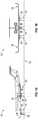
- FIGS. 1A and 1B illustrate an aircraft 10 elevated above a service center floor 12 via hydraulic jacks 14.
- hydraulic jacks 14 are usually built into the floor 12 of the service center as illustrated by the dashed lines in FIGS. 1A and 1B .
- each of the hydraulic jacks 14 interface with a jack pad 18, that is coupled by service technicians to the wings 16 and the fuselage of the aircraft just aft of the front landing gear prior to the elevation (jacking) operation to service the aircraft, such as, the landing gear 20.
- each of the hydraulic jacks 14 is operated (i.e., raised or lowered) independently by service technicians who must maintain the aircraft in a substantially level position so that the aircraft 10 does not slide off the hydraulic jacks 14.
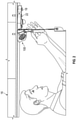
- a non-limiting embodiment of a leveling device 100 is illustrated coupled to the jack pad 18, which has been fixed to the wing 16 of the aircraft via removable fasteners 22.
- the leveling device 100 of the present disclosure includes a rear mounting support that positions the front surface of the leveling device at approximately a thirty-degree angle relative to the jack pad 18 for easy viewing by the service technician. As will be appreciated, other viewing angles may be provided for any particular embodiment as desired.
- the leveling device 100 includes a body 102 having a front surface 104, a side surface 106, a bottom surface 108 and a rear mounting support 110.
- the body 102 is made of a thermoplastic material that is produced by 3-D printing using fused deposition modeling (FDM) as is know in the art.
- FDM fused deposition modeling
- the body 102 may be formed by conventional injection molding techniques.
- the rear mounting support 110 includes a first mounting surface 112 that is configured to be an angle relative to the bottom surface 108 (best seen in FIG. 5D ) and a second mounting surface 114 that is substantially orthogonal to the first mounting surface.
- Each of the first mounting surface and second mounting surface include apertures (128 in FIG. 5B and FIG. 5D ) formed therein to receive magnetic coupling elements 116.
- the magnetic mounting elements 116 permit the leveling device 100 to be magnetically coupled to the jack pad 18 and then easily removed after servicing the aircraft 10 (see FIG. 2 ).
- the magnetic coupling elements comprise rare earth magnets, such as, for example, neodymium magnets. As will be appreciated, magnets are available with a variety of magnetic attractive force, and in some embodiments, a magnetic attraction force of twenty pounds is preferred for each magnetic coupling element 116.
- the side surface 106 of the body 102 includes an aperture for receiving a spirit level 200.
- a "spirit level” or “bubble level” means an instrument designed to indicate whether a surface is horizontal (level) or vertical (plumb).
- the spirit level 200 comprises a tubular bubble level, such as, for example, model 48-22-5102 pocket level available from MILWAUKEE TOOL. Operationally, after magnetically coupling the leveling device 100 to the jack pad 18 (see FIG.
- a releasable fastener 202 is loosened to allow the tubular bubble element 204 to rotate (as indicated by the reference arrows 118 on the body 102) within the spirit level 200 to calibrate (commonly referred to as "zero” or "level”) the tubular bubble element 204 after, which the releasable fastener 202 is tightened. Then, as the aircraft 10 is elevated by the service technicians, an objective determination of whether the aircraft wings 16 remain level during the jacking operation can be easily made.
- FIG. 4 is an exploded view of the leveling device 100 to further illustrate an exemplary embodiment.
- the side surface 106 of the body 102 includes an aperture for receiving the spirit level 200.
- the body 102 includes protrusions 120 to facilitate a friction fit of the spirit level 200 within the body 102.
- the spirit level 200 may be fixed within the body 102 by an adhesive (e.g., epoxy) to secure the spirit level in the body 102.
- the leveling device 100 includes a lanyard 122 that couples to the body 102.
- the lanyard may be used to couple tools or labels to the leveling device 100, such as, for example, a magnetic field caution label 124 to advise service technicians that may have an implantable pacemaker, defibrillator or other medical device that caution should be taken when coming near to the leveling device 100.
- a "remove before flight" label 126 may be attached to the leveling device 100 by the lanyard 122 to remind service technicians to remove the leveling device at the conclusion of the service operation.
- Other labels are, of course, possible as desire for any particular realization of the illustrated exemplary embodiment.
- FIGS. 5 A-E are line drawings (some with exemplary dimensions) of the body 102 in accordance non-limiting embodiments of the present disclosure.
- FIG. 5 A is a perspective top-front view while FIG. 5B is a top view.
- the rear mounting support 110 includes apertures 128 formed in the first mounting surface 112 and second mounting surface 114 as can be best seen in FIG. 5 B and FIG. 5D . These apertures 128 receive the magnetic coupling elements 116, which may be held in place by an adhesive (e.g., epoxy).
- FIG. 5C is a front view illustrating section line A-A which is shown in FIG. 5D . As noted above and illustrated in FIG.
- the first mounting surface 112 is configured to be at an angle ( ⁇ ) relative to a plane 130 of the bottom surface 108.
- the angle ( ⁇ ) is approximately thirty-degrees, however, other angles are possible as will be appreciated depending upon the embodiment being realized. It is the angle ( ⁇ ) that enables the leveling device 100 to present the front surface 104 (and thus the technician's view of the spirit level 200) at an approximate thirty-degree angle for ease of viewing (see FIG. 2 ).
- the second mounting surface 114 is configured to be orthogonal to the first mounting surface 112 (as can be seen in FIG. 5D and FIG. 5E ) allowing for a square corner of the rear mounting support 110 to securely magnetically couple to the jack pad 18.
- the leveling device body 102 may be formed by three-dimensional printing. Accordingly, the present disclosure contemplates a non-transitory computer-readable medium that would contain instructions that when executed by a processor of a three-dimensional printer would cause the printer to successively deposit material in a way to form the body 102 of the leveling device 100 in any particular shape or size desired for any particular application. As a non-limiting example, FIG.
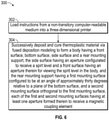
- FIG. 6 illustrates one embodiment of a method 300 of the present disclosure, where the non-transitory computer-readable medium would contain instructions that when loaded (block 302) and executed by a processor (block 304) would cause fused deposition modeling (FDM) to create the body having a front surface, bottom surface, side surface and a rear mounting support, the side surface having an aperture configurated to receive a spirt level and a front surface having an aperture therein for viewing the sprit level in the body, and the rear mounting support having a first mounting surface configured to be at an angle of approximately thirty degrees relative to a plane of the bottom surface, and a second mounting surface orthogonal to the first mounting surface, each of the first and second mounting surfaces having at least one aperture formed therein to receive a magnetic coupling element.
- FDM fused deposition modeling
- words such as connect or coupled to that are used in describing a relationship between different elements does not imply that a direct physical connection must be made between these elements.
- two elements may be connected to each other physically, electronically, logically, or in any other manner, through one or more additional elements.
Landscapes
- Engineering & Computer Science (AREA)
- Mechanical Engineering (AREA)
- Aviation & Aerospace Engineering (AREA)
- General Physics & Mathematics (AREA)
- Radar, Positioning & Navigation (AREA)
- Remote Sensing (AREA)
- Physics & Mathematics (AREA)
- Geology (AREA)
- Structural Engineering (AREA)
- Life Sciences & Earth Sciences (AREA)
- Manufacturing & Machinery (AREA)
- Transportation (AREA)
- Toys (AREA)
Abstract
Description
- The present invention generally relates to leveling devices that are used in connection with assuring an object is level relative to a surface, and more particularly relates to a leveling device that facilitates aircraft maintenance.
- Contemporary business aircraft require regular maintenance in order to retain flight certification. During some aircraft maintenance operations (e.g., landing gear service), the aircraft must be elevated (commonly referred to as jacked) from the service facility floor in order to access, remove or otherwise service the aircraft. Typically, hydraulic jacks are installed in the floor of the service facility for elevating the aircraft. It is common on typical business aircraft to have three jacking points; one under each wing and a third just aft of the front landing gear. When elevating (or jacking) an aircraft, the aircraft wings should be kept substantially level from the service facility floor so that the aircraft does not slide off the wing jacks and potentially damage the aircraft. In a typical jacking operation, several service technicians are used to gauge the level of the aircraft wings manually (i.e., by eye), which can be prone to human error.
- Accordingly, it is desirable to provide more objective manner to gauge the level of an aircraft during a jacking operation. It is further desirable that a reliable leveling device be easy to attach, use and remove from the aircraft at the conclusion of service. Furthermore, other desirable features and characteristics will become apparent from the subsequent detailed description and the appended claims, taken in conjunction with the accompanying drawings and the foregoing technical field and background.
- Exemplary embodiments of a leveling device are disclosed herein. In a first non-limiting embodiment, the leveling device includes, but is not limited to, a body having a body having front surface, bottom surface, side surface and a rear mounting support, the side surface having an aperture configurated to receive a spirt level and a front surface having an aperture therein for viewing the sprit level in the body and the rear mounting support having a first mounting surface configured to be at an angle relative to a plane of the bottom surface, and a second mounting surface orthogonal to the first mounting surface, each of the first and second mounting surfaces having at least one aperture formed therein to receive a magnetic coupling element, whereby, the body containing the sprit level may be magnetically coupled to a vehicle to indicate whether the vehicle remains level during a jacking operation.
- In a second non-limiting embodiment, a leveling device includes, but is not limited to, a body having front surface, bottom surface, side surface and a rear mounting support, the side surface having an aperture configurated to receive a spirt level and a front surface having an aperture therein for viewing the sprit level in the body, the rear mounting support having a first mounting surface configured to be at an angle of approximately thirty degrees relative to a plane of the bottom surface, and a second mounting surface orthogonal to the first mounting surface, each of the first and second mounting surfaces having at least one aperture formed therein to receive a neodymium magnetic coupling element, whereby, the body containing the sprit level may be magnetically coupled to a vehicle to indicate whether the vehicle remains level during a jacking operation.
- In a third non-limiting embodiment, a method is provided for forming a body for a leveling device. The method includes, but is not limited to, successively depositing a thermoplastic material to produce the body having a front surface, bottom surface, side surface and a rear mounting support, the side surface having an aperture configurated to receive a spirt level and a front surface having an aperture therein for viewing the sprit level in the body, and the rear mounting support having a first mounting surface configured to be at an angle of approximately thirty degrees relative to a plane of the bottom surface, and a second mounting surface orthogonal to the first mounting surface, each of the first and second mounting surfaces having at least one aperture formed therein to receive a magnetic coupling element.
- The present invention will hereinafter be described in conjunction with the following drawing figures, wherein like numerals denote like elements, and
-
FIGS. 1A and 1B are illustrations of an aircraft elevated for a maintenance operation in accordance with the teachings of the present disclosure; -
FIG. 2 is an illustration of a leveling device coupled to a jack pad in accordance with the teachings of the present disclosure; -
FIGS. 3A and 3B are perspective views of the leveling device ofFIG. 2 in accordance with the teachings of the present disclosure; -
FIG. 4 is an exploded perspective view of the leveling device in accordance with the teachings of the present disclosure; -
FIGS. 5 A-E are line drawings illustrating the body of the leveling device in accordance with the teachings of the present disclosure; and -
FIG. 6 is a is a flow diagram illustrating a method in accordance with the teachings of the present disclosure. - As used herein, the word "exemplary" means "serving as an example, instance, or illustration." The following detailed description is merely exemplary in nature and is not intended to limit application and uses. Any embodiment described herein as "exemplary" is not necessarily to be construed as preferred or advantageous over other embodiments. All of the embodiments described in this Detailed Description are exemplary embodiments provided to enable persons skilled in the art to make or use the embodiment and not to limit the scope that is defined by the claims. Furthermore, there is no intention to be bound by any expressed or implied theory presented in the preceding Technical Field, Background, Drawings Summary or the following Detailed Description.
- A leveling device for use in elevating (or jacking) a vehicle is described herein. While the leveling device of the present disclosure is described as affording an advantage in an aircraft maintenance applications, it will be appreciated that the present disclosure may be advantageously employed in other applications, including but not limited to, service operations for ground based vehicles, watercraft and spacecraft without departing from the teachings of the present disclosure. Furthermore, use of the leveling device of the present disclosure is not limited to use in servicing vehicles, but rather may be employed in any process that entails leveling an object.
- A greater understanding of the leveling device described above may be obtained through a review of the illustrations accompanying this application together with a review of the Detailed Description that follows.
-
FIGS. 1A and 1B illustrate anaircraft 10 elevated above aservice center floor 12 viahydraulic jacks 14. As is known,hydraulic jacks 14 are usually built into thefloor 12 of the service center as illustrated by the dashed lines inFIGS. 1A and 1B . As is shown, each of thehydraulic jacks 14 interface with ajack pad 18, that is coupled by service technicians to thewings 16 and the fuselage of the aircraft just aft of the front landing gear prior to the elevation (jacking) operation to service the aircraft, such as, thelanding gear 20. Typically, each of thehydraulic jacks 14 is operated (i.e., raised or lowered) independently by service technicians who must maintain the aircraft in a substantially level position so that theaircraft 10 does not slide off thehydraulic jacks 14. - Referring now to
FIG. 2 , a non-limiting embodiment of aleveling device 100 is illustrated coupled to thejack pad 18, which has been fixed to thewing 16 of the aircraft viaremovable fasteners 22. As will be explained in more detail below, theleveling device 100 of the present disclosure includes a rear mounting support that positions the front surface of the leveling device at approximately a thirty-degree angle relative to thejack pad 18 for easy viewing by the service technician. As will be appreciated, other viewing angles may be provided for any particular embodiment as desired. - Referring now to
FIGS. 3A and 3B , perspective front and rear views of a non-limiting embodiment of theleveling device 100 are shown. Theleveling device 100 includes abody 102 having afront surface 104, aside surface 106, abottom surface 108 and arear mounting support 110. In some embodiments, thebody 102 is made of a thermoplastic material that is produced by 3-D printing using fused deposition modeling (FDM) as is know in the art. In other embodiments, thebody 102 may be formed by conventional injection molding techniques. Therear mounting support 110 includes afirst mounting surface 112 that is configured to be an angle relative to the bottom surface 108 (best seen inFIG. 5D ) and asecond mounting surface 114 that is substantially orthogonal to the first mounting surface. Each of the first mounting surface and second mounting surface include apertures (128 inFIG. 5B andFIG. 5D ) formed therein to receivemagnetic coupling elements 116. Themagnetic mounting elements 116 permit theleveling device 100 to be magnetically coupled to thejack pad 18 and then easily removed after servicing the aircraft 10 (seeFIG. 2 ). In some non-limiting embodiments, the magnetic coupling elements comprise rare earth magnets, such as, for example, neodymium magnets. As will be appreciated, magnets are available with a variety of magnetic attractive force, and in some embodiments, a magnetic attraction force of twenty pounds is preferred for eachmagnetic coupling element 116. - In non-limiting embodiments, the
side surface 106 of thebody 102 includes an aperture for receiving aspirit level 200. As used herein, a "spirit level" or "bubble level" means an instrument designed to indicate whether a surface is horizontal (level) or vertical (plumb). In fundamental embodiments, thespirit level 200 comprises a tubular bubble level, such as, for example, model 48-22-5102 pocket level available from MILWAUKEE TOOL. Operationally, after magnetically coupling theleveling device 100 to the jack pad 18 (seeFIG. 2 ), areleasable fastener 202 is loosened to allow thetubular bubble element 204 to rotate (as indicated by thereference arrows 118 on the body 102) within thespirit level 200 to calibrate (commonly referred to as "zero" or "level") thetubular bubble element 204 after, which thereleasable fastener 202 is tightened. Then, as theaircraft 10 is elevated by the service technicians, an objective determination of whether theaircraft wings 16 remain level during the jacking operation can be easily made. - With continued reference to
FIGS. 3A and 3B ,FIG. 4 is an exploded view of theleveling device 100 to further illustrate an exemplary embodiment. InFIG. 4 , it can be seen that theside surface 106 of thebody 102 includes an aperture for receiving thespirit level 200. In some embodiments, thebody 102 includesprotrusions 120 to facilitate a friction fit of thespirit level 200 within thebody 102. In other embodiments, thespirit level 200 may be fixed within thebody 102 by an adhesive (e.g., epoxy) to secure the spirit level in thebody 102. In some embodiments, theleveling device 100 includes alanyard 122 that couples to thebody 102. The lanyard may be used to couple tools or labels to theleveling device 100, such as, for example, a magneticfield caution label 124 to advise service technicians that may have an implantable pacemaker, defibrillator or other medical device that caution should be taken when coming near to theleveling device 100. As another example, a "remove before flight"label 126 may be attached to theleveling device 100 by thelanyard 122 to remind service technicians to remove the leveling device at the conclusion of the service operation. Other labels are, of course, possible as desire for any particular realization of the illustrated exemplary embodiment. -
FIGS. 5 A-E are line drawings (some with exemplary dimensions) of thebody 102 in accordance non-limiting embodiments of the present disclosure.FIG. 5 A is a perspective top-front view whileFIG. 5B is a top view. As noted above, therear mounting support 110 includesapertures 128 formed in the first mountingsurface 112 and second mountingsurface 114 as can be best seen inFIG. 5 B andFIG. 5D . Theseapertures 128 receive themagnetic coupling elements 116, which may be held in place by an adhesive (e.g., epoxy).FIG. 5C is a front view illustrating section line A-A which is shown inFIG. 5D . As noted above and illustrated inFIG. 5D , the first mountingsurface 112 is configured to be at an angle (µ) relative to aplane 130 of thebottom surface 108. In some embodiments, the angle (µ) is approximately thirty-degrees, however, other angles are possible as will be appreciated depending upon the embodiment being realized. It is the angle (µ) that enables theleveling device 100 to present the front surface 104 (and thus the technician's view of the spirit level 200) at an approximate thirty-degree angle for ease of viewing (seeFIG. 2 ). Thesecond mounting surface 114 is configured to be orthogonal to the first mounting surface 112 (as can be seen inFIG. 5D and FIG. 5E ) allowing for a square corner of therear mounting support 110 to securely magnetically couple to thejack pad 18. - As mentioned above, the present disclosure contemplates that the
leveling device body 102 may be formed by three-dimensional printing. Accordingly, the present disclosure contemplates a non-transitory computer-readable medium that would contain instructions that when executed by a processor of a three-dimensional printer would cause the printer to successively deposit material in a way to form thebody 102 of theleveling device 100 in any particular shape or size desired for any particular application. As a non-limiting example,FIG. 6 illustrates one embodiment of amethod 300 of the present disclosure, where the non-transitory computer-readable medium would contain instructions that when loaded (block 302) and executed by a processor (block 304) would cause fused deposition modeling (FDM) to create the body having a front surface, bottom surface, side surface and a rear mounting support, the side surface having an aperture configurated to receive a spirt level and a front surface having an aperture therein for viewing the sprit level in the body, and the rear mounting support having a first mounting surface configured to be at an angle of approximately thirty degrees relative to a plane of the bottom surface, and a second mounting surface orthogonal to the first mounting surface, each of the first and second mounting surfaces having at least one aperture formed therein to receive a magnetic coupling element. - It will be appreciated that skilled artisans may form the leveling device in varying ways for each particular application, but such implementation variations should not be interpreted as causing a departure from the scope as set forth in the claims.
- In this document, relational terms such as first and second, and the like may be used solely to distinguish one entity or action from another entity or action without necessarily requiring or implying any actual such relationship or order between such entities or actions. Numerical ordinals such as first, second, third," etc. simply denote different singles of a plurality and do not imply any order or sequence unless specifically defined by the claim language. The sequence of the text in any of the claims does not imply that process steps must be performed in a temporal or logical order according to such sequence unless it is specifically defined by the language of the claim. The process steps may be interchanged in any order without departing from the scope of the invention as long as such an interchange does not contradict the claim language and is not logically nonsensical.
- Furthermore, depending on the context, words such as connect or coupled to that are used in describing a relationship between different elements does not imply that a direct physical connection must be made between these elements. For example, two elements may be connected to each other physically, electronically, logically, or in any other manner, through one or more additional elements.
- While at least one exemplary embodiment has been presented in the foregoing detailed description of the disclosure, it should be appreciated that a vast number of variations exist. It should also be appreciated that the exemplary embodiment or exemplary embodiments are only examples, and are not intended to limit the scope, applicability, or configuration of the invention in any way. Rather, the foregoing detailed description will provide those skilled in the art with a convenient road map for implementing an exemplary embodiment of the invention. It being understood that various changes may be made in the function and arrangement of elements described in an exemplary embodiment without departing from the scope of the disclosure as set forth in the appended claims.
- The present disclosure may be further described by the following Aspects.
- Aspect 1. A leveling device, comprising:
- a body having front surface, bottom surface, side surface and a rear mounting support;
- the side surface having an aperture configurated to receive a spirt level and a front surface having an aperture therein for viewing the sprit level in the body;
- the rear mounting support having a first mounting surface configured to be at an angle relative to a plane of the bottom surface, and a second mounting surface orthogonal to the first mounting surface, each of the first and second mounting surfaces having at least one aperture formed therein to receive a magnetic coupling element;
- whereby, the body containing the sprit level may be magnetically coupled to a vehicle to indicate whether the vehicle remains level during a jacking operation.
- Aspect 2. The leveling device of Aspect 1, wherein the body is formed by fused deposition modeling of a thermoplastic material.
- Aspect 3. The leveling device of Aspects 1 or 2, wherein the spirit level comprises a model 48-22-5102 level produced by MILWALKEE TOOL.
- Aspect 4. The leveling device of Aspect 3, wherein the spirit level includes a releasable fastener for calibrating the spirit level in the body.
- Aspect 5. The leveling device of any one of Aspects 1-4, wherein the angle of the first mounting surface is approximately thirty degrees.
- Aspect 6. The leveling device of any one of Aspects 1-5, wherein the magnetic coupling elements comprise rare earth magnets.
- Aspect 7. The leveling device of Aspect 6, wherein each of the rare earth magnets comprise neodymium magnets.
- Aspect 8. The leveling device of Aspect 7, wherein each of the neodymium magnets have a magnetic attraction force of approximately twenty pounds.
- Aspect 9. The leveling device of any one of Aspects 1-8, wherein the body includes protrusions formed within the aperture of the side surface to retain the spirit level.
-
Aspect 10. The leveling device of Aspect 9, wherein the spirit level is further retained in the body by an adhesive. - Aspect 11. The leveling device of any one of Aspects 1-10, further comprising a lanyard attached to the body.
-
Aspect 12. The leveling device of Aspect 11, further comprising a magnetic field caution label coupled to the lanyard. - Aspect 13. The leveling device of
Aspects 11 or 12, further comprising a 'remove before flight' label coupled to the lanyard. -
Aspect 14. A leveling device, comprising:- a body having front surface, bottom surface, side surface and a rear mounting support;
- the side surface having an aperture configurated to receive a spirt level and a front surface having an aperture therein for viewing the sprit level in the body;
- the rear mounting support having a first mounting surface configured to be at an angle of approximately thirty degrees relative to a plane of the bottom surface, and a second mounting surface orthogonal to the first mounting surface, each of the first and second mounting surfaces having at least one aperture formed therein to receive a neodymium magnetic coupling element;
- whereby, the body containing the sprit level may be magnetically coupled to a vehicle to indicate whether the vehicle remains level during a jacking operation.
- Aspect 15. The leveling device of
Aspect 14, wherein the spirit level comprises a model 48-22-5102 level produced by MILWALKEE TOOL. -
Aspect 16. The leveling device ofAspects 14 or 15, wherein the spirit level is further retained in the body by an adhesive. - Aspect 17. The leveling device of any one of Aspects 14-16, further comprising a lanyard attached to the body.
-
Aspect 18. The leveling device of Aspect 17, further comprising a magnetic field caution label coupled to the lanyard. - Aspect 19. The leveling device of
Aspects 17or 18, further comprising a 'remove before flight' label coupled to the lanyard. -
Aspect 20. A non-transitory computer-readable medium for producing a body for a leveling device, the non-transitory computer-readable medium comprising instructions stored thereon, that when executed by a processor, cause a three-dimensional fused deposition modeling printer to perform the steps of:- successively deposit a thermoplastic material to produce the body having:
- a front surface, bottom surface, side surface and a rear mounting support, the side surface having an aperture configurated to receive a spirt level and a front surface having an aperture therein for viewing the sprit level in the body, and the rear mounting support having a first mounting surface configured to be at an angle of approximately thirty degrees relative to a plane of the bottom surface, and a second mounting surface orthogonal to the first mounting surface, each of the first and second mounting surfaces having at least one aperture formed therein to receive a magnetic coupling element.
- successively deposit a thermoplastic material to produce the body having:
Claims (14)
- A leveling device, comprising:a body having front surface, bottom surface, side surface and a rear mounting support;the side surface having an aperture configurated to receive a spirt level and a front surface having an aperture therein for viewing the sprit level in the body;the rear mounting support having a first mounting surface configured to be at an angle relative to a plane of the bottom surface, and a second mounting surface orthogonal to the first mounting surface, each of the first and second mounting surfaces having at least one aperture formed therein to receive a magnetic coupling element;whereby, the body containing the sprit level may be magnetically coupled to a vehicle to indicate whether the vehicle remains level during a jacking operation.
- The leveling device of claim 1, wherein the body is formed by fused deposition modeling of a thermoplastic material.
- The leveling device of claims 1 or 2, wherein the spirit level comprises a model 48-22-5102 level produced by MILWALKEE TOOL.
- The leveling device of any one of claims 1-3, wherein the spirit level includes a releasable fastener for calibrating the spirit level in the body.
- The leveling device of any one of claims 1-4, wherein the angle of the first mounting surface is approximately thirty degrees.
- The leveling device of any one of claims 1-5, wherein the magnetic coupling elements comprise rare earth magnets.
- The leveling device of claim 6, wherein each of the rare earth magnets comprise neodymium magnets.
- The leveling device of claim 7, wherein each of the neodymium magnets have a magnetic attraction force of approximately twenty pounds.
- The leveling device of any one of claims 1-8, wherein the body includes protrusions formed within the aperture of the side surface to retain the spirit level.
- The leveling device of claim 9, wherein the spirit level is further retained in the body by an adhesive.
- The leveling device of any one of claims 1-10, further comprising a lanyard attached to the body.
- The leveling device of claim 11, further comprising a magnetic field caution label coupled to the lanyard.
- The leveling device of claims 11 or 12, further comprising a 'remove before flight' label coupled to the lanyard.
- A non-transitory computer-readable medium for producing a body for a leveling device, the non-transitory computer-readable medium comprising instructions stored thereon, that when executed by a processor, cause a three-dimensional fused deposition modeling printer to perform the steps of:successively deposit a thermoplastic material to produce the body having:a front surface, bottom surface, side surface and a rear mounting support, the side surface having an aperture configurated to receive a spirt level and a front surface having an aperture therein for viewing the sprit level in the body, and the rear mounting support having a first mounting surface configured to be at an angle of approximately thirty degrees relative to a plane of the bottom surface, and a second mounting surface orthogonal to the first mounting surface, each of the first and second mounting surfaces having at least one aperture formed therein to receive a magnetic coupling element.
Applications Claiming Priority (1)
| Application Number | Priority Date | Filing Date | Title |
|---|---|---|---|
| US16/936,141 US11231274B1 (en) | 2020-07-22 | 2020-07-22 | Leveling device |
Publications (1)
| Publication Number | Publication Date |
|---|---|
| EP3943884A1 true EP3943884A1 (en) | 2022-01-26 |
Family
ID=77179869
Family Applications (1)
| Application Number | Title | Priority Date | Filing Date |
|---|---|---|---|
| EP21185279.3A Withdrawn EP3943884A1 (en) | 2020-07-22 | 2021-07-13 | Leveling device |
Country Status (3)
| Country | Link |
|---|---|
| US (1) | US11231274B1 (en) |
| EP (1) | EP3943884A1 (en) |
| CN (1) | CN113844673B (en) |
Citations (1)
| Publication number | Priority date | Publication date | Assignee | Title |
|---|---|---|---|---|
| US5255443A (en) * | 1992-10-30 | 1993-10-26 | Great Neck Saw Manufacturing, Inc. | Post level with detent |
Family Cites Families (17)
| Publication number | Priority date | Publication date | Assignee | Title |
|---|---|---|---|---|
| US3820249A (en) * | 1972-10-16 | 1974-06-28 | T Stone | Self gripping level |
| US4124940A (en) * | 1977-09-23 | 1978-11-14 | Vaida Peter P | Level and method of assembling same |
| US4829676A (en) * | 1987-08-04 | 1989-05-16 | Waldron David C | Hands-free level indicating device |
| US5421094A (en) * | 1993-03-01 | 1995-06-06 | Mccord; David W. | Adjustable level |
| US6026581A (en) * | 1996-03-27 | 2000-02-22 | Johnson Level & Tool Mfg. Co., Inc. | Pocket level with optional magnet |
| US6029360A (en) * | 1996-11-13 | 2000-02-29 | Koch; Robert E. | Multi-angle pocket level |
| IL120249A (en) * | 1997-02-18 | 2000-02-17 | Kapro Ind Ltd | Post pipe and sign level |
| US6568095B2 (en) * | 2001-07-03 | 2003-05-27 | David H. Snyder | Magnetic torpedo level |
| US6834435B2 (en) * | 2001-08-18 | 2004-12-28 | Steven Turner | Multi-purpose leveling device |
| US20080116330A1 (en) * | 2004-12-10 | 2008-05-22 | Cotto Peter J | Apparatus for leveling and method of using same |
| US8572873B2 (en) * | 2007-11-07 | 2013-11-05 | Brett Van Bortel | Frame with integrated surface attachment for drywall and drywall-like surfaces and method for installing frames |
| US8621760B2 (en) * | 2008-11-10 | 2014-01-07 | Louis A. Norelli | Hands-free measuring instrument |
| CN102829721B (en) * | 2012-08-17 | 2015-02-25 | 中国航天空气动力技术研究院 | Airplane detection platform and airplane detection method |
| US9885571B2 (en) * | 2014-07-22 | 2018-02-06 | Milwaukee Electric Tool Corporation | Attachable level with rotatable bubble vial |
| US11136144B2 (en) * | 2018-07-12 | 2021-10-05 | Gulfstream Aerospace Corporation | Apparatus for supporting an object adjacent to an aircraft |
| CN209229297U (en) * | 2018-12-11 | 2019-08-09 | 防灾科技学院 | a leveling tripod |
| US11255668B2 (en) * | 2020-02-21 | 2022-02-22 | Joseph J. Calhoun | Level and level assembly |
-
2020
- 2020-07-22 US US16/936,141 patent/US11231274B1/en active Active
-
2021
- 2021-07-02 CN CN202110750800.5A patent/CN113844673B/en active Active
- 2021-07-13 EP EP21185279.3A patent/EP3943884A1/en not_active Withdrawn
Patent Citations (1)
| Publication number | Priority date | Publication date | Assignee | Title |
|---|---|---|---|---|
| US5255443A (en) * | 1992-10-30 | 1993-10-26 | Great Neck Saw Manufacturing, Inc. | Post level with detent |
Non-Patent Citations (1)
| Title |
|---|
| DORESOOM TOOL REVIEWS: "Milwaukee 4" Pocket Level Review", 19 August 2017 (2017-08-19), XP093138785, Retrieved from the Internet <URL:https://www.youtube.com/watch?v=KmErQHKtcuk> [retrieved on 20240307] * |
Also Published As
| Publication number | Publication date |
|---|---|
| CN113844673B (en) | 2022-10-11 |
| US11231274B1 (en) | 2022-01-25 |
| CN113844673A (en) | 2021-12-28 |
| US20220026205A1 (en) | 2022-01-27 |
Similar Documents
| Publication | Publication Date | Title |
|---|---|---|
| CN112154454B (en) | Target object detection method, system, device and storage medium | |
| US8005563B2 (en) | System for assembling aircraft | |
| CN109253731A (en) | Parking space drawing generating method, device, equipment and readable storage medium storing program for executing | |
| US10562745B2 (en) | Adapters for vehicle lifts and methods for using | |
| CN107388967A (en) | A kind of outer parameter compensation method of vehicle-mounted three-dimensional laser sensor and device | |
| US11231274B1 (en) | Leveling device | |
| BR102015031877B1 (en) | METHOD AND SYSTEM TO DETERMINE SHIFT DIMENSIONS USING AN AERIAL DRONE | |
| DE112020004308T5 (en) | Automatic supply station for an autonomous aircraft | |
| DE102016010690A1 (en) | Vehicle with drone landing gear functionality | |
| CN108356512A (en) | Adaptive leveling spacecraft precision butt-joint process | |
| CN103954458A (en) | Non-contacting type four-wheel aligner and detecting method thereof | |
| CN107298052A (en) | A kind of outer visor of vehicle blocks range computation method | |
| CN118306572A (en) | Method for adjusting butt joint of wing bodies of aircraft | |
| CN104964830B (en) | Vehicle cubing instrument board and auxiliary fasia console interface analogue simulation block and detection method | |
| CN218349403U (en) | Civil aviation passenger hand-carried luggage compliance detection device | |
| CN213041514U (en) | Calibration equipment | |
| US20030182059A1 (en) | Methods and apparatus for installation alignment of equipment | |
| CN112987768B (en) | Unmanned aerial vehicle righting device and orientation righting method | |
| US20050030552A1 (en) | Method for measuring large components, especially the body of rail cars | |
| CN109084932A (en) | A kind of adjustment six-dimensional force/torque sensor calibration coordinate system method and system | |
| CN222800307U (en) | Impact vibration test tool for four-rotor unmanned aerial vehicle | |
| CN207997865U (en) | Suspension assembly and train with same | |
| CN216815931U (en) | Simulation oil tank cabin tool for airplane oil tank shaking and vibrating test | |
| CN113639765B (en) | Aircraft mount projection calibration method | |
| CN115164824B (en) | Space-borne antenna compaction adaptive seat position measurement and adjustment method |
Legal Events
| Date | Code | Title | Description |
|---|---|---|---|
| PUAI | Public reference made under article 153(3) epc to a published international application that has entered the european phase |
Free format text: ORIGINAL CODE: 0009012 |
|
| STAA | Information on the status of an ep patent application or granted ep patent |
Free format text: STATUS: REQUEST FOR EXAMINATION WAS MADE |
|
| 17P | Request for examination filed |
Effective date: 20210713 |
|
| AK | Designated contracting states |
Kind code of ref document: A1 Designated state(s): AL AT BE BG CH CY CZ DE DK EE ES FI FR GB GR HR HU IE IS IT LI LT LU LV MC MK MT NL NO PL PT RO RS SE SI SK SM TR |
|
| P01 | Opt-out of the competence of the unified patent court (upc) registered |
Effective date: 20230519 |
|
| GRAP | Despatch of communication of intention to grant a patent |
Free format text: ORIGINAL CODE: EPIDOSNIGR1 |
|
| STAA | Information on the status of an ep patent application or granted ep patent |
Free format text: STATUS: GRANT OF PATENT IS INTENDED |
|
| INTG | Intention to grant announced |
Effective date: 20240423 |
|
| STAA | Information on the status of an ep patent application or granted ep patent |
Free format text: STATUS: THE APPLICATION IS DEEMED TO BE WITHDRAWN |
|
| 18D | Application deemed to be withdrawn |
Effective date: 20240824 |