EP3943734B1 - Assembly of a liquid carrying line and a hydraulic snubber insert for gas turbine engine and associated method of installation - Google Patents
Assembly of a liquid carrying line and a hydraulic snubber insert for gas turbine engine and associated method of installation Download PDFInfo
- Publication number
- EP3943734B1 EP3943734B1 EP21187301.3A EP21187301A EP3943734B1 EP 3943734 B1 EP3943734 B1 EP 3943734B1 EP 21187301 A EP21187301 A EP 21187301A EP 3943734 B1 EP3943734 B1 EP 3943734B1
- Authority
- EP
- European Patent Office
- Prior art keywords
- segment
- insert
- stem
- aperture
- assembly
- Prior art date
- Legal status (The legal status is an assumption and is not a legal conclusion. Google has not performed a legal analysis and makes no representation as to the accuracy of the status listed.)
- Active
Links
Images


Classifications
-
- F—MECHANICAL ENGINEERING; LIGHTING; HEATING; WEAPONS; BLASTING
- F16—ENGINEERING ELEMENTS AND UNITS; GENERAL MEASURES FOR PRODUCING AND MAINTAINING EFFECTIVE FUNCTIONING OF MACHINES OR INSTALLATIONS; THERMAL INSULATION IN GENERAL
- F16L—PIPES; JOINTS OR FITTINGS FOR PIPES; SUPPORTS FOR PIPES, CABLES OR PROTECTIVE TUBING; MEANS FOR THERMAL INSULATION IN GENERAL
- F16L55/00—Devices or appurtenances for use in, or in connection with, pipes or pipe systems
- F16L55/02—Energy absorbers; Noise absorbers
- F16L55/027—Throttle passages
- F16L55/02709—Throttle passages in the form of perforated plates
- F16L55/02718—Throttle passages in the form of perforated plates placed transversely
-
- F—MECHANICAL ENGINEERING; LIGHTING; HEATING; WEAPONS; BLASTING
- F16—ENGINEERING ELEMENTS AND UNITS; GENERAL MEASURES FOR PRODUCING AND MAINTAINING EFFECTIVE FUNCTIONING OF MACHINES OR INSTALLATIONS; THERMAL INSULATION IN GENERAL
- F16L—PIPES; JOINTS OR FITTINGS FOR PIPES; SUPPORTS FOR PIPES, CABLES OR PROTECTIVE TUBING; MEANS FOR THERMAL INSULATION IN GENERAL
- F16L55/00—Devices or appurtenances for use in, or in connection with, pipes or pipe systems
- F16L55/02—Energy absorbers; Noise absorbers
- F16L55/027—Throttle passages
- F16L55/02736—Throttle passages using transversal baffles defining a tortuous path
-
- F—MECHANICAL ENGINEERING; LIGHTING; HEATING; WEAPONS; BLASTING
- F16—ENGINEERING ELEMENTS AND UNITS; GENERAL MEASURES FOR PRODUCING AND MAINTAINING EFFECTIVE FUNCTIONING OF MACHINES OR INSTALLATIONS; THERMAL INSULATION IN GENERAL
- F16L—PIPES; JOINTS OR FITTINGS FOR PIPES; SUPPORTS FOR PIPES, CABLES OR PROTECTIVE TUBING; MEANS FOR THERMAL INSULATION IN GENERAL
- F16L55/00—Devices or appurtenances for use in, or in connection with, pipes or pipe systems
- F16L55/04—Devices damping pulsations or vibrations in fluids
-
- G—PHYSICS
- G01—MEASURING; TESTING
- G01L—MEASURING FORCE, STRESS, TORQUE, WORK, MECHANICAL POWER, MECHANICAL EFFICIENCY, OR FLUID PRESSURE
- G01L19/00—Details of, or accessories for, apparatus for measuring steady or quasi-steady pressure of a fluent medium insofar as such details or accessories are not special to particular types of pressure gauges
- G01L19/06—Means for preventing overload or deleterious influence of the measured medium on the measuring device or vice versa
- G01L19/0609—Pressure pulsation damping arrangements
-
- F—MECHANICAL ENGINEERING; LIGHTING; HEATING; WEAPONS; BLASTING
- F02—COMBUSTION ENGINES; HOT-GAS OR COMBUSTION-PRODUCT ENGINE PLANTS
- F02C—GAS-TURBINE PLANTS; AIR INTAKES FOR JET-PROPULSION PLANTS; CONTROLLING FUEL SUPPLY IN AIR-BREATHING JET-PROPULSION PLANTS
- F02C7/00—Features, components parts, details or accessories, not provided for in, or of interest apart form groups F02C1/00 - F02C6/00; Air intakes for jet-propulsion plants
- F02C7/22—Fuel supply systems
- F02C7/222—Fuel flow conduits, e.g. manifolds
-
- F—MECHANICAL ENGINEERING; LIGHTING; HEATING; WEAPONS; BLASTING
- F04—POSITIVE - DISPLACEMENT MACHINES FOR LIQUIDS; PUMPS FOR LIQUIDS OR ELASTIC FLUIDS
- F04B—POSITIVE-DISPLACEMENT MACHINES FOR LIQUIDS; PUMPS
- F04B11/00—Equalisation of pulses, e.g. by use of air vessels; Counteracting cavitation
- F04B11/0091—Equalisation of pulses, e.g. by use of air vessels; Counteracting cavitation using a special shape of fluid pass, e.g. throttles, ducts
-
- F—MECHANICAL ENGINEERING; LIGHTING; HEATING; WEAPONS; BLASTING
- F05—INDEXING SCHEMES RELATING TO ENGINES OR PUMPS IN VARIOUS SUBCLASSES OF CLASSES F01-F04
- F05D—INDEXING SCHEME FOR ASPECTS RELATING TO NON-POSITIVE-DISPLACEMENT MACHINES OR ENGINES, GAS-TURBINES OR JET-PROPULSION PLANTS
- F05D2220/00—Application
- F05D2220/30—Application in turbines
- F05D2220/32—Application in turbines in gas turbines
-
- F—MECHANICAL ENGINEERING; LIGHTING; HEATING; WEAPONS; BLASTING
- F15—FLUID-PRESSURE ACTUATORS; HYDRAULICS OR PNEUMATICS IN GENERAL
- F15D—FLUID DYNAMICS, i.e. METHODS OR MEANS FOR INFLUENCING THE FLOW OF GASES OR LIQUIDS
- F15D1/00—Influencing flow of fluids
- F15D1/02—Influencing flow of fluids in pipes or conduits
- F15D1/025—Influencing flow of fluids in pipes or conduits by means of orifice or throttle elements
Definitions
- the application relates generally to gas turbine engines and, more particularly, to the hydraulic circuits thereof.
- Hydraulic snubbers also referred to as pressure snubbers, are devices which are used to attenuate sharp pressure transients in liquids upstream of sensitive equipment.
- Many potential sources of sharp pressure transients exist the most common ones perhaps being the shutting and opening of valves and pressure ripples from pumps.
- various types of equipment sensitive to pressure transients exist the most common in gas turbine engine applications likely being pressure sensors.
- a pressure sensor construction can include a load cell applied against a diaphragm which is configured to elastically deform within a given pressure range, and the diaphragm is typically designed in a manner to reach a suitable trade-off between sensitivity and the extent of the pressure range.
- Hydraulic snubbers in the form of accessory fittings can be positioned in the liquid solid line, between the potential pressure transient source and the sensitive equipment. They can be used to avoid the loss of function of the sensitive equipment or to provide accurate readings (such as in the case of Bourdon tube pressure gauges). Pressure snubbers are typically configured to attenuate sharp pressure fluctuations (transients), such as may occur over a relatively small duration and/or with high frequency (such as less than one second). Indeed, the pressure fluctuations which pressure sensors are designed to monitor in liquid carrying lines of gas turbine engines can be of significantly longer duration, such as more than one second, for instance.
- FR 1,454,310 discloses a device for damping the oscillation of a pulsating liquid stream.
- US 2019/162350 discloses an inline fluid damper device.
- US 3,468,345 discloses means for limiting a temperature rise due to an abrupt alteration of the flow rate of gas under high pressure through a conduit.
- the invention is an assembly in accordance with the technical features of claim 1, a gas turbine engine in accordance with claim 13 and a method of installing a hydraulic snubber insert into a liquid line of a gas turbine engine in accordance with claim 14.
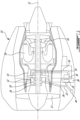
- Fig. 1 illustrates a gas turbine engine 10 of a type preferably provided for use in subsonic flight, generally comprising in serial flow communication a fan 12 through which ambient air is propelled, a compressor section 14 for pressurizing the air, a combustor 16 in which the compressed air is mixed with fuel and ignited for generating an annular stream of hot combustion gases, and a turbine section 18 for extracting energy from the combustion gases.
- the compressor 14, fan 12 and turbine 18 have rotating components which can be mounted on one or more shafts.
- Bearings 20 are used to provide smooth relative rotation between a shaft and casing (non-rotating component), and/or between two shafts which rotate at different speeds.
- An oil lubrication system 22 including an oil pump 24, sometimes referred to as a main pump, and a network of conduits and nozzles 26, is provided to feed the bearings 20 with oil.
- Seals 28 are used to contain the oil.
- a scavenge system 30 having cavities 32, conduits 34, and one or more scavenge pumps 36, is used to recover the oil, which can be in the form of an oil foam at that stage, from the bearings 20.
- the oil pump 24 typically draws the oil from an oil reservoir 38, and it is relatively common to use some form of air/oil separating device in the return line.
- a pressure sensor 40 can be used to monitor the oil supply operation, and can have a diaphragm exposed to the oil pressure in the oil supply line, for instance.
- the pressure sensor 40 can form part of a low oil pressure (LOP) switch which, for instance, can be configured to shut down an auto-pilot system (APS) in the event where the pressure falls below a predetermined threshold.
- LOP low oil pressure
- APS auto-pilot system
- the average pressure in the oil line can vary slowly, typically not changing significantly within duration windows of more than one second
- the instantaneous oil pressure can vary sharply due to the operation of the main pump.
- the flowrate generated by the pump will not be constant, but rather minutely influenced due to the effect of individual ones of the gear teeth on the flow, producing relatively sharp, repetitive variations in pressure in duration windows of less than one second, and even in the 10 th of a second range.
- such regular, sharp, decreases in pressure may be sufficient to toggle the low pressure switch, even though such high frequency pressure transients are not what the low pressure switch is configured to be responsive to.
- the pressure snubber in the form of an insert designed to be introduced within an existing liquid carrying line, as opposed to, say, a coupling configured to be assembled in line between the sensor outlet of the line and the sensor.
- the insert can have a plurality of segments mounted to a stem via which the segments can be pushed into or pulled out from the liquid carrying line, for instance, and even held longitudinally in place during operation such as by way of one form or another of a retainer which can be provided at a proximal end of the stem and secured into place during operation for instance.
- the stem is flexible to make the hydraulic snubber insert adaptable to curvilinear liquid lines.
- the stem can be made of a metal wire, and the segments can be secured to the stem, such as by being made of a polymer or other metal overmoulded onto the stem, for instance.
- the insert can be designed in a manner to be a single moulded component, for instance.
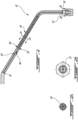
- Fig. 2 shows an example embodiment of a pressure snubber 41 formed by a hydraulic snubber insert 42 introduced into an existing liquid carrying line 44, upstream of a sensitive equipment such as a pressure sensor 40.
- the snubber insert 42 has an elongated stem 46 which is made of a sturdy, yet flexible material. The amount of required flexibility can depend on the minimum bend radius in the liquid carrying line 44, for instance, and for straight lines, one may prefer using a rigid material metal wire or braided line for the stem 46.
- the snubber insert 42 further has at least one segment 48, typically a plurality, which extend transversally from the stem 46. "Transversally”, here, is used relative to refer to an orientation generally normal to the length of the stem 46.
- the segments 48 are interspaced from one another along the length of the stem 46 and have a cross-sectional size and shape generally mating the cross-sectional size and shape of the liquid carrying line they are intended to fit.
- Each one of the segments 48 has at least one aperture 50, preferably more than one aperture 50, such as perhaps best seen in Fig. 2A .
- the apertures 50 can be provided in the form of open shapes such as "dents” formed along the periphery of the corresponding segment's outer edge, such as shown in Fig. 2A , and form a portion of the outer edge, but can alternately be closed shapes radially recessed from the outer edge.
- each segment 48 has three equidistant semi-circular orifices along its outer edge such as shown in Fig. 2A .
- the insert 42 can be handled via the stem 46, and therefore, by pushing the stem 46, the segments which can snugly fit the liquid carrying conduit can be pushed while being frictionally engaged with the inner surface (wall) of the liquid carrying conduit 44.
- the segments 48 can also be pulled out from the conduit by pulling the stem 46, which can remain externally accessible even when the insert 42 has been pushed into the position of use, which can be referred to as the snubbing position.
- the amplitude of the pressure transient can drop by a given step across each segment, due to the decrease in cross-sectional area through the segment (or otherwise said, through the at least one aperture per segment).
- the insert can include a single segment instead of a plurality of segments, for instance.
- the insert can also have a retainer 52, which would typically be positioned at an end 54 of the insert opposite the end 56 which is first introduced into the liquid carrying line through the sensor aperture.
- the retainer 52 can be configured to abut against a corresponding end of the liquid carrying line 44, and therefore prevent the insert from being pulled deeper into the liquid carrying line 44 during operation.
- the retainer 52 can be configured to become trapped into place when the sensor 40 or other sensitive equipment is secured at the end of the liquid carrying line 44.
- the insert has two retainers 52, one at each end 54, 56, and the insert is symmetrical and can alternately be engaged into the conduit via either end 54, 56.
- the insert 42 may have a single retainer, or be provided without a retainer.
- the retainer 52 also extends transversally, is cruciform, having four arms, and the tips of the arms can engage an flat annular edge surrounding the conduit's bore, thereby preventing the insert from being pulled further into the conduit due to vibrations or the like, for instance.
- Another component such as a pressure sensor, can be secured to the end of the conduit and trap the retainer between the component and the annular edge, for instance, also preventing the insert from exiting the conduit unless the component is removed.
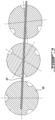
- the exact configuration of the snubber insert 42 can vary depending on the embodiment. Indeed, many variables can be controlled in a manner to arrive to a suitable solution for the specific embodiment, such as the geometry of the apertures, the size of the apertures, the number of orifices per segment, the number of segments, the downstream volume (between the last segment and the sensitive equipment - it will be noted that to a certain extent, this volume can be controlled by the free length of stem extending between the end 54 of the insert 42 and the closest segment), and even the configuration of the apertures relative to one another, e.g. whether successive apertures are aligned with one another or clocked/rotated relative to one another - such as shown in Fig. 3 (alternatively, the clocking can be by 180 degrees to produce a zig-zag pressure pattern), or whether the geometry is otherwise varied from one segment to another (e.g. progressively increasing or reducing the open surface area from one segment to another).
- Lohm rate can be used to select an appropriate attenuation rate for a given frequency of pressure ripple in pump applications.
- L 0.76 / d 2 with the diameter expressed in inches.
- L 1 , L 2 , L N are the respective Lohm rates of apertures 1, 2... N.
- Lohm rate can also change as a function of geometry. For instance, comparing triangular (90°) cuts such as shown in Fig. 4A and semi-circular cuts such as shown in Fig. 4B , for different cut depths, one can produce the graph presented in Fig. 5A showing the resulting cross-sectional area of the aperture. Plotting for different cut depths and different orifice geometries leads to the resulting Lohm rates plotted in Fig. 5B . Similarly, the graph of Fig. 5C presents Lohm rate for varying numbers of segments, comparing cases of one aperture per segment (top) progressively to 4 orifices per segment (bottom).
- orifice geometry can define cross-section area which directly translates to attenuation rate which single orifice can provide (Lohm rate).
- the geometry can have a significant impact on tolerance definition and overall feasibility of the solution. For instance, in the case of a semi-circular cut orifice with a radius of 0.005 inches and a tolerance of ⁇ 0.0005, the Lohm rate can change by roughly ⁇ 20% in the case of a single orifice.
- the orifice size can have a significant impact on cross-section area which can directly translate to attenuation rate which a single orifice can provide (Lohm rate).
- the number of orifices both in a segment and in a row change the overall attenuation rate. In a single segment, more orifices in a segment decreases attenuation rate for a segment, whereas in a row, more orifices in a row increases the attenuation rate for the entire wire. Increasing downstream volume can also decrease required attenuation rate.
- the unapertured portions of the segments can seal the flow by applying pressure on the inner surface of the conduit.
- Fig. 6 shows one such alternate embodiment of a pressure snubber 141 formed by a hydraulic snubber insert 142 introduced into an existing liquid carrying line 144.
- the snubber insert 142 has an elongated stem 146 which is made of a sturdy, yet flexible material.
- the snubber insert 142 further has a plurality of segments which extend transversally from the stem 146. "Transversally”, here, is used relative to refer to an orientation generally normal to the length of the stem 146.
- the segments 148 are interspaced from one another along the length of the stem 146 and have a cross-sectional size and shape generally mating the cross-sectional size and shape of the liquid carrying line they are intended to fit.
- Each one of the segments 148 has a single aperture 150 such as seen in Fig. 6A .
- the apertures 150 can be provided in the form of open shapes such as "dents” formed along the periphery of the corresponding segment's outer edge, such as shown in Fig. 2A , and form a portion of the outer edge.
- the insert 142 can be handled via the stem 146, and therefore, by pushing the stem 146 (which can be handled directly or via other segments or a retainer), the segments 148 which snugly fit the liquid carrying conduit can be pushed while being frictionally engaged with the inner surface (wall) of the liquid carrying conduit 144.
- the segments 148 can also be pulled out from the conduit by pulling the stem 146, which can remain externally accessible even when the insert 142 has been pushed into the snubbing position.
- the amplitude of the pressure transient can drop by a given step across each segment 148, due to the decrease in cross-sectional area through the segment 148 (or otherwise said, through the at least one aperture 150 per segment 148).
- the insert 142 can also have a retainer 152 positioned at an end 154 of the insert.
- the retainer 152 can be configured to abut against a corresponding end of the liquid carrying line 144, and therefore prevent the insert from being pulled deeper into the liquid carrying line 144 during operation.
- the retainer 152 can be configured to become trapped into place when the sensor 40 or other sensitive equipment is secured at the end of the liquid carrying line 144.
- Another component such as a pressure sensor 40, can be secured to the end of the conduit and trap the retainer 152 between the component and the annular edge, for instance, also preventing the insert 142 from exiting the conduit unless the component is removed.
- the insert can have a phase offsetting effect in addition to an attenuation effect.
- Fig. 7 shows two superposed pressure graphs, one at the outlet of a pump exhibiting significant pump ripple (upstream of the insert), and the second one immediately upstream of the sensor.
- the insert in this embodiment, has the effect of significantly attenuating the pressure ripple from the pump, and also slightly offsets the phase of the pressure ripple.
- the insert 42, 142 can be inserted directly into the liquid carrying line at the time of manufacturing the gas turbine engine. Alternately, the insert 42, 142 can be retrofitted to an existing gas turbine engine, several months or years after manufacturing the gas turbine engine.
- Fig. 8 shows an example of a solid tube or flexible sensing line referred to herein as a liquid carrying line 162 used between a gearbox 160 and a low oil pressure sensor 164 in a gas turbine engine.
- the liquid carrying line 162 can be a liquid carrying line 162 about to be installed in a new gas turbine engine, in which case the insert can be introduced 310 into the liquid line by pushing it along an inner wall of the line via the stem. Its end can be initially introduced via either end of the liquid line.
- the liquid line can then be installed 330 by connecting it to the engine at one end, and to the sensor at the other end.
- the liquid carrying line 162 can be an existing liquid carrying line 162 of a gas turbine engine having several years of service for instance, in which case the liquid carrying line 162 will first be disassembled 320, 340, from either the engine side, the sensor side, or both the engine side and the sensor side. If disassembled from the engine side, the liquid carrying line 162 can be disassembled from the gearbox 160 for instance. If disassembled from the sensor side, the liquid carrying line 162 can be disassembled from the low oil pressure sensor, for instance. Accordingly, the aperture of the liquid carrying line through which the insert is introduced can be a few parts of a sensing apparatus, such as fluid carrying line, ferrule, fitting, sensor passage leading to pressure chamber with diaphragm, to name a few examples.
- a sensing apparatus such as fluid carrying line, ferrule, fitting, sensor passage leading to pressure chamber with diaphragm, to name a few examples.
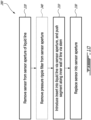
- Fig. 10 shows another example method of installing the insert 200, which includes introducing 210 a first end of the insert into the liquid line via the sensor end, and therefore through the aperture onto which the sensor is installed (referred to as the sensor aperture hereinafter), and pushing the insert into the liquid line.
- This can include pushing at least one segment in friction sliding engagement along an inner wall of the liquid line via a stem (directly or indirectly), the segment protruding transversally from the stem.
- reaching this step 210 can require removing a sensor 220 (either in good condition or damaged) from the sensor aperture, and the step 210 will likely be followed by replacing 230 a sensor (the same one or a new one in the case of a damaged sensor).
- a retrofit application can also involve an optional step of removing 240 an existing hydraulic snubber device and replacing it with the hydraulic snubber insert.
- the existing hydraulic snubber device can be a pressure ripple snubber fitting secured between the sensor and the line, for instance.
- the line in which the snubber insert is inserted can be an external line, or an integrated passage such as an integrated passage present in a gearbox housing for instance.
- the line can be an oil line, or can be a line adapted to carry another liquid than oil, such as fuel for instance.
- the retainer can take various forms and have various shapes, having the function of securing the stem in relation with the line.
- the connection between the segments and the stem can be rigid, or somewhat flexible.
- the stem can extend centrally relative to the segments or be offset from the center of the segments.
Landscapes
- Engineering & Computer Science (AREA)
- General Engineering & Computer Science (AREA)
- Mechanical Engineering (AREA)
- Chemical & Material Sciences (AREA)
- Combustion & Propulsion (AREA)
- Physics & Mathematics (AREA)
- General Physics & Mathematics (AREA)
- Measuring Fluid Pressure (AREA)
Description
- The application relates generally to gas turbine engines and, more particularly, to the hydraulic circuits thereof.
- Hydraulic snubbers, also referred to as pressure snubbers, are devices which are used to attenuate sharp pressure transients in liquids upstream of sensitive equipment. Many potential sources of sharp pressure transients exist, the most common ones perhaps being the shutting and opening of valves and pressure ripples from pumps. Similarly, various types of equipment sensitive to pressure transients exist, the most common in gas turbine engine applications likely being pressure sensors. For example, a pressure sensor construction can include a load cell applied against a diaphragm which is configured to elastically deform within a given pressure range, and the diaphragm is typically designed in a manner to reach a suitable trade-off between sensitivity and the extent of the pressure range. If the pressure range is exceeded, the diaphragm can plastically deform, which destroys the sensor. Hydraulic snubbers in the form of accessory fittings can be positioned in the liquid solid line, between the potential pressure transient source and the sensitive equipment. They can be used to avoid the loss of function of the sensitive equipment or to provide accurate readings (such as in the case of Bourdon tube pressure gauges). Pressure snubbers are typically configured to attenuate sharp pressure fluctuations (transients), such as may occur over a relatively small duration and/or with high frequency (such as less than one second). Indeed, the pressure fluctuations which pressure sensors are designed to monitor in liquid carrying lines of gas turbine engines can be of significantly longer duration, such as more than one second, for instance.
- While existing pressure snubbers were satisfactory to a certain degree, there remained room for improvement. For example, in the case of oil lines in gas turbine engines, the oil temperature can vary significantly depending on the engine's operating conditions throughout the operating envelope, and the oil viscosity varies significantly with temperature. This particular kind of scenario can make it difficult to achieve required sharp pressure transients attenuation while maintaining sufficient sensor response. Moreover, cost, durability, maintenance load and weight are other example factors which can be relevant in providing a pressure snubber suitable for a given application.
-
FR 1,454,310 -
US 2019/162350 discloses an inline fluid damper device. -
US 3,468,345 discloses means for limiting a temperature rise due to an abrupt alteration of the flow rate of gas under high pressure through a conduit. - The invention is an assembly in accordance with the technical features of
claim 1, a gas turbine engine in accordance with claim 13 and a method of installing a hydraulic snubber insert into a liquid line of a gas turbine engine in accordance withclaim 14. - Reference is now made to the accompanying figures in which:
-
Fig. 1 is a schematic cross-sectional view of a gas turbine engine; -
Fig. 2 is a longitudinal cross-sectional view of a liquid carrying line with a hydraulic snubber insert therein, withFig. 2A and 2B being cross-sectional views taken along corresponding lines ofFig. 2 ; -
Fig. 3 is a schematic view showing the tangential offsetting of apertures in successive ones of the segments; -
Fig. 4A and 4B are enlarged views showing two potential aperture shapes, triangular and semi-circular, respectively; -
Figs 5A and5B are graphs showing relationships between cut depth, orifice geometry, and cross sectional area and Lohm rate, respectively, whereasFig. 5C is a graph showing relationships between number of segments, number of apertures per segment, and Lohm rate; -
Fig. 6 is a longitudinal cross-sectional view of a liquid carrying line with an alternate embodiment of a hydraulic snubber insert therein, withFig. 6A being a cross-sectional view taken along lines 6A-6A inFig. 6 ; and -
Fig. 7 is a graph showing pressure fluctuations at different points in a liquid line of a gas turbine engine; -
Fig. 8 is a schematic view of an example sensing apparatus of a gas turbine engine; -
Fig. 9 is a flow chart illustrating an example method of installing a hydraulic snubber insert; and -
Fig. 10 is flow chart illustrating an other example method of installing a hydraulic snubber insert. -
Fig. 1 illustrates agas turbine engine 10 of a type preferably provided for use in subsonic flight, generally comprising in serial flow communication afan 12 through which ambient air is propelled, acompressor section 14 for pressurizing the air, acombustor 16 in which the compressed air is mixed with fuel and ignited for generating an annular stream of hot combustion gases, and aturbine section 18 for extracting energy from the combustion gases. - The
compressor 14,fan 12 andturbine 18 have rotating components which can be mounted on one or more shafts.Bearings 20 are used to provide smooth relative rotation between a shaft and casing (non-rotating component), and/or between two shafts which rotate at different speeds. Anoil lubrication system 22 including anoil pump 24, sometimes referred to as a main pump, and a network of conduits andnozzles 26, is provided to feed thebearings 20 with oil.Seals 28 are used to contain the oil. Ascavenge system 30 havingcavities 32,conduits 34, and one ormore scavenge pumps 36, is used to recover the oil, which can be in the form of an oil foam at that stage, from thebearings 20. Theoil pump 24 typically draws the oil from anoil reservoir 38, and it is relatively common to use some form of air/oil separating device in the return line. Apressure sensor 40 can be used to monitor the oil supply operation, and can have a diaphragm exposed to the oil pressure in the oil supply line, for instance. - In one example, the
pressure sensor 40 can form part of a low oil pressure (LOP) switch which, for instance, can be configured to shut down an auto-pilot system (APS) in the event where the pressure falls below a predetermined threshold. While during typical operation of the gas turbine engine, the average pressure in the oil line can vary slowly, typically not changing significantly within duration windows of more than one second, the instantaneous oil pressure can vary sharply due to the operation of the main pump. Indeed, in the case of a gear pump, for instance, the flowrate generated by the pump will not be constant, but rather minutely influenced due to the effect of individual ones of the gear teeth on the flow, producing relatively sharp, repetitive variations in pressure in duration windows of less than one second, and even in the 10th of a second range. Depending on the operating conditions, such regular, sharp, decreases in pressure may be sufficient to toggle the low pressure switch, even though such high frequency pressure transients are not what the low pressure switch is configured to be responsive to. - One potential solution to this problem is to introduce a pressure snubber between the LOP switch and the
pump 24. However, looking into this more closely, there may be several design requirements for such a solution to be viable, such as : a) achieving sufficiently high attenuation rate for the pressure transient; b) achieving sufficiently low fill-up time (e.g. a minimum pressure signal threshold build up below 10 seconds, preferably in the order of 1 second or even less); and c) providing a solution versatile enough to address a range of oil temperatures (e.g. from -40F to 270F (-40C to 132C)), and the associated range of oil viscosity. There may also be a challenge in obtaining accurate pressure readings due to slowly released high pressure in a transducer cavity or in a restrictor. - Accordingly, one may consider using a pressure snubber coupling having a single orifice, but realize that if such a device was adjusted to provide sufficient attenuation for the application, it would then only be suitable for a range of oil temperatures smaller than the actual range of oil temperatures in the application. Alternately, if adjusting the orifice size for the achieving suitable fill-up time over the entire oil temperature range, one may not be able to achieve sufficient attenuation rate.
- As will be explained below in further detail, it was found that such limitations could be addressed by using a composite pressure snubber formed of a plurality of orifices, such as, for instance, a sequence of segments each having one or more orifice. However, this leaves the issues of achieving satisfactory costs, convenience, and weight.
- It was found that such latter considerations could satisfactorily be addressed, at least in some embodiments, by providing the pressure snubber in the form of an insert designed to be introduced within an existing liquid carrying line, as opposed to, say, a coupling configured to be assembled in line between the sensor outlet of the line and the sensor. The insert can have a plurality of segments mounted to a stem via which the segments can be pushed into or pulled out from the liquid carrying line, for instance, and even held longitudinally in place during operation such as by way of one form or another of a retainer which can be provided at a proximal end of the stem and secured into place during operation for instance. The stem is flexible to make the hydraulic snubber insert adaptable to curvilinear liquid lines. The stem can be made of a metal wire, and the segments can be secured to the stem, such as by being made of a polymer or other metal overmoulded onto the stem, for instance. Alternatively, the insert can be designed in a manner to be a single moulded component, for instance. Using a stem which is flexible while having a certain amount of compressive strength, can allow to provide for the possibility of introducing the insert into a curvilinear conduit, for instance, allowing the insert to be usable in a manner somewhat akin to how a drain snake is used in unclogging curved drain pipes. Examples are presented below in association with a gas turbine engine context, but it will be understood that the proposed solution appears significantly original, and may benefit from use in contexts other than gas turbine engine contexts.
-
Fig. 2 shows an example embodiment of apressure snubber 41 formed by ahydraulic snubber insert 42 introduced into an existingliquid carrying line 44, upstream of a sensitive equipment such as apressure sensor 40. In this embodiment, thesnubber insert 42 has an elongatedstem 46 which is made of a sturdy, yet flexible material. The amount of required flexibility can depend on the minimum bend radius in theliquid carrying line 44, for instance, and for straight lines, one may prefer using a rigid material metal wire or braided line for thestem 46. Thesnubber insert 42 further has at least onesegment 48, typically a plurality, which extend transversally from thestem 46. "Transversally", here, is used relative to refer to an orientation generally normal to the length of thestem 46. Thesegments 48 are interspaced from one another along the length of thestem 46 and have a cross-sectional size and shape generally mating the cross-sectional size and shape of the liquid carrying line they are intended to fit. - Each one of the
segments 48 has at least oneaperture 50, preferably more than oneaperture 50, such as perhaps best seen inFig. 2A . Theapertures 50 can be provided in the form of open shapes such as "dents" formed along the periphery of the corresponding segment's outer edge, such as shown inFig. 2A , and form a portion of the outer edge, but can alternately be closed shapes radially recessed from the outer edge. In this embodiment, eachsegment 48 has three equidistant semi-circular orifices along its outer edge such as shown inFig. 2A . Theinsert 42 can be handled via thestem 46, and therefore, by pushing thestem 46, the segments which can snugly fit the liquid carrying conduit can be pushed while being frictionally engaged with the inner surface (wall) of the liquid carryingconduit 44. Thesegments 48 can also be pulled out from the conduit by pulling thestem 46, which can remain externally accessible even when theinsert 42 has been pushed into the position of use, which can be referred to as the snubbing position. The amplitude of the pressure transient can drop by a given step across each segment, due to the decrease in cross-sectional area through the segment (or otherwise said, through the at least one aperture per segment). In an alternate embodiment, the insert can include a single segment instead of a plurality of segments, for instance. - The insert can also have a
retainer 52, which would typically be positioned at anend 54 of the insert opposite theend 56 which is first introduced into the liquid carrying line through the sensor aperture. Theretainer 52 can be configured to abut against a corresponding end of the liquid carryingline 44, and therefore prevent the insert from being pulled deeper into the liquid carryingline 44 during operation. Theretainer 52 can be configured to become trapped into place when thesensor 40 or other sensitive equipment is secured at the end of the liquid carryingline 44. In this embodiment, the insert has tworetainers 52, one at eachend end insert 42 may have a single retainer, or be provided without a retainer. In this embodiment, theretainer 52 also extends transversally, is cruciform, having four arms, and the tips of the arms can engage an flat annular edge surrounding the conduit's bore, thereby preventing the insert from being pulled further into the conduit due to vibrations or the like, for instance. Another component, such as a pressure sensor, can be secured to the end of the conduit and trap the retainer between the component and the annular edge, for instance, also preventing the insert from exiting the conduit unless the component is removed. - The exact configuration of the
snubber insert 42 can vary depending on the embodiment. Indeed, many variables can be controlled in a manner to arrive to a suitable solution for the specific embodiment, such as the geometry of the apertures, the size of the apertures, the number of orifices per segment, the number of segments, the downstream volume (between the last segment and the sensitive equipment - it will be noted that to a certain extent, this volume can be controlled by the free length of stem extending between theend 54 of theinsert 42 and the closest segment), and even the configuration of the apertures relative to one another, e.g. whether successive apertures are aligned with one another or clocked/rotated relative to one another - such as shown inFig. 3 (alternatively, the clocking can be by 180 degrees to produce a zig-zag pressure pattern), or whether the geometry is otherwise varied from one segment to another (e.g. progressively increasing or reducing the open surface area from one segment to another). - We will now illustrate one possible example of how a
snubber insert 42 can be specifically adapted to a specific embodiment by variations in some of the aforementioned variables. - Indeed, as explained in the "Technical Hydraulic Handbook", 12th edition, from The Lee Company, the concept of Lohm rate can be used to select an appropriate attenuation rate for a given frequency of pressure ripple in pump applications.
- One can reduce the Lohm rate (L) by increasing hole diameter (d) in accordance with the formula :


apertures 
- Lohm rate can also change as a function of geometry. For instance, comparing triangular (90°) cuts such as shown in
Fig. 4A and semi-circular cuts such as shown inFig. 4B , for different cut depths, one can produce the graph presented inFig. 5A showing the resulting cross-sectional area of the aperture. Plotting for different cut depths and different orifice geometries leads to the resulting Lohm rates plotted inFig. 5B . Similarly, the graph ofFig. 5C presents Lohm rate for varying numbers of segments, comparing cases of one aperture per segment (top) progressively to 4 orifices per segment (bottom). - Accordingly, one can achieve a desired Lohm rate in various ways, by tuning different variables, which can produce different effects on response time, allowing for versatility. Indeed, it has been observed that orifice geometry, for instance, can define cross-section area which directly translates to attenuation rate which single orifice can provide (Lohm rate). The geometry can have a significant impact on tolerance definition and overall feasibility of the solution. For instance, in the case of a semi-circular cut orifice with a radius of 0.005 inches and a tolerance of ± 0.0005, the Lohm rate can change by roughly ± 20% in the case of a single orifice. The orifice size can have a significant impact on cross-section area which can directly translate to attenuation rate which a single orifice can provide (Lohm rate). The number of orifices both in a segment and in a row change the overall attenuation rate. In a single segment, more orifices in a segment decreases attenuation rate for a segment, whereas in a row, more orifices in a row increases the attenuation rate for the entire wire. Increasing downstream volume can also decrease required attenuation rate. In the case of segments having open-shaped apertures formed in the outer edge, the unapertured portions of the segments can seal the flow by applying pressure on the inner surface of the conduit.
- Indeed,
Fig. 6 shows one such alternate embodiment of apressure snubber 141 formed by ahydraulic snubber insert 142 introduced into an existingliquid carrying line 144. In this embodiment, thesnubber insert 142 has anelongated stem 146 which is made of a sturdy, yet flexible material. Thesnubber insert 142 further has a plurality of segments which extend transversally from thestem 146. "Transversally", here, is used relative to refer to an orientation generally normal to the length of thestem 146. Thesegments 148 are interspaced from one another along the length of thestem 146 and have a cross-sectional size and shape generally mating the cross-sectional size and shape of the liquid carrying line they are intended to fit. - Each one of the
segments 148 has asingle aperture 150 such as seen inFig. 6A . Theapertures 150 can be provided in the form of open shapes such as "dents" formed along the periphery of the corresponding segment's outer edge, such as shown inFig. 2A , and form a portion of the outer edge. Theinsert 142 can be handled via thestem 146, and therefore, by pushing the stem 146 (which can be handled directly or via other segments or a retainer), thesegments 148 which snugly fit the liquid carrying conduit can be pushed while being frictionally engaged with the inner surface (wall) of the liquid carryingconduit 144. Thesegments 148 can also be pulled out from the conduit by pulling thestem 146, which can remain externally accessible even when theinsert 142 has been pushed into the snubbing position. The amplitude of the pressure transient can drop by a given step across eachsegment 148, due to the decrease in cross-sectional area through the segment 148 (or otherwise said, through the at least oneaperture 150 per segment 148). - The
insert 142 can also have aretainer 152 positioned at anend 154 of the insert. Theretainer 152 can be configured to abut against a corresponding end of theliquid carrying line 144, and therefore prevent the insert from being pulled deeper into theliquid carrying line 144 during operation. Theretainer 152 can be configured to become trapped into place when thesensor 40 or other sensitive equipment is secured at the end of theliquid carrying line 144. Another component, such as apressure sensor 40, can be secured to the end of the conduit and trap theretainer 152 between the component and the annular edge, for instance, also preventing theinsert 142 from exiting the conduit unless the component is removed. - Depending on the embodiment, the insert can have a phase offsetting effect in addition to an attenuation effect. This is illustrated in
Fig. 7 which shows two superposed pressure graphs, one at the outlet of a pump exhibiting significant pump ripple (upstream of the insert), and the second one immediately upstream of the sensor. As seen, the insert, in this embodiment, has the effect of significantly attenuating the pressure ripple from the pump, and also slightly offsets the phase of the pressure ripple. - The
insert insert - For instance,
Fig. 8 shows an example of a solid tube or flexible sensing line referred to herein as aliquid carrying line 162 used between agearbox 160 and a lowoil pressure sensor 164 in a gas turbine engine. Theliquid carrying line 162 can be aliquid carrying line 162 about to be installed in a new gas turbine engine, in which case the insert can be introduced 310 into the liquid line by pushing it along an inner wall of the line via the stem. Its end can be initially introduced via either end of the liquid line. As shown inFig. 9 , the liquid line can then be installed 330 by connecting it to the engine at one end, and to the sensor at the other end. Alternately, theliquid carrying line 162 can be an existingliquid carrying line 162 of a gas turbine engine having several years of service for instance, in which case theliquid carrying line 162 will first be disassembled 320, 340, from either the engine side, the sensor side, or both the engine side and the sensor side. If disassembled from the engine side, theliquid carrying line 162 can be disassembled from thegearbox 160 for instance. If disassembled from the sensor side, theliquid carrying line 162 can be disassembled from the low oil pressure sensor, for instance. Accordingly, the aperture of the liquid carrying line through which the insert is introduced can be a few parts of a sensing apparatus, such as fluid carrying line, ferrule, fitting, sensor passage leading to pressure chamber with diaphragm, to name a few examples. -
Fig. 10 shows another example method of installing theinsert 200, which includes introducing 210 a first end of the insert into the liquid line via the sensor end, and therefore through the aperture onto which the sensor is installed (referred to as the sensor aperture hereinafter), and pushing the insert into the liquid line. This can include pushing at least one segment in friction sliding engagement along an inner wall of the liquid line via a stem (directly or indirectly), the segment protruding transversally from the stem. In the case of a retrofit application, reaching thisstep 210 can require removing a sensor 220 (either in good condition or damaged) from the sensor aperture, and thestep 210 will likely be followed by replacing 230 a sensor (the same one or a new one in the case of a damaged sensor). If the insert has a retainer, the sensor can trap the retainer into place, preventing the snubber insert from moving thereafter via the stem. A retrofit application can also involve an optional step of removing 240 an existing hydraulic snubber device and replacing it with the hydraulic snubber insert. The existing hydraulic snubber device can be a pressure ripple snubber fitting secured between the sensor and the line, for instance. - The embodiments described in this document provide non-limiting examples of possible implementations of the present invention.
- Upon review of the present disclosure, a person of ordinary skill in the art will recognize that changes may be made to the embodiments described herein without departing from the scope of the present invention as defined in the appended claims.
- For example, depending on the application, the line in which the snubber insert is inserted can be an external line, or an integrated passage such as an integrated passage present in a gearbox housing for instance. The line can be an oil line, or can be a line adapted to carry another liquid than oil, such as fuel for instance. If used, the retainer can take various forms and have various shapes, having the function of securing the stem in relation with the line. The connection between the segments and the stem can be rigid, or somewhat flexible. The stem can extend centrally relative to the segments or be offset from the center of the segments.
Claims (15)
- An assembly comprising a liquid carrying line (44; 144; 162) of a gas turbine engine (10) and a hydraulic snubber insert (42; 142) for the liquid carrying line (44; 144; 162), the insert (42; 142) comprising an elongated stem (46; 146) and at least one segment (48; 148) extending transversally from the stem (46; 146), each segment (48; 148) having a size and shape mating a cross-sectional size and shape of the liquid carrying line (44; 144; 162), and having at least one aperture (50; 150), the insert (42; 142) being configured for the at least one segment (48; 148) to be pushable snugly inside and along the liquid carrying line (44; 144; 162) and pullable out from the liquid carrying line (44; 144; 162) via the stem (46; 146), wherein the stem (46; 146) is flexible, characterised in that:the liquid carrying line (44; 144; 162) is curvilinear; and in thatthe at least one segment (48; 148) includes a plurality of segments (48; 148) interspaced from one another along a length of the stem (46; 146), and at least one of :a number of the plurality of segments (48; 148);a number of said at least one aperture (50; 150) per segment (48; 148)a configuration of said at least one aperture (50; 150) per segment (48; 148);a shape of the apertures (50; 150); anda configuration of the at least one aperture (50; 150) in each segment (48; 148) relative to the at least one aperture (50; 150) of the other segments (48; 148),are configured to provide a substantial attenuation of repetitive pressure transients of a pump in liquids in the form of pressure ripples during operation of the gas turbine engine (10) while preserving response time of slower pressure variations across the hydraulic snubber insert (42; 142) via the apertures (50; 150).
- The assembly of claim 1, wherein the at least one aperture (50; 150) of adjacent ones of the segments (48; 148) are tangentially offset from one another.
- The assembly of claim 1 or 2, wherein the total open cross-sectional area of the at least one aperture (50; 150) increases from one segment (48; 148) to another along the length of the stem (46; 146).
- The assembly of any preceding claim, wherein the at least one aperture (50) includes a plurality of apertures (50) tangentially spaced apart from one another around the stem (46).
- The assembly of any preceding claim, wherein each segment (48; 148) is flat and planar.
- The assembly of any preceding claim, wherein the stem (46; 146) extends across a center of each segment (48; 148).
- The assembly of any preceding claim, wherein each segment (48; 148) has a circular cross-sectional shape.
- The assembly of any preceding claim, wherein the at least one aperture (50; 150) is an open shape defined along a radially outer periphery of each segment (48; 148).
- The assembly of any preceding claim, wherein the at least one aperture (50; 150) is semi-circular in shape.
- The assembly of any of claims 1 to 8, wherein the at least one aperture (50; 150) is a V-shaped notch defined into the radially outer periphery.
- The assembly of any preceding claim, wherein each segment (48; 148) is made of a polymer overmoulded onto the stem (46; 146).
- The assembly of claim 11, wherein the stem (46; 146) is a metal wire.
- A gas turbine engine (10) comprising the assembly of any preceding claim, a pressure transient source in fluid flow communication with the liquid carrying line (44; 144; 162), a sensor (40; 164) in fluid flow communication with the liquid carrying line (44; 144; 162), and the hydraulic snubber insert (42; 142) positioned in the liquid carrying line (44; 144; 162), between the pressure transient source and the sensor (40; 164), and wherein, optionally:the liquid carrying line (44; 144; 162) is an oil line; and/orthe pressure transient source is a pump (24) which generates repetitive pressure transients in the form of pressure ripples during operation of the gas turbine engine (10).
- A method of assembling a hydraulic snubber insert (42; 142) into a liquid line (44; 144; 162) of a gas turbine engine (10), the method comprising:
introducing (310) a first end (56) of the insert (42; 142) into the liquid line (44; 144; 162), and pushing the insert (42; 142) into the liquid line (44; 144; 162), including pushing at least one segment (48; 148) in friction sliding engagement along an inner wall of the liquid line (44; 144; 162) via a stem (46; 146), the segment (48; 148) protruding transversally from the stem (46; 146) and comprising at least one aperture (50; 150), wherein the stem (46; 146) is flexible,
characterised in that:the liquid carrying line (44; 144; 162) is curvilinear; and in thatthe at least one segment (48; 148) includes a plurality of segments (48; 148) interspaced from one another along a length of the stem (46; 146), and at least one of :a number of the plurality of segments (48; 148);a number of said at least one aperture (50; 150) per segment (48; 148)a configuration of said at least one aperture (50; 150) per segment (48; 148);a shape of the apertures (50; 150); anda configuration of the at least one aperture (50; 150) in each segment (48; 148) relative to the at least one aperture (50; 150) of the other segments (48; 148),are configured to provide a substantial attenuation of repetitive pressure transients of a pump in liquids in the form of pressure ripples during operation of the gas turbine engine (10) while preserving response time of slower pressure variations across the hydraulic snubber insert (42; 142) via the apertures (50; 150). - The method of claim 14, further comprising disassembling (320, 340) the liquid line (44; 144; 162) from either an engine aperture or a sensor (40; 164) prior to said introducing, and reassembling the liquid line (44; 144; 162) after said introducing (310), the hydraulic snubber insert (42; 142) being trapped in the liquid line (44; 144; 162) subsequently to said reassembling, wherein, optionally:the hydraulic snubber insert (42; 142) further comprises a retainer (52; 152) extending transversally from a second end (54; 154) of the stem (46; 146);said reassembling includes trapping the insert (42; 142); andsaid pushing is further done via the retainer (52; 152).
Applications Claiming Priority (1)
| Application Number | Priority Date | Filing Date | Title |
|---|---|---|---|
| US16/938,127 US11608927B2 (en) | 2020-07-24 | 2020-07-24 | Hydraulic snubber insert for gas turbine engine and associated method of installation |
Publications (2)
| Publication Number | Publication Date |
|---|---|
| EP3943734A1 EP3943734A1 (en) | 2022-01-26 |
| EP3943734B1 true EP3943734B1 (en) | 2025-05-14 |
Family
ID=77042761
Family Applications (1)
| Application Number | Title | Priority Date | Filing Date |
|---|---|---|---|
| EP21187301.3A Active EP3943734B1 (en) | 2020-07-24 | 2021-07-22 | Assembly of a liquid carrying line and a hydraulic snubber insert for gas turbine engine and associated method of installation |
Country Status (3)
| Country | Link |
|---|---|
| US (1) | US11608927B2 (en) |
| EP (1) | EP3943734B1 (en) |
| CA (1) | CA3124978A1 (en) |
Citations (2)
| Publication number | Priority date | Publication date | Assignee | Title |
|---|---|---|---|---|
| US3468345A (en) * | 1966-05-31 | 1969-09-23 | Automatic Sprinkler Corp | Means for limiting temperature rise due to abrupt alteration of the flow rate of gas under high pressure through a conduit |
| EP3610145B1 (en) * | 2017-04-13 | 2021-12-15 | General Electric Company | Gas turbine engine fuel manifold damper and method of dynamics attenuation |
Family Cites Families (42)
| Publication number | Priority date | Publication date | Assignee | Title |
|---|---|---|---|---|
| US1094667A (en) * | 1913-01-06 | 1914-04-28 | Philo W Masten | Muffler. |
| US1377970A (en) * | 1920-05-14 | 1921-05-10 | Thomas S Richard | Gas-pressure-reducing device |
| US1926627A (en) * | 1930-07-26 | 1933-09-12 | John E Michaels | Carburetor attachment |
| US1976442A (en) * | 1933-11-15 | 1934-10-09 | Philip P Finn | Water silencer |
| US2400161A (en) * | 1943-08-24 | 1946-05-14 | Worthington Pump & Mach Corp | Multiple orifice throttling device |
| US2426833A (en) * | 1943-11-05 | 1947-09-02 | Power Jets Res & Dev Ltd | Apparatus for mixing fluids |
| US2553141A (en) * | 1945-08-17 | 1951-05-15 | Elgin Rowland Parker | Baffle |
| FR1454310A (en) * | 1965-11-18 | 1966-07-22 | Joseph Voegele Ag | Device for damping the oscillations of a pulsating liquid stream |
| GB1148435A (en) * | 1966-04-23 | 1969-04-10 | Rolls Royce | Warning systems for lubricated bearings |
| US4065918A (en) * | 1973-02-12 | 1978-01-03 | Ethyl Corporation | Exhaust systems |
| US4090559A (en) * | 1974-08-14 | 1978-05-23 | The United States Of America As Represented By The Secretary Of The Navy | Heat transfer device |
| US4050479A (en) | 1975-06-27 | 1977-09-27 | Masoneilan International, Inc. | Fluid resistance device |
| GB2066984B (en) | 1980-01-04 | 1983-05-25 | Hopkinsons Ltd | Pressure reducing device |
| US4473043A (en) * | 1980-08-19 | 1984-09-25 | Kabushiki Kaisha Komatsu Seisakusho | Fluid lubricating circuit for engines |
| US4412582A (en) * | 1981-07-06 | 1983-11-01 | Hiross, Inc. | Baffle array for heat exchange apparatus |
| US4420016A (en) * | 1982-01-07 | 1983-12-13 | Nichols Ralph A | Kink-preventing spine for aquarium air hoses |
| US4594877A (en) | 1984-09-17 | 1986-06-17 | Eg&G Chandler Engineering Company | Pneumatic deadweight tester incorporating dampening means |
| SE454101B (en) * | 1986-03-10 | 1988-03-28 | Sven Runo Vilhelm Gebelius | EXHAUST ENGINE EXHAUST SYSTEM |
| US5156680A (en) * | 1991-07-30 | 1992-10-20 | Rockwell International Corporation | Flow restrictor for a fluid |
| DE19516358C1 (en) * | 1995-05-04 | 1996-08-22 | Daimler Benz Ag | Fuel pulsation damper in fuel supply system of IC engine |
| US6520767B1 (en) * | 1999-04-26 | 2003-02-18 | Supercritical Combusion Corporation | Fuel delivery system for combusting fuel mixtures |
| US6655207B1 (en) | 2000-02-16 | 2003-12-02 | Honeywell International Inc. | Flow rate module and integrated flow restrictor |
| US6820431B2 (en) * | 2002-10-31 | 2004-11-23 | General Electric Company | Acoustic impedance-matched fuel nozzle device and tunable fuel injection resonator assembly |
| US6848477B2 (en) * | 2003-01-14 | 2005-02-01 | Visteon Global Technologies, Inc. | Fuel pressure damping system and method |
| CA2457329A1 (en) | 2004-02-10 | 2005-08-10 | Richard T. Hay | Downhole drilling fluid heating apparatus and method |
| US20090065295A1 (en) | 2007-09-11 | 2009-03-12 | Sherikar Sanjay V | Desuperheater muffler |
| US8561470B2 (en) | 2008-05-09 | 2013-10-22 | Kulite Semiconductor Products, Inc. | Apparatus and method for eliminating varying pressure fluctuations in a pressure transducer |
| US20110147322A1 (en) * | 2009-12-17 | 2011-06-23 | Honeywell International Inc. | Lubricant supply filtration system and method |
| US8707791B2 (en) | 2010-09-10 | 2014-04-29 | Kulite Semiconductor Products, Inc. | Tunable pressure transducer assembly |
| JP2015086968A (en) * | 2013-10-31 | 2015-05-07 | 三菱日立パワーシステムズ株式会社 | Multistage decompression device and boiler |
| US9527231B2 (en) * | 2014-04-24 | 2016-12-27 | Continental Automotive Systems, Inc. | Wire bundle overmold structure |
| EP3034945B1 (en) * | 2014-12-19 | 2018-05-30 | Ansaldo Energia Switzerland AG | Gas turbine fuel pipe comprising a damper |
| US9494048B1 (en) * | 2015-05-12 | 2016-11-15 | United Technologies Corporation | Active system for bearing oil damper supply and vibration control |
| US9982601B2 (en) * | 2015-06-01 | 2018-05-29 | United Technologies Corporation | Oil system with helmholtz resonator damper in lube line |
| US10145501B2 (en) * | 2015-12-08 | 2018-12-04 | The Boeing Company | Pressurized fluid line deresonator |
| US10808874B2 (en) | 2017-11-30 | 2020-10-20 | General Electric Company | Inline fluid damper device |
| WO2019202616A1 (en) | 2018-04-16 | 2019-10-24 | Tm Tecnomatic S.R.L. | Device for reducing pressure and/or flow rate in pipings, and assembly method of such device |
| US10907631B2 (en) | 2018-08-01 | 2021-02-02 | Rolls-Royce Corporation | Pump ripple pressure monitoring for incompressible fluid systems |
| US11506125B2 (en) | 2018-08-01 | 2022-11-22 | General Electric Company | Fluid manifold assembly for gas turbine engine |
| US20200158063A1 (en) | 2018-11-15 | 2020-05-21 | Hamilton Sundstrand Corporation | Fluid pulsation attenuating arrangement |
| US11060935B2 (en) | 2019-05-01 | 2021-07-13 | Kulite Semiconductor Products, Inc. | Pressure transducer assembly with selectable damping inserts |
| US11619560B2 (en) | 2019-10-18 | 2023-04-04 | Hamilton Sundstrand Corporation | Pressure ripple mitigation in pressure sensors |
-
2020
- 2020-07-24 US US16/938,127 patent/US11608927B2/en active Active
-
2021
- 2021-07-15 CA CA3124978A patent/CA3124978A1/en active Pending
- 2021-07-22 EP EP21187301.3A patent/EP3943734B1/en active Active
Patent Citations (2)
| Publication number | Priority date | Publication date | Assignee | Title |
|---|---|---|---|---|
| US3468345A (en) * | 1966-05-31 | 1969-09-23 | Automatic Sprinkler Corp | Means for limiting temperature rise due to abrupt alteration of the flow rate of gas under high pressure through a conduit |
| EP3610145B1 (en) * | 2017-04-13 | 2021-12-15 | General Electric Company | Gas turbine engine fuel manifold damper and method of dynamics attenuation |
Also Published As
| Publication number | Publication date |
|---|---|
| EP3943734A1 (en) | 2022-01-26 |
| US20220026006A1 (en) | 2022-01-27 |
| US11608927B2 (en) | 2023-03-21 |
| CA3124978A1 (en) | 2022-01-24 |
Similar Documents
| Publication | Publication Date | Title |
|---|---|---|
| CN104246197B (en) | Dampers for fan drive gear trains of gas turbine engines | |
| EP3358148B1 (en) | Diffuser in wastegate turbine housings of a turbocharger | |
| US9157638B2 (en) | Adaptor assembly for removable components | |
| US20150285152A1 (en) | Gas turbine engine and seal assembly therefore | |
| EP2949874A1 (en) | Dual walled seal assembly | |
| US20190093565A1 (en) | Tunable resonator | |
| EP3029298B1 (en) | Turbomachine air inlets with liquid separation | |
| EP3597867A1 (en) | Sealing configuration using a bellows to reduce air leakage | |
| US20150096641A1 (en) | Flow regulating apparatus | |
| EP3144482A1 (en) | Ceramic matrix composite ring shroud retention methods - cmc pin-head | |
| EP3943734B1 (en) | Assembly of a liquid carrying line and a hydraulic snubber insert for gas turbine engine and associated method of installation | |
| CN106948872A (en) | The vane seals of spring are crossed using fixing structure | |
| EP2930303A1 (en) | Gas turbine engine coupling stack | |
| US10697323B2 (en) | Engine bearing damper with interrupted oil film | |
| US10260643B2 (en) | Bleed valve resonator drain | |
| EP2056952B1 (en) | Silencer sub-assembly for a vacuum pump oil separator | |
| EP2933439B1 (en) | Seal plate with fluid bypass control | |
| Lee et al. | Acoustic Amplification of Flow Ripple and Cavitation Damage in an Aerospace Fuel System Component | |
| EP3073060B1 (en) | Seal support structures for turbomachines | |
| EP3330496B1 (en) | Bearing compartment scavenge control | |
| US8083940B2 (en) | Oil strainer for a gas turbine engine | |
| EP4488488A2 (en) | Diametrically expandable/collapsible piston seal | |
| EP3428404B1 (en) | Stator vane assembly for a gas turbine engine | |
| FR3122451A1 (en) | Turbojet | |
| US20170159484A1 (en) | Instrumented flow passage of a turbine engine |
Legal Events
| Date | Code | Title | Description |
|---|---|---|---|
| PUAI | Public reference made under article 153(3) epc to a published international application that has entered the european phase |
Free format text: ORIGINAL CODE: 0009012 |
|
| STAA | Information on the status of an ep patent application or granted ep patent |
Free format text: STATUS: THE APPLICATION HAS BEEN PUBLISHED |
|
| AK | Designated contracting states |
Kind code of ref document: A1 Designated state(s): AL AT BE BG CH CY CZ DE DK EE ES FI FR GB GR HR HU IE IS IT LI LT LU LV MC MK MT NL NO PL PT RO RS SE SI SK SM TR |
|
| STAA | Information on the status of an ep patent application or granted ep patent |
Free format text: STATUS: REQUEST FOR EXAMINATION WAS MADE |
|
| 17P | Request for examination filed |
Effective date: 20220720 |
|
| RBV | Designated contracting states (corrected) |
Designated state(s): AL AT BE BG CH CY CZ DE DK EE ES FI FR GB GR HR HU IE IS IT LI LT LU LV MC MK MT NL NO PL PT RO RS SE SI SK SM TR |
|
| STAA | Information on the status of an ep patent application or granted ep patent |
Free format text: STATUS: EXAMINATION IS IN PROGRESS |
|
| 17Q | First examination report despatched |
Effective date: 20231027 |
|
| GRAP | Despatch of communication of intention to grant a patent |
Free format text: ORIGINAL CODE: EPIDOSNIGR1 |
|
| STAA | Information on the status of an ep patent application or granted ep patent |
Free format text: STATUS: GRANT OF PATENT IS INTENDED |
|
| INTG | Intention to grant announced |
Effective date: 20241202 |
|
| GRAS | Grant fee paid |
Free format text: ORIGINAL CODE: EPIDOSNIGR3 |
|
| GRAA | (expected) grant |
Free format text: ORIGINAL CODE: 0009210 |
|
| STAA | Information on the status of an ep patent application or granted ep patent |
Free format text: STATUS: THE PATENT HAS BEEN GRANTED |
|
| AK | Designated contracting states |
Kind code of ref document: B1 Designated state(s): AL AT BE BG CH CY CZ DE DK EE ES FI FR GB GR HR HU IE IS IT LI LT LU LV MC MK MT NL NO PL PT RO RS SE SI SK SM TR |
|
| REG | Reference to a national code |
Ref country code: GB Ref legal event code: FG4D |
|
| REG | Reference to a national code |
Ref country code: CH Ref legal event code: EP |
|
| REG | Reference to a national code |
Ref country code: DE Ref legal event code: R096 Ref document number: 602021030699 Country of ref document: DE |
|
| REG | Reference to a national code |
Ref country code: IE Ref legal event code: FG4D |
|
| PGFP | Annual fee paid to national office [announced via postgrant information from national office to epo] |
Ref country code: GB Payment date: 20250619 Year of fee payment: 5 |
|
| PGFP | Annual fee paid to national office [announced via postgrant information from national office to epo] |
Ref country code: FR Payment date: 20250619 Year of fee payment: 5 |
|
| REG | Reference to a national code |
Ref country code: NL Ref legal event code: MP Effective date: 20250514 |
|
| PG25 | Lapsed in a contracting state [announced via postgrant information from national office to epo] |
Ref country code: FI Free format text: LAPSE BECAUSE OF FAILURE TO SUBMIT A TRANSLATION OF THE DESCRIPTION OR TO PAY THE FEE WITHIN THE PRESCRIBED TIME-LIMIT Effective date: 20250514 Ref country code: PT Free format text: LAPSE BECAUSE OF FAILURE TO SUBMIT A TRANSLATION OF THE DESCRIPTION OR TO PAY THE FEE WITHIN THE PRESCRIBED TIME-LIMIT Effective date: 20250915 Ref country code: ES Free format text: LAPSE BECAUSE OF FAILURE TO SUBMIT A TRANSLATION OF THE DESCRIPTION OR TO PAY THE FEE WITHIN THE PRESCRIBED TIME-LIMIT Effective date: 20250514 |
|
| PGFP | Annual fee paid to national office [announced via postgrant information from national office to epo] |
Ref country code: DE Payment date: 20250620 Year of fee payment: 5 |
|
| REG | Reference to a national code |
Ref country code: LT Ref legal event code: MG9D |
|
| PG25 | Lapsed in a contracting state [announced via postgrant information from national office to epo] |
Ref country code: NO Free format text: LAPSE BECAUSE OF FAILURE TO SUBMIT A TRANSLATION OF THE DESCRIPTION OR TO PAY THE FEE WITHIN THE PRESCRIBED TIME-LIMIT Effective date: 20250814 Ref country code: GR Free format text: LAPSE BECAUSE OF FAILURE TO SUBMIT A TRANSLATION OF THE DESCRIPTION OR TO PAY THE FEE WITHIN THE PRESCRIBED TIME-LIMIT Effective date: 20250815 |
|
| PG25 | Lapsed in a contracting state [announced via postgrant information from national office to epo] |
Ref country code: NL Free format text: LAPSE BECAUSE OF FAILURE TO SUBMIT A TRANSLATION OF THE DESCRIPTION OR TO PAY THE FEE WITHIN THE PRESCRIBED TIME-LIMIT Effective date: 20250514 Ref country code: PL Free format text: LAPSE BECAUSE OF FAILURE TO SUBMIT A TRANSLATION OF THE DESCRIPTION OR TO PAY THE FEE WITHIN THE PRESCRIBED TIME-LIMIT Effective date: 20250514 |
|
| REG | Reference to a national code |
Ref country code: AT Ref legal event code: MK05 Ref document number: 1794942 Country of ref document: AT Kind code of ref document: T Effective date: 20250514 |
|
| PG25 | Lapsed in a contracting state [announced via postgrant information from national office to epo] |
Ref country code: BG Free format text: LAPSE BECAUSE OF FAILURE TO SUBMIT A TRANSLATION OF THE DESCRIPTION OR TO PAY THE FEE WITHIN THE PRESCRIBED TIME-LIMIT Effective date: 20250514 |
|
| PG25 | Lapsed in a contracting state [announced via postgrant information from national office to epo] |
Ref country code: HR Free format text: LAPSE BECAUSE OF FAILURE TO SUBMIT A TRANSLATION OF THE DESCRIPTION OR TO PAY THE FEE WITHIN THE PRESCRIBED TIME-LIMIT Effective date: 20250514 |
|
| PG25 | Lapsed in a contracting state [announced via postgrant information from national office to epo] |
Ref country code: AT Free format text: LAPSE BECAUSE OF FAILURE TO SUBMIT A TRANSLATION OF THE DESCRIPTION OR TO PAY THE FEE WITHIN THE PRESCRIBED TIME-LIMIT Effective date: 20250514 |
|
| PG25 | Lapsed in a contracting state [announced via postgrant information from national office to epo] |
Ref country code: RS Free format text: LAPSE BECAUSE OF FAILURE TO SUBMIT A TRANSLATION OF THE DESCRIPTION OR TO PAY THE FEE WITHIN THE PRESCRIBED TIME-LIMIT Effective date: 20250814 |
|
| PG25 | Lapsed in a contracting state [announced via postgrant information from national office to epo] |
Ref country code: IS Free format text: LAPSE BECAUSE OF FAILURE TO SUBMIT A TRANSLATION OF THE DESCRIPTION OR TO PAY THE FEE WITHIN THE PRESCRIBED TIME-LIMIT Effective date: 20250914 |
|
| PG25 | Lapsed in a contracting state [announced via postgrant information from national office to epo] |
Ref country code: LV Free format text: LAPSE BECAUSE OF FAILURE TO SUBMIT A TRANSLATION OF THE DESCRIPTION OR TO PAY THE FEE WITHIN THE PRESCRIBED TIME-LIMIT Effective date: 20250514 |
|
| PG25 | Lapsed in a contracting state [announced via postgrant information from national office to epo] |
Ref country code: SM Free format text: LAPSE BECAUSE OF FAILURE TO SUBMIT A TRANSLATION OF THE DESCRIPTION OR TO PAY THE FEE WITHIN THE PRESCRIBED TIME-LIMIT Effective date: 20250514 Ref country code: DK Free format text: LAPSE BECAUSE OF FAILURE TO SUBMIT A TRANSLATION OF THE DESCRIPTION OR TO PAY THE FEE WITHIN THE PRESCRIBED TIME-LIMIT Effective date: 20250514 |
|
| PG25 | Lapsed in a contracting state [announced via postgrant information from national office to epo] |
Ref country code: CZ Free format text: LAPSE BECAUSE OF FAILURE TO SUBMIT A TRANSLATION OF THE DESCRIPTION OR TO PAY THE FEE WITHIN THE PRESCRIBED TIME-LIMIT Effective date: 20250514 |
|
| PG25 | Lapsed in a contracting state [announced via postgrant information from national office to epo] |
Ref country code: EE Free format text: LAPSE BECAUSE OF FAILURE TO SUBMIT A TRANSLATION OF THE DESCRIPTION OR TO PAY THE FEE WITHIN THE PRESCRIBED TIME-LIMIT Effective date: 20250514 |
|
| PG25 | Lapsed in a contracting state [announced via postgrant information from national office to epo] |
Ref country code: RO Free format text: LAPSE BECAUSE OF FAILURE TO SUBMIT A TRANSLATION OF THE DESCRIPTION OR TO PAY THE FEE WITHIN THE PRESCRIBED TIME-LIMIT Effective date: 20250514 Ref country code: SK Free format text: LAPSE BECAUSE OF FAILURE TO SUBMIT A TRANSLATION OF THE DESCRIPTION OR TO PAY THE FEE WITHIN THE PRESCRIBED TIME-LIMIT Effective date: 20250514 |
|
| PG25 | Lapsed in a contracting state [announced via postgrant information from national office to epo] |
Ref country code: IT Free format text: LAPSE BECAUSE OF FAILURE TO SUBMIT A TRANSLATION OF THE DESCRIPTION OR TO PAY THE FEE WITHIN THE PRESCRIBED TIME-LIMIT Effective date: 20250514 |
|
| REG | Reference to a national code |
Ref country code: DE Ref legal event code: R097 Ref document number: 602021030699 Country of ref document: DE |
|
| REG | Reference to a national code |
Ref country code: CH Ref legal event code: H13 Free format text: ST27 STATUS EVENT CODE: U-0-0-H10-H13 (AS PROVIDED BY THE NATIONAL OFFICE) Effective date: 20260224 |
|
| PG25 | Lapsed in a contracting state [announced via postgrant information from national office to epo] |
Ref country code: LU Free format text: LAPSE BECAUSE OF NON-PAYMENT OF DUE FEES Effective date: 20250722 |
|
| PLBE | No opposition filed within time limit |
Free format text: ORIGINAL CODE: 0009261 |
|
| STAA | Information on the status of an ep patent application or granted ep patent |
Free format text: STATUS: NO OPPOSITION FILED WITHIN TIME LIMIT |
|
| REG | Reference to a national code |
Ref country code: CH Ref legal event code: L10 Free format text: ST27 STATUS EVENT CODE: U-0-0-L10-L00 (AS PROVIDED BY THE NATIONAL OFFICE) Effective date: 20260325 |
|
| REG | Reference to a national code |
Ref country code: BE Ref legal event code: MM Effective date: 20250731 |
|
| PG25 | Lapsed in a contracting state [announced via postgrant information from national office to epo] |
Ref country code: BE Free format text: LAPSE BECAUSE OF NON-PAYMENT OF DUE FEES Effective date: 20250731 |
|
| 26N | No opposition filed |
Effective date: 20260217 |
|
| PG25 | Lapsed in a contracting state [announced via postgrant information from national office to epo] |
Ref country code: CH Free format text: LAPSE BECAUSE OF NON-PAYMENT OF DUE FEES Effective date: 20250731 |