EP3943626A1 - Sliding bearing made of titanium alloy - Google Patents
Sliding bearing made of titanium alloy Download PDFInfo
- Publication number
- EP3943626A1 EP3943626A1 EP20772851.0A EP20772851A EP3943626A1 EP 3943626 A1 EP3943626 A1 EP 3943626A1 EP 20772851 A EP20772851 A EP 20772851A EP 3943626 A1 EP3943626 A1 EP 3943626A1
- Authority
- EP
- European Patent Office
- Prior art keywords
- titanium alloy
- sliding bearing
- crystal grains
- sliding
- surface region
- Prior art date
- Legal status (The legal status is an assumption and is not a legal conclusion. Google has not performed a legal analysis and makes no representation as to the accuracy of the status listed.)
- Pending
Links
- 229910001069 Ti alloy Inorganic materials 0.000 title claims abstract description 81
- 239000013078 crystal Substances 0.000 claims abstract description 78
- 229910052760 oxygen Inorganic materials 0.000 claims abstract description 69
- QVGXLLKOCUKJST-UHFFFAOYSA-N atomic oxygen Chemical compound [O] QVGXLLKOCUKJST-UHFFFAOYSA-N 0.000 claims abstract description 68
- 239000001301 oxygen Substances 0.000 claims abstract description 68
- 238000009792 diffusion process Methods 0.000 claims abstract description 31
- 230000007423 decrease Effects 0.000 claims abstract description 7
- 238000001887 electron backscatter diffraction Methods 0.000 claims description 13
- 239000006104 solid solution Substances 0.000 claims description 13
- 239000000835 fiber Substances 0.000 claims description 12
- 239000011347 resin Substances 0.000 claims description 10
- 229920005989 resin Polymers 0.000 claims description 10
- 239000002759 woven fabric Substances 0.000 claims description 7
- -1 polytetrafluoroethylene Polymers 0.000 claims description 6
- 239000004810 polytetrafluoroethylene Substances 0.000 claims description 6
- 229920001343 polytetrafluoroethylene Polymers 0.000 claims description 6
- 238000005259 measurement Methods 0.000 claims description 5
- 229910000883 Ti6Al4V Inorganic materials 0.000 claims description 4
- 239000004952 Polyamide Substances 0.000 claims description 3
- 239000004642 Polyimide Substances 0.000 claims description 3
- 239000004734 Polyphenylene sulfide Substances 0.000 claims description 3
- 239000004760 aramid Substances 0.000 claims description 3
- 229920003235 aromatic polyamide Polymers 0.000 claims description 3
- 239000003365 glass fiber Substances 0.000 claims description 3
- 229920002647 polyamide Polymers 0.000 claims description 3
- 229920000728 polyester Polymers 0.000 claims description 3
- 229920001721 polyimide Polymers 0.000 claims description 3
- 229920000069 polyphenylene sulfide Polymers 0.000 claims description 3
- RTAQQCXQSZGOHL-UHFFFAOYSA-N Titanium Chemical compound [Ti] RTAQQCXQSZGOHL-UHFFFAOYSA-N 0.000 claims description 2
- 229910052719 titanium Inorganic materials 0.000 claims description 2
- 239000010936 titanium Substances 0.000 claims description 2
- 239000010410 layer Substances 0.000 description 21
- IJGRMHOSHXDMSA-UHFFFAOYSA-N Atomic nitrogen Chemical compound N#N IJGRMHOSHXDMSA-UHFFFAOYSA-N 0.000 description 13
- 239000000463 material Substances 0.000 description 10
- 239000000243 solution Substances 0.000 description 10
- 230000032683 aging Effects 0.000 description 9
- XKRFYHLGVUSROY-UHFFFAOYSA-N Argon Chemical compound [Ar] XKRFYHLGVUSROY-UHFFFAOYSA-N 0.000 description 8
- 239000007789 gas Substances 0.000 description 8
- CURLTUGMZLYLDI-UHFFFAOYSA-N Carbon dioxide Chemical compound O=C=O CURLTUGMZLYLDI-UHFFFAOYSA-N 0.000 description 6
- 238000001816 cooling Methods 0.000 description 6
- 239000011261 inert gas Substances 0.000 description 6
- 229910002092 carbon dioxide Inorganic materials 0.000 description 5
- 239000001569 carbon dioxide Substances 0.000 description 5
- 238000003754 machining Methods 0.000 description 5
- 229910052757 nitrogen Inorganic materials 0.000 description 5
- 229910052786 argon Inorganic materials 0.000 description 4
- 230000002093 peripheral effect Effects 0.000 description 4
- 229910052799 carbon Inorganic materials 0.000 description 3
- 239000007795 chemical reaction product Substances 0.000 description 3
- 239000001307 helium Substances 0.000 description 3
- 229910052734 helium Inorganic materials 0.000 description 3
- SWQJXJOGLNCZEY-UHFFFAOYSA-N helium atom Chemical compound [He] SWQJXJOGLNCZEY-UHFFFAOYSA-N 0.000 description 3
- 238000000034 method Methods 0.000 description 3
- 229910052756 noble gas Inorganic materials 0.000 description 3
- 238000002360 preparation method Methods 0.000 description 3
- 239000002344 surface layer Substances 0.000 description 3
- 230000009466 transformation Effects 0.000 description 3
- OKTJSMMVPCPJKN-UHFFFAOYSA-N Carbon Chemical compound [C] OKTJSMMVPCPJKN-UHFFFAOYSA-N 0.000 description 2
- 229910000831 Steel Inorganic materials 0.000 description 2
- GWEVSGVZZGPLCZ-UHFFFAOYSA-N Titan oxide Chemical compound O=[Ti]=O GWEVSGVZZGPLCZ-UHFFFAOYSA-N 0.000 description 2
- NRTOMJZYCJJWKI-UHFFFAOYSA-N Titanium nitride Chemical compound [Ti]#N NRTOMJZYCJJWKI-UHFFFAOYSA-N 0.000 description 2
- XAGFODPZIPBFFR-UHFFFAOYSA-N aluminium Chemical compound [Al] XAGFODPZIPBFFR-UHFFFAOYSA-N 0.000 description 2
- 150000001875 compounds Chemical class 0.000 description 2
- 238000005260 corrosion Methods 0.000 description 2
- 230000007797 corrosion Effects 0.000 description 2
- 229910001873 dinitrogen Inorganic materials 0.000 description 2
- 238000009826 distribution Methods 0.000 description 2
- 238000002715 modification method Methods 0.000 description 2
- 238000005240 physical vapour deposition Methods 0.000 description 2
- 238000005498 polishing Methods 0.000 description 2
- 239000010959 steel Substances 0.000 description 2
- QDZRBIRIPNZRSG-UHFFFAOYSA-N titanium nitrate Chemical compound [O-][N+](=O)O[Ti](O[N+]([O-])=O)(O[N+]([O-])=O)O[N+]([O-])=O QDZRBIRIPNZRSG-UHFFFAOYSA-N 0.000 description 2
- 235000015842 Hesperis Nutrition 0.000 description 1
- 235000012633 Iberis amara Nutrition 0.000 description 1
- 229910034327 TiC Inorganic materials 0.000 description 1
- 239000000853 adhesive Substances 0.000 description 1
- 230000001070 adhesive effect Effects 0.000 description 1
- 239000002131 composite material Substances 0.000 description 1
- 238000005336 cracking Methods 0.000 description 1
- 238000000151 deposition Methods 0.000 description 1
- 239000002657 fibrous material Substances 0.000 description 1
- 239000000446 fuel Substances 0.000 description 1
- 238000010438 heat treatment Methods 0.000 description 1
- 238000001746 injection moulding Methods 0.000 description 1
- 238000004519 manufacturing process Methods 0.000 description 1
- 229910000734 martensite Inorganic materials 0.000 description 1
- 238000012986 modification Methods 0.000 description 1
- 230000004048 modification Effects 0.000 description 1
- 238000000465 moulding Methods 0.000 description 1
- 125000004430 oxygen atom Chemical group O* 0.000 description 1
- 238000003672 processing method Methods 0.000 description 1
- 230000000717 retained effect Effects 0.000 description 1
- 239000000523 sample Substances 0.000 description 1
- 230000000087 stabilizing effect Effects 0.000 description 1
- 238000005728 strengthening Methods 0.000 description 1
- OGIDPMRJRNCKJF-UHFFFAOYSA-N titanium oxide Inorganic materials [Ti]=O OGIDPMRJRNCKJF-UHFFFAOYSA-N 0.000 description 1
- LEONUFNNVUYDNQ-UHFFFAOYSA-N vanadium atom Chemical compound [V] LEONUFNNVUYDNQ-UHFFFAOYSA-N 0.000 description 1
- 238000007740 vapor deposition Methods 0.000 description 1
Images

Classifications
-
- C—CHEMISTRY; METALLURGY
- C23—COATING METALLIC MATERIAL; COATING MATERIAL WITH METALLIC MATERIAL; CHEMICAL SURFACE TREATMENT; DIFFUSION TREATMENT OF METALLIC MATERIAL; COATING BY VACUUM EVAPORATION, BY SPUTTERING, BY ION IMPLANTATION OR BY CHEMICAL VAPOUR DEPOSITION, IN GENERAL; INHIBITING CORROSION OF METALLIC MATERIAL OR INCRUSTATION IN GENERAL
- C23C—COATING METALLIC MATERIAL; COATING MATERIAL WITH METALLIC MATERIAL; SURFACE TREATMENT OF METALLIC MATERIAL BY DIFFUSION INTO THE SURFACE, BY CHEMICAL CONVERSION OR SUBSTITUTION; COATING BY VACUUM EVAPORATION, BY SPUTTERING, BY ION IMPLANTATION OR BY CHEMICAL VAPOUR DEPOSITION, IN GENERAL
- C23C30/00—Coating with metallic material characterised only by the composition of the metallic material, i.e. not characterised by the coating process
- C23C30/005—Coating with metallic material characterised only by the composition of the metallic material, i.e. not characterised by the coating process on hard metal substrates
-
- F—MECHANICAL ENGINEERING; LIGHTING; HEATING; WEAPONS; BLASTING
- F16—ENGINEERING ELEMENTS AND UNITS; GENERAL MEASURES FOR PRODUCING AND MAINTAINING EFFECTIVE FUNCTIONING OF MACHINES OR INSTALLATIONS; THERMAL INSULATION IN GENERAL
- F16C—SHAFTS; FLEXIBLE SHAFTS; ELEMENTS OR CRANKSHAFT MECHANISMS; ROTARY BODIES OTHER THAN GEARING ELEMENTS; BEARINGS
- F16C33/00—Parts of bearings; Special methods for making bearings or parts thereof
- F16C33/02—Parts of sliding-contact bearings
- F16C33/04—Brasses; Bushes; Linings
- F16C33/06—Sliding surface mainly made of metal
- F16C33/12—Structural composition; Use of special materials or surface treatments, e.g. for rust-proofing
- F16C33/121—Use of special materials
-
- B—PERFORMING OPERATIONS; TRANSPORTING
- B32—LAYERED PRODUCTS
- B32B—LAYERED PRODUCTS, i.e. PRODUCTS BUILT-UP OF STRATA OF FLAT OR NON-FLAT, e.g. CELLULAR OR HONEYCOMB, FORM
- B32B15/00—Layered products comprising a layer of metal
- B32B15/04—Layered products comprising a layer of metal comprising metal as the main or only constituent of a layer, which is next to another layer of the same or of a different material
- B32B15/08—Layered products comprising a layer of metal comprising metal as the main or only constituent of a layer, which is next to another layer of the same or of a different material of synthetic resin
-
- B—PERFORMING OPERATIONS; TRANSPORTING
- B32—LAYERED PRODUCTS
- B32B—LAYERED PRODUCTS, i.e. PRODUCTS BUILT-UP OF STRATA OF FLAT OR NON-FLAT, e.g. CELLULAR OR HONEYCOMB, FORM
- B32B15/00—Layered products comprising a layer of metal
- B32B15/14—Layered products comprising a layer of metal next to a fibrous or filamentary layer
-
- C—CHEMISTRY; METALLURGY
- C22—METALLURGY; FERROUS OR NON-FERROUS ALLOYS; TREATMENT OF ALLOYS OR NON-FERROUS METALS
- C22C—ALLOYS
- C22C14/00—Alloys based on titanium
-
- C—CHEMISTRY; METALLURGY
- C23—COATING METALLIC MATERIAL; COATING MATERIAL WITH METALLIC MATERIAL; CHEMICAL SURFACE TREATMENT; DIFFUSION TREATMENT OF METALLIC MATERIAL; COATING BY VACUUM EVAPORATION, BY SPUTTERING, BY ION IMPLANTATION OR BY CHEMICAL VAPOUR DEPOSITION, IN GENERAL; INHIBITING CORROSION OF METALLIC MATERIAL OR INCRUSTATION IN GENERAL
- C23C—COATING METALLIC MATERIAL; COATING MATERIAL WITH METALLIC MATERIAL; SURFACE TREATMENT OF METALLIC MATERIAL BY DIFFUSION INTO THE SURFACE, BY CHEMICAL CONVERSION OR SUBSTITUTION; COATING BY VACUUM EVAPORATION, BY SPUTTERING, BY ION IMPLANTATION OR BY CHEMICAL VAPOUR DEPOSITION, IN GENERAL
- C23C8/00—Solid state diffusion of only non-metal elements into metallic material surfaces; Chemical surface treatment of metallic material by reaction of the surface with a reactive gas, leaving reaction products of surface material in the coating, e.g. conversion coatings, passivation of metals
- C23C8/02—Pretreatment of the material to be coated
-
- C—CHEMISTRY; METALLURGY
- C23—COATING METALLIC MATERIAL; COATING MATERIAL WITH METALLIC MATERIAL; CHEMICAL SURFACE TREATMENT; DIFFUSION TREATMENT OF METALLIC MATERIAL; COATING BY VACUUM EVAPORATION, BY SPUTTERING, BY ION IMPLANTATION OR BY CHEMICAL VAPOUR DEPOSITION, IN GENERAL; INHIBITING CORROSION OF METALLIC MATERIAL OR INCRUSTATION IN GENERAL
- C23C—COATING METALLIC MATERIAL; COATING MATERIAL WITH METALLIC MATERIAL; SURFACE TREATMENT OF METALLIC MATERIAL BY DIFFUSION INTO THE SURFACE, BY CHEMICAL CONVERSION OR SUBSTITUTION; COATING BY VACUUM EVAPORATION, BY SPUTTERING, BY ION IMPLANTATION OR BY CHEMICAL VAPOUR DEPOSITION, IN GENERAL
- C23C8/00—Solid state diffusion of only non-metal elements into metallic material surfaces; Chemical surface treatment of metallic material by reaction of the surface with a reactive gas, leaving reaction products of surface material in the coating, e.g. conversion coatings, passivation of metals
- C23C8/04—Treatment of selected surface areas, e.g. using masks
-
- C—CHEMISTRY; METALLURGY
- C23—COATING METALLIC MATERIAL; COATING MATERIAL WITH METALLIC MATERIAL; CHEMICAL SURFACE TREATMENT; DIFFUSION TREATMENT OF METALLIC MATERIAL; COATING BY VACUUM EVAPORATION, BY SPUTTERING, BY ION IMPLANTATION OR BY CHEMICAL VAPOUR DEPOSITION, IN GENERAL; INHIBITING CORROSION OF METALLIC MATERIAL OR INCRUSTATION IN GENERAL
- C23C—COATING METALLIC MATERIAL; COATING MATERIAL WITH METALLIC MATERIAL; SURFACE TREATMENT OF METALLIC MATERIAL BY DIFFUSION INTO THE SURFACE, BY CHEMICAL CONVERSION OR SUBSTITUTION; COATING BY VACUUM EVAPORATION, BY SPUTTERING, BY ION IMPLANTATION OR BY CHEMICAL VAPOUR DEPOSITION, IN GENERAL
- C23C8/00—Solid state diffusion of only non-metal elements into metallic material surfaces; Chemical surface treatment of metallic material by reaction of the surface with a reactive gas, leaving reaction products of surface material in the coating, e.g. conversion coatings, passivation of metals
- C23C8/06—Solid state diffusion of only non-metal elements into metallic material surfaces; Chemical surface treatment of metallic material by reaction of the surface with a reactive gas, leaving reaction products of surface material in the coating, e.g. conversion coatings, passivation of metals using gases
- C23C8/08—Solid state diffusion of only non-metal elements into metallic material surfaces; Chemical surface treatment of metallic material by reaction of the surface with a reactive gas, leaving reaction products of surface material in the coating, e.g. conversion coatings, passivation of metals using gases only one element being applied
- C23C8/10—Oxidising
- C23C8/16—Oxidising using oxygen-containing compounds, e.g. water, carbon dioxide
-
- C—CHEMISTRY; METALLURGY
- C23—COATING METALLIC MATERIAL; COATING MATERIAL WITH METALLIC MATERIAL; CHEMICAL SURFACE TREATMENT; DIFFUSION TREATMENT OF METALLIC MATERIAL; COATING BY VACUUM EVAPORATION, BY SPUTTERING, BY ION IMPLANTATION OR BY CHEMICAL VAPOUR DEPOSITION, IN GENERAL; INHIBITING CORROSION OF METALLIC MATERIAL OR INCRUSTATION IN GENERAL
- C23C—COATING METALLIC MATERIAL; COATING MATERIAL WITH METALLIC MATERIAL; SURFACE TREATMENT OF METALLIC MATERIAL BY DIFFUSION INTO THE SURFACE, BY CHEMICAL CONVERSION OR SUBSTITUTION; COATING BY VACUUM EVAPORATION, BY SPUTTERING, BY ION IMPLANTATION OR BY CHEMICAL VAPOUR DEPOSITION, IN GENERAL
- C23C8/00—Solid state diffusion of only non-metal elements into metallic material surfaces; Chemical surface treatment of metallic material by reaction of the surface with a reactive gas, leaving reaction products of surface material in the coating, e.g. conversion coatings, passivation of metals
- C23C8/80—After-treatment
-
- F—MECHANICAL ENGINEERING; LIGHTING; HEATING; WEAPONS; BLASTING
- F16—ENGINEERING ELEMENTS AND UNITS; GENERAL MEASURES FOR PRODUCING AND MAINTAINING EFFECTIVE FUNCTIONING OF MACHINES OR INSTALLATIONS; THERMAL INSULATION IN GENERAL
- F16C—SHAFTS; FLEXIBLE SHAFTS; ELEMENTS OR CRANKSHAFT MECHANISMS; ROTARY BODIES OTHER THAN GEARING ELEMENTS; BEARINGS
- F16C17/00—Sliding-contact bearings for exclusively rotary movement
- F16C17/10—Sliding-contact bearings for exclusively rotary movement for both radial and axial load
-
- F—MECHANICAL ENGINEERING; LIGHTING; HEATING; WEAPONS; BLASTING
- F16—ENGINEERING ELEMENTS AND UNITS; GENERAL MEASURES FOR PRODUCING AND MAINTAINING EFFECTIVE FUNCTIONING OF MACHINES OR INSTALLATIONS; THERMAL INSULATION IN GENERAL
- F16C—SHAFTS; FLEXIBLE SHAFTS; ELEMENTS OR CRANKSHAFT MECHANISMS; ROTARY BODIES OTHER THAN GEARING ELEMENTS; BEARINGS
- F16C23/00—Bearings for exclusively rotary movement adjustable for aligning or positioning
- F16C23/02—Sliding-contact bearings
- F16C23/04—Sliding-contact bearings self-adjusting
- F16C23/043—Sliding-contact bearings self-adjusting with spherical surfaces, e.g. spherical plain bearings
- F16C23/045—Sliding-contact bearings self-adjusting with spherical surfaces, e.g. spherical plain bearings for radial load mainly, e.g. radial spherical plain bearings
-
- F—MECHANICAL ENGINEERING; LIGHTING; HEATING; WEAPONS; BLASTING
- F16—ENGINEERING ELEMENTS AND UNITS; GENERAL MEASURES FOR PRODUCING AND MAINTAINING EFFECTIVE FUNCTIONING OF MACHINES OR INSTALLATIONS; THERMAL INSULATION IN GENERAL
- F16C—SHAFTS; FLEXIBLE SHAFTS; ELEMENTS OR CRANKSHAFT MECHANISMS; ROTARY BODIES OTHER THAN GEARING ELEMENTS; BEARINGS
- F16C33/00—Parts of bearings; Special methods for making bearings or parts thereof
- F16C33/02—Parts of sliding-contact bearings
- F16C33/04—Brasses; Bushes; Linings
- F16C33/06—Sliding surface mainly made of metal
- F16C33/12—Structural composition; Use of special materials or surface treatments, e.g. for rust-proofing
- F16C33/122—Multilayer structures of sleeves, washers or liners
- F16C33/124—Details of overlays
-
- F—MECHANICAL ENGINEERING; LIGHTING; HEATING; WEAPONS; BLASTING
- F16—ENGINEERING ELEMENTS AND UNITS; GENERAL MEASURES FOR PRODUCING AND MAINTAINING EFFECTIVE FUNCTIONING OF MACHINES OR INSTALLATIONS; THERMAL INSULATION IN GENERAL
- F16C—SHAFTS; FLEXIBLE SHAFTS; ELEMENTS OR CRANKSHAFT MECHANISMS; ROTARY BODIES OTHER THAN GEARING ELEMENTS; BEARINGS
- F16C33/00—Parts of bearings; Special methods for making bearings or parts thereof
- F16C33/02—Parts of sliding-contact bearings
- F16C33/04—Brasses; Bushes; Linings
- F16C33/06—Sliding surface mainly made of metal
- F16C33/14—Special methods of manufacture; Running-in
-
- F—MECHANICAL ENGINEERING; LIGHTING; HEATING; WEAPONS; BLASTING
- F16—ENGINEERING ELEMENTS AND UNITS; GENERAL MEASURES FOR PRODUCING AND MAINTAINING EFFECTIVE FUNCTIONING OF MACHINES OR INSTALLATIONS; THERMAL INSULATION IN GENERAL
- F16C—SHAFTS; FLEXIBLE SHAFTS; ELEMENTS OR CRANKSHAFT MECHANISMS; ROTARY BODIES OTHER THAN GEARING ELEMENTS; BEARINGS
- F16C33/00—Parts of bearings; Special methods for making bearings or parts thereof
- F16C33/02—Parts of sliding-contact bearings
- F16C33/04—Brasses; Bushes; Linings
- F16C33/20—Sliding surface consisting mainly of plastics
- F16C33/203—Multilayer structures, e.g. sleeves comprising a plastic lining
-
- F—MECHANICAL ENGINEERING; LIGHTING; HEATING; WEAPONS; BLASTING
- F16—ENGINEERING ELEMENTS AND UNITS; GENERAL MEASURES FOR PRODUCING AND MAINTAINING EFFECTIVE FUNCTIONING OF MACHINES OR INSTALLATIONS; THERMAL INSULATION IN GENERAL
- F16C—SHAFTS; FLEXIBLE SHAFTS; ELEMENTS OR CRANKSHAFT MECHANISMS; ROTARY BODIES OTHER THAN GEARING ELEMENTS; BEARINGS
- F16C33/00—Parts of bearings; Special methods for making bearings or parts thereof
- F16C33/02—Parts of sliding-contact bearings
- F16C33/04—Brasses; Bushes; Linings
- F16C33/20—Sliding surface consisting mainly of plastics
- F16C33/208—Methods of manufacture, e.g. shaping, applying coatings
-
- B—PERFORMING OPERATIONS; TRANSPORTING
- B32—LAYERED PRODUCTS
- B32B—LAYERED PRODUCTS, i.e. PRODUCTS BUILT-UP OF STRATA OF FLAT OR NON-FLAT, e.g. CELLULAR OR HONEYCOMB, FORM
- B32B1/00—Layered products having a non-planar shape
- B32B1/08—Tubular products
-
- Y—GENERAL TAGGING OF NEW TECHNOLOGICAL DEVELOPMENTS; GENERAL TAGGING OF CROSS-SECTIONAL TECHNOLOGIES SPANNING OVER SEVERAL SECTIONS OF THE IPC; TECHNICAL SUBJECTS COVERED BY FORMER USPC CROSS-REFERENCE ART COLLECTIONS [XRACs] AND DIGESTS
- Y10—TECHNICAL SUBJECTS COVERED BY FORMER USPC
- Y10T—TECHNICAL SUBJECTS COVERED BY FORMER US CLASSIFICATION
- Y10T428/00—Stock material or miscellaneous articles
- Y10T428/12—All metal or with adjacent metals
- Y10T428/12493—Composite; i.e., plural, adjacent, spatially distinct metal components [e.g., layers, joint, etc.]
- Y10T428/12771—Transition metal-base component
- Y10T428/12806—Refractory [Group IVB, VB, or VIB] metal-base component
Definitions
- This invention relates to sliding bearings, and particularly a titanium alloy sliding bearing which can be used in the aerospace field or similar fields, where durability as well as lightness in weight is particularly important.
- Instruments and devices used in satellites and rockets are ordinarily required to be as lightweight as possible in order to, e.g., reduce fuel consumption during transportation.
- Titanium alloys are well-known materials which can be used for mechanical structural members for reduced weight, instead of ordinarily used materials such as steel.
- titanium alloys are lightweight, and also high in corrosion resistance and strength-to-weight ratio, they are low in hardness compared to steel, and thus low in wear resistance.
- a processing method for increasing the hardness of a titanium alloy used for ornamental goods by holding a member in a mixed atmosphere gas containing mainly nitrogen and a trace amount of oxygen, for a predetermined period of time at an elevated temperature, thereby forming a solid solution of mainly nitrogen and oxygen on the surface of the member (below-identified Patent Document 1).
- a spherical sliding bearing having, on at least one of the inner ring and the outer ring of a spherical sliding bearing made of a titanium alloy, a hardened surface formed by depositing titanium nitrate by means of physical vapor deposition (PVD) (below-identified Patent Document 2).
- PVD physical vapor deposition
- the hardened solid-solution layer formed by adding 0.6 to 8.0% by weight of nitrogen and 0.5 to 14.0% by weight of oxygen to the surface of the titanium alloy is brittle, although the hardness is increased by nitrogen and oxygen. If a large load is applied to the inner ring or outer ring of a titanium alloy sliding bearing having such a hardened layer, cracking may occur.
- the solid solution of oxygen in such a surface modification method coarsens the crystal grains of the titanium alloy, resulting in a decrease in fatigue strength.
- the hardened layer of titanium nitride is formed by vapor deposition, the hardened layer of titanium nitride could delaminate when the titanium alloy is slid at a high sliding speed under a large load.
- an object of this invention is to solve the above-described problems associated with the modification treatment to harden the surface of a titanium alloy sliding bearing, and to provide a titanium alloy sliding bearing of which the hardness of the sliding surface while ensuring the toughness of the sliding surface and suppressing a decrease in fatigue strength.
- the present invention provides a titanium sliding bearing made of a titanium alloy and having a sliding surface region formed of an ⁇ + ⁇ or ⁇ type titanium alloy, wherein the sliding surface region contains primary and secondary ⁇ crystal grains, and includes an oxygen diffusion layer in which the oxygen concentration continuously decreases with depth from a surface of the sliding surface region, wherein the surface is composed of a solid solution of oxygen of which the oxygen concentration is not less than 0.8% by mass, and the hardness of the surface is not less than 550 Hv.
- the titanium alloy sliding bearing of this invention configured as described above, includes a sliding surface region having a surface strengthened and hardened to a hardness of not less than 0.8% by mass by the oxygen diffusion layer formed by mixing not less than 0.8% by mass of oxygen to the surface to form a solid solution.
- the sliding surface region made of an ⁇ + ⁇ or ⁇ type titanium alloy contain, besides primary ⁇ crystal grains, secondary ⁇ crystal grains that are finer than the primary ⁇ crystal grains, and the finer grain size improves fatigue strength and ensures sufficient toughness at the sliding surfaces for sliding bearings.
- the fatigue strength of the titanium alloy sliding bearing is improved by the finer crystal grain size, and the hardness of the sliding surface region is improved by providing the oxygen diffusion layer.
- the oxygen diffusion layer is provided on the sliding surface region made of titanium alloy in a state where the oxygen concentration decreases continuously with depth from the surface, so that it is integrated with the inside of the titanium alloy with good adhesiveness and is difficult to peel off, and it does not reduce the fatigue strength that has been improved by the refinement of the crystal grain size.
- the oxygen diffusion layer improves the strength, hardness, corrosion resistance, and wear resistance of the surface of the titanium alloy, and does not reduce the fatigue strength of the entire titanium alloy.
- the above titanium alloy In order to increase the tensile strength, creep strength, etc. as much as possible, it is desirable for the above titanium alloy to contain aluminum element (Al), which is a stabilizing element of the ⁇ phase, to some extent (not more than 7% by mass), for example, Ti-6Al-4V titanium alloy, which contains 6% by mass of aluminum element (Al) and 4% by mass of vanadium (V).
- Al aluminum element
- V vanadium
- the average grain size of all crystal grains having a fine secondary ⁇ phase compounded with oxygen atoms should be not more than 15 ⁇ m to increase fatigue strength.
- This average grain size is obtained as follows: (1) in an observation image of EBSD measurement of the surface of the sliding surface region, the average of the grain sizes of the crystal grains over the entire EBSD image of which, assuming that differences in crystallographic orientations of not less than 15° are crystal grain boundaries, the areas are added, one at a time, from the largest area in descending order, until the sum of the added areas reaches 70% of the total area of the entire crystal grains in the EBSD image; and (2) the average grain size of the crystal grains whose areas are added is calculated.
- Sliding bearings to which the invention can be applied include, for example, a spherical sliding bearing, which can be configured as a titanium alloy spherical bearing in which the inner ring and outer ring are in sliding contact via a lubricative liner.
- the lubricative liner is preferably a resin molded body or a resin woven fabric so that the titanium alloy sliding bearing can be used in low-pressure or vacuum environments, such as in aerospace equipment, as well as in cryogenic environments and environments with large temperature variations.
- the lubricative liner is a resin molded body, it is preferred to employ a molded body of one or more resins selected from polytetrafluoroethylene, polyamide, polyimide, and polyphenylene sulfide, in order to make the titanium alloy sliding bearing resistant to use in the above specific environments.
- the above lubricative liner is a liner formed of a woven fabric
- the liner be a woven fabric made of one or more fibers selected from polytetrafluoroethylene fibers, aromatic polyamide fibers, glass fibers, and polyester fibers, in order for the titanium alloy sliding bearing to withstand use in the above specified environment.
- the above-described titanium alloy sliding bearing is suitable as a titanium alloy sliding bearing used in aerospace devices and instruments.
- the titanium alloy sliding bearing of the present invention includes a sliding surface region containing primary and secondary ⁇ crystal grains, and in which the fatigue strength is improved as the crystal grain size becomes finer, and the hardness of the sliding surface region with the oxygen diffusion layer is improved, the toughness of the sliding surface region is secured, while the hardness of the sliding surface region is increased and the fatigue strength is reduced.
- the first embodiment is a lubrication-free titanium alloy spherical sliding bearing A. It is composed of a titanium alloy inner ring 1 having a convex spherical sliding surface region 2 on its outer periphery, and an outer ring 4 having a concave spherical inner periphery which is in sliding contact with the sliding surface region 2 via a lubricative liner 3.
- the sliding surface region 2 of the inner ring 1, which is in contact with the lubricative liner 3, contains primary and secondary ⁇ crystal grains, and includes an oxygen diffusion layer 5 in which the oxygen concentration decreases continuously with depth from the surface of the sliding surface region 2.
- the inner ring 1 is formed of a titanium alloy of the ⁇ + ⁇ or ⁇ type.
- the sliding surface region (surface) 2 is composed of a solid solution of oxygen of which the oxygen concentration is not less than 0.8% by mass, and the hardness of the sliding surface region (surface) 2 is not less than 550 Hv.
- the lubricative liner 3 is a molded member or a woven fabric made of resin or fiber having self-lubricating properties, or a composite material thereof, and is retained by the outer ring 4 by being integrated with the outer ring 4. If the lubricative liner 3 is a resin liner, it is mainly composed of a resin such as polytetrafluoroethylene, polyamide, polyimide, or polyphenylene sulfide, and is molded into an annular shape with spherical radially inner and outer surfaces by injection molding or any other well-known molding method.
- a resin liner it is mainly composed of a resin such as polytetrafluoroethylene, polyamide, polyimide, or polyphenylene sulfide
- the lubricative liner 3 is a woven fabric, it is made of a fiber material such as polytetrafluoroethylene fiber, aromatic polyamide fiber, glass fiber or polyester fiber, and is bonded to the inner peripheral surface of the outer ring 4 with a predetermined adhesive.
- the titanium alloy sliding bearing of this invention can be used as a sliding bearing in a well-known form.
- the second embodiment shown in Fig. 2 is a spherical sliding bearing B of the oil-feed type including a titanium alloy inner ring 6 having a convex spherical sliding surface region 2 on the outer periphery thereof, and a titanium alloy outer ring 4 with a concave spherical inner periphery defining a sliding surface region 7 opposed to and in sliding contact with the sliding surface region 2.
- These pair of sliding surface regions 2 and 7 both contain primary ⁇ crystal grains and secondary ⁇ crystal grains forming the oxygen diffusion layers 5.
- Numeral 8 in the figure designates an oil supply hole leading to the sliding surface region 2
- numeral 9 designates an oil groove.
- a sleeve-type sliding bearing C comprising a cylindrical sleeve 10 made of a titanium alloy and having the sliding surface region 11 formed on the inner peripheral surface of the cylindrical sleeve 10, and containing primary and secondary ⁇ crystal grains.
- the cylindrical sleeve 10 also has the oxygen diffusion layer 5.
- the titanium alloy that forms the sliding surface region or regions is an ⁇ + ⁇ or ⁇ type titanium alloy.
- Examples of ⁇ + ⁇ type titanium alloys include Ti-6Al-4V and Ti-6Al-2Sn-4Zr-6Mo, and examples of ⁇ type titanium alloys include Ti-5Al-2.5Sn and Ti-8Al-1Mo-1V.
- the sliding surface region(s) of any of the titanium alloy sliding bearings described above is ultimately strengthened by increasing the surface hardness by mixing oxygen into the ⁇ + ⁇ or ⁇ type titanium alloy, thereby forming a solid solution during an oxygen diffusion treatment step.
- the titanium alloy on the surface forming a solid solution of oxygen contains multiple ⁇ crystal grains.
- ⁇ crystal grains refer to crystal grains composed of an ⁇ phase.
- ⁇ crystal grains include primary ⁇ crystal grains and secondary ⁇ crystal grains.
- Primary ⁇ crystal grains are crystal grains composed of a primary ⁇ phase.
- the secondary ⁇ crystal grains are grains composed of a secondary ⁇ phase.
- the primary ⁇ phase is an ⁇ phase that remains without transformation to the ⁇ phase during any of the below-described solution treatment step, aging treatment step, and oxygen diffusion treatment step.
- the secondary ⁇ phase is a phase formed by martensitic or massive transformation during cooling after the transformation to the ⁇ phase.
- the secondary ⁇ phase is classified into an ⁇ ' type, which has an hcp structure and an ⁇ " type, which has an orthorhombic structure.
- the primary and secondary ⁇ crystal grains can be distinguished by their shape.
- the primary ⁇ grain has an elliptical shape, while the secondary ⁇ grain has a needle-like shape.
- Each ⁇ grain can be identified by its crystallographic orientation. More specifically, if the deviation between the crystallographic orientations of two adjacent ⁇ crystalline phases is less than 15°, then those ⁇ crystalline phases are considered to be one ⁇ crystalline grain.
- the crystal grains are classified into a first group and a second group, and the minimum value of the grain sizes of the ⁇ crystal grains classified in the first group is larger than the maximum value of the grain sizes of the ⁇ crystal grains classified in the second group.
- the ratio of the total area of the ⁇ crystal grains classified in the first group, to the total area of the entire ⁇ crystal grains, is not less than 0.7.
- the ratio of the total area of the ⁇ crystal grains classified in the first group, except the ⁇ crystal grain smallest in grain size, to the total area of the entire ⁇ crystal grains, is less than 0.7.
- the ⁇ crystal grains at the surface of the sliding surface region are classified, one at a time, from the one largest in grain size in descending order, into the first group, until the total area of the ⁇ crystal grains classified into the first group first exceeds 70% of the total area of the entire ⁇ crystal grains, and the remaining ⁇ crystal grains are classified into the second group.
- the " ⁇ crystal grains at the surface” refer to ⁇ crystal grains present in the area from the surface of the sliding surface region to the depth of 250 ⁇ m. However, instead, the " ⁇ crystal grains at the surface” may be ⁇ crystal grains present in the area from the surface of the sliding surface region to the depth of 300 ⁇ m.
- the average grain size of the ⁇ crystal grains classified in the first group is not more than 25 ⁇ m, preferably not more than 15 ⁇ m.
- the average grain size of the ⁇ crystal grains classified in the first group can be calculated from the equivalent circle diameters of the respective crystal grains.
- the titanium alloy contains, at the surface thereof, not less than 0.8% by mass of oxygen (O), preferably not less than 1.4% by mass of oxygen, further preferably not less than 1.8% mass of oxygen.
- O oxygen
- EPMA electron probe micro analyzer
- the method of manufacturing the titanium alloy sliding bearing containing, as described above, primary ⁇ crystal grains and secondary ⁇ crystal grains at the sliding surface region includes the below-described preparation step, solution treatment step, aging treatment step, oxygen diffusion treatment step, and post-treatment step.
- an inner ring or an outer ring having a sliding surface region composed of an ⁇ + ⁇ type titanium alloy or an ⁇ type titanium alloy is cut to a shape and dimensions close to those of the end product.
- the inner ring or outer ring that has been roughly formed into the shape of the end product in the preparation step is heated and held, in a furnace, at a predetermined temperature for a predetermined period of time.
- an inert gas such as argon is introduced into the furnace under normal pressure.
- the inert gas introduced may be instead helium, which is a noble gas, or nitrogen gas.
- the solution treatment step includes two essential sub-steps, i.e., a holding sub-step and a cooling sub-step.
- a member to be treated is held, in the furnace, at a predetermined holding temperature (hereinafter referred to as the "first temperature”) for a predetermined period of time (hereinafter referred to as the "first period of time").
- the ⁇ phase in the titanium alloy constituting the member to be treated partially transforms into the ⁇ phase.
- the above first temperature is lower than the temperature at which the ⁇ phase in the titanium alloy constituting the member to be treated entirely transforms into the ⁇ phase.
- the cooling sub-step is carried out after the holding sub-step.
- the member to be treated that has been processed in the holding sub-step is cooled.
- the ⁇ phase that has been transformed into the 6 phase transforms into the secondary ⁇ phase.
- the aging treatment step is carried out after the solution treatment step for the purpose of separating secondary ⁇ crystal grains, which are finer than primary ⁇ crystal grains.
- the member to be treated is held at a predetermined temperature (this temperature is hereinafter referred to as the "second temperature") for a predetermined period of time (hereinafter referred to as the "second period of time"), and the member is then cooled.
- this temperature is hereinafter referred to as the "second temperature”
- second period of time a predetermined period of time
- fine secondary ⁇ crystal grains separate from the ⁇ phase that has not transformed into the ⁇ phase during the cooling sub-step.
- an inert gas such as argon, helium, which is a noble gas, nitrogen gas, or the like, is introduced into the furnace under normal pressure.
- oxygen diffusion treatment step which is carried out after the solution treatment step and the aging step, oxygen diffusion treatment is carried out in order to form an oxygen diffusion layer having high hardness.
- the oxygen diffusion treatment step is carried out by holding the member to be treated at a predetermined holding temperature (hereinafter referred to as the "third temperature”) for a predetermined period of time (hereinafter referred to as the "third period of time").
- the oxygen diffusion treatment is carried out in an atmospheric gas containing carbon dioxide (CO 2 ).
- the atmospheric gas may further contain an inert gas.
- the inert gas is, for example, a noble gas such as argon (Ar) or helium (He).
- the inert gas may be instead nitrogen (N 2 ).
- the pressure of the atmospheric gas is preferably normal pressure (atmospheric pressure).
- the above-described series of processing steps may be carried out on the entire surface of the member to be treated, such as an inner ring or an outer ring. If only the sliding surface is to be subjected to oxygen diffusion treatment, the member to be treated is partially masked in forming the oxygen diffusion layer.
- the oxygen diffusion treatment is described in detail below: An argon gas-based CO 2 gas is introduced into a furnace kept at normal pressure, and a member made of a titanium alloy is heated, held, and cooled in the furnace. When the titanium alloy is heated in the CO 2 gas atmosphere, CO 2 gas is decomposed into O and C at the surface of the titanium alloy member, and these elements diffuse into the titanium alloy from its surface. Because, compared with oxygen, the solid solution limit of carbon is low, carbon hardly affects the solid solution strengthening of the member to be treated.
- the member to be treated is subjected to machining such as turning and polishing to finish the member to specific dimensional accuracy, and a liner is, as needed, formed and bonded to the member, and other assembling and processing steps are carried out.
- a surface layer in the form of a compound layer composed of TiC, TiO 2 or TiO is formed on the titanium alloy. Because this compound layer is, though hard, brittle, it is removed by machining during the post-treatment step. Also, after the oxygen diffusion treatment, in order to finish the titanium alloy to specific dimensional accuracy, it is subjected to machining such as turning or polishing.
- the surface of the sliding surface region of the inner ring formed by the above-described series of processing steps has an oxygen concentration of not less than about 0.8% by mass, and a hardness of about not less than 550 Hv.
- the surface of the sliding surface region is composed of crystal grains of which, in an observation image of the surface of the sliding surface region obtained by EBSD measurement, assuming that differences in crystallographic orientations of not less than 15° are crystal grain boundaries, and when the areas of the crystal grains over the entire observation image are added, one at a time, from the largest area in descending order, until the sum of the added areas reaches 70% of the total area of the entire crystal grains in the observation image, the average of the grain sizes of the crystal grains of which the areas are added is not more than 15 ⁇ m.
- the above-described method of the embodiment for producing a titanium alloy sliding bearing having high specific hardness ensures sufficient fatigue strength by reducing the crystal grain sizes during the solution treatment and aging treatment steps, and also enables the provision of a high-hardness oxygen diffusion layer during the subsequent oxygen diffusion treatment step. Therefore, the sliding bearing thus formed has high hardness and excellent fatigue strength.
- the solution treatment and the aging treatment were performed on a material for an inner ring 1 of a spherical sliding bearing ( Fig. 1 ), the material being Ti-6Al-4V, an ⁇ + ⁇ type titanium alloy under ASTM B348-13 GR.5.
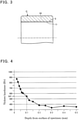
- the surface of the material (hereinafter referred to as the "specimen") for the inner ring was scraped off little by little to the depth of 0.5 mm, and the outer peripheral surface Vickers hardness (V) was measured at each of predetermined depths (mm) from the initial surface, up to the 0.5 mm depth.
- Fig. 4 shows the relationship between the respective depths (mm) from the initial surface and the hardness values Hv at the respective depths.
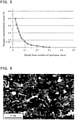
- Fig. 5 shows the relationship between the respective depths from the initial surface and the oxygen concentrations at the respective depths.
- Figs. 4 and 5 show the hardness and oxygen concentration distributions for a specimen that is not subjected to the post-treatment step.
- the spherical sliding bearing of the Example as an end product has the outer peripheral surface layer of the inner ring removed, by an arbitrarily determined amount, by machining during the post-treatment step.
- the hardness and oxygen concentration at a position deeper than the removed amount are the hardness and the oxygen concentration of the actual sliding surface region (surface).
- the machining after the oxygen diffusion treatment step is preferably performed so as to minimize the amount by which the oxygen diffusion layer or hardened layer is removed, and ordinarily, the removed amount is less than 0.10 mm.
- the bearing sliding surface was formed by removing the material of the specimen by 0.10 mm from the surface, the hardness and oxygen concentration of the sliding surface region (surface) were, as shown, 547 Hv and 0.78% by mass, respectively.
- Fig. 6 shows an EBSD image of the surface layer of the specimen when the bearing sliding region was formed by removing the material of the specimen by 0.10 mm from its surface.
- the average grain size of the ⁇ crystal grains in the specimen measured was 10.1 ⁇ m. It was also confirmed that the secondary ⁇ crystal grains separated during the solution treatment and aging treatment were fine needle-like secondary ⁇ phases as appear in the EBSD image.
- the above average grain size is the average of the grain sizes of the crystal grains over the entire EBSD image, of which, assuming that differences in crystallographic orientations of not less than 15° are crystal grain boundaries, the areas are added, one at a time, from the largest area in descending order, until the sum of the added areas reaches 70% of the total area of the entire crystal grains in the EBSD image.
- the ⁇ crystal grains including fine secondary ⁇ crystal grains have a sufficiently small average grain size, i.e., of 10.1 ⁇ m, and during the subsequent oxygen diffusion treatment, enough oxygen is mixed into the surface to form a solid solution.
- the hardness of the sliding surface region (surface) is about 550 Hv and the oxygen concentration thereof is about 0.8% by mass. Therefore, while the bearing is made of a lightweight titanium alloy, it has sufficient fatigue resistance as well as wear resistance. The bearing is therefore applicable in an environment where durability and strength are required.
- the sliding bearing according to the present invention can be used for general applications where lightness in weight, durability and strength are required, such as in the aerospace field, and also can be used in an environment where the bearing is pivoted while sliding, or rotated in one direction.
Landscapes
- Engineering & Computer Science (AREA)
- Chemical & Material Sciences (AREA)
- Mechanical Engineering (AREA)
- General Engineering & Computer Science (AREA)
- Materials Engineering (AREA)
- Metallurgy (AREA)
- Organic Chemistry (AREA)
- Chemical Kinetics & Catalysis (AREA)
- Manufacturing & Machinery (AREA)
- Sliding-Contact Bearings (AREA)
Abstract
Description
- This invention relates to sliding bearings, and particularly a titanium alloy sliding bearing which can be used in the aerospace field or similar fields, where durability as well as lightness in weight is particularly important.
- Instruments and devices used in satellites and rockets are ordinarily required to be as lightweight as possible in order to, e.g., reduce fuel consumption during transportation.
- Titanium alloys are well-known materials which can be used for mechanical structural members for reduced weight, instead of ordinarily used materials such as steel.
- While titanium alloys are lightweight, and also high in corrosion resistance and strength-to-weight ratio, they are low in hardness compared to steel, and thus low in wear resistance.
- As one way to improve the hardness of a titanium alloy, a processing method is known for increasing the hardness of a titanium alloy used for ornamental goods by holding a member in a mixed atmosphere gas containing mainly nitrogen and a trace amount of oxygen, for a predetermined period of time at an elevated temperature, thereby forming a solid solution of mainly nitrogen and oxygen on the surface of the member (below-identified Patent Document 1).
- Also known is a spherical sliding bearing having, on at least one of the inner ring and the outer ring of a spherical sliding bearing made of a titanium alloy, a hardened surface formed by depositing titanium nitrate by means of physical vapor deposition (PVD) (below-identified Patent Document 2).
-
- Patent Document 1: International Publication No.
97/36018 - Patent Document 2:
JP Patent Publication 2007-255712A - However, while the above-described surface modification method, in which nitrogen and a trace amount of oxygen are mixed into the titanium alloy to form a solid solution, improves hardness, toughness remains low and does not improve.
- In other words, the hardened solid-solution layer formed by adding 0.6 to 8.0% by weight of nitrogen and 0.5 to 14.0% by weight of oxygen to the surface of the titanium alloy is brittle, although the hardness is increased by nitrogen and oxygen. If a large load is applied to the inner ring or outer ring of a titanium alloy sliding bearing having such a hardened layer, cracking may occur. In addition, the solid solution of oxygen in such a surface modification method coarsens the crystal grains of the titanium alloy, resulting in a decrease in fatigue strength.
- Moreover, if the hardened layer of titanium nitride is formed by vapor deposition, the hardened layer of titanium nitride could delaminate when the titanium alloy is slid at a high sliding speed under a large load.
- Therefore, an object of this invention is to solve the above-described problems associated with the modification treatment to harden the surface of a titanium alloy sliding bearing, and to provide a titanium alloy sliding bearing of which the hardness of the sliding surface while ensuring the toughness of the sliding surface and suppressing a decrease in fatigue strength.
- In order to achieve the above object, the present invention provides a titanium sliding bearing made of a titanium alloy and having a sliding surface region formed of an α+β or α type titanium alloy, wherein the sliding surface region contains primary and secondary α crystal grains, and includes an oxygen diffusion layer in which the oxygen concentration continuously decreases with depth from a surface of the sliding surface region, wherein the surface is composed of a solid solution of oxygen of which the oxygen concentration is not less than 0.8% by mass, and the hardness of the surface is not less than 550 Hv.
- The titanium alloy sliding bearing of this invention, configured as described above, includes a sliding surface region having a surface strengthened and hardened to a hardness of not less than 0.8% by mass by the oxygen diffusion layer formed by mixing not less than 0.8% by mass of oxygen to the surface to form a solid solution.
- The sliding surface region made of an α+β or α type titanium alloy contain, besides primary α crystal grains, secondary α crystal grains that are finer than the primary α crystal grains, and the finer grain size improves fatigue strength and ensures sufficient toughness at the sliding surfaces for sliding bearings.
- In this way, the fatigue strength of the titanium alloy sliding bearing is improved by the finer crystal grain size, and the hardness of the sliding surface region is improved by providing the oxygen diffusion layer.
- The oxygen diffusion layer is provided on the sliding surface region made of titanium alloy in a state where the oxygen concentration decreases continuously with depth from the surface, so that it is integrated with the inside of the titanium alloy with good adhesiveness and is difficult to peel off, and it does not reduce the fatigue strength that has been improved by the refinement of the crystal grain size. In other words, the oxygen diffusion layer improves the strength, hardness, corrosion resistance, and wear resistance of the surface of the titanium alloy, and does not reduce the fatigue strength of the entire titanium alloy.
- In order to increase the tensile strength, creep strength, etc. as much as possible, it is desirable for the above titanium alloy to contain aluminum element (Al), which is a stabilizing element of the α phase, to some extent (not more than 7% by mass), for example, Ti-6Al-4V titanium alloy, which contains 6% by mass of aluminum element (Al) and 4% by mass of vanadium (V).
- The average grain size of all crystal grains having a fine secondary α phase compounded with oxygen atoms should be not more than 15 µm to increase fatigue strength. This average grain size is obtained as follows: (1) in an observation image of EBSD measurement of the surface of the sliding surface region, the average of the grain sizes of the crystal grains over the entire EBSD image of which, assuming that differences in crystallographic orientations of not less than 15° are crystal grain boundaries, the areas are added, one at a time, from the largest area in descending order, until the sum of the added areas reaches 70% of the total area of the entire crystal grains in the EBSD image; and (2) the average grain size of the crystal grains whose areas are added is calculated.
- Sliding bearings to which the invention can be applied include, for example, a spherical sliding bearing, which can be configured as a titanium alloy spherical bearing in which the inner ring and outer ring are in sliding contact via a lubricative liner.
- The lubricative liner is preferably a resin molded body or a resin woven fabric so that the titanium alloy sliding bearing can be used in low-pressure or vacuum environments, such as in aerospace equipment, as well as in cryogenic environments and environments with large temperature variations.
- If the lubricative liner is a resin molded body, it is preferred to employ a molded body of one or more resins selected from polytetrafluoroethylene, polyamide, polyimide, and polyphenylene sulfide, in order to make the titanium alloy sliding bearing resistant to use in the above specific environments.
- Similarly, when the above lubricative liner is a liner formed of a woven fabric, it is preferred that the liner be a woven fabric made of one or more fibers selected from polytetrafluoroethylene fibers, aromatic polyamide fibers, glass fibers, and polyester fibers, in order for the titanium alloy sliding bearing to withstand use in the above specified environment.
- The above-described titanium alloy sliding bearing is suitable as a titanium alloy sliding bearing used in aerospace devices and instruments.
- Because the titanium alloy sliding bearing of the present invention includes a sliding surface region containing primary and secondary α crystal grains, and in which the fatigue strength is improved as the crystal grain size becomes finer, and the hardness of the sliding surface region with the oxygen diffusion layer is improved, the toughness of the sliding surface region is secured, while the hardness of the sliding surface region is increased and the fatigue strength is reduced.
-
-
Fig. 1 is a cross-sectional view of a titanium alloy spherical sliding bearing of a first embodiment. -
Fig. 2 is a cross-sectional view of a titanium alloy spherical sliding bearing of a second embodiment. -
Fig. 3 is a cross-sectional view of a titanium alloy sliding bearing of a third embodiment. -
Fig. 4 is a graph showing the relationship between the depth from the surface of an inner ring material of the example, and the hardness (Hv). -
Fig. 5 is a graph showing the relationship between the depth from the surface of the inner ring material of the example, and the oxygen concentration. -
Fig. 6 is a substitute photograph of an image used for EBSD measurement of the surface of the inner ring material in the example. - The embodiments of the invention are described below with reference to the accompanying drawings.
- As shown in
Fig. 1 , the first embodiment is a lubrication-free titanium alloy spherical sliding bearing A. It is composed of a titanium alloyinner ring 1 having a convex spherical slidingsurface region 2 on its outer periphery, and anouter ring 4 having a concave spherical inner periphery which is in sliding contact with thesliding surface region 2 via a lubricative liner 3. - The
sliding surface region 2 of theinner ring 1, which is in contact with the lubricative liner 3, contains primary and secondary α crystal grains, and includes anoxygen diffusion layer 5 in which the oxygen concentration decreases continuously with depth from the surface of thesliding surface region 2. - The
inner ring 1 is formed of a titanium alloy of the α+β or β type. The sliding surface region (surface) 2 is composed of a solid solution of oxygen of which the oxygen concentration is not less than 0.8% by mass, and the hardness of the sliding surface region (surface) 2 is not less than 550 Hv. - The lubricative liner 3 is a molded member or a woven fabric made of resin or fiber having self-lubricating properties, or a composite material thereof, and is retained by the
outer ring 4 by being integrated with theouter ring 4. If the lubricative liner 3 is a resin liner, it is mainly composed of a resin such as polytetrafluoroethylene, polyamide, polyimide, or polyphenylene sulfide, and is molded into an annular shape with spherical radially inner and outer surfaces by injection molding or any other well-known molding method. If the lubricative liner 3 is a woven fabric, it is made of a fiber material such as polytetrafluoroethylene fiber, aromatic polyamide fiber, glass fiber or polyester fiber, and is bonded to the inner peripheral surface of theouter ring 4 with a predetermined adhesive. - The titanium alloy sliding bearing of this invention can be used as a sliding bearing in a well-known form. For example, the second embodiment shown in
Fig. 2 is a spherical sliding bearing B of the oil-feed type including a titanium alloyinner ring 6 having a convex spherical slidingsurface region 2 on the outer periphery thereof, and a titanium alloyouter ring 4 with a concave spherical inner periphery defining a sliding surface region 7 opposed to and in sliding contact with thesliding surface region 2. These pair of slidingsurface regions 2 and 7 both contain primary α crystal grains and secondary α crystal grains forming theoxygen diffusion layers 5. Numeral 8 in the figure designates an oil supply hole leading to thesliding surface region 2, andnumeral 9 designates an oil groove. - In the third embodiment shown in
Fig. 3 , which is a sleeve-type sliding bearing C comprising acylindrical sleeve 10 made of a titanium alloy and having thesliding surface region 11 formed on the inner peripheral surface of thecylindrical sleeve 10, and containing primary and secondary α crystal grains. Thecylindrical sleeve 10 also has theoxygen diffusion layer 5. - In any of the above embodiments, the titanium alloy that forms the sliding surface region or regions is an α+β or α type titanium alloy.
- Examples of α+β type titanium alloys include Ti-6Al-4V and Ti-6Al-2Sn-4Zr-6Mo, and examples of α type titanium alloys include Ti-5Al-2.5Sn and Ti-8Al-1Mo-1V.
- The sliding surface region(s) of any of the titanium alloy sliding bearings described above is ultimately strengthened by increasing the surface hardness by mixing oxygen into the α+β or α type titanium alloy, thereby forming a solid solution during an oxygen diffusion treatment step. The titanium alloy on the surface forming a solid solution of oxygen contains multiple α crystal grains.
- α crystal grains refer to crystal grains composed of an α phase. α crystal grains include primary α crystal grains and secondary α crystal grains. Primary α crystal grains are crystal grains composed of a primary α phase. The secondary α crystal grains are grains composed of a secondary α phase.
- The primary α phase is an α phase that remains without transformation to the β phase during any of the below-described solution treatment step, aging treatment step, and oxygen diffusion treatment step.
- The secondary α phase is a phase formed by martensitic or massive transformation during cooling after the transformation to the β phase. The secondary α phase is classified into an α' type, which has an hcp structure and an α" type, which has an orthorhombic structure.
- The primary and secondary α crystal grains can be distinguished by their shape. The primary α grain has an elliptical shape, while the secondary α grain has a needle-like shape.
- Each α grain can be identified by its crystallographic orientation. More specifically, if the deviation between the crystallographic orientations of two adjacent α crystalline phases is less than 15°, then those α crystalline phases are considered to be one α crystalline grain.
- On the other hand, if the deviation between the crystallographic orientations of two adjacent α crystalline phases is not less than 15°, then those α crystalline phases are considered to be separate α crystalline grains.
- Measurement of the crystallographic orientations (identification of the respective α crystal grain boundaries) is made using electron backscatter diffraction (EBSD).
- When, using this method, the sizes of the α crystal grains contained in the titanium alloy on the surface of the sliding surface region according to the present invention are measured, the crystal grains are classified into a first group and a second group, and the minimum value of the grain sizes of the α crystal grains classified in the first group is larger than the maximum value of the grain sizes of the α crystal grains classified in the second group. The ratio of the total area of the α crystal grains classified in the first group, to the total area of the entire α crystal grains, is not less than 0.7. The ratio of the total area of the α crystal grains classified in the first group, except the α crystal grain smallest in grain size, to the total area of the entire α crystal grains, is less than 0.7.
- To put it another way, the α crystal grains at the surface of the sliding surface region are classified, one at a time, from the one largest in grain size in descending order, into the first group, until the total area of the α crystal grains classified into the first group first exceeds 70% of the total area of the entire α crystal grains, and the remaining α crystal grains are classified into the second group.
- The "α crystal grains at the surface" refer to α crystal grains present in the area from the surface of the sliding surface region to the depth of 250 µm. However, instead, the "α crystal grains at the surface" may be α crystal grains present in the area from the surface of the sliding surface region to the depth of 300 µm.
- The average grain size of the α crystal grains classified in the first group is not more than 25 µm, preferably not more than 15 µm. The average grain size of the α crystal grains classified in the first group can be calculated from the equivalent circle diameters of the respective crystal grains.
- From an observation image of the surface of the sliding surface region obtained by the EBSD, assuming that differences in crystallographic orientations of not less than 15° are crystal grain boundaries, the areas of the crystal grains over the entire observation image were added, one at a time, in descending order from the largest area, until the sum of the added areas reached 70% of the total area of the entire crystal grains in the image observed, and the average of the grain sizes of the crystal grains of which the areas were added was calculated. This average is not more than 15 µm.
- The titanium alloy contains, at the surface thereof, not less than 0.8% by mass of oxygen (O), preferably not less than 1.4% by mass of oxygen, further preferably not less than 1.8% mass of oxygen. The oxygen concentration in the titanium alloy is measured with an electron probe micro analyzer (EPMA).
- The method of manufacturing the titanium alloy sliding bearing containing, as described above, primary α crystal grains and secondary α crystal grains at the sliding surface region, includes the below-described preparation step, solution treatment step, aging treatment step, oxygen diffusion treatment step, and post-treatment step.
- During the preparation step, an inner ring or an outer ring having a sliding surface region composed of an α+β type titanium alloy or an α type titanium alloy is cut to a shape and dimensions close to those of the end product.
- During the solution treatment step, the inner ring or outer ring that has been roughly formed into the shape of the end product in the preparation step is heated and held, in a furnace, at a predetermined temperature for a predetermined period of time.
- During this step, as an inert gas such as argon is introduced into the furnace under normal pressure. The inert gas introduced may be instead helium, which is a noble gas, or nitrogen gas.
- The solution treatment step includes two essential sub-steps, i.e., a holding sub-step and a cooling sub-step.
- During the holding sub-step, a member to be treated is held, in the furnace, at a predetermined holding temperature (hereinafter referred to as the "first temperature") for a predetermined period of time (hereinafter referred to as the "first period of time").
- During the solution treatment, the α phase in the titanium alloy constituting the member to be treated partially transforms into the β phase.
- The above first temperature is lower than the temperature at which the α phase in the titanium alloy constituting the member to be treated entirely transforms into the β phase.
- The cooling sub-step is carried out after the holding sub-step. During the cooling sub-step, the member to be treated that has been processed in the holding sub-step is cooled. As a result of cooling, the α phase that has been transformed into the 6 phase transforms into the secondary α phase.
- The aging treatment step is carried out after the solution treatment step for the purpose of separating secondary α crystal grains, which are finer than primary α crystal grains.
- During the aging treatment step, the member to be treated is held at a predetermined temperature (this temperature is hereinafter referred to as the "second temperature") for a predetermined period of time (hereinafter referred to as the "second period of time"), and the member is then cooled. During the aging treatment step, fine secondary α crystal grains separate from the β phase that has not transformed into the α phase during the cooling sub-step.
- During heating and holding, an inert gas such as argon, helium, which is a noble gas, nitrogen gas, or the like, is introduced into the furnace under normal pressure.
- During the oxygen diffusion treatment step, which is carried out after the solution treatment step and the aging step, oxygen diffusion treatment is carried out in order to form an oxygen diffusion layer having high hardness.
- The oxygen diffusion treatment step is carried out by holding the member to be treated at a predetermined holding temperature (hereinafter referred to as the "third temperature") for a predetermined period of time (hereinafter referred to as the "third period of time").
- The oxygen diffusion treatment is carried out in an atmospheric gas containing carbon dioxide (CO2). The atmospheric gas may further contain an inert gas. The inert gas is, for example, a noble gas such as argon (Ar) or helium (He). The inert gas may be instead nitrogen (N2). The pressure of the atmospheric gas is preferably normal pressure (atmospheric pressure).
- The above-described series of processing steps may be carried out on the entire surface of the member to be treated, such as an inner ring or an outer ring. If only the sliding surface is to be subjected to oxygen diffusion treatment, the member to be treated is partially masked in forming the oxygen diffusion layer.
- The oxygen diffusion treatment is described in detail below:
An argon gas-based CO2 gas is introduced into a furnace kept at normal pressure, and a member made of a titanium alloy is heated, held, and cooled in the furnace. When the titanium alloy is heated in the CO2 gas atmosphere, CO2 gas is decomposed into O and C at the surface of the titanium alloy member, and these elements diffuse into the titanium alloy from its surface. Because, compared with oxygen, the solid solution limit of carbon is low, carbon hardly affects the solid solution strengthening of the member to be treated. - During the post-treatment step, which is carried out after the oxygen diffusion treatment step, the member to be treated is subjected to machining such as turning and polishing to finish the member to specific dimensional accuracy, and a liner is, as needed, formed and bonded to the member, and other assembling and processing steps are carried out.
- In particular, after the oxygen diffusion treatment step, a surface layer in the form of a compound layer composed of TiC, TiO2 or TiO is formed on the titanium alloy. Because this compound layer is, though hard, brittle, it is removed by machining during the post-treatment step. Also, after the oxygen diffusion treatment, in order to finish the titanium alloy to specific dimensional accuracy, it is subjected to machining such as turning or polishing.
- The surface of the sliding surface region of the inner ring formed by the above-described series of processing steps has an oxygen concentration of not less than about 0.8% by mass, and a hardness of about not less than 550 Hv. The surface of the sliding surface region is composed of crystal grains of which, in an observation image of the surface of the sliding surface region obtained by EBSD measurement, assuming that differences in crystallographic orientations of not less than 15° are crystal grain boundaries, and when the areas of the crystal grains over the entire observation image are added, one at a time, from the largest area in descending order, until the sum of the added areas reaches 70% of the total area of the entire crystal grains in the observation image, the average of the grain sizes of the crystal grains of which the areas are added is not more than 15 µm.
- The above-described method of the embodiment for producing a titanium alloy sliding bearing having high specific hardness ensures sufficient fatigue strength by reducing the crystal grain sizes during the solution treatment and aging treatment steps, and also enables the provision of a high-hardness oxygen diffusion layer during the subsequent oxygen diffusion treatment step. Therefore, the sliding bearing thus formed has high hardness and excellent fatigue strength.
- The solution treatment and the aging treatment were performed on a material for an
inner ring 1 of a spherical sliding bearing (Fig. 1 ), the material being Ti-6Al-4V, an α+β type titanium alloy under ASTM B348-13 GR.5. - The surface of the material (hereinafter referred to as the "specimen") for the inner ring was scraped off little by little to the depth of 0.5 mm, and the outer peripheral surface Vickers hardness (V) was measured at each of predetermined depths (mm) from the initial surface, up to the 0.5 mm depth.
Fig. 4 shows the relationship between the respective depths (mm) from the initial surface and the hardness values Hv at the respective depths. - When measuring the Vickers hardness (HV), the oxygen concentration (% by mass) was measured by EPMA.
Fig. 5 shows the relationship between the respective depths from the initial surface and the oxygen concentrations at the respective depths.
Figs. 4 and5 show the hardness and oxygen concentration distributions for a specimen that is not subjected to the post-treatment step. - The spherical sliding bearing of the Example as an end product has the outer peripheral surface layer of the inner ring removed, by an arbitrarily determined amount, by machining during the post-treatment step. Thus, in the hardness and oxygen concentration distributions of the specimen shown in
Figs. 4 and5 , the hardness and oxygen concentration at a position deeper than the removed amount are the hardness and the oxygen concentration of the actual sliding surface region (surface). - The machining after the oxygen diffusion treatment step is preferably performed so as to minimize the amount by which the oxygen diffusion layer or hardened layer is removed, and ordinarily, the removed amount is less than 0.10 mm. For reference, when the bearing sliding surface was formed by removing the material of the specimen by 0.10 mm from the surface, the hardness and oxygen concentration of the sliding surface region (surface) were, as shown, 547 Hv and 0.78% by mass, respectively.
-
Fig. 6 shows an EBSD image of the surface layer of the specimen when the bearing sliding region was formed by removing the material of the specimen by 0.10 mm from its surface. - As is apparent from the EBSD image of
Fig. 6 , the average grain size of the α crystal grains in the specimen measured was 10.1 µm. It was also confirmed that the secondary α crystal grains separated during the solution treatment and aging treatment were fine needle-like secondary α phases as appear in the EBSD image. - The above average grain size is the average of the grain sizes of the crystal grains over the entire EBSD image, of which, assuming that differences in crystallographic orientations of not less than 15° are crystal grain boundaries, the areas are added, one at a time, from the largest area in descending order, until the sum of the added areas reaches 70% of the total area of the entire crystal grains in the EBSD image.
- For the thus-obtained spherical sliding bearing of the example, the α crystal grains including fine secondary α crystal grains have a sufficiently small average grain size, i.e., of 10.1 µm, and during the subsequent oxygen diffusion treatment, enough oxygen is mixed into the surface to form a solid solution. Thus, the hardness of the sliding surface region (surface) is about 550 Hv and the oxygen concentration thereof is about 0.8% by mass. Therefore, while the bearing is made of a lightweight titanium alloy, it has sufficient fatigue resistance as well as wear resistance. The bearing is therefore applicable in an environment where durability and strength are required.
- The sliding bearing according to the present invention can be used for general applications where lightness in weight, durability and strength are required, such as in the aerospace field, and also can be used in an environment where the bearing is pivoted while sliding, or rotated in one direction.
-
- 1, 6.
- Inner ring
- 2, 7, 11.
- Sliding surface region
- 3.
- Lubricative liner
- 4.
- Outer ring
- 5.
- Oxygen diffusion layer
- 8.
- Oil supply hole
- 9.
- Oil groove
- 10.
- Sleeve
- A, B.
- Spherical sliding bearing
- C.
- Sleeve type sliding bearing
Claims (8)
- A titanium sliding bearing made of a titanium alloy and having a sliding surface region formed of an α+β or α type titanium alloy, wherein the sliding surface region contains primary and secondary α crystal grains, and includes an oxygen diffusion layer in which the oxygen concentration continuously decreases with depth from a surface of the sliding surface region, wherein the surface is composed of a solid solution of oxygen of which the oxygen concentration is not less than 0.8% by mass, and the surface has a hardness of not less than 550 Hv.
- The titanium alloy sliding bearing of claim 1, wherein the titanium alloy is Ti-6Al-4V titanium alloy.
- The titanium alloy sliding bearing of claim 1 or 2, wherein the surface of the sliding surface region is composed of crystal grains of which, in an observation image of the surface of the sliding surface region obtained by EBSD measurement, assuming that differences in crystallographic orientations of not less than 15° are crystal grain boundaries, and when the areas of the crystal grains over the entire observation image were added, one at a time, from the largest area in descending order, until the sum of the added areas reaches 70% of the total area of the entire crystal grains in the observation image, the average of the grain sizes of the crystal grains of which the areas are added is not more than 15 µm.
- The titanium alloy sliding bearing of any of claims 1 to 3, wherein the sliding bearing is a spherical sliding bearing comprising an inner ring and an outer ring which are in sliding contact via a lubricative liner.
- The titanium alloy sliding bearing of claim 4, wherein the lubricative liner is a resin molded body or a resin woven fabric.
- The titanium alloy sliding bearing of claim 5, wherein the lubricative liner is a molded body of at least one kind of resin selected from polytetrafluoroethylene, polyamide, polyimide, and polyphenylene sulfide.
- The titanium alloy sliding bearing of claim 5, wherein the lubricative liner is a woven fabric of at least one kind of fiber selected from polytetrafluoroethylene fiber, aromatic polyamide fiber, glass fiber, and polyester fiber.
- A titanium alloy sliding bearing for use in aerospace devices and instruments, the titanium alloy sliding bearing being the titanium alloy sliding bearing of any of claims 1 to 7.
Applications Claiming Priority (2)
| Application Number | Priority Date | Filing Date | Title |
|---|---|---|---|
| JP2019049793A JP2020152935A (en) | 2019-03-18 | 2019-03-18 | Titan alloy plain bearing |
| PCT/JP2020/010239 WO2020189402A1 (en) | 2019-03-18 | 2020-03-10 | Sliding bearing made of titanium alloy |
Publications (2)
| Publication Number | Publication Date |
|---|---|
| EP3943626A1 true EP3943626A1 (en) | 2022-01-26 |
| EP3943626A4 EP3943626A4 (en) | 2022-05-18 |
Family
ID=72520938
Family Applications (1)
| Application Number | Title | Priority Date | Filing Date |
|---|---|---|---|
| EP20772851.0A Pending EP3943626A4 (en) | 2019-03-18 | 2020-03-10 | Sliding bearing made of titanium alloy |
Country Status (5)
| Country | Link |
|---|---|
| US (1) | US20220186780A1 (en) |
| EP (1) | EP3943626A4 (en) |
| JP (1) | JP2020152935A (en) |
| CN (1) | CN113646451A (en) |
| WO (1) | WO2020189402A1 (en) |
Cited By (1)
| Publication number | Priority date | Publication date | Assignee | Title |
|---|---|---|---|---|
| EP4283147A1 (en) * | 2022-05-24 | 2023-11-29 | Roller Bearing Company of America, Inc. | Wear resistant bearing system |
Family Cites Families (13)
| Publication number | Priority date | Publication date | Assignee | Title |
|---|---|---|---|---|
| JPH0742729A (en) * | 1993-07-30 | 1995-02-10 | Ntn Corp | Spherical sliding bearing |
| CN1205351C (en) | 1996-03-26 | 2005-06-08 | 西铁城时计株式会社 | Titanium or titanium alloy parts and surface treatment method thereof |
| JP2005030492A (en) * | 2003-07-11 | 2005-02-03 | Minebea Co Ltd | Spherical bearing |
| JP4153848B2 (en) * | 2003-08-21 | 2008-09-24 | 三菱重工業株式会社 | Surface treatment method of titanium alloy member for aerospace equipment |
| JP2007255712A (en) * | 2006-03-21 | 2007-10-04 | Roller Bearing Co Of America Inc | Liner and titanium spherical sliding bearing with surface-treated surface |
| JP5934972B2 (en) * | 2011-10-17 | 2016-06-15 | 長野県 | Lubricationless sliding member |
| GB201410485D0 (en) * | 2014-06-12 | 2014-07-30 | Skf Ab | Plain bearing |
| JP2016169861A (en) * | 2015-03-13 | 2016-09-23 | キヤノン株式会社 | Slide member, slide mechanism and transport device |
| CN107923027B (en) * | 2015-08-17 | 2020-02-07 | Ntn株式会社 | Sliding member and method for manufacturing same |
| JP6914688B2 (en) * | 2017-03-27 | 2021-08-04 | Ntn株式会社 | Machine parts and plain bearings |
| JP2019049034A (en) * | 2017-09-11 | 2019-03-28 | Ntn株式会社 | Mechanical part, and production method for mechanical part |
| WO2019124265A1 (en) * | 2017-12-20 | 2019-06-27 | Ntn株式会社 | Machine part and method for producing machine part |
| JP7051419B2 (en) * | 2017-12-20 | 2022-04-11 | Ntn株式会社 | Manufacturing method of machine parts |
-
2019
- 2019-03-18 JP JP2019049793A patent/JP2020152935A/en active Pending
-
2020
- 2020-03-10 CN CN202080022666.0A patent/CN113646451A/en active Pending
- 2020-03-10 EP EP20772851.0A patent/EP3943626A4/en active Pending
- 2020-03-10 WO PCT/JP2020/010239 patent/WO2020189402A1/en not_active Ceased
- 2020-03-10 US US17/439,946 patent/US20220186780A1/en not_active Abandoned
Cited By (1)
| Publication number | Priority date | Publication date | Assignee | Title |
|---|---|---|---|---|
| EP4283147A1 (en) * | 2022-05-24 | 2023-11-29 | Roller Bearing Company of America, Inc. | Wear resistant bearing system |
Also Published As
| Publication number | Publication date |
|---|---|
| EP3943626A4 (en) | 2022-05-18 |
| WO2020189402A1 (en) | 2020-09-24 |
| CN113646451A (en) | 2021-11-12 |
| US20220186780A1 (en) | 2022-06-16 |
| JP2020152935A (en) | 2020-09-24 |
Similar Documents
| Publication | Publication Date | Title |
|---|---|---|
| US6250812B1 (en) | Rolling bearing | |
| EP1900844B1 (en) | Article with high-hardness carbon coating | |
| EP3643805A1 (en) | Sliding member and coating film | |
| JPH09133138A (en) | Bearing device | |
| US6623568B2 (en) | Ti alloy poppet valve and a method of manufacturing the same | |
| EP1496277A2 (en) | Spherical bearing | |
| SE526481C2 (en) | Surface hardened stainless steel with improved abrasion resistance and low static friction | |
| US9759324B2 (en) | Piston ring | |
| US20100058592A1 (en) | Method for hardening running surfaces of roller bearing components | |
| CA2869018A1 (en) | Method for solution hardening of a cold deformed workpiece of a passive alloy, and a member solution hardened by the method | |
| US20220186780A1 (en) | Sliding bearing made of titanium alloy | |
| EP2401419B1 (en) | Coating system and method for making it | |
| Zuo et al. | A study on the mechanical performance and medium temperature tribological behavior of plasma nitrocarburizing/TiAlSiN/DLC composite coating | |
| Chen et al. | Effect of carburizing and nitriding duplex treatment on the friction and wear properties of 20CrNi2Mo steel | |
| AU2021207594B2 (en) | Thermal protection system for lightweight hypersonic missile fin | |
| Ivanov et al. | Structure and properties of a HfNbTaTiZr cathode and a coating formed through its vacuum arc evaporation | |
| US6592683B2 (en) | Ti alloy surface treatment | |
| JP4398546B2 (en) | Abrasion-resistant coating material and process for producing the same | |
| Quaeyhaegens et al. | Promising developments for new applications | |
| JP2020159435A (en) | Plain bearing structure | |
| Deepak | A Review on Surface Engineering of Ti6Al4V Titanium Alloy Using Gas and Laser Nitriding Techniques | |
| WO2020195967A1 (en) | Rolling bearing | |
| Pantazopoulos et al. | Wear-related failures of nitrocarburized steels: Some microstructural and morphological observations | |
| JP2020164887A (en) | Titanium alloy plain bearing | |
| Bloyce | Surface engineering in motorsport for improved tribological performance |
Legal Events
| Date | Code | Title | Description |
|---|---|---|---|
| STAA | Information on the status of an ep patent application or granted ep patent |
Free format text: STATUS: THE INTERNATIONAL PUBLICATION HAS BEEN MADE |
|
| PUAI | Public reference made under article 153(3) epc to a published international application that has entered the european phase |
Free format text: ORIGINAL CODE: 0009012 |
|
| STAA | Information on the status of an ep patent application or granted ep patent |
Free format text: STATUS: REQUEST FOR EXAMINATION WAS MADE |
|
| 17P | Request for examination filed |
Effective date: 20211007 |
|
| AK | Designated contracting states |
Kind code of ref document: A1 Designated state(s): AL AT BE BG CH CY CZ DE DK EE ES FI FR GB GR HR HU IE IS IT LI LT LU LV MC MK MT NL NO PL PT RO RS SE SI SK SM TR |
|
| A4 | Supplementary search report drawn up and despatched |
Effective date: 20220419 |
|
| RIC1 | Information provided on ipc code assigned before grant |
Ipc: F16C 33/14 20060101ALI20220411BHEP Ipc: F16C 23/04 20060101ALI20220411BHEP Ipc: C23C 30/00 20060101ALI20220411BHEP Ipc: C23C 8/80 20060101ALI20220411BHEP Ipc: C23C 8/04 20060101ALI20220411BHEP Ipc: C23C 8/02 20060101ALI20220411BHEP Ipc: C23C 8/16 20060101ALI20220411BHEP Ipc: F16C 33/20 20060101ALI20220411BHEP Ipc: F16C 33/12 20060101ALI20220411BHEP Ipc: F16C 17/10 20060101ALI20220411BHEP Ipc: C22C 14/00 20060101AFI20220411BHEP |
|
| DAV | Request for validation of the european patent (deleted) | ||
| DAX | Request for extension of the european patent (deleted) |