EP3943588A1 - Information processing apparatus, cell culture system, information processing method, and information processing program - Google Patents
Information processing apparatus, cell culture system, information processing method, and information processing program Download PDFInfo
- Publication number
- EP3943588A1 EP3943588A1 EP20773850.1A EP20773850A EP3943588A1 EP 3943588 A1 EP3943588 A1 EP 3943588A1 EP 20773850 A EP20773850 A EP 20773850A EP 3943588 A1 EP3943588 A1 EP 3943588A1
- Authority
- EP
- European Patent Office
- Prior art keywords
- evaluation value
- culture environment
- fluidic device
- environment
- cells
- Prior art date
- Legal status (The legal status is an assumption and is not a legal conclusion. Google has not performed a legal analysis and makes no representation as to the accuracy of the status listed.)
- Pending
Links
Images



Classifications
-
- C—CHEMISTRY; METALLURGY
- C12—BIOCHEMISTRY; BEER; SPIRITS; WINE; VINEGAR; MICROBIOLOGY; ENZYMOLOGY; MUTATION OR GENETIC ENGINEERING
- C12M—APPARATUS FOR ENZYMOLOGY OR MICROBIOLOGY; APPARATUS FOR CULTURING MICROORGANISMS FOR PRODUCING BIOMASS, FOR GROWING CELLS OR FOR OBTAINING FERMENTATION OR METABOLIC PRODUCTS, i.e. BIOREACTORS OR FERMENTERS
- C12M41/00—Means for regulation, monitoring, measurement or control, e.g. flow regulation
- C12M41/48—Automatic or computerized control
-
- C—CHEMISTRY; METALLURGY
- C12—BIOCHEMISTRY; BEER; SPIRITS; WINE; VINEGAR; MICROBIOLOGY; ENZYMOLOGY; MUTATION OR GENETIC ENGINEERING
- C12M—APPARATUS FOR ENZYMOLOGY OR MICROBIOLOGY; APPARATUS FOR CULTURING MICROORGANISMS FOR PRODUCING BIOMASS, FOR GROWING CELLS OR FOR OBTAINING FERMENTATION OR METABOLIC PRODUCTS, i.e. BIOREACTORS OR FERMENTERS
- C12M23/00—Constructional details, e.g. recesses, hinges
- C12M23/02—Form or structure of the vessel
- C12M23/16—Microfluidic devices; Capillary tubes
-
- C—CHEMISTRY; METALLURGY
- C12—BIOCHEMISTRY; BEER; SPIRITS; WINE; VINEGAR; MICROBIOLOGY; ENZYMOLOGY; MUTATION OR GENETIC ENGINEERING
- C12M—APPARATUS FOR ENZYMOLOGY OR MICROBIOLOGY; APPARATUS FOR CULTURING MICROORGANISMS FOR PRODUCING BIOMASS, FOR GROWING CELLS OR FOR OBTAINING FERMENTATION OR METABOLIC PRODUCTS, i.e. BIOREACTORS OR FERMENTERS
- C12M29/00—Means for introduction, extraction or recirculation of materials, e.g. pumps
-
- C—CHEMISTRY; METALLURGY
- C12—BIOCHEMISTRY; BEER; SPIRITS; WINE; VINEGAR; MICROBIOLOGY; ENZYMOLOGY; MUTATION OR GENETIC ENGINEERING
- C12M—APPARATUS FOR ENZYMOLOGY OR MICROBIOLOGY; APPARATUS FOR CULTURING MICROORGANISMS FOR PRODUCING BIOMASS, FOR GROWING CELLS OR FOR OBTAINING FERMENTATION OR METABOLIC PRODUCTS, i.e. BIOREACTORS OR FERMENTERS
- C12M41/00—Means for regulation, monitoring, measurement or control, e.g. flow regulation
-
- C—CHEMISTRY; METALLURGY
- C12—BIOCHEMISTRY; BEER; SPIRITS; WINE; VINEGAR; MICROBIOLOGY; ENZYMOLOGY; MUTATION OR GENETIC ENGINEERING
- C12M—APPARATUS FOR ENZYMOLOGY OR MICROBIOLOGY; APPARATUS FOR CULTURING MICROORGANISMS FOR PRODUCING BIOMASS, FOR GROWING CELLS OR FOR OBTAINING FERMENTATION OR METABOLIC PRODUCTS, i.e. BIOREACTORS OR FERMENTERS
- C12M41/00—Means for regulation, monitoring, measurement or control, e.g. flow regulation
- C12M41/12—Means for regulation, monitoring, measurement or control, e.g. flow regulation of temperature
-
- C—CHEMISTRY; METALLURGY
- C12—BIOCHEMISTRY; BEER; SPIRITS; WINE; VINEGAR; MICROBIOLOGY; ENZYMOLOGY; MUTATION OR GENETIC ENGINEERING
- C12M—APPARATUS FOR ENZYMOLOGY OR MICROBIOLOGY; APPARATUS FOR CULTURING MICROORGANISMS FOR PRODUCING BIOMASS, FOR GROWING CELLS OR FOR OBTAINING FERMENTATION OR METABOLIC PRODUCTS, i.e. BIOREACTORS OR FERMENTERS
- C12M41/00—Means for regulation, monitoring, measurement or control, e.g. flow regulation
- C12M41/12—Means for regulation, monitoring, measurement or control, e.g. flow regulation of temperature
- C12M41/14—Incubators; Climatic chambers
-
- C—CHEMISTRY; METALLURGY
- C12—BIOCHEMISTRY; BEER; SPIRITS; WINE; VINEGAR; MICROBIOLOGY; ENZYMOLOGY; MUTATION OR GENETIC ENGINEERING
- C12M—APPARATUS FOR ENZYMOLOGY OR MICROBIOLOGY; APPARATUS FOR CULTURING MICROORGANISMS FOR PRODUCING BIOMASS, FOR GROWING CELLS OR FOR OBTAINING FERMENTATION OR METABOLIC PRODUCTS, i.e. BIOREACTORS OR FERMENTERS
- C12M41/00—Means for regulation, monitoring, measurement or control, e.g. flow regulation
- C12M41/30—Means for regulation, monitoring, measurement or control, e.g. flow regulation of concentration
- C12M41/34—Means for regulation, monitoring, measurement or control, e.g. flow regulation of concentration of gas
-
- C—CHEMISTRY; METALLURGY
- C12—BIOCHEMISTRY; BEER; SPIRITS; WINE; VINEGAR; MICROBIOLOGY; ENZYMOLOGY; MUTATION OR GENETIC ENGINEERING
- C12M—APPARATUS FOR ENZYMOLOGY OR MICROBIOLOGY; APPARATUS FOR CULTURING MICROORGANISMS FOR PRODUCING BIOMASS, FOR GROWING CELLS OR FOR OBTAINING FERMENTATION OR METABOLIC PRODUCTS, i.e. BIOREACTORS OR FERMENTERS
- C12M41/00—Means for regulation, monitoring, measurement or control, e.g. flow regulation
- C12M41/30—Means for regulation, monitoring, measurement or control, e.g. flow regulation of concentration
- C12M41/36—Means for regulation, monitoring, measurement or control, e.g. flow regulation of concentration of biomass, e.g. colony counters or by turbidity measurements
-
- G—PHYSICS
- G06—COMPUTING OR CALCULATING; COUNTING
- G06N—COMPUTING ARRANGEMENTS BASED ON SPECIFIC COMPUTATIONAL MODELS
- G06N20/00—Machine learning
-
- G—PHYSICS
- G06—COMPUTING OR CALCULATING; COUNTING
- G06N—COMPUTING ARRANGEMENTS BASED ON SPECIFIC COMPUTATIONAL MODELS
- G06N3/00—Computing arrangements based on biological models
- G06N3/02—Neural networks
- G06N3/08—Learning methods
- G06N3/084—Backpropagation, e.g. using gradient descent
-
- G—PHYSICS
- G06—COMPUTING OR CALCULATING; COUNTING
- G06N—COMPUTING ARRANGEMENTS BASED ON SPECIFIC COMPUTATIONAL MODELS
- G06N5/00—Computing arrangements using knowledge-based models
- G06N5/01—Dynamic search techniques; Heuristics; Dynamic trees; Branch-and-bound
Definitions
- the present disclosure relates to an information processing apparatus, a cell culture system, an information processing method, and an information processing program.
- a culture station that is used to culture biological cells in a microfluidic device has been known (see JP2018-512853A ).
- the culture station is provided with a pump that makes a culture medium from a culture medium source flow into the microfluidic device and a thermal regulation system that controls the temperature of the microfluidic device.
- a cell culture apparatus comprising a culture layer that cultures cells, a monitoring device, an aseptic sampling device, an analyzer, a data collection device, a data analyzer, and a cell state determination device provided with a cluster analysis function is disclosed. (See JP2018-117567A ).
- the cell culture apparatus further comprises an operation control correction device provided with a reference function of reaction models of cells for each cluster.
- a fluidic device such as a microfluidic device
- various functions can be customized through examination of various flow passage structures of the fluidic device.
- the fluidic device has been applied to applications such as drug discovery, toxicity evaluation, an organ-on-a-chip, a body-on-a-chip, and analytical chemistry.
- the fluidic device alone cannot be used for the intended application, a system capable of controlling a liquid feeding system, sensing, adjustment of culture environment, and the like has been required.
- cell culture using a plurality of fluidic devices can be performed. Furthermore, in this case, it is preferable that the state of the cells cultured in each of the plurality of fluidic devices is as good and homogeneous as possible.
- the states of the cells may vary depending on the disposition position of the fluidic device even in a case where the culture environment of the cells that are cultured in each fluidic device is made the same.
- JP2018-512853A and JP2018-117567A have not considered that the state of the cells that are cultured in each of the plurality of fluidic devices is made good and homogeneous in consideration of the disposition position of each fluidic device.
- the present disclosure has been made in view of the above circumstances, and an object thereof is to provide an information processing apparatus, a cell culture system, an information processing method, and an information processing program by which the state of cells that are cultured in each of the plurality of fluidic devices can be made good and homogeneous.
- an information processing apparatus comprises: an acquisition unit that acquires an evaluation value for a state of cells which are cultured in each of a plurality of fluidic devices, culture environment, and information representing a disposition position of the fluidic device; and a generation unit that generates a learned model in which the evaluation value and the information representing the disposition position are received as an input and the culture environment is output, through machine learning using, as training data, the evaluation value before adjustment of the culture environment, the culture environment after the adjustment, and the information representing the disposition position, in a case where, due to the adjustment, the evaluation value becomes a first threshold value or more and an absolute value of a difference in evaluation value between the plurality of fluidic devices becomes a second threshold value or less, among a plurality of the evaluation values, the culture environment, and the information which are acquired by the acquisition unit.
- the evaluation value may be a value that is determined by information which is derived from an image obtained by imaging the cells and transepithelial electrical resistance of the cells.
- the culture environment may include a flow rate of a liquid flowing through the fluidic device, a temperature of the liquid, an environment temperature around the fluidic device, an environment humidity around the fluidic device, a carbon dioxide concentration around the fluidic device, a nitrogen concentration around the fluidic device, and an oxygen concentration around the fluidic device.
- a cell culture system comprises: a plurality of cell culture channels each of which includes a fluidic device in which cells are cultured, a liquid feeding unit which makes a liquid flow into the fluidic device, a detection unit which detects a state of the cells that are cultured in the fluidic device, and a controller which controls the liquid feeding unit and the detection unit; a measurement unit that measures culture environment of the cells which are cultured in the plurality of cell culture channels; and the information processing apparatus according to the present disclosure.
- the information processing method comprises: acquiring an evaluation value for a state of cells which are cultured in each of a plurality of fluidic devices, culture environment, and information representing a disposition position of the fluidic device; and generating a learned model in which the evaluation value and the information representing the disposition position are received as an input and the culture environment is output, through machine learning using, as training data, the evaluation value before adjustment of the culture environment, the culture environment after the adjustment, and the information representing the disposition position, in a case where, due to the adjustment, the evaluation value becomes a first threshold value or more and an absolute value of a difference in evaluation value between the plurality of fluidic devices becomes a second threshold value or less, among a plurality of the evaluation values, the culture environment, and the information which are acquired.
- an information processing program that causes a computer to execute a process, the process comprises: acquiring an evaluation value for a state of cells which are cultured in each of a plurality of fluidic devices, culture environment, and information representing a disposition position of the fluidic device; and generating a learned model in which the evaluation value and the information representing the disposition position are received as an input and the culture environment is output, through machine learning using, as training data, the evaluation value before adjustment of the culture environment, the culture environment after the adjustment, and the information representing the disposition position, in a case where, due to the adjustment, the evaluation value becomes a first threshold value or more and an absolute value of a difference in evaluation value between the plurality of fluidic devices becomes a second threshold value or less, among a plurality of the evaluation values, the culture environment, and the information which are acquired.
- an information processing apparatus comprises: a memory for storing an instruction to be executed by a computer; and a processor configured to execute the stored instruction, in which the processor acquires an evaluation value for a state of cells which are cultured in each of a plurality of fluidic devices, culture environment, and information representing a disposition position of the fluidic device; and generates a learned model in which the evaluation value and the information representing the disposition position are received as an input and the culture environment is output, through machine learning using, as training data, the evaluation value before adjustment of the culture environment, the culture environment after the adjustment, and the information representing the disposition position, in a case where, due to the adjustment, the evaluation value becomes a first threshold value or more and an absolute value of a difference in evaluation value between the plurality of fluidic devices becomes a second threshold value or less, among a plurality of the evaluation values, the culture environment, and the information which are acquired.
- the state of the cells that are cultured in each of the plurality of fluidic devices can be made good and homogeneous.
- the cell culture system 10 includes an information processing apparatus 12 and an incubator 14.
- the information processing apparatus 12 include a personal computer, a server computer, and the like.
- the cell culture system 10 is used in applications such as drug discovery, toxicity evaluation, an organ-on-a-chip, a body-on-a-chip, and analytical chemistry.
- a plurality of cell culture channels 16, a controller 40, an environment measurement unit 42, and an environment adjustment unit 44 are provided inside the incubator 14.
- the controller 40 is connected to the environment measurement unit 42 and the environment adjustment unit 44.
- an example of an aspect in which the controller 40, the environment measurement unit 42, and the environment adjustment unit 44 are provided in a set inside the incubator 14 will be described, but the present disclosure is not limited thereto.
- the controller 40, the environment measurement unit 42, and the environment adjustment unit 44 may be provided, for example, in a set for each one cell culture channel 16 or a set for each two cell culture channels 16.
- the cell culture channel 16 includes a reservoir 20, a pump 22, a fluidic device 24, a waste liquid unit 26, a flow rate measurement unit 28, a micro-differential pressure measurement unit 30, a potential of hydrogen (pH) measurement unit 32, a resistance measurement unit 34, an imaging unit, 36 and a controller 38.
- the controller 38 is connected to the pump 22, the flow rate measurement unit 28, the micro-differential pressure measurement unit 30, the pH measurement unit 32, the resistance measurement unit 34, and the imaging unit 36.
- a liquid is stored in the reservoir 20.
- the liquid stored in the reservoir 20 include a liquid medium, a cell suspension, an added compound solution, an evaluation chemical agent, and a tracer solution.
- the pump 22 is, for example, a micropump that feeds the liquid by driving a piezo element, and makes the liquid stored in the reservoir 20 flow into the fluidic device 24.
- the pump 22 is an example of a liquid feeding unit that makes the liquid flow into the fluidic device 24. In the pump 22, the flow rate of the liquid is controlled by the controller 38.
- the reservoir 20 and the pump 22 are provided in a set for each type of liquid.
- the fluidic device 24 comprises an inlet into which the liquid flows, an outlet out of which the liquid flows, and a flow passage which connects the inlet and the outlet to each other.
- Examples of the fluidic device 24 include a microfluidic device having micro flow passages.
- cultured cells cells cultured in the fluidic device 24 will be referred to as "cultured cells”.
- the waste liquid unit 26 discards the liquid flowing out of the fluidic device 24.
- the cell culture channel 16 may be provided with a circulation unit that circulates the liquid flowing out of the fluidic device 24 to the reservoir 20, instead of the waste liquid unit 26.
- the flow rate measurement unit 28 measures the flow rate of the liquid flowing through the fluidic device 24 per unit time and outputs the measurement result to the controller 38.
- the micro-differential pressure measurement unit 30 measures the micro-differential pressure between the inlet and the outlet of the fluidic device 24 and outputs the measurement result to the controller 38.
- the pH measurement unit 32 measures the pH of the liquid flowing through the fluidic device 24 and outputs the measurement result to the controller 38.
- the measurement results of the flow rate measurement unit 28, the micro-differential pressure measurement unit 30, and the pH measurement unit 32 are used, for example, to detect the presence or absence of contamination inside the fluidic device 24.
- the resistance measurement unit 34 measures the transepithelial electrical resistance of the cultured cells and outputs the measurement result to the controller 38.
- the transepithelial electrical resistance is used to evaluate the barrier function of cells, and numerical values thereof vary depending on the environment temperature, the state of cultured cells, and the like.
- the imaging unit 36 captures an image of the cultured cells in accordance with a predetermined frame rate and outputs image data showing the image obtained by the capturing of the image to the controller 38.
- the resistance measurement unit 34 and the imaging unit 36 are examples of a detection unit that detects the state of cells.
- the flow rate measurement unit 28, the micro-differential pressure measurement unit 30, the pH measurement unit 32, the resistance measurement unit 34, and the imaging unit 36 may be formed of various sensors that detect amounts to be measured.
- the controller 38 controls the pump 22, the flow rate measurement unit 28, the micro-differential pressure measurement unit 30, the pH measurement unit 32, the resistance measurement unit 34, and the imaging unit 36.
- Examples of the controller 38 include a processor such as a programmable logic device (PLD).
- PLD programmable logic device
- the controller 40 controls the environment measurement unit 42 and the environment adjustment unit 44.
- Examples of the controller 40 include a processor such as a PLD.
- the environment measurement unit 42 measures the culture environment of the cells that are cultured in each cell culture channel 16.
- the culture environment that is measured by the environment measurement unit 42 includes a temperature of the liquid flowing through the fluidic device 24, an environment temperature around the fluidic device 24, an environment humidity around the fluidic device 24, a carbon dioxide concentration around the fluidic device 24, a nitrogen concentration around the fluidic device 24, and an oxygen concentration around the fluidic device 24. That is, the environment measurement unit 42 includes various sensors capable of measuring the culture environment.
- the environment adjustment unit 44 adjusts the culture environment of the cultured cells that are cultured in each cell culture channel 16.
- the culture environment that can be adjusted by the environment adjustment unit 44 is the same, for example, as the culture environment that can be measured by the environment measurement unit 42.
- the controller 38 and the controller 40 are connected to the information processing apparatus 12 and are controlled in an integrated manner by the information processing apparatus 12.
- the environment adjustment unit 44 may adjust the culture environment for each cell culture channel 16.
- the environment measurement unit 42 also measures the culture environment for each cell culture channel 16.
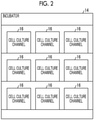
- the cell culture channels 16 are arranged side by side in the incubator 14 as shown in Fig. 2 as an example.
- Fig. 2 is a front view of the incubator 14.
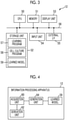
- the information processing apparatus 12 includes a central processing unit (CPU) 50, a memory 51 as a temporary storage area, and a non-volatile storage unit 52. Further, the information processing apparatus 12 includes a display unit 53, such as a liquid crystal display, an input unit 54, such as a keyboard and a mouse, and an external interface (I/F) 55 to which the controller 38 and the controller 40 are connected.
- the CPU 50, the memory 51, the storage unit 52, the display unit 53, the input unit 54, and the external I/F 55 are connected to a bus 56.
- the storage unit 52 is implemented with a hard disk drive (HDD), a solid state drive (SSD), a flash memory, and the like.
- a learning program 57, a cell culture program 58, and a learned model 59 are stored in the storage unit 52 as a storage medium.
- the CPU 50 reads out the learning program 57 and the cell culture program 58 from the storage unit 52, extracts the learning program 57 and the cell culture program 58 to the memory 51, and executes the extracted learning program 57 and cell culture program 58.
- the information processing apparatus 12 includes an acquisition unit 60, a derivation unit 62, and a generation unit 64.
- the CPU 50 executes the learning program 57 to function as the acquisition unit 60, the derivation unit 62, and the generation unit 64.
- the acquisition unit 60 acquires the transepithelial electrical resistance measured by the resistance measurement unit 34 for each cell culture channel 16, via the controller 38. Further, the acquisition unit 60 acquires image data showing the image of the cultured cells imaged by the imaging unit 36 for each cell culture channel 16, via the controller 38.
- the acquisition unit 60 acquires the evaluation value for the state of the cells that are cultured in the fluidic device 24 of each cell culture channel 16, the culture environment, and information indicating the disposition position of the fluidic device 24 in the incubator 14 (hereinafter, referred to as "a disposition position information").
- the acquisition unit 60 acquires the flow rate of the liquid flowing through the fluidic device 24 per unit time, which is measured by the flow rate measurement unit 28, as the culture environment of the cultured cells, via the controller 38. Further, the acquisition unit 60 acquires the temperature of the liquid flowing through the fluidic device 24, the environment temperature around the fluidic device 24, the environment humidity around the fluidic device 24, the carbon dioxide concentration around the fluidic device 24, the nitrogen concentration around the fluidic device 24, and the oxygen concentration around the fluidic device 24, which are measured by the environment measurement unit 42, as the culture environment of the cultured cells, via the controller 40.
- the acquisition unit 60 acquires the evaluation value derived by the derivation unit 62, which will be described later, as the evaluation value for the state of the cells. Further, the acquisition unit 60 acquires the disposition position information, for example, from the storage unit 52. The disposition position information of the fluidic device 24 will be described in detail with reference to Fig. 5 .
- Fig. 5 shows an example in which the cell culture system 10 is provided with four cell culture channels 16.
- the disposition position information of the fluidic device 24 information indicating the number from the top and information indicating the number from the left in a case where each cell culture channel 16 is viewed from the front of the incubator 14 are assigned to each cell culture channel 16. For example, "1-1" is assigned as the disposition position information to the cell culture channel 16 which is the first from the top and the first from the left in Fig. 5 .
- the disposition position information is associated with the identification information of the cell culture channel 16 and stored in the storage unit 52.
- the identification information of the cell culture channel 16 is given, for example, in a case where the controller 38 outputs the transepithelial electrical resistance, the image data, and the flow rate acquired for each cell culture channel 16 to the information processing apparatus 12.
- the acquisition unit 60 can specify which cell culture channel 16 each information relates to. Furthermore, the acquisition unit 60 can also specify which cell culture channel 16 disposed at which position in the incubator 14 each information relates to.
- the acquisition unit 60 periodically acquires various kinds of information described above.
- the derivation unit 62 derives the cell directions for the cultured cells of each cell culture channel 16 by using the image shown by the image data of each frame acquired by the acquisition unit 60.
- the derivation unit 62 can derive the cell direction from the image of each frame by using the directionality of the cells of which the long-axes or short-axes converge into one direction, with respect to the flowing liquid.
- the derivation unit 62 derives the cell migration distance from the image of each frame and divides the migration distance by the time between frames to derive the cell migration speed.
- the cell direction and the cell migration speed are examples of information that is derived from the images obtained by imaging cells. Further, the cell direction, the cell migration speed, and the transepithelial electrical resistance are examples of information representing the state of the cells.
- the derivation unit 62 derives an evaluation value for the state of the cells, for the cultured cells of each cell culture channel 16, on the basis of the transepithelial electrical resistance, the cell direction, and the cell migration speed.
- the derivation unit 62 derives a higher evaluation value, for example, as the numerical value, which is set to 10 levels from 1 to 10, increases, as the evaluation value for the state of the cells.
- the derivation unit 62 may derive a higher evaluation value, for example, as the convergence degree of the cell directions increases.
- the derivation unit 62 may derive a higher evaluation value, for example, as the cell migration speed increases.
- the derivation unit 62 may derive a higher evaluation value, for example, as the magnitude of transepithelial electrical resistance increases.
- the derivation unit 62 may use the shear stress quantification of the cells to derive the evaluation value for the state of the cells.
- the user adjusts the culture environment for each cell culture channel 16 while checking the evaluation value for the state of the cultured cells.
- the evaluation values for the states of the cultured cells of the four cell culture channels 16 change.
- the generation unit 64 uses, as training data, the evaluation values before adjustment of the culture environment, the culture environment after the adjustment, and the disposition position information, in a case where, due to the adjustment, each evaluation value becomes a first threshold value or more and the absolute value of the difference in evaluation value between the cell culture channels becomes a second threshold value or less, among the evaluation values for the states of the cells, the culture environment, and the disposition position information. This is because it is preferable that the cells of which the evaluation value is a certain value or more and the variation in state is small can be obtained in each cell culture channel 16.
- the culture environment after adjustment of the culture environment, the disposition position information, and the evaluation values before the adjustment for example, when due to the adjustment, the evaluation values for the states of the cultured cells of the four cell culture channels 16 are from 3, 4, 2, 5 to 8, 8, 8, 8, respectively, are used as the training data.
- the generation unit 64 generates the learned model 59 in which the evaluation value and the disposition position information for each cell culture channel 16 are received as an input and the culture environment is output, through the machine learning using the training data obtained as described above.
- the culture environment that is output by the learned model 59 includes the flow rate of the liquid flowing through the fluidic device 24 per unit time, the temperature of the liquid flowing through the fluidic device 24, the environment temperature around the fluidic device 24, the environment humidity around the fluidic device 24, the carbon dioxide concentration around the fluidic device 24, the nitrogen concentration around the fluidic device 24, and the oxygen concentration around the fluidic device 24.
- the generation unit 64 applies a deep neural network as the learned model 59 to generate the learned model 59 by using the backpropagation method.
- the generation unit 64 may use a method other than the neural network, such as linear regression and a decision tree, as the machine learning method.
- the CPU 50 executes the learning program 57, whereby learning processing shown in Fig. 7 is executed.
- the learning processing shown in Fig. 7 is executed, for example, in a case where the user inputs a start instruction via the input unit 54.
- the acquisition unit 60 collects training data. As described above, the acquisition unit 60 periodically acquires the evaluation value for the state of the cultured cells, the culture environment, and the disposition position information, for each cell culture channel 16. The acquisition unit 60 collects, as training data, the evaluation values before adjustment of the culture environment, the culture environment after the adjustment, and the disposition position information, in a case where, due to the adjustment, each evaluation value becomes a first threshold value or more and the absolute value of the difference in evaluation value between the cell culture channels becomes a second threshold value or less, among the plurality of evaluation values, the culture environment, and the disposition position information which are acquired.
- Step S12 the generation unit 64 generates the learned model 59 in which the evaluation value and the disposition position information for each cell culture channel 16 are received as an input and the culture environment is output, through the machine learning using the training data collected by processing of Step S12.
- the learning processing ends.
- the operation phase is a phase in which cells are cultured in each cell culture channel 16.
- the information processing apparatus 12 includes an acquisition unit 70, a derivation unit 72, and an integrated controller 74.
- the CPU 50 executes the cell culture program 58 to function as the acquisition unit 70, the derivation unit 72, and the integrated controller 74.
- the acquisition unit 70 acquires transepithelial electrical resistance and image data for each cell culture channel 16. Further, the acquisition unit 70 acquires the evaluation value for the state of the cells that are cultured in the fluidic device 24 of each cell culture channel 16 and the disposition position information of the fluidic device 24, as in the acquisition unit 60.
- the derivation unit 72 derives the evaluation value for the state of the cells for the cultured cells of each cell culture channel 16.
- the integrated controller 74 adjusts the culture environment such that the states of the cultured cells of the cell culture channels 16 are the same, on the basis of the state of the cultured cells and the culture environment of each cell culture channel 16.
- the integrated controller 74 according to the present embodiment adjusts the culture environment using the learned model 59 described above.
- the disposition position information and the evaluation value for the state of the cells for each cell culture channel 16, which are acquired by the acquisition unit 70, are received to the learned model 59, as an input, by the integrated controller 74. Further, the integrated controller 74 acquires the culture environment output by the learned model 59 in response to the input.
- the integrated controller 74 performs control by outputting the culture environment that can be controlled for each cell culture channel 16 (in the present embodiment, the flow rate), among the acquired the culture environment, to the controller 38.
- the controller 38 controls the pump 22 such that the flow rate of the liquid flowing through the fluidic device 24 becomes the flow rate received as an input from the integrated controller 74.
- the integrated controller 74 performs control by outputting the culture environment that can be controlled for each incubator 14 (in the present embodiment, the culture environment that can be adjusted by the environment adjustment unit 44), among the acquired the culture environment, to the controller 40.
- the controller 40 controls the environment adjustment unit 44 such that the culture environment that is measured by the environment measurement unit 42 becomes the environment received as an input from the integrated controller 74.
- the CPU 50 executes the cell culture program 58, whereby cell culture processing shown in Fig. 9 is executed.
- the cell culture processing shown in Fig. 9 is executed, for example, in a case where the user inputs a start instruction via the input unit 54.
- Step S20 of Fig. 9 the acquisition unit 70 acquires the evaluation value for the state of the cultured cells and the disposition position information for each cell culture channel 16.
- Step S22 the integrated controller 74 acquires the culture environment output by the learned model 59 in response to the input of the evaluation value and the disposition position information received to the learned model 59, which are acquired by the processing of Step S20.
- Step S24 the integrated controller 74 performs control by outputting the culture environment that can be controlled for each cell culture channel 16, among the culture environment acquired by the processing of Step S22, to the controller 38. Further, the integrated controller 74 performs control by outputting the culture environment that can be controlled for each incubator 14, among the culture environment acquired by the processing of Step S22, to the controller 40. With the processing of Step S24, the culture environment of the cells cultured in each cell culture channel 16 is adjusted. When the processing of Step S24 ends, the cell culture processing ends.
- Steps S20 to S24 are repeated at a predetermined time interval, for example, until the evaluation value for the state of the cultured cells of each cell culture channel 16 is the first threshold value or more and the absolute value of the difference in evaluation value between the cell culture channels is the second threshold value or less.
- the cells of which the evaluation value is a certain value or more and the variation in state is small, which are obtained by repeating the processing, are used for applications such as drug discovery.
- the culture environment of each of the plurality of fluidic devices 24 can be adjusted in an integrated manner. Further, according to the present embodiment, the evaluation values before adjustment of the culture environment, the culture environment after the adjustment, and the disposition position information, in a case where, due to the adjustment, each evaluation value becomes a first threshold value or more and the absolute value of the difference in evaluation value between the cell culture channels becomes a second threshold value or less, are used as training data. Therefore, the state of the cells cultured in each of the plurality of fluidic devices can be made good and homogeneous.
- the culture environment that can be adjusted for each incubator 14 by the environment adjustment unit 44 may be individually adjusted for each cell culture channel 16.
- an aspect in which the environment measurement unit 42 and the environment adjustment unit 44 are provided in each cell culture channel 16 and controlled by the controller 38 of each cell culture channel 16 is exemplified.
- the culture environment that is output by the learned model 59 is also output corresponding to each cell culture channel 16.
- the generation unit 64 may generate the learned model 59 for each cell culture channel 16.
- the culture environment of each cell culture channel 16 can be individually adjusted by the integrated controller 74.
- the integrated controller 74 of the information processing apparatus 12 may perform control to make the display unit 53 display the evaluation value for the state of the cultured cells of each cell culture channel 16.
- the user switches to a manual operation to adjust the culture environment in a case where the evaluation value for the state of the cells displayed by the display unit 53 does not satisfy the desired condition, is exemplified.
- the various processors include, for example, a programmable logic device (PLD), such as an FPGA, which is a processor having a changeable circuit configuration after manufacture and a dedicated electrical circuit, such as an application specific integrated circuit (ASIC), which is a processor having a dedicated circuit configuration designed to perform specific processing, in addition to the CPU which is a general-purpose processor that executes software (program) to function as various processing units as described above.
- PLD programmable logic device
- FPGA field-programmable gate array
- ASIC application specific integrated circuit
- One processing unit may be formed by one of the various processors or may be formed by a combination of two or more processors of the same type or different types (for example, a combination of a plurality of FPGAs and a combination of a CPU and an FPGA).
- the plurality of processing units may be formed by one processor.
- a first example of the configuration in which the plurality of processing units are formed by one processor is an aspect in which one or more CPUs and software are combined to form one processor and the processor functions as a plurality of processing units.
- a representative example of the aspect is a computer such as a client and server.
- a second example of the configuration is an aspect in which a processor that implements all of the functions of a system including the plurality of processing units with one integrated circuit (IC) chip is used.
- IC integrated circuit
- a representative example of the aspect is a system-on-chip (SoC).
- SoC system-on-chip
- circuitry obtained by combining circuit elements, such as semiconductor elements, may be used as the hardware structure of these various processors.
- the learning program 57 and the cell culture program 58 may be stored (installed) in the storage unit 52 in advance, but the present disclosure is not limited thereto.
- the learning program 57 and the cell culture program 58 may be recorded on a recording medium, such as a compact disc read only memory (CD-ROM), a digital versatile disc read only memory (DVD-ROM), or a universal serial bus (USB) memory, and then provided.
- the learning program 57 and the cell culture program 58 may be downloaded from an external apparatus via the network.
Landscapes
- Chemical & Material Sciences (AREA)
- Engineering & Computer Science (AREA)
- Health & Medical Sciences (AREA)
- Wood Science & Technology (AREA)
- Organic Chemistry (AREA)
- Life Sciences & Earth Sciences (AREA)
- Bioinformatics & Cheminformatics (AREA)
- Zoology (AREA)
- General Engineering & Computer Science (AREA)
- Genetics & Genomics (AREA)
- Microbiology (AREA)
- Biotechnology (AREA)
- Biochemistry (AREA)
- Biomedical Technology (AREA)
- General Health & Medical Sciences (AREA)
- Sustainable Development (AREA)
- Analytical Chemistry (AREA)
- Physics & Mathematics (AREA)
- Thermal Sciences (AREA)
- Theoretical Computer Science (AREA)
- Software Systems (AREA)
- Dispersion Chemistry (AREA)
- Clinical Laboratory Science (AREA)
- Computer Hardware Design (AREA)
- Evolutionary Computation (AREA)
- Data Mining & Analysis (AREA)
- Medical Informatics (AREA)
- Computer Vision & Pattern Recognition (AREA)
- Computing Systems (AREA)
- General Physics & Mathematics (AREA)
- Mathematical Physics (AREA)
- Artificial Intelligence (AREA)
- Apparatus Associated With Microorganisms And Enzymes (AREA)
Abstract
Description
- The present disclosure relates to an information processing apparatus, a cell culture system, an information processing method, and an information processing program.
- As a technique related to cell culture, a culture station that is used to culture biological cells in a microfluidic device has been known (see
JP2018-512853A - Further, a cell culture apparatus comprising a culture layer that cultures cells, a monitoring device, an aseptic sampling device, an analyzer, a data collection device, a data analyzer, and a cell state determination device provided with a cluster analysis function is disclosed. (See
JP2018-117567A - Incidentally, in the cell culture using a fluidic device, such as a microfluidic device, various functions can be customized through examination of various flow passage structures of the fluidic device. As a result, the fluidic device has been applied to applications such as drug discovery, toxicity evaluation, an organ-on-a-chip, a body-on-a-chip, and analytical chemistry. However, since the fluidic device alone cannot be used for the intended application, a system capable of controlling a liquid feeding system, sensing, adjustment of culture environment, and the like has been required.
- Further, in the above-mentioned applications, it is preferable that cell culture using a plurality of fluidic devices can be performed. Furthermore, in this case, it is preferable that the state of the cells cultured in each of the plurality of fluidic devices is as good and homogeneous as possible.
- However, in a case where the plurality of fluidic devices are arranged in a closed environment, such as an incubator, the states of the cells may vary depending on the disposition position of the fluidic device even in a case where the culture environment of the cells that are cultured in each fluidic device is made the same.
JP2018-512853A JP2018-117567A - The present disclosure has been made in view of the above circumstances, and an object thereof is to provide an information processing apparatus, a cell culture system, an information processing method, and an information processing program by which the state of cells that are cultured in each of the plurality of fluidic devices can be made good and homogeneous.
- In order to achieve the above object, an information processing apparatus according to the present disclosure comprises: an acquisition unit that acquires an evaluation value for a state of cells which are cultured in each of a plurality of fluidic devices, culture environment, and information representing a disposition position of the fluidic device; and a generation unit that generates a learned model in which the evaluation value and the information representing the disposition position are received as an input and the culture environment is output, through machine learning using, as training data, the evaluation value before adjustment of the culture environment, the culture environment after the adjustment, and the information representing the disposition position, in a case where, due to the adjustment, the evaluation value becomes a first threshold value or more and an absolute value of a difference in evaluation value between the plurality of fluidic devices becomes a second threshold value or less, among a plurality of the evaluation values, the culture environment, and the information which are acquired by the acquisition unit.
- In the information processing apparatus according to the present disclosure, the evaluation value may be a value that is determined by information which is derived from an image obtained by imaging the cells and transepithelial electrical resistance of the cells.
- Further, in the information processing apparatus according to the present disclosure, the culture environment may include a flow rate of a liquid flowing through the fluidic device, a temperature of the liquid, an environment temperature around the fluidic device, an environment humidity around the fluidic device, a carbon dioxide concentration around the fluidic device, a nitrogen concentration around the fluidic device, and an oxygen concentration around the fluidic device.
- Further, a cell culture system according to the present disclosure comprises: a plurality of cell culture channels each of which includes a fluidic device in which cells are cultured, a liquid feeding unit which makes a liquid flow into the fluidic device, a detection unit which detects a state of the cells that are cultured in the fluidic device, and a controller which controls the liquid feeding unit and the detection unit; a measurement unit that measures culture environment of the cells which are cultured in the plurality of cell culture channels; and the information processing apparatus according to the present disclosure.
- Meanwhile, in order to achieve the above object, the information processing method according to the present disclosure that is executed by a computer, the method comprises: acquiring an evaluation value for a state of cells which are cultured in each of a plurality of fluidic devices, culture environment, and information representing a disposition position of the fluidic device; and generating a learned model in which the evaluation value and the information representing the disposition position are received as an input and the culture environment is output, through machine learning using, as training data, the evaluation value before adjustment of the culture environment, the culture environment after the adjustment, and the information representing the disposition position, in a case where, due to the adjustment, the evaluation value becomes a first threshold value or more and an absolute value of a difference in evaluation value between the plurality of fluidic devices becomes a second threshold value or less, among a plurality of the evaluation values, the culture environment, and the information which are acquired.
- Further, an information processing program according to the present disclosure that causes a computer to execute a process, the process comprises: acquiring an evaluation value for a state of cells which are cultured in each of a plurality of fluidic devices, culture environment, and information representing a disposition position of the fluidic device; and generating a learned model in which the evaluation value and the information representing the disposition position are received as an input and the culture environment is output, through machine learning using, as training data, the evaluation value before adjustment of the culture environment, the culture environment after the adjustment, and the information representing the disposition position, in a case where, due to the adjustment, the evaluation value becomes a first threshold value or more and an absolute value of a difference in evaluation value between the plurality of fluidic devices becomes a second threshold value or less, among a plurality of the evaluation values, the culture environment, and the information which are acquired.
- In addition, an information processing apparatus according to the present disclosure comprises: a memory for storing an instruction to be executed by a computer; and a processor configured to execute the stored instruction, in which the processor acquires an evaluation value for a state of cells which are cultured in each of a plurality of fluidic devices, culture environment, and information representing a disposition position of the fluidic device; and generates a learned model in which the evaluation value and the information representing the disposition position are received as an input and the culture environment is output, through machine learning using, as training data, the evaluation value before adjustment of the culture environment, the culture environment after the adjustment, and the information representing the disposition position, in a case where, due to the adjustment, the evaluation value becomes a first threshold value or more and an absolute value of a difference in evaluation value between the plurality of fluidic devices becomes a second threshold value or less, among a plurality of the evaluation values, the culture environment, and the information which are acquired.
- According to the present disclosure, the state of the cells that are cultured in each of the plurality of fluidic devices can be made good and homogeneous.
-
-
Fig. 1 is a block diagram showing an example of a configuration of a cell culture system according to an embodiment. -
Fig. 2 is a diagram for explaining a disposition state of a cell culture channel according to the embodiment. -
Fig. 3 is a block diagram showing an example of a hardware configuration of an information processing apparatus according to the embodiment. -
Fig. 4 is a block diagram showing an example of a functional configuration of the information processing apparatus according to the embodiment in a learning phase. -
Fig. 5 is a diagram for explaining information representing a disposition position of the cell culture channel according to the embodiment. -
Fig. 6 is a diagram for explaining a learned model according to the embodiment. -
Fig. 7 is a flowchart showing an example of learning processing according to the embodiment. -
Fig. 8 is a block diagram showing an example of a functional configuration of the information processing apparatus according to the embodiment in an operation phase. -
Fig. 9 is a flowchart showing an example of cell culture processing according to the embodiment. - Hereinafter, an exemplary embodiment of the technique according to the present disclosure will be described in detail with reference to the drawings.
- First, the configuration of a
cell culture system 10 according to the present embodiment will be described with reference toFig. 1 . As shown inFig. 1 , thecell culture system 10 includes aninformation processing apparatus 12 and anincubator 14. Examples of theinformation processing apparatus 12 include a personal computer, a server computer, and the like. Thecell culture system 10 is used in applications such as drug discovery, toxicity evaluation, an organ-on-a-chip, a body-on-a-chip, and analytical chemistry. - A plurality of
cell culture channels 16, acontroller 40, an environment measurement unit 42, and an environment adjustment unit 44 are provided inside theincubator 14. Thecontroller 40 is connected to the environment measurement unit 42 and the environment adjustment unit 44. In the present embodiment, an example of an aspect in which thecontroller 40, the environment measurement unit 42, and the environment adjustment unit 44 are provided in a set inside theincubator 14 will be described, but the present disclosure is not limited thereto. Thecontroller 40, the environment measurement unit 42, and the environment adjustment unit 44 may be provided, for example, in a set for each onecell culture channel 16 or a set for each twocell culture channels 16. - The
cell culture channel 16 includes areservoir 20, apump 22, afluidic device 24, awaste liquid unit 26, a flowrate measurement unit 28, a micro-differentialpressure measurement unit 30, a potential of hydrogen (pH)measurement unit 32, aresistance measurement unit 34, an imaging unit, 36 and acontroller 38. Thecontroller 38 is connected to thepump 22, the flowrate measurement unit 28, the micro-differentialpressure measurement unit 30, thepH measurement unit 32, theresistance measurement unit 34, and theimaging unit 36. - A liquid is stored in the
reservoir 20. Examples of the liquid stored in thereservoir 20 include a liquid medium, a cell suspension, an added compound solution, an evaluation chemical agent, and a tracer solution. Thepump 22 is, for example, a micropump that feeds the liquid by driving a piezo element, and makes the liquid stored in thereservoir 20 flow into thefluidic device 24. Thepump 22 is an example of a liquid feeding unit that makes the liquid flow into thefluidic device 24. In thepump 22, the flow rate of the liquid is controlled by thecontroller 38. In a case where there are a plurality of types of liquids to be fed, thereservoir 20 and thepump 22 are provided in a set for each type of liquid. - In the
fluidic device 24, cells are cultured. Thefluidic device 24 comprises an inlet into which the liquid flows, an outlet out of which the liquid flows, and a flow passage which connects the inlet and the outlet to each other. Examples of thefluidic device 24 include a microfluidic device having micro flow passages. In the following, cells cultured in thefluidic device 24 will be referred to as "cultured cells". - The
waste liquid unit 26 discards the liquid flowing out of thefluidic device 24. Thecell culture channel 16 may be provided with a circulation unit that circulates the liquid flowing out of thefluidic device 24 to thereservoir 20, instead of thewaste liquid unit 26. - The flow
rate measurement unit 28 measures the flow rate of the liquid flowing through thefluidic device 24 per unit time and outputs the measurement result to thecontroller 38. The micro-differentialpressure measurement unit 30 measures the micro-differential pressure between the inlet and the outlet of thefluidic device 24 and outputs the measurement result to thecontroller 38. ThepH measurement unit 32 measures the pH of the liquid flowing through thefluidic device 24 and outputs the measurement result to thecontroller 38. The measurement results of the flowrate measurement unit 28, the micro-differentialpressure measurement unit 30, and thepH measurement unit 32 are used, for example, to detect the presence or absence of contamination inside thefluidic device 24. - The
resistance measurement unit 34 measures the transepithelial electrical resistance of the cultured cells and outputs the measurement result to thecontroller 38. The transepithelial electrical resistance is used to evaluate the barrier function of cells, and numerical values thereof vary depending on the environment temperature, the state of cultured cells, and the like. Theimaging unit 36 captures an image of the cultured cells in accordance with a predetermined frame rate and outputs image data showing the image obtained by the capturing of the image to thecontroller 38. Theresistance measurement unit 34 and theimaging unit 36 are examples of a detection unit that detects the state of cells. Further, the flowrate measurement unit 28, the micro-differentialpressure measurement unit 30, thepH measurement unit 32, theresistance measurement unit 34, and theimaging unit 36 may be formed of various sensors that detect amounts to be measured. - The
controller 38 controls thepump 22, the flowrate measurement unit 28, the micro-differentialpressure measurement unit 30, thepH measurement unit 32, theresistance measurement unit 34, and theimaging unit 36. Examples of thecontroller 38 include a processor such as a programmable logic device (PLD). - The
controller 40 controls the environment measurement unit 42 and the environment adjustment unit 44. Examples of thecontroller 40 include a processor such as a PLD. The environment measurement unit 42 measures the culture environment of the cells that are cultured in eachcell culture channel 16. The culture environment that is measured by the environment measurement unit 42 includes a temperature of the liquid flowing through thefluidic device 24, an environment temperature around thefluidic device 24, an environment humidity around thefluidic device 24, a carbon dioxide concentration around thefluidic device 24, a nitrogen concentration around thefluidic device 24, and an oxygen concentration around thefluidic device 24. That is, the environment measurement unit 42 includes various sensors capable of measuring the culture environment. - The environment adjustment unit 44 adjusts the culture environment of the cultured cells that are cultured in each
cell culture channel 16. The culture environment that can be adjusted by the environment adjustment unit 44 is the same, for example, as the culture environment that can be measured by the environment measurement unit 42. Thecontroller 38 and thecontroller 40 are connected to theinformation processing apparatus 12 and are controlled in an integrated manner by theinformation processing apparatus 12. The environment adjustment unit 44 may adjust the culture environment for eachcell culture channel 16. In this case, the environment measurement unit 42 also measures the culture environment for eachcell culture channel 16. - The
cell culture channels 16 are arranged side by side in theincubator 14 as shown inFig. 2 as an example.Fig. 2 is a front view of theincubator 14. - Next, the hardware configuration of the
information processing apparatus 12 according to the present embodiment will be described with reference toFig. 3 . As shown inFig. 3 , theinformation processing apparatus 12 includes a central processing unit (CPU) 50, amemory 51 as a temporary storage area, and anon-volatile storage unit 52. Further, theinformation processing apparatus 12 includes adisplay unit 53, such as a liquid crystal display, aninput unit 54, such as a keyboard and a mouse, and an external interface (I/F) 55 to which thecontroller 38 and thecontroller 40 are connected. TheCPU 50, thememory 51, thestorage unit 52, thedisplay unit 53, theinput unit 54, and the external I/F 55 are connected to abus 56. - The
storage unit 52 is implemented with a hard disk drive (HDD), a solid state drive (SSD), a flash memory, and the like. Alearning program 57, acell culture program 58, and a learnedmodel 59 are stored in thestorage unit 52 as a storage medium. TheCPU 50 reads out thelearning program 57 and thecell culture program 58 from thestorage unit 52, extracts thelearning program 57 and thecell culture program 58 to thememory 51, and executes the extractedlearning program 57 andcell culture program 58. - Next, a learning phase for obtaining the learned
model 59 will be described. With reference toFig. 4 , a functional configuration of theinformation processing apparatus 12 according to the present embodiment in the learning phase will be described. As shown inFig. 4 , theinformation processing apparatus 12 includes anacquisition unit 60, aderivation unit 62, and ageneration unit 64. TheCPU 50 executes thelearning program 57 to function as theacquisition unit 60, thederivation unit 62, and thegeneration unit 64. - The
acquisition unit 60 acquires the transepithelial electrical resistance measured by theresistance measurement unit 34 for eachcell culture channel 16, via thecontroller 38. Further, theacquisition unit 60 acquires image data showing the image of the cultured cells imaged by theimaging unit 36 for eachcell culture channel 16, via thecontroller 38. - In addition, the
acquisition unit 60 acquires the evaluation value for the state of the cells that are cultured in thefluidic device 24 of eachcell culture channel 16, the culture environment, and information indicating the disposition position of thefluidic device 24 in the incubator 14 (hereinafter, referred to as "a disposition position information"). - Specifically, the
acquisition unit 60 acquires the flow rate of the liquid flowing through thefluidic device 24 per unit time, which is measured by the flowrate measurement unit 28, as the culture environment of the cultured cells, via thecontroller 38. Further, theacquisition unit 60 acquires the temperature of the liquid flowing through thefluidic device 24, the environment temperature around thefluidic device 24, the environment humidity around thefluidic device 24, the carbon dioxide concentration around thefluidic device 24, the nitrogen concentration around thefluidic device 24, and the oxygen concentration around thefluidic device 24, which are measured by the environment measurement unit 42, as the culture environment of the cultured cells, via thecontroller 40. - In addition, the
acquisition unit 60 acquires the evaluation value derived by thederivation unit 62, which will be described later, as the evaluation value for the state of the cells. Further, theacquisition unit 60 acquires the disposition position information, for example, from thestorage unit 52. The disposition position information of thefluidic device 24 will be described in detail with reference toFig. 5 . For ease of understanding,Fig. 5 shows an example in which thecell culture system 10 is provided with fourcell culture channels 16. - As shown in
Fig. 5 , in the present embodiment, as the disposition position information of thefluidic device 24, information indicating the number from the top and information indicating the number from the left in a case where eachcell culture channel 16 is viewed from the front of theincubator 14 are assigned to eachcell culture channel 16. For example, "1-1" is assigned as the disposition position information to thecell culture channel 16 which is the first from the top and the first from the left inFig. 5 . In the present embodiment, the disposition position information is associated with the identification information of thecell culture channel 16 and stored in thestorage unit 52. The identification information of thecell culture channel 16 is given, for example, in a case where thecontroller 38 outputs the transepithelial electrical resistance, the image data, and the flow rate acquired for eachcell culture channel 16 to theinformation processing apparatus 12. - Accordingly, in a case where the
acquisition unit 60 acquires each information regarding the flow rate of the liquid flowing through thefluidic device 24, the transepithelial electrical resistance, and the image data, via thecontroller 38, theacquisition unit 60 can specify whichcell culture channel 16 each information relates to. Furthermore, theacquisition unit 60 can also specify whichcell culture channel 16 disposed at which position in theincubator 14 each information relates to. Theacquisition unit 60 periodically acquires various kinds of information described above. - The
derivation unit 62 derives the cell directions for the cultured cells of eachcell culture channel 16 by using the image shown by the image data of each frame acquired by theacquisition unit 60. Thederivation unit 62 can derive the cell direction from the image of each frame by using the directionality of the cells of which the long-axes or short-axes converge into one direction, with respect to the flowing liquid. - Further, the
derivation unit 62 derives the cell migration distance from the image of each frame and divides the migration distance by the time between frames to derive the cell migration speed. The cell direction and the cell migration speed are examples of information that is derived from the images obtained by imaging cells. Further, the cell direction, the cell migration speed, and the transepithelial electrical resistance are examples of information representing the state of the cells. - The
derivation unit 62 derives an evaluation value for the state of the cells, for the cultured cells of eachcell culture channel 16, on the basis of the transepithelial electrical resistance, the cell direction, and the cell migration speed. In the present embodiment, thederivation unit 62 derives a higher evaluation value, for example, as the numerical value, which is set to 10 levels from 1 to 10, increases, as the evaluation value for the state of the cells. Thederivation unit 62 may derive a higher evaluation value, for example, as the convergence degree of the cell directions increases. Alternatively, thederivation unit 62 may derive a higher evaluation value, for example, as the cell migration speed increases. Alternatively, thederivation unit 62 may derive a higher evaluation value, for example, as the magnitude of transepithelial electrical resistance increases. In addition, thederivation unit 62 may use the shear stress quantification of the cells to derive the evaluation value for the state of the cells. - For example, the user adjusts the culture environment for each
cell culture channel 16 while checking the evaluation value for the state of the cultured cells. With this adjustment, for example, the evaluation values for the states of the cultured cells of the fourcell culture channels 16 change. Thegeneration unit 64 according to the present embodiment uses, as training data, the evaluation values before adjustment of the culture environment, the culture environment after the adjustment, and the disposition position information, in a case where, due to the adjustment, each evaluation value becomes a first threshold value or more and the absolute value of the difference in evaluation value between the cell culture channels becomes a second threshold value or less, among the evaluation values for the states of the cells, the culture environment, and the disposition position information. This is because it is preferable that the cells of which the evaluation value is a certain value or more and the variation in state is small can be obtained in eachcell culture channel 16. - In a case where a first threshold value is set to 8 and a second threshold value is set to 0, the culture environment after adjustment of the culture environment, the disposition position information, and the evaluation values before the adjustment, for example, when due to the adjustment, the evaluation values for the states of the cultured cells of the four
cell culture channels 16 are from 3, 4, 2, 5 to 8, 8, 8, 8, respectively, are used as the training data. - The user repeatedly cultures the cells in the
cell culture system 10, so that thegeneration unit 64 can obtain a large number of training data. As shown inFig. 6 as an example, thegeneration unit 64 generates the learnedmodel 59 in which the evaluation value and the disposition position information for eachcell culture channel 16 are received as an input and the culture environment is output, through the machine learning using the training data obtained as described above. The culture environment that is output by the learnedmodel 59 includes the flow rate of the liquid flowing through thefluidic device 24 per unit time, the temperature of the liquid flowing through thefluidic device 24, the environment temperature around thefluidic device 24, the environment humidity around thefluidic device 24, the carbon dioxide concentration around thefluidic device 24, the nitrogen concentration around thefluidic device 24, and the oxygen concentration around thefluidic device 24. For example, thegeneration unit 64 applies a deep neural network as the learnedmodel 59 to generate the learnedmodel 59 by using the backpropagation method. Thegeneration unit 64 may use a method other than the neural network, such as linear regression and a decision tree, as the machine learning method. - Next, with reference to
Fig. 7 , the action of theinformation processing apparatus 12 according to the present embodiment in the learning phase will be described. TheCPU 50 executes thelearning program 57, whereby learning processing shown inFig. 7 is executed. The learning processing shown inFig. 7 is executed, for example, in a case where the user inputs a start instruction via theinput unit 54. - In Step S10 of
Fig. 7 , theacquisition unit 60 collects training data. As described above, theacquisition unit 60 periodically acquires the evaluation value for the state of the cultured cells, the culture environment, and the disposition position information, for eachcell culture channel 16. Theacquisition unit 60 collects, as training data, the evaluation values before adjustment of the culture environment, the culture environment after the adjustment, and the disposition position information, in a case where, due to the adjustment, each evaluation value becomes a first threshold value or more and the absolute value of the difference in evaluation value between the cell culture channels becomes a second threshold value or less, among the plurality of evaluation values, the culture environment, and the disposition position information which are acquired. - In Step S12, as described above, the
generation unit 64 generates the learnedmodel 59 in which the evaluation value and the disposition position information for eachcell culture channel 16 are received as an input and the culture environment is output, through the machine learning using the training data collected by processing of Step S12. When the processing of Step S12 ends, the learning processing ends. - Next, an operation phase using the learned
model 59 will be described. The operation phase is a phase in which cells are cultured in eachcell culture channel 16. With reference toFig. 8 , a functional configuration of theinformation processing apparatus 12 according to the present embodiment in the operation phase will be described. As shown inFig. 8 , theinformation processing apparatus 12 includes anacquisition unit 70, aderivation unit 72, and anintegrated controller 74. TheCPU 50 executes thecell culture program 58 to function as theacquisition unit 70, thederivation unit 72, and theintegrated controller 74. - As in the
acquisition unit 60, theacquisition unit 70 acquires transepithelial electrical resistance and image data for eachcell culture channel 16. Further, theacquisition unit 70 acquires the evaluation value for the state of the cells that are cultured in thefluidic device 24 of eachcell culture channel 16 and the disposition position information of thefluidic device 24, as in theacquisition unit 60. - As in the
derivation unit 62, thederivation unit 72 derives the evaluation value for the state of the cells for the cultured cells of eachcell culture channel 16. - The
integrated controller 74 adjusts the culture environment such that the states of the cultured cells of thecell culture channels 16 are the same, on the basis of the state of the cultured cells and the culture environment of eachcell culture channel 16. Theintegrated controller 74 according to the present embodiment adjusts the culture environment using the learnedmodel 59 described above. - Specifically, the disposition position information and the evaluation value for the state of the cells for each
cell culture channel 16, which are acquired by theacquisition unit 70, are received to the learnedmodel 59, as an input, by theintegrated controller 74. Further, theintegrated controller 74 acquires the culture environment output by the learnedmodel 59 in response to the input. - The
integrated controller 74 performs control by outputting the culture environment that can be controlled for each cell culture channel 16 (in the present embodiment, the flow rate), among the acquired the culture environment, to thecontroller 38. Thecontroller 38 controls thepump 22 such that the flow rate of the liquid flowing through thefluidic device 24 becomes the flow rate received as an input from the integratedcontroller 74. - The
integrated controller 74 performs control by outputting the culture environment that can be controlled for each incubator 14 (in the present embodiment, the culture environment that can be adjusted by the environment adjustment unit 44), among the acquired the culture environment, to thecontroller 40. Thecontroller 40 controls the environment adjustment unit 44 such that the culture environment that is measured by the environment measurement unit 42 becomes the environment received as an input from the integratedcontroller 74. - Next, with reference to
Fig. 9 , the action of theinformation processing apparatus 12 according to the present embodiment in the operation phase will be described. TheCPU 50 executes thecell culture program 58, whereby cell culture processing shown inFig. 9 is executed. The cell culture processing shown inFig. 9 is executed, for example, in a case where the user inputs a start instruction via theinput unit 54. - In Step S20 of
Fig. 9 , as described above, theacquisition unit 70 acquires the evaluation value for the state of the cultured cells and the disposition position information for eachcell culture channel 16. In Step S22, as described above, theintegrated controller 74 acquires the culture environment output by the learnedmodel 59 in response to the input of the evaluation value and the disposition position information received to the learnedmodel 59, which are acquired by the processing of Step S20. - In Step S24, as described above, the
integrated controller 74 performs control by outputting the culture environment that can be controlled for eachcell culture channel 16, among the culture environment acquired by the processing of Step S22, to thecontroller 38. Further, theintegrated controller 74 performs control by outputting the culture environment that can be controlled for eachincubator 14, among the culture environment acquired by the processing of Step S22, to thecontroller 40. With the processing of Step S24, the culture environment of the cells cultured in eachcell culture channel 16 is adjusted. When the processing of Step S24 ends, the cell culture processing ends. The above processing from Steps S20 to S24 is repeated at a predetermined time interval, for example, until the evaluation value for the state of the cultured cells of eachcell culture channel 16 is the first threshold value or more and the absolute value of the difference in evaluation value between the cell culture channels is the second threshold value or less. The cells of which the evaluation value is a certain value or more and the variation in state is small, which are obtained by repeating the processing, are used for applications such as drug discovery. - As described above, according to the present embodiment, the culture environment of each of the plurality of
fluidic devices 24 can be adjusted in an integrated manner. Further, according to the present embodiment, the evaluation values before adjustment of the culture environment, the culture environment after the adjustment, and the disposition position information, in a case where, due to the adjustment, each evaluation value becomes a first threshold value or more and the absolute value of the difference in evaluation value between the cell culture channels becomes a second threshold value or less, are used as training data. Therefore, the state of the cells cultured in each of the plurality of fluidic devices can be made good and homogeneous. - In the above-described embodiment, the culture environment that can be adjusted for each
incubator 14 by the environment adjustment unit 44 may be individually adjusted for eachcell culture channel 16. In this case, an aspect in which the environment measurement unit 42 and the environment adjustment unit 44 are provided in eachcell culture channel 16 and controlled by thecontroller 38 of eachcell culture channel 16 is exemplified. Further, in the example of the aspect, the culture environment that is output by the learnedmodel 59 is also output corresponding to eachcell culture channel 16. In the example of the aspect, thegeneration unit 64 may generate the learnedmodel 59 for eachcell culture channel 16. Further, in the example of the aspect, the culture environment of eachcell culture channel 16 can be individually adjusted by theintegrated controller 74. - Further, in the operation phase of the above embodiment, the
integrated controller 74 of theinformation processing apparatus 12 may perform control to make thedisplay unit 53 display the evaluation value for the state of the cultured cells of eachcell culture channel 16. In this case, an aspect in which the user switches to a manual operation to adjust the culture environment in a case where the evaluation value for the state of the cells displayed by thedisplay unit 53 does not satisfy the desired condition, is exemplified. - Further, in the above-described embodiment, for example, as a hardware structure of a processing unit that executes various processing such as processing performed by the
acquisition units derivation units generation unit 64, and theintegrated controller 74, the following various processors may be used. The various processors include, for example, a programmable logic device (PLD), such as an FPGA, which is a processor having a changeable circuit configuration after manufacture and a dedicated electrical circuit, such as an application specific integrated circuit (ASIC), which is a processor having a dedicated circuit configuration designed to perform specific processing, in addition to the CPU which is a general-purpose processor that executes software (program) to function as various processing units as described above. - One processing unit may be formed by one of the various processors or may be formed by a combination of two or more processors of the same type or different types (for example, a combination of a plurality of FPGAs and a combination of a CPU and an FPGA). Alternatively, the plurality of processing units may be formed by one processor.
- A first example of the configuration in which the plurality of processing units are formed by one processor is an aspect in which one or more CPUs and software are combined to form one processor and the processor functions as a plurality of processing units. A representative example of the aspect is a computer such as a client and server. A second example of the configuration is an aspect in which a processor that implements all of the functions of a system including the plurality of processing units with one integrated circuit (IC) chip is used. A representative example of the aspect is a system-on-chip (SoC). As described above, as the hardware structure of various processing units, one or more of the various processors are used.
- Furthermore, an electrical circuit (circuitry) obtained by combining circuit elements, such as semiconductor elements, may be used as the hardware structure of these various processors.
- In the above-described embodiment, the aspect in which the
learning program 57 and thecell culture program 58 are stored (installed) in thestorage unit 52 in advance has been described, but the present disclosure is not limited thereto. Thelearning program 57 and thecell culture program 58 may be recorded on a recording medium, such as a compact disc read only memory (CD-ROM), a digital versatile disc read only memory (DVD-ROM), or a universal serial bus (USB) memory, and then provided. Alternatively, thelearning program 57 and thecell culture program 58 may be downloaded from an external apparatus via the network. - The disclosure of
Japanese Patent Application No. 2019-051926 - All documents, patent applications, and technical standards described in the present specification are incorporated herein by reference to the same extent as a case where each individual document, patent application, and technical standard are specifically and individually stated to be incorporated by reference.
-
- 10:
- cell culture system
- 12:
- information processing apparatus
- 14:
- incubator
- 16:
- cell culture channel
- 20:
- reservoir
- 22:
- pump
- 24:
- fluidic device
- 26:
- waste liquid unit
- 28:
- flow rate measurement unit
- 30:
- micro-differential pressure measurement unit
- 32:
- pH measurement unit
- 34:
- resistance measurement unit
- 36:
- imaging unit
- 38,
- 40: controller
- 42:
- environment measurement unit
- 44:
- environment adjustment unit
- 50:
- CPU
- 51:
- memory
- 52:
- storage unit
- 53:
- display unit
- 54:
- input unit
- 55:
- external I/F
- 56:
- bus
- 57:
- learning program
- 58:
- cell culture program
- 59:
- learned model
- 60, 70:
- acquisition unit
- 62, 72:
- derivation unit
- 64:
- generation unit
- 74:
- integrated controller
Claims (6)
- An information processing apparatus comprising:a first processor that acquires an evaluation value for a state of cells which are cultured in each of a plurality of fluidic devices, culture environment, and information representing a disposition position of the fluidic device, and
generates a learned model in which the evaluation value and the information representing the disposition position are received as an input and the culture environment is output, through machine learning using, as training data, the evaluation value before adjustment of the culture environment, the culture environment after the adjustment, and the information representing the disposition position, in a case where, due to the adjustment, the evaluation value becomes a first threshold value or more and an absolute value of a difference in evaluation value between the plurality of fluidic devices becomes a second threshold value or less, among a plurality of the evaluation values, the culture environment, and the information which are acquired. - The information processing apparatus according to claim 1,
wherein the evaluation value is a value that is determined by information which is derived from an image obtained by imaging the cells and transepithelial electrical resistance of the cells. - The information processing apparatus according to claim 1 or 2,
wherein the culture environment includes a flow rate of a liquid flowing through the fluidic device, a temperature of the liquid, an environment temperature around the fluidic device, an environment humidity around the fluidic device, a carbon dioxide concentration around the fluidic device, a nitrogen concentration around the fluidic device, and an oxygen concentration around the fluidic device. - A cell culture system comprising:a plurality of cell culture channels each of which includes a fluidic device in which cells are cultured, a liquid feeding unit which makes a liquid flow into the fluidic device, a first sensor which detects a state of the cells that are cultured in the fluidic device, and a second processor which controls the liquid feeding unit and the first sensor;a second sensor that measures culture environment of the cells which are cultured in the plurality of cell culture channels; andthe information processing apparatus according to any one of claims 1 to 3.
- An information processing method that is executed by a computer, the method comprising:acquiring an evaluation value for a state of cells which are cultured in each of a plurality of fluidic devices, culture environment, and information representing a disposition position of the fluidic device; andgenerating a learned model in which the evaluation value and the information representing the disposition position are received as an input and the culture environment is output, through machine learning using, as training data, the evaluation value before adjustment of the culture environment, the culture environment after the adjustment, and the information representing the disposition position, in a case where, due to the adjustment, the evaluation value becomes a first threshold value or more and an absolute value of a difference in evaluation value between the plurality of fluidic devices becomes a second threshold value or less, among a plurality of the evaluation values, the culture environment, and the information which are acquired.
- An information processing program that causes a computer to execute a process, the process comprising:acquiring an evaluation value for a state of cells which are cultured in each of a plurality of fluidic devices, culture environment, and information representing a disposition position of the fluidic device; andgenerating a learned model in which the evaluation value and the information representing the disposition position are received as an input and the culture environment is output, through machine learning using, as training data, the evaluation value before adjustment of the culture environment, the culture environment after the adjustment, and the information representing the disposition position, in a case where, due to the adjustment, the evaluation value becomes a first threshold value or more and an absolute value of a difference in evaluation value between the plurality of fluidic devices becomes a second threshold value or less, among a plurality of the evaluation values, the culture environment, and the information which are acquired.
Applications Claiming Priority (2)
| Application Number | Priority Date | Filing Date | Title |
|---|---|---|---|
| JP2019051926 | 2019-03-19 | ||
| PCT/JP2020/007993 WO2020189219A1 (en) | 2019-03-19 | 2020-02-27 | Information processing apparatus, cell culture system, information processing method, and information processing program |
Publications (2)
| Publication Number | Publication Date |
|---|---|
| EP3943588A1 true EP3943588A1 (en) | 2022-01-26 |
| EP3943588A4 EP3943588A4 (en) | 2022-05-25 |
Family
ID=72520880
Family Applications (1)
| Application Number | Title | Priority Date | Filing Date |
|---|---|---|---|
| EP20773850.1A Pending EP3943588A4 (en) | 2019-03-19 | 2020-02-27 | INFORMATION PROCESSING APPARATUS, CELL CULTURE SYSTEM, INFORMATION PROCESSING METHOD AND INFORMATION PROCESSING PROGRAM |
Country Status (4)
| Country | Link |
|---|---|
| US (1) | US12460172B2 (en) |
| EP (1) | EP3943588A4 (en) |
| JP (1) | JP7314253B2 (en) |
| WO (1) | WO2020189219A1 (en) |
Families Citing this family (6)
| Publication number | Priority date | Publication date | Assignee | Title |
|---|---|---|---|---|
| WO2020189219A1 (en) * | 2019-03-19 | 2020-09-24 | 富士フイルム株式会社 | Information processing apparatus, cell culture system, information processing method, and information processing program |
| JP7686216B2 (en) * | 2020-12-08 | 2025-06-02 | 清水建設株式会社 | Cell culture optimization condition acquisition system, cell culture optimization condition acquisition method, and program |
| JP7734497B2 (en) * | 2021-03-22 | 2025-09-05 | 株式会社カネカ | Prediction device, control device, manufacturing method, and program |
| WO2024090302A1 (en) * | 2022-10-26 | 2024-05-02 | 千代田化工建設株式会社 | Method for creating machine learning model for estimating state of fluid inside tank, and method for estimating state of fluid inside tank using machine learning model |
| JP2025093738A (en) * | 2023-12-12 | 2025-06-24 | 千代田化工建設株式会社 | Trained model, estimation device, and estimation method |
| CN120700213B (en) * | 2025-08-28 | 2026-02-03 | 山东大学 | Cell self-adaptive culture method and device based on adjustable culture environment |
Family Cites Families (29)
| Publication number | Priority date | Publication date | Assignee | Title |
|---|---|---|---|---|
| JP4730000B2 (en) * | 2005-07-01 | 2011-07-20 | 株式会社ニコン | incubator |
| WO2009039433A1 (en) * | 2007-09-20 | 2009-03-26 | Incept Biosystems Inc. | Analytical microfluidic culture system |
| JP2011229411A (en) * | 2010-04-23 | 2011-11-17 | Nagoya Univ | Cell valuation model production apparatus, cell evaluation device, incubator, program, and culture method |
| WO2014081840A1 (en) * | 2012-11-21 | 2014-05-30 | Vanderbilt University | Organ on chip integration and applications of the same |
| US20130287613A1 (en) * | 2010-10-07 | 2013-10-31 | Vanderbilt University | Peristaltic micropump and related systems and methods |
| WO2012147463A1 (en) * | 2011-04-28 | 2012-11-01 | 株式会社日立製作所 | Cell cultivation container and cell culturing apparatus |
| US9177192B2 (en) * | 2013-02-28 | 2015-11-03 | Progyny, Inc. | Apparatus, method, and system for image-based human embryo cell classification |
| EP3103860A4 (en) | 2014-02-07 | 2017-09-13 | Tokyo Electron Limited | Culturing device |
| EP3262417B1 (en) * | 2015-02-23 | 2021-11-03 | Cellanyx Diagnostics, LLC | Cell imaging and analysis to differentiate clinically relevant sub-populations of cells |
| TWI712686B (en) | 2015-04-22 | 2020-12-11 | 美商柏克萊燈光有限公司 | Culturing station for microfluidic device |
| US11308121B2 (en) | 2015-11-04 | 2022-04-19 | Thrive Bioscience, Inc. | Method and system for cell operations using a blockchain data network |
| EP3371294B1 (en) | 2015-11-04 | 2023-12-13 | Thrive Bioscience, Inc. | Networked incubator operation |
| US20210294808A1 (en) | 2015-11-04 | 2021-09-23 | Thrive Bioscience, Inc. | Method and system for identifying a cell line during incubation of the cell line |
| US11230690B2 (en) | 2015-11-04 | 2022-01-25 | Thrive Bioscience, Inc. | Method and system for cell operations using the internet of things |
| US20210292704A1 (en) | 2015-11-04 | 2021-09-23 | Thrive Bioscience, Inc. | Method and system for cell operations using artificial intelligence |
| JP2018022216A (en) * | 2016-08-01 | 2018-02-08 | ソニー株式会社 | Information processing device, information processing method, and program |
| CN110072988A (en) | 2016-10-28 | 2019-07-30 | 国立大学法人京都大学 | Co-cultivation device and co-cultivation method of anaerobic bacteria and other bacteria and epithelial cells |
| JP6801000B2 (en) * | 2016-12-01 | 2020-12-16 | 富士フイルム株式会社 | Cell image evaluation device and cell image evaluation control program |
| JP6706739B2 (en) * | 2017-01-17 | 2020-06-10 | パナソニックIpマネジメント株式会社 | Roasting machine |
| JP6935201B2 (en) * | 2017-01-20 | 2021-09-15 | 日本光電工業株式会社 | Cell culture system, cell culture environment evaluation device, and program |
| JP6824050B2 (en) | 2017-01-25 | 2021-02-03 | 株式会社日立プラントサービス | Cell culture device |
| EP3624943B1 (en) * | 2017-05-16 | 2025-10-15 | Cairn Biosciences, Inc. | Microfluidic-enabled multiwell cell culture devices and systems for precision culture, control and monitoring of living cells |
| EP3434585B1 (en) | 2017-07-28 | 2021-04-14 | General Electric Company | Propeller control system for an aircraft |
| US20190050532A1 (en) * | 2017-08-11 | 2019-02-14 | Bioelectron Technology Corporation | Distributed systems and methods for learning about a bioprocess from redox indicators and local conditions |
| US20200256856A1 (en) * | 2017-10-26 | 2020-08-13 | Essenlix Corporation | System and methods of image-based assay using crof and machine learning |
| WO2019082617A1 (en) * | 2017-10-26 | 2019-05-02 | ソニー株式会社 | Information processing device, information processing method, program, and observation system |
| EP3766000A2 (en) * | 2018-03-16 | 2021-01-20 | The United States of America as represented by the Secretary of the Department of Health and Human Services | Using machine learning and/or neural networks to validate stem cells and their derivatives for use in cell therapy, drug discovery, and diagnostics |
| WO2020189219A1 (en) * | 2019-03-19 | 2020-09-24 | 富士フイルム株式会社 | Information processing apparatus, cell culture system, information processing method, and information processing program |
| JP7209079B2 (en) * | 2019-03-19 | 2023-01-19 | 富士フイルム株式会社 | Cell culture system and cell culture method |
-
2020
- 2020-02-27 WO PCT/JP2020/007993 patent/WO2020189219A1/en not_active Ceased
- 2020-02-27 JP JP2021507145A patent/JP7314253B2/en active Active
- 2020-02-27 EP EP20773850.1A patent/EP3943588A4/en active Pending
-
2021
- 2021-09-13 US US17/472,730 patent/US12460172B2/en active Active
Also Published As
| Publication number | Publication date |
|---|---|
| WO2020189219A1 (en) | 2020-09-24 |
| JPWO2020189219A1 (en) | 2020-09-24 |
| JP7314253B2 (en) | 2023-07-25 |
| US20210403855A1 (en) | 2021-12-30 |
| US12460172B2 (en) | 2025-11-04 |
| EP3943588A4 (en) | 2022-05-25 |
Similar Documents
| Publication | Publication Date | Title |
|---|---|---|
| US12384996B2 (en) | Cell culture system and cell culture method | |
| US12460172B2 (en) | Information processing apparatus, cell culture system, information processing method, and information processing program | |
| US9910966B2 (en) | System and method of increasing sample throughput | |
| KR20210099575A (en) | Methods and systems for determining the concentration of an analyte in a sample of bodily fluid, and methods and systems for creating software-implemented modules | |
| EP2930579A2 (en) | State monitoring system, state monitoring method and state monitoring program | |
| Reimherr et al. | A functional data analysis approach for genetic association studies | |
| US20160131671A1 (en) | Identification calibration method for blood gas biochemical analysis system, and device | |
| Vappangi et al. | Applications of raspberry pi in bio-technology: A review | |
| CN110178012B (en) | Classification analysis method, classification analysis device, and recording medium for classification analysis | |
| US20180306831A1 (en) | Automated medical sample collection and testing | |
| Huang et al. | Bayesian semiparametric nonlinear mixed-effects joint models for data with skewness, missing responses, and measurement errors in covariates | |
| CN109239207B (en) | Electronic nose-based smell identification method and device and electronic nose system | |
| Anthony et al. | Electronic honey quality analyser | |
| EP4053661B1 (en) | Measurement data recording apparatus, method, and program | |
| US20240255483A1 (en) | Multi-Parametric Machine Olfaction | |
| NL2034449B1 (en) | Method for detecting fluid parameters using a flow sensor configuration | |
| US20240242781A1 (en) | Antibody Production Assisting Method and Antibody Production Assisting Program | |
| Clarke | Development of multipore sequencing instruments | |
| Vergara et al. | Gas sensor drift mitigation using classifier ensembles | |
| EP4088808B1 (en) | Method for monitoring a filtration process | |
| Karakurt et al. | Evaluation of Effects of Different Base Calling Models on Single Nucleotide Variant Calling Using Lowcoverage Long Read Sequencing | |
| Margarit-Taulé et al. | Neurocomputational electrochemical sensing device for predicting properties of a substance | |
| Ašeris | Computational Modelling of Wire Biosensor with Competitive Substrates Conversion | |
| WO2026061979A1 (en) | Monitoring and/or controlling a chemical and/or biological process | |
| Gnoth et al. | Fermentation process supervision and strategies for fail‐safe operation: A practical approach |
Legal Events
| Date | Code | Title | Description |
|---|---|---|---|
| STAA | Information on the status of an ep patent application or granted ep patent |
Free format text: STATUS: THE INTERNATIONAL PUBLICATION HAS BEEN MADE |
|
| PUAI | Public reference made under article 153(3) epc to a published international application that has entered the european phase |
Free format text: ORIGINAL CODE: 0009012 |
|
| STAA | Information on the status of an ep patent application or granted ep patent |
Free format text: STATUS: REQUEST FOR EXAMINATION WAS MADE |
|
| 17P | Request for examination filed |
Effective date: 20210915 |
|
| AK | Designated contracting states |
Kind code of ref document: A1 Designated state(s): AL AT BE BG CH CY CZ DE DK EE ES FI FR GB GR HR HU IE IS IT LI LT LU LV MC MK MT NL NO PL PT RO RS SE SI SK SM TR |
|
| A4 | Supplementary search report drawn up and despatched |
Effective date: 20220425 |
|
| RIC1 | Information provided on ipc code assigned before grant |
Ipc: C12M 1/34 20060101ALI20220419BHEP Ipc: C12M 3/06 20060101ALI20220419BHEP Ipc: G06N 20/00 20190101ALI20220419BHEP Ipc: C12M 1/00 20060101AFI20220419BHEP |
|
| DAV | Request for validation of the european patent (deleted) | ||
| DAX | Request for extension of the european patent (deleted) |