EP3943254A2 - Personalized neuromotor rehabilitation therapy for upper limb using a neuromusculoskeletal arm model - Google Patents
Personalized neuromotor rehabilitation therapy for upper limb using a neuromusculoskeletal arm model Download PDFInfo
- Publication number
- EP3943254A2 EP3943254A2 EP21185567.1A EP21185567A EP3943254A2 EP 3943254 A2 EP3943254 A2 EP 3943254A2 EP 21185567 A EP21185567 A EP 21185567A EP 3943254 A2 EP3943254 A2 EP 3943254A2
- Authority
- EP
- European Patent Office
- Prior art keywords
- muscle
- motion
- actuators
- trajectory
- joint
- Prior art date
- Legal status (The legal status is an assumption and is not a legal conclusion. Google has not performed a legal analysis and makes no representation as to the accuracy of the status listed.)
- Pending
Links
Images






Classifications
-
- B—PERFORMING OPERATIONS; TRANSPORTING
- B25—HAND TOOLS; PORTABLE POWER-DRIVEN TOOLS; MANIPULATORS
- B25J—MANIPULATORS; CHAMBERS PROVIDED WITH MANIPULATION DEVICES
- B25J9/00—Program-controlled manipulators
- B25J9/16—Program controls
- B25J9/1656—Program controls characterised by programming, planning systems for manipulators
- B25J9/1671—Program controls characterised by programming, planning systems for manipulators characterised by simulation, either to verify existing program or to create and verify new program, CAD/CAM oriented, graphic oriented programming systems
-
- A—HUMAN NECESSITIES
- A61—MEDICAL OR VETERINARY SCIENCE; HYGIENE
- A61B—DIAGNOSIS; SURGERY; IDENTIFICATION
- A61B5/00—Measuring for diagnostic purposes; Identification of persons
- A61B5/24—Detecting, measuring or recording bioelectric or biomagnetic signals of the body or parts thereof
- A61B5/316—Modalities, i.e. specific diagnostic methods
- A61B5/389—Electromyography [EMG]
- A61B5/397—Analysis of electromyograms
-
- A—HUMAN NECESSITIES
- A61—MEDICAL OR VETERINARY SCIENCE; HYGIENE
- A61B—DIAGNOSIS; SURGERY; IDENTIFICATION
- A61B5/00—Measuring for diagnostic purposes; Identification of persons
- A61B5/24—Detecting, measuring or recording bioelectric or biomagnetic signals of the body or parts thereof
- A61B5/30—Input circuits therefor
- A61B5/307—Input circuits therefor specially adapted for particular uses
- A61B5/313—Input circuits therefor specially adapted for particular uses for electromyography [EMG]
-
- A—HUMAN NECESSITIES
- A61—MEDICAL OR VETERINARY SCIENCE; HYGIENE
- A61B—DIAGNOSIS; SURGERY; IDENTIFICATION
- A61B5/00—Measuring for diagnostic purposes; Identification of persons
- A61B5/48—Other medical applications
- A61B5/4836—Diagnosis combined with treatment in closed-loop systems or methods
-
- B—PERFORMING OPERATIONS; TRANSPORTING
- B25—HAND TOOLS; PORTABLE POWER-DRIVEN TOOLS; MANIPULATORS
- B25J—MANIPULATORS; CHAMBERS PROVIDED WITH MANIPULATION DEVICES
- B25J9/00—Program-controlled manipulators
- B25J9/16—Program controls
- B25J9/1602—Program controls characterised by the control system, structure, architecture
- B25J9/1605—Simulation of manipulator lay-out, design, modelling of manipulator
-
- G—PHYSICS
- G05—CONTROLLING; REGULATING
- G05B—CONTROL OR REGULATING SYSTEMS IN GENERAL; FUNCTIONAL ELEMENTS OF SUCH SYSTEMS; MONITORING OR TESTING ARRANGEMENTS FOR SUCH SYSTEMS OR ELEMENTS
- G05B17/00—Systems involving the use of models or simulators of said systems
-
- G—PHYSICS
- G16—INFORMATION AND COMMUNICATION TECHNOLOGY [ICT] SPECIALLY ADAPTED FOR SPECIFIC APPLICATION FIELDS
- G16H—HEALTHCARE INFORMATICS, i.e. INFORMATION AND COMMUNICATION TECHNOLOGY [ICT] SPECIALLY ADAPTED FOR THE HANDLING OR PROCESSING OF MEDICAL OR HEALTHCARE DATA
- G16H20/00—ICT specially adapted for therapies or health-improving plans, e.g. for handling prescriptions, for steering therapy or for monitoring patient compliance
- G16H20/30—ICT specially adapted for therapies or health-improving plans, e.g. for handling prescriptions, for steering therapy or for monitoring patient compliance relating to physical therapies or activities, e.g. physiotherapy, acupressure or exercising
-
- A—HUMAN NECESSITIES
- A61—MEDICAL OR VETERINARY SCIENCE; HYGIENE
- A61B—DIAGNOSIS; SURGERY; IDENTIFICATION
- A61B2505/00—Evaluating, monitoring or diagnosing in the context of a particular type of medical care
- A61B2505/09—Rehabilitation or training
-
- G—PHYSICS
- G05—CONTROLLING; REGULATING
- G05B—CONTROL OR REGULATING SYSTEMS IN GENERAL; FUNCTIONAL ELEMENTS OF SUCH SYSTEMS; MONITORING OR TESTING ARRANGEMENTS FOR SUCH SYSTEMS OR ELEMENTS
- G05B2219/00—Program-control systems
- G05B2219/30—Nc systems
- G05B2219/40—Robotics, robotics mapping to robotics vision
- G05B2219/40324—Simulation, modeling of muscle, musculoskeletal dynamical system
Definitions
- the disclosure herein generally relates to the field of neuromotor rehabilitation therapy, and, more particularly, to a personalized neuromotor rehabilitation therapy for upper limb using a neuromusculoskeletal arm model.
- Embodiments of the present disclosure present technological improvements as solutions to one or more of the above-mentioned technical problems recognized by the inventors in conventional systems.
- a processor implemented method comprising the steps of: personalizing, via one or more hardware processors, a neuromusculoskeletal arm model having three joints and a set of muscle actuators, wherein the neuromusculoskeletal arm model is adapted to conform with anthropometric measurements of a subject and is configured to perform one or more motion tasks by the subject using the three joints being a ball and socket shoulder joint along with clavicle and scapula having three degrees of freedom (DoF), an elbow joint with one DoF and a wrist joint having three DoF; and optimizing, via the one or more hardware processors, the set of muscle actuators by performing the following iterative steps starting with the set of muscle actuators in the personalized neuromusculoskeletal arm model in a first iteration and every subsequent iteration having a reduced number of muscle actuators in the set of muscle actuators compared to a previous iteration: calculating a muscle torque ⁇ m indicative of a muscle force based on a moment arm ⁇ R ( q ) ⁇ wherein
- a system comprising: one or more data storage devices operatively coupled to one or more hardware processors via the one or more input/output interfaces and configured to store instructions configured for execution via the one or more hardware processors to: personalize a neuromusculoskeletal arm model having three joints and a set of muscle actuators, wherein the neuromusculoskeletal arm model is adapted to conform with anthropometric measurements of a subject and is configured to perform one or more motion tasks by the subject using the three joints being a ball and socket shoulder joint along with clavicle and scapula having three degrees of freedom (DoF), an elbow joint with one DoF and a wrist joint having three DoF; optimize the set of muscle actuators by performing the following iterative steps starting with the set of muscle actuators in the personalized neuromusculoskeletal arm model in a first iteration and every subsequent iteration having a reduced number of muscle actuators in the set of muscle actuators compared to a previous iteration by: calculating a muscle torque ⁇ m indicative of
- a computer program product comprising a non-transitory computer readable medium having a computer readable program embodied therein, wherein the computer readable program, when executed on a computing device, causes the computing device to: personalize a neuromusculoskeletal arm model having three joints and a set of muscle actuators, wherein the neuromusculoskeletal arm model is adapted to conform with anthropometric measurements of a subject and is configured to perform one or more motion tasks by the subject using the three joints being a ball and socket shoulder joint along with clavicle and scapula having three degrees of freedom (DoF), an elbow joint with one DoF and a wrist joint having three DoF; optimize the set of muscle actuators by performing the following iterative steps starting with the set of muscle actuators in the personalized neuromusculoskeletal arm model in a first iteration and every subsequent iteration having a reduced number of muscle actuators in the set of muscle actuators compared to a previous iteration by: calculating a muscle torque ⁇ m indicative
- the one or more hardware processors are further configured to estimate an optimal muscle synergy corresponding to the one or more motion tasks using Non-Negative Matrix Factorization (NNMF); reconstruct the muscle EMG data using the estimated optimal muscle synergy to obtain a synergy reconstructed EMG data; generate an activation map for each of the one or more motion tasks based on the synergy reconstructed EMG data, wherein the activation map is an aggregation of the activation value a of each of the muscle actuators in the optimized set of muscle actuators; and regenerate the trajectory associated with a corresponding motion profile for each of the one or more motion tasks based on the forward dynamics by providing the generated activation map for each of the one or more motion tasks to the personalized musculoskeletal arm model.
- NMF Non-Negative Matrix Factorization
- 1 and W i ⁇ X m and defines a synergy space, n is the number of control commands, n ⁇ m , and C ⁇ X n*t , C is a column matrix containing n commands to control m muscle actuators in the synergy space, E E E
- the one or more hardware processors are further configured to: calculate muscle energy consumption E M from the muscle force ⁇ m and the joint velocity q for the corresponding one or more motion tasks associated with the regenerated trajectory; rank, the generated trajectory associated with each of the one or more motion tasks based on the calculated muscle energy consumption E M ; identify the regenerated trajectory associated with each of the one or more motion tasks having a minimum value for the muscle energy consumption E M as an optimized trajectory; and select from a repository, a neuromotor rehabilitation therapy corresponding to the identified optimized trajectory for each of the one or more motion tasks, wherein the identified optimized trajectory is indicative of optimal positioning of joint and muscle activation.
- Applicant has addressed the problem of providing a personalized neuromotor rehabilitation therapy for upper limb using a neuromusculoskeletal arm model.
- the neuromusculoskeletal arm model is personalized based on anthropometric measurements and then the model is further adapted to be operated with an optimized set of muscle actuators.
- Use of a simulation platform to test motion and generate activation in place of real Electromyography (EMG) data provides the flexibility to test different task combinations theoretically, before finding an optimal energy task space for different motion tasks.
- EMG Electromyography
- the synergy space configuration and energy optimized trajectory generated by the method and system of the present disclosure facilitates planning a personalized rehabilitation therapy for patients with neuromotor disabilities such as post stroke patients and may also help in better control of neuro-prosthetic arms.
- the neuromusculoskeletal arm model may interchangeably be referred as musculoskeletal arm model or arm model.
- the musculoskeletal arm model in the present disclosure is a simplified adaptation of an Holzbaur model, capturing the dynamics of glenohumeral joint for specific point to point reaching task involving active elbow flexion.
- FIG. 1 through FIG.8C where similar reference characters denote corresponding features consistently throughout the figures, there are shown preferred embodiments and these embodiments are described in the context of the following exemplary system and/or method.
- FIG.1 illustrates an exemplary block diagram of a system 100 that provides a personalized neuromotor rehabilitation therapy for upper limb using a neuromusculoskeletal arm model, in accordance with some embodiments of the present disclosure.
- the system 100 includes one or more processors 104, communication interface device(s) or input/output (I/O) interface(s) 106, and one or more data storage devices or memory 102 operatively coupled to the one or more processors 104.
- the one or more processors 104 that are hardware processors can be implemented as one or more microprocessors, microcomputers, microcontrollers, digital signal processors, central processing units, state machines, graphics controllers, logic circuitries, and/or any devices that manipulate signals based on operational instructions.
- the processor(s) are configured to fetch and execute computer-readable instructions stored in the memory.
- the expressions 'processors' and 'hardware processors' may be used interchangeably.
- the system 100 can be implemented in a variety of computing systems, such as laptop computers, notebooks, hand-held devices, workstations, mainframe computers, servers, a network cloud and the like.
- I/O interface(s) 106 can include a variety of software and hardware interfaces, for example, a web interface, a graphical user interface, and the like and can facilitate multiple communications within a wide variety of networks N/W and protocol types, including wired networks, for example, LAN, cable, etc., and wireless networks, such as WLAN, cellular, or satellite.
- the I/O interface(s) can include one or more ports for connecting a number of devices to one another or to another server.
- the memory 102 may include any computer-readable medium known in the art including, for example, volatile memory, such as static random access memory (SRAM) and dynamic random access memory (DRAM), and/or non-volatile memory, such as read only memory (ROM), erasable programmable ROM, flash memories, hard disks, optical disks, and magnetic tapes.
- volatile memory such as static random access memory (SRAM) and dynamic random access memory (DRAM)
- non-volatile memory such as read only memory (ROM), erasable programmable ROM, flash memories, hard disks, optical disks, and magnetic tapes.
- ROM read only memory
- erasable programmable ROM erasable programmable ROM
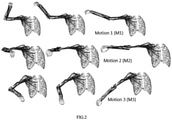
- FIG.2 illustrates three exemplary hand reach motions (M1, M2, M3) considered in the present disclosure for explaining the workflow of a method that provides a personalized neuromotor rehabilitation therapy for upper limb using a neuromusculoskeletal arm model.
- the three motions resemble point to point reaching task in a three-dimensional plane, keeping trajectory of elbow joint fixed in all three motions. These motions resemble routine exercise motion to regain joint operative range of motion after stroke or any rehabilitation specific to neuro-motor disorder.
- Motion variation was in terms of change in shoulder configuration, i.e. change in elevation angle (flexion-extension) and rotation (internal-external).
- the other degree of freedom, i.e., shoulder abduction-adduction was fixed. Numerically solving, there can be infinite joint configuration in the three-dimensional plane to complete a reach task and in practice the developed arm model is suitable to generate all possible joint configurations.
- Exemplary point to point hand reach motions with joint configuration values and range of motion are provided in the TABLE 1 below. It may be understood by those skilled in the art, that the exemplary hand reach motions are non-limiting motion tasks that may be performed by a subject and the method and system of the present disclosure may be extended to other motion tasks.
- TABLE 1 Point to point hand reach motions with joint configuration values and range of motion Motion Shoulder abduction-adduction Shoulder flexion-extension Shoulder internal-external rotation Elbow flexion M1 0 degree 90 degree -45 degree 0-105 degree M2 0 degree 90 degree 0 degree 0-105 degree M3 0 degree 90 degree 20 degree 0-105 degree
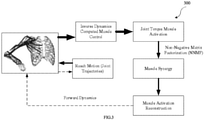
- FIG.3 is an exemplary high level flow diagram 300 illustrating a general workflow of a method that provides a personalized neuromotor rehabilitation therapy for upper limb using a neuromusculoskeletal arm model, in accordance with some embodiments of the present disclosure.
- the neuromusculoskeletal arm model with an optimized set of muscle actuators is fed with target (desired) trajectories associated with the three exemplary hand reach motions (Ml, M2, M3).
- a muscle force and a joint torque are calculated through inverse dynamics and computed muscle control.
- muscle synergy is estimated using Non-Negative Matrix Factorization (NNMF).
- NNMF Non-Negative Matrix Factorization
- EMG Muscle Electromyography
- FIG.4A through FIG.4E illustrate an exemplary flow diagram of a computer implemented method 400 that provides the personalized neuromotor rehabilitation therapy for upper limb using the neuromusculoskeletal arm model, in accordance with some embodiments of the present disclosure.
- the system 100 includes one or more data storage devices or memory 102 operatively coupled to the one or more processors 104 and is configured to store instructions configured for execution of steps of the method 400 by the one or more processors 104.
- the steps of the method 400 will now be explained in detail with reference to the components of the system 100 of FIG.1 and the high level flow diagram 300 using the exemplary hand reach motions of FIG.2 .
- the one or more processors 104 are configured to personalize, at step 402, a neuromusculoskeletal arm model having three joints and a set of muscle actuators, wherein the neuromusculoskeletal arm model is adapted to conform with anthropometric measurements of a subject and is configured to perform one or more motion tasks by the subject using the three joints being a ball and socket shoulder joint along with clavicle and scapula having three degrees of freedom (DoF), an elbow joint with one DoF and a wrist joint having three DoF.
- the anthropometric measurements of the subject may include height, weight, triceps and mid-upper-arm circumference that provides a proxy measure of body composition (e.g. muscularity, fat free mass and fat mass).
- An exemplary neuromusculoskeletal arm model is a simplified adaptation of Holzbaur model provided by Holzbaur, K.R., et al., Moment-generating capacity of upper limb muscles in healthy adults. Journal of Biomechanics (2006) f or capturing the dynamics of glenohumeral joint for specific point to point reaching task involving active elbow flexion.
- the set of muscle actuators included 49 muscle actuators having 23 DoF.
- Dynamic characteristics of the arm model is dependent on muscle characteristics.
- 'Hill type' muscle property is defined using the 'Thelen 2003' muscle model, comprising of a contractile element (CE), a parallel element (PE), and a series element (SE).
- Muscle force generated from the 'Thelen' muscle actuator is a function of three factors: activation value (a), normalized length of the muscle unit (1), and normalized velocity of the muscle unit ( ⁇ 1).
- Individual muscles can be characterized by some parameters like pennation angle, contraction velocity, muscle fibre length, tendon slack length, maximum isometric force, etc. These parameters may be selected to desired value as per requirement, or if data is available, model can even be personalized with specific muscle properties.
- the muscle actuators may be one of Hill type, modified hill type, Huxley model, Zajac model, and the like and in an embodiment the personalizing of the neuromusculoskeletal arm model may employ a scaling function by OpenSim.
- the one or more processors 104 are configured to optimize, at step 404, the set of muscle actuators (49 in an exemplary embodiment) by performing the following iterative steps starting with the set of muscle actuators in the personalized neuromusculoskeletal arm model in a first iteration and every subsequent iteration having a reduced number of muscle actuators in the set of muscle actuators compared to a previous iteration until an evaluated mean square error is less than a pre-defined threshold.
- the iterative steps include steps 404a through 404d described hereinafter.
- EMG muscle Electromyography
- a muscle model is an algorithm transforming muscle activation into muscle force.
- the muscle model's inputs are activation a (a real number between 0 and 1 inclusive) and length l of the muscle actuator.
- the muscle model's output is the muscle-tendon actuator force.
- Activation dynamics represent how an excitation, a unit-less value between 0 and 1 is transformed into an activation that is also a unit-less value between 0 and 1, of a muscle.
- a joint torque indicative of loading on each of the three joints is calculated, wherein the joint torque is based on an acceleration q ⁇ due to the joint torque ⁇ , the joint angle q, an inertia tensor function Q , a mass matrix M , a Coriolis component C, a gravity component G and an external force F applied to the neuromusculoskeletal arm model.
- a trajectory associated with a corresponding motion profile for each of the one or more motion tasks based on forward dynamics using the calculated muscle torque and the calculated joint torque is generated.
- a 5th-order Runge-Kutta-Feldberg integrator is used to solve (numerically integrate) the dynamical equations for the trajectories of the arm model states over a definite interval in time generating the trajectory.
- a mean square error between the generated trajectory and a target trajectory associated with a corresponding motion profile for each of the one or more motion tasks is evaluated.
- the target trajectory or the desired trajectory may be a point to point motion associated the task as shown in FIG.2 .
- the one or more processors 104 are configured to identify, at step 406, the set of the muscle actuators with the reduced number of muscle actuators at the end of the iterative steps as the optimized set of muscle actuators to perform the one or more motion tasks.
- the optimized set of muscle actuators include a reduced set of 27 'hill type' muscle actuators (from the 49 muscle actuators) distributed in three groups of 14 muscle actuators controlling the shoulder joint, 9 muscle actuators for the elbow joint and 4 muscle actuators controlling a forearm with wrist movement. The distribution of muscle actuators into groups is based on the type of motion task to be performed by the subject.
- FIG.5 is an exemplary flow diagram illustrating steps for identifying an optimized set of muscle actuators in the musculoskeletal arm model, in accordance with some embodiments of the present disclosure.
- the pre-defined threshold for the evaluated mean square error depends on the subject and the motion task performed.
- the mean square error may be 2% for the three exemplary reach motions illustrated in FIG.2 .
- the next step involves estimating muscle synergy.
- muscle synergy constitutes the coordinated activation of groups of muscles with fixed time-varying profile.
- fixed weights capable of creating a new work space of reduced dimension are associated with muscle activation.
- the one or more processors 104 are configured to estimate an optimal muscle synergy, at step 408, corresponding to the one or more motion tasks using the NNMF.
- the muscle EMG data is then reconstructed, at step 410, using the estimated optimal muscle synergy to obtain a synergy reconstructed EMG data.
- An activation map for each of the one or more motion tasks is generated based on the synergy reconstructed EMG data, at step 412, wherein the activation map is an aggregation of the activation value a of each of the muscle actuators in the optimized set of muscle actuators.
- the one or more processors 104 are configured to regenerate, at step 414, the trajectory associated with a corresponding motion profile for each of the one or more motion tasks based on the forward dynamics by providing the generated activation map for each of the one or more motion tasks to the personalized musculoskeletal arm model.
- Muscle synergy is used to derive redundant muscle information from the optimized set of muscle actuators, which help to recreate desired motion if any of the major muscles get damaged due to motor injury.
- Time independent formulation is incorporated to derive synergy space for the three exemplary motions.
- NNMF works on a set of multivariate ' n ' dimensional data vectors. Generally, for controlling m muscles, n neural commands are required. NNMF reduces the n neural commands into a low dimensional subspace.
- Z' WC
- E ij and Z ij are the elements of matrices E and Z, respectively.
- the error E, between Z and WC in equation (3) must be small enough so that m muscles may be controlled by n commands in.
- the matrix Z is factorized using MU (multiplicative updates) method.
- the range of L is 0 ⁇ L ⁇ 100.
- Value of L is sensitive to the shape and magnitude of the reconstructed EMG data. Generally, value of L > 75% is considered as 'good fit' to guarantee complete muscle reconstruction.
- Muscle energy is calculated from muscle power which is a product of muscle force and velocity.
- FIG.7A through FIG.7C illustrates a similarity plot and muscle synergy variation for original muscle recruitment and for similarity value 85% and 75% for motion M1, M2 and M3, respectively in accordance with some embodiments of the present disclosure.
- the similarity plot illustrates similarity along the y-axis and synergy along the x-axis.
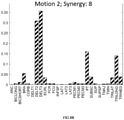
- FIG.8A through FIG.8C illustrates synergy weight distribution at 85% similarity for motion M1, M2 and M3, in accordance with some embodiments of the present disclosure.
- the figures FIG.8A through FIG.8C show synergy weight distribution for the three motions at synergy value at 8.
- the weight distribution shows which muscle will have higher response for a particular neural command at a given time.
- Each synergy has a different activation combination across muscles, with some muscle contributing more in terms of activation than others. Also, the weight varies with change in synergy for same motion.
- Muscle activation for all three motion types were reconstructed with synergy equivalent to 85% similarity index (Synergy 8). Individual muscle force, joint torque and energy required were calculated for each of the motion, driven through forward dynamics using reconstructed muscle activation.
- TABLE 2 and TABLE 3 show dynamic variables calculated from reconstructed activation with 85% similarity synergy value.
- TABLE 2 Dynamic variables (joint loading and muscle force) calculated from reconstructed activation with 85% similarity synergy value.
- TABLE 3 Dynamic variables (trajectory error and energy consumption) calculated from reconstructed activation with 85% similarity synergy value.
- Motion Minimum Synergy Trajectory error % (elbow) Muscle energy Consumption (refer equation 5 below) M1 4 3.73 42.17 M2 5 4.
- Results indicate a direct relation between the synergy subspace and change in elevation and rotation pattern of shoulder which corresponds to gravity and directional component. Selecting an optimal trajectory in simulation platform may help to evaluate the synergy recruitment and energy cost and can be used to create personalized rehabilitation therapy.
- synergistic recruitment approach is used to find the optimized trajectory and the trajectories are ranked accordingly. So for any motion task in a given work-space, an optimal positioning of joint and muscle activation can be ranked and chosen accordingly to get the best possible result with rehabilitation exercise.
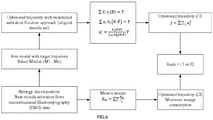
- FIG.6 is an exemplary flow diagram illustrating steps for ranking a trajectory associated with each motion profile and identifying an optimized trajectory for selecting a corresponding neuromotor rehabilitation therapy, in accordance with some embodiments of the present disclosure.
- the one or more processors 104 are configured to rank, at step 418, a trajectory associated with each motion profile associated with each of the one or more motion tasks based on the computed cost function J .
- a motion profile associated with each of the one or more motion tasks having a minimum value for the cost function J is identified as an optimized trajectory at step 420.
- a neuromotor rehabilitation therapy corresponding to the identified optimized trajectory for each of the one or more motion tasks is selected from a repository, at step 422, wherein the identified optimized trajectory is indicative of optimal positioning of join and muscle activation.
- the reconstructed muscle EMG data is utilized.
- the one or more processors 104 are configured to calculate, at step 424, muscle energy consumption E M from the muscle force ⁇ m and the joint velocity q for the corresponding one or more motion tasks associated with the regenerated trajectory.
- the regenerated trajectory associated with each of the one or more motion tasks is ranked based on the calculated muscle energy consumption of equation (5).
- the regenerated trajectory associated with each of the one or more motion tasks having a minimum value for the muscle energy consumption E M is identified as an optimized trajectory, at step 428.
- a neuromotor rehabilitation therapy corresponding to the identified optimized trajectory for each of the one or more motion tasks is selected from a repository, at step 430, wherein the identified optimized trajectory is indicative of optimal positioning of joint and muscle activation.
- the method and system of the present disclosure thus models the human arm (upper limb) motion dynamics to study synergy variation for different shoulder configuration.
- the personalized neuromusculoskeletal model of the arm of the present disclosure with optimized set of muscle actuators allows different motions to be simulated using various possible joint configuration.
- Three exemplary point to point reaching motion were generated with varying shoulder elevation and rotation, while maintaining fixed elbow trajectory.
- Muscle activation for the motion were calculated and synergy space was derived for the three-reaching motion.
- Analysis reveals that both orientation and elevation of shoulder joint dictates muscle recruitment pattern for fixed elbow motion and minimum energy trajectory corresponds to minimum synergy configuration. Synergy space configuration and energy optimized trajectory thus obtained, enables planning a personalized rehabilitation therapy for neuromotor disabilities such as post stroke patients and may also help in better control of neuro-prosthetic arms.
- the hardware device can be any kind of device which can be programmed including e.g. any kind of computer like a server or a personal computer, or the like, or any combination thereof.
- the device may also include means which could be e.g. hardware means like e.g. an application-specific integrated circuit (ASIC), a field-programmable gate array (FPGA), or a combination of hardware and software means, e.g.
- ASIC application-specific integrated circuit
- FPGA field-programmable gate array
- the means can include both hardware means and software means.
- the method embodiments described herein could be implemented in hardware and software.
- the device may also include software means.
- the embodiments may be implemented on different hardware devices, e.g. using a plurality of CPUs.
- the embodiments herein can comprise hardware and software elements.
- the embodiments that are implemented in software include but are not limited to, firmware, resident software, microcode, etc.
- the functions performed by various components described herein may be implemented in other components or combinations of other components.
- a computer-usable or computer readable medium can be any apparatus that can comprise, store, communicate, propagate, or transport the program for use by or in connection with the instruction execution system, apparatus, or device.
- a computer-readable storage medium refers to any type of physical memory on which information or data readable by a processor may be stored.
- a computer-readable storage medium may store instructions for execution by one or more processors, including instructions for causing the processor(s) to perform steps or stages consistent with the embodiments described herein.
- the term "computer-readable medium” should be understood to include tangible items and exclude carrier waves and transient signals, i.e., be non-transitory. Examples include random access memory (RAM), read-only memory (ROM), volatile memory, nonvolatile memory, hard drives, CD ROMs, DVDs, flash drives, disks, and any other known physical storage media.
Landscapes
- Health & Medical Sciences (AREA)
- Life Sciences & Earth Sciences (AREA)
- Engineering & Computer Science (AREA)
- Medical Informatics (AREA)
- Biophysics (AREA)
- Public Health (AREA)
- General Health & Medical Sciences (AREA)
- Physics & Mathematics (AREA)
- Surgery (AREA)
- Molecular Biology (AREA)
- Heart & Thoracic Surgery (AREA)
- Animal Behavior & Ethology (AREA)
- Biomedical Technology (AREA)
- Pathology (AREA)
- Veterinary Medicine (AREA)
- Robotics (AREA)
- Mechanical Engineering (AREA)
- Automation & Control Theory (AREA)
- Physical Education & Sports Medicine (AREA)
- Epidemiology (AREA)
- Primary Health Care (AREA)
- General Physics & Mathematics (AREA)
- Rehabilitation Tools (AREA)
Abstract
Description
- The present application claims priority from
Indian Patent Application No. 202021030392, filed on July 16, 2020 - The disclosure herein generally relates to the field of neuromotor rehabilitation therapy, and, more particularly, to a personalized neuromotor rehabilitation therapy for upper limb using a neuromusculoskeletal arm model.
- Human musculoskeletal system is highly redundant, creating many ways of muscle recruitment for performing any specific task. This redundancy poses a computational challenge to Central Nervous system (CNS), which in association with sensory and musculoskeletal system tries to simplify control of tasks by mapping initial states and goals into muscle activation through the combination of coordinated recruitment of groups of muscles with specific activation. Recently, there have been numerous studies on reaching toward a point target in human motor control.
- Controlling the movement of the arm for point to point motion like reaching for an object is challenging as it requires coordinating numerous muscles acting on many joints and for such tasks, CNS actively recruits muscle synergy to find an optimal trajectory or torque profile. The discrepancy between kinetic-kinematic variables and complexity of muscle pattern underlines the requirement for better understanding of the muscle control mechanism during reaching tasks and correlate synergy variation dependencies on work-space configuration. Several state of art methods exists on synergy control mechanism in post stroke rehabilitation during hand reaching task execution. However, in the prior methods, reaching task synergy calculation is mostly computed on a single task, which are not able to derive conclusive control actions to aid in rehabilitation.
- Embodiments of the present disclosure present technological improvements as solutions to one or more of the above-mentioned technical problems recognized by the inventors in conventional systems.
- In an aspect, there is provided a processor implemented method comprising the steps of: personalizing, via one or more hardware processors, a neuromusculoskeletal arm model having three joints and a set of muscle actuators, wherein the neuromusculoskeletal arm model is adapted to conform with anthropometric measurements of a subject and is configured to perform one or more motion tasks by the subject using the three joints being a ball and socket shoulder joint along with clavicle and scapula having three degrees of freedom (DoF), an elbow joint with one DoF and a wrist joint having three DoF; and optimizing, via the one or more hardware processors, the set of muscle actuators by performing the following iterative steps starting with the set of muscle actuators in the personalized neuromusculoskeletal arm model in a first iteration and every subsequent iteration having a reduced number of muscle actuators in the set of muscle actuators compared to a previous iteration: calculating a muscle torque τm indicative of a muscle force based on a moment arm └R(q)┘ wherein q represent a joint angle, an activation value a obtained from a muscle Electromyography (EMG) data, a normalized length l and a normalized velocity i of each muscle actuator in the set of muscle actuators; calculating a joint torque indicative of loading on each of the three joints, wherein the joint torque is based on an acceleration q̈ due to the joint torque τ, the joint angle q, an inertia tensor function Q, a mass matrix M, a Coriolis component C, a gravity component G and an external force F applied to the neuromusculoskeletal arm model; generating a trajectory associated with a corresponding motion profile for each of the one or more motion tasks based on forward dynamics using the calculated muscle torque and the calculated joint torque; and evaluating a mean square error between the generated trajectory and a target trajectory associated with a corresponding motion profile for each of the one or more motion tasks; until the evaluated mean square error is less than a pre-defined threshold; and identifying, via the one or more hardware processors, the set of the muscle actuators with the reduced number of muscle actuators at the end of the iterative steps as the optimized set of muscle actuators to perform the one or more motion tasks.
- In another aspect, there is provided a system comprising: one or more data storage devices operatively coupled to one or more hardware processors via the one or more input/output interfaces and configured to store instructions configured for execution via the one or more hardware processors to: personalize a neuromusculoskeletal arm model having three joints and a set of muscle actuators, wherein the neuromusculoskeletal arm model is adapted to conform with anthropometric measurements of a subject and is configured to perform one or more motion tasks by the subject using the three joints being a ball and socket shoulder joint along with clavicle and scapula having three degrees of freedom (DoF), an elbow joint with one DoF and a wrist joint having three DoF; optimize the set of muscle actuators by performing the following iterative steps starting with the set of muscle actuators in the personalized neuromusculoskeletal arm model in a first iteration and every subsequent iteration having a reduced number of muscle actuators in the set of muscle actuators compared to a previous iteration by: calculating a muscle torque τm indicative of a muscle force based on a moment arm └R(q)┘, wherein q represent a joint angle, an activation value a obtained from a muscle Electromyography (EMG) data, a normalized length l and a normalized velocity l̇ of each muscle actuator in the set of muscle actuators; calculating a joint torque indicative of loading on each of the three joints, wherein the joint torque is based on an acceleration q̈ due to the joint torque τ, the joint angle q, an inertia tensor function Q, a mass matrix M, a Coriolis component C, a gravity component G and an external force F applied to the neuromusculoskeletal arm model; generating a trajectory associated with a corresponding motion profile for each of the one or more motion tasks based on forward dynamics using the calculated muscle torque and the calculated joint torque; and evaluating a mean square error between the generated trajectory and a target trajectory associated with a corresponding motion profile for each of the one or more motion tasks; until the evaluated mean square error is less than a pre-defined threshold; and identify the set of the muscle actuators with the reduced number of muscle actuators at the end of the iterative steps as the optimized set of muscle actuators to perform the one or more motion tasks.
- In yet another aspect, there is provided a computer program product comprising a non-transitory computer readable medium having a computer readable program embodied therein, wherein the computer readable program, when executed on a computing device, causes the computing device to: personalize a neuromusculoskeletal arm model having three joints and a set of muscle actuators, wherein the neuromusculoskeletal arm model is adapted to conform with anthropometric measurements of a subject and is configured to perform one or more motion tasks by the subject using the three joints being a ball and socket shoulder joint along with clavicle and scapula having three degrees of freedom (DoF), an elbow joint with one DoF and a wrist joint having three DoF; optimize the set of muscle actuators by performing the following iterative steps starting with the set of muscle actuators in the personalized neuromusculoskeletal arm model in a first iteration and every subsequent iteration having a reduced number of muscle actuators in the set of muscle actuators compared to a previous iteration by: calculating a muscle torque τm indicative of a muscle force based on a moment arm └R(q)┘, wherein q represent a joint angle, an activation value a obtained from a muscle Electromyography (EMG) data, a normalized length l and a normalized velocity l̇ of each muscle actuator in the set of muscle actuators; calculating a joint torque indicative of loading on each of the three joints, wherein the joint torque is based on an acceleration q̈ due to the joint torque τ, the joint angle q, an inertia tensor function Q, a mass matrix M, a Coriolis component C, a gravity component G and an external force F applied to the neuromusculoskeletal arm model; generating a trajectory associated with a corresponding motion profile for each of the one or more motion tasks based on forward dynamics using the calculated muscle torque and the calculated joint torque; and evaluating a mean square error between the generated trajectory and a target trajectory associated with a corresponding motion profile for each of the one or more motion tasks; until the evaluated mean square error is less than a pre-defined threshold; and identify the set of the muscle actuators with the reduced number of muscle actuators at the end of the iterative steps as the optimized set of muscle actuators to perform the one or more motion tasks.
- In accordance with an embodiment of the present disclosure, the one or more hardware processors are further configured to calculate the muscle torque represented by the equation τm = └R(q)┘ƒ(a,l,i); and further calculate the joint torque represented by the equation q̈ = [M(Q)]-1{τ + C((q,q̇) + G(q) + F)}, wherein q represents joint velocity.
- In accordance with an embodiment of the present disclosure, the one or more hardware processors are further configured to estimate an optimal muscle synergy corresponding to the one or more motion tasks using Non-Negative Matrix Factorization (NNMF); reconstruct the muscle EMG data using the estimated optimal muscle synergy to obtain a synergy reconstructed EMG data; generate an activation map for each of the one or more motion tasks based on the synergy reconstructed EMG data, wherein the activation map is an aggregation of the activation value a of each of the muscle actuators in the optimized set of muscle actuators; and regenerate the trajectory associated with a corresponding motion profile for each of the one or more motion tasks based on the forward dynamics by providing the generated activation map for each of the one or more motion tasks to the personalized musculoskeletal arm model.
- In accordance with an embodiment of the present disclosure, the one or more hardware processors are configured to estimate an optimal muscle synergy by deriving a synergy space for each of the one or more motion profiles by performing: computing number of commands needed for controlling the optimized set of muscle actuators based on the NNMF using a matrix Z of the reconstructed EMG data of muscle actuators in the optimized set of muscle actuators, wherein Z ∈ X m*t , 'm' and 't' represent number of muscle actuators and number of time data, respectively such that Z = WC + E, wherein W ∈ Xm*n , W is a normalized row vector: |Wi | = 1 and Wi ∈ Xm and defines a synergy space, n is the number of control commands, n < m, and C ∈ Xn*t , C is a column matrix containing n commands to control m muscle actuators in the synergy space, E E X m*t , E is an error between Z and WC; and determining the optimal muscle synergy based on a similarity index L =

- In accordance with an embodiment of the present disclosure, the one or more hardware processors are configured to calculate muscle energy consumption based on the equation:

- In accordance with an embodiment of the present disclosure, the one or more hardware processors are further configured to compute a cost function J representative of muscular effort at each time instant for m number of muscle actuators using the activation value a for each motion profile associated with each of the one or more motion tasks, wherein the cost function is represented as

- In accordance with an embodiment of the present disclosure, the one or more hardware processors are further configured to: calculate muscle energy consumption EM from the muscle force τm and the joint velocity q for the corresponding one or more motion tasks associated with the regenerated trajectory; rank, the generated trajectory associated with each of the one or more motion tasks based on the calculated muscle energy consumption EM ; identify the regenerated trajectory associated with each of the one or more motion tasks having a minimum value for the muscle energy consumption EM as an optimized trajectory; and select from a repository, a neuromotor rehabilitation therapy corresponding to the identified optimized trajectory for each of the one or more motion tasks, wherein the identified optimized trajectory is indicative of optimal positioning of joint and muscle activation.
- It is to be understood that both the foregoing general description and the following detailed description are exemplary and explanatory only and are not restrictive of the invention, as claimed.
- The accompanying drawings, which are incorporated in and constitute a part of this disclosure, illustrate exemplary embodiments and, together with the description, serve to explain the disclosed principles:
-
FIG.1 illustrates a block diagram of a system that provides a personalized neuromotor rehabilitation therapy for upper limb using a neuromusculoskeletal arm model, in accordance with some embodiments of the present disclosure. -
FIG.2 illustrates three exemplary hand reach motions considered in the present disclosure. -
FIG.3 is an exemplary high level flow diagram illustrating a general workflow of a method that provides the personalized neuromotor rehabilitation therapy for upper limb using the neuromusculoskeletal arm model, in accordance with some embodiments of the present disclosure. -
FIG.4A through FIG.4E is an exemplary flow diagram of a computer implemented method that provides the personalized neuromotor rehabilitation therapy for upper limb using the neuromusculoskeletal arm model, in accordance with some embodiments of the present disclosure. -
FIG.5 is an exemplary flow diagram illustrating steps for identifying an optimized set of muscle actuators in the musculoskeletal arm model in the method ofFIG.4A through FIG.4E , in accordance with some embodiments of the present disclosure. -
FIG.6 is an exemplary flow diagram illustrating steps for ranking a trajectory associated with each motion profile and identifying an optimized trajectory in the method ofFIG.4A through FIG.4E , for selecting a corresponding neuromotor rehabilitation therapy, in accordance with some embodiments of the present disclosure. -
FIG.7A through FIG.7C illustrates a similarity plot and muscle synergy variation for original muscle recruitment and forsimilarity value 85% and 75% for motion M1, M2 and M3, respectively in accordance with some embodiments of the present disclosure. -
FIG.8A through FIG.8C illustrates synergy weight distribution at 85% similarity for motion M1, M2 and M3, in accordance with some embodiments of the present disclosure. - Exemplary embodiments are described with reference to the accompanying drawings. In the figures, the left-most digit(s) of a reference number identifies the figure in which the reference number first appears. Wherever convenient, the same reference numbers are used throughout the drawings to refer to the same or like parts. While examples and features of disclosed principles are described herein, modifications, adaptations, and other implementations are possible without departing from the scope of the disclosed embodiments.
- Conventional methods that work with neural dynamics in deriving muscle synergy are dependent on single tasks, leaving synergy variation with task variability unexplored. An important application related to synergy variation is in study of post stroke movement alteration, where knowledge of muscle synergy can be used to determine simplifying motor control mechanism for altered movement generation and in rehabilitation. Several state of art methods exist for synergy control mechanism in post stroke rehabilitation during hand reaching task execution. However, a clear understanding of the workspace, task variable and synergy paradigm is required to derive conclusive control actions to particularly aid in rehabilitation.
- Applicant has addressed the problem of providing a personalized neuromotor rehabilitation therapy for upper limb using a neuromusculoskeletal arm model. The neuromusculoskeletal arm model is personalized based on anthropometric measurements and then the model is further adapted to be operated with an optimized set of muscle actuators. Use of a simulation platform to test motion and generate activation in place of real Electromyography (EMG) data provides the flexibility to test different task combinations theoretically, before finding an optimal energy task space for different motion tasks. The synergy space configuration and energy optimized trajectory generated by the method and system of the present disclosure facilitates planning a personalized rehabilitation therapy for patients with neuromotor disabilities such as post stroke patients and may also help in better control of neuro-prosthetic arms.
- In the context of the present disclosure, the neuromusculoskeletal arm model may interchangeably be referred as musculoskeletal arm model or arm model. The musculoskeletal arm model in the present disclosure is a simplified adaptation of an Holzbaur model, capturing the dynamics of glenohumeral joint for specific point to point reaching task involving active elbow flexion.
- Referring now to the drawings, and more particularly to
FIG. 1 through FIG.8C , where similar reference characters denote corresponding features consistently throughout the figures, there are shown preferred embodiments and these embodiments are described in the context of the following exemplary system and/or method. -
FIG.1 illustrates an exemplary block diagram of asystem 100 that provides a personalized neuromotor rehabilitation therapy for upper limb using a neuromusculoskeletal arm model, in accordance with some embodiments of the present disclosure. In an embodiment, thesystem 100 includes one ormore processors 104, communication interface device(s) or input/output (I/O) interface(s) 106, and one or more data storage devices ormemory 102 operatively coupled to the one ormore processors 104. The one ormore processors 104 that are hardware processors can be implemented as one or more microprocessors, microcomputers, microcontrollers, digital signal processors, central processing units, state machines, graphics controllers, logic circuitries, and/or any devices that manipulate signals based on operational instructions. Among other capabilities, the processor(s) are configured to fetch and execute computer-readable instructions stored in the memory. In the context of the present disclosure, the expressions 'processors' and 'hardware processors' may be used interchangeably. In an embodiment, thesystem 100 can be implemented in a variety of computing systems, such as laptop computers, notebooks, hand-held devices, workstations, mainframe computers, servers, a network cloud and the like. - I/O interface(s) 106 can include a variety of software and hardware interfaces, for example, a web interface, a graphical user interface, and the like and can facilitate multiple communications within a wide variety of networks N/W and protocol types, including wired networks, for example, LAN, cable, etc., and wireless networks, such as WLAN, cellular, or satellite. In an embodiment, the I/O interface(s) can include one or more ports for connecting a number of devices to one another or to another server.
- The
memory 102 may include any computer-readable medium known in the art including, for example, volatile memory, such as static random access memory (SRAM) and dynamic random access memory (DRAM), and/or non-volatile memory, such as read only memory (ROM), erasable programmable ROM, flash memories, hard disks, optical disks, and magnetic tapes. In an embodiment, one or more modules (not shown) of thesystem 100 can be stored in thememory 102. -
FIG.2 illustrates three exemplary hand reach motions (M1, M2, M3) considered in the present disclosure for explaining the workflow of a method that provides a personalized neuromotor rehabilitation therapy for upper limb using a neuromusculoskeletal arm model. The three motions resemble point to point reaching task in a three-dimensional plane, keeping trajectory of elbow joint fixed in all three motions. These motions resemble routine exercise motion to regain joint operative range of motion after stroke or any rehabilitation specific to neuro-motor disorder. Motion variation was in terms of change in shoulder configuration, i.e. change in elevation angle (flexion-extension) and rotation (internal-external). The other degree of freedom, i.e., shoulder abduction-adduction was fixed. Numerically solving, there can be infinite joint configuration in the three-dimensional plane to complete a reach task and in practice the developed arm model is suitable to generate all possible joint configurations. - Exemplary point to point hand reach motions with joint configuration values and range of motion are provided in the TABLE 1 below. It may be understood by those skilled in the art, that the exemplary hand reach motions are non-limiting motion tasks that may be performed by a subject and the method and system of the present disclosure may be extended to other motion tasks.
TABLE 1: Point to point hand reach motions with joint configuration values and range of motion Motion Shoulder abduction-adduction Shoulder flexion-extension Shoulder internal-external rotation Elbow flexion M1 0 degree 90 degree -45 degree 0-105 degree M2 0 degree 90 degree 0 degree 0-105 degree M3 0 degree 90 degree 20 degree 0-105 degree -
FIG.3 is an exemplary high level flow diagram 300 illustrating a general workflow of a method that provides a personalized neuromotor rehabilitation therapy for upper limb using a neuromusculoskeletal arm model, in accordance with some embodiments of the present disclosure. The neuromusculoskeletal arm model with an optimized set of muscle actuators is fed with target (desired) trajectories associated with the three exemplary hand reach motions (Ml, M2, M3). A muscle force and a joint torque are calculated through inverse dynamics and computed muscle control. From muscle activation for the optimized set of muscle actuators, muscle synergy is estimated using Non-Negative Matrix Factorization (NNMF). Muscle Electromyography (EMG) data is reconstructed. From a generated activation map corresponding to the reconstructed EMG data, forward dynamics is calculated to derive joint angles and positions corresponding to the generated activation map and is fed to the arm model. Error function may then be calculated based on a targeted trajectory and the trajectory calculated from a synergy space. -
FIG.4A through FIG.4E illustrate an exemplary flow diagram of a computer implementedmethod 400 that provides the personalized neuromotor rehabilitation therapy for upper limb using the neuromusculoskeletal arm model, in accordance with some embodiments of the present disclosure. In an embodiment, thesystem 100 includes one or more data storage devices ormemory 102 operatively coupled to the one ormore processors 104 and is configured to store instructions configured for execution of steps of themethod 400 by the one ormore processors 104. The steps of themethod 400 will now be explained in detail with reference to the components of thesystem 100 ofFIG.1 and the high level flow diagram 300 using the exemplary hand reach motions ofFIG.2 . Although process steps, method steps, techniques or the like may be described in a sequential order, such processes, methods and techniques may be configured to work in alternate orders. In other words, any sequence or order of steps that may be described does not necessarily indicate a requirement that the steps be performed in that order. The steps of processes described herein may be performed in any order practical. Further, some steps may be performed simultaneously. - Accordingly, in an embodiment of the present disclosure, the one or
more processors 104, are configured to personalize, atstep 402, a neuromusculoskeletal arm model having three joints and a set of muscle actuators, wherein the neuromusculoskeletal arm model is adapted to conform with anthropometric measurements of a subject and is configured to perform one or more motion tasks by the subject using the three joints being a ball and socket shoulder joint along with clavicle and scapula having three degrees of freedom (DoF), an elbow joint with one DoF and a wrist joint having three DoF. The anthropometric measurements of the subject may include height, weight, triceps and mid-upper-arm circumference that provides a proxy measure of body composition (e.g. muscularity, fat free mass and fat mass). - An exemplary neuromusculoskeletal arm model is a simplified adaptation of Holzbaur model provided by Holzbaur, K.R., et al., Moment-generating capacity of upper limb muscles in healthy adults. Journal of Biomechanics (2006) for capturing the dynamics of glenohumeral joint for specific point to point reaching task involving active elbow flexion. In the exemplary arm model used in the present disclosure, the set of muscle actuators included 49 muscle actuators having 23 DoF.
- Dynamic characteristics of the arm model is dependent on muscle characteristics. In OpenSim, 'Hill type' muscle property is defined using the 'Thelen 2003' muscle model, comprising of a contractile element (CE), a parallel element (PE), and a series element (SE). Muscle force generated from the 'Thelen' muscle actuator is a function of three factors: activation value (a), normalized length of the muscle unit (1), and normalized velocity of the muscle unit (˙1). Individual muscles can be characterized by some parameters like pennation angle, contraction velocity, muscle fibre length, tendon slack length, maximum isometric force, etc. These parameters may be selected to desired value as per requirement, or if data is available, model can even be personalized with specific muscle properties. In an embodiment, the muscle actuators may be one of Hill type, modified hill type, Huxley model, Zajac model, and the like and in an embodiment the personalizing of the neuromusculoskeletal arm model may employ a scaling function by OpenSim.
- In an embodiment of the present disclosure, the one or
more processors 104, are configured to optimize, atstep 404, the set of muscle actuators (49 in an exemplary embodiment) by performing the following iterative steps starting with the set of muscle actuators in the personalized neuromusculoskeletal arm model in a first iteration and every subsequent iteration having a reduced number of muscle actuators in the set of muscle actuators compared to a previous iteration until an evaluated mean square error is less than a pre-defined threshold. The iterative steps includesteps 404a through 404d described hereinafter. Atstep 404a, a muscle torque τm indicative of a muscle force based on a moment arm └R(q)┘ wherein q represent a joint angle, an activation value a obtained from a muscle Electromyography (EMG) data, a normalized length l and a normalized velocity i of each muscle actuator in the set of muscle actuators is calculated. - Computing the activation value a: In simulation studies, a muscle model is an algorithm transforming muscle activation into muscle force. At a given time t in a simulation, the muscle model's inputs are activation a (a real number between 0 and 1 inclusive) and length l of the muscle actuator. The muscle model's output is the muscle-tendon actuator force. Activation dynamics represent how an excitation, a unit-less value between 0 and 1 is transformed into an activation that is also a unit-less value between 0 and 1, of a muscle. When a muscle is neurally excited, its activation gradually increases, while if a muscle's excitation decreases, its activation also decreases, albeit at a slower rate than the increase.
- At
step 404b, a joint torque indicative of loading on each of the three joints is calculated, wherein the joint torque is based on an acceleration q̈ due to the joint torque τ, the joint angle q, an inertia tensor function Q, a mass matrix M, a Coriolis component C, a gravity component G and an external force F applied to the neuromusculoskeletal arm model. - In an embodiment, the step of calculating the muscle torque is represented by the Thelen model equation:

- In an embodiment, the step of calculating the joint torque is represented by the equation:

- At step 404c, a trajectory associated with a corresponding motion profile for each of the one or more motion tasks based on forward dynamics using the calculated muscle torque and the calculated joint torque is generated. In an embodiment, a 5th-order Runge-Kutta-Feldberg integrator is used to solve (numerically integrate) the dynamical equations for the trajectories of the arm model states over a definite interval in time generating the trajectory.
- At
step 404d, a mean square error between the generated trajectory and a target trajectory associated with a corresponding motion profile for each of the one or more motion tasks is evaluated. The target trajectory or the desired trajectory may be a point to point motion associated the task as shown inFIG.2 . - In an embodiment of the present disclosure, the one or
more processors 104, are configured to identify, atstep 406, the set of the muscle actuators with the reduced number of muscle actuators at the end of the iterative steps as the optimized set of muscle actuators to perform the one or more motion tasks. In an embodiment, the optimized set of muscle actuators include a reduced set of 27 'hill type' muscle actuators (from the 49 muscle actuators) distributed in three groups of 14 muscle actuators controlling the shoulder joint, 9 muscle actuators for the elbow joint and 4 muscle actuators controlling a forearm with wrist movement. The distribution of muscle actuators into groups is based on the type of motion task to be performed by the subject.FIG.5 is an exemplary flow diagram illustrating steps for identifying an optimized set of muscle actuators in the musculoskeletal arm model, in accordance with some embodiments of the present disclosure. - The pre-defined threshold for the evaluated mean square error depends on the subject and the motion task performed. In an embodiment, the mean square error may be 2% for the three exemplary reach motions illustrated in
FIG.2 . - Having identified the optimized set of muscle actuators, the next step involves estimating muscle synergy. In time-dependent approach, muscle synergy constitutes the coordinated activation of groups of muscles with fixed time-varying profile. For time independent formulation, as in the present disclosure, fixed weights, capable of creating a new work space of reduced dimension are associated with muscle activation. Accordingly, in an embodiment of the present disclosure, the one or
more processors 104, are configured to estimate an optimal muscle synergy, atstep 408, corresponding to the one or more motion tasks using the NNMF. The muscle EMG data is then reconstructed, atstep 410, using the estimated optimal muscle synergy to obtain a synergy reconstructed EMG data. An activation map for each of the one or more motion tasks is generated based on the synergy reconstructed EMG data, atstep 412, wherein the activation map is an aggregation of the activation value a of each of the muscle actuators in the optimized set of muscle actuators. The one ormore processors 104, are configured to regenerate, atstep 414, the trajectory associated with a corresponding motion profile for each of the one or more motion tasks based on the forward dynamics by providing the generated activation map for each of the one or more motion tasks to the personalized musculoskeletal arm model. - Muscle synergy is used to derive redundant muscle information from the optimized set of muscle actuators, which help to recreate desired motion if any of the major muscles get damaged due to motor injury. Time independent formulation is incorporated to derive synergy space for the three exemplary motions. NNMF works on a set of multivariate 'n' dimensional data vectors. Generally, for controlling m muscles, n neural commands are required. NNMF reduces the n neural commands into a low dimensional subspace. Accordingly, in an embodiment, the step of estimating an optimal muscle synergy, at
step 408 comprises deriving a synergy space for each of the one or more reach motion profiles by firstly computing number of commands needed for controlling the optimized set of muscle actuators based on the NNMF using a matrix Z of the reconstructed EMG data of muscle actuators in the optimized set of muscle actuators, wherein Z ∈ X m*t , 'm' and 't' represent number of muscle actuators and number of time data, respectively such that
- W ∈ X m*n , W defines a synergy space (indicate of the activation map) and is a normalized row vector: |Wi | = 1 and Wi E Xm ,
- n is the number of control commands, n < m, and
- C ∈ X n*t , C is a column matrix containing n commands to control m muscle actuators in the synergy space,
- E ∈ X m*t , E is an error betweenZ and WC.
- Secondly, the optimal muscle synergy is determine based on a similarity

- Considering the similarity index value of 75% for truthful reconstruction of activation, Motion M1 has minimum synergy value of 4, Motion M2 has synergy value of 5 and Motion M3 has synergy value of 3. For all three motions, synergy value of 8 corresponded to similarity index of 85%. Motion M3, which corresponds to a configuration due to alteration of both shoulder rotation and elevation shows minimum synergy requirement for reconstruction.
FIG.7A through FIG.7C illustrates a similarity plot and muscle synergy variation for original muscle recruitment and forsimilarity value 85% and 75% for motion M1, M2 and M3, respectively in accordance with some embodiments of the present disclosure. The similarity plot illustrates similarity along the y-axis and synergy along the x-axis. - When activation is decomposed in synergy space, it is represented through individual muscle weights and a neural command.
FIG.8A through FIG.8C illustrates synergy weight distribution at 85% similarity for motion M1, M2 and M3, in accordance with some embodiments of the present disclosure. The figuresFIG.8A through FIG.8C show synergy weight distribution for the three motions at synergy value at 8. The weight distribution shows which muscle will have higher response for a particular neural command at a given time. Each synergy has a different activation combination across muscles, with some muscle contributing more in terms of activation than others. Also, the weight varies with change in synergy for same motion. When comparing between three motions atsynergy level 8, for Motion M1, Infraspinatus (INFSP), Latissimus (LAT 1,2) are more prominent, for Motion M2, Deltoid muscle group shows maximum activation while for Motion M3, TRILONG shows maximum activation followed by LAT and DEL group. In terms of magnitude of activity, activation of Motion M2 is more with respect to Motion M1. Motion M3 in many ways is a hybrid set of Motion M1 and Motion M2 and this nature is evident in the weight distribution profile. - Muscle activation for all three motion types were reconstructed with synergy equivalent to 85% similarity index (Synergy 8). Individual muscle force, joint torque and energy required were calculated for each of the motion, driven through forward dynamics using reconstructed muscle activation.
- TABLE 2 and TABLE 3 show dynamic variables calculated from reconstructed activation with 85% similarity synergy value.
TABLE 2: Dynamic variables (joint loading and muscle force) calculated from reconstructed activation with 85% similarity synergy value. Motion Minimum Synergy Joint Loading (Nm) Muscle Force(N) S1 S2 S3 Elbow Shoulder Elbow Forearm M1 4 2.435 1.505 1.31 1.922 110.44 87.51 57.83 M2 5 2.237 1.426 1.129 1.768 138.07 94.37 58.29 M3 3 1.462 1.07 1.28 1.373 121.11 54.08 40.77 TABLE 3: Dynamic variables (trajectory error and energy consumption) calculated from reconstructed activation with 85% similarity synergy value. Motion Minimum Synergy Trajectory error % (elbow) Muscle energy Consumption (refer equation 5 below)M1 4 3.73 42.17 M2 5 4.11 47.67 M3 3 2.92 37.84 - During rehabilitation exercise, the main focus remains on increasing joint range of motion with minimum muscle restraint. In such cases, for any point to point motion, retracing minimum energy path is the most efficient way to complete a task. Present analysis shows that motion M3, which is due to shoulder configuration having a combination of both rotational and elevation component, produces minimum energy to trace a desired trajectory. Gravity and rotation vector component of Motion 3 (M3) is better suited in terms of energy optimization to complete the hand reaching task. In terms of synergy subspace, M3 requires the least synergy (synergy 3) to reach reconstructable activation range. Due to this, error in trajectory regeneration is also less compared to the other two motions. Results indicate a direct relation between the synergy subspace and change in elevation and rotation pattern of shoulder which corresponds to gravity and directional component. Selecting an optimal trajectory in simulation platform may help to evaluate the synergy recruitment and energy cost and can be used to create personalized rehabilitation therapy.
- Accordingly, for any rehabilitation exercise involving motion tasks such as say, arm reaching motions, in accordance with the present disclosure, synergistic recruitment approach is used to find the optimized trajectory and the trajectories are ranked accordingly. So for any motion task in a given work-space, an optimal positioning of joint and muscle activation can be ranked and chosen accordingly to get the best possible result with rehabilitation exercise.
- In accordance with the present disclosure, if there is limited lesion and muscle activity is in the process of recovering a base threshold (as seen after some period of therapy) a ranking method J1 is applied. And if there is substantial lesion and muscle degeneration such that new muscle synergy for a motion task needs to be programmed, a ranking method J2 is applied to select exercises for rehabilitation, after personalizing the arm model according to subject's condition.
FIG.6 is an exemplary flow diagram illustrating steps for ranking a trajectory associated with each motion profile and identifying an optimized trajectory for selecting a corresponding neuromotor rehabilitation therapy, in accordance with some embodiments of the present disclosure. - Ranking method J1: In an embodiment of the present disclosure, the one or
more processors 104, are configured to compute, atstep 416, a cost function J representative of muscular effort at each time instant for m number of muscle actuators using the activation value a for each motion profile associated with each of the one or more motion tasks, wherein the cost function is represented as
- In an embodiment, the cost function J is subjected to a constraint



- Accordingly, in an embodiment of the present disclosure, the one or
more processors 104, are configured to rank, atstep 418, a trajectory associated with each motion profile associated with each of the one or more motion tasks based on the computed cost function J. A motion profile associated with each of the one or more motion tasks having a minimum value for the cost function J is identified as an optimized trajectory atstep 420. Finally, a neuromotor rehabilitation therapy corresponding to the identified optimized trajectory for each of the one or more motion tasks is selected from a repository, atstep 422, wherein the identified optimized trajectory is indicative of optimal positioning of join and muscle activation. - Ranking method J2: In the J2 ranking method, the reconstructed muscle EMG data, at
step 410, is utilized. In an embodiment of the present disclosure, the one ormore processors 104, are configured to calculate, atstep 424, muscle energy consumption EM from the muscle force τm and the joint velocity q for the corresponding one or more motion tasks associated with the regenerated trajectory. In an embodiment, calculating muscle energy consumption is represented by:
- At
step 426, the regenerated trajectory associated with each of the one or more motion tasks is ranked based on the calculated muscle energy consumption of equation (5). The regenerated trajectory associated with each of the one or more motion tasks having a minimum value for the muscle energy consumption EM is identified as an optimized trajectory, atstep 428. Finally, a neuromotor rehabilitation therapy corresponding to the identified optimized trajectory for each of the one or more motion tasks is selected from a repository, atstep 430, wherein the identified optimized trajectory is indicative of optimal positioning of joint and muscle activation. - The method and system of the present disclosure thus models the human arm (upper limb) motion dynamics to study synergy variation for different shoulder configuration. The personalized neuromusculoskeletal model of the arm of the present disclosure with optimized set of muscle actuators allows different motions to be simulated using various possible joint configuration. Three exemplary point to point reaching motion were generated with varying shoulder elevation and rotation, while maintaining fixed elbow trajectory. Muscle activation for the motion were calculated and synergy space was derived for the three-reaching motion. Analysis reveals that both orientation and elevation of shoulder joint dictates muscle recruitment pattern for fixed elbow motion and minimum energy trajectory corresponds to minimum synergy configuration. Synergy space configuration and energy optimized trajectory thus obtained, enables planning a personalized rehabilitation therapy for neuromotor disabilities such as post stroke patients and may also help in better control of neuro-prosthetic arms.
- The written description describes the subject matter herein to enable any person skilled in the art to make and use the embodiments. The scope of the subject matter embodiments is defined by the claims and may include other modifications that occur to those skilled in the art. Such other modifications are intended to be within the scope of the claims if they have similar elements that do not differ from the literal language of the claims or if they include equivalent elements with insubstantial differences from the literal language of the claims.
- It is to be understood that the scope of the protection is extended to such a program and in addition to a computer-readable means having a message therein; such computer-readable storage means contain program-code means for implementation of one or more steps of the method, when the program runs on a server or mobile device or any suitable programmable device. The hardware device can be any kind of device which can be programmed including e.g. any kind of computer like a server or a personal computer, or the like, or any combination thereof. The device may also include means which could be e.g. hardware means like e.g. an application-specific integrated circuit (ASIC), a field-programmable gate array (FPGA), or a combination of hardware and software means, e.g. an ASIC and an FPGA, or at least one microprocessor and at least one memory with software processing components located therein. Thus, the means can include both hardware means and software means. The method embodiments described herein could be implemented in hardware and software. The device may also include software means. Alternatively, the embodiments may be implemented on different hardware devices, e.g. using a plurality of CPUs.
- The embodiments herein can comprise hardware and software elements. The embodiments that are implemented in software include but are not limited to, firmware, resident software, microcode, etc. The functions performed by various components described herein may be implemented in other components or combinations of other components. For the purposes of this description, a computer-usable or computer readable medium can be any apparatus that can comprise, store, communicate, propagate, or transport the program for use by or in connection with the instruction execution system, apparatus, or device.
- The illustrated steps are set out to explain the exemplary embodiments shown, and it should be anticipated that ongoing technological development will change the manner in which particular functions are performed. These examples are presented herein for purposes of illustration, and not limitation. Further, the boundaries of the functional building blocks have been arbitrarily defined herein for the convenience of the description. Alternative boundaries can be defined so long as the specified functions and relationships thereof are appropriately performed. Alternatives (including equivalents, extensions, variations, deviations, etc., of those described herein) will be apparent to persons skilled in the relevant art(s) based on the teachings contained herein. Such alternatives fall within the scope of the disclosed embodiments. Also, the words "comprising," "having," "containing," and "including," and other similar forms are intended to be equivalent in meaning and be open ended in that an item or items following any one of these words is not meant to be an exhaustive listing of such item or items, or meant to be limited to only the listed item or items. It must also be noted that as used herein and in the appended claims, the singular forms "a," "an," and "the" include plural references unless the context clearly dictates otherwise.
- Furthermore, one or more computer-readable storage media may be utilized in implementing embodiments consistent with the present disclosure. A computer-readable storage medium refers to any type of physical memory on which information or data readable by a processor may be stored. Thus, a computer-readable storage medium may store instructions for execution by one or more processors, including instructions for causing the processor(s) to perform steps or stages consistent with the embodiments described herein. The term "computer-readable medium" should be understood to include tangible items and exclude carrier waves and transient signals, i.e., be non-transitory. Examples include random access memory (RAM), read-only memory (ROM), volatile memory, nonvolatile memory, hard drives, CD ROMs, DVDs, flash drives, disks, and any other known physical storage media.
- It is intended that the disclosure and examples be considered as exemplary only, with a true scope of disclosed embodiments being indicated by the following claims.
Claims (15)
- A processor implemented method (400) comprising the steps of:personalizing, via one or more hardware processors, a neuromusculoskeletal arm model having three joints and a set of muscle actuators, wherein the neuromusculoskeletal arm model is adapted to conform with anthropometric measurements of a subject and is configured to perform one or more motion tasks by the subject using the three joints being a ball and socket shoulder joint along with clavicle and scapula having three degrees of freedom (DoF), an elbow joint with one DoF and a wrist joint having three DoF (402); andoptimizing, via the one or more hardware processors, the set of muscle actuators (404) by performing the following iterative steps starting with the set of muscle actuators in the personalized neuromusculoskeletal arm model in a first iteration and every subsequent iteration having a reduced number of muscle actuators in the set of muscle actuators compared to a previous iteration:calculating a muscle torque τm indicative of a muscle force based on a moment arm └R(q)┘ wherein q represent a joint angle, an activation value a obtained from a muscle Electromyography (EMG) data, a normalized length l and a normalized velocity l̇ of each muscle actuator in the set of muscle actuators (404a);calculating a joint torque indicative of loading on each of the three joints, wherein the joint torque is based on an acceleration q̈ due to the joint torque τ, the joint angle q, an inertia tensor function Q, a mass matrix M, a Coriolis component C, a gravity component G and an external force F applied to the neuromusculoskeletal arm model (404b);generating a trajectory associated with a corresponding motion profile for each of the one or more motion tasks based on forward dynamics using the calculated muscle torque and the calculated joint torque (404c); andevaluating a mean square error between the generated trajectory and a target trajectory associated with a corresponding motion profile for each of the one or more motion tasks (404d),until the evaluated mean square error is less than a pre-defined threshold; andidentifying, via the one or more hardware processors, the set of the muscle actuators with the reduced number of muscle actuators at the end of the iterative steps as the optimized set of muscle actuators to perform the one or more motion tasks (406).
- The processor implemented method of claim 1, wherein the step of calculating the muscle torque is represented by the equation τm = └R(q)┘ƒ(a,l,l̇); and the step of calculating the joint torque is represented by the equation q̈ = [M(Q)]-1{τ + C((q,q̇) + G(q) + F)}, wherein q represents joint velocity.
- The processor implemented method of claim 2, further comprising:estimating an optimal muscle synergy, via the one or more hardware processors, corresponding to the one or more motion tasks using Non-Negative Matrix Factorization (NNMF) (408);reconstructing, via the one or more hardware processors, the muscle EMG data using the estimated optimal muscle synergy to obtain a synergy reconstructed EMG data (410);generating, via the one or more hardware processors, an activation map for each of the one or more motion tasks based on the synergy reconstructed EMG data, wherein the activation map is an aggregation of the activation value a of each of the muscle actuators in the optimized set of muscle actuators (412); andregenerating, via the one or more hardware processors, the trajectory associated with a corresponding motion profile for each of the one or more motion tasks based on the forward dynamics by providing the generated activation map for each of the one or more motion tasks to the personalized musculoskeletal arm model (414).
- The processor implemented method of claim 3, wherein the step of estimating an optimal muscle synergy comprises deriving a synergy space for each of the one or more motion profiles by:computing number of commands needed for controlling the optimized set of muscle actuators based on the NNMF using a matrix Z of the reconstructed EMG data of muscle actuators in the optimized set of muscle actuators, wherein Z E X m*t , 'm' and 't' represent number of muscle actuators and number of time data, respectively such that Z = WC + E, whereinW ∈ X m*n , W is a normalized row vector: |Wi |= 1 and Wi ∈ Xm and defines a synergy space,n is the number of control commands, n < m, andC ∈ X n*t , C is a column matrix containing n commands to control m muscle actuators in the synergy space,E ∈ X m*t , E is an error betweenZ and WC; and determining the optimal muscle synergy based on a similarity index L =
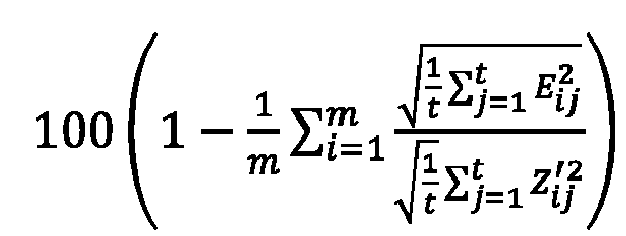
- The processor implemented method of claim 1, further comprising:computing, via the one or more hardware processors, a cost function J representative of muscular effort at each time instant for m number of muscle actuators using the activation value a for each motion profile associated with each of the one or more motion tasks, wherein the cost function is represented as
 ranking, via the one or more hardware processors, a trajectory associated with each motion profile associated with each of the one or more motion tasks based on the computed cost function J (418);identifying, via the one or more hardware processors, a motion profile associated with each of the one or more motion tasks having a minimum value for the cost function J as an optimized trajectory (420); andselecting, via the one or more hardware processors, from a repository, a neuromotor rehabilitation therapy corresponding to the identified optimized trajectory for each of the one or more motion tasks, wherein the identified optimized trajectory is indicative of optimal positioning of joint and muscle activation (422).
 - The processor implemented method of claim 3, further comprising:calculating, via the one or more hardware processors, muscle energy consumption EM from the muscle force τm and the joint velocity q for the corresponding one or more motion tasks associated with the regenerated trajectory (424);ranking, via the one or more hardware processors, the regenerated trajectory associated with each of the one or more motion tasks based on the calculated muscle energy consumption EM (426);identifying, via the one or more hardware processors, the regenerated trajectory associated with each of the one or more motion tasks having a minimum value for the muscle energy consumption EM as an optimized trajectory (428); andselecting, via the one or more hardware processors, from a repository, a neuromotor rehabilitation therapy corresponding to the identified optimized trajectory for each of the one or more motion tasks, wherein the identified optimized trajectory is indicative of optimal positioning of joint and muscle activation (430).
- The processor implemented method of claim 6, wherein the step of calculating muscle energy consumption is represented by:

- A system (100) comprising:one or more data storage devices (102) operatively coupled to one or more hardware processors (104) via the one or more input/output interfaces (106); and configured to store instructions configured for execution via the one or more hardware processors to:personalize a neuromusculoskeletal arm model having three joints and a set of muscle actuators, wherein the neuromusculoskeletal arm model is adapted to conform with anthropometric measurements of a subject and is configured to perform one or more motion tasks by the subject using the three joints being a ball and socket shoulder joint along with clavicle and scapula having three degrees of freedom (DoF), an elbow joint with one DoF and a wrist joint having three DoF;optimize the set of muscle actuators by performing the following iterative steps starting with the set of muscle actuators in the personalized neuromusculoskeletal arm model in a first iteration and every subsequent iteration having a reduced number of muscle actuators in the set of muscle actuators compared to a previous iteration by:calculating a muscle torque indicative of a muscle force based on a moment arm └R(q)┘, wherein q represent a joint angle, an activation value a obtained from a muscle Electromyography (EMG) data, a normalized length l and a normalized velocity l̇ of each muscle actuator in the set of muscle actuators;calculating a joint torque indicative of loading on each of the three joints, wherein the joint torque is based on an acceleration q̈ due to the joint torque τ, the joint angle q, an inertia tensor function Q, a mass matrix M, a Coriolis component C, a gravity component G and an external force F applied to the neuromusculoskeletal arm model;generating a trajectory associated with a corresponding motion profile for each of the one or more motion tasks based on forward dynamics using the calculated muscle torque and the calculated joint torque; andevaluating a mean square error between the generated trajectory and a target trajectory associated with a corresponding motion profile for each of the one or more motion tasks;until the evaluated mean square error is less than a pre-defined threshold; andidentify the set of the muscle actuators with the reduced number of muscle actuators at the end of the iterative steps as the optimized set of muscle actuators to perform the one or more motion tasks.
- The system of claim 8, wherein the one or more hardware processors are further configured to calculate the muscle torque based on the equation τm = └R(q)┘ƒ(a,l,l̇); and further calculate the joint torque represented by the equation q̈ = [M(Q)]-1{τ + C((q,q̇) + G(q) + F)}, wherein q represents joint velocity.
- The system of claim 9, wherein the one or more hardware processors are further configured to:estimate an optimal muscle synergy corresponding to the one or more motion tasks using Non-Negative Matrix Factorization (NNMF);reconstruct the muscle EMG data using the estimated optimal muscle synergy to obtain a synergy reconstructed EMG data;generate an activation map for each of the one or more motion tasks based on the synergy reconstructed EMG data, wherein the activation map is an aggregation of the activation value a of each of the muscle actuators in the optimized set of muscle actuators; andregenerate the trajectory associated with a corresponding motion profile for each of the one or more motion tasks based on the forward dynamics by providing the generated activation map for each of the one or more motion tasks to the personalized musculoskeletal arm model.
- The system of claim 10, wherein the one or more hardware processors are configured to estimate an optimal muscle synergy by deriving a synergy space for each of the one or more motion profiles by performing:computing number of commands needed for controlling the optimized set of muscle actuators based on the NNMF using a matrix Z of the reconstructed EMG data of muscle actuators in the optimized set of muscle actuators, whereinZ ∈ X m*t , 'm' and 't' represent number of muscle actuators and number of time data, respectively such that Z = WC + E, whereinW E X m*n , W is a normalized row vector: |Wi | = 1 and Wi ∈ Xm and defines a synergy space,n is the number of control commands, n < m, andC ∈ X n*t , C is a column matrix containing n commands to control m muscle actuators in the synergy space,E ∈ Xm*t , E is an error between Z and WC; and determining the optimal muscle synergy based on a similarity index L =

- The system of claim 8, wherein the one or more hardware processors are further configured to:compute a cost function J representative of muscular effort at each time instant for m number of muscle actuators using the activation value a for each motion profile associated with each of the one or more motion tasks, wherein the cost function is represented as
 rank a trajectory associated with each motion profile associated with each of the one or more motion tasks based on the computed cost function J;identify a motion profile associated with each of the one or more motion tasks having a minimum value for the cost function J as an optimized trajectory; andselect from a repository, a neuromotor rehabilitation therapy corresponding to the identified optimized trajectory for each of the one or more motion tasks, wherein the identified optimized trajectory is indicative of optimal positioning of joint and muscle activation.
 - The system of claim 10, wherein the one or more hardware processors are further configured to:calculate muscle energy consumption EM from the muscle force τm and the joint velocity q for the corresponding one or more motion tasks associated with the regenerated trajectory, based on the equation:
 rank, the regenerated trajectory associated with each of the one or more motion tasks based on the calculated muscle energy consumption EM ;identify the regenerated trajectory associated with each of the one or more motion tasks having a minimum value for the muscle energy consumption EM as an optimized trajectory; andselect from a repository, a neuromotor rehabilitation therapy corresponding to the identified optimized trajectory for each of the one or more motion tasks, wherein the identified optimized trajectory is indicative of optimal positioning of joint and muscle activation.
 - A computer program product comprising a non-transitory computer readable medium having a computer readable program embodied therein, wherein the computer readable program, when executed on a computing device, causes the computing device to:personalize a neuromusculoskeletal arm model having three joints and a set of muscle actuators, wherein the neuromusculoskeletal arm model is adapted to conform with anthropometric measurements of a subject and is configured to perform one or more motion tasks by the subject using the three joints being a ball and socket shoulder joint along with clavicle and scapula having three degrees of freedom (DoF), an elbow joint with one DoF and a wrist joint having three DoF;optimize the set of muscle actuators by performing the following iterative steps starting with the set of muscle actuators in the personalized neuromusculoskeletal arm model in a first iteration and every subsequent iteration having a reduced number of muscle actuators in the set of muscle actuators compared to a previous iteration by:calculating a muscle torque indicative of a muscle force based on a moment arm └R(q)┘, wherein q represent a joint angle, an activation value a obtained from a muscle Electromyography (EMG) data, a normalized length l and a normalized velocity l̇ of each muscle actuator in the set of muscle actuators;calculating a joint torque indicative of loading on each of the three joints, wherein the joint torque is based on an acceleration q̈ due to the joint torque τ, the joint angle q, an inertia tensor function Q, a mass matrix M, a Coriolis component C, a gravity component G and an external force F applied to the neuromusculoskeletal arm model;generating a trajectory associated with a corresponding motion profile for each of the one or more motion tasks based on forward dynamics using the calculated muscle torque and the calculated joint torque; andevaluating a mean square error between the generated trajectory and a target trajectory associated with a corresponding motion profile for each of the one or more motion tasks;until the evaluated mean square error is less than a pre-defined threshold; andidentify the set of the muscle actuators with the reduced number of muscle actuators at the end of the iterative steps as the optimized set of muscle actuators to perform the one or more motion tasks.
- The computer program product of claim 14, wherein the computer readable program further causes the computing device to perform one or more of:estimate an optimal muscle synergy corresponding to the one or more motion tasks using Non-Negative Matrix Factorization (NNMF);reconstruct the muscle EMG data using the estimated optimal muscle synergy to obtain a synergy reconstructed EMG data;generate an activation map for each of the one or more motion tasks based on the synergy reconstructed EMG data, wherein the activation map is an aggregation of the activation value a of each of the muscle actuators in the optimized set of muscle actuators;regenerate the trajectory associated with a corresponding motion profile for each of the one or more motion tasks based on the forward dynamics by providing the generated activation map for each of the one or more motion tasks to the personalized musculoskeletal arm model;compute a cost function J representative of muscular effort at each time instant for m number of muscle actuators using the activation value a for each motion profile associated with each of the one or more motion tasks, wherein the cost function is represented as
 rank a trajectory associated with each motion profile associated with each of the one or more motion tasks based on the computed cost function J;identify a motion profile associated with each of the one or more motion tasks having a minimum value for the cost function J as an optimized trajectory;select from a repository, a neuromotor rehabilitation therapy corresponding to the identified optimized trajectory for each of the one or more motion tasks, wherein the identified optimized trajectory is indicative of optimal positioning of joint and muscle activation;calculate muscle energy consumption EM from the muscle force τm and the joint velocity q for the corresponding one or more motion tasks associated with the regenerated trajectory;rank, the regenerated trajectory associated with each of the one or more motion tasks based on the calculated muscle energy consumption EM ;identify the regenerated trajectory associated with each of the one or more motion tasks having a minimum value for the muscle energy consumption EM as an optimized trajectory; andselect from a repository, a neuromotor rehabilitation therapy corresponding to the identified optimized trajectory for each of the one or more motion tasks, wherein the identified optimized trajectory is indicative of optimal positioning of joint and muscle activation.
Applications Claiming Priority (1)
| Application Number | Priority Date | Filing Date | Title |
|---|---|---|---|
| IN202021030392 | 2020-07-16 |
Publications (2)
| Publication Number | Publication Date |
|---|---|
| EP3943254A2 true EP3943254A2 (en) | 2022-01-26 |
| EP3943254A3 EP3943254A3 (en) | 2022-05-11 |
Family
ID=76920692
Family Applications (1)
| Application Number | Title | Priority Date | Filing Date |
|---|---|---|---|
| EP21185567.1A Pending EP3943254A3 (en) | 2020-07-16 | 2021-07-14 | Personalized neuromotor rehabilitation therapy for upper limb using a neuromusculoskeletal arm model |
Country Status (2)
| Country | Link |
|---|---|
| US (1) | US12390145B2 (en) |
| EP (1) | EP3943254A3 (en) |
Cited By (1)
| Publication number | Priority date | Publication date | Assignee | Title |
|---|---|---|---|---|
| CN121587845A (en) * | 2026-01-27 | 2026-03-03 | 四川大学 | Biosensor-based joint actuation method and system for medical surgical robots |
Families Citing this family (4)
| Publication number | Priority date | Publication date | Assignee | Title |
|---|---|---|---|---|
| CN117226852B (en) * | 2023-11-10 | 2024-01-26 | 西南交通大学 | Software exoskeleton control method and device |
| CN118493373A (en) * | 2024-03-29 | 2024-08-16 | 湖南大学 | Redundancy mechanical arm self-adaptive control method and system based on nerve dynamics |
| CN119049652A (en) * | 2024-10-31 | 2024-11-29 | 江苏域圆智能科技有限公司 | Method and system for optimizing muscle tension test, electronic equipment and storage medium |
| CN120753662B (en) * | 2025-09-11 | 2025-11-28 | 天津大学 | Muscle strength prediction method under functional electrical stimulation |
Family Cites Families (3)
| Publication number | Priority date | Publication date | Assignee | Title |
|---|---|---|---|---|
| US10409928B1 (en) * | 2013-11-13 | 2019-09-10 | Hrl Laboratories, Llc | Goal oriented sensorimotor controller for controlling musculoskeletal simulations with neural excitation commands |
| US9811074B1 (en) * | 2016-06-21 | 2017-11-07 | TruPhysics GmbH | Optimization of robot control programs in physics-based simulated environment |
| EP3493217B1 (en) * | 2017-12-01 | 2025-01-01 | Tata Consultancy Services Limited | Method and system for injury risk prediction and corrective action for high contact type activity |
-
2021
- 2021-07-14 EP EP21185567.1A patent/EP3943254A3/en active Pending
- 2021-07-15 US US17/376,323 patent/US12390145B2/en active Active
Non-Patent Citations (1)
| Title |
|---|
| HOLZBAUR, K.R. ET AL.: "Moment-generating capacity of upper limb muscles in healthy adults", JOURNAL OF BIOMECHANICS, 2006 |
Cited By (1)
| Publication number | Priority date | Publication date | Assignee | Title |
|---|---|---|---|---|
| CN121587845A (en) * | 2026-01-27 | 2026-03-03 | 四川大学 | Biosensor-based joint actuation method and system for medical surgical robots |
Also Published As
| Publication number | Publication date |
|---|---|
| EP3943254A3 (en) | 2022-05-11 |
| US20220054073A1 (en) | 2022-02-24 |
| US12390145B2 (en) | 2025-08-19 |
Similar Documents
| Publication | Publication Date | Title |
|---|---|---|
| US12390145B2 (en) | Personalized neuromotor rehabilitation therapy for upper limb using a neuromusculoskeletal arm model | |
| Caggiano et al. | MyoSuite--A contact-rich simulation suite for musculoskeletal motor control | |
| US10994417B2 (en) | Systems, devices, and methods for the distribution and collection of multimodal data associated with robots | |
| Albrecht et al. | A bilevel optimization approach to obtain optimal cost functions for human arm movements | |
| Gielniak et al. | Generating human-like motion for robots | |
| Travers et al. | Shape-based coordination in locomotion control | |
| EP3716285B1 (en) | Modeling a neuronal controller exhibiting human postural sway | |
| Babič et al. | Human motor adaptation in whole body motion | |
| US20190172585A1 (en) | Method and system for injury risk prediction and corrective action for high contact type activity | |
| Cop et al. | Unifying system identification and biomechanical formulations for the estimation of muscle, tendon and joint stiffness during human movement | |
| Figueredo et al. | Planning to minimize the human muscular effort during forceful human-robot collaboration | |
| John et al. | Modelling 3D saccade generation by feedforward optimal control | |
| Dehghani et al. | Compact modeling of spatial continuum robotic arms towards real-time control | |
| Mehrabi et al. | Steering disturbance rejection using a physics-based neuromusculoskeletal driver model | |
| Kim et al. | Effect of kinetic degrees of freedom on multi-finger synergies and task performance during force production and release tasks | |
| Xiong et al. | A learning-based control framework for cable-driven parallel robots with unknown Jacobians | |
| Huang et al. | Manual skill generalization enhanced by negative viscosity | |
| Drücker et al. | Application of stable inversion to flexible manipulators modeled by the absolute nodal coordinate formulation | |
| Hernandez et al. | Force feasible set prediction with artificial neural network and musculoskeletal model | |
| Li et al. | Motor synergy and energy efficiency emerge in whole-body locomotion learning | |
| Ulbrich et al. | General robot kinematics decomposition without intermediate markers | |
| Ehsani et al. | A general-purpose framework to simulate musculoskeletal system of human body: using a motion tracking approach | |
| EP4620391B1 (en) | Method and system for personalized and optimal selection of ankle foot orthosis | |
| Bahrami et al. | Dynamic model estimating and designing controller for the 2-DoF planar robot in interaction with cable-driven robot based on adaptive neural network | |
| Spillmann et al. | Inextensible elastic rods with torsional friction based on Lagrange multipliers |
Legal Events
| Date | Code | Title | Description |
|---|---|---|---|
| PUAI | Public reference made under article 153(3) epc to a published international application that has entered the european phase |
Free format text: ORIGINAL CODE: 0009012 |
|
| STAA | Information on the status of an ep patent application or granted ep patent |
Free format text: STATUS: THE APPLICATION HAS BEEN PUBLISHED |
|
| AK | Designated contracting states |
Kind code of ref document: A2 Designated state(s): AL AT BE BG CH CY CZ DE DK EE ES FI FR GB GR HR HU IE IS IT LI LT LU LV MC MK MT NL NO PL PT RO RS SE SI SK SM TR |
|
| PUAL | Search report despatched |
Free format text: ORIGINAL CODE: 0009013 |
|
| AK | Designated contracting states |
Kind code of ref document: A3 Designated state(s): AL AT BE BG CH CY CZ DE DK EE ES FI FR GB GR HR HU IE IS IT LI LT LU LV MC MK MT NL NO PL PT RO RS SE SI SK SM TR |
|
| RIC1 | Information provided on ipc code assigned before grant |
Ipc: G05B 17/00 20060101ALI20220404BHEP Ipc: B25J 9/16 20060101AFI20220404BHEP |
|
| STAA | Information on the status of an ep patent application or granted ep patent |
Free format text: STATUS: REQUEST FOR EXAMINATION WAS MADE |
|
| 17P | Request for examination filed |
Effective date: 20220725 |
|
| RBV | Designated contracting states (corrected) |
Designated state(s): AL AT BE BG CH CY CZ DE DK EE ES FI FR GB GR HR HU IE IS IT LI LT LU LV MC MK MT NL NO PL PT RO RS SE SI SK SM TR |
|
| STAA | Information on the status of an ep patent application or granted ep patent |
Free format text: STATUS: EXAMINATION IS IN PROGRESS |
|
| 17Q | First examination report despatched |
Effective date: 20240502 |