EP3941906B1 - Quinoline derivatives, processes for their preparation and uses thereof for the treatment of cancer - Google Patents
Quinoline derivatives, processes for their preparation and uses thereof for the treatment of cancer Download PDFInfo
- Publication number
- EP3941906B1 EP3941906B1 EP20712346.4A EP20712346A EP3941906B1 EP 3941906 B1 EP3941906 B1 EP 3941906B1 EP 20712346 A EP20712346 A EP 20712346A EP 3941906 B1 EP3941906 B1 EP 3941906B1
- Authority
- EP
- European Patent Office
- Prior art keywords
- oxy
- quinolyl
- propanoyl
- phenyl
- fluoro
- Prior art date
- Legal status (The legal status is an assumption and is not a legal conclusion. Google has not performed a legal analysis and makes no representation as to the accuracy of the status listed.)
- Active
Links
Images




Classifications
-
- C—CHEMISTRY; METALLURGY
- C07—ORGANIC CHEMISTRY
- C07D—HETEROCYCLIC COMPOUNDS
- C07D401/00—Heterocyclic compounds containing two or more hetero rings, having nitrogen atoms as the only ring hetero atoms, at least one ring being a six-membered ring with only one nitrogen atom
- C07D401/02—Heterocyclic compounds containing two or more hetero rings, having nitrogen atoms as the only ring hetero atoms, at least one ring being a six-membered ring with only one nitrogen atom containing two hetero rings
- C07D401/12—Heterocyclic compounds containing two or more hetero rings, having nitrogen atoms as the only ring hetero atoms, at least one ring being a six-membered ring with only one nitrogen atom containing two hetero rings linked by a chain containing hetero atoms as chain links
-
- A—HUMAN NECESSITIES
- A61—MEDICAL OR VETERINARY SCIENCE; HYGIENE
- A61K—PREPARATIONS FOR MEDICAL, DENTAL OR TOILETRY PURPOSES
- A61K31/00—Medicinal preparations containing organic active ingredients
- A61K31/33—Heterocyclic compounds
- A61K31/395—Heterocyclic compounds having nitrogen as a ring hetero atom, e.g. guanethidine or rifamycins
- A61K31/435—Heterocyclic compounds having nitrogen as a ring hetero atom, e.g. guanethidine or rifamycins having six-membered rings with one nitrogen as the only ring hetero atom
- A61K31/4353—Heterocyclic compounds having nitrogen as a ring hetero atom, e.g. guanethidine or rifamycins having six-membered rings with one nitrogen as the only ring hetero atom ortho- or peri-condensed with heterocyclic ring systems
- A61K31/4375—Heterocyclic compounds having nitrogen as a ring hetero atom, e.g. guanethidine or rifamycins having six-membered rings with one nitrogen as the only ring hetero atom ortho- or peri-condensed with heterocyclic ring systems the heterocyclic ring system containing a six-membered ring having nitrogen as a ring heteroatom, e.g. quinolizines, naphthyridines, berberine, vincamine
-
- A—HUMAN NECESSITIES
- A61—MEDICAL OR VETERINARY SCIENCE; HYGIENE
- A61K—PREPARATIONS FOR MEDICAL, DENTAL OR TOILETRY PURPOSES
- A61K31/00—Medicinal preparations containing organic active ingredients
- A61K31/33—Heterocyclic compounds
- A61K31/395—Heterocyclic compounds having nitrogen as a ring hetero atom, e.g. guanethidine or rifamycins
- A61K31/435—Heterocyclic compounds having nitrogen as a ring hetero atom, e.g. guanethidine or rifamycins having six-membered rings with one nitrogen as the only ring hetero atom
- A61K31/438—The ring being spiro-condensed with carbocyclic or heterocyclic ring systems
-
- A—HUMAN NECESSITIES
- A61—MEDICAL OR VETERINARY SCIENCE; HYGIENE
- A61K—PREPARATIONS FOR MEDICAL, DENTAL OR TOILETRY PURPOSES
- A61K31/00—Medicinal preparations containing organic active ingredients
- A61K31/33—Heterocyclic compounds
- A61K31/395—Heterocyclic compounds having nitrogen as a ring hetero atom, e.g. guanethidine or rifamycins
- A61K31/435—Heterocyclic compounds having nitrogen as a ring hetero atom, e.g. guanethidine or rifamycins having six-membered rings with one nitrogen as the only ring hetero atom
- A61K31/44—Non condensed pyridines; Hydrogenated derivatives thereof
- A61K31/445—Non condensed piperidines, e.g. piperocaine
- A61K31/4523—Non condensed piperidines, e.g. piperocaine containing further heterocyclic ring systems
- A61K31/4545—Non condensed piperidines, e.g. piperocaine containing further heterocyclic ring systems containing a six-membered ring with nitrogen as a ring hetero atom, e.g. pipamperone, anabasine
-
- A—HUMAN NECESSITIES
- A61—MEDICAL OR VETERINARY SCIENCE; HYGIENE
- A61K—PREPARATIONS FOR MEDICAL, DENTAL OR TOILETRY PURPOSES
- A61K31/00—Medicinal preparations containing organic active ingredients
- A61K31/33—Heterocyclic compounds
- A61K31/395—Heterocyclic compounds having nitrogen as a ring hetero atom, e.g. guanethidine or rifamycins
- A61K31/435—Heterocyclic compounds having nitrogen as a ring hetero atom, e.g. guanethidine or rifamycins having six-membered rings with one nitrogen as the only ring hetero atom
- A61K31/47—Quinolines; Isoquinolines
-
- A—HUMAN NECESSITIES
- A61—MEDICAL OR VETERINARY SCIENCE; HYGIENE
- A61K—PREPARATIONS FOR MEDICAL, DENTAL OR TOILETRY PURPOSES
- A61K31/00—Medicinal preparations containing organic active ingredients
- A61K31/33—Heterocyclic compounds
- A61K31/395—Heterocyclic compounds having nitrogen as a ring hetero atom, e.g. guanethidine or rifamycins
- A61K31/435—Heterocyclic compounds having nitrogen as a ring hetero atom, e.g. guanethidine or rifamycins having six-membered rings with one nitrogen as the only ring hetero atom
- A61K31/47—Quinolines; Isoquinolines
- A61K31/4709—Non-condensed quinolines and containing further heterocyclic rings
-
- A—HUMAN NECESSITIES
- A61—MEDICAL OR VETERINARY SCIENCE; HYGIENE
- A61K—PREPARATIONS FOR MEDICAL, DENTAL OR TOILETRY PURPOSES
- A61K31/00—Medicinal preparations containing organic active ingredients
- A61K31/33—Heterocyclic compounds
- A61K31/395—Heterocyclic compounds having nitrogen as a ring hetero atom, e.g. guanethidine or rifamycins
- A61K31/495—Heterocyclic compounds having nitrogen as a ring hetero atom, e.g. guanethidine or rifamycins having six-membered rings with two or more nitrogen atoms as the only ring heteroatoms, e.g. piperazine or tetrazines
- A61K31/496—Non-condensed piperazines containing further heterocyclic rings, e.g. rifampin, thiothixene or sparfloxacin
-
- A—HUMAN NECESSITIES
- A61—MEDICAL OR VETERINARY SCIENCE; HYGIENE
- A61K—PREPARATIONS FOR MEDICAL, DENTAL OR TOILETRY PURPOSES
- A61K31/00—Medicinal preparations containing organic active ingredients
- A61K31/33—Heterocyclic compounds
- A61K31/395—Heterocyclic compounds having nitrogen as a ring hetero atom, e.g. guanethidine or rifamycins
- A61K31/535—Heterocyclic compounds having nitrogen as a ring hetero atom, e.g. guanethidine or rifamycins having six-membered rings with at least one nitrogen and one oxygen as the ring hetero atoms, e.g. 1,2-oxazines
- A61K31/5375—1,4-Oxazines, e.g. morpholine
- A61K31/5377—1,4-Oxazines, e.g. morpholine not condensed and containing further heterocyclic rings, e.g. timolol
-
- A—HUMAN NECESSITIES
- A61—MEDICAL OR VETERINARY SCIENCE; HYGIENE
- A61K—PREPARATIONS FOR MEDICAL, DENTAL OR TOILETRY PURPOSES
- A61K45/00—Medicinal preparations containing active ingredients not provided for in groups A61K31/00 - A61K41/00
- A61K45/06—Mixtures of active ingredients without chemical characterisation, e.g. antiphlogistics and cardiaca
-
- A—HUMAN NECESSITIES
- A61—MEDICAL OR VETERINARY SCIENCE; HYGIENE
- A61P—SPECIFIC THERAPEUTIC ACTIVITY OF CHEMICAL COMPOUNDS OR MEDICINAL PREPARATIONS
- A61P35/00—Antineoplastic agents
-
- C—CHEMISTRY; METALLURGY
- C07—ORGANIC CHEMISTRY
- C07D—HETEROCYCLIC COMPOUNDS
- C07D215/00—Heterocyclic compounds containing quinoline or hydrogenated quinoline ring systems
- C07D215/02—Heterocyclic compounds containing quinoline or hydrogenated quinoline ring systems having no bond between the ring nitrogen atom and a non-ring member or having only hydrogen atoms or carbon atoms directly attached to the ring nitrogen atom
- C07D215/16—Heterocyclic compounds containing quinoline or hydrogenated quinoline ring systems having no bond between the ring nitrogen atom and a non-ring member or having only hydrogen atoms or carbon atoms directly attached to the ring nitrogen atom with hetero atoms or with carbon atoms having three bonds to hetero atoms with at the most one bond to halogen, e.g. ester or nitrile radicals, directly attached to ring carbon atoms
- C07D215/20—Oxygen atoms
-
- C—CHEMISTRY; METALLURGY
- C07—ORGANIC CHEMISTRY
- C07D—HETEROCYCLIC COMPOUNDS
- C07D409/00—Heterocyclic compounds containing two or more hetero rings, at least one ring having sulfur atoms as the only ring hetero atoms
- C07D409/14—Heterocyclic compounds containing two or more hetero rings, at least one ring having sulfur atoms as the only ring hetero atoms containing three or more hetero rings
-
- C—CHEMISTRY; METALLURGY
- C07—ORGANIC CHEMISTRY
- C07D—HETEROCYCLIC COMPOUNDS
- C07D471/00—Heterocyclic compounds containing nitrogen atoms as the only ring hetero atoms in the condensed system, at least one ring being a six-membered ring with one nitrogen atom, not provided for by groups C07D451/00 - C07D463/00
- C07D471/02—Heterocyclic compounds containing nitrogen atoms as the only ring hetero atoms in the condensed system, at least one ring being a six-membered ring with one nitrogen atom, not provided for by groups C07D451/00 - C07D463/00 in which the condensed system contains two hetero rings
- C07D471/04—Ortho-condensed systems
-
- C—CHEMISTRY; METALLURGY
- C07—ORGANIC CHEMISTRY
- C07D—HETEROCYCLIC COMPOUNDS
- C07D471/00—Heterocyclic compounds containing nitrogen atoms as the only ring hetero atoms in the condensed system, at least one ring being a six-membered ring with one nitrogen atom, not provided for by groups C07D451/00 - C07D463/00
- C07D471/02—Heterocyclic compounds containing nitrogen atoms as the only ring hetero atoms in the condensed system, at least one ring being a six-membered ring with one nitrogen atom, not provided for by groups C07D451/00 - C07D463/00 in which the condensed system contains two hetero rings
- C07D471/10—Spiro-condensed systems
-
- C—CHEMISTRY; METALLURGY
- C07—ORGANIC CHEMISTRY
- C07D—HETEROCYCLIC COMPOUNDS
- C07D491/00—Heterocyclic compounds containing in the condensed ring system both one or more rings having oxygen atoms as the only ring hetero atoms and one or more rings having nitrogen atoms as the only ring hetero atoms, not provided for by groups C07D451/00 - C07D459/00, C07D463/00, C07D477/00 or C07D489/00
- C07D491/02—Heterocyclic compounds containing in the condensed ring system both one or more rings having oxygen atoms as the only ring hetero atoms and one or more rings having nitrogen atoms as the only ring hetero atoms, not provided for by groups C07D451/00 - C07D459/00, C07D463/00, C07D477/00 or C07D489/00 in which the condensed system contains two hetero rings
- C07D491/10—Spiro-condensed systems
- C07D491/107—Spiro-condensed systems with only one oxygen atom as ring hetero atom in the oxygen-containing ring
-
- C—CHEMISTRY; METALLURGY
- C07—ORGANIC CHEMISTRY
- C07D—HETEROCYCLIC COMPOUNDS
- C07D519/00—Heterocyclic compounds containing more than one system of two or more relevant hetero rings condensed among themselves or condensed with a common carbocyclic ring system not provided for in groups C07D453/00 or C07D455/00
Definitions
- the present invention relates to compounds of the general formula (I) wherein V, W, M, R, R 1 and Y have the designations cited below, or a pharmaceutically or veterinary acceptable salt, hydrate or solvate thereof, and to processes for the preparation of compounds of the general formula (I) or a pharmaceutically or veterinary acceptable salt, hydrate or solvate thereof.
- the invention also relates to compounds of the general formula (I) or a pharmaceutically or veterinary acceptable salt, hydrate or solvate thereof for use as a medicament.
- the invention relates to compounds of the general formula (I) or a pharmaceutically or veterinary acceptable salt, hydrate or solvate thereof for use in the treatment of cancer.
- the invention relates to compounds of the general formula (I) or a pharmaceutically or veterinary acceptable salt, hydrate or solvate thereof for treating cancer in simultaneous, alternating or subsequent combination with another cancer therapy.
- Lactate is transferred to the liver, where the carbon skeleton is used to synthesize glucose known as the "neoplastic or pathological Cori cycle" contributing to the clinical metabolic state of Cachexia, a condition existing in neoplastic patients who suffer massive loss of normal body mass as the neoplasm continues its growth (Tisdale, 2002). Consequently, inhibiting aerobic glycolysis (Warburg effect) and/or neoplastic anabolism (pathological Cori cycle) may be another effective way to interfere with cancer metabolism and effectively treat cancer patients.
- the inhibition of glycolysis in connection with the Warburg effect for cancer treatment has been described by Pelicano, H. et al. (2006) and Scatena et al. (2008).
- tumors show heterogeneity in fuel utilization even within the same disease entity with some having a significant mitochondrial component, marked by elevated oxidative phosphorylation (OXPHOS), increased contribution of mitochondria to total cellular energy budget, greater incorporation of fatty acid- and glucose-derived carbons into the TCA cycle, and increased lipogenesis from these carbon substrates (Caro et al., 2012).
- OXPHOS oxidative phosphorylation
- Cancer cell mitochondria are structurally and functionally different from their normal counterparts. Moreover, tumor cells exhibit an extensive metabolic reprogramming that renders them more susceptible to mitochondrial perturbations than non-immortalized cells. Based on these premises, mitochondrially-targeted agents emerge as a means to selectively target tumors. The correction of cancer-associated mitochondrial dysfunctions and the (re)activation of cell death programs by pharmacological agents that induce or facilitate mitochondrial membrane permeabilization represent attractive strategies for cancer therapy.
- autophagy in the tumor stroma and oxidative mitochondrial metabolism (OXPHOS) in cancer cells can both dramatically promote tumor growth, independently of tumor angiogenesis (Salem et al., 2012) and that cancer-associated fibroblasts undergo aerobic glycolysis, thereby producing lactate, which is utilized as a metabolic substrate by adjacent cancer cells.
- “energy transfer” or “metabolic-coupling” between the tumor stroma and epithelial cancer cells "fuels” tumor growth and metastasis, via oxidative mitochondrial metabolism in anabolic cancer cells, the “reverse Warburg effect” (Whitaker-Menezes et al., 2011).
- Mitochondrial targeted anti-cancer drugs are reviewed by Fulda et al. (2010) and Weinberg and Chandel (2015) including inhibitors of mitochondrial complex 1, inhibitors of the electron transfer chain (ETC) complex, inhibitors of mitochondrial ribosomal machinery, inhibitors of the translation of ETC subunits, inhibitors of mitochondrial chaperone proteins, inhibitors of glutaminases, aminotransferases or glutamate dehydrogenases, short term inhibition of autophagy, mitochondrial-targeted antioxidants.
- ETC electron transfer chain
- WO2017/155991 discloses quinazoline derivatives as inhibitors of mitochondrial activity useful for treating cancer.
- POLRMT mitochondrial RNA polymerase
- h-mtRNAP mitochondrial RNA polymerase
- a number of nucleoside analogues used as antiviral agents to target viral RNA polymerases demonstrate off-target inhibition of POLRMT (Arnold et al., 2012); POLRMT is distantly related to bacteriophage T7 class of single-subunit RNAPs.
- 2-C-methyladenosine identified as an inhibitor of the RNA-dependent RNA polymerase of hepatitis C virus (Carroll et al., 2003), triggers the death of AML cells allegedly through rather unspecific inhibition of mitochondrial transcription confirms this rational (Bralha et al., 2015).
- novel compounds which specifically inhibit POLRMT and are suitable for use as a medicament.
- novel compounds that can be used in the treatment of cancer, preferably melanoma, metastatic melanoma, pancreatic cancer, hepatocellular carcinoma, lymphoma, acute myeloid leukemia, breast cancer, glioblastoma, cervical cancer, renal cancer, colorectal cancer or ovarian cancer.
- POLRMT inhibitors are of interest, which can be used in a method for treating cancer in simultaneous, alternating or subsequent combination with another cancer therapy.
- the present invention provides specific POLRMT inhibitors for the treatment of cancer.
- the present invention in one aspect, relates to a compound of the general formula (I) wherein
- the invention relates to a compound of the general formula (I) as defined above, wherein
- the invention relates to a compound of the general formula (I) as defined above, wherein
- the invention relates to a compound of the general formula (I) as defined above, wherein
- the invention relates to a compound of the general formula (I) as defined above, wherein
- the invention relates to a compound of the general formula (I) as defined above, wherein
- the invention relates to a compound of the general formula (I) as defined above, wherein
- the invention relates to a compound of the general formula (I) as defined above, wherein
- the invention relates to a compound of the general formula (I) as defined above, wherein
- the invention relates to a compound of the general formula (I) as defined above, wherein
- the invention relates to a compound of the general formula (I) as defined above, wherein
- the invention relates to a compound of the general formula (I) as defined above, wherein X is at the para-position of the phenyl ring.
- the invention relates to a compound of the general formula (I) as defined above, selected from
- the invention relates to a process for manufacturing a compound of the general formula (I) as defined above, wherein V is -H, -OH, -Cl or -C 1 -C 4 -alkyl, comprising the step of: (a) alkylating a compound of formulae (D 1 to D 5 ) wherein in D 1 V is -H, M is CH, and W is as defined herein, in D 2 V is -OH, M is N, and W is as defined herein, in D 3 V is -Cl, M is CH, and W is as defined herein, in D 4 V is -H, M is CH, and W is as defined herein, and in D 5 V is -C 1 -C 4 -alkyl, M is CH, and W is as defined herein, with an alkylating agent, preferably with an alkylating agent of the formula Z-OH or Z-Br, wherein Z is the group wherein R, R 1 and Y are as defined herein,
- the compounds of formulae E 1 to E 5 correspond to the compounds of the general formula (I) as defined above, wherein V is -H, -OH, -CI or C 1 -C 4 -alkyl.
- the invention in another aspect, relates to a process for manufacturing a compound of the general formula (I) as defined herein, wherein V is -F, comprising the step of: (b) reacting a compound of formula (E 1 ) wherein in E 1 V is -H, M is CH, and W and Z are as defined herein, with a fluorinating agent, preferably with AgF 2 , to obtain a compound of formula E 6 wherein V is -F, M is CH, and W and Z are as defined herein.
- a fluorinating agent preferably with AgF 2
- the invention relates to a compound of the general formula (I) as defined herein for use as a medicament.
- the invention relates to a compound of the general formula (I) as defined herein for use in the treatment of cancer, preferably melanoma, metastatic melanoma, pancreatic cancer, hepatocellular carcinoma, lymphoma, acute myeloid leukemia, breast cancer, glioblastoma, cervical cancer, renal cancer, colorectal cancer or ovarian cancer.
- cancer preferably melanoma, metastatic melanoma, pancreatic cancer, hepatocellular carcinoma, lymphoma, acute myeloid leukemia, breast cancer, glioblastoma, cervical cancer, renal cancer, colorectal cancer or ovarian cancer.
- the invention relates to a compound of the general formula (I) as defined herein for use in a method for treating cancer in simultaneous, alternating or subsequent combination with another cancer therapy, preferably selected from chemotherapy, immunotherapy, hormone therapy, stem cell transplantation therapy, radiation therapy or surgery.
- “4-, 5- or 6-membered saturated heterocycle” represents an unsubstituted or substituted saturated or partially unsaturated ring system containing 4, 5 or 6 ring atoms and containing in addition to C ring atoms one to three nitrogen atoms and/or an oxygen or sulfur atom or one or two oxygen and/or sulfur atoms.
- the "4-, 5- or 6-membered saturated heterocycle” represents an unsubstituted or substituted saturated ring system containing 4, 5 or 6 ring atoms and containing in addition to C ring atoms one to three nitrogen atoms and/or an oxygen or sulfur atom or one or two oxygen and/or sulfur atoms.
- the 4-, 5- or 6-membered saturated heterocycle contains in addition to C ring atoms one N and optionally one additional heteroatom.
- the additional heteroatoms are preferably selected from O, N or S.
- heterocycles with only one N as a heteroatom Preferably, these substituted heterocycles are single or twofold substituted.
- the 4-, 5- or 6-membered saturated heterocycle may be substituted at the C atom(s), at the O atom(s), at the N atom(s) or at the S atom(s).
- 4-, 5- or 6-membered saturated heterocycle examples include, but are not limited to oxetanyl, azetidinyl, 1,3-diazetinyl, thietanyl, 2-tetrahydrofuranyl, 3-tetrahydrofuranyl, 2-tetrahydrothienyl, 3-tetrahydrothienyl, 2-pyrrolidinyl, 3-pyrrolidinyl, 3-isoxazolidinyl, 4-isoxazolidinyl, 5-isoxazolidinyl, 3-isothiazolidinyl, 4-isothiazolidinyl, 5-isothiazolidinyl, 3-pyrazolidinyl, 4-pyrazolidinyl, 5-pyrazolidinyl, 2-oxazolidinyl, 4-oxazolidinyl, 5-oxazolidinyl, 2-thiazolidinyl, 4-thiazolidinyl, 5-thiazolidinyl, 2-imidazolidin
- the 4-, 5- or 6-membered saturated heterocycle may be each optionally and independently substituted with one or more, preferably with one of the following residues:
- C 1 -C 4 -alkyl and “C 1 -C 8 -alkyl” represent a straight-chain or branched-chain alkyl group with 1 to 4 or 1 to 8 carbon atoms, respectively.
- straight-chain and branched groups include, but are not limited to, methyl, ethyl, propyl, isopropyl, butyl, isobutyl, and tert-butyl, preferably methyl and ethyl and most preferred methyl.
- halogen-C 1 -C 4 -alkyl represents a straight-chain or branched alkyl group having 1 to 4 carbon atoms (as mentioned above), it being possible for the hydrogen atoms in these groups to be partly or completely replaced by halogen atoms as mentioned above, e.g.
- C 1 -C 2 -halogenalkyl such as chloromethyl, dichloromethyl, trichloromethyl, fluoromethyl, difluoromethyl, trifluoromethyl, chlorofluoromethyl, dichlorofluoromethyl, chlorodifluoromethyl, 1-fluoroethyl, 2-fluoroethyl, 2,2-difluoroethyl, 2,2,2-trifluoroethyl, 2-chloro-2fluoroethyl, 2-chloro-2,2-difluoroethyl, 2,2-dichloro-2-fluoroethyl, 2,2,2-trichloroethyl and pentafluoroethyl;
- C 1 -C 4 -alkoxy represents a straight-chain or branched-chain alkyl group with 1 to 4 or 1 to 8 carbon atoms, which are bonded to the structure via an oxygen atom (-O).
- C 1 -C 4 -dialkylamino represents two straight-chain or branched alkyl groups having 1 to 4 carbon atoms (as mentioned above), which are independent of one another and are bonded to the structure via a nitrogen atom (-N:);
- C 2 -C 6 -alkenyl represents a straight-chain or branched-chain hydrocarbon group comprising an olefinic bond in any desired position and 2 to 6, more preferably 2 to 4 carbon atoms.
- alkenyl groups include, but are not limited to, ethenyl, 1-propenyl, 2-propenyl, isopropenyl, 1-butenyl, 2-butenyl, 3-butenyl and isobutenyl. Preferred examples are 1-propenyl and 2-propenyl.
- C 2 -C 6 -alkynyl represents a straight-chain or branched hydrocarbon group having 2 to 6 carbon atoms and a triple bond in any desired position, such as ethynyl, 1-propynyl, 2-propynyl, 1-butynyl, 2-butynyl, 3-butynyl, 1-methyl-2-propynyl, 1-pentynyl, 2-pentynyl, 3-pentynyl, 4-pentynyl, 1-methyl-2-butynyl, 1-methyl-3-butynyl, 2-methyl-3-butynyl, 3-methyl-1-butynyl, 1,1-dimethyl-2-propynyl, 1-ethyl-2-propynyl, 1-hexynyl, 2-hexynyl, 3-hexynyl, 4-hexynyl, 5-hexynyl, 1-methyl-2-pentynyl, 1-methyl-3-
- C 3 -C 6 -cycloalkyl represents a carbocyclic saturated ring system having 3 to 6 carbon atoms.
- Examples of C 3 -C 6 -cycloalkyl include, but are not limited cyclopropyl, cyclobutyl, cyclopentyl, or cyclohexyl, preferably cyclopentyl and cyclohexyl.
- substitution or “substituted” represents one or more substituents commonly known in the art, or as specifically defined herein.
- Halogen represents fluoro, chloro, bromo or iodo, preferably represents fluoro and chloro.
- Stepoisomer(s) as it relates to a compound of formula (I) and to its intermediate compounds represents any possible enantiomers or diastereomers of a compound of formula (I) and its salts or hydrates.
- stereoisomer means a single compound or a mixture of two or more compounds, wherein at least one chiral center is predominantly present in one definite isomeric form, in particular the S -enantiomer, the R -enantiomer and the racemate of a compound of formula (I). It is also possible that two or more stereogenic centers are predominantly present in one definite isomeric form of a derivative of a compound of formula (I) as defined above.
- “predominantly” has the meaning of at least 60%, preferably at least 70%, particularly preferably at least 80%, most preferably at least 90%.
- stereoisomers of a compound of formula (I) may be present as a salt or a hydrate.
- stereoisomer, salt, and hydrate may also be used in conjunction with one another.
- a stereoisomer of a compound of formula (I) may have a salt. Combinations of these terms are considered to be within the scope of the invention.
- novel compounds which inhibit POLRMT and are suitable for use as a medicament.
- novel compounds that can be used in the treatment of cancer, preferably melanoma, metastatic melanoma, pancreatic cancer, hepatocellular carcinoma, lymphoma, acute myeloid leukemia, breast cancer, glioblastoma, cervical cancer, renal cancer, colorectal cancer or ovarian cancer.
- POLRMT inhibitors are of interest, which can be used in a method for treating cancer in simultaneous, alternating or subsequent combination with another cancer therapy.
- a problem of the present invention was therefore to provide novel alternative compounds having the above-mentioned desired characteristics.
- the compounds of the general formula (I) are quinoline derivatives, wherein M is CH.
- a pharmaceutically or veterinary acceptable salt can be an anionic counterion, e.g. an acetate, a bromide, camsylate, chloride, citrate, formate, fumarate, lactate, maleate, mesylate, nitrate, oxalate, phosphate, sulfate, tartrate, thiocyanate, or tosylate, or preferably a cationic counterion, e.g.
- Some compounds of the invention contain one or more chiral centers due to the presence of asymmetric carbon atoms, which gives rise to stereoisomers, for example todiastereoisomers with R or S stereochemistry at each chiral center.
- the invention includes all such stereoisomers and diastereoisomers and mixtures thereof.
- the inventors have now surprisingly and unexpectedly found that the compounds of general formula (I) or a pharmaceutically or veterinary acceptable salt, hydrate or solvate thereof, are useful as mitochondrial RNA polymerase (POLRMT) inhibitors and thereby inhibit mitochondrial DNA replication and/or mitochondrial transcription.
- POLRMT mitochondrial RNA polymerase
- the invention relates to a compound of the general formula (I) as defined above, wherein
- This preferred group of compounds corresponds to the compounds of formula (IA) wherein R, R 1 , R 2 , R 3 , M, V, X, n and Y are as defined in the preferred group above.
- a particular preferred group of compounds are compounds of formula (IB) wherein R, R 1, R 2 , R 3 , M, V, X, n and Y are as defined in the preferred group above.
- the invention relates to a compound of the general formula (I) as defined above, wherein
- the invention relates to a compound of the general formula (I) as defined above, wherein
- the invention relates to a compound of the general formula (I) of the group as defined above, wherein W is with R 2 , X and n as defined above, for example compound 134.
- the invention relates to a compound of the general formula (I) of the group as defined above, wherein W is with R 3 is H, R 2 , X and m as defined above.
- the invention relates to a compound of the general formula (I) of the group as defined above, wherein W is with R 2 is H, R 3 , X and m as defined above, for example compound 133.
- the invention relates to a compound of the general formula (I) as defined above, wherein
- N, R 4 and R 5 together form an unsubstituted or substituted azetidine, piperidine, piperazine or pyrrolidine residue, each optionally and independently substituted with one or more, preferably with one of the following residues:
- N, R 4 and R 5 together form an unsubstituted or substituted piperidine or pyrrolidine residue, each optionally and independently substituted with one or more, preferably with one, of the following residues:
- a group of preferred compounds have an unsubstituted piperidine, i.e. N, R 4 and R 5 together form an unsubstituted piperidine residue.
- a more preferred subgroup are compounds having a substituted piperidine residue substituted with -COOH or with -CH 2 COOH.
- Another more preferred subgroup are compounds having a unsubstituted or substituted piperidine residue, optionally and indpendently substituted with one or more of the following residues: -COOH, -COOCH 3 , -COOC 2 H 5 , -CH 2 COOH, -C(CH 3 ) 2 -COOH, -CH 2 COOCH 3 , -CH 2 COOCH 2 CH 3 , -CONH 2 , -CONHCH 3 , -CON(CH 3 ) 2 ,-SO 2 NH 2 or-CH 2 SO 2 NH 2 .
- the invention relates to a compound of the general formula (I) as defined herein, wherein
- the invention relates to a compound of the general formula (I) as defined herein, wherein
- R is -( R )-methyl.
- the invention relates to a compound of the general formula (I) as defined herein, wherein X is at the para-position of the phenyl ring.
- a more preferred subgroup are compounds, wherein R is ( R )-methyl, having a substituted piperidine residue substituted with -COOH or with -CH 2 COOH.
- R is ( R )-methyl, having a substituted piperidine residue substituted with -(CH 2 ) o -COOR 7 with R 7 is -H, -C 1 -C 8 -alkyl,
- Another specific subset of compounds are compounds, wherein the piperidine residue or the pyrrolidine residue is substituted at the 3-position.
- An even more preferred subgroup of this group are compounds where R is ( R )-methyl
- a more preferred subgroup are compounds having a substituted piperidine residue substituted with -COOH at the 3-position and wherein R is ( R )-methyl, or with -CH 2 COOH at the 3-position and wherein R is ( R )-methyl.
- a more preferred subgroup are compounds, wherein X is at the para-position, having a substituted piperidine residue substituted with -COOH at the 3-position and wherein R is ( R )-methyl or with -CH 2 COOH at the 3-position and wherein R is ( R )-methyl.
- Another specific subset of compounds concerns compounds selected from
- the present invention provides novel processes for the preparation of compounds of the general formula (I) and novel processes for the preparation of their intermediates.
- the invention relates to a process for manufacturing a compound of the general formula (I) as defined herein, wherein V is -H, -OH, -Cl, or -C 1 -C 4 -alkyl comprising the step of: (a) alkylating a compound of formulae (D 1 to D 5 ) wherein in D 1 V is -H, M is CH, and W is as defined herein, in D 2 V is -OH, M is CH, and W is as defined herein, in D 3 V is -Cl, M is CH, and W is as defined herein, in D 4 V is -H, M is N, and W is as defined herein, and in D 5 V is -C 1 -C 4 -alkyl, M is CH, and W is as defined herein, with an alkylating agent, preferably with an alkylating agent of the formula Z-OH or Z-Br, wherein Z is the group wherein R, R 1 and Y are as defined herein
- the compounds of formulae E 1 to E 5 correspond to the compounds of the general formula (I) as defined herein, wherein V is -H, -CI or -C 1 -C 4 -alkyl.
- alkylation of the compounds of formulae (D 1 to D 5 ) can be carried out with any suitable alkylating agent under standard alkylation conditions, e.g. with an alkylbromide (Z-Br), or with an alcohol (Z-OH) according to the Mitsunobu reaction (Mitsunobu and Yamada, 1967).
- Process step (a) can be carried out according to standard prcedures known in the art, whereas further guidance can be found in reaction Scheme 2 and in the Examples disclosed below.
- the invention relates to a compound of formulae (D 1 to D 5 ) as defined above.
- the invention relates to a process for manufacturing a compound of the general formula (I) as defined above, wherein V is -F, comprising the step of: (b) reacting a compound of formula (E 1 ) wherein in E 1 V is -H, M is CH, and W and Z are as defined herein,
- fluorination of the compounds of formulae (E 1 to E 3 ) can be carried out with any suitable fluorinating agent under standard conditions, e.g. with AgF 2 .
- Process step (b) can be carried out according to standard procedures known in the art, whereas further guidance can be found in reaction Scheme 2, in Figure 3 , and in the Examples disclosed below.
- the compounds of formulae (D 1 and D 2 ) may be prepared according to process steps (c), (d) and (f), or according to process steps (e) and (f), respectively, as described below.
- the present invention relates to a process for the preparation of a compound of the general formulae (D 1 and D 2 ) wherein in D 1 V is -H, M is CH, and W is as defined herein, in D 2 V is -OH, M is CH, and W is as defined herein, comprising the steps of: (c) reacting a compound of formula (A)
- the desired quinoline compounds of formula (C 2 ) may be prepared from the corresponding ⁇ -ketoesters of formula (A) and 3-methoxy-aniline in 2 steps through a cyclisation such as the one described by Leonetti et al. (2004).
- the compounds of formula (C1 1x ) used as a starting material in process step (e) are either commercially available quinoline derivatives or can be prepared in similar manners as described in literature procedures or in the specific examples. Boronic acids or esters used as a starting material in process step (e) are commercially available or can be obtained by standard procedures known to the skilled person.
- the compounds of formula W-B(OH) 2 may be prepared as described in literature procedures.
- the boron tribromide used in process step (f) is commercially available.
- Process steps (c), (d), (e) and (f) can be carried out according to standard procedures known in the art, whereas further guidance can be found in the reaction schemes and examples disclosed below.
- the cyclisation of process step (d) can be carried out as described by Leonetti et al. (2004).
- the invention relates to a compound of formulae (B, C 1 and C 2 ) as defined above.
- the present invention relates to a process for manufacturing a compound of the invention of formula (IA) as defined above, preferably, wherein V is -CI, comprising the step of: (a1) alkylating a compound of formulae (D 1 to D 5 ) as defined herein, preferably D 3 ,
- the alkylation of the compounds of formulae (D 1 to D 5 ) can be carried out with any suitable alkylation agent, e.g. with an alkylbromide (Z-Br), or with an alcohol (Z-OH) according to the Mitsunobu reaction (Mitsunobu and Yamada, 1967).
- Process step (a) can be carried out according to standard procedures known in the art, whereas further guidance can be found in the reaction schemes and examples disclosed below.
- the present invention relates to a process for the preparation of a compound of formula (I) of the invention, wherein Y is -NR 3 R 4 as defined above corresponding to a compound of formula (J), comprising the steps of:
- the optionally substituted amines used as starting materials in process step (h) are commercially available or can be prepared by standard procedures.
- the invention relates to an intermediate compound of formula (F) or to an intermediate compound of formula (G) as defined above.
- reaction steps (g) and (h) can be carried out according to standard procedures known in the art, whereas further guidance can be found in the reaction schemes and examples disclosed below.
- step (h) can be carried out with an optionally substituted amine according to known standard procedures.
- the present invention relates to a process for manufacturing a compound of formula (IA) of the invention, wherein Y is -NR 3 R 4 as defined above, comprising the steps of:
- reaction steps (g1) and (h1) can be carried out according to standard procedures known in the art, whereas further guidance can be found in the reaction schemes and examples disclosed below.
- step (h1) can be carried out with an optionally substituted amine according to known standard procedures.
- the invention relates to a compound of formula (F1) or to an intermediate compound of formula (G1) as defined above.
- the present invention relates to a process for manufacturing specific embodiments of the compounds of formula (I) of the invention, i.e. compounds of formulae (L) and (M), wherein Y is -NR 4 R 5 and N, R 4 and R 5 form a substituted 5- or 6-membered saturated heterocycle as defined herein, comprising the steps of:
- reaction steps (g2) and (h2) can be carried out according to standard procedures known in the art, whereas further guidance can be found in the reaction schemes and examples disclosed below.
- step (h2) can be carried out with an optionally substituted amine according to known standard procedures.
- the invention relates to a compound of formula (K), (L) or (M) as defined above.
- Scheme 1 shows the preparation of a compound of formulae (D 1 to D 4 ) used as starting materials for the preparation of the compounds of formulae E 1 to E 4 and E 6 corresponding to the compounds of formula (I) as defined above.
- the starting materials are either commercially available or are prepared in similar manners as described in literature procedures or in the specific examples.
- the ⁇ -ketoesters of formula (A) and 3-methoxy-aniline used as a starting material for the preparation of the compounds of formula (B) are commercially available or can be obtained by standard procedures known to the skilled person.
- Scheme 2 shows the preparation of a compound of formulae E 1 to E 4 , E 8 , E 9 , E x and E 6 corresponding to the compounds of formula (I) as defined above by alkylating a compound of the formulae D 1 to D 4 , D 8 , D 9 , or D x with a commercial alkylbromide (Z-Br) or subjected to a Mitsunobu (Z-OH) reaction.
- Z-Br commercial alkylbromide
- Z-OH Mitsunobu
- the compounds of formula (I) are suitable for use as a medicament.
- the compounds of formula (I) can be used in the treatment of cancer, preferably in the treatment of melanoma, metastatic melanoma, pancreatic cancer, hepatocellular carcinoma, lymphoma, acute myeloid leukemia, breast cancer, glioblastoma, cervical cancer, renal cancer, colorectal cancer or ovarian cancer.
- the compounds of formula (I) of the invention and their pharmaceutically or veterinary acceptable salts, hydrates or solvates exhibit valuable pharmacological properties and are therefore useful as a medicament or pharmaceutical.
- the medicament or pharmaceutical can be further formulated with additional pharmaceutically or veterinary acceptable carriers and/or excipients, e.g. for oral administrations in the form of tablets.
- Tablets may contain suitable binders, lubricants, disintegrating agents, coloring agents, flavoring agents, flow-inducing agents and/or melting agents, generally known in the art.
- the invention relates to a compound of the general formula (I) as defined herein for use as a medicament.
- Compounds of the invention exhibit a marked and selective inhibitory effect on the POLRMT. This can be determined for example in the Homogeneous TR-FRET assay (see example 4) or the Quantitative real time-PCR assay (see example 5). The skilled person however may use different assays to determine the direct or indirect inhibition of POLRMT.
- breast cancer should be a suitable cancer indication as overexpression of progesterone receptor is present in more than 50% of all breast cancer patients, whereas progesterone is stimulating mitochondrial activity with subsequent inhibition of apoptosis (Nadji et al., 2005, Behera et al., 2009). Further, the inhibition of mTOR leads to a shift towards OXPHOSdependence and there is a glucose-dependent effect of mTOR inhibitors in combination with metformin (Pelicano et al., 2014, Ariaans et al., 2017). Additionally, it is described that mitochondrial dysfunction caused by metformin prevents tumor growth in breast cancer (Sanchez-Alvarez et al., 2013).
- the invention relates to compounds of formula (I) of the invention as defined herein for use in the treatment of cancer, preferably melanoma, metastatic melanoma, pancreatic cancer, hepatocellular carcinoma, lymphoma, acute myeloid leukemia, breast cancer, glioblastoma, cervical cancer, renal cancer, colorectal cancer or ovarian cancer.
- cancer preferably melanoma, metastatic melanoma, pancreatic cancer, hepatocellular carcinoma, lymphoma, acute myeloid leukemia, breast cancer, glioblastoma, cervical cancer, renal cancer, colorectal cancer or ovarian cancer.
- the compounds of the invention are preferably useful in a method for treating cancer in simultaneous, alternating or subsequent combination with another cancer therapy, preferably selected from chemotherapy, immunotherapy, hormone therapy, stem cell transplantation therapy, radiation therapy or surgery. It is likely that the cytostatic activity of the POLRMT inhibitors on tumor cells can be further enhanced by combining the treatment with the respective standard of care in order to get improved/additive treatment results. In this context simultaneous, alternating or subsequent application of the various treatments is envisaged. Any of the standard classes of cancer therapy, chemotherapy, immunotherapy, hormone therapy, stem cell transplantation therapy, radiation therapy or surgery, appears to be feasible for combination with the POLRMT inhibitors of this invention.
- the invention relates to a compound of the general formula (I) as defined herein for use in a method for treating cancer in simultaneous, alternating or subsequent combination with another cancer therapy, preferably selected from chemotherapy, immunotherapy, hormone therapy, stem cell transplantation therapy, radiation therapy or surgery.
- the compounds of formula (I) used of the invention might be prepared by standard techniques known in the art, by known processes analogous thereto, and/or by the processes described herein, using starting materials which are either commercially available or producible according to conventional chemical methods.
- the particular processes to be utilised in the preparation of the compounds of formula (I) of this invention depends upon the specific compound desired. Such factors as the type of substitution at various locations of the molecule and the commercial availability of the starting materials play a role in the path to be followed and in the chosen reaction conditions for the preparation of the specific compounds of formula (I) of this invention. Those factors are readily recognised by one of ordinary skill in the art.
- HPLC - electrospray mass spectra were obtained using a Waters Acquity Ultra Performance Liquid Chromatography (UPLC) equipped with a SQ 3100 Mass detector spectrometer.
- UPLC Waters Acquity Ultra Performance Liquid Chromatography
- Eluents A: H 2 O with 0.05% formic acid and B: MeCN with 0.05% formic acid.
- Gradient elution from 5% to 100% B over 3.5 min with an initial hold of 0.5 min and a final hold at 100% B of 0.5 min.
- Total run time 5 min.
- the gradient described could be altered in function of the physico-chemical properties of the compound analyzed and is in no way restrictive.
- Preparative HPLC was performed using a Waters System consisting of a Waters 2767 Sample Manager, a Waters 2545 Binary Gradient Module, a Waters SFO (System Fluidics Organizer), a Waters 3100 Mass Detector, and a Waters 2498 UV/Visible Detector.
- Eluents A: H 2 O with 0.1% TFA and B: MeCN with 0.1% TFA
- preparative HPLC was performed using an Agilent System consisting of a Agilent Infinity 1260 Autosampler, an Agilent Infinity 1260 Binary Gradient Module, an Agilent 6120 Quadrupole Mass Detector and an Agilent Infinity 1260 DAD VL UV/Visible Detector.
- Eluents A: H 2 O with 0.1% TFA and B: MeCN with 0.1% TFA.
- the gradient described could be altered in function of the physico-chemical properties of the compound analyzed and is in no way restrictive.
- Eluents for reverse phase analysis (1) and normal phase analysis (2) are described below: Eluents (1): A: H 2 O with 20 mM NH 4 HCO 3 , 0.1% DEA and B: MeCN with 0.1% DEA. Gradient: elution from 25-50% B over 20 min. Eluents (2): A: n-Hexane with 0.1% DEA and B: Isopropanol with 0.1% DEA. Gradient: elution from 60-90% B over 20 min. The gradient could be altered in function of the physico-chemical properties of the compound analysed and is in no way restrictive.
- Preparative HPLC was performed using a Waters System consisting of a Waters 2767 Sample Manager, a Waters 2545 Binary Gradient Module, a Waters SFO (System Fluidics Organizer), a Waters 3100 Mass Detector, and a Waters 2498 UV/Visible Detector.
- Eluents A: H 2 O with 0.1% TFA and B: MeCN with 0.1% TFA.
- the gradient could be altered in function of the physico-chemical properties of the compound analyzed and is in no way restrictive.
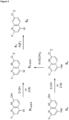
- the quinoline can be further alkylated with a commercial alkylbromide (Z-Br) or subjected to a Mitsunobu (Z-OH) reaction with a commercial alcohol to produce compounds of formula E as outlined in Scheme 2 (see Figure 3 ).
- Z was generally a potentially substituted alkyl acetate group (compound F); which was usually further modified by hydrolysis to the corresponding carboxylic acid G, followed by coupling with a commercially available, optionally substituted amine, according to standard procedures known in the art, and as described in Scheme 3 (see Figure 4 ), to produce structure J.
- the Mitsunobu reaction could be carried out with a suitable, synthesized or commercially available 2-hydroxyacetamide H to obtain a compound of structure J directly.
- intermediate F 1x-6x could be modified using a similar reaction sequence to obtain compounds of formula J through intermediates G 1x-6x and J 1x-6x , carrying a halogen substituent, which is subjected to a Suzuki coupling in the final stages of the synthesis.
- intermediates F 1x-6x can be transformed into intermediate F 1-6 via Suzuki coupling.
- R 4 and R 5 form an optionally substituted cyclic amide
- this amide can carry an ester moiety or a carbamate moiety, as highlighted in formulas K x , K or N of Scheme 4, which can be further hydrolyzed or deprotected to obtain compounds of substructure L or P.
- compounds K could be obtained by linear synthesis through a coupling reaction as for compounds of formula J as described in Scheme 3, or in a parallel manner using compounds K x . Examples are outlined in Scheme 4 (see Figure 5 ).
- the amide could also carry a nitrile moiety (compound 11), which could be transformed into a tetrazole to produce a carboxylic acid bioisostere, as in exemplified with M12 for compound 30.
- compound 11 a nitrile moiety
- M12 carboxylic acid bioisostere
- reaction mixture was allowed to cool to rt and was poured onto ice-water (2.5 L).
- the aqueous layer was extracted with Et 2 O, then acidified to pH 2 with 10% aq. HCl and extracted with Et 2 O.
- the combined organic phases were washed with H 2 O and brine, dried over MgSO 4 , filtered and evaporated in vacuo to yield the desired product 4A (37.9 g, 38%) as a mixture of tautomers, which was used in the following step without further purification.
- the isopropylic ester 36 was synthesized from precursor ( R )-2G 1 as described below:
- the desired compound was synthesized in three steps starting from intermediate 4P 1 _piperidine-NH 2 : A solution of BPO (355 mg, 1.10 mmol) in DCM (5.5 mL) was added quickly to a mixture of intermediate 4P 1 _piperidine-NH 2 (240 mg, 0.517 mmol) in buffer solution at pH 10 (NaOH/NaHCO 3 , 5.5 mL) at rt. The reaction mixture was stirred for 2 h at rt, and the pH adjusted to ⁇ 10 by the addition of 10 M NaOH. Further BPO (355 mg, 1.10 mmol) was added, and the mixture stirred at rt for 18 h, upon which the reaction was deemed complete.
- Primary amines such as compounds of formula P_pyrrolidine could be further modified to obtain ureas of formula S, by reacting with tert- butyl-isocyanate as described for compound 214. It should be apparent to a person skilled in the art that reaction conditions such as temperature, dilution, reaction time or work-up procedures, including pH adjustment, are dependent on reaction partners and functional group compatibility and could vary from compound to compound.
- enantiomeric excess (ee) of the compounds was not measured, and was assumed equal to the value determined by chiral HPLC for the final compounds (usually carboxylic acids L ).
- Chiral separation of the diastereomeric mixture was occasionally required to improve ee, particularly when any of the hydroxy-quinolines of formula D were alkylated via M7.
- Use of HATU as a coupling reagent ( M11a ) usually resulted in lower ee as compared to the coupling mixture EDC.HCl / HOBt.xH 2 O ( M11b ).
- the TR-FRET assay was basically conducted as described in WO2016/193231A1 , especially as described in example 1 (hereby incorporated by reference). With respect to the background of the mitochondrial transcription it is referred to Falkenberg et al. (2002) and Posse et al. (Posse et al., 2015).
- the method monitors the activity of mitochondrial RNApolymerase via detection of the formation of its product, a 407 bp long RNA sequence. Detection of the product is facilitated by hybridization of two DNA-oligonucleotide probes to specific and adjacent sequences within the RNA product sequence.
- the protocol described here was applied for screening and activity determination in a low-volume 384-well microtiter plate with non-binding surface.
- volumes of the reagent mixes were adjusted, maintaining the volumetric ratio.
- Proteins POLRMT (NM_172551.3), TFAM (NM_009360.4) and TFB2M (NM_008249.4) were diluted from their stocks to working concentrations of 150 nM, 1.8 ⁇ M and 330 nM respectively, in a dilution buffer containing 100 mM Tris-HCl pH 8.0, 200 mM NaCl, 10 % (v/v) glycerole, 2 mM glutathione (GSH), 0.5 mM EDTA and 0.1 mg/mL BSA.
- Protein dilutions and template DNA comprising a pUC18 plasmid encoding the mitochondrial light strand promoter, restriction linearized proximal to the promoter 3'-end (pUC-LSP), were mixed at the twofold final assay-concentration in a reaction buffer, containing 10 mM Tris-HCl pH 7.5, 10 mM MgCl 2 , 40 mM NaCl, 2 mM GSH, 0.01 % (w/v) Tween-20 and 0.1 mg/mL BSA.
- the enzymatic reaction was started by the addition of 5 ⁇ L of a mix of dNTPs in reaction buffer to a final concentration of 500 ⁇ M each. No nucleotide mix was added to negative control samples.
- the content of the wells was mixed using a VarioTeleshaker TM (Thermo Fisher Scientific, Waltham MA) at 1500 rpm for 45 sec after which the microtiter plate was centrifuged at 500 ⁇ g for 1 min. The samples were incubated for 2 h at rt with humidity control to avoid evaporation.
- the detection reagents were prepared in a buffer that was composed, such that the enzymatic reaction was terminated due to chelating of Mg-ions and increased ionic strength, containing 50 mM Tris-HCl pH 7.5, 700 mM NaCl, 20 mM EDTA, and 0.01 %(w/v) Tween-20.
- Eu-cryptate-coupled streptavidin had to be preincubated with a 100-fold molar excess of a random sequence oligonucleotide for 10 min at rt in the dark to block unspecific binding of single stranded RNA to the protein.
- the blocked streptavidin(-Eu) was mixed with the DNA-probes on ice and kept away from light until use.
- the generated signal was measured with an EnVision plate reader, including TRF light unit (Perkin Elmer, Waltham MA), using excitation at 320 nm, an integration time of 200 ⁇ s and a delay time of 100 ⁇ s, prior to detection at 620 nm and 665 nm.
- the ratio of donor- and acceptor-fluorescence was used to assess the specific FRET signal, as a measure of the generated product content (i.e. enzymatic activity).
- qRT-PCR Quantitative real-time PCR
- TaqMan TM Thermo Fisher Scientific, Waltham MA
- qRT-PCR Quantitative real-time PCR
- RNA concentrations were measured spectroscopically, using a NanoDrop-2000 (Thermo Fisher Scientific, Waltham MA) and normalized prior to cDNA synthesis, using a 'High-Capacity cDNA Reverse Transcription Kit' (Thermo Fisher Scientific, Waltham MA).
- qRT-PCR was carried out using the 'TaqMan Fast Advance Master Mix' (Thermo Fisher Scientific, Waltham MA) on a 7500 Fast Real-Time PCR machine (Applied Biosystems, Foster City CA)
- the POLRMT-gene was used to detect potential influences on nuclear transcription. Mitochondrial transcription in vivo was monitored by measurements 7S RNA.
- the TBP (TATA-box binding protein) gene was employed as the control (housekeeping gene) during qRT-PCR.
- the short-lived mitochondrial 7S RNA which is not post-transcriptionally stabilized, allowed us to monitor rapid changes in mitochondrial transcription activity following compound addition.
- the CellTiter-Glo Luminescent Cell Viability Assay (Promega) is a homogeneous method of determining the number of viable cells in culture. It is based on quantification of ATP, indicating the presence of metabolically active cells. The assay can be used to determine the inhibitory activity of the compounds of the invention on the growth of cancer cells in vitro.
- Cells are seeded on day 1 at cell numbers that assure assay linearity and optimal signal intensity. After incubation for 3 h in humidified chambers at 37°C/5% CO 2 compounds/DMSO are added at different concentrations. Cells are further incubated for 72 h at 37°C and 5% CO 2 . Cells treated with the compound vehicle DMSO are used as positive controls and cells treated with 10 ⁇ M Staurosporine served as negative controls.
- the CellTiter Glo Reagent is prepared according to the instructions of the kit (Promega Inc.): Reagent is mixed 1:1 with cell culture medium. Thereon, mixture and assay plates are equilibrated at room temperature for 20 min. Equal volumes of the reagent-medium-mixture are added to the volume of culture medium present in each well.
- the plates are mixed at -200 rpm for 2 minutes on an orbital shaker.
- the microplates are then incubated at room temperature for 10 minutes for stabilization of the luminescent signal.
- the luminescence is recorded on a Victor microplate reader (Perkin Elmer) using 200 ms integration time.
- the data are then analyzed with Excel using the XLFIT Plugin (dose response Fit 205) for IC 50 -determination.
- the Z'-factor is calculated from 16 positive and negative control values. Only assay results showing a Z'-factor ⁇ 0.5 are used for further analysis.
- a suitable cell line panel for the CellTiter GLO viability assay is CA-46 (lymphoma), HEC-59 (endometrial), HRT-18 (colon), NCI-H1299 (lung), NCI-H23 (lung), NCI-H596 (lung), SW403 (colon), SW48 (colon), SW948 (colon)
Landscapes
- Chemical & Material Sciences (AREA)
- Health & Medical Sciences (AREA)
- Organic Chemistry (AREA)
- Veterinary Medicine (AREA)
- General Health & Medical Sciences (AREA)
- Medicinal Chemistry (AREA)
- Public Health (AREA)
- Pharmacology & Pharmacy (AREA)
- Life Sciences & Earth Sciences (AREA)
- Animal Behavior & Ethology (AREA)
- Epidemiology (AREA)
- General Chemical & Material Sciences (AREA)
- Nuclear Medicine, Radiotherapy & Molecular Imaging (AREA)
- Chemical Kinetics & Catalysis (AREA)
- Pharmaceuticals Containing Other Organic And Inorganic Compounds (AREA)
- Nitrogen Condensed Heterocyclic Rings (AREA)
- Plural Heterocyclic Compounds (AREA)
Description
- The present invention relates to compounds of the general formula (I)

- Despite enormous research efforts during the last decades and advanced cancer treatments, cancer remains a major public health problem worldwide and is the second leading cause of death in the United States. In the US population, incidence and death rates are even increasing for several cancer types, including liver and pancreas - two of the most fatal cancers (Siegel et al., 2016). Thus, there is still an urgent need to obtain additional and improved treatment options for fighting cancer besides the established chemotherapies, radiation and upcoming immunotherapies.
- Interfering with the cancer metabolism is another principle to tackle tumor growth. In contrast to normal differentiated cells, which rely primarily on mitochondrial oxidative phosphorylation to generate energy, most cancer cells instead rely on aerobic glycolysis, a phenomenon termed "the Warburg effect" (Vander Heiden et al., 2009). Aerobic glycolysis in the cytoplasm leads to pyruvate generated from glucose, which is not transported into mitochondria for total oxidation for yielding more energy but is converted to lactate, originally described by Warburg (Hsu and Sabatini, 2008). Lactate is transferred to the liver, where the carbon skeleton is used to synthesize glucose known as the "neoplastic or pathological Cori cycle" contributing to the clinical metabolic state of Cachexia, a condition existing in neoplastic patients who suffer massive loss of normal body mass as the neoplasm continues its growth (Tisdale, 2002). Consequently, inhibiting aerobic glycolysis (Warburg effect) and/or neoplastic anabolism (pathological Cori cycle) may be another effective way to interfere with cancer metabolism and effectively treat cancer patients. The inhibition of glycolysis in connection with the Warburg effect for cancer treatment has been described by Pelicano, H. et al. (2006) and Scatena et al. (2008).
- However, the relevance of mitochondrial respiration in tumors is varied depending on tumor type. An oxidative class of tumors and tumors with dual capacity for glycolytic and oxidative metabolism is evident and the importance of mitochondria in tumor cell survival and proliferation, including utilization of alternative oxidizable substrates such as glutamine and fatty acids, has been increasingly appreciated. The diversity of carbon substrate utilization pathways in tumors is indicative of metabolic heterogeneity that may not only be relevant across different types of cancer but also manifest within a group of tumors that otherwise share a common diagnosis (Caro et al., 2012). Accordingly, tumors show heterogeneity in fuel utilization even within the same disease entity with some having a significant mitochondrial component, marked by elevated oxidative phosphorylation (OXPHOS), increased contribution of mitochondria to total cellular energy budget, greater incorporation of fatty acid- and glucose-derived carbons into the TCA cycle, and increased lipogenesis from these carbon substrates (Caro et al., 2012).
- Indeed, recent evidence supports the hypothesis that acquired resistance to therapy is accompanied by a metabolic shift from aerobic glycolysis toward respiratory metabolism, suggesting that metabolic plasticity can have a role in survival of cells responsible for tumor relapse, suggesting that metabolic plasticity can have a role in survival of cells responsible for tumor relapse. For example, it has been observed that several drug-resistant tumor cells show a higher respiratory activity than parental cells. The metabolic adaptation allows OXPHOS-addicted cancer cells to easily survive drug treatments, but leaves cells susceptible to inhibitors of OXPHOS (Denise et al., 2015).
- Cancer cell mitochondria are structurally and functionally different from their normal counterparts. Moreover, tumor cells exhibit an extensive metabolic reprogramming that renders them more susceptible to mitochondrial perturbations than non-immortalized cells. Based on these premises, mitochondrially-targeted agents emerge as a means to selectively target tumors. The correction of cancer-associated mitochondrial dysfunctions and the (re)activation of cell death programs by pharmacological agents that induce or facilitate mitochondrial membrane permeabilization represent attractive strategies for cancer therapy. Further, autophagy in the tumor stroma and oxidative mitochondrial metabolism (OXPHOS) in cancer cells can both dramatically promote tumor growth, independently of tumor angiogenesis (Salem et al., 2012) and that cancer-associated fibroblasts undergo aerobic glycolysis, thereby producing lactate, which is utilized as a metabolic substrate by adjacent cancer cells. In this model, "energy transfer" or "metabolic-coupling" between the tumor stroma and epithelial cancer cells "fuels" tumor growth and metastasis, via oxidative mitochondrial metabolism in anabolic cancer cells, the "reverse Warburg effect" (Whitaker-Menezes et al., 2011).
- Accordingly, these findings provide a rationale and for novel strategies for anti-cancer therapies by employing inhibitors of OXPHOS and mitochondrial functions. Mitochondrial targeted anti-cancer drugs are reviewed by Fulda et al. (2010) and Weinberg and Chandel (2015) including inhibitors of
mitochondrial complex 1, inhibitors of the electron transfer chain (ETC) complex, inhibitors of mitochondrial ribosomal machinery, inhibitors of the translation of ETC subunits, inhibitors of mitochondrial chaperone proteins, inhibitors of glutaminases, aminotransferases or glutamate dehydrogenases, short term inhibition of autophagy, mitochondrial-targeted antioxidants.WO2017/155991 discloses quinazoline derivatives as inhibitors of mitochondrial activity useful for treating cancer. - Recently, mitochondrial RNA polymerase (POLRMT, also known as h-mtRNAP) has been proposed as a new target in acute myeloid leukemia (Bralha et al., 2015). POLRMT is responsible for the transcription of the 13 subunits of the OXPHOS complexes, two rRNAs and 22 tRNAs required for mitochondrial translation and acts as the RNA primase for mitochondrial DNA replication (Wanrooij and Falkenberg, 2010, Scarpulla, 2008). Therefore, this enzyme is of fundamental importance for both expression and replication of the human mitochondrial genome (Arnold et al., 2012).
- A number of nucleoside analogues used as antiviral agents to target viral RNA polymerases demonstrate off-target inhibition of POLRMT (Arnold et al., 2012); POLRMT is distantly related to bacteriophage T7 class of single-subunit RNAPs. The finding that treatment with 2-C-methyladenosine, identified as an inhibitor of the RNA-dependent RNA polymerase of hepatitis C virus (Carroll et al., 2003), triggers the death of AML cells allegedly through rather unspecific inhibition of mitochondrial transcription confirms this rational (Bralha et al., 2015).
- Thus, there is a need for alternative novel compounds, which specifically inhibit POLRMT and are suitable for use as a medicament. In particular, a need exists for novel compounds that can be used in the treatment of cancer, preferably melanoma, metastatic melanoma, pancreatic cancer, hepatocellular carcinoma, lymphoma, acute myeloid leukemia, breast cancer, glioblastoma, cervical cancer, renal cancer, colorectal cancer or ovarian cancer. Furthermore, POLRMT inhibitors are of interest, which can be used in a method for treating cancer in simultaneous, alternating or subsequent combination with another cancer therapy.
- Accordingly, the present invention provides specific POLRMT inhibitors for the treatment of cancer.
- The present invention, in one aspect, relates to a compound of the general formula (I)

- R
- is -H, or -C1-C4-alkyl, preferably -H, -methyl or -ethyl, in particular -methyl;
- R1
- is -H, or -methyl, preferably -H;
- M
- is CH or N, preferably CH;
- V
- is -H, -OH, -Cl, -F, or -C1-C4-alkyl, preferably -H, -Cl, -F, or -methyl;
- W
- is

R2 and R3 are identical or different and are -H, -C1-C4-alkyl, halogen-C1-C4-alkyl, -C1-C4-alkoxy, -C1-C4-dialkylamino, -C2-C6-alkenyl, -C2-C6-alkynyl, -halogen, -CN or -CO-NH2; preferably-H, -C1-C4-alkyl, -CF3, -OCH3, -NHCH3, -N(CH3)2, -F, or -Cl;
X is -halogen, or -CN, preferably -F, with n = 1 or 2 or with m = 1
n = 0, 1, or 2, preferably 0 or 1;
m = 0 or 1, preferably 0; - Y
- is -NR4R5 with
R4 is -H, or -C1-C4-alkyl, preferably -H or -methyl, and
R5 is -H, -C1-C4-alkyl, an unsubstituted or substituted -C3-C6-cycloalkyl, preferably -methyl, -ethyl, -isopropyl, or -cyclopropyl; or an unsubstituted or substituted pyridine residue; or an unsubstituted or substituted phenyl residue, preferably substituted at the para position; - Y
- is -NR4R5 with N, R4 and R5 forming an unsubstituted or substituted 4-, 5- or 6-membered saturated heterocycle, preferably an unsubstituted or substituted azetidine, an unsubstituted or substituted piperidine, an unsubstituted or substituted pyrrolidine, an unsubstituted or substituted piperazine, or an unsubstituted or substituted tetrahydropyridine residue; or
- Y
- is -OR6, with R6 is -H or -C1-C4-alkyl, preferably -H, -methyl, -ethyl, -isopropyl, or -tert-butyl;
- In one embodiment, the invention relates to a compound of the general formula (I) as defined above, wherein
- W
- is

R3 is -H, -C1-C4-alkyl, -CF3, -OCH3, -N(CH3)2, acetylenyl, -F, -Cl, -Br, -CN, or - CO-NH2;
R2 is -H, -methyl, -ethyl, isopropyl, -CF3, -F, or -CI; and
X is -F with n = 1; preferably, wherein X is at the para-position of the phenyl ring; or
n =0. - In another embodiment, the invention relates to a compound of the general formula (I) as defined above, wherein
- W
- is

R2 is -H, -methyl, -ethyl, isopropyl, -Cl, preferably -methyl or -Cl;
R3 is -H, -methyl or -Cl; preferably R2 is -methyl and R3 is -methyl, or R2 is -CI and R3 is -CI; and
n =0. - In another embodiment, the invention relates to a compound of the general formula (I) as defined above, wherein
- Y
- is -NR4R5 with
R4 is -H, or -C1-C4-alkyl, preferably -H or -methyl, and
R5 is -H, -C1-C4-alkyl, unsubstituted -C3-C4-cycloalkyl, -C4-cycloalkyl substituted with -COO-CH3, preferably -methyl, -ethyl, -isopropyl, or-cyclopropyl. - In another embodiment, the invention relates to a compound of the general formula (I) as defined above, wherein
- Y
- is -NR4R5 with
R4 is -H, or -C1-C4-alkyl, preferably -H or -methyl, and
R5 is an unsubstituted pyridine residue; or- an unsubstituted or substituted phenyl residue, preferably unsubstituted or substituted with one substituent at the para position;
- wherein the substituents are selected from the group consisting of: -C1-C4-alkyl, -C1-C4-alkoxy, -(CH2)2-OH, -COOH, or - CO-O-(C1-C4-alkyl).
- In another embodiment, the invention relates to a compound of the general formula (I) as defined above, wherein
- Y
- is -NR4R5 with
N, R4 and R5 forming an unsubstituted or substituted azetidine residue, an unsubstituted or substituted piperidine, an unsubstituted or substituted piperazine, an unsubstituted or substituted pyrrolidine residue, an unsubstituted or substituted morpholine residue, or an unsubstituted or substituted tetrahydropyridine residue, preferably an unsubstituted or substituted piperidine residue, each optionally and independently substituted with one or more, preferably with one of the following residues:- -C1-C4-alkyl;
- -C(OH)-cyclopropyl; -C(COOH)-cyclopropyl;
- unsubstituted or substituted -C3-C6-cycloalkyl; preferably hydroxycyclopropyl or carboxycyclopropyl;
- -(CH2)o-COOR7 with
- R7 is -H, -C1-C8-alkyl,
- preferably -H, -methyl, -ethyl, -isopropyl, or -tert-butyl, and
- o = 0, 1 or 2; preferably 0 or 1;
-

- -(CH2)pCONR8R9 with
- R8 and R9 independently are -H, -OH, -CN, or -C1-C4-alkyl, preferably -H or -methyl, and
- p = 0, 1 or 2; preferably 0 or 1;
- -C(CH3)2-COOH;
- =O or -OH;
- -CO-cyclopropyl;
- -CO-(C1-C4-alkyl), preferably -CO-CH2-CH3;
- -CO-(CH2)q-NR12R13 with R12 and R13 independently are -H, -C1-C4-alkyl or -CN, preferably -CO-(CH2)q-NH2, more preferably -CO-CH2-NH2, and
q = 0, 1 or 2, preferably 0 or 1; - -NH2, -NH-CO-cyclopropyl, -NH-CO-CH2-Cl, -NH-CO-CH2-CH3, -NH-CO-NH-C(CH3)3, -NH-SO2CH3, -NH-CO-phenyl, -NOH-CO-CH3;
- -F; -CN;
- R14 and R15 forming a pyrrolidinone ring, a cyclopropanecarboxlic acid ring, an oxetane ring, or a -CH2- group; or
- -(CH2)rSO2NR10R11 with R10 and R11 independently are -H, or-C1-C4-alkyl, preferably
- -H or -methyl, preferably -CH2SO2NH2 and
- r = 0, 1 or 2, preferably 0 or 1.
- In another embodiment, the invention relates to a compound of the general formula (I) as defined above, wherein
- Y
- is -NR4R5 with
N, R4 and R5 forming an unsubstituted or substituted piperidine residue, an unsubstituted or substituted piperazine, an unsubstituted or substituted pyrrolidine residue or an unsubstituted or substituted morpholine, each optionally and independently substituted with one or more, preferably with one of the following residues:- -C1-C4-alkyl;
- - C(OH)cyclopropyl;
- hydroxycyclopropyl or carboxycyclopropyl;
- -(CH2)o-COOR7 with
- R7 is -H, -C1-C8-alkyl, preferably -H, -methyl, -ethyl, -isopropyl, or -tert-butyl,
and - o = 0, 1 or 2;

- -(CH2)pCONR8R9 with
- R8 and R9 independently are -H, -OH, -CN, -methyl or tert-butyl, and p = 0;
- -C(CH3)2-COOH;
- =O or -OH;
- -CO-cyclopropyl;
- -CO-CH2-CH3;
- -CO-tert-butyl ;
- -NH2,
- -CO-CH2-NH2;
- -NH-CO-CH2-CH3, -NH-CO-NH-C(CH3)3, -NH-SO2CH3, -NH-CO-phenyl, -NOH-CO-CH3;
- -CN;
- R14 and R15 forming a pyrrolidinone ring;a cyclopropanecarboxlic acid ring, an oxetane ring, or a -CH2- group;
- -SO2NR10R11 with R10 and R11 independently are -H or -methyl; or
- -CH2SO2NH2.
- In another embodiment, the invention relates to a compound of the general formula (I) as defined above, wherein
- Y
- is -NR4R5 with
N, R4 and R5 forming an unsubstituted or substituted piperidine residue, optionally and independently substituted with one or more, preferably with one of the following residues:
-COOH, -COOCH3, -COOC2H5, -CH2COOH, -C(CH3)2-COOH, -CH2COOCH3, -CH2COOCH2CH3, -CONH2, -CONHCH3, -CON(CH3)2,-SO2NH2 or-CH2SO2NH2. - In another embodiment, the invention relates to a compound of the general formula (I) as defined above, wherein
- Y
- is -OR6, with R6 is -H, -methyl, -ethyl, -isopropyl, or -tert-butyl, preferably -ethyl.
- In another embodiment, the invention relates to a compound of the general formula (I) as defined above, wherein
- V
- is -H, -Cl, -F, or -methyl, preferably -H.
- In another embodiment, the invention relates to a compound of the general formula (I) as defined above, wherein
- R
- is -methyl, preferably -(R)-methyl; and
- R1
- is -H.
- In another embodiment, the invention relates to a compound of the general formula (I) as defined above, wherein X is at the para-position of the phenyl ring.
- In another embodiment, the invention relates to a compound of the general formula (I) as defined above, selected from
- (3S)-1-[(2R)-2-[[4-(o-tolyl)-7-quinolyl]oxy]propanoyl]piperidine-3-carboxylic acid,
- (3S)-1-[(2R)-2-[[4-(2,6-dimethylphenyl)-7-quinolyl]oxy]propanoyl]piperidine-3-carboxylic acid,
- 2-[(3R)-1-[(2R)-2-[[4-(2,6-dimethylphenyl)-7-quinolyl]oxy]propanoyl]-3-piperidyl]acetic acid,
- ethyl (3S)-1-[(2R)-2-[[4-(2,6-dimethylphenyl)-7-quinolyl]oxy]propanoyl]piperidine-3-carboxylate,
- 2-[(3S)-1-[(2R)-2-[[4-(2,6-dimethylphenyl)-7-quinolyl]oxy]propanoyl]-3-piperidyl]acetic acid,
- ethyl 2-[(3R)-1-[(2R)-2-[[4-(2,6-dimethylphenyl)-7-quinolyl]oxy]propanoyl]-3-piperidyl]acetate,
- (3R)-1-[(2R)-2-[[4-(2-chlorophenyl)-7-quinolyl]oxy]propanoyl]piperidine-3-carboxylic acid,
- ethyl 2-[(3R)-1-[(2R)-2-[[4-(o-tolyl)-7-quinolyl]oxy]propanoyl]-3-piperidyl]acetate,
- (3S)-1-[(2R)-2-[[4-(2-chlorophenyl)-7-quinolyl]oxy]propanoyl]piperidine-3-carboxylic acid,
- (3S)-1-[(2R)-2-[[4-(2-chloro-4-fluoro-phenyl)-7-quinolyl]oxy]propanoyl]piperidine-3-carboxylic acid,
- (2R)-2-[[4-(2-chloro-4-fluoro-phenyl)-7-quinolyl]oxy]-1-[(3S)-3-(2H-tetrazol-5-yl)-1-piperidyl]propan-1-one,
- (3S)-1-[(2R)-2-[[4-(2-chlorophenyl)-2-fluoro-7-quinolyl]oxy]propanoyl]piperidine-3-carboxylic acid,
- 2-[(3R)-1-[(2R)-2-[[4-(o-tolyl)-7-quinolyl]oxy]propanoyl]-3-piperidyl]acetic acid,
- ethyl (3S)-1-[(2R)-2-[[4-(o-tolyl)-7-quinolyl]oxy]propanoyl]piperidine-3-carboxylate,
- ethyl 2-[(3R)-1-[(2R)-2-[[4-(2-chloro-4-fluoro-phenyl)-7-quinolyl]oxy]propanoyl]-3-piperidyl]acetate,
- 2-[(3R)-1-[(2R)-2-[[4-(2-chlorophenyl)-7-quinolyl]oxy]propanoyl]-3-piperidyl]acetic acid
- (3R)-1-[(2R)-2-[[4-(2-chloro-4-fluoro-phenyl)-7-quinolyl]oxy]propanoyl]piperidine-3-carboxylic acid,
- 2-[(3R)-1-[(2R)-2-[[4-(2-chloro-4-fluoro-phenyl)-7-quinolyl]oxy]propanoyl]-3-piperidyl]acetic acid,
- (3S)-1-[(2R)-2-[[4-(2-chloro-4-fluoro-phenyl)-7-quinolyl]oxy]propanoyl]pyrrolidine-3-carboxylic acid,
- (2R)-2-[[4-(2-chloro-4-fluoro-phenyl)-7-quinolyl]oxy]-1-(1-piperidyl)propan-1-one,
- 2-[(3R)-1-[(2R)-2-[[2-chloro-4-(o-tolyl)-7-quinolyl]oxy]propanoyl]-3-piperidyl]acetic acid,
- 2-[(3S)-1-[(2R)-2-[[4-(2-chloro-4-fluoro-phenyl)-7-quinolyl]oxy]propanoyl]-3-piperidyl]acetic acid,
- rac-(3S)-1-[2-[[4-(2-chlorophenyl)-7-quinolyl]oxy]propanoyl]piperidine-3-carboxylic acid,
- 1-[(2R)-2-[[4-(2-chloro-4-fluoro-phenyl)-7-quinolyl]oxy]propanoyl]piperidine-4-carboxylic acid,
- (3S)-1-[rac-(2R)-2-[[2-chloro-4-(o-tolyl)-7-quinolyl]oxy]propanoyl]piperidine-3-carboxylic acid,
- 3-[[(2R)-2-[[4-(2-chloro-4-fluoro-phenyl)-7-quinolyl]oxy]propanoyl]amino]benzoic acid
- ethyl (3S)-1-[(2R)-2-[[4-(2-chloro-4-fluoro-phenyl)-7-quinolyl]oxy]propanoyl]piperidine-3-carboxylate,
- (2R)-2-[[4-(2-chloro-4-fluoro-phenyl)-7-quinolyl]oxy]-1-(4-propanoylpiperazin-1-yl)propan-1-one,
- tert-butyl (2R)-2-[[4-(2-chlorophenyl)-7-quinolyl]oxy]propanoate,
- (3S)-1-[(2R)-2-[[4-(2-chloro-4-fluoro-phenyl)-7-quinolyl]oxy]propanoyl]piperidine-3-carbonitrile,
- (3S)-1-[(2R)-2-[[2-methyl-4-(o-tolyl)-7-quinolyl]oxy]propanoyl]piperidine-3-carboxylic acid,
- (2R)-2-[[4-(2-chloro-4-fluoro-phenyl)-7-quinolyl]oxy]-N-isopropyl-N-methyl-propanamide,
- 1-[rac-(2R)-2-[[4-(2-chloro-4-fluoro-phenyl)-7-quinolyl]oxy]propanoyl]piperidine-3-sulfonamide,
- (3S)-1-[(2R)-2-[[2-chloro-4-(2-chlorophenyl)-7-quinolyl]oxy]propanoyl]piperidine-3-carboxylic acid,
- (3S)-1-[(2R)-2-[[2-chloro-4-(4-fluoro-2-methyl-phenyl)-7-quinolyl]oxy]propanoyl]piperidine-3-carboxylic acid,
- isopropyl (2R)-2-[[4-(2-chlorophenyl)-7-quinolyl]oxy]propanoate,
- methyl 2-[(3R)-1-[(2R)-2-[[4-(2-chloro-4-fluoro-phenyl)-7-quinolyl]oxy]propanoyl]pyrrolidin-3-yl]acetate,
- (3S)-1-[(2R)-2-[[4-(2-chloro-4-fluoro-phenyl)-7-quinolyl]oxy]propanoyl]-N-methyl-piperidine-3-carboxamide,
- 2-[(3S)-1-[(2R)-2-[[4-(2-chloro-4-fluoro-phenyl)-7-quinolyl]oxy]propanoyl]pyrrolidin-3-yl]acetic acid,
- 2-[(3R)-1-[(2R)-2-[[4-(2-chloro-4-fluoro-phenyl)-7-quinolyl]oxy]propanoyl]pyrrolidin-3-yl]acetic acid,
- ethyl (3S)-1-[(2R)-2-[[4-(2-chlorophenyl)-2-fluoro-7-quinolyl]oxy]propanoyl]piperidine-3-carboxylate,
- (2R)-2-[[4-(2-chloro-4-fluoro-phenyl)-7-quinolyl]oxy]-1-pyrrolidin-1-yl-propan-1-one,
- (2R)-2-[[2-chloro-4-(o-tolyl)-7-quinolyl]oxy]propanoic acid,
- (2R)-2-[[4-(2-chloro-4-fluoro-phenyl)-7-quinolyl]oxy]propanoic acid,
- (2R)-2-[[4-(2-chloro-4-fluoro-phenyl)-7-quinolyl]oxy]-N,N-dimethyl-propanamide,
- rac-(3S)-1-[2-[[4-(2-chlorophenyl)-7-quinolyl]oxy]acetyl]piperidine-3-carboxylic acid,
- (2R)-N-tert-butyl-2-[[4-(2-chloro-4-fluoro-phenyl)-7-quinolyl]oxy]propanamide,
- (2R)-2-[[4-(2-chlorophenyl)-7-quinolyl]oxy]-N-isopropyl-propanamide,
- ethyl 2-[(3R)-1-[(2R)-2-[[2-methyl-4-(o-tolyl)-7-quinolyl]oxy]propanoyl]-3-piperidyl]acetate,
- ethyl (2R)-2-[[4-(2-chlorophenyl)-7-quinolyl]oxy]propanoate,
- ethyl 4-[[(2R)-2-[[4-(2-chloro-4-fluoro-phenyl)-7-quinolyl]oxy]propanoyl]amino]benzoate,
- (3S)-1-[(2R)-2-[[2-chloro-4-(o-tolyl)-7-quinolyl]oxy]propanoyl]piperidine-3-carboxamide,
- (2R)-2-[[4-(2-chlorophenyl)-7-quinolyl]oxy]-1-(1-piperidyl)propan-1-one,
- methyl 3-[[(2R)-2-[[4-(2-chloro-4-fluoro-phenyl)-7-quinolyl]oxy]propanoyl]amino]cyclobutanecarboxylate,
- (2R)-2-[[4-(2-chloro-4-fluoro-phenyl)-7-quinolyl]oxy]-1-piperazin-1-yl-propan-1-one,
- 2-[(3R)-1-[(2R)-2-[[2-chloro-4-(2-chloro-4-fluoro-phenyl)-7-quinolyl]oxy]propanoyl]-3-piperidyl]acetic acid,
- 2-[(3R)-1-[(2R)-2-[[2-chloro-4-(4-fluoro-2-methyl-phenyl)-7-quinolyl]oxy]propanoyl]-3-piperidyl]acetic acid,
- ethyl 1-[(2R)-2-[[4-(2-chloro-4-fluoro-phenyl)-7-quinolyl]oxy]propanoyl]piperidine-4-carboxylate,
- (3S)-1-[(2R)-2-[[4-(2-chloro-4-fluoro-phenyl)-2-methyl-7-quinolyl]oxy]propanoyl]piperidine-3-carboxylic acid,
- 4-[[(2R)-2-[[4-(2-chloro-4-fluoro-phenyl)-7-quinolyl]oxy]propanoyl]amino]benzoic acid,
- (2R)-2-[[4-(2-chloro-4-fluoro-phenyl)-7-quinolyl]oxy]-N-isopropyl-propanamide,
- (3S)-1-[2-[[5-(2-chloro-4-fluoro-phenyl)-1,8-naphthyridin-2-yl]oxy] propanoyl]piperidine-3-carboxylic acid,
- 4-[(2R)-2-[[4-(2-chloro-4-fluoro-phenyl)-7-quinolyl]oxy]propanoyl]piperazin-2-one,
- (3S)-1-[(2R)-2-[[2-chloro-4-(2-chloro-4-fluoro-phenyl)-7-quinolyl]oxy]propanoyl]piperidine-3-carboxylic acid,
- 2-[(3R)-1-[(2R)-2-[[4-(2-chloro-3-fluoro-phenyl)-7-quinolyl]oxy]propanoyl]-3-piperidyl]acetic acid,
- (3S)-1-[(2R)-2-[(4-phenyl-7-quinolyl)oxy]propanoyl]piperidine-3-carboxylic acid,
- methyl 2-[(3S)-1-[(2R)-2-[[4-(2-chloro-4-fluoro-phenyl)-7-quinolyl]oxy]propanoyl]pyrrolidin-3-yl]acetate,
- 2-[(3R)-1-[(2R)-2-[[2-chloro-4-(2-chlorophenyl)-7-quinolyl]oxy]propanoyl]-3-piperidyl]-N-methyl-acetamide,
- 2-[(3R)-1-[(2R)-2-[[2-methyl-4-(o-tolyl)-7-quinolyl]oxy]propanoyl]-3-piperidyl]acetic acid, (2R)-2-[[2-chloro-4-(2-chlorophenyl)-7-quinolyl]oxy]-1-[4-(cyclopropanecarbonyl)piperazin-1-yl]propan-1-one,
- methyl (3R)-1-[(2R)-2-[[4-(2-chloro-4-fluoro-phenyl)-7-quinolyl]oxy]propanoyl]piperidine-3-carboxylate,
- (2R)-2-[[2-chloro-4-(2-chlorophenyl)-7-quinolyl]oxy]-1-(4-propanoylpiperazin-1-yl)propan-1-one,
- tert-butyl (2R)-2-[[2-chloro-4-(o-tolyl)-7-quinolyl]oxy]propanoate,
- ethyl 2-[(3R)-1-[(2R)-2-[[4-(2-chloro-4-fluoro-phenyl)-2-methyl-7-quinolyl]oxy]propanoyl]-3-piperidyl]acetate,
- ethyl (3S)-1-[(2R)-2-[[4-(2-chloro-4-fluoro-phenyl)-7-quinolyl]oxy]propanoyl]pyrrolidine-3-carboxylate,
- (3S)-1-[(2R)-2-[[2-chloro-4-(2-chlorophenyl)-7-quinolyl]oxy]propanoyl]piperidine-3-carboxamide,
- (2R)-2-[[4-(2-chloro-4-fluoro-phenyl)-7-quinolyl]oxy]-N-cyclopropyl-propanamide,
- (3S)-1-[(2S)-2-[[4-(2-chlorophenyl)-7-quinolyl]oxy]propanoyl]piperidine-3-carboxylic acid,
- 2-[(3R)-1-[(2R)-2-[[4-(2-methyl-3-thienyl)-7-quinolyl]oxy]propanoyl]-3-piperidyl]acetic acid,
- 2-[rac-(3R)-1-[2-[[5-(2-chloro-4-fluoro-phenyl)-1,8-naphthyridin-2-yl]oxy]propanoyl]-3-piperidyl]acetic acid,
- (3S)-1-[(2R)-2-[[2-chloro-4-(2-chloro-4-fluoro-phenyl)-7-quinolyl]oxy]propanoyl]piperidine-3-carboxamide,
- isopropyl 2-[[4-(2-chlorophenyl)-7-quinolyl]oxy]acetate,
- (3S)-1-[(2R)-2-[[4-(4-fluoro-2,6-dimethyl-phenyl)-7-quinolyl]oxy]propanoyl]piperidine-3-carboxylic acid,
- (2R)-1-[4-(2-aminoacetyl)piperazin-1-yl]-2-[[2-chloro-4-(2-chlorophenyl)-7-quinolyl]oxy]propan-1-one,
- 2-[[4-(2-chlorophenyl)-7-quinolyl]oxy]-N, N-dimethyl-propanamide,
- ethyl (3S)-1-[2-[[4-(2-chlorophenyl)-7-quinolyl]oxy]acetyl]piperidine-3-carboxylate,
- (2R)-2-[[4-(2-chlorophenyl)-7-quinolyl]oxy]-N,N-dimethyl-propanamide,
- ethyl 2-[(3S)-1-[(2R)-2-[[4-(2-chloro-4-fluoro-phenyl)-7-quinolyl]oxy]propanoyl]-3-piperidyl]acetate,
- (2R)-2-[[4-(2-chlorophenyl)-2-fluoro-7-quinolyl]oxy]propanoic acid,
- (2R)-2-[[2-chloro-4-(2-chloro-4-fluoro-phenyl)-7-quinolyl]oxy]propanoic acid,
- ethyl 2-[(3R)-1-[(2R)-2-[[2-chloro-4-(2-chlorophenyl)-7-quinolyl]oxy]propanoyl]-3-piperidyl]acetate,
- ethyl 2-[(3R)-1-[(2R)-2-[[2-chloro-4-(2-chloro-4-fluoro-phenyl)-7-quinolyl]oxy]propanoyl]-3-piperidyl]acetate,
- ethyl (3S)-1-[(2R)-2-[[2-chloro-4-(4-fluoro-2-methyl-phenyl)-7-quinolyl]oxy]propanoyl]piperidine-3-carboxylate,
- (2R)-2-[[4-(2-chloro-4-fluoro-phenyl)-7-quinolyl]oxy]-N-(4-pyridyl)propanamide,
- (3S)-1-[(2R)-2-[[2-chloro-4-(2-chlorophenyl)-7-quinolyl]oxy]propanoyl]-N-methyl-piperidine-3-carboxamide,
- methyl 3-[[(2R)-2-[[2-chloro-4-(2-chlorophenyl)-7-quinolyl]oxy]propanoyl]amino]cyclobutanecarboxylate,
- 2-[(3R)-1-[(2R)-2-[[2-chloro-4-(2-chloro-4-fluoro-phenyl)-7-quinolyl]oxy]propanoyl]-3-piperidyl]-N-methyl-acetamide,
- (2R)-2-[[2-chloro-4-(2-chlorophenyl)-7-quinolyl]oxy]-1-(1-piperidyl)propan-1-one,
- (3S)-1-[(2R)-2-[[2-chloro-4-(2-chlorophenyl)-7-quinolyl]oxy]propanoyl]-N,N-dimethyl-piperidine-3-carboxamide,
- 2-[(3R)-1-[(2R)-2-[[4-(2-chloro-4-fluoro-phenyl)-2-methyl-7-quinolyl]oxy]propanoyl]-3-piperidyl]acetic acid,
- (3R)-1-[(2S)-2-[[4-(2-chlorophenyl)-7-quinolyl]oxy]propanoyl]piperidine-3-carboxylic acid,
- (2R)-2-[[4-(2-chlorophenyl)-7-quinolyl]oxy]propanoic acid,
- (2R)-2-[[2-chloro-4-(2-chlorophenyl)-7-quinolyl]oxy]-1-piperazin-1-yl-propan-1-one,
- (3S)-N-methyl-1-[(2R)-2-[[2-chloro-4-(2-chloro-4-fluoro-phenyl)-7-quinolyl]oxy]propanoyl]piperidine-3-carboxamide,
- 2-[[4-(o-tolyl)-7-quinolyl]oxy]acetamide,
- (2R)-2-[[2-chloro-4-(2-chloro-4-fluoro-phenyl)-7-quinolyl]oxy]-1-(1-piperidyl)propan-1-one,
- ethyl 3-[[(2R)-2-[[4-(2-chloro-4-fluoro-phenyl)-7-quinolyl]oxy]propanoyl]amino]benzoate,
- 2-[[5-(2-chloro-4-fluoro-phenyl)-1,8-naphthyridin-2-yl]oxy]-N-isopropyl-propanamide,
- 2-[(3R)-1-[(2R)-2-[[4-(2-fluorophenyl)-7-quinolyl]oxy]propanoyl]-3-piperidyl]acetic acid,
- tert-butyl (3S)-1-[(2R)-2-[[2-methyl-4-(o-tolyl)-7-quinolyl]oxy]propanoyl]piperidine-3-carboxylate,
- 2-[1-[(2R)-2-[[4-(2-chlorophenyl)-7-quinolyl]oxy]propanoyl]-4-piperidyl]acetic acid,
- (3S)-1-[rac-(2R)-2-[[4-(2,6-dimethylphenyl)-2-methyl-7-quinolyl]oxy]propanoyl]piperidine-3-sulfonamide,
- (3R)-1-[rac-(2R)-2-[[4-(2,6-dimethylphenyl)-2-methyl-7-quinolyl]oxy]propanoyl]piperidine-3-sulfonamide,
- (3R)-1-[rac-(2R)-2-[[4-(2,6-dimethylphenyl)-2-methyl-7-quinolyl]oxy]propanoyl]piperidine-3-sulfonamide,
- (3R)-1-[(2R)-2-[[4-(2-chloro-4-fluoro-phenyl)-2-methyl-7-quinolyl]oxy]propanoyl]piperidine-3-sulfonamide,
- (3S)-1-[(2R)-2-[[4-(2-chloro-4-fluoro-phenyl)-7-quinolyl]oxy]propanoyl]piperidine-3-sulfonamide,
- (3R)-1-[(2R)-2-[[4-(2-chloro-4-fluoro-phenyl)-7-quinolyl]oxy]propanoyl]piperidine-3-sulfonamide,
- 3-[1-[(2R)-2-[[4-(2-chlorophenyl)-7-quinolyl]oxy]propanoyl]-4-piperidyl]propanoic acid,
- 1-[rac-(2R)-2-[[4-(2,6-dimethylphenyl)-7-quinolyl]oxy]propanoyl]piperidine-3-sulfonamide,
- 2-[(3R)-1-[(2R)-2-[[4-(2,6-dichlorophenyl)-7-quinolyl]oxy]propanoyl]-3-piperidyl]acetic acid,
- 2-[(3R)-1-[(2R)-2-[[4-(2-ethylphenyl)-7-quinolyl]oxy]propanoyl]-3-piperidyl]acetic acid,
- 2-[(3R)-1-[(2R)-2-[[4-(2-isopropylphenyl)-7-quinolyl]oxy]propanoyl]-3-piperidyl]acetic acid,
- [1-[rac-(2R)-2-[[4-(2-chloro-4-fluoro-phenyl)-7-quinolyl]oxy]propanoyl]-3-piperidyl]methanesulfonamide,
- 2-[(3R)-1-[(2R)-2-[[4-(2,6-dimethylphenyl)-2-methyl-7-quinolyl]oxy]propanoyl]-3-piperidyl]acetic acid,
- (2R)-2-[[4-(2-chloro-4-fluoro-phenyl)-7-quinolyl]oxy]-N-[4-(2-hydroxyethyl)phenyl]propanamide,
- (3S)-1-[(2R)-2-[[5-(2-chloro-4-fluoro-phenyl)-1,8-naphthyridin-2-yl]oxy]propanoyl]piperidine-3-carboxylic acid,
- (3S)-1-[(2S)-2-[[5-(2-chloro-4-fluoro-phenyl)-1,8-naphthyridin-2-yl]oxy]propanoyl]piperidine-3-carboxylic acid,
- (3S)-1-[(2S)-2-[[5-(2-chloro-4-fluoro-phenyl)-1,8-naphthyridin-2-yl]oxy]propanoyl]piperidine-3-carboxylic acid,
- 2-[(3R)-1-[(2R)-2-[[5-(2-chloro-4-fluoro-phenyl)-1,8-naphthyridin-2-yl]oxy]propanoyl]-3-piperidyl]acetic acid,
- 2-[(3R)-1-[(2R)-2-[[5-(2-chloro-4-fluoro-phenyl)-1,8-naphthyridin-2-yl]oxy]propanoyl]-3-piperidyl]acetic acid,
- (3S)-1-[(2R)-2-[[4-(2,6-dichlorophenyl)-7-quinolyl]oxy]propanoyl]piperidine-3-carboxylic acid,
- (2R)-2-[[4-(2-chloro-4-fluoro-phenyl)-7-quinolyl]oxy]-N-(2-pyridyl)propanamide,
- (2R)-2-[[4-(2-chloro-4-fluoro-phenyl)-7-quinolyl]oxy]-N-ethyl-propanamide,
- (3S)-1-[(2R)-2-[[4-(2,6-dichloro-4-fluoro-phenyl)-7-quinolyl]oxy]propanoyl]piperidine-3-carboxylic acid
- 2-[(3R)-1-[(2R)-2-[[4-(4-methyl-3-thienyl)-7-quinolyl]oxy]propanoyl]-3-piperidyl]acetic acid
- 2-[(3R)-1-[(2R)-2-[[4-(3-methyl-2-thienyl)-7-quinolyl]oxy]propanoyl]-3-piperidyl]acetic acid
- 2-[(3R)-1-[(2R)-2-[[4-(2-methoxyphenyl)-7-quinolyl]oxy]propanoyl]-3-piperidyl]acetic acid
- 2-[(3R)-1-[(2R)-2-[[4-[2-(trifluoromethyl)phenyl]-7-quinolyl]oxy]propanoyl]-3-piperidyl]acetic acid
- 2-[(3R)-1-[(2R)-2-[[4-[2-(trifluoromethoxy)phenyl]-7-quinolyl]oxy]propanoyl]-3-piperidyl]acetic acid,
- (3S)-1-[(2R)-2-[[4-(2,6-dimethylphenyl)-7-quinolyl]oxy]propanoyl]piperidine-3-sulfonamide,
- 2-[(3R)-1-[2-[[4-(2-chlorophenyl)-7-quinolyl]oxy]-2-methyl-propanoyl]-3-piperidyl]acetic acid,
- 2-[rac-(3R)-1-[2-[[4-(2-chlorophenyl)-7-quinolyl]oxy]butanoyl]-3-piperidyl]acetic acid,
- 2-[(3R)-1-[(2R)-2-[[4-(2-chloro-6-methyl-phenyl)-7-quinolyl]oxy]propanoyl]-3-piperidyl]acetic acid,
- 2-[(3R)-1-[(2R)-2-[[4-(2-bromophenyl)-7-quinolyl]oxy]propanoyl]-3-piperidyl]acetic acid,
- 2-[(3R)-1-[(2R)-2-[[4-(2-cyanophenyl)-7-quinolyl]oxy]propanoyl]-3-piperidyl]acetic acid,
- 2-[(3R)-1-[(2R)-2-[[4-(2-ethynylphenyl)-7-quinolyl]oxy]propanoyl]-3-piperidyl]acetic acid,
- 2-[(3R)-1-[(2R)-2-[[4-[2-(dimethylamino)phenyl]-7-quinolyl]oxy]propanoyl]-3-piperidyl]acetic acid,
- 2-[(3R)-1-[(2R)-2-[[4-(2-carbamoylphenyl)-7-quinolyl]oxy]propanoyl]-3-piperidyl]acetic acid,
- 2-[(3R)-1-[(2R)-2-[[4-(2,6-difluorophenyl)-7-quinolyl]oxy]propanoyl]-3-piperidyl]acetic acid,
- 2-[(3R)-1-[(2R)-2-[[4-(2,4-dimethyl-3-thienyl)-7-quinolyl]oxy]propanoyl]-3-piperidyl]acetic acid,
- 2-[(3R)-1-[(2R)-2-[[4-[2-chloro-6-(trifluoromethyl)phenyl]-7-quinolyl]oxy]propanoyl]-3-piperidyl]acetic acid,
- 2-[(3R)-1-[(2R)-2-[[4-(2-bromo-6-chloro-phenyl)-7-quinolyl]oxy]propanoyl]-3-piperidyl]acetic acid,
- 2-[(3R)-1-[(2R)-2-[[4-[2,6-bis(trifluoromethyl)phenyl]-7-quinolyl]oxy]propanoyl]-3-piperidyl]acetic acid,
- 2-[(3R)-1-[(2R)-2-[[4-(2-chloro-6-methoxy-phenyl)-7-quinolyl]oxy]propanoyl]-3-piperidyl]acetic acid,
- 2-[(3R)-1-[(2R)-2-[[4-(2,6-diisopropylphenyl)-7-quinolyl]oxy]propanoyl]-3-piperidyl]acetic acid,
- (2R)-1-[(3R)-3-amino-1-piperidyl]-2-[[4-(2,6-dimethylphenyl)-7-quinolyl]oxy]propan-1-one,
- (2R)-1-[(3S)-3-amino-1-piperidyl]-2-[[4-(2,6-dimethylphenyl)-7-quinolyl]oxy]propan-1-one,
- N-[(3S)-1-[(2R)-2-[[4-(2,6-dimethylphenyl)-7-quinolyl]oxy]propanoyl]-3-piperidyl]propanamide,
- N-tert-butyl-4-[(2R)-2-[[4-(2,6-dimethylphenyl)-7-quinolyl]oxy]propanoyl]piperazine-1-carboxamide,
- (2R)-2-[[4-(2,6-dimethylphenyl)-7-quinolyl]oxy]-1-[3-(1-hydroxycyclopropyl)-1-piperidyl]propan-1-one,
- 8-[(2R)-2-[[4-(2,6-dimethylphenyl)-7-quinolyl]oxy]propanoyl]-2,8-diazaspiro[4.5]decan-1-one,
- (2R)-2-[[4-(2,6-dimethylphenyl)-7-quinolyl]oxy]-1-(3,5-dimethylpiperazin-1-yl)propan-1-one,
- N-[(3S)-1-[(2R)-2-[[4-(2,6-dimethylphenyl)-7-quinolyl]oxy]propanoyl]-3-piperidyl]-N-hydroxy-acetamide,
- 1-[4-[(2R)-2-[[4-(2,6-dimethylphenyl)-7-quinolyl]oxy]propanoyl]piperazin-1-yl]-2,2-dimethyl-propan-1-one,
- N-[(3S)-1-[(2R)-2-[[4-(2,6-dimethylphenyl)-7-quinolyl]oxy]propanoyl]-3-piperidyl]methanesulfonamide,
- N-[(3S)-1-[(2R)-2-[[4-(2,6-dimethylphenyl)-7-quinolyl]oxy]propanoyl]-3-piperidyl]benzamide,
- (3S)-N-cyano-1-[(2R)-2-[[4-(2,6-dimethylphenyl)-7-quinolyl]oxy]propanoyl]piperidine-3-carboxamide,
- (3S)-1-[(2R)-2-[[4-(2,6-dimethylphenyl)-7-quinolyl]oxy]propanoyl]piperidine-3-carbohydroxamic acid,
- 2-[(3R)-1-[(2R)-2-[[4-(2,6-dimethylphenyl)-7-quinolyl]oxy]propanoyl]-3-piperidyl]ethanehydroxamic acid,
- (2R)-1-(3-aminoazetidin-1-yl)-2-[[4-(2,6-dimethylphenyl)-7-quinolyl]oxy]propan-1-one,
- (2R)-2-[[4-(2,6-dimethylphenyl)-7-quinolyl]oxy]-1-[3-(1H-tetrazol-5-yl)azetidin-1-yl]propan-1-one,
- 3-hydroxy-1-[(2R)-2-[[4-(2,6-dimethylphenyl)-7-quinolyl]oxy]propanoyl]piperidine-3-carboxylic acid,
- 5-[(2R)-2-[[4-(2,6-dimethylphenyl)-7-quinolyl]oxy]propanoyl]-5-azaspiro[2.5]octane-2-carboxylic acid,
- (3R)-1-[(2R)-2-[[4-(2,6-dimethylphenyl)-7-quinolyl]oxy]propanoyl]piperidine-3-sulfonamide,
- (3S)-1-[(2R)-2-[[4-(2,6-dichloro-4-fluoro-phenyl)-7-quinolyl]oxy]propanoyl]-3-methylpiperidine-3-carboxylic acid,
- 5-[rac-(2R)-2-[[4-(4-fluoro-2,6-dimethyl-phenyl)-7-quinolyl]oxy]propanoyl]-5-azaspiro[2.5]octane-2-carboxylic acid,
- (3R)-1-[(2R)-2-[[4-(4-fluoro-2,6-dimethyl-phenyl)-7-quinolyl]oxy]propanoyl]-3-methylpiperidine-3-carboxylic acid,
- (2R)-2-[[4-(4-fluoro-2,6-dimethyl-phenyl)-7-quinolyl]oxy]-1-[(2S)-2-methyl-1-piperidyl]propan-1-one,
- 5-[rac-(2R)-2-[[4-(2,6-dichloro-4-fluoro-phenyl)-7-quinolyl]oxy]propanoyl]-5-azaspiro[2.5]octane-2-carboxylic acid,
- (2R)-2-[[4-(4-fluoro-2,6-dimethyl-phenyl)-7-quinolyl]oxy]-1-morpholino-propan-1-one,
- (2R)-2-[[4-(4-fluoro-2,6-dimethyl-phenyl)-7-quinolyl]oxy]-1-(2-oxa-7-azaspiro[3.5]nonan-7-yl)propan-1-one,
- rac-(2R)-2-[[4-(4-fluoro-2,6-dimethyl-phenyl)-7-quinolyl]oxy]-1-[3-(1-hydroxycyclopropyl)-1-piperidyl]propan-1-one,
- 8-[(2R)-2-[[4-(4-fluoro-2,6-dimethyl-phenyl)-7-quinolyl]oxy]propanoyl]-2,8-diazaspiro[4.5]decan-1-one,
- 1- [1-[rac-(2R)-2-[[4-(4-fluoro-2,6-dimethyl-phenyl)-7-quinolyl]oxy]propanoyl]-3-piperidyl]cyclopropanecarboxylic acid,
- 2-[(3R)-1-[(2R)-2-[[4-(4-fluoro-2,6-dimethyl-phenyl)-7-quinolyl]oxy]propanoyl]-3-piperidyl]acetic acid,
- (3S)-1-[(2R)-2-[[4-(4-fluoro-2,6-dimethyl-phenyl)-7-quinolyl]oxy]propanoyl]-3-methylpiperidine-3-carboxylic acid,
- N-[(3S)-1-[(2R)-2-[[4-(4-fluoro-2,6-dimethyl-phenyl)-7-quinolyl]oxy]propanoyl]-3-piperidyl]-N-hydroxy-acetamide,
- 2-methyl-2-[1-[rac-(2R)-2-[[4-(4-fluoro-2,6-dimethyl-phenyl)-7-quinolyl]oxy]propanoyl]-3-piperidyl]propanoic acid,
- (2R)-2-[[4-(4-fluoro-2,6-dimethyl-phenyl)-7-quinolyl]oxy]-1-[(2R)-2-methyl-1-piperidyl]propan-1-one,
- (3R)-1-[(2R)-2-[[4-(2,6-dichloro-4-fluoro-phenyl)-7-quinolyl]oxy]propanoyl]-3-methylpiperidine-3-carboxylic acid,
- (3S)-1-[(2R)-2-[[4-(2-chloro-4-fluoro-phenyl)-7-quinolyl]oxy]propanoyl]-3-methyl-piperidine-3-carboxylic acid,
- [1-[rac-(2R)-2-[[4-(2,6-dimethylphenyl)-7-quinolyl]oxy]propanoyl]-3-piperidyl]methanesulfonamide,
- rac-(2R)-1-(2,6-dimethyl-1-piperidyl)-2-[[4-(4-fluoro-2,6-dimethyl-phenyl)-7-quinolyl]oxy]propan-1-one,
- 2-[(3R)-1-[(2R)-2-[[4-(2,6-dichloro-4-fluoro-phenyl)-7-quinolyl]oxy]propanoyl]-3-piperidyl]acetic acid,
- 5-[rac-(2R)-2-[[4-(2-chloro-4-fluoro-phenyl)-7-quinolyl]oxy]propanoyl]-5-azaspiro[2.5]octane-2-carboxylic acid,
- 1-[1-[rac-(2R)-2-[[4-(2-chloro-4-fluoro-phenyl)-7-quinolyl]oxy]propanoyl]-3-piperidyl]cyclopropanecarboxylic acid,
- 2-methyl-2-[1-[rac-(2R)-2-[[4-(2,6-dichloro-4-fluoro-phenyl)-7-quinolyl]oxy]propanoyl]-3-piperidyl]propanoic acid,
- 1- [1-[rac-(2R)-2-[[4-(2,6-dichloro-4-fluoro-phenyl)-7-quinolyl]oxy]propanoyl]-3-piperidyl]cyclopropanecarboxylic acid,
- 2-methyl-2-[1-[rac-(2R)-2-[[4-(2-chloro-4-fluoro-phenyl)-7-quinolyl]oxy]propanoyl]-3-piperidyl]propanoic acid,
- (3R)-1-[(2R)-2-[[4-(2-chloro-4-fluoro-phenyl)-7-quinolyl]oxy]propanoyl]-3-methyl-piperidine-3-carboxylic acid,
- (2R)-2-[[4-(2,6-dichloro-4-fluoro-phenyl)-7-quinolyl]oxy]-1-[(2S)-2-methyl-1-piperidyl]propan-1-one,
- rac-(2R)-2-[[4-(2-chloro-4-fluoro-phenyl)-7-quinolyl]oxy]-1-(2-methyl-1-piperidyl)propan-1-one,
- (2R)-2-[[4-(2,6-dichloro-4-fluoro-phenyl)-7-quinolyl]oxy]-1-morpholino-propan-1-one,
- 8-[(2R)-2-[[4-(2,6-dichloro-4-fluoro-phenyl)-7-quinolyl]oxy]propanoyl]-2,8-diazaspiro[4.5]decan-1-one,
- rac-(2R)-2-[[4-(2,6-dichloro-4-fluoro-phenyl)-7-quinolyl]oxy]-1-[3-(1-hydroxycyclopropyl)-1-piperidyl]propan-1-one,
- (2R)-2-[[4-(2,6-dichloro-4-fluoro-phenyl)-7-quinolyl]oxy]-1-[(2R)-2-methyl-1-piperidyl]propan-1-one,
- 8-[(2R)-2-[[4-(2-chloro-4-fluoro-phenyl)-7-quinolyl]oxy]propanoyl]-2,8-diazaspiro[4.5]decan-1-one,
- (2R)-2-[[4-(2-chloro-4-fluoro-phenyl)-7-quinolyl]oxy]-1-morpholino-propan-1-one,
- (2R)-2-[[4-(2-chloro-4-fluoro-phenyl)-7-quinolyl]oxy]-1-[3-(1-hydroxycyclopropyl)-1-piperidyl]propan-1-one,
- (2R)-2-[[4-(2,6-dichloro-4-fluoro-phenyl)-7-quinolyl]oxy]-1-(2-oxa-7-azaspiro[3.5]nonan-7-yl)propan-1-one,
- N-hydroxy-N-[rac-(3S)-1-[rac-(2R)-2-[[4-(2-chloro-4-fluoro-phenyl)-7-quinolyl]oxy]propanoyl]-3-piperidyl]acetamide,
- (2R)-2-[[4-(2-chloro-4-fluoro-phenyl)-7-quinolyl]oxy]-1-(2-oxa-7-azaspiro[3.5]nonan-7-yl)propan-1-one,
- (2R)-2-[[4-(2-chloro-4-fluoro-phenyl)-7-quinolyl]oxy]-1-(2,6-dimethyl-1-piperidyl)propan-1-one,
- (2R)-2-[[4-(2-chloro-4-fluoro-phenyl)-7-quinolyl]oxy]-1-(2-oxa-8-azaspiro[3.5]nonan-8-yl)propan-1-one,
- (2R)-2-[[4-(2-chloro-4-fluoro-phenyl)-7-quinolyl]oxy]-1-(2-oxa-7-azaspiro[3.4]octan-7-yl)propan-1-one,
- 1-tert-butyl-3-[(3R)-1-[(2R)-2-[[4-(2-chloro-4-fluoro-phenyl)-7-quinolyl]oxy]propanoyl]pyrrolidin-3-yl]urea,
- (2R)-2-[[4-(2-chloro-4-fluoro-phenyl)-7-quinolyl]oxy]-1-(3,3,5,5-tetramethylpiperazin-1-yl)propan-1-one,
- (2R)-2-[[4-(2-chloro-4-fluoro-phenyl)-7-quinolyl]oxy]-1-(3,5-dimethylpiperazin-1-yl)propan-1-one,
- (2R)-2-[[4-(2-chloro-4-fluoro-phenyl)-7-quinolyl]oxy]-1-[(1R)-2,5-diazabicyclo[2.2.1]heptan-2-yl]propan-1-one,
- (2R)-2-[[4-(2-chloro-4-fluoro-phenyl)-7-quinolyl]oxy]-1-(2-oxa-6-azaspiro[3.3]heptan-6-yl)propan-1-one,
- 1-[(2R)-2-[[4-(2-chloro-4-fluoro-phenyl)-7-quinolyl]oxy]propanoyl]-3,6-dihydro-2H-pyridine-5-carboxylic acid,
- 2-[(3R)-1-[(2R)-2-[[5-(2,6-dichloro-4-fluoro-phenyl)-1,8-naphthyridin-2-yl]oxy]propanoyl]-3-piperidyl]acetic acid, and
- 2-[(3R)-1-[(2R)-2-[[5-(4-fluoro-2,6-dimethyl-phenyl)-1,8-naphthyridin-2-yl]oxy]propanoyl]-3-piperidyl]acetic acid,
- or a pharmaceutically or veterinary acceptable salt, hydrate or solvate thereof.
- In another aspect, the invention relates to a process for manufacturing a compound of the general formula (I) as defined above, wherein V is -H, -OH, -Cl or -C1-C4-alkyl, comprising the step of:
(a) alkylating a compound of formulae (D1 to D5)
in D1 V is -H, M is CH, and W is as defined herein, in D2 V is -OH, M is N, and W is as defined herein, in D3 V is -Cl, M is CH, and W is as defined herein, in D4 V is -H, M is CH, and W is as defined herein, and in D5 V is -C1-C4-alkyl, M is CH, and W is as defined herein,
with an alkylating agent, preferably with an alkylating agent of the formula Z-OH or Z-Br, wherein Z is the group
wherein R, R1 and Y are as defined herein,
to obtain a compound of formulae (E1 to E5)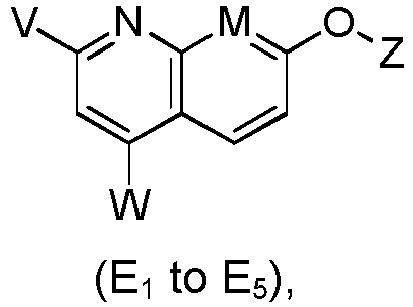
whereinin E1 V is -H, M is CH, and W and Z are as defined herein, in E2 V is -OH, M is CH, and W and Z are as defined herein, in E3 V is -Cl, M is CH, and W and Z are as defined herein, in E4 V is -H, M is N, and W and Z are as defined herein, and in E5 V is C1-C4-alkyl, M is N, and W and Z are as defined herein - - The compounds of formulae E1 to E5 correspond to the compounds of the general formula (I) as defined above, wherein V is -H, -OH, -CI or C1-C4-alkyl.
- In another aspect, the invention relates to a process for manufacturing a compound of the general formula (I) as defined herein, wherein V is -F, comprising the step of:
(b) reacting a compound of formula (E1)
in E1 V is -H, M is CH, and W and Z are as defined herein, 
V is -F, M is CH, and W and Z are as defined herein. - In another aspect, the invention relates to a compound of the general formula (I) as defined herein for use as a medicament.
- In another aspect, the invention relates to a compound of the general formula (I) as defined herein for use in the treatment of cancer, preferably melanoma, metastatic melanoma, pancreatic cancer, hepatocellular carcinoma, lymphoma, acute myeloid leukemia, breast cancer, glioblastoma, cervical cancer, renal cancer, colorectal cancer or ovarian cancer.
- In another aspect, the invention relates to a compound of the general formula (I) as defined herein for use in a method for treating cancer in simultaneous, alternating or subsequent combination with another cancer therapy, preferably selected from chemotherapy, immunotherapy, hormone therapy, stem cell transplantation therapy, radiation therapy or surgery.
- "4-, 5- or 6-membered saturated heterocycle" represents an unsubstituted or substituted saturated or partially unsaturated ring system containing 4, 5 or 6 ring atoms and containing in addition to C ring atoms one to three nitrogen atoms and/or an oxygen or sulfur atom or one or two oxygen and/or sulfur atoms. In a particular preferred embodiment the "4-, 5- or 6-membered saturated heterocycle" represents an unsubstituted or substituted saturated ring system containing 4, 5 or 6 ring atoms and containing in addition to C ring atoms one to three nitrogen atoms and/or an oxygen or sulfur atom or one or two oxygen and/or sulfur atoms. In a preferred embodiment, the 4-, 5- or 6-membered saturated heterocycle contains in addition to C ring atoms one N and optionally one additional heteroatom. The additional heteroatoms are preferably selected from O, N or S. Especially preferred are heterocycles with only one N as a heteroatom. Preferably, these substituted heterocycles are single or twofold substituted. The 4-, 5- or 6-membered saturated heterocycle may be substituted at the C atom(s), at the O atom(s), at the N atom(s) or at the S atom(s). Examples of 4-, 5- or 6-membered saturated heterocycle include, but are not limited to oxetanyl, azetidinyl, 1,3-diazetinyl, thietanyl, 2-tetrahydrofuranyl, 3-tetrahydrofuranyl, 2-tetrahydrothienyl, 3-tetrahydrothienyl, 2-pyrrolidinyl, 3-pyrrolidinyl, 3-isoxazolidinyl, 4-isoxazolidinyl, 5-isoxazolidinyl, 3-isothiazolidinyl, 4-isothiazolidinyl, 5-isothiazolidinyl, 3-pyrazolidinyl, 4-pyrazolidinyl, 5-pyrazolidinyl, 2-oxazolidinyl, 4-oxazolidinyl, 5-oxazolidinyl, 2-thiazolidinyl, 4-thiazolidinyl, 5-thiazolidinyl, 2-imidazolidinyl, 4-imidazolidinyl, 1,2,4-oxadiazolidin-3-yl, 1,2,4-oxadiazolidin-5-yl, 1,2,4-thiadiazolidin-3-yl, 1,2,4-thiadiazolidin-5-yl, 1,2,4-triazolidin-3-yl, 1,3,4-oxadiazolidin-2-yl, 1,3,4-thiadiazolidin-2-yl, 1,3,4-triazolidin-2-yl, 2,3-dihydrofur-2-yl, 2,3-dihydrofur-3-yl, 2,4-dihydrofur-2-yl, 2,4-dihydrofur-3-yl, 2,3-dihydrothien-2-yl, 2,3-dihydrothien-3-yl, 2,4-dihydrothien-2-yl, 2,4-dihydrothien-3-yl, 2,3-pyrrolin-2-yl, 2,3-pyrrolin-3-yl, 2,4-pyrrolin-2-yl, 2,4-pyrrolin-3-yl, 2,3-isoxazolin-3-yl, 3,4-isoxazolin-3-yl, 4,5-isoxazolin-3-yl, 2,3-isoxazolin-4-yl, 3,4-isoxazolin-4-yl, 4,5-isoxazolin-4-yl, 2,3-isoxazolin-5-yl, 3,4-isoxazolin-5-yl, 4,5-isoxazolin-5-yl, 2,3-isothiazolin-3-yl, 3,4-isothiazolin-3-yl, 4,5-isothiazolin-3-yl, 2,3-isothiazolin-4-yl, 3,4-isothiazolin-4-yl, 4,5-isothiazolin-4-yl, 2,3-isothiazolin-5-yl, 3,4-isothiazolin-5-yl, 4,5-isothiazolin-5-yl, 2,3-dihydropyrazol-1-yl, 2,3-dihydropyrazol-2-yl, 2,3-dihydropyrazol-3-yl, 2,3-dihydropyrazol-4-yl, 2,3-dihydropyrazol-5-yl, 3,4-dihydropyrazol-1-yl, 3,4-dihydropyrazol-3-yl, 3,4-dihydropyrazol-4-yl, 3,4-dihydropyrazol-5-yl, 4,5-dihydropyrazol-1-yl, 4,5-dihydropyrazol-3-yl, 4,5-dihydropyrazol-4-yl, 4,5-dihydropyrazol-5-yl, 2,3-dihydrooxazol-2-yl, 2,3-dihydrooxazol-3-yl, 2,3-dihydrooxazol-4-yl, 2,3-dihydrooxazol-5-yl, 3,4-dihydrooxazol-2-yl, 3,4-dihydrooxazol-3-yl, 3,4-dihydrooxazol-4-yl, 3,4-dihydrooxazol-5-yl, 3,4-dihydrooxazol-2-yl, 3,4-dihydrooxazol-3-yl, 3,4-dihydrooxazol-4-yl, 2-piperidinyl, 3-piperidinyl, 4-piperidinyl, 1-piperazinyl, 2-piperazinyl, 1,3-dioxan-5-yl, 2-tetrahydropyranyl, 4-tetrahydropyranyl, 2-tetrahydrothienyl, 3-tetrahydropyridazinyl, 4-tetrahydropyridazinyl, 2-tetrahydropyrimidinyl, 4-tetrahydropyrimidinyl, 5-tetrahydropyrimidinyl, 2-tetrahydropyrazinyl, 1,3,5-tetrahydrotriazin-2-yl and 1,2,4-tetrahydrotriazin-3-yl, preferably piperidin-1-yl, 2-piperidinyl, 3-piperidinyl, 4-piperidinyl, 1-piperazinyl, 2-piperazinyl, 2-pyrrolidinyl, and 3-pyrrolidinyl, tetrahydropyridinyl, preferably 1,2,3,6-tetrahydropyridinyl, 1,2-oxazinyl, 1,3-oxazinyl, and 1,4-oxazinyl, preferably tetrahydro-1,4-oxazinyl.
- The 4-, 5- or 6-membered saturated heterocycle may be each optionally and independently substituted with one or more, preferably with one of the following residues:
- -C1-C4-alkyl;
- -C(OH)-cyclopropyl; -C(COOH)-cyclopropyl;
- unsubstituted or substituted -C3-C6-cycloalkyl; preferably hydroxycyclopropyl or carboxycyclopropyl;
- -(CH2)o-COOR7 with
- R7 is -H, -C1-C8-alkyl,
- preferably -H, -methyl, -ethyl, -isopropyl, or -tert-butyl, and
- o = 0, 1 or 2; preferably 0 or 1;
-

- -(CH2)pCONR8R9 with
- R8 and R9 independently are -H, -OH , -CN, or -C1-C4-alkyl, preferably -H or -methyl, and
- p = 0, 1 or 2; preferably 0 or 1;
- -C(CH3)2-COOH;
- =O or -OH;
- -CO-cyclopropyl;
- -CO-(C1-C4-alkyl), preferably -CO-CH2-CH3;
- -CO-(CH2)q-NR12R13 with R12 and R13 independently are -H, -C1-C4-alkyl or -CN, preferably
- -CO-(CH2)q-NH2, more preferably -CO-CH2-NH2, and
- q = 0, 1 or 2, preferably 0 or 1;
- -NH2, -NH-CO-cyclopropyl, -NH-CO-CH2-Cl, -NH-CO-CH2-CH3, - NH-CO-NH-C(CH3)3, -NH-SO2CH3, -NH-CO-phenyl, -NOH-CO-CH3;
- -F; -CN;
- R14 and R15 forming a pyrrolidinone ring, a cyclopropanecarboxlic acid ring, an oxetane ring or a -CH2- group;
or - -(CH2)rSO2NR10R11 with R10 and R11 independently are -H, or -C1-C4-alkyl, preferably -H or - methyl, preferably -CH2SO2NH2 and
r = 0, 1 or 2, preferably 0 or 1. - "C1-C4-alkyl" and "C1-C8-alkyl" represent a straight-chain or branched-chain alkyl group with 1 to 4 or 1 to 8 carbon atoms, respectively. Examples of straight-chain and branched groups include, but are not limited to, methyl, ethyl, propyl, isopropyl, butyl, isobutyl, and tert-butyl, preferably methyl and ethyl and most preferred methyl.
"halogen-C1-C4-alkyl" represents a straight-chain or branched alkyl group having 1 to 4 carbon atoms (as mentioned above), it being possible for the hydrogen atoms in these groups to be partly or completely replaced by halogen atoms as mentioned above, e.g. C1-C2-halogenalkyl such as chloromethyl, dichloromethyl, trichloromethyl, fluoromethyl, difluoromethyl, trifluoromethyl, chlorofluoromethyl, dichlorofluoromethyl, chlorodifluoromethyl, 1-fluoroethyl, 2-fluoroethyl, 2,2-difluoroethyl, 2,2,2-trifluoroethyl, 2-chloro-2fluoroethyl, 2-chloro-2,2-difluoroethyl, 2,2-dichloro-2-fluoroethyl, 2,2,2-trichloroethyl and pentafluoroethyl; - "C1-C4-alkoxy" represents a straight-chain or branched-chain alkyl group with 1 to 4 or 1 to 8 carbon atoms, which are bonded to the structure via an oxygen atom (-O).
- "C1-C4-dialkylamino" represents two straight-chain or branched alkyl groups having 1 to 4 carbon atoms (as mentioned above), which are independent of one another and are bonded to the structure via a nitrogen atom (-N:);
- "C2-C6-alkenyl" represents a straight-chain or branched-chain hydrocarbon group comprising an olefinic bond in any desired position and 2 to 6, more preferably 2 to 4 carbon atoms. Examples of alkenyl groups include, but are not limited to, ethenyl, 1-propenyl, 2-propenyl, isopropenyl, 1-butenyl, 2-butenyl, 3-butenyl and isobutenyl. Preferred examples are 1-propenyl and 2-propenyl.
- "C2-C6-alkynyl" represents a straight-chain or branched hydrocarbon group having 2 to 6 carbon atoms and a triple bond in any desired position, such as ethynyl, 1-propynyl, 2-propynyl, 1-butynyl, 2-butynyl, 3-butynyl, 1-methyl-2-propynyl, 1-pentynyl, 2-pentynyl, 3-pentynyl, 4-pentynyl, 1-methyl-2-butynyl, 1-methyl-3-butynyl, 2-methyl-3-butynyl, 3-methyl-1-butynyl, 1,1-dimethyl-2-propynyl, 1-ethyl-2-propynyl, 1-hexynyl, 2-hexynyl, 3-hexynyl, 4-hexynyl, 5-hexynyl, 1-methyl-2-pentynyl, 1-methyl-3-pentynyl, 1-methyl-4-pentynyl, 2-methyl-3-pentynyl, 2-methyl-4-pentynyl, 3-methyl-1-pentynyl, 3-methyl-4-pentynyl, 4-methyl-1-pentynyl, 4-methyl-2-pentynyl, 1,1-dimethyl-2-butynyl, 1,1-dimethyl-3-butynyl, 1,2-dimethyl-3-butynyl, 2,2-dimethyl-3-butynyl, 3,3-dimethyl-1-butynyl, 1-ethyl-2-butynyl, 1-ethyl-3-butynyl, 2-ethyl-3-butynyl and 1-ethyl-1-methyl-2-propynyl;
- "C3-C6-cycloalkyl" represents a carbocyclic saturated ring system having 3 to 6 carbon atoms. Examples of C3-C6-cycloalkyl include, but are not limited cyclopropyl, cyclobutyl, cyclopentyl, or cyclohexyl, preferably cyclopentyl and cyclohexyl.
- "Substitution" or "substituted" represents one or more substituents commonly known in the art, or as specifically defined herein.
- "Halogen" represents fluoro, chloro, bromo or iodo, preferably represents fluoro and chloro.
- "Stereoisomer(s)" as it relates to a compound of formula (I) and to its intermediate compounds represents any possible enantiomers or diastereomers of a compound of formula (I) and its salts or hydrates. In particular, the term "stereoisomer" means a single compound or a mixture of two or more compounds, wherein at least one chiral center is predominantly present in one definite isomeric form, in particular the S-enantiomer, the R-enantiomer and the racemate of a compound of formula (I). It is also possible that two or more stereogenic centers are predominantly present in one definite isomeric form of a derivative of a compound of formula (I) as defined above. In the sense of the present invention, "predominantly" has the meaning of at least 60%, preferably at least 70%, particularly preferably at least 80%, most preferably at least 90%. According to the present invention, also stereoisomers of a compound of formula (I) may be present as a salt or a hydrate.
- The terms stereoisomer, salt, and hydrate may also be used in conjunction with one another. For example, a stereoisomer of a compound of formula (I) may have a salt. Combinations of these terms are considered to be within the scope of the invention.
- References to compounds by number refer to the compounds as defined in Table 6.
- Technical terms are used by their common sense. If a specific meaning is conveyed to certain terms, definitions of terms will be given in the following in the context of which the terms are used.
- The below mentioned general or preferred residue definitions apply both to the end products of the formula (I) and to specific embodiments thereof, and also, correspondingly, to the starting materials or intermediates of formulae (A) to (J) required in each case for the preparation. These residue definitions can be combined with one another at will, i.e. including combinations between the given preferred residues. Further, individual definitions may not apply.
- As indicated above, there is a need for alternative novel compounds, which inhibit POLRMT and are suitable for use as a medicament. In particular, a need exists for novel compounds that can be used in the treatment of cancer, preferably melanoma, metastatic melanoma, pancreatic cancer, hepatocellular carcinoma, lymphoma, acute myeloid leukemia, breast cancer, glioblastoma, cervical cancer, renal cancer, colorectal cancer or ovarian cancer. Further, POLRMT inhibitors are of interest, which can be used in a method for treating cancer in simultaneous, alternating or subsequent combination with another cancer therapy.
- A problem of the present invention was therefore to provide novel alternative compounds having the above-mentioned desired characteristics.
- In one aspect, according to the present invention there is provided a compound of the general formula (I)

- R
- is -H or -C1-C4-alkyl, preferably -H, -methyl or -ethyl, in particular -methyl;
- R1
- is -H, or -methyl, preferably -H;
- M
- is CH or N, preferably -H;
- V
- is -H, -OH, -Cl, -F, or -C1-C4-alkyl, preferably -H, -Cl, -F, or -methyl;
- W
- is

R2 and R3 are identical or different and are- -H, -C1-C4-alkyl, halogen-C1-C4-alkyl, -C1-C4-alkoxy, -C1-C4-dialkylamino, -C2-C6-alkenyl, -C2-C6-alkynyl, -halogen, -CN or -CO-NH2;
- preferably-H, -C1-C4-alkyl, -CF3, -OCH3, -NHCH3, -N(CH3)2, -F, or -Cl;
X is -halogen, or -CN, preferably -F, with n = 1 or 2 or m = 1;
n = 0, 1, or 2, preferably 0 or 1;
m = 0 or 1; - Y
- is -NR4R5 with
R4 is -H, or -C1-C4-alkyl, preferably -H or -methyl, and
R5 is -H, -C1-C4-alkyl, an unsubstituted or substituted -C3-C6-cycloalkyl, preferably -methyl, -ethyl, -isopropyl, or -cyclopropyl; or- an unsubstituted or substituted pyridine residue; or
- an unsubstituted or substituted phenyl residue, preferably substituted at the para position;
- Y
- is -NR4R5 with N, R4 and R5 forming an unsubstituted or substituted 4-, 5- or 6-membered saturated heterocycle, preferably an unsubstituted or substituted azetidine, an unsubstituted or substituted piperidine, an unsubstituted or substituted pyrrolidine, anunsubstituted or substituted piperazine, or an unsubstituted or substituted tetrahydropyridine residue; or
- Y
- is -OR6, with R6 is -H or -C1-C4-alkyl, preferably -H, -methyl, -ethyl, -isopropyl or-tert-butyl ,
- In a preferred embodiment, the compounds of the general formula (I) are quinoline derivatives, wherein M is CH.
- Further included are pharmaceutically or veterinary acceptable salts, hydrates or solvates of the compounds of formula (I) or its intermediate compounds disclosed herein. A pharmaceutically or veterinary acceptable salt can be an anionic counterion, e.g. an acetate, a bromide, camsylate, chloride, citrate, formate, fumarate, lactate, maleate, mesylate, nitrate, oxalate, phosphate, sulfate, tartrate, thiocyanate, or tosylate, or preferably a cationic counterion, e.g. ammonium, arginine, diethylamine, ethylenediamine, piperazine, potassium, sodium, or any other counter ion disclosed in Haynes et al. (2005). Some compounds of the invention contain one or more chiral centers due to the presence of asymmetric carbon atoms, which gives rise to stereoisomers, for example todiastereoisomers with R or S stereochemistry at each chiral center. The invention includes all such stereoisomers and diastereoisomers and mixtures thereof.
- As shown in the Examples, the inventors have now surprisingly and unexpectedly found that the compounds of general formula (I) or a pharmaceutically or veterinary acceptable salt, hydrate or solvate thereof, are useful as mitochondrial RNA polymerase (POLRMT) inhibitors and thereby inhibit mitochondrial DNA replication and/or mitochondrial transcription.
- In the following, preferred groups of the compounds of general formula (I) of the present invention are described. The preferred groups constitute preferred embodiments of the compounds of general formula (I). Any combinations of the embodiments of the compounds of general formula (I) of the invention described herein are considered to be within the scope of the invention.
- In a preferred embodiment, the invention relates to a compound of the general formula (I) as defined above, wherein
- W
- is

R3 is -H, -C1-C4-alkyl, -CF3, -OCH3, -NHCH3, -N(CH3)2,acetylenyl, -F, -Cl, -Br, CN, or CONH2;
R2 is -H, -methyl, -ethyl, isopropyl, -CF3, -F, or -CI; and
X is -F with n = 1; preferably, wherein X is at the para-position of the phenyl ring; or
n = 0. - This preferred group of compounds corresponds to the compounds of formula (IA)

- A particular preferred group of compounds are compounds of formula (IB)

- In one embodiment, the invention relates to a compound of the general formula (I) as defined above, wherein
- W
- is

R2 is -H, -methyl, -ethyl, isopropyl, -Cl, preferably -methyl or -Cl;
R3 is -H, -methyl or -Cl; preferably R2 is -methyl and R3 is -methyl, or R2 is -CI and R3 is -CI; and
n = 0. - In one embodiment, the invention relates to a compound of the general formula (I) as defined above, wherein
- R
- is -C1-C4-alkyl, preferably -methyl or -ethyl, in particular -methyl;
- R1
- is -H, or -methyl, preferably -H;
- M
- is -CH;
- V
- is as defined above;
- W
- is

R2 is -H, methyl, -halogen, -CN, preferably -methyl, -Cl, or -Br;
R3 is -H, C1-C4-alkyl, -halogen, -CN, preferably -methyl, -ethyl, -Cl, or -Br;
X is -halogen, or -CN, preferably -Cl, -Br, or -F, in particular -F, with n = 1 or 2;
n = 0, 1, or 2, preferably 0 or 1;
m = 0 or 1; - Y
- is -NR4R5 with
- R4
- is -H, or -C1-C4-alkyl, preferably -H or -methyl, and
- R5
- is -C1-C4-alkyl or -C3-C6-cycloalkyl, preferably -methyl, -ethyl, -isopropyl, or -cyclopropyl; or an unsubstituted or substituted pyridine residue; or an unsubstituted or substituted phenyl residue, preferably substituted at the para position;
- Y
- is -NR4R5 with N, R4 and R5 form an unsubstituted or substituted 5- or 6-membered saturated heterocycle; or
- Y
- is -OR6, with R6 is -H or -C1-C4-alkyl, preferably -H, -methyl, -ethyl, or -isopropyl.
- In one embodiment, the invention relates to a compound of the general formula (I) of the group as defined above, wherein
W is
- In one embodiment, the invention relates to a compound of the general formula (I) of the group as defined above, wherein
W is
- In one embodiment, the invention relates to a compound of the general formula (I) of the group as defined above, wherein
W is
- In another embodiment, the invention relates to a compound of the general formula (I) as defined above, wherein
- Y
- is -NR4R5, with
R4 is -H, or -C1-C4-alkyl, preferably -H or -methyl, and
R5 is -H, -C1-C4-alkyl, unsubstituted -C3-C4-cycloalkyl, -C4-cycloalkyl substituted with -COO-CH3, preferably -methyl, -ethyl, -isopropyl, or -cyclopropyl. - A specific subset of the compounds of the invention as defined above are the compounds of the general formula (I), wherein Y is -NR4R5, with
- R4
- is -H, or -C1-C4-alkyl, preferably -H or -methyl, and
- R5
- is an unsubstituted pyridine residue; or
- an unsubstituted or substituted phenyl residue, preferably unsubstituted or substituted with one substituent at the para position,
- wherein the substituents are selected from the group consisting of: -C1-C4-alkyl, -C1-C4-alkoxy, -(CH2)2-OH, -COOH, or - CO-O-(C1-C4-alkyl).
- Another specific subset of the compounds of the invention are the compounds of the general formula (I), wherein
- Y
- is -NR4R5 with
N, R4 and R5 forming an unsubstituted or substituted azetidine residue, an unsubstituted or substituted piperidine residue, an unsubstituted or substituted piperazine residue, an unsubstituted or substituted pyrrolidine residue, an unsubstituted or substituted morpholine residue, or an unsubstituted or substituted tetrahydropyridine residue, preferably an unsubstituted or substituted piperidine residue, each optionally and independently substituted with one or more, preferably with one of the following residues:- -C1-C4-alkyl;
- -C(OH)-cyclopropyl); -C(COOH)-cyclopropyl;
- unsubstituted or substituted -C3-C6-cycloalkyl; preferably hydroxycyclopropyl, or carboxycyclopropyl;
- -(CH2)o-COOR7 with
- R7 is -H, -C1-C8-alkyl,
- preferably -H, -methyl, -ethyl, -isopropyl, or -tert-butyl, and
- o = 0, 1 or 2; preferably 0 or 1;
-

- -(CH2)pCONR8R9 with
- R8 and R9 independently are -H, -OH, -CN or -C1-C4-alkyl, preferably -H or -methyl, and
- p = 0, 1 or 2; preferably 0 or 1;
- -C(CH3)2-COOH;
- =O or -OH;
- -CO-cyclopropyl;
- -CO-(C1-C4-alkyl), preferably -CO-CH2-CH3;
- -CO-(CH2)q-NR12R13 with R12 and R13 independently are -H, -C1-C4-alkyl or -CN, preferably -CO-(CH2)q-NH2, more preferably -CO-CH2-NH2, and
q = 0, 1 or 2, preferably 0 or 1; - -NH2, -NH-CO-cyclopropyl, -NH-CO-CH2-Cl, -NH-CO-CH2-CH3, -NH-CO-NH-C(CH3)3, -NH-SO2CH3, -NH-CO-phenyl, -NOH-CO-CH3;
- -F; -CN;
- R14 and R15 forming a pyrrolidinone ring, a cyclopropanecarboxlic acid ring, an oxetane ring, or a -CH2- group; or
- -(CH2)rSO2NR10R11 with R10 and R11 independently are -H, or-C1-C4-alkyl, preferably
- -H or -methyl, preferably -CH2SO2NH2 and
r = 0, 1 or 2, preferably 0 or 1.
- Another specific subset of the compounds of the invention are the compounds of the general formula (I), wherein N, R4 and R5 together form an unsubstituted or substituted azetidine, piperidine, piperazine or pyrrolidine residue, each optionally and independently substituted with one or more, preferably with one of the following residues:
- -C1-C4-alkyl, unsubstituted or substituted -C3-C6-cycloalkyl;
- -(CH2)o-COOR7 with
- R7 is -H, -C1-C8-alkyl,
- preferably -H, -methyl, -ethyl, -isopropyl, or -tert-butyl, and
- o = 0, 1 or 2; preferably 0 or 1;
-

- -(CH2)pCONR8R9 with
- R8 and R9 independently are -H, -OH, -CN, or -C1-C4-alkyl, preferably -H or -methyl, and
- p = 0, 1 or 2; preferably 0 or 1;
- =O or -OH;
- -CO-cyclopropyl;
- -CO-(C1-C4-alkyl), preferably -CO-CH2-CH3;
- -CO-(CH2)q-NR12R13 with R12 and R13 independently are -H, -C1-C4-alkyl or -CN, preferably -CO-(CH2)q-NH2, more preferably -CO-CH2-NH2, and
q = 0, 1 or 2, preferably 0 or 1; - -NH2, -NH-CO-cyclopropyl, -NH-CO-CH2-Cl, -NH-CO-CH2-CH3, -NH-SO2CH3, -NH-CO-phenyl, -NOH-CO-CH3;
- -F; -CN;
- R14 and Reforming a pyrrolidinone ring or a cyclopropanecarboxlic acid ring; or
- -(CH2)rSO2NR10R11 with R10 and R11 independently are -H, or -C1-C4-alkyl, preferably -H or -methyl, preferably -CH2SO2NH2 and
r = 0, 1 or 2, preferably 0 or 1. - Another specific subset of the compounds of the invention are the compounds of the general formula (I), wherein
- Y
- is -NR4R5 with
N, R4 and R5 forming an unsubstituted or substituted piperidine reside, an unsubstituted or substituted piperazine residue, an unsubstituted or substituted pyrrolidine residue, or an unsubstituted or substituted morpholine residue, each optionally and independently substituted with one or more, preferably with one of the following residues:- -C1-C4-alkyl;
- -C(OH)cyclopropyl;
- hydroxycyclopropyl or carboxycyclopropyl;
- -(CH2)o-COOR7 with
- R7 is -H, -C1-C8-alkyl, preferably -H, -methyl, -ethyl, -isopropyl, or -tert-butyl,
and - o = 0 1 or 2;

- -(CH2)pCONR8R9 with
- R8 and R9 independently are -H, -OH, -CN, -methyl, or -tert-butyl and p = 0;
- -C(CH3)2-COOH;
- =O or -OH;
- -CO-cyclopropyl;
- -CO-CH2-CH3;
- -CO-tert-butyl;
- -NH2,
- -CO-CH2-NH2;
- -NH-CO-CH2-CH3, -NH-CO-NH-C(CH3)3, -NH-SO2CH3, -NH-CO-phenyl, -NOH-CO-CH3;
- -CN;
- R14 and R15 forming a pyrrolidinone ring, a cyclopropanecarboxlic acid ring, an oxetane ring; or a -CH2- group;
- -SO2NR10R11 with R10 and R11 independently are -H or -methyl; or
- -CH2SO2NH2.
- Another specific subset of the compounds of the invention are the compounds of the general formula (I), wherein N, R4 and R5 together form an unsubstituted or substituted piperidine or pyrrolidine residue, each optionally and independently substituted with one or more, preferably with one, of the following residues:
- -(CH2)o-COOR7 with
- R7 is -H, -C1-C8-alkyl, preferably -H, -methyl, -ethyl, -isopropyl, or -tert-butyl,
and - o = 0, 1 or 2;

- -(CH2)pCONR8R9 with
- R8 and R9 independently are -H, -OH, -CN, -methyl or -tert-butyl, and p = 0;
- =O or -OH;
- -CO-cyclopropyl;
- -CO-CH2-CH3;
- -CO-tert-butyl;
- -NH2
- -CO-CH2-NH2;
- -CN;
- -SO2NR10R11 with R10 and R11 independently are -H or -methyl; or
- -CH2SO2NH2.
- A group of preferred compounds have an unsubstituted piperidine, i.e. N, R4 and R5 together form an unsubstituted piperidine residue.
- A more preferred subgroup are compounds having a substituted piperidine residue substituted with -COOH or with -CH2COOH.
- Another more preferred subgroup are compounds having a unsubstituted or substituted piperidine residue, optionally and indpendently substituted with one or more of the the following residues:
-COOH, -COOCH3, -COOC2H5, -CH2COOH, -C(CH3)2-COOH, -CH2COOCH3, -CH2COOCH2CH3, -CONH2, -CONHCH3, -CON(CH3)2,-SO2NH2 or-CH2SO2NH2. - In another embodiment, the invention relates to a compound of the general formula (I) as defined herein, wherein
- V
- is -H, -Cl, -F, or-methyl, preferably -H.
- In another embodiment, the invention relates to a compound of the general formula (I) as defined herein, wherein
- R
- is -methyl, preferably -(R)-methyl; and
- R1
- is -H.
- In a preferred embodiment, R is -(R)-methyl.
- In another embodiment, the invention relates to a compound of the general formula (I) as defined herein, wherein X is at the para-position of the phenyl ring.
- Another specific subset of the compounds are the compounds of the general formula (I), wherein
- R
- is -methyl, preferably (R)-methyl;
- R1
- is -H;
- M
- is CH;
- V
- is -H, -Cl, -F or -methyl;
- W
- is

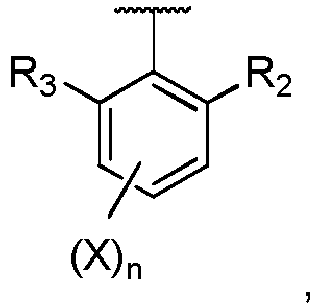
R2 and R3 are -methyl, or -CI with n = 1 or 2, preferably di-methyl or di-choro with n = 2;
X is -F with m = 1;
n = 0, 1, or 2
m = 0, or 1; - Y
- is -NR4R5
with
R4 is -H, and - R5
- is a pyridine residue,
- a phenyl residue substituted at the para position, preferably substituted with -(CH2)2OH, or
- a cyclopropyl or isopropyl residue;
- A more preferred subgroup are compounds, wherein R is (R)-methyl, having a substituted piperidine residue substituted with -COOH or with -CH2COOH.
- Another more preferred subgroup of this specific subset are compounds, wherein R is (R)-methyl, having a substituted piperidine residue substituted with -(CH2)o-COOR7 with R7 is -H, -C1-C8-alkyl,
- preferably -H, -methyl, -ethyl, -isopropyl, or -tert-butyl, and
- o = 0, 1 or 2; preferably 0 or 1;
- Another specific subset of compounds are compounds, wherein
- R
- is (R)-methyl;
- R1
- is -H;
- M
- is CH;
- V
- is -H, -Cl, -F or -methyl;
- W
- is


R2 and R3 are -methyl, or -Cl, with n = 1 or 2, preferably di-methyl or di-choro with n = 2;
X is -F with m = 1;
n = 0, 1, or 2
m = 0, or 1; - Y
- is -NR4R5
- -COOH, -COOCH3, -COOC2H5, -CH2COOH, -C(CH3)2-COOH, -CH2COOCH3, -CH2COOCH2CH3, -CONH2, -CONHCH3, -CON(CH3)2,-SO2NH2 or -CH2SO2NH2,
- preferably -COOH, -CH2COOH, or -CONHCH3 ,
- more preferably (S)-COOH, (R)-COOH, (S)-CH2COOH or (R)-CH2COOH,
- especially a piperidine residue substituted with (S)-COOH, (R)-COOH, (S)-CH2COOH or (R)-CH2COOH.
- A more preferred group of compounds are compounds having a substituted piperidine residue where R is (R)-methyl, W is

- Another specific subset of compounds are compounds, wherein the piperidine residue or the pyrrolidine residue is substituted at the 3-position.
- A more preferred group of compounds of this subset are compounds having any substituted piperidine or pyrrolidine residue as defined above at the 3-position. More preferred within this group are compounds having a substituted piperidine residue substituted with -(CH2)o-COOR7 with R7 is -H, -C1-C8-alkyl, preferably -H, -methyl, -ethyl, -isopropyl, or -tert-butyl, and o = 0, 1 or 2; preferably 0 or 1;at the 3-position with -COOR7 or -CH2COOR7 at the 3-position, or with R7 is -isopropyl, -tert-butyl, or with -CONHCH3 or -CH2CONHCH3 at the 3-position.
- Another group of preferred compounds of this subset have a substituted piperidine residue substituted with -(CH2)rSO2NR10R11 with R10 and R11 independently are -H, or -C1-C4-alkyl, preferably -H or -methyl, preferably -CH2SO2NH2 and r = 0, 1 or 2, preferably 0 or 1 at the 3-position with R10 is -H and R11 is -H or-methyl.
- A more preferred group of compounds are compounds having a substituted piperidine residue, wherein the substitution is at the 3-position, where R is methyl, R1 is -H, V = -H, R2 and R3 is -methyl or -Cl, n, m = 0 or 1, X is -F with n = 1 or m = 1 and wherein the piperidine is substituted with one of the following residues: -COOH, -COOCH3, -COOC2H5, -CH2COOH, - CH2COOCH3, -CH2COOCH2CH3, -CONH2, -CONHCH3, -CON(CH3)2, -CH2CONHCH3, SO2NH2, -SO2NHCH3, or -CN. An even more preferred subgroup of this group are compounds where R is (R)-methyl
- A more preferred subgroup are compounds having a substituted piperidine residue substituted with -COOH at the 3-position and wherein R is (R)-methyl, or with -CH2COOH at the 3-position and wherein R is (R)-methyl.
- Another more preferred subgroup are compounds, wherein R is (R)-methyl and having a substituted piperidine residue, wherein the substitution is at the 3-position, substituted with -(CH2)o-COOR7 with R7 is -H, -C1-C8-alkyl, preferably -H, -methyl, -ethyl, -isopropyl, or -tert-butyl, and o = 0, 1 or 2; preferably 0 or 1, preferably with R7 is -isopropyl, -tert-butyl, , or with -CONHCH3 or -CH2CONHCH3.
- An especially preferred group of compounds are compounds having a substituted piperidine residue where R is (R)-methyl, R1 is -H, V = -H, R2 and R3 is -methyl, or -Cl, W is

- A more preferred subgroup are compounds, wherein X is at the para-position, having a substituted piperidine residue substituted with -COOH at the 3-position and wherein R is (R)-methyl or with -CH2COOH at the 3-position and wherein R is (R)-methyl.
- Another more preferred subgroup are compounds, wherein X is at the para-position, wherein R is (R)-methyl and having a substituted piperidine residue substituted with -(CH2)o-COOR7 with R7 is -H, -C1-C8-alkyl, preferably -H, -methyl, -ethyl, -isopropyl, or -tert-butyl, and o = 0, 1 or 2; preferably 0 or 1at the 3-position, with R7 is -isopropyl, -tert-butyl, n, or -CONHCH3 or -CH2CONHCH3 at the 3-position.
- An especially preferred group of compounds are compounds, wherein X is at the para-position, having a substituted piperidine residue where R is (R)-methyl, R1 is -H, W is

- Another specific subset of compounds concerns compounds selected from
- (3S)-1-[(2R)-2-[[4-(o-tolyl)-7-quinolyl]oxy]propanoyl]piperidine-3-carboxylic acid,
- (3S)-1-[(2R)-2-[[4-(2,6-dimethylphenyl)-7-quinolyl]oxy]propanoyl]piperidine-3-carboxylic acid,
- 2-[(3R)-1-[(2R)-2-[[4-(2,6-dimethylphenyl)-7-quinolyl]oxy]propanoyl]-3-piperidyl]acetic acid,
- ethyl (3S)-1-[(2R)-2-[[4-(2,6-dimethylphenyl)-7-quinolyl]oxy]propanoyl]piperidine-3-carboxylate,
- 2-[(3S)-1-[(2R)-2-[[4-(2,6-dimethylphenyl)-7-quinolyl]oxy]propanoyl]-3-piperidyl]acetic acid,
- ethyl 2-[(3R)-1-[(2R)-2-[[4-(2,6-dimethylphenyl)-7-quinolyl]oxy]propanoyl]-3-piperidyl]acetate,
- (3R)-1-[(2R)-2-[[4-(2-chlorophenyl)-7-quinolyl]oxy]propanoyl]piperidine-3-carboxylic acid,
- ethyl 2-[(3R)-1-[(2R)-2-[[4-(o-tolyl)-7-quinolyl]oxy]propanoyl]-3-piperidyl]acetate,
- (3S)-1-[(2R)-2-[[4-(2-chlorophenyl)-7-quinolyl]oxy]propanoyl]piperidine-3-carboxylic acid,
- (3S)-1-[(2R)-2-[[4-(2-chloro-4-fluoro-phenyl)-7-quinolyl]oxy]propanoyl]piperidine-3-carboxylic acid,
- (2R)-2-[[4-(2-chloro-4-fluoro-phenyl)-7-quinolyl]oxy]-1-[(3S)-3-(2H-tetrazol-5-yl)-1-piperidyl]propan-1-one,
- (3S)-1-[(2R)-2-[[4-(2-chlorophenyl)-2-fluoro-7-quinolyl]oxy]propanoyl]piperidine-3-carboxylic acid,
- 2-[(3R)-1-[(2R)-2-[[4-(o-tolyl)-7-quinolyl]oxy]propanoyl]-3-piperidyl]acetic acid,
- ethyl (3S)-1-[(2R)-2-[[4-(o-tolyl)-7-quinolyl]oxy]propanoyl]piperidine-3-carboxylate,
- ethyl 2-[(3R)-1-[(2R)-2-[[4-(2-chloro-4-fluoro-phenyl)-7-quinolyl]oxy]propanoyl]-3-piperidyl]acetate,
- 2-[(3R)-1-[(2R)-2-[[4-(2-chlorophenyl)-7-quinolyl]oxy]propanoyl]-3-piperidyl]acetic acid
- (3R)-1-[(2R)-2-[[4-(2-chloro-4-fluoro-phenyl)-7-quinolyl]oxy]propanoyl]piperidine-3-carboxylic acid,
- 2-[(3R)-1-[(2R)-2-[[4-(2-chloro-4-fluoro-phenyl)-7-quinolyl]oxy]propanoyl]-3-piperidyl]acetic acid,
- (3S)-1-[(2R)-2-[[4-(2-chloro-4-fluoro-phenyl)-7-quinolyl]oxy]propanoyl]pyrrolidine-3-carboxylic acid,
- (2R)-2-[[4-(2-chloro-4-fluoro-phenyl)-7-quinolyl]oxy]-1-(1-piperidyl)propan-1-one,
- 2-[(3R)-1-[(2R)-2-[[2-chloro-4-(o-tolyl)-7-quinolyl]oxy]propanoyl]-3-piperidyl]acetic acid,
- 2-[(3S)-1-[(2R)-2-[[4-(2-chloro-4-fluoro-phenyl)-7-quinolyl]oxy]propanoyl]-3-piperidyl]acetic acid,
- rac-(3S)-1-[2-[[4-(2-chlorophenyl)-7-quinolyl]oxy]propanoyl]piperidine-3-carboxylic acid,
- 1-[(2R)-2-[[4-(2-chloro-4-fluoro-phenyl)-7-quinolyl]oxy]propanoyl]piperidine-4-carboxylic acid,
- (3S)-1-[rac-(2R)-2-[[2-chloro-4-(o-tolyl)-7-quinolyl]oxy]propanoyl]piperidine-3-carboxylic acid,
- 3-[[(2R)-2-[[4-(2-chloro-4-fluoro-phenyl)-7-quinolyl]oxy]propanoyl]amino]benzoic acid
- ethyl (3S)-1-[(2R)-2-[[4-(2-chloro-4-fluoro-phenyl)-7-quinolyl]oxy]propanoyl]piperidine-3-carboxylate,
- (2R)-2-[[4-(2-chloro-4-fluoro-phenyl)-7-quinolyl]oxy]-1-(4-propanoylpiperazin-1-yl)propan-1-one,
- tert-butyl (2R)-2-[[4-(2-chlorophenyl)-7-quinolyl]oxy]propanoate,
- (3S)-1-[(2R)-2-[[4-(2-chloro-4-fluoro-phenyl)-7-quinolyl]oxy]propanoyl]piperidine-3-carbonitrile,
- (3S)-1-[(2R)-2-[[2-methyl-4-(o-tolyl)-7-quinolyl]oxy]propanoyl]piperidine-3-carboxylic acid,
- (2R)-2-[[4-(2-chloro-4-fluoro-phenyl)-7-quinolyl]oxy]-N-isopropyl-N-methyl-propanamide,
- 1-[rac-(2R)-2-[[4-(2-chloro-4-fluoro-phenyl)-7-quinolyl]oxy]propanoyl]piperidine-3-sulfonamide,
- (3S)-1-[(2R)-2-[[2-chloro-4-(2-chlorophenyl)-7-quinolyl]oxy]propanoyl]piperidine-3-carboxylic acid,
- (3S)-1-[(2R)-2-[[2-chloro-4-(4-fluoro-2-methyl-phenyl)-7-quinolyl]oxy]propanoyl]piperidine-3-carboxylic acid,
- isopropyl (2R)-2-[[4-(2-chlorophenyl)-7-quinolyl]oxy]propanoate,
- methyl 2-[(3R)-1-[(2R)-2-[[4-(2-chloro-4-fluoro-phenyl)-7-quinolyl]oxy]propanoyl]pyrrolidin-3-yl]acetate,
- (3S)-1-[(2R)-2-[[4-(2-chloro-4-fluoro-phenyl)-7-quinolyl]oxy]propanoyl]-N-methylpiperidine-3-carboxamide,
- 2-[(3S)-1-[(2R)-2-[[4-(2-chloro-4-fluoro-phenyl)-7-quinolyl]oxy]propanoyl]pyrrolidin-3-yl]acetic acid,
- 2-[(3R)-1-[(2R)-2-[[4-(2-chloro-4-fluoro-phenyl)-7-quinolyl]oxy]propanoyl]pyrrolidin-3-yl]acetic acid,
- ethyl (3S)-1-[(2R)-2-[[4-(2-chlorophenyl)-2-fluoro-7-quinolyl]oxy]propanoyl]piperidine-3-carboxylate,
- (2R)-2-[[4-(2-chloro-4-fluoro-phenyl)-7-quinolyl]oxy]-1-pyrrolidin-1-yl-propan-1-one,
- (2R)-2-[[2-chloro-4-(o-tolyl)-7-quinolyl]oxy]propanoic acid,
- (2R)-2-[[4-(2-chloro-4-fluoro-phenyl)-7-quinolyl]oxy]propanoic acid,
- (2R)-2-[[4-(2-chloro-4-fluoro-phenyl)-7-quinolyl]oxy]-N,N-dimethyl-propanamide,
- rac-(3S)-1-[2-[[4-(2-chlorophenyl)-7-quinolyl]oxy]acetyl]piperidine-3-carboxylic acid,
- (2R)-N-tert-butyl-2-[[4-(2-chloro-4-fluoro-phenyl)-7-quinolyl]oxy]propanamide,
- (2R)-2-[[4-(2-chlorophenyl)-7-quinolyl]oxy]-N-isopropyl-propanamide,
- ethyl 2-[(3R)-1-[(2R)-2-[[2-methyl-4-(o-tolyl)-7-quinolyl]oxy]propanoyl]-3-piperidyl]acetate,
- ethyl (2R)-2-[[4-(2-chlorophenyl)-7-quinolyl]oxy]propanoate,
- ethyl 4-[[(2R)-2-[[4-(2-chloro-4-fluoro-phenyl)-7-quinolyl]oxy]propanoyl]amino]benzoate,
- (3S)-1-[(2R)-2-[[2-chloro-4-(o-tolyl)-7-quinolyl]oxy]propanoyl]piperidine-3-carboxamide,
- (2R)-2-[[4-(2-chlorophenyl)-7-quinolyl]oxy]-1-(1-piperidyl)propan-1-one,
- methyl 3-[[(2R)-2-[[4-(2-chloro-4-fluoro-phenyl)-7-quinolyl]oxy]propanoyl]amino]cyclobutanecarboxylate,
- (2R)-2-[[4-(2-chloro-4-fluoro-phenyl)-7-quinolyl]oxy]-1-piperazin-1-yl-propan-1-one,
- 2-[(3R)-1-[(2R)-2-[[2-chloro-4-(2-chloro-4-fluoro-phenyl)-7-quinolyl]oxy]propanoyl]-3-piperidyl]acetic acid,
- 2-[(3R)-1-[(2R)-2-[[2-chloro-4-(4-fluoro-2-methyl-phenyl)-7-quinolyl]oxy]propanoyl]-3-piperidyl]acetic acid,
- ethyl 1-[(2R)-2-[[4-(2-chloro-4-fluoro-phenyl)-7-quinolyl]oxy]propanoyl]piperidine-4-carboxylate,
- (3S)-1-[(2R)-2-[[4-(2-chloro-4-fluoro-phenyl)-2-methyl-7-quinolyl]oxy]propanoyl]piperidine-3-carboxylic acid,
- 4-[[(2R)-2-[[4-(2-chloro-4-fluoro-phenyl)-7-quinolyl]oxy]propanoyl]amino]benzoic acid,
- (2R)-2-[[4-(2-chloro-4-fluoro-phenyl)-7-quinolyl]oxy]-N-isopropyl-propanamide,
- (3S)-1-[2-[[5-(2-chloro-4-fluoro-phenyl)-1,8-naphthyridin-2-yl]oxy]propanoyl]piperidine-3-carboxylic acid,
- 4-[(2R)-2-[[4-(2-chloro-4-fluoro-phenyl)-7-quinolyl]oxy]propanoyl]piperazin-2-one,
- (3S)-1-[(2R)-2-[[2-chloro-4-(2-chloro-4-fluoro-phenyl)-7-quinolyl]oxy]propanoyl]piperidine-3-carboxylic acid,
- 2-[(3R)-1-[(2R)-2-[[4-(2-chloro-3-fluoro-phenyl)-7-quinolyl]oxy]propanoyl]-3-piperidyl]acetic acid,
- (3S)-1-[(2R)-2-[(4-phenyl-7-quinolyl)oxy]propanoyl]piperidine-3-carboxylic acid,
- methyl 2-[(3S)-1-[(2R)-2-[[4-(2-chloro-4-fluoro-phenyl)-7-quinolyl]oxy]propanoyl]pyrrolidin-3-yl]acetate,
- 2-[(3R)-1-[(2R)-2-[[2-chloro-4-(2-chlorophenyl)-7-quinolyl]oxy]propanoyl]-3-piperidyl]-N-methyl-acetamide,
- 2-[(3R)-1-[(2R)-2-[[2-methyl-4-(o-tolyl)-7-quinolyl]oxy]propanoyl]-3-piperidyl]acetic acid,
- (2R)-2-[[2-chloro-4-(2-chlorophenyl)-7-quinolyl]oxy]-1-[4-(cyclopropanecarbonyl)piperazin-1-yl]propan-1-one,
- methyl (3R)-1-[(2R)-2-[[4-(2-chloro-4-fluoro-phenyl)-7-quinolyl]oxy]propanoyl]piperidine-3-carboxylate,
- (2R)-2-[[2-chloro-4-(2-chlorophenyl)-7-quinolyl]oxy]-1-(4-propanoylpiperazin-1-yl)propan-1-one,
- tert-butyl (2R)-2-[[2-chloro-4-(o-tolyl)-7-quinolyl]oxy]propanoate,
- ethyl 2-[(3R)-1-[(2R)-2-[[4-(2-chloro-4-fluoro-phenyl)-2-methyl-7-quinolyl]oxy]propanoyl]-3-piperidyl]acetate,
- ethyl (3S)-1-[(2R)-2-[[4-(2-chloro-4-fluoro-phenyl)-7-quinolyl]oxy]propanoyl]pyrrolidine-3-carboxylate,
- (3S)-1-[(2R)-2-[[2-chloro-4-(2-chlorophenyl)-7-quinolyl]oxy]propanoyl]piperidine-3-carboxamide,
- (2R)-2-[[4-(2-chloro-4-fluoro-phenyl)-7-quinolyl]oxy]-N-cyclopropyl-propanamide,
- (3S)-1-[(2S)-2-[[4-(2-chlorophenyl)-7-quinolyl]oxy]propanoyl]piperidine-3-carboxylic acid,
- 2-[(3R)-1-[(2R)-2-[[4-(2-methyl-3-thienyl)-7-quinolyl]oxy]propanoyl]-3-piperidyl]acetic acid,
- 2-[rac-(3R)-1-[2-[[5-(2-chloro-4-fluoro-phenyl)-1,8-naphthyridin-2-yl]oxy]propanoyl]-3-piperidyl]acetic acid,
- (3S)-1-[(2R)-2-[[2-chloro-4-(2-chloro-4-fluoro-phenyl)-7-quinolyl]oxy]propanoyl]piperidine-3-carboxamide,
- isopropyl 2-[[4-(2-chlorophenyl)-7-quinolyl]oxy]acetate,
- (3S)-1-[(2R)-2-[[4-(4-fluoro-2,6-dimethyl-phenyl)-7-quinolyl]oxy]propanoyl]piperidine-3-carboxylic acid,
- (2R)-1-[4-(2-aminoacetyl)piperazin-1-yl]-2-[[2-chloro-4-(2-chlorophenyl)-7-quinolyl]oxy]propan-1-one,
- 2-[[4-(2-chlorophenyl)-7-quinolyl]oxy]-N, N-dimethyl-propanamide,
- ethyl (3S)-1-[2-[[4-(2-chlorophenyl)-7-quinolyl]oxy]acetyl]piperidine-3-carboxylate,
- (2R)-2-[[4-(2-chlorophenyl)-7-quinolyl]oxy]-N,N-dimethyl-propanamide,
- ethyl 2-[(3S)-1-[(2R)-2-[[4-(2-chloro-4-fluoro-phenyl)-7-quinolyl]oxy]propanoyl]-3-piperidyl]acetate,
- (2R)-2-[[4-(2-chlorophenyl)-2-fluoro-7-quinolyl]oxy]propanoic acid,
- (2R)-2-[[2-chloro-4-(2-chloro-4-fluoro-phenyl)-7-quinolyl]oxy]propanoic acid,
- ethyl 2-[(3R)-1-[(2R)-2-[[2-chloro-4-(2-chlorophenyl)-7-quinolyl]oxy]propanoyl]-3-piperidyl]acetate,
- ethyl 2-[(3R)-1-[(2R)-2-[[2-chloro-4-(2-chloro-4-fluoro-phenyl)-7-quinolyl]oxy]propanoyl]-3-piperidyl]acetate,
- ethyl (3S)-1-[(2R)-2-[[2-chloro-4-(4-fluoro-2-methyl-phenyl)-7-quinolyl]oxy]propanoyl]piperidine-3-carboxylate,
- (2R)-2-[[4-(2-chloro-4-fluoro-phenyl)-7-quinolyl]oxy]-N-(4-pyridyl)propanamide,
- (3S)-1-[(2R)-2-[[2-chloro-4-(2-chlorophenyl)-7-quinolyl]oxy]propanoyl]-N-methylpiperidine-3-carboxamide,
- methyl 3-[[(2R)-2-[[2-chloro-4-(2-chlorophenyl)-7-quinolyl]oxy]propanoyl]amino]cyclobutanecarboxylate,
- 2-[(3R)-1-[(2R)-2-[[2-chloro-4-(2-chloro-4-fluoro-phenyl)-7-quinolyl]oxy]propanoyl]-3-piperidyl]-N-methyl-acetamide,
- (2R)-2-[[2-chloro-4-(2-chlorophenyl)-7-quinolyl]oxy]-1-(1-piperidyl)propan-1-one,
- (3S)-1-[(2R)-2-[[2-chloro-4-(2-chlorophenyl)-7-quinolyl]oxy]propanoyl]-N,N-dimethyl-piperidine-3-carboxamide,
- 2-[(3R)-1-[(2R)-2-[[4-(2-chloro-4-fluoro-phenyl)-2-methyl-7-quinolyl]oxy]propanoyl]-3-piperidyl]acetic acid,
- (3R)-1-[(2S)-2-[[4-(2-chlorophenyl)-7-quinolyl]oxy]propanoyl]piperidine-3-carboxylic acid,
- (2R)-2-[[4-(2-chlorophenyl)-7-quinolyl]oxy]propanoic acid,
- (2R)-2-[[2-chloro-4-(2-chlorophenyl)-7-quinolyl]oxy]-1-piperazin-1-yl-propan-1-one,
- (3S)-N-methyl-1-[(2R)-2-[[2-chloro-4-(2-chloro-4-fluoro-phenyl)-7-quinolyl]oxy]propanoyl]piperidine-3-carboxamide,
- 2-[[4-(o-tolyl)-7-quinolyl]oxy]acetamide,
- (2R)-2-[[2-chloro-4-(2-chloro-4-fluoro-phenyl)-7-quinolyl]oxy]-1-(1-piperidyl)propan-1-one,
- ethyl 3-[[(2R)-2-[[4-(2-chloro-4-fluoro-phenyl)-7-quinolyl]oxy]propanoyl]amino]benzoate,
- 2-[[5-(2-chloro-4-fluoro-phenyl)-1,8-naphthyridin-2-yl]oxy]-N-isopropyl-propanamide,
- 2-[(3R)-1-[(2R)-2-[[4-(2-fluorophenyl)-7-quinolyl]oxy]propanoyl]-3-piperidyl]acetic acid,
- tert-butyl (3S)-1-[(2R)-2-[[2-methyl-4-(o-tolyl)-7-quinolyl]oxy]propanoyl]piperidine-3-carboxylate,
- 2-[1-[(2R)-2-[[4-(2-chlorophenyl)-7-quinolyl]oxy]propanoyl]-4-piperidyl]acetic acid,
- (3S)-1-[rac-(2R)-2-[[4-(2,6-dimethylphenyl)-2-methyl-7-quinolyl]oxy]propanoyl]piperidine-3-sulfonamide,
- (3R)-1-[rac-(2R)-2-[[4-(2,6-dimethylphenyl)-2-methyl-7-quinolyl]oxy]propanoyl]piperidine-3-sulfonamide,
- (3R)-1-[rac-(2R)-2-[[4-(2,6-dimethylphenyl)-2-methyl-7-quinolyl]oxy]propanoyl]piperidine-3-sulfonamide,
- (3R)-1-[(2R)-2-[[4-(2-chloro-4-fluoro-phenyl)-2-methyl-7-quinolyl]oxy]propanoyl]piperidine-3-sulfonamide,
- (3S)-1-[(2R)-2-[[4-(2-chloro-4-fluoro-phenyl)-7-quinolyl]oxy]propanoyl]piperidine-3-sulfonamide,
- (3R)-1-[(2R)-2-[[4-(2-chloro-4-fluoro-phenyl)-7-quinolyl]oxy]propanoyl]piperidine-3-sulfonamide,
- 3-[1-[(2R)-2-[[4-(2-chlorophenyl)-7-quinolyl]oxy]propanoyl]-4-piperidyl]propanoic acid,
- 1-[rac-(2R)-2-[[4-(2,6-dimethylphenyl)-7-quinolyl]oxy]propanoyl]piperidine-3-sulfonamide,
- 2-[(3R)-1-[(2R)-2-[[4-(2,6-dichlorophenyl)-7-quinolyl]oxy]propanoyl]-3-piperidyl]acetic acid,
- 2-[(3R)-1-[(2R)-2-[[4-(2-ethylphenyl)-7-quinolyl]oxy]propanoyl]-3-piperidyl]acetic acid,
- 2-[(3R)-1-[(2R)-2-[[4-(2-isopropylphenyl)-7-quinolyl]oxy]propanoyl]-3-piperidyl]acetic acid,
- [1-[rac-(2R)-2-[[4-(2-chloro-4-fluoro-phenyl)-7-quinolyl]oxy]propanoyl]-3-piperidyl]methanesulfonamide,
- 2-[(3R)-1-[(2R)-2-[[4-(2,6-dimethylphenyl)-2-methyl-7-quinolyl]oxy]propanoyl]-3-piperidyl]acetic acid,
- (2R)-2-[[4-(2-chloro-4-fluoro-phenyl)-7-quinolyl]oxy]-N-[4-(2-hydroxyethyl)phenyl]propanamide,
- (3S)-1-[(2R)-2-[[5-(2-chloro-4-fluoro-phenyl)-1,8-naphthyridin-2-yl]oxy]propanoyl]piperidine-3-carboxylic acid,
- (3S)-1-[(2S)-2-[[5-(2-chloro-4-fluoro-phenyl)-1,8-naphthyridin-2-yl]oxy]propanoyl]piperidine-3-carboxylic acid,
- (3S)-1-[(2S)-2-[[5-(2-chloro-4-fluoro-phenyl)-1,8-naphthyridin-2-yl]oxy]propanoyl]piperidine-3-carboxylic acid,
- 2-[(3R)-1-[(2R)-2-[[5-(2-chloro-4-fluoro-phenyl)-1,8-naphthyridin-2-yl]oxy]propanoyl]-3-piperidyl]acetic acid,
- 2-[(3R)-1-[(2R)-2-[[5-(2-chloro-4-fluoro-phenyl)-1,8-naphthyridin-2-yl]oxy]propanoyl]-3-piperidyl]acetic acid,
- (3S)-1-[(2R)-2-[[4-(2,6-dichlorophenyl)-7-quinolyl]oxy]propanoyl]piperidine-3-carboxylic acid,
- (2R)-2-[[4-(2-chloro-4-fluoro-phenyl)-7-quinolyl]oxy]-N-(2-pyridyl)propanamide,
- (2R)-2-[[4-(2-chloro-4-fluoro-phenyl)-7-quinolyl]oxy]-N-ethyl-propanamide,
- (3S)-1-[(2R)-2-[[4-(2,6-dichloro-4-fluoro-phenyl)-7-quinolyl]oxy]propanoyl]piperidine-3-carboxylic acid
- 2-[(3R)-1-[(2R)-2-[[4-(4-methyl-3-thienyl)-7-quinolyl]oxy]propanoyl]-3-piperidyl]acetic acid
- 2-[(3R)-1-[(2R)-2-[[4-(3-methyl-2-thienyl)-7-quinolyl]oxy]propanoyl]-3-piperidyl]acetic acid
- 2-[(3R)-1-[(2R)-2-[[4-(2-methoxyphenyl)-7-quinolyl]oxy]propanoyl]-3-piperidyl]acetic acid
- 2-[(3R)-1-[(2R)-2-[[4-[2-(trifluoromethyl)phenyl]-7-quinolyl]oxy]propanoyl]-3-piperidyl]acetic acid,
- 2-[(3R)-1-[(2R)-2-[[4-[2-(trifluoromethoxy)phenyl]-7-quinolyl]oxy]propanoyl]-3-piperidyl]acetic acid,
- (3S)-1-[(2R)-2-[[4-(2,6-dimethylphenyl)-7-quinolyl]oxy]propanoyl]piperidine-3-sulfonamide,
- 2-[(3R)-1-[2-[[4-(2-chlorophenyl)-7-quinolyl]oxy]-2-methyl-propanoyl]-3-piperidyl]acetic acid,
- 2-[rac-(3R)-1-[2-[[4-(2-chlorophenyl)-7-quinolyl]oxy]butanoyl]-3-piperidyl]acetic acid,
- 2-[(3R)-1-[(2R)-2-[[4-(2-chloro-6-methyl-phenyl)-7-quinolyl]oxy]propanoyl]-3-piperidyl]acetic acid,
- 2-[(3R)-1-[(2R)-2-[[4-(2-bromophenyl)-7-quinolyl]oxy]propanoyl]-3-piperidyl]acetic acid,
- 2-[(3R)-1-[(2R)-2-[[4-(2-cyanophenyl)-7-quinolyl]oxy]propanoyl]-3-piperidyl]acetic acid,
- 2-[(3R)-1-[(2R)-2-[[4-(2-ethynylphenyl)-7-quinolyl]oxy]propanoyl]-3-piperidyl]acetic acid,
- 2-[(3R)-1-[(2R)-2-[[4-[2-(dimethylamino)phenyl]-7-quinolyl]oxy]propanoyl]-3-piperidyl]acetic acid,
- 2-[(3R)-1-[(2R)-2-[[4-(2-carbamoylphenyl)-7-quinolyl]oxy]propanoyl]-3-piperidyl]acetic acid,
- 2-[(3R)-1-[(2R)-2-[[4-(2,6-difluorophenyl)-7-quinolyl]oxy]propanoyl]-3-piperidyl]acetic acid,
- 2-[(3R)-1-[(2R)-2-[[4-(2,4-dimethyl-3-thienyl)-7-quinolyl]oxy]propanoyl]-3-piperidyl]acetic acid,
- 2-[(3R)-1-[(2R)-2-[[4-[2-chloro-6-(trifluoromethyl)phenyl]-7-quinolyl]oxy]propanoyl]-3-piperidyl]acetic acid,
- 2-[(3R)-1-[(2R)-2-[[4-(2-bromo-6-chloro-phenyl)-7-quinolyl]oxy]propanoyl]-3-piperidyl]acetic acid,
- 2-[(3R)-1-[(2R)-2-[[4-[2,6-bis(trifluoromethyl)phenyl]-7-quinolyl]oxy]propanoyl]-3-piperidyl]acetic acid,
- 2-[(3R)-1-[(2R)-2-[[4-(2-chloro-6-methoxy-phenyl)-7-quinolyl]oxy]propanoyl]-3-piperidyl]acetic acid,
- 2-[(3R)-1-[(2R)-2-[[4-(2,6-diisopropylphenyl)-7-quinolyl]oxy]propanoyl]-3-piperidyl]acetic acid,
- (2R)-1-[(3R)-3-amino-1-piperidyl]-2-[[4-(2,6-dimethylphenyl)-7-quinolyl]oxy]propan-1-one,
- (2R)-1-[(3S)-3-amino-1-piperidyl]-2-[[4-(2,6-dimethylphenyl)-7-quinolyl]oxy]propan-1-one,
- N-[(3S)-1-[(2R)-2-[[4-(2,6-dimethylphenyl)-7-quinolyl]oxy]propanoyl]-3-piperidyl]propanamide,
- N-tert-butyl-4-[(2R)-2-[[4-(2,6-dimethylphenyl)-7-quinolyl]oxy]propanoyl]piperazine-1-carboxamide,
- (2R)-2-[[4-(2,6-dimethylphenyl)-7-quinolyl]oxy]-1-[3-(1-hydroxycyclopropyl)-1-piperidyl]propan-1-one,
- 8-[(2R)-2-[[4-(2,6-dimethylphenyl)-7-quinolyl]oxy]propanoyl]-2,8-diazaspiro[4.5]decan-1-one,
- (2R)-2-[[4-(2,6-dimethylphenyl)-7-quinolyl]oxy]-1-(3,5-dimethylpiperazin-1-yl)propan-1-one,
- N-[(3S)-1-[(2R)-2-[[4-(2,6-dimethylphenyl)-7-quinolyl]oxy]propanoyl]-3-piperidyl]-N-hydroxy-acetamide,
- 1-[4-[(2R)-2-[[4-(2,6-dimethylphenyl)-7-quinolyl]oxy]propanoyl]piperazin-1-yl]-2,2-dimethyl-propan-1-one,
- N-[(3S)-1-[(2R)-2-[[4-(2,6-dimethylphenyl)-7-quinolyl]oxy]propanoyl]-3-piperidyl]methanesulfonamide,
- N-[(3S)-1-[(2R)-2-[[4-(2,6-dimethylphenyl)-7-quinolyl]oxy]propanoyl]-3-piperidyl]benzamide,
- (3S)-N-cyano-1-[(2R)-2-[[4-(2,6-dimethylphenyl)-7-quinolyl]oxy]propanoyl]piperidine-3-carboxamide,
- (3S)-1-[(2R)-2-[[4-(2,6-dimethylphenyl)-7-quinolyl]oxy]propanoyl]piperidine-3-carbohydroxamic acid,
- 2-[(3R)-1-[(2R)-2-[[4-(2,6-dimethylphenyl)-7-quinolyl]oxy]propanoyl]-3-piperidyl]ethanehydroxamic acid,
- (2R)-1-(3-aminoazetidin-1-yl)-2-[[4-(2,6-dimethylphenyl)-7-quinolyl]oxy]propan-1-one,
- (2R)-2-[[4-(2,6-dimethylphenyl)-7-quinolyl]oxy]-1-[3-(1H-tetrazol-5-yl)azetidin-1-yl]propan-1-one,
- 3-hydroxy-1-[(2R)-2-[[4-(2,6-dimethylphenyl)-7-quinolyl]oxy]propanoyl]piperidine-3-carboxylic acid,
- 5-[(2R)-2-[[4-(2,6-dimethylphenyl)-7-quinolyl]oxy]propanoyl]-5-azaspiro[2.5]octane-2-carboxylic acid,
- (3R)-1-[(2R)-2-[[4-(2,6-dimethylphenyl)-7-quinolyl]oxy]propanoyl]piperidine-3-sulfonamide,
- (3S)-1-[(2R)-2-[[4-(2,6-dichloro-4-fluoro-phenyl)-7-quinolyl]oxy]propanoyl]-3-methylpiperidine-3-carboxylic acid,
- 5-[rac-(2R)-2-[[4-(4-fluoro-2,6-dimethyl-phenyl)-7-quinolyl]oxy]propanoyl]-5-azaspiro[2.5]octane-2-carboxylic acid,
- (3R)-1-[(2R)-2-[[4-(4-fluoro-2,6-dimethyl-phenyl)-7-quinolyl]oxy]propanoyl]-3-methylpiperidine-3-carboxylic acid,
- (2R)-2-[[4-(4-fluoro-2,6-dimethyl-phenyl)-7-quinolyl]oxy]-1-[(2S)-2-methyl-1-piperidyl]propan-1-one,
- 5-[rac-(2R)-2-[[4-(2,6-dichloro-4-fluoro-phenyl)-7-quinolyl]oxy]propanoyl]-5-azaspiro[2.5]octane-2-carboxylic acid,
- (2R)-2-[[4-(4-fluoro-2,6-dimethyl-phenyl)-7-quinolyl]oxy]-1-morpholino-propan-1-one,
- (2R)-2-[[4-(4-fluoro-2,6-dimethyl-phenyl)-7-quinolyl]oxy]-1-(2-oxa-7-azaspiro[3.5]nonan-7-yl)propan-1-one,
- rac-(2R)-2-[[4-(4-fluoro-2,6-dimethyl-phenyl)-7-quinolyl]oxy]-1-[3-(1-hydroxycyclopropyl)-1-piperidyl]propan-1-one,
- 8-[(2R)-2-[[4-(4-fluoro-2,6-dimethyl-phenyl)-7-quinolyl]oxy]propanoyl]-2,8-diazaspiro[4.5]decan-1-one,
- 1- [1-[rac-(2R)-2-[[4-(4-fluoro-2,6-dimethyl-phenyl)-7-quinolyl]oxy]propanoyl]-3-piperidyl]cyclopropanecarboxylic acid,
- 2- [(3R)-1-[(2R)-2-[[4-(4-fluoro-2,6-dimethyl-phenyl)-7-quinolyl]oxy]propanoyl]-3-piperidyl]acetic acid,
- (3S)-1-[(2R)-2-[[4-(4-fluoro-2,6-dimethyl-phenyl)-7-quinolyl]oxy]propanoyl]-3-methylpiperidine-3-carboxylic acid,
- N-[(3S)-1-[(2R)-2-[[4-(4-fluoro-2,6-dimethyl-phenyl)-7-quinolyl]oxy]propanoyl]-3-piperidyl]-N-hydroxy-acetamide,
- 2-methyl-2-[1-[rac-(2R)-2-[[4-(4-fluoro-2,6-dimethyl-phenyl)-7-quinolyl]oxy]propanoyl]-3-piperidyl]propanoic acid,
- (2R)-2-[[4-(4-fluoro-2,6-dimethyl-phenyl)-7-quinolyl]oxy]-1-[(2R)-2-methyl-1-piperidyl]propan-1-one,
- (3R)-1-[(2R)-2-[[4-(2,6-dichloro-4-fluoro-phenyl)-7-quinolyl]oxy]propanoyl]-3-methylpiperidine-3-carboxylic acid,
- (3S)-1-[(2R)-2-[[4-(2-chloro-4-fluoro-phenyl)-7-quinolyl]oxy]propanoyl]-3-methyl-piperidine-3-carboxylic acid,
- [1-[rac-(2R)-2-[[4-(2,6-dimethylphenyl)-7-quinolyl]oxy]propanoyl]-3-piperidyl]methanesulfonamide,
- rac-(2R)-1-(2,6-dimethyl-1-piperidyl)-2-[[4-(4-fluoro-2,6-dimethyl-phenyl)-7-quinolyl]oxy]propan-1-one,
- 2-[(3R)-1-[(2R)-2-[[4-(2,6-dichloro-4-fluoro-phenyl)-7-quinolyl]oxy]propanoyl]-3-piperidyl]acetic acid,
- 5-[rac-(2R)-2-[[4-(2-chloro-4-fluoro-phenyl)-7-quinolyl]oxy]propanoyl]-5-azaspiro[2.5]octane-2-carboxylic acid,
- 1-[1-[rac-(2R)-2-[[4-(2-chloro-4-fluoro-phenyl)-7-quinolyl]oxy]propanoyl]-3-piperidyl]cyclopropanecarboxylic acid,
- 2-methyl-2-[1-[rac-(2R)-2-[[4-(2,6-dichloro-4-fluoro-phenyl)-7-quinolyl]oxy]propanoyl]-3-piperidyl]propanoic acid,
- 1- [1-[rac-(2R)-2-[[4-(2,6-dichloro-4-fluoro-phenyl)-7-quinolyl]oxy]propanoyl]-3-piperidyl]cyclopropanecarboxylic acid,
- 2-methyl-2-[1-[rac-(2R)-2-[[4-(2-chloro-4-fluoro-phenyl)-7-quinolyl]oxy]propanoyl]-3-piperidyl]propanoic acid,
- (3R)-1-[(2R)-2-[[4-(2-chloro-4-fluoro-phenyl)-7-quinolyl]oxy]propanoyl]-3-methyl-piperidine-3-carboxylic acid,
- (2R)-2-[[4-(2,6-dichloro-4-fluoro-phenyl)-7-quinolyl]oxy]-1-[(2S)-2-methyl-1-piperidyl]propan-1-one,
- rac-(2R)-2-[[4-(2-chloro-4-fluoro-phenyl)-7-quinolyl]oxy]-1-(2-methyl-1-piperidyl)propan-1-one,
- (2R)-2-[[4-(2,6-dichloro-4-fluoro-phenyl)-7-quinolyl]oxy]-1-morpholino-propan-1-one,
- 8-[(2R)-2-[[4-(2,6-dichloro-4-fluoro-phenyl)-7-quinolyl]oxy]propanoyl]-2,8-diazaspiro[4.5]decan-1-one,
- rac-(2R)-2-[[4-(2,6-dichloro-4-fluoro-phenyl)-7-quinolyl]oxy]-1-[3-(1-hydroxycyclopropyl)-1-piperidyl]propan-1-one,
- (2R)-2-[[4-(2,6-dichloro-4-fluoro-phenyl)-7-quinolyl]oxy]-1-[(2R)-2-methyl-1-piperidyl]propan-1-one,
- 8-[(2R)-2-[[4-(2-chloro-4-fluoro-phenyl)-7-quinolyl]oxy]propanoyl]-2,8-diazaspiro[4.5]decan-1-one,
- (2R)-2-[[4-(2-chloro-4-fluoro-phenyl)-7-quinolyl]oxy]-1-morpholino-propan-1-one,
- (2R)-2-[[4-(2-chloro-4-fluoro-phenyl)-7-quinolyl]oxy]-1-[3-(1-hydroxycyclopropyl)-1-piperidyl]propan-1-one,
- (2R)-2-[[4-(2,6-dichloro-4-fluoro-phenyl)-7-quinolyl]oxy]-1-(2-oxa-7-azaspiro[3.5]nonan-7-yl)propan-1-one,
- N-hydroxy-N-[rac-(3S)-1-[rac-(2R)-2-[[4-(2-chloro-4-fluoro-phenyl)-7-quinolyl]oxy]propanoyl]-3-piperidyl]acetamide,
- (2R)-2-[[4-(2-chloro-4-fluoro-phenyl)-7-quinolyl]oxy]-1-(2-oxa-7-azaspiro[3.5]nonan-7-yl)propan-1-one,
- (2R)-2-[[4-(2-chloro-4-fluoro-phenyl)-7-quinolyl]oxy]-1-(2,6-dimethyl-1-piperidyl)propan-1-one,
- (2R)-2-[[4-(2-chloro-4-fluoro-phenyl)-7-quinolyl]oxy]-1-(2-oxa-8-azaspiro[3.5]nonan-8-yl)propan-1-one,
- (2R)-2-[[4-(2-chloro-4-fluoro-phenyl)-7-quinolyl]oxy]-1-(2-oxa-7-azaspiro[3.4]octan-7-yl)propan-1-one,
- 1-tert-butyl-3-[(3R)-1-[(2R)-2-[[4-(2-chloro-4-fluoro-phenyl)-7-quinolyl]oxy]propanoyl]pyrrolidin-3-yl]urea,
- (2R)-2-[[4-(2-chloro-4-fluoro-phenyl)-7-quinolyl]oxy]-1-(3,3,5,5-tetramethylpiperazin-1-yl)propan-1-one,
- (2R)-2-[[4-(2-chloro-4-fluoro-phenyl)-7-quinolyl]oxy]-1-(3,5-dimethylpiperazin-1-yl)propan-1-one,
- (2R)-2-[[4-(2-chloro-4-fluoro-phenyl)-7-quinolyl]oxy]-1-[(1 R)-2,5-diazabicyclo[2.2.1]heptan-2-yl]propan-1-one,
- (2R)-2-[[4-(2-chloro-4-fluoro-phenyl)-7-quinolyl]oxy]-1-(2-oxa-6-azaspiro[3.3]heptan-6-yl)propan-1-one,
- 1-[(2R)-2-[[4-(2-chloro-4-fluoro-phenyl)-7-quinolyl]oxy]propanoyl]-3,6-dihydro-2H-pyridine-5-carboxylic acid,
- 2-[(3R)-1-[(2R)-2-[[5-(2,6-dichloro-4-fluoro-phenyl)-1,8-naphthyridin-2-yl]oxy]propanoyl]-3-piperidyl]acetic acid, and
- 2-[(3R)-1-[(2R)-2-[[5-(4-fluoro-2,6-dimethyl-phenyl)-1,8-naphthyridin-2-yl]oxy]propanoyl]-3-piperidyl]acetic acid,
- In another aspect, the present invention provides novel processes for the preparation of compounds of the general formula (I) and novel processes for the preparation of their intermediates.
- In one aspect, the invention relates to a process for manufacturing a compound of the general formula (I) as defined herein, wherein V is -H, -OH, -Cl, or -C1-C4-alkyl comprising the step of:
(a) alkylating a compound of formulae (D1 to D5)
in D1 V is -H, M is CH, and W is as defined herein, in D2 V is -OH, M is CH, and W is as defined herein, in D3 V is -Cl, M is CH, and W is as defined herein, in D4 V is -H, M is N, and W is as defined herein, and in D5 V is -C1-C4-alkyl, M is CH, and W is as defined herein,
with an alkylating agent, preferably with an alkylating agent of the formula Z-OH or Z-Br, wherein Z is the group
wherein R, R1 and Y are as defined herein,
to obtain a compound of formulae (E1 to E5)
whereinin E1 V is -H, M is CH, and W and Z are as defined herein, in E2 V is -OH, M is CH, and W and Z are as defined herein, in E3 V is -Cl, M is CH, and W and Z are as defined herein, in E4 V is -H, M is N, and W and Z are as defined herein, and in E4 V is -C1-C4-alkyl, M is N, and W and Z are as defined herein - The compounds of formulae E1 to E5 correspond to the compounds of the general formula (I) as defined herein, wherein V is -H, -CI or -C1-C4-alkyl.
- The compounds of formulae (D1 to D5) used as a starting material in process step (a) are either commercially available, can be prepared in similar manners as described in literature procedures or according to the processes of the invention described below and in the specific Examples.
- In process step (a), alkylation of the compounds of formulae (D1 to D5) can be carried out with any suitable alkylating agent under standard alkylation conditions, e.g. with an alkylbromide (Z-Br), or with an alcohol (Z-OH) according to the Mitsunobu reaction (Mitsunobu and Yamada, 1967). Process step (a) can be carried out according to standard prcedures known in the art, whereas further guidance can be found in
reaction Scheme 2 and in the Examples disclosed below. - In one aspect, the invention relates to a compound of formulae (D1 to D5) as defined above.
- In another aspect, the invention relates to a process for manufacturing a compound of the general formula (I) as defined above, wherein V is -F, comprising the step of:
(b) reacting a compound of formula (E1)
in E1 V is -H, M is CH, and W and Z are as defined herein, - with a fluorinating agent, preferably with AgF2, to obtain a compound of formula E6

- wherein
V is -F, M is CH, and W and Z are as defined herein - In process step (b), fluorination of the compounds of formulae (E1 to E3) can be carried out with any suitable fluorinating agent under standard conditions, e.g. with AgF2. Process step (b) can be carried out according to standard procedures known in the art, whereas further guidance can be found in
reaction Scheme 2, inFigure 3 , and in the Examples disclosed below. - The compounds of formulae (D1 and D2) may be prepared according to process steps (c), (d) and (f), or according to process steps (e) and (f), respectively, as described below.
- Thus, in another aspect, the present invention relates to a process for the preparation of a compound of the general formulae (D1 and D2)

in D1 V is -H, M is CH, and W is as defined herein, in D2 V is -OH, M is CH, and W is as defined herein,
(c) reacting a compound of formula (A)
- wherein W is as defined above,
- with 3-methoxy-aniline to obtain a compound of formula (B)

- wherein W is as defined above, and
- wherein V is H and M is CH
- with W-B(OH)2,
- to obtain a compound of formula (C1)

- wherein V is -H, M is CH, and W is as defined above;
and - The compounds of formulae (A) (β-ketoesters) and the 3-methoxy-anilines used as a starting material in process step (c) are commercially available or can be obtained by standard procedures known to the skilled person.
- The desired quinoline compounds of formula (C2) may be prepared from the corresponding β-ketoesters of formula (A) and 3-methoxy-aniline in 2 steps through a cyclisation such as the one described by Leonetti et al. (2004).
- The compounds of formula (C11x) used as a starting material in process step (e) are either commercially available quinoline derivatives or can be prepared in similar manners as described in literature procedures or in the specific examples. Boronic acids or esters used as a starting material in process step (e) are commercially available or can be obtained by standard procedures known to the skilled person. The compounds of formula W-B(OH)2 may be prepared as described in literature procedures.
- The boron tribromide used in process step (f) is commercially available.
- Process steps (c), (d), (e) and (f) can be carried out according to standard procedures known in the art, whereas further guidance can be found in the reaction schemes and examples disclosed below. For example the cyclisation of process step (d) can be carried out as described by Leonetti et al. (2004).
- In one aspect, the invention relates to a compound of formulae (B, C1 and C2) as defined above.
- Processes for the preparation of the compounds of formulae D3 and D4 are described in
Scheme 1 below and inFigure 2 . - In a preferred embodiment, the present invention relates to a process for manufacturing a compound of the invention of formula (IA) as defined above, preferably, wherein V is -CI, comprising the step of:
(a1) alkylating a compound of formulae (D1 to D5) as defined herein, preferably D3,
- wherein V and M are as defined above, and W is

- with R2, R3, X and n as defined herein,
- with an alkylating agent, preferably with an alkylating agent of the formula Z-OH or Z-Br, wherein Z is the group

- wherein R, R1 and Y are as defined herein,
- to obtain a compound of formula (IA)

- wherein R, R1, R2, R3, M, V, X, n and Y are as defined in the preferred group above.
- The alkylation of the compounds of formulae (D1 to D5) can be carried out with any suitable alkylation agent, e.g. with an alkylbromide (Z-Br), or with an alcohol (Z-OH) according to the Mitsunobu reaction (Mitsunobu and Yamada, 1967). Process step (a) can be carried out according to standard procedures known in the art, whereas further guidance can be found in the reaction schemes and examples disclosed below.
- In another aspect, the present invention relates to a process for the preparation of a compound of formula (I) of the invention, wherein Y is -NR3R4 as defined above corresponding to a compound of formula (J), comprising the steps of:
- (g) hydrolyzing a compound of formula (F)

- wherein V, W, M, R, R1, and R6 are as defined above,
- to obtain a compound of formula (G)

- wherein V, W, M, R, and R1 are as defined above,
and
- (h) amidating the compound of formula (G) to obtain a compound of formula (J)

- The compounds of formula (F) used as starting material in process step (g) correspond to compound of formula (I), wherein Y = -OR6, and can be obtained for example by the process for the preparation of compounds of formula (I) as described above.
- The optionally substituted amines used as starting materials in process step (h) are commercially available or can be prepared by standard procedures.
- In one aspect, the invention relates to an intermediate compound of formula (F) or to an intermediate compound of formula (G) as defined above.
- Again, both reaction steps (g) and (h) can be carried out according to standard procedures known in the art, whereas further guidance can be found in the reaction schemes and examples disclosed below. For example, step (h) can be carried out with an optionally substituted amine according to known standard procedures.
- In another preferred embodiment, the present invention relates to a process for manufacturing a compound of formula (IA) of the invention, wherein Y is -NR3R4 as defined above, comprising the steps of:
- (g1) hydrolyzing a compound of formula (F1)

- wherein V, M, R, R1, R2, R3, R6 and X are as defined above,
- to obtain a compound of formula (G1)
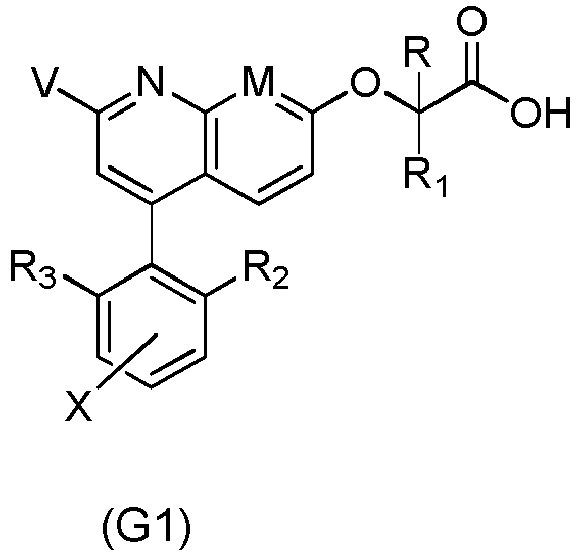
- wherein V, M, R, R1, R2, R3 and X are as defined above,
and
- (h1) amidating the compound of formula (G1) to obtain a compound of formula (J1)

- Again, both reaction steps (g1) and (h1) can be carried out according to standard procedures known in the art, whereas further guidance can be found in the reaction schemes and examples disclosed below. For example, step (h1) can be carried out with an optionally substituted amine according to known standard procedures.
- In one aspect, the invention relates to a compound of formula (F1) or to an intermediate compound of formula (G1) as defined above.
- In another aspect, the present invention relates to a process for manufacturing specific embodiments of the compounds of formula (I) of the invention, i.e. compounds of formulae (L) and (M), wherein Y is -NR4R5 and N, R4 and R5 form a substituted 5- or 6-membered saturated heterocycle as defined herein, comprising the steps of:
- (g2) hydrolyzing a compound of formula (K) or

- wherein W, V, M, R, R1, and o are as defined above, k = 1 or 2, R7 is -H or -C1-C4-alkyl and R16 is -H or -C1-C4-alkyl,
- to obtain a compound of formula (L)
or
- wherein W, V, M, R, R1, and o are as defined above, k = 1 or 2, and R16 is -H or -C1-C4-alkyl,
and
- (h2) amidating the compound of formula (L) to obtain a compound of formula (M) or

- Again, both reaction steps (g2) and (h2) can be carried out according to standard procedures known in the art, whereas further guidance can be found in the reaction schemes and examples disclosed below. For example, step (h2) can be carried out with an optionally substituted amine according to known standard procedures.
- In one aspect, the invention relates to a compound of formula (K), (L) or (M) as defined above.
-
Scheme 1 shows the preparation of a compound of formulae (D1 to D4) used as starting materials for the preparation of the compounds of formulae E1 to E4 and E6 corresponding to the compounds of formula (I) as defined above. As mentioned above, the starting materials are either commercially available or are prepared in similar manners as described in literature procedures or in the specific examples. The β-ketoesters of formula (A) and 3-methoxy-aniline used as a starting material for the preparation of the compounds of formula (B) are commercially available or can be obtained by standard procedures known to the skilled person. - It is apparent to the skilled person that the sequence of the synthetic steps is dependent on the starting materials' availability and functional group compatibility and could vary from compound to compound.

-
Scheme 2 shows the preparation of a compound of formulae E1 to E4, E8, E9, Ex and E6 corresponding to the compounds of formula (I) as defined above by alkylating a compound of the formulae D1 to D4, D8, D9, or Dx with a commercial alkylbromide (Z-Br) or subjected to a Mitsunobu (Z-OH) reaction.
- Furthermore, it has been found that the compounds of formula (I) are suitable for use as a medicament. Specifically, it has been found that the compounds of formula (I) can be used in the treatment of cancer, preferably in the treatment of melanoma, metastatic melanoma, pancreatic cancer, hepatocellular carcinoma, lymphoma, acute myeloid leukemia, breast cancer, glioblastoma, cervical cancer, renal cancer, colorectal cancer or ovarian cancer.
- POLRMT inhibitors previously have been described to trigger the death of AML cells allegedly through rather unspecific inhibition of mitochondrial transcription confirms this rational (Bralha et al., 2015). As described in the examples below compounds of the invention were surprisingly and unexpectedly shown to have cytostatic activity on a number of tumor cells and tumor models both in vitro and in vivo.
- Accordingly, the compounds of formula (I) of the invention and their pharmaceutically or veterinary acceptable salts, hydrates or solvates, exhibit valuable pharmacological properties and are therefore useful as a medicament or pharmaceutical. The medicament or pharmaceutical can be further formulated with additional pharmaceutically or veterinary acceptable carriers and/or excipients, e.g. for oral administrations in the form of tablets. Tablets may contain suitable binders, lubricants, disintegrating agents, coloring agents, flavoring agents, flow-inducing agents and/or melting agents, generally known in the art.
- Thus, in one aspect, the invention relates to a compound of the general formula (I) as defined herein for use as a medicament.
- Compounds of the invention exhibit a marked and selective inhibitory effect on the POLRMT. This can be determined for example in the Homogeneous TR-FRET assay (see example 4) or the Quantitative real time-PCR assay (see example 5). The skilled person however may use different assays to determine the direct or indirect inhibition of POLRMT.
- As mentioned above, it has been found that the compounds of the invention are useful in the treatment of cancer. There is evidence that in melanoma and especially in metastatic melanoma OXPHOS plays a major role in cancer cells and that inhibition of mitochondria in general may lead to superior treatment success. For example it was shown that H3K4-demethylase (JARID1B) and OXPHOS dependent drug resistance play a role in metastatic melanoma (Roesch et al., 2013). Haq et al. (2013) describe that the standard of care (SoC) treatment with MEK inhibitors in melanoma leads to PGC1-a-dependent increase in OXPHOS as a drug-resistance escape route. It was also shown that the inhibition of mutated BRAF by vemurafenib increases OXPHOS dependency of BRAF mutated melanoma cells (Schöckel et al., 2015). And further, enhanced OXPHOS, glutaminolysis and β-oxidation constitute the metastatic phenotype of melanoma cells (Rodrigues et al., 2016).
- For pancreatic cancer selective killing of OXPHOS-dependent Panc-1 cells has been described for treatment with arctigenin (Brecht et al., 2017). In hepatocellular carcinoma, standard of care (SoC) treatment with MEK inhibitor is leading to PGC1-a-dependent increase in OXPHOS as a drug-resistance escape route (Bhat et al., 2013, Ling et al., 2017). For lymphoma it has been demonstrated that OXPHOS is dependent on mt-complex III inhibitor antimycin A (Dörr et al., 2013). As described above acute myeloid leukemia, POLRMT inhibitors previously have been described to trigger the death of AML cells allegedly through rather unspecific inhibition of mitochondrial transcription (Bralha et al., 2015).
- Also breast cancer should be a suitable cancer indication as overexpression of progesterone receptor is present in more than 50% of all breast cancer patients, whereas progesterone is stimulating mitochondrial activity with subsequent inhibition of apoptosis (Nadji et al., 2005, Behera et al., 2009). Further, the inhibition of mTOR leads to a shift towards OXPHOSdependence and there is a glucose-dependent effect of mTOR inhibitors in combination with metformin (Pelicano et al., 2014, Ariaans et al., 2017). Additionally, it is described that mitochondrial dysfunction caused by metformin prevents tumor growth in breast cancer (Sanchez-Alvarez et al., 2013).
- For glioblastoma it is known that malignant repopulation is dependent on OXPHOS (Yeung et al., 2014). With respect to cervical cancer, POLRTM inhibitors inhibit free fatty acid oxidation (data not shown), which otherwise promote cervical cancer cell proliferation (Rodriguez-Enriquez et al., 2015). In renal cancer there is evidence that Birt-Hogg-Dubé renal tumors are associated with up-regulation of mitochondrial gene expression (Klomp et al., 2010). In colon carcinoma the rational is based on the finding that 5-fluorouracil resistant colorectal/colon cancer cells are addicted to OXPHOS to survive and enhance stem-like traits (Denise et al., 2015).
- Accordingly, in another aspect, the invention relates to compounds of formula (I) of the invention as defined herein for use in the treatment of cancer, preferably melanoma, metastatic melanoma, pancreatic cancer, hepatocellular carcinoma, lymphoma, acute myeloid leukemia, breast cancer, glioblastoma, cervical cancer, renal cancer, colorectal cancer or ovarian cancer.
- The compounds of the invention are preferably useful in a method for treating cancer in simultaneous, alternating or subsequent combination with another cancer therapy, preferably selected from chemotherapy, immunotherapy, hormone therapy, stem cell transplantation therapy, radiation therapy or surgery. It is likely that the cytostatic activity of the POLRMT inhibitors on tumor cells can be further enhanced by combining the treatment with the respective standard of care in order to get improved/additive treatment results. In this context simultaneous, alternating or subsequent application of the various treatments is envisaged. Any of the standard classes of cancer therapy, chemotherapy, immunotherapy, hormone therapy, stem cell transplantation therapy, radiation therapy or surgery, appears to be feasible for combination with the POLRMT inhibitors of this invention.
- Thus, in another aspect, the invention relates to a compound of the general formula (I) as defined herein for use in a method for treating cancer in simultaneous, alternating or subsequent combination with another cancer therapy, preferably selected from chemotherapy, immunotherapy, hormone therapy, stem cell transplantation therapy, radiation therapy or surgery.
-
-
Figure 1 shows an Example of numbering of a compound of formula F. -
Figure 2 corresponds toScheme 1.Scheme 1 shows an exemplary preparation of a compound of formula (D), specifically D1-D4. All residues of the formulae shown inScheme 1 are as defined herein. -
Figure 3 corresponds toScheme 2.Scheme 2 shows an exemplary preparation of a compound of formula (E), specifically E1-E6. All residues of the formulae shown inScheme 2 are as defined herein. -
Figure 4 corresponds to Scheme 3. Scheme 3 shows an exemplary preparation of a compound of formula (J), specifically J1-J6. All residues of the formulae shown in Scheme 3 are as defined herein. -
Figure 5 corresponds to Scheme 4. Scheme 4 shows an exemplary preparation of a compound of formulae (K), (L), (M), (P), (Q), (R) and (S). All residues of the formulae shown in Scheme 3 are as defined herein. - Abbreviations and Acronyms used in the description of the chemistry and in the Examples that follow are:
- Abs
- Absolute configuration (at least one stereocenter)
- aq.
- aqueous
- BB
- building block
- BBr3
- boron tribromide
- BPO
- benzoyl peroxide
- br.
- broad
- Bu3SnN3
- tributyltin azide
- CDCl3
- deuterated chloroform
- CD3OD
- deuterated methanol
- CHCl3
- chloroform
- cHex
- cyclohexane
- Cs2CO3
- caesium carbonate
- d
- doublet
- DCM
- dichloromethane
- DIAD
- diisopropylazodicarboxylate
- DIPEA
- Diisopropylethylamine
- DMF
- dimethylformamide
- DMSO
- dimethylsulfoxide
- DMSO-d6
- deuterated dimethylsulfoxide
- EDC
- 1-Ethyl-3-(3-dimethylaminopropyl)carbodiimide
- ES
- electrospray
- Et3N
- triethylamine
- Et2O
- diethylether
- EtOAc
- ethyl acetate
- EtOH
- ethanol
- FA
- formic acid
- h
- hour
- HATU
- O-(7-Azabenzotriazol-1-yl)-N,N,N',N'-tetramethyluronium-hexafluorphosphate
- HCl
- hydrochloric acid
- H2O
- water
- HOBt
- 1H-benzo[d][1,2,3]triazol-1-ol
- H3PO4
- polyphosphoric acid
- K2CO3
- potassium carbonate
- m
- multiplet
- MeCN
- acetonitrile
- MeOH
- methanol
- min
- minutes
- MS
- mass spectrometry
- N2
- nitrogen
- NaHCO3
- sodium hydrogencarbonate
- NaCl
- sodium chloride
- NaH
- sodium hydride
- NH4Cl
- ammonium chloride
- NMR
- nuclear magnetic resonance
- PCl5
- phosphorus (V) chloride
- Pd(amphos)Cl2
- Bis(di-tert-butyl(4-dimethylaminophenyl)phosphine) dichloropalladium(II)
- Pd(PPh3)4
- Tetrakis(triphenylphosphine)palladium(0)
- PPh3
- triphenylphosphine
- q
- quartet
- quint
- quintet
- rt
- room temperature
- s
- singlet
- sat.
- saturated
- SOCl2
- thionyl chloride
- t
- triplet
- TFA
- trifluoroacetic acid
- THF
- tetrahydrofuran
- In general, the compounds of formula (I) used of the invention might be prepared by standard techniques known in the art, by known processes analogous thereto, and/or by the processes described herein, using starting materials which are either commercially available or producible according to conventional chemical methods. The particular processes to be utilised in the preparation of the compounds of formula (I) of this invention depends upon the specific compound desired. Such factors as the type of substitution at various locations of the molecule and the commercial availability of the starting materials play a role in the path to be followed and in the chosen reaction conditions for the preparation of the specific compounds of formula (I) of this invention. Those factors are readily recognised by one of ordinary skill in the art.
- The following preparative methods are presented to aid the reader in the synthesis of the compounds of the present invention.
- HPLC - electrospray mass spectra (HPLC ES-MS) were obtained using a Waters Acquity Ultra Performance Liquid Chromatography (UPLC) equipped with a SQ 3100 Mass detector spectrometer.
Column: Acquity UPLC BEH C18 1.7 µm, 2.1 × 50 mm Flow: 0.500 mL/min Eluents: A: H2O with 0.05% formic acid and B: MeCN with 0.05% formic acid. Gradient: elution from 5% to 100% B over 3.5 min with an initial hold of 0.5 min and a final hold at 100% B of 0.5 min. Total run time: 5 min. The gradient described could be altered in function of the physico-chemical properties of the compound analyzed and is in no way restrictive. - Preparative HPLC was performed using a Waters System consisting of a Waters 2767 Sample Manager, a Waters 2545 Binary Gradient Module, a Waters SFO (System Fluidics Organizer), a Waters 3100 Mass Detector, and a Waters 2498 UV/Visible Detector.
Column: XBridge® Prep C18 5 µm OBD™, 19 x 150 mm Flow: 20 mL/min Eluents: A: H2O with 0.1% TFA and B: MeCN with 0.1% TFA - Alternatively, preparative HPLC was performed using an Agilent System consisting of a Agilent Infinity 1260 Autosampler, an Agilent Infinity 1260 Binary Gradient Module, an Agilent 6120 Quadrupole Mass Detector and an Agilent Infinity 1260 DAD VL UV/Visible Detector.
Column: XBridge® BEH Prep C18 5 µm, 19 mm X 150 mm Flow: 32 mL/min Eluents: A: H2O with 0.1% TFA and B: MeCN with 0.1% TFA. General Gradient: elution from X% to Y% B over 20 min with an initial hold of 2 min and a final increase to 100% B over 2 min and hold at 100% B of 2 min followed by a 1 min gradient back to the initial composition. Total run time: 26 min. X = Y - 30% where Y = concentration of elution on the above described LC-MS method. - The gradient described could be altered in function of the physico-chemical properties of the compound analyzed and is in no way restrictive.
- Chiral HPLC - electrospray mass spectra (HPLC ES-MS) were obtained using a Waters Acquity Ultra Performance Liquid Chromatography (UPLC) equipped with a SQ 3100 Mass detector spectrometer.
Column: Lux 5u Cellulose-2; 150x4.6mm Flow: 0.500 mL/min - 1.000 mL/min Eluents: A: H2O with 0.05% formic acid and B: MeCN with 0.05% formic acid. Gradient: elution from X% to Y% B over 15 min with an initial hold of 0.5 min and a return to 100% B and final hold at of 2.5 min. Total run time: 18 min. The gradient could be altered in function of the physico-chemical properties of the compound analyzed and is in no way restrictive. - Alternatively, Chiral HPLC - electrospray mass spectra (HPLC ES-MS) were obtained using an Agilent 1100 Series with DAD detector spectrometer.
Column : Lux 5µm Cellulose-2; 150x4.6mm Flow: 1.500 mL/min - Eluents for reverse phase analysis (1) and normal phase analysis (2) are described below:
Eluents (1): A: H2O with 20 mM NH4HCO3, 0.1% DEA and B: MeCN with 0.1% DEA. Gradient: elution from 25-50% B over 20 min. Eluents (2): A: n-Hexane with 0.1% DEA and B: Isopropanol with 0.1% DEA. Gradient: elution from 60-90% B over 20 min. The gradient could be altered in function of the physico-chemical properties of the compound analysed and is in no way restrictive. - Preparative HPLC was performed using a Waters System consisting of a Waters 2767 Sample Manager, a Waters 2545 Binary Gradient Module, a Waters SFO (System Fluidics Organizer), a Waters 3100 Mass Detector, and a Waters 2498 UV/Visible Detector.
Column: Lux 5u Cellulose-2, 150 x 21.2 mm (Phenomenex) Flow: 20 mL/min - 30 mL/min Eluents: A: H2O with 0.1% TFA and B: MeCN with 0.1% TFA. The gradient could be altered in function of the physico-chemical properties of the compound analyzed and is in no way restrictive. - Gas Chromatography - Mass spectra were obtained using Agilent 7820A GC with 5977E MSD
Column: HP-5MS 30 m, 0.25 mm ID, 0.25µm Flow: 2 mL/min. He Injection: 100 µl/s, 250°C; Split Flow: 20 mL/min. Split Ratio: 10 Detection: Agilent 5977E Gradient: 0 min 50°C; 0.5 min 50°C; 7.6 min 300°C; 9.6 min 300°C. The gradient described could be altered in function of the physico-chemical properties of the compound analyzed and is in no way restrictive. - Proton (1H) nuclear magnetic resonance (NMR) spectra were measured with an Oxford Varian 400/54 (400MHz) spectrometer or a Bruker Avance II (300MHz) spectrometer with residual protonated solvent (CHCl3 δ 7.26; MeOH δ 3.30; DMSO δ 2.49) as standard. The NMR data of the synthesized examples are in agreement with their corresponding structural assignments.
- The specific and unequivocal numbering of the intermediates comprising a subscript, defining the substituents of the quinoline scaffold, and a prefix, defining the substituents of the phenyl group, is explained in Table 1 and Table 2. In particular, in Table 2, Examples of intermediates at different stages are given for a specific aryl substituent. The numbering of intermediates F and G is self-explanatory and highlighted in Table 4 of the synthetic methods: an indication of the stereochemistry ((R), (S) or (rac)) and a suffix defining the type of ester (_Et or _tBu) are given. (gem) describes the gem-dimethyl-compound and (rac)-Et refers to the ethyl substituted linker.
Figure 1 shows a general example of numbering structures F. Numbering of the most advanced intermediates and final compounds is unique and assigned in the procedures for preparing the compounds of the invention or in Table 6.Table 1 - Numbering of the scaffolds of intermediates of formulas C-E: Subscripts Structure Subscript Examples 
W / Hal C1-6-E1-6 / C1x-6x-E1x-6x V = H 1 / 1x 
M = CH V = OH 2 / 2x C2-E2 M = CH V = Cl 3 / 3x C3-E3 M = CH V = H 4 / 4x C4-E4 M = N V = Me 5 / 5x C5-E5 M = CH V = F 6 / 6x C6-E6 M = CH Table 2 - Numbering of intermediates of formulas A-E: Prefix Structure Prefix Examples 
W 1-7A- E 
1 

2 

3 

4 

5 5A-E 
6 

7 7A-E 
8 8A-E 
9 9A-E - The general synthesis of a compound of this invention is described below in Schemes 1-4. The starting materials are either commercially available or are prepared in similar manners as described in literature procedures or in the specific examples. The desired quinolines D, were either commercially available (such as 4-chloro-2-methylquinolin-7-ol, CAS 148018-30-8) or were synthesized from the possibly substituted 4-chloro-7-methoxyquinolines through a Suzuki Coupling to obtain compounds C, followed by demethylation with BBr3. Alternatively, the intermediate quinolines C where substituent V is OH or Cl were prepared from the corresponding β-ketoesters and 3-methoxy-aniline followed by cyclisation and potential further halogenation as described by Chen et al. (2015) and Upton et al. (1986) and highlighted in Scheme 1 (see
Figure 2 ). - When the β-ketoesters could not be purchased, they were synthesized from the required acetophenones and ethyl potassium malonate under basic conditions in a similar manner as indicated in
Scheme 1. Alternative syntheses, for example starting from benzoylchlorides and diethylcarbonate, are clearly also possible. - In the case of 1,8-naphthyridines, where M is N, the specific synthesis, analogue to what suggested by Nicoleti et al. (2012) was employed, which is also outlined in
Scheme 1 and is described for intermediates C4x and C4.
- It should be apparent to those skilled in the art that the sequence of the synthetic steps is dependent on starting materials availability and functional group compatibility and could vary from compound to compound.
- The quinoline can be further alkylated with a commercial alkylbromide (Z-Br) or subjected to a Mitsunobu (Z-OH) reaction with a commercial alcohol to produce compounds of formula E as outlined in Scheme 2 (see
Figure 3 ).
- In particular, and for the purpose of rapid diversification, the Mitsunobu / alkylation reaction step (D to E and D1 to E1 ) and the Suzuki Coupling step (Cx to C and Ex to E), described in
Schemes -
Scheme 2 also illustrates how intermediate E1 (V = H) could be transformed into intermediate E6 (V = F) through reaction with AgF2 as described by Fier and Hartwig (2013) or other fluorination agents known in the art. The specific procedures are listed below. - For the Examples of this invention, Z was generally a potentially substituted alkyl acetate group (compound F); which was usually further modified by hydrolysis to the corresponding carboxylic acid G, followed by coupling with a commercially available, optionally substituted amine, according to standard procedures known in the art, and as described in Scheme 3 (see
Figure 4 ), to produce structure J. Alternatively, the Mitsunobu reaction could be carried out with a suitable, synthesized or commercially available 2-hydroxyacetamide H to obtain a compound of structure J directly. Again, for the purpose of parallel synthesis and rapid diversification of group W, intermediate F1x-6x could be modified using a similar reaction sequence to obtain compounds of formula J through intermediates G1x-6x and J1x-6x , carrying a halogen substituent, which is subjected to a Suzuki coupling in the final stages of the synthesis. Alternatively, intermediates F1x-6x can be transformed into intermediate F1-6 via Suzuki coupling.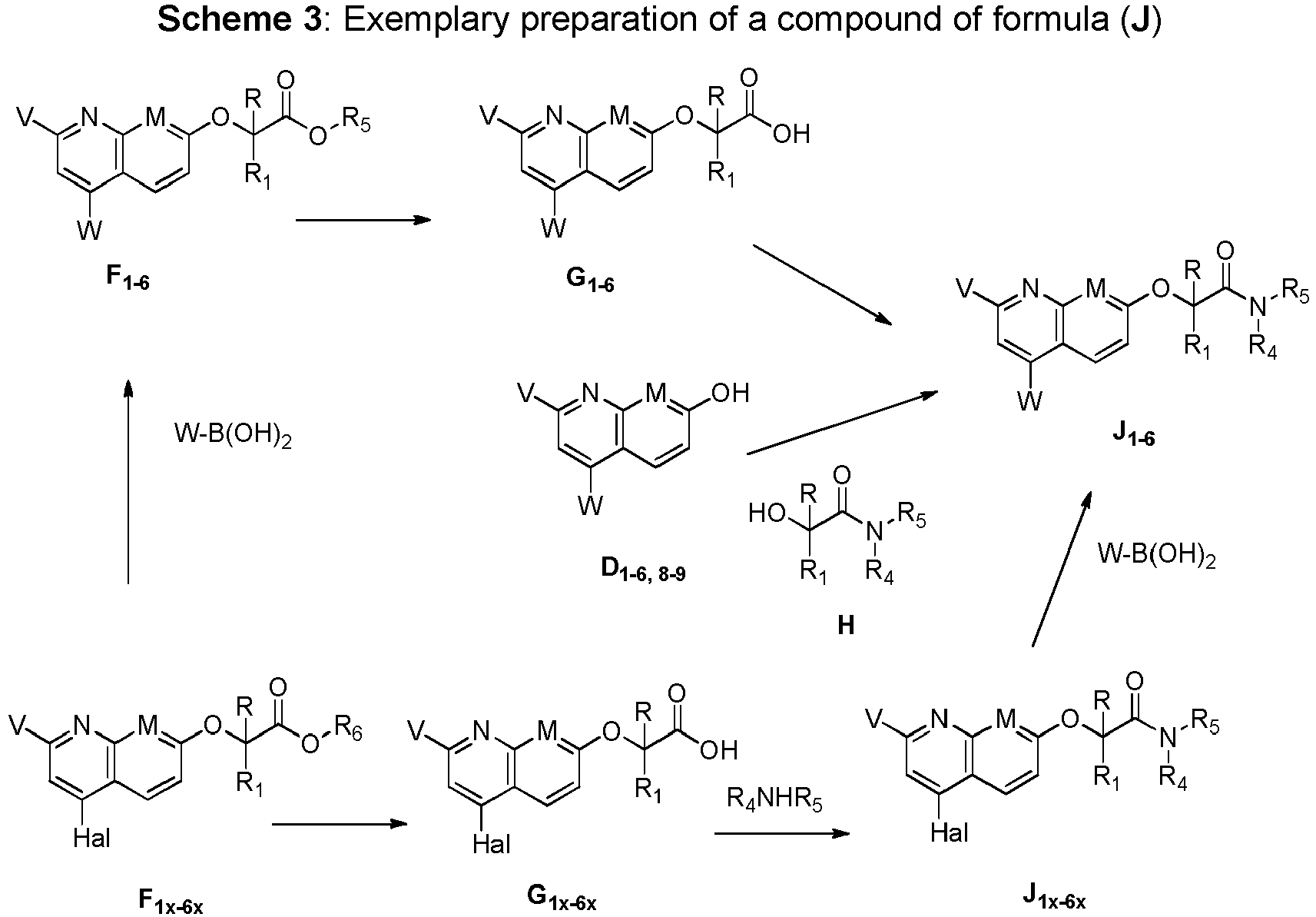
- When R4 and R5 form an optionally substituted cyclic amide, this amide can carry an ester moiety or a carbamate moiety, as highlighted in formulas Kx , K or N of Scheme 4, which can be further hydrolyzed or deprotected to obtain compounds of substructure L or P. As it will be obvious to a person skilled in the art, compounds K could be obtained by linear synthesis through a coupling reaction as for compounds of formula J as described in Scheme 3, or in a parallel manner using compounds Kx . Examples are outlined in Scheme 4 (see
Figure 5 ). The amide could also carry a nitrile moiety (compound 11), which could be transformed into a tetrazole to produce a carboxylic acid bioisostere, as in exemplified with M12 for compound 30. When the commercially available ester building blocks were racemic, or intermediate F was prepared according to method M7, the coupling reaction was sometimes followed by chiral preparative HPLC to allow separation of the diastereomers. - In case of non-commercially available amide building blocks, the synthesis of compounds M required further derivatization of compound L, in a way that is described in method M11a. Amines P could also be further modified using methods known in the art, to obtain amides of formula Q. An example of such modification is described in method M11d for compound 28. Further hydrolysis of Q, when Q carries a Boc-protected amine, is also possible, as in the case of compound 85. When P was a primary amine, this could also be further modified using methods known in the art, to obtain, over three subsequent reactions and without isolation of the intermediates, N-hydroxyacetamides of formula R; or it could be reacted with an isocyanate to obtain ureas of formula S. Examples of such modifications are described herein exemplarily for compounds 209 and 214. Additionally, the tetrazole derivative 11 described in Table 6 was synthesized from the corresponding nitrile, compound 30, according to method 12.
- The compounds of formulae E, F, G, J, K, L, M, P, Q, R, and S are compounds of the general formula I of the invention.

- The following specific examples are presented to illustrate the invention, but they should not be construed as limiting the scope of the invention in any way. In the tables listing the intermediates, the compounds might have characterization such as (M+H)+ mass spectrometry data, HPLC purity and/or NMR. Those that have no characterization are commercially available, and a CAS number is given.
- At least one intermediate example per method is described below:
-

- 60% NaH in mineral oil (34.2 g, 852 mmol) was washed with pentane and dried under a flow of N2. Dry toluene (2.4 L) was added and the suspension was cooled to 0°C. Diethyl carbonate (192 g, 1.62 mol) was added dropwise over a period of 35 min, the mixture was stirred 30 min, upon which 2-Chloro-4-fluoroacetophenone (70 g, 406 mmol) was added over a period of 35 min. The cooling bath was removed, and the reaction heated to 50°C and stirred for 20 h. The reaction mixture was allowed to cool to rt and was poured onto ice-water (2.5 L).The aqueous layer was extracted with Et2O, then acidified to
pH 2 with 10% aq. HCl and extracted with Et2O. The combined organic phases were washed with H2O and brine, dried over MgSO4, filtered and evaporated in vacuo to yield the desired product 4A (37.9 g, 38%) as a mixture of tautomers, which was used in the following step without further purification. - 1H NMR (300MHz, Chloroform-d) δ 7.63 (dd, J = 8.7, 6.0 Hz, 1H), 7.14-6.93 (m, 2H), 4.12 (q, J = 7.2 Hz, 2H), 3.96 (s, 2H), 1.18 (t, J = 7.1 Hz, 3H) -
tautomer 1, ethyl 3-(2-chloro-4-fluorophenyl)-3-oxopropanoate - 1H NMR (300MHz, Chloroform-d) δ 12.43 (s, 1H), 7.52 (dd, J = 8.7, 6.1 Hz, 1H), 7.14-6.93 (m, 2H), 5.48 (s, 1H), 4.21 (q, J = 7.1 Hz, 2H), 1.27 (t, J = 7.1 Hz, 3H) -
tautomer 2, (Z)-ethyl 3-(2-chloro-4-fluorophenyl)-3-hydroxyacrylate - MS (ES) C11H10ClFO3 requires: 244/246, found: 245/247(M+H)+, -93%
-

- A mixture of compound 4A (20.8 g, 85 mmol) and 3-methoxyaniline (10.47 g, 9.5 mL, 85 mmol) was heated to 140°C and stirred for 3.5 h. The mixture was allowed to cool to rt and diluted with 1,4-dioxane (90 mL) before addition of 10% aq. HCl solution (45 mL). The reaction was stirred for 2 h, upon which the mixture was diluted with H2O and extracted with EtOAc. The combined organic layers were washed with H2O and brine, dried over MgSO4, filtered and evaporated in vacuo. The crude was purified by flash chromatography on silica gel using a gradient of EtOAc in cHex to yield the desired product 4B (12.2 g, 45%) as a mixture of tautomers, which was used in the following step without further purification.
- 1H NMR (300MHz, Chloroform-d) δ 8.83 (s, 1H), 7.63 (dd, J = 8.7, 5.9 Hz, 1H), 7.28 - 6.86 (m, 5H), 6.66 - 6.56 (m, 1H), 4.02 (s, 2H), 3.74 (s, 3H). -
tautomer 1, 3-(2-chloro-4-fluorophenyl)-N-(3-methoxyphenyl)-3-oxopropanamide - 1H NMR (300MHz, Chloroform-d) δ 13.96 (s, 1H), 7.55 (dd, J = 8.8, 6.2 Hz, 1H), 7.28 - 6.86 (m, 6H), 6.66 - 6.56 (m, 1H), 5.48 (s, 1H), 3.72 (s, 3H). -
tautomer 2, (Z)-3-(2-chloro-4-fluorophenyl)-3-hydroxy-N-(3-methoxyphenyl)acrylamide - MS (ES) C16H13ClFO3 requires: 321/323, found: 322/324(M+H)+, -94%
-

- A mixture of 4-chloro-7-methoxyquinoline C1x (1.5 g, 7.75 mmol), Pd(amphos)Cl2 (274 mg, 0.387 mmol), 2-chlorophenylboronic acid (1.82 g, 11.6 mmol) and K2CO3 (3.2 g, 22.8 mmol) was purged with N2 before addition of toluene (35 mL) and H2O (5 mL). The reaction was then stirred at 85°C for 3.5 h, upon which the mixture was diluted with DCM and washed with H2O. The aqueous phase was extracted with DCM, and the combined organic layers were washed with a sat. NaHCO3 solution and brine, dried over MgSO4, filtered and evaporated in vacuo. The crude was purified by flash chromatography on silica gel using a gradient of EtOAc in cHex to yield the desired product 2C1 (1.0 g, 48%) as a yellow solid.
- 1H NMR (300 MHz, Chloroform-d) δ 8.82 (d, J = 4.5 Hz, 1H), 7.55 - 7.39 (m, 2H), 7.42 - 7.25 (m, 3H), 7.30 - 7.19 (m, 1H), 7.20 - 7.01 (m, 2H), 3.90 (s, 3H).
- MS (ES) C16H12ClNO requires: 269/271, found: 270/272 (M+H)+, 91%
-

- A mixture of compound 4B (12.2 g, 37.9 mmol) and H3PO4 (100 g) was heated to 150°C for 1 h, upon which the reaction was carefully quenched by slow addition of a 2N NaOH aq. solution (400 mL). The precipitate was filtered, washed with H2O and dried in vacuo to yield the desired product 4C2 (9.75 g, 85%) as a yellow solid.
- 1H NMR (300 MHz, Chloroform-d) δ 12.21 (s, 1H), 7.28 - 7.17 (m, 2H), 7.06 (td, J = 8.2, 2.6 Hz, 1H), 6.95 (d, J = 9.0 Hz, 1H), 6.83 (d, J = 2.4 Hz, 1H), 6.68 (dd, J = 8.9, 2.4 Hz, 1H), 6.41 (s, 1H), 3.84 (s, 3H).
- MS (ES) C16H11ClFO2 requires: 303/305, found: 304/306 (M+H)+, 89%
-

- To compound 4C2 (9.75 g, 32.1 mmol) was added dry DMF (2.5 mL) and SOCl2 (110 mL). The resulting mixture was heated at 50°C for 22 h, upon which the mixture was allowed to cool to rt and slowly poured over water-ice (-800 mL). The mixture was then extracted with Et2O and the combined organic layers were washed with H2O and brine, dried over MgSO4, filtered and evaporated in vacuo. The crude was purified by flash chromatography on silica gel using a gradient of EtOAc in cHex to yield the desired product 4C3 (5.18 g, 50%) as an off-white solid.
- 1H NMR (300 MHz, Chloroform-d) δ 7.35 (d, J = 2.6 Hz, 1H), 7.30 - 7.10 (m, 3H), 7.15 - 6.97 (m, 3H), 3.87 (s, 3H).
- MS (ES) C16H10Cl2FO requires: 321/323, found: 322/324 (M+H)+, 92%
- All 7-methoxyquinoline intermediates C were synthesized in a similar manner as for intermediates 2C1, 4C2 or 4C3.
-

- A mixture of Meldrum acid (26 g, 179 mmol) and 110 mL of trimethyl orthoformate was refluxed for 2 h. The solution was allowed to cool to rt, 2-amino-6-methoxypyridine (10 g, 80.6 mmol) was added and the solution refluxed for 30 min. The mixture was cooled to rt, and the resulting precipitate was filtered, washed with EtOH (60 mL) and dried in vacuo to yield the desired product C4a (20.89 g, 93%) as an orange solid.
- 1H NMR (300 MHz, DMSO-d 6) δ 11.34 (d, J = 13.8 Hz, 1H), 9.19 (d, J = 13.9 Hz, 1H), 7.79 (t, J = 7.9 Hz, 1H), 7.22 (d, J = 7.6 Hz, 1H), 6.71 (d, J = 8.1 Hz, 1H), 3.91 (s, 3H), 1.69 (s, 6H).
- MS (ES) C13H14N2O5 requires: 278, found: 279 (M+H)+, 100%
-

- Diphenyl ether (860 mL) was heated to 150°C and intermediate C4a (20.8 g, 74.82 mmol) was added slowly. The resulting mixture was heated to 225°C for 90 min, upon which it was allowed to cool to rt. The mixture was diluted with Et2O. The resulting precipitate was filtered, washed with Et2O and dried in vacuo, to yield the desired product C4b (11.06 g, 84%) as an as an orange solid.
- 1H NMR (300 MHz, DMSO-d 6) δ 11.98 (s, 1H), 8.29 (d, J= 8.7 Hz, 1H), 7.76 (d, J= 7.5 Hz, 1H), 6.79 (d, J= 8.7 Hz, 1H), 6.03 (d, J= 7.6 Hz, 1H), 3.96 (s, 3H).
- MS (ES) C9H8N2O2 requires: 176, found: 177 (M+H)+, 99%
-

- A solution of compound C4b (11 g, 62.4 mmol) in PCl5 (225 mL) was heated to 95°C for 2 h, after which the mixture was allowed to cool to rt and ice was added slowly under vigorous stirring. The pH of the mixture was adjusted to ~8 by careful addition of 25% aq. NH3OH solution. The resulting solid was filtered, washed with H2O and dried in vacuo, to yield the desired product C4x (11.36 g, 86%) as a yellow solid.
- 1H NMR (300 MHz, Chloroform-d) δ 8.75 (d, J = 4.9 Hz, 1H), 8.33 (d, J = 9.0 Hz, 1H), 7.34 (d, J = 4.9 Hz, 1H), 7.01 (d, J = 9.0 Hz, 1H), 4.10 (s, 3H).
- MS (ES) C9H7ClN2O requires: 194/196, found: 195/197 (M+H)+, 95%
-

- To a mixture of compound C4x (10.45 g, 53.7 mmol), 2-chloro-4-fluorophenylboronic acid (11.2 g, 64.4 mmol) and Pd(PPh3)4 (3.1 g, 2.68 mmol) was added toluene (135 mL), EtOH (18 mL) and 2M aq. Na2CO3 solution (48 mL, 96 mmol). The mixture was stirred under N2 atmosphere at 80°C for 15 h. The reaction was then diluted with H2O and extracted with DCM. The combined organic layers were washed with brine, dried over MgSO4, filtered and evaporated in vacuo. The crude was purified by flash chromatography on silica gel using a gradient of MeOH in DCM to yield compound 4C4 (12.86 g, 83%) as a yellow solid.
- 1H NMR (300 MHz, Chloroform-d) δ 8.93 (d, J = 4.6 Hz, 1H), 7.62 (d, J = 9.0 Hz, 1H), 7.33-7.11 (m, 3H), 7.08 (ddd, J = 8.6, 7.9, 2.6 Hz, 1H), 6.88 (d, J = 9.0 Hz, 1H), 4.11 (s, 3H).
- MS (ES) C15H10ClFN2O requires: 288/290, found: 289/291 (M+H)+, 86%.
- All 2-methoxy-1,8-naphthyridine intermediates C were synthesized in a similar manner as intermediates 4C4.
-

- Compound 4C4 (12.85 g, 44.5 mmol) was dissolved in DCM (95 mL) and BBr3 (25 g, 99.8 mmol) in DCM (40 mL) was added at -50°C. The mixture was allowed to warm up to rt and was stirred for 18 h, upon which it was cooled to 0°C. Additional BBr3 (25 g, 99.8 mmol) in DCM (40 mL) was added. The reaction mixture was then stirred at rt for 6 days before being carefully poured over a mixture of ice-water (-500 mL) and aq. 25% NH4OH solution (150 mL) under vigorous stirring. The resulting precipitate was twice filtered, washed with H2O and dried in vacuo to yield the desired product 4D4 (9.88 g, 81%) as a yellow solid.
- 1H NMR (300 MHz, DMSO-d6) δ 12.34 (s, 1H), 8.60 (d, J = 4.9 Hz, 1H), 7.71 (dd, J = 8.9, 2.6 Hz, 1H), 7.53 (dd, J = 8.6, 6.2 Hz, 1H), 7.49 - 7.31 (m, 2H), 7.17 (d, J = 4.9 Hz, 1H), 6.55 (dd, J = 9.8, 1.9 Hz, 1H).
- MS (ES) C14H8ClFN2O requires: 274/276, found: 275/277 (M+H)+, 89%.
- The following quinoline and naphthyridine intermediates D in Table 3, unless commercially available, were synthesized from intermediates C according to M6 in a similar manner as for intermediate 4D4 .
Table 3 - 7-Hydroxy-Quinolines of formula (D and D x ) Intermediate Structure (M+H)+, purity D1x 
CAS: 181950-57-2 1D1 
MS (ES) C15H11NO requires: 221, found 222 (M+H)+, >95% 2D1 
MS (ES) C15H10ClNO requires: 255/257, found: 256/258 (M+H)+, 92% 3D1 
MS (ES) C16H13NO requires: 235, found: 236 (M+H)+, 90% 4D1 
MS (ES) C15H9ClFNO requires: 273/275, found: 274/276 (M+H)+, 91% 6D1 
MS (ES) C17H15NO requires: 249, found: 250 (M+H)+, 91% 7D1 
MS (ES) C15H9Cl2NO requires: 289/291, found: 290/292 (M+H)+, 92% 8D1 
MS (ES) C17H14FNO requires: 267/268, found: 268/269 (M+H)+, 89% 9D1 
MS (ES) C15H8Cl2FNO requires: 307/309, found: 308/310 (M+H)+, 99% 1D2 
MS (ES) C15H11NO2 requires: 237, found: 238 (M+H)+, 85% 3D2 
MS (ES) C16H13NO2 requires: 251, found: 252 (M+H)+, 93% 2D3 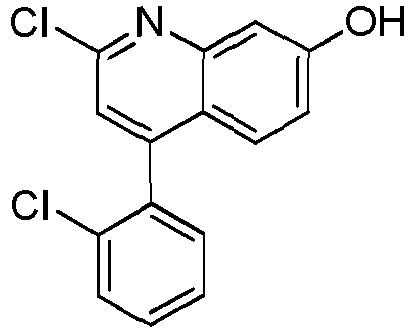
MS (ES) C15H9Cl2NO requires: 289/291, found: 290/292 (M+H)+, >95% 3D3 
MS (ES) C16H12ClNO requires: 269/271, found: 270/272 (M+H)+, >95% 4D3 
MS (ES) C15H8Cl2FNO requires: 307/309, found: 308/310 (M+H)+, 92% 5D3 
MS (ES) C16H11ClFNO requires: 287/289, found: 288/290 (M+H)+, 93% 6D3 
MS (ES) C17H14ClNO requires: 283/285, found: 284/286 (M+H)+, 31% - used without purification 4D4 
MS (ES) C14H8ClFN2O requires: 274/276, found: 275/277 (M+H)+, 89% 8D4 
MS (ES) C16H13FN2O requires: 268/269, found: 269/270 (M+H)+, 78% 9D4 
MS (ES) C14H7Cl2FN2O requires: 308/310, found: 309/311 (M+H)+, 58% D5x 
CAS: 148018-30-8 -

- Intermediate 3D1 (80 mg, 0.34 mmol) was suspended in dry DMF (1.5 mL) and Cs2CO3 (286 mg, 0.879 mmol) was added, followed by 2-bromoacetamide (47 mg, 0.34 mmol) in dry DMF (1 mL). The reaction was stirred at rt for 24 h. The mixture was diluted with EtOAc (50 mL) and the organic phase was washed with H2O and brine. The organic layer was dried over MgSO4, filtered and evaporated in vacuo. The crude was purified by preparative TLC on silica gel using an eluent mixture of DCM: MeOH 19:1 containing 0.05% of 25% NH4OH solution to yield the desired product (106) (12 mg, 12%) as a white solid.
- 1H NMR (300 MHz, Chloroform-d) δ 8.84 (d, J = 4.5 Hz, 1H), 7.45 (d, J = 2.6 Hz, 1H), 7.37 (d, J = 9.2 Hz, 1H), 7.34 - 7.21 (m, 3H), 7.16 - 7.05 (m, 3H), 6.52 (s, 1H), 5.69 (s, 1H), 4.61 (s, 2H), 1.96 (s, 3H).
- MS (ES) C18H16N2O2 requires: 292, found: 293 (M+H)+, 96%
-

- Intermediate 4D4 (1 g, 3.64 mmol) was reacted with ethyl-2-bromopropionate (0.71 mL, 5.46 mmol) according to M7 to yield the desired product (rac)-4F4_Et (1.03 g, 75%).
- 1H NMR (300 MHz, Chloroform-d) δ 8.93 (d, J = 4.6 Hz, 1H), 7.68 (d, J = 9.0 Hz, 1H), 7.34 - 7.14 (m, 3H), 7.18 - 6.96 (m, 2H), 5.84 (qd, J = 7.0, 4.5 Hz, 1H), 4.29 - 4.06 (m, 2H), 1.62 (d, J = 7.0 Hz, 3H), 1.23 (t, J = 7.1 Hz, 3H).
- MS (ES) C19H16ClFN2O3 requires: 374/376, found: 375/377 (M+H)+, 97%
-

- Intermediate 4D1 (100 mg, 0.365 mmol) and PPh3 (105 mg, 0.402 mmol) were dissolved in THF (5.5 mL), and (-)-Ethyl (S)-2-hydroxypropionate (50 µl, 0.438 mmol) was added. The reaction was cooled to 0°C and DIAD (79 µl, 0.402 mmol) was added dropwise. The reaction was then stirred at rt for 1 h, upon which further reagents were added in the same amounts, and the reaction stirred for a further 6 h. The mixture was diluted with EtOAc and washed with a sat. NaHCO3 solution, a sat. NH4Cl solution, and H2O. The organic layer was dried over MgSO4, filtered and evaporated in vacuo. The crude product was purified by flash chromatography on silica gel using a gradient of EtOAc in cHex to yield the desired product (R)-4F1_Et (163 mg, -20% excess weight), which was carried through to the following step without further purification.
- MS (ES) C20H17ClFNO3 requires: 373/375, found: 374/376 (M+H)+, 94%
-

- 4-chloroquinolin-7-ol (D1x ) (200 mg, 1.11 mmol) was reacted with tert-butyl (2S)-2-hydroxypropanoate (244 mg, 1.67 mmol) according to M8 to yield the desired product (R)-F1x_ tBu (222 mg, 65%) as a colorless glue.
- 1H NMR (400 MHz, DMSO-d 6) δ 8.76 (d, J= 4.7 Hz, 1H), 8.13 (d, J= 9.2 Hz, 1H), 7.60 (dd, J = 4.8, 0.5 Hz, 1H), 7.47 - 7.40 (m, 1H), 7.31 (d, J = 2.6 Hz, 1H), 5.06 (q, J = 6.7 Hz, 1H), 1.57 (dd, J= 6.8, 0.6 Hz, 3H), 1.39 (d, J= 0.5 Hz, 9H).
- MS (ES) C16H18ClNO3 requires: 307/309, found: 308/310 (M+H)+, 100%
-
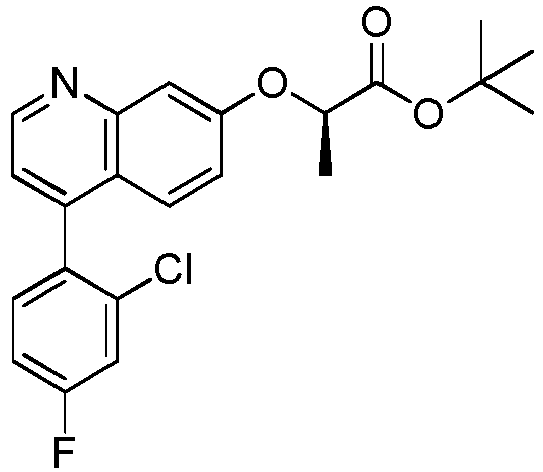
- Intermediate (R)-F1x_tBu (110 mg, 0.356 mmol) was reacted with (2-chloro-4-fluorophenyl)boronic acid (75 mg, 0.427 mmol) according to M3b to yield the desired product (R)-4F1_tBu (95 mg, 66%) as a white solid.
- 1H NMR (400 MHz, DMSO-d 6) δ 8.87 (d, J= 4.4 Hz, 1H), 7.67 (dt, J = 8.9, 2.7 Hz, 1H), 7.51 (ddd, J = 8.5, 7.3, 6.2 Hz, 1H), 7.45 - 7.36 (m, 1H), 7.35 - 7.18 (m, 4H), 5.05 - 4.93 (m, 1H), 1.55 (d, J = 6.7 Hz, 3H), 1.40 (s, 9H).
- MS (ES) C22H21ClFNO3 requires: 401/403, found: 402/404 (M+H)+, 92%
-

- Compound (R)-2F1_tBu (34.5 mg, 0.090 mmol) was dissolved in dry ACN (1 mL) and AgF2 (39.4 mg, 0.270 mmol) was added at rt. The resulting suspension was stirred under N2 atmosphere for 2h. A second aliquot of AgF2 (39.4 mg, 0.270 mmol) was added and stirring was continued for 90 min. The mixture was diluted with EtOAc and washed with sat. Na-HCO3 solution and brine. The organic layer was dried over MgSO4, filtered through a plug of celite and evaporated in vacuo. The crude was purified by flash chromatography on silica gel using a gradient of EtOAc in cHex to yield the desired product (R)-2F6_tBu (14.3 mg, 40%) as a colorless oil.
- 1H NMR (400 MHz, Chloroform-d) δ 7.59 - 7.53 (m, 1H), 7.48 - 7.35 (m, 3H), 7.34 - 7.29 (m, 1H), 7.22 (dd, J = 5.5, 2.6 Hz, 1H), 7.18 - 7.12 (m, 1H), 6.87 (dd, J = 2.2, 1.0 Hz, 1H), 4.81 (qd, J = 6.8, 4.4 Hz, 1H), 1.66 (d, J = 6.8 Hz, 3H), 1.48 (s, 9H).
- MS (ES) C22H21ClFNO3 requires: 401/403, found: 402/404 (M+H)+, 100%
-

- Compound (R)-4F1_Et (156 g, ~0.365 mmol) was dissolved in THF (6.3 mL) and 2M NaOH aq. solution (1.3 mL) was added. MeOH was added dropwise until the mixture became homogeneous. The reaction was stirred at rt for 30 min. The mixture was acidified with 2M HCl to pH5 and extracted with EtOAc. The combined organic layers were washed with H2O, dried over MgSO4, filtered, and evaporated in vacuo. The crude was purified by column chromatography using a gradient of MeOH in DCM to yield the desired product (R)-4G1 (44) (66 mg, 52% over 2 steps) as a white solid.
- 1H NMR (400 MHz, DMSO-d 6) δ 8.85 (dd, J = 4.4, 0.6 Hz, 1H), 7.67 (dt, J = 8.9, 2.3 Hz, 1H), 7.49 (ddd, J = 8.1, 6.2, 1.8 Hz, 1H), 7.39 (tt, J = 8.5, 2.4 Hz, 1H), 7.32 - 7.27 (m, 2H), 7.26 (dd, J = 4.4, 0.6 Hz, 1H), 7.22 (dd, J = 9.2, 2.6 Hz, 1H), 5.00 (q, J = 6.5 Hz, 1H), 1.55 (d, J = 6.8 Hz, 3H).
- MS (ES) C18H13ClFNO3 requires: 345/347, found: 346/348 (M+H)+, 96%
-

- Compound (R)-4F1_tBu (93 mg, 0.232 mmol) was dissolved in a 4:1 DCM:TFA solution (2.3 ml) and the reaction was stirred at rt for 1.5 h, upon which the solvents were removed in vacuo and a fresh 4:1 DCM:TFA solution (2.3 ml) was added and the mixture stirred for further 4 h. The solvents were evaporated in vacuo to yield the desired product (R)-4G1 (44) (132 mg, -23% excess weight) as a brown glue (TFA salt), which was used in the following step without further purification.
- 1H NMR (400 MHz, DMSO-d 6) δ 8.99 (d, J = 4.7 Hz, 1H), 7.70 (ddd, J = 8.9, 2.5, 1.8 Hz, 1H), 7.53 (ddd, J = 8.9, 6.2, 3.0 Hz, 1H), 7.49 - 7.39 (m, 3H), 7.39 - 7.30 (m, 2H), 5.09 (q, J = 6.8 Hz, 1H), 1.59 (d, J= 6.8 Hz, 3H).
- MS (ES) C18H13ClFNO3 requires: 345/347, found: 346/348 (M+H)+, 92%
- The ethyl esters and carboxylic acids shown in Table 4 were synthesized in a similar manner as described for intermediates (rac)-4F4_Et, (R)-4F1_Et, (R)-F1x, (R)-4F1_tBu, (R)-2F6_tBu and (R)-4G1.
Table 4 - Esters and carboxylic acids compounds (F) and (G) Compounds Structure (M+H)+, purity (R)-F1x_Et 
Et: MS (ES) C14H14ClNO3 requires: 279/281, found: 280/282 (M+H)+, >95% tBu: MS (ES) C16H18ClNO3 requires: 307/309, found: 308/310 (M+H)+, 100% (R)-F1x_tBu (R)-G1x H: MS (ES) C12H10ClNO3 requires: 251/253, found: 252/253 (M+H)+, >95% (R)-1 F1_Et 
Et: MS (ES) C20H17ClFNO3 requires: 373/375, found: 374/376 (M+H)+, 94% tBu: MS (ES) C22H21ClFNO3 requires: 401/403, found: 402/404 (M+H)+, 92% (R)-1 F1_tBu (R)-1G1 H: MS (ES) C18H13ClFNO3 requires: 345/347, found: 346/348 (M+H)+, 92% 2F1_Et 
Et: MS (ES) C19H16ClNO3 requires: 341/343, found: 342/344 (M+H)+, 92% 2G, H: MS (ES) C17H12ClNO3 requires: 313/315, found: 314/316 (M+H)+, 93% (R)-2F1_Et 
Et: MS (ES) C20H18ClNO3 requires: 355/357, found: 356/358 (M+H)+, >95% tBu: MS (ES) C22H22ClNO3 requires: 383/385, found: 384/386 (M+H)+, 92% (R)-2F1_tBu (R)-2G1 H: MS (ES) C18H14ClNO3 requires: 327/329, found: 328/330 (M+H)+, >95% (R)-3F1_tBu 
tBu: MS (ES) C23H25NO3 requires: 363, found: 364 (M+H)+, 96% (R)-3G1 H: MS (ES) C19H17NO3 requires: 307, found: 308 (M+H)+, 96% (R)-4F1_Et 
Et: MS (ES) C20H17ClFNO3 requires: 373/375, found: 374/376 (M+H)+, 94% tBu: MS (ES) C22H21ClFNO3 requires: 401/403, found: 402/404 (M+H)+, 92% (R)-4F1_tBu (R)-4G1 H: MS (ES) C18H13ClFNO3 requires: 345/347, found: 346/348 (M+H)+, 92% (R)-6F1_Et 
Et: MS (ES) C22H23NO3 requires: 349, found: 350 (M+H)+, >95% (R)-6G1 H: MS (ES) C20H19NO3 requires: 321, found: 322 (M+H)+, >95% (gem)-2F1_Et 
Et: MS (ES) C21H20ClNO3 requires: 369/371, found: 370/372 (M+H)+, 98% (gem)-2G, H: MS (ES) C19H16ClNO3 requires:341/343, found: 342/344 (M+H)+, 92% (rac)-Et-2F1_Et 
Et: MS (ES) C21H20ClNO3 requires: 369/371, found: 370/372 (M+H)+, 98% (rac)-Et-2G1 H: MS (ES) C19H16ClNO3 requires: 341/343, found: 342/344 (M+H)+, 97% (R)-7F1_Et 
Et: MS (ES) C20H17Cl2NO3 requires: 389/391, found: 390/392 (M+H)+, >95% (R)-7G1 H: MS (ES) C18H13Cl2NO3 requires: 361/363, found: 362/364 (M+H)+, >95% (R)-8F1_Et 
Et: MS (ES) C22H22FNO3 requires: 367/368, found: 368/369 (M+H)+, 95% (R)-8G1 H: MS (ES) C20H18FNO3 requires: 339/340, found: 340/341 (M+H)+, >99% (R)-9F1_Et 
Et: MS (ES) C20H16Cl2FNO3 requires: 408/409, found: 408/410 (M+H)+, 95% (R)-9G1 H: MS (ES) C18H12Cl2FNO3 requires: 380/382, found: 381/383 (M+H)+, used as crude (R)-1 F3_tBu 
tBu: MS (ES) C23H24ClNO3 requires: 397/399, found: 398/400 (M+H)+, >95% (R)-1G3 H: MS (ES) C19H16ClNO3 requires: 341/343, found: 342/344 (M+H)+, >95% (R)-2F3_Et 
Et: MS (ES) C20H17Cl2NO3 requires: 389/391, found: 390/392 (M+H)+, >95% (R)-2G3 H: MS (ES) C18H13Cl2NO3 requires: 361/363, found: 362/364 (M+H)+, >95% (R)-4F3_Et 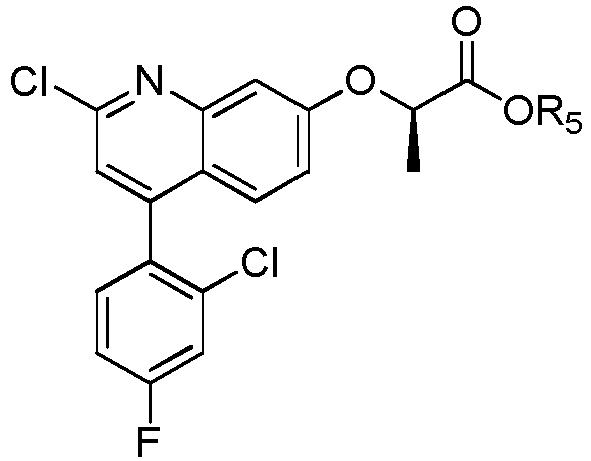
Et: MS (ES) C20H16Cl2FNO3 requires: 407/409, found: 408/410 (M+H)+, >95% (R)-4G3 H: MS (ES) C18H12Cl2FNO3 requires: 379/381, found: 380/382 (M+H)+, >95% (R)-6F3_Et 
Et: MS (ES) C21H19ClFNO3 requires: 387/389, found: 388/390 (M+H)+, >95% (R)-6G3 H: MS (ES) C19H15ClFNO3 requires: 359/361, found: 360/362 (M+H)+, >95% (rac)-4F4_Et 
Et: MS (ES) C19H16ClFN2O3 requires: 374/376, found: 375/377(M+H)+, 97% (rac)-4G4 H: MS (ES) C19H16ClFN2O3 requires: 374/376, found: 375/377 (M+H)+, 97% (R)-8F4_Et 
Et: MS (ES) C21H21FN2O3 requires: 368/369, found: 369/370 (M+H)+, 86% (R)-8G4 H: MS (ES) C19H17FN2O3 requires: 340/341, found: 341/342 (M+H)+, 94% (R)-9F4_Et 
Et: MS (ES) C19H15Cl2FN2O3 requires: 408/410, found: 409/411 (M+H)+, 89% (R)-9G4 H: MS (ES) C17H11Cl2FN2O3 requires: 380/382, found: 381/383 (M+H)+, used as crude (R)-F5x_tBu 
tBu: MS (ES) C17H20ClNO3 requires: 321/323, found: 322/324 (M+H)+, 100% (R)-3F5_tBu 
tBu: MS (ES) C24H27NO3 requires: 377, found: 378 (M+H)+, 96% (R)-3G5 H: MS (ES) C20H19NO3 requires: 321, found: 322 (M+H)+, 96% (R)-4F5_tBu 
tBu: MS (ES) C23H23ClFNO3 requires: 415/417, found: 416/418 (M+H)+, 100% (R)-4G5 H: MS (ES) C19H15ClFNO3 requires: 359/361, found: 360/362 (M+H)+, 98% (R)-6F5_tBu 
tBu: MS (ES) C25H29NO3 requires: 391, found: 392 (M+H)+, 97% (R)-6G5 H: MS (ES) C21H21NO3 requires: 335, found: 336 (M+H)+, 97% (R)-2F6_tBu 
tBu: MS (ES) C22H21ClFNO3 requires: 401/403, found: 402/404 (M+H)+, 100% (R)-2G6 H: MS (ES) C18H13ClFNO3 requires: 345/347, found: 346/348 (M+H)+, 96% -

- Compound (R)-4G1 (35.0 mg, 0.101 mmol) and 2-oxopiperazine (16.2 mg, 0.162 mmol) were dissolved in dry DMF (0.8 mL). D!PEA (51.6 µL, 39.3 mg, 0.304 mmol) and HATU (57.7 mg, 0.152 mmol) were added, and the mixture was stirred at rt overnight. The reaction was diluted with EtOAc and washed with H2O, sat. NaHCO3 solution and brine. The organic phase was dried over MgSO4, filtered and evaporated in vacuo. The crude product was purified by flash chromatography on silica gel using a gradient of MeOH in DCM to yield the desired product 63 (31.5 mg, 73%) as a white solid.
- 1H NMR (400 MHz, DMSO-d 6) δ 8.89 (d, J = 4.4 Hz, 1H), 8.14 (d, J = 10.8 Hz, 1H), 7.69 (ddd, J = 8.9, 2.6, 1.3 Hz, 1H), 7.52 (dd, J = 8.6, 6.2 Hz, 1H), 7.45 - 7.21 (m, 5H), 5.57 (q, J = 6.6 Hz, 1H), 4.40 - 4.07 (m, 1H), 4.06 - 3.52 (m, 3H), 3.30 - 3.13 (m, 2H), 1.51 (ddd, J = 13.4, 6.5, 2.5 Hz, 3H).
- MS (ES) C22H19ClFN3O3 requires: 427/429, found: 428/430 (M+H)+, 97%
-

- Compound (R)-4G1 (129 mg, 0.282 mmol), EDC.HCl (135 mg, 0.704 mmol), and HOBt.xH2O (108 mg, 0.704 mmol) were dissolved in DMF (4 mL) and (S)-piperidine-3-carboxylic acid ethyl ester hydrochloride (146 mg, 0.704 mmol) was added slowly. Et3N (98 µL, 0.704 mmol) was added, and the mixture was stirred at rt overnight. The reaction was diluted with EtOAc and washed with H2O, a sat. NaHCO3 solution, and again with H2O. The organic phase was dried over MgSO4, filtered and evaporated in vacuo. The crude product was purified by flash chromatography on silica gel using a gradient of EtOAc in cHex to yield the desired product 15 (50 mg, 36%) as a colorless glue.
- 1H NMR (400 MHz, DMSO-d 6) δ 8.88 (dd, J = 7.3, 4.4 Hz, 1H), 7.73 - 7.63 (m, 1H), 7.52 (dd, J = 8.6, 6.2 Hz, 1H), 7.42 (dddd, J = 8.7, 7.8, 3.0, 2.2 Hz, 1H), 7.34 - 7.20 (m, 4H), 5.65 - 5.35 (m, 1H), 4.20 (d, J = 13.1 Hz, 2H), 4.11 - 3.92 (m, 3H), 3.19 - 2.60 (m, 1H), 2.36 - 2.12 (m, 2H), 1.91 - 1.45 (m, 8H), 1.19-1.09 (m, 3H).
- MS (ES) C27H23ClFN2O4 requires: 498/500, found: 499/501 (M+H)+, 97%.
-

- A mixture of intermediate (R)-G1x (1.2 g, 4.77 mmol) and 1,1'-carbonyldiimidazole (775 mg, 4.77 mmol) in dry THF (24 mL) was stirred at room temperature for 1.5 hours. The reaction mixture was poured over a solution of ethyl-(R)-2-(3-piperidyl)acetate hydrochloride (990 mg, 4.47 mmol) and triethylamine (506 mg, 5.00 mmol) in dry THF (24 mL). After stirring for 12 hours, the mixture was diluted with EtOAc and washed with H2O. The aqueous phase was further extracted with EtOAc. The combined organic layers were dried over MgSO4, filtered and evaporated in vacuo. The crude was purified by flash chromatography using a gradient of EtOAc in cHex to yield the desired product (R,R)-2K1x (1.36 g, 70%) as white solid.
- 1H NMR (300 MHz, Chloroform-d) δ 8.61 (t, J = 5.3 Hz, 1H), 8.07 (dd, J = 9.1, 4.1 Hz, 1H), 7.36 - 7.16 (m, 3H), 5.24 - 5.08 (m, 1H), 4.50 - 4.14 (m, 1H), 4.13 - 3.74 (m, 4H), 3.16 - 2.72 (m, 1H), 2.57 (ddd, J = 13.2, 7.8, 3.2 Hz, 1H), 2.29 - 1.98 (m, 2H), 1.92 - 1.70 (m, 1H), 1.68 - 1.26 (m, 4H), 1.28 - 1.06 (m, 5H).
- MS (ES) C21H25ClN2O4 requires: 404/406, found: 405/407 (M+H)+, 100%.
-

- Intermediate (R,S)-1K 1_Cl (379 mg, 0.97 mmol) was dissolved in MeCN (1.5 mL) and Nal (1.45 g, 9.7 mmol) and AcCI were added (112 mg, 1.43 mmol). The suspension was heated to 80 °C for 5 min in a microwave. The mixture was diluted with DCM and washed with H2O, a sat. Na2S2O3 solution, H2O, and brine. The organic layer was dried over MgSO4, filtered and evaporated in vacuo to yield the desired product (R,S)-1K1_l (481 mg, -100%) as yellow solid.
- 1H NMR (300 MHz, Chloroform-d) δ 8.28 (d, J = 3.9 Hz, 1H), 7.92 - 7.75 (m, 2H), 7.32 - 7.21 (m, 2H), 5.27 - 5.12 (m, 1H), 4.51 - 4.09 (m, 3H), 4.08 - 3.75 (m, 2H), 3.44 - 2.76 (m, 2H), 2.57 - 2.36 (m, 1H), 2.31 - 1.85 (m, 1H), 1.80 - 1.54 (m, 3H), 1.26 - 1.09 (m, 5H).
- MS (ES) C29H23IN2O4 requires: 482, found: 483 (M+H)+, 86%.
- The library building blocks shown in Table 5 were synthesized in a similar manner.
Table 5 - Building Blocks (J) and (K) Intermediates Structure (M+H)+, purity (R,S)-1K1_Cl 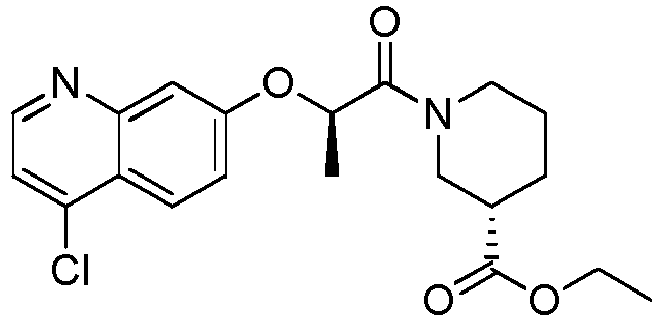
MS (ES) C29H23ClN2O4 requires: 390/392, found: 391/393 (M+H)+, 89% (R,S)-1K1_l 
MS (ES) C20H23IN2O4 requires: 482, found: 483 (M+H)+, 89% (R,R)-2K1x 
MS (ES) C21H25ClN2O4 requires: 404/406, found: 405/407 (M+H)+, 100% -

- L-(+)-Lactic acid (10 g, 111 mmol) and (S)-(+)-Nipecotic acid ethyl ester (17.5 g, 111 mmol) were reacted according to M11a to yield the desired product (S,S)-1H (12.7 g, 50%) as an off-white solid.
- 1H-NMR (300 MHz, CDCl3) δ 4.59-4.40 (m, 2H), 4.20-4.09 (m, 2H), 3.84-3.62 (m, 2H), 3.15-2.70 (m, 2H), 2.50-2.40 (m, 1H), 2.21-2.08 (m, 1H), 1.80-1.51 (m, 3H), 1.32-1.25 (m, 6H). GC-MS C11H19NO4 requires: 229, found: 229 (M+), 93%.
-

- Compound (R)-4G1 (100.0 mg, 0.289 mmol) and tert-butyl piperazine-1-carboxylate (80.8 mg, 0.434 mmol) were reacted according to M11a to yield the desired product 4N1_piperazine after lyophilization (114 mg, 77%) as a white solid.
- 1H NMR (400 MHz, DMSO-d 6) δ 8.89 (d, J = 4.4 Hz, 1H), 7.69 (ddd, J = 8.9, 2.6, 0.9 Hz, 1H), 7.54 - 7.49 (m, 1H), 7.45 - 7.39 (m, 1H), 7.37 - 7.28 (m, 3H), 7.23 (ddd, J = 9.3, 2.7, 1.0 Hz, 1H), 5.59 - 5.49 (m, 1H), 3.78 - 3.66 (m, 1H), 3.62 - 3.50 (m, 2H), 3.45 - 3.20 (m, 5H), 1.51 (dd, J = 6.5, 2.1 Hz, 3H), 1.46 - 1.39 (m, 9H).
- MS (ES) C27H29ClFN3O4 requires: 513/515, found: 514/516 (M+H)+, 96%.
-

- Intermediate (R)-4G1 (200.0 mg, 0.578 mmol) and (S)-3-Boc-aminopiperidine (174.0 mg, 0.868 mmol) were reacted according to M11a to yield the desired product 4N1_piperidine-NH2 (277 mg, 91%), which was used in the following step without further purification.
- 1H NMR (300 MHz, DMSO-d 6) δ 8.89 (dd, J = 8.5, 4.5 Hz, 1H), 7.70 (dd, J = 8.9, 2.8 Hz, 1H), 7.55 - 7.39 (m, 2H), 7.33 - 7.21 (m, 4H), 5.57 - 5.42 (m, 1H), 3.99 - 3.90 (m, 1H), 3.21 - 2.82 (m, 3H), 1.92 - 1.67 (m, 3H), 1.52 (d, J = 6.4 Hz, 3H), 1,43 - 1.32 (m, 12H).
- MS (ES) C28H31ClFN3O4 requires: 527/529, found: 528/530 (M+H)+, 95%.
-

- Intermediate (R)-4G1 (100.0 mg, 0.289 mmol) and (R)-3-(Boc-amino)pyrrolidine hydrochloride (97.0 mg, 0.434 mmol) were reacted according to M11a to yield the desired product 4N1_pyrrolidine-NH2 (139 mg, 94%) as an off-white solid.
- 1H NMR (300 MHz, DMSO-d 6) δ 8.89 (d, J = 4.4 Hz, 1H), 7.70 (dd, J = 8.9, 2.4 Hz, 1H), 7.54 - 7.39 (m, 2H), 7.33 - 7.20 (m, 4H), 5.28 - 5.23 (m, 1H), 4.12 - 3.84 (m, 2H), 3.55 - 3.16 (m, 2H), 2.69 (s, 1H), 2.27 - 1.70 (m, 3H), 1.51 - 1.47 (m, 3H), 1.38 (s, 9H).
-
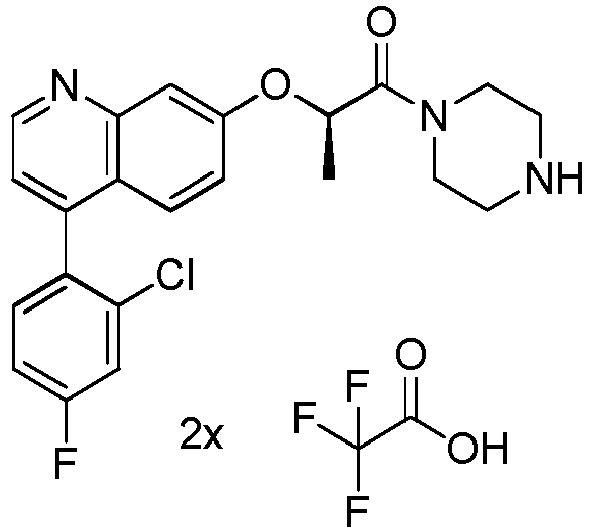
- Intermediate 4N1_piperazine (111 mg, 0.215 mmol) was reacted according to M10a to yield the desired product 4P1_piperazine (55) (135 mg, 97%) as a white solid after coevaporation with toluene.
- 1H NMR (400MHz, DMSO-d 6) δ 8.94 (d, J= 4.6 Hz, 1H), 7.70 (dd, J = 8.9, 2.6 Hz, 1H), 7.52 (dd, J = 8.6, 6.2 Hz, 1H), 7.51 - 7.39 (m, 1H), 7.43 - 7.33 (m, 3H), 7.27 (dt, J = 9.2, 2.0 Hz, 1H), 5.58 (p, J = 6.7 Hz, 1H), 3.94 - 3.59 (m, 4H), 3.25 - 3.02 (m, 4H), 1.51 (dd, J = 6.5, 2.3 Hz, 3H).
- MS (ES) C22H21ClFN3O2 requires: 413/415, found: 414/416 (M+H)+, 97%.
-

- Intermediate 4N1_piperidine-NH2 (270 mg, 0.511 mmol) was dissolved in 0.5 mL of 1,4-dioxane with 1.3 mL of 4N HCl in 1,4-dioxane and stirred at rt over 2.5 days. The solvents were evaporated in vacuo to yield the desired product 4P1_piperidine-NH2 (240 mg, 99%) as a white solid (HCl salt) after freeze drying.
- 1H NMR (300MHz, DMSO-d 6) δ 9.22 (m, 1H), 8.58 (bs, 1H), 8.30 (bs, 2H), 7.81 - 7.46 (m, 7H), 5.64 (m, 1H), 4.46 - 4.41 (m, 1H), 4.14 - 3.67 (m, 2H), 3.28 - 3.08 (m, 2H), 2.87 - 2.79 (m, 1H), 2.08 - 1.83 (m, 2H), 1.63 - 1.53 (m, 4H).
- MS (ES) C23H23ClFN3O2 requires: 427/429, found: 428/430 (M+H)+, 95%.
-

- Intermediate 4N1_pyrrolidine-NH2 (137 mg, 0.267 mmol) was reacted with HCl in dioxane according to Method 10b to yield the desired product 4P1_pyrrolidine-NH2 (106 mg, 91%) as a white solid (HCl salt) after freeze drying.
- 1H NMR (300MHz, DMSO-d 6) δ 9.28 - 9.19 (m, 1H), 8.54 - 8.44 (m, 3H), 7.84 - 7.49 (m, 7H), 5.33 - 5.23 (m, 1H), 4.37 - 3.51 (m, 5H), 2.50 - 2.26 (m, 2H), 1.58 (d, J = 1.6 Hz, 3H).
- MS (ES) C22H21ClFN3O2 requires: 413/415, found: 414/416 (M+H)+, 95%.
-

- Compound 4K (48 mg, 0.096 mmol) was reacted with 2 M NaOH aq. solution according to M9 to yield the desired product 18 (33 mg, 73%) as a white solid.
- 1H NMR (400 MHz, DMSO-d 6) δ 8.86 (dd, J = 9.3, 4.4 Hz, 1H), 7.67 (dd, J = 8.9, 2.5 Hz, 1H), 7.49 (t, J = 7.4 Hz, 1H), 7.40 (ddt, J = 10.7, 8.6, 2.2 Hz, 1H), 7.32 - 7.18 (m, 4H), 5.47 (dt, J = 33.1, 7.4 Hz, 1H), 4.34 - 3.88 (m, 2H), 3.13 - 2.87 (m, 1H), 2.64 - 2.04 (m, 3H), 2.01 - 1.44 (m, 6H), 1.35 - 1.16 (m, 2H).
- MS (ES) C26H24ClFN2O4 requires: 470/472, found: 471/473 (M+H)+, 98%
-

- Intermediate (R,R)-2K1x (50 mg, 0.123 mmol) was reacted with (2-ethylphenyl)boronic acid according to M3a. The reaction was evaporated in vacuo to yield the crude desired product 8K which was used in the following step without further purification.
- MS (ES) C29H34N2O4 requires: 474, found: 475 (M+H)+, 70%.
-

- Crude 8K (160 mg) was reacted with 2 M NaOH aq. solution according to M9 to yield the desired product 121 (31mg, 56% over 2 steps) as a white solid.
- 1H NMR (300 MHz, DMSO-d 6) δ 8.85 (dd, J = 7.8, 4.5 Hz, 1H), 7.51 - 7.41 (m, 2H), 7.40-7.30 (m, 1H), 7.30 - 7.13 (m, 5H), 5.49 (dd, J = 27.5, 6.2 Hz, 1H), 4.24 (d, J = 12.9 Hz, 1H), 4.17 - 3.94 (m, 1H), 3.22 - 2.54 (m, 1H), 2.44 - 2.07 (m, 3H), 1.92 - 1.58 (m, 4H), 1.51 (dd, J = 16.4, 6.4 Hz, 3H), 1.33 - 1.19 (m, 3H), 0.99 - 0.82 (m, 3H).
- MS (ES) C27H30N2O4 requires: 466, found: 467 (M+H)+, 99%.
- The tetrazole derivative 11 described in Table 6 was synthesized from the corresponding nitrile according to Method 12:
-

- Compound 30 (16 mg, 0.036 mmol) was dissolved in o-dichlorobenzene (360 µl) and Bu3SnN3 (61 mg, 0.182 mmol) was added in a sealed tube. The reaction was stirred at 125°C for 1 h, then at rt overnight. The crude product was absorbed onto Hydromatrix and purified by flash chromatography on silica gel using a gradient of MeOH in DCM to yield the desired product 11 (12.6 mg, 73%) as an off-white solid.
- 1H NMR (400 MHz, DMSO-d 6) δ 8.90 (t, J= 4.2 Hz, 1H), 7.70 (ddd, J = 8.9, 2.5, 1.2 Hz, 1H), 7.53 (dd, J = 8.6, 6.2 Hz, 1H), 7.47 - 7.28 (m, 4H), 7.24 (dd, J = 9.2, 2.6 Hz, 1H), 5.60 (dt, J = 37.7, 6.8 Hz, 1H), 4.49 (dd, J = 102.7, 12.9 Hz, 1H), 4.22 (dd, J = 52.2, 13.2 Hz, 1H), 3.56 - 2.75 (m, 2H), 2.30 - 2.11 (m, 1H), 1.84 (dd, J = 35.4, 18.1 Hz, 2H), 1.53 (ddd, J = 18.3, 6.6, 2.3 Hz, 4H), 1.39 - 1.08 (m, 1H).
- MS (ES) C24H22ClFN6O2 requires: 480/482, found: 481/483 (M+H)+, 99%.
- The isopropylic ester 36 was synthesized from precursor (R)-2G1 as described below:
-

- Compound (R)-2G1 (20 mg, 0.061 mmol) was dissolved in isopropanol (1 mL) and 1 drop conc. H2SO4 was added. The mixture was stirred at rt overnight, then heated to 60°C for 4h, and stirred at rt overnight. The reaction mixture was evaporated in vacuo and the crude product was purified by flash chromatography on reverse phase silica gel using a gradient of MeCN in H2O (both solvents containing 0.05% FA) to yield the desired product 36 as a FA salt (16 mg, 73%) as a beige glue.
- 1H NMR (400 MHz, DMSO-d 6) δ 8.87 (d, J = 4.4 Hz, 1H), 7.66 (dt, J = 7.7, 2.0 Hz, 1H), 7.58 - 7.48 (m, 2H), 7.43 (ddd, J = 7.2, 5.0, 2.0 Hz, 1H), 7.33 - 7.26 (m, 3H), 7.24 (dd, J = 9.2, 2.5 Hz, 1H), 5.21 - 5.08 (m, 1H), 4.96 (pd, J = 6.2, 1.1 Hz, 1H), 1.56 (d, J = 6.7 Hz, 3H), 1.23 (dd, J = 6.2, 3.2 Hz, 3H), 1.14 (dd, J = 6.3, 1.4 Hz, 3H).
- MS (ES) C21H20ClNO3 requires: 369/371, found: 370/372 (M+H)+, 98%.
-
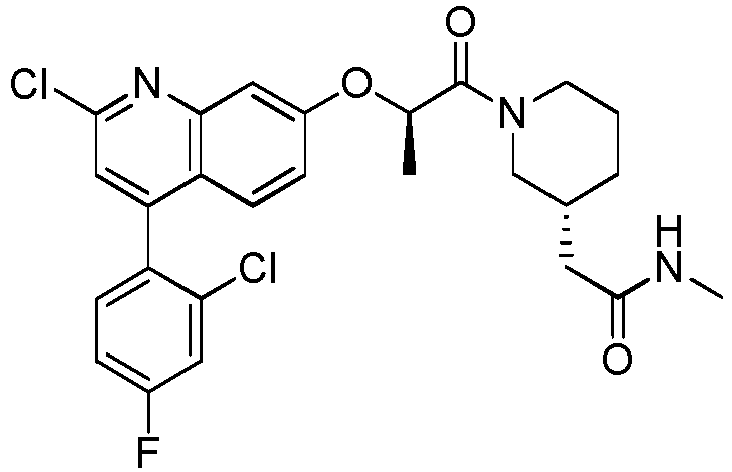
- Compound 56 (27 mg, 0.053 mmol) and 2M methylamine in THF (0.13 mL, 0.26 mmol) were reacted according to M11a to yield the desired product 98 after lyophilization (5.6 mg, 20%) as a white solid.
- 1H NMR (300 MHz, Chloroform-d) δ 8.82 (t, J = 4.1 Hz, 1H), 7.55 - 6.98 (m, 7H), 5.97 (m, 1H), 5.39 - 5.06 (m, 1H), 4.43 - 3.56 (m, 2H), 3.48 - 3.29 (m, 2H), 3.06 - 2.45 (m, 3H), 2.27 (s, 1H), 2.10 - 1.68 (m, 3H), 1.71 - 1.54 (m, 3H), 1.33 - 0.72 (m, 1H).
- MS (ES) C25H25ClFN3O3 requires: 469/471, found: 470/472 (M+H)+, 99%.
-

- To an ice-cold solution of compound 4N1_piperazine (20.3 mg, 0.043 mmol) and DIPEA (29 µL, 0.172 mmol) in dry DCM (1 mL), propionyl chloride (4.5 µL, 0.052 mmol) in dry DCM (0.5 mL) was added dropwise. The resulting mixture was stirred at 0 °C for 30 min followed by 3 h at rt. The reaction was then diluted with DCM and washed with H2O, a sat. NaHCO3 solution and brine. The organic phase was dried over MgSO4, filtered and evaporated in vacuo. The crude product was purified by flash chromatography on silica gel using a gradient of MeOH in DCM to yield the desired product 28 (25.5 mg, 68%) as a white solid.
- 1H NMR (400 MHz, DMSO-d 6) δ 8.89 (dd, J = 4.4, 0.8 Hz, 1H), 7.69 (ddd, J = 8.9, 2.5, 1.1 Hz, 1H), 7.55 - 7.48 (m, 1H), 7.45 - 7.21 (m, 5H), 5.57 (s, 1H), 3.81 - 3.34 (m, 8H), 2.34 (d, J = 8.0 Hz, 2H), 1.52 (dd, J = 6.5, 2.5 Hz, 3H), 0.99 (tdd, J = 7.4, 2.1, 0.8 Hz, 3H).
- MS (ES) C25H25ClFN3O3 requires: 469/471, found: 470/472 (M+H)+, 96%.
-
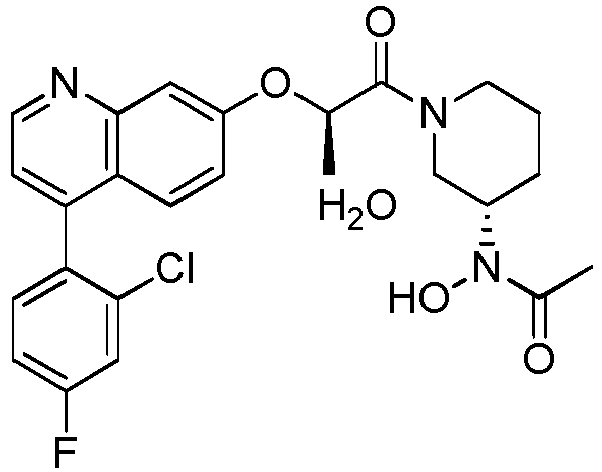
- The desired compound was synthesized in three steps starting from intermediate 4P1_piperidine-NH2:
A solution of BPO (355 mg, 1.10 mmol) in DCM (5.5 mL) was added quickly to a mixture of intermediate 4P1_piperidine-NH2 (240 mg, 0.517 mmol) in buffer solution at pH 10 (NaOH/NaHCO3, 5.5 mL) at rt. The reaction mixture was stirred for 2 h at rt, and the pH adjusted to ~10 by the addition of 10 M NaOH. Further BPO (355 mg, 1.10 mmol) was added, and the mixture stirred at rt for 18 h, upon which the reaction was deemed complete. Acetyl chloride (328 mg, 4.14 mmol) was added, and the reaction was further stirred at rt for 18 h. The mixture was extracted DCM, and the combined organic phases were washed with Na2CO3 and brine, dried over MgSO4, and the solvents removed in vacuo, to yield (39 mg, 13%) of the desired intermediate N-(benzoyloxy)-acetamide, which was taken to the next step without further analysis or purification. - MS (ES) C32H29ClFN3O5 requires: 589/591, found: 590/592 (M+H)+, 91%
- The crude N-(benzoyloxy)-N-(piperidin-3-yl)acetamide was treated with 3.5N NH3 in MeOH (0.4mL) at rt for 1 h. The solvents were removed in vacuo and the residue purified by preparative HPLC using NH4HCO3 as an additive to yield the desired product 209 (18 mg, 56% over 3 steps) as a white solid.
- 1H NMR (300MHz, DMSO-d 6) δ 9.83 - 9.58 (m, 1H), 8.88 (dd, J = 8.9, 4.4 Hz, 1H), 7.68 (dd, J = 8.8, 2.1 Hz, 1H), 7.57 - 7.38 (m, 2H), 7.36 - 7.19 (m, 4H), 5.61-5.46 (m, 1H), 4.36 - 3.96 (m, 3H), 3.02-2.63 (m, 1H), 2.02 - 1.97 (m, 3H), 1.87-1.77 (m, 4H), 1.58 - 1.22 (m, 4H).
- MS (ES) C25H25ClFN3O4 requires: 485/487, found: 486/488 (M+H)+, 98%.
-

- 4P1_pyrrolidine-NH2.HCl (109 mg, 0.242 mmol) was dissolved in DCM (1.0 mL) at 0°C under the atmosphere of nitrogen. DIPEA (66 mg, 0.508 mmol) was added to the suspension, followed by tert-butyl isocyanate (29 mg, 0.290 mmol), and the reaction was stirred and allowed to slowly warm up to rt over 4 h. The reaction mixture was concentrated, and the residue was purified by preparative HPLC using NH4HCO3 as an additive to yield the desired product 214 (65 mg, 52%) as a white solid.
- 1H NMR (300MHz, DMSO-d 6) δ 8.90 - 8.80 (m, 1H), 7.69 (dd, J = 8.7, 1.9 Hz, 1H), 7.54 - 7.39 (m, 2H), 7.35 - 7.20 (m, 4H), 5.97- 5.94 (m, 1H), 5.59 - 5.54 (m, 1H), 5.32 - 5.21 (m, 1H), 4.21 - 3.98 (m, 1H), 3.93 - 3.75 (m, 1H), 3.60 - 3.39 (m, 2H), 3.29 - 3.06 (m, 1H), 2.16 - 1.93 (m, 1H), 1.84- 1.59 (m, 1H), 1.50- 1.48 (m, 3H), 1.21 - 1.20 (m, 9H).
- MS (ES) C27H30ClFN4O3 requires: 512/514, found: 513/515 (M+H)+, 95%.
- The compounds exemplifying the invention are described in Table 6.
- When not otherwise specified, it should be assumed that M7, M11a, M11b, M11c, M12 or M13, optionally followed by M9, M10a, M10b, M11d, or M14 were used to yield the target compound. Tetrazoles can be obtained from the corresponding nitriles as exemplified in M8. Piperazines carbamates N could also be further modified according to M10a to obtain amines P followed by M11a, M11b, M11c or M11d to yield amides of formula Q. Primary amines such as compounds of formula P_piperidine-NH2 could be further modified to obtain N-hydroxyacetamides of formula R, using the multi-step method described for compound 209. Primary amines such as compounds of formula P_pyrrolidine could be further modified to obtain ureas of formula S, by reacting with tert-butyl-isocyanate as described for compound 214. It should be apparent to a person skilled in the art that reaction conditions such as temperature, dilution, reaction time or work-up procedures, including pH adjustment, are dependent on reaction partners and functional group compatibility and could vary from compound to compound.
- Generally, enantiomeric excess (ee) of the compounds (esters F and K, carboxylic acids G) was not measured, and was assumed equal to the value determined by chiral HPLC for the final compounds (usually carboxylic acids L). Chiral separation of the diastereomeric mixture was occasionally required to improve ee, particularly when any of the hydroxy-quinolines of formula D were alkylated via M7. Use of HATU as a coupling reagent (M11a) usually resulted in lower ee as compared to the coupling mixture EDC.HCl / HOBt.xH2O (M11b).
Table 6 - Compounds of formula (I) of the invention Ex Structure BB 1H-NMR LC purity %ee 1 
3D, + (S,S)-1H + M9 (300 MHz, DMSO-d 6) δ 12.50 (s, 1H), 8.90 (t, J = 4.2 Hz, 1H), 7.54 - 7.19 (m, 8H), 5.56 - 5.54 (m, 1H), 4.49 - 3.87 (m, 2H), 3.59 - 3.10 (m, 2H), 3.08-2.74 (m, 1H), 2.48 - 2.25 (m, 1H), 2.14 - 1.77 (m, 4H), 1.76 - 1.60 (m, 2H), 1.54 (dd, J = 10.2, 6.4 Hz, 3H). 99% 2 
4 (300 MHz, DMSO-d 6) δ 12.41 (s, 1H), 8.88 (t, J = 4.5 Hz, 1H), 7.35 - 7.08 (m, 7H), 5.60 - 5.47 (m, 1H), 4.44 - 3.84 (m, 2H), 3.65 - 2.74 (m, 2H), 2.46 - 2.21 (m, 1H), 2.19 - 1.74 (m, 1H), 1.88 - 1.77 (m, 6H), 1.71 - 1.55 (m, 2H), 1.50 (dd, J = 10.5, 6.3 Hz, 3H), 1.40 - 1.09 (m, 1H). 95% 3 
6 (300 MHz, Chloroform-d) δ 8.88 - 8.74 (m, 1H), 7.45 (s, 1H), 7.31 - 7.20 (m, 3H), 7.17 - 7.07 (m, 3H), 5.43 - 5.07 (m, 1H), 4.12 - 3.67 (m, 3H), 3.38 - 2.93 (m, 2H), 2.58 - 2.25 (m, 2H), 2.23 - 2.05 (m, 1H), 1.81 (d, J = 5.6 Hz, 6H), 1.90 - 1.29 (m, 6H). 98% 4 
6D1 + (S,S)-1H (300 MHz, Chloroform-d) δ 8.82 (t, J = 4.1 Hz, 1H), 7.33 (d, J = 2.5 Hz, 1H), 7.27 - 7.15 (m, 2H), 7.15 - 6.98 (m, 4H), 5.19 (dq, J = 16.1, 6.6 Hz, 1H), 4.54-4.21 (m, 1H), 4.08 (dq, J = 23.5, 7.0, 6.5 Hz, 2H), 3.93 - 3.24 (m, 1H), 3.03 (ddd, J = 38.7, 13.6, 10.2 Hz, 1H), 2.87 - 2.56 (m, 2H), 2.37 (dtd, J = 82.7, 10.4, 4.5 Hz, 1H), 2.10 (s, 1H), 1.82 (d, J = 3.0 Hz, 6H), 1.80 - 1.55 (m, 4H), 1.44 - 1.08 (m, 1H), 1.16 (t, J = 7.1 Hz, 3H). 95% 5 
(R)-6G1 + M11a + M9 (300 MHz, Chloroform-d) δ 9.30 (s, 1H), 8.83 (dd, J = 28.5, 4.8 Hz, 1H), 7.38 - 7.04 (m, 7H), 5.41 -5.05 (m, 1H), 4.39 (d, J = 13.7 Hz, 1H), 4.34 - 3.79 (m, 1H), 3.26 - 3.12 (m, 1H), 2.90 - 2.64 (m, 1H), 2.55 (dd, J = 16.1, 4.0 Hz, 1H), 2.33 (dd, J = 16.3, 10.2 Hz, 1H), 2.22 - 2.02 (m, 1H), 2.03 - 1.85 (m, 1H), 1.83 - 1.74 (m, 7H), 1.72 - 1.41 (m, 4H), 1.34 (d, J = 12.3 Hz, 1H). 94% 6 
(R)-6G1 (300 MHz, Chloroform-d) δ 8.82 (dd, J = 9.8, 4.5 Hz, 1H), 7.40 - 7.02 (m, 7H), 5.30 - 5.11 (m, 1H), 4.56 - 3.45 (m, 5H), 3.12 - 2.52 (m, 2H), 2.32 - 1.98 (m, 2H), 1.93 - 1.74 (m, 7H), 1.71 - 1.54 (m, 4H), 1.50 - 1.06 (m, 5H). 91% 7 
71 (400 MHz, DMSO-d 6) δ 8.89 (t, J = 4.6 Hz, 1H), 7.73 - 7.65 (m, 1H), 7.60 - 7.50 (m, 2H), 7.44 (dd, J = 7.3, 1.9 Hz, 1H), 7.37 - 7.26 (m, 3H), 7.22 (dd, J = 9.2, 2.6 Hz, 1H), 5.67 - 5.40 (m, 1H), 4.47 - 3.94 (m, 2H), 3.20 (s, 2H), 2.82 (t, J = 12.0 Hz, 1H), 2.63 - 2.16 (m, 1H), 2.08 - 1.90 (m, 1H), 1.82 - 1.56 (m, 2H), 1.54 - 1.30 (m, 3H). 98% ee86% 8 
(R)-3G1 (400 MHz, DMSO-d 6) δ 8.85 (dd, J = 7.1, 4.4 Hz, 1H), 7.47 - 7.16 (m, 8H), 5.61 - 5.35 (m, 1H), 4.19 (d, J = 11.6 Hz, 1H), 4.11 - 3.91 (m, 2H), 3.19-2.90 (m, 1H), 2.71 -2.10 (m, 3H), 2.01 - 1.95 (m, 3H), 1.87 - 1.46 (m, 6H), 1.32 - 1.20 (m, 3H), 1.14 (qd, J = 7.0, 2.0 Hz, 3H). 100% 9 
2D1 + (S,S)-1H + M9 (400 MHz, DMSO-d 6) δ 8.88 (t, J = 4.9 Hz, 1H), 7.68 (dt, J = 7.6, 1.3 Hz, 1H), 7.61 - 7.50 (m, 2H), 7.44 (dd, J = 7.2, 2.0 Hz, 1H), 7.38 - 7.25 (m, 3H), 7.22 (dd, J = 9.1, 2.4 Hz, 1H), 5.56 (q, J = 6.5 Hz, 1H), 4.45 - 3.83 (m, 2H), 3.53 - 3.08 (m, 2H), 3.01 - 2.73 (m, 1H), 2.43 - 2.23 (m, 1H), 2.10 - 1.86 (m, 1H), 1.86 - 1.29 (m, 2H), 1.55 - 1.45 (m, 3H). 97%, ee85% 10 
27 (400 MHz, DMSO-d 6) δ 8.88 (t, J = 4.9 Hz, 1H), 7.69 (ddd, J = 9.0, 2.7, 1.4 Hz, 1H), 7.52 (dd, J = 8.6, 6.2 Hz, 1H), 7.42 (tt, J = 6.7, 5.9, 2.4 Hz, 1H), 7.37 - 7.26 (m, 3H), 7.22 (dd, J = 9.3, 2.5 Hz, 1H), 5.61 - 5.50 (m, 1H), 4.47 - 3.83 (m, 2H), 3.22 - 2.73 (m, 2H), 2.44 - 2.21 (m, 2H), 2.10-1.88 (m, 1H), 1.84 - 1.27 (m, 2H), 1.50 (dd, J = 13.5, 6.6 Hz, 3H). 98% 11 
30 (400 MHz, DMSO-d 6) δ 8.90 (t, J = 4.2 Hz, 1H), 7.70 (ddd, J = 8.9, 2.5, 1.2 Hz, 1H), 7.53 (dd, J = 8.6, 6.2 Hz, 1H), 7.47 - 7.28 (m, 4H), 7.24 (dd, J = 9.2, 2.6 Hz, 1H), 5.60 (dt, J = 37.7, 6.8 Hz, 1H), 4.49 (dd, J = 102.7, 12.9 Hz, 1H), 4.22 (dd, J = 52.2, 13.2 Hz, 1H), 3.56 - 2.75 (m, 2H), 2.30 - 2.11 (m, 1H), 1.84 (dd, J = 35.4, 18.1 Hz, 2H), 1.53 (ddd, J = 18.3, 6.6, 2.3 Hz, 4H), 1.39 - 1.08 (m, 1H). 99% 12 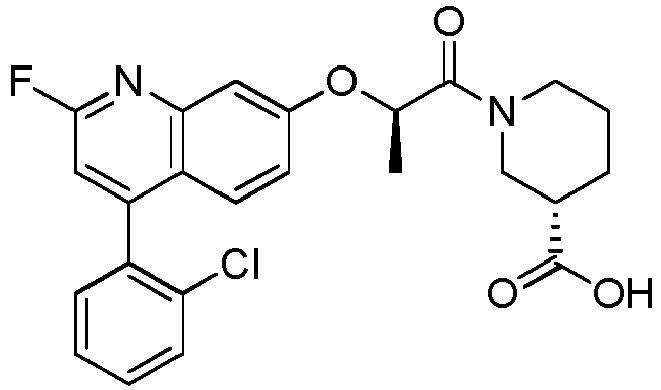
(R)-2G6 + M11a + M10a (400 MHz, DMSO-d 6) δ 12.47 (br. s, 1H), 7.70 (dt, J = 7.9, 1.3 Hz, 1H), 7.63 - 7.47 (m, 3H), 7.31 - 7.15 (m, 4H), 5.57 (q, J = 6.3 Hz, 1H), 4.44 - 3.75 (m, 2H), 3.22 - 2.62 (m, 2H), 2.46 - 2.22 (m, J = 1.9 Hz, 1H), 2.35 - 2.23 (m, 1H), 2.07 - 1.89 (m, 1H), 1.82 - 1.28 (m, 5H). 94% 13 
8 (400 MHz, DMSO-d 6) δ 12.15 (br. s, 1H), 8.83 (s, 1H), 7.52 - 7.09 (m, 8H), 5.58 - 5.34 (m, J = 33.9 Hz, 1H), 4.32 - 3.91 (m, 2H), 3.14 - 2.61 (m, 1H), 2.65 (s, 2H), 2.28 - 2.03 (m, 2H), 1.95 (s, 3H), 1.90 - 1.40 (m, 5H), 1.23 (s, 2H). 99% 14 
(R)-3G1 (300 MHz, Chloroform-d) δ 8.79 (d, J = 4.4 Hz, 1H), 7.40 - 7.03 (m, 8H), 5.20 (dq, J = 13.0, 6.8 Hz, 1H), 4.37 (dd, J = 55.5, 13.3 Hz, 1H), 4.20 - 3.96 (m, 2H), 3.92 - 3.20 (m, 1H), 3.17 - 2.13 (m, 3H), 2.08 - 1.89 (m, 4H), 1.81 - 1.27 (m, 8H), 1.16 (td, J = 7.1, 1.2 Hz, 3H). 97% 15 
(R)-4G1 400 MHz, DMSO-d 6) δ 8.88 (dd, J = 7.3, 4.4 Hz, 1H), 7.73 - 7.63 (m, 1H), 7.52 (dd, J = 8.6, 6.2 Hz, 1H), 7.46 - 7.38 (m, 1H), 7.34 - 7.20 (m, 4H), 5.65 - 5.35 (m, 1H), 4.20 (d, J = 13.1 Hz, 2H), 4.11 - 3.92 (m, 3H), 3.19 - 2.60 (m, 1H), 2.36 - 2.12 (m, 2H), 1.91 - 1.45 (m, 8H), 1.19-1.09 (m, 3H). 95% 16 
(R)-2G1 +M11b + M9 (400 MHz, DMSO-d 6) δ 8.86 (dd, J = 8.8, 4.4 Hz, 1H), 7.66 (d, J = 7.7 Hz, 1H), 7.58 - 7.48 (m, 2H), 7.42 (d, J = 7.3 Hz, 1H), 7.33 - 7.16 (m, 4H), 5.61 - 5.36 (m, 1H), 4.35 - 3.88 (m, 2H), 3.00 (d, J = 58.4 Hz, 2H), 2.14 (d, J = 36.0 Hz, 2H), 1.93 - 1.42 (m, 6H), 1.23 (s, 2H). 97% 17 
71 (300 MHz, DMSO-d 6) δ 12.57 (s, 1H), 8.95 (t, J = 4.1 Hz, 1H), 7.76 (dd, J = 9.0, 2.5 Hz, 1H), 7.65 - 7.24 (m, 6H), 5.73 - 5.50 (m, 1H), 4.50 - 3.99 (m, 2H), 3.34 - 3.14 (m, 2H), 2.99 - 2.76 (m, 1H), 2.69 - 2.21 (m, 2H), 2.16 - 1.61 (m, 1H), 1.57 (dd, J = 6.5, 2.8 Hz, 3H), 1.49 - 1.27 (m, 1H). 100% 18 
15 (400 MHz, DMSO-d 6) δ 8.86 (dd, J = 9.3, 4.4 Hz, 1H), 7.67 (dd, J = 8.9, 2.5 Hz, 1H), 7.49 (t, J = 7.4 Hz, 1H), 7.40 (ddt, J = 10.7, 8.6, 2.2 Hz, 1H), 7.32 - 7.18 (m, 4H), 5.47 (dt, J = 33.1, 7.4 Hz, 1H), 4.34 - 3.88 (m, 2H), 3.13 - 2.87 (m, 1H), 2.64 - 2.04 (m, 3H), 2.01 - 1.44 (m, 6H), 1.35 - 1.16 (m, 2H). 99% 19 
75 (300 MHz, Chloroform-d) δ 8.88 (d, J = 4.5 Hz, 1H), 7.69 (dd, J = 8.9, 2.5 Hz, 1H), 7.52 (dd, J = 8.7, 6.2 Hz, 1H), 7.41 (td, J = 8.5, 2.5 Hz, 1H), 7.34 - 7.19 (m, 4H), 5.33 - 5.23 (m, 1H), 3.92 - 3.21 (m, 5H), 3.17 - 2.99 (m, 1H), 2.23 - 1.88 (m, 1H), 1.55 - 1.44 (m, 3H). 98% 20 
4G, (400 MHz, DMSO-d 6) δ 8.88 (dd, J = 4.4, 0.7 Hz, 1H), 7.81 - 7.63 (m, 1H), 7.52 (ddt, J = 8.2, 6.2, 0.9 Hz, 1H), 7.46 - 7.38 (m, 1H), 7.34 - 7.26 (m, 3H), 7.22 (dd, J = 9.1, 2.6 Hz, 1H), 5.51 (p, J = 6.6 Hz, 1H), 3.72 - 3.39 (m, 4H), 1.72 - 1.37 (m, 9H). 100% 21 
3G3 + M11a+ M9 (300 MHz, DMSO-d 6) δ 12.19 (s, 1H), 7.53 - 7.16 (m, 8H), 5.64 - 5.44 (m, 1H), 4.37 - 3.84 (m, 2H), 3.18 - 2.89 (m, 1H), 2.64 (s, 1H), 2.23 (t, J = 4.7 Hz, 1H), 2.14 (dd, J = 6.9, 4.1 Hz, 1H), 2.01 (s, 3H), 1.80 (s, 2H), 1.67 (s, 1H), 1.53 (dd, J = 16.3, 6.4 Hz, 3H), 1.26 (s, 1H). 99% 22 
89 (300 MHz, DMSO-d 6) δ 12.25 (s, 1H), 8.95 (dd, J = 5.9, 4.4 Hz, 1H), 7.76 (dd, J = 8.9, 2.5 Hz, 1H), 7.63 - 7.44 (m, 2H), 7.41 - 7.33 (m, 3H), 7.29 (dd, J = 9.1, 2.6 Hz, 1H), 5.54 (dt, J = 10.7, 7.0 Hz, 1H), 4.20 (ddd, J = 52.0, 31.3, 13.1 Hz, 2H), 3.30 - 2.81 (m, 1H), 2.68 - 2.56 (m, 1H), 2.39 - 1.66 (m, 5H), 1.63 - 1.51 (m, 3H), 1.48 - 1.20 (m, 2H). 90% 23 
2D1 + (S,S)-1H + M9 (300 MHz, Methanol-d4) δ 8.77 - 8.66 (m, 1H), 7.57 - 7.47 (m, 1H), 7.52 - 7.11 (m, 7H), 5.55 - 5.26 (m, 1H), 4.53 - 3.67 (m, 2H), 3.58 - 2.58 (m, 1H), 2.54-2.21 (m, 1H), 2.15-1.29 (m, 7H) 91%-racemisation occurred 24 
58 (300 MHz, DMSO-d 6) δ 12.32 (s, 1H), 8.86 - 8.76 (m, 1H), 7.63 (dd, J = 8.9, 2.6 Hz, 1H), 7.51 - 7.29 (m, 2H), 7.30 - 7.11 (m, 4H), 5.56 - 4.75 (m, 1H), 4.24 - 3.88 (m, 1H), 3.24 - 2.35 (m, 3H), 2.50 (s, 1H), 1.97 - 0.74 (m, 7H). 100% 25 
3D3 + (S,S)-1H + M9 (300 MHz, DMSO-d 6) δ 12.50 (s, 1H), 7.47 - 7.17 (m, 8H), 5.56 (dd, J = 6.6, 4.0 Hz, 1H), 4.36 - 3.84 (m, 2H), 3.32 (s, 1H), 3.00 - 2.78 (m, 1H), 2.43 - 2.20 (m, 1H), 1.98 (d, J = 1.8 Hz, 4H), 1.80 - 1.42 (m, 5H), 1.27 (d, J = 25.9 Hz, 1H). 98% 26 
(R)-4G1 + M11a + M9 (300 MHz, DMSO-d 6) δ 13.06 (s, 1H), 10.59 (d, J = 4.0 Hz, 1H), 8.91 (dd, J = 4.4, 1.7 Hz, 1H), 8.32 (q, J = 2.2 Hz, 1H), 7.98 - 7.86 (m, 1H), 7.79 - 7.64 (m, 2H), 7.60 - 7.41 (m, 4H), 7.39 (d, J = 2.1 Hz, 2H), 7.33 (dd, J = 4.4, 1.0 Hz, 1H), 5.19 (q, J = 6.5 Hz, 1H), 1.74 - 1.65 (m, 3H). 100% 27 
4D1 + (S,S)-1H or (R)-4G, (400 MHz, DMSO-d 6) δ 8.88 (t, J = 5.2 Hz, 1H), 7.74 - 7.64 (m, 1H), 7.51 (ddd, J = 9.4, 6.1, 3.5 Hz, 1H), 7.42 (tt, J = 8.5, 2.5 Hz, 1H), 7.36 - 7.26 (m, 3H), 7.22 (dt, J = 9.3, 2.0 Hz, 1H), 5.69 - 5.42 (m, 1H), 4.32 - 3.42 (m, 5H), 3.27 - 2.92 (m, 2H), 2.65 - 2.28 (m, 1H), 2.09 - 1.85 (m, 1H), 1.82 - 1.55 (m, 2H), 1.51 (dd, J = 14.1, 6.4 Hz, 3H), 1.15 (t, J = 7.1 Hz, 3H). 95% 28 
1P (400 MHz, DMSO-d 6) δ 8.89 (dd, J = 4.4, 0.8 Hz, 1H), 7.69 (ddd, J = 8.9, 2.5, 1.1 Hz, 1H), 7.55 - 7.48 (m, 1H), 7.45 - 7.21 (m, 5H), 5.57 (s, 1H), 3.81 - 3.34 (m, 8H), 2.34 (d, J = 8.0 Hz, 2H), 1.52 (dd, J = 6.5, 2.5 Hz, 3H), 0.99 (tdd, J = 7.4, 2.1, 0.8 Hz, 3H). 96% 29 
(R)-F1x (400 MHz, Chloroform-d) δ 8.88 (d, J = 4.5 Hz, 1H), 7.58 - 7.53 (m, 1H), 7.47 - 7.37 (m, 4H), 7.35 - 7.29 (m, 1H), 7.24 - 7.15 (m, 2H), 4.86 (qd, J = 6.8, 4.3 Hz, 1H), 1.67 (d, J = 6.8 Hz, 3H), 1.48 (s, 9H). 95% 30 
(R)-4G1 (300 MHz, Chloroform-d) δ 8.81 (d, J = 4.5 Hz, 1H), 7.38 (td, J = 11.5, 9.3, 5.5 Hz, 2H), 7.30 - 7.00 (m, 5H), 5.26-5.10 (m, 1H), 4.26 - 3.82 (m, 1H), 3.77 - 3.68 (m, 1H), 3.42 (tdd, J = 29.1, 13.9, 7.8 Hz, 2H), 2.98 - 2.48 (m, 1H), 1.99 (s, 1H), 1.80 (d, J = 12.7 Hz, 2H), 1.67 - 1.25 (m, 4H). 98% 31 
(R)-3G5 + M11a + M10a (400 MHz, DMSO-d 6) δ 7.63 - 7.19 (m, 8H), 5.56 (q, J = 6.7 Hz, 1H), 4.32 - 3.79 (m, 2H), 3.51-3.12 (m, 1H), 2.83 (s, 4H), 2.44 - 2.26 (m, 2H), 2.02 (s, 4H), 1.79 - 1.47 (m, 5H). 97% 32 
(R)-4G1 (300 MHz, Chloroform-d) δ 8.89 - 8.75 (m, 1H), 7.43 - 7.00 (m, 7H), 5.26 - 5.06 (m, 1H), 4.90 - 4.16 (m, 1H), 2.84 (dd, J = 48.2, 1.4 Hz, 3H), 1.60 (ddd, J = 6.6, 5.4, 1.1 Hz, 3H), 1.26 - 0.98 (m, 6H). 99% 33 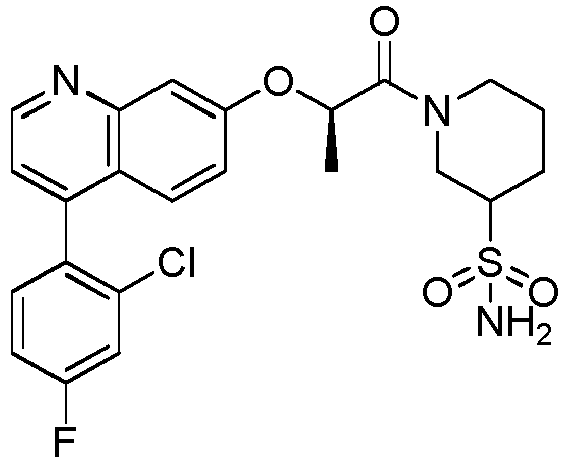
(R)-4G1 (300 MHz, Chloroform-d) δ 8.80 (d, J = 4.8 Hz, 1H), 7.48 - 7.21 (m, 4H), 7.17 - 7.01 (m, 3H), 5.80 - 5.05 (m, 2H), 4.67 - 4.21 (m, 2H), 3.98 - 3.23 (m, 2H), 3.17 - 2.69 (m, 1H), 2.61 - 1.71 (m, 2H), 1.69 - 1.12 (m, 4H). 100% 34 
2G3 + M11a + M9 (400 MHz, DMSO-d 6) δ 12.45 (s, 1H), 7.73 - 7.67 (m, 1H), 7.63 - 7.47 (m, 3H), 7.39 (d, J = 2.6 Hz, 1H), 7.36 - 7.23 (m, 3H), 5.57 (q, J = 6.6 Hz, 1H), 4.16 (dd, J = 113.6, 13.5 Hz, 1H), 3.93 (s, 1H), 3.52 - 3.05 (m, 1H), 3.04 - 2.79 (m, 1H), 2.47 - 2.22 (m, 1H), 2.06 - 1.87 (m, 1H), 1.82 - 1.55 (m, 2H), 1.54 - 1.44 (m, 3H), 1.28 (d, J = 35.1 Hz, 1H). 99% 35 
6G3 + M11a + M9 (300 MHz, Chloroform-d) δ 7.44 - 7.21 (m, 1H), 7.18 - 6.87 (m, 6H), 5.47 - 5.00 (m, 1H), 4.35 - 3.60 (m, 3H), 3.38 - 3.08 (m, 1H), 2.66 - 2.46 (m, 1H), 2.18 - 2.00 (m, 1H), 1.99 - 1.91 (m, 4H), 1.91 - 1.76 (m, 2H), 1.73 - 1.42 (m, 3H). 99% 36 
(R)-2G1 (400 MHz, DMSO-d 6) δ 8.87 (d, J = 4.4 Hz, 1H), 7.66 (dt, J = 7.7, 2.0 Hz, 1H), 7.58 - 7.48 (m, 2H), 7.43 (ddd, J = 7.2, 5.0, 2.0 Hz, 1H), 7.33 - 7.26 (m, 3H), 7.24 (dd, J = 9.2, 2.5 Hz, 1H), 5.21 - 5.08 (m, 1H), 4.96 (pd, J = 6.2, 1.1 Hz, 1H), 1.56 (d, J = 6.7 Hz, 3H), 1.23 (dd, J = 6.2, 3.2 Hz, 3H), 1.14 (dd, J = 6.3, 1.4 Hz, 3H). 98% 37 
(R)-4G1 (300 MHz, Chloroform-d) δ 8.81 (d, J = 4.6 Hz, 1H), 7.37 - 7.20 (m, 4H), 7.19 - 7.03 (m, 3H), 4.99 (p, J = 6.5 Hz, 1H), 3.87 - 3.49 (m, 5H), 3.43 - 3.30 (m, 1H), 3.10 -1.95 (m, 5H), 1.72-1.46 (m, 4H). 97% 38 
66 (300 MHz, Chloroform-d) δ 8.82 (t, J = 4.1 Hz, 1H), 7.55 - 6.98 (m, 7H), 5.97 (m, 1H), 5.39 - 5.06 (m, 1H), 4.43 - 3.56 (m, 2H), 3.48 - 3.29 (m, 2H), 3.06 - 2.45 (m, 3H), 2.27 (s, 1H), 2.10-1.68 (m, 3H), 1.71 - 1.54 (m, 3H), 1.33 - 0.72 (m, 1H). 99% 39 
67 (300 MHz, DMSO-d 6) δ 12.10 (s, 1H), 8.75 (d, J = 4.3 Hz, 1H), 7.56 (dd, J = 8.9, 2.6 Hz, 1H), 7.38 (dd, J = 8.6, 6.2 Hz, 1H), 7.29 (tdd, J = 8.5, 2.6, 1.4 Hz, 1H), 7.21 - 7.06 (m, 4H), 5.20 - 5.06 (m, 1H), 3.92 - 3.68 (m, 1H), 3.52 - 3.08 (m, 2H), 3.08 - 2.76 (m, 1H), 2.51 - 2.32 (m, 1H), 2.23 (dd, J = 7.4, 3.6 Hz, 2H), 2.06 - 1.81 (m, 1H), 1.63 - 1.28 (m, 4H). 100% 40 
37 (300 MHz, DMSO-d 6) δ 12.25 (s, 1H), 8.89 (d, J = 4.4 Hz, 1H), 7.70 (dd, J = 8.9, 2.5 Hz, 1H), 7.58 - 7.39 (m, 2H), 7.35 - 7.19 (m, 4H), 5.24 (p, J = 6.3 Hz, 1H), 3.82 - 3.56 (m, 2H), 3.33 (s, 3H), 2.47 - 2.30 (m, 2H), 2.21 - 1.92 (m, 1H), 1.73 - 1.46 (m, 4H). 100% 41 
(R)-2G6 (400 MHz, Chloroform-d) δ 7.56 (dd, J = 7.7, 1.4 Hz, 1H), 7.49 - 7.34 (m, 3H), 7.33 - 7.22 (m, 2H), 7.15 (q, J = 8.0, 7.4 Hz, 1H), 6.87 (d, J = 5.7 Hz, 1H), 5.34 - 5.12 (m, 1H), 4.57 - 3.74 (m, 4H), 3.55 - 2.89 (m, 2H), 2.43 (dt, J = 86.3, 9.7 Hz, 1H), 2.15 - 1.96 (m, 1H), 1.85 - 1.60 (m, 5H), 1.25 (p, J = 7.1 Hz, 4H). 98% 42 
(R)-4G1 (300 MHz, Chloroform-d) δ 8.80 (d, J = 4.6 Hz, 1H), 7.38 - 7.00 (m, 7H), 5.01 (q, J = 6.6 Hz, 1H), 3.70 (ddd, J = 9.7, 7.8, 4.1 Hz, 1H), 3.56 - 3.33 (m, 3H), 2.09 - 1.65 (m, 4H), 1.60 (d, J = 6.5 Hz, 3H). 99% 43 
73 (300 MHz, Chloroform-d) δ 7.62 (t, J = 2.8 Hz, 1H), 7.47 - 7.07 (m, 7H), 5.15 - 5.01 (m, 1H), 2.08 - 1.97 (m, 3H), 1.87 (d, J = 6.9 Hz, 3H). 93% 44 
(R)-4F1_Et (400 MHz, DMSO-d 6) δ 8.85 (dd, J = 4.4, 0.6 Hz, 1H), 7.67 (dt, J = 8.9, 2.3 Hz, 1H), 7.49 (ddd, J = 8.1, 6.2, 1.8 Hz, 1H), 7.39 (tt, J = 8.5, 2.4 Hz, 1H), 7.32 - 7.27 (m, 2H), 7.26 (dd, J = 4.4, 0.6 Hz, 1H), 7.22 (dd, J = 9.2, 2.6 Hz, 1H), 5.00 (q, J = 6.5 Hz, 1H), 1.55 (d, J = 6.8 Hz, 3H). 96% 45 
4G1 (400 MHz, DMSO-d 6) δ 8.88 (d, J = 4.4 Hz, 1H), 7.69 (ddd, J = 8.9, 2.6, 1.4 Hz, 1H), 7.51 (ddd, J = 7.9, 6.2, 1.5 Hz, 1H), 7.42 (tt, J = 8.5, 2.3 Hz, 1H), 7.35 - 7.19 (m, 4H), 5.58 - 5.41 (m, 1H), 3.16 (d, J = 7.5 Hz, 3H), 2.87 (d, J = 3.0 Hz, 3H), 1.50 (dd, J = 6.5, 1.5 Hz, 3H). 97% 46 
2G + M11b + M9 (400 MHz, DMSO-d 6) δ 12.47 (br. s, 1H), 8.89 (d, J = 4.4 Hz, 1H), 7.68 (dd, J = 7.8, 1.4 Hz, 1H), 7.55 (dtd, J = 15.9, 7.4, 1.6 Hz, 2H), 7.45 (dt, J = 4.7, 2.0 Hz, 2H), 7.33 - 7.22 (m, 3H), 5.17- 4.96 (m, 2H), 4.42 - 3.67 (m, 2H), 3.51 -3.02 (m, 2H), 2.92 - 2.53 (m, 1H), 2.45 - 1.34 (m, 4H). 100% 47 
(R)-4G1 (300 MHz, Chloroform-d) δ 8.89 - 8.77 (m, 1H), 7.47 (d, J = 2.6 Hz, 1H), 7.45 - 7.18 (m, 3H), 7.20 -7.00 (m, 3H), 6.21 (d, J = 11.0 Hz, 1H), 4.71 (qd, J = 6.7, 3.3 Hz, 1H), 1.56 (dd, J = 6.7, 0.9 Hz, 3H), 1.28 (d, J = 2.8 Hz, 9H). 97% 48 
(R)-2G1 (400 MHz, DMSO-d 6) δ 8.88 (dd, J = 4.5, 0.8 Hz, 1H), 8.13 (t, J = 7.7 Hz, 1H), 7.68 (dq, J = 7.6, 1.3 Hz, 1H), 7.61 - 7.49 (m, 2H), 7.44 (ddd, J = 7.0, 3.4, 1.5 Hz, 1H), 7.35 - 7.20 (m, 3H), 4.86 (q, J = 6.6 Hz, 1H), 4.07 - 3.69 (m, 1H), 1.49 (dt, J = 6.5, 1.2 Hz, 3H), 1.10 (ddd, J = 6.4, 5.3, 0.9 Hz, 3H), 1.04 (ddd, J = 6.2, 5.0, 0.9 Hz, 3H). 100% 49 
(R)-3G5 (400 MHz, DMSO-d 6) δ 7.49 - 7.05 (m, 8H), 5.53 - 5.34 (m, 1H), 4.32 - 3.82 (m, 4H), 3.04 (dq, J = 69.0, 11.4, 10.4 Hz, 1H), 2.66 (s, 4H), 2.37 - 2.08 (m, 2H), 1.98 (d, J = 3.6 Hz, 3H), 1.79 (s, 2H), 1.70-1.45 (m, 4H), 1.32 - 1.20 (m, 2H), 1.15 (qd, J = 7.0, 2.3 Hz, 3H). 100% 50 
2D1 (300 MHz, Chloroform-d) δ 8.82 (d, J = 4.4 Hz, 1H), 7.52 - 7.45 (m, 1H), 7.43 - 7.26 (m, 4H), 7.27 - 7.21 (m, 1H), 7.17 - 7.09 (m, 2H), 4.90 (qd, J = 6.8, 2.4 Hz, 1H), 4.27 - 4.10 (m, 2H), 1.63 (d, J = 6.8 Hz, 3H), 1.22 (t, J = 7.1 Hz, 3H). 94% 51 
(R)-4G1 (300 MHz, Chloroform-d) δ 8.84 (d, J = 4.4 Hz, 1H), 8.48 - 8.34 (m, 1H), 7.99 - 7.87 (m, 2H), 7.59 (dq, J = 8.6, 2.3 Hz, 3H), 7.41 (dd, J = 9.1, 1.0 Hz, 1H), 7.31 - 7.02 (m, 5H), 5.01 (qd, J = 6.8, 1.8 Hz, 1H), 4.28 (q, J = 7.1 Hz, 2H), 1.70 (d, J = 6.7 Hz, 3H), 1.31 (t, J = 7.1 Hz, 3H). 100% 52 
25 (300 MHz, Chloroform-d) δ 7.38 - 7.02 (m, 7H), 6.93 - 6.76 (m, 1H), 6.31 (d, J = 90.5 Hz, 1H), 5.87 - 5.36 (m, 1H), 5.28 - 5.06 (m, 1H), 4.06 - 2.96 (m, 3H), 2.49-2.11 (m, 1H), 2.13-1.90 (m, 5H), 1.89 - 1.62 (m, 2H), 1.58 (d, J = 6.5 Hz, 3H), 1.61 - 1.25 (m, 1H). 100% 53 
(R)-2G1 (300 MHz, Chloroform-d) δ 8.81 (d, J = 4.5 Hz, 1H), 7.54 - 7.42 (m, 1H), 7.43 - 7.27 (m, 4H), 7.26 - 7.21 (m, 1H), 7.20 - 7.03 (m, 2H), 5.17 (td, J = 7.0, 5.8 Hz, 1H), 3.63 - 3.39 (m, 4H), 1.69 - 1.31 (m, 10H). 92% 54 
(R)-4G1 (400 MHz, DMSO-d 6) δ 8.89 (d, J = 4.4 Hz, 1H), 8.66 - 8.56 (m, 1H), 7.69 (ddd, J = 8.9, 2.6, 1.7 Hz, 1H), 7.52 (ddd, J = 8.8, 6.2, 2.8 Hz, 1H), 7.45 - 7.24 (m, 5H), 4.88 (dtd, J = 8.6, 4.3, 2.5 Hz, 1H), 4.45 - 4.08 (m, 1H), 3.60 (dd, J = 9.3, 1.1 Hz, 3H), 3.10 - 2.76 (m, 1H), 2.46 - 2.04 (m, 4H), 1.50 (ddd, J = 6.9, 5.8, 1.5 Hz, 3H). 96% 55 
4N1_pipe razine (400 MHz, DMSO-d 6) δ 8.94 (d, J = 4.6 Hz, 1H), 7.70 (dd, J = 8.9, 2.6 Hz, 1H), 7.52 (dd, J = 8.6, 6.2 Hz, 1H), 7.51 - 7.39 (m, 1H), 7.43 - 7.33 (m, 3H), 7.27 (dt, J = 9.2, 2.0 Hz, 1H), 5.58 (p, J = 6.7 Hz, 1H), 3.94 - 3.59 (m, 4H), 3.25 - 3.02 (m, 4H), 1.51 (dd, J = 6.5, 2.3 Hz, 3H). 97% 56 
93 (300 MHz, Chloroform-d) δ 7.33 - 7.21 (m, 4H), 7.17 - 7.00 (m, 3H), 5.26 - 5.09 (m, 1H), 4.43 - 4.30 (m, 1H), 4.16 - 4.00 (m, 1H), 3.84 - 3.06 (m, 1H), 2.96 - 2.62 (m, 2H), 2.38 - 1.75 (m, 4H), 1.71 - 1.52 (m, 4H), 1.46 - 1.11 (m, 2H). 98% 57 
(R)-6G3 + M11a + M9 (300 MHz, Chloroform-d) δ 7.33 - 7.21 (m, 2H), 7.14 - 6.86 (m, 5H), 6.69 (s, 1H), 5.27 - 5.07 (m, 1H), 4.64 - 2.45 (m, 4H), 2.38 - 2.09 (m, 2H), 2.15 - 1.73 (m, 5H), 1.70 - 1.12 (m, 6H). 100% 58 
(R)-4G1 (300 MHz, Chloroform-d) δ 8.81 (t, J = 5.5 Hz, 1H), 7.48 - 7.31 (m, 2H), 7.28 - 7.20 (m, 2H), 7.18 - 7.01 (m, 3H), 5.23 - 5.12 (m, 1H), 4.34 (d, J = 14.6 Hz, 1H), 4.16 - 3.90 (m, 3H), 3.44 - 3.01 (m, 1H), 2.95 - 2.78 (m, 1H), 2.58 - 2.39 (m, 1H), 2.02 - 1.46 (m, 7H), 1.18 (q, J = 7.1 Hz, 3H). 96% 59 
(R)-4G5 + M11a + M10a (400 MHz, DMSO-d 6) δ 7.73 (dd, J = 8.9, 2.5 Hz, 1H), 7.58 - 7.19 (m, 6H), 5.67 - 5.44 (m, 1H), 4.31 - 3.79 (m, 2H), 3.50 - 3.08 (m, 1H), 2.98 - 2.72 (m, 4H), 2.43 - 2.25 (m, 1H), 1.96 (d, J = 15.8 Hz, 1H), 1.77 - 1.44 (m, 6H). 98% 60 
51 (300 MHz, DMSO-d 6) δ 10.66 (d, J = 4.3 Hz, 1H), 8.87 (dd, J = 4.4, 1.5 Hz, 1H), 7.91 (dd, J = 8.6, 1.7 Hz, 2H), 7.82 - 7.66 (m, 3H), 7.61 - 7.26 (m, 6H), 5.18 (q, J = 6.5 Hz, 1H), 1.67 (d, J = 6.5 Hz, 3H). 94% 61 
(R)-4G1 (300 MHz, Chloroform-d) δ 12.78 (s, 1H), 8.85 (d, J = 4.5 Hz, 1H), 7.48 (d, J = 2.6 Hz, 1H), 7.37 (d, J = 9.2 Hz, 1H), 7.25 (ddd, J = 8.7, 6.5, 2.4 Hz, 2H), 7.24 - 7.02 (m, 3H), 6.28-6.15 (m, 1H), 4.81 (qd, J = 6.7, 2.7 Hz, 1H), 4.17 - 3.94 (m, 1H), 1.58 (d, J = 6.9 Hz, 3H), 1.13 (dd, J = 6.6, 2.3 Hz, 3H), 1.03 (dd, J = 6.5, 3.8 Hz, 3H). 97% 62 
(rac)-4G4 + M11a + M9 (300 MHz, Chloroform-d) δ 8.92 - 8.76 (m, 1H), 7.77 - 7.59 (m, 1H), 7.35 - 7.00 (m, 5H), 6.23 - 5.63 (m, 1H), 4.88 - 4.43 (m, 2H), 3.49-2.67 (m, 2H), 2.55 (tt, J = 12.6, 3.7 Hz, 1H), 2.31 - 2.16 (m, 1H), 2.08 - 1.80 (m, 1H), 1.56 (dd, J = 13.1, 6.8 Hz, 3H), 1.77-1.12 (m, 2H). 99% 63 
(R)-4G1 (400 MHz, DMSO-d 6) δ 8.89 (d, J = 4.4 Hz, 1H), 8.14 (d, J = 10.8 Hz, 1H), 7.69 (ddd, J = 8.9, 2.6, 1.3 Hz, 1H), 7.52 (dd, J = 8.6, 6.2 Hz, 1H), 7.45 - 7.21 (m, 5H), 5.57 (q, J = 6.6 Hz, 1H), 4.40 - 4.07 (m, 1H), 4.06 - 3.52 (m, 3H), 3.30 - 3.13 (m, 2H), 1.51 (ddd, J = 13.4, 6.5, 2.5 Hz, 3H). 97% 64 
(R)-4G3 + M11a + M9 (300 MHz, DMSO-d 6) δ 12.41 (s, 1H), 7.59 (ddd, J = 8.9, 2.6, 1.0 Hz, 1H), 7.44 (ddd, J = 7.9, 6.2, 1.7 Hz, 1H), 7.38 - 7.25 (m, 2H), 7.24 - 7.07 (m, 3H), 5.51 - 5.40 (m, 1H), 4.25 - 3.68 (m, 2H), 3.39 - 2.94 (m, 1H), 2.87 - 2.65 (m, 1H), 2.45 - 1.73 (m, 2H), 1.66 - 1.42 (m, 3H), 1.36 (dd, J = 10.2, 6.4 Hz, 3H). 99% 65 
(R,R)-2K1x (300 MHz, DMSO-d 6) δ 12.32 (s, 1H), 8.98 (dd, J = 7.4, 4.4 Hz, 1H), 7.66 (qd, J = 8.6, 6.1 Hz, 2H), 7.53 - 7.19 (m, 5H), 5.70 - 5.49 (m, 1H), 4.38 - 4.03 (m, 2H), 3.25 - 2.96 (m, 1H), 2.84 - 2.46 (m, 1H), 2.36-2.13 (m, 2H), 2.00 - 1.66 (m, 3H), 1.59 (dd, J = 16.0, 6.4 Hz, 3H), 1.33 (s, 2H). 90% 66 
1D1 + (S,S)-1H + M9 (300 MHz, DMSO-d 6) δ 12.49 (s, 1H), 8.85 (t, J = 4.1 Hz, 1H), 7.76 (dd, J = 9.3, 2.4 Hz, 1H), 7.65 - 7.48 (m, 5H), 7.40 - 7.20 (m, 3H), 5.57 (q, J = 6.5 Hz, 1H), 4.42 - 3.88 (m, 2H), 3.50 - 3.08 (m, 2H), 3.01 - 2.68 (m, 1H), 2.43 - 1.72 (m, 2H), 1.73 - 1.45 (m, 4H), 1.26 (d, J = 15.3 Hz, 1H). 97% 67 
(R)-4G1 (300 MHz, Chloroform-d) δ 8.81 (d, J = 4.5 Hz, 1H), 7.39 - 7.01 (m, 7H), 5.01 (dq, J = 6.8, 5.5 Hz, 1H), 4.04 - 3.60 (m, 5H), 3.59 - 3.29 (m, 1H), 3.15 - 3.00 (m, 1H), 2.76 - 2.24 (m, 3H), 2.20 - 1.98 (m, 1H), 1.85 - 1.36 (m, 4H). 100% 68 
83 (300 MHz, Chloroform-d) δ 7.49 (dt, J = 7.6, 2.1 Hz, 1H), 7.43 - 7.17 (m, 5H), 7.16 - 7.07 (m, 2H), 6.62 - 6.37 (m, 1H), 5.23 - 5.00 (m, 1H), 3.92 - 3.78 (m, 1H), 3.71 - 3.06 (m, 2H), 2.82 - 2.67 (m, 3H), 2.49 - 2.26 (m, 1H), 2.24 - 1.84 (m, 1H), 1.72 (td, J = 8.8, 4.2 Hz, 1H), 1.61 (dd, J = 17.1, 6.6 Hz, 4H), 1.52 - 0.65 (m, 4H). 100% 69 
49 (400 MHz, DMSO-d 6) δ 7.65 - 7.18 (m, 8H), 5.50 (dt, J = 24.4, 6.9 Hz, 1H), 4.41 - 3.68 (m, 2H), 2.84 (s, 4H), 2.70 - 2.54 (m, 1H), 2.37 - 2.07 (m, 2H), 2.03 (s, 3H), 1.80 (s, 3H), 1.70-1.50 (m, 4H), 1.25 (s, 1H). 100% 70 
104 (400 MHz, DMSO-d 6) δ 7.71 - 7.67 (m, 1H), 7.62 - 7.52 (m, 2H), 7.49 (dt, J = 7.3, 2.1 Hz, 1H), 7.40 (s, 1H), 7.37 - 7.24 (m, 3H), 5.59 (s, 1H), 3.68 (s, 8H), 1.99 (s, 1H), 1.52 (dd, J = 6.5, 2.6 Hz, 3H), 0.82 - 0.62 (m, 4H). 100% 71 
(R)-4G1 (300 MHz, Chloroform-d) δ 8.82 (t, J = 4.0 Hz, 1H), 7.46 - 7.01 (m, 7H), 5.21 (dt, J = 32.8, 6.5 Hz, 1H), 4.66 - 3.81 (m, 3H), 3.73 - 3.10 (m, 4H), 3.06-2.44 (m, 2H), 2.42 - 1.86 (m, 2H), 1.82 - 1.13 (m, 4H). 100% 72 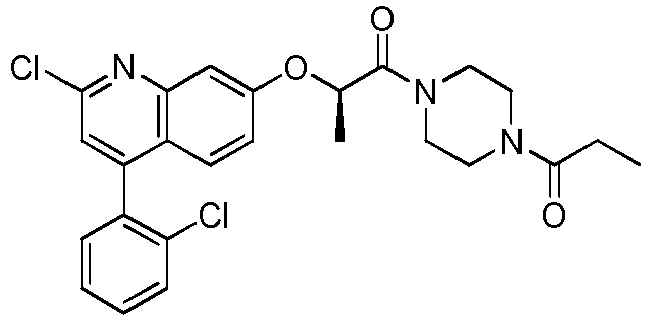
104 (400 MHz, DMSO-d 6) δ 7.71 - 7.67 (m, 1H), 7.63 - 7.46 (m, 3H), 7.40 (s, 1H), 7.36 - 7.24 (m, 3H), 5.58 (d, J = 6.3 Hz, 1H), 3.77 - 3.37 (m, 8H), 2.34 (d, J = 7.6 Hz, 2H), 1.51 (dd, J = 6.5, 2.6 Hz, 3H), 1.05 - 0.94 (m, 3H). 100% 73 
3D3 (300 MHz, Chloroform-d) δ 7.37 - 7.20 (m, 5H), 7.15 - 7.04 (m, 3H), 4.75 (qd, J = 6.8, 2.5 Hz, 1H), 1.97 (d, J = 1.6 Hz, 3H), 1.59 (d, J = 6.8 Hz, 3H), 1.41 (d, J = 2.9 Hz, 9H). 95% 74 
(R)-4G5 (400 MHz, DMSO-d 6) δ 7.67 (dd, J = 8.9, 2.5 Hz, 1H), 7.50 (t, J = 7.5 Hz, 1H), 7.41 (tt, J = 8.6, 2.3 Hz, 1H), 7.33 - 7.10 (m, 4H), 5.61 - 5.30 (m, 1H), 4.28 - 3.85 (m, 4H), 3.04 (dq, J = 63.3, 11.6 Hz, 1H), 2.73 - 2.51 (m, 4H), 2.37 - 2.11 (m, 3H), 1.89 - 1.45 (m, 7H), 1.15 (dt, J = 7.1, 4.9 Hz, 3H). 99% 75 
(R)-4G1 (300 MHz, DMSO-d 6) δ 8.89 (d, J = 4.5 Hz, 1H), 7.70 (dd, J = 8.9, 2.6 Hz, 1H), 7.61 - 7.39 (m, 2H), 7.44 - 7.17 (m, 4H), 5.28 (tt, J = 6.5, 4.5 Hz, 1H), 4.16 (qd, J = 7.1, 2.4 Hz, 1H), 4.05 (q, J = 7.1 Hz, 1H), 3.97 - 3.36 (m, 4H), 3.31 - 3.07 (m, 1H), 2.28 - 1.97 (m, 2H), 1.57 - 1.46 (m, 3H), 1.26-1.08 (m, 3H). 100% 76 
34 (300 MHz, Chloroform-d) δ 7.48 (dd, J = 7.6, 1.7 Hz, 1H), 7.42 - 7.28 (m, 4H), 7.26 - 7.06 (m, 4H), 6.51 - 5.96 (m, 1H), 5.77-5.40 (m, 1H), 5.28 - 5.06 (m, 1H), 4.14 - 3.96 (m, 1H), 3.96 - 3.72 (m, 1H), 3.71 - 2.88 (m, 2H), 2.51 - 2.36 (m, 1H), 2.17 - 1.25 (m, 7H). 100% 77 
(R)-4G1 (300 MHz, DMSO-d 6) δ 8.73 (d, J = 4.5 Hz, 1H), 8.24-8.12 (m, 1H), 7.54 (dt, J = 8.8, 2.0 Hz, 1H), 7.36 (ddd, J = 8.4, 6.2, 2.1 Hz, 1H), 7.26 (tt, J = 8.5, 2.2 Hz, 1H), 7.20 - 7.06 (m, 4H), 4.68 (q, J = 6.5 Hz, 1H), 2.55 - 2.43 (m, 1H), 1.33 (d, J = 6.4 Hz, 3H), 0.51 - 0.41 (m, 2H), 0.32 - 0.22 (m, 2H). 100% 78 
(400 MHz, DMSO-d 6) δ 8.89 (t, J = 4.6 Hz, 1H), 7.68 (dt, J = 7.7, 1.2 Hz, 1H), 7.61 - 7.49 (m, 2H), 7.47 - 7.42 (m, 1H), 7.38 - 7.26 (m, 3H), 7.22 (dd, J = 9.2, 2.6 Hz, 1H), 5.83 - 5.40 (m, 1H), 4.44 - 3.95 (m, 2H), 3.27 - 3.10 (m, 1H), 2.82 (t, J = 12.0 Hz, 1H), 2.63 - 1.89 (m, 2H), 1.83 - 1.28 (m, 6H). 98%, ee90% 79 
(R,R)-2K1x (300 MHz, DMSO-d 6) δ 8.83 (dd, J = 7.9, 4.4 Hz, 1H), 7.61 - 7.48 (m, 2H), 7.32 - 7.18 (m, 3H), 7.09 (d, J = 5.2 Hz, 1H), 5.61 - 5.40 (m, 1H), 4.30 - 3.94 (m, 2H), 3.15-2.87 (m, 1H), 2.50 (p, J = 1.9 Hz, 2H), 2.27 (s, 3H), 2.24 - 1.95 (m, 2H), 1.92 - 1.59 (m, 1H), 1.52 (dd, J = 17.0, 6.4 Hz, 3H), 1.30 - 1.06 (m, 3H). 99% 80 
(rac)-4G4 + M11a + M9 (300 MHz, Chloroform-d) δ 9.02 - 8.74 (m, 1H), 7.75 - 7.60 (m, 1H), 7.32 - 7.00 (m, 5H), 6.46 - 5.63 (m, 1H), 4.52 - 4.22 (m, 1H), 4.09 - 3.68 (m, 1H), 3.60 - 3.30 (m, 1H), 3.29 - 2.03 (m, 3H), 1.88 - 1.67 (m, 1H), 1.65 - 1.49 (m, 3H), 1.50 - 1.13 (m, 2H). 98% 81 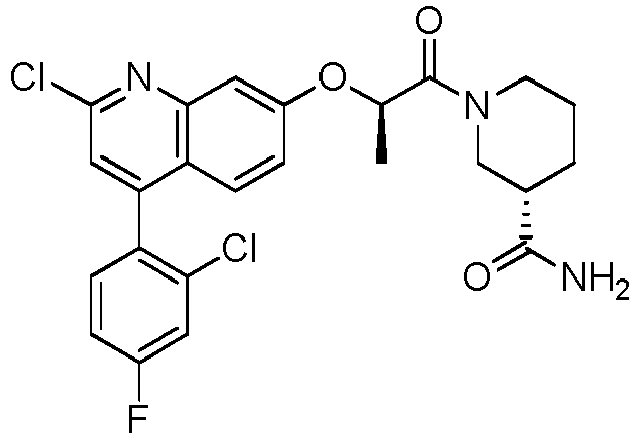
64 (300 MHz, Chloroform-d) δ 7.36 - 7.20 (m, 4H), 7.18 - 7.03 (m, 3H), 6.43 - 5.73 (m, 1H), 5.56 - 5.03 (m, 2H), 4.11 - 3.00 (m, 4H), 2.47 (d, J = 10.8 Hz, 1H), 2.08 (dd, J = 15.4, 8.9 Hz, 1H), 1.91 - 1.13 (m, 6H). 100% 82 
2G, (400 MHz, DMSO-d 6) δ 8.90 (dd, J = 4.4, 0.7 Hz, 1H), 7.71 - 7.66 (m, 1H), 7.61 - 7.51 (m, 2H), 7.48 - 7.43 (m, 1H), 7.40 (d, J = 2.5 Hz, 1H), 7.35 - 7.25 (m, 3H), 5.03 (pd, J = 6.3, 0.8 Hz, 1H), 4.95 (d, J = 0.7 Hz, 2H), 1.24 (d, J = 6.2 Hz, 6H). 97% 83 
92 (300 MHz, Chloroform-d) δ 7.49 (dd, J = 7.6, 1.6 Hz, 1H), 7.42 - 7.03 (m, 7H), 5.30 - 5.07 (m, 1H), 4.33 - 3.61 (m, 2H), 3.28 - 2.71 (m, 2H), 2.54- 1.72 (m, 5H), 1.72 - 1.36 (m, 4H), 1.32 - 1.15 (m, 1H). 90% 84 
(R, S)-1K1_Cl (300 MHz, DMSO-d6) δ 12.60 (s, 1H), 8.95 (t, J = 4.6 Hz, 1H), 7.43 - 7.12 (m, 6H), 5.60 (q, J = 6.5 Hz, 1H), 4.52 - 3.88 (m, 2H), 3.59-3.14 (m, 1H), 3.12 - 2.92 (m, 1H), 2.96 - 2.72 (m, 1H), 2.40 (d, J = 35.6 Hz, 1H), 2.18 - 1.51 (m, 10H), 1.24 - 1.16 (m, 2H). 91% 85 
104 + M10a (400 MHz, DMSO-d 6) δ 8.03 (s, 3H), 7.70 (dd, J = 8.0, 1.3 Hz, 1H), 7.63 - 7.46 (m, 3H), 7.41 (s, 1H), 7.37 - 7.25 (m, 3H), 5.61 (dt, J = 14.6, 7.1 Hz, 1H), 3.91 (s, 2H), 3.80 - 3.36 (m, 8H), 1.53 (d, J = 5.7 Hz, 3H). - TFA Salt 99% 86 
2D1 (300 MHz, Chloroform-d) δ 8.81 (dd, J = 4.5, 0.9 Hz, 1H), 7.53 - 7.42 (m, 1H), 7.42 - 7.02 (m, 6H), 5.16 (qd, J = 6.6, 2.5 Hz, 1H), 3.09 (d, J = 1.0 Hz, 3H), 2.94 (d, J = 2.2 Hz, 3H), 1.60 (d, J = 6.6 Hz, 3H). 93% 87 
2G, (400 MHz, DMSO-d 6) δ 8.89 (d, J = 4.4 Hz, 1H), 7.68 (dd, J = 7.8, 1.5 Hz, 1H), 7.55 (dtd, J = 15.9, 7.4, 1.7 Hz, 2H), 7.49 - 7.43 (m, 2H), 7.34 - 7.23 (m, 3H), 5.21 - 4.97 (m, 2H), 4.34 - 3.41 (m, 4H), 3.21 - 2.92 (m, 2H), 2.48 - 2.37 (m, 1H), 2.05 - 1.38 (m, 4H), 1.28 - 1.12 (m, 3H). 93% 88 
2D1 (400 MHz, DMSO-d 6) δ 8.88 (d, J = 4.4 Hz, 1H), 7.68 (d, J = 7.8 Hz, 1H), 7.61 - 7.49 (m, 2H), 7.48 - 7.40 (m, 1H), 7.36 - 7.18 (m, 4H), 5.57 - 5.45 (m, 1H), 3.16 (d, J = 7.3 Hz, 3H), 2.87 (d, J = 3.0 Hz, 3H), 1.50 (dd, J = 6.5, 1.5 Hz, 3H). 100% 89 
(R)-4G1 (300 MHz, Chloroform-d) δ 8.81 (t, J = 4.0 Hz, 1H), 7.45 - 7.28 (m, 2H), 7.28 - 7.20 (m, 2H), 7.18 - 7.00 (m, 3H), 5.28-5.10 (m, 1H), 4.37 (t, J = 13.1 Hz, 1H), 4.17 - 3.82 (m, 3H), 3.27 - 2.65 (m, 1H), 2.65 - 2.41 (m, 1H), 2.28 - 1.28 (m, 9H), 1.28 - 1.09 (m, 4H). 98% 90 
(R)-2F6_tBu (400 MHz, Chloroform-d) δ 7.59 - 7.50 (m, 2H), 7.49 - 7.35 (m, 3H), 7.34 - 7.13 (m, 2H), 6.87 (t, J = 1.4 Hz, 1H), 5.06 (p, J = 6.7 Hz, 1H), 1.84 (dd, J = 6.8, 1.2 Hz, 3H). 96% 91 
(R)-4F3_Et (300 MHz, DMSO-d 6) δ 7.72 (dt, J = 8.9, 2.3 Hz, 1H), 7.58 (ddd, J = 8.2, 6.2, 1.8 Hz, 1H), 7.51 - 7.37 (m, 2H), 7.37 - 7.22 (m, 3H), 5.03 (d, J = 7.0 Hz, 1H), 1.56 (d, J = 6.7 Hz, 3H). 99% 92 
(R)-2G3 (300 MHz, Chloroform-d) δ 7.48 (dd, J = 7.6, 1.7 Hz, 1H), 7.44 - 7.21 (m, 4H), 7.27-7.13 (m, 1H), 7.19 - 7.06 (m, 2H), 5.16 (p, J = 6.1, 5.5 Hz, 1H), 4.51 - 4.13 (m, 1H), 4.06 (qd, J = 7.2, 3.1 Hz, 3H), 3.13-2.74 (m, 1H), 2.57 (dd, J = 17.3, 9.5 Hz, 1H), 2.31 - 2.15 (m, 1H), 2.12 - 1.74 (m, 2H), 1.68 - 1.55 (m, 6H), 1.25 - 1.10 (m, 4H). 95% 93 
(R)-4G3 (300 MHz, DMSO-d 6) δ 7.73 (dd, J = 8.9, 2.5 Hz, 1H), 7.63 - 7.51 (m, 1H), 7.51 - 7.38 (m, 2H), 7.38 - 7.19 (m, 3H), 5.61 - 5.44 (m, 1H), 4.18 (dd, J = 21.8, 12.7 Hz, 1H), 4.10 - 3.83 (m, 3H), 3.01 (dd, J = 38.7, 24.1 Hz, 1H), 2.69 - 2.53 (m, 1H), 2.36 - 2.10 (m, 2H), 1.89 - 1.59 (m, 3H), 1.51 (dd, J = 12.2, 6.4 Hz, 3H), 1.26 (s, 2H), 1.16 (t, J = 7.1 Hz, 3H). 98% 94 
(R)-6G3 (300 MHz, Chloroform-d) δ 7.34 - 6.88 (m, 7H), 5.14 (dq, J = 12.8, 6.6 Hz, 1H), 4.52 - 4.14 (m, 1H), 4.12 - 2.41 (m, 4H), 2.32 - 2.13 (m, 1H), 2.11 - 1.72 (m, 5H), 1.71 - 1.48 (m, 5H), 1.45 - 1.08 (m, 4H). 100% 95 
(R)-4G1 (400 MHz, DMSO-d 6) δ 11.68 (s, 1H), 8.93 (dd, J = 4.6, 1.4 Hz, 1H), 8.78 - 8.69 (m, 2H), 8.18-8.10 (m, 2H), 7.71 (dd, J = 8.9, 2.5 Hz, 1H), 7.56 - 7.33 (m, 6H), 5.31 (qd, J = 6.6, 2.8 Hz, 1H), 1.70 (dd, J = 6.6, 1.5 Hz, 3H). 100% 96 
34 (300 MHz, Chloroform-d) δ 8.06 - 7.64 (m, 1H), 7.49 (dt, J = 7.6, 1.4 Hz, 1H), 7.45 - 7.27 (m, 3H), 7.23 (dt, J = 6.5, 2.9 Hz, 2H), 7.17 - 7.06 (m, 2H), 6.37 - 5.32 (m, 1H), 5.13 (q, J = 6.3 Hz, 1H), 4.43 - 3.22 (m, 3H), 2.89 (s, 1H), 2.82 (s, 1H), 2.80 - 2.73 (m, 1H), 2.70 (d, J = 4.4 Hz, 2H), 2.42 - 2.31 (m, 1H), 2.18-1.98 (m, 1H), 1.87 - 1.75 (m, 1H), 1.69 - 1.53 (m, 3H). 96% 97 
2G3 (400 MHz, DMSO-d 6) δ 8.60 (td, J = 8.4, 7.9, 4.0 Hz, 1H), 7.69 (dt, J = 8.0, 1.5 Hz, 1H), 7.63 - 7.51 (m, 2H), 7.49 (dt, J = 7.5, 2.3 Hz, 1H), 7.41 - 7.39 (m, 1H), 7.35 - 7.28 (m, 3H), 4.98 - 4.82 (m, 1H), 4.41 - 4.11 (m, 1H), 3.66 - 3.55 (m, 3H), 3.08 - 2.77 (m, 1H), 2.47 - 2.04 (m, 4H), 1.53 - 1.45 (m, 3H). 100% 98 
56 (300 MHz, Chloroform-d) δ 7.34 - 7.03 (m, 7H), 6.54 - 6.35 (m, 1H), 5.21 - 5.01 (m, 1H), 3.91 - 3.76 (m, 1H), 3.69 - 3.07 (m, 3H), 2.82 - 2.67 (m, 3H), 2.47 - 2.12 (m, 2H), 2.01 - 1.30 (m, 6H), 1.20 (d, J = 8.2 Hz, 2H). 100% 99 
2D3 (300 MHz, Chloroform-d) δ 7.53 - 7.41 (m, 1H), 7.44 - 7.06 (m, 7H), 5.12 (qd, J = 6.6, 1.7 Hz, 1H), 3.70 - 3.54 (m, 1H), 3.52 - 3.32 (m, 3H), 1.59 (dd, J = 6.6, 1.3 Hz, 9H). 100% 100 
34 (300 MHz, Chloroform-d) δ 7.49 (dd, J = 7.7, 1.7 Hz, 1H), 7.45 - 7.18 (m, 5H), 7.17 - 7.01 (m, 2H), 5.21 - 4.99 (m, 1H), 4.55 (d, J = 9.9 Hz, 1H), 4.29 - 3.83 (m, 1H), 3.35 - 2.92 (m, 3H), 2.85 (d, J = 7.6 Hz, 3H), 2.79 - 2.66 (m, 2H), 2.60 - 2.16 (m, 1H), 1.97 - 1.17 (m, 7H). 100% 101 
74 (400 MHz, DMSO-d 6) δ 7.75 (dd, J = 8.9, 2.5 Hz, 1H), 7.63 - 7.43 (m, 4H), 7.40 - 7.26 (m, 2H), 5.66 - 5.35 (m, 1H), 4.35-3.80 (m, 2H), 2.84 (s, 4H), 2.60 (d, J = 10.1 Hz, 1H), 2.28-2.19 (m, 1H), 2.12 (dt, J = 15.2, 7.8 Hz, 1H), 1.89 - 1.48 (m, 6H), 1.26 (s, 2H). 98% 102 
(400 MHz, DMSO-d 6) δ 8.89 (t, J = 4.9 Hz, 1H), 7.68 (dt, J = 7.7, 1.3 Hz, 1H), 7.60 - 7.49 (m, 2H), 7.45 (dd, J = 7.3, 1.9 Hz, 1H), 7.38 - 7.26 (m, 3H), 7.22 (dd, J = 9.2, 2.5 Hz, 1H), 5.80 - 5.46 (m, 1H), 4.42 - 3.85 (m, 2H), 3.58 - 3.09 (m, 1H), 3.04 - 2.76 (m, 1H), 2.47-2.21 (m, 1H), 2.10-1.89 (m, 1H), 1.85 - 1.56 (m, 2H), 1.55 - 1.45 (m, 3H), 1.33 (s, 1H). 94% ee 85% 103 
(R)-2F1_Et (400 MHz, DMSO-d 6) δ 13.19 (s, 1H), 8.88 (d, J = 4.4 Hz, 1H), 7.72 - 7.65 (m, 1H), 7.61 - 7.49 (m, 2H), 7.48 - 7.41 (m, 1H), 7.35 - 7.21 (m, 4H), 5.05 (q, J = 6.7 Hz, 1H), 1.58 (dd, J = 6.7, 0.9 Hz, 3H). 94% 104 
2G3 + M11a + M10a (400 MHz, DMSO-d 6) δ 8.88 (s, 2H), 7.70 (dd, J = 7.9, 1.4 Hz, 1H), 7.58 (dtd, J = 20.0, 7.4, 1.6 Hz, 2H), 7.49 (ddd, J = 7.5, 5.6, 1.9 Hz, 1H), 7.42 (d, J = 1.1 Hz, 1H), 7.38 (d, J = 2.4 Hz, 1H), 7.33 - 7.25 (m, 2H), 5.59 (p, J = 6.6 Hz, 1H), 3.95 - 3.60 (m, 4H), 3.27 - 3.05 (m, 4H), 1.52 (dd, J = 6.5, 2.6 Hz, 3H). - TFA Salt 100% 105 
64 (300 MHz, Chloroform-d) δ 7.34 - 7.24 (m, 1H), 7.31 - 7.10 (m, 4H), 7.16 - 7.01 (m, 3H), 6.42 - 5.31 (m, 1H), 5.23 - 5.06 (m, 1H), 4.35 - 3.25 (m, 3H), 2.83-2.73 (m, 1H), 2.72-2.63 (m, 2H), 2.42 - 2.27 (m, 1H), 2.16 - 1.99 (m, 1H), 1.87-1.73 (m, 1H), 1.73-1.49 (m, 5H). 100% 106 
3D1 (300 MHz, Chloroform-d) δ 8.84 (d, J = 4.5 Hz, 1H), 7.45 (d, J = 2.6 Hz, 1H), 7.37 (d, J = 9.2 Hz, 1H), 7.34 - 7.21 (m, 3H), 7.16 - 7.05 (m, 3H), 6.52 (s, 1H), 5.69 (s, 1H), 4.61 (s, 2H), 1.96 (s, 3H). 96% 107 
4G3 (300 MHz, DMSO-d 6) δ 7.80 (dd, J = 8.9, 2.5 Hz, 1H), 7.65 (dd, J = 8.6, 6.1 Hz, 1H), 7.59 - 7.46 (m, 1H), 7.49 (s, 1H), 7.44 - 7.28 (m, 3H), 5.61 (p, J = 6.3 Hz, 1H), 3.79 - 3.59 (m, 2H), 3.57 - 3.49 (d, J = 5.3 Hz, 2H), 1.74 - 1.62 (m, 4H), 1.61 - 1.44 (m, 5H). 99% 108 
4G, (300 MHz, Chloroform-d) δ 8.84 (d, J = 4.5 Hz, 1H), 8.35 (d, J = 7.2 Hz, 1H), 8.01 - 7.89 (m, 2H), 7.73 (dq, J = 7.7, 1.5 Hz, 1H), 7.59 (t, J = 2.5 Hz, 1H), 7.47 - 7.02 (m, 7H), 5.08 - 4.95 (m, 1H), 4.30 (q, J = 7.2 Hz, 2H), 1.70 (d, J = 6.6 Hz, 3H), 1.31 (t, J = 7.1 Hz, 3H). 100% 109 
(rac)-4G4 (300 MHz, Chloroform-d) δ 8.95 (dd, J = 4.6, 1.7 Hz, 1H), 7.76 - 7.66 (m, 1H), 7.33 - 7.19 (m, 3H), 7.10 (td, J = 8.2, 2.5 Hz, 1H), 6.99 (d, J = 8.9 Hz, 1H), 6.36 (s, 1H), 5.88 (p, J = 6.8 Hz, 1H), 4.14 - 3.99 (m, 1H), 1.60 (dd, J = 6.7, 2.0 Hz, 3H), 1.22 - 1.06 (m, 6H). 100% 110 
(R,R)-2K1x (300 MHz, DMSO-d 6) δ 12.28 (s, 1H), 8.95 (dd, J = 7.2, 4.5 Hz, 1H), 7.68 (tdd, J = 7.4, 5.3, 2.0 Hz, 1H), 7.63 - 7.35 (m, 5H), 7.41 - 7.27 (m, 2H), 5.69 - 5.49 (m, 1H), 4.35 - 4.02 (m, 2H), 3.09 (dt, J = 40.8, 12.0 Hz, 1H), 2.81 - 2.46 (m, 1H), 2.36 - 2.09 (m, 2H), 2.00 - 1.65 (m, 3H), 1.58 (dd, J = 15.9, 6.4 Hz, 3H), 1.31 (s, 2H). 100% 111 
(R)-3G5 (400 MHz, DMSO-d 6) δ 7.45 - 7.30 (m, 4H), 7.28 - 7.16 (m, 2H), 7.10 (d, J = 10.9 Hz, 2H), 5.48 (d, J = 8.3 Hz, 1H), 4.23 - 3.20 (m, 3H), 3.18 - 2.88 (m, 1H), 2.64 (s, 4H), 2.40 - 2.25 (m, 2H), 1.98 (d, J = 3.3 Hz, 4H), 1.76 - 1.43 (m, 4H), 1.37 (d, J = 2.8 Hz, 9H). 97% 112 
(R)-2G1 + M11a + M9 (300 MHz, Chloroform-d) δ 9.05-8.71 (m, 1H), 8.15 (br. s, 1H), 7.49 (dd, J = 7.6, 1.7 Hz, 1H), 7.48 - 7.28 (m, 3H), 7.34 - 7.12 (m, 4H), 5.29 - 5.09 (m, 1H), 4.59 (t, J = 15.8 Hz, 1H), 3.99 (t, J = 16.0 Hz, 1H), 3.65 - 3.07 (m, 1H), 2.83 - 2.60 (m, 1H), 2.38 (dd, J = 41.1, 6.6 Hz, 2H), 2.23 - 1.75 (m, 3H), 1.62 (dd, J = 6.7, 3.8 Hz, 3H), 1.49 (m, 1H), 1.31 - 1.11 (m, 1H). 96% 113 
(R)-6G5 (400 MHz, DMSO-d 6) δ 7.54 - 7.42 (m, 1H), 7.39 - 7.23 (m, 6H), 6.98 (d, J = 32.2 Hz, 2H), 5.63 - 5.42 (m, 1H), 4.81 - 3.95 (m, 2H), 3.39 - 2.99 (m, 1H), 2.95 - 2.57 (m, 5H), 2.30 - 2.09 (m, 1H), 1.93 - 1.63 (m, 9H), 1.62 - 1.46 (m, 3H). 95% 114 
(R)-6G5 (400 MHz, DMSO-d 6) δ 7.61 - 7.48 (s, 1H), 7.46 - 7.22 (m, 6H), 7.01 - 6.89 (m, 2H), 5.58 - 5.37 (m, 1H), 4.86 - 4.04 (m, 2H), 3.26 - 3.04 (m, 1H), 2.95 - 2.78 (m, 4H), 2.74 - 2.58 (m, 1H), 2.18 (d, J = 12.7 Hz, 1H), 1.96 - 1.77 (m, 7H), 1.75 - 1.37 (m, 5H). 100% 115 
(R)-4G5 (400 MHz, DMSO-d 6) δ 7.82 - 7.68 (m, 1H), 7.61 - 7.21 (m, 6H), 7.07 - 6.89 (m, 2H), 5.61 - 5.36 (m, 1H), 4.84 - 4.07 (m, 2H), 3.30 - 3.07 (m, 1H), 2.91 -2.58 (m, 5H), 2.23 - 2.08 (m, 1H), 1.93 - 1.76 (m, 1H), 1.76-1.62 (m, 1H), 1.62-1.49 (m, 3H), 1.50 - 1.33 (m, 1H). 100% 116 
(R)-4G1 (400 MHz, DMSO-d 6) δ 8.99 (d, J = 4.5 Hz, 1H), 7.72 (dd, J = 8.9, 2.6 Hz, 1H), 7.54 (ddd, J = 8.4, 6.1, 3.8 Hz, 1H), 7.48 - 7.37 (m, 3H), 7.35 - 7.26 (m, 2H), 7.04 - 6.86 (m, 2H), 5.69 - 5.38 (m, 1H), 4.83 - 3.97 (m, 2H), 3.38 - 2.57 (m, 3H), 2.29 - 2.06 (m, 1H), 1.96 - 1.45 (m, 6H). 100% 117 
(R)-4G1 (400 MHz, DMSO-d 6) δ 9.01 (d, J = 4.8 Hz, 1H), 7.73 (ddd, J = 8.9, 2.6, 1.3 Hz, 1H), 7.60 - 7.27 (m, 6H), 7.07 - 6.87 (m, 2H), 5.64 - 5.36 (m, 1H), 4.89 - 4.04 (m, 2H), 3.32 - 3.07 (m, 1H), 2.92 - 2.55 (m, 2H), 2.31 - 2.07 (m, 1H), 1.97 - 1.32 (m, 6H). 100% 118 
(R)-2G1 + M11a + M9 (300 MHz, DMSO-d 6) δ 12.06 (s, 1H), 8.89 (dd, J = 4.5, 2.6 Hz, 1H), 7.69 (dd, J = 7.5, 1.8 Hz, 1H), 7.64 - 7.47 (m, 2H), 7.45 (dd, J = 7.1, 2.3 Hz, 1H), 7.38 - 7.18 (m, 4H), 5.60 - 5.46 (m, 1H), 4.34 (d, J = 12.7 Hz, 1H), 4.12 (s, 1H), 3.13 (dd, J = 30.7, 16.5 Hz, 1H), 2.61 (t, J = 13.0 Hz, 1H), 2.34 - 2.15 (m, 2H), 1.80 - 1.61 (m, 2H), 1.57 - 0.74 (m, 6H). 98% 119 
(R)-6G1 (300 MHz, DMSO-d 6) δ 9.03 (t, J = 4.8 Hz, 1H), 7.51 - 7.23 (m, 7H), 7.21 -7.06 (m, 2H), 5.76 - 5.39 (m, 1H), 4.75 (dd, J = 118.6, 12.4 Hz, 1H), 4.48-4.19 (m, 1H), 3.42 - 3.14 (m, 1H), 3.03 - 2.89 (m, 1H), 2.81 (t, J = 11.8 Hz, 1H), 2.41 -2.18 (m, 1H), 2.09 - 1.77 (m, 9H), 1.73 - 1.52 (m, 3H). 95% 120 
(R)-7G1 + M11a + M9 (300 MHz, DMSO-d 6) δ 8.93 (dd, J = 8.4, 4.5 Hz, 1H), 7.71 (d, J = 8.0 Hz, 2H), 7.66 - 7.54 (m, 1H), 7.36 - 7.13 (m, 4H), 5.62 - 5.43 (m, 1H), 4.31-4.18 (m, 1H), 4.17 - 3.94 (m, 1H), 3.14 - 2.90 (m, 1H), 2.74 - 2.40 (m, 1H), 2.29 - 2.07 (m, 2H), 1.92 - 1.44 (m, 6H), 1.33 - 1.20 (m, 2H). 97% 121 
(R,R)-2K1x (300 MHz, DMSO-d 6) δ 8.85 (dd, J = 7.8, 4.5 Hz, 1H), 7.51 - 7.41 (m, 2H), 7.40-7.30 (m, 1H), 7.30 - 7.13 (m, 5H), 5.49 (dd, J = 27.5, 6.2 Hz, 1H), 4.24 (d, J = 12.9 Hz, 1H), 4.17 - 3.94 (m, 1H), 3.22 - 2.54 (m, 1H), 2.44 - 2.07 (m, 3H), 1.92 - 1.58 (m, 4H), 1.58 - 1.43 (m, 3H), 1.33 - 1.19 (m, 3H), 0.99 - 0.82 (m, 3H). 99% 122 
(R,R)-2K1x (300 MHz, DMSO-d 6) δ 12.21 (br. s, 1H), 8.81 (dd, J = 7.8, 4.4 Hz, 1H), 7.56 - 7.40 (m, 2H), 7.35 - 7.06 (m, 6H), 5.56 - 5.37 (m, 1H), 4.20 (d, J = 12.9 Hz, 1H), 4.14 - 3.91 (m, 1H), 3.16 - 2.51 (m, 1H), 2.47 - 2.36 (m, 1H), 2.24 - 2.02 (m, 2H), 1.89 - 1.56 (m, 4H), 1.53 - 1.40 (m, 3H), 1.28 - 1.17 (m, 2H), 1.06 - 0.94 (m, 6H). 99% 123 
(R)-4G1 (300 MHz, DMSO-d 6) δ 8.99 (dd, J = 9.0, 4.5 Hz, 1H), 7.74 (dd, J = 8.9, 2.5 Hz, 1H), 7.63 - 7.23 (m, 6H), 7.11 - 6.98 (m, 1H), 6.94 - 6.75 (m, 1H), 5.68 - 5.38 (m, 1H), 4.42 - 3.87 (m, 2H), 3.37 - 2.58 (m, 4H), 2.32 - 1.87 (m, 2H), 1.87 - 1.29 (m, 6H). 99% 124 
(R)-6G5+ M11a + M9 (300 MHz, DMSO-d 6) δ 12.17 (s, 1H), 7.35 - 7.01 (m, 7H), 5.54 - 5.35 (m, 1H), 4.37 - 3.80 (m, 2H), 3.19 - 2.87 (m, 1H), 2.78-2.41 (m, 4H), 2.31 -2.07 (m, 2H), 1.90 - 1.73 (m, 8H), 1.69 - 1.62 (m, 1H), 1.58 - 1.43 (m, 4H), 1.33 - 1.20 (m, 2H). 92% 125 
(R)-4G1 (400 MHz, DMSO-d 6) δ 10.27 (d, J = 5.3 Hz, 1H), 8.96 (d, J = 4.7 Hz, 1H), 7.72 (dd, J = 9.0, 2.5 Hz, 1H), 7.57 - 7.36 (m, 8H), 7.15 (dd, J = 8.5, 2.3 Hz, 2H), 5.12 (q, J = 6.4 Hz, 1H), 3.55 (td, J = 7.1, 1.1 Hz, 2H), 2.66 (t, J = 6.9 Hz, 2H), 1.64 (dd, J = 6.6, 1.5 Hz, 3H). 100% 126 
62 + chiral HPLC separation (300 MHz, DMSO-d 6) δ 12.37 (s, 1H), 9.20 - 8.85 (m, 1H), 7.81 - 7.67 (m, 2H), 7.61 - 7.49 (m, 1H), 7.50 - 7.35 (m, 2H), 7.16 (d, J = 9.0 Hz, 1H), 6.08 - 5.82 (m, 1H), 4.45 - 3.94 (m, 2H), 3.49 - 3.06 (m, 1H), 2.82 - 2.63 (m, 1H), 2.40 (s, 1H), 2.21 - 1.94 (m, 1H), 1.67 (d, J = 17.1 Hz, 2H), 1.55 - 1.19 (m, 4H). 95% 127 
62 + chiral HPLC separation (400 MHz, DMSO-d 6) δ 12.38 (br. s, 1H), 8.97 (d, J = 4.5 Hz, 1H), 7.77 - 7.66 (m, 2H), 7.52 (dt, J = 8.9, 5.8 Hz, 1H), 7.46 - 7.34 (m, 2H), 7.13 (d, J = 9.1 Hz, 1H), 6.07 - 5.88 (m, 1H), 4.52 - 3.90 (m, 2H), 3.24 - 2.54 (m, 1H), 2.35 - 1.63 (m, 4H), 1.48 (d, J = 6.6 Hz, 5H). 93% 128 
80 + chiral HPLC separation (400 MHz, DMSO-d 6) δ 8.98 (t, J = 5.1 Hz, 1H), 7.79 - 7.68 (m, 2H), 7.60 - 7.51 (m, 1H), 7.48 - 7.36 (m, 2H), 7.16 (dd, J = 9.0, 3.4 Hz, 1H), 6.07 - 5.83 (m, 1H), 4.28 - 3.93 (m, 2H), 3.18 - 3.05 (m, 1H), 2.86 - 2.31 (m, 2H), 2.23 - 2.04 (m, 2H), 1.99 - 1.59 (m, 2H), 1.57 - 1.43 (m, 3H), 1.39 - 1.20 (m, 2H). 98% 129 
(R)-7G1 + M11a + M9 (300 MHz, DMSO-d 6) δ 12.55 (br. s, 1H), 8.94 (t, J = 4.9 Hz, 1H), 7.76 - 7.66 (m, 2H), 7.66 - 7.54 (m, 1H), 7.39 - 7.13 (m, 4H), 5.63 - 5.53 (m, 1H), 4.46 - 3.81 (m, 2H), 3.54 - 3.12 (m, 1H), 3.08 - 2.70 (m, 1H), 2.61 - 1.73 (m, 3H), 1.73 - 1.17 (m, 5H). 98% 130 
(R)-4G1 (400 MHz, DMSO-d 6) δ 10.98 (d, J = 10.2 Hz, 1H), 8.96 (d, J = 4.7 Hz, 1H), 8.38 (dd, J = 4.8, 2.2 Hz, 1H), 8.03 (dd, J = 8.4, 3.9 Hz, 1H), 7.85 - 7.66 (m, 2H), 7.59 - 7.33 (m, 6H), 7.16 (ddt, J = 7.3, 4.9, 1.2 Hz, 1H), 5.32 (q, J = 6.6 Hz, 1H), 1.65 (d, J = 6.5 Hz, 3H). 100% 131 
(R)-4G1 (400 MHz, DMSO-d 6) δ 8.99 (dd, J = 4.7, 0.9 Hz, 1H), 8.28 (q, J = 5.8 Hz, 1H), 7.72 (ddd, J = 8.9, 2.6, 1.1 Hz, 1H), 7.54 (ddd, J = 9.0, 6.2, 3.0 Hz, 1H), 7.44 (ddt, J = 13.6, 9.2, 3.3 Hz, 4H), 7.35 (ddd, J = 9.2, 2.5, 1.4 Hz, 1H), 4.91 (q, J = 6.6 Hz, 1H), 3.18 - 3.05 (m, 2H), 1.52 (dd, J = 6.6, 1.4 Hz, 3H), 1.01 (td, J = 7.2, 4.4 Hz, 3H). 100% 132 
(R, S)-1K1_l (300 MHz, DMSO-d 6) δ 8.94 (t, J = 5.1 Hz, 1H), 7.80 (d, J = 8.7 Hz, 2H), 7.39 - 7.14 (m, 4H), 5.65 - 5.53 (m, 1H), 4.44 - 3.80 (m, 2H), 3.56 - 3.08 (m, 1H), 3.06 - 2.70 (m, 1H), 2.32 (dd, J = 34.5, 7.6 Hz, 1H), 1.98 (d, J = 42.0 Hz, 1H), 1.83-1.12 (m, 6H). 92% 133 
(R,R)-2K1x (300 MHz, DMSO-d 6) δ 12.30 (s, 1H), 8.89 (dd, J = 7.4, 4.4 Hz, 1H), 7.66 (d, J = 3.2 Hz, 1H), 7.63 - 7.45 (m, 2H), 7.38 - 7.25 (m, 3H), 5.56 (dq, J = 28.9, 6.5 Hz, 1H), 4.30 (d, J = 12.6 Hz, 1H), 4.14 (dd, J = 36.9, 13.3 Hz, 1H), 3.09 (dt, J = 42.5, 12.1 Hz, 1H), 2.82 - 2.45 (m, 1H), 2.36 - 2.09 (m, 2H), 2.04 (s, 3H), 1.97 - 1.64 (m, 3H), 1.58 (dd, J = 16.0, 6.4 Hz, 3H), 1.41 - 1.21 (m, 2H). 100% 134 
(R,R)-2K1x (300 MHz, DMSO-d 6) δ 12.32 (s, 1H), 8.90 (dd, J = 7.5, 4.5 Hz, 1H), 7.77 (d, J = 5.1 Hz, 1H), 7.74 - 7.67 (m, 1H), 7.43 - 7.26 (m, 3H), 7.20 (d, J = 5.1 Hz, 1H), 5.57 (dq, J = 28.1, 6.6 Hz, 1H), 4.30 (d, J = 12.6 Hz, 1H), 4.13 (dd, J = 36.0, 13.4 Hz, 1H), 3.23-2.92 (m, 1H), 2.76 - 2.47 (m, 1H), 2.36 - 2.11 (m, 2H), 2.10 (d, J = 1.4 Hz, 3H), 1.86 (q, J = 17.3, 15.2 Hz, 3H), 1.58 (dd, J = 16.1, 6.4 Hz, 3H), 1.33 (d, J = 13.0 Hz, 2H). 100% 135 
(R,R)-2K1x (300 MHz, DMSO-d 6) δ 12.32 (s, 1H), 8.88 (dd, J = 7.2, 4.5 Hz, 1H), 7.58 (td, J = 7.9, 1.8 Hz, 1H), 7.44 (dt, J = 10.7, 2.9 Hz, 1H), 7.37 - 7.12 (m, 6H), 5.64 - 5.45 (m, 1H), 4.36 - 3.99 (m, 2H), 3.73 (s, 3H), 3.22 - 2.93 (m, 1H), 2.77 - 2.44 (m, 1H), 2.24 (dt, J = 25.8, 6.7 Hz, 2H), 1.76 (d, J = 42.9 Hz, 3H), 1.57 (dd, J = 15.8, 6.4 Hz, 3H), 1.31 (s, 2H). 100% 136 
(R,R)-2K1x (300 MHz, DMSO-d 6) δ 12.29 (s, 1H), 8.91 (dd, J = 7.6, 4.4 Hz, 1H), 8.07 - 7.97 (m, 1H), 7.94 - 7.76 (m, 2H), 7.52 (t, J = 7.2 Hz, 1H), 7.38 - 7.16 (m, 4H), 5.65 - 5.46 (m, 1H), 4.29 (d, J = 12.9 Hz, 1H), 4.12 (dd, J = 35.2, 13.4 Hz, 1H), 3.09 (dt, J = 39.3, 11.4 Hz, 1H), 2.80 - 2.45 (m, 1H), 2.35 - 2.09 (m, 2H), 1.96 - 1.64 (m, 2H), 1.57 (dd, J = 15.9, 6.4 Hz, 3H), 1.38 - 1.24 (m, 2H). 99% 137 
(R,R)-2K1x (300 MHz, DMSO-d 6) δ 12.29 (s, 1H), 8.95 (dd, J = 7.5, 4.4 Hz, 1H), 7.83 - 7.55 (m, 4H), 7.48 - 7.25 (m, 4H), 5.69 - 5.48 (m, 1H), 4.37 - 3.98 (m, 2H), 3.24 - 2.95 (m, 1H), 2.80 - 2.46 (m, 1H), 2.34 - 2.09 (m, 2H), 1.96 - 1.65 (m, 3H), 1.58 (dd, J = 16.2, 6.4 Hz, 3H), 1.38 - 1.24 (m, 2H). 100% 138 
(R)-6G1 (400 MHz, DMSO-d 6) δ 9.05 (d, J = 4.9 Hz, 1H), 7.44 (s, 1H), 7.39 - 7.21 (m, 6H), 7.08 - 6.87 (m, 2H), 5.65 - 5.42 (m, 1H), 4.87 - 3.97 (m, 2H), 3.59 - 2.60 (m, 3H), 2.29 - 2.08 (m, 1H), 2.02 - 1.65 (m, 9H), 1.61 - 1.47 (m, 3H). 100% 139 
(gem)-2G1 (400 MHz, DMSO- d 6) δ 12.08 (s, 1H), 8.87 (d, J = 4.4 Hz, 1H), 7.67 (dt, J = 7.8, 1.5 Hz, 1H), 7.60 - 7.43 (m, 3H), 7.35 - 7.25 (m, 3H), 7.21 - 7.11 (m, 1H), 4.66 - 4.44 (m, 1H), 4.41 - 4.19 (m, 1H), 3.12 - 2.33 (m, 2H), 2.18 - 1.94 (m, 2H), 1.74 - 1.54 (m, 8H), 1.25 - 1.21 (m, 1H), 1.17 (d, J = 4.7 Hz, 2H). 93% 140 
(R)-Et-2G, (400 MHz, DMSO-d 6) δ 9.02 (dd, J = 6.9, 4.8 Hz, 1H), 7.78 - 7.27 (m, 8H), 5.42 - 5.20 (m, 1H), 4.34 - 3.94 (m, 2H), 3.33 - 2.71 (m, 1H), 2.65 - 2.37 (m, 1H), 2.36 - 1.60 (m, 7H), 1.43 - 1.17 (m, 2H), 1.12 - 0.98 (m, 3H). 100% 141 
(R,R)-2K1x (400 MHz, DMSO-d 6) δ 8.94 (d, J = 4.4 Hz, 1H), 8.09 (d, J = 7.7 Hz, 1H), 7.90 (dd, J = 7.7, 7.5 Hz, 1H), 7.75 (dd, J = 7.7, 7.6 Hz, 1H), 7.66 (d, J = 7.4 Hz, 1H), 7.44 - 7.23 (m, 4H), 5.63 - 5.43 (m, 1H), 4.29 - 3.95 (m, 2H), 3.14 - 2.86 (m, 1H), 2.70 - 2.37 (m, 1H), 2.22 - 2.01 (m, 2H), 1.91 - 1.44 (m, 6H), 1.32 - 1.14 (m, 2H). 91% 142 
(R,R)-2K1x (300 MHz, DMSO- d 6) δ 8.88 (dd, J = 7.7, 4.5 Hz, 1H), 7.84 (d, J = 7.9 Hz, 1H), 7.63 - 7.38 (m, 3H), 7.35 - 7.18 (m, 4H), 5.62 - 5.41 (m, 1H), 4.24 (d, J = 12.7 Hz, 1H), 4.18 - 3.94 (m, 1H), 3.16 - 2.87 (m, 1H), 2.75 - 2.40 (m, 1H), 2.33 - 2.04 (m, 1H), 1.92 - 1.60 (m, 4H), 1.52 (dd, J = 16.2, 6.4 Hz, 3H), 1.35 - 1.17 (m, 2H). 96% 143 
(R,R)-2K1x (300 MHz, DMSO-d6 ) δ 8.98 - 8.88 (m, 1H), 8.08 (d, J = 7.7 Hz, 1H), 7.90 (dd, J = 7.7, 7.5 Hz, 1H), 7.75 (dd, J = 7.7, 7.6 Hz, 1H), 7.66 (d, J = 7.4 Hz, 1H), 7.44 - 7.23 (m, 4H), 5.63 - 5.43 (m, 1H), 4.30 - 3.95 (m, 2H), 3.13 - 2.88 (m, 1H), 2.71 - 2.37 (m, 1H), 2.22 - 2.00 (m, 2H), 1.93 - 1.43 (m, 6H), 1.32 - 1.14 (m, 2H). 91% 144 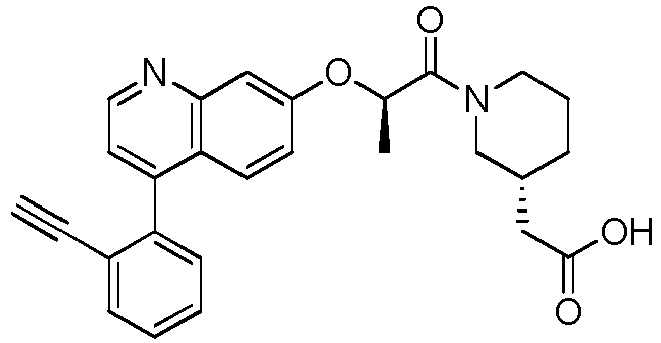
(R,R)-2K1x (300 MHz, DMSO-d 6) δ 8.86 (dd, J = 7.6, 4.5 Hz, 1H), 7.75 - 7.66 (m, 1H), 7.65 - 7.49 (m, 2H), 7.46 - 7.32 (m, 2H), 7.31 - 7.16 (m, 3H), 5.60 - 5.38 (m, 1H), 4.32 - 3.95 (m, 2H), 3.92 (d, J = 3.3 Hz, 1H), 3.16 - 2.89 (m, 1H), 2.70-2.41 (m, 1H), 2.27 - 2.06 (m, 1H), 1.70 (d, J = 42.7 Hz, 4H), 1.52 (dd, J = 15.5, 6.3 Hz, 3H), 1.25 (s, 2H). 93% 145 
(R,R)-2K1x (300 MHz, DMSO-d 6) δ 8.66 (dd, J = 8.2, 4.5 Hz, 1H), 7.35 - 7.20 (m, 2H), 7.19 - 6.86 (m, 6H), 5.37 - 5.21 (m, 1H), 3.98 (dd, J = 51.5, 22.6 Hz, 2H), 3.00 - 2.39 (m, 2H), 2.31 - 2.17 (m, 6H), 2.07 - 1.89 (m, 1H), 1.52 (d, J = 44.9 Hz, 4H), 1.35 (dd, J = 17.7, 6.4 Hz, 3H), 1.08 (s, 2H). 97% 146 
147 
148 
149 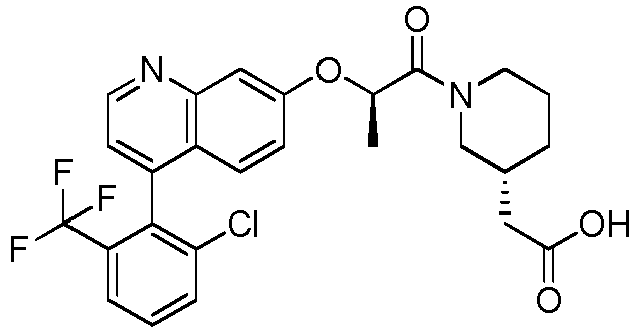
150 
151 
(R,R)-2K1x (300 MHz, DMSO-d6 ) δ 8.92 - 8.85 (m, 1H), 8.28 (s, 1H), 8.22 (d, J = 8.0 Hz, 1H), 7.77- 7.72 (m, 1H), 7.35 - 7.14 (m, 4H), 5.61 - 5.40 (m, 1H), 4.30 - 3.94 (m, 2H), 3.15 - 2.89 (m, 1H), 2.70 - 2.38 (m, 1H), 2.28 - 2.00 (m, 2H), 1.94 - 1.42 (m, 7H), 1.34 - 1.11 (m, 2H). 97% 152 
(R,R)-2K1x (300 MHz, DMSO-d6 ) δ 8.89 - 8.82 (m, 1H), 7.53 (t, J = 8.3 Hz, 1H), 7.28 - 7.14 (m, 6H), 5.59 - 5.40 (m, 1H), 4.30 - 3.95 (m, 2H), 3.63 (s, 3H), 3.15 - 2.54 (m, 2H), 2.33 - 2.05 (m, 2H), 1.94 - 1.43 (m, 6H), 1.36 - 1.15 (m, 2H). 95% 153 
154 
155 
156 
157 
158 
159 
160 
161 
162 
163 
164 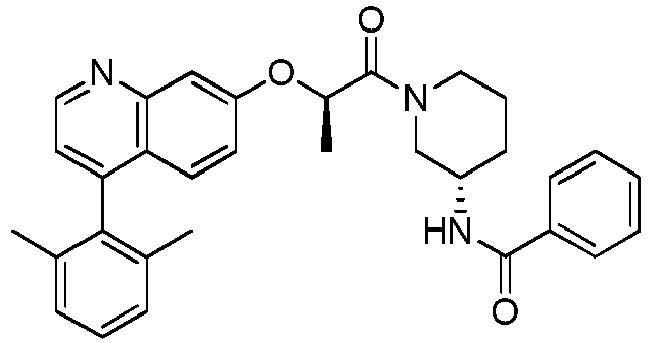
165 
166 
167 
168 
169 
170 
171 
172 
(R)-6G1 (400 MHz, DMSO-d 6) δ 9.04 (d, J = 4.9 Hz, 1H), 7.44 (d, J = 4.9 Hz, 1H), 7.38 - 7.15 (m, 6H), 7.05 - 6.85 (m, 2H), 5.60 - 5.33 (dd, J = 48.4, 6.8 Hz, 1H), 4.88 - 4.00 (m, 2H), 3.33 - 3.05 (m, 1H), 2.91-2.77 (m, 1H), 2.72 - 2.56 (m, 1H), 2.25 - 2.09 (m, 1H), 1.93 - 1.60 (m, 8H), 1.58 - 1.32 (m, 4H). 97% 173 
(R)-9G1 (400 MHz, DMSO-d6 ) δ 8.96 - 8.88 (m, 1H), 7.82 - 7.20 (m, 6H), 5.81 - 5.47 (m, 1H), 4.18 - 3.94 (m, 1H), 3.80 - 3.06 (m, 3H), 2.95 - 2.59 (m, 1H), 2.19 - 1.23 (m, 7H), 1.17 - 0.91 (m, 2H). 92% ee98% 174 
(R)-8G1 (400 MHz, DMSO-d6 ) δ 8.91 - 8.85 (m, 1H), 7.40 - 7.06 (m, 6H), 5.59 - 5.40 (m, 1H), 3.78 - 3.40 (m, 3H), 1.90 - 1.66 (m, 9H), 1.63 - 1.40 (m, 5H), 1.26-0.71 (m, 3H). 98% ee 96% (methylgroup) 175 
(R)-8G1 (400 MHz, DMSO-d6 ) δ 8.88 (d, J = 3.6 Hz, 1H), 7.29 (d, J = 10.1 Hz, 1H), 7.20-7.14 (m, 3H), 7.10 (d, J = 9.8 Hz, 2H), 5.66 - 5.42 (m, 1H), 4.01 - 3.58 (m, 2H), 3.50 - 3.13 (m, 2H), 2.08 - 1.77 (m, 7H), 1.69 - 1.37 (m, 6H), 1.22 - 0.93 (m, 3H). 99% ee100% 176 
(R)-8G1 (300 MHz, DMSO-d6 ) δ 8.90 - 8.86 (m, 1H), 7.30 - 7.06 (m, 6H), 5.49 (q, J = 6.4 Hz, 1H), 4.75 - 4.33 (m, 1H), 4.31 - 3.88 (m, 1H), 3.21 - 2.68 (m, 1H), 1.87 - 1.80 (m, 6H), 1.76 - 1.37 (m, 10H), 1.27 - 1.02 (m, 2H). 99% 177 
(R)-9F1_Et (400 MHz, DMSO-d6 ) δ 8.97 - 8.91 (m, 1H), 7.83 - 7.73 (m, 2H), 7.44 - 7.19 (m, 4H), 5.63 - 5.45 (m, 1H), 3.80 - 3.40 (m, 4H), 1.87 - 1.40 (m, 8H), 1.27 - 0.71 (m, 2H). 96% 178 
(R)-8G1 (400 MHz, DMSO-d6 ) δ 8.89 (d, J = 4.4 Hz, 1H), 7.32 (d, J = 2.1 Hz, 1H), 7.21 - 7.14 (m, 3H), 7.10 (d, J = 10.0 Hz, 2H), 5.52 (q, J = 6.5 Hz, 1H), 3.80 - 3.37 (m, 8H), 1.85 (s, 3H), 1.83 (s, 3H), 1.51 (d, J = 6.5 Hz, 3H). 98% ee 92% 179 
(R)-8G1 (400 MHz, DMSO-d6 ) δ 8.87 (d, J = 4.4 Hz, 1H), 7.26 (d, J = 2.0 Hz, 1H), 7.20 - 7.07 (m, 5H), 5.51 (q, J = 6.5 Hz, 1H), 4.41 - 4.28 (m, 4H), 3.68 - 3.34 (m, 4H), 1.94 - 1.68 (m, 4H), 1.84 (s, 3H), 1.82 (s, 3H), 1.48 (d, J = 6.5 Hz, 3H). 98% ee92% 180 
(R)-8G1 (400 MHz, DMSO-d6 ) δ 8.91 - 8.85 (m, 1H), 7.41 -7.06 (m, 6H), 5.56 - 5.40 (m, 1H), 5.18 - 5.06 (m, 1H), 4.54 - 4.34 (m, 1H), 4.22 - 3.89 (m, 1H), 3.17-2.88 (m, 1H), 1.91 - 1.64 (m, 8H), 1.60 - 1.39 (m, 4H), 1.36 - 0.87 (m, 2H), 0.57 - 0.19 (m, 4H). 95% ee92% (methyl group) 181 
(R)-8G1 (400 MHz, DMSO-d6 ) δ 8.92 - 8.85 (m, 1H), 7.63 (d, J = 7.2 Hz, 1H), 7.34 - 7.06 (m, 6H), 5.58 - 5.47 (m, 1H), 4.21 - 4.00 (m, 2H), 3.44 - 3.14 (m, 3H), 3.03-2.87 (m, 1H), 2.08 - 1.94 (m, 2H), 1.85 (s, 3H), 1.83 (s, 3H), 1.67 - 1.33 (m, 7H). 98% 182 
(R)-8G1 (400 MHz, DMSO-d6 ) δ 8.91 - 8.85 (m, 1H), 7.40 - 7.07 (m, 6H), 5.54 - 5.45 (m, 1H), 4.39 (d, J = 12.4 Hz, 1H), 4.17 - 3.98 (m, 1H), 3.25 - 2.88 (m, 1H), 2.68 - 2.41 (m, 1H), 1.89-1.81 (m, 6H), 1.79 - 1.18 (m, 9H), 1.09 - 0.59 (m, 3H). 99% 183 
(R)-8G1 (400 MHz, DMSO-d6 ) δ 8.90 - 8.81 (m, 1H), 7.29 - 7.06 (m, 6H), 5.55 - 5.40 (m, 1H), 4.29 - 3.96 (m, 3H), 3.15 - 2.91 (m, 1H), 2.70 - 2.43 (m, 1H), 2.24 - 2.03 (m, 2H), 1.91 - 1.40 (m, 12H), 1.33 - 1.17 (m, 1H). 95% ee 97% 184 
(R)-8G1 (400 MHz, DMSO-d6 ) δ 8.91 - 8.84 (m, 1H), 7.63 - 7.06 (m, 6H), 5.74 - 5.43 (m, 1H), 4.17 - 3.93 (m, 1H), 3.80 - 3.10 (m, 2H), 2.98 - 2.65 (m, 1H), 2.18-1.70 (m, 8H), 1.67 - 1.23 (m, 6H), 1.18 - 0.90 (m, 2H). 99% ee96% (methyl group) 185 
(R)-8G1 (300 MHz, Chloroform-d) δ 8.91 - 8.71 (m, 1H), 7.62 - 7.45 (m, 1H), 7.35 - 7.08 (m, 3H), 6.90 (d, J = 9.4 Hz, 2H), 5.25 (q, J = 6.6 Hz, 1H), 4.59 - 4.19 (m, 2H), 3.57 - 3.42 (m, 1H), 3.09 - 2.90 (m, 1H), 2.56 - 2.40 (m, 1H), 2.19 - 1.51 (m, 16H). 97% 186 
(R)-8G1 (400 MHz, DMSO-d6 ) δ 8.91 - 8.85 (m, 1H), 7.40 - 7.07 (m, 6H), 5.55 - 5.34 (m, 1H), 4.49 - 4.35 (m, 1H), 4.15 - 3.92 (m, 1H), 2.98 - 2.65 (m, 1H), 3.13-2.81 (m, 1H), 2.48 - 2.28 (m, 1H), 1.90 - 1.44 (m, 12H), 1.38 - 0.91 (m, 7H). 97% 187 
(R)-8G1 (300 MHz, DMSO-d6 ) δ 8.90 - 8.86 (m, 1H), 7.30 - 7.06 (m, 6H), 5.49 (q, J = 6.4 Hz, 1H), 4.75 - 4.32 (m, 1H), 4.31 - 3.88 (m, 1H), 3.20 - 2.68 (m, 1H), 1.88 - 1.79 (m, 6H), 1.76 - 1.36 (m, 10H), 1.27 - 1.02 (m, 2H). 99% 188 
(R)-9G1 (300 MHz, DMSO-d6 ) δ 8.96 - 8.86 (m, 1H), 7.83 - 7.73 (m, 2H), 7.41 - 7.19 (m, 4H), 5.73 - 5.45 (m, 1H), 4.46 - 4.02 (m, 4H), 2.07 - 1.80 (m, 1H), 1.68 - 1.35 (m, 6H), 1.27 - 0.91 (m, 3H). 96% ee96% 189 
(R)-4G1 (300 MHz, DMSO-d6 ) δ 8.90 - 8.83 (m, 1H), 7.72 -7.18 (m, 7H), 5.78 - 5.42 (m, 1H), 4.24 - 3.90 (m, 2H), 3.80 - 3.06 (m, 1H), 2.97 - 2.58 (m, 1H), 2.19-0.85 (m, 10H). 95% ee100% 190 
(R)-6G1 (300 MHz, DMSO-d6) δ 9.03 (dd, J = 6.9, 4.1 Hz, 1H), 7.49 -7.17 (m, 8H), 7.04 (d, J = 6.5 Hz, 1H), 6.85 (d, J = 3.5 Hz, 1H), 5.64 - 5.35 (m, 1H), 4.36 - 3.88 (m, 2H), 3.38-2.18 (m, 5H), 2.01 (s, 2H), 1.84 (d, J = 7.6 Hz, 7H), 1.65 (d, J = 19.8 Hz, 1H), 1.58-1.34 (m, 5H). 91% 191 
(R)-8G1 (300 MHz, DMSO-d6 ) δ 8.91 - 8.86 (m, 1H), 7.34 - 7.07 (m, 6H), 5.56 - 5.30 (m, 1H), 4.69 - 4.07 (m, 2H), 2.04 - 1.76 (m, 7H), 1.69 - 1.41 (m, 9H), 1.32 - 1.11 (m, 5H). 96% 192 
(R)-9G1 (400 MHz, DMSO-d6 ) δ 8.95 - 8.90 (m, 1H), 7.81 - 7.73 (m, 2H), 7.40 - 7.22 (m, 4H), 5.59 - 5.43 (m, 1H), 4.29 - 3.94 (m, 2H), 3.13 - 2.90 (m, 1H), 2.69 - 2.40 (m, 1H), 2.23 - 2.00 (m, 2H), 1.92 - 1.46 (m, 6H), 1.33 - 1.17 (m, 2H). 98% ee100% 193 
(R)-4G1 (400 MHz, DMSO-d6 ) δ 8.91 - 8.87 (m, 1H), 7.71 -7.19 (m, 7H), 5.60 - 5.44 (m, 1H), 3.77 - 3.32 (m, 4H), 1.86 - 1.40 (m, 8H), 1.30 - 0.73 (m, 2H). 99% ee 99% (methyl group) 194 
(R)-4G1 (400 MHz, DMSO-d6 ) δ 8.91 - 8.87 (m, 1H), 7.72 - 7.20 (m, 7H), 5.57 - 5.46 (m, 1H), 4.44 - 4.00 (m, 2H), 3.19 - 2.56 (m, 2H), 1.84 - 1.20 (m, 8H), 1.09 - 0.67 (m, 4H). 98% 195 
(R)-9G1 (400 MHz, DMSO-d6 ) δ 8.96 - 8.90 (m, 1H), 7.82 - 7.73 (m, 2H), 7.41 - 7.20 (m, 4H), 5.59 - 5.30 (m, 1H), 4.48 - 3.95 (m, 2H), 3.13 - 2.81 (m, 1H), 2.53 - 2.27 (m, 1H), 1.89 - 1.20 (m, 8H), 1.16 - 0.80 (m, 6H). 96% ee100% (methyl group) 196 
(R)-9G1 (400 MHz, DMSO-d6 ) δ 8.95 - 8.90 (m, 1H), 7.82 - 7.73 (m, 2H), 7.43 - 7.21 (m, 4H), 5.58 - 5.48 (m, 1H), 4.42 - 4.03 (m, 2H), 3.26 - 2.88 (m, 1H), 2.69 - 2.40 (m, 1H), 1.86 - 1.20 (m, 8H), 1.08 - 0.67 (m, 4H). 98% ee100% (methyl group) 197 
(R)-4G1 (300 MHz, DMSO-d6 ) δ 8.92 - 8.84 (m, 1H), 7.73 - 7.66 (m, 1H), 7.56 - 7.18 (m, 6H), 5.60 - 5.29 (m, 1H), 4.49 - 4.32 (m, 1H), 4.17 - 3.93 (m, 1H), 3.14 - 2.77 (m, 1H), 2.45 - 2.24 (m, 1H), 1.89 - 1.19 (m, 8H), 1.15 - 0.78 (m, 6H). 98% ee100% 198 
(R)-4G1 (300 MHz, DMSO-d6 ) δ 8.88 (d, J = 4.3 Hz, 1H), 7.69 (dd, J = 8.9, 2.2 Hz, 1H), 7.56 - 7.37 (m, 2H), 7.35 - 7.18 (m, 4H), 5.77 - 5.42 (m, 1H), 4.03 - 3.62 (m, 2H), 3.42 - 3.03 (m, 2H), 2.05 - 1.32 (m, 7H), 1.19 - 0.89 (m, 3H). 95% ee100% 199 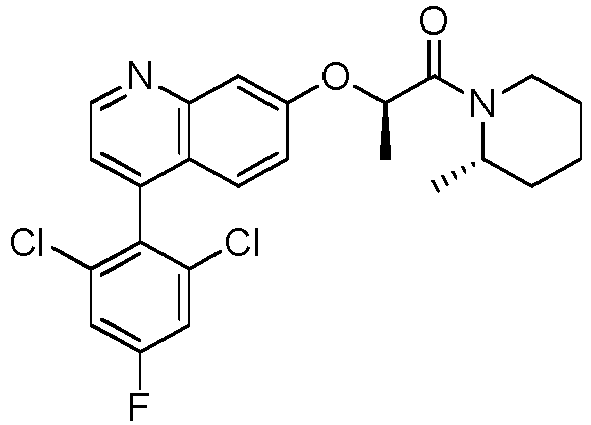
(R)-9G1 (300 MHz, DMSO-d6 ) δ 8.93 (d, J = 4.3 Hz, 1H), 7.83 - 7.73 (m, 2H), 7.41 - 7.19 (m, 4H), 5.58 - 5.47 (m, 1H), 4.73 - 4.32 (m, 1H), 4.30 - 3.87 (m, 1H), 3.21 - 2.68 (m, 1H), 1.77 - 1.33 (m, 10H), 1.27 - 1.00 (m, 2H). 99% 200 
(R)-4G1 (300 MHz, DMSO-d6 ) δ 8.92 - 8.85 (m, 1H), 7.69 (dd, J = 9.0, 1.4 Hz, 1H), 7.55 - 7.38 (m, 2H), 7.35 - 7.15 (m, 4H), 5.59 - 5.33 (m, 1H), 4.75 - 3.91 (m, 2H), 3.21 - 2.63 (m, 1H), 1.84 - 1.01 (m, 12H). 95% 201 
(R)-9G1 (300 MHz, DMSO-d6 ) δ 8.94 (d, J = 4.4 Hz, 1H), 7.82 - 7.75 (m, 2H), 7.41 - 7.35 (m, 3H), 7.25 (dd, J = 9.1, 2.6 Hz, 1H), 5.60 - 5.52 (m, 1H), 3.80 - 3.35 (m, 8H), 1.51 (d, J = 6.5 Hz, 3H). 99% ee92% 202 
(R)-9G1 (300 MHz, DMSO-d6 ) δ 8.97 - 8.91 (m, 1H), 7.83 - 7.60 (m, 3H), 7.41 - 7.29 (m, 3H), 7.24 (dd, J = 9.1, 2.5 Hz, 1H), 5.62 - 5.51 (m, 1H), 4.22 - 3.97 (m, 2H), 3.44 - 2.84 (m, 4H), 2.08 - 1.93 (m, 2H), 1.83 - 1.22 (m, 7H). 98% ee100% 203 
(R)-9G1 (300 MHz, DMSO-d6 ) δ 8.96 - 8.89 (m, 1H), 7.84 - 7.73 (m, 2H), 7.41 - 7.19 (m, 4H), 5.61 - 5.43 (m, 1H), 5.18 - 5.05 (m, 1H), 4.53 - 3.96 (m, 2H), 3.18 - 2.88 (m, 1H), 2.55 - 2.37 (m, 1H), 1.85 - 1.64 (m, 2H), 1.59 - 0.85 (m, 6H), 0.58 - 0.12 (m, 4H). 99% ee100% (methyl group) 204 
(R)-9G1 (300 MHz, DMSO-d6 ) δ 8.98 - 8.80 (m, 1H), 7.85 - 7.73 (m, 2H), 7.43 - 7.14 (m, 4H), 5.62 - 5.37(m, 1H), 4.75 - 4.45 (m, 1H), 4.31 - 3.96 (m, 1H), 3.31 -2.64 (m, 1H), 1.87 - 1.42 (m, 8H), 1.35 - 1.02 (m, 4H). 99% 205 
(R)-4G1 (300 MHz, DMSO-d6 ) δ 8.92 - 8.85 (m, 1H), 7.72 - 7.20 (m, 8H), 5.61 - 5.48 (m, 1H), 4.21 - 3.97 (m, 2H), 3.46 - 3.14 (m, 3H), 3.04 - 2.83 (m, 1H), 2.08 - 1.94 (m, 2H), 1.82 - 1.21 (m, 7H). 95% ee100% 206 
(R)-4G1 (300 MHz, DMSO-d6 ) δ 8.89 (d, J = 4.4 Hz, 1H), 7.70 (dd, J = 8.9, 1.9 Hz, 1H), 7.56 - 7.38 (m, 2H), 7.36 - 7.30 (m, 2H), 7.29 (d, J = 4.4 Hz, 1H), 7.23 (dd, J = 9.2, 2.5 Hz, 1H), 5.60 - 5.50 (m, 1H), 3.82 - 3.35 (m, 8H), 1.51 (d, J = 6.5 Hz, 3H). 95% 207 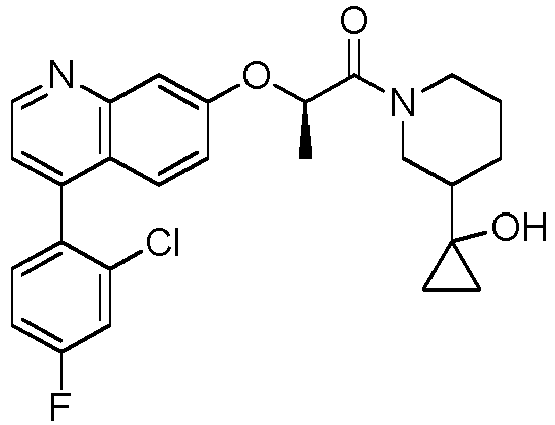
(R)-4G1 (300 MHz, DMSO-d6 ) δ 8.91 - 8.85 (m, 1H), 7.69 (dd, J = 8.9, 1.1 Hz, 1H), 7.56 - 7.38 (m, 2H), 7.37 - 7.17 (m, 4H), 5.60 - 5.41 (m, 1H), 5.16 - 5.04 (m, 1H), 4.54 - 3.97 (m, 2H), 3.15 - 2.86 (m, 1H), 2.54 - 2.37 (m, 1H), 1.86 - 0.86 (m, 8H), 0.59 - 0.11 (m, 4H). 95% 208 
(R)-9G1 (400 MHz, DMSO-d6 ) δ 8.92 (d, J = 4.4 Hz, 1H), 7.82 - 7.73 (m, 2H), 7.40 - 7.30 (m, 3H), 7.23 (dd, J = 9.1, 2.2 Hz, 1H), 5.58 - 5.51 (m, 1H), 4.40 - 4.29 (m, 4H), 3.66 - 3.32 (m, 4H), 1.93 - 1.66 (m, 4H), 1.49 (d, J = 6.4 Hz, 3H). 97% ee92% 209 
(R)-4G1 (300 MHz, DMSO-d6 ) δ 9.83 - 9.58 (m, 1H), 8.88 (dd, J = 8.9, 4.4 Hz, 1H), 7.68 (dd, J = 8.8, 2.1 Hz, 1H), 7.57 - 7.38 (m, 2H), 7.36 - 7.19 (m, 4H), 5.61-5.46 (m, 1H), 4.36 - 3.96 (m, 3H), 3.02 - 2.63 (m, 1H), 2.02 - 1.97 (m, 3H), 1.87 - 1.77 (m, 4H), 1.58 - 1.22 (m, 4H). 98% 210 
(R)-4G1 (300 MHz, DMSO-d6 ) δ 8.87 (d, J = 4.4 Hz, 1H), 7.70 (dd, J = 8.3, 2.2 Hz, 1H), 7.55 - 7.37 (m, 2H), 7.34 - 7.19 (m, 4H), 5.59 - 5.48 (m, 1H), 4.40 - 4.28 (m, 4H), 3.69 - 3.33 (m, 4H), 1.94 - 1.64 (m, 4H), 1.48 (d, J = 6.4 Hz, 3H). 95% 211 
(R)-4G1 (300 MHz, DMSO-d6 ) δ 8.91 - 8.85 (m, 1H), 7.72 - 7.66 (m, 1H), 7.56 - 7.19 (m, 6H), 5.57 - 5.34 (m, 1H), 4.69 - 4.56 (m, 1H), 4.54 - 4.15 (m, 1H), 2.01 - 1.40 (m, 10H), 1.33 - 1.04 (m, 5H). 94% 212 
(R)-4G1 (300 MHz, DMSO-d6 ) δ 8.88 (d, J = 4.3 Hz, 1H), 7.72 - 7.65 (m, 1H), 7.57 - 7.18 (m, 6H), 5.75 - 5.44 (m, 1H), 4.56 - 3.83 (m, 6H), 3.72 - 3.47 (m, 2H), 2.01 - 1.70 (m, 2H), 1.67 - 1.34 (m, 5H). 95% 213 
(R)-4G1 (300 MHz, DMSO-d6 ) δ 8.90 - 8.86 (m, 1H), 7.69 (dd, J = 8.9, 2.0 Hz, 1H), 7.55 - 7.38 (m, 2H), 7.35 - 7.19 (m, 4H), 5.36 - 5.22 (m, 1H), 4.63 - 4.40 (m, 4H), 4.04 - 3.33 (m, 3H), 3.17 (d, J = 5.2 Hz, 1H), 2.30 - 2.00 (m, 2H), 1.55 - 1.43 (m, 3H). 95% 214 
(R)-4G1 (300 MHz, DMSO-d6 ) δ 8.90 - 8.80 (m, 1H), 7.69 (dd, J = 8.7, 1.9 Hz, 1H), 7.54 - 7.39 (m, 2H), 7.35 - 7.20 (m, 4H), 5.97 - 5.94 (m, 1H), 5.59 - 5.54 (m, 1H), 5.32 - 5.21 (m, 1H), 4.21 - 3.98 (m, 1H), 3.93 - 3.75 (m, 1H), 3.60 - 3.39 (m, 2H), 3.29 - 3.06 (m, 1H), 2.16 - 1.93 (m, 1H), 1.84-1.59 (m, 1H), 1.50 - 1.48 (m, 3H), 1.21 - 1.20 (m, 9H). 95% 215 
(R)-4G1 (300 MHz, DMSO-d6 ) δ 8.88 (d, J = 4.4 Hz, 1H), 7.72 - 7.66 (m, 1H), 7.55 - 7.47 (m, 1H), 7.46 - 7.19 (m, 5H), 5.50 (q, J = 6.3 Hz, 1H), 3.57 - 3.43 (m, 2H), 3.25 - 3.15 (m, 1H), 2.91 (d, J = 12.4, 4.4 Hz, 1H), 1.65 (bs, 1H), 1.52 (d, J = 6.3 Hz, 3H), 1.30 - 1.20 (m, 3H), 1.10 - 0.95 (m, 9H). 95% 216 
(R)-4G1 (300 MHz, DMSO-d6 ) δ 10.10 - 9.29 (m, 3H), 9.23 - 9.12 (m, 1H), 7.84 - 7.41 (m, 4H), 5.83 - 5.54 (m, 1H), 4.50 - 4.00 (m, 3H), 3.66 - 2.68 (m, 4H), 1.61 - 1.12 (m, 10H). 95% 217 
(R)-4G1 (300 MHz, DMSO-d6 ) δ 8.89 (d, J = 4.4 Hz, 1H), 7.69 (dd, J = 8.9, 2.3 Hz, 1H), 7.52 (dd, J = 8.4, 6.4 Hz, 1H), 7.42 (dt, J = 8.5, 2.4 Hz, 1H), 7.35 - 7.17 (m, 4H), 5.41 - 5.03 (m, 1H), 4.93 - 4.50 (m, 1H), 3.71 - 3.36 (m, 2H), 3.09 - 2.35 (m, 4H), 1.78 - 0.89 (m, 5H). 90% 218 
(R)-4G1 (300 MHz, Chloroform-d) δ 8.88 (d, J = 4.6 Hz, 1H), 7.57 (bs, 1H), 7.45 (d, J = 9.2 Hz, 1H), 7.36 - 7.27 (m, 2H), 7.25 - 7.11 (m, 3H), 4.93 (q, J = 6.7 Hz, 1H), 4.87 (d, J 7.0 Hz, 1H), 4.82 (d, J = 7.0 Hz, 1H), 4.77 - 4.69 (m, 1H), 4.73 (d, J = 7.0 Hz, 1H), 4.65 (d, J = 7.0 Hz, 1H), 4.30 (d, J = 10.0 Hz, 1H), 4.29 (d, J = 11.0 Hz, 1H), 4.16 (d, J = 11.0 Hz, 1H), 1.65 (d, J = 6.7 Hz, 3H). 95% 219 
(R)-4G1 (400 MHz, DMSO-d 6) δ 8.88 (d, J = 4.2 Hz, 1H), 7.69 (ddd, J = 8.9, 2.6, 1.4 Hz, 1H), 7.52 (dd, J = 8.6, 6.2 Hz, 1H), 7.42 (tdd, J = 8.5, 2.6, 1.8 Hz, 1H), 7.37 - 7.17 (m, 4H), 7.00 - 6.92 (m, 1H), 5.68 - 5.48 (m, 1H), 4.45 - 3.98 (m, 2H), 3.84 - 3.48 (m, 3H), 2.47 - 2.18 (m, 2H), 1.59 - 1.45 (m, 3H). 100% ee94% 220 
(R)-9G4 (400 MHz, DMSO-d 6) δ 9.05 - 9.02 (m, 1H), 7.81 (d, J = 8.6 Hz, 2H), 7.71 (d, J = 8.9 Hz, 1H), 7.45 -7.42 (m, 1H), 7.16 (d, J = 8.9 Hz, 1H), 5.99 - 5.86 (m, 1H), 4.24 - 3.98 (m, 2H), 3.16 - 2.70 (m, 2H), 2.32 - 1.63 (m, 6H), 1.55 - 1.24 (m, 5H). 95% ee90% 221 
(R)-8G4 (400 MHz, DMSO-d 6) δ 9.00 - 8.96 (m, 1H), 7.53 (d, J = 8.9 Hz, 1H), 7.31- 7.28 (m, 1H), 7.13 - 7.08 (m, 3H), 5.99 - 5.86 (m, 1H), 4.24 - 3.91 (m, 2H), 3.17-2.64 (m, 2H), 2.46 - 2.07 (m, 3H), 1.93-1.82 (m, 8H), 1.71 - 1.46 (m, 6H). 97% ee96% - The IUPAC chemical names for the compounds shown in Table 6 are provided in Table 7 below.
- The TR-FRET assay was basically conducted as described in
WO2016/193231A1 , especially as described in example 1 (hereby incorporated by reference). With respect to the background of the mitochondrial transcription it is referred to Falkenberg et al. (2002) and Posse et al. (Posse et al., 2015). The method monitors the activity of mitochondrial RNApolymerase via detection of the formation of its product, a 407 bp long RNA sequence. Detection of the product is facilitated by hybridization of two DNA-oligonucleotide probes to specific and adjacent sequences within the RNA product sequence. Upon annealing of the probes, two fluorophores that are coupled directly to an acceptor nucleotide probe (ATT0647, 5') or introduced via a coupled streptavidin interacting with a biotinylated donor nucleotide probe on the other side (Europium cryptate, 3') are brought into sufficient proximity to serve as a fluorescence-donor-acceptor pair as generally described in Walters and Namchuk (2003). Thus, a FRET signal at 665 nm is generated upon excitation at 340 nm. - Briefly, the protocol described here was applied for screening and activity determination in a low-volume 384-well microtiter plate with non-binding surface. For high-throughput application in the 1536-well microtiter plate format, volumes of the reagent mixes were adjusted, maintaining the volumetric ratio. Proteins POLRMT (NM_172551.3), TFAM (NM_009360.4) and TFB2M (NM_008249.4) were diluted from their stocks to working concentrations of 150 nM, 1.8 µM and 330 nM respectively, in a dilution buffer containing 100 mM Tris-HCl pH 8.0, 200 mM NaCl, 10 % (v/v) glycerole, 2 mM glutathione (GSH), 0.5 mM EDTA and 0.1 mg/mL BSA. Protein dilutions and template DNA, comprising a pUC18 plasmid encoding the mitochondrial light strand promoter, restriction linearized proximal to the promoter 3'-end (pUC-LSP), were mixed at the twofold final assay-concentration in a reaction buffer, containing 10 mM Tris-HCl pH 7.5, 10 mM MgCl2, 40 mM NaCl, 2 mM GSH, 0.01 % (w/v) Tween-20 and 0.1 mg/mL BSA.
- 5 µL of this mix were dispensed, depending on the chosen microtiter plate format, using multi-channel pipettes or a Multidrop® dispenser (Thermo Fisher Scientific, Waltham MA) into the wells of a microtiter plate and incubated at room temperature (rt) for 10 min. Chemical compounds under scrutiny in the assay were applied using contact-free acoustic dropletdispensing (Echo520® Labcyte Inc., Sunnyvale CA) from 10 mM compound stocks in 100 % DMSO, to a final concentration of 10 µM) or in serial dilution series of the required concentration range. Equal amounts of DMSO without any compound were added to positive control samples, followed by an incubation step at rt for 10 min.
- The enzymatic reaction was started by the addition of 5 µL of a mix of dNTPs in reaction buffer to a final concentration of 500 µM each. No nucleotide mix was added to negative control samples. The content of the wells was mixed using a VarioTeleshaker™ (Thermo Fisher Scientific, Waltham MA) at 1500 rpm for 45 sec after which the microtiter plate was centrifuged at 500 ×g for 1 min. The samples were incubated for 2 h at rt with humidity control to avoid evaporation. The detection reagents were prepared in a buffer that was composed, such that the enzymatic reaction was terminated due to chelating of Mg-ions and increased ionic strength, containing 50 mM Tris-HCl pH 7.5, 700 mM NaCl, 20 mM EDTA, and 0.01 %(w/v) Tween-20. Importantly Eu-cryptate-coupled streptavidin had to be preincubated with a 100-fold molar excess of a random sequence oligonucleotide for 10 min at rt in the dark to block unspecific binding of single stranded RNA to the protein. Subsequently, the blocked streptavidin(-Eu) was mixed with the DNA-probes on ice and kept away from light until use.
- At the end of the enzymatic reaction time 10 µL detection reagent mix was added, such that the final concentration of fluorescent-donor probe (bio-5'-AACACATCTCT(-bio)GCCAAACCCCA-bio-3'), fluorescent-acceptor probe (ATTO647N-5'-ACAAAGAACCCTAACACCAG-3') and streptavidin(-Eu) in each assay well was 1 nM, 3 nM, and 1 nM respectively. Assay plates were again mixed and centrifuged as above and stored at rt, protected from light for at least 2h or until binding of the DNA probes to RNA product and binding of streptavidin(-Eu) to the biotinylated DNA probe led to the development of the maximal FRET signal. The generated signal was measured with an EnVision plate reader, including TRF light unit (Perkin Elmer, Waltham MA), using excitation at 320 nm, an integration time of 200 µs and a delay time of 100 µs, prior to detection at 620 nm and 665 nm. The ratio of donor- and acceptor-fluorescence was used to assess the specific FRET signal, as a measure of the generated product content (i.e. enzymatic activity).
- Quantitative real-time PCR (qRT-PCR), based on the TaqMan™ (Thermo Fisher Scientific, Waltham MA) technology, was carried out essentially as described in Heid et al. (1996). HeLa cells were plated one day before compound treatment in RPMI medium supplemented with 10% Fetal Calf Serum and 2 mM L-glutamine. Cells were incubated with dilution series of compounds or vehicle (DMSO) for 4 h, prior to harvest and extraction of the RNA using the RNeasy Mini Kit (Qiagen, Hilden D), according to the manufacturer's instructions. RNA concentrations were measured spectroscopically, using a NanoDrop-2000 (Thermo Fisher Scientific, Waltham MA) and normalized prior to cDNA synthesis, using a 'High-Capacity cDNA Reverse Transcription Kit' (Thermo Fisher Scientific, Waltham MA). qRT-PCR was carried out using the 'TaqMan Fast Advance Master Mix' (Thermo Fisher Scientific, Waltham MA) on a 7500 Fast Real-Time PCR machine (Applied Biosystems, Foster City CA)
- For these measurements, three genes were used to compare the effect of the scrutinized compounds in relation to their concentration. The POLRMT-gene was used to detect potential influences on nuclear transcription. Mitochondrial transcription in vivo was monitored by measurements 7S RNA. The TBP (TATA-box binding protein) gene was employed as the control (housekeeping gene) during qRT-PCR. The short-lived mitochondrial 7S RNA, which is not post-transcriptionally stabilized, allowed us to monitor rapid changes in mitochondrial transcription activity following compound addition. Biological triplicates were analyzed using the comparative CT Method (ΔΔCt) method (Bubner and Baldwin, 2004) and reported as Rq% values (Rq = Relative quantification = 2-ΔΔCt).
- Activities of compounds are listed in Table 7 together with compound number and IUPAC names as determined by the homogeneous TR-FRET assay for mitochondrial transcription activity according to Example 4 and the quantitative real time-PCR assay of inhibition of mitochondrial transcription according to Example 5 were grouped according to the following scheme:
mitochondrial transcription activity (IC-50) < 20nM 20nM ≤ x < 100nM 100nM ≤ x < 1µM 1µM ≤ x < 10µM +++ ++ + (+) cellular qPCR assay IMT (IC-50) < 10nM 10nM ≤ x < 50nM 50nM ≤ x < 500nM 500nM ≤ x < 5µM +++ ++ + (+) Table 7 - IUPAC chemical names and biological activities Ex IUPAC Name mitochondrial transcription activity cellular qPCR assay 1 (3S)-1-[(2R)-2-[[4-(o-tolyl)-7-quinolyl]oxy]propanoyl]piperidine-3-carboxylic acid +++ +++ 2 (3S)-1-[(2R)-2-[[4-(2,6-dimethylphenyl)-7-quinolyl]oxy]propanoyl]piperidine-3-carboxylic acid +++ +++ 3 2-[(3R)-1-[(2R)-2-[[4-(2,6-dimethylphenyl)-7-quinolyl]oxy]propanoyl]-3-piperidyl]acetic acid +++ +++ 4 ethyl (3S)-1-[(2R)-2-[[4-(2,6-dimethylphenyl)-7-quinolyl]oxy]propanoyl]piperidine-3-carboxylate +++ +++ 5 2-[(3S)-1-[(2R)-2-[[4-(2,6-dimethylphenyl)-7-quinolyl]oxy]propanoyl]-3-piperidyl]acetic acid +++ +++ 6 ethyl 2-[(3R)-1-[(2R)-2-[[4-(2,6-dimethylphenyl)-7-quinolyl]oxy]propanoyl]-3-piperidyl]acetate +++ 7 (3R)-1-[(2R)-2-[[4-(2-chlorophenyl)-7-quinolyl]oxy]propanoyl]piperidine-3-carboxylic acid (formic acid salt) +++ +++ 8 ethyl 2-[(3R)-1-[(2R)-2-[[4-(o-tolyl)-7-quinolyl]oxy]propanoyl]-3-piperidyl]acetate +++ + 9 (3S)-1-[(2R)-2-[[4-(2-chlorophenyl)-7-quinolyl]oxy]propanoyl]piperidine-3-carboxylic acid (formic acid salt) +++ +++ 10 (3S)-1-[(2R)-2-[[4-(2-chloro-4-fluoro-phenyl)-7-quinolyl]oxy]propanoyl]piperidine-3-carboxylic acid (formic acid salt) +++ ++ 11 (2R)-2-[[4-(2-chloro-4-fluoro-phenyl)-7-quinolyl]oxy]-1-[(3S)-3-(2H-tetrazol-5-yl)-1-piperidyl]propan-1-one +++ + 12 (3S)-1-[(2R)-2-[[4-(2-chlorophenyl)-2-fluoro-7-quinolyl]oxy]propanoyl]piperidine-3-carboxylic acid (trifluoroacetic acid salt) +++ +++ 13 2-[(3R)-1-[(2R)-2-[[4-(o-tolyl)-7-quinolyl]oxy]propanoyl]-3-piperidyl]acetic acid (formic acid salt) ++ ++ 14 ethyl (3S)-1-[(2R)-2-[[4-(o-tolyl)-7-quinolyl]oxy]propanoyl]piperidine-3-carboxylate ++ + 15 ethyl 2-[(3R)-1-[(2R)-2-[[4-(2-chloro-4-fluoro-phenyl)-7-quinolyl]oxy]propanoyl]-3-piperidyl]acetate ++ + 16 2-[(3R)-1-[(2R)-2-[[4-(2-chlorophenyl)-7-quinolyl]oxy]propanoyl]-3-piperidyl]acetic acid (formic acid salt) ++ + 17 (3R)-1-[(2R)-2-[[4-(2-chloro-4-fluoro-phenyl)-7-quinolyl]oxy]propanoyl]piperidine-3-carboxylic acid ++ + 18 2-[(3R)-1-[(2R)-2-[[4-(2-chloro-4-fluoro-phenyl)-7-quinolyl]oxy]propanoyl]-3-piperidyl]acetic acid (formic acid salt) ++ + 19 (3S)-1-[(2R)-2-[[4-(2-chloro-4-fluoro-phenyl)-7-quinolyl]oxy]propanoyl]pyrrolidine-3-carboxylic acid ++ + 20 (2R)-2-[[4-(2-chloro-4-fluoro-phenyl)-7-quinolyl]oxy]-1-(1-piperidyl)propan-1-one (formic acid salt) ++ ++ 21 2-[(3 R)-1-[(2 R)-2-[[2-chloro-4-(o-tolyl)-7-quinolyl]oxy]propanoyl]-3-piperidyl]acetic acid ++ (+) 22 2-[(3S)-1-[(2R)-2-[[4-(2-chloro-4-fluoro-phenyl)-7-quinolyl]oxy]propanoyl]-3-piperidyl]acetic acid ++ + 23 rac-(3S)-1-[2-[[4-(2-chlorophenyl)-7-quinolyl]oxy]propanoyl]piperidine-3-carboxylic acid ++ 24 1-[(2R)-2-[[4-(2-chloro-4-fluoro-phenyl)-7-quinolyl]oxy]propanoyl]piperidine-4-carboxylic acid ++ + 25 (3S)-1-[(2R)-2-[[2-chloro-4-(o-tolyl)-7-quinolyl]oxy]propanoyl]piperidine-3-carboxylic acid ++ ++ 26 3-[[(2R)-2-[[4-(2-chloro-4-fluoro-phenyl)-7-quinolyl]oxy]propanoyl]amino]benzoic acid ++ + 27 ethyl (3S)-1-[(2R)-2-[[4-(2-chloro-4-fluoro-phenyl)-7-quinolyl]oxy]propanoyl]piperidine-3-carboxylate ++ (+) 28 (2R)-2-[[4-(2-chloro-4-fluoro-phenyl)-7-quinolyl]oxy]-1-(4-propanoylpiperazin-1-yl)propan-1-one + ++ 29 tert-butyl (2R)-2-[[4-(2-chlorophenyl)-7-quinolyl]oxy]propanoate + +++ 30 (3S)-1-[(2R)-2-[[4-(2-chloro-4-fluoro-phenyl)-7-quinolyl]oxy]propanoyl]piperidine-3-carbonitrile + ++ 31 (3S)-1-[(2R)-2-[[2-methyl-4-(o-tolyl)-7-quinolyl]oxy]propanoyl]piperidine-3-carboxylic acid (trifluoroacetic acid salt) + +++ 32 (2R)-2-[[4-(2-chloro-4-fluoro-phenyl)-7-quinolyl]oxy]-N-isopropyl-N-methyl-propanamide + ++ 33 1-[rac-(2R)-2-[[4-(2-chloro-4-fluoro-phenyl)-7-quinolyl]oxy]propanoyl]piperidine-3-sulfonamide + +++ 34 (3S)-1-[(2R)-2-[[2-chloro-4-(2-chlorophenyl)-7-quinolyl]oxy]propanoyl]piperidine-3-carboxylic acid + ++ 35 (3S)-1-[(2R)-2-[[2-chloro-4-(4-fluoro-2-methyl-phenyl)-7-quinolylloxy]propanoyl]piperidine-3-carboxylic acid + +++ 36 isopropyl (2R)-2-[[4-(2-chlorophenyl)-7-quinolyl]oxy]propanoate (formic acid salt) + + 37 methyl 2-[(3R)-1-[(2R)-2-[[4-(2-chloro-4-fluorophenyl)-7-quinolyl]oxy]propanoyl]pyrrolidin-3-y)]acetate + 38 (3S)-1-[(2R)-2-[[4-(2-chloro-4-fluoro-phenyl)-7-quinolyl]oxy]propanoyl]-N-methyl-piperidine-3-carboxamide + ++ 39 2-[(3S)-1-[(2R)-2-[[4-(2-chloro-4-fluoro-phenyl)-7-quinolyl]oxy]propanoyl]pyrrolidin-3-yl]acetic acid + + 40 2-[(3R)-1-[(2R)-2-[[4-(2-chloro-4-fluoro-phenyl)-7-quinolyl]oxy]propanoyl]pyrrolidin-3-yl]acetic acid + + 41 ethyl (3S)-1-[(2R)-2-[[4-(2-chlorophenyl)-2-fluoro-7-quinolyl]oxy]propanoyl]piperidine-3-carboxylate + (+) 42 (2R)-2-[[4-(2-chloro-4-fluoro-phenyl)-7-quinolyl]oxy]-1-pyrrolidin-1-yl-propan-1-one + + 43 (2R)-2-[[2-chloro-4-(o-tolyl)-7-quinolyl]oxy]propanoic acid + 44 (2R)-2-[[4-(2-chloro-4-fluoro-phenyl)-7-quinolyl]oxy]propanoic acid + 45 (2R)-2-[[4-(2-chloro-4-fluoro-phenyl)-7-quinolyl]oxy]-N,N-dimethyl-propanamide (formic acid salt) + + 46 (3S)-1-[2-[[4-(2-chlorophenyl)-7-quinolyl]oxy]acetyl]piperidine-3-carboxylic acid (formic acid salt) + + 47 (2R)-N-tert-butyl-2-[[4-(2-chloro-4-fluoro-phenyl)-7-quinolyl]oxy]propanamide + ++ 48 (2R)-2-[[4-(2-chlorophenyl)-7-quinolyl]oxy]-N-isopropyl-propanamide (formic acid salt) + + 49 ethyl 2-[(3R)-1-[(2R)-2-[[2-methyl-4-(o-tolyl)-7-quinolyl]oxy]propanoyl]-3-piperidyl]acetate + ++ 50 ethyl (2R)-2-[[4-(2-chlorophenyl)-7-quinolyl]oxy]propanoate + ++ 51 ethyl 4-[[(2R)-2-[[4-(2-chloro-4-fluoro-phenyl)-7-quinolyl]oxy]propanoyl]amino]benzoate + 52 (3S)-1-[(2R)-2-[[2-chloro-4-(o-tolyl)-7-quinolyl]oxy]propanoyl]piperidine-3-carboxamide + ++ 53 (2R)-2-[[4-(2-chlorophenyl)-7-quinolyl]oxy]-1-(1-piperidyl)propan-1-one + ++ 54 methyl 3-[[(2R)-2-[[4-(2-chloro-4-fluoro-phenyl)-7-quinolyl]oxy]propanoyl]amino]cyclobutanecarboxylate + 55 (2R)-2-[[4-(2-chloro-4-fluoro-phenyl)-7-quinolyl]oxy]-1-piperazin-1-yl-propan-1-one (trifluoroacetic acid salt) + + 56 2-[(3R)-1-[(2R)-2-[[2-chloro-4-(2-chloro-4-fluorophenyl)-7-quinolyl]oxy]propanoyl]-3-piperidyl]acetic acid + + 57 2-[(3R)-1-[(2R)-2-[[2-chloro-4-(4-fluoro-2-methylphenyl)-7-quinolyl]oxy]propanoyl]-3-piperidyl]acetic acid + + 58 ethyl 1-[(2R)-2-[[4-(2-chloro-4-fluoro-phenyl)-7-quinolyl]oxy]propanoyl]piperidine-4-carboxylate + 59 (3S)-1-[(2R)-2-[[4-(2-chloro-4-fluoro-phenyl)-2-methyl-7-quinolyl]oxy]propanoyl]piperidine-3-carboxylic acid + ++ 60 4-[[(2R)-2-[[4-(2-chloro-4-fluoro-phenyl)-7-quinolyl]oxy]propanoyl]amino]benzoic acid (trifluoroacetic acid salt) + + 61 (2R)-2-[[4-(2-chloro-4-fluoro-phenyl)-7-quinolyl]oxy]-N-isopropyl-propanamide + + 62 (3S)-1-[2-[[5-(2-chloro-4-fluoro-phenyl)-1, 8-naphthyridin-2-yl]oxy]propanoyl]piperidine-3-carboxylic acid + ++ 63 4-[(2R)-2-[[4-(2-chloro-4-fluoro-phenyl)-7-quinolyl]oxy]propanoyl]piperazin-2-one + + 64 (3S)-1-[(2R)-2-[[2-chloro-4-(2-chloro-4-fluoro-phenyl)-7-quinolyl]oxy]propanoyl]piperidine-3-carboxylic acid + + 65 2-[(3R)-1-[(2R)-2-[[4-(2-chloro-3-fluoro-phenyl)-7-quinolyl]oxy]propanoyl]-3-piperidyl]acetic acid ++ 66 (3S)-1-[(2R)-2-[(4-phenyl-7-quinolyl)oxy]propanoyl]piperidine-3-carboxylic acid + ++ 67 methyl 2-[(3S)-1-[(2R)-2-[[4-(2-chloro-4-fluorophenyl)-7-quinolyl]oxy]propanoyl]pyrrolidin-3-yl]acetate + 68 2-[(3R)-1-[(2R)-2-[[2-chloro-4-(2-chlorophenyl)-7-quinolyl]oxy]propanoyl]-3-piperidyl]-N-methyl-acetamide + + 69 2-[(3R)-1-[(2R)-2-[[2-methyl-4-(o-tolyl)-7-quinolyl]oxy]propanoyl]-3-piperidyl]acetic acid (trifluoroacetic acid salt) + ++ 70 (2R)-2-[[2-chloro-4-(2-chlorophenyl)-7-quinolyl]oxy]-1-[4-(cyclopropanecarbonyl)piperazin-1-yl]propan-1-one + (+) 71 methyl (3R)-1-[(2R)-2-[[4-(2-chloro-4-fluoro-phenyl)-7-quinolyl]oxy]propanoyl]piperidine-3-carboxylate + 72 (2R)-2-[[2-chloro-4-(2-chlorophenyl)-7-quinolyl]oxy]-1-(4-propanoylpiperazin-1-yl)propan-1-one + 73 tert-butyl (2R)-2-[[2-chloro-4-(o-tolyl)-7-quinolyl]oxy]propanoate + + 74 ethyl 2-[(3R)-1-[(2R)-2-[[4-(2-chloro-4-fluoro-phenyl)-2-methyl-7-quinolyl]oxy]propanoyl]-3-piperidyl]acetate + + 75 ethyl (3S)-1-[(2R)-2-[[4-(2-chloro-4-fluoro-phenyl)-7-quinolyl]oxy]propanoyl]pyrrolidine-3-carboxylate + 76 (3S)-1-[(2R)-2-[[2-chloro-4-(2-chlorophenyl)-7-quinolyl]oxy]propanoyl]piperidine-3-carboxamide + ++ 77 (2R)-2-[[4-(2-chloro-4-fluoro-phenyl)-7-quinolyl]oxy]-N-cyclopropyl-propanamide + + 78 (3S)-1-[(2S)-2-[[4-(2-chlorophenyl)-7-quinolyl]oxy]propanoyl]piperidine-3-carboxylic acid (formic acid salt) + (+) 79 2-[(3R)-1-[(2R)-2-[[4-(2-methyl-3-thienyl)-7-quinolyl]oxy]propanoyl]-3-piperidyl]acetic acid + + 80 2-[rac-(3R)-1-[2-[[5-(2-chloro-4-fluoro-phenyl)-1,8-naphthyridin-2-yl]oxy]propanoyl]-3-piperidyl]acetic acid (+) + 81 (3S)-1-[(2R)-2-[[2-chloro-4-(2-chloro-4-fluoro-phenyl)-7-quinolyl]oxy]propanoyl]piperidine-3-carboxamide (+) + 82 isopropyl 2-[[4-(2-chlorophenyl)-7-quinolyl]oxy]acetate (formic acid salt) (+) 83 2-[(3R)-1-[(2R)-2-[[2-chloro-4-(2-chlorophenyl)-7-quinolyl]oxy]propanoyl]-3-piperidyl]acetic acid (+) (+) 84 (3S)-1-[(2R)-2-[[4-(4-fluoro-2,6-dimethyl-phenyl)-7-quinolyl]oxy]propanoyl]piperidine-3-carboxylic acid +++ 85 (2R)-1-[4-(2-aminoacetyl)piperazin-1-yl]-2-[[2-chloro-4-(2-chlorophenyl)-7-quinolyl]oxy]propan-1-one (trifluoroacetic acid salt) (+) 86 2-[[4-(2-chlorophenyl)-7-quinolyl]oxy]-N,N-dimethyl-propanamide (+) + 87 ethyl (3S)-1-[2-[[4-(2-chlorophenyl)-7-quinolyl]oxy]acetyl]piperidine-3-carboxylate (+) 88 (2R)-2-[[4-(2-chlorophenyl)-7-quinolyl]oxy]-N,N-dimethyl-propanamide (formic acid salt) (+) + 89 ethyl 2-[(3S)-1-[(2R)-2-[[4-(2-chloro-4-fluoro-phenyl)-7-quinolyl]oxy]propanoyl]-3-piperidyl]acetate (+) 90 (2R)-2-[[4-(2-chlorophenyl)-2-fluoro-7-quinolyl]oxy]propanoic acid (trifluoroacetic acid salt) (+) 91 (2R)-2-[[2-chloro-4-(2-chloro-4-fluoro-phenyl)-7-quinolyl]oxy]propanoic acid (+) 92 ethyl 2-[(3R)-1-[(2R)-2-[[2-chloro-4-(2-chlorophenyl)-7-quinolyl]oxy]propanoyl]-3-piperidyl]acetate (+) 93 ethyl 2-[(3R)-1-[(2R)-2-[[2-chloro-4-(2-chloro-4-fluorophenyl)-7-quinolyl]oxy]propanoyl]-3-piperidyl]acetate (+) 94 ethyl (3S)-1-[(2R)-2-[[2-chloro-4-(4-fluoro-2-methylphenyl)-7-quinolyl]oxy]propanoyl]piperidine-3-carboxylate (+) 95 (2R)-2-[[4-(2-chloro-4-fluoro-phenyl)-7-quinolyl]oxy]-N-(4-pyridyl)propanamide (trifluoroacetic acid salt) + + 96 (3S)-1-[(2R)-2-[[2-chloro-4-(2-chlorophenyl)-7-quinolyl]oxy]propanoyl]-N-methyl-piperidine-3-carboxamide (+) 97 methyl 3-[[(2R)-2-[[2-chloro-4-(2-chlorophenyl)-7-quinolyl]oxy]propanoyl]amino]cyclobutanecarboxylate (+) 98 2-[(3R)-1-[(2R)-2-[[2-chloro-4-(2-chloro-4-fluorophenyl)-7-quinolyl]oxy]propanoyl]-3-piperidyl]-N-methyl-acetamide (+) 99 (2R)-2-[[2-chloro-4-(2-chlorophenyl)-7-quinolyl]oxy]-1-(1-piperidyl)propan-1-one (+) (+) 100 (3S)-1-[(2R)-2-[[2-chloro-4-(2-chlorophenyl)-7-quinolyl]oxy]propanoyl]-N,N-dimethyl-piperidine-3-carboxamide (+) 101 2-[(3R)-1-[(2R)-2-[[4-(2-chloro-4-fluoro-phenyl)-2-methyl-7-quinolyl]oxy]propanoyl]-3-piperidyl]acetic acid (trifluoroacetic acid salt) (+) (+) 102 (3R)-1-[(2S)-2-[[4-(2-chlorophenyl)-7-quinolyl]oxy]propanoyl]piperidine-3-carboxylic acid (formic acid salt) (+) 103 (2R)-2-[[4-(2-chlorophenyl)-7-quinolyl]oxy]propanoic acid (+) 104 (2R)-2-[[2-chloro-4-(2-chlorophenyl)-7-quinolyl]oxy]-1-piperazin-1-yl-propan-1-one (trifluoroacetic acid salt) (+) + 105 (3S)-N-methyl-1-[(2R)-2-[[2-chloro-4-(2-chloro-4-fluoro-phenyl)-7-quinolyl]oxy]propanoyl]piperidine-3-carboxamide (+) 106 2-[[4-(o-tolyl)-7-quinolyl]oxy]acetamide (+) + 107 (2R)-2-[[2-chloro-4-(2-chloro-4-fluoro-phenyl)-7-quinolyl]oxy]-1-(1-piperidyl)propan-1-one (+) 108 ethyl 3-[[(2R)-2-[[4-(2-chloro-4-fluoro-phenyl)-7-quinolyl]oxy]propanoyl]amino]benzoate (+) 109 2-[[5-(2-chloro-4-fluoro-phenyl)-1,8-naphthyridin-2-yl]oxy]-N-isopropyl-propanamide (+) 110 2-[(3R)-1-[(2R)-2-[[4-(2-fluorophenyl)-7-quinolyl]oxy]propanoyl]-3-piperidyl]acetic acid (+) 111 tert-butyl (3S)-1-[(2R)-2-[[2-methyl-4-(o-tolyl)-7-quinolyl]oxy]propanoyl]piperidine-3-carboxylate (+) 112 2-[1-[(2R)-2-[[4-(2-chlorophenyl)-7-quinolyl]oxy]propanoyl]-4-piperidyl]acetic acid ++ ++ 113 (3S)-1-[(2R)-2-[[4-(2,6-dimethylphenyl)-2-methyl-7-quinolyl]oxy]propanoyl]piperidine-3-sulfonamide (trifluoroacetic acid salt) + + 114 (3R)-1-[(2R)-2-[[4-(2,6-dimethylphenyl)-2-methyl-7-quinolyl]oxy]propanoyl]piperidine-3-sulfonamide (trifluoroacetic acid salt) + ++ 115 (3R)-1-[(2R)-2-[[4-(2-chloro-4-fluoro-phenyl)-2-methyl-7-quinolyl]oxy]propanoyl]piperidine-3-sulfonamide (trifluoroacetic acid salt) (+) + 116 (3S)-1-[(2R)-2-[[4-(2-chloro-4-fluoro-phenyl)-7-quinolyl]oxy]propanoyl]piperidine-3-sulfonamide (trifluoroacetic acid salt) + +++ 117 (3R)-1-[(2R)-2-[[4-(2-chloro-4-fluoro-phenyl)-7-quinolyl]oxy]propanoyl]piperidine-3-sulfonamide (trifluoroacetic acid salt) + ++ 118 3-[1-[(2R)-2-[[4-(2-chlorophenyl)-7-quinolyl]oxy]propanoyl]-4-piperidyl]propanoic acid +++ ++ 119 1-[rac-(2R)-2-[[4-(2,6-dimethylphenyl)-7-quinolyl]oxy]propanoyl]piperidine-3-sulfonamide +++ +++ 120 2-[(3R)-1-[(2R)-2-[[4-(2,6-dichlorophenyl)-7-quinolyl]oxy]propanoyl]-3-piperidyl]acetic acid +++ ++ 121 2-[(3R)-1-[(2R)-2-[[4-(2-ethylphenyl)-7-quinolyl]oxy]propanoyl]-3-piperidyl]acetic acid ++ ++ 122 2-[(3R)-1-[(2R)-2-[[4-(2-isopropylphenyl)-7-quinolyl]oxy]propanoyl]-3-piperidyl]acetic acid (+) 123 [1-[rac-(2R)-2-[[4-(2-chloro-4-fluoro-phenyl)-7-quinolyl]oxy]propanoyl]-3-piperidyl]methanesulfonamide (trifluoroacetic acid salt) + + 124 2-[(3R)-1-[(2R)-2-[[4-(2,6-dimethylphenyl)-2-methyl-7-quinolyl]oxy]propanoyl]-3-piperidyl]acetic acid + + 125 (2R)-2-[[4-(2-chloro-4-fluoro-phenyl)-7-quinolyl]oxy]-N-[4-(2-hydroxyethyl)phenyl]propanamide (trifluoroacetic acid salt) (+) 126 (3S)-1-[(2R)-2-[[5-(2-chloro-4-fluoro-phenyl)-1,8-naphthyridin-2-yl]oxy]propanoyl]piperidine-3-carboxylic acid (formic acid salt) + ++ 127 (3S)-1-[(2S)-2-[[5-(2-chloro-4-fluoro-phenyl)-1,8-naphthyridin-2-yl]oxy]propanoyl]piperidine-3-carboxylic acid (+) 128 2-[(3R)-1-[(2R)-2-[[5-(2-chloro-4-fluoro-phenyl)-1,8-naphthyridin-2-yl]oxy]propanoyl]-3-piperidyl]acetic acid (formic acid salt) + + 129 (3S)-1-[(2R)-2-[[4-(2,6-dichlorophenyl)-7-quinolyl]oxy]propanoyl]piperidine-3-carboxylic acid +++ +++ 130 (2R)-2-[[4-(2-chloro-4-fluoro-phenyl)-7-quinolyl]oxy]-N-(2-pyridyl)propanamide (trifluoroacetic acid salt) + (+) 131 (2R)-2-[[4-(2-chloro-4-fluoro-phenyl)-7-quinolyl]oxy]-N-ethyl-propanamide (trifluoroacetic acid salt) (+) + 132 (3S)-1-[(2R)-2-[[4-(2,6-dichloro-4-fluoro-phenyl)-7-quinolyl]oxy]propanoyl]piperidine-3-carboxylic acid +++ +++ 133 2-[(3R)-1-[(2R)-2-[[4-(4-methyl-3-thienyl)-7-quinolyl]oxy]propanoyl]-3-piperidyl]acetic acid + + 134 2-[(3R)-1-[(2R)-2-[[4-(3-methyl-2-thienyl)-7-quino)yl]oxy]propanoyl]-3-piperidyl]acetic acid (+) 135 2-[(3R)-1-[(2R)-2-[[4-(2-methoxyphenyl)-7-quinolyl]oxy]propanoyl]-3-piperidyl]acetic acid (+) 136 2-[(3R)-1-[(2R)-2-[[4-[2-(trifluoromethyl)phenyl]-7-quinolyl]oxy]propanoyl]-3-piperidyl]acetic acid + 137 2-[(3R)-1-[(2R)-2-[[4-[2-(trifluoromethoxy)phenyl]-7-quinolyl]oxy]propanoyl]-3-piperidyl]acetic acid (+) 138 (3S)-1-[(2R)-2-[[4-(2,6-dimethylphenyl)-7-quinolyl]oxy]propanoyl]piperidine-3-sulfonamide +++ 139 2-[(3R)-1-[2-[[4-(2-chlorophenyl)-7-quinolyl]oxy]-2-methyl-propanoyl]-3-piperidyl]acetic acid (+) 140 2-[rac-(3R)-1-[2-[[4-(2-chlorophenyl)-7-quinolyl]oxy]butanoyl]-3-piperidyl]acetic acid ++ 141 2-[(3R)-1-[(2R)-2-[[4-(2-chloro-6-methyl-phenyl)-7-quinolyl]oxy]propanoyl]-3-piperidyl]acetic acid +++ 142 2-[(3R)-1-[(2R)-2-[[4-(2-bromophenyl)-7-quinolyl]oxy]propanoyl]-3-piperidyl]acetic acid +++ 143 2-[(3R)-1-[(2R)-2-[[4-(2-cyanophenyl)-7-quinolyl]oxy]propanoyl]-3-piperidyl]acetic acid + 144 2-[(3R)-1-[(2R)-2-[[4-(2-ethynylphenyl)-7-quinolyl]oxy]propanoyl]-3-piperidyl]acetic acid ++ 145 2-[(3R)-1-[(2R)-2-[[4-[2-(dimethylamino)phenyl]-7-quinolyl]oxy]propanoyl]-3-piperidyl]acetic acid + 146 2-[(3R)-1-[(2R)-2-[[4-(2-carbamoylphenyl)-7-quinolyl]oxy]propanoyl]-3-piperidyl]acetic acid 147 2-[(3R)-1-[(2R)-2-[[4-(2,6-difluorophenyl)-7-quinolyl]oxy]propanoyl]-3-piperidyl]acetic acid 148 2-[(3R)-1-[(2R)-2-[[4-(2,4-dimethyl-3-thienyl)-7-quinolyl]oxy]propanoyl]-3-piperidyl]acetic acid 149 2-[(3R)-1-[(2R)-2-[[4-[2-chloro-6-(trifluoromethyl)phenyl]-7-quinolyl]oxy]propanoyl]-3-piperidyl]acetic acid 150 2-[(3R)-1-[(2 R)-2-[[4-(2-bromo-6-chloro-phenyl)-7-quinolyl]oxy]propanoyl]-3-piperidyl]acetic acid 151 2-[(3R)-1-[(2R)-2-[[4-[2,6-bis(trifluoromethyl)phenyl]-7-quinolyl]oxy]propanoyl]-3-piperidyl]acetic acid (+) 152 2-[(3R)-1-[(2R)-2-[[4-(2-chloro-6-methoxy-phenyl)-7-quinolyl]oxy]propanoyl]-3-piperidyl]acetic acid (+) 153 2-[(3R)-1-[(2R)-2-[[4-(2,6-diisopropylphenyl)-7-quinolyl]oxy]propanoyl]-3-piperidyl]acetic acid 154 (2R)-1-[(3R)-3-amino-1-piperidyl]-2-[[4-(2,6-dimethylphenyl)-7-quinolyl]oxy]propan-1-one 155 (2R)-1-[(3S)-3-amino-1-piperidyl]-2-[[4-(2,6-dimethylphenyl)-7-quinolyl]oxy]propan-1-one 156 N-[(3S)-1-[(2R)-2-[[4-(2,6-dimethylphenyl)-7-quinolyl]oxy]propanoyl]-3-piperidyl]propanamide 157 N-tert-butyl-4-[(2R)-2-[[4-(2,6-dimethylphenyl)-7-quinolyl]oxy]propanoyl]piperazine-1-carboxamide 158 (2R)-2-[[4-(2,6-dimethylphenyl)-7-quinolyl]oxy]-1-[3-(1-hydroxycyclopropyl)-1-piperidyl]propan-1-one 159 8-[(2R)-2-[[4-(2,6-dimethylphenyl)-7-quinolyl]oxy]propanoyl]-2,8-diazaspiro[4.5]decan-1-one 160 (2R)-2-[[4-(2,6-dimethylphenyl)-7-quinolyl]oxy]-1-(3,5-dimethylpiperazin-1-yl)propan-1-one 161 N-[(3S)-1-[(2R)-2-[[4-(2,6-dimethylphenyl)-7-quinolyl]oxy]propanoyl]-3-piperidyl]-N-hydroxy-acetamide 162 1-[4-[(2R)-2-[[4-(2,6-dimethylphenyl)-7-quinolyl]oxy]propanoyl]piperazin-1-yl]-2,2-dimethyl-propan-1-one 163 N-[(3S)-1-[(2R)-2-[[4-(2,6-dimethylphenyl)-7-quinolyl]oxy]propanoyl]-3-piperidyl]methanesulfonamide 164 N-[(3S)-1-[(2R)-2-[[4-(2,6-dimethylphenyl)-7-quinolyl]oxy]propanoyl]-3-piperidyl]benzamide 165 (3S)-N-cyano-1-[(2R)-2-[[4-(2,6-dimethylphenyl)-7-quinolyl]oxy]propanoyl]piperidine-3-carboxamide 166 (3S)-1-[(2R)-2-[[4-(2,6-dimethylphenyl)-7-quinolyl]oxy]propanoyl]piperidine-3-carbohydroxamic acid 167 2-[(3R)-1-[(2R)-2-[[4-(2,6-dimethylphenyl)-7-quinolyl]oxy]propanoyl]-3-piperidyl]ethanehydroxamic acid 168 (2R)-1-(3-aminoazetidin-1-yl)-2-[[4-(2,6-dimethylphenyl)-7-quinolyl]oxy]propan-1-one 169 (2R)-2-[[4-(2,6-dimethylphenyl)-7-quinolyl]oxy]-1-[3-(1H-tetrazol-5-yl)azetidin-1-yl]propan-1-one 170 3-hydroxy-1-[(2R)-2-[[4-(2,6-dimethylphenyl)-7-quinolyl]oxy]propanoyl]piperidine-3-carboxylic acid 171 5-[(2R)-2-[[4-(2,6-dimethylphenyl)-7-quinolyl]oxy]propanoyl]-5-azaspiro[2.5]octane-2-carboxylic acid 172 (3R)-1-[(2R)-2-[[4-(2,6-dimethylphenyl)-7-quinolyl]oxy]propanoyl]piperidine-3-sulfonamide +++ 173 (3S)-1-[(2R)-2-[[4-(2,6-dichloro-4-fluoro-phenyl)-7-quinolyl]oxy]propanoyl]-3-methyl-piperidine-3-carboxylic acid +++ +++ 174 5-[rac-(2R)-2-[[4-(4-fluoro-2,6-dimethyl-phenyl)-7-quinolyl]oxy]propanoyl]-5-azaspiro[2.5]octane-2-carboxylic acid +++ +++ 175 (3R)-1-[(2R)-2-[[4-(4-fluoro-2,6-dimethyl-phenyl)-7-quinolyl]oxy]propanoyl]-3-methyl-piperidine-3-carboxylic acid +++ +++ 176 (2R)-2-[[4-(4-fluoro-2,6-dimethyl-phenyl)-7-quinolyl]oxy]-1-[(2S)-2-methyl-1-piperidyl]propan-1-one +++ ++ 177 5-[rac-(2R)-2-[[4-(2,6-dichloro-4-fluoro-phenyl)-7-quinolyl]oxy]propanoyl]-5-azaspiro[2.5]octane-2-carboxylic acid +++ +++ 178 (2R)-2-[[4-(4-fluoro-2,6-dimethyl-phenyl)-7-quinolyl]oxy]-1-morpholino-propan-1-one +++ ++ 179 (2R)-2-[[4-(4-fluoro-2,6-dimethyl-phenyl)-7-quinolyl]oxy]-1-(2-oxa-7-azaspiro[3.5]nonan-7-yl)propan-1-one +++ +++ 180 rac-(2R)-2-[[4-(4-fluoro-2,6-dimethyl-phenyl)-7-quinolyl]oxy]-1-[3-(1-hydroxycyclopropyl)-1-piperidyl]propan-1-one +++ +++ 181 8-[(2R)-2-[[4-(4-fluoro-2,6-dimethyl-phenyl)-7-quinolyl]oxy]propanoyl]-2,8-diazaspiro[4.5]decan-1-one +++ +++ 182 1-[1-[rac-(2R)-2-[[4-(4-fluoro-2,6-dimethyl-phenyl)-7-quinolyl]oxy]propanoyl]-3-piperidyl]cyclopropanecarboxylic acid +++ +++ 183 2-[(3R)-1-[(2R)-2-[[4-(4-fluoro-2,6-dimethyl-phenyl)-7-quinolyl]oxy]propanoyl]-3-piperidyl]acetic acid +++ +++ 184 (3S)-1-[(2R)-2-[[4-(4-fluoro-2,6-dimethyl-phenyl)-7-quinolyl]oxy]propanoyl]-3-methyl-piperidine-3-carboxylic acid +++ +++ 185 N-[(3S)-1-[(2R)-2-[[4-(4-fluoro-2,6-dimethyl-phenyl)-7-quinolyl]oxy]propanoyl]-3-piperidyl]-N-hydroxy-acetamide +++ +++ 186 2-methyl-2-[1-[rac-(2R)-2-[[4-(4-fluoro-2,6-dimethylphenyl)-7-quinolyl]oxy]propanoyl]-3-piperidyl]propanoic acid +++ +++ 187 (2R)-2-[[4-(4-fluoro-2,6-dimethyl-phenyl)-7-quinolyl]oxy]-1-[(2R)-2-methyl-1-piperidyl]propan-1-one +++ +++ 188 (3R)-1-[(2R)-2-[[4-(2,6-dichloro-4-fluoro-phenyl)-7-quinolyl]oxy]propanoyl]-3-methyl-piperidine-3-carboxylic acid +++ ++ 189 (3S)-1-[(2R)-2-[[4-(2-chloro-4-fluoro-phenyl)-7-quinolyl]oxy]propanoyl]-3-methyl-piperidine-3-carboxylic acid +++ +++ 190 [1-[rac-(2R)-2-[[4-(2,6-dimethylphenyl)-7-quinolyl]oxy]propanoyl]-3-piperidyl]methanesulfonamide +++ 191 rac-(2R)-1-(2,6-dimethyl-1-piperidyl)-2-[[4-(4-fluoro-2,6-dimethyl-phenyl)-7-quinolyl]oxy]propan-1-one +++ +++ 192 2-[(3R)-1-[(2R)-2-[[4-(2,6-dichloro-4-fluoro-phenyl)-7-quinolyl]oxy]propanoyl]-3-piperidyl]acetic acid ++ +++ 193 5-[rac-(2R)-2-[[4-(2-chloro-4-fluoro-phenyl)-7-quinolyl]oxy]propanoyl]-5-azaspiro[2.5]octane-2-carboxylic acid ++ ++ 194 1-[1-[rac-(2R)-2-[[4-(2-chloro-4-fluoro-phenyl)-7-quinolyl]oxy]propanoyl]-3-piperidyl]cyclopropanecarboxylic acid ++ ++ 195 2-methyl-2-[1-[rac-(2R)-2-[[4-(2,6-dichloro-4-fluorophenyl)-7-quinolyl]oxy]propanoyl]-3-piperidyl]propanoic acid ++ ++ 196 1-[1-[rac-(2R)-2-[[4-(2,6-dichloro-4-fluoro-phenyl)-7-quinolyl]oxy]propanoyl]-3-piperidyl]cyclopropanecarboxylic acid ++ ++ 197 2-methyl-2-[1-[rac-(2R)-2-[[4-(2-chloro-4-fluorophenyl)-7-quinolyl]oxy]propanoyl]-3-piperidyl]propanoic acid ++ ++ 198 (3R)-1-[(2R)-2-[[4-(2-chloro-4-fluoro-phenyl)-7-quinolyl]oxy]propanoyl]-3-methyl-piperidine-3-carboxylic acid ++ +++ 199 (2R)-2-[[4-(2,6-dichloro-4-fluoro-phenyl)-7-quinolyl]oxy]-1-[(2S)-2-methyl-1-piperidyl]propan-1-one ++ +++ 200 rac-(2R)-2-[[4-(2-chloro-4-fluoro-phenyl)-7-quinolyl]oxy]-1-(2-methyl-1-piperidyl)propan-1-one ++ +++ 201 (2R)-2-[[4-(2,6-dichloro-4-fluoro-phenyl)-7-quinolyl]oxy]-1-morpholino-propan-1-one + ++ 202 8-[(2R)-2-[[4-(2,6-dichloro-4-fluoro-phenyl)-7-quinolyl]oxy]propanoyl]-2,8-diazaspiro[4.5]decan-1-one + ++ 203 rac-(2R)-2-[[4-(2,6-dichloro-4-fluoro-phenyl)-7-quinolyl]oxy]-1-[3-(1-hydroxycyclopropyl)-1-piperidyl]propan-1-one + ++ 204 (2R)-2-[[4-(2,6-dichloro-4-fluoro-phenyl)-7-quinolyl]oxy]-1-[(2R)-2-methyl-1-piperidyl]propan-1-one + ++ 205 8-[(2R)-2-[[4-(2-chloro-4-fluoro-phenyl)-7-quinolyl]oxy]propanoyl]-2,8-diazaspiro[4.5]decan-1-one + ++ 206 (2R)-2-[[4-(2-chloro-4-fluoro-phenyl)-7-quinolyl]oxy]-1-morpholino-propan-1-one + ++ 207 (2R)-2-[[4-(2-chloro-4-fluoro-phenyl)-7-quinolyl]oxy]-1-[3-(1-hydroxycyclopropyl)-1-piperidyl]propan-1-one + +++ 208 (2R)-2-[[4-(2,6-dichloro-4-fluoro-phenyl)-7-quinolyl]oxy]-1-(2-oxa-7-azaspiro[3.5]nonan-7-yl)propan-1-one + ++ 209 N-hydroxy-N-[rac-(3S)-1-[rac-(2R)-2-[[4-(2-chloro-4-fluoro-phenyl)-7-quinolyl]oxy]propanoyl]-3-piperidyl]acetamide + ++ 210 (2R)-2-[[4-(2-chloro-4-fluoro-phenyl)-7-quinolyl]oxy]-1-(2-oxa-7-azaspiro[3.5]nonan-7-yl)propan-1-one + ++ 211 (2R)-2-[[4-(2-chloro-4-fluoro-phenyl)-7-quinolyl]oxy]-1-(2,6-dimethyl-1-piperidyl)propan-1-one + ++ 212 (2R)-2-[[4-(2-chloro-4-fluoro-phenyl)-7-quinolyl]oxy]-1-(2-oxa-8-azaspiro[3.5]nonan-8-yl)propan-1-one + +++ 213 (2R)-2-[[4-(2-chloro-4-fluoro-phenyl)-7-quinolyl]oxy]-1-(2-oxa-7-azaspiro[3.4]octan-7-yl)propan-1-one + + 214 1-tert-butyl-3-[(3R)-1-[(2R)-2-[[4-(2-chloro-4-fluorophenyl)-7-quinolyl]oxy]propanoyl]pyrrolidin-3-yl]urea + + 215 (2R)-2-[[4-(2-chloro-4-fluoro-phenyl)-7-quinolyl]oxy]-1-(3,3,5,5-tetramethylpiperazin-1-yl)propan-1-one + + 216 (2R)-2-[[4-(2-chloro-4-fluoro-phenyl)-7-quinolyl]oxy]-1-(3,5-dimethylpiperazin-1-yl)propan-1-one + + 217 (2R)-2-[[4-(2-chloro-4-fluoro-phenyl)-7-quinolyl]oxy]-1-[(1R)-2,5-diazabicyclo[2.2.1]heptan-2-yl]propan-1-one (+) 218 (2R)-2-[[4-(2-chloro-4-fluoro-phenyl)-7-quinolyl]oxy]-1-(2-oxa-6-azaspiro[3.3]heptan-6-yl)propan-1-one (+) 219 1-[(2R)-2-[[4-(2-chloro-4-fluoro-phenyl)-7-quinolyl]oxy]propanoyl]-3,6-dihydro-2H-pyridine-5-carboxylic acid ++ + 220 2-[(3R)-1-[(2R)-2-[[5-(2,6-dichloro-4-fluoro-phenyl)-1,8-naphthyridin-2-yl]oxy]propanoyl]-3-piperidyl]acetic acid ++ +++ 221 2-[(3R)-1-[(2R)-2-[[5-(4-fluoro-2,6-dimethyl-phenyl)-1,8-naphthyridin-2-yl]oxy]propanoyl]-3-piperidyl]acetic acid +++ +++ - The CellTiter-Glo Luminescent Cell Viability Assay (Promega) is a homogeneous method of determining the number of viable cells in culture. It is based on quantification of ATP, indicating the presence of metabolically active cells. The assay can be used to determine the inhibitory activity of the compounds of the invention on the growth of cancer cells in vitro.
- Cells are seeded on
day 1 at cell numbers that assure assay linearity and optimal signal intensity. After incubation for 3 h in humidified chambers at 37°C/5% CO2 compounds/DMSO are added at different concentrations. Cells are further incubated for 72 h at 37°C and 5% CO2. Cells treated with the compound vehicle DMSO are used as positive controls and cells treated with 10 µM Staurosporine served as negative controls. At day 4 the CellTiter Glo Reagent is prepared according to the instructions of the kit (Promega Inc.): Reagent is mixed 1:1 with cell culture medium. Thereon, mixture and assay plates are equilibrated at room temperature for 20 min. Equal volumes of the reagent-medium-mixture are added to the volume of culture medium present in each well. - The plates are mixed at -200 rpm for 2 minutes on an orbital shaker. The microplates are then incubated at room temperature for 10 minutes for stabilization of the luminescent signal. Following incubation the luminescence is recorded on a Victor microplate reader (Perkin Elmer) using 200 ms integration time. The data are then analyzed with Excel using the XLFIT Plugin (dose response Fit 205) for IC50-determination. As quality control, the Z'-factor is calculated from 16 positive and negative control values. Only assay results showing a Z'-factor ≥ 0.5 are used for further analysis.
- A suitable cell line panel for the CellTiter GLO viability assay is CA-46 (lymphoma), HEC-59 (endometrial), HRT-18 (colon), NCI-H1299 (lung), NCI-H23 (lung), NCI-H596 (lung), SW403 (colon), SW48 (colon), SW948 (colon)
-
- ARIAANS, G., JALVING, M., VRIES, E. G. & JONG, S. 2017. Anti-tumor effects of everolimus and metformin are complementary and glucose-dependent in breast cancer cells. BMC Cancer, 17, 232.
- ARNOLD, J. J., SMIDANSKY, E. D., MOUSTAFA, I. M. & CAMERON, C. E. 2012. Human mitochondrial RNA polymerase: structure-function, mechanism and inhibition. Biochim Biophys Acta, 1819, 948-60.
- BEHERA, M. A., DAI, Q., GARDE, R., SANER, C., JUNGHEIM, E. & PRICE, T. M. 2009. Progesterone stimulates mitochondrial activity with subsequent inhibition of apoptosis in MCF-10A benign breast epithelial cells. Am J Physiol Endocrinol Metab, 297, E 1089-96.
- BHAT, M., SONENBERG, N. & GORES, G. J. 2013. The mTOR pathway in hepatic malignancies. Hepatology, 58, 810-8.
- BISSEMBER, A. C. & BANWELL, M. G. 2009. Microwave-assisted trans-halogenation reactions of various chloro-, bromo-, trifluoromethanesulfonyloxy- and nonafluorobutanesulfonyloxy-substituted quinolines, isoquinolines, and pyridines leading to the corresponding iodinated heterocycles. J Org Chem, 74, 4893-5.
- BRALHA, F. N., LIYANAGE, S. U., HURREN, R., WANG, X., SON, M. H., FUNG, T. A., CHINGCUANCO, F. B., TUNG, A. Y., ANDREAZZA, A. C., PSAR!ANOS, P., SCHIMMER, A. D., SALMENA, L. & LAPOSA, R. R. 2015. Targeting mitochondrial RNA polymerase in acute myeloid leukemia. Oncotarget, 6, 37216-28.
- BRECHT, K., RIEBEL, V., COUTTET, P., PAECH, F., WOLF, A., CHIBOUT, S. D., POGNAN, F., KRAHENBUHL, S. & UTENG, M. 2017. Mechanistic insights into selective killing of OXPHOS-dependent cancer cells by arctigenin. Toxicol In Vitro, 40, 55-65.
- BUBNER, B. & BALDWIN, I. T. 2004. Use of real-time PCR for determining copy number and zygosity in transgenic plants. Plant Cell Rep, 23, 263-71.
- CARO, P., KISHAN, A. U., NORBERG, E., STANLEY, I. A., CHAPUY, B., FICARRO, S. B., POLAK, K., TONDERA, D., GOUNARIDES, J., YIN, H., ZHOU, F., GREEN, M. R., CHEN, L., MONTI, S., MARTO, J. A., SHIPP, M. A. & DANIAL, N. N. 2012. Metabolic signatures uncover distinct targets in molecular subsets of diffuse large B cell lymphoma. Cancer Cell, 22, 547-60.
- CARROLL, S. S., TOMASSINI, J. E., BOSSERMAN, M., GETTY, K., STAHLHUT, M. W., ELDRUP, A. B., BHAT, B., HALL, D., SIMCOE, A. L., LAFEMINA, R., RUTKOWSKI, C. A., WOLANSKI, B., YANG, Z., MIGLIACCIO, G., DE FRANCESCO, R., KUO, L. C., MACCOSS, M. & OLSEN, D. B. 2003. Inhibition of hepatitis C virus RNA replication by 2'-modified nucleoside analogs. J Biol Chem, 278, 11979-84.
- CHEN, Y. F., LIN, Y. C., MORRIS-NATSCHKE, S. L., WEI, C. F., SHEN, T. C., LIN, H. Y., HSU, M. H., CHOU, L. C., ZHAO, Y., KUO, S. C., LEE, K. H. & HUANG, L. J. 2015. Synthesis and SAR studies of novel 6,7,8-substituted 4-substituted benzyloxyquinolin-2(1H)-one derivatives for anticancer activity. Br J Pharmacol, 172, 1195-221.
- DENISE, C., PAOLI, P., CALVANI, M., TADDEI, M. L., GIANNONI, E., KOPETZ, S., KAZMI, S. M., PIA, M. M., PETTAZZONI, P., SACCO, E., CASELLI, A., VANONI, M., LANDRISCINA, M., CIRRI, P. & CHIARUGI, P. 2015. 5-fluorouracil resistant colon cancer cells are addicted to OXPHOS to survive and enhance stem-like traits. Oncotarget, 6, 41706-21.
- DORR, J. R., YU, Y., MILANOVIC, M., BEUSTER, G., ZASADA, C., DABRITZ, J. H., LISEC, J., LENZE, D., GERHARDT, A., SCHLEICHER, K., KRATZAT, S., PURFURST, B., WALENTA, S., MUELLER-KLIESER, W., GRALER, M., HUMMEL, M., KELLER, U., BUCK, A. K., DORKEN, B., WILLMITZER, L., REIMANN, M., KEMPA, S., LEE, S. & SCHMITT, C. A. 2013. Synthetic lethal metabolic targeting of cellular senescence in cancer therapy. Nature, 501, 421-5.
- FALKENBERG, M., GASPARI, M., RANTANEN, A., TRIFUNOVIC, A., LARSSON, N. G. & GUSTAFSSON, C. M. 2002. Mitochondrial transcription factors B1 and B2 activate transcription of human mtDNA. Nat Genet, 31, 289-94.
- FIER, P. S. & HARTWIG, J. F. 2013. Selective C-H fluorination of pyridines and diazines inspired by a classic amination reaction. Science, 342, 956-60.
- FULDA, S., GALLUZZI, L. & KROEMER, G. 2010. Targeting mitochondria for cancer therapy. Nat Rev Drug Discov, 9, 447-64.
- GOSSELIN, F., BRITTON, R. A., DAVIES, I. W., DOLMAN, S. J., GAUVREAU, D., HOERRNER, R. S., HUGHES, G., JANEY, J., LAU, S., MOLINARO, C., NADEAU, C., O'SHEA, P. D., PALUCKI, M. & SIDLER, R. 2010. A practical synthesis of 5-lipoxygenase inhibitor MK-0633. J Org Chem, 75, 4154-60.
- HAQ, R., SHOAG, J., ANDREU-PEREZ, P., YOKOYAMA, S., EDELMAN, H., ROWE, G. C., FREDERICK, D. T., HURLEY, A. D., NELLORE, A., KUNG, A. L., WARGO, J. A., SONG, J. S., FISHER, D. E., ARANY, Z. & WIDLUND, H. R. 2013. Oncogenic BRAF regulates oxidative metabolism via PGC1alpha and MITF. Cancer Cell, 23, 302-15.
- HAYNES, D. A., JONES, W. & MOTHERWELL, W. D. S. 2005. Occurrence of pharmaceutically acceptable anions and cations in the Cambridge Structural Database. Journal of Pharmaceutical Sciences, 94, 2111-2120.
- HEID, C. A., STEVENS, J., LIVAK, K. J. & WILLIAMS, P. M. 1996. Real time quantitative PCR. Genome Res, 6, 986-94.
- HSU, P. P. & SABATINI, D. M. 2008. Cancer cell metabolism: Warburg and beyond. Cell, 134, 703-7.
- KLOMP, J. A., PETILLO, D., NIEMI, N. M., DYKEMA, K. J., CHEN, J., YANG, X. J., SAAF, A., ZICKERT, P., ALY, M., BERGERHEIM, U., NORDENSKJOLD, M., GAD, S., GIRAUD, S., DENOUX, Y., YONNEAU, L., MEJEAN, A., VASILIU, V., RICHARD, S., MACKEIGAN, J. P., TEH, B. T. & FURGE, K. A. 2010. Birt-Hogg-Dube renal tumors are genetically distinct from other renal neoplasias and are associated with up-regulation of mitochondrial gene expression. BMC Med Genomics, 3, 59.
- LEONETTI, F., FAVIA, A., RAO, A., ALIANO, R., PALUSZCAK, A., HARTMANN, R. W. & CAROTTI, A. 2004. Design, synthesis, and 3D QSAR of novel potent and selective aromatase inhibitors. J Med Chem, 47, 6792-803.
- LING, S., SONG, L., FAN, N., FENG, T., LIU, L., YANG, X., WANG, M., LI, Y., TIAN, Y., ZHAO, F., LIU, Y., HUANG, Q., HOU, Z., XU, F., SHI, L. & LI, Y. 2017. Combination of metformin and sorafenib suppresses proliferation and induces autophagy of hepatocellular carcinoma via targeting the mTOR pathway. Int J Oncol, 50, 297-309.
- MITSUNOBU, O. & YAMADA, M. 1967. Preparation of Esters of Carboxylic and Phosphoric Acid via Quaternary Phosphonium Salts. Bulletin of the Chemical Society of Japan, 40, 2380-2382.
- NADJI, M., GOMEZ-FERNANDEZ, C., GANJEI-AZAR, P. & MORALES, A. R. 2005. Immunohistochemistry of estrogen and progesterone receptors reconsidered: experience with 5,993 breast cancers. Am J Clin Pathol, 123, 21-7.
- NICOLETI, C. R., GARCIA, D. N., DA SILVA, L. E., BEGNINI, I. M., REBELO, R. A., JOUSSEF, A. C. & MACHADO, V. G. 2012. Synthesis of 1,8-naphthyridines and their application in the development of anionic fluorogenic chemosensors. J Fluoresc, 22, 1033-46.
- PELICANO, H., MARTIN, D. S., XU, R. H. & HUANG, P. 2006. Glycolysis inhibition for anticancer treatment. Oncogene, 25, 4633-46.
- PELICANO, H., ZHANG, W., LIU, J., HAMMOUDI, N., DAI, J., XU, R. H., PUSZTAI, L. & HUANG, P. 2014. Mitochondrial dysfunction in some triple-negative breast cancer cell lines: role of mTOR pathway and therapeutic potential. Breast Cancer Res, 16, 434.
- POSSE, V., SHAHZAD, S., FALKENBERG, M., HALLBERG, B. M. & GUSTAFSSON, C. M. 2015. TEFM is a potent stimulator of mitochondrial transcription elongation in vitro. Nucleic Acids Res, 43, 2615-24.
- RODRIGUES, M. F., OBRE, E., DE MELO, F. H., SANTOS, G. C., JR., GALINA, A., JASIULIONIS, M. G., ROSSIGNOL, R., RUMJANEK, F. D. & AMOEDO, N. D. 2016. Enhanced OXPHOS, glutaminolysis and beta-oxidation constitute the metastatic phenotype of melanoma cells. Biochem J, 473, 703-15.
- RODRIGUEZ-ENRIQUEZ, S., HERNANDEZ-ESQUIVEL, L., MARIN-HERNANDEZ, A., EL HAFIDI, M., GALLARDO-PEREZ, J. C., HERNANDEZ-RESENDIZ, I., RODRIGUEZ-ZAVALA, J. S., PACHECO-VELAZQUEZ, S. C. & MORENO-SANCHEZ, R. 2015. Mitochondrial free fatty acid beta-oxidation supports oxidative phosphorylation and proliferation in cancer cells. Int J Biochem Cell Biol, 65, 209-21.
- ROESCH, A., VULTUR, A., BOGESKI, I., WANG, H., ZIMMERMANN, K. M., SPEICHER, D., KORBEL, C., LASCHKE, M. W., GIMOTTY, P. A., PHILIPP, S. E., KRAUSE, E., PATZOLD, S., VILLANUEVA, J., KREPLER, C., FUKUNAGA-KALABIS, M., HOTH, M., BASTIAN, B. C., VOGT, T. & HERLYN, M. 2013. Overcoming intrinsic multidrug resistance in melanoma by blocking the mitochondrial respiratory chain of slow-cycling JARID1B(high) cells. Cancer Cell, 23, 811-25.
- SALEM, A. F., WHITAKER-MENEZES, D., LIN, Z., MARTINEZ-OUTSCHOORN, U. E., TANOWITZ, H. B., AL-ZOUBI, M. S., HOWELL, A., PESTELL, R. G., SOTGIA, F. & LISANTI, M. P. 2012. Two-compartment tumor metabolism: autophagy in the tumor microenvironment and oxidative mitochondrial metabolism (OXPHOS) in cancer cells. Cell Cycle, 11, 2545-56.
- SANCHEZ-ALVAREZ, R., MARTINEZ-OUTSCHOORN, U. E., LAMB, R., HULIT, J., HOWELL, A., GANDARA, R., SARTINI, M., RUBIN, E., LISANTI, M. P. & SOTGIA, F. 2013. Mitochondrial dysfunction in breast cancer cells prevents tumor growth: understanding chemoprevention with metformin. Cell Cycle, 12, 172-82.
- SCARPULLA, R. C. 2008. Transcriptional paradigms in mammalian mitochondrial biogenesis and function. Physiol Rev, 88, 611-38.
- SCATENA, R., BOTTONI, P., PONTOGLIO, A., MASTROTOTARO, L. & GIARDINA, B. 2008. Glycolytic enzyme inhibitors in cancer treatment. Expert Opin Investig Drugs, 17, 1533-45.
- SCHOCKEL, L., GLASAUER, A., BASIT, F., BITSCHAR, K., TRUONG, H., ERDMANN, G., ALGIRE, C., HAGEBARTH, A., WILLEMS, P. H., KOPITZ, C., KOOPMAN, W. J. & HEROULT, M. 2015. Targeting mitochondrial complex I using BAY 87-2243 reduces melanoma tumor growth. Cancer Metab, 3, 11.
- SHARMA, D., REDDY, C. B., SHIL, A. K., SAROACH, R. P. & DAS, P. 2013. Cyclohexyl iodide promoted approach for coumarin analog synthesis using small scaffold. Mol Divers, 17, 651-9.
- SIEGEL, R. L., MILLER, K. D. & JEMAL, A. 2016. Cancer statistics, 2016. CA Cancer J Clin, 66, 7-30.
- TISDALE, M. J. 2002. Cachexia in cancer patients. Nat Rev Cancer, 2, 862-71.
- UPTON, C. 1986. Cyclic amidines. Part 26. The reported syntheses of 7-anilino-6-aryl-5,12-diazabenz[a]anthracenes are reinvestigated and their correct structures identified. Journal of the Chemical Society, .
- VANDER HEIDEN, M. G., CANTLEY, L. C. & THOMPSON, C. B. 2009. Understanding the Warburg effect: the metabolic requirements of cell proliferation. Science, 324, 1029-33.
- WALTERS, W. P. & NAMCHUK, M. 2003. Designing screens: how to make your hits a hit. Nat Rev Drug Discov, 2, 259-66.
- WANROOIJ, S. & FALKENBERG, M. 2010. The human mitochondrial replication fork in health and disease. Biochim Biophys Acta, 1797, 1378-88.
- WEINBERG, S. E. & CHANDEL, N. S. 2015. Targeting mitochondria metabolism for cancer therapy. Nat Chem Biol, 11, 9-15.
- WHITAKER-MENEZES, D., MARTINEZ-OUTSCHOORN, U. E., LIN, Z., ERTEL, A., FLOMENBERG, N., WITKIEWICZ, A. K., BIRBE, R. C., HOWELL, A., PAVLIDES, S., GANDARA, R., PESTELL, R. G., SOTGIA, F., PHILP, N. J. & LISANTI, M. P. 2011. Evidence for a stromal-epithelial "lactate shuttle" in human tumors: MCT4 is a marker of oxidative stress in cancer-associated fibroblasts. Cell Cycle, 10, 1772-83.
- YEUNG, K. Y., DICKINSON, A., DONOGHUE, J. F., POLEKHINA, G., WHITE, S. J., GRAMMATOPOULOS, D. K., MCKENZIE, M., JOHNS, T. G. & ST JOHN, J. C. 2014. The identification of mitochondrial DNA variants in glioblastoma multiforme. Acta Neuropathol Commun, 2, 1.
-
WO 2016/146583 A1 -
WO 2016/193231 A1 -
WO2017/155991 A1
N, R4 and R5 are together a piperidine residue, or a pyrrolidine residue, each optionally and independently substituted with one of the following residues: -COOH, -COOCH3, -COOC2H5, -CH2COOH, -C(CH3)2-COOH, -CH2COOCH3, -CH2COOCH2CH3, -CONH2, -CONHCH3, -CON(CH3)2,-SO2NH2 or-CH2SO2NH2.
N, R4 and R5 form a piperidine residue, or a pyrrolidine residue, each optionally and independently substituted with one of the following residues:
(d) cyclisation of a compound of formula (B) as defined above to obtain a compound of formula (C2)

or
(e) reacting a compound of formula (C1x)

(f) reacting a compound of formulae (C1 or C2) as defined above
with boron tribromide to obtain a compound of formulae

wherein
| in D1 | V is -H, M is CH, and W is as defined herein, |
| in D2 | V is -OH, M is CH, and W is as defined herein. |
Claims (16)
- A compound of the general formula (I)
 R is -H, or -C1-C4-alkyl, preferably -H, -methyl or -ethyl; in particular methyl;R1 is -H, or -methyl, preferably -H;M is CH or N; preferably CH;V is -H, -OH, -Cl, -F, or -C1-C4-alkyl, preferably -H, -Cl, -F, or -methyl;W is
 R2 and R3 are identical or different and are-H, -C1-C4-alkyl, halogen-C1-C4-alkyl, -C1-C4-alkoxy, -C1-C4-dialkylamino, -C2-C6-alkenyl, -C2-C6-alkynyl, -halogen, -CN or -CO-NH2;preferably-H, -C1-C4-alkyl, -CF3, -OCH3, -NHCH3, -N(CH3)2, -F, or -Cl;X is -halogen, or -CN, preferably -F, with n = 1 or 2 or with m = 1;n = 0, 1, or 2, preferably 0 or 1;m = 0 or 1, preferably 0;Y is -NR4R5 withR4 is -H, or -C1-C4-alkyl, preferably -H or -methyl, andR5 is -H, -C1-C4-alkyl, an unsubstituted or substituted -C3-C6-cycloalkyl, preferably -methyl, -ethyl, -isopropyl, or -cyclopropyl; oran unsubstituted or substituted pyridine residue; oran unsubstituted or substituted phenyl residue, preferably substituted at the para position; orY is -NR4R5 with N, R4 and R5 forming an unsubstituted or substituted 4-, 5- or 6-membered saturated heterocycle, preferably an unsubstituted or substituted azetidine residue, an unsubstituted or substituted piperidine residue, an unsubstituted or substituted pyrrolidine residue, an unsubstituted or substituted piperazine residue, an unsubstituted or substituted morpholine residue, or an unsubstituted or substituted tetrahydropyridine residue; orY is -OR6, with R6 is -H or -C1-C4-alkyl, preferably -H, -methyl, -ethyl, -isopropyl, or -tert-butyl;or a pharmaceutically or veterinary acceptable salt, hydrate or solvate thereof.
 - The compound of claim 1, whereinW is
 R3 is -H, -C1-C4-alkyl, -CF3, -OCH3, -N(CH3)2, acetylenyl, -F, -Cl, -Br, -CN, or -CO-NH2;R2 is -H, -methyl, -ethyl, isopropyl, -CF3, -F, or -CI; andX is -F with n = 1; preferably, wherein X is at the para-position of the phenyl ring; orn = 0.
 - The compound of claim 1 or 2, whereinW is
 R2 is -H, -methyl, -ethyl, isopropyl, -Cl, preferably -methyl or -Cl;R3 is -H, -methyl or -Cl; preferably R2 is -methyl and R3 is -methyl, or R2 is -CI and R3 is -CI; andn = 0.
 - The compound of any one of claims 1 to 3, whereinY is -NR4R5 with
R4 is -H, or -C1-C4-alkyl, preferably -H or -methyl, andR5 is -H, -C1-C4-alkyl, unsubstituted -C3-C4-cycloalkyl, -C4-cycloalkyl substituted with -COO-CH3, preferably -methyl, -ethyl, -isopropyl, or-cyclopropyl. - The compound of any one of claims 1 to 3, whereinY is -NR4R5 withR4 is -H, or -C1-C4-alkyl, preferably -H or -methyl, andR5 is an unsubstituted pyridine residue; oran unsubstituted or substituted phenyl residue, preferably unsubstituted or substituted with one substituent at the para position;wherein the substituents are selected from the group consisting of:-C1-C4-alkyl, -C1-C4-alkoxy, -(CH2)2-OH, -COOH, or - CO-O-(C1-C4-alkyl).
- The compound of any one of claims 1 to 3, wherein
Y is -NR4R5 with
N, R4 and R5 forming an unsubstituted or substituted azetidine residue, an unsubstituted or substituted piperidine residue, an unsubstituted or substituted piperazine residue, an unsubstituted or substituted pyrrolidine residue, an unsubstituted or substituted morpholine residue, or an unsubstituted or substituted tetrahydropyridine residue, preferably an unsubstituted or substituted piperidine residue, each optionally and independently substituted with one or more, preferably with one of the following residues:-C1-C4-alkyl;-C(OH)-cyclopropyl); -C(COOH)-cyclopropyl;unsubstituted or substituted -C3-C6-cycloalkyl; preferably hydroxycyclopropyl, or carboxycyclopropyl;-(CH2)o-COOR7 withR7 is -H, -C1-C8-alkyl,preferably -H, -methyl, -ethyl, -isopropyl, or -tert-butyl, ando = 0, 1 or 2; preferably 0 or 1; -(CH2)pCONR8R9 withR8 and R9 independently are -H, -OH, -CN or -C1-C4-alkyl, preferably -H or -methyl, andp = 0, 1 or 2; preferably 0 or 1;-C(CH3)2-COOH;=O or -OH;-CO-cyclopropyl;-CO-(C1-C4-alkyl), preferably -CO-CH2-CH3;-CO-(CH2)q-NR12R13 with R12 and R13 independently are -H, -C1-C4-alkyl or -CN,preferably -CO-(CH2)q-NH2, more preferably -CO-CH2-NH2, and
q = 0, 1 or 2, preferably 0 or 1;-NH2, -NH-CO-cyclopropyl, -NH-CO-CH2-Cl, -NH-CO-CH2-CH3, -NH-CO-NH-C(CH3)3, -NH-SO2CH3, -NH-CO-phenyl, -NOH-CO-CH3;-F; -CN;R14 and R15 forming a pyrrolidinone ring, a cyclopropanecarboxlic acid ring, an oxetane ring, or a -CH2- group; or-(CH2)rSO2NR10R11 with R10 and R11 independently are -H, or-C1-C4-alkyl, preferably-H or -methyl, preferably -CH2SO2NH2 and
r = 0, 1 or 2, preferably 0 or 1. - The compound of any one of claims 1 to 3 or 6, wherein
Y is -NR4R5 with
N, R4 and R5 forming an unsubstituted or substituted piperidine reside, an unsubstituted or substituted piperazine residue, an unsubstituted or substituted pyrrolidine residue, or an unsubstituted or substituted morpholine residue, each optionally and independently substituted with one or more, preferably with one of the following residues:-C1-C4-alkyl;-C(OH)cyclopropyl;hydroxycyclopropyl or carboxycyclopropyl;-(CH2)o-COOR7 withR7 is -H, -C1-C8-alkyl, preferably -H, -methyl, -ethyl, -isopropyl, or -tert-butyl, ando = 0, 1 or 2 -(CH2)pCONR8R9 withR8 and R9 independently are -H, -OH, -CN, -methyl, or -tert-butyl and p = 0;-C(CH3)2-COOH;=O or -OH;-CO-cyclopropyl;-CO-CH2-CH3;-CO-tert-butyl;-NH2,-CO-CH2-NH2;-NH-CO-CH2-CH3, -NH-CO-NH-C(CH3)3, -NH-SO2CH3, -NH-CO-phenyl, -NOH-CO-CH3;-CN;R14 and R15 forming a pyrrolidinone ring, a cyclopropanecarboxlic acid ring, an oxetane ring; or a -CH2- group;-SO2NR10R11 with R10 and R11 independently are -H or -methyl; or-CH2SO2NH2.
 - The compound of any one of claims 1 to 3, 6 or 7, wherein
Y is -NR4R5 with
N, R4 and R5 forming an unsubstituted or substituted piperidine residue, optionally and independently substituted with one or more, preferably with one of the following residues:
-COOH, -COOCH3, -COOC2H5, -CH2COOH, -C(CH3)2-COOH, -CH2COOCH3, -CH2COOCH2CH3, -CONH2, -CONHCH3, -CON(CH3)2, -SO2NH2 or-CH2SO2NH2. - The compound of any one of claims 1 to 3, whereinY is -OR6, with R6 is -H, -methyl, -ethyl, -isopropyl, or -tert-butyl, preferably -ethyl.
- The compound of any one of claims 1 to 9, whereinV is -H, -Cl, -F, or-methyl, preferably -H.
- The compound of any one of claims 1 to 10, whereinR is -methyl, preferably -(R)-methyl; andR1 is -H.
- The compound of claim 1, selected from(3S)-1-[(2R)-2-[[4-(o-tolyl)-7-quinolyl]oxy]propanoyl]piperidine-3-carboxylic acid,(3S)-1-[(2R)-2-[[4-(2,6-dimethylphenyl)-7-quinolyl]oxy]propanoyl]piperidine-3-carboxylic acid,2-[(3R)-1-[(2R)-2-[[4-(2,6-dimethylphenyl)-7-quinolyl]oxy]propanoyl]-3-piperidyl]acetic acid,ethyl (3S)-1-[(2R)-2-[[4-(2,6-dimethylphenyl)-7-quinolyl]oxy]propanoyl]piperidine-3-carboxylate,2-[(3S)-1-[(2R)-2-[[4-(2,6-dimethylphenyl)-7-quinolyl]oxy]propanoyl]-3-piperidyl]acetic acid,ethyl 2-[(3R)-1-[(2R)-2-[[4-(2,6-dimethylphenyl)-7-quinolyl]oxy]propanoyl]-3-piperidyl]acetate,(3R)-1-[(2R)-2-[[4-(2-chlorophenyl)-7-quinolyl]oxy]propanoyl]piperidine-3-carboxylic acid,ethyl 2-[(3R)-1-[(2R)-2-[[4-(o-tolyl)-7-quinolyl]oxy]propanoyl]-3-piperidyl]acetate,(3S)-1-[(2R)-2-[[4-(2-chlorophenyl)-7-quinolyl]oxy]propanoyl]piperidine-3-carboxylic acid,(3S)-1-[(2R)-2-[[4-(2-chloro-4-fluoro-phenyl)-7-quinolyl]oxy]propanoyl]piperidine-3-carboxylic acid,(2R)-2-[[4-(2-chloro-4-fluoro-phenyl)-7-quinolyl]oxy]-1-[(3S)-3-(2H-tetrazol-5-yl)-1-piperidyl]propan-1-one,(3S)-1-[(2R)-2-[[4-(2-chlorophenyl)-2-fluoro-7-quinolyl]oxy]propanoyl]piperidine-3-carboxylic acid,2-[(3R)-1-[(2R)-2-[[4-(o-tolyl)-7-quinolyl]oxy]propanoyl]-3-piperidyl]acetic acid,ethyl (3S)-1-[(2R)-2-[[4-(o-tolyl)-7-quinolyl]oxy]propanoyl]piperidine-3-carboxylate,ethyl 2-[(3R)-1-[(2R)-2-[[4-(2-chloro-4-fluoro-phenyl)-7-quinolyl]oxy]propanoyl]-3-piperidyl]acetate,2-[(3R)-1-[(2R)-2-[[4-(2-chlorophenyl)-7-quinolyl]oxy]propanoyl]-3-piperidyl]acetic acid (3R)-1-[(2R)-2-[[4-(2-chloro-4-fluoro-phenyl)-7-quinolyl]oxy]propanoyl]piperidine-3-carboxylic acid,2-[(3R)-1-[(2R)-2-[[4-(2-chloro-4-fluoro-phenyl)-7-quinolyl]oxy]propanoyl]-3-piperidyl]acetic acid,(3S)-1-[(2R)-2-[[4-(2-chloro-4-fluoro-phenyl)-7-quinolyl]oxy]propanoyl]pyrrolidine-3-carboxylic acid,(2R)-2-[[4-(2-chloro-4-fluoro-phenyl)-7-quinolyl]oxy]-1-(1-piperidyl)propan-1-one,2-[(3R)-1-[(2R)-2-[[2-chloro-4-(o-tolyl)-7-quinolyl]oxy]propanoyl]-3-piperidyl]acetic acid,2- [(3S)-1-[(2R)-2-[[4-(2-chloro-4-fluoro-phenyl)-7-quinolyl]oxy]propanoyl]-3-piperidyl]acetic acid,rac-(3S)-1-[2-[[4-(2-chlorophenyl)-7-quinolyl]oxy]propanoyl]piperidine-3-carboxylic acid,1-[(2R)-2-[[4-(2-chloro-4-fluoro-phenyl)-7-quinolyl]oxy]propanoyl]piperidine-4-carboxylic acid,(3S)-1-[rac-(2R)-2-[[2-chloro-4-(o-tolyl)-7-quinolyl]oxy]propanoyl]piperidine-3-carboxylic acid,3-[[(2R)-2-[[4-(2-chloro-4-fluoro-phenyl)-7-quinolyl]oxy]propanoyl]amino]benzoic acidethyl (3S)-1-[(2R)-2-[[4-(2-chloro-4-fluoro-phenyl)-7-quinolyl]oxy]propanoyl]piperidine-3-carboxylate,(2R)-2-[[4-(2-chloro-4-fluoro-phenyl)-7-quinolyl]oxy]-1-(4-propanoylpiperazin-1-yl)propan-1-one,tert-butyl (2R)-2-[[4-(2-chlorophenyl)-7-quinolyl]oxy]propanoate,(3S)-1-[(2R)-2-[[4-(2-chloro-4-fluoro-phenyl)-7-quinolyl]oxy]propanoyl]piperidine-3-carbonitrile,(3S)-1-[(2R)-2-[[2-methyl-4-(o-tolyl)-7-quinolyl]oxy]propanoyl]piperidine-3-carboxylic acid,(2R)-2-[[4-(2-chloro-4-fluoro-phenyl)-7-quinolyl]oxy]-N-isopropyl-N-methyl-propanamide,1-[rac-(2R)-2-[[4-(2-chloro-4-fluoro-phenyl)-7-quinolyl]oxy]propanoyl]piperidine-3-sulfonamide,(3S)-1-[(2R)-2-[[2-chloro-4-(2-chlorophenyl)-7-quinolyl]oxy]propanoyl]piperidine-3-carboxylic acid,(3S)-1-[(2R)-2-[[2-chloro-4-(4-fluoro-2-methyl-phenyl)-7-quinolyl]oxy]propanoyl]piperidine-3-carboxylic acid,isopropyl (2R)-2-[[4-(2-chlorophenyl)-7-quinolyl]oxy]propanoate,methyl 2-[(3R)-1-[(2R)-2-[[4-(2-chloro-4-fluoro-phenyl)-7-quinolyl]oxy]propanoyl]pyrrolidin-3-yl]acetate,(3S)-1-[(2R)-2-[[4-(2-chloro-4-fluoro-phenyl)-7-quinolyl]oxy]propanoyl]-N-methylpiperidine-3-carboxamide,2- [(3S)-1-[(2R)-2-[[4-(2-chloro-4-fluoro-phenyl)-7-quinolyl]oxy]propanoyl]pyrrolidin-3-yl]acetic acid,2-[(3R)-1-[(2R)-2-[[4-(2-chloro-4-fluoro-phenyl)-7-quinolyl]oxy]propanoyl]pyrrolidin-3-yl]acetic acid,ethyl (3S)-1-[(2R)-2-[[4-(2-chlorophenyl)-2-fluoro-7-quinolyl]oxy]propanoyl]piperidine-3-carboxylate,(2R)-2-[[4-(2-chloro-4-fluoro-phenyl)-7-quinolyl]oxy]-1-pyrrolidin-1-yl-propan-1-one,(2R)-2-[[2-chloro-4-(o-tolyl)-7-quinolyl]oxy]propanoic acid,(2R)-2-[[4-(2-chloro-4-fluoro-phenyl)-7-quinolyl]oxy]propanoic acid,(2R)-2-[[4-(2-chloro-4-fluoro-phenyl)-7-quinolyl]oxy]-N,N-dimethyl-propanamide,rac-(3S)-1-[2-[[4-(2-chlorophenyl)-7-quinolyl]oxy]acetyl]piperidine-3-carboxylic acid,(2R)-N-tert-butyl-2-[[4-(2-chloro-4-fluoro-phenyl)-7-quinolyl]oxy]propanamide,(2R)-2-[[4-(2-chlorophenyl)-7-quinolyl]oxy]-N-isopropyl-propanamide,ethyl 2-[(3R)-1-[(2R)-2-[[2-methyl-4-(o-tolyl)-7-quinolyl]oxy]propanoyl]-3-piperidyl]acetate,ethyl (2R)-2-[[4-(2-chlorophenyl)-7-quinolyl]oxy]propanoate,ethyl 4-[[(2R)-2-[[4-(2-chloro-4-fluoro-phenyl)-7-quinolyl]oxy]propanoyl]amino]benzoate,(3S)-1-[(2R)-2-[[2-chloro-4-(o-tolyl)-7-quinolyl]oxy]propanoyl]piperidine-3-carboxamide,(2R)-2-[[4-(2-chlorophenyl)-7-quinolyl]oxy]-1-(1-piperidyl)propan-1-one,methyl 3-[[(2R)-2-[[4-(2-chloro-4-fluoro-phenyl)-7-quinolyl]oxy]propanoyl]amino]cyclobutanecarboxylate,(2R)-2-[[4-(2-chloro-4-fluoro-phenyl)-7-quinolyl]oxy]-1-piperazin-1-yl-propan-1-one,2-[(3R)-1-[(2R)-2-[[2-chloro-4-(2-chloro-4-fluoro-phenyl)-7-quinolyl]oxy]propanoyl]-3-piperidyl]acetic acid,2-[(3R)-1-[(2R)-2-[[2-chloro-4-(4-fluoro-2-methyl-phenyl)-7-quinolyl]oxy]propanoyl]-3-piperidyl]acetic acid,ethyl 1-[(2R)-2-[[4-(2-chloro-4-fluoro-phenyl)-7-quinolyl]oxy]propanoyl]piperidine-4-carboxylate,(3S)-1-[(2R)-2-[[4-(2-chloro-4-fluoro-phenyl)-2-methyl-7-quinolyl]oxy]propanoyl]piperidine-3-carboxylic acid,4-[[(2R)-2-[[4-(2-chloro-4-fluoro-phenyl)-7-quinolyl]oxy]propanoyl]amino]benzoic acid,(2R)-2-[[4-(2-chloro-4-fluoro-phenyl)-7-quinolyl]oxy]-N-isopropyl-propanamide,(3S)-1-[2-[[5-(2-chloro-4-fluoro-phenyl)-1,8-naphthyridin-2-yl]oxy]propanoyl]piperidine-3-carboxylic acid,4-[(2R)-2-[[4-(2-chloro-4-fluoro-phenyl)-7-quinolyl]oxy]propanoyl]piperazin-2-one,(3S)-1-[(2R)-2-[[2-chloro-4-(2-chloro-4-fluoro-phenyl)-7-quinolyl]oxy]propanoyl]piperidine-3-carboxylic acid,2-[(3R)-1-[(2R)-2-[[4-(2-chloro-3-fluoro-phenyl)-7-quinolyl]oxy]propanoyl]-3-piperidyl]acetic acid,(3S)-1-[(2R)-2-[(4-phenyl-7-quinolyl)oxy]propanoyl]piperidine-3-carboxylic acid,methyl 2-[(3S)-1-[(2R)-2-[[4-(2-chloro-4-fluoro-phenyl)-7-quinolyl]oxy]propanoyl]pyrrolidin-3-yl]acetate,2-[(3R)-1-[(2R)-2-[[2-chloro-4-(2-chlorophenyl)-7-quinolyl]oxy]propanoyl]-3-piperidyl]-N-methyl-acetamide,2-[(3R)-1-[(2R)-2-[[2-methyl-4-(o-tolyl)-7-quinolyl]oxy]propanoyl]-3-piperidyl]acetic acid,(2R)-2-[[2-chloro-4-(2-chlorophenyl)-7-quinolyl]oxy]-1-[4-(cyclopropanecarbonyl)piperazin-1-yl]propan-1-one,methyl (3R)-1-[(2R)-2-[[4-(2-chloro-4-fluoro-phenyl)-7-quinolyl]oxy]propanoyl]piperidine-3-carboxylate,(2R)-2-[[2-chloro-4-(2-chlorophenyl)-7-quinolyl]oxy]-1-(4-propanoylpiperazin-1-yl)propan-1-one,tert-butyl (2R)-2-[[2-chloro-4-(o-tolyl)-7-quinolyl]oxy]propanoate,ethyl 2-[(3R)-1-[(2R)-2-[[4-(2-chloro-4-fluoro-phenyl)-2-methyl-7-quinolyl]oxy]propanoyl]-3-piperidyl]acetate,ethyl (3S)-1-[(2R)-2-[[4-(2-chloro-4-fluoro-phenyl)-7-quinolyl]oxy]propanoyl]pyrrolidine-3-carboxylate,(3S)-1-[(2R)-2-[[2-chloro-4-(2-chlorophenyl)-7-quinolyl]oxy]propanoyl]piperidine-3-carboxamide,(2R)-2-[[4-(2-chloro-4-fluoro-phenyl)-7-quinolyl]oxy]-N-cyclopropyl-propanamide,(3S)-1-[(2S)-2-[[4-(2-chlorophenyl)-7-quinolyl]oxy]propanoyl]piperidine-3-carboxylic acid,2-[(3R)-1-[(2R)-2-[[4-(2-methyl-3-thienyl)-7-quinolyl]oxy]propanoyl]-3-piperidyl]acetic acid,2-[rac-(3R)-1-[2-[[5-(2-chloro-4-fluoro-phenyl)-1,8-naphthyridin-2-yl]oxy]propanoyl]-3-piperidyl]acetic acid,(3S)-1-[(2R)-2-[[2-chloro-4-(2-chloro-4-fluoro-phenyl)-7-quinolyl]oxy]propanoyl]piperidine-3-carboxamide,isopropyl 2-[[4-(2-chlorophenyl)-7-quinolyl]oxy]acetate,(3S)-1-[(2R)-2-[[4-(4-fluoro-2,6-dimethyl-phenyl)-7-quinolyl]oxy]propanoyl]piperidine-3-carboxylic acid,(2R)-1-[4-(2-aminoacetyl)piperazin-1-yl]-2-[[2-chloro-4-(2-chlorophenyl)-7-quinolyl]oxy]propan-1-one,2-[[4-(2-chlorophenyl)-7-quinolyl]oxy]-N, N-dimethyl-propanamide,ethyl (3S)-1-[2-[[4-(2-chlorophenyl)-7-quinolyl]oxy]acetyl]piperidine-3-carboxylate,(2R)-2-[[4-(2-chlorophenyl)-7-quinolyl]oxy]-N,N-dimethyl-propanamide,ethyl 2-[(3S)-1-[(2R)-2-[[4-(2-chloro-4-fluoro-phenyl)-7-quinolyl]oxy]propanoyl]-3-piperidyl]acetate,(2R)-2-[[4-(2-chlorophenyl)-2-fluoro-7-quinolyl]oxy]propanoic acid,(2R)-2-[[2-chloro-4-(2-chloro-4-fluoro-phenyl)-7-quinolyl]oxy]propanoic acid,ethyl 2-[(3R)-1-[(2R)-2-[[2-chloro-4-(2-chlorophenyl)-7-quinolyl]oxy]propanoyl]-3-piperidyl]acetate,ethyl 2-[(3R)-1-[(2R)-2-[[2-chloro-4-(2-chloro-4-fluoro-phenyl)-7-quinolyl]oxy]propanoyl]-3-piperidyl]acetate,ethyl (3S)-1-[(2R)-2-[[2-chloro-4-(4-fluoro-2-methyl-phenyl)-7-quinolyl]oxy]propanoyl]piperidine-3-carboxylate,(2R)-2-[[4-(2-chloro-4-fluoro-phenyl)-7-quinolyl]oxy]-N-(4-pyridyl)propanamide,(3S)-1-[(2R)-2-[[2-chloro-4-(2-chlorophenyl)-7-quinolyl]oxy]propanoyl]-N-methylpiperidine-3-carboxamide,methyl 3-[[(2R)-2-[[2-chloro-4-(2-chlorophenyl)-7-quinolyl]oxy]propanoyl]amino]cyclobutanecarboxylate,2-[(3R)-1-[(2R)-2-[[2-chloro-4-(2-chloro-4-fluoro-phenyl)-7-quinolyl]oxy]propanoyl]-3-piperidyl]-N-methyl-acetamide,(2R)-2-[[2-chloro-4-(2-chlorophenyl)-7-quinolyl]oxy]-1-(1-piperidyl)propan-1-one,(3S)-1-[(2R)-2-[[2-chloro-4-(2-chlorophenyl)-7-quinolyl]oxy]propanoyl]-N,N-dimethyl-piperidine-3-carboxamide,2-[(3R)-1-[(2R)-2-[[4-(2-chloro-4-fluoro-phenyl)-2-methyl-7-quinolyl]oxy]propanoyl]-3-piperidyl]acetic acid,(3R)-1-[(2S)-2-[[4-(2-chlorophenyl)-7-quinolyl]oxy]propanoyl]piperidine-3-carboxylic acid,(2R)-2-[[4-(2-chlorophenyl)-7-quinolyl]oxy]propanoic acid,(2R)-2-[[2-chloro-4-(2-chlorophenyl)-7-quinolyl]oxy]-1-piperazin-1-yl-propan-1-one,(3S)-N-methyl-1-[(2R)-2-[[2-chloro-4-(2-chloro-4-fluoro-phenyl)-7-quinolyl]oxy]propanoyl]piperidine-3-carboxamide,2-[[4-(o-tolyl)-7-quinolyl]oxy]acetamide,(2R)-2-[[2-chloro-4-(2-chloro-4-fluoro-phenyl)-7-quinolyl]oxy]-1-(1-piperidyl)propan-1-one,ethyl 3-[[(2R)-2-[[4-(2-chloro-4-fluoro-phenyl)-7-quinolyl]oxy]propanoyl]amino]benzoate,2-[[5-(2-chloro-4-fluoro-phenyl)-1,8-naphthyridin-2-yl]oxy]-N-isopropyl-propanamide,2-[(3R)-1-[(2R)-2-[[4-(2-fluorophenyl)-7-quinolyl]oxy]propanoyl]-3-piperidyl]acetic acid,tert-butyl (3S)-1-[(2R)-2-[[2-methyl-4-(o-tolyl)-7-quinolyl]oxy]propanoyl]piperidine-3-carboxylate,2-[1-[(2R)-2-[[4-(2-chlorophenyl)-7-quinolyl]oxy]propanoyl]-4-piperidyl]acetic acid,(3S)-1-[rac-(2R)-2-[[4-(2,6-dimethylphenyl)-2-methyl-7-quinolyl]oxy]propanoyl]piperidine-3-sulfonamide,(3R)-1-[rac-(2R)-2-[[4-(2,6-dimethylphenyl)-2-methyl-7-quinolyl]oxy]propanoyl]piperidine-3-sulfonamide,(3R)-1-[rac-(2R)-2-[[4-(2,6-dimethylphenyl)-2-methyl-7-quinolyl]oxy]propanoyl]piperidine-3-sulfonamide,(3R)-1-[(2R)-2-[[4-(2-chloro-4-fluoro-phenyl)-2-methyl-7-quinolyl]oxy]propanoyl]piperidine-3-sulfonamide,(3S)-1-[(2R)-2-[[4-(2-chloro-4-fluoro-phenyl)-7-quinolyl]oxy]propanoyl]piperidine-3-sulfonamide,(3R)-1-[(2R)-2-[[4-(2-chloro-4-fluoro-phenyl)-7-quinolyl]oxy]propanoyl]piperidine-3-sulfonamide,3-[1-[(2R)-2-[[4-(2-chlorophenyl)-7-quinolyl]oxy]propanoyl]-4-piperidyl]propanoic acid,1-[rac-(2R)-2-[[4-(2,6-dimethylphenyl)-7-quinolyl]oxy]propanoyl]piperidine-3-sulfonamide,2-[(3R)-1-[(2R)-2-[[4-(2,6-dichlorophenyl)-7-quinolyl]oxy]propanoyl]-3-piperidyl]acetic acid,2-[(3R)-1-[(2R)-2-[[4-(2-ethylphenyl)-7-quinolyl]oxy]propanoyl]-3-piperidyl]acetic acid,2-[(3R)-1-[(2R)-2-[[4-(2-isopropylphenyl)-7-quinolyl]oxy]propanoyl]-3-piperidyl]acetic acid,[1-[rac-(2R)-2-[[4-(2-chloro-4-fluoro-phenyl)-7-quinolyl]oxy]propanoyl]-3-piperidyl]methanesulfonamide,2-[(3R)-1-[(2R)-2-[[4-(2,6-dimethylphenyl)-2-methyl-7-quinolyl]oxy]propanoyl]-3-piperidyl]acetic acid,(2R)-2-[[4-(2-chloro-4-fluoro-phenyl)-7-quinolyl]oxy]-N-[4-(2-hydroxyethyl)phenyl]propanamide,(3S)-1-[(2R)-2-[[5-(2-chloro-4-fluoro-phenyl)-1,8-naphthyridin-2-yl]oxy]propanoyl]piperidine-3-carboxylic acid,(3S)-1-[(2S)-2-[[5-(2-chloro-4-fluoro-phenyl)-1,8-naphthyridin-2-yl]oxy]propanoyl]piperidine-3-carboxylic acid,(3S)-1-[(2S)-2-[[5-(2-chloro-4-fluoro-phenyl)-1,8-naphthyridin-2-yl]oxy]propanoyl]piperidine-3-carboxylic acid,2-[(3R)-1-[(2R)-2-[[5-(2-chloro-4-fluoro-phenyl)-1,8-naphthyridin-2-yl]oxy]propanoyl]-3-piperidyl]acetic acid,2-[(3R)-1-[(2R)-2-[[5-(2-chloro-4-fluoro-phenyl)-1,8-naphthyridin-2-yl]oxy]propanoyl]-3-piperidyl]acetic acid,(3S)-1-[(2R)-2-[[4-(2,6-dichlorophenyl)-7-quinolyl]oxy]propanoyl]piperidine-3-carboxylic acid,(2R)-2-[[4-(2-chloro-4-fluoro-phenyl)-7-quinolyl]oxy]-N-(2-pyridyl)propanamide,(2R)-2-[[4-(2-chloro-4-fluoro-phenyl)-7-quinolyl]oxy]-N-ethyl-propanamide,(3S)-1-[(2R)-2-[[4-(2,6-dichloro-4-fluoro-phenyl)-7-quinolyl]oxy]propanoyl]piperidine-3-carboxylic acid,2-[(3R)-1-[(2R)-2-[[4-(4-methyl-3-thienyl)-7-quinolyl]oxy]propanoyl]-3-piperidyl]acetic acid,2-[(3R)-1-[(2R)-2-[[4-(3-methyl-2-thienyl)-7-quinolyl]oxy]propanoyl]-3-piperidyl]acetic acid,2-[(3R)-1-[(2R)-2-[[4-(2-methoxyphenyl)-7-quinolyl]oxy]propanoyl]-3-piperidyl]acetic acid,2-[(3R)-1-[(2R)-2-[[4-[2-(trifluoromethyl)phenyl]-7-quinolyl]oxy]propanoyl]-3-piperidyl]acetic acid,2-[(3R)-1-[(2R)-2-[[4-[2-(trifluoromethoxy)phenyl]-7-quinolyl]oxy]propanoyl]-3-piperidyl]acetic acid,(3S)-1-[(2R)-2-[[4-(2,6-dimethylphenyl)-7-quinolyl]oxy]propanoyl]piperidine-3-sulfonamide,2-[(3R)-1-[2-[[4-(2-chlorophenyl)-7-quinolyl]oxy]-2-methyl-propanoyl]-3-piperidyl]acetic acid,2-[rac-(3R)-1-[2-[[4-(2-chlorophenyl)-7-quinolyl]oxy]butanoyl]-3-piperidyl]acetic acid,2-[(3R)-1-[(2R)-2-[[4-(2-chloro-6-methyl-phenyl)-7-quinolyl]oxy]propanoyl]-3-piperidyl]acetic acid,2-[(3R)-1-[(2R)-2-[[4-(2-bromophenyl)-7-quinolyl]oxy]propanoyl]-3-piperidyl]acetic acid,2-[(3R)-1-[(2R)-2-[[4-(2-cyanophenyl)-7-quinolyl]oxy]propanoyl]-3-piperidyl]acetic acid,2-[(3R)-1-[(2R)-2-[[4-(2-ethynylphenyl)-7-quinolyl]oxy]propanoyl]-3-piperidyl]acetic acid,2-[(3R)-1-[(2R)-2-[[4-[2-(dimethylamino)phenyl]-7-quinolyl]oxy]propanoyl]-3-piperidyl]acetic acid,2-[(3R)-1-[(2R)-2-[[4-(2-carbamoylphenyl)-7-quinolyl]oxy]propanoyl]-3-piperidyl]acetic acid,2-[(3R)-1-[(2R)-2-[[4-(2,6-difluorophenyl)-7-quinolyl]oxy]propanoyl]-3-piperidyl]acetic acid,2-[(3R)-1-[(2R)-2-[[4-(2,4-dimethyl-3-thienyl)-7-quinolyl]oxy]propanoyl]-3-piperidyl]acetic acid,2-[(3R)-1-[(2R)-2-[[4-[2-chloro-6-(trifluoromethyl)phenyl]-7-quinolyl]oxy]propanoyl]-3-piperidyl]acetic acid,2-[(3R)-1-[(2R)-2-[[4-(2-bromo-6-chloro-phenyl)-7-quinolyl]oxy]propanoyl]-3-piperidyl]acetic acid,2-[(3R)-1-[(2R)-2-[[4-[2,6-bis(trifluoromethyl)phenyl]-7-quinolyl]oxy]propanoyl]-3-piperidyl]acetic acid,2-[(3R)-1-[(2R)-2-[[4-(2-chloro-6-methoxy-phenyl)-7-quinolyl]oxy]propanoyl]-3-piperidyl]acetic acid,2-[(3R)-1-[(2R)-2-[[4-(2,6-diisopropylphenyl)-7-quinolyl]oxy]propanoyl]-3-piperidyl]acetic acid,(2R)-1-[(3R)-3-amino-1-piperidyl]-2-[[4-(2,6-dimethylphenyl)-7-quinolyl]oxy]propan-1-one,(2R)-1-[(3S)-3-amino-1-piperidyl]-2-[[4-(2,6-dimethylphenyl)-7-quinolyl]oxy]propan-1-one,N-[(3S)-1-[(2R)-2-[[4-(2,6-dimethylphenyl)-7-quinolyl]oxy]propanoyl]-3-piperidyl]propanamide,N-tert-butyl-4-[(2R)-2-[[4-(2,6-dimethylphenyl)-7-quinolyl]oxy]propanoyl]piperazine-1-carboxamide,(2R)-2-[[4-(2,6-dimethylphenyl)-7-quinolyl]oxy]-1-[3-(1-hydroxycyclopropyl)-1-piperidyl]propan-1-one,8-[(2R)-2-[[4-(2,6-dimethylphenyl)-7-quinolyl]oxy]propanoyl]-2,8-diazaspiro[4.5]decan-1-one,(2R)-2-[[4-(2,6-dimethylphenyl)-7-quinolyl]oxy]-1-(3,5-dimethylpiperazin-1-yl)propan-1-one,N-[(3S)-1-[(2R)-2-[[4-(2,6-dimethylphenyl)-7-quinolyl]oxy]propanoyl]-3-piperidyl]-N-hydroxy-acetamide,1-[4-[(2R)-2-[[4-(2,6-dimethylphenyl)-7-quinolyl]oxy]propanoyl]piperazin-1-yl]-2,2-dimethyl-propan-1-one,N-[(3S)-1-[(2R)-2-[[4-(2,6-dimethylphenyl)-7-quinolyl]oxy]propanoyl]-3-piperidyl]methanesulfonamide,N-[(3S)-1-[(2R)-2-[[4-(2,6-dimethylphenyl)-7-quinolyl]oxy]propanoyl]-3-piperidyl]benzamide,(3S)-N-cyano-1-[(2R)-2-[[4-(2,6-dimethylphenyl)-7-quinolyl]oxy]propanoyl]piperidine-3-carboxamide,(3S)-1-[(2R)-2-[[4-(2,6-dimethylphenyl)-7-quinolyl]oxy]propanoyl]piperidine-3-carbohydroxamic acid,2-[(3R)-1-[(2R)-2-[[4-(2,6-dimethylphenyl)-7-quinolyl]oxy]propanoyl]-3-piperidyl]ethanehydroxamic acid,(2R)-1-(3-aminoazetidin-1-yl)-2-[[4-(2,6-dimethylphenyl)-7-quinolyl]oxy]propan-1-one,(2R)-2-[[4-(2,6-dimethylphenyl)-7-quinolyl]oxy]-1-[3-(1H-tetrazol-5-yl)azetidin-1-yl]propan-1-one,3-hydroxy-1-[(2R)-2-[[4-(2,6-dimethylphenyl)-7-quinolyl]oxy]propanoyl]piperidine-3-carboxylic acid,5-[(2R)-2-[[4-(2,6-dimethylphenyl)-7-quinolyl]oxy]propanoyl]-5-azaspiro[2.5]octane-2-carboxylic acid,(3R)-1-[(2R)-2-[[4-(2,6-dimethylphenyl)-7-quinolyl]oxy]propanoyl]piperidine-3-sulfonamide,(3S)-1-[(2R)-2-[[4-(2,6-dichloro-4-fluoro-phenyl)-7-quinolyl]oxy]propanoyl]-3-methylpiperidine-3-carboxylic acid,5-[rac-(2R)-2-[[4-(4-fluoro-2,6-dimethyl-phenyl)-7-quinolyl]oxy]propanoyl]-5-azaspiro[2.5]octane-2-carboxylic acid,(3R)-1-[(2R)-2-[[4-(4-fluoro-2,6-dimethyl-phenyl)-7-quinolyl]oxy]propanoyl]-3-methylpiperidine-3-carboxylic acid,(2R)-2-[[4-(4-fluoro-2,6-dimethyl-phenyl)-7-quinolyl]oxy]-1-[(2S)-2-methyl-1-piperidyl]propan-1-one,5-[rac-(2R)-2-[[4-(2,6-dichloro-4-fluoro-phenyl)-7-quinolyl]oxy]propanoyl]-5-azaspiro[2.5]octane-2-carboxylic acid,(2R)-2-[[4-(4-fluoro-2,6-dimethyl-phenyl)-7-quinolyl]oxy]-1-morpholino-propan-1-one,(2R)-2-[[4-(4-fluoro-2,6-dimethyl-phenyl)-7-quinolyl]oxy]-1-(2-oxa-7-azaspiro[3.5]nonan-7-yl)propan-1-one,rac-(2R)-2-[[4-(4-fluoro-2,6-dimethyl-phenyl)-7-quinolyl]oxy]-1-[3-(1-hydroxycyclopropyl)-1-piperidyl]propan-1-one,8-[(2R)-2-[[4-(4-fluoro-2,6-dimethyl-phenyl)-7-quinolyl]oxy]propanoyl]-2,8-diazaspiro[4.5]decan-1-one,1- [1-[rac-(2R)-2-[[4-(4-fluoro-2,6-dimethyl-phenyl)-7-quinolyl]oxy]propanoyl]-3-piperidyl]cyclopropanecarboxylic acid,2- [(3R)-1-[(2R)-2-[[4-(4-fluoro-2,6-dimethyl-phenyl)-7-quinolyl]oxy]propanoyl]-3-piperidyl]acetic acid,(3S)-1-[(2R)-2-[[4-(4-fluoro-2,6-dimethyl-phenyl)-7-quinolyl]oxy]propanoyl]-3-methylpiperidine-3-carboxylic acid,N-[(3S)-1-[(2R)-2-[[4-(4-fluoro-2,6-dimethyl-phenyl)-7-quinolyl]oxy]propanoyl]-3-piperidyl]-N-hydroxy-acetamide,2-methyl-2-[1-[rac-(2R)-2-[[4-(4-fluoro-2,6-dimethyl-phenyl)-7-quinolyl]oxy]propanoyl]-3-piperidyl]propanoic acid,(2R)-2-[[4-(4-fluoro-2,6-dimethyl-phenyl)-7-quinolyl]oxy]-1-[(2R)-2-methyl-1-piperidyl]propan-1-one,(3R)-1-[(2R)-2-[[4-(2,6-dichloro-4-fluoro-phenyl)-7-quinolyl]oxy]propanoyl]-3-methylpiperidine-3-carboxylic acid,(3S)-1-[(2R)-2-[[4-(2-chloro-4-fluoro-phenyl)-7-quinolyl]oxy]propanoyl]-3-methylpiperidine-3-carboxylic acid,[1-[rac-(2R)-2-[[4-(2,6-dimethylphenyl)-7-quinolyl]oxy]propanoyl]-3-piperidyl]methanesulfonamide,rac-(2R)-1-(2,6-dimethyl-1-piperidyl)-2-[[4-(4-fluoro-2,6-dimethyl-phenyl)-7-quinolyl]oxy]propan-1-one,2-[(3R)-1-[(2R)-2-[[4-(2,6-dichloro-4-fluoro-phenyl)-7-quinolyl]oxy]propanoyl]-3-piperidyl]acetic acid,5-[rac-(2R)-2-[[4-(2-chloro-4-fluoro-phenyl)-7-quinolyl]oxy]propanoyl]-5-azaspiro[2.5]octane-2-carboxylic acid,1-[1-[rac-(2R)-2-[[4-(2-chloro-4-fluoro-phenyl)-7-quinolyl]oxy]propanoyl]-3-piperidyl]cyclopropanecarboxylic acid,2-methyl-2-[1-[rac-(2R)-2-[[4-(2,6-dichloro-4-fluoro-phenyl)-7-quinolyl]oxy]propanoyl]-3-piperidyl]propanoic acid,1- [1-[rac-(2R)-2-[[4-(2,6-dichloro-4-fluoro-phenyl)-7-quinolyl]oxy]propanoyl]-3-piperidyl]cyclopropanecarboxylic acid,2-methyl-2-[1-[rac-(2R)-2-[[4-(2-chloro-4-fluoro-phenyl)-7-quinolyl]oxy]propanoyl]-3-piperidyl]propanoic acid,(3R)-1-[(2R)-2-[[4-(2-chloro-4-fluoro-phenyl)-7-quinolyl]oxy]propanoyl]-3-methylpiperidine-3-carboxylic acid,(2R)-2-[[4-(2,6-dichloro-4-fluoro-phenyl)-7-quinolyl]oxy]-1-[(2S)-2-methyl-1-piperidyl]propan-1-one,rac-(2R)-2-[[4-(2-chloro-4-fluoro-phenyl)-7-quinolyl]oxy]-1-(2-methyl-1-piperidyl)propan-1-one,(2R)-2-[[4-(2,6-dichloro-4-fluoro-phenyl)-7-quinolyl]oxy]-1-morpholino-propan-1-one,8-[(2R)-2-[[4-(2,6-dichloro-4-fluoro-phenyl)-7-quinolyl]oxy]propanoyl]-2,8-diazaspiro[4.5]decan-1-one,rac-(2R)-2-[[4-(2,6-dichloro-4-fluoro-phenyl)-7-quinolyl]oxy]-1-[3-(1-hydroxycyclopropyl)-1-piperidyl]propan-1-one,(2R)-2-[[4-(2,6-dichloro-4-fluoro-phenyl)-7-quinolyl]oxy]-1-[(2R)-2-methyl-1-piperidyl]propan-1-one,8-[(2R)-2-[[4-(2-chloro-4-fluoro-phenyl)-7-quinolyl]oxy]propanoyl]-2,8-diazaspiro[4.5]decan-1-one,(2R)-2-[[4-(2-chloro-4-fluoro-phenyl)-7-quinolyl]oxy]-1-morpholino-propan-1-one,(2R)-2-[[4-(2-chloro-4-fluoro-phenyl)-7-quinolyl]oxy]-1-[3-(1-hydroxycyclopropyl)-1-piperidyl]propan-1-one,(2R)-2-[[4-(2,6-dichloro-4-fluoro-phenyl)-7-quinolyl]oxy]-1-(2-oxa-7-azaspiro[3.5]nonan-7-yl)propan-1-one,N-hydroxy-N-[rac-(3S)-1-[rac-(2R)-2-[[4-(2-chloro-4-fluoro-phenyl)-7-quinolyl]oxy]propanoyl]-3-piperidyl]acetamide,(2R)-2-[[4-(2-chloro-4-fluoro-phenyl)-7-quinolyl]oxy]-1-(2-oxa-7-azaspiro[3.5]nonan-7-yl)propan-1-one,(2R)-2-[[4-(2-chloro-4-fluoro-phenyl)-7-quinolyl]oxy]-1-(2,6-dimethyl-1-piperidyl)propan-1-one,(2R)-2-[[4-(2-chloro-4-fluoro-phenyl)-7-quinolyl]oxy]-1-(2-oxa-8-azaspiro[3.5]nonan-8-yl)propan-1-one,(2R)-2-[[4-(2-chloro-4-fluoro-phenyl)-7-quinolyl]oxy]-1-(2-oxa-7-azaspiro[3.4]octan-7-yl)propan-1-one,1-tert-butyl-3-[(3R)-1-[(2R)-2-[[4-(2-chloro-4-fluoro-phenyl)-7-quinolyl]oxy]propanoyl]pyrrolidin-3-yl]urea,(2R)-2-[[4-(2-chloro-4-fluoro-phenyl)-7-quinolyl]oxy]-1-(3,3,5,5-tetramethylpiperazin-1-yl)propan-1-one,(2R)-2-[[4-(2-chloro-4-fluoro-phenyl)-7-quinolyl]oxy]-1-(3,5-dimethylpiperazin-1-yl)propan-1-one,(2R)-2-[[4-(2-chloro-4-fluoro-phenyl)-7-quinolyl]oxy]-1-[(1 R)-2,5-diazabicyclo[2.2.1]heptan-2-yl]propan-1-one,(2R)-2-[[4-(2-chloro-4-fluoro-phenyl)-7-quinolyl]oxy]-1-(2-oxa-6-azaspiro[3.3]heptan-6-yl)propan-1-one,1-[(2R)-2-[[4-(2-chloro-4-fluoro-phenyl)-7-quinolyl]oxy]propanoyl]-3,6-dihydro-2H-pyridine-5-carboxylic acid,2-[(3R)-1-[(2R)-2-[[5-(2,6-dichloro-4-fluoro-phenyl)-1,8-naphthyridin-2-yl]oxy]propanoyl]-3-piperidyl]acetic acid, and2-[(3R)-1-[(2R)-2-[[5-(4-fluoro-2,6-dimethyl-phenyl)-1,8-naphthyridin-2-yl]oxy]propanoyl]-3-piperidyl]acetic acid,or a pharmaceutically or veterinary acceptable salt, hydrate or solvate thereof.
- A process for manufacturing a compound of formula (I) according to at least one of the claims 1 to 12, wherein V is -H, -OH, -Cl, or -C1-C4-alkyl, comprising the steps of:(a) alkylating a compound of formulae (D1 to D5) wherein

in D1 V is -H, M is CH, and W is as defined in any one of claims 1 to 3, in D2 V is -OH, M is CH, and W is as defined in any one of claims 1 to 3, in D3 V is -Cl, M is CH, and W is as defined in any one of claims 1 to 3, in D4 V is -H, M is N, and W is as defined in any one of claims 1 to 3, and in D5 V is -C1-C4-alkyl, M is CH, and W is as defined in any one of claims 1 to 3, with an alkylating agent, preferably with an alkylating agent of the formula Z-OH or Z-Br, wherein Z is the group wherein R, R1 and Y are as defined in any one of claims 1, or 4 to 11,to obtain a compound of formulae (E1 to E5)
 wherein
in E1 V is -H, M is CH, and W and Z are as defined above, in E2 V is -OH, M is CH, and W and Z are as defined above, in E3 V is -Cl, M is CH, and W and Z are as defined above, in E4 V is -H, M is N, and W and Z are as defined above, and in E5 V is -C1-C4-alkyl, M is CH, and W and Z are as defined above. - A compound as defined in any one of claims 1 to 12 for use as a medicament.
- A compound as defined in any one of claims 1 to 12 for use in the treatment of cancer, preferably melanoma, metastatic melanoma, pancreatic cancer, hepatocellular carcinoma, lymphoma, acute myeloid leukemia, breast cancer, glioblastoma, cervical cancer, renal cancer, colorectal cancer or ovarian cancer.
- A compound as defined in any one of claims 1 to 12 for use in a method of treating cancer in simultaneous, alternating or subsequent combination with another cancer therapy, preferably selected from chemotherapy, immunotherapy, hormone therapy, stem cell transplantation therapy, radiation therapy or surgery.
Applications Claiming Priority (2)
| Application Number | Priority Date | Filing Date | Title |
|---|---|---|---|
| EP19163976 | 2019-03-20 | ||
| PCT/EP2020/057663 WO2020188049A1 (en) | 2019-03-20 | 2020-03-19 | Quinoline derivatives, processes for their preparation and uses thereof for the treatment of cancer |
Publications (2)
| Publication Number | Publication Date |
|---|---|
| EP3941906A1 EP3941906A1 (en) | 2022-01-26 |
| EP3941906B1 true EP3941906B1 (en) | 2023-05-03 |
Family
ID=65904062
Family Applications (1)
| Application Number | Title | Priority Date | Filing Date |
|---|---|---|---|
| EP20712346.4A Active EP3941906B1 (en) | 2019-03-20 | 2020-03-19 | Quinoline derivatives, processes for their preparation and uses thereof for the treatment of cancer |
Country Status (7)
| Country | Link |
|---|---|
| US (1) | US12281079B2 (en) |
| EP (1) | EP3941906B1 (en) |
| JP (1) | JP7525507B2 (en) |
| KR (1) | KR102899601B1 (en) |
| AU (1) | AU2020243166B2 (en) |
| CA (1) | CA3133870A1 (en) |
| WO (1) | WO2020188049A1 (en) |
Families Citing this family (2)
| Publication number | Priority date | Publication date | Assignee | Title |
|---|---|---|---|---|
| WO2022146022A1 (en) * | 2020-12-29 | 2022-07-07 | 주식회사 티씨노바이오사이언스 | Novel naphthyridinone derivative having inhibitory activity against ectonucleotide pyrophosphatase-phosphodiesterase and use thereof |
| EP4333822A1 (en) | 2021-05-03 | 2024-03-13 | Lead Discovery Center GmbH | Composition comprising an inhibitor of mitochondrial transcription |
Family Cites Families (4)
| Publication number | Priority date | Publication date | Assignee | Title |
|---|---|---|---|---|
| TWI701249B (en) | 2015-03-13 | 2020-08-11 | 德商4Sc製藥公司 | Kv1.3 inhibitors and their medical application |
| EP3098322A1 (en) | 2015-05-29 | 2016-11-30 | Max-Planck-Gesellschaft zur Förderung der Wissenschaften e.V. | Method to detect activity of a polymerase |
| CN109328062A (en) | 2016-03-08 | 2019-02-12 | 密执安大学评议会 | Small molecule reactive oxygen species inducers and mitochondrial activity inhibitors |
| EP4333822A1 (en) * | 2021-05-03 | 2024-03-13 | Lead Discovery Center GmbH | Composition comprising an inhibitor of mitochondrial transcription |
-
2020
- 2020-03-19 JP JP2021556579A patent/JP7525507B2/en active Active
- 2020-03-19 EP EP20712346.4A patent/EP3941906B1/en active Active
- 2020-03-19 US US17/440,468 patent/US12281079B2/en active Active
- 2020-03-19 WO PCT/EP2020/057663 patent/WO2020188049A1/en not_active Ceased
- 2020-03-19 CA CA3133870A patent/CA3133870A1/en active Pending
- 2020-03-19 AU AU2020243166A patent/AU2020243166B2/en active Active
- 2020-03-19 KR KR1020217033437A patent/KR102899601B1/en active Active
Also Published As
| Publication number | Publication date |
|---|---|
| AU2020243166B2 (en) | 2025-04-17 |
| JP2022525676A (en) | 2022-05-18 |
| KR102899601B1 (en) | 2025-12-11 |
| CA3133870A1 (en) | 2020-09-24 |
| KR20210141587A (en) | 2021-11-23 |
| US12281079B2 (en) | 2025-04-22 |
| AU2020243166A1 (en) | 2021-10-14 |
| EP3941906A1 (en) | 2022-01-26 |
| WO2020188049A1 (en) | 2020-09-24 |
| JP7525507B2 (en) | 2024-07-30 |
| US20220169616A1 (en) | 2022-06-02 |
Similar Documents
| Publication | Publication Date | Title |
|---|---|---|
| EP3684762B1 (en) | Coumarin derivatives, processes for their preparation and uses thereof for the treatment of cancer | |
| EP3302448B1 (en) | Substituted heterocyclyl derivatives as cdk inhibitors | |
| AU2020266956B2 (en) | Crystal form of Wee1 inhibitor compound and use thereof | |
| US10703735B2 (en) | 4-phenyl-coumarin derivatives, processes for their preparation and uses thereof for the treatment of cancer | |
| JP2011526586A (en) | Heterocyclic derivatives as HDAC inhibitors | |
| HUP0200849A2 (en) | N-aminoacetyl-pyrrolidine-2-carbonitrile derivatives, pharmaceutical compositions containing them and process for producing them | |
| JP2021532077A (en) | A dimeric immunomodulatory compound that opposes the cereblon mechanism | |
| CA3001452A1 (en) | Compounds for treatment of cancer and epigenetics | |
| US12281079B2 (en) | Quinoline derivatives, processes for their preparation and uses thereof for the treatment of cancer | |
| WO2023147063A2 (en) | Compounds and methods for yap/tead modulation and indications therefor | |
| AU2022270334A1 (en) | Composition comprising an inhibitor of mitochondrial transcription | |
| EP2120933B1 (en) | Isoquinolinopyrrolopyridinones active as kinase inhibitors | |
| CN117412972A (en) | Selective modulators of ataxia telangiectasia mutated (ATM) kinase and uses thereof | |
| WO2024159081A1 (en) | Compounds and methods for yap/tead modulation and indications therefor | |
| KR20260029501A (en) | Aromatic amides and their conjugates as binders for TEAD | |
| HK40072682A (en) | Pyridopyrimdinone cdk2/4/6 inhibitors | |
| BR112019012264A2 (en) | imidazopyrrolopyridine as inhibitors of the jak family of kinases | |
| HK40002986A (en) | Pyridopyrimdinone cdk2/4/6 inhibitors | |
| BR112017026088B1 (en) | COMPOUND, USE OF A COMPOUND AND PHARMACEUTICAL COMPOSITION |
Legal Events
| Date | Code | Title | Description |
|---|---|---|---|
| STAA | Information on the status of an ep patent application or granted ep patent |
Free format text: STATUS: UNKNOWN |
|
| STAA | Information on the status of an ep patent application or granted ep patent |
Free format text: STATUS: THE INTERNATIONAL PUBLICATION HAS BEEN MADE |
|
| PUAI | Public reference made under article 153(3) epc to a published international application that has entered the european phase |
Free format text: ORIGINAL CODE: 0009012 |
|
| STAA | Information on the status of an ep patent application or granted ep patent |
Free format text: STATUS: REQUEST FOR EXAMINATION WAS MADE |
|
| 17P | Request for examination filed |
Effective date: 20211013 |
|
| AK | Designated contracting states |
Kind code of ref document: A1 Designated state(s): AL AT BE BG CH CY CZ DE DK EE ES FI FR GB GR HR HU IE IS IT LI LT LU LV MC MK MT NL NO PL PT RO RS SE SI SK SM TR |
|
| DAV | Request for validation of the european patent (deleted) | ||
| DAX | Request for extension of the european patent (deleted) | ||
| GRAP | Despatch of communication of intention to grant a patent |
Free format text: ORIGINAL CODE: EPIDOSNIGR1 |
|
| STAA | Information on the status of an ep patent application or granted ep patent |
Free format text: STATUS: GRANT OF PATENT IS INTENDED |
|
| INTG | Intention to grant announced |
Effective date: 20221027 |
|
| GRAS | Grant fee paid |
Free format text: ORIGINAL CODE: EPIDOSNIGR3 |
|
| GRAA | (expected) grant |
Free format text: ORIGINAL CODE: 0009210 |
|
| STAA | Information on the status of an ep patent application or granted ep patent |
Free format text: STATUS: THE PATENT HAS BEEN GRANTED |
|
| AK | Designated contracting states |
Kind code of ref document: B1 Designated state(s): AL AT BE BG CH CY CZ DE DK EE ES FI FR GB GR HR HU IE IS IT LI LT LU LV MC MK MT NL NO PL PT RO RS SE SI SK SM TR |
|
| REG | Reference to a national code |
Ref country code: GB Ref legal event code: FG4D |
|
| REG | Reference to a national code |
Ref country code: AT Ref legal event code: REF Ref document number: 1564508 Country of ref document: AT Kind code of ref document: T Effective date: 20230515 Ref country code: CH Ref legal event code: EP |
|
| REG | Reference to a national code |
Ref country code: DE Ref legal event code: R096 Ref document number: 602020010419 Country of ref document: DE |
|
| REG | Reference to a national code |
Ref country code: IE Ref legal event code: FG4D |
|
| P01 | Opt-out of the competence of the unified patent court (upc) registered |
Effective date: 20230330 |
|
| REG | Reference to a national code |
Ref country code: LT Ref legal event code: MG9D |
|
| REG | Reference to a national code |
Ref country code: NL Ref legal event code: MP Effective date: 20230503 |
|
| REG | Reference to a national code |
Ref country code: AT Ref legal event code: MK05 Ref document number: 1564508 Country of ref document: AT Kind code of ref document: T Effective date: 20230503 |
|
| PG25 | Lapsed in a contracting state [announced via postgrant information from national office to epo] |
Ref country code: SE Free format text: LAPSE BECAUSE OF FAILURE TO SUBMIT A TRANSLATION OF THE DESCRIPTION OR TO PAY THE FEE WITHIN THE PRESCRIBED TIME-LIMIT Effective date: 20230503 Ref country code: PT Free format text: LAPSE BECAUSE OF FAILURE TO SUBMIT A TRANSLATION OF THE DESCRIPTION OR TO PAY THE FEE WITHIN THE PRESCRIBED TIME-LIMIT Effective date: 20230904 Ref country code: NO Free format text: LAPSE BECAUSE OF FAILURE TO SUBMIT A TRANSLATION OF THE DESCRIPTION OR TO PAY THE FEE WITHIN THE PRESCRIBED TIME-LIMIT Effective date: 20230803 Ref country code: NL Free format text: LAPSE BECAUSE OF FAILURE TO SUBMIT A TRANSLATION OF THE DESCRIPTION OR TO PAY THE FEE WITHIN THE PRESCRIBED TIME-LIMIT Effective date: 20230503 Ref country code: ES Free format text: LAPSE BECAUSE OF FAILURE TO SUBMIT A TRANSLATION OF THE DESCRIPTION OR TO PAY THE FEE WITHIN THE PRESCRIBED TIME-LIMIT Effective date: 20230503 Ref country code: AT Free format text: LAPSE BECAUSE OF FAILURE TO SUBMIT A TRANSLATION OF THE DESCRIPTION OR TO PAY THE FEE WITHIN THE PRESCRIBED TIME-LIMIT Effective date: 20230503 |
|
| PG25 | Lapsed in a contracting state [announced via postgrant information from national office to epo] |
Ref country code: RS Free format text: LAPSE BECAUSE OF FAILURE TO SUBMIT A TRANSLATION OF THE DESCRIPTION OR TO PAY THE FEE WITHIN THE PRESCRIBED TIME-LIMIT Effective date: 20230503 Ref country code: PL Free format text: LAPSE BECAUSE OF FAILURE TO SUBMIT A TRANSLATION OF THE DESCRIPTION OR TO PAY THE FEE WITHIN THE PRESCRIBED TIME-LIMIT Effective date: 20230503 Ref country code: LV Free format text: LAPSE BECAUSE OF FAILURE TO SUBMIT A TRANSLATION OF THE DESCRIPTION OR TO PAY THE FEE WITHIN THE PRESCRIBED TIME-LIMIT Effective date: 20230503 Ref country code: LT Free format text: LAPSE BECAUSE OF FAILURE TO SUBMIT A TRANSLATION OF THE DESCRIPTION OR TO PAY THE FEE WITHIN THE PRESCRIBED TIME-LIMIT Effective date: 20230503 Ref country code: IS Free format text: LAPSE BECAUSE OF FAILURE TO SUBMIT A TRANSLATION OF THE DESCRIPTION OR TO PAY THE FEE WITHIN THE PRESCRIBED TIME-LIMIT Effective date: 20230903 Ref country code: HR Free format text: LAPSE BECAUSE OF FAILURE TO SUBMIT A TRANSLATION OF THE DESCRIPTION OR TO PAY THE FEE WITHIN THE PRESCRIBED TIME-LIMIT Effective date: 20230503 Ref country code: GR Free format text: LAPSE BECAUSE OF FAILURE TO SUBMIT A TRANSLATION OF THE DESCRIPTION OR TO PAY THE FEE WITHIN THE PRESCRIBED TIME-LIMIT Effective date: 20230804 |
|
| PG25 | Lapsed in a contracting state [announced via postgrant information from national office to epo] |
Ref country code: FI Free format text: LAPSE BECAUSE OF FAILURE TO SUBMIT A TRANSLATION OF THE DESCRIPTION OR TO PAY THE FEE WITHIN THE PRESCRIBED TIME-LIMIT Effective date: 20230503 |
|
| PG25 | Lapsed in a contracting state [announced via postgrant information from national office to epo] |
Ref country code: SK Free format text: LAPSE BECAUSE OF FAILURE TO SUBMIT A TRANSLATION OF THE DESCRIPTION OR TO PAY THE FEE WITHIN THE PRESCRIBED TIME-LIMIT Effective date: 20230503 |
|
| PG25 | Lapsed in a contracting state [announced via postgrant information from national office to epo] |
Ref country code: SM Free format text: LAPSE BECAUSE OF FAILURE TO SUBMIT A TRANSLATION OF THE DESCRIPTION OR TO PAY THE FEE WITHIN THE PRESCRIBED TIME-LIMIT Effective date: 20230503 Ref country code: SK Free format text: LAPSE BECAUSE OF FAILURE TO SUBMIT A TRANSLATION OF THE DESCRIPTION OR TO PAY THE FEE WITHIN THE PRESCRIBED TIME-LIMIT Effective date: 20230503 Ref country code: RO Free format text: LAPSE BECAUSE OF FAILURE TO SUBMIT A TRANSLATION OF THE DESCRIPTION OR TO PAY THE FEE WITHIN THE PRESCRIBED TIME-LIMIT Effective date: 20230503 Ref country code: EE Free format text: LAPSE BECAUSE OF FAILURE TO SUBMIT A TRANSLATION OF THE DESCRIPTION OR TO PAY THE FEE WITHIN THE PRESCRIBED TIME-LIMIT Effective date: 20230503 Ref country code: DK Free format text: LAPSE BECAUSE OF FAILURE TO SUBMIT A TRANSLATION OF THE DESCRIPTION OR TO PAY THE FEE WITHIN THE PRESCRIBED TIME-LIMIT Effective date: 20230503 Ref country code: CZ Free format text: LAPSE BECAUSE OF FAILURE TO SUBMIT A TRANSLATION OF THE DESCRIPTION OR TO PAY THE FEE WITHIN THE PRESCRIBED TIME-LIMIT Effective date: 20230503 |
|
| REG | Reference to a national code |
Ref country code: DE Ref legal event code: R097 Ref document number: 602020010419 Country of ref document: DE |
|
| PLBE | No opposition filed within time limit |
Free format text: ORIGINAL CODE: 0009261 |
|
| STAA | Information on the status of an ep patent application or granted ep patent |
Free format text: STATUS: NO OPPOSITION FILED WITHIN TIME LIMIT |
|
| 26N | No opposition filed |
Effective date: 20240206 |
|
| PG25 | Lapsed in a contracting state [announced via postgrant information from national office to epo] |
Ref country code: SI Free format text: LAPSE BECAUSE OF FAILURE TO SUBMIT A TRANSLATION OF THE DESCRIPTION OR TO PAY THE FEE WITHIN THE PRESCRIBED TIME-LIMIT Effective date: 20230503 |
|
| PG25 | Lapsed in a contracting state [announced via postgrant information from national office to epo] |
Ref country code: SI Free format text: LAPSE BECAUSE OF FAILURE TO SUBMIT A TRANSLATION OF THE DESCRIPTION OR TO PAY THE FEE WITHIN THE PRESCRIBED TIME-LIMIT Effective date: 20230503 Ref country code: IT Free format text: LAPSE BECAUSE OF FAILURE TO SUBMIT A TRANSLATION OF THE DESCRIPTION OR TO PAY THE FEE WITHIN THE PRESCRIBED TIME-LIMIT Effective date: 20230503 |
|
| PG25 | Lapsed in a contracting state [announced via postgrant information from national office to epo] |
Ref country code: BG Free format text: LAPSE BECAUSE OF FAILURE TO SUBMIT A TRANSLATION OF THE DESCRIPTION OR TO PAY THE FEE WITHIN THE PRESCRIBED TIME-LIMIT Effective date: 20230503 |
|
| PG25 | Lapsed in a contracting state [announced via postgrant information from national office to epo] |
Ref country code: MC Free format text: LAPSE BECAUSE OF FAILURE TO SUBMIT A TRANSLATION OF THE DESCRIPTION OR TO PAY THE FEE WITHIN THE PRESCRIBED TIME-LIMIT Effective date: 20230503 |
|
| PG25 | Lapsed in a contracting state [announced via postgrant information from national office to epo] |
Ref country code: MC Free format text: LAPSE BECAUSE OF FAILURE TO SUBMIT A TRANSLATION OF THE DESCRIPTION OR TO PAY THE FEE WITHIN THE PRESCRIBED TIME-LIMIT Effective date: 20230503 Ref country code: BG Free format text: LAPSE BECAUSE OF FAILURE TO SUBMIT A TRANSLATION OF THE DESCRIPTION OR TO PAY THE FEE WITHIN THE PRESCRIBED TIME-LIMIT Effective date: 20230503 |
|
| PGFP | Annual fee paid to national office [announced via postgrant information from national office to epo] |
Ref country code: CH Payment date: 20250401 Year of fee payment: 6 |
|
| PG25 | Lapsed in a contracting state [announced via postgrant information from national office to epo] |
Ref country code: CY Free format text: LAPSE BECAUSE OF FAILURE TO SUBMIT A TRANSLATION OF THE DESCRIPTION OR TO PAY THE FEE WITHIN THE PRESCRIBED TIME-LIMIT; INVALID AB INITIO Effective date: 20200319 |
|
| PG25 | Lapsed in a contracting state [announced via postgrant information from national office to epo] |
Ref country code: HU Free format text: LAPSE BECAUSE OF FAILURE TO SUBMIT A TRANSLATION OF THE DESCRIPTION OR TO PAY THE FEE WITHIN THE PRESCRIBED TIME-LIMIT; INVALID AB INITIO Effective date: 20200319 |
|
| PG25 | Lapsed in a contracting state [announced via postgrant information from national office to epo] |
Ref country code: TR Free format text: LAPSE BECAUSE OF FAILURE TO SUBMIT A TRANSLATION OF THE DESCRIPTION OR TO PAY THE FEE WITHIN THE PRESCRIBED TIME-LIMIT Effective date: 20230503 |
|
| REG | Reference to a national code |
Ref country code: CH Ref legal event code: U11 Free format text: ST27 STATUS EVENT CODE: U-0-0-U10-U11 (AS PROVIDED BY THE NATIONAL OFFICE) Effective date: 20260401 |
|
| PGFP | Annual fee paid to national office [announced via postgrant information from national office to epo] |
Ref country code: GB Payment date: 20260324 Year of fee payment: 7 |
|
| PGFP | Annual fee paid to national office [announced via postgrant information from national office to epo] |
Ref country code: DE Payment date: 20260330 Year of fee payment: 7 Ref country code: IE Payment date: 20260323 Year of fee payment: 7 |
|
| PGFP | Annual fee paid to national office [announced via postgrant information from national office to epo] |
Ref country code: LU Payment date: 20260320 Year of fee payment: 7 Ref country code: BE Payment date: 20260323 Year of fee payment: 7 |
|
| PGFP | Annual fee paid to national office [announced via postgrant information from national office to epo] |
Ref country code: FR Payment date: 20260324 Year of fee payment: 7 |