EP3941793B1 - Mirrors to extend sensor field of view in self-driving vehicles - Google Patents
Mirrors to extend sensor field of view in self-driving vehicles Download PDFInfo
- Publication number
- EP3941793B1 EP3941793B1 EP20793934.9A EP20793934A EP3941793B1 EP 3941793 B1 EP3941793 B1 EP 3941793B1 EP 20793934 A EP20793934 A EP 20793934A EP 3941793 B1 EP3941793 B1 EP 3941793B1
- Authority
- EP
- European Patent Office
- Prior art keywords
- vehicle
- mirrors
- mirror
- sensors
- sensor
- Prior art date
- Legal status (The legal status is an assumption and is not a legal conclusion. Google has not performed a legal analysis and makes no representation as to the accuracy of the status listed.)
- Active
Links
Images











Classifications
-
- G—PHYSICS
- G01—MEASURING; TESTING
- G01S—RADIO DIRECTION-FINDING; RADIO NAVIGATION; DETERMINING DISTANCE OR VELOCITY BY USE OF RADIO WAVES; LOCATING OR PRESENCE-DETECTING BY USE OF THE REFLECTION OR RERADIATION OF RADIO WAVES; ANALOGOUS ARRANGEMENTS USING OTHER WAVES
- G01S7/00—Details of systems according to groups G01S13/00, G01S15/00, G01S17/00
- G01S7/48—Details of systems according to groups G01S13/00, G01S15/00, G01S17/00 of systems according to group G01S17/00
- G01S7/481—Constructional features, e.g. arrangements of optical elements
- G01S7/4811—Constructional features, e.g. arrangements of optical elements common to transmitter and receiver
-
- B—PERFORMING OPERATIONS; TRANSPORTING
- B60—VEHICLES IN GENERAL
- B60R—VEHICLES, VEHICLE FITTINGS, OR VEHICLE PARTS, NOT OTHERWISE PROVIDED FOR
- B60R11/00—Arrangements for holding or mounting articles, not otherwise provided for
- B60R11/04—Mounting of cameras operative during drive; Arrangement of controls thereof relative to the vehicle
-
- B—PERFORMING OPERATIONS; TRANSPORTING
- B60—VEHICLES IN GENERAL
- B60R—VEHICLES, VEHICLE FITTINGS, OR VEHICLE PARTS, NOT OTHERWISE PROVIDED FOR
- B60R11/00—Arrangements for holding or mounting articles, not otherwise provided for
-
- B—PERFORMING OPERATIONS; TRANSPORTING
- B60—VEHICLES IN GENERAL
- B60R—VEHICLES, VEHICLE FITTINGS, OR VEHICLE PARTS, NOT OTHERWISE PROVIDED FOR
- B60R1/00—Optical viewing arrangements; Real-time viewing arrangements for drivers or passengers using optical image capturing systems, e.g. cameras or video systems specially adapted for use in or on vehicles
- B60R1/02—Rear-view mirror arrangements
- B60R1/06—Rear-view mirror arrangements mounted on vehicle exterior
-
- B—PERFORMING OPERATIONS; TRANSPORTING
- B60—VEHICLES IN GENERAL
- B60R—VEHICLES, VEHICLE FITTINGS, OR VEHICLE PARTS, NOT OTHERWISE PROVIDED FOR
- B60R1/00—Optical viewing arrangements; Real-time viewing arrangements for drivers or passengers using optical image capturing systems, e.g. cameras or video systems specially adapted for use in or on vehicles
- B60R1/12—Mirror assemblies combined with other articles, e.g. clocks
-
- B—PERFORMING OPERATIONS; TRANSPORTING
- B60—VEHICLES IN GENERAL
- B60R—VEHICLES, VEHICLE FITTINGS, OR VEHICLE PARTS, NOT OTHERWISE PROVIDED FOR
- B60R16/00—Electric or fluid circuits specially adapted for vehicles and not otherwise provided for; Arrangement of elements of electric or fluid circuits specially adapted for vehicles and not otherwise provided for
- B60R16/02—Electric or fluid circuits specially adapted for vehicles and not otherwise provided for; Arrangement of elements of electric or fluid circuits specially adapted for vehicles and not otherwise provided for electric constitutive elements
- B60R16/023—Electric or fluid circuits specially adapted for vehicles and not otherwise provided for; Arrangement of elements of electric or fluid circuits specially adapted for vehicles and not otherwise provided for electric constitutive elements for transmission of signals between vehicle parts or subsystems
- B60R16/0231—Circuits relating to the driving or the functioning of the vehicle
-
- B—PERFORMING OPERATIONS; TRANSPORTING
- B60—VEHICLES IN GENERAL
- B60W—CONJOINT CONTROL OF VEHICLE SUB-UNITS OF DIFFERENT TYPE OR DIFFERENT FUNCTION; CONTROL SYSTEMS SPECIALLY ADAPTED FOR HYBRID VEHICLES; ROAD VEHICLE DRIVE CONTROL SYSTEMS FOR PURPOSES NOT RELATED TO THE CONTROL OF A PARTICULAR SUB-UNIT
- B60W10/00—Conjoint control of vehicle sub-units of different type or different function
- B60W10/04—Conjoint control of vehicle sub-units of different type or different function including control of propulsion units
-
- B—PERFORMING OPERATIONS; TRANSPORTING
- B60—VEHICLES IN GENERAL
- B60W—CONJOINT CONTROL OF VEHICLE SUB-UNITS OF DIFFERENT TYPE OR DIFFERENT FUNCTION; CONTROL SYSTEMS SPECIALLY ADAPTED FOR HYBRID VEHICLES; ROAD VEHICLE DRIVE CONTROL SYSTEMS FOR PURPOSES NOT RELATED TO THE CONTROL OF A PARTICULAR SUB-UNIT
- B60W10/00—Conjoint control of vehicle sub-units of different type or different function
- B60W10/18—Conjoint control of vehicle sub-units of different type or different function including control of braking systems
-
- B—PERFORMING OPERATIONS; TRANSPORTING
- B60—VEHICLES IN GENERAL
- B60W—CONJOINT CONTROL OF VEHICLE SUB-UNITS OF DIFFERENT TYPE OR DIFFERENT FUNCTION; CONTROL SYSTEMS SPECIALLY ADAPTED FOR HYBRID VEHICLES; ROAD VEHICLE DRIVE CONTROL SYSTEMS FOR PURPOSES NOT RELATED TO THE CONTROL OF A PARTICULAR SUB-UNIT
- B60W10/00—Conjoint control of vehicle sub-units of different type or different function
- B60W10/20—Conjoint control of vehicle sub-units of different type or different function including control of steering systems
-
- B—PERFORMING OPERATIONS; TRANSPORTING
- B60—VEHICLES IN GENERAL
- B60W—CONJOINT CONTROL OF VEHICLE SUB-UNITS OF DIFFERENT TYPE OR DIFFERENT FUNCTION; CONTROL SYSTEMS SPECIALLY ADAPTED FOR HYBRID VEHICLES; ROAD VEHICLE DRIVE CONTROL SYSTEMS FOR PURPOSES NOT RELATED TO THE CONTROL OF A PARTICULAR SUB-UNIT
- B60W30/00—Purposes of road vehicle drive control systems not related to the control of a particular sub-unit, e.g. of systems using conjoint control of vehicle sub-units
- B60W30/18—Propelling the vehicle
-
- G—PHYSICS
- G01—MEASURING; TESTING
- G01S—RADIO DIRECTION-FINDING; RADIO NAVIGATION; DETERMINING DISTANCE OR VELOCITY BY USE OF RADIO WAVES; LOCATING OR PRESENCE-DETECTING BY USE OF THE REFLECTION OR RERADIATION OF RADIO WAVES; ANALOGOUS ARRANGEMENTS USING OTHER WAVES
- G01S13/00—Systems using the reflection or reradiation of radio waves, e.g. radar systems; Analogous systems using reflection or reradiation of waves whose nature or wavelength is irrelevant or unspecified
- G01S13/88—Radar or analogous systems specially adapted for specific applications
- G01S13/93—Radar or analogous systems specially adapted for specific applications for anti-collision purposes
- G01S13/931—Radar or analogous systems specially adapted for specific applications for anti-collision purposes of land vehicles
-
- G—PHYSICS
- G01—MEASURING; TESTING
- G01S—RADIO DIRECTION-FINDING; RADIO NAVIGATION; DETERMINING DISTANCE OR VELOCITY BY USE OF RADIO WAVES; LOCATING OR PRESENCE-DETECTING BY USE OF THE REFLECTION OR RERADIATION OF RADIO WAVES; ANALOGOUS ARRANGEMENTS USING OTHER WAVES
- G01S17/00—Systems using the reflection or reradiation of electromagnetic waves other than radio waves, e.g. lidar systems
- G01S17/87—Combinations of systems using electromagnetic waves other than radio waves
-
- G—PHYSICS
- G01—MEASURING; TESTING
- G01S—RADIO DIRECTION-FINDING; RADIO NAVIGATION; DETERMINING DISTANCE OR VELOCITY BY USE OF RADIO WAVES; LOCATING OR PRESENCE-DETECTING BY USE OF THE REFLECTION OR RERADIATION OF RADIO WAVES; ANALOGOUS ARRANGEMENTS USING OTHER WAVES
- G01S17/00—Systems using the reflection or reradiation of electromagnetic waves other than radio waves, e.g. lidar systems
- G01S17/88—Lidar systems specially adapted for specific applications
- G01S17/93—Lidar systems specially adapted for specific applications for anti-collision purposes
- G01S17/931—Lidar systems specially adapted for specific applications for anti-collision purposes of land vehicles
-
- G—PHYSICS
- G01—MEASURING; TESTING
- G01S—RADIO DIRECTION-FINDING; RADIO NAVIGATION; DETERMINING DISTANCE OR VELOCITY BY USE OF RADIO WAVES; LOCATING OR PRESENCE-DETECTING BY USE OF THE REFLECTION OR RERADIATION OF RADIO WAVES; ANALOGOUS ARRANGEMENTS USING OTHER WAVES
- G01S7/00—Details of systems according to groups G01S13/00, G01S15/00, G01S17/00
- G01S7/02—Details of systems according to groups G01S13/00, G01S15/00, G01S17/00 of systems according to group G01S13/00
- G01S7/03—Details of HF subsystems specially adapted therefor, e.g. common to transmitter and receiver
-
- G—PHYSICS
- G05—CONTROLLING; REGULATING
- G05D—SYSTEMS FOR CONTROLLING OR REGULATING NON-ELECTRIC VARIABLES
- G05D1/00—Control of position, course, altitude or attitude of land, water, air or space vehicles, e.g. using automatic pilots
- G05D1/0088—Control of position, course, altitude or attitude of land, water, air or space vehicles, e.g. using automatic pilots characterized by the autonomous decision making process, e.g. artificial intelligence, predefined behaviours
-
- G—PHYSICS
- G05—CONTROLLING; REGULATING
- G05D—SYSTEMS FOR CONTROLLING OR REGULATING NON-ELECTRIC VARIABLES
- G05D1/00—Control of position, course, altitude or attitude of land, water, air or space vehicles, e.g. using automatic pilots
- G05D1/02—Control of position or course in two dimensions
- G05D1/021—Control of position or course in two dimensions specially adapted to land vehicles
- G05D1/0231—Control of position or course in two dimensions specially adapted to land vehicles using optical position detecting means
- G05D1/0238—Control of position or course in two dimensions specially adapted to land vehicles using optical position detecting means using obstacle or wall sensors
- G05D1/024—Control of position or course in two dimensions specially adapted to land vehicles using optical position detecting means using obstacle or wall sensors in combination with a laser
-
- G—PHYSICS
- G05—CONTROLLING; REGULATING
- G05D—SYSTEMS FOR CONTROLLING OR REGULATING NON-ELECTRIC VARIABLES
- G05D1/00—Control of position, course, altitude or attitude of land, water, air or space vehicles, e.g. using automatic pilots
- G05D1/02—Control of position or course in two dimensions
- G05D1/021—Control of position or course in two dimensions specially adapted to land vehicles
- G05D1/0231—Control of position or course in two dimensions specially adapted to land vehicles using optical position detecting means
- G05D1/0242—Control of position or course in two dimensions specially adapted to land vehicles using optical position detecting means using non-visible light signals, e.g. IR or UV signals
-
- G—PHYSICS
- G05—CONTROLLING; REGULATING
- G05D—SYSTEMS FOR CONTROLLING OR REGULATING NON-ELECTRIC VARIABLES
- G05D1/00—Control of position, course, altitude or attitude of land, water, air or space vehicles, e.g. using automatic pilots
- G05D1/02—Control of position or course in two dimensions
- G05D1/021—Control of position or course in two dimensions specially adapted to land vehicles
- G05D1/0231—Control of position or course in two dimensions specially adapted to land vehicles using optical position detecting means
- G05D1/0246—Control of position or course in two dimensions specially adapted to land vehicles using optical position detecting means using a video camera in combination with image processing means
-
- G—PHYSICS
- G05—CONTROLLING; REGULATING
- G05D—SYSTEMS FOR CONTROLLING OR REGULATING NON-ELECTRIC VARIABLES
- G05D1/00—Control of position, course, altitude or attitude of land, water, air or space vehicles, e.g. using automatic pilots
- G05D1/02—Control of position or course in two dimensions
- G05D1/021—Control of position or course in two dimensions specially adapted to land vehicles
- G05D1/0257—Control of position or course in two dimensions specially adapted to land vehicles using a radar
-
- B—PERFORMING OPERATIONS; TRANSPORTING
- B60—VEHICLES IN GENERAL
- B60R—VEHICLES, VEHICLE FITTINGS, OR VEHICLE PARTS, NOT OTHERWISE PROVIDED FOR
- B60R1/00—Optical viewing arrangements; Real-time viewing arrangements for drivers or passengers using optical image capturing systems, e.g. cameras or video systems specially adapted for use in or on vehicles
- B60R1/12—Mirror assemblies combined with other articles, e.g. clocks
- B60R2001/1223—Mirror assemblies combined with other articles, e.g. clocks with sensors or transducers
-
- B—PERFORMING OPERATIONS; TRANSPORTING
- B60—VEHICLES IN GENERAL
- B60R—VEHICLES, VEHICLE FITTINGS, OR VEHICLE PARTS, NOT OTHERWISE PROVIDED FOR
- B60R1/00—Optical viewing arrangements; Real-time viewing arrangements for drivers or passengers using optical image capturing systems, e.g. cameras or video systems specially adapted for use in or on vehicles
- B60R1/12—Mirror assemblies combined with other articles, e.g. clocks
- B60R2001/1284—Mirror assemblies combined with other articles, e.g. clocks with communication systems other than radio-receivers, e.g. keyless entry systems, navigation systems; with anti-collision systems
-
- B—PERFORMING OPERATIONS; TRANSPORTING
- B60—VEHICLES IN GENERAL
- B60R—VEHICLES, VEHICLE FITTINGS, OR VEHICLE PARTS, NOT OTHERWISE PROVIDED FOR
- B60R11/00—Arrangements for holding or mounting articles, not otherwise provided for
- B60R2011/0001—Arrangements for holding or mounting articles, not otherwise provided for characterised by position
- B60R2011/004—Arrangements for holding or mounting articles, not otherwise provided for characterised by position outside the vehicle
-
- B—PERFORMING OPERATIONS; TRANSPORTING
- B60—VEHICLES IN GENERAL
- B60R—VEHICLES, VEHICLE FITTINGS, OR VEHICLE PARTS, NOT OTHERWISE PROVIDED FOR
- B60R2300/00—Details of viewing arrangements using cameras and displays, specially adapted for use in a vehicle
- B60R2300/80—Details of viewing arrangements using cameras and displays, specially adapted for use in a vehicle characterised by the intended use of the viewing arrangement
- B60R2300/802—Details of viewing arrangements using cameras and displays, specially adapted for use in a vehicle characterised by the intended use of the viewing arrangement for monitoring and displaying vehicle exterior blind spot views
-
- B—PERFORMING OPERATIONS; TRANSPORTING
- B60—VEHICLES IN GENERAL
- B60W—CONJOINT CONTROL OF VEHICLE SUB-UNITS OF DIFFERENT TYPE OR DIFFERENT FUNCTION; CONTROL SYSTEMS SPECIALLY ADAPTED FOR HYBRID VEHICLES; ROAD VEHICLE DRIVE CONTROL SYSTEMS FOR PURPOSES NOT RELATED TO THE CONTROL OF A PARTICULAR SUB-UNIT
- B60W2300/00—Indexing codes relating to the type of vehicle
- B60W2300/14—Tractor-trailers, i.e. combinations of a towing vehicle and one or more towed vehicles, e.g. caravans; Road trains
- B60W2300/147—Road trains
-
- B—PERFORMING OPERATIONS; TRANSPORTING
- B60—VEHICLES IN GENERAL
- B60W—CONJOINT CONTROL OF VEHICLE SUB-UNITS OF DIFFERENT TYPE OR DIFFERENT FUNCTION; CONTROL SYSTEMS SPECIALLY ADAPTED FOR HYBRID VEHICLES; ROAD VEHICLE DRIVE CONTROL SYSTEMS FOR PURPOSES NOT RELATED TO THE CONTROL OF A PARTICULAR SUB-UNIT
- B60W2400/00—Indexing codes relating to detected, measured or calculated conditions or factors
-
- B—PERFORMING OPERATIONS; TRANSPORTING
- B60—VEHICLES IN GENERAL
- B60W—CONJOINT CONTROL OF VEHICLE SUB-UNITS OF DIFFERENT TYPE OR DIFFERENT FUNCTION; CONTROL SYSTEMS SPECIALLY ADAPTED FOR HYBRID VEHICLES; ROAD VEHICLE DRIVE CONTROL SYSTEMS FOR PURPOSES NOT RELATED TO THE CONTROL OF A PARTICULAR SUB-UNIT
- B60W2420/00—Indexing codes relating to the type of sensors based on the principle of their operation
- B60W2420/40—Photo, light or radio wave sensitive means, e.g. infrared sensors
- B60W2420/408—Radar; Laser, e.g. lidar
-
- B—PERFORMING OPERATIONS; TRANSPORTING
- B60—VEHICLES IN GENERAL
- B60W—CONJOINT CONTROL OF VEHICLE SUB-UNITS OF DIFFERENT TYPE OR DIFFERENT FUNCTION; CONTROL SYSTEMS SPECIALLY ADAPTED FOR HYBRID VEHICLES; ROAD VEHICLE DRIVE CONTROL SYSTEMS FOR PURPOSES NOT RELATED TO THE CONTROL OF A PARTICULAR SUB-UNIT
- B60W2710/00—Output or target parameters relating to a particular sub-units
- B60W2710/08—Electric propulsion units
-
- B—PERFORMING OPERATIONS; TRANSPORTING
- B60—VEHICLES IN GENERAL
- B60W—CONJOINT CONTROL OF VEHICLE SUB-UNITS OF DIFFERENT TYPE OR DIFFERENT FUNCTION; CONTROL SYSTEMS SPECIALLY ADAPTED FOR HYBRID VEHICLES; ROAD VEHICLE DRIVE CONTROL SYSTEMS FOR PURPOSES NOT RELATED TO THE CONTROL OF A PARTICULAR SUB-UNIT
- B60W2710/00—Output or target parameters relating to a particular sub-units
- B60W2710/18—Braking system
-
- B—PERFORMING OPERATIONS; TRANSPORTING
- B60—VEHICLES IN GENERAL
- B60W—CONJOINT CONTROL OF VEHICLE SUB-UNITS OF DIFFERENT TYPE OR DIFFERENT FUNCTION; CONTROL SYSTEMS SPECIALLY ADAPTED FOR HYBRID VEHICLES; ROAD VEHICLE DRIVE CONTROL SYSTEMS FOR PURPOSES NOT RELATED TO THE CONTROL OF A PARTICULAR SUB-UNIT
- B60W2710/00—Output or target parameters relating to a particular sub-units
- B60W2710/20—Steering systems
-
- B—PERFORMING OPERATIONS; TRANSPORTING
- B60—VEHICLES IN GENERAL
- B60W—CONJOINT CONTROL OF VEHICLE SUB-UNITS OF DIFFERENT TYPE OR DIFFERENT FUNCTION; CONTROL SYSTEMS SPECIALLY ADAPTED FOR HYBRID VEHICLES; ROAD VEHICLE DRIVE CONTROL SYSTEMS FOR PURPOSES NOT RELATED TO THE CONTROL OF A PARTICULAR SUB-UNIT
- B60W2720/00—Output or target parameters relating to overall vehicle dynamics
- B60W2720/10—Longitudinal speed
- B60W2720/106—Longitudinal acceleration
-
- G—PHYSICS
- G01—MEASURING; TESTING
- G01S—RADIO DIRECTION-FINDING; RADIO NAVIGATION; DETERMINING DISTANCE OR VELOCITY BY USE OF RADIO WAVES; LOCATING OR PRESENCE-DETECTING BY USE OF THE REFLECTION OR RERADIATION OF RADIO WAVES; ANALOGOUS ARRANGEMENTS USING OTHER WAVES
- G01S13/00—Systems using the reflection or reradiation of radio waves, e.g. radar systems; Analogous systems using reflection or reradiation of waves whose nature or wavelength is irrelevant or unspecified
- G01S13/86—Combinations of radar systems with non-radar systems, e.g. sonar, direction finder
- G01S13/862—Combination of radar systems with sonar systems
-
- G—PHYSICS
- G01—MEASURING; TESTING
- G01S—RADIO DIRECTION-FINDING; RADIO NAVIGATION; DETERMINING DISTANCE OR VELOCITY BY USE OF RADIO WAVES; LOCATING OR PRESENCE-DETECTING BY USE OF THE REFLECTION OR RERADIATION OF RADIO WAVES; ANALOGOUS ARRANGEMENTS USING OTHER WAVES
- G01S13/00—Systems using the reflection or reradiation of radio waves, e.g. radar systems; Analogous systems using reflection or reradiation of waves whose nature or wavelength is irrelevant or unspecified
- G01S13/86—Combinations of radar systems with non-radar systems, e.g. sonar, direction finder
- G01S13/865—Combination of radar systems with lidar systems
-
- G—PHYSICS
- G01—MEASURING; TESTING
- G01S—RADIO DIRECTION-FINDING; RADIO NAVIGATION; DETERMINING DISTANCE OR VELOCITY BY USE OF RADIO WAVES; LOCATING OR PRESENCE-DETECTING BY USE OF THE REFLECTION OR RERADIATION OF RADIO WAVES; ANALOGOUS ARRANGEMENTS USING OTHER WAVES
- G01S13/00—Systems using the reflection or reradiation of radio waves, e.g. radar systems; Analogous systems using reflection or reradiation of waves whose nature or wavelength is irrelevant or unspecified
- G01S13/86—Combinations of radar systems with non-radar systems, e.g. sonar, direction finder
- G01S13/867—Combination of radar systems with cameras
-
- G—PHYSICS
- G01—MEASURING; TESTING
- G01S—RADIO DIRECTION-FINDING; RADIO NAVIGATION; DETERMINING DISTANCE OR VELOCITY BY USE OF RADIO WAVES; LOCATING OR PRESENCE-DETECTING BY USE OF THE REFLECTION OR RERADIATION OF RADIO WAVES; ANALOGOUS ARRANGEMENTS USING OTHER WAVES
- G01S17/00—Systems using the reflection or reradiation of electromagnetic waves other than radio waves, e.g. lidar systems
- G01S17/86—Combinations of lidar systems with systems other than lidar, radar or sonar, e.g. with direction finders
-
- G—PHYSICS
- G01—MEASURING; TESTING
- G01S—RADIO DIRECTION-FINDING; RADIO NAVIGATION; DETERMINING DISTANCE OR VELOCITY BY USE OF RADIO WAVES; LOCATING OR PRESENCE-DETECTING BY USE OF THE REFLECTION OR RERADIATION OF RADIO WAVES; ANALOGOUS ARRANGEMENTS USING OTHER WAVES
- G01S13/00—Systems using the reflection or reradiation of radio waves, e.g. radar systems; Analogous systems using reflection or reradiation of waves whose nature or wavelength is irrelevant or unspecified
- G01S13/88—Radar or analogous systems specially adapted for specific applications
- G01S13/93—Radar or analogous systems specially adapted for specific applications for anti-collision purposes
- G01S13/931—Radar or analogous systems specially adapted for specific applications for anti-collision purposes of land vehicles
- G01S2013/9315—Monitoring blind spots
-
- G—PHYSICS
- G01—MEASURING; TESTING
- G01S—RADIO DIRECTION-FINDING; RADIO NAVIGATION; DETERMINING DISTANCE OR VELOCITY BY USE OF RADIO WAVES; LOCATING OR PRESENCE-DETECTING BY USE OF THE REFLECTION OR RERADIATION OF RADIO WAVES; ANALOGOUS ARRANGEMENTS USING OTHER WAVES
- G01S13/00—Systems using the reflection or reradiation of radio waves, e.g. radar systems; Analogous systems using reflection or reradiation of waves whose nature or wavelength is irrelevant or unspecified
- G01S13/88—Radar or analogous systems specially adapted for specific applications
- G01S13/93—Radar or analogous systems specially adapted for specific applications for anti-collision purposes
- G01S13/931—Radar or analogous systems specially adapted for specific applications for anti-collision purposes of land vehicles
- G01S2013/9323—Alternative operation using light waves
-
- G—PHYSICS
- G01—MEASURING; TESTING
- G01S—RADIO DIRECTION-FINDING; RADIO NAVIGATION; DETERMINING DISTANCE OR VELOCITY BY USE OF RADIO WAVES; LOCATING OR PRESENCE-DETECTING BY USE OF THE REFLECTION OR RERADIATION OF RADIO WAVES; ANALOGOUS ARRANGEMENTS USING OTHER WAVES
- G01S13/00—Systems using the reflection or reradiation of radio waves, e.g. radar systems; Analogous systems using reflection or reradiation of waves whose nature or wavelength is irrelevant or unspecified
- G01S13/88—Radar or analogous systems specially adapted for specific applications
- G01S13/93—Radar or analogous systems specially adapted for specific applications for anti-collision purposes
- G01S13/931—Radar or analogous systems specially adapted for specific applications for anti-collision purposes of land vehicles
- G01S2013/9327—Sensor installation details
- G01S2013/93273—Sensor installation details on the top of the vehicles
Definitions
- Autonomous vehicles such as vehicles that do not require a human driver, can be used to aid in the transport of trailered (e.g., towed) cargo, such as freight, livestock or other items from one location to another.
- trailered (e.g., towed) cargo such as freight, livestock or other items from one location to another.
- Other types of articulated vehicles may also transport cargo or passengers.
- Such vehicles may operate in a fully autonomous mode without any in-vehicle passenger input or a partially autonomous mode where a person may provide some driving input.
- One or more sensors can be used to detect nearby objects in the environment, and the vehicle may use information from the sensors when driving in an autonomous mode.
- US 2018/083363 A1 describes methods and apparatuses that enable a radar system to transmit radar signals into lanes on a roadway in which a vehicle may turn. For example, when a car is making a protected right turn, that is a right turn when there is another vehicle traveling in the same direction in a lane adjacent to the lane of the turning vehicle, a traditional radar may have its view of the lane in which it is turning obscured by the vehicle in the lane adjacent to the lane of the turning vehicle. By using radar deflectors strategically located near the front of the vehicle, the radar signals may be deflected at angles to avoid being obstructed by the vehicle in the lane adjacent to the lane of the turning vehicle.
- US 2018/267558 A1 describes a system and method for collecting and processing sensor data for facilitating and/or enabling autonomous, semi-autonomous, and remote operation of a vehicle, including: collecting surroundings at one or more sensors, and determining properties of the surroundings of the vehicle and/or the behavior of the vehicle based on the surroundings data at a computing system.
- US 2016/170412 A1 describes an autonomous mobile device (1) which moves while detecting (i) an obstacle present ahead of the autonomous mobile device (1) and (ii) a difference in level of a floor surface, including: a laser range finder (21) which measures a distance to an object present in a scan area by scanning the scan area while emitting a laser beam in parallel to the floor surface; and mirrors (22a, 22b) each of which is provided within the scan area scanned by the laser range finder (21) and each of which reflects part of the laser beam to the floor surface.
- a laser range finder (21) which measures a distance to an object present in a scan area by scanning the scan area while emitting a laser beam in parallel to the floor surface
- mirrors (22a, 22b) each of which is provided within the scan area scanned by the laser range finder (21) and each of which reflects part of the laser beam to the floor surface.
- US 2018/167551 A1 describes a control system for a vehicle includes a camera module having a plurality of cameras.
- a control is operable to adjust a field of view of the cameras responsive to an input.
- the control sets the field of view of at least some of the cameras forward through the vehicle windshield.
- the control adjusts at least one camera to set the field of view of the camera toward an exterior rearview mirror at the side of the vehicle at which the target lane is located.
- the control controls the at least one vehicle control system to maneuver the vehicle into the target lane.
- All vehicles have blind spots that may impair the field of view (FOV) of the driver or on-board computer system in the case of a vehicle capable of operating in a self-driving mode.
- Large-sized vehicles such as cargo vehicles, buses and construction equipment can encounter particular challenges compared to smaller passenger vehicles such as sedans or vans.
- the trailer of a cargo truck may obstruct the FOV of sensors mounted on the truck's tractor, especially during a turning maneuver.
- the blind spot(s) may be significantly larger than those of a smaller passenger vehicle.
- Careful sensor placement can help to reduce blind spots.
- Employing additional sensors on the vehicle can further minimize blind spots.
- adding sensors can increase system cost as well as processing complexity, for example from a sensor fusion perspective. Regardless of the number or type of added sensors, some areas around the vehicle may be obscured or have reduced visibility due to physical limitations on where the sensors can be placed.
- the technology described herein employs one or more reflective components (mirrors) located external to the sensor to increase the sensor's effective FOV.
- mirrors can reflect or redirect beams that would otherwise be wasted.
- the main lidar sensor on the roof of the tractor of a cargo vehicle may rotate to provide a 360° FOV. As it rotates through various yaw positions, multiple beams are emitted across a set of pitches (e.g., between +2° to -18°). Some beams may be wasted due to obstruction by the trailer. Other beams may be wasted because they are emitted at high pitch angles to the side.
- mirrors to redirect these and other beams emitted from the lidar sensor can help address the blind spot issue and provide enhanced visibility around external obstructions, e.g., a large truck between the vehicle and another object.
- the mirrors may also be employed with other types of sensors (e.g., cameras and radar).
- a vehicle is configured to operate in an autonomous driving mode.
- the vehicle comprises a driving system, a perception system, one or more mirrors and a control system.
- the driving system includes a steering subsystem, an acceleration subsystem and a deceleration subsystem to control driving of the vehicle in the autonomous driving mode.
- the perception system includes one or more sensors configured to detect objects in an environment surrounding the vehicle based on obtained sensor data. Each of the sensors is disposed in a respective housing positioned along the vehicle.
- the one or more mirrors are remote from the respective housings of the one or more sensors.
- the one or more mirrors are configured to reflect received signals towards at least one of the one or more sensors to enhance a sensor field of view.
- the control system is operatively connected to at least the driving system and the perception system.
- the control system has one or more computer processors configured to receive sensor data corresponding to the enhanced sensor field of view from the perception system and to direct the driving system when operating in the autonomous driving mode based on the sensor data received from the perception system.
- the vehicle further comprises a calibration system configured to detect an amount of vibration for the one or more mirrors and to provide information regarding the detected amount of vibration to the perception system or the control system during processing of the obtained sensor data.
- the calibration system may be part of the perception system or the control system.
- the one or more mirrors are further configured to reflect emitted signals from the one or more sensors to the environment.
- the emitted signals may include laser light or radio waves
- the received signals may be at least one of laser light, radio waves, optical imagery or infrared imagery.
- the one or more mirrors are planar front surface mirrors. In a further example, the one or more mirrors are rigidly affixed to a surface of the vehicle. In yet another example, a given one of the one or more mirrors extends externally from the respective housing of a corresponding one of the one or more sensors.
- the one or more mirrors are configured to deploy away from a surface of the vehicle during operation of the vehicle in the autonomous driving mode.
- Deployment may include the one or more mirrors popping out from a surface of the vehicle.
- the vehicle may include a servo mechanism configured to control deployment of the one or more mirrors.
- the servo mechanism may be further configured to steer the one or more mirrors.
- the servo mechanism is further configured to dampen vibration of the one or more mirrors.
- the one or more mirrors includes a first mirror and a second mirror.
- the first and second mirrors may be non-coplanar.
- the vehicle may be a truck having a tractor unit, with the tractor unit including a coupling system to pivotally coupled to a trailer.
- the one or more mirrors may be disposed along respective surfaces of the tractor unit.
- the vehicle includes the trailer and at least one of the one or more mirrors is disposed along the trailer.
- a method of operating a vehicle in an autonomous driving mode comprises receiving, by one or more processors of a control system of the vehicle, obtained sensor data from one or more sensors configured to detect objects in an environment surrounding the vehicle, each of the one or more sensors being disposed in a respective housing positioned along the vehicle and having a respective field of view; receiving, by the one or more processors, reflected signals from one or more mirrors remote from the respective housings of the one or more sensors, the one or more mirrors being configured to reflect received signals towards at least one of the one or more sensors to provide an enhanced a sensor field of view; and controlling, by the one or more processors, a driving system of the vehicle when operating in the autonomous driving mode, in response to the received obtained sensor data and the received reflected signals that provide the enhanced sensor field of view.
- the method further comprises controlling operation of at least one of the one or more mirrors by dampening vibration of the at least one mirror.
- the method may further comprise controlling operation of at least one of the one or more mirrors by: deploying the at least one mirror away from a surface of the vehicle during operation of the vehicle in the autonomous driving mode; steering the at least one mirror; and/or retracting the at least one mirror onto or into the vehicle when not in use.
- the method may alternatively or additionally further include calibrating the one or more mirrors prior to or during operation in the autonomous driving mode.
- the technology relates to fully autonomous or semi-autonomous vehicles, including cargo vehicles (e.g., tractor-trailers) and other articulated vehicles (e.g., buses), construction or farm vehicles, as well as passenger vehicles (e.g., sedans and minivans).
- cargo vehicles e.g., tractor-trailers
- articulated vehicles e.g., buses
- passenger vehicles e.g., sedans and minivans
- On-board sensors such as lidar sensors, are used to detect objects in the vehicle's environment. These sensors may also detect the real-time pose of the vehicle.
- Reflective components are employed to reduce sensor blind spots and enhance sensor FOV.
- Figs. 1A-B illustrate an example vehicle 100, such as a tractor-trailer truck.
- the truck may include, e.g., a single, double or triple trailer, or may be another medium or heavy duty truck such as in commercial weight classes 4 through 8.
- the truck includes a tractor unit 102 and a single cargo unit or trailer 104.
- the trailer 104 may be fully enclosed, open such as a flat bed, or partially open depending on the type of cargo to be transported.
- the tractor unit 102 includes the engine and steering systems (not shown) and a cab 106 for a driver and any passengers. In a fully autonomous arrangement, the cab 106 may not be equipped with seats or manual driving components, since no person may be necessary.
- the trailer 104 includes a hitching point, known as a kingpin, 108.
- the kingpin 108 is typically formed as a solid steel shaft, which is configured to pivotally attach to the tractor unit 102.
- the kingpin 108 attaches to a trailer coupling 109, known as a fifth-wheel, that is mounted rearward of the cab.
- the second and/or third trailers may have simple hitch connections to the leading trailer.
- each trailer may have its own kingpin.
- at least the first and second trailers could include a fifth-wheel type structure arranged to couple to the next trailer.
- the tractor may have one or more sensor units 110, 112 disposed therealong.
- one or more sensor units 110 may be disposed on a roof or top portion of the cab 106, and one or more side sensor units 112 may be disposed on left and/or right sides of the cab 106.
- Sensor units may also be located along other regions of the cab 106, such as along the front bumper or hood area, in the rear of the cab, adjacent to the fifth-wheel, underneath the chassis, etc.
- the trailer 104 may also have one or more sensor units 114 disposed therealong, for instance along a side panel, front, rear, roof and/or undercarriage of the trailer 104.
- Figs. 1C-D illustrate an example of another type of articulated vehicle 120, such as an articulated bus.
- the articulated bus 120 may include one or more sensor units disposed along different areas of the vehicle.
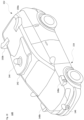
- Fig. 1E is a perspective view of an exemplary passenger vehicle 140. Similar to vehicles 100 and 120, the vehicle 140 includes various sensors for obtaining information about the vehicle's external environment. For instance, a roof-top housing 142 and dome arrangement 144 may include a lidar sensor as well as various cameras and/or radar units. Housing 146, located at the front end of vehicle 140, and housings 148a, 148b on the driver's and passenger's sides of the vehicle may each store a lidar or other sensor. For example, each housing 148 may be located in front of the driver's side door. Vehicle 140 also includes housings 150a, 150b for radar units, lidar and/or cameras also located towards the rear roof portion of the vehicle.
- housings 150a, 150b for radar units, lidar and/or cameras also located towards the rear roof portion of the vehicle.
- Additional lidar, radar units and/or cameras may be located at other places along the vehicle 140.
- arrow 152 indicates that a sensor unit may be positioned along the read of the vehicle 140, such as on or adjacent to the bumper.
- arrow 154 indicates that another sensor unit may be positioned on the undercarriage of the vehicle.
- each sensor unit may include one or more sensors within one housing, such as lidar, radar, camera (e.g., optical or infrared), acoustical (e.g., microphone or sonar-type sensor), inertial (e.g., accelerometer, gyroscope, etc.) or other sensors.
- lidar e.g., lidar, radar, camera (e.g., optical or infrared), acoustical (e.g., microphone or sonar-type sensor), inertial (e.g., accelerometer, gyroscope, etc.) or other sensors.
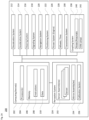
- Fig. 2A illustrates a block diagram 200 with various components and systems of a vehicle, such as a truck, farm equipment or construction equipment, configured to operate in a fully or semi-autonomous mode of operation.
- a vehicle such as a truck, farm equipment or construction equipment
- the U.S. National Highway Traffic Safety Administration and the Society of Automotive Engineers have identified different levels to indicate how much, or how little, the vehicle controls the driving. For instance, Level 0 has no automation and the driver makes all driving-related decisions.
- the lowest semi-autonomous mode, Level 1, includes some drive assistance such as cruise control.
- Level 2 has partial automation of certain driving operations, while Level 3 involves conditional automation that can enable a person in the driver's seat to take control as warranted.
- Level 4 is a high automation level where the vehicle is able to drive without assistance in select conditions.
- Level 5 is a fully autonomous mode in which the vehicle is able to drive without assistance in all situations.
- the architectures, components, systems and methods described herein can function in any of the semi or fully-autonomous modes, e.g., Levels 1-5, which are referred to herein as "autonomous" driving modes.
- autonomous driving mode includes both partial and full autonomy.
- the vehicle includes a control system of one or more computing devices, such as computing devices 202 containing one or more processors 204, memory 206 and other components typically present in general purpose computing devices.
- the control system may constitute an electronic control unit (ECU) of a tractor unit.
- the memory 206 stores information accessible by the one or more processors 204, including instructions 208 and data 210 that may be executed or otherwise used by the processor 204.
- the memory 206 may be of any type capable of storing information accessible by the processor, including a computing device-readable medium.
- the memory is a non-transitory medium such as a hard drive, memory card, optical disk, solid state device, tape memory, or the like. Systems may include different combinations of the foregoing, whereby different portions of the instructions and data are stored on different types of media.
- the instructions 208 may be any set of instructions to be executed directly (such as machine code) or indirectly (such as scripts) by the processor.
- the instructions may be stored as computing device code on the computing device-readable medium.
- the terms "instructions” and “programs” may be used interchangeably herein.
- the instructions may be stored in object code format for direct processing by the processor, or in any other computing device language including scripts or collections of independent source code modules that are interpreted on demand or compiled in advance.
- the data 210 may be retrieved, stored or modified by one or more processors 204 in accordance with the instructions 208.
- data 210 of memory 206 may store information, such as calibration information, to be used when calibrating different types of sensors, mirrors and other parts of a perception system.
- the one or more processor 204 may be any conventional processors, such as commercially available CPUs. Alternatively, the one or more processors may be a dedicated device such as an ASIC or other hardware-based processor, FPGA or the like. Although Fig. 2A functionally illustrates the processor(s), memory, and other elements of computing devices 202 as being within the same block, such devices may actually include multiple processors, computing devices, or memories that may or may not be stored within the same physical housing. Similarly, the memory 206 may be a hard drive or other storage media located in a housing different from that of the processor(s) 204. Accordingly, references to a processor or computing device will be understood to include references to a collection of processors or computing devices or memories that may or may not operate in parallel.
- the computing devices 202 may form an autonomous driving computing system incorporated into vehicle 100.
- the autonomous driving computing system may be capable of communicating with various components of the vehicle in order to perform route planning and driving operations.
- the computing devices 202 may be in communication with various systems of the vehicle, such as a driving system including a deceleration system 212 (for controlling braking of the vehicle), acceleration system 214 (for controlling acceleration of the vehicle), steering system 216 (for controlling the orientation of the wheels and direction of the vehicle), signaling system 218 (for controlling turn signals), navigation system 220 (for navigating the vehicle to a location or around objects) and a positioning system 222 (for determining the position of the vehicle).
- a driving system including a deceleration system 212 (for controlling braking of the vehicle), acceleration system 214 (for controlling acceleration of the vehicle), steering system 216 (for controlling the orientation of the wheels and direction of the vehicle), signaling system 218 (for controlling turn signals), navigation system 220 (for navigating the vehicle to a location or around objects) and a positioning system
- the computing devices 202 are also operatively coupled to a perception system 224 (for detecting objects in the vehicle's environment), a power system 226 (for example, a battery and/or gas or diesel powered engine) and a transmission system 230 in order to control the movement, speed, etc., of the vehicle in accordance with the instructions 208 of memory 206 in an autonomous driving mode which does not require or need continuous or periodic input from a passenger of the vehicle.
- a perception system 224 for detecting objects in the vehicle's environment
- a power system 226 for example, a battery and/or gas or diesel powered engine
- a transmission system 230 in order to control the movement, speed, etc., of the vehicle in accordance with the instructions 208 of memory 206 in an autonomous driving mode which does not require or need continuous or periodic input from a passenger of the vehicle.
- Some or all of the wheels/tires 228 are coupled to the transmission system 230, and the computing devices 202 may be able to receive information about tire pressure, balance and other factors that may impact driving
- the computing devices 202 may control the direction and speed of the vehicle by controlling various components.
- computing devices 202 may navigate the vehicle to a destination location completely autonomously using data from the map information and navigation system 220.
- Computing devices 202 may use the positioning system 222 to determine the vehicle's location and the perception system 224 to detect and respond to objects when needed to reach the location safely.
- computing devices 202 may cause the vehicle to accelerate (e.g., by increasing fuel or other energy provided to the engine by acceleration system 214), decelerate (e.g., by decreasing the fuel supplied to the engine, changing gears (e.g., via the transmission system 230), and/or by applying brakes by deceleration system 212), change direction (e.g., by turning the front or other wheels of vehicle 100 by steering system 216), and signal such changes (e.g., by lighting turn signals of signaling system 218).
- the acceleration system 214 and deceleration system 212 may be a part of a drivetrain or other transmission system 230 that includes various components between an engine of the vehicle and the wheels of the vehicle.
- computing devices 202 may also control the transmission system 230 of the vehicle in order to maneuver the vehicle autonomously.
- computing devices 202 may interact with deceleration system 212 and acceleration system 214 in order to control the speed of the vehicle.
- steering system 216 may be used by computing devices 202 in order to control the direction of vehicle.
- the steering system 216 may include components to control the angle of the wheels of the tractor unit to turn the vehicle.
- Signaling system 218 may be used by computing devices 202 in order to signal the vehicle's intent to other drivers or vehicles, for example, by lighting turn signals or brake lights when needed.
- the perception system 224 also includes one or more sensors or other components for detecting objects external to the vehicle such as other vehicles, obstacles in the roadway, traffic signals, signs, trees, etc.
- the perception system 224 may include one or more light detection and ranging (lidar) sensors, acoustical (e.g., microphone or sonar) devices, radar units, cameras (e.g., optical and/or infrared), inertial sensors (e.g., gyroscopes or accelerometers), pressure sensors, and/or any other detection devices that record data which may be processed by computing devices 202.
- the sensors of the perception system 224 may detect objects and their characteristics such as location, orientation, size, shape, type (for instance, vehicle, pedestrian, bicyclist, vegetation, etc.), heading, and speed of movement, etc.
- the raw data from the sensors (e.g., lidar point clouds) and/or the aforementioned characteristics can sent for further processing to the computing devices 202 periodically or continuously as it is generated by the perception system 224.
- Computing devices 202 may use information from the positioning system 222 to determine the vehicle's location and the perception system 224 to detect and respond to objects when needed to reach the location safely, including planning changes to the route and/or modifying driving operations.
- the vehicle 200 also includes one or more mirrors 234, which may be part of the perception system 224 as shown, or which may be separate from the perception system.
- the mirror(s) 234 is used to reflect a beam and direct it to or from one or more sensors of the perception system 224.
- each mirror may be placed at a particular location along the vehicle external to a corresponding sensor assembly.
- the mirror may be rigidly affixed to the vehicle.
- the mirror may be pivotally or otherwise adjustably affixed to the vehicle.
- the mirror may be raised from a surface or receptacle of the vehicle when in use, and lowered towards the surface or receptacle when not in use.
- the mirror may be coupled to and extend from a sensor assembly.
- the autonomous driving computing system may perform calibration of individual sensors and their associated mirrors, all sensors in a particular sensor assembly relative to a commonly used mirror, between sensors in different sensor assemblies, between multiple mirrors in case of non-coplanar setups, etc. This may be done using a calibration system 236, which may be part of the perception system 224, the computing devices 202 or some other part of the autonomous driving computing system.
- the calibration system 236, perception system 224, computing devices 202 and other systems may be directly or indirectly connected via a Controller Area Network (CAN bus) of the vehicle.
- CAN bus Controller Area Network
- the coupling system 238 for connectivity between the tractor unit and the trailer.
- the coupling system 238 includes one or more power and/or pneumatic connections 240, and a fifth-wheel 242 at the tractor unit for connection to the kingpin at the trailer.
- Fig. 2B illustrates an example block diagram 250 of a trailer.
- the system includes an ECU 252 of one or more computing devices, such as computing devices containing one or more processors 254, memory 256 and other components typically present in general purpose computing devices.
- the memory 256 stores information accessible by the one or more processors 254, including instructions 258 and data 260 that may be executed or otherwise used by the processor(s) 254.
- the descriptions of the processors, memory, instructions and data from Fig. 2A apply to these elements of Fig. 2B .
- the ECU 252 is configured to receive information and control signals from the trailer unit.
- the on-board processors 254 of the ECU 252 may communicate with various systems of the trailer, including a deceleration system 262 (for controlling braking of the trailer), signaling system 264 (for controlling turn signals), and a positioning system 266 (to assist in determining the location of the trailer).
- the ECU 252 may also be operatively coupled to a perception system 268 with one or more sensors for detecting objects in the trailer's environment. One or more mirrors may be included as part of the perception system 268 or separate from the perception system.
- a power system 270 (for example, a battery power supply) provides power to local components on the trailer.
- wheels/tires 272 of the trailer may be coupled to the deceleration system 262, and the processors 254 may be able to receive information about tire pressure, balance, wheel speed and other factors that may impact driving in an autonomous mode, and to relay that information to the processing system of the tractor unit.
- the deceleration system 262, signaling system 264, positioning system 266, perception system 268, power system 270 and wheels/tires 272 may operate in a manner such as described above with regard to Fig. 2A .
- Figs. 2A-B While the components and systems of Figs. 2A-B are described in relation to a tractor-trailer arrangement, as noted above the technology may be employed with other types of articulated vehicles, such as the articulate bus 120 of Figs. 1C-D .
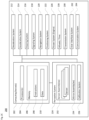
- Fig. 2C illustrates a block diagram 290 with various components and systems of a passenger-type vehicle such as shown in Fig. 1E , configured to operate in a fully or semi-autonomous mode of operation.
- the passenger-type vehicle may be, e.g., a car, motorcycle, recreational vehicles, etc.
- the block diagram 290 shows that the passenger vehicle may have components and systems that are equivalent to what is shown and described in block diagram 200, for instance to form an autonomous driving computing system for controlling vehicle 140 of Fig. 1E .
- a user interface system 292 may include, e.g., a mouse, keyboard, touch screen and/or microphone, as well as one or more displays (e.g., a touch screen display with or without haptic feedback, a heads-up display, or the like) that is operable to display information to passengers in the vehicle.
- an internal electronic display may be located within a cabin of vehicle 140 (not shown) and may be used by computing devices 202 to provide information to the passengers.
- the communication system 238 may also include one or more wireless connections to facilitate communication with other computing devices, such as passenger computing devices within the vehicle, and computing devices external to the vehicle, such as in another nearby vehicle on the roadway or a remote server system.
- the wireless connections may include short range communication protocols such as Bluetooth TM or Bluetooth TM low energy (LE), cellular connections, etc.
- Bluetooth TM or Bluetooth TM low energy (LE) Bluetooth TM low energy (LE)
- Various configurations and protocols may be employed, such as Ethernet, WiFi and HTTPS, for communication via the Internet, intranets, virtual private networks, wide area networks, local networks, private networks using communication protocols proprietary to one or more companies, and various combinations of the foregoing.
- Each sensor, or type of sensor may have a different range, resolution and/or field of view (FOV).
- FOV field of view
- the sensors may include a long range, narrow FOV lidar and a short range, tall FOV lidar.
- the long range lidar may have a range exceeding 50-250 meters, while the short range lidar has a range no greater than 1-50 meters.
- the short range lidar may generally cover up to 10-15 meters from the vehicle while the long range lidar may cover a range exceeding 100 meters.
- the long range is between 10-200 meters, while the short range has a range of 0-20 meters.
- the long range exceeds 80 meters while the short range is below 50 meters.
- Intermediate ranges of between, e.g., 10-100 meters can be covered by one or both of the long range and short range lidars, or by a medium range lidar that may also be included in the sensor system.
- the medium range lidar may be disposed between the long and short range lidars in a single housing.
- a set of cameras may be arranged, for instance to provide forward, side and rear-facing imagery.
- a set of radar sensors may also be arranged to provide forward, side and rear-facing data.
- Other sensors may include an inertial sensor such as a gyroscope, an accelerometer, etc.
- lidar, camera and radar sensors and their fields of view are shown in Figs. 3A and 3B .
- one or more lidar units may be located in rooftop sensor housing 302, with other lidar units in side sensor housings 304.
- the rooftop sensor housing 302 may be configured to provide a 360° FOV.
- a pair of sensor housings 304 may be located on either side of the tractor unit cab, for instance integrated into a side view mirror assembly, along a side door or quarterpanel of the cab, or extending out laterally along one or both sides of the cab roof.
- long range lidars may be located along a top or upper area of the sensor housings 302 and 304.
- the long range lidar may be configured to see over the hood of the vehicle.
- short range lidars may be located in other portions of the sensor housings 302 and 304.
- the short range lidars may be used by the perception system to determine whether an object such as another vehicle, pedestrian, bicyclist, etc. is next to the front or side of the vehicle and take that information into account when determining how to drive or turn. Both types of lidars may be co-located in the housing, for instance aligned along a common vertical axis.
- the lidar(s) in the rooftop sensor housing 302 may have a FOV 306.
- the trailer or other articulating portion of the vehicle may provide signal returns, and may partially or fully block a rearward view.
- Long range lidars on the left and right sides of the tractor unit have fields of view 310. These can encompass significant areas along the sides and front of the vehicle.
- the overlap region 312 provides the perception system with additional or information about a very important region that is directly in front of the tractor unit. This redundancy also has a safety aspect.
- Short range lidars on the left and right sides may have different (e.g., smaller) fields of view 314.
- a space is shown between different fields of view for clarity in the drawing; however in actuality there may be no break in the coverage.
- the specific placements of the sensor assemblies and fields of view is merely exemplary, and may different depending on, e.g., the type of vehicle, the size of the vehicle, FOV requirements, etc.
- Fig. 3B illustrates an example configuration 320 for either (or both) of radar and camera sensors in a rooftop housing and on both sides of a tractor-trailer vehicle.
- the trailer may impact the ability of the sensor to detect objects behind the vehicle.
- Sensors in the sensor housings 304 may have forward facing fields of view 328 (and side and/or rear fields of view as well).
- the sensors of Fig. 3B may be arranged so that the adjoining fields of view overlap, such as shown by overlapping region 330.
- the overlap regions similarly can provide redundancy and have the same benefits should one sensor suffer degradation in performance.
- Fig. 4 illustrates a vehicle using sensor assembly to scan for objects in the environment.
- the sensor assembly may be, e.g., rooftop sensor housing 302 of Fig. 3A .
- the sensor assembly may include one or more lidar, radar, camera or other sensors therein.
- Solid and dashed lines emanating from the housing indicate examples of individual scans of the environment. For instance, 10 (or more or less) individual scans may be made by a given sensor per scan period. This may include adjusting the sensor's FOV up or down, left or right, e.g., with a motor, servo or other actuator.
- the individual scans may be selected to cover particular portions of the sensor's FOV or selected regions around the vehicle.
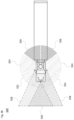
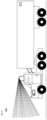
- Fig. 5 illustrates a top-down view 500 of an obstructed FOV, for instance due to a trailer of the vehicle.
- the sensor e.g., a lidar sensor
- the sensor may be located on a roof of the vehicle. Only a portion of the trailer is shown, as indicated by the dash-dot line towards the rear of the trailer.
- the sensor's overall FOV 502 may be obstructed by corners of the trailer, as shown by FOV edges 504.
- reflective surfaces may be used to redirect emitted light beams or radio waves from a sensor towards the obstructed area.
- received light beams, radio waves or imagery are reflected off of the mirror(s) towards the sensor.
- the sensor may have a transmitter portion (e.g., laser, transmit antenna) for emitted light beams or radio waves and/or a receiver portion (e.g., photodetector, receive antenna, CCD or CMOS image sensor) for received light beams, radio waves or imagery.
- a transmitter portion e.g., laser, transmit antenna
- a receiver portion e.g., photodetector, receive antenna, CCD or CMOS image sensor
- existing mirrors e.g., side view mirrors
- one or more mirrors may be distributed at different places along the tractor, trailer or other parts of the vehicle. This could include placing one or more mirrors along the cab, a fairing on the tractor or trailer, extending from a portion of the sensor housing, etc.
- Figs. 6A-B through 9A-B Various examples are shown in Figs. 6A-B through 9A-B .
- Figs. 6A-B illustrate a scenario 600 using side-view mirrors 602 located on either side of the vehicle cab.
- the sensor may be a lidar sensor that emits laser light as shown by dashed line 604.
- One or more beams of the emitted light are directed toward and reflect off of the mirror 602.
- the reflected beams, shown by dashed line 606, may be directed toward a blind spot or other area around the vehicle.
- Light received from the environment, as shown by dotted line 608, is reflected off of a mirror 602 and directed toward the sensor, as shown by dotted line 610.
- emitted light is shown reflecting off of the mirror on the left side of the vehicle while received light is shown reflecting off of the mirror on the right side of the vehicle.
- each mirror may be used to emit and/or receive laser light (or RF waves, optical or infrared imagery, etc.).
- Fig. 6B illustrates a perspective view 620 of the scenario, showing a mirror reflecting the beam (or radio waves) towards and from a blind spot along the rear of the vehicle.
- Shorter dashed lines 622 illustrate emitted beams (or radio waves) that are not reflected by the mirror but which may be blocked by a portion of the vehicle (e.g., a front or side surface of the trailer).
- Figs. 7A-B illustrate a scenario 700 using mirrors 702 located on or extending from one or more surfaces of the vehicle, such as the cab.
- the sensor may be a lidar sensor that emits laser light as shown by dashed line 704.
- One or more beams of the emitted light are directed toward and reflect off of the mirror 702.
- the reflected beams, shown by dashed line 706, may be directed toward a blind spot or other area around the vehicle.
- Light received from the environment, as shown by dotted line 708, is reflected off of a mirror 702 and directed toward the sensor, as shown by dotted line 710.
- each mirror may be used to emit and/or receive laser light (or RF waves, optical or infrared imagery, etc.).
- Fig. 7B illustrates a perspective view 720 of the scenario, showing a mirror reflecting the beam (or radio waves) towards and from a blind spot along the rear of the vehicle.
- Shorter dashed lines 722 illustrate emitted beams (or radio waves) that are not reflected by the mirror but which may be blocked by a portion of the vehicle (e.g., a surface of the trailer).
- the mirror(s) 702 may be rigidly affixed or otherwise permanently positioned to a surface of the vehicle.
- the mirror(s) 702 may be configured to pop up or otherwise extend from the vehicle during use, and retract onto or into the vehicle when not in use.
- pop-up mirrors could be used on an as-needed basis, for instance when the perception system determines that a blind spot exists or that a determined blind spot exceeds some threshold size. This would reduce wind drag during typical vehicle operation.
- a mirror could be extended one or more preset or calculated distances in specific situations.
- Such pop-up mirrors could also be steerable, for instance via a servo mechanism that provides one or more degrees of freedom, e.g., by panning and/or tilting the mirror or an arm member that couples the mirror to the vehicle.
- the servo mechanism could be used to reflect beams toward (or from) needed areas of visibility. For example, when the vehicle is driving in a crowded surroundings, the system can pop up mirrors to reflect high light beams down to the nearby areas.
- the servo mechanism could also be used in conjunction with a calibration system to address vibration-related issues, for instance by dampening vibration of a mirror.
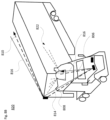
- Figs. 8A-B illustrate another scenario 800 using one or more first mirrors 802 located on or extending from one or more surfaces of the vehicle (e.g., the cab), and one or more second mirrors 804 along another part of the vehicle (e.g., a corner or fairing of the trailer).
- the sensor may be a lidar sensor that emits laser light as shown by dashed line 806.
- One or more first reflected beams 808 of the emitted light are directed toward and reflect off of the first mirror 802.
- the first reflected beams 808 are then redirected as second reflected beams 810 by the second mirror 804.
- the second reflected 808 may be directed toward a blind spot or other area around the vehicle.
- Fig. 8B illustrates a perspective view 820 of the scenario, showing a mirror reflecting the beam (or radio waves) towards and from a blind spot along the rear of the vehicle.
- Shorter dashed lines 822 illustrate emitted beams (or radio waves) that are not reflected by the mirror but which may be blocked by a portion of the vehicle (e.g., a surface of the trailer). While only first and second mirrors are shown in this example, one or more additional mirrors may also be employed. In this scenario, the mirrors 802 and/or 804 may be rigidly affixed or otherwise permanently positioned to a surface of the vehicle. Alternatively, as with mirrors 702, the mirrors 802 and/or 804 may be configured to pop up or otherwise extend from the vehicle during use, and retract onto or into the vehicle when not in use. In one scenario, such pop-up mirrors could be used on an as-needed basis, for instance in response to detection of a blind spot or a change in the size of a blind spot.
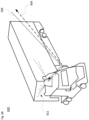
- Figs. 9A-B illustrate yet another scenario 900 using a mirror 902 that extends from the sensor housing, e.g., via an extendable or maneuverable arm 903.
- the sensor may be a lidar sensor that emits laser light as shown by dashed line 904.
- One or more beams of the emitted light are directed toward and reflect off of the mirror 902.
- the reflected beams, shown by dashed line 906, may be directed toward a blind spot or other area around the vehicle.
- Light received from the environment, as shown by dotted line 908, is reflected off of the mirror 902 and directed toward the sensor, as shown by dotted line 910.
- the mirror 902 may be used to emit and/or receive laser light (or RF waves, optical or infrared imagery, etc.).
- Fig. 9B illustrates a perspective view 920 of the scenario, showing a mirror reflecting the beam (or radio waves) towards and from a blind spot along the rear of the vehicle.
- Shorter dashed lines 922 illustrate emitted beams (or radio waves) that are not reflected by the mirror but which may be blocked by a portion of the vehicle (e.g., a front or side surface of the trailer).
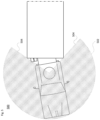
- Figs. 10A-B illustrate another example that shows an enhancement to the sensor's FOV by reducing a blind spot.
- Fig. 10A illustrates a first scenario 1000 with passenger vehicle having a rooftop sensor with a FOV 1002.
- Arrow 1004 represents the lower limit of the FOV, for instance due to a corner or other portion of the vehicle.
- a blind spot 1006 is adjacent to a side of the vehicle.
- Fig. 10B illustrates a second scenario 1010.
- the base FOV 1002 can be enhanced with an added FOV 1012 via mirror 1014.
- blind spot 1016 can be made much smaller than initial blind spot 1006 (or eliminated entirely).
- Figs. 11A-C illustrate a further example 1100.
- a first vehicle 1102 may be waiting at a stop light.
- Another vehicle such as a cargo truck 1104, may stop behind the first vehicle 1102. Due to the size of the truck, the first vehicle may be partly or entirely obscured from view for a vehicle positioned behind the truck.
- Fig. 11C illustrates a third vehicle 1106, e.g., a passenger vehicle such as a sedan or minivan, having a sensor FOV 1108.
- any of the mirror configurations described above may be employed to redirect laser light (or RF waves, optical or infrared imagery, etc.) to enhance the sensor's FOV, as shown by dotted line 1110.
- the mirrors may be front surface mirrors (with the reflective surface being above a backing), and may be flat. There should be minimal or no refraction effect in a secondary (e.g., rear) surface of the mirror.
- Each mirror can be of any size or shape. For instance, a mirror may be rectangular, circular or oval in shape, and range in size from a few square centimeters to one square meter or more. In one scenario, the size of a mirror may be the FOV range times the distance from the lidar to the mirror. Given both values are typically small, the size of mirror may be in tens of centimeters. If multiple mirrors are used, they do not need to be the same size.
- a cleaning system may be employed to remove or reduce debris.
- the cleaning system may include a heater element to eliminate condensation or frost.
- multiple mirrors may be employed to redirect the beams. This could be done with either coplanar mirrors or non-coplanar mirrors. Vibration and other issues may be more pronounced when there are multiple mirrors involved.
- a calibration system e.g., using cameras
- an onboard camera of the perception system or other system of the vehicle can be used to measure the angular position of the mirror constantly during operation.
- Information about the mirror's angular position may be employed as part of a mirror reflection model, which is used in an overall sensor calibration process.
- the calibration process determines an extrinsic matrix C.
- the vehicle may drive for several miles (or more or less), collecting a series of data (e.g., pose and a lidar point set). Then the system solves for the extrinsic matrix C so that when transforming every lidar point set to the world coordinate system, different lidar point sets should be well aligned at overlapped parts.
- small fiducial markers could be added on or incorporated into the mirror surface that can be seen in a small portion of the laser beams hitting the mirror. The measurements from the markers can used to accurately determine the position and orientation relative to sensor. For any laser point p in the laser framework. C * p is its coordinates in the world coordinate system.
- a reflection matrix R i (i is the index of mirror) is needed so that for any reflected laser point p in the laser framework, R i * p is its real position in the laser framework. Therefore, for all the reflected laser point p in the laser framework, C * R i * p is its real position in the world coordinate system.
- C * R i is the extrinsic matrix for reflected laser points.
- One way treats the approach as a normal calibration task, but selects out only reflected points. In this way, the system can directly determine C * R i .
- the system measures all necessary geometry information of the vehicle and the mirror, e.g. normal direction, positions of the laser and the mirror.
- R i is computed based on this measured information. For instance, given the pose of the vehicle and the extrinsic matrix, the system can compute a transform matrix T which transforms any laser point in the lidar local coordinate system to the world system (lat/long or smooth coordinates).
- T L * C, where L is a localization matrix, and C is the extrinsic matrix. L changes with the vehicle pose, while C is a constant matrix which the calibration process is aiming at.
- the system may only need to collect the lidar points shot into the mirror, and feed that information into the process described above.
- a non-planer mirror could be employed to detect whether there is an object in a general vicinity, although it may be difficult to determine exactly where the object is or the particular type of object. For instance, this might approach may be beneficial with a detector located on the underside of the vehicle, which can be used to determine that a region beneath or adjacent to the vehicle is clear before the vehicle starts moving.
- one or more mirrors may be curved.
- a convex mirror may be used to expand the field of view and a concave mirror to contract the field of view.
- the calibration system would calibrate the returned signal from different points on the mirror individually. For instance, a look-up table may be created for laser points reflected from different spots on the mirror. This is similar to storing a high resolution mesh of the mirror surface and computing the reflection transform for each single laser point.
- Fig. 12 illustrates an example operational method 1200 for a vehicle configured to operate in an autonomous driving mode according to the above techniques.
- the method includes receiving obtained sensor data from one or more sensors.
- One or more processors of the vehicle's control system are configured to receive the obtained sensor data.
- the sensors may be part of a perception system of the vehicle, and are configured to detect objects in an environment surrounding the vehicle.
- Each of the sensors is disposed in a respective housing positioned along the vehicle and has a respective field of view. In one example, multiple sensors may be included in the same housing, while in another example different sensors each have their own housing.
- reflected signals are received from one or more mirrors remote from the respective housings of the one or more sensors.
- the mirrors are configured to reflect received signals towards at least one of the one or more sensors to provide an enhanced a sensor field of view. See, e.g., Fig. 11C , including dotted line 1110.
- a driving system of the vehicle is controlled when operating in the autonomous driving mode.
- the processor(s) of the control system may cause the driving system to perform one or more operations in response to the received obtained sensor data and the received reflected signals that provide the enhanced sensor field of view. This may include, e.g., altering a current trajectory of the vehicle by turning or changing lanes, increasing or decreasing speed, performing emergency braking, modifying a planned route, etc.
- the above approaches enable the onboard computer system to evaluate lidar and other signals reflected off of one or more mirrors external to a sensor housing.
- the reflected signals can enhance sensor FOV and reduce blind spots around the vehicle.
- Such information can be used by the computer system to effectively control the vehicle (e.g., via a planner module of the computer system), for instance by modifying a driving operation, changing a route, or taking other corrective action.
- Using mirrors in the manners described above enables perception to be more complete and increases the utility of sensors (e.g., more FOV for the same cost). It also allows sensors to be mounted in a potentially better location (e.g., out of harsh areas and other places that may be subject to impact from dirt, debris, etc.).
- Such approaches also permit the system to redirect and utilize sensor measurements of a spinning laser when it sweeps through areas that does not need sensing, e.g. sensor backside that faces the vehicle, returns from the vehicle or trailer body, and the like.
Landscapes
- Engineering & Computer Science (AREA)
- Physics & Mathematics (AREA)
- Radar, Positioning & Navigation (AREA)
- Remote Sensing (AREA)
- General Physics & Mathematics (AREA)
- Mechanical Engineering (AREA)
- Automation & Control Theory (AREA)
- Electromagnetism (AREA)
- Aviation & Aerospace Engineering (AREA)
- Computer Networks & Wireless Communication (AREA)
- Transportation (AREA)
- Combustion & Propulsion (AREA)
- Chemical & Material Sciences (AREA)
- Multimedia (AREA)
- Health & Medical Sciences (AREA)
- Computer Vision & Pattern Recognition (AREA)
- Business, Economics & Management (AREA)
- Optics & Photonics (AREA)
- Artificial Intelligence (AREA)
- Evolutionary Computation (AREA)
- Game Theory and Decision Science (AREA)
- Medical Informatics (AREA)
- Traffic Control Systems (AREA)
- Optical Radar Systems And Details Thereof (AREA)
Description
- The present application claims the benefit of Application No.
16/396,176, filed April 26, 2019 - Autonomous vehicles, such as vehicles that do not require a human driver, can be used to aid in the transport of trailered (e.g., towed) cargo, such as freight, livestock or other items from one location to another. Other types of articulated vehicles may also transport cargo or passengers. Such vehicles may operate in a fully autonomous mode without any in-vehicle passenger input or a partially autonomous mode where a person may provide some driving input. One or more sensors can be used to detect nearby objects in the environment, and the vehicle may use information from the sensors when driving in an autonomous mode. Depending on the size, shape and orientation of the vehicle, there may be one or more blind spots around the vehicle. Blind spots may be reduced by adding more sensors. However, each added sensor results in increased cost and may increase computer processing power requirements. Also, this approach may not be physically feasible in certain instances.
-
US 2018/083363 A1 describes methods and apparatuses that enable a radar system to transmit radar signals into lanes on a roadway in which a vehicle may turn. For example, when a car is making a protected right turn, that is a right turn when there is another vehicle traveling in the same direction in a lane adjacent to the lane of the turning vehicle, a traditional radar may have its view of the lane in which it is turning obscured by the vehicle in the lane adjacent to the lane of the turning vehicle. By using radar deflectors strategically located near the front of the vehicle, the radar signals may be deflected at angles to avoid being obstructed by the vehicle in the lane adjacent to the lane of the turning vehicle. -
US 2018/267558 A1 describes a system and method for collecting and processing sensor data for facilitating and/or enabling autonomous, semi-autonomous, and remote operation of a vehicle, including: collecting surroundings at one or more sensors, and determining properties of the surroundings of the vehicle and/or the behavior of the vehicle based on the surroundings data at a computing system. -
US 2016/170412 A1 describes an autonomous mobile device (1) which moves while detecting (i) an obstacle present ahead of the autonomous mobile device (1) and (ii) a difference in level of a floor surface, including: a laser range finder (21) which measures a distance to an object present in a scan area by scanning the scan area while emitting a laser beam in parallel to the floor surface; and mirrors (22a, 22b) each of which is provided within the scan area scanned by the laser range finder (21) and each of which reflects part of the laser beam to the floor surface. -
US 2018/167551 A1 describes a control system for a vehicle includes a camera module having a plurality of cameras. A control is operable to adjust a field of view of the cameras responsive to an input. When the vehicle is traveling in and along a traffic lane, the control sets the field of view of at least some of the cameras forward through the vehicle windshield. Responsive to an input indicative of an intended lane change, the control adjusts at least one camera to set the field of view of the camera toward an exterior rearview mirror at the side of the vehicle at which the target lane is located. Responsive to determination, via processing of captured image data when the camera views the exterior rearview mirror of the vehicle, that the target lane is clear, the control controls the at least one vehicle control system to maneuver the vehicle into the target lane. - The matter for protection is defined by the claims.
- All vehicles have blind spots that may impair the field of view (FOV) of the driver or on-board computer system in the case of a vehicle capable of operating in a self-driving mode. Large-sized vehicles such as cargo vehicles, buses and construction equipment can encounter particular challenges compared to smaller passenger vehicles such as sedans or vans. For instance, the trailer of a cargo truck may obstruct the FOV of sensors mounted on the truck's tractor, especially during a turning maneuver. And due to the size of the truck, the blind spot(s) may be significantly larger than those of a smaller passenger vehicle.
- Careful sensor placement can help to reduce blind spots. Employing additional sensors on the vehicle can further minimize blind spots. However, adding sensors can increase system cost as well as processing complexity, for example from a sensor fusion perspective. Regardless of the number or type of added sensors, some areas around the vehicle may be obscured or have reduced visibility due to physical limitations on where the sensors can be placed.
- The technology described herein employs one or more reflective components (mirrors) located external to the sensor to increase the sensor's effective FOV. Such mirrors can reflect or redirect beams that would otherwise be wasted. By way of example, the main lidar sensor on the roof of the tractor of a cargo vehicle may rotate to provide a 360° FOV. As it rotates through various yaw positions, multiple beams are emitted across a set of pitches (e.g., between +2° to -18°). Some beams may be wasted due to obstruction by the trailer. Other beams may be wasted because they are emitted at high pitch angles to the side. Using mirrors to redirect these and other beams emitted from the lidar sensor can help address the blind spot issue and provide enhanced visibility around external obstructions, e.g., a large truck between the vehicle and another object. Depending on the configuration and materials, the mirrors may also be employed with other types of sensors (e.g., cameras and radar).
- According to one aspect of the technology, a vehicle is configured to operate in an autonomous driving mode. The vehicle comprises a driving system, a perception system, one or more mirrors and a control system. The driving system includes a steering subsystem, an acceleration subsystem and a deceleration subsystem to control driving of the vehicle in the autonomous driving mode. The perception system includes one or more sensors configured to detect objects in an environment surrounding the vehicle based on obtained sensor data. Each of the sensors is disposed in a respective housing positioned along the vehicle. The one or more mirrors are remote from the respective housings of the one or more sensors. The one or more mirrors are configured to reflect received signals towards at least one of the one or more sensors to enhance a sensor field of view. The control system is operatively connected to at least the driving system and the perception system. The control system has one or more computer processors configured to receive sensor data corresponding to the enhanced sensor field of view from the perception system and to direct the driving system when operating in the autonomous driving mode based on the sensor data received from the perception system.
- In one example, the vehicle further comprises a calibration system configured to detect an amount of vibration for the one or more mirrors and to provide information regarding the detected amount of vibration to the perception system or the control system during processing of the obtained sensor data. The calibration system may be part of the perception system or the control system.
- In another example, the one or more mirrors are further configured to reflect emitted signals from the one or more sensors to the environment. Here, the emitted signals may include laser light or radio waves, and the received signals may be at least one of laser light, radio waves, optical imagery or infrared imagery.
- In another example, the one or more mirrors are planar front surface mirrors. In a further example, the one or more mirrors are rigidly affixed to a surface of the vehicle. In yet another example, a given one of the one or more mirrors extends externally from the respective housing of a corresponding one of the one or more sensors.
- In a further example, the one or more mirrors are configured to deploy away from a surface of the vehicle during operation of the vehicle in the autonomous driving mode. Deployment may include the one or more mirrors popping out from a surface of the vehicle. The vehicle may include a servo mechanism configured to control deployment of the one or more mirrors. Here, the servo mechanism may be further configured to steer the one or more mirrors. Alternatively, the servo mechanism is further configured to dampen vibration of the one or more mirrors.
- In another example, the one or more mirrors includes a first mirror and a second mirror. According to one scenario, the first and second mirrors may be non-coplanar.
- The vehicle may be a truck having a tractor unit, with the tractor unit including a coupling system to pivotally coupled to a trailer. In this case, the one or more mirrors may be disposed along respective surfaces of the tractor unit. Alternatively and/or additionally, the vehicle includes the trailer and at least one of the one or more mirrors is disposed along the trailer.
- According to another aspect, a method of operating a vehicle in an autonomous driving mode comprises receiving, by one or more processors of a control system of the vehicle, obtained sensor data from one or more sensors configured to detect objects in an environment surrounding the vehicle, each of the one or more sensors being disposed in a respective housing positioned along the vehicle and having a respective field of view; receiving, by the one or more processors, reflected signals from one or more mirrors remote from the respective housings of the one or more sensors, the one or more mirrors being configured to reflect received signals towards at least one of the one or more sensors to provide an enhanced a sensor field of view; and controlling, by the one or more processors, a driving system of the vehicle when operating in the autonomous driving mode, in response to the received obtained sensor data and the received reflected signals that provide the enhanced sensor field of view. The method further comprises controlling operation of at least one of the one or more mirrors by dampening vibration of the at least one mirror.
- The method may further comprise controlling operation of at least one of the one or more mirrors by: deploying the at least one mirror away from a surface of the vehicle during operation of the vehicle in the autonomous driving mode; steering the at least one mirror; and/or retracting the at least one mirror onto or into the vehicle when not in use. The method may alternatively or additionally further include calibrating the one or more mirrors prior to or during operation in the autonomous driving mode.
-
-
Figs. 1A-B illustrate an example tractor-trailer arrangement for use with aspects of the technology. -
Figs. 1C-D illustrate an example articulated bus arrangement for use with aspects of the technology. -
Fig. 1E illustrates an example passenger vehicle for use with aspects of the technology. -
Fig. 2A illustrates a system diagram of an autonomous vehicle control system in accordance with aspects of the disclosure. -
Fig. 2B illustrates a system diagram of a trailer, in accordance with aspects of the disclosure. -
Fig. 2C illustrates a system diagram of another autonomous vehicle control system in accordance with aspects of the disclosure. disclosure. -
Fig. 3B is another example of sensor coverage for a vehicle in accordance with aspects of the disclosure. -
Fig. 4 illustrates a sensor scanning example in accordance with aspects of the disclosure. -
Fig. 5 illustrates an example of sensor field of view obstruction. -
Figs. 6A-B illustrate a field of view scenario in accordance with aspects of the disclosure. -
Figs. 7A-B illustrate another field of view scenario in accordance with aspects of the disclosure. -
Figs. 8A-B illustrate a further field of view scenario in accordance with aspects of the disclosure. -
Figs. 9A-B illustrate yet another field of view scenario in accordance with aspects of the disclosure. -
Figs. 10A-B illustrate an enhanced field of view scenario in accordance with aspects of the disclosure. -
Figs. 11A-C illustrate another enhanced field of view scenario in accordance with aspects of the disclosure. -
Fig. 12 illustrates a method of operating a vehicle in an autonomous driving mode in response to an enhanced field of view, in accordance with aspects of the disclosure. - The technology relates to fully autonomous or semi-autonomous vehicles, including cargo vehicles (e.g., tractor-trailers) and other articulated vehicles (e.g., buses), construction or farm vehicles, as well as passenger vehicles (e.g., sedans and minivans). On-board sensors, such as lidar sensors, are used to detect objects in the vehicle's environment. These sensors may also detect the real-time pose of the vehicle. Reflective components (mirrors) are employed to reduce sensor blind spots and enhance sensor FOV. These and other aspects are discussed in detail below.
-
Figs. 1A-B illustrate anexample vehicle 100, such as a tractor-trailer truck. The truck may include, e.g., a single, double or triple trailer, or may be another medium or heavy duty truck such as in commercial weight classes 4 through 8. As shown, the truck includes atractor unit 102 and a single cargo unit ortrailer 104. Thetrailer 104 may be fully enclosed, open such as a flat bed, or partially open depending on the type of cargo to be transported. Thetractor unit 102 includes the engine and steering systems (not shown) and acab 106 for a driver and any passengers. In a fully autonomous arrangement, thecab 106 may not be equipped with seats or manual driving components, since no person may be necessary. - The
trailer 104 includes a hitching point, known as a kingpin, 108. Thekingpin 108 is typically formed as a solid steel shaft, which is configured to pivotally attach to thetractor unit 102. In particular, thekingpin 108 attaches to atrailer coupling 109, known as a fifth-wheel, that is mounted rearward of the cab. For a double or triple tractor-trailer, the second and/or third trailers may have simple hitch connections to the leading trailer. Or, alternatively, according to one aspect of the disclosure, each trailer may have its own kingpin. In this case, at least the first and second trailers could include a fifth-wheel type structure arranged to couple to the next trailer. - As shown, the tractor may have one or
more sensor units more sensor units 110 may be disposed on a roof or top portion of thecab 106, and one or moreside sensor units 112 may be disposed on left and/or right sides of thecab 106. Sensor units may also be located along other regions of thecab 106, such as along the front bumper or hood area, in the rear of the cab, adjacent to the fifth-wheel, underneath the chassis, etc. Thetrailer 104 may also have one ormore sensor units 114 disposed therealong, for instance along a side panel, front, rear, roof and/or undercarriage of thetrailer 104.Figs. 1C-D illustrate an example of another type of articulatedvehicle 120, such as an articulated bus. As with the tractor-trailer 100, the articulatedbus 120 may include one or more sensor units disposed along different areas of the vehicle. -
Fig. 1E is a perspective view of anexemplary passenger vehicle 140. Similar tovehicles vehicle 140 includes various sensors for obtaining information about the vehicle's external environment. For instance, a roof-top housing 142 anddome arrangement 144 may include a lidar sensor as well as various cameras and/or radar units.Housing 146, located at the front end ofvehicle 140, andhousings Vehicle 140 also includeshousings vehicle 140. For instance,arrow 152 indicates that a sensor unit may be positioned along the read of thevehicle 140, such as on or adjacent to the bumper. Andarrow 154 indicates that another sensor unit may be positioned on the undercarriage of the vehicle. - By way of example, as discussed further below each sensor unit may include one or more sensors within one housing, such as lidar, radar, camera (e.g., optical or infrared), acoustical (e.g., microphone or sonar-type sensor), inertial (e.g., accelerometer, gyroscope, etc.) or other sensors.
-
Fig. 2A illustrates a block diagram 200 with various components and systems of a vehicle, such as a truck, farm equipment or construction equipment, configured to operate in a fully or semi-autonomous mode of operation. By way of example, there are different degrees of autonomy that may occur for a vehicle operating in a partially or fully autonomous driving mode. The U.S. National Highway Traffic Safety Administration and the Society of Automotive Engineers have identified different levels to indicate how much, or how little, the vehicle controls the driving. For instance, Level 0 has no automation and the driver makes all driving-related decisions. The lowest semi-autonomous mode, Level 1, includes some drive assistance such as cruise control. Level 2 has partial automation of certain driving operations, whileLevel 3 involves conditional automation that can enable a person in the driver's seat to take control as warranted. In contrast, Level 4 is a high automation level where the vehicle is able to drive without assistance in select conditions. And Level 5 is a fully autonomous mode in which the vehicle is able to drive without assistance in all situations. The architectures, components, systems and methods described herein can function in any of the semi or fully-autonomous modes, e.g., Levels 1-5, which are referred to herein as "autonomous" driving modes. Thus, reference to an autonomous driving mode includes both partial and full autonomy. - As shown in the block diagram of
Fig. 2A , the vehicle includes a control system of one or more computing devices, such ascomputing devices 202 containing one ormore processors 204,memory 206 and other components typically present in general purpose computing devices. The control system may constitute an electronic control unit (ECU) of a tractor unit. Thememory 206 stores information accessible by the one ormore processors 204, includinginstructions 208 anddata 210 that may be executed or otherwise used by theprocessor 204. Thememory 206 may be of any type capable of storing information accessible by the processor, including a computing device-readable medium. The memory is a non-transitory medium such as a hard drive, memory card, optical disk, solid state device, tape memory, or the like. Systems may include different combinations of the foregoing, whereby different portions of the instructions and data are stored on different types of media. - The
instructions 208 may be any set of instructions to be executed directly (such as machine code) or indirectly (such as scripts) by the processor. For example, the instructions may be stored as computing device code on the computing device-readable medium. In that regard, the terms "instructions" and "programs" may be used interchangeably herein. The instructions may be stored in object code format for direct processing by the processor, or in any other computing device language including scripts or collections of independent source code modules that are interpreted on demand or compiled in advance. Thedata 210 may be retrieved, stored or modified by one ormore processors 204 in accordance with theinstructions 208. As an example,data 210 ofmemory 206 may store information, such as calibration information, to be used when calibrating different types of sensors, mirrors and other parts of a perception system. - The one or
more processor 204 may be any conventional processors, such as commercially available CPUs. Alternatively, the one or more processors may be a dedicated device such as an ASIC or other hardware-based processor, FPGA or the like. AlthoughFig. 2A functionally illustrates the processor(s), memory, and other elements ofcomputing devices 202 as being within the same block, such devices may actually include multiple processors, computing devices, or memories that may or may not be stored within the same physical housing. Similarly, thememory 206 may be a hard drive or other storage media located in a housing different from that of the processor(s) 204. Accordingly, references to a processor or computing device will be understood to include references to a collection of processors or computing devices or memories that may or may not operate in parallel. - In one example, the
computing devices 202 may form an autonomous driving computing system incorporated intovehicle 100. The autonomous driving computing system may be capable of communicating with various components of the vehicle in order to perform route planning and driving operations. For example, thecomputing devices 202 may be in communication with various systems of the vehicle, such as a driving system including a deceleration system 212 (for controlling braking of the vehicle), acceleration system 214 (for controlling acceleration of the vehicle), steering system 216 (for controlling the orientation of the wheels and direction of the vehicle), signaling system 218 (for controlling turn signals), navigation system 220 (for navigating the vehicle to a location or around objects) and a positioning system 222 (for determining the position of the vehicle). - The
computing devices 202 are also operatively coupled to a perception system 224 (for detecting objects in the vehicle's environment), a power system 226 (for example, a battery and/or gas or diesel powered engine) and atransmission system 230 in order to control the movement, speed, etc., of the vehicle in accordance with theinstructions 208 ofmemory 206 in an autonomous driving mode which does not require or need continuous or periodic input from a passenger of the vehicle. Some or all of the wheels/tires 228 are coupled to thetransmission system 230, and thecomputing devices 202 may be able to receive information about tire pressure, balance and other factors that may impact driving in an autonomous mode. - The
computing devices 202 may control the direction and speed of the vehicle by controlling various components. By way of example,computing devices 202 may navigate the vehicle to a destination location completely autonomously using data from the map information andnavigation system 220.Computing devices 202 may use thepositioning system 222 to determine the vehicle's location and theperception system 224 to detect and respond to objects when needed to reach the location safely. In order to do so,computing devices 202 may cause the vehicle to accelerate (e.g., by increasing fuel or other energy provided to the engine by acceleration system 214), decelerate (e.g., by decreasing the fuel supplied to the engine, changing gears (e.g., via the transmission system 230), and/or by applying brakes by deceleration system 212), change direction (e.g., by turning the front or other wheels ofvehicle 100 by steering system 216), and signal such changes (e.g., by lighting turn signals of signaling system 218). Thus, theacceleration system 214 anddeceleration system 212 may be a part of a drivetrain orother transmission system 230 that includes various components between an engine of the vehicle and the wheels of the vehicle. Again, by controlling these systems,computing devices 202 may also control thetransmission system 230 of the vehicle in order to maneuver the vehicle autonomously. - As an example,
computing devices 202 may interact withdeceleration system 212 andacceleration system 214 in order to control the speed of the vehicle. Similarly,steering system 216 may be used by computingdevices 202 in order to control the direction of vehicle. For example, if the vehicle is configured for use on a road, such as a tractor-trailer truck or a construction vehicle, thesteering system 216 may include components to control the angle of the wheels of the tractor unit to turn the vehicle.Signaling system 218 may be used by computingdevices 202 in order to signal the vehicle's intent to other drivers or vehicles, for example, by lighting turn signals or brake lights when needed. -
Navigation system 220 may be used by computingdevices 202 in order to determine and follow a route to a location. In this regard, thenavigation system 220 and/ordata 210 may store map information, e.g., highly detailed maps thatcomputing devices 202 can use to navigate or control the vehicle. As an example, these maps may identify the shape and elevation of roadways, lane markers, intersections, crosswalks, speed limits, traffic signal lights, buildings, signs, real time traffic information, vegetation, or other such objects and information. The lane markers may include features such as solid or broken double or single lane lines, solid or broken lane lines, reflectors, etc. A given lane may be associated with left and right lane lines or other lane markers that define the boundary of the lane. Thus, most lanes may be bounded by a left edge of one lane line and a right edge of another lane line. - The
perception system 224 also includes one or more sensors or other components for detecting objects external to the vehicle such as other vehicles, obstacles in the roadway, traffic signals, signs, trees, etc. For example, theperception system 224 may include one or more light detection and ranging (lidar) sensors, acoustical (e.g., microphone or sonar) devices, radar units, cameras (e.g., optical and/or infrared), inertial sensors (e.g., gyroscopes or accelerometers), pressure sensors, and/or any other detection devices that record data which may be processed by computingdevices 202. The sensors of theperception system 224 may detect objects and their characteristics such as location, orientation, size, shape, type (for instance, vehicle, pedestrian, bicyclist, vegetation, etc.), heading, and speed of movement, etc. The raw data from the sensors (e.g., lidar point clouds) and/or the aforementioned characteristics can sent for further processing to thecomputing devices 202 periodically or continuously as it is generated by theperception system 224.Computing devices 202 may use information from thepositioning system 222 to determine the vehicle's location and theperception system 224 to detect and respond to objects when needed to reach the location safely, including planning changes to the route and/or modifying driving operations. - As indicated in
Fig. 2A , theperception system 224 includes one ormore sensor assemblies 232. Eachsensor assembly 232 may include one or more sensors at least partly received in a housing. In one example, thesensor assemblies 232 may be arranged as sensor towers integrated into the side-view mirrors on the truck, farm equipment, construction equipment, bus or the like.Sensor assemblies 232 may also be positioned at different locations on thetractor unit 102 or on thetrailer 104, as noted above with regard toFigs. 1A-B . Thecomputing devices 202 may communicate with the sensor assemblies located on both thetractor unit 102 and thetrailer 104. Each assembly may have one or more types of sensors such as those described above. - The
vehicle 200 also includes one ormore mirrors 234, which may be part of theperception system 224 as shown, or which may be separate from the perception system. The mirror(s) 234 is used to reflect a beam and direct it to or from one or more sensors of theperception system 224. As discussed further below, each mirror may be placed at a particular location along the vehicle external to a corresponding sensor assembly. In some instances, the mirror may be rigidly affixed to the vehicle. In other instances, the mirror may be pivotally or otherwise adjustably affixed to the vehicle. Here, the mirror may be raised from a surface or receptacle of the vehicle when in use, and lowered towards the surface or receptacle when not in use. And in still other instances, the mirror may be coupled to and extend from a sensor assembly. - The autonomous driving computing system may perform calibration of individual sensors and their associated mirrors, all sensors in a particular sensor assembly relative to a commonly used mirror, between sensors in different sensor assemblies, between multiple mirrors in case of non-coplanar setups, etc. This may be done using a
calibration system 236, which may be part of theperception system 224, thecomputing devices 202 or some other part of the autonomous driving computing system. In one example, thecalibration system 236,perception system 224,computing devices 202 and other systems may be directly or indirectly connected via a Controller Area Network (CAN bus) of the vehicle. - Also shown in
Fig. 2A is acoupling system 238 for connectivity between the tractor unit and the trailer. Thecoupling system 238 includes one or more power and/orpneumatic connections 240, and a fifth-wheel 242 at the tractor unit for connection to the kingpin at the trailer. -
Fig. 2B illustrates an example block diagram 250 of a trailer. As shown, the system includes anECU 252 of one or more computing devices, such as computing devices containing one ormore processors 254,memory 256 and other components typically present in general purpose computing devices. Thememory 256 stores information accessible by the one ormore processors 254, includinginstructions 258 anddata 260 that may be executed or otherwise used by the processor(s) 254. The descriptions of the processors, memory, instructions and data fromFig. 2A apply to these elements ofFig. 2B . - The
ECU 252 is configured to receive information and control signals from the trailer unit. The on-board processors 254 of theECU 252 may communicate with various systems of the trailer, including a deceleration system 262 (for controlling braking of the trailer), signaling system 264 (for controlling turn signals), and a positioning system 266 (to assist in determining the location of the trailer). TheECU 252 may also be operatively coupled to aperception system 268 with one or more sensors for detecting objects in the trailer's environment. One or more mirrors may be included as part of theperception system 268 or separate from the perception system. A power system 270 (for example, a battery power supply) provides power to local components on the trailer. Some or all of the wheels/tires 272 of the trailer may be coupled to thedeceleration system 262, and theprocessors 254 may be able to receive information about tire pressure, balance, wheel speed and other factors that may impact driving in an autonomous mode, and to relay that information to the processing system of the tractor unit. Thedeceleration system 262, signalingsystem 264,positioning system 266,perception system 268,power system 270 and wheels/tires 272 may operate in a manner such as described above with regard toFig. 2A . - The trailer also includes a set of
landing gear 274, as well as acoupling system 276. The landing gear provide a support structure for the trailer when decoupled from the tractor unit. Thecoupling system 276, which may be a part ofcoupling system 238, provides connectivity between the trailer and the tractor unit. Thecoupling system 276 may include a connection section 278 (e.g., for power and/or pneumatic links) to provide backward compatibility with legacy trailer units that may or may not be capable of operating in an autonomous mode. The coupling system also includes akingpin 280 configured for connectivity with the fifth-wheel of the tractor unit. - While the components and systems of
Figs. 2A-B are described in relation to a tractor-trailer arrangement, as noted above the technology may be employed with other types of articulated vehicles, such as thearticulate bus 120 ofFigs. 1C-D . -
Fig. 2C illustrates a block diagram 290 with various components and systems of a passenger-type vehicle such as shown inFig. 1E , configured to operate in a fully or semi-autonomous mode of operation. The passenger-type vehicle may be, e.g., a car, motorcycle, recreational vehicles, etc. The block diagram 290 shows that the passenger vehicle may have components and systems that are equivalent to what is shown and described in block diagram 200, for instance to form an autonomous driving computing system for controllingvehicle 140 ofFig. 1E . - A
user interface system 292 may include, e.g., a mouse, keyboard, touch screen and/or microphone, as well as one or more displays (e.g., a touch screen display with or without haptic feedback, a heads-up display, or the like) that is operable to display information to passengers in the vehicle. In this regard, an internal electronic display may be located within a cabin of vehicle 140 (not shown) and may be used by computingdevices 202 to provide information to the passengers. - Also shown in
Fig. 2C is acommunication system 294. Thecommunication system 238 may also include one or more wireless connections to facilitate communication with other computing devices, such as passenger computing devices within the vehicle, and computing devices external to the vehicle, such as in another nearby vehicle on the roadway or a remote server system. The wireless connections may include short range communication protocols such as Bluetooth™ or Bluetooth™ low energy (LE), cellular connections, etc. Various configurations and protocols may be employed, such as Ethernet, WiFi and HTTPS, for communication via the Internet, intranets, virtual private networks, wide area networks, local networks, private networks using communication protocols proprietary to one or more companies, and various combinations of the foregoing. - In view of the structures and configurations described above and illustrated in the figures, various implementations will now be described.
- Information obtained from one or more sensors is employed so that the vehicle may operate in an autonomous mode. Each sensor, or type of sensor, may have a different range, resolution and/or field of view (FOV).
- For instance, the sensors may include a long range, narrow FOV lidar and a short range, tall FOV lidar. In one example, the long range lidar may have a range exceeding 50-250 meters, while the short range lidar has a range no greater than 1-50 meters. Alternatively, the short range lidar may generally cover up to 10-15 meters from the vehicle while the long range lidar may cover a range exceeding 100 meters. In another example, the long range is between 10-200 meters, while the short range has a range of 0-20 meters. In a further example, the long range exceeds 80 meters while the short range is below 50 meters. Intermediate ranges of between, e.g., 10-100 meters can be covered by one or both of the long range and short range lidars, or by a medium range lidar that may also be included in the sensor system. The medium range lidar may be disposed between the long and short range lidars in a single housing. In addition to or in place of these lidars, a set of cameras may be arranged, for instance to provide forward, side and rear-facing imagery. Similarly, a set of radar sensors may also be arranged to provide forward, side and rear-facing data. Other sensors may include an inertial sensor such as a gyroscope, an accelerometer, etc.
- Examples of lidar, camera and radar sensors and their fields of view are shown in
Figs. 3A and3B . In example 300 ofFig. 3A , one or more lidar units may be located inrooftop sensor housing 302, with other lidar units inside sensor housings 304. In particular, therooftop sensor housing 302 may be configured to provide a 360° FOV. A pair ofsensor housings 304 may be located on either side of the tractor unit cab, for instance integrated into a side view mirror assembly, along a side door or quarterpanel of the cab, or extending out laterally along one or both sides of the cab roof. In one scenario, long range lidars may be located along a top or upper area of thesensor housings sensor housings - As illustrated in
Fig. 3A , the lidar(s) in therooftop sensor housing 302 may have aFOV 306. Here, as shown byregion 308, the trailer or other articulating portion of the vehicle may provide signal returns, and may partially or fully block a rearward view. Long range lidars on the left and right sides of the tractor unit have fields ofview 310. These can encompass significant areas along the sides and front of the vehicle. As shown, there may be anoverlap region 312 of their fields of view in front of the vehicle. Theoverlap region 312 provides the perception system with additional or information about a very important region that is directly in front of the tractor unit. This redundancy also has a safety aspect. Should one of the long range lidar sensors suffer degradation in performance, the redundancy would still allow for operation in an autonomous mode. Short range lidars on the left and right sides may have different (e.g., smaller) fields ofview 314. A space is shown between different fields of view for clarity in the drawing; however in actuality there may be no break in the coverage. The specific placements of the sensor assemblies and fields of view is merely exemplary, and may different depending on, e.g., the type of vehicle, the size of the vehicle, FOV requirements, etc. -
Fig. 3B illustrates anexample configuration 320 for either (or both) of radar and camera sensors in a rooftop housing and on both sides of a tractor-trailer vehicle. Here, there may be multiple radar and/or camera sensors in each of thesensor housings view 322, side fields ofview 324 and rear fields ofview 326. As withregion 308, the trailer may impact the ability of the sensor to detect objects behind the vehicle. Sensors in thesensor housings 304 may have forward facing fields of view 328 (and side and/or rear fields of view as well). As with the lidars discussed above with respect toFig. 3A , the sensors ofFig. 3B may be arranged so that the adjoining fields of view overlap, such as shown by overlappingregion 330. The overlap regions here similarly can provide redundancy and have the same benefits should one sensor suffer degradation in performance. -
Fig. 4 illustrates a vehicle using sensor assembly to scan for objects in the environment. The sensor assembly may be, e.g.,rooftop sensor housing 302 ofFig. 3A . The sensor assembly may include one or more lidar, radar, camera or other sensors therein. Solid and dashed lines emanating from the housing indicate examples of individual scans of the environment. For instance, 10 (or more or less) individual scans may be made by a given sensor per scan period. This may include adjusting the sensor's FOV up or down, left or right, e.g., with a motor, servo or other actuator. The individual scans may be selected to cover particular portions of the sensor's FOV or selected regions around the vehicle. -
Fig. 5 illustrates a top-down view 500 of an obstructed FOV, for instance due to a trailer of the vehicle. Here, the sensor (e.g., a lidar sensor) may be located on a roof of the vehicle. Only a portion of the trailer is shown, as indicated by the dash-dot line towards the rear of the trailer. The sensor'soverall FOV 502 may be obstructed by corners of the trailer, as shown by FOV edges 504. In order to overcome such an obstruction, according to one aspect reflective surfaces (mirrors) may be used to redirect emitted light beams or radio waves from a sensor towards the obstructed area. According to another aspect, received light beams, radio waves or imagery are reflected off of the mirror(s) towards the sensor. The sensor may have a transmitter portion (e.g., laser, transmit antenna) for emitted light beams or radio waves and/or a receiver portion (e.g., photodetector, receive antenna, CCD or CMOS image sensor) for received light beams, radio waves or imagery. - In one example, existing mirrors (e.g., side view mirrors) or other reflective surfaces can be employed. In other examples, one or more mirrors may be distributed at different places along the tractor, trailer or other parts of the vehicle. This could include placing one or more mirrors along the cab, a fairing on the tractor or trailer, extending from a portion of the sensor housing, etc. Various examples are shown in
Figs. 6A-B through 9A-B . - For instance,
Figs. 6A-B illustrate ascenario 600 using side-view mirrors 602 located on either side of the vehicle cab. In this example, the sensor may be a lidar sensor that emits laser light as shown by dashedline 604. One or more beams of the emitted light are directed toward and reflect off of themirror 602. The reflected beams, shown by dashedline 606, may be directed toward a blind spot or other area around the vehicle. Light received from the environment, as shown by dottedline 608, is reflected off of amirror 602 and directed toward the sensor, as shown by dottedline 610. For ease of illustration in this figure, emitted light is shown reflecting off of the mirror on the left side of the vehicle while received light is shown reflecting off of the mirror on the right side of the vehicle. In operation, each mirror may be used to emit and/or receive laser light (or RF waves, optical or infrared imagery, etc.).Fig. 6B illustrates aperspective view 620 of the scenario, showing a mirror reflecting the beam (or radio waves) towards and from a blind spot along the rear of the vehicle. Shorter dashedlines 622 illustrate emitted beams (or radio waves) that are not reflected by the mirror but which may be blocked by a portion of the vehicle (e.g., a front or side surface of the trailer). -
Figs. 7A-B illustrate ascenario 700 usingmirrors 702 located on or extending from one or more surfaces of the vehicle, such as the cab. As above, the sensor may be a lidar sensor that emits laser light as shown by dashedline 704. One or more beams of the emitted light are directed toward and reflect off of themirror 702. The reflected beams, shown by dashedline 706, may be directed toward a blind spot or other area around the vehicle. Light received from the environment, as shown by dottedline 708, is reflected off of amirror 702 and directed toward the sensor, as shown by dottedline 710. Again, for ease of illustration, emitted light is shown reflecting off of the mirror on the left side of the vehicle while received light is shown reflecting off of the mirror on the right side of the vehicle. In operation, each mirror may be used to emit and/or receive laser light (or RF waves, optical or infrared imagery, etc.).Fig. 7B illustrates aperspective view 720 of the scenario, showing a mirror reflecting the beam (or radio waves) towards and from a blind spot along the rear of the vehicle. Shorter dashedlines 722 illustrate emitted beams (or radio waves) that are not reflected by the mirror but which may be blocked by a portion of the vehicle (e.g., a surface of the trailer). In this scenario, the mirror(s) 702 may be rigidly affixed or otherwise permanently positioned to a surface of the vehicle. - Alternatively, the mirror(s) 702 may be configured to pop up or otherwise extend from the vehicle during use, and retract onto or into the vehicle when not in use. In one scenario, pop-up mirrors could be used on an as-needed basis, for instance when the perception system determines that a blind spot exists or that a determined blind spot exceeds some threshold size. This would reduce wind drag during typical vehicle operation. In this case, a mirror could be extended one or more preset or calculated distances in specific situations. Such pop-up mirrors could also be steerable, for instance via a servo mechanism that provides one or more degrees of freedom, e.g., by panning and/or tilting the mirror or an arm member that couples the mirror to the vehicle. Here, the servo mechanism could be used to reflect beams toward (or from) needed areas of visibility. For example, when the vehicle is driving in a crowded surroundings, the system can pop up mirrors to reflect high light beams down to the nearby areas. The servo mechanism could also be used in conjunction with a calibration system to address vibration-related issues, for instance by dampening vibration of a mirror.
-
Figs. 8A-B illustrate anotherscenario 800 using one or morefirst mirrors 802 located on or extending from one or more surfaces of the vehicle (e.g., the cab), and one or moresecond mirrors 804 along another part of the vehicle (e.g., a corner or fairing of the trailer). As above, the sensor may be a lidar sensor that emits laser light as shown by dashedline 806. One or more firstreflected beams 808 of the emitted light are directed toward and reflect off of thefirst mirror 802. The firstreflected beams 808 are then redirected as secondreflected beams 810 by thesecond mirror 804. The second reflected 808 may be directed toward a blind spot or other area around the vehicle. - Light received from the environment, as shown by dotted
line 812, is reflected off ofsecond mirror 804 and directed toward thefirst mirror 802 as first reflectedbeam 814. Then the first reflectedbeam 814 is directed toward and reflected off of thefirst mirror 802 and towards the sensor, as shown by dottedline 816. As noted above, in operation each mirror may be used to emit and/or receive laser light (or RF waves or optical imagery).Fig. 8B illustrates aperspective view 820 of the scenario, showing a mirror reflecting the beam (or radio waves) towards and from a blind spot along the rear of the vehicle. Shorter dashedlines 822 illustrate emitted beams (or radio waves) that are not reflected by the mirror but which may be blocked by a portion of the vehicle (e.g., a surface of the trailer). While only first and second mirrors are shown in this example, one or more additional mirrors may also be employed. In this scenario, themirrors 802 and/or 804 may be rigidly affixed or otherwise permanently positioned to a surface of the vehicle. Alternatively, as withmirrors 702, themirrors 802 and/or 804 may be configured to pop up or otherwise extend from the vehicle during use, and retract onto or into the vehicle when not in use. In one scenario, such pop-up mirrors could be used on an as-needed basis, for instance in response to detection of a blind spot or a change in the size of a blind spot. - And
Figs. 9A-B illustrate yet anotherscenario 900 using amirror 902 that extends from the sensor housing, e.g., via an extendable ormaneuverable arm 903. In this example, the sensor may be a lidar sensor that emits laser light as shown by dashedline 904. One or more beams of the emitted light are directed toward and reflect off of themirror 902. The reflected beams, shown by dashedline 906, may be directed toward a blind spot or other area around the vehicle. Light received from the environment, as shown by dottedline 908, is reflected off of themirror 902 and directed toward the sensor, as shown by dottedline 910. In operation, themirror 902 may be used to emit and/or receive laser light (or RF waves, optical or infrared imagery, etc.).Fig. 9B illustrates aperspective view 920 of the scenario, showing a mirror reflecting the beam (or radio waves) towards and from a blind spot along the rear of the vehicle. Shorter dashedlines 922 illustrate emitted beams (or radio waves) that are not reflected by the mirror but which may be blocked by a portion of the vehicle (e.g., a front or side surface of the trailer). - Any combination of mirror configurations according to the above examples may be employed according to aspects of the technology.
-
Figs. 10A-B illustrate another example that shows an enhancement to the sensor's FOV by reducing a blind spot.Fig. 10A illustrates afirst scenario 1000 with passenger vehicle having a rooftop sensor with aFOV 1002.Arrow 1004 represents the lower limit of the FOV, for instance due to a corner or other portion of the vehicle. As seen in this rear view, a blind spot 1006 is adjacent to a side of the vehicle.Fig. 10B illustrates asecond scenario 1010. In this scenario, thebase FOV 1002 can be enhanced with an addedFOV 1012 viamirror 1014. As a result,blind spot 1016 can be made much smaller than initial blind spot 1006 (or eliminated entirely). -
Figs. 11A-C illustrate a further example 1100. Here, as shown inFig. 11A , afirst vehicle 1102 may be waiting at a stop light. Another vehicle, such as acargo truck 1104, may stop behind thefirst vehicle 1102. Due to the size of the truck, the first vehicle may be partly or entirely obscured from view for a vehicle positioned behind the truck. For instance,Fig. 11C illustrates athird vehicle 1106, e.g., a passenger vehicle such as a sedan or minivan, having asensor FOV 1108. Here, any of the mirror configurations described above may be employed to redirect laser light (or RF waves, optical or infrared imagery, etc.) to enhance the sensor's FOV, as shown by dottedline 1110. - The mirrors may be front surface mirrors (with the reflective surface being above a backing), and may be flat. There should be minimal or no refraction effect in a secondary (e.g., rear) surface of the mirror. Each mirror can be of any size or shape. For instance, a mirror may be rectangular, circular or oval in shape, and range in size from a few square centimeters to one square meter or more. In one scenario, the size of a mirror may be the FOV range times the distance from the lidar to the mirror. Given both values are typically small, the size of mirror may be in tens of centimeters. If multiple mirrors are used, they do not need to be the same size.
- Various issues may impact the quality of the information provided by employing redirecting mirrors. For instance, the size, shape and/or distance of the mirror from the sensor impacts the size or resolution of the objects that can the detected. Wind drag, vibration, bugs, dirt, condensation, frost and other factors may also affect the quality of the received information. Thus, a cleaning system may be employed to remove or reduce debris. The cleaning system may include a heater element to eliminate condensation or frost.
- As noted above, multiple mirrors may be employed to redirect the beams. This could be done with either coplanar mirrors or non-coplanar mirrors. Vibration and other issues may be more pronounced when there are multiple mirrors involved. A calibration system (e.g., using cameras) could account for mirror movement due to vibration or wind drag.
- For instance, an onboard camera of the perception system or other system of the vehicle can be used to measure the angular position of the mirror constantly during operation. Information about the mirror's angular position may be employed as part of a mirror reflection model, which is used in an overall sensor calibration process.
- In one scenario, the calibration process determines an extrinsic matrix C. Here, the vehicle may drive for several miles (or more or less), collecting a series of data (e.g., pose and a lidar point set). Then the system solves for the extrinsic matrix C so that when transforming every lidar point set to the world coordinate system, different lidar point sets should be well aligned at overlapped parts. In order to help determine the extrinsic matrix C, small fiducial markers could be added on or incorporated into the mirror surface that can be seen in a small portion of the laser beams hitting the mirror. The measurements from the markers can used to accurately determine the position and orientation relative to sensor. For any laser point p in the laser framework. C * p is its coordinates in the world coordinate system. For laser points that are reflected, a reflection matrix Ri (i is the index of mirror) is needed so that for any reflected laser point p in the laser framework, Ri * p is its real position in the laser framework. Therefore, for all the reflected laser point p in the laser framework, C * Ri * p is its real position in the world coordinate system.
- There are two ways of computing (C * Ri), which is the extrinsic matrix for reflected laser points. One way treats the approach as a normal calibration task, but selects out only reflected points. In this way, the system can directly determine C * Ri. In the other way, the system measures all necessary geometry information of the vehicle and the mirror, e.g. normal direction, positions of the laser and the mirror. Ri is computed based on this measured information. For instance, given the pose of the vehicle and the extrinsic matrix, the system can compute a transform matrix T which transforms any laser point in the lidar local coordinate system to the world system (lat/long or smooth coordinates). T = L * C, where L is a localization matrix, and C is the extrinsic matrix. L changes with the vehicle pose, while C is a constant matrix which the calibration process is aiming at.
- To simplify the process, when calibrating the extrinsic matrix for reflected points, the system may only need to collect the lidar points shot into the mirror, and feed that information into the process described above.
- In some scenarios, a non-planer mirror could be employed to detect whether there is an object in a general vicinity, although it may be difficult to determine exactly where the object is or the particular type of object. For instance, this might approach may be beneficial with a detector located on the underside of the vehicle, which can be used to determine that a region beneath or adjacent to the vehicle is clear before the vehicle starts moving. In one scenario, one or more mirrors may be curved. For example, a convex mirror may be used to expand the field of view and a concave mirror to contract the field of view. For a non-flat (e.g., convex or concave) mirror, the calibration system would calibrate the returned signal from different points on the mirror individually. For instance, a look-up table may be created for laser points reflected from different spots on the mirror. This is similar to storing a high resolution mesh of the mirror surface and computing the reflection transform for each single laser point.
-
Fig. 12 illustrates an exampleoperational method 1200 for a vehicle configured to operate in an autonomous driving mode according to the above techniques. As shown inblock 1202, the method includes receiving obtained sensor data from one or more sensors. One or more processors of the vehicle's control system are configured to receive the obtained sensor data. The sensors may be part of a perception system of the vehicle, and are configured to detect objects in an environment surrounding the vehicle. Each of the sensors is disposed in a respective housing positioned along the vehicle and has a respective field of view. In one example, multiple sensors may be included in the same housing, while in another example different sensors each have their own housing. - At
block 1204, reflected signals are received from one or more mirrors remote from the respective housings of the one or more sensors. The mirrors are configured to reflect received signals towards at least one of the one or more sensors to provide an enhanced a sensor field of view. See, e.g.,Fig. 11C , including dottedline 1110. Then, atblock 1206, a driving system of the vehicle is controlled when operating in the autonomous driving mode. For instance, the processor(s) of the control system may cause the driving system to perform one or more operations in response to the received obtained sensor data and the received reflected signals that provide the enhanced sensor field of view. This may include, e.g., altering a current trajectory of the vehicle by turning or changing lanes, increasing or decreasing speed, performing emergency braking, modifying a planned route, etc. - The above approaches enable the onboard computer system to evaluate lidar and other signals reflected off of one or more mirrors external to a sensor housing. The reflected signals can enhance sensor FOV and reduce blind spots around the vehicle. Such information can be used by the computer system to effectively control the vehicle (e.g., via a planner module of the computer system), for instance by modifying a driving operation, changing a route, or taking other corrective action. Using mirrors in the manners described above enables perception to be more complete and increases the utility of sensors (e.g., more FOV for the same cost). It also allows sensors to be mounted in a potentially better location (e.g., out of harsh areas and other places that may be subject to impact from dirt, debris, etc.). Such approaches also permit the system to redirect and utilize sensor measurements of a spinning laser when it sweeps through areas that does not need sensing, e.g. sensor backside that faces the vehicle, returns from the vehicle or trailer body, and the like.
- Unless otherwise stated, the foregoing alternative examples are not mutually exclusive, but may be implemented in various combinations to achieve unique advantages. As these and other variations and combinations of the features discussed above can be utilized without departing from the subject matter defined by the claims, the foregoing description of the embodiments should be taken by way of illustration rather than by way of limitation of the subject matter defined by the claims. In addition, the provision of the examples described herein, as well as clauses phrased as "such as," "including" and the like, should not be interpreted as limiting the subject matter of the claims to the specific examples; rather, the examples are intended to illustrate only one of many possible embodiments. Further, the same reference numbers in different drawings can identify the same or similar elements. The processes or other operations may be performed in a different order or simultaneously, unless expressly indicated otherwise herein.
Claims (15)
- A vehicle (100; 120; 140) configured to operate in an autonomous driving mode, comprising:a driving system including a steering subsystem (216), an acceleration subsystem (214) and a deceleration subsystem (212) to control driving of the vehicle (100; 120; 140) in the autonomous driving mode;a perception system (224) including one or more sensors (232) configured to detect objects in an environment surrounding the vehicle (100; 120; 140) based on obtained sensor data, each of the one or more sensors (232) being disposed in a respective housing positioned along the vehicle (100; 120; 140);one or more mirrors (602) remote from the respective housings of the one or more sensors, the one or more mirrors (602) being configured to reflect received signals (606, 608) towards at least one of the one or more sensors (232) to enhance a sensor field of view; anda control system operatively connected to the driving system and the perception system (224), the control system having one or more computer processors (204) configured to receive sensor data corresponding to the enhanced sensor field of view from the perception system (224) and to direct the driving system when operating in the autonomous driving mode based on the sensor data received from the perception system (224),wherein the vehicle is configured to control operation of at least one of the one or more mirrors by dampening vibration of the at least one mirror.
- The vehicle of claim 1, further comprising a calibration system (236) configured to detect an amount of vibration for the one or more mirrors and to provide information regarding the detected amount of vibration to the perception system or the control system during processing of the obtained sensor data, optionally wherein the calibration system is part of the perception system or the control system.
- The vehicle of claim 1, wherein the one or more mirrors are further configured to reflect emitted signals from the one or more sensors to the environment, and optionally wherein the emitted signals are laser light or radio waves, and the received signals are at least one of laser light, radio waves, optical imagery or infrared imagery.
- The vehicle of claim 1, wherein the one or more mirrors are planar front surface mirrors, and/or wherein the one or more mirrors are rigidly affixed to a surface of the vehicle.
- The vehicle of claim 1, wherein a given one of the one or more mirrors extends externally from the respective housing of a corresponding one of the one or more sensors.
- The vehicle of claim 1, wherein the one or more mirrors are configured to deploy away from a surface of the vehicle during operation of the vehicle in the autonomous driving mode and, optionally, to retract onto or into the vehicle when not in use.
- The vehicle of claim 6, wherein deployment includes the one or more mirrors popping out from a surface of the vehicle.
- The vehicle of claim 6, further comprising a servo mechanism configured to control deployment of the one or more mirrors.
- The vehicle of claim 8, wherein the servo mechanism is further configured to steer the one or more mirrors.
- The vehicle of claim 8, wherein the servo mechanism is configured to dampen vibration of the at least one mirror.
- The vehicle of claim 1, wherein the one or more mirrors includes a first mirror and a second mirror, and optionally wherein the first and second mirrors are non-coplanar.
- The vehicle of claim 1, wherein the vehicle is a truck (100) having a tractor unit (102), the tractor unit (102) including a coupling system to pivotally coupled to a trailer (104), and optionally wherein:the one or more mirrors are disposed along respective surfaces of the tractor unit; and/orthe vehicle further comprises the trailer, wherein at least one of the one or more mirrors is disposed along the trailer.
- A method of operating a vehicle (100; 120; 140) in an autonomous driving mode, comprising:receiving, by one or more processors (204) of a control system of the vehicle (100; 120; 140), obtained sensor data from one or more sensors (232) configured to detect objects in an environment surrounding the vehicle (100; 120; 140), each of the one or more sensors (232) being disposed in a respective housing positioned along the vehicle (100; 120; 140) and having a respective field of view;receiving, by the one or more processors (204), reflected signals from one or more mirrors (602) remote from the respective housings of the one or more sensors (232), the one or more mirrors (602) being configured to reflect received signals towards at least one of the one or more sensors (232) to provide an enhanced a sensor field of view;controlling operation of at least one of the one or more mirrors by dampening vibration of the at least one mirror; andcontrolling, by the one or more processors (204), a driving system of the vehicle (100; 120; 140) when operating in the autonomous driving mode, in response to the received obtained sensor data and the received reflected signals that provide the enhanced sensor field of view.
- The method of claim 13, further comprising controlling operation of at least one of the one or more mirrors by:deploying the at least one mirror away from a surface of the vehicle during operation of the vehicle in the autonomous driving mode;steering the at least one mirror; orretracting the at least one mirror onto or into the vehicle when not in use.
- The method of claim 13, further comprising calibrating the one or more mirrors prior to or during operation in the autonomous driving mode.
Applications Claiming Priority (2)
| Application Number | Priority Date | Filing Date | Title |
|---|---|---|---|
| US16/396,176 US11391820B2 (en) | 2019-04-26 | 2019-04-26 | Mirrors to extend sensor field of view in self-driving vehicles |
| PCT/US2020/029811 WO2020219875A1 (en) | 2019-04-26 | 2020-04-24 | Mirrors to extend sensor field of view in self-driving vehicles |
Publications (3)
| Publication Number | Publication Date |
|---|---|
| EP3941793A1 EP3941793A1 (en) | 2022-01-26 |
| EP3941793A4 EP3941793A4 (en) | 2022-12-28 |
| EP3941793B1 true EP3941793B1 (en) | 2025-02-26 |
Family
ID=72921448
Family Applications (1)
| Application Number | Title | Priority Date | Filing Date |
|---|---|---|---|
| EP20793934.9A Active EP3941793B1 (en) | 2019-04-26 | 2020-04-24 | Mirrors to extend sensor field of view in self-driving vehicles |
Country Status (4)
| Country | Link |
|---|---|
| US (2) | US11391820B2 (en) |
| EP (1) | EP3941793B1 (en) |
| CN (1) | CN111845576A (en) |
| WO (1) | WO2020219875A1 (en) |
Families Citing this family (17)
| Publication number | Priority date | Publication date | Assignee | Title |
|---|---|---|---|---|
| IL236606B (en) | 2015-01-11 | 2020-09-30 | Gornik Amihay | Systems and methods for agricultural monitoring |
| US10943367B1 (en) * | 2018-07-11 | 2021-03-09 | Waymo Llc | Calibration of detection system to vehicle using a mirror |
| DE102019205455A1 (en) * | 2019-04-16 | 2020-10-22 | Zf Friedrichshafen Ag | Control device, control method and computer program product for a vehicle which has a chassis part and a driver's cab part located on the chassis part |
| DE102019213170A1 (en) * | 2019-08-30 | 2021-03-04 | Robert Bosch Gmbh | Device for a vehicle |
| US11525911B2 (en) * | 2019-11-14 | 2022-12-13 | GM Global Technology Operations LLC | Radar system control to perform cross-traffic management in a vehicle with a trailer |
| BE1028219B1 (en) * | 2020-04-20 | 2021-11-24 | Rombit Nv | METHOD, SYSTEM AND COMPUTER PROGRAM PRODUCT FOR BLIND STAIN DETECTION |
| JP2022182704A (en) * | 2021-05-28 | 2022-12-08 | トヨタ自動車株式会社 | Sensor fitting structure for vehicle |
| US12043242B2 (en) | 2022-05-23 | 2024-07-23 | Waymo Llc | Repositioning rooftop sensors for autonomous vehicles |
| GB202210395D0 (en) * | 2022-07-15 | 2022-08-31 | Agco Int Gmbh | A vehicle with a sensor unit for environmental perception |
| US11884292B1 (en) * | 2022-10-24 | 2024-01-30 | Aurora Operations, Inc. | Radar sensor system for vehicles |
| DE102023106661A1 (en) | 2023-03-16 | 2024-09-19 | Valeo Schalter Und Sensoren Gmbh | Front camera arrangement for a motor vehicle and motor vehicle |
| DE102023106664A1 (en) | 2023-03-16 | 2024-09-19 | Valeo Schalter Und Sensoren Gmbh | Front camera arrangement for a motor vehicle and motor vehicle |
| US12552209B2 (en) * | 2023-08-18 | 2026-02-17 | Torc Robotics, Inc. | Systems and methods of monitoring and control for trailer dynamics |
| US20250060454A1 (en) * | 2023-08-18 | 2025-02-20 | Torc Robotics, Inc. | Systems and methods of monitoring and control for trailer dynamics |
| US12472784B2 (en) | 2023-08-18 | 2025-11-18 | Torc Robotics, Inc. | Systems and methods of monitoring and control for trailer dynamics |
| US12576858B2 (en) | 2024-05-08 | 2026-03-17 | International Business Machines Corporation | Intelligent settings of onboard sensors on a vehicle |
| US20260072175A1 (en) * | 2024-09-06 | 2026-03-12 | Torc Robotics, Inc. | Systems and methods for blind zone visualization and online visualization sensor calibration |
Family Cites Families (25)
| Publication number | Priority date | Publication date | Assignee | Title |
|---|---|---|---|---|
| US4825062A (en) | 1987-10-29 | 1989-04-25 | Kaman Aerospace Corporation | Extendable large aperture phased array mirror system |
| US5610815A (en) * | 1989-12-11 | 1997-03-11 | Caterpillar Inc. | Integrated vehicle positioning and navigation system, apparatus and method |
| US6498620B2 (en) | 1993-02-26 | 2002-12-24 | Donnelly Corporation | Vision system for a vehicle including an image capture device and a display system having a long focal length |
| JPH08282379A (en) | 1995-04-14 | 1996-10-29 | Sadako Mizukami | Rear safety confirming device for lorry |
| US7167796B2 (en) * | 2000-03-09 | 2007-01-23 | Donnelly Corporation | Vehicle navigation system for use with a telematics system |
| KR20040003216A (en) | 2002-07-02 | 2004-01-13 | 기아자동차주식회사 | A system for monitoring driving-dead space related to a front piller of vehicle |
| GB0314156D0 (en) * | 2003-06-18 | 2003-07-23 | Dsine Technology Ltd | Proximity sensing system |
| JP4677364B2 (en) * | 2006-05-23 | 2011-04-27 | 株式会社村上開明堂 | Vehicle monitoring device |
| US7211980B1 (en) * | 2006-07-05 | 2007-05-01 | Battelle Energy Alliance, Llc | Robotic follow system and method |
| EP2291677B1 (en) | 2008-04-18 | 2014-01-01 | BAE Systems PLC | Improvements in lidars |
| JP5892416B2 (en) * | 2011-12-21 | 2016-03-23 | いすゞ自動車株式会社 | Vehicle rear monitoring device |
| WO2013144998A1 (en) * | 2012-03-27 | 2013-10-03 | 三菱電機株式会社 | Visual recognition assistance apparatus for vehicle |
| US8718861B1 (en) * | 2012-04-11 | 2014-05-06 | Google Inc. | Determining when to drive autonomously |
| DE102012212064A1 (en) | 2012-07-11 | 2014-01-16 | Carl Zeiss Smt Gmbh | Lithographic plant with segmented mirror |
| US8849494B1 (en) * | 2013-03-15 | 2014-09-30 | Google Inc. | Data selection by an autonomous vehicle for trajectory modification |
| JP6258626B2 (en) * | 2013-08-05 | 2018-01-10 | シャープ株式会社 | Autonomous mobile device and control method thereof |
| US10042159B2 (en) | 2016-02-18 | 2018-08-07 | Aeye, Inc. | Ladar transmitter with optical field splitter/inverter |
| US10355365B2 (en) * | 2016-09-20 | 2019-07-16 | Waymo Llc | Vehicle-mounted radar detectors |
| US10049328B2 (en) * | 2016-10-13 | 2018-08-14 | Baidu Usa Llc | Group driving style learning framework for autonomous vehicles |
| US10462354B2 (en) * | 2016-12-09 | 2019-10-29 | Magna Electronics Inc. | Vehicle control system utilizing multi-camera module |
| KR102254079B1 (en) * | 2017-01-04 | 2021-05-20 | 현대자동차주식회사 | Vehicle And Control Method Thereof |
| WO2018170074A1 (en) | 2017-03-14 | 2018-09-20 | Starsky Robotics, Inc. | Vehicle sensor system and method of use |
| US10254762B2 (en) * | 2017-03-29 | 2019-04-09 | Luminar Technologies, Inc. | Compensating for the vibration of the vehicle |
| US11022688B2 (en) | 2017-03-31 | 2021-06-01 | Luminar, Llc | Multi-eye lidar system |
| CN107985204A (en) | 2017-12-20 | 2018-05-04 | 沃田机电科技海安有限公司 | Truck with safety rear-view mirror device |
-
2019
- 2019-04-26 US US16/396,176 patent/US11391820B2/en active Active
-
2020
- 2020-04-24 WO PCT/US2020/029811 patent/WO2020219875A1/en not_active Ceased
- 2020-04-24 EP EP20793934.9A patent/EP3941793B1/en active Active
- 2020-04-26 CN CN202010337617.8A patent/CN111845576A/en active Pending
-
2022
- 2022-06-17 US US17/843,292 patent/US11822011B2/en active Active
Also Published As
| Publication number | Publication date |
|---|---|
| US11391820B2 (en) | 2022-07-19 |
| CN111845576A (en) | 2020-10-30 |
| US11822011B2 (en) | 2023-11-21 |
| EP3941793A4 (en) | 2022-12-28 |
| US20200341118A1 (en) | 2020-10-29 |
| WO2020219875A1 (en) | 2020-10-29 |
| US20220317254A1 (en) | 2022-10-06 |
| EP3941793A1 (en) | 2022-01-26 |
Similar Documents
| Publication | Publication Date | Title |
|---|---|---|
| US11822011B2 (en) | Mirrors to extend sensor field of view in self-driving vehicles | |
| US12084119B2 (en) | Efficient autonomous trucks | |
| US11899466B2 (en) | Sensor integration for large autonomous vehicles | |
| EP3867118B1 (en) | Lidar-based trailer tracking | |
| KR102665624B1 (en) | proximity detection camera system | |
| KR102649924B1 (en) | Peripheral sensor housing | |
| CN114074682B (en) | Method for handling self-return and vehicle | |
| CN112020661A (en) | Vehicle bottom radar unit | |
| US12498470B1 (en) | Surface fouling detection | |
| US12501003B2 (en) | Multi-sensor assembly with improved backward view of a vehicle |
Legal Events
| Date | Code | Title | Description |
|---|---|---|---|
| STAA | Information on the status of an ep patent application or granted ep patent |
Free format text: STATUS: THE INTERNATIONAL PUBLICATION HAS BEEN MADE |
|
| PUAI | Public reference made under article 153(3) epc to a published international application that has entered the european phase |
Free format text: ORIGINAL CODE: 0009012 |
|
| STAA | Information on the status of an ep patent application or granted ep patent |
Free format text: STATUS: REQUEST FOR EXAMINATION WAS MADE |
|
| 17P | Request for examination filed |
Effective date: 20211018 |
|
| AK | Designated contracting states |
Kind code of ref document: A1 Designated state(s): AL AT BE BG CH CY CZ DE DK EE ES FI FR GB GR HR HU IE IS IT LI LT LU LV MC MK MT NL NO PL PT RO RS SE SI SK SM TR |
|
| DAV | Request for validation of the european patent (deleted) | ||
| DAX | Request for extension of the european patent (deleted) | ||
| A4 | Supplementary search report drawn up and despatched |
Effective date: 20221130 |
|
| RIC1 | Information provided on ipc code assigned before grant |
Ipc: B60R 1/12 20060101ALI20221124BHEP Ipc: G05D 1/00 20060101ALI20221124BHEP Ipc: B60R 21/0134 20060101ALI20221124BHEP Ipc: B60W 40/10 20120101ALI20221124BHEP Ipc: B60W 60/00 20200101ALI20221124BHEP Ipc: B60W 40/02 20060101AFI20221124BHEP |
|
| GRAP | Despatch of communication of intention to grant a patent |
Free format text: ORIGINAL CODE: EPIDOSNIGR1 |
|
| STAA | Information on the status of an ep patent application or granted ep patent |
Free format text: STATUS: GRANT OF PATENT IS INTENDED |
|
| INTG | Intention to grant announced |
Effective date: 20240918 |
|
| GRAS | Grant fee paid |
Free format text: ORIGINAL CODE: EPIDOSNIGR3 |
|
| GRAA | (expected) grant |
Free format text: ORIGINAL CODE: 0009210 |
|
| STAA | Information on the status of an ep patent application or granted ep patent |
Free format text: STATUS: THE PATENT HAS BEEN GRANTED |
|
| AK | Designated contracting states |
Kind code of ref document: B1 Designated state(s): AL AT BE BG CH CY CZ DE DK EE ES FI FR GB GR HR HU IE IS IT LI LT LU LV MC MK MT NL NO PL PT RO RS SE SI SK SM TR |
|
| REG | Reference to a national code |
Ref country code: GB Ref legal event code: FG4D |
|
| REG | Reference to a national code |
Ref country code: CH Ref legal event code: EP |
|
| P01 | Opt-out of the competence of the unified patent court (upc) registered |
Free format text: CASE NUMBER: APP_3945/2025 Effective date: 20250124 |
|
| REG | Reference to a national code |
Ref country code: DE Ref legal event code: R096 Ref document number: 602020046846 Country of ref document: DE |
|
| REG | Reference to a national code |
Ref country code: IE Ref legal event code: FG4D |
|
| REG | Reference to a national code |
Ref country code: NL Ref legal event code: MP Effective date: 20250226 |
|
| PG25 | Lapsed in a contracting state [announced via postgrant information from national office to epo] |
Ref country code: RS Free format text: LAPSE BECAUSE OF FAILURE TO SUBMIT A TRANSLATION OF THE DESCRIPTION OR TO PAY THE FEE WITHIN THE PRESCRIBED TIME-LIMIT Effective date: 20250526 |
|
| PG25 | Lapsed in a contracting state [announced via postgrant information from national office to epo] |
Ref country code: FI Free format text: LAPSE BECAUSE OF FAILURE TO SUBMIT A TRANSLATION OF THE DESCRIPTION OR TO PAY THE FEE WITHIN THE PRESCRIBED TIME-LIMIT Effective date: 20250226 |
|
| PG25 | Lapsed in a contracting state [announced via postgrant information from national office to epo] |
Ref country code: PL Free format text: LAPSE BECAUSE OF FAILURE TO SUBMIT A TRANSLATION OF THE DESCRIPTION OR TO PAY THE FEE WITHIN THE PRESCRIBED TIME-LIMIT Effective date: 20250226 |
|
| PGFP | Annual fee paid to national office [announced via postgrant information from national office to epo] |
Ref country code: DE Payment date: 20250428 Year of fee payment: 6 |
|
| PG25 | Lapsed in a contracting state [announced via postgrant information from national office to epo] |
Ref country code: ES Free format text: LAPSE BECAUSE OF FAILURE TO SUBMIT A TRANSLATION OF THE DESCRIPTION OR TO PAY THE FEE WITHIN THE PRESCRIBED TIME-LIMIT Effective date: 20250226 |
|
| PGFP | Annual fee paid to national office [announced via postgrant information from national office to epo] |
Ref country code: GB Payment date: 20250422 Year of fee payment: 6 |
|
| REG | Reference to a national code |
Ref country code: LT Ref legal event code: MG9D |
|
| PG25 | Lapsed in a contracting state [announced via postgrant information from national office to epo] |
Ref country code: NO Free format text: LAPSE BECAUSE OF FAILURE TO SUBMIT A TRANSLATION OF THE DESCRIPTION OR TO PAY THE FEE WITHIN THE PRESCRIBED TIME-LIMIT Effective date: 20250526 Ref country code: IS Free format text: LAPSE BECAUSE OF FAILURE TO SUBMIT A TRANSLATION OF THE DESCRIPTION OR TO PAY THE FEE WITHIN THE PRESCRIBED TIME-LIMIT Effective date: 20250626 |
|
| PG25 | Lapsed in a contracting state [announced via postgrant information from national office to epo] |
Ref country code: NL Free format text: LAPSE BECAUSE OF FAILURE TO SUBMIT A TRANSLATION OF THE DESCRIPTION OR TO PAY THE FEE WITHIN THE PRESCRIBED TIME-LIMIT Effective date: 20250226 |
|
| PG25 | Lapsed in a contracting state [announced via postgrant information from national office to epo] |
Ref country code: HR Free format text: LAPSE BECAUSE OF FAILURE TO SUBMIT A TRANSLATION OF THE DESCRIPTION OR TO PAY THE FEE WITHIN THE PRESCRIBED TIME-LIMIT Effective date: 20250226 |
|
| PG25 | Lapsed in a contracting state [announced via postgrant information from national office to epo] |
Ref country code: PT Free format text: LAPSE BECAUSE OF FAILURE TO SUBMIT A TRANSLATION OF THE DESCRIPTION OR TO PAY THE FEE WITHIN THE PRESCRIBED TIME-LIMIT Effective date: 20250626 Ref country code: LV Free format text: LAPSE BECAUSE OF FAILURE TO SUBMIT A TRANSLATION OF THE DESCRIPTION OR TO PAY THE FEE WITHIN THE PRESCRIBED TIME-LIMIT Effective date: 20250226 |
|
| PGFP | Annual fee paid to national office [announced via postgrant information from national office to epo] |
Ref country code: FR Payment date: 20250424 Year of fee payment: 6 |
|
| PG25 | Lapsed in a contracting state [announced via postgrant information from national office to epo] |
Ref country code: BG Free format text: LAPSE BECAUSE OF FAILURE TO SUBMIT A TRANSLATION OF THE DESCRIPTION OR TO PAY THE FEE WITHIN THE PRESCRIBED TIME-LIMIT Effective date: 20250226 Ref country code: GR Free format text: LAPSE BECAUSE OF FAILURE TO SUBMIT A TRANSLATION OF THE DESCRIPTION OR TO PAY THE FEE WITHIN THE PRESCRIBED TIME-LIMIT Effective date: 20250527 |
|
| REG | Reference to a national code |
Ref country code: AT Ref legal event code: MK05 Ref document number: 1770380 Country of ref document: AT Kind code of ref document: T Effective date: 20250226 |
|
| PG25 | Lapsed in a contracting state [announced via postgrant information from national office to epo] |
Ref country code: SE Free format text: LAPSE BECAUSE OF FAILURE TO SUBMIT A TRANSLATION OF THE DESCRIPTION OR TO PAY THE FEE WITHIN THE PRESCRIBED TIME-LIMIT Effective date: 20250226 |
|
| PG25 | Lapsed in a contracting state [announced via postgrant information from national office to epo] |
Ref country code: SM Free format text: LAPSE BECAUSE OF FAILURE TO SUBMIT A TRANSLATION OF THE DESCRIPTION OR TO PAY THE FEE WITHIN THE PRESCRIBED TIME-LIMIT Effective date: 20250226 |
|
| PG25 | Lapsed in a contracting state [announced via postgrant information from national office to epo] |
Ref country code: DK Free format text: LAPSE BECAUSE OF FAILURE TO SUBMIT A TRANSLATION OF THE DESCRIPTION OR TO PAY THE FEE WITHIN THE PRESCRIBED TIME-LIMIT Effective date: 20250226 |
|
| PG25 | Lapsed in a contracting state [announced via postgrant information from national office to epo] |
Ref country code: IT Free format text: LAPSE BECAUSE OF FAILURE TO SUBMIT A TRANSLATION OF THE DESCRIPTION OR TO PAY THE FEE WITHIN THE PRESCRIBED TIME-LIMIT Effective date: 20250226 |
|
| PG25 | Lapsed in a contracting state [announced via postgrant information from national office to epo] |
Ref country code: AT Free format text: LAPSE BECAUSE OF FAILURE TO SUBMIT A TRANSLATION OF THE DESCRIPTION OR TO PAY THE FEE WITHIN THE PRESCRIBED TIME-LIMIT Effective date: 20250226 |
|
| PG25 | Lapsed in a contracting state [announced via postgrant information from national office to epo] |
Ref country code: CZ Free format text: LAPSE BECAUSE OF FAILURE TO SUBMIT A TRANSLATION OF THE DESCRIPTION OR TO PAY THE FEE WITHIN THE PRESCRIBED TIME-LIMIT Effective date: 20250226 Ref country code: EE Free format text: LAPSE BECAUSE OF FAILURE TO SUBMIT A TRANSLATION OF THE DESCRIPTION OR TO PAY THE FEE WITHIN THE PRESCRIBED TIME-LIMIT Effective date: 20250226 |
|
| PG25 | Lapsed in a contracting state [announced via postgrant information from national office to epo] |
Ref country code: RO Free format text: LAPSE BECAUSE OF FAILURE TO SUBMIT A TRANSLATION OF THE DESCRIPTION OR TO PAY THE FEE WITHIN THE PRESCRIBED TIME-LIMIT Effective date: 20250226 |
|
| PG25 | Lapsed in a contracting state [announced via postgrant information from national office to epo] |
Ref country code: SK Free format text: LAPSE BECAUSE OF FAILURE TO SUBMIT A TRANSLATION OF THE DESCRIPTION OR TO PAY THE FEE WITHIN THE PRESCRIBED TIME-LIMIT Effective date: 20250226 |
|
| REG | Reference to a national code |
Ref country code: CH Ref legal event code: H13 Free format text: ST27 STATUS EVENT CODE: U-0-0-H10-H13 (AS PROVIDED BY THE NATIONAL OFFICE) Effective date: 20251125 |
|
| REG | Reference to a national code |
Ref country code: DE Ref legal event code: R097 Ref document number: 602020046846 Country of ref document: DE |
|
| PG25 | Lapsed in a contracting state [announced via postgrant information from national office to epo] |
Ref country code: LU Free format text: LAPSE BECAUSE OF NON-PAYMENT OF DUE FEES Effective date: 20250424 |
|
| PG25 | Lapsed in a contracting state [announced via postgrant information from national office to epo] |
Ref country code: MC Free format text: LAPSE BECAUSE OF FAILURE TO SUBMIT A TRANSLATION OF THE DESCRIPTION OR TO PAY THE FEE WITHIN THE PRESCRIBED TIME-LIMIT Effective date: 20250226 |
|
| REG | Reference to a national code |
Ref country code: BE Ref legal event code: MM Effective date: 20250430 |
|
| PLBE | No opposition filed within time limit |
Free format text: ORIGINAL CODE: 0009261 |
|
| STAA | Information on the status of an ep patent application or granted ep patent |
Free format text: STATUS: NO OPPOSITION FILED WITHIN TIME LIMIT |
|
| PG25 | Lapsed in a contracting state [announced via postgrant information from national office to epo] |
Ref country code: BE Free format text: LAPSE BECAUSE OF NON-PAYMENT OF DUE FEES Effective date: 20250430 |
|
| PG25 | Lapsed in a contracting state [announced via postgrant information from national office to epo] |
Ref country code: CH Free format text: LAPSE BECAUSE OF NON-PAYMENT OF DUE FEES Effective date: 20250430 |
|
| 26N | No opposition filed |
Effective date: 20251127 |
|
| PG25 | Lapsed in a contracting state [announced via postgrant information from national office to epo] |
Ref country code: IE Free format text: LAPSE BECAUSE OF NON-PAYMENT OF DUE FEES Effective date: 20250424 |