EP3940810B1 - Cylindrical secondary battery including gasket having recess formed therein - Google Patents
Cylindrical secondary battery including gasket having recess formed therein Download PDFInfo
- Publication number
- EP3940810B1 EP3940810B1 EP20825967.1A EP20825967A EP3940810B1 EP 3940810 B1 EP3940810 B1 EP 3940810B1 EP 20825967 A EP20825967 A EP 20825967A EP 3940810 B1 EP3940810 B1 EP 3940810B1
- Authority
- EP
- European Patent Office
- Prior art keywords
- gasket
- secondary battery
- cylindrical secondary
- outer circumferential
- current interrupt
- Prior art date
- Legal status (The legal status is an assumption and is not a legal conclusion. Google has not performed a legal analysis and makes no representation as to the accuracy of the status listed.)
- Active
Links
Images



Classifications
-
- H—ELECTRICITY
- H01—ELECTRIC ELEMENTS
- H01M—PROCESSES OR MEANS, e.g. BATTERIES, FOR THE DIRECT CONVERSION OF CHEMICAL ENERGY INTO ELECTRICAL ENERGY
- H01M50/00—Constructional details or processes of manufacture of the non-active parts of electrochemical cells other than fuel cells, e.g. hybrid cells
- H01M50/10—Primary casings; Jackets or wrappings
- H01M50/147—Lids or covers
- H01M50/148—Lids or covers characterised by their shape
- H01M50/15—Lids or covers characterised by their shape for prismatic or rectangular cells
-
- H—ELECTRICITY
- H01—ELECTRIC ELEMENTS
- H01M—PROCESSES OR MEANS, e.g. BATTERIES, FOR THE DIRECT CONVERSION OF CHEMICAL ENERGY INTO ELECTRICAL ENERGY
- H01M50/00—Constructional details or processes of manufacture of the non-active parts of electrochemical cells other than fuel cells, e.g. hybrid cells
- H01M50/10—Primary casings; Jackets or wrappings
- H01M50/147—Lids or covers
- H01M50/166—Lids or covers characterised by the methods of assembling casings with lids
-
- H—ELECTRICITY
- H01—ELECTRIC ELEMENTS
- H01M—PROCESSES OR MEANS, e.g. BATTERIES, FOR THE DIRECT CONVERSION OF CHEMICAL ENERGY INTO ELECTRICAL ENERGY
- H01M10/00—Secondary cells; Manufacture thereof
- H01M10/04—Construction or manufacture in general
-
- H—ELECTRICITY
- H01—ELECTRIC ELEMENTS
- H01M—PROCESSES OR MEANS, e.g. BATTERIES, FOR THE DIRECT CONVERSION OF CHEMICAL ENERGY INTO ELECTRICAL ENERGY
- H01M50/00—Constructional details or processes of manufacture of the non-active parts of electrochemical cells other than fuel cells, e.g. hybrid cells
- H01M50/10—Primary casings; Jackets or wrappings
- H01M50/102—Primary casings; Jackets or wrappings characterised by their shape or physical structure
- H01M50/107—Primary casings; Jackets or wrappings characterised by their shape or physical structure having curved cross-section, e.g. round or elliptic
-
- H—ELECTRICITY
- H01—ELECTRIC ELEMENTS
- H01M—PROCESSES OR MEANS, e.g. BATTERIES, FOR THE DIRECT CONVERSION OF CHEMICAL ENERGY INTO ELECTRICAL ENERGY
- H01M50/00—Constructional details or processes of manufacture of the non-active parts of electrochemical cells other than fuel cells, e.g. hybrid cells
- H01M50/10—Primary casings; Jackets or wrappings
- H01M50/147—Lids or covers
- H01M50/148—Lids or covers characterised by their shape
-
- H—ELECTRICITY
- H01—ELECTRIC ELEMENTS
- H01M—PROCESSES OR MEANS, e.g. BATTERIES, FOR THE DIRECT CONVERSION OF CHEMICAL ENERGY INTO ELECTRICAL ENERGY
- H01M50/00—Constructional details or processes of manufacture of the non-active parts of electrochemical cells other than fuel cells, e.g. hybrid cells
- H01M50/10—Primary casings; Jackets or wrappings
- H01M50/147—Lids or covers
- H01M50/148—Lids or covers characterised by their shape
- H01M50/152—Lids or covers characterised by their shape for cells having curved cross-section, e.g. round or elliptic
-
- H—ELECTRICITY
- H01—ELECTRIC ELEMENTS
- H01M—PROCESSES OR MEANS, e.g. BATTERIES, FOR THE DIRECT CONVERSION OF CHEMICAL ENERGY INTO ELECTRICAL ENERGY
- H01M50/00—Constructional details or processes of manufacture of the non-active parts of electrochemical cells other than fuel cells, e.g. hybrid cells
- H01M50/10—Primary casings; Jackets or wrappings
- H01M50/147—Lids or covers
- H01M50/166—Lids or covers characterised by the methods of assembling casings with lids
- H01M50/171—Lids or covers characterised by the methods of assembling casings with lids using adhesives or sealing agents
-
- H—ELECTRICITY
- H01—ELECTRIC ELEMENTS
- H01M—PROCESSES OR MEANS, e.g. BATTERIES, FOR THE DIRECT CONVERSION OF CHEMICAL ENERGY INTO ELECTRICAL ENERGY
- H01M50/00—Constructional details or processes of manufacture of the non-active parts of electrochemical cells other than fuel cells, e.g. hybrid cells
- H01M50/10—Primary casings; Jackets or wrappings
- H01M50/183—Sealing members
- H01M50/184—Sealing members characterised by their shape or structure
-
- H—ELECTRICITY
- H01—ELECTRIC ELEMENTS
- H01M—PROCESSES OR MEANS, e.g. BATTERIES, FOR THE DIRECT CONVERSION OF CHEMICAL ENERGY INTO ELECTRICAL ENERGY
- H01M50/00—Constructional details or processes of manufacture of the non-active parts of electrochemical cells other than fuel cells, e.g. hybrid cells
- H01M50/50—Current conducting connections for cells or batteries
- H01M50/572—Means for preventing undesired use or discharge
-
- H—ELECTRICITY
- H01—ELECTRIC ELEMENTS
- H01M—PROCESSES OR MEANS, e.g. BATTERIES, FOR THE DIRECT CONVERSION OF CHEMICAL ENERGY INTO ELECTRICAL ENERGY
- H01M50/00—Constructional details or processes of manufacture of the non-active parts of electrochemical cells other than fuel cells, e.g. hybrid cells
- H01M50/50—Current conducting connections for cells or batteries
- H01M50/572—Means for preventing undesired use or discharge
- H01M50/574—Devices or arrangements for the interruption of current
- H01M50/578—Devices or arrangements for the interruption of current in response to pressure
-
- Y—GENERAL TAGGING OF NEW TECHNOLOGICAL DEVELOPMENTS; GENERAL TAGGING OF CROSS-SECTIONAL TECHNOLOGIES SPANNING OVER SEVERAL SECTIONS OF THE IPC; TECHNICAL SUBJECTS COVERED BY FORMER USPC CROSS-REFERENCE ART COLLECTIONS [XRACs] AND DIGESTS
- Y02—TECHNOLOGIES OR APPLICATIONS FOR MITIGATION OR ADAPTATION AGAINST CLIMATE CHANGE
- Y02E—REDUCTION OF GREENHOUSE GAS [GHG] EMISSIONS, RELATED TO ENERGY GENERATION, TRANSMISSION OR DISTRIBUTION
- Y02E60/00—Enabling technologies; Technologies with a potential or indirect contribution to GHG emissions mitigation
- Y02E60/10—Energy storage using batteries
Definitions
- the present invention relates to a cylindrical secondary battery including a gasket having a recess formed therein, wherein the shape of a gasket adjacent to a high-temperature portion of a cap assembly is modified, whereby resistance of the cylindrical secondary battery to high temperature is improved.
- Lithium secondary batteries are classified into a cylindrical secondary battery having an electrode assembly mounted in a cylindrical metal can, a prismatic secondary battery having an electrode assembly mounted in a prismatic metal can, and a pouch-shaped secondary battery having an electrode assembly mounted in a pouch-shaped case made of an aluminum laminate sheet.
- the cylindrical secondary battery has advantages in that the capacity of the cylindrical secondary battery is relatively large and in that the cylindrical secondary battery is structurally stable.
- the cylindrical secondary battery is configured such that a cap assembly is located at the upper end of a cylindrical case, which is open, and the cylindrical secondary battery is hermetically sealed in the state in which a gasket is interposed between the cylindrical case and the cap assembly.
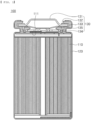
- FIG. 1 is a vertical sectional view of a general cylindrical secondary battery.
- the cylindrical secondary battery 100 is configured such that a jelly-roll type electrode assembly 110 is received in a cylindrical battery case 120, a cap assembly 130 is located at the upper part of the cylindrical battery case 120, and the cylindrical secondary battery 100 is hermetically sealed by a first gasket 133 of the cap assembly 130.
- the cap assembly 130 includes a safety vent 132 located at the lower part of the top cap 131 in the state of covering the outer circumference of the top cap and a current interrupt device 134 located under the safety vent 132 in the state of being in contact with the central part of the safety vent 132.
- a positive electrode tab 111 of the jelly-roll type electrode assembly 110 is attached to the lower surface of the current interrupt device 134 such that the cap assembly 130 functions as a positive electrode terminal.
- the part of the top cap 131 at which no gas discharge opening is formed may overheat due to the generation of heat from the positive electrode tab, and there is a high possibility that the part of the first gasket that is in tight contact with the heat generation portion of the top cap will melt.
- the first gasket melts a problem in that hermetic sealing of the secondary battery is deteriorated or a problem in that electrical conduction is caused due to contact between the battery case and the tap assembly may occur.
- FIG. 2 is a lower perspective view showing the positional relationship between the second gasket and the positive electrode tab of FIG. 1 .
- the positive electrode tab 111 which is attached to the jelly-roll type electrode assembly and extends therefrom, is coupled to the current interrupt device (not shown).
- the end 112 of the positive electrode tab 111 may be coupled to the lower surface of the current interrupt device. That is, the positive electrode tab is not coupled to the central part of the lower surface of the current interrupt device but is coupled to the lower surface of the current interrupt device in the state of being biased to one side.
- the part of the second gasket 135 that is adjacent to the end 112 of the positive electrode tab may melt due to the temperature of the positive electrode tab, which is the main heat generation portion. In this case, the current interrupt device 134 and the safety vent 132 may be electrically conducted to each other.
- each of the first gasket and the second gasket may be made of a material that has a high melting point and may then be used, which, however, causes an increase in manufacturing costs and thus is difficult to apply.
- Patent Document 1 relates to a hermetically sealed battery including an inner gasket having convex portions formed on opposite surfaces thereof, wherein it is possible to inhibit an electrolytic solution from permeating a hermetically sealed body, whereby it is possible to prevent malfunction of a PTC element or an explosion-proof valve in the hermetically sealed body.
- Patent Document 1 does not disclose technology capable of preventing a gasket from melting due to the generation of heat from a cap assembly.
- Patent Document 2 discloses a structure in which a gasket having a recess formed therein is inserted between a cap assembly used as a positive electrode terminal and a can used as a negative electrode terminal in order to insulate the cap assembly and the can from each other.
- Patent Document 2 does not disclose a structure capable of preventing melting of a gasket for current interrupt devices.
- Patent Document 3 discloses a structure in which a recess is formed in a gasket interposed between a cap assembly and a battery can in a direction toward the battery can, which, however, does not correspond to technology capable of preventing the gasket from being melted by a heated top cap.
- Patent Document 4 discloses a cylindrical battery cell configured to have a structure in which a recessed groove is formed in the inner surface of a clamped portion of a metal can, which is the upper part of the metal can, with a gasket partially being introduced into the groove by clamping, whereby damage to the gasket is prevented during a clamping process.
- a cylindrical secondary battery including a gasket having a recessed portion formed therein, wherein the cylindrical secondary battery is configured to have a structure in which the shape of a first gasket interposed between a top cap and a battery case is modified to minimize contact between a high-temperature portion of the top cap and the first gasket and in which the shape of a second gasket located at the outer circumference of a current interrupt device is modified to maximally maintain the distance between a high-temperature positive electrode tab and the second gasket.
- the present invention provides a cylindrical secondary battery including a cylindrical can configured to receive an electrode assembly including a positive electrode, a negative electrode, and a separator; a cap assembly located at the upper part of the cylindrical can; a first gasket configured to hermetically seal the cylindrical can in the state of being added so as to cover outer circumferential edges of a top cap and a venting member of the cap assembly; a current interrupt device (CID) located at the lower part of the cap assembly; and a second gasket located at the outer circumferential edge of the current interrupt device, wherein an upper end portion of the first gasket has a structure configured to cover the upper surface of the outer circumferential edge of the top cap, and a recessed portion is formed in at least a part of the inner surface of the upper end portion of the first gasket, the recessed portion being configured to prevent the first gasket from being brought into tight contact with the upper surface of the outer circumferential edge of the top cap.
- CID current interrupt device
- the top cap may include a bridge configured to connect a protruding central portion and the outer circumferential edge of the top cap to each other, and the recessed portion may be formed in the upper end portion of the first gasket that faces the outer circumferential edge of the top cap connected to the bridge.
- connection length between opposite ends of the recessed portion may be greater than the width of the bridge.
- the recessed portion may include a recess having an entirely uniform depth.
- the recessed portion may have a structure in which concave portions and convex portions are alternately formed.
- each of the convex portions may be equal to the thickness of the upper end portion of the first gasket at which no recessed portion is formed.
- each of the convex portions may be less than the thickness of the upper end portion of the first gasket at which no recessed portion is formed.
- the upper end portion of the first gasket may have a porous structure.
- the second gasket may include an upper portion located at the upper surface of the outer circumferential portion of the current interrupt device, the upper portion being configured to prevent contact between the venting member and the current interrupt device, and a side portion located outside the outer circumferential portion of the current interrupt device, and a punched portion may be formed in at least a part of the upper portion.
- the punched portion may be formed at a position adjacent to a positive electrode tab coupled to the current interrupt device.
- the punched portion may be formed in a shape in which a part of the inside of the upper second gasket portion is removed.
- the punched portion may have a structure in which a recess is formed in the lower surface of the upper second gasket portion.
- the recess may be formed in a slit shape.
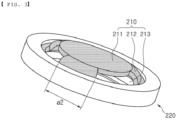
- FIG. 3 is a perspective view of a cap assembly.
- the cap assembly is configured to have a structure in which the outer circumferential edge of a top cap 210 is covered by a first gasket 220.
- the top cap 210 includes a protruding central portion 211, an opening 213 configured to allow gas generated in a cylindrical can to be discharged therethrough, and a bridge 212 configured to connect the central portion 211 and the outer circumferential edge of the top cap.
- a positive electrode tab is coupled to the lower surface of a current interrupt device located at the lower end of the cap assembly.
- the positive electrode tab is a passage through which current flows, which is particularly a part from which heat is excessively generated.
- the temperature of the entirety of the cap assembly connected to the positive electrode tab increases.
- the upper end portion of the first gasket 220 that faces the outer circumferential edge of the top cap connected to the bridge 212 of the top cap exhibits highest temperature distribution.
- the present invention proposes a structure capable of minimizing contact between the outer circumferential edge of the top cap and the first gasket to inhibit high temperature of the bridge from being transmitted to the first gasket, thereby preventing melting of the first gasket.
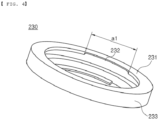
- FIG. 4 is a view showing a first embodiment of the first gasket
- FIG. 5 is a view showing a second embodiment of the first gasket.
- a first gasket 230 has a structure in which a recessed portion 232 is formed in the inner surface of the upper end portion 231 of the first gasket.
- the recessed portion 232 is formed in the upper end portion 231 of the first gasket that faces the outer circumferential edge of the top cap connected to the bridge of the top cap.
- the recessed portion 232 may be formed so as to have a uniform thickness, and the same number of recessed portions 232 as the number of bridges formed on the top cap may be formed.
- the thickness of the recessed portion 232 is less than the thickness of the part of the first gasket at which no recessed portion is formed, whereby a space spaced apart from the upper surface of the top cap is formed by the recessed portion 232 of the first gasket.
- the size of the recessed portion 232 is greater than the size of the outer circumferential edge of the top cap connected to the bridge, wherein the connection length a1 between opposite ends of the recessed portion 232 of the gasket 230 may be greater than the width a2 of the bridge 212 of FIG. 3 .
- a first gasket 240 has a structure in which a recessed portion 242 is formed in the inner surface of the upper end portion 241 of the first gasket.
- the recessed portion 242 of the first gasket 240 is formed in the inner surface of the upper end portion of the first gasket that faces the outer circumferential edge of the top cap connected to the bridge of the top cap.
- the recessed portion 242 has a structure in which concave portions 242a and convex portions 242b are alternately formed.
- the concave portions 242a of the recessed portion are not brought into tight contact with the upper surface of the outer circumferential edge of the top cap connected to the bridge, but the convex portions 242b of the recessed portion are brought into tight contact with the upper surface of the outer circumferential edge of the top cap connected to the bridge.
- the contact point between the high-temperature portion of the cap assembly and the first gasket may be partially removed, whereby it is possible to inhibit damage to the first gasket due to high temperature transmitted to the first gasket.
- the entirety of the recessed portion is configured to be spaced apart from the upper surface of the outer circumferential edge of the top cap connected to the bridge, whereby it is possible to minimize high temperature from being transmitted to the first gasket.
- the upper end portion 231 or 241 of the first gasket 230 or 240 may have a porous structure in order to minimize high temperature from being transmitted to the first gasket, and the side portion 233 or 243 of the first gasket 230 or 240 may have a high-density structure in order to hermetically seal the cylindrical can.
- the second gasket is located at the outer circumferential edge of the current interrupt device located at the lower part of the cap assembly, and the second gasket functions to maintain insulation between the current interrupt device and the safety vent when the current interrupt device and the safety vent are separated from each other.
- the positive electrode tab of the electrode assembly is attached to the lower surface of the current interrupt device, and the positive electrode tab is attached to a position being biased from the center to one side of the current interrupt device. Consequently, the part of the second gasket that is adjacent to the positive electrode tab exhibits highest temperature distribution.
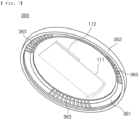
- FIG. 6 is a view showing a first embodiment of the second gasket
- FIG. 7 is a view showing a second embodiment of the second gasket.
- a second gasket 350 includes an upper second gasket portion 351 located at the upper surface of the outer circumferential portion of the current interrupt device in order to prevent contact between a venting member and the current interrupt device and a side second gasket portion 352 located outside the outer circumferential portion of the current interrupt device, wherein a punched portion 353 is formed in at least a part of the upper second gasket portion 351.
- the positive electrode tab 111 that has been extended so as to be attached to the lower surface of the current interrupt device is shown by a dotted line.
- a part of the inside of the upper second gasket portion 351 is removed by punching, whereby the punched portion 353 is formed.
- the punched portion 353 is formed so as to have a size necessary to secure the distance from the positive electrode tab 111 and to be located at a position necessary to secure the distance from the positive electrode tab 111.
- the connection length c1 between opposite ends of the punched portion is greater than the width c2 of the positive electrode tab.
- a second gasket 360 includes an upper second gasket portion 361 located at the upper surface of the outer circumferential portion of the current interrupt device in order to prevent contact between the venting member and the current interrupt device and a side second gasket portion 362 located outside the outer circumferential portion of the current interrupt device, wherein a punched portion 363 is formed in at least a part of the upper second gasket portion 361.
- the punched portion 363 has a structure in which a recess is formed in the lower surface of the upper second gasket portion 361, wherein the recess is formed in the shape of a slit.
- the punched portion may have a through hole formed therein.
- the punched portion 363 is also formed in the upper part of the second gasket that is adjacent to the end 112 of the positive electrode tab, and the connection length between opposite ends of the punched portion is greater than the width of the positive electrode tab.
- the end of the positive electrode tab opposite to the end 112 of the positive electrode tab coupled to the current interrupt device is the portion that is connected to the electrode assembly, and is located so as to be spaced apart from the cap assembly. Unlike what is shown in the figures, therefore, the opposite end of the positive electrode tab is not located so as to be adjacent to the second gasket.
- the present invention provides a cylindrical secondary battery configured such that a first gasket and a second gasket are applied in the state in which the shape of each of the first gasket and the second gasket is modified, whereby resistance of the cylindrical secondary battery to high temperature is improved while hermetic sealability and insulation of the cylindrical secondary battery are secured.
- a cylindrical secondary battery according to the present invention is configured such that a recessed portion is formed in a first gasket, whereby a portion is defined at which a top cap, which is a high-temperature portion, and the first gasket are not brought into tight contact with each other. Consequently, it is possible to minimize melting of the first gasket due to the generation of heat from the top cap.
- a punched portion is formed in a second gasket, whereby it is possible to maximally maintain the distance between the second gasket and a positive electrode tab. Consequently, it is possible to minimize melting of the second gasket due to the generation of heat from the positive electrode tab.
Landscapes
- Chemical & Material Sciences (AREA)
- Chemical Kinetics & Catalysis (AREA)
- Electrochemistry (AREA)
- General Chemical & Material Sciences (AREA)
- Engineering & Computer Science (AREA)
- Manufacturing & Machinery (AREA)
- Sealing Battery Cases Or Jackets (AREA)
- Cold Air Circulating Systems And Constructional Details In Refrigerators (AREA)
- Devices That Are Associated With Refrigeration Equipment (AREA)
- Refrigerator Housings (AREA)
Description
- The present invention relates to a cylindrical secondary battery including a gasket having a recess formed therein, wherein the shape of a gasket adjacent to a high-temperature portion of a cap assembly is modified, whereby resistance of the cylindrical secondary battery to high temperature is improved.
- Lithium secondary batteries are classified into a cylindrical secondary battery having an electrode assembly mounted in a cylindrical metal can, a prismatic secondary battery having an electrode assembly mounted in a prismatic metal can, and a pouch-shaped secondary battery having an electrode assembly mounted in a pouch-shaped case made of an aluminum laminate sheet. Among these batteries, the cylindrical secondary battery has advantages in that the capacity of the cylindrical secondary battery is relatively large and in that the cylindrical secondary battery is structurally stable.
- The cylindrical secondary battery is configured such that a cap assembly is located at the upper end of a cylindrical case, which is open, and the cylindrical secondary battery is hermetically sealed in the state in which a gasket is interposed between the cylindrical case and the cap assembly.
-
FIG. 1 is a vertical sectional view of a general cylindrical secondary battery. Referring toFIG. 1 , the cylindricalsecondary battery 100 is configured such that a jelly-rolltype electrode assembly 110 is received in acylindrical battery case 120, acap assembly 130 is located at the upper part of thecylindrical battery case 120, and the cylindricalsecondary battery 100 is hermetically sealed by afirst gasket 133 of thecap assembly 130. - The
cap assembly 130 includes asafety vent 132 located at the lower part of thetop cap 131 in the state of covering the outer circumference of the top cap and acurrent interrupt device 134 located under thesafety vent 132 in the state of being in contact with the central part of thesafety vent 132. Asecond gasket 135, configured to prevent thesafety vent 132 and thecurrent interrupt device 134 from contacting each other at parts other than the central part of thesafety vent 132, is located at the outer circumferential edge of thecurrent interrupt device 134. - A
positive electrode tab 111 of the jelly-rolltype electrode assembly 110 is attached to the lower surface of thecurrent interrupt device 134 such that thecap assembly 130 functions as a positive electrode terminal. - In connection therewith, the part of the
top cap 131 at which no gas discharge opening is formed may overheat due to the generation of heat from the positive electrode tab, and there is a high possibility that the part of the first gasket that is in tight contact with the heat generation portion of the top cap will melt. In the case in which the first gasket melts, a problem in that hermetic sealing of the secondary battery is deteriorated or a problem in that electrical conduction is caused due to contact between the battery case and the tap assembly may occur. -
FIG. 2 is a lower perspective view showing the positional relationship between the second gasket and the positive electrode tab ofFIG. 1 . - Referring to
FIG. 2 , thepositive electrode tab 111, which is attached to the jelly-roll type electrode assembly and extends therefrom, is coupled to the current interrupt device (not shown). In the case in which theend 112 of thepositive electrode tab 111 is bent in order to stably couple the positive electrode tab to the current interrupt device, theend 112 of thepositive electrode tab 111 may be coupled to the lower surface of the current interrupt device. That is, the positive electrode tab is not coupled to the central part of the lower surface of the current interrupt device but is coupled to the lower surface of the current interrupt device in the state of being biased to one side. The part of thesecond gasket 135 that is adjacent to theend 112 of the positive electrode tab may melt due to the temperature of the positive electrode tab, which is the main heat generation portion. In this case, thecurrent interrupt device 134 and thesafety vent 132 may be electrically conducted to each other. - Accordingly, each of the first gasket and the second gasket may be made of a material that has a high melting point and may then be used, which, however, causes an increase in manufacturing costs and thus is difficult to apply.
- Patent Document 1 relates to a hermetically sealed battery including an inner gasket having convex portions formed on opposite surfaces thereof, wherein it is possible to inhibit an electrolytic solution from permeating a hermetically sealed body, whereby it is possible to prevent malfunction of a PTC element or an explosion-proof valve in the hermetically sealed body. However, Patent Document 1 does not disclose technology capable of preventing a gasket from melting due to the generation of heat from a cap assembly.
- Patent Document 2 discloses a structure in which a gasket having a recess formed therein is inserted between a cap assembly used as a positive electrode terminal and a can used as a negative electrode terminal in order to insulate the cap assembly and the can from each other. However, Patent Document 2 does not disclose a structure capable of preventing melting of a gasket for current interrupt devices.
- Patent Document 3 discloses a structure in which a recess is formed in a gasket interposed between a cap assembly and a battery can in a direction toward the battery can, which, however, does not correspond to technology capable of preventing the gasket from being melted by a heated top cap.
- Patent Document 4 discloses a cylindrical battery cell configured to have a structure in which a recessed groove is formed in the inner surface of a clamped portion of a metal can, which is the upper part of the metal can, with a gasket partially being introduced into the groove by clamping, whereby damage to the gasket is prevented during a clamping process.
- As described above, no solution to prevent damage to a gasket due to high temperature in a cylindrical secondary battery has been proposed, and therefore there is a high necessity for technology capable of preventing melting of the gasket using an easy method, whereby it is possible to improve hermetic sealability and insulation.
-
- (Patent Document 1)
Japanese Patent Application Publication No. 1999-283588 (1999.10.15 - (Patent Document 2)
Korean Patent Application Publication No. 2000-0051436 (2000.08.16 - (Patent Document 3)
Japanese Patent Application Publication No. 2009-135008 (2009.06.18 - (Patent Document 4)
Korean Patent Application Publication No. 2018-0036086 (2018.04.09 - Further examples of background art can be found in
EP2773767A1 ,WO2019/054765A1 ,US2018/205044A1 ,KR101313325B1 KR200363824Y1 WO89/11608A1 KR20190040698A KR20170063128A - The present invention as fully defined by the independent claims has been made in view of the above problems, and it is an object of the present invention to provide a cylindrical secondary battery including a gasket having a recessed portion formed therein, wherein the cylindrical secondary battery is configured to have a structure in which the shape of a first gasket interposed between a top cap and a battery case is modified to minimize contact between a high-temperature portion of the top cap and the first gasket and in which the shape of a second gasket located at the outer circumference of a current interrupt device is modified to maximally maintain the distance between a high-temperature positive electrode tab and the second gasket.
- In order to accomplish the above object, the present invention provides a cylindrical secondary battery including a cylindrical can configured to receive an electrode assembly including a positive electrode, a negative electrode, and a separator; a cap assembly located at the upper part of the cylindrical can; a first gasket configured to hermetically seal the cylindrical can in the state of being added so as to cover outer circumferential edges of a top cap and a venting member of the cap assembly; a current interrupt device (CID) located at the lower part of the cap assembly; and a second gasket located at the outer circumferential edge of the current interrupt device, wherein an upper end portion of the first gasket has a structure configured to cover the upper surface of the outer circumferential edge of the top cap, and a recessed portion is formed in at least a part of the inner surface of the upper end portion of the first gasket, the recessed portion being configured to prevent the first gasket from being brought into tight contact with the upper surface of the outer circumferential edge of the top cap.
- The top cap may include a bridge configured to connect a protruding central portion and the outer circumferential edge of the top cap to each other, and the recessed portion may be formed in the upper end portion of the first gasket that faces the outer circumferential edge of the top cap connected to the bridge.
- The connection length between opposite ends of the recessed portion may be greater than the width of the bridge.
- The recessed portion may include a recess having an entirely uniform depth.
- The recessed portion may have a structure in which concave portions and convex portions are alternately formed.
- The thickness of each of the convex portions may be equal to the thickness of the upper end portion of the first gasket at which no recessed portion is formed.
- The thickness of each of the convex portions may be less than the thickness of the upper end portion of the first gasket at which no recessed portion is formed.
- The upper end portion of the first gasket may have a porous structure.
- The second gasket may include an upper portion located at the upper surface of the outer circumferential portion of the current interrupt device, the upper portion being configured to prevent contact between the venting member and the current interrupt device, and a side portion located outside the outer circumferential portion of the current interrupt device, and a punched portion may be formed in at least a part of the upper portion.
- The punched portion may be formed at a position adjacent to a positive electrode tab coupled to the current interrupt device.
- The punched portion may be formed in a shape in which a part of the inside of the upper second gasket portion is removed.
- The punched portion may have a structure in which a recess is formed in the lower surface of the upper second gasket portion.
- The recess may be formed in a slit shape.
-
-
FIG. 1 is a vertical sectional view of a general cylindrical secondary battery. -
FIG. 2 is a lower perspective view showing the positional relationship between a second gasket and a positive electrode tab ofFIG. 1 . -
FIG. 3 is a perspective view of a cap assembly. -
FIG. 4 is a view showing a first embodiment of a first gasket. -
FIG. 5 is a view showing a second embodiment of the first gasket. -
FIG. 6 is a view showing a first embodiment of a second gasket. -
FIG. 7 is a view showing a second embodiment of the second gasket. - Now, preferred embodiments of the present invention will be described in detail with reference to the accompanying drawings such that the preferred embodiments of the present invention can be easily implemented by a person having ordinary skill in the art to which the present invention pertains. In describing the principle of operation of the preferred embodiments of the present invention in detail, however, a detailed description of known functions and configurations incorporated herein will be omitted when the same may obscure the subject matter of the present invention.
- In addition, the same reference numbers will be used throughout the drawings to refer to parts that perform similar functions or operations. In the case in which one part is said to be connected to another part in the specification, not only may the one part be directly connected to the other part, but also, the one part may be indirectly connected to the other part via a further part. In addition, that a certain element is included does not mean that other elements are excluded, but means that such elements may be further included unless mentioned otherwise.
- Embodiments of the present invention will be described in detail with reference to the accompanying drawings.
-
FIG. 3 is a perspective view of a cap assembly. - Referring to
FIG. 3 , the cap assembly is configured to have a structure in which the outer circumferential edge of atop cap 210 is covered by afirst gasket 220. Thetop cap 210 includes a protrudingcentral portion 211, anopening 213 configured to allow gas generated in a cylindrical can to be discharged therethrough, and abridge 212 configured to connect thecentral portion 211 and the outer circumferential edge of the top cap. - A positive electrode tab is coupled to the lower surface of a current interrupt device located at the lower end of the cap assembly. The positive electrode tab is a passage through which current flows, which is particularly a part from which heat is excessively generated.
- As a result, the temperature of the entirety of the cap assembly connected to the positive electrode tab increases. Particularly, in the
first gasket 220, the upper end portion of thefirst gasket 220 that faces the outer circumferential edge of the top cap connected to thebridge 212 of the top cap exhibits highest temperature distribution. - Accordingly, the present invention proposes a structure capable of minimizing contact between the outer circumferential edge of the top cap and the first gasket to inhibit high temperature of the bridge from being transmitted to the first gasket, thereby preventing melting of the first gasket.
- In connection therewith,
FIG. 4 is a view showing a first embodiment of the first gasket, andFIG. 5 is a view showing a second embodiment of the first gasket. - Referring to
FIG. 4 , afirst gasket 230 has a structure in which a recessedportion 232 is formed in the inner surface of theupper end portion 231 of the first gasket. - Specifically, the recessed
portion 232 is formed in theupper end portion 231 of the first gasket that faces the outer circumferential edge of the top cap connected to the bridge of the top cap. - At the upper end portion of the first gasket, the recessed
portion 232 may be formed so as to have a uniform thickness, and the same number of recessedportions 232 as the number of bridges formed on the top cap may be formed. - At the upper end portion of the first gasket, the thickness of the recessed
portion 232 is less than the thickness of the part of the first gasket at which no recessed portion is formed, whereby a space spaced apart from the upper surface of the top cap is formed by the recessedportion 232 of the first gasket. - Preferably, the size of the recessed
portion 232 is greater than the size of the outer circumferential edge of the top cap connected to the bridge, wherein the connection length a1 between opposite ends of the recessedportion 232 of thegasket 230 may be greater than the width a2 of thebridge 212 ofFIG. 3 . - Referring to
FIG. 5 , afirst gasket 240 has a structure in which a recessedportion 242 is formed in the inner surface of theupper end portion 241 of the first gasket. - Like the
first gasket 230 ofFIG. 4 , the recessedportion 242 of thefirst gasket 240 is formed in the inner surface of the upper end portion of the first gasket that faces the outer circumferential edge of the top cap connected to the bridge of the top cap. - The recessed
portion 242 has a structure in whichconcave portions 242a andconvex portions 242b are alternately formed. In the case in which the thickness d2 of each of theconvex portions 242b is equal to the thickness d1 of the upper end portion of the first gasket at which no recessed portion is formed, theconcave portions 242a of the recessed portion are not brought into tight contact with the upper surface of the outer circumferential edge of the top cap connected to the bridge, but theconvex portions 242b of the recessed portion are brought into tight contact with the upper surface of the outer circumferential edge of the top cap connected to the bridge. - As described above, the contact point between the high-temperature portion of the cap assembly and the first gasket may be partially removed, whereby it is possible to inhibit damage to the first gasket due to high temperature transmitted to the first gasket.
- Alternatively, in the case in which the thickness d2 of each of the
convex portions 242b is less than the thickness d1 of the upper end portion of the first gasket at which no recessed portion is formed, the entirety of the recessed portion is configured to be spaced apart from the upper surface of the outer circumferential edge of the top cap connected to the bridge, whereby it is possible to minimize high temperature from being transmitted to the first gasket. - Alternatively, the
upper end portion first gasket side portion first gasket - In general, the second gasket is located at the outer circumferential edge of the current interrupt device located at the lower part of the cap assembly, and the second gasket functions to maintain insulation between the current interrupt device and the safety vent when the current interrupt device and the safety vent are separated from each other.
- The positive electrode tab of the electrode assembly is attached to the lower surface of the current interrupt device, and the positive electrode tab is attached to a position being biased from the center to one side of the current interrupt device. Consequently, the part of the second gasket that is adjacent to the positive electrode tab exhibits highest temperature distribution.
- In connection therewith,
FIG. 6 is a view showing a first embodiment of the second gasket, andFIG. 7 is a view showing a second embodiment of the second gasket. - Referring to
FIG. 6 , asecond gasket 350 includes an uppersecond gasket portion 351 located at the upper surface of the outer circumferential portion of the current interrupt device in order to prevent contact between a venting member and the current interrupt device and a sidesecond gasket portion 352 located outside the outer circumferential portion of the current interrupt device, wherein a punchedportion 353 is formed in at least a part of the uppersecond gasket portion 351. - In
FIG. 6 , thepositive electrode tab 111 that has been extended so as to be attached to the lower surface of the current interrupt device is shown by a dotted line. In accordance with the independent claim 1, at a position adjacent to theend 112 of the positive electrode tab that is coupled to the current interrupt device, a part of the inside of the uppersecond gasket portion 351 is removed by punching, whereby the punchedportion 353 is formed. - The punched
portion 353 is formed so as to have a size necessary to secure the distance from thepositive electrode tab 111 and to be located at a position necessary to secure the distance from thepositive electrode tab 111. The connection length c1 between opposite ends of the punched portion is greater than the width c2 of the positive electrode tab. - Consequently, it is possible to maximize the distance between the
end 112 of thepositive electrode tab 111 and thesecond gasket 350. - Referring to
FIG. 7 , asecond gasket 360 includes an uppersecond gasket portion 361 located at the upper surface of the outer circumferential portion of the current interrupt device in order to prevent contact between the venting member and the current interrupt device and a sidesecond gasket portion 362 located outside the outer circumferential portion of the current interrupt device, wherein a punchedportion 363 is formed in at least a part of the uppersecond gasket portion 361. - The punched
portion 363 has a structure in which a recess is formed in the lower surface of the uppersecond gasket portion 361, wherein the recess is formed in the shape of a slit. Alternatively, in another embodiment, the punched portion may have a through hole formed therein. - Consequently, in the case in which the safety vent is deformed due to an increase in inner pressure of the cylindrical secondary battery, whereby the safety vent coupled to the current interrupt device is separated from the current interrupt device, it is possible to inhibit damage to the second gasket due to high heat of the positive electrode tab transmitted to the second gasket while securing insulation between the safety vent and the current interrupt device.
- In the same manner as the punched
portion 353 ofFIG. 6 , the punchedportion 363 is also formed in the upper part of the second gasket that is adjacent to theend 112 of the positive electrode tab, and the connection length between opposite ends of the punched portion is greater than the width of the positive electrode tab. - For reference, for each of the positive electrode tabs shown in
FIGS. 6 and7 , the end of the positive electrode tab opposite to theend 112 of the positive electrode tab coupled to the current interrupt device is the portion that is connected to the electrode assembly, and is located so as to be spaced apart from the cap assembly. Unlike what is shown in the figures, therefore, the opposite end of the positive electrode tab is not located so as to be adjacent to the second gasket. - As described above, the present invention provides a cylindrical secondary battery configured such that a first gasket and a second gasket are applied in the state in which the shape of each of the first gasket and the second gasket is modified, whereby resistance of the cylindrical secondary battery to high temperature is improved while hermetic sealability and insulation of the cylindrical secondary battery are secured.
- A person having ordinary skill in the art to which the present invention pertains will appreciate that various applications and modifications are possible based on the above description without departing from the scope of the present invention.
-
- 100: Cylindrical secondary battery
- 110: Jelly-roll type electrode assembly
- 111: Positive electrode tab
- 112: End of positive electrode tab
- 120: Cylindrical battery case
- 130: Cap assembly
- 131, 210: Top caps
- 132: Safety vent
- 133, 220, 230, 240: First gaskets
- 134: Current interrupt device
- 135, 350, 360: Second gaskets
- 211: Central portion
- 212: Bridge
- 213: Opening
- 231, 241: Upper end portions of first gaskets
- 232, 242: Recessed portions
- 233, 243: Side portions of first gaskets
- 242a: Concave portions
- 242b: Convex portions
- 351, 361: Upper second gasket portions
- 352, 362: Side second gasket portions
- 353, 363: Punched portions
- a1: Connection length between opposite ends of recessed portion
- a2: Width of bridge
- c1: Connection length between opposite ends of punched portion
- c2: Width of positive electrode tab
- d1: Thickness of upper end portion of first gasket at which no recessed portion is formed
- d2: Thickness of convex portion
- As is apparent from the above description, a cylindrical secondary battery according to the present invention is configured such that a recessed portion is formed in a first gasket, whereby a portion is defined at which a top cap, which is a high-temperature portion, and the first gasket are not brought into tight contact with each other. Consequently, it is possible to minimize melting of the first gasket due to the generation of heat from the top cap.
- In addition, a punched portion is formed in a second gasket, whereby it is possible to maximally maintain the distance between the second gasket and a positive electrode tab. Consequently, it is possible to minimize melting of the second gasket due to the generation of heat from the positive electrode tab.
- As described above, it is possible to improve resistance of the cylindrical secondary battery to high temperature using a method of modifying the shape of each of the first gasket and the second gasket. Consequently, no additional process for securing resistance of the cylindrical secondary battery to high temperature is necessary, and therefore the present invention is easily applicable to a process of manufacturing a conventional cylindrical secondary battery.
- In addition, no expensive heatproof material is used, whereby it is possible to reduce manufacturing costs.
Claims (10)
- A cylindrical secondary battery (100) comprising:a cylindrical can configured to receive an electrode assembly (110) comprising a positive electrode (111), a negative electrode, and a separator;a cap assembly (130) located at an upper part of the cylindrical can;a first gasket (133, 220, 230, 240) configured to hermetically seal the cylindrical can in a state of being added so as to cover outer circumferential edges of a top cap (131, 210) and a venting member of the cap assembly (130);a current interrupt device (CID) (134) located at a lower part of the cap assembly (130); anda second gasket (135, 350, 360) located along an outer circumferential edge of the current interrupt device (134), whereinan upper end portion (231, 241) of the first gasket is structured and arranged so as to cover an upper surface of the outer circumferential edge of the top cap, anda recessed portion (232, 242) is formed in at least a part of an inner surface of the upper end portion of the first gasket (133, 220, 230, 240), the recessed portion (232, 242) being configured to prevent the first gasket (133, 220, 230, 240) from being brought into tight contact with the upper surface of the outer circumferential edge of the top cap,whereinthe second gasket (135, 350, 360) comprises: an upper portion (351, 361) located along an upper surface of the outer circumferential portion of the current interrupt device (134), the upper portion (351, 361) being arranged to prevent contact between the venting member and the current interrupt device (134); and a side portion (352, 362) located outside the outer circumferential portion of the current interrupt device (134),a punched portion (353, 363) is formed in at least a part of the upper portion at a position adjacent to a positive electrode tab (111) coupled to the current interrupt device (134),wherein the punched portion (353, 363) is defined by a shape in which a part of an inside of the upper portion (351, 361) of the second gasket (135, 350, 360) is removed by punching at a position adjacent to an end (112) of the positive electrode tab (111) that is coupled to the current interrupt device (134), whereby the punched portion (353, 363) is formed,wherein a connection length (c1) between opposite ends of the punched portion (353, 363) is greater than a width (c2) of the positive electrode tab (111).
- The cylindrical secondary battery (100) according to claim 1, whereinthe top cap comprises a bridge (212) connecting a protruding central portion (211) of the top cap to the outer circumferential edge of the top cap, andthe recessed portion (232, 242) of the upper end portion of the first gasket (133, 220, 230, 240) faces the outer circumferential edge of the top cap connected to the bridge (212).
- The cylindrical secondary battery (100) according to claim 2, wherein a connection length defined between opposite ends of the recessed portion (232, 242) is greater than a width of the bridge (212).
- The cylindrical secondary battery (100) according to claim 1, wherein the recessed portion (232, 242) includes a recess having an entirely uniform depth.
- The cylindrical secondary battery (100) according to claim 1, wherein the recessed portion (232, 242) has a structure in which concave portions and convex portions are alternately formed.
- The cylindrical secondary battery (100) according to claim 5, wherein a thickness (d2) of each of the convex portions is equal to a thickness (d1) of the upper end portion of the first gasket (133, 220, 230, 240) at which no recessed portion (232, 242) is formed.
- The cylindrical secondary battery (100) according to claim 5, wherein a thickness (d2) of each of the convex portions is less than a thickness (d1) of the upper end portion of the first gasket (133, 220, 230, 240) at which no recessed portion (232, 242) is formed.
- The cylindrical secondary battery (100) according to claim 1, wherein the upper end portion of the first gasket (133, 220, 230, 240) has a porous structure.
- The cylindrical secondary battery according to claim 1, wherein the punched portion (353, 363) has a structure in which a recess is formed in a lower surface of the upper portion of the second gasket (135, 350, 360).
- The cylindrical secondary battery according to claim 9, wherein the recess is formed in a slit shape.
Applications Claiming Priority (2)
| Application Number | Priority Date | Filing Date | Title |
|---|---|---|---|
| KR1020190072473A KR102610593B1 (en) | 2019-06-18 | 2019-06-18 | Cylindrical Secondary Battery Comprising Gasket with Groove |
| PCT/KR2020/006498 WO2020256284A1 (en) | 2019-06-18 | 2020-05-18 | Cylindrical secondary battery comprising gasket having groove |
Publications (3)
| Publication Number | Publication Date |
|---|---|
| EP3940810A1 EP3940810A1 (en) | 2022-01-19 |
| EP3940810A4 EP3940810A4 (en) | 2022-05-04 |
| EP3940810B1 true EP3940810B1 (en) | 2024-08-28 |
Family
ID=74040247
Family Applications (1)
| Application Number | Title | Priority Date | Filing Date |
|---|---|---|---|
| EP20825967.1A Active EP3940810B1 (en) | 2019-06-18 | 2020-05-18 | Cylindrical secondary battery including gasket having recess formed therein |
Country Status (9)
| Country | Link |
|---|---|
| US (1) | US20220077526A1 (en) |
| EP (1) | EP3940810B1 (en) |
| JP (1) | JP7081771B2 (en) |
| KR (1) | KR102610593B1 (en) |
| CN (1) | CN113728498B (en) |
| ES (1) | ES2991464T3 (en) |
| HU (1) | HUE068664T2 (en) |
| PL (1) | PL3940810T3 (en) |
| WO (1) | WO2020256284A1 (en) |
Families Citing this family (4)
| Publication number | Priority date | Publication date | Assignee | Title |
|---|---|---|---|---|
| CN118872129A (en) * | 2022-03-18 | 2024-10-29 | 松下新能源株式会社 | Cylindrical battery |
| KR20250019310A (en) * | 2023-08-01 | 2025-02-10 | 주식회사 엘지에너지솔루션 | Electrode assembly, secondary battery, battery pack and vehicle |
| KR20250102639A (en) * | 2023-12-28 | 2025-07-07 | 삼성에스디아이 주식회사 | Cylindrical secondary battery |
| CN118867604A (en) * | 2024-07-04 | 2024-10-29 | 厦门新能安科技有限公司 | Cylindrical secondary battery, battery pack and electrical device |
Family Cites Families (32)
| Publication number | Priority date | Publication date | Assignee | Title |
|---|---|---|---|---|
| JPS5256225U (en) * | 1975-10-20 | 1977-04-22 | ||
| JPS53166023U (en) * | 1977-06-03 | 1978-12-26 | ||
| DE68921981T2 (en) * | 1988-05-25 | 1995-11-02 | Gore & Ass | POETRY. |
| JP3732945B2 (en) | 1998-03-31 | 2006-01-11 | 三洋電機株式会社 | Sealed battery |
| KR100522676B1 (en) | 1999-01-22 | 2005-10-19 | 삼성에스디아이 주식회사 | Gasket used in secondary battery |
| JP4200277B2 (en) * | 2002-12-06 | 2008-12-24 | パナソニック株式会社 | Sealed secondary battery |
| KR200363824Y1 (en) * | 2004-06-30 | 2004-10-06 | 주식회사 롯데기공 | a packing of a boiler |
| KR20060037595A (en) * | 2004-10-28 | 2006-05-03 | 삼성에스디아이 주식회사 | Secondary battery |
| KR100686827B1 (en) * | 2005-07-11 | 2007-02-26 | 삼성에스디아이 주식회사 | Lithium secondary battery |
| JP2009135008A (en) | 2007-11-30 | 2009-06-18 | Sanyo Electric Co Ltd | Gasket for alkaline cell, and alkaline cell |
| JP5279341B2 (en) * | 2008-05-20 | 2013-09-04 | Fdkエナジー株式会社 | Cylindrical non-aqueous electrolyte battery |
| KR100995417B1 (en) * | 2008-08-14 | 2010-11-18 | 삼성에스디아이 주식회사 | Secondary battery |
| JP2010124072A (en) * | 2008-11-17 | 2010-06-03 | Nec Corp | Waterproofing mechanism for housing, assembling method for housing, and mobile terminal unit |
| EP2466668B1 (en) * | 2009-08-14 | 2014-10-22 | LG Chem, Ltd. | Cylindrical rechargeable battery with improved stability |
| KR20110029061A (en) * | 2009-09-14 | 2011-03-22 | 주식회사 엘지화학 | Secondary battery |
| KR101062685B1 (en) * | 2009-09-30 | 2011-09-06 | 주식회사 엘지화학 | Double sealed cap assembly, and cylindrical secondary battery having the same |
| KR101184403B1 (en) * | 2010-10-21 | 2012-09-19 | 주식회사 엘지화학 | Cap assembly and secondary battery using the same |
| JP5767407B2 (en) * | 2011-07-13 | 2015-08-19 | エルジー・ケム・リミテッド | Cylindrical secondary battery |
| KR101326069B1 (en) * | 2011-12-26 | 2013-11-07 | 주식회사 엘지화학 | Cap Assembly of Improved Productivity and Cylindrical Battery Cell Employed with the Same |
| WO2014017091A1 (en) * | 2012-07-26 | 2014-01-30 | パナソニック株式会社 | Secondary battery |
| KR102209831B1 (en) * | 2014-02-20 | 2021-01-29 | 삼성에스디아이 주식회사 | Cap assembly and secondary battery comprising the same |
| KR101777458B1 (en) * | 2014-07-25 | 2017-09-11 | 주식회사 엘지화학 | Cylindrical-type secondary battery |
| KR20160063217A (en) * | 2014-11-25 | 2016-06-03 | 신흥에스이씨주식회사 | Method of manufacturing CID assembly for a secondary battery and the CID assembly thereof |
| KR101948620B1 (en) * | 2015-06-05 | 2019-02-15 | 주식회사 엘지화학 | A cap assembly for a secondary battery |
| KR102043864B1 (en) * | 2015-11-30 | 2019-11-12 | 주식회사 엘지화학 | Cap assembly of secondary battery |
| CN107437593A (en) * | 2016-05-28 | 2017-12-05 | 深圳市量能科技有限公司 | Alkaline battery |
| CN206003849U (en) * | 2016-08-10 | 2017-03-08 | 深圳塔菲尔新能源科技有限公司 | A kind of electrokinetic cell top cover |
| KR102116116B1 (en) | 2016-09-30 | 2020-05-27 | 주식회사 엘지화학 | Cylindrical Battery Cell Comprising Metal Can Having Groove |
| JP6868400B2 (en) * | 2017-01-17 | 2021-05-12 | Fdk株式会社 | Cylindrical battery enclosure, tubular battery |
| KR102263435B1 (en) * | 2017-09-13 | 2021-06-11 | 주식회사 엘지에너지솔루션 | Cylindrical Battery Cell Having no Beading Part |
| KR102586879B1 (en) * | 2017-10-11 | 2023-10-10 | 삼성에스디아이 주식회사 | Secondary Battery |
| KR102263976B1 (en) | 2017-12-15 | 2021-06-14 | 프리시젼바이오 주식회사 | Diagnostic System |
-
2019
- 2019-06-18 KR KR1020190072473A patent/KR102610593B1/en active Active
-
2020
- 2020-05-18 WO PCT/KR2020/006498 patent/WO2020256284A1/en not_active Ceased
- 2020-05-18 HU HUE20825967A patent/HUE068664T2/en unknown
- 2020-05-18 JP JP2021532879A patent/JP7081771B2/en active Active
- 2020-05-18 PL PL20825967.1T patent/PL3940810T3/en unknown
- 2020-05-18 EP EP20825967.1A patent/EP3940810B1/en active Active
- 2020-05-18 ES ES20825967T patent/ES2991464T3/en active Active
- 2020-05-18 CN CN202080030001.4A patent/CN113728498B/en active Active
-
2021
- 2021-11-19 US US17/530,770 patent/US20220077526A1/en active Pending
Also Published As
| Publication number | Publication date |
|---|---|
| JP2022513751A (en) | 2022-02-09 |
| EP3940810A4 (en) | 2022-05-04 |
| PL3940810T3 (en) | 2024-12-16 |
| CN113728498B (en) | 2023-06-30 |
| CN113728498A (en) | 2021-11-30 |
| HUE068664T2 (en) | 2025-01-28 |
| JP7081771B2 (en) | 2022-06-07 |
| ES2991464T3 (en) | 2024-12-03 |
| KR20200144414A (en) | 2020-12-29 |
| EP3940810A1 (en) | 2022-01-19 |
| WO2020256284A1 (en) | 2020-12-24 |
| KR102610593B1 (en) | 2023-12-07 |
| US20220077526A1 (en) | 2022-03-10 |
Similar Documents
| Publication | Publication Date | Title |
|---|---|---|
| EP3940810B1 (en) | Cylindrical secondary battery including gasket having recess formed therein | |
| CN115799591B (en) | Cylindrical secondary battery | |
| EP4362154A1 (en) | Cylindrical secondary battery | |
| KR101050535B1 (en) | Cap assembly and secondary battery having the same | |
| CN116505206B (en) | Cylindrical secondary battery | |
| EP4258434A1 (en) | Cylindrical secondary battery | |
| EP4191782A1 (en) | Cylindrical secondary battery | |
| CN112368878B (en) | Secondary battery | |
| EP4350825B1 (en) | Rechargeable battery | |
| KR20150116700A (en) | Rechargeable battery | |
| US20240113369A1 (en) | Cylindrical secondary battery | |
| KR20170117748A (en) | Secondary battery | |
| EP4593174A2 (en) | Secondary battery | |
| EP4593166A1 (en) | Cylindrical secondary battery | |
| CN117954773A (en) | Cylindrical secondary battery | |
| CN120413921A (en) | Cylindrical secondary batteries | |
| KR101175008B1 (en) | Cylinderical Rechargeable Battery | |
| EP4468470A1 (en) | Cylindrical secondary battery | |
| EP4216348B1 (en) | Secondary battery | |
| KR101106403B1 (en) | Secondary battery | |
| EP4358283A1 (en) | Cap assembly, cylindrical secondary battery including same, and method for manufacturing cylindrical secondary battery including same | |
| EP4593137A1 (en) | Cylindrical secondary battery | |
| KR102853427B1 (en) | Secondary battery | |
| KR20260049920A (en) | Secondary battery and method for manufacturing same | |
| CN120453440A (en) | Cylindrical secondary batteries |
Legal Events
| Date | Code | Title | Description |
|---|---|---|---|
| STAA | Information on the status of an ep patent application or granted ep patent |
Free format text: STATUS: THE INTERNATIONAL PUBLICATION HAS BEEN MADE |
|
| PUAI | Public reference made under article 153(3) epc to a published international application that has entered the european phase |
Free format text: ORIGINAL CODE: 0009012 |
|
| STAA | Information on the status of an ep patent application or granted ep patent |
Free format text: STATUS: REQUEST FOR EXAMINATION WAS MADE |
|
| 17P | Request for examination filed |
Effective date: 20211012 |
|
| AK | Designated contracting states |
Kind code of ref document: A1 Designated state(s): AL AT BE BG CH CY CZ DE DK EE ES FI FR GB GR HR HU IE IS IT LI LT LU LV MC MK MT NL NO PL PT RO RS SE SI SK SM TR |
|
| REG | Reference to a national code |
Ref country code: DE Ref legal event code: R079 Free format text: PREVIOUS MAIN CLASS: H01M0002040000 Ipc: H01M0050107000 Ref country code: DE Ref legal event code: R079 Ref document number: 602020036804 Country of ref document: DE Free format text: PREVIOUS MAIN CLASS: H01M0002040000 Ipc: H01M0050107000 |
|
| RAP3 | Party data changed (applicant data changed or rights of an application transferred) |
Owner name: LG ENERGY SOLUTION, LTD. |
|
| A4 | Supplementary search report drawn up and despatched |
Effective date: 20220404 |
|
| RIC1 | Information provided on ipc code assigned before grant |
Ipc: H01M 50/184 20210101ALI20220329BHEP Ipc: H01M 50/152 20210101ALI20220329BHEP Ipc: H01M 50/107 20210101AFI20220329BHEP |
|
| DAV | Request for validation of the european patent (deleted) | ||
| DAX | Request for extension of the european patent (deleted) | ||
| STAA | Information on the status of an ep patent application or granted ep patent |
Free format text: STATUS: EXAMINATION IS IN PROGRESS |
|
| 17Q | First examination report despatched |
Effective date: 20230919 |
|
| GRAP | Despatch of communication of intention to grant a patent |
Free format text: ORIGINAL CODE: EPIDOSNIGR1 |
|
| STAA | Information on the status of an ep patent application or granted ep patent |
Free format text: STATUS: GRANT OF PATENT IS INTENDED |
|
| INTG | Intention to grant announced |
Effective date: 20240313 |
|
| P01 | Opt-out of the competence of the unified patent court (upc) registered |
Effective date: 20240404 |
|
| GRAS | Grant fee paid |
Free format text: ORIGINAL CODE: EPIDOSNIGR3 |
|
| GRAA | (expected) grant |
Free format text: ORIGINAL CODE: 0009210 |
|
| STAA | Information on the status of an ep patent application or granted ep patent |
Free format text: STATUS: THE PATENT HAS BEEN GRANTED |
|
| AK | Designated contracting states |
Kind code of ref document: B1 Designated state(s): AL AT BE BG CH CY CZ DE DK EE ES FI FR GB GR HR HU IE IS IT LI LT LU LV MC MK MT NL NO PL PT RO RS SE SI SK SM TR |
|
| REG | Reference to a national code |
Ref country code: CH Ref legal event code: EP |
|
| REG | Reference to a national code |
Ref country code: DE Ref legal event code: R096 Ref document number: 602020036804 Country of ref document: DE |
|
| REG | Reference to a national code |
Ref country code: IE Ref legal event code: FG4D |
|
| REG | Reference to a national code |
Ref country code: NL Ref legal event code: FP |
|
| REG | Reference to a national code |
Ref country code: SE Ref legal event code: TRGR |
|
| REG | Reference to a national code |
Ref country code: ES Ref legal event code: FG2A Ref document number: 2991464 Country of ref document: ES Kind code of ref document: T3 Effective date: 20241203 |
|
| REG | Reference to a national code |
Ref country code: LT Ref legal event code: MG9D |
|
| PG25 | Lapsed in a contracting state [announced via postgrant information from national office to epo] |
Ref country code: NO Free format text: LAPSE BECAUSE OF FAILURE TO SUBMIT A TRANSLATION OF THE DESCRIPTION OR TO PAY THE FEE WITHIN THE PRESCRIBED TIME-LIMIT Effective date: 20241128 |
|
| REG | Reference to a national code |
Ref country code: AT Ref legal event code: MK05 Ref document number: 1719000 Country of ref document: AT Kind code of ref document: T Effective date: 20240828 |
|
| PG25 | Lapsed in a contracting state [announced via postgrant information from national office to epo] |
Ref country code: PT Free format text: LAPSE BECAUSE OF FAILURE TO SUBMIT A TRANSLATION OF THE DESCRIPTION OR TO PAY THE FEE WITHIN THE PRESCRIBED TIME-LIMIT Effective date: 20241230 Ref country code: GR Free format text: LAPSE BECAUSE OF FAILURE TO SUBMIT A TRANSLATION OF THE DESCRIPTION OR TO PAY THE FEE WITHIN THE PRESCRIBED TIME-LIMIT Effective date: 20241129 Ref country code: FI Free format text: LAPSE BECAUSE OF FAILURE TO SUBMIT A TRANSLATION OF THE DESCRIPTION OR TO PAY THE FEE WITHIN THE PRESCRIBED TIME-LIMIT Effective date: 20240828 |
|
| PG25 | Lapsed in a contracting state [announced via postgrant information from national office to epo] |
Ref country code: BG Free format text: LAPSE BECAUSE OF FAILURE TO SUBMIT A TRANSLATION OF THE DESCRIPTION OR TO PAY THE FEE WITHIN THE PRESCRIBED TIME-LIMIT Effective date: 20240828 |
|
| PG25 | Lapsed in a contracting state [announced via postgrant information from national office to epo] |
Ref country code: LV Free format text: LAPSE BECAUSE OF FAILURE TO SUBMIT A TRANSLATION OF THE DESCRIPTION OR TO PAY THE FEE WITHIN THE PRESCRIBED TIME-LIMIT Effective date: 20240828 |
|
| PG25 | Lapsed in a contracting state [announced via postgrant information from national office to epo] |
Ref country code: AT Free format text: LAPSE BECAUSE OF FAILURE TO SUBMIT A TRANSLATION OF THE DESCRIPTION OR TO PAY THE FEE WITHIN THE PRESCRIBED TIME-LIMIT Effective date: 20240828 Ref country code: IS Free format text: LAPSE BECAUSE OF FAILURE TO SUBMIT A TRANSLATION OF THE DESCRIPTION OR TO PAY THE FEE WITHIN THE PRESCRIBED TIME-LIMIT Effective date: 20241228 |
|
| PG25 | Lapsed in a contracting state [announced via postgrant information from national office to epo] |
Ref country code: HR Free format text: LAPSE BECAUSE OF FAILURE TO SUBMIT A TRANSLATION OF THE DESCRIPTION OR TO PAY THE FEE WITHIN THE PRESCRIBED TIME-LIMIT Effective date: 20240828 |
|
| PG25 | Lapsed in a contracting state [announced via postgrant information from national office to epo] |
Ref country code: RS Free format text: LAPSE BECAUSE OF FAILURE TO SUBMIT A TRANSLATION OF THE DESCRIPTION OR TO PAY THE FEE WITHIN THE PRESCRIBED TIME-LIMIT Effective date: 20241128 |
|
| REG | Reference to a national code |
Ref country code: HU Ref legal event code: AG4A Ref document number: E068664 Country of ref document: HU |
|
| PG25 | Lapsed in a contracting state [announced via postgrant information from national office to epo] |
Ref country code: RS Free format text: LAPSE BECAUSE OF FAILURE TO SUBMIT A TRANSLATION OF THE DESCRIPTION OR TO PAY THE FEE WITHIN THE PRESCRIBED TIME-LIMIT Effective date: 20241128 Ref country code: PT Free format text: LAPSE BECAUSE OF FAILURE TO SUBMIT A TRANSLATION OF THE DESCRIPTION OR TO PAY THE FEE WITHIN THE PRESCRIBED TIME-LIMIT Effective date: 20241230 Ref country code: NO Free format text: LAPSE BECAUSE OF FAILURE TO SUBMIT A TRANSLATION OF THE DESCRIPTION OR TO PAY THE FEE WITHIN THE PRESCRIBED TIME-LIMIT Effective date: 20241128 Ref country code: LV Free format text: LAPSE BECAUSE OF FAILURE TO SUBMIT A TRANSLATION OF THE DESCRIPTION OR TO PAY THE FEE WITHIN THE PRESCRIBED TIME-LIMIT Effective date: 20240828 Ref country code: IS Free format text: LAPSE BECAUSE OF FAILURE TO SUBMIT A TRANSLATION OF THE DESCRIPTION OR TO PAY THE FEE WITHIN THE PRESCRIBED TIME-LIMIT Effective date: 20241228 Ref country code: HR Free format text: LAPSE BECAUSE OF FAILURE TO SUBMIT A TRANSLATION OF THE DESCRIPTION OR TO PAY THE FEE WITHIN THE PRESCRIBED TIME-LIMIT Effective date: 20240828 Ref country code: GR Free format text: LAPSE BECAUSE OF FAILURE TO SUBMIT A TRANSLATION OF THE DESCRIPTION OR TO PAY THE FEE WITHIN THE PRESCRIBED TIME-LIMIT Effective date: 20241129 Ref country code: FI Free format text: LAPSE BECAUSE OF FAILURE TO SUBMIT A TRANSLATION OF THE DESCRIPTION OR TO PAY THE FEE WITHIN THE PRESCRIBED TIME-LIMIT Effective date: 20240828 Ref country code: BG Free format text: LAPSE BECAUSE OF FAILURE TO SUBMIT A TRANSLATION OF THE DESCRIPTION OR TO PAY THE FEE WITHIN THE PRESCRIBED TIME-LIMIT Effective date: 20240828 Ref country code: AT Free format text: LAPSE BECAUSE OF FAILURE TO SUBMIT A TRANSLATION OF THE DESCRIPTION OR TO PAY THE FEE WITHIN THE PRESCRIBED TIME-LIMIT Effective date: 20240828 |
|
| PG25 | Lapsed in a contracting state [announced via postgrant information from national office to epo] |
Ref country code: SM Free format text: LAPSE BECAUSE OF FAILURE TO SUBMIT A TRANSLATION OF THE DESCRIPTION OR TO PAY THE FEE WITHIN THE PRESCRIBED TIME-LIMIT Effective date: 20240828 Ref country code: DK Free format text: LAPSE BECAUSE OF FAILURE TO SUBMIT A TRANSLATION OF THE DESCRIPTION OR TO PAY THE FEE WITHIN THE PRESCRIBED TIME-LIMIT Effective date: 20240828 Ref country code: RO Free format text: LAPSE BECAUSE OF FAILURE TO SUBMIT A TRANSLATION OF THE DESCRIPTION OR TO PAY THE FEE WITHIN THE PRESCRIBED TIME-LIMIT Effective date: 20240828 |
|
| PG25 | Lapsed in a contracting state [announced via postgrant information from national office to epo] |
Ref country code: EE Free format text: LAPSE BECAUSE OF FAILURE TO SUBMIT A TRANSLATION OF THE DESCRIPTION OR TO PAY THE FEE WITHIN THE PRESCRIBED TIME-LIMIT Effective date: 20240828 |
|
| PG25 | Lapsed in a contracting state [announced via postgrant information from national office to epo] |
Ref country code: CZ Free format text: LAPSE BECAUSE OF FAILURE TO SUBMIT A TRANSLATION OF THE DESCRIPTION OR TO PAY THE FEE WITHIN THE PRESCRIBED TIME-LIMIT Effective date: 20240828 |
|
| PG25 | Lapsed in a contracting state [announced via postgrant information from national office to epo] |
Ref country code: SK Free format text: LAPSE BECAUSE OF FAILURE TO SUBMIT A TRANSLATION OF THE DESCRIPTION OR TO PAY THE FEE WITHIN THE PRESCRIBED TIME-LIMIT Effective date: 20240828 |
|
| PGFP | Annual fee paid to national office [announced via postgrant information from national office to epo] |
Ref country code: NL Payment date: 20250422 Year of fee payment: 6 |
|
| REG | Reference to a national code |
Ref country code: DE Ref legal event code: R097 Ref document number: 602020036804 Country of ref document: DE |
|
| PLBE | No opposition filed within time limit |
Free format text: ORIGINAL CODE: 0009261 |
|
| STAA | Information on the status of an ep patent application or granted ep patent |
Free format text: STATUS: NO OPPOSITION FILED WITHIN TIME LIMIT |
|
| PGFP | Annual fee paid to national office [announced via postgrant information from national office to epo] |
Ref country code: PL Payment date: 20250423 Year of fee payment: 6 Ref country code: DE Payment date: 20250422 Year of fee payment: 6 |
|
| PGFP | Annual fee paid to national office [announced via postgrant information from national office to epo] |
Ref country code: ES Payment date: 20250613 Year of fee payment: 6 |
|
| PGFP | Annual fee paid to national office [announced via postgrant information from national office to epo] |
Ref country code: HU Payment date: 20250526 Year of fee payment: 6 |
|
| PGFP | Annual fee paid to national office [announced via postgrant information from national office to epo] |
Ref country code: BE Payment date: 20250407 Year of fee payment: 6 Ref country code: IT Payment date: 20250423 Year of fee payment: 6 |
|
| PGFP | Annual fee paid to national office [announced via postgrant information from national office to epo] |
Ref country code: FR Payment date: 20250422 Year of fee payment: 6 |
|
| PGFP | Annual fee paid to national office [announced via postgrant information from national office to epo] |
Ref country code: TR Payment date: 20250422 Year of fee payment: 6 |
|
| PGFP | Annual fee paid to national office [announced via postgrant information from national office to epo] |
Ref country code: SE Payment date: 20250422 Year of fee payment: 6 |
|
| 26N | No opposition filed |
Effective date: 20250530 |
|
| REG | Reference to a national code |
Ref country code: CH Ref legal event code: H13 Free format text: ST27 STATUS EVENT CODE: U-0-0-H10-H13 (AS PROVIDED BY THE NATIONAL OFFICE) Effective date: 20251223 |
|
| PG25 | Lapsed in a contracting state [announced via postgrant information from national office to epo] |
Ref country code: LU Free format text: LAPSE BECAUSE OF NON-PAYMENT OF DUE FEES Effective date: 20250518 |
|
| PG25 | Lapsed in a contracting state [announced via postgrant information from national office to epo] |
Ref country code: CH Free format text: LAPSE BECAUSE OF NON-PAYMENT OF DUE FEES Effective date: 20250531 |
|
| PG25 | Lapsed in a contracting state [announced via postgrant information from national office to epo] |
Ref country code: MC Free format text: LAPSE BECAUSE OF FAILURE TO SUBMIT A TRANSLATION OF THE DESCRIPTION OR TO PAY THE FEE WITHIN THE PRESCRIBED TIME-LIMIT Effective date: 20240828 |
|
| PGFP | Annual fee paid to national office [announced via postgrant information from national office to epo] |
Ref country code: GB Payment date: 20260324 Year of fee payment: 7 |
|
| PG25 | Lapsed in a contracting state [announced via postgrant information from national office to epo] |
Ref country code: IE Free format text: LAPSE BECAUSE OF NON-PAYMENT OF DUE FEES Effective date: 20250518 |