EP3940690A1 - Method and device for processing music file, terminal and storage medium - Google Patents
Method and device for processing music file, terminal and storage medium Download PDFInfo
- Publication number
- EP3940690A1 EP3940690A1 EP20801727.7A EP20801727A EP3940690A1 EP 3940690 A1 EP3940690 A1 EP 3940690A1 EP 20801727 A EP20801727 A EP 20801727A EP 3940690 A1 EP3940690 A1 EP 3940690A1
- Authority
- EP
- European Patent Office
- Prior art keywords
- target
- data
- accompaniment
- music file
- sound effect
- Prior art date
- Legal status (The legal status is an assumption and is not a legal conclusion. Google has not performed a legal analysis and makes no representation as to the accuracy of the status listed.)
- Granted
Links
Images





Classifications
-
- H—ELECTRICITY
- H04—ELECTRIC COMMUNICATION TECHNIQUE
- H04S—STEREOPHONIC SYSTEMS
- H04S7/00—Indicating arrangements; Control arrangements, e.g. balance control
- H04S7/30—Control circuits for electronic adaptation of the sound field
-
- G—PHYSICS
- G06—COMPUTING OR CALCULATING; COUNTING
- G06F—ELECTRIC DIGITAL DATA PROCESSING
- G06F3/00—Input arrangements for transferring data to be processed into a form capable of being handled by the computer; Output arrangements for transferring data from processing unit to output unit, e.g. interface arrangements
- G06F3/01—Input arrangements or combined input and output arrangements for interaction between user and computer
- G06F3/017—Gesture based interaction, e.g. based on a set of recognized hand gestures
-
- G—PHYSICS
- G06—COMPUTING OR CALCULATING; COUNTING
- G06F—ELECTRIC DIGITAL DATA PROCESSING
- G06F3/00—Input arrangements for transferring data to be processed into a form capable of being handled by the computer; Output arrangements for transferring data from processing unit to output unit, e.g. interface arrangements
- G06F3/01—Input arrangements or combined input and output arrangements for interaction between user and computer
- G06F3/03—Arrangements for converting the position or the displacement of a member into a coded form
- G06F3/033—Pointing devices displaced or positioned by the user, e.g. mice, trackballs, pens or joysticks; Accessories therefor
- G06F3/0346—Pointing devices displaced or positioned by the user, e.g. mice, trackballs, pens or joysticks; Accessories therefor with detection of the device orientation or free movement in a three-dimensional [3D] space, e.g. 3D mice, 6-DOF [six degrees of freedom] pointers using gyroscopes, accelerometers or tilt-sensors
-
- G—PHYSICS
- G06—COMPUTING OR CALCULATING; COUNTING
- G06F—ELECTRIC DIGITAL DATA PROCESSING
- G06F3/00—Input arrangements for transferring data to be processed into a form capable of being handled by the computer; Output arrangements for transferring data from processing unit to output unit, e.g. interface arrangements
- G06F3/16—Sound input; Sound output
- G06F3/165—Management of the audio stream, e.g. setting of volume, audio stream path
-
- G—PHYSICS
- G10—MUSICAL INSTRUMENTS; ACOUSTICS
- G10H—ELECTROPHONIC MUSICAL INSTRUMENTS; INSTRUMENTS IN WHICH THE TONES ARE GENERATED BY ELECTROMECHANICAL MEANS OR ELECTRONIC GENERATORS, OR IN WHICH THE TONES ARE SYNTHESISED FROM A DATA STORE
- G10H1/00—Details of electrophonic musical instruments
- G10H1/0008—Associated control or indicating means
-
- G—PHYSICS
- G10—MUSICAL INSTRUMENTS; ACOUSTICS
- G10H—ELECTROPHONIC MUSICAL INSTRUMENTS; INSTRUMENTS IN WHICH THE TONES ARE GENERATED BY ELECTROMECHANICAL MEANS OR ELECTRONIC GENERATORS, OR IN WHICH THE TONES ARE SYNTHESISED FROM A DATA STORE
- G10H1/00—Details of electrophonic musical instruments
- G10H1/0091—Means for obtaining special acoustic effects
-
- G—PHYSICS
- G10—MUSICAL INSTRUMENTS; ACOUSTICS
- G10H—ELECTROPHONIC MUSICAL INSTRUMENTS; INSTRUMENTS IN WHICH THE TONES ARE GENERATED BY ELECTROMECHANICAL MEANS OR ELECTRONIC GENERATORS, OR IN WHICH THE TONES ARE SYNTHESISED FROM A DATA STORE
- G10H1/00—Details of electrophonic musical instruments
- G10H1/36—Accompaniment arrangements
-
- G—PHYSICS
- G10—MUSICAL INSTRUMENTS; ACOUSTICS
- G10L—SPEECH ANALYSIS TECHNIQUES OR SPEECH SYNTHESIS; SPEECH RECOGNITION; SPEECH OR VOICE PROCESSING TECHNIQUES; SPEECH OR AUDIO CODING OR DECODING
- G10L25/00—Speech or voice analysis techniques not restricted to a single one of groups G10L15/00 - G10L21/00
- G10L25/78—Detection of presence or absence of voice signals
- G10L25/81—Detection of presence or absence of voice signals for discriminating voice from music
-
- G—PHYSICS
- G11—INFORMATION STORAGE
- G11B—INFORMATION STORAGE BASED ON RELATIVE MOVEMENT BETWEEN RECORD CARRIER AND TRANSDUCER
- G11B27/00—Editing; Indexing; Addressing; Timing or synchronising; Monitoring; Measuring tape travel
- G11B27/02—Editing, e.g. varying the order of information signals recorded on, or reproduced from, record carriers
- G11B27/031—Electronic editing of digitised analogue information signals, e.g. audio or video signals
-
- G—PHYSICS
- G10—MUSICAL INSTRUMENTS; ACOUSTICS
- G10H—ELECTROPHONIC MUSICAL INSTRUMENTS; INSTRUMENTS IN WHICH THE TONES ARE GENERATED BY ELECTROMECHANICAL MEANS OR ELECTRONIC GENERATORS, OR IN WHICH THE TONES ARE SYNTHESISED FROM A DATA STORE
- G10H1/00—Details of electrophonic musical instruments
-
- G—PHYSICS
- G10—MUSICAL INSTRUMENTS; ACOUSTICS
- G10H—ELECTROPHONIC MUSICAL INSTRUMENTS; INSTRUMENTS IN WHICH THE TONES ARE GENERATED BY ELECTROMECHANICAL MEANS OR ELECTRONIC GENERATORS, OR IN WHICH THE TONES ARE SYNTHESISED FROM A DATA STORE
- G10H2210/00—Aspects or methods of musical processing having intrinsic musical character, i.e. involving musical theory or musical parameters or relying on musical knowledge, as applied in electrophonic musical tools or instruments
- G10H2210/005—Musical accompaniment, i.e. complete instrumental rhythm synthesis added to a performed melody, e.g. as output by drum machines
-
- G—PHYSICS
- G10—MUSICAL INSTRUMENTS; ACOUSTICS
- G10H—ELECTROPHONIC MUSICAL INSTRUMENTS; INSTRUMENTS IN WHICH THE TONES ARE GENERATED BY ELECTROMECHANICAL MEANS OR ELECTRONIC GENERATORS, OR IN WHICH THE TONES ARE SYNTHESISED FROM A DATA STORE
- G10H2210/00—Aspects or methods of musical processing having intrinsic musical character, i.e. involving musical theory or musical parameters or relying on musical knowledge, as applied in electrophonic musical tools or instruments
- G10H2210/031—Musical analysis, i.e. isolation, extraction or identification of musical elements or musical parameters from a raw acoustic signal or from an encoded audio signal
- G10H2210/056—Musical analysis, i.e. isolation, extraction or identification of musical elements or musical parameters from a raw acoustic signal or from an encoded audio signal for extraction or identification of individual instrumental parts, e.g. melody, chords, bass; Identification or separation of instrumental parts by their characteristic voices or timbres
-
- G—PHYSICS
- G10—MUSICAL INSTRUMENTS; ACOUSTICS
- G10H—ELECTROPHONIC MUSICAL INSTRUMENTS; INSTRUMENTS IN WHICH THE TONES ARE GENERATED BY ELECTROMECHANICAL MEANS OR ELECTRONIC GENERATORS, OR IN WHICH THE TONES ARE SYNTHESISED FROM A DATA STORE
- G10H2210/00—Aspects or methods of musical processing having intrinsic musical character, i.e. involving musical theory or musical parameters or relying on musical knowledge, as applied in electrophonic musical tools or instruments
- G10H2210/155—Musical effects
-
- G—PHYSICS
- G10—MUSICAL INSTRUMENTS; ACOUSTICS
- G10H—ELECTROPHONIC MUSICAL INSTRUMENTS; INSTRUMENTS IN WHICH THE TONES ARE GENERATED BY ELECTROMECHANICAL MEANS OR ELECTRONIC GENERATORS, OR IN WHICH THE TONES ARE SYNTHESISED FROM A DATA STORE
- G10H2220/00—Input/output interfacing specifically adapted for electrophonic musical tools or instruments
- G10H2220/155—User input interfaces for electrophonic musical instruments
- G10H2220/201—User input interfaces for electrophonic musical instruments for movement interpretation, i.e. capturing and recognizing a gesture or a specific kind of movement, e.g. to control a musical instrument
-
- G—PHYSICS
- G10—MUSICAL INSTRUMENTS; ACOUSTICS
- G10H—ELECTROPHONIC MUSICAL INSTRUMENTS; INSTRUMENTS IN WHICH THE TONES ARE GENERATED BY ELECTROMECHANICAL MEANS OR ELECTRONIC GENERATORS, OR IN WHICH THE TONES ARE SYNTHESISED FROM A DATA STORE
- G10H2220/00—Input/output interfacing specifically adapted for electrophonic musical tools or instruments
- G10H2220/155—User input interfaces for electrophonic musical instruments
- G10H2220/395—Acceleration sensing or accelerometer use, e.g. 3D movement computation by integration of accelerometer data, angle sensing with respect to the vertical, i.e. gravity sensing
-
- G—PHYSICS
- G10—MUSICAL INSTRUMENTS; ACOUSTICS
- G10H—ELECTROPHONIC MUSICAL INSTRUMENTS; INSTRUMENTS IN WHICH THE TONES ARE GENERATED BY ELECTROMECHANICAL MEANS OR ELECTRONIC GENERATORS, OR IN WHICH THE TONES ARE SYNTHESISED FROM A DATA STORE
- G10H2220/00—Input/output interfacing specifically adapted for electrophonic musical tools or instruments
- G10H2220/155—User input interfaces for electrophonic musical instruments
- G10H2220/401—3D sensing, i.e. three-dimensional (x, y, z) position or movement sensing
-
- G—PHYSICS
- G10—MUSICAL INSTRUMENTS; ACOUSTICS
- G10L—SPEECH ANALYSIS TECHNIQUES OR SPEECH SYNTHESIS; SPEECH RECOGNITION; SPEECH OR VOICE PROCESSING TECHNIQUES; SPEECH OR AUDIO CODING OR DECODING
- G10L21/00—Speech or voice signal processing techniques to produce another audible or non-audible signal, e.g. visual or tactile, in order to modify its quality or its intelligibility
- G10L21/003—Changing voice quality, e.g. pitch or formants
-
- G—PHYSICS
- G10—MUSICAL INSTRUMENTS; ACOUSTICS
- G10L—SPEECH ANALYSIS TECHNIQUES OR SPEECH SYNTHESIS; SPEECH RECOGNITION; SPEECH OR VOICE PROCESSING TECHNIQUES; SPEECH OR AUDIO CODING OR DECODING
- G10L21/00—Speech or voice signal processing techniques to produce another audible or non-audible signal, e.g. visual or tactile, in order to modify its quality or its intelligibility
- G10L21/02—Speech enhancement, e.g. noise reduction or echo cancellation
- G10L21/0272—Voice signal separating
-
- H—ELECTRICITY
- H04—ELECTRIC COMMUNICATION TECHNIQUE
- H04R—LOUDSPEAKERS, MICROPHONES, GRAMOPHONE PICK-UPS OR LIKE ACOUSTIC ELECTROMECHANICAL TRANSDUCERS; ELECTRIC HEARING AIDS; PUBLIC ADDRESS SYSTEMS
- H04R2499/00—Aspects covered by H04R or H04S not otherwise provided for in their subgroups
- H04R2499/10—General applications
- H04R2499/11—Transducers incorporated or for use in hand-held devices, e.g. mobile phones, PDA's, camera's
-
- H—ELECTRICITY
- H04—ELECTRIC COMMUNICATION TECHNIQUE
- H04R—LOUDSPEAKERS, MICROPHONES, GRAMOPHONE PICK-UPS OR LIKE ACOUSTIC ELECTROMECHANICAL TRANSDUCERS; ELECTRIC HEARING AIDS; PUBLIC ADDRESS SYSTEMS
- H04R5/00—Stereophonic arrangements
- H04R5/04—Circuit arrangements, e.g. for selective connection of amplifier inputs/outputs to loudspeakers, for loudspeaker detection, or for adaptation of settings to personal preferences or hearing impairments
-
- H—ELECTRICITY
- H04—ELECTRIC COMMUNICATION TECHNIQUE
- H04S—STEREOPHONIC SYSTEMS
- H04S2400/00—Details of stereophonic systems covered by H04S but not provided for in its groups
- H04S2400/11—Positioning of individual sound objects, e.g. moving airplane, within a sound field
-
- H—ELECTRICITY
- H04—ELECTRIC COMMUNICATION TECHNIQUE
- H04S—STEREOPHONIC SYSTEMS
- H04S2420/00—Techniques used stereophonic systems covered by H04S but not provided for in its groups
- H04S2420/01—Enhancing the perception of the sound image or of the spatial distribution using head related transfer functions [HRTF's] or equivalents thereof, e.g. interaural time difference [ITD] or interaural level difference [ILD]
-
- H—ELECTRICITY
- H04—ELECTRIC COMMUNICATION TECHNIQUE
- H04S—STEREOPHONIC SYSTEMS
- H04S2420/00—Techniques used stereophonic systems covered by H04S but not provided for in its groups
- H04S2420/11—Application of ambisonics in stereophonic audio systems
-
- H—ELECTRICITY
- H04—ELECTRIC COMMUNICATION TECHNIQUE
- H04S—STEREOPHONIC SYSTEMS
- H04S7/00—Indicating arrangements; Control arrangements, e.g. balance control
- H04S7/30—Control circuits for electronic adaptation of the sound field
- H04S7/305—Electronic adaptation of stereophonic audio signals to reverberation of the listening space
- H04S7/306—For headphones
Definitions
- the present disclosure relates to the technical field of computers, and in particular to a method and a device for processing a music file, a terminal and a storage medium.
- a method and a device for processing a music file, a terminal and a storage medium are provided in embodiments of the present disclosure.
- a method for processing a music file includes: acquiring, in response to a received sound effect adjustment instruction, a music file to be adjusted that is instructed by the sound effect adjustment instruction; extracting a voice and an accompaniment from the music file to obtain voice data and accompaniment data in the music file; performing a first sound effect processing on the voice data to obtain target voice data, and performing a second sound effect processing on the accompaniment data to obtain target accompaniment data; and synthesizing the target voice data and the target accompaniment data to obtain a target music file.
- the performing a first sound effect processing on the voice data to obtain target voice data includes: acquiring a rhythm parameter corresponding to the accompaniment data, the rhythm parameter characterizing a rhythm of the music file; determining a first adjustment parameter corresponding to the rhythm parameter; and performing, based on the first adjustment parameter, the first sound effect processing on the voice data to obtain the target voice data.
- the performing a first sound effect processing on the voice data to obtain target voice data includes: acquiring a preset second adjustment parameter indicating a target motion trajectory of the voice; and performing, based on the second adjustment parameter, the first sound effect processing on the voice data to obtain the target voice data.
- the performing a first sound effect processing on the voice data to obtain target voice data includes: determining a motion trajectory of a terminal that plays the music file; generating a third adjustment parameter based on the motion trajectory of the terminal, where a motion trajectory of the voice indicated by the third adjustment parameter is identical to the motion trajectory of the terminal; and performing, based on the third adjustment parameter, the first sound effect processing on the voice data to obtain the target voice data.
- the performing a second sound effect processing on the accompaniment data to obtain target accompaniment data includes: acquiring a preset accompaniment mode indicating a playback form of the accompaniment data; and performing, based on the accompaniment mode, the second sound effect processing on the accompaniment data to obtain the target accompaniment data.
- the performing a second sound effect processing on the accompaniment data to obtain target accompaniment data includes: extracting accompaniment data corresponding to a target musical instrument from the accompaniment data in a case that the accompaniment data includes the accompaniment data corresponding to the target musical instrument; acquiring a preset fourth adjustment parameter indicating a playing orientation of the target musical instrument; and performing, based on the fourth adjustment parameter, the second sound effect processing on the accompaniment data corresponding to the target musical instrument to obtain the target accompaniment data.
- the method further includes: acquiring an additional adjustment parameter for the music file including at least one of pitch, timbre, loudness, and dynamic range; and processing at least one of the voice data and the accompaniment data based on the additional adjustment parameter.
- a device for processing a music file is further provided according to an embodiment of the present disclosure.
- the device includes: an acquisition unit, a separation unit, a processing unit and a synthesis unit.
- the acquisition unit is configured to acquire, in response to a received sound effect adjustment instruction, a music file to be adjusted that is instructed by the sound effect adjustment instruction.
- the separation unit is configured to extract a voice and an accompaniment from the music file to obtain voice data and accompaniment data in the music file.
- the processing unit is configured to perform a first sound effect processing on the voice data to obtain target voice data, and perform a second sound effect processing on the accompaniment data to obtain target accompaniment data.
- the synthesis unit is configured to synthesize the target voice data and the target accompaniment data to obtain a target music file.
- the processing unit is further configured to: acquire a rhythm parameter corresponding to the accompaniment data, the rhythm parameter characterizing a rhythm of the music file; determine a first adjustment parameter corresponding to the rhythm parameter; and perform, based on the first adjustment parameter, the first sound effect processing on the voice data to obtain the target voice data.
- the processing unit is further configured to: acquire a preset second adjustment parameter indicating a target motion trajectory of the voice; and perform, based on the second adjustment parameter, the first sound effect processing on the voice data to obtain the target voice data.
- the processing unit is further configured to: determine a motion trajectory of a terminal that plays the music file; generate a third adjustment parameter based on the motion trajectory of the terminal, where a motion trajectory of the voice indicated by the third adjustment parameter is identical to the motion trajectory of the terminal; and perform, based on the third adjustment parameter, the first sound effect processing on the voice data to obtain the target voice data.
- the processing unit is further configured to: acquire a preset accompaniment mode indicating a playback form of the accompaniment data; and perform, based on the accompaniment mode, the second sound effect processing on the accompaniment data to obtain the target accompaniment data.
- the processing unit is further configured to: extract accompaniment data corresponding to a target musical instrument from the accompaniment data in a case that the accompaniment data includes the accompaniment data corresponding to the target musical instrument; acquire a preset fourth adjustment parameter indicating a playing orientation of the target musical instrument; and perform, based on the fourth adjustment parameter, the second sound effect processing on the accompaniment data corresponding to the target musical instrument to obtain the target accompaniment data.
- the processing unit is further configured to: acquire an additional adjustment parameter for the music file including at least one of pitch, timbre, loudness, and dynamic range; and process at least one of the voice data and the accompaniment data based on the additional adjustment parameter.
- a terminal is further provided according to an embodiment of the present disclosure.
- the terminal includes a memory configured to store executable instructions; and a processor configured to perform the method for processing a music file provided in the embodiment of the present disclosure when executing the executable instructions stored in the memory.
- a storage medium storing executable instructions is further provided according to an embodiment of the present disclosure.
- the executable instructions are executed to implement the method for processing a music file according to the embodiment of the present disclosure.
- Beneficial effects of the embodiments of the present disclosure are as follows.
- the voice and the accompaniment are extracted from the music file to obtain the voice data and the accompaniment data in the music file; the voice data and the accompaniment data are separately processed for sound effects; and then the processed data is synthesized.
- targeted sound effect adjustments of the voice and the accompaniment in the music file are achieved with high flexibility, and the target music file obtained based on the target voice data and the target accompaniment data suffering from respective sound effect processing has a better play effect, thereby improving user experience.
- Flowcharts and block diagrams in the drawings of the present disclosure illustrate the architecture, functions and operations that can be implemented by the system, method and computer program product according to the embodiments of the present disclosure.
- Each block in a flowchart or a block diagram may represent a module, a program segment, or a part of code, and part of the module, program segment, or part of code contains one or more executable instructions for implementing the specified logical function.
- the functions marked in blocks may be performed in an order different from the order shown in the drawings. For example, two blocks shown in succession may actually be executed in parallel, or sometimes may be executed in a reverse order, which depends on the functions involved.
- each block in a block diagram and/or flowchart, and a combination of the blocks in a block diagram and/or flowchart may be implemented by a dedicated hardware-based system that performs the specified functions or operations, or may be realized by a combination of dedicated hardware and computer instructions.
- FIG. 1 is a schematic architectural diagram of a system for processing a music file according to an embodiment of the present disclosure.
- a terminal 400 which includes a terminal 400-1 (including a graphical interface 410-1) and a terminal 400-2 (including a graphical interface 410-2)) is connected to a server 200 through a network 300.
- the terminal is installed with a play client, through which a user can operate to play music.
- the network 300 may be a Wide Area Network or a Local Area Network, or a combination thereof, and the network 300 performs data transmission through wireless links.
- the terminal 400 (such as the terminal 400-1) is configured to send, in response to a received sound effect adjustment instruction, an acquisition request for a music file to the server 200.
- the server 200 is configured to return the corresponding music file in response to the received acquisition request.
- the terminal 400 (such as the terminal 400-1) is further configured to: extract a voice and an accompaniment from the received music file to obtain voice data and accompaniment data in the music file; perform a first sound effect processing on the voice data to obtain target voice data, and perform a second sound effect processing on the accompaniment data to obtain a target accompaniment data; and synthesize the target voice data and the target accompaniment data to obtain a target music file.
- the terminal 400 (such as the terminal 400-1) is installed with a play client, through which the terminal may play music.
- the play client acquires a music file to be adjusted that is instructed by the sound effect adjustment instruction.
- a voice and an accompaniment are extracted from the music file to obtain voice data and accompaniment data in the music file.
- a first sound effect processing is performed on the voice data to obtain target voice data, and a second sound effect processing is performed on the accompaniment data to obtain target accompaniment data.
- the target voice data and the target accompaniment data are synthesized to obtain a target music file.
- the target music file is played.
- a device for processing a music file according to an embodiment of the present disclosure is illustrated hereinafter.
- the device for processing a music file according to the embodiment of the present disclosure may be implemented in various forms.
- the device may be implemented by a standalone terminal such as a smart phone, a tablet computer, a desktop computer, or may be implemented by a terminal and a server in cooperation.
- the device for processing a music file according to the embodiment of the present disclosure may be implemented in a manner of hardware, software, or a combination thereof.
- Various exemplary implementations of the device for processing a music file provided in the embodiments of the present disclosure are described below.
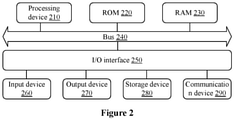
- Figure 2 is a schematic diagram of a structure of the device for processing a music file according to an embodiment of the present disclosure.
- the device composition shown in Figure 2 is only schematic, and is not intended to limit a function and use of the embodiment of the present disclosure.
- the device for processing a music file may include a processing device (such as a Central Processing Unit or a Graphics Processing Unit) 210, which may execute various operations and processing through a program stored in a Read Only Memory (ROM) 220 or a program loaded from a storage device 280 into a Random Access Memory (RAM) 230.
- the RAM 230 is configured to store various programs and data required by the terminal.
- the processing device 210, the ROM 220 and the RAM 230 are connected to each other via a bus 240.
- An Input/output (I/O) interface 250 is also connected to the bus 240.
- the I/O interface 250 may be connected to: an input device 260, such as a touch screen, a touch panel, a keyboard, a mouse, a camera, a microphone, an accelerometer, and a gyroscope; an output device 270, such as a liquid crystal display (LCD), a speaker, and a vibrator; a storage device 280 such as a magnetic tape and a hard disk; and a communication device 290.
- the communication device 290 enables wireless or wired communication between the terminal and other devices for data exchanging.
- Figure 2 shows various devices included, it should be understood that the illustrated devices are not necessarily required to all be implemented or included. Alternatively, more or fewer devices may be implemented or included.
- a procedure described with the provided flowchart may be implemented as a computer program.
- a computer program product is further provided according to an embodiment of the present disclosure.
- the computer program product includes a computer program stored in a computer readable medium.
- the computer program includes program codes for performing the method shown in the flowchart.
- the computer program may be downloaded and installed from the network via the communication device 290, or installed from the storage device 280, or installed from the ROM 220.
- the processing device 210 When the computer program is executed by the processing device 210, the functions defined in the method according to the embodiment of the present disclosure are performed.
- the computer readable medium mentioned herein may be a computer readable signal medium or a computer readable storage medium or any combination thereof.
- the computer readable storage medium may include, but is not limited to, a system, an apparatus, or a device in an electronic, magnetic, optical, electromagnetic, infrared, or semi-conductive form, or any combination thereof.
- the computer readable storage medium may include, but is not limited to, an electrical connection with one or more wires, a portable computer disk, a hard disk, a random access memory (RAM), a read-only memory (ROM), an erasable programmable read-only memory (EPROM or flash memory), an optical fiber, a portable compact disc read-only memory (CD-ROM), a light storage device, a magnetic storage device or any combination thereof.
- the computer readable storage medium may be any tangible medium containing or storing a program, and the program may be used by or in combination with an instruction execution system, apparatus, or device.
- the computer readable signal medium may include a data signal transmitted in a baseband or transmitted as a part of a carrier, and the data signal carries computer readable program codes.
- the transmitted data signal may be in various forms, including but not limited to an electromagnetic signal, an optical signal or any proper combination thereof.
- the computer readable signal medium may be any computer readable medium other than the computer readable storage medium, and can send, propagate or transmit programs to be used by or in combination with an instruction execution system, apparatus or device.
- the program codes stored in the computer readable medium may be transmitted via any proper medium including, but not limited to, a wire, an optical cable, radio frequency (RF) and the like, or any proper combination thereof.
- RF radio frequency
- the computer readable medium may be incorporated in the above-mentioned terminal, or may exist alone without being assembled into the terminal.
- the computer readable medium carries one or more programs.
- the programs when being executed by the terminal, cause the terminal to perform the method for processing a music file provided in the embodiment of the present disclosure.
- the computer program code for performing the operations disclosed in the embodiments of the present disclosure may be written in one or more programming languages or combinations thereof.
- the programming languages include an object-oriented programming language, such as Java, Smalltalk, and C++, and a conventional procedural programming language, such as C language or a similar programming language.
- the program code may be executed entirely on a user computer, partially on the user computer, as a standalone software package, partially on the user computer and partially on a remote computer, or entirely on the remote computer or a server.
- the remote computer may be connected to a user computer or an external computer through any kind of network including a Local Area Network (LAN) or a Wide Area Network (WAN).
- LAN Local Area Network
- WAN Wide Area Network
- the remote computer may be connected to the external computer through an Internet connection supported by an Internet service provider.
- the units and/or modules of the terminal provided in the embodiments of the present disclosure may be implemented by one or more Application Specific Integrated Circuits (ASICs), DSPs, Programmable Logic Devices (PLDs), Complex Programmable Logic Devices (CPLDs), Field-Programmable Gate Arrays (FPGAs) or other electronic elements, in order to perform the method provided in the embodiments of the present disclosure.
- ASICs Application Specific Integrated Circuits
- DSPs Digital Signals
- PLDs Programmable Logic Devices
- CPLDs Complex Programmable Logic Devices
- FPGAs Field-Programmable Gate Arrays
- FIG 3 is a schematic flowchart of a method for processing a music file according to an embodiment of the present disclosure.
- the method for processing a music file includes steps 301 to 304.
- step 301 in response to a received sound effect adjustment instruction, a music file to be adjusted that is instructed by the sound effect adjustment instruction is acquired.
- a terminal is installed with a play client, through which a user may operate to play music.
- the play client has a function of sound effect adjustment.
- the user may trigger the sound effect adjustment instruction through a sound effect adjustment button displayed on a page of the play client, to adjust playing sound effect of the music file.
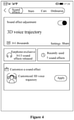
- Figure 4 is a schematic diagram of an interface for sound effect adjustment displayed on a play client according to an embodiment of the present disclosure. Referring to Figure 4 , when the user clicks the sound effect adjustment button, a corresponding sound effect adjustment instruction is triggered.
- the user may trigger the sound effect adjustment instruction before the music file is played, so as to process the sound effect of the music file to be played.
- the user may trigger the sound effect adjustment instruction when the play client is playing music, so as to adjust the sound effect of the music file being played.
- the sound effect adjustment instruction carries a music file identifier
- the terminal acquires a music file represented by the music file identifier from the terminal or the server.
- the music file may be in a format of streaming media (RM format) or non-streaming media (such as Mp4 format).
- the music file acquired by the terminal may be either a complete music file or a segmented music file.
- the play client requests a segment of the music file from the server based on a current playback point for the music file.
- the server returns the corresponding segmented music file to the play client by streaming.
- step 302 a voice and an accompaniment are extracted from the music file to obtain voice data and accompaniment data in the music file.
- the voice and the accompaniment may be extracted from the music file by a neural network model (such as a Recurrent Neural Network (RNN)) obtained by training.
- a neural network model such as a Recurrent Neural Network (RNN)
- music data of the acquired music file is inputted into an input layer of the neural network model.
- the music data is processed through a hidden layer, and extracted voice data and accompaniment data are outputted through the output layer.
- RNN Recurrent Neural Network
- the voice and the accompaniment may be extracted from the music file by means of signal processing. For example, an audio signal corresponding to the music file is acquired and a waveform of the audio signal is determined. Then the voice data and the accompaniment data in the music data included in the music file are determined based on the audio signal waveform.
- step 303 a first sound effect processing is performed on the voice data to obtain target voice data, and a second sound effect processing is performed on the accompaniment data to obtain target accompaniment data.
- a dynamic change rate of the voice may be adjusted based on a rhythm feature of the music file.
- the process of performing the first sound effect processing on the voice data to obtain target voice data may include: acquiring a rhythm parameter corresponding to the accompaniment data, the rhythm parameter characterizing a rhythm of the music file; determining a first adjustment parameter corresponding to the rhythm parameter, the first adjustment parameter being used to adjust the dynamic change rate of the voice; and performing, based on the first adjustment parameter, the first sound effect processing on the voice data to obtain the target voice data.
- the rhythm parameter may be a beat frequency corresponding to the accompaniment data.
- a beat per minute (bmp) of the accompaniment data is calculated, and the first adjustment parameter is determined based on the bmp value of the accompaniment data.
- the beat frequency of the accompaniment data is related to the first adjustment parameter. That is, the faster the rhythm of the music file is, the faster the change rate of the voice is adjusted. In this way, a play effect of the voice and a play effect of the accompaniment are adapted to each other, so that users feel that the voice and the accompaniment are monolithic, thereby improving auditory experience of the users.
- an adjustment parameter for the voice may be preset, and a motion trajectory of the voice may be adjusted through the preset adjustment parameter.
- the process of performing the first sound effect processing on the voice data to obtain the target voice data may include: acquiring a preset second adjustment parameter indicating a target motion trajectory of the voice; and performing, based on the second adjustment parameter, the first sound effect processing on the voice data to obtain the target voice data.
- the target motion trajectory of the voice may be a three-dimensional motion trajectory.
- the target motion trajectory of the voice may be set based on an actual demand.
- Figure 5 is a schematic diagram of a three-dimensional motion trajectory of a voice according to an embodiment of the present disclosure. Referring to Figure 5 , the target motion trajectory of the voice may travel with a reference of a circle on a horizontal plane while going up and down on a vertical plane, the motion trajectory on the vertical plane being a sinusoid or similar to a sinusoid.
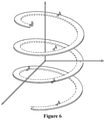
- FIG. 6 is a schematic diagram of the three-dimensional motion trajectory of a voice according to an embodiment of the present disclosure.
- the target motion trajectory of the voice may travel with a reference of a circle on a horizontal plane while going up and down on a vertical plane, the motion trajectory on the vertical plane being an S-curve.
- the user listens to music by means of the play client in the terminal in following scenarios.
- the user is immersed in the music and dances with the mobile phone in hand, or the user taps a rhythm of the music while grasping the mobile phone, the mobile phone moves in accompany with the user with a same motion trajectory.
- the motion trajectory of the terminal may function as the motion trajectory of the voice in the music file.
- the process of performing the first sound effect processing on the voice data to obtain the target voice data may include: determining a motion trajectory of the terminal that plays the music file; generating a third adjustment parameter based on the motion trajectory of the terminal, where a motion trajectory of the voice indicated by the third adjustment parameter is identical to the motion trajectory of the terminal; and performing, based on the third adjustment parameter, the first sound effect processing on the voice data to obtain the target voice data.
- the terminal is provided with a three-axis sensor or a six-axis sensor to accurately capture and record a three-dimensional trajectory of the terminal movement.
- the recorded three-dimensional trajectory of the terminal may be adjusted by, for example, smoothing processing, center position correction, and the like.
- the adjusted three-dimensional trajectory may function as the motion trajectory of the voice.
- Figure 4 when a custom 3D voice trajectory is triggered by the user, the motion trajectory of the terminal functions as the motion trajectory of the voice.
- Figure 7 is a schematic diagram of a three-dimensional motion trajectory of a terminal according to an embodiment of the present disclosure.
- the voice data of the music file is controlled by using the motion trajectory of the terminal as the motion trajectory of the voice, so that the sound heard by the user dynamically changes with a gesture of the user, thereby improving the dynamic sensing of music and user interaction, and thus improving user experience.
- the first sound effect processing on the voice data may be performed by: rendering the voice data in three dimensions based on the first adjustment parameter or the second adjustment parameter or the third adjustment parameter, to obtain the target voice data.
- an HRTF technology or Ambisonic technology may be applied to accurately simulate a 3D effect of sound.
- reverb technology a sense of distance of the sound and a sense of broadness of the sound field can be simulated.
- the process of performing the second sound effect processing on the accompaniment data to obtain the target accompaniment data may include: acquiring a preset accompaniment mode indicating a playback form of the accompaniment data; and performing, based on the acquired accompaniment mode, the second sound effect processing on the accompaniment data to obtain the target accompaniment data.
- multiple accompaniment modes may be preset, such as a surround sound mode.
- the accompaniment presents statically in a form of surround sound around the user.
- the accompaniment data includes accompaniment data corresponding to a certain musical instrument or target musical instrument (such as a drum).
- the accompaniment data corresponding to the target musical instrument may be processed separately.
- the process of performing the second sound effect processing on the accompaniment data to obtain the target accompaniment data may include: extracting the accompaniment data corresponding to the target instrument from the accompaniment data; acquiring a preset fourth adjustment parameter indicating a playing orientation of the target musical instrument; and performing, based on the fourth adjustment parameter, the second sound effect processing on the accompaniment data corresponding to the target musical instrument to obtain the target accompaniment data.
- the accompaniment data corresponding to the drum is processed based on the preset fourth adjustment parameter, so that drum sound dynamically appears at certain orientations, which is similar to a laser light in a nightclub flashing at different positions, thereby improving auditory experience of the user.
- the voice data and and/or the accompaniment data obtained from the music file may be customized based on an additional adjustment parameter.
- an additional adjustment parameter for the music file is acquired, including at least one of pitch, timbre, loudness, and dynamic range; and the voice data and/or the accompaniment data are processed based on the acquired additional adjustment parameter.
- the drum sound data may be enhanced or weakened separately.
- step 304 the target voice data and the target accompaniment data are synthesized to obtain a target music file.
- the obtained target music file may be played and released (uploaded).
- the voice and the accompaniment are extracted from the music file to obtain the voice data and the accompaniment data in the music file; the voice data and the accompaniment data are separately processed for sound effects; and then the processed data is synthesized.
- targeted sound effect adjustments of the voice and the accompaniment in the music file are achieved with high flexibility, and the target music file obtained based on the target voice data and the target accompaniment data suffering from respective sound effect processing has a better play effect, thereby improving user experience.
- Figure 8 is a schematic flowchart of a method for processing a music file according to an embodiment of the present disclosure. The method may be implemented through a play client installed in a terminal. Referring to Figure 8 , the method for processing a music file according to the embodiment of the present disclosure includes steps 401 to 409.
- step 401 a play instruction for a target music triggered by a user is received by the play client.
- the user may trigger the play instruction for the target music by clicking an identifier (such as a music name/icon) of the target music on a music play interface displayed by the play client.
- an identifier such as a music name/icon
- step 402 a music file acquisition request for the target music is sent to a server by the play client.
- the music file acquisition request carries a music file identifier of the target music.
- step 403 a music file of the target music returned by the server is received by the play client.
- step 404 a sound effect adjustment instruction is received by the play client when the music file is being played.
- the user may trigger the sound effect adjustment instruction for the music file being currently played by clicking a sound effect adjustment button on the music play interface displayed by the play client.
- step 405 a voice and an accompaniment are extracted from the music file by the play client to obtain voice data and accompaniment data in the music file.
- step 406 a motion trajectory of a terminal to which the play client belongs is recorded by the play client, and the recorded motion trajectory functions as a motion trajectory of the voice data for processing to obtain target voice data.
- the motion trajectory of the terminal may be recorded through a gyroscope, a gravitational acceleration sensor and other sensors in the terminal.
- step 407 the accompaniment data is processed by the play client based on a preset accompaniment mode to obtain target accompaniment data.
- the accompaniment mode indicates a playback form of the accompaniment data, for example, a form of surround sound.
- step 408 the target voice data and the target accompaniment data are synthesized by the play client to obtain a target music file.
- step 409 the target music file is played and uploaded to the server through the play client.
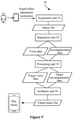
- Figure 9 is a schematic diagram of a structure of a device for processing a music file according to an embodiment of the present disclosure.
- the device for processing a music file includes: an acquisition unit 91, a separating unit 92, a processing unit 93 and a synthesis unit 94.
- the acquisition unit 91 is configured to acquire, in response to a received sound effect adjustment instruction, a music file to be adjusted that is instructed by the sound effect adjustment instruction.
- the separation unit 92 is configured to extract a voice and an accompaniment from the music file to obtain voice data and accompaniment data in the music file.
- the processing unit 93 is configured to perform a first sound effect processing on the voice data to obtain target voice data, and perform a second sound effect processing on the accompaniment data to obtain target accompaniment data.
- the synthesis unit 94 is configured to synthesize the target voice data and the target accompaniment data to obtain a target music file.
- the device further includes a playing unit 95 configured to play the target music file.
- the processing unit is further configured to: acquire a rhythm parameter corresponding to the accompaniment data, the rhythm parameter characterizing a rhythm of the music file; determine a first adjustment parameter corresponding to the rhythm parameter; and perform, based on the first adjustment parameter, the first sound effect processing on the voice data to obtain the target voice data.
- the processing unit is further configured to: acquire a preset second adjustment parameter indicating a target motion trajectory of the voice; and perform, based on the second adjustment parameter, the first sound effect processing on the voice data to obtain the target voice data.
- the processing unit is further configured to: determine a motion trajectory of a terminal that plays the music file; generate a third adjustment parameter based on the motion trajectory of the terminal, where a motion trajectory of the voice indicated by the third adjustment parameter is identical to the motion trajectory of the terminal; and perform, based on the third adjustment parameter, the first sound effect processing on the voice data to obtain the target voice data.
- the processing unit is further configured to: acquire a preset accompaniment mode indicating a playback form of the accompaniment data; and perform, based on the accompaniment mode, the second sound effect processing on the accompaniment data to obtain the target accompaniment data.
- the processing unit is further configured to: extract accompaniment data corresponding to a target musical instrument from the accompaniment data in a case that the accompaniment data includes the accompaniment data corresponding to the target musical instrument; acquire a preset fourth adjustment parameter indicating a playing orientation of the target musical instrument; and perform, based on the fourth adjustment parameter, the second sound effect processing on the accompaniment data corresponding to the target musical instrument to obtain the target accompaniment data.
- the processing unit is further configured to: acquire an additional adjustment parameter for the music file including at least one of pitch, timbre, loudness, and dynamic range; and process at least one of the voice data and the accompaniment data based on the additional adjustment parameter.
- a terminal is further provided according to an embodiment of the present disclosure.
- the terminal includes: a memory configured to store executable instructions; and a processor configured to perform the method for processing a music file provided in the embodiment of the present disclosure when executing the executable instructions stored in the memory.
- a readable storage medium is further provided according to an embodiment of the present disclosure.
- the storage medium may include a mobile storage device, a random access memory (RAM), a read-only memory (ROM), a magnetic disk, an optical disk or other mediums that can store program codes.
- the readable storage medium stores executable instructions. The executable instructions are executed to implement the method for processing a music file provided in the embodiment of the present disclosure.
Landscapes
- Engineering & Computer Science (AREA)
- Physics & Mathematics (AREA)
- Multimedia (AREA)
- Acoustics & Sound (AREA)
- Human Computer Interaction (AREA)
- Theoretical Computer Science (AREA)
- General Engineering & Computer Science (AREA)
- Signal Processing (AREA)
- Health & Medical Sciences (AREA)
- Audiology, Speech & Language Pathology (AREA)
- Computational Linguistics (AREA)
- General Physics & Mathematics (AREA)
- Quality & Reliability (AREA)
- General Health & Medical Sciences (AREA)
- Electrophonic Musical Instruments (AREA)
- Auxiliary Devices For Music (AREA)
Abstract
Description
- This application claims priority to
Chinese Patent Application No. 201910381051.6 - The present disclosure relates to the technical field of computers, and in particular to a method and a device for processing a music file, a terminal and a storage medium.
- With the speed up of pace of life, listening to music has become a common way for relaxing. The sound effect of a piece of music directly affects auditory experience of a user. In the related art, fixed types of sound effects are provided, and an adjustment of sound effect is performed on the entire music based on the type of sound effect chosen by a user. Such processing of sound effects is not flexible. Additionally, because the fixed sound effect type may not be suitable for the music file to be played, and thus the play effect of the processed music file is not good enough, resulting in a poor user experience.
- In view of the above, a method and a device for processing a music file, a terminal and a storage medium are provided in embodiments of the present disclosure.
- A method for processing a music file is provided according to an embodiment of the present disclosure. The method includes: acquiring, in response to a received sound effect adjustment instruction, a music file to be adjusted that is instructed by the sound effect adjustment instruction; extracting a voice and an accompaniment from the music file to obtain voice data and accompaniment data in the music file; performing a first sound effect processing on the voice data to obtain target voice data, and performing a second sound effect processing on the accompaniment data to obtain target accompaniment data; and synthesizing the target voice data and the target accompaniment data to obtain a target music file.
- In the above solution, the performing a first sound effect processing on the voice data to obtain target voice data includes: acquiring a rhythm parameter corresponding to the accompaniment data, the rhythm parameter characterizing a rhythm of the music file; determining a first adjustment parameter corresponding to the rhythm parameter; and performing, based on the first adjustment parameter, the first sound effect processing on the voice data to obtain the target voice data.
- In the above solution, the performing a first sound effect processing on the voice data to obtain target voice data includes: acquiring a preset second adjustment parameter indicating a target motion trajectory of the voice; and performing, based on the second adjustment parameter, the first sound effect processing on the voice data to obtain the target voice data.
- In the above solution, the performing a first sound effect processing on the voice data to obtain target voice data includes: determining a motion trajectory of a terminal that plays the music file; generating a third adjustment parameter based on the motion trajectory of the terminal, where a motion trajectory of the voice indicated by the third adjustment parameter is identical to the motion trajectory of the terminal; and performing, based on the third adjustment parameter, the first sound effect processing on the voice data to obtain the target voice data.
- In the above solution, the performing a second sound effect processing on the accompaniment data to obtain target accompaniment data includes: acquiring a preset accompaniment mode indicating a playback form of the accompaniment data; and performing, based on the accompaniment mode, the second sound effect processing on the accompaniment data to obtain the target accompaniment data.
- In the above solution, the performing a second sound effect processing on the accompaniment data to obtain target accompaniment data includes: extracting accompaniment data corresponding to a target musical instrument from the accompaniment data in a case that the accompaniment data includes the accompaniment data corresponding to the target musical instrument; acquiring a preset fourth adjustment parameter indicating a playing orientation of the target musical instrument; and performing, based on the fourth adjustment parameter, the second sound effect processing on the accompaniment data corresponding to the target musical instrument to obtain the target accompaniment data.
- The method further includes: acquiring an additional adjustment parameter for the music file including at least one of pitch, timbre, loudness, and dynamic range; and processing at least one of the voice data and the accompaniment data based on the additional adjustment parameter.
- A device for processing a music file is further provided according to an embodiment of the present disclosure. The device includes: an acquisition unit, a separation unit, a processing unit and a synthesis unit. The acquisition unit is configured to acquire, in response to a received sound effect adjustment instruction, a music file to be adjusted that is instructed by the sound effect adjustment instruction. The separation unit is configured to extract a voice and an accompaniment from the music file to obtain voice data and accompaniment data in the music file. The processing unit is configured to perform a first sound effect processing on the voice data to obtain target voice data, and perform a second sound effect processing on the accompaniment data to obtain target accompaniment data. The synthesis unit is configured to synthesize the target voice data and the target accompaniment data to obtain a target music file.
- In the above solution, the processing unit is further configured to: acquire a rhythm parameter corresponding to the accompaniment data, the rhythm parameter characterizing a rhythm of the music file; determine a first adjustment parameter corresponding to the rhythm parameter; and perform, based on the first adjustment parameter, the first sound effect processing on the voice data to obtain the target voice data.
- In the above solution, the processing unit is further configured to: acquire a preset second adjustment parameter indicating a target motion trajectory of the voice; and perform, based on the second adjustment parameter, the first sound effect processing on the voice data to obtain the target voice data.
- In the above solution, the processing unit is further configured to: determine a motion trajectory of a terminal that plays the music file; generate a third adjustment parameter based on the motion trajectory of the terminal, where a motion trajectory of the voice indicated by the third adjustment parameter is identical to the motion trajectory of the terminal; and perform, based on the third adjustment parameter, the first sound effect processing on the voice data to obtain the target voice data.
- In the above solution, the processing unit is further configured to: acquire a preset accompaniment mode indicating a playback form of the accompaniment data; and perform, based on the accompaniment mode, the second sound effect processing on the accompaniment data to obtain the target accompaniment data.
- In the above solution, the processing unit is further configured to: extract accompaniment data corresponding to a target musical instrument from the accompaniment data in a case that the accompaniment data includes the accompaniment data corresponding to the target musical instrument; acquire a preset fourth adjustment parameter indicating a playing orientation of the target musical instrument; and perform, based on the fourth adjustment parameter, the second sound effect processing on the accompaniment data corresponding to the target musical instrument to obtain the target accompaniment data.
- In the above solution, the processing unit is further configured to: acquire an additional adjustment parameter for the music file including at least one of pitch, timbre, loudness, and dynamic range; and process at least one of the voice data and the accompaniment data based on the additional adjustment parameter.
- A terminal is further provided according to an embodiment of the present disclosure. The terminal includes a memory configured to store executable instructions; and a processor configured to perform the method for processing a music file provided in the embodiment of the present disclosure when executing the executable instructions stored in the memory.
- A storage medium storing executable instructions is further provided according to an embodiment of the present disclosure. The executable instructions are executed to implement the method for processing a music file according to the embodiment of the present disclosure.
- Beneficial effects of the embodiments of the present disclosure are as follows. According to the above embodiments of the present disclosure, the voice and the accompaniment are extracted from the music file to obtain the voice data and the accompaniment data in the music file; the voice data and the accompaniment data are separately processed for sound effects; and then the processed data is synthesized. In this way, targeted sound effect adjustments of the voice and the accompaniment in the music file are achieved with high flexibility, and the target music file obtained based on the target voice data and the target accompaniment data suffering from respective sound effect processing has a better play effect, thereby improving user experience.
-
-
Figure 1 is a schematic architectural diagram of a system for processing a music file according to an embodiment of the present disclosure; -
Figure 2 is a schematic diagram of a structure of a device for processing a music file according to an embodiment of the present disclosure; -
Figure 3 is a schematic flowchart of a method for processing a music file according to an embodiment of the present disclosure; -
Figure 4 is a schematic diagram of an interface for sound effect adjustment displayed on a play client according to an embodiment of the present disclosure; -
Figure 5 is a schematic diagram of a three-dimensional motion trajectory of a voice according to an embodiment of the present disclosure; -
Figure 6 is a schematic diagram of a three-dimensional motion trajectory of a voice according to an embodiment of the present disclosure; -
Figure 7 is a schematic diagram of a three-dimensional motion trajectory of a terminal according to an embodiment of the present disclosure; -
Figure 8 is a schematic flowchart of a method for processing a music file according to an embodiment of the present disclosure; and -
Figure 9 is a schematic diagram of a structure of a device for processing a music file according to an embodiment of the present disclosure. - In the following description, an expression "some embodiments" is used to describe a subset of all possible embodiments. However, it should be understood that the "some embodiments" may indicate same or different subsets of all the possible embodiments, and the subsets may be combined with each other without a conflict.
- Unless otherwise defined, all technical and scientific terms used herein have the same meanings as those commonly comprehended by the skilled in the art. Terms used herein are only for the purpose of describing detailed embodiments and are not intended to limit the present disclosure.
- Flowcharts and block diagrams in the drawings of the present disclosure illustrate the architecture, functions and operations that can be implemented by the system, method and computer program product according to the embodiments of the present disclosure. Each block in a flowchart or a block diagram may represent a module, a program segment, or a part of code, and part of the module, program segment, or part of code contains one or more executable instructions for implementing the specified logical function. It should be noted that, in some alternative implementations, the functions marked in blocks may be performed in an order different from the order shown in the drawings. For example, two blocks shown in succession may actually be executed in parallel, or sometimes may be executed in a reverse order, which depends on the functions involved. It is to be noted that each block in a block diagram and/or flowchart, and a combination of the blocks in a block diagram and/or flowchart, may be implemented by a dedicated hardware-based system that performs the specified functions or operations, or may be realized by a combination of dedicated hardware and computer instructions.
- Reference is made to
Figure 1 , which is a schematic architectural diagram of a system for processing a music file according to an embodiment of the present disclosure. In order to support an exemplary application, a terminal 400 (which includes a terminal 400-1 (including a graphical interface 410-1) and a terminal 400-2 (including a graphical interface 410-2)) is connected to aserver 200 through anetwork 300. The terminal is installed with a play client, through which a user can operate to play music. Thenetwork 300 may be a Wide Area Network or a Local Area Network, or a combination thereof, and thenetwork 300 performs data transmission through wireless links. - The terminal 400 (such as the terminal 400-1) is configured to send, in response to a received sound effect adjustment instruction, an acquisition request for a music file to the
server 200. - The
server 200 is configured to return the corresponding music file in response to the received acquisition request. - The terminal 400 (such as the terminal 400-1) is further configured to: extract a voice and an accompaniment from the received music file to obtain voice data and accompaniment data in the music file; perform a first sound effect processing on the voice data to obtain target voice data, and perform a second sound effect processing on the accompaniment data to obtain a target accompaniment data; and synthesize the target voice data and the target accompaniment data to obtain a target music file.
- The expression "in response to" used herein indicates a condition or state that an execution of an operation depends on. When the condition or state is satisfied, one or more operations may be executed in real time or with a set delay. Unless otherwise specified, the order in which multiple operations are executed is not limited.
- In some embodiment, the terminal 400 (such as the terminal 400-1) is installed with a play client, through which the terminal may play music. When a user triggers a sound effect adjustment instruction, the play client acquires a music file to be adjusted that is instructed by the sound effect adjustment instruction. A voice and an accompaniment are extracted from the music file to obtain voice data and accompaniment data in the music file. A first sound effect processing is performed on the voice data to obtain target voice data, and a second sound effect processing is performed on the accompaniment data to obtain target accompaniment data. The target voice data and the target accompaniment data are synthesized to obtain a target music file. The target music file is played.
- A device for processing a music file according to an embodiment of the present disclosure is illustrated hereinafter. The device for processing a music file according to the embodiment of the present disclosure may be implemented in various forms. For example, the device may be implemented by a standalone terminal such as a smart phone, a tablet computer, a desktop computer, or may be implemented by a terminal and a server in cooperation. The device for processing a music file according to the embodiment of the present disclosure may be implemented in a manner of hardware, software, or a combination thereof. Various exemplary implementations of the device for processing a music file provided in the embodiments of the present disclosure are described below.
- A hardware structure of the device for processing a music file according to an embodiment of the present disclosure is described in detail below.
Figure 2 is a schematic diagram of a structure of the device for processing a music file according to an embodiment of the present disclosure. The device composition shown inFigure 2 is only schematic, and is not intended to limit a function and use of the embodiment of the present disclosure. - As shown in
Figure 2 , the device for processing a music file may include a processing device (such as a Central Processing Unit or a Graphics Processing Unit) 210, which may execute various operations and processing through a program stored in a Read Only Memory (ROM) 220 or a program loaded from astorage device 280 into a Random Access Memory (RAM) 230. TheRAM 230 is configured to store various programs and data required by the terminal. Theprocessing device 210, theROM 220 and theRAM 230 are connected to each other via a bus 240. An Input/output (I/O)interface 250 is also connected to the bus 240. - Generally, the I/
O interface 250 may be connected to: aninput device 260, such as a touch screen, a touch panel, a keyboard, a mouse, a camera, a microphone, an accelerometer, and a gyroscope; anoutput device 270, such as a liquid crystal display (LCD), a speaker, and a vibrator; astorage device 280 such as a magnetic tape and a hard disk; and acommunication device 290. Thecommunication device 290 enables wireless or wired communication between the terminal and other devices for data exchanging. AlthoughFigure 2 shows various devices included, it should be understood that the illustrated devices are not necessarily required to all be implemented or included. Alternatively, more or fewer devices may be implemented or included. - Particularly, according to an embodiment of the present disclosure, a procedure described with the provided flowchart may be implemented as a computer program. For example, a computer program product is further provided according to an embodiment of the present disclosure. The computer program product includes a computer program stored in a computer readable medium. The computer program includes program codes for performing the method shown in the flowchart. In the embodiment, the computer program may be downloaded and installed from the network via the
communication device 290, or installed from thestorage device 280, or installed from theROM 220. When the computer program is executed by theprocessing device 210, the functions defined in the method according to the embodiment of the present disclosure are performed. - It is to be noted that, the computer readable medium mentioned herein may be a computer readable signal medium or a computer readable storage medium or any combination thereof. The computer readable storage medium may include, but is not limited to, a system, an apparatus, or a device in an electronic, magnetic, optical, electromagnetic, infrared, or semi-conductive form, or any combination thereof. The computer readable storage medium may include, but is not limited to, an electrical connection with one or more wires, a portable computer disk, a hard disk, a random access memory (RAM), a read-only memory (ROM), an erasable programmable read-only memory (EPROM or flash memory), an optical fiber, a portable compact disc read-only memory (CD-ROM), a light storage device, a magnetic storage device or any combination thereof.
- In the embodiment of the present disclosure, the computer readable storage medium may be any tangible medium containing or storing a program, and the program may be used by or in combination with an instruction execution system, apparatus, or device. In the embodiment of the present disclosure, the computer readable signal medium may include a data signal transmitted in a baseband or transmitted as a part of a carrier, and the data signal carries computer readable program codes. The transmitted data signal may be in various forms, including but not limited to an electromagnetic signal, an optical signal or any proper combination thereof. The computer readable signal medium may be any computer readable medium other than the computer readable storage medium, and can send, propagate or transmit programs to be used by or in combination with an instruction execution system, apparatus or device. The program codes stored in the computer readable medium may be transmitted via any proper medium including, but not limited to, a wire, an optical cable, radio frequency (RF) and the like, or any proper combination thereof.
- The computer readable medium may be incorporated in the above-mentioned terminal, or may exist alone without being assembled into the terminal.
- The computer readable medium carries one or more programs. The programs, when being executed by the terminal, cause the terminal to perform the method for processing a music file provided in the embodiment of the present disclosure.
- The computer program code for performing the operations disclosed in the embodiments of the present disclosure may be written in one or more programming languages or combinations thereof. The programming languages include an object-oriented programming language, such as Java, Smalltalk, and C++, and a conventional procedural programming language, such as C language or a similar programming language. The program code may be executed entirely on a user computer, partially on the user computer, as a standalone software package, partially on the user computer and partially on a remote computer, or entirely on the remote computer or a server. In a case involving a remote computer, the remote computer may be connected to a user computer or an external computer through any kind of network including a Local Area Network (LAN) or a Wide Area Network (WAN). For example, the remote computer may be connected to the external computer through an Internet connection supported by an Internet service provider.
- The units and/or modules mentioned in the embodiments of the present disclosure may be implemented by means of software or hardware.
- In terms of a hardware implementation, the units and/or modules of the terminal provided in the embodiments of the present disclosure may be implemented by one or more Application Specific Integrated Circuits (ASICs), DSPs, Programmable Logic Devices (PLDs), Complex Programmable Logic Devices (CPLDs), Field-Programmable Gate Arrays (FPGAs) or other electronic elements, in order to perform the method provided in the embodiments of the present disclosure.
-
Figure 3 is a schematic flowchart of a method for processing a music file according to an embodiment of the present disclosure. Referring toFigure 3 , the method for processing a music file includessteps 301 to 304. - In
step 301, in response to a received sound effect adjustment instruction, a music file to be adjusted that is instructed by the sound effect adjustment instruction is acquired. - In a practical application, a terminal is installed with a play client, through which a user may operate to play music. The play client has a function of sound effect adjustment. For example, the user may trigger the sound effect adjustment instruction through a sound effect adjustment button displayed on a page of the play client, to adjust playing sound effect of the music file.
Figure 4 is a schematic diagram of an interface for sound effect adjustment displayed on a play client according to an embodiment of the present disclosure. Referring toFigure 4 , when the user clicks the sound effect adjustment button, a corresponding sound effect adjustment instruction is triggered. - In some embodiments, the user may trigger the sound effect adjustment instruction before the music file is played, so as to process the sound effect of the music file to be played. Alternatively, the user may trigger the sound effect adjustment instruction when the play client is playing music, so as to adjust the sound effect of the music file being played.
- In some embodiments, the sound effect adjustment instruction carries a music file identifier, and the terminal acquires a music file represented by the music file identifier from the terminal or the server. In a practical application, the music file may be in a format of streaming media (RM format) or non-streaming media (such as Mp4 format). Correspondingly, the music file acquired by the terminal may be either a complete music file or a segmented music file. For example, when playing the music file, the play client requests a segment of the music file from the server based on a current playback point for the music file. The server returns the corresponding segmented music file to the play client by streaming.
- In
step 302, a voice and an accompaniment are extracted from the music file to obtain voice data and accompaniment data in the music file. - In some embodiments, the voice and the accompaniment may be extracted from the music file by a neural network model (such as a Recurrent Neural Network (RNN)) obtained by training. For example, music data of the acquired music file is inputted into an input layer of the neural network model. The music data is processed through a hidden layer, and extracted voice data and accompaniment data are outputted through the output layer.
- In some embodiments, the voice and the accompaniment may be extracted from the music file by means of signal processing. For example, an audio signal corresponding to the music file is acquired and a waveform of the audio signal is determined. Then the voice data and the accompaniment data in the music data included in the music file are determined based on the audio signal waveform.
- In
step 303, a first sound effect processing is performed on the voice data to obtain target voice data, and a second sound effect processing is performed on the accompaniment data to obtain target accompaniment data. - In some embodiments, a dynamic change rate of the voice may be adjusted based on a rhythm feature of the music file. Specifically, the process of performing the first sound effect processing on the voice data to obtain target voice data may include: acquiring a rhythm parameter corresponding to the accompaniment data, the rhythm parameter characterizing a rhythm of the music file; determining a first adjustment parameter corresponding to the rhythm parameter, the first adjustment parameter being used to adjust the dynamic change rate of the voice; and performing, based on the first adjustment parameter, the first sound effect processing on the voice data to obtain the target voice data.
- In practice, the rhythm parameter may be a beat frequency corresponding to the accompaniment data. Specifically, a beat per minute (bmp) of the accompaniment data is calculated, and the first adjustment parameter is determined based on the bmp value of the accompaniment data. In some embodiments, the beat frequency of the accompaniment data is related to the first adjustment parameter. That is, the faster the rhythm of the music file is, the faster the change rate of the voice is adjusted. In this way, a play effect of the voice and a play effect of the accompaniment are adapted to each other, so that users feel that the voice and the accompaniment are monolithic, thereby improving auditory experience of the users.
- In some embodiments, an adjustment parameter for the voice may be preset, and a motion trajectory of the voice may be adjusted through the preset adjustment parameter. Specifically, the process of performing the first sound effect processing on the voice data to obtain the target voice data may include: acquiring a preset second adjustment parameter indicating a target motion trajectory of the voice; and performing, based on the second adjustment parameter, the first sound effect processing on the voice data to obtain the target voice data.
- In practice, as shown in
Figure 4 , in a case that a 3D voice trajectory included in the sound effect adjustment is triggered by the user, the target motion trajectory of the voice may be a three-dimensional motion trajectory. The target motion trajectory of the voice may be set based on an actual demand.Figure 5 is a schematic diagram of a three-dimensional motion trajectory of a voice according to an embodiment of the present disclosure. Referring toFigure 5 , the target motion trajectory of the voice may travel with a reference of a circle on a horizontal plane while going up and down on a vertical plane, the motion trajectory on the vertical plane being a sinusoid or similar to a sinusoid. Reference is made toFigure 6 , which is a schematic diagram of the three-dimensional motion trajectory of a voice according to an embodiment of the present disclosure. The target motion trajectory of the voice may travel with a reference of a circle on a horizontal plane while going up and down on a vertical plane, the motion trajectory on the vertical plane being an S-curve. - The user listens to music by means of the play client in the terminal in following scenarios. In which, the user is immersed in the music and dances with the mobile phone in hand, or the user taps a rhythm of the music while grasping the mobile phone, the mobile phone moves in accompany with the user with a same motion trajectory. In some embodiments, based on the music playing scenario, the motion trajectory of the terminal may function as the motion trajectory of the voice in the music file. Specifically, the process of performing the first sound effect processing on the voice data to obtain the target voice data may include: determining a motion trajectory of the terminal that plays the music file; generating a third adjustment parameter based on the motion trajectory of the terminal, where a motion trajectory of the voice indicated by the third adjustment parameter is identical to the motion trajectory of the terminal; and performing, based on the third adjustment parameter, the first sound effect processing on the voice data to obtain the target voice data.
- In practice, the terminal is provided with a three-axis sensor or a six-axis sensor to accurately capture and record a three-dimensional trajectory of the terminal movement. The recorded three-dimensional trajectory of the terminal may be adjusted by, for example, smoothing processing, center position correction, and the like. The adjusted three-dimensional trajectory may function as the motion trajectory of the voice. As shown in
Figure 4 , when acustom 3D voice trajectory is triggered by the user, the motion trajectory of the terminal functions as the motion trajectory of the voice.Figure 7 is a schematic diagram of a three-dimensional motion trajectory of a terminal according to an embodiment of the present disclosure. The voice data of the music file is controlled by using the motion trajectory of the terminal as the motion trajectory of the voice, so that the sound heard by the user dynamically changes with a gesture of the user, thereby improving the dynamic sensing of music and user interaction, and thus improving user experience. - In some embodiments, the first sound effect processing on the voice data may be performed by: rendering the voice data in three dimensions based on the first adjustment parameter or the second adjustment parameter or the third adjustment parameter, to obtain the target voice data. For example, an HRTF technology or Ambisonic technology may be applied to accurately simulate a 3D effect of sound. Additionally, with appropriate reverb technology, a sense of distance of the sound and a sense of broadness of the sound field can be simulated.
- In some embodiments, the process of performing the second sound effect processing on the accompaniment data to obtain the target accompaniment data may include: acquiring a preset accompaniment mode indicating a playback form of the accompaniment data; and performing, based on the acquired accompaniment mode, the second sound effect processing on the accompaniment data to obtain the target accompaniment data.
- In practice, multiple accompaniment modes may be preset, such as a surround sound mode. When the surround sound mode is applied, the accompaniment presents statically in a form of surround sound around the user.
- In practice, the accompaniment data includes accompaniment data corresponding to a certain musical instrument or target musical instrument (such as a drum). The accompaniment data corresponding to the target musical instrument may be processed separately. In some embodiments, the process of performing the second sound effect processing on the accompaniment data to obtain the target accompaniment data may include: extracting the accompaniment data corresponding to the target instrument from the accompaniment data; acquiring a preset fourth adjustment parameter indicating a playing orientation of the target musical instrument; and performing, based on the fourth adjustment parameter, the second sound effect processing on the accompaniment data corresponding to the target musical instrument to obtain the target accompaniment data.
- In an example where the target musical instrument is a drum, the accompaniment data corresponding to the drum is processed based on the preset fourth adjustment parameter, so that drum sound dynamically appears at certain orientations, which is similar to a laser light in a nightclub flashing at different positions, thereby improving auditory experience of the user.
- In some embodiments, the voice data and and/or the accompaniment data obtained from the music file may be customized based on an additional adjustment parameter. Specifically, an additional adjustment parameter for the music file is acquired, including at least one of pitch, timbre, loudness, and dynamic range; and the voice data and/or the accompaniment data are processed based on the acquired additional adjustment parameter. Practically, in a case that the accompaniment data includes drum sound data, the drum sound data may be enhanced or weakened separately.
-
Instep 304, the target voice data and the target accompaniment data are synthesized to obtain a target music file. - In some embodiments, the obtained target music file may be played and released (uploaded).
- According to the above embodiments of the present disclosure, the voice and the accompaniment are extracted from the music file to obtain the voice data and the accompaniment data in the music file; the voice data and the accompaniment data are separately processed for sound effects; and then the processed data is synthesized. In this way, targeted sound effect adjustments of the voice and the accompaniment in the music file are achieved with high flexibility, and the target music file obtained based on the target voice data and the target accompaniment data suffering from respective sound effect processing has a better play effect, thereby improving user experience.
-
Figure 8 is a schematic flowchart of a method for processing a music file according to an embodiment of the present disclosure. The method may be implemented through a play client installed in a terminal. Referring toFigure 8 , the method for processing a music file according to the embodiment of the present disclosure includes steps 401 to 409. - In step 401, a play instruction for a target music triggered by a user is received by the play client.
- In practice, the user may trigger the play instruction for the target music by clicking an identifier (such as a music name/icon) of the target music on a music play interface displayed by the play client.
- In step 402, a music file acquisition request for the target music is sent to a server by the play client.
- In practice, the music file acquisition request carries a music file identifier of the target music.
- In step 403, a music file of the target music returned by the server is received by the play client.
- In step 404, a sound effect adjustment instruction is received by the play client when the music file is being played.
- In a practical application, the user may trigger the sound effect adjustment instruction for the music file being currently played by clicking a sound effect adjustment button on the music play interface displayed by the play client.
- In step 405, a voice and an accompaniment are extracted from the music file by the play client to obtain voice data and accompaniment data in the music file.
- In step 406, a motion trajectory of a terminal to which the play client belongs is recorded by the play client, and the recorded motion trajectory functions as a motion trajectory of the voice data for processing to obtain target voice data.
- Here, the motion trajectory of the terminal may be recorded through a gyroscope, a gravitational acceleration sensor and other sensors in the terminal.
- In step 407, the accompaniment data is processed by the play client based on a preset accompaniment mode to obtain target accompaniment data.
- Here, the accompaniment mode indicates a playback form of the accompaniment data, for example, a form of surround sound.
- In step 408, the target voice data and the target accompaniment data are synthesized by the play client to obtain a target music file.
- In step 409, the target music file is played and uploaded to the server through the play client.
- A software implementation of the device for processing a music file according to an embodiment of the present disclosure is further illustrated as follows.
Figure 9 is a schematic diagram of a structure of a device for processing a music file according to an embodiment of the present disclosure. Referring toFigure 9 , the device for processing a music file includes: anacquisition unit 91, a separatingunit 92, aprocessing unit 93 and asynthesis unit 94. Theacquisition unit 91 is configured to acquire, in response to a received sound effect adjustment instruction, a music file to be adjusted that is instructed by the sound effect adjustment instruction. Theseparation unit 92 is configured to extract a voice and an accompaniment from the music file to obtain voice data and accompaniment data in the music file. Theprocessing unit 93 is configured to perform a first sound effect processing on the voice data to obtain target voice data, and perform a second sound effect processing on the accompaniment data to obtain target accompaniment data. Thesynthesis unit 94 is configured to synthesize the target voice data and the target accompaniment data to obtain a target music file. - In some embodiments, the device further includes a playing unit 95 configured to play the target music file.
- In some embodiments, the processing unit is further configured to: acquire a rhythm parameter corresponding to the accompaniment data, the rhythm parameter characterizing a rhythm of the music file; determine a first adjustment parameter corresponding to the rhythm parameter; and perform, based on the first adjustment parameter, the first sound effect processing on the voice data to obtain the target voice data.
- In some embodiments, the processing unit is further configured to: acquire a preset second adjustment parameter indicating a target motion trajectory of the voice; and perform, based on the second adjustment parameter, the first sound effect processing on the voice data to obtain the target voice data.
- In some embodiments, the processing unit is further configured to: determine a motion trajectory of a terminal that plays the music file; generate a third adjustment parameter based on the motion trajectory of the terminal, where a motion trajectory of the voice indicated by the third adjustment parameter is identical to the motion trajectory of the terminal; and perform, based on the third adjustment parameter, the first sound effect processing on the voice data to obtain the target voice data.
- In some embodiments, the processing unit is further configured to: acquire a preset accompaniment mode indicating a playback form of the accompaniment data; and perform, based on the accompaniment mode, the second sound effect processing on the accompaniment data to obtain the target accompaniment data.
- In some embodiments, the processing unit is further configured to: extract accompaniment data corresponding to a target musical instrument from the accompaniment data in a case that the accompaniment data includes the accompaniment data corresponding to the target musical instrument; acquire a preset fourth adjustment parameter indicating a playing orientation of the target musical instrument; and perform, based on the fourth adjustment parameter, the second sound effect processing on the accompaniment data corresponding to the target musical instrument to obtain the target accompaniment data.
- In some embodiments, the processing unit is further configured to: acquire an additional adjustment parameter for the music file including at least one of pitch, timbre, loudness, and dynamic range; and process at least one of the voice data and the accompaniment data based on the additional adjustment parameter.
- It should be noted that the foregoing description related to the device for processing a music file is similar to the foregoing description of the method for processing a music file. Beneficial effect of the device is similar to that of the method, and is not repeated herein. For technical details that are not disclosed in the device embodiments of the present disclosure, one may refer to the description of the method embodiments of the present disclosure.
- A terminal is further provided according to an embodiment of the present disclosure. The terminal includes: a memory configured to store executable instructions; and a processor configured to perform the method for processing a music file provided in the embodiment of the present disclosure when executing the executable instructions stored in the memory.
- A readable storage medium is further provided according to an embodiment of the present disclosure. The storage medium may include a mobile storage device, a random access memory (RAM), a read-only memory (ROM), a magnetic disk, an optical disk or other mediums that can store program codes. The readable storage medium stores executable instructions. The executable instructions are executed to implement the method for processing a music file provided in the embodiment of the present disclosure.
- Only specific embodiments of the present disclosure are described above, and the scope of protection of the present disclosure is not limited thereto. Changes and substitutions which may be easily contemplated by those skilled in the art within the technical scope disclosed in the present disclosure shall fall within the scope of protection of the present disclosure. Therefore, the scope of protection of the present disclosure shall be defined by the appended claims.
Claims (16)
- A method for processing a music file, comprising:acquiring, in response to a received sound effect adjustment instruction, a music file to be adjusted that is instructed by the sound effect adjustment instruction;extracting a voice and an accompaniment from the music file to obtain voice data and accompaniment data in the music file;performing a first sound effect processing on the voice data to obtain target voice data, and performing a second sound effect processing on the accompaniment data to obtain target accompaniment data; andsynthesizing the target voice data and the target accompaniment data to obtain a target music file.
- The method according to claim 1, wherein the performing a first sound effect processing on the voice data to obtain target voice data comprises:acquiring a rhythm parameter corresponding to the accompaniment data, the rhythm parameter characterizing a rhythm of the music file;determining a first adjustment parameter corresponding to the rhythm parameter; andperforming, based on the first adjustment parameter, the first sound effect processing on the voice data to obtain the target voice data.
- The method according to claim 1, wherein the performing a first sound effect processing on the voice data to obtain target voice data comprises:acquiring a preset second adjustment parameter indicating a target motion trajectory of the voice; andperforming, based on the second adjustment parameter, the first sound effect processing on the voice data to obtain the target voice data.
- The method according to claim 1, wherein the performing a first sound effect processing on the voice data to obtain target voice data comprises:determining a motion trajectory of a terminal that plays the music file;generating a third adjustment parameter based on the motion trajectory of the terminal, wherein a motion trajectory of the voice indicated by the third adjustment parameter is identical to the motion trajectory of the terminal; andperforming, based on the third adjustment parameter, the first sound effect processing on the voice data to obtain the target voice data.
- The method according to claim 1, wherein the performing a second sound effect processing on the accompaniment data to obtain target accompaniment data comprises:acquiring a preset accompaniment mode indicating a playback form of the accompaniment data; andperforming, based on the accompaniment mode, the second sound effect processing on the accompaniment data to obtain the target accompaniment data.
- The method according to claim 1, wherein the performing a second sound effect processing on the accompaniment data to obtain target accompaniment data comprises:extracting accompaniment data corresponding to a target musical instrument from the accompaniment data in a case that the accompaniment data comprises the accompaniment data corresponding to the target musical instrument;acquiring a preset fourth adjustment parameter indicating a playing orientation of the target musical instrument; andperforming, based on the fourth adjustment parameter, the second sound effect processing on the accompaniment data corresponding to the target musical instrument to obtain the target accompaniment data.
- The method according to claim 1, further comprising:acquiring an additional adjustment parameter for the music file comprising at least one of pitch, timbre, loudness, and dynamic range; andprocessing at least one of the voice data and the accompaniment data based on the additional adjustment parameter.
- A device for processing a music file, comprising:an acquisition unit configured to acquire, in response to a received sound effect adjustment instruction, a music file to be adjusted that is instructed by the sound effect adjustment instruction;a separation unit configured to extract a voice and an accompaniment from the music file to obtain voice data and accompaniment data in the music file;a processing unit configured to perform a first sound effect processing on the voice data to obtain target voice data, and perform a second sound effect processing on the accompaniment data to obtain target accompaniment data; anda synthesis unit configured to synthesize the target voice data and the target accompaniment data to obtain a target music file.
- The device according to claim 8, wherein the processing unit is further configured to:acquire a rhythm parameter corresponding to the accompaniment data, the rhythm parameter characterizing a rhythm of the music file;determine a first adjustment parameter corresponding to the rhythm parameter; andperform, based on the first adjustment parameter, the first sound effect processing on the voice data to obtain the target voice data.
- The device according to claim 8, wherein the processing unit is further configured to:acquire a preset second adjustment parameter indicating a target motion trajectory of the voice; andperform, based on the second adjustment parameter, the first sound effect processing on the voice data to obtain the target voice data.
- The device according to claim 8, wherein the processing unit is further configured to:determine a motion trajectory of a terminal that plays the music file;generate a third adjustment parameter based on the motion trajectory of the terminal, wherein a motion trajectory of the voice indicated by the third adjustment parameter is identical to the motion trajectory of the terminal; andperform, based on the third adjustment parameter, the first sound effect processing on the voice data to obtain the target voice data.
- The device according to claim 8, wherein the processing unit is further configured to:acquire a preset accompaniment mode indicating a playback form of the accompaniment data; andperform, based on the accompaniment mode, the second sound effect processing on the accompaniment data to obtain the target accompaniment data.
- The device according to claim 8, wherein the processing unit is further configured to:extract accompaniment data corresponding to a target musical instrument from the accompaniment data in a case that the accompaniment data comprises the accompaniment data corresponding to the target musical instrument;acquire a preset fourth adjustment parameter indicating a playing orientation of the target musical instrument; andperform, based on the fourth adjustment parameter, the second sound effect processing on the accompaniment data corresponding to the target musical instrument to obtain the target accompaniment data.
- The device according to claim 8, wherein the processing unit is further configured to:acquire an additional adjustment parameter for the music file comprising at least one of pitch, timbre, loudness, and dynamic range; andprocess at least one of the voice data and the accompaniment data based on the additional adjustment parameter.
- A terminal, comprising:a memory configured to store executable instructions; anda processor configured to perform the method for processing a music file according to any one of claims 1 to 7 when executing the executable instructions stored in the memory.
- A storage medium storing executable instructions, wherein the executable instructions are executed to implement the method for processing a music file according to any one of claims 1 to 7.
Applications Claiming Priority (2)
| Application Number | Priority Date | Filing Date | Title |
|---|---|---|---|
| CN201910381051.6A CN111916039B (en) | 2019-05-08 | 2019-05-08 | Music file processing method, device, terminal and storage medium |
| PCT/CN2020/078869 WO2020224322A1 (en) | 2019-05-08 | 2020-03-11 | Method and device for processing music file, terminal and storage medium |
Publications (3)
| Publication Number | Publication Date |
|---|---|
| EP3940690A1 true EP3940690A1 (en) | 2022-01-19 |
| EP3940690A4 EP3940690A4 (en) | 2022-05-18 |
| EP3940690B1 EP3940690B1 (en) | 2024-11-06 |
Family
ID=73050571
Family Applications (1)
| Application Number | Title | Priority Date | Filing Date |
|---|---|---|---|
| EP20801727.7A Active EP3940690B1 (en) | 2019-05-08 | 2020-03-11 | Method and device for processing music file, terminal and storage medium |
Country Status (5)
| Country | Link |
|---|---|
| US (1) | US11514923B2 (en) |
| EP (1) | EP3940690B1 (en) |
| CN (1) | CN111916039B (en) |
| SG (1) | SG11202111759XA (en) |
| WO (1) | WO2020224322A1 (en) |
Cited By (2)
| Publication number | Priority date | Publication date | Assignee | Title |
|---|---|---|---|---|
| WO2023217352A1 (en) * | 2022-05-09 | 2023-11-16 | Algoriddim Gmbh | Reactive dj system for the playback and manipulation of music based on energy levels and musical features |
| EP4524952A4 (en) * | 2022-05-07 | 2026-04-29 | Beijing Zitiao Network Technology Co Ltd | AUDIO PROCESSING METHOD AND DEVICE, DEVICE AND STORAGE MEDIUM |
Families Citing this family (11)
| Publication number | Priority date | Publication date | Assignee | Title |
|---|---|---|---|---|
| JP7505830B2 (en) * | 2020-10-22 | 2024-06-25 | ガウディオ・ラボ・インコーポレイテッド | Audio signal processing device including multiple signal components using machine learning model |
| CN112967705B (en) * | 2021-02-24 | 2023-11-28 | 腾讯音乐娱乐科技(深圳)有限公司 | Method, device, equipment and storage medium for generating mixed song |
| CN113055809B (en) * | 2021-03-12 | 2023-02-28 | 腾讯音乐娱乐科技(深圳)有限公司 | 5.1 sound channel signal generation method, equipment and medium |
| CN113393857B (en) * | 2021-06-10 | 2024-06-14 | 腾讯音乐娱乐科技(深圳)有限公司 | Method, equipment and medium for eliminating human voice of music signal |
| CN113488005A (en) * | 2021-07-05 | 2021-10-08 | 福建星网视易信息系统有限公司 | Musical instrument ensemble method and computer-readable storage medium |
| CN113836344A (en) * | 2021-09-30 | 2021-12-24 | 广州艾美网络科技有限公司 | Personalized song file generation method and device and music singing equipment |
| CN114038485A (en) * | 2021-11-16 | 2022-02-11 | 紫光展锐(重庆)科技有限公司 | Sound effect adjusting method and device |
| US20250036353A1 (en) * | 2022-05-07 | 2025-01-30 | Beijing Zitiao Network Technology Co., Ltd. | Audio processing method, apparatus, device and storage medium |
| CN117258271A (en) * | 2022-06-13 | 2023-12-22 | 北京罗克维尔斯科技有限公司 | Vehicle-mounted game control method, device, electronic equipment and storage medium |
| CN115240709B (en) * | 2022-07-25 | 2023-09-19 | 镁佳(北京)科技有限公司 | Sound field analysis method and device for audio file |
| CN119400136A (en) * | 2024-11-15 | 2025-02-07 | 腾讯音乐娱乐科技(深圳)有限公司 | Real-time accompaniment tuning method, device, storage medium and program product |
Family Cites Families (13)
| Publication number | Priority date | Publication date | Assignee | Title |
|---|---|---|---|---|
| JP3183117B2 (en) * | 1995-09-13 | 2001-07-03 | ヤマハ株式会社 | Karaoke equipment |
| JP4621792B2 (en) * | 2009-06-30 | 2011-01-26 | 株式会社東芝 | SOUND QUALITY CORRECTION DEVICE, SOUND QUALITY CORRECTION METHOD, AND SOUND QUALITY CORRECTION PROGRAM |
| CN106537502B (en) * | 2014-03-31 | 2019-10-15 | 索尼公司 | Method and apparatus for generating audio content |
| CN105070283B (en) * | 2015-08-27 | 2019-07-09 | 百度在线网络技术(北京)有限公司 | The method and apparatus dubbed in background music for singing voice |
| CN106024005B (en) * | 2016-07-01 | 2018-09-25 | 腾讯科技(深圳)有限公司 | A kind of processing method and processing device of audio data |
| CN106952637B (en) * | 2017-03-15 | 2021-02-09 | 北京时代拓灵科技有限公司 | Interactive music creation method and experience device |
| CN106898340B (en) * | 2017-03-30 | 2021-05-28 | 腾讯音乐娱乐(深圳)有限公司 | Song synthesis method and terminal |
| US20180366097A1 (en) * | 2017-06-14 | 2018-12-20 | Kent E. Lovelace | Method and system for automatically generating lyrics of a song |
| CN108538302B (en) * | 2018-03-16 | 2020-10-09 | 广州酷狗计算机科技有限公司 | Method and apparatus for synthesizing audio |
| CN208193604U (en) * | 2018-04-23 | 2018-12-07 | 广州市天汇计算机科技有限公司 | Sports movement entertainment system based on karaoke broadcast control equipment |
| CN108922506A (en) * | 2018-06-29 | 2018-11-30 | 广州酷狗计算机科技有限公司 | Song audio generation method, device and computer readable storage medium |
| JP6733720B2 (en) * | 2018-10-23 | 2020-08-05 | ヤマハ株式会社 | Performance device, performance program, and performance pattern data generation method |
| US11245950B1 (en) * | 2019-04-24 | 2022-02-08 | Amazon Technologies, Inc. | Lyrics synchronization |
-
2019
- 2019-05-08 CN CN201910381051.6A patent/CN111916039B/en active Active
-
2020
- 2020-03-11 EP EP20801727.7A patent/EP3940690B1/en active Active
- 2020-03-11 SG SG11202111759XA patent/SG11202111759XA/en unknown
- 2020-03-11 WO PCT/CN2020/078869 patent/WO2020224322A1/en not_active Ceased
-
2021
- 2021-10-05 US US17/494,655 patent/US11514923B2/en active Active
Cited By (2)
| Publication number | Priority date | Publication date | Assignee | Title |
|---|---|---|---|---|
| EP4524952A4 (en) * | 2022-05-07 | 2026-04-29 | Beijing Zitiao Network Technology Co Ltd | AUDIO PROCESSING METHOD AND DEVICE, DEVICE AND STORAGE MEDIUM |
| WO2023217352A1 (en) * | 2022-05-09 | 2023-11-16 | Algoriddim Gmbh | Reactive dj system for the playback and manipulation of music based on energy levels and musical features |
Also Published As
| Publication number | Publication date |
|---|---|
| US11514923B2 (en) | 2022-11-29 |
| US20220028407A1 (en) | 2022-01-27 |
| CN111916039A (en) | 2020-11-10 |
| EP3940690B1 (en) | 2024-11-06 |
| WO2020224322A1 (en) | 2020-11-12 |
| EP3940690A4 (en) | 2022-05-18 |
| SG11202111759XA (en) | 2021-11-29 |
| CN111916039B (en) | 2022-09-23 |
Similar Documents
| Publication | Publication Date | Title |
|---|---|---|
| US11514923B2 (en) | Method and device for processing music file, terminal and storage medium | |
| US11158102B2 (en) | Method and apparatus for processing information | |
| CN107168518B (en) | Synchronization method and device for head-mounted display and head-mounted display | |
| JP2020030376A (en) | Acoustic scene reconstruction device, acoustic scene reconstruction method, and program | |
| CN113946211A (en) | Method for interacting multiple objects based on metauniverse and related equipment | |
| JP7674462B2 (en) | Augmented reality image processing method, device, electronic device, and storage medium | |
| CN113318432B (en) | Music control method in game, nonvolatile storage medium and electronic device | |
| EP4604064A1 (en) | Image processing method and apparatus, electronic device, and storage medium | |
| CN113823250B (en) | Audio playing method, device, terminal and storage medium | |
| EP4170589B1 (en) | Music playing method and apparatus based on user interaction, and device and storage medium | |
| CN110430475A (en) | A kind of interactive method and related device | |
| JPWO2020090223A1 (en) | Information processing equipment, information processing method and recording medium | |
| WO2023051651A1 (en) | Music generation method and apparatus, device, storage medium, and program | |
| US12121812B2 (en) | Audio frequency signal processing method and apparatus, terminal and storage medium | |
| EP4524952A1 (en) | Audio processing method and apparatus, device, and storage medium | |
| CN116229996A (en) | Audio production method, device, terminal, storage medium and program product | |
| Benson et al. | Soundmorpheus: A myoelectric-sensor based interface for sound spatialization and shaping | |
| CN112825245B (en) | Real-time sound repairing method and device and electronic equipment | |
| US12223932B2 (en) | Harmony processing method and apparatus, device, and medium | |
| WO2022143530A1 (en) | Audio processing method and apparatus, computer device, and storage medium | |
| US20240064486A1 (en) | Rendering method and related device | |
| EP4597488A1 (en) | Audio processing method and apparatus, and electronic device | |
| CN120564675A (en) | In-vehicle audio adjustment method, device, equipment and storage medium | |
| CN121785472A (en) | Vibration control method and device of terminal equipment and electronic equipment | |
| CN114329001A (en) | Dynamic picture display method and device, electronic equipment and storage medium |
Legal Events
| Date | Code | Title | Description |
|---|---|---|---|
| STAA | Information on the status of an ep patent application or granted ep patent |
Free format text: STATUS: THE INTERNATIONAL PUBLICATION HAS BEEN MADE |
|
| PUAI | Public reference made under article 153(3) epc to a published international application that has entered the european phase |
Free format text: ORIGINAL CODE: 0009012 |
|
| STAA | Information on the status of an ep patent application or granted ep patent |
Free format text: STATUS: REQUEST FOR EXAMINATION WAS MADE |
|
| 17P | Request for examination filed |
Effective date: 20211014 |
|
| AK | Designated contracting states |
Kind code of ref document: A1 Designated state(s): AL AT BE BG CH CY CZ DE DK EE ES FI FR GB GR HR HU IE IS IT LI LT LU LV MC MK MT NL NO PL PT RO RS SE SI SK SM TR |
|
| A4 | Supplementary search report drawn up and despatched |
Effective date: 20220421 |
|
| RIC1 | Information provided on ipc code assigned before grant |
Ipc: G06F 3/01 20060101ALN20220413BHEP Ipc: G10L 21/0272 20130101ALN20220413BHEP Ipc: G10H 1/00 20060101ALI20220413BHEP Ipc: G10H 1/36 20060101AFI20220413BHEP |
|
| DAV | Request for validation of the european patent (deleted) | ||
| DAX | Request for extension of the european patent (deleted) | ||
| GRAP | Despatch of communication of intention to grant a patent |
Free format text: ORIGINAL CODE: EPIDOSNIGR1 |
|
| STAA | Information on the status of an ep patent application or granted ep patent |
Free format text: STATUS: GRANT OF PATENT IS INTENDED |
|
| RIC1 | Information provided on ipc code assigned before grant |
Ipc: G06F 3/01 20060101ALN20240514BHEP Ipc: G10L 21/0272 20130101ALN20240514BHEP Ipc: G11B 27/031 20060101ALI20240514BHEP Ipc: H04S 7/00 20060101ALI20240514BHEP Ipc: G10H 1/36 20060101ALI20240514BHEP Ipc: G10H 1/00 20060101AFI20240514BHEP |
|
| INTG | Intention to grant announced |
Effective date: 20240529 |
|
| GRAS | Grant fee paid |
Free format text: ORIGINAL CODE: EPIDOSNIGR3 |
|
| GRAA | (expected) grant |
Free format text: ORIGINAL CODE: 0009210 |
|
| STAA | Information on the status of an ep patent application or granted ep patent |
Free format text: STATUS: THE PATENT HAS BEEN GRANTED |
|
| AK | Designated contracting states |
Kind code of ref document: B1 Designated state(s): AL AT BE BG CH CY CZ DE DK EE ES FI FR GB GR HR HU IE IS IT LI LT LU LV MC MK MT NL NO PL PT RO RS SE SI SK SM TR |
|
| REG | Reference to a national code |
Ref country code: GB Ref legal event code: FG4D |
|
| P01 | Opt-out of the competence of the unified patent court (upc) registered |
Free format text: CASE NUMBER: APP_54010/2024 Effective date: 20240930 |
|
| REG | Reference to a national code |
Ref country code: CH Ref legal event code: EP |
|
| REG | Reference to a national code |
Ref country code: DE Ref legal event code: R096 Ref document number: 602020040940 Country of ref document: DE |
|
| REG | Reference to a national code |
Ref country code: IE Ref legal event code: FG4D |
|
| REG | Reference to a national code |
Ref country code: LT Ref legal event code: MG9D |
|
| REG | Reference to a national code |
Ref country code: NL Ref legal event code: MP Effective date: 20241106 |
|
| PG25 | Lapsed in a contracting state [announced via postgrant information from national office to epo] |
Ref country code: HR Free format text: LAPSE BECAUSE OF FAILURE TO SUBMIT A TRANSLATION OF THE DESCRIPTION OR TO PAY THE FEE WITHIN THE PRESCRIBED TIME-LIMIT Effective date: 20241106 Ref country code: PT Free format text: LAPSE BECAUSE OF FAILURE TO SUBMIT A TRANSLATION OF THE DESCRIPTION OR TO PAY THE FEE WITHIN THE PRESCRIBED TIME-LIMIT Effective date: 20250306 Ref country code: IS Free format text: LAPSE BECAUSE OF FAILURE TO SUBMIT A TRANSLATION OF THE DESCRIPTION OR TO PAY THE FEE WITHIN THE PRESCRIBED TIME-LIMIT Effective date: 20250306 |
|
| PG25 | Lapsed in a contracting state [announced via postgrant information from national office to epo] |
Ref country code: FI Free format text: LAPSE BECAUSE OF FAILURE TO SUBMIT A TRANSLATION OF THE DESCRIPTION OR TO PAY THE FEE WITHIN THE PRESCRIBED TIME-LIMIT Effective date: 20241106 Ref country code: NL Free format text: LAPSE BECAUSE OF FAILURE TO SUBMIT A TRANSLATION OF THE DESCRIPTION OR TO PAY THE FEE WITHIN THE PRESCRIBED TIME-LIMIT Effective date: 20241106 |
|
| REG | Reference to a national code |
Ref country code: AT Ref legal event code: MK05 Ref document number: 1740289 Country of ref document: AT Kind code of ref document: T Effective date: 20241106 |
|
| PG25 | Lapsed in a contracting state [announced via postgrant information from national office to epo] |
Ref country code: BG Free format text: LAPSE BECAUSE OF FAILURE TO SUBMIT A TRANSLATION OF THE DESCRIPTION OR TO PAY THE FEE WITHIN THE PRESCRIBED TIME-LIMIT Effective date: 20241106 |
|
| PG25 | Lapsed in a contracting state [announced via postgrant information from national office to epo] |
Ref country code: ES Free format text: LAPSE BECAUSE OF FAILURE TO SUBMIT A TRANSLATION OF THE DESCRIPTION OR TO PAY THE FEE WITHIN THE PRESCRIBED TIME-LIMIT Effective date: 20241106 |
|
| PG25 | Lapsed in a contracting state [announced via postgrant information from national office to epo] |
Ref country code: NO Free format text: LAPSE BECAUSE OF FAILURE TO SUBMIT A TRANSLATION OF THE DESCRIPTION OR TO PAY THE FEE WITHIN THE PRESCRIBED TIME-LIMIT Effective date: 20250206 |
|
| PG25 | Lapsed in a contracting state [announced via postgrant information from national office to epo] |
Ref country code: LV Free format text: LAPSE BECAUSE OF FAILURE TO SUBMIT A TRANSLATION OF THE DESCRIPTION OR TO PAY THE FEE WITHIN THE PRESCRIBED TIME-LIMIT Effective date: 20241106 Ref country code: GR Free format text: LAPSE BECAUSE OF FAILURE TO SUBMIT A TRANSLATION OF THE DESCRIPTION OR TO PAY THE FEE WITHIN THE PRESCRIBED TIME-LIMIT Effective date: 20250207 Ref country code: AT Free format text: LAPSE BECAUSE OF FAILURE TO SUBMIT A TRANSLATION OF THE DESCRIPTION OR TO PAY THE FEE WITHIN THE PRESCRIBED TIME-LIMIT Effective date: 20241106 |
|
| PG25 | Lapsed in a contracting state [announced via postgrant information from national office to epo] |
Ref country code: PL Free format text: LAPSE BECAUSE OF FAILURE TO SUBMIT A TRANSLATION OF THE DESCRIPTION OR TO PAY THE FEE WITHIN THE PRESCRIBED TIME-LIMIT Effective date: 20241106 |
|
| PG25 | Lapsed in a contracting state [announced via postgrant information from national office to epo] |
Ref country code: RS Free format text: LAPSE BECAUSE OF FAILURE TO SUBMIT A TRANSLATION OF THE DESCRIPTION OR TO PAY THE FEE WITHIN THE PRESCRIBED TIME-LIMIT Effective date: 20250206 |
|
| PG25 | Lapsed in a contracting state [announced via postgrant information from national office to epo] |
Ref country code: SM Free format text: LAPSE BECAUSE OF FAILURE TO SUBMIT A TRANSLATION OF THE DESCRIPTION OR TO PAY THE FEE WITHIN THE PRESCRIBED TIME-LIMIT Effective date: 20241106 |
|
| PG25 | Lapsed in a contracting state [announced via postgrant information from national office to epo] |
Ref country code: DK Free format text: LAPSE BECAUSE OF FAILURE TO SUBMIT A TRANSLATION OF THE DESCRIPTION OR TO PAY THE FEE WITHIN THE PRESCRIBED TIME-LIMIT Effective date: 20241106 |
|
| PG25 | Lapsed in a contracting state [announced via postgrant information from national office to epo] |
Ref country code: EE Free format text: LAPSE BECAUSE OF FAILURE TO SUBMIT A TRANSLATION OF THE DESCRIPTION OR TO PAY THE FEE WITHIN THE PRESCRIBED TIME-LIMIT Effective date: 20241106 |
|
| PG25 | Lapsed in a contracting state [announced via postgrant information from national office to epo] |
Ref country code: RO Free format text: LAPSE BECAUSE OF FAILURE TO SUBMIT A TRANSLATION OF THE DESCRIPTION OR TO PAY THE FEE WITHIN THE PRESCRIBED TIME-LIMIT Effective date: 20241106 |
|
| PG25 | Lapsed in a contracting state [announced via postgrant information from national office to epo] |
Ref country code: SK Free format text: LAPSE BECAUSE OF FAILURE TO SUBMIT A TRANSLATION OF THE DESCRIPTION OR TO PAY THE FEE WITHIN THE PRESCRIBED TIME-LIMIT Effective date: 20241106 |
|
| PG25 | Lapsed in a contracting state [announced via postgrant information from national office to epo] |
Ref country code: CZ Free format text: LAPSE BECAUSE OF FAILURE TO SUBMIT A TRANSLATION OF THE DESCRIPTION OR TO PAY THE FEE WITHIN THE PRESCRIBED TIME-LIMIT Effective date: 20241106 |
|
| PG25 | Lapsed in a contracting state [announced via postgrant information from national office to epo] |
Ref country code: IT Free format text: LAPSE BECAUSE OF FAILURE TO SUBMIT A TRANSLATION OF THE DESCRIPTION OR TO PAY THE FEE WITHIN THE PRESCRIBED TIME-LIMIT Effective date: 20241106 |
|
| REG | Reference to a national code |
Ref country code: DE Ref legal event code: R097 Ref document number: 602020040940 Country of ref document: DE |
|
| PG25 | Lapsed in a contracting state [announced via postgrant information from national office to epo] |
Ref country code: SE Free format text: LAPSE BECAUSE OF FAILURE TO SUBMIT A TRANSLATION OF THE DESCRIPTION OR TO PAY THE FEE WITHIN THE PRESCRIBED TIME-LIMIT Effective date: 20241106 |
|
| PLBE | No opposition filed within time limit |
Free format text: ORIGINAL CODE: 0009261 |
|
| STAA | Information on the status of an ep patent application or granted ep patent |
Free format text: STATUS: NO OPPOSITION FILED WITHIN TIME LIMIT |
|
| PG25 | Lapsed in a contracting state [announced via postgrant information from national office to epo] |
Ref country code: MC Free format text: LAPSE BECAUSE OF FAILURE TO SUBMIT A TRANSLATION OF THE DESCRIPTION OR TO PAY THE FEE WITHIN THE PRESCRIBED TIME-LIMIT Effective date: 20241106 |
|
| 26N | No opposition filed |
Effective date: 20250807 |
|
| REG | Reference to a national code |
Ref country code: CH Ref legal event code: H13 Free format text: ST27 STATUS EVENT CODE: U-0-0-H10-H13 (AS PROVIDED BY THE NATIONAL OFFICE) Effective date: 20251023 |
|
| PG25 | Lapsed in a contracting state [announced via postgrant information from national office to epo] |
Ref country code: LU Free format text: LAPSE BECAUSE OF NON-PAYMENT OF DUE FEES Effective date: 20250311 |
|
| REG | Reference to a national code |
Ref country code: BE Ref legal event code: MM Effective date: 20250331 |
|
| PG25 | Lapsed in a contracting state [announced via postgrant information from national office to epo] |
Ref country code: BE Free format text: LAPSE BECAUSE OF NON-PAYMENT OF DUE FEES Effective date: 20250331 |
|
| PG25 | Lapsed in a contracting state [announced via postgrant information from national office to epo] |
Ref country code: CH Free format text: LAPSE BECAUSE OF NON-PAYMENT OF DUE FEES Effective date: 20250331 |
|
| PG25 | Lapsed in a contracting state [announced via postgrant information from national office to epo] |
Ref country code: IE Free format text: LAPSE BECAUSE OF NON-PAYMENT OF DUE FEES Effective date: 20250311 |
|
| PGFP | Annual fee paid to national office [announced via postgrant information from national office to epo] |
Ref country code: GB Payment date: 20260120 Year of fee payment: 7 |
|
| PGFP | Annual fee paid to national office [announced via postgrant information from national office to epo] |
Ref country code: DE Payment date: 20260320 Year of fee payment: 7 |
|
| PGFP | Annual fee paid to national office [announced via postgrant information from national office to epo] |
Ref country code: FR Payment date: 20260119 Year of fee payment: 7 |