EP3940539B1 - A system and method for generating dynamic media - Google Patents
A system and method for generating dynamic media Download PDFInfo
- Publication number
- EP3940539B1 EP3940539B1 EP21186120.8A EP21186120A EP3940539B1 EP 3940539 B1 EP3940539 B1 EP 3940539B1 EP 21186120 A EP21186120 A EP 21186120A EP 3940539 B1 EP3940539 B1 EP 3940539B1
- Authority
- EP
- European Patent Office
- Prior art keywords
- video
- chunk
- timeline
- hash
- dynamic
- Prior art date
- Legal status (The legal status is an assumption and is not a legal conclusion. Google has not performed a legal analysis and makes no representation as to the accuracy of the status listed.)
- Active
Links
Images








Classifications
-
- G—PHYSICS
- G11—INFORMATION STORAGE
- G11B—INFORMATION STORAGE BASED ON RELATIVE MOVEMENT BETWEEN RECORD CARRIER AND TRANSDUCER
- G11B27/00—Editing; Indexing; Addressing; Timing or synchronising; Monitoring; Measuring tape travel
- G11B27/10—Indexing; Addressing; Timing or synchronising; Measuring tape travel
- G11B27/34—Indicating arrangements
-
- H—ELECTRICITY
- H04—ELECTRIC COMMUNICATION TECHNIQUE
- H04N—PICTORIAL COMMUNICATION, e.g. TELEVISION
- H04N21/00—Selective content distribution, e.g. interactive television or video on demand [VOD]
- H04N21/20—Servers specifically adapted for the distribution of content, e.g. VOD servers; Operations thereof
- H04N21/21—Server components or server architectures
- H04N21/218—Source of audio or video content, e.g. local disk arrays
- H04N21/2183—Cache memory
-
- G—PHYSICS
- G06—COMPUTING OR CALCULATING; COUNTING
- G06F—ELECTRIC DIGITAL DATA PROCESSING
- G06F16/00—Information retrieval; Database structures therefor; File system structures therefor
- G06F16/40—Information retrieval; Database structures therefor; File system structures therefor of multimedia data, e.g. slideshows comprising image and additional audio data
- G06F16/44—Browsing; Visualisation therefor
- G06F16/447—Temporal browsing, e.g. timeline
-
- G—PHYSICS
- G06—COMPUTING OR CALCULATING; COUNTING
- G06F—ELECTRIC DIGITAL DATA PROCESSING
- G06F16/00—Information retrieval; Database structures therefor; File system structures therefor
- G06F16/70—Information retrieval; Database structures therefor; File system structures therefor of video data
- G06F16/73—Querying
-
- G—PHYSICS
- G06—COMPUTING OR CALCULATING; COUNTING
- G06F—ELECTRIC DIGITAL DATA PROCESSING
- G06F16/00—Information retrieval; Database structures therefor; File system structures therefor
- G06F16/70—Information retrieval; Database structures therefor; File system structures therefor of video data
- G06F16/74—Browsing; Visualisation therefor
- G06F16/745—Browsing; Visualisation therefor the internal structure of a single video sequence
-
- G—PHYSICS
- G06—COMPUTING OR CALCULATING; COUNTING
- G06F—ELECTRIC DIGITAL DATA PROCESSING
- G06F16/00—Information retrieval; Database structures therefor; File system structures therefor
- G06F16/90—Details of database functions independent of the retrieved data types
- G06F16/95—Retrieval from the web
- G06F16/955—Retrieval from the web using information identifiers, e.g. uniform resource locators [URL]
- G06F16/9566—URL specific, e.g. using aliases, detecting broken or misspelled links
-
- G—PHYSICS
- G11—INFORMATION STORAGE
- G11B—INFORMATION STORAGE BASED ON RELATIVE MOVEMENT BETWEEN RECORD CARRIER AND TRANSDUCER
- G11B27/00—Editing; Indexing; Addressing; Timing or synchronising; Monitoring; Measuring tape travel
- G11B27/02—Editing, e.g. varying the order of information signals recorded on, or reproduced from, record carriers
- G11B27/031—Electronic editing of digitised analogue information signals, e.g. audio or video signals
-
- H—ELECTRICITY
- H04—ELECTRIC COMMUNICATION TECHNIQUE
- H04N—PICTORIAL COMMUNICATION, e.g. TELEVISION
- H04N21/00—Selective content distribution, e.g. interactive television or video on demand [VOD]
- H04N21/20—Servers specifically adapted for the distribution of content, e.g. VOD servers; Operations thereof
- H04N21/23—Processing of content or additional data; Elementary server operations; Server middleware
- H04N21/231—Content storage operation, e.g. caching movies for short term storage, replicating data over plural servers, prioritizing data for deletion
- H04N21/23106—Content storage operation, e.g. caching movies for short term storage, replicating data over plural servers, prioritizing data for deletion involving caching operations
-
- H—ELECTRICITY
- H04—ELECTRIC COMMUNICATION TECHNIQUE
- H04N—PICTORIAL COMMUNICATION, e.g. TELEVISION
- H04N21/00—Selective content distribution, e.g. interactive television or video on demand [VOD]
- H04N21/20—Servers specifically adapted for the distribution of content, e.g. VOD servers; Operations thereof
- H04N21/23—Processing of content or additional data; Elementary server operations; Server middleware
- H04N21/234—Processing of video elementary streams, e.g. splicing of video streams or manipulating encoded video stream scene graphs
- H04N21/23412—Processing of video elementary streams, e.g. splicing of video streams or manipulating encoded video stream scene graphs for generating or manipulating the scene composition of objects, e.g. MPEG-4 objects
-
- H—ELECTRICITY
- H04—ELECTRIC COMMUNICATION TECHNIQUE
- H04N—PICTORIAL COMMUNICATION, e.g. TELEVISION
- H04N21/00—Selective content distribution, e.g. interactive television or video on demand [VOD]
- H04N21/20—Servers specifically adapted for the distribution of content, e.g. VOD servers; Operations thereof
- H04N21/23—Processing of content or additional data; Elementary server operations; Server middleware
- H04N21/235—Processing of additional data, e.g. scrambling of additional data or processing content descriptors
- H04N21/2353—Processing of additional data, e.g. scrambling of additional data or processing content descriptors specifically adapted to content descriptors, e.g. coding, compressing or processing of metadata
-
- H—ELECTRICITY
- H04—ELECTRIC COMMUNICATION TECHNIQUE
- H04N—PICTORIAL COMMUNICATION, e.g. TELEVISION
- H04N21/00—Selective content distribution, e.g. interactive television or video on demand [VOD]
- H04N21/20—Servers specifically adapted for the distribution of content, e.g. VOD servers; Operations thereof
- H04N21/23—Processing of content or additional data; Elementary server operations; Server middleware
- H04N21/239—Interfacing the upstream path of the transmission network, e.g. prioritizing client content requests
- H04N21/2393—Interfacing the upstream path of the transmission network, e.g. prioritizing client content requests involving handling client requests
-
- H—ELECTRICITY
- H04—ELECTRIC COMMUNICATION TECHNIQUE
- H04N—PICTORIAL COMMUNICATION, e.g. TELEVISION
- H04N21/00—Selective content distribution, e.g. interactive television or video on demand [VOD]
- H04N21/20—Servers specifically adapted for the distribution of content, e.g. VOD servers; Operations thereof
- H04N21/25—Management operations performed by the server for facilitating the content distribution or administrating data related to end-users or client devices, e.g. end-user or client device authentication, learning user preferences for recommending movies
- H04N21/262—Content or additional data distribution scheduling, e.g. sending additional data at off-peak times, updating software modules, calculating the carousel transmission frequency, delaying a video stream transmission, generating play-lists
- H04N21/26258—Content or additional data distribution scheduling, e.g. sending additional data at off-peak times, updating software modules, calculating the carousel transmission frequency, delaying a video stream transmission, generating play-lists for generating a list of items to be played back in a given order, e.g. playlist, or scheduling item distribution according to such list
-
- H—ELECTRICITY
- H04—ELECTRIC COMMUNICATION TECHNIQUE
- H04N—PICTORIAL COMMUNICATION, e.g. TELEVISION
- H04N21/00—Selective content distribution, e.g. interactive television or video on demand [VOD]
- H04N21/20—Servers specifically adapted for the distribution of content, e.g. VOD servers; Operations thereof
- H04N21/25—Management operations performed by the server for facilitating the content distribution or administrating data related to end-users or client devices, e.g. end-user or client device authentication, learning user preferences for recommending movies
- H04N21/266—Channel or content management, e.g. generation and management of keys and entitlement messages in a conditional access system, merging a VOD unicast channel into a multicast channel
- H04N21/2668—Creating a channel for a dedicated end-user group, e.g. insertion of targeted commercials based on end-user profiles
-
- H—ELECTRICITY
- H04—ELECTRIC COMMUNICATION TECHNIQUE
- H04N—PICTORIAL COMMUNICATION, e.g. TELEVISION
- H04N21/00—Selective content distribution, e.g. interactive television or video on demand [VOD]
- H04N21/40—Client devices specifically adapted for the reception of or interaction with content, e.g. set-top-box [STB]; Operations thereof
- H04N21/43—Processing of content or additional data, e.g. demultiplexing additional data from a digital video stream; Elementary client operations, e.g. monitoring of home network or synchronising decoder's clock; Client middleware
- H04N21/433—Content storage operation, e.g. storage operation in response to a pause request, caching operations
- H04N21/4331—Caching operations, e.g. of an advertisement for later insertion during playback
-
- H—ELECTRICITY
- H04—ELECTRIC COMMUNICATION TECHNIQUE
- H04N—PICTORIAL COMMUNICATION, e.g. TELEVISION
- H04N21/00—Selective content distribution, e.g. interactive television or video on demand [VOD]
- H04N21/40—Client devices specifically adapted for the reception of or interaction with content, e.g. set-top-box [STB]; Operations thereof
- H04N21/43—Processing of content or additional data, e.g. demultiplexing additional data from a digital video stream; Elementary client operations, e.g. monitoring of home network or synchronising decoder's clock; Client middleware
- H04N21/44—Processing of video elementary streams, e.g. splicing a video clip retrieved from local storage with an incoming video stream or rendering scenes according to encoded video stream scene graphs
- H04N21/4402—Processing of video elementary streams, e.g. splicing a video clip retrieved from local storage with an incoming video stream or rendering scenes according to encoded video stream scene graphs involving reformatting operations of video signals for household redistribution, storage or real-time display
-
- H—ELECTRICITY
- H04—ELECTRIC COMMUNICATION TECHNIQUE
- H04N—PICTORIAL COMMUNICATION, e.g. TELEVISION
- H04N21/00—Selective content distribution, e.g. interactive television or video on demand [VOD]
- H04N21/80—Generation or processing of content or additional data by content creator independently of the distribution process; Content per se
- H04N21/81—Monomedia components thereof
- H04N21/816—Monomedia components thereof involving special video data, e.g 3D video
-
- H—ELECTRICITY
- H04—ELECTRIC COMMUNICATION TECHNIQUE
- H04N—PICTORIAL COMMUNICATION, e.g. TELEVISION
- H04N21/00—Selective content distribution, e.g. interactive television or video on demand [VOD]
- H04N21/80—Generation or processing of content or additional data by content creator independently of the distribution process; Content per se
- H04N21/83—Generation or processing of protective or descriptive data associated with content; Content structuring
- H04N21/84—Generation or processing of descriptive data, e.g. content descriptors
-
- H—ELECTRICITY
- H04—ELECTRIC COMMUNICATION TECHNIQUE
- H04N—PICTORIAL COMMUNICATION, e.g. TELEVISION
- H04N21/00—Selective content distribution, e.g. interactive television or video on demand [VOD]
- H04N21/80—Generation or processing of content or additional data by content creator independently of the distribution process; Content per se
- H04N21/83—Generation or processing of protective or descriptive data associated with content; Content structuring
- H04N21/845—Structuring of content, e.g. decomposing content into time segments
- H04N21/8456—Structuring of content, e.g. decomposing content into time segments by decomposing the content in the time domain, e.g. in time segments
Definitions
- the present invention relates generally to the field of dynamic video generation. More specifically, the present invention relates to methods for generating personalized dynamic videos.
- Personalized videos are videos whose content can be tailored to the end-viewer. Similar to form mail, in which a template is filled in and altered with information specific to the target reader, personalized videos are constructed from one or more video template elements that can be combined and adjusted to enhance the viewing experience of the intended audience.
- Personalized videos are used widely in marketing, sales, customer care and social media as people-centric solutions that deliver unparalleled levels of customer engagement and action. They are further used in industries such as telecommunication, utilities, banking, insurance, retail, automotive and others to support customer acquisition and customer relationship management.
- Producing a video involves two fundamental operations: rendering, which determines the pixel colors for each output frame; and encoding, which transforms the video data into a form suitable for storage, potentially compressing the data in the process. These operations are known to be expensive and thus usually consume the most time during the video generation process.
- a video may also contain audio information, and the case of audio may be thought of analogously.
- the audio case thus also involves a rendering process that determines the amplitude level(s) for each audio data sample, and an encoding process that transforms and potentially compresses the audio data.
- 'video' may bring about some confusion.
- 'video' refers to the visual data, distinguishable from audio data and other information types.
- we intend the more popular usage referring to what the end-viewer sees: a combination of video and audio (and perhaps subtitle, etc.) information, taken together as a full experience.
- 'video' and 'media' are used interchangeably.
- the present invention provides a method for generating customized dynamic video, implemented by one or more processors operatively coupled to a non-transitory computer readable storage device, on which are stored modules of instruction code that when executed cause the one or more processors to perform said method comprising the steps of:
- the predefined partition scheme involves partitioning the video timeline at scene boundaries.
- predefined partition scheme involvespartitioning the video timeline at times when one or more dynamic objects enters into or exits from the video.
- the predefined partition scheme involves partitioning the video timeline into fixed-sized intervals.
- the predefined partition scheme involves partitioning the video timeline around segments with constant color.
- the partitions created by the predefined partition scheme are constrained by predefined partition size.
- identifier is a hash value and/or based on the result of some hashing algorithm.
- the chunk includes only part of a video frame.
- the chunk descriptor stores intermediate values used to construct the final identifier.
- two or more video chunks' static components identified as identical based on their static hash values, are generated only once but used to render two or more video chunks.
- two or more dynamic videos are generated at the same time, wherein said chunks with identical static components may belong to different output videos.
- said chunks with identical static components belong to the same output video.
- the video timeline consists of a single frame and the output video comprises a still image.
- the present invention provides a method for generating customized dynamic audio, implemented by one or more processors operatively coupled to a non-transitory computer readable storage device, on which are stored modules of instruction code that when executed cause the one or more processors to perform said method comprising the steps of:
- the predefined partition scheme involves partitioning the audio timeline at scene boundaries.
- the predefined partition scheme involvespartitioning the audio timeline at times when one or more dynamic audio elements starts or stops playing.
- the predefined partition scheme involves partitioning the audio timeline into fixed-sized intervals.
- the predefined partition scheme involves partitioning the audio timeline around silent segments.
- the partitions created by the predefined partition scheme are constrained by predefined partition size.
- the identifier is a hash value and/or based on the result of some hashing algorithm.
- the hashing calculation comprises at least one of the following components of hash computing or some combination thereof:
- the chunk descriptor stores intermediate values used to construct the final identifier.
- two or more audio chunks' static components identified as identical based on their static hash values, are generated only once but used to render two or more audio chunks.
- the present invention provides a system for generating customized dynamic video, implemented by one or more processors operatively coupled to a non-transitory computer readable storage device, which comprise the module of :
- the predefined partition scheme involves partitioning the video timeline at scene boundaries.
- the predefined partition scheme involvespartitioning the video timeline at times when one or more dynamic objects enters into or exits from the video.
- the predefined partition scheme involves partitioning the video timeline into fixed-sized intervals.
- the predefined partition scheme involves partitioning the video timeline around segments with constant color.
- the partitions created by the predefined partition scheme are constrained by predefined partition size.
- the identifier is a hash value and/or based on the result of some hashing algorithm.
- the hashing calculation comprises at least one of the following components of hash computing or some combination thereof:
- the chunk includes only part of a video frame.
- the chunk descriptor stores intermediate values used to construct the final identifier.
- two or more video chunks' static components identified as identical based on their static hash values, are generated only once but used to render two or more video chunks.
- the video timeline consists of a single frame and the output video comprises a still image.
- a movie is composed of one or more scenes arranged on a timeline in a collage-like form, where each scene sits at a specific time, lasts a specified duration, and is positioned at a specified z-index ("distance" from the viewer).
- Scenes may be thought of as templatized build blocks. They contain layers, which in turn hold assets such as images, video, text, and audio. Both the containing scene and its constituent layers may expose properties that act as parameters to creation of the video.
- the scene may expose timing properties such as start time and duration, which control when on the global timeline the scene begins, and how much of the scene to show, or z-index, which governs which controls the front-to-back ordering of the scenes in the event that multiple scenes appear in the video simultaneously.
- the constituent layers may expose properties that govern transparency, alignment properties of the asset with respect to its bounding box, and most notably, the asset itself.
- a video may be assembled and generated that is customized for the end-viewer.
- this "video collage” may be specified by a high-level object description format such as JSON or XML.
- Each scene's composition, layer and placeholder definitions and the like are described in a predefined format whose function is to serve as a template for that scene.
- the configuration for each unique movie is then specified with some format/method/notation convenient for specifying hierarchical data structures, such as JavaScript Object Notation (JSON).
- JSON JavaScript Object Notation
- many aspects of the final video may be specified using this simplified format, for instance, which scenes appear in the video, when in time they are scheduled to play, where (in z-space) they sit, which assets will be used to fill which placeholders within each scene, other placeholder attributes (alignment, font, etc), and the like.
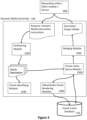
- FIG. 3 we see a block diagram of a Dynamic Media Generator 130 in association with some requesting entity 200 and a Chunk Cache Database 120, in accordance with some embodiments of the present invention.
- the requesting entity sends to the Dynamic Media Generator 130 a video request comprising a description of the desired configuration of the movie.
- This description may come in the form of instructions for building the timeline, an object-based description of the timeline (in a format such as JSON), or some other form that adequately describes the visual and sonic configuration of the movie throughout time.
- the Dynamic Media Generator 130 consists of a Partitioning Module 1320A and/or 1320B, a Chunk Identifying Module 1340A and/or 1340B, a Chunk Cache Query Module 1360, a Chunk Rendering Module 1380 (A and/or B%), and a Merging Module 1400. Further, the Dynamic Media Generator 130 has associated with it a Chunk Cache Database 120. As seen in figure 3A , multiple Dynamic Media Generator modules 130 may use the same Chunk Cache Database 200.
- the Partitioning Module 1320 splits the timeline described in the request into discrete partitions called chunk descriptors.
- the main information associated with a chunk descriptor is an identifier (see section Naming Chunks below) and a reference to a time interval on the global movie timeline.
- the interval information may take the form of start and end times, a start time and a duration, or some equivalent form.
- Each chunk descriptor will thus be used to render and/or encode a chunk of the final video or audio stream.
- the partitioning process operates according to a predefined scheme designed to optimize the likelihood of a so-called chunk cache hit.
- a chunk cache hit occurs when a previously-rendered chunk is found (in the chunk cache database) whose configuration is identical to one described by a chunk descriptor, and thus required by the movie currently being generated.
- video rendering/encoding and audio rendering/encoding are separate processes, different partitioning schemes may be used for each. However, the same video and audio schemes should be used across all movies in order to optimize the likelihood of chunk cache hits.
- Figures 4A and 4B further detail the partitioning process for video and audio, respectively.
- the scheme may involve partitioning into chunks of fixed duration, partitioning via certain properties of the timeline description such as scene or layer boundaries, or partitioning by other means.
- For video data there are at least five options, one or more of which may be combined or integrated into a final scheme:
- partitioning scheme may contain constraints:
- the partitioning is invariant to the absolute timing of the movie. This property allows for a high likelihood of cache hits even if, for example, a new scene is added to the beginning of the movie (see Toy Examples for concrete examples).
- the partitioning scheme may contain constraints:
- An audio partitioning algorithm analogous to the video partitioning algorithm described above may be used to illustrate an audio chunk partition scheme.
- a key technique used by the present invention allows for quickly identifying and matching chunks and/or chunk descriptors based on part or all of their configurations. This technique involves generating simple unique identifiers (UIDs) that may be quickly compared for equality. As long as UIDs are composable, they may take arbitrary form. However in typical embodiments they are represented as hash values, and for this reason we use "UID” and "hash” (or “hash value”) interchangeably.
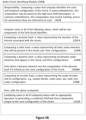
- the Chunk Identifying Module 1340 calculates a UID, usually in the form of a hash value, of each chunk descriptor using a technique further detailed in Figures 5A (for video) and 5B (for audio).
- the goal of the UID generation scheme is to synthesize values unique enough to distinguish two similar but not identical configurations, yet inclusive enough to equate those configurations we do deem identical.
- a hash value is generated for the chunk.
- This hash will be composed from (or otherwise associated with, in a one-to-one relationship, a combination of) one or more hash values, each of which represents some sub-component of the configuration.
- hash values may be composed from values found in the high-level movie timeline description (for example, from the high-level JSON description), from values found in the scene descriptions, and/or from values from other data sources.
- Figure 5A illustrates this process via the responsibilities of the Video Chunk Identifying Module 1340A, according to some embodiments of the present invention.
- the diagram therein specifies computation of at least one of several values:
- the ordinal z-values (OZVs) mentioned above are a method for encoding only the order of the scenes without encoding their absolute or even relative positions. They are calculated by retrieving the scene's index in an array of scenes sorted by z-value. For example, suppose we have three scenes with the following z-values:
- hash values listed above are then combined to create a "full hash” (1352A), which may then be used to identify the chunk by distinguishing its overall configuration based on its sub-configurations.
- Figure 10 is a pseudocode example of a video chunk hashing algorithm, in accordance with some embodiments of the present invention.
- the hash() procedure performs some hashing operation on the input data, while the combine() procedure combines the input hash values into a single value.
- the combine() procedure may be based on the commutative XOR operator if it is to be invariant to the order of the input values, or some non-commutative operator if it is to be order sensitive.
- "c.duration” is C-language-style syntax to retrieve the "duration" member contained in the structure named "c”.
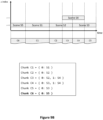
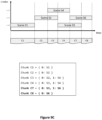
- Figures 9A , 9B , 9C show examples of chunk partitioning, according to some embodiments of the present invention. Assuming these movies are rendered in the given order, and with access to the same chunk cache database, we can see some cases where we will save rendering and encoding time. Chunk names ("C1", “C2”, etc.) persist across examples to illustrate chunk reuse; for example, chunk “C3" in Figure 9A is identical to those named “C3" in Figures 9B and 9C .
- Figure 9A shows the timeline of the first example movie. It contains four scenes, positioned at two different z-indexes.
- the Partition Module has partitioned the timeline into five intervals according to scene boundaries.
- the table below specifies the scenes associated with each chunk. Inside each structure each scene is associated with its so-called ordinal z-value (OZV). As explained above, OZVs are used because only the z-ordering of the scenes matters, and not the z-distance between them.
- Bold font specifies which items need to be rendered, which in this case is all of them.
- Figure 9B shows the timeline of the second example movie. It is mostly identical to the movie from Figure 9A , except that a new scene S5 is found at the beginning, and everything else has been shifted in time to start after S5. Note that chunks C1 through C5 have been shifted in time. However, since we are partitioning at scene boundaries, the partition points relative to the scenes are invariant to such time shifts, and so there is no need to re-render them. Thus C1 through C5 can be reused, and only C6 requires rendering. The table below the timeline indicates in boldface which chunks need to be rendered; everything else should be found in the cache.
- Figure 9C shows the timeline of the third example movie.
- scenes S2 and S4 have been moved up in z-space.
- scene S6 that begins halfway through the duration of S3.
- This movie seems very different from its predecessors, but since we record ordinal z-values and not absolute or relative z-values, C2, C3 and C4 are found in the cache from the previous examples. Only C7 and C8 need rendering.
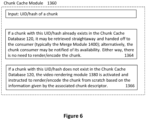
- the Chunk Cache Query Module 1360 queries the Chunk Cache Database 120 for the chunk based on the UID calculated by the Chunk Identifying Module 1340A and/or 1340B. If the chunk is not available in the cache [1366], it is rendered and encoded by the Rendering Module 1380 according to the chunk descriptor, and recorded in the Chunk Cache Database 120 with its UID acting as a retrieval key (step 1368A). If the chunk can be retrieved from the Chunk Cache Database 120, the entire rendering and encoding step may be skipped [1364]. This process is illustrated in Figure 6 .
- the associated Rendering Module 1380[A or B] is activated and instructed to render and encode the chunk based on the information in the chunk descriptor: typically the start and end time with respect to the global timeline, and with the scene graph assembled during initial processing of the request.
- the Rendering Module 1380 renders and encodes all frames or audio samples on the chunk descriptor's specified time interval, and writes everything to the final video or audio chunk.
- the whole process is illustrated in Figure 7A , with its execution flow detailed in Figure 7B . Note that, for the case in which a chunk has both static and dynamic data, the rendering process itself may be thought of as comprising at least two substeps prior to encoding: rendering of the static data and rendering of the dynamic data.
- two or more dynamic videos may be generated simultaneously.
- some static chunks, or static components of chunks, say, from two different videos may be identified as identical by comparing their static hash values.
- these chunks or chunk components may be temporarily cached in hardware memory, and ultimately generated only once for use in multiple videos.
- SSMD Single Static / Multiple Dynamic
- SSMD gathers chunk descriptors for chunks whose static components are identical, even if the dynamic components differ. These chunk descriptors can be trivially compared and grouped together by identifying which chunk descriptors have identical static hash values (1370B). Once grouped, they are rendered and encoded as follows: first, a file is created and opened for each output chunk; next, for each frame in the range, for each chunk in the group, render the frame and encode it to the file corresponding to its chunk; close the files.
- the Merging Module 1400 may begin producing the desired output. To do so, this module begins with a description of everything needed to produce the final output movie. This description may come from the original request and/or data derived thereof. It may include one or more lists of video and/or audio chunk descriptors, and/or descriptions of streams of information such as subtitles or other metadata.
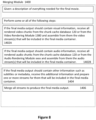
- a flow diagram of the Merging Module's behavior is illustrated in Figure 8 , in accordance with some embodiments of the present invention.
- the Merging Module 1400 then writes the output according to the output movie description. If the output movie should contain visual information, that is, for any lists of video chunk descriptors, this module collects or receives all of these chunks from either the Chunk Cache Database 120 or the Video Rendering Module 1380A, and copies their contents to the relevant stream in the output, concatenating the chunks in the process[1402A]. The chunks can be simply copied because they have already been encoded via the desired codec. Avoiding re-encoding makes the chunk merging process extremely fast. For the audio case [1402B], the process is very similar, except that audio chunks should be received or collected from either the Chunk Cache Database 120 or the Audio Rendering Module 1380B.
- the output movie description may specify that the final movie should contain streams of other information, such as subtitles, or other kinds of metadata [1404]. If so, the Merging Module 1400 receives or collects the relevant information and writes the relevant streams to the output.
- the data for these auxiliary streams may come from the request itself or from external sources referenced by the request.
- the Dynamic Media Generator 130 may now notify the Requesting Entity of completion.
Landscapes
- Engineering & Computer Science (AREA)
- Multimedia (AREA)
- Signal Processing (AREA)
- Theoretical Computer Science (AREA)
- Databases & Information Systems (AREA)
- Data Mining & Analysis (AREA)
- General Engineering & Computer Science (AREA)
- General Physics & Mathematics (AREA)
- Physics & Mathematics (AREA)
- Computational Linguistics (AREA)
- Human Computer Interaction (AREA)
- Library & Information Science (AREA)
- Two-Way Televisions, Distribution Of Moving Picture Or The Like (AREA)
Description
- The present invention relates generally to the field of dynamic video generation. More specifically, the present invention relates to methods for generating personalized dynamic videos.
- Personalized videos are videos whose content can be tailored to the end-viewer. Similar to form mail, in which a template is filled in and altered with information specific to the target reader, personalized videos are constructed from one or more video template elements that can be combined and adjusted to enhance the viewing experience of the intended audience.
- Personalized videos are used widely in marketing, sales, customer care and social media as people-centric solutions that deliver unparalleled levels of customer engagement and action. They are further used in industries such as telecommunication, utilities, banking, insurance, retail, automotive and others to support customer acquisition and customer relationship management.
- Producing a video involves two fundamental operations: rendering, which determines the pixel colors for each output frame; and encoding, which transforms the video data into a form suitable for storage, potentially compressing the data in the process. These operations are known to be expensive and thus usually consume the most time during the video generation process.
- A video may also contain audio information, and the case of audio may be thought of analogously. The audio case thus also involves a rendering process that determines the amplitude level(s) for each audio data sample, and an encoding process that transforms and potentially compresses the audio data.
- Current technology allows for personalized videos to be rendered and encoded with the aid of parallel processing systems, specifically graphical processing units (GPUs) or other related technologies. Even so, as the rendering and encoding are the fundamental operations, their computation represents a significant portion of the processing pipeline, and this translates to significant cost over multitudes of videos. The current invention concerns itself with avoiding rendering and/or encoding operations where possible by reusing previously rendered and/or encoded results.
- In the following exposition, the terms "dynamic" and "personalized" are used interchangeably. The terms "hash", "UID" and "unique identifier" are used interchangeably as well. Finally, the term 'video' may bring about some confusion. In our more technical discussions, 'video' refers to the visual data, distinguishable from audio data and other information types. Meanwhile, in higher-level discussions, we intend the more popular usage, referring to what the end-viewer sees: a combination of video and audio (and perhaps subtitle, etc.) information, taken together as a full experience. In the latter context, 'video' and 'media' are used interchangeably.
-
US 2014/025837 by SWENSON ERIK R ET AL discloses a just-in-time distributed video cache. - The present invention provides a method for generating customized dynamic video, implemented by one or more processors operatively coupled to a non-transitory computer readable storage device, on which are stored modules of instruction code that when executed cause the one or more processors to perform said method comprising the steps of:
- a. receiving a request to generate a customized dynamic video;
- b. partitioning said customized dynamic video's timeline, using a predefined partition scheme, into a series of chunk descriptors, each defined by an interval of the timeline and corresponding to a video chunk of the customized dynamic video;
- c. for each chunk descriptor, constructing an identifier based on the combination of a set of parameters that represent visual, temporal and other characteristics of the video chunk, and associating said identifier to the chunk descriptor;
- d. for each chunk descriptor, querying a cache of previously rendered and encoded video chunks for a video chunk indexed by the identifier matching that of the chunk descriptor;
- e. in the case that a video chunk whose identifier matches the queried identifier is found, retrieving said video chunk from the cache;
- f. otherwise, rendering and encoding the video chunk, as specified by the request, for the chunk descriptor's timeline interval, and saving said video chunk in the cache, indexed by the identifier;
- g. merging the video chunks to create the customized dynamic video.
- According to some embodiments of the present invention wherein the predefined partition scheme involves partitioning the video timeline at scene boundaries.
- According to some embodiments of the present invention predefined partition scheme involvespartitioning the video timeline at times when one or more dynamic objects enters into or exits from the video. According to some embodiments of the present invention the predefined partition scheme involves partitioning the video timeline into fixed-sized intervals.
- According to some embodiments of the present invention the predefined partition scheme involves partitioning the video timeline around segments with constant color.
- According to some embodiments of the present invention the partitions created by the predefined partition scheme are constrained by predefined partition size.
- According to the present invention identifier is a hash value and/or based on the result of some hashing algorithm.
- According to some embodiments of the present invention hashing calculation comprises at least one of the following components of hash computing or some combination thereof:
- a. computing the duration hash, representing the duration of the interval associated with the chunk;
- b. computing the static hash, representing the configuration of static elements of the video contained on the interval associated with the chunk;
- c. computing the dynamic hash, representing the configuration of dynamic elements in the video associated with the chunk;
- d. computing the encoder hash, representing the encoder of the video and its configuration.
- According to some embodiments of the present invention the chunk includes only part of a video frame.
- According to some embodiments of the present invention the chunk descriptor stores intermediate values used to construct the final identifier. According to some embodiments of the present invention two or more video chunks' static components, identified as identical based on their static hash values, are generated only once but used to render two or more video chunks.
- According to some embodiments of the present invention two or more dynamic videos are generated at the same time, wherein said chunks with identical static components may belong to different output videos. According to some embodiments of the present invention said chunks with identical static components belong to the same output video.
- According to some embodiments of the present invention the video timeline consists of a single frame and the output video comprises a still image.
- The present invention provides a method for generating customized dynamic audio, implemented by one or more processors operatively coupled to a non-transitory computer readable storage device, on which are stored modules of instruction code that when executed cause the one or more processors to perform said method comprising the steps of:
- e. receiving a request to generate a customized dynamic audio;
- f. partitioning said customized dynamic audio's timeline, using a predefined partition scheme, into a series of chunk descriptors, each defined by an interval of the timeline and corresponding to an audio chunk of the customized dynamic audio;
- g. for each chunk descriptor, constructing an identifier based on the combination of a set of parameters that represent visual, temporal and other characteristics of the audio chunk, and associating said identifier to the chunk descriptor;
- h. for each chunk descriptor, querying a cache of previously rendered and encoded audio chunks for a audio chunk indexed by the identifier matching that of the chunk descriptor;
- i. in the case that an audio chunk whose identifier matches the queried identifier is found, retrieving said audio chunk from the cache;
- j. otherwise, rendering and encoding the audio chunk, as specified by the request, for the chunk descriptor's timeline interval, and saving said audio chunk in the cache, indexed by the identifier;
- k. merging the audio chunks to create the customized dynamic audio.
- According to some embodiments of the present invention the predefined partition scheme involves partitioning the audio timeline at scene boundaries.
- According to some embodiments of the present invention the predefined partition scheme involvespartitioning the audio timeline at times when one or more dynamic audio elements starts or stops playing.
- According to some embodiments of the present invention the predefined partition scheme involves partitioning the audio timeline into fixed-sized intervals.
- According to some embodiments of the present invention the predefined partition scheme involves partitioning the audio timeline around silent segments.
- According to some embodiments of the present invention the partitions created by the predefined partition scheme are constrained by predefined partition size.
- According to the present invention the identifier is a hash value and/or based on the result of some hashing algorithm. According to some embodiments of the present invention the hashing calculation comprises at least one of the following components of hash computing or some combination thereof:
- l. computing the duration hash, representing the duration of the interval associated with the chunk;
- m. computing the static hash, representing the configuration of static elements of the audio contained on the interval associated with the chunk;
- n. computing the dynamic hash, representing the configuration of dynamic elements in the audio associated with the chunk;
- o. computing the encoder hash, representing the encoder of the audio and its configuration.
- According to some embodiments of the present invention the chunk descriptor stores intermediate values used to construct the final identifier. According to some embodiments of the present invention two or more audio chunks' static components, identified as identical based on their static hash values, are generated only once but used to render two or more audio chunks.
- According to some embodiments of the present invention wherein two or more dynamic audio are generated at the same time, wherein said chunks with identical static components may belong to different output audio. According to some embodiments of the present invention wherein said chunks with identical static components belong to the same output audio. The present invention provides a system for generating customized dynamic video, implemented by one or more processors operatively coupled to a non-transitory computer readable storage device, which comprise the module of :
- p. partitioning nodule partitioning a requested customized dynamic video's timeline, using a predefined partition scheme, into a series of chunk descriptors, each defined by an interval of the timeline and corresponding to a video chunk of the customized dynamic video;
- q. checking module for constructing an identifier for each chunk descriptor, based on the combination of a set of parameters that represent visual, temporal and other characteristics of the video chunk, and associating said identifier to the chunk descriptor;
- and, querying for each chunk descriptor, a cache of previously rendered and encoded video chunks for a video chunk indexed by the identifier matching that of the chunk descriptor;
- wherein in the case that a video chunk whose identifier matches the queried identifier is found, retrieving said video chunk from the cache;
- otherwise, rendering and encoding the video chunk, as specified by the request, for the chunk descriptor's timeline interval, and saving said video chunk in the cache, indexed by the identifier;
- r. merging module for merging the video chunks to create the customized dynamic video.
- According to some embodiments of the present invention the predefined partition scheme involves partitioning the video timeline at scene boundaries.
- According to some embodiments of the present invention the predefined partition scheme involvespartitioning the video timeline at times when one or more dynamic objects enters into or exits from the video.
- According to some embodiments of the present invention the predefined partition scheme involves partitioning the video timeline into fixed-sized intervals.
- According to some embodiments of the present invention the predefined partition scheme involves partitioning the video timeline around segments with constant color.
- According to some embodiments of the present invention the partitions created by the predefined partition scheme are constrained by predefined partition size.
- According to the present invention the identifier is a hash value and/or based on the result of some hashing algorithm. According to some embodiments of the present invention wherein the hashing calculation comprises at least one of the following components of hash computing or some combination thereof:
- s. computing the duration hash, representing the duration of the interval associated with the chunk;
- t. computing the static hash, representing the configuration of static elements of the video contained on the interval associated with the chunk;
- u. computing the dynamic hash, representing the configuration of dynamic elements in the video associated with the chunk;
- v. computing the encoder hash, representing the encoder of the video and its configuration.
- According to some embodiments of the present invention the chunk includes only part of a video frame.
- According to some embodiments of the present invention the chunk descriptor stores intermediate values used to construct the final identifier. According to some embodiments of the present invention two or more video chunks' static components, identified as identical based on their static hash values, are generated only once but used to render two or more video chunks.
- According to some embodiments of the present invention wherein two or more dynamic videos are generated at the same time, wherein said chunks with identical static components may belong to different output videos. According to some embodiments of the present invention said chunks with identical static components belong to the same output video.
- According to some embodiments of the present invention the video timeline consists of a single frame and the output video comprises a still image.
- The present invention will be more readily understood from the detailed description of its embodiments as well as the accompanying drawings of which:
-
Figure 1 (PRIOR-ART) illustrates the current video rendering technology's dynamic movie timeline. Scenes may be positioned at any point along the time axis as well as at any z-index (where greater z-index corresponds to proximity to the viewer). -
Figures 2A and2B (PRIOR-ART) depict two scenes, each of which contains one or more layers of video, images, text or other assets. Several properties, such as timing (start, offset), and z-index, etc., control the configuration of the scene and its constituent layers. Alongside each is a sketch illustrating how the scene is composed of layers of static and dynamic elements. -
Figure 3 is a block diagram of a dynamic video generation management system in accordance with some embodiments of the present invention. -
Figure 3A is a diagram of multiple dynamic video generator modules accessing a single cache database, according to some embodiments of the present invention. -
Figure 4A is a flow diagram of the module that partitions the video timeline into video chunk descriptors, in accordance with some embodiments of the present invention. -
Figure 4B is a flow diagram of the module that partitions the audio timeline into audio chunk descriptors, in accordance with some embodiments of the present invention. -
Figure 5A is a diagram of the Video Chunk Identifying (Hashing) Module, according to some embodiments of the present invention. -
Figure 5B is a diagram of the Audio Chunk Identifying (Hashing) Module, according to some embodiments of the present invention. -
Figure 6 is a diagram of the Chunk Cache Query module, according to some embodiments of the present invention. -
Figure 7A is a flow diagram of a typical non-optimized execution of the Video Rendering Module, according to some embodiments of the present invention. -
Figure 7B shows the rendering and encoding events over time for a non-optimized execution of the Video Rendering Module, according to some embodiments of the present invention. -
Figure 7C is a flow diagram of an execution of the Video Rendering Module in a case where the Single Static/Multiple Dynamic (SSMD) optimization may be exploited, according to some embodiments of the present invention. -
Figure 7D shows the rendering and encoding events over time for an SSMD-optimized execution of the Video Rendering Module, according to some embodiments of the present invention. -
Figure 8 is a flow diagram of the Merging Module, according to some embodiments of the present invention. -
Figure 9A is an example of partitioning the timeline into chunk descriptors, according to some embodiments of the present invention. -
Figure 9B is another example of partitioning the timeline into chunk descriptors, according to some embodiments of the present invention. This timeline is similar to that ofFigure 9A , except for an additional scene at the beginning scene, and a shift in time for the rest of the scenes. -
Figure 9C is another example of partitioning the timeline into chunk descriptors, according to some embodiments of the present invention. This timeline is similar to that ofFigure 9A , except for an additional scene near the end, and a shift in z-value for two of the other scenes. -
Figure 10 is an example of a chunk hashing algorithm, according to some embodiments of the present invention. - Before explaining at least one embodiment of the invention in detail, it is to be understood that the invention is not limited in its application to the details of construction and the arrangement of the components set forth in the following description or illustrated in the drawings. The invention is applicable to other embodiments or of being practiced or carried out in various ways. Also, it is to be understood that the phraseology and terminology employed herein is for the purpose of description and should not be regarded as limiting.
- According to current dynamic movie generation technology, as seen in
Fig. 1 (PRIOR-ART), a movie is composed of one or more scenes arranged on a timeline in a collage-like form, where each scene sits at a specific time, lasts a specified duration, and is positioned at a specified z-index ("distance" from the viewer). Scenes may be thought of as templatized build blocks. They contain layers, which in turn hold assets such as images, video, text, and audio. Both the containing scene and its constituent layers may expose properties that act as parameters to creation of the video. For example, the scene may expose timing properties such as start time and duration, which control when on the global timeline the scene begins, and how much of the scene to show, or z-index, which governs which controls the front-to-back ordering of the scenes in the event that multiple scenes appear in the video simultaneously. Likewise, the constituent layers may expose properties that govern transparency, alignment properties of the asset with respect to its bounding box, and most notably, the asset itself. By referencing the scene building blocks and specifying values for the exposed properties, a video may be assembled and generated that is customized for the end-viewer. Moreover, this "video collage" may be specified by a high-level object description format such as JSON or XML. - Across thousands or millions of movies, each intended for potentially different end-viewers, some of the assets and properties will vary heavily, and some will be identical. Those that remain the same from video to video are called static, and those that change are called dynamic.
- In the example scenes shown in
figures 2A and2B (PRIOR-ART), the backgrounds are static, while the text as well as the image of the dog are dynamic. These dynamic components are also called "placeholders." Thus, infigures 2A and2B (PRIOR-ART), the text and the foreground image are placeholders. - Each scene's composition, layer and placeholder definitions and the like are described in a predefined format whose function is to serve as a template for that scene. The configuration for each unique movie is then specified with some format/method/notation convenient for specifying hierarchical data structures, such as JavaScript Object Notation (JSON). Specifically, many aspects of the final video may be specified using this simplified format, for instance, which scenes appear in the video, when in time they are scheduled to play, where (in z-space) they sit, which assets will be used to fill which placeholders within each scene, other placeholder attributes (alignment, font, etc), and the like.
- For a given video campaign, there are typically many segments that are identical across thousands or millions of videos. For example, parts that have only static content, and parts that are dynamic but have identical placeholder configurations across videos. The present invention exploits this assumption to provide an improved and efficient method for generating dynamic videos that avoids rendering and/or encoding frames parts of the video that have already been rendered and/or encoded.
- In
Figure 3 we see a block diagram of aDynamic Media Generator 130 in association with some requestingentity 200 and aChunk Cache Database 120, in accordance with some embodiments of the present invention. The requesting entity sends to the Dynamic Media Generator 130 a video request comprising a description of the desired configuration of the movie. This description may come in the form of instructions for building the timeline, an object-based description of the timeline (in a format such as JSON), or some other form that adequately describes the visual and sonic configuration of the movie throughout time. - The
Dynamic Media Generator 130 consists of aPartitioning Module 1320A and/or 1320B, aChunk Identifying Module 1340A and/or 1340B, a ChunkCache Query Module 1360, a Chunk Rendering Module 1380 (A and/or B...), and aMerging Module 1400. Further, theDynamic Media Generator 130 has associated with it aChunk Cache Database 120. As seen infigure 3A , multiple DynamicMedia Generator modules 130 may use the sameChunk Cache Database 200. - The
Partitioning Module 1320 splits the timeline described in the request into discrete partitions called chunk descriptors. The main information associated with a chunk descriptor is an identifier (see section Naming Chunks below) and a reference to a time interval on the global movie timeline. The interval information may take the form of start and end times, a start time and a duration, or some equivalent form. Each chunk descriptor will thus be used to render and/or encode a chunk of the final video or audio stream. - The partitioning process operates according to a predefined scheme designed to optimize the likelihood of a so-called chunk cache hit. A chunk cache hit occurs when a previously-rendered chunk is found (in the chunk cache database) whose configuration is identical to one described by a chunk descriptor, and thus required by the movie currently being generated. As video rendering/encoding and audio rendering/encoding are separate processes, different partitioning schemes may be used for each. However, the same video and audio schemes should be used across all movies in order to optimize the likelihood of chunk cache hits.
-
Figures 4A and4B further detail the partitioning process for video and audio, respectively. In both cases, the scheme may involve partitioning into chunks of fixed duration, partitioning via certain properties of the timeline description such as scene or layer boundaries, or partitioning by other means. For video data, there are at least five options, one or more of which may be combined or integrated into a final scheme: - Option 1: Partition based on scene boundaries (step 1326A).
- Option 2: Partition based on the intervals during which dynamic layers are visible, or more generally, during which dynamic layers influence the visual configuration of the chunk (step 1328A).
- Option 3: Partition into intervals of fixed length (
step 1340A) - Option 4: Partition based on blank intervals (i.e. intervals with constantcolor video information, e.g. all black).
- Option 5: Partition based on intervals with no dynamic video content
- In addition to partitioning options, the partitioning scheme may contain constraints:
- Constraint 1: Video chunk lengths must be greater than some minimal length.
- Constraint 2: Video chunk lengths must be less than some maximal length.
- The following is an example of an algorithm implementing a video partitioning scheme that integrates multiple options and constraints:
- 1. Split the timeline into intervals beginning and ending at scene boundaries (Option 1)
- 2. Further split each of the generated intervals into intervals of some fixed size (Option 3). If the length of any of the intervals generated in
step 1 is not a multiple of the desired fixed size, this step will generate at least one interval of smaller size. - 3. If any of the intervals generated in
step 2 are smaller than some minimal length, combine these intervals with one of their neighboring intervals. - Note that in this and similar schemes, the partitioning is invariant to the absolute timing of the movie. This property allows for a high likelihood of cache hits even if, for example, a new scene is added to the beginning of the movie (see Toy Examples for concrete examples).
- For audio data, there are at least five options, one or more of which may be combined or integrated into a final scheme:
- Option 1: Partition based on scene boundaries (step 1326B).
- Option 2: Partition based on the intervals during which dynamic layers are audible, or more generally, during which dynamic layers influence the aural configuration of the chunk (step 1328B).
- Option 3: Partition into intervals of fixed length (
step 1340B) - Option 4: Partition based on silent intervals (i.e. intervals with no or very quiet audio information).
- Option 5: Partition based on intervals with no dynamic audio content
- In addition to audio partitioning options, the partitioning scheme may contain constraints:
- Constraint 1: Audio chunk lengths must be greater than some minimal length.
- Constraint 2: Audio chunk lengths must be less than some maximal length.
- An audio partitioning algorithm analogous to the video partitioning algorithm described above may be used to illustrate an audio chunk partition scheme.
- A key technique used by the present invention allows for quickly identifying and matching chunks and/or chunk descriptors based on part or all of their configurations. This technique involves generating simple unique identifiers (UIDs) that may be quickly compared for equality. As long as UIDs are composable, they may take arbitrary form. However in typical embodiments they are represented as hash values, and for this reason we use "UID" and "hash" (or "hash value") interchangeably.
- The Chunk Identifying Module 1340 (A and B), calculates a UID, usually in the form of a hash value, of each chunk descriptor using a technique further detailed in
Figures 5A (for video) and 5B (for audio). The goal of the UID generation scheme is to synthesize values unique enough to distinguish two similar but not identical configurations, yet inclusive enough to equate those configurations we do deem identical. - A hash value is generated for the chunk. This hash will be composed from (or otherwise associated with, in a one-to-one relationship, a combination of) one or more hash values, each of which represents some sub-component of the configuration. To accurately represent the configuration sub-components, hash values may be composed from values found in the high-level movie timeline description (for example, from the high-level JSON description), from values found in the scene descriptions, and/or from values from other data sources.
-
Figure 5A illustrates this process via the responsibilities of the VideoChunk Identifying Module 1340A, according to some embodiments of the present invention. The diagram therein specifies computation of at least one of several values: - Static hash: A hash value representing all static elements and their configurations, optionally including their positions on the timeline relative to the chunk's position, and optionally including their implicitly or explicitly including their ordinal z-values (step 1344A);
- Dynamic hash: A hash value representing all dynamic elements and their configurations, optionally including their positions on the timeline relative to the chunk's position, and optionally including their implicitly or explicitly including their ordinal z-values (step 1346A);
- Encoder hash: A hash value representing the encoder and its configuration, optionally including values such as output resolution, frames per second (fps), codec name (H.264, png, etc), codec configuration (step 1348A);
- Duration hash: A hash value representing the duration of the timeline interval to which this chunk corresponds (step 1350A).
- The ordinal z-values (OZVs) mentioned above are a method for encoding only the order of the scenes without encoding their absolute or even relative positions. They are calculated by retrieving the scene's index in an array of scenes sorted by z-value. For example, suppose we have three scenes with the following z-values:
- Scene A @ z = 3
- Scene B @ z = 7
- Scene C @ z = 1
- OZV(Scene A) = 1
- OZV(Scene B) = 2
- OZV(Scene C) = 0
- Some or all of the hash values listed above are then combined to create a "full hash" (1352A), which may then be used to identify the chunk by distinguishing its overall configuration based on its sub-configurations.
-
Figure 10 is a pseudocode example of a video chunk hashing algorithm, in accordance with some embodiments of the present invention. Here, the hash() procedure performs some hashing operation on the input data, while the combine() procedure combines the input hash values into a single value. The combine() procedure may be based on the commutative XOR operator if it is to be invariant to the order of the input values, or some non-commutative operator if it is to be order sensitive. Moreover, "c.duration" is C-language-style syntax to retrieve the "duration" member contained in the structure named "c". - The effect of the overall procedure in
Figure 10 is to fill in the four sub-component hash values discussed above, and then to combine them into the full hash. It is not necessary to save the sub-component hash values for the purposes of identifying the chunk. However, these values may be useful for other purposes; for example, the static hash may be used in the implementation of the SSMD optimization, discussed later. - The process discussed above has lightly focused on identifying video chunks. The case for audio is very similar. In audio there is no concept of z-space as there is for the video case. The scenes' ordinal z-values should therefore not be factored into the hash calculation for audio chunks.
- Now that we have described the partitioning and naming processes, some toy examples may help to illustrate how the present invention allows us to avoid rendering and encoding chunks of video or audio that have previously been rendered and encoded. For clarity and simplicity, but without loss of generality, these examples will be described in terms of the video case.
-
Figures 9A ,9B ,9C show examples of chunk partitioning, according to some embodiments of the present invention. Assuming these movies are rendered in the given order, and with access to the same chunk cache database, we can see some cases where we will save rendering and encoding time. Chunk names ("C1", "C2", etc.) persist across examples to illustrate chunk reuse; for example, chunk "C3" inFigure 9A is identical to those named "C3" inFigures 9B and9C . -
Figure 9A shows the timeline of the first example movie. It contains four scenes, positioned at two different z-indexes. In this case, the Partition Module has partitioned the timeline into five intervals according to scene boundaries. The table below specifies the scenes associated with each chunk. Inside each structure each scene is associated with its so-called ordinal z-value (OZV). As explained above, OZVs are used because only the z-ordering of the scenes matters, and not the z-distance between them. Bold font specifies which items need to be rendered, which in this case is all of them. -
Figure 9B shows the timeline of the second example movie. It is mostly identical to the movie fromFigure 9A , except that a new scene S5 is found at the beginning, and everything else has been shifted in time to start after S5. Note that chunks C1 through C5 have been shifted in time. However, since we are partitioning at scene boundaries, the partition points relative to the scenes are invariant to such time shifts, and so there is no need to re-render them. Thus C1 through C5 can be reused, and only C6 requires rendering. The table below the timeline indicates in boldface which chunks need to be rendered; everything else should be found in the cache. -
Figure 9C shows the timeline of the third example movie. Here, scenes S2 and S4 have been moved up in z-space. In addition, there is a scene S6 that begins halfway through the duration of S3. This movie seems very different from its predecessors, but since we record ordinal z-values and not absolute or relative z-values, C2, C3 and C4 are found in the cache from the previous examples. Only C7 and C8 need rendering. - The Chunk
Cache Query Module 1360, queries theChunk Cache Database 120 for the chunk based on the UID calculated by theChunk Identifying Module 1340A and/or 1340B. If the chunk is not available in the cache [1366], it is rendered and encoded by theRendering Module 1380 according to the chunk descriptor, and recorded in theChunk Cache Database 120 with its UID acting as a retrieval key (step 1368A). If the chunk can be retrieved from theChunk Cache Database 120, the entire rendering and encoding step may be skipped [1364]. This process is illustrated inFigure 6 . - If the chunk was not found in the chunk cache database during the query, the associated Rendering Module 1380[A or B] is activated and instructed to render and encode the chunk based on the information in the chunk descriptor: typically the start and end time with respect to the global timeline, and with the scene graph assembled during initial processing of the request. In the non-optimized case, where each chunk is rendered in isolation, the
Rendering Module 1380 renders and encodes all frames or audio samples on the chunk descriptor's specified time interval, and writes everything to the final video or audio chunk. The whole process is illustrated inFigure 7A , with its execution flow detailed inFigure 7B . Note that, for the case in which a chunk has both static and dynamic data, the rendering process itself may be thought of as comprising at least two substeps prior to encoding: rendering of the static data and rendering of the dynamic data. - In accordance with some embodiments of the present invention, two or more dynamic videos may be generated simultaneously. When this occurs, some static chunks, or static components of chunks, say, from two different videos, may be identified as identical by comparing their static hash values. In this case, these chunks or chunk components may be temporarily cached in hardware memory, and ultimately generated only once for use in multiple videos.
- In some embodiments, it may be advantageous to implement the so-called Single Static / Multiple Dynamic (SSMD) optimization. This optimization takes advantage of the chunking and hashing scheme described above. However, instead of looking in the cache for a rendered and encoded piece of the video, it optimizes at the rendering level by only rendering static components once for use in multiple chunks.
- In more detail, SSMD gathers chunk descriptors for chunks whose static components are identical, even if the dynamic components differ. These chunk descriptors can be trivially compared and grouped together by identifying which chunk descriptors have identical static hash values (1370B). Once grouped, they are rendered and encoded as follows: first, a file is created and opened for each output chunk; next, for each frame in the range, for each chunk in the group, render the frame and encode it to the file corresponding to its chunk; close the files.
- Assuming that we have a buffer for rendering intermediate static components, if we implement our rendering process with the outer loop iterating over frames and the inner loop iterating over chunks, the static component buffer does not need to be updated on each successive render call, thus preventing rendering of the static component for all but the first chunk in the group (1374B). This may amount to significant render time savings. The difference may be understood by comparing the execution flow for the non-optimized case (as seen in
Figure 7B ) with the execution flow for the SSMD-optimized case (as seen inFigure 7D ). We can see that in the SSMD case, for each frame, all but one of the 'static' render executions across the K chunks in the group may be omitted. - When all of the relevant chunks and metadata are available, the
Merging Module 1400 may begin producing the desired output. To do so, this module begins with a description of everything needed to produce the final output movie. This description may come from the original request and/or data derived thereof. It may include one or more lists of video and/or audio chunk descriptors, and/or descriptions of streams of information such as subtitles or other metadata. A flow diagram of the Merging Module's behavior is illustrated inFigure 8 , in accordance with some embodiments of the present invention. - The
Merging Module 1400 then writes the output according to the output movie description. If the output movie should contain visual information, that is, for any lists of video chunk descriptors, this module collects or receives all of these chunks from either theChunk Cache Database 120 or the Video Rendering Module 1380A, and copies their contents to the relevant stream in the output, concatenating the chunks in the process[1402A]. The chunks can be simply copied because they have already been encoded via the desired codec. Avoiding re-encoding makes the chunk merging process extremely fast. For the audio case [1402B], the process is very similar, except that audio chunks should be received or collected from either theChunk Cache Database 120 or the Audio Rendering Module 1380B. - As referenced above, in addition to audio and video data, the output movie description may specify that the final movie should contain streams of other information, such as subtitles, or other kinds of metadata [1404]. If so, the
Merging Module 1400 receives or collects the relevant information and writes the relevant streams to the output. The data for these auxiliary streams may come from the request itself or from external sources referenced by the request. - Once the
Merging Module 1400 finishes formatting the output and writing to it all of the required streams, the generated output media is complete. TheDynamic Media Generator 130 may now notify the Requesting Entity of completion.
Claims (13)
- A method for generating customized dynamic video, implemented by one or more processors operatively coupled to a non-transitory computer readable storage device, on which are stored modules of instruction code that when executed cause the one or more processors to perform said method comprising the steps of:a. receiving a request to generate a customized dynamic video; (200)b. partitioning said customized dynamic video's timeline, using a predefined partition scheme, into a series of chunk descriptors, each defined by an interval of the timeline and corresponding to a video chunk of the customized dynamic video; (1320)c. for each chunk descriptor, constructing an identifier based on the combination of a set of parameters that represent visual, temporal and other characteristics of the video chunk, and associating said identifier to the chunk descriptor; (1340)d. for each chunk descriptor, querying a cache of previously rendered and encoded video chunks for a video chunk indexed by the identifier matching that of the chunk descriptor; (1360)e. in the case that a video chunk whose identifier matches the queried identifier is found, retrieving said video chunk from the cache; (120)f. otherwise, rendering and encoding the video chunk, as specified by the request, for the chunk descriptor's timeline interval, and saving said video chunk in the cache, indexed by the identifier; (1380)g. merging the video chunks to create the customized dynamic video (1400)wherein the identifier is a hash value generated for the chunk, said hash is composed from one or more hash values, each of which represents some sub-component of the configuration representing the configuration sub-components, composed from values found in the high-level movie timeline description including visual and sonic configuration of the movie throughout time, the values found in the scene descriptions include instructions for building the timeline or an object-based description of the timeline
- The method of claim 1, wherein the predefined partition scheme involves partitioning the video timeline at scene boundaries.
- The method of claim 1, wherein the predefined partition scheme involves partitioning the video timeline at times when one or more dynamic objects enters into or exits from the video.
- The method of claim 1, wherein the predefined partition scheme involves partitioning the video timeline into fixed-sized intervals.
- The method of claim 1, wherein the predefined partition scheme involves partitioning the video timeline around segments with constant color.
- The method of claim 1, wherein the partitions created by the predefined partition scheme are constrained by predefined partition size.
- The method of claim 1, wherein the hashing calculation comprises at least one of the following components of hash computing or some combination thereof:a. computing the duration hash, representing the duration of the interval associated with the chunk;b. computing the static hash, representing the configuration of static elements of the video contained on the interval associated with the chunk;c. computing the dynamic hash, representing the configuration of dynamic elements in the video associated with the chunk;d. computing the encoder hash, representing the encoder of the video and its configuration.
- The method of claim 7 wherein the chunk includes only part of a video frame.
- The method of claim 1 wherein the chunk descriptor stores intermediate values used to construct the final identifier.
- The method of claim 7 wherein two or more video chunks' static components, identified as identical based on their static hash values, are generated only once but used to render two or more video chunks.
- The method of claim 10, wherein two or more dynamic videos are generated at the same time, wherein said chunks with identical static components may belong to different output videos.
- The method of claim 10, wherein said chunks with identical static components belong to the same output video.
- The method of claim 1, wherein the video timeline consists of a single frame and the output video comprises a still image.
Applications Claiming Priority (1)
| Application Number | Priority Date | Filing Date | Title |
|---|---|---|---|
| US16/931,984 US11133037B1 (en) | 2020-07-17 | 2020-07-17 | System and method for generating dynamic media |
Publications (2)
| Publication Number | Publication Date |
|---|---|
| EP3940539A1 EP3940539A1 (en) | 2022-01-19 |
| EP3940539B1 true EP3940539B1 (en) | 2025-06-25 |
Family
ID=76958815
Family Applications (1)
| Application Number | Title | Priority Date | Filing Date |
|---|---|---|---|
| EP21186120.8A Active EP3940539B1 (en) | 2020-07-17 | 2021-07-16 | A system and method for generating dynamic media |
Country Status (3)
| Country | Link |
|---|---|
| US (2) | US11133037B1 (en) |
| EP (1) | EP3940539B1 (en) |
| JP (1) | JP7748215B2 (en) |
Families Citing this family (7)
| Publication number | Priority date | Publication date | Assignee | Title |
|---|---|---|---|---|
| CN114187556B (en) * | 2021-12-14 | 2023-12-15 | 华策影视(北京)有限公司 | Intelligent high-definition video segmentation method based on picture characteristics |
| US12212810B2 (en) * | 2022-04-07 | 2025-01-28 | Mux, Inc. | Method for audio and video just-in-time transcoding with command frames |
| US12190915B2 (en) * | 2022-12-03 | 2025-01-07 | Synamedia Limited | Common timeline processing for unique manifests |
| US20250008109A1 (en) * | 2023-06-30 | 2025-01-02 | Disney Enterprises, Inc. | Automated Avoidance of Media File Encoding Redundancies |
| US12563247B2 (en) * | 2023-07-26 | 2026-02-24 | Idomoo Ltd | System and method of tracking video usage in communication network |
| WO2025099744A1 (en) * | 2023-11-08 | 2025-05-15 | Arvind Sasikumar | System and method for generating customized multimedia content |
| CN120881004B (en) * | 2025-09-22 | 2026-01-02 | 桐乡华锐自控技术装备有限公司 | Dynamic Identifier Generation Method Based on Multi-Level Distributed Download |
Family Cites Families (12)
| Publication number | Priority date | Publication date | Assignee | Title |
|---|---|---|---|---|
| JP2003061038A (en) | 2001-08-20 | 2003-02-28 | Univ Waseda | Video content editing support apparatus and video content editing support method |
| US8214516B2 (en) * | 2006-01-06 | 2012-07-03 | Google Inc. | Dynamic media serving infrastructure |
| US20080281697A1 (en) * | 2007-05-11 | 2008-11-13 | Verizon Services Organization Inc. | Systems and methods for using video services records to provide targeted marketing services |
| US8195689B2 (en) * | 2009-06-10 | 2012-06-05 | Zeitera, Llc | Media fingerprinting and identification system |
| US8705933B2 (en) * | 2009-09-25 | 2014-04-22 | Sony Corporation | Video bookmarking |
| US8694533B2 (en) * | 2010-05-19 | 2014-04-08 | Google Inc. | Presenting mobile content based on programming context |
| US8949872B2 (en) * | 2011-12-20 | 2015-02-03 | Yahoo! Inc. | Audio fingerprint for content identification |
| US20130263182A1 (en) * | 2012-03-30 | 2013-10-03 | Hulu Llc | Customizing additional content provided with video advertisements |
| US8856445B2 (en) * | 2012-05-24 | 2014-10-07 | International Business Machines Corporation | Byte caching with chunk sizes based on data type |
| WO2014015168A2 (en) | 2012-07-18 | 2014-01-23 | Skyfire Labs, Inc. | Just-in-time distributed video cache |
| US11412312B2 (en) * | 2016-09-28 | 2022-08-09 | Idomoo Ltd | System and method for generating customizable encapsulated media files |
| US10445052B2 (en) * | 2016-10-04 | 2019-10-15 | Descript, Inc. | Platform for producing and delivering media content |
-
2020
- 2020-07-17 US US16/931,984 patent/US11133037B1/en active Active
-
2021
- 2021-07-16 EP EP21186120.8A patent/EP3940539B1/en active Active
- 2021-07-16 JP JP2021117762A patent/JP7748215B2/en active Active
- 2021-08-24 US US17/410,509 patent/US11521657B2/en active Active
Also Published As
| Publication number | Publication date |
|---|---|
| US11133037B1 (en) | 2021-09-28 |
| JP7748215B2 (en) | 2025-10-02 |
| US11521657B2 (en) | 2022-12-06 |
| EP3940539A1 (en) | 2022-01-19 |
| US20220020397A1 (en) | 2022-01-20 |
| JP2022019682A (en) | 2022-01-27 |
Similar Documents
| Publication | Publication Date | Title |
|---|---|---|
| US11521657B2 (en) | System and method for generating dynamic media | |
| EP3523734B1 (en) | Techniques for generating snapshots of datasets | |
| US11695932B2 (en) | Temporal alignment of MPEG and GLTF media | |
| US6539163B1 (en) | Non-linear editing system and method employing reference clips in edit sequences | |
| US7673239B2 (en) | Synthetic audiovisual description scheme, method and system for MPEG-7 | |
| EP1523179B1 (en) | Method and apparatus for reproducing event occurrence information | |
| JP5745462B2 (en) | Method and program for supplying media content and server apparatus | |
| CN117178557A (en) | Methods and devices for timing and event-triggered updates in scenes | |
| US20220309035A1 (en) | File processing device, file processing method, and program | |
| US20100257375A1 (en) | System and method for compressing compressed data | |
| EP3993394A1 (en) | File processing device, file processing method, and program | |
| US12289493B2 (en) | Partial frame replacement enabling multiple versions in an integrated video package | |
| US12243180B2 (en) | Information processing device and method | |
| WO2023176928A1 (en) | Information processing device and method | |
| JP2664817B2 (en) | Frame train image compression method and system, and frame reconstruction method and system | |
| US7835614B2 (en) | Data recording method, data recording apparatus, and data recording medium | |
| US8200067B2 (en) | Processing of scalable compressed video data formats for nonlinear video editing systems | |
| WO2023176419A1 (en) | Information processing device and method | |
| CN1551210A (en) | Method for storing additional data relating to menu data | |
| US8165424B1 (en) | Method and device for video transformations | |
| US20040264932A1 (en) | Method for storing additional data relating to menu data | |
| KR100987655B1 (en) | Feature Point Information (CPI) for Multi-Layer Video | |
| KR102892054B1 (en) | A high-speed search method for a person in a video and a server that performs the method. | |
| WO2023204289A1 (en) | Information processing device and method | |
| HK40087982B (en) | Video feature representation constructing method, device, equipment and storage medium |
Legal Events
| Date | Code | Title | Description |
|---|---|---|---|
| PUAI | Public reference made under article 153(3) epc to a published international application that has entered the european phase |
Free format text: ORIGINAL CODE: 0009012 |
|
| STAA | Information on the status of an ep patent application or granted ep patent |
Free format text: STATUS: THE APPLICATION HAS BEEN PUBLISHED |
|
| AK | Designated contracting states |
Kind code of ref document: A1 Designated state(s): AL AT BE BG CH CY CZ DE DK EE ES FI FR GB GR HR HU IE IS IT LI LT LU LV MC MK MT NL NO PL PT RO RS SE SI SK SM TR |
|
| STAA | Information on the status of an ep patent application or granted ep patent |
Free format text: STATUS: REQUEST FOR EXAMINATION WAS MADE |
|
| 17P | Request for examination filed |
Effective date: 20220719 |
|
| RBV | Designated contracting states (corrected) |
Designated state(s): AL AT BE BG CH CY CZ DE DK EE ES FI FR GB GR HR HU IE IS IT LI LT LU LV MC MK MT NL NO PL PT RO RS SE SI SK SM TR |
|
| STAA | Information on the status of an ep patent application or granted ep patent |
Free format text: STATUS: EXAMINATION IS IN PROGRESS |
|
| 17Q | First examination report despatched |
Effective date: 20230829 |
|
| GRAP | Despatch of communication of intention to grant a patent |
Free format text: ORIGINAL CODE: EPIDOSNIGR1 |
|
| STAA | Information on the status of an ep patent application or granted ep patent |
Free format text: STATUS: GRANT OF PATENT IS INTENDED |
|
| INTG | Intention to grant announced |
Effective date: 20250120 |
|
| GRAS | Grant fee paid |
Free format text: ORIGINAL CODE: EPIDOSNIGR3 |
|
| GRAA | (expected) grant |
Free format text: ORIGINAL CODE: 0009210 |
|
| STAA | Information on the status of an ep patent application or granted ep patent |
Free format text: STATUS: THE PATENT HAS BEEN GRANTED |
|
| AK | Designated contracting states |
Kind code of ref document: B1 Designated state(s): AL AT BE BG CH CY CZ DE DK EE ES FI FR GB GR HR HU IE IS IT LI LT LU LV MC MK MT NL NO PL PT RO RS SE SI SK SM TR |
|
| REG | Reference to a national code |
Ref country code: GB Ref legal event code: FG4D |
|
| REG | Reference to a national code |
Ref country code: CH Ref legal event code: EP |
|
| REG | Reference to a national code |
Ref country code: CH Ref legal event code: EP |
|
| REG | Reference to a national code |
Ref country code: IE Ref legal event code: FG4D |
|
| REG | Reference to a national code |
Ref country code: DE Ref legal event code: R096 Ref document number: 602021032714 Country of ref document: DE |
|
| PG25 | Lapsed in a contracting state [announced via postgrant information from national office to epo] |
Ref country code: FI Free format text: LAPSE BECAUSE OF FAILURE TO SUBMIT A TRANSLATION OF THE DESCRIPTION OR TO PAY THE FEE WITHIN THE PRESCRIBED TIME-LIMIT Effective date: 20250625 |
|
| PGFP | Annual fee paid to national office [announced via postgrant information from national office to epo] |
Ref country code: DE Payment date: 20250722 Year of fee payment: 5 |
|
| REG | Reference to a national code |
Ref country code: LT Ref legal event code: MG9D |
|
| PG25 | Lapsed in a contracting state [announced via postgrant information from national office to epo] |
Ref country code: NO Free format text: LAPSE BECAUSE OF FAILURE TO SUBMIT A TRANSLATION OF THE DESCRIPTION OR TO PAY THE FEE WITHIN THE PRESCRIBED TIME-LIMIT Effective date: 20250925 Ref country code: GR Free format text: LAPSE BECAUSE OF FAILURE TO SUBMIT A TRANSLATION OF THE DESCRIPTION OR TO PAY THE FEE WITHIN THE PRESCRIBED TIME-LIMIT Effective date: 20250926 |
|
| PG25 | Lapsed in a contracting state [announced via postgrant information from national office to epo] |
Ref country code: BG Free format text: LAPSE BECAUSE OF FAILURE TO SUBMIT A TRANSLATION OF THE DESCRIPTION OR TO PAY THE FEE WITHIN THE PRESCRIBED TIME-LIMIT Effective date: 20250625 |
|
| PGFP | Annual fee paid to national office [announced via postgrant information from national office to epo] |
Ref country code: GB Payment date: 20250722 Year of fee payment: 5 |
|
| PG25 | Lapsed in a contracting state [announced via postgrant information from national office to epo] |
Ref country code: HR Free format text: LAPSE BECAUSE OF FAILURE TO SUBMIT A TRANSLATION OF THE DESCRIPTION OR TO PAY THE FEE WITHIN THE PRESCRIBED TIME-LIMIT Effective date: 20250625 |
|
| PGFP | Annual fee paid to national office [announced via postgrant information from national office to epo] |
Ref country code: AT Payment date: 20251020 Year of fee payment: 5 |
|
| PG25 | Lapsed in a contracting state [announced via postgrant information from national office to epo] |
Ref country code: RS Free format text: LAPSE BECAUSE OF FAILURE TO SUBMIT A TRANSLATION OF THE DESCRIPTION OR TO PAY THE FEE WITHIN THE PRESCRIBED TIME-LIMIT Effective date: 20250925 |
|
| PG25 | Lapsed in a contracting state [announced via postgrant information from national office to epo] |
Ref country code: LV Free format text: LAPSE BECAUSE OF FAILURE TO SUBMIT A TRANSLATION OF THE DESCRIPTION OR TO PAY THE FEE WITHIN THE PRESCRIBED TIME-LIMIT Effective date: 20250625 |
|
| REG | Reference to a national code |
Ref country code: NL Ref legal event code: MP Effective date: 20250625 |
|
| PG25 | Lapsed in a contracting state [announced via postgrant information from national office to epo] |
Ref country code: NL Free format text: LAPSE BECAUSE OF FAILURE TO SUBMIT A TRANSLATION OF THE DESCRIPTION OR TO PAY THE FEE WITHIN THE PRESCRIBED TIME-LIMIT Effective date: 20250625 |
|
| PG25 | Lapsed in a contracting state [announced via postgrant information from national office to epo] |
Ref country code: PT Free format text: LAPSE BECAUSE OF FAILURE TO SUBMIT A TRANSLATION OF THE DESCRIPTION OR TO PAY THE FEE WITHIN THE PRESCRIBED TIME-LIMIT Effective date: 20251027 |
|
| REG | Reference to a national code |
Ref country code: AT Ref legal event code: MK05 Ref document number: 1807201 Country of ref document: AT Kind code of ref document: T Effective date: 20250625 |
|
| PG25 | Lapsed in a contracting state [announced via postgrant information from national office to epo] |
Ref country code: IS Free format text: LAPSE BECAUSE OF FAILURE TO SUBMIT A TRANSLATION OF THE DESCRIPTION OR TO PAY THE FEE WITHIN THE PRESCRIBED TIME-LIMIT Effective date: 20251025 |
|
| PG25 | Lapsed in a contracting state [announced via postgrant information from national office to epo] |
Ref country code: AT Free format text: LAPSE BECAUSE OF FAILURE TO SUBMIT A TRANSLATION OF THE DESCRIPTION OR TO PAY THE FEE WITHIN THE PRESCRIBED TIME-LIMIT Effective date: 20250625 Ref country code: SM Free format text: LAPSE BECAUSE OF FAILURE TO SUBMIT A TRANSLATION OF THE DESCRIPTION OR TO PAY THE FEE WITHIN THE PRESCRIBED TIME-LIMIT Effective date: 20250625 |
|
| PG25 | Lapsed in a contracting state [announced via postgrant information from national office to epo] |
Ref country code: CZ Free format text: LAPSE BECAUSE OF FAILURE TO SUBMIT A TRANSLATION OF THE DESCRIPTION OR TO PAY THE FEE WITHIN THE PRESCRIBED TIME-LIMIT Effective date: 20250625 |
|
| PG25 | Lapsed in a contracting state [announced via postgrant information from national office to epo] |
Ref country code: PL Free format text: LAPSE BECAUSE OF FAILURE TO SUBMIT A TRANSLATION OF THE DESCRIPTION OR TO PAY THE FEE WITHIN THE PRESCRIBED TIME-LIMIT Effective date: 20250625 |
|
| PG25 | Lapsed in a contracting state [announced via postgrant information from national office to epo] |
Ref country code: EE Free format text: LAPSE BECAUSE OF FAILURE TO SUBMIT A TRANSLATION OF THE DESCRIPTION OR TO PAY THE FEE WITHIN THE PRESCRIBED TIME-LIMIT Effective date: 20250625 |
|
| PG25 | Lapsed in a contracting state [announced via postgrant information from national office to epo] |
Ref country code: SK Free format text: LAPSE BECAUSE OF FAILURE TO SUBMIT A TRANSLATION OF THE DESCRIPTION OR TO PAY THE FEE WITHIN THE PRESCRIBED TIME-LIMIT Effective date: 20250625 |
|
| PG25 | Lapsed in a contracting state [announced via postgrant information from national office to epo] |
Ref country code: ES Free format text: LAPSE BECAUSE OF FAILURE TO SUBMIT A TRANSLATION OF THE DESCRIPTION OR TO PAY THE FEE WITHIN THE PRESCRIBED TIME-LIMIT Effective date: 20250625 |
|
| REG | Reference to a national code |
Ref country code: CH Ref legal event code: H13 Free format text: ST27 STATUS EVENT CODE: U-0-0-H10-H13 (AS PROVIDED BY THE NATIONAL OFFICE) Effective date: 20260224 |
|
| PG25 | Lapsed in a contracting state [announced via postgrant information from national office to epo] |
Ref country code: RO Free format text: LAPSE BECAUSE OF FAILURE TO SUBMIT A TRANSLATION OF THE DESCRIPTION OR TO PAY THE FEE WITHIN THE PRESCRIBED TIME-LIMIT Effective date: 20250625 Ref country code: LU Free format text: LAPSE BECAUSE OF NON-PAYMENT OF DUE FEES Effective date: 20250716 |
|
| REG | Reference to a national code |
Ref country code: BE Ref legal event code: MM Effective date: 20250731 |
|
| PG25 | Lapsed in a contracting state [announced via postgrant information from national office to epo] |
Ref country code: MC Free format text: LAPSE BECAUSE OF FAILURE TO SUBMIT A TRANSLATION OF THE DESCRIPTION OR TO PAY THE FEE WITHIN THE PRESCRIBED TIME-LIMIT Effective date: 20250625 |
|
| PG25 | Lapsed in a contracting state [announced via postgrant information from national office to epo] |
Ref country code: DK Free format text: LAPSE BECAUSE OF FAILURE TO SUBMIT A TRANSLATION OF THE DESCRIPTION OR TO PAY THE FEE WITHIN THE PRESCRIBED TIME-LIMIT Effective date: 20250625 |
|
| PG25 | Lapsed in a contracting state [announced via postgrant information from national office to epo] |
Ref country code: BE Free format text: LAPSE BECAUSE OF NON-PAYMENT OF DUE FEES Effective date: 20250731 Ref country code: IT Free format text: LAPSE BECAUSE OF FAILURE TO SUBMIT A TRANSLATION OF THE DESCRIPTION OR TO PAY THE FEE WITHIN THE PRESCRIBED TIME-LIMIT Effective date: 20250625 |
|
| PG25 | Lapsed in a contracting state [announced via postgrant information from national office to epo] |
Ref country code: CH Free format text: LAPSE BECAUSE OF NON-PAYMENT OF DUE FEES Effective date: 20250731 |
|
| PLBE | No opposition filed within time limit |
Free format text: ORIGINAL CODE: 0009261 |
|
| STAA | Information on the status of an ep patent application or granted ep patent |
Free format text: STATUS: NO OPPOSITION FILED WITHIN TIME LIMIT |
|
| REG | Reference to a national code |
Ref country code: CH Ref legal event code: L10 Free format text: ST27 STATUS EVENT CODE: U-0-0-L10-L00 (AS PROVIDED BY THE NATIONAL OFFICE) Effective date: 20260507 |