EP3940095B1 - Alkaline sulfide oxidation process and device for treating refractory ore, in particular refractory gold ore - Google Patents
Alkaline sulfide oxidation process and device for treating refractory ore, in particular refractory gold ore Download PDFInfo
- Publication number
- EP3940095B1 EP3940095B1 EP20186290.1A EP20186290A EP3940095B1 EP 3940095 B1 EP3940095 B1 EP 3940095B1 EP 20186290 A EP20186290 A EP 20186290A EP 3940095 B1 EP3940095 B1 EP 3940095B1
- Authority
- EP
- European Patent Office
- Prior art keywords
- alkaline
- slurry
- mechanical activation
- oxidation
- oxidation step
- Prior art date
- Legal status (The legal status is an assumption and is not a legal conclusion. Google has not performed a legal analysis and makes no representation as to the accuracy of the status listed.)
- Active
Links
Images
Classifications
-
- C—CHEMISTRY; METALLURGY
- C22—METALLURGY; FERROUS OR NON-FERROUS ALLOYS; TREATMENT OF ALLOYS OR NON-FERROUS METALS
- C22B—PRODUCTION AND REFINING OF METALS; PRETREATMENT OF RAW MATERIALS
- C22B3/00—Extraction of metal compounds from ores or concentrates by wet processes
- C22B3/04—Extraction of metal compounds from ores or concentrates by wet processes by leaching
- C22B3/12—Extraction of metal compounds from ores or concentrates by wet processes by leaching in inorganic alkaline solutions
-
- C—CHEMISTRY; METALLURGY
- C22—METALLURGY; FERROUS OR NON-FERROUS ALLOYS; TREATMENT OF ALLOYS OR NON-FERROUS METALS
- C22B—PRODUCTION AND REFINING OF METALS; PRETREATMENT OF RAW MATERIALS
- C22B1/00—Preliminary treatment of ores or scrap
- C22B1/14—Agglomerating; Briquetting; Binding; Granulating
- C22B1/24—Binding; Briquetting ; Granulating
-
- C—CHEMISTRY; METALLURGY
- C22—METALLURGY; FERROUS OR NON-FERROUS ALLOYS; TREATMENT OF ALLOYS OR NON-FERROUS METALS
- C22B—PRODUCTION AND REFINING OF METALS; PRETREATMENT OF RAW MATERIALS
- C22B11/00—Obtaining noble metals
- C22B11/04—Obtaining noble metals by wet processes
-
- C—CHEMISTRY; METALLURGY
- C22—METALLURGY; FERROUS OR NON-FERROUS ALLOYS; TREATMENT OF ALLOYS OR NON-FERROUS METALS
- C22B—PRODUCTION AND REFINING OF METALS; PRETREATMENT OF RAW MATERIALS
- C22B11/00—Obtaining noble metals
- C22B11/08—Obtaining noble metals by cyaniding
-
- C—CHEMISTRY; METALLURGY
- C22—METALLURGY; FERROUS OR NON-FERROUS ALLOYS; TREATMENT OF ALLOYS OR NON-FERROUS METALS
- C22B—PRODUCTION AND REFINING OF METALS; PRETREATMENT OF RAW MATERIALS
- C22B11/00—Obtaining noble metals
- C22B11/10—Obtaining noble metals by amalgamating
- C22B11/12—Apparatus therefor
-
- C—CHEMISTRY; METALLURGY
- C22—METALLURGY; FERROUS OR NON-FERROUS ALLOYS; TREATMENT OF ALLOYS OR NON-FERROUS METALS
- C22B—PRODUCTION AND REFINING OF METALS; PRETREATMENT OF RAW MATERIALS
- C22B15/00—Obtaining copper
- C22B15/0063—Hydrometallurgy
- C22B15/0065—Leaching or slurrying
- C22B15/008—Leaching or slurrying with non-acid solutions containing salts of alkali or alkaline earth metals
-
- C—CHEMISTRY; METALLURGY
- C22—METALLURGY; FERROUS OR NON-FERROUS ALLOYS; TREATMENT OF ALLOYS OR NON-FERROUS METALS
- C22B—PRODUCTION AND REFINING OF METALS; PRETREATMENT OF RAW MATERIALS
- C22B15/00—Obtaining copper
- C22B15/0063—Hydrometallurgy
- C22B15/0084—Treating solutions
- C22B15/0086—Treating solutions by physical methods
-
- C—CHEMISTRY; METALLURGY
- C22—METALLURGY; FERROUS OR NON-FERROUS ALLOYS; TREATMENT OF ALLOYS OR NON-FERROUS METALS
- C22B—PRODUCTION AND REFINING OF METALS; PRETREATMENT OF RAW MATERIALS
- C22B19/00—Obtaining zinc or zinc oxide
- C22B19/20—Obtaining zinc otherwise than by distilling
- C22B19/24—Obtaining zinc otherwise than by distilling with leaching with alkaline solutions, e.g. ammonia
-
- C—CHEMISTRY; METALLURGY
- C22—METALLURGY; FERROUS OR NON-FERROUS ALLOYS; TREATMENT OF ALLOYS OR NON-FERROUS METALS
- C22B—PRODUCTION AND REFINING OF METALS; PRETREATMENT OF RAW MATERIALS
- C22B23/00—Obtaining nickel or cobalt
- C22B23/04—Obtaining nickel or cobalt by wet processes
- C22B23/0407—Leaching processes
-
- C—CHEMISTRY; METALLURGY
- C22—METALLURGY; FERROUS OR NON-FERROUS ALLOYS; TREATMENT OF ALLOYS OR NON-FERROUS METALS
- C22B—PRODUCTION AND REFINING OF METALS; PRETREATMENT OF RAW MATERIALS
- C22B3/00—Extraction of metal compounds from ores or concentrates by wet processes
- C22B3/02—Apparatus therefor
-
- C—CHEMISTRY; METALLURGY
- C22—METALLURGY; FERROUS OR NON-FERROUS ALLOYS; TREATMENT OF ALLOYS OR NON-FERROUS METALS
- C22B—PRODUCTION AND REFINING OF METALS; PRETREATMENT OF RAW MATERIALS
- C22B3/00—Extraction of metal compounds from ores or concentrates by wet processes
- C22B3/20—Treatment or purification of solutions, e.g. obtained by leaching
- C22B3/22—Treatment or purification of solutions, e.g. obtained by leaching by physical processes, e.g. by filtration, by magnetic means, or by thermal decomposition
-
- Y—GENERAL TAGGING OF NEW TECHNOLOGICAL DEVELOPMENTS; GENERAL TAGGING OF CROSS-SECTIONAL TECHNOLOGIES SPANNING OVER SEVERAL SECTIONS OF THE IPC; TECHNICAL SUBJECTS COVERED BY FORMER USPC CROSS-REFERENCE ART COLLECTIONS [XRACs] AND DIGESTS
- Y02—TECHNOLOGIES OR APPLICATIONS FOR MITIGATION OR ADAPTATION AGAINST CLIMATE CHANGE
- Y02P—CLIMATE CHANGE MITIGATION TECHNOLOGIES IN THE PRODUCTION OR PROCESSING OF GOODS
- Y02P10/00—Technologies related to metal processing
- Y02P10/20—Recycling
Definitions
- the present invention relates to an alkaline sulfide oxidation process for treating refractory ore particles enriched in a metal to be recovered, i.e., prior to extraction and recovery of such metal, as well as to a device for such alkaline sulfide oxidation process.
- Gold and other precious metals are generally extracted from ores by treatment with a cyanide solution which solubilizes the gold and precious metals in the presence of oxygen.
- Cyanidation leaching of gold needs to occur at alkaline pH conditions, preferably at pH 11, to maintain cyanide in an anionic solution form (CN-) for use in the gold dissolution.
- CN- anionic solution form
- soluble cyanide is converted to hydrogen cyanide (HCN) that is both ineffective as a leaching agent and prone to evaporation as a toxic gas released from the aqueous phase.
- HCN hydrogen cyanide
- Quicklime is converted to its hydrated form, Ca(OH) 2 , when in contact with water and may be utilized in either Ca(OH) 2 or CaO formats.
- refractory In some ores, the gold is termed "refractory" to recovery by cyanidation.
- ores there are several features that may cause ores to be refractory: (1) The presence of carbonaceous matter that adsorbs (i.e. robs) gold from the pregnant solution (containing cyanide-dissolved gold) thereby reducing recovery, leading to the term "preg-robbing" ore.
- carbonaceous matter that adsorbs i.e. robs
- the most common form of refractory ore is caused by the presence of sulfide minerals, such as pyrite or arsenopyrite.
- Sulfide refractory ore (or concentrate) is the most commonly encountered refractory ore where fine gold particles are co-contained and often occluded within a matrix of sulfide minerals, most commonly pyrite (FeS 2 ) or arsenopyrite (FeAsS).
- FeS 2 pyrite
- FeAsS arsenopyrite
- refractory in the rest of this text is meant to refer to sulfide refractory ore (or concentrate) rather than preg-robbing ore.
- a first option available is a roasting pre-treatment.
- Roasting is conducted at temperatures of approximately 800°C in the presence of oxygen-containing gas, resulting in the oxidation of sulfides into sulfate solids and gaseous sulfur dioxide.
- the generation of sulfur dioxide gas is problematic and needs to be collected, generally by conversion into sulfuric acid.
- the roasting process and capital requirements are further complicated when arsenic is present in the refractory ore.
- the residual gold-containing material can be subjected to conventional gold cyanidation processes.
- Pressure oxidation is a hydrometallurgical processing method in which refractory concentrate (typically with a P 80 150 ⁇ m) is oxidized in an autoclave by the introduction of oxygen gas into aqueous media under elevated pressure and temperature conditions, typically 200°C and 3,100 kPa for up to 60 minutes.
- the notation Px represents a diameter expressed in ⁇ m, compared to which the size of X% by volume of the particles measured are less than or equal to this diameter.
- P 80 150 ⁇ m means that 80% by volume of the particles have a diameter smaller than or equal to 150 ⁇ m.
- the particle size distribution of a sample can be determined by different methods, known in the art.
- Bacterial bio-oxidation is a hydrometallurgical processing method in which refractory concentrate (typically P 80 ⁇ 150 ⁇ m) is oxidized in aqueous media at atmospheric pressure and mild temperature 35 - 45°C, where sulfide mineral oxidation is catalyzed by iron- and sulfur-oxidizing bacteria in a cascade of reactors with a total residence time of approximately 4 days. While bacteria cope well with impurities such as arsenic, they have a low tolerance for chloride (above approximately 1g/dm 3 ), thereby prohibiting the use of seawater (chloride content of approximately 17g/dm 3 ). Similar pyrite oxidation reactions occur during biooxidation as earlier illustrated for pressure oxidation, but the ambient pressure conditions of biooxidation result in iron precipitating as jarosite rather than hematite.
- refractory concentrate typically P 80 ⁇ 150 ⁇ m
- iron- and sulfur-oxidizing bacteria in a cascade of reactors with a total residence time of
- ultra-fine grinding methods such as the Albion process, disclosed in EP 1 171 641 .
- ultra-fine grinding methods are employed to improve the leaching rate under atmospheric conditions in the presence of oxygen, but at the expense of increased grinding costs.
- all of the material to be treated is subjected to grinding to reduce mineral particle size, prior to leaching in alkaline conditions.
- this process is energy intensive.
- feed material containing metal values is ground to a particle size d90 of 100 ⁇ m or less to form an ultra fine pulp
- the ultra fine ground pulp from the first step is oxygenated by pumping it in multiple passes through an in.line high shear static oxygenation device, while recirculating it on a tank or any other vessel.
- a more recent alternative is an acidic leaching process by FLSmidt called the Rapid Ore Leaching process (as disclosed in WO 2016/100981 ) which makes use of alternating grinding (stirred media reactors) and leaching, in acid environments for base metal recovery.
- Patent CN1228480 Leaching inside a mill was also proposed in Patent CN1228480 which teaches a process in which milling and oxidation occurs simultaneously in the same reactor and does not separate the oxidation step from the surface attritioning/milling. The problem with such an approach is that the oxidation and milling cannot be independently controlled.
- Acid generation is a consequence of most aqueous pyrite oxidation processes and has three important negative consequences:
- Caldeira et al. studied the alkaline oxidation of pyrite with different alkaline solutions to characterize the nature of a product layer formed at the surface of the oxidized pyrite. A comparison between different alkaline reagents was performed, such as with sodium or calcium hydroxide and sodium carbonate. Caldeira et al., 2003 reported that a "...
- Alkaline oxidation conditions have advantages compared to acidic conditions, but has a number of drawbacks: (1) alkali reagents such as sodium hydroxide, ammonium hydroxide or potassium hydroxide are expensive reagents and pose environmental risks because of the inability to readily remove the associated cation from processing circuits, while (2) calcium based alkali reagents have been demonstrated to cause passivation of pyrite and thereby work counter to the objective of oxidizing refractory ore.
- alkali reagents such as sodium hydroxide, ammonium hydroxide or potassium hydroxide are expensive reagents and pose environmental risks because of the inability to readily remove the associated cation from processing circuits
- calcium based alkali reagents have been demonstrated to cause passivation of pyrite and thereby work counter to the objective of oxidizing refractory ore.
- pyrite occurs as an unwanted sulfide mineral that needs to be rejected during processing. This is typically achieved by inducing surface coating effects partly attributed to lime.
- Hu et al. 2000 notes that: "Well known phenomenon of the depression of pyrite by lime is attributed to the surface formation of Ca(OH) 2 , CaSO 4 and Fe(OH) 3 as determined by XPS analysis” [ Hu et al., J. D. (2000). Surface chemistry of activation of lime-depressed pyrite in flotation. Transactions of Nonferrous Metals Society of China (English Edition), 10(6), 798-803 .]
- the present invention it has been identified that it is possible to use lime during alkaline oxidation of refractory ore particles enriched in a metal to be recovered after at least 3 stages of alkaline oxidation with intermittent mechanical activation.
- a slurry is formed in which the refractory ore particles are oxidized.
- the slurry is further mechanically activated to remove or alter the passivation layer around the refractory ore particles in an attrition step or milling step.
- the attritioning step or milling step is performed during a relatively short residence time to only remove or alter the passivation layer and to limit the energy requirements for this mechanical activation step.
- the mechanically activated slurry is again submitted to a new and second stage of alkaline oxidation mechanical activation step.
- the remaining portion of the refractory ore particles is further surface-oxidized and become coated with a new passivation layer (forming a second slurry).
- the new passivation layer is further removed or altered during a subsequent attrition or milling step of the second slurry and forms a second mechanically activated slurry.
- the second mechanically activated slurry is further submitted to a third stage of alkaline oxidation step and mechanical activation step.
- the remaining portion of the refractory ore particles is further oxidized in surface and surrounded with a new passivation layer (forming a third slurry).
- the new passivation layer is further removed or alter during a subsequent attrition or milling step of the third slurry and forms a third mechanically activated slurry.
- the third mechanically activated slurry is either collected for further processing or submitted to a next alkaline oxidation step, possibly by being beforehand returned to (so looping with) the previous alkaline oxidation step through the third mechanical activation step.
- the number of stages is at least three and can be further increased depending on the particle size of the refractory ore particles.
- the residence time for each alkaline oxidation step can be the same or different from one to each other and will be defined taking into account the constraints of the process.
- refractory ore is gold refractory sulfide ore or concentrate such as gold containing pyrite ore or concentrate, gold containing arsenopyrite ore or concentrate, copper sulfide ore or concentrate, nickel sulfide ore or concentrate, zinc sulfide ore or concentrate or cobalt sulfide ore or concentrate and combined metal sulfide ore or concentrate such as low grade copper-gold sulfide ore or concentrate.
- gold refractory sulfide ore or concentrate such as gold containing pyrite ore or concentrate, gold containing arsenopyrite ore or concentrate, copper sulfide ore or concentrate, nickel sulfide ore or concentrate, zinc sulfide ore or concentrate or cobalt sulfide ore or concentrate and combined metal sulfide ore or concentrate such as low grade copper-gold sulfide ore or concentrate.
- said added oxidizing agent is an oxidizing liquid, an oxidizing powder or an oxidizing gas, such as oxygen, ozone, and their mixture
- said calcium hydroxide of said alkaline liquid phase is obtained by wherein said calcium hydroxide of said alkaline liquid phase is obtained by one or more addition of dry quicklime CaO, hydrated lime Ca(OH) 2 , a milk of lime also known as slaked lime being a slurry of Ca(OH) 2 and water, said one or more addition being chosen amongst an addition upstream one n th reactor, in one n th reactor, upstream a x th communition device, in a x th mechanical activation means or combination thereof
- each intermediate alkaline oxidation step is fed by a previous alkaline oxidation step, optionally via a mechanical activation step.
- x n and each n th alkaline oxidation step of said series of n alkaline oxidation step is followed by a x th mechanical activation step of said series of x mechanical activation steps (with the number of the series x th being normally equal to the number of the series n th but not mandatorily), each n th (from second), i.e. each amongst the at least one intermediate alkaline oxidation step and last alkaline oxidation step being fed by a (n - 1) th slurry from a (n - 1) agitated reactor to which a (n- 1) th mechanically activated slurry is returned.
- x is different from n, hence lower than n.
- the process comprises several intermediate alkaline oxidation steps and some intermediate alkaline oxidation steps of said series of n alkaline oxidation step are followed by a mechanical activation step.
- each n th intermediate alkaline oxidation step forming a n th slurry is fed by a (n-1) th slurry from the (n- 1) th agitated reactor, optionally subsequently mechanically activated.
- each n th alkaline oxidation step forming a n th slurry is fed from a (n - 1) th agitated reactor optionally to which a x th mechanically activated slurry with x ⁇ (n - 1) is returned.
- mechanical activation is achieved by at least one comminution device, i.e., can be made by a single comminution device or two, three or more sequentially ordered comminution devices in parallel and/or in series, between two sequential alkaline oxidation steps.
- At least one alkaline oxidation step preferably more than one alkaline oxidation step and more preferably each alkaline oxidation step of said series of n alkaline oxidation steps is performed at atmospheric pressure.
- At least one alkaline oxidation step preferably more than one alkaline oxidation step and more preferably each alkaline oxidation step of said series of n alkaline oxidation steps is performed at a temperature comprised between 70 and 100°C, preferably between 80 and 95°C, more preferably between 80°C and 90°C.
- At least one alkaline oxidation step preferably more than one alkaline oxidation step and more preferably each alkaline oxidation step of said series of n alkaline oxidation steps is performed with a dissolved oxygen content comprised between 1 and 30 mg/dm 3 , preferably between 5 and 25 mg/dm 3 , more preferably higher than 10 mg/dm 3 and in particular between 10 and 20 mg/dm 3 of liquid phase.
- At least one alkaline oxidation step preferably more than one alkaline oxidation step and more preferably each alkaline oxidation step of said series of n alkaline oxidation steps is performed at a pH comprised between 10 and 12.5, preferably comprised between 10 and 12 and in particular between 10.5 and 11.5, said pH being controlled with a controlled lime addition of said alkaline agent.
- At least one alkaline oxidation step preferably more than one alkaline oxidation step and more preferably each alkaline oxidation step of said series of n alkaline oxidation steps is performed with solid content in the stirred reactor comprised between 10 and 70 wt%, preferably, between 20 and 70 wt%, more preferably between 35 and 70 wt%, more particularly between 40 and 65 wt% with respect to the total weight contained in said stirred reactor.
- At least one of mechanical step of said series of x mechanical activation step is performed in a vertical mill, a vertical stirred mill, a horizontal mill, an attritor, a stirred ball mill or a horizontal stirred mill.
- said refractory ore particles fed to said first alkaline oxidation step is beforehand crushed and grinded, for example milled typically down to a P 80 of 200 ⁇ m, preferably down to a P 80 of 150 ⁇ m forming a crushed and ground refractory ore particles.
- said crushed and ground refractory ore particles are subjected to mineral flotation to produce a concentrate of refractory particles fed to said first alkaline oxidation step.
- the process according to the present invention may be carried out in a device for alkaline sulfide oxidation of refractory ore particles enriched in a metal to be recovered comprising:
- said device further comprising a lime agent feeding means connected to at least one agitated reactor or to at least one mechanical activation means or both
- lime can be fed to all or any number of the alkaline oxidation reactors and/or mechanical activation reactors.
- At least one agitated reactor preferably at least 3 agitated reactors, more preferably each agitated reactor, comprises sparging means for feeding an oxidizing gas.
- said lime feeding means comprises a further stirred vessel to suspend calcium hydroxide powder in a liquid phase connected to a lime agent pump.
- At least one intermediate n th agitated reactor of said series of n agitated reactors is connected on one side to a previous (n-1) th agitated reactor, optionally via a mechanical activation means, and on the other side to a following x th mechanical activation means of said series of x mechanical activation means.
- At least one intermediate n th agitated reactor of said series of n agitated reactor is connected on one side to a previous (n-1) th agitated reactor, optionally via a mechanical activation means and on the other side to a following (n+1) th agitated reactor of said series of n agitated reactors.
- x n and each n th (from second), i.e. each amongst the at least one intermediate agitated reactor and last agitated reactor of said series of n agitated reactor is connected to a x th mechanical activation means of said series of x mechanical activation means for feeding the x th mechanical activation means with a n th slurry of surface oxidized refractory ore particles, said x th mechanical activation means being connected to a (n + 1) th agitated reactor for feeding said (n + 1) th agitated reactor with a x th mechanically activated slurry.
- x n and each n th (from second), i.e. each amongst the at least one intermediate agitated reactor and last agitated reactor of said series of n agitated reactor is connected to a x th mechanical activation means of said series of x mechanical activation means for feeding the x th mechanical activation means with a n th slurry of surface oxidized refractory ore particles, said x th mechanical activation means being connected (inwards and outwards) to said n th agitated reactor for returning (looping) said x th mechanically activated slurry to said n th agitated reactor, the (n + 1) th agitated reactor being connected to said n th agitated reactor to be fed by a flow from said n th agitated reactor.
- x is different from n, hence lower than n.
- the process comprises several intermediate agitated reactors and some intermediate agitated reactors of said series of n agitated reactors are followed by a mechanical activation step.
- each n th intermediate agitated reactor forming a n th slurry is connected to a (n-1) th agitated reactor and fed by a flow from said (n- 1) th agitated reactor, optionally subsequently mechanically activated.
- each n th intermediate agitated reactor forming a n th slurry is fed from a (n - 1) th agitated reactor optionally to which a x th mechanically activated slurry with x ⁇ (n - 1) is returned.
- a mechanical activation means is made by at least one comminution device, i.e., can be made by a single comminution device or two, three or more sequentially ordered comminution devices in parallel and/or in series, between two sequential alkaline oxidation steps.
- At least one agitated reactor preferably each agitated reactor of said series of n agitated reactor comprises heating means.
- At least one mechanical activation means of said series of x mechanical activation means is a vertical mill, a vertical stirred mill, a horizontal mill, an attritor, a stirred ball mill or a horizontal stirred mill.
- the present invention relates to an alkaline sulfide oxidation process for treating refractory ore particles enriched in a metal to be recovered.
- the refractory ore particles are submitted to at least 3 stages, preferably 4, 5, 6, 7 or even 8 or up to 10 stages, in which refractory ore particles are oxidized in surface in an alkaline oxidation step in alkaline liquid phase containing calcium hydroxide for forming an alkaline slurry containing surface oxidized refractory ore particles.
- the slurry is further mechanically activated to remove at least partly a surface layer from the surface oxidized refractory ore particles.
- the surface layer contains oxidized matter.
- the mechanical activation forms a slurry which is called a mechanically activated slurry and which contains oxidized matter, refractory sulfide ore or concentrate particles, alkaline liquid phase and liberated metal to be recovered for further processing.
- the product of the process described earlier is a slurry containing oxidized matter, alkaline liquid phase and liberated metal to be recovered for further processing.
- the process according to the present invention is contrary to the conventional industrial practice of using lime-based reagents, where it is generally used to retard sulfide mineral oxidation.
- the present invention is based on the use of a lime-based reagent to induce alkaline conditions for sulfide mineral oxidation by explicitly overcoming the gypsum and iron oxide coating effect, thereby facilitating high rates of sulfide mineral oxidation.
- Refractory ore is crushed and milled typically down to a P 80 of 150 ⁇ m.
- This ore can either be fed directly into the first alkaline oxidation reactor, or can first be subjected to a mineral flotation process and thereby upgraded to a concentrate.
- the upgraded concentrate, containing the metal and sulfide mineral of interest, is then be fed into the first alkaline agitated oxidation reactor.
- the present invention is herein illustrated with gold refractory ore, without being limited thereto.
- precious metal refractory ore can also be treated in the process according to the present invention, but also base metal sulfide ore, such as zinc sulfide ore, copper sulfide ore, cobalt sulfide ore, nickel sulfide ore or combined metal sulfide ore such as low grade copper-gold sulfide ores.
- base metal sulfide ore such as zinc sulfide ore, copper sulfide ore, cobalt sulfide ore, nickel sulfide ore or combined metal sulfide ore such as low grade copper-gold sulfide ores.
- the main sulfide minerals in the concentrate are most typically pyrite or arsenopyrite.
- Lime as dry quicklime, dry hydrated lime (also known as slaked lime or dry slaked lime), or a milk of lime a slurry of Ca(OH) 2 particles and water) or a paste of lime may be added at least one agitated reactor and/or to at least one mechanical activation means, preferably to at least 3 agitated reactors and/or to at least 3 mechanical activation means, more preferably to each agitated reactors and/or to at least each mechanical activation means.
- Lime in any form is added to as many of the process units (agitated reactors and/or mechanical activation means) as is required to maintain the pH throughout the processing circuit at the target pH setpoint. Practically, if the lime is added to each oxidation reactor, to maintain the pH at the setpoint, the lime consumption can be used as an indicator of the extent of mineral oxidation therefore it could be a very important parameter to monitor the performance of the process circuit.
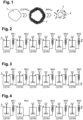
- the sulfide mineral concentrate (1) is subjected to a combination of alkaline oxidation ((CSTR) n ) and surface attritioning ((MA) n ) in order to reduce the impact of surface coating (2) and passivation effects, illustrated in figure 1 .
- the surface layer (2) or passivation layer (2) contains ferric iron hydroxide (Fe(OH) 3 ) and gypsum (CaSO 4 .2 H 2 O).
- the surface attritioning forms a slurry which is called a mechanically activated slurry and which contains oxidized matter (4), refractory sulfide ore (3) or concentrate particles, alkaline liquid phase and liberated metal to be recovered.
- the sulfide mineral concentrate is subjected to an elevated temperature alkaline oxidation process into which oxygen gas (preferably with an oxygen content greater than 95% v/v) is sparged and lime is added.
- oxygen gas preferably with an oxygen content greater than 95% v/v
- the rationale for this approach is to limit milling/grinding to achieve mineral surface attritioning (also called herein mechanical activation and encompassing both mechanical activation or attritioning) in a stirred media reactor sufficient to disrupt/alter or remove gypsum and iron oxide surface coating and passivation.
- the alkaline oxidation process is applied to mineral surfaces and milling (mechanical activation) is only used to expose fresh mineral surfaces ("active" layer) to sustain elevated mineral oxidation rates, as illustrated in figure 1 .
- the process of mechanically activation also results in a high degree of strain being introduced into the sulphide mineral lattice, increasing the number of grain boundary fractures and lattice defects in the mineral.
- the introduction of strain lowers the activation energy for the oxidation of the sulfides and enables oxidation under atmospheric conditions.
- the rate of oxidation is also enhanced, due to the increased mineral surface area.
- the process according to the present invention can occur in a number of different circuit configurations, with the basic feature of alternating alkaline oxidation (shown in CSTR reactors below) with inter-stage surface attritioning (also called mechanical activation, MA).
- the number of stages can range from 3 - 10, preferably from 3 to 8. More preferably from 4 to 7.
- alkaline sulfide oxidation process for treating refractory ore particles enriched in said metal to be collected comprises said at least 3 stages comprising:
- the series of n alkaline oxidation steps comprises at least:
- FIG. 2 A first embodiment is illustrated in figure 2 .
- the series of n reactor comprises 6 agitated reactors.
- Each agitated reactor (CSTR 1 to CSTR 6) is followed by one mechanical activation means (MA 1 to MA 6).
- the first agitated reactor is fed with refractory ore particles, having preferably a P 80 lower than 150 ⁇ m.
- Each alkaline oxidation step of said series of n alkaline oxidation step is followed by a mechanical activation step of said series of x mechanical activation steps.
- Each n th alkaline oxidation step forms a n th slurry of surface oxidized refractory ore particles.
- Each x th mechanical activation step forms a x th mechanically activated slurry.
- the first alkaline oxidation step in agitated reactor CSTR 1 forms a first slurry of surface oxidized refractory ore particles and is followed by a first mechanical activation step in a mechanical activation means MA1.
- the first mechanical activation forms a first mechanically activated slurry.
- the first alkaline oxidation step is fed by refractory ore particles.
- the second alkaline oxidation step in agitated reactor CSTR 2 forms a second slurry of surface oxidized refractory ore particles and is followed by a second mechanical activation step in a mechanical activation means MA 2.
- the second mechanical activation forms a second mechanically activated slurry.
- the second alkaline oxidation step is fed by the first mechanically activated slurry.
- the third alkaline oxidation step in agitated reactor CSTR 3 forms a third slurry of surface oxidized refractory ore particles and is followed by a third mechanical activation step in a mechanical activation means MA 3.
- the third mechanical activation forms a third mechanically activated slurry.
- the third alkaline oxidation step is fed by the second mechanically activated slurry.
- the fourth alkaline oxidation step in agitated reactor CSTR 4 forms a fourth slurry of surface oxidized refractory ore particles and is followed by a fourth mechanical activation step in a mechanical activation means MA 4.
- the fourth mechanical activation forms a fourth mechanically activated slurry.
- the fourth alkaline oxidation step is fed by the third mechanically activated slurry.
- the fifth alkaline oxidation step in agitated reactor CSTR 5 forms a fifth slurry of surface oxidized refractory ore particles and is followed by a fifth mechanical activation step in a mechanical activation means MA 5.
- the fifth mechanical activation forms a fifth mechanically activated slurry.
- the fifth alkaline oxidation step is fed by the fourth mechanically activated slurry.
- the sixth alkaline oxidation step in agitated reactor CSTR 6 forms a sixth slurry of surface oxidized refractory ore particles and is followed by a sixth mechanical activation step in a mechanical activation means MA 6.
- the sixth mechanical activation forms a sixth mechanically activated slurry.
- the sixth alkaline oxidation step is fed by the fifth mechanically activated slurry.
- the attritioners or mechanical activation means (MA 1 to MA 6) will not be between the alkaline oxidation stages (CSTR 1 to CSTR 6), but rather in parallel with the oxidation stages, forming an internal loop between the alkaline oxidation reactor and the mechanical activation reactor.
- the equipment arrangement would have preferably 4 to 6 reactors for alkaline oxidation, with 4 to 6 attritioners "next to" the reactors.
- the slurry is drawn from a n th agitated reactor, sent through the attritioner, which then returns the slurry to the same n th reactor.
- This arrangement offers the added benefit that the circuit may continue to operate even if an attritioner needs to be taken offline for maintenance or replacement. It also provides more flexibility to alter the relative extent of attritioning vs oxidation, by adjusting the return (to the same oxidation reactor) versus the forwarding (to the next oxidation reactor in the series) flow rate. Also, not all alkaline oxidation stages may require a mechanical activation step, therefore some mechanical activation steps can be omitted (see figure 5 ).
- the number of agitated reactors in said series is preferably 6 and the number of mechanical activation means in said series is also preferably 6.
- Each alkaline oxidation step of said series of n alkaline oxidation step is followed by a mechanical activation step of said series of x mechanical activation steps.
- Each n th alkaline oxidation step forms a n th slurry of surface oxidized refractory ore particles.
- the n th alkaline oxidation step is fed by a (n - 1) th slurry from a (n - 1) agitated reactor to which a (n- 1) th mechanically activated slurry is returned.
- the first alkaline oxidation step in agitated reactor CSTR 1 forms a first slurry of surface oxidized refractory ore particles and is followed by a first mechanical activation step in a mechanical activation means MA1.
- the first mechanical activation forms a first mechanically activated slurry.
- the first alkaline oxidation step is fed by refractory ore particles and by said first mechanically activated slurry.
- the second alkaline oxidation step in agitated reactor CSTR 2 forms a second slurry of surface oxidized refractory ore particles and is followed by a second mechanical activation step in a mechanical activation means MA 2.
- the second mechanical activation forms a second mechanically activated slurry.
- the second alkaline oxidation step is fed by the first slurry from the first agitated reactor and by the second mechanically activated slurry.
- the third alkaline oxidation step in agitated reactor CSTR 3 forms a third slurry of surface oxidized refractory ore particles and is followed by a third mechanical activation step in a mechanical activation means MA 3.
- the third mechanical activation forms a third mechanically activated slurry.
- the third alkaline oxidation step is fed by the second slurry from the second agitated reactor and by the third mechanically activated slurry.
- the fourth alkaline oxidation step in agitated reactor CSTR 4 forms a fourth slurry of surface oxidized refractory ore particles and is followed by a fourth mechanical activation step in a mechanical activation means MA 4.
- the fourth mechanical activation forms a fourth mechanically activated slurry.
- the fourth alkaline oxidation step is fed by the third slurry from the third agitated reactor and by the fourth mechanically activated slurry.
- the fifth alkaline oxidation step in agitated reactor CSTR 5 forms a fifth slurry of surface oxidized refractory ore particles and is followed by a fifth mechanical activation step in a mechanical activation means MA 5.
- the fifth mechanical activation forms a fifth mechanically activated slurry.
- the fifth alkaline oxidation step is fed by the fourth slurry from the fourth agitated reactor and by the fifth mechanically activated slurry.
- the sixth alkaline oxidation step in agitated reactor CSTR 6 forms a sixth slurry of surface oxidized refractory ore particles and is followed by a sixth mechanical activation step in a mechanical activation means MA 6.
- the sixth mechanical activation forms a sixth mechanically activated slurry.
- the sixth alkaline oxidation step is fed by the fifth slurry from the fifth agitated reactor and by the sixth mechanically activated slurry.
- Figure 4 illustrates a variant embodiment compared to figure 2 , where the number of agitated reactors in said series of n agitated reactor is not the same as the number of mechanical activation means of said series of x mechanical activation means.
- This arrangement can be carried out as such or at any location in the series and can be carried out as illustrated by construction or because one mechanical activation means needs to be maintained. In this case, a by-pass is realized between two consecutive agitated reactors.
- x is different from n, hence lower than n.
- Some alkaline oxidation step of said series of n alkaline oxidation step are followed by a mechanical activation step of said series of x mechanical activation steps, but not each alkaline oxidation steps.
- Each n th alkaline oxidation step forms a n th slurry of surface oxidized refractory ore particles and is fed by a (n-1) th slurry from the (n- 1) th agitated reactor, optionally subsequently mechanically activated.
- the first alkaline oxidation step in agitated reactor CSTR 1 forms a first slurry of surface oxidized refractory ore particles and is followed by a first mechanical activation step in a mechanical activation means MA1.
- the first mechanical activation forms a first mechanically activated slurry.
- the first alkaline oxidation is fed by refractory ore particles.
- the second alkaline oxidation step in agitated reactor CSTR 2 forms a second slurry of surface oxidized refractory ore particles.
- the second alkaline oxidation step is fed by the first mechanically activated slurry.
- the third alkaline oxidation step in agitated reactor CSTR 3 forms a third slurry of surface oxidized refractory ore particles and is followed by a second mechanical activation step in a mechanical activation means MA 2.
- the second mechanical activation forms a second mechanically activated slurry.
- the third alkaline oxidation step is fed by the second slurry from the second alkaline oxidation step.
- the fourth alkaline oxidation step in agitated reactor CSTR 4 forms a fourth slurry of surface oxidized refractory ore particles and is followed by a third mechanical activation step in a mechanical activation means MA 3.
- the third mechanical activation forms a third mechanically activated slurry.
- the fourth alkaline oxidation step is fed by the second mechanically activated slurry.
- the fifth alkaline oxidation step in agitated reactor CSTR 5 forms a fifth slurry of surface oxidized refractory ore particles and is followed by a fourth mechanical activation step in a mechanical activation means MA 4.
- the fourth mechanical activation forms a fourth mechanically activated slurry.
- the fifth alkaline oxidation step is fed by the third mechanically activated slurry.
- the sixth alkaline oxidation step in agitated reactor CSTR 6 forms a sixth slurry of surface oxidized refractory ore particles and is followed by a fifth mechanical activation step in a mechanical activation means MA 5.
- the fifth mechanical activation forms a fifth mechanically activated slurry.
- the sixth alkaline oxidation step is fed by the fourth mechanically activated slurry.
- Figure 5 illustrates a variant embodiment compared to figure 3 , where the number of agitated reactor in said series of n agitated reactor is not the same as the number of mechanical activation means of said series of x mechanical activation means.
- This arrangement can be carried out as such or at any location in the series and can be carried out as illustrated by construction or because one mechanical activation means needs to be maintained, as afore explained.
- x is different from n, and lower than n.
- Each nth alkaline oxidation step forming a nth slurry of surface oxidized refractory ore particles and being fed from a (n - 1)th agitated reactor optionally to which a xth mechanically activated slurry with x ⁇ (n - 1) is returned.
- the first alkaline oxidation step in agitated reactor CSTR 1 forms a first slurry of surface oxidized refractory ore particles and is followed by a first mechanical activation step in a mechanical activation means MA1.
- the first mechanical activation forms a first mechanically activated slurry.
- the first alkaline oxidation is fed by refractory ore particles and by said first mechanically activated slurry.
- the second alkaline oxidation step in agitated reactor CSTR 2 forms a second slurry of surface oxidized refractory ore particles and is followed by a second mechanical activation step in a mechanical activation means MA 2.
- the second mechanical activation forms a second mechanically activated slurry.
- the second alkaline oxidation step is fed by the first slurry from the first agitated reactor and by the second mechanically activated slurry.
- the third alkaline oxidation step in agitated reactor CSTR 3 forms a third slurry of surface oxidized refractory ore particles.
- the third alkaline oxidation step is fed by the second slurry from the second agitated reactor.
- the fourth alkaline oxidation step in agitated reactor CSTR 4 forms a fourth slurry of surface oxidized refractory ore particles and is followed by a third mechanical activation step in a mechanical activation means MA 3.
- the third mechanical activation forms a third mechanically activated slurry.
- the fourth alkaline oxidation step is fed by the third slurry from the third agitated reactor and by the third mechanically activated slurry.
- the fifth alkaline oxidation step in agitated reactor CSTR 5 forms a fifth slurry of surface oxidized refractory ore particles and is followed by a fourth mechanical activation step in a mechanical activation means MA 4.
- the fourth mechanical activation forms a fourth mechanically activated slurry.
- the fifth alkaline oxidation step is fed by the fourth slurry from the fourth agitated reactor and by the fourth mechanically activated slurry.
- the sixth alkaline oxidation step in agitated reactor CSTR 6 forms a sixth slurry of surface oxidized refractory ore particles and is followed by a fifth mechanical activation step in a mechanical activation means MA 5.
- the fifth mechanical activation forms a fifth mechanically activated slurry.
- the sixth alkaline oxidation step is fed by the fifth slurry from the fifth agitated reactor and by the fifth mechanically activated slurry.
- Figure 6 shows another arrangement in which a combination of several variants is illustrated.
- the first alkaline oxidation step in agitated reactor CSTR 1 forms a first slurry of surface oxidized refractory ore particles and is followed by a first mechanical activation step in a mechanical activation means MA1.
- the first mechanical activation forms a first mechanically activated slurry.
- the first alkaline oxidation is fed by refractory ore particles and the first mechanically activated slurry.
- the second alkaline oxidation step in agitated reactor CSTR 2 forms a second slurry of surface oxidized refractory ore particles and is followed by a second mechanical activation step in a mechanical activation means MA 2.
- the second mechanical activation forms a second mechanically activated slurry.
- the second alkaline oxidation step is fed by the first slurry from the first agitated reactor and by the second mechanically activated slurry.
- the third alkaline oxidation step in agitated reactor CSTR 3 forms a third slurry of surface oxidized refractory ore particles.
- the third alkaline oxidation step is fed by the second slurry from the second agitated reactor.
- the fourth alkaline oxidation step in agitated reactor CSTR 4 forms a fourth slurry of surface oxidized refractory ore particles and is followed by a third mechanical activation step in a mechanical activation means MA 3.
- the third mechanical activation forms a third mechanically activated slurry.
- the fourth alkaline oxidation step is fed by the third slurry from the third agitated reactor.
- the fifth alkaline oxidation step in agitated reactor CSTR 5 forms a fifth slurry of surface oxidized refractory ore particles.
- the fifth alkaline oxidation step is fed by the third mechanically activated slurry from the third mechanical activation means.
- the sixth alkaline oxidation step in agitated reactor CSTR 6 forms a sixth slurry of surface oxidized refractory ore particles and is followed by a fourth mechanical activation step in a mechanical activation means MA 4.
- the fourth mechanical activation forms a fourth mechanically activated slurry.
- the sixth alkaline oxidation step is fed by the fifth slurry from the fifth agitated reactor.
- the seventh alkaline oxidation step in agitated reactor CSTR 7 forms a seventh slurry of surface oxidized refractory ore particles and is followed by a fifth mechanical activation step in a mechanical activation means MA 5.
- the fifth mechanical activation forms a fifth mechanically activated slurry.
- the seventh alkaline oxidation step is fed by the fourth mechanically activated slurry from the fourth mechanical activation means.
- the conditions for alkaline oxidation process are preferably as follows:
- Lime agent addition into the oxidation reactors (CSTR) and stirred media (attritioning or mechanical activation) reactors can be achieved either by addition of dry quicklime (CaO - in powder form), lime hydrate (Ca(OH) 2 - in powder form), or milk of lime also known as slaked lime slurry (a suspension of Ca(OH) 2 ).
- the lime addition rate would be dependent upon reaction demand and maintaining the pH at 11 in all alkaline oxidation reactors.
- the heat for maintaining the temperature at or above 80°C is derived from the stirred media reactor as well as the exothermic chemical reactions and is sustained by managing the various heat balance factors of the processing circuit. These heat balance factors are specific to each application scenario and should be evaluated for each individual scenario as key inputs into the process design and selection of lime reagent type. The mass feed and subsequent rate of sulfide oxidation, as well the type of lime reagent used are particularly relevant to the heat balance.
- the choice of lime reagent in the form of CaO, compared to already-hydrated Ca(OH) 2 may impact the heat balance, and may be used to manage the amount of heat in the process.
- Oxygen utilization efficiency may also be improved by making use of a cascade of multiple oxidation reactors where the oxygen gas from one reactor is captured and introduced to a next reactor vessel in the cascade.
- a key design element of the processing circuit is the extent of pyrite (or other sulfide mineral) oxidation to be targeted, as this is the key driver for determining the extent surface attrition, the extent of oxidation and therefore also the extent of lime and oxygen reagent requirement. In turn, these factors influence the process residence time and thereby the reactor size. These factors thus also influence the operational and capital costs of the processing circuit.
- the optimal solids content is determined by optimal viscosity of the solids slurry.
- a too viscous slurry will reduce the efficiency of oxygen mass transfer and would negatively impact the efficiency of attritioning.
- the design of the process circuit should take into account that the that the solids content, and thus viscosity, of the slurry will increase through the circuit as a result of increased gypsum generation.
- the process design should take into consideration this increased viscosity and the optimal viscosity for oxygen transfer and attritioning or mechanical activation. Dilution process water may also be introduced along the process circuit to reduce the solids concentration and viscosity if required to maintain optimal conditions
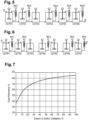
- the extent of gold extraction by cyanidation leaching should be determined as a function of extent of pyrite oxidation, as is known in the art and shown by way of example in the graph in figure 7 .
- the process circuit design and in particular the extent of surface attritioning and oxidation is based on obtaining key process design parameters experimentally.
- the lime consumption is correlated with the oxygen consumption via the reaction mechanism, which allows for the oxygen demand for the system to be calculated and the oxygen supply system to be designed for the oxidation reactors.
Landscapes
- Chemical & Material Sciences (AREA)
- Engineering & Computer Science (AREA)
- Organic Chemistry (AREA)
- Materials Engineering (AREA)
- Mechanical Engineering (AREA)
- Metallurgy (AREA)
- Manufacturing & Machinery (AREA)
- Life Sciences & Earth Sciences (AREA)
- Environmental & Geological Engineering (AREA)
- General Life Sciences & Earth Sciences (AREA)
- Geology (AREA)
- Geochemistry & Mineralogy (AREA)
- Inorganic Chemistry (AREA)
- Manufacture And Refinement Of Metals (AREA)
Description
- The present invention relates to an alkaline sulfide oxidation process for treating refractory ore particles enriched in a metal to be recovered, i.e., prior to extraction and recovery of such metal, as well as to a device for such alkaline sulfide oxidation process.
- Gold and other precious metals are generally extracted from ores by treatment with a cyanide solution which solubilizes the gold and precious metals in the presence of oxygen.
- In the cyanide leaching process, solid metallic gold (Au0) is oxidized (to Au+) by sparged oxygen and is maintained in soluble form as a gold-cyanide complex (Au(CN)2-) via the overall reaction illustrated below using sodium cyanide as an example, prior to recovery by adsorption onto activated carbon and subsequent processing:
4 Au + 8 NaCN + O2 + 2H2O = 4 Na [Au(CN)2] + 4 NaOH
- Cyanidation leaching of gold needs to occur at alkaline pH conditions, preferably at pH 11, to maintain cyanide in an anionic solution form (CN-) for use in the gold dissolution. At pH levels below 11, and particularly below 9, soluble cyanide is converted to hydrogen cyanide (HCN) that is both ineffective as a leaching agent and prone to evaporation as a toxic gas released from the aqueous phase. It is, therefore, imperative to increase the aqueous mineral slurry pH and maintain it at a safe and effective level, which imposes a reagent consumption demand, most often in the form of quicklime (with active reagent CaO) as the most economical alkalizing reagent. Quicklime is converted to its hydrated form, Ca(OH)2, when in contact with water and may be utilized in either Ca(OH)2 or CaO formats.
- In some ores, the gold is termed "refractory" to recovery by cyanidation. There are several features that may cause ores to be refractory: (1) The presence of carbonaceous matter that adsorbs (i.e. robs) gold from the pregnant solution (containing cyanide-dissolved gold) thereby reducing recovery, leading to the term "preg-robbing" ore. The most common form of refractory ore is caused by the presence of sulfide minerals, such as pyrite or arsenopyrite. Sulfide refractory ore (or concentrate) is the most commonly encountered refractory ore where fine gold particles are co-contained and often occluded within a matrix of sulfide minerals, most commonly pyrite (FeS2) or arsenopyrite (FeAsS).
- Such gold is not sufficiently liberated and therefore not sufficiently accessible to lixiviants, of which cyanide is the most commonly used. Even if sufficiently liberated the presence of sulfide minerals contributes to uneconomically high cyanide reaction consumption because of the overwhelming unwanted side-reaction of sulfide minerals with cyanide, to form thiocyanate (SCN-) that is less effective as a gold lixiviant.
4 FeS2 + 8 NaCN + 3 O2 + 6 H2O = 8 NaSCN + 4 Fe(OH)3
- Because of the predominance of sulfide refractory ore, the term "refractory" in the rest of this text is meant to refer to sulfide refractory ore (or concentrate) rather than preg-robbing ore.
- To solve the aforementioned difficulties, there are several well-known processing options, as pre-treatment before cyanidation, which are available to recover gold from sulfide-refractory ore, most commonly after it has been upgraded to a concentrate via a mineral flotation process [Aylmore et al., 2012. Evaluating process options for treating some refractory ores DOI: 10.13140/2.1.4325.9842 Conference: ALTA 2012 INTERNATIONAL GOLD CONFERENCE, Perth, Australia].
- Such available pre-treatment process options are further described in La Brooy et al., Review of gold extraction from ores, Minerals Engineering, [Volume 7, ], and are carried out either via roasting or hydrometallurgical methods that range from high temperature (up to 250°C), pressure oxidation in autoclaves to bacteria catalyzed oxidation at atmospheric pressure and mild temperature conditions (35 - 45°C in the case of mesophilic bacteria and up to 80°C for archaea systems).
- A first option available is a roasting pre-treatment. Roasting is conducted at temperatures of approximately 800°C in the presence of oxygen-containing gas, resulting in the oxidation of sulfides into sulfate solids and gaseous sulfur dioxide. The generation of sulfur dioxide gas is problematic and needs to be collected, generally by conversion into sulfuric acid. The roasting process and capital requirements are further complicated when arsenic is present in the refractory ore. After calcination, the residual gold-containing material, can be subjected to conventional gold cyanidation processes.
- Another option available is pressure oxidation. Pressure oxidation is a hydrometallurgical processing method in which refractory concentrate (typically with a P80 150 µm) is oxidized in an autoclave by the introduction of oxygen gas into aqueous media under elevated pressure and temperature conditions, typically 200°C and 3,100 kPa for up to 60 minutes.
- The notation Px represents a diameter expressed in µm, compared to which the size of X% by volume of the particles measured are less than or equal to this diameter. For example, P80 150 µm means that 80% by volume of the particles have a diameter smaller than or equal to 150 µm. The particle size distribution of a sample can be determined by different methods, known in the art.
- The reaction below illustrates pyrite oxidation (by way of example) as is typically achieved in an autoclave, generating hematite and sulfuric acid.
4 FeS2 + 15 O2 + 8 H2O = 2 Fe2O3 + 8 H2SO4
- A portion of the iron contained in pyrite remains in solution as ferric iron sulfate because of the high acid levels preventing all ferric iron precipitating.
4 FeS2 + 15 O2 + 2 H2O = 4 Fe3+ + 6 SO4 2- + 2 H2SO4
- A further available option is bacterial bio-oxidation. Bacterial bio-oxidation is a hydrometallurgical processing method in which refractory concentrate (typically P80 < 150 µm) is oxidized in aqueous media at atmospheric pressure and mild temperature 35 - 45°C, where sulfide mineral oxidation is catalyzed by iron- and sulfur-oxidizing bacteria in a cascade of reactors with a total residence time of approximately 4 days. While bacteria cope well with impurities such as arsenic, they have a low tolerance for chloride (above approximately 1g/dm3), thereby prohibiting the use of seawater (chloride content of approximately 17g/dm3). Similar pyrite oxidation reactions occur during biooxidation as earlier illustrated for pressure oxidation, but the ambient pressure conditions of biooxidation result in iron precipitating as jarosite rather than hematite.
- Alternatively, there also exist ultra-fine grinding methods (P80 25 µm), such as the Albion process, disclosed in
EP 1 171 641EP 1 171 641WO006/064350 WO2006/064350 A1 discloses a process for obtaining metal values, typically base metals, platinum or gold from feed material. In a first step of the process, feed material containing metal values is ground to a particle size d90 of 100 µm or less to form an ultra fine pulp, In a second step of the process, the ultra fine ground pulp from the first step is oxygenated by pumping it in multiple passes through an in.line high shear static oxygenation device, while recirculating it on a tank or any other vessel. - A more recent alternative is an acidic leaching process by FLSmidt called the Rapid Ore Leaching process (as disclosed in
WO 2016/100981 ) which makes use of alternating grinding (stirred media reactors) and leaching, in acid environments for base metal recovery. - Leaching inside a mill was also proposed in Patent
CN1228480 which teaches a process in which milling and oxidation occurs simultaneously in the same reactor and does not separate the oxidation step from the surface attritioning/milling. The problem with such an approach is that the oxidation and milling cannot be independently controlled. - Several of the above hydrometallurgical methods, such as FLSmidt's Rapid Ore Leaching process, will yield acidic conditions in the bulk of the slurry.
- Acid generation is a consequence of most aqueous pyrite oxidation processes and has three important negative consequences:
- 1. The combination of acidic and oxidative process conditions (dissolved oxygen and ferric iron) is particularly corrosive, thus requiring special materials of construction that, in turn, impose significant capital equipment costs for the pressurized reactor vessels. The corrosive conditions are further exacerbated by the use of chloride-containing water as is contained in seawater. These features increase capital equipment complexity and costs.
- 2. The generation of acid during hydrometallurgical sulfide mineral oxidation also causes significant dissolution of gangue minerals contained in the ore or concentrate. Dissolved gangue elements such as Fe, Al, Mn, Mg and others, require precipitation for removal from solution prior to process solution re-use or disposal. These gangue element precipitation reactions also typically require a combination of calcium carbonate (effective at pH levels < 4.5 for Fe and Al removal) and lime (effective at pH levels up to 12 for precipitation of elements that precipitate as hydroxides at elevated pH levels). The precipitation reagents required, incur significant costs.
- 3. Acidic conditions are contrary to the alkaline conditions required in the subsequent gold cyanidation leaching process. The oxidized slurry therefore requires the addition of large quantities of base reagents to render the pH conducive to cyanidation leaching of gold.
- As it can be seen from industrial practice, the available hydrometallurgical process options present problems of acid generation. To overcome these challenges, alkaline sulfide mineral oxidation methods have been proposed, where the absence of acid would avoid the problems of corrosion and gangue mineral dissolution [Bahkta et al., 1989. Alkaline oxidative leaching of gold-bearing arsenopyrite ores. Report of investigations (United States of America Bureau of Mines): 9258. Supt. Docs no: I28.23.:9258]. Alkaline reagents that have previously been considered for this purpose have included, amongst others, NaOH, Na2CO3, NaOCI and KOH. Unfortunately, the use of these reagents, however, poses a number of problems:
- 1. The monovalent cations (such as Na+) associated with these reagents typically remain soluble and are not readily removed from solution circuits by precipitation reactions. This, in turn, causes secondary environmental, regulatory or license-to-operate issues because of process circuit discharge and seepage into underground- or open water sources.
- 2. These reagents are relatively expensive.
- Further, Bidari et al. studied the alkaline oxidation of pyrite in the presence of calcite and dolomite and highlighted the formation of a surface layer on the pyrite containing Ca (in the case of calcite) and Mg (in the case of dolomite) on the pyrite surface, which ascribed to be the cause of the slowdown in pyrite leaching rate. Pyrite alkaline oxidation rate decreased in the presence of both calcite and dolomite, while a more detrimental effect was observed in the case of calcite (see " Pyrite oxidation in the presence of calcite and dolomite: Alkaline leaching, chemical modelling and surface characterization" in Trans. Nonferrous Met. Soc. China 28(2018) 1433-1443).
- Caldeira et al. studied the alkaline oxidation of pyrite with different alkaline solutions to characterize the nature of a product layer formed at the surface of the oxidized pyrite. A comparison between different alkaline reagents was performed, such as with sodium or calcium hydroxide and sodium carbonate. Caldeira et al., 2003 reported that a "... very low oxidation of pyrite was obtained in the presence of lime" compared to sodium carbonate which does not result in gypsum formation [C.L Caldeira, V.S.T Ciminelli, A Dias, K Osseo-Asare, Pyrite oxidation in alkaline solutions: nature of the product layer, International Journal of Mineral Processing, Volume 72, Issues 1-4, 2003, Pages 373-386].
- Alkaline oxidation conditions have advantages compared to acidic conditions, but has a number of drawbacks: (1) alkali reagents such as sodium hydroxide, ammonium hydroxide or potassium hydroxide are expensive reagents and pose environmental risks because of the inability to readily remove the associated cation from processing circuits, while (2) calcium based alkali reagents have been demonstrated to cause passivation of pyrite and thereby work counter to the objective of oxidizing refractory ore.
- There is, therefore, a need to provide oxidation of sulfide minerals for recovering metal in the sulfide mineral having the minimal impact on environment, either in terms of impact or treatment of disposal, further allowing the use of diverse source of water and where the capital equipment costs remain reasonable.
- It is an objective of the present invention to compensate at least partly for these drawbacks by providing an alkaline oxidation process of refractory ore particles for recovering metal which are entrapped in or co-occurring such sulfide minerals which involve less expensive alkaline agent, allows the use of diversified sources of water and where the capital equipment costs and energy consumption remains at an acceptable level.
- The invention is defined in accordance with the claims.
- According to the present invention and against all expectations, it has been possible to perform efficiently a lime based alkaline oxidation step of refractory sulfide ore particles for extracting a metal of interest. While the literature was strongly teaching away from the use of an alkaline calcium reagent compound because the surface coating effect of lime creating a passivation layer that prevents further oxidation of the refractory ore, the yield of the oxidation process according to the present invention was comparable to other acid or alkaline oxidation leaching but more economical and without the drawbacks of the prior art.
- Indeed,
US Patent 2016/0258038A1 states that "...leaching of iron sulfide materials with lime has been unsuccessful in that leaching is incomplete and subsequent precious metal recovery is low. For example, an earlier study of alkaline oxidation of pyrite for gold recovery using lime achieved only 30 to 40% gold recovery which offered little improvement over direct cyanidation of the pyrite. This is believed to be due to passivation of the mineral by precipitation of a gypsum/iron oxide layer." - Further, in copper sulfide mineral processing, pyrite occurs as an unwanted sulfide mineral that needs to be rejected during processing. This is typically achieved by inducing surface coating effects partly attributed to lime. For example Hu et al. 2000, notes that: "Well known phenomenon of the depression of pyrite by lime is attributed to the surface formation of Ca(OH)2, CaSO4 and Fe(OH)3 as determined by XPS analysis" [Hu et al., J. D. (2000). Surface chemistry of activation of lime-depressed pyrite in flotation. Transactions of Nonferrous Metals Society of China (English Edition), 10(6), 798-803.]
- Pyrite oxidation is the main cause of acid mine drainage (also called acid rock drainage). Acid mine drainage prevention therefore focusses on preventing the oxidation of pyrite. An article by Qian 2017 states that: "treatment with lime-saturated water was found to be of paramount importance for maintaining long-term circum-neutral pH, favourable for the formation and preservation of the pyrite surface passivating layer and reduced acid generation rate" [Qian, Gujie & Schumann, Russell & Li, Jun & Short, Michael & Fan, Rong & Li, Yubiao & Kawashima, Nobuyuki & Zhou, Yan & St. C. Smart, Roger & R. Gerson, Andrea. (2017). Strategies for Reduced Acid and Metalliferous Drainage by Pyrite Surface Passivation. Minerals. 7. 1-15. 10.3390/min7030042.]
- According to the present invention, it has been identified that it is possible to use lime during alkaline oxidation of refractory ore particles enriched in a metal to be recovered after at least 3 stages of alkaline oxidation with intermittent mechanical activation. During each alkaline oxidation step, a slurry is formed in which the refractory ore particles are oxidized. The slurry is further mechanically activated to remove or alter the passivation layer around the refractory ore particles in an attrition step or milling step. The attritioning step or milling step is performed during a relatively short residence time to only remove or alter the passivation layer and to limit the energy requirements for this mechanical activation step. Further, the mechanically activated slurry is again submitted to a new and second stage of alkaline oxidation mechanical activation step. During the alkaline oxidation step of the second stage, the remaining portion of the refractory ore particles is further surface-oxidized and become coated with a new passivation layer (forming a second slurry). The new passivation layer is further removed or altered during a subsequent attrition or milling step of the second slurry and forms a second mechanically activated slurry. The second mechanically activated slurry is further submitted to a third stage of alkaline oxidation step and mechanical activation step. During the alkaline oxidation step of the third stage, the remaining portion of the refractory ore particles is further oxidized in surface and surrounded with a new passivation layer (forming a third slurry). The new passivation layer is further removed or alter during a subsequent attrition or milling step of the third slurry and forms a third mechanically activated slurry. The third mechanically activated slurry is either collected for further processing or submitted to a next alkaline oxidation step, possibly by being beforehand returned to (so looping with) the previous alkaline oxidation step through the third mechanical activation step.
- The number of stages is at least three and can be further increased depending on the particle size of the refractory ore particles. In addition, the residence time for each alkaline oxidation step can be the same or different from one to each other and will be defined taking into account the constraints of the process.
- An unexpected finding of the present invention, was that refractory ore particles could be oxidized to a substantial extent with the use of lime as alkaline reagent under oxidation conditions that are otherwise known for generating a passivation layer, normally considered as an obstacle to oxidation. This was achieved by facilitating oxidation under alkaline conditions using, a lime reagent, and subsequent removal/alteration of the surface passivation layer to further generate a new "active" surface and accordingly, reduce the main diameter of each refractory ore particles step by step by the stages in the process according to the present invention. According to the present invention,said refractory ore is gold refractory sulfide ore or concentrate such as gold containing pyrite ore or concentrate, gold containing arsenopyrite ore or concentrate, copper sulfide ore or concentrate, nickel sulfide ore or concentrate, zinc sulfide ore or concentrate or cobalt sulfide ore or concentrate and combined metal sulfide ore or concentrate such as low grade copper-gold sulfide ore or concentrate.
- In addition, according to the present invention, said added oxidizing agent is an oxidizing liquid, an oxidizing powder or an oxidizing gas, such as oxygen, ozone, and their mixture
- Further, in a particular embodiment, said calcium hydroxide of said alkaline liquid phase is obtained by wherein said calcium hydroxide of said alkaline liquid phase is obtained by one or more addition of dry quicklime CaO, hydrated lime Ca(OH)2, a milk of lime also known as slaked lime being a slurry of Ca(OH)2 and water, said one or more addition being chosen amongst an addition upstream one nth reactor, in one nthreactor, upstream a xth communition device, in a xth mechanical activation means or combination thereof
- More specifically, in the process according to the present invention, each intermediate alkaline oxidation step is fed by a previous alkaline oxidation step, optionally via a mechanical activation step.
- For example, in one advantageous embodiment of the process according to the present invention, x = n and each nth alkaline oxidation step of said series of n alkaline oxidation step is followed by a xth mechanical activation step of said series of x mechanical activation steps (with the number of the series xth being normally equal to the number of the series nth but not mandatorily), each nth (from second), i.e. each amongst the at least one intermediate alkaline oxidation step and last alkaline oxidation step being fed by a xth mechanically activated slurry where x = n - 1.
- In another exemplary embodiment according to the present invention, x = n and each nth alkaline oxidation step of said series of n alkaline oxidation step is followed by a xth mechanical activation step of said series of x mechanical activation steps (with the number of the series xth being normally equal to the number of the series nth but not mandatorily), each nth (from second), i.e. each amongst the at least one intermediate alkaline oxidation step and last alkaline oxidation step being fed by a (n - 1)th slurry from a (n - 1)th agitated reactor to which a (n- 1)th mechanically activated slurry is returned.
- In a further exemplary embodiment according to the process of the present invention, x is different from n, hence lower than n. In this exemplary embodiment, the process comprises several intermediate alkaline oxidation steps and some intermediate alkaline oxidation steps of said series of n alkaline oxidation step are followed by a mechanical activation step. In one sub-variant of this exemplary embodiment, each nth intermediate alkaline oxidation step forming a nth slurry is fed by a (n-1)th slurry from the (n- 1)th agitated reactor, optionally subsequently mechanically activated. In another sub-variant of this exemplary embodiment, each nth alkaline oxidation step forming a nth slurry is fed from a (n - 1)th agitated reactor optionally to which a xth mechanically activated slurry with x < (n - 1) is returned.
- According to the present invention, it is foreseen that mechanical activation is achieved by at least one comminution device, i.e., can be made by a single comminution device or two, three or more sequentially ordered comminution devices in parallel and/or in series, between two sequential alkaline oxidation steps.
- In an advantageous embodiment of the process according to the present invention, at least one alkaline oxidation step, preferably more than one alkaline oxidation step and more preferably each alkaline oxidation step of said series of n alkaline oxidation steps is performed at atmospheric pressure.
- In another advantageous embodiment of the process according to the present invention, at least one alkaline oxidation step, preferably more than one alkaline oxidation step and more preferably each alkaline oxidation step of said series of n alkaline oxidation steps is performed at a temperature comprised between 70 and 100°C, preferably between 80 and 95°C, more preferably between 80°C and 90°C.
- In a further particular embodiment of the process according to the present invention, at least one alkaline oxidation step, preferably more than one alkaline oxidation step and more preferably each alkaline oxidation step of said series of n alkaline oxidation steps is performed with a dissolved oxygen content comprised between 1 and 30 mg/dm3, preferably between 5 and 25 mg/dm3, more preferably higher than 10 mg/dm3 and in particular between 10 and 20 mg/dm3 of liquid phase.
- Preferably, in the process according to the present invention, at least one alkaline oxidation step, preferably more than one alkaline oxidation step and more preferably each alkaline oxidation step of said series of n alkaline oxidation steps is performed at a pH comprised between 10 and 12.5, preferably comprised between 10 and 12 and in particular between 10.5 and 11.5, said pH being controlled with a controlled lime addition of said alkaline agent.
- More preferably, in the process according to the present invention, at least one alkaline oxidation step, preferably more than one alkaline oxidation step and more preferably each alkaline oxidation step of said series of n alkaline oxidation steps is performed with solid content in the stirred reactor comprised between 10 and 70 wt%, preferably, between 20 and 70 wt%, more preferably between 35 and 70 wt%, more particularly between 40 and 65 wt% with respect to the total weight contained in said stirred reactor.
- In particular, in the process according to the present invention, at least one of mechanical step of said series of x mechanical activation step is performed in a vertical mill, a vertical stirred mill, a horizontal mill, an attritor, a stirred ball mill or a horizontal stirred mill.
- Advantageously, in the process according to the present invention, said refractory ore particles fed to said first alkaline oxidation step is beforehand crushed and grinded, for example milled typically down to a P80 of 200 µm, preferably down to a P80 of 150 µm forming a crushed and ground refractory ore particles.
- Preferably, in the process according to the present invention, said crushed and ground refractory ore particles are subjected to mineral flotation to produce a concentrate of refractory particles fed to said first alkaline oxidation step.
- Other embodiments of the process according to the present invention are mentioned in the appended claims.
- The process according to the present invention may be carried out in a device for alkaline sulfide oxidation of refractory ore particles enriched in a metal to be recovered comprising:
- a series of n agitated reactors for alkaline oxidation where n is an integer comprised between 3 and 10, preferably between 4 and 8, more preferably between 5 and 7,
- a series of x mechanical activation means where x is an integer equal or lower than n and comprised between 3 and 10, preferably between 4 and 8, more preferably between 5 and 7, and
- a collection means for feeding a process for recovering said metal,
- By the wording "said device further comprising a lime agent feeding means connected to at least one agitated reactor or to at least one mechanical activation means or both", it is meant that lime can be fed to all or any number of the alkaline oxidation reactors and/or mechanical activation reactors.
- Advantageously, in such a device, at least one agitated reactor, preferably at least 3 agitated reactors, more preferably each agitated reactor, comprises sparging means for feeding an oxidizing gas.
- In a particular embodiment of the device, said lime feeding means comprises a further stirred vessel to suspend calcium hydroxide powder in a liquid phase connected to a lime agent pump.
- In a particular embodiment of the device, at least one intermediate nth agitated reactor of said series of n agitated reactors is connected on one side to a previous (n-1)th agitated reactor, optionally via a mechanical activation means, and on the other side to a following xth mechanical activation means of said series of x mechanical activation means.
- In another particular embodiment of the device, at least one intermediate nth agitated reactor of said series of n agitated reactor is connected on one side to a previous (n-1)th agitated reactor, optionally via a mechanical activation means and on the other side to a following (n+1)th agitated reactor of said series of n agitated reactors.
- For example, in one exemplary embodiment of the device, x = n and each nth (from second), i.e. each amongst the at least one intermediate agitated reactor and last agitated reactor of said series of n agitated reactor is connected to a xth mechanical activation means of said series of x mechanical activation means for feeding the xth mechanical activation means with a nth slurry of surface oxidized refractory ore particles, said xth mechanical activation means being connected to a (n + 1)th agitated reactor for feeding said (n + 1)th agitated reactor with a xth mechanically activated slurry.
- In another exemplary embodiment of the device, x = n and each nth (from second), i.e. each amongst the at least one intermediate agitated reactor and last agitated reactor of said series of n agitated reactor is connected to a xth mechanical activation means of said series of x mechanical activation means for feeding the xth mechanical activation means with a nth slurry of surface oxidized refractory ore particles, said xth mechanical activation means being connected (inwards and outwards) to said nth agitated reactor for returning (looping) said xth mechanically activated slurry to said nth agitated reactor, the (n + 1)th agitated reactor being connected to said nth agitated reactor to be fed by a flow from said nth agitated reactor.
- In yet another exemplary embodiment of the device, x is different from n, hence lower than n. In this exemplary embodiment, the process comprises several intermediate agitated reactors and some intermediate agitated reactors of said series of n agitated reactors are followed by a mechanical activation step. In one sub-variant of this exemplary embodiment, each nth intermediate agitated reactor forming a nth slurry is connected to a (n-1)th agitated reactor and fed by a flow from said (n- 1)th agitated reactor, optionally subsequently mechanically activated. In another sub-variant of this exemplary embodiment, each nth intermediate agitated reactor forming a nth slurry is fed from a (n - 1)th agitated reactor optionally to which a xth mechanically activated slurry with x < (n - 1) is returned.
- It may be foreseen that a mechanical activation means is made by at least one comminution device, i.e., can be made by a single comminution device or two, three or more sequentially ordered comminution devices in parallel and/or in series, between two sequential alkaline oxidation steps.
- Preferably, in the device, at least one agitated reactor, preferably each agitated reactor of said series of n agitated reactor comprises heating means.
- More particularly, in the device, at least one mechanical activation means of said series of x mechanical activation means is a vertical mill, a vertical stirred mill, a horizontal mill, an attritor, a stirred ball mill or a horizontal stirred mill.
- Other characteristics and advantages of the present invention will be derived from the non-limitative following description, and by making reference to the drawings where.
-
Figure 1 is a schematic view of the status of a refractory ore material particle during one stage of alkaline oxidation and mechanical activation. -
Figure 2 is a flow chart of one embodiment of the process according to the present invention, showing the device to carry out such process. -
Figure 3 is a flow chart of another embodiment of the process according to the present invention, showing the device to carry out such process. -
Figure 4 is a flow chart of yet another embodiment of the process according to the present invention, showing the device to carry out such process. -
Figure 5 is a flow chart of a further embodiment of the process according to the present invention, showing the device to carry out such process. -
Figure 6 is a flow chart of a variant embodiment of the process according to the present invention, showing the device to carry out such process. -
Figure 7 is a graph showing the extent of gold extraction by cyanidation leaching (or other target method) as a function of extent of pyrite oxidation. - In the drawings, the same reference numbers have been allocated to the same or analogue element.
- The present invention relates to an alkaline sulfide oxidation process for treating refractory ore particles enriched in a metal to be recovered.
- The refractory ore particles are submitted to at least 3 stages, preferably 4, 5, 6, 7 or even 8 or up to 10 stages, in which refractory ore particles are oxidized in surface in an alkaline oxidation step in alkaline liquid phase containing calcium hydroxide for forming an alkaline slurry containing surface oxidized refractory ore particles. The slurry is further mechanically activated to remove at least partly a surface layer from the surface oxidized refractory ore particles. The surface layer contains oxidized matter. The mechanical activation forms a slurry which is called a mechanically activated slurry and which contains oxidized matter, refractory sulfide ore or concentrate particles, alkaline liquid phase and liberated metal to be recovered for further processing.
- The product of the process described earlier is a slurry containing oxidized matter, alkaline liquid phase and liberated metal to be recovered for further processing.
- The process according to the present invention is contrary to the conventional industrial practice of using lime-based reagents, where it is generally used to retard sulfide mineral oxidation. The present invention is based on the use of a lime-based reagent to induce alkaline conditions for sulfide mineral oxidation by explicitly overcoming the gypsum and iron oxide coating effect, thereby facilitating high rates of sulfide mineral oxidation.
- Refractory ore is crushed and milled typically down to a P80 of 150 µm. This ore can either be fed directly into the first alkaline oxidation reactor, or can first be subjected to a mineral flotation process and thereby upgraded to a concentrate. The upgraded concentrate, containing the metal and sulfide mineral of interest, is then be fed into the first alkaline agitated oxidation reactor. The present invention is herein illustrated with gold refractory ore, without being limited thereto. Other precious metal refractory ore can also be treated in the process according to the present invention, but also base metal sulfide ore, such as zinc sulfide ore, copper sulfide ore, cobalt sulfide ore, nickel sulfide ore or combined metal sulfide ore such as low grade copper-gold sulfide ores.
- In refractory sulfide gold ore, the main sulfide minerals in the concentrate are most typically pyrite or arsenopyrite. Lime as dry quicklime, dry hydrated lime (also known as slaked lime or dry slaked lime), or a milk of lime a slurry of Ca(OH)2 particles and water) or a paste of lime may be added at least one agitated reactor and/or to at least one mechanical activation means, preferably to at least 3 agitated reactors and/or to at least 3 mechanical activation means, more preferably to each agitated reactors and/or to at least each mechanical activation means. Lime (in any form) is added to as many of the process units (agitated reactors and/or mechanical activation means) as is required to maintain the pH throughout the processing circuit at the target pH setpoint. Practically, if the lime is added to each oxidation reactor, to maintain the pH at the setpoint, the lime consumption can be used as an indicator of the extent of mineral oxidation therefore it could be a very important parameter to monitor the performance of the process circuit.
- It is also possible that the lime is added to each stage of the process by adding it to the attritioner feed. In this way the mechanical activation means acts to mill and disperse added lime. The sulfide mineral concentrate (1) is subjected to a combination of alkaline oxidation ((CSTR)n) and surface attritioning ((MA)n) in order to reduce the impact of surface coating (2) and passivation effects, illustrated in
figure 1 . The surface layer (2) or passivation layer (2) contains ferric iron hydroxide (Fe(OH)3) and gypsum (CaSO4.2 H2O). The surface attritioning forms a slurry which is called a mechanically activated slurry and which contains oxidized matter (4), refractory sulfide ore (3) or concentrate particles, alkaline liquid phase and liberated metal to be recovered. - The sulfide mineral concentrate is subjected to an elevated temperature alkaline oxidation process into which oxygen gas (preferably with an oxygen content greater than 95% v/v) is sparged and lime is added.
- A combination of surface attritioning (mechanical activation) and alkaline oxidation, prior to gold leaching, is thereby induced. The rationale for this approach is to limit milling/grinding to achieve mineral surface attritioning (also called herein mechanical activation and encompassing both mechanical activation or attritioning) in a stirred media reactor sufficient to disrupt/alter or remove gypsum and iron oxide surface coating and passivation. In effect, the alkaline oxidation process is applied to mineral surfaces and milling (mechanical activation) is only used to expose fresh mineral surfaces ("active" layer) to sustain elevated mineral oxidation rates, as illustrated in
figure 1 . The process of mechanically activation also results in a high degree of strain being introduced into the sulphide mineral lattice, increasing the number of grain boundary fractures and lattice defects in the mineral. The introduction of strain lowers the activation energy for the oxidation of the sulfides and enables oxidation under atmospheric conditions. The rate of oxidation is also enhanced, due to the increased mineral surface area. - The process according to the present invention can occur in a number of different circuit configurations, with the basic feature of alternating alkaline oxidation (shown in CSTR reactors below) with inter-stage surface attritioning (also called mechanical activation, MA). The number of stages can range from 3 - 10, preferably from 3 to 8. More preferably from 4 to 7.
- As it can be seen from the
figure 2 to 6 , alkaline sulfide oxidation process for treating refractory ore particles enriched in said metal to be collected comprises said at least 3 stages comprising: - A series of n alkaline oxidation steps in a series of n agitated reactors (CSTRs) forming n alkaline slurries, where n is an integer comprised between 3 and 10, preferably between 4 and 8, more preferably between 5 and 7,
- A series of x mechanical activation steps in a series of x mechanical activation means (MA), each mechanical activation step being a mechanical activation of a nth alkaline slurry, where x is an integer, equal to or lower than n, and comprised between 3 and 10, preferably between 4 and 8, more preferably between 5 and 7.
- The series of n alkaline oxidation steps comprises at least:
- A first alkaline oxidation step where said refractory ore particles enriched in a metal to be recovered is fed into an agitated reactor and forming a first alkaline slurry,
- At least one intermediate alkaline oxidation step fed with one alkaline slurry from a previous alkaline oxidation step,
- A last alkaline oxidation step being said nth alkaline oxidation step fed with one alkaline slurry from a previous alkaline oxidation step,
- A first mechanical activation step of said first alkaline slurry in a first mechanical activation means to form a first mechanically activated slurry,
- At least one intermediate mechanical activation step of a nth alkaline slurry with said nth alkaline slurry being comprised between a 2nd alkaline slurry and a (x-1)th alkaline slurry in a yth mechanical activation means to form a yth mechanically activated slurry,
- A last mechanical activation step of said last alkaline slurry being said xth mechanical activation step in a xth mechanical activation means to form a xth mechanically activated slurry.
- A first embodiment is illustrated in
figure 2 . As it can be seen, the series of n reactor comprises 6 agitated reactors. Each agitated reactor (CSTR 1 to CSTR 6) is followed by one mechanical activation means (MA 1 to MA 6). In this embodiment offigure 2 , x = n = 6. The first agitated reactor is fed with refractory ore particles, having preferably a P80 lower than 150 µm. Each alkaline oxidation step of said series of n alkaline oxidation step is followed by a mechanical activation step of said series of x mechanical activation steps. Each nth alkaline oxidation step forms a nth slurry of surface oxidized refractory ore particles. Each nth alkaline oxidation step from n = 2 is fed by a xth mechanically activated slurry where x = n - 1. Each xth mechanical activation step forms a xth mechanically activated slurry. - In other words, the first alkaline oxidation step in
agitated reactor CSTR 1 forms a first slurry of surface oxidized refractory ore particles and is followed by a first mechanical activation step in a mechanical activation means MA1. The first mechanical activation forms a first mechanically activated slurry. The first alkaline oxidation step is fed by refractory ore particles. - The second alkaline oxidation step in
agitated reactor CSTR 2 forms a second slurry of surface oxidized refractory ore particles and is followed by a second mechanical activation step in a mechanical activation meansMA 2. The second mechanical activation forms a second mechanically activated slurry. The second alkaline oxidation step is fed by the first mechanically activated slurry. - The third alkaline oxidation step in
agitated reactor CSTR 3 forms a third slurry of surface oxidized refractory ore particles and is followed by a third mechanical activation step in a mechanical activation meansMA 3. The third mechanical activation forms a third mechanically activated slurry. The third alkaline oxidation step is fed by the second mechanically activated slurry. - The fourth alkaline oxidation step in agitated reactor CSTR 4 forms a fourth slurry of surface oxidized refractory ore particles and is followed by a fourth mechanical activation step in a mechanical activation means MA 4. The fourth mechanical activation forms a fourth mechanically activated slurry. The fourth alkaline oxidation step is fed by the third mechanically activated slurry.
- The fifth alkaline oxidation step in agitated reactor CSTR 5 forms a fifth slurry of surface oxidized refractory ore particles and is followed by a fifth mechanical activation step in a mechanical activation means MA 5. The fifth mechanical activation forms a fifth mechanically activated slurry. The fifth alkaline oxidation step is fed by the fourth mechanically activated slurry.
- The sixth alkaline oxidation step in agitated reactor CSTR 6 forms a sixth slurry of surface oxidized refractory ore particles and is followed by a sixth mechanical activation step in a mechanical activation means MA 6. The sixth mechanical activation forms a sixth mechanically activated slurry. The sixth alkaline oxidation step is fed by the fifth mechanically activated slurry.
- In another alternative arrangement as illustrated in
figure 3 , the attritioners or mechanical activation means (MA 1 to MA 6) will not be between the alkaline oxidation stages (CSTR 1 to CSTR 6), but rather in parallel with the oxidation stages, forming an internal loop between the alkaline oxidation reactor and the mechanical activation reactor. - The equipment arrangement would have preferably 4 to 6 reactors for alkaline oxidation, with 4 to 6 attritioners "next to" the reactors.
- In this case, the slurry is drawn from a nth agitated reactor, sent through the attritioner, which then returns the slurry to the same nth reactor.
- This arrangement offers the added benefit that the circuit may continue to operate even if an attritioner needs to be taken offline for maintenance or replacement. It also provides more flexibility to alter the relative extent of attritioning vs oxidation, by adjusting the return (to the same oxidation reactor) versus the forwarding (to the next oxidation reactor in the series) flow rate. Also, not all alkaline oxidation stages may require a mechanical activation step, therefore some mechanical activation steps can be omitted (see
figure 5 ). - Indeed, as illustrated in
figure 3 , in this arrangement, the number of agitated reactors in said series is preferably 6 and the number of mechanical activation means in said series is also preferably 6. - Accordingly, x = n = 6. Each alkaline oxidation step of said series of n alkaline oxidation step is followed by a mechanical activation step of said series of x mechanical activation steps. Each nth alkaline oxidation step forms a nth slurry of surface oxidized refractory ore particles. The nth alkaline oxidation step is fed by a (n - 1)th slurry from a (n - 1)th agitated reactor to which a (n- 1) th mechanically activated slurry is returned.
- In other words, the first alkaline oxidation step in
agitated reactor CSTR 1 forms a first slurry of surface oxidized refractory ore particles and is followed by a first mechanical activation step in a mechanical activation means MA1. The first mechanical activation forms a first mechanically activated slurry. The first alkaline oxidation step is fed by refractory ore particles and by said first mechanically activated slurry. - The second alkaline oxidation step in
agitated reactor CSTR 2 forms a second slurry of surface oxidized refractory ore particles and is followed by a second mechanical activation step in a mechanical activation meansMA 2. The second mechanical activation forms a second mechanically activated slurry. The second alkaline oxidation step is fed by the first slurry from the first agitated reactor and by the second mechanically activated slurry. - The third alkaline oxidation step in
agitated reactor CSTR 3 forms a third slurry of surface oxidized refractory ore particles and is followed by a third mechanical activation step in a mechanical activation meansMA 3. The third mechanical activation forms a third mechanically activated slurry. The third alkaline oxidation step is fed by the second slurry from the second agitated reactor and by the third mechanically activated slurry. - The fourth alkaline oxidation step in agitated reactor CSTR 4 forms a fourth slurry of surface oxidized refractory ore particles and is followed by a fourth mechanical activation step in a mechanical activation means MA 4. The fourth mechanical activation forms a fourth mechanically activated slurry. The fourth alkaline oxidation step is fed by the third slurry from the third agitated reactor and by the fourth mechanically activated slurry.
- The fifth alkaline oxidation step in agitated reactor CSTR 5 forms a fifth slurry of surface oxidized refractory ore particles and is followed by a fifth mechanical activation step in a mechanical activation means MA 5. The fifth mechanical activation forms a fifth mechanically activated slurry. The fifth alkaline oxidation step is fed by the fourth slurry from the fourth agitated reactor and by the fifth mechanically activated slurry.
- The sixth alkaline oxidation step in agitated reactor CSTR 6 forms a sixth slurry of surface oxidized refractory ore particles and is followed by a sixth mechanical activation step in a mechanical activation means MA 6. The sixth mechanical activation forms a sixth mechanically activated slurry. The sixth alkaline oxidation step is fed by the fifth slurry from the fifth agitated reactor and by the sixth mechanically activated slurry.
-
Figure 4 illustrates a variant embodiment compared tofigure 2 , where the number of agitated reactors in said series of n agitated reactor is not the same as the number of mechanical activation means of said series of x mechanical activation means. This arrangement can be carried out as such or at any location in the series and can be carried out as illustrated by construction or because one mechanical activation means needs to be maintained. In this case, a by-pass is realized between two consecutive agitated reactors. - As it can be seen, in this arrangement, x is different from n, hence lower than n. x = 5 while n = 6. Some alkaline oxidation step of said series of n alkaline oxidation step are followed by a mechanical activation step of said series of x mechanical activation steps, but not each alkaline oxidation steps. Each nth alkaline oxidation step forms a nth slurry of surface oxidized refractory ore particles and is fed by a (n-1)th slurry from the (n- 1) th agitated reactor, optionally subsequently mechanically activated.
- In other words, the first alkaline oxidation step in
agitated reactor CSTR 1 forms a first slurry of surface oxidized refractory ore particles and is followed by a first mechanical activation step in a mechanical activation means MA1. The first mechanical activation forms a first mechanically activated slurry. The first alkaline oxidation is fed by refractory ore particles. - The second alkaline oxidation step in
agitated reactor CSTR 2 forms a second slurry of surface oxidized refractory ore particles. The second alkaline oxidation step is fed by the first mechanically activated slurry. - The third alkaline oxidation step in
agitated reactor CSTR 3 forms a third slurry of surface oxidized refractory ore particles and is followed by a second mechanical activation step in a mechanical activation meansMA 2. The second mechanical activation forms a second mechanically activated slurry. The third alkaline oxidation step is fed by the second slurry from the second alkaline oxidation step. - The fourth alkaline oxidation step in agitated reactor CSTR 4 forms a fourth slurry of surface oxidized refractory ore particles and is followed by a third mechanical activation step in a mechanical activation means
MA 3. The third mechanical activation forms a third mechanically activated slurry. The fourth alkaline oxidation step is fed by the second mechanically activated slurry. - The fifth alkaline oxidation step in agitated reactor CSTR 5 forms a fifth slurry of surface oxidized refractory ore particles and is followed by a fourth mechanical activation step in a mechanical activation means MA 4. The fourth mechanical activation forms a fourth mechanically activated slurry. The fifth alkaline oxidation step is fed by the third mechanically activated slurry.
- The sixth alkaline oxidation step in agitated reactor CSTR 6 forms a sixth slurry of surface oxidized refractory ore particles and is followed by a fifth mechanical activation step in a mechanical activation means MA 5. The fifth mechanical activation forms a fifth mechanically activated slurry. The sixth alkaline oxidation step is fed by the fourth mechanically activated slurry.
-
Figure 5 illustrates a variant embodiment compared tofigure 3 , where the number of agitated reactor in said series of n agitated reactor is not the same as the number of mechanical activation means of said series of x mechanical activation means. This arrangement can be carried out as such or at any location in the series and can be carried out as illustrated by construction or because one mechanical activation means needs to be maintained, as afore explained. - As it can be seen, in this arrangement, x is different from n, and lower than n. x = 5 while n = 6. Some alkaline oxidation step of said series of n alkaline oxidation steps (
CSTR 1 to CSTR 6) being followed by a mechanical activation step of said series of x mechanical activation steps (MA 1 to MA 5). Each nth alkaline oxidation step forming a nth slurry of surface oxidized refractory ore particles and being fed from a (n - 1)th agitated reactor optionally to which a xth mechanically activated slurry with x < (n - 1) is returned. - In other words, the first alkaline oxidation step in
agitated reactor CSTR 1 forms a first slurry of surface oxidized refractory ore particles and is followed by a first mechanical activation step in a mechanical activation means MA1. The first mechanical activation forms a first mechanically activated slurry. The first alkaline oxidation is fed by refractory ore particles and by said first mechanically activated slurry. - The second alkaline oxidation step in
agitated reactor CSTR 2 forms a second slurry of surface oxidized refractory ore particles and is followed by a second mechanical activation step in a mechanical activation meansMA 2. The second mechanical activation forms a second mechanically activated slurry. The second alkaline oxidation step is fed by the first slurry from the first agitated reactor and by the second mechanically activated slurry. - The third alkaline oxidation step in
agitated reactor CSTR 3 forms a third slurry of surface oxidized refractory ore particles. The third alkaline oxidation step is fed by the second slurry from the second agitated reactor. - The fourth alkaline oxidation step in agitated reactor CSTR 4 forms a fourth slurry of surface oxidized refractory ore particles and is followed by a third mechanical activation step in a mechanical activation means
MA 3. The third mechanical activation forms a third mechanically activated slurry. The fourth alkaline oxidation step is fed by the third slurry from the third agitated reactor and by the third mechanically activated slurry. - The fifth alkaline oxidation step in agitated reactor CSTR 5 forms a fifth slurry of surface oxidized refractory ore particles and is followed by a fourth mechanical activation step in a mechanical activation means MA 4. The fourth mechanical activation forms a fourth mechanically activated slurry. The fifth alkaline oxidation step is fed by the fourth slurry from the fourth agitated reactor and by the fourth mechanically activated slurry.
- The sixth alkaline oxidation step in agitated reactor CSTR 6 forms a sixth slurry of surface oxidized refractory ore particles and is followed by a fifth mechanical activation step in a mechanical activation means MA 5. The fifth mechanical activation forms a fifth mechanically activated slurry. The sixth alkaline oxidation step is fed by the fifth slurry from the fifth agitated reactor and by the fifth mechanically activated slurry.
-
Figure 6 shows another arrangement in which a combination of several variants is illustrated. - In this embodiment, the first alkaline oxidation step in
agitated reactor CSTR 1 forms a first slurry of surface oxidized refractory ore particles and is followed by a first mechanical activation step in a mechanical activation means MA1. The first mechanical activation forms a first mechanically activated slurry. The first alkaline oxidation is fed by refractory ore particles and the first mechanically activated slurry. - The second alkaline oxidation step in
agitated reactor CSTR 2 forms a second slurry of surface oxidized refractory ore particles and is followed by a second mechanical activation step in a mechanical activation meansMA 2. The second mechanical activation forms a second mechanically activated slurry. The second alkaline oxidation step is fed by the first slurry from the first agitated reactor and by the second mechanically activated slurry. - The third alkaline oxidation step in
agitated reactor CSTR 3 forms a third slurry of surface oxidized refractory ore particles. The third alkaline oxidation step is fed by the second slurry from the second agitated reactor. - The fourth alkaline oxidation step in agitated reactor CSTR 4 forms a fourth slurry of surface oxidized refractory ore particles and is followed by a third mechanical activation step in a mechanical activation means
MA 3. The third mechanical activation forms a third mechanically activated slurry. The fourth alkaline oxidation step is fed by the third slurry from the third agitated reactor. - The fifth alkaline oxidation step in agitated reactor CSTR 5 forms a fifth slurry of surface oxidized refractory ore particles. The fifth alkaline oxidation step is fed by the third mechanically activated slurry from the third mechanical activation means.
- The sixth alkaline oxidation step in agitated reactor CSTR 6 forms a sixth slurry of surface oxidized refractory ore particles and is followed by a fourth mechanical activation step in a mechanical activation means MA 4. The fourth mechanical activation forms a fourth mechanically activated slurry. The sixth alkaline oxidation step is fed by the fifth slurry from the fifth agitated reactor.
- The seventh alkaline oxidation step in agitated reactor CSTR 7 forms a seventh slurry of surface oxidized refractory ore particles and is followed by a fifth mechanical activation step in a mechanical activation means MA 5. The fifth mechanical activation forms a fifth mechanically activated slurry. The seventh alkaline oxidation step is fed by the fourth mechanically activated slurry from the fourth mechanical activation means.
- According to the present invention, further possible separation steps can be foreseen between two agitated oxidation reactors or between one mechanical activation means and one agitated reactor, such as for example to remove a portion of said liquid phase and keeping a higher concentration in solid matter in a further alkaline oxidation step.
- In the process according to the present invention, the conditions for alkaline oxidation process are preferably as follows:
- ▪ Pressure: atmospheric
- ▪ Solids concentration: 40 - 65% wt
- ▪ Temperature: 80 - 90°C
- ▪ Dissolved oxygen: 2 - 30mg/dm3 (preferably > 10 mg/dm3)
- ▪ pH control level: 11 with controlled lime addition
- Lime agent addition into the oxidation reactors (CSTR) and stirred media (attritioning or mechanical activation) reactors can be achieved either by addition of dry quicklime (CaO - in powder form), lime hydrate (Ca(OH)2- in powder form), or milk of lime also known as slaked lime slurry (a suspension of Ca(OH)2). The lime addition rate would be dependent upon reaction demand and maintaining the pH at 11 in all alkaline oxidation reactors.
- The heat for maintaining the temperature at or above 80°C is derived from the stirred media reactor as well as the exothermic chemical reactions and is sustained by managing the various heat balance factors of the processing circuit. These heat balance factors are specific to each application scenario and should be evaluated for each individual scenario as key inputs into the process design and selection of lime reagent type. The mass feed and subsequent rate of sulfide oxidation, as well the type of lime reagent used are particularly relevant to the heat balance.
- The alkaline oxidation reaction, summarized by the overall reaction below, is exothermic (ΔH -1732kJ/mol @ 30°C) thereby contributing to heat generation in the agitated reactor.
4 FeS2 + 8 Ca(OH)2 + 15 O2 + 14 H2O = 4 Fe(OH)3 + 8 CaSO4.2H2O
- The hydration reaction of quicklime is also exothermic (ΔH - 65kJ/mol @ 30°C).
CaO + H2O = Ca(OH)2
- The choice of lime reagent in the form of CaO, compared to already-hydrated Ca(OH)2 may impact the heat balance, and may be used to manage the amount of heat in the process.
- Oxygen utilization efficiency may also be improved by making use of a cascade of multiple oxidation reactors where the oxygen gas from one reactor is captured and introduced to a next reactor vessel in the cascade.
- A key design element of the processing circuit is the extent of pyrite (or other sulfide mineral) oxidation to be targeted, as this is the key driver for determining the extent surface attrition, the extent of oxidation and therefore also the extent of lime and oxygen reagent requirement. In turn, these factors influence the process residence time and thereby the reactor size. These factors thus also influence the operational and capital costs of the processing circuit.
- The optimal solids content is determined by optimal viscosity of the solids slurry. A too viscous slurry will reduce the efficiency of oxygen mass transfer and would negatively impact the efficiency of attritioning. The design of the process circuit should take into account that the that the solids content, and thus viscosity, of the slurry will increase through the circuit as a result of increased gypsum generation. The process design should take into consideration this increased viscosity and the optimal viscosity for oxygen transfer and attritioning or mechanical activation. Dilution process water may also be introduced along the process circuit to reduce the solids concentration and viscosity if required to maintain optimal conditions
- The extent of gold extraction by cyanidation leaching (or other target method) should be determined as a function of extent of pyrite oxidation, as is known in the art and shown by way of example in the graph in
figure 7 . - The process circuit design, and in particular the extent of surface attritioning and oxidation is based on obtaining key process design parameters experimentally. Lime consumption (to maintain the pH at a setpoint of 11), can be used as an indicator or proxy of the extent of pyrite oxidation because of the correlation via the reaction mechanism:
4 FeS2 + 8 Ca(OH)2 + 15 O2 + 14 H2O = 4 Fe(OH)3 + 8 CaSO4.2H2O
- Once initial oxidation is commenced, using the concentrate feed at particle size as obtained from the mineral flotation process, lime and/or oxygen consumption is monitored (according to the above reaction) until a plateau is reached indicating the onset of the particle coating effect caused by gypsum and iron oxides. The mineral slurry is then transferred to a surface attritioning step to induce surface cleaning for a monitored period of time, that can be adjusted as required. Oxidation is again resumed in the same way until a lime/oxygen consumption plateau is reached. The stage of said series of at least 3 stages is repeated until no further oxidation occurs.
- The lime consumption is correlated with the oxygen consumption via the reaction mechanism, which allows for the oxygen demand for the system to be calculated and the oxygen supply system to be designed for the oxidation reactors.
- It should be understood that the present invention is not limited to the described embodiments and that variations can be applied insofar they remain within the scope of the claims.
Claims (12)
- Alkaline sulfide oxidation process for treating refractory sulfide ore particles (1) enriched in a metal to be recovered wherein refractory sulfide ore particles are submitted to at least 3 stages in each of which said refractory sulfide ore particles are oxidized in surface by an oxidizing agent in an alkaline oxidation step (CSTR) in alkaline liquid phase and form an alkaline slurry containing surface oxidized refractory sulfide ore particles and in each of which said alkaline slurry is further submitted to a mechanical activation step (MA) for removing from the surface oxidized refractory sulfide ore particles at least partly a surface layer (2) containing oxidized matter, said mechanical activation forming a mechanically activated slurry containing oxidized matter (4), refractory sulfide ore particles from which oxidized matter has been removed (3), alkaline liquid phase and liberated metal to be recovered by further processing or returned to a next or a previous alkaline oxidation step, said alkaline liquid phase containing calcium hydroxide as alkaline agent and said refractory ore being gold refractory sulfide ore or concentrate such as gold-containing pyrite ore or concentrate, gold containing arsenopyrite ore or concentrate, copper sulfide ore or concentrate, nickel sulfide ore or concentrate, zinc sulfide ore or concentrate or cobalt sulfide ore or concentrate and combined metal sulfide ore or concentrate such as low grade copper-gold sulfide ores or concentrates, characterized in that said at least 3 stages comprising :• a series of n alkaline oxidation steps in a series of n reactors (CSTR), each nth alkaline oxidation forming a nth alkaline slurry, where n is an integer comprised between 3 and 10, preferably between 4 and 8, more preferably between 5 and 7,• a series of x mechanical activation steps (MR), each mechanical activation step being a mechanical activation of said nth alkaline slurry, where x is an integer, equal or lower than n, and comprised between 3 and 10, preferably between 4 and 8, more preferably between 5 and 7,wherein said series of n alkaline oxidation steps comprises at least:• a first alkaline oxidation step where said refractory ore particles enriched in a metal to be recovered are fed into an agitated reactor and form a first alkaline slurry,• at least one intermediate alkaline oxidation step fed with one alkaline slurry from a previous alkaline oxidation step,• a last alkaline oxidation step being said nth alkaline oxidation step fed with one alkaline slurry from a previous alkaline oxidation step,said series of x mechanical activation steps comprising at least:• a first mechanical activation step of said first alkaline slurry in a first mechanical activation means to form a first mechanically activated slurry,• at least one intermediate mechanical activation step of a nth alkaline slurry with said nth alkaline slurry being comprised between a 2nd alkaline slurry and a (x-1)th alkaline slurry in a yth mechanical activation means to form a yth mechanically activated slurry,• a last mechanical activation step of said last alkaline slurry being said xth mechanical activation step in a xth mechanical activation means to form a xth mechanically activated slurry.
- Alkaline sulfide oxidation process according to claim 1, wherein said added oxidizing agent is an oxidizing liquid, an oxidizing powder or an oxidizing gas, such as oxygen, ozone, peroxide, and their mixture
- Alkaline sulfide oxidation process according to any of the claims 1 or 2, wherein said calcium hydroxide of said alkaline liquid phase is obtained by one or more addition of dry quicklime CaO, hydrated lime Ca(OH)2, a milk of lime, said one or more addition being chosen amongst an addition upstream one nth reactor, in one nth reactor, upstream a xth communition device, in a xth mechanical activation means or combination thereof.
- Alkaline sulfide oxidation process according to any of the claims 1 to 3, wherein each intermediate alkaline oxidation step is fed by a previous alkaline oxidation step, optionally via a mechanical activation step.
- Alkaline sulfide oxidation process according to any of the claims 1 to 4, wherein at least one alkaline oxidation step, preferably more than one alkaline oxidation step and more preferably each alkaline oxidation step of said series of n alkaline oxidation steps is performed at atmospheric pressure.
- Alkaline sulfide oxidation process according to any of the claims 1 to 5, wherein at least one alkaline oxidation step, preferably more than one alkaline oxidation step and more preferably each alkaline oxidation step of said series of n alkaline oxidation steps is performed at a temperature comprised between 70 and 100°C, preferably between 80 and 95°C, more preferably between 80°C and 90°C.
- Alkaline sulfide oxidation process according to any of the claims 1 to 6, wherein at least one alkaline oxidation step, preferably more than one alkaline oxidation step and more preferably each alkaline oxidation step of said series of n alkaline oxidation steps is performed with a dissolved oxygen content comprised between 1 and 30 mg/dm3, preferably between 5 and 25 mg/dm3, more preferably higher than 10 mg/dm3 and in particular between 10 and 20 mg/dm3 of liquid phase.
- Alkaline sulfide oxidation process according to any of the claims 1 to 7, wherein at least one alkaline oxidation step, preferably more than one alkaline oxidation step and more preferably each alkaline oxidation step of said series of n alkaline oxidation steps, is performed at a pH comprised between 10 and 12.5, preferably comprised between 10 and 12 and in particular between 10.5 and 11.5, said pH being controlled with a controlled lime addition of said alkaline agent.
- Alkaline sulfide oxidation process according to any of the claims 1 to 8, wherein at least one alkaline oxidation step, preferably more than one alkaline oxidation step and more preferably each alkaline oxidation step of said series of n alkaline oxidation steps, is performed with solid content in the agitated reactor comprised between 10 and 70 wt%, preferably, between 20 and 70 wt%, more preferably between 35 and 70 wt%, more particularly between 40 and 65 wt% with respect to the total weight contained in said agitated reactor.
- Alkaline sulfide oxidation process according to any of the claims 1 to 9, wherein at least one of mechanical step of said series of x mechanical activation step is performed in a vertical mill, a vertical stirred mill, a horizontal mill, an attritor, a stirred ball mill or a horizontal stirred mill.
- Alkaline sulfide oxidation process according to any of the claims 1 to 10, wherein said refractory ore particles fed to said first alkaline oxidation step is beforehand crushed and grinded, for example milled typically down to a P80 of 200 µm, preferably down to a P80 of 150 µm forming a crushed and ground refractory ore particles.
- Alkaline sulfide oxidation process according to claim 11, wherein said crushed and ground refractory ore particles are subjected to mineral flotation to produce a concentrate of refractory particles fed to said first alkaline oxidation step.
Priority Applications (13)
| Application Number | Priority Date | Filing Date | Title |
|---|---|---|---|
| PT201862901T PT3940095T (en) | 2020-07-16 | 2020-07-16 | Alkaline sulfide oxidation process and device for treating refractory ore, in particular refractory gold ore |
| EP20186290.1A EP3940095B1 (en) | 2020-07-16 | 2020-07-16 | Alkaline sulfide oxidation process and device for treating refractory ore, in particular refractory gold ore |
| FIEP20186290.1T FI3940095T3 (en) | 2020-07-16 | 2020-07-16 | Alkaline sulfide oxidation process and device for treating refractory ore, in particular refractory gold ore |
| SI202030228T SI3940095T1 (en) | 2020-07-16 | 2020-07-16 | Alkaline sulfide oxidation process and device for treating refractory ore, in particular refractory gold ore |
| DK20186290.1T DK3940095T3 (en) | 2020-07-16 | 2020-07-16 | PROCESS AND DEVICE FOR OXIDATION OF ALKALINE SULPHIDE FOR TREATMENT OF REFRACTORY ORE, IN PARTICULAR REFRACTORY GOLD ORE |
| PH1/2023/550138A PH12023550138A1 (en) | 2020-07-16 | 2021-07-16 | Alkaline oxidation process and device for treating refractory sulfide ore, in particular refractory gold ore |
| BR112022027127A BR112022027127A2 (en) | 2020-07-16 | 2021-07-16 | ALKALINE OXIDATION PROCESS AND DEVICE FOR TREATMENT OF REFRACTORY SULPHIDE ORE, IN PARTICULAR REFRACTORY GOLD ORE |
| US17/776,448 US20230128925A1 (en) | 2020-07-16 | 2021-07-16 | Alkaline Oxidation Process and Device for Treating Refractory Sulfide Ore, in Particular Refractory Gold Ore |
| CA3185758A CA3185758A1 (en) | 2020-07-16 | 2021-07-16 | Alkaline oxidation process and device for treating refractory sulfide ore, in particular refractory gold ore |
| AU2021309568A AU2021309568B2 (en) | 2020-07-16 | 2021-07-16 | Alkaline oxidation process and device for treating refractory sulfide ore, in particular refractory gold ore |
| PCT/EP2021/069927 WO2022013414A1 (en) | 2020-07-16 | 2021-07-16 | Alkaline oxidation process and device for treating refractory sulfide ore, in particular refractory gold ore |
| EP21746677.0A EP4182486A1 (en) | 2020-07-16 | 2021-07-16 | Alkaline oxidation process and device for treating refractory sulfide ore, in particular refractory gold ore |
| AU2022204322A AU2022204322B2 (en) | 2020-07-16 | 2022-06-20 | Alkaline oxidation process and device for treating refractory sulfide ore, in particular refractory gold ore |
Applications Claiming Priority (1)
| Application Number | Priority Date | Filing Date | Title |
|---|---|---|---|
| EP20186290.1A EP3940095B1 (en) | 2020-07-16 | 2020-07-16 | Alkaline sulfide oxidation process and device for treating refractory ore, in particular refractory gold ore |
Publications (2)
| Publication Number | Publication Date |
|---|---|
| EP3940095A1 EP3940095A1 (en) | 2022-01-19 |
| EP3940095B1 true EP3940095B1 (en) | 2023-04-26 |
Family
ID=71661765
Family Applications (2)
| Application Number | Title | Priority Date | Filing Date |
|---|---|---|---|
| EP20186290.1A Active EP3940095B1 (en) | 2020-07-16 | 2020-07-16 | Alkaline sulfide oxidation process and device for treating refractory ore, in particular refractory gold ore |
| EP21746677.0A Pending EP4182486A1 (en) | 2020-07-16 | 2021-07-16 | Alkaline oxidation process and device for treating refractory sulfide ore, in particular refractory gold ore |
Family Applications After (1)
| Application Number | Title | Priority Date | Filing Date |
|---|---|---|---|
| EP21746677.0A Pending EP4182486A1 (en) | 2020-07-16 | 2021-07-16 | Alkaline oxidation process and device for treating refractory sulfide ore, in particular refractory gold ore |
Country Status (11)
| Country | Link |
|---|---|
| US (1) | US20230128925A1 (en) |
| EP (2) | EP3940095B1 (en) |
| AU (2) | AU2021309568B2 (en) |
| BR (1) | BR112022027127A2 (en) |
| CA (1) | CA3185758A1 (en) |
| DK (1) | DK3940095T3 (en) |
| FI (1) | FI3940095T3 (en) |
| PH (1) | PH12023550138A1 (en) |
| PT (1) | PT3940095T (en) |
| SI (1) | SI3940095T1 (en) |
| WO (1) | WO2022013414A1 (en) |
Families Citing this family (1)
| Publication number | Priority date | Publication date | Assignee | Title |
|---|---|---|---|---|
| CN115807158B (en) * | 2022-12-02 | 2025-05-06 | 攀钢集团攀枝花钢铁研究院有限公司 | Method for improving quality of alkaline pellets |
Family Cites Families (6)
| Publication number | Priority date | Publication date | Assignee | Title |
|---|---|---|---|---|
| CN1098933C (en) | 1998-03-05 | 2003-01-15 | 中国科学院金属研究所 | Reinforced alkaline-leaching gold-extracting technology for arsenic-containing sulphur-containing difficult-to-extract gold ore |
| DE69926661T2 (en) * | 1998-09-21 | 2006-06-08 | Xstrata Queensland Ltd. | METHOD OF TREATING MINERALS CONTAINING PRECIOUS MATERIALS |
| DE602005006622D1 (en) * | 2004-12-15 | 2008-06-19 | Maelgwyn Mineral Services Afri | EXTRACTION METHODS FOR METALS SUCH AS GOLD AND PLATINUM BY OXYGENIZING FINE GROWS |
| RS59766B1 (en) | 2013-10-21 | 2020-02-28 | Glencore Tech Pty Ltd | Leaching of minerals |
| PE20170798A1 (en) * | 2014-11-20 | 2017-07-04 | Smidth As F L | SYSTEM AND METHOD FOR THE IMPROVED METAL RECOVERY DURING THE ATMOSPHERIC LEACHING OF METAL SULFIDES |
| PE20220918A1 (en) | 2014-12-19 | 2022-05-30 | Smidth As F L | METHODS TO LEACH CHALCOPYRITE RAPIDLY |
-
2020
- 2020-07-16 FI FIEP20186290.1T patent/FI3940095T3/en active
- 2020-07-16 PT PT201862901T patent/PT3940095T/en unknown
- 2020-07-16 SI SI202030228T patent/SI3940095T1/en unknown
- 2020-07-16 EP EP20186290.1A patent/EP3940095B1/en active Active
- 2020-07-16 DK DK20186290.1T patent/DK3940095T3/en active
-
2021
- 2021-07-16 WO PCT/EP2021/069927 patent/WO2022013414A1/en not_active Ceased
- 2021-07-16 US US17/776,448 patent/US20230128925A1/en active Pending
- 2021-07-16 AU AU2021309568A patent/AU2021309568B2/en active Active
- 2021-07-16 CA CA3185758A patent/CA3185758A1/en active Pending
- 2021-07-16 EP EP21746677.0A patent/EP4182486A1/en active Pending
- 2021-07-16 PH PH1/2023/550138A patent/PH12023550138A1/en unknown
- 2021-07-16 BR BR112022027127A patent/BR112022027127A2/en unknown
-
2022
- 2022-06-20 AU AU2022204322A patent/AU2022204322B2/en active Active
Also Published As
| Publication number | Publication date |
|---|---|
| AU2022204322B2 (en) | 2024-03-14 |
| AU2022204322A1 (en) | 2022-07-07 |
| EP4182486A1 (en) | 2023-05-24 |
| SI3940095T1 (en) | 2023-10-30 |
| WO2022013414A1 (en) | 2022-01-20 |
| PT3940095T (en) | 2023-07-27 |
| CA3185758A1 (en) | 2022-01-20 |
| AU2021309568B2 (en) | 2022-07-28 |
| DK3940095T3 (en) | 2023-07-24 |
| BR112022027127A2 (en) | 2023-03-07 |
| EP3940095A1 (en) | 2022-01-19 |
| PH12023550138A1 (en) | 2024-06-24 |
| US20230128925A1 (en) | 2023-04-27 |
| AU2021309568A1 (en) | 2022-06-02 |
| FI3940095T3 (en) | 2023-07-19 |
Similar Documents
| Publication | Publication Date | Title |
|---|---|---|
| CA2693271C (en) | Precious metal recovery using thiocyanate lixiviant | |
| CA2593474C (en) | Reduction of lime consumption when treating refractory gold ores or concentrates | |
| US8623115B2 (en) | Alkaline and acid pressure oxidation of precious metal-containing materials | |
| JP2008533294A (en) | Continuous or simultaneous leaching of ores containing nickel and cobalt | |
| Sceresini | Gold-copper ores | |
| CN107034359A (en) | A kind of utilization cyanide wastewater reclaims the method for neutralizing valuable metal in waste residue | |
| WO2023034590A1 (en) | Multi-staged high temperature pressure oxidation process for double refractory precious metal-containing materials | |
| AU2022204322B2 (en) | Alkaline oxidation process and device for treating refractory sulfide ore, in particular refractory gold ore | |
| WO2021217273A1 (en) | Methods for recovering a precious metal from refractory ores by near-ambient alkaline pre-oxidation and complexation | |
| AU2005262366B2 (en) | Processing of acid-consuming mineral materials involving treatment with acidic biooxidation effluent | |
| CA2809742C (en) | Process for reduced alkali consumption in the recovery of silver | |
| CN100424204C (en) | Recovery of precious metals using thiocyanate leachate | |
| WO2007053947A1 (en) | Thiosulfate generation in situ in precious metal recovery | |
| US20040118248A1 (en) | Recovery of metals from jarosite-containing materials | |
| OA21598A (en) | Alkaline oxidation process and device for treating refractory sulfide ore, in particular refractory gold ore. | |
| RU2749309C2 (en) | Method for recovery of gold and copper from sulphide gold and copper float concentrate | |
| Robinson | UTILIZING CYANIDE RECOVERY TECHNIQUES IN THE CESL GOLD-SILVER PROCESS |
Legal Events
| Date | Code | Title | Description |
|---|---|---|---|
| PUAI | Public reference made under article 153(3) epc to a published international application that has entered the european phase |
Free format text: ORIGINAL CODE: 0009012 |
|
| STAA | Information on the status of an ep patent application or granted ep patent |
Free format text: STATUS: THE APPLICATION HAS BEEN PUBLISHED |
|
| AK | Designated contracting states |
Kind code of ref document: A1 Designated state(s): AL AT BE BG CH CY CZ DE DK EE ES FI FR GB GR HR HU IE IS IT LI LT LU LV MC MK MT NL NO PL PT RO RS SE SI SK SM TR |
|
| STAA | Information on the status of an ep patent application or granted ep patent |
Free format text: STATUS: REQUEST FOR EXAMINATION WAS MADE |
|
| 17P | Request for examination filed |
Effective date: 20220311 |
|
| STAA | Information on the status of an ep patent application or granted ep patent |
Free format text: STATUS: EXAMINATION IS IN PROGRESS |
|
| 17Q | First examination report despatched |
Effective date: 20220524 |
|
| RBV | Designated contracting states (corrected) |
Designated state(s): AL AT BE BG CH CY CZ DE DK EE ES FI FR GB GR HR HU IE IS IT LI LT LU LV MC MK MT NL NO PL PT RO RS SE SI SK SM TR |
|
| REG | Reference to a national code |
Ref country code: DE Ref legal event code: R079 Ref document number: 602020010051 Country of ref document: DE Free format text: PREVIOUS MAIN CLASS: C22B0003120000 Ipc: C22B0003020000 |
|
| RIC1 | Information provided on ipc code assigned before grant |
Ipc: C22B 11/00 20060101ALI20220930BHEP Ipc: C22B 11/12 20060101ALI20220930BHEP Ipc: C22B 11/08 20060101ALI20220930BHEP Ipc: C22B 3/12 20060101ALI20220930BHEP Ipc: C22B 3/02 20060101AFI20220930BHEP |
|
| GRAP | Despatch of communication of intention to grant a patent |
Free format text: ORIGINAL CODE: EPIDOSNIGR1 |
|
| STAA | Information on the status of an ep patent application or granted ep patent |
Free format text: STATUS: GRANT OF PATENT IS INTENDED |
|
| INTG | Intention to grant announced |
Effective date: 20221114 |
|
| GRAS | Grant fee paid |
Free format text: ORIGINAL CODE: EPIDOSNIGR3 |
|
| GRAA | (expected) grant |
Free format text: ORIGINAL CODE: 0009210 |
|
| STAA | Information on the status of an ep patent application or granted ep patent |
Free format text: STATUS: THE PATENT HAS BEEN GRANTED |
|
| AK | Designated contracting states |
Kind code of ref document: B1 Designated state(s): AL AT BE BG CH CY CZ DE DK EE ES FI FR GB GR HR HU IE IS IT LI LT LU LV MC MK MT NL NO PL PT RO RS SE SI SK SM TR |
|
| REG | Reference to a national code |
Ref country code: GB Ref legal event code: FG4D |
|
| REG | Reference to a national code |
Ref country code: CH Ref legal event code: EP |
|
| REG | Reference to a national code |
Ref country code: DE Ref legal event code: R096 Ref document number: 602020010051 Country of ref document: DE |
|
| REG | Reference to a national code |
Ref country code: AT Ref legal event code: REF Ref document number: 1562857 Country of ref document: AT Kind code of ref document: T Effective date: 20230515 |
|
| REG | Reference to a national code |
Ref country code: IE Ref legal event code: FG4D |
|
| P01 | Opt-out of the competence of the unified patent court (upc) registered |
Effective date: 20230525 |
|
| REG | Reference to a national code |
Ref country code: FI Ref legal event code: FGE |
|
| REG | Reference to a national code |
Ref country code: DK Ref legal event code: T3 Effective date: 20230720 |
|
| REG | Reference to a national code |
Ref country code: PT Ref legal event code: SC4A Ref document number: 3940095 Country of ref document: PT Date of ref document: 20230727 Kind code of ref document: T Free format text: AVAILABILITY OF NATIONAL TRANSLATION Effective date: 20230721 |
|
| REG | Reference to a national code |
Ref country code: SE Ref legal event code: TRGR |
|
| REG | Reference to a national code |
Ref country code: LT Ref legal event code: MG9D |
|
| REG | Reference to a national code |
Ref country code: NL Ref legal event code: MP Effective date: 20230426 |
|
| REG | Reference to a national code |
Ref country code: AT Ref legal event code: MK05 Ref document number: 1562857 Country of ref document: AT Kind code of ref document: T Effective date: 20230426 |
|
| PG25 | Lapsed in a contracting state [announced via postgrant information from national office to epo] |
Ref country code: NL Free format text: LAPSE BECAUSE OF FAILURE TO SUBMIT A TRANSLATION OF THE DESCRIPTION OR TO PAY THE FEE WITHIN THE PRESCRIBED TIME-LIMIT Effective date: 20230426 |
|
| REG | Reference to a national code |
Ref country code: GR Ref legal event code: EP Ref document number: 20230401108 Country of ref document: GR Effective date: 20230908 |
|
| PG25 | Lapsed in a contracting state [announced via postgrant information from national office to epo] |
Ref country code: NO Free format text: LAPSE BECAUSE OF FAILURE TO SUBMIT A TRANSLATION OF THE DESCRIPTION OR TO PAY THE FEE WITHIN THE PRESCRIBED TIME-LIMIT Effective date: 20230726 Ref country code: ES Free format text: LAPSE BECAUSE OF FAILURE TO SUBMIT A TRANSLATION OF THE DESCRIPTION OR TO PAY THE FEE WITHIN THE PRESCRIBED TIME-LIMIT Effective date: 20230426 Ref country code: AT Free format text: LAPSE BECAUSE OF FAILURE TO SUBMIT A TRANSLATION OF THE DESCRIPTION OR TO PAY THE FEE WITHIN THE PRESCRIBED TIME-LIMIT Effective date: 20230426 |
|
| PG25 | Lapsed in a contracting state [announced via postgrant information from national office to epo] |
Ref country code: RS Free format text: LAPSE BECAUSE OF FAILURE TO SUBMIT A TRANSLATION OF THE DESCRIPTION OR TO PAY THE FEE WITHIN THE PRESCRIBED TIME-LIMIT Effective date: 20230426 Ref country code: PL Free format text: LAPSE BECAUSE OF FAILURE TO SUBMIT A TRANSLATION OF THE DESCRIPTION OR TO PAY THE FEE WITHIN THE PRESCRIBED TIME-LIMIT Effective date: 20230426 Ref country code: LV Free format text: LAPSE BECAUSE OF FAILURE TO SUBMIT A TRANSLATION OF THE DESCRIPTION OR TO PAY THE FEE WITHIN THE PRESCRIBED TIME-LIMIT Effective date: 20230426 Ref country code: LT Free format text: LAPSE BECAUSE OF FAILURE TO SUBMIT A TRANSLATION OF THE DESCRIPTION OR TO PAY THE FEE WITHIN THE PRESCRIBED TIME-LIMIT Effective date: 20230426 Ref country code: IS Free format text: LAPSE BECAUSE OF FAILURE TO SUBMIT A TRANSLATION OF THE DESCRIPTION OR TO PAY THE FEE WITHIN THE PRESCRIBED TIME-LIMIT Effective date: 20230826 Ref country code: HR Free format text: LAPSE BECAUSE OF FAILURE TO SUBMIT A TRANSLATION OF THE DESCRIPTION OR TO PAY THE FEE WITHIN THE PRESCRIBED TIME-LIMIT Effective date: 20230426 |
|
| PG25 | Lapsed in a contracting state [announced via postgrant information from national office to epo] |
Ref country code: SK Free format text: LAPSE BECAUSE OF FAILURE TO SUBMIT A TRANSLATION OF THE DESCRIPTION OR TO PAY THE FEE WITHIN THE PRESCRIBED TIME-LIMIT Effective date: 20230426 |
|
| REG | Reference to a national code |
Ref country code: DE Ref legal event code: R097 Ref document number: 602020010051 Country of ref document: DE |
|
| PG25 | Lapsed in a contracting state [announced via postgrant information from national office to epo] |
Ref country code: SM Free format text: LAPSE BECAUSE OF FAILURE TO SUBMIT A TRANSLATION OF THE DESCRIPTION OR TO PAY THE FEE WITHIN THE PRESCRIBED TIME-LIMIT Effective date: 20230426 Ref country code: SK Free format text: LAPSE BECAUSE OF FAILURE TO SUBMIT A TRANSLATION OF THE DESCRIPTION OR TO PAY THE FEE WITHIN THE PRESCRIBED TIME-LIMIT Effective date: 20230426 Ref country code: RO Free format text: LAPSE BECAUSE OF FAILURE TO SUBMIT A TRANSLATION OF THE DESCRIPTION OR TO PAY THE FEE WITHIN THE PRESCRIBED TIME-LIMIT Effective date: 20230426 Ref country code: EE Free format text: LAPSE BECAUSE OF FAILURE TO SUBMIT A TRANSLATION OF THE DESCRIPTION OR TO PAY THE FEE WITHIN THE PRESCRIBED TIME-LIMIT Effective date: 20230426 Ref country code: CZ Free format text: LAPSE BECAUSE OF FAILURE TO SUBMIT A TRANSLATION OF THE DESCRIPTION OR TO PAY THE FEE WITHIN THE PRESCRIBED TIME-LIMIT Effective date: 20230426 |
|
| REG | Reference to a national code |
Ref country code: DE Ref legal event code: R119 Ref document number: 602020010051 Country of ref document: DE |
|
| PG25 | Lapsed in a contracting state [announced via postgrant information from national office to epo] |
Ref country code: MC Free format text: LAPSE BECAUSE OF FAILURE TO SUBMIT A TRANSLATION OF THE DESCRIPTION OR TO PAY THE FEE WITHIN THE PRESCRIBED TIME-LIMIT Effective date: 20230426 |
|
| PG25 | Lapsed in a contracting state [announced via postgrant information from national office to epo] |
Ref country code: MC Free format text: LAPSE BECAUSE OF FAILURE TO SUBMIT A TRANSLATION OF THE DESCRIPTION OR TO PAY THE FEE WITHIN THE PRESCRIBED TIME-LIMIT Effective date: 20230426 |
|
| REG | Reference to a national code |
Ref country code: CH Ref legal event code: PL |
|
| PLBE | No opposition filed within time limit |
Free format text: ORIGINAL CODE: 0009261 |
|
| STAA | Information on the status of an ep patent application or granted ep patent |
Free format text: STATUS: NO OPPOSITION FILED WITHIN TIME LIMIT |
|
| REG | Reference to a national code |
Ref country code: BE Ref legal event code: MM Effective date: 20230731 |
|
| PG25 | Lapsed in a contracting state [announced via postgrant information from national office to epo] |
Ref country code: LU Free format text: LAPSE BECAUSE OF NON-PAYMENT OF DUE FEES Effective date: 20230716 |
|
| PG25 | Lapsed in a contracting state [announced via postgrant information from national office to epo] |
Ref country code: LU Free format text: LAPSE BECAUSE OF NON-PAYMENT OF DUE FEES Effective date: 20230716 |
|
| 26N | No opposition filed |
Effective date: 20240129 |
|
| REG | Reference to a national code |
Ref country code: IE Ref legal event code: MM4A |
|
| PG25 | Lapsed in a contracting state [announced via postgrant information from national office to epo] |
Ref country code: DE Free format text: LAPSE BECAUSE OF NON-PAYMENT OF DUE FEES Effective date: 20240201 Ref country code: CH Free format text: LAPSE BECAUSE OF NON-PAYMENT OF DUE FEES Effective date: 20230731 |
|
| PG25 | Lapsed in a contracting state [announced via postgrant information from national office to epo] |
Ref country code: IT Free format text: LAPSE BECAUSE OF FAILURE TO SUBMIT A TRANSLATION OF THE DESCRIPTION OR TO PAY THE FEE WITHIN THE PRESCRIBED TIME-LIMIT Effective date: 20230426 Ref country code: FR Free format text: LAPSE BECAUSE OF NON-PAYMENT OF DUE FEES Effective date: 20230731 Ref country code: BE Free format text: LAPSE BECAUSE OF NON-PAYMENT OF DUE FEES Effective date: 20230731 |
|
| PG25 | Lapsed in a contracting state [announced via postgrant information from national office to epo] |
Ref country code: IE Free format text: LAPSE BECAUSE OF NON-PAYMENT OF DUE FEES Effective date: 20230716 |
|
| PG25 | Lapsed in a contracting state [announced via postgrant information from national office to epo] |
Ref country code: IE Free format text: LAPSE BECAUSE OF NON-PAYMENT OF DUE FEES Effective date: 20230716 |
|
| PG25 | Lapsed in a contracting state [announced via postgrant information from national office to epo] |
Ref country code: BG Free format text: LAPSE BECAUSE OF FAILURE TO SUBMIT A TRANSLATION OF THE DESCRIPTION OR TO PAY THE FEE WITHIN THE PRESCRIBED TIME-LIMIT Effective date: 20230426 |
|
| PG25 | Lapsed in a contracting state [announced via postgrant information from national office to epo] |
Ref country code: BG Free format text: LAPSE BECAUSE OF FAILURE TO SUBMIT A TRANSLATION OF THE DESCRIPTION OR TO PAY THE FEE WITHIN THE PRESCRIBED TIME-LIMIT Effective date: 20230426 |
|
| PGFP | Annual fee paid to national office [announced via postgrant information from national office to epo] |
Ref country code: PT Payment date: 20250630 Year of fee payment: 6 |
|
| PG25 | Lapsed in a contracting state [announced via postgrant information from national office to epo] |
Ref country code: CY Free format text: LAPSE BECAUSE OF FAILURE TO SUBMIT A TRANSLATION OF THE DESCRIPTION OR TO PAY THE FEE WITHIN THE PRESCRIBED TIME-LIMIT; INVALID AB INITIO Effective date: 20200716 |
|
| PGFP | Annual fee paid to national office [announced via postgrant information from national office to epo] |
Ref country code: SI Payment date: 20250702 Year of fee payment: 6 |
|
| PG25 | Lapsed in a contracting state [announced via postgrant information from national office to epo] |
Ref country code: HU Free format text: LAPSE BECAUSE OF FAILURE TO SUBMIT A TRANSLATION OF THE DESCRIPTION OR TO PAY THE FEE WITHIN THE PRESCRIBED TIME-LIMIT; INVALID AB INITIO Effective date: 20200716 |
|
| PGFP | Annual fee paid to national office [announced via postgrant information from national office to epo] |
Ref country code: FI Payment date: 20250724 Year of fee payment: 6 |
|
| PGFP | Annual fee paid to national office [announced via postgrant information from national office to epo] |
Ref country code: DK Payment date: 20250723 Year of fee payment: 6 |
|
| PGFP | Annual fee paid to national office [announced via postgrant information from national office to epo] |
Ref country code: GR Payment date: 20250716 Year of fee payment: 6 |
|
| PGFP | Annual fee paid to national office [announced via postgrant information from national office to epo] |
Ref country code: TR Payment date: 20250702 Year of fee payment: 6 |
|
| PGFP | Annual fee paid to national office [announced via postgrant information from national office to epo] |
Ref country code: GB Payment date: 20250724 Year of fee payment: 6 |
|
| PGFP | Annual fee paid to national office [announced via postgrant information from national office to epo] |
Ref country code: SE Payment date: 20250728 Year of fee payment: 6 |