EP3939664A1 - Compounds for use in the treatment of viral infections by virus of the family coronaviridae - Google Patents
Compounds for use in the treatment of viral infections by virus of the family coronaviridae Download PDFInfo
- Publication number
- EP3939664A1 EP3939664A1 EP20382647.4A EP20382647A EP3939664A1 EP 3939664 A1 EP3939664 A1 EP 3939664A1 EP 20382647 A EP20382647 A EP 20382647A EP 3939664 A1 EP3939664 A1 EP 3939664A1
- Authority
- EP
- European Patent Office
- Prior art keywords
- carboxylic acid
- quinoline
- methoxyphenyl
- phenyl
- biphenyl
- Prior art date
- Legal status (The legal status is an assumption and is not a legal conclusion. Google has not performed a legal analysis and makes no representation as to the accuracy of the status listed.)
- Withdrawn
Links
- 150000001875 compounds Chemical class 0.000 title claims abstract description 112
- 241000711573 Coronaviridae Species 0.000 title claims abstract description 40
- 241000700605 Viruses Species 0.000 title claims abstract description 28
- 238000011282 treatment Methods 0.000 title claims abstract description 20
- 208000036142 Viral infection Diseases 0.000 title claims abstract description 19
- 230000009385 viral infection Effects 0.000 title claims abstract description 19
- 150000003839 salts Chemical class 0.000 claims abstract description 22
- 230000002265 prevention Effects 0.000 claims abstract description 14
- 125000001997 phenyl group Chemical group [H]C1=C([H])C([H])=C(*)C([H])=C1[H] 0.000 claims description 46
- 125000004435 hydrogen atom Chemical group [H]* 0.000 claims description 42
- 125000004178 (C1-C4) alkyl group Chemical group 0.000 claims description 41
- 125000000876 trifluoromethoxy group Chemical group FC(F)(F)O* 0.000 claims description 40
- 125000005843 halogen group Chemical group 0.000 claims description 38
- 239000001257 hydrogen Substances 0.000 claims description 28
- 229910052739 hydrogen Inorganic materials 0.000 claims description 28
- 125000000229 (C1-C4)alkoxy group Chemical group 0.000 claims description 25
- 241001678559 COVID-19 virus Species 0.000 claims description 25
- 125000004573 morpholin-4-yl group Chemical group N1(CCOCC1)* 0.000 claims description 24
- 230000000241 respiratory effect Effects 0.000 claims description 19
- 208000011580 syndromic disease Diseases 0.000 claims description 19
- 125000003903 2-propenyl group Chemical group [H]C([*])([H])C([H])=C([H])[H] 0.000 claims description 17
- 241000127282 Middle East respiratory syndrome-related coronavirus Species 0.000 claims description 16
- 208000015181 infectious disease Diseases 0.000 claims description 15
- 229910052760 oxygen Inorganic materials 0.000 claims description 15
- 125000001072 heteroaryl group Chemical group 0.000 claims description 14
- 125000005842 heteroatom Chemical group 0.000 claims description 14
- 125000002950 monocyclic group Chemical group 0.000 claims description 14
- 229910052717 sulfur Inorganic materials 0.000 claims description 14
- 125000000956 methoxy group Chemical group [H]C([H])([H])O* 0.000 claims description 13
- -1 methoxy, phenyl Chemical group 0.000 claims description 13
- 241000315672 SARS coronavirus Species 0.000 claims description 11
- 229910052736 halogen Inorganic materials 0.000 claims description 8
- 150000002367 halogens Chemical group 0.000 claims description 8
- 239000008194 pharmaceutical composition Substances 0.000 claims description 7
- 239000000546 pharmaceutical excipient Substances 0.000 claims description 7
- 125000000217 alkyl group Chemical group 0.000 claims description 6
- BZPXBOLHSUIDBO-UHFFFAOYSA-N 8-(4-butylphenyl)-2-(4-methoxyphenyl)quinoline-4-carboxylic acid Chemical compound CCCCC(C=C1)=CC=C1C(C=CC=C1C(C(O)=O)=C2)=C1N=C2C(C=C1)=CC=C1OC BZPXBOLHSUIDBO-UHFFFAOYSA-N 0.000 claims description 5
- 125000001309 chloro group Chemical group Cl* 0.000 claims description 5
- 125000002887 hydroxy group Chemical group [H]O* 0.000 claims description 5
- 125000004108 n-butyl group Chemical group [H]C([H])([H])C([H])([H])C([H])([H])C([H])([H])* 0.000 claims description 5
- 125000004169 (C1-C6) alkyl group Chemical group 0.000 claims description 4
- 125000006325 2-propenyl amino group Chemical group [H]C([H])=C([H])C([H])([H])N([H])* 0.000 claims description 4
- HPVQBCJSDKWFOE-UHFFFAOYSA-N 6-(3,4-dichlorophenyl)-2-phenylquinoline-4-carboxylic acid Chemical compound OC(C(C1=C2)=CC(C3=CC=CC=C3)=NC1=CC=C2C(C=C1)=CC(Cl)=C1Cl)=O HPVQBCJSDKWFOE-UHFFFAOYSA-N 0.000 claims description 4
- POLISKOWJGIONR-UHFFFAOYSA-N 6-(4-ethylphenyl)-2-phenylquinoline-4-carboxylic acid Chemical compound CCC(C=C1)=CC=C1C(C=C1C(C(O)=O)=C2)=CC=C1N=C2C1=CC=CC=C1 POLISKOWJGIONR-UHFFFAOYSA-N 0.000 claims description 4
- 125000001797 benzyl group Chemical group [H]C1=C([H])C([H])=C(C([H])=C1[H])C([H])([H])* 0.000 claims description 4
- CCFANQGEUTYCRF-UHFFFAOYSA-N 2,6-diphenylquinoline-4-carboxylic acid Chemical compound OC(C(C1=C2)=CC(C3=CC=CC=C3)=NC1=CC=C2C1=CC=CC=C1)=O CCFANQGEUTYCRF-UHFFFAOYSA-N 0.000 claims description 3
- XWLGCUBTGXDLOK-UHFFFAOYSA-N 2,7-diphenylquinoline-4-carboxylic acid Chemical compound C1=CC=C(C=C1)C2=CC3=C(C=C2)C(=CC(=N3)C4=CC=CC=C4)C(=O)O XWLGCUBTGXDLOK-UHFFFAOYSA-N 0.000 claims description 3
- SAIXWBOQBHQPGC-UHFFFAOYSA-N 2-(3-phenylphenyl)quinoline-4-carboxylic acid Chemical compound OC(C1=CC(C2=CC=CC(C3=CC=CC=C3)=C2)=NC2=CC=CC=C12)=O SAIXWBOQBHQPGC-UHFFFAOYSA-N 0.000 claims description 3
- SROPDKOVEPDBPL-UHFFFAOYSA-N 2-(4-methoxyphenyl)-6-(3,4,5-trimethoxyphenyl)quinoline-4-carboxylic acid Chemical compound COC(C=C1)=CC=C1C(C=C(C(O)=O)C1=C2)=NC1=CC=C2C(C=C1OC)=CC(OC)=C1OC SROPDKOVEPDBPL-UHFFFAOYSA-N 0.000 claims description 3
- CCNSMGBVAPGUCK-UHFFFAOYSA-N 2-(4-methoxyphenyl)-6-(4-morpholin-4-ylphenyl)quinoline-4-carboxylic acid Chemical compound COC(C=C1)=CC=C1C(C=C(C(O)=O)C1=C2)=NC1=CC=C2C(C=C1)=CC=C1N1CCOCC1 CCNSMGBVAPGUCK-UHFFFAOYSA-N 0.000 claims description 3
- GCMFEKAKEUEJQJ-UHFFFAOYSA-N 2-(4-methoxyphenyl)-6-(4-propoxyphenyl)quinoline-4-carboxylic acid Chemical compound CCCOC(C=C1)=CC=C1C(C=C1C(C(O)=O)=C2)=CC=C1N=C2C(C=C1)=CC=C1OC GCMFEKAKEUEJQJ-UHFFFAOYSA-N 0.000 claims description 3
- YWCGYFGUAFDGTO-UHFFFAOYSA-N 2-(4-methoxyphenyl)-6-[3-(trifluoromethoxy)phenyl]quinoline-4-carboxylic acid Chemical compound COC(C=C1)=CC=C1C(C=C(C(O)=O)C1=C2)=NC1=CC=C2C1=CC(OC(F)(F)F)=CC=C1 YWCGYFGUAFDGTO-UHFFFAOYSA-N 0.000 claims description 3
- QOEZQKIIQYDLLL-UHFFFAOYSA-N 2-(4-methoxyphenyl)-6-phenylquinoline-4-carboxylic acid Chemical compound COC(C=C1)=CC=C1C(C=C(C(O)=O)C1=C2)=NC1=CC=C2C1=CC=CC=C1 QOEZQKIIQYDLLL-UHFFFAOYSA-N 0.000 claims description 3
- KLXHYKQHRTYVES-UHFFFAOYSA-N 2-(4-methoxyphenyl)-7-(3,4,5-trimethoxyphenyl)quinoline-4-carboxylic acid Chemical compound COC(C=C1)=CC=C1C1=NC2=CC(C(C=C3OC)=CC(OC)=C3OC)=CC=C2C(C(O)=O)=C1 KLXHYKQHRTYVES-UHFFFAOYSA-N 0.000 claims description 3
- ONQYEDMBVQCJMB-UHFFFAOYSA-N 2-(4-methoxyphenyl)-7-(4-morpholin-4-ylphenyl)quinoline-4-carboxylic acid Chemical compound COC(C=C1)=CC=C1C1=NC2=CC(C(C=C3)=CC=C3N3CCOCC3)=CC=C2C(C(O)=O)=C1 ONQYEDMBVQCJMB-UHFFFAOYSA-N 0.000 claims description 3
- OJBSIGOXFZRHNE-UHFFFAOYSA-N 2-(4-methoxyphenyl)-7-(4-propoxyphenyl)quinoline-4-carboxylic acid Chemical compound CCCOC(C=C1)=CC=C1C1=CC=C(C(C(O)=O)=CC(C(C=C2)=CC=C2OC)=N2)C2=C1 OJBSIGOXFZRHNE-UHFFFAOYSA-N 0.000 claims description 3
- KWOFRMFCNHLFPC-UHFFFAOYSA-N 2-(4-methoxyphenyl)-7-[3-(trifluoromethoxy)phenyl]quinoline-4-carboxylic acid Chemical compound COC(C=C1)=CC=C1C1=NC2=CC(C3=CC(OC(F)(F)F)=CC=C3)=CC=C2C(C(O)=O)=C1 KWOFRMFCNHLFPC-UHFFFAOYSA-N 0.000 claims description 3
- QSILECINZJDUHK-UHFFFAOYSA-N 2-(4-methoxyphenyl)-8-(3,4,5-trimethoxyphenyl)quinoline-4-carboxylic acid Chemical compound COC(C=C1)=CC=C1C(C=C(C(O)=O)C1=CC=C2)=NC1=C2C(C=C1OC)=CC(OC)=C1OC QSILECINZJDUHK-UHFFFAOYSA-N 0.000 claims description 3
- YBINZOULNJQVKT-UHFFFAOYSA-N 2-(4-methoxyphenyl)-8-(4-morpholin-4-ylphenyl)quinoline-4-carboxylic acid Chemical compound COC(C=C1)=CC=C1C(C=C(C(O)=O)C1=CC=C2)=NC1=C2C(C=C1)=CC=C1N1CCOCC1 YBINZOULNJQVKT-UHFFFAOYSA-N 0.000 claims description 3
- DVODRLZGXUNBJB-UHFFFAOYSA-N 2-(4-methoxyphenyl)-8-(4-propoxyphenyl)quinoline-4-carboxylic acid Chemical compound CCCOC(C=C1)=CC=C1C(C=CC=C1C(C(O)=O)=C2)=C1N=C2C(C=C1)=CC=C1OC DVODRLZGXUNBJB-UHFFFAOYSA-N 0.000 claims description 3
- UZHZTSSWQHPOSY-UHFFFAOYSA-N 2-(4-methoxyphenyl)-8-[3-(trifluoromethoxy)phenyl]quinoline-4-carboxylic acid Chemical compound COC(C=C1)=CC=C1C(C=C(C(O)=O)C1=CC=C2)=NC1=C2C1=CC(OC(F)(F)F)=CC=C1 UZHZTSSWQHPOSY-UHFFFAOYSA-N 0.000 claims description 3
- ZCNPYYVKVXSLQF-UHFFFAOYSA-N 2-(4-methoxyphenyl)quinoline-4-carboxylic acid Chemical compound C1=CC(OC)=CC=C1C1=CC(C(O)=O)=C(C=CC=C2)C2=N1 ZCNPYYVKVXSLQF-UHFFFAOYSA-N 0.000 claims description 3
- KWBYZVZTYCOJCK-UHFFFAOYSA-N 2-[3-(4-acetylphenyl)phenyl]quinoline-4-carboxylic acid Chemical compound CC(C(C=C1)=CC=C1C1=CC(C2=NC3=CC=CC=C3C(C(O)=O)=C2)=CC=C1)=O KWBYZVZTYCOJCK-UHFFFAOYSA-N 0.000 claims description 3
- NMXVCMORVRLUDA-UHFFFAOYSA-N 2-[3-(4-butylphenyl)phenyl]quinoline-4-carboxylic acid Chemical compound CCCCC(C=C1)=CC=C1C1=CC(C2=NC3=CC=CC=C3C(C(O)=O)=C2)=CC=C1 NMXVCMORVRLUDA-UHFFFAOYSA-N 0.000 claims description 3
- OVZKURVVECFDBM-UHFFFAOYSA-N 2-[3-(4-ethylphenyl)phenyl]quinoline-4-carboxylic acid Chemical compound CCC(C=C1)=CC=C1C1=CC(C2=NC3=CC=CC=C3C(C(O)=O)=C2)=CC=C1 OVZKURVVECFDBM-UHFFFAOYSA-N 0.000 claims description 3
- TXJVXWKPGRBBSK-UHFFFAOYSA-N 2-[3-(4-tert-butylphenyl)phenyl]quinoline-4-carboxylic acid Chemical compound CC(C)(C)C(C=C1)=CC=C1C1=CC(C2=NC3=CC=CC=C3C(C(O)=O)=C2)=CC=C1 TXJVXWKPGRBBSK-UHFFFAOYSA-N 0.000 claims description 3
- PLESBYQWEMVTOO-UHFFFAOYSA-N 2-[3-[3-(trifluoromethoxy)phenyl]phenyl]quinoline-4-carboxylic acid Chemical compound OC(C1=CC(C2=CC=CC(C3=CC(OC(F)(F)F)=CC=C3)=C2)=NC2=CC=CC=C12)=O PLESBYQWEMVTOO-UHFFFAOYSA-N 0.000 claims description 3
- FGCCCPPDRASNAC-UHFFFAOYSA-N 2-[4-(3,4-dichlorophenyl)phenyl]quinoline-4-carboxylic acid Chemical compound OC(C1=CC(C(C=C2)=CC=C2C(C=C2)=CC(Cl)=C2Cl)=NC2=CC=CC=C12)=O FGCCCPPDRASNAC-UHFFFAOYSA-N 0.000 claims description 3
- NGUBXEQESPAJDW-UHFFFAOYSA-N 2-[4-(4-acetylphenyl)phenyl]quinoline-4-carboxylic acid Chemical compound CC(C(C=C1)=CC=C1C(C=C1)=CC=C1C1=NC2=CC=CC=C2C(C(O)=O)=C1)=O NGUBXEQESPAJDW-UHFFFAOYSA-N 0.000 claims description 3
- GQCJRHBRIFRQFT-UHFFFAOYSA-N 2-[4-(4-butylphenyl)phenyl]quinoline-4-carboxylic acid Chemical compound CCCCC(C=C1)=CC=C1C(C=C1)=CC=C1C1=NC2=CC=CC=C2C(C(O)=O)=C1 GQCJRHBRIFRQFT-UHFFFAOYSA-N 0.000 claims description 3
- IGFUTTSOMGAVBP-UHFFFAOYSA-N 2-[4-(4-tert-butylphenyl)phenyl]quinoline-4-carboxylic acid Chemical compound CC(C)(C)C(C=C1)=CC=C1C(C=C1)=CC=C1C1=NC2=CC=CC=C2C(C(O)=O)=C1 IGFUTTSOMGAVBP-UHFFFAOYSA-N 0.000 claims description 3
- GDQLWQVRSUPXST-UHFFFAOYSA-N 2-[4-[3-(trifluoromethoxy)phenyl]phenyl]quinoline-4-carboxylic acid Chemical compound OC(C1=CC(C(C=C2)=CC=C2C2=CC(OC(F)(F)F)=CC=C2)=NC2=CC=CC=C12)=O GDQLWQVRSUPXST-UHFFFAOYSA-N 0.000 claims description 3
- SIONNGDJTOASBZ-UHFFFAOYSA-N 2-phenyl-6-[3-(trifluoromethoxy)phenyl]quinoline-4-carboxylic acid Chemical compound OC(C(C1=C2)=CC(C3=CC=CC=C3)=NC1=CC=C2C1=CC(OC(F)(F)F)=CC=C1)=O SIONNGDJTOASBZ-UHFFFAOYSA-N 0.000 claims description 3
- JUUZLDUGEPSPGG-UHFFFAOYSA-N 6-(3,4-dichlorophenyl)-2-(4-methoxyphenyl)quinoline-4-carboxylic acid Chemical compound COC(C=C1)=CC=C1C(C=C(C(O)=O)C1=C2)=NC1=CC=C2C(C=C1)=CC(Cl)=C1Cl JUUZLDUGEPSPGG-UHFFFAOYSA-N 0.000 claims description 3
- RINDXYKHDCINBG-UHFFFAOYSA-N 6-(4-acetylphenyl)-2-(4-methoxyphenyl)quinoline-4-carboxylic acid Chemical compound CC(C(C=C1)=CC=C1C(C=C1C(C(O)=O)=C2)=CC=C1N=C2C(C=C1)=CC=C1OC)=O RINDXYKHDCINBG-UHFFFAOYSA-N 0.000 claims description 3
- GWHYCVVUCBJEDX-UHFFFAOYSA-N 6-(4-acetylphenyl)-2-phenylquinoline-4-carboxylic acid Chemical compound CC(C(C=C1)=CC=C1C(C=C1C(C(O)=O)=C2)=CC=C1N=C2C1=CC=CC=C1)=O GWHYCVVUCBJEDX-UHFFFAOYSA-N 0.000 claims description 3
- NGZSRINBQQCKNL-UHFFFAOYSA-N 6-(4-butylphenyl)-2-(4-methoxyphenyl)quinoline-4-carboxylic acid Chemical compound CCCCC(C=C1)=CC=C1C(C=C1C(C(O)=O)=C2)=CC=C1N=C2C(C=C1)=CC=C1OC NGZSRINBQQCKNL-UHFFFAOYSA-N 0.000 claims description 3
- ZSSYSNJCYQDODQ-UHFFFAOYSA-N 6-(4-butylphenyl)-2-phenylquinoline-4-carboxylic acid Chemical compound CCCCC(C=C1)=CC=C1C(C=C1C(C(O)=O)=C2)=CC=C1N=C2C1=CC=CC=C1 ZSSYSNJCYQDODQ-UHFFFAOYSA-N 0.000 claims description 3
- XXIYVPJRHVKABD-UHFFFAOYSA-N 6-(4-ethylphenyl)-2-(4-methoxyphenyl)quinoline-4-carboxylic acid Chemical compound CCC(C=C1)=CC=C1C(C=C1C(C(O)=O)=C2)=CC=C1N=C2C(C=C1)=CC=C1OC XXIYVPJRHVKABD-UHFFFAOYSA-N 0.000 claims description 3
- GQHJOPZYDXWDRM-UHFFFAOYSA-N 6-(4-tert-butylphenyl)-2-(4-methoxyphenyl)quinoline-4-carboxylic acid Chemical compound CC(C)(C)C(C=C1)=CC=C1C(C=C1C(C(O)=O)=C2)=CC=C1N=C2C(C=C1)=CC=C1OC GQHJOPZYDXWDRM-UHFFFAOYSA-N 0.000 claims description 3
- SMQWXSPWDMMMGL-UHFFFAOYSA-N 6-(4-tert-butylphenyl)-2-phenylquinoline-4-carboxylic acid Chemical compound CC(C)(C)C(C=C1)=CC=C1C(C=C1C(C(O)=O)=C2)=CC=C1N=C2C1=CC=CC=C1 SMQWXSPWDMMMGL-UHFFFAOYSA-N 0.000 claims description 3
- JRUSEBLWBHCTKV-UHFFFAOYSA-N 7-(3,4-dichlorophenyl)-2-(4-methoxyphenyl)quinoline-4-carboxylic acid Chemical compound COC(C=C1)=CC=C1C1=NC2=CC(C(C=C3)=CC(Cl)=C3Cl)=CC=C2C(C(O)=O)=C1 JRUSEBLWBHCTKV-UHFFFAOYSA-N 0.000 claims description 3
- PATYNMWXVDSIDS-UHFFFAOYSA-N 7-(4-acetylphenyl)-2-(4-methoxyphenyl)quinoline-4-carboxylic acid Chemical compound CC(C(C=C1)=CC=C1C1=CC=C(C(C(O)=O)=CC(C(C=C2)=CC=C2OC)=N2)C2=C1)=O PATYNMWXVDSIDS-UHFFFAOYSA-N 0.000 claims description 3
- NUUOAHHTPAFEJY-UHFFFAOYSA-N 7-(4-butylphenyl)-2-(4-methoxyphenyl)quinoline-4-carboxylic acid Chemical compound CCCCC(C=C1)=CC=C1C1=CC=C(C(C(O)=O)=CC(C(C=C2)=CC=C2OC)=N2)C2=C1 NUUOAHHTPAFEJY-UHFFFAOYSA-N 0.000 claims description 3
- AMUAQEXLDMZOST-UHFFFAOYSA-N 7-(4-ethylphenyl)-2-(4-methoxyphenyl)quinoline-4-carboxylic acid Chemical compound CCC(C=C1)=CC=C1C1=CC=C(C(C(O)=O)=CC(C(C=C2)=CC=C2OC)=N2)C2=C1 AMUAQEXLDMZOST-UHFFFAOYSA-N 0.000 claims description 3
- ATXWEASTYNFVHI-UHFFFAOYSA-N 7-(4-tert-butylphenyl)-2-(4-methoxyphenyl)quinoline-4-carboxylic acid Chemical compound CC(C)(C)C(C=C1)=CC=C1C1=CC=C(C(C(O)=O)=CC(C(C=C2)=CC=C2OC)=N2)C2=C1 ATXWEASTYNFVHI-UHFFFAOYSA-N 0.000 claims description 3
- QWESLRXKIPCULP-UHFFFAOYSA-N 8-(3,4-dichlorophenyl)-2-(4-methoxyphenyl)quinoline-4-carboxylic acid Chemical compound COC(C=C1)=CC=C1C(C=C(C(O)=O)C1=CC=C2)=NC1=C2C(C=C1)=CC(Cl)=C1Cl QWESLRXKIPCULP-UHFFFAOYSA-N 0.000 claims description 3
- KQQNAXIETNUJRD-UHFFFAOYSA-N 8-(4-acetylphenyl)-2-(4-methoxyphenyl)quinoline-4-carboxylic acid Chemical compound CC(C(C=C1)=CC=C1C(C=CC=C1C(C(O)=O)=C2)=C1N=C2C(C=C1)=CC=C1OC)=O KQQNAXIETNUJRD-UHFFFAOYSA-N 0.000 claims description 3
- BXKSNFWEHVPTOM-UHFFFAOYSA-N 8-(4-ethylphenyl)-2-(4-methoxyphenyl)quinoline-4-carboxylic acid Chemical compound CCC(C=C1)=CC=C1C(C=CC=C1C(C(O)=O)=C2)=C1N=C2C(C=C1)=CC=C1OC BXKSNFWEHVPTOM-UHFFFAOYSA-N 0.000 claims description 3
- YNAWXQADRQXFHX-UHFFFAOYSA-N 8-(4-tert-butylphenyl)-2-(4-methoxyphenyl)quinoline-4-carboxylic acid Chemical compound CC(C)(C)C(C=C1)=CC=C1C(C=CC=C1C(C(O)=O)=C2)=C1N=C2C(C=C1)=CC=C1OC YNAWXQADRQXFHX-UHFFFAOYSA-N 0.000 claims description 3
- UFHFLCQGNIYNRP-UHFFFAOYSA-N Hydrogen Chemical compound [H][H] UFHFLCQGNIYNRP-UHFFFAOYSA-N 0.000 claims description 3
- KBIDGMKRLPPRNG-UHFFFAOYSA-N 2-(3-bromophenyl)quinoline-4-carboxylic acid Chemical compound N=1C2=CC=CC=C2C(C(=O)O)=CC=1C1=CC=CC(Br)=C1 KBIDGMKRLPPRNG-UHFFFAOYSA-N 0.000 claims description 2
- FDFYQTBGWBNVQE-UHFFFAOYSA-N 2-(4-methoxyphenyl)-8-phenylquinoline-4-carboxylic acid Chemical compound COC1=CC=C(C=C1)C1=NC2=C(C=CC=C2C(=C1)C(=O)O)C1=CC=CC=C1 FDFYQTBGWBNVQE-UHFFFAOYSA-N 0.000 claims description 2
- VESNJOQCJLQZSK-UHFFFAOYSA-N 2-(4-phenylphenyl)quinoline-4-carboxylic acid Chemical compound N=1C2=CC=CC=C2C(C(=O)O)=CC=1C(C=C1)=CC=C1C1=CC=CC=C1 VESNJOQCJLQZSK-UHFFFAOYSA-N 0.000 claims description 2
- JGXBXQCPVXGDQH-UHFFFAOYSA-N 2-[3-(3,4,5-trimethoxyphenyl)phenyl]quinoline-4-carboxylic acid Chemical compound COC(C=C(C=C1OC)C2=CC(C3=NC4=CC=CC=C4C(C(O)=O)=C3)=CC=C2)=C1OC JGXBXQCPVXGDQH-UHFFFAOYSA-N 0.000 claims description 2
- LRMQCHZKNVBDCX-UHFFFAOYSA-N 2-[3-(3,4-dichlorophenyl)phenyl]quinoline-4-carboxylic acid Chemical compound OC(C1=CC(C2=CC=CC(C(C=C3)=CC(Cl)=C3Cl)=C2)=NC2=CC=CC=C12)=O LRMQCHZKNVBDCX-UHFFFAOYSA-N 0.000 claims description 2
- PEEPNZFLLYPKNU-UHFFFAOYSA-N 2-[3-(4-morpholin-4-ylphenyl)phenyl]quinoline-4-carboxylic acid Chemical compound OC(C1=CC(C2=CC=CC(C(C=C3)=CC=C3N3CCOCC3)=C2)=NC2=CC=CC=C12)=O PEEPNZFLLYPKNU-UHFFFAOYSA-N 0.000 claims description 2
- YUHNFDGOVSWLFV-UHFFFAOYSA-N 2-[3-(4-propoxyphenyl)phenyl]quinoline-4-carboxylic acid Chemical compound CCCOC(C=C1)=CC=C1C1=CC(C2=NC3=CC=CC=C3C(C(O)=O)=C2)=CC=C1 YUHNFDGOVSWLFV-UHFFFAOYSA-N 0.000 claims description 2
- CIRWLPKRPUBVHI-UHFFFAOYSA-N 2-[4-(4-ethylphenyl)phenyl]quinoline-4-carboxylic acid Chemical compound CCC(C=C1)=CC=C1C(C=C1)=CC=C1C1=NC2=CC=CC=C2C(C(O)=O)=C1 CIRWLPKRPUBVHI-UHFFFAOYSA-N 0.000 claims description 2
- BMTGPJGXCWZZGP-UHFFFAOYSA-N 2-phenyl-6-(3,4,5-trimethoxyphenyl)quinoline-4-carboxylic acid Chemical compound COC1=CC(C(C=C2C(C(O)=O)=C3)=CC=C2N=C3C2=CC=CC=C2)=CC(OC)=C1OC BMTGPJGXCWZZGP-UHFFFAOYSA-N 0.000 claims description 2
- JIMHMXFIGIMJLA-UHFFFAOYSA-N 2-phenyl-6-(4-propoxyphenyl)quinoline-4-carboxylic acid Chemical compound CCCOC(C=C1)=CC=C1C(C=C1C(C(O)=O)=C2)=CC=C1N=C2C1=CC=CC=C1 JIMHMXFIGIMJLA-UHFFFAOYSA-N 0.000 claims description 2
- PTCDSWPMFZBLST-UHFFFAOYSA-N 6-(4-morpholin-4-ylphenyl)-2-phenylquinoline-4-carboxylic acid Chemical compound OC(C(C1=C2)=CC(C3=CC=CC=C3)=NC1=CC=C2C(C=C1)=CC=C1N1CCOCC1)=O PTCDSWPMFZBLST-UHFFFAOYSA-N 0.000 claims description 2
- 241000894007 species Species 0.000 claims description 2
- 125000002777 acetyl group Chemical group [H]C([H])([H])C(*)=O 0.000 claims 12
- 238000000034 method Methods 0.000 abstract description 67
- 201000010099 disease Diseases 0.000 abstract description 9
- 208000037265 diseases, disorders, signs and symptoms Diseases 0.000 abstract description 9
- 239000004480 active ingredient Substances 0.000 abstract description 6
- 238000004519 manufacturing process Methods 0.000 abstract description 6
- 239000003814 drug Substances 0.000 abstract description 4
- YTRMTPPVNRALON-UHFFFAOYSA-N 2-phenyl-4-quinolinecarboxylic acid Chemical class N=1C2=CC=CC=C2C(C(=O)O)=CC=1C1=CC=CC=C1 YTRMTPPVNRALON-UHFFFAOYSA-N 0.000 abstract description 2
- IAZDPXIOMUYVGZ-WFGJKAKNSA-N Dimethyl sulfoxide Chemical compound [2H]C([2H])([2H])S(=O)C([2H])([2H])[2H] IAZDPXIOMUYVGZ-WFGJKAKNSA-N 0.000 description 235
- WEVYAHXRMPXWCK-UHFFFAOYSA-N Acetonitrile Chemical compound CC#N WEVYAHXRMPXWCK-UHFFFAOYSA-N 0.000 description 178
- XLYOFNOQVPJJNP-UHFFFAOYSA-N water Substances O XLYOFNOQVPJJNP-UHFFFAOYSA-N 0.000 description 71
- 239000000047 product Substances 0.000 description 63
- 239000007787 solid Substances 0.000 description 62
- 238000001644 13C nuclear magnetic resonance spectroscopy Methods 0.000 description 60
- 238000005160 1H NMR spectroscopy Methods 0.000 description 60
- 238000004128 high performance liquid chromatography Methods 0.000 description 58
- 238000004895 liquid chromatography mass spectrometry Methods 0.000 description 57
- IAZDPXIOMUYVGZ-UHFFFAOYSA-N Dimethylsulphoxide Chemical compound CS(C)=O IAZDPXIOMUYVGZ-UHFFFAOYSA-N 0.000 description 27
- 125000000218 acetic acid group Chemical group C(C)(=O)* 0.000 description 24
- 239000000203 mixture Substances 0.000 description 22
- 239000000243 solution Substances 0.000 description 12
- XEKOWRVHYACXOJ-UHFFFAOYSA-N Ethyl acetate Chemical compound CCOC(C)=O XEKOWRVHYACXOJ-UHFFFAOYSA-N 0.000 description 10
- WKBOTKDWSSQWDR-UHFFFAOYSA-N Bromine atom Chemical group [Br] WKBOTKDWSSQWDR-UHFFFAOYSA-N 0.000 description 9
- 125000003178 carboxy group Chemical group [H]OC(*)=O 0.000 description 9
- RWWYLEGWBNMMLJ-YSOARWBDSA-N remdesivir Chemical compound NC1=NC=NN2C1=CC=C2[C@]1([C@@H]([C@@H]([C@H](O1)CO[P@](=O)(OC1=CC=CC=C1)N[C@H](C(=O)OCC(CC)CC)C)O)O)C#N RWWYLEGWBNMMLJ-YSOARWBDSA-N 0.000 description 9
- RWWYLEGWBNMMLJ-MEUHYHILSA-N remdesivir Drugs C([C@@H]1[C@H]([C@@H](O)[C@@](C#N)(O1)C=1N2N=CN=C(N)C2=CC=1)O)OP(=O)(N[C@@H](C)C(=O)OCC(CC)CC)OC1=CC=CC=C1 RWWYLEGWBNMMLJ-MEUHYHILSA-N 0.000 description 9
- 125000000999 tert-butyl group Chemical group [H]C([H])([H])C(*)(C([H])([H])[H])C([H])([H])[H] 0.000 description 9
- 239000003981 vehicle Substances 0.000 description 8
- 230000000840 anti-viral effect Effects 0.000 description 7
- 208000025721 COVID-19 Diseases 0.000 description 6
- LFQSCWFLJHTTHZ-UHFFFAOYSA-N Ethanol Chemical compound CCO LFQSCWFLJHTTHZ-UHFFFAOYSA-N 0.000 description 6
- 239000002253 acid Substances 0.000 description 6
- 239000003443 antiviral agent Substances 0.000 description 6
- 239000011541 reaction mixture Substances 0.000 description 6
- RTZKZFJDLAIYFH-UHFFFAOYSA-N Diethyl ether Chemical compound CCOCC RTZKZFJDLAIYFH-UHFFFAOYSA-N 0.000 description 5
- VEXZGXHMUGYJMC-UHFFFAOYSA-N Hydrochloric acid Chemical compound Cl VEXZGXHMUGYJMC-UHFFFAOYSA-N 0.000 description 5
- 238000011529 RT qPCR Methods 0.000 description 5
- 238000006069 Suzuki reaction reaction Methods 0.000 description 5
- 229940121357 antivirals Drugs 0.000 description 5
- 239000013553 cell monolayer Substances 0.000 description 5
- 208000024891 symptom Diseases 0.000 description 5
- WHTVZRBIWZFKQO-AWEZNQCLSA-N (S)-chloroquine Chemical compound ClC1=CC=C2C(N[C@@H](C)CCCN(CC)CC)=CC=NC2=C1 WHTVZRBIWZFKQO-AWEZNQCLSA-N 0.000 description 4
- 102000002227 Interferon Type I Human genes 0.000 description 4
- 108010014726 Interferon Type I Proteins 0.000 description 4
- KJHKTHWMRKYKJE-SUGCFTRWSA-N Kaletra Chemical compound N1([C@@H](C(C)C)C(=O)N[C@H](C[C@H](O)[C@H](CC=2C=CC=CC=2)NC(=O)COC=2C(=CC=CC=2C)C)CC=2C=CC=CC=2)CCCNC1=O KJHKTHWMRKYKJE-SUGCFTRWSA-N 0.000 description 4
- CSNNHWWHGAXBCP-UHFFFAOYSA-L Magnesium sulfate Chemical compound [Mg+2].[O-][S+2]([O-])([O-])[O-] CSNNHWWHGAXBCP-UHFFFAOYSA-L 0.000 description 4
- IWUCXVSUMQZMFG-AFCXAGJDSA-N Ribavirin Chemical compound N1=C(C(=O)N)N=CN1[C@H]1[C@H](O)[C@H](O)[C@@H](CO)O1 IWUCXVSUMQZMFG-AFCXAGJDSA-N 0.000 description 4
- NCDNCNXCDXHOMX-UHFFFAOYSA-N Ritonavir Natural products C=1C=CC=CC=1CC(NC(=O)OCC=1SC=NC=1)C(O)CC(CC=1C=CC=CC=1)NC(=O)C(C(C)C)NC(=O)N(C)CC1=CSC(C(C)C)=N1 NCDNCNXCDXHOMX-UHFFFAOYSA-N 0.000 description 4
- 125000006295 amino methylene group Chemical group [H]N(*)C([H])([H])* 0.000 description 4
- 239000002585 base Substances 0.000 description 4
- ZADPBFCGQRWHPN-UHFFFAOYSA-N boronic acid Chemical compound OBO ZADPBFCGQRWHPN-UHFFFAOYSA-N 0.000 description 4
- GDTBXPJZTBHREO-UHFFFAOYSA-N bromine Chemical compound BrBr GDTBXPJZTBHREO-UHFFFAOYSA-N 0.000 description 4
- 238000006243 chemical reaction Methods 0.000 description 4
- 229960003677 chloroquine Drugs 0.000 description 4
- WHTVZRBIWZFKQO-UHFFFAOYSA-N chloroquine Natural products ClC1=CC=C2C(NC(C)CCCN(CC)CC)=CC=NC2=C1 WHTVZRBIWZFKQO-UHFFFAOYSA-N 0.000 description 4
- 239000013078 crystal Substances 0.000 description 4
- 238000010790 dilution Methods 0.000 description 4
- 239000012895 dilution Substances 0.000 description 4
- ZCGNOVWYSGBHAU-UHFFFAOYSA-N favipiravir Chemical compound NC(=O)C1=NC(F)=CNC1=O ZCGNOVWYSGBHAU-UHFFFAOYSA-N 0.000 description 4
- 229950008454 favipiravir Drugs 0.000 description 4
- 239000005090 green fluorescent protein Substances 0.000 description 4
- XXSMGPRMXLTPCZ-UHFFFAOYSA-N hydroxychloroquine Chemical compound ClC1=CC=C2C(NC(C)CCCN(CCO)CC)=CC=NC2=C1 XXSMGPRMXLTPCZ-UHFFFAOYSA-N 0.000 description 4
- 229960004171 hydroxychloroquine Drugs 0.000 description 4
- 229960004525 lopinavir Drugs 0.000 description 4
- BWHMMNNQKKPAPP-UHFFFAOYSA-L potassium carbonate Chemical compound [K+].[K+].[O-]C([O-])=O BWHMMNNQKKPAPP-UHFFFAOYSA-L 0.000 description 4
- 229960000329 ribavirin Drugs 0.000 description 4
- HZCAHMRRMINHDJ-DBRKOABJSA-N ribavirin Natural products O[C@@H]1[C@H](O)[C@@H](CO)O[C@H]1N1N=CN=C1 HZCAHMRRMINHDJ-DBRKOABJSA-N 0.000 description 4
- NCDNCNXCDXHOMX-XGKFQTDJSA-N ritonavir Chemical compound N([C@@H](C(C)C)C(=O)N[C@H](C[C@H](O)[C@H](CC=1C=CC=CC=1)NC(=O)OCC=1SC=NC=1)CC=1C=CC=CC=1)C(=O)N(C)CC1=CSC(C(C)C)=N1 NCDNCNXCDXHOMX-XGKFQTDJSA-N 0.000 description 4
- 229960000311 ritonavir Drugs 0.000 description 4
- FYSNRJHAOHDILO-UHFFFAOYSA-N thionyl chloride Chemical compound ClS(Cl)=O FYSNRJHAOHDILO-UHFFFAOYSA-N 0.000 description 4
- KCFYEAOKVJSACF-UHFFFAOYSA-N umifenovir Chemical compound CN1C2=CC(Br)=C(O)C(CN(C)C)=C2C(C(=O)OCC)=C1CSC1=CC=CC=C1 KCFYEAOKVJSACF-UHFFFAOYSA-N 0.000 description 4
- 229960004626 umifenovir Drugs 0.000 description 4
- 108091032973 (ribonucleotides)n+m Proteins 0.000 description 3
- CSCPPACGZOOCGX-UHFFFAOYSA-N Acetone Chemical compound CC(C)=O CSCPPACGZOOCGX-UHFFFAOYSA-N 0.000 description 3
- PEDCQBHIVMGVHV-UHFFFAOYSA-N Glycerine Chemical compound OCC(O)CO PEDCQBHIVMGVHV-UHFFFAOYSA-N 0.000 description 3
- OKKJLVBELUTLKV-UHFFFAOYSA-N Methanol Chemical compound OC OKKJLVBELUTLKV-UHFFFAOYSA-N 0.000 description 3
- KWYUFKZDYYNOTN-UHFFFAOYSA-M Potassium hydroxide Chemical compound [OH-].[K+] KWYUFKZDYYNOTN-UHFFFAOYSA-M 0.000 description 3
- HEMHJVSKTPXQMS-UHFFFAOYSA-M Sodium hydroxide Chemical compound [OH-].[Na+] HEMHJVSKTPXQMS-UHFFFAOYSA-M 0.000 description 3
- 230000015572 biosynthetic process Effects 0.000 description 3
- 230000030833 cell death Effects 0.000 description 3
- 238000004587 chromatography analysis Methods 0.000 description 3
- 239000012091 fetal bovine serum Substances 0.000 description 3
- 125000000896 monocarboxylic acid group Chemical group 0.000 description 3
- VLKZOEOYAKHREP-UHFFFAOYSA-N n-Hexane Chemical compound CCCCCC VLKZOEOYAKHREP-UHFFFAOYSA-N 0.000 description 3
- 239000003921 oil Substances 0.000 description 3
- 235000019198 oils Nutrition 0.000 description 3
- 239000000843 powder Substances 0.000 description 3
- 238000003786 synthesis reaction Methods 0.000 description 3
- 230000003612 virological effect Effects 0.000 description 3
- HZAXFHJVJLSVMW-UHFFFAOYSA-N 2-Aminoethan-1-ol Chemical compound NCCO HZAXFHJVJLSVMW-UHFFFAOYSA-N 0.000 description 2
- JKMHFZQWWAIEOD-UHFFFAOYSA-N 2-[4-(2-hydroxyethyl)piperazin-1-yl]ethanesulfonic acid Chemical compound OCC[NH+]1CCN(CCS([O-])(=O)=O)CC1 JKMHFZQWWAIEOD-UHFFFAOYSA-N 0.000 description 2
- 208000004998 Abdominal Pain Diseases 0.000 description 2
- 206010002653 Anosmia Diseases 0.000 description 2
- XKRFYHLGVUSROY-UHFFFAOYSA-N Argon Chemical compound [Ar] XKRFYHLGVUSROY-UHFFFAOYSA-N 0.000 description 2
- IJGRMHOSHXDMSA-UHFFFAOYSA-N Atomic nitrogen Chemical compound N#N IJGRMHOSHXDMSA-UHFFFAOYSA-N 0.000 description 2
- 241000008904 Betacoronavirus Species 0.000 description 2
- 239000002028 Biomass Substances 0.000 description 2
- 108091003079 Bovine Serum Albumin Proteins 0.000 description 2
- 206010011224 Cough Diseases 0.000 description 2
- 206010012735 Diarrhoea Diseases 0.000 description 2
- 239000006144 Dulbecco’s modified Eagle's medium Substances 0.000 description 2
- 208000000059 Dyspnea Diseases 0.000 description 2
- 206010013975 Dyspnoeas Diseases 0.000 description 2
- PXGOKWXKJXAPGV-UHFFFAOYSA-N Fluorine Chemical compound FF PXGOKWXKJXAPGV-UHFFFAOYSA-N 0.000 description 2
- 239000007995 HEPES buffer Substances 0.000 description 2
- 241000711467 Human coronavirus 229E Species 0.000 description 2
- KFZMGEQAYNKOFK-UHFFFAOYSA-N Isopropanol Chemical compound CC(C)O KFZMGEQAYNKOFK-UHFFFAOYSA-N 0.000 description 2
- GUBGYTABKSRVRQ-QKKXKWKRSA-N Lactose Natural products OC[C@H]1O[C@@H](O[C@H]2[C@H](O)[C@@H](O)C(O)O[C@@H]2CO)[C@H](O)[C@@H](O)[C@H]1O GUBGYTABKSRVRQ-QKKXKWKRSA-N 0.000 description 2
- 241001465754 Metazoa Species 0.000 description 2
- 208000000112 Myalgia Diseases 0.000 description 2
- 206010068319 Oropharyngeal pain Diseases 0.000 description 2
- 201000007100 Pharyngitis Diseases 0.000 description 2
- 206010035664 Pneumonia Diseases 0.000 description 2
- 206010036790 Productive cough Diseases 0.000 description 2
- 206010037660 Pyrexia Diseases 0.000 description 2
- HEDRZPFGACZZDS-MICDWDOJSA-N Trichloro(2H)methane Chemical compound [2H]C(Cl)(Cl)Cl HEDRZPFGACZZDS-MICDWDOJSA-N 0.000 description 2
- 108020000999 Viral RNA Proteins 0.000 description 2
- 238000002835 absorbance Methods 0.000 description 2
- 125000003118 aryl group Chemical group 0.000 description 2
- 125000004429 atom Chemical group 0.000 description 2
- 229910052794 bromium Inorganic materials 0.000 description 2
- 125000004432 carbon atom Chemical group C* 0.000 description 2
- 239000006143 cell culture medium Substances 0.000 description 2
- 150000001793 charged compounds Chemical class 0.000 description 2
- 229910052801 chlorine Inorganic materials 0.000 description 2
- 230000000694 effects Effects 0.000 description 2
- 239000003797 essential amino acid Substances 0.000 description 2
- 235000020776 essential amino acid Nutrition 0.000 description 2
- 238000011156 evaluation Methods 0.000 description 2
- 239000000284 extract Substances 0.000 description 2
- 229910052731 fluorine Inorganic materials 0.000 description 2
- 239000011737 fluorine Substances 0.000 description 2
- 230000002401 inhibitory effect Effects 0.000 description 2
- 238000001990 intravenous administration Methods 0.000 description 2
- JXDYKVIHCLTXOP-UHFFFAOYSA-N isatin Chemical compound C1=CC=C2C(=O)C(=O)NC2=C1 JXDYKVIHCLTXOP-UHFFFAOYSA-N 0.000 description 2
- 239000008101 lactose Substances 0.000 description 2
- 229910052943 magnesium sulfate Inorganic materials 0.000 description 2
- 235000019341 magnesium sulphate Nutrition 0.000 description 2
- GBMDVOWEEQVZKZ-UHFFFAOYSA-N methanol;hydrate Chemical compound O.OC GBMDVOWEEQVZKZ-UHFFFAOYSA-N 0.000 description 2
- 239000002480 mineral oil Substances 0.000 description 2
- 235000010446 mineral oil Nutrition 0.000 description 2
- 208000013465 muscle pain Diseases 0.000 description 2
- 229910000027 potassium carbonate Inorganic materials 0.000 description 2
- 230000003389 potentiating effect Effects 0.000 description 2
- 230000001681 protective effect Effects 0.000 description 2
- LOAUVZALPPNFOQ-UHFFFAOYSA-N quinaldic acid Chemical compound C1=CC=CC2=NC(C(=O)O)=CC=C21 LOAUVZALPPNFOQ-UHFFFAOYSA-N 0.000 description 2
- 238000010992 reflux Methods 0.000 description 2
- 238000007127 saponification reaction Methods 0.000 description 2
- 208000013220 shortness of breath Diseases 0.000 description 2
- 239000002356 single layer Substances 0.000 description 2
- 239000002904 solvent Substances 0.000 description 2
- 208000024794 sputum Diseases 0.000 description 2
- 210000003802 sputum Anatomy 0.000 description 2
- 238000010186 staining Methods 0.000 description 2
- 239000011550 stock solution Substances 0.000 description 2
- 229960005322 streptomycin Drugs 0.000 description 2
- 239000000126 substance Substances 0.000 description 2
- VZCYOOQTPOCHFL-UHFFFAOYSA-N trans-butenedioic acid Natural products OC(=O)C=CC(O)=O VZCYOOQTPOCHFL-UHFFFAOYSA-N 0.000 description 2
- 239000003643 water by type Substances 0.000 description 2
- 102000040650 (ribonucleotides)n+m Human genes 0.000 description 1
- 125000005918 1,2-dimethylbutyl group Chemical group 0.000 description 1
- 125000006218 1-ethylbutyl group Chemical group [H]C([H])([H])C([H])([H])C([H])([H])C([H])(*)C([H])([H])C([H])([H])[H] 0.000 description 1
- 125000006176 2-ethylbutyl group Chemical group [H]C([H])([H])C([H])([H])C([H])(C([H])([H])*)C([H])([H])C([H])([H])[H] 0.000 description 1
- 125000004493 2-methylbut-1-yl group Chemical group CC(C*)CC 0.000 description 1
- 125000005916 2-methylpentyl group Chemical group 0.000 description 1
- 125000003542 3-methylbutan-2-yl group Chemical group [H]C([H])([H])C([H])(*)C([H])(C([H])([H])[H])C([H])([H])[H] 0.000 description 1
- 125000005917 3-methylpentyl group Chemical group 0.000 description 1
- ZCYVEMRRCGMTRW-UHFFFAOYSA-N 7553-56-2 Chemical group [I] ZCYVEMRRCGMTRW-UHFFFAOYSA-N 0.000 description 1
- QTBSBXVTEAMEQO-UHFFFAOYSA-M Acetate Chemical compound CC([O-])=O QTBSBXVTEAMEQO-UHFFFAOYSA-M 0.000 description 1
- KWOLFJPFCHCOCG-UHFFFAOYSA-N Acetophenone Natural products CC(=O)C1=CC=CC=C1 KWOLFJPFCHCOCG-UHFFFAOYSA-N 0.000 description 1
- 241000004176 Alphacoronavirus Species 0.000 description 1
- NLXLAEXVIDQMFP-UHFFFAOYSA-N Ammonia chloride Chemical compound [NH4+].[Cl-] NLXLAEXVIDQMFP-UHFFFAOYSA-N 0.000 description 1
- QGZKDVFQNNGYKY-UHFFFAOYSA-O Ammonium Chemical compound [NH4+] QGZKDVFQNNGYKY-UHFFFAOYSA-O 0.000 description 1
- 101100272788 Arabidopsis thaliana BSL3 gene Proteins 0.000 description 1
- 0 COC(c1cc(-c(cc2*)ccc2Br)nc2c1cc(*)c(*)c2*)=O Chemical compound COC(c1cc(-c(cc2*)ccc2Br)nc2c1cc(*)c(*)c2*)=O 0.000 description 1
- OYPRJOBELJOOCE-UHFFFAOYSA-N Calcium Chemical compound [Ca] OYPRJOBELJOOCE-UHFFFAOYSA-N 0.000 description 1
- 239000004215 Carbon black (E152) Substances 0.000 description 1
- KZBUYRJDOAKODT-UHFFFAOYSA-N Chlorine Chemical compound ClCl KZBUYRJDOAKODT-UHFFFAOYSA-N 0.000 description 1
- KRKNYBCHXYNGOX-UHFFFAOYSA-K Citrate Chemical compound [O-]C(=O)CC(O)(CC([O-])=O)C([O-])=O KRKNYBCHXYNGOX-UHFFFAOYSA-K 0.000 description 1
- 208000035473 Communicable disease Diseases 0.000 description 1
- 208000001528 Coronaviridae Infections Diseases 0.000 description 1
- 241001461743 Deltacoronavirus Species 0.000 description 1
- FEWJPZIEWOKRBE-JCYAYHJZSA-N Dextrotartaric acid Chemical compound OC(=O)[C@H](O)[C@@H](O)C(O)=O FEWJPZIEWOKRBE-JCYAYHJZSA-N 0.000 description 1
- PIICEJLVQHRZGT-UHFFFAOYSA-N Ethylenediamine Chemical compound NCCN PIICEJLVQHRZGT-UHFFFAOYSA-N 0.000 description 1
- WSFSSNUMVMOOMR-UHFFFAOYSA-N Formaldehyde Chemical compound O=C WSFSSNUMVMOOMR-UHFFFAOYSA-N 0.000 description 1
- VZCYOOQTPOCHFL-OWOJBTEDSA-N Fumaric acid Chemical compound OC(=O)\C=C\C(O)=O VZCYOOQTPOCHFL-OWOJBTEDSA-N 0.000 description 1
- 241000008920 Gammacoronavirus Species 0.000 description 1
- 239000001828 Gelatine Substances 0.000 description 1
- WQZGKKKJIJFFOK-GASJEMHNSA-N Glucose Natural products OC[C@H]1OC(O)[C@H](O)[C@@H](O)[C@@H]1O WQZGKKKJIJFFOK-GASJEMHNSA-N 0.000 description 1
- 108010043121 Green Fluorescent Proteins Proteins 0.000 description 1
- 102000004144 Green Fluorescent Proteins Human genes 0.000 description 1
- 241000282412 Homo Species 0.000 description 1
- CPELXLSAUQHCOX-UHFFFAOYSA-N Hydrogen bromide Chemical compound Br CPELXLSAUQHCOX-UHFFFAOYSA-N 0.000 description 1
- DGAQECJNVWCQMB-PUAWFVPOSA-M Ilexoside XXIX Chemical compound C[C@@H]1CC[C@@]2(CC[C@@]3(C(=CC[C@H]4[C@]3(CC[C@@H]5[C@@]4(CC[C@@H](C5(C)C)OS(=O)(=O)[O-])C)C)[C@@H]2[C@]1(C)O)C)C(=O)O[C@H]6[C@@H]([C@H]([C@@H]([C@H](O6)CO)O)O)O.[Na+] DGAQECJNVWCQMB-PUAWFVPOSA-M 0.000 description 1
- FYYHWMGAXLPEAU-UHFFFAOYSA-N Magnesium Chemical compound [Mg] FYYHWMGAXLPEAU-UHFFFAOYSA-N 0.000 description 1
- 241000124008 Mammalia Species 0.000 description 1
- AFVFQIVMOAPDHO-UHFFFAOYSA-M Methanesulfonate Chemical compound CS([O-])(=O)=O AFVFQIVMOAPDHO-UHFFFAOYSA-M 0.000 description 1
- 208000034486 Multi-organ failure Diseases 0.000 description 1
- OPFJDXRVMFKJJO-ZHHKINOHSA-N N-{[3-(2-benzamido-4-methyl-1,3-thiazol-5-yl)-pyrazol-5-yl]carbonyl}-G-dR-G-dD-dD-dD-NH2 Chemical compound S1C(C=2NN=C(C=2)C(=O)NCC(=O)N[C@H](CCCN=C(N)N)C(=O)NCC(=O)N[C@H](CC(O)=O)C(=O)N[C@H](CC(O)=O)C(=O)N[C@H](CC(O)=O)C(N)=O)=C(C)N=C1NC(=O)C1=CC=CC=C1 OPFJDXRVMFKJJO-ZHHKINOHSA-N 0.000 description 1
- 229910002651 NO3 Inorganic materials 0.000 description 1
- NHNBFGGVMKEFGY-UHFFFAOYSA-N Nitrate Chemical compound [O-][N+]([O-])=O NHNBFGGVMKEFGY-UHFFFAOYSA-N 0.000 description 1
- MUBZPKHOEPUJKR-UHFFFAOYSA-N Oxalic acid Chemical compound OC(=O)C(O)=O MUBZPKHOEPUJKR-UHFFFAOYSA-N 0.000 description 1
- 229910019142 PO4 Inorganic materials 0.000 description 1
- NFHFRUOZVGFOOS-UHFFFAOYSA-N Pd(PPh3)4 Substances [Pd].C1=CC=CC=C1P(C=1C=CC=CC=1)C1=CC=CC=C1.C1=CC=CC=C1P(C=1C=CC=CC=1)C1=CC=CC=C1.C1=CC=CC=C1P(C=1C=CC=CC=1)C1=CC=CC=C1.C1=CC=CC=C1P(C=1C=CC=CC=1)C1=CC=CC=C1 NFHFRUOZVGFOOS-UHFFFAOYSA-N 0.000 description 1
- 235000019483 Peanut oil Nutrition 0.000 description 1
- ZLMJMSJWJFRBEC-UHFFFAOYSA-N Potassium Chemical compound [K] ZLMJMSJWJFRBEC-UHFFFAOYSA-N 0.000 description 1
- GOOHAUXETOMSMM-UHFFFAOYSA-N Propylene oxide Chemical compound CC1CO1 GOOHAUXETOMSMM-UHFFFAOYSA-N 0.000 description 1
- 241001678561 Sarbecovirus Species 0.000 description 1
- FAPWRFPIFSIZLT-UHFFFAOYSA-M Sodium chloride Chemical compound [Na+].[Cl-] FAPWRFPIFSIZLT-UHFFFAOYSA-M 0.000 description 1
- 238000003477 Sonogashira cross-coupling reaction Methods 0.000 description 1
- 229920002472 Starch Polymers 0.000 description 1
- QAOWNCQODCNURD-UHFFFAOYSA-L Sulfate Chemical compound [O-]S([O-])(=O)=O QAOWNCQODCNURD-UHFFFAOYSA-L 0.000 description 1
- NINIDFKCEFEMDL-UHFFFAOYSA-N Sulfur Chemical group [S] NINIDFKCEFEMDL-UHFFFAOYSA-N 0.000 description 1
- GSEJCLTVZPLZKY-UHFFFAOYSA-N Triethanolamine Chemical compound OCCN(CCO)CCO GSEJCLTVZPLZKY-UHFFFAOYSA-N 0.000 description 1
- 150000008062 acetophenones Chemical class 0.000 description 1
- 230000002378 acidificating effect Effects 0.000 description 1
- 239000000654 additive Substances 0.000 description 1
- 230000000996 additive effect Effects 0.000 description 1
- 239000002671 adjuvant Substances 0.000 description 1
- 239000003513 alkali Substances 0.000 description 1
- 150000001447 alkali salts Chemical class 0.000 description 1
- 125000003545 alkoxy group Chemical group 0.000 description 1
- 230000000172 allergic effect Effects 0.000 description 1
- BHELZAPQIKSEDF-UHFFFAOYSA-N allyl bromide Chemical compound BrCC=C BHELZAPQIKSEDF-UHFFFAOYSA-N 0.000 description 1
- 125000005336 allyloxy group Chemical group 0.000 description 1
- HSFWRNGVRCDJHI-UHFFFAOYSA-N alpha-acetylene Natural products C#C HSFWRNGVRCDJHI-UHFFFAOYSA-N 0.000 description 1
- 239000004411 aluminium Substances 0.000 description 1
- 150000001398 aluminium Chemical class 0.000 description 1
- XAGFODPZIPBFFR-UHFFFAOYSA-N aluminium Chemical compound [Al] XAGFODPZIPBFFR-UHFFFAOYSA-N 0.000 description 1
- 229910052782 aluminium Inorganic materials 0.000 description 1
- 239000005030 aluminium foil Substances 0.000 description 1
- 150000001412 amines Chemical class 0.000 description 1
- 235000001014 amino acid Nutrition 0.000 description 1
- 235000019270 ammonium chloride Nutrition 0.000 description 1
- 238000004458 analytical method Methods 0.000 description 1
- SMWDFEZZVXVKRB-UHFFFAOYSA-N anhydrous quinoline Natural products N1=CC=CC2=CC=CC=C21 SMWDFEZZVXVKRB-UHFFFAOYSA-N 0.000 description 1
- 238000013459 approach Methods 0.000 description 1
- 239000007864 aqueous solution Substances 0.000 description 1
- 229910052786 argon Inorganic materials 0.000 description 1
- 150000001499 aryl bromides Chemical class 0.000 description 1
- 150000001502 aryl halides Chemical group 0.000 description 1
- 238000003556 assay Methods 0.000 description 1
- QVGXLLKOCUKJST-UHFFFAOYSA-N atomic oxygen Chemical compound [O] QVGXLLKOCUKJST-UHFFFAOYSA-N 0.000 description 1
- 208000010668 atopic eczema Diseases 0.000 description 1
- AGEZXYOZHKGVCM-UHFFFAOYSA-N benzyl bromide Chemical compound BrCC1=CC=CC=C1 AGEZXYOZHKGVCM-UHFFFAOYSA-N 0.000 description 1
- 125000000051 benzyloxy group Chemical group [H]C1=C([H])C([H])=C(C([H])=C1[H])C([H])([H])O* 0.000 description 1
- WQZGKKKJIJFFOK-VFUOTHLCSA-N beta-D-glucose Chemical compound OC[C@H]1O[C@@H](O)[C@H](O)[C@@H](O)[C@@H]1O WQZGKKKJIJFFOK-VFUOTHLCSA-N 0.000 description 1
- 150000001642 boronic acid derivatives Chemical class 0.000 description 1
- 239000012267 brine Substances 0.000 description 1
- 239000011575 calcium Substances 0.000 description 1
- 229910052791 calcium Inorganic materials 0.000 description 1
- 239000002775 capsule Substances 0.000 description 1
- 150000001735 carboxylic acids Chemical class 0.000 description 1
- 108091092328 cellular RNA Proteins 0.000 description 1
- 239000003795 chemical substances by application Substances 0.000 description 1
- 239000000460 chlorine Substances 0.000 description 1
- 238000011208 chromatographic data Methods 0.000 description 1
- 229940126086 compound 21 Drugs 0.000 description 1
- 238000007796 conventional method Methods 0.000 description 1
- 230000008878 coupling Effects 0.000 description 1
- 239000007819 coupling partner Substances 0.000 description 1
- 238000010168 coupling process Methods 0.000 description 1
- 238000005859 coupling reaction Methods 0.000 description 1
- 238000006880 cross-coupling reaction Methods 0.000 description 1
- 239000012043 crude product Substances 0.000 description 1
- 238000003235 crystal violet staining Methods 0.000 description 1
- 238000002425 crystallisation Methods 0.000 description 1
- 230000008025 crystallization Effects 0.000 description 1
- 125000004122 cyclic group Chemical group 0.000 description 1
- 230000003013 cytotoxicity Effects 0.000 description 1
- 231100000135 cytotoxicity Toxicity 0.000 description 1
- 230000034994 death Effects 0.000 description 1
- 238000011161 development Methods 0.000 description 1
- 239000008121 dextrose Substances 0.000 description 1
- 239000003085 diluting agent Substances 0.000 description 1
- 239000006185 dispersion Substances 0.000 description 1
- 208000002173 dizziness Diseases 0.000 description 1
- 229940079593 drug Drugs 0.000 description 1
- 239000003937 drug carrier Substances 0.000 description 1
- 238000009511 drug repositioning Methods 0.000 description 1
- 238000005516 engineering process Methods 0.000 description 1
- 125000004185 ester group Chemical group 0.000 description 1
- 150000002148 esters Chemical class 0.000 description 1
- 125000001495 ethyl group Chemical group [H]C([H])([H])C([H])([H])* 0.000 description 1
- 125000002534 ethynyl group Chemical group [H]C#C* 0.000 description 1
- 238000002474 experimental method Methods 0.000 description 1
- 239000008098 formaldehyde solution Substances 0.000 description 1
- 238000009472 formulation Methods 0.000 description 1
- 238000007306 functionalization reaction Methods 0.000 description 1
- 150000002240 furans Chemical class 0.000 description 1
- 230000002496 gastric effect Effects 0.000 description 1
- 229920000159 gelatin Polymers 0.000 description 1
- 235000019322 gelatine Nutrition 0.000 description 1
- 230000008570 general process Effects 0.000 description 1
- 230000002068 genetic effect Effects 0.000 description 1
- 238000000589 high-performance liquid chromatography-mass spectrometry Methods 0.000 description 1
- 229930195733 hydrocarbon Natural products 0.000 description 1
- XMBWDFGMSWQBCA-UHFFFAOYSA-N hydrogen iodide Chemical compound I XMBWDFGMSWQBCA-UHFFFAOYSA-N 0.000 description 1
- 150000002460 imidazoles Chemical class 0.000 description 1
- 230000001900 immune effect Effects 0.000 description 1
- 230000002458 infectious effect Effects 0.000 description 1
- 229910052500 inorganic mineral Inorganic materials 0.000 description 1
- 238000007918 intramuscular administration Methods 0.000 description 1
- 229910052740 iodine Inorganic materials 0.000 description 1
- INQOMBQAUSQDDS-UHFFFAOYSA-N iodomethane Chemical compound IC INQOMBQAUSQDDS-UHFFFAOYSA-N 0.000 description 1
- 125000001972 isopentyl group Chemical group [H]C([H])([H])C([H])(C([H])([H])[H])C([H])([H])C([H])([H])* 0.000 description 1
- 125000001449 isopropyl group Chemical group [H]C([H])([H])C([H])(*)C([H])([H])[H] 0.000 description 1
- 239000010410 layer Substances 0.000 description 1
- 239000007788 liquid Substances 0.000 description 1
- 229910003002 lithium salt Inorganic materials 0.000 description 1
- 159000000002 lithium salts Chemical class 0.000 description 1
- 230000007774 longterm Effects 0.000 description 1
- 239000011777 magnesium Substances 0.000 description 1
- 229910052749 magnesium Inorganic materials 0.000 description 1
- 238000003760 magnetic stirring Methods 0.000 description 1
- 229940049920 malate Drugs 0.000 description 1
- VZCYOOQTPOCHFL-UPHRSURJSA-N maleic acid Chemical compound OC(=O)\C=C/C(O)=O VZCYOOQTPOCHFL-UPHRSURJSA-N 0.000 description 1
- BJEPYKJPYRNKOW-UHFFFAOYSA-N malic acid Chemical compound OC(=O)C(O)CC(O)=O BJEPYKJPYRNKOW-UHFFFAOYSA-N 0.000 description 1
- IWYDHOAUDWTVEP-UHFFFAOYSA-M mandelate Chemical compound [O-]C(=O)C(O)C1=CC=CC=C1 IWYDHOAUDWTVEP-UHFFFAOYSA-M 0.000 description 1
- 238000001819 mass spectrum Methods 0.000 description 1
- 239000000463 material Substances 0.000 description 1
- 239000002609 medium Substances 0.000 description 1
- 150000004702 methyl esters Chemical class 0.000 description 1
- 125000002496 methyl group Chemical group [H]C([H])([H])* 0.000 description 1
- 239000011707 mineral Substances 0.000 description 1
- 235000010755 mineral Nutrition 0.000 description 1
- 208000029744 multiple organ dysfunction syndrome Diseases 0.000 description 1
- 125000001280 n-hexyl group Chemical group C(CCCCC)* 0.000 description 1
- 125000000740 n-pentyl group Chemical group [H]C([H])([H])C([H])([H])C([H])([H])C([H])([H])C([H])([H])* 0.000 description 1
- 125000004123 n-propyl group Chemical group [H]C([H])([H])C([H])([H])C([H])([H])* 0.000 description 1
- 239000013642 negative control Substances 0.000 description 1
- 229910052757 nitrogen Inorganic materials 0.000 description 1
- 239000012457 nonaqueous media Substances 0.000 description 1
- 231100000252 nontoxic Toxicity 0.000 description 1
- 230000003000 nontoxic effect Effects 0.000 description 1
- 150000007524 organic acids Chemical class 0.000 description 1
- 239000012044 organic layer Substances 0.000 description 1
- 239000003960 organic solvent Substances 0.000 description 1
- 150000002916 oxazoles Chemical class 0.000 description 1
- 239000001301 oxygen Substances 0.000 description 1
- 125000004430 oxygen atom Chemical group O* 0.000 description 1
- 239000002245 particle Substances 0.000 description 1
- 239000000312 peanut oil Substances 0.000 description 1
- 125000003538 pentan-3-yl group Chemical group [H]C([H])([H])C([H])([H])C([H])(*)C([H])([H])C([H])([H])[H] 0.000 description 1
- 239000003208 petroleum Substances 0.000 description 1
- 229940124531 pharmaceutical excipient Drugs 0.000 description 1
- NBIIXXVUZAFLBC-UHFFFAOYSA-K phosphate Chemical compound [O-]P([O-])([O-])=O NBIIXXVUZAFLBC-UHFFFAOYSA-K 0.000 description 1
- 239000010452 phosphate Substances 0.000 description 1
- 239000013641 positive control Substances 0.000 description 1
- 239000011591 potassium Substances 0.000 description 1
- 229910052700 potassium Inorganic materials 0.000 description 1
- 238000004393 prognosis Methods 0.000 description 1
- 229940021993 prophylactic vaccine Drugs 0.000 description 1
- 238000011321 prophylaxis Methods 0.000 description 1
- 235000018102 proteins Nutrition 0.000 description 1
- 102000004169 proteins and genes Human genes 0.000 description 1
- 108090000623 proteins and genes Proteins 0.000 description 1
- 230000002685 pulmonary effect Effects 0.000 description 1
- 238000000746 purification Methods 0.000 description 1
- 150000003216 pyrazines Chemical class 0.000 description 1
- 150000003217 pyrazoles Chemical class 0.000 description 1
- 150000003222 pyridines Chemical class 0.000 description 1
- 150000003233 pyrroles Chemical class 0.000 description 1
- 230000001105 regulatory effect Effects 0.000 description 1
- 230000010076 replication Effects 0.000 description 1
- 125000002914 sec-butyl group Chemical group [H]C([H])([H])C([H])([H])C([H])(*)C([H])([H])[H] 0.000 description 1
- 125000003548 sec-pentyl group Chemical group [H]C([H])([H])C([H])([H])C([H])([H])C([H])(*)C([H])([H])[H] 0.000 description 1
- 238000000926 separation method Methods 0.000 description 1
- 239000008159 sesame oil Substances 0.000 description 1
- 235000011803 sesame oil Nutrition 0.000 description 1
- 208000026425 severe pneumonia Diseases 0.000 description 1
- 239000011734 sodium Substances 0.000 description 1
- 229910052708 sodium Inorganic materials 0.000 description 1
- 239000011780 sodium chloride Substances 0.000 description 1
- HPALAKNZSZLMCH-UHFFFAOYSA-M sodium;chloride;hydrate Chemical compound O.[Na+].[Cl-] HPALAKNZSZLMCH-UHFFFAOYSA-M 0.000 description 1
- 239000003549 soybean oil Substances 0.000 description 1
- 235000012424 soybean oil Nutrition 0.000 description 1
- 238000010561 standard procedure Methods 0.000 description 1
- 239000008107 starch Substances 0.000 description 1
- 235000019698 starch Nutrition 0.000 description 1
- 238000003756 stirring Methods 0.000 description 1
- 238000007920 subcutaneous administration Methods 0.000 description 1
- KDYFGRWQOYBRFD-UHFFFAOYSA-L succinate(2-) Chemical compound [O-]C(=O)CCC([O-])=O KDYFGRWQOYBRFD-UHFFFAOYSA-L 0.000 description 1
- 238000000967 suction filtration Methods 0.000 description 1
- 229910021653 sulphate ion Inorganic materials 0.000 description 1
- 229940095064 tartrate Drugs 0.000 description 1
- 125000004213 tert-butoxy group Chemical group [H]C([H])([H])C(O*)(C([H])([H])[H])C([H])([H])[H] 0.000 description 1
- 125000001973 tert-pentyl group Chemical group [H]C([H])([H])C([H])([H])C(*)(C([H])([H])[H])C([H])([H])[H] 0.000 description 1
- 150000003557 thiazoles Chemical class 0.000 description 1
- 229930192474 thiophene Natural products 0.000 description 1
- 150000003577 thiophenes Chemical class 0.000 description 1
- JOXIMZWYDAKGHI-UHFFFAOYSA-M toluene-4-sulfonate Chemical compound CC1=CC=C(S([O-])(=O)=O)C=C1 JOXIMZWYDAKGHI-UHFFFAOYSA-M 0.000 description 1
- 230000000699 topical effect Effects 0.000 description 1
- 229910052723 transition metal Inorganic materials 0.000 description 1
- 150000003624 transition metals Chemical class 0.000 description 1
- 238000004627 transmission electron microscopy Methods 0.000 description 1
- 229960005486 vaccine Drugs 0.000 description 1
- 235000013311 vegetables Nutrition 0.000 description 1
- 230000029812 viral genome replication Effects 0.000 description 1
- 210000002845 virion Anatomy 0.000 description 1
Images

Classifications
-
- C—CHEMISTRY; METALLURGY
- C07—ORGANIC CHEMISTRY
- C07D—HETEROCYCLIC COMPOUNDS
- C07D215/00—Heterocyclic compounds containing quinoline or hydrogenated quinoline ring systems
- C07D215/02—Heterocyclic compounds containing quinoline or hydrogenated quinoline ring systems having no bond between the ring nitrogen atom and a non-ring member or having only hydrogen atoms or carbon atoms directly attached to the ring nitrogen atom
- C07D215/16—Heterocyclic compounds containing quinoline or hydrogenated quinoline ring systems having no bond between the ring nitrogen atom and a non-ring member or having only hydrogen atoms or carbon atoms directly attached to the ring nitrogen atom with hetero atoms or with carbon atoms having three bonds to hetero atoms with at the most one bond to halogen, e.g. ester or nitrile radicals, directly attached to ring carbon atoms
- C07D215/48—Carbon atoms having three bonds to hetero atoms with at the most one bond to halogen
- C07D215/50—Carbon atoms having three bonds to hetero atoms with at the most one bond to halogen attached in position 4
- C07D215/52—Carbon atoms having three bonds to hetero atoms with at the most one bond to halogen attached in position 4 with aryl radicals attached in position 2
-
- A—HUMAN NECESSITIES
- A61—MEDICAL OR VETERINARY SCIENCE; HYGIENE
- A61P—SPECIFIC THERAPEUTIC ACTIVITY OF CHEMICAL COMPOUNDS OR MEDICINAL PREPARATIONS
- A61P31/00—Antiinfectives, i.e. antibiotics, antiseptics, chemotherapeutics
- A61P31/12—Antivirals
- A61P31/14—Antivirals for RNA viruses
Definitions
- the present invention relates to compounds for use in the treatment and/or prevention of viral infections by virus of the family Coronaviridae, especially by respiratory syndrome-related coronavirus selected from the species "Middle East respiratory syndrome-related coronavirus” (such as MERS-CoV) and "Severe respiratory syndrome-related coronavirus” (such as SARS-CoV and SARS-CoV-2).
- respiratory syndrome-related coronavirus selected from the species "Middle East respiratory syndrome-related coronavirus” (such as MERS-CoV) and "Severe respiratory syndrome-related coronavirus” (such as SARS-CoV and SARS-CoV-2).
- the virus of the family Coronaviridae are enveloped viruses with a positive-sense single-stranded RNA genome and a nucleocapsid of helical symmetry.
- the name of the family is derived from the Latin corona, meaning "crown” or “halo”, which refers to the characteristic appearance pronounced of a solar corona around the virions (virus particles) when viewed under two-dimensional transmission electron microscopy, due to the surface being covered in club-shaped protein spikes.
- SARS-CoV-2 severe acute respiratory syndrome coronavirus 2
- SARS-CoV-2 Severe Acute Respiratory Syndrome coronavirus
- SARS-CoV-2 replicates efficiently in asymptomatic patients, which are largely responsible for the spread of the virus worldwide, given that high replication levels are not necessarily associated with clinical manifestations of the disease that may restrict infected patient mobility. This characteristic and the prolonged periods of time of productive infection have definitely contributed to the establishment of the current pandemic. While silent in a majority of cases, SARS-CoV-2 may lead to COVID-19, which is primarily but not exclusively characterized by severe pneumonia, that may cause death in fragile segments of the population, notably, but not exclusively in the elderly.
- Common symptoms include fever, cough, and shortness of breath. Other symptoms may include muscle pain, sputum production, diarrhea, sore throat, loss of smell, and abdominal pain. While the majority of cases result in mild symptoms, some progress to bilateral pneumonia and multi-organ failure.
- the present invention relates to compounds of formula (I) for use in the treatment and/or prevention of an infection by a virus of the family Coronaviridae, wherein
- the invention relates to the use of a compound as defined in the first aspect in the manufacture of a medicament for the treatment and/or prevention of viral infections by a virus of the family Coronaviridae, especially by respiratory syndrome-related coronaviruses selected from the species "Middle East respiratory syndrome-related coronavirus” (such as MERS-CoV) and "Severe respiratory syndrome-related coronavirus” (such as SARS-CoV and SARS-CoV-2).
- MERS-CoV Middle East respiratory syndrome-related coronavirus
- Severe respiratory syndrome-related coronavirus such as SARS-CoV and SARS-CoV-2
- the invention also relates to a method of treating and/or preventing viral infections by a virus of the family Coronaviridae, especially by respiratory syndrome-related coronaviruses selected from the species "Middle East respiratory syndrome-related coronavirus” (such MERS-CoV) and "Severe respiratory syndrome-related coronavirus” (such as SARS-CoV and SARS-CoV-2), in a subject, comprising administering to said subject a therapeutically effective amount of a compound as defined in the first aspect of the invention.
- MERS-CoV Middle East respiratory syndrome-related coronavirus
- Severe respiratory syndrome-related coronavirus such as SARS-CoV and SARS-CoV-2
- the present invention relates to a subgroup of new compounds selected from the group of compounds defined in the first aspect of the invention. Said subgroup is defined by formula I' wherein
- the present invention relates to a combination comprising one or more compounds as defined in the fourth aspect of the invention and or more additional compounds useful in the treatment of viral infections by virus of the family Coronaviridae.
- Some compounds that have been disclosed as potentially useful are remdesivir, ribavirin, favipiravir, chloroquine, hydroxychloroquine, lopinavir, ritonavir, umifenovir and recombinant type I interferon.
- the present invention relates to a pharmaceutical composition
- a pharmaceutical composition comprising a compound of formula (I) and at least one pharmaceutically acceptable excipient for use in the treatment and/or prevention of viral infections by virus of the family Coronaviridae.
- the present invention relates to a compound of formula (I) for use in the treatment and/or prevention of an infection by a virus of the family Coronaviridae, wherein
- the invention also relates to the use of a compound of formula (I) in the manufacture of a medicament for the treatment and/or prevention of viral infections by a virus of the family Coronaviridae, especially by respiratory syndrome-related coronaviruses selected from the species "Middle East respiratory syndrome-related coronavirus” (such as MERS-CoV) and "Severe respiratory syndrome-related coronavirus” (such SARS-CoV and SARS-CoV-2).
- MERS-CoV Middle East respiratory syndrome-related coronavirus
- Severe respiratory syndrome-related coronavirus such SARS-CoV and SARS-CoV-2
- the invention also relates to a method of treating and/or preventing viral infections by a virus of the family Coronaviridae, especially by respiratory syndrome-related coronaviruses selected from the species "Middle East respiratory syndrome-related coronavirus” (such as MERS-CoV) and "Severe respiratory syndrome-related coronavirus” (such as SARS-CoV and SARS-CoV-2) in a subject, comprising administering to said subject a therapeutically effective amount of a compound of formula (I).
- MERS-CoV Middle East respiratory syndrome-related coronavirus
- Severe respiratory syndrome-related coronavirus such as SARS-CoV and SARS-CoV-2
- virus of the family Coronaviridae is used to designate any viral species of the taxonomic family "Coronaviridae” including those of the genera “Alphaletovirus”, “Alphacoronavirus”, “Betacoronavirus”, “Gammacoronavirus” and “Deltacoronavirus” .
- the virus are selected from betacoronaviruses, in particular from the lineage "Sarbecovirus” and still more preferably from the species "Middle East respiratory syndrome-related coronavirus” (such as MERS-CoV) and "Severe respiratory syndrome-related coronavirus” (such as SARS-CoV and SARS-CoV-2).
- MERS-CoV Middle East respiratory syndrome-related coronavirus
- SARS-CoV and SARS-CoV-2 severe respiratory syndrome-related coronavirus
- treating and “treatment”, as used herein, means reversing, alleviating, inhibiting the progress of, the disease or condition to which such term applies, or one or more symptoms of such disease or condition, such as lowering the viral load in a patient with respect to pretreatment levels.
- preventing and prevention means avoiding or inhibiting the onset of one or more symptoms of coronavirus infections such as fever, cough, shortness of breath, muscle pain, sputum production, diarrhea, sore throat, loss of smell, pneumonia and abdominal pain.
- the compounds disclosed herein are used for the treatment and/or prevention of viral infections by "Severe respiratory syndrome-related coronavirus” and most preferably for the treatment and/or prevention of viral infections by SARS-CoV-2.
- At least one of R 1 , R 2 , R 3 , R 4 and R 5 is a phenyl group substituted by 1 or 2 groups selected from chlorine atoms, trifluoromethoxy and C 1-4 alkyl.
- R 1 is a hydrogen atom and at least one at least one of R 2 , R 3 , R 4 and R 5 is a phenyl group substituted by 1 group selected C 3-4 alkyl.
- R 1 , R 2 and R 5 are hydrogen atoms, one of R 3 and R 4 is a phenyl group substituted by 1 butyl and the other one of R 3 and R 4 is selected from hydrogen atom and methoxy.
- the present invention relates to a subgroup of new compounds selected from the group of compounds defined in the first aspect of the invention. Said subgroup is defined by formula (I') wherein
- At least one at least one of R 1 , R 2 , R 3 , R 4 and R 5 is a phenyl group substituted by 1 or 2 groups selected from chlorine atoms, trifluoromethoxy and C 1-4 alkyl.
- R 1 is a hydrogen atom and at least one at least one of R 2 , R 3 , R 4 and R 5 is a phenyl group substituted by 1 group selected C 3-4 alkyl.
- R 1 and R 5 are hydrogen atoms
- one of R 3 and R 4 is a phenyl group substituted by 1 butyl and the other one of R 3 and R 4 is selected from hydrogen atom and methoxy.
- alkyl is used to designate linear or branched hydrocarbon radicals (C n H 2n+1 ). Examples include methyl, ethyl, n-propyl, i-propyl, n-butyl, sec-butyl, tert-butyl, n-pentyl, 1-methyl-butyl, 2-methyl-butyl, isopentyl, 1-ethylpropyl, 1,1-dimethylpropyl, 1,2-dimethylpropyl, n-hexyl, 1-ethylbutyl, 2-ethylbutyl, 1,1-dimethylbutyl, 1,2-dimethylbutyl, 1,3dimethylbutyl, 2,2-dimethylbutyl, 2,3-dimethylbutyl, 2-methylpentyl and 3-methylpentyl.
- said alkyl groups have 1 to 6 carbon atoms, most preferably 1 to 4 carbons atoms.
- C 1-4 alkoxy is used to designate radicals which contain a linear or branched C 1-4 alkyl group linked to an oxygen atom (C n H 2n+1 -O-) wherein n ranges from 1 to 4.
- Preferred alkoxy radicals include methoxy, ethoxy, n-propoxy, i-propoxy, n-butoxy, sec-butoxy and tert-butoxy.
- benzyl refers to the group phenyl-CH 2 -.
- 5-6 membered, monocyclic, heteroaromatic ring comprising 1, 2 or 3 heteroatoms selected from N, O and S refers to a ring system with only one ring having 5 to 6 members which are selected from carbon atoms, nitrogen, oxygen and sulphur atoms and which is aromatic in nature.
- said rings are pyridines, furanes, pyrazines, pyrroles, imidazoles, pyrazoles, oxazoles, thiazoles and thiophenes.
- halogen atom is used to designate an atom selected from the group consisting of chlorine, fluorine, bromine or iodine atom, preferably bromine, fluorine or chlorine atom.
- pharmaceutically acceptable refers to molecular entities and compositions that are physiologically tolerable and do not typically produce an allergic or similar untoward reaction, such as gastric upset, dizziness and the like, when administered to a human.
- pharmaceutically acceptable means approved by a regulatory agency of the Federal or a state government or listed in the U.S. Pharmacopeia or other generally recognized pharmacopeia for use in animals, and more particularly in humans.
- a pharmaceutically acceptable salt refers to any salt, which, upon administration to the recipient is capable of providing (directly or indirectly) a compound as described herein.
- a pharmaceutically acceptable salt of compounds provided herein may be acid addition salts, base addition salts or metallic salts, and they can be synthesized from the parent compound, which contains a basic or acidic moiety by conventional chemical methods.
- such salts are, for example, prepared by reacting the free acid or base forms of these compounds with a stoichiometric amount of the appropriate base or acid in water or in an organic solvent or in a mixture of the two.
- non-aqueous media like ether, ethyl acetate, ethanol, isopropanol or acetonitrile are preferred.
- acid addition salts include mineral acid addition salts such as, for example, hydrochloride, hydrobromide, hydroiodide, sulphate, nitrate, phosphate, and organic acid addition salts such as, for example, acetate, maleate, fumarate, citrate, oxalate, succinate, tartrate, malate, mandelate, methanesulphonate and p-toluenesulphonate.
- alkali addition salts include inorganic salts such as, for example, ammonium, and organic alkali salts such as, for example, ethylenediamine, ethanolamine, N,N-dialkylenethanolamine, triethanolamine, glucamine and basic aminoacids salts.
- organic alkali salts such as, for example, ethylenediamine, ethanolamine, N,N-dialkylenethanolamine, triethanolamine, glucamine and basic aminoacids salts.
- metallic salts include, for example, sodium, potassium, calcium, magnesium, aluminium and lithium salts.
- the viral infection is an infection by "Severe respiratory syndrome-related coronavirus” and most preferably by SARS-CoV-2.
- the compounds for use according to the invention may be administered by any appropriate route (via), such as, oral (e.g., oral, sublingual, etc.), parenteral (e.g., subcutaneous, intramuscular, intravenous, etc.), vaginal, rectal, nasal, topical, ophtalmic, inhaled, intranasal, intratracheal, pulmonary, etc., preferably oral, inhaled or parenteral, more preferably intravenous.
- oral e.g., oral, sublingual, etc.
- parenteral e.g., subcutaneous, intramuscular, intravenous, etc.
- vaginal vaginal
- rectal rectal
- nasal topical
- ophtalmic inhaled
- intranasal intranasal
- intratracheal intratracheal
- pulmonary pulmonary
- parenteral e.g., inhaled or parenteral, more preferably intravenous.
- the compounds for use according to the invention may, in particular be administered by inhalation.
- they are advantageously formulated as dry powder compositions and may, for example, be presented in capsules and cartridges of for example gelatine or blisters of for example laminated aluminium foil, for use in an inhaler or insufflator.
- Formulations generally contain a powder mix for inhalation of the compound of the invention and a suitable powder base (carrier substance) such as lactose or starch. Use of lactose is preferred.
- the compounds for use according to the invention are administered as a pharmaceutical composition, which comprises the corresponding (active) compound and one or more pharmaceutically acceptable excipients.
- pharmaceutically acceptable excipient refers to a vehicle, diluent, or adjuvant that is administered with the active ingredient.
- Such pharmaceutical excipients can be sterile liquids, such as water and oils, including those of petroleum, animal, vegetable, or synthetic origin, such as peanut oil, soybean oil, mineral oil, sesame oil, and similars. Water or saline aqueous solutions and aqueous dextrose and glycerol solutions, particularly for injectable solutions, are preferably used as vehicles. Suitable pharmaceutical vehicles are known by the skilled person.
- the pharmaceutically acceptable excipient necessary to manufacture the desired pharmaceutical composition of the invention will depend, among other factors, on the elected administration route. Said pharmaceutical compositions may be manufactured according to conventional methods known by the skilled person in the art.
- the compounds for use according to the invention may be administered in a "therapeutically effective amount", i.e. a nontoxic but sufficient amount of the corresponding compound to provide the desired effect.
- a "therapeutically effective amount” i.e. a nontoxic but sufficient amount of the corresponding compound to provide the desired effect.
- the amount that is “effective” will vary from subject to subject, depending on the age and general condition of the individual, the particular compound administered, and the like. Thus, it is not always possible to specify an exact “therapeutically effective amount”. However, an appropriate amount in any individual case may be determined by one of ordinary skill in the art using routine experimentation.
- the compounds for use according to the invention will typically be administered once or more times a day, for example 1, 2, 3 or 4 times daily, with typical total daily doses depending on the particular compound and severity of the disease, and may be easily determined by the skilled practitioner.
- typical total daily doses the compound of the invention are in the range of from 0.1 to 2000 mg/day, preferably from 1 to 600 mg/ day, even more preferably from 1 to 100 mg/day.
- compositions may be prepared using standard methods such as those described or referred to in the Spanish and US Pharmacopoeias and similar reference texts.
- subject refers to a mammal, e.g., a human.
- the compounds for use according to the invention may be administered as the sole active ingredient or in combination with other active ingredients.
- the compounds are used as the sole active ingredient.
- the compounds are used in combination with other active ingredients.
- the present invention relates to a combination comprising one or more compounds selected useful in the treatment of viral infections by virus of the family Coronaviridae.
- Some compounds that have been disclosed as potentially useful are selected from the group consisting of remdesivir, ribavirin, favipiravir, chloroquine, hydroxychloroquine, lopinavir, ritonavir, umifenovir and, recombinant type I interferon,
- the invention also relates to the use of a combination comprising one or more compounds useful in the treatment of viral infections by virus of the family Coronaviridae.
- Some compounds that have been disclosed as potentially useful are selected from the group consisting of remdesivir, ribavirin, favipiravir, chloroquine, hydroxychloroquine, lopinavir, ritonavir, umifenovir and, recombinant type I interferon.
- the invention also relates a method of treating and/or preventing viral infections by coronavirus, especially by respiratory syndrome-related coronavirus selected from the species "Middle East respiratory syndrome-related coronavirus” (such as MERS-CoV) and "Severe respiratory syndrome-related coronavirus” (such as SARS-CoV and SARS-CoV-2) in a subject, comprising administering to said subject a therapeutically effective amount of a combination comprising one or more compounds selected from the group consisting of remdesivir, ribavirin, favipiravir, chloroquine, hydroxychloroquine, lopinavir, ritonavir, umifenovir and, recombinant type I interferon.
- MERS-CoV Middle East respiratory syndrome-related coronavirus
- SARS-CoV and SARS-CoV-2 severe respiratory syndrome-related coronavirus
- the term "combination” refers to a product comprising one or more of the defined compounds, either in a single composition or in several compositions (or units), in which case the corresponding compounds are distributed among the several compositions.
- the combination refers to several compositions, in particular comprising one composition (or unit) per compound (compound as defined above) of the combination.
- the expression "one or more” when characterizing the combination refers to at least one, preferably 1, 2, 3, 4, or 5 compounds, more preferably, 1, 2 or 3 compounds, even more preferably 1 or 2 compounds.
- the compounds present in the combination are always administered simultaneously.
- compositions or units When the combination is in the form of several compositions (or units), each of them having at least one of the compounds of the combination, the compositions or (units) may be administered simultaneously, sequentially or separately.
- Simultaneous administration means that the compounds or compositions (or units) are administered at the same time.
- Sequential administration means that the compounds or compositions (or units) are administered at different time points in a chronologically staggered manner.
- Separate administration means that the compounds or compositions (or units) are administered at different time points independently of each other.
- compositions which comprise the corresponding (active) compounds and a pharmaceutically acceptable excipient, as previously defined.
- combinations for use according to the invention will typically be administered once or more times a day, for example 1, 2, 3 or 4 times daily, with typical total daily doses depending on the particular compound and severity of the disease, and may be easily determined by the skilled practitioner.
- the viral infection is an infection by SARS-CoV-2 virus.
- the compounds of general formula (I) of the present invention can be synthesized as described in detail below: A mixture of the corresponding isatin (1 eq.), 33% potassium hydroxide (1 mL/mmol) in ethanol (2 mL/mmol) and the 4-substituted acetophenone (1.5 eq.) was heated under reflux for 12-18 h. The reaction mixture was concentrated under reduce pressure and the residue was diluted with water (5 mL) and extracted with ethyl acetate (3 x 15 mL). The aqueous layer was acidified with 1 M hydrochloric acid until pH 3. The precipitated solid was filtered, washed with water and dried to yield the corresponding quinolone-4-carboxylic acid.
- R 1' represents either a bromine atom or a group R 1 as defined in claim 1
- R 2' represents either a bromine atom or a group R 2 as defined in claim 1
- R 3' represents either a bromine atom or a group R 3 as defined in claim 1
- R 4' represents either a bromine atom or a group R 4 as defined in claim 1
- R 5' represents either a bromine atom or a group R 5 as defined in claim 1.
- any one of R 1 , R 2' , R 3' , R 4' and R 5' is a bromine atom said bromine atom may be replaced by a desired optionally substituted phenyl group or 5-6 membered, monocyclic, heteroaromatic ring comprising 1, 2 or 3 heteroatoms selected from N, O and S (A) through a Suzuki coupling with the corresponding boronic acid.
- Cross-coupling technology allows the functionalization of an aromatic ring through reactions catalyzed by a transition metal.
- a Suzuki coupling can be carried out using aryl bromide and a boronic acid coupling partner.
- couplings between a terminal acetylene and an aryl halide can be carried out by means of the Sonogashira reaction.
- the reaction mixture was concentrated under reduced pressure and the residue was diluted with water (5 mL) and extracted with ethyl acetate (3 x 10 mL). The organic layer was dried over MgSO4 anhydrous, filtrated and concentrated. The obtained residue was purified by medium-pressure chromatography (hexane/AcOEt).
- allyl bromide, benzyl bromide, C 1-6 alkyl bromide or mPEG-bromide of formula Br-CH 2 -CH 2 -(O-CH 2 -CH 2 -) (n-1) -OCH 3 ) (0.94 mmol, 3.0 equiv.) was added dropwise to the previous solution at 0°C and then stirred for 20 hours at room temperature.
- the reaction was quenched by 50 mL of NH4Cl (sat), extracted by of diethyl ether (3 x 15 mL), washed with brine, dried over MgSO4, and then concentrated to give a crude product which was purified by means of medium-pressure chromatography or by crystallization to give the desired compound.
- HPLC-MS chromatographic data mentioned in the following examples were obtained with a Waters 2695 kit coupled to a Waters Micromass ZQ spectrometer. The separation was performed with a Sunfire C18 column (3.5 ⁇ m, 4.6 mm x 50 mm), a flow of 1.0 mL/min and as a mobile phase, a gradient from A (CH 3 CN) to B (H 2 O) with 0.1% acid formic as an additive. Mass spectra were obtained using the ESI electrospray technique. The peaks corresponding to the molecular ion have been indicated as ([M] + ), while those corresponding to the molecular ion plus one unit as ([M + H] + ).
- Example 3 6-(4-butylphenyl)-2-(4-methoxyphenyl)quinoline-4-carboxylic acid.
- Example 10 2-(4-methoxyphenyl)-6-(4-morpholinophenyl)quinoline-4-carboxylic acid.
- Example 41 2-(4-methoxyphenyl)-8-phenylquinoline-4-carboxylic acid.
- Example 53 6-[3-(Allyl-tert-butoxycarbonyl-amino)-phenyl]-2-(4'-tert-butyl-biphenyl-4-yl)-quinoline-4-carboxylic acid allyl ester
- Vero-E6 cells ATCC No. CRL-1586 were seeded onto 96-well plates (2.5 X10 4 cells/well).
- Candidate compounds were diluted from stock solutions in complete media [(DMEM supplemented with 10 mM HEPES, 1X non-essential amino acids (Gibco), 100 U/mL penicillin-streptomycin (Gibco) and 2 % Fetal Bovine Serum (heat-inactivated at 56 °C for 30 min)) to achieve the desired concentration.
- DMEM supplemented with 10 mM HEPES, 1X non-essential amino acids (Gibco), 100 U/mL penicillin-streptomycin (Gibco) and 2 % Fetal Bovine Serum (heat-inactivated at 56 °C for 30 min)
- SARS-CoV-2 stock strain NL/2020 kindly provided by Dr. R.
- Virus-compound mixture was used to inoculate the Vero-E6 monolayer. Cultures were maintained at 37°C in a 5% CO 2 incubator for 72 hours in the BSL3 facility. Cells were fixed using a 4% formaldehyde-PBS solution to finalize the experiment and inactivate the virus. Virus-induced cell death was revealed by staining with a 0.1% crystal violet solution in water-methanol for 30-60 minutes, time after which, plates were extensively washed with water and dried. Infected as well as uninfected cell wells were used as controls. Additionally, remdesivir was used as reference compound. Using crystal violet staining, we determined the dilutions of extract capable of protecting the cell monolayer from virus-induced cell death.
- the antiviral activity was initially estimated by the maximum and minimum protective concentrations (PCmax and PCmin), i.e. maximum and minimum compound concentrations capable of protecting a Vero-E6 cell monolayer from virus induced cell death.
- PCmax and PCmin maximum and minimum protective concentrations capable of protecting a Vero-E6 cell monolayer from virus induced cell death.
- Table 1 Antiviral activity on SARS-CoV-2 Example PC Max PC Min Remdesevir 50 0.78 3 50 50 4 50 50 12 50 50 14 50 50 50 16 50 50 19 50 50 20 50 12.50 21 50 3.125 23 50 50 24 50 50 27 50 25 28 50 25 33 50 50 34 50 50 42 50 50 44 50 12.50 46 50 50 47 50 50 48 50 50 50
- Huh7-Lunet#3 cells (kindly provided by Dr. Thommas Pietschmann; Twincore-Hannover) were maintained subconfluent in complete media [(DMEM supplemented with 10 mM HEPES, 1X non-essential amino acids (Gibco), 100 U/ mL penicillin-streptomycin (Gibco) and 10 % Fetal Bovine Serum (FBS; heat-inactivated at 56 °C for 30 min)].
- Huh7-Lunet#3 cells were seeded onto 96-well plates (1x10 4 cells/well). The day after, compound stock solutions (10 mM in DMSO) were diluted into complete cell culture media to achieve a final concentration of 20 ⁇ M.
- compound stock solutions (10 mM in DMSO) were diluted into complete cell culture media to achieve a final concentration of 20 ⁇ M.
- hCoV-229E-GFP virus Human coronavirus 229E expressing Green Fluorescent Protein
- FFU focus forming units
- One hundred microliters (100 ⁇ l) of the virus dilution were mixed 1:1 with 100 ⁇ l of the compound dilution to achieve final compound concentrations of 10 ⁇ M and 150 infectious units (FFU) per well in a 96 well plate.
- One hundred ⁇ l of the mixture was applied onto the Huh7-Lunet #3 cell monolayer in biological replicates and cells were cultured for 72 hours at 33°C in a 5% CO 2 incubator. Cells were fixed in a 4% formaldehyde solution in PBS for 10 minutes at room temperature, washed twice with PBS and individual well fluorescence was measured in a SpectraMax iD3 fluorescence plate reader (Molecular Devices).
Landscapes
- Organic Chemistry (AREA)
- Health & Medical Sciences (AREA)
- Chemical & Material Sciences (AREA)
- Life Sciences & Earth Sciences (AREA)
- Virology (AREA)
- Chemical Kinetics & Catalysis (AREA)
- Pharmacology & Pharmacy (AREA)
- Oncology (AREA)
- Molecular Biology (AREA)
- General Chemical & Material Sciences (AREA)
- Medicinal Chemistry (AREA)
- Nuclear Medicine, Radiotherapy & Molecular Imaging (AREA)
- Communicable Diseases (AREA)
- Animal Behavior & Ethology (AREA)
- General Health & Medical Sciences (AREA)
- Public Health (AREA)
- Veterinary Medicine (AREA)
- Pharmaceuticals Containing Other Organic And Inorganic Compounds (AREA)
- Plural Heterocyclic Compounds (AREA)
Abstract
The present invention relates to new derivatives of 2-phenyl-quinoline-4-carboxylic acid or pharmaceutically acceptable salt thereof and to combination of said compounds with other active ingredients, for use in the treatment and/or prevention of viral infections by virus from the family Coronaviridae, to the use of said compound or its combinations in the manufacture of a medicament for the treatment or prevention of said diseases and to a method of treating and/or preventing said diseases by administration of said compound or its combinations.
Description
- The present invention relates to compounds for use in the treatment and/or prevention of viral infections by virus of the family Coronaviridae, especially by respiratory syndrome-related coronavirus selected from the species "Middle East respiratory syndrome-related coronavirus" (such as MERS-CoV) and "Severe respiratory syndrome-related coronavirus" (such as SARS-CoV and SARS-CoV-2).
- The virus of the family Coronaviridae are enveloped viruses with a positive-sense single-stranded RNA genome and a nucleocapsid of helical symmetry. The name of the family is derived from the Latin corona, meaning "crown" or "halo", which refers to the characteristic appearance reminiscent of a solar corona around the virions (virus particles) when viewed under two-dimensional transmission electron microscopy, due to the surface being covered in club-shaped protein spikes.
- In December 2019 a new infectious disease caused by severe acute respiratory syndrome coronavirus 2 (SARS-CoV-2) was first identified in Wuhan, the capital of China's Hubei province, and has since spread globally, resulting in the ongoing 2019-20 coronavirus pandemic. The disease has been given the name Coronavirus disease 2019 or COVID-19. COVID-19 has evolved into an appalling global pandemic worldwide.
- The etiological agent of this severe respiratory syndrome is caused by a coronavirus, named SARS-CoV-2 due to its genetic similarity to the Severe Acute Respiratory Syndrome coronavirus (SARS-CoV) that emerged in 2003 as a limited epidemic in different areas of southeast Asia.
- SARS-CoV-2 replicates efficiently in asymptomatic patients, which are largely responsible for the spread of the virus worldwide, given that high replication levels are not necessarily associated with clinical manifestations of the disease that may restrict infected patient mobility. This characteristic and the prolonged periods of time of productive infection have definitely contributed to the establishment of the current pandemic. While silent in a majority of cases, SARS-CoV-2 may lead to COVID-19, which is primarily but not exclusively characterized by severe pneumonia, that may cause death in fragile segments of the population, notably, but not exclusively in the elderly.
- Common symptoms include fever, cough, and shortness of breath. Other symptoms may include muscle pain, sputum production, diarrhea, sore throat, loss of smell, and abdominal pain. While the majority of cases result in mild symptoms, some progress to bilateral pneumonia and multi-organ failure.
- Early immunological studies as well as prior experience with SARS-CoV suggest that a prophylactic vaccine may be developed against SARS-CoV-2. Given the severity and wide impact of the disease, numerous efforts are being put into the development of such vaccine. While this is certainly the best approach to contain future outbreaks, it is clear that additional strategies need to be in place for patients that already acquired the infection. Antiviral treatment may contribute to infection resolution and better prognosis of hospitalized patients. Eventually, antivirals may also be considered under certain circumstances as prophylactic treatment option for the containment of specific outbreaks.
- Considering that the only approved antiviral drug against SARS-CoV-2, remdesivir, is non-specific, injectable and has limited efficacy at improving COVID-19 clinical outcome, there is an urgent need for the identification of novel antivirals against SARS-CoV-2.
- Given the urgency of the matter, a large effort has been done in drug repurposing, with a long list of repurposing candidates currently under clinical evaluation.
- In addition to this urgent effort, it is of capital importance the discovery of new antivirals, which could allow the identification of clinical candidates. This should be the way to arrive in medium/long term to efficient drugs for COVID-19 treatment, and potentially also for other coronaviruses infections that could emerge.
-
-
Figure 1 : Cell monolayer protection assay. Figure shows a photograph of crystal violet stained Vero-E6 culture plates uninfected or infected with SARS-CoV-2 at MOI 0.001. Infected cells are dead and do not retain staining, as compared with uninfected cells that appear strongly stained. The rest of the plate was infected at MOI 0.001 although in the presence of increasing concentrations (0.78-50µM) of remdesivir (RMDVIR) and the indicated compounds or equivalent volumes of vehicle (DMSO). Except for DMSO, all tested compounds shown in the figure display protective activity against SARS-CoV-2.Compound 21 did so with comparable efficacy to remdesivir. -
Figure 2 shows the quantity of viral RNA detected by qPCR when cells were treated with the compounds of examples 20, 21 and 44 in comparison with the quantity detected when the cells where only treated with the vehicle (DMSO). The qPCR results indicate that the compounds of examples 21, 44 and 20 are particularly potent antivirals at 15µM, reaching virtually undetectable levels as compared with the uninfected controls. - The inventors have surprisingly found that certain derivatives of 2-phenylquinoline-4-carboxylic acid are useful in the treatment and/or prevention of viral infections by virus from the family Coronaviridae. Some of these derivatives are also new compounds not previously described in the state of the art.
Thus, in a first aspect, the present invention relates to compounds of formula (I)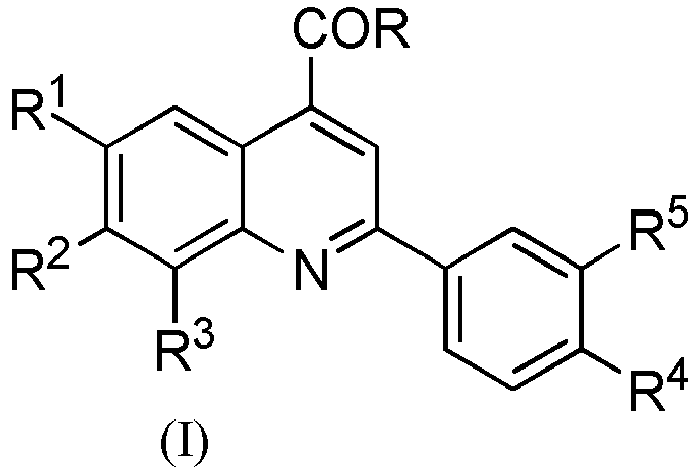
- R is a group selected from hydroxyl, OR' and NR'R" wherein R' and R" independently represent a group selected from allyl, benzyl, C1-6 alkyl and -(O-CH2-CH2)n-OCH3, wherein n is an integer from 1 to 25,
- R1, R2 and R3 independently represent a hydrogen atom, a phenyl or a 5-6 membered, monocyclic, heteroaromatic ring comprising 1, 2 or 3 heteroatoms selected from N, O and S, which are optionally substituted by 1, 2 or 3 groups selected from the group consisting of C1-4 alkyl, C1-4 alkoxy, halogen atoms, acetyl, allylamino, morpholino and trifluoromethoxy,
- R4 is hydrogen, methoxy, phenyl or a 5-6 membered, monocyclic, heteroaromatic ring comprising 1, 2 or 3 heteroatoms selected from N, O and S, which are optionally substituted by 1 or 2 groups selected from the group consisting of C1-4 alkyl, halogen atoms, acetyl and trifluoromethoxy, and
- R5 is hydrogen, halogen, phenyl or a 5-6 membered, monocyclic, heteroaromatic ring comprising 1, 2 or 3 heteroatoms selected from N, O and S, which are optionally substituted by 1, 2 or 3 groups selected from the group consisting of halogen atoms, C1-4 alkyl, C1-4 alkoxy, acetyl, morpholino and trifluoromethoxy,
- In a second aspect, the invention relates to the use of a compound as defined in the first aspect in the manufacture of a medicament for the treatment and/or prevention of viral infections by a virus of the family Coronaviridae, especially by respiratory syndrome-related coronaviruses selected from the species "Middle East respiratory syndrome-related coronavirus" (such as MERS-CoV) and "Severe respiratory syndrome-related coronavirus" (such as SARS-CoV and SARS-CoV-2).
- In a third aspect, the invention also relates to a method of treating and/or preventing viral infections by a virus of the family Coronaviridae, especially by respiratory syndrome-related coronaviruses selected from the species "Middle East respiratory syndrome-related coronavirus" (such MERS-CoV) and "Severe respiratory syndrome-related coronavirus" (such as SARS-CoV and SARS-CoV-2), in a subject, comprising administering to said subject a therapeutically effective amount of a compound as defined in the first aspect of the invention.
- In a fourth aspect, the present invention relates to a subgroup of new compounds selected from the group of compounds defined in the first aspect of the invention. Said subgroup is defined by formula I' wherein

- R1 is hydrogen or phenyl optionally substituted by 1, 2 or 3 groups selected from the group consisting of C1-4 alkyl, C1-4 alkoxy, halogen atoms, acetyl, morpholino and trifluoromethoxy,
- R2 is hydrogen or phenyl optionally substituted by 1, 2 or 3 groups selected from the group consisting of C1-4 alkyl, C1-4 alkoxy, halogen atoms, acetyl, morpholino and trifluoromethoxy,
- R3 is hydrogen or phenyl optionally substituted by 1, 2 or 3 groups selected from the group consisting of C1-4 alkyl, C1-4 alkoxy, halogen atoms, acetyl, morpholino and trifluoromethoxy,
- R4 is hydrogen, methoxy or phenyl optionally substituted by 1 or 2 groups selected from the group consisting of C1-4 alkyl, acetyl, halogen atoms and trifluoromethoxy,
- R5 is hydrogen, halogen or phenyl optionally substituted by 1 group selected from the group consisting of halogen atoms, C1-4 alkyl, acetyl and trifluoromethoxy,
- In a fifth aspect, the present invention relates to a combination comprising one or more compounds as defined in the fourth aspect of the invention and or more additional compounds useful in the treatment of viral infections by virus of the family Coronaviridae. Some compounds that have been disclosed as potentially useful are remdesivir, ribavirin, favipiravir, chloroquine, hydroxychloroquine, lopinavir, ritonavir, umifenovir and recombinant type I interferon.
- In sixth aspect, the present invention relates to a pharmaceutical composition comprising a compound of formula (I) and at least one pharmaceutically acceptable excipient for use in the treatment and/or prevention of viral infections by virus of the family Coronaviridae.
- In the first aspect, the present invention relates to a compound of formula (I)

- R is a group selected from hydroxyl, OR' and NR'R" wherein R' and R" independently represent a group selected from allyl, benzyl, C1-6 alkyl and -(O-CH2-CH2)n-OCH3, wherein n is an integer from 1 to 25,
- R1, R2 and R3 independently represent a hydrogen atom, a phenyl or a 5-6 membered, monocyclic, heteroaromatic ring comprising 1, 2 or 3 heteroatoms selected from N, O and S, which are optionally substituted by 1, 2 or 3 groups selected from the group consisting of C1-4 alkyl, C1-4 alkoxy, halogen atoms, acetyl, allylamino, morpholino and trifluoromethoxy,
- R4 is hydrogen, methoxy, phenyl or a 5-6 membered, monocyclic, heteroaromatic ring comprising 1, 2 or 3 heteroatoms selected from N, O and S, which are optionally substituted by 1 or 2 groups selected from the group consisting of C1-4 alkyl, halogen atoms, acetyl and trifluoromethoxy, and
- R5 is hydrogen, halogen, phenyl or a 5-6 membered, monocyclic, heteroaromatic ring comprising 1, 2 or 3 heteroatoms selected from N, O and S, which are optionally substituted by 1, 2 or 3 groups selected from the group consisting of halogen atoms, C1-4 alkyl, C1-4 alkoxy, acetyl, morpholino and trifluoromethoxy,
- The invention also relates to the use of a compound of formula (I) in the manufacture of a medicament for the treatment and/or prevention of viral infections by a virus of the family Coronaviridae, especially by respiratory syndrome-related coronaviruses selected from the species "Middle East respiratory syndrome-related coronavirus" (such as MERS-CoV) and "Severe respiratory syndrome-related coronavirus" (such SARS-CoV and SARS-CoV-2).
- The invention also relates to a method of treating and/or preventing viral infections by a virus of the family Coronaviridae, especially by respiratory syndrome-related coronaviruses selected from the species "Middle East respiratory syndrome-related coronavirus" (such as MERS-CoV) and "Severe respiratory syndrome-related coronavirus" (such as SARS-CoV and SARS-CoV-2) in a subject, comprising administering to said subject a therapeutically effective amount of a compound of formula (I).
- The term "virus of the family Coronaviridae", as used herein, is used to designate any viral species of the taxonomic family "Coronaviridae" including those of the genera "Alphaletovirus", "Alphacoronavirus", "Betacoronavirus", "Gammacoronavirus" and "Deltacoronavirus" .
- In a preferred embodiment of the present invention, the virus are selected from betacoronaviruses, in particular from the lineage "Sarbecovirus" and still more preferably from the species "Middle East respiratory syndrome-related coronavirus" (such as MERS-CoV) and "Severe respiratory syndrome-related coronavirus" (such as SARS-CoV and SARS-CoV-2).
- The terms "treating" and "treatment", as used herein, means reversing, alleviating, inhibiting the progress of, the disease or condition to which such term applies, or one or more symptoms of such disease or condition, such as lowering the viral load in a patient with respect to pretreatment levels.
- The terms "preventing" and "prevention", as used herein, means avoiding or inhibiting the onset of one or more symptoms of coronavirus infections such as fever, cough, shortness of breath, muscle pain, sputum production, diarrhea, sore throat, loss of smell, pneumonia and abdominal pain.
- Preferably, the compounds disclosed herein, are used for the treatment and/or prevention of viral infections by "Severe respiratory syndrome-related coronavirus" and most preferably for the treatment and/or prevention of viral infections by SARS-CoV-2.
- In a particular embodiment of the first, second and third aspects of the invention in the compound for use of formula (I)
- R is a hydroxyl, group,
- R1, R2 and R3 independently represent a hydrogen atom or a phenyl optionally substituted by 1, 2 or 3 groups selected from the group consisting of C1-4 alkyl, C1-4 alkoxy, halogen atoms, acetyl, morpholino and trifluoromethoxy,
- R4 is hydrogen, methoxy or phenyl optionally substituted by 1 or 2 groups selected from the group consisting of C1-4 alkyl, halogen atoms, acetyl and trifluoromethoxy, and
- R5 is hydrogen, halogen or phenyl optionally substituted by 1, 2 or 3 groups selected from the group consisting of halogen atoms, C1-4 alkyl, C1-4 alkoxy, acetyl, morpholino and trifluoromethoxy.
- In a particular embodiment of the first, second and third aspects of the invention in the compound for use of formula (I) at least one of R1, R2, R3, R4 and R5 is a phenyl group substituted by 1 or 2 groups selected from chlorine atoms, trifluoromethoxy and C1-4 alkyl.
- In another embodiment of the first, second and third aspects of the invention in the compound for use of formula (I) R1 is a hydrogen atom and at least one at least one of R2, R3, R4 and R5 is a phenyl group substituted by 1 group selected C3-4 alkyl.
- In still another embodiment of the first, second and third aspects of the invention in the compound for use of formula (I) R1, R2 and R5 are hydrogen atoms, one of R3 and R4 is a phenyl group substituted by 1 butyl and the other one of R3 and R4 is selected from hydrogen atom and methoxy.
- In a fourth aspect, the present invention relates to a subgroup of new compounds selected from the group of compounds defined in the first aspect of the invention. Said subgroup is defined by formula (I')

- R1 is hydrogen or phenyl optionally substituted by 1, 2 or 3 groups selected from the group consisting of C1-4 alkyl, C1-4 alkoxy, halogen atoms, acetyl, morpholino and trifluoromethoxy,
- R2 is hydrogen or phenyl optionally substituted by 1, 2 or 3 groups selected from the group consisting of C1-4 alkyl, C1-4 alkoxy, halogen atoms, acetyl, morpholino and trifluoromethoxy,
- R3 is hydrogen or phenyl optionally substituted by 1, 2 or 3 groups selected from the group consisting of C1-4 alkyl, C1-4 alkoxy, halogen atoms, acetyl, morpholino and trifluoromethoxy,
- R4 is hydrogen, methoxy or phenyl optionally substituted by 1 or 2 groups selected from the group consisting of C1-4 alkyl, acetyl, halogen atoms and trifluoromethoxy,
- R5 is hydrogen, halogen or phenyl optionally substituted by 1 group selected from the group consisting of halogen atoms, C1-4 alkyl, acetyl and trifluoromethoxy,
- In one embodiment of the fourth aspect of the invention in the compounds of formula (I') at least one at least one of R1, R2, R3, R4 and R5 is a phenyl group substituted by 1 or 2 groups selected from chlorine atoms, trifluoromethoxy and C1-4 alkyl.
- In another embodiment of the fourth aspect of the invention in the compounds of formula (I') R1 is a hydrogen atom and at least one at least one of R2, R3, R4 and R5 is a phenyl group substituted by 1 group selected C3-4 alkyl.
- In another embodiment of the fourth aspect of the invention in the compounds of formula (I') R1 and R5 are hydrogen atoms, one of R3 and R4 is a phenyl group substituted by 1 butyl and the other one of R3 and R4 is selected from hydrogen atom and methoxy.
- As used herein the term alkyl is used to designate linear or branched hydrocarbon radicals (CnH2n+1). Examples include methyl, ethyl, n-propyl, i-propyl, n-butyl, sec-butyl, tert-butyl, n-pentyl, 1-methyl-butyl, 2-methyl-butyl, isopentyl, 1-ethylpropyl, 1,1-dimethylpropyl, 1,2-dimethylpropyl, n-hexyl, 1-ethylbutyl, 2-ethylbutyl, 1,1-dimethylbutyl, 1,2-dimethylbutyl, 1,3dimethylbutyl, 2,2-dimethylbutyl, 2,3-dimethylbutyl, 2-methylpentyl and 3-methylpentyl. In a preferred embodiment said alkyl groups have 1 to 6 carbon atoms, most preferably 1 to 4 carbons atoms.
- As used herein, the term C1-4 alkoxy is used to designate radicals which contain a linear or branched C1-4 alkyl group linked to an oxygen atom (CnH2n+1-O-) wherein n ranges from 1 to 4. Preferred alkoxy radicals include methoxy, ethoxy, n-propoxy, i-propoxy, n-butoxy, sec-butoxy and tert-butoxy.
- As used herein, the term "allyl" is used to designate the group -CH2-CH=CH2.
- As used herein, the term "benzyl" refers to the group phenyl-CH2-.
- The term "5-6 membered, monocyclic, heteroaromatic ring comprising 1, 2 or 3 heteroatoms selected from N, O and S" refers to a ring system with only one ring having 5 to 6 members which are selected from carbon atoms, nitrogen, oxygen and sulphur atoms and which is aromatic in nature. Examples of said rings are pyridines, furanes, pyrazines, pyrroles, imidazoles, pyrazoles, oxazoles, thiazoles and thiophenes.
- As used herein, the term halogen atom is used to designate an atom selected from the group consisting of chlorine, fluorine, bromine or iodine atom, preferably bromine, fluorine or chlorine atom.
- The term "pharmaceutically acceptable" refers to molecular entities and compositions that are physiologically tolerable and do not typically produce an allergic or similar untoward reaction, such as gastric upset, dizziness and the like, when administered to a human. Preferably, as used herein, the term "pharmaceutically acceptable" means approved by a regulatory agency of the Federal or a state government or listed in the U.S. Pharmacopeia or other generally recognized pharmacopeia for use in animals, and more particularly in humans.
- Further, the term "pharmaceutically acceptable salt" refers to any salt, which, upon administration to the recipient is capable of providing (directly or indirectly) a compound as described herein. For instance, a pharmaceutically acceptable salt of compounds provided herein may be acid addition salts, base addition salts or metallic salts, and they can be synthesized from the parent compound, which contains a basic or acidic moiety by conventional chemical methods. Generally, such salts are, for example, prepared by reacting the free acid or base forms of these compounds with a stoichiometric amount of the appropriate base or acid in water or in an organic solvent or in a mixture of the two. Generally, non-aqueous media like ether, ethyl acetate, ethanol, isopropanol or acetonitrile are preferred. Examples of the acid addition salts include mineral acid addition salts such as, for example, hydrochloride, hydrobromide, hydroiodide, sulphate, nitrate, phosphate, and organic acid addition salts such as, for example, acetate, maleate, fumarate, citrate, oxalate, succinate, tartrate, malate, mandelate, methanesulphonate and p-toluenesulphonate. Examples of the alkali addition salts include inorganic salts such as, for example, ammonium, and organic alkali salts such as, for example, ethylenediamine, ethanolamine, N,N-dialkylenethanolamine, triethanolamine, glucamine and basic aminoacids salts. Examples of the metallic salts include, for example, sodium, potassium, calcium, magnesium, aluminium and lithium salts.
- In another particular embodiment, the viral infection is an infection by "Severe respiratory syndrome-related coronavirus" and most preferably by SARS-CoV-2.
- The compounds for use according to the invention may be administered by any appropriate route (via), such as, oral (e.g., oral, sublingual, etc.), parenteral (e.g., subcutaneous, intramuscular, intravenous, etc.), vaginal, rectal, nasal, topical, ophtalmic, inhaled, intranasal, intratracheal, pulmonary, etc., preferably oral, inhaled or parenteral, more preferably intravenous.
- The compounds for use according to the invention may, in particular be administered by inhalation. In this case, they are advantageously formulated as dry powder compositions and may, for example, be presented in capsules and cartridges of for example gelatine or blisters of for example laminated aluminium foil, for use in an inhaler or insufflator. Formulations generally contain a powder mix for inhalation of the compound of the invention and a suitable powder base (carrier substance) such as lactose or starch. Use of lactose is preferred.
- In particular, the compounds for use according to the invention are administered as a pharmaceutical composition, which comprises the corresponding (active) compound and one or more pharmaceutically acceptable excipients.
- The term "pharmaceutically acceptable excipient" refers to a vehicle, diluent, or adjuvant that is administered with the active ingredient. Such pharmaceutical excipients can be sterile liquids, such as water and oils, including those of petroleum, animal, vegetable, or synthetic origin, such as peanut oil, soybean oil, mineral oil, sesame oil, and similars. Water or saline aqueous solutions and aqueous dextrose and glycerol solutions, particularly for injectable solutions, are preferably used as vehicles. Suitable pharmaceutical vehicles are known by the skilled person.
- The pharmaceutically acceptable excipient necessary to manufacture the desired pharmaceutical composition of the invention will depend, among other factors, on the elected administration route. Said pharmaceutical compositions may be manufactured according to conventional methods known by the skilled person in the art.
- The compounds for use according to the invention may be administered in a "therapeutically effective amount", i.e. a nontoxic but sufficient amount of the corresponding compound to provide the desired effect. The amount that is "effective" will vary from subject to subject, depending on the age and general condition of the individual, the particular compound administered, and the like. Thus, it is not always possible to specify an exact "therapeutically effective amount". However, an appropriate amount in any individual case may be determined by one of ordinary skill in the art using routine experimentation.
- The compounds for use according to the invention will typically be administered once or more times a day, for example 1, 2, 3 or 4 times daily, with typical total daily doses depending on the particular compound and severity of the disease, and may be easily determined by the skilled practitioner.
- By way of example, typical total daily doses the compound of the invention are in the range of from 0.1 to 2000 mg/day, preferably from 1 to 600 mg/ day, even more preferably from 1 to 100 mg/day.
- The pharmaceutical compositions may be prepared using standard methods such as those described or referred to in the Spanish and US Pharmacopoeias and similar reference texts.
- The term "subject" refers to a mammal, e.g., a human.
- The compounds for use according to the invention may be administered as the sole active ingredient or in combination with other active ingredients. In a particular embodiment, the compounds are used as the sole active ingredient. In another particular embodiment, the compounds are used in combination with other active ingredients.
- In another aspect, the present invention relates to a combination comprising one or more compounds selected useful in the treatment of viral infections by virus of the family Coronaviridae. Some compounds that have been disclosed as potentially useful are selected from the group consisting of remdesivir, ribavirin, favipiravir, chloroquine, hydroxychloroquine, lopinavir, ritonavir, umifenovir and, recombinant type I interferon,
- The invention also relates to the use of a combination comprising one or more compounds useful in the treatment of viral infections by virus of the family Coronaviridae. Some compounds that have been disclosed as potentially useful are selected from the group consisting of remdesivir, ribavirin, favipiravir, chloroquine, hydroxychloroquine, lopinavir, ritonavir, umifenovir and, recombinant type I interferon.
- The invention also relates a method of treating and/or preventing viral infections by coronavirus, especially by respiratory syndrome-related coronavirus selected from the species "Middle East respiratory syndrome-related coronavirus" (such as MERS-CoV) and "Severe respiratory syndrome-related coronavirus" (such as SARS-CoV and SARS-CoV-2) in a subject, comprising administering to said subject a therapeutically effective amount of a combination comprising one or more compounds selected from the group consisting of remdesivir, ribavirin, favipiravir, chloroquine, hydroxychloroquine, lopinavir, ritonavir, umifenovir and, recombinant type I interferon.
- The term "combination" refers to a product comprising one or more of the defined compounds, either in a single composition or in several compositions (or units), in which case the corresponding compounds are distributed among the several compositions. Preferably, the combination refers to several compositions, in particular comprising one composition (or unit) per compound (compound as defined above) of the combination. The expression "one or more" when characterizing the combination refers to at least one, preferably 1, 2, 3, 4, or 5 compounds, more preferably, 1, 2 or 3 compounds, even more preferably 1 or 2 compounds.
- When the combination is in the form of a single composition, the compounds present in the combination are always administered simultaneously.
- When the combination is in the form of several compositions (or units), each of them having at least one of the compounds of the combination, the compositions or (units) may be administered simultaneously, sequentially or separately.
- Simultaneous administration means that the compounds or compositions (or units) are administered at the same time.
- Sequential administration means that the compounds or compositions (or units) are administered at different time points in a chronologically staggered manner.
- Separate administration means that the compounds or compositions (or units) are administered at different time points independently of each other.
- In particular, the combinations for use according to the invention are administered as pharmaceutical compositions, which comprise the corresponding (active) compounds and a pharmaceutically acceptable excipient, as previously defined.
- The combinations for use according to the invention will typically be administered once or more times a day, for example 1, 2, 3 or 4 times daily, with typical total daily doses depending on the particular compound and severity of the disease, and may be easily determined by the skilled practitioner.
- In another particular embodiment, the viral infection is an infection by SARS-CoV-2 virus.
- The following examples represent specific embodiments of the present invention. They do not intend to limit in any way the scope of the invention defined in the present description.
- The compounds of general formula (I) of the present invention, can be synthesized as described in detail below:
A mixture of the corresponding isatin (1 eq.), 33% potassium hydroxide (1 mL/mmol) in ethanol (2 mL/mmol) and the 4-substituted acetophenone (1.5 eq.) was heated under reflux for 12-18 h. The reaction mixture was concentrated under reduce pressure and the residue was diluted with water (5 mL) and extracted with ethyl acetate (3 x 15 mL). The aqueous layer was acidified with 1 M hydrochloric acid until pH 3. The precipitated solid was filtered, washed with water and dried to yield the corresponding quinolone-4-carboxylic acid. Then, the obtained quinolone-4-carboxylic acid (0.5 mmol, 1 eq.) was added to a mixture of acetone (2 mL) and potassium carbonate (5 eq.). Next, methyl iodide (5 eq.) was added. The reaction mixture was refluxed with magnetic stirring for 12 h. After this time, it was concentrated under reduced pressure and water was added to the remaining mixture. The product was collected by suction filtration and air-dried as a colored solid.
- R1' represents either a bromine atom or a group R1 as defined in
claim 1, R2' represents either a bromine atom or a group R2 as defined inclaim 1, R3' represents either a bromine atom or a group R3 as defined inclaim 1, R4' represents either a bromine atom or a group R4 as defined inclaim 1 and R5' represents either a bromine atom or a group R5 as defined inclaim 1. - Compounds of formula (III) are either commercially available or may be obtained using a Suzuki reaction between a bromine derivative ((VI) or (VIII)) with a boronic acid ((VII) or (IX)). In formula (VII) (A) represents a phenyl or a 5-6 membered, monocyclic, heteroaromatic ring comprising 1, 2 or 3 heteroatoms selected from N, O and S, which are optionally substituted by 1, 2 or 3 groups selected from the group consisting of halogen atoms, C1-4 alkyl, C1-4 alkoxy, acetyl, morpholino and trifluoromethoxy and in formula (IX) (A) represents a phenyl or a 5-6 membered, monocyclic, heteroaromatic ring comprising 1, 2 or 3 heteroatoms selected from N, O and S, which are optionally substituted by 1 or 2 groups selected from the group consisting of C1-4 alkyl, halogen atoms, acetyl and trifluoromethoxy.


- Compounds of formula (II) are either commercially available or may be obtained using a Suzuki reaction between a bromine derivative ((X), (XII) or (XIV)) with a boronic acid ((XI), (XIII) or (XV)). In formulae (XI), (XIII) and (XV) (A) represents a phenyl or a 5-6 membered, monocyclic, heteroaromatic ring comprising 1, 2 or 3 heteroatoms selected from N, O and S, which are optionally substituted by 1, 2 or 3 groups selected from the group consisting of C1-4 alkyl, C1-4 alkoxy, halogen atoms, acetyl, allylamino, morpholino and trifluoromethoxy.


- When in the compound of formula (V) any one of R1, R2', R3', R4' and R5' is a bromine atom said bromine atom may be replaced by a desired optionally substituted phenyl group or 5-6 membered, monocyclic, heteroaromatic ring comprising 1, 2 or 3 heteroatoms selected from N, O and S (A) through a Suzuki coupling with the corresponding boronic acid.


- Cross-coupling technology allows the functionalization of an aromatic ring through reactions catalyzed by a transition metal. For example, a Suzuki coupling can be carried out using aryl bromide and a boronic acid coupling partner. Alternatively, couplings between a terminal acetylene and an aryl halide can be carried out by means of the Sonogashira reaction.
- A quinoline halide derivative of formulae (Va), (Vb), (Vc), (Vd) or (Ve) (1 eq), the corresponding boronic acid derivative formulae (XVI), (XVII), (XVIII), (XIX) or (XX) (1.5 eq), K2CO3 (6 eq), [Pd(PPh3)4] (2 mol%) and 5 mL/mmol of a mixture THF/H2O (4/1) are added in a microwave tube. The reaction mixture is purged with argon and irradiated by MWI for 30 min at 100 °C. The reaction mixture was concentrated under reduced pressure and the residue was diluted with water (5 mL) and extracted with ethyl acetate (3 x 10 mL). The organic layer was dried over MgSO4 anhydrous, filtrated and concentrated. The obtained residue was purified by medium-pressure chromatography (hexane/AcOEt).
- The methyl esters of formula (V), (V'), (V"), (V'''), (Viv) and (Vv) may be converted into the corresponding carboxylic acids of formula (I) following the saponification reaction explained below:
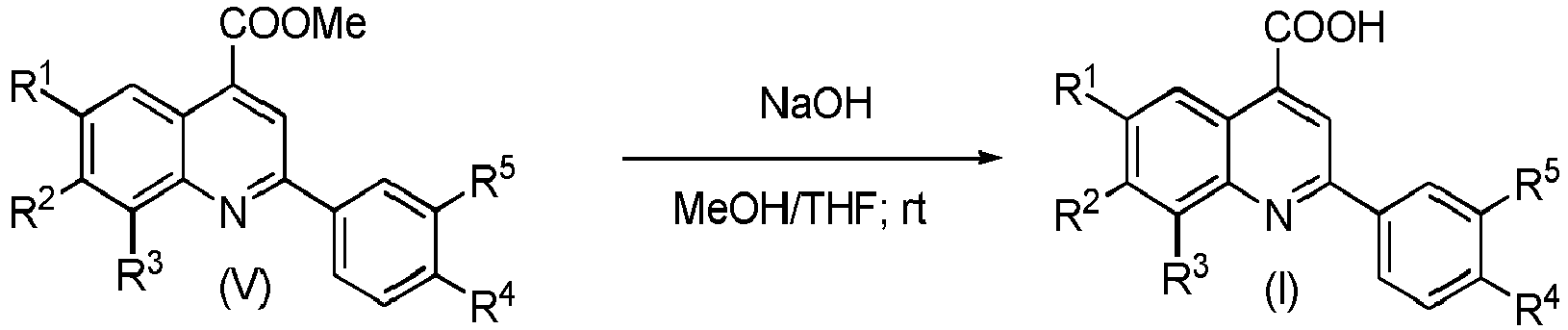
- To a solution of the corresponding ester in 13.3 mL/mmol of THF and 6.6 mL/mmol of MeOH is added slowly a solution of NaOH 2M. After 12 h stirring at room temperature, the reaction mixture was concentrated under reduced pressure and the residue was diluted with water (5 mL). The reaction mixture was acidified with 1 M hydrochloric acid until pH 3. The precipitated solid was filtered, washed with water, dried and lyophilized. The compounds was obtained pure without the need of further purification.
- NaH (0.94 mmol, 3.0 equiv.) (60 % dispersion in mineral oil) was added portionwise to a solution the corresponding quinoline carboxylic acid (0.31 mmol, 1.0 equiv.) in DMF (5 mL) and then was stirred for 1.5 hour at room temperature. The correspondingbromide (i.e. allyl bromide, benzyl bromide, C1-6 alkyl bromide or mPEG-bromide of formula Br-CH2-CH2-(O-CH2-CH2-)(n-1)-OCH3) (0.94 mmol, 3.0 equiv.) was added dropwise to the previous solution at 0°C and then stirred for 20 hours at room temperature. The reaction was quenched by 50 mL of NH4Cl (sat), extracted by of diethyl ether (3 x 15 mL), washed with brine, dried over MgSO4, and then concentrated to give a crude product which was purified by means of medium-pressure chromatography or by crystallization to give the desired compound.
- A solution of the corresponding quinoline carboxylic acid (0.75 mmol) in thionyl chloride (1.5 ml) is heated under reflux for 6 h. After this time, the excess thionyl chloride is evaporated to dryness. Then, the residue is dissolved in anhydrous THF (2 ml), and the corresponding amine NHR'R" (0.5 mmol) and propylene oxide (7.5 mmol) are added to the solution. The reaction is stirred at room temperature overnight. Lastly, the excess solvent is removed under vacuum and the solid formed is washed with water. The synthesized product is purified by successive washes with the suitable solvent or by means of medium-pressure chromatography.
- HPLC-MS chromatographic data mentioned in the following examples were obtained with a Waters 2695 kit coupled to a Waters Micromass ZQ spectrometer. The separation was performed with a Sunfire C18 column (3.5 µm, 4.6 mm x 50 mm), a flow of 1.0 mL/min and as a mobile phase, a gradient from A (CH3CN) to B (H2O) with 0.1% acid formic as an additive. Mass spectra were obtained using the ESI electrospray technique. The peaks corresponding to the molecular ion have been indicated as ([M]+), while those corresponding to the molecular ion plus one unit as ([M+H]+).
- The product was prepared according to the methods described above and obtained as a yellow solid with a yield of 43%.
m.p.: 272.8 °C
1H NMR (300 MHz, DMSO-d6) δ 8.98 (d, J = 2.0 Hz, 1H, H5), 8.46 (s, 1H, H3), 8.29 (m, 2H, H7H8), 8.17 (m, 2H, H2'H6'), 7.80 (m, 2H, H2"H6"), 7.55 (t, J = 7.5 Hz, 2H, H3"H5"), 7.44 (t, J = 7.5 Hz, 1H, H4"), 7.12 (m, 2H, H3'H5'), 3.86 (s, 3H, H7').
13C NMR (75 MHz, DMSO-d6) δ 167.6 (-COOH), 160.9 (C4'), 155.4 (C2), 147.8 (C4), 139.6 (C1"), 138.7 (C6), 137.3 (C8a), 130.2 (C8), 130.2 (C1'), 129.2 (C2'C6'), 129.0 (C4"), 128.6 (C3"C5"), 127.9 (C4a), 127.1 (C2"C6"), 123.4 (C3), 122.8 (C5), 119.3 (C7), 114.3 (C3'C5'), 55.3 (C7').
HPLC (Sunfire C18, 60-95% of acetonitrile in water, 10 min): tR = 3.31 min.
LC-MS (m/z): 356.1 ([M+H]+). - The product was prepared according to the methods described above and obtained as a yellow solid with a yield of 95%.
m.p.: 254.9 °C
1H NMR (300 MHz, DMSO-d6) δ 8.88 (d, J = 1.9 Hz, 1H, H5), 8.43 (s, 1H, H3), 8.28 (m, 2H, H2"H6"), 8.16 (d, J = 8.8 Hz, 1H, H8), 8.11 (dd, J = 8.8, 2.0 Hz, 1H, H7), 7.71 (m, 2H, H2'H6'), 7.38 (m, 2H, H3"H5"), 7.12 (m, 2H, H3'H5'), 3.86 (s, 3H, H7), 2.68 (q, J = 7.6 Hz, 2H, H7"), 1.23 (t, J = 7.6 Hz, 3H, H8").
13C NMR (75 MHz, DMSO-d6) δ 168.1 (COO-), 161.2 (C4'), 155.6 (C2), 148.1 (C4), 144.0 (C8a), 138.9 (C4"), 137.3 (C6), 130.7 (C1"), 130.4 (C1'), 129.4 (C8), 128.9 (C5), 128.9 (C2"C6"), 128.9 (C2'C6'), 127.3 (C3"C5"), 123.8 (C7), 122.9 (C4a), 119.4 (C3), 114.7 (C3'C5'), 55.7 (C7'), 28.2 (C7"), 15.91 (C8").
HPLC (Sunfire C18, 60-95% of acetonitrile in water, 10 min): tR = 4.06 min.
LC-MS (m/z): 384.2 ([M+H]+). - The product was prepared according to the methods described above and obtained as a yellow solid with a yield of 60%.
m.p.: 124.8 °C
1H NMR (300 MHz, DMSO-d6) δ 8.86 (d, J = 2.1 Hz, 1H, H5), 8.46 (s, 1H, H3), 8.28 (m, 2H, H2"H6"), 8.14 (m, 2H, H7H8), 7.70 (m, 2H, H2'H6'), 7.35 (d, J = 8.0 Hz, 2H, H3"H5"), 7.13 (m, 2H, H3'H5'), 3.86 (s, 3H, H7'), 2.64 (t, J = 7.6 Hz, 2H, H7"), 1.59 (m, 2H, H8"), 1.32 (m, 2H, H9"), 0.91 (t, J = 7.4 Hz, 3H, H10").
13C NMR (75 MHz, DMSO-d6) δ 167.6 (COO-), 160.9 (C4'), 155.2 (C2), 147.6 (C4"), 142.3 (C4), 138.7 (C8a), 137.2 (C6), 136.9 (C1"), 130.1 (C1'), 129.3 (C8), 129.1 (C2"C6"), 129.0 (C5), 128.7 (C2'C6'), 126.9 (C3"C5"), 123.5 (C4a), 122.4 (C7), 119.3 (C3), 114.4 (C3'C5'), 55.3 (C7'), 34.3 (C7"), 33.0 (C8"), 21.8 (C9"), 13.8 (C10").
HPLC (Sunfire C18, 60-95% of acetonitrile in water, 10 min): tR = 9.15 min.
LC-MS (m/z): 412.2 ([M+H]+). - The product was prepared according to the methods described above and obtained as a orange solid with a yield of 78%.
m.p.: 164.0 °C
1H NMR (300 MHz, DMSO-d6) δ 8.88 (d, J = 2.0 Hz, 1H, H5), 8.46 (s, 1H, H3), 8.28 (m, 2H, H2'H6'), 8.18 (d, J = 8.8 Hz, 1H, H8), 8.11 (dd, J = 8.8, 2.0 Hz, 1H, H7), 7.71 (m, 2H, H2"H6"), 7.55 (m, 2H, H3"H5"), 7.12 (m, 2H, H3'H5'), 3.86 (s, 3H, H7), 1.33 (s, 9H, H(tBu)).
13C NMR (75 MHz, DMSO-d6) δ 167.6 (COO-), 160.9 (C4'), 155.2 (C2), 150.5 (C4"), 147.6 (C4), 138.7 (C8a), 137.2 (C6), 136.7 (C1"), 130.1 (C1'), 130.0 (C8), 129.2 (C5), 128.7 (C2"C6"), 126.8 (C2'C6'), 126.0 (C3"C5"), 123.4 (C4a), 122.5 (C7), 119.3 (C3), 114.4 (C3'C5'), 55.3 (C7'), 34.3 (C7"), 31.1 (CtBu).
HPLC (Sunfire C18, 60-95% of acetonitrile in water, 10 min): tR = 8.20 min.
LC-MS (m/z): 412.2 ([M]+) - The product was prepared according to the methods described above and obtained as an orange solid with a yield of 87%.
m.p.: 246.9 °C
1H NMR (300 MHz, DMSO-d6) δ 13.9 (s, 1H, -COOH), 8.98 (d, J = 1.7 Hz, 1H, H5), 8.48 (s, 1H, H3), 8.32 (m, 2H, H2'H6'), 8.25 (m, 2H, H3"H5"), 8.12 (m, 2H, H2"H6"), 7.98 (m, 2H, H2'H6'), 7.15 (m, 2H, H3'H5'), 3.86 (s, 3H, H7'), 2.64 (s, 3H, H8").
13C NMR (75 MHz, DMSO-d6) δ 197.5 (C7"), 167.5 (COO-), 161.0 (C4'), 155.8 (C2), 148.1 (C4), 143.9 (C8a), 137.4 (C6), 137.3 (C1"), 135.9 (C4"), 130.5 (C8), 130.3 (C1'), 130.1 (C5), 129.1 (C2"C6"), 128.7 (C2'C6'), 127.2 (C3"C5"), 123.5 (C7), 124.3 (C4a), 119.5 (C3), 114.4 (C3'C5'), 55.3 (C7'), 26.8 (C8").
HPLC (Sunfire C18, 60-95% of acetonitrile in water, 10 min): tR = 1.70 min.
LC-MS (m/z): 398.2 ([M+H]+). - The product was prepared according to the methods described above and obtained as a yellow solid with a yield of 83%.
m.p: 281.5 °C
1H NMR (300 MHz, DMSO-d6) δ 8.91 (d, J = 1.7 Hz, 1H, H5), 8.47 (s, 1H, H3), 8.34 (m, 2H, H7H8), 8.24 (m, 2H, H2'H6'), 8.06 (s, 1H, H2"), 7.80 (d, J = 1.2 Hz, 2H, H5"H6"), 7.17 (m, 2H, H3'H5'), 3.86 (s, 3H, H7').
13C NMR (75 MHz, DMSO-d6) δ 167.4 (-COOH), 161.0 (C4'), 155.8 (C2), 148.1 (C4), 140.2 (C8a), 137.6 (C6), 136.0 (C1"), 131.9 (C1'), 131.2 (C3"), 130.7 (C8), 130.7 (C5), 130.1 (C7), 129.0 (C4"), 128.8 (C5"), 128.7 (C2'C6'), 127.3 (C2"), 123.5 (C4a), 123.6 (C6"), 119.4 (C3), 114.4 (C3'C5'), 55.3 (C7').
HPLC (Sunfire C18, 60-95% of acetonitrile in water, 10 min): tR = 5.33 min.
LC-MS (m/z): 424.2 ([M]+). - The product was prepared according to the methods described above and obtained as a yellow solid with a yield of 89%.
m.p.: 169.3 °C
1H NMR (300 MHz, DMSO-d6) δ 8.92 (d, J = 1.9 Hz, 1H, H5), 8.47 (s, 1H, H3), 8.28 (m, 2H, H7H8), 8.18 (m, 2H, H2'H6'), 7.83 (m, 1H, H6"), 7.75 (s, 1H, H2"), 7.68 (t, J = 8.0 Hz, 1H, H5"), 7.45 (m, 1H, H4"), 7.12 (m, 2H, H3'H5'), 3.86 (s, 3H, H7').
13C NMR (75 MHz, DMSO-d6) δ 167.5 (COO-), 161.0 (C4'), 155.8 (C2), 149.0 (C3"), 148.1 (C4), 142.0 (C8a), 137.3 (C1"), 137.0 (C6), 131.2 (C1'), 130.3 (C8), 130.1 (C5), 129.1 (C5"), 128.7 (C2'C6'), 126.2 (C7), 123.5 (C4a), 123.3 (C6"), 120.3 (C7"), 119.6 (C4"), 119.6 (C2"), 119.5 (C3), 114.4 (C3'C5'), 55.3 (C7').
HPLC (Sunfire C18, 60-95% of acetonitrile in water, 10 min): tR = 4.53 min.
LC-MS (m/z): 440.2 ([M+H]+). - The product was prepared according to the methods described above and obtained as a red solid with a yield of 85%.
m.p.: 205.3 °C
1H NMR (300 MHz, DMSO-d6) δ 9.04 (d, J = 2.0 Hz, 1H, H5), 8.40 (s, 1H, H3), 8.25 (d, J = 8.8 Hz, 1H, H8), 8.22 - 8.15 (m, 2H, H3"H5"), 8.11 - 8.04 (m, 2H, H2"H6"), 8.01 (dd, J = 8.8, 2.1 Hz, 1H, H7), 7.85 (dq, J = 8.6, 2.0 Hz, 2H, H2'H6'), 7.11 - 7.02 (m, 2H, H3'H5',), 4.08 (s, 3H, H9), 3.89 (s, 3H, H7'), 2.66 (s, 3H, H8").
13C NMR (75 MHz, DMSO-d6) δ 167.8 (COO-), 160.8 (C4'), 158.7 (C4"), 155.0 (C2), 147.5 (C4), 138.2 (C8a), 138.0 (C6), 131.7 (C1"), 130.4 (C1'), 130.0 (C8), 128.9 (C5), 128.6 (C2'C6'), 128.1 (C2"C6"), 123.6 (C4a), 121.9 (C7), 118.9 (C3), 115.1 (C3"C5"), 114.3 (C3'C5'), 69.0 (C7"), 55.3 (C7'), 22.0 (C8"), 10.4 (C9").
HPLC (Sunfire C18, 60-95% of acetonitrile in water, 10 min): tR = 4.15 min.
LC-MS (m/z): 414.4 ([M+H]+). - The product was prepared according to the methods described above and obtained as a yellow solid with a yield of 97%.
m.p.: 235.6 °C
1H NMR (300 MHz, DMSO-d6) δ 8.85 (d, J = 1.3 Hz, 1H, H5), 8.45 (s, 1H, H3), 8.29 (m, 2H, H2'H6'), 8.17 (m, 2H, H7H8), 7.13 (m, 2H, H3'H5'), 7.04 (s, 2H, H2"H6"), 3.90 (s, 6H, H7"H9"), 3.86 (s, 3H, H8"), 3.73 (s, 3H, H7').
13C NMR (75 MHz, DMSO-d6) δ 167.7 (COO-), 160.9 (C4'), 155.3 (C2), 153.4 (C3"C5"), 147.8 (C4), 139.0 (C8a), 137.7 (C6), 137.4 (C4"), 135.5 (C1"), 130.3 (C1'), 129.8 (C5), 129.6 (C8), 128.7 (C2'C6'), 123.3 (C4a), 122.8 (C7), 119.2 (C3), 114.4 (C3'C5'), 104.8 (C2"C6"), 60.1 (C8"), 56.1 (C7"C9"), 55.4 (C7').
HPLC (Sunfire C18, 60-95% of acetonitrile in water, 10 min): tR = 1.67 min.
LC-MS (m/z): 446.3 ([M+H]+). - The product was prepared according to the methods described above and obtained as a black solid with a yield of 87%.
m.p: n.d.
1H NMR (300 MHz, DMSO-d6) δ 8.92 (d, J = 1.9 Hz, 1H, H5), 8.21 (m, 2H, H2'H6'), 8.12 (s, 1H, H3), 8.01 (m, 2H, H8H7), 7.60 (m, 4H, H3"H5"H2"H6"), 7.09 (m, 2H, H3'H5'), 3.84 (s, 3H, H7'), 3.76 (t, J = 4.7 Hz, 4H, H8"H9"), 3.17 (t, J = 4.7 Hz, 4H, H7"H10").
13C NMR (75 MHz, DMSO-d6) δ 169.6 (COO-), 160.7 (C4'), 155.1 (C2), 150.8 (C4"), 147.7 (C4), 137.1 (C8a), 131.9 (C6), 131.7 (C1"), 130.6 (C1'), 129.1 (C8), 129.0 (C5), 128.7 (C2"C6"), 128.0 (C7), 127.7 (C2'C6'), 123.5 (C4a), 117.0 (C3), 115.7 (C3"C5"), 114.5 (C3'C5'), 66.4 (C8"C9"), 55.6 (C7'), 48.4 (C7"C10").
HPLC (Sunfire C18, 60-95% of acetonitrile in water, 10 min): tR = 1.59 min.
LC-MS (m/z): 441.5 ([M+H]+) - The product was prepared according to the methods described above and obtained as a yellow solid with a yield of 91%.
m.p.: 208.4 °C
1H NMR (300 MHz, DMSO-d6) δ 8.94 (d, J = 1.5 Hz, 1H, H5), 8.51 (s, 1H, H3), 8.31 (m, 2H, H2'H6'), 8.25 (d, J = 8.8 Hz, 1H, H8), 8.17 (dd, J = 8.8, 2.0 Hz, 1H, H7), 7.81 (m, 2H, H3"H5"), 7.57 (m, 5H, H4"H2"H6"H3"H5"), 7.46 (m, 1H, H4').
13C NMR (75 MHz, DMSO-d6) δ 167.6 (-COO), 155.8 (C2), 147.9 (C4), 139.5 (C8a), 139.3 (C1"), 137.8 (C6), 137.4 (C1'), 130.4 (C4"), 130.1 (C7), 129.5 (C5), 129.2 (C3'C5'), 129.0 (C3"C5"), 128.1 (C4'), 127.3 (C2"C6"), 127.2 (C2'C6'), 123.8 (C8), 122.9 (C4a), 119.8 (C3). HPLC (Sunfire C18, 60-95% of acetonitrile in water, 10 min): tR = 2.84 min.
LC-MS (m/z): 326.3 ([M+H]+). - The product was prepared according to the methods described above and obtained as a yellow solid with a yield of 98%.
m.p.: 228.7 °C
1H NMR (300 MHz, DMSO-d6δ 8.91 (d, J = 1.9 Hz, 1H, H5), 8.50 (s, 1H, H3), 8.30 (m, 2H, H2'H6'), 8.21 (d, J = 8.8 Hz, 1H, H8), 8.13 (dd, J = 8.8, 1.9 Hz, 1H, H7), 7.70 (m, 2H, H3"H5"), 7.56 (m, 3H, H4'H2"H6"), 7.37 (d, J = 8.0 Hz, 2H, H3'H5'), 2.67 (q, J = 7.6 Hz, 2H, H7"), 1.22 (t, J = 7.6 Hz, 3H, H8").
13C NMR (75 MHz, DMSO-d6) δ 167.5 (-COO), 155.5 (C2), 147.8 (C4), 143.8 (C8a), 139.2 (C6), 137.8 (C1"), 137.2 (C4"), 136.9 (C1'), 130.3 (C8), 129.9 (C7), 129.3 (C4'), 129.0 (C2"C6"), 128.6 (C3'C5'), 127.1 (C3"C5"), 127.0 (C2'C6'), 123.8 (C4a), 122.4 (C5), 119.7 (C3), 27.8 (C7"), 15.5 (C8").
HPLC (Sunfire C18, 60-95% of acetonitrile in water, 10 min): tR = 5.28 min.
LC-MS (m/z): 354.2 ([M+H]+). - The product was prepared according to the methods described above and obtained as a yellow solid with a yield of 77%.
m.p.: 213.6 °C
1H NMR (300 MHz, DMSO-d6) δ 13.99 (s, 1H, -COOH), 8.92 (d, J = 2.0 Hz, 1H, H5), 8.51 (s, 1H, H3), 8.31 (dd, J = 8.1, 1.5 Hz, 2H, H2'H6'), 8.23 (d, J = 8.8 Hz, 1H, H8), 8.16 (dd, J = 8.8, 2.0 Hz, 1H, H7), 7.72 (d, J = 8.2 Hz, 2H, H3"H5"), 7.57 (m, 3H, H4'H2"H6"), 7.37 (d, J = 8.2 Hz, 2H, H3'H5'), 2.66 (t, J = 7.6 Hz, 2H, H7"), 1.61 (p, J = 7.6 Hz, 2H, H8"), 1.35 (sext, J = 7.6 Hz, 2H, H9"), 0.92 (t, J = 7.7 Hz, 3H, H10").
13C NMR (75 MHz, DMSO-d6) δ 167.6 (-COO), 155.6 (C2), 147.8 (C4), 142.5 (C8a), 139.2 (C6), 137.9 (C1"), 137.2 (C4"), 136.9 (C1'), 130.4 (C8), 130.0 (C7), 129.3 (C4'), 129.2 (C2"C6"), 129.0 (C3'C5'), 127.2 (C3"C5"), 127.0 (C2'C6'), 123.9 (C4a), 124.5 (C5), 119.7 (C3), 34.5 (C7"), 33.0 (C8"), 21.8 (C9"), 13.8 (C10").
HPLC (Sunfire C18, 60-95% of acetonitrile in water, 10 min): tR = 7.92 min.
LC-MS (m/z): 382.5 ([M+H]+) - The product was prepared according to the methods described above and obtained as a yellow solid with a yield of 94%.
m.p.: 274.2 °C
1H NMR (300 MHz, DMSO-d6) δ 8.93 (d, J = 2.0 Hz, 1H, H5), 8.50 (s, 1H, H3), 8.32 (m, 2H, H2'H6'), 8.24 (d, J = 8.9 Hz, 1H, H8), 8.17 (dd, J = 8.9, 2.0 Hz, 1H, H7), 7.75 (m, 2H, H3"H5"), 7.57 (m, 5H, H4'H3'H5'H2"H6"), 1.36 (s, 9H, H tBu).
13C NMR (75 MHz, DMSO-d6) δ 167.5 (-COO), 155.5 (C2), 150.6 (C4), 147.8 (C8a), 139.1 (C6), 137.8 (C1"), 136.6 (C4"), 130.3 (C1'), 129.9 (C8), 129.3 (C7), 129.0 (C2"C6"), 127.1 (C3'C5'), 126.8 (C3"C5"), 126.0 (C2'C6'), 126.0 (C4'), 123.8 (C4a), 122.5 (C5), 119.7 (C3), 34.2 (C7"), 31.1 (C tBu).
HPLC (Sunfire C18, 60-95% of acetonitrile in water, 10 min): tR = 7.04 min.
LC-MS (m/z): 382.2 ([M+H]+). - The product was prepared according to the methods described above and obtained as a yellow solid with a yield of 74%.
m.p.: 253.3 °C
1H NMR (300 MHz, DMSO-d6) δ 14.1 (s, 1H, -COOH) 9.08 (d, J = 1.5 Hz, 1H, H5), 8.54 (s, 1H, H3), 8.33 (m, 2H, H2'H6'), 8.24 (m, 2H, H7H8), 8.13 (d, J = 8.5 Hz, 2H, H3"H5"), 7.96 (d, J = 8.5 Hz, 2H, H2"H6"), 7.59 (m, 3H, H4'H3'H5'), 2.66 (s, 3H, H8").
13C NMR (75 MHz, DMSO-d6) δ 197.9 (C7"), 167.7 (-COO), 156.5 (C2), 149.0 (C4), 144.1 (C8a), 138.2 (C6), 138.0 (C1"), 137.8 (C4"), 136.3 (C1'), 130.8 (C8), 130.4 (C7), 129.5 (C4'), 129.4 (C2"C6"), 129.3 (C3'C5'), 127.6 (C3"C5"), 127.5 (C2'C6'), 124.0 (C4a), 123.9 (C5), 120.2 (C3), 27.1 (C8").
HPLC (Sunfire C18, 60-95% of acetonitrile in water, 10 min): tR = 2.02 min.
LC-MS (m/z): 368.3 ([M+H]+). - The product was prepared according to the methods described above and obtained as a yellow solid with a yield of 84%.
m.p.: 183.4 °C
1H NMR (300 MHz, DMSO-d6) δ 8.98 (d, J = 1.6Hz, 1H, H5), 8.35 (s, 1H, H3), 8.28 (m, 2H, H2'H6'), 8.17 (d, J = 8.9 Hz, 1H, H8), 8.12 (dd, J = 8.9, 1.9 Hz, 1H, H7), 8.03 (m, 1H, H2"), 7.77 (m, 1H, H5"), 7.55 (m, 4H, H4'H3'H5'H6").
13C NMR (75 MHz, DMSO-d6) δ 168.2 (-COO), 156.2 (C2), 148.0 (C4), 140.4 (C8a), 138.2 (C6), 135.6 (C1"), 131.9 (C1'), 131.2 (C4"), 131.2 (C5"), 130.6 (C7), 130.3 (C3"), 129.9 (C5), 129.0 (C3'C5'), 128.8 (C2"), 128.6 (C4'), 127.3 (C8), 127.2 (C2'C6'), 124.3 (C6"), 124.2 (C4a), 118.7 (C3).
HPLC (Sunfire C18, 60-95% of acetonitrile in water, 10 min): tR = 5.88 min.
LC-MS (m/z): 394.2 ([M+H]+). - The product was prepared according to the methods described above and obtained as a yellow solid with a yield of 88%.
m.p.: 164.3 °C
1H NMR (300 MHz, DMSO-d6) δ 9.04 (d, J = 2.1 Hz, 1H, H5), 8.30 (s, 1H, H3), 8.27 (m, 2H, H2'H6'), 8.17 (d, J = 8.8 Hz, 1H, H8), 8.11 (dd, J = 8.8, 2.1 Hz, 1H, H7), 7.84 (m, 2H, H6"), 7.73 (m, 2H, H2"), 7.68 (t, J = 8.0 Hz, 1H, H5"), 7.54 (m, 3H, H3'H5'H4'), 7.43 (m, 2H, H4").
13C NMR(75 MHz, DMSO-d6) δ 168.8 (-COO), 156.1 (C2), 149.0 (C3"), 148.0 (C4), 144.1 (C8a), 142.2 (C6), 138.4 (C1"), 136.2 (C1'), 131.1 (C8), 130.2 (C7), 129.7 (C4'), 128.9 (C3'C5'), 128.5 (C5"), 127.1 (C2'C6'), 126.2 (C5), 124.6 (C4a), 124.4 (C6"), 120.4 (C7"), 120.1 (C3), 119.4 (C2"), 118.4 (C4").
HPLC (Sunfire C18, 60-95% of acetonitrile in water, 10 min): tR = 5.33 min.
LC-MS (m/z): 410.3 ([M+H]+). - The product was prepared according to the methods described above and obtained as a yellow solid with a yield of 83%.
m.p.: 291.3 °C
1H NMR (300 MHz, DMSO-d6) δ 14.0 (s, 1H, -COOH), 8.67 (dt, J = 8.5, 1.9 Hz, 1H, H5), 8.53 (d, J = 2.2 Hz, 1H, H3), 8.41 (m, 2H, H2'H6'), 8.19 (dt, J = 8.6, 1.8 Hz, 1H, H8), 7.88 (m, 3H, H6H3'H5'), 7.78 (m, 2H, H2"H6"), 7.72 (ddt, J = 8.8, 6.8, 1.7 Hz, 1H, H7), 7.52 (m, 2H, H3"H5"), 7.42 (m, 1H, H4").
13C NMR (75 MHz, DMSO-d6) δ 167.6 (COO-), 155.3 (C2), 148.3 (C8a), 141.5 (C4), 139.3 (C4'), 137.6 (C1"), 136.8 (C1'), 130.2 (C4"), 129.7 (C7), 129.0 (C2"C6"), 127.9 (C8), 127.7 (C3"C5"), 127.7 (C6), 127.2 (C3'C5'), 126.7 (C2'C6'), 125.4 (C5), 123.4 (C4a), 119.0 (C3).
HPLC (Sunfire C18, 60-95% of acetonitrile in water, 10 min): tR = 3.81 min.
LC-MS (m/z): 326.2 ([M+H]+). - The product was prepared according to the methods described above and obtained as a yellow solid with a yield of 87%.
m.p.: 251.6 °C
1H NMR (300 MHz, DMSO-d6) δ 8.66 (dd, J = 8.5, 1.4 Hz, 1H, H5), 8.50 (s, 1H, H3), 8.39 (m, 2H, H2'H6'), 8.18 (dd, J = 8.7, 1.3 Hz, 1H, H8), 7.87 (m, 3H, H6H3'H5'), 7.71 (m, 3H, H7H2"H6"), 7.35 (m, 2H, H3"H5"), 2.13 (q, J = 7.6 Hz, 2H, H7"), 1.23 (t, J = 7.6 Hz, 3H, H8").
13C NMR (75 MHz, DMSO-d6) δ 167.8 (COO-), 155.3 (C2), 148.4 (C8a), 143.6 (C4), 141.4 (C4'), 138.0 (C4"), 136.6 (C1"), 136.5 (C1'), 130.2 (C8), 129.7 (C6), 128.4 (C2"C6"), 127.7 (C2'C6'), 127.6 (C7), 126.9 (C3'C5'), 126.6 (C3"C5"), 125.5 (C5), 123.4 (C4a), 118.9 (C3), 27.8 (C7"), 15.5 (C8").
HPLC (Sunfire C18, 60-95% of acetonitrile in water, 10 min): tR = 5.00 min.
LC-MS (m/z): 354.2 ([M+H]+). - The product was prepared according to the methods described above and obtained as a yellow solid with a yield of 85%.
m.p.: 251.3 °C
1H NMR (300 MHz, DMSO-d6) δ 8.76 (dd, J = 8.5, 0.7 Hz, 1H, H5), 8.46 (s, 1H, H3), 8.28 (m, 3H, H8H2'H6'), 7.79 (m, 3H, H6H3'H5'), 7.63 (m, 3H, H7H2"H6"), 7.30 (d, J = 8.0 Hz, 2H, H3"H5"), 4.09 (s, 3H, H9), 2.08 (t, J = 7.7 Hz, 2H, H7"), 1.66 (p, J = 7.6 Hz, 2H, H8"), 1.40 (h, J = 7.5 Hz, 2H, H9"), 0.97 (t, J = 7.3 Hz, 2H, H10").
13C NMR (75 MHz, DMSO-d6) δ 167.7 (COO-), 155.4 (C2), 148.9 (C8a), 1432.2 (C4), 141.5 (C4'), 137.7 (C1"), 136.7 (C4"), 136.6 (C1'), 130.2 (C8), 129.8 (C6), 129.0 (C2"C6"), 127.7 (C2'C6'), 127.7 (C7), 127.0 (C3'C5'), 126.6 (C3"C5"), 125.4 (C5), 123.5 (C4a), 119.0 (C3), 34.5 (C7"), 33.1 (C8"), 21.7 (C9"), 13.8 (C10").
HPLC (Sunfire C18, 60-95% of acetonitrile in water, 10 min): tR = 7.65 min.
LC-MS (m/z): 382.4 ([M+H]+). - The product was prepared according to the methods described above and obtained as a yellow solid with a yield of 92%.
m.p.: 276.7 °C
1H NMR (300 MHz, DMSO-d6) δ 8.66 (d, J = 8.4 Hz, 1H, H5), 8.47 (s, 1H, H3), 8.39 (m, 2H, H2'H6'), 8.18 (d, J = 8.7 Hz, 1H, H8), 7.85 (m, 3H, H6H3'H5'), 7.71 (m, 3H, H7H2"H6"), 7.53 (m, 2H, H3"H5"), 1.34 (s, 9H, H tBu).
13C NMR(75 MHz, DMSO-d6) δ 167.6 (COO-), 155.3 (C2), 150.4 (C8a), 148.4 (C4), 141.4 (C4'), 137.9 (C4"), 136.6 (C1"), 136.4 (C1'), 130.2 (C8), 129.7 (C6), 127.7 (C2"C6"), 127.7 (C7), 126.9 (C2'C6'), 126.4 (C3'C5'), 125.8 (C3"C5"), 125.4 (C5), 123.4 (C4a), 118.9 (C3), 34.3 (C7"), 31.0 (C tBu).
HPLC (Sunfire C18, 60-95% of acetonitrile in water, 10 min): tR = 6.82 min. - The product was prepared according to the methods described above and obtained as a white solid with a yield of 95%.
m.p.: 267.6 °C
1H NMR (300 MHz, DMSO-d6) δ 14.1 (s, 1H, -COOH), 8.66 (dd, J = 8.6, 1.4 Hz, 1H, H5), 8.53 (s, 1H, H3), 8.45 (m, 2H, H2'H6'), 8.19 (m, 1H, H8), 8.09 (m, 2H, H3"H5"), 7.96 (m, 4H, H3'H5'H2"H6"), 7.87 (ddd, J = 8.4, 6.9, 1.5 Hz, 1H, H6), 7.72 (ddd, J = 8.3, 6.8, 1.4 Hz, 1H, H7), 2.64 (s, 3H, H7").
13C NMR (75 MHz, DMSO-d6) δ 199.9 (C7"), 169.9 (-COOH), 157.5 (C2), 150.7 (C8a), 145.9 (C4), 142.5 (C4'), 140.2 (C1"), 140.0 (C4"), 138.3 (C1'), 132.6 (C8), 132.1 (C6), 131.3 (C2"C6"), 130.2 (C2'C6'), 130.2 (C7), 129.9 (C3"C5"), 129.3 (C3'C5'), 127.8 (C5), 125.9 (C4a), 121.4 (C3), 29.1 (C8").
HPLC (Sunfire C18, 60-95% of acetonitrile in water, 10 min): tR = 1.61 min.
LC-MS (m/z): 368.1 ([M+H]+). - The product was prepared according to the methods described above and obtained as a yellow solid with a yield of 78%.
m.p.: 226.8 °C
1H NMR (300 MHz, DMSO-d6) δ 8.64 (dd, J = 8.6, 1.4 Hz, 1H, H5), 8.37 (m, 3H, H3H2'H6'), 8.11 (d, J = 8.5 Hz, 1H, H8), 8.02 (d, J = 1.9 Hz, 1H, H2"), 7.89 (m, 2H, H3'H5'), 7.76 (m, 3H, H6H7H5"), 7.62 (m, 1H, H6").
13C NMR (75 MHz, DMSO-d6) δ 168.6 (COO-), 154.9 (C2), 148.3 (C8a), 139.9 (C4), 138.4 (C4'), 138.1 (C1"), 131.8 (C1'), 131.0 (C3"), 130.5 (C4"), 129.7 (C5"), 129.4 (C2"), 128.4 (C7), 127.7 (C2'C6'), 127.2 (C3'C5'), 126.9 (C6"), 126.9 (C8), 126.9 (C6), 126.2 (C5), 124.0 (C4a), 117.7 (C3).
HPLC (Sunfire C18, 60-95% of acetonitrile in water, 10 min): tR = 7.88 min.
LC-MS (m/z): 394.2 ([M]+). - The product was prepared according to the methods described above and obtained as a yellow solid with a yield of 81%.
m.p.: 226.5 °C
1H NMR (300 MHz, DMSO-d6) δ 8.66 (dd, J = 8.6, 1.3 Hz, 1H, H5), 8.53 (s, 1H, H3), 8.44 (m, 2H, H2'H6'), 8.20 (dd, J = 8.6, 1.2 Hz, 1H, H8), 7.95 (m, 2H, H3'H5'), 7.86 (m, 2H, H6H7), 7.77 (s, 1H, H2"), 7.72 (m, 1H, H6"), 7.66 (t, J = 8.0 Hz, 1H, H5"), 7.43 (dt, J = 8.2, 2.3 Hz, 1H, H4").
13C NMR (75 MHz, DMSO-d6) δ 167.6 (COO-), 155.1 (C2), 149.0 (C3"), 148.4 (C4), 141.7 (C8a), 139.7 (C4'), 137.8 (C1"), 137.6 (C1'), 131.0 (C5"), 130.3 (C4a), 129.8 (C5), 127.9 (C2'C6'), 127.9 (C7), 127.4 (C3'C5'), 125.9 (C6), 125.4 (C8), 123.5 (C6"), 120.2 (C4"), 119.8 (C7"), 119.3 (C2"), 119.1 (C3).
HPLC (Sunfire C18, 60-95% of acetonitrile in water, 10 min): tR = 7.88 min.
LC-MS (m/z): 410.2 ([M]+). - The product was prepared according to the methods described above and obtained as a white solid with a yield of 92%.
m.p.: 113.0 °C
1H NMR (300 MHz, DMSO-d6) δ 8.65 (dd, J = 8.5, 1.5 Hz, 1H, H2'), 8.47 (t, J = 1.8 Hz, 1H, H3'), 8.23 (m, 2H, H5H7), 8.08 (dd, J = 8.5, 1.3 Hz, 1H, H8), 7.81 (m, 1H, H6'), 7.77 (m, 2H, H2"H6"), 7.73 (m, 1H, H6), 7.65 (t, J = 7.7 Hz, 1H, H5'), 7.56 (m, 1H, H4'), 7.51 (m, 2H, H3"H5"), 7.43 (m, 1H, H4").
13C NMR(75 MHz, DMSO-d6) δ 168.7 (COO-), 155.5 (C2), 148.2 (C8a), 140.8 (C4), 140.0 (C4"), 139.5 (C3'), 129.5 (C1'), 129.3 (C1"), 129.2 (C7), 129.0 (C2"C6"), 127.8 (C5'), 127.6 (C4'), 127.0 (C8), 126.9 (C3"C5"), 126.2 (C6), 126.1 (C5), 126.1 (C2'), 125.3 (C6'), 124.4 (C4a), 117.0 (C3).
HPLC (Sunfire C18, 60-95% of acetonitrile in water, 10 min): tR = 2.38 min.
LC-MS (m/z): 326.3 ([M+H]+). - The product was prepared according to the methods described above and obtained as a white solid with a yield of 88%.
m.p.: 246.7 °C
1H NMR (300 MHz DMSO-d6) δ 13.98 (s, 1H, COOH), 8.64 (dd, J = 8.7, 1.4 Hz, 1H, H5), 8.56 (s, 1H, H3), 8.51 (s, 1H, H2'), 8.27 (dt, J = 7.9, 1.3 Hz, 1H, H8), 8.20 (d, J = 7.8 Hz, 1H, H6'), 7.87 (m, 1H, H7), 7.81 (m, 1H, H4'), 7.73 (m, 2H, H2"H6"), 7.67 (m, 2H, H6H5'), 7.37 (m, 2H, H3"H5"), 2.68 (q, J = 7.6 Hz, 2H, H7"), 1.24 (t, J = 7.6 Hz, 3H, H8").
13C NMR(75 MHz, DMSO-d6) δ 167.7 (COO-), 155.8 (C2), 148.3 (C8a), 143.3 (C4), 140.9 (C4"), 138.5 (C3'), 137.8 (C1'), 137.3 (C1"), 130.2 (C4'), 129.8 (C2'), 129.6 (C5'), 127.7 (C2"C6"), 128.1 (C7), 127.8 (C8), 126.9 (C3"C5"), 126.1 (C6), 125.3 (C5), 125.3 (C6'), 123.4 (C4a), 119.3 (C3), 27.8 (C7"), 15.6 (C8").
HPLC (Sunfire C18, 50-95% of acetonitrile in water, 10 min): tR = 7.00 min.
LC-MS (m/z): 354.3 ([M+H]+). - The product was prepared according to the methods described above and obtained as a yellow solid with a yield of 80%.
m.p.: 208.0 °C
1H NMR (300 MHz, DMSO-d6) δ 13.98 (s, 1H, COOH), 8.64 (dd, J = 7.7, 0.9 Hz, 1H, H5), 8.56 (s, 1H, H3), 8.51 (t, J = 1.7 Hz, 1H, H2'), 8.27 (dt, J = 7.9, 1.3 Hz, 1H, H6'), 8.21 (d, J = 7.9 Hz, 1H, H8), 7.87 (m, 1H, H7), 7.81 (m, 1H, H4'), 7.73 (m, 3H, H6H2"H6"), 7.66 (t, J = 7.8 Hz, 1H, H5'), 7.31 (d, J = 8.2 Hz, 2H, H3"H5"), 2.66 (t, J = 7.6 Hz, 2H, H7"), 1.62 (m, 2H, H5"), 1.35 (sext, J = 7.3 Hz, 2H, H9"), 0.93 (t, J = 7.3 Hz, 3H, H10").
13C NMR(75 MHz, DMSO-d6) δ 168.0 (COO-), 156.1 (C2), 148.7 (C8a), 142.3 (C4), 141.2 (C4"), 138.9 (C3'), 138.2 (C1'), 137.6 (C1"), 130.6 (C4a), 130.1 (C2'), 129.9 (C5'), 129.3 (C2"C6"), 128.4 (C7), 128.1 (C8), 127.1 (C3"C5"), 126.4 (C6), 125.7 (C5), 125.6 (C6'), 123.8 (C4'), 119.6 (C3), 34.8 (C7"), 33.4 (C8"), 22.1 (C9"), 14.1 (C10").
HPLC (Sunfire C18, 50-95% of acetonitrile in water, 10 min): tR = 9.43 min.
LC-MS (m/z): 382.4 ([M+H]+). - The product was prepared according to the methods described above and obtained as a yellow solid with a yield of 97%.
m.p.: 234.2 °C
1H NMR (300 MHz, DMSO-d6) δ 14.03 (s, 1H, COOH), 8.65 (dd, J = 8.7, 1.4 Hz, 1H, H5), 8.56 (s, 1H, H3), 8.51 (t, J = 1.8 Hz, 1H, H2'), 8.27 (dt, J = 7.8, 1.4 Hz, 1H, H6'), 8.20 (dd, J = 8.7, 1.3 Hz, 1H, H8), 7.87 (ddd, J = 8.4, 6.8, 1.5 Hz, 1H, H7), 7.80 (dt, J = 7.8, 1.4 Hz, 1H, H4'), 7.73 (m, 3H, H6H2"H6"), 7.67 (t, J = 7.7 Hz, H5'), 7.54 (d, J = 8.4 Hz, 2H, H3"H5"), 1.34 (s, 9H, H tBu ).
13C NMR (75 MHz, DMSO-d6) δ 167.6 (COO-), 155.7 (C2), 150.1 (C8a), 148.3 (C4), 140.9 (C4"), 138.5 (C3'), 137.8 (C1'), 137.1 (C1"), 130.2 (C4a), 129.8 (C2'), 129.6 (C5'), 128.1 (C7), 127.8 (C8), 126.6 (C2"C6"), 126.1 (C6), 125.7 (C3"C5"), 125.3 (C5), 125.3 (C6'), 123.4 (C4'), 119.3 (C3), 34.2 (C7"), 31.1 (C8").
HPLC (Sunfire C18, 50-95% of acetonitrile in water, 10 min): tR = 8.71 min. - The product was prepared according to the methods described above and obtained as a yellow solid with a yield of 92%.
1H NMR (300 MHz Chloroform-d) δ 8.64 (d, J = 8.5, Hz, 1H, H5), 8.60 (s, 2H, H3H2'), 8.35 (d, J = 7.8 Hz, 1H, H6'), 8.24 (d, J = 8.3 Hz, 1H, H8), 8.09 (d, J = 8.4 Hz, 2H, H3"H5"), 7.97 (d, J = 8.4 Hz, 2H, H2"H6"), 7.74 (m, 2H, H7H4'), 7.73 (m, 2H, H6H5'), 2.64 (s, 3H, H8"),
13C NMR (75 MHz, Chloroform-d) δ 198.4 (C7"), 168.4 (COO-), 156.3 (C2), 148.8 (C8a), 145.0 (C4), 140.5 (C3'), 139.3 (C1"), 139.0 (C4"), 136.7 (C1'), 131.3 (C7), 130.6 (C8C4'), 130.3 (C4'), 129.6 (C2"C6"), 129.5 (C2'), 128.8 (C6'), 128.1 (C5'), 128.1 (C3"C5"), 126.7 (C6), 126.2 (C5), 124.3 (C4a), 120.2 (C3), 27.6 (C8").
HPLC (Sunfire C18, 60-95% of acetonitrile in water, 10 min): tR = 1.59 min.
LC-MS (m/z): 368.2 ([M+H]+). - The product was prepared according to the methods described above and obtained as a white solid with a yield of 89%.
m.p.: 194.6 °C
1H NMR (300 MHz, DMSO-d6) δ 8.63 (dd, J = 8.6, 1.4 Hz, 1H, H5), 8.60 (s, 1H, H3), 8.55 (d, J = 1.9 Hz, 1H, H2'), 8.36 (dt, J = 7.9, 1.4 Hz, 1H, H7), 8.21 (d, J = 8.4 Hz, 1H, H8), 7.88 (m, 2H, H6H2"H6"), 7.84 (d, J = 8.3 Hz, 1H, H6'), 7.70 (m, 3H, H5'H3"H5"), 7.44 (m, 1H, H4').
13C NMR (75 MHz, DMSO-d6) δ 168.6 (COO-), 156.1 (C2), 152.9 (C3"), 144.7 (C8a), 144.3 (C4), 140.2 (C3'), 138.6 (C1"), 138.1 (C1'), 130.6 (C2'), 129.8 (C5"), 129.2 (C4a), 129.1 (C5'), 127.6 (C5), 127.2 (C6), 127.1 (C7), 126.0 (C8), 125.4 (C6'), 125.0 (C4'), 125.0 (C6"), 122.3 (C7"), 119.7 (C4"), 119.0 (C2"), 117.8 (C3).
HPLC (Sunfire C18, 60-95% of acetonitrile in water, 10 min): tR = 4.38 min.
LC-MS (m/z): 410.3 ([M+H]+). - The product was prepared according to the methods described above and obtained as a brown solid with a yield of 96%.
1H NMR (300 MHz, DMSO-d6) δ 14.01 (s, 1H, -COOH) 8.64 (dd, J = 8.5, 1.3 Hz, 1H, H5), 8.50 (m, 2H, H3H8), 8.30 (td, J = 7.9, 1.3 Hz, 1H, H6'), 8.20 (dd, J = 8.6, 1.2 Hz, 1H, H2'), 7.87 (m, 1H, H7), 7.73 (m, 2H, H6H4'), 7.54 (t, J = 7.9 Hz, 1H, H5').
13C NMR (75 MHz, DMSO-d6) δ 167.5 (COO-), 154.1 (C2), 142.2 (C8a), 140.1 (C4), 138.0 (C1'), 132.6 (C4'), 1381.1 (C2'), 130.4 (C5'), 129.8 (C4a), 129.7 (C5), 128.1 (C6), 126.3 (C7), 125.3 (C8), 123.6 (C6'), 122.5 (C3'), 119.0 (C3).
HPLC (Sunfire C18, 60-95% of Acetonitrile in water, 10 min): tR = 1.95 min.
LC-MS (m/z): 328.2 ([M]+). - The product was prepared according to the methods described above and obtained as a yellow solid with a yield of 77%.
m.p.: 247.3 °C
1H NMR (300 MHz, DMSO-d6) δ 8.70 (d, J = 8.8 Hz, 1H, H5), 8.40 (s, 1H, H3), 8.34 (d, J = 1.9 Hz, 1H, H8), 8.29 (m, 2H, H2"H6"), 8.00 (dd, J = 8.9, 2.0 Hz, 1H, H6), 7.82 (m, 2H, H2'H6'), 7.38 (d, J = 8.2 Hz, 2H, H3"H5"), 7.13 (m, 2H, H3'H5'), 3.86 (s, 3H, H7'), 2.68 (q, J = 7.6 Hz, 2H, H7"), 1.24 (t, J = 7.6 Hz, 3H, H8").
13C NMR (75 MHz, DMSO-d6) δ 168.0 (-COO), 161.3 (C4'), 156.2 (C2), 149.2 (C8a), 144.3 (C4), 141.7 (C4"), 137.4 (C7), 136.6 (C1"), 130.6 (C1'), 129.0 (C2"C6"), 128.9 (C2'C6'), 127.4 (C3"C5"), 126.7 (C4a), 126.3 (C6), 126.3 (C5), 122.5 (C8), 118.9 (C3), 114.7 (C3'C5'), 55.7 (C7'), 28.2 (C7"), 15.9 (C8").
HPLC (Sunfire C18, 60-95% of Acetonitrile in water, 10 min): tR = 2.36 min.
LC-MS (m/z): 384.3 ([M+H]+). - The product was prepared according to the methods described above and obtained as a yellow solid with a yield of 89%.
m.p.: 215.1 °C
1H NMR (300 MHz, DMSO-d6) δ 8.70 (d, J = 8.9 Hz, 1H, H5), 8.41 (s, 1H, H3), 8.36 (d, J = 1.9 Hz, 1H, H8), 8.30 (m, 2H, H2'H6'), 8.01 (dd, J = 8.9, 2.0 Hz, 1H, H6), 7.82 (m, 2H, H2"H6"), 7.37 (m, 2H, H3"H5"), 7.14 (m, 2H, H3'H5'), 3.86 (s, 3H, H7'), 2.66 (t, J = 7.6 Hz, 2H, H7"), 1.61 (m, 2H, H8"), 1.35 (m, 2H, H9"), 0.92 (t, J = 7.3 Hz, 3H, H10").
13C NMR (75 MHz, DMSO-d6) δ 167.6 (-COO), 161.0 (C4'), 155.8 (C2), 148.7 (C8a), 142.6 (C4"), 141.5 (C7), 137.3 (C1"), 136.1 (C4), 130.1 (C1'), 129.1 (C3"C5"), 128.8 (C2'C6'), 127.0 (C2"C6"), 126.4 (C6), 126.0 (C4a), 125.7 (C8), 122.2 (C5), 118.6 (C3), 114.4 (C3'C5'), 55.3 (C7'), 34.4 (C7"), 33.0 (C8"), 21.8 (C9"), 13.8 (C10").
HPLC (Sunfire C18, 60-95% of Acetonitrile in water, 10 min): tR = 6.90 min.
LC-MS (m/z): 412.4 ([M+H]+). - The product was prepared according to the methods described above and obtained as a yellow solid with a yield of 87%.
m.p.: 291.5 °C
1H NMR (300 MHz, DMSO-d6) δ 8.70 (d, J = 8.9 Hz, 1H, H5), 8.40 (s, 1H, H3), 8.34 (d, J = 1.8 Hz, 1H, H8), 8.29 (d, J = 8.7 Hz, 2H, H2H6), 7.99 (dd, J = 8.9, 1.9 Hz, 1H, H6), 7.83(d, J = 8.2 Hz, 2H, H2"H6"), 7.55 (d, J = 8.1 Hz, 2H, H3"H5"), 7.13 (d, J = 8.8 Hz, 2H, H3'H5'), 3.86 (s, 3H, H7'), 1.33 (s, 3H, H8").
13C NMR (75 MHz, DMSO-d6) δ 167.6 (-COO), 160.9 (C2), 155.9 (C4"), 150.8 (C8a), 148.9 (C4), 141.2 (C4'), 137.2 (C7), 136.0 (C1'), 130.3 (C1"), 128.7 (C2"C6"), 126.8 (C3'C5'), 126.3 (C4a), 126.0 (C8), 126.0 (C6), 125.9 (C2'C6'), 122.2 (C5), 118.5 (C3), 114.4 (C3"C5"), 55.3 (C7), 34.3 (C7"), 31.0 (C8").
HPLC (Sunfire C18, 60-95% of Acetonitrile in water, 10 min): tR = 3.60 min.
LC-MS (m/z): 412.4 ([M+H]+). - The product was prepared according to the methods described above and obtained as a yellow solid with a yield of 65%.
m.p.: 233.8 °C
1H NMR (300 MHz, DMSO-d6) δ 8.75 (d, J = 8.9 Hz, 1H, H5), 8.47 (d, J = 2.0 Hz, 1H, H8), 8.45 (s, 1H, H3), 8.31 (m, 2H, H3"H5"), 8.08 (m, 5H, H6 H2' H6'H2" H6"), 7.14 (m, 2H, H3'H5'), 3.87 (s, 3H, H7'), 2.65 (s, 3H, H8").
13C NMR (75 MHz, DMSO-d6) δ 197.5 (C7"), 167.5 (-COO), 161.0 (C4'), 156.1 (C2), 148.7 (C8a), 143.2 (C4), 140.1 (C1"), 137.1 (C4"), 136.2 (C7), 130.1 (C1'), 129.0 (C2"C6") 128.7 (C2'C6'), 127.4 (C3"C5"), 127.1 (C4a), 126.2 (C8), 126.2 (C6), 122.8 (C5), 119.1 (C3), 114.4 (C3'C5'), 55.3 (C7), 26.8 (C8").
HPLC (Sunfire C18, 60-95% of Acetonitrile in water, 10 min): tR = 1.53 min.
LC-MS (m/z): 398.3 ([M+H]+). - The product was prepared according to the methods described above and obtained as a yellow solid with a yield of 90%.
m.p.: 207.2 °C
1H NMR (300 MHz, DMSO-d6) δ 8.73 (d, J = 8.8 Hz, 1H, H5), 8.35 (d, J = 2.0 Hz, 1H, H8), 8.25 (m, 3H, H3H2'H6'), 8.18 (d, J = 2.2 Hz, 1H, H2"), 7.92 (m, 2H, H5"H6"), 7.78 (d, J = 8.4 Hz, 1H, H6), 7.11 (m, 2H, H3'H5'), 3.90 (s, 3H, H7').
13C NMR (75 MHz, DMSO-d6) δ 167.9 (-COO), 160.4 (C4'), 155.7 (C2), 148.2 (C8a), 139.6 (C4), 137.8 (C1"), 131.6 (C7), 133.2 (C1'C5"), 130.5 (C4a), 130.5 (C3"), 128.6 (C8), 128.3 (C2'C6'), 127.1 (C4"), 127.0 (C6"), 126.4 (C2") 124.6 (C6), 123.2 (C5), 117.3 (C3), 114.0 (C3'C5'), 55.0 (C7').
HPLC (Sunfire C18, 60-95% of Acetonitrile in water, 10 min): tR = 5.72 min.
LC-MS (m/z): 424.1 ([M]+). - The product was prepared according to the methods described above and obtained as a yellow solid with a yield of 88%.
m.p.: 292.1 °C
1H NMR (300 MHz, DMSO-d6) δ 8.74(d, J = 8.9 Hz, 1H, H5), 8.44 (s, 1H, H3), 8.43 (d, J = 2.1 Hz, 1H, H8), 8.30 (m, 2H, H2'H6'), 8.04 (dd, J = 8.9, 2.0 Hz, 1H, H6), 7.97 (dt, J = 8.0, 1.2 Hz, 1H, H6"), 7.90 (s, 1H, H2"), 7.68 (t, J = 8.0, 1H, H5"), 7.46 (ddt, J = 8.2, 2.3, 1.1 Hz, 1H, H4"), 7.13 (m, 2H, H3'H5'), 3.86 (s, 3H, H7').
13C NMR (75 MHz, DMSO-d6) δ 167.5 (-COO), 161.0 (C4'), 156.1 (C2), 149.1 (C3"), 148.7 (C8a), 141.2 (C4), 139.6 (C1"), 137.1 (C7), 131.1 (C1'), 130.2 (C8), 128.7 (C2'C6'), 127.0 (C5"), 126.3 (C6), 126.3 (C5), 126.2 (C6"), 122.7 (C4a), 121.8 (C7"), 120.6 (C4"), 119.8 (C2"), 119.0 (C3), 114.3 (C3'C5'), 55.3 (C7').
HPLC (Sunfire C18, 60-95% of Acetonitrile in water, 10 min): tR = 4.64 min.
LC-MS (m/z): 440.2 ([M+H]+). - The product was prepared according to the methods described above and obtained as a yellow solid with a yield of 100%.
m.p.: 251.5 °C
1H NMR (300 MHz, DMSO-d6) δ 8.67 (d, J = 8.9 Hz, 1H, H5), 8.37 (s, 1H, H3), 8.28 (m, 3H, H8H2'H6'), 7.97 (dd, J = 8.9, 2.0 Hz, 1H, H6), 7.84 (m, 2H, H2"H6"), 7.10 (m, 4H, H3'H5'H3"H5"), 4.00 (t, J = 6.5 Hz, 2H, H7"), 3.86 (s, 3H, H7'), 1.76 (h, J = 7.1 Hz, 2H, H8"), 1.00 (t, J = 7.4 Hz, 3H, H9").
13C NMR (75 MH7z, DMSO-d6) δ 167.7 (-COO), 160.9 (C4'), 159.0 (C4"), 155.8 (C2), 149.0 (C8a), 141.0 (C4), 137.4 (C7), 130.9 (C1"), 130.4 (C1'), 128.7 (C2'C6'), 128.3 (C2"C6"), 126.0 (C8), 126.0 (C6), 125.4 (C5), 121.9 (C4a), 118.0 (C3), 115.0 (C3"C5"), 114.3 (C3'C5'), 69.0 (C7"), 55.3 (C7), 22.0 (C8"), 10.4 (C9").
HPLC (Sunfire C18, 60-95% of Acetonitrile in water, 10 min): tR = 3.53 min.
LC-MS (m/z): 414.4 ([M+H]+). - The product was prepared according to the methods described above and obtained as a yellow solid with a yield of 71%.
m.p.: 279.7 °C
1H NMR (300 MHz, DMSO-d6) δ 8.69 (d, J = 8.9 Hz, 1H, H8), 8.41 (m, 2H, H3H8), 8.30 (m, 2H, H2'H6'), 8.05 (dd, J = 8.9, 2.0 Hz, 1H, H6), 7.14 (m, 4H, H3'H5'H2"H6"), 3.93 (s, 6H, H7"H9"), 3.86 (s, 3H, H8"), 3.74 (s, 3H, H7').
13C NMR (75 MHz, DMSO-d6) δ 167.6 (-COO), 161.0 (C4'), 155.9 (C2), 153.4 (C3"C5"), 148.7 (C8a), 141.6 (C4), 137.8 (C4"), 137.2 (C7), 134.6 (C1"), 130.2 (C1'), 128.8 (C2'C6'), 126.7 (C8), 126.2 (C6), 125.8 (C5), 122.2 (C4a), 118.6 (C3), 114.4 (C3'C5'), 104.6 (C2"C6"), 60.1 (C8"), 56.1 (C7"C9"), 55.3 (C7').
HPLC (Sunfire C18, 60-95% of Acetonitrile in water, 10 min): tR = 1.47 min.
LC-MS (m/z): 446.3 ([M+H]+). - The product was prepared according to the methods described above and obtained as a black solid with a yield of 98%. m.p.: n.d.
1H NMR (300 MHz, DMSO-d6) δ 8.66 (d, J = 8.9 Hz, 1H, H5), 8.39 (m, 2H, H3H8), 8.29 (m, 2H, H2'H6'), 8.02 (dd, J = 8.9, 2.0 Hz, 1H, H6), 7.81 (m, 2H, H2"H6"), 7.14 (m, 4H, H3'H5'H3"H5"), 3.86 (s, 3H, H7'), 3.78 (t, J = 4.2 Hz, 4H, H8"H9"), 3.23 (t, J = 4.6 Hz, 4H, H7"H10").
13C NMR (75 MHz, DMSO-d6) δ 167.4 (-COO), 161.3 (C4'), 155.5 (C2), 150.5 (C4"), 147.8 (C8a), 141.6 (C4), 130.1 (C7), 129.2 (C1"), 129.2 (C1'), 129.1 (C2"C6"), 127.8 (C2'C6'), 126.3 (C8), 126.0 (C6), 123.6 (C5), 121.9 (C4a), 118.5 (C3), 115.6 (C3"C5"), 114.4 (C3'C5'), 65.8 (C8"C9"), 55.4 (C7), 48.2 (C7"C9").
HPLC (Sunfire C18, 60-95% of Acetonitrile in water, 10 min): tR = 1.30 min.
LC-MS (m/z): 441.3 ([M+H]+). - The product was prepared according to the methods described above and obtained as a yellow solid with a yield of 67%.
m.p.: 212.3 °C
1H NMR (300 MHz, DMSO-d6) δ 8.58 (dd, J = 8.5, 1.5 Hz, 1H, H5), 8.39 (s, 1H, H3), 8.14 (m, 2H, H2"H6"), 7.82 (dd, J = 7.2, 1.5 Hz, 1H, H7), 7.72 (m, 3H, H6H2'H6'), 7.52 (m, 2H, H3"H5"), 7.43 (td, J = 7.2, 1.3 Hz, 1H, H4"), 7.05 (m, 2H, H3'H5'), 3.81 (s, 3H, H7').
13C NMR (75 MHz, DMSO-d6) δ 168.2 (-COO), 160.8 (C4'), 154.5 (C2), 145.5 (C8a), 140.0 (C8), 139.3 (C4), 139.3 (C1"), 130.8 (C2"C6"), 130.6 (C1'), 130.4 (C7), 128.6 (C2'C6'), 127.6 (C3"C5"), 127.1 (C6), 126.8 (C4"), 125.1 (C5), 123.5 (C4a), 117.6 (C3), 114.3 (C3'C5'), 55.7 (C7').
HPLC (Sunfire C18, 60-95% of Acetonitrile in water, 10 min): tR = 2.79 min.
LC-MS (m/z): 356.3 ([M+H]+). - The product was prepared according to the methods described above and obtained as a yellow solid with a yield of 97%.
m.p.: 183.8 °C
1H NMR (300 MHz, DMSO-d6) δ 8.55 (dd, J = 8.4, 1.4 Hz, 1H, H5), 8.11 (m, 3H, H3H2"H6"), 7.70 (m, 3H, H7H2'H6'), 7.56 (dd, J = 8.4, 7.1 Hz, 1H, H6), 7.35 (m, 2H, H3"H5"), 7.05 (m, 2H, H3'H5'), 3.82 (s, 3H, H7'), 2.72 (q, J = 7.6 Hz, 2H, H7"), 1.28 (t, J = 7.6 Hz, 3H, H8").
13C NMR (75 MHz, DMSO-d6) δ 169.1 (-COO), 160.4 (C4'), 154.4 (C2), 145.4 (C8a), 142.3 (C8), 139.9 (C4"), 137.1 (C4), 131.3 (C1"), 130.8 (C1'), 130.8 (C2"C6"), 129.7 (C7), 128.4 (C2'C6'), 126.9 (C3"C5"), 126.2 (C6), 125.5 (C5), 124.3 (C4a), 115.7 (C3), 114.2 (C3'C5'), 55.5 (C7'), 27.9 (C7"), 15.6 (C8").
HPLC (Sunfire C18, 60-95% of Acetonitrile in water, 10 min): tR = 4.79 min.
LC-MS (m/z): 384.3 ([M+H]+). - The product was prepared according to the methods described above and obtained as a yellow solid with a yield of 98%.
m.p.: 184.2 °C
1H NMR (300 MHz, DMSO-d6) δ 8.55 (m, 1H, H5), 8.42 (s, 1H, H3), 8.16 (m, 2H, H2"H6"), 7.82 (m, 1H, H7), 7.69 (m, 3H, H6H2'H6'), 7.33 (m, 2H, H3"H5"), 7.05 (m, 2H, H3'H5'), 3.82 (s, 3H, H7'), 2.68 (t, J = 7.9 Hz, 2H, H7"), 1.64 (m, 2H, H8"), 1.38 (m, 2H, H9"), 0.94 (m, 3H, H10").
13C NMR (75 MHz, DMSO-d6) δ 168.0 (-COO), 160.8 (C4'), 154.5 (C2), 145.6 (C8a), 141.2 (C8), 140.0 (C4), 138.3 (C4"), 136.5 (C1"), 130.7 (C2"C6"), 130.5 (C1'), 130.4 (C7), 128.6 (C2'C6'), 127.5 (C3"C5"), 127.0 (C6), 124.6 (C5), 123.4 (C4a), 117.8 (C3), 114.3 (C3'C5'), 55.3 (C7), 34.6 (C7"), 33.1 (C8"), 21.8 (C9"), 13.8 (C10"). - The product was prepared according to the methods described above and obtained as a yellow solid with a yield of 74%.
m.p.: 207.2 °C
1H NMR (300 MHz, DMSO-d6) δ 8.55(dd, J = 8.4, 1.4 Hz, 1H, H5), 8.14 (m, 2H, H2"H6"), 8.11 (s, 1H, H3), 7.73 (m, 3H, H7H2'H6'), 7.59 (m, 1H, H6), 7.54 (m, 2H, H3"H5"), 7.04 (m, 2H, H3'H5'), 3.82 (s, 3H, H7'), 1.38 (s, 9H, H8").
13C NMR (75 MHz, DMSO-d6) δ 168.9 (-COO), 160.5 (C4'), 154.5 (C2), 149.3 (C8a), 145.4 (C4"), 139.3 (C8), 139.7 (C4), 131.3 (C1"), 130.5 (C1'), 130.5 (C2"C6"), 129.8 (C7), 128.5 (C2'C6'), 126.1 (C6), 125.7 (C5), 124.3 (C3"C5"), 124.1 (C4a), 116.0 (C3), 114.2 (C3'C5'), 55.3 (C7), 34.3 (C7"), 31.2 (C8").
HPLC (Sunfire C18, 80-95% of Acetonitrile in water, 10 min): tR = 6.56min.
LC-MS (m/z): 412.3 ([M+H]+). - The product was prepared according to the methods described above and obtained as a yellow solid with a yield of 92%.
m.p.: 264.6 °C
1H NMR (300 MHz, DMSO-d6) δ 8.63 (dd, J = 8.5, 1.5 Hz, 1H, H5), 8.45 (s, 1H, H3), 8.12 (m, 4H, H2"H6"H3"H5"), 7.89 (m, 3H, H7H2'H6'), 7.75 (dd, J = 8.5, 7.2 Hz, 1H, H6), 7.07 (m, 2H, H3'H5'), 3.82 (s, 3H, H7'), 2.67 (s, 3H, H8").
13C NMR (75 MHz, DMSO-d6) δ 197.8 (C7"), 167.8 (-COO), 160.9 (C4'), 154.9 (C2), 145.4 (C8a), 144.1 (C8), 138.9 (C1"), 138.3 (C4), 135.4 (C4"), 131.1 (C2"C6"), 130.9 (C1'), 130.3 (C7), 128.7 (C2'C6'), 127.5 (C3"C5"), 127.0 (C6), 125.7 (C5), 123.4 (C4a), 118.2 (C3), 114.4 (C3'C5'), 55.3 (C7), 26.8 (C8").
HPLC (Sunfire C18, 70-95% of Acetonitrile in water, 10 min): tR = 1.63 min.
LC-MS (m/z): 398.3 ([M+H]+). - The product was prepared according to the methods described above and obtained as a yellow solid with a yield of 60%.
m.p.: 292.5 °C
1H NMR (300 MHz, DMSO-d6) δ 8.61 (dd, J = 8.5, 1.4 Hz, 1H, H5), 8.37 (s, 1H, H3), 8.15 (m, 2H, H2'H6'), 8.06 (d, J = 1.8 Hz, 1H, H2"), 7.89 (dd, J = 7.2, 1.5 Hz, 1H, H7), 7.72 (m, 3H, H6H5"H6"), 7.07 (m, 2H, H3'H5'), 3.83 (s, 3H, H7').
13C NMR (75 MHz, DMSO-d6) δ 168.1 (-COO), 160.9 (C4'), 154.9 (C2), 145.0 (C8a), 139.7 (C8), 136.9 (C4), 132.7 (C1'), 131.0 (C7), 130.5 (C3"), 130.5 (C1"), 130.4 (C4"), 130.3 (C2"), 129.8 (C6"), 129.7 (C5"), 128.6 (C2'C6'), 126.6 (C6), 126.3 (C5), 123.6 (C4a), 117.6 (C3), 114.3 (C3'C5'), 55.3 (C7').
HPLC (Sunfire C18, 60-95% of Acetonitrile in water, 10 min): tR = 6.02 min.
LC-MS (m/z): 424.2 ([M]+). - The product was prepared according to the methods described above and obtained as a yellow solid with a yield of 75%.
m.p.: 166.4 °C
1H NMR (300 MHz, DMSO-d6) δ 8.61 (dd, J = 8.5, 1.5 Hz, 1H, H5), 8.28 (s, 1H, H3), 8.13 (m, 2H, H2'H6'), 7.83 (dd, J = 7.2, 1.5 Hz, 1H, H7), 7.76 (m, 2H, H2"H6"), 7.66 (m, 2H, H6H5"), 7.44 (ddt, J = 8.2, 2.4, 1.1 Hz, 1H, H4"), 7.02 (m, 2H, H3'H5'), 3.82 (s, 3H, H7').
13C NMR (75 MHz, DMSO-d6) δ 168.5 (-COO), 160.7 (C4'), 154.8 (C2), 147.8 (C8a), 145.1 (C8), 143.2 (C3" (c)), 141.7 (C4), 137.8 (C1'), 130.7 (C1"), 130.5 (C7), 129.7 (C5"), 129.6 (C6), 128.5 (C2'C6'), 126.6 (C8), 126.1 (C6"), 123.9 (C2"), 123.5 (C4a), 121.9 (C7"), 119.6 (C4"), 116.8 (C3), 114.1 (C3'C5'), 55.5 (C7').
HPLC (Sunfire C18, 60-95% of Acetonitrile in water, 10 min): tR = 5.32 min.
LC-MS (m/z): 440.2 ([M+H]+). - The product was prepared according to the methods described above and obtained as a yellow solid with a yield of 92%.
m.p.: 211.7 °C
1H NMR (300 MHz, DMSO-d6) δ 8.51 (dd, J = 8.4, 1.5 Hz, 1H, H5), 8.35 (s, 1H, H3), 8.16 (m, 2H, H2"H6"), 7.77 (dd, J = 7.2, 1.5 Hz, 1H, H7), 7.66 (m, 3H, H6H2'H6'), 7.07 (m, 4H, H3'H5'H3"H5"), 4.02 (t, J = 6.5 Hz, 2H, H7"), 3.82 (s, 3H, H7), 1.79 (h, J = 7.1 Hz, 2H, H8"), 1.03 (t, J = 7.4 Hz, 3H, H9").
13C NMR (75 MHz, DMSO-d6) δ 168.3 (-COO), 160.7 (C4'), 158.0 (C4"), 154.3 (C2), 145.5 (C8a), 140.1 (C8), 139.5 (C4), 131.9 (C2"C6"), 131.4 (C1"), 130.6 (C1'), 130.0 (C7), 128.5 (C2'C6'), 126.7 (C6), 124.6 (C8), 123.6 (C4a), 117.2 (C3), 114.3 (C3"C5"), 113.6 (C3'C5'), 68.9 (C7"), 55.3 (C1'), 22.1 (C8"), 10.4 (C9").
HPLC (Sunfire C18, 60-95% of Acetonitrile in water, 10 min): tR = 4.74 min.
LC-MS (m/z): 414.4 ([M+H]+). - The product was prepared according to the methods described above and obtained as a yellow solid with a yield of 94%.
m.p.: 191.5 °C
1H NMR (300 MHz, DMSO-d6) δ 8.56 (dd, J = 8.5, 1.4 Hz, 1H, H5), 8.45 (s, 1H, H3), 8.23 (m, 2H, H2'H6'), 7.90 (dd, J = 7.2, 1.5 Hz, 1H, H7), 7.71 (dd, J = 8.5, 7.2 Hz, 1H, H6), 7.08 (m, 4H, H3H5'H2"H6"), 3.85 (s, 6H, H7"H9"), 3.83 (s, 3H, H8"), 3.78 (s, 3H, H7').
13C NMR (75 MHz, DMSO-d6) δ 167.9 (-COO), 160.9 (C4'), 154.4 (C2), 152.2 (C3"C5"), 145.5 (C8a), 139.8 (C8), 138.2 (C4"), 137.0 (C4), 134.7 (C1'), 130.7 (C1"), 130.4 (C7), 128.6 (C2'C6'), 127.0 (C6), 124.7 (C5), 123.4 (C4a), 117.8 (C3), 114.3 (C3'C5'), 108.6 (C2"C6"), 60.1 (C8"), 55.9 (C7"C9"), 55.3 (C7').
HPLC (Sunfire C18, 60-95% of Acetonitrile in water, 10 min): tR = 1.61 min.
LC-MS (m/z): 446.4 ([M+H]+). - The product was prepared according to the methods described above and obtained as a yellow solid with a yield of 92%.
m.p.: 265.3 °C
1H NMR (300 MHz, DMSO-d6) δ 8.50 (d, J = 8.5 Hz, 1H, H5), 8.41 (s, 1H, H3), 8.19 (m, 2H, H2'H6'), 7.79 (dd, J = 7.2, 1.2 Hz, 1H, H7), 7.67 (m, 3H, H6H3"H5'), 7.09 (m, 4H, H3'H5'H2"H6"), 3.83 (s, 3H, H7'), 3.79 (t, J = 4.9 Hz, 4H, H8"H9"), 3.22 (t, J = 4.5 Hz, 4H, H7"H10").
13C NMR (75 MHz, DMSO-d6) δ 168.0 (-COO), 160.8 (C4'), 154.3 (C2), 150.2 (C4"), 145.6 (C8a), 139.9 (C8), 138.4 (C4), 131.5 (C2"C6"), 130.6 (C1"), 129.9 (C1'), 129.8 (C7), 128.6 (C2'C6'), 127.1 (C6), 124.0 (C5), 123.5 (C4a), 117.7 (C3), 114.3 (C3"C5"), 114.1 (C3'C5'), 66.1 (C8"C9"), 55.3 (C7), 48.2 (C7"C10").
HPLC (Sunfire C18, 60-95% of Acetonitrile in water, 10 min): tR = 1.64 min.
LC-MS (m/z): 441.5 ([M+H]+). - The product was prepared according to the method described above and obtained as a yellow oil with a yield of 40%.
1H NMR (300 MHz, DMSO-d6) δ 8.98 (m, 1H, H5), 8.43 (d, J = 9.6 Hz, 1H, H8), 8.32 (m, 3H, H3H2'H6'), 8.07 (m, 1H, H7), 7.82 (d, J = 8.2 Hz, 1H, H3'H5'), 7.66 (m, 3H, H8'H12'H6"), 7.55 (d, J = 8.3 Hz, 1H, H9'H11"), 7.48 (t, J = 7.8 Hz, 1H, H5"), 7.32 (m, 2H, H2"H4"), 6.15 (m, 1H, O-CH2-CH=CH2), 5.97 (m, 1H, NH-CH2-CH=CH2), 5.55 (m, 1H, O-CH2-CH=CH 2 ), 5.43 (m, 1H, NH-CH2-CH=CH 2 ), 5.26 (m, 1H, O-CH2-CH=CH 2 ), 5.20 (m, 1H, O-CH2), 5.04 (m, 1H, NH-CH2-CH=CH 2 ), 4.31 (m, 1H, NH-CH2), 2.10 (t, J = 7.7 Hz, 2H, H13'), 1.72 (p, J = 7.6 Hz, 2H, H14'), 1.43 (h, J = 7.5 Hz, 2H, H15'), 0.99 (t, J = 7.3 Hz, 2H, H16').
13C NMR (75 MHz, DMSO-d6) δ 167.2 (-COO), 156.9 (C2), 154.9 (C10'), 151.6 (C3"), 144.2 (C8a), 143.0 (C4), 138.5 (C4'), 137.1 (C6), 136.9 (C1"), 136.3 (C1'), 135.0 (C7'), 132.1 (NH-CH2-CH=CH2), 131.0 (O-CH2-CH=CH2), 130.0 (C8), 129.6 (C5), 128.3 (C8'C12'), 128.0 (C2'C6'), 127.3 (C3'C5'), 126.3 (C9'C11'), 126.3 (C7), 125.7 (C5"), 123.9 (C4a), 123.8 (C3), 123.8 (C6"), 121.2 (C4"), 121.0 (C2"), 119.8 (O-CH2-CH=CH2), 117.1 (NH-CH2-CH=CH2), 62.4 (O-CH2), 53.5 (NH-CH2), 34.5 (C13'), 33.6 (C14'), 21.9 (C15'), 14.0 (C16').
LC-MS (m/z): 553.5 ([M+H]+). - The product was prepared according to the methods described above and obtained as a yellow solid with a yield of 98%.
m.p.: 184.2 °C
1H NMR (300 MHz, DMSO-d6) δ 8.55 (m, 1H, H5), 8.42 (s, 1H, H3), 8.16 (m, 2H, H2"H6"), 7.82 (m, 1H, H7), 7.69 (m, 3H, H6H2'H6'), 7.33 (m, 2H, H3"H5"), 7.05 (m, 2H, H3'H5'), 3.82 (s, 3H, H7'), 2.68 (t, J = 7.9 Hz, 2H, H7"), 1.64 (m, 2H, H8"), 1.38 (m, 2H, H9"), 0.94 (m, 3H, H10").
13C NMR (75 MHz, DMSO-d6) δ 168.0 (-COO), 160.8 (C4'), 154.5 (C2), 145.6 (C8a), 141.2 (C8), 140.0 (C4), 138.3 (C4"), 136.5 (C1"), 130.7 (C2"C6"), 130.5 (C1'), 130.4 (C7), 128.6 (C2'C6'), 127.5 (C3"C5"), 127.0 (C6), 124.6 (C5), 123.4 (C4a), 117.8 (C3), 114.3 (C3'C5'), 55.3 (C7'), 34.6 (C7"), 33.1 (C8"), 21.8 (C9"), 13.8 (C10").
HPLC (Sunfire C18, 80-95% of Acetonitrile in water, 10 min): tR = 7.52 min.
LC-MS (m/z): 412.4 ([M+H]+). - The product was prepared according to the methods described above and obtained as a yellow oil with a yield of 32%.
1H NMR (300 MHz, DMSO-d6) δ 9.00 (m, 1H, H5), 8.49 (d, J = 9.6 Hz, 1H, H8), 8.30 (m, 3H, H3H2'H6'), 8.03 (m, 1H, H7), 7.80 (d, J = 8.2 Hz, 1H, H3'H5'), 7.63 (m, 3H, H8'H12'H6"), 7.52 (d, J = 8.3 Hz, 1H, H9'H11'), 7.45 (t, J = 7.8 Hz, 1H, H5"), 7.33 (m, 2H, H2"H4"), 6.15 (m, 1H,O-CH2-CH=CH2), 5.99 (m, 1H, NH-CH2-CH=CH2), 5.52 (m, 1H,O-CH2-CH=CH 2 ), 5.40 (m, 1H, NH-CH2-CH=CH 2 ), 5.20 (m, 1H,O-CH2), 5.26 (m, 1H,O-CH2-CH=CH 2 ), 5.01 (m, 1H, NH-CH2-CH=CH 2 ), 4.30 (m, 1H, NH-CH2), 1.39 (s, 9H, H tBu).
13C NMR (75 MHz, DMSO-d6) δ 166.8 (-COO), 156.7 (C2), 154.9 (C10'), 151.3 (C3"), 143.9 (C8a), 142.8 (C4), 138.0 (C4'), 137.8 (C6), 136.4 (C1"), 136.0 (C1'), 134.8 (C7'), 132.1 (NH-CH2-CH=CH2), 131.1 (O-CH2-CH=CH2), 129.9 (C8), 129.6 (C5), 128.3 (C8'C12'), 128.0 (C2'C6'), 127.3 (C3'C5'), 126.3 (C9'C11'), 126.0 (C7), 125.4 (C5"), 124.7 (C4a), 123.8 (C3), 123.8 (C6"), 121.0 (C4"), 121.0 (C2"), 119.8 (O-CH2-CH=CH2), 117.1 (NH-CH2-CH=CH2), 62.4 (O-CH2), 53.5 (NH-CH2). 35.0 (C13'), 28.8 (C tBu).
HPLC (Sunfire C18, 90-95% of Acetonitrile in water, 10 min): tR = 7.92 min.
LC-MS (m/z): 653.5 ([M+H]+). - The product was prepared according to the methods described above and obtained as a brown solid with a yield of 81%;
m.p: 110.7 °C
1H NMR (400 MHz DMSO-d6) δ 8.65 (dd, J = 8.5, 1.3 Hz, 1H, H5), 8.55 (s, 1H, H3), 8.46 (t, J = 1.8 Hz, 1H, H2'), 8.19 (t, J = 7.1 Hz, 2H, H8H6'), 7.86 (m, 1H, H7), 7.73 (m, 2H, H6H4'), 7.67 (m, 2H, H2"H6"), 7.60 (t, J = 7.7 Hz, 1H, H5'), 7.04 (m, 2H, H3"H5"), 3.75 (t, J = 4.6 Hz, 4H, H8"H9"), 3.15 (t, J = 4.6 Hz, 4H, H7"H10").
13C NMR (100 MHz, DMSO-d6) δ 167.8 (COO-), 156.0 (C2), 150.7 (C4"), 148.4 (C8a), 140.8 (C4), 138.6 (C3'), 137.8 (C1'), 130.3 (C1"), 130.2 (C4a), 129.9 (C2'), 129.6 (C5'), 127.8 (C7), 127.5 (C8), 127.4 (C2"C6"), 125.4 (C6), 125.4 (C5), 124.6 (C6'), 123.5 (C4'), 119.4 (C3), 115.3 (C3"C5"), 66.1 (C7"C10"), 48.2 (C8"C9").
HPLC (Sunfire C18, 50-95% of Acetonitrile in water, 10 min): tR = 7.00 min.
LC-MS (m/z): 354.3 ([M+H]+). - The product was prepared according to the methods described above and obtained as a yellow solid with a yield of 96%;
m.p: 206.3 °C
1H NMR (400 MHz DMSO-d6) δ 8.64 (dd, J = 8.6, 1.4 Hz, 1H, H5), 8.56 (s, 1H, H3), 8.48 (t, J = 1.9 Hz, 1H, H2'), 8.25 (m, 2H, H8H6'), 7.88 (m, 1H, H7), 7.84 (m, 1H, H6), 7.74 (m, 1H, H4'), 7.66 (t, J = 7.7 Hz, 1H, H5'), 7.03 (s, 2H, H2"H6"), 3.90 (s, 6H, H7"H9"), 3.72 (s, 3H, H8").
13C NMR (100 MHz, DMSO-d6) δ 167.6 (COO-), 155.9 (C2), 153.4 (C3"C5"), 147.9 (C8a), 141.4 (C4), 138.4 (C4"), 138.2 (C1'), 137.4 (C3'), 135.9 (C1"), 130.6 (C4a), 129.6 (C2'), 129.5 (C5'), 128.9 (C7), 128.1 (C8), 126.5 (C6'), 125.9 (C6), 125.5 (C5), 123.6 (C4'), 119.6 (C3), 104.6 (C2"C6"), 60.4 (C8"), 56.0 (C7"C9").
HPLC (Sunfire C18, 50-95% of Acetonitrile in water, 10 min): tR = 7.00 min.
LC-MS (m/z): 354.3 ([M+H]+). - The product was prepared according to the methods described above and obtained as a white solid with a yield of 57%;
m.p: 248.2 °C
1H NMR (400 MHz DMSO-d6) δ 8.61 (dd, J = 8.6, 1.3 Hz, 1H, H5), 8.58 (s, 1H, H3), 8.54 (t, J = 1.8 Hz, 1H, H2'), 8.35 (dt, J = 7.9, 1.3 Hz, 1H, H6'), 8.20 (dd, J = 8.5, 1.1 Hz, 1H, H8), 8.12 (d, J = 2.1 Hz, 1H, H2"), 7.87 (m, 2H, H6H4'), 7.83 (dd, J = 8.4, 2.1 Hz, 1H, H6"), 7.76 (d, J = 8.4 Hz, 1H, H5"), 7.68 (m, 2H, H7H5').
13C NMR (100 MHz, DMSO-d6) δ 167.8 (COO-), 155.6 (C2), 148.3 (C8a), 140.6 (C4), 138.9 (C1'), 138.5 (C3'), 138.5 (C1"), 131.8 (C3"), 131.0 (C2'), 130.5 (C4"), 130.3 (C4a), 129.8 (C2"), 129.8 (C5"), 128.9 (C5'), 128.5 (C7), 127.9 (C6"), 127.3 (C8), 127.3 (C6), 125.7 (C6'), 125.5 (C5), 123.5 (C4'), 119.2 (C3).
HPLC (Sunfire C18, 50-95% of Acetonitrile in water, 10 min): tR = 7.00 min.
LC-MS (m/z): 354.3 ([M+H]+). - The product was prepared according to the methods described above and obtained as a yellow solid with a yield of 70%;
m.p: 201.6 °C
1H NMR (400 MHz DMSO-d6) δ 8.64 (dd, J = 8.6, 1.3 Hz, 1H, H5), 8.55 (s, 1H, H3), 8.47 (t, J = 1.8 Hz, 1H, H2'), 8.21 (m, 2H, H8H6'), 7.86 (m, 1H, H7), 7.76 (m, 1H, H6), 7.72 (m, 3H, H4'H2"H6"), 7.63 (t, J= 7.7 Hz, 1H, H5'), 7.06 (m, 2H, H3"H5"), 3.98 (t, J = 6.5 Hz, 2H, H7"), 1.75 (h, J = 7.1 Hz, 2H, H8"), 0.99 (t, J = 7.4 Hz, 3H, H9").
13C NMR (100 MHz, DMSO-d6) δ 167.8 (COO-), 158.6 (C4"), 155.9 (C2), 148.4 (C8a), 140.7 (C4), 138.6 (C3'), 137.8 (C1'), 132.1 (C1"), 130.3 (C4a), 129.9 (C2'), 129.6 (C5'), 128.1 (C3"C5"), 127.9 (C7), 127.9 (C8), 125.7 (C6), 125.4 (C5), 125.0 (C6'), 123.5 (C4'), 119.4 (C3), 115.0 (C2"C6"), 69.1 (C7"), 22.1 (C8"), 10.5 (C9").
HPLC (Sunfire C18, 50-95% of Acetonitrile in water, 10 min): tR = 7.00 min.
LC-MS (m/z): 354.3 ([M+H]+). - The product was prepared according to the methods described above and obtained as a orange solid with a yield of 76%;
1H NMR (400 MHz, DMSO-d6) δ 8.87 (d, J = 1.9 Hz, 1H, H5), 8.46 (s, 1H, H3), 8.30 (m, 2H, H2'H6'), 8.19 (d, J = 8.8 Hz, 1H, H8), 8.14 (dd, J = 8.9, 2.0 Hz, 1H, H7), 7.71 (m, 2H, H3"H5"), 7.57 (m, 3H, H4'H3'H5'), 7.12 (m, 2H, H2"H6"), 3.77 (t, J = 4.8 Hz, 4H, H8"H9"), 3.21 (t, J = 4.7 Hz, 4H, H7"H10").
13C NMR (100 MHz, DMSO-d6) δ 167.6 (COO-), 155.1 (C2), 150.9 (C4), 147.5 (C8a), 138.9 (C6), 138.0 (C1"), 130.2 (C4"), 130.2 (C1'), 129.9 (C8), 129.6 (C7), 129.0 (C2"C6"), 129.0 (C4'), 127.7 (C2'C6'), 127.1 (C3"C5"), 124.0 (C4a), 121.2 (C5), 119.0 (C3), 115.3 (C3'C5'), 66.1 (C8"C9"), 48.0 (C7"C10").
HPLC (Sunfire C18, 60-95% of Acetonitrile in water, 10 min): tR = 1.59 min.
LC-MS (m/z): 441.5 ([M+H]+). - The product was prepared according to the methods described above and obtained as a yellow solid with a yield of 82%;
m.p: 216.5 °C
1H NMR (400 MHz, DMSO-d6) δ 8.87 (d, J = 2.0 Hz, 1H, H5), 8.49 (s, 1H, H3), 8.30 (m, 2H, H2'H6'), 8.20 (d, J = 8.8 Hz, 1H, H8), 8.13 (dd, J = 8.8, 2.1 Hz, 1H, H7), 7.73 (m, 2H, H3"H5"), 7.57 (m, 3H, H4'H3'H5'), 7.10 (m, 2H, H2"H6"), 4.00 (t, J= 6.5 Hz, 2H, H7"), 1.76 (h, J = 7.1 Hz, 2H, H8"), 1.00 (t, J = 7.4 Hz, 3H, H9").
13C NMR (100 MHz, DMSO-d6) δ 167.6 (COO-), 158.9 (C2), 155.4 (C4), 147.7 (C8a), 138.9 (C6), 137.9 (C1"), 137.2 (C4"), 131.6 (C1'), 130.3 (C8), 130.0 (C7), 129.0 (C4'), 129.0 (C2'C6'), 128.3 (C2"C6"), 127.2 (C3"C5"), 123.9 (C4a), 121.8 (C5), 119.7 (C3), 115.2 (C3'C5'), 69.1 (C7"), 22.1 (C8"), 10.5 (C9").
HPLC (Sunfire C18, 60-95% of Acetonitrile in water, 10 min): tR = 4.15 min.
LC-MS (m/z): 414.4 ([M+H]+). - The product was prepared according to the methods described above and obtained as a orange solid with a yield of 85%;
m.p: 233.6 °C
1H NMR (400 MHz, DMSO-d6) δ 8.88 (d, J = 1.4 Hz, 1H, H5), 8.50 (s, 1H, H3), 8.31 (m, 2H, H2'H6'), 8.23 (d, J = 8.2 Hz, 1H, H8), 8.20 (dd, J = 8.8, 2.0 Hz, 1H, H7), 7.58 (m, 3H, H4'H3'H5'), 7.05 (s, 2H, H2"H6"), 3.90 (s, 6H, H7"H9"), 3.73 (s, 3H, H8").
13C NMR (100 MHz, DMSO-d6) δ 167.6 (COO-), 155.7 (C2), 153.4 (C3"C5"), 147.8 (C8a), 139.5 (C6), 137.8 (C1'), 137.7 (C4"), 137.6 (C4), 135.4 (C1"), 130.2 (C8), 130.1 (C7), 129.8 (C4'), 129.1 (C3'C5'), 127.2 (C2'C6'), 123.7 (C5), 122.9 (C4a), 119.7 (C3), 104.9 (C2"C6"), 60.2 (C8"), 56.1 (C7"C9").
HPLC (Sunfire C18, 60-95% of Acetonitrile in water, 10 min): tR = 1.67 min.
LC-MS (m/z): 446.3 ([M+H]+). - Vero-E6 cells (ATCC No. CRL-1586) were seeded onto 96-well plates (2.5 X10⁴ cells/well). Candidate compounds were diluted from stock solutions in complete media [(DMEM supplemented with 10 mM HEPES, 1X non-essential amino acids (Gibco), 100 U/mL penicillin-streptomycin (Gibco) and 2 % Fetal Bovine Serum (heat-inactivated at 56 °C for 30 min)) to achieve the desired concentration. A wide range of dilutions from 50µM to 780nM were tested initially. SARS-CoV-2 stock strain NL/2020 (kindly provided by Dr. R. Molenkamp, Erasmus University Medical Center Rotterdam)) was diluted to achieve a multiplicity of infection (MOI) of 0.001. Virus-compound mixture was used to inoculate the Vero-E6 monolayer. Cultures were maintained at 37°C in a 5% CO2 incubator for 72 hours in the BSL3 facility. Cells were fixed using a 4% formaldehyde-PBS solution to finalize the experiment and inactivate the virus. Virus-induced cell death was revealed by staining with a 0.1% crystal violet solution in water-methanol for 30-60 minutes, time after which, plates were extensively washed with water and dried. Infected as well as uninfected cell wells were used as controls. Additionally, remdesivir was used as reference compound. Using crystal violet staining, we determined the dilutions of extract capable of protecting the cell monolayer from virus-induced cell death.
- The antiviral activity was initially estimated by the maximum and minimum protective concentrations (PCmax and PCmin), i.e. maximum and minimum compound concentrations capable of protecting a Vero-E6 cell monolayer from virus induced cell death.
Table 1: Antiviral activity on SARS-CoV-2 Example PC Max PC Min Remdesevir 50 0.78 3 50 50 4 50 50 12 50 50 14 50 50 16 50 50 19 50 50 20 50 12.50 21 50 3.125 23 50 50 24 50 50 27 50 25 28 50 25 33 50 50 34 50 50 42 50 50 44 50 12.50 46 50 50 47 50 50 48 50 50 - Given that protection of the cell monolayer is an indirect evaluation of the compound antiviral activity, and to confirm that protection of the monolayer was indeed due to the ability of the compounds to interfere with virus replication, we determined the relative viral RNA contents in the presence/absence of the compounds to directly infer the antiviral activity of the candidates. Thus, we extracted total cellular RNA from 2.5 X10⁴ cells treated with 200µl of cell culture media supplemented with compounds to achieve a final 15µM concentration of each of the compounds or with the corresponding volume of the vehicle to determine the relative viral load found in mock-infected as well as infected cells in the presence/absence of the extracts by real time qPCR. We included in the analysis cells infected in the absence of vehicle (media) as well as mock-infected cells as positive and negative controls respectively. The cell morphology was not affected by the presence of the controls (not shown). The results are expressed as a percentage of the quantity of RNA in comparison with the quantity detected when the cells where only treated with the vehicle (DMSO).
Table 2. qPCR results for the compounds of examples 21, 44, 20. Compound % RNA relative to DMSO DMSO 102 20 10-3 21 10-5 44 10-2 - The qPCR results indicate that the compounds of examples 21, 44 and 20 are particularly potent antivirals at 15µM, reaching virtually undetectable levels as compared with the uninfected controls.
- Huh7-Lunet#3 cells (kindly provided by Dr. Thommas Pietschmann; Twincore-Hannover) were maintained subconfluent in complete media [(DMEM supplemented with 10 mM HEPES, 1X non-essential amino acids (Gibco), 100 U/ mL penicillin-streptomycin (Gibco) and 10 % Fetal Bovine Serum (FBS; heat-inactivated at 56 °C for 30 min)].
- Huh7-Lunet#3 cells were seeded onto 96-well plates (1x10⁴ cells/well). The day after, compound stock solutions (10 mM in DMSO) were diluted into complete cell culture media to achieve a final concentration of 20 µM. On the other hand, hCoV-229E-GFP virus (Human coronavirus 229E expressing Green Fluorescent Protein) stock (kindly provided by Dr. Volker Thiel; University of Bern) was diluted in complete media to achieve a final concentration of 3x10³ focus forming units (FFU)/ml. One hundred microliters (100 µl) of the virus dilution were mixed 1:1 with 100 µl of the compound dilution to achieve final compound concentrations of 10 µM and 150 infectious units (FFU) per well in a 96 well plate. One hundred µl of the mixture was applied onto the Huh7-Lunet #3 cell monolayer in biological replicates and cells were cultured for 72 hours at 33°C in a 5% CO2 incubator. Cells were fixed in a 4% formaldehyde solution in PBS for 10 minutes at room temperature, washed twice with PBS and individual well fluorescence was measured in a SpectraMax iD3 fluorescence plate reader (Molecular Devices). Background subtraction was performed using non-infected wells and signal was normalized to the average fluorescence found in vehicle (DMSO)-treated virus-infected wells. Once infection efficiency had been determined, plates were stained with a 0.1% crystal violet solution in water-methanol for 30-60 minutes. Then, plates were extensively washed with water and dried before 1% SDS solution in water was added to solubilize crystal violet. Absorbance was measured at 570 nm and background was subtracted from blank wells. Relative well biomass was estimated by calculating the absorbance in each well relative to the average observed in infected cells treated with DMSO.
- Compound of example 4 (10µM) reduced by 74% hCoV-229E-GFP propagation in the absence of measurable cytotoxicity, given that well biomass was comparable (107%) to that found in the controls, suggesting that it also displays antiviral activity against hCoV-229E-GFP.
and the further proviso that the compound is neither 2-(4-methoxy-phenyl)-quinoline-4-carboxylic acid nor (2,7-diphenyl-quinolin-4-carboxylic acid)
and pharmaceutically acceptable salts thereof.
and pharmaceutically acceptable salts thereof.
and the further proviso that the compound is neither 2-(4-methoxy-phenyl)-quinoline-4-carboxylic acid nor (2,7-diphenyl-quinolin-4-carboxylic acid)
and pharmaceutically acceptable salts thereof.
Claims (15)
- A compound of formula (I)
 • • R is a group selected from hydroxyl, OR' and NR'R" wherein R' and R" independently represent a group selected from allyl, benzyl, C1-6 alkyl and -(O-CH2-CH2)n-OCH3, wherein n is an integer from 1 to 25,• R1, R2 and R3 independently represent a hydrogen atom, a phenyl or a 5-6 membered, monocyclic, heteroaromatic ring comprising 1, 2 or 3 heteroatoms selected from N, O and S, which are optionally substituted by 1, 2 or 3 groups selected from the group consisting of C1-4 alkyl, C1-4 alkoxy, halogen atoms, acetyl, allylamino, morpholino and trifluoromethoxy,• R4 is hydrogen, methoxy, phenyl or a 5-6 membered, monocyclic, heteroaromatic ring comprising 1, 2 or 3 heteroatoms selected from N, O and S, which are optionally substituted by 1 or 2 groups selected from the group consisting of C1-4 alkyl, halogen atoms, acetyl and trifluoromethoxy, and• R5 is hydrogen, halogen, phenyl or a 5-6 membered, monocyclic, heteroaromatic ring comprising 1, 2 or 3 heteroatoms selected from N, O and S, which are optionally substituted by 1, 2 or 3 groups selected from the group consisting of halogen atoms, C1-4 alkyl, C1-4 alkoxy, acetyl, morpholino and trifluoromethoxy,with the condition that at least one of R1, R2, R3, R4 and R5, is not hydrogen and pharmaceutically acceptable salts thereof.
 - Compound for use according to claim 1 wherein• R is a hydroxyl, group,• R1, R2 and R3 independently represent a hydrogen atom or a phenyl optionally substituted by 1, 2 or 3 groups selected from the group consisting of C1-4 alkyl, C1-4 alkoxy, halogen atoms, acetyl, morpholino and trifluoromethoxy,• R4 is hydrogen, methoxy or phenyl optionally substituted by 1 or 2 groups selected from the group consisting of C1-4 alkyl, halogen atoms, acetyl and trifluoromethoxy, and• R5 is hydrogen, halogen or phenyl optionally substituted by 1, 2 or 3 groups selected from the group consisting of halogen atoms, C1-4 alkyl, C1-4 alkoxy, acetyl, morpholino and trifluoromethoxy.
- Compound for use according to any one of claims 1 to 2 wherein at least one at least one of R1, R2, R3, R4 and R5 is a phenyl group substituted by 1 or 2 groups selected from chlorine atoms, trifluoromethoxy and C1-4 alkyl.
- Compound for use according to claim 3 wherein R1 is a hydrogen atom and at least one at least one of R2, R3, R4 and R5 is a phenyl group substituted by 1 group selected C3-4 alkyl.
- Compound for use according to claim 4 wherein R1, R2 and R5 are hydrogen atoms, one of R3 and R4 is a phenyl group substituted by 1 butyl and the other one of R3 and R4 is selected from hydrogen atom and methoxy.
- Compound for use according to claim 1 wherein the compound is one of:• 2-(4-methoxyphenyl)-6-phenylquinoline-4-carboxylic acid• 6-(4-ethylphenyl)-2-(4-methoxyphenyl)quinoline-4-carboxylic acid• 6-(4-butylphenyl)-2-(4-methoxyphenyl)quinoline-4-carboxylic acid• 6-(4-(tert-butyl)phenyl)-2-(4-methoxyphenyl)quinoline-4-carboxylic acid• 6-(4-acetylphenyl)-2-(4-methoxyphenyl)quinoline-4-carboxylic acid• 6-(3,4-dichlorophenyl)-2-(4-methoxyphenyl)quinoline-4-carboxylic acid• 2-(4-methoxyphenyl)-6-(3-(trifluoromethoxy)phenyl)quinoline-4-carboxylic acid• 2-(4-methoxyphenyl)-6-(4-propoxyphenyl)quinoline-4-carboxylic acid• 2-(4-methoxyphenyl)-6-(3,4,5-trimethoxyphenyl)quinoline-4-carboxylic acid• 2-(4-methoxyphenyl)-6-(4-morpholinophenyl)quinoline-4-carboxylic acid• 2,6-diphenylquinoline-4-carboxylic acid• 6-(4-ethylphenyl)-2-phenylquinoline-4-carboxylic acid• 6-(4-butylphenyl)-2-phenylquinoline-4-carboxylic acid• 6-(4-(tert-butyl)phenyl)-2-phenylquinoline-4-carboxylic acid• 6-(4-acetylphenyl)-2-phenylquinoline-4-carboxylic acid• 6-(3,4-dichlorophenyl)-2-phenylquinoline-4-carboxylic acid• 2-phenyl-6-(3-(trifluoromethoxy)phenyl)quinoline-4-carboxylic acid• 2-([1,1'-biphenyl]-4-yl)quinoline-4-carboxylic acid• 2-(4'-ethyl-[1,1'-biphenyl]-4-yl)quinoline-4-carboxylic acid• 2-(4'-butyl-[1,1'-biphenyl]-4-yl)quinoline-4-carboxylic acid• 2-(4'-(tert-butyl)-[1,1'-biphenyl]-4-yl)quinoline-4-carboxylic acid• 2-(4'-acetyl-[1,1'-biphenyl]-4-yl)quinoline-4-carboxylic acid• 2-(3',4'-dichloro-[1,1'-biphenyl]-4-yl)quinoline-4-carboxylic acid• 2-(3'-(trifluoromethoxy)-[1,1'-biphenyl]-4-yl)quinoline-4-carboxylic acid• 2-([1,1'-biphenyl]-3-yl)quinoline-4-carboxylic acid• 2-(4'-ethyl-[1,1'-biphenyl]-3-yl)quinoline-4-carboxylic acid• 2-(4'-butyl-[1,1'-biphenyl]-3-yl)quinoline-4-carboxylic acid• 2-(4'-(tert-butyl)-[1,1'-biphenyl]-3-yl)quinoline-4-carboxylic acid• 2-(4'-acetyl-[1,1'-biphenyl]-3-yl)quinoline-4-carboxylic acid• 2-(3'-(trifluoromethoxy)-[1,1'-biphenyl]-3-yl)quinoline-4-carboxylic acid• 2-(3-bromophenyl)quinoline-4-carboxylic acid• 7-(4-ethylphenyl)-2-(4-methoxyphenyl)quinoline-4-carboxylic acid• 7-(4-butylphenyl)-2-(4-methoxyphenyl)quinoline-4-carboxylic acid• 7-(4-(tert-butyl)phenyl)-2-(4-methoxyphenyl)quinoline-4-carboxylic acid• 7-(4-acetylphenyl)-2-(4-methoxyphenyl)quinoline-4-carboxylic acid• 7-(3,4-dichlorophenyl)-2-(4-methoxyphenyl)quinoline-4-carboxylic acid• 2-(4-methoxyphenyl)-7-(3-(trifluoromethoxy)phenyl)quinoline-4-carboxylic acid• 2-(4-methoxyphenyl)-7-(4-propoxyphenyl)quinoline-4-carboxylic acid• 2-(4-methoxyphenyl)-7-(3,4,5-trimethoxyphenyl)quinoline-4-carboxylic acid• 2-(4-methoxyphenyl)-7-(4-morpholinophenyl)quinoline-4-carboxylic acid• 2-(4-methoxyphenyl)-8-phenylquinoline-4-carboxylic acid• 8-(4-ethylphenyl)-2-(4-methoxyphenyl)quinoline-4-carboxylic acid• 8-(4-butylphenyl)-2-(4-methoxyphenyl)quinoline-4-carboxylic acid• 8-(4-(tert-butyl)phenyl)-2-(4-methoxyphenyl)quinoline-4-carboxylic acid• 8-(4-acetylphenyl)-2-(4-methoxyphenyl)quinoline-4-carboxylic acid• 8-(3,4-dichlorophenyl)-2-(4-methoxyphenyl)quinoline-4-carboxylic acid• 2-(4-methoxyphenyl)-8-(3-(trifluoromethoxy)phenyl)quinoline-4-carboxylic• 2-(4-methoxyphenyl)-8-(4-propoxyphenyl)quinoline-4-carboxylic acid• 2-(4-methoxyphenyl)-8-(3,4,5-trimethoxyphenyl)quinoline-4-carboxylic acid• 2-(4-methoxyphenyl)-8-(4-morpholinophenyl)quinoline-4-carboxylic acid• 6-(3 -Allylamino-phenyl)-2-(4'-butyl-biphenyl-4-yl)-quinoline-4-carboxylic acid allyl ester• 8-(4-Butyl-phenyl)-2-(4-methoxy-phenyl)-quinoline-4-carboxylic acid• 6-[3-(Allyl-tert-butoxycarbonyl-amino)-phenyl]-2-(4'-tert-butyl-biphenyl-4-yl)-quinoline-4-carboxylic acid allyl ester• 2-(4'-Morpholin-4-yl-biphenyl-3-yl)-quinoline-4-carboxylic acid• 2-(3',4',5'-trimethoxy-[1,1'-biphenyl]-3-yl)quinoline-4-carboxylic acid• 2-(3',4'-dichloro-[1,1'-biphenyl]-3-yl)quinoline-4-carboxylic acid• 2-(4'-propoxy-[1,1'-biphenyl]-3-yl)quinoline-4-carboxylic acid• 6-(4-morpholinophenyl)-2-phenylquinoline-4-carboxylic acid• 2-phenyl-6-(4-propoxyphenyl)quinoline-4-carboxylic acid• 2-phenyl-6-(3,4,5-trimethoxyphenyl)quinoline-4-carboxylic acid• 6-(4-ethylphenyl)-2-phenylquinoline-4-carboxylic acid• 6-(3,4-Dichloro-phenyl)-2-phenyl-quinoline-4-carboxylic acid and pharmaceutically acceptable salts thereof.
- A compound for use according to any one of claims 1 to 6 wherein the infection by a virus is selected from infections by respiratory syndrome-related coronaviruses selected from the species "Severe respiratory syndrome-related coronavirus" and "Middle East respiratory syndrome-related coronavirus".
- Compound for use according any one of claims 1 to 6, wherein the respiratory syndrome-related coronavirus is selected from the group consisting of SARS-CoV-2, SARS-CoV and MERS-CoV.
- Compound for use according to any one of the preceding claims, wherein the viral infection is by SARS-CoV-2 virus.
- A compound of formula (I')
 • R1 is hydrogen or phenyl optionally substituted by 1, 2 or 3 groups selected from the group consisting of C1-4 alkyl, C1-4 alkoxy, halogen atoms, acetyl, morpholino and trifluoromethoxy,• R2 is hydrogen or phenyl optionally substituted by 1, 2 or 3 groups selected from the group consisting of C1-4 alkyl, C1-4 alkoxy, halogen atoms, acetyl, morpholino and trifluoromethoxy,• R3 is hydrogen or phenyl optionally substituted by 1, 2 or 3 groups selected from the group consisting of C1-4 alkyl, C1-4 alkoxy, halogen atoms, acetyl, morpholino and trifluoromethoxy,• R4 is hydrogen, methoxy or phenyl optionally substituted by 1 or 2 groups selected from the group consisting of C1-4 alkyl, acetyl, halogen atoms and trifluoromethoxy,• R5 is hydrogen, halogen or phenyl optionally substituted by 1 group selected from the group consisting of halogen atoms, C1-4 alkyl, acetyl and trifluoromethoxy,with the proviso that at least one of R1 and R2 is a phenyl group optionally substituted by 1, 2 or 3 groups selected from the group consisting of C1-4 alkyl, C1-4 alkoxy, halogen atoms, acetyl, morpholino and trifluoromethoxy,
and the further proviso that the compound is neither 2-(4-methoxy-phenyl)-quinoline-4-carboxylic acid nor (2,7-diphenyl-quinolin-4-carboxylic acid)
and pharmaceutically acceptable salts thereof. - Compound according to claim 10 wherein at least one at least one of R1, R2, R3, R4 and R5 is a phenyl group substituted by 1 or 2 groups selected from chlorine atoms, trifluoromethoxy and C1-4 alkyl.
- Compound according to claim 11 wherein R1 is a hydrogen atom and at least one at least one of R2, R3, R4 and R5 is a phenyl group substituted by 1 group selected C3-4 alkyl.
- Compound according to claim 12 wherein R1 and R5 are hydrogen atoms, one of R3 and R4 is a phenyl group substituted by 1 butyl and the other one of R3 and R4 is selected from hydrogen atom and methoxy.
- A compound according to claim 10 which is one of:• 2-(4-methoxyphenyl)-6-phenylquinoline-4-carboxylic acid• 6-(4-ethylphenyl)-2-(4-methoxyphenyl)quinoline-4-carboxylic acid• 6-(4-butylphenyl)-2-(4-methoxyphenyl)quinoline-4-carboxylic acid• 6-(4-(tert-butyl)phenyl)-2-(4-methoxyphenyl)quinoline-4-carboxylic acid• 6-(4-acetylphenyl)-2-(4-methoxyphenyl)quinoline-4-carboxylic acid• 6-(3,4-dichlorophenyl)-2-(4-methoxyphenyl)quinoline-4-carboxylic acid• 2-(4-methoxyphenyl)-6-(3-(trifluoromethoxy)phenyl)quinoline-4-carboxylic acid• 2-(4-methoxyphenyl)-6-(4-propoxyphenyl)quinoline-4-carboxylic acid• 2-(4-methoxyphenyl)-6-(3,4,5-trimethoxyphenyl)quinoline-4-carboxylic acid• 2-(4-methoxyphenyl)-6-(4-morpholinophenyl)quinoline-4-carboxylic acid• 2,6-diphenylquinoline-4-carboxylic acid• 6-(4-ethylphenyl)-2-phenylquinoline-4-carboxylic acid• 6-(4-butylphenyl)-2-phenylquinoline-4-carboxylic acid• 6-(4-(tert-butyl)phenyl)-2-phenylquinoline-4-carboxylic acid• 6-(4-acetylphenyl)-2-phenylquinoline-4-carboxylic acid• 6-(3,4-dichlorophenyl)-2-phenylquinoline-4-carboxylic acid• 2-phenyl-6-(3-(trifluoromethoxy)phenyl)quinoline-4-carboxylic acid• 2-(4'-butyl-[1,1'-biphenyl]-4-yl)quinoline-4-carboxylic acid• 2-(4'-(tert-butyl)-[1,1'-biphenyl]-4-yl)quinoline-4-carboxylic acid• 2-(4'-acetyl-[1,1'-biphenyl]-4-yl)quinoline-4-carboxylic acid• 2-(3',4'-dichloro-[1,1'-biphenyl]-4-yl)quinoline-4-carboxylic acid• 2-(3'-(trifluoromethoxy)-[1,1'-biphenyl]-4-yl)quinoline-4-carboxylic acid• 2-([1,1'-biphenyl]-3-yl)quinoline-4-carboxylic acid• 2-(4'-ethyl-[1,1'-biphenyl]-3-yl)quinoline-4-carboxylic acid• 2-(4'-butyl-[1,1'-biphenyl]-3-yl)quinoline-4-carboxylic acid• 2-(4'-(tert-butyl)-[1,1'-biphenyl]-3-yl)quinoline-4-carboxylic acid• 2-(4'-acetyl-[1,1'-biphenyl]-3-yl)quinoline-4-carboxylic acid• 2-(3'-(trifluoromethoxy)-[1,1'-biphenyl]-3-yl)quinoline-4-carboxylic acid• 7-(4-ethylphenyl)-2-(4-methoxyphenyl)quinoline-4-carboxylic acid• 7-(4-butylphenyl)-2-(4-methoxyphenyl)quinoline-4-carboxylic acid• 7-(4-(tert-butyl)phenyl)-2-(4-methoxyphenyl)quinoline-4-carboxylic acid• 7-(4-acetylphenyl)-2-(4-methoxyphenyl)quinoline-4-carboxylic acid• 7-(3,4-dichlorophenyl)-2-(4-methoxyphenyl)quinoline-4-carboxylic acid• 2-(4-methoxyphenyl)-7-(3-(trifluoromethoxy)phenyl)quinoline-4-carboxylic acid• 2-(4-methoxyphenyl)-7-(4-propoxyphenyl)quinoline-4-carboxylic acid• 2-(4-methoxyphenyl)-7-(3,4,5-trimethoxyphenyl)quinoline-4-carboxylic acid• 2-(4-methoxyphenyl)-7-(4-morpholinophenyl)quinoline-4-carboxylic acid• 8-(4-ethylphenyl)-2-(4-methoxyphenyl)quinoline-4-carboxylic acid• 8-(4-butylphenyl)-2-(4-methoxyphenyl)quinoline-4-carboxylic acid• 8-(4-(tert-butyl)phenyl)-2-(4-methoxyphenyl)quinoline-4-carboxylic acid• 8-(4-acetylphenyl)-2-(4-methoxyphenyl)quinoline-4-carboxylic acid• 8-(3,4-dichlorophenyl)-2-(4-methoxyphenyl)quinoline-4-carboxylic acid• 2-(4-methoxyphenyl)-8-(3-(trifluoromethoxy)phenyl)quinoline-4-carboxylic acid• 2-(4-methoxyphenyl)-8-(4-propoxyphenyl)quinoline-4-carboxylic acid• 2-(4-methoxyphenyl)-8-(3,4,5-trimethoxyphenyl)quinoline-4-carboxylic acid• 2-(4-methoxyphenyl)-8-(4-morpholinophenyl)quinoline-4-carboxylic acid and pharmaceutically acceptable salts thereof.
- A pharmaceutical composition comprising a compound according to any one of claim 1 to 6 and at least one pharmaceutically acceptable excipient for use in the treatment and/or prevention of viral infections.
Priority Applications (2)
| Application Number | Priority Date | Filing Date | Title |
|---|---|---|---|
| EP20382647.4A EP3939664A1 (en) | 2020-07-17 | 2020-07-17 | Compounds for use in the treatment of viral infections by virus of the family coronaviridae |
| PCT/EP2021/069920 WO2022013412A1 (en) | 2020-07-17 | 2021-07-16 | Compounds for use in the treatment of viral infections by virus of the family coronaviridae |
Applications Claiming Priority (1)
| Application Number | Priority Date | Filing Date | Title |
|---|---|---|---|
| EP20382647.4A EP3939664A1 (en) | 2020-07-17 | 2020-07-17 | Compounds for use in the treatment of viral infections by virus of the family coronaviridae |
Publications (1)
| Publication Number | Publication Date |
|---|---|
| EP3939664A1 true EP3939664A1 (en) | 2022-01-19 |
Family
ID=71995920
Family Applications (1)
| Application Number | Title | Priority Date | Filing Date |
|---|---|---|---|
| EP20382647.4A Withdrawn EP3939664A1 (en) | 2020-07-17 | 2020-07-17 | Compounds for use in the treatment of viral infections by virus of the family coronaviridae |
Country Status (2)
| Country | Link |
|---|---|
| EP (1) | EP3939664A1 (en) |
| WO (1) | WO2022013412A1 (en) |
Families Citing this family (1)
| Publication number | Priority date | Publication date | Assignee | Title |
|---|---|---|---|---|
| CN119350240B (en) * | 2024-10-18 | 2025-09-09 | 河南师范大学 | 4-Quinoline anilines main protease inhibitor and preparation method and medical application thereof |
Citations (2)
| Publication number | Priority date | Publication date | Assignee | Title |
|---|---|---|---|---|
| WO2002040023A1 (en) * | 2000-11-16 | 2002-05-23 | Smithkline Beecham Corporation | Novel use |
| WO2016146602A1 (en) * | 2015-03-18 | 2016-09-22 | Bayer Pharma Aktiengesellschaft | Substituted n-bicyclo-2-aryl-quinolin-4-carboxamides and use thereof |
-
2020
- 2020-07-17 EP EP20382647.4A patent/EP3939664A1/en not_active Withdrawn
-
2021
- 2021-07-16 WO PCT/EP2021/069920 patent/WO2022013412A1/en not_active Ceased
Patent Citations (2)
| Publication number | Priority date | Publication date | Assignee | Title |
|---|---|---|---|---|
| WO2002040023A1 (en) * | 2000-11-16 | 2002-05-23 | Smithkline Beecham Corporation | Novel use |
| WO2016146602A1 (en) * | 2015-03-18 | 2016-09-22 | Bayer Pharma Aktiengesellschaft | Substituted n-bicyclo-2-aryl-quinolin-4-carboxamides and use thereof |
Non-Patent Citations (6)
| Title |
|---|
| DO CAO THANG ET AL: "MOLECULES HETEROCYCLIQUES DERIVES DE L'AMINO-3 BIPHENYLE*", COLLECT. CZECH. CHEM. COMMUN., vol. 41, 1 January 1976 (1976-01-01), pages 1212 - 1218, XP055756843 * |
| DOUGLAS FERREIRA SALES-MEDINA ET AL: "Discovery of clinically approved drugs capable of inhibiting SARS-CoV-2 in vitro infection using a phenotypic screening strategy and network-analysis to predict their potential to treat covid-19", BIORXIV, 13 July 2020 (2020-07-13), pages 1 - 32, XP055757391, Retrieved from the Internet <URL:http://biorxiv.org/lookup/doi/10.1101/2020.07.09.196337> [retrieved on 20201207], DOI: 10.1101/2020.07.09.196337 * |
| M N ZEMTSOVA ET AL: "SYNTHESIS AND ANTIVIRAL ACTIVITY OF SEVERAL QUINOLINE DERIVATIVES Translated from Khimiko-Farmatsevticheskii", PHARMACEUTICAL CHEMISTRY JOURNAL, vol. 45, no. 5, 21 September 2011 (2011-09-21), pages 267 - 269, XP055756727 * |
| MICHINORI KAKISAKA ET AL: "A Novel Antiviral Target Structure Involved in the RNA Binding, Dimerization, and Nuclear Export Functions of the Influenza A Virus Nucleoprotein", PLOS PATHOGENS, vol. 11, no. 7, 29 July 2015 (2015-07-29), pages e1005062, XP055757631, DOI: 10.1371/journal.ppat.1005062 * |
| NAM NAM CHEUNG ET AL: "Broad-spectrum inhibition of common respiratory RNA viruses by a pyrimidine synthesis inhibitor with involvement of the host antiviral response", JOURNAL OF GENERAL VIROLOGY., vol. 98, no. 5, 1 May 2017 (2017-05-01), GB, pages 946 - 954, XP055741507, ISSN: 0022-1317, DOI: 10.1099/jgv.0.000758 * |
| RAZIEH GHODSI ET AL: "Design, Synthesis and Biological Evaluation of 4-(Imidazolylmethyl)-2- Aryl-Quinoline Derivatives as Aromatase Inhibitors and Anti-breast Cancer Agents", LETTERS IN DRUG DESIGN & DISCOVERY, vol. 13, 1 January 2016 (2016-01-01), pages 89 - 97, XP055756826 * |
Also Published As
| Publication number | Publication date |
|---|---|
| WO2022013412A1 (en) | 2022-01-20 |
Similar Documents
| Publication | Publication Date | Title |
|---|---|---|
| EP3180319B1 (en) | Novel pyridazones and triazinones for the treatment and prophylaxis of hepatitis b virus infection | |
| RU2612530C2 (en) | Benzimidazole derivatives effective in treating respiratory syncytial virus infection | |
| EP3096762B1 (en) | Pyrazolo[1,5-a]pyrimidines as antiviral compounds | |
| CN112521386B (en) | Polycyclic pyridone compounds having antiviral action, pharmaceutical combinations and uses thereof | |
| EP0806418A2 (en) | Novel pyrimidine compound and anti-rotavirus agent | |
| JP2024178473A (en) | Bicyclic nitrogen-containing heterocyclic derivatives having virus proliferation inhibitory activity and pharmaceutical compositions containing the same | |
| KR101472944B1 (en) | 2',2-bisthiazol non-nucleoside compounds, preparation methods, pharmaceutical compositions and uses as hepatitis virus inhibitors thereof | |
| JP5404607B2 (en) | Aniline derivative having anti-RNA virus action | |
| CN115554303B (en) | A tricyclic compound, preparation method and application thereof | |
| WO2022013412A1 (en) | Compounds for use in the treatment of viral infections by virus of the family coronaviridae | |
| US20060223783A1 (en) | 3,4-Disubstituted coumarin and quinolone compounds | |
| KR20190041202A (en) | Antiviral compound, preparation method thereof, and pharmaceutical composition for use in preventing or treating viral diseases containing the same as an active ingredient | |
| US10226434B2 (en) | Design, synthesis and methods of use of acyclic fleximer nucleoside analogues having anti-coronavirus activity | |
| Gutiérrez-Rodríguez et al. | Compounds for use in the treatment of viral infections by virus of the family coronaviridae | |
| JP5932827B2 (en) | Thiazoleamine derivatives and their use as anti-picornavirus infectious agents | |
| WO2009037357A1 (en) | Benzimidazole nf- kappab inhibitors | |
| WO2024102989A1 (en) | Non-peptidic sars-cov-2 main protease inhibitors | |
| US20230365535A1 (en) | Compounds and method for preparing the same | |
| CN101111247A (en) | Prophylactic or therapeutic agent for herpes virus-related diseases | |
| EP4000623A1 (en) | 5-(2-(1h-indol-3-yl))-ethyl)- piperazin-2-one derivatives for use in the treatment of viral infections by viruses of the family coronaviridae | |
| KR20120129227A (en) | Novel Heteroaromatic Compounds and Uses Thereof | |
| KR101828553B1 (en) | Novel benzothiophene derivatives, preparation method thereof, and pharmaceutical composition for use in preventing or treating Viral diseases containing the same as an active ingredient | |
| EP1844775B1 (en) | Therapeutic agent for the treatment of herpes progenitalis after development of lesions | |
| CN115197164B (en) | Novel thiazole compound and its preparation method and use | |
| WO2022175384A1 (en) | Small-molecule agents with antiviral activity against rna viruses |
Legal Events
| Date | Code | Title | Description |
|---|---|---|---|
| PUAI | Public reference made under article 153(3) epc to a published international application that has entered the european phase |
Free format text: ORIGINAL CODE: 0009012 |
|
| STAA | Information on the status of an ep patent application or granted ep patent |
Free format text: STATUS: THE APPLICATION HAS BEEN PUBLISHED |
|
| AK | Designated contracting states |
Kind code of ref document: A1 Designated state(s): AL AT BE BG CH CY CZ DE DK EE ES FI FR GB GR HR HU IE IS IT LI LT LU LV MC MK MT NL NO PL PT RO RS SE SI SK SM TR |
|
| STAA | Information on the status of an ep patent application or granted ep patent |
Free format text: STATUS: THE APPLICATION IS DEEMED TO BE WITHDRAWN |
|
| 18D | Application deemed to be withdrawn |
Effective date: 20220720 |