-
The present invention relates to a method of producing an aerosol-generating article with a distal end and a proximal end. The aerosol-generating article comprises at least one aerosol-generating substrate segment. At least a part of the distal end and/or the proximal end is covered with a binding agent. The method comprises the steps of: a) Providing the aerosol-generating article, b) providing the binding agent in a liquid form and/or bringing the binding agent into a liquid form, c) applying the binding agent onto at least a part of the distal end and/or the proximal end of the aerosol-generating article and d) solidifying the binding agent.
-
So called "loose ends" are an issue in cigarette manufacturing. After wrapping cigarettes and especially loose tobacco with wrapping paper, these loose ends are an end of the wrapped tobacco rod, which is open so that loose tobacco can fall out of the cigarette. In the manufacturing process of cigarettes that loose tobacco falls out of the cigarettes causing dirt in the machines. The machines then have to be stopped to be cleaned. Moreover, the loose tobacco, which fell out of the cigarettes during production leads to a lower yield and an increased tobacco waste. Therefore production costs of cigarettes are increased with high waste of tobacco.
-
Further, after packing cigarettes and transportation of cigarette packs the packs are polluted by loose tobacco from the cigarettes. This leads to an inferior appearance for consumers who open the packs and see void cigarette ends. It is also possible that loose tobacco from void ends of cigarettes are a real nuisance if they pollute bags and pockets of consumers. It was tried to prevent those problems by addition of a paper cap, which causes very high production costs and has an odd appearance to consumers, which is considered as a product quality defect. Moreover, as another solution cigarette ends with an increased tobacco density were developed. Such dense ends however, have not been fully effective and are also very costly in production.
-
It is therefore the objective of the invention to provide a solution for the loose ends issue and therefore a method and/or smoking product, where loose tobacco is prevented from falling out of the smoking product, while keeping production costs low and an appealing appearance of known tobacco products.
-
The afore-mentioned problems are eliminated by a method of producing an aerosol-generating article with a distal end and a proximal end and extending in a longitudinal axis between said distal and proximal ends. The aerosol-generating article comprises at least one aerosol-generating substrate segment. At least a part of the distal end and/or the proximal end is at least partially and preferably completely covered with a binding agent. The method comprises the steps of:
- a. Providing the aerosol-generating article,
- b. Providing the binding agent in a liquid form and/or bringing the binding agent into a liquid form,
- c. Applying the binding agent onto at least a part of the distal end and/or the proximal end of the aerosol-generating article
- d. Solidifying the binding agent.
-
Such method allows to seal an open end of the aerosol-generating article, wherein the aerosol-generating substrate e.g. tobacco may fall out of the article. With a sealed end, the tobacco or rather aerosol-generating substrate are substantially retained within the covered end(s) of said article, thereby maintaining ends integrity and visual appearance to provide a satisfying quality for consumers.
-
Preferably, the aerosol-generating article further comprises at least one filter segment, preferably arranged in abutment against each other along said longitudinal axis.
-
In a first step, the aerosol-generating article and/or at least components, which are desired to be applied by binding agent is/are provided. Depending on a processing step, which is desired for the application of the binding agent, an almost finished aerosol-generating article will be applied by and/or coated with binding agent or at least one or more components of the aerosol-generating article.
-
The aerosol-generating substrate segment may comprise tobacco, in particular tobacco leafs, tobacco pulp, tobacco extract, tobacco oil, cured tobacco, finely cut tobacco leaves, reconstituted tobacco and/or homogenized tobacco or combinations thereof. The tobacco may further contain essentially at least one sort of tobacco, preferred a blend of at least two or more different sorts of tobacco. With a blend of different sorts of tobacco the taste is adjustable and can be adjusted to a preferred taste of the consumer.
-
Whenever the aerosol-generating article is provided with a filter segment, such filter segment may comprise at least one part, which is made of at least one filtering material e.g. cellulose acetate or an alternative material out of cellulose and/or fibers. It is also possible that the filter segment comprises more than one, e.g. two, three or more parts, which may also contain a tubular element, in particular made of cellulose material, and/or a cavity. That way, certain substances can be filtered out of the hot stream generated by the aerosol-generating substrate during usage and/or the hot stream can be cooled down. Ideally, the filter segment and/or the aerosol-generating substrate segment is at least partly surrounded by a wrapping element.
-
In a next step, in particular a second step, the binding agent is provided. Preferably, the binding agent is provided in a solid or at least a formable form. The solid or formable binding agent may be transformed into a liquid form so that the binding agent can be processed as a liquid. It may also be possible, that the binding agent is provided in a liquid form to be processable without the additional step of liquefying the binding agent. A liquid form of the binding agent improves its dosability and homogeneity of application.
-
In a next step, in particular a third step, the binding agent is applied onto at least a part of the distal end and/or the proximal end of the aerosol-generating article. Preferably, the binding agent is applied onto a face of the distal and/or a proximal end, especially a face, which preferably is arranged perpendicular to the longitudinal axis. Ideally, the binding agent is applied onto the distal end of the aerosol-generating article and especially applied directly onto tobacco particles at the open cut-end of a tobacco rod which are prone to fall out in the above describe undesired way (in other words, the loose tobacco end), where it ideally at least partly wets tobacco particles and/or the wrapping element such as preferably to connect the tobacco particles with each other and/or with the wrapping element. It may also be possible that the binding agent is applied onto the proximal end and especially directly onto the filter segment, where it ideally at least partly wets filter material and/or the wrapping element.
-
In a next step, in particular a fourth step, the binding agent is solidified. A solidification of the binding agent guarantees that it can connect loose particles of the aerosol-generating article with each other and/or with the wrapping element so that those particles are prevented from falling out of the of the aerosol-generating article.
-
It is further conceivable that after solidifying the binding agent sticks onto the distal end and/or the proximal end of the aerosol-generating article. That way, the binding agent is able to fix loose particles onto each other and/or other cut filler particles and/or onto the wrapping element and/or filter material.
-
According to a preferred embodiment, the binding agent can be melted with subsequent vaporization or directly sublimated at temperatures above 60°C, preferably above 80°C, preferably above 100°C and/or when the binding agent comes in contact to heat, especially heat generated by fire or an electrical device. That way, the binding agent will not disturb the smoking experience and/or hinder the aerosol-generating substrate to release aerosol.
-
In a preferred embodiment, the binding agent comprises at least one material of a group of materials that contains sugars, such as syrup, honey or molasses), saccarose, fructose, xytol or the like, starches, starch based glues, agar agar, gel, waxes and/or flavors and/or combinations thereof. It may be possible, that the binding agent is a thickening agent, which is ideally liquifiable by mixing it with water and/or that hardens after drying. When using a flavor as a constituent of the binding agent, such as menthol, peppermint and/or spearmint, lemon balm, basil, cinnamon, lemon basil, chive, coriander, lavender, sage, tea, thyme or a combination thereof, it will provide a special taste while consuming the aerosol-generating article.
-
In a preferred embodiment, the binding agent comprises at least one biodegradable wax selected from a group out of animal waxes, plant waxes and/or modified waxes. Animal waxes may comprise lanolin, chinese wax, fat of uropygial gland, tallow, shellac and/or spermaceti. Plant waxes may be selected out of a group containing carnauba wax, candelilla wax, japan wax, sugarcane wax, jojoba, cork wax, rice bran wax, rose wax, jasmine wax, peat wax, flax wax, cotton wax, esparto wax and/or guaruma wax. Those waxes are natural waxes and are biodegradable and therefore those waxes provide a better sustainability in relation to the smoking article.
-
A further step provides melting the binding agent and/or wax preferably above 50°C, preferably above 55°C, preferably above 60°C and/or below 80°C, preferably below 70°C and preferably below 65°C. Preferably the binding agent and/or wax is melted at temperatures between 60°C and 70°C in order to liquefy it to ensure a good processability of the binding agent and/or wax. Ideally, the liquefied binding agent and/or wax is sprayable and/or castable and/or spreadable.
-
It may be possible that the method comprises an additional step of mixing the binding agent with at least one additive. The additive may comprise one of the materials mentioned above, such as glycerol and/or a flavor. After mixing the binding agent with the additive, the binding agent may comprise one or more of the materials mentioned above. Ideally, the mixing takes place in a liquid state of the binding agent to guarantee a good miscibility with the additive into the binding agent. The additive may also be in liquid or solid state when mixing it with the binding agent.
-
In a further step, desired areas of the aerosol-generating article and/or components of the aerosol-generating article are coated with the binding agent at temperatures preferably above 50°C, preferably above 55°C, preferably above 60°C and/or below 80°C, preferably below 70°C and preferably below 65°C. Ideally, the desired areas of the aerosol-generating article and/or components of the aerosol-generating article are coated with the binding agent at temperatures above a melting temperature of the binding agent to guarantee that the binding agent can be processed well.
-
In a preferred embodiment, the binding agent is soluble in fat, at least partially soluble in alcohol and/or insoluble in water. Preferably, the alcohol is a long-chained alcohol. Ideally, the binding agent has a good miscibility with fat and/or alcohol so that the properties of the binding agent are configurable and adjustable to specific applications and moreover to guarantee a good processing during production of the smoking article. The binding agent may also be soluble in water so that it can be liquefied at room temperatures.
-
In a preferred embodiment, the binding agent is soluble in water. In this embodiment, the binding agent is preferably insoluble in fat. Preferably, the binding agent is soluble in alcohol. In this embodiment, the alcohol preferably is a short-chained alcohol.
-
The binding agent may also comprise glycerol and/or other polyols to provide humectant or to improve a solubility of the binding agent or to dilute the binding agent for an improved processing during production. Ideally, the binding agent comprises more than 0,1wt%, preferably more than 2wt%, preferably more than 3wt% and/or less than 0,8wt%, preferably less than 7wt%, preferably less than 6wt% of glycerol.
-
Further, it is possible that the binding agent has antibacterial properties to stop growth of bacterial microorganism on the smoking article and especially on an area that may come in contact to a body of a consumer.
-
In a preferred embodiment, the binding agent has a density preferably larger than 0.80 g/cm3, preferably larger than 0.90 g/cm3, preferably larger than 0.95 g/cm3 and/or smaller than 1 g/cm3, preferably smaller than 0.98 g/cm3 and preferably smaller than 0.97 g/cm3. Such density is well suitable for processing and handling the binding agent. Ideally, the binding agent is plastic in a solid state and sprayable and/or castable in a liquid state to guarantee a good processing of the binding agent.
-
In a further preferred embodiment the binding agent is meltable at temperatures preferably above 50°C, preferably above 55°C, preferably above 60°C and/or below 80°C, preferably below 70°C and preferably below 65°C. Ideally, the binding agent has melting point between 60°C and 70°C. Such temperatures allow a low energy input during production and therefore allow to keep production costs at a low level.
-
In a further preferred embodiment, the binding agent solidifies by cooling and/or drying of the binding agent. The binding agent may be transformable from a solid into a liquid state and vice versa. The binding agent may also harden by heating it or mixing it with e.g. water so that the binding agent can be processed in a liquid form and/or stored and/or transported in a solid form.
-
In a preferred embodiment, the method comprises a step of drying the binding agent. The binding agent may also be cooled. Ideally, the step of drying and/or cooling the binding agent takes place before packing the smoking articles so that a risk of a damage of the solidified binding agent by further processing of the aerosol generating article and/or its components is reduced.
-
In another preferred embodiment, the application of the binding agent takes place in a horizontal or vertical position of the aerosol-generating article, wherein a face of the distal and/or a proximal end is arranged perpendicular to the longitudinal axis of the position of the aerosol-generating article. It may also be possible, that the distal and/or proximal end of the aerosol generating article is dipped into the binding agent to coat the end/s with binding agent. Ideally, the binding agent is applied to the distal and/or a proximal end of more than one aerosol generating article at the same time. Preferably, several aerosol generating articles are positioned parallel to each other with respect to their longitudinal axes and/or with their distal ends directing into the same direction. Their proximal ends may also be directed into the same direction. This way, the application of the binding agent onto several aerosol generating articles are simplified as several aerosol generating articles can then be applied with the binding agent at the same time. Further, such processing allows to save binding agent and to apply a same or at least similar amount of binding agent onto several aerosol generating articles.
-
In another preferred embodiment, the method comprises an additional step of an automatic, preferably contactless and preferably optical recognition of a position of the face of the distal and/or a proximal end of at least one aerosol-generating article, preferably several aerosol-generating articles. Ideally, a position of one or more faces of the distal and/or a proximal end of one or more specific aerosol-generating articles between several aerosol-generating articles can be recognized. If the face of the distal and/or a proximal end/s are recognized automatically, a further step of application of the binding agent onto the recognized distal and/or a proximal end/s can also be conducted automatically. Further, such recognition of the distal and/or a proximal end/s allows an improved and precise application of the binding agent, so that ideally material can be saved and/or production costs kept low.
-
It may be possible that optical methods, such as a combination of at least one laser and at least one optical sensor is used to detect one or more distal and/or a proximal end/s. It may also be possible, that electronical methods and/or algorithms, such as image recognition and/or pattern perception are used to detect one or more distal and/or a proximal end/s. preferably, an area, in which several aerosol-generating articles are positioned is captured/recorded to recognize a position of at least one, preferably several distal and/or a proximal end/s. Ideally, these positions are then converted into application patterns and/or spray pulses to improve the application of the binding agent.
-
In a preferred embodiment, an additional step of adjusting a distribution element, preferably an orifice, of an application unit to the position of the face of the distal and/or a proximal end is performed. Preferably, the application unit comprises more than one distribution element and in particular the distribution element comprise a nozzle. Ideally, the application unit comprises an array of distribution elements and in particular nozzles to spray the binding agent. It may be possible that one or more of the distribution elements/nozzles are adjusted on the basis of an application pattern and/or that the binding agent is applied by spraying it, ideally on the basis of the spray pulses. This way, the application of the binding agent and/or a flavor is improved, so that ideally material can be saved and/or production costs kept low.
-
In a preferred embodiment, during application of the binding agent a center of at least one orifice of the application unit faces a center of the face of the distal and/or a proximal end. Preferably, several or all orifices of the elements of the application unit are directed to at least, especially several faces of the distal and/or proximal ends. Ideally, each orifice is directed to another face so that the binding agent can be applied, in particular sprayed onto several distal and/or proximal ends at the same time. The direction of each orifice to the center of the face of the distal and/or proximal end/s allows a precise application of the binding agent onto the distal and/or proximal end/s.
-
In a preferred embodiment, the application of the binding agent onto the face of the distal and/or a proximal end takes place after formation of the at least one aerosol-generating substrate segment of the aerosol-generating article/s. The application of the binding agent onto the distal and/or a proximal end/s of the aerosol generating article/s may take place directly after components of the aerosol generating articles are assembled, e.g. at a cigarette maker so that there is enough time for the binding agent to dry before further processing. Such point of application would be the earliest point for the elimination of loose ends and therefore will keep subsequent machines clean from loose tobacco to reduce costs. The application of the binding agent onto the distal and/or a proximal end/s of the aerosol generating article/s may take place directly before packing the aerosol generating article/s, e.g. at a packer. When applying the binding agent at a packer, the complexity of the application is reduced because the aerosol generating article/s rest at the same position for a sufficient time span to apply the binding agent.
-
In a preferred embodiment, during application a quantity of preferably below 1.5mg, preferably below 1mg, preferably below 0.8mg of the binding agent is applied to the face of the distal and/or a proximal end. Preferably, between 0.8 and 1.5, in particular 1 mg of binding agent is applied onto one proximal or distal end of the aerosol generating article. Such quantity will effectively eliminate the loose ends. A quantity higher than 1.5 mg may have a negative effect on the appearance and/or the technical properties of the aerosol generating article. Too less binding agent may not be enough to overcome the loose ends issue and may not be sufficient to keep the loose tobacco within the aerosol generating article.
-
The objective is also reached by an aerosol-generating article with a distal end and a proximal end and extending in a longitudinal axis between said distal and proximal ends, wherein the aerosol-generating article comprises at least one aerosol-generating substrate segment and at least one filter segment arranged in abutment against each other along said longitudinal axis, wherein at least a part of the filter segment is surrounded by a tipping wrapper for holding the aerosol-generating article. At least a part of the distal end and/or the proximal end is covered with a binding agent to avoid tobacco from falling out of the aerosol-generating article.
-
Ideally, a face of the distal and/or proximal end and in particular a loose tobacco end of the aerosol-generating article is covered with the binding agent e.g. to keep the tobacco within the aerosol-generating article. The face may be arranged perpendicular to the longitudinal axis. Such covering allows to seal an open end of the aerosol-generating article, where the aerosol-generating substrate e.g. tobacco may fall out of the article. With a sealed end, the tobacco or rather aerosol-generating substrate cannot fall out of e.g. a cigarette anymore.
-
In a preferred embodiment, the binding agent comprises a material selected from a group of materials that contains, flavors, sugars, starches, starch based glues, agar agar, gel and/or at least one biodegradable wax selected from a group that contains animal waxes, plant waxes and/or modified waxes. It may be possible, that the binding agent is a thickening agent, which is ideally liquidable by mixing it with water and/or able to solidify due to drying so that the binding agent can be processed and applied to the aerosol generating article in a liquid form and/or is able keep loose particles of the aerosol generating substrate within the aerosol generating article in a solid and/or flexible form.
-
In a preferred embodiment, the binding agent comprises beeswax. Because of its properties, beeswax is most suitable for the desired application on distal and/or proximal ends and in particular beeswax has an ability to be formable and to undergo plastic deformation without melting below 50°C and to melt above 50°C and below 80°C so that the beeswax can be melted at low temperatures and in particular with a low energy expenditure, which keeps costs low. Further, the beeswax is formable and therefore not brittle below 50°C so its stability lasts for a sufficient time span to fix loose particles of the aerosol generating substrate onto the aerosol generating article. Ideally, the aerosol generating article and its components, especially the binding agent has properties as described above to provide improvements according to the above description.
-
Further advantages, objectives and features of the present invention will be described, by way of example only, in the following description with reference to the appended figures. In the figures, like components in different embodiments can exhibit the same reference symbols.
-
The figures show:
- Fig. 1
- Chart of the method of producing an aerosol-generating article with binding agent onto a proximal and/or distal end of the aerosol-generating article.
- Fig. 2
- Schematic view of an application of binding agent onto the aerosol-generating article.
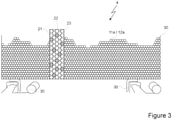
- Fig. 3
- Schematic view of recognition of aerosol-generating articles during processing.
-
In Figure 1a chart of steps 1-7 of the method of producing an aerosol-generating article 10 with a binding agent 16 onto a proximal 12 and/or distal 11 end of the aerosol-generating article 10 is shown. The aerosol generating article 10 with binding agent applied onto it is schematically shown in figure 2.
-
In a first step 1, the aerosol-generating article 10 is provided. The aerosol generating article comprises a longitudinal axis 13 along which at least one aerosol-generating substrate segment 14 and at least one filter segment 15 are arranged, as well as a distal end 11 and a proximal end 12, wherein these ends comprise a face 11a, 12a that is ideally arranged perpendicular to the longitudinal axis 13. Preferably, the aerosol-generating substrate segment comprises tobacco, in particular in the form of tobacco particles. Optionally, the aerosol-generating substrate segment 14 and the filter segment 15 are positioned adjacent to each other or with at least one cavity between them. The aerosol-generating substrate segment 14 and the filter segment 15 may both be at least partly surrounded by a wrapping element, ideally made of paper material or plastic material and in particular by a tipping wrapper.
-
In a further, in particular a second step 2, the binding agent 16 is provided. Ideally, the binding agent 16 comprises at least one material of a group of materials that contains sugars, starches, starch based glues, agar agar, gel, waxes, water and/or flavors and/or combinations thereof. Preferably, the binding agent comprises or is made of one biodegradable wax selected from a group out of animal waxes, in particular beeswax. It may be possible that in an intermediate step the binding agent 16 is mixed with at least one additive, such as glycerol, other polyols and/or flavors, preferably with an amount of between 0.1% and 0.8% of the additive. The binding agent 16 may be soluble in fat, at least partially soluble in alcohol and/or soluble or insoluble in water. Ideally, the binding agent has a good miscibility with fat and/or water.
-
In a further, in particular a third step 3 the binding agent 16 is provided in a liquid form or is liquefied into a liquid form. Ideally, the binding agent 16 is transformed form a solid and/or plastic state into a liquid state by melting the binding agent 16. The melting preferably takes place at temperatures between 50°C, preferably above 55°C and 80°C. It may also be possible that the binding agent has a solid form, e.g. as a powder and is mixed with a liquid material, such as water to liquefy the binding agent 16.
-
In a further, in particular a fourth step 4, a position of one or several least one aerosol-generating article/s 10 is recognized by e.g. an automatic and preferably contactless and/or optical and/or electromagnetic recognition method. Preferably, the electromagnetic recognition method uses micro-waves or terahertz waves. Ideally, this step and may be subsequent steps take place between production and packaging of the aerosol-generating article/s and/or directly after components of the aerosol generating article/s is/are assembled e.g. at a maker part of the manufacturing plant, or directly before the aerosol generating article/s are packed into packagings, e.g. at a packing part of the manufacturing plant.
-
In this step 4, preferably several aerosol-generating article/s 10 are positioned close to each other and/or arranged in parallel with respect to their longitudinal axes 13. Ideally, the aerosol-generating article/s 10 are arranged such that their distal ends 11 are directed into the same direction or that their proximal ends 12 are directed into the same direction, which is preferably a direction perpendicular to each longitudinal axis 13. The faces 11a, 12a of the distal 11 and/or proximal 12 ends of the several aerosol-generating articles 10 may be arranged such they are arranged in the same plane. Ideally, at least one position, in particular several positions of the faces 11a, 12a of different aerosol-generating article/s 10 are recognized by the recognition method.
-
The position/s of the distal 11 and/or proximal 12 end/s and/or faces 11a, 12a may be detected or recognized by an electronical system, that may include at least one, preferably several imaging devices, such as cameras with e.g. a CCD sensor or another optical or electronic sensor. In a specific area 21 of detection, that is ideally a plane view of the faces 11a, 12a and/or the distal 11 and/or proximal 12 ends of several aerosol-generating article/s 10 the faces 11a, 12a and/or the distal 11 and/or proximal 12 ends are detected.
-
Figure 3 shows a schematic view of the recognition of aerosol-generating articles during processing. The area 21 of detection may be arranged such that the faces 11a, 12a are recognizable and detectable. Exemplary, some of the detected faces 22 are shown within the area 21 of detection. It may be possible that some faces 11a, 12a remain undetected 23 and may be detected in a subsequent detection cycle. Ideally, electronical methods and/or algorithms, such as image recognition and/or pattern perception are used to detect one or more distal and/or a proximal end/s or faces 11a, 12a and in particular to determine a center of each detected face 11a, 12a, each distal 11 and/or proximal 12 end. The electronical methods and/or algorithms may also be used in a further step, in particular step 5, to convert the detected positions into application patterns and/or spray pulses, which will then serve as basis for the application 6 of the binding agent 16.
-
In a further, in particular an intermediate step, a distribution element, e.g. in the form of a nozzle, roller and/or stamp, and especially an orifice 24 of the element of an application unit 20 is adjusted such that it is directed to at least one face 11a, 12a and/or the distal 11 and/or proximal 12 end. Preferably, the application unit 20 comprises more than one, in particular several elements/orifices, which ideally are arranged in an array and are preferably adjusted such that each element/orifice 24 is directed to another face 11a, 12a and/or the distal 11 and/or proximal 12 end. The adjustment may be based on the application patterns or rather on the recognized face/s 22 and/or proximal 12 or distal 11 end/s such that ideally, each element/orifice 24 is adjusted and directed to recognized face/s 22 and/or proximal 12 or distal 11 end/s.
-
In a further, in particular a sixth step 6, a quantity of preferably between 0.8 and 1.5 mg of the binding agent 16 is applied onto at least one, preferably several and preferably each face 11a, 12a and/or proximal 12 or distal 11 end of the aerosol generating article 10. Ideally, the binding agent 16 is applied onto the recognized 22, and especially onto the center of the recognized face/s 22 and/or proximal 12 or distal 11 end/s of the aerosol generating article/s 10. The binding agent 16 may be applied by spraying it, ideally on the basis of the spray pulses.
-
In a further, in particular a seventh step 7, the binding agent 16 is dried. Preferably, drying causes a solidification of the binding agent 16 so that the binding agent ideally solidifies by a transformation from a liquid state to a solid and/or plastic state. The binding agent 16 may solidify by cooling it, preferably from down to room temperature, which is in particular below 40°C. The binding agent 16 may also solidify due to a loss of liquid constituents, e.g. water and/or heating it to cause a desorption of at least one liquid constituent.
-
Subsequently, the finished aerosol-generating article 10 comprising the binding agent 16 are preferably subjected to further standard processing as packaging and/or storage.
-
The applicant reserves his right to claim all features disclosed in the application document as being an essential feature of the invention, as long as they are new, individually or in combination, in view of the prior art. Furthermore, it is noted that in the figures features are described, which can be advantageous individually. Someone skilled in the art will directly recognize that a specific feature being disclosed in a figure can be advantageous also without the adoption of further features from this figure. Furthermore, someone skilled in the art will recognize that advantages can evolve from a combination of diverse features being disclosed in one or various figures.
List of reference symbols
-
- 1
- step 1; providing the aerosol generating article
- 2
- step 2; providing the binding agent
- 3
- step 3; bringing the binding agent into a liquid form
- 4
- step 4; recognizing position of a proximal and/or distal end
- 5
- step 5; converting positions into application patterns
- 6
- step 6; applying the binding agent
- 7
- step 7; drying the binding agent
- 10
- aerosol generating article
- 11
- distal end
- 11a
- face of the distal end
- 12
- proximal end
- 12a
- face of the proximal end
- 13
- longitudinal axis
- 14
- aerosol-generating substrate segment
- 15
- filter segment
- 16
- binding agent
- 20
- application unit
- 21
- area of detection
- 22
- detected faces / recognized faces
- 23
- undetected faces
- 24
- orifice
- 30
- manufacturing plant