EP3939417A1 - Individual unit for milking and milk-metering through a system of automated milk data collection during the milking of ovine and caprine animals - Google Patents
Individual unit for milking and milk-metering through a system of automated milk data collection during the milking of ovine and caprine animals Download PDFInfo
- Publication number
- EP3939417A1 EP3939417A1 EP20386045.7A EP20386045A EP3939417A1 EP 3939417 A1 EP3939417 A1 EP 3939417A1 EP 20386045 A EP20386045 A EP 20386045A EP 3939417 A1 EP3939417 A1 EP 3939417A1
- Authority
- EP
- European Patent Office
- Prior art keywords
- milking
- milk
- animal
- box
- fact
- Prior art date
- Legal status (The legal status is an assumption and is not a legal conclusion. Google has not performed a legal analysis and makes no representation as to the accuracy of the status listed.)
- Withdrawn
Links
- 241001465754 Metazoa Species 0.000 title claims abstract description 26
- 235000013336 milk Nutrition 0.000 title claims abstract description 15
- 239000008267 milk Substances 0.000 title claims abstract description 15
- 210000004080 milk Anatomy 0.000 title claims abstract description 15
- 238000013480 data collection Methods 0.000 title 1
- 238000009434 installation Methods 0.000 claims abstract description 12
- 238000009826 distribution Methods 0.000 claims description 3
- 238000004806 packaging method and process Methods 0.000 claims description 2
- 239000000470 constituent Substances 0.000 claims 1
- 238000005516 engineering process Methods 0.000 abstract description 7
- 239000002184 metal Substances 0.000 abstract description 3
- 238000000034 method Methods 0.000 description 8
- 244000144972 livestock Species 0.000 description 7
- 241001494479 Pecora Species 0.000 description 6
- 230000008901 benefit Effects 0.000 description 4
- 238000004519 manufacturing process Methods 0.000 description 4
- 235000013351 cheese Nutrition 0.000 description 2
- 238000010276 construction Methods 0.000 description 2
- 238000009313 farming Methods 0.000 description 2
- 230000007246 mechanism Effects 0.000 description 2
- 239000002994 raw material Substances 0.000 description 2
- 238000004458 analytical method Methods 0.000 description 1
- 230000008030 elimination Effects 0.000 description 1
- 238000003379 elimination reaction Methods 0.000 description 1
- 230000006872 improvement Effects 0.000 description 1
- 238000005528 milk analysis Methods 0.000 description 1
- 230000006855 networking Effects 0.000 description 1
- 230000008569 process Effects 0.000 description 1
- 235000020185 raw untreated milk Nutrition 0.000 description 1
- 230000007704 transition Effects 0.000 description 1
- 239000002699 waste material Substances 0.000 description 1
- 238000005303 weighing Methods 0.000 description 1
Images


Classifications
-
- A—HUMAN NECESSITIES
- A01—AGRICULTURE; FORESTRY; ANIMAL HUSBANDRY; HUNTING; TRAPPING; FISHING
- A01K—ANIMAL HUSBANDRY; AVICULTURE; APICULTURE; PISCICULTURE; FISHING; REARING OR BREEDING ANIMALS, NOT OTHERWISE PROVIDED FOR; NEW BREEDS OF ANIMALS
- A01K1/00—Housing animals; Equipment therefor
- A01K1/12—Milking stations
-
- A—HUMAN NECESSITIES
- A01—AGRICULTURE; FORESTRY; ANIMAL HUSBANDRY; HUNTING; TRAPPING; FISHING
- A01J—MANUFACTURE OF DAIRY PRODUCTS
- A01J5/00—Milking machines or devices
- A01J5/007—Monitoring milking processes; Control or regulation of milking machines
-
- A—HUMAN NECESSITIES
- A01—AGRICULTURE; FORESTRY; ANIMAL HUSBANDRY; HUNTING; TRAPPING; FISHING
- A01K—ANIMAL HUSBANDRY; AVICULTURE; APICULTURE; PISCICULTURE; FISHING; REARING OR BREEDING ANIMALS, NOT OTHERWISE PROVIDED FOR; NEW BREEDS OF ANIMALS
- A01K1/00—Housing animals; Equipment therefor
- A01K1/12—Milking stations
- A01K1/123—Mobile milking parlours
Definitions
- the invention applies to stockraising in general and, more specifically, the main goal is the development of an innovative milking and digital milk-metering system.
- the invention develops the technology of the already existing milking devices introducing stockraising network technology and offering a decentralized milking installation, as the transition to decentralized installation technology is considered necessary in order to make the coverage of big stockraising networks possible.
- the existing technique is by definition unable to provide the modern, extended networks of thousands of farmers with the necessary technology, causing information asymmetry and low productivity.
- the second asymmetry is found in the milk contracts between the industry and the farmers for the production of Feta cheese with Protected Designation of Origin.
- feedback loop The procedure of the repeated offer of horizontal price and asymmetric information is called "feedback loop" and it causes the under-developed market, which is a market that is constantly producing non-quality products and low efficiency farmers.
- the Greek breeds are less than 20% of the total number of animals bred for Feta production, since Greek farmers have sheep unsuitable for Feta production, due to the information asymmetry caused by the previous techniques used by the milking devices.
- pre-construced milking crates are packaged vertically and can be distributed through logistics networks at very low cost, making it unnecessary to create support networks, since any part of the system can be replaced on the spot and sent back to the factory.
- BOX milking unit
- the decentralized milking device «BOX» consists of preconstructed milking crates which are serially connected, depending on the livestock needs.
- the animal pushes the entrance gate (3) and takes position for milking.
- the eartag is identified by the mechanism on the release gate (1).
- the flaps on the upper part of the box open (4) and the clusters come out (2) so that the milking of the animal can start.
- the clusters (2) and the flaps (4) return to their original place and the release gate opens (1) so that the animal can exit the box.
- the milk is weighed and analyzed and the data are sent to a computer or a smartphone.
- the box is serially connected with 6, 12, or 24 other boxes (8) in line on a metal construction (7) where the animals enter from one side (5) and exit from another (6).
Landscapes
- Life Sciences & Earth Sciences (AREA)
- Environmental Sciences (AREA)
- Animal Husbandry (AREA)
- Zoology (AREA)
- Biodiversity & Conservation Biology (AREA)
- Management, Administration, Business Operations System, And Electronic Commerce (AREA)
Abstract
Description
- The invention applies to stockraising in general and, more specifically, the main goal is the development of an innovative milking and digital milk-metering system.
- The invention develops the technology of the already existing milking devices introducing stockraising network technology and offering a decentralized milking installation, as the transition to decentralized installation technology is considered necessary in order to make the coverage of big stockraising networks possible.
- The previous technique requires specialized installers, who assume the installation of all the equipment, which limits considerably the number of the milking devices that can be installed at the same time, while it lengthens the time required for the provision and installation of the equipment on the spot, and increases its cost at the same time.
- The existing technique, is by definition unable to provide the modern, extended networks of thousands of farmers with the necessary technology, causing information asymmetry and low productivity.
- One of the main features of stockraising is the ownership of livestock by the farmer, which is the most important motive for their keeping and care of the animals. For this reason, the industry, internationally, is supplied the raw material by the farmers, with annual milk contracts. The milk market has the industry as the principle and the producer as the agent of the order, which is delivered by contract. In this way, the industry creates informal networks of producers that are summed into "Milk Zones".
- In contractual economy, an important role is played by information asymmetry, which describes situations where some agents-counterparties hold information which is not available to other counterparties in the same transaction. When observing stockraising in Greece, we can see two asymmetries that play a vital role in the outcome of the contractual relation in the stockraising economy. As the first asymmetry, we consider the transactions for the purchase and sale of livestock between Greek farmers.
- So far, we see that the great majority of the farms that do have livestock surplus available cannot exploit it, as there is a maximum animal number (maximum capacity number) for every farm. On the other hand, there are agents who need animals to improve their farms' livestock. So, it is important that the animals be sold to agenets for milk-production, otherwise they will be sold as carcasses (this means we will have waste of livestock)
- Today, such transactions fail because the agents do not have information regarding the livestock surpluses, while the access mechanisms are considered inadequate, since 80% of the farms do not have the basic infrastructure for this procedure.
- The second asymmetry is found in the milk contracts between the industry and the farmers for the production of Feta cheese with Protected Designation of Origin.
- (PDO). The Feta cheese market is not developed enough, since, for decades, industries have been paying a fixed price for the milk of both Greek and foreign animal breeds, because they do not have any information that allows them to distinguish, and the Greek farmers choose foreign breeds that have been genetically enhanced, which they consider more productive.
- The procedure of the repeated offer of horizontal price and asymmetric information is called "feedback loop" and it causes the under-developed market, which is a market that is constantly producing non-quality products and low efficiency farmers.
- As a result, the Greek breeds are less than 20% of the total number of animals bred for Feta production, since Greek farmers have sheep unsuitable for Feta production, due to the information asymmetry caused by the previous techniques used by the milking devices.
- The networks of industry suppliers operate mostly as raw material distribution channels and do not reap any scale or networking benefits. 60% of the Greek farmers are part of one of the loosely structured networks of the 10 biggest industries in the country, their only common thing being the milk contract with the same principle-industry.
- The advantages of the invention are:
- the preconstruction of the individual milking positions in a "BOX" form, which simplifies the process of installing the equipment, allowing, for the first time, the decentralized installation by a non-expert (it is installed by any electrician or the plumber available), as well as the vertical packaging and distribution that enables the simultaneous service of extended farming networks.
- the in-line connection, which allows the milking device to extend, with the addition of more pre-constructed BOX crates.
- The pre-construced milking crates (BOX) are packaged vertically and can be distributed through logistics networks at very low cost, making it unnecessary to create support networks, since any part of the system can be replaced on the spot and sent back to the factory.
- A considerable advantage deriving from the way the milking unit is designed (BOX) is the possibility of installing milk analysis with lower cost technology than that available on the market, as the space in the BOX allows the use of volumetric rather than flowmetric technology, which is unsuitable for the ovine and caprine animal farming due to the constant flow of the milk during the milking session.
- What is more, the installation and maintainance by any electrician and plumber is made possible, abolishing the need for and the cost of creating support, sales and logistics networks and allowing the decentralized installation and maintainance of thousands of machines at the same time.
- The possibility of massive installation of low-cost milking devices is a strong motive for the industry and the associations to participate in the improvement of networks and the elimination of information asymmetry, since the installation of the system addresses the longstanding problem of high viable colony in the raw milk.
- The decentralized milking device «BOX» consists of preconstructed milking crates which are serially connected, depending on the livestock needs.
- The basic functions incorporated in every individual milking unit will be:
- a) the identification of the animal so that all the relevant information is registered on the individual animal's code. This will enable, to a great extent, the assessment of the individual animal in relation with the measured elements,
- b) semi-automated milking,
- c) measuremet of the volume of the milk,
- d) weighing or the animal,
- e) analysis of the milk,
- f) sending data to a smartphone and
- g) the serial connection with other kits.
-
-
Drawing 1 : Individual milking and digital milk-metering unit in its full form for transportation.
The drawing shows by numbers- 1. Exit gate
- 3. Entrance gate
-
Drawing 2 : Individual milking and digital milk-metering unit in its full form for transportation.
The drawing shows by numbers- 1. Exit gate
- 3. Entrance gate
-
Drawing 3 : Individual milking and digital milk-metering unit in its full form for transportation.
The drawing shows by numbers- 1. Exit gate
- 2. Clusters
- 3. Entrance gate
- 4. Flaps
-
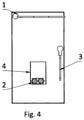
Drawing 4 : Detailed illustration of the system
The drawing shows by numbers- 1. Exit gate
- 2. Clusters
- 3. Entrance gate
- 4. Flaps
-
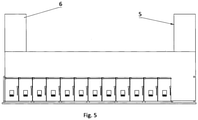
Drawing 5 : Illustration of the route followed by the sheep when using the pilot system
The drawing shows by numbers- 5. Sheep entrance
- 6. Sheep exit
-
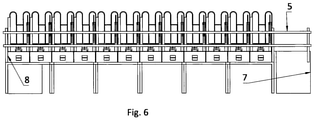
Drawing 6 : Illustration of the route followed by the sheep when using the pilot system
The drawing shows by numbers- 5. Sheep entrance
- 7. Metal construction
- 8. Milking unit
- This is a box (8) allowing the semi-automated milking and digital milk metering. Upon entering the box, the animal pushes the entrance gate (3) and takes position for milking. The eartag is identified by the mechanism on the release gate (1). The flaps on the upper part of the box open (4) and the clusters come out (2) so that the milking of the animal can start. At the end of the milking, the clusters (2) and the flaps (4) return to their original place and the release gate opens (1) so that the animal can exit the box. The milk is weighed and analyzed and the data are sent to a computer or a smartphone. The box is serially connected with 6, 12, or 24 other boxes (8) in line on a metal construction (7) where the animals enter from one side (5) and exit from another (6).
Claims (8)
- The system is characterized by the ability to connect preconstructed individual milking and digital milk-metering units for ovine and caprine animals with a view to creating a decentrilized semi-automated milking installation.
It consists of preconstructed milking crates in a "BOX" form without the need for specialized installation, which can be connected serially to each other with mechanical connectors and packaged vertically (one on top of the other) with a view to their easy transportation, packaging and distribution. - The system, according to claim (1) is characterized by the fact that the animal is identified upon entering the individual milking and digital milk-metering unit so that all the data can be registered on the code of the individual animal.
- The system, according to claims (1) and (2) is characterized by the fact that the semi-automated milking is conducted through two-pump clusters.
- The system, according to claims (1), (2) and (3) is characterized by the fact that the volume of the milk is measured.
- The system, according to claims (1), (2), (3) and (4) is characterized by the fact that the animal is weighed.
- The system, according to claims (1), (2), (3), (4) and (5) is characterized by the fact that the milk constituents are analyzed .
- The system, according to claims (1), (2), (3), (4), (5) and (6) is characterized by the fact that the registered data are sent to the farmer through a GSM mobile telephony network.
- The system, according to claims (1), (2), (3), (4), (5), (6) and (7) is characterized by the fact that the animal is automatically released through the exit gate after the completion of the milking session.
Applications Claiming Priority (1)
| Application Number | Priority Date | Filing Date | Title |
|---|---|---|---|
| GR20190100417A GR1009884B (en) | 2019-09-12 | 2019-09-12 | Individual milking and digital milk measuring via an automatic data collection system used during the milking of sheep and goats |
Publications (1)
| Publication Number | Publication Date |
|---|---|
| EP3939417A1 true EP3939417A1 (en) | 2022-01-19 |
Family
ID=74554242
Family Applications (1)
| Application Number | Title | Priority Date | Filing Date |
|---|---|---|---|
| EP20386045.7A Withdrawn EP3939417A1 (en) | 2019-09-12 | 2020-09-11 | Individual unit for milking and milk-metering through a system of automated milk data collection during the milking of ovine and caprine animals |
Country Status (2)
| Country | Link |
|---|---|
| EP (1) | EP3939417A1 (en) |
| GR (1) | GR1009884B (en) |
Citations (4)
| Publication number | Priority date | Publication date | Assignee | Title |
|---|---|---|---|---|
| US4889074A (en) * | 1986-11-19 | 1989-12-26 | Multinorm B.V. | Movable accomodation or container in which is arranged apparatus for automatic milking of an animal |
| US20030168014A1 (en) * | 2002-03-11 | 2003-09-11 | Lely Enterprises Ag | A device and an assembly for an animal related action |
| US20040020441A1 (en) * | 2002-07-31 | 2004-02-05 | Reisgies Rolf W. | Modular milking parlor and transport system |
| WO2017217870A1 (en) * | 2016-06-13 | 2017-12-21 | Lic Automation Limited | A livestock management system and method of operation |
Family Cites Families (2)
| Publication number | Priority date | Publication date | Assignee | Title |
|---|---|---|---|---|
| US5743209A (en) * | 1994-08-01 | 1998-04-28 | La Federation Francaise De Controle Laitier (F.F.C.L.) | System and method for monitoring and controlling milk production at dairy farms |
| EP3122173B2 (en) * | 2014-03-26 | 2024-05-29 | SCR Engineers Ltd | Livestock location system |
-
2019
- 2019-09-12 GR GR20190100417A patent/GR1009884B/en unknown
-
2020
- 2020-09-11 EP EP20386045.7A patent/EP3939417A1/en not_active Withdrawn
Patent Citations (4)
| Publication number | Priority date | Publication date | Assignee | Title |
|---|---|---|---|---|
| US4889074A (en) * | 1986-11-19 | 1989-12-26 | Multinorm B.V. | Movable accomodation or container in which is arranged apparatus for automatic milking of an animal |
| US20030168014A1 (en) * | 2002-03-11 | 2003-09-11 | Lely Enterprises Ag | A device and an assembly for an animal related action |
| US20040020441A1 (en) * | 2002-07-31 | 2004-02-05 | Reisgies Rolf W. | Modular milking parlor and transport system |
| WO2017217870A1 (en) * | 2016-06-13 | 2017-12-21 | Lic Automation Limited | A livestock management system and method of operation |
Also Published As
| Publication number | Publication date |
|---|---|
| GR1009884B (en) | 2020-12-16 |
Similar Documents
| Publication | Publication Date | Title |
|---|---|---|
| Dong et al. | Technical efficiency, herd size, and exit intentions in US dairy farms | |
| Kahi et al. | Sustainable community-based organizations for the genetic improvement of livestock in developing countries | |
| Lie et al. | Modeling dynamic processes in smallholder dairy value chains in Nicaragua: a system dynamics approach | |
| Braga Lobo | Opportunities for investment into small ruminant breeding programmes in Brazil | |
| Legarra et al. | Economic weights of fertility, prolificacy, milk yield and longevity in dairy sheep | |
| McKendree et al. | Oligopsonistic input substitution in a thin market | |
| Oguz et al. | Productivity analysis of dairy cattle farms in Turkey: case study of Konya Province | |
| Vries et al. | A review of simulation analyses of economics and genetics for the use of in-vitro produced embryos and artificial insemination in dairy herds | |
| EP3939417A1 (en) | Individual unit for milking and milk-metering through a system of automated milk data collection during the milking of ovine and caprine animals | |
| Sattar | What is Holding Back Milk Production Potential in Pakistan? | |
| Dillon | The Irish dairy industry–Planning for 2020 | |
| Balogh et al. | Analysis and optimization regarding the activity of a Hungarian Pig Sales and Purchase Cooperation | |
| Sharma et al. | Determinants of small-scale farmer inclusion in emerging modern agrifood markets: A study of the dairy industry in India | |
| Omer et al. | Development of a breeding program for improving the milk yield performance of Butana cattle under smallholder production conditions using a stochastic simulation approach | |
| Daburon et al. | Evolution of a milkshed and role of alternative milk collection centres in Egypt | |
| Täubert et al. | Comparing conventional and genomic breeding programs with ZPLAN+ | |
| Miles et al. | The role of a national evaluation system in promoting dairy sustainability | |
| Mrode et al. | The application of digital-genomic tools to improve productivity and profitability in smallholder dairy systems in Sub-Saharan Africa | |
| Nga | An analysis of the fresh milk chain in Ha Nam province of Vietnam | |
| Lie et al. | Improving value chains for dairy farmers in matiguás, Nicaragua: a System Dynamics Approach | |
| Nurtayeva et al. | Ecological and economic efficiency of production and processing of milk on the example of enterprises of the Akmola Region | |
| Ponce-Méndez et al. | Model GGAVATT and networks of innovation in the dairy basin in the Cienega of Chapala, Michoacán | |
| Hansen Axelsson et al. | Breakeven prices for recording of indicator traits to reduce the environmental impact of milk production | |
| Ouma et al. | Theory of change for the dairy value chain in Uganda, developed for the CGIAR initiative sustainable animal productivity for livelihoods, nutrition and gender inclusion | |
| Ojango et al. | Breeding programs to accelerate dairy productivity in Nepal: Opportunity for adapting the Africa Dairy Genetic Gains (ADGG) program |
Legal Events
| Date | Code | Title | Description |
|---|---|---|---|
| STAA | Information on the status of an ep patent application or granted ep patent |
Free format text: STATUS: UNKNOWN |
|
| PUAI | Public reference made under article 153(3) epc to a published international application that has entered the european phase |
Free format text: ORIGINAL CODE: 0009012 |
|
| STAA | Information on the status of an ep patent application or granted ep patent |
Free format text: STATUS: THE APPLICATION HAS BEEN PUBLISHED |
|
| AK | Designated contracting states |
Kind code of ref document: A1 Designated state(s): AL AT BE BG CH CY CZ DE DK EE ES FI FR GB GR HR HU IE IS IT LI LT LU LV MC MK MT NL NO PL PT RO RS SE SI SK SM TR |
|
| STAA | Information on the status of an ep patent application or granted ep patent |
Free format text: STATUS: REQUEST FOR EXAMINATION WAS MADE |
|
| 17P | Request for examination filed |
Effective date: 20220610 |
|
| RBV | Designated contracting states (corrected) |
Designated state(s): AL AT BE BG CH CY CZ DE DK EE ES FI FR GB GR HR HU IE IS IT LI LT LU LV MC MK MT NL NO PL PT RO RS SE SI SK SM TR |
|
| STAA | Information on the status of an ep patent application or granted ep patent |
Free format text: STATUS: THE APPLICATION IS DEEMED TO BE WITHDRAWN |
|
| 18D | Application deemed to be withdrawn |
Effective date: 20220720 |