EP3938958B1 - Packaging with radio-frequency authentication system for packaged product - Google Patents
Packaging with radio-frequency authentication system for packaged product Download PDFInfo
- Publication number
- EP3938958B1 EP3938958B1 EP20715573.0A EP20715573A EP3938958B1 EP 3938958 B1 EP3938958 B1 EP 3938958B1 EP 20715573 A EP20715573 A EP 20715573A EP 3938958 B1 EP3938958 B1 EP 3938958B1
- Authority
- EP
- European Patent Office
- Prior art keywords
- packaging
- product
- electronic device
- chip
- data chip
- Prior art date
- Legal status (The legal status is an assumption and is not a legal conclusion. Google has not performed a legal analysis and makes no representation as to the accuracy of the status listed.)
- Active
Links
Images




Classifications
-
- G—PHYSICS
- G06—COMPUTING OR CALCULATING; COUNTING
- G06K—GRAPHICAL DATA READING; PRESENTATION OF DATA; RECORD CARRIERS; HANDLING RECORD CARRIERS
- G06K19/00—Record carriers for use with machines and with at least a part designed to carry digital markings
- G06K19/06—Record carriers for use with machines and with at least a part designed to carry digital markings characterised by the kind of the digital marking, e.g. shape, nature, code
- G06K19/067—Record carriers with conductive marks, printed circuits or semiconductor circuit elements, e.g. credit or identity cards also with resonating or responding marks without active components
- G06K19/07—Record carriers with conductive marks, printed circuits or semiconductor circuit elements, e.g. credit or identity cards also with resonating or responding marks without active components with integrated circuit chips
- G06K19/073—Special arrangements for circuits, e.g. for protecting identification code in memory
- G06K19/07309—Means for preventing undesired reading or writing from or onto record carriers
- G06K19/07345—Means for preventing undesired reading or writing from or onto record carriers by activating or deactivating at least a part of the circuit on the record carrier, e.g. ON/OFF switches
-
- B—PERFORMING OPERATIONS; TRANSPORTING
- B65—CONVEYING; PACKING; STORING; HANDLING THIN OR FILAMENTARY MATERIAL
- B65D—CONTAINERS FOR STORAGE OR TRANSPORT OF ARTICLES OR MATERIALS, e.g. BAGS, BARRELS, BOTTLES, BOXES, CANS, CARTONS, CRATES, DRUMS, JARS, TANKS, HOPPERS, FORWARDING CONTAINERS; ACCESSORIES, CLOSURES, OR FITTINGS THEREFOR; PACKAGING ELEMENTS; PACKAGES
- B65D23/00—Details of bottles or jars not otherwise provided for
- B65D23/12—Means for the attachment of smaller articles
- B65D23/14—Means for the attachment of smaller articles of tags, labels, cards, coupons, decorations or the like
-
- B—PERFORMING OPERATIONS; TRANSPORTING
- B65—CONVEYING; PACKING; STORING; HANDLING THIN OR FILAMENTARY MATERIAL
- B65D—CONTAINERS FOR STORAGE OR TRANSPORT OF ARTICLES OR MATERIALS, e.g. BAGS, BARRELS, BOTTLES, BOXES, CANS, CARTONS, CRATES, DRUMS, JARS, TANKS, HOPPERS, FORWARDING CONTAINERS; ACCESSORIES, CLOSURES, OR FITTINGS THEREFOR; PACKAGING ELEMENTS; PACKAGES
- B65D27/00—Envelopes or like essentially-rectangular flexible containers for postal or other purposes having no structural provision for thickness of contents
- B65D27/12—Closures
- B65D27/14—Closures using adhesive applied to integral parts, e.g. flaps
-
- B—PERFORMING OPERATIONS; TRANSPORTING
- B65—CONVEYING; PACKING; STORING; HANDLING THIN OR FILAMENTARY MATERIAL
- B65D—CONTAINERS FOR STORAGE OR TRANSPORT OF ARTICLES OR MATERIALS, e.g. BAGS, BARRELS, BOTTLES, BOXES, CANS, CARTONS, CRATES, DRUMS, JARS, TANKS, HOPPERS, FORWARDING CONTAINERS; ACCESSORIES, CLOSURES, OR FITTINGS THEREFOR; PACKAGING ELEMENTS; PACKAGES
- B65D27/00—Envelopes or like essentially-rectangular flexible containers for postal or other purposes having no structural provision for thickness of contents
- B65D27/12—Closures
- B65D27/30—Closures with special means for indicating unauthorised opening
-
- B—PERFORMING OPERATIONS; TRANSPORTING
- B65—CONVEYING; PACKING; STORING; HANDLING THIN OR FILAMENTARY MATERIAL
- B65D—CONTAINERS FOR STORAGE OR TRANSPORT OF ARTICLES OR MATERIALS, e.g. BAGS, BARRELS, BOTTLES, BOXES, CANS, CARTONS, CRATES, DRUMS, JARS, TANKS, HOPPERS, FORWARDING CONTAINERS; ACCESSORIES, CLOSURES, OR FITTINGS THEREFOR; PACKAGING ELEMENTS; PACKAGES
- B65D27/00—Envelopes or like essentially-rectangular flexible containers for postal or other purposes having no structural provision for thickness of contents
- B65D27/32—Opening devices incorporated during envelope manufacture
- B65D27/38—Tearing-strings or -strips
-
- B—PERFORMING OPERATIONS; TRANSPORTING
- B65—CONVEYING; PACKING; STORING; HANDLING THIN OR FILAMENTARY MATERIAL
- B65D—CONTAINERS FOR STORAGE OR TRANSPORT OF ARTICLES OR MATERIALS, e.g. BAGS, BARRELS, BOTTLES, BOXES, CANS, CARTONS, CRATES, DRUMS, JARS, TANKS, HOPPERS, FORWARDING CONTAINERS; ACCESSORIES, CLOSURES, OR FITTINGS THEREFOR; PACKAGING ELEMENTS; PACKAGES
- B65D79/00—Kinds or details of packages, not otherwise provided for
-
- G—PHYSICS
- G06—COMPUTING OR CALCULATING; COUNTING
- G06F—ELECTRIC DIGITAL DATA PROCESSING
- G06F21/00—Security arrangements for protecting computers, components thereof, programs or data against unauthorised activity
- G06F21/30—Authentication, i.e. establishing the identity or authorisation of security principals
- G06F21/31—User authentication
- G06F21/34—User authentication involving the use of external additional devices, e.g. dongles or smart cards
-
- G—PHYSICS
- G06—COMPUTING OR CALCULATING; COUNTING
- G06F—ELECTRIC DIGITAL DATA PROCESSING
- G06F21/00—Security arrangements for protecting computers, components thereof, programs or data against unauthorised activity
- G06F21/30—Authentication, i.e. establishing the identity or authorisation of security principals
- G06F21/44—Program or device authentication
-
- G—PHYSICS
- G06—COMPUTING OR CALCULATING; COUNTING
- G06K—GRAPHICAL DATA READING; PRESENTATION OF DATA; RECORD CARRIERS; HANDLING RECORD CARRIERS
- G06K7/00—Methods or arrangements for sensing record carriers, e.g. for reading patterns
- G06K7/10—Methods or arrangements for sensing record carriers, e.g. for reading patterns by electromagnetic radiation, e.g. optical sensing; by corpuscular radiation
- G06K7/10009—Methods or arrangements for sensing record carriers, e.g. for reading patterns by electromagnetic radiation, e.g. optical sensing; by corpuscular radiation sensing by radiation using wavelengths larger than 0.1 mm, e.g. radio-waves or microwaves
- G06K7/10297—Methods or arrangements for sensing record carriers, e.g. for reading patterns by electromagnetic radiation, e.g. optical sensing; by corpuscular radiation sensing by radiation using wavelengths larger than 0.1 mm, e.g. radio-waves or microwaves arrangements for handling protocols designed for non-contact record carriers such as RFIDs NFCs, e.g. ISO/IEC 14443 and 18092
-
- H—ELECTRICITY
- H01—ELECTRIC ELEMENTS
- H01Q—ANTENNAS, i.e. RADIO AERIALS
- H01Q1/00—Details of, or arrangements associated with, antennas
- H01Q1/12—Supports; Mounting means
- H01Q1/22—Supports; Mounting means by structural association with other equipment or articles
- H01Q1/2208—Supports; Mounting means by structural association with other equipment or articles associated with components used in interrogation type services, i.e. in systems for information exchange between an interrogator/reader and a tag/transponder, e.g. in Radio Frequency Identification [RFID] systems
- H01Q1/2216—Supports; Mounting means by structural association with other equipment or articles associated with components used in interrogation type services, i.e. in systems for information exchange between an interrogator/reader and a tag/transponder, e.g. in Radio Frequency Identification [RFID] systems used in interrogator/reader equipment
-
- B—PERFORMING OPERATIONS; TRANSPORTING
- B65—CONVEYING; PACKING; STORING; HANDLING THIN OR FILAMENTARY MATERIAL
- B65D—CONTAINERS FOR STORAGE OR TRANSPORT OF ARTICLES OR MATERIALS, e.g. BAGS, BARRELS, BOTTLES, BOXES, CANS, CARTONS, CRATES, DRUMS, JARS, TANKS, HOPPERS, FORWARDING CONTAINERS; ACCESSORIES, CLOSURES, OR FITTINGS THEREFOR; PACKAGING ELEMENTS; PACKAGES
- B65D2203/00—Decoration means, markings, information elements, contents indicators
- B65D2203/10—Transponders
Definitions
- the described embodiments relate generally to retail packaging. More particularly, the present embodiments relate to "smart" packaging using communication systems such as near field communication (“NFC”) in order to provide automatic activation, authentication, etc., when a user opens the packaging.
- NFC near field communication
- Connected or "smart" packaging may include certain sensors or communication tools to track packages in transit, or provide additional information about a product to a consumer (e.g., through a digital application or visual display). Such tools simply provide information. They do not take part in activation, authentication, etc., of a product when a user opens or receives the packaging.
- WO 2007/096898 A2 which discusses a package-companion-user interactive system
- WO 01/31558 A2 which discusses a data carrier and a system for transmitting product related information
- US 2018/025349 A1 which discusses activation and assigning value to gift cards using RFID
- CN 203 078 858 U which discusses packaging box with near field communication (NFC) verification function.
- NFC near field communication
- Some embodiments include packaging, such as an envelope or box.
- the packaging may include an opening or cavity that may contain a product that requires or benefits from activation prior to use (e.g., a gift card, credit card, membership card, or other suitable product).
- a data chip e.g., an RFID chip, which may be an NFC chip, etc.
- a passive data chip e.g., one that is temporarily powered as needed wirelessly by another device in proximity to the chip
- a passive NFC chip for example, if a user's personal electronic device such as a mobile phone with an NFC transceiver is within range, the electronic device may recognize the NFC chip, and initialize the authentication or activation of the product via the electronic device automatically.
- no outward searching function e.g., of an active NFC chip
- the packaging may be formed of different materials than the product (e.g., the packaging may be formed of a cellulose-based material and the product may be formed of or include a plastic and/or metallic material).
- the packaging may be made entirely from recyclable material, for example from paper, molded fiber, corrugated cardboard, etc.
- all or some of the packaging may be made from polymeric materials.
- the packaging may be formed from radio-transmissive materials.
- the packaging may include additional space to receive a second product that does not require authentication or activation.
- the packaging may take the form of an envelope, particularly composed of layered panels.
- a receiving passage may be formed such that the data chip is concealed flatly within a panel of the packaging. This provides protection for the chip, aesthetic relief in the panel, and-in the case of a card product for example-provides for a smooth insertion of the product along a flat plane of the envelope.
- An additional shipping package may be provided (such as a corrugated paper envelope having a tear-strip) that the finished goods package (e.g., the envelope) is shipped to an end user in to protect the finished goods package.
- this improves upon prior systems having, for example, manual authentication or activation that may provide a more difficult customer experience.
- prior systems that require a user to manually telephone an activation line, or manually navigate to a website, the customer experience is improved by removing those impediments to authentication or activation.
- Product packaging is an integral part of a customer's experience. It introduces the customer to their product, and can affect the customer's feelings toward the product and the company that created it. Seamless packaging that allows for an individual to automatically authenticate or activate products-removing any barriers to their use-may be particularly desirable.
- packaging made out of recyclable and/or biodegradable materials, such as paper or other cellulose-based products, can reduce environmental impact. Packaging that is interesting in character and that enhances a user's initial experience with the product that it contains may boost a product's or a brand's reputation, thereby attracting new customers and retaining previous customers.
- Packaging described in this document achieves these and other beneficial characteristics by balancing smart connectivity and efficiency, structural robustness, eco-friendly materials, and aesthetic elements.
- the packaging may be retail packaging (i.e., finished packaging for containing and conveying a product to a user such as may be used in a retail setting or a finished goods package that may be shipped to a customer within an outer shipping package) that one may expect to find on the shelf in a retail store, and which one may open after purchase to directly access their product.
- a product contained by the packaging may be, for example, a credit card, gift card, membership card or the like; or an electronic device such as, for example, a laptop, tablet computer, or smartphone.
- the packaged product may be desirable to authenticate, or it may require activation (e.g., a credit card or a gift card). Authentication or activation may be initiated by an authorized user.
- the packaging may include electronics such as an NFC chip that may communicate with the user's electronic device in order to carry out the authentication or activation function. For example, some of the required electronics to communicate with electronic device for authentication or activation may be housed within the packaging and not the product.
- this allows for added space and efficiency within the product such that electronics that are only used for authentication are not contained within the product. This is especially beneficial for products with small design footprints, or if a product requires a one-time-only activation or authentication.
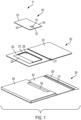
- FIG. 1 shows a schematic illustration of packaging system 10 including product 100, finished goods packaging 200, and shipping package 300.
- packaging 200 is shown as a bi-fold envelope configuration, and includes authentication electronics such as a data chip 214 (shown in FIG. 3A in an exploded view), for example a passive data chip 214.
- Data chip 214 may be a data tag that includes a chip portion and an antenna portion.
- Product 100 may be a card product such as a credit card.
- Product 100 may include longitudinal surfaces 104 and transverse surfaces 103 defining the general perimeter of the planar surface of the card product.
- Product 100 may include an additional chip 102 that is not used in authentication or activation of the product-instead it may be tied to an account such that the card product may be used, for example, for drawing credit against a user's account in a credit and/or banking system.
- product 100 may be inserted into receiving portion 206 of packaging 200.
- Retaining panel 208 may extend over receiving portion 206 product 100 to help retain product 100 when product 100 is disposed inside a pocket formed by a lower surface of receiving portion 206.
- the embossed edge 210 may similarly engage product 100 when product 100 is disposed in packaging 200.
- packaging 200 may generally have a bi-fold configuration having first panel 204 where product 100 is retained.
- Packaging 200 may fold about folding portion 212 to be closed by the opposing second panel 202.
- shipping package 300 may receive packaging 200 in receiving portion 306, sized to snugly hold packaging 200 therein (see FIGS. 4A and 4B , for example).
- a panel 302 of shipping package 300 may fold over and close on a panel 304 of shipping package 300, being attached by an adhesive 308, such as an adhesive strip, hot melt glue, or the like.
- an adhesive 308 such as an adhesive strip, hot melt glue, or the like.
- a tear strip 310 may be removed by the user to open panel 302 and remove packaging 200.
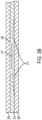
- packaging 200 includes a plurality of layers laminated together (e.g., using high-frequency welding of a coating between paper panels.
- packaging 200 may be configured as an upper panel including a surface of opposing second panel 202 first panel 204, and retaining panel 208.
- Frame panel 216 may "sandwich" at least a portion of a data chip 214 between the frame panel 216 and an opposite surface of first panel 204 (e.g., antenna 215 of chip 214 may be so sandwiched).
- frame panel 216 is "sandwiched" by the opposing surface of first panel 204 and the panel making up the lower surface of receiving portion 206.
- panel 204 and portion 206 may be bonded to panel 216.
- panel 202 and panel 220 are also bonded together.
- Internal perimeter 218 may define an opening and coact with the lower panel to serve as a receiving portion.
- the placement shown in the FIGS. of data chip 214 is not limiting, and it may be disposed in various acceptable places, e.g., towards the center of the envelope, an upper portion, or other suitable space for its disposal.
- a pocket, slot, opening, or other relief feature 226 may receive at least a portion of data chip 214 in between panels 204 and portion 206. This achieves two goals-protecting data chip 214, and also keeping a flat configuration such that neither panel 204 nor portion 206 includes any bulge or protrusion showing the underlying data chip 214.
- relief feature 226 may be in one or more of the panels, and the location of the same is flexible.
- the chip portion 217 of data chip 214 may have a thickness greater than a thickness of antenna 215, which may be essentially flat such that it may be laminated directly between two adjacent panels.
- Data chip 214 may be affixed to one or more of the panels, e.g., through an adhesive, polyethylene backer, or other securing means.
- antenna 215 may be, for example, a conductive metal trace such as copper, aluminum, silver, etc.
- data chip 214 e.g., an NFC chip
- its antenna may be directly printed on a paper or other cellulose substrate, such as one of the panels (e.g., in copper, silver, aluminum, or other metallic traces as an ink).
- data chip 214 is passive (e.g., a passive NFC chip), and does not require receiving data to operate as intended. It can be energized (e.g., powered) wirelessly from a device in close proximity to it (e.g., a personal electronic device with an NFC reader), which can then receive data from data chip 214. Additionally, other modes of powering on and activating data chip 214 are contemplated, for example interacting with a particular feature of the packaging. While discussed generally with the relation to NFC technology, other modes of data and energy transmission are contemplated, such as different radio frequency (RF) schemes like RFID, Bluetooth, acoustic, Wi-Fi, or other modes of data and energy transmission.
- RF radio frequency
- the packaging may include an active data chip (e.g., an active NFC chip) that includes a data chip and power source (e.g., a battery such as a micro-battery).
- a data chip e.g., an active NFC chip
- power source e.g., a battery such as a micro-battery
- the data chip may be powered on and begin searching for an electronic device to carry out an authentication function, an activation function, or the like. Additional details of such systems may be found in co-pending U.S. App. 62/732,740, filed September 18, 2018 , incorporated herein by reference in its entirety for all purposes.
- Packaging 200 or shipping package 300 may be made from radio-transmissive materials, for example cellulose-based materials, wood materials, nonmetallic polymer materials, etc.
- radio transmissive materials for packaging 200, communication from data chip 214 is made easier (especially, for example, if a product 100 is made from metallic materials, such as a metal card shaped product, such as a credit card).
- packaging 200 may be provided with a radiofrequency (RF) transparent feature, such as an aperture or antenna window such that data chip 214 may communicate through packaging 200.
- RF radiofrequency
- the packaging components may be composed of a recyclable material (e.g., a biodegradable or compostable material). If and when the customer opts to dispose of the packaging, because the packaging is recyclable or cellulose-based, the packaging may simply be recycled without requiring material separation (e.g., in a single-stream recycling program). In some embodiments, any electronics associated with packaging system 10 may be removed from the packaging prior to recycling.
- a recyclable material e.g., a biodegradable or compostable material.
- data chip 214 may be preprogrammed to allow the initiation of activation authentication processes only when certain criteria are met (e.g., initiation is triggered by a particular target user).
- a user may order a new credit card from a company.
- the company may prepare a credit card (product 100; see, e.g., FIG. 5 ) for that particular user.
- the credit card may be packaged within packaging 200 including data chip 214. At this point the credit card is not active, and cannot be used.
- Data chip 214 may be preprogrammed with data representing at least identification information for the particular card contained within the packaging, destined for the particular user.
- the data on data chip 214 may be encrypted or otherwise protected such that its information is not discoverable by unauthorized users.
- the user's personal electronic device 40 may already be associated with the user's unique account (e.g., from the user's prior use of or access to the account using their personal electronic device).
- the user may bring their personal electronic device 40 within the range of a data chip reader of their personal electronic device.
- data chip 214 is within such range, it may send the data representing identification information for the particular card to the personal electronic device 40.
- the personal electronic device may communicate with a remote server of the company to determine if the unique account on the user's personal electronic device 40 matches an account of the intended recipient of the credit card. If so, server may activate the credit card (or send a signal to the personal electronic device that initiates an activation process on the device). Otherwise, activation of the credit card will not occur, and an activation process will not be initiated.
- data chip 214 may be preprogrammed with data representing at least two pieces of information: (1) identification information for the particular card contained within the packaging, destined for the particular user; and (2) identification information for an account of the particular user.
- the latter information can be used to serve a gateway function, e.g., causing another step to trigger on device 40 such as a user interface displaying options for authentication and activation.
- there may be a visual indicator on the packaging 200 such as an icon to indicate active packaging functionality.
- the visual indicator may include instructions, such as "To activate, wake device and hold below.” The visual indicator may be proximate or on top of where data chip 214 is located such that the user will be prompted to bring the packaging proximate the electronic device.
- data chip 214 When data chip 214 is brought within range of a personal electronic device 40, data chip 214 may send to electronic device 40 only the identification information for the account of the particular user. If this account information does not match or otherwise correspond acceptably to account information associated with the electronic device 40 (as determined either by data chip 214 or by electronic device 40 itself), activation of the credit card will not occur, and an activation process will not be initiated.
- a second authentication may be required either before, after, or in parallel to the first authentication using a data chip.
- a biometric recognition step may be required as a second authentication, e.g., a fingerprint authentication, facial recognition authentication, voice authentication, or other biometric authentication may be required in order for the product to be activated or authenticated.
- the an NFC chip acts as a type of signal signpost, such that no active reception or signal searching is required; it only broadcasts outward to electronic devices having NFC receivers.
- data chip 214 is associated with a particular target user account, if a device not associated with a specific user is brought near a receiver that does not belong to that specific user, either no action will be taken, or a generic action will be taken (e.g., opening a generic product website, for example, or alerting the company or individual that a non-target user has brought the data chip 214 within a non-target receiver's range).
- data chip 214 may be preprogrammed to begin activation or authentication processes on any electronic device that is associated with a user account that is in turn associated with a purchase of a product of the particular type contained within packaging 200 (which product 100 may be awaiting activation or authentication). If a product is fungible but still requires activation, e.g., in the case of a cash card, this allows data chip 214 to identify a corresponding electronic device 40 that belongs to a person that has a verified order for the fungible product. In this way, electronic device 40 may interface with a company's (e.g., the seller of the product) logistics platform, such that information about product 100 may be shared with an appropriate electronic device 40. Once the product 100 is authenticated or activated, electronic device 40 may communicate with the logistics platform to inform the company that the order is complete. Similarly, in an active chip configuration, electronic device 40 may communicate to an active data chip 214 and disable any further attempts at activation or authentication.
- a company's e.g., the seller of the product
- data chip 214 may broadcast a signal specific to the account associated with the card, or the user associated with the card, for example.
- electronic device 40 that receives the signal may communicate or interface with a company's (e.g., the seller of the product) logistics platform, such that information about product 100 may be shared with an only an appropriate electronic device 40 tied to the target user of the card.
- a company's logistics platform e.g., the seller of the product
- electronic device 40 may communicate with the logistics platform to inform the company that the order is complete. If the data chip is active, rather than passive, electronic device 40 may communicate to data chip 214 and disable any further attempts at activation or authentication.
- Electronic device 40 for example a user's mobile phone, tablet, smart watch, laptop, desktop, etc.-includes a body 400 that may house electronics of electronic device 40, and generally may include a screen 402, for example a touchscreen (or other user interface).
- a screen 402 for example a touchscreen (or other user interface).
- activation and authentication would previously have been accomplished by manually calling a telephone number, manually navigating to and typing in information at website, or via an application-based process where the user manually authenticates themselves in some manner and then confirms the card is in their possession. The user may be prompted to start this process by following instructions written on a sticker applied to the credit card. While manual authentication options such as one of these that would allow for other modes of activation or authentication may be useful and may be included in some embodiments as a fallback option, FIGS. 5 and 6 shows an example of how this manual process is initially avoided.
- packaging system 10 or packaging 200 if the packaging system 10 or packaging 200 is in an unopened state, it may be such that no automatic activation or authentication has been or will be performed with reference to any product contained within packaging system 10-e.g., by disabling data chip 214.
- disabling data chip 214 In the case of a passive data chip configured to produce at least two functions at different electronic devices (i.e., target and non-target devices), no such disabling is necessary as the chip is already effectively disabled when brought proximate a non-target electronic device.
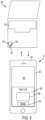
- FIG. 5 shows a schematic illustration of packaging 200 (with product 100) and electronic device 40.
- Data chip 214 of packaging 200 is shown communicating with electronic device 40, for example through an NFC transceiver 410 in electronic device 40 that may serve as a reader and a transmitter. This communication may be bidirectional, as indicated by the arrows shown between packaging 200 and electronic device 40, or may be in one direction from data chip 214 to transceiver 410.
- envelope flap panel 202 open a product 100 may be revealed within the envelope's cavity (e.g., receiving portion 206).
- product 100 may be a type of card, for example a credit card, debit card, gift card, membership card, etc.
- the target user for example purchaser of the product 100, then may remove product 100 from packaging 200.
- screen 402 of electronic device 40 may display a graphical user interface 406 when data chip 214 communicates to electronic device 40 through NFC transceiver 410.
- Graphical user interface 406 may include, for example text information about product 100, for example a description of the product, serial number or identification number, or other useful information to the user.
- graphical user interface 406 may include an image 408 representing the product, as shown in FIG. 5 .
- a user may interact with graphical user interface 406 by touching, tapping, swiping, etc. on screen 402.
- Screen 402 may display other images or information about product 100, or may virtually zoom-in, zoom-out, translate, or rotate the image 408 of the product virtually in three dimensions as displayed on screen 402.
- Graphical user interface 406 may also include user interface activation element 404, for example an on-screen button that may be interfaced with by the user.
- User interface activation element 404 may execute a function, for example to initiate activation or authentication of product 100 via electronic device 40. In some embodiments, no further interaction by a user would be required to activate their product. From the user's perspective activation would be completed simply by opening the packaging and tapping the activate button on their smartphone. In the case of a non-target user device interacting with package 200, the activation element 404 may be grayed out, or not available for selection. In some embodiments, graphical user interface 406 may be different, or completely absent if a non-target user device attempts to activate product 100.
- packaging 200 as an envelope configuration, with activation data chip 214 embedded between panels of the envelope, this configuration may take a different form, for example as attached to the outside of packaging 200, or embedded in or attached to a pull-tab, tear-strip, a lid, or other removable or destructible component of packaging 200.
- data chip 214 may power on (such as through a micro battery 224, which may be excluded in a passive chip), or may be activated by the electromagnetic field of the electronic device 40 or its NFC transceiver 410.
- a separate power source such as a micro-battery
- it may contain enough energy (i.e., battery life) for an expected duration from when the packaging 200 containing product 100 is shipped to when a target end-user will open packaging 200 and complete the activation process. This is beneficial because it reduces power source complexity and moves relatively large NFC electronics out of a small volume allowance in a particular product 100, such as a card product, and into a large allowable volume within packaging.
- FIG. 6 a schematic illustration of packaging 200 and electronic device 40 is shown, with the packaging 200 being opened and the electronic device 40 communicating with a server 50, such as an external device or network that may include a logistics platform.
- server 50 such as an external device or network that may include a logistics platform.
- electronic device 40 may communicate with server 50 in order to carry out an authentication, activation, or other smart packaging feature.
- Server 50 may include one or more of a database, server, Internet, network, or cloud-based server features such that product 100 may be authenticated or activated.
- data chip 214 broadcasts a signal to electronic device 40, e.g., through a transmitter 222.
- Data chip 214 may be preprogrammed to begin an activation or authentication process only upon establishing communication with a particular user's electronic device. In some embodiments, this may be achieved by programming information into data chip 214 that may identify electronic information stored in electronic device 40 correlated with a user's identity. This helps prevent data chip 214 from initiating an activation process with a device that does not belong to the particular user for which it is intended.
- data chip 214 may include an authorized user's user ID, and may only communicate with an electronic device 40 that has a matching user ID (e.g., within an operating system of electronic device 40). Other software, firmware, hardware, etc.
- device or user identity may be provided by a third-party source, such as a web-based application accessed on electronic device 40.
- a third-party source such as a web-based application accessed on electronic device 40.
- a user may be required to access such an application in order for device or user identification to proceed.
- the packaging is constructed to give a clean, unitary appearance. This helps to reinforce its high quality and robust character, and that of the product 100. To achieve this appearance, seams, gaps, and distortions in shape are minimized.
- the packaging may be a particular color, e.g., a brand-identifier color. In some embodiments, visible surfaces of packaging may be predominantly white.
- Components of the packaging may be formed from one or more blanks.
- the blank is formed of a single continuous substrate, such as, for example cellulose-based material like cardboard or paperboard.
- interior surfaces of the packaging may be surface treated or coated, for example with a coating to protect the finished product.
- Tabs, flaps, and regions without adhesive of the blank are formed such that no adhesive is visible in finished packaging.
- adhesive may be omitted and the various flaps and tabs attached in another suitable manner (e.g., by mechanical interlock or press fit).
- Fold lines may be formed, for example, by weakening the substrate along the lines, such as by perforation, material crushing, scoring, miter cutting, etc.
- any surface finishing may take place after the components are cut from the blank, or alternatively prior to the blank being cut into separate sheets for assembling to a final package. Additionally, some operations may be performed concurrently.
- cellulose-based material such as cellulose fiber material like paper
- cellulose fiber material may instead be formed of a polymeric material, or coated in a material such that they may be laminated together or otherwise adhered to each other.
- Suitable polymeric materials include, but are not limited to, polyethylene, polypropylene, polyurethane, polystyrene, polymer blends including one or more of these polymers, or co-polymers including one or more of these polymers. All or some of the surfaces of the packaging may be coated, or laminated, which may increase structural strength properties such as rigidity and which may protect a product within the packaging, or avoid scratching.
- the packaging may be manufactured in a cost-effective and environmentally-friendly way.
- the packaging components may be constructed of a single integrally-formed piece of material.
- the single integrally-formed piece of material may be a foldable material that is folded into a configuration that holds and secures a product, either alone or within a cavity of a packaging container.
- the foldable material may be a single piece of material that is cut by a single operation (e.g., a single die-cutting operation).
- the foldable material may be die cut from a stock material (e.g., a sheet or roll of material).
- Single integrally-formed pieces of material that are cut by a single cutting operation may facilitate efficient and reproducible manufacturing. Moreover, such manufacturing may reduce waste by reducing waste material during manufacturing.
- personally identifiable information should follow privacy policies and practices that are generally recognized as meeting or exceeding industry or governmental requirements for maintaining the privacy of users.
- personally identifiable information data should be managed and handled so as to minimize risks of unintentional or unauthorized access or use, and the nature of authorized use should be clearly indicated to users.
Landscapes
- Engineering & Computer Science (AREA)
- Computer Security & Cryptography (AREA)
- Theoretical Computer Science (AREA)
- Physics & Mathematics (AREA)
- Mechanical Engineering (AREA)
- General Physics & Mathematics (AREA)
- Computer Hardware Design (AREA)
- General Engineering & Computer Science (AREA)
- Health & Medical Sciences (AREA)
- Toxicology (AREA)
- Software Systems (AREA)
- Computer Networks & Wireless Communication (AREA)
- Electromagnetism (AREA)
- Computer Vision & Pattern Recognition (AREA)
- Artificial Intelligence (AREA)
- General Health & Medical Sciences (AREA)
- Microelectronics & Electronic Packaging (AREA)
- Packages (AREA)
- Details Of Rigid Or Semi-Rigid Containers (AREA)
- Purses, Travelling Bags, Baskets, Or Suitcases (AREA)
Description
- The described embodiments relate generally to retail packaging. More particularly, the present embodiments relate to "smart" packaging using communication systems such as near field communication ("NFC") in order to provide automatic activation, authentication, etc., when a user opens the packaging.
- Connected or "smart" packaging may include certain sensors or communication tools to track packages in transit, or provide additional information about a product to a consumer (e.g., through a digital application or visual display). Such tools simply provide information. They do not take part in activation, authentication, etc., of a product when a user opens or receives the packaging.
The following documents are relevant:WO 2007/096898 A2 which discusses a package-companion-user interactive system,WO 01/31558 A2 US 2018/025349 A1 which discusses activation and assigning value to gift cards using RFID, an article by Kavi Dhokia titled "Tap to Activate Your Debit Card" retrieved from https://monzo.com/blog/2017/11/14/nfc-card-activation#article andCN 203 078 858 U which discusses packaging box with near field communication (NFC) verification function. - The essential features of the invention are outlined by the appended independent claims.
- Some embodiments include packaging, such as an envelope or box.
- As an envelope, the packaging may include an opening or cavity that may contain a product that requires or benefits from activation prior to use (e.g., a gift card, credit card, membership card, or other suitable product). A data chip (e.g., an RFID chip, which may be an NFC chip, etc.) may be embedded within the packaging, or affixed to a surface of the packaging (either interior or exterior), and can be used in conjunction with a user's personal electronic device to activate the product contained in the packaging.
- In the case of a passive data chip (e.g., one that is temporarily powered as needed wirelessly by another device in proximity to the chip) such as a passive NFC chip, for example, if a user's personal electronic device such as a mobile phone with an NFC transceiver is within range, the electronic device may recognize the NFC chip, and initialize the authentication or activation of the product via the electronic device automatically. Advantageously, no outward searching function (e.g., of an active NFC chip) is needed.
- The packaging may be formed of different materials than the product (e.g., the packaging may be formed of a cellulose-based material and the product may be formed of or include a plastic and/or metallic material). For example, the packaging may be made entirely from recyclable material, for example from paper, molded fiber, corrugated cardboard, etc. In some embodiments, all or some of the packaging may be made from polymeric materials. In any event, the packaging may be formed from radio-transmissive materials. The packaging may include additional space to receive a second product that does not require authentication or activation.
- In some embodiments, the packaging may take the form of an envelope, particularly composed of layered panels. Within the stack-up of the layered panels, a receiving passage may be formed such that the data chip is concealed flatly within a panel of the packaging. This provides protection for the chip, aesthetic relief in the panel, and-in the case of a card product for example-provides for a smooth insertion of the product along a flat plane of the envelope. An additional shipping package may be provided (such as a corrugated paper envelope having a tear-strip) that the finished goods package (e.g., the envelope) is shipped to an end user in to protect the finished goods package.
- Advantageously, this improves upon prior systems having, for example, manual authentication or activation that may provide a more difficult customer experience. In contrast to prior systems that require a user to manually telephone an activation line, or manually navigate to a website, the customer experience is improved by removing those impediments to authentication or activation. By designing smart, connected packaging that automatically authenticates or activates a packaged product with minimal impact to the user, efficiency is improved along with the user experience.
- The disclosure will be readily understood by the following detailed description in conjunction with the accompanying drawings, wherein like reference numerals designate like structural elements, and in which:
-
FIG. 1 shows a packaging system with a card product. -
FIG. 2 shows a finished goods package in the form of an envelope as shown inFIG. 1 . -
FIG. 3A shows an exploded view of the finished goods package shown inFIG. 2 . -
FIG. 3B shows a cross-sectional schematic view taken alongline 3B-3B ofFIG. 2 . -
FIG. 4A shows an open configuration of the packaging system with the envelope being placed into a shipping package. -
FIG. 4B shows a closed configuration showing the shipping package being closed. -
FIG. 5 shows a schematic illustration of a packaging and an electronic device shown in, with the packaging being opened and the data chip communicating with the electronic device. -
FIG. 6 shows a schematic illustration of the packaging and electronic device shown in, with the packaging being opened and the data chip communicating with the electronic device, and electronic device communicating with a server. - Reference will now be made in detail to representative embodiments illustrated in the accompanying drawings. It should be understood that the following descriptions are not intended to limit the embodiments to one preferred embodiment. To the contrary, it is intended to cover alternatives, modifications, and equivalents as can be included within the spirit and scope of the described embodiments as defined by the appended claims.
- Product packaging is an integral part of a customer's experience. It introduces the customer to their product, and can affect the customer's feelings toward the product and the company that created it. Seamless packaging that allows for an individual to automatically authenticate or activate products-removing any barriers to their use-may be particularly desirable.
- In the same vein, companies may be sensitive to the cost of packaging and may wish to promote packaging that is eco-friendly. Certain packaging materials are higher cost due to their processing, and while engineers may be able to design single-component packaging, the cost may be prohibitive for certain materials. Optimization of packaging in material usage may help keep costs low, and if done well may not interfere with, and may promote, a positive user experience. Packaging made out of recyclable and/or biodegradable materials, such as paper or other cellulose-based products, can reduce environmental impact. Packaging that is interesting in character and that enhances a user's initial experience with the product that it contains may boost a product's or a brand's reputation, thereby attracting new customers and retaining previous customers.
- Packaging described in this document achieves these and other beneficial characteristics by balancing smart connectivity and efficiency, structural robustness, eco-friendly materials, and aesthetic elements.
- The packaging may be retail packaging (i.e., finished packaging for containing and conveying a product to a user such as may be used in a retail setting or a finished goods package that may be shipped to a customer within an outer shipping package) that one may expect to find on the shelf in a retail store, and which one may open after purchase to directly access their product. A product contained by the packaging may be, for example, a credit card, gift card, membership card or the like; or an electronic device such as, for example, a laptop, tablet computer, or smartphone.
- The packaged product may be desirable to authenticate, or it may require activation (e.g., a credit card or a gift card). Authentication or activation may be initiated by an authorized user. The packaging may include electronics such as an NFC chip that may communicate with the user's electronic device in order to carry out the authentication or activation function. For example, some of the required electronics to communicate with electronic device for authentication or activation may be housed within the packaging and not the product. Advantageously, this allows for added space and efficiency within the product such that electronics that are only used for authentication are not contained within the product. This is especially beneficial for products with small design footprints, or if a product requires a one-time-only activation or authentication.
- These and other embodiments are discussed below with reference to the accompanying figures. However, those skilled in the art will readily appreciate that the detailed description given herein with respect to these figures is for explanatory purposes only and should not be construed as limiting.
-
FIG. 1 shows a schematic illustration ofpackaging system 10 includingproduct 100, finishedgoods packaging 200, andshipping package 300. InFIGS. 1 and2 packaging 200 is shown as a bi-fold envelope configuration, and includes authentication electronics such as a data chip 214 (shown inFIG. 3A in an exploded view), for example apassive data chip 214.Data chip 214 may be a data tag that includes a chip portion and an antenna portion.Product 100 may be a card product such as a credit card.Product 100 may includelongitudinal surfaces 104 andtransverse surfaces 103 defining the general perimeter of the planar surface of the card product.Product 100 may include anadditional chip 102 that is not used in authentication or activation of the product-instead it may be tied to an account such that the card product may be used, for example, for drawing credit against a user's account in a credit and/or banking system. - As will be appreciated with reference to the figures,
product 100 may be inserted into receivingportion 206 ofpackaging 200. Retainingpanel 208 may extend over receivingportion 206product 100 to help retainproduct 100 whenproduct 100 is disposed inside a pocket formed by a lower surface of receivingportion 206. Theembossed edge 210 may similarly engageproduct 100 whenproduct 100 is disposed inpackaging 200. As shown inFIG. 2 for example,packaging 200 may generally have a bi-fold configuration havingfirst panel 204 whereproduct 100 is retained. Packaging 200 may fold about foldingportion 212 to be closed by the opposingsecond panel 202. - In turn,
shipping package 300 may receivepackaging 200 in receivingportion 306, sized to snugly holdpackaging 200 therein (seeFIGS. 4A and 4B , for example). Apanel 302 ofshipping package 300 may fold over and close on apanel 304 ofshipping package 300, being attached by an adhesive 308, such as an adhesive strip, hot melt glue, or the like. When closed, atear strip 310 may be removed by the user to openpanel 302 and removepackaging 200. - Returning to
FIG. 3A , an exploded view ofpackaging 200 is shown. In some embodiments,packaging 200 includes a plurality of layers laminated together (e.g., using high-frequency welding of a coating between paper panels. As shown inFIGS. 3A and3B ,packaging 200,packaging 200 may be configured as an upper panel including a surface of opposingsecond panel 202first panel 204, and retainingpanel 208.Frame panel 216 may "sandwich" at least a portion of adata chip 214 between theframe panel 216 and an opposite surface of first panel 204 (e.g.,antenna 215 ofchip 214 may be so sandwiched). In turn,frame panel 216 is "sandwiched" by the opposing surface offirst panel 204 and the panel making up the lower surface of receivingportion 206. In this way,panel 204 andportion 206 may be bonded topanel 216. Additionally,panel 202 andpanel 220 are also bonded together.Internal perimeter 218 may define an opening and coact with the lower panel to serve as a receiving portion. The placement shown in the FIGS. ofdata chip 214 is not limiting, and it may be disposed in various acceptable places, e.g., towards the center of the envelope, an upper portion, or other suitable space for its disposal. - In some embodiments, a pocket, slot, opening, or
other relief feature 226 may receive at least a portion ofdata chip 214 in betweenpanels 204 andportion 206. This achieves two goals-protectingdata chip 214, and also keeping a flat configuration such that neitherpanel 204 norportion 206 includes any bulge or protrusion showing theunderlying data chip 214. In some embodiments,relief feature 226 may be in one or more of the panels, and the location of the same is flexible. Thechip portion 217 ofdata chip 214 may have a thickness greater than a thickness ofantenna 215, which may be essentially flat such that it may be laminated directly between two adjacent panels.Data chip 214 may be affixed to one or more of the panels, e.g., through an adhesive, polyethylene backer, or other securing means. In some embodiments,antenna 215 may be, for example, a conductive metal trace such as copper, aluminum, silver, etc. In some embodiments, data chip 214 (e.g., an NFC chip) or its antenna may be directly printed on a paper or other cellulose substrate, such as one of the panels (e.g., in copper, silver, aluminum, or other metallic traces as an ink). - In some embodiments,
data chip 214 is passive (e.g., a passive NFC chip), and does not require receiving data to operate as intended. It can be energized (e.g., powered) wirelessly from a device in close proximity to it (e.g., a personal electronic device with an NFC reader), which can then receive data fromdata chip 214. Additionally, other modes of powering on and activatingdata chip 214 are contemplated, for example interacting with a particular feature of the packaging. While discussed generally with the relation to NFC technology, other modes of data and energy transmission are contemplated, such as different radio frequency (RF) schemes like RFID, Bluetooth, acoustic, Wi-Fi, or other modes of data and energy transmission. In some embodiments, the data/energy transmission may not require a power source. In other embodiments, the packaging may include an active data chip (e.g., an active NFC chip) that includes a data chip and power source (e.g., a battery such as a micro-battery). When the packaging is opened, the data chip may be powered on and begin searching for an electronic device to carry out an authentication function, an activation function, or the like. Additional details of such systems may be found in co-pendingU.S. App. 62/732,740, filed September 18, 2018 - Packaging 200 or
shipping package 300 may be made from radio-transmissive materials, for example cellulose-based materials, wood materials, nonmetallic polymer materials, etc. By using radio transmissive materials forpackaging 200, communication fromdata chip 214 is made easier (especially, for example, if aproduct 100 is made from metallic materials, such as a metal card shaped product, such as a credit card). In some embodiments, (e.g., wherepackaging 200 may include less relatively radio transmissive materials or non-radio transmissive materials)packaging 200 may be provided with a radiofrequency (RF) transparent feature, such as an aperture or antenna window such thatdata chip 214 may communicate throughpackaging 200. - As previously discussed, the packaging components may be composed of a recyclable material (e.g., a biodegradable or compostable material). If and when the customer opts to dispose of the packaging, because the packaging is recyclable or cellulose-based, the packaging may simply be recycled without requiring material separation (e.g., in a single-stream recycling program). In some embodiments, any electronics associated with
packaging system 10 may be removed from the packaging prior to recycling. - Returning to the automatic activation and authentication features, in some embodiments,
data chip 214 may be preprogrammed to allow the initiation of activation authentication processes only when certain criteria are met (e.g., initiation is triggered by a particular target user). - For example, a user may order a new credit card from a company. The company may prepare a credit card (
product 100; see, e.g.,FIG. 5 ) for that particular user. The credit card may be packaged withinpackaging 200 includingdata chip 214. At this point the credit card is not active, and cannot be used.Data chip 214 may be preprogrammed with data representing at least identification information for the particular card contained within the packaging, destined for the particular user. The data ondata chip 214 may be encrypted or otherwise protected such that its information is not discoverable by unauthorized users. - The user's personal electronic device 40 may already be associated with the user's unique account (e.g., from the user's prior use of or access to the account using their personal electronic device). When the user receives their credit card packaged within
packaging 200, the user may bring their personal electronic device 40 within the range of a data chip reader of their personal electronic device. Whendata chip 214 is within such range, it may send the data representing identification information for the particular card to the personal electronic device 40. The personal electronic device may communicate with a remote server of the company to determine if the unique account on the user's personal electronic device 40 matches an account of the intended recipient of the credit card. If so, server may activate the credit card (or send a signal to the personal electronic device that initiates an activation process on the device). Otherwise, activation of the credit card will not occur, and an activation process will not be initiated. - In some embodiments,
data chip 214 may be preprogrammed with data representing at least two pieces of information: (1) identification information for the particular card contained within the packaging, destined for the particular user; and (2) identification information for an account of the particular user. The latter information can be used to serve a gateway function, e.g., causing another step to trigger on device 40 such as a user interface displaying options for authentication and activation. In some embodiments, there may be a visual indicator on thepackaging 200 such as an icon to indicate active packaging functionality. In some embodiments the visual indicator may include instructions, such as "To activate, wake device and hold below." The visual indicator may be proximate or on top of wheredata chip 214 is located such that the user will be prompted to bring the packaging proximate the electronic device. Whendata chip 214 is brought within range of a personal electronic device 40,data chip 214 may send to electronic device 40 only the identification information for the account of the particular user. If this account information does not match or otherwise correspond acceptably to account information associated with the electronic device 40 (as determined either bydata chip 214 or by electronic device 40 itself), activation of the credit card will not occur, and an activation process will not be initiated. In some embodiments, a second authentication may be required either before, after, or in parallel to the first authentication using a data chip. For example, a biometric recognition step may be required as a second authentication, e.g., a fingerprint authentication, facial recognition authentication, voice authentication, or other biometric authentication may be required in order for the product to be activated or authenticated. - More specifically, in a passive system, the an NFC chip acts as a type of signal signpost, such that no active reception or signal searching is required; it only broadcasts outward to electronic devices having NFC receivers. So when
data chip 214 is associated with a particular target user account, if a device not associated with a specific user is brought near a receiver that does not belong to that specific user, either no action will be taken, or a generic action will be taken (e.g., opening a generic product website, for example, or alerting the company or individual that a non-target user has brought thedata chip 214 within a non-target receiver's range). - Turning to
FIGS. 5 and6 , in some embodiments,data chip 214 may be preprogrammed to begin activation or authentication processes on any electronic device that is associated with a user account that is in turn associated with a purchase of a product of the particular type contained within packaging 200 (whichproduct 100 may be awaiting activation or authentication). If a product is fungible but still requires activation, e.g., in the case of a cash card, this allowsdata chip 214 to identify a corresponding electronic device 40 that belongs to a person that has a verified order for the fungible product. In this way, electronic device 40 may interface with a company's (e.g., the seller of the product) logistics platform, such that information aboutproduct 100 may be shared with an appropriate electronic device 40. Once theproduct 100 is authenticated or activated, electronic device 40 may communicate with the logistics platform to inform the company that the order is complete. Similarly, in an active chip configuration, electronic device 40 may communicate to anactive data chip 214 and disable any further attempts at activation or authentication. - In the case of a non-fungible product, e.g., such as a credit card for a particular target user that requires activation,
data chip 214 may broadcast a signal specific to the account associated with the card, or the user associated with the card, for example. In this way, electronic device 40 that receives the signal may communicate or interface with a company's (e.g., the seller of the product) logistics platform, such that information aboutproduct 100 may be shared with an only an appropriate electronic device 40 tied to the target user of the card. Once theproduct 100 is authenticated or activated, electronic device 40 may communicate with the logistics platform to inform the company that the order is complete. If the data chip is active, rather than passive, electronic device 40 may communicate todata chip 214 and disable any further attempts at activation or authentication. - Electronic device 40-for example a user's mobile phone, tablet, smart watch, laptop, desktop, etc.-includes a
body 400 that may house electronics of electronic device 40, and generally may include ascreen 402, for example a touchscreen (or other user interface). For certain products, such as a credit card, activation and authentication would previously have been accomplished by manually calling a telephone number, manually navigating to and typing in information at website, or via an application-based process where the user manually authenticates themselves in some manner and then confirms the card is in their possession. The user may be prompted to start this process by following instructions written on a sticker applied to the credit card. While manual authentication options such as one of these that would allow for other modes of activation or authentication may be useful and may be included in some embodiments as a fallback option,FIGS. 5 and6 shows an example of how this manual process is initially avoided. - In some embodiments, if the
packaging system 10 orpackaging 200 is in an unopened state, it may be such that no automatic activation or authentication has been or will be performed with reference to any product contained within packaging system 10-e.g., by disablingdata chip 214. However, in the case of a passive data chip configured to produce at least two functions at different electronic devices (i.e., target and non-target devices), no such disabling is necessary as the chip is already effectively disabled when brought proximate a non-target electronic device. -
FIG. 5 shows a schematic illustration of packaging 200 (with product 100) and electronic device 40.Data chip 214 ofpackaging 200 is shown communicating with electronic device 40, for example through anNFC transceiver 410 in electronic device 40 that may serve as a reader and a transmitter. This communication may be bidirectional, as indicated by the arrows shown betweenpackaging 200 and electronic device 40, or may be in one direction fromdata chip 214 totransceiver 410. With reference topackaging 200, withenvelope flap panel 202 open aproduct 100 may be revealed within the envelope's cavity (e.g., receiving portion 206). As described,product 100 may be a type of card, for example a credit card, debit card, gift card, membership card, etc. The target user, for example purchaser of theproduct 100, then may removeproduct 100 frompackaging 200. - As shown in
FIG. 5 ,screen 402 of electronic device 40 may display agraphical user interface 406 whendata chip 214 communicates to electronic device 40 throughNFC transceiver 410.Graphical user interface 406 may include, for example text information aboutproduct 100, for example a description of the product, serial number or identification number, or other useful information to the user. In some embodiments,graphical user interface 406 may include animage 408 representing the product, as shown inFIG. 5 . A user may interact withgraphical user interface 406 by touching, tapping, swiping, etc. onscreen 402.Screen 402 may display other images or information aboutproduct 100, or may virtually zoom-in, zoom-out, translate, or rotate theimage 408 of the product virtually in three dimensions as displayed onscreen 402.Graphical user interface 406 may also include userinterface activation element 404, for example an on-screen button that may be interfaced with by the user. - User
interface activation element 404 may execute a function, for example to initiate activation or authentication ofproduct 100 via electronic device 40. In some embodiments, no further interaction by a user would be required to activate their product. From the user's perspective activation would be completed simply by opening the packaging and tapping the activate button on their smartphone. In the case of a non-target user device interacting withpackage 200, theactivation element 404 may be grayed out, or not available for selection. In some embodiments,graphical user interface 406 may be different, or completely absent if a non-target user device attempts to activateproduct 100. - While the figures generally show
packaging 200 as an envelope configuration, withactivation data chip 214 embedded between panels of the envelope, this configuration may take a different form, for example as attached to the outside ofpackaging 200, or embedded in or attached to a pull-tab, tear-strip, a lid, or other removable or destructible component ofpackaging 200. In any event,data chip 214 may power on (such as through amicro battery 224, which may be excluded in a passive chip), or may be activated by the electromagnetic field of the electronic device 40 or itsNFC transceiver 410. In this way-by containing a power source and data chip withinpackaging 200 or utilizing an external electronic device's own energy to power the data chip-instead of integrating a separate power source or data chip on a card product for example, challenges regarding constructing additional electronics within the card, including added size and weight from the additional electronics, etc., may be avoided. In some embodiments, if a separate power source is included, such as a micro-battery, it may contain enough energy (i.e., battery life) for an expected duration from when thepackaging 200 containingproduct 100 is shipped to when a target end-user will open packaging 200 and complete the activation process. This is beneficial because it reduces power source complexity and moves relatively large NFC electronics out of a small volume allowance in aparticular product 100, such as a card product, and into a large allowable volume within packaging. - Turning to
FIG. 6 , a schematic illustration ofpackaging 200 and electronic device 40 is shown, with thepackaging 200 being opened and the electronic device 40 communicating with aserver 50, such as an external device or network that may include a logistics platform. In some embodiments, electronic device 40 may communicate withserver 50 in order to carry out an authentication, activation, or other smart packaging feature.Server 50 may include one or more of a database, server, Internet, network, or cloud-based server features such thatproduct 100 may be authenticated or activated. - As discussed above,
data chip 214 broadcasts a signal to electronic device 40, e.g., through atransmitter 222.Data chip 214 may be preprogrammed to begin an activation or authentication process only upon establishing communication with a particular user's electronic device. In some embodiments, this may be achieved by programming information intodata chip 214 that may identify electronic information stored in electronic device 40 correlated with a user's identity. This helps preventdata chip 214 from initiating an activation process with a device that does not belong to the particular user for which it is intended. For example,data chip 214 may include an authorized user's user ID, and may only communicate with an electronic device 40 that has a matching user ID (e.g., within an operating system of electronic device 40). Other software, firmware, hardware, etc. may be used. In some embodiments, device or user identity may be provided by a third-party source, such as a web-based application accessed on electronic device 40. In this regard, fordata chip 214 to initiate authentication or activation functions, a user may be required to access such an application in order for device or user identification to proceed. - The packaging is constructed to give a clean, unitary appearance. This helps to reinforce its high quality and robust character, and that of the
product 100. To achieve this appearance, seams, gaps, and distortions in shape are minimized. The packaging may be a particular color, e.g., a brand-identifier color. In some embodiments, visible surfaces of packaging may be predominantly white. - Components of the packaging may be formed from one or more blanks. In some embodiments, the blank is formed of a single continuous substrate, such as, for example cellulose-based material like cardboard or paperboard. In some embodiments, interior surfaces of the packaging may be surface treated or coated, for example with a coating to protect the finished product. Tabs, flaps, and regions without adhesive of the blank are formed such that no adhesive is visible in finished packaging. In some embodiments, adhesive may be omitted and the various flaps and tabs attached in another suitable manner (e.g., by mechanical interlock or press fit). Fold lines may be formed, for example, by weakening the substrate along the lines, such as by perforation, material crushing, scoring, miter cutting, etc.
- In some embodiments, any surface finishing may take place after the components are cut from the blank, or alternatively prior to the blank being cut into separate sheets for assembling to a final package. Additionally, some operations may be performed concurrently.
- Alternatively, some or all of the components described as being formed of cellulose-based material, such as cellulose fiber material like paper, may instead be formed of a polymeric material, or coated in a material such that they may be laminated together or otherwise adhered to each other. Suitable polymeric materials include, but are not limited to, polyethylene, polypropylene, polyurethane, polystyrene, polymer blends including one or more of these polymers, or co-polymers including one or more of these polymers. All or some of the surfaces of the packaging may be coated, or laminated, which may increase structural strength properties such as rigidity and which may protect a product within the packaging, or avoid scratching.
- Additionally, the packaging may be manufactured in a cost-effective and environmentally-friendly way. In some embodiments, the packaging components may be constructed of a single integrally-formed piece of material. The single integrally-formed piece of material may be a foldable material that is folded into a configuration that holds and secures a product, either alone or within a cavity of a packaging container. In some embodiments, the foldable material may be a single piece of material that is cut by a single operation (e.g., a single die-cutting operation). In some embodiments, the foldable material may be die cut from a stock material (e.g., a sheet or roll of material). Single integrally-formed pieces of material that are cut by a single cutting operation may facilitate efficient and reproducible manufacturing. Moreover, such manufacturing may reduce waste by reducing waste material during manufacturing.
- It is well understood that the use of personally identifiable information should follow privacy policies and practices that are generally recognized as meeting or exceeding industry or governmental requirements for maintaining the privacy of users. In particular, personally identifiable information data should be managed and handled so as to minimize risks of unintentional or unauthorized access or use, and the nature of authorized use should be clearly indicated to users.
- The foregoing description, for purposes of explanation, used specific nomenclature to provide a thorough understanding of the described embodiments. However, it will be apparent to one skilled in the art that the specific details are not required in order to practice the described embodiments. Thus, the foregoing descriptions of the specific embodiments described herein are presented for purposes of illustration and description. They are not target to be exhaustive or to limit the embodiments to the precise forms disclosed. It will be apparent to one of ordinary skill in the art that many modifications and variations are possible in view of the above teachings.
Claims (15)
- A packaged product, comprising:a product that requires authentication or activation for use as intended; andfinished goods packaging (200), comprising:a receiving portion (206) configured to receive the product; andthe finished goods packaging (200) being characterized by further comprising a passive data chip (214), wherein the passive data chip (214) includes data that is uniquely associated with the product and with a target user account;wherein the passive data chip (214) is configured to initiate an authentication or activation process by transmitting the data to a personal mobile device that is associated with the target user account, upon the passive data chip (214) being brought within range of a data reader of the personal mobile devicewherein the passive data chip (214) is configured to not initiate an authentication or activation process, upon the passive data chip (214) being brought within range of a data reader of a personal mobile device that is associated with a non-target user .
- The packaged product of claim 1, wherein the passive data chip (214) is an NFC chip, and wherein the data reader is an NFC reader.
- The packaged product of either of claims 1 or 2, wherein the passive data chip (214) is laminated between layers of the finished goods packaging, and is not visible.
- A system comprising:the packaged product of claim 1; anda remote server,wherein the remote server is configured to receive second data from the personal mobile device, the second data based on the first data,wherein the remote server is configured to determine, based on the second data, whether to authenticate or activate the product, andwherein the remote server is configured to send third data to the personal mobile device, the third data indicating whether the product was authenticated or activated.
- Packaging, comprising:a receiving portion (206) configured to receive a product; andcharacterized by further comprising a passive data chip (214), wherein the passive data chip (214) includes data that is uniquely associated with the product and with a target user account, andwherein when the packaging is brought within range of a target user's personal electronic device the passive data chip (214) automatically communicates with the target user's personal electronic device to initiate an authentication process or an activation process, andwherein when the packaging is brought near a non-target user's personal electronic device, the passive data chip (214) automatically communicates with the non-target user's personal electronic device but does not initiate an authentication process or activation process.
- The packaging of claim 5, wherein the passive data chip (214) is preprogrammed to begin an authentication or activation process only upon communicating with an electronic device that is associated with a single target user account.
- The packaging of either of claims 5 or 6, wherein the passive data chip (214) is preprogrammed to begin an activation process on any electronic device for which a defined category of product has been ordered.
- The packaging of any of claims 5 to 7, wherein the passive NFC chip is energized by the personal electronic device.
- The packaging of any of claims 5 to 8, wherein the passive data chip (214) is configured as a transmitter only.
- The packaging of claim 5, further comprising:a first panel;a second panel attached to the first panel, wherein the passive data chip (214) is laminated between the first and second panels.
- The packaging of claim 10, further comprising a third panel disposed between the first panel and the second panel, wherein the third panel includes an opening that surrounds the passive data chip (214), thereby providing a space for the passive data chip (214) between the top and bottom panel.
- The packaging of either of claims 10 or 11, wherein the first and second panels are part of a finished goods package, the packaging further comprising a separate shipping envelope having internal dimensions matching external dimensions of the closed finished goods packaging that the finished goods package is received in for shipment.
- The packaging of any of claims 10 to 12, wherein the first panel comprises a raised rim disposed around a product-receiving portion of the packaging, the raised rim defining a retaining element that is configured to hold a product within the packaging.
- The packaging of claim 13, wherein the retaining element is bounded in part by an embossed edge defining an aperture, and wherein a surface of the second panel is disposed below the retaining element such that the product is held between a surface of the second panel and the retaining element.
- A packaging system, comprising:the packaging of claim 10; anda server configured to be in communication with the user's personal electronic device and to determine whether to authenticate or activate a product that is or was contained within the packaging based upon whether the user's personal electronic device is associated with a target user account,wherein in response to determining that the user's personal electronic device is associated with a target user account, the server is further configured to transmit indication of account authorization to the user's personal electronic device,wherein the personal electronic device begins a graphical user interface authentication process, andwherein the server takes no action in response to determining that the user's personal electronic device is not associated with a target user account.
Applications Claiming Priority (2)
| Application Number | Priority Date | Filing Date | Title |
|---|---|---|---|
| US16/354,730 US10807766B2 (en) | 2019-03-15 | 2019-03-15 | Packaging with radio-frequency authentication system for packaged product |
| PCT/US2020/020371 WO2020190481A1 (en) | 2019-03-15 | 2020-02-28 | Packaging with radio-frequency authentication system for packaged product |
Publications (2)
| Publication Number | Publication Date |
|---|---|
| EP3938958A1 EP3938958A1 (en) | 2022-01-19 |
| EP3938958B1 true EP3938958B1 (en) | 2025-01-15 |
Family
ID=70057280
Family Applications (1)
| Application Number | Title | Priority Date | Filing Date |
|---|---|---|---|
| EP20715573.0A Active EP3938958B1 (en) | 2019-03-15 | 2020-02-28 | Packaging with radio-frequency authentication system for packaged product |
Country Status (5)
| Country | Link |
|---|---|
| US (2) | US10807766B2 (en) |
| EP (1) | EP3938958B1 (en) |
| JP (2) | JP7801893B2 (en) |
| CN (1) | CN113597619B (en) |
| WO (1) | WO2020190481A1 (en) |
Families Citing this family (10)
| Publication number | Priority date | Publication date | Assignee | Title |
|---|---|---|---|---|
| USD774899S1 (en) * | 2015-03-09 | 2016-12-27 | Apple Inc. | Packaging with accessory |
| USD918036S1 (en) * | 2018-09-12 | 2021-05-04 | Apple Inc. | Packaging |
| USD940552S1 (en) * | 2019-03-08 | 2022-01-11 | Apple Inc. | Packaging |
| GB2582741B (en) * | 2019-03-13 | 2021-11-10 | Burgopak Ltd | Packaging insert |
| GB2586668B (en) * | 2019-12-19 | 2022-08-10 | Burgopak Ltd | Improvements in band-driven packaging |
| USD1130101S1 (en) * | 2022-05-03 | 2026-06-16 | Peleman Industries Nv | Storage box |
| USD1039381S1 (en) | 2022-09-14 | 2024-08-20 | Apple Inc. | Packaging |
| USD985382S1 (en) * | 2023-02-23 | 2023-05-09 | Tuned In Grading, Llc | Record display case |
| DE102023112759A1 (en) * | 2023-05-15 | 2024-11-21 | Giesecke+Devrient ePayments GmbH | Card-shaped data carrier and method for producing a card-shaped data carrier |
| USD1111818S1 (en) * | 2023-05-31 | 2026-02-10 | Burgopak Limited | Package |
Family Cites Families (45)
| Publication number | Priority date | Publication date | Assignee | Title |
|---|---|---|---|---|
| US5842629A (en) * | 1996-08-09 | 1998-12-01 | Sprague; William R. | Veri mag pack |
| AU1822201A (en) * | 1999-10-27 | 2001-05-08 | Lionel Nicholas Mantzivis | Data carrier and system for transmitting product related information |
| AU2001253892A1 (en) | 2000-04-13 | 2001-10-30 | International Paper | Integrated package and rfid antenna |
| US20020088855A1 (en) * | 2001-01-05 | 2002-07-11 | Hodes Mark B. | Point of sale activation for software and metered accounts |
| US7996324B2 (en) * | 2001-07-10 | 2011-08-09 | American Express Travel Related Services Company, Inc. | Systems and methods for managing multiple accounts on a RF transaction device using secondary identification indicia |
| WO2004031969A2 (en) | 2002-10-02 | 2004-04-15 | Discover Financial Services, Inc. | Multi-fonction credit card and case |
| JP3101938U (en) * | 2003-11-27 | 2004-06-24 | 政己 井川 | Recording media storage book |
| US7427024B1 (en) * | 2003-12-17 | 2008-09-23 | Gazdzinski Mark J | Chattel management apparatus and methods |
| US7098794B2 (en) | 2004-04-30 | 2006-08-29 | Kimberly-Clark Worldwide, Inc. | Deactivating a data tag for user privacy or tamper-evident packaging |
| US7948381B2 (en) | 2004-04-30 | 2011-05-24 | Binforma Group Limited Liability Company | Reversibly deactivating a radio frequency identification data tag |
| JP4445359B2 (en) * | 2004-09-21 | 2010-04-07 | トッパン・フォームズ株式会社 | Manufacturing method of RF-ID media sending body |
| US20070194945A1 (en) | 2004-12-07 | 2007-08-23 | Paul Atkinson | Mobile Device for Selectively Activating a Target and Method of Using Same |
| US20070040683A1 (en) | 2005-08-22 | 2007-02-22 | Neal Oliver | Light-activated RFID tag |
| EP1986586A4 (en) * | 2006-02-06 | 2014-02-12 | Bilcare Ltd | PACKAGING USER INTERACTIVE SYSTEM WITH ASSOCIATED DEVICE |
| DE102006015782B4 (en) | 2006-04-04 | 2021-09-16 | Infineon Technologies Ag | Device for the storage and wireless transmission of data |
| US20090192912A1 (en) | 2008-01-30 | 2009-07-30 | Kent Griffin | Charge-for-service near field communication transactions |
| US8777110B2 (en) | 2008-03-03 | 2014-07-15 | Apple Inc. | Multi-pack gift card and activation thereof |
| CN102160061B (en) * | 2008-08-20 | 2014-04-09 | X卡控股有限公司 | Secure smart card system |
| US20100133128A1 (en) * | 2008-12-03 | 2010-06-03 | Meadwestvaco Corporation | Gift card book style o-sleeve |
| WO2010073732A1 (en) * | 2008-12-26 | 2010-07-01 | パナソニック株式会社 | Communication device |
| US8295811B1 (en) | 2010-07-27 | 2012-10-23 | Sprint Communications Company L.P. | System and method for mobile phone activation |
| US9087305B2 (en) * | 2011-05-27 | 2015-07-21 | Ztar Mobile, Inc. | Packaging with custom magnetic stripe |
| JP2014092934A (en) * | 2012-11-02 | 2014-05-19 | Sony Corp | Information communication device and information communication method, information communication system, and computer program |
| US20140138275A1 (en) * | 2012-11-20 | 2014-05-22 | Nokia Corporation | Automatic power-up from sales package |
| ES2464873B1 (en) * | 2012-12-04 | 2015-07-28 | Julio Ángel Serrano Pérez | Method for the supply of digital information and product authentication using an NFC sensor included in the package of said product. |
| JP6028560B2 (en) | 2012-12-20 | 2016-11-16 | 凸版印刷株式会社 | Terminal device and expiration date update method |
| CN203078858U (en) * | 2013-02-05 | 2013-07-24 | 广州众码汇信息科技有限公司 | Packaging box with near field communication (NFC) verification function |
| KR20140101518A (en) | 2013-02-10 | 2014-08-20 | 이대희 | Secure credit card information input method using NFC(Near field communication) |
| GB2515724B (en) | 2013-04-10 | 2017-09-20 | Moo Print Ltd | Improvements Relating to Business Cards |
| US9510181B2 (en) | 2013-10-18 | 2016-11-29 | T-Mobile Usa, Inc. | Image-based remote subscriber identity module activation |
| US20170132565A1 (en) * | 2014-05-24 | 2017-05-11 | Robert Dale Beadles | Reusable parcel apparatus and methods |
| HK1193940A2 (en) * | 2014-05-29 | 2014-10-03 | Color-I Holdings Limited | A method for activating sim card and obtaining balance in real-time |
| JP5920747B1 (en) | 2015-04-07 | 2016-05-18 | エイピーエス.エスエイ | Application programs and cards |
| US9652919B2 (en) * | 2015-04-22 | 2017-05-16 | Dell Products Lp | Dynamic authentication adaptor systems and methods |
| KR20160144101A (en) | 2015-06-08 | 2016-12-16 | 지현구 | Goods authenticating system using near field communication |
| US10438110B2 (en) * | 2015-07-08 | 2019-10-08 | Assa Abloy Ab | Multiple frequency transponder with a single antenna |
| CN105407042B (en) * | 2015-11-26 | 2019-01-04 | 北京拓明科技有限公司 | A kind of wechat public platform based remote sim card activating method and system |
| US10628821B2 (en) * | 2016-01-26 | 2020-04-21 | American Greetings | Activation and assigning value to gift cards using RFID |
| WO2018065114A1 (en) * | 2016-10-07 | 2018-04-12 | Boehringer Ingelheim Vetmedica Gmbh | Analysis system and method for testing a sample |
| US20180189527A1 (en) * | 2017-01-03 | 2018-07-05 | Soo Hyang KANG | Method for activating multi-function device card |
| CN107538956A (en) * | 2017-09-08 | 2018-01-05 | 深圳市华平盛工艺品有限公司 | Stereoscopic electric subcard |
| US10937261B2 (en) | 2017-11-01 | 2021-03-02 | Schlage Lock Company Llc | Secure container for package delivery |
| CN108600184A (en) * | 2018-03-28 | 2018-09-28 | 湖南东方华龙信息科技有限公司 | A kind of equipment authentication method of embedded chip certificate |
| US10262319B1 (en) | 2018-07-11 | 2019-04-16 | Capital One Services, Llc | Automatically activating a transaction card by detecting a change associated with a package that carries the transaction card |
| US11429704B2 (en) * | 2018-09-18 | 2022-08-30 | Apple Inc. | Packaging with automatic authentication system for packaged product |
-
2019
- 2019-03-15 US US16/354,730 patent/US10807766B2/en active Active
-
2020
- 2020-02-28 JP JP2021554389A patent/JP7801893B2/en active Active
- 2020-02-28 WO PCT/US2020/020371 patent/WO2020190481A1/en not_active Ceased
- 2020-02-28 CN CN202080020978.8A patent/CN113597619B/en active Active
- 2020-02-28 EP EP20715573.0A patent/EP3938958B1/en active Active
- 2020-09-16 US US17/022,339 patent/US11447297B2/en active Active
-
2023
- 2023-12-11 JP JP2023208752A patent/JP2024041753A/en active Pending
Also Published As
| Publication number | Publication date |
|---|---|
| JP2024041753A (en) | 2024-03-27 |
| CN113597619B (en) | 2025-01-21 |
| WO2020190481A1 (en) | 2020-09-24 |
| US20200407113A1 (en) | 2020-12-31 |
| JP2022524598A (en) | 2022-05-09 |
| US11447297B2 (en) | 2022-09-20 |
| EP3938958A1 (en) | 2022-01-19 |
| US20200290769A1 (en) | 2020-09-17 |
| US10807766B2 (en) | 2020-10-20 |
| CN113597619A (en) | 2021-11-02 |
| JP7801893B2 (en) | 2026-01-19 |
Similar Documents
| Publication | Publication Date | Title |
|---|---|---|
| US11447297B2 (en) | Packaging with radio-frequency authentication system for packaged product | |
| US11429704B2 (en) | Packaging with automatic authentication system for packaged product | |
| EP3184456B1 (en) | Closure assembly with radio frequency identification tag | |
| JP4712986B2 (en) | Liquid container with RFID tag | |
| US9073675B2 (en) | Chipless RFID structure, cap, can and packaging material, stacked film for preventing forgery, method for fabricating the same; RFID tag, RFID system and method for controlling the same; certificate for chipless RFID and method for authenticating the same | |
| RU2475857C2 (en) | Product having solid envelope with concealed protective device | |
| US20120217244A1 (en) | Container seal with radio frequency identification tag, and method of making same | |
| US20060208062A1 (en) | Injection molded gift case for debit, credit and smart cards | |
| WO2014167309A1 (en) | Product authentication and/or identification | |
| KR20090096470A (en) | Reversible Deactivation of Radio Frequency Identification Data Tags | |
| US8350705B1 (en) | Book product with concealed security device | |
| US20100102131A1 (en) | Systems and Methods for Disabling a Contactless Transaction Device | |
| US20100072283A1 (en) | Holder for small identification card | |
| CN207389934U (en) | Soft packaging bag with identification code | |
| CN104349990B (en) | Closure assembly for selective retention and distribution of substances | |
| CN110235147A (en) | Label and relevant production method for bottle including electronic chip | |
| KR20120059675A (en) | Box equipped data record tag | |
| JP2014114066A (en) | Cap with ic tag | |
| US20070052228A1 (en) | Intermediate cover board with concealed security device for hard cover product | |
| CN204622746U (en) | Protection sticker with near field communication function | |
| CN217707101U (en) | Composite film, easy-to-tear cover with composite film and container with composite film | |
| WO2019052580A1 (en) | Flexible packaging bag with identification code | |
| CN119337909A (en) | Preparation method of card body with information interaction function and card body with information interaction function | |
| JP2007045442A (en) | IC tag holding packaging material and IC tag holding packaging material | |
| CN108945769A (en) | Soft packaging bag with identification code |
Legal Events
| Date | Code | Title | Description |
|---|---|---|---|
| STAA | Information on the status of an ep patent application or granted ep patent |
Free format text: STATUS: UNKNOWN |
|
| STAA | Information on the status of an ep patent application or granted ep patent |
Free format text: STATUS: THE INTERNATIONAL PUBLICATION HAS BEEN MADE |
|
| PUAI | Public reference made under article 153(3) epc to a published international application that has entered the european phase |
Free format text: ORIGINAL CODE: 0009012 |
|
| STAA | Information on the status of an ep patent application or granted ep patent |
Free format text: STATUS: REQUEST FOR EXAMINATION WAS MADE |
|
| 17P | Request for examination filed |
Effective date: 20210920 |
|
| AK | Designated contracting states |
Kind code of ref document: A1 Designated state(s): AL AT BE BG CH CY CZ DE DK EE ES FI FR GB GR HR HU IE IS IT LI LT LU LV MC MK MT NL NO PL PT RO RS SE SI SK SM TR |
|
| DAV | Request for validation of the european patent (deleted) | ||
| DAX | Request for extension of the european patent (deleted) | ||
| REG | Reference to a national code |
Ref country code: HK Ref legal event code: DE Ref document number: 40064260 Country of ref document: HK |
|
| STAA | Information on the status of an ep patent application or granted ep patent |
Free format text: STATUS: EXAMINATION IS IN PROGRESS |
|
| 17Q | First examination report despatched |
Effective date: 20230601 |
|
| GRAP | Despatch of communication of intention to grant a patent |
Free format text: ORIGINAL CODE: EPIDOSNIGR1 |
|
| STAA | Information on the status of an ep patent application or granted ep patent |
Free format text: STATUS: GRANT OF PATENT IS INTENDED |
|
| RIC1 | Information provided on ipc code assigned before grant |
Ipc: G06F 21/44 20130101ALI20240730BHEP Ipc: G06F 21/34 20130101ALI20240730BHEP Ipc: B65D 27/38 20060101ALI20240730BHEP Ipc: B65D 27/30 20060101ALI20240730BHEP Ipc: B65D 27/14 20060101ALI20240730BHEP Ipc: G06K 19/073 20060101AFI20240730BHEP |
|
| INTG | Intention to grant announced |
Effective date: 20240808 |
|
| GRAS | Grant fee paid |
Free format text: ORIGINAL CODE: EPIDOSNIGR3 |
|
| GRAA | (expected) grant |
Free format text: ORIGINAL CODE: 0009210 |
|
| STAA | Information on the status of an ep patent application or granted ep patent |
Free format text: STATUS: THE PATENT HAS BEEN GRANTED |
|
| AK | Designated contracting states |
Kind code of ref document: B1 Designated state(s): AL AT BE BG CH CY CZ DE DK EE ES FI FR GB GR HR HU IE IS IT LI LT LU LV MC MK MT NL NO PL PT RO RS SE SI SK SM TR |
|
| REG | Reference to a national code |
Ref country code: CH Ref legal event code: EP Ref country code: GB Ref legal event code: FG4D |
|
| REG | Reference to a national code |
Ref country code: DE Ref legal event code: R096 Ref document number: 602020044771 Country of ref document: DE |
|
| REG | Reference to a national code |
Ref country code: IE Ref legal event code: FG4D |
|
| REG | Reference to a national code |
Ref country code: NL Ref legal event code: MP Effective date: 20250115 |
|
| PG25 | Lapsed in a contracting state [announced via postgrant information from national office to epo] |
Ref country code: NL Free format text: LAPSE BECAUSE OF FAILURE TO SUBMIT A TRANSLATION OF THE DESCRIPTION OR TO PAY THE FEE WITHIN THE PRESCRIBED TIME-LIMIT Effective date: 20250115 |
|
| PG25 | Lapsed in a contracting state [announced via postgrant information from national office to epo] |
Ref country code: RS Free format text: LAPSE BECAUSE OF FAILURE TO SUBMIT A TRANSLATION OF THE DESCRIPTION OR TO PAY THE FEE WITHIN THE PRESCRIBED TIME-LIMIT Effective date: 20250415 |
|
| PG25 | Lapsed in a contracting state [announced via postgrant information from national office to epo] |
Ref country code: FI Free format text: LAPSE BECAUSE OF FAILURE TO SUBMIT A TRANSLATION OF THE DESCRIPTION OR TO PAY THE FEE WITHIN THE PRESCRIBED TIME-LIMIT Effective date: 20250115 |
|
| PG25 | Lapsed in a contracting state [announced via postgrant information from national office to epo] |
Ref country code: PL Free format text: LAPSE BECAUSE OF FAILURE TO SUBMIT A TRANSLATION OF THE DESCRIPTION OR TO PAY THE FEE WITHIN THE PRESCRIBED TIME-LIMIT Effective date: 20250115 |
|
| PG25 | Lapsed in a contracting state [announced via postgrant information from national office to epo] |
Ref country code: ES Free format text: LAPSE BECAUSE OF FAILURE TO SUBMIT A TRANSLATION OF THE DESCRIPTION OR TO PAY THE FEE WITHIN THE PRESCRIBED TIME-LIMIT Effective date: 20250115 |
|
| REG | Reference to a national code |
Ref country code: LT Ref legal event code: MG9D |
|
| PG25 | Lapsed in a contracting state [announced via postgrant information from national office to epo] |
Ref country code: IS Free format text: LAPSE BECAUSE OF FAILURE TO SUBMIT A TRANSLATION OF THE DESCRIPTION OR TO PAY THE FEE WITHIN THE PRESCRIBED TIME-LIMIT Effective date: 20250515 Ref country code: NO Free format text: LAPSE BECAUSE OF FAILURE TO SUBMIT A TRANSLATION OF THE DESCRIPTION OR TO PAY THE FEE WITHIN THE PRESCRIBED TIME-LIMIT Effective date: 20250415 |
|
| REG | Reference to a national code |
Ref country code: AT Ref legal event code: MK05 Ref document number: 1760302 Country of ref document: AT Kind code of ref document: T Effective date: 20250115 |
|
| PG25 | Lapsed in a contracting state [announced via postgrant information from national office to epo] |
Ref country code: HR Free format text: LAPSE BECAUSE OF FAILURE TO SUBMIT A TRANSLATION OF THE DESCRIPTION OR TO PAY THE FEE WITHIN THE PRESCRIBED TIME-LIMIT Effective date: 20250115 |
|
| PG25 | Lapsed in a contracting state [announced via postgrant information from national office to epo] |
Ref country code: LV Free format text: LAPSE BECAUSE OF FAILURE TO SUBMIT A TRANSLATION OF THE DESCRIPTION OR TO PAY THE FEE WITHIN THE PRESCRIBED TIME-LIMIT Effective date: 20250115 Ref country code: PT Free format text: LAPSE BECAUSE OF FAILURE TO SUBMIT A TRANSLATION OF THE DESCRIPTION OR TO PAY THE FEE WITHIN THE PRESCRIBED TIME-LIMIT Effective date: 20250515 |
|
| PG25 | Lapsed in a contracting state [announced via postgrant information from national office to epo] |
Ref country code: GR Free format text: LAPSE BECAUSE OF FAILURE TO SUBMIT A TRANSLATION OF THE DESCRIPTION OR TO PAY THE FEE WITHIN THE PRESCRIBED TIME-LIMIT Effective date: 20250416 Ref country code: BG Free format text: LAPSE BECAUSE OF FAILURE TO SUBMIT A TRANSLATION OF THE DESCRIPTION OR TO PAY THE FEE WITHIN THE PRESCRIBED TIME-LIMIT Effective date: 20250115 |
|
| PG25 | Lapsed in a contracting state [announced via postgrant information from national office to epo] |
Ref country code: AT Free format text: LAPSE BECAUSE OF FAILURE TO SUBMIT A TRANSLATION OF THE DESCRIPTION OR TO PAY THE FEE WITHIN THE PRESCRIBED TIME-LIMIT Effective date: 20250115 |
|
| PG25 | Lapsed in a contracting state [announced via postgrant information from national office to epo] |
Ref country code: SE Free format text: LAPSE BECAUSE OF FAILURE TO SUBMIT A TRANSLATION OF THE DESCRIPTION OR TO PAY THE FEE WITHIN THE PRESCRIBED TIME-LIMIT Effective date: 20250115 |
|
| REG | Reference to a national code |
Ref country code: CH Ref legal event code: PL |
|
| PG25 | Lapsed in a contracting state [announced via postgrant information from national office to epo] |
Ref country code: SM Free format text: LAPSE BECAUSE OF FAILURE TO SUBMIT A TRANSLATION OF THE DESCRIPTION OR TO PAY THE FEE WITHIN THE PRESCRIBED TIME-LIMIT Effective date: 20250115 |
|
| PG25 | Lapsed in a contracting state [announced via postgrant information from national office to epo] |
Ref country code: DK Free format text: LAPSE BECAUSE OF FAILURE TO SUBMIT A TRANSLATION OF THE DESCRIPTION OR TO PAY THE FEE WITHIN THE PRESCRIBED TIME-LIMIT Effective date: 20250115 |
|
| PG25 | Lapsed in a contracting state [announced via postgrant information from national office to epo] |
Ref country code: MC Free format text: LAPSE BECAUSE OF FAILURE TO SUBMIT A TRANSLATION OF THE DESCRIPTION OR TO PAY THE FEE WITHIN THE PRESCRIBED TIME-LIMIT Effective date: 20250115 |
|
| PG25 | Lapsed in a contracting state [announced via postgrant information from national office to epo] |
Ref country code: LU Free format text: LAPSE BECAUSE OF NON-PAYMENT OF DUE FEES Effective date: 20250228 Ref country code: IT Free format text: LAPSE BECAUSE OF FAILURE TO SUBMIT A TRANSLATION OF THE DESCRIPTION OR TO PAY THE FEE WITHIN THE PRESCRIBED TIME-LIMIT Effective date: 20250115 |
|
| REG | Reference to a national code |
Ref country code: DE Ref legal event code: R097 Ref document number: 602020044771 Country of ref document: DE |
|
| PG25 | Lapsed in a contracting state [announced via postgrant information from national office to epo] |
Ref country code: CH Free format text: LAPSE BECAUSE OF NON-PAYMENT OF DUE FEES Effective date: 20250228 |
|
| PG25 | Lapsed in a contracting state [announced via postgrant information from national office to epo] |
Ref country code: CZ Free format text: LAPSE BECAUSE OF FAILURE TO SUBMIT A TRANSLATION OF THE DESCRIPTION OR TO PAY THE FEE WITHIN THE PRESCRIBED TIME-LIMIT Effective date: 20250115 Ref country code: EE Free format text: LAPSE BECAUSE OF FAILURE TO SUBMIT A TRANSLATION OF THE DESCRIPTION OR TO PAY THE FEE WITHIN THE PRESCRIBED TIME-LIMIT Effective date: 20250115 |
|
| PG25 | Lapsed in a contracting state [announced via postgrant information from national office to epo] |
Ref country code: RO Free format text: LAPSE BECAUSE OF FAILURE TO SUBMIT A TRANSLATION OF THE DESCRIPTION OR TO PAY THE FEE WITHIN THE PRESCRIBED TIME-LIMIT Effective date: 20250115 |
|
| PG25 | Lapsed in a contracting state [announced via postgrant information from national office to epo] |
Ref country code: SK Free format text: LAPSE BECAUSE OF FAILURE TO SUBMIT A TRANSLATION OF THE DESCRIPTION OR TO PAY THE FEE WITHIN THE PRESCRIBED TIME-LIMIT Effective date: 20250115 |
|
| PLBE | No opposition filed within time limit |
Free format text: ORIGINAL CODE: 0009261 |
|
| STAA | Information on the status of an ep patent application or granted ep patent |
Free format text: STATUS: NO OPPOSITION FILED WITHIN TIME LIMIT |
|
| REG | Reference to a national code |
Ref country code: BE Ref legal event code: MM Effective date: 20250228 |
|
| 26N | No opposition filed |
Effective date: 20251016 |
|
| PG25 | Lapsed in a contracting state [announced via postgrant information from national office to epo] |
Ref country code: FR Free format text: LAPSE BECAUSE OF NON-PAYMENT OF DUE FEES Effective date: 20250315 |
|
| PG25 | Lapsed in a contracting state [announced via postgrant information from national office to epo] |
Ref country code: BE Free format text: LAPSE BECAUSE OF NON-PAYMENT OF DUE FEES Effective date: 20250228 |
|
| PG25 | Lapsed in a contracting state [announced via postgrant information from national office to epo] |
Ref country code: IE Free format text: LAPSE BECAUSE OF NON-PAYMENT OF DUE FEES Effective date: 20250228 |
|
| PGFP | Annual fee paid to national office [announced via postgrant information from national office to epo] |
Ref country code: GB Payment date: 20260106 Year of fee payment: 7 |
|
| PGFP | Annual fee paid to national office [announced via postgrant information from national office to epo] |
Ref country code: DE Payment date: 20260102 Year of fee payment: 7 |
|
| PG25 | Lapsed in a contracting state [announced via postgrant information from national office to epo] |
Ref country code: CY Free format text: LAPSE BECAUSE OF FAILURE TO SUBMIT A TRANSLATION OF THE DESCRIPTION OR TO PAY THE FEE WITHIN THE PRESCRIBED TIME-LIMIT Effective date: 20250115 |
|
| PG25 | Lapsed in a contracting state [announced via postgrant information from national office to epo] |
Ref country code: LT Free format text: LAPSE BECAUSE OF FAILURE TO SUBMIT A TRANSLATION OF THE DESCRIPTION OR TO PAY THE FEE WITHIN THE PRESCRIBED TIME-LIMIT Effective date: 20250115 |
|
| PG25 | Lapsed in a contracting state [announced via postgrant information from national office to epo] |
Ref country code: TR Free format text: LAPSE BECAUSE OF FAILURE TO SUBMIT A TRANSLATION OF THE DESCRIPTION OR TO PAY THE FEE WITHIN THE PRESCRIBED TIME-LIMIT Effective date: 20250115 |