EP3937284B1 - Fuel cell system - Google Patents
Fuel cell system Download PDFInfo
- Publication number
- EP3937284B1 EP3937284B1 EP20766412.9A EP20766412A EP3937284B1 EP 3937284 B1 EP3937284 B1 EP 3937284B1 EP 20766412 A EP20766412 A EP 20766412A EP 3937284 B1 EP3937284 B1 EP 3937284B1
- Authority
- EP
- European Patent Office
- Prior art keywords
- fluid
- fuel cell
- heat exchange
- housing
- module
- Prior art date
- Legal status (The legal status is an assumption and is not a legal conclusion. Google has not performed a legal analysis and makes no representation as to the accuracy of the status listed.)
- Active
Links
Images





Classifications
-
- H—ELECTRICITY
- H01—ELECTRIC ELEMENTS
- H01M—PROCESSES OR MEANS, e.g. BATTERIES, FOR THE DIRECT CONVERSION OF CHEMICAL ENERGY INTO ELECTRICAL ENERGY
- H01M8/00—Fuel cells; Manufacture thereof
- H01M8/04—Auxiliary arrangements, e.g. for control of pressure or for circulation of fluids
- H01M8/04082—Arrangements for control of reactant parameters, e.g. pressure or concentration
- H01M8/04089—Arrangements for control of reactant parameters, e.g. pressure or concentration of gaseous reactants
- H01M8/04119—Arrangements for control of reactant parameters, e.g. pressure or concentration of gaseous reactants with simultaneous supply or evacuation of electrolyte; Humidifying or dehumidifying
- H01M8/04126—Humidifying
- H01M8/04149—Humidifying by diffusion, e.g. making use of membranes
-
- B—PERFORMING OPERATIONS; TRANSPORTING
- B01—PHYSICAL OR CHEMICAL PROCESSES OR APPARATUS IN GENERAL
- B01D—SEPARATION
- B01D63/00—Apparatus in general for separation processes using semi-permeable membranes
- B01D63/02—Hollow fibre modules
-
- B—PERFORMING OPERATIONS; TRANSPORTING
- B01—PHYSICAL OR CHEMICAL PROCESSES OR APPARATUS IN GENERAL
- B01D—SEPARATION
- B01D63/00—Apparatus in general for separation processes using semi-permeable membranes
- B01D63/02—Hollow fibre modules
- B01D63/04—Hollow fibre modules comprising multiple hollow fibre assemblies
-
- F—MECHANICAL ENGINEERING; LIGHTING; HEATING; WEAPONS; BLASTING
- F28—HEAT EXCHANGE IN GENERAL
- F28D—HEAT-EXCHANGE APPARATUS, NOT PROVIDED FOR IN ANOTHER SUBCLASS, IN WHICH THE HEAT-EXCHANGE MEDIA DO NOT COME INTO DIRECT CONTACT
- F28D21/00—Heat-exchange apparatus not covered by any of the groups F28D1/00 - F28D20/00
- F28D21/0015—Heat and mass exchangers, e.g. with permeable walls
-
- F—MECHANICAL ENGINEERING; LIGHTING; HEATING; WEAPONS; BLASTING
- F28—HEAT EXCHANGE IN GENERAL
- F28D—HEAT-EXCHANGE APPARATUS, NOT PROVIDED FOR IN ANOTHER SUBCLASS, IN WHICH THE HEAT-EXCHANGE MEDIA DO NOT COME INTO DIRECT CONTACT
- F28D7/00—Heat-exchange apparatus having stationary tubular conduit assemblies for both heat-exchange media, the media being in contact with different sides of a conduit wall
- F28D7/16—Heat-exchange apparatus having stationary tubular conduit assemblies for both heat-exchange media, the media being in contact with different sides of a conduit wall the conduits being arranged in parallel spaced relation
- F28D7/163—Heat-exchange apparatus having stationary tubular conduit assemblies for both heat-exchange media, the media being in contact with different sides of a conduit wall the conduits being arranged in parallel spaced relation with conduit assemblies having a particular shape, e.g. square or annular; with assemblies of conduits having different geometrical features; with multiple groups of conduits connected in series or parallel and arranged inside common casing
-
- F—MECHANICAL ENGINEERING; LIGHTING; HEATING; WEAPONS; BLASTING
- F28—HEAT EXCHANGE IN GENERAL
- F28F—DETAILS OF HEAT-EXCHANGE AND HEAT-TRANSFER APPARATUS, OF GENERAL APPLICATION
- F28F27/00—Control arrangements or safety devices specially adapted for heat-exchange or heat-transfer apparatus
- F28F27/02—Control arrangements or safety devices specially adapted for heat-exchange or heat-transfer apparatus for controlling the distribution of heat-exchange media between different channels
-
- B—PERFORMING OPERATIONS; TRANSPORTING
- B01—PHYSICAL OR CHEMICAL PROCESSES OR APPARATUS IN GENERAL
- B01D—SEPARATION
- B01D2313/00—Details relating to membrane modules or apparatus
- B01D2313/18—Specific valves
-
- B—PERFORMING OPERATIONS; TRANSPORTING
- B01—PHYSICAL OR CHEMICAL PROCESSES OR APPARATUS IN GENERAL
- B01D—SEPARATION
- B01D2313/00—Details relating to membrane modules or apparatus
- B01D2313/20—Specific housing
- B01D2313/201—Closed housing, vessels or containers
-
- B—PERFORMING OPERATIONS; TRANSPORTING
- B01—PHYSICAL OR CHEMICAL PROCESSES OR APPARATUS IN GENERAL
- B01D—SEPARATION
- B01D2313/00—Details relating to membrane modules or apparatus
- B01D2313/20—Specific housing
- B01D2313/205—Specific housing characterised by the shape
-
- B—PERFORMING OPERATIONS; TRANSPORTING
- B01—PHYSICAL OR CHEMICAL PROCESSES OR APPARATUS IN GENERAL
- B01D—SEPARATION
- B01D2313/00—Details relating to membrane modules or apparatus
- B01D2313/22—Cooling or heating elements
- B01D2313/221—Heat exchangers
-
- F—MECHANICAL ENGINEERING; LIGHTING; HEATING; WEAPONS; BLASTING
- F28—HEAT EXCHANGE IN GENERAL
- F28D—HEAT-EXCHANGE APPARATUS, NOT PROVIDED FOR IN ANOTHER SUBCLASS, IN WHICH THE HEAT-EXCHANGE MEDIA DO NOT COME INTO DIRECT CONTACT
- F28D21/00—Heat-exchange apparatus not covered by any of the groups F28D1/00 - F28D20/00
- F28D2021/0019—Other heat exchangers for particular applications; Heat exchange systems not otherwise provided for
- F28D2021/0043—Other heat exchangers for particular applications; Heat exchange systems not otherwise provided for for fuel cells
-
- F—MECHANICAL ENGINEERING; LIGHTING; HEATING; WEAPONS; BLASTING
- F28—HEAT EXCHANGE IN GENERAL
- F28F—DETAILS OF HEAT-EXCHANGE AND HEAT-TRANSFER APPARATUS, OF GENERAL APPLICATION
- F28F9/00—Casings; Header boxes; Auxiliary supports for elements; Auxiliary members within casings
- F28F9/22—Arrangements for directing heat-exchange media into successive compartments, e.g. arrangements of guide plates
- F28F2009/222—Particular guide plates, baffles or deflectors, e.g. having particular orientation relative to an elongated casing or conduit
- F28F2009/226—Transversal partitions
-
- H—ELECTRICITY
- H01—ELECTRIC ELEMENTS
- H01M—PROCESSES OR MEANS, e.g. BATTERIES, FOR THE DIRECT CONVERSION OF CHEMICAL ENERGY INTO ELECTRICAL ENERGY
- H01M8/00—Fuel cells; Manufacture thereof
- H01M8/04—Auxiliary arrangements, e.g. for control of pressure or for circulation of fluids
- H01M8/04007—Auxiliary arrangements, e.g. for control of pressure or for circulation of fluids related to heat exchange
- H01M8/04014—Heat exchange using gaseous fluids; Heat exchange by combustion of reactants
-
- H—ELECTRICITY
- H01—ELECTRIC ELEMENTS
- H01M—PROCESSES OR MEANS, e.g. BATTERIES, FOR THE DIRECT CONVERSION OF CHEMICAL ENERGY INTO ELECTRICAL ENERGY
- H01M8/00—Fuel cells; Manufacture thereof
- H01M8/04—Auxiliary arrangements, e.g. for control of pressure or for circulation of fluids
- H01M8/04007—Auxiliary arrangements, e.g. for control of pressure or for circulation of fluids related to heat exchange
- H01M8/04029—Heat exchange using liquids
-
- H—ELECTRICITY
- H01—ELECTRIC ELEMENTS
- H01M—PROCESSES OR MEANS, e.g. BATTERIES, FOR THE DIRECT CONVERSION OF CHEMICAL ENERGY INTO ELECTRICAL ENERGY
- H01M8/00—Fuel cells; Manufacture thereof
- H01M8/04—Auxiliary arrangements, e.g. for control of pressure or for circulation of fluids
- H01M8/04007—Auxiliary arrangements, e.g. for control of pressure or for circulation of fluids related to heat exchange
- H01M8/04067—Heat exchange or temperature measuring elements, thermal insulation, e.g. heat pipes, heat pumps, fins
- H01M8/04074—Heat exchange unit structures specially adapted for fuel cell
-
- H—ELECTRICITY
- H01—ELECTRIC ELEMENTS
- H01M—PROCESSES OR MEANS, e.g. BATTERIES, FOR THE DIRECT CONVERSION OF CHEMICAL ENERGY INTO ELECTRICAL ENERGY
- H01M8/00—Fuel cells; Manufacture thereof
- H01M8/04—Auxiliary arrangements, e.g. for control of pressure or for circulation of fluids
- H01M8/04082—Arrangements for control of reactant parameters, e.g. pressure or concentration
- H01M8/04089—Arrangements for control of reactant parameters, e.g. pressure or concentration of gaseous reactants
- H01M8/04119—Arrangements for control of reactant parameters, e.g. pressure or concentration of gaseous reactants with simultaneous supply or evacuation of electrolyte; Humidifying or dehumidifying
- H01M8/04126—Humidifying
- H01M8/04141—Humidifying by water containing exhaust gases
-
- Y—GENERAL TAGGING OF NEW TECHNOLOGICAL DEVELOPMENTS; GENERAL TAGGING OF CROSS-SECTIONAL TECHNOLOGIES SPANNING OVER SEVERAL SECTIONS OF THE IPC; TECHNICAL SUBJECTS COVERED BY FORMER USPC CROSS-REFERENCE ART COLLECTIONS [XRACs] AND DIGESTS
- Y02—TECHNOLOGIES OR APPLICATIONS FOR MITIGATION OR ADAPTATION AGAINST CLIMATE CHANGE
- Y02E—REDUCTION OF GREENHOUSE GAS [GHG] EMISSIONS, RELATED TO ENERGY GENERATION, TRANSMISSION OR DISTRIBUTION
- Y02E60/00—Enabling technologies; Technologies with a potential or indirect contribution to GHG emissions mitigation
- Y02E60/30—Hydrogen technology
- Y02E60/50—Fuel cells
Definitions
- the present disclosure relates to a fuel cell system capable of performing humidification through moisture exchange and cooling through heat exchange alone, thereby realizing simplification and miniaturization of a fuel system.
- a fuel cell is a power generation cell that combines hydrogen and oxygen to generate electricity.
- Such a fuel cell has advantages in that it is possible to continuously generate electricity as long as hydrogen and oxygen are supplied, unlike a general chemical cell, such as a dry cell or a storage cell, and in that there is no heat loss, whereby efficiency of the fuel cell is about twice as high as efficiency of an internal combustion engine.
- the fuel cell directly converts chemical energy generated by combination of hydrogen and oxygen into electrical energy, whereby the amount of contaminants that are discharged is small. Consequently, the fuel cell has advantages in that the fuel cell is environmentally friendly and in that a concern about depletion of resources due to an increase in energy consumption can be reduced.
- such a fuel cell may generally be classified as a polymer electrolyte membrane fuel cell (PEMFC), a phosphoric acid fuel cell (PAFC), a molten carbonate fuel cell (MCFC), a solid oxide fuel cell (SOFC), or an alkaline fuel cell (AFC).
- PEMFC polymer electrolyte membrane fuel cell
- PAFC phosphoric acid fuel cell
- MCFC molten carbonate fuel cell
- SOFC solid oxide fuel cell
- AFC alkaline fuel cell
- the polymer electrolyte membrane fuel cell is known as being the most favorable to a transportation system as well as small-scale stationary power generation equipment, since the polymer electrolyte membrane fuel cell is operated at a lower temperature than the other fuel cells and the output density of the polymer electrolyte membrane fuel cell is high, whereby it is possible to miniaturize the polymer electrolyte membrane fuel cell.
- One of the most important factors in improving the performance of the polymer electrolyte membrane fuel cell is to supply a predetermined amount or more of moisture to a polymer electrolyte membrane or a proton exchange membrane (PEM) of a membrane electrode assembly (MEA) in order to retain moisture content.
- PEM polymer electrolyte membrane or a proton exchange membrane
- MEA membrane electrode assembly
- a bubbler humidification method of filling a pressure-resistant container with water and allowing a target gas to pass through a diffuser in order to supply moisture 2) a direct injection method of calculating the amount of moisture to be supplied that is necessary for fuel cell reaction and directly supplying moisture to a gas stream pipe through a solenoid valve, and 3) a membrane humidification method of supplying moisture to a gas fluid bed using a polymer separation membrane are used as methods of humidifying the polymer electrolyte membrane or the proton exchange membrane.
- the membrane humidification method which provides water vapor to a gas that is supplied to the polymer electrolyte membrane or the proton exchange membrane using a membrane configured to selectively transmit only water vapor included in off-gas in order to humidify the polymer electrolyte membrane or the proton exchange membrane, is advantageous in that it is possible to reduce the weight and size of a humidifier.
- a hollow fiber membrane having large transmission area per unit volume is suitable for the selective transmission membrane used in the membrane humidification method. That is, in the case in which a humidifier is manufactured using a hollow fiber membrane, high integration of the hollow fiber membrane having large contact surface area is possible, whereby it is possible to sufficiently humidify a fuel cell even in the case of a small capacity, it is possible to use a low-priced material, and it is possible to collect moisture and heat included in off-gas discharged from the fuel cell at a high temperature and to reuse the collected moisture and heat through the humidifier.
- high-temperature dry air generated from a compressor or a blower is introduced into a fuel cell stack through a membrane humidifier.
- the high-temperature dry air passes through a heat exchanger, such as an air cooler, in which heat exchange is performed such that the air is suitable for operation conditions of the fuel cell stack, is humidified through the membrane humidifier, and is supplied to the fuel cell stack.
- the heat exchanger and the membrane humidifier have been arranged in series in order to perform heat exchange and humidification (moisture control), which requires installation of an additional air cooler between the membrane humidifier and the blower.
- the volume of the air cooler is large, whereby the air cooler is disadvantageous in package application, and pressure loss of air compressed by the blower is increased.
- a coolant channel is additionally required, whereby facility is complicated, which is disadvantageous in miniaturization.
- a fuel cell system includes an air compression means configured to receive and compress outside air in order to generate a first fluid, a fuel cell stack configured to generate a second fluid through reaction between hydrogen and oxygen, the second fluid having higher humidity than the first fluid, and a fuel cell membrane humidifier including a housing unit having first and second spaces, between which a partition wall is disposed; a humidification module disposed in the first space, the humidification module comprising a plurality of hollow fiber membranes and configured to humidify the first fluid using moisture exchange between the first and second fluids, the moisture exchange being performed through the plurality of hollow fiber membranes; a heat exchange module disposed in the second space, the heat exchange module being configured to cool the first fluid introduced thereinto; and a channel valve configured to distribute the first fluid to the humidification module and the heat exchange module at a variable distribution ratio,the fuel cell, wherein the housing unit comprises a coolant inlet, through which a coolant is supplied to the heat exchange module, and a coolant outlet, through which the coolant, after performing
- the housing unit may include a housing body having the first and second spaces defined therein and housing caps coupled respectively to opposite ends of the housing body, the housing caps being provided respectively with a first fluid inlet, through which the first fluid is introduced, and a first fluid outlet, through which the first fluid is discharged, and the housing cap provided with the first fluid inlet may include the channel valve and a cap partition wall configured to guide the first fluid to the humidification module and the heat exchange module according to a distribution ratio set by the channel valve.
- the housing unit may include a housing body having the first and second spaces defined therein, the housing body being provided with a first fluid inlet, through which the first fluid is introduced, and a first fluid outlet, through which the first fluid is discharged, and housing caps coupled respectively to opposite ends of the housing body, the housing caps being provided respectively with a second fluid inlet, through which the second fluid is introduced, and a second fluid outlet, through which the second fluid is discharged, and the housing body may include an extending partition wall configured to guide the first fluid to the humidification module and the heat exchange module according to a distribution ratio set by the channel valve.
- the housing unit may include a housing body having the first and second spaces defined therein, the housing body being provided in one surface thereof with a first fluid inlet, through which the first fluid is introduced, and a first fluid outlet, through which the first fluid is discharged, and housing caps coupled respectively to opposite ends of the housing body, the housing caps being provided respectively with a second fluid inlet, through which the second fluid is introduced, and a second fluid outlet, through which the second fluid is discharged, and the housing body may include an extending partition wall configured to guide the first fluid introduced through the first fluid inlet to the humidification module and the heat exchange module according to a distribution ratio set by the channel valve and an intersecting partition wall configured to prevent the first fluid flowing from the first fluid inlet to the humidification module and the heat exchange module from being mixed with the first fluid flowing from the humidification module and the heat exchange module to the first fluid outlet.
- the fuel cell system may further include a sensing unit configured to sense the output state of the fuel cell stack and a controller configured to output a control signal for controlling the channel valve based on the output state of the fuel cell stack sensed by the sensing unit.
- a fuel cell system having a single membrane humidifier is capable of performing humidification through moisture exchange and cooling through heat exchange, whereby it is possible to realize simplification and miniaturization of a fuel cell system.
- Fig. 1-19 does not form part of the present invention.
- FIG. 1 is a schematic view of a fuel cell system including a fuel cell membrane humidifier. As shown in FIG. 1 , the fuel cell system includes an air compression means 10, a fuel cell membrane humidifier 20, and a fuel cell stack 30.
- the air compression means 10 receives outside air from an outside air supply channel L1, compresses the received outside air to generate a first fluid, and supplies the generated first fluid to the fuel cell membrane humidifier 20.
- the air compression means 10 is an apparatus for compressing a fluid, such as air, and may be a blower or a compressor.
- the fuel cell membrane humidifier 20 receives the first fluid, which is high-temperature dry air, from the air compression means 10. In addition, the fuel cell membrane humidifier 20 receives a second fluid, which is high-temperature, high-humidity off-gas, discharged from the fuel cell stack 30.
- a humidification module 200 of the fuel cell membrane humidifier 20 at least a portion of the first fluid (may be all or none depending on operation conditions) exchanges moisture with the second fluid.
- the first fluid, humidified by moisture exchange, is supplied to the fuel cell stack 30.
- the first fluid may not be humidified in the humidification module 200 and may pass through a heat exchange module 300.
- the first fluid may be converted from high-temperature dry air to low-temperature dry air through heat exchange, and may be mixed with the moisture-contained air that has passed through the humidification module 200 (i.e. the humidified first fluid).
- the mixture may be supplied to the fuel cell stack 30.
- Reference numeral 100 indicates a housing unit.
- the fuel cell stack 30 is an electricity generation assembly constituted by a plurality of continuously arranged unit cells.
- Each unit cell is provided as a unit fuel cell configured to generate electrical energy through electrochemical reaction between hydrogen and oxygen.
- Each unit cell includes a membrane electrode assembly and separators disposed at opposite sides thereof in tight contact.
- Each of the separators is configured in the shape of a conductive plate, and the separators form channels configured to allow fuel and air to flow to the tight contact surfaces of the membrane electrode assembly.
- a fuel electrode is formed at one surface of the membrane electrode assembly, an air electrode is formed at the other surface of the membrane electrode assembly, and an electrolyte membrane is formed between the fuel electrode and the air electrode.
- the fuel electrode divides hydrogen supplied through the channel of a corresponding one of the separators into electrons and protons through oxidation reaction, and the electrolyte membrane moves the protons to the cathode.
- the air electrode generates water and heat from the electrons and the protons received from the fuel electrode and oxygen in air received through the channel of a corresponding one of the separators through reduction reaction.
- the relatively high-humidity off-gas generated as the result of reaction between hydrogen and oxygen, i.e. the second fluid, is supplied from the fuel cell stack 30 to the fuel cell membrane humidifier 20.
- the humidification module 200 for moisture exchange and the heat exchange module 300 for heat exchange are disposed in parallel in the single housing unit 100 in an integrated state, whereby the fuel cell system is simplified, and the fuel cell system is miniaturized through a reduction in size thereof.
- FIG. 2 is an exploded perspective view of a fuel cell membrane humidifier
- FIG. 3 shows an illustrative modification of the fuel cell membrane humidifier of FIG. 2
- FIG. 4 is a front view of the fuel cell membrane humidifier of FIG. 2
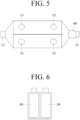
- FIG. 5 is a plan view of the fuel cell membrane humidifier of FIG. 2
- FIG. 6 is a sectional view of the fuel cell membrane humidifier when viewed from line A-A of FIG. 4
- FIG. 7 is a sectional view of the fuel cell membrane humidifier when viewed from line B-B of FIG. 4 .
- the fuel cell membrane humidifier 20 includes a housing unit 100 having first and second spaces, between which a partition wall is disposed, a humidification module 200 disposed in the first space, a heat exchange module 300 disposed in the second space, and a channel valve 400.
- the housing unit 100 defines the external appearance of the membrane humidifier 20.
- the housing unit 100 may include a housing body 110 having the first and second spaces defined therein, and housing caps 120 coupled respectively to opposite ends of the housing body 110.
- the housing body and the housing caps may be integrally coupled to each other.
- Each of the housing body 110 and the housing caps 120 may be made of hard plastic, such as polycarbonate, or metal.
- the inner space of the housing body 110 is divided into two spaces (i.e. the first and second spaces) by the partition wall 150, and the humidification module 200, which is configured to perform moisture exchange, and the heat exchange module 300, which is configured to perform cooling through heat exchange, are disposed in the first and second spaces, respectively (see FIG. 6 ).
- each of the housing body 110 and the housing caps 120 in the lateral direction thereof may be a polygon or a circle.
- the polygon may be a rectangle, a square, a trapezoid, a parallelogram, a pentagon, or a hexagon, and corners of the polygon may be round.
- the circle may be an oval.
- the portion of the housing body 110 corresponding to the humidification module 200 is provided with a second fluid inlet 131, through which a second fluid is introduced, and a second fluid outlet 132, through which the second fluid is discharged.
- the housing caps 120 are coupled respectively to opposite ends of the housing body 110.
- the first fluid may be a relatively low-humidity fluid
- the second fluid may be a relatively high-humidity fluid. More specifically, the first fluid may be dry air compressed by the air compression means 10, and the second fluid may be high-humidity off-gas discharged from the fuel cell stack 30.
- the portion of the housing body 110 corresponding to the heat exchange module 300 is provided with a coolant inlet 141, through which a coolant is supplied to the heat exchange module 300, and a coolant outlet 142, through which the coolant, after performing cooling, is discharged. Cooling of the heat exchange module 300 may be performed in an air cooling mode or a water cooling mode, and the coolant may be air or water supplied from outside.
- the channel valve 400 which is configured to distribute the first fluid to the humidification module 200 and the heat exchange module 300 at a variable distribution ratio, is formed in the housing cap 120 in which the first fluid inlet 121 is formed.
- the housing cap 120 in which the first fluid inlet 121 is formed may further include a cap partition wall 123 configured to guide the first fluid to the humidification module 200 and the heat exchange module 300 according to the distribution ratio set by the channel valve 400.
- the partition wall 150 which divides the inner space of the housing body 110 into the first and second spaces, and the cap partition wall 123 may be separately formed or integrally formed.
- At least a portion of the first fluid introduced through the first fluid inlet 121 is introduced into the humidification module 200, and the remainder of the first fluid is introduced into the heat exchange module 300. Depending on operation conditions, all of the first fluid is introduced into the humidification module 200 or into the heat exchange module 300.
- the humidification module 200 may include a plurality of hollow fiber membranes H configured to allow moisture to selectively pass therethrough.
- a plurality of cartridges C in each of which a plurality of hollow fiber membranes is received, may be disposed in the humidification module 200.
- each of the hollow fiber membranes H may be made of Nafion, polyetherimide, polyphenylsulfone, polyimide, polysulfone, or polyether sulfone.
- Moisture exchange is performed between the first fluid and the second fluid, the humidity of which is higher than the humidity of the first fluid, through the hollow fiber membranes H.
- the first fluid introduced into the humidification module 200 flows through lumina in the hollow fiber membranes H, is discharged out of the humidification module 200, is mixed with the first fluid that has passed through the heat exchange module 300, is discharged through the first fluid outlet 122, and is introduced into the fuel cell stack 30.
- the humidification module 200 is provided at opposite ends thereof with potting units (not shown) configured to bind the hollow fiber membranes H and to fill gaps therebetween. As a result, the opposite ends of the humidification module 200 are blocked by the potting units, whereby a channel configured to allow the second fluid to pass therethrough is defined in the humidification module.
- potting units may be made of a known material, and therefore a detailed description thereof will be omitted from this specification.
- FIG. 8 illustrates a shell and tube type heat exchange module
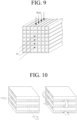
- FIG. 9 illustrates a honeycomb type heat exchange module
- FIG. 10 illustrates a plate type heat exchange module.
- the shell and tube type heat exchange module shown in FIG. 8 is configured to have a structure in which a bundle of tubes is received in a shell and in which a fluid flows through the tubes and another fluid flows through the shell, whereby heat is exchanged between the two fluids as the result of heat transfer.
- the bundle of tubes may include various kinds of tubes, such as flat tubes and vertical pin-shaped tubes.
- the coolant introduced through the coolant inlet 141 flows in the shell (as indicated by curved arrows), cools the first fluid while contacting the tubes, and is discharged outside through the coolant outlet 142.
- the honeycomb type heat exchange module shown in FIG. 9 is a honeycomb type heat exchanger made of a ceramic material, and is configured to have a structure in which, when the first fluid (indicated by “air”) flows in honeycomb pipelines, the coolant (indicated by "water”) is supplied in a direction intersecting the pipelines in order to cool the first fluid.
- the plate type heat exchange module shown in FIG. 10 includes heat transfer plates, which are formed using embossed stainless plates, wherein the heat transfer plates are disposed in the vertical direction such that herringbone patterns of the heat transfer plates are staggered such that the fluid is uniformly distributed to the heat transfer plates to form turbulence, whereby the coolant and the first fluid exchange heat with each other while flowing in opposite directions.
- the first fluid introduced into the heat exchange module 300 passes through the interior of a heat exchanger constituting the heat exchange module 300, is discharged out of the heat exchange module 300, is mixed with the first fluid humidified by the humidification module 200, is discharged from the membrane humidifier 20 through the first fluid outlet 122, and is introduced into the fuel cell stack 30.
- the heat exchange modules of FIGS. 8 to 10 are provided merely for illustration, and the present disclosure is not limited thereto.
- the channel valve 400 is rotatably installed in the housing cap 120 in which the first fluid inlet 121 is formed, and adjusts the flow direction and flow rate of the first fluid such that the first fluid is distributed to the humidification module 200 and the heat exchange module 300 at a variable distribution ratio.
- the channel valve 400 may be configured to be controlled depending on the output state of the fuel cell stack. That is the distribution ratio of the first fluid may be controlled depending on the output state of the fuel cell stack.
- the channel valve 400 may include a valve unit 420 configured to be rotated by a rotor (not shown) and a rotary space 410 in which the valve unit 420 is rotatable (see FIGS. 17 to 19 ).
- the first fluid may flow to the humidification module 200 and the heat exchange module 300 in equal amounts, (ii) the first fluid may flow to any one of the humidification module 200 and the heat exchange module 300 in a larger amount, or (iii) the first fluid may not flow to any one of the humidification module 200 and the heat exchange module 300.
- the fuel cell system may further include a sensing unit (not shown) configured to sense the output state of the fuel cell stack and a controller (not shown) configured to output a control signal for controlling the channel valve 400 based on the output state of the fuel cell stack sensed by the sensing unit.
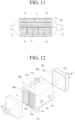
- FIG. 12 is an exploded perspective view of a fuel cell membrane humidifier 20a
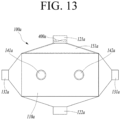
- FIG. 13 is a side view of the fuel cell membrane humidifier 20a of FIG. 12
- FIG. 14 shows an illustrative modification of the fuel cell membrane humidifier 20a of FIG. 12 .
- the fuel cell membrane humidifier shown in FIGS. 12 to 14 includes a housing unit 100a, a humidification module 200a, a heat exchange module 300a, and a channel valve 400a.
- a relatively high-humidity second fluid is introduced and discharged through housing caps 120a
- a relatively dry (low-humidity) first fluid is introduced and discharged through a housing body 110a.
- a portion of an inner space of the housing body 110a is divided into two spaces, i.e. first and second spaces, by a partition wall 150a, and the humidification module 200a, which is configured to perform moisture exchange, and the heat exchange module 300a, which is configured to perform cooling through heat exchange, are disposed in the respective spaces.
- a first fluid inlet 121a, through which the first fluid is introduced, and a first fluid outlet 122a, through which the first fluid is discharged, are formed in the housing body 110a.
- the channel valve 400a which is configured to distribute the first fluid introduced into the first fluid inlet to the humidification module 200a and the heat exchange module 300a at a variable distribution ratio, is formed in the first fluid inlet 121a.
- the housing body 110a in which the first fluid inlet 121a is formed may include an extending partition wall 151a configured to guide the first fluid to the humidification module 200a and the heat exchange module 300a according to the distribution ratio set by the channel valve 400a.
- the partition wall 150a which divides the inner space of the housing body 110a into the first and second spaces, and the extending partition wall 151a may be separately formed or integrally formed.
- At least a portion of the first fluid introduced through the first fluid inlet 121a is introduced into the humidification module 200a, and the remainder of the first fluid is introduced into the heat exchange module 300a. Depending on operation conditions, all of the first fluid is introduced only into any one of the humidification module 200a and the heat exchange module 300a.
- the portion of the housing body 110a corresponding to the heat exchange module 300a is provided with a coolant inlet 141a, through which a coolant is introduced, and a coolant outlet 142a, through which the coolant, after performing cooling, is discharged.
- the coolant inlet 141a and the coolant outlet 142a may be formed in a side surface of the housing body 110a.
- the present disclosure is not limited thereto.
- the coolant inlet 141a and the coolant outlet 142a may be formed in the upper surface or the lower surface of the housing body 110a.
- the coolant inlet 141a and the coolant outlet 142a may be formed through the upper surface or the lower surface of the housing body 110a so as to be connected to the heat exchange module 300a such that the coolant is supplied to or discharged from the heat exchange module 300a.
- the housing caps 120a are coupled respectively to opposite ends of the housing body 110a.
- the humidification module 200a and the heat exchange module 300a are identical to the humidification module and the heat exchange module of the previous embodiment, and therefore a duplicate description thereof will be omitted.
- the channel valve 400a is substantially identical in function and construction to the channel valve of the previous embodiment except that the channel valve is installed in the first fluid inlet 121a, and therefore a duplicate description thereof will be omitted.
- FIG. 15 is an exploded perspective view of a fuel cell membrane humidifier 20b according to a further embodiment of the present disclosure
- FIG. 16 is a plan view of the fuel cell membrane humidifier of FIG. 15 .
- the fuel cell membrane humidifier shown in FIGS. 15 and 16 includes a housing unit 100b, a humidification module 200b, a heat exchange module 300b, and a channel valve 400b.
- a high-humidity second fluid is introduced and discharged through housing caps 120b
- a dry (low-humidity) first fluid is introduced and discharged through a housing body 110b
- a first fluid inlet 121b and a first fluid outlet 122b are formed together in the upper surface or the lower surface of the housing body 110b.
- a portion of an inner space of the housing body 110b is divided into two spaces (i.e. first and second spaces) by a partition wall 150b, and the humidification module 200b, which is configured to perform moisture exchange, and the heat exchange module 300b, which is configured to perform cooling through heat exchange, are disposed in the respective spaces.
- the housing body 110b is provided in one surface (the upper surface or the lower surface) thereof with a first fluid inlet 121b, through which the first fluid is introduced, and a first fluid outlet 122b, through which the first fluid is discharged.
- the channel valve 400b which is configured to distribute the first fluid to the humidification module 200b and the heat exchange module 300b at a variable distribution ratio, is formed in the first fluid inlet 121b.
- the housing body 110b in which the first fluid inlet 121b and the first fluid outlet 122b are formed may include an extending partition wall 151b configured to guide the first fluid introduced through the first fluid inlet 121b to the humidification module 200b and the heat exchange module 300b according to the distribution ratio set by the channel valve 400b and an intersecting partition wall 152b configured to prevent the first fluid flowing from the first fluid inlet 121b to the humidification module 200b and the heat exchange module 300b from being mixed with the first fluid flowing from the humidification module 200b and the heat exchange module 300b to the first fluid outlet 122b.
- the extending partition wall 151b and the intersecting partition wall 152b may intersect each other.
- the intersecting partition wall 152b may be formed between the first fluid inlet 121b and the first fluid outlet 122b, and divides a fluid flow space in the housing body 110b (i.e. a space between the humidification module 200b and the heat exchange module 300b and the housing body 110b) into four spaces together with the extending partition wall 151b.
- the humidification module 200b is provided in one surface (the upper surface or the lower surface) thereof with a first introduction window 201b, through which the first fluid introduced through the first fluid inlet 121b is introduced into the humidification module 200b, and a first discharge window 202b, through which the first fluid, after being humidified through moisture exchange while flowing in the humidification module 200b, is discharged.
- the heat exchange module 300b is provided in one surface (the upper surface or the lower surface) thereof with a second introduction window 301b, through which the first fluid introduced through the first fluid inlet 121b is introduced into the heat exchange module 300b, and a second discharge window 302b, through which the first fluid, after being cooled while flowing in the heat exchange module 300b, is discharged.
- Each of the first and second introduction windows 201b and 301b and the first and second discharge windows 202b and 302b is formed through a portion of one surface of a corresponding one of the humidification module 200b and the heat exchange module 300b.
- the portion of the housing body 110b corresponding to the heat exchange module 300b is provided with a coolant inlet 141b, through which a coolant is introduced, and a coolant outlet 142b, through which the coolant, after performing cooling, is discharged.
- the coolant inlet 141b and the coolant outlet 142b may be formed in a side surface of the housing body 110b.
- the housing caps 120b are coupled respectively to opposite ends of the housing body 110b.
- a second fluid inlet 131b is formed in one of the housing caps 120b, and a second fluid outlet 132b is formed in the other housing cap 120b.
- the humidification module 200b and the heat exchange module 300b are identical to the humidification module and the heat exchange module of the previous embodiment, and therefore a duplicate description thereof will be omitted.
- the channel valve 400b is substantially identical in function and construction to the channel valve of the previous embodiment except that the channel valve is installed in the first fluid inlet 121b, and therefore a duplicate description thereof will be omitted.
- the first fluid is guided to the humidification module 200b and/or the heat exchange module 300b by the extending partition wall 151b according to the distribution ratio set by the channel valve 400b.
- At least a portion of the first fluid introduced through the first fluid inlet 121b is introduced into the humidification module 200b through the first introduction window 201b, and the remainder of the first fluid is introduced into the heat exchange module 300b through the second introduction window 301b.
- all of the first fluid is introduced only into any one of the humidification module 200b and the heat exchange module 300b.
- the intersecting partition wall 152b prevents the first fluid from being directly discharged through the first fluid outlet 122b without being introduced into the humidification module 200b and/or the heat exchange module 300b through the introduction windows 201b and 301b.
- the first fluid introduced into the humidification module 200b and/or the heat exchange module 300b performs moisture exchange and/or heat exchange, and is discharged from the fuel cell membrane humidifier 20b through the first fluid outlet 122b.
- FIG. 17 shows an example in which the first fluid is introduced into only the humidification module 200 in order to realize only the function of a humidifier.
- the controller performs control such that the valve unit 420 blocks all flows to the heat exchange module 300. All of the dry air (the first fluid) compressed by the air compression means 10 flows into the hollow fiber membranes in the humidification module 200 and is discharged from the membrane humidifier through the first fluid outlet 122 of the other housing cap 120. In this process, the first fluid exchanges moisture with the second fluid introduced through the second fluid inlet 131.
- FIG. 18 shows an example in which the first fluid is introduced into only the heat exchange module 300 in order to realize only the function of a heat exchanger.
- the controller performs control such that the valve unit 420 blocks all flows to the humidification module 200. All of the dry air (the first fluid) compressed by the air compression means 10 flows into the heat exchange module 300 and is discharged from the membrane humidifier through the first fluid outlet 122 of the other housing cap 120. In this process, moisture exchange between the first fluid and the second fluid is not performed, and only heat exchange between the first fluid and the coolant is performed. At this time, it is possible to adjust the temperature and flow rate of the coolant that is introduced into the heat exchange module 300 in order to adjust the temperature of the first fluid discharged through the first fluid outlet 122 and introduced into the fuel cell stack 30 to a desired temperature.
- FIG. 19 shows an example in which the first fluid is introduced into the humidification module 200 and the heat exchange module 300 in order to realize humidification and heat exchange functions.
- the controller performs control such that the valve unit 420 blocks some flows to the humidification module 200 and the heat exchange module 300. At least a portion of the dry air (the first fluid) compressed by the air compression means 10 flows into the humidification module 200, and the remainder of the first fluid flows into the heat exchange module 300. Subsequently, the first fluid is discharged from the membrane humidifier through the first fluid outlet 122 of the other housing cap 120. The first fluid that has passed through the humidification module 200 and the first fluid that has passed through the heat exchange module 300 are discharged through the first fluid outlet 122 in a mixed state, and are introduced into the fuel cell stack 30.
- the fuel cell system includes an air compression means 10, a fuel cell membrane humidifier 20, a fuel cell stack 30, a bypass channel L2, and a bypass valve V.
- the fuel cell system according to this embodiment is identical in construction to the fuel cell system according to the previous embodiment except that the bypass channel L2 and the bypass valve V are further included, and therefore a detailed description of the air compression means 10, the fuel cell membrane humidifier 20, and the fuel cell stack 30 will be omitted.
- the fuel cell system includes a bypass channel L2 diverging from the outside air supply channel L1 installed upstream of the front of the air compression means 10 so as to be connected to the coolant inlet 141 of the heat exchange module 300.
- a bypass valve V configured to adjust a bypass flow rate is formed in the outside air supply channel L1.
- the heat exchange module 300 cools the first fluid using a coolant supplied from outside.
- a separate coolant storage means must be provided in order to supply such a coolant. As a result, it is difficult to simplify and miniaturize the fuel cell system.
- At least a portion of outside air that would otherwise be introduced into the air compression means 10 is supplied to the heat exchange module 300 through the bypass channel L2 in order to cool the first fluid.
- a separate coolant storage means configured to supply a coolant, whereby it is possible to construct a much more simplified/miniaturized fuel cell system.
Landscapes
- Engineering & Computer Science (AREA)
- Chemical & Material Sciences (AREA)
- Chemical Kinetics & Catalysis (AREA)
- General Chemical & Material Sciences (AREA)
- Manufacturing & Machinery (AREA)
- Sustainable Development (AREA)
- Sustainable Energy (AREA)
- Electrochemistry (AREA)
- Life Sciences & Earth Sciences (AREA)
- Physics & Mathematics (AREA)
- Thermal Sciences (AREA)
- Mechanical Engineering (AREA)
- General Engineering & Computer Science (AREA)
- Combustion & Propulsion (AREA)
- Geometry (AREA)
- Fuel Cell (AREA)
Description
- The present disclosure relates to a fuel cell system capable of performing humidification through moisture exchange and cooling through heat exchange alone, thereby realizing simplification and miniaturization of a fuel system.
- A fuel cell is a power generation cell that combines hydrogen and oxygen to generate electricity. Such a fuel cell has advantages in that it is possible to continuously generate electricity as long as hydrogen and oxygen are supplied, unlike a general chemical cell, such as a dry cell or a storage cell, and in that there is no heat loss, whereby efficiency of the fuel cell is about twice as high as efficiency of an internal combustion engine.
- In addition, the fuel cell directly converts chemical energy generated by combination of hydrogen and oxygen into electrical energy, whereby the amount of contaminants that are discharged is small. Consequently, the fuel cell has advantages in that the fuel cell is environmentally friendly and in that a concern about depletion of resources due to an increase in energy consumption can be reduced.
- Based on the kind of an electrolyte that is used, such a fuel cell may generally be classified as a polymer electrolyte membrane fuel cell (PEMFC), a phosphoric acid fuel cell (PAFC), a molten carbonate fuel cell (MCFC), a solid oxide fuel cell (SOFC), or an alkaline fuel cell (AFC).
- These fuel cells are operated fundamentally by the same principle, but are different from each other in terms of the kind of fuel that is used, operating temperature, catalyst, and electrolyte. Among these fuel cells, the polymer electrolyte membrane fuel cell is known as being the most favorable to a transportation system as well as small-scale stationary power generation equipment, since the polymer electrolyte membrane fuel cell is operated at a lower temperature than the other fuel cells and the output density of the polymer electrolyte membrane fuel cell is high, whereby it is possible to miniaturize the polymer electrolyte membrane fuel cell.
- One of the most important factors in improving the performance of the polymer electrolyte membrane fuel cell is to supply a predetermined amount or more of moisture to a polymer electrolyte membrane or a proton exchange membrane (PEM) of a membrane electrode assembly (MEA) in order to retain moisture content. The reason for this is that, in the case in which the polymer electrolyte membrane or the proton exchange membrane is dried, power generation efficiency is abruptly reduced.
- 1) A bubbler humidification method of filling a pressure-resistant container with water and allowing a target gas to pass through a diffuser in order to supply moisture, 2) a direct injection method of calculating the amount of moisture to be supplied that is necessary for fuel cell reaction and directly supplying moisture to a gas stream pipe through a solenoid valve, and 3) a membrane humidification method of supplying moisture to a gas fluid bed using a polymer separation membrane are used as methods of humidifying the polymer electrolyte membrane or the proton exchange membrane.
- Among these methods, the membrane humidification method, which provides water vapor to a gas that is supplied to the polymer electrolyte membrane or the proton exchange membrane using a membrane configured to selectively transmit only water vapor included in off-gas in order to humidify the polymer electrolyte membrane or the proton exchange membrane, is advantageous in that it is possible to reduce the weight and size of a humidifier.
- In the case in which a module is formed, a hollow fiber membrane having large transmission area per unit volume is suitable for the selective transmission membrane used in the membrane humidification method. That is, in the case in which a humidifier is manufactured using a hollow fiber membrane, high integration of the hollow fiber membrane having large contact surface area is possible, whereby it is possible to sufficiently humidify a fuel cell even in the case of a small capacity, it is possible to use a low-priced material, and it is possible to collect moisture and heat included in off-gas discharged from the fuel cell at a high temperature and to reuse the collected moisture and heat through the humidifier.
- Meanwhile, in a fuel cell system, high-temperature dry air generated from a compressor or a blower is introduced into a fuel cell stack through a membrane humidifier. At this time, the high-temperature dry air passes through a heat exchanger, such as an air cooler, in which heat exchange is performed such that the air is suitable for operation conditions of the fuel cell stack, is humidified through the membrane humidifier, and is supplied to the fuel cell stack.
- To date, the heat exchanger and the membrane humidifier have been arranged in series in order to perform heat exchange and humidification (moisture control), which requires installation of an additional air cooler between the membrane humidifier and the blower.
- However, the volume of the air cooler is large, whereby the air cooler is disadvantageous in package application, and pressure loss of air compressed by the blower is increased. In addition, a coolant channel is additionally required, whereby facility is complicated, which is disadvantageous in miniaturization.
-
- 1.
Korean Patent Application Publication No. 10-2009-0013304 - 2.
Korean Patent Application Publication No. 10-2009-0057773 - 3.
Korean Patent Application Publication No. 10-2009-0128005 - 4.
Korean Patent Application Publication No. 10-2000-0108092 - 5.
Korean Patent Application Publication No. 10-2000-0131631 - 6.
Korean Patent Application Publication No. 10-2001-0001022 - 7.
Korean Patent Application Publication No. 10-2001-0006122 - 8.
Korean Patent Application Publication No. 10-2001-0006128 - 9.
Korean Patent Application Publication No. 10-2001-0021217 - 10.
Korean Patent Application Publication No. 10-2001-0026696 - 11.
Korean Patent Application Publication No. 10-2001-0063366 - 12.
US 2015/0004504 - 13.
WO 2008/000001 - It is an object of the present disclosure to provide a fuel cell membrane humidifier capable of performing humidification through moisture exchange and cooling through heat exchange alone, thereby realizing simplification and miniaturization of a fuel cell system, and a fuel cell system including the same.
- A fuel cell system according to an embodiment of the present disclosure includes an air compression means configured to receive and compress outside air in order to generate a first fluid, a fuel cell stack configured to generate a second fluid through reaction between hydrogen and oxygen, the second fluid having higher humidity than the first fluid, and a fuel cell membrane humidifier including a housing unit having first and second spaces, between which a partition wall is disposed; a humidification module disposed in the first space, the humidification module comprising a plurality of hollow fiber membranes and configured to humidify the first fluid using moisture exchange between the first and second fluids, the moisture exchange being performed through the plurality of hollow fiber membranes; a heat exchange module disposed in the second space, the heat exchange module being configured to cool the first fluid introduced thereinto; and a channel valve configured to distribute the first fluid to the humidification module and the heat exchange module at a variable distribution ratio,the fuel cell, wherein the housing unit comprises a coolant inlet, through which a coolant is supplied to the heat exchange module, and a coolant outlet, through which the coolant, after performing cooling, is discharged, and the fuel cell system further comprises: an outside air supply channel installed upstream of a front of the air compression means;a bypass channel diverging from the outside air supply channel and connected to the coolant inlet of the housing unit; and a bypass valve configured to adjust a bypass flow rate such that at least a portion of outside air that would otherwise be introduced into the air compression means is supplied to the heat exchange module through the bypass channel in order to cool the first fluid introduced into the heat exchange module.
- In the fuel cell system according to the embodiment of the present disclosure, the housing unit may include a housing body having the first and second spaces defined therein and housing caps coupled respectively to opposite ends of the housing body, the housing caps being provided respectively with a first fluid inlet, through which the first fluid is introduced, and a first fluid outlet, through which the first fluid is discharged, and the housing cap provided with the first fluid inlet may include the channel valve and a cap partition wall configured to guide the first fluid to the humidification module and the heat exchange module according to a distribution ratio set by the channel valve.
- In the fuel cell system according to the embodiment of the present disclosure, the housing unit may include a housing body having the first and second spaces defined therein, the housing body being provided with a first fluid inlet, through which the first fluid is introduced, and a first fluid outlet, through which the first fluid is discharged, and housing caps coupled respectively to opposite ends of the housing body, the housing caps being provided respectively with a second fluid inlet, through which the second fluid is introduced, and a second fluid outlet, through which the second fluid is discharged, and the housing body may include an extending partition wall configured to guide the first fluid to the humidification module and the heat exchange module according to a distribution ratio set by the channel valve.
- In the fuel cell system according to the embodiment of the present disclosure, the housing unit may include a housing body having the first and second spaces defined therein, the housing body being provided in one surface thereof with a first fluid inlet, through which the first fluid is introduced, and a first fluid outlet, through which the first fluid is discharged, and housing caps coupled respectively to opposite ends of the housing body, the housing caps being provided respectively with a second fluid inlet, through which the second fluid is introduced, and a second fluid outlet, through which the second fluid is discharged, and the housing body may include an extending partition wall configured to guide the first fluid introduced through the first fluid inlet to the humidification module and the heat exchange module according to a distribution ratio set by the channel valve and an intersecting partition wall configured to prevent the first fluid flowing from the first fluid inlet to the humidification module and the heat exchange module from being mixed with the first fluid flowing from the humidification module and the heat exchange module to the first fluid outlet.
- The fuel cell system according to the embodiment of the present disclosure may further include a sensing unit configured to sense the output state of the fuel cell stack and a controller configured to output a control signal for controlling the channel valve based on the output state of the fuel cell stack sensed by the sensing unit.
- The details of other embodiments according to various aspects of the present disclosure are included in the following detailed description of the present disclosure.
- According to embodiments of the present disclosure, a fuel cell system having a single membrane humidifier is capable of performing humidification through moisture exchange and cooling through heat exchange, whereby it is possible to realize simplification and miniaturization of a fuel cell system.
-
Fig. 1-19 does not form part of the present invention. -
FIG. 1 is a schematic view of a fuel cell system including a fuel cell membrane humidifier. -
FIG. 2 is an exploded perspective view of a fuel cell membrane humidifier -
FIG. 3 shows an illustrative modification of the fuel cell membrane humidifier ofFIG. 2 . -
FIG. 4 is a front view of the fuel cell membrane humidifier ofFIG. 2 . -
FIG. 5 is a plan view of the fuel cell membrane humidifier ofFIG. 2 . -
FIG. 6 is a sectional view of the fuel cell membrane humidifier when viewed from line A-A ofFIG. 4 . -
FIG. 7 is a sectional view of the fuel cell membrane humidifier when viewed from line B-B ofFIG. 4 . -
FIG. 8 illustrates a shell and tube type heat exchange module. -
FIG. 9 illustrates a honeycomb type heat exchange module. -
FIG. 10 illustrates a plate type heat exchange module. -
FIG. 11 illustrates a fuel cell membrane humidifier to which the shell and tube type heat exchange module ofFIG. 8 is applied -
FIG. 12 is an exploded perspective view of a fuel cell membrane humidifier. -
FIG. 13 is a front view of the fuel cell membrane humidifier ofFIG. 12 . -
FIG. 14 shows an illustrative modification of the fuel cell membrane humidifier ofFIG. 12 . -
FIG. 15 is an exploded perspective view of a fuel cell membrane humidifier. -
FIG. 16 is a plan view of the fuel cell membrane humidifier ofFIG. 15 . -
FIGS. 17 to 19 are schematic views used to describe the operation of the fuel cell membrane humidifier. -
FIG. 20 is a schematic view of another example of the fuel cell system including the fuel cell membrane humidifier according to the embodiment of the present disclosure. - Hereinafter, a fuel cell membrane humidifier according to the present disclosure and a fuel cell system including the same will be described with reference to the accompanying drawings.
-
FIG. 1 is a schematic view of a fuel cell system including a fuel cell membrane humidifier. As shown inFIG. 1 , the fuel cell system includes an air compression means 10, a fuelcell membrane humidifier 20, and afuel cell stack 30. - The air compression means 10 receives outside air from an outside air supply channel L1, compresses the received outside air to generate a first fluid, and supplies the generated first fluid to the fuel
cell membrane humidifier 20. The air compression means 10 is an apparatus for compressing a fluid, such as air, and may be a blower or a compressor. - The fuel
cell membrane humidifier 20 receives the first fluid, which is high-temperature dry air, from the air compression means 10. In addition, the fuelcell membrane humidifier 20 receives a second fluid, which is high-temperature, high-humidity off-gas, discharged from thefuel cell stack 30. - In a
humidification module 200 of the fuelcell membrane humidifier 20, at least a portion of the first fluid (may be all or none depending on operation conditions) exchanges moisture with the second fluid. The first fluid, humidified by moisture exchange, is supplied to thefuel cell stack 30. - Depending on operation conditions, at least a portion of the first fluid (may be all or none depending on operation conditions) may not be humidified in the
humidification module 200 and may pass through aheat exchange module 300. At this time, the first fluid may be converted from high-temperature dry air to low-temperature dry air through heat exchange, and may be mixed with the moisture-contained air that has passed through the humidification module 200 (i.e. the humidified first fluid). The mixture may be supplied to thefuel cell stack 30.Reference numeral 100 indicates a housing unit. - The
fuel cell stack 30 is an electricity generation assembly constituted by a plurality of continuously arranged unit cells. Each unit cell is provided as a unit fuel cell configured to generate electrical energy through electrochemical reaction between hydrogen and oxygen. Each unit cell includes a membrane electrode assembly and separators disposed at opposite sides thereof in tight contact. Each of the separators is configured in the shape of a conductive plate, and the separators form channels configured to allow fuel and air to flow to the tight contact surfaces of the membrane electrode assembly. A fuel electrode is formed at one surface of the membrane electrode assembly, an air electrode is formed at the other surface of the membrane electrode assembly, and an electrolyte membrane is formed between the fuel electrode and the air electrode. - The fuel electrode divides hydrogen supplied through the channel of a corresponding one of the separators into electrons and protons through oxidation reaction, and the electrolyte membrane moves the protons to the cathode. The air electrode generates water and heat from the electrons and the protons received from the fuel electrode and oxygen in air received through the channel of a corresponding one of the separators through reduction reaction. The relatively high-humidity off-gas generated as the result of reaction between hydrogen and oxygen, i.e. the second fluid, is supplied from the
fuel cell stack 30 to the fuelcell membrane humidifier 20. - In the fuel cell system, as described above, the
humidification module 200 for moisture exchange and theheat exchange module 300 for heat exchange are disposed in parallel in thesingle housing unit 100 in an integrated state, whereby the fuel cell system is simplified, and the fuel cell system is miniaturized through a reduction in size thereof. - Hereinafter, a fuel
cell membrane humidifier 20 will be described with reference toFIGS. 2 to 11 . -
FIG. 2 is an exploded perspective view of a fuel cell membrane humidifier,FIG. 3 shows an illustrative modification of the fuel cell membrane humidifier ofFIG. 2 ,FIG. 4 is a front view of the fuel cell membrane humidifier ofFIG. 2 ,FIG. 5 is a plan view of the fuel cell membrane humidifier ofFIG. 2 ,FIG. 6 is a sectional view of the fuel cell membrane humidifier when viewed from line A-A ofFIG. 4 , andFIG. 7 is a sectional view of the fuel cell membrane humidifier when viewed from line B-B ofFIG. 4 . - As shown in
FIGS. 2 to 7 , the fuelcell membrane humidifier 20 includes ahousing unit 100 having first and second spaces, between which a partition wall is disposed, ahumidification module 200 disposed in the first space, aheat exchange module 300 disposed in the second space, and achannel valve 400. - The
housing unit 100 defines the external appearance of themembrane humidifier 20. Thehousing unit 100 may include ahousing body 110 having the first and second spaces defined therein, andhousing caps 120 coupled respectively to opposite ends of thehousing body 110. The housing body and the housing caps may be integrally coupled to each other. Each of thehousing body 110 and thehousing caps 120 may be made of hard plastic, such as polycarbonate, or metal. - As described above, the inner space of the
housing body 110 is divided into two spaces (i.e. the first and second spaces) by thepartition wall 150, and thehumidification module 200, which is configured to perform moisture exchange, and theheat exchange module 300, which is configured to perform cooling through heat exchange, are disposed in the first and second spaces, respectively (seeFIG. 6 ). - In addition, the cross-sectional shape of each of the
housing body 110 and thehousing caps 120 in the lateral direction thereof may be a polygon or a circle. The polygon may be a rectangle, a square, a trapezoid, a parallelogram, a pentagon, or a hexagon, and corners of the polygon may be round. In addition, the circle may be an oval. - Referring to
FIG. 7 , the portion of thehousing body 110 corresponding to thehumidification module 200 is provided with a secondfluid inlet 131, through which a second fluid is introduced, and a secondfluid outlet 132, through which the second fluid is discharged. - The housing caps 120 are coupled respectively to opposite ends of the
housing body 110. Afirst fluid inlet 121, through which a first fluid is introduced, is formed in one of thehousing caps 120, and a firstfluid outlet 122, through which the first fluid is discharged, is formed in theother housing cap 120. - The first fluid may be a relatively low-humidity fluid, and the second fluid may be a relatively high-humidity fluid. More specifically, the first fluid may be dry air compressed by the air compression means 10, and the second fluid may be high-humidity off-gas discharged from the
fuel cell stack 30. - The portion of the
housing body 110 corresponding to theheat exchange module 300 is provided with acoolant inlet 141, through which a coolant is supplied to theheat exchange module 300, and acoolant outlet 142, through which the coolant, after performing cooling, is discharged. Cooling of theheat exchange module 300 may be performed in an air cooling mode or a water cooling mode, and the coolant may be air or water supplied from outside. - The
channel valve 400, which is configured to distribute the first fluid to thehumidification module 200 and theheat exchange module 300 at a variable distribution ratio, is formed in thehousing cap 120 in which the firstfluid inlet 121 is formed. In addition, thehousing cap 120 in which the firstfluid inlet 121 is formed may further include acap partition wall 123 configured to guide the first fluid to thehumidification module 200 and theheat exchange module 300 according to the distribution ratio set by thechannel valve 400. Thepartition wall 150, which divides the inner space of thehousing body 110 into the first and second spaces, and thecap partition wall 123 may be separately formed or integrally formed. - At least a portion of the first fluid introduced through the first
fluid inlet 121 is introduced into thehumidification module 200, and the remainder of the first fluid is introduced into theheat exchange module 300. Depending on operation conditions, all of the first fluid is introduced into thehumidification module 200 or into theheat exchange module 300. - As illustrated in
FIG. 2 , thehumidification module 200 may include a plurality of hollow fiber membranes H configured to allow moisture to selectively pass therethrough. Alternatively, as illustrated inFIG. 3 , a plurality of cartridges C, in each of which a plurality of hollow fiber membranes is received, may be disposed in thehumidification module 200. For example, each of the hollow fiber membranes H may be made of Nafion, polyetherimide, polyphenylsulfone, polyimide, polysulfone, or polyether sulfone. Moisture exchange is performed between the first fluid and the second fluid, the humidity of which is higher than the humidity of the first fluid, through the hollow fiber membranes H. - The first fluid introduced into the
humidification module 200 flows through lumina in the hollow fiber membranes H, is discharged out of thehumidification module 200, is mixed with the first fluid that has passed through theheat exchange module 300, is discharged through the firstfluid outlet 122, and is introduced into thefuel cell stack 30. - The
humidification module 200 is provided at opposite ends thereof with potting units (not shown) configured to bind the hollow fiber membranes H and to fill gaps therebetween. As a result, the opposite ends of thehumidification module 200 are blocked by the potting units, whereby a channel configured to allow the second fluid to pass therethrough is defined in the humidification module. Each of the potting units may be made of a known material, and therefore a detailed description thereof will be omitted from this specification. - The
heat exchange module 300, which is configured to cool the first fluid introduced thereinto, will be described with reference toFIGS. 8 to 10 .FIG. 8 illustrates a shell and tube type heat exchange module,FIG. 9 illustrates a honeycomb type heat exchange module, andFIG. 10 illustrates a plate type heat exchange module. - The shell and tube type heat exchange module shown in
FIG. 8 is configured to have a structure in which a bundle of tubes is received in a shell and in which a fluid flows through the tubes and another fluid flows through the shell, whereby heat is exchanged between the two fluids as the result of heat transfer. The bundle of tubes may include various kinds of tubes, such as flat tubes and vertical pin-shaped tubes. - When at least a portion of the first fluid (the dry air compressed by the air compression means 10) flows through the tubes (as indicated by straight arrows), the coolant introduced through the
coolant inlet 141 flows in the shell (as indicated by curved arrows), cools the first fluid while contacting the tubes, and is discharged outside through thecoolant outlet 142. - The honeycomb type heat exchange module shown in
FIG. 9 is a honeycomb type heat exchanger made of a ceramic material, and is configured to have a structure in which, when the first fluid (indicated by "air") flows in honeycomb pipelines, the coolant (indicated by "water") is supplied in a direction intersecting the pipelines in order to cool the first fluid. - The plate type heat exchange module shown in
FIG. 10 includes heat transfer plates, which are formed using embossed stainless plates, wherein the heat transfer plates are disposed in the vertical direction such that herringbone patterns of the heat transfer plates are staggered such that the fluid is uniformly distributed to the heat transfer plates to form turbulence, whereby the coolant and the first fluid exchange heat with each other while flowing in opposite directions. - The first fluid introduced into the
heat exchange module 300 passes through the interior of a heat exchanger constituting theheat exchange module 300, is discharged out of theheat exchange module 300, is mixed with the first fluid humidified by thehumidification module 200, is discharged from themembrane humidifier 20 through the firstfluid outlet 122, and is introduced into thefuel cell stack 30. The heat exchange modules ofFIGS. 8 to 10 are provided merely for illustration, and the present disclosure is not limited thereto. - The
channel valve 400 is rotatably installed in thehousing cap 120 in which the firstfluid inlet 121 is formed, and adjusts the flow direction and flow rate of the first fluid such that the first fluid is distributed to thehumidification module 200 and theheat exchange module 300 at a variable distribution ratio. Thechannel valve 400 may be configured to be controlled depending on the output state of the fuel cell stack. That is the distribution ratio of the first fluid may be controlled depending on the output state of the fuel cell stack. Thechannel valve 400 may include avalve unit 420 configured to be rotated by a rotor (not shown) and arotary space 410 in which thevalve unit 420 is rotatable (seeFIGS. 17 to 19 ). - As the result of controlling the
channel valve 400 of the present disclosure, (i) the first fluid may flow to thehumidification module 200 and theheat exchange module 300 in equal amounts, (ii) the first fluid may flow to any one of thehumidification module 200 and theheat exchange module 300 in a larger amount, or (iii) the first fluid may not flow to any one of thehumidification module 200 and theheat exchange module 300. - The fuel cell system may further include a sensing unit (not shown) configured to sense the output state of the fuel cell stack and a controller (not shown) configured to output a control signal for controlling the
channel valve 400 based on the output state of the fuel cell stack sensed by the sensing unit. - Next, a fuel cell membrane humidifier according to another will be described with reference to
FIGS. 12 to 14 .FIG. 12 is an exploded perspective view of a fuelcell membrane humidifier 20a,FIG. 13 is a side view of the fuelcell membrane humidifier 20a ofFIG. 12 , andFIG. 14 shows an illustrative modification of the fuelcell membrane humidifier 20a ofFIG. 12 . - Substantially similarly to the previous embodiment, the fuel cell membrane humidifier shown in
FIGS. 12 to 14 includes ahousing unit 100a, ahumidification module 200a, aheat exchange module 300a, and achannel valve 400a. In this embodiment, however, a relatively high-humidity second fluid is introduced and discharged throughhousing caps 120a, and a relatively dry (low-humidity) first fluid is introduced and discharged through ahousing body 110a. - A portion of an inner space of the
housing body 110a is divided into two spaces, i.e. first and second spaces, by apartition wall 150a, and thehumidification module 200a, which is configured to perform moisture exchange, and theheat exchange module 300a, which is configured to perform cooling through heat exchange, are disposed in the respective spaces. - A
first fluid inlet 121a, through which the first fluid is introduced, and afirst fluid outlet 122a, through which the first fluid is discharged, are formed in thehousing body 110a. Thechannel valve 400a, which is configured to distribute the first fluid introduced into the first fluid inlet to thehumidification module 200a and theheat exchange module 300a at a variable distribution ratio, is formed in thefirst fluid inlet 121a. In addition, thehousing body 110a in which thefirst fluid inlet 121a is formed may include an extendingpartition wall 151a configured to guide the first fluid to thehumidification module 200a and theheat exchange module 300a according to the distribution ratio set by thechannel valve 400a. Thepartition wall 150a, which divides the inner space of thehousing body 110a into the first and second spaces, and the extendingpartition wall 151a may be separately formed or integrally formed. - At least a portion of the first fluid introduced through the
first fluid inlet 121a is introduced into thehumidification module 200a, and the remainder of the first fluid is introduced into theheat exchange module 300a. Depending on operation conditions, all of the first fluid is introduced only into any one of thehumidification module 200a and theheat exchange module 300a. - The portion of the
housing body 110a corresponding to theheat exchange module 300a is provided with acoolant inlet 141a, through which a coolant is introduced, and acoolant outlet 142a, through which the coolant, after performing cooling, is discharged. Thecoolant inlet 141a and thecoolant outlet 142a may be formed in a side surface of thehousing body 110a. However, the present disclosure is not limited thereto. As shown inFIG. 14 , thecoolant inlet 141a and thecoolant outlet 142a may be formed in the upper surface or the lower surface of thehousing body 110a. In this case, thecoolant inlet 141a and thecoolant outlet 142a may be formed through the upper surface or the lower surface of thehousing body 110a so as to be connected to theheat exchange module 300a such that the coolant is supplied to or discharged from theheat exchange module 300a. - The
housing caps 120a are coupled respectively to opposite ends of thehousing body 110a. Asecond fluid inlet 131a, through which the relatively high-humidity second fluid is introduced, is formed in one of thehousing caps 120a, and asecond fluid outlet 132a, through which the second fluid is discharged, is formed in theother housing cap 120a. - The
humidification module 200a and theheat exchange module 300a are identical to the humidification module and the heat exchange module of the previous embodiment, and therefore a duplicate description thereof will be omitted. In addition, thechannel valve 400a is substantially identical in function and construction to the channel valve of the previous embodiment except that the channel valve is installed in thefirst fluid inlet 121a, and therefore a duplicate description thereof will be omitted. - A fuel cell membrane humidifier will be described with reference to
FIGS. 15 and 16. FIG. 15 is an exploded perspective view of a fuelcell membrane humidifier 20b according to a further embodiment of the present disclosure, andFIG. 16 is a plan view of the fuel cell membrane humidifier ofFIG. 15 . - Substantially similarly to the previous embodiment, the fuel cell membrane humidifier shown in
FIGS. 15 and 16 includes a housing unit 100b, a humidification module 200b, aheat exchange module 300b, and achannel valve 400b. In this embodiment, a high-humidity second fluid is introduced and discharged throughhousing caps 120b, a dry (low-humidity) first fluid is introduced and discharged through a housing body 110b, and a firstfluid inlet 121b and a firstfluid outlet 122b are formed together in the upper surface or the lower surface of the housing body 110b. - A portion of an inner space of the housing body 110b is divided into two spaces (i.e. first and second spaces) by a
partition wall 150b, and the humidification module 200b, which is configured to perform moisture exchange, and theheat exchange module 300b, which is configured to perform cooling through heat exchange, are disposed in the respective spaces. - The housing body 110b is provided in one surface (the upper surface or the lower surface) thereof with a first
fluid inlet 121b, through which the first fluid is introduced, and a firstfluid outlet 122b, through which the first fluid is discharged. Thechannel valve 400b, which is configured to distribute the first fluid to the humidification module 200b and theheat exchange module 300b at a variable distribution ratio, is formed in the firstfluid inlet 121b. In addition, the housing body 110b in which the firstfluid inlet 121b and the firstfluid outlet 122b are formed may include an extendingpartition wall 151b configured to guide the first fluid introduced through the firstfluid inlet 121b to the humidification module 200b and theheat exchange module 300b according to the distribution ratio set by thechannel valve 400b and an intersectingpartition wall 152b configured to prevent the first fluid flowing from the firstfluid inlet 121b to the humidification module 200b and theheat exchange module 300b from being mixed with the first fluid flowing from the humidification module 200b and theheat exchange module 300b to the firstfluid outlet 122b. The extendingpartition wall 151b and the intersectingpartition wall 152b may intersect each other. The intersectingpartition wall 152b may be formed between the firstfluid inlet 121b and the firstfluid outlet 122b, and divides a fluid flow space in the housing body 110b (i.e. a space between the humidification module 200b and theheat exchange module 300b and the housing body 110b) into four spaces together with the extendingpartition wall 151b. - The humidification module 200b is provided in one surface (the upper surface or the lower surface) thereof with a
first introduction window 201b, through which the first fluid introduced through the firstfluid inlet 121b is introduced into the humidification module 200b, and afirst discharge window 202b, through which the first fluid, after being humidified through moisture exchange while flowing in the humidification module 200b, is discharged. - In addition, the
heat exchange module 300b is provided in one surface (the upper surface or the lower surface) thereof with asecond introduction window 301b, through which the first fluid introduced through the firstfluid inlet 121b is introduced into theheat exchange module 300b, and asecond discharge window 302b, through which the first fluid, after being cooled while flowing in theheat exchange module 300b, is discharged. - Each of the first and
second introduction windows second discharge windows heat exchange module 300b. - The portion of the housing body 110b corresponding to the
heat exchange module 300b is provided with acoolant inlet 141b, through which a coolant is introduced, and acoolant outlet 142b, through which the coolant, after performing cooling, is discharged. Thecoolant inlet 141b and thecoolant outlet 142b may be formed in a side surface of the housing body 110b. - The housing caps 120b are coupled respectively to opposite ends of the housing body 110b. A
second fluid inlet 131b, is formed in one of thehousing caps 120b, and a secondfluid outlet 132b is formed in theother housing cap 120b. - The humidification module 200b and the
heat exchange module 300b are identical to the humidification module and the heat exchange module of the previous embodiment, and therefore a duplicate description thereof will be omitted. In addition, thechannel valve 400b is substantially identical in function and construction to the channel valve of the previous embodiment except that the channel valve is installed in the firstfluid inlet 121b, and therefore a duplicate description thereof will be omitted. - The first fluid is guided to the humidification module 200b and/or the
heat exchange module 300b by the extendingpartition wall 151b according to the distribution ratio set by thechannel valve 400b. - At least a portion of the first fluid introduced through the first
fluid inlet 121b is introduced into the humidification module 200b through thefirst introduction window 201b, and the remainder of the first fluid is introduced into theheat exchange module 300b through thesecond introduction window 301b. Depending on operation conditions, all of the first fluid is introduced only into any one of the humidification module 200b and theheat exchange module 300b. At this time, the intersectingpartition wall 152b prevents the first fluid from being directly discharged through the firstfluid outlet 122b without being introduced into the humidification module 200b and/or theheat exchange module 300b through theintroduction windows - The first fluid introduced into the humidification module 200b and/or the
heat exchange module 300b performs moisture exchange and/or heat exchange, and is discharged from the fuelcell membrane humidifier 20b through the firstfluid outlet 122b. - Next, the operation of the fuel cell membrane humidifier will be described with reference to
FIGS. 17 to 19 . Meanwhile, the operation of the fuel cell membrane humidifier according to each of the other embodiments of the present disclosure is substantially identical to the operation of the fuel cell membrane humidifier, and a duplicate description thereof will be omitted. -
FIG. 17 shows an example in which the first fluid is introduced into only thehumidification module 200 in order to realize only the function of a humidifier. The controller performs control such that thevalve unit 420 blocks all flows to theheat exchange module 300. All of the dry air (the first fluid) compressed by the air compression means 10 flows into the hollow fiber membranes in thehumidification module 200 and is discharged from the membrane humidifier through the firstfluid outlet 122 of theother housing cap 120. In this process, the first fluid exchanges moisture with the second fluid introduced through the secondfluid inlet 131. -
FIG. 18 shows an example in which the first fluid is introduced into only theheat exchange module 300 in order to realize only the function of a heat exchanger. The controller performs control such that thevalve unit 420 blocks all flows to thehumidification module 200. All of the dry air (the first fluid) compressed by the air compression means 10 flows into theheat exchange module 300 and is discharged from the membrane humidifier through the firstfluid outlet 122 of theother housing cap 120. In this process, moisture exchange between the first fluid and the second fluid is not performed, and only heat exchange between the first fluid and the coolant is performed. At this time, it is possible to adjust the temperature and flow rate of the coolant that is introduced into theheat exchange module 300 in order to adjust the temperature of the first fluid discharged through the firstfluid outlet 122 and introduced into thefuel cell stack 30 to a desired temperature. -
FIG. 19 shows an example in which the first fluid is introduced into thehumidification module 200 and theheat exchange module 300 in order to realize humidification and heat exchange functions. The controller performs control such that thevalve unit 420 blocks some flows to thehumidification module 200 and theheat exchange module 300. At least a portion of the dry air (the first fluid) compressed by the air compression means 10 flows into thehumidification module 200, and the remainder of the first fluid flows into theheat exchange module 300. Subsequently, the first fluid is discharged from the membrane humidifier through the firstfluid outlet 122 of theother housing cap 120. The first fluid that has passed through thehumidification module 200 and the first fluid that has passed through theheat exchange module 300 are discharged through the firstfluid outlet 122 in a mixed state, and are introduced into thefuel cell stack 30. At this time, it is possible to adjust the amount of humidification through thechannel valve 400 and to adjust the temperature and flow rate of the coolant that is introduced into theheat exchange module 300 in order to adjust the temperature of the first fluid in the mixed state. As a result, it is possible to adjust the humidified state and temperature of the first fluid that is introduced into thefuel cell stack 30 to a desired humidified state and a desired temperature. - Next, another example of the fuel cell system including the fuel cell membrane humidifier according to the embodiment of the present disclosure will be described with reference to
FIG. 20 . - As shown in
FIG. 20 , the fuel cell system according to the other embodiment of the present disclosure includes an air compression means 10, a fuelcell membrane humidifier 20, afuel cell stack 30, a bypass channel L2, and a bypass valve V. - The fuel cell system according to this embodiment is identical in construction to the fuel cell system according to the previous embodiment except that the bypass channel L2 and the bypass valve V are further included, and therefore a detailed description of the air compression means 10, the fuel
cell membrane humidifier 20, and thefuel cell stack 30 will be omitted. - The fuel cell system according to this embodiment includes a bypass channel L2 diverging from the outside air supply channel L1 installed upstream of the front of the air compression means 10 so as to be connected to the
coolant inlet 141 of theheat exchange module 300. A bypass valve V configured to adjust a bypass flow rate is formed in the outside air supply channel L1. - In the fuel cell system according to the previous embodiment, the
heat exchange module 300 cools the first fluid using a coolant supplied from outside. In this case, a separate coolant storage means must be provided in order to supply such a coolant. As a result, it is difficult to simplify and miniaturize the fuel cell system. - In this embodiment, at least a portion of outside air that would otherwise be introduced into the air compression means 10 is supplied to the
heat exchange module 300 through the bypass channel L2 in order to cool the first fluid. For an air-cooling type heat exchanger, therefore, it is not necessary to provide a separate coolant storage means configured to supply a coolant, whereby it is possible to construct a much more simplified/miniaturized fuel cell system.
Claims (5)
- A fuel cell system comprising:an air compression means (10) configured to receive and compress outside air in order to generate a first fluid;a fuel cell stack (30) configured to generate a second fluid through reaction between hydrogen and oxygen, the second fluid having higher humidity than the first fluid; anda fuel cell membrane humidifier (20) comprising:a housing unit (100, 100a, 100b) having first and second spaces, between which a partition wall (150, 150a, 150b) is disposed;a humidification module (200, 200a, 200b) disposed in the first space, the humidification module (200, 200a, 200b) comprising a plurality of hollow fiber membranes (H) and configured to humidify the first fluid using moisture exchange between the first and second fluids, the moisture exchange being performed through the plurality of hollow fiber membranes;a heat exchange module (300, 300a, 300b) disposed in the second space, the heat exchange module (300, 300a, 300b) being configured to cool the first fluid introduced thereinto; anda channel valve (400, 400a, 400b) configured to distribute the first fluid to the humidification module (200, 200a, 200b) and the heat exchange module (300, 300a, 300b) at a variable distribution ratio,the housing unit (100, 100a, 100b) comprises a coolant inlet (141, 141a, 141b), through which a coolant is supplied to the heat exchange module (300, 300a, 300b), and a coolant outlet (142, 142a, 142b), through which the coolant, after performing cooling, is discharged, andan outside air supply channel (L1) installed upstream of a front of the air compression means (10);the fuel cell system characterized in thata bypass channel (L2) diverging from the outside air supply channel (L1) and connected to the coolant inlet (141, 141a, 141b) of the housing unit (100, 100a, 100b); anda bypass valve (V) configured to adjust a bypass flow rate such that at least a portion of outside air that would otherwise be introduced into the air compression means (10) is supplied to the heat exchange module (300, 300a, 300b) through the bypass channel (L2) in order to cool the first fluid introduced into the heat exchange module (300, 300a, 300b).
- The fuel cell system according to claim 1, wherein the housing unit (100) comprises:a housing body (110) having the first and second spaces defined therein; andhousing caps (120) coupled respectively to opposite ends of the housing body (110), the housing caps (120) being provided respectively with a first fluid inlet (121), through which the first fluid is introduced, and a first fluid outlet (122), through which the first fluid is discharged, andwherein the housing cap (120) provided with the first fluid inlet (121) comprises the channel valve (400) and a cap partition wall (123) configured to guide the first fluid to the humidification module (200) and the heat exchange module (300) according to a distribution ratio set by the channel valve (400).
- The fuel cell system according to claim 1, wherein the housing unit (100a) comprises:a housing body (110a) having the first and second spaces defined therein, the housing body (110a) being provided with a first fluid inlet (121a), through which the first fluid is introduced, and a first fluid outlet (122a), through which the first fluid is discharged; andhousing caps (120a) coupled respectively to opposite ends of the housing body (110a), the housing caps (120a) being provided respectively with a second fluid inlet (131a), through which the second fluid is introduced, and a second fluid outlet (132a), through which the second fluid is discharged, andwherein the housing body (1 10a) comprises an extending partition wall (151a) configured to guide the first fluid to the humidification module (200a) and the heat exchange module (300a) according to a distribution ratio set by the channel valve (400a).
- The fuel cell system according to claim 1, wherein the housing unit (100b) comprises:a housing body (110b) having the first and second spaces defined therein, the housing body (110b) being provided in one surface thereof with a first fluid inlet (121b), through which the first fluid is introduced, and a first fluid outlet (122b), through which the first fluid is discharged; andhousing caps (120b) coupled respectively to opposite ends of the housing body (1 10b), the housing caps (120b) being provided respectively with a second fluid inlet (131b), through which the second fluid is introduced, and a second fluid outlet (132b), through which the second fluid is discharged, andwherein the housing body (1 10b) comprises an extending partition wall (151b) configured to guide the first fluid introduced through the first fluid inlet (121b) to the humidification module (200b) and the heat exchange module (300b) according to a distribution ratio set by the channel valve (400b) and an intersecting partition wall (152b) configured to prevent the first fluid flowing from the first fluid inlet (121b) to the humidification module (200b) and the heat exchange module (300b) from being mixed with the first fluid flowing from the humidification module (200b) and the heat exchange module (300b) to the first fluid outlet (122b).
- The fuel cell system according to claim 1, further comprising:a sensing unit configured to sense an output state of the fuel cell stack (30); anda controller configured to output a control signal for controlling the channel valve (400, 400a, 400b) based on the output state of the fuel cell stack (30) sensed by the sensing unit.
Applications Claiming Priority (2)
| Application Number | Priority Date | Filing Date | Title |
|---|---|---|---|
| KR20190026120 | 2019-03-07 | ||
| PCT/KR2020/003274 WO2020180169A1 (en) | 2019-03-07 | 2020-03-09 | Membrane humidifier for fuel cell, and fuel cell system comprising same |
Publications (3)
| Publication Number | Publication Date |
|---|---|
| EP3937284A1 EP3937284A1 (en) | 2022-01-12 |
| EP3937284A4 EP3937284A4 (en) | 2023-08-09 |
| EP3937284B1 true EP3937284B1 (en) | 2024-10-02 |
Family
ID=72338563
Family Applications (1)
| Application Number | Title | Priority Date | Filing Date |
|---|---|---|---|
| EP20766412.9A Active EP3937284B1 (en) | 2019-03-07 | 2020-03-09 | Fuel cell system |
Country Status (5)
| Country | Link |
|---|---|
| US (1) | US11831047B2 (en) |
| EP (1) | EP3937284B1 (en) |
| KR (1) | KR102430847B1 (en) |
| CN (1) | CN113557619B (en) |
| WO (1) | WO2020180169A1 (en) |
Families Citing this family (14)
| Publication number | Priority date | Publication date | Assignee | Title |
|---|---|---|---|---|
| CA3180127A1 (en) * | 2020-04-20 | 2021-10-28 | Intelligent Energy Limited | Coaxial fuel cell cathode flow path ducting |
| CN114730898A (en) * | 2020-09-14 | 2022-07-08 | 可隆工业株式会社 | Fuel cell membrane humidifier and fuel cell system having the same |
| KR102677165B1 (en) * | 2020-09-14 | 2024-06-20 | 코오롱인더스트리 주식회사 | Fuel cell membrane humidifier and fuel cell system comprising it |
| KR102677163B1 (en) * | 2020-09-14 | 2024-06-20 | 코오롱인더스트리 주식회사 | Fuel cell membrane humidifier and fuel cell system comprising it |
| KR102897811B1 (en) * | 2020-10-29 | 2025-12-10 | 한온시스템 주식회사 | Membrane humidification assembly and membrane humidification device having the same |
| US12592403B2 (en) | 2020-12-23 | 2026-03-31 | Kolon Industries, Inc. | Humidifier system for fuel cell |
| KR102664877B1 (en) * | 2021-01-06 | 2024-05-09 | 코오롱인더스트리 주식회사 | Humidifier for Fuel Cell |
| KR102870598B1 (en) * | 2021-02-02 | 2025-10-13 | 코오롱인더스트리 주식회사 | Fuel cell membrane humidifier with adjustable dry air flow |
| KR102913559B1 (en) * | 2021-03-11 | 2026-01-15 | 코오롱인더스트리 주식회사 | Fuel cell membrane humidifier and fuel cell system comprising it |
| KR20230074963A (en) | 2021-11-22 | 2023-05-31 | 주식회사 씨엠피 | Inspection system of membrane humidifier for fuel cell |
| KR102447975B1 (en) * | 2021-12-13 | 2022-09-27 | 주식회사 디에스필터 | Membrane humidifier for fuel cell |
| CN114725440A (en) * | 2022-06-08 | 2022-07-08 | 佛山市清极能源科技有限公司 | Humidifying device, system and method for fuel cell |
| EP4336604A1 (en) * | 2022-09-12 | 2024-03-13 | ALSTOM Holdings | Air supply and conditioning module for fuel cells of a vehicle |
| EP4699688A1 (en) * | 2024-08-19 | 2026-02-25 | Carl Freudenberg KG | Humidifier for a fuel cell |
Family Cites Families (27)
| Publication number | Priority date | Publication date | Assignee | Title |
|---|---|---|---|---|
| JPH08273687A (en) * | 1995-03-30 | 1996-10-18 | Mazda Motor Corp | Fuel gas supply gas humidifier |
| GB2324214A (en) | 1997-04-08 | 1998-10-14 | Power X Limited | Synchronising arrangements |
| JP4249268B2 (en) | 1997-04-14 | 2009-04-02 | トムソン コンシューマ エレクトロニクス インコーポレイテッド | Method of forming a program guide for program content available in a video decoder system |
| JP3483116B2 (en) | 1998-06-15 | 2004-01-06 | 松下電器産業株式会社 | Polymer electrolyte fuel cell |
| KR100316710B1 (en) | 1999-06-01 | 2001-12-12 | 윤종용 | Method and Apparatus for Instruction issuing in Out-of-Order for Parallel Processor |
| JP3777893B2 (en) | 1999-08-05 | 2006-05-24 | セイコーエプソン株式会社 | Liquid crystal display |
| KR20010026696A (en) | 1999-09-08 | 2001-04-06 | 이중구 | Method for automatically measuring line of balance and apparatus thereof |
| KR100394827B1 (en) | 1999-12-22 | 2003-08-21 | 엘지전자 주식회사 | Program and data down loading method for restating processor of mobile communication exchage system |
| JP4559693B2 (en) * | 2002-08-08 | 2010-10-13 | 本田技研工業株式会社 | Humidifier for fuel cell |
| JP2006313687A (en) * | 2005-05-09 | 2006-11-16 | Osaka Gas Co Ltd | Solid oxide fuel cell system |
| JP2007059090A (en) * | 2005-08-22 | 2007-03-08 | Nissan Motor Co Ltd | Humidification system for fuel cell |
| AT502353B1 (en) * | 2006-06-29 | 2007-07-15 | Avl List Gmbh | Combined humidifier and heat exchanger unit for e.g. proton exchange membrane-fuel cell, has feed line with branch lines that are conducted across heat exchanger integrated into coolant circuit of low-temperature fuel cell |
| JP2008108473A (en) * | 2006-10-23 | 2008-05-08 | Nissan Motor Co Ltd | Humidification system for fuel cell |
| DE102007003240B3 (en) * | 2007-01-22 | 2008-09-04 | Daimler Ag | Recooling and humidifying device in fuel cells |
| JP2008300324A (en) * | 2007-06-04 | 2008-12-11 | Mitsubishi Electric Corp | Fuel cell unit |
| KR101278398B1 (en) | 2007-08-01 | 2013-06-24 | 코오롱인더스트리 주식회사 | Hollow Fiber Membrane and Method for Manufacturing The Same |
| KR101028030B1 (en) | 2007-09-06 | 2011-04-13 | 현대자동차주식회사 | Humidifier for Fuel Cell |
| KR101398779B1 (en) | 2007-12-03 | 2014-05-28 | 코오롱인더스트리 주식회사 | Fuel Cell Humidifier with Improved Cold Resistance |
| KR20090128005A (en) | 2008-06-10 | 2009-12-15 | 주식회사 코오롱 | Humidification system for fuel cell and fuel cell system using same |
| US8308938B2 (en) * | 2008-06-18 | 2012-11-13 | GM Global Technology Operations LLC | Three-way diverter assembly for a fuel cell system |
| KR101724454B1 (en) | 2011-05-04 | 2017-04-10 | 현대자동차 주식회사 | Fuel cell system and humidification device of the same |
| DE102011111742B4 (en) | 2011-08-24 | 2024-12-24 | Cellcentric Gmbh & Co. Kg | fuel cell system |
| DE202013009357U1 (en) * | 2013-06-27 | 2015-01-16 | Dana Canada Corporation | Integrated gas management device for a fuel cell system |
| KR101601377B1 (en) | 2013-12-20 | 2016-03-21 | 현대자동차주식회사 | A heat exchange unit of suppling air to fuel cell cathod and a heat exchange method thereof |
| KR101535026B1 (en) * | 2014-06-12 | 2015-07-07 | 현대자동차주식회사 | Humidifier for Fuel Cell System |
| KR101807015B1 (en) * | 2014-08-01 | 2017-12-08 | 현대자동차 주식회사 | Humidification device for fuel cell |
| KR101655186B1 (en) * | 2014-12-04 | 2016-09-07 | 현대자동차 주식회사 | Air cooler for fuel cell system and humidification device comprising the same |
-
2020
- 2020-03-09 KR KR1020200029216A patent/KR102430847B1/en active Active
- 2020-03-09 WO PCT/KR2020/003274 patent/WO2020180169A1/en not_active Ceased
- 2020-03-09 EP EP20766412.9A patent/EP3937284B1/en active Active
- 2020-03-09 US US17/418,257 patent/US11831047B2/en active Active
- 2020-03-09 CN CN202080019529.1A patent/CN113557619B/en active Active
Also Published As
| Publication number | Publication date |
|---|---|
| KR102430847B1 (en) | 2022-08-09 |
| EP3937284A4 (en) | 2023-08-09 |
| CN113557619B (en) | 2024-12-17 |
| US20220093946A1 (en) | 2022-03-24 |
| CN113557619A (en) | 2021-10-26 |
| KR20200107874A (en) | 2020-09-16 |
| WO2020180169A1 (en) | 2020-09-10 |
| EP3937284A1 (en) | 2022-01-12 |
| US11831047B2 (en) | 2023-11-28 |
Similar Documents
| Publication | Publication Date | Title |
|---|---|---|
| EP3937284B1 (en) | Fuel cell system | |
| US20250279447A1 (en) | Membrane humidifier for fuel cell | |
| US8003278B2 (en) | Fuel cell | |
| EP4350820A1 (en) | Fuel cell membrane humidifier | |
| US12394808B2 (en) | Humidifier for fuel cell | |
| US12542288B2 (en) | Fuel cell membrane humidifier and fuel cell system having same | |
| KR102846031B1 (en) | Fuel cell humidifier | |
| KR102677163B1 (en) | Fuel cell membrane humidifier and fuel cell system comprising it | |
| EP4009405A1 (en) | Fuel cell membrane humidifier capable of controlling flow direction of fluid | |
| US20240021848A1 (en) | Cartridge of fuel cell humidifier, and fuel cell humidifier | |
| JP7642862B2 (en) | Fuel Cell Membrane Humidifier | |
| US20240322200A1 (en) | Cartridge for membrane humidifier, and fuel cell membrane humidifier comprising same | |
| JP7573767B2 (en) | Fuel Cell Membrane Humidifier | |
| EP4266433A1 (en) | Automatic flow rate control cartridge and fuel cell membrane humidifier comprising same | |
| US12548788B2 (en) | Cartridge of humidifier for fuel cell and humidifier for fuel cell | |
| KR102677165B1 (en) | Fuel cell membrane humidifier and fuel cell system comprising it | |
| EP4730448A1 (en) | Cartridge for membrane humidifier and membrane humidifier comprising same | |
| EP4629354A1 (en) | Cartridge for fuel cell humidifier, and fuel cell humidifier | |
| KR20230170220A (en) | Humidifier for Fuel Cell and Mid-case of Humidifier for Fuel Cell |
Legal Events
| Date | Code | Title | Description |
|---|---|---|---|
| STAA | Information on the status of an ep patent application or granted ep patent |
Free format text: STATUS: THE INTERNATIONAL PUBLICATION HAS BEEN MADE |
|
| PUAI | Public reference made under article 153(3) epc to a published international application that has entered the european phase |
Free format text: ORIGINAL CODE: 0009012 |
|
| STAA | Information on the status of an ep patent application or granted ep patent |
Free format text: STATUS: REQUEST FOR EXAMINATION WAS MADE |
|
| 17P | Request for examination filed |
Effective date: 20210916 |
|
| AK | Designated contracting states |
Kind code of ref document: A1 Designated state(s): AL AT BE BG CH CY CZ DE DK EE ES FI FR GB GR HR HU IE IS IT LI LT LU LV MC MK MT NL NO PL PT RO RS SE SI SK SM TR |
|
| DAV | Request for validation of the european patent (deleted) | ||
| DAX | Request for extension of the european patent (deleted) | ||
| A4 | Supplementary search report drawn up and despatched |
Effective date: 20230712 |
|
| RIC1 | Information provided on ipc code assigned before grant |
Ipc: B01D 63/02 20060101ALI20230706BHEP Ipc: H01M 8/04119 20160101AFI20230706BHEP |
|
| GRAP | Despatch of communication of intention to grant a patent |
Free format text: ORIGINAL CODE: EPIDOSNIGR1 |
|
| STAA | Information on the status of an ep patent application or granted ep patent |
Free format text: STATUS: GRANT OF PATENT IS INTENDED |
|
| INTG | Intention to grant announced |
Effective date: 20240425 |
|
| GRAS | Grant fee paid |
Free format text: ORIGINAL CODE: EPIDOSNIGR3 |
|
| GRAA | (expected) grant |
Free format text: ORIGINAL CODE: 0009210 |
|
| STAA | Information on the status of an ep patent application or granted ep patent |
Free format text: STATUS: THE PATENT HAS BEEN GRANTED |
|
| AK | Designated contracting states |
Kind code of ref document: B1 Designated state(s): AL AT BE BG CH CY CZ DE DK EE ES FI FR GB GR HR HU IE IS IT LI LT LU LV MC MK MT NL NO PL PT RO RS SE SI SK SM TR |
|
| REG | Reference to a national code |
Ref country code: GB Ref legal event code: FG4D |
|
| REG | Reference to a national code |
Ref country code: CH Ref legal event code: EP |
|
| REG | Reference to a national code |
Ref country code: IE Ref legal event code: FG4D |
|
| REG | Reference to a national code |
Ref country code: DE Ref legal event code: R096 Ref document number: 602020038744 Country of ref document: DE |
|
| REG | Reference to a national code |
Ref country code: LT Ref legal event code: MG9D |
|
| REG | Reference to a national code |
Ref country code: NL Ref legal event code: MP Effective date: 20241002 |
|
| REG | Reference to a national code |
Ref country code: AT Ref legal event code: MK05 Ref document number: 1729116 Country of ref document: AT Kind code of ref document: T Effective date: 20241002 |
|
| PG25 | Lapsed in a contracting state [announced via postgrant information from national office to epo] |
Ref country code: NL Free format text: LAPSE BECAUSE OF FAILURE TO SUBMIT A TRANSLATION OF THE DESCRIPTION OR TO PAY THE FEE WITHIN THE PRESCRIBED TIME-LIMIT Effective date: 20241002 |
|
| PG25 | Lapsed in a contracting state [announced via postgrant information from national office to epo] |
Ref country code: NL Free format text: LAPSE BECAUSE OF FAILURE TO SUBMIT A TRANSLATION OF THE DESCRIPTION OR TO PAY THE FEE WITHIN THE PRESCRIBED TIME-LIMIT Effective date: 20241002 |
|
| PG25 | Lapsed in a contracting state [announced via postgrant information from national office to epo] |
Ref country code: PT Free format text: LAPSE BECAUSE OF FAILURE TO SUBMIT A TRANSLATION OF THE DESCRIPTION OR TO PAY THE FEE WITHIN THE PRESCRIBED TIME-LIMIT Effective date: 20250203 Ref country code: IS Free format text: LAPSE BECAUSE OF FAILURE TO SUBMIT A TRANSLATION OF THE DESCRIPTION OR TO PAY THE FEE WITHIN THE PRESCRIBED TIME-LIMIT Effective date: 20250202 Ref country code: HR Free format text: LAPSE BECAUSE OF FAILURE TO SUBMIT A TRANSLATION OF THE DESCRIPTION OR TO PAY THE FEE WITHIN THE PRESCRIBED TIME-LIMIT Effective date: 20241002 |
|
| PG25 | Lapsed in a contracting state [announced via postgrant information from national office to epo] |
Ref country code: FI Free format text: LAPSE BECAUSE OF FAILURE TO SUBMIT A TRANSLATION OF THE DESCRIPTION OR TO PAY THE FEE WITHIN THE PRESCRIBED TIME-LIMIT Effective date: 20241002 |
|
| PG25 | Lapsed in a contracting state [announced via postgrant information from national office to epo] |
Ref country code: BG Free format text: LAPSE BECAUSE OF FAILURE TO SUBMIT A TRANSLATION OF THE DESCRIPTION OR TO PAY THE FEE WITHIN THE PRESCRIBED TIME-LIMIT Effective date: 20241002 |
|
| PG25 | Lapsed in a contracting state [announced via postgrant information from national office to epo] |
Ref country code: ES Free format text: LAPSE BECAUSE OF FAILURE TO SUBMIT A TRANSLATION OF THE DESCRIPTION OR TO PAY THE FEE WITHIN THE PRESCRIBED TIME-LIMIT Effective date: 20241002 |
|
| PG25 | Lapsed in a contracting state [announced via postgrant information from national office to epo] |
Ref country code: NO Free format text: LAPSE BECAUSE OF FAILURE TO SUBMIT A TRANSLATION OF THE DESCRIPTION OR TO PAY THE FEE WITHIN THE PRESCRIBED TIME-LIMIT Effective date: 20250102 |
|
| PG25 | Lapsed in a contracting state [announced via postgrant information from national office to epo] |
Ref country code: LV Free format text: LAPSE BECAUSE OF FAILURE TO SUBMIT A TRANSLATION OF THE DESCRIPTION OR TO PAY THE FEE WITHIN THE PRESCRIBED TIME-LIMIT Effective date: 20241002 Ref country code: GR Free format text: LAPSE BECAUSE OF FAILURE TO SUBMIT A TRANSLATION OF THE DESCRIPTION OR TO PAY THE FEE WITHIN THE PRESCRIBED TIME-LIMIT Effective date: 20250103 Ref country code: AT Free format text: LAPSE BECAUSE OF FAILURE TO SUBMIT A TRANSLATION OF THE DESCRIPTION OR TO PAY THE FEE WITHIN THE PRESCRIBED TIME-LIMIT Effective date: 20241002 |
|
| PG25 | Lapsed in a contracting state [announced via postgrant information from national office to epo] |
Ref country code: PL Free format text: LAPSE BECAUSE OF FAILURE TO SUBMIT A TRANSLATION OF THE DESCRIPTION OR TO PAY THE FEE WITHIN THE PRESCRIBED TIME-LIMIT Effective date: 20241002 Ref country code: CZ Free format text: LAPSE BECAUSE OF FAILURE TO SUBMIT A TRANSLATION OF THE DESCRIPTION OR TO PAY THE FEE WITHIN THE PRESCRIBED TIME-LIMIT Effective date: 20241002 |
|
| PG25 | Lapsed in a contracting state [announced via postgrant information from national office to epo] |
Ref country code: RS Free format text: LAPSE BECAUSE OF FAILURE TO SUBMIT A TRANSLATION OF THE DESCRIPTION OR TO PAY THE FEE WITHIN THE PRESCRIBED TIME-LIMIT Effective date: 20250102 |
|
| PG25 | Lapsed in a contracting state [announced via postgrant information from national office to epo] |
Ref country code: SM Free format text: LAPSE BECAUSE OF FAILURE TO SUBMIT A TRANSLATION OF THE DESCRIPTION OR TO PAY THE FEE WITHIN THE PRESCRIBED TIME-LIMIT Effective date: 20241002 |
|
| REG | Reference to a national code |
Ref country code: DE Ref legal event code: R097 Ref document number: 602020038744 Country of ref document: DE |
|
| PG25 | Lapsed in a contracting state [announced via postgrant information from national office to epo] |
Ref country code: DK Free format text: LAPSE BECAUSE OF FAILURE TO SUBMIT A TRANSLATION OF THE DESCRIPTION OR TO PAY THE FEE WITHIN THE PRESCRIBED TIME-LIMIT Effective date: 20241002 |
|
| PG25 | Lapsed in a contracting state [announced via postgrant information from national office to epo] |
Ref country code: EE Free format text: LAPSE BECAUSE OF FAILURE TO SUBMIT A TRANSLATION OF THE DESCRIPTION OR TO PAY THE FEE WITHIN THE PRESCRIBED TIME-LIMIT Effective date: 20241002 |
|
| PG25 | Lapsed in a contracting state [announced via postgrant information from national office to epo] |
Ref country code: RO Free format text: LAPSE BECAUSE OF FAILURE TO SUBMIT A TRANSLATION OF THE DESCRIPTION OR TO PAY THE FEE WITHIN THE PRESCRIBED TIME-LIMIT Effective date: 20241002 |
|
| PG25 | Lapsed in a contracting state [announced via postgrant information from national office to epo] |
Ref country code: SK Free format text: LAPSE BECAUSE OF FAILURE TO SUBMIT A TRANSLATION OF THE DESCRIPTION OR TO PAY THE FEE WITHIN THE PRESCRIBED TIME-LIMIT Effective date: 20241002 |
|
| PG25 | Lapsed in a contracting state [announced via postgrant information from national office to epo] |
Ref country code: IT Free format text: LAPSE BECAUSE OF FAILURE TO SUBMIT A TRANSLATION OF THE DESCRIPTION OR TO PAY THE FEE WITHIN THE PRESCRIBED TIME-LIMIT Effective date: 20241002 |
|
| PLBE | No opposition filed within time limit |
Free format text: ORIGINAL CODE: 0009261 |
|
| STAA | Information on the status of an ep patent application or granted ep patent |
Free format text: STATUS: NO OPPOSITION FILED WITHIN TIME LIMIT |
|
| PG25 | Lapsed in a contracting state [announced via postgrant information from national office to epo] |
Ref country code: SE Free format text: LAPSE BECAUSE OF FAILURE TO SUBMIT A TRANSLATION OF THE DESCRIPTION OR TO PAY THE FEE WITHIN THE PRESCRIBED TIME-LIMIT Effective date: 20241002 |
|
| 26N | No opposition filed |
Effective date: 20250703 |
|
| PG25 | Lapsed in a contracting state [announced via postgrant information from national office to epo] |
Ref country code: MC Free format text: LAPSE BECAUSE OF FAILURE TO SUBMIT A TRANSLATION OF THE DESCRIPTION OR TO PAY THE FEE WITHIN THE PRESCRIBED TIME-LIMIT Effective date: 20241002 |
|
| REG | Reference to a national code |
Ref country code: CH Ref legal event code: H13 Free format text: ST27 STATUS EVENT CODE: U-0-0-H10-H13 (AS PROVIDED BY THE NATIONAL OFFICE) Effective date: 20251024 |
|
| PG25 | Lapsed in a contracting state [announced via postgrant information from national office to epo] |
Ref country code: LU Free format text: LAPSE BECAUSE OF NON-PAYMENT OF DUE FEES Effective date: 20250309 |
|
| REG | Reference to a national code |
Ref country code: BE Ref legal event code: MM Effective date: 20250331 |
|
| PG25 | Lapsed in a contracting state [announced via postgrant information from national office to epo] |
Ref country code: BE Free format text: LAPSE BECAUSE OF NON-PAYMENT OF DUE FEES Effective date: 20250331 |
|
| PG25 | Lapsed in a contracting state [announced via postgrant information from national office to epo] |
Ref country code: CH Free format text: LAPSE BECAUSE OF NON-PAYMENT OF DUE FEES Effective date: 20250331 |
|
| PG25 | Lapsed in a contracting state [announced via postgrant information from national office to epo] |
Ref country code: IE Free format text: LAPSE BECAUSE OF NON-PAYMENT OF DUE FEES Effective date: 20250309 |
|
| PGFP | Annual fee paid to national office [announced via postgrant information from national office to epo] |
Ref country code: GB Payment date: 20260209 Year of fee payment: 7 |
|
| PGFP | Annual fee paid to national office [announced via postgrant information from national office to epo] |
Ref country code: DE Payment date: 20260205 Year of fee payment: 7 |
|
| PGFP | Annual fee paid to national office [announced via postgrant information from national office to epo] |
Ref country code: FR Payment date: 20260209 Year of fee payment: 7 |