EP3936888B1 - Control circuit and ranging system - Google Patents
Control circuit and ranging system Download PDFInfo
- Publication number
- EP3936888B1 EP3936888B1 EP19918306.2A EP19918306A EP3936888B1 EP 3936888 B1 EP3936888 B1 EP 3936888B1 EP 19918306 A EP19918306 A EP 19918306A EP 3936888 B1 EP3936888 B1 EP 3936888B1
- Authority
- EP
- European Patent Office
- Prior art keywords
- circuit
- spad element
- spad
- light
- signal
- Prior art date
- Legal status (The legal status is an assumption and is not a legal conclusion. Google has not performed a legal analysis and makes no representation as to the accuracy of the status listed.)
- Active
Links
Images



Classifications
-
- H—ELECTRICITY
- H10—SEMICONDUCTOR DEVICES; ELECTRIC SOLID-STATE DEVICES NOT OTHERWISE PROVIDED FOR
- H10F—INORGANIC SEMICONDUCTOR DEVICES SENSITIVE TO INFRARED RADIATION, LIGHT, ELECTROMAGNETIC RADIATION OF SHORTER WAVELENGTH OR CORPUSCULAR RADIATION
- H10F30/00—Individual radiation-sensitive semiconductor devices in which radiation controls the flow of current through the devices, e.g. photodetectors
- H10F30/20—Individual radiation-sensitive semiconductor devices in which radiation controls the flow of current through the devices, e.g. photodetectors the devices having potential barriers, e.g. phototransistors
- H10F30/21—Individual radiation-sensitive semiconductor devices in which radiation controls the flow of current through the devices, e.g. photodetectors the devices having potential barriers, e.g. phototransistors the devices being sensitive to infrared, visible or ultraviolet radiation
- H10F30/22—Individual radiation-sensitive semiconductor devices in which radiation controls the flow of current through the devices, e.g. photodetectors the devices having potential barriers, e.g. phototransistors the devices being sensitive to infrared, visible or ultraviolet radiation the devices having only one potential barrier, e.g. photodiodes
- H10F30/225—Individual radiation-sensitive semiconductor devices in which radiation controls the flow of current through the devices, e.g. photodetectors the devices having potential barriers, e.g. phototransistors the devices being sensitive to infrared, visible or ultraviolet radiation the devices having only one potential barrier, e.g. photodiodes the potential barrier working in avalanche mode, e.g. avalanche photodiodes
-
- G—PHYSICS
- G01—MEASURING; TESTING
- G01J—MEASUREMENT OF INTENSITY, VELOCITY, SPECTRAL CONTENT, POLARISATION, PHASE OR PULSE CHARACTERISTICS OF INFRARED, VISIBLE OR ULTRAVIOLET LIGHT; COLORIMETRY; RADIATION PYROMETRY
- G01J1/00—Photometry, e.g. photographic exposure meter
- G01J1/42—Photometry, e.g. photographic exposure meter using electric radiation detectors
-
- G—PHYSICS
- G01—MEASURING; TESTING
- G01J—MEASUREMENT OF INTENSITY, VELOCITY, SPECTRAL CONTENT, POLARISATION, PHASE OR PULSE CHARACTERISTICS OF INFRARED, VISIBLE OR ULTRAVIOLET LIGHT; COLORIMETRY; RADIATION PYROMETRY
- G01J1/00—Photometry, e.g. photographic exposure meter
- G01J1/42—Photometry, e.g. photographic exposure meter using electric radiation detectors
- G01J1/44—Electric circuits
-
- G—PHYSICS
- G01—MEASURING; TESTING
- G01S—RADIO DIRECTION-FINDING; RADIO NAVIGATION; DETERMINING DISTANCE OR VELOCITY BY USE OF RADIO WAVES; LOCATING OR PRESENCE-DETECTING BY USE OF THE REFLECTION OR RERADIATION OF RADIO WAVES; ANALOGOUS ARRANGEMENTS USING OTHER WAVES
- G01S17/00—Systems using the reflection or reradiation of electromagnetic waves other than radio waves, e.g. lidar systems
- G01S17/02—Systems using the reflection of electromagnetic waves other than radio waves
- G01S17/06—Systems determining position data of a target
- G01S17/08—Systems determining position data of a target for measuring distance only
-
- G—PHYSICS
- G01—MEASURING; TESTING
- G01S—RADIO DIRECTION-FINDING; RADIO NAVIGATION; DETERMINING DISTANCE OR VELOCITY BY USE OF RADIO WAVES; LOCATING OR PRESENCE-DETECTING BY USE OF THE REFLECTION OR RERADIATION OF RADIO WAVES; ANALOGOUS ARRANGEMENTS USING OTHER WAVES
- G01S17/00—Systems using the reflection or reradiation of electromagnetic waves other than radio waves, e.g. lidar systems
- G01S17/02—Systems using the reflection of electromagnetic waves other than radio waves
- G01S17/06—Systems determining position data of a target
- G01S17/08—Systems determining position data of a target for measuring distance only
- G01S17/10—Systems determining position data of a target for measuring distance only using transmission of interrupted, pulse-modulated waves
-
- G—PHYSICS
- G01—MEASURING; TESTING
- G01S—RADIO DIRECTION-FINDING; RADIO NAVIGATION; DETERMINING DISTANCE OR VELOCITY BY USE OF RADIO WAVES; LOCATING OR PRESENCE-DETECTING BY USE OF THE REFLECTION OR RERADIATION OF RADIO WAVES; ANALOGOUS ARRANGEMENTS USING OTHER WAVES
- G01S17/00—Systems using the reflection or reradiation of electromagnetic waves other than radio waves, e.g. lidar systems
- G01S17/88—Lidar systems specially adapted for specific applications
- G01S17/89—Lidar systems specially adapted for specific applications for mapping or imaging
-
- G—PHYSICS
- G01—MEASURING; TESTING
- G01S—RADIO DIRECTION-FINDING; RADIO NAVIGATION; DETERMINING DISTANCE OR VELOCITY BY USE OF RADIO WAVES; LOCATING OR PRESENCE-DETECTING BY USE OF THE REFLECTION OR RERADIATION OF RADIO WAVES; ANALOGOUS ARRANGEMENTS USING OTHER WAVES
- G01S17/00—Systems using the reflection or reradiation of electromagnetic waves other than radio waves, e.g. lidar systems
- G01S17/88—Lidar systems specially adapted for specific applications
- G01S17/89—Lidar systems specially adapted for specific applications for mapping or imaging
- G01S17/894—Three-dimensional [3D] imaging with simultaneous measurement of time-of-flight at a two-dimensional [2D] array of receiver pixels, e.g. time-of-flight cameras or flash lidar
-
- G—PHYSICS
- G01—MEASURING; TESTING
- G01S—RADIO DIRECTION-FINDING; RADIO NAVIGATION; DETERMINING DISTANCE OR VELOCITY BY USE OF RADIO WAVES; LOCATING OR PRESENCE-DETECTING BY USE OF THE REFLECTION OR RERADIATION OF RADIO WAVES; ANALOGOUS ARRANGEMENTS USING OTHER WAVES
- G01S7/00—Details of systems according to groups G01S13/00, G01S15/00, G01S17/00
- G01S7/48—Details of systems according to groups G01S13/00, G01S15/00, G01S17/00 of systems according to group G01S17/00
- G01S7/483—Details of pulse systems
- G01S7/486—Receivers
- G01S7/4861—Circuits for detection, sampling, integration or read-out
- G01S7/4863—Detector arrays, e.g. charge-transfer gates
-
- G—PHYSICS
- G01—MEASURING; TESTING
- G01S—RADIO DIRECTION-FINDING; RADIO NAVIGATION; DETERMINING DISTANCE OR VELOCITY BY USE OF RADIO WAVES; LOCATING OR PRESENCE-DETECTING BY USE OF THE REFLECTION OR RERADIATION OF RADIO WAVES; ANALOGOUS ARRANGEMENTS USING OTHER WAVES
- G01S7/00—Details of systems according to groups G01S13/00, G01S15/00, G01S17/00
- G01S7/48—Details of systems according to groups G01S13/00, G01S15/00, G01S17/00 of systems according to group G01S17/00
- G01S7/483—Details of pulse systems
- G01S7/486—Receivers
- G01S7/4865—Time delay measurement, e.g. time-of-flight measurement, time of arrival measurement or determining the exact position of a peak
-
- H—ELECTRICITY
- H04—ELECTRIC COMMUNICATION TECHNIQUE
- H04N—PICTORIAL COMMUNICATION, e.g. TELEVISION
- H04N25/00—Circuitry of solid-state image sensors [SSIS]; Control thereof
- H04N25/70—SSIS architectures; Circuits associated therewith
- H04N25/76—Addressed sensors, e.g. MOS or CMOS sensors
- H04N25/77—Pixel circuitry, e.g. memories, A/D converters, pixel amplifiers, shared circuits or shared components
- H04N25/772—Pixel circuitry, e.g. memories, A/D converters, pixel amplifiers, shared circuits or shared components comprising A/D, V/T, V/F, I/T or I/F converters
- H04N25/773—Pixel circuitry, e.g. memories, A/D converters, pixel amplifiers, shared circuits or shared components comprising A/D, V/T, V/F, I/T or I/F converters comprising photon counting circuits, e.g. single photon detection [SPD] or single photon avalanche diodes [SPAD]
-
- H—ELECTRICITY
- H10—SEMICONDUCTOR DEVICES; ELECTRIC SOLID-STATE DEVICES NOT OTHERWISE PROVIDED FOR
- H10F—INORGANIC SEMICONDUCTOR DEVICES SENSITIVE TO INFRARED RADIATION, LIGHT, ELECTROMAGNETIC RADIATION OF SHORTER WAVELENGTH OR CORPUSCULAR RADIATION
- H10F77/00—Constructional details of devices covered by this subclass
- H10F77/95—Circuit arrangements
- H10F77/953—Circuit arrangements for devices having potential barriers
- H10F77/959—Circuit arrangements for devices having potential barriers for devices working in avalanche mode
-
- G—PHYSICS
- G01—MEASURING; TESTING
- G01C—MEASURING DISTANCES, LEVELS OR BEARINGS; SURVEYING; NAVIGATION; GYROSCOPIC INSTRUMENTS; PHOTOGRAMMETRY OR VIDEOGRAMMETRY
- G01C3/00—Measuring distances in line of sight; Optical rangefinders
- G01C3/02—Details
- G01C3/06—Use of electric means to obtain final indication
-
- G—PHYSICS
- G01—MEASURING; TESTING
- G01J—MEASUREMENT OF INTENSITY, VELOCITY, SPECTRAL CONTENT, POLARISATION, PHASE OR PULSE CHARACTERISTICS OF INFRARED, VISIBLE OR ULTRAVIOLET LIGHT; COLORIMETRY; RADIATION PYROMETRY
- G01J1/00—Photometry, e.g. photographic exposure meter
- G01J1/42—Photometry, e.g. photographic exposure meter using electric radiation detectors
- G01J1/44—Electric circuits
- G01J2001/4413—Type
- G01J2001/442—Single-photon detection or photon counting
-
- G—PHYSICS
- G01—MEASURING; TESTING
- G01J—MEASUREMENT OF INTENSITY, VELOCITY, SPECTRAL CONTENT, POLARISATION, PHASE OR PULSE CHARACTERISTICS OF INFRARED, VISIBLE OR ULTRAVIOLET LIGHT; COLORIMETRY; RADIATION PYROMETRY
- G01J1/00—Photometry, e.g. photographic exposure meter
- G01J1/42—Photometry, e.g. photographic exposure meter using electric radiation detectors
- G01J1/44—Electric circuits
- G01J2001/4446—Type of detector
- G01J2001/446—Photodiode
- G01J2001/4466—Avalanche
Definitions
- the present disclosure relates to a control circuit and a distance measuring system.
- a distance measuring technique that is called a direct Time-of-Flight (ToF) method as one of distance measuring methods for measuring, with the use of light, a distance up to an object to be measured.
- a light receiving element receives reflected light of light having been emitted from a light source which is reflected from an object to be measured so as to measure a distance up to a target on the basis of a time interval from emission of the light until reception of the reflected light (see Patent Literature 1, for example).
- US 2017/131143 A1 describes a photodetection circuit including an avalanche photodiode and a mode switching circuit that may be configured to selectively switch an operating mode of the photodetection circuit between linear mode and Geiger mode.
- the photodetection circuit may further include a quenching circuit configured to quench and reset the avalanche photodiode in response to an avalanche event when the photodetection circuit is operated in Geiger mode.
- the photodetection circuit may additionally include an integration circuit configured to integrate photocurrent output by the photodiode and generate integrated charge units when the photodetection circuit is operated in linear mode.
- the photodetection circuit may also include a counter configured to count pulses output by the avalanche photodiode when the photodetection circuit is operated in Geiger mode and to count integrated charge units generated by the integration circuit when the photodetection circuit is operated in linear mode.
- a light-detection circuit includes an avalanche photodiode implemented in a deep submicron CMOS technology.
- the light-detection circuit includes a passive quench control circuit to create an avalanche current that generates a high voltage at an output of a second inverter gate of the circuit.
- the light-detection circuit further includes an active quench control circuit to reduce a dead time of the circuit.
- the light-detection circuit also includes a reset circuit to create a low voltage at an output of the second inverter gate and to create an active reset through a PMOS transistor of the light-detection circuit.
- Patent Literature 1 JP 2014-081254 A
- a dynamic range of a distance measuring system is rate-controlled by a dead time of the SPAD element. Therefore, it is difficult to enlarge a dynamic range of the distance measuring system unless a dead time of the [0006] Therefore, in the present disclosure, there are proposed a control circuit and a distance measuring system capable of enlarging a dynamic range. SPAD element is shortened.
- a distance measuring technique that is referred to as a direct ToF method.
- reflected light that is reflected from an object to be measured, which has been emitted from a light source is received by a light receiving element, and a distance up to a target is measured on the basis of a time interval from emission of light up to reception of the light as reflected light.
- a dynamic range of a distance measuring system is rate-controlled by a dead time of the SPAD element. Therefore, it is difficult to enlarge a dynamic range of the distance measuring system unless a dead time of the SPAD element is shortened.
- the above-mentioned dead time of the SPAD element is decided by a value of current supplied to the SPAD element, and when a value of the above-mentioned supplied current is increased, the dead time of the SPAD element is able to be shortened.
- the present disclosure relates to a technology for measuring a distance with the use of light.
- a distance measuring method to be applied to the embodiments will be explained.
- FIG. 1 is a schematic diagram illustrating distance measurement by a direct ToF method to be applied to the embodiments according to the present disclosure.
- a direct ToF method is employed as a distance measuring method.
- a light receiving unit 3 receives reflected light L2 of the emission light L1 having been emitted from a light source unit 2 which is reflected from an object to be measured 100, so as to measure a distance on the basis of a difference time interval between a light emitting timing and a light receiving timing.
- a distance measuring device 1 includes the light source unit 2 and the light receiving unit 3.
- the distance measuring device 1 is one example of a distance measuring system.
- the light source unit 2 includes a light source 4 (see FIG. 3 ) such as a laser diode, and is driven so as to emit laser light in a pulse form.
- the emission light L1 emitted from the light source unit 2 is reflected from the object to be measured 100 to be received by the light receiving unit 3 as the reflected light L2.
- the light receiving unit 3 includes a pixel array unit 6 (see FIG. 3 ) that converts light into an electrical signal by photoelectric conversion, so as to output a signal according to received light.
- a time point (light emitting timing) is defined as a time point t 0 at which the light source unit 2 emits light
- a time point (light receiving timing) is defined as a time point t 1 at which the light receiving unit 3 receives the reflected light L2 of the emission light L1 having been emitted from the light source unit 2 which is reflected from the object to be measured 100.
- a distance D between the distance measuring device 1 and the object to be measured 100 is calculated by the following formula (1).
- D c / 2 ⁇ t 1 ⁇ t 0
- the distance measuring device 1 may repeatedly execute the above-mentioned process at a plurality of times.
- the light receiving unit 3 may include a plurality of SPAD elements 6a (see FIG. 4 ), and the distance D may be individually computed on the basis of a light receiving timing at which each of the SPAD elements 6a receives the reflected light L2.
- the distance measuring device 1 classifies, on the basis of bins, a time interval t m (hereinafter, may be referred to as "light receiving time interval t m ”) from the time point t 0 of a light emitting timing until a light receiving timing at which the light receiving unit 3 receives light, so as to generate a histogram.
- a time interval t m (hereinafter, may be referred to as "light receiving time interval t m ") from the time point t 0 of a light emitting timing until a light receiving timing at which the light receiving unit 3 receives light, so as to generate a histogram.
- FIG. 2 is a histogram illustrating one example based on a time point at which the light receiving unit 3 to be applied to the embodiments according to the present disclosure receives light.
- a lateral axis indicates a bin
- a vertical axis indicates a frequency for each bin.
- a bin is obtained by classifying the light receiving time interval t m for each predetermined unit time interval d.
- a bin #0 satisfies 0 ⁇ t m ⁇ d
- a bin #1 satisfies d ⁇ t m ⁇ 2 ⁇ d
- a bin #2 satisfies 2 ⁇ d ⁇ t m ⁇ 3 ⁇ d
- a bin #(N-2) satisfies (N-2) ⁇ d ⁇ t m ⁇ (N-1) ⁇ d.
- the distance measuring device 1 counts, on the basis of a bin, the number of acquisition times of the light receiving time interval t m , and obtains a frequency 200 for each bin so as to generate a histogram.
- the light receiving unit 3 receives light other than the reflected light L2 that is the reflected light of the emission light L1 emitted from the light source unit 2.
- the reflected light L2 to be a target there presents ambient light in the periphery of the distance measuring device 1.
- the above-mentioned ambient light is light that is made incident on the light receiving unit 3 at random, and an ambient light component 201 in a histogram due to ambient light becomes noise for the reflected light L2 to be a target.
- the reflected light L2 to be a target is light that is received in accordance with a specific distance, and appears as an active light component 202 in a histogram.
- a bin corresponding to a frequency of a peak in the active light component 202 is a bin corresponding to the distance D of the object to be measured 100.
- the distance measuring device 1 acquires, as the above-mentioned time point t 1 , a representative time point (for example, time point at center of bin) of the bin to be able to compute the distance D up to the object to be measured 100 in accordance with the above-mentioned formula (1). As described above, by using a plurality of light reception results, it is possible to execute appropriate distance measurement in spite of random noise.
- a representative time point for example, time point at center of bin
- FIG. 3 is a block diagram illustrating a configuration example of the distance measuring device 1 according to the embodiments of the present disclosure.
- the distance measuring device 1 includes the light source unit 2 and the light receiving unit 3.
- the light source unit 2 includes the light source 4 and a light-source driving unit 5.
- the light source 4 is constituted of a laser diode such as a Vertical Cavity Surface Emitting LASER (VCSEL).
- VCSEL Vertical Cavity Surface Emitting LASER
- a laser diode array in which laser diodes are arrayed on a line and the like may be employed.
- the light-source driving unit 5 drives the light source 4.
- the light-source driving unit 5 drives the light source 4 such that the emission light L1 having a predetermined timing and a predetermined pulse width is emitted from the light source 4 on the basis of a light-emission control signal transmitted from a control unit 8 of the light receiving unit 3, for example.
- the light-source driving unit 5 is capable of driving the light source 4 such that by using laser light emitted from the light source 4 including laser diodes arrayed in a line, scanning is performed in a direction perpendicular to the line, for example.
- the light receiving unit 3 includes the pixel array unit 6, a pulse outputting unit 7, and the control unit 8.
- the pixel array unit 6 includes the plurality of SPAD elements 6a (see FIG. 4 ) arrayed in a two-dimensional grid.
- the above-mentioned SPAD element 6a applies, to a cathode, a large reverse bias voltage generated by avalanche multiplication, and the avalanche multiplication occurs therein caused by electrons generated in response to incidence of a single photon.
- the SPAD element 6a has a characteristic that a large current flows therethrough in response to incidence of a single photon.
- the SPAD element 6a is capable of detecting incidence of a single photon included in the reflected light L2 with a high sensitivity.
- control unit 8 Operation of the plurality of SPAD elements 6a in the pixel array unit 6 is controlled by the control unit 8.
- the control unit 8 is capable of controlling reading out of a signal from each of the SPAD elements 6a, for each block including the n ⁇ m SPAD elements 6a constituted of n pixels in a row direction multiplied by m pixels in a column direction.
- control unit 8 For each of the blocks as a unit, the control unit 8 scans the SPAD elements 6a in a row direction and further executes scanning in a column direction for each row to be able to read out signals from the SPAD elements 6a.
- control unit 8 may individually reads out a signal from each of the SPAD elements 6a. Signals generated in the SPAD elements 6a in the pixel array unit 6 are supplied to the pulse outputting unit 7.
- the pulse outputting unit 7 In response to signals generated in the SPAD elements 6a, the pulse outputting unit 7 outputs, as a digital signal, a predetermined pulse signal to the control unit 8. Details of the above-mentioned pulse outputting unit 7 will be mentioned later.
- the control unit 8 controls whole operation of the distance measuring device 1 in accordance with a preliminarily-implemented program, for example.
- the control unit 8 controls the light-source driving unit 5 so as to control a light emitting timing of the light source 4, for example.
- the control unit 8 generates a histogram illustrated in FIG. 2 on the basis of pulse signals output from the pulse outputting unit 7.
- the control unit 8 executes a predetermined operation process on the basis of data on the generated histogram, so as to compute the distance D up to the object to be measured 100.
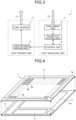
- FIG. 4 is a schematic diagram illustrating a configuration of a device to be applied to the light receiving unit 3 according to the embodiments of the present disclosure.
- the light receiving unit 3 is constituted of a light receiving tip 3a and a logic tip 3b that are laminated, each of which is constituted of a semiconductor chip.
- the light receiving tip 3a and the logic tip 3b are illustrated in a separated state.
- the SPAD elements 6a are arrayed in a two-dimensional grid in a region of the pixel array unit 6.
- the logic tip 3b is provided with the pulse outputting unit 7 and the control unit 8. Note that configurations of the light receiving tip 3a and the logic tip 3b are not limited to the example illustrated in FIG. 4 .
- FIG. 5 is a circuit diagram illustrating a configuration example the pulse outputting unit 7 according to the embodiments of the present disclosure.
- the pulse outputting unit 7 includes a passive circuit 10 and an active circuit 20.
- One of the above-mentioned passive circuit 10 and the above-mentioned active circuit 20 that is selected by the control unit 8 operates in accordance with a control signal transmitted from the control unit 8.
- the passive circuit 10 includes a P-type transistor 11, a P-type transistor 12, and an inverter 13.
- a source of the P-type transistor 11 is connected to a power source voltage Vdd, and a drain of the P-type transistor 11 is connected to a node 14.
- a source of the P-type transistor 12 is connected to the node 14, and a drain of the P-type transistor 12 is connected to a signal line 15.
- the above-mentioned signal line 15 connects between a cathode of the SPAD element 6a and an input terminal of the inverter 13 via a connector 6b of the pixel array unit 6.
- An anode of the SPAD element 6a is grounded, and an output terminal of the inverter 13 is connected to the control unit 8 (see FIG. 3 ) via a node 16.
- control unit 8 When the passive circuit 10 instead of the active circuit 20 is selected, the control unit 8 inputs a predetermined first reference voltage V REF1 to a gate of the P-type transistor 11, and further inputs a low-level selection signal Sa to a gate the P-type transistor 12.
- a predetermined current controlled by the first reference voltage V REF1 is supplied to a cathode of the SPAD element 6a via a supply path Rp including the P-type transistor 11 and the P-type transistor 12.
- the control unit 8 is capable of operating the SPAD element 6a.
- the control unit 8 When the passive circuit 10 is selected, the control unit 8 inputs a high-level selection signal Sb to a gate of a P-type transistor 22 in the active circuit 20 to be mentioned later, and further inputs a high-level selection signal Sc to a gate of a P-type transistor 23.
- the control unit 8 inputs a low-level selection signal Sd to an input terminal of a NAND circuit 24. Thus, current other than the above-mentioned predetermined current is not supplied to a cathode of the SPAD element 6a.
- FIG. 6 is a diagram illustrating, in the form of a timing chart, operation of the passive circuit 10 in the pulse outputting unit 7 according to the embodiments of the present disclosure.
- Reverse bias of a voltage Va is applied to the SPAD element 6a until it goes into a state immediately before avalanche amplification occurs, which is called Geiger mode.
- a signal S1 output from a cathode of the SPAD element 6a becomes the above-mentioned voltage Va.
- the voltage Va equal to or more than a threshold voltage Vth is input to the inverter 13 as the signal S1, and thus the inverter 13 outputs a low-level signal S2.
- the SPAD element 6a When at a time point T1, a single photon is made incident on the SPAD element 6a to which the voltage Va is applied, the SPAD element 6a is broken down and current flows into the supply path Rp. Thus, the signal S1 rapidly reduces from the voltage Va. When the signal S1 becomes smaller than the threshold voltage Vth at a time point T2, the inverter 13 outputs the high-level signal S2.
- Avalanche amplification in the SPAD element 6a stops at a time point T3, and thus the signal S1 stops reducing at a voltage Vb. Moreover, the SPAD element 6a is recharged via the supply path Rp, and thus the signal S1 rises (i.e. quenching operation).
- the inverter 13 At a time point T4 when the signal S1 becomes equal to or more than the threshold voltage Vth, the inverter 13 outputs the low-level signal S2. Finally, the SPAD element 6a returns to the voltage Va of an initial state at a time point T5, and the SPAD element 6a and the passive circuit 10 return to respective initial states.
- the passive circuit 10 converts, into a first pulse signal P1 by using the inverter 13, the signal S1 generated in the SPAD element 6a by incidence of a single photon so as to output the first pulse signal P1.
- the above-mentioned first pulse signal P1 is a signal having a pulse width from the time point T2 to the time point T4 in the example illustrated in FIG. 6 .
- a pulse width of the first pulse signal P1 is prescribed by a recovery time interval (time point T1 to time point T5) of the SPAD element 6a.
- the recovery time interval of the SPAD element 6a is decided by characteristics of the SPAD element 6a (for example, capacity of element) and a value of current supplied from the supply path Rp.
- the SPAD element 6a When there presents incidence of a new photon during the above-mentioned recovery time interval, the SPAD element 6a is not able to detect the above-mentioned new photon. This is because when the above-mentioned new photon is made incident, avalanche amplification again occurs in the SPAD element 6a, and thus even when a new photon is made incident during the recovery time interval, the total number of pulses of the first pulse signal P1 becomes one.
- a recovery time interval of the SPAD element 6a corresponds to a pulse width of the first pulse signal P1
- the above-mentioned pulse width of the first pulse signal P1 corresponds to a dead time of the SPAD element 6a.
- a recovery time interval of the SPAD element 6a is shorter, on the other hand, when a value of the supplied current is too large, avalanche amplification in the SPAD element 6a ceases to stop.
- a value of current to be supplied to the SPAD element 6a from the supply path Rp in the passive circuit 10 is not set to be equal to or larger than a determined value.
- a recovery time interval i.e. pulse width of first pulse signal P1
- the active circuit 20 is added to the pulse outputting unit 7 in order to further shorten a recovery time interval of the SPAD element 6a.
- the active circuit 20 is added to the pulse outputting unit 7 in order to further shorten a recovery time interval of the SPAD element 6a.
- the active circuit 20 includes the P-type transistor 11, the inverter 13, a P-type transistor 21, the P-type transistor 22, the P-type transistor 23, the NAND circuit 24, a delay circuit 25, and a P-type transistor 26.
- the delay circuit 25 includes four inverters 31 to 34.
- a source of the P-type transistor 21 is connected to the power source voltage Vdd, a drain of the P-type transistor 21 is connected to a source of the P-type transistor 22, and a gate of the P-type transistor 21 is connected to the node 16.
- a drain of the P-type transistor 22 is connected to the signal line 15.
- a source of the P-type transistor 23 is connected to the node 14, and a drain of the P-type transistor 23 is connected to the inverter 31 of the delay circuit 25.
- Two input terminals of the NAND circuit 24 are connected to the node 16 and an output terminal of the inverter 34.
- the selection signal Sd is input to another input terminal of the NAND circuit 24.
- An output terminal of the NAND circuit 24 is connected to an input terminal of the inverter 31.
- An output terminal of the inverter 31 is connected to an input terminal of the inverter 32.
- An output terminal of the inverter 32 is connected to an input terminal of the inverter 33.
- An output terminal of the inverter 33 is connected to an input terminal of the inverter 34.
- the NAND circuit 24 and the four inverters 31 to 34 constitute a ring oscillator.
- a source of the P-type transistor 26 is connected to the power source voltage Vdd, a drain of the P-type transistor 21 is connected to the signal line 15, and a gate of the P-type transistor 21 is connected to an output terminal of the inverter 34.
- the control unit 8 inputs the low-level selection signal Sb to a gate of the P-type transistor 22.
- the low-level signal S2 is input via the node 16 in an initial state.
- a predetermined current is supplied to a cathode of the SPAD element 6a by a first supply path Ra1 including the P-type transistor 21 and the P-type transistor 22.
- the control unit 8 is capable of operating the SPAD element 6a by using the above-mentioned predetermined current.
- the control unit 8 inputs a predetermined second reference voltage V REF2 to a gate of the P-type transistor 11, and further inputs the high-level selection signal Sa to a gate of the P-type transistor 12.
- control unit 8 inputs the low-level selection signal Sc to a gate of the P-type transistor 23, and further inputs the high-level selection signal Sd to an input terminal of the NAND circuit 24.
- a high-level signal S3 is input, in an initial state, to a gate of the P-type transistor 26.
- FIG. 7 is a diagram illustrating, in the form of a timing chart, operation of the active circuit 20 in the pulse outputting unit 7 according to the embodiments of the present disclosure.
- the voltage Va equal to or more than the threshold voltage Vth is input, as the signal S1, to the inverter 13, and thus the inverter 13 outputs the low-level signal S2.
- the low-level signal S2 is input to the NAND circuit 24 from the inverter 13, and thus the high-level signal S3 is output from the delay circuit 25.
- the SPAD element 6a When a single photon is made incident on the SPAD element 6a, at a time point T1a, to which the voltage Va is applied, the SPAD element 6a is broken down and current flows into the first supply path Ra1. Thus, the signal S1 rapidly reduces from the voltage Va. When the signal S1 becomes smaller than the threshold voltage Vth at a time point T2a, the inverter 13 outputs the high-level signal S2.
- Avalanche amplification stops at a time point T3a, and thus the signal S1 stops reducing at the voltage Vb.
- the signal S2 having turned into a high level at the time point T2a is input to a gate of the P-type transistor 21, and thus the first supply path Ra1 is cut.
- the signal S2 having turned into a high level at the time point T2a is also input to the NAND circuit 24.
- the high-level selection signal Sd and the high-level signal S3 are input to the NAND circuit 24, and thus the NAND circuit 24 outputs a low-level signal.
- the delay circuit 25 On the basis of a low-level signal transmitted from the above-mentioned the NAND circuit 24, the delay circuit 25 outputs the low-level signal S3 at a time point T4a after the time point T2a by a predetermined delay time.
- the signal S3 having turned to a low level at the above-mentioned time point T4a is input to a gate of the P-type transistor 26.
- the P-type transistor 26 is turned into an electric conductive state, and thus a second supply path Ra2 including the P-type transistor 26 opens in the active circuit 20.
- the SPAD element 6a is recharged via the above-mentioned second supply path Ra2 so that the signal S1 rises.
- the first supply path Ra1 and the second supply path Ra2 are provided as supply paths for supplying current to the SPAD element 6a.
- the first supply path Ra1 includes the P-type transistors 21 and 22 so as to supply current to the SPAD element 6a in an initial state and while avalanche amplification is occurring in the SPAD element 6a.
- the second supply path Ra2 includes the P-type transistor 26 so as to supply current to the SPAD element 6a after avalanche amplification has stopped in the SPAD element 6a.
- an internal resistance of the P-type transistor 26 is set to be smaller than an internal resistance of the P-type transistor 21.
- a resistance value of the second supply path Ra2 is set to be smaller than a resistance value of the first supply path Ra1.
- the second supply path Ra2 does not supply current while avalanche amplification is occurring in the SPAD element 6a. Therefore, even when an internal resistance of the P-type transistor 26 is set to be small, there presents no negative effect that avalanche amplification ceases to stop in the SPAD element 6a, for example.
- the first supply path Ra1 may have a resistance value to be able to supply a current value within a range in which the SPAD element 6a is able to normally operate.
- the inverter 13 outputs the low-level signal S2. Furthermore, at a time point T6a, the SPAD element 6a returns to the voltage Va in an initial state.
- the active circuit 20 converts, by using the inverter 13, the signal S1 having been generated in the SPAD element 6a by incidence of a single photon into a second pulse signal P2 so as to output the second pulse signal P2.
- the above-mentioned second pulse signal P2 is a signal having a pulse width from the time point T2a up to the time point T5a in the example illustrated in FIG. 7 .
- the signal S2 that becomes a low level at the time point T5a is input to a gate of the P-type transistor 21.
- a predetermined current is supplied to a cathode of the SPAD element 6a via the P-type transistor 21 and the P-type transistor 22.
- the signal S2 that becomes a low level at the time point T5a is input also to the NAND circuit 24.
- the NAND circuit 24 outputs a high-level signal
- the delay circuit 25 outputs the high-level signal S3 at a time point T7a after the time point T5a by a predetermined delay time.
- the signal S3 that becomes a high level at the time point T7a is input to a gate of the P-type transistor 26.
- the P-type transistor 26 becomes a cut state, and the SPAD element 6a and the active circuit 20 return to respective initial states.
- the active circuit 20 is provided with a plurality of supply paths (first supply path Ra1 and second supply path Ra2) for supplying current to a cathode of the SPAD element 6a to be able to rapidly recover the SPAD element 6a.
- a recovery time interval of the SPAD element 6a is able to be shortened, so that it is possible to shorten a dead time of the SPAD element 6a. Therefore, according to the embodiments, it is possible to enlarge a dynamic range of the distance measuring device 1.
- FIG. 8 is a diagram illustrating relation between amounts of incident light per frame of the passive circuit 10 and the active circuit 20 according to the embodiments of the present disclosure and the numbers of counts per frame.
- the number of counts per frame of the first pulse signal P1 output from the passive circuit 10 increases in proportion to an amount of incident light per frame.
- the number of counts per frame of the second pulse signal P2 output from the active circuit 20 increases in proportion to an amount of incident light per frame.
- the control unit 8 selects the passive circuit 10 when the number of counts is smaller than a number of threshold counts Cth just before start of the above-mentioned saturation, and selects the active circuit 20 when the number of counts is equal to or more than the number of threshold counts Cth.
- the second pulse signal P2 having the number of counts according to an amount of incident light. Therefore, according to the embodiments, it is possible to enlarge a dynamic range of the distance measuring device 1.
- a circuit configuration of the passive circuit 10 is simple, and thus power consumption thereof is lower than that of the active circuit 20. Therefore, when the number of counts is lower than the number of threshold counts Cth, the passive circuit 10 is selected so that power consumption of the pulse outputting unit 7 is able to be reduced.
- control unit 8 may select the passive circuit 10 from the next frame.
- control unit 8 may select the active circuit 20 from the next frame.
- a pulse width of the second pulse signal P2 may be set to be shorter than a pulse width of the first pulse signal P1.
- a pulse width of the second pulse signal P2 may be set on the basis of a delay time of the delay circuit 25. Thus, it is possible to reduce fluctuation in a pulse width of the second pulse signal P2.
- FIG. 9 is a circuit diagram illustrating a configuration example of the inverter 31 in the delay circuit 25 according to the embodiments of the present disclosure.
- the inverter 31 is configured as a CMOS circuit that is constituted of a P-type transistor 31a on an upper channel and an N-type transistor 31b on a lower channel.
- a source of the above-mentioned P-type transistor 31a on an upper channel is connected to the P-type transistor 11 that is a constant-current source.
- a delay time from the time point T5a to the time point T7a is able to be shorten than a delay time from the time point T2a to the time point T4a illustrated in FIG. 7 .
- a pulse width of the signal S3 is able to be shorten than a pulse width of the signal S2 (second pulse signal P2). The reason will be described below.
- the inverter 31 When the signal S2 is turned to a high level at the time point T2a, a low-level signal is input to the inverter 31 from the NAND circuit 24. Therefore, the inverter 31 outputs, to the inverter 32, a high-level signal from the P-type transistor 11 that is a constant-current source via the P-type transistor 31a turned into an electric conductive state.
- the second reference voltage VREF2 is input to the P-type transistor 11 as described above, when the above-mentioned second reference voltage VREF2 is controlled, a current amount supplied to the P-type transistor 31a is able to be limited.
- the N-type transistor 31b is directly connected to the ground, and thus it goes into an electric conductive state more rapidly than the P-type transistor 31a.
- the delay circuit 25 supplies current having a limited value to the inverter 31 at a first step to be able to shorten a pulse width of the signal S3 than a pulse width of the signal S2 (second pulse signal P2).
- the P-type transistor 11 shares a transistor that controls current supplied to the SPAD element 6a in the passive circuit 10 and a transistor that controls current supplied to the inverter 31 in the active circuit 20.
- a resistance value of the second supply path Ra2 may be set to be equal to a resistance value of the first supply path Ra1, or may be set to be larger than a resistance value of the first supply path Ra1.
- FIG. 10 is a circuit diagram illustrating a configuration example of the pulse outputting unit 7 according to a modification of the embodiments of the present disclosure.
- a configuration of a transistor that controls current supplied to the inverter 31 in the active circuit 20 is different from that according to the embodiments.
- a P-type transistor 27 is additionally provided as a transistor for controlling current to be supplied to the inverter 31 in the active circuit 20.
- a source of the P-type transistor 27 is connected to the power source voltage Vdd, and a drain of the P-type transistor 27 is connected to a source of the P-type transistor 23.
- the predetermined second reference voltage VREF2 is input to a gate of the P-type transistor 27.
- a transistor that controls current supplied to the SPAD element 6a in the passive circuit 10 is the P-type transistor 11 as well as the case of the embodiments.
- the predetermined first reference voltage V REF1 is input to a gate of the above-mentioned P-type transistor 11.
- a recovery time interval of the SPAD element 6a is able to be shortened, so that it is possible to shorten a dead time of the SPAD element 6a. Therefore, according to the modification, it is possible to enlarge a dynamic range of the distance measuring device 1.
- the modification is effective in a case where difference between a value of the first reference voltage V REF1 and a value of the second reference voltage VREF2 is large, and thus a rapid change in a gate voltage of the P-type transistor 11 is difficult.
- the control circuit includes the passive circuit 10 and the active circuit 20.
- the passive circuit 10 is configured to: supply current to the SPAD element 6a from the single supply path Rp; and output the first pulse signal P1 according to a signal generated in the SPAD element 6a.
- the active circuit 20 is configured to: supply current to the SPAD element 6a selectively from among a plurality of supply paths (first supply path Ra1 and second supply path Ra2); and output the second pulse signal P2 according to a signal generated in the SPAD element 6a.
- a pulse width of the second pulse signal P2 is shorter than a pulse width of the first pulse signal P1.
- the active circuit 20 includes the first supply path Ra1 and the second supply path Ra2.
- the first supply path Ra1 supplies current to the SPAD element 6a while avalanche amplification is occurring in the SPAD element 6a.
- the second supply path Ra2 supplies current to the SPAD element 6a after avalanche amplification is stopped in the SPAD element 6a.
- a recovery time interval of the SPAD element 6a is able to be shortened, so that it is possible to shorten a dead time of the SPAD element 6a.
- a resistance value of the second supply path Ra2 is smaller than a resistance value of the first supply path Ra1.
- the control circuit further includes the control unit 8 that controls the passive circuit 10 and the active circuit 20.
- the control unit 8 switches a circuit connected to the SPAD element 6a between the passive circuit 10 and the active circuit 20 in accordance with a number of counts per frame of the first pulse signal P1 or the second pulse signal P2 output from the passive circuit 10 or the active circuit 20.
- the active circuit 20 includes the delay circuit 25 to output the second pulse signal P2 having a pulse width based on a delay time of the delay circuit 25.
- the delay circuit 25 includes the inverter 31 to set the delay time based on a value of current supplied to the inverter 31.
- the control circuit according to the embodiments shares a transistor that controls current supplied to the SPAD element 6a in the passive circuit 10 and a transistor that controls current supplied to the inverter 31 in the active circuit 20.
Landscapes
- Physics & Mathematics (AREA)
- Engineering & Computer Science (AREA)
- General Physics & Mathematics (AREA)
- Remote Sensing (AREA)
- Computer Networks & Wireless Communication (AREA)
- Radar, Positioning & Navigation (AREA)
- Electromagnetism (AREA)
- Spectroscopy & Molecular Physics (AREA)
- Multimedia (AREA)
- Signal Processing (AREA)
- Optical Radar Systems And Details Thereof (AREA)
- Electronic Switches (AREA)
- Measurement Of Optical Distance (AREA)
- Light Receiving Elements (AREA)
Description
- The present disclosure relates to a control circuit and a distance measuring system.
- There has been known a distance measuring technique that is called a direct Time-of-Flight (ToF) method as one of distance measuring methods for measuring, with the use of light, a distance up to an object to be measured. In the above-mentioned direct ToF method, a light receiving element receives reflected light of light having been emitted from a light source which is reflected from an object to be measured so as to measure a distance up to a target on the basis of a time interval from emission of the light until reception of the reflected light (see
Patent Literature 1, for example). -
US 2017/131143 A1 describes a photodetection circuit including an avalanche photodiode and a mode switching circuit that may be configured to selectively switch an operating mode of the photodetection circuit between linear mode and Geiger mode. The photodetection circuit may further include a quenching circuit configured to quench and reset the avalanche photodiode in response to an avalanche event when the photodetection circuit is operated in Geiger mode. The photodetection circuit may additionally include an integration circuit configured to integrate photocurrent output by the photodiode and generate integrated charge units when the photodetection circuit is operated in linear mode. The photodetection circuit may also include a counter configured to count pulses output by the avalanche photodiode when the photodetection circuit is operated in Geiger mode and to count integrated charge units generated by the integration circuit when the photodetection circuit is operated in linear mode. -
US 2011/266420 A1 describes a system, a method and an apparatus of reduction of delay between subsequent capture operations of a light-detection device. In one embodiment, a light-detection circuit includes an avalanche photodiode implemented in a deep submicron CMOS technology. In addition, the light-detection circuit includes a passive quench control circuit to create an avalanche current that generates a high voltage at an output of a second inverter gate of the circuit. The light-detection circuit further includes an active quench control circuit to reduce a dead time of the circuit. The light-detection circuit also includes a reset circuit to create a low voltage at an output of the second inverter gate and to create an active reset through a PMOS transistor of the light-detection circuit. - Patent Literature 1:
JP 2014-081254 A - However, in the above-mentioned conventional technology, when a Single Photon Avalanche Diode (SPAD) element receives again reflected light at interval shorter than a dead time of the SPAD element that is used as a light receiving element, detection of the above-mentioned following reflected light is difficult.
- Furthermore, in the above-mentioned conventional technology, a dynamic range of a distance measuring system is rate-controlled by a dead time of the SPAD element. Therefore, it is difficult to enlarge a dynamic range of the distance measuring system unless a dead time of the [0006] Therefore, in the present disclosure, there are proposed a control circuit and a distance measuring system capable of enlarging a dynamic range.
SPAD element is shortened. - The invention is defined by the appended claims.
- References to embodiments which do not fall under the scope of the claims are to be understood as examples useful for understanding the invention.
- According to the present disclosure, there is provided a control circuit according to
claim 1. - Further advantageous embodiments are provided in the dependent claims.
- According to the present disclosure, it is possible to enlarge a dynamic range. It is noted that the above effects are not necessarily limited, and, along with or instead of the above effects, any of the effects described in the present specification or other effects which can be understood from the present specification may be exhibited.
-
-
FIG. 1 is a schematic diagram illustrating distance measurement by a direct ToF method to be applied to embodiments according to the present disclosure. -
FIG. 2 is a histogram illustrating one example based on a time point at which a light receiving unit to be applied to the embodiments according to the present disclosure receives light. -
FIG. 3 is a block diagram illustrating a configuration example of a distance measuring device according to the embodiments of the present disclosure. -
FIG. 4 is a schematic diagram illustrating a configuration of a device to be applied to a light receiving unit according to the embodiments of the present disclosure. -
FIG. 5 is a circuit diagram illustrating a configuration example a pulse outputting unit according to the embodiments of the present disclosure. -
FIG. 6 is a diagram illustrating, in the form of a timing chart, operation of a passive circuit in the pulse outputting unit according to the embodiments of the present disclosure. -
FIG. 7 is a diagram illustrating, in the form of a timing chart, operation of an active circuit in the pulse outputting unit according to the embodiments of the present disclosure. -
FIG. 8 is a diagram illustrating relation between amounts of incident light per frame of the passive circuit and the active circuit according to the embodiments of the present disclosure and the numbers of counts per frame. -
FIG. 9 is a circuit diagram illustrating a configuration example of an inverter in a delay circuit according to the embodiments of the present disclosure. -
FIG. 10 is a circuit diagram illustrating a configuration example of a pulse outputting unit according to a modification of the embodiments of the present disclosure. - Hereinafter, embodiments according to the present disclosure will be specifically explained with reference to accompanying drawings. In the following embodiments, the same part is provided with the same reference symbol so as to avoid duplicated explanation.
- As one of distance measuring methods for measuring, by using light, a distance up to an object to be measured, there has been known a distance measuring technique that is referred to as a direct ToF method. In the above-mentioned direct ToF method, reflected light that is reflected from an object to be measured, which has been emitted from a light source, is received by a light receiving element, and a distance up to a target is measured on the basis of a time interval from emission of light up to reception of the light as reflected light.
- However, in the above-mentioned conventional technology, when a Single Photon Avalanche Diode (SPAD) element receives again reflected light at interval shorter than a dead time of the SPAD element that is used as a light receiving element, detection of the above-mentioned following reflected light is difficult.
- Furthermore, in the above-mentioned conventional technology, a dynamic range of a distance measuring system is rate-controlled by a dead time of the SPAD element. Therefore, it is difficult to enlarge a dynamic range of the distance measuring system unless a dead time of the SPAD element is shortened.
- The above-mentioned dead time of the SPAD element is decided by a value of current supplied to the SPAD element, and when a value of the above-mentioned supplied current is increased, the dead time of the SPAD element is able to be shortened.
- On the other hand, when a value of current supplied to an SPAD element is too large, there may occur a negative effect that avalanche amplification having occurred in the SPAD element does not stop when the SPAD element receives light.
- Thus, there has been desired achievement of a control circuit and a distance measuring system capable of overcoming the above-mentioned problem and enlarging a dynamic range.
- The present disclosure relates to a technology for measuring a distance with the use of light. For convenience of explanation of embodiments according to the present disclosure, with reference to
FIGS. 1 and 2 , a distance measuring method to be applied to the embodiments will be explained. -
FIG. 1 is a schematic diagram illustrating distance measurement by a direct ToF method to be applied to the embodiments according to the present disclosure. In the embodiments, a direct ToF method is employed as a distance measuring method. - In the above-mentioned direct ToF method, a
light receiving unit 3 receives reflected light L2 of the emission light L1 having been emitted from alight source unit 2 which is reflected from an object to be measured 100, so as to measure a distance on the basis of a difference time interval between a light emitting timing and a light receiving timing. - A
distance measuring device 1 includes thelight source unit 2 and thelight receiving unit 3. The distance measuringdevice 1 is one example of a distance measuring system. Thelight source unit 2 includes a light source 4 (seeFIG. 3 ) such as a laser diode, and is driven so as to emit laser light in a pulse form. - The emission light L1 emitted from the
light source unit 2 is reflected from the object to be measured 100 to be received by thelight receiving unit 3 as the reflected light L2. Thelight receiving unit 3 includes a pixel array unit 6 (seeFIG. 3 ) that converts light into an electrical signal by photoelectric conversion, so as to output a signal according to received light. - A time point (light emitting timing) is defined as a time point t0 at which the
light source unit 2 emits light, and a time point (light receiving timing) is defined as a time point t1 at which thelight receiving unit 3 receives the reflected light L2 of the emission light L1 having been emitted from thelight source unit 2 which is reflected from the object to be measured 100. - When a constant number c is defined as the speed of light (2.9979 × 10⁸ [m / sec]), a distance D between the distance measuring
device 1 and the object to be measured 100 is calculated by the following formula (1).
- The
distance measuring device 1 may repeatedly execute the above-mentioned process at a plurality of times. Thelight receiving unit 3 may include a plurality ofSPAD elements 6a (seeFIG. 4 ), and the distance D may be individually computed on the basis of a light receiving timing at which each of theSPAD elements 6a receives the reflected light L2. - The
distance measuring device 1 classifies, on the basis of bins, a time interval tm (hereinafter, may be referred to as "light receiving time interval tm") from the time point t0 of a light emitting timing until a light receiving timing at which thelight receiving unit 3 receives light, so as to generate a histogram. -
FIG. 2 is a histogram illustrating one example based on a time point at which thelight receiving unit 3 to be applied to the embodiments according to the present disclosure receives light. InFIG. 2 , a lateral axis indicates a bin, and a vertical axis indicates a frequency for each bin. A bin is obtained by classifying the light receiving time interval tm for each predetermined unit time interval d. - Specifically, a
bin # 0 satisfies 0 ≤ tm < d, abin # 1 satisfies d ≤ tm < 2 × d, abin # 2 satisfies 2 × d ≤ tm < 3 × d, ..., a bin #(N-2) satisfies (N-2) × d ≤ tm < (N-1) × d. When an exposure time interval of thelight receiving unit 3 is defined as a time interval tep, there is satisfied tep = N × d. - The
distance measuring device 1 counts, on the basis of a bin, the number of acquisition times of the light receiving time interval tm, and obtains afrequency 200 for each bin so as to generate a histogram. Herein, thelight receiving unit 3 receives light other than the reflected light L2 that is the reflected light of the emission light L1 emitted from thelight source unit 2. - For example, as an example of light other than the reflected light L2 to be a target, there presents ambient light in the periphery of the
distance measuring device 1. The above-mentioned ambient light is light that is made incident on thelight receiving unit 3 at random, and anambient light component 201 in a histogram due to ambient light becomes noise for the reflected light L2 to be a target. - On the other hand, the reflected light L2 to be a target is light that is received in accordance with a specific distance, and appears as an active
light component 202 in a histogram. A bin corresponding to a frequency of a peak in the activelight component 202 is a bin corresponding to the distance D of the object to be measured 100. - The
distance measuring device 1 acquires, as the above-mentioned time point t1, a representative time point (for example, time point at center of bin) of the bin to be able to compute the distance D up to the object to be measured 100 in accordance with the above-mentioned formula (1). As described above, by using a plurality of light reception results, it is possible to execute appropriate distance measurement in spite of random noise. - Next, a configuration of the
distance measuring device 1 according to the embodiments will be explained with reference toFIGS. 3 and 4. FIG. 3 is a block diagram illustrating a configuration example of thedistance measuring device 1 according to the embodiments of the present disclosure. As described above, thedistance measuring device 1 includes thelight source unit 2 and thelight receiving unit 3. - The
light source unit 2 includes thelight source 4 and a light-source driving unit 5. Thelight source 4 is constituted of a laser diode such as a Vertical Cavity Surface Emitting LASER (VCSEL). For thelight source 4, not limited to the VCSEL, a laser diode array in which laser diodes are arrayed on a line and the like may be employed. - The light-
source driving unit 5 drives thelight source 4. The light-source driving unit 5 drives thelight source 4 such that the emission light L1 having a predetermined timing and a predetermined pulse width is emitted from thelight source 4 on the basis of a light-emission control signal transmitted from acontrol unit 8 of thelight receiving unit 3, for example. - The light-
source driving unit 5 is capable of driving thelight source 4 such that by using laser light emitted from thelight source 4 including laser diodes arrayed in a line, scanning is performed in a direction perpendicular to the line, for example. - The
light receiving unit 3 includes thepixel array unit 6, apulse outputting unit 7, and thecontrol unit 8. - The
pixel array unit 6 includes the plurality ofSPAD elements 6a (seeFIG. 4 ) arrayed in a two-dimensional grid. The above-mentionedSPAD element 6a applies, to a cathode, a large reverse bias voltage generated by avalanche multiplication, and the avalanche multiplication occurs therein caused by electrons generated in response to incidence of a single photon. - In other words, the
SPAD element 6a has a characteristic that a large current flows therethrough in response to incidence of a single photon. By using the above-mentioned characteristic, theSPAD element 6a is capable of detecting incidence of a single photon included in the reflected light L2 with a high sensitivity. - Operation of the plurality of
SPAD elements 6a in thepixel array unit 6 is controlled by thecontrol unit 8. For example, thecontrol unit 8 is capable of controlling reading out of a signal from each of theSPAD elements 6a, for each block including the n × mSPAD elements 6a constituted of n pixels in a row direction multiplied by m pixels in a column direction. - For each of the blocks as a unit, the
control unit 8 scans theSPAD elements 6a in a row direction and further executes scanning in a column direction for each row to be able to read out signals from theSPAD elements 6a. - Note that in the embodiments, the
control unit 8 may individually reads out a signal from each of theSPAD elements 6a. Signals generated in theSPAD elements 6a in thepixel array unit 6 are supplied to thepulse outputting unit 7. - In response to signals generated in the
SPAD elements 6a, thepulse outputting unit 7 outputs, as a digital signal, a predetermined pulse signal to thecontrol unit 8. Details of the above-mentionedpulse outputting unit 7 will be mentioned later. - The
control unit 8 controls whole operation of thedistance measuring device 1 in accordance with a preliminarily-implemented program, for example. Thecontrol unit 8 controls the light-source driving unit 5 so as to control a light emitting timing of thelight source 4, for example. - The
control unit 8 generates a histogram illustrated inFIG. 2 on the basis of pulse signals output from thepulse outputting unit 7. Thecontrol unit 8 executes a predetermined operation process on the basis of data on the generated histogram, so as to compute the distance D up to the object to be measured 100. -
FIG. 4 is a schematic diagram illustrating a configuration of a device to be applied to thelight receiving unit 3 according to the embodiments of the present disclosure. InFIG. 4 , thelight receiving unit 3 is constituted of a light receiving tip 3a and alogic tip 3b that are laminated, each of which is constituted of a semiconductor chip. InFIG. 4 , for convenience of explanation, the light receiving tip 3a and thelogic tip 3b are illustrated in a separated state. - In the light receiving tip 3a, the
SPAD elements 6a are arrayed in a two-dimensional grid in a region of thepixel array unit 6. Thelogic tip 3b is provided with thepulse outputting unit 7 and thecontrol unit 8. Note that configurations of the light receiving tip 3a and thelogic tip 3b are not limited to the example illustrated inFIG. 4 . - Next, a configuration and operation of the
pulse outputting unit 7 according to the embodiments will be explained with reference toFIGS. 5 to 9 .FIG. 5 is a circuit diagram illustrating a configuration example thepulse outputting unit 7 according to the embodiments of the present disclosure. - As illustrated in
FIG. 5 , thepulse outputting unit 7 includes apassive circuit 10 and anactive circuit 20. One of the above-mentionedpassive circuit 10 and the above-mentionedactive circuit 20 that is selected by thecontrol unit 8 operates in accordance with a control signal transmitted from thecontrol unit 8. - Thus, a configuration and operation of the
passive circuit 10 will be first explained. Thepassive circuit 10 includes a P-type transistor 11, a P-type transistor 12, and aninverter 13. - A source of the P-
type transistor 11 is connected to a power source voltage Vdd, and a drain of the P-type transistor 11 is connected to anode 14. A source of the P-type transistor 12 is connected to thenode 14, and a drain of the P-type transistor 12 is connected to asignal line 15. - The above-mentioned
signal line 15 connects between a cathode of theSPAD element 6a and an input terminal of theinverter 13 via aconnector 6b of thepixel array unit 6. An anode of theSPAD element 6a is grounded, and an output terminal of theinverter 13 is connected to the control unit 8 (seeFIG. 3 ) via anode 16. - When the
passive circuit 10 instead of theactive circuit 20 is selected, thecontrol unit 8 inputs a predetermined first reference voltage VREF1 to a gate of the P-type transistor 11, and further inputs a low-level selection signal Sa to a gate the P-type transistor 12. - Thus, a predetermined current controlled by the first reference voltage VREF1 is supplied to a cathode of the
SPAD element 6a via a supply path Rp including the P-type transistor 11 and the P-type transistor 12. By using the above-mentioned predetermined current, thecontrol unit 8 is capable of operating theSPAD element 6a. - When the
passive circuit 10 is selected, thecontrol unit 8 inputs a high-level selection signal Sb to a gate of a P-type transistor 22 in theactive circuit 20 to be mentioned later, and further inputs a high-level selection signal Sc to a gate of a P-type transistor 23. - The
control unit 8 inputs a low-level selection signal Sd to an input terminal of aNAND circuit 24. Thus, current other than the above-mentioned predetermined current is not supplied to a cathode of theSPAD element 6a. - Next, with reference to
FIG. 6 in addition toFIG. 5 , operation of thepassive circuit 10 will be explained.FIG. 6 is a diagram illustrating, in the form of a timing chart, operation of thepassive circuit 10 in thepulse outputting unit 7 according to the embodiments of the present disclosure. - Reverse bias of a voltage Va is applied to the
SPAD element 6a until it goes into a state immediately before avalanche amplification occurs, which is called Geiger mode. In other words, in an initial state, a signal S1 output from a cathode of theSPAD element 6a becomes the above-mentioned voltage Va. The voltage Va equal to or more than a threshold voltage Vth is input to theinverter 13 as the signal S1, and thus theinverter 13 outputs a low-level signal S2. - When at a time point T1, a single photon is made incident on the
SPAD element 6a to which the voltage Va is applied, theSPAD element 6a is broken down and current flows into the supply path Rp. Thus, the signal S1 rapidly reduces from the voltage Va. When the signal S1 becomes smaller than the threshold voltage Vth at a time point T2, theinverter 13 outputs the high-level signal S2. - Avalanche amplification in the
SPAD element 6a stops at a time point T3, and thus the signal S1 stops reducing at a voltage Vb. Moreover, theSPAD element 6a is recharged via the supply path Rp, and thus the signal S1 rises (i.e. quenching operation). - At a time point T4 when the signal S1 becomes equal to or more than the threshold voltage Vth, the
inverter 13 outputs the low-level signal S2. Finally, theSPAD element 6a returns to the voltage Va of an initial state at a time point T5, and theSPAD element 6a and thepassive circuit 10 return to respective initial states. - As described above, the
passive circuit 10 converts, into a first pulse signal P1 by using theinverter 13, the signal S1 generated in theSPAD element 6a by incidence of a single photon so as to output the first pulse signal P1. The above-mentioned first pulse signal P1 is a signal having a pulse width from the time point T2 to the time point T4 in the example illustrated inFIG. 6 . - As illustrated in
FIG. 6 , a pulse width of the first pulse signal P1 is prescribed by a recovery time interval (time point T1 to time point T5) of theSPAD element 6a. The recovery time interval of theSPAD element 6a is decided by characteristics of theSPAD element 6a (for example, capacity of element) and a value of current supplied from the supply path Rp. - When there presents incidence of a new photon during the above-mentioned recovery time interval, the
SPAD element 6a is not able to detect the above-mentioned new photon. This is because when the above-mentioned new photon is made incident, avalanche amplification again occurs in theSPAD element 6a, and thus even when a new photon is made incident during the recovery time interval, the total number of pulses of the first pulse signal P1 becomes one. - In other words, a recovery time interval of the
SPAD element 6a corresponds to a pulse width of the first pulse signal P1, and the above-mentioned pulse width of the first pulse signal P1 corresponds to a dead time of theSPAD element 6a. - Herein, as a value of current supplied from the supply path Rp is larger, a recovery time interval of the
SPAD element 6a is shorter, on the other hand, when a value of the supplied current is too large, avalanche amplification in theSPAD element 6a ceases to stop. - Therefore, a value of current to be supplied to the
SPAD element 6a from the supply path Rp in thepassive circuit 10 is not set to be equal to or larger than a determined value. - In other words, when current is supplied from the
passive circuit 10 to theSPAD element 6a, it is difficult to set a recovery time interval (i.e. pulse width of first pulse signal P1) of theSPAD element 6a to be equal to or shorter than a time interval decided by a current value within a range in which theSPAD element 6a is able to normally operate. - Thus, in the embodiments, the
active circuit 20 is added to thepulse outputting unit 7 in order to further shorten a recovery time interval of theSPAD element 6a. Returning toFIG. 5 , a circuit configuration of the above-mentionedactive circuit 20 will be explained. - The
active circuit 20 includes the P-type transistor 11, theinverter 13, a P-type transistor 21, the P-type transistor 22, the P-type transistor 23, theNAND circuit 24, adelay circuit 25, and a P-type transistor 26. Thedelay circuit 25 includes fourinverters 31 to 34. - A source of the P-
type transistor 21 is connected to the power source voltage Vdd, a drain of the P-type transistor 21 is connected to a source of the P-type transistor 22, and a gate of the P-type transistor 21 is connected to thenode 16. A drain of the P-type transistor 22 is connected to thesignal line 15. - A source of the P-
type transistor 23 is connected to thenode 14, and a drain of the P-type transistor 23 is connected to theinverter 31 of thedelay circuit 25. - Two input terminals of the
NAND circuit 24 are connected to thenode 16 and an output terminal of theinverter 34. The selection signal Sd is input to another input terminal of theNAND circuit 24. - An output terminal of the
NAND circuit 24 is connected to an input terminal of theinverter 31. An output terminal of theinverter 31 is connected to an input terminal of theinverter 32. An output terminal of theinverter 32 is connected to an input terminal of theinverter 33. An output terminal of theinverter 33 is connected to an input terminal of theinverter 34. - In other words, in the
active circuit 20, theNAND circuit 24 and the fourinverters 31 to 34 constitute a ring oscillator. - A source of the P-
type transistor 26 is connected to the power source voltage Vdd, a drain of the P-type transistor 21 is connected to thesignal line 15, and a gate of the P-type transistor 21 is connected to an output terminal of theinverter 34. - Herein, when the
active circuit 20 instead of thepassive circuit 10 is selected, thecontrol unit 8 inputs the low-level selection signal Sb to a gate of the P-type transistor 22. To a gate of the P-type transistor 21 that is connected to the P-type transistor 22 in serial, the low-level signal S2 is input via thenode 16 in an initial state. - Thus, in an initial state, a predetermined current is supplied to a cathode of the
SPAD element 6a by a first supply path Ra1 including the P-type transistor 21 and the P-type transistor 22. Thecontrol unit 8 is capable of operating theSPAD element 6a by using the above-mentioned predetermined current. - The
control unit 8 inputs a predetermined second reference voltage VREF2 to a gate of the P-type transistor 11, and further inputs the high-level selection signal Sa to a gate of the P-type transistor 12. - Furthermore, the
control unit 8 inputs the low-level selection signal Sc to a gate of the P-type transistor 23, and further inputs the high-level selection signal Sd to an input terminal of theNAND circuit 24. A high-level signal S3 is input, in an initial state, to a gate of the P-type transistor 26. - Thus, in an initial state, current is not supplied to a cathode of the
SPAD element 6a from other than the above-mentioned first supply path Ra1. - Next, with reference to
FIG. 7 in addition toFIG. 5 , operation of theactive circuit 20 will be explained.FIG. 7 is a diagram illustrating, in the form of a timing chart, operation of theactive circuit 20 in thepulse outputting unit 7 according to the embodiments of the present disclosure. - Similarly to the
passive circuit 10, also in theactive circuit 20, reverse bias of the voltage Va is applied to theSPAD element 6a until it goes into a state immediately before avalanche amplification occurs. In other words, in an initial state, the signal S1 output from a cathode of theSPAD element 6a becomes the above-mentioned voltage Va. - The voltage Va equal to or more than the threshold voltage Vth is input, as the signal S1, to the
inverter 13, and thus theinverter 13 outputs the low-level signal S2. The low-level signal S2 is input to theNAND circuit 24 from theinverter 13, and thus the high-level signal S3 is output from thedelay circuit 25. - When a single photon is made incident on the
SPAD element 6a, at a time point T1a, to which the voltage Va is applied, theSPAD element 6a is broken down and current flows into the first supply path Ra1. Thus, the signal S1 rapidly reduces from the voltage Va. When the signal S1 becomes smaller than the threshold voltage Vth at a time point T2a, theinverter 13 outputs the high-level signal S2. - Avalanche amplification stops at a time point T3a, and thus the signal S1 stops reducing at the voltage Vb. On the other hand, in the
active circuit 20, the signal S2 having turned into a high level at the time point T2a is input to a gate of the P-type transistor 21, and thus the first supply path Ra1 is cut. - Thus, a cathode of the
SPAD element 6a goes into a floating state being cut from the power source voltage Vdd. Therefore, the signal S1 is fixed to the voltage Vb also after the time point T3a. - Furthermore, the signal S2 having turned into a high level at the time point T2a is also input to the
NAND circuit 24. At a timing of the time point T2a, the high-level selection signal Sd and the high-level signal S3 are input to theNAND circuit 24, and thus theNAND circuit 24 outputs a low-level signal. - On the basis of a low-level signal transmitted from the above-mentioned the
NAND circuit 24, thedelay circuit 25 outputs the low-level signal S3 at a time point T4a after the time point T2a by a predetermined delay time. - The signal S3 having turned to a low level at the above-mentioned time point T4a is input to a gate of the P-
type transistor 26. Thus, the P-type transistor 26 is turned into an electric conductive state, and thus a second supply path Ra2 including the P-type transistor 26 opens in theactive circuit 20. - Therefore, the
SPAD element 6a is recharged via the above-mentioned second supply path Ra2 so that the signal S1 rises. - In other words, in the
active circuit 20 according to the embodiments, the first supply path Ra1 and the second supply path Ra2 are provided as supply paths for supplying current to theSPAD element 6a. The first supply path Ra1 includes the P-type transistors SPAD element 6a in an initial state and while avalanche amplification is occurring in theSPAD element 6a. - The second supply path Ra2 includes the P-
type transistor 26 so as to supply current to theSPAD element 6a after avalanche amplification has stopped in theSPAD element 6a. - In the embodiments, it is preferable that an internal resistance of the P-
type transistor 26 is set to be smaller than an internal resistance of the P-type transistor 21. In other words, in the embodiments, it is preferable that a resistance value of the second supply path Ra2 is set to be smaller than a resistance value of the first supply path Ra1. - Thus, a large current is able to be supplied to the
SPAD element 6a from the second supply path Ra2 so that theSPAD element 6a is able to be recharged more rapidly than thepassive circuit 10. - The second supply path Ra2 does not supply current while avalanche amplification is occurring in the
SPAD element 6a. Therefore, even when an internal resistance of the P-type transistor 26 is set to be small, there presents no negative effect that avalanche amplification ceases to stop in theSPAD element 6a, for example. - Similarly to the supply path Rp of the
passive circuit 10, the first supply path Ra1 may have a resistance value to be able to supply a current value within a range in which theSPAD element 6a is able to normally operate. - At a time point T5a when the signal S1 becomes equal to or more than the threshold voltage Vth, the
inverter 13 outputs the low-level signal S2. Furthermore, at a time point T6a, theSPAD element 6a returns to the voltage Va in an initial state. - As described above, the
active circuit 20 converts, by using theinverter 13, the signal S1 having been generated in theSPAD element 6a by incidence of a single photon into a second pulse signal P2 so as to output the second pulse signal P2. The above-mentioned second pulse signal P2 is a signal having a pulse width from the time point T2a up to the time point T5a in the example illustrated inFIG. 7 . - The signal S2 that becomes a low level at the time point T5a is input to a gate of the P-
type transistor 21. Thus, a predetermined current is supplied to a cathode of theSPAD element 6a via the P-type transistor 21 and the P-type transistor 22. - Moreover, the signal S2 that becomes a low level at the time point T5a is input also to the
NAND circuit 24. Thus, theNAND circuit 24 outputs a high-level signal, and thus thedelay circuit 25 outputs the high-level signal S3 at a time point T7a after the time point T5a by a predetermined delay time. - The signal S3 that becomes a high level at the time point T7a is input to a gate of the P-
type transistor 26. Thus, the P-type transistor 26 becomes a cut state, and theSPAD element 6a and theactive circuit 20 return to respective initial states. - As described above, the
active circuit 20 according to the embodiments is provided with a plurality of supply paths (first supply path Ra1 and second supply path Ra2) for supplying current to a cathode of theSPAD element 6a to be able to rapidly recover theSPAD element 6a. - Thus, a recovery time interval of the
SPAD element 6a is able to be shortened, so that it is possible to shorten a dead time of theSPAD element 6a. Therefore, according to the embodiments, it is possible to enlarge a dynamic range of thedistance measuring device 1. - The switching process between the
passive circuit 10 and theactive circuit 20 is performed by thecontrol unit 8 in accordance with a procedure illustrated inFIG. 8. FIG. 8 is a diagram illustrating relation between amounts of incident light per frame of thepassive circuit 10 and theactive circuit 20 according to the embodiments of the present disclosure and the numbers of counts per frame. - As illustrated in
FIG. 8 , within a range in which an amount of incident light per frame with respect to thepixel array unit 6 is small, the number of counts per frame of the first pulse signal P1 output from thepassive circuit 10 increases in proportion to an amount of incident light per frame. - Similarly, within a range in which an amount of incident light per frame with respect to the
pixel array unit 6 is small, the number of counts per frame of the second pulse signal P2 output from theactive circuit 20 increases in proportion to an amount of incident light per frame. - On the other hand, when an amount of incident light per frame with respect to the
pixel array unit 6 gradually increases, the number of counts of the first pulse signal P1 output from thepassive circuit 10 is saturated earlier than the number of counts of the second pulse signal P2 output from theactive circuit 20. This is because when thepassive circuit 10 is selected, a dead time of theSPAD element 6a is longer than that of theactive circuit 20. - The
control unit 8 selects thepassive circuit 10 when the number of counts is smaller than a number of threshold counts Cth just before start of the above-mentioned saturation, and selects theactive circuit 20 when the number of counts is equal to or more than the number of threshold counts Cth. - Thus, even when the number of counts is equal to or more than the number of threshold counts Cth, it is possible to output the second pulse signal P2 having the number of counts according to an amount of incident light. Therefore, according to the embodiments, it is possible to enlarge a dynamic range of the
distance measuring device 1. - On the other hand, a circuit configuration of the
passive circuit 10 is simple, and thus power consumption thereof is lower than that of theactive circuit 20. Therefore, when the number of counts is lower than the number of threshold counts Cth, thepassive circuit 10 is selected so that power consumption of thepulse outputting unit 7 is able to be reduced. - For example, when the
active circuit 20 is selected and the number of counts of one frame is lower than the number of threshold counts Cth, thecontrol unit 8 may select thepassive circuit 10 from the next frame. - When the
passive circuit 10 is selected and the number of counts of one frame is equal to or more than the number of threshold counts Cth, thecontrol unit 8 may select theactive circuit 20 from the next frame. - In the embodiments, a pulse width of the second pulse signal P2 may be set to be shorter than a pulse width of the first pulse signal P1. Thus, when the
active circuit 20 is selected, a dead time of theSPAD element 6a is able to be shortened. - Therefore, according to the embodiments, it is possible to enlarge a dynamic range of the
distance measuring device 1. - Moreover, in the embodiments, a pulse width of the second pulse signal P2 may be set on the basis of a delay time of the
delay circuit 25. Thus, it is possible to reduce fluctuation in a pulse width of the second pulse signal P2. - Therefore, according to the embodiments, it is possible to avoid an erroneous non-detection of the second pulse signal P2 by the
control unit 8 due to an excessive reduction in a pulse width of the second pulse signal P2. - Moreover, in the embodiments, as illustrated in
FIG. 9 , by using the P-type transistor 11 that functions as a constant-current source, current may be supplied to theinverter 31 of thedelay circuit 25.FIG. 9 is a circuit diagram illustrating a configuration example of theinverter 31 in thedelay circuit 25 according to the embodiments of the present disclosure. - As illustrated in
FIG. 9 , theinverter 31 is configured as a CMOS circuit that is constituted of a P-type transistor 31a on an upper channel and an N-type transistor 31b on a lower channel. A source of the above-mentioned P-type transistor 31a on an upper channel is connected to the P-type transistor 11 that is a constant-current source. - Thus, a delay time from the time point T5a to the time point T7a is able to be shorten than a delay time from the time point T2a to the time point T4a illustrated in
FIG. 7 . In other words, a pulse width of the signal S3 is able to be shorten than a pulse width of the signal S2 (second pulse signal P2). The reason will be described below. - When the signal S2 is turned to a high level at the time point T2a, a low-level signal is input to the
inverter 31 from theNAND circuit 24. Therefore, theinverter 31 outputs, to theinverter 32, a high-level signal from the P-type transistor 11 that is a constant-current source via the P-type transistor 31a turned into an electric conductive state. - The second reference voltage VREF2 is input to the P-
type transistor 11 as described above, when the above-mentioned second reference voltage VREF2 is controlled, a current amount supplied to the P-type transistor 31a is able to be limited. - Thus, in the embodiments, it is possible to extend a delay time from a time point at which a low-level signal is input to the
inverter 31 until a time point at which theinverter 31 outputs a high-level signal. - On the other hand, when the signal S2 is turned to a low level at the time point T5a, a high-level signal is input to the
inverter 31 from theNAND circuit 24. Therefore, theinverter 31 outputs from the ground, to theinverter 32, a low-level signal via the N-type transistor 31b turned to an electric conductive state. - Furthermore, the N-
type transistor 31b is directly connected to the ground, and thus it goes into an electric conductive state more rapidly than the P-type transistor 31a. Thus, in the embodiments, it is possible to shorten a delay time from a time point at which a high-level signal is input to theinverter 31 to a time point at which theinverter 31 outputs a low-level signal. - As described above, the
delay circuit 25 supplies current having a limited value to theinverter 31 at a first step to be able to shorten a pulse width of the signal S3 than a pulse width of the signal S2 (second pulse signal P2). - Thus, in the embodiments, it is possible to avoid a phenomenon where a pulse width of the second pulse signal P2 is too shortened to be detected by the
control unit 8, and further to rapidly return thedelay circuit 25 to an initial state. - In the embodiments, the P-
type transistor 11 shares a transistor that controls current supplied to theSPAD element 6a in thepassive circuit 10 and a transistor that controls current supplied to theinverter 31 in theactive circuit 20. - Thus, it is possible to minimize deterioration in mismatch characteristics between the
passive circuit 10 and theactive circuit 20, which becomes a problem in limiting a layout of thepulse outputting unit 7. Therefore, according to the embodiments, it is possible to maximize enlargement in a dynamic range of thedistance measuring device 1. - In the embodiments, an example has been described in which current having a limited value is supplied to the
inverter 31 at a first step in thedelay circuit 25; however, current having a limited value may be supplied to any inverter as long as the inverter (for example,inverter 33 at third step) is at an odd-numbered step. - In the embodiments, a resistance value of the second supply path Ra2 may be set to be equal to a resistance value of the first supply path Ra1, or may be set to be larger than a resistance value of the first supply path Ra1.
- Next, a modification of the embodiments will be explained with reference to
FIG. 10. FIG. 10 is a circuit diagram illustrating a configuration example of thepulse outputting unit 7 according to a modification of the embodiments of the present disclosure. - In the present modification, a configuration of a transistor that controls current supplied to the
inverter 31 in theactive circuit 20 is different from that according to the embodiments. - Specifically, in the modification, a P-
type transistor 27 is additionally provided as a transistor for controlling current to be supplied to theinverter 31 in theactive circuit 20. - A source of the P-
type transistor 27 is connected to the power source voltage Vdd, and a drain of the P-type transistor 27 is connected to a source of the P-type transistor 23. The predetermined second reference voltage VREF2 is input to a gate of the P-type transistor 27. - A transistor that controls current supplied to the
SPAD element 6a in thepassive circuit 10 is the P-type transistor 11 as well as the case of the embodiments. The predetermined first reference voltage VREF1 is input to a gate of the above-mentioned P-type transistor 11. - According to the above-mentioned modification, as well as the case of the embodiments, when the
active circuit 20 is selected, a recovery time interval of theSPAD element 6a is able to be shortened, so that it is possible to shorten a dead time of theSPAD element 6a. Therefore, according to the modification, it is possible to enlarge a dynamic range of thedistance measuring device 1. - The modification is effective in a case where difference between a value of the first reference voltage VREF1 and a value of the second reference voltage VREF2 is large, and thus a rapid change in a gate voltage of the P-
type transistor 11 is difficult. - The control circuit according to the embodiments includes the
passive circuit 10 and theactive circuit 20. Thepassive circuit 10 is configured to: supply current to theSPAD element 6a from the single supply path Rp; and output the first pulse signal P1 according to a signal generated in theSPAD element 6a. Theactive circuit 20 is configured to: supply current to theSPAD element 6a selectively from among a plurality of supply paths (first supply path Ra1 and second supply path Ra2); and output the second pulse signal P2 according to a signal generated in theSPAD element 6a. - Thus, it is possible to enlarge a dynamic range of the
distance measuring device 1. - In the control circuit according to the embodiments, a pulse width of the second pulse signal P2 is shorter than a pulse width of the first pulse signal P1.
- Thus, when the
active circuit 20 is selected, it is possible to shorten a dead time of theSPAD element 6a. - In the control circuit according to the embodiments, the
active circuit 20 includes the first supply path Ra1 and the second supply path Ra2. The first supply path Ra1 supplies current to theSPAD element 6a while avalanche amplification is occurring in theSPAD element 6a. The second supply path Ra2 supplies current to theSPAD element 6a after avalanche amplification is stopped in theSPAD element 6a. - Thus, a recovery time interval of the
SPAD element 6a is able to be shortened, so that it is possible to shorten a dead time of theSPAD element 6a. - In the control circuit according to the embodiments, a resistance value of the second supply path Ra2 is smaller than a resistance value of the first supply path Ra1.
- Thus, a large current is able to be supplied from the second supply path Ra2 to the
SPAD element 6a, so that it is possible to recharge theSPAD element 6a more rapidly than thepassive circuit 10. - The control circuit according to the embodiments further includes the
control unit 8 that controls thepassive circuit 10 and theactive circuit 20. Thecontrol unit 8 switches a circuit connected to theSPAD element 6a between thepassive circuit 10 and theactive circuit 20 in accordance with a number of counts per frame of the first pulse signal P1 or the second pulse signal P2 output from thepassive circuit 10 or theactive circuit 20. - Thus, it is possible to enlarge a dynamic range of the
distance measuring device 1, and further to reduce power consumption of thepulse outputting unit 7. - In the control circuit according to the embodiments, the
active circuit 20 includes thedelay circuit 25 to output the second pulse signal P2 having a pulse width based on a delay time of thedelay circuit 25. - Thus, it is possible to avoid erroneous non-detection of the second pulse signal P2 by the
control unit 8. - In the control circuit according to the embodiments, the
delay circuit 25 includes theinverter 31 to set the delay time based on a value of current supplied to theinverter 31. - Thus, it is possible to avoid a phenomenon where a pulse width of the second pulse signal P2 is too shortened to be detected by the
control unit 8, and further to rapidly return thedelay circuit 25 to an initial state. - The control circuit according to the embodiments shares a transistor that controls current supplied to the
SPAD element 6a in thepassive circuit 10 and a transistor that controls current supplied to theinverter 31 in theactive circuit 20. - Thus, it is possible to maximize enlargement in a dynamic range of the
distance measuring device 1. -
- 1
- Distance measuring device (one example of Distance measuring system)
- 2
- Light source unit
- 3
- Light receiving unit
- 6a
- SPAD element
- 7
- Pulse outputting unit
- 8
- Control unit
- 10
- Passive circuit
- 20
- Active circuit
- 25
- Delay circuit
- 31
- Inverter
- P1
- First pulse signal
- P2
- Second pulse signal
- Rp
- Supply path
- Ra1
- First supply path
- Ra2
- Second supply path
Claims (7)
- A control circuit for a distance measuring system (1) configured to measure a distance to an object (100) by emitting light and receiving reflected light from the object (100) by means of the Time-of-Flight method, the control circuit comprising:a passive circuit (10) configured to:supply current to a Single Photon Avalanche Diode, SPAD, element (6a), from a single supply path (Rp), the SPAD being configured to receive the reflected light from the object (100),; andoutput a first pulse signal (P1) according to a signal generated in the SPAD element (6a);an active circuit (20) configured to:supply current to the SPAD element (6a) selectively from among a plurality of supply paths (Ra1, Ra2); andoutput a second pulse signal (P2) according to a signal generated in the SPAD element (6a), the active circuit (20) including:a first supply path (Ra1) that supplies current to the SPAD element (6a) while avalanche amplification is occurring in the SPAD element (6a); anda second supply path (Ra2) that supplies current to the SPAD element (6a) after avalanche amplification is stopped in the SPAD element (6a); anda control unit (8) that controls the passive circuit (10) and the active circuit (20),characterized in thatthe control unit (8) switches a circuit connected to the SPAD element (6a) between the passive circuit (10) and the active circuit (20) in accordance with a number of counts per frame of one of the first pulse signal (P1) and the second pulse signal (P2) output from corresponding one of the passive circuit (10) and the active circuit (20), wherein the control unit (8) selects the passive circuit (10) when the number of counts is smaller than a number of threshold counts (Cth), and selects the active circuit (20) when the number of counts is equal to or more than the number of threshold counts (Cth).
- The control circuit according to claim 1, wherein
a pulse width of the second pulse signal is shorter than a pulse width of the first pulse signal. - The control circuit according to claim 1, wherein
a resistance value of the second supply path (Ra2) is smaller than a resistance value of the first supply path (Ra1). - The control circuit according to claim 1, wherein
the active circuit (20) includes a delay circuit (25) to output the second pulse signal (P2) having a pulse width based on a delay time of the delay circuit (25). - The control circuit according to claim 4, wherein
the delay circuit (25) includes an inverter (31) to set the delay time based on a value of current supplied to the inverter (31). - The control circuit according to claim 5, wherein
the control circuit shares a transistor that controls current supplied to the SPAD element (6a) in the passive circuit (10) and a transistor that controls current supplied to the inverter (31) in the active circuit (20). - A distance measuring system (1) comprising:a light source (4) that emits light to an object (100) to be measured;an SPAD element (6a) that outputs a signal when receiving light reflected from the object to be measured; anda control circuit according to any of the preceding claims.
Applications Claiming Priority (2)
| Application Number | Priority Date | Filing Date | Title |
|---|---|---|---|
| JP2019039791A JP2020143959A (en) | 2019-03-05 | 2019-03-05 | Control circuit and ranging system |
| PCT/JP2019/048841 WO2020179180A1 (en) | 2019-03-05 | 2019-12-13 | Control circuit and ranging system |
Publications (3)
| Publication Number | Publication Date |
|---|---|
| EP3936888A1 EP3936888A1 (en) | 2022-01-12 |
| EP3936888A4 EP3936888A4 (en) | 2022-04-06 |
| EP3936888B1 true EP3936888B1 (en) | 2024-06-05 |
Family
ID=72338537
Family Applications (1)
| Application Number | Title | Priority Date | Filing Date |
|---|---|---|---|
| EP19918306.2A Active EP3936888B1 (en) | 2019-03-05 | 2019-12-13 | Control circuit and ranging system |
Country Status (5)
| Country | Link |
|---|---|
| US (1) | US12477840B2 (en) |
| EP (1) | EP3936888B1 (en) |
| JP (1) | JP2020143959A (en) |
| CN (1) | CN113508311B (en) |
| WO (1) | WO2020179180A1 (en) |
Families Citing this family (7)
| Publication number | Priority date | Publication date | Assignee | Title |
|---|---|---|---|---|
| JP7562570B2 (en) * | 2020-01-10 | 2024-10-07 | ソニーセミコンダクタソリューションズ株式会社 | Light receiving device and distance measuring device |
| US12356740B2 (en) | 2020-09-25 | 2025-07-08 | Apple Inc. | Transistor integration with stacked single-photon avalanche diode (SPAD) pixel arrays |
| JP2022061517A (en) * | 2020-10-07 | 2022-04-19 | ソニーセミコンダクタソリューションズ株式会社 | Light receiving element, ranging module, and control method of light receiving element |
| JP2023044285A (en) * | 2021-09-17 | 2023-03-30 | 浜松ホトニクス株式会社 | Light detection device |
| CN115399681B (en) * | 2022-09-19 | 2024-04-05 | 上海集成电路制造创新中心有限公司 | Sensor, robot and sweeper |
| KR102735202B1 (en) * | 2023-02-13 | 2024-11-28 | 주식회사 솔리드뷰 | Analog Front End(AFE) device and control method for the same |
| WO2025204246A1 (en) * | 2024-03-29 | 2025-10-02 | ソニーセミコンダクタソリューションズ株式会社 | Light detection device and light detection system |
Family Cites Families (20)
| Publication number | Priority date | Publication date | Assignee | Title |
|---|---|---|---|---|
| JPH1141070A (en) | 1997-07-23 | 1999-02-12 | Fujitsu Ltd | Digitally controlled oscillator circuit |
| US8410416B2 (en) | 2010-04-29 | 2013-04-02 | King Abdulaziz City For Science And Technology | Reduction of delay between subsequent capture operations of a light-detection device |
| CN102735351B (en) * | 2012-06-27 | 2014-05-07 | 华南师范大学 | Single-photon detector circuit and detection method thereof |
| JP6225411B2 (en) | 2012-10-16 | 2017-11-08 | 株式会社豊田中央研究所 | Optical distance measuring device |
| US9874629B2 (en) * | 2013-12-23 | 2018-01-23 | Oulun Yliopisto | Distance measurement device, receiver thereof and method of distance measurement |
| EP3164683B1 (en) * | 2014-07-02 | 2023-02-22 | The John Hopkins University | Photodetection circuit |
| JP2017053833A (en) | 2015-09-10 | 2017-03-16 | ソニー株式会社 | Correction device, correction method, and distance measuring device |
| US10852183B2 (en) | 2015-11-19 | 2020-12-01 | Sony Semiconductors Solutions Corporation | Optical pulse detection device, optical pulse detection method, radiation counter device, and biological testing device |
| JP6644892B2 (en) | 2015-12-20 | 2020-02-12 | アップル インコーポレイテッドApple Inc. | Light detection distance measuring sensor |
| EP3309582B1 (en) | 2016-10-12 | 2022-12-07 | STMicroelectronics (Research & Development) Limited | A single photon avalanche diode based range detecting apparatus |
| EP3542179B1 (en) * | 2016-11-17 | 2021-03-24 | trinamiX GmbH | Detector for optically detecting at least one object |
| JP6799690B2 (en) * | 2017-01-25 | 2020-12-16 | アップル インコーポレイテッドApple Inc. | SPAD detector with modulation sensitivity |
| CN107063452B (en) * | 2017-04-07 | 2018-07-20 | 电子科技大学 | A kind of single-photon avalanche photodiode capacitance quenching circuit |
| JP6957949B2 (en) | 2017-04-12 | 2021-11-02 | 株式会社デンソー | Photodetector |
| EP3415950B1 (en) * | 2017-06-13 | 2020-05-27 | Hexagon Technology Center GmbH | Range finder using spad assembly and range walk compensation |
| JP2019002760A (en) * | 2017-06-14 | 2019-01-10 | オムロンオートモーティブエレクトロニクス株式会社 | Distance measuring device |
| JP6881074B2 (en) | 2017-06-22 | 2021-06-02 | 株式会社デンソー | Photodetector |
| KR102436936B1 (en) | 2017-06-23 | 2022-08-26 | 삼성전자주식회사 | Distance measuring device and method for measuring distance by using thereof |
| JP2020094849A (en) * | 2018-12-11 | 2020-06-18 | ソニーセミコンダクタソリューションズ株式会社 | Light detector and distance measuring device |
| TWI896902B (en) * | 2021-09-08 | 2025-09-11 | 日商佳能股份有限公司 | A photoelectric conversion device, a calculation circuit, a photoelectric conversion system and a moving body |
-
2019
- 2019-03-05 JP JP2019039791A patent/JP2020143959A/en active Pending
- 2019-12-13 CN CN201980093257.7A patent/CN113508311B/en active Active
- 2019-12-13 EP EP19918306.2A patent/EP3936888B1/en active Active
- 2019-12-13 WO PCT/JP2019/048841 patent/WO2020179180A1/en not_active Ceased
- 2019-12-13 US US17/434,902 patent/US12477840B2/en active Active
Also Published As
| Publication number | Publication date |
|---|---|
| WO2020179180A1 (en) | 2020-09-10 |
| EP3936888A1 (en) | 2022-01-12 |
| JP2020143959A (en) | 2020-09-10 |
| CN113508311A (en) | 2021-10-15 |
| CN113508311B (en) | 2026-02-03 |
| US12477840B2 (en) | 2025-11-18 |
| EP3936888A4 (en) | 2022-04-06 |
| US20220059716A1 (en) | 2022-02-24 |
Similar Documents
| Publication | Publication Date | Title |
|---|---|---|
| EP3936888B1 (en) | Control circuit and ranging system | |
| CN113534107B (en) | Detection circuit, receiving unit, and laser radar with adjustable output pulse width | |
| EP3900322A1 (en) | Wide-area single-photon detector with time-gating capability | |
| CN211979200U (en) | sensor | |
| US10641653B2 (en) | Apparatus for detecting illumination levels | |
| US12007481B2 (en) | Sensor and distance measuring device | |
| US9200953B2 (en) | Spectrometer including a geiger-mode avalanche photodiode | |
| US20220082668A1 (en) | Light detector and distance measurement device | |
| IL275400B1 (en) | Receiving arrangement for receiving light signals | |
| KR101381392B1 (en) | Single photon detector for reducing after pulse | |
| US12392895B2 (en) | Control circuit and distance measurement system to improve sensitivity characteristics of SPAD element | |
| CN114624678B (en) | Front-end circuit of photodetector, photodetector array, laser radar and ranging method | |
| US11265500B2 (en) | Photodetection apparatus, electronic apparatus and photodetection method | |
| CN114551603B (en) | Avalanche photodiode | |
| US20220163642A1 (en) | Current generation circuit and ranging system | |
| EP4382959A1 (en) | Photodetection device and distance measurement device | |
| WO2020183842A1 (en) | Control circuit and ranging system | |
| CN117826124A (en) | Logic circuit and driving method thereof, single photon laser radar |
Legal Events
| Date | Code | Title | Description |
|---|---|---|---|
| STAA | Information on the status of an ep patent application or granted ep patent |
Free format text: STATUS: THE INTERNATIONAL PUBLICATION HAS BEEN MADE |
|
| PUAI | Public reference made under article 153(3) epc to a published international application that has entered the european phase |
Free format text: ORIGINAL CODE: 0009012 |
|
| STAA | Information on the status of an ep patent application or granted ep patent |
Free format text: STATUS: REQUEST FOR EXAMINATION WAS MADE |
|
| 17P | Request for examination filed |
Effective date: 20210714 |
|
| AK | Designated contracting states |
Kind code of ref document: A1 Designated state(s): AL AT BE BG CH CY CZ DE DK EE ES FI FR GB GR HR HU IE IS IT LI LT LU LV MC MK MT NL NO PL PT RO RS SE SI SK SM TR |
|
| A4 | Supplementary search report drawn up and despatched |
Effective date: 20220310 |
|
| RIC1 | Information provided on ipc code assigned before grant |
Ipc: H01L 31/107 20060101ALI20220303BHEP Ipc: H03K 17/78 20060101ALI20220303BHEP Ipc: H01L 31/10 20060101ALI20220303BHEP Ipc: G01C 3/06 20060101ALI20220303BHEP Ipc: G01S 17/10 20200101ALI20220303BHEP Ipc: G01S 7/4863 20200101ALI20220303BHEP Ipc: G01S 7/4861 20200101ALI20220303BHEP Ipc: G01J 1/42 20060101ALI20220303BHEP Ipc: G01S 7/486 20200101AFI20220303BHEP |
|
| DAV | Request for validation of the european patent (deleted) | ||
| DAX | Request for extension of the european patent (deleted) | ||
| REG | Reference to a national code |
Ref legal event code: R079 Ipc: G01S0007486300 Ref country code: DE Ref legal event code: R079 Ref document number: 602019053408 Country of ref document: DE Free format text: PREVIOUS MAIN CLASS: G01S0007486000 Ipc: G01S0007486300 |
|
| RIC1 | Information provided on ipc code assigned before grant |
Ipc: G01C 3/06 20060101ALN20231124BHEP Ipc: H01L 31/02 20060101ALI20231124BHEP Ipc: G01S 17/894 20200101ALI20231124BHEP Ipc: G01S 7/4865 20200101ALI20231124BHEP Ipc: G01J 1/44 20060101ALI20231124BHEP Ipc: G01S 17/10 20200101ALI20231124BHEP Ipc: G01S 7/4863 20200101AFI20231124BHEP |
|
| GRAP | Despatch of communication of intention to grant a patent |
Free format text: ORIGINAL CODE: EPIDOSNIGR1 |
|
| STAA | Information on the status of an ep patent application or granted ep patent |
Free format text: STATUS: GRANT OF PATENT IS INTENDED |
|
| INTG | Intention to grant announced |
Effective date: 20240109 |
|
| GRAS | Grant fee paid |
Free format text: ORIGINAL CODE: EPIDOSNIGR3 |
|
| GRAA | (expected) grant |
Free format text: ORIGINAL CODE: 0009210 |
|
| STAA | Information on the status of an ep patent application or granted ep patent |
Free format text: STATUS: THE PATENT HAS BEEN GRANTED |
|
| P01 | Opt-out of the competence of the unified patent court (upc) registered |
Effective date: 20240416 |
|
| AK | Designated contracting states |
Kind code of ref document: B1 Designated state(s): AL AT BE BG CH CY CZ DE DK EE ES FI FR GB GR HR HU IE IS IT LI LT LU LV MC MK MT NL NO PL PT RO RS SE SI SK SM TR |
|
| REG | Reference to a national code |
Ref country code: CH Ref legal event code: EP |
|
| REG | Reference to a national code |
Ref country code: DE Ref legal event code: R096 Ref document number: 602019053408 Country of ref document: DE |
|
| REG | Reference to a national code |
Ref country code: IE Ref legal event code: FG4D |
|
| REG | Reference to a national code |
Ref country code: LT Ref legal event code: MG9D |
|
| PG25 | Lapsed in a contracting state [announced via postgrant information from national office to epo] |
Ref country code: BG Free format text: LAPSE BECAUSE OF FAILURE TO SUBMIT A TRANSLATION OF THE DESCRIPTION OR TO PAY THE FEE WITHIN THE PRESCRIBED TIME-LIMIT Effective date: 20240605 |
|
| REG | Reference to a national code |
Ref country code: NL Ref legal event code: MP Effective date: 20240605 |
|
| PG25 | Lapsed in a contracting state [announced via postgrant information from national office to epo] |
Ref country code: FI Free format text: LAPSE BECAUSE OF FAILURE TO SUBMIT A TRANSLATION OF THE DESCRIPTION OR TO PAY THE FEE WITHIN THE PRESCRIBED TIME-LIMIT Effective date: 20240605 Ref country code: HR Free format text: LAPSE BECAUSE OF FAILURE TO SUBMIT A TRANSLATION OF THE DESCRIPTION OR TO PAY THE FEE WITHIN THE PRESCRIBED TIME-LIMIT Effective date: 20240605 |
|
| PG25 | Lapsed in a contracting state [announced via postgrant information from national office to epo] |
Ref country code: GR Free format text: LAPSE BECAUSE OF FAILURE TO SUBMIT A TRANSLATION OF THE DESCRIPTION OR TO PAY THE FEE WITHIN THE PRESCRIBED TIME-LIMIT Effective date: 20240906 |
|
| PG25 | Lapsed in a contracting state [announced via postgrant information from national office to epo] |
Ref country code: ES Free format text: LAPSE BECAUSE OF FAILURE TO SUBMIT A TRANSLATION OF THE DESCRIPTION OR TO PAY THE FEE WITHIN THE PRESCRIBED TIME-LIMIT Effective date: 20240605 |
|
| PG25 | Lapsed in a contracting state [announced via postgrant information from national office to epo] |
Ref country code: LV Free format text: LAPSE BECAUSE OF FAILURE TO SUBMIT A TRANSLATION OF THE DESCRIPTION OR TO PAY THE FEE WITHIN THE PRESCRIBED TIME-LIMIT Effective date: 20240605 |
|
| PG25 | Lapsed in a contracting state [announced via postgrant information from national office to epo] |
Ref country code: NO Free format text: LAPSE BECAUSE OF FAILURE TO SUBMIT A TRANSLATION OF THE DESCRIPTION OR TO PAY THE FEE WITHIN THE PRESCRIBED TIME-LIMIT Effective date: 20240905 Ref country code: LV Free format text: LAPSE BECAUSE OF FAILURE TO SUBMIT A TRANSLATION OF THE DESCRIPTION OR TO PAY THE FEE WITHIN THE PRESCRIBED TIME-LIMIT Effective date: 20240605 Ref country code: HR Free format text: LAPSE BECAUSE OF FAILURE TO SUBMIT A TRANSLATION OF THE DESCRIPTION OR TO PAY THE FEE WITHIN THE PRESCRIBED TIME-LIMIT Effective date: 20240605 Ref country code: GR Free format text: LAPSE BECAUSE OF FAILURE TO SUBMIT A TRANSLATION OF THE DESCRIPTION OR TO PAY THE FEE WITHIN THE PRESCRIBED TIME-LIMIT Effective date: 20240906 Ref country code: FI Free format text: LAPSE BECAUSE OF FAILURE TO SUBMIT A TRANSLATION OF THE DESCRIPTION OR TO PAY THE FEE WITHIN THE PRESCRIBED TIME-LIMIT Effective date: 20240605 Ref country code: ES Free format text: LAPSE BECAUSE OF FAILURE TO SUBMIT A TRANSLATION OF THE DESCRIPTION OR TO PAY THE FEE WITHIN THE PRESCRIBED TIME-LIMIT Effective date: 20240605 Ref country code: BG Free format text: LAPSE BECAUSE OF FAILURE TO SUBMIT A TRANSLATION OF THE DESCRIPTION OR TO PAY THE FEE WITHIN THE PRESCRIBED TIME-LIMIT Effective date: 20240605 Ref country code: RS Free format text: LAPSE BECAUSE OF FAILURE TO SUBMIT A TRANSLATION OF THE DESCRIPTION OR TO PAY THE FEE WITHIN THE PRESCRIBED TIME-LIMIT Effective date: 20240905 |
|
| PG25 | Lapsed in a contracting state [announced via postgrant information from national office to epo] |
Ref country code: NL Free format text: LAPSE BECAUSE OF FAILURE TO SUBMIT A TRANSLATION OF THE DESCRIPTION OR TO PAY THE FEE WITHIN THE PRESCRIBED TIME-LIMIT Effective date: 20240605 |
|
| REG | Reference to a national code |
Ref country code: AT Ref legal event code: MK05 Ref document number: 1692846 Country of ref document: AT Kind code of ref document: T Effective date: 20240605 |
|
| PG25 | Lapsed in a contracting state [announced via postgrant information from national office to epo] |
Ref country code: NL Free format text: LAPSE BECAUSE OF FAILURE TO SUBMIT A TRANSLATION OF THE DESCRIPTION OR TO PAY THE FEE WITHIN THE PRESCRIBED TIME-LIMIT Effective date: 20240605 |
|
| PG25 | Lapsed in a contracting state [announced via postgrant information from national office to epo] |
Ref country code: PT Free format text: LAPSE BECAUSE OF FAILURE TO SUBMIT A TRANSLATION OF THE DESCRIPTION OR TO PAY THE FEE WITHIN THE PRESCRIBED TIME-LIMIT Effective date: 20241007 |
|
| PG25 | Lapsed in a contracting state [announced via postgrant information from national office to epo] |
Ref country code: PT Free format text: LAPSE BECAUSE OF FAILURE TO SUBMIT A TRANSLATION OF THE DESCRIPTION OR TO PAY THE FEE WITHIN THE PRESCRIBED TIME-LIMIT Effective date: 20241007 |
|
| PG25 | Lapsed in a contracting state [announced via postgrant information from national office to epo] |
Ref country code: PL Free format text: LAPSE BECAUSE OF FAILURE TO SUBMIT A TRANSLATION OF THE DESCRIPTION OR TO PAY THE FEE WITHIN THE PRESCRIBED TIME-LIMIT Effective date: 20240605 |
|
| PG25 | Lapsed in a contracting state [announced via postgrant information from national office to epo] |
Ref country code: EE Free format text: LAPSE BECAUSE OF FAILURE TO SUBMIT A TRANSLATION OF THE DESCRIPTION OR TO PAY THE FEE WITHIN THE PRESCRIBED TIME-LIMIT Effective date: 20240605 |
|
| PG25 | Lapsed in a contracting state [announced via postgrant information from national office to epo] |
Ref country code: AT Free format text: LAPSE BECAUSE OF FAILURE TO SUBMIT A TRANSLATION OF THE DESCRIPTION OR TO PAY THE FEE WITHIN THE PRESCRIBED TIME-LIMIT Effective date: 20240605 Ref country code: IS Free format text: LAPSE BECAUSE OF FAILURE TO SUBMIT A TRANSLATION OF THE DESCRIPTION OR TO PAY THE FEE WITHIN THE PRESCRIBED TIME-LIMIT Effective date: 20241005 |
|
| PG25 | Lapsed in a contracting state [announced via postgrant information from national office to epo] |
Ref country code: CZ Free format text: LAPSE BECAUSE OF FAILURE TO SUBMIT A TRANSLATION OF THE DESCRIPTION OR TO PAY THE FEE WITHIN THE PRESCRIBED TIME-LIMIT Effective date: 20240605 |
|
| PG25 | Lapsed in a contracting state [announced via postgrant information from national office to epo] |
Ref country code: SK Free format text: LAPSE BECAUSE OF FAILURE TO SUBMIT A TRANSLATION OF THE DESCRIPTION OR TO PAY THE FEE WITHIN THE PRESCRIBED TIME-LIMIT Effective date: 20240605 Ref country code: RO Free format text: LAPSE BECAUSE OF FAILURE TO SUBMIT A TRANSLATION OF THE DESCRIPTION OR TO PAY THE FEE WITHIN THE PRESCRIBED TIME-LIMIT Effective date: 20240605 |
|
| PG25 | Lapsed in a contracting state [announced via postgrant information from national office to epo] |
Ref country code: SM Free format text: LAPSE BECAUSE OF FAILURE TO SUBMIT A TRANSLATION OF THE DESCRIPTION OR TO PAY THE FEE WITHIN THE PRESCRIBED TIME-LIMIT Effective date: 20240605 |
|
| PG25 | Lapsed in a contracting state [announced via postgrant information from national office to epo] |
Ref country code: SM Free format text: LAPSE BECAUSE OF FAILURE TO SUBMIT A TRANSLATION OF THE DESCRIPTION OR TO PAY THE FEE WITHIN THE PRESCRIBED TIME-LIMIT Effective date: 20240605 Ref country code: SK Free format text: LAPSE BECAUSE OF FAILURE TO SUBMIT A TRANSLATION OF THE DESCRIPTION OR TO PAY THE FEE WITHIN THE PRESCRIBED TIME-LIMIT Effective date: 20240605 Ref country code: RO Free format text: LAPSE BECAUSE OF FAILURE TO SUBMIT A TRANSLATION OF THE DESCRIPTION OR TO PAY THE FEE WITHIN THE PRESCRIBED TIME-LIMIT Effective date: 20240605 Ref country code: PL Free format text: LAPSE BECAUSE OF FAILURE TO SUBMIT A TRANSLATION OF THE DESCRIPTION OR TO PAY THE FEE WITHIN THE PRESCRIBED TIME-LIMIT Effective date: 20240605 Ref country code: IS Free format text: LAPSE BECAUSE OF FAILURE TO SUBMIT A TRANSLATION OF THE DESCRIPTION OR TO PAY THE FEE WITHIN THE PRESCRIBED TIME-LIMIT Effective date: 20241005 Ref country code: EE Free format text: LAPSE BECAUSE OF FAILURE TO SUBMIT A TRANSLATION OF THE DESCRIPTION OR TO PAY THE FEE WITHIN THE PRESCRIBED TIME-LIMIT Effective date: 20240605 Ref country code: CZ Free format text: LAPSE BECAUSE OF FAILURE TO SUBMIT A TRANSLATION OF THE DESCRIPTION OR TO PAY THE FEE WITHIN THE PRESCRIBED TIME-LIMIT Effective date: 20240605 Ref country code: AT Free format text: LAPSE BECAUSE OF FAILURE TO SUBMIT A TRANSLATION OF THE DESCRIPTION OR TO PAY THE FEE WITHIN THE PRESCRIBED TIME-LIMIT Effective date: 20240605 |
|
| PG25 | Lapsed in a contracting state [announced via postgrant information from national office to epo] |
Ref country code: IT Free format text: LAPSE BECAUSE OF FAILURE TO SUBMIT A TRANSLATION OF THE DESCRIPTION OR TO PAY THE FEE WITHIN THE PRESCRIBED TIME-LIMIT Effective date: 20240605 |
|
| REG | Reference to a national code |
Ref country code: DE Ref legal event code: R097 Ref document number: 602019053408 Country of ref document: DE |
|
| PLBE | No opposition filed within time limit |
Free format text: ORIGINAL CODE: 0009261 |
|
| STAA | Information on the status of an ep patent application or granted ep patent |
Free format text: STATUS: NO OPPOSITION FILED WITHIN TIME LIMIT |
|
| PG25 | Lapsed in a contracting state [announced via postgrant information from national office to epo] |
Ref country code: DK Free format text: LAPSE BECAUSE OF FAILURE TO SUBMIT A TRANSLATION OF THE DESCRIPTION OR TO PAY THE FEE WITHIN THE PRESCRIBED TIME-LIMIT Effective date: 20240605 |
|
| 26N | No opposition filed |
Effective date: 20250306 |
|
| PG25 | Lapsed in a contracting state [announced via postgrant information from national office to epo] |
Ref country code: MC Free format text: LAPSE BECAUSE OF FAILURE TO SUBMIT A TRANSLATION OF THE DESCRIPTION OR TO PAY THE FEE WITHIN THE PRESCRIBED TIME-LIMIT Effective date: 20240605 |
|
| REG | Reference to a national code |
Ref country code: CH Ref legal event code: PL |
|
| PG25 | Lapsed in a contracting state [announced via postgrant information from national office to epo] |
Ref country code: LU Free format text: LAPSE BECAUSE OF NON-PAYMENT OF DUE FEES Effective date: 20241213 |
|
| GBPC | Gb: european patent ceased through non-payment of renewal fee |
Effective date: 20241213 |
|
| PG25 | Lapsed in a contracting state [announced via postgrant information from national office to epo] |
Ref country code: SE Free format text: LAPSE BECAUSE OF FAILURE TO SUBMIT A TRANSLATION OF THE DESCRIPTION OR TO PAY THE FEE WITHIN THE PRESCRIBED TIME-LIMIT Effective date: 20240605 |
|
| REG | Reference to a national code |
Ref country code: BE Ref legal event code: MM Effective date: 20241231 |
|
| PG25 | Lapsed in a contracting state [announced via postgrant information from national office to epo] |
Ref country code: BE Free format text: LAPSE BECAUSE OF NON-PAYMENT OF DUE FEES Effective date: 20241231 Ref country code: GB Free format text: LAPSE BECAUSE OF NON-PAYMENT OF DUE FEES Effective date: 20241213 |
|
| PG25 | Lapsed in a contracting state [announced via postgrant information from national office to epo] |
Ref country code: FR Free format text: LAPSE BECAUSE OF NON-PAYMENT OF DUE FEES Effective date: 20241231 |
|
| PG25 | Lapsed in a contracting state [announced via postgrant information from national office to epo] |
Ref country code: CH Free format text: LAPSE BECAUSE OF NON-PAYMENT OF DUE FEES Effective date: 20241231 |
|
| PG25 | Lapsed in a contracting state [announced via postgrant information from national office to epo] |
Ref country code: IE Free format text: LAPSE BECAUSE OF NON-PAYMENT OF DUE FEES Effective date: 20241213 |
|
| PGFP | Annual fee paid to national office [announced via postgrant information from national office to epo] |
Ref country code: DE Payment date: 20251126 Year of fee payment: 7 |