EP3936631B1 - Waste lithium-ion battery roasting apparatus - Google Patents
Waste lithium-ion battery roasting apparatus Download PDFInfo
- Publication number
- EP3936631B1 EP3936631B1 EP20766152.1A EP20766152A EP3936631B1 EP 3936631 B1 EP3936631 B1 EP 3936631B1 EP 20766152 A EP20766152 A EP 20766152A EP 3936631 B1 EP3936631 B1 EP 3936631B1
- Authority
- EP
- European Patent Office
- Prior art keywords
- cylindrical body
- ion battery
- waste lithium
- circular cylindrical
- temperature
- Prior art date
- Legal status (The legal status is an assumption and is not a legal conclusion. Google has not performed a legal analysis and makes no representation as to the accuracy of the status listed.)
- Active
Links
Images

Classifications
-
- H—ELECTRICITY
- H01—ELECTRIC ELEMENTS
- H01M—PROCESSES OR MEANS, e.g. BATTERIES, FOR THE DIRECT CONVERSION OF CHEMICAL ENERGY INTO ELECTRICAL ENERGY
- H01M10/00—Secondary cells; Manufacture thereof
- H01M10/54—Reclaiming serviceable parts of waste accumulators
-
- C—CHEMISTRY; METALLURGY
- C22—METALLURGY; FERROUS OR NON-FERROUS ALLOYS; TREATMENT OF ALLOYS OR NON-FERROUS METALS
- C22B—PRODUCTION AND REFINING OF METALS; PRETREATMENT OF RAW MATERIALS
- C22B1/00—Preliminary treatment of ores or scrap
- C22B1/02—Roasting processes
-
- C—CHEMISTRY; METALLURGY
- C22—METALLURGY; FERROUS OR NON-FERROUS ALLOYS; TREATMENT OF ALLOYS OR NON-FERROUS METALS
- C22B—PRODUCTION AND REFINING OF METALS; PRETREATMENT OF RAW MATERIALS
- C22B23/00—Obtaining nickel or cobalt
- C22B23/02—Obtaining nickel or cobalt by dry processes
-
- C—CHEMISTRY; METALLURGY
- C22—METALLURGY; FERROUS OR NON-FERROUS ALLOYS; TREATMENT OF ALLOYS OR NON-FERROUS METALS
- C22B—PRODUCTION AND REFINING OF METALS; PRETREATMENT OF RAW MATERIALS
- C22B26/00—Obtaining alkali, alkaline earth metals or magnesium
- C22B26/10—Obtaining alkali metals
- C22B26/12—Obtaining lithium
-
- C—CHEMISTRY; METALLURGY
- C22—METALLURGY; FERROUS OR NON-FERROUS ALLOYS; TREATMENT OF ALLOYS OR NON-FERROUS METALS
- C22B—PRODUCTION AND REFINING OF METALS; PRETREATMENT OF RAW MATERIALS
- C22B7/00—Working up raw materials other than ores, e.g. scrap, to produce non-ferrous metals and compounds thereof; Methods of a general interest or applied to the winning of more than two metals
- C22B7/005—Separation by a physical processing technique only, e.g. by mechanical breaking
-
- H—ELECTRICITY
- H01—ELECTRIC ELEMENTS
- H01M—PROCESSES OR MEANS, e.g. BATTERIES, FOR THE DIRECT CONVERSION OF CHEMICAL ENERGY INTO ELECTRICAL ENERGY
- H01M10/00—Secondary cells; Manufacture thereof
- H01M10/04—Construction or manufacture in general
- H01M10/0422—Cells or battery with cylindrical casing
-
- H—ELECTRICITY
- H01—ELECTRIC ELEMENTS
- H01M—PROCESSES OR MEANS, e.g. BATTERIES, FOR THE DIRECT CONVERSION OF CHEMICAL ENERGY INTO ELECTRICAL ENERGY
- H01M10/00—Secondary cells; Manufacture thereof
- H01M10/05—Accumulators with non-aqueous electrolyte
- H01M10/052—Li-accumulators
- H01M10/0525—Rocking-chair batteries, i.e. batteries with lithium insertion or intercalation in both electrodes; Lithium-ion batteries
-
- H—ELECTRICITY
- H01—ELECTRIC ELEMENTS
- H01M—PROCESSES OR MEANS, e.g. BATTERIES, FOR THE DIRECT CONVERSION OF CHEMICAL ENERGY INTO ELECTRICAL ENERGY
- H01M10/00—Secondary cells; Manufacture thereof
- H01M10/60—Heating or cooling; Temperature control
- H01M10/61—Types of temperature control
- H01M10/615—Heating or keeping warm
-
- Y—GENERAL TAGGING OF NEW TECHNOLOGICAL DEVELOPMENTS; GENERAL TAGGING OF CROSS-SECTIONAL TECHNOLOGIES SPANNING OVER SEVERAL SECTIONS OF THE IPC; TECHNICAL SUBJECTS COVERED BY FORMER USPC CROSS-REFERENCE ART COLLECTIONS [XRACs] AND DIGESTS
- Y02—TECHNOLOGIES OR APPLICATIONS FOR MITIGATION OR ADAPTATION AGAINST CLIMATE CHANGE
- Y02E—REDUCTION OF GREENHOUSE GAS [GHG] EMISSIONS, RELATED TO ENERGY GENERATION, TRANSMISSION OR DISTRIBUTION
- Y02E60/00—Enabling technologies; Technologies with a potential or indirect contribution to GHG emissions mitigation
- Y02E60/10—Energy storage using batteries
-
- Y—GENERAL TAGGING OF NEW TECHNOLOGICAL DEVELOPMENTS; GENERAL TAGGING OF CROSS-SECTIONAL TECHNOLOGIES SPANNING OVER SEVERAL SECTIONS OF THE IPC; TECHNICAL SUBJECTS COVERED BY FORMER USPC CROSS-REFERENCE ART COLLECTIONS [XRACs] AND DIGESTS
- Y02—TECHNOLOGIES OR APPLICATIONS FOR MITIGATION OR ADAPTATION AGAINST CLIMATE CHANGE
- Y02P—CLIMATE CHANGE MITIGATION TECHNOLOGIES IN THE PRODUCTION OR PROCESSING OF GOODS
- Y02P10/00—Technologies related to metal processing
- Y02P10/20—Recycling
-
- Y—GENERAL TAGGING OF NEW TECHNOLOGICAL DEVELOPMENTS; GENERAL TAGGING OF CROSS-SECTIONAL TECHNOLOGIES SPANNING OVER SEVERAL SECTIONS OF THE IPC; TECHNICAL SUBJECTS COVERED BY FORMER USPC CROSS-REFERENCE ART COLLECTIONS [XRACs] AND DIGESTS
- Y02—TECHNOLOGIES OR APPLICATIONS FOR MITIGATION OR ADAPTATION AGAINST CLIMATE CHANGE
- Y02P—CLIMATE CHANGE MITIGATION TECHNOLOGIES IN THE PRODUCTION OR PROCESSING OF GOODS
- Y02P70/00—Climate change mitigation technologies in the production process for final industrial or consumer products
- Y02P70/50—Manufacturing or production processes characterised by the final manufactured product
-
- Y—GENERAL TAGGING OF NEW TECHNOLOGICAL DEVELOPMENTS; GENERAL TAGGING OF CROSS-SECTIONAL TECHNOLOGIES SPANNING OVER SEVERAL SECTIONS OF THE IPC; TECHNICAL SUBJECTS COVERED BY FORMER USPC CROSS-REFERENCE ART COLLECTIONS [XRACs] AND DIGESTS
- Y02—TECHNOLOGIES OR APPLICATIONS FOR MITIGATION OR ADAPTATION AGAINST CLIMATE CHANGE
- Y02W—CLIMATE CHANGE MITIGATION TECHNOLOGIES RELATED TO WASTEWATER TREATMENT OR WASTE MANAGEMENT
- Y02W30/00—Technologies for solid waste management
- Y02W30/50—Reuse, recycling or recovery technologies
- Y02W30/84—Recycling of batteries or fuel cells
Definitions
- the present invention relates to a waste lithium-ion battery roasting apparatus.
- Lithium-ion batteries are widely used in electric automobiles, mobile phones, laptop computers, etc.
- a lithium-ion battery includes, for example, a cathode material, an anode material, an electrolyte solution, and a separator.
- the cathode material is formed in such a manner that a cathode active material, such as lithium cobalt oxide, lithium nickel oxide, or lithium manganese oxide, is fixed to an aluminum foil by a fluorine-based binder.
- the anode material is formed in such a manner that an anode active material, such as graphite, is fixed to a copper foil by a fluorine-based binder.
- Patent Literature 1 discloses a configuration including a circular heat treatment furnace provided with a single furnace door.
- heat-resistant containers each of which stores therein a battery pack or a battery module made up of multiple lithium-ion batteries, are sequentially fed into the heat treatment furnace by opening and closing the furnace door.
- the temperature of the heat treatment furnace is set to a constant temperature.
- the heat-resistant containers are subjected to heat treatment.
- the heat-resistant containers are sequentially discharged from the heat treatment furnace by opening and closing the furnace door.
- Patent Literature 2-4 further disclose a waste lithium-ion battery roasting apparatus.
- Non-Patent Literature 1 compares a case where the temperature increase rate in heat treatment performed on the waste lithium-ion battery is 30 K/min and a case where the temperature increase rate in heat treatment performed on the waste lithium-ion battery is 2 K/min. Results of the comparison indicate that in the case where the temperature increase rate is 2 K/min, the grain size of the cobalt component is greater, and also, the cobalt recovery rate is higher in a subsequent recovery process, in which cobalt is recovered by, for example, physical sorting that utilizes, for example, magnetic separation.
- NPL 1 " Investigation of heating conditions for cobalt recycling from spent lithium ion batteries by magnetic separation" co-authored by Kengo Horiuchi, Mitsuaki Matsuoka, Chiharu Tokoro, Shuji Owada, and Shojiro Usui, vol. 43, No. 4, pp.213-218, Kagaku Kogaku Ronbunshu (Chemical Engineering Journals in Japanese) published in 2017 by The Society of Chemical Engineers, Japan .
- Patent Literature 1 since each heat-resistant container is fed into and discharged from the heat treatment furnace through the single furnace door, there is room for improvement in terms of heat treatment efficiency.
- Non-Patent Literature 1 does not disclose any specific configuration for performing the heat treatment.
- the present invention has been made to solve the above-described problems, and an object of the present invention is to provide a waste lithium-ion battery roasting apparatus that makes it possible to improve heat treatment efficiency and to improve a useful metal recovery rate.
- the present invention is configured as described above, and has an advantage of being able to provide a waste lithium-ion battery roasting apparatus that makes it possible to improve heat treatment efficiency and to improve a useful metal recovery rate.
- FIG. 1 is a schematic diagram schematically showing a processing system including a waste lithium-ion battery roasting apparatus according to one example of the embodiment.
- the waste lithium-ion battery processing system shown in FIG. 1 includes, for example, a waste lithium-ion battery roasting apparatus A and exhaust gas treatment equipment B.
- the waste lithium-ion battery roasting apparatus A is capable of roasting cells and modules of waste lithium-ion batteries (waste LIBs). Each module is made up of multiple cells (battery cells) combined together.
- the roasting apparatus A includes a waste lithium-ion battery feeder 1, a feeding inlet 2, a pusher 3, a transport mechanism 4, a heating mechanism 5, roasted product take-out outlets 6, a temperature detector 15 including temperature sensors St, a controller 21, and an operating device 22.
- the controller 21 and the operating device 22 are used as a controller and an operating device of the entire processing system shown in FIG. 1 .
- the feeder 1 is, for example, a rotary feeder.
- the feeder 1 receives waste lithium-ion battery cells and modules fed from the outside, and sequentially feeds the cells and modules to the feeding inlet 2.
- the pusher 3 pushes and feeds the waste lithium-ion battery cells and modules, which are sequentially fed to the feeding inlet 2, to the transport mechanism 4.
- the transport mechanism 4 includes a cylindrical body 41.
- One end of the cylindrical body 41 is a receiving inlet 41a, and the other end is a discharging outlet 41b.
- the cylindrical body 41 is a circular cylindrical body.
- the cylindrical body 41 is supported in such a manner that the cylindrical body 41 is rotatable about its center axis and is inclined with a predetermined angle such that the cylindrical body 41 is sloped downward from the receiving inlet 41a toward the discharging outlet 41b.
- the cylindrical body 41 is rotated by a driver 42.
- the driver 42 is a device that includes a motor for rotating a girth gear 43 fixed to the outer periphery of the cylindrical body 41.
- the driver 42 is a known device included in an external heat type rotary kiln that will be described below.
- the internal atmosphere of the cylindrical body 41 is a reducing atmosphere or a low-oxygen atmosphere (having an oxygen concentration of 10% or lower).
- the waste lithium-ion batteries (i.e., cells and/or modules) fed by the pusher 3 into the cylindrical body 41 through the receiving inlet 41a are moved (transported) toward the discharging outlet 41b by the rotation of the cylindrical body 41, and are then discharged from the discharging outlet 41b through the roasted product take-out outlets 6.
- the heating mechanism 5 includes heaters 51, 52, and 53 for heating the outer wall of the cylindrical body 41. These heaters 51, 52, and 53 are arranged side by side in the transporting direction of the waste lithium-ion batteries (in the center axis direction of the cylindrical body 41), and each of the heaters 51, 52, and 53 surrounds the outer periphery of the cylindrical body 41.
- High-temperature gas (e.g., 800°C) from a secondary combustion chamber 13 is fed into the heaters 51, 52, and 53 via an electrically operated valve 61 and electrically operated valves 55, 56, and 57.
- Normal-temperature gas (air) is also fed into the heaters 51, 52, and 53 via electrically operated valves 58, 59, and 60.
- gas in each of the heaters 51, 52, and 53 is fed by a fan 54 into the secondary combustion chamber 13 via an electrically operated valve 62.
- the controller 21 controls the opening degree of each of the electrically operated valves 55, 56, 57, 58, 59, and 60, and thereby gas temperatures in the respective heaters 51, 52, and 53 can be controlled individually.
- the internal temperature of the cylindrical body 41 is controlled.
- the transport mechanism 4 and the heating mechanism 5 are configured such that, in a well-known external heat type rotary kiln that includes the cylindrical body 41 (an internal cylinder) and a heating jacket (an external cylinder) for heating the cylindrical body 41, the heating jacket is divided into multiple segments that are the heaters 51, 52, and 53, and the heating temperatures at which the respective heaters 51, 52, and 53 perform the heating can be controlled individually.
- the temperature sensors St which are, for example, thermocouples, are arranged at respective predetermined positions, for example, at regular intervals in the transporting direction of the waste lithium-ion batteries (in the center axis direction of the cylindrical body 41).
- the temperature detected by each temperature sensor St is outputted to the controller 21.
- the temperature detector 15, which includes the temperature sensors St detects internal temperatures of the cylindrical body 41 at different respective positions in the transporting direction of the waste lithium-ion batteries, and outputs the detected temperatures to the controller 21.
- the internal temperatures of the cylindrical body 41 are always detected by the respective temperature sensors St, and the detected temperatures are inputted to the controller 21.
- the controller 21 can monitor the temperatures detected by the respective temperature sensors St and the positions at which the respective temperatures are detected (i.e., temperature detection positions).
- the controller 21 prestores therein the positions of the respective temperature sensors St (i.e., the temperature detection positions).
- Exhaust gas generated in the cylindrical body 41 is fed to a cyclone 11 of the exhaust gas treatment equipment B, and in the cyclone 11, solid fine particles in the exhaust gas, such as metal particles, are separated from the exhaust gas.
- the solid fine particles separated from the exhaust gas are recovered by, for example, a rotary feeder 12. Meanwhile, the exhaust gas from which the solid fine particles have been separated is fed from the cyclone 11 to the secondary combustion chamber 13.
- the exhaust gas fed from the cyclone 11, and the gas fed from the heaters 51, 52, and 53, are heated by a burner to a high temperature (e.g., 800°C). Then, part of the high-temperature gas is fed to the roasting apparatus A via the electrically operated valve 61. Although not illustrated, the rest of the high-temperature gas is discharged from a chimney via, for example, a bag filter. Residue is collected from the secondary combustion chamber 13 via a rotary feeder 14.
- the exhaust gas treatment equipment B includes the cyclone 11, the rotary feeder 12, the secondary combustion chamber 13, the rotary feeder 14, the unshown bag filter, the unshown chimney, and so forth.
- the roasted cells and modules are sorted from each other based on their sizes.
- the modules are fed to a crusher 7 through one discharging outlet 6a, and the cells are fed to a crusher 8 through the other discharging outlet 6b.
- Each module is crushed by the crusher 7 into pieces, each of which is roughly in the size of a cell, and then fed to the crusher 8.
- the crusher 8 further crushes these crushed pieces into smaller pieces together with the cells.
- the crushed products of the cells and modules crushed by the crusher 8 are fed to a classifier 10 via a double flap damper (two-stage damper) 9.
- the classifier 10 sorts the crushed products into massive materials and powdery and granular materials by using a sieve, such as a vibration sieve.
- the massive materials contain, for example, copper and aluminum.
- the powdery and granular materials contain useful metals such as cobalt.
- the powdery and granular materials sorted by the classifier 10 are fed to useful metal extraction equipment, by which useful metals such as cobalt, nickel, manganese, and lithium are extracted from the powdery and granular materials.
- the controller 21 is a computer that includes, for example, an operational processor such as a CPU and memories such as a ROM and RAM.
- the CPU executes a predetermined program prestored in a memory, thereby controlling the operations of the entire processing system shown in FIG. 1 .
- the controller 21 may be a single controller performing centralized control, or may be multiple controllers performing distributed control in cooperation with each other.
- the operating device 22 receives operation inputs, such as an operation input to start or stop the operation of each part of the processing system shown in FIG. 1 . In response to an operation input made by the operator, the operating device 22 outputs operation input information to the controller 21.
- the controller 21 outputs information indicating, for example, the operating state of each part of the processing system.
- the information outputted from the controller 21 is inputted to the operating device 22.
- the operating device 22 includes a display that displays the inputted information.
- the rotation speed of the rotary kiln is set such that the filling rate of to-be-processed objects in the cylindrical body is constant.
- the rotation speed of the cylindrical body 41 is set such that the filling rate of to-be-processed objects (waste lithium-ion batteries) in the cylindrical body 41 is constant.
- the rotation speed can be set through an operation of the operating device 22 by the operator. Then, the controller 21 controls the driver 42 to rotate the cylindrical body 41 at the set rotation speed.
- the filling rate X (%) of the to-be-processed objects in the cylindrical body 41 can be calculated by using an equation (1) shown below.
- X H ⁇ T / Vi ⁇ 100
- H is the feeding amount of the to-be-processed objects per minute (m 3 /min); T is the retention time of the to-be-processed objects in the cylindrical body 41 (min); and Vi is the volume of the interior of the cylindrical body 41 (m 3 ).
- the retention time T (min) is a necessary amount of time for the to-be-processed objects to move from the receiving inlet 41a of the cylindrical body 41 to the discharging outlet 41b.
- the retention time T (min) is inversely proportional to the rotation speed (N) of the cylindrical body 41.
- the filling rate X is proportional to the feeding amount H of the to-be-processed objects per minute, and is inversely proportional to the rotation speed N of the cylindrical body 41 (X ⁇ H / N).
- the feeding amount H of the to-be-processed objects per minute is changed due to a change in the feeding amount (processing amount) of the to-be-processed objects fed into the roasting apparatus A per day, it is necessary to change the rotation speed N of the cylindrical body 41 in order to make the filling rate X of the to-be-processed objects constant.
- the rotation speed N of the cylindrical body 41 is proportional to the transporting speed of the to-be-processed objects transported inside the cylindrical body 41 from the receiving inlet 41a toward the discharging outlet 41b. Therefore, changing the rotation speed N of the cylindrical body 41 is the same as changing the transporting speed of the to-be-processed objects.
- the controller 21 controls the heating temperatures (gas temperatures) at which the respective heaters 51 to 53 perform the heating, such that the temperature increase rate of the to-be-processed objects is a predetermined temperature increase rate (Tv). Specifically, the controller 21 controls the heating temperatures at which the respective heaters 51 to 53 perform the heating by controlling (adjusting) the opening degrees of the respective electrically operated valves 55 to 60.
- the predetermined temperature increase rate Tv is preset (prestored) in the controller 21 through an operation of the operating device 22 by the operator. The setting value of the temperature increase rate Tv can be changed by operating the operating device 22.
- the controller 21 changes the heating temperatures at which the respective heaters 51 to 53 perform the heating, such that the temperature increase rate of the to-be-processed objects is the predetermined temperature increase rate (Tv). This is described hereinafter with reference to FIGS. 2A and 2B .
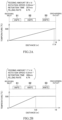
- FIGS. 2A and 2B show respective cases where the feeding amount of the to-be-processed objects fed into the roasting apparatus A per day is different from each other.
- FIGS. 2A and 2B each show one example of a graph indicating the heating temperatures at which the respective heaters 51 to 53 perform the heating and a target internal temperature of the cylindrical body 41 from the receiving inlet 41a to the discharging outlet 41b.
- the filling rate X is 6.7 (%).
- the length of the cylindrical body 41 in the axial direction is 18 (m); the internal diameter of the cylindrical body 41 is 1.5 (m); and the internal volume Vi of the cylindrical body 41 is 32 (m 3 ).
- the feeding amount of the to-be-processed objects per day (ton/day) is set to 30 (t/d).
- the rotation speed N of the cylindrical body 41 is calculated as 0.53 (min -1 ) and the retention time T is calculated as 207 (min) by separately performed calculation.
- the graph of FIG. 2A shows one example of a relationship between the internal temperature of the cylindrical body 41 and a distance from the receiving inlet 41a of the cylindrical body 41 (i.e., a position in the transporting direction) in a case where the predetermined temperature increase rate Tv is, for example, 2.5 (K/min).
- the graph of FIG. 2A also shows 250°C, 450°C, and 650°C as one example of heating temperatures set for the respective heaters 51, 52, and 53 to perform the heating for realizing this relationship.
- the rotation speed N of the cylindrical body 41 is controlled to 0.53 (min -1 ), and the to-be-processed objects received through the receiving inlet 41a are transported while being heated such that the temperature increase rate of the to-be-processed objects is the predetermined temperature increase rate Tv (2.5 (K/min)).
- the temperature of the to-be-processed objects reaches 500°C when their distance from the receiving inlet 41a becomes 17.4 m, and thereafter, the temperature of the to-be-processed objects is kept as it is while the to-be-processed objects are transported to the discharging outlet 41b.
- the feeding amount of the to-be-processed objects per day is set to 17 (t/d).
- the rotation speed N of the cylindrical body 41 is calculated as 0.3 (min -1 ) and the retention time T is calculated as 366 (min) by separately performed calculation.
- the graph of FIG. 2B shows one example of a relationship between the internal temperature of the cylindrical body 41 and a distance from the receiving inlet 41a of the cylindrical body 41 (i.e., a position in the transporting direction) in a case where the predetermined temperature increase rate Tv is 2.5 (K/min), which is the same as in the case of FIG. 2A .
- the graph of FIG. 2B also shows 350°C, 650°C, and 650°C as one example of heating temperatures set for the respective heaters 51, 52, and 53 to perform the heating for realizing this relationship.
- the rotation speed N of the cylindrical body 41 is controlled to 0.3 (min -1 ), and the to-be-processed objects received through the receiving inlet 41a are transported while being heated such that the temperature increase rate of the to-be-processed objects is the predetermined temperature increase rate Tv (2.5 (K/min)).
- the temperature of the to-be-processed objects reaches 500°C when their distance from the receiving inlet 41a becomes 9.8 m, and thereafter, the temperature of the to-be-processed objects is kept as it is while the to-be-processed objects are transported to the discharging outlet 41b.
- the controller 21 calculates target temperatures corresponding to the respective temperature detection positions (i.e., the positions of the respective temperature sensors St), the target temperatures enabling the adjustment of the temperature increase rate of the to-be-processed objects to the predetermined temperature increase rate Tv, and adjusts the heating temperatures at which the respective heaters 51, 52, and 53 perform the heating, such that the temperature detected by each temperature sensor St is the corresponding target temperature.
- the graphs of FIGS. 2A and 2B illustratively show a temperature range of 0°C to 500°C as a temperature range within which the temperature is increased at the predetermined temperature increase rate Tv.
- the temperature range within which the temperature is increased at the predetermined temperature increase rate Tv is not limited to 0°C to 500°C, but may be, for example, 20°C to 520°C.
- the electrolyte solution contained in a lithium-ion battery can be decomposed and removed from the lithium-ion battery by heating the lithium-ion battery at 150°C to 200°C.
- the heating temperature needs to be such a temperature as to be able to decompose the organic matter, such as a separator and a binder (e.g., higher than or equal to 400°C).
- the heating temperature needs to be a temperature at which aluminum used in the cathode material of the lithium-ion battery does not melt, i.e., a temperature lower than the melting point of aluminum (660°C). Therefore, the temperature at the discharging outlet 41b (i.e., the maximum internal temperature of the cylindrical body 41) is preferably higher than or equal to 400°C and lower than the melting point of aluminum (660°C).
- an operator determines the rotation speed N of the cylindrical body 41 based on a scheduled processing amount (feeding amount) of the waste lithium-ion batteries for the day.
- the rotation speed N of the cylindrical body 41 is set, and also, the predetermined temperature increase rate Tv is set. The operation of the roasting apparatus A is started in accordance therewith.
- the controller 21 controls the driver 42 of the cylindrical body 41 to rotate the cylindrical body 41 at the set rotation speed N, and also, based on the rotation speed N and the temperature increase rate Tv, the controller 21 calculates target temperatures corresponding to the temperature detection positions of the respective temperature sensors St installed in the cylindrical body 41, and controls the opening degrees of the respective electrically operated valves 55 to 60 to adjust the heating temperatures at which the respective heaters 51, 52, and 53 perform the heating, such that the temperature detected by each temperature sensor St is the corresponding target temperature.
- the opening degrees of the respective electrically operated valves 55 to 60 at an early stage of the operation may be predetermined in accordance with the rotation speed N and the temperature increase rate Tv.
- Described hereinafter is how the controller of the claimed invention is calculating target temperatures Ta corresponding to the respective temperature detection positions, the target temperatures Ta enabling the adjustment of the temperature increase rate of the waste lithium-ion batteries that are being transported inside the cylindrical body 41 to the predetermined temperature increase rate Tv.
- Each temperature detection position (the position of each temperature sensor St) is stored in the controller 21 as a distance from the receiving inlet 41a of the cylindrical body 41 to the installation position of the temperature sensor St.
- a retention time (transport time) Ti (min) from when to-be-processed objects are fed into the cylindrical body 41 through the receiving inlet 41a to when the to-be-processed objects reach the temperature detection position of a particular temperature sensor St can be calculated by an equation below.
- xi the temperature detection position of the particular temperature sensor St (i.e., the aforementioned distance) stored in the controller 21
- k is a coefficient that is determined depending on, for example, the type of the to-be-processed objects (waste lithium-ion batteries) and the type of the kiln included in the transport mechanism 4.
- the predetermined temperature increase rate Tv (°C/min), the target temperature Ta (°C) corresponding to the particular temperature detection position (xi) can be calculated by an equation below.
- t (°C) is the temperature at the receiving inlet 41a.
- the temperature t at the receiving inlet 41a may be set together with the rotation speed N of the cylindrical body 41 and the temperature increase rate Tv through operations of the operating device 22 by the operator.
- the controller 21 can calculate the target temperatures corresponding to the respective temperature detection positions to realize the predetermined temperature increase rate Tv.
- the upper limit target temperature value is set to a predetermined temperature (e.g., in the cases of FIGS. 2A and 2B , 500°C).
- the setting value of the rotation speed N may be changed through an operation of the operating device 22 by the operator.
- the controller 21 controls the driver 42 of the cylindrical body 41 to rotate the cylindrical body 41 at the changed rotation speed N (the changed setting value of the rotation speed N), and also, calculates target temperatures corresponding to the respective temperature detection positions and controls the opening degrees of the respective electrically operated valves 55 to 60 to adjust the heating temperatures at which the respective heaters 51, 52, and 53 perform the heating, such that each detected temperature is the corresponding target temperature.
- the rotation speed N of the cylindrical body 41 is set or changed by operating the operating device 22.
- a weigher that detects the weight of the waste lithium-ion batteries fed into the cylindrical body 41 per unit time may be installed, and the controller 21 may set or change the rotation speed N based on the weighing value of the weigher.
- the processes of receiving and discharging the waste lithium-ion batteries can be performed continuously by using the external heat type rotary kiln that is provided with the heaters 51 to 53, the temperatures of which are individually controllable.
- the predetermined temperature increase rate Tv to a suitable temperature increase rate for increasing the grain size of useful metal components such as cobalt (e.g., 2 K/min in the case of the cobalt component)
- the useful metal recovery rate in a subsequent recovery process in which the useful metals such as cobalt are recovered by, for example, physical sorting that utilizes, for example, magnetic separation, can be improved.
- a suitable temperature increase rate (Tv), or a preferable setting range thereof, for increasing the grain size of each useful metal component is determined in advance through an experiment or the like.
- the roasting apparatus A of the present embodiment is not limited to the above-described configuration using the external heat type rotary kiln, but may be configured differently, so long as the roasting apparatus A includes: a transport mechanism (4) including a cylindrical body whose one end is a receiving inlet and whose another end is a discharging outlet, the cylindrical body containing an internal atmosphere that is a reducing atmosphere or a low-oxygen atmosphere, the transport mechanism receiving a waste lithium-ion battery through the receiving inlet, transporting the waste lithium-ion battery inside the cylindrical body toward the discharging outlet, and discharging the waste lithium-ion battery from the discharging outlet; a heating mechanism (5) that heats an outer wall of the cylindrical body to increase an internal temperature of the cylindrical body, and controls heating temperatures individually at which the heating mechanism heats the outer wall at different respective positions in a transporting direction in which the transport mechanism transports the waste lithium-ion battery; and a controller (21) that controls the heating temperatures, at which the heating mechanism heats the outer wall, in accordance with
- the controller adjusts the heating temperatures, at which the heating mechanism heats the outer wall, such that the temperature increase rate of the waste lithium-ion battery is the predetermined temperature increase rate.
- the temperature detector 15 is configured by using the temperature sensors St, which are, for example, thermocouples.
- the temperature detector 15 may be configured by using an optical fiber temperature sensor capable of detecting temperatures at intervals of 1 m.
- the present invention is useful, for example, as a waste lithium-ion battery roasting apparatus that makes it possible to improve heat treatment efficiency and to improve a useful metal recovery rate.
Landscapes
- Chemical & Material Sciences (AREA)
- Engineering & Computer Science (AREA)
- Manufacturing & Machinery (AREA)
- Materials Engineering (AREA)
- Chemical Kinetics & Catalysis (AREA)
- General Chemical & Material Sciences (AREA)
- Electrochemistry (AREA)
- Mechanical Engineering (AREA)
- Organic Chemistry (AREA)
- Metallurgy (AREA)
- Environmental & Geological Engineering (AREA)
- General Life Sciences & Earth Sciences (AREA)
- Geology (AREA)
- Life Sciences & Earth Sciences (AREA)
- Geochemistry & Mineralogy (AREA)
- Manufacture And Refinement Of Metals (AREA)
- Processing Of Solid Wastes (AREA)
- Muffle Furnaces And Rotary Kilns (AREA)
- Secondary Cells (AREA)
Description
- The present invention relates to a waste lithium-ion battery roasting apparatus.
- Lithium-ion batteries (LIB) are widely used in electric automobiles, mobile phones, laptop computers, etc. A lithium-ion battery includes, for example, a cathode material, an anode material, an electrolyte solution, and a separator. The cathode material is formed in such a manner that a cathode active material, such as lithium cobalt oxide, lithium nickel oxide, or lithium manganese oxide, is fixed to an aluminum foil by a fluorine-based binder. The anode material is formed in such a manner that an anode active material, such as graphite, is fixed to a copper foil by a fluorine-based binder.
- In order to recover useful metals such as cobalt, nickel, manganese, and lithium from lithium-ion batteries to be discarded (waste lithium-ion batteries), such as spent lithium-ion batteries, heat treatment (roasting) is performed thereon for the purpose of detoxifying the electrolyte solution and reducing the volume of combustibles, such as the separator and the binder.
- For example,
Patent Literature 1 discloses a configuration including a circular heat treatment furnace provided with a single furnace door. InPatent Literature 1, heat-resistant containers, each of which stores therein a battery pack or a battery module made up of multiple lithium-ion batteries, are sequentially fed into the heat treatment furnace by opening and closing the furnace door. The temperature of the heat treatment furnace is set to a constant temperature. In the heat treatment furnace, the heat-resistant containers are subjected to heat treatment. Then, the heat-resistant containers are sequentially discharged from the heat treatment furnace by opening and closing the furnace door. Patent Literature 2-4 further disclose a waste lithium-ion battery roasting apparatus. - In relation to recovering cobalt from a waste lithium-ion battery, Non-Patent
Literature 1 compares a case where the temperature increase rate in heat treatment performed on the waste lithium-ion battery is 30 K/min and a case where the temperature increase rate in heat treatment performed on the waste lithium-ion battery is 2 K/min. Results of the comparison indicate that in the case where the temperature increase rate is 2 K/min, the grain size of the cobalt component is greater, and also, the cobalt recovery rate is higher in a subsequent recovery process, in which cobalt is recovered by, for example, physical sorting that utilizes, for example, magnetic separation. -
- PTL 1:
Japanese Laid-Open Patent Application Publication No. 2016-22395 - PTL 2:
JP 2018 159477 A - PTL 3:
JP 2018 026279 A - PTL 4:
WO 2012/132072 A1 - NPL 1: "Investigation of heating conditions for cobalt recycling from spent lithium ion batteries by magnetic separation" co-authored by Kengo Horiuchi, Mitsuaki Matsuoka, Chiharu Tokoro, Shuji Owada, and Shojiro Usui, vol. 43, No. 4, pp.213-218, Kagaku Kogaku Ronbunshu (Chemical Engineering Journals in Japanese) published in 2017 by The Society of Chemical Engineers, Japan.
- In the configuration of
Patent Literature 1, since each heat-resistant container is fed into and discharged from the heat treatment furnace through the single furnace door, there is room for improvement in terms of heat treatment efficiency. Non-Patent Literature 1 does not disclose any specific configuration for performing the heat treatment. - The present invention has been made to solve the above-described problems, and an object of the present invention is to provide a waste lithium-ion battery roasting apparatus that makes it possible to improve heat treatment efficiency and to improve a useful metal recovery rate.
- In order to achieve the above object, a waste lithium-ion battery roasting apparatus according to the present invention is disclosed in appended
claim 1. - The present invention is configured as described above, and has an advantage of being able to provide a waste lithium-ion battery roasting apparatus that makes it possible to improve heat treatment efficiency and to improve a useful metal recovery rate.
-
-
FIG. 1 is a schematic diagram schematically showing a processing system including a waste lithium-ion battery roasting apparatus according to one example of an embodiment. -
FIGS. 2A and 2B show respective cases where the feeding amount of to-be-processed objects fed into the roasting apparatus per day is different from each other, andFIGS. 2A and 2B each show one example of a graph indicating heating temperatures at which respective heaters perform heating and a target internal temperature of a cylindrical body of the roasting apparatus from a receiving inlet to a discharging outlet of the cylindrical body. - Hereinafter, a preferred embodiment of the present invention is described with reference to the drawings. The present invention is not limited to the embodiment described below but to appended
claim 1. -
FIG. 1 is a schematic diagram schematically showing a processing system including a waste lithium-ion battery roasting apparatus according to one example of the embodiment. - The waste lithium-ion battery processing system shown in
FIG. 1 includes, for example, a waste lithium-ion battery roasting apparatus A and exhaust gas treatment equipment B. - The waste lithium-ion battery roasting apparatus A is capable of roasting cells and modules of waste lithium-ion batteries (waste LIBs). Each module is made up of multiple cells (battery cells) combined together.
- The roasting apparatus A includes a waste lithium-
ion battery feeder 1, afeeding inlet 2, apusher 3, atransport mechanism 4, aheating mechanism 5, roasted product take-outoutlets 6, atemperature detector 15 including temperature sensors St, acontroller 21, and anoperating device 22. In this example, thecontroller 21 and theoperating device 22 are used as a controller and an operating device of the entire processing system shown inFIG. 1 . - The
feeder 1 is, for example, a rotary feeder. Thefeeder 1 receives waste lithium-ion battery cells and modules fed from the outside, and sequentially feeds the cells and modules to thefeeding inlet 2. Thepusher 3 pushes and feeds the waste lithium-ion battery cells and modules, which are sequentially fed to thefeeding inlet 2, to thetransport mechanism 4. - The
transport mechanism 4 includes a cylindrical body 41. One end of the cylindrical body 41 is a receivinginlet 41a, and the other end is a discharging outlet 41b. The cylindrical body 41 is a circular cylindrical body. The cylindrical body 41 is supported in such a manner that the cylindrical body 41 is rotatable about its center axis and is inclined with a predetermined angle such that the cylindrical body 41 is sloped downward from thereceiving inlet 41a toward the discharging outlet 41b. The cylindrical body 41 is rotated by adriver 42. Thedriver 42 is a device that includes a motor for rotating agirth gear 43 fixed to the outer periphery of the cylindrical body 41. Thedriver 42 is a known device included in an external heat type rotary kiln that will be described below. - The internal atmosphere of the cylindrical body 41 is a reducing atmosphere or a low-oxygen atmosphere (having an oxygen concentration of 10% or lower). The waste lithium-ion batteries (i.e., cells and/or modules) fed by the
pusher 3 into the cylindrical body 41 through the receivinginlet 41a are moved (transported) toward the discharging outlet 41b by the rotation of the cylindrical body 41, and are then discharged from the discharging outlet 41b through the roasted product take-outoutlets 6. - The
heating mechanism 5 includesheaters heaters heaters - High-temperature gas (e.g., 800°C) from a
secondary combustion chamber 13 is fed into theheaters valve 61 and electrically operatedvalves heaters valves heaters fan 54 into thesecondary combustion chamber 13 via an electrically operatedvalve 62. - For example, the
controller 21 controls the opening degree of each of the electrically operatedvalves respective heaters respective heaters respective heaters - The
transport mechanism 4 and theheating mechanism 5 are configured such that, in a well-known external heat type rotary kiln that includes the cylindrical body 41 (an internal cylinder) and a heating jacket (an external cylinder) for heating the cylindrical body 41, the heating jacket is divided into multiple segments that are theheaters respective heaters - Inside the cylindrical body 41, the temperature sensors St, which are, for example, thermocouples, are arranged at respective predetermined positions, for example, at regular intervals in the transporting direction of the waste lithium-ion batteries (in the center axis direction of the cylindrical body 41). The temperature detected by each temperature sensor St is outputted to the
controller 21. Accordingly, thetemperature detector 15, which includes the temperature sensors St, detects internal temperatures of the cylindrical body 41 at different respective positions in the transporting direction of the waste lithium-ion batteries, and outputs the detected temperatures to thecontroller 21. The internal temperatures of the cylindrical body 41 are always detected by the respective temperature sensors St, and the detected temperatures are inputted to thecontroller 21. In this manner, thecontroller 21 can monitor the temperatures detected by the respective temperature sensors St and the positions at which the respective temperatures are detected (i.e., temperature detection positions). Thecontroller 21 prestores therein the positions of the respective temperature sensors St (i.e., the temperature detection positions). - Exhaust gas generated in the cylindrical body 41 is fed to a
cyclone 11 of the exhaust gas treatment equipment B, and in thecyclone 11, solid fine particles in the exhaust gas, such as metal particles, are separated from the exhaust gas. The solid fine particles separated from the exhaust gas are recovered by, for example, arotary feeder 12. Meanwhile, the exhaust gas from which the solid fine particles have been separated is fed from thecyclone 11 to thesecondary combustion chamber 13. - In the
secondary combustion chamber 13, the exhaust gas fed from thecyclone 11, and the gas fed from theheaters valve 61. Although not illustrated, the rest of the high-temperature gas is discharged from a chimney via, for example, a bag filter. Residue is collected from thesecondary combustion chamber 13 via arotary feeder 14. The exhaust gas treatment equipment B includes thecyclone 11, therotary feeder 12, thesecondary combustion chamber 13, therotary feeder 14, the unshown bag filter, the unshown chimney, and so forth. - At the roasted product take-out
outlets 6, the roasted cells and modules are sorted from each other based on their sizes. The modules are fed to acrusher 7 through one discharging outlet 6a, and the cells are fed to acrusher 8 through the other dischargingoutlet 6b. Each module is crushed by thecrusher 7 into pieces, each of which is roughly in the size of a cell, and then fed to thecrusher 8. Thecrusher 8 further crushes these crushed pieces into smaller pieces together with the cells. - The crushed products of the cells and modules crushed by the
crusher 8 are fed to aclassifier 10 via a double flap damper (two-stage damper) 9. For example, theclassifier 10 sorts the crushed products into massive materials and powdery and granular materials by using a sieve, such as a vibration sieve. The massive materials contain, for example, copper and aluminum. The powdery and granular materials contain useful metals such as cobalt. The powdery and granular materials sorted by theclassifier 10 are fed to useful metal extraction equipment, by which useful metals such as cobalt, nickel, manganese, and lithium are extracted from the powdery and granular materials. - The
controller 21 is a computer that includes, for example, an operational processor such as a CPU and memories such as a ROM and RAM. The CPU executes a predetermined program prestored in a memory, thereby controlling the operations of the entire processing system shown inFIG. 1 . Thecontroller 21 may be a single controller performing centralized control, or may be multiple controllers performing distributed control in cooperation with each other. - An operator operates the operating
device 22. The operatingdevice 22 receives operation inputs, such as an operation input to start or stop the operation of each part of the processing system shown inFIG. 1 . In response to an operation input made by the operator, the operatingdevice 22 outputs operation input information to thecontroller 21. Thecontroller 21 outputs information indicating, for example, the operating state of each part of the processing system. The information outputted from thecontroller 21 is inputted to the operatingdevice 22. The operatingdevice 22 includes a display that displays the inputted information. - Next, one example of the operations of, in particular, the waste lithium-ion battery roasting apparatus A of the processing system shown in
FIG. 1 is described. - Generally speaking, the rotation speed of the rotary kiln is set such that the filling rate of to-be-processed objects in the cylindrical body is constant. Also in the present embodiment, the rotation speed of the cylindrical body 41 is set such that the filling rate of to-be-processed objects (waste lithium-ion batteries) in the cylindrical body 41 is constant. For example, the rotation speed can be set through an operation of the operating
device 22 by the operator. Then, thecontroller 21 controls thedriver 42 to rotate the cylindrical body 41 at the set rotation speed. - For example, the filling rate X (%) of the to-be-processed objects in the cylindrical body 41 can be calculated by using an equation (1) shown below.

- In the equation (1), H is the feeding amount of the to-be-processed objects per minute (m3/min); T is the retention time of the to-be-processed objects in the cylindrical body 41 (min); and Vi is the volume of the interior of the cylindrical body 41 (m3).
- The retention time T (min) is a necessary amount of time for the to-be-processed objects to move from the receiving
inlet 41a of the cylindrical body 41 to the discharging outlet 41b. The retention time T (min) is inversely proportional to the rotation speed (N) of the cylindrical body 41. - Accordingly, the filling rate X is proportional to the feeding amount H of the to-be-processed objects per minute, and is inversely proportional to the rotation speed N of the cylindrical body 41 (X ∝ H / N). For example, in a case where the feeding amount H of the to-be-processed objects per minute is changed due to a change in the feeding amount (processing amount) of the to-be-processed objects fed into the roasting apparatus A per day, it is necessary to change the rotation speed N of the cylindrical body 41 in order to make the filling rate X of the to-be-processed objects constant. The rotation speed N of the cylindrical body 41 is proportional to the transporting speed of the to-be-processed objects transported inside the cylindrical body 41 from the receiving
inlet 41a toward the discharging outlet 41b. Therefore, changing the rotation speed N of the cylindrical body 41 is the same as changing the transporting speed of the to-be-processed objects. - In the present embodiment, the
controller 21 controls the heating temperatures (gas temperatures) at which therespective heaters 51 to 53 perform the heating, such that the temperature increase rate of the to-be-processed objects is a predetermined temperature increase rate (Tv). Specifically, thecontroller 21 controls the heating temperatures at which therespective heaters 51 to 53 perform the heating by controlling (adjusting) the opening degrees of the respective electrically operatedvalves 55 to 60. The predetermined temperature increase rate Tv is preset (prestored) in thecontroller 21 through an operation of the operatingdevice 22 by the operator. The setting value of the temperature increase rate Tv can be changed by operating the operatingdevice 22. - In a case where the rotation speed N of the cylindrical body 41 is changed, the
controller 21 changes the heating temperatures at which therespective heaters 51 to 53 perform the heating, such that the temperature increase rate of the to-be-processed objects is the predetermined temperature increase rate (Tv). This is described hereinafter with reference toFIGS. 2A and 2B . -
FIGS. 2A and 2B show respective cases where the feeding amount of the to-be-processed objects fed into the roasting apparatus A per day is different from each other.FIGS. 2A and 2B each show one example of a graph indicating the heating temperatures at which therespective heaters 51 to 53 perform the heating and a target internal temperature of the cylindrical body 41 from the receivinginlet 41a to the discharging outlet 41b. - In both cases of
FIGS. 2A and 2B , the filling rate X is 6.7 (%). In these examples, the length of the cylindrical body 41 in the axial direction is 18 (m); the internal diameter of the cylindrical body 41 is 1.5 (m); and the internal volume Vi of the cylindrical body 41 is 32 (m3). - In the case of
FIG. 2A , the feeding amount of the to-be-processed objects per day (ton/day) is set to 30 (t/d). In order to adjust the filling rate X to 6.7 (%), the rotation speed N of the cylindrical body 41 is calculated as 0.53 (min-1) and the retention time T is calculated as 207 (min) by separately performed calculation. - The graph of
FIG. 2A shows one example of a relationship between the internal temperature of the cylindrical body 41 and a distance from the receivinginlet 41a of the cylindrical body 41 (i.e., a position in the transporting direction) in a case where the predetermined temperature increase rate Tv is, for example, 2.5 (K/min). The graph ofFIG. 2A also shows 250°C, 450°C, and 650°C as one example of heating temperatures set for therespective heaters - In a case where the relationship shown in the graph of
FIG. 2A is realized, the rotation speed N of the cylindrical body 41 is controlled to 0.53 (min-1), and the to-be-processed objects received through the receivinginlet 41a are transported while being heated such that the temperature increase rate of the to-be-processed objects is the predetermined temperature increase rate Tv (2.5 (K/min)). The temperature of the to-be-processed objects reaches 500°C when their distance from the receivinginlet 41a becomes 17.4 m, and thereafter, the temperature of the to-be-processed objects is kept as it is while the to-be-processed objects are transported to the discharging outlet 41b. - In the case of
FIG. 2B , the feeding amount of the to-be-processed objects per day is set to 17 (t/d). In order to adjust the filling rate X to 6.7 (%), the rotation speed N of the cylindrical body 41 is calculated as 0.3 (min-1) and the retention time T is calculated as 366 (min) by separately performed calculation. - The graph of
FIG. 2B shows one example of a relationship between the internal temperature of the cylindrical body 41 and a distance from the receivinginlet 41a of the cylindrical body 41 (i.e., a position in the transporting direction) in a case where the predetermined temperature increase rate Tv is 2.5 (K/min), which is the same as in the case ofFIG. 2A . The graph ofFIG. 2B also shows 350°C, 650°C, and 650°C as one example of heating temperatures set for therespective heaters - In a case where the relationship shown in the graph of
FIG. 2B is realized, the rotation speed N of the cylindrical body 41 is controlled to 0.3 (min-1), and the to-be-processed objects received through the receivinginlet 41a are transported while being heated such that the temperature increase rate of the to-be-processed objects is the predetermined temperature increase rate Tv (2.5 (K/min)). The temperature of the to-be-processed objects reaches 500°C when their distance from the receivinginlet 41a becomes 9.8 m, and thereafter, the temperature of the to-be-processed objects is kept as it is while the to-be-processed objects are transported to the discharging outlet 41b. - It is understood from
FIGS. 2A and 2B that in order to adjust the temperature increase rate of the to-be-processed objects to the predetermined temperature increase rate Tv, at least one of the heating temperatures at which therespective heaters - In view of the above, based on the rotation speed N of the cylindrical body 41 and the predetermined temperature increase rate Tv, the
controller 21 calculates target temperatures corresponding to the respective temperature detection positions (i.e., the positions of the respective temperature sensors St), the target temperatures enabling the adjustment of the temperature increase rate of the to-be-processed objects to the predetermined temperature increase rate Tv, and adjusts the heating temperatures at which therespective heaters - The graphs of
FIGS. 2A and 2B illustratively show a temperature range of 0°C to 500°C as a temperature range within which the temperature is increased at the predetermined temperature increase rate Tv. However, the temperature range within which the temperature is increased at the predetermined temperature increase rate Tv is not limited to 0°C to 500°C, but may be, for example, 20°C to 520°C. - The electrolyte solution contained in a lithium-ion battery can be decomposed and removed from the lithium-ion battery by heating the lithium-ion battery at 150°C to 200°C. In order to readily recover useful metals such as cobalt from the lithium-ion battery, the heating temperature needs to be such a temperature as to be able to decompose the organic matter, such as a separator and a binder (e.g., higher than or equal to 400°C). However, the heating temperature needs to be a temperature at which aluminum used in the cathode material of the lithium-ion battery does not melt, i.e., a temperature lower than the melting point of aluminum (660°C). Therefore, the temperature at the discharging outlet 41b (i.e., the maximum internal temperature of the cylindrical body 41) is preferably higher than or equal to 400°C and lower than the melting point of aluminum (660°C).
- In the case of operating the roasting apparatus A, for example, before starting operating the roasting apparatus A, an operator determines the rotation speed N of the cylindrical body 41 based on a scheduled processing amount (feeding amount) of the waste lithium-ion batteries for the day. Through operations of the operating
device 22 by the operator, the rotation speed N of the cylindrical body 41 is set, and also, the predetermined temperature increase rate Tv is set. The operation of the roasting apparatus A is started in accordance therewith. At the start of the operation, thecontroller 21 controls thedriver 42 of the cylindrical body 41 to rotate the cylindrical body 41 at the set rotation speed N, and also, based on the rotation speed N and the temperature increase rate Tv, thecontroller 21 calculates target temperatures corresponding to the temperature detection positions of the respective temperature sensors St installed in the cylindrical body 41, and controls the opening degrees of the respective electrically operatedvalves 55 to 60 to adjust the heating temperatures at which therespective heaters valves 55 to 60 at an early stage of the operation may be predetermined in accordance with the rotation speed N and the temperature increase rate Tv. - Described hereinafter is how the controller of the claimed invention is calculating target temperatures Ta corresponding to the respective temperature detection positions, the target temperatures Ta enabling the adjustment of the temperature increase rate of the waste lithium-ion batteries that are being transported inside the cylindrical body 41 to the predetermined temperature increase rate Tv.
- Each temperature detection position (the position of each temperature sensor St) is stored in the
controller 21 as a distance from the receivinginlet 41a of the cylindrical body 41 to the installation position of the temperature sensor St. A retention time (transport time) Ti (min) from when to-be-processed objects are fed into the cylindrical body 41 through the receivinginlet 41a to when the to-be-processed objects reach the temperature detection position of a particular temperature sensor St can be calculated by an equation below.
controller 21, and k is a coefficient that is determined depending on, for example, the type of the to-be-processed objects (waste lithium-ion batteries) and the type of the kiln included in thetransport mechanism 4. - The predetermined temperature increase rate Tv (°C/min), the target temperature Ta (°C) corresponding to the particular temperature detection position (xi) can be calculated by an equation below.

inlet 41a. Before starting the operation, the temperature t at the receivinginlet 41a may be set together with the rotation speed N of the cylindrical body 41 and the temperature increase rate Tv through operations of the operatingdevice 22 by the operator. For example, if a temperature sensor detecting the temperature of the receivinginlet 41a is installed, then at the time of calculating the target temperature Ta, thecontroller 21 may calculate the temperature t at the receivinginlet 41a based on a temperature (tx) detected by the temperature sensor by using, for example, an equation t = tx or an equation t = tx + α (α is a predetermined value). - In the above-described manner, the
controller 21 can calculate the target temperatures corresponding to the respective temperature detection positions to realize the predetermined temperature increase rate Tv. The upper limit target temperature value is set to a predetermined temperature (e.g., in the cases ofFIGS. 2A and 2B , 500°C). - During the operation, the setting value of the rotation speed N may be changed through an operation of the operating
device 22 by the operator. In this case, thecontroller 21 controls thedriver 42 of the cylindrical body 41 to rotate the cylindrical body 41 at the changed rotation speed N (the changed setting value of the rotation speed N), and also, calculates target temperatures corresponding to the respective temperature detection positions and controls the opening degrees of the respective electrically operatedvalves 55 to 60 to adjust the heating temperatures at which therespective heaters - As described above, the rotation speed N of the cylindrical body 41 is set or changed by operating the operating
device 22. Alternatively, for example, a weigher that detects the weight of the waste lithium-ion batteries fed into the cylindrical body 41 per unit time may be installed, and thecontroller 21 may set or change the rotation speed N based on the weighing value of the weigher. - In the roasting apparatus A of the present embodiment, for example, the processes of receiving and discharging the waste lithium-ion batteries can be performed continuously by using the external heat type rotary kiln that is provided with the
heaters 51 to 53, the temperatures of which are individually controllable. This makes it possible to improve heat treatment efficiency. In addition, by setting the predetermined temperature increase rate Tv to a suitable temperature increase rate for increasing the grain size of useful metal components such as cobalt (e.g., 2 K/min in the case of the cobalt component), the useful metal recovery rate in a subsequent recovery process, in which the useful metals such as cobalt are recovered by, for example, physical sorting that utilizes, for example, magnetic separation, can be improved. Desirably, for the purpose of improving the recovery rate of useful metals such as cobalt, a suitable temperature increase rate (Tv), or a preferable setting range thereof, for increasing the grain size of each useful metal component is determined in advance through an experiment or the like. - The roasting apparatus A of the present embodiment is not limited to the above-described configuration using the external heat type rotary kiln, but may be configured differently, so long as the roasting apparatus A includes: a transport mechanism (4) including a cylindrical body whose one end is a receiving inlet and whose another end is a discharging outlet, the cylindrical body containing an internal atmosphere that is a reducing atmosphere or a low-oxygen atmosphere, the transport mechanism receiving a waste lithium-ion battery through the receiving inlet, transporting the waste lithium-ion battery inside the cylindrical body toward the discharging outlet, and discharging the waste lithium-ion battery from the discharging outlet; a heating mechanism (5) that heats an outer wall of the cylindrical body to increase an internal temperature of the cylindrical body, and controls heating temperatures individually at which the heating mechanism heats the outer wall at different respective positions in a transporting direction in which the transport mechanism transports the waste lithium-ion battery; and a controller (21) that controls the heating temperatures, at which the heating mechanism heats the outer wall, in accordance with a transporting speed at which the transport mechanism transports the waste lithium-ion battery, such that a temperature increase rate of the waste lithium-ion battery transported inside the cylindrical body is a predetermined temperature increase rate. Accordingly, when the transporting speed, at which the transport mechanism transports the waste lithium-ion battery, is changed, then in accordance with the changed transporting speed, the controller adjusts the heating temperatures, at which the heating mechanism heats the outer wall, such that the temperature increase rate of the waste lithium-ion battery is the predetermined temperature increase rate.
- In the present embodiment, the
temperature detector 15 is configured by using the temperature sensors St, which are, for example, thermocouples. Alternatively, for example, thetemperature detector 15 may be configured by using an optical fiber temperature sensor capable of detecting temperatures at intervals of 1 m. - The present invention is useful, for example, as a waste lithium-ion battery roasting apparatus that makes it possible to improve heat treatment efficiency and to improve a useful metal recovery rate.
-
- A
- roasting apparatus
- 4
- transport mechanism
- 5
- heating mechanism
- 15
- temperature detector
- 21
- controller
- 41
- cylindrical body
- 41a
- receiving inlet
- 41b
- discharging outlet
- 51 to 53
- heater
- 55 to 60
- electrically operated valve
Claims (1)
- A waste lithium-ion battery roasting apparatus (A) comprising:a transport mechanism (4) including a circular cylindrical body (41) supported in such a manner that the circular cylindrical body (41) is rotatable about a center axis thereof, wherein one end of the circular cylindrical body (41) in a direction of the center axis is a receiving inlet (41a) and another end of the circular cylindrical body (41) in the direction of the center axis is a discharging outlet (41b), the transport mechanism (4) being adapted to receive a waste lithium-ion battery through the receiving inlet (41a), transport the waste lithium-ion battery inside the circular cylindrical body (41) in the direction of the center axis toward the discharging outlet (41b), and discharge the waste lithium-ion battery from the discharging outlet (41b);a heating mechanism (5) adapted to heat an outer wall of the circular cylindrical body (41) to increase an internal temperature of the circular cylindrical body (41), and control heating temperatures individually at which the heating mechanism heats the outer wall at different respective positions in a transporting direction in which the transport mechanism (4) transports the waste lithium-ion battery;a controller (21) adapted to control the heating temperatures, at which the heating mechanism (5) heats the outer wall, in accordance with a transporting speed at which the transport mechanism (4) transports the waste lithium-ion battery, such that a temperature increase rate of the waste lithium-ion battery transported inside the circular cylindrical body (41) is a predetermined temperature increase rate; anda temperature detector (15) adapted to detect internal temperatures of the circular cylindrical body (41) at different respective detection positions in the transporting direction of the waste lithium-ion battery, whereinthe transport mechanism (4) is adapted to rotate the circular cylindrical body (41) to transport the waste lithium-ion battery from the receiving inlet (41a) toward the discharging outlet (41b) at a transporting speed corresponding to a rotation speed of the circular cylindrical body (41),the heating mechanism (5) includes heaters (51, 52, 53) that heat the outer wall of the circular cylindrical body (41), the heaters (51, 52, 53) being arranged side by side in the transporting direction, in which the transport mechanism (4) transports the waste lithium-ion battery, the heating mechanism (5) being adapted to control the heating temperatures individually at which the respective heaters (51, 52, 53) heat the outer wall,characterized in thatthe controller (21) is adapted to:calculate target temperatures corresponding to the respective detection positions based on distances to the respective detection positions from the receiving inlet (41a) of the circular cylindrical body (41) and a value that is proportional to the predetermined temperature increase rate but inversely proportional to the rotation speed of the circular cylindrical body (41), the target temperatures enabling adjustment of the temperature increase rate of the waste lithium-ion battery to the predetermined temperature increase rate; andadjust the heating temperatures, at which the respective heaters (51, 52, 53) heat the outer wall, such that the internal temperature detected at each detection position by the temperature detector (15) is the target temperature corresponding to each detection position.
Applications Claiming Priority (2)
| Application Number | Priority Date | Filing Date | Title |
|---|---|---|---|
| JP2019038150A JP7195181B2 (en) | 2019-03-04 | 2019-03-04 | Roasting equipment for waste lithium-ion batteries |
| PCT/JP2020/008419 WO2020179695A1 (en) | 2019-03-04 | 2020-02-28 | Apparatus for roasting lithium ion battery waste |
Publications (3)
| Publication Number | Publication Date |
|---|---|
| EP3936631A1 EP3936631A1 (en) | 2022-01-12 |
| EP3936631A4 EP3936631A4 (en) | 2022-12-07 |
| EP3936631B1 true EP3936631B1 (en) | 2023-10-18 |
Family
ID=72337787
Family Applications (1)
| Application Number | Title | Priority Date | Filing Date |
|---|---|---|---|
| EP20766152.1A Active EP3936631B1 (en) | 2019-03-04 | 2020-02-28 | Waste lithium-ion battery roasting apparatus |
Country Status (5)
| Country | Link |
|---|---|
| US (1) | US12206079B2 (en) |
| EP (1) | EP3936631B1 (en) |
| JP (1) | JP7195181B2 (en) |
| CN (1) | CN113166841B (en) |
| WO (1) | WO2020179695A1 (en) |
Families Citing this family (8)
| Publication number | Priority date | Publication date | Assignee | Title |
|---|---|---|---|---|
| CN112652831B (en) * | 2020-12-09 | 2022-07-22 | 深圳供电局有限公司 | Double-insulation type disassembling and crushing device for waste lithium ion batteries |
| CN113405367B (en) * | 2021-06-22 | 2023-05-23 | 四川长虹格润环保科技股份有限公司 | Lithium battery recycling powder reduction equipment and ternary lithium battery recycling powder reduction method |
| CN115679091A (en) * | 2021-07-27 | 2023-02-03 | 川崎重工业株式会社 | System and method for treating waste lithium ion battery |
| CN114914573B (en) * | 2022-07-18 | 2022-09-30 | 湖州景远新能源科技有限公司 | Waste lithium ion battery disassembling and recycling device |
| GB2625173A (en) * | 2022-07-26 | 2024-06-12 | Guangdong Brunp Recycling Technology Co Ltd | Lithium battery rotary kiln with heat energy recovery mechanism |
| CN115406225B (en) * | 2022-07-26 | 2025-07-08 | 广东邦普循环科技有限公司 | Lithium battery rotary kiln with heat energy recovery mechanism |
| CN117488080A (en) * | 2023-12-19 | 2024-02-02 | 深圳汇能储能材料工程研究中心有限公司 | Device for separating and recycling metal elements in lithium battery anode material |
| KR102846699B1 (en) * | 2024-06-12 | 2025-08-14 | 에이케이트리(주) | Method for Recycling Waste Lithium-ion Secondary Batteries and Rraw Materials for Lithium-ion Secondary Battery Cathode Materials Therefrom |
Family Cites Families (13)
| Publication number | Priority date | Publication date | Assignee | Title |
|---|---|---|---|---|
| JP3086450B1 (en) * | 1999-04-09 | 2000-09-11 | 川崎重工業株式会社 | Externally heated rotary kiln |
| JP4492222B2 (en) * | 2004-06-21 | 2010-06-30 | トヨタ自動車株式会社 | Lithium battery treatment method |
| TWI468367B (en) * | 2011-03-29 | 2015-01-11 | Jx日鑛日石金屬股份有限公司 | Production method of positive electrode active material for lithium ion battery and positive electrode active material for lithium ion battery |
| JP6474207B2 (en) | 2014-07-16 | 2019-02-27 | 太平洋セメント株式会社 | Waste lithium ion battery treatment method and treatment system |
| JP6587861B2 (en) * | 2015-08-11 | 2019-10-09 | 学校法人早稲田大学 | Lithium-ion battery processing method |
| JP6469547B2 (en) * | 2015-08-13 | 2019-02-13 | Jx金属株式会社 | Lithium-ion battery processing method |
| JP6716389B2 (en) * | 2016-08-10 | 2020-07-01 | 太平洋セメント株式会社 | Method of collecting valuables from waste lithium-ion battery and method of creating database |
| JP7017860B2 (en) * | 2017-03-22 | 2022-02-09 | 太平洋セメント株式会社 | How to dispose of waste lithium-ion batteries |
| CN107342444B (en) | 2017-06-19 | 2019-10-25 | 荆门市格林美新材料有限公司 | A continuous roasting method and device for lithium battery cathode material |
| CN207066096U (en) * | 2017-06-22 | 2018-03-02 | 格林美股份有限公司 | A kind of lithium battery recovery roaster |
| CN107959080A (en) * | 2018-01-05 | 2018-04-24 | 广东省稀有金属研究所 | A kind of preprocess method of waste and old lithium ion battery material recovery valuable element |
| CN109103537A (en) * | 2018-09-27 | 2018-12-28 | 四川理工学院 | A kind of waste lithium cell microwave cracking processing method |
| CN109326843B (en) * | 2018-11-26 | 2021-01-15 | 荆门市格林美新材料有限公司 | A kind of recycling process of waste battery cathode material |
-
2019
- 2019-03-04 JP JP2019038150A patent/JP7195181B2/en active Active
-
2020
- 2020-02-28 CN CN202080006400.7A patent/CN113166841B/en active Active
- 2020-02-28 EP EP20766152.1A patent/EP3936631B1/en active Active
- 2020-02-28 WO PCT/JP2020/008419 patent/WO2020179695A1/en not_active Ceased
- 2020-02-28 US US17/436,969 patent/US12206079B2/en active Active
Also Published As
| Publication number | Publication date |
|---|---|
| CN113166841B (en) | 2023-05-16 |
| EP3936631A1 (en) | 2022-01-12 |
| WO2020179695A1 (en) | 2020-09-10 |
| EP3936631A4 (en) | 2022-12-07 |
| US12206079B2 (en) | 2025-01-21 |
| CN113166841A (en) | 2021-07-23 |
| JP7195181B2 (en) | 2022-12-23 |
| US20220173447A1 (en) | 2022-06-02 |
| JP2020144976A (en) | 2020-09-10 |
Similar Documents
| Publication | Publication Date | Title |
|---|---|---|
| EP3936631B1 (en) | Waste lithium-ion battery roasting apparatus | |
| CN115066509B (en) | Valuable metal recovery method for recovering valuable metals from waste batteries | |
| TWI757135B (en) | Heat treatment method of battery waste and lithium recovery method | |
| US6228143B1 (en) | Rotary thermal oxidizer for battery recycling and process | |
| EP3936246A1 (en) | Treatment system and treatment method for waste lithium ion batteries | |
| CN113165031A (en) | Treatment system and treatment method for waste lithium ion battery | |
| CA3239918C (en) | Multistage vertical graphitization furnace system | |
| CN112840488A (en) | Equipment for recycling used batteries | |
| US20230115052A1 (en) | Lithium battery recycling process, apparatus, and system for the production of black mass | |
| EP4121573A1 (en) | Method for recovering valuable metals from spent lithium-ion-batteries | |
| KR102908580B1 (en) | System and method to control the reactions during heat treatmentof end of life lithium-ion batteries by a pyrometallurgical method | |
| US20240186604A1 (en) | Treatment method for battery waste | |
| EP4212258A1 (en) | Valuable matter recovery method | |
| US10811695B2 (en) | Process and system for recycling alkaline and carbon zinc batteries | |
| KR102342491B1 (en) | Metal smelting system of continuity thermit reaction control type | |
| EP4215288A1 (en) | Method for recovering valuable substance | |
| TWI811785B (en) | Method for recovering valuable materials | |
| EP4612337A1 (en) | Battery recycling plant and process | |
| RU2489255C1 (en) | Computerised line for production of complex oxide-based solid-phase composites | |
| CN120432708A (en) | Carbon thermal reduction regeneration method for waste lithium iron phosphate batteries | |
| US20250125433A1 (en) | Method for recovering valuable metals | |
| US20230088387A1 (en) | Metal recycling system for in-space manufacturing | |
| CN119040639A (en) | Method and device for efficiently recycling valuable metals from waste lithium iron phosphate black powder | |
| Friedrich et al. | Lithium Ion Battery Recycling and Recent IME Activities | |
| RU2572667C1 (en) | Plant for metal-thermal reduction of earth metals |
Legal Events
| Date | Code | Title | Description |
|---|---|---|---|
| STAA | Information on the status of an ep patent application or granted ep patent |
Free format text: STATUS: THE INTERNATIONAL PUBLICATION HAS BEEN MADE |
|
| PUAI | Public reference made under article 153(3) epc to a published international application that has entered the european phase |
Free format text: ORIGINAL CODE: 0009012 |
|
| STAA | Information on the status of an ep patent application or granted ep patent |
Free format text: STATUS: REQUEST FOR EXAMINATION WAS MADE |
|
| 17P | Request for examination filed |
Effective date: 20210826 |
|
| AK | Designated contracting states |
Kind code of ref document: A1 Designated state(s): AL AT BE BG CH CY CZ DE DK EE ES FI FR GB GR HR HU IE IS IT LI LT LU LV MC MK MT NL NO PL PT RO RS SE SI SK SM TR |
|
| DAV | Request for validation of the european patent (deleted) | ||
| DAX | Request for extension of the european patent (deleted) | ||
| RAP3 | Party data changed (applicant data changed or rights of an application transferred) |
Owner name: KAWASAKI JUKOGYO KABUSHIKI KAISHA |
|
| RIN1 | Information on inventor provided before grant (corrected) |
Inventor name: YAMASHITA, MARIKO Inventor name: OSAWA, HIROAKI Inventor name: ANDO, FUMINORI |
|
| A4 | Supplementary search report drawn up and despatched |
Effective date: 20221109 |
|
| RIC1 | Information provided on ipc code assigned before grant |
Ipc: H01M 10/54 20060101ALI20221103BHEP Ipc: C22B 26/12 20060101ALI20221103BHEP Ipc: F27B 7/42 20060101ALI20221103BHEP Ipc: F27B 7/34 20060101ALI20221103BHEP Ipc: F27B 7/08 20060101ALI20221103BHEP Ipc: F27B 7/06 20060101ALI20221103BHEP Ipc: C22B 7/00 20060101ALI20221103BHEP Ipc: C22B 1/02 20060101AFI20221103BHEP |
|
| GRAP | Despatch of communication of intention to grant a patent |
Free format text: ORIGINAL CODE: EPIDOSNIGR1 |
|
| STAA | Information on the status of an ep patent application or granted ep patent |
Free format text: STATUS: GRANT OF PATENT IS INTENDED |
|
| RIC1 | Information provided on ipc code assigned before grant |
Ipc: C22B 23/02 20060101ALI20230712BHEP Ipc: C22B 7/00 20060101ALI20230712BHEP Ipc: H01M 10/54 20060101ALI20230712BHEP Ipc: C22B 26/12 20060101ALI20230712BHEP Ipc: C22B 1/02 20060101AFI20230712BHEP |
|
| INTG | Intention to grant announced |
Effective date: 20230808 |
|
| GRAS | Grant fee paid |
Free format text: ORIGINAL CODE: EPIDOSNIGR3 |
|
| GRAA | (expected) grant |
Free format text: ORIGINAL CODE: 0009210 |
|
| STAA | Information on the status of an ep patent application or granted ep patent |
Free format text: STATUS: THE PATENT HAS BEEN GRANTED |
|
| AK | Designated contracting states |
Kind code of ref document: B1 Designated state(s): AL AT BE BG CH CY CZ DE DK EE ES FI FR GB GR HR HU IE IS IT LI LT LU LV MC MK MT NL NO PL PT RO RS SE SI SK SM TR |
|
| REG | Reference to a national code |
Ref country code: GB Ref legal event code: FG4D |
|
| REG | Reference to a national code |
Ref country code: CH Ref legal event code: EP |
|
| REG | Reference to a national code |
Ref country code: DE Ref legal event code: R096 Ref document number: 602020019513 Country of ref document: DE |
|
| REG | Reference to a national code |
Ref country code: IE Ref legal event code: FG4D |
|
| REG | Reference to a national code |
Ref country code: SE Ref legal event code: TRGR |
|
| REG | Reference to a national code |
Ref country code: LT Ref legal event code: MG9D |
|
| REG | Reference to a national code |
Ref country code: NO Ref legal event code: T2 Effective date: 20231018 |
|
| REG | Reference to a national code |
Ref country code: NL Ref legal event code: MP Effective date: 20231018 |
|
| REG | Reference to a national code |
Ref country code: AT Ref legal event code: MK05 Ref document number: 1622514 Country of ref document: AT Kind code of ref document: T Effective date: 20231018 |
|
| PG25 | Lapsed in a contracting state [announced via postgrant information from national office to epo] |
Ref country code: NL Free format text: LAPSE BECAUSE OF FAILURE TO SUBMIT A TRANSLATION OF THE DESCRIPTION OR TO PAY THE FEE WITHIN THE PRESCRIBED TIME-LIMIT Effective date: 20231018 |
|
| PG25 | Lapsed in a contracting state [announced via postgrant information from national office to epo] |
Ref country code: GR Free format text: LAPSE BECAUSE OF FAILURE TO SUBMIT A TRANSLATION OF THE DESCRIPTION OR TO PAY THE FEE WITHIN THE PRESCRIBED TIME-LIMIT Effective date: 20240119 |
|
| PG25 | Lapsed in a contracting state [announced via postgrant information from national office to epo] |
Ref country code: IS Free format text: LAPSE BECAUSE OF FAILURE TO SUBMIT A TRANSLATION OF THE DESCRIPTION OR TO PAY THE FEE WITHIN THE PRESCRIBED TIME-LIMIT Effective date: 20240218 |
|
| PG25 | Lapsed in a contracting state [announced via postgrant information from national office to epo] |
Ref country code: LT Free format text: LAPSE BECAUSE OF FAILURE TO SUBMIT A TRANSLATION OF THE DESCRIPTION OR TO PAY THE FEE WITHIN THE PRESCRIBED TIME-LIMIT Effective date: 20231018 |
|
| PG25 | Lapsed in a contracting state [announced via postgrant information from national office to epo] |
Ref country code: AT Free format text: LAPSE BECAUSE OF FAILURE TO SUBMIT A TRANSLATION OF THE DESCRIPTION OR TO PAY THE FEE WITHIN THE PRESCRIBED TIME-LIMIT Effective date: 20231018 |
|
| PG25 | Lapsed in a contracting state [announced via postgrant information from national office to epo] |
Ref country code: ES Free format text: LAPSE BECAUSE OF FAILURE TO SUBMIT A TRANSLATION OF THE DESCRIPTION OR TO PAY THE FEE WITHIN THE PRESCRIBED TIME-LIMIT Effective date: 20231018 |
|
| PG25 | Lapsed in a contracting state [announced via postgrant information from national office to epo] |
Ref country code: LT Free format text: LAPSE BECAUSE OF FAILURE TO SUBMIT A TRANSLATION OF THE DESCRIPTION OR TO PAY THE FEE WITHIN THE PRESCRIBED TIME-LIMIT Effective date: 20231018 Ref country code: IS Free format text: LAPSE BECAUSE OF FAILURE TO SUBMIT A TRANSLATION OF THE DESCRIPTION OR TO PAY THE FEE WITHIN THE PRESCRIBED TIME-LIMIT Effective date: 20240218 Ref country code: GR Free format text: LAPSE BECAUSE OF FAILURE TO SUBMIT A TRANSLATION OF THE DESCRIPTION OR TO PAY THE FEE WITHIN THE PRESCRIBED TIME-LIMIT Effective date: 20240119 Ref country code: ES Free format text: LAPSE BECAUSE OF FAILURE TO SUBMIT A TRANSLATION OF THE DESCRIPTION OR TO PAY THE FEE WITHIN THE PRESCRIBED TIME-LIMIT Effective date: 20231018 Ref country code: BG Free format text: LAPSE BECAUSE OF FAILURE TO SUBMIT A TRANSLATION OF THE DESCRIPTION OR TO PAY THE FEE WITHIN THE PRESCRIBED TIME-LIMIT Effective date: 20240118 Ref country code: AT Free format text: LAPSE BECAUSE OF FAILURE TO SUBMIT A TRANSLATION OF THE DESCRIPTION OR TO PAY THE FEE WITHIN THE PRESCRIBED TIME-LIMIT Effective date: 20231018 Ref country code: PT Free format text: LAPSE BECAUSE OF FAILURE TO SUBMIT A TRANSLATION OF THE DESCRIPTION OR TO PAY THE FEE WITHIN THE PRESCRIBED TIME-LIMIT Effective date: 20240219 |
|
| PG25 | Lapsed in a contracting state [announced via postgrant information from national office to epo] |
Ref country code: RS Free format text: LAPSE BECAUSE OF FAILURE TO SUBMIT A TRANSLATION OF THE DESCRIPTION OR TO PAY THE FEE WITHIN THE PRESCRIBED TIME-LIMIT Effective date: 20231018 Ref country code: PL Free format text: LAPSE BECAUSE OF FAILURE TO SUBMIT A TRANSLATION OF THE DESCRIPTION OR TO PAY THE FEE WITHIN THE PRESCRIBED TIME-LIMIT Effective date: 20231018 Ref country code: LV Free format text: LAPSE BECAUSE OF FAILURE TO SUBMIT A TRANSLATION OF THE DESCRIPTION OR TO PAY THE FEE WITHIN THE PRESCRIBED TIME-LIMIT Effective date: 20231018 Ref country code: HR Free format text: LAPSE BECAUSE OF FAILURE TO SUBMIT A TRANSLATION OF THE DESCRIPTION OR TO PAY THE FEE WITHIN THE PRESCRIBED TIME-LIMIT Effective date: 20231018 |
|
| PG25 | Lapsed in a contracting state [announced via postgrant information from national office to epo] |
Ref country code: DK Free format text: LAPSE BECAUSE OF FAILURE TO SUBMIT A TRANSLATION OF THE DESCRIPTION OR TO PAY THE FEE WITHIN THE PRESCRIBED TIME-LIMIT Effective date: 20231018 |
|
| REG | Reference to a national code |
Ref country code: DE Ref legal event code: R097 Ref document number: 602020019513 Country of ref document: DE |
|
| PG25 | Lapsed in a contracting state [announced via postgrant information from national office to epo] |
Ref country code: CZ Free format text: LAPSE BECAUSE OF FAILURE TO SUBMIT A TRANSLATION OF THE DESCRIPTION OR TO PAY THE FEE WITHIN THE PRESCRIBED TIME-LIMIT Effective date: 20231018 |
|
| PG25 | Lapsed in a contracting state [announced via postgrant information from national office to epo] |
Ref country code: SK Free format text: LAPSE BECAUSE OF FAILURE TO SUBMIT A TRANSLATION OF THE DESCRIPTION OR TO PAY THE FEE WITHIN THE PRESCRIBED TIME-LIMIT Effective date: 20231018 |
|
| PG25 | Lapsed in a contracting state [announced via postgrant information from national office to epo] |
Ref country code: SM Free format text: LAPSE BECAUSE OF FAILURE TO SUBMIT A TRANSLATION OF THE DESCRIPTION OR TO PAY THE FEE WITHIN THE PRESCRIBED TIME-LIMIT Effective date: 20231018 Ref country code: SK Free format text: LAPSE BECAUSE OF FAILURE TO SUBMIT A TRANSLATION OF THE DESCRIPTION OR TO PAY THE FEE WITHIN THE PRESCRIBED TIME-LIMIT Effective date: 20231018 Ref country code: RO Free format text: LAPSE BECAUSE OF FAILURE TO SUBMIT A TRANSLATION OF THE DESCRIPTION OR TO PAY THE FEE WITHIN THE PRESCRIBED TIME-LIMIT Effective date: 20231018 Ref country code: IT Free format text: LAPSE BECAUSE OF FAILURE TO SUBMIT A TRANSLATION OF THE DESCRIPTION OR TO PAY THE FEE WITHIN THE PRESCRIBED TIME-LIMIT Effective date: 20231018 Ref country code: EE Free format text: LAPSE BECAUSE OF FAILURE TO SUBMIT A TRANSLATION OF THE DESCRIPTION OR TO PAY THE FEE WITHIN THE PRESCRIBED TIME-LIMIT Effective date: 20231018 Ref country code: DK Free format text: LAPSE BECAUSE OF FAILURE TO SUBMIT A TRANSLATION OF THE DESCRIPTION OR TO PAY THE FEE WITHIN THE PRESCRIBED TIME-LIMIT Effective date: 20231018 Ref country code: CZ Free format text: LAPSE BECAUSE OF FAILURE TO SUBMIT A TRANSLATION OF THE DESCRIPTION OR TO PAY THE FEE WITHIN THE PRESCRIBED TIME-LIMIT Effective date: 20231018 |
|
| PLBE | No opposition filed within time limit |
Free format text: ORIGINAL CODE: 0009261 |
|
| STAA | Information on the status of an ep patent application or granted ep patent |
Free format text: STATUS: NO OPPOSITION FILED WITHIN TIME LIMIT |
|
| 26N | No opposition filed |
Effective date: 20240719 |
|
| PG25 | Lapsed in a contracting state [announced via postgrant information from national office to epo] |
Ref country code: MC Free format text: LAPSE BECAUSE OF FAILURE TO SUBMIT A TRANSLATION OF THE DESCRIPTION OR TO PAY THE FEE WITHIN THE PRESCRIBED TIME-LIMIT Effective date: 20231018 |
|
| REG | Reference to a national code |
Ref country code: CH Ref legal event code: PL |
|
| PG25 | Lapsed in a contracting state [announced via postgrant information from national office to epo] |
Ref country code: LU Free format text: LAPSE BECAUSE OF NON-PAYMENT OF DUE FEES Effective date: 20240228 |
|
| PG25 | Lapsed in a contracting state [announced via postgrant information from national office to epo] |
Ref country code: CH Free format text: LAPSE BECAUSE OF NON-PAYMENT OF DUE FEES Effective date: 20240229 |
|
| PG25 | Lapsed in a contracting state [announced via postgrant information from national office to epo] |
Ref country code: SI Free format text: LAPSE BECAUSE OF FAILURE TO SUBMIT A TRANSLATION OF THE DESCRIPTION OR TO PAY THE FEE WITHIN THE PRESCRIBED TIME-LIMIT Effective date: 20231018 |
|
| PG25 | Lapsed in a contracting state [announced via postgrant information from national office to epo] |
Ref country code: SI Free format text: LAPSE BECAUSE OF FAILURE TO SUBMIT A TRANSLATION OF THE DESCRIPTION OR TO PAY THE FEE WITHIN THE PRESCRIBED TIME-LIMIT Effective date: 20231018 Ref country code: LU Free format text: LAPSE BECAUSE OF NON-PAYMENT OF DUE FEES Effective date: 20240228 Ref country code: CH Free format text: LAPSE BECAUSE OF NON-PAYMENT OF DUE FEES Effective date: 20240229 |
|
| REG | Reference to a national code |
Ref country code: BE Ref legal event code: MM Effective date: 20240229 |
|
| PG25 | Lapsed in a contracting state [announced via postgrant information from national office to epo] |
Ref country code: BE Free format text: LAPSE BECAUSE OF NON-PAYMENT OF DUE FEES Effective date: 20240229 |
|
| PG25 | Lapsed in a contracting state [announced via postgrant information from national office to epo] |
Ref country code: IE Free format text: LAPSE BECAUSE OF NON-PAYMENT OF DUE FEES Effective date: 20240228 |
|
| PG25 | Lapsed in a contracting state [announced via postgrant information from national office to epo] |
Ref country code: IE Free format text: LAPSE BECAUSE OF NON-PAYMENT OF DUE FEES Effective date: 20240228 Ref country code: BE Free format text: LAPSE BECAUSE OF NON-PAYMENT OF DUE FEES Effective date: 20240229 |
|
| PG25 | Lapsed in a contracting state [announced via postgrant information from national office to epo] |
Ref country code: CY Free format text: LAPSE BECAUSE OF FAILURE TO SUBMIT A TRANSLATION OF THE DESCRIPTION OR TO PAY THE FEE WITHIN THE PRESCRIBED TIME-LIMIT; INVALID AB INITIO Effective date: 20200228 |
|
| PG25 | Lapsed in a contracting state [announced via postgrant information from national office to epo] |
Ref country code: HU Free format text: LAPSE BECAUSE OF FAILURE TO SUBMIT A TRANSLATION OF THE DESCRIPTION OR TO PAY THE FEE WITHIN THE PRESCRIBED TIME-LIMIT; INVALID AB INITIO Effective date: 20200228 |
|
| PG25 | Lapsed in a contracting state [announced via postgrant information from national office to epo] |
Ref country code: FI Free format text: LAPSE BECAUSE OF FAILURE TO SUBMIT A TRANSLATION OF THE DESCRIPTION OR TO PAY THE FEE WITHIN THE PRESCRIBED TIME-LIMIT Effective date: 20231019 |
|
| PG25 | Lapsed in a contracting state [announced via postgrant information from national office to epo] |
Ref country code: TR Free format text: LAPSE BECAUSE OF FAILURE TO SUBMIT A TRANSLATION OF THE DESCRIPTION OR TO PAY THE FEE WITHIN THE PRESCRIBED TIME-LIMIT Effective date: 20231018 |
|
| PGFP | Annual fee paid to national office [announced via postgrant information from national office to epo] |
Ref country code: FR Payment date: 20251231 Year of fee payment: 7 |
|
| PGFP | Annual fee paid to national office [announced via postgrant information from national office to epo] |
Ref country code: SE Payment date: 20260105 Year of fee payment: 7 |
|
| PGFP | Annual fee paid to national office [announced via postgrant information from national office to epo] |
Ref country code: GB Payment date: 20260106 Year of fee payment: 7 |
|
| PGFP | Annual fee paid to national office [announced via postgrant information from national office to epo] |
Ref country code: DE Payment date: 20260102 Year of fee payment: 7 Ref country code: NO Payment date: 20260211 Year of fee payment: 7 |