EP3936509B1 - Fgfr4 kinase inhibitor, preparation method therefor and use thereof - Google Patents
Fgfr4 kinase inhibitor, preparation method therefor and use thereof Download PDFInfo
- Publication number
- EP3936509B1 EP3936509B1 EP20771072.4A EP20771072A EP3936509B1 EP 3936509 B1 EP3936509 B1 EP 3936509B1 EP 20771072 A EP20771072 A EP 20771072A EP 3936509 B1 EP3936509 B1 EP 3936509B1
- Authority
- EP
- European Patent Office
- Prior art keywords
- compound
- mhz
- nmr
- dichloro
- naphthyridin
- Prior art date
- Legal status (The legal status is an assumption and is not a legal conclusion. Google has not performed a legal analysis and makes no representation as to the accuracy of the status listed.)
- Active
Links
Classifications
-
- C—CHEMISTRY; METALLURGY
- C07—ORGANIC CHEMISTRY
- C07D—HETEROCYCLIC COMPOUNDS
- C07D491/00—Heterocyclic compounds containing in the condensed ring system both one or more rings having oxygen atoms as the only ring hetero atoms and one or more rings having nitrogen atoms as the only ring hetero atoms, not provided for by groups C07D451/00 - C07D459/00, C07D463/00, C07D477/00 or C07D489/00
- C07D491/02—Heterocyclic compounds containing in the condensed ring system both one or more rings having oxygen atoms as the only ring hetero atoms and one or more rings having nitrogen atoms as the only ring hetero atoms, not provided for by groups C07D451/00 - C07D459/00, C07D463/00, C07D477/00 or C07D489/00 in which the condensed system contains two hetero rings
- C07D491/10—Spiro-condensed systems
- C07D491/107—Spiro-condensed systems with only one oxygen atom as ring hetero atom in the oxygen-containing ring
-
- A—HUMAN NECESSITIES
- A61—MEDICAL OR VETERINARY SCIENCE; HYGIENE
- A61K—PREPARATIONS FOR MEDICAL, DENTAL OR TOILETRY PURPOSES
- A61K31/00—Medicinal preparations containing organic active ingredients
- A61K31/33—Heterocyclic compounds
- A61K31/395—Heterocyclic compounds having nitrogen as a ring hetero atom, e.g. guanethidine or rifamycins
- A61K31/435—Heterocyclic compounds having nitrogen as a ring hetero atom, e.g. guanethidine or rifamycins having six-membered rings with one nitrogen as the only ring hetero atom
- A61K31/4353—Heterocyclic compounds having nitrogen as a ring hetero atom, e.g. guanethidine or rifamycins having six-membered rings with one nitrogen as the only ring hetero atom ortho- or peri-condensed with heterocyclic ring systems
- A61K31/4375—Heterocyclic compounds having nitrogen as a ring hetero atom, e.g. guanethidine or rifamycins having six-membered rings with one nitrogen as the only ring hetero atom ortho- or peri-condensed with heterocyclic ring systems the heterocyclic ring system containing a six-membered ring having nitrogen as a ring heteroatom, e.g. quinolizines, naphthyridines, berberine, vincamine
-
- A—HUMAN NECESSITIES
- A61—MEDICAL OR VETERINARY SCIENCE; HYGIENE
- A61K—PREPARATIONS FOR MEDICAL, DENTAL OR TOILETRY PURPOSES
- A61K31/00—Medicinal preparations containing organic active ingredients
- A61K31/33—Heterocyclic compounds
- A61K31/395—Heterocyclic compounds having nitrogen as a ring hetero atom, e.g. guanethidine or rifamycins
- A61K31/435—Heterocyclic compounds having nitrogen as a ring hetero atom, e.g. guanethidine or rifamycins having six-membered rings with one nitrogen as the only ring hetero atom
- A61K31/438—The ring being spiro-condensed with carbocyclic or heterocyclic ring systems
-
- A—HUMAN NECESSITIES
- A61—MEDICAL OR VETERINARY SCIENCE; HYGIENE
- A61K—PREPARATIONS FOR MEDICAL, DENTAL OR TOILETRY PURPOSES
- A61K31/00—Medicinal preparations containing organic active ingredients
- A61K31/33—Heterocyclic compounds
- A61K31/395—Heterocyclic compounds having nitrogen as a ring hetero atom, e.g. guanethidine or rifamycins
- A61K31/535—Heterocyclic compounds having nitrogen as a ring hetero atom, e.g. guanethidine or rifamycins having six-membered rings with at least one nitrogen and one oxygen as the ring hetero atoms, e.g. 1,2-oxazines
- A61K31/5375—1,4-Oxazines, e.g. morpholine
- A61K31/5377—1,4-Oxazines, e.g. morpholine not condensed and containing further heterocyclic rings, e.g. timolol
-
- A—HUMAN NECESSITIES
- A61—MEDICAL OR VETERINARY SCIENCE; HYGIENE
- A61K—PREPARATIONS FOR MEDICAL, DENTAL OR TOILETRY PURPOSES
- A61K31/00—Medicinal preparations containing organic active ingredients
- A61K31/33—Heterocyclic compounds
- A61K31/395—Heterocyclic compounds having nitrogen as a ring hetero atom, e.g. guanethidine or rifamycins
- A61K31/535—Heterocyclic compounds having nitrogen as a ring hetero atom, e.g. guanethidine or rifamycins having six-membered rings with at least one nitrogen and one oxygen as the ring hetero atoms, e.g. 1,2-oxazines
- A61K31/5375—1,4-Oxazines, e.g. morpholine
- A61K31/5386—1,4-Oxazines, e.g. morpholine spiro-condensed or forming part of bridged ring systems
-
- A—HUMAN NECESSITIES
- A61—MEDICAL OR VETERINARY SCIENCE; HYGIENE
- A61P—SPECIFIC THERAPEUTIC ACTIVITY OF CHEMICAL COMPOUNDS OR MEDICINAL PREPARATIONS
- A61P35/00—Antineoplastic agents
-
- C—CHEMISTRY; METALLURGY
- C07—ORGANIC CHEMISTRY
- C07D—HETEROCYCLIC COMPOUNDS
- C07D471/00—Heterocyclic compounds containing nitrogen atoms as the only ring hetero atoms in the condensed system, at least one ring being a six-membered ring with one nitrogen atom, not provided for by groups C07D451/00 - C07D463/00
- C07D471/12—Heterocyclic compounds containing nitrogen atoms as the only ring hetero atoms in the condensed system, at least one ring being a six-membered ring with one nitrogen atom, not provided for by groups C07D451/00 - C07D463/00 in which the condensed system contains three hetero rings
- C07D471/14—Ortho-condensed systems
-
- C—CHEMISTRY; METALLURGY
- C07—ORGANIC CHEMISTRY
- C07D—HETEROCYCLIC COMPOUNDS
- C07D487/00—Heterocyclic compounds containing nitrogen atoms as the only ring hetero atoms in the condensed system, not provided for by groups C07D451/00 - C07D477/00
- C07D487/02—Heterocyclic compounds containing nitrogen atoms as the only ring hetero atoms in the condensed system, not provided for by groups C07D451/00 - C07D477/00 in which the condensed system contains two hetero rings
- C07D487/04—Ortho-condensed systems
-
- C—CHEMISTRY; METALLURGY
- C07—ORGANIC CHEMISTRY
- C07D—HETEROCYCLIC COMPOUNDS
- C07D487/00—Heterocyclic compounds containing nitrogen atoms as the only ring hetero atoms in the condensed system, not provided for by groups C07D451/00 - C07D477/00
- C07D487/02—Heterocyclic compounds containing nitrogen atoms as the only ring hetero atoms in the condensed system, not provided for by groups C07D451/00 - C07D477/00 in which the condensed system contains two hetero rings
- C07D487/08—Bridged systems
-
- C—CHEMISTRY; METALLURGY
- C07—ORGANIC CHEMISTRY
- C07D—HETEROCYCLIC COMPOUNDS
- C07D491/00—Heterocyclic compounds containing in the condensed ring system both one or more rings having oxygen atoms as the only ring hetero atoms and one or more rings having nitrogen atoms as the only ring hetero atoms, not provided for by groups C07D451/00 - C07D459/00, C07D463/00, C07D477/00 or C07D489/00
- C07D491/02—Heterocyclic compounds containing in the condensed ring system both one or more rings having oxygen atoms as the only ring hetero atoms and one or more rings having nitrogen atoms as the only ring hetero atoms, not provided for by groups C07D451/00 - C07D459/00, C07D463/00, C07D477/00 or C07D489/00 in which the condensed system contains two hetero rings
- C07D491/04—Ortho-condensed systems
- C07D491/044—Ortho-condensed systems with only one oxygen atom as ring hetero atom in the oxygen-containing ring
- C07D491/048—Ortho-condensed systems with only one oxygen atom as ring hetero atom in the oxygen-containing ring the oxygen-containing ring being five-membered
-
- C—CHEMISTRY; METALLURGY
- C07—ORGANIC CHEMISTRY
- C07D—HETEROCYCLIC COMPOUNDS
- C07D495/00—Heterocyclic compounds containing in the condensed system at least one hetero ring having sulfur atoms as the only ring hetero atoms
- C07D495/02—Heterocyclic compounds containing in the condensed system at least one hetero ring having sulfur atoms as the only ring hetero atoms in which the condensed system contains two hetero rings
- C07D495/10—Spiro-condensed systems
-
- C—CHEMISTRY; METALLURGY
- C07—ORGANIC CHEMISTRY
- C07D—HETEROCYCLIC COMPOUNDS
- C07D498/00—Heterocyclic compounds containing in the condensed system at least one hetero ring having nitrogen and oxygen atoms as the only ring hetero atoms
- C07D498/02—Heterocyclic compounds containing in the condensed system at least one hetero ring having nitrogen and oxygen atoms as the only ring hetero atoms in which the condensed system contains two hetero rings
- C07D498/08—Bridged systems
-
- C—CHEMISTRY; METALLURGY
- C07—ORGANIC CHEMISTRY
- C07D—HETEROCYCLIC COMPOUNDS
- C07D519/00—Heterocyclic compounds containing more than one system of two or more relevant hetero rings condensed among themselves or condensed with a common carbocyclic ring system not provided for in groups C07D453/00 or C07D455/00
Definitions
- the present disclosure relates to compounds and pharmaceutical compositions thereof as FGFR4 kinase inhibitors and use of said compounds and compositions in the treatment of FGFR4-mediated diseases.
- FGFR fibroblast growth factor receptor
- FGFR1, FGFR2, FGFR3, and FGFR4 consists of an extracellular variant region, a conserved region that binds heparan sulfate proteoglycan, an FGF binding region, a single transmembrane region, and an intracellular tyrosine kinase region.
- Most FGFs form complexes with FGFRs and heparin under the assistance of a co-receptor Klotho, resulting in autophosphorylation of the conformationally altered FGFR intracellular kinase domain to activate the STATS signaling pathway.
- Autophosphorylated FGFR can also phosphorylate its aptamer protein FRS2 ⁇ and activate the Grb2/Sos1 complex to initiate downstream MAPK and PI3K/AKT signaling pathways.
- FGFR activates phospholipase C-y (PLC-y), phosphorylates RAF, strengthens MAPK signaling, and plays a role in regulating cell proliferation, differentiation, and migration in an FRS2 ⁇ -independent manner.
- MAPK signaling pathway is mainly associated with FGFR-mediated cell proliferation and metastasis, while PI3K/AKT signaling pathway is mainly associated with cell motility and survival.
- the FGFR4 signaling pathway is controlled strictly under physiological conditions and deregulated FGFR4 signaling leads to the development, proliferation, survival, and metastasis of cancer.
- FGFR4 inhibitors showed superior potential for the treatment of HCC in both preclinical and clinical trials and had good safety and a sufficient toxicity/effectiveness window.
- Small molecule tyrosine kinase inhibitors block cell proliferation signals by blocking the binding activity of intracellular kinases to ATP.
- Small molecule inhibitors of FGFR4 can be divided into pan-FGFR and FGFR4 specific small molecule inhibitors. Due to the similar structure of the kinase domains of FGFR1, FGFR2, and FGFR3, the inhibitors developed at this stage against these three kinases have similar effects. However, the FGFR4 kinase domain differs from the FGFR1-3 kinase domains to a certain extent, and therefore many inhibitors that can effectively inhibit FGFR1-3 have poor effects on FGFR4.
- small molecule inhibitors entering Phase I or Phase II clinical trial such as CH5183284, BGJ398, and AZD4547 were more selective for FGFR1-3 (IC 50 ⁇ 10 nmol/L) than for FGFR4.
- JNJ-42756493 and LY2874455 are a few pan FGFR small-molecule inhibitors with equally high-efficiency inhibition effect on FGFR1-4, the IC50 of which reaches a single-digit nanomolar level.
- JNJ-42756493 and LY2874455 By inhibiting the FGF/FGFR signaling pathway, both JNJ-42756493 and LY2874455 showed FGFR-dependent anti-proliferation effects in cells, and had a strong inhibitory effect on transplanted tumors with abnormal FGFR, and showed a dose-response to inhibit tumor growth.
- the results of Phase I clinical trial of JNJ-42756493 (NCT01962532) determined that the drug dose for Phase II clinical trial (RP2D) was 10 mg/day (drug administration for 7 days, drug withdrawal for 7 days).
- RP2874455 NCT 01212107
- AZD4547 In Phase I clinical trial of AZD4547 (NCT00979134), AZD4547 showed strong tumor-killing activity in patients with FGFR gene-amplified squamous non-small cell lung cancer and was well tolerated at a dose of 80 mg.
- WO2018004258A discloses a heterocyclic derivative compound and a use thereof.
- WO2018004258A further discloses a novel heterocyclic detivative compound having selective inhibitory activity against a fibroblast growth factor receptor (FGFR), and a pharmaceutical composition comprising the same for preventing or treating various diseases associated with the FGFR.
- FGFR fibroblast growth factor receptor
- WO2014144737A discloses compouds useful as inhibitors of protein kinases, containing a cysteine residue in the ATP binding site. WO2014144737A further discloses pharmaceutically acceptable compositions comprising therapeutically effective amounts of one or more of the proteim kinase inhibitor compounds and methods of using said compositions in the treatmentof cancers and carcinomas.
- WO2017050864A discloses quinoxaline, quinoline and quinazolinone derivative compounds, pharmaceutical compositions comprising said compounds, processes for the preparation of said compounds and the use of said compounds in the treatment of diseases,e.g. cancer.
- WO2018113584A discloses an FGFR4 inhibitor having the structure of formula (I) and a preparation method therefor and the use thereof.
- WO2014011900A discloses imhibitors of FGFR, pharmaceutical compositions including such compounds, and methods of using such compounds and compositions to inhibit the activity of tyrosine kinases.
- WO2018153373A discloses an azatricyclic compound (as represented by formula 1) which acts as an inhibitor of fibroblast growth factor receptors (FGFR), as well as a pharnaceutical composition thereof, a preparation method, and a use therefore in the treatment of FGFR-ediated diseases.
- FGFR fibroblast growth factor receptors
- a lack of selective FGFR kinase inhibitors results in hyperphosphatemia, onycholysis, alopecia, mucositis, dysgeusia, and mucosal dryness, conjunctivitis, keratitis, sears optical, asymptomatic retinal pigment layer detachment, osteoarticular pain, myalgia, and other adverse reactions due to off-target, limiting their clinical use.
- the compound disclosed by the present disclosure is an FGFR4 protein kinase inhibitor which can inhibit FGFR4 tyrosine kinase with high selectivity, and has a weak inhibition effect on FGFR1-3, to safely and effectively treat liver cancer patients with high FGFR4 expression.
- the compounds below or a pharmaceutically acceptable salt, solvate, polymorph or tautomer thereof (the compounds marked with * are not part of the claimed invention): or a pharmaceutically acceptable salt, solvate, polymorph or tautomer thereof.
- FGFR4-mediated disease is non-small cell lung cancer, gastric carcinoma, multiple myeloma, liver cancer, cholangiocarcinoma, prostate cancer, skin cancer, ovarian cancer, breast cancer, colon cancer, glioma, and rhabdomyosarcoma, preferably liver cancer and cholangiocarcinoma.
- Another aspect of the invention also relates to a pharmaceutical composition
- a pharmaceutical composition comprising the above compounds of the invention or a pharmaceutically acceptable salt, solvate, polymorph or tautomer thereof, and a pharmaceutically acceptable carrier.
- FGFR4-mediated disease is non-small cell lung cancer, gastric carcinoma, multiple myeloma, liver cancer, cholangiocarcinoma, prostate cancer, skin cancer, ovarian cancer, breast cancer, colon cancer, glioma, and rhabdomyosarcoma, preferably liver cancer and cholangiocarcinoma.
- the object involved in the present invention is a mammal including humans.
- a compound of the invention or a pharmaceutically acceptable salt, solvate, polymorph or tautomer thereof in the manufacture of a medicament for the treatment of an FGFR4-mediated disease is non-small cell lung cancer, gastric carcinoma, multiple myeloma, liver cancer, cholangiocarcinoma, prostate cancer, skin cancer, ovarian cancer, breast cancer, colon cancer, glioma, and rhabdomyosarcoma, preferably liver cancer and cholangiocarcinoma.
- optionally substituted alkyl means “unsubstituted alkyl” or "substituted alkyl”.
- an optionally substituted group may be unsubstituted (for example: -CH 2 CH 3 ), completely substituted (for example: -CF 2 CF 3 ), monosubstituted (for example: -CH 2 CH 2 F) or any level between mono- and completely substituted (e.g: -CH 2 CHF 2 , -CF 2 CH 3 , -CFHCHF 2 , etc.).
- any substitution or substitution pattern that is impossible to exist in space and/or cannot be synthesized will not be introduced.
- substituent When a substituent is described by a conventional chemical formula written from left to right, the substituent also includes chemically equivalent substituents obtained when the structural formula is written from right to left. For example, -CH 2 O- is equivalent to -OCH 2 -.
- group and “chemical group” refer to a particular moiety or functional group of a molecule. Chemical groups are often considered to be chemical entities embedded or attached to a molecule.
- C 1 -C 6 alkyl describes an alkyl group, as defined below, having a total of 1 to 6 carbon atoms.
- the total number of carbon atoms indicated in the abbreviated notation does not include the carbon atoms on the possible substituents.
- halogen refers to bromine, chlorine, fluorine, or iodine.
- aromatic ring refers to a planar ring portion of one or more rings having a delocalized electron conjugation system containing 4n+2 electrons, where n is an integer.
- the aromatic ring may be formed from 5, 6, 7, 8, 9, or more atoms.
- the aromatic compound may be optionally substituted and may be monocyclic or fused polycyclic.
- aromatic compounds include all carbocyclic rings (e.g., benzene rings) and rings containing one or more heteroatoms (e.g., pyridine).
- heteroatom or “hetero” as used herein alone or as part of another ingredient refers to an atom other than carbon and hydrogen.
- the heteroatoms are independently selected from oxygen, nitrogen, sulfur, phosphorus, silicon, selenium, and stannum, but are not limited to these atoms.
- the two or more heteroatoms may be the same as each other, or some or all of the two or more heteroatoms may be different from each other.
- fused or "fused ring” as used herein, alone or in combination, refer to a cyclic structure in which two or more rings share one or more bonds.
- spiro or “spirocyclic”, as used herein, alone or in combination, refer to a cyclic structure in which two or more rings share one or more atoms.
- alkyl refers to an optionally substituted linear or optionally substituted branched monovalent saturated hydrocarbon having 1 to 12 carbon atoms, preferably 1 to 8 carbon atoms, more preferably 1 to 6 carbon atoms, attached to the rest of the molecule via a single bond, for example, methyl, ethyl, n-propyl, isopropyl, n-butyl, isobutyl, sec-butyl, tert-butyl, n-pentyl, n-hexyl, n-heptyl, 2-methylhexyl, 3-methylhexyl, n-octyl, n-nonyl, n-decyl.
- alkylene refers to a divalent group derived from a monovalent alkyl group as defined above. Examples include, but are not limited to, methylene (-CH 2 ), ethylidene (-CH 2 CH 2 ), propylidene (-CH 2 CH 2 CH 2 ), and isopropylidene (-CH(CH 3 )CH 2 ).
- cycloalkyl refers to a stable monovalent non-aromatic monocyclic or polycyclic hydrocarbon group containing only carbon and hydrogen atoms, possibly including fused, spiro, or bridged ring systems, containing from 3 to 15 ring-forming carbon atoms, preferably from 3 to 10 ring-forming carbon atoms, more preferably from 3 to 8 ring-forming carbon atoms, which may be saturated or unsaturated, attached to the rest of the molecule via a single bond.
- Non-limiting examples of "cycloalkyl” include, but are not limited to, cyclopropyl, cyclobutyl, cyclopentyl, cyclohexyl, cycloheptyl.
- heterocyclyl refers to a stable 3-18 membered monovalent non-aromatic ring containing from 2 to 12 carbon atoms and from 1 to 6 heteroatoms selected from nitrogen, oxygen, and sulfur.
- a heterocyclyl group may be a monocyclic, bicyclic, tricyclic, or tetracyclic ring system, which may contain fused, spiro, or bridged ring systems, nitrogen, carbon, or sulfur on the heterocyclyl may be optionally oxidized, the nitrogen atom may be optionally quaternized, and the heterocyclyl may be partially or completely saturated.
- the heterocyclyl may be attached to the rest of the molecule via a single bond through a carbon atom or heteroatom on the ring.
- a heterocyclyl containing fused rings may contain one or more aromatic or heteroaromatic rings as long as the atoms on the non-aromatic ring are attached to the rest of the molecule.
- the heterocyclyl is preferably a stable 4-11 membered monovalent non-aromatic monocyclic or bicyclic ring containing from 1 to 3 heteroatoms selected from nitrogen, oxygen and sulfur, more preferably a stable 4-8 membered monovalent non-aromatic monocyclic ring containing from 1 to 3 heteroatoms selected from nitrogen, oxygen, and sulfur.
- heterocyclyl examples include azepanyl, azetidinyl, decahydroisoquinolinyl, dihydrofuranyl, indolinyl, dioxolanyl, 1,1-dioxo-thiomorpholinyl, imidazolidinyl, imidazolinyl, isothiazolidinyl, isoxazolidinyl, morpholinyl, octahydroindolyl, octahydroisoindolyl, oxazinyl, piperazinyl, piperidinyl, 4-piperidonyl, pyranyl, pyrazolidinyl, pyrrolidinyl, quinolizinyl, quinuclidinyl, tetrahydrofuranyl, tetrahydropyranyl.
- aromatic ring refers to a hydrocarbon ring system containing hydrogen, 6 to 18 ring-forming carbon atoms, preferably 6 to 10 ring-forming carbon atoms, and at least one aromatic ring.
- an aromatic ring group may be a monocyclic, bicyclic, tricyclic or tetracyclic ring system, which may contain fused or bridged ring systems.
- the aryl carbon atom may be attached to the rest of the molecule via a single bond.
- aryl groups include phenyl, naphthyl, anthracenyl, phenanthrenyl, fluorenyl.
- the aryl group is preferably a C 6 -C 10 aryl group, more preferably a phenyl group.
- heteroaryl refers to a 5-16 membered ring system containing from 1 to 15 carbon atoms, preferably from 1 to 10 carbon atoms, from 1 to 4 heteroatoms selected from nitrogen, oxygen and sulfur, and at least one aromatic ring.
- a heteroaryl may be a monocyclic, bicyclic, tricyclic, or tetracyclic ring system, which may contain fused or bridged ring systems, so long as the point of attachment to the rest of the molecule is an aromatic ring atom.
- the nitrogen, carbon, and sulfur atoms on the heteroaromatic ring may be optionally oxidized and the nitrogen atom may be optionally quaternized.
- heteroaryl is preferably a stable 4-11 membered monoaromatic ring containing from 1 to 3 heteroatoms selected from nitrogen, oxygen, and sulfur, more preferably a stable 5-8 membered monoaromatic ring containing from 1 to 3 heteroatoms selected from nitrogen, oxygen, and sulfur.
- heteroaryl groups include acridinyl, azepinyl, benzimidazolyl, benzindolyl, benzodioxinyl, benzodioxolyl, benzofuranonyl, benzofuranyl, benzonaphthofuranyl, benzopyranonyl, benzopyranyl, benzopyrazolyl, benzothiadiazolyl, benzothiazolyl, benzotriazolyl, furanyl, imidazolyl, indazolyl, indolyl, oxazolyl, purinyl, pyrazinyl, pyrazolyl, pyridazinyl, pyridinyl, pyrimidinyl, pyrrolyl, quinazolinyl, quinolinyl, quininyl, tetrazolyl, thiadiazolyl, thiazolyl, thienyl, triazinyl, pyr
- polymorph or “ polymorphism” refers to a compound of the present invention having a variety of lattice morphologies. Some of the compounds of the present invention may have more than one crystal form, and the present invention encompasses all polymorphs or mixtures thereof.
- the olefinic double bond contained in the compound of the present invention includes E and Z isomers.
- the compounds of the present invention may contain asymmetric centers. These asymmetric centers may independently be in the R or S configuration. Some of the compounds of the present invention may also show cis-trans isomerism, which is obvious to those skilled in the art. It is to be understood that the compounds of the present invention include individual geometric and stereoisomers thereof as well as mixtures thereof, including racemic mixtures. These isomers may be separated from their mixtures by practicing or modifying known methods, such as chromatographic techniques and recrystallization techniques, or they may be prepared separately from the appropriate isomers of their intermediates.
- pharmaceutically acceptable salt includes both acid and alkali addition salts.
- “Pharmaceutically acceptable acid addition salts” refer to those salts formed with inorganic acids such as, but not limited to, hydrochloric acid, hydrobromic acid, sulfuric acid, nitric acid, and phosphoric acid; or with organic acids such as, but not limited to, acetic acid, 2,2-dichloroacetic acid, adipic acid, alginic acid, ascorbic acid, aspartic acid, benzenesulfonic, benzoic acid, capric acid caproic acid, carbonic acid, cinnamic acid, and citric acids, which retain the biological effectiveness and properties of the free alkali of the compound, and are not biologically or otherwise undesirable.
- inorganic acids such as, but not limited to, hydrochloric acid, hydrobromic acid, sulfuric acid, nitric acid, and phosphoric acid
- organic acids such as, but not limited to, acetic acid, 2,2-dichloroacetic acid, adipic acid, alginic acid, ascorbic
- “Pharmaceutically acceptable alkali addition salts” refers to those salts that retain the biological effectiveness and properties of the free acids of the compounds and are not biologically or otherwise undesirable. These salts are prepared by reacting free acids with inorganic or organic alkalis. Salts formed by reaction with inorganic alkalis include, but are not limited to, sodium, potassium, lithium, ammonium, calcium, magnesium, iron, zinc, copper, manganese, aluminum salts, and the like. Preferred inorganic salts are ammonium, sodium, potassium, calcium, and manganese salts.
- Organic alkalis that form salts include, but are not limited to, primary, secondary, tertiary, and cyclic amines, such as ammonia, isopropylamine, trimethylamine, diethylamine, triethylamine, tripropylamine, ethanolamine, diethanolamine, ethanolamine, dicyclohexylamine, ethylenediamine, purine, piperazine, piperidine, choline, and caffeine.
- Particularly preferred organic alkalis include isopropylamine, diethylamine, ethanolamine, trimethylamine, dicyclohexylamine, choline, and caffeine.
- solvate refers to a complex composed of one or more molecules of the compound of the present invention and one or more solvent molecules.
- the solvent may be water, in which case the solvate is a hydrate. It may additionally be an organic solvent.
- the compounds of the present invention may exist as hydrates, including monohydrate, dihydrate, hemihydrate, trihydrate, and tetrahydrate, as well as the corresponding solvated forms.
- the compounds of the present invention may be true solvates, but in other cases, the compounds of the present invention may simply accidentally retain water or a mixture of water with some other solvent.
- the compounds of the present invention may be reacted in a solvent or precipitated or crystallized in a solvent. Solvates of the compounds of the present invention are also included in the scope of the present invention.
- composition refers to a formulation incorporating a compound of the present invention and a medium generally accepted in the art for delivering a biologically active compound to a mammal, such as a human.
- Such media comprise all pharmaceutically acceptable carriers.
- pharmaceutically acceptable refers to a substance (e.g., a carrier or diluent) that does not affect the biological activity or properties of the compounds of the present invention, and is relatively nontoxic, i.e., the substance can be administered to an individual without causing an undesirable biological response or interaction in an undesirable manner with any of the components contained in the composition.
- “Pharmaceutically acceptable carrier” includes, but is not limited to, adjuvants, carriers, excipients, auxiliaries, deodorants, diluents, preservatives, dyes/colorants, flavor enhancers, surfactants and wetting agents, dispersing agents, suspending agents, stabilizers, isotonic agents, solvents, or emulsifying agents, which may be used in humans and domesticated animals, as approved by the relevant government administration.
- the terms “subject”, “patient, “object”, or “individual” refers to an individual suffering from a disease, disorder, or condition, etc., including mammals and non-mammals.
- mammals include, but are not limited to, any member of the class Mammalia: humans, non-human primates (e.g., chimpanzees and other apes and monkeys); livestock, such as cattle, horses, sheep, goats, pigs; domestic animals such as rabbits, dogs, and cats; laboratory animals, including rodents, such as rats, mice, and guinea pigs, etc.
- Non-mammals include, but are not limited to, birds, and fish.
- the mammal is a human.
- treatment refers to the treatment of a disease or condition associated with a mammal, particularly a human, including
- disease and condition as used herein may be used interchangeably and may have different meanings, as some specific diseases or conditions have no known pathogenic factors (so the cause of the disease remains unknown), and therefore they cannot be considered a disease but can only be considered an unwanted condition or syndrome, with more or less specific symptoms having been confirmed by clinical researchers.
- an “effective amount” for therapy is the amount of a composition comprising a compound disclosed herein required to provide a clinically significant disease remission effect. Effective amounts suitable for use in any individual case may be determined using techniques such as dose escalation test.
- taking refers to a method of delivering a compound or composition to the desired site for biological action. These methods include, but are not limited to, oral routes, duodenal routes, parenteral injection (including intravenous, subcutaneous, intraperitoneal, intramuscular, intraarterial injection or infusion), topical administration, and rectal administration. In preferred embodiments, the compounds and compositions discussed herein are administered orally.
- silica gel for column chromatography was supplied from Qingdao Haiyang Chemical Plant in 200-300 mesh size; thin layer chromatography silica gel precast slab (HSGF254) for preparative Thin Layer Chromatography was produced by Yantai Chemical Industry Research Institute; Thermo LCQ Fleet type (ESI) Liquid Chromatograph Mass Spectrometer was used for MS assay.
- Nuclear magnetic data ( 1 H NMR) were run at 400 MHz using a Varian apparatus.
- the solvents used for nuclear magnetic data are CDCl 3 , CD 3 OD, D 2 O, DMSO-d6, etc., based on tetramethylsilane (0.00 ppm) or based on the residual solvent (CDCl 3 : 7.26 ppm; CD 3 OD: 3.31 ppm; D 2 O: 4.79 ppm; d6- DMSO: 2.50 ppm).
- peak shape diversity When peak shape diversity is indicated, the following abbreviations denote different peak shapes: s (singlet), d (doublet), t (triplet), q (quartet), m (multiplet), br (broad), dd (doublet of doublets), dt (doublet of triplets). If a coupling constant is given, it is in Hertz (Hz).
- the FGFR-4 kinase activity detection platform was established by the homogeneous time-resolved fluorescence (HTRF) method, and the activity of the compound was determined. 1000 ⁇ M compounds were subjected to 3-fold gradient dilution in 100% DMSO 11 times (12 concentrations in total), 4 ⁇ L diluent from each concentration was added to 96 ⁇ L of reaction buffer (50 mM HEPES, pH 7.4, 5 mM MnCl 2 , 0.1 mM NaVO 3 , 0.001% Tween-20, 0.01% BAS, 1 mM DTT) and mixed well, as a 4* compound (final concentration of 0.017 nM-1000 nM) for later use.
- reaction buffer 50 mM HEPES, pH 7.4, 5 mM MnCl 2 , 0.1 mM NaVO 3 , 0.001% Tween-20, 0.01% BAS, 1 mM DTT
- 2 * FGFR-4 kinase (final concentration of 1 nM) was formulated using reaction buffer and 4 * substrate (ATP+TK peptide) (TK peptide, HTRF ® KinEASE TM -TK, purchased from Cisbio, TK peptide, final concentration of 1 ⁇ M, ATP final concentration of 25 ⁇ M) was formulated using reaction buffer.
- 4 * substrate ATP+TK peptide
- TK peptide HTRF ® KinEASE TM -TK, purchased from Cisbio
- TK peptide final concentration of 1 ⁇ M
- 2.5 ⁇ L of 4 * compound and then 5 ⁇ L of 2 * FGFR-4 kinase were added to a 384-well plate (OptiPlate-384, purchased from PerkinElmer), the mixture was mixed by centrifugation, and 2.5 ⁇ L of 4 * substrate mixture was added to start the reaction (total reaction volume of 10 ⁇ L).
- the 384-well plate was placed in an incubator 23°C and stirred for 60 min before the reaction was stopped by the addition of 5 ⁇ L of Eu 3+ cryptate-labeled anti-phosphotyrosine antibody (TRF ® KinEASE TM -TK, purchased from Cisbio) and 5 ⁇ L of Streptavidin-XL-665 (HTRF ® KinEASE TM -TK, purchased from Cisbio). After incubation in the incubator for 1 h, fluorescence values (excitation at 320 nm, detecting emitted light at 665 nm and 620 nm, and a ratio of the two as enzyme activity) were read on Envision (purchased from PerkinElmer). The enzyme activity of each compound was measured at 12 concentrations, and the IC 50 value of the compound was calculated using GraphPad Prism 5.0 software.
- Hep3b Human hepatoma cells Hep3b (Xiehe Cell Research Center) were cultured in 25 cm 2 or 75 cm 2 plastic tissue culture flasks (Corning ® ) filled with MEM (Gibco ® ) medium supplemented with 10% fetal bovine serum (Hyclone ® ) under 37°C, 95% air and 5% CO 2 , and subcultured 2-3 times a week.
- Hep3b cells were seeded in a 96-well cell culture plate (Corning ® ) at a density of 3 ⁇ 10 3 cells/well, 195 mL/well, and cultured under 37°C, 95% air, and 5% CO 2 .
- the test compound was added: 10 mM compounds (dissolved in DMSO) were subjected to 3-fold gradient dilution in DMSO , 4 mL of diluent from each concentration was added to 96 mL of serum-free medium, and finally 5 mL of compound diluted in the medium was added to the plate seeded with cells.
- the final concentration of DMSO in the cell culture medium was 0.1% and the final concentration of the test compound was 0.3 nM-10 mM.
- the above cells were incubated for 3 days under 37°C.
- the cell viability assay was performed by the Cell Titer-Glo (Promega) kit, and finally, the inhibitory concentration 50% of the compound on cell proliferation, i.e. the IC 50 value, was calculated by the GraphPad Prism 5.0 program. Table 1.
- mice Male SD rats (Beijing Vital River Laboratory Animal Technology Co., Ltd.) were divided into groups of 3 rats each. The rats were subjected to 5 mg/kg suspension of the test sample by single intragastric administration, respectively. Animals were fasted overnight prior to the experiment from 10 h before dosing to 4 h after dosing. Blood was collected 0.25, 0.5, 1, 2, 4, 6, 8, and 24 h after administration.
- Example Example 6 Example 27 Blu-554 Dose (mg/kg) 5 5 5 T 1/2 (hr) 11.5 2.73 1.64 Tmax (hr) 6.00 3.33 2.67 Cmax (ng/mL) 236 452 362 AUC0-inf (hr*ng/mL) 2555 1858 1683
- the FGFR-4 kinase activity detection platform was established by homogeneous time-resolved fluorescence (HTRF) method, and the activity of compound was determined. 1000 ⁇ M compounds were subjected to 3-fold gradient dilution in 100% DMSO 11 times (12 concentrations in total), 4 ⁇ L of diluent from each concentration was added to 96 ⁇ L of reaction buffer (50 mM HEPES, pH 7.4, 5 mM MnCl 2 , 0.1 mM NaVO 3 , 0.001% Tween-20, 0.01% BAS, 1 mM DTT) and mixed well, as a 4* compound (final concentration of 0.017 nM-1000 nM) for later use.
- reaction buffer 50 mM HEPES, pH 7.4, 5 mM MnCl 2 , 0.1 mM NaVO 3 , 0.001% Tween-20, 0.01% BAS, 1 mM DTT
- 2 * FGFR-4 kinase (final concentration of 1 nM) was formulated using reaction buffer and 4 * substrate ( ATP+TK peptide)( TK peptide, HTRF ® KinEASE TM -TK, purchased from Cisbio, TK peptide, final concentration of 1 ⁇ M, ATP final concentration of 25 ⁇ M) was formulated using reaction buffer.
- 2.5 ⁇ L of 4 * compound and then 5 ⁇ L of 2 * FGFR-4 kinase were added to a 384-well plate ( OptiPlate-384, purchased from PerkinElmer), the mixture was mixed by centrifugation, and 2.5 ⁇ L of 4 * substrate mixture was added to start the reaction (total reaction volume of 10 ⁇ L).
- the 384-well plate was placed in an incubator 23°C and stirred for 60 min before the reaction was stopped by the addition of 5 ⁇ L of Eu 3+ cryptate-labled anti-phosphotyrosine antibody (TRF ® KinEASE TM -TK, purchased from Cisbio) and 5 ⁇ L of Streptavidin-XL-665 (HTRF ® KinEASE TM -TK, purchased from Cisbio). After incubation in the incubator for 1 h, fluorescence values (excitation at 320 nm, detecting emitted light at 665 nm and 620 nm, and a ratio of the two as enzyme activity) were read on Envision (purchased from PerkinElmer). The enzyme activity of each compound was measured at 12 concentrations, and the IC 50 value of the compound was calculated using GraphPad prism 5.0 software.
- Hep3b Human hepatoma cells Hep3b (Xiehe Cell Research Center) were cultured in 25 cm 2 or 75 cm 2 plastic tissue culture flasks (Corning ® ) filled with MEM (Gibco ® ) medium supplemented with 10% fetal bovine serum (Hyclone ® ) under 37°C, 95% air and 5% CO 2 , and subcultured 2-3 times a week.
- Hep3b cells were seeded in a 96-well cell culture plate (Coming ® ) at a density of 3 ⁇ 10 3 cells/well, 195 mL/well, and cultured under 37°C, 95% air, and 5% CO 2 .
- the test compound was added: 10 mM compounds (dissolved in DMSO) were subjected to 3-fold gradient dilution in DMSO, 4 mL of diluent from each concentration was added to 96 mL of serum-free medium, and finally, 5 mL of compound diluted in the medium was added to the plate seeded with cells.
- the final concentration of DMSO in the cell culture medium was 0.1% and the final concentration of test compound was 0.3 nM-10 mM.
- the above cells were incubated for 3 days under 37°C.
- mice Male SD rats (Beijing Vital River Laboratory Animal Technology Co., Ltd.) were divided into groups of 3 rats each. The rats were subjected to 5 mg/kg suspension of the test sample by single intragastric administration, respectively. Animals were fasted overnight prior to the experiment from 10 h before dosing to 4 h after dosing. Blood was collected 0.25, 0.5, 1, 2, 4, 6, 8, and 24 h after administration.
- Example Example 59 Example 62 Example 61 Blu-554 Dose (mg/kg) 5 5 5 5 5 T1/2 (hr) 3.97 4.93 2.60 1.64 Tmax (hr) 2.67 5.33 1.17 2.67 Cmax (ng/mL) 505 175 561 362 AUC0-inf (hr*ng/mL) 3942 1118 3048 1683
- the present invention provides an FGFR4 kinase inhibitor, a preparation method therefor and use thereof, as further defined in the claims.
- the present invention relates to the compounds as defined in the claims or a pharmaceutically acceptable salt, solvate, polymorph, or isomer thereof, and use thereof in the preparation of a drug for the treatment of FGFR4-mediated diseases.
- the FGFR4 protein kinase inhibitor can inhibit FGFR4 tyrosine kinase with high selectivity, has a weak inhibition effect on FGFR1-3, to safely and effectively treat liver cancer patients with high FGFR4 expression, and has good economic value and application prospect.
Landscapes
- Chemical & Material Sciences (AREA)
- Organic Chemistry (AREA)
- Health & Medical Sciences (AREA)
- Life Sciences & Earth Sciences (AREA)
- General Health & Medical Sciences (AREA)
- Veterinary Medicine (AREA)
- Public Health (AREA)
- Pharmacology & Pharmacy (AREA)
- Medicinal Chemistry (AREA)
- Animal Behavior & Ethology (AREA)
- Epidemiology (AREA)
- Chemical Kinetics & Catalysis (AREA)
- General Chemical & Material Sciences (AREA)
- Nuclear Medicine, Radiotherapy & Molecular Imaging (AREA)
- Pharmaceuticals Containing Other Organic And Inorganic Compounds (AREA)
- Nitrogen Condensed Heterocyclic Rings (AREA)
- Nitrogen And Oxygen Or Sulfur-Condensed Heterocyclic Ring Systems (AREA)
Description
- The present disclosure relates to compounds and pharmaceutical compositions thereof as FGFR4 kinase inhibitors and use of said compounds and compositions in the treatment of FGFR4-mediated diseases.
- FGFR (fibroblast growth factor receptor), as a family of receptor tyrosine kinases, includes FGFR1, FGFR2, FGFR3, and FGFR4, and consists of an extracellular variant region, a conserved region that binds heparan sulfate proteoglycan, an FGF binding region, a single transmembrane region, and an intracellular tyrosine kinase region. Most FGFs form complexes with FGFRs and heparin under the assistance of a co-receptor Klotho, resulting in autophosphorylation of the conformationally altered FGFR intracellular kinase domain to activate the STATS signaling pathway. Autophosphorylated FGFR can also phosphorylate its aptamer protein FRS2α and activate the Grb2/Sos1 complex to initiate downstream MAPK and PI3K/AKT signaling pathways. In addition, FGFR activates phospholipase C-y (PLC-y), phosphorylates RAF, strengthens MAPK signaling, and plays a role in regulating cell proliferation, differentiation, and migration in an FRS2α-independent manner. MAPK signaling pathway is mainly associated with FGFR-mediated cell proliferation and metastasis, while PI3K/AKT signaling pathway is mainly associated with cell motility and survival. The FGFR4 signaling pathway is controlled strictly under physiological conditions and deregulated FGFR4 signaling leads to the development, proliferation, survival, and metastasis of cancer.
- About 30% of patients with hepatocellular carcinoma have abnormally activated FGFR4 in their tumors. FGFR4 inhibitors showed superior potential for the treatment of HCC in both preclinical and clinical trials and had good safety and a sufficient toxicity/effectiveness window.
- Small molecule tyrosine kinase inhibitors block cell proliferation signals by blocking the binding activity of intracellular kinases to ATP. Small molecule inhibitors of FGFR4 can be divided into pan-FGFR and FGFR4 specific small molecule inhibitors. Due to the similar structure of the kinase domains of FGFR1, FGFR2, and FGFR3, the inhibitors developed at this stage against these three kinases have similar effects. However, the FGFR4 kinase domain differs from the FGFR1-3 kinase domains to a certain extent, and therefore many inhibitors that can effectively inhibit FGFR1-3 have poor effects on FGFR4. For example, small molecule inhibitors entering Phase I or Phase II clinical trial such as CH5183284, BGJ398, and AZD4547 were more selective for FGFR1-3 (IC50<10 nmol/L) than for FGFR4. JNJ-42756493 and LY2874455 are a few pan FGFR small-molecule inhibitors with equally high-efficiency inhibition effect on FGFR1-4, the IC50 of which reaches a single-digit nanomolar level. By inhibiting the FGF/FGFR signaling pathway, both JNJ-42756493 and LY2874455 showed FGFR-dependent anti-proliferation effects in cells, and had a strong inhibitory effect on transplanted tumors with abnormal FGFR, and showed a dose-response to inhibit tumor growth. The results of Phase I clinical trial of JNJ-42756493 (NCT01962532) determined that the drug dose for Phase II clinical trial (RP2D) was 10 mg/day (drug administration for 7 days, drug withdrawal for 7 days). The results of Phase I clinical trial of LY2874455 (NCT 01212107) determined that its RP2D was 16 mg/day, twice a day. In Phase I clinical trial of AZD4547 (NCT00979134), AZD4547 showed strong tumor-killing activity in patients with FGFR gene-amplified squamous non-small cell lung cancer and was well tolerated at a dose of 80 mg. The Phase II/III clinical trial (NCT01761747) of Ponatinib in the treatment of patients with advanced squamous cell lung carcinoma with abnormal FGFR was terminated by adverse reactions.
-
WO2018004258A discloses a heterocyclic derivative compound and a use thereof.WO2018004258A further discloses a novel heterocyclic detivative compound having selective inhibitory activity against a fibroblast growth factor receptor (FGFR), and a pharmaceutical composition comprising the same for preventing or treating various diseases associated with the FGFR. -
WO2014144737A discloses compouds useful as inhibitors of protein kinases, containing a cysteine residue in the ATP binding site.WO2014144737A further discloses pharmaceutically acceptable compositions comprising therapeutically effective amounts of one or more of the proteim kinase inhibitor compounds and methods of using said compositions in the treatmentof cancers and carcinomas. -
WO2017050864A discloses quinoxaline, quinoline and quinazolinone derivative compounds, pharmaceutical compositions comprising said compounds, processes for the preparation of said compounds and the use of said compounds in the treatment of diseases,e.g. cancer. -
WO2018113584A discloses an FGFR4 inhibitor having the structure of formula (I) and a preparation method therefor and the use thereof. -
WO2014011900A discloses imhibitors of FGFR, pharmaceutical compositions including such compounds, and methods of using such compounds and compositions to inhibit the activity of tyrosine kinases. -
WO2018153373A discloses an azatricyclic compound (as represented by formula 1) which acts as an inhibitor of fibroblast growth factor receptors (FGFR), as well as a pharnaceutical composition thereof, a preparation method, and a use therefore in the treatment of FGFR-ediated diseases. - "First Selective Small Molecule Inhibitor of FGFR4 for the Treatment of Hepatocellular Carcinomas with an Activated FGFR4 Signaling Pathway" discloses that aberrant signaling through the fibroblast growth factor 19 (FGF19)/fibroblast growth factor receptor 4 (FGFR4) signaling complex has been shown to cause hepatocellular carcinoma (HCC) in mice and has been implicated to paly a similar role in humans.
- A lack of selective FGFR kinase inhibitors results in hyperphosphatemia, onycholysis, alopecia, mucositis, dysgeusia, and mucosal dryness, conjunctivitis, keratitis, sears optical, asymptomatic retinal pigment layer detachment, osteoarticular pain, myalgia, and other adverse reactions due to off-target, limiting their clinical use.
- The compound disclosed by the present disclosure is an FGFR4 protein kinase inhibitor which can inhibit FGFR4 tyrosine kinase with high selectivity, and has a weak inhibition effect on FGFR1-3, to safely and effectively treat liver cancer patients with high FGFR4 expression.
- In one aspect, disclosed are the compounds below, or a pharmaceutically acceptable salt, solvate, polymorph or tautomer thereof (the compounds marked with * are not part of the claimed invention):





- Compounds as recited above and in the claims of the invention can for use in the treatment of an FGFR4-mediated disease; In some embodiments, said FGFR4-mediated disease is non-small cell lung cancer, gastric carcinoma, multiple myeloma, liver cancer, cholangiocarcinoma, prostate cancer, skin cancer, ovarian cancer, breast cancer, colon cancer, glioma, and rhabdomyosarcoma, preferably liver cancer and cholangiocarcinoma.
- Another aspect of the invention also relates to a pharmaceutical composition comprising the above compounds of the invention or a pharmaceutically acceptable salt, solvate, polymorph or tautomer thereof, and a pharmaceutically acceptable carrier.
- In another aspect, disclosed are the compounds as recited above and in the claims or a pharmaceutically acceptable salt, solvate, polymorph or tautomer thereof, or the pharmaceutical composition above for use in the treatment of an FGFR4-mediated disease, comprising administering to an object an effective amount of a compound of Formula I or II or a pharmaceutically acceptable salt, solvate, polymorph or tautomer thereof, or the pharmaceutical composition above; In some embodiments, said FGFR4-mediated disease is non-small cell lung cancer, gastric carcinoma, multiple myeloma, liver cancer, cholangiocarcinoma, prostate cancer, skin cancer, ovarian cancer, breast cancer, colon cancer, glioma, and rhabdomyosarcoma, preferably liver cancer and cholangiocarcinoma.
- In some embodiments of the present invention, the object involved in the present invention is a mammal including humans.
- In another aspect, disclosed is a compound of the invention or a pharmaceutically acceptable salt, solvate, polymorph or tautomer thereof in the manufacture of a medicament for the treatment of an FGFR4-mediated disease; In some embodiments, said FGFR4-mediated disease is non-small cell lung cancer, gastric carcinoma, multiple myeloma, liver cancer, cholangiocarcinoma, prostate cancer, skin cancer, ovarian cancer, breast cancer, colon cancer, glioma, and rhabdomyosarcoma, preferably liver cancer and cholangiocarcinoma.
- Exemplary embodiments utilizing the principles of the present invention are set forth in the following detailed description. The features and advantages of the present invention may be better understood with reference to the following contents of the present invention.
- It is to be understood that the scope of the various aspects of the present invention is determined by the scope of the appended claims.
- Unless defined otherwise, all technical and scientific terms used herein have the same meaning as commonly understood by one of the ordinary skills in the art.
- It is to be understood that both the foregoing general description and the following detailed description are exemplary and explanatory and are not restrictive of any inventive subject matter. The use of the singular also includes the plural unless specifically stated otherwise. The use of "or" means "and/or" unless otherwise indicated. Furthermore, the use of the term "include" and other forms, such as "comprise", "have", and "contain", are not restrictive.
- The term "option", "optional" or "optionally" means that the event or situation described later may or may not occur, and the description includes the occurrence of the event or situation and the non-occurrence of the event or situation. For example, "optionally substituted alkyl" means "unsubstituted alkyl" or "substituted alkyl". Also, an optionally substituted group may be unsubstituted (for example: -CH2CH3), completely substituted (for example: -CF2CF3), monosubstituted (for example: -CH2CH2F) or any level between mono- and completely substituted (e.g: -CH2CHF2, -CF2CH3, -CFHCHF2, etc.). Those skilled in the art can understand that for any group containing one or more substituents, any substitution or substitution pattern that is impossible to exist in space and/or cannot be synthesized will not be introduced.
- Unless otherwise indicated, conventional methods within the skill of the art are employed, such as mass spectrometry, nuclear magnetic resonance, high-performance liquid chromatography, infrared and ultraviolet/visible spectroscopy, and pharmacological methods. Unless specifically defined otherwise, the relevant terms and experimental procedures and techniques in analytical chemistry, organic synthetic chemistry, and pharmaceutical and medicinal chemistry herein are known in the art. Standard techniques may be used in chemical synthesis, chemical analysis, pharmaceutical preparation, formulation and delivery, and treatment of patients. For example, reactions and purifications can be carried out using the manufacturer's instructions for the kit, or in a manner well known in the art or under the instructions of the present invention. The techniques and methods described above can generally be implemented according to conventional methods well known in the art, as described in various general and more specific documents cited and discussed in this specification. In the present specification, groups and substituents thereof may be selected by those skilled in the art to provide stable moieties and compounds.
- When a substituent is described by a conventional chemical formula written from left to right, the substituent also includes chemically equivalent substituents obtained when the structural formula is written from right to left. For example, -CH2O- is equivalent to -OCH2-.
- As used herein, the terms "group" and "chemical group" refer to a particular moiety or functional group of a molecule. Chemical groups are often considered to be chemical entities embedded or attached to a molecule.
- Some of the chemical groups named herein may use abbreviated notation to indicate the total number of carbon atoms. For example, C1-C6 alkyl describes an alkyl group, as defined below, having a total of 1 to 6 carbon atoms. The total number of carbon atoms indicated in the abbreviated notation does not include the carbon atoms on the possible substituents.
- The term "halogen", "halo" or "halide" refers to bromine, chlorine, fluorine, or iodine.
- As used herein, the terms "aroma", "aromatic ring", "aromatic", "aromaticity", and "aromatic ring" refer to a planar ring portion of one or more rings having a delocalized electron conjugation system containing 4n+2 electrons, where n is an integer. The aromatic ring may be formed from 5, 6, 7, 8, 9, or more atoms. The aromatic compound may be optionally substituted and may be monocyclic or fused polycyclic. The term aromatic compounds include all carbocyclic rings (e.g., benzene rings) and rings containing one or more heteroatoms (e.g., pyridine).
- The term "heteroatom" or "hetero" as used herein alone or as part of another ingredient refers to an atom other than carbon and hydrogen. The heteroatoms are independently selected from oxygen, nitrogen, sulfur, phosphorus, silicon, selenium, and stannum, but are not limited to these atoms. In embodiments where two or more heteroatoms are present, the two or more heteroatoms may be the same as each other, or some or all of the two or more heteroatoms may be different from each other.
- The terms "fused" or "fused ring" as used herein, alone or in combination, refer to a cyclic structure in which two or more rings share one or more bonds.
- The terms "spiro" or "spirocyclic", as used herein, alone or in combination, refer to a cyclic structure in which two or more rings share one or more atoms.
- The term "alkyl" as used herein alone or as part of other components (such as monoalkylamino) refers to an optionally substituted linear or optionally substituted branched monovalent saturated hydrocarbon having 1 to 12 carbon atoms, preferably 1 to 8 carbon atoms, more preferably 1 to 6 carbon atoms, attached to the rest of the molecule via a single bond, for example, methyl, ethyl, n-propyl, isopropyl, n-butyl, isobutyl, sec-butyl, tert-butyl, n-pentyl, n-hexyl, n-heptyl, 2-methylhexyl, 3-methylhexyl, n-octyl, n-nonyl, n-decyl.
- The term "alkylene", as used herein, alone or in combination, refers to a divalent group derived from a monovalent alkyl group as defined above. Examples include, but are not limited to, methylene (-CH2), ethylidene (-CH2CH2), propylidene (-CH2CH2CH2), and isopropylidene (-CH(CH3)CH2).
- The term "cycloalkyl" as used herein alone or as part of another component refers to a stable monovalent non-aromatic monocyclic or polycyclic hydrocarbon group containing only carbon and hydrogen atoms, possibly including fused, spiro, or bridged ring systems, containing from 3 to 15 ring-forming carbon atoms, preferably from 3 to 10 ring-forming carbon atoms, more preferably from 3 to 8 ring-forming carbon atoms, which may be saturated or unsaturated, attached to the rest of the molecule via a single bond. Non-limiting examples of "cycloalkyl" include, but are not limited to, cyclopropyl, cyclobutyl, cyclopentyl, cyclohexyl, cycloheptyl.
- The terms "heterocyclyl", "heterocycloalkyl", "heterocycle" as used herein alone or as part of another component, refer to a stable 3-18 membered monovalent non-aromatic ring containing from 2 to 12 carbon atoms and from 1 to 6 heteroatoms selected from nitrogen, oxygen, and sulfur. Unless otherwise specified, a heterocyclyl group may be a monocyclic, bicyclic, tricyclic, or tetracyclic ring system, which may contain fused, spiro, or bridged ring systems, nitrogen, carbon, or sulfur on the heterocyclyl may be optionally oxidized, the nitrogen atom may be optionally quaternized, and the heterocyclyl may be partially or completely saturated. The heterocyclyl may be attached to the rest of the molecule via a single bond through a carbon atom or heteroatom on the ring. A heterocyclyl containing fused rings may contain one or more aromatic or heteroaromatic rings as long as the atoms on the non-aromatic ring are attached to the rest of the molecule. For purposes of this application, the heterocyclyl is preferably a stable 4-11 membered monovalent non-aromatic monocyclic or bicyclic ring containing from 1 to 3 heteroatoms selected from nitrogen, oxygen and sulfur, more preferably a stable 4-8 membered monovalent non-aromatic monocyclic ring containing from 1 to 3 heteroatoms selected from nitrogen, oxygen, and sulfur. Non-limiting examples of heterocyclyl include azepanyl, azetidinyl, decahydroisoquinolinyl, dihydrofuranyl, indolinyl, dioxolanyl, 1,1-dioxo-thiomorpholinyl, imidazolidinyl, imidazolinyl, isothiazolidinyl, isoxazolidinyl, morpholinyl, octahydroindolyl, octahydroisoindolyl, oxazinyl, piperazinyl, piperidinyl, 4-piperidonyl, pyranyl, pyrazolidinyl, pyrrolidinyl, quinolizinyl, quinuclidinyl, tetrahydrofuranyl, tetrahydropyranyl.
- The terms "aromatic ring", "aromatic ring group", "aromatic group", "aryl", or the prefix "ar" as used herein alone or as part of another component, (such as in "aralkyl"), refer to a hydrocarbon ring system containing hydrogen, 6 to 18 ring-forming carbon atoms, preferably 6 to 10 ring-forming carbon atoms, and at least one aromatic ring. For purposes of the present disclosure, an aromatic ring group may be a monocyclic, bicyclic, tricyclic or tetracyclic ring system, which may contain fused or bridged ring systems. The aryl carbon atom may be attached to the rest of the molecule via a single bond. Non-limiting examples of aryl groups include phenyl, naphthyl, anthracenyl, phenanthrenyl, fluorenyl. In the present disclosure, the aryl group is preferably a C6-C10 aryl group, more preferably a phenyl group.
- The term "heteroaryl" as used herein alone or as part of another component refers to a 5-16 membered ring system containing from 1 to 15 carbon atoms, preferably from 1 to 10 carbon atoms, from 1 to 4 heteroatoms selected from nitrogen, oxygen and sulfur, and at least one aromatic ring. Unless otherwise specified, a heteroaryl may be a monocyclic, bicyclic, tricyclic, or tetracyclic ring system, which may contain fused or bridged ring systems, so long as the point of attachment to the rest of the molecule is an aromatic ring atom. The nitrogen, carbon, and sulfur atoms on the heteroaromatic ring may be optionally oxidized and the nitrogen atom may be optionally quaternized. For the purposes of the present disclosure, heteroaryl is preferably a stable 4-11 membered monoaromatic ring containing from 1 to 3 heteroatoms selected from nitrogen, oxygen, and sulfur, more preferably a stable 5-8 membered monoaromatic ring containing from 1 to 3 heteroatoms selected from nitrogen, oxygen, and sulfur. Non-limiting examples of heteroaryl groups include acridinyl, azepinyl, benzimidazolyl, benzindolyl, benzodioxinyl, benzodioxolyl, benzofuranonyl, benzofuranyl, benzonaphthofuranyl, benzopyranonyl, benzopyranyl, benzopyrazolyl, benzothiadiazolyl, benzothiazolyl, benzotriazolyl, furanyl, imidazolyl, indazolyl, indolyl, oxazolyl, purinyl, pyrazinyl, pyrazolyl, pyridazinyl, pyridinyl, pyrimidinyl, pyrrolyl, quinazolinyl, quinolinyl, quininyl, tetrazolyl, thiadiazolyl, thiazolyl, thienyl, triazinyl, triazolyl. As used herein, heteroaryl is preferably a 5-8 membered heteroaryl comprising from 1 to 3 heteroatoms selected from nitrogen, oxygen, and sulfur, more preferably pyridinyl, pyrimidinyl, and thiazolyl.
- As used herein, the term "polymorph" or " polymorphism" refers to a compound of the present invention having a variety of lattice morphologies. Some of the compounds of the present invention may have more than one crystal form, and the present invention encompasses all polymorphs or mixtures thereof.
- Intermediates of the compounds of the present disclosure and polymorphs thereof are also within the scope of the present disclosure (but not of the claimed invention).
- Unless otherwise specified, the olefinic double bond contained in the compound of the present invention includes E and Z isomers.
- It is to be understood that the compounds of the present invention may contain asymmetric centers. These asymmetric centers may independently be in the R or S configuration. Some of the compounds of the present invention may also show cis-trans isomerism, which is obvious to those skilled in the art. It is to be understood that the compounds of the present invention include individual geometric and stereoisomers thereof as well as mixtures thereof, including racemic mixtures. These isomers may be separated from their mixtures by practicing or modifying known methods, such as chromatographic techniques and recrystallization techniques, or they may be prepared separately from the appropriate isomers of their intermediates.
- As used herein, the term "pharmaceutically acceptable salt" includes both acid and alkali addition salts.
- "Pharmaceutically acceptable acid addition salts" refer to those salts formed with inorganic acids such as, but not limited to, hydrochloric acid, hydrobromic acid, sulfuric acid, nitric acid, and phosphoric acid; or with organic acids such as, but not limited to, acetic acid, 2,2-dichloroacetic acid, adipic acid, alginic acid, ascorbic acid, aspartic acid, benzenesulfonic, benzoic acid, capric acid caproic acid, carbonic acid, cinnamic acid, and citric acids, which retain the biological effectiveness and properties of the free alkali of the compound, and are not biologically or otherwise undesirable. "Pharmaceutically acceptable alkali addition salts" refers to those salts that retain the biological effectiveness and properties of the free acids of the compounds and are not biologically or otherwise undesirable. These salts are prepared by reacting free acids with inorganic or organic alkalis. Salts formed by reaction with inorganic alkalis include, but are not limited to, sodium, potassium, lithium, ammonium, calcium, magnesium, iron, zinc, copper, manganese, aluminum salts, and the like. Preferred inorganic salts are ammonium, sodium, potassium, calcium, and manganese salts.
- Organic alkalis that form salts include, but are not limited to, primary, secondary, tertiary, and cyclic amines, such as ammonia, isopropylamine, trimethylamine, diethylamine, triethylamine, tripropylamine, ethanolamine, diethanolamine, ethanolamine, dicyclohexylamine, ethylenediamine, purine, piperazine, piperidine, choline, and caffeine. Particularly preferred organic alkalis include isopropylamine, diethylamine, ethanolamine, trimethylamine, dicyclohexylamine, choline, and caffeine.
- Crystallization often produces solvates of the compounds of the present invention. The term "solvate" as used herein refers to a complex composed of one or more molecules of the compound of the present invention and one or more solvent molecules.
- The solvent may be water, in which case the solvate is a hydrate. It may additionally be an organic solvent. Thus, the compounds of the present invention may exist as hydrates, including monohydrate, dihydrate, hemihydrate, trihydrate, and tetrahydrate, as well as the corresponding solvated forms. The compounds of the present invention may be true solvates, but in other cases, the compounds of the present invention may simply accidentally retain water or a mixture of water with some other solvent. The compounds of the present invention may be reacted in a solvent or precipitated or crystallized in a solvent. Solvates of the compounds of the present invention are also included in the scope of the present invention.
- The term "pharmaceutical composition" as used herein refers to a formulation incorporating a compound of the present invention and a medium generally accepted in the art for delivering a biologically active compound to a mammal, such as a human. Such media comprise all pharmaceutically acceptable carriers.
- The term "acceptable" as used herein in connection with a formulation, composition, or ingredient means there is no sustained deleterious effect on the overall health of the subject being treated.
- The term "pharmaceutically acceptable" as used herein refers to a substance (e.g., a carrier or diluent) that does not affect the biological activity or properties of the compounds of the present invention, and is relatively nontoxic, i.e., the substance can be administered to an individual without causing an undesirable biological response or interaction in an undesirable manner with any of the components contained in the composition.
- "Pharmaceutically acceptable carrier" includes, but is not limited to, adjuvants, carriers, excipients, auxiliaries, deodorants, diluents, preservatives, dyes/colorants, flavor enhancers, surfactants and wetting agents, dispersing agents, suspending agents, stabilizers, isotonic agents, solvents, or emulsifying agents, which may be used in humans and domesticated animals, as approved by the relevant government administration.
- As used herein, the terms "subject", "patient, "object", or "individual" refers to an individual suffering from a disease, disorder, or condition, etc., including mammals and non-mammals. Examples of mammals include, but are not limited to, any member of the class Mammalia: humans, non-human primates (e.g., chimpanzees and other apes and monkeys); livestock, such as cattle, horses, sheep, goats, pigs; domestic animals such as rabbits, dogs, and cats; laboratory animals, including rodents, such as rats, mice, and guinea pigs, etc. Non-mammals include, but are not limited to, birds, and fish. In an embodiment related to methods and compositions provided herein, the mammal is a human.
- The term "treatment" as used herein refers to the treatment of a disease or condition associated with a mammal, particularly a human, including
- (i) preventing a mammal, particularly a mammal that has previously been exposed to a disease or condition but has not yet been diagnosed with the disease or condition, from developing the corresponding disease or condition;
- (ii) inhibiting the disease or disorder, i.e., controlling its development;
- (iii) alleviating the disease or disorder, i.e., causing regression of the disease or disorder; and
- (iv) alleviating symptoms caused by the disease or disorder.
- The terms "disease" and "condition" as used herein may be used interchangeably and may have different meanings, as some specific diseases or conditions have no known pathogenic factors (so the cause of the disease remains unknown), and therefore they cannot be considered a disease but can only be considered an unwanted condition or syndrome, with more or less specific symptoms having been confirmed by clinical researchers.
- As used herein, the terms "effective amount", "therapeutically effective amount", or "pharmaceutically effective amount" refer to an amount of at least one agent or compound that, upon administration, is sufficient to relieve to some extent one or more symptoms of the disease or disorder being treated. The result may be reduction and/or alleviation of signs, symptoms, or causes, or any other desired change in the biological system. For example, an "effective amount" for therapy is the amount of a composition comprising a compound disclosed herein required to provide a clinically significant disease remission effect. Effective amounts suitable for use in any individual case may be determined using techniques such as dose escalation test.
- The terms "taking", "administration", "administering", etc., as used herein, refer to a method of delivering a compound or composition to the desired site for biological action. These methods include, but are not limited to, oral routes, duodenal routes, parenteral injection (including intravenous, subcutaneous, intraperitoneal, intramuscular, intraarterial injection or infusion), topical administration, and rectal administration. In preferred embodiments, the compounds and compositions discussed herein are administered orally.
- The following non-limiting examples are merely illustrative and do not limit the present invention in any way.
- Unless otherwise stated, temperatures are in degrees Celsius. Reagents were purchased from commercial suppliers such as Sinopharm Chemical Reagent Beijing Co., Ltd., Alfa Aesar, or Beijing J&K Scientific Ltd., and these reagents were used without further purification unless otherwise specified.
- Unless otherwise stated, the following reactions were carried out at room temperature, in an anhydrous solvent, under a positive pressure of nitrogen or argon, or using a drying tube; glassware was baked and/or dried by drying.
- Unless otherwise stated, silica gel for column chromatography was supplied from Qingdao Haiyang Chemical Plant in 200-300 mesh size; thin layer chromatography silica gel precast slab (HSGF254) for preparative Thin Layer Chromatography was produced by Yantai Chemical Industry Research Institute; Thermo LCQ Fleet type (ESI) Liquid Chromatograph Mass Spectrometer was used for MS assay.
- Nuclear magnetic data (1H NMR) were run at 400 MHz using a Varian apparatus. The solvents used for nuclear magnetic data are CDCl3, CD3OD, D2O, DMSO-d6, etc., based on tetramethylsilane (0.00 ppm) or based on the residual solvent (CDCl3: 7.26 ppm; CD3OD: 3.31 ppm; D2O: 4.79 ppm; d6- DMSO: 2.50 ppm). When peak shape diversity is indicated, the following abbreviations denote different peak shapes: s (singlet), d (doublet), t (triplet), q (quartet), m (multiplet), br (broad), dd (doublet of doublets), dt (doublet of triplets). If a coupling constant is given, it is in Hertz (Hz).
- Exemplary embodiments of the present invention are provided in the following examples. The following examples are given by way of example only and are intended to assist ordinarily skilled in the art in the use of the present invention. The examples are not intended to limit the scope of the present invention in any way.
-

- To a solution of compound 1 (2 g) in 1-Methyl-2-pyrrolidinone (15 mL) were added compound 2 (2.49 g) and potassium carbonate (5.29 g). The reaction solution was heated to 100 °C and reacted overnight. The reaction solution was cooled to room temperature and poured into water. The mixture was filtered, and the filter cake was washed with distilled water and dried to obtain compound 3 (3.58 g).
- At -20 °C, to a solution of compound 3 (3.58 g) in THF (100 mL) was dropwise added sulfuryl chloride (2.3 mL). The reaction solution was stirred at this temperature for 2 hours. An aqueous solution of saturated sodium bicarbonate was used to quench the reaction. The mixture was allowed to stay and partition, the organic phase was separated, and the aqueous phase was extracted with ethyl acetate. The organic phases were combined, dried over anhydrous sodium sulfate, and concentrated under reduced pressure. The residue thus obtained was purified through flash column chromatography (dichloromethane/methanol = 100/1) to obtain compound 4 (3.24 g).
- To a solution of compound 4 (3.24 g) in ethanol (18 mL) was added chloroacetaldehyde (18 mL). The reaction solution was heated to 80 °C and reacted overnight. The reaction solution was poured into water and filtered. The solid thus obtained was dried to obtain compound 5 (3.1 g).
- Under nitrogen protection, to a solution of compound 5 (1.23 g) in dioxane/water (20 mL/5 mL) were added tetrakis(triphenylphosphine)palladium (500 mg), compound 6 (1.5 g) and anhydrous sodium carbonate (1.5 g). The reaction solution was heated to 80 °C and reacted overnight. The reaction solution was cooled to room temperature and concentrated under reduced pressure, and the residue thus obtained was separated and purified through flash silica gel column chromatography (dichloromethane/methanol = 500/1) to obtain compound 7 (1.12 g).
- To a solution of compound 7 (200 mg) in DMF (1 mL) were added anhydrous caesium carbonate (120 mg) and morpholine (0.1 mL), and the mixture was heated to 60 °C and reacted overnight. The reaction solution was cooled to room temperature and concentrated under reduced pressure. The residue thus obtained was separated and purified through flash silica gel column chromatography (dichloromethane/methanol = 100/1 to 50/1) to obtain compound 8 (120 mg).
- To a solution of compound 8 (120 mg) in tetrahydrofuran (5 mL) was added palladium on carbon (50 mg), and the system was purged with hydrogen gas. The reaction system was reacted at room temperature overnight and filtered through celite. The filtrate was concentrated under reduced pressure to obtain compound 9 (71 mg).
- In an ice bath, to a solution of compound 9 (71 mg) in dichloromethane (2 mL) were added DIEA (5 µL) and acryloyl chloride (11 µL). The reaction solution was stirred in an ice bath for 2 h. Methanol was added to quench the reaction, and the mixture was concentrated under reduced pressure. The residue thus obtained was separated and purified through preparative thin layer chromatography (dichloromethane/methanol =30/1) to obtain compound 10 (35 mg). 1H NMR (400 MHz, CDCl3), 9.21 (1H, s), 9.00 (1H, s), 8.35 (1H, s), 8.22 (1H, s), 8.12 (1H, d, J= 1.2 MHz), 7.69 (1H, d, J = 1.2 Hz), 7.50 (1H, s), 6.81 (1H, s), 6.70 (1H, s), 6.42 (1H, d, J = 16.8 Hz), 6.30 (1H, dd, J = 16.8 Hz, 10.0 Hz), 5.77 (1H, d, J = 10.0 Hz), 3.97 (6H, s), 3.91-3.95 (5H, m), 3.68 (2H, s), 2.85-2.99 (4H, m), 1.87 (2H, t, J = 7.2 Hz), 1.78-1.83 (4H, m).
-

- The synthetic method of example 2 was same as that of example 1. 1H NMR (400 MHz, CDCl3), 9.12 (1H, s), 8.41 (1H, s), 8.11 (1H, s), 8.01 (1H, s), 7.68 (1H, s), 7.46 (1H, s), 7.22 (1H, s), 6.70 (1H, s), 6.42 (1H, d, J = 16.8Hz), 6.31 (1H, dd, J = 16.8 Hz, 10.8 Hz), 6.09 (1H, s), 5.78 (1H, d, J = 10.8 Hz), 3.97 (6H, s), 3.94 (3H, s), 3.77 (4H, s), 3.60-3.67 (4H, m), 1.77-1.83 (4H, m).
-

- The synthetic method of example 3 was same as that of example 1. 1H NMR (400 MHz, CDCl3), 9.20 (1H, s), 8.95 (1H, s), 8.42 (1H, s), 8.37 (1H, s), 8.13 (1H, s), 7.69 (1H, s), 7.49 (1H, s), 7.02-7.13 (1H, brs), 6.70 (1H, s), 6.45 (1H, d, J = 16.8 Hz), 6.30 (1H, dd, J = 16.8 Hz, 10.0 Hz), 5.78 (1H, d, J = 10.0 Hz), 3.96 (6H, s), 3.88 (3H, s), 3.21-3.78 (4H, m), 2.79 (2H, d, J = 10.4 Hz), 2.20-2.38 (2H, m), 1.97-2.18 (3H, m), 0.81-0.91 (2H, m), 0.56-0.70 (2H, m).
-

- The synthetic method of example 4 was same as that of example 1. 1H NMR (400 MHz, CDCl3), 9.20 (1H, s), 8.87 (1H, s), 8.37 (1H, s), 8.15 (1H, s), 8.12 (1H, d, J = 1.6 Hz), 7.68 (1H, d, J = 1.6 Hz), 7.49 (1H, s), 6.79 (1H, s), 6.70 (1H, s), 6.43 (1H, d, J = 17.2 Hz), 6.30 (1H, dd, J = 17.2 Hz, 10.0 Hz), 5.76 (1H, d, J = 10.0 Hz), 3.88-4.01 (11H, m), 3.76 (2H, d, J = 10.0 Hz), 3.17-3.24 (2H, m), 2.96-3.07 (4H, m).
-

- The synthetic method of example 5 was same as that of example 1. 1H NMR (400 MHz, CDCl3), 9.20 (1H, s), 9.01 (1H, s), 8.37 (2H, s), 8.12 (1H, s), 7.69 (1H, s), 7.49 (1H, s), 6.88 (1H, s), 6.70 (1H, s), 6.44 (1H, d, J = 16.8 Hz), 6.29 (1H, dd, J = 16.8 Hz, 10.8 Hz), 5.78 (1H, d, J = 10.8 Hz), 3.90-4.01 (11H, m), 3.10 (2H. t, J = 7.2 Hz), 2.87 (2H, s), 0.91-0.99 (2H, m), 0.58-0.66 (2H, m).
-

- The synthetic method of example 6 was same as that of example 1. 1H NMR (400 MHz, CDCl3), 9.19 (1H, s), 8.85 (1H, s), 8.38 (1H, s), 8.12 (1H, s), 7.84 (1H, s), 7.68 (1H, s), 7.49 (1H, s), 6.70 (1H, s), 6.61 (1H, s), 6.43 (1H, d, J = 16.8 Hz), 6.29 (1H, dd, J = 16.8 Hz, 10.4 Hz), 5.78 (1H, d, J = 10.4 Hz), 3.88-3.98 (11H, m), 3.75 (2H, d, J = 10.8 Hz), 3.62-3.65 (2H, m), 2.01-2.18 (4H, m).
-

- The synthetic method of example 7 was same as that of example 1. 1H NMR (400 MHz, CDCl3), 9.21 (1H, s), 8.99 (1H, s), 8.36 (1H, s), 8.32 (1H, s), 8.12 (1H, d, J = 1.6 Hz), 7.69 (1H, d, J = 1.6 Hz), 7.50 (1H, s), 6.86 (1H, s), 6.70 (1H, s), 6.46 (1H, d, J = 16.8 Hz), 6.28 (1H, dd, J = 16.8 Hz, 10.0 Hz), 5.80 (1H, d, J = 10.0 Hz), 4.85-4.90 (1H, m), 4.24-4.28 (1H, m), 3.97 (6H, s), 3.90 (3H, s), 3.21 (1H, d, J = 9.6 Hz), 2.93-3.01 (2H, m), 2.85(1H, d, J = 9.6 Hz), 1.98-2.28 (7H, m).
-

- The synthetic method of example 8 was same as that of example 1. 1H NMR (400 MHz, CDCl3), 9.01 (1H, s), 8.41 (1H, s), 8.27 (1H, s), 8.09 (1H, s), 7.49 (1H, s), 7.40 (1H, s), 6.63 (1H, s), 6.51 (1H, s), 6.19-6.33 (2H, m), 5.67 (1H, d, J = 10.0 Hz), 3.97 (3H, s), 3.86 (6H, s), 3.57-3.63 (2H, m), 3.19-3.24 (1H, m), 2.76 (2H, d, J = 10.8 Hz), 2.54 (2H, d, J = 10.8 Hz), 1.68-1.83 (4H, m), 0.29-0.36 (2H, m), 0.19-0.25 (2H, m).
-

- The synthetic method of example 9 was same as that of example 1. 1H NMR (400 MHz, DMSO), 9.44 (2H, s), 9.32 (1H, s), 9.28 (1H, s), 8.79 (1H, s), 8.73 (1H, s), 8.34 (1H, s), 7.80 (1H, s), 7.68 (1H, s), 7.08 (1H, s), 6.88 (1H, s), 6.62 (1H, dd, J = 16.8 Hz, 10.0 Hz), 6.23 (1H, d, J = 16.8 Hz), 5.75 (1H, d, J = 10.0 Hz), 3.99 (6H, s), 3.96 (3H, s), 3.39-3.48 (2H, m), 3.23-3.32 (2H, m), 3.05 (2H, s), 1.06-1.12 (2H, m), 0.83-0.90 (2H, m).
-

- The synthetic method of example 10 was same as that of example 1. 1H NMR (400 MHz, CDCl3), 9.20 (1H, s), 8.99 (1H, s), 8.47 (1H, s), 8.35 (1H, s), 8.12 (1H, s), 7.69 (1H, s), 7.49 (1H, s), 6.90 (1H, s), 6.70 (1H, s), 6.43 (1H, d, J = 16.8 Hz), 6.29 (1H, dd, J = 16.8 Hz, 10.0 Hz), 5.78 (1H, d, J = 10.0 Hz), 3.97 (6H, s), 3.90 (3H, s), 3.02-3.21 (4H, m), 2.63-2.85 (2H, m), 1.95-2.15 (1H, m), 1.02-1.16 (2H, m), 0.40-0.61 (6H, m).
-

- The synthetic method of example 11 was same as that of example 1. 1H NMR (400 MHz, DMSO), 9.28 (1H, s), 9.22 (1H, s), 8.72 (1H, d, J = 1.2 Hz), 8.70 (1H, s), 8.32 (1H, s), 7.72 (1H, s), 7.60 (1H, d, J = 1.2 Hz), 7.07 (1H, s), 6.95 (1H, s), 6.57 (1H, dd, J = 16.8 Hz, 10.4 Hz), 6.23 (1H, dd, J = 16.8 Hz, 1.6 Hz), 5.75 (1H, d, J = 10.4 Hz), 3.67-4.05 (11H, m), 2.65-3.12 (4H, m), 2.13 (2.4 H, s), 2.03 (0.6 H, s), 0.78-1.06 (4H, m).
-

- The synthetic method of example 12 was same as that of example 1. 1H NMR (400 MHz, CDCl3), 9.20 (1H, s), 8.39 (1H, s), 8.11 (2H, s), 7.70 (1H, s), 7.49 (1H, s), 7.40-7.47 (1H, brs), 6.93 (1H, s), 6.70 (1H, s), 6.66 (1H, dd, J = 16.4 Hz, 9.6 Hz), 6.42 (1H, d, J = 16.4 Hz), 6.01 (1H, d, J = 9.6 Hz), 3.98 (6H, s), 3.89 (3H, s), 3.63-3.69 (1H, m), 2.84-3.14 (4H, m), 1.66-1.92 (4H, m), 0.80-0.90 (2H, m), 0.56-0.66 (2H, m).
-

- The synthetic method of example 13 was same as that of example 1. 1H NMR (400 MHz, CDCl3), 9.21 (1H, s), 8.99 (1H, s), 8.36 (1H, s), 8.12 (2H, s), 7.69 (1H, s), 7.50 (1H, s), 6.84 (1H, s), 6.70 (1H, s), 6.42 (1H, d, J = 16.8 Hz), 6.29 (1H, dd, J = 16.8 Hz, 10.4 Hz), 5.78 (1H, d, J = 10.4 Hz), 3.97 (6H, s), 3.92 (3H, s), 3.43-3.48 (4H, m), 3.01-3.06 (4H, m), 2.90 (6H, s).
-

- The synthetic method of example 14 was same as that of example 1. 1H NMR (400 MHz, CDCl3), 9.07 (1H, s), 8.39 (1H, s), 8.10 (1H, s), 7.95 (1H, s), 7.70-7.82 (1H, brs), 7.65 (1H, s), 7.43 (1H, s), 6.68 (1H, s), 6.36-6.44 (2H, m), 5.99-6.04 (1H, m), 5.70-5.75 (1H, m), 3.95 (6H, s), 3.90 (3H, s), 3.69-3.81 (4H, m), 3.48-3.55 (2H, m), 3.29-3.38 (2H, m), 2.06 (3H, s), 1.69-1.80 (4H, m).
-

- The synthetic method of example 15 was same as that of example 1. 1H NMR (400 MHz, DMSO), 9.39 (1H, s), 9.20 (1H, s), 8.67 (1H, s), 8.66 (1H, s), 7.88 (1H, s), 7.66 (1H, s), 7.58 (1H, s), 7.06 (1H, s), 6.46 (1H, dd, J = 16.8 Hz, 10.4 Hz), 6.20 (1H, dd, J = 16.8 Hz, 1.6 Hz), 6.15 (1H, s), 5.69 (1H, dd, J = 10.4 Hz, 1.6 Hz), 3.98 (6H, s), 3.95 (3H, s), 3.80 (4H, s), 3.08-3.13 (4H, m), 2.17-2.23 (4H, m).
-

- The synthetic method of example 16 was same as that of example 1. 1H NMR (400 MHz, CDCl3), 9.20 (1H, s), 8.99 (1H, s), 8.36 (1H, s), 8.31 (1H, s), 8.12 (1H, s), 7.68 (1H, s), 7.49 (1H, s), 6.90 (1H, s), 6.70 (1H, s), 6.41 (1H, d, J = 16.8 Hz), 6.28 (1H, dd, J = 16.8 Hz, 10.4 Hz), 5.75 (1H, d, J = 10.4 Hz), 3.97 (6H, s), 3.91 (2H, t, J = 6.8 Hz), 3.90 (3H, s), 3.07-3.13 (2H, m), 2.85-2.92 (2H, m), 1.99 (2H, qui, J = 6.8 Hz), 1.77-1.91 (6H, m).
-

- The synthetic method of example 17 was same as that of example 1. 1H NMR (400 MHz, CDCl3), 9.04 (1H, s), 9.38 (1H, s), 8.24 (1H, s), 8.09 (1H, s), 7.94 (1H, s), 7.63 (1H, s), 7.40 (1H, s), 6.67 (1H, s), 6.49 (1H, dd, J = 16.8 Hz, 10.0 Hz), 6.38 (1H, d, J = 16.8 Hz), 6.01 (1H, s), 5.70 (1H, d, J = 10.0 Hz), 3.93 (6H, s), 3.89 (3H, s), 3.74 (4H, s), 2.62-2.98 (4H, m), 1.89-2.06 (5H, m), 0.79-0.88 (2H, m), 0.55-0.64 (2H, m).
-

- The synthetic method of example 18 was same as that of example 1. 1H NMR (400 MHz, CDCl3), 9.10 (1H, s), 8.41 (1H, s), 8.11 (1H, s), 7.99 (1H, s), 7.60-7.75 (2H, m), 7.44 (1H, S), 6.69 (1H, s), 6.38-6.45 (2H, m), 6.07 (1H, s), 5.74-5.77 (1H, m), 3.88-4.09 (11H, m), 2.92-3.24 (4H, m), 2.16-2.25 (2H, m), 1.88-2.06 (3H, m), 0.80-0.90 (2H, m), 0.53-0.62 (2H, m).
-

- The synthetic method of example 19 was same as that of example 1. 1H NMR (400 MHz, DMSO), 9.27 (1H, s), 9.09 (1H, s), 8.70 (1H, s), 8.69 (1H, s), 8.40 (1H, s), 7.70 (1H, s), 7.59 (1H, s), 7.06 (1H, s), 6.85 (1H, s), 6.65 (1H, dd, J = 16.8 Hz, 10.4 Hz), 6.22 (1H, d, J = 16.8 Hz), 5.71 (1H, d, J = 10.4 Hz), 3.98 (6H, s), 3.94 (3H, s), 2.88-2.96 (4H, m), 1.36-2.02 (13H, m), 0.96-1.12 (2H, m), 0.66-0.86 (2H, m).
-

- The synthetic method of example 20 was same as that of example 1. 1H NMR (400 MHz, CDCl3), 9.14 (1H, s), 8.41 (1H, s), 8.35 (1H, s), 8.11 (1H, s), 7.68 (1H, s), 7.47 (1H, s), 7.42 (1H, s), 6.70 (1H, s), 6.51 (1H, s), 6.42 (1H, d, J = 16.4 Hz), 6.29 (1H, dd, J = 16.4 Hz, 10.0 Hz), 5.77 (1H, d, J = 10.0 Hz), 4.64-4.71 (4H, m), 3.97 (6H, s), 3.94 (3H, s), 3.55 (2H, s), 3.33 (2H, t, J = 7.2 Hz), 2.27 (2H, t, J = 7.2 Hz).
-

- The synthetic method of example 21 was same as that of example 1. 1H NMR (400 MHz, CDCl3), 9.20 (1H, s), 8.99 (1H, s), 8.36 (1H, s), 8.21 (1H, s), 8.12 (1H, d, J = 1.6 Hz), 7.69 (1H, d, J = 1.2 Hz), 7.50 (1H, s), 6.86 (1H, s), 6.70 (1H, s), 6.42 (1H, d, J = 16.8 Hz), 6.30 (1H, dd, J = 16.8 Hz, 10.4 Hz), 5.77 (1H, d, J = 10.4 Hz), 3.97 (6H, s), 3.92 (3H, s), 3.71-3.75 (4H, m), 2.90-2.95 (4H, m), 1.74-1.79 (4H, m), 1.61-1.66 (4H, m).
-

- The synthetic method of example 22 was same as that of example 1. 1H NMR (400 MHz, CDCl3), 9.08 (1H, s), 8.42 (1H, s), 8.11 (1H, s), 8.09 (1H, s), 7.66 (1H, s), 7.44 (1H, s), 6.67-6.71 (2H, m), 6.49-6.61 (1H, m), 6.41 (1H, d, J = 16.8 Hz), 6.36 (1H, s), 5.73 (1H, d, J = 10.8 Hz), 3.93-4.01 (13H, m), 3.37-3.56 (4H, m), 2.81 (3H, s), 1.99-2.26 (4H, m).
-

- The synthetic method of example 23 was same as that of example 1. 1H NMR (400 MHz, CDCl3), 9.21 (1H, s), 9.02 (1H, s), 8.44 (1H, s), 8.36 (1H, s), 8.12 (1H, d, J = 1.2 Hz), 7.69 (1H, d, J = 1.2 Hz), 7.50 (1H, s), 6.90 (1H, s), 6.70 (1H, s), 6.44 (1H, d, J = 16.8 Hz), 6.30 (1H, dd, J = 16.8 Hz, 10.0 Hz), 5.78 (1H, d, J = 10.0 Hz), 3.98 (6H, s), 3.93 (3H, s), 3.09-3.13 (2H, m), 3.02-3.08 (2H, m), 2.67-2.78 (2H, m), 2.46 (3H, s), 0.84-0.90 (2H, m), 0.49-0.52 (2H, m).
-

- The synthetic method of example 24 was same as that of example 1. 1H NMR (400 MHz, DMSO), 9.25 (1H, s), 9.05 (1H, s), 8.70 (2H, s), 8.17 (1H, s), 7.69 (1H, s), 7.59 (1H, s), 7.06 (1H, s), 6.61-6.74 (2H, m), 6.21-6.30 (1H, m), 5.69-5.78 (1H, m), 3.94-4.01 (9H, m), 3.54-3.63 (4H, m), 3.06-3.14 (4H, m), 2.90-3.02 (3H, m), 1.20-1.30 (2H, m), 0.74-0.84 (2H, m).
-

- The synthetic method of example 25 was same as that of example 1. 1H NMR (400 MHz, DMSO), 9.52 (1H, s), 9.20 (1H, s), 8.68 (1H, s), 8.66 (1H, s), 7.91 (1H, s), 7.66 (1H, s), 7.58 (1H, s), 7.06 (1H, s), 6.38-6.51 (2H, m), 6.19 (1H, d, J = 16.8 Hz), 5.70 (1H, d, J = 10.4 Hz), 3.99 (3H, s), 3.98 (6H, s), 3.38-3.54 (4H, m), 3.14-3.30 (4H, m), 2.76-2.94 (1H, m), 1.69-1.91 (4H, m), 1.39-1.62 (2H, m), 0.96-1.12 (2H, m), 0.69-0.87 (2H, m).
-

- The synthetic method of example 26 was same as that of example 1. 1H NMR (400 MHz, CDCl3), 9.15 (1H, s), 8.40 (1H, s), 8.15 (1H, s), 8.11 (1H, s), 7.68 (1H, s), 7.62 (1H, s), 7.46 (1H, s), 6.70 (1H, s), 6.42 (1H, s), 3.89-3.97 (11H, m), 3.75 (1H, d, J = 8.4 Hz), 3.67 (1H, d, J = 8.4 Hz), 3.44-3.49 (2H, m), 3.34 (1H, d, J = 9.2 Hz), 3.30 (1H, d, J = 9.2 Hz), 1.88-2.03 (7H, m).
-

- The synthetic method of example 27 was same as that of example 1. 1H NMR (400 MHz, CDCl3), 9.16 (1H, s), 8.39 (1H, s), 8.26 (1H, s), 8.11 (1H, s), 7.68 (1H, s), 7.53 (1H, s), 7.47 (1H, s), 6.70 (1H, s), 6.49 (1H, s), 4.65 (1H, s), 4.29 (1H, s), 4.10 (1H, d, J = 8.0 Hz), 3.97 (6H, s), 3.93 (3H, s), 3.87 (1H, d, J = 8.0 Hz), 3.49 (1H, d, J = 9.2 Hz), 3.49 (1H, d, J = 9.2 Hz), 1.96-2.06 (5H, m).
-

- The synthetic method of example 28 was same as that of example 1. 1H NMR (400 MHz, CDCl3), 9.19 (1H, s), 8.67 (1H, s), 8.34 (1H, s), 8.11 (1H, s), 7.88 (1H, s), 7.68 (1H, s), 7.49 (1H, s), 6.70 (1H, s), 6.60 (1H, s), 3.93-4.01 (8H, m), 3.89 (3H, s), 3.76-3.79 (2H, m), 3.64-3.68 (2H, m), 2.01-2.17 (7H, m).
-

- The synthetic method of example 29 was same as that of example 1. 1H NMR (400 MHz, CDCl3), 9.21 (1H, s), 8.80 (1H, s), 8.33 (1H, s), 8.25 (1H, s), 8.12 (1H, s), 7.68 (1H, s), 7.49 (1H, s), 6.84 (1H, s), 6.70 (1H, s), 3.96 (6H, s), 3.89-3.95 (7H, m), 2.95-2.98 (4H, m), 2.03 (3H, s).
-

- The synthetic method of example 30 was same as that of example 1. 1H NMR (400 MHz, CDCl3), 9.22 (1H, s), 8.74 (1H, s), 8.33 (1H, s), 8.12 (1H, s), 7.96 (1H, s), 7.70 (1H, s), 7.51 (1H, s), 6.87 (1H, s), 6.71 (1H, s), 3.98 (6H, s), 3.92 (3H, s), 3.49-3.53 (4H, m), 3.31-3.35 (4H, m), 2.05 (3H, s).
-

- The synthetic method of example 31 was same as that of example 1. 1H NMR (400 MHz, CDCl3), 9.21 (1H, s), 8.79 (1H, s), 8.32 (1H, s), 8.17 (1H, s), 8.11 (1H, d, J = 1.2 Hz), 7.69 (1H, d, J = 1.2 Hz), 7.49 (1H, s), 6.82 (1H, s), 6.70 (1H, s), 3.97 (6H, s), 3.79-3.92 (7H, m), 3.18-3.24 (2H, m), 2.61-2.84 (6H, m), 2.13-2.23 (1H, m), 2.04 (3H, s), 1.59-1.91 (4H, m).
-

- The synthetic method of example 32 was same as that of example 1. 1H NMR (400 MHz, CDCl3), 9.21 (1H, s), 8.79 (1H, s), 8.32 (2H, s), 8.11 (1H, d, J = 1.2 Hz), 7.69 (1H, d, J = 1.2 Hz), 7.49 (1H, s), 6.86 (1H, s), 6.70 (1H, s), 3.98 (6H, s), 3.92 (3H, s), 3.02-3.28 (4H, m), 2.38-2.87 (5H, m), 2.04 (3H, s), 0.79-0.96 (2H, m), 0.61-0.77 (2H, m).
-

- The synthetic method of example 33 was same as that of example 1. 1H NMR (400 MHz, CDCl3), 9.34 (1H, s), 9.07 (1H, s), 8.58 (1H, s), 8.26 (1H, s), 7.68(1H, s), 7.43(1H, s), 6.94 (1H, s), 6.71 (1H, s), 6.41 (1H, d, J = 16.8 Hz), 6.28 (1H, dd, J = 16.8 Hz, 10.4 Hz), 5.77 (1H, d, J = 10.4 Hz), 4.66-4.75 (4H, m), 3.98 (6H, s), 3.93 (3H, s), 3.60-3.66 (1H, m), 3.02-3.09 (4H, m), 2.48-2.64 (4H, m).
-

- The synthetic method of example 34 was same as that of example 1. 1H NMR (400 MHz, CDCl3), 9.07 (1H, s), 8.84 (1H, s), 8.40 (1H, s), 8.35 (1H, s), 8.10 (1H, s), 7.63 (1H, s), 7.42 (1H, s), 6.61-6.75 (3H, m), 6.39 (1H, dd, J = 16.8 Hz, 1.2 Hz), 5.69 (1H, d, J = 10.4 Hz), 4.44-4.50 (1H, m), 4.10-4.20 (2H, m), 3.91-3.98 (9H, m), 3.64-3.81 (1H, m), 3.43-3.52 (1H, m), 3.19-3.27 (1H, m), 2.87 (3H, s), 2.26-2.38 (2H, m).
-

- The synthetic method of example 35 was same as that of example 1. 1H NMR (400 MHz, DMSO), 9.55 (1H, s), 9.17 (1H, s), 8.51 (1H, d, J = 1.6 Hz), 8.33 (1H, s), 7.75 (1H, s), 7.64 (1H, d, J = 1.6 Hz), 7.09 (1H, s), 6.87 (1H, s), 6.63 (1H, dd, J = 16.8 Hz, 10.4 Hz), 6.23 (1H, dd, J = 16.8 Hz, 1.6 Hz), 5.73 (1H, dd, J = 10.4 Hz, 1.6 Hz), 3.99 (6H, s), 3.89 (3H, s), 2.92-2.97 (4H, m), 2.74-2.79 (4H, m), 1.68-1.74 (1H, m), 0.42-0.47 (2H, m), 0.30-0.36 (2H, m).
-

- The synthetic method of example 36 was same as that of example 1. 1H NMR (400 MHz, CDCl3), 9.31 (1H, s), 8.58 (1H, s), 8.55 (1H, s), 7.69 (1H, s), 7.43 (1H, s), 7.39 (1H, s), 6.72 (1H, s), 6.62 (1H, s), 6.46 (1H, d, J = 16.8 Hz), 6.33 (1H, dd, J = 16.8 Hz, 10.0 Hz), 5.81 (1H, d, J = 10.0 Hz), 4.65-4.69 (1H, m), 4.27-4.31 (1H, m), 4.12 (1H, d, J = 8.0 Hz), 3.99 (6H, s), 3.97 (3H, s), 3.88 (1H, d, J = 8.0 Hz), 3.42-3.46 (2H, m), 1.99-2.09 (2H, m).
-

- The synthetic method of example 37 was same as that of example 1. 1H NMR (400 MHz, CDCl3), 9.21 (1H, s), 8.99 (1H, s), 8.39 (1H, s), 8.24 (1H, s), 8.14 (1H, s), 7.70 (1H, s), 7.51 (1H, s), 6.81 (1H, s), 6.71 (1H, s), 6.43 (1H, d, J = 16.8 Hz), 6.30 (1H, dd, J = 16.8 Hz, 10.0 Hz), 5.77 (1H, d, J = 10.0 Hz), 3.97 (6H, s), 3.94 (3H, s), 3.79-3.87 (2H, m), 3.64-3.70 (2H, m), 2.94-2.99 (4H, m), 2.17 (3H, s).
-

- The synthetic method of example 38 was same as that of example 1. 1H NMR (400 MHz, CDCl3), 9.21 (1H, s), 9.01 (1H, s), 8.39 (1H, s), 8.28 (1H, s), 8.14 (1H, d, J = 1.2 Hz), 7.68 (1H, d, J = 1.2 Hz), 7.50 (1H, s), 6.83 (1H, s), 6.70 (1H, s), 6.41 (1H, d, J = 16.8 Hz), 6.29 (1H, dd, J = 16.8 Hz, 10.0 Hz), 5.76 (1H, dd, J = 10.0 Hz, 1.2 Hz), 4.04 (1H, d, J = 11.6 Hz), 3.96 (6H, s), 3.92 (3H, s), 3.77-3.86 (2H, m), 2.88-2.95 (3H, m), 2.63 (1H, t, J = 10.8 Hz), 1.24 (3H, t, J = 6.4 Hz).
-

- The synthetic method of example 39 was same as that of example 1. 1H NMR (400 MHz, CDCl3), 9.19 (1H, s), 8.96 (1H, s), 8.37 (1H, s), 8.11 (1H, d, J = 1.6 Hz), 8.10 (1H, s), 7.68 (1H, d, J = 1.2 Hz), 7.49 (1H, s), 6.83 (1H, s), 6.69 (1H, s), 6.42 (1H, d, J = 16.8 Hz), 6.27 (1H, dd, J = 16.8 Hz, 10.0 Hz), 5.76 (1H, d, J = 10.0 Hz), 3.96 (6H, s), 3.91 (3H, s), 3.42-3.46 (4H, m), 3.05-3.08 (4H, m), 2.88 (3H, s).
-

- The synthetic method of example 40 was same as that of example 1. 1H NMR (400 MHz, CDCl3), 9.22 (1H, s), 8.99 (1H, s), 8.39 (1H, s), 8.22 (1H, s), 8.13 (1H, d, J = 1.2 Hz), 7.70 (1H, d, J = 1.2 Hz), 7.51 (1H, s), 6.84 (1H, s), 6.71 (1H, s), 6.46 (1H, d, J = 16.8 Hz), 6.26 (1H, dd, J = 16.8 Hz, 10.4 Hz), 5.78 (1H, d, J = 10.4 Hz), 3.92-4.02 (11H, m), 2.97 (2H, t, J = 4.4 Hz), 2.71 (2H, s), 1.41 (6H, s).
-

- The synthetic method of example 41 was same as that of example 1. 1H NMR (400 MHz, CDCl3), 9.21 (1H, s), 8.99 (1H, s), 8.39 (1H, s), 8.27 (1H, s), 8.14 (1H, d, J = 1.2 Hz), 7.69 (1H, d, J = 1.2 Hz), 7.51 (1H, s), 6.84 (1H, s), 6.70 (1H, s), 6.41 (1H, d, J =16.8 Hz), 6.29 (1H, dd, J = 16.8 Hz, 10.0 Hz), 5.77 (1H, d, J = 10.0 Hz), 4.04 (1H, d, J = 11.2 Hz), 3.96 (6H, s), 3.92 (3H, s), 3.78-3.87 (2H, m), 2.88-2.98 (3H, m), 2.63 (1H, dd, J = 11.2 Hz, 10.0 Hz), 1.25 (3H, d, J = 6.4 Hz).
-

- The synthetic method of example 42 was same as that of example 1. 1H NMR (400 MHz, CDCl3), 9.17 (1H, s), 8.97 (1H, s), 8.36 (1H, s), 8.28 (1H, s), 7.86 (1H, s), 7.43 (1H, s), 6.85 (1H, s), 6.68 (1H, s), 6.42 (1H, d, J = 16.8 Hz), 6.32 (1H, dd, J = 16.8 Hz, 10.0 Hz), 5.77 (1H, d, J = 10.0 Hz), 3.96 (6H, s), 3.82 (3H, s), 2.75-3.05 (8H, m), 2.47 (3H, s), 1.70-1.81 (1H, m), 0.46-0.61 (4H, m).
-

- The synthetic method of example 43 was same as that of example 1. 1H NMR (400 MHz, CDCl3), 9.11 (1H, s), 8.42 (1H, s), 8.11 (1H, s), 8.04 (1H, s), 7.68 (1H, s), 7.45 (1H, s), 7.03 (1H, s), 6.70 (1H, s), 6.42 (1H, d, J = 16.8 Hz), 6.29 (1H, dd J = 16.8 Hz, 10.0 Hz), 6.12 (1H, s), 5.78 (1H, d, J = 10.0 Hz), 3.97 (6H, s), 3.95 (3H, s), 3.76 (4H, s), 3.35-3.41 (4H, m), 1.72-1.81 (4H, m), 1.46 (9H, s).
-

- The synthetic method of example 44 was same as that of example 1. 1H NMR (400 MHz, CDCl3), 9.22 (1H, s), 9.01 (1H, s), 8.38 (1H, s), 8.36 (1H, s), 8.13 (1H, d, J = 1.2 Hz), 7.71 (1H, d, J = 1.2 Hz), 7.51 (1H, s), 6.93 (1H, s), 6.72 (1H, s), 6.47 (1H, d, J = 16.8 Hz), 6.30 (1H, dd, J = 16.8 Hz, 10.0 Hz), 5.81 (1H, d, J = 10.0 Hz), 4.52 (2H, s), 3.99 (6H, s), 3.92 (3H, s), 3.19 (2H, d, J = 11.2 Hz), 2.78 (2H, d, J = 11.2 Hz), 2.09-2.05 (4H, m).
-

- The synthetic method of example 45 was same as that of example 1. 1H NMR (400 MHz, CD3OD), 9.49 (1H, s), 9.04 (1H, s), 9.01 (1H, s), 8.22 (1H, s), 8.02 (1H, s), 7.91 (1H, s), 7.08 (1H, s), 6.51 (1H, dd, J = 16.8 Hz, 10.0 Hz), 6.41 (1H, dd, J = 16.8 Hz, 2.0 Hz), 6.27 (1H, s), 5.86 (1H, dd, J = 10.0 Hz, 2.0 Hz), 4.07 (3H, s), 4.04 (6H, s), 3.95 (4H, s), 3.21-3.24 (4H, m), 2.07-2.11 (4H, m).
-
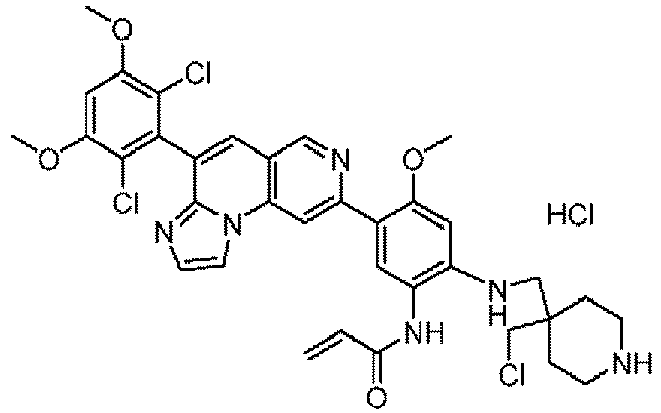
- The synthetic method of example 46 was same as that of example 1. 1H NMR (400 MHz, CD3OD), 9.59 (1H, s), 9.20 (1H, d, J = 2.0 Hz), 9.09 (1H, s), 8.36 (1H, s), 8.14 (1H, d, J = 2.0 Hz), 7.97 (1H, s), 7.11 (1H, s), 6.75 (1H, s), 6.62 (1H, dd, J = 16.8 Hz, 10.4 Hz), 6.41 (1H, dd, J = 16.8 Hz, 1.2 Hz), 5.85 (1H, dd, J = 10.4 Hz, 1.2 Hz), 4.13 (3H, s), 4.05 (6H, s), 3.83 (2H, s), 3.53 (2H, s), 3.30-3.36 (2H, m), 3.19-3.25 (2H, m), 1.90-2.03 (4H, m).
-

- The synthetic method of example 47 was same as that of example 1. 1H NMR (400 MHz, CDCl3), 9.22 (1H, s), 8.82 (1H, s), 8.34 (1H, s), 8.30 (1H, s), 8.13 (1H, s), 7.71 (1H, s), 7.51 (1H, s), 6.88 (1H, s), 6.72 (1H, s), 3.99 (6H, S), 3.89 (3H, s), 2.78-3.11 (8H, m), 2.06 (3H, s), 1.77-1.84 (1H, m), 0.44-0.64 (4H, m).
-

- The synthetic method of example 48 was same as that of example 1. 1H NMR (400 MHz, CDCl3), 9.21 (1H, s), 8.89 (1H, s), 8.44 (1H, s), 8.33 (1H, s), 8.11 (1H, s), 7.68 (1H, s), 7.49 (1H, s), 6.85 (1H, s), 6.70 (1H, s), 6.25 (1H, d, J = 6.0 Hz), 4.66-4.72 (1H, m), 3.98 (6H, s), 3.87 (3H, s), 3.72 (3H, s), 3.24 (2H, d J = 7.6 Hz), 2.77-3.24 (8H, m), 1.78-1.87 (1H, m), 0.47-0.59 (4H, m).
-

- The synthetic method of example 49 was same as that of example 1. 1H NMR (400 MHz, CDCl3), 9.48 (1H, s), 9.22 (1H, s), 8.96 (1H, s), 8.37 (1H, s), 8.12 (1H, d, J = 1.2 Hz), 7.70 (1H, d, J = 1.2 Hz), 7.50 (1H, s), 6.92 (1H, s), 6.71 (1H, s), 4.27 (2H, s), 3.98 (6H, s), 3.84 (3H, s), 2.85-3.08 (8H, m), 1.76-1.82 (1H, m), 0.49-0.63 (4H, m).
-

- The synthetic method of example 50 was same as that of example 1. 1H NMR (400 MHz, CDCl3), 9.28 (1H, s), 9.23 (1H, s), 8.92 (1H, s), 8.37 (1H, s), 8.12 (1H, s), 7.70 (1H, s), 7.51 (1H, s), 6.95 (1H, s), 6.71 (1H, s), 3.98 (6H, s), 3.90(3H, s), 3.62 (2H, s), 2.86-3.17 (8H, m), 1.76-1.95 (1H, m), 0.50-0.79 (4H, m).
-

- The synthetic method of example 51 was same as that of example 1. 1H NMR (400 MHz, CDCl3), 9.21 (1H, s), 8.92 (1H, s), 8.41 (1H, s), 8.34 (1H, s), 8.11 (1H, d, J = 1.6 Hz), 7.69 (1H, d J = 1.2 Hz), 7.49 (1H, s), 6.87 (1H, s), 6.70 (1H, s), 6.03-6.14 (1H, m), 5.38-5.43 (2H, m), 3.98 (6H, s), 3.87 (3H, s), 3.25 (2H, d, J = 7.6 Hz), 2.77-3.02 (8H, m), 1.69-1.89 (1H, m), 0.48-0.61 (4H, m).
-

- The synthetic method of example 52 was same as that of example 1. 1H NMR (400 MHz, CDCl3), 9.33 (1H, s), 9.11 (1H, s), 8.48 (1H, s), 8.23-8.26 (2H, m), 7.81 (1H, d, J = 1.2 Hz), 7.62 (1H, s), 7.08-7.17 (1H, m), 7.00 (1H, s), 6.83 (1H, s), 6.12 (1H, d, J = 16.8 Hz), 4.10 (6H, s), 4.01 (3H, s), 2.90-3.20 (8H, m), 2.07 (3H, d, J = 6.8 Hz), 1.83-1.96 (1H, m), 0.57-0.80 (4H, m).
-

- The synthetic method of example 53 was same as that of example 1. 1H NMR (400 MHz, CDCl3), 9.23 (1H, s), 8.85 (1H, s), 8.49-8.55 (1H, brs), 8.35 (1H, s), 8.13 (1H, s), 7.71 (1H, s), 7.51 (1H, s), 6.90 (1H, s), 6.72 (1H, s), 3.99 (6H, s), 3.91 (3H, s), 2.85-3.07 (9H, m), 1.74-1.83 (1H, m), 0.46-0.61 (4H, m).
- The FGFR-4 kinase activity detection platform was established by the homogeneous time-resolved fluorescence (HTRF) method, and the activity of the compound was determined. 1000 µM compounds were subjected to 3-fold gradient dilution in 100% DMSO 11 times (12 concentrations in total), 4 µL diluent from each concentration was added to 96 µL of reaction buffer (50 mM HEPES, pH 7.4, 5 mM MnCl2, 0.1 mM NaVO3, 0.001% Tween-20, 0.01% BAS, 1 mM DTT) and mixed well, as a 4* compound (final concentration of 0.017 nM-1000 nM) for later use. 2 * FGFR-4 kinase (final concentration of 1 nM) was formulated using reaction buffer and 4 * substrate (ATP+TK peptide) (TK peptide, HTRF® KinEASE™-TK, purchased from Cisbio, TK peptide, final concentration of 1 µ M, ATP final concentration of 25 µ M) was formulated using reaction buffer. 2.5 µL of 4 * compound and then 5 µL of 2 * FGFR-4 kinase were added to a 384-well plate (OptiPlate-384, purchased from PerkinElmer), the mixture was mixed by centrifugation, and 2.5 µL of 4 * substrate mixture was added to start the reaction (total reaction volume of 10 µL). The 384-well plate was placed in an incubator 23°C and stirred for 60 min before the reaction was stopped by the addition of 5 µL of Eu3+ cryptate-labeled anti-phosphotyrosine antibody (TRF® KinEASE™-TK, purchased from Cisbio) and 5 µL of Streptavidin-XL-665 (HTRF® KinEASE™-TK, purchased from Cisbio). After incubation in the incubator for 1 h, fluorescence values (excitation at 320 nm, detecting emitted light at 665 nm and 620 nm, and a ratio of the two as enzyme activity) were read on Envision (purchased from PerkinElmer). The enzyme activity of each compound was measured at 12 concentrations, and the IC50 value of the compound was calculated using GraphPad Prism 5.0 software.
- Cell Titer-Glo ® detection reagent from Promega was used to establish the suspension cell proliferation inhibition screening method. Human hepatoma cells Hep3b (Xiehe Cell Research Center) were cultured in 25 cm2 or 75 cm2 plastic tissue culture flasks (Corning®) filled with MEM (Gibco®) medium supplemented with 10% fetal bovine serum (Hyclone®) under 37°C, 95% air and 5% CO2, and subcultured 2-3 times a week.
- Hep3b cells were seeded in a 96-well cell culture plate (Corning®) at a density of 3×10³ cells/well, 195 mL/well, and cultured under 37°C, 95% air, and 5% CO2. After 24 h the test compound was added: 10 mM compounds (dissolved in DMSO) were subjected to 3-fold gradient dilution in DMSO , 4 mL of diluent from each concentration was added to 96 mL of serum-free medium, and finally 5 mL of compound diluted in the medium was added to the plate seeded with cells. The final concentration of DMSO in the cell culture medium was 0.1% and the final concentration of the test compound was 0.3 nM-10 mM. The above cells were incubated for 3 days under 37°C.
- After 3 days, the cell viability assay was performed by the Cell Titer-Glo (Promega) kit, and finally, the inhibitory concentration 50% of the compound on cell proliferation, i.e. the IC 50 value, was calculated by the GraphPad Prism 5.0 program.
Table 1. Inhibitory effects of the compounds in Examples on FGFR4 Compound FGFR4 IC50 (nM) Hep3B IC50 (nM) Example 4 2.25 - Example 5 - 20.3 Example 6 - 58.3 Example 7 1.74 83.6 Example 9 2.43 74.7 Example 11 3.82 68.3 Example 19 5.79 71.7 Example 20 2.54 - Example 22 5.61 - Example 23 3.85 142 Example 29 2.17 34.4 Example 30 0.947 46.3 Example 31 3.63 81.3 Example 32 6.10 76.8 Example 37 2.16 107 Example 38 5.07 - Example 44 5.03 113 Blu-554 7.49 162 - Male SD rats (Beijing Vital River Laboratory Animal Technology Co., Ltd.) were divided into groups of 3 rats each. The rats were subjected to 5 mg/kg suspension of the test sample by single intragastric administration, respectively. Animals were fasted overnight prior to the experiment from 10 h before dosing to 4 h after dosing. Blood was collected 0.25, 0.5, 1, 2, 4, 6, 8, and 24 h after administration. After isoflurane anesthesia using a small animal anesthesia machine, 0.3 mL of whole blood samples was collected from the fundus venous plexus, placed in a heparin anticoagulant tube, and were centrifuged at 4°C, 4000 rpm for 5 min, plasma was transferred to the centrifuge tube, and stored at -80°C until analysis. Samples in the plasma were extracted using protein precipitation and the extracts were analyzed by LC/MS/MS.
Example Example 6 Example 27 Blu-554 Dose (mg/kg) 5 5 5 T1/2 (hr) 11.5 2.73 1.64 Tmax (hr) 6.00 3.33 2.67 Cmax (ng/mL) 236 452 362 AUC0-inf (hr*ng/mL) 2555 1858 1683 -

- To a solution of compound 1 (2 g) in 1-Methyl-2-pyrrolidinone (15 mL) were added compound 2 (2.49 g) and potassium carbonate (5.29 g). The reaction solution was heated at 100 °C overnight. The reaction solution was cooled to room temperature and poured into water. The mixture was filtered, and the filter cake was washed with distilled water and dried to obtain compound 3 (3.58 g).
- At -20 °C, to a solution of compound 3 (3.58 g) in THF (100 mL) was added sulfuryl chloride (2.3 mL). The reaction solution was stirred at -20 °C for 2 hours until the reaction was completed. An aqueous solution of saturated sodium bicarbonate was used to quench the reaction. The organic phase was separated, and the aqueous phase was extracted with ethyl acetate. The organic phases were combined, dried over anhydrous sodium sulfate, and concentrated under reduced pressure. The residue thus obtained was purified through flash column chromatography (dichloromethane/methanol = 100/1) to obtain compound 4 (3.24 g).
- To a solution of compound 4 (3.24 g) in ethanol (18 mL) was added chloroacetaldehyde (18 mL). The reaction solution was heated to 80 °C and reacted overnight. The reaction solution was poured into water and filtered. The solid thus obtained was dried to obtain compound 5 (3.1 g).
- Under nitrogen protection, to a solution of compound 5 (1.23 g) in dioxane/water (20 mL/5 mL) were added tetrakis(triphenylphosphine)palladium (500 mg), compound 6 (1.5 g) and anhydrous sodium carbonate (1.5 g). The reaction solution was heated to 80 °C and reacted overnight. The reaction solution was cooled to room temperature and concentrated under reduced pressure, the residue thus obtained was separated and purified through flash silica gel column chromatography (dichloromethane/methanol = 500/1) to obtain compound 7 (1.12 g).
- To a solution of compound 7 (200 mg) in DMF (1 mL) were added anhydrous caesium carbonate (120 mg) and morpholine (0.1 mL), and the mixture was heated to 60 °C and reacted overnight. The reaction solution was cooled to room temperature and concentrated under reduced pressure. The residue thus obtained was separated and purified through flash silica gel column chromatography (dichloromethane/methanol = 100/1 to 50/1) to obtain compound 8 (120 mg).
- To a solution of compound 8 (120 mg) in tetrahydrofuran (5 mL) was added palladium on carbon (50 mg), and the system was purged with hydrogen gas. The reaction system was reacted at room temperature overnight and filtered through celite. The filtrate was concentrated under reduced pressure to obtain compound 9 (71 mg).
- At 0 °C, to a solution of compound 9 (71 mg) in dichloromethane (2 mL) were added DIEA (5 µL) and acryloyl chloride (11 µL). The reaction solution was stirred at 0 °C for 2 hours, methanol was added to quench the reaction, and the mixture was concentrated under reduced pressure. The residue thus obtained was separated and purified through preparative thin layer chromatography (dichloromethane/methanol = 25/1) to obtain example 54 (35 mg). 1H NMR (400 MHz, CDCl3) δ 9.22 (1H, s), 9.02 (1H, s), 8.38 (1H, s), 8.27 (1H, s), 8.14 (1H, s), 7.70 (1H, s), 7.51 (1H, s), 6.86 (1H, s), 6.71 (1H, s), 6.42 (1H, d, J = 16.8 Hz), 6.30 (1H, dd, J = 16.8, 10.0 Hz), 5.77 (1H, d, J = 10.0 Hz), 3.97 (6H, s), 3.87-3.95 (7H, m), 2.95-3.02 (4H, m).
-

- The synthetic method of example 55 was same as that of example 54. 1H NMR (400 MHz, CDCl3) δ 9.62-10.21 (1H, brs), 9.20 (1H, s), 8.82 (1H, s), 8.39 (1H, s), 8.15 (1H, s), 7.70 (1H, s), 7.51 (1H, s), 6.88 (1H, s), 6.71 (1H, s), 6.39 (1H, d, J = 16.8 Hz), 6.18-6.29 (1H, m), 5.75 (1H, d, J = 11.6 Hz), 3.98 (6H, s), 3.92 (3H, s), 3.78 (2H, s), 2.75-3.02 (8H, m), 2.69 (3H, s).
-

- The synthetic method of example 56 was same as that of example 54. 1H NMR (400 MHz, CDCl3) δ 9.19 (1H, s), 8.87 (1H, s), 8.38 (1H, s), 8.12 (1H, s), 7.75 (1H, s), 7.69 (1H, s), 7.49 (1H, s), 6.71 (1H, s), 6.66 (1H, s), 6.45 (1H, d, J = 16.8 Hz), 6.29 (1H, dd, J = 16.8, 10.4 Hz), 5.77 (1H, d, J = 10.4 Hz), 4.24-4.29 (1H, m), 3.98 (6H, s), 3.91 (3H, s), 3.75-3.83 (2H, m), 2.32-2.39 (2H, m), 2.21-2.31 (2H, m), 2.04-2.12 (2H, m), 1.94-2.03 (2H, m).
-

- The synthetic method of example 57 was same as that of example 54. 1H NMR (400 MHz, CDCl3) δ 9.21 (1H, s), 9.04 (1H, s), 8.37 (1H, s), 8.33 (1H, s), 8.12 (1H, s), 7.70 (1H, s), 7.50 (1H, s), 6.93 (1H, s), 6.71 (1H, s), 6.42 (1H, d, J = 17.2 Hz), 6.29 (1H, dd, J = 17.2, 10.0 Hz), 5.77 (1H, d, J = 10.0 Hz), 3.98 (6H, s), 3.91 (3H, s), 3.01-3.08 (4H, m), 2.67-2.85 (4H, m), 2.39 (2H, d, J = 6.4 Hz), 0.81-0.94 (1H, m), 0.55-0.63 (2H, m), 0.15-0.23 (2H, m).
-

- The synthetic method of example 58 was same as that of example 54. 1H NMR (400 MHz, CDCl3) δ 9.21 (1H, s), 9.01 (1H, s), 8.36 (1H, s), 8.19 (1H, s), 8.12 (1H, s), 7.69 (1H, s), 7.50 (1H, s), 6.85 (1H, s), 6.71 (1H, s), 6.42 (1H, d, J = 16.8 Hz), 6.28 (1H, dd, J = 16.8, 10.0 Hz), 5.76 (1H, d, J = 10.0 Hz), 3.98 (6H, s), 3.91 (3H, s), 3.76-3.83 (4H, m), 3.20 (2H, d, J = 10.8 Hz), 2.79 (2H, t, J = 11.6 Hz), 2.61-2.71 (4H, m), 2.30-2.42 (1H, m), 2.12 (2H, d, J = 11.6 Hz), 1.64-1.78 (2H, m).
-

- The synthetic method of example 59 was same as that of example 54. 1H NMR (400 MHz, CDCl3) δ 9.21 (1H, s), 9.03 (1H, s), 8.30-8.38 (2H, m), 8.12 (1H, s), 7.69 (1H, s), 7.50 (1H, s), 6.89 (1H, s), 6.71 (1H, s), 6.43 (1H, d, J = 16.8 Hz), 6.30 (1H, dd, J = 16.8 Hz), 5.78 (1H, d, J = 10.0 Hz), 3.98 (6H, s), 3.89 (3H, s), 2.94-3.04 (4H, m), 2.79-2.93 (4H, m), 1.72-1.82 (1H, m), 0.42-0.59 (4H, m).
-

- The synthetic method of example 60 was same as that of example 54. 1H NMR (400 MHz, CDCl3) δ 9.21 (1H, s), 8.99 (1H, s), 8.37 (1H, s), 8.13 (1H, s), 8.05 (1H, s), 7.70 (1H, s), 7.51 (1H, s), 6.84 (1H, s), 6.71 (1H, s), 6.43 (1H, d, J = 17.2 Hz), 6.28 (1H, dd, J = 17.2, 10.4 Hz), 5.74 (1H, d, J = 10.4 Hz), 3.98 (6H, s), 3.93 (3H, s), 3.43-3.53 (4H, m), 3.03-3.12 (4H, m).
-

- The synthetic method of example 61 was same as that of example 54. 1H NMR (400 MHz, CDCl3) δ 9.15 (1H, s), 8.41 (1H, s), 8.40 (1H, s), 8.13 (1H, s), 7.69 (1H, s), 7.60 (1H, s), 7.48 (1H, s), 6.70 (1H, s), 6.52 (1H, s), 6.41 (1H, d, J = 16.8 Hz), 6.31 (1H, dd, J = 16.8, 10.0 Hz), 5.75 (1H, d, J = 10.0 Hz), 4.62 (1H, s), 4.24 (1H, s), 4.08 (1H, d, J = 7.6 Hz), 3.97 (6H, s), 3.92 (3H, s), 3.83 (1H, d, J = 7.6 Hz), 3.42 (1H, d, J = 9.6 Hz), 3.37 (1H, d, J = 9.6 Hz), 1.94-2.01 (2H, m).
-

- The synthetic method of example 62 was same as that of example 54. 1H NMR (400 MHz, CDCl3) δ 9.14 (1H, s), 8.42 (1H, s), 8.28 (1H, s), 8.12 (1H, s), 7.68 (1H, s), 7.63 (1H, s), 7.47 (1H, s), 6.70 (1H, s), 6.46 (1H, s), 6.37 (1H, d, J = 16.8 Hz), 6.31 (1H, dd, J = 16.8, 10.8 Hz), 5.76 (1H, d, J = 10.8 Hz), 3.97 (6H, s), 3.94 (3H, s), 3.87-3.93 (2H, m), 3.72 (1H, d, J = 8.4 Hz), 3.65 (1H, d, J = 8.4 Hz), 3.37-3.43 (2H, m), 3.30 (1H, d, J = 9.2 Hz), 3.25 (1H, d, J = 9.2 Hz), 1.86-2.03 (4H, m).
-

- The synthetic method of example 63 was same as that of example 54. 1H NMR (400 MHz, CDCl3) δ 9.21 (1H, s), 8.86 (1H, d, J = 9.2 Hz), 8.37 (1H, s), 8.14 (1H, s), 7.71 (1H, s), 7.51 (1H, s), 7.46 (1H, s), 6.87 (1H, d, J = 12.4 Hz), 6.71 (1H, s), 6.46 (1H, d, J = 16.8 Hz), 6.30 (1H, dd, J = 16.8, 10.0 Hz), 5.80 (1H, d, J = 10.0 Hz), 3.98 (6H, s), 3.93 (3H, s).
-

- The synthetic method of example 64 was same as that of example 54. 1H NMR (400 MHz, DMSO-d6 ) δ 9.51 (1H, s), 9.32 (1H, s), 9.12 (1H, s), 8.93 (1H, s), 8.38 (1H, s), 8.21 (1H, s), 8.08 (1H, s), 7.15 (1H, s), 6.90 (1H, s), 6.89 (1H, dd, J = 17.2, 10.0 Hz), 6.25 (1H, d, J = 17.2 Hz), 5.75 (1H, d, J =10.0 Hz), 4.01 (6H, s), 3.97 (3H, s), 3.68-3.86 (4H, m), 3.49-3.65 (4H, m), 3.32-3.48 (3H, m), 2.75-2.88 (5H, m), 2.14-2.26 (2H, m), 1.96-2.12 (2H, m).
-

- The synthetic method of example 65 was same as that of example 54. 1H NMR (400 MHz, CDCl3) δ 9.21 (1H, s), 9.02 (1H, s), 8.37 (1H, s), 8.24 (1H, s), 8.12 (1H, s), 7.70 (1H, s), 7.50 (1H, s), 6.91 (1H, s), 6.71 (1H, s), 6.42 (1H, d, J = 16.8 Hz), 6.28 (1H, dd, J = 16.8, 10.0 Hz), 5.77 (1H, d, J = 10.0 Hz), 4.67-4.75 (4H, m), 3.98 (6H, s), 3.92 (3H, s), 3.60-3.68 (1H, m), 3.01-3.12 (4H, m), 2.46-2.67 (4H, m).
-

- The synthetic method of example 66 was same as that of example 54. 1H NMR (400 MHz, CD3OD) δ 9.20 (1H, s), 8.54 (1H, s), 8.35 (1H, s), 8.24 (1H, s), 7.65 (1H, s), 7.56 (1H, s), 6.93 (1H, s), 6.85 (1H, s), 6.69 (1H, dd, J = 17.2, 10.4 Hz), 6.43 (1H, d, J = 17.2 Hz), 5.83 (1H, d, J = 10.4 Hz), 4.02 (6H, s), 4.01 (3H, s), 3.43-3.51 (2H, m), 3.12-3.21 (2H, m), 2.83 (3H, s), 2.75 (6H, s).
-
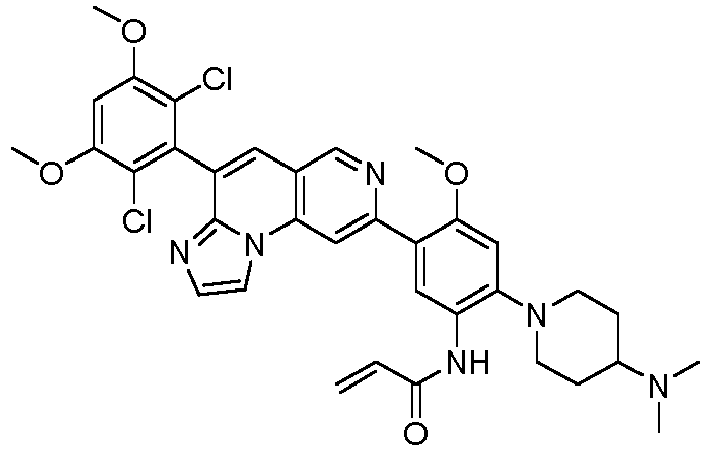
- The synthetic method of example 67 was same as that of example 54. 1H NMR (400 MHz, CDCl3) δ 9.18 (1H, s), 8.92 (1H, s), 8.37 (1H, s), 8.12-8.18 (2H, m), 7.69 (1H, s), 7.49 (1H, s), 6.79 (1H, s), 6.71 (1H, s), 6.42-6.45 (2H, m), 5.77-5.80 (1H, m), 3.98 (6H, s), 3.90 (3H, s), 3.31 (2H, d, J = 12.0 Hz), 3.12-3.24 (1H, m), 2.79-2.89 (8H, m), 2.35 (2H, d, J = 11.2 Hz), 2.07-2.22 (2H, m).
-

- The synthetic method of example 68 was same as that of example 54. 1H NMR (400 MHz, CDCl3) δ 9.13 (1H, s), 8.40 (1H, s), 8.29 (1H, s), 8.12 (1H, s), 7.78 (1H, s), 7.68 (1H, s), 7.47 (1H, s), 6.70 (1H, s), 6.44 (1H, s), 6.42 (1H, d, J = 16.8 Hz), 6.34 (1H, dd, J = 16.8, 10.0 Hz), 5.77 (1H, d, J = 10.0 Hz), 3.97 (6H, s), 3.94 (3H, s), 3.61-3.71 (4H, m), 3.36 (2H, t, J = 6.8 Hz), 3.14 (2H, s), 1.81 (2H, t, J = 6.8 Hz), 1.52-1.68 (4H, m).
-

- The synthetic method of example 69 was same as that of example 54. 1H NMR (400 MHz, CDCl3) δ 9.21 (1H, s), 9.04 (1H, s), 8.37 (1H, s), 8.32 (1H, s), 8.12 (1H, s), 7.69 (1H, s), 7.50 (1H, s), 6.91 (1H, s), 6.71 (1H, s), 6.42 (1H, d, J = 16.8 Hz), 6.30 (1H, dd, J = 16.8, 10.4 Hz), 5.77 (1H, d, J = 10.4 Hz), 3.98 (6H, s), 3.90 (3H, s), 3.01-3.05 (4H, m), 2.58-2.75 (4H, m), 2.54 (2H, q, J = 7.2 Hz), 1.17 (3H, t, J = 7.2 Hz).
-


- At room temperature, to a solution of compound 2 (3.0 g) in tetrahydrofuran (20 mL) was added sodium hydride (774 mg), the mixture was stirred at room temperature for 1.5 hours, then compound 10 (2.86 g) was added into the mixture, and the mixture was stirred at room temperature overnight. An aqueous solution of saturated ammonium chloride was used to quench the reaction, and dichloromethane was used for dilution, the organic phase was separated, washed with aqueous solution of saturated ammonium chloride, dried over anhydrous sodium sulfate, filtered, and concentrated, and the residue was purified through flash silica gel column chromatography (DCM/MeOH = 100/1) to obtain compound 11 (5.2 g).
- At -20 °C, to a solution of compound 11 (5.2 g) in tetrahydrofuran (100 mL) was slowly dropwise added sulfuryl chloride (2.81 g). After the addition was complete, the mixture was stirred at -20 °C for 2 hours. Then an aqueous solution of saturated sodium bicarbonate was used to quench the reaction. The mixture was extracted with ethyl acetate, the extract was dried over anhydrous sodium sulfate, filtered and concentrated, and the residue was purified through flash silica gel column chromatography (DCM/MeOH = 100/2) to obtain compound 12 (4.7 g).
- To a solution of compound 12 (2.0 g) in ethanol (20 mL) was added an aqueous solution of 40% chloroacetaldehyde (8 mL), and the mixture was heated at 80 °C overnight. The mixture was poured into an aqueous solution of saturated sodium bicarbonate, stirred and filtered, and the filter cake was dried to obtain a light yellow solid 13 (2.1 g). This compound was directly used in the next step without further purification.
- To a solution of compound 13 (2.1 g) in dichloromethane/methanol/water (20 mL/ 20 mL/ 20 mL) was added potassium peroxymonosulfate sulfate (18.4 g), and the mixture was heated to 40 °C and stirred overnight. Water was added to dilute the mixture, the mixture was extracted with dichloromethane, and the extract was dried over anhydrous sodium sulfate, filtered and concentrated. The light yellow solid 14 thus obtained was used in the next step.without further purification.
- To a solution of compound 14 (2.5 g) in THF (10 mL) was added a solution of potassium hydroxide (924 mg) in water (10 mL). The reaction solution was stirred at room temperature overnight. The mixture was concentrated under reduced pressure to remove THF, and then concentrated hydrochloric acid was added to pH = 2. The mixture was filtered, the solid thus obtained was washed with anhydrous acetonitrile (5 mL) and dried to obtain compound 15 (2.1 g).
- To a solution of compound 15 (2.1 g) in acetonitrile (20 mL) was added phosphorus oxychloride (20 mL). The reaction solution was heated to 80 °C and reacted for 3 hours, then cooled to room temperature. The reaction solution was concentrated under reduced pressure, then ice water was added. The mixture was filtered, and thus obtained solid was washed with anhydrous acetonitrile and dried to obtain compound 16 (1.9 g).
- Under nitrogen protection, to a solution of compound 16 (1.14 g) in dioxane/water (20 mL/5 mL) were added tetrakis(triphenylphosphine)palladium (500 mg), compound 6 (1.3 g) and anhydrous sodium carbonate (1.2 g). The reaction solution was heated to 80 °C and reacted overnight. The reaction solution was cooled to room temperature and concentrated under reduced pressure, and the residue thus obtained was separated and purified through flash silica gel column chromatography (dichloromethane/methanol = 500/1) to obtain compound 17 (920 mg).
- To a solution of compound 17 (200 mg) in DMF (1 mL) were added anhydrous caesium carbonate (120 mg) and compound 18 (120 mg), and the mixture was heated to 60 °C and reacted overnight. The reaction solution was cooled to room temperature and concentrated under reduced pressure. The residue thus obtained was separated and purified through flash silica gel column chromatography (dichloromethane/methanol = 100/1 to 50/1) to obtain compound 19 (110 mg).
- To a solution of compound 19 (110 mg) in tetrahydrofuran (5 mL) was added palladium on carbon (50 mg), and the system was purged with hydrogen gas. The reaction system was reacted at room temperature overnight and filtered through celite. The filtrate was concentrated under reduced pressure to obtain compound 20 (63 mg).
- In an ice bath, to a solution of compound 20 (63 mg) in dichloromethane (2 mL) were added DIEA (5 µL) and acryloyl chloride (11 µL). The reaction solution was stirred in an ice bath for 2 hours, then methanol was added to quench the reaction, and the mixture was concentrated under reduced pressure. The residue thus obtained was separated and purified through preparative thin layer chromatography (dichloromethane/methanol = 20/1) to obtain example 70 (33 mg). 1H NMR (400 MHz, CDCl3) δ 9.34 (1H, s), 9.07 (1H, s), 8.58 (1H, s), 8.26 (1H, s), 7.68 (1H, s), 7.43 (1H, s), 6.93 (1H, s), 6.71 (1H, s), 6.42 (1H, d, J = 16.8 Hz), 6.28 (1H, dd, J = 16.8, 10.4 Hz), 5.78 (1H, d, J = 10.4 Hz), 4.74 (2H, t, J = 6.4 Hz), 4.68 (2H, t, J = 6.4 Hz), 3.98 (6H, s), 3.93 (3H, s), 3.61-3.67 (1H, m), 3.03-3.09 (4H, m), 2.51-2.65 (4H, m).
- The FGFR-4 kinase activity detection platform was established by homogeneous time-resolved fluorescence (HTRF) method, and the activity of compound was determined. 1000 µM compounds were subjected to 3-fold gradient dilution in 100% DMSO 11 times (12 concentrations in total), 4 µL of diluent from each concentration was added to 96 µL of reaction buffer (50 mM HEPES, pH 7.4, 5 mM MnCl2, 0.1 mM NaVO3, 0.001% Tween-20, 0.01% BAS, 1 mM DTT) and mixed well, as a 4* compound (final concentration of 0.017 nM-1000 nM) for later use. 2 * FGFR-4 kinase (final concentration of 1 nM) was formulated using reaction buffer and 4 * substrate ( ATP+TK peptide)( TK peptide, HTRF® KinEASE™-TK, purchased from Cisbio, TK peptide, final concentration of 1 µ M, ATP final concentration of 25 µ M) was formulated using reaction buffer. 2.5 µL of 4 * compound and then 5 µL of 2 * FGFR-4 kinase were added to a 384-well plate ( OptiPlate-384, purchased from PerkinElmer), the mixture was mixed by centrifugation, and 2.5 µL of 4 * substrate mixture was added to start the reaction (total reaction volume of 10 µL). The 384-well plate was placed in an incubator 23°C and stirred for 60 min before the reaction was stopped by the addition of 5 µL of Eu3+ cryptate-labled anti-phosphotyrosine antibody (TRF® KinEASE™-TK, purchased from Cisbio) and 5 µL of Streptavidin-XL-665 (HTRF® KinEASE™-TK, purchased from Cisbio). After incubation in the incubator for 1 h, fluorescence values (excitation at 320 nm, detecting emitted light at 665 nm and 620 nm, and a ratio of the two as enzyme activity) were read on Envision (purchased from PerkinElmer). The enzyme activity of each compound was measured at 12 concentrations, and the IC50 value of the compound was calculated using GraphPad prism 5.0 software.
- Cell Titer-Glo ® detection reagent from Promega was used to establish the suspension cell proliferation inhibition screening method. Human hepatoma cells Hep3b (Xiehe Cell Research Center) were cultured in 25 cm2 or 75 cm2 plastic tissue culture flasks (Corning®) filled with MEM (Gibco®) medium supplemented with 10% fetal bovine serum (Hyclone®) under 37°C, 95% air and 5% CO2, and subcultured 2-3 times a week.
- Hep3b cells were seeded in a 96-well cell culture plate (Coming®) at a density of 3×10³ cells/well, 195 mL/well, and cultured under 37°C, 95% air, and 5% CO2. After 24 h the test compound was added: 10 mM compounds (dissolved in DMSO) were subjected to 3-fold gradient dilution in DMSO, 4 mL of diluent from each concentration was added to 96 mL of serum-free medium, and finally, 5 mL of compound diluted in the medium was added to the plate seeded with cells. The final concentration of DMSO in the cell culture medium was 0.1% and the final concentration of test compound was 0.3 nM-10 mM. The above cells were incubated for 3 days under 37°C.
- After 3 days, the cell viability assay was performed by the Cell Titer-Glo (Promega) kit, and finally the inhibitory concentration 50% of the compound on cell proliferation, i.e. the IC 50 value, was calculated by the GraphPad Prism 5.0 program.
Table 2. Inhibitory effects of the compounds in Examples on FGFR4 and Hep3B cell lines Compound FGFR4 IC50 (nM) Hep3B IC50 (nM) Example 54 0.7 21.5 Example 59 1.1 63.2 Example 60 0.9 95.2 Example 61 1.7 121 Example 62 2.4 43.8 Example 64 0.3 69.7 Example 65 0.9 22.3 Example 67 0.4 81.3 Blu-554 2.21 66.1 - Male SD rats (Beijing Vital River Laboratory Animal Technology Co., Ltd.) were divided into groups of 3 rats each. The rats were subjected to 5 mg/kg suspension of the test sample by single intragastric administration, respectively. Animals were fasted overnight prior to the experiment from 10 h before dosing to 4 h after dosing. Blood was collected 0.25, 0.5, 1, 2, 4, 6, 8, and 24 h after administration. After isoflurane anesthesia using a small animal anesthesia machine, 0.3 mL of whole blood samples was taken through the fundus venous plexus, placed in a heparin anticoagulant tube, and were centrifuged at 4°C, 4000 rpm for 5 min, plasma was transferred to the centrifuge tube, and stored at -80°C until analysis. Samples in the plasma were extracted using protein precipitation and the extracts were analyzed by LC/MS/MS.
Example Example 59 Example 62 Example 61 Blu-554 Dose (mg/kg) 5 5 5 5 T1/2 (hr) 3.97 4.93 2.60 1.64 Tmax (hr) 2.67 5.33 1.17 2.67 Cmax (ng/mL) 505 175 561 362 AUC0-inf (hr*ng/mL) 3942 1118 3048 1683 - The present invention provides an FGFR4 kinase inhibitor, a preparation method therefor and use thereof, as further defined in the claims. The present invention relates to the compounds as defined in the claims or a pharmaceutically acceptable salt, solvate, polymorph, or isomer thereof, and use thereof in the preparation of a drug for the treatment of FGFR4-mediated diseases. The FGFR4 protein kinase inhibitor can inhibit FGFR4 tyrosine kinase with high selectivity, has a weak inhibition effect on FGFR1-3, to safely and effectively treat liver cancer patients with high FGFR4 expression, and has good economic value and application prospect.
Claims (3)
- The compound below, or a pharmaceutically acceptable salt, solvate, polymorph or tautomer thereof:










- A composition comprising the compound according to claim 1 or a pharmaceutically acceptable salt, solvate, polymorph or tautomer thereof, and a pharmaceutically acceptable carrier.
- The compound according to claim 1 or a pharmaceutically acceptable salt, solvate, polymorph or tautomer thereof and the composition according to claim 2 for use in the treatment of an FGFR4 mediated disease, wherein the FGFR4 mediated disease is nonsmall cell lung cancer, gastric carcinoma, multiple myeloma, liver cancer, cholangiocarcinoma, prostate cancer, skin cancer, ovarian cancer, breast cancer, colon cancer, glioma, and rhabdomyosarcoma.
Applications Claiming Priority (3)
| Application Number | Priority Date | Filing Date | Title |
|---|---|---|---|
| CN201910178024.9A CN111662292A (en) | 2019-03-08 | 2019-03-08 | FGFR4 kinase inhibitor and preparation method and use thereof |
| CN201910602669.0A CN112174986A (en) | 2019-07-05 | 2019-07-05 | FGFR4 kinase inhibitor and preparation method and application thereof |
| PCT/CN2020/078098 WO2020182062A1 (en) | 2019-03-08 | 2020-03-06 | Fgfr4 kinase inhibitor, preparation method therefor and use thereof |
Publications (3)
| Publication Number | Publication Date |
|---|---|
| EP3936509A1 EP3936509A1 (en) | 2022-01-12 |
| EP3936509A4 EP3936509A4 (en) | 2022-03-30 |
| EP3936509B1 true EP3936509B1 (en) | 2024-07-31 |
Family
ID=72426923
Family Applications (1)
| Application Number | Title | Priority Date | Filing Date |
|---|---|---|---|
| EP20771072.4A Active EP3936509B1 (en) | 2019-03-08 | 2020-03-06 | Fgfr4 kinase inhibitor, preparation method therefor and use thereof |
Country Status (6)
| Country | Link |
|---|---|
| US (1) | US20220185811A1 (en) |
| EP (1) | EP3936509B1 (en) |
| JP (1) | JP7378488B2 (en) |
| KR (1) | KR20210131369A (en) |
| CN (1) | CN113646314B (en) |
| WO (1) | WO2020182062A1 (en) |
Families Citing this family (7)
| Publication number | Priority date | Publication date | Assignee | Title |
|---|---|---|---|---|
| US11591329B2 (en) | 2019-07-09 | 2023-02-28 | Incyte Corporation | Bicyclic heterocycles as FGFR inhibitors |
| US12122767B2 (en) | 2019-10-01 | 2024-10-22 | Incyte Corporation | Bicyclic heterocycles as FGFR inhibitors |
| CA3163875A1 (en) | 2019-12-04 | 2021-06-10 | Incyte Corporation | Tricyclic heterocycles as fgfr inhibitors |
| US12012409B2 (en) | 2020-01-15 | 2024-06-18 | Incyte Corporation | Bicyclic heterocycles as FGFR inhibitors |
| KR20220159457A (en) * | 2020-03-27 | 2022-12-02 | 베타 파머수티컬 컴퍼니 리미티드 | Salt Forms, Crystalline Forms and Uses of FGFR4 Inhibitors |
| EP4352060A1 (en) | 2021-06-09 | 2024-04-17 | Incyte Corporation | Tricyclic heterocycles as fgfr inhibitors |
| JP2024522189A (en) | 2021-06-09 | 2024-06-11 | インサイト・コーポレイション | Tricyclic Heterocycles as FGFR Inhibitors |
Family Cites Families (10)
| Publication number | Priority date | Publication date | Assignee | Title |
|---|---|---|---|---|
| PL374544A1 (en) * | 2002-04-03 | 2005-10-31 | F.Hoffmann-La Roche Ag | Imidazo fused compounds |
| NZ703495A (en) * | 2012-07-11 | 2018-02-23 | Blueprint Medicines Corp | Inhibitors of the fibroblast growth factor receptor |
| JP6576325B2 (en) * | 2013-03-15 | 2019-09-18 | セルジーン シーエーアール エルエルシー | Heteroaryl compounds and their use |
| WO2015108992A1 (en) | 2014-01-15 | 2015-07-23 | Blueprint Medicines Corporation | Heterobicyclic compounds and their use as fgfr4 receptor inhibitors |
| KR102703498B1 (en) * | 2015-09-23 | 2024-09-04 | 얀센 파마슈티카 엔브이 | new compound |
| WO2018004258A1 (en) * | 2016-06-28 | 2018-01-04 | 한미약품 주식회사 | Novel heterocyclic derivative compound and use thereof |
| US10968220B2 (en) * | 2016-12-19 | 2021-04-06 | Abbisko Therapeutics Co., Ltd. | FGFR4 inhibitor, preparation method therefor and pharmaceutical use thereof |
| CN110382499B (en) * | 2017-02-27 | 2023-01-03 | 贝达药业股份有限公司 | FGFR inhibitor and application thereof |
| TW201900644A (en) | 2017-05-09 | 2019-01-01 | 大陸商南京聖和藥業股份有限公司 | Fgfr4 inhibitor and preparation and use thereof |
| KR102421137B1 (en) | 2017-10-30 | 2022-07-13 | 상하이 린진 바이오파마 씨오., 엘티디. | Amino-substituted nitrogen-containing condensed cyclic compound and method and use thereof |
-
2020
- 2020-03-06 JP JP2021553854A patent/JP7378488B2/en active Active
- 2020-03-06 US US17/437,375 patent/US20220185811A1/en not_active Abandoned
- 2020-03-06 EP EP20771072.4A patent/EP3936509B1/en active Active
- 2020-03-06 CN CN202080026854.0A patent/CN113646314B/en active Active
- 2020-03-06 WO PCT/CN2020/078098 patent/WO2020182062A1/en not_active Ceased
- 2020-03-06 KR KR1020217029540A patent/KR20210131369A/en active Pending
Also Published As
| Publication number | Publication date |
|---|---|
| CN113646314A (en) | 2021-11-12 |
| EP3936509A1 (en) | 2022-01-12 |
| KR20210131369A (en) | 2021-11-02 |
| US20220185811A1 (en) | 2022-06-16 |
| CN113646314B (en) | 2023-12-08 |
| WO2020182062A1 (en) | 2020-09-17 |
| EP3936509A4 (en) | 2022-03-30 |
| JP2022523448A (en) | 2022-04-22 |
| JP7378488B2 (en) | 2023-11-13 |
Similar Documents
| Publication | Publication Date | Title |
|---|---|---|
| CN113795483B (en) | Carboxamide-pyrimidine derivatives as SHP2 antagonists | |
| CN111153901B (en) | Nitrogen-containing fused heterocyclic SHP2 inhibitor compound, preparation method and application | |
| CN115028644A (en) | SOS1 inhibitor heterocyclic compounds | |
| CN113646314B (en) | FGFR4 kinase inhibitors and preparation methods and uses thereof | |
| US20220194960A1 (en) | Wee1 inhibitor and preparation and use thereof | |
| AU2020271838A1 (en) | Pyrimidinone derivatives as SHP2 antagonists | |
| EP3784671B1 (en) | Dual atm and dna-pk inhibitors for use in anti-tumor therapy | |
| KR20240144125A (en) | PARP inhibitors, pharmaceutical compositions comprising same, and uses thereof | |
| CN114072404B (en) | RET selective inhibitors and preparation methods and uses thereof | |
| CN115504980B (en) | Pyrimidine nitrogen-containing six-membered aromatic heterocyclic compound and application thereof | |
| EP4223759B1 (en) | Pyrazolopyridazinone compound, and pharmaceutical composition and use thereof | |
| CN114340634A (en) | Heterocyclic compounds as kinase inhibitors | |
| WO2023036156A1 (en) | Dna-pk selective inhibitor, and preparation method therefor and use thereof | |
| JP2022538901A (en) | Pyrazolone condensed pyrimidine compound, its production method and use | |
| CN110950867A (en) | FGFR4 kinase inhibitor and preparation method and application thereof | |
| CN114634521A (en) | DNA-PK selective inhibitor and preparation method and application thereof | |
| CN112209925A (en) | RET selective inhibitor and preparation method and application thereof | |
| EP4142732B1 (en) | Methods of use for pyrimidines as ferroportin inhibitors | |
| CN111662292A (en) | FGFR4 kinase inhibitor and preparation method and use thereof | |
| CN114573584A (en) | DNA-PK selective inhibitor and preparation method and application thereof | |
| CN114195805A (en) | DNA-PK selective inhibitor and preparation method and application thereof | |
| CN117586256A (en) | Substituted heterocyclic compounds | |
| WO2024083111A1 (en) | Novel heterocyclic compounds | |
| KR20240007181A (en) | Nitrogen-containing heterocyclic compounds | |
| CN116249692A (en) | Pyrazole compound and its preparation method and use |
Legal Events
| Date | Code | Title | Description |
|---|---|---|---|
| STAA | Information on the status of an ep patent application or granted ep patent |
Free format text: STATUS: THE INTERNATIONAL PUBLICATION HAS BEEN MADE |
|
| PUAI | Public reference made under article 153(3) epc to a published international application that has entered the european phase |
Free format text: ORIGINAL CODE: 0009012 |
|
| STAA | Information on the status of an ep patent application or granted ep patent |
Free format text: STATUS: REQUEST FOR EXAMINATION WAS MADE |
|
| 17P | Request for examination filed |
Effective date: 20210917 |
|
| AK | Designated contracting states |
Kind code of ref document: A1 Designated state(s): AL AT BE BG CH CY CZ DE DK EE ES FI FR GB GR HR HU IE IS IT LI LT LU LV MC MK MT NL NO PL PT RO RS SE SI SK SM TR |
|
| REG | Reference to a national code |
Ref country code: DE Ref legal event code: R079 Free format text: PREVIOUS MAIN CLASS: C07D0519000000 Ipc: C07D0471140000 Ref document number: 602020034921 Country of ref document: DE |
|
| A4 | Supplementary search report drawn up and despatched |
Effective date: 20220228 |
|
| RIC1 | Information provided on ipc code assigned before grant |
Ipc: A61K 31/541 20060101ALI20220222BHEP Ipc: A61K 31/5377 20060101ALI20220222BHEP Ipc: A61K 31/5386 20060101ALI20220222BHEP Ipc: A61K 31/499 20060101ALI20220222BHEP Ipc: A61K 31/496 20060101ALI20220222BHEP Ipc: A61K 31/4375 20060101ALI20220222BHEP Ipc: A61K 31/4995 20060101ALI20220222BHEP Ipc: A61K 31/438 20060101ALI20220222BHEP Ipc: A61P 35/00 20060101ALI20220222BHEP Ipc: C07D 519/00 20060101ALI20220222BHEP Ipc: C07D 471/14 20060101AFI20220222BHEP |
|
| DAV | Request for validation of the european patent (deleted) | ||
| DAX | Request for extension of the european patent (deleted) | ||
| STAA | Information on the status of an ep patent application or granted ep patent |
Free format text: STATUS: EXAMINATION IS IN PROGRESS |
|
| 17Q | First examination report despatched |
Effective date: 20230309 |
|
| GRAP | Despatch of communication of intention to grant a patent |
Free format text: ORIGINAL CODE: EPIDOSNIGR1 |
|
| STAA | Information on the status of an ep patent application or granted ep patent |
Free format text: STATUS: GRANT OF PATENT IS INTENDED |
|
| INTG | Intention to grant announced |
Effective date: 20240306 |
|
| GRAS | Grant fee paid |
Free format text: ORIGINAL CODE: EPIDOSNIGR3 |
|
| GRAA | (expected) grant |
Free format text: ORIGINAL CODE: 0009210 |
|
| STAA | Information on the status of an ep patent application or granted ep patent |
Free format text: STATUS: THE PATENT HAS BEEN GRANTED |
|
| AK | Designated contracting states |
Kind code of ref document: B1 Designated state(s): AL AT BE BG CH CY CZ DE DK EE ES FI FR GB GR HR HU IE IS IT LI LT LU LV MC MK MT NL NO PL PT RO RS SE SI SK SM TR |
|
| REG | Reference to a national code |
Ref country code: CH Ref legal event code: EP Ref country code: GB Ref legal event code: FG4D |
|
| REG | Reference to a national code |
Ref country code: DE Ref legal event code: R096 Ref document number: 602020034921 Country of ref document: DE |
|
| REG | Reference to a national code |
Ref country code: IE Ref legal event code: FG4D |
|
| U01 | Request for unitary effect filed |
Effective date: 20240830 |
|
| U12 | Request for unitary effect withdrawn |
Effective date: 20240830 |
|
| REG | Reference to a national code |
Ref country code: LT Ref legal event code: MG9D |
|
| REG | Reference to a national code |
Ref country code: NL Ref legal event code: MP Effective date: 20240731 |
|
| REG | Reference to a national code |
Ref country code: AT Ref legal event code: MK05 Ref document number: 1708390 Country of ref document: AT Kind code of ref document: T Effective date: 20240731 |
|
| PG25 | Lapsed in a contracting state [announced via postgrant information from national office to epo] |
Ref country code: NO Free format text: LAPSE BECAUSE OF FAILURE TO SUBMIT A TRANSLATION OF THE DESCRIPTION OR TO PAY THE FEE WITHIN THE PRESCRIBED TIME-LIMIT Effective date: 20241031 |
|
| PG25 | Lapsed in a contracting state [announced via postgrant information from national office to epo] |
Ref country code: FI Free format text: LAPSE BECAUSE OF FAILURE TO SUBMIT A TRANSLATION OF THE DESCRIPTION OR TO PAY THE FEE WITHIN THE PRESCRIBED TIME-LIMIT Effective date: 20240731 Ref country code: NL Free format text: LAPSE BECAUSE OF FAILURE TO SUBMIT A TRANSLATION OF THE DESCRIPTION OR TO PAY THE FEE WITHIN THE PRESCRIBED TIME-LIMIT Effective date: 20240731 Ref country code: PL Free format text: LAPSE BECAUSE OF FAILURE TO SUBMIT A TRANSLATION OF THE DESCRIPTION OR TO PAY THE FEE WITHIN THE PRESCRIBED TIME-LIMIT Effective date: 20240731 Ref country code: GR Free format text: LAPSE BECAUSE OF FAILURE TO SUBMIT A TRANSLATION OF THE DESCRIPTION OR TO PAY THE FEE WITHIN THE PRESCRIBED TIME-LIMIT Effective date: 20241101 |
|
| PG25 | Lapsed in a contracting state [announced via postgrant information from national office to epo] |
Ref country code: BG Free format text: LAPSE BECAUSE OF FAILURE TO SUBMIT A TRANSLATION OF THE DESCRIPTION OR TO PAY THE FEE WITHIN THE PRESCRIBED TIME-LIMIT Effective date: 20240731 |
|
| PG25 | Lapsed in a contracting state [announced via postgrant information from national office to epo] |
Ref country code: IS Free format text: LAPSE BECAUSE OF FAILURE TO SUBMIT A TRANSLATION OF THE DESCRIPTION OR TO PAY THE FEE WITHIN THE PRESCRIBED TIME-LIMIT Effective date: 20241130 Ref country code: AT Free format text: LAPSE BECAUSE OF FAILURE TO SUBMIT A TRANSLATION OF THE DESCRIPTION OR TO PAY THE FEE WITHIN THE PRESCRIBED TIME-LIMIT Effective date: 20240731 |
|
| PG25 | Lapsed in a contracting state [announced via postgrant information from national office to epo] |
Ref country code: HR Free format text: LAPSE BECAUSE OF FAILURE TO SUBMIT A TRANSLATION OF THE DESCRIPTION OR TO PAY THE FEE WITHIN THE PRESCRIBED TIME-LIMIT Effective date: 20240731 |
|
| PG25 | Lapsed in a contracting state [announced via postgrant information from national office to epo] |
Ref country code: RS Free format text: LAPSE BECAUSE OF FAILURE TO SUBMIT A TRANSLATION OF THE DESCRIPTION OR TO PAY THE FEE WITHIN THE PRESCRIBED TIME-LIMIT Effective date: 20241031 Ref country code: ES Free format text: LAPSE BECAUSE OF FAILURE TO SUBMIT A TRANSLATION OF THE DESCRIPTION OR TO PAY THE FEE WITHIN THE PRESCRIBED TIME-LIMIT Effective date: 20240731 |
|
| PG25 | Lapsed in a contracting state [announced via postgrant information from national office to epo] |
Ref country code: RS Free format text: LAPSE BECAUSE OF FAILURE TO SUBMIT A TRANSLATION OF THE DESCRIPTION OR TO PAY THE FEE WITHIN THE PRESCRIBED TIME-LIMIT Effective date: 20241031 Ref country code: PL Free format text: LAPSE BECAUSE OF FAILURE TO SUBMIT A TRANSLATION OF THE DESCRIPTION OR TO PAY THE FEE WITHIN THE PRESCRIBED TIME-LIMIT Effective date: 20240731 Ref country code: NO Free format text: LAPSE BECAUSE OF FAILURE TO SUBMIT A TRANSLATION OF THE DESCRIPTION OR TO PAY THE FEE WITHIN THE PRESCRIBED TIME-LIMIT Effective date: 20241031 Ref country code: NL Free format text: LAPSE BECAUSE OF FAILURE TO SUBMIT A TRANSLATION OF THE DESCRIPTION OR TO PAY THE FEE WITHIN THE PRESCRIBED TIME-LIMIT Effective date: 20240731 Ref country code: IS Free format text: LAPSE BECAUSE OF FAILURE TO SUBMIT A TRANSLATION OF THE DESCRIPTION OR TO PAY THE FEE WITHIN THE PRESCRIBED TIME-LIMIT Effective date: 20241130 Ref country code: HR Free format text: LAPSE BECAUSE OF FAILURE TO SUBMIT A TRANSLATION OF THE DESCRIPTION OR TO PAY THE FEE WITHIN THE PRESCRIBED TIME-LIMIT Effective date: 20240731 Ref country code: GR Free format text: LAPSE BECAUSE OF FAILURE TO SUBMIT A TRANSLATION OF THE DESCRIPTION OR TO PAY THE FEE WITHIN THE PRESCRIBED TIME-LIMIT Effective date: 20241101 Ref country code: FI Free format text: LAPSE BECAUSE OF FAILURE TO SUBMIT A TRANSLATION OF THE DESCRIPTION OR TO PAY THE FEE WITHIN THE PRESCRIBED TIME-LIMIT Effective date: 20240731 Ref country code: ES Free format text: LAPSE BECAUSE OF FAILURE TO SUBMIT A TRANSLATION OF THE DESCRIPTION OR TO PAY THE FEE WITHIN THE PRESCRIBED TIME-LIMIT Effective date: 20240731 Ref country code: BG Free format text: LAPSE BECAUSE OF FAILURE TO SUBMIT A TRANSLATION OF THE DESCRIPTION OR TO PAY THE FEE WITHIN THE PRESCRIBED TIME-LIMIT Effective date: 20240731 Ref country code: AT Free format text: LAPSE BECAUSE OF FAILURE TO SUBMIT A TRANSLATION OF THE DESCRIPTION OR TO PAY THE FEE WITHIN THE PRESCRIBED TIME-LIMIT Effective date: 20240731 |
|
| PG25 | Lapsed in a contracting state [announced via postgrant information from national office to epo] |
Ref country code: PT Free format text: LAPSE BECAUSE OF FAILURE TO SUBMIT A TRANSLATION OF THE DESCRIPTION OR TO PAY THE FEE WITHIN THE PRESCRIBED TIME-LIMIT Effective date: 20250216 |
|
| PG25 | Lapsed in a contracting state [announced via postgrant information from national office to epo] |
Ref country code: DK Free format text: LAPSE BECAUSE OF FAILURE TO SUBMIT A TRANSLATION OF THE DESCRIPTION OR TO PAY THE FEE WITHIN THE PRESCRIBED TIME-LIMIT Effective date: 20240731 Ref country code: RO Free format text: LAPSE BECAUSE OF FAILURE TO SUBMIT A TRANSLATION OF THE DESCRIPTION OR TO PAY THE FEE WITHIN THE PRESCRIBED TIME-LIMIT Effective date: 20240731 Ref country code: SM Free format text: LAPSE BECAUSE OF FAILURE TO SUBMIT A TRANSLATION OF THE DESCRIPTION OR TO PAY THE FEE WITHIN THE PRESCRIBED TIME-LIMIT Effective date: 20240731 |
|
| PG25 | Lapsed in a contracting state [announced via postgrant information from national office to epo] |
Ref country code: EE Free format text: LAPSE BECAUSE OF FAILURE TO SUBMIT A TRANSLATION OF THE DESCRIPTION OR TO PAY THE FEE WITHIN THE PRESCRIBED TIME-LIMIT Effective date: 20240731 |
|
| PG25 | Lapsed in a contracting state [announced via postgrant information from national office to epo] |
Ref country code: CZ Free format text: LAPSE BECAUSE OF FAILURE TO SUBMIT A TRANSLATION OF THE DESCRIPTION OR TO PAY THE FEE WITHIN THE PRESCRIBED TIME-LIMIT Effective date: 20240731 |
|
| PG25 | Lapsed in a contracting state [announced via postgrant information from national office to epo] |
Ref country code: IT Free format text: LAPSE BECAUSE OF FAILURE TO SUBMIT A TRANSLATION OF THE DESCRIPTION OR TO PAY THE FEE WITHIN THE PRESCRIBED TIME-LIMIT Effective date: 20240731 Ref country code: SK Free format text: LAPSE BECAUSE OF FAILURE TO SUBMIT A TRANSLATION OF THE DESCRIPTION OR TO PAY THE FEE WITHIN THE PRESCRIBED TIME-LIMIT Effective date: 20240731 |
|
| REG | Reference to a national code |
Ref country code: DE Ref legal event code: R097 Ref document number: 602020034921 Country of ref document: DE |
|
| PLBE | No opposition filed within time limit |
Free format text: ORIGINAL CODE: 0009261 |
|
| STAA | Information on the status of an ep patent application or granted ep patent |
Free format text: STATUS: NO OPPOSITION FILED WITHIN TIME LIMIT |
|
| 26N | No opposition filed |
Effective date: 20250501 |
|
| PG25 | Lapsed in a contracting state [announced via postgrant information from national office to epo] |
Ref country code: SE Free format text: LAPSE BECAUSE OF FAILURE TO SUBMIT A TRANSLATION OF THE DESCRIPTION OR TO PAY THE FEE WITHIN THE PRESCRIBED TIME-LIMIT Effective date: 20240731 |
|
| REG | Reference to a national code |
Ref country code: DE Ref legal event code: R119 Ref document number: 602020034921 Country of ref document: DE |
|
| PG25 | Lapsed in a contracting state [announced via postgrant information from national office to epo] |
Ref country code: MC Free format text: LAPSE BECAUSE OF FAILURE TO SUBMIT A TRANSLATION OF THE DESCRIPTION OR TO PAY THE FEE WITHIN THE PRESCRIBED TIME-LIMIT Effective date: 20240731 |
|
| REG | Reference to a national code |
Ref country code: CH Ref legal event code: H13 Free format text: ST27 STATUS EVENT CODE: U-0-0-H10-H13 (AS PROVIDED BY THE NATIONAL OFFICE) Effective date: 20251023 |
|
| PG25 | Lapsed in a contracting state [announced via postgrant information from national office to epo] |
Ref country code: LU Free format text: LAPSE BECAUSE OF NON-PAYMENT OF DUE FEES Effective date: 20250306 |
|
| GBPC | Gb: european patent ceased through non-payment of renewal fee |
Effective date: 20250306 |
|
| REG | Reference to a national code |
Ref country code: BE Ref legal event code: MM Effective date: 20250331 |
|
| PG25 | Lapsed in a contracting state [announced via postgrant information from national office to epo] |
Ref country code: DE Free format text: LAPSE BECAUSE OF NON-PAYMENT OF DUE FEES Effective date: 20251001 |
|
| PG25 | Lapsed in a contracting state [announced via postgrant information from national office to epo] |
Ref country code: GB Free format text: LAPSE BECAUSE OF NON-PAYMENT OF DUE FEES Effective date: 20250306 |
|
| PG25 | Lapsed in a contracting state [announced via postgrant information from national office to epo] |
Ref country code: FR Free format text: LAPSE BECAUSE OF NON-PAYMENT OF DUE FEES Effective date: 20250331 |
|
| PG25 | Lapsed in a contracting state [announced via postgrant information from national office to epo] |
Ref country code: BE Free format text: LAPSE BECAUSE OF NON-PAYMENT OF DUE FEES Effective date: 20250331 |
|
| PG25 | Lapsed in a contracting state [announced via postgrant information from national office to epo] |
Ref country code: CH Free format text: LAPSE BECAUSE OF NON-PAYMENT OF DUE FEES Effective date: 20250331 |
|
| PG25 | Lapsed in a contracting state [announced via postgrant information from national office to epo] |
Ref country code: IE Free format text: LAPSE BECAUSE OF NON-PAYMENT OF DUE FEES Effective date: 20250306 |