EP3935011B1 - A method for the suppression of soot formation in an atr or pox reactor - Google Patents
A method for the suppression of soot formation in an atr or pox reactor Download PDFInfo
- Publication number
- EP3935011B1 EP3935011B1 EP20705066.7A EP20705066A EP3935011B1 EP 3935011 B1 EP3935011 B1 EP 3935011B1 EP 20705066 A EP20705066 A EP 20705066A EP 3935011 B1 EP3935011 B1 EP 3935011B1
- Authority
- EP
- European Patent Office
- Prior art keywords
- soot
- steam
- ratio
- feed
- addition
- Prior art date
- Legal status (The legal status is an assumption and is not a legal conclusion. Google has not performed a legal analysis and makes no representation as to the accuracy of the status listed.)
- Active
Links
Images

Classifications
-
- C—CHEMISTRY; METALLURGY
- C01—INORGANIC CHEMISTRY
- C01B—NON-METALLIC ELEMENTS; COMPOUNDS THEREOF; METALLOIDS OR COMPOUNDS THEREOF NOT COVERED BY SUBCLASS C01C
- C01B3/00—Hydrogen; Gaseous mixtures containing hydrogen; Separation of hydrogen from mixtures containing it; Purification of hydrogen; Reversible storage of hydrogen
- C01B3/02—Production of hydrogen; Production of gaseous mixtures containing hydrogen
- C01B3/32—Production of hydrogen; Production of gaseous mixtures containing hydrogen by reaction of gaseous or liquid organic compounds with gasifying agents, e.g. water, carbon dioxide or air
- C01B3/34—Production of hydrogen; Production of gaseous mixtures containing hydrogen by reaction of gaseous or liquid organic compounds with gasifying agents, e.g. water, carbon dioxide or air by reaction of hydrocarbons with gasifying agents
- C01B3/36—Production of hydrogen; Production of gaseous mixtures containing hydrogen by reaction of gaseous or liquid organic compounds with gasifying agents, e.g. water, carbon dioxide or air by reaction of hydrocarbons with gasifying agents using oxygen; using mixtures containing oxygen as gasifying agents
-
- C—CHEMISTRY; METALLURGY
- C01—INORGANIC CHEMISTRY
- C01B—NON-METALLIC ELEMENTS; COMPOUNDS THEREOF; METALLOIDS OR COMPOUNDS THEREOF NOT COVERED BY SUBCLASS C01C
- C01B3/00—Hydrogen; Gaseous mixtures containing hydrogen; Separation of hydrogen from mixtures containing it; Purification of hydrogen; Reversible storage of hydrogen
- C01B3/02—Production of hydrogen; Production of gaseous mixtures containing hydrogen
- C01B3/32—Production of hydrogen; Production of gaseous mixtures containing hydrogen by reaction of gaseous or liquid organic compounds with gasifying agents, e.g. water, carbon dioxide or air
- C01B3/34—Production of hydrogen; Production of gaseous mixtures containing hydrogen by reaction of gaseous or liquid organic compounds with gasifying agents, e.g. water, carbon dioxide or air by reaction of hydrocarbons with gasifying agents
- C01B3/38—Production of hydrogen; Production of gaseous mixtures containing hydrogen by reaction of gaseous or liquid organic compounds with gasifying agents, e.g. water, carbon dioxide or air by reaction of hydrocarbons with gasifying agents using catalysts
-
- C—CHEMISTRY; METALLURGY
- C01—INORGANIC CHEMISTRY
- C01B—NON-METALLIC ELEMENTS; COMPOUNDS THEREOF; METALLOIDS OR COMPOUNDS THEREOF NOT COVERED BY SUBCLASS C01C
- C01B3/00—Hydrogen; Gaseous mixtures containing hydrogen; Separation of hydrogen from mixtures containing it; Purification of hydrogen; Reversible storage of hydrogen
- C01B3/02—Production of hydrogen; Production of gaseous mixtures containing hydrogen
- C01B3/32—Production of hydrogen; Production of gaseous mixtures containing hydrogen by reaction of gaseous or liquid organic compounds with gasifying agents, e.g. water, carbon dioxide or air
- C01B3/34—Production of hydrogen; Production of gaseous mixtures containing hydrogen by reaction of gaseous or liquid organic compounds with gasifying agents, e.g. water, carbon dioxide or air by reaction of hydrocarbons with gasifying agents
- C01B3/38—Production of hydrogen; Production of gaseous mixtures containing hydrogen by reaction of gaseous or liquid organic compounds with gasifying agents, e.g. water, carbon dioxide or air by reaction of hydrocarbons with gasifying agents using catalysts
- C01B3/382—Processes with two or more reaction steps, of which at least one is catalytic, e.g. steam reforming and partial oxidation
-
- C—CHEMISTRY; METALLURGY
- C01—INORGANIC CHEMISTRY
- C01B—NON-METALLIC ELEMENTS; COMPOUNDS THEREOF; METALLOIDS OR COMPOUNDS THEREOF NOT COVERED BY SUBCLASS C01C
- C01B2203/00—Integrated processes for the production of hydrogen or synthesis gas
- C01B2203/02—Processes for making hydrogen or synthesis gas
- C01B2203/0205—Processes for making hydrogen or synthesis gas containing a reforming step
- C01B2203/0227—Processes for making hydrogen or synthesis gas containing a reforming step containing a catalytic reforming step
- C01B2203/0244—Processes for making hydrogen or synthesis gas containing a reforming step containing a catalytic reforming step the reforming step being an autothermal reforming step, e.g. secondary reforming processes
-
- C—CHEMISTRY; METALLURGY
- C01—INORGANIC CHEMISTRY
- C01B—NON-METALLIC ELEMENTS; COMPOUNDS THEREOF; METALLOIDS OR COMPOUNDS THEREOF NOT COVERED BY SUBCLASS C01C
- C01B2203/00—Integrated processes for the production of hydrogen or synthesis gas
- C01B2203/02—Processes for making hydrogen or synthesis gas
- C01B2203/025—Processes for making hydrogen or synthesis gas containing a partial oxidation step
- C01B2203/0255—Processes for making hydrogen or synthesis gas containing a partial oxidation step containing a non-catalytic partial oxidation step
-
- C—CHEMISTRY; METALLURGY
- C01—INORGANIC CHEMISTRY
- C01B—NON-METALLIC ELEMENTS; COMPOUNDS THEREOF; METALLOIDS OR COMPOUNDS THEREOF NOT COVERED BY SUBCLASS C01C
- C01B2203/00—Integrated processes for the production of hydrogen or synthesis gas
- C01B2203/12—Feeding the process for making hydrogen or synthesis gas
- C01B2203/1205—Composition of the feed
- C01B2203/1211—Organic compounds or organic mixtures used in the process for making hydrogen or synthesis gas
- C01B2203/1235—Hydrocarbons
-
- C—CHEMISTRY; METALLURGY
- C01—INORGANIC CHEMISTRY
- C01B—NON-METALLIC ELEMENTS; COMPOUNDS THEREOF; METALLOIDS OR COMPOUNDS THEREOF NOT COVERED BY SUBCLASS C01C
- C01B2203/00—Integrated processes for the production of hydrogen or synthesis gas
- C01B2203/16—Controlling the process
-
- C—CHEMISTRY; METALLURGY
- C01—INORGANIC CHEMISTRY
- C01B—NON-METALLIC ELEMENTS; COMPOUNDS THEREOF; METALLOIDS OR COMPOUNDS THEREOF NOT COVERED BY SUBCLASS C01C
- C01B2203/00—Integrated processes for the production of hydrogen or synthesis gas
- C01B2203/16—Controlling the process
- C01B2203/169—Controlling the feed
-
- Y—GENERAL TAGGING OF NEW TECHNOLOGICAL DEVELOPMENTS; GENERAL TAGGING OF CROSS-SECTIONAL TECHNOLOGIES SPANNING OVER SEVERAL SECTIONS OF THE IPC; TECHNICAL SUBJECTS COVERED BY FORMER USPC CROSS-REFERENCE ART COLLECTIONS [XRACs] AND DIGESTS
- Y02—TECHNOLOGIES OR APPLICATIONS FOR MITIGATION OR ADAPTATION AGAINST CLIMATE CHANGE
- Y02P—CLIMATE CHANGE MITIGATION TECHNOLOGIES IN THE PRODUCTION OR PROCESSING OF GOODS
- Y02P20/00—Technologies relating to chemical industry
- Y02P20/141—Feedstock
Definitions
- the invention relates to ATR reactors and POX reactors.
- the invention relates particularly to a method for the suppression of soot formation in an ATR reactor or in a POX reactor.
- Autothermal reforming (ATR) and partial oxidation (POX) reactors are widely used in the field of production of synthesis gas.
- An ATR reactor can be used as a self-standing syngas generation unit or can be used for secondary reforming after a primary steam reforming in a fired furnace.
- An ATR reactor fed by air or enriched air is often known as secondary reformer.
- POX systems are an alternative technology typically used to convert a preheated hydrocarbon gas and oxidant.
- Autothermal reforming is performed in the presence of a catalyst while partial oxidation is performed in absence of catalyst.
- the temperature may be around 1000 to 1300 °C for ATR (at the catalyst bed inlet) and even higher (1300 °C or more) for POX.
- the pressure is typically in the range 10 to 100 bar.
- the ATR and POX reactors include a burner, which is normally installed on top of the reactor vessel, above a reaction chamber.
- the reaction chamber contains a catalyst in the case of ATR.
- the burner provides mixing between a gaseous fuel and a gaseous oxidant.
- the fuel may be a pre-heated hydrocarbon or a partially reformed hydrocarbon with a certain amount of steam, which may be already contained in the fuel or added to the fuel.
- the oxidant is normally air, oxygen-enriched air, or substantially pure oxygen, possibly added with steam.
- the hydrocarbon may be natural gas for example.
- the burner includes an oxidant pipe with a circular cross section, coaxially arranged with an annular fuel pipe.
- a field of particular interest for application of ATR or POX systems is the conversion of a hydrocarbon source into a partially oxidized CO-containing synthesis gas, for example a mixture of H2 and CO. Both ATR and POX can be used to produce such gas.
- a CO-containing gas still has a considerable heat value and can be used as a fuel; a H2 and CO gas has also a variety of applications in the chemical industry, e.g. it is a feed for synthesis of several products including, among others, ammonia and methanol.
- soot has several drawbacks: loss of carbon source, which is not converted into CO as desired; fouling and obstruction of conduits; need of periodical cleaning which is expensive and disposal of a pollutant and potentially carcinogenic substance.
- soot is a complex process influenced by several parameters.
- soot formation is reduced by intensive mixing between the fuel and oxidant. Accordingly, a number of prior art solutions try to reduce soot by giving a high velocity and/or swirling to one or both of the fuel and oxidant streams. Other solutions deviate from the common coaxial configuration of the streams in an attempt to improve mixing, for example by directing a stream of fuel perpendicular to a stream of oxidant.
- WO 2016/198245 for example discloses a method for determining temperature, pressure and steam to carbon ratio for soot free operation in an ATR.
- EP 0 982 266 A2 discloses the control of the soot formation based on the steam to carbon ratio and the amount of oxygen and hydrocarbons contained in the feed.
- the invention aims to solve the above problem and provide an improved reactor with less soot formation, compared to the prior art reactors, for a given set of operation parameters such as reaction pressure and temperature, steam and oxygen consumption, pressure drop of the feed streams of fuel and oxidant.
- the invention is based on the finding that carbon dioxide added to the gaseous feed of the partial oxidation process acts as a soot suppressor.
- the aim of the invention is reached with a method for the suppression of soot formation during the partial oxidation of a hydrocarbon-containing gaseous feed, in the presence of steam and in an ATR reactor or in a POX reactor, the method comprising the addition of gaseous carbon dioxide to the hydrocarbon-containing gaseous feed before entry into the reactor.
- carbon dioxide is preferably added in an amount such that a ratio m CO2 / m C is at least 0.25, wherein: m CO2 denotes the moles of added carbon dioxide and m C denoted the moles of carbon contained in the feed prior to addition of CO2.
- m CO2 denotes the moles of added carbon dioxide
- m C denoted the moles of carbon contained in the feed prior to addition of CO2.
- said ratio is 0.25 to 2 and more preferably 0.25 to 1.
- Carbon dioxide may be added to the hydrocarbon-containing gaseous feed before or after addition of steam.
- the hydrocarbon-containing feed is preferably a natural gas or a methane-containing feed.
- Another aspect of the invention is a method for determining a minimum steam to carbon ratio for soot free operation in a process of partial oxidation of a hydrocarbon-containing gaseous feed according to the claims.
- Said minimum steam to carbon ratio is also termed critical steam to carbon ratio. This ratio is generally regarded as the ratio at which soot formation starts, for a given set of process conditions. Said process conditions may include, among others, the pressure, temperature, composition of the feed, oxygen to carbon ratio.
- soot free oxidation process denotes a process wherein the formation of soot is deemed negligible. Typically, this is the case when the soot in the effluent of the oxidation process is not greater than 5 ppb (parts per billion) in volume or even less (e.g. 2 ppb or less).
- the equation (1) was found experimentally by the applicant.
- the equation shows that, for a given set of conditions, the addition of CO2 into the feed stream decreases the soot critical steam to carbon ratio. Consequently, for example, for a given set of process conditions the addition of CO2 as soot suppressor allows reducing the amount of steam to operate at a lower steam to carbon ratio without incurring in soot formation.
- a reduced amount of steam has advantages because steam is expensive in terms of energy and increases the volume flow rate and therefore the size of equipment.
- Still another aspect of the invention is a method of controlling a process of partial oxidation, wherein the steam to carbon ratio is maintained above a minimum value which is calculated according to the formula (1) above.
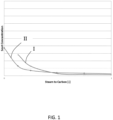
- the plot I relates to a base case without addition of CO2 to the feed and the plot II relates to the same process as in the base case, with addition of CO2 to the feed gas in an amount such that m CO2 / m C is 0.25.
- Fig. 1 and Fig. 2 illustrate that the comparative base case starts to form soot at higher S/C values.
- the addition of CO2 reduces the soot critical S/C, which means the process can be operated at a lower S/C to save steam without incurring in the soot formation.
- Fig. 2 illustrates that adding more carbon dioxide further reduces the critical S/C, as can be seen from a comparison of plots II and III.
Landscapes
- Chemical & Material Sciences (AREA)
- Chemical Kinetics & Catalysis (AREA)
- Organic Chemistry (AREA)
- Health & Medical Sciences (AREA)
- General Health & Medical Sciences (AREA)
- Engineering & Computer Science (AREA)
- Combustion & Propulsion (AREA)
- Inorganic Chemistry (AREA)
- Hydrogen, Water And Hydrids (AREA)
Description
- The invention relates to ATR reactors and POX reactors. The invention relates particularly to a method for the suppression of soot formation in an ATR reactor or in a POX reactor.
- Autothermal reforming (ATR) and partial oxidation (POX) reactors are widely used in the field of production of synthesis gas.
- An ATR reactor can be used as a self-standing syngas generation unit or can be used for secondary reforming after a primary steam reforming in a fired furnace. An ATR reactor fed by air or enriched air is often known as secondary reformer. On the contrary POX systems are an alternative technology typically used to convert a preheated hydrocarbon gas and oxidant.
- Autothermal reforming is performed in the presence of a catalyst while partial oxidation is performed in absence of catalyst. The temperature may be around 1000 to 1300 °C for ATR (at the catalyst bed inlet) and even higher (1300 °C or more) for POX. The pressure is typically in the range 10 to 100 bar.
- The ATR and POX reactors include a burner, which is normally installed on top of the reactor vessel, above a reaction chamber. The reaction chamber contains a catalyst in the case of ATR.
- The burner provides mixing between a gaseous fuel and a gaseous oxidant. The fuel may be a pre-heated hydrocarbon or a partially reformed hydrocarbon with a certain amount of steam, which may be already contained in the fuel or added to the fuel. The oxidant is normally air, oxygen-enriched air, or substantially pure oxygen, possibly added with steam. The hydrocarbon may be natural gas for example. In a known configuration, the burner includes an oxidant pipe with a circular cross section, coaxially arranged with an annular fuel pipe.
- A field of particular interest for application of ATR or POX systems is the conversion of a hydrocarbon source into a partially oxidized CO-containing synthesis gas, for example a mixture of H2 and CO. Both ATR and POX can be used to produce such gas.
- A CO-containing gas still has a considerable heat value and can be used as a fuel; a H2 and CO gas has also a variety of applications in the chemical industry, e.g. it is a feed for synthesis of several products including, among others, ammonia and methanol.
- The production of a CO-containing gas from a hydrocarbon source however requires under-stoichiometric combustion which may lead to undesirable formation of soot. The formation of soot has several drawbacks: loss of carbon source, which is not converted into CO as desired; fouling and obstruction of conduits; need of periodical cleaning which is expensive and disposal of a pollutant and potentially carcinogenic substance.
- The formation of soot is a complex process influenced by several parameters.
- It is known, for example, that the steam to carbon ratio and the oxygen to carbon ratio influence the formation of soot: the greater these two ratios, the lesser the formation of soot. However increasing the steam to carbon ratio and/or the oxygen to carbon ratio to inhibit soot formation has the disadvantage of increasing the consumption of steam or oxygen, which are valuable source materials.
- It is also known that soot formation is reduced by intensive mixing between the fuel and oxidant. Accordingly, a number of prior art solutions try to reduce soot by giving a high velocity and/or swirling to one or both of the fuel and oxidant streams. Other solutions deviate from the common coaxial configuration of the streams in an attempt to improve mixing, for example by directing a stream of fuel perpendicular to a stream of oxidant. These techniques and more generally all techniques based on high velocities, swirler and change of directions of the flows have the drawbacks of introducing a significant pressure loss.
-
WO 2016/198245 for example discloses a method for determining temperature, pressure and steam to carbon ratio for soot free operation in an ATR. -
EP 0 982 266 A2 - In summary, the need to reduce the soot formation forces the adoption of certain operating parameters, such as a large excess of steam/oxygen, or a high velocity and swirl of the streams, which inevitably entail some drawbacks.
- Therefore, there is still the need to provide an improved design of an ATR or POX burner which is able to reduce the soot formation and operate under more advantageous conditions, thus minimizing the above drawbacks.
- The invention aims to solve the above problem and provide an improved reactor with less soot formation, compared to the prior art reactors, for a given set of operation parameters such as reaction pressure and temperature, steam and oxygen consumption, pressure drop of the feed streams of fuel and oxidant.
- The invention is based on the finding that carbon dioxide added to the gaseous feed of the partial oxidation process acts as a soot suppressor.
- The aim of the invention is reached with a method for the suppression of soot formation during the partial oxidation of a hydrocarbon-containing gaseous feed, in the presence of steam and in an ATR reactor or in a POX reactor, the method comprising the addition of gaseous carbon dioxide to the hydrocarbon-containing gaseous feed before entry into the reactor.
- Preferred features of the invention are stated in the dependent claims.
- Particularly, carbon dioxide is preferably added in an amount such that a ratio mCO2/ mC is at least 0.25, wherein: mCO2 denotes the moles of added carbon dioxide and mC denoted the moles of carbon contained in the feed prior to addition of CO2. Preferably said ratio is 0.25 to 2 and more preferably 0.25 to 1.
- Carbon dioxide may be added to the hydrocarbon-containing gaseous feed before or after addition of steam.
- The hydrocarbon-containing feed is preferably a natural gas or a methane-containing feed.
- Another aspect of the invention is a method for determining a minimum steam to carbon ratio for soot free operation in a process of partial oxidation of a hydrocarbon-containing gaseous feed according to the claims.
- Said minimum steam to carbon ratio is also termed critical steam to carbon ratio. This ratio is generally regarded as the ratio at which soot formation starts, for a given set of process conditions. Said process conditions may include, among others, the pressure, temperature, composition of the feed, oxygen to carbon ratio.
- Particularly, for a steam to carbon ratio greater than the critical value the process is virtually soot-free, whilst below the critical value the formation of soot becomes detectable and rapidly increases if the ratio is further lowered.
- The term of soot free oxidation process denotes a process wherein the formation of soot is deemed negligible. Typically, this is the case when the soot in the effluent of the oxidation process is not greater than 5 ppb (parts per billion) in volume or even less (e.g. 2 ppb or less).
- According to an aspect of the invention, the minimum steam to carbon ratio (critical ratio), in the presence of added CO2 to the stream, is calculated by a correction of the minimum ratio in absence of CO2 addition, the other process conditions being the same. Then, the minimum steam to carbon ratio with added CO2 is calculated as:

- (S/C)lim,CO2 is the critical steam to carbon ratio of the process when the process is performed with a first gaseous feed which is a reference feed of hydrocarbon and steam with added CO2;
- (S/C)lim is the critical steam to carbon ratio of the given process when the process is performed with a second feed which is said reference feed without added CO2;
- mCO2 denotes the moles of CO2 added to the first gaseous feed;
- mc denoted the moles of carbon contained in the first gaseous feed before addition of CO2;
- ζ is in the range 0.4 to 0.6.
- The equation (1) was found experimentally by the applicant. The equation shows that, for a given set of conditions, the addition of CO2 into the feed stream decreases the soot critical steam to carbon ratio. Consequently, for example, for a given set of process conditions the addition of CO2 as soot suppressor allows reducing the amount of steam to operate at a lower steam to carbon ratio without incurring in soot formation. A reduced amount of steam has advantages because steam is expensive in terms of energy and increases the volume flow rate and therefore the size of equipment.
- The above method of calculation of the minimum steam to carbon ratio can be applicable to the control of the partial oxidation process. Therefore, still another aspect of the invention is a method of controlling a process of partial oxidation, wherein the steam to carbon ratio is maintained above a minimum value which is calculated according to the formula (1) above.
- The benefit of the invention is elucidated by
Fig. 1 andFig. 2 , wherein: -
Fig. 1 is a plot of soot concentration Vs. steam to carbon ratio for a process of partial oxidation performed at 15 bar pressure, using methane (CH4) as fuel and in the presence of oxygen to carbon (O2/C) ratio of 0.5; -
Fig. 2 is a plot of soot concentration Vs. steam to carbon ratio for a process of partial oxidation as inFig. 1 with oxygen to carbon (O2/C) ratio of 0.6. - In
Fig. 1 , the plot I relates to a base case without addition of CO2 to the feed and the plot II relates to the same process as in the base case, with addition of CO2 to the feed gas in an amount such that mCO2 / mC is 0.25. - In
Fig. 2 , the plot I relates to a base case without addition of CO2 to the feed; the plot II relates to addition of CO2 such that mCO2 / mc = 0.25 and plot III relates to mCO2 / mC = 0.66. - All plots of
Fig. 1 andFig. 2 illustrate that the comparative base case starts to form soot at higher S/C values. In other words, the addition of CO2 reduces the soot critical S/C, which means the process can be operated at a lower S/C to save steam without incurring in the soot formation.Fig. 2 illustrates that adding more carbon dioxide further reduces the critical S/C, as can be seen from a comparison of plots II and III.
Claims (9)
- A method for the suppression of soot formation during the partial oxidation of a hydrocarbon-containing gaseous feed, in the presence of steam and in an ATR reactor or in a POX reactor, the method comprising the addition of gaseous carbon dioxide to the hydrocarbon-containing gaseous feed before entry into the reactor.
- A method according to claim 1, wherein the ratio mCO2 / mC of moles of added carbon dioxide over moles of carbon contained in the feed prior to addition of CO2 is at least 0.25.
- A method according to claim 2, wherein said ratio mCO2 / mc is in the range 0.25 to 2 and preferably 0.25 to 1.
- A method according to any of claims 1 to 3 wherein CO2 is added to the hydrocarbon-containing gaseous feed before or after addition of steam.
- A method according to any of claims 1 to 4 comprising the step of determining a minimum steam to carbon ratio for soot free operation of the partial oxidation process, according to the following relationship:
 (S/C)lim is the minimum steam to carbon ratio for soot-free operation of the process when performed with the gaseous feed without addition of CO2;(S/C)lim,CO2 is the minimum steam to carbon ratio for soot-free operation of the process when performed with addition of CO2 to the gaseous feed;(mCO2 / mC) denotes the ratio of moles of CO2 added to the feed over the moles of carbon contained in the feed before addition of CO2;ζ is in the range 0.4 to 0.6.
 - Method according to claim 5 wherein the concentration in volume of the soot in the effluent of the partial oxidation process is not greater than 5 ppb.
- A method for determining a minimum steam to carbon ratio required for soot-free operation in a process of partial oxidation of a hydrocarbon-containing gaseous feed, wherein said process of partial oxidation is carried out in the presence of steam in an ATR reactor or in a POX reactor, and wherein said gaseous feed is added with carbon dioxide before entry into the reactor, wherein the minimum steam to carbon ratio for soot-free operation in the presence of added CO2 is determined as:
 (S/C)lim is the minimum steam to carbon ratio for soot-free operation of the process when performed with the gaseous feed without addition of CO2;(S/C)lim,CO2 is the minimum steam to carbon ratio for soot-free operation of the process when performed with addition of CO2 to the gaseous feed;(mCO2 / mC) denotes the ratio of moles of CO2 added to the feed over the moles of carbon contained in the feed before addition of CO2;ζ is in the range 0.4 to 0.6.
 - Method according to claim 7 wherein the concentration in volume of the soot in the effluent of the partial oxidation process is not greater than 5 ppb.
- A method for controlling a partial oxidation process in an ATR or POX reactor, the process being carried out in the presence of steam and with addition of carbon dioxide to a hydrocarbon-containing gaseous feed of the process, the method including the determination of a minimum steam to carbon ratio for soot free operation according to claim 7 or 8.
Applications Claiming Priority (2)
| Application Number | Priority Date | Filing Date | Title |
|---|---|---|---|
| EP19160723.3A EP3705452A1 (en) | 2019-03-05 | 2019-03-05 | A method for the suppression of soot formation in an atr or pox reactor |
| PCT/EP2020/054176 WO2020178018A1 (en) | 2019-03-05 | 2020-02-18 | A method for the suppression of soot formation in an atr or pox reactor |
Publications (2)
| Publication Number | Publication Date |
|---|---|
| EP3935011A1 EP3935011A1 (en) | 2022-01-12 |
| EP3935011B1 true EP3935011B1 (en) | 2024-06-26 |
Family
ID=65717749
Family Applications (2)
| Application Number | Title | Priority Date | Filing Date |
|---|---|---|---|
| EP19160723.3A Withdrawn EP3705452A1 (en) | 2019-03-05 | 2019-03-05 | A method for the suppression of soot formation in an atr or pox reactor |
| EP20705066.7A Active EP3935011B1 (en) | 2019-03-05 | 2020-02-18 | A method for the suppression of soot formation in an atr or pox reactor |
Family Applications Before (1)
| Application Number | Title | Priority Date | Filing Date |
|---|---|---|---|
| EP19160723.3A Withdrawn EP3705452A1 (en) | 2019-03-05 | 2019-03-05 | A method for the suppression of soot formation in an atr or pox reactor |
Country Status (9)
| Country | Link |
|---|---|
| US (1) | US12600625B2 (en) |
| EP (2) | EP3705452A1 (en) |
| CN (1) | CN113498404B (en) |
| AU (2) | AU2020230826A1 (en) |
| BR (1) | BR112021014771A2 (en) |
| CA (1) | CA3128126A1 (en) |
| SA (1) | SA521430139B1 (en) |
| UA (1) | UA128868C2 (en) |
| WO (1) | WO2020178018A1 (en) |
Citations (2)
| Publication number | Priority date | Publication date | Assignee | Title |
|---|---|---|---|---|
| EP1413547A1 (en) | 2002-09-26 | 2004-04-28 | Haldor Topsoe A/S | Process for the production of synthesis gas |
| WO2019020513A1 (en) | 2017-07-25 | 2019-01-31 | Haldor Topsøe A/S | METHOD OF PREPARING A SYNTHESIS GAS |
Family Cites Families (6)
| Publication number | Priority date | Publication date | Assignee | Title |
|---|---|---|---|---|
| FR2768424B1 (en) * | 1997-09-01 | 1999-10-29 | Albin Czernichowski | ELECTRIC ASSISTANCE FOR PARTIAL OXIDATION OF LIGHT OXYGEN HYDROCARBONS |
| DK173745B1 (en) * | 1998-08-27 | 2001-09-03 | Topsoe Haldor As | Process for Autothermal Reform of Hydrocarbon Material |
| US7510793B2 (en) * | 2004-08-05 | 2009-03-31 | Rolls-Royce Fuel Cell Systems (Us) Inc. | Post-reformer treatment of reformate gas |
| DE102009015767A1 (en) * | 2009-03-31 | 2010-10-07 | Linde Aktiengesellschaft | Gas mixture i.e. synthesis gas, producing method, involves returning carbon dioxide into partial oxidation from synthesis raw gas, and using heat recovery boiler for cooling gas, where boiler permits automatic blowing of soot deposits |
| AR096635A1 (en) | 2013-06-17 | 2016-01-20 | Praxair Technology Inc | HOLLIN CONTROL IN OXIDATION REACTIONS |
| DE102015210803A1 (en) | 2015-06-12 | 2016-12-15 | Thyssenkrupp Ag | Determination of pressure, temperature and S / C ratio for a soot-free ATR operation |
-
2019
- 2019-03-05 EP EP19160723.3A patent/EP3705452A1/en not_active Withdrawn
-
2020
- 2020-02-18 CA CA3128126A patent/CA3128126A1/en active Pending
- 2020-02-18 WO PCT/EP2020/054176 patent/WO2020178018A1/en not_active Ceased
- 2020-02-18 UA UAA202104319A patent/UA128868C2/en unknown
- 2020-02-18 CN CN202080017532.XA patent/CN113498404B/en active Active
- 2020-02-18 AU AU2020230826A patent/AU2020230826A1/en not_active Abandoned
- 2020-02-18 EP EP20705066.7A patent/EP3935011B1/en active Active
- 2020-02-18 BR BR112021014771-3A patent/BR112021014771A2/en unknown
- 2020-02-18 US US17/436,568 patent/US12600625B2/en active Active
-
2021
- 2021-08-24 SA SA521430139A patent/SA521430139B1/en unknown
-
2026
- 2026-02-20 AU AU2026201284A patent/AU2026201284A1/en active Pending
Patent Citations (2)
| Publication number | Priority date | Publication date | Assignee | Title |
|---|---|---|---|---|
| EP1413547A1 (en) | 2002-09-26 | 2004-04-28 | Haldor Topsoe A/S | Process for the production of synthesis gas |
| WO2019020513A1 (en) | 2017-07-25 | 2019-01-31 | Haldor Topsøe A/S | METHOD OF PREPARING A SYNTHESIS GAS |
Non-Patent Citations (2)
| Title |
|---|
| CHRISTENSEN T S, PRIMDAHL I I: "IMPROVE SYNGAS PRODUCTION USING AUTOTHERMAL REFORMING", HYDROCARBON PROCESSING., GULF PUBLISHING CO. HOUSTON., US, 1 March 1994 (1994-03-01), US , pages 39 - 42 + 44 + 46, XP001194531, ISSN: 0018-8190 |
| LEONARDO RAMOS: "Feasibility study for mega plant construction of synthesis gas to produce ammonia and methanol", FUEL, vol. 110, 3 January 2013 (2013-01-03), XP028557863, DOI: 10.1016/j.fuel.2012.12.045 |
Also Published As
| Publication number | Publication date |
|---|---|
| CA3128126A1 (en) | 2020-09-10 |
| BR112021014771A2 (en) | 2021-09-28 |
| US20220119253A1 (en) | 2022-04-21 |
| EP3935011A1 (en) | 2022-01-12 |
| SA521430139B1 (en) | 2024-10-08 |
| CN113498404B (en) | 2024-04-30 |
| UA128868C2 (en) | 2024-11-13 |
| AU2020230826A1 (en) | 2021-08-19 |
| CN113498404A (en) | 2021-10-12 |
| WO2020178018A1 (en) | 2020-09-10 |
| EP3705452A1 (en) | 2020-09-09 |
| US12600625B2 (en) | 2026-04-14 |
| AU2026201284A1 (en) | 2026-03-12 |
Similar Documents
| Publication | Publication Date | Title |
|---|---|---|
| EP0989094B1 (en) | Process for the autothermal reforming of a hydrocarbon feedstock containing higher hydrocarbons | |
| US10029224B2 (en) | Process for reforming hydrocarbons | |
| US9637432B2 (en) | Method and system for producing methanol using partial oxidation | |
| US9353022B2 (en) | Process for conversion of natural gas to hydrocarbon products and a plant for carrying out the process | |
| CN101454263B (en) | Methanol production process and system | |
| EP3935011B1 (en) | A method for the suppression of soot formation in an atr or pox reactor | |
| EP1098838B1 (en) | Process for autothermal reforming of a hydrocarbon feedstock | |
| KR20230130739A (en) | Method for controlling synthesis gas composition by reactor temperature | |
| EP3689818A1 (en) | Reactor and process for partial oxidation | |
| EP4385947A1 (en) | Decarbonisation of a chemical plant | |
| EP4385946A1 (en) | Decarbonisation of a chemical plant | |
| CA3268672A1 (en) | Decarbonisation of a chemical plant | |
| HK1134073B (en) | Methanol production process and system |
Legal Events
| Date | Code | Title | Description |
|---|---|---|---|
| STAA | Information on the status of an ep patent application or granted ep patent |
Free format text: STATUS: UNKNOWN |
|
| STAA | Information on the status of an ep patent application or granted ep patent |
Free format text: STATUS: THE INTERNATIONAL PUBLICATION HAS BEEN MADE |
|
| PUAI | Public reference made under article 153(3) epc to a published international application that has entered the european phase |
Free format text: ORIGINAL CODE: 0009012 |
|
| STAA | Information on the status of an ep patent application or granted ep patent |
Free format text: STATUS: REQUEST FOR EXAMINATION WAS MADE |
|
| 17P | Request for examination filed |
Effective date: 20210818 |
|
| AK | Designated contracting states |
Kind code of ref document: A1 Designated state(s): AL AT BE BG CH CY CZ DE DK EE ES FI FR GB GR HR HU IE IS IT LI LT LU LV MC MK MT NL NO PL PT RO RS SE SI SK SM TR |
|
| DAV | Request for validation of the european patent (deleted) | ||
| DAX | Request for extension of the european patent (deleted) | ||
| GRAP | Despatch of communication of intention to grant a patent |
Free format text: ORIGINAL CODE: EPIDOSNIGR1 |
|
| STAA | Information on the status of an ep patent application or granted ep patent |
Free format text: STATUS: GRANT OF PATENT IS INTENDED |
|
| INTG | Intention to grant announced |
Effective date: 20240326 |
|
| GRAS | Grant fee paid |
Free format text: ORIGINAL CODE: EPIDOSNIGR3 |
|
| GRAA | (expected) grant |
Free format text: ORIGINAL CODE: 0009210 |
|
| STAA | Information on the status of an ep patent application or granted ep patent |
Free format text: STATUS: THE PATENT HAS BEEN GRANTED |
|
| P01 | Opt-out of the competence of the unified patent court (upc) registered |
Effective date: 20240502 |
|
| AK | Designated contracting states |
Kind code of ref document: B1 Designated state(s): AL AT BE BG CH CY CZ DE DK EE ES FI FR GB GR HR HU IE IS IT LI LT LU LV MC MK MT NL NO PL PT RO RS SE SI SK SM TR |
|
| REG | Reference to a national code |
Ref country code: GB Ref legal event code: FG4D |
|
| REG | Reference to a national code |
Ref country code: CH Ref legal event code: EP |
|
| REG | Reference to a national code |
Ref country code: DE Ref legal event code: R096 Ref document number: 602020032935 Country of ref document: DE |
|
| PG25 | Lapsed in a contracting state [announced via postgrant information from national office to epo] |
Ref country code: BG Free format text: LAPSE BECAUSE OF FAILURE TO SUBMIT A TRANSLATION OF THE DESCRIPTION OR TO PAY THE FEE WITHIN THE PRESCRIBED TIME-LIMIT Effective date: 20240626 |
|
| PG25 | Lapsed in a contracting state [announced via postgrant information from national office to epo] |
Ref country code: FI Free format text: LAPSE BECAUSE OF FAILURE TO SUBMIT A TRANSLATION OF THE DESCRIPTION OR TO PAY THE FEE WITHIN THE PRESCRIBED TIME-LIMIT Effective date: 20240626 Ref country code: HR Free format text: LAPSE BECAUSE OF FAILURE TO SUBMIT A TRANSLATION OF THE DESCRIPTION OR TO PAY THE FEE WITHIN THE PRESCRIBED TIME-LIMIT Effective date: 20240626 |
|
| REG | Reference to a national code |
Ref country code: LT Ref legal event code: MG9D |
|
| PG25 | Lapsed in a contracting state [announced via postgrant information from national office to epo] |
Ref country code: GR Free format text: LAPSE BECAUSE OF FAILURE TO SUBMIT A TRANSLATION OF THE DESCRIPTION OR TO PAY THE FEE WITHIN THE PRESCRIBED TIME-LIMIT Effective date: 20240927 |
|
| PG25 | Lapsed in a contracting state [announced via postgrant information from national office to epo] |
Ref country code: LV Free format text: LAPSE BECAUSE OF FAILURE TO SUBMIT A TRANSLATION OF THE DESCRIPTION OR TO PAY THE FEE WITHIN THE PRESCRIBED TIME-LIMIT Effective date: 20240626 |
|
| REG | Reference to a national code |
Ref country code: NL Ref legal event code: MP Effective date: 20240626 |
|
| PG25 | Lapsed in a contracting state [announced via postgrant information from national office to epo] |
Ref country code: NO Free format text: LAPSE BECAUSE OF FAILURE TO SUBMIT A TRANSLATION OF THE DESCRIPTION OR TO PAY THE FEE WITHIN THE PRESCRIBED TIME-LIMIT Effective date: 20240926 Ref country code: LV Free format text: LAPSE BECAUSE OF FAILURE TO SUBMIT A TRANSLATION OF THE DESCRIPTION OR TO PAY THE FEE WITHIN THE PRESCRIBED TIME-LIMIT Effective date: 20240626 Ref country code: HR Free format text: LAPSE BECAUSE OF FAILURE TO SUBMIT A TRANSLATION OF THE DESCRIPTION OR TO PAY THE FEE WITHIN THE PRESCRIBED TIME-LIMIT Effective date: 20240626 Ref country code: GR Free format text: LAPSE BECAUSE OF FAILURE TO SUBMIT A TRANSLATION OF THE DESCRIPTION OR TO PAY THE FEE WITHIN THE PRESCRIBED TIME-LIMIT Effective date: 20240927 Ref country code: FI Free format text: LAPSE BECAUSE OF FAILURE TO SUBMIT A TRANSLATION OF THE DESCRIPTION OR TO PAY THE FEE WITHIN THE PRESCRIBED TIME-LIMIT Effective date: 20240626 Ref country code: BG Free format text: LAPSE BECAUSE OF FAILURE TO SUBMIT A TRANSLATION OF THE DESCRIPTION OR TO PAY THE FEE WITHIN THE PRESCRIBED TIME-LIMIT Effective date: 20240626 Ref country code: RS Free format text: LAPSE BECAUSE OF FAILURE TO SUBMIT A TRANSLATION OF THE DESCRIPTION OR TO PAY THE FEE WITHIN THE PRESCRIBED TIME-LIMIT Effective date: 20240926 |
|
| PG25 | Lapsed in a contracting state [announced via postgrant information from national office to epo] |
Ref country code: NL Free format text: LAPSE BECAUSE OF FAILURE TO SUBMIT A TRANSLATION OF THE DESCRIPTION OR TO PAY THE FEE WITHIN THE PRESCRIBED TIME-LIMIT Effective date: 20240626 |
|
| REG | Reference to a national code |
Ref country code: AT Ref legal event code: MK05 Ref document number: 1697569 Country of ref document: AT Kind code of ref document: T Effective date: 20240626 |
|
| PG25 | Lapsed in a contracting state [announced via postgrant information from national office to epo] |
Ref country code: NL Free format text: LAPSE BECAUSE OF FAILURE TO SUBMIT A TRANSLATION OF THE DESCRIPTION OR TO PAY THE FEE WITHIN THE PRESCRIBED TIME-LIMIT Effective date: 20240626 |
|
| PG25 | Lapsed in a contracting state [announced via postgrant information from national office to epo] |
Ref country code: PT Free format text: LAPSE BECAUSE OF FAILURE TO SUBMIT A TRANSLATION OF THE DESCRIPTION OR TO PAY THE FEE WITHIN THE PRESCRIBED TIME-LIMIT Effective date: 20241028 |
|
| PG25 | Lapsed in a contracting state [announced via postgrant information from national office to epo] |
Ref country code: PT Free format text: LAPSE BECAUSE OF FAILURE TO SUBMIT A TRANSLATION OF THE DESCRIPTION OR TO PAY THE FEE WITHIN THE PRESCRIBED TIME-LIMIT Effective date: 20241028 |
|
| PG25 | Lapsed in a contracting state [announced via postgrant information from national office to epo] |
Ref country code: PL Free format text: LAPSE BECAUSE OF FAILURE TO SUBMIT A TRANSLATION OF THE DESCRIPTION OR TO PAY THE FEE WITHIN THE PRESCRIBED TIME-LIMIT Effective date: 20240626 |
|
| PG25 | Lapsed in a contracting state [announced via postgrant information from national office to epo] |
Ref country code: EE Free format text: LAPSE BECAUSE OF FAILURE TO SUBMIT A TRANSLATION OF THE DESCRIPTION OR TO PAY THE FEE WITHIN THE PRESCRIBED TIME-LIMIT Effective date: 20240626 |
|
| PG25 | Lapsed in a contracting state [announced via postgrant information from national office to epo] |
Ref country code: AT Free format text: LAPSE BECAUSE OF FAILURE TO SUBMIT A TRANSLATION OF THE DESCRIPTION OR TO PAY THE FEE WITHIN THE PRESCRIBED TIME-LIMIT Effective date: 20240626 Ref country code: IS Free format text: LAPSE BECAUSE OF FAILURE TO SUBMIT A TRANSLATION OF THE DESCRIPTION OR TO PAY THE FEE WITHIN THE PRESCRIBED TIME-LIMIT Effective date: 20241026 |
|
| PG25 | Lapsed in a contracting state [announced via postgrant information from national office to epo] |
Ref country code: CZ Free format text: LAPSE BECAUSE OF FAILURE TO SUBMIT A TRANSLATION OF THE DESCRIPTION OR TO PAY THE FEE WITHIN THE PRESCRIBED TIME-LIMIT Effective date: 20240626 |
|
| PG25 | Lapsed in a contracting state [announced via postgrant information from national office to epo] |
Ref country code: RO Free format text: LAPSE BECAUSE OF FAILURE TO SUBMIT A TRANSLATION OF THE DESCRIPTION OR TO PAY THE FEE WITHIN THE PRESCRIBED TIME-LIMIT Effective date: 20240626 Ref country code: SK Free format text: LAPSE BECAUSE OF FAILURE TO SUBMIT A TRANSLATION OF THE DESCRIPTION OR TO PAY THE FEE WITHIN THE PRESCRIBED TIME-LIMIT Effective date: 20240626 |
|
| PG25 | Lapsed in a contracting state [announced via postgrant information from national office to epo] |
Ref country code: SM Free format text: LAPSE BECAUSE OF FAILURE TO SUBMIT A TRANSLATION OF THE DESCRIPTION OR TO PAY THE FEE WITHIN THE PRESCRIBED TIME-LIMIT Effective date: 20240626 Ref country code: ES Free format text: LAPSE BECAUSE OF FAILURE TO SUBMIT A TRANSLATION OF THE DESCRIPTION OR TO PAY THE FEE WITHIN THE PRESCRIBED TIME-LIMIT Effective date: 20240626 |
|
| PG25 | Lapsed in a contracting state [announced via postgrant information from national office to epo] |
Ref country code: SM Free format text: LAPSE BECAUSE OF FAILURE TO SUBMIT A TRANSLATION OF THE DESCRIPTION OR TO PAY THE FEE WITHIN THE PRESCRIBED TIME-LIMIT Effective date: 20240626 Ref country code: SK Free format text: LAPSE BECAUSE OF FAILURE TO SUBMIT A TRANSLATION OF THE DESCRIPTION OR TO PAY THE FEE WITHIN THE PRESCRIBED TIME-LIMIT Effective date: 20240626 Ref country code: RO Free format text: LAPSE BECAUSE OF FAILURE TO SUBMIT A TRANSLATION OF THE DESCRIPTION OR TO PAY THE FEE WITHIN THE PRESCRIBED TIME-LIMIT Effective date: 20240626 Ref country code: PL Free format text: LAPSE BECAUSE OF FAILURE TO SUBMIT A TRANSLATION OF THE DESCRIPTION OR TO PAY THE FEE WITHIN THE PRESCRIBED TIME-LIMIT Effective date: 20240626 Ref country code: IS Free format text: LAPSE BECAUSE OF FAILURE TO SUBMIT A TRANSLATION OF THE DESCRIPTION OR TO PAY THE FEE WITHIN THE PRESCRIBED TIME-LIMIT Effective date: 20241026 Ref country code: ES Free format text: LAPSE BECAUSE OF FAILURE TO SUBMIT A TRANSLATION OF THE DESCRIPTION OR TO PAY THE FEE WITHIN THE PRESCRIBED TIME-LIMIT Effective date: 20240626 Ref country code: EE Free format text: LAPSE BECAUSE OF FAILURE TO SUBMIT A TRANSLATION OF THE DESCRIPTION OR TO PAY THE FEE WITHIN THE PRESCRIBED TIME-LIMIT Effective date: 20240626 Ref country code: CZ Free format text: LAPSE BECAUSE OF FAILURE TO SUBMIT A TRANSLATION OF THE DESCRIPTION OR TO PAY THE FEE WITHIN THE PRESCRIBED TIME-LIMIT Effective date: 20240626 Ref country code: AT Free format text: LAPSE BECAUSE OF FAILURE TO SUBMIT A TRANSLATION OF THE DESCRIPTION OR TO PAY THE FEE WITHIN THE PRESCRIBED TIME-LIMIT Effective date: 20240626 |
|
| PG25 | Lapsed in a contracting state [announced via postgrant information from national office to epo] |
Ref country code: IT Free format text: LAPSE BECAUSE OF FAILURE TO SUBMIT A TRANSLATION OF THE DESCRIPTION OR TO PAY THE FEE WITHIN THE PRESCRIBED TIME-LIMIT Effective date: 20240626 |
|
| REG | Reference to a national code |
Ref country code: DE Ref legal event code: R026 Ref document number: 602020032935 Country of ref document: DE |
|
| PLBI | Opposition filed |
Free format text: ORIGINAL CODE: 0009260 |
|
| PLAX | Notice of opposition and request to file observation + time limit sent |
Free format text: ORIGINAL CODE: EPIDOSNOBS2 |
|
| PG25 | Lapsed in a contracting state [announced via postgrant information from national office to epo] |
Ref country code: DK Free format text: LAPSE BECAUSE OF FAILURE TO SUBMIT A TRANSLATION OF THE DESCRIPTION OR TO PAY THE FEE WITHIN THE PRESCRIBED TIME-LIMIT Effective date: 20240626 |
|
| 26 | Opposition filed |
Opponent name: JOHNSON MATTHEY PUBLIC LIMITED COMPANY Effective date: 20250326 |
|
| PLBB | Reply of patent proprietor to notice(s) of opposition received |
Free format text: ORIGINAL CODE: EPIDOSNOBS3 |
|
| PG25 | Lapsed in a contracting state [announced via postgrant information from national office to epo] |
Ref country code: SE Free format text: LAPSE BECAUSE OF FAILURE TO SUBMIT A TRANSLATION OF THE DESCRIPTION OR TO PAY THE FEE WITHIN THE PRESCRIBED TIME-LIMIT Effective date: 20240626 |
|
| PG25 | Lapsed in a contracting state [announced via postgrant information from national office to epo] |
Ref country code: MC Free format text: LAPSE BECAUSE OF FAILURE TO SUBMIT A TRANSLATION OF THE DESCRIPTION OR TO PAY THE FEE WITHIN THE PRESCRIBED TIME-LIMIT Effective date: 20240626 |
|
| REG | Reference to a national code |
Ref country code: CH Ref legal event code: PL |
|
| PG25 | Lapsed in a contracting state [announced via postgrant information from national office to epo] |
Ref country code: LU Free format text: LAPSE BECAUSE OF NON-PAYMENT OF DUE FEES Effective date: 20250218 |
|
| PG25 | Lapsed in a contracting state [announced via postgrant information from national office to epo] |
Ref country code: CH Free format text: LAPSE BECAUSE OF NON-PAYMENT OF DUE FEES Effective date: 20250228 |
|
| REG | Reference to a national code |
Ref country code: BE Ref legal event code: MM Effective date: 20250228 |
|
| PG25 | Lapsed in a contracting state [announced via postgrant information from national office to epo] |
Ref country code: BE Free format text: LAPSE BECAUSE OF NON-PAYMENT OF DUE FEES Effective date: 20250228 |
|
| PG25 | Lapsed in a contracting state [announced via postgrant information from national office to epo] |
Ref country code: IE Free format text: LAPSE BECAUSE OF NON-PAYMENT OF DUE FEES Effective date: 20250218 |
|
| PLAB | Opposition data, opponent's data or that of the opponent's representative modified |
Free format text: ORIGINAL CODE: 0009299OPPO |
|
| REG | Reference to a national code |
Ref country code: CH Ref legal event code: L10 Free format text: ST27 STATUS EVENT CODE: U-0-0-L10-L00 (AS PROVIDED BY THE NATIONAL OFFICE) Effective date: 20260218 |
|
| R26 | Opposition filed (corrected) |
Opponent name: JOHNSON MATTHEY PUBLIC LIMITED COMPANY Effective date: 20250326 |
|
| PGFP | Annual fee paid to national office [announced via postgrant information from national office to epo] |
Ref country code: GB Payment date: 20260122 Year of fee payment: 7 |
|
| PGFP | Annual fee paid to national office [announced via postgrant information from national office to epo] |
Ref country code: DE Payment date: 20260121 Year of fee payment: 7 |
|
| PGFP | Annual fee paid to national office [announced via postgrant information from national office to epo] |
Ref country code: FR Payment date: 20260121 Year of fee payment: 7 |
|
| PLAB | Opposition data, opponent's data or that of the opponent's representative modified |
Free format text: ORIGINAL CODE: 0009299OPPO |
|
| REG | Reference to a national code |
Ref country code: CH Ref legal event code: L10 Free format text: ST27 STATUS EVENT CODE: U-0-0-L10-L00 (AS PROVIDED BY THE NATIONAL OFFICE) Effective date: 20260430 |