EP3934266A1 - Broadcast receiving device and operating method thereof - Google Patents
Broadcast receiving device and operating method thereof Download PDFInfo
- Publication number
- EP3934266A1 EP3934266A1 EP20769597.4A EP20769597A EP3934266A1 EP 3934266 A1 EP3934266 A1 EP 3934266A1 EP 20769597 A EP20769597 A EP 20769597A EP 3934266 A1 EP3934266 A1 EP 3934266A1
- Authority
- EP
- European Patent Office
- Prior art keywords
- content
- transfer path
- asset
- receiving device
- broadcast receiving
- Prior art date
- Legal status (The legal status is an assumption and is not a legal conclusion. Google has not performed a legal analysis and makes no representation as to the accuracy of the status listed.)
- Granted
Links
Images





Classifications
-
- H—ELECTRICITY
- H04—ELECTRIC COMMUNICATION TECHNIQUE
- H04N—PICTORIAL COMMUNICATION, e.g. TELEVISION
- H04N21/00—Selective content distribution, e.g. interactive television or video on demand [VOD]
- H04N21/20—Servers specifically adapted for the distribution of content, e.g. VOD servers; Operations thereof
- H04N21/23—Processing of content or additional data; Elementary server operations; Server middleware
- H04N21/238—Interfacing the downstream path of the transmission network, e.g. adapting the transmission rate of a video stream to network bandwidth; Processing of multiplex streams
- H04N21/2385—Channel allocation; Bandwidth allocation
-
- H—ELECTRICITY
- H04—ELECTRIC COMMUNICATION TECHNIQUE
- H04H—BROADCAST COMMUNICATION
- H04H20/00—Arrangements for broadcast or for distribution combined with broadcast
- H04H20/20—Arrangements for broadcast or distribution of identical information via plural systems
- H04H20/24—Arrangements for distribution of identical information via broadcast system and non-broadcast system
-
- H—ELECTRICITY
- H04—ELECTRIC COMMUNICATION TECHNIQUE
- H04H—BROADCAST COMMUNICATION
- H04H20/00—Arrangements for broadcast or for distribution combined with broadcast
- H04H20/26—Arrangements for switching distribution systems
-
- H—ELECTRICITY
- H04—ELECTRIC COMMUNICATION TECHNIQUE
- H04H—BROADCAST COMMUNICATION
- H04H60/00—Arrangements for broadcast applications with a direct linking to broadcast information or broadcast space-time; Broadcast-related systems
- H04H60/76—Arrangements characterised by transmission systems other than for broadcast, e.g. the Internet
-
- H—ELECTRICITY
- H04—ELECTRIC COMMUNICATION TECHNIQUE
- H04L—TRANSMISSION OF DIGITAL INFORMATION, e.g. TELEGRAPHIC COMMUNICATION
- H04L12/00—Data switching networks
- H04L12/28—Data switching networks characterised by path configuration, e.g. LAN [Local Area Networks] or WAN [Wide Area Networks]
- H04L12/2854—Wide area networks, e.g. public data networks
- H04L12/2856—Access arrangements, e.g. Internet access
- H04L12/2869—Operational details of access network equipments
- H04L12/2898—Subscriber equipments
-
- H—ELECTRICITY
- H04—ELECTRIC COMMUNICATION TECHNIQUE
- H04N—PICTORIAL COMMUNICATION, e.g. TELEVISION
- H04N21/00—Selective content distribution, e.g. interactive television or video on demand [VOD]
- H04N21/20—Servers specifically adapted for the distribution of content, e.g. VOD servers; Operations thereof
- H04N21/23—Processing of content or additional data; Elementary server operations; Server middleware
- H04N21/234—Processing of video elementary streams, e.g. splicing of video streams or manipulating encoded video stream scene graphs
- H04N21/2343—Processing of video elementary streams, e.g. splicing of video streams or manipulating encoded video stream scene graphs involving reformatting operations of video signals for distribution or compliance with end-user requests or end-user device requirements
- H04N21/234327—Processing of video elementary streams, e.g. splicing of video streams or manipulating encoded video stream scene graphs involving reformatting operations of video signals for distribution or compliance with end-user requests or end-user device requirements by decomposing into layers, e.g. base layer and one or more enhancement layers
-
- H—ELECTRICITY
- H04—ELECTRIC COMMUNICATION TECHNIQUE
- H04N—PICTORIAL COMMUNICATION, e.g. TELEVISION
- H04N21/00—Selective content distribution, e.g. interactive television or video on demand [VOD]
- H04N21/20—Servers specifically adapted for the distribution of content, e.g. VOD servers; Operations thereof
- H04N21/23—Processing of content or additional data; Elementary server operations; Server middleware
- H04N21/235—Processing of additional data, e.g. scrambling of additional data or processing content descriptors
- H04N21/2353—Processing of additional data, e.g. scrambling of additional data or processing content descriptors specifically adapted to content descriptors, e.g. coding, compressing or processing of metadata
-
- H—ELECTRICITY
- H04—ELECTRIC COMMUNICATION TECHNIQUE
- H04N—PICTORIAL COMMUNICATION, e.g. TELEVISION
- H04N21/00—Selective content distribution, e.g. interactive television or video on demand [VOD]
- H04N21/40—Client devices specifically adapted for the reception of or interaction with content, e.g. set-top-box [STB]; Operations thereof
- H04N21/43—Processing of content or additional data, e.g. demultiplexing additional data from a digital video stream; Elementary client operations, e.g. monitoring of home network or synchronising decoder's clock; Client middleware
- H04N21/44—Processing of video elementary streams, e.g. splicing a video clip retrieved from local storage with an incoming video stream or rendering scenes according to encoded video stream scene graphs
- H04N21/4402—Processing of video elementary streams, e.g. splicing a video clip retrieved from local storage with an incoming video stream or rendering scenes according to encoded video stream scene graphs involving reformatting operations of video signals for household redistribution, storage or real-time display
- H04N21/440227—Processing of video elementary streams, e.g. splicing a video clip retrieved from local storage with an incoming video stream or rendering scenes according to encoded video stream scene graphs involving reformatting operations of video signals for household redistribution, storage or real-time display by decomposing into layers, e.g. base layer and one or more enhancement layers
-
- H—ELECTRICITY
- H04—ELECTRIC COMMUNICATION TECHNIQUE
- H04N—PICTORIAL COMMUNICATION, e.g. TELEVISION
- H04N21/00—Selective content distribution, e.g. interactive television or video on demand [VOD]
- H04N21/40—Client devices specifically adapted for the reception of or interaction with content, e.g. set-top-box [STB]; Operations thereof
- H04N21/45—Management operations performed by the client for facilitating the reception of or the interaction with the content or administrating data related to the end-user or to the client device itself, e.g. learning user preferences for recommending movies, resolving scheduling conflicts
- H04N21/462—Content or additional data management e.g. creating a master electronic programme guide from data received from the Internet and a Head-end or controlling the complexity of a video stream by scaling the resolution or bit-rate based on the client capabilities
- H04N21/4622—Retrieving content or additional data from different sources, e.g. from a broadcast channel and the Internet
-
- H—ELECTRICITY
- H04—ELECTRIC COMMUNICATION TECHNIQUE
- H04N—PICTORIAL COMMUNICATION, e.g. TELEVISION
- H04N21/00—Selective content distribution, e.g. interactive television or video on demand [VOD]
- H04N21/60—Network structure or processes for video distribution between server and client or between remote clients; Control signalling between clients, server and network components; Transmission of management data between server and client, e.g. sending from server to client commands for recording incoming content stream; Communication details between server and client
- H04N21/61—Network physical structure; Signal processing
- H04N21/6106—Network physical structure; Signal processing specially adapted to the downstream path of the transmission network
- H04N21/6125—Network physical structure; Signal processing specially adapted to the downstream path of the transmission network involving transmission via Internet
-
- H—ELECTRICITY
- H04—ELECTRIC COMMUNICATION TECHNIQUE
- H04N—PICTORIAL COMMUNICATION, e.g. TELEVISION
- H04N21/00—Selective content distribution, e.g. interactive television or video on demand [VOD]
- H04N21/60—Network structure or processes for video distribution between server and client or between remote clients; Control signalling between clients, server and network components; Transmission of management data between server and client, e.g. sending from server to client commands for recording incoming content stream; Communication details between server and client
- H04N21/63—Control signaling related to video distribution between client, server and network components; Network processes for video distribution between server and clients or between remote clients, e.g. transmitting basic layer and enhancement layers over different transmission paths, setting up a peer-to-peer communication via Internet between remote STB's; Communication protocols; Addressing
- H04N21/647—Control signaling between network components and server or clients; Network processes for video distribution between server and clients, e.g. controlling the quality of the video stream, by dropping packets, protecting content from unauthorised alteration within the network, monitoring of network load, bridging between two different networks, e.g. between IP and wireless
- H04N21/64707—Control signaling between network components and server or clients; Network processes for video distribution between server and clients, e.g. controlling the quality of the video stream, by dropping packets, protecting content from unauthorised alteration within the network, monitoring of network load, bridging between two different networks, e.g. between IP and wireless for transferring content from a first network to a second network, e.g. between IP and wireless
Definitions
- Various embodiments relate to a broadcast receiving device and an operating method thereof, and more particularly, to a broadcast receiving device capable of providing a handoff function in receiving transmitted broadcast content by using an MPEC Media Transport (MMT) protocol, and an operating method of the broadcast receiving device.
- MMT MPEC Media Transport
- a broadcast receiving device is a device having a function of receiving broadcast images that users can view and displaying the broadcast images. A user can watch broadcasts through the broadcast receiving device.
- the broadcast receiving device displays a broadcast selected by a user from among broadcast signals sent from a broadcasting station on a display.
- smart TVs of providing various contents in addition to a broadcasting function are provided.
- the smart TVs are aimed to analyze and provide what a user desires without having to receive the user's control, instead of operating passively according to the user's selection.
- ATSC 3.0 which is a digital TV broadcast standard is a North American next-generation broadcast standard having features of a high data rate, a network convergence service, etc., and has been adopted as a national UHD broadcast standard.
- ATSC 3.0 uses a Real-Time Object Delivery over Unidirectional Transport (ROUTE) protocol and an MMT protocol as transport standards.
- ROUTE Real-Time Object Delivery over Unidirectional Transport
- MMT protocol MMT protocol as transport standards.
- ROUTE Real-Time Object Delivery over Unidirectional Transport
- MMT protocol no standard for handoff has been specified. Accordingly, because the MMT protocol has no method for specifying that content transmitted through a broadcast and content transmitted through a broadband are the same contents, the MMT protocol cannot support a handoff function.
- Various embodiments provide a broadcast receiving device capable of supporting a handoff function, by using Service Layer Signaling (SLS), when receiving a transmitted broadcast service by using an MMT protocol, and an operating method of the broadcast receiving device.
- SLS Service Layer Signaling
- a broadcast receiving device may provide a method capable of matching the same contents among contents transmitted through different transfer paths, by using information included in service layer signaling, when receiving a transmitted broadcast service by using an MMT protocol.
- handoff to another transfer path may be performed to continue to receive the same content, thereby assuring users of stable broadcast viewing.
- a broadcast receiving device for receiving a transmitted service by using an MPEG Media Transport (MMT) protocol includes: a tuner configured to receive MMT Service Layer Signaling (SLS); a memory storing one or more instructions; and a processor configured to execute the one or more instructions stored in the memory to obtain information of one or more contents constituting the service, from an MMT Package (MP) table included in the MMT SLS, determine whether there is second content that is the same as first content being currently received through a first transfer path and is received through a different transfer path from the first transfer path of the first content, among the one or more contents, based on the information of the one or more contents, and perform, when there is the second content, a handoff of a content receiving channel from the first transfer path to a second transfer path corresponding to the second content to receive the second content.
- MMT MPEG Media Transport
- the first transfer path and the second transfer path may be any one of a broadcast and a broadband.
- the processor may obtain the information of the one or more contents from number_of_assets data, asset_location data, and asset_descriptors data included in the MP table.
- the processor may determine whether there is the second content among at least one content classified into the same asset as the first content, based on the asset_location data.
- the processor may determine whether there is the second content, by determining whether location_count data in the asset_location data for the first content is 2 or more.
- the processor may determine whether there is the second content among at least one content classified into a different asset from the first content, based on the number_of_assets data, the asset_location data, and the asset_descriptors data.
- the processor may identify, when there is the second content, content matching with the second content from among one or more contents having the second transfer path, and receive the identified content through the second transfer path.
- the processor may obtain a reference for a Media Presentation Description (MPD) from a User Service Bundle Description (USBD) fragment included in the MMT SLS, control a communicator to receive the MPD based on the reference for the MPD, and obtain identification information for one or more contents received through the second transfer path from the MPD, and identify the content matching with the second content from among one or more contents received through the second transfer path, based on the identification information and information about the second content.
- MPD Media Presentation Description
- USBD User Service Bundle Description
- the processor may identify the content matching with the second content from among the one or more contents received through the second transfer path, based on URL information about the one or more contents included in the MPD and URL information about the second content.
- the processor may perform the handoff based on a broadcast receiving environment and a user input.
- a method of operating a broadcast receiving device to receive a transmitted service by using an MPEG Media Transport (MMT) protocol includes: receiving MMT Service Layer Signaling (SLS); obtaining information of one or more contents constituting the service from an MMT Package (MP) table included in the MMT SLS; determining whether there is second content that is the same as first content being currently received through a first transfer path and is received through a different transfer path from a transfer path of the first content among the one or more contents, based on the information of the one or more contents; and performing, when there is the second content, a handoff of a content receiving channel from the first transfer path to a second transfer path corresponding to the second content, and receiving the second content.
- SLS MMT Service Layer Signaling
- MP MMT Package
- portion refers to a unit that can perform at least one function or operation, and may be implemented as hardware, software, or a combination of hardware and software.
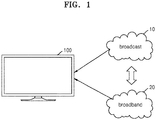
- a broadcast receiving device according to an embodiment is shown.
- a broadcast receiving device 100 may be a TV, but this is only an embodiment.
- the broadcast receiving device 100 may be implemented as an electronic device capable of receiving a broadcast signal and displaying an image based on the broadcast signal.
- the broadcast receiving device 100 may be implemented as various electronic devices, such as a mobile phone, a tablet PC, a digital camera, a camcorder, a laptop computer, a desktop, an e-book terminal, a digital broadcast terminal, a Personal Digital Assistant (PDA), a Portable Multimedia Player (PMP), a navigation, an MP3 player, a wearable device, etc.
- PDA Personal Digital Assistant
- PMP Portable Multimedia Player
- the embodiments may be easily implemented in a display device having a large display, such as a TV, although not limited thereto.
- the broadcast receiving device 100 may be a stationary type or a mobile type, or may be a digital broadcast receiving device capable of receiving digital broadcasts. Also, the broadcast receiving device 100 may be implemented as a flat display device, a curved display device having a curvature, or a flexible display device having an adjustable curvature An output resolution of the broadcast receiving device 100 may be, for example, High Definition (HD), Full HD, Ultra HD, or higher.
- HD High Definition
- Full HD Full HD
- Ultra HD Ultra HD
- the term "user” means a person who controls the functions or operations of the broadcast receiving device 100 using a controller, and may include a viewer, a manager, or an installation engineer.
- the broadcast receiving device 100 may receive a service through a broadcast 10 or a broadband 20.
- the service may include at least one component.
- a service may be a group of media components that are provided to a user, and the components may have various formats of media.
- a service may be provided continuously or intermittently, and in real time or non-real-time.
- a real-time service may be configured with a series of TV programs.
- a service according to an embodiment may include a broadcast service, and the broadcast service may include one or more contents.
- a service provided to the broadcast receiving device 100 may include first content transmitted through the broadcast 10 and second content transmitted through the broadband 20.
- the first content and the second content may be the same contents transmitted through different transfer paths.
- the broadcast receiving device 100 may perform a handoff based on a broadcast reception environment or a user input. For example, when the broadcast receiving device 100 has difficulties in receiving content through a broadcast, while receiving and reproducing first content through the broadcast, the broadcast receiving device 100 may perform a handoff from the broadcast to a broadband. The broadcast receiving device 100 may receive second content that is the same as the first content through the broadband, and reproduce the second content.
- the broadcast receiving device 100 may receive Service Layer Signaling (SLS).
- SLS may be signaling information describing characteristics about the corresponding service, and may provide information for obtaining the corresponding service and components (for example, contents) included in the corresponding service.
- the broadcast receiving device 100 may obtain information about first content and second content from MPEG Media Transport (MMT) SLS, and determine that the first content and the second content are the same contents having different transfer paths, based on the obtained information.
- MMT MPEG Media Transport
- the broadcast receiving device 100 may identify content matching with the second content from among contents transmitted through the broadband 20. After the broadcast receiving device 100 identifies the content matching with the second content, the broadcast receiving device 100 may perform a handoff between the broadcast 10 and the broadband 20 to receive the identified content.
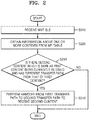
- FIG. 2 is a flowchart illustrating an operating method of a broadcast receiving device according to an embodiment.
- the broadcast receiving device 100 may receive SLS (S210).
- the SLS may be MMT SLS.
- the SLS may include a User Service Bundle Description (USBD) fragment and an MMT Package (MP) table.
- the USBD fragment may provide an identifier of a service and reference information about another SLS required for obtaining components constituting the corresponding service.
- the USBD fragment may provide reference information about the MP table, and the MP table may provide information about an MMT protocol session through which the service is transmitted and information about an asset that is transmitted through the MMT protocol session.
- the broadcast receiving device 100 may obtain information about one or more contents constituting the service from the MP table included in the SLS (S220).
- the MP table may include the number number_of_assets of assets, location information asset_location of assets, and descriptors asset_descriptors for assets.
- an asset may be a multimedia data entity, and may mean a component constituting a service.
- the broadcast receiving device 100 may determine whether there is second content which is the same as first content being currently received and has a different transfer path from that of the first content, based on the information about the one or more contents (S230).
- the broadcast receiving device 100 may obtain asset_location data from the MP table.
- the broadcast receiving device 100 may determine whether there is second content which is the same as first content being currently received and is received through a different transfer path from that of the first content, based on location_count data included in the asset_location data.
- the location_count data may be data providing the number of pieces of location information for an asset. When location_count is '1', it may mean that content (an asset) is transmitted through a transfer path. Meanwhile, when location_count data is '2' or more, it may mean that the same content can be transmitted through two or more transfer paths.
- the broadcast receiving device 100 may determine whether the location_count data is '2' or more, thereby determining whether a handoff is possible.
- the broadcast receiving device 100 may check number_of_assets data from the MP table, wherein the number_of_ assets data may be data providing the number of assets of which information is provided by the MP table. For example, when the number_of_assets data is '2', information of two assets (a first asset and a second asset) may be provided by the MP table. In this case, when the first asset and the second asset are the same contents (assets), at least one of a descriptor asset_descriptors for the first asset and a descriptor asset_descriptors for the second asset may represent that the first asset and the second asset are the same contents (assets).
- the broadcast receiving device 100 may determine whether the assets are the same contents, based on descriptors for the assets.
- the broadcast receiving device 100 may perform a handoff of a content receiving channel from a first transfer path (a path through which the first content is received) to a second transfer path (a path through which the second content is received) to receive the second content (S240).
- the broadcast receiving device 100 may obtain information about one or more contents transmitted through the second transfer path.
- the broadcast receiving device 100 may download a Media Presentation Description (MPD).
- the broadcast receiving device 100 may download the MPD by using a @fullMPDUri element of broadbandComponent in the USBD fragment included in the SLS.
- the @fullMPDUri element may represent a reference for a MPD fragment including descriptions about service components (one or more contents) transmitted through a broadband.
- the broadcast receiving device 100 may obtain identification information about one or more contents received through the broadband from the MPD, and identify content matching with the second content from among the one or more contents received through the broadband, based on the identification information and information about the second content.
- the broadcast receiving device 100 may perform a handoff of a content receiving channel from the first transfer path to the second transfer path, receive the identified content, and reproduce the content.
- FIG. 3 illustrates an MP table included in SLS according to an embodiment.
- an MP table 310 may include information of one or more assets (contents) constituting a service.
- the MP table 310 may include the number number_of_assets of assets, location information asset_location of assets, and descriptors asset_descriptors for assets.
- the number number_of_assets of assets may be data providing the number of assets of which information is provided by the MP table 310.
- the location information asset_location of assets may include location_count data and MMT_general_location_info data.
- the location_count data may be data providing the number of pieces of location information about an asset
- the MMT_general_location_info data may be data providing location information of an asset.
- descriptors asset_descriptors for assets may be data providing descriptions about assets.
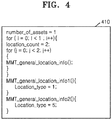
- FIG. 4 is a view referred to describe a method of determining whether a handoff is possible in a broadcast receiving device according to an embodiment.
- an MP table 410 may provide information about an asset.
- number_of_assets data included in the MP table 410 may represent '1', although not limited thereto.
- the broadcast receiving device 100 may determine whether a handoff is possible, based on the number number_of_assets of pieces of location information included in an asset. For example, the broadcast receiving device 100 may determine whether the number of pieces of location information included in an asset is '2' or more, and when the number of pieces of location information is '2' or more, the broadcast receiving device 100 may determine that a handoff is possible.
- an asset may have two pieces of location information. That an asset has two pieces of location information may mean that the same content can be transmitted through two transfer paths.
- location_count data for the asset may be represented as '2', and two pieces of MMT_general_location_info data for the asset may be provided.
- the location information may include first location information MMT_general_location_info1 and second location information MMT_general_location_info2, as illustrated in FIG. 4 .
- an asset (the same content) may include first content that is receivable through a first transfer path corresponding to the first location information and second content that is receivable through a second transfer path corresponding to the second location information, wherein the first content and the second content may be the same contents transmitted through different paths.
- the broadcast receiving device 100 may determine that a handoff is possible.
- the location information may include location type information location_type.
- the location type information location_type may be data representing a type of location information. For example, when location_type data of the first location information is '1(0x01)', it may mean that transfer path information (first location information) of the asset is represented in the form of 'MMTP packet flow over UDP/IP(version 4)'. Also, when location_type data of the second location information is '5(0x05)', it may mean that transfer path information (second location information) of the asset is represented in the form of a 'URL', although not limited thereto.
- FIG. 5 is a view referred to describe a method of determining whether a handoff is possible in a broadcast receiving device according to an embodiment.
- an MP table 510 may provide information about two or more assets.
- number_of_assets data included in the MP table 510 may represent '2'.
- the broadcast receiving device 100 may determine whether a handoff is possible, based on location information asset_location and descriptors asset_descriptors included in two or more assets.
- the broadcast receiving device 100 may determine that a handoff is possible.
- the first asset and the second asset may have different transfer paths.
- contents classified into the same asset while having different transfer paths may be determined to be the same contents, whereas, in the case of contents classified into different assets (for example, asset 1 and asset 2) while having different transfer paths, it may need to be determined whether the contents are the same contents.
- the descriptor for the second asset may be data providing a description about the second asset, and may include a description representing that the second asset is the same asset (content) as the first asset.
- the broadcast receiving device 100 may determine whether contents classified into different assets are the same contents, based on descriptor data asset_descriptors for the assets.
- the broadcast receiving device 100 may determine that the first asset (first content) having the first location information and the second asset (second content) having the second location information are the same contents.
- the broadcast receiving device 100 may determine that a handoff is possible.
- the broadcast receiving device 100 may determine, as described above with reference to FIGS. 4 and 5 , whether there is second content that is the same as the first content being currently received and has a different transfer path from that of the first content (whether a handoff is possible), and, when it is determined that there is the second content (when it is determined that a handoff is possible), the broadcast receiving device 100 may identify content matching with the second content from among one or more contents transmitted through the different transfer path. This will be described in detail with reference to FIGS. 6 and 7 .
- FIG. 6 illustrates location type information included in an MP table according to an embodiment.
- the broadcast receiving device 100 may receive the contents through a first transfer path corresponding to the first location information type or through a second transfer path corresponding to the second location information type.
- an MP table 610 may include different pieces of location information data according to location information types. For example, when a location information type is '0(0x00)', the MP table 610 may include packet_id data, and, when a location information type is '5(0x05)', the MP table 610 may include URL_length data and URL_byte data.
- the broadcast receiving device 100 may identify content matching with content (second content that is the same as the first content and has the second transfer path) having the second location information type from among at least one content that is receivable through the second transfer path corresponding to the second location information type (for example, '5(0x05)').
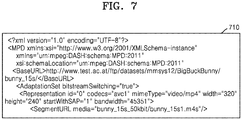
- FIG. 7 illustrates an MDP according to an embodiment.
- the broadcast receiving device 100 may obtain information about one or more contents transmitted through a second transfer path.
- the broadcast receiving device 100 may download a Media Presentation Description (MPD) 710.
- the broadcast receiving device 100 may download the MPD 710 by using a @fullMPDUri element of broadbandComponent in a USBD fragment included in SLS.
- the @fullMPDUri element may represent a reference for an MPD fragment including presentation descriptions for service components (one or more contents) transmitted through a broadband.
- the broadcast receiving device 100 may obtain identification information for one or more contents received through a broadband, from an MPD, and identify content matching with second content from among the one or more contents received through the broadband, based on the identification information and information about the second content.
- the broadcast receiving device 100 may identify content matching with second content from among one or more contents (one or more contents included in the MPD) that are receivable through a second transfer path (for example, a broadband), based on second location information (for example, URL_length data and URL_byte data) of the second content (asset) included in the MP table of FIG. 6 and URL information (for example, at least one of Base URL information and Segment URL information) for one or more contents included in the MPD of FIG. 7 .
- a second transfer path for example, a broadband
- second location information for example, URL_length data and URL_byte data
- URL information for example, at least one of Base URL information and Segment URL information
- the broadcast receiving device 100 may identify the third content as content matching with the second content.
- a method of identifying matching content is not limited to this, and matching content may be identified by various methods.
- FIG. 8 illustrates a part of a USBD fragment received by a broadcast receiving device according to an embodiment.
- the broadcast receiving device 100 may receive SLS, wherein the SLS may be MMT SLS.
- the SLS may include a User Service Bundle Description (USBD) fragment.
- USBD User Service Bundle Description
- the USBD fragment may provide an identifier of a service and reference information about another SLS required for obtaining components constituting the corresponding service.
- broadbandComponent may include a @fullMPDUri element
- broadbandComponentlnfo may include a @Repld element and a @SimulcastAssetld element.
- the @fullMPDUri element may represent a reference for an MPD fragment including descriptions about service components (one or more contents) transmitted through a broadband.
- the @Repld element may represent identification information (for example, ID) of content transmitted through the broadband
- the @SimulcastAssetld element may represent identification information (for example, Asset ID) corresponding to the same content as the content transmitted through the broadband.
- the broadcast receiving device 100 may identify the same contents as contents transmitted through the broadband by Asset ID, based on @Repld element data and @SimulcastAssetld element data.
- the broadcast receiving device 100 may determine Asset ID corresponding to content being currently received from an MP table, and determine identification information of content that is the same as the content having the determined Asset ID and is transmitted through a broadband, based on the @SimulcastAssetld element data and @Repld element data.
- the broadcast receiving device 100 may identify content that is the same as the content being currently received and is transmitted through the broadband, based on the determined identification information and identification information included in an MPD.
- the broadcast receiving device 100 may perform a handoff to receive the identified content through the broadband.
- FIG. 9 is a block diagram illustrating a configuration of a broadcast receiving device according to an embodiment.
- the broadcast receiving device 100 may include a tuner 110, a communicator 120, a processor 140, and a memory 130.
- the tuner 110 may perform amplification, mixing, resonance, etc. on a broadcast signal received in a wired or wireless manner to tune and select only a frequency of a channel that the broadcast receiving device 100 intends to receive from among many radio wave components.
- the broadcast signal may include audio, video, and additional information (for example, Electronic Program Guide (EPG)).
- EPG Electronic Program Guide
- the tuner 110 may receive a broadcast signal from various sources, such as terrestrial broadcasting, cable broadcasting, satellite broadcasting, Internet broadcasting, etc.
- the tuner 110 may receive a broadcast signal from a source, such as analog broadcasting, digital broadcasting, etc.
- the tuner 110 may receive SLS.
- the SLS may be MMT SLS.
- the SLS may include a User Service Bundle Description (USBD) fragment and an MMT Package (MP) table.
- the USBD fragment may provide an identifier of a service and reference information about another SLS required for obtaining components constituting the corresponding service.
- the USBD fragment may provide reference information about an MP table, and the MP table may provide information about an MMT protocol session through which the service is transmitted and information about an asset that is transmitted through the MMT protocol session.
- the communicator 120 may transmit and receive data or signals to and from an external device (for example, a control device, a peripheral device, etc.) by a control of the processor 140.
- an external device for example, a control device, a peripheral device, etc.
- the communicator 120 may transmit and receive data or signals by a method of at least one of a wireless LAN (for example, Wi-Fi), Bluetooth, wired Ethernet, infrared (IR), bluetooth low energy (BLE), ultrasonic waves, zigbee, and HDMI, in correspondence to the performance and structure of the broadcast receiving device 100.
- a wireless LAN for example, Wi-Fi
- Bluetooth for example, Wi-Fi
- wired Ethernet for example, wired Ethernet
- IR infrared
- BLE bluetooth low energy
- the communicator 120 may download a Media Presentation Description (MPD).
- the communicator 120 may download the MPD by using a @fullMPDUri element of broadbandComponent in a USBD fragment included in SLS.
- the @fullMPDUri element may represent a reference for an MPD fragment including descriptions about service components (one or more contents) transmitted through a broadband.
- the processor 140 may execute one or more programs stored in the memory 130.
- the processor 140 may include a single core, a dual core, a triple core, a quad core, and a multiple core.
- the processor 140 may include a plurality of processors.
- the processor 140 may be implemented as a main processor (not shown) and a sub processor (not shown) that operates in a sleep mode.
- the memory 130 may store various data, programs, or applications for driving and controlling the broadcast receiving device 100.
- programs stored in the memory 130 may include one or more instructions.
- the programs (one or more instructions) or applications stored in the memory 10 may be executed by the processor 140.
- the processor 140 may obtain information of one or more contents constituting a service from an MP table included in the SLS by executing one or more instructions stored in the memory 130.
- the MP table may include the number number_of_assets of assets, location information asset_location of assets, and descriptors asset_descriptors for assets.
- the processor 140 may determine whether there is second content that is the same as first content being currently received and has a different transfer path from that of the first content, based on the information of the one or more contents. For example, the processor 140 may obtain asset_location data from the MP table, and determine whether there is second content that is the same as the first content being currently received and is received through a different transfer path from that of the first content, based on location_count data included in the asset_location data. When the location_count data is '2' or more, it may mean that the same content can be transmitted through two or more transfer paths, and the processor 140 may determine whether a handoff is possible by determining whether the location_count data is '2' or more.
- the processor 140 may check number_of_assets data from the MP table. When the number_of_assets data is '2' or more, it may mean that information of two or more assets can be provided by the MP table. When the number_of_assets data is '2' or more, the processor 140 may determine whether the same content exists, based on descriptors for assets.
- the processor 140 may perform a handoff of a content receiving channel from a first transfer path (a path through which the first content is received) to a second transfer path (a path through which the second content is received).
- the processor 140 may obtain identification information about one or more contents received through the broadband, from the MPD, and identify content matching with the second content from among the one or more contents received through the broadband, based on the identification information and information about the second content. After the content matching with the second content is identified, the processor 140 may perform a handoff of a content receiving channel from the first transfer path to the second transfer path to receive and reproduce the identified content.
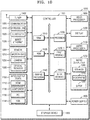
- FIG. 10 is a block diagram illustrating a configuration of a broadcast receiving device 1000 according to another embodiment.
- the broadcast receiving device 1000 of FIG. 10 may be an embodiment of the broadcast receiving device 100 of FIG. 1 .
- the broadcast receiving device 1000 may include a tuner 1400, a controller 1100, a display 1200, a communicator 1500, a sensor 1300, an input/output device 1700, a video processor 1800, an audio processor 1150, an audio outputter 1250, a storage device 1900, and a power supply 1600.
- the tuner 1400 of FIG. 10 may correspond to the tuner 110 of FIG. 9
- the communicator 1500 of FIG. 10 may correspond to the communicator 120 of FIG. 9
- the controller 1100 of FIG. 10 may correspond to the processor 140 of FIG. 9
- the storage device 1900 of FIG. 10 may correspond to the memory 130 of FIG. 9 . Therefore, the same descriptions will be omitted.
- the communicator 1500 may transmit and receive data or signals to and from an external device or a server by a control of the controller 1100.
- the controller 1100 may transmit and receive content to and from an external device connected through the communicator 1500, download an application from the external device, or perform web browsing.
- the video processor 1800 may process video data received by the broadcast receiving device 1000.
- the video processor 1800 may perform various kinds of image processing, such as decoding, scaling, noise filtering, frame rate conversion, resolution conversion, etc., on video data.
- the sensor 1300 may sense a user's voice, a user's image, or a user's interaction, and may include a microphone 1310, a camera 1320, and an optical receiver 1330.
- the microphone 1310 may receive a voice uttered from a user.
- the microphone 1310 may convert the received voice into an electrical signal, and output the electrical signal to the controller 1100.
- the user's voice may include, for example, a voice corresponding to a menu or function of the broadcast receiving device 1000.
- the camera 1320 may receive an image (for example, successive frames) corresponding to a user's motion including a gesture within a camera recognition range.
- the controller 1100 may select a menu displayed on the broadcast receiving device 1000 using a received result of motion recognition, or perform a control corresponding to the result of motion recognition.
- the optical receiver 1330 may receive an optical signal (including a control signal) from an external control device through a light window (not shown), etc. of a bezel of the display 1200.
- the optical receiver 1330 may receive an optical signal corresponding to a user input (for example, a touch, pressing, a touch gesture, a voice, or a motion) from a control device.
- a control signal may be extracted from the received optical signal under the control of the controller 1100.
- the input/output device 1700 may receive video (for example, moving images, etc.), audio (for example, voice, music, etc.), and additional information (for example, EPG, etc.) from the outside of the broadcast receiving device 1000 under the control of the controller 1100.
- the input/output device 1700 may include one of a High Definition Multimedia Interface (HDMI) port 1710, a component jack 1720, a PC port 1730, and a USB port 1740.
- HDMI High Definition Multimedia Interface
- the input/output device 1700 may include a combination of the HDMI port 1710, the component jack 1720, the PC port 1730, and the USB port 1740.
- HDMI High Definition Multimedia Interface
- the controller 1100 may control overall operations of the broadcast receiving device 1000 and signal flow between the internal components of the broadcast receiving device 1000, and process data.
- the controller 1100 may execute an operating system (OS) and various applications stored in the storage device 1900.
- OS operating system
- the controller 1100 may include RAM 1810 that stores signals or data received from outside the broadcast receiving device 1000 or is used as a storage area corresponding to various tasks performed by the broadcast receiving device 1000, ROM 1820 storing a control program for controlling the broadcast receiving device 1000, and a processor 1830.
- a graphic processor 1840 may create a screen including various objects, such as an icon, an image, text, etc., by using a calculator (not shown) and a rendering device (not shown).
- the calculator may calculate attribute values, such as coordinate values, shapes, sizes, colors, etc., of individual objects, according to a layout of a screen, by using a user input sensed through the sensor 1300.
- the rendering device may create screens of various layouts including the objects, based on the attribute values calculated by the calculator. The screens created by the rendering device may be displayed on a display area of the display 1200.
- First to n-th interfaces 1850-1 to 1850-n may be connected to various components described above.
- One of the interfaces 1850-1 to 1850-n may be a network interface that is connected to an external device through a network.
- the RAM 1810, the ROM 1820, the processor 1830, the graphic processor 1840, and the first to n-th interfaces 1850-1 to 1850-n may be connected to each other through an internal bus 1860.
- controller of a broadcast receiving device may include the processor 1830, the ROM 1820, and the RAM 1810.
- the display 1200 may convert an image signal, a data signal, an OSD signal, a control signal, etc., processed by the controller 1100 to generate a driving signal.
- the display 1200 may be implemented as a PDP, an LCD, an OLED, a flexible display, etc., and also may be implemented as a 3-dimensional (3D) display. Also, the display 1200 may be configured as a touch screen and used as an inputter as well as an outputter.
- the audio processor 1150 may process audio data.
- the audio processor 1150 may perform various processing, such as decoding, amplification, noise filtering, etc., on audio data. Meanwhile, the audio processor 1150 may include a plurality of audio processing modules for processing audio corresponding to contents.
- the audio outputter 1250 may output audio included in a broadcasting signal received through the tuner 1400 by a control of the controller 1100.
- the audio outputter 1250 may output audio (for example, a voice or sound) received through the communicator 1500 or the input/output device 1700.
- the audio outputter 1250 may output audio stored in the storage device 1900 by a control of the controller 1100.
- the audio outputter 1250 may include at least one of a speaker 1260, a headphone output terminal 1270, or a Sony/Philips Digital Interface (S/PDIF) output terminal 1280.
- the audio outputter 1250 may include a combination of the speaker 1260, the headphone output terminal 1270, and the S/PDIF output terminal 1280.
- the power supply 1600 may supply power received from an external power source to internal components of the broadcast receiving device 1000 by a control of the controller 1100. Also, the power supply 1600 may supply power output from a single or one or more batteries (not shown) located inside the broadcast receiving device 1000 to the internal components by a control of the controller 1100.
- the storage device 1900 may store various data, programs, or applications for driving and controlling the broadcast receiving device 1000 by a control of the controller 1100.
- the storage device 1900 may include a broadcast receiving module, a channel control module, a volume control module, a communication control module, a voice recognition module, a motion recognition module, a light receiving module, a display control module, an audio control module, an external input control module, a power control module, a power control module of an external device connected in a wireless fashion (for example, Bluetooth), a voice database (DB), or a motion database (DB), which are not illustrated.
- a broadcast receiving module for example, a channel control module, a volume control module, a communication control module, a voice recognition module, a motion recognition module, a light receiving module, a display control module, an audio control module, an external input control module, a power control module, a power control module of an external device connected in a wireless fashion (for example, Bluetooth), a voice database (DB), or a motion database (DB), which are not
- the modules (not shown) and databases of the storage device 1900 may be implemented in the form of software (S/W) to perform a broadcast reception control function, a channel control function, a volume control function, a communication control function, a voice recognition function, a motion recognition function, a light reception control function, a display control function, an audio control function, an external input control function, a power control function, or a power control function of an external device connected in a wireless fashion (for example, Bluetooth), in the broadcast receiving device 1000.
- the controller 1100 may perform the individual functions by using the software stored in the storage device 1900.
- FIGS. 9 and 10 are block diagrams for embodiments. Some components included in the individual block diagrams may be integrated or omitted, or another component may be added, according to actual specifications of the broadcast receiving devices 100 and 1000. That is, two or more components may be integrated into one component, or one component may be separated into two or more components, as necessary. Also, functions performed in the individual blocks are provided to describe the embodiments, and the detailed operations or devices for the functions do not limit the scope of rights of the disclosure.
- the method of operating the broadcast receiving device may be embodied in the form of program commands that can be executed through various computing means, and recorded in computer-readable media.
- the computer-readable media may also include, alone or in combination with the program commands, data files, data structures, and the like.
- the program commands recorded on the media may be those specially designed and constructed for the present disclosure, or they may be of the kind well-known and available to those having skill in the computer software art.
- Examples of the computer-readable media may include magnetic media such as hard disks, floppy disks, and magnetic tape; optical media such as a CD-ROM and a DVD; magneto-optical media such as floptical disks; and hardware devices that are specially configured to store and perform program commands, such as ROM, RAM, flash memory, and the like.
- Examples of the program commands may include both machine code, such as produced by a compiler, and high-level language code that may be executed by the computer using an interpreter.
- the method of operating the broadcast receiving device may be included and provided in a computer program product.
- the computer program product may be traded between a seller and a purchaser as a commodity.
- the computer program product may include a S/W program and computer-readable storage media in which the S/W program is stored.
- the computer program product may include a product in the form of a S/W program (e.g., a downloadable app) that is electronically distributed through a manufacturer of a broadcast receiving device or an electronic marketplace (e.g., Google Play Store or AppStore).
- a S/W program e.g., a downloadable app
- an electronic marketplace e.g., Google Play Store or AppStore
- the storage media may be storage media of a server of a manufacturer, a server of an electronic marketplace, or a relay server for temporarily storing the SW program.
- the computer program product may include, in a system configured with a server and a client device, storage media of the server or storage media of the client device.
- a third device e.g., a smartphone
- the computer program product may include storage media of the third device.
- the computer program product may include a S/W program itself transmitted from the server to the client device or to the third device, or from the third device to the client device.
- one of the server, the client device, and the third device may execute the computer program product to perform the method according to the disclosed embodiments.
- two or more of the server, the client device, and the third device may execute the computer program product to distribute and perform the method according to the disclosed embodiments.
- a server e.g., a cloud server or an artificial intelligence server, etc.
- a server may execute a computer program product stored on the server to control a client device communicatively connected to the server to perform the method according to the disclosed embodiments.
Landscapes
- Engineering & Computer Science (AREA)
- Signal Processing (AREA)
- Multimedia (AREA)
- Computer Networks & Wireless Communication (AREA)
- Databases & Information Systems (AREA)
- Computer Security & Cryptography (AREA)
- Library & Information Science (AREA)
- Two-Way Televisions, Distribution Of Moving Picture Or The Like (AREA)
Abstract
Description
- Various embodiments relate to a broadcast receiving device and an operating method thereof, and more particularly, to a broadcast receiving device capable of providing a handoff function in receiving transmitted broadcast content by using an MPEC Media Transport (MMT) protocol, and an operating method of the broadcast receiving device.
- A broadcast receiving device is a device having a function of receiving broadcast images that users can view and displaying the broadcast images. A user can watch broadcasts through the broadcast receiving device. The broadcast receiving device displays a broadcast selected by a user from among broadcast signals sent from a broadcasting station on a display.
- Also, smart TVs of providing various contents in addition to a broadcasting function are provided. The smart TVs are aimed to analyze and provide what a user desires without having to receive the user's control, instead of operating passively according to the user's selection.
- Meanwhile, ATSC 3.0, which is a digital TV broadcast standard is a North American next-generation broadcast standard having features of a high data rate, a network convergence service, etc., and has been adopted as a national UHD broadcast standard. ATSC 3.0 uses a Real-Time Object Delivery over Unidirectional Transport (ROUTE) protocol and an MMT protocol as transport standards. In the case of the ROUTE protocol, a standard for handoff has been specified in the ATSC 3.0 S33-1 standard. However, in the case of the MMT protocol, no standard for handoff has been specified. Accordingly, because the MMT protocol has no method for specifying that content transmitted through a broadcast and content transmitted through a broadband are the same contents, the MMT protocol cannot support a handoff function.
- Various embodiments provide a broadcast receiving device capable of supporting a handoff function, by using Service Layer Signaling (SLS), when receiving a transmitted broadcast service by using an MMT protocol, and an operating method of the broadcast receiving device.
- A broadcast receiving device according to an embodiment may provide a method capable of matching the same contents among contents transmitted through different transfer paths, by using information included in service layer signaling, when receiving a transmitted broadcast service by using an MMT protocol.
- Accordingly, when no broadcast can be received through a current transfer path of receiving content, handoff to another transfer path may be performed to continue to receive the same content, thereby assuring users of stable broadcast viewing.
-
-
FIG. 1 illustrates a broadcast receiving device according to an embodiment. -
FIG. 2 is a flowchart illustrating an operating method of a broadcast receiving device according to an embodiment. -
FIG. 3 illustrates an MP table included in SLS according to an embodiment. -
FIG. 4 is a view referred to describe a method of determining whether a handoff is possible in a broadcast receiving device according to an embodiment. -
FIG. 5 is a view referred to describe a method of determining whether a handoff is possible in a broadcast receiving device according to an embodiment. -
FIG. 6 illustrates location type information included in an MP table according to an embodiment. -
FIG. 7 illustrates a MDP according to an embodiment. -
FIG. 8 illustrates a part of a USBD fragment received by a broadcast receiving device according to an embodiment. -
FIG. 9 is a block diagram illustrating a configuration of a broadcast receiving device according to an embodiment. -
FIG. 10 is a block diagram illustrating a configuration of abroadcast receiving device 1000 according to another embodiment. - A broadcast receiving device for receiving a transmitted service by using an MPEG Media Transport (MMT) protocol, according to an embodiment, includes: a tuner configured to receive MMT Service Layer Signaling (SLS); a memory storing one or more instructions; and a processor configured to execute the one or more instructions stored in the memory to obtain information of one or more contents constituting the service, from an MMT Package (MP) table included in the MMT SLS, determine whether there is second content that is the same as first content being currently received through a first transfer path and is received through a different transfer path from the first transfer path of the first content, among the one or more contents, based on the information of the one or more contents, and perform, when there is the second content, a handoff of a content receiving channel from the first transfer path to a second transfer path corresponding to the second content to receive the second content.
- The first transfer path and the second transfer path, according to an embodiment, may be any one of a broadcast and a broadband.
- The processor according to an embodiment may obtain the information of the one or more contents from number_of_assets data, asset_location data, and asset_descriptors data included in the MP table.
- The processor according to an embodiment may determine whether there is the second content among at least one content classified into the same asset as the first content, based on the asset_location data.
- The processor according to an embodiment may determine whether there is the second content, by determining whether location_count data in the asset_location data for the first content is 2 or more.
- The processor according to an embodiment may determine whether there is the second content among at least one content classified into a different asset from the first content, based on the number_of_assets data, the asset_location data, and the asset_descriptors data.
- The processor according to an embodiment may identify, when there is the second content, content matching with the second content from among one or more contents having the second transfer path, and receive the identified content through the second transfer path.
- The processor according to an embodiment may obtain a reference for a Media Presentation Description (MPD) from a User Service Bundle Description (USBD) fragment included in the MMT SLS, control a communicator to receive the MPD based on the reference for the MPD, and obtain identification information for one or more contents received through the second transfer path from the MPD, and identify the content matching with the second content from among one or more contents received through the second transfer path, based on the identification information and information about the second content.
- The processor according to an embodiment may identify the content matching with the second content from among the one or more contents received through the second transfer path, based on URL information about the one or more contents included in the MPD and URL information about the second content.
- The processor according to an embodiment may perform the handoff based on a broadcast receiving environment and a user input.
- A method of operating a broadcast receiving device to receive a transmitted service by using an MPEG Media Transport (MMT) protocol, according to an embodiment, includes: receiving MMT Service Layer Signaling (SLS); obtaining information of one or more contents constituting the service from an MMT Package (MP) table included in the MMT SLS; determining whether there is second content that is the same as first content being currently received through a first transfer path and is received through a different transfer path from a transfer path of the first content among the one or more contents, based on the information of the one or more contents; and performing, when there is the second content, a handoff of a content receiving channel from the first transfer path to a second transfer path corresponding to the second content, and receiving the second content.
- Terms used in this specification will be briefly described, and the disclosure will be described in detail.
- Although general terms being widely used were selected as terminology used in the disclosure while considering the functions of the disclosure, they may vary according to intentions of one of ordinary skill in the art, judicial precedents, the advent of new technologies, and the like. Also, terms arbitrarily selected by the applicant may also be used in a specific case. In this case, their meanings will be described in detail in the detailed description of the disclosure. Hence, the terms used in the disclosure must be defined based on the meanings of the terms and the contents of the entire specification, not by simply stating the terms themselves.
- It will be understood that when a certain part "includes" a certain component, the part does not exclude another component but can further include another component, unless the context clearly dictates otherwise. As used herein, the terms "portion", "module", or "unit" refers to a unit that can perform at least one function or operation, and may be implemented as hardware, software, or a combination of hardware and software.
- Hereinafter, embodiments of the present disclosure will be described in detail with reference to the appended drawings in order for one of ordinary skill in the art to easily embody the present disclosure. However, the present disclosure can be implemented in various different forms, and is not limited to the embodiments described herein. Also, in the drawings, portions irrelevant to the description are not shown in order to definitely describe the disclosure, and throughout the entire specification, similar components are assigned similar reference numerals.
- A broadcast receiving device according to an embodiment is shown.
- A
broadcast receiving device 100 according to an embodiment may be a TV, but this is only an embodiment. Thebroadcast receiving device 100 may be implemented as an electronic device capable of receiving a broadcast signal and displaying an image based on the broadcast signal. For example, thebroadcast receiving device 100 may be implemented as various electronic devices, such as a mobile phone, a tablet PC, a digital camera, a camcorder, a laptop computer, a desktop, an e-book terminal, a digital broadcast terminal, a Personal Digital Assistant (PDA), a Portable Multimedia Player (PMP), a navigation, an MP3 player, a wearable device, etc. Particularly, the embodiments may be easily implemented in a display device having a large display, such as a TV, although not limited thereto. - Also, the
broadcast receiving device 100 may be a stationary type or a mobile type, or may be a digital broadcast receiving device capable of receiving digital broadcasts. Also, thebroadcast receiving device 100 may be implemented as a flat display device, a curved display device having a curvature, or a flexible display device having an adjustable curvature An output resolution of thebroadcast receiving device 100 may be, for example, High Definition (HD), Full HD, Ultra HD, or higher. - In the embodiments of the present specification, the term "user" means a person who controls the functions or operations of the
broadcast receiving device 100 using a controller, and may include a viewer, a manager, or an installation engineer. - The
broadcast receiving device 100 may receive a service through abroadcast 10 or abroadband 20. The service according to an embodiment may include at least one component. A service may be a group of media components that are provided to a user, and the components may have various formats of media. Also, a service may be provided continuously or intermittently, and in real time or non-real-time. A real-time service may be configured with a series of TV programs. Also, a service according to an embodiment may include a broadcast service, and the broadcast service may include one or more contents. - For example, referring to
FIG. 1 , a service provided to thebroadcast receiving device 100 according to an embodiment may include first content transmitted through thebroadcast 10 and second content transmitted through thebroadband 20. In this case, the first content and the second content may be the same contents transmitted through different transfer paths. - The
broadcast receiving device 100 according to an embodiment may perform a handoff based on a broadcast reception environment or a user input. For example, when thebroadcast receiving device 100 has difficulties in receiving content through a broadcast, while receiving and reproducing first content through the broadcast, thebroadcast receiving device 100 may perform a handoff from the broadcast to a broadband. Thebroadcast receiving device 100 may receive second content that is the same as the first content through the broadband, and reproduce the second content. - The
broadcast receiving device 100 according to an embodiment may receive Service Layer Signaling (SLS). The SLS may be signaling information describing characteristics about the corresponding service, and may provide information for obtaining the corresponding service and components (for example, contents) included in the corresponding service. - For example, the
broadcast receiving device 100 may obtain information about first content and second content from MPEG Media Transport (MMT) SLS, and determine that the first content and the second content are the same contents having different transfer paths, based on the obtained information. When it is determined that the first content and the second content are the same contents, and the first content is content transmitted through thebroadcast 10 while the second content is content transmitted through thebroadband 20, thebroadcast receiving device 100 according to an embodiment may identify content matching with the second content from among contents transmitted through thebroadband 20. After thebroadcast receiving device 100 identifies the content matching with the second content, thebroadcast receiving device 100 may perform a handoff between thebroadcast 10 and thebroadband 20 to receive the identified content. -
FIG. 2 is a flowchart illustrating an operating method of a broadcast receiving device according to an embodiment. - Referring to
FIG. 2 , thebroadcast receiving device 100 according to an embodiment may receive SLS (S210). At this time, the SLS may be MMT SLS. The SLS may include a User Service Bundle Description (USBD) fragment and an MMT Package (MP) table. The USBD fragment may provide an identifier of a service and reference information about another SLS required for obtaining components constituting the corresponding service. Also, the USBD fragment may provide reference information about the MP table, and the MP table may provide information about an MMT protocol session through which the service is transmitted and information about an asset that is transmitted through the MMT protocol session. - The
broadcast receiving device 100 may obtain information about one or more contents constituting the service from the MP table included in the SLS (S220). For example, the MP table may include the number number_of_assets of assets, location information asset_location of assets, and descriptors asset_descriptors for assets. Herein, an asset may be a multimedia data entity, and may mean a component constituting a service. - The
broadcast receiving device 100 may determine whether there is second content which is the same as first content being currently received and has a different transfer path from that of the first content, based on the information about the one or more contents (S230). - For example, the
broadcast receiving device 100 may obtain asset_location data from the MP table. Thebroadcast receiving device 100 may determine whether there is second content which is the same as first content being currently received and is received through a different transfer path from that of the first content, based on location_count data included in the asset_location data. The location_count data may be data providing the number of pieces of location information for an asset. When location_count is '1', it may mean that content (an asset) is transmitted through a transfer path. Meanwhile, when location_count data is '2' or more, it may mean that the same content can be transmitted through two or more transfer paths. Thebroadcast receiving device 100 may determine whether the location_count data is '2' or more, thereby determining whether a handoff is possible. - Also, the
broadcast receiving device 100 may check number_of_assets data from the MP table, wherein the number_of_ assets data may be data providing the number of assets of which information is provided by the MP table. For example, when the number_of_assets data is '2', information of two assets (a first asset and a second asset) may be provided by the MP table. In this case, when the first asset and the second asset are the same contents (assets), at least one of a descriptor asset_descriptors for the first asset and a descriptor asset_descriptors for the second asset may represent that the first asset and the second asset are the same contents (assets). - When there are a plurality of assets of which information is provided by the MP table, the
broadcast receiving device 100 may determine whether the assets are the same contents, based on descriptors for the assets. - When there is the second content which is the same as the first content being currently received and which is received through a different transfer path from that of the first content, the
broadcast receiving device 100 may perform a handoff of a content receiving channel from a first transfer path (a path through which the first content is received) to a second transfer path (a path through which the second content is received) to receive the second content (S240). - When there is the second content received through the second transfer path, the
broadcast receiving device 100 according to an embodiment may obtain information about one or more contents transmitted through the second transfer path. For example, thebroadcast receiving device 100 may download a Media Presentation Description (MPD). In this case, thebroadcast receiving device 100 may download the MPD by using a @fullMPDUri element of broadbandComponent in the USBD fragment included in the SLS. The @fullMPDUri element may represent a reference for a MPD fragment including descriptions about service components (one or more contents) transmitted through a broadband. - When the second transfer path is a broadband, the
broadcast receiving device 100 according to an embodiment may obtain identification information about one or more contents received through the broadband from the MPD, and identify content matching with the second content from among the one or more contents received through the broadband, based on the identification information and information about the second content. - After the content matching with the second content is identified, the
broadcast receiving device 100 may perform a handoff of a content receiving channel from the first transfer path to the second transfer path, receive the identified content, and reproduce the content. -
FIG. 3 illustrates an MP table included in SLS according to an embodiment. - Referring to
FIG. 3 , an MP table 310 may include information of one or more assets (contents) constituting a service. For example, as illustrated inFIG. 3 , the MP table 310 may include the number number_of_assets of assets, location information asset_location of assets, and descriptors asset_descriptors for assets. The number number_of_assets of assets may be data providing the number of assets of which information is provided by the MP table 310. - Also, the location information asset_location of assets may include location_count data and MMT_general_location_info data. In this case, the location_count data may be data providing the number of pieces of location information about an asset, and the MMT_general_location_info data may be data providing location information of an asset.
- Also, the descriptors asset_descriptors for assets may be data providing descriptions about assets.
-
FIG. 4 is a view referred to describe a method of determining whether a handoff is possible in a broadcast receiving device according to an embodiment. - Referring to
FIG. 4 , an MP table 410 according to an embodiment may provide information about an asset. For example, when information about an asset is provided by the MP table 410, number_of_assets data included in the MP table 410 may represent '1', although not limited thereto. - An asset included in an MP table may have identification information, and an asset included in the MP table 410 of
FIG. 4 may have first identification information (for example, asset ID=0). Also, an asset may include one or more pieces of location information. - The
broadcast receiving device 100 according to an embodiment may determine whether a handoff is possible, based on the number number_of_assets of pieces of location information included in an asset. For example, thebroadcast receiving device 100 may determine whether the number of pieces of location information included in an asset is '2' or more, and when the number of pieces of location information is '2' or more, thebroadcast receiving device 100 may determine that a handoff is possible. - As illustrated in
FIG. 4 , an asset may have two pieces of location information. That an asset has two pieces of location information may mean that the same content can be transmitted through two transfer paths. - Also, when an asset has two pieces of location information, location_count data for the asset may be represented as '2', and two pieces of MMT_general_location_info data for the asset may be provided. For example, the location information may include first location information MMT_general_location_info1 and second location information MMT_general_location_info2, as illustrated in
FIG. 4 . - For example, an asset (the same content) may include first content that is receivable through a first transfer path corresponding to the first location information and second content that is receivable through a second transfer path corresponding to the second location information, wherein the first content and the second content may be the same contents transmitted through different paths.
- The
broadcast receiving device 100 according to an embodiment may identify anasset asset 1 corresponding to the first content by using identification information (for example, asset ID=0) of an asset corresponding to content (for example, the first content) being currently received. When the identifiedasset asset 1 has two or more pieces of location information, it means that the same content (for example, the second content) having a different transfer path as that of the first content exists. Therefore, thebroadcast receiving device 100 may determine that a handoff is possible. - The location information may include location type information location_type. The location type information location_type may be data representing a type of location information. For example, when location_type data of the first location information is '1(0x01)', it may mean that transfer path information (first location information) of the asset is represented in the form of 'MMTP packet flow over UDP/IP(version 4)'. Also, when location_type data of the second location information is '5(0x05)', it may mean that transfer path information (second location information) of the asset is represented in the form of a 'URL', although not limited thereto.
-
FIG. 5 is a view referred to describe a method of determining whether a handoff is possible in a broadcast receiving device according to an embodiment. - Referring to
FIG. 5 , an MP table 510 according to an embodiment may provide information about two or more assets. For example, number_of_assets data included in the MP table 510 may represent '2'. - The
broadcast receiving device 100 according to an embodiment may determine whether a handoff is possible, based on location information asset_location and descriptors asset_descriptors included in two or more assets. - For example, as illustrated in
FIG. 5 , when thebroadcast receiving device 100 determines that two assets asset 1 (for example, 'l=0') and asset 2 (for example, 'l=1') are the same contents having different transfer paths, based on location information asset_location and descriptors asset_descriptors for the two assets, thebroadcast receiving device 100 may determine that a handoff is possible. - As illustrated in
FIG. 5 , each of the two assets may have one piece of location information (for example, 'location_count=1'), wherein a type of location information of afirst asset asset 1 may be '1(0x01)' and a type of location information of asecond asset asset 2 may be '5(5x05)'. The first asset and the second asset may have different transfer paths. - For example, contents classified into the same asset while having different transfer paths may be determined to be the same contents, whereas, in the case of contents classified into different assets (for example,
asset 1 and asset 2) while having different transfer paths, it may need to be determined whether the contents are the same contents. - An MP table according to an embodiment may include a descriptor asset_descriptors for the second asset asset 2 (l=1).
- For example, the descriptor for the second asset may be data providing a description about the second asset, and may include a description representing that the second asset is the same asset (content) as the first asset.
- Accordingly, when there are a plurality of assets (for example, the first asset and the second asset), the
broadcast receiving device 100 may determine whether contents classified into different assets are the same contents, based on descriptor data asset_descriptors for the assets. When descriptor data for the first asset or the second asset includes a description representing that the first asset (asset 1, l=0) and the second asset (asset 2, l=1) are the same assets, thebroadcast receiving device 100 may determine that the first asset (first content) having the first location information and the second asset (second content) having the second location information are the same contents. - When an asset (the first asset) corresponding to content (the first content) being currently received and the second asset (the second content) classified into a different asset are the same contents, and a transfer path of the first asset is different from a transfer path of the second asset, the
broadcast receiving device 100 according to an embodiment may determine that a handoff is possible. - The
broadcast receiving device 100 according to an embodiment may determine, as described above with reference toFIGS. 4 and5 , whether there is second content that is the same as the first content being currently received and has a different transfer path from that of the first content (whether a handoff is possible), and, when it is determined that there is the second content (when it is determined that a handoff is possible), thebroadcast receiving device 100 may identify content matching with the second content from among one or more contents transmitted through the different transfer path. This will be described in detail with reference toFIGS. 6 and7 . -
FIG. 6 illustrates location type information included in an MP table according to an embodiment. - When a first location information type for the same assets (contents) is '0(0x01)' and a second location information type for the same assets (contents) is '5(0x05)', the
broadcast receiving device 100 according to an embodiment may receive the contents through a first transfer path corresponding to the first location information type or through a second transfer path corresponding to the second location information type. - Meanwhile, referring to
FIG. 6 , an MP table 610 according to an embodiment may include different pieces of location information data according to location information types. For example, when a location information type is '0(0x00)', the MP table 610 may include packet_id data, and, when a location information type is '5(0x05)', the MP table 610 may include URL_length data and URL_byte data. - When content (first content) being currently received is received through the first transfer path corresponding to the first location information type (for example, '1(0x01)'), the
broadcast receiving device 100 according to an embodiment may identify content matching with content (second content that is the same as the first content and has the second transfer path) having the second location information type from among at least one content that is receivable through the second transfer path corresponding to the second location information type (for example, '5(0x05)'). -
FIG. 7 illustrates an MDP according to an embodiment. - The
broadcast receiving device 100 according to an embodiment may obtain information about one or more contents transmitted through a second transfer path. For example, thebroadcast receiving device 100 may download a Media Presentation Description (MPD) 710. At this time, thebroadcast receiving device 100 may download theMPD 710 by using a @fullMPDUri element of broadbandComponent in a USBD fragment included in SLS. The @fullMPDUri element may represent a reference for an MPD fragment including presentation descriptions for service components (one or more contents) transmitted through a broadband. - The
broadcast receiving device 100 according to an embodiment may obtain identification information for one or more contents received through a broadband, from an MPD, and identify content matching with second content from among the one or more contents received through the broadband, based on the identification information and information about the second content. - For example, the
broadcast receiving device 100 may identify content matching with second content from among one or more contents (one or more contents included in the MPD) that are receivable through a second transfer path (for example, a broadband), based on second location information (for example, URL_length data and URL_byte data) of the second content (asset) included in the MP table ofFIG. 6 and URL information (for example, at least one of Base URL information and Segment URL information) for one or more contents included in the MPD ofFIG. 7 . For example, when the URL_byte data of the second content is "abcde", a Base URL of third content among the one or more contents included in the MPD is "abc", and Segment URL is "de", thebroadcast receiving device 100 may identify the third content as content matching with the second content. However, a method of identifying matching content is not limited to this, and matching content may be identified by various methods. -
FIG. 8 illustrates a part of a USBD fragment received by a broadcast receiving device according to an embodiment. - The
broadcast receiving device 100 according to an embodiment may receive SLS, wherein the SLS may be MMT SLS. The SLS may include a User Service Bundle Description (USBD) fragment. The USBD fragment may provide an identifier of a service and reference information about another SLS required for obtaining components constituting the corresponding service. - In the USBD fragment included in the SLS according to an embodiment, broadbandComponent may include a @fullMPDUri element, and broadbandComponentlnfo may include a @Repld element and a @SimulcastAssetld element.
- The @fullMPDUri element may represent a reference for an MPD fragment including descriptions about service components (one or more contents) transmitted through a broadband.
- Also, the @Repld element may represent identification information (for example, ID) of content transmitted through the broadband, and the @SimulcastAssetld element may represent identification information (for example, Asset ID) corresponding to the same content as the content transmitted through the broadband.
- The
broadcast receiving device 100 may identify the same contents as contents transmitted through the broadband by Asset ID, based on @Repld element data and @SimulcastAssetld element data. - For example, the
broadcast receiving device 100 may determine Asset ID corresponding to content being currently received from an MP table, and determine identification information of content that is the same as the content having the determined Asset ID and is transmitted through a broadband, based on the @SimulcastAssetld element data and @Repld element data. Thebroadcast receiving device 100 may identify content that is the same as the content being currently received and is transmitted through the broadband, based on the determined identification information and identification information included in an MPD. Thebroadcast receiving device 100 may perform a handoff to receive the identified content through the broadband. -
FIG. 9 is a block diagram illustrating a configuration of a broadcast receiving device according to an embodiment. - Referring to
FIG. 9 , thebroadcast receiving device 100 according to an embodiment may include atuner 110, acommunicator 120, aprocessor 140, and amemory 130. - The
tuner 110 according to an embodiment may perform amplification, mixing, resonance, etc. on a broadcast signal received in a wired or wireless manner to tune and select only a frequency of a channel that thebroadcast receiving device 100 intends to receive from among many radio wave components. The broadcast signal may include audio, video, and additional information (for example, Electronic Program Guide (EPG)). - The
tuner 110 may receive a broadcast signal from various sources, such as terrestrial broadcasting, cable broadcasting, satellite broadcasting, Internet broadcasting, etc. Thetuner 110 may receive a broadcast signal from a source, such as analog broadcasting, digital broadcasting, etc. - Also, the
tuner 110 according to an embodiment may receive SLS. In this case, the SLS may be MMT SLS. The SLS may include a User Service Bundle Description (USBD) fragment and an MMT Package (MP) table. The USBD fragment may provide an identifier of a service and reference information about another SLS required for obtaining components constituting the corresponding service. Also, the USBD fragment may provide reference information about an MP table, and the MP table may provide information about an MMT protocol session through which the service is transmitted and information about an asset that is transmitted through the MMT protocol session. - The
communicator 120 according to an embodiment may transmit and receive data or signals to and from an external device (for example, a control device, a peripheral device, etc.) by a control of theprocessor 140. - The
communicator 120 may transmit and receive data or signals by a method of at least one of a wireless LAN (for example, Wi-Fi), Bluetooth, wired Ethernet, infrared (IR), bluetooth low energy (BLE), ultrasonic waves, zigbee, and HDMI, in correspondence to the performance and structure of thebroadcast receiving device 100. - The
communicator 120 according to an embodiment may download a Media Presentation Description (MPD). At this time, thecommunicator 120 may download the MPD by using a @fullMPDUri element of broadbandComponent in a USBD fragment included in SLS. The @fullMPDUri element may represent a reference for an MPD fragment including descriptions about service components (one or more contents) transmitted through a broadband. - The
processor 140 according to an embodiment may execute one or more programs stored in thememory 130. Theprocessor 140 may include a single core, a dual core, a triple core, a quad core, and a multiple core. Also, theprocessor 140 may include a plurality of processors. For example, theprocessor 140 may be implemented as a main processor (not shown) and a sub processor (not shown) that operates in a sleep mode. - The
memory 130 according to an embodiment may store various data, programs, or applications for driving and controlling thebroadcast receiving device 100. - Also, the programs stored in the
memory 130 may include one or more instructions. The programs (one or more instructions) or applications stored in thememory 10 may be executed by theprocessor 140. - The
processor 140 according to an embodiment may obtain information of one or more contents constituting a service from an MP table included in the SLS by executing one or more instructions stored in thememory 130. For example, the MP table may include the number number_of_assets of assets, location information asset_location of assets, and descriptors asset_descriptors for assets. - The
processor 140 may determine whether there is second content that is the same as first content being currently received and has a different transfer path from that of the first content, based on the information of the one or more contents. For example, theprocessor 140 may obtain asset_location data from the MP table, and determine whether there is second content that is the same as the first content being currently received and is received through a different transfer path from that of the first content, based on location_count data included in the asset_location data. When the location_count data is '2' or more, it may mean that the same content can be transmitted through two or more transfer paths, and theprocessor 140 may determine whether a handoff is possible by determining whether the location_count data is '2' or more. - Also, the
processor 140 may check number_of_assets data from the MP table. When the number_of_assets data is '2' or more, it may mean that information of two or more assets can be provided by the MP table. When the number_of_assets data is '2' or more, theprocessor 140 may determine whether the same content exists, based on descriptors for assets. - When there is the second content that is the same as the first content being currently received and is received through a different transfer path from that of the first content, the
processor 140 according to an embodiment may perform a handoff of a content receiving channel from a first transfer path (a path through which the first content is received) to a second transfer path (a path through which the second content is received). - When the second transfer path is a broadband, the
processor 140 according to an embodiment may obtain identification information about one or more contents received through the broadband, from the MPD, and identify content matching with the second content from among the one or more contents received through the broadband, based on the identification information and information about the second content. After the content matching with the second content is identified, theprocessor 140 may perform a handoff of a content receiving channel from the first transfer path to the second transfer path to receive and reproduce the identified content. -
FIG. 10 is a block diagram illustrating a configuration of abroadcast receiving device 1000 according to another embodiment. Thebroadcast receiving device 1000 ofFIG. 10 may be an embodiment of thebroadcast receiving device 100 ofFIG. 1 . - Referring to
FIG. 10 , thebroadcast receiving device 1000 according to an embodiment may include atuner 1400, acontroller 1100, adisplay 1200, acommunicator 1500, asensor 1300, an input/output device 1700, avideo processor 1800, anaudio processor 1150, anaudio outputter 1250, astorage device 1900, and apower supply 1600. - The
tuner 1400 ofFIG. 10 may correspond to thetuner 110 ofFIG. 9 , thecommunicator 1500 ofFIG. 10 may correspond to thecommunicator 120 ofFIG. 9 , thecontroller 1100 ofFIG. 10 may correspond to theprocessor 140 ofFIG. 9 , and thestorage device 1900 ofFIG. 10 may correspond to thememory 130 ofFIG. 9 . Therefore, the same descriptions will be omitted. - The
communicator 1500 according to an embodiment may transmit and receive data or signals to and from an external device or a server by a control of thecontroller 1100. Thecontroller 1100 may transmit and receive content to and from an external device connected through thecommunicator 1500, download an application from the external device, or perform web browsing. - The
video processor 1800 may process video data received by thebroadcast receiving device 1000. Thevideo processor 1800 may perform various kinds of image processing, such as decoding, scaling, noise filtering, frame rate conversion, resolution conversion, etc., on video data. - The
sensor 1300 may sense a user's voice, a user's image, or a user's interaction, and may include amicrophone 1310, acamera 1320, and anoptical receiver 1330. - The
microphone 1310 may receive a voice uttered from a user. Themicrophone 1310 may convert the received voice into an electrical signal, and output the electrical signal to thecontroller 1100. The user's voice may include, for example, a voice corresponding to a menu or function of thebroadcast receiving device 1000. - The
camera 1320 may receive an image (for example, successive frames) corresponding to a user's motion including a gesture within a camera recognition range. Thecontroller 1100 may select a menu displayed on thebroadcast receiving device 1000 using a received result of motion recognition, or perform a control corresponding to the result of motion recognition. - The
optical receiver 1330 may receive an optical signal (including a control signal) from an external control device through a light window (not shown), etc. of a bezel of thedisplay 1200. Theoptical receiver 1330 may receive an optical signal corresponding to a user input (for example, a touch, pressing, a touch gesture, a voice, or a motion) from a control device. A control signal may be extracted from the received optical signal under the control of thecontroller 1100. - The input/
output device 1700 may receive video (for example, moving images, etc.), audio (for example, voice, music, etc.), and additional information (for example, EPG, etc.) from the outside of thebroadcast receiving device 1000 under the control of thecontroller 1100. The input/output device 1700 may include one of a High Definition Multimedia Interface (HDMI)port 1710, acomponent jack 1720, aPC port 1730, and aUSB port 1740. The input/output device 1700 may include a combination of theHDMI port 1710, thecomponent jack 1720, thePC port 1730, and theUSB port 1740. - The
controller 1100 may control overall operations of thebroadcast receiving device 1000 and signal flow between the internal components of thebroadcast receiving device 1000, and process data. When a user input is received or when a predetermined, stored condition is satisfied, thecontroller 1100 may execute an operating system (OS) and various applications stored in thestorage device 1900. - The
controller 1100 may includeRAM 1810 that stores signals or data received from outside thebroadcast receiving device 1000 or is used as a storage area corresponding to various tasks performed by thebroadcast receiving device 1000,ROM 1820 storing a control program for controlling thebroadcast receiving device 1000, and aprocessor 1830. - A
graphic processor 1840 may create a screen including various objects, such as an icon, an image, text, etc., by using a calculator (not shown) and a rendering device (not shown). The calculator may calculate attribute values, such as coordinate values, shapes, sizes, colors, etc., of individual objects, according to a layout of a screen, by using a user input sensed through thesensor 1300. The rendering device may create screens of various layouts including the objects, based on the attribute values calculated by the calculator. The screens created by the rendering device may be displayed on a display area of thedisplay 1200. - First to n-th interfaces 1850-1 to 1850-n may be connected to various components described above. One of the interfaces 1850-1 to 1850-n may be a network interface that is connected to an external device through a network.
- The
RAM 1810, theROM 1820, theprocessor 1830, thegraphic processor 1840, and the first to n-th interfaces 1850-1 to 1850-n may be connected to each other through an internal bus 1860. - In the current embodiment, the term "controller of a broadcast receiving device" may include the
processor 1830, theROM 1820, and theRAM 1810. - The
display 1200 may convert an image signal, a data signal, an OSD signal, a control signal, etc., processed by thecontroller 1100 to generate a driving signal. Thedisplay 1200 may be implemented as a PDP, an LCD, an OLED, a flexible display, etc., and also may be implemented as a 3-dimensional (3D) display. Also, thedisplay 1200 may be configured as a touch screen and used as an inputter as well as an outputter. - The
audio processor 1150 may process audio data. Theaudio processor 1150 may perform various processing, such as decoding, amplification, noise filtering, etc., on audio data. Meanwhile, theaudio processor 1150 may include a plurality of audio processing modules for processing audio corresponding to contents. - The
audio outputter 1250 may output audio included in a broadcasting signal received through thetuner 1400 by a control of thecontroller 1100. Theaudio outputter 1250 may output audio (for example, a voice or sound) received through thecommunicator 1500 or the input/output device 1700. Also, theaudio outputter 1250 may output audio stored in thestorage device 1900 by a control of thecontroller 1100. Theaudio outputter 1250 may include at least one of aspeaker 1260, aheadphone output terminal 1270, or a Sony/Philips Digital Interface (S/PDIF)output terminal 1280. Theaudio outputter 1250 may include a combination of thespeaker 1260, theheadphone output terminal 1270, and the S/PDIF output terminal 1280. - The
power supply 1600 may supply power received from an external power source to internal components of thebroadcast receiving device 1000 by a control of thecontroller 1100. Also, thepower supply 1600 may supply power output from a single or one or more batteries (not shown) located inside thebroadcast receiving device 1000 to the internal components by a control of thecontroller 1100. - The
storage device 1900 may store various data, programs, or applications for driving and controlling thebroadcast receiving device 1000 by a control of thecontroller 1100. Thestorage device 1900 may include a broadcast receiving module, a channel control module, a volume control module, a communication control module, a voice recognition module, a motion recognition module, a light receiving module, a display control module, an audio control module, an external input control module, a power control module, a power control module of an external device connected in a wireless fashion (for example, Bluetooth), a voice database (DB), or a motion database (DB), which are not illustrated. The modules (not shown) and databases of thestorage device 1900 may be implemented in the form of software (S/W) to perform a broadcast reception control function, a channel control function, a volume control function, a communication control function, a voice recognition function, a motion recognition function, a light reception control function, a display control function, an audio control function, an external input control function, a power control function, or a power control function of an external device connected in a wireless fashion (for example, Bluetooth), in thebroadcast receiving device 1000. Thecontroller 1100 may perform the individual functions by using the software stored in thestorage device 1900. - Meanwhile, the block diagrams of the
broadcast receiving devices FIGS. 9 and10 are block diagrams for embodiments. Some components included in the individual block diagrams may be integrated or omitted, or another component may be added, according to actual specifications of thebroadcast receiving devices - The method of operating the broadcast receiving device according to an embodiment may be embodied in the form of program commands that can be executed through various computing means, and recorded in computer-readable media. The computer-readable media may also include, alone or in combination with the program commands, data files, data structures, and the like. The program commands recorded on the media may be those specially designed and constructed for the present disclosure, or they may be of the kind well-known and available to those having skill in the computer software art. Examples of the computer-readable media may include magnetic media such as hard disks, floppy disks, and magnetic tape; optical media such as a CD-ROM and a DVD; magneto-optical media such as floptical disks; and hardware devices that are specially configured to store and perform program commands, such as ROM, RAM, flash memory, and the like. Examples of the program commands may include both machine code, such as produced by a compiler, and high-level language code that may be executed by the computer using an interpreter.
- Also, the method of operating the broadcast receiving device, according to the disclosed embodiments, may be included and provided in a computer program product. The computer program product may be traded between a seller and a purchaser as a commodity.
- The computer program product may include a S/W program and computer-readable storage media in which the S/W program is stored. For example, the computer program product may include a product in the form of a S/W program (e.g., a downloadable app) that is electronically distributed through a manufacturer of a broadcast receiving device or an electronic marketplace (e.g., Google Play Store or AppStore). For electronic distribution, at least a part of the S/W program may be stored on storage media or may be created temporarily. In this case, the storage media may be storage media of a server of a manufacturer, a server of an electronic marketplace, or a relay server for temporarily storing the SW program.
- The computer program product may include, in a system configured with a server and a client device, storage media of the server or storage media of the client device. Alternatively, when there is a third device (e.g., a smartphone) connected and communicating with the server or the client device, the computer program product may include storage media of the third device. Alternatively, the computer program product may include a S/W program itself transmitted from the server to the client device or to the third device, or from the third device to the client device.
- In this case, one of the server, the client device, and the third device may execute the computer program product to perform the method according to the disclosed embodiments. Alternatively, two or more of the server, the client device, and the third device may execute the computer program product to distribute and perform the method according to the disclosed embodiments.
- For example, a server (e.g., a cloud server or an artificial intelligence server, etc.) may execute a computer program product stored on the server to control a client device communicatively connected to the server to perform the method according to the disclosed embodiments.
- Although the embodiments have been described in detail, the scope of the rights of the disclosure is not limited thereto, and various modifications and improvements of the skilled person using the basic concepts of the disclosure defined in the following claims are also within the scope of the right of the disclosure.
Claims (15)
- A broadcast receiving device for receiving a transmitted service by using an MPEG Media Transport (MMT) protocol, the broadcast receiving device comprising:a tuner configured to receive MMT Service Layer Signaling (SLS);a memory storing one or more instructions; anda processor configured to execute the one or more instructions stored in the memory toobtain information of one or more contents constituting the service, from an MMT Package (MP) table included in the MMT SLS,determine whether there is second content that is the same as first content being currently received through a first transfer path and is received through a different transfer path from the first transfer path of the first content, among the one or more contents, based on the information of the one or more contents, andperform, when there is the second content, a handoff of a content receiving channel from the first transfer path to a second transfer path corresponding to the second content to receive the second content.
- The broadcast receiving device of claim 1, wherein the first transfer path and the second transfer path are any one of a broadcast and a broadband.
- The broadcast receiving device of claim 1, wherein the processor is configured to obtain the information of the one or more contents from number_of_assets data, asset_location data, and asset_descriptors data included in the MP table.
- The broadcast receiving device of claim 3, wherein the processor is configured to determine whether there is the second content among at least one content classified into the same asset as the first content, based on the asset_location data.
- The broadcast receiving device of claim 4, wherein the processor is configured to determine whether there is the second content, by determining whether location_count data in the asset_location data for the first content is 2 or more.
- The broadcast receiving device of claim 3, wherein the processor is configured to determine whether there is the second content among at least one content classified into a different asset from the first content, based on the number_of_assets data, the asset_location data, and the asset_descriptors data.
- The broadcast receiving device of claim 1, wherein the processor is configured to identify, when there is the second content, content matching with the second content from among one or more contents having the second transfer path, and receive the identified content through the second transfer path.
- The broadcast receiving device of claim 7, wherein the processor is configured to obtain a reference for a Media Presentation Description (MPD) from a User Service Bundle Description (USBD) fragment included in the MMT SLS,control a communicator to receive the MPD based on the reference for the MPD, andobtain identification information for one or more contents received through the second transfer path from the MPD, and identify the content matching with the second content from among one or more contents received through the second transfer path, based on the identification information and information about the second content.
- The broadcast receiving device of claim 8, wherein the processor is configured to identify the content matching with the second content from among the one or more contents received through the second transfer path, based on URL information about the one or more contents included in the MPD and URL information about the second content.
- The broadcast receiving device of claim 1, wherein the processor is configured to perform the handoff based on a broadcast receiving environment and a user input.
- A method of operating a broadcast receiving device to receive a transmitted service by using an MPEG Media Transport (MMT) protocol, the method comprising:receiving MMT Service Layer Signaling (SLS);obtaining information of one or more contents constituting the service from an MMT Package (MP) table included in the MMT SLS;determining whether there is second content that is the same as first content being currently received through a first transfer path and is received through a different transfer path from the first transfer path of the first content among the one or more contents, based on the information of the one or more contents; andperforming, when there is the second content, a handoff of a content receiving channel from the first transfer path to a second transfer path corresponding to the second content, and receiving the second content.
- The method of claim 11, wherein the first transfer path and the second transfer path are any one of a broadcast and a broadband.
- The method of claim 11, wherein the obtaining of the information of the one or more content comprises obtaining the information of the one or more contents from number_of_assets data, asset_location data, and asset_descriptors data included in the MP table.
- The method of claim 13, wherein the determining of whether there is the second content comprises determining whether there is the second content among at least one content classified into the same asset as the first content, based on the asset_location data.
- A computer program product including one or more computer-readable recording media having recorded thereon a program for implementing the method according to claim 11.
Applications Claiming Priority (2)
| Application Number | Priority Date | Filing Date | Title |
|---|---|---|---|
| KR1020190027017A KR102709173B1 (en) | 2019-03-08 | 2019-03-08 | Image display device and operating method for the same |
| PCT/KR2020/002183 WO2020184856A1 (en) | 2019-03-08 | 2020-02-17 | Broadcast receiving device and operating method thereof |
Publications (3)
| Publication Number | Publication Date |
|---|---|
| EP3934266A1 true EP3934266A1 (en) | 2022-01-05 |
| EP3934266A4 EP3934266A4 (en) | 2022-06-01 |
| EP3934266B1 EP3934266B1 (en) | 2026-01-07 |
Family
ID=72426410
Family Applications (1)
| Application Number | Title | Priority Date | Filing Date |
|---|---|---|---|
| EP20769597.4A Active EP3934266B1 (en) | 2019-03-08 | 2020-02-17 | Broadcast receiving device and operating method thereof |
Country Status (4)
| Country | Link |
|---|---|
| US (1) | US11622139B2 (en) |
| EP (1) | EP3934266B1 (en) |
| KR (1) | KR102709173B1 (en) |
| WO (1) | WO2020184856A1 (en) |
Families Citing this family (1)
| Publication number | Priority date | Publication date | Assignee | Title |
|---|---|---|---|---|
| US12598346B2 (en) | 2022-02-07 | 2026-04-07 | Lg Electronics Inc. | Display device and operation method thereof |
Family Cites Families (12)
| Publication number | Priority date | Publication date | Assignee | Title |
|---|---|---|---|---|
| US7344084B2 (en) * | 2005-09-19 | 2008-03-18 | Sony Corporation | Portable video programs |
| US9237372B2 (en) * | 2008-12-15 | 2016-01-12 | At&T Intellectual Property I, L.P. | Method and apparatus for presenting media content |
| US9544641B2 (en) | 2012-05-10 | 2017-01-10 | Humax Co., Ltd. | Hybrid transmission method through MMT packet format extension |
| US9930086B2 (en) | 2013-10-28 | 2018-03-27 | Samsung Electronics Co., Ltd. | Content presentation for MPEG media transport |
| CA3126649C (en) | 2014-11-20 | 2023-10-17 | Lg Electronics Inc. | Apparatus for transmitting broadcast signal, apparatus for receiving broadcast signal, method for transmitting broadcast signal and method for receiving broadcast signal |
| JP6472892B2 (en) | 2015-02-06 | 2019-02-20 | 上海交通大学Shanghai Jiao Tong University | Dynamic time window and cache mechanism in heterogeneous network transmission |
| WO2016129868A1 (en) * | 2015-02-10 | 2016-08-18 | 엘지전자 주식회사 | Broadcast signal transmitting device, broadcast signal receiving device, broadcast signal transmitting method, and broadcast signal receiving method |
| WO2016129866A1 (en) | 2015-02-10 | 2016-08-18 | 엘지전자 주식회사 | Broadcast signal transmitting device, broadcast signal receiving device, broadcast signal transmitting method, and broadcast signal receiving method |
| CA3166548A1 (en) | 2015-05-26 | 2016-12-01 | Lg Electronics Inc. | Broadcasting signal transmitting apparatus, broadcasting signal receiving apparatus, broadcasting signal transmitting method, and broadcasting signal receiving method |
| KR102468763B1 (en) * | 2016-02-05 | 2022-11-18 | 삼성전자 주식회사 | Image processing apparatus and control method thereof |
| CN109690674B (en) * | 2016-09-08 | 2021-05-11 | 索尼公司 | Information processing apparatus, information processing method, and program |
| KR101863904B1 (en) | 2016-11-17 | 2018-06-01 | 주식회사 에어코드 | System and method for broadcasting integrated signaling of av encoder in ground radio wave uhd service |
-
2019
- 2019-03-08 KR KR1020190027017A patent/KR102709173B1/en active Active
-
2020
- 2020-02-17 US US17/436,781 patent/US11622139B2/en active Active
- 2020-02-17 WO PCT/KR2020/002183 patent/WO2020184856A1/en not_active Ceased
- 2020-02-17 EP EP20769597.4A patent/EP3934266B1/en active Active
Also Published As
| Publication number | Publication date |
|---|---|
| US20220174333A1 (en) | 2022-06-02 |
| KR20200107616A (en) | 2020-09-16 |
| EP3934266B1 (en) | 2026-01-07 |
| EP3934266A4 (en) | 2022-06-01 |
| KR102709173B1 (en) | 2024-09-25 |
| WO2020184856A1 (en) | 2020-09-17 |
| US11622139B2 (en) | 2023-04-04 |
Similar Documents
| Publication | Publication Date | Title |
|---|---|---|
| US11722218B2 (en) | Image display device and operation method thereof | |
| US20260119025A1 (en) | Interaction method and apparatus, electronic device and computer readable medium | |
| US11231901B2 (en) | Display device performing screen mirroring and operating method thereof | |
| US10019224B2 (en) | Electronic device and method of operating the same | |
| US11455140B2 (en) | Electronic device and method for same controlling external device | |
| EP3349471A1 (en) | Image display device and operating method for the same | |
| US11303958B2 (en) | Display device and image display method of the same | |
| US20160119685A1 (en) | Display method and display device | |
| KR20170006203A (en) | Electronic device and method thereof for providing information associated with news content | |
| EP3038374A1 (en) | Display device and display method | |
| CN107920277A (en) | EPG information extending method, device and computer-readable recording medium | |
| CN106060641A (en) | Display apparatus for searching and control method thereof | |
| US20190369847A1 (en) | Image display apparatus and operating method of the same | |
| US12450024B2 (en) | Display device and method for sharing screens of electronic devices | |
| US10742880B2 (en) | Image display apparatus and method of displaying image | |
| US11622139B2 (en) | Broadcast receiving device and operating method thereof | |
| US11622157B2 (en) | Display apparatus and operating method of the same | |
| KR102664197B1 (en) | Method for displaying an image and displaying apparatus | |
| US20240388755A1 (en) | Electronic device and operation method of electronic device | |
| KR102572699B1 (en) | Image display device and operating method for the same |
Legal Events
| Date | Code | Title | Description |
|---|---|---|---|
| STAA | Information on the status of an ep patent application or granted ep patent |
Free format text: STATUS: THE INTERNATIONAL PUBLICATION HAS BEEN MADE |
|
| PUAI | Public reference made under article 153(3) epc to a published international application that has entered the european phase |
Free format text: ORIGINAL CODE: 0009012 |
|
| STAA | Information on the status of an ep patent application or granted ep patent |
Free format text: STATUS: REQUEST FOR EXAMINATION WAS MADE |
|
| 17P | Request for examination filed |
Effective date: 20210928 |
|
| AK | Designated contracting states |
Kind code of ref document: A1 Designated state(s): AL AT BE BG CH CY CZ DE DK EE ES FI FR GB GR HR HU IE IS IT LI LT LU LV MC MK MT NL NO PL PT RO RS SE SI SK SM TR |
|
| A4 | Supplementary search report drawn up and despatched |
Effective date: 20220504 |
|
| RIC1 | Information provided on ipc code assigned before grant |
Ipc: H04N 21/2385 20110101ALI20220428BHEP Ipc: H04N 21/235 20110101ALI20220428BHEP Ipc: H04N 21/2343 20110101ALI20220428BHEP Ipc: H04N 21/4402 20110101ALI20220428BHEP Ipc: H04N 21/647 20110101AFI20220428BHEP |
|
| DAV | Request for validation of the european patent (deleted) | ||
| DAX | Request for extension of the european patent (deleted) | ||
| STAA | Information on the status of an ep patent application or granted ep patent |
Free format text: STATUS: EXAMINATION IS IN PROGRESS |
|
| 17Q | First examination report despatched |
Effective date: 20231030 |
|
| GRAP | Despatch of communication of intention to grant a patent |
Free format text: ORIGINAL CODE: EPIDOSNIGR1 |
|
| STAA | Information on the status of an ep patent application or granted ep patent |
Free format text: STATUS: GRANT OF PATENT IS INTENDED |
|
| INTG | Intention to grant announced |
Effective date: 20250820 |
|
| GRAS | Grant fee paid |
Free format text: ORIGINAL CODE: EPIDOSNIGR3 |
|
| GRAA | (expected) grant |
Free format text: ORIGINAL CODE: 0009210 |
|
| STAA | Information on the status of an ep patent application or granted ep patent |
Free format text: STATUS: THE PATENT HAS BEEN GRANTED |
|
| AK | Designated contracting states |
Kind code of ref document: B1 Designated state(s): AL AT BE BG CH CY CZ DE DK EE ES FI FR GB GR HR HU IE IS IT LI LT LU LV MC MK MT NL NO PL PT RO RS SE SI SK SM TR |
|
| REG | Reference to a national code |
Ref country code: CH Ref legal event code: F10 Free format text: ST27 STATUS EVENT CODE: U-0-0-F10-F00 (AS PROVIDED BY THE NATIONAL OFFICE) Effective date: 20260107 Ref country code: GB Ref legal event code: FG4D |
|
| REG | Reference to a national code |
Ref country code: DE Ref legal event code: R096 Ref document number: 602020065186 Country of ref document: DE |
|
| REG | Reference to a national code |
Ref country code: IE Ref legal event code: FG4D |
|
| PGFP | Annual fee paid to national office [announced via postgrant information from national office to epo] |
Ref country code: GB Payment date: 20260224 Year of fee payment: 7 |
|
| PGFP | Annual fee paid to national office [announced via postgrant information from national office to epo] |
Ref country code: DE Payment date: 20260220 Year of fee payment: 7 |