EP3933972B1 - Non-aqueous electrolyte secondary battery - Google Patents
Non-aqueous electrolyte secondary battery Download PDFInfo
- Publication number
- EP3933972B1 EP3933972B1 EP20763285.2A EP20763285A EP3933972B1 EP 3933972 B1 EP3933972 B1 EP 3933972B1 EP 20763285 A EP20763285 A EP 20763285A EP 3933972 B1 EP3933972 B1 EP 3933972B1
- Authority
- EP
- European Patent Office
- Prior art keywords
- negative electrode
- graphite particles
- active material
- region
- electrode active
- Prior art date
- Legal status (The legal status is an assumption and is not a legal conclusion. Google has not performed a legal analysis and makes no representation as to the accuracy of the status listed.)
- Active
Links
Images

Classifications
-
- H—ELECTRICITY
- H01—ELECTRIC ELEMENTS
- H01M—PROCESSES OR MEANS, e.g. BATTERIES, FOR THE DIRECT CONVERSION OF CHEMICAL ENERGY INTO ELECTRICAL ENERGY
- H01M10/00—Secondary cells; Manufacture thereof
- H01M10/05—Accumulators with non-aqueous electrolyte
- H01M10/052—Li-accumulators
- H01M10/0525—Rocking-chair batteries, i.e. batteries with lithium insertion or intercalation in both electrodes; Lithium-ion batteries
-
- H—ELECTRICITY
- H01—ELECTRIC ELEMENTS
- H01M—PROCESSES OR MEANS, e.g. BATTERIES, FOR THE DIRECT CONVERSION OF CHEMICAL ENERGY INTO ELECTRICAL ENERGY
- H01M4/00—Electrodes
- H01M4/02—Electrodes composed of, or comprising, active material
- H01M4/13—Electrodes for accumulators with non-aqueous electrolyte, e.g. for lithium-accumulators; Processes of manufacture thereof
- H01M4/133—Electrodes based on carbonaceous material, e.g. graphite-intercalation compounds or CFx
-
- H—ELECTRICITY
- H01—ELECTRIC ELEMENTS
- H01M—PROCESSES OR MEANS, e.g. BATTERIES, FOR THE DIRECT CONVERSION OF CHEMICAL ENERGY INTO ELECTRICAL ENERGY
- H01M4/00—Electrodes
- H01M4/02—Electrodes composed of, or comprising, active material
- H01M4/13—Electrodes for accumulators with non-aqueous electrolyte, e.g. for lithium-accumulators; Processes of manufacture thereof
- H01M4/134—Electrodes based on metals, Si or alloys
-
- H—ELECTRICITY
- H01—ELECTRIC ELEMENTS
- H01M—PROCESSES OR MEANS, e.g. BATTERIES, FOR THE DIRECT CONVERSION OF CHEMICAL ENERGY INTO ELECTRICAL ENERGY
- H01M4/00—Electrodes
- H01M4/02—Electrodes composed of, or comprising, active material
- H01M4/36—Selection of substances as active materials, active masses, active liquids
- H01M4/362—Composites
- H01M4/364—Composites as mixtures
-
- H—ELECTRICITY
- H01—ELECTRIC ELEMENTS
- H01M—PROCESSES OR MEANS, e.g. BATTERIES, FOR THE DIRECT CONVERSION OF CHEMICAL ENERGY INTO ELECTRICAL ENERGY
- H01M4/00—Electrodes
- H01M4/02—Electrodes composed of, or comprising, active material
- H01M4/36—Selection of substances as active materials, active masses, active liquids
- H01M4/38—Selection of substances as active materials, active masses, active liquids of elements or alloys
- H01M4/386—Silicon or alloys based on silicon
-
- H—ELECTRICITY
- H01—ELECTRIC ELEMENTS
- H01M—PROCESSES OR MEANS, e.g. BATTERIES, FOR THE DIRECT CONVERSION OF CHEMICAL ENERGY INTO ELECTRICAL ENERGY
- H01M4/00—Electrodes
- H01M4/02—Electrodes composed of, or comprising, active material
- H01M4/36—Selection of substances as active materials, active masses, active liquids
- H01M4/48—Selection of substances as active materials, active masses, active liquids of inorganic oxides or hydroxides
- H01M4/483—Selection of substances as active materials, active masses, active liquids of inorganic oxides or hydroxides for non-aqueous cells
-
- H—ELECTRICITY
- H01—ELECTRIC ELEMENTS
- H01M—PROCESSES OR MEANS, e.g. BATTERIES, FOR THE DIRECT CONVERSION OF CHEMICAL ENERGY INTO ELECTRICAL ENERGY
- H01M4/00—Electrodes
- H01M4/02—Electrodes composed of, or comprising, active material
- H01M4/36—Selection of substances as active materials, active masses, active liquids
- H01M4/58—Selection of substances as active materials, active masses, active liquids of inorganic compounds other than oxides or hydroxides, e.g. sulfides, selenides, tellurides, halogenides or LiCoFy; of polyanionic structures, e.g. phosphates, silicates or borates
- H01M4/583—Carbonaceous material, e.g. graphite-intercalation compounds or CFx
- H01M4/587—Carbonaceous material, e.g. graphite-intercalation compounds or CFx for inserting or intercalating light metals
-
- H—ELECTRICITY
- H01—ELECTRIC ELEMENTS
- H01M—PROCESSES OR MEANS, e.g. BATTERIES, FOR THE DIRECT CONVERSION OF CHEMICAL ENERGY INTO ELECTRICAL ENERGY
- H01M4/00—Electrodes
- H01M4/02—Electrodes composed of, or comprising, active material
- H01M2004/021—Physical characteristics, e.g. porosity, surface area
-
- H—ELECTRICITY
- H01—ELECTRIC ELEMENTS
- H01M—PROCESSES OR MEANS, e.g. BATTERIES, FOR THE DIRECT CONVERSION OF CHEMICAL ENERGY INTO ELECTRICAL ENERGY
- H01M4/00—Electrodes
- H01M4/02—Electrodes composed of, or comprising, active material
- H01M2004/026—Electrodes composed of, or comprising, active material characterised by the polarity
- H01M2004/027—Negative electrodes
-
- H—ELECTRICITY
- H01—ELECTRIC ELEMENTS
- H01M—PROCESSES OR MEANS, e.g. BATTERIES, FOR THE DIRECT CONVERSION OF CHEMICAL ENERGY INTO ELECTRICAL ENERGY
- H01M4/00—Electrodes
- H01M4/02—Electrodes composed of, or comprising, active material
- H01M4/13—Electrodes for accumulators with non-aqueous electrolyte, e.g. for lithium-accumulators; Processes of manufacture thereof
- H01M4/139—Processes of manufacture
- H01M4/1393—Processes of manufacture of electrodes based on carbonaceous material, e.g. graphite-intercalation compounds or CFx
-
- H—ELECTRICITY
- H01—ELECTRIC ELEMENTS
- H01M—PROCESSES OR MEANS, e.g. BATTERIES, FOR THE DIRECT CONVERSION OF CHEMICAL ENERGY INTO ELECTRICAL ENERGY
- H01M4/00—Electrodes
- H01M4/02—Electrodes composed of, or comprising, active material
- H01M4/36—Selection of substances as active materials, active masses, active liquids
- H01M4/362—Composites
- H01M4/366—Composites as layered products
-
- H—ELECTRICITY
- H01—ELECTRIC ELEMENTS
- H01M—PROCESSES OR MEANS, e.g. BATTERIES, FOR THE DIRECT CONVERSION OF CHEMICAL ENERGY INTO ELECTRICAL ENERGY
- H01M4/00—Electrodes
- H01M4/02—Electrodes composed of, or comprising, active material
- H01M4/36—Selection of substances as active materials, active masses, active liquids
- H01M4/48—Selection of substances as active materials, active masses, active liquids of inorganic oxides or hydroxides
- H01M4/52—Selection of substances as active materials, active masses, active liquids of inorganic oxides or hydroxides of nickel, cobalt or iron
- H01M4/525—Selection of substances as active materials, active masses, active liquids of inorganic oxides or hydroxides of nickel, cobalt or iron of mixed oxides or hydroxides containing iron, cobalt or nickel for inserting or intercalating light metals, e.g. LiNiO2, LiCoO2 or LiCoOxFy
-
- H—ELECTRICITY
- H01—ELECTRIC ELEMENTS
- H01M—PROCESSES OR MEANS, e.g. BATTERIES, FOR THE DIRECT CONVERSION OF CHEMICAL ENERGY INTO ELECTRICAL ENERGY
- H01M4/00—Electrodes
- H01M4/02—Electrodes composed of, or comprising, active material
- H01M4/62—Selection of inactive substances as ingredients for active masses, e.g. binders, fillers
- H01M4/624—Electric conductive fillers
- H01M4/625—Carbon or graphite
-
- Y—GENERAL TAGGING OF NEW TECHNOLOGICAL DEVELOPMENTS; GENERAL TAGGING OF CROSS-SECTIONAL TECHNOLOGIES SPANNING OVER SEVERAL SECTIONS OF THE IPC; TECHNICAL SUBJECTS COVERED BY FORMER USPC CROSS-REFERENCE ART COLLECTIONS [XRACs] AND DIGESTS
- Y02—TECHNOLOGIES OR APPLICATIONS FOR MITIGATION OR ADAPTATION AGAINST CLIMATE CHANGE
- Y02E—REDUCTION OF GREENHOUSE GAS [GHG] EMISSIONS, RELATED TO ENERGY GENERATION, TRANSMISSION OR DISTRIBUTION
- Y02E60/00—Enabling technologies; Technologies with a potential or indirect contribution to GHG emissions mitigation
- Y02E60/10—Energy storage using batteries
-
- Y—GENERAL TAGGING OF NEW TECHNOLOGICAL DEVELOPMENTS; GENERAL TAGGING OF CROSS-SECTIONAL TECHNOLOGIES SPANNING OVER SEVERAL SECTIONS OF THE IPC; TECHNICAL SUBJECTS COVERED BY FORMER USPC CROSS-REFERENCE ART COLLECTIONS [XRACs] AND DIGESTS
- Y02—TECHNOLOGIES OR APPLICATIONS FOR MITIGATION OR ADAPTATION AGAINST CLIMATE CHANGE
- Y02P—CLIMATE CHANGE MITIGATION TECHNOLOGIES IN THE PRODUCTION OR PROCESSING OF GOODS
- Y02P70/00—Climate change mitigation technologies in the production process for final industrial or consumer products
- Y02P70/50—Manufacturing or production processes characterised by the final manufactured product
Definitions
- the present disclosure relates to a non-aqueous electrolyte secondary battery.
- Patent Literature 1 discloses a non-aqueous electrolyte secondary battery, with, as a carbon material, densified carbon having an internal porosity of 5% or less.
- Patent Literature 2 discloses a non-aqueous electrolyte secondary battery with, as a carbon material, a mixture of a carbon material A having an internal porosity of 1% or more and less than 23% and a carbon material B having an internal porosity of 23% to 40%.
- non-aqueous electrolyte secondary battery When a non-aqueous electrolyte secondary battery is used under a low-temperature environment, for example, the viscosity of an electrolyte is increased to result in a reduction in lithium ion mobility, thereby causing, for example, an increase in resistance and a reduction in capacity due to such an increase in resistance to occur. It is an advantage of the present disclosure to provide a non-aqueous electrolyte secondary battery that can be suppressed in an increase in resistance under a low-temperature environment and that is excellent in low-temperature characteristics.
- a non-aqueous electrolyte secondary battery according to the invention is defined in appended claim 1.
- the non-aqueous electrolyte secondary battery according to the present disclosure an increase in resistance under a low-temperature environment is suppressed.
- the non-aqueous electrolyte secondary battery according to the present disclosure is excellent in low-temperature characteristics.
- an important object is to suppress an increase in resistance of a non-aqueous electrolyte secondary battery under a low-temperature environment and suppress, for example, deterioration in output characteristics and reductions in charge capacity and discharge capacity due to such an increase in resistance.
- the present inventors have made intensive studies in order to achieve the object, and as a result, have found that graphite particles A having an internal porosity of 8% to 20% are more present in a half second region on an outer surface side than in a half first region on a negative electrode current collector side in a negative electrode active material layer, resulting in suppression of an increase in resistance under a low-temperature environment and an enhancement in low-temperature characteristics.
- Graphite particles B having an internal porosity of 5% or less are preferably more included in the first region than in the second region in the negative electrode active material layer.
- the graphite particles A are larger in specific surface area than graphite particles having a lower internal porosity.
- the graphite particles A can be used to thereby allow a negative electrode to be suppressed in deterioration in reactivity.
- the graphite particles A more easily rupture upon compression of a negative electrode than graphite particles having a lower internal porosity, and are reduced in sizes of pores between particles and decreased in diffusion path of an electrolyte in a region including a large number of the graphite particles A.
- the conductivity of lithium ions under a low-temperature environment is remarkably reduced in the first region in the negative electrode active material layer, where an electrolyte is hardly permeated.
- the content of the graphite particles A in the first region in the negative electrode active material layer can be decreased, resulting in an increase in size of pores in the negative electrode active material layer and an increase in diffusion path of an electrolyte.
- the graphite particles A are more present in the second region than in the first region in the negative electrode active material layer, namely, the content rate of the graphite particles A is lower in the first region than in the second region. This enables not only suppression of deterioration in reactivity on a negative electrode surface even under a low-temperature environment, but also an increase in diffusion path of an electrolyte in the first region. Accordingly, the non-aqueous electrolyte secondary battery according to the present disclosure has excellent low-temperature characteristics.
- non-aqueous electrolyte secondary battery of the present disclosure is not limited to embodiments described below.
- the drawings referred to in the description of embodiments are schematically illustrated.
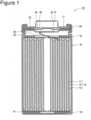
- FIG. 1 is a sectional view of a non-aqueous electrolyte secondary battery of an exemplary embodiment.
- a non-aqueous electrolyte secondary battery 10 shown in FIG. 1 comprises a wound-type electrode assembly 14 formed by winding a positive electrode 11 and a negative electrode 12 with a separator 13 being interposed therebetween, a non-aqueous electrolyte, insulating plates 18 and 19 respectively disposed on and under the electrode assembly 14, and an exterior can 16 that houses such members.
- the exterior can 16 is a cylindrical metal container having a closed-end, and the opening thereof is sealed by a sealing assembly 17.
- a battery case may be, for example, a rectangular, coin-shaped, or button-shaped metal exterior can, or a pouch exterior body formed by laminating a resin sheet and a metal sheet.
- the exterior can 16 is a cylindrical metal container having a closed-end, as described above.
- a gasket 28 is disposed between the exterior can 16 and the sealing assembly 17 to ensure that the interior of the battery is tightly sealed.
- the exterior can 16 includes, for example, a grooved portion 22 which has a portion of a lateral surface projected inward and which supports the sealing assembly 17.
- the grooved portion 22 is preferably formed annularly along the circumferential direction of the exterior can 16, and the upper surface thereof supports the sealing assembly 17.
- the sealing assembly 17 has a structure in which an internal terminal plate 23, a lower vent member 24, an insulating member 25, an upper vent member 26, and a cap 27 are stacked in the listed order sequentially from the electrode assembly 14 side.
- Each of the members constituting the sealing assembly 17 has, for example, a disk or ring shape, and the members other than the insulating member 25 are electrically connected to each other.
- the lower vent member 24 and the upper vent member 26 are connected to each other at respective middle portions and the insulating member 25 is interposed between respective circumferences.
- the lower vent member 24 changes its shape in such a way as to, for example, push up the upper vent member 26 toward the cap 27, and thus ruptures, thereby breaking the electrical connection between the lower vent member 24 and the upper vent member 26. If the internal pressure further increases, the upper vent member 26 ruptures to discharge gas through the opening of the cap 27.
- a positive electrode lead 20 attached to the positive electrode 11 passes through a though-hole in the insulating plate 18 and extends toward the sealing assembly 17, and a negative electrode lead 21 attached to the negative electrode 12 passes on the outside of the insulating plate 19 and extends toward the bottom of the exterior can 16.
- the positive electrode lead 20 is connected to the lower surface of the internal terminal plate 23, which is the bottom board of the sealing assembly 17, by welding or the like, and the cap 27, which is the top board of the sealing assembly 17 and electrically connected to the internal terminal plate 23, serves as a positive electrode terminal.
- the negative electrode lead 21 is connected to the inner surface of the bottom of the exterior can 16 by welding or the like, and the exterior can 16 serves as a negative electrode terminal.
- FIG. 2 is a sectional view of a negative electrode of an exemplary embodiment.
- the negative electrode 12 includes a negative electrode current collector 40 and a negative electrode active material layer 42 disposed on a surface of the negative electrode current collector 40.
- the negative electrode active material layer 42 is preferably disposed on each of both surfaces of the negative electrode current collector 40.
- the negative electrode current collector 40 here used is, for example, foil of a metal, such as copper, which is stable in the electric potential range of the negative electrode, or a film in which such a metal is disposed on an outer layer.
- the negative electrode active material layer 42 includes graphite particles as a negative electrode active material.
- the negative electrode active material layer 42 preferably includes, for example, a binder.
- the negative electrode 12 can be produced by, for example, preparing a negative electrode mixture slurry including a negative electrode active material, a binder, and the like, coating the negative electrode current collector 40 with the negative electrode mixture slurry and drying the resultant to thereby form the negative electrode active material layer 42, and rolling the negative electrode active material layer 42. The detail of the method for producing the negative electrode active material layer 42 will be described below.
- FIG. 3 is a sectional view of a graphite particle in a negative electrode active material layer.
- a graphite particle 30 has closed pores 34 (hereinafter, internal pores 34) not linked from the internal of the particle to the surface of the particle and pores 36 (hereinafter, external pores 36) linked from the internal of the particle to the surface of the particle, when the cross section of the graphite particle 30 is viewed.
- the median size (hereinafter, designated as "D50") on a volume basis of the graphite particles 30 is, for example, 5 ⁇ m to 30 ⁇ m, and is preferably 10 ⁇ m to 25 ⁇ m.
- D50 can be measured with water as a dispersion medium by use of a laser diffraction particle size distribution measurement apparatus (for example, LA950 manufactured by HORIBA Ltd.).
- D50 means a particle size at an accumulation of 50% from a smaller particle size in a particle size distribution on a volume basis.
- Such graphite particles 30 in the present embodiment include graphite particles A having an internal porosity of 8% to 20% and graphite particles B having an internal porosity of 5% or less.
- the graphite particles A may have an internal porosity of 8% to 20%, preferably 10% to 18%, more preferably 12% to 16%, in view of, for example, suppression of an increase in resistance under a low-temperature environment.
- the graphite particles B may have an internal porosity of 5% or less, preferably 1% to 5%, more preferably 3% to 5%, in view of, for example, suppression of an increase in resistance under a low-temperature environment.
- Such respective internal porosities of the graphite particles are two dimensional values each determined from the percentage of the area of the internal pores 34 of the graphite particle to the cross sectional area of the graphite particle.
- Such respective internal porosities of the graphite particles are each determined by the following procedure.
- the graphite particles A and B are produced as follows, for example.
- the graphite particles A having a desired size are obtained by, for example, pulverizing coke (precursor) serving as a main raw material, to a predetermined size, firing and graphitizing such a precursor pulverized, which is aggregated by a binder and then further pressure molded into a block, at a temperature of 2600°C or more, and pulverizing and sieving a block molded product graphitized.
- the internal porosity can be here adjusted to 8% to 20% by the amount of a volatile component added to the block molded product.
- the D50 of the precursor pulverized is preferably in the range from 12 ⁇ m to 20 ⁇ m.
- the binder can be used as a volatile component. Examples of such a binder include pitch.
- the graphite particles B having a desired size are obtained by, for example, pulverizing coke (precursor) serving as a main raw material, to a predetermined size, firing and graphitizing such a precursor pulverized, which is aggregated by a binder, at a temperature of 2600°C or more, and then sieving the resultant.
- the internal porosity can be here adjusted to 5% or less by the particle size of the precursor pulverized, the particle size of the precursor aggregated, and/or the like.
- the D50 of the precursor pulverized is preferably in the range from 12 ⁇ m to 20 ⁇ m. When the internal porosity is decreased in the range of 5% or less, the particle size of the precursor pulverized is preferably increased.
- the graphite particles A and B for use in the present embodiment are, for example, natural graphite or artificial graphite without any particular limitation, and are preferably artificial graphite in view of, for example, easiness of adjustment of the internal porosity.
- the plane spacing (d 002 ) of the (002) plane with respect to the graphite particles A and B for use in the present embodiment, according to a wide-angle X-ray diffraction method, is, for example, preferably 0.3354 nm or more, more preferably 0.3357 nm or more, and preferably less than 0.340 nm, more preferably 0.338 nm or less.
- the crystallite size (Lc(002)) with respect to the graphite particles A and B for use in the present embodiment, as determined according to an X-ray diffraction method, is, for example, preferably 5 nm or more, more preferably 10 nm or more, and preferably 300 nm or less, more preferably 200 nm or less.
- the plane spacing (d 002 ) and the crystallite size (Lc(002)) satisfy the above respective ranges, the battery capacity of the non-aqueous electrolyte secondary battery tends to increase as compared with when the above respective ranges are not satisfied.
- the graphite particles A are more included in a half second region 42B on the outer surface side than in a half first region 42A on the negative electrode current collector side in the case of bisection of the negative electrode active material layer 42 shown in FIG. 2 in the thickness direction.
- This enables not only suppression of deterioration in reactivity of the negative electrode 12, but also an increase in diffusion path of an electrolyte in the first region 42A where such an electrolyte is hardly permeated.
- an increase in resistance under a low-temperature environment is suppressed and low-temperature characteristics of the battery are enhanced.
- the bisection of the negative electrode active material layer 42 in the thickness direction means division into halves at the midpoint Z of the thickness of the negative electrode active material layer 42 under the assumption that the direction of stacking of the negative electrode current collector 40 and the negative electrode active material layer 42 is the thickness direction of the negative electrode active material layer 42.
- Any negative electrode active material layer 42 located closer when viewed from the negative electrode current collector 40 and any negative electrode active material layer 42 located farther when viewed from the negative electrode current collector 40, in the bisection of the negative electrode active material layer 42 in the thickness direction are defined as the half first region 42A on the negative electrode current collector side and the half second region 42B on the outer surface side, respectively.
- the graphite particles A may be more included in the second region 42B than in the first region 42A, or may be included in only the second region 42B.
- the graphite particles B are preferably more included in the first region 42A than in the second region 42B and may be included in only the first region 42A, in view of more suppression of an increase in resistance under a low-temperature environment.
- the content rate of the graphite particles A satisfies first region 42A ⁇ second region 42B
- the content rate of the graphite particles B satisfies first region 42A > second region 42B.
- the mass ratio between the graphite particles A and the graphite particles B in the second region 42B is preferably 50:50 to 100:0, more preferably 75:25 to 100:0.
- the mass ratio between the graphite particles A and the graphite particles B in the first region 42A is preferably 25:75 to 0:100, more preferably 10:90 to 0:100.
- a specific method for allowing the amount of the graphite particles A to be larger in the second region 42B than in the first region 42A is described.
- a negative electrode active material including the graphite particles B (if necessary, graphite particles A), a binder, and a solvent such as water are mixed to prepare a negative electrode mixture slurry for use in the first region.
- a negative electrode active material including a larger amount of the graphite particles A (if necessary, graphite particles B) than that in the negative electrode mixture slurry for use in the first region, a binder, and a solvent such as water are mixed to separately prepare a negative electrode mixture slurry for use in the second region.
- Both sides of the negative electrode current collector can be coated with the negative electrode mixture slurry for use in the first region, the resultant coatings can be dried, thereafter both sides of a coating of the negative electrode mixture slurry for use in the first region can be coated with the negative electrode mixture slurry for use in the second region, and the resultant coatings can be dried, to thereby form the negative electrode active material layer 42.
- the method while involves coating with the negative electrode mixture slurry for use in the second region after coating with the negative electrode mixture slurry for use in the first region, and drying, may be a method involving coating with the negative electrode mixture slurry for use in the second region after coating with the negative electrode mixture slurry for use in the first region and before drying.
- the negative electrode active material may include other material that can reversibly intercalate and deintercalate lithium ions, other than the graphite particles A and B for use in the present embodiment, and may include, for example, a Si material.
- the Si material include Si, an alloy including Si, and silicon oxide such as SiO x (x is 0.8 to 1.6).
- the Si material although is a negative electrode material that can more enhance battery capacity than graphite particles, is large in volume expansion along with charge and discharge and thus is disadvantageous in view of cycle characteristics.
- the content of the Si material is, for example, preferably 1 mass% to 10 mass%, more preferably 3 mass% to 7 mass% based on the mass of the negative electrode active material in view of, for example, an enhancement in battery capacity and suppression of deterioration in cycle characteristics.
- Examples of such other material that can reversibly intercalate and deintercalate lithium ions include a metal to be alloyed with lithium, such as tin (Sn), or an alloy or oxide including a metal element such as Sn.
- the negative electrode active material may include such other material, and the content of such other material is, for example, 10 mass% or less based on the mass of the negative electrode active material.
- binder examples include fluoro resins, PAN, polyimide resins, acrylic resins, polyolefin resins, styrene-butadiene rubber (SBR), nitrile-butadiene rubber (NBR), carboxymethyl cellulose (CMC) or salts thereof, poly(acrylic acid) (PAA) or salts thereof (PAA-Na, PAA-K, and the like which may be partially neutralized salts), and poly(vinyl alcohol) (PVA). These may be used singly or may be used in combinations of two or more thereof.
- the positive electrode 11 is configured from, for example, a positive electrode current collector of metal foil or the like, and a positive electrode active material layer provided on a surface of the positive electrode current collector.
- the positive electrode current collector here used can be, for example, foil of a metal, such as aluminum, which is stable in the electric potential range of the positive electrode, or a film in which such a metal is disposed on an outer layer.
- the positive electrode active material layer includes, for example, a positive electrode active material, a binder, and a conductive agent.
- the positive electrode 11 can be produced by, for example, coating the positive electrode current collector with a positive electrode mixture slurry including, for example, a positive electrode active material, a binder, and a conductive agent, and drying the resultant to thereby form the positive electrode active material layer, and then rolling the positive electrode active material layer.
- a positive electrode mixture slurry including, for example, a positive electrode active material, a binder, and a conductive agent
- the positive electrode active material can include a lithium-containing transition metal composite oxide containing a transition metal element such as Co, Mn, or Ni.
- the lithium-containing transition metal composite oxide include Li x CoO 2 , Li x NiO 2 , Li x MnO 2 , Li x Co y Ni 1-y O 2 , Li x Co y M 1 - y O z , Li x Ni 1-y M y Oz, Li x Mn 2 O 4 , Li x Mn 2-y M y O 4 , LiMPO 4 , Li 2 MPO 4 F (M; at least one of Na, Mg, Sc, Y, Mn, Fe, Co, Ni, Cu, Zn, Al, Cr, Pb, Sb, and B, 0 ⁇ x ⁇ 1.2, 0 ⁇ y ⁇ 0.9, 2.0 ⁇ z ⁇ 2.3).
- the positive electrode active material preferably includes a lithium/nickel complex oxide such as Li x NiO 2 , Li x Co y Ni 1-y O 2 , or Li x Ni 1 - y M y O z (M; at least one of Na, Mg, Sc, Y, Mn, Fe, Co, Ni, Cu, Zn, Al, Cr, Pb, Sb, and B, 0 ⁇ x ⁇ 1.2, 0 ⁇ y ⁇ 0.9, 2.0 ⁇ z ⁇ 2.3) from the viewpoint that the capacity of the non-aqueous electrolyte secondary battery can be increased.
- a lithium/nickel complex oxide such as Li x NiO 2 , Li x Co y Ni 1-y O 2 , or Li x Ni 1 - y M y O z (M; at least one of Na, Mg, Sc, Y, Mn, Fe, Co, Ni, Cu, Zn, Al, Cr, Pb, Sb, and B, 0 ⁇ x ⁇
- Examples of the conductive agent include carbon particles such as carbon black (CB), acetylene black (AB), Ketjenblack, and graphite. These may be used singly or may be used in combinations of two or more thereof.
- binder examples include fluoro resins such as polytetrafluoroethylene (PTFE) and poly(vinylidene fluoride) (PVdF), polyacrylonitrile (PAN), polyimide resins, acrylic resins, and polyolefin resins. These may be used singly or may be used in combinations of two or more thereof.
- fluoro resins such as polytetrafluoroethylene (PTFE) and poly(vinylidene fluoride) (PVdF), polyacrylonitrile (PAN), polyimide resins, acrylic resins, and polyolefin resins.
- an ion-permeable and insulating porous sheet is used as the separator 13.
- the porous sheet include a microporous thin film, woven fabric, and nonwoven fabric.
- Suitable examples of the material for the separator include olefin resins such as polyethylene and polypropylene, and cellulose.
- the separator 13 may be a laminate including a cellulose fiber layer and a layer of fibers of a thermoplastic resin such as an olefin resin.
- the separator may be a multi-layered separator including a polyethylene layer and a polypropylene layer, and a surface of a separator to be used may be coated with a material such as an aramid resin or ceramic.
- the non-aqueous electrolyte includes a non-aqueous solvent and an electrolyte salt dissolved in the non-aqueous solvent.
- the non-aqueous electrolyte is not limited to a liquid electrolyte (electrolyte solution), and may be a solid electrolyte using a gel polymer or the like.
- the non-aqueous solvent that can be used include esters, ethers, nitriles such as acetonitrile, amides such as dimethylformamide, and any mixed solvent of two or more thereof.
- the non-aqueous solvent may contain a halogen-substituted product formed by replacing at least a portion of hydrogen of any of the above solvents with a halogen atom such as fluorine.
- esters examples include cyclic carbonate esters such as ethylene carbonate (EC), propylene carbonate (PC), and butylene carbonate, chain carbonate esters such as dimethyl carbonate (DMC), ethyl methyl carbonate (EMC), diethyl carbonate (DEC), methyl propyl carbonate, ethyl propyl carbonate, and methyl isopropyl carbonate, cyclic carboxylate esters such as ⁇ -butyrolactone and ⁇ -valerolactone, and chain carboxylate esters such as methyl acetate, ethyl acetate, propyl acetate, methyl propionate (MP), and ethyl propionate.
- cyclic carbonate esters such as ethylene carbonate (EC), propylene carbonate (PC), and butylene carbonate
- chain carbonate esters such as dimethyl carbonate (DMC), ethyl methyl carbonate (EMC), diethyl carbonate (DEC), methyl
- ethers examples include cyclic ethers such as 1,3-dioxolane, 4-methyl-1,3-dioxolane, tetrahydrofuran, 2-methyltetrahydrofuran, propylene oxide, 1,2-butylene oxide, 1,3-dioxane, 1,4-dioxane, 1,3,5-trioxane, furan, 2-methylfuran, 1,8-cineole, and crown ethers, and chain ethers such as 1,2-dimethoxyethane, diethyl ether, dipropyl ether, diisopropyl ether, dibutyl ether, dihexyl ether, ethyl vinyl ether, butyl vinyl ether, methyl phenyl ether, ethyl phenyl ether, butyl phenyl ether, pentyl phenyl ether, methoxytoluene, benzyl ethyl ether, di
- halogen-substituted product for use include a fluorinated cyclic carbonate ester such as fluoroethylene carbonate (FEC), a fluorinated chain carbonate ester, and a fluorinated chain carboxylate ester such as methyl fluoropropionate (FMP).
- FEC fluoroethylene carbonate
- FMP fluorinated chain carboxylate ester
- the electrolyte salt is preferably a lithium salt.
- the lithium salt include LiBF 4 , LiClO 4 , LiPF 6 , LiAsF 6 , LiSbF 6 , LiAlCl 4 , LiSCN, LiCF 3 SO 3 , LiCF 3 CO 2 , Li(P(C 2 O 4 )F 4 ), LiPF 6-x (C n F 2n+1 ) x (where 1 ⁇ x ⁇ 6, and n is 1 or 2), LiB 10 Cl 10 , LiCl, LiBr, LiI, chloroborane lithium, lithium lower aliphatic carboxylate, borate salts such as Li 2 B 4 O 7 and Li(B(C 2 O 4 )F 2 ), and imide salts such as LiN(SO 2 CF 3 ) 2 and LiN(C 1 F 21 + 1 SO 2 )(C m F 2m+1 SO 2 ) ⁇ where 1 and m are integers of 1 or more ⁇ .
- lithium salts may be used singly or a plurality thereof may be mixed and used.
- LiPF 6 is preferably used in view of ionic conductivity, electrochemical stability, and other properties.
- the concentration of the lithium salt is preferably 0.8 to 1.8 mol per liter of the solvent.
- a lithium-containing transition metal composite oxide represented by LiNi 0.91 Co 0.45 Al 0.45 O 2 was used as a positive electrode active material.
- NMP N-methyl-2-pyrrolidone
- Both sides of a positive electrode current collector made of aluminum foil (thickness 15 ⁇ m) were coated with the slurry by a doctor blade method, and the resultant coatings were dried and then rolled by a roller to thereby produce a positive electrode in which a positive electrode active material layer was formed on each of both sides of the positive electrode current collector.
- An exposed portion in which a current collector surface was exposed was disposed on the middle portion in the longitudinal direction of the positive electrode, and a positive electrode lead made of aluminum was attached to the exposed portion.
- Coke was pulverized until the D50 reached 15 ⁇ m, pitch as a binder was added to the coke pulverized, the resultant was aggregated, and furthermore a block molded product having a density of 1.6 g/cm 3 to 1.9 g/cm 3 was then produced at isotropic pressure.
- the block molded product was fired and graphitized at a temperature of 2800°C. Then, the block molded product graphitized was pulverized and sieved using a 250-mesh sieve, to thereby obtain graphite particles A having a D50 of 23 ⁇ m.
- Negative electrode active material A was adopted as negative electrode active material A to be included in the half second region of the negative electrode active material layer on the outer surface side.
- Negative electrode active material A, carboxymethyl cellulose (CMC), and styrene-butadiene copolymer rubber (SBR) were mixed such that the mass ratio thereof was 100:1:1, to thereby prepare negative electrode mixture slurry A.
- Negative electrode active material B was adopted as negative electrode active material B to be included in the half first region of the negative electrode active material layer on the negative electrode current collector side.
- Negative electrode active material B, carboxymethyl cellulose (CMC), and styrene-butadiene copolymer rubber (SBR) were mixed such that the mass ratio thereof was 100:1:1, to thereby prepare negative electrode mixture slurry B.
- the internal porosities of the graphite particles A and B in the negative electrode produced were measured, and were 15% and 3%, respectively.
- the measurement method was as described above, and thus the description thereof was omitted.
- An exposed portion in which a current collector surface was exposed was disposed at one end in the longitudinal direction of the negative electrode, and a negative electrode lead made of nickel/copper/nickel was attached to the exposed portion.
- Vinylene carbonate (VC) was added at a concentration of 5% by mass to a non-aqueous solvent obtained by mixing ethylene carbonate (EC), ethyl methyl carbonate (EMC) and dimethyl carbonate (DMC) in a volume ratio of 4:1:15, and LiPF 6 was dissolved therein at a concentration of 1.35 mol/L, to thereby prepare a non-aqueous electrolyte solution.
- EC ethylene carbonate
- EMC ethyl methyl carbonate
- DMC dimethyl carbonate
- a wound-type electrode assembly was produced by spirally winding the positive electrode and the negative electrode with a polyethylene separator being interposed therebetween. Respective insulating plates were disposed on and under the electrode assembly, the negative electrode lead was welded to the inner surface of the bottom of an exterior can, and the positive electrode lead was welded to the sealing assembly, to thereby house the electrode assembly in the exterior can. Thereafter, the non-aqueous electrolyte solution was injected into the exterior can, the opening of the exterior can was sealed by the sealing assembly via a gasket, to thereby produce a cylindrical battery. The capacity of the battery was 4700 mAh.
- a negative electrode was produced in the same manner as in Example 1 except that 95 parts by mass of a mixture of graphite particles A and graphite particles B at a mass ratio of 75:25, and 5 parts by mass of SiO were mixed and the resulting mixture was used as negative electrode active material A.
- the mass ratio of graphite particles A : graphite particles B in the second region of the negative electrode active material layer was 75:25.
- a cylindrical battery was produced using the resultant negative electrode of Example 2 in the same manner as in Example 1.
- a negative electrode was produced in the same manner as in Example 1 except that 95 parts by mass of a mixture of graphite particles A and graphite particles B at a mass ratio of 25:75, and 5 parts by mass of SiO were mixed and the resulting mixture was used as negative electrode active material B.
- the mass ratio of graphite particles A : graphite particles B in the first region of the negative electrode active material layer was 25:75.
- a cylindrical battery was produced using the resultant negative electrode of Example 3 in the same manner as in Example 1.
- a negative electrode and a cylindrical battery were produced in the same manner as in Example 1 except that a negative electrode active material layer in which the mass ratio of graphite particles A : graphite particles B in the second region was 0:100 and the mass ratio of graphite particles A : graphite particles B in the first region was 100:0 was formed by forming coatings with negative electrode mixture slurry A on both sides of the negative electrode current collector and then forming coatings with negative electrode mixture slurry B thereon.
- a negative electrode and a cylindrical battery were produced in the same manner as in Example 1 except that 95 parts by mass of a mixture of graphite particles A and graphite particles B at a mass ratio of 50:50, and 5 parts by mass of SiO were mixed and the resulting mixture was used as each of negative electrode active materials A and B.
- a negative electrode and a cylindrical battery were produced in the same manner as in Example 1 except that a negative electrode active material layer was formed by using only negative electrode mixture slurry A.
- a negative electrode and a cylindrical battery were produced in the same manner as in Example 1 except that a negative electrode active material layer was formed by using only negative electrode mixture slurry B.
- the batteries of Examples each exhibited a low value of low-temperature DCR as compared with the batteries of Comparative Examples. It was considered that the batteries of Examples, in which graphite particles A were more present in the second region of the negative electrode active material layer, the region being in contact with an electrolyte, and graphite particles B were more present in the first region where an electrolyte was hardly permeated, thus not only were suppressed in deterioration in reactivity of the negative electrode, but also could result in an increase in diffusion path of an electrolyte solution in the first region, thereby leading to suppression of an increase in resistance.
- the batteries of Comparative Examples 1 and 2 were each deteriorated in reactivity of a negative electrode and allowed for no sufficient formation of any diffusion path of an electrolyte solution in the first region of the negative electrode active material layer, resulting in an increase in low-temperature DCR. It was considered that the battery of Comparative Example 3 allowed for no sufficient formation of any diffusion path of an electrolyte solution in the first region of the negative electrode active material layer and the battery of Comparative Example 4 was deteriorated in reactivity of the negative electrode, thereby leading to an increase in low-temperature DCR.
Landscapes
- Chemical & Material Sciences (AREA)
- Chemical Kinetics & Catalysis (AREA)
- Electrochemistry (AREA)
- General Chemical & Material Sciences (AREA)
- Engineering & Computer Science (AREA)
- Materials Engineering (AREA)
- Inorganic Chemistry (AREA)
- Composite Materials (AREA)
- Manufacturing & Machinery (AREA)
- Battery Electrode And Active Subsutance (AREA)
- Secondary Cells (AREA)
Description
- The present disclosure relates to a non-aqueous electrolyte secondary battery.
- A non-aqueous electrolyte secondary battery using a carbon material such as graphite as a negative electrode active material, for example, a lithium ion battery, has been recently utilized in a power source for electric vehicles and the like. For example, Patent Literature 1 discloses a non-aqueous electrolyte secondary battery, with, as a carbon material, densified carbon having an internal porosity of 5% or less. Patent Literature 2 discloses a non-aqueous electrolyte secondary battery with, as a carbon material, a mixture of a carbon material A having an internal porosity of 1% or more and less than 23% and a carbon material B having an internal porosity of 23% to 40%.
-
- PATENT LITERATURE 1:
Japanese Unexamined Patent Application Publication No. Hei 9-320600 - PATENT LITERATURE 2:
Japanese Unexamined Patent Application Publication No. 2014-67638 - When a non-aqueous electrolyte secondary battery is used under a low-temperature environment, for example, the viscosity of an electrolyte is increased to result in a reduction in lithium ion mobility, thereby causing, for example, an increase in resistance and a reduction in capacity due to such an increase in resistance to occur. It is an advantage of the present disclosure to provide a non-aqueous electrolyte secondary battery that can be suppressed in an increase in resistance under a low-temperature environment and that is excellent in low-temperature characteristics.
- A non-aqueous electrolyte secondary battery according to the invention is defined in appended claim 1.
- According to the non-aqueous electrolyte secondary battery according to the present disclosure, an increase in resistance under a low-temperature environment is suppressed. Thus, the non-aqueous electrolyte secondary battery according to the present disclosure is excellent in low-temperature characteristics.
-
-
FIG. 1 is a sectional view of a non-aqueous electrolyte secondary battery of an exemplary embodiment. -
FIG. 2 is a sectional view of a negative electrode of an exemplary embodiment. -
FIG. 3 is a sectional view of a graphite particle in a negative electrode active material layer. - As described above, an important object is to suppress an increase in resistance of a non-aqueous electrolyte secondary battery under a low-temperature environment and suppress, for example, deterioration in output characteristics and reductions in charge capacity and discharge capacity due to such an increase in resistance. The present inventors have made intensive studies in order to achieve the object, and as a result, have found that graphite particles A having an internal porosity of 8% to 20% are more present in a half second region on an outer surface side than in a half first region on a negative electrode current collector side in a negative electrode active material layer, resulting in suppression of an increase in resistance under a low-temperature environment and an enhancement in low-temperature characteristics. Graphite particles B having an internal porosity of 5% or less are preferably more included in the first region than in the second region in the negative electrode active material layer.
- The graphite particles A are larger in specific surface area than graphite particles having a lower internal porosity. Thus, the graphite particles A can be used to thereby allow a negative electrode to be suppressed in deterioration in reactivity. On the other hand, the graphite particles A more easily rupture upon compression of a negative electrode than graphite particles having a lower internal porosity, and are reduced in sizes of pores between particles and decreased in diffusion path of an electrolyte in a region including a large number of the graphite particles A. Thus, the conductivity of lithium ions under a low-temperature environment is remarkably reduced in the first region in the negative electrode active material layer, where an electrolyte is hardly permeated. In other words, the content of the graphite particles A in the first region in the negative electrode active material layer can be decreased, resulting in an increase in size of pores in the negative electrode active material layer and an increase in diffusion path of an electrolyte.
- According to the non-aqueous electrolyte secondary battery according to the present disclosure, the graphite particles A are more present in the second region than in the first region in the negative electrode active material layer, namely, the content rate of the graphite particles A is lower in the first region than in the second region. This enables not only suppression of deterioration in reactivity on a negative electrode surface even under a low-temperature environment, but also an increase in diffusion path of an electrolyte in the first region. Accordingly, the non-aqueous electrolyte secondary battery according to the present disclosure has excellent low-temperature characteristics.
- Hereinafter, an exemplary embodiment will be described in detail with reference to drawings. The non-aqueous electrolyte secondary battery of the present disclosure is not limited to embodiments described below. The drawings referred to in the description of embodiments are schematically illustrated.
-
FIG. 1 is a sectional view of a non-aqueous electrolyte secondary battery of an exemplary embodiment. A non-aqueous electrolytesecondary battery 10 shown inFIG. 1 comprises a wound-type electrode assembly 14 formed by winding apositive electrode 11 and anegative electrode 12 with aseparator 13 being interposed therebetween, a non-aqueous electrolyte,insulating plates sealing assembly 17. Another form of electrode assembly, for example, a stacked electrode assembly formed by stacking alternately a positive electrode and a negative electrode with a separator being interposed therebetween may be here applied instead of the wound-type electrode assembly 14. A battery case may be, for example, a rectangular, coin-shaped, or button-shaped metal exterior can, or a pouch exterior body formed by laminating a resin sheet and a metal sheet. - The exterior can 16 is a cylindrical metal container having a closed-end, as described above. A
gasket 28 is disposed between the exterior can 16 and thesealing assembly 17 to ensure that the interior of the battery is tightly sealed. The exterior can 16 includes, for example, agrooved portion 22 which has a portion of a lateral surface projected inward and which supports thesealing assembly 17. Thegrooved portion 22 is preferably formed annularly along the circumferential direction of the exterior can 16, and the upper surface thereof supports thesealing assembly 17. - The
sealing assembly 17 has a structure in which aninternal terminal plate 23, alower vent member 24, aninsulating member 25, anupper vent member 26, and acap 27 are stacked in the listed order sequentially from the electrode assembly 14 side. Each of the members constituting thesealing assembly 17 has, for example, a disk or ring shape, and the members other than the insulatingmember 25 are electrically connected to each other. Thelower vent member 24 and theupper vent member 26 are connected to each other at respective middle portions and the insulatingmember 25 is interposed between respective circumferences. If the internal pressure of the non-aqueous electrolytesecondary battery 10 increases by heat generation due to, for example, internal short, thelower vent member 24 changes its shape in such a way as to, for example, push up theupper vent member 26 toward thecap 27, and thus ruptures, thereby breaking the electrical connection between thelower vent member 24 and theupper vent member 26. If the internal pressure further increases, theupper vent member 26 ruptures to discharge gas through the opening of thecap 27. - In the non-aqueous electrolyte
secondary battery 10 shown inFIG. 1 , a positive electrode lead 20 attached to thepositive electrode 11 passes through a though-hole in theinsulating plate 18 and extends toward thesealing assembly 17, and anegative electrode lead 21 attached to thenegative electrode 12 passes on the outside of theinsulating plate 19 and extends toward the bottom of the exterior can 16. The positive electrode lead 20 is connected to the lower surface of theinternal terminal plate 23, which is the bottom board of thesealing assembly 17, by welding or the like, and thecap 27, which is the top board of thesealing assembly 17 and electrically connected to theinternal terminal plate 23, serves as a positive electrode terminal. Thenegative electrode lead 21 is connected to the inner surface of the bottom of the exterior can 16 by welding or the like, and the exterior can 16 serves as a negative electrode terminal. - Hereinafter, each component of the non-aqueous electrolyte
secondary battery 10 will be described in detail. -
FIG. 2 is a sectional view of a negative electrode of an exemplary embodiment. Thenegative electrode 12 includes a negative electrode current collector 40 and a negative electrodeactive material layer 42 disposed on a surface of the negative electrode current collector 40. The negative electrodeactive material layer 42 is preferably disposed on each of both surfaces of the negative electrode current collector 40. - The negative electrode current collector 40 here used is, for example, foil of a metal, such as copper, which is stable in the electric potential range of the negative electrode, or a film in which such a metal is disposed on an outer layer.
- The negative electrode
active material layer 42 includes graphite particles as a negative electrode active material. The negative electrodeactive material layer 42 preferably includes, for example, a binder. Thenegative electrode 12 can be produced by, for example, preparing a negative electrode mixture slurry including a negative electrode active material, a binder, and the like, coating the negative electrode current collector 40 with the negative electrode mixture slurry and drying the resultant to thereby form the negative electrodeactive material layer 42, and rolling the negative electrodeactive material layer 42. The detail of the method for producing the negative electrodeactive material layer 42 will be described below. -
FIG. 3 is a sectional view of a graphite particle in a negative electrode active material layer. As shown inFIG. 3 , agraphite particle 30 has closed pores 34 (hereinafter, internal pores 34) not linked from the internal of the particle to the surface of the particle and pores 36 (hereinafter, external pores 36) linked from the internal of the particle to the surface of the particle, when the cross section of thegraphite particle 30 is viewed. - The median size (hereinafter, designated as "D50") on a volume basis of the
graphite particles 30 is, for example, 5 µm to 30 µm, and is preferably 10 µm to 25 µm. D50 can be measured with water as a dispersion medium by use of a laser diffraction particle size distribution measurement apparatus (for example, LA950 manufactured by HORIBA Ltd.). D50 means a particle size at an accumulation of 50% from a smaller particle size in a particle size distribution on a volume basis. -
Such graphite particles 30 in the present embodiment include graphite particles A having an internal porosity of 8% to 20% and graphite particles B having an internal porosity of 5% or less. The graphite particles A may have an internal porosity of 8% to 20%, preferably 10% to 18%, more preferably 12% to 16%, in view of, for example, suppression of an increase in resistance under a low-temperature environment. The graphite particles B may have an internal porosity of 5% or less, preferably 1% to 5%, more preferably 3% to 5%, in view of, for example, suppression of an increase in resistance under a low-temperature environment. Such respective internal porosities of the graphite particles are two dimensional values each determined from the percentage of the area of theinternal pores 34 of the graphite particle to the cross sectional area of the graphite particle. Such respective internal porosities of the graphite particles are each determined by the following procedure. -
- (1) The cross section of the negative electrode active material layer is exposed. Examples of the method for exposing the cross section include a method involving cutting out a portion of the negative electrode and processing the resultant with an ion milling apparatus (for example, IM4000PLUS manufactured by Hitachi High-Tech Corporation) to expose the cross section of the negative electrode active material layer.
- (2) A reflection electron image of the cross section exposed of the negative electrode active material layer is taken with a scanning electron microscope. The magnification in taking of the reflection electron image is from 3000x to 5000x.
- (3) The cross section image obtained as described above is imported into a computer and binarized with image analysis software (for example, ImageJ manufactured by U.S. National Institutes of Health), thereby obtaining an image binarized, in which the cross section of each particle in the cross section image is converted into a black image and any pore present in the cross section of such each particle is converted into a white image.
- (4) Any graphite particles A and B each having a particle size of 5 µm to 50 µm are selected in the image binarized, and the area of the cross section of each of the graphite particles, and the area of each of the internal pores present in the cross section of each of the graphite particles are calculated. The area of the cross section of each of the graphite particles here refers to the area of the region surrounded by the circumference of each of the graphite particles, namely, the area of the entire cross section part of such each of the graphite particles. Any pore having a width of 3 µm or less, among pores present in the cross sections of the graphite particles, may sometimes have a difficulty in determining whether such any pore is an internal pore or an external pore in image analysis, and thus such any pore having a width of 3 µm or less may be defined as an internal pore. Each of the internal porosities of the graphite particles (area of internal pore in cross section of each graphite particle × 100/area of cross section of each graphite particle) is calculated from the area of the cross section of each of the graphite particles and the area of each of the internal pores in the cross section of each of the graphite particles, calculated. The internal porosities of the graphite particles A and B are average values with respect to ten graphite particles A and ten graphite particles B, respectively.
- The graphite particles A and B are produced as follows, for example.
- The graphite particles A having a desired size are obtained by, for example, pulverizing coke (precursor) serving as a main raw material, to a predetermined size, firing and graphitizing such a precursor pulverized, which is aggregated by a binder and then further pressure molded into a block, at a temperature of 2600°C or more, and pulverizing and sieving a block molded product graphitized. The internal porosity can be here adjusted to 8% to 20% by the amount of a volatile component added to the block molded product. The D50 of the precursor pulverized is preferably in the range from 12 µm to 20 µm. When a portion of the binder added to the coke (precursor) volatilizes in firing, the binder can be used as a volatile component. Examples of such a binder include pitch.
- The graphite particles B having a desired size are obtained by, for example, pulverizing coke (precursor) serving as a main raw material, to a predetermined size, firing and graphitizing such a precursor pulverized, which is aggregated by a binder, at a temperature of 2600°C or more, and then sieving the resultant. The internal porosity can be here adjusted to 5% or less by the particle size of the precursor pulverized, the particle size of the precursor aggregated, and/or the like. The D50 of the precursor pulverized is preferably in the range from 12 µm to 20 µm. When the internal porosity is decreased in the range of 5% or less, the particle size of the precursor pulverized is preferably increased.
- The graphite particles A and B for use in the present embodiment are, for example, natural graphite or artificial graphite without any particular limitation, and are preferably artificial graphite in view of, for example, easiness of adjustment of the internal porosity. The plane spacing (d002) of the (002) plane with respect to the graphite particles A and B for use in the present embodiment, according to a wide-angle X-ray diffraction method, is, for example, preferably 0.3354 nm or more, more preferably 0.3357 nm or more, and preferably less than 0.340 nm, more preferably 0.338 nm or less. The crystallite size (Lc(002)) with respect to the graphite particles A and B for use in the present embodiment, as determined according to an X-ray diffraction method, is, for example, preferably 5 nm or more, more preferably 10 nm or more, and preferably 300 nm or less, more preferably 200 nm or less. When the plane spacing (d002) and the crystallite size (Lc(002)) satisfy the above respective ranges, the battery capacity of the non-aqueous electrolyte secondary battery tends to increase as compared with when the above respective ranges are not satisfied.
- In the present embodiment, the graphite particles A are more included in a half
second region 42B on the outer surface side than in a halffirst region 42A on the negative electrode current collector side in the case of bisection of the negative electrodeactive material layer 42 shown inFIG. 2 in the thickness direction. This enables not only suppression of deterioration in reactivity of thenegative electrode 12, but also an increase in diffusion path of an electrolyte in thefirst region 42A where such an electrolyte is hardly permeated. Thus, an increase in resistance under a low-temperature environment is suppressed and low-temperature characteristics of the battery are enhanced. Herein, the bisection of the negative electrodeactive material layer 42 in the thickness direction means division into halves at the midpoint Z of the thickness of the negative electrodeactive material layer 42 under the assumption that the direction of stacking of the negative electrode current collector 40 and the negative electrodeactive material layer 42 is the thickness direction of the negative electrodeactive material layer 42. Any negative electrodeactive material layer 42 located closer when viewed from the negative electrode current collector 40 and any negative electrodeactive material layer 42 located farther when viewed from the negative electrode current collector 40, in the bisection of the negative electrodeactive material layer 42 in the thickness direction, are defined as the halffirst region 42A on the negative electrode current collector side and the halfsecond region 42B on the outer surface side, respectively. - The graphite particles A may be more included in the
second region 42B than in thefirst region 42A, or may be included in only thesecond region 42B. The graphite particles B are preferably more included in thefirst region 42A than in thesecond region 42B and may be included in only thefirst region 42A, in view of more suppression of an increase in resistance under a low-temperature environment. In other words, the content rate of the graphite particles A satisfiesfirst region 42A <second region 42B, and the content rate of the graphite particles B satisfiesfirst region 42A >second region 42B. - The mass ratio between the graphite particles A and the graphite particles B in the
second region 42B is preferably 50:50 to 100:0, more preferably 75:25 to 100:0. The mass ratio between the graphite particles A and the graphite particles B in thefirst region 42A is preferably 25:75 to 0:100, more preferably 10:90 to 0:100. - A specific method for allowing the amount of the graphite particles A to be larger in the
second region 42B than in thefirst region 42A is described. For example, first, a negative electrode active material including the graphite particles B (if necessary, graphite particles A), a binder, and a solvent such as water are mixed to prepare a negative electrode mixture slurry for use in the first region. A negative electrode active material including a larger amount of the graphite particles A (if necessary, graphite particles B) than that in the negative electrode mixture slurry for use in the first region, a binder, and a solvent such as water are mixed to separately prepare a negative electrode mixture slurry for use in the second region. Both sides of the negative electrode current collector can be coated with the negative electrode mixture slurry for use in the first region, the resultant coatings can be dried, thereafter both sides of a coating of the negative electrode mixture slurry for use in the first region can be coated with the negative electrode mixture slurry for use in the second region, and the resultant coatings can be dried, to thereby form the negative electrodeactive material layer 42. The method, while involves coating with the negative electrode mixture slurry for use in the second region after coating with the negative electrode mixture slurry for use in the first region, and drying, may be a method involving coating with the negative electrode mixture slurry for use in the second region after coating with the negative electrode mixture slurry for use in the first region and before drying. - The negative electrode active material may include other material that can reversibly intercalate and deintercalate lithium ions, other than the graphite particles A and B for use in the present embodiment, and may include, for example, a Si material. Examples of the Si material include Si, an alloy including Si, and silicon oxide such as SiOx (x is 0.8 to 1.6). The Si material, although is a negative electrode material that can more enhance battery capacity than graphite particles, is large in volume expansion along with charge and discharge and thus is disadvantageous in view of cycle characteristics. The content of the Si material is, for example, preferably 1 mass% to 10 mass%, more preferably 3 mass% to 7 mass% based on the mass of the negative electrode active material in view of, for example, an enhancement in battery capacity and suppression of deterioration in cycle characteristics.
- Examples of such other material that can reversibly intercalate and deintercalate lithium ions include a metal to be alloyed with lithium, such as tin (Sn), or an alloy or oxide including a metal element such as Sn. The negative electrode active material may include such other material, and the content of such other material is, for example, 10 mass% or less based on the mass of the negative electrode active material.
- Examples of the binder include fluoro resins, PAN, polyimide resins, acrylic resins, polyolefin resins, styrene-butadiene rubber (SBR), nitrile-butadiene rubber (NBR), carboxymethyl cellulose (CMC) or salts thereof, poly(acrylic acid) (PAA) or salts thereof (PAA-Na, PAA-K, and the like which may be partially neutralized salts), and poly(vinyl alcohol) (PVA). These may be used singly or may be used in combinations of two or more thereof.
- The
positive electrode 11 is configured from, for example, a positive electrode current collector of metal foil or the like, and a positive electrode active material layer provided on a surface of the positive electrode current collector. The positive electrode current collector here used can be, for example, foil of a metal, such as aluminum, which is stable in the electric potential range of the positive electrode, or a film in which such a metal is disposed on an outer layer. The positive electrode active material layer includes, for example, a positive electrode active material, a binder, and a conductive agent. - The
positive electrode 11 can be produced by, for example, coating the positive electrode current collector with a positive electrode mixture slurry including, for example, a positive electrode active material, a binder, and a conductive agent, and drying the resultant to thereby form the positive electrode active material layer, and then rolling the positive electrode active material layer. - Examples of the positive electrode active material can include a lithium-containing transition metal composite oxide containing a transition metal element such as Co, Mn, or Ni. Examples of the lithium-containing transition metal composite oxide include LixCoO2, LixNiO2, LixMnO2, LixCoyNi1-yO2, LixCoyM1-yOz, LixNi1-yMyOz, LixMn2O4, LixMn2-yMyO4, LiMPO4, Li2MPO4F (M; at least one of Na, Mg, Sc, Y, Mn, Fe, Co, Ni, Cu, Zn, Al, Cr, Pb, Sb, and B, 0 < x ≤ 1.2, 0 < y ≤ 0.9, 2.0 ≤ z ≤ 2.3). These may be used singly or a plurality thereof may be mixed and used. The positive electrode active material preferably includes a lithium/nickel complex oxide such as LixNiO2, LixCoyNi1-yO2, or LixNi1-yMyOz (M; at least one of Na, Mg, Sc, Y, Mn, Fe, Co, Ni, Cu, Zn, Al, Cr, Pb, Sb, and B, 0 < x ≤ 1.2, 0 < y ≤ 0.9, 2.0 ≤ z ≤ 2.3) from the viewpoint that the capacity of the non-aqueous electrolyte secondary battery can be increased.
- Examples of the conductive agent include carbon particles such as carbon black (CB), acetylene black (AB), Ketjenblack, and graphite. These may be used singly or may be used in combinations of two or more thereof.
- Examples of the binder include fluoro resins such as polytetrafluoroethylene (PTFE) and poly(vinylidene fluoride) (PVdF), polyacrylonitrile (PAN), polyimide resins, acrylic resins, and polyolefin resins. These may be used singly or may be used in combinations of two or more thereof.
- For example, an ion-permeable and insulating porous sheet is used as the
separator 13. Specific examples of the porous sheet include a microporous thin film, woven fabric, and nonwoven fabric. Suitable examples of the material for the separator include olefin resins such as polyethylene and polypropylene, and cellulose. Theseparator 13 may be a laminate including a cellulose fiber layer and a layer of fibers of a thermoplastic resin such as an olefin resin. The separator may be a multi-layered separator including a polyethylene layer and a polypropylene layer, and a surface of a separator to be used may be coated with a material such as an aramid resin or ceramic. - The non-aqueous electrolyte includes a non-aqueous solvent and an electrolyte salt dissolved in the non-aqueous solvent. The non-aqueous electrolyte is not limited to a liquid electrolyte (electrolyte solution), and may be a solid electrolyte using a gel polymer or the like. Examples of the non-aqueous solvent that can be used include esters, ethers, nitriles such as acetonitrile, amides such as dimethylformamide, and any mixed solvent of two or more thereof. The non-aqueous solvent may contain a halogen-substituted product formed by replacing at least a portion of hydrogen of any of the above solvents with a halogen atom such as fluorine.
- Examples of the esters include cyclic carbonate esters such as ethylene carbonate (EC), propylene carbonate (PC), and butylene carbonate, chain carbonate esters such as dimethyl carbonate (DMC), ethyl methyl carbonate (EMC), diethyl carbonate (DEC), methyl propyl carbonate, ethyl propyl carbonate, and methyl isopropyl carbonate, cyclic carboxylate esters such as γ-butyrolactone and γ-valerolactone, and chain carboxylate esters such as methyl acetate, ethyl acetate, propyl acetate, methyl propionate (MP), and ethyl propionate.
- Examples of the ethers include cyclic ethers such as 1,3-dioxolane, 4-methyl-1,3-dioxolane, tetrahydrofuran, 2-methyltetrahydrofuran, propylene oxide, 1,2-butylene oxide, 1,3-dioxane, 1,4-dioxane, 1,3,5-trioxane, furan, 2-methylfuran, 1,8-cineole, and crown ethers, and chain ethers such as 1,2-dimethoxyethane, diethyl ether, dipropyl ether, diisopropyl ether, dibutyl ether, dihexyl ether, ethyl vinyl ether, butyl vinyl ether, methyl phenyl ether, ethyl phenyl ether, butyl phenyl ether, pentyl phenyl ether, methoxytoluene, benzyl ethyl ether, di phenyl ether, dibenzyl ether, o-dimethoxybenzene, 1,2-diethoxyethane, 1,2-dibutoxyethane, diethylene glycol dimethyl ether, diethylene glycol diethyl ether, diethylene glycol dibutyl ether, 1,1-dimethoxymethane, 1,1-diethoxyethane, and triethylene glycol dimethyl ether.
- Preferable examples of the halogen-substituted product for use include a fluorinated cyclic carbonate ester such as fluoroethylene carbonate (FEC), a fluorinated chain carbonate ester, and a fluorinated chain carboxylate ester such as methyl fluoropropionate (FMP).
- The electrolyte salt is preferably a lithium salt. Examples of the lithium salt include LiBF4, LiClO4, LiPF6, LiAsF6, LiSbF6, LiAlCl4, LiSCN, LiCF3SO3, LiCF3CO2, Li(P(C2O4)F4), LiPF6-x(CnF2n+1)x(where 1 < x < 6, and n is 1 or 2), LiB10Cl10, LiCl, LiBr, LiI, chloroborane lithium, lithium lower aliphatic carboxylate, borate salts such as Li2B4O7 and Li(B(C2O4)F2), and imide salts such as LiN(SO2CF3)2 and LiN(C1F21+1SO2)(CmF2m+1SO2) {where 1 and m are integers of 1 or more}. These lithium salts may be used singly or a plurality thereof may be mixed and used. Among these, LiPF6 is preferably used in view of ionic conductivity, electrochemical stability, and other properties. The concentration of the lithium salt is preferably 0.8 to 1.8 mol per liter of the solvent.
- Hereinafter, the present disclosure will be further described with reference to Examples, but the present disclosure is not intended to be limited to such Examples.
- A lithium-containing transition metal composite oxide represented by LiNi0.91Co0.45Al0.45O2 was used as a positive electrode active material. Mixed were 100 parts by mass of the positive electrode active material, 1 part by mass of graphite as a conductive agent, and 0.9 parts by mass of a poly(vinylidene fluoride) powder as a binder, and an appropriate amount of N-methyl-2-pyrrolidone (NMP) was further added thereto to prepare a positive electrode mixture slurry. Both sides of a positive electrode current collector made of aluminum foil (thickness 15 µm) were coated with the slurry by a doctor blade method, and the resultant coatings were dried and then rolled by a roller to thereby produce a positive electrode in which a positive electrode active material layer was formed on each of both sides of the positive electrode current collector. An exposed portion in which a current collector surface was exposed was disposed on the middle portion in the longitudinal direction of the positive electrode, and a positive electrode lead made of aluminum was attached to the exposed portion.
- Coke was pulverized until the D50 reached 15 µm, pitch as a binder was added to the coke pulverized, the resultant was aggregated, and furthermore a block molded product having a density of 1.6 g/cm3 to 1.9 g/cm3 was then produced at isotropic pressure. The block molded product was fired and graphitized at a temperature of 2800°C. Then, the block molded product graphitized was pulverized and sieved using a 250-mesh sieve, to thereby obtain graphite particles A having a D50 of 23 µm.
- Pitch as a binder was added to the coke pulverized, and the resultant was aggregated until the D50 reached 15 µm. After such an aggregate was fired and graphitized at a temperature of 2800°C, the resultant was sieved using a 250-mesh sieve, to thereby obtain graphite particles B having a D50 of 17 µm.
- Mixed were 95 parts by mass of graphite particles A and 5 parts by mass of particles of a Si-containing compound represented by SiO, in which Si particles were dispersed in SiO2, and the resulting mixture was adopted as negative electrode active material A to be included in the half second region of the negative electrode active material layer on the outer surface side. Negative electrode active material A, carboxymethyl cellulose (CMC), and styrene-butadiene copolymer rubber (SBR) were mixed such that the mass ratio thereof was 100:1:1, to thereby prepare negative electrode mixture slurry A. Mixed were 95 parts by mass of graphite particles B and 5 parts by mass of SiO, and the resulting mixture was adopted as negative electrode active material B to be included in the half first region of the negative electrode active material layer on the negative electrode current collector side. Negative electrode active material B, carboxymethyl cellulose (CMC), and styrene-butadiene copolymer rubber (SBR) were mixed such that the mass ratio thereof was 100:1:1, to thereby prepare negative electrode mixture slurry B.
- After both sides of a negative electrode current collector made of copper foil were coated with negative electrode mixture slurry B by a doctor blade method, and the resulting coatings were dried, the coatings were coated with negative electrode mixture slurry A, the resultant coatings were dried, and the coatings were then rolled by a roller to thereby produce a negative electrode in which a negative electrode active material layer was formed on each of both sides of the negative electrode current collector. In other words, the mass ratio of graphite particles A : graphite particles B in the second region of the negative electrode active material layer was 100:0, and the mass ratio of graphite particles A : graphite particles B in the first region of the negative electrode active material layer was 0:100. The internal porosities of the graphite particles A and B in the negative electrode produced were measured, and were 15% and 3%, respectively. The measurement method was as described above, and thus the description thereof was omitted. An exposed portion in which a current collector surface was exposed was disposed at one end in the longitudinal direction of the negative electrode, and a negative electrode lead made of nickel/copper/nickel was attached to the exposed portion.
- Vinylene carbonate (VC) was added at a concentration of 5% by mass to a non-aqueous solvent obtained by mixing ethylene carbonate (EC), ethyl methyl carbonate (EMC) and dimethyl carbonate (DMC) in a volume ratio of 4:1:15, and LiPF6 was dissolved therein at a concentration of 1.35 mol/L, to thereby prepare a non-aqueous electrolyte solution.
- A wound-type electrode assembly was produced by spirally winding the positive electrode and the negative electrode with a polyethylene separator being interposed therebetween. Respective insulating plates were disposed on and under the electrode assembly, the negative electrode lead was welded to the inner surface of the bottom of an exterior can, and the positive electrode lead was welded to the sealing assembly, to thereby house the electrode assembly in the exterior can. Thereafter, the non-aqueous electrolyte solution was injected into the exterior can, the opening of the exterior can was sealed by the sealing assembly via a gasket, to thereby produce a cylindrical battery. The capacity of the battery was 4700 mAh.
- A negative electrode was produced in the same manner as in Example 1 except that 95 parts by mass of a mixture of graphite particles A and graphite particles B at a mass ratio of 75:25, and 5 parts by mass of SiO were mixed and the resulting mixture was used as negative electrode active material A. In other words, the mass ratio of graphite particles A : graphite particles B in the second region of the negative electrode active material layer was 75:25. A cylindrical battery was produced using the resultant negative electrode of Example 2 in the same manner as in Example 1.
- A negative electrode was produced in the same manner as in Example 1 except that 95 parts by mass of a mixture of graphite particles A and graphite particles B at a mass ratio of 25:75, and 5 parts by mass of SiO were mixed and the resulting mixture was used as negative electrode active material B. In other words, the mass ratio of graphite particles A : graphite particles B in the first region of the negative electrode active material layer was 25:75. A cylindrical battery was produced using the resultant negative electrode of Example 3 in the same manner as in Example 1.
- A negative electrode and a cylindrical battery were produced in the same manner as in Example 1 except that a negative electrode active material layer in which the mass ratio of graphite particles A : graphite particles B in the second region was 0:100 and the mass ratio of graphite particles A : graphite particles B in the first region was 100:0 was formed by forming coatings with negative electrode mixture slurry A on both sides of the negative electrode current collector and then forming coatings with negative electrode mixture slurry B thereon.
- A negative electrode and a cylindrical battery were produced in the same manner as in Example 1 except that 95 parts by mass of a mixture of graphite particles A and graphite particles B at a mass ratio of 50:50, and 5 parts by mass of SiO were mixed and the resulting mixture was used as each of negative electrode active materials A and B.
- A negative electrode and a cylindrical battery were produced in the same manner as in Example 1 except that a negative electrode active material layer was formed by using only negative electrode mixture slurry A.
- A negative electrode and a cylindrical battery were produced in the same manner as in Example 1 except that a negative electrode active material layer was formed by using only negative electrode mixture slurry B.
- Each of the batteries of Examples and Comparative Examples was charged to a battery voltage of 3.54 V at a constant current of 0.3 C (1 C=4700 mA) and then discharged to 1/50 C at a constant voltage at 25°C. After 2 hours of rest under an environment at -20°C, charge and discharge were each made under a condition of 0.3 C to measure the direct current resistance (DCR), and the evaluation results were shown in Table 1.

[Table 1] Graphite particles in negative electrode active material layer Evaluation of low-temperature characteristics Second region First region Charge DCR Discharge DCR Example 1 Graphite A : Graphite B =100:0 Graphite A : Graphite B =0:100 1.01Ω 0.63Ω Example 2 Graphite A : Graphite B =75:25 Graphite A : Graphite B =0:100 1.05Ω 0.67Ω Example 3 Graphite A : Graphite B =100:0 Graphite A : Graphite B =25:75 1.09Ω 0.7052 Comparative Example 1 Graphite A : Graphite B =0:100 Graphite A : Graphite B =100:0 1.3252 0.78Ω Comparative Example 2 Graphite A : Graphite B =50:50 Graphite A : Graphite B =50:50 1.3452 1.01Ω Comparative Example 3 Graphite A : Graphite B =100:0 Graphite A : Graphite B =100:0 1.10Ω 0.7052 Comparative Example 4 Graphite A : Graphite B =0:100 Graphite A : Graphite B =0:100 1.3752 0.85Ω - As clear from Table 1, the batteries of Examples each exhibited a low value of low-temperature DCR as compared with the batteries of Comparative Examples. It was considered that the batteries of Examples, in which graphite particles A were more present in the second region of the negative electrode active material layer, the region being in contact with an electrolyte, and graphite particles B were more present in the first region where an electrolyte was hardly permeated, thus not only were suppressed in deterioration in reactivity of the negative electrode, but also could result in an increase in diffusion path of an electrolyte solution in the first region, thereby leading to suppression of an increase in resistance.
- It was considered that the batteries of Comparative Examples 1 and 2 were each deteriorated in reactivity of a negative electrode and allowed for no sufficient formation of any diffusion path of an electrolyte solution in the first region of the negative electrode active material layer, resulting in an increase in low-temperature DCR. It was considered that the battery of Comparative Example 3 allowed for no sufficient formation of any diffusion path of an electrolyte solution in the first region of the negative electrode active material layer and the battery of Comparative Example 4 was deteriorated in reactivity of the negative electrode, thereby leading to an increase in low-temperature DCR.
- 10 non-aqueous electrolyte secondary battery, 11 positive electrode, 12 negative electrode, 13 separator, 14 electrode assembly, 16 exterior can, 17 sealing assembly, 18, 19 insulating plate, 20 positive electrode lead, 21 negative electrode lead, 22 grooved portion, 23 internal terminal plate, 24 lower vent member, 25 insulating member, 26 upper vent member, 27 cap, 28 gasket, 30 graphite particle, 34 internal pore, 36 external pore, 40 negative electrode current collector, 42 negative electrode active material layer, 42A first region, 42B second region
Claims (4)
- A non-aqueous electrolyte secondary battery (10) comprising:a negative electrode (12) including a negative electrode current collector (40) and a negative electrode active material layer (42) disposed on the negative electrode current collector (41); whereinthe negative electrode active material layer (42) includes graphite particles A and graphite particles B each as a negative electrode active material,the graphite particles A have an internal porosity of 8% to 20% and the graphite particles B have an internal porosity of 5% or less, when the internal porosity is measured as indicated in the description; andthe amount by mass of graphite particles A is larger in a half second region (42B) on an outer surface side than in a half first region (42A) on a negative electrode current collector side in the case of bisection of the negative electrode active material layer (42) in a thickness direction.
- The non-aqueous electrolyte secondary battery (10) according to claim 1, wherein the graphite particles B are more included in the first region (42A) than in the second region (42B).
- The non-aqueous electrolyte secondary battery (10) according to claim 1 or 2, wherein a mass ratio between the graphite particles A and the graphite particles B in the second region is 75:25 to 100:0.
- The non-aqueous electrolyte secondary battery (10) according to any one of claims 1 to 3, wherein the negative electrode active material includes a Si material.
Applications Claiming Priority (2)
| Application Number | Priority Date | Filing Date | Title |
|---|---|---|---|
| JP2019035843 | 2019-02-28 | ||
| PCT/JP2020/007024 WO2020175361A1 (en) | 2019-02-28 | 2020-02-21 | Non-aqueous electrolyte secondary battery |
Publications (3)
| Publication Number | Publication Date |
|---|---|
| EP3933972A1 EP3933972A1 (en) | 2022-01-05 |
| EP3933972A4 EP3933972A4 (en) | 2022-05-18 |
| EP3933972B1 true EP3933972B1 (en) | 2024-10-02 |
Family
ID=72238485
Family Applications (1)
| Application Number | Title | Priority Date | Filing Date |
|---|---|---|---|
| EP20763285.2A Active EP3933972B1 (en) | 2019-02-28 | 2020-02-21 | Non-aqueous electrolyte secondary battery |
Country Status (5)
| Country | Link |
|---|---|
| US (1) | US12015139B2 (en) |
| EP (1) | EP3933972B1 (en) |
| JP (1) | JP7621243B2 (en) |
| CN (1) | CN113474914B (en) |
| WO (1) | WO2020175361A1 (en) |
Families Citing this family (18)
| Publication number | Priority date | Publication date | Assignee | Title |
|---|---|---|---|---|
| US12126013B2 (en) | 2018-06-15 | 2024-10-22 | Panasonic Energy Co., Ltd. | Non-aqueous electrolyte secondary cell |
| WO2020218083A1 (en) * | 2019-04-24 | 2020-10-29 | 三洋電機株式会社 | Nonaqueous electrolyte secondary battery |
| WO2021059706A1 (en) * | 2019-09-27 | 2021-04-01 | パナソニックIpマネジメント株式会社 | Negative electrode for lithium ion secondary batteries, and lithium ion secondary battery |
| JP7716670B2 (en) | 2019-09-27 | 2025-08-01 | パナソニックIpマネジメント株式会社 | Negative electrode for lithium ion secondary battery and lithium ion secondary battery |
| WO2021111931A1 (en) * | 2019-12-06 | 2021-06-10 | 三洋電機株式会社 | Nonaqueous electrolyte secondary battery |
| WO2021111932A1 (en) * | 2019-12-06 | 2021-06-10 | 三洋電機株式会社 | Nonaqueous electrolyte secondary battery |
| WO2021117480A1 (en) * | 2019-12-09 | 2021-06-17 | 三洋電機株式会社 | Non-aqueous electrolyte secondary battery |
| EP4283702A4 (en) * | 2021-01-21 | 2025-07-30 | Panasonic Energy Co Ltd | SECONDARY BATTERY WITH NON-AQUEOUS ELECTROLYTE |
| EP4300622A4 (en) * | 2021-02-25 | 2025-06-18 | Panasonic Energy Co., Ltd. | Negative electrode for secondary batteries with anhydrous electrolyte and secondary batteries with anhydrous electrolyte |
| JP7504825B2 (en) * | 2021-03-16 | 2024-06-24 | プライムアースEvエナジー株式会社 | Method for manufacturing non-aqueous electrolyte secondary battery |
| EP4411870A4 (en) * | 2021-09-30 | 2025-06-18 | Panasonic Intellectual Property Management Co., Ltd. | NEGATIVE ELECTRODE FOR SECONDARY BATTERIES AND SECONDARY BATTERY |
| JPWO2024004837A1 (en) * | 2022-06-29 | 2024-01-04 | ||
| JPWO2024024505A1 (en) * | 2022-07-29 | 2024-02-01 | ||
| KR20240040497A (en) * | 2022-09-21 | 2024-03-28 | 에스케이온 주식회사 | Lithium secondary battery, secondary battery module, and secondary battery pack |
| TW202437575A (en) * | 2022-11-30 | 2024-09-16 | 日商松下新能源股份有限公司 | Non-aqueous electrolyte secondary battery |
| CN120569819A (en) * | 2023-01-31 | 2025-08-29 | 松下新能源株式会社 | Nonaqueous electrolyte secondary battery |
| CN117976818A (en) * | 2024-03-28 | 2024-05-03 | 宁德时代新能源科技股份有限公司 | Battery cells, batteries and electrical devices |
| CN119890444A (en) * | 2025-03-28 | 2025-04-25 | 宁德新能源科技有限公司 | Secondary battery and electronic device |
Family Cites Families (16)
| Publication number | Priority date | Publication date | Assignee | Title |
|---|---|---|---|---|
| US5677082A (en) | 1996-05-29 | 1997-10-14 | Ucar Carbon Technology Corporation | Compacted carbon for electrochemical cells |
| JP4136344B2 (en) * | 2001-09-05 | 2008-08-20 | アオイ電子株式会社 | Lithium secondary battery and manufacturing method thereof |
| GB2412484B (en) * | 2004-07-27 | 2006-03-22 | Intellikraft Ltd | Improvements relating to electrode structures in batteries |
| JP2012049124A (en) | 2010-07-30 | 2012-03-08 | Sanyo Electric Co Ltd | Nonaqueous electrolyte secondary battery |
| CN102130337A (en) * | 2011-01-10 | 2011-07-20 | 山东圣阳电源股份有限公司 | High-temperature cyclic type negative pole active substance of lead-acid battery |
| KR101211489B1 (en) | 2011-04-21 | 2012-12-13 | 쇼와 덴코 가부시키가이샤 | Graphite/carbon composite materials, carbonaceous material for battery electrodes, and batteries |
| JP2014067638A (en) | 2012-09-26 | 2014-04-17 | Mitsubishi Chemicals Corp | Carbon material for nonaqueous secondary battery, negative electrode, and nonaqueous secondary battery |
| CN103199251B (en) | 2013-03-05 | 2016-08-10 | 东莞新能源科技有限公司 | A kind of cathode material of lithium ion battery and preparation method thereof |
| JP2015133296A (en) * | 2014-01-15 | 2015-07-23 | トヨタ自動車株式会社 | Nonaqueous electrolyte secondary battery |
| US10784498B2 (en) * | 2014-06-26 | 2020-09-22 | Murata Manufacturing Co., Ltd. | Positive electrode, battery, battery pack, electronic device, electric vehicle, electricity storage device, and electric power system |
| JP2016054101A (en) * | 2014-09-04 | 2016-04-14 | 株式会社日立製作所 | Lithium ion secondary battery |
| CN107381563B (en) * | 2016-05-17 | 2020-06-09 | 深圳格林德能源集团有限公司 | A kind of graphite negative electrode material and fast charging lithium ion battery using the graphite |
| CN107437614B (en) | 2016-05-27 | 2022-04-05 | 松下知识产权经营株式会社 | Anode active materials and batteries |
| JP2018125077A (en) | 2017-01-30 | 2018-08-09 | トヨタ自動車株式会社 | Negative electrode for lithium ion secondary battery |
| KR102308943B1 (en) | 2017-05-15 | 2021-10-01 | 주식회사 엘지에너지솔루션 | Anode Having Double Active Material Layers, Method of Preparing the Same, and Secondary Battery Comprising the Same |
| CN109301225B (en) * | 2018-10-16 | 2022-01-11 | 湖南宸宇富基新能源科技有限公司 | Graphite negative electrode material with graphitization degree and aperture dual-gradient structure and preparation and application thereof |
-
2020
- 2020-02-21 WO PCT/JP2020/007024 patent/WO2020175361A1/en not_active Ceased
- 2020-02-21 EP EP20763285.2A patent/EP3933972B1/en active Active
- 2020-02-21 JP JP2021502182A patent/JP7621243B2/en active Active
- 2020-02-21 CN CN202080016141.6A patent/CN113474914B/en active Active
- 2020-02-21 US US17/430,362 patent/US12015139B2/en active Active
Also Published As
| Publication number | Publication date |
|---|---|
| EP3933972A1 (en) | 2022-01-05 |
| CN113474914B (en) | 2024-09-20 |
| WO2020175361A1 (en) | 2020-09-03 |
| US20220131131A1 (en) | 2022-04-28 |
| EP3933972A4 (en) | 2022-05-18 |
| JPWO2020175361A1 (en) | 2021-12-23 |
| JP7621243B2 (en) | 2025-01-24 |
| CN113474914A (en) | 2021-10-01 |
| US12015139B2 (en) | 2024-06-18 |
Similar Documents
| Publication | Publication Date | Title |
|---|---|---|
| EP3933972B1 (en) | Non-aqueous electrolyte secondary battery | |
| EP3809492B1 (en) | Non-aqueous electrolyte secondary cell | |
| EP4084125B1 (en) | Negative electrode for nonaqueous electrolyte secondary batteries, and nonaqueous electrolyte secondary battery | |
| EP4071849B1 (en) | Nonaqueous electrolyte secondary battery | |
| US11626593B2 (en) | Negative electrode for non-aqueous electrolyte secondary battery, and non-aqueous electrolyte secondary battery | |
| EP4224561A1 (en) | Negative electrode for secondary batteries, and secondary battery | |
| CN114762167A (en) | Non-aqueous electrolyte secondary battery | |
| JP7682099B2 (en) | Nonaqueous electrolyte secondary battery | |
| EP4075537A1 (en) | Nonaqueous electrolyte secondary battery | |
| EP4071847A1 (en) | Non-aqueous electrolyte secondary cell | |
| US12040476B2 (en) | Negative electrode for nonaqueous electrolyte secondary battery, and nonaqueous electrolyte secondary battery | |
| US12555769B2 (en) | Nonaqueous electrolyte secondary battery | |
| US20210193995A1 (en) | Negative electrode for non-aqueous electrolyte secondary battery, and non-aqueous electrolyte secondary battery | |
| EP4481845A1 (en) | Non-aqueous electrolyte secondary battery | |
| EP4478441A1 (en) | Non-aqueous electrolyte secondary battery | |
| EP4366016A1 (en) | Non-aqueous electrolyte secondary battery | |
| EP4283702A1 (en) | Non-aqueous electrolyte secondary battery | |
| US20220416245A1 (en) | Negative electrode for nonaqueous electrolyte secondary batteries, nonaqueous electrolyte secondary battery, and method for producing negative electrode for nonaqueous electrolyte secondary batteries | |
| EP4550442A1 (en) | Non-aqueous electrolyte secondary battery |
Legal Events
| Date | Code | Title | Description |
|---|---|---|---|
| STAA | Information on the status of an ep patent application or granted ep patent |
Free format text: STATUS: THE INTERNATIONAL PUBLICATION HAS BEEN MADE |
|
| PUAI | Public reference made under article 153(3) epc to a published international application that has entered the european phase |
Free format text: ORIGINAL CODE: 0009012 |
|
| STAA | Information on the status of an ep patent application or granted ep patent |
Free format text: STATUS: REQUEST FOR EXAMINATION WAS MADE |
|
| 17P | Request for examination filed |
Effective date: 20210728 |
|
| AK | Designated contracting states |
Kind code of ref document: A1 Designated state(s): AL AT BE BG CH CY CZ DE DK EE ES FI FR GB GR HR HU IE IS IT LI LT LU LV MC MK MT NL NO PL PT RO RS SE SI SK SM TR |
|
| A4 | Supplementary search report drawn up and despatched |
Effective date: 20220422 |
|
| RIC1 | Information provided on ipc code assigned before grant |
Ipc: H01M 10/058 20100101ALI20220414BHEP Ipc: H01M 4/587 20100101ALI20220414BHEP Ipc: H01M 4/38 20060101ALI20220414BHEP Ipc: H01M 4/36 20060101ALI20220414BHEP Ipc: H01M 4/133 20100101AFI20220414BHEP |
|
| DAV | Request for validation of the european patent (deleted) | ||
| DAX | Request for extension of the european patent (deleted) | ||
| RAP3 | Party data changed (applicant data changed or rights of an application transferred) |
Owner name: PANASONIC HOLDINGS CORPORATION Owner name: SANYO ELECTRIC CO., LTD. |
|
| GRAP | Despatch of communication of intention to grant a patent |
Free format text: ORIGINAL CODE: EPIDOSNIGR1 |
|
| STAA | Information on the status of an ep patent application or granted ep patent |
Free format text: STATUS: GRANT OF PATENT IS INTENDED |
|
| INTG | Intention to grant announced |
Effective date: 20240422 |
|
| P01 | Opt-out of the competence of the unified patent court (upc) registered |
Free format text: CASE NUMBER: APP_33744/2024 Effective date: 20240605 |
|
| RAP3 | Party data changed (applicant data changed or rights of an application transferred) |
Owner name: PANASONIC HOLDINGS CORPORATION Owner name: SANYO ELECTRIC CO., LTD. |
|
| GRAS | Grant fee paid |
Free format text: ORIGINAL CODE: EPIDOSNIGR3 |
|
| GRAA | (expected) grant |
Free format text: ORIGINAL CODE: 0009210 |
|
| STAA | Information on the status of an ep patent application or granted ep patent |
Free format text: STATUS: THE PATENT HAS BEEN GRANTED |
|
| RAP1 | Party data changed (applicant data changed or rights of an application transferred) |
Owner name: PANASONIC HOLDINGS CORPORATION Owner name: PANASONIC ENERGY CO., LTD. |
|
| AK | Designated contracting states |
Kind code of ref document: B1 Designated state(s): AL AT BE BG CH CY CZ DE DK EE ES FI FR GB GR HR HU IE IS IT LI LT LU LV MC MK MT NL NO PL PT RO RS SE SI SK SM TR |
|
| REG | Reference to a national code |
Ref country code: GB Ref legal event code: FG4D |
|
| REG | Reference to a national code |
Ref country code: CH Ref legal event code: EP |
|
| REG | Reference to a national code |
Ref country code: IE Ref legal event code: FG4D |
|
| REG | Reference to a national code |
Ref country code: DE Ref legal event code: R096 Ref document number: 602020038740 Country of ref document: DE |
|
| REG | Reference to a national code |
Ref country code: LT Ref legal event code: MG9D |
|
| REG | Reference to a national code |
Ref country code: NL Ref legal event code: MP Effective date: 20241002 |
|
| REG | Reference to a national code |
Ref country code: AT Ref legal event code: MK05 Ref document number: 1729111 Country of ref document: AT Kind code of ref document: T Effective date: 20241002 |
|
| PG25 | Lapsed in a contracting state [announced via postgrant information from national office to epo] |
Ref country code: NL Free format text: LAPSE BECAUSE OF FAILURE TO SUBMIT A TRANSLATION OF THE DESCRIPTION OR TO PAY THE FEE WITHIN THE PRESCRIBED TIME-LIMIT Effective date: 20241002 |
|
| PG25 | Lapsed in a contracting state [announced via postgrant information from national office to epo] |
Ref country code: NL Free format text: LAPSE BECAUSE OF FAILURE TO SUBMIT A TRANSLATION OF THE DESCRIPTION OR TO PAY THE FEE WITHIN THE PRESCRIBED TIME-LIMIT Effective date: 20241002 |
|
| PG25 | Lapsed in a contracting state [announced via postgrant information from national office to epo] |
Ref country code: PT Free format text: LAPSE BECAUSE OF FAILURE TO SUBMIT A TRANSLATION OF THE DESCRIPTION OR TO PAY THE FEE WITHIN THE PRESCRIBED TIME-LIMIT Effective date: 20250203 Ref country code: HR Free format text: LAPSE BECAUSE OF FAILURE TO SUBMIT A TRANSLATION OF THE DESCRIPTION OR TO PAY THE FEE WITHIN THE PRESCRIBED TIME-LIMIT Effective date: 20241002 Ref country code: IS Free format text: LAPSE BECAUSE OF FAILURE TO SUBMIT A TRANSLATION OF THE DESCRIPTION OR TO PAY THE FEE WITHIN THE PRESCRIBED TIME-LIMIT Effective date: 20250202 |
|
| PG25 | Lapsed in a contracting state [announced via postgrant information from national office to epo] |
Ref country code: FI Free format text: LAPSE BECAUSE OF FAILURE TO SUBMIT A TRANSLATION OF THE DESCRIPTION OR TO PAY THE FEE WITHIN THE PRESCRIBED TIME-LIMIT Effective date: 20241002 |
|
| PG25 | Lapsed in a contracting state [announced via postgrant information from national office to epo] |
Ref country code: BG Free format text: LAPSE BECAUSE OF FAILURE TO SUBMIT A TRANSLATION OF THE DESCRIPTION OR TO PAY THE FEE WITHIN THE PRESCRIBED TIME-LIMIT Effective date: 20241002 |
|
| PG25 | Lapsed in a contracting state [announced via postgrant information from national office to epo] |
Ref country code: ES Free format text: LAPSE BECAUSE OF FAILURE TO SUBMIT A TRANSLATION OF THE DESCRIPTION OR TO PAY THE FEE WITHIN THE PRESCRIBED TIME-LIMIT Effective date: 20241002 |
|
| PG25 | Lapsed in a contracting state [announced via postgrant information from national office to epo] |
Ref country code: NO Free format text: LAPSE BECAUSE OF FAILURE TO SUBMIT A TRANSLATION OF THE DESCRIPTION OR TO PAY THE FEE WITHIN THE PRESCRIBED TIME-LIMIT Effective date: 20250102 |
|
| PG25 | Lapsed in a contracting state [announced via postgrant information from national office to epo] |
Ref country code: LV Free format text: LAPSE BECAUSE OF FAILURE TO SUBMIT A TRANSLATION OF THE DESCRIPTION OR TO PAY THE FEE WITHIN THE PRESCRIBED TIME-LIMIT Effective date: 20241002 Ref country code: GR Free format text: LAPSE BECAUSE OF FAILURE TO SUBMIT A TRANSLATION OF THE DESCRIPTION OR TO PAY THE FEE WITHIN THE PRESCRIBED TIME-LIMIT Effective date: 20250103 Ref country code: AT Free format text: LAPSE BECAUSE OF FAILURE TO SUBMIT A TRANSLATION OF THE DESCRIPTION OR TO PAY THE FEE WITHIN THE PRESCRIBED TIME-LIMIT Effective date: 20241002 |
|
| PG25 | Lapsed in a contracting state [announced via postgrant information from national office to epo] |
Ref country code: PL Free format text: LAPSE BECAUSE OF FAILURE TO SUBMIT A TRANSLATION OF THE DESCRIPTION OR TO PAY THE FEE WITHIN THE PRESCRIBED TIME-LIMIT Effective date: 20241002 Ref country code: CZ Free format text: LAPSE BECAUSE OF FAILURE TO SUBMIT A TRANSLATION OF THE DESCRIPTION OR TO PAY THE FEE WITHIN THE PRESCRIBED TIME-LIMIT Effective date: 20241002 |
|
| PG25 | Lapsed in a contracting state [announced via postgrant information from national office to epo] |
Ref country code: RS Free format text: LAPSE BECAUSE OF FAILURE TO SUBMIT A TRANSLATION OF THE DESCRIPTION OR TO PAY THE FEE WITHIN THE PRESCRIBED TIME-LIMIT Effective date: 20250102 |
|
| PG25 | Lapsed in a contracting state [announced via postgrant information from national office to epo] |
Ref country code: SM Free format text: LAPSE BECAUSE OF FAILURE TO SUBMIT A TRANSLATION OF THE DESCRIPTION OR TO PAY THE FEE WITHIN THE PRESCRIBED TIME-LIMIT Effective date: 20241002 |
|
| REG | Reference to a national code |
Ref country code: DE Ref legal event code: R097 Ref document number: 602020038740 Country of ref document: DE |
|
| PG25 | Lapsed in a contracting state [announced via postgrant information from national office to epo] |
Ref country code: DK Free format text: LAPSE BECAUSE OF FAILURE TO SUBMIT A TRANSLATION OF THE DESCRIPTION OR TO PAY THE FEE WITHIN THE PRESCRIBED TIME-LIMIT Effective date: 20241002 |
|
| PG25 | Lapsed in a contracting state [announced via postgrant information from national office to epo] |
Ref country code: EE Free format text: LAPSE BECAUSE OF FAILURE TO SUBMIT A TRANSLATION OF THE DESCRIPTION OR TO PAY THE FEE WITHIN THE PRESCRIBED TIME-LIMIT Effective date: 20241002 |
|
| PG25 | Lapsed in a contracting state [announced via postgrant information from national office to epo] |
Ref country code: RO Free format text: LAPSE BECAUSE OF FAILURE TO SUBMIT A TRANSLATION OF THE DESCRIPTION OR TO PAY THE FEE WITHIN THE PRESCRIBED TIME-LIMIT Effective date: 20241002 |
|
| PG25 | Lapsed in a contracting state [announced via postgrant information from national office to epo] |
Ref country code: SK Free format text: LAPSE BECAUSE OF FAILURE TO SUBMIT A TRANSLATION OF THE DESCRIPTION OR TO PAY THE FEE WITHIN THE PRESCRIBED TIME-LIMIT Effective date: 20241002 |
|
| PG25 | Lapsed in a contracting state [announced via postgrant information from national office to epo] |
Ref country code: IT Free format text: LAPSE BECAUSE OF FAILURE TO SUBMIT A TRANSLATION OF THE DESCRIPTION OR TO PAY THE FEE WITHIN THE PRESCRIBED TIME-LIMIT Effective date: 20241002 |
|
| PLBE | No opposition filed within time limit |
Free format text: ORIGINAL CODE: 0009261 |
|
| STAA | Information on the status of an ep patent application or granted ep patent |
Free format text: STATUS: NO OPPOSITION FILED WITHIN TIME LIMIT |
|
| PG25 | Lapsed in a contracting state [announced via postgrant information from national office to epo] |
Ref country code: SE Free format text: LAPSE BECAUSE OF FAILURE TO SUBMIT A TRANSLATION OF THE DESCRIPTION OR TO PAY THE FEE WITHIN THE PRESCRIBED TIME-LIMIT Effective date: 20241002 |
|
| 26N | No opposition filed |
Effective date: 20250703 |
|
| PG25 | Lapsed in a contracting state [announced via postgrant information from national office to epo] |
Ref country code: MC Free format text: LAPSE BECAUSE OF FAILURE TO SUBMIT A TRANSLATION OF THE DESCRIPTION OR TO PAY THE FEE WITHIN THE PRESCRIBED TIME-LIMIT Effective date: 20241002 |
|
| REG | Reference to a national code |
Ref country code: CH Ref legal event code: PL |
|
| PG25 | Lapsed in a contracting state [announced via postgrant information from national office to epo] |
Ref country code: LU Free format text: LAPSE BECAUSE OF NON-PAYMENT OF DUE FEES Effective date: 20250221 |
|
| PG25 | Lapsed in a contracting state [announced via postgrant information from national office to epo] |
Ref country code: CH Free format text: LAPSE BECAUSE OF NON-PAYMENT OF DUE FEES Effective date: 20250228 |
|
| REG | Reference to a national code |
Ref country code: BE Ref legal event code: MM Effective date: 20250228 |
|
| PG25 | Lapsed in a contracting state [announced via postgrant information from national office to epo] |
Ref country code: BE Free format text: LAPSE BECAUSE OF NON-PAYMENT OF DUE FEES Effective date: 20250228 |
|
| PG25 | Lapsed in a contracting state [announced via postgrant information from national office to epo] |
Ref country code: IE Free format text: LAPSE BECAUSE OF NON-PAYMENT OF DUE FEES Effective date: 20250221 |
|
| PGFP | Annual fee paid to national office [announced via postgrant information from national office to epo] |
Ref country code: GB Payment date: 20260220 Year of fee payment: 7 |
|
| PGFP | Annual fee paid to national office [announced via postgrant information from national office to epo] |
Ref country code: DE Payment date: 20260218 Year of fee payment: 7 |
|
| PGFP | Annual fee paid to national office [announced via postgrant information from national office to epo] |
Ref country code: FR Payment date: 20260219 Year of fee payment: 7 |