EP3933969B1 - Negative electrode plate, lithium secondary battery, and apparatus containing such lithium secondary battery - Google Patents
Negative electrode plate, lithium secondary battery, and apparatus containing such lithium secondary battery Download PDFInfo
- Publication number
- EP3933969B1 EP3933969B1 EP20856083.9A EP20856083A EP3933969B1 EP 3933969 B1 EP3933969 B1 EP 3933969B1 EP 20856083 A EP20856083 A EP 20856083A EP 3933969 B1 EP3933969 B1 EP 3933969B1
- Authority
- EP
- European Patent Office
- Prior art keywords
- negative electrode
- elastic
- elastic coating
- lithium secondary
- secondary battery
- Prior art date
- Legal status (The legal status is an assumption and is not a legal conclusion. Google has not performed a legal analysis and makes no representation as to the accuracy of the status listed.)
- Active
Links
Images

Classifications
-
- H—ELECTRICITY
- H01—ELECTRIC ELEMENTS
- H01M—PROCESSES OR MEANS, e.g. BATTERIES, FOR THE DIRECT CONVERSION OF CHEMICAL ENERGY INTO ELECTRICAL ENERGY
- H01M4/00—Electrodes
- H01M4/02—Electrodes composed of, or comprising, active material
- H01M4/62—Selection of inactive substances as ingredients for active masses, e.g. binders, fillers
- H01M4/624—Electric conductive fillers
- H01M4/625—Carbon or graphite
-
- H—ELECTRICITY
- H01—ELECTRIC ELEMENTS
- H01M—PROCESSES OR MEANS, e.g. BATTERIES, FOR THE DIRECT CONVERSION OF CHEMICAL ENERGY INTO ELECTRICAL ENERGY
- H01M4/00—Electrodes
- H01M4/02—Electrodes composed of, or comprising, active material
- H01M4/64—Carriers or collectors
- H01M4/66—Selection of materials
- H01M4/661—Metal or alloys, e.g. alloy coatings
-
- H—ELECTRICITY
- H01—ELECTRIC ELEMENTS
- H01M—PROCESSES OR MEANS, e.g. BATTERIES, FOR THE DIRECT CONVERSION OF CHEMICAL ENERGY INTO ELECTRICAL ENERGY
- H01M4/00—Electrodes
- H01M4/02—Electrodes composed of, or comprising, active material
- H01M4/13—Electrodes for accumulators with non-aqueous electrolyte, e.g. for lithium-accumulators; Processes of manufacture thereof
-
- H—ELECTRICITY
- H01—ELECTRIC ELEMENTS
- H01M—PROCESSES OR MEANS, e.g. BATTERIES, FOR THE DIRECT CONVERSION OF CHEMICAL ENERGY INTO ELECTRICAL ENERGY
- H01M10/00—Secondary cells; Manufacture thereof
- H01M10/05—Accumulators with non-aqueous electrolyte
- H01M10/052—Li-accumulators
-
- H—ELECTRICITY
- H01—ELECTRIC ELEMENTS
- H01M—PROCESSES OR MEANS, e.g. BATTERIES, FOR THE DIRECT CONVERSION OF CHEMICAL ENERGY INTO ELECTRICAL ENERGY
- H01M10/00—Secondary cells; Manufacture thereof
- H01M10/05—Accumulators with non-aqueous electrolyte
- H01M10/052—Li-accumulators
- H01M10/0525—Rocking-chair batteries, i.e. batteries with lithium insertion or intercalation in both electrodes; Lithium-ion batteries
-
- H—ELECTRICITY
- H01—ELECTRIC ELEMENTS
- H01M—PROCESSES OR MEANS, e.g. BATTERIES, FOR THE DIRECT CONVERSION OF CHEMICAL ENERGY INTO ELECTRICAL ENERGY
- H01M10/00—Secondary cells; Manufacture thereof
- H01M10/05—Accumulators with non-aqueous electrolyte
- H01M10/056—Accumulators with non-aqueous electrolyte characterised by the materials used as electrolytes, e.g. mixed inorganic/organic electrolytes
- H01M10/0561—Accumulators with non-aqueous electrolyte characterised by the materials used as electrolytes, e.g. mixed inorganic/organic electrolytes the electrolyte being constituted of inorganic materials only
- H01M10/0562—Solid materials
-
- H—ELECTRICITY
- H01—ELECTRIC ELEMENTS
- H01M—PROCESSES OR MEANS, e.g. BATTERIES, FOR THE DIRECT CONVERSION OF CHEMICAL ENERGY INTO ELECTRICAL ENERGY
- H01M4/00—Electrodes
- H01M4/02—Electrodes composed of, or comprising, active material
- H01M4/13—Electrodes for accumulators with non-aqueous electrolyte, e.g. for lithium-accumulators; Processes of manufacture thereof
- H01M4/134—Electrodes based on metals, Si or alloys
-
- H—ELECTRICITY
- H01—ELECTRIC ELEMENTS
- H01M—PROCESSES OR MEANS, e.g. BATTERIES, FOR THE DIRECT CONVERSION OF CHEMICAL ENERGY INTO ELECTRICAL ENERGY
- H01M4/00—Electrodes
- H01M4/02—Electrodes composed of, or comprising, active material
- H01M4/13—Electrodes for accumulators with non-aqueous electrolyte, e.g. for lithium-accumulators; Processes of manufacture thereof
- H01M4/139—Processes of manufacture
- H01M4/1395—Processes of manufacture of electrodes based on metals, Si or alloys
-
- H—ELECTRICITY
- H01—ELECTRIC ELEMENTS
- H01M—PROCESSES OR MEANS, e.g. BATTERIES, FOR THE DIRECT CONVERSION OF CHEMICAL ENERGY INTO ELECTRICAL ENERGY
- H01M4/00—Electrodes
- H01M4/02—Electrodes composed of, or comprising, active material
- H01M4/36—Selection of substances as active materials, active masses, active liquids
- H01M4/38—Selection of substances as active materials, active masses, active liquids of elements or alloys
- H01M4/381—Alkaline or alkaline earth metals elements
- H01M4/382—Lithium
-
- H—ELECTRICITY
- H01—ELECTRIC ELEMENTS
- H01M—PROCESSES OR MEANS, e.g. BATTERIES, FOR THE DIRECT CONVERSION OF CHEMICAL ENERGY INTO ELECTRICAL ENERGY
- H01M4/00—Electrodes
- H01M4/02—Electrodes composed of, or comprising, active material
- H01M4/64—Carriers or collectors
- H01M4/66—Selection of materials
- H01M4/665—Composites
- H01M4/667—Composites in the form of layers, e.g. coatings
-
- H—ELECTRICITY
- H01—ELECTRIC ELEMENTS
- H01M—PROCESSES OR MEANS, e.g. BATTERIES, FOR THE DIRECT CONVERSION OF CHEMICAL ENERGY INTO ELECTRICAL ENERGY
- H01M4/00—Electrodes
- H01M4/02—Electrodes composed of, or comprising, active material
- H01M4/64—Carriers or collectors
- H01M4/66—Selection of materials
- H01M4/668—Composites of electroconductive material and synthetic resins
-
- H—ELECTRICITY
- H01—ELECTRIC ELEMENTS
- H01M—PROCESSES OR MEANS, e.g. BATTERIES, FOR THE DIRECT CONVERSION OF CHEMICAL ENERGY INTO ELECTRICAL ENERGY
- H01M4/00—Electrodes
- H01M4/02—Electrodes composed of, or comprising, active material
- H01M2004/021—Physical characteristics, e.g. porosity, surface area
-
- H—ELECTRICITY
- H01—ELECTRIC ELEMENTS
- H01M—PROCESSES OR MEANS, e.g. BATTERIES, FOR THE DIRECT CONVERSION OF CHEMICAL ENERGY INTO ELECTRICAL ENERGY
- H01M4/00—Electrodes
- H01M4/02—Electrodes composed of, or comprising, active material
- H01M2004/026—Electrodes composed of, or comprising, active material characterised by the polarity
- H01M2004/027—Negative electrodes
-
- H—ELECTRICITY
- H01—ELECTRIC ELEMENTS
- H01M—PROCESSES OR MEANS, e.g. BATTERIES, FOR THE DIRECT CONVERSION OF CHEMICAL ENERGY INTO ELECTRICAL ENERGY
- H01M2220/00—Batteries for particular applications
- H01M2220/20—Batteries in motive systems, e.g. vehicle, ship, plane
-
- H—ELECTRICITY
- H01—ELECTRIC ELEMENTS
- H01M—PROCESSES OR MEANS, e.g. BATTERIES, FOR THE DIRECT CONVERSION OF CHEMICAL ENERGY INTO ELECTRICAL ENERGY
- H01M2300/00—Electrolytes
- H01M2300/0017—Non-aqueous electrolytes
- H01M2300/0065—Solid electrolytes
- H01M2300/0068—Solid electrolytes inorganic
-
- Y—GENERAL TAGGING OF NEW TECHNOLOGICAL DEVELOPMENTS; GENERAL TAGGING OF CROSS-SECTIONAL TECHNOLOGIES SPANNING OVER SEVERAL SECTIONS OF THE IPC; TECHNICAL SUBJECTS COVERED BY FORMER USPC CROSS-REFERENCE ART COLLECTIONS [XRACs] AND DIGESTS
- Y02—TECHNOLOGIES OR APPLICATIONS FOR MITIGATION OR ADAPTATION AGAINST CLIMATE CHANGE
- Y02E—REDUCTION OF GREENHOUSE GAS [GHG] EMISSIONS, RELATED TO ENERGY GENERATION, TRANSMISSION OR DISTRIBUTION
- Y02E60/00—Enabling technologies; Technologies with a potential or indirect contribution to GHG emissions mitigation
- Y02E60/10—Energy storage using batteries
Definitions
- This application relates to the field of batteries, and more specifically, to a negative electrode plate as specified in any of claims 1-9, a lithium secondary battery as specified in any of claims 10-12, and an apparatus as specified in claim 13 containing such lithium secondary battery.
- solid-state batteries are typically challenged by the easy growth of dendrites at a negative electrode of metallic lithium.
- the negative electrode of metallic lithium is prone to swell with the deposition of lithium ions.
- the solid electrolyte suffers plastic deformation under pressure, and will not recover its original shape after the pressure disappears.
- pores appear on an interface between the metallic lithium and the electrolyte, causing a contact failure.
- Such interface failure not only causes battery polarization to increase and cycling to decrease, but also further worsens uneven deposition of metallic lithium in subsequent charging, causing the battery to be easily short-circuited during cycling. Therefore, a full solid-state lithium secondary battery is extremely prone to short-circuit failures in continuous charge and discharge cycles.
- CN109755464 , CN109755467 and CN109755465 refer to an electrode pole piece comprising a safety coating including a polymer matrix.
- CN108155387 refers to an elastic current collector which comprises an elastic polymer substrate
- this application is intended to provide a negative electrode plate as specified in any of claims 1-9 containing an elastic coating and a lithium secondary battery as specified in any of claims 10-12 containing such negative electrode plate.
- This application can improve stability of an interface between an electrode and a solid electrolyte, reducing interface contact failures caused by deposition and dissolution of metallic lithium during battery charging and discharging, and can also relieve an internal expansion stress of the solid-state battery during charging and discharging, thereby avoiding battery short circuit.
- this application provides a negative electrode plate as specified in any of claims 1-9 for a lithium secondary battery, including a current collector and a negative electrode active material layer disposed on at least one surface of the current collector, where an elastic coating is provided on a surface of the negative electrode active material layer closer to the current collector, and the elastic coating includes an elastic polymer and a conductive agent; at the pressure of 1 MPa to 20 MPa, the elastic coating has a compression deformation of 30% to 60% and an elastic modulus of 5 MPa to 100 Mpa, determined as described in the description;
- this application provides a lithium secondary battery as specified in any of claims 10-12, where the lithium secondary battery includes a solid electrolyte, the solid electrolyte is selected from a sulfide solid electrolyte and/or a polymer solid electrolyte, and the lithium secondary battery includes the negative electrode plate according to the first aspect of this application.
- This application further provides an apparatus as specified in claim 13 containing the foregoing lithium secondary battery.
- this application has at least the following beneficial effects:
- the elastic polymer included in the coating helps reduce the elastic modulus and the internal stress, while the conductive agent helps improve conductivity of the coating to reduce transference resistance of the electrons.
- the elastic coating can effectively alleviate a volume change generated during charging and discharging processes of a lithium secondary battery, reduce an internal stress caused by volume expansion of the negative electrode during the charging process, to inhibit a short circuit, and reduce interface contact failures caused by volume shrinkage of the negative electrode during the discharging process.
- the apparatus in this application includes the lithium secondary battery provided in this application, and therefore provides at least the same advantages as the lithium secondary battery.
- a negative electrode plate as specified in any of claims 1-9 for a lithium secondary battery according to the first aspect of this application includes a current collector and a negative electrode active material layer disposed on at least one surface of the current collector, a surface of the negative electrode active material layer closer to the current collector is provided with an elastic coating, and the elastic coating includes an elastic polymer and a conductive agent; at the pressure of 1 MPa to 20 MPa, the elastic coating has a compression deformation of 30% to 60% and an elastic modulus of 5 MPa to 100 MPa, determined as described in the description;
- the elastic coating can effectively alleviate a volume change generated during charging and discharging processes of a lithium secondary battery, reduce an internal stress caused by volume expansion of the negative electrode during the charging process, to inhibit a short circuit, and reduce interface contact failures caused by volume shrinkage of the negative electrode during the discharging process.
- dissolution of metallic lithium at the negative electrode causes the volume to shrink, the coating resumes its shape, and the internal stress is released, thereby helping reduce the interface failures caused by the volume shrinkage of the negative electrode.
- L is an initial thickness of the coating
- ⁇ L is a compressed thickness of the coating
- a compressed thickness of the coating is determined by a thickness of deposited lithium.
- the compression deformation and elastic modulus of the elastic coating have great impact on performance of the battery.
- the compression deformation of the elastic coating during cycling is closely related to both the thickness and elastic modulus. Excessively large deformation is not conducive to deformation recovery and performance stability of the elastic coating. Excessively small deformation indicates that the elastic coating is excessively hard (excessively great elastic modulus) or thick, neither of which is conducive to performance optimization of the battery.
- a ratio of the amount of elastic polymer to the amount of conductive agent in the elastic coating has great impact on the performance of the battery.
- a larger amount of elastic polymer contained in the coating is conducive to reduction of the elastic modulus and internal stress, and a larger amount of conductive agent is conducive to improvement of conductivity of the coating, to reduce migration resistance of electrons. Therefore, the amounts of the elastic polymer and conductive agent need to be adjusted based on an actual situation.
- the amount of elastic polymer contained in the composite layer is excessively high and the amount of the conductive agent is excessively small, because electrons are difficult to migrate, the overall impedance is increased, and capacity and efficiency of the battery are reduced.
- the amount of elastic polymer contained in the composite layer is excessively small and the amount of conductive agent is excessively large, a buffering effect of the elastic coating is inadequate and cycling improvement is insignificant.
- the elastic coating has a function of buffering, which can effectively reduce deformation of the negative electrode, to reduce a risk of short circuit of the battery.
- overall resistance change of the battery is relatively small, the capacity and efficiency decrease of the battery are also relatively small, and the battery performance is improved.
- the mass of the elastic polymer is 50% to 80% of the total mass of the coating, and the mass of the conductive agent is 20% to 50% of the total mass of the coating.
- the buffering by the elastic coating can effectively reduce the deformation of the negative electrode, further reducing the risk of the short circuit of the battery and improving the overall performance of the battery.
- the thickness of the elastic coating has some influences on the performance of the battery.
- the excessively thick elastic coating causes the battery impedance to increase and performance to reduce.
- a volume change requirement of the buffer layer cannot be satisfied, and problems such as poor uniformity and reduced adhesion to the negative electrode plate are likely to occur.
- a thickness of the elastic coating is 1 ⁇ m to 100 ⁇ m, and further optionally, 5 ⁇ m to 20 ⁇ m.
- a surface coarseness of the elastic coating has some impact on the performance of the battery.
- An excessively high coarseness of the elastic coating deteriorates the interface contact between the electrode plate and the elastic coating, and the overall impedance of the battery increases significantly and the cycling performance is difficult to improve; while an excessively small coarseness of the elastic coating is not conducive to improvement of the adhesion to the electrode plate.
- a surface coarseness of the elastic coating is 0.2 ⁇ m to 20 ⁇ m, and further optionally, 0.5 ⁇ m to 2 ⁇ m.
- a value of the thickness T ( ⁇ m) of the elastic coating, the surface coarseness Ra 1 ( ⁇ m) of the current collector, and the surface coarseness Ra 2 ( ⁇ m) and the elastic modulus E (mPa) of the elastic coating satisfy the following equation: 2.50 ⁇ E ⁇ Ra 1 ⁇ Ra 2 / T Ra 1 + Ra 2 ⁇ 2.60
- T denotes the thickness of the elastic coating
- the type of the elastic polymer in the elastic coating affects the elastic modulus and the compression deformation of the elastic coating, further affecting electrochemical performance of the battery.
- the elastic modulus is excessively low, strength of an elastic buffer layer is relatively low and the compression deformation is excessively large, which is not conducive to the deformation recovery and the performance stability of the elastic coating.
- the elastic modulus is excessively high, the compression deformation is relatively small, indicating that the elastic coating is too hard to achieve an effective buffering effect, which is not conducive to the performance improvement of the battery.
- the elastic polymer includes one or more of polyethylene, polyethylene oxide, polyvinyl chloride, polyvinylidene fluoride, polypropylene, polystyrene butadiene, or polyisobutylene.
- a type of the conductive carbon in the elastic coating mainly affects electronic conductivity of the elastic coating and a charge transfer process at an interface between the elastic coating and a current collector, thereby further affecting the electrochemical performance of the battery. Therefore, conductive carbon with a sheet structure or a spherical structure is prone to agglomerate in the elastic coating, which is not conducive to uniform dispersion. Therefore, the overall polarization resistance of the battery is significantly increased, which causes capacity and efficiency to decrease.
- a composite of conductive carbon with a fibrous structure and conductive carbon with a spherical structure helps form a continuous internal conductive path, to improve an electron transference process inside and on the interface, thereby improving the overall performance of the battery. Therefore, preferably, the conductive agent includes both the conductive carbon with a fiber structure and the conductive carbon with a spherical structure.
- the conductive agent includes conductive carbon with a fibrous structure and conductive carbon with a spherical structure
- the conductive carbon with a fibrous structure includes one or more of carbon nanotube (CNT), carbon fiber (VGCF), or Ketjen black
- the conductive carbon with a spherical structure includes one or more of conductive carbon black (SP), conductive graphite, or acetylene black
- the conductive carbon with a fibrous structure is carbon nanotube CNT and the conductive carbon with a spherical structure is conductive carbon black SP.
- a mass ratio of the conductive carbon with a fiber structure to the conductive carbon with a spherical structure is 1:5 to 5:1, preferably 1:2 to 2:1, and more preferably 1:1.
- a surface coarseness of the current collector has some impact on the performance of the battery.
- the surface coarseness of the current collector affects the surface coarseness of the elastic coating.
- the surface coarseness of the current collector (copper foil) is excessively large, the coarseness of the elastic coating significantly increases, and as a result, the interface contact between the electrode plate and the elastic coating deteriorates, the overall impedance of the battery increases significantly, and the cycling performance is difficult to improve.
- the surface coarseness of the current collector (copper foil) is excessively small, the coarseness of the elastic coating is excessively small, which is not conducive to improvement of the adhesion to the electrode plate.
- a surface coarseness of the current collector is 0.05 ⁇ m to 5 ⁇ m, and further optionally, 0.1 ⁇ m to 1 ⁇ m.
- the negative electrode current collector may be various materials suitable to be used as a negative electrode current collector of an electrochemical energy storage apparatus in the art.
- the negative electrode current collector may include but is not limited to a metal foil, or more specifically, may include but is not limited to a copper foil.
- a carbon material, metallic lithium, silicon, tin, LTO, or the like capable of intercalating or deintercalating lithium ions can be typically used as the negative electrode active material.
- the negative electrode active material layer includes metallic lithium and/or a lithium alloy.
- the negative electrode plate includes the negative electrode current collector, the elastic coating, and the negative electrode active material layer in sequence.
- the lithium secondary battery includes a solid electrolyte, the solid electrolyte includes a sulfide solid electrolyte and/or a polymer solid electrolyte, and the lithium secondary battery includes the negative electrode plate according to the first aspect of this application.
- the lithium secondary battery includes a positive electrode, the positive electrode includes a positive electrode active material, and the positive electrode active material is an NCM ternary material, that is, a ternary material of lithium nickel cobalt manganate.
- specific types and composition of the positive electrode plate are not specifically limited, and may be selected based on an actual need.
- the solid electrolyte is selected from a sulfide solid electrolyte and/or a polymer solid electrolyte.
- the sulfide electrolyte is selected from one or more of Li 3 PS 4 , Li 6 PS 5 Cl, Li 10 GeP 2 S 12 , or Li 7 P 3 S 11 .
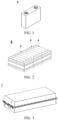
- FIG. 1 shows a lithium secondary battery 5 with a square structure used as an example.
- the lithium secondary battery may include an outer package for packaging the positive electrode plate, the negative electrode plate, and an electrolyte.
- the outer package of the lithium secondary battery may be a soft package, for example, a soft bag.
- a material of the soft package may be plastic, for example, may include one or more of polypropylene PP, polybutylene terephthalate PBT, polybutylene succinate PBS, or the like.
- the outer package of the lithium secondary battery may be a hard shell, such as a hard plastic shell, an aluminum shell, a steel shell, or the like.
- lithium secondary batteries may be assembled into a battery module, and the battery module may include a plurality of secondary batteries. A specific number may be adjusted based on application and capacity of the battery module.
- FIG. 2 shows a battery module 4 used as an example.
- a plurality of lithium secondary batteries 5 may be sequentially arranged along a length direction of the battery module 4.
- the lithium secondary batteries 5 may be arranged in any other manner. Further, the plurality of lithium secondary batteries 5 may be fixed by using fasteners.
- the battery module 4 may further include a housing with accommodating space, and the plurality of lithium secondary batteries 5 are accommodated in the accommodating space.
- the foregoing battery modules may be further assembled into a battery pack, and a number of battery modules included in the battery pack may be adjusted based on application and capacity of the battery pack.
- FIG. 3 and FIG. 4 show a battery pack 1 used as an example.
- the battery pack 1 may include a battery box and a plurality of battery modules 4 disposed in the battery box.
- the battery box includes an upper box body 2 and a lower box body 3.
- the upper box body 2 can cover the lower box body 3 to form enclosed space for accommodating the battery modules 4.
- the plurality of battery modules 4 may be arranged in the battery box in any manner.
- a third aspect of this application provides an apparatus, where the apparatus includes the lithium secondary battery according to the second aspect of this application.
- the lithium secondary battery may be used as a power source for the apparatus, or an energy storage unit of the apparatus.
- the apparatus may be, but is not limited to, a mobile device (for example, a mobile phone or a laptop), an electric vehicle (for example, a pure electric vehicle, a hybrid electric vehicle, a plug-in hybrid electric vehicle, an electric bicycle, an electric scooter, an electric golf vehicle, or an electric truck), an electric train, a ship, a satellite, an energy storage system, or the like.
- a lithium secondary battery, a battery module, or a battery pack may be selected for the apparatus according to requirements for using the apparatus.
- FIG. 5 shows an apparatus used as an example.
- the apparatus is a pure electric vehicle, a hybrid electric vehicle, a plug-in hybrid electric vehicle, or the like.
- a battery pack or a battery module may be used.
- the apparatus may be a mobile phone, a tablet computer, a laptop, or the like.
- the apparatus is usually required to be light and thin, and a secondary battery may be used as a power source.
- the elastic coating had a compression deformation of 20% to 80% and an elastic modulus of 1 MPa to 800 MPa; and optionally, at the pressure of 1 MPa to 20 MPa, the elastic coating had a compression deformation of 30% to 60% and an elastic modulus of 5 MPa to 100 MPa.
- the amounts of the elastic polymer and conductive agent contained in the elastic coating affected the impedance of the battery, and also affected the compression deformation and the elastic modulus of the elastic coating, thereby further affecting the electrochemical performance of the battery.
- a mass percentage of the elastic polymer was 30% to 90%, and preferably 50% to 80%; and a mass percentage of the conductive agent was 10% to 70%, and preferably, 20% to 50%.
- the thickness of the elastic coating affected the impedance of the battery and the electrochemical performance of the battery. If the elastic coating was excessively thick, the battery impedance was increased and the number of cycles, the capacity, and the efficiency were reduced. If the elastic coating was excessively thin, the volume change requirement of the buffer layer could not be satisfied, problems such as poor uniformity and reduced adhesion to the negative electrode plate were likely to occur, and the number of cycles was reduced. Therefore, the thickness of the elastic coating was 1 ⁇ m to 100 ⁇ m, and preferably, 5 ⁇ m to 20 ⁇ m.
- the surface coarseness of the elastic coating affected the impedance and the electrochemical performance of the battery.
- An excessively great surface coarseness of the elastic coating caused deterioration of the interface contact between the negative electrode plate and the elastic coating, and the overall impedance of the battery was increased significantly, and the cycling performance was difficult to improve; while an excessively small coarseness of the elastic coating was not conducive to improvement of the adhesion to the electrode plate, and a process was more difficult. Therefore, the surface coarseness of the elastic coating was 0.2 ⁇ m to 20 ⁇ m, and preferably, 0.5 ⁇ m to 2 ⁇ m.
- Example 12 and Examples 14 to 17 that the surface coarseness of the current collector (copper foil) affected bonding between the elastic coating and the current collector, thereby affecting the electrochemical characteristic of the battery.
- the surface coarseness of the copper foil was excessively large, interface contact between the elastic coating and the copper foil was not even, which was not conducive to the transference of interfacial charge, the battery impedance was increased, and the capacity was reduced.
- the surface coarseness of the copper foil was excessively small, it is not conducive to improvement of the adhesion to the elastic coating, and the preparation process was difficult. Therefore, the surface coarseness of the copper foil was 0.05 ⁇ m to 5 ⁇ m, and preferably, 0.1 ⁇ m to 1 ⁇ m.
- Example 16 and Examples 18 to 20 it could be seen from Example 16 and Examples 18 to 20 that the type of the elastic polymer in the elastic coating affected the elastic modulus and the compression deformation of the elastic coating, thereby affecting electrochemical performance of the battery.
- the elastic modulus was excessively low, strength of an elastic buffer layer was relatively low and the compression deformation was excessively large, which was not conducive to the deformation recovery and the performance stability of the elastic coating.
- the elastic modulus was excessively high, the compression deformation was relatively small, indicating that the elastic coating was too hard to achieve an effective buffering effect, which was not conducive to the performance improvement of the battery.
- the elastic coating had a compression deformation of 20% to 80% and an elastic modulus of 1 MPa to 800 MPa; and optionally, at the pressure of 1 MPa to 20 MPa, the elastic coating had a compression deformation of 30% to 60% and an elastic modulus of 5 MPa to 100 MPa.
- Example 16 and Examples 21 to 24 it could be seen from Example 16 and Examples 21 to 24 that the type of the conductive carbon in the elastic coating mainly affected electronic conductivity of the elastic coating and a charge transfer process at an interface between the elastic coating and a current collector, thereby further affecting the electrochemical performance of the battery. Therefore, conductive carbon with a sheet structure or a spherical structure was prone to agglomerate in the elastic coating, which was not conducive to uniform dispersion. Therefore, the overall polarization resistance of the battery was significantly increased, which caused the capacity and efficiency to decrease.
- the conductive agent included the conductive carbon with a fiber structure and the conductive carbon with a spherical structure, and further optionally, carbon nanotube CNT and conductive carbon black SP.
- Example 23 satisfied the foregoing equation, and the number of cycles of the provided lithium secondary battery reached 34 and the coulomb efficiency reached 98%. According to the disclosure of this specification, a person skilled in the art of this application may further make appropriate changes or modifications to the foregoing implementations.
Landscapes
- Chemical & Material Sciences (AREA)
- Engineering & Computer Science (AREA)
- General Chemical & Material Sciences (AREA)
- Chemical Kinetics & Catalysis (AREA)
- Electrochemistry (AREA)
- Materials Engineering (AREA)
- Manufacturing & Machinery (AREA)
- General Physics & Mathematics (AREA)
- Inorganic Chemistry (AREA)
- Condensed Matter Physics & Semiconductors (AREA)
- Physics & Mathematics (AREA)
- Composite Materials (AREA)
- Battery Electrode And Active Subsutance (AREA)
- Secondary Cells (AREA)
- Cell Electrode Carriers And Collectors (AREA)
Description
- This application relates to the field of batteries, and more specifically, to a negative electrode plate as specified in any of claims 1-9, a lithium secondary battery as specified in any of claims 10-12, and an apparatus as specified in claim 13 containing such lithium secondary battery.
- Because liquid electrolytes currently used in commercial lithium-ion batteries are prone to leak and burn, existing electric vehicles and energy storage products are often at risk of safety hazards. Especially, with the explosive growth of the new energy industry in recent years, battery fires and explosions are occasionally reported. Therefore, consumers have an increasingly urgent demand for battery safety. In consideration that the inherent characteristics of the liquid electrolyte are difficult to change, solid electrolytes and corresponding solid-state batteries have become an ultimate solution commonly acknowledged in the industry to resolve the safety problem of lithium batteries.
- However, solid-state batteries are typically challenged by the easy growth of dendrites at a negative electrode of metallic lithium. In addition, the negative electrode of metallic lithium is prone to swell with the deposition of lithium ions. As a result, the solid electrolyte suffers plastic deformation under pressure, and will not recover its original shape after the pressure disappears. In this case, pores appear on an interface between the metallic lithium and the electrolyte, causing a contact failure. Such interface failure not only causes battery polarization to increase and cycling to decrease, but also further worsens uneven deposition of metallic lithium in subsequent charging, causing the battery to be easily short-circuited during cycling. Therefore, a full solid-state lithium secondary battery is extremely prone to short-circuit failures in continuous charge and discharge cycles.
- The prior art documents
CN109755464 ,CN109755467 andCN109755465 refer to an electrode pole piece comprising a safety coating including a polymer matrix.CN108155387 refers to an elastic current collector which comprises an elastic polymer substrate - In view of the problems in Background, this application is intended to provide a negative electrode plate as specified in any of claims 1-9 containing an elastic coating and a lithium secondary battery as specified in any of claims 10-12 containing such negative electrode plate. This application can improve stability of an interface between an electrode and a solid electrolyte, reducing interface contact failures caused by deposition and dissolution of metallic lithium during battery charging and discharging, and can also relieve an internal expansion stress of the solid-state battery during charging and discharging, thereby avoiding battery short circuit.
- To achieve the foregoing objectives, according to a first aspect of this application, this application provides a negative electrode plate as specified in any of claims 1-9 for a lithium secondary battery, including a current collector and a negative electrode active material layer disposed on at least one surface of the current collector, where an elastic coating is provided on a surface of the negative electrode active material layer closer to the current collector, and the elastic coating includes an elastic polymer and a conductive agent; at the pressure of 1 MPa to 20 MPa, the elastic coating has a compression deformation of 30% to 60% and an elastic modulus of 5 MPa to 100 Mpa, determined as described in the description;
- wherein the mass of the elastic polymer is 50% to 80% of the total mass of the elastic coating, and the mass of the conductive agent is 20% to 50% of the total mass of the elastic coating; and
- wherein the elastic polymer comprises one or more of polyethylene, polyethylene oxide, polyvinylidene fluoride, or polystyrene butadiene.
- According to a second aspect of this application, this application provides a lithium secondary battery as specified in any of claims 10-12, where the lithium secondary battery includes a solid electrolyte, the solid electrolyte is selected from a sulfide solid electrolyte and/or a polymer solid electrolyte, and the lithium secondary battery includes the negative electrode plate according to the first aspect of this application.
- This application further provides an apparatus as specified in claim 13 containing the foregoing lithium secondary battery.
- Compared with the prior art, this application has at least the following beneficial effects: In the negative electrode plate containing the elastic coating provided in this application, the elastic polymer included in the coating helps reduce the elastic modulus and the internal stress, while the conductive agent helps improve conductivity of the coating to reduce transference resistance of the electrons. The elastic coating can effectively alleviate a volume change generated during charging and discharging processes of a lithium secondary battery, reduce an internal stress caused by volume expansion of the negative electrode during the charging process, to inhibit a short circuit, and reduce interface contact failures caused by volume shrinkage of the negative electrode during the discharging process. The apparatus in this application includes the lithium secondary battery provided in this application, and therefore provides at least the same advantages as the lithium secondary battery.
-
-
FIG. 1 is a schematic diagram of an embodiment of a lithium secondary battery; -
FIG. 2 is a schematic diagram of an embodiment of a battery module; -
FIG. 3 is a schematic diagram of an embodiment of a battery pack; -
FIG. 4 is an exploded view ofFIG. 3 ; and -
FIG. 5 is a schematic diagram of an embodiment of an apparatus using a lithium secondary battery as a power source. - To describe in detail the technical content, structural features, and intended objectives and effects of the technical solutions, the following provides detailed descriptions with reference to specific embodiments.
- Firstly, a negative electrode plate as specified in any of claims 1-9 for a lithium secondary battery according to the first aspect of this application includes a current collector and a negative electrode active material layer disposed on at least one surface of the current collector, a surface of the negative electrode active material layer closer to the current collector is provided with an elastic coating, and the elastic coating includes an elastic polymer and a conductive agent; at the pressure of 1 MPa to 20 MPa, the elastic coating has a compression deformation of 30% to 60% and an elastic modulus of 5 MPa to 100 MPa, determined as described in the description;
- wherein the mass of the elastic polymer is 50% to 80% of the total mass of the elastic coating, and the mass of the conductive agent is 20% to 50% of the total mass of the elastic coating; and
- wherein the elastic polymer comprises one or more of polyethylene, polyethylene oxide, polyvinylidene fluoride, or polystyrene butadiene.
- The elastic coating can effectively alleviate a volume change generated during charging and discharging processes of a lithium secondary battery, reduce an internal stress caused by volume expansion of the negative electrode during the charging process, to inhibit a short circuit, and reduce interface contact failures caused by volume shrinkage of the negative electrode during the discharging process. When the battery is discharged, dissolution of metallic lithium at the negative electrode causes the volume to shrink, the coating resumes its shape, and the internal stress is released, thereby helping reduce the interface failures caused by the volume shrinkage of the negative electrode. When the battery is charged, deposition of metallic lithium on the negative electrode side causes volume expansion of the negative electrode, thereby generating an internal expansion stress F. Because the elastic modulus E of a composite coating on the negative electrode side is less than that of metallic lithium, the coating is compressed and deformed:

- L is an initial thickness of the coating, ΔL is a compressed thickness of the coating, and a compressed thickness of the coating is determined by a thickness of deposited lithium.
- The compression deformation and elastic modulus of the elastic coating have great impact on performance of the battery. The compression deformation of the elastic coating during cycling is closely related to both the thickness and elastic modulus. Excessively large deformation is not conducive to deformation recovery and performance stability of the elastic coating. Excessively small deformation indicates that the elastic coating is excessively hard (excessively great elastic modulus) or thick, neither of which is conducive to performance optimization of the battery.
- A ratio of the amount of elastic polymer to the amount of conductive agent in the elastic coating has great impact on the performance of the battery. A larger amount of elastic polymer contained in the coating is conducive to reduction of the elastic modulus and internal stress, and a larger amount of conductive agent is conducive to improvement of conductivity of the coating, to reduce migration resistance of electrons. Therefore, the amounts of the elastic polymer and conductive agent need to be adjusted based on an actual situation. When the amount of elastic polymer contained in the composite layer is excessively high and the amount of the conductive agent is excessively small, because electrons are difficult to migrate, the overall impedance is increased, and capacity and efficiency of the battery are reduced. When the amount of elastic polymer contained in the composite layer is excessively small and the amount of conductive agent is excessively large, a buffering effect of the elastic coating is inadequate and cycling improvement is insignificant.
- Therefore, adjusting a ratio of the amount of elastic polymer to the amount of conductive agent in the elastic coating has great impact on the performance of the battery. When mass of the elastic polymer is 30% to 90% of total mass of the coating layer, and mass of the conductive agent is 10% to 70% of the total mass of the coating layer, the elastic coating has a function of buffering, which can effectively reduce deformation of the negative electrode, to reduce a risk of short circuit of the battery. In addition, overall resistance change of the battery is relatively small, the capacity and efficiency decrease of the battery are also relatively small, and the battery performance is improved.
- Optionally, the mass of the elastic polymer is 50% to 80% of the total mass of the coating, and the mass of the conductive agent is 20% to 50% of the total mass of the coating. The buffering by the elastic coating can effectively reduce the deformation of the negative electrode, further reducing the risk of the short circuit of the battery and improving the overall performance of the battery.
- The thickness of the elastic coating has some influences on the performance of the battery. The excessively thick elastic coating causes the battery impedance to increase and performance to reduce. When the elastic coating is excessively thin, despite the relatively small impact on a cycling function of the battery, a volume change requirement of the buffer layer cannot be satisfied, and problems such as poor uniformity and reduced adhesion to the negative electrode plate are likely to occur.
- Optionally, a thickness of the elastic coating is 1 µm to 100 µm, and further optionally, 5 µm to 20 µm.
- A surface coarseness of the elastic coating has some impact on the performance of the battery. An excessively high coarseness of the elastic coating deteriorates the interface contact between the electrode plate and the elastic coating, and the overall impedance of the battery increases significantly and the cycling performance is difficult to improve; while an excessively small coarseness of the elastic coating is not conducive to improvement of the adhesion to the electrode plate.
- Optionally, a surface coarseness of the elastic coating is 0.2 µm to 20 µm, and further optionally, 0.5 µm to 2 µm.
- Further, preferably, a value of the thickness T (µm) of the elastic coating, the surface coarseness Ra1 (µm) of the current collector, and the surface coarseness Ra2 (µm) and the elastic modulus E (mPa) of the elastic coating satisfy the following equation:

- Herein, T denotes the thickness of the elastic coating;
- Ra1 denotes the surface coarseness of the current collector;
- Ra2 denotes the surface coarseness of the elastic coating; and
- E denotes the elastic modulus.
- The type of the elastic polymer in the elastic coating affects the elastic modulus and the compression deformation of the elastic coating, further affecting electrochemical performance of the battery. When the elastic modulus is excessively low, strength of an elastic buffer layer is relatively low and the compression deformation is excessively large, which is not conducive to the deformation recovery and the performance stability of the elastic coating. When the elastic modulus is excessively high, the compression deformation is relatively small, indicating that the elastic coating is too hard to achieve an effective buffering effect, which is not conducive to the performance improvement of the battery.
- Optionally, the elastic polymer includes one or more of polyethylene, polyethylene oxide, polyvinyl chloride, polyvinylidene fluoride, polypropylene, polystyrene butadiene, or polyisobutylene.
- A type of the conductive carbon in the elastic coating mainly affects electronic conductivity of the elastic coating and a charge transfer process at an interface between the elastic coating and a current collector, thereby further affecting the electrochemical performance of the battery. Therefore, conductive carbon with a sheet structure or a spherical structure is prone to agglomerate in the elastic coating, which is not conducive to uniform dispersion. Therefore, the overall polarization resistance of the battery is significantly increased, which causes capacity and efficiency to decrease. A composite of conductive carbon with a fibrous structure and conductive carbon with a spherical structure helps form a continuous internal conductive path, to improve an electron transference process inside and on the interface, thereby improving the overall performance of the battery. Therefore, preferably, the conductive agent includes both the conductive carbon with a fiber structure and the conductive carbon with a spherical structure.
- Optionally, the conductive agent includes conductive carbon with a fibrous structure and conductive carbon with a spherical structure, the conductive carbon with a fibrous structure includes one or more of carbon nanotube (CNT), carbon fiber (VGCF), or Ketjen black, the conductive carbon with a spherical structure includes one or more of conductive carbon black (SP), conductive graphite, or acetylene black, and preferably, the conductive carbon with a fibrous structure is carbon nanotube CNT and the conductive carbon with a spherical structure is conductive carbon black SP. Optionally, a mass ratio of the conductive carbon with a fiber structure to the conductive carbon with a spherical structure is 1:5 to 5:1, preferably 1:2 to 2:1, and more preferably 1:1.
- A surface coarseness of the current collector has some impact on the performance of the battery. The surface coarseness of the current collector affects the surface coarseness of the elastic coating. When the surface coarseness of the current collector (copper foil) is excessively large, the coarseness of the elastic coating significantly increases, and as a result, the interface contact between the electrode plate and the elastic coating deteriorates, the overall impedance of the battery increases significantly, and the cycling performance is difficult to improve. When the surface coarseness of the current collector (copper foil) is excessively small, the coarseness of the elastic coating is excessively small, which is not conducive to improvement of the adhesion to the electrode plate.
- Optionally, a surface coarseness of the current collector is 0.05 µm to 5 µm, and further optionally, 0.1 µm to 1 µm.
- The negative electrode current collector may be various materials suitable to be used as a negative electrode current collector of an electrochemical energy storage apparatus in the art. For example, the negative electrode current collector may include but is not limited to a metal foil, or more specifically, may include but is not limited to a copper foil.
- A carbon material, metallic lithium, silicon, tin, LTO, or the like capable of intercalating or deintercalating lithium ions can be typically used as the negative electrode active material. In particular, the negative electrode active material layer includes metallic lithium and/or a lithium alloy.
- The negative electrode plate includes the negative electrode current collector, the elastic coating, and the negative electrode active material layer in sequence.
- In addition, a lithium secondary battery according to a second aspect of this application is described. The lithium secondary battery includes a solid electrolyte, the solid electrolyte includes a sulfide solid electrolyte and/or a polymer solid electrolyte, and the lithium secondary battery includes the negative electrode plate according to the first aspect of this application.
- Further, the lithium secondary battery includes a positive electrode, the positive electrode includes a positive electrode active material, and the positive electrode active material is an NCM ternary material, that is, a ternary material of lithium nickel cobalt manganate.
- In the lithium secondary battery in this application, specific types and composition of the positive electrode plate are not specifically limited, and may be selected based on an actual need.
- In the lithium secondary battery in this application, the solid electrolyte is selected from a sulfide solid electrolyte and/or a polymer solid electrolyte. Optionally, the sulfide electrolyte is selected from one or more of Li3PS4, Li6PS5Cl, Li10GeP2S12, or Li7P3S11.
- This application has no particular limitation on a shape of the lithium secondary battery, and the lithium secondary battery may have a square or any other shape.
FIG. 1 shows a lithiumsecondary battery 5 with a square structure used as an example. - In some embodiments, the lithium secondary battery may include an outer package for packaging the positive electrode plate, the negative electrode plate, and an electrolyte.
- In some embodiments, the outer package of the lithium secondary battery may be a soft package, for example, a soft bag. A material of the soft package may be plastic, for example, may include one or more of polypropylene PP, polybutylene terephthalate PBT, polybutylene succinate PBS, or the like. Alternatively, the outer package of the lithium secondary battery may be a hard shell, such as a hard plastic shell, an aluminum shell, a steel shell, or the like.
- In some embodiments, lithium secondary batteries may be assembled into a battery module, and the battery module may include a plurality of secondary batteries. A specific number may be adjusted based on application and capacity of the battery module.
-
FIG. 2 shows abattery module 4 used as an example. Referring toFIG. 2 , in thebattery module 4, a plurality of lithiumsecondary batteries 5 may be sequentially arranged along a length direction of thebattery module 4. Certainly, the lithiumsecondary batteries 5 may be arranged in any other manner. Further, the plurality of lithiumsecondary batteries 5 may be fixed by using fasteners. - Optionally, the
battery module 4 may further include a housing with accommodating space, and the plurality of lithiumsecondary batteries 5 are accommodated in the accommodating space. - In some embodiments, the foregoing battery modules may be further assembled into a battery pack, and a number of battery modules included in the battery pack may be adjusted based on application and capacity of the battery pack.
-
FIG. 3 andFIG. 4 show abattery pack 1 used as an example. Referring toFIG. 3 andFIG. 4 , thebattery pack 1 may include a battery box and a plurality ofbattery modules 4 disposed in the battery box. The battery box includes anupper box body 2 and alower box body 3. Theupper box body 2 can cover thelower box body 3 to form enclosed space for accommodating thebattery modules 4. The plurality ofbattery modules 4 may be arranged in the battery box in any manner. - A third aspect of this application provides an apparatus, where the apparatus includes the lithium secondary battery according to the second aspect of this application. The lithium secondary battery may be used as a power source for the apparatus, or an energy storage unit of the apparatus. The apparatus may be, but is not limited to, a mobile device (for example, a mobile phone or a laptop), an electric vehicle (for example, a pure electric vehicle, a hybrid electric vehicle, a plug-in hybrid electric vehicle, an electric bicycle, an electric scooter, an electric golf vehicle, or an electric truck), an electric train, a ship, a satellite, an energy storage system, or the like.
- A lithium secondary battery, a battery module, or a battery pack may be selected for the apparatus according to requirements for using the apparatus.
-
FIG. 5 shows an apparatus used as an example. The apparatus is a pure electric vehicle, a hybrid electric vehicle, a plug-in hybrid electric vehicle, or the like. To meet a requirement of the apparatus for high power and high energy density of a battery, a battery pack or a battery module may be used. - In another example, the apparatus may be a mobile phone, a tablet computer, a laptop, or the like. The apparatus is usually required to be light and thin, and a secondary battery may be used as a power source.
- To describe in detail the technical content, structural features, and intended objectives and effects of the technical solutions, the following provides detailed descriptions with reference to specific embodiments. It should be understood that these embodiments are merely intended to illustrate this application but not to limit the scope of this application.
- Batteries in the examples are all prepared in the following method:
- (1) Preparation of a negative electrode plate:
An elastic polymer and a conductive agent were mixed well according to types and a mass ratio in Table 1, and after thorough stirring, an elastic slurry was obtained; and firstly, the elastic slurry was applied on Cu foil and dried, to obtain a current collector coated with an elastic polymer coating, then lithium metal foil was combined on the surface of the elastic coating through a roll-in process, and the lithium metal was punched into a disk with a diameter of 14 mm, to obtain a lithium metal negative electrode plate containing the elastic coating. - (2) Preparation of a positive electrode plate:
A positive electrode active material LiNi1/3Co1/3Mn1/3O2, an electrolyte material Li3PS4, a conductive agent of Super-P, and a binder styrene-butadiene rubber were mixed at a mass ratio of 70:24:3:3, and a solvent of toluene was added, and stirred under an action of a vacuum mixer until a system was uniform, to obtain a positive electrode slurry; and the positive electrode slurry was uniformly applied on two surfaces of aluminum foil as the positive electrode current collector, dried at room temperature, and transferred to an oven for continuous drying, and then cold pressing and slitting were performed to obtain the positive electrode plate. - (3) Preparation of a solid electrolyte plate
An electrolyte material Li3PS4 and a binder of styrene-butadiene rubber were mixed at a mass ratio of 97:3, and a solvent of toluene was added, and stirred under an action of a vacuum mixer until a system was uniform, to obtain an electrolyte slurry; and the electrolyte slurry was uniformly applied on a surface of a glass pane, dried at room temperature, and transferred to an oven for continuous drying, and then cold pressing and slitting were performed to obtain the electrolyte plate. - (4) The foregoing positive electrode plate, the solid electrolyte plate, and the negative electrode plate were sequentially laminated, and at 300 MPa, pressure was increased to prepare a solid lithium secondary battery.
A comparative example is about a battery without an elastic coating. (No step of applying the elastic slurry was performed.) - A parameter and a performance test method of the lithium secondary battery are described below:
- (1) Thickness test: Thicknesses of a current collector and a current collector-elastic coating were separately measured by using a micrometer. A difference between the two thicknesses was a thickness of the elastic coating.
- (2) Compression deformation test: The negative electrode plate was pressed in a circular sleeve mold, a pressure range was 1 MPa to 20 MPa, a thickness change value of a composite layer before and after the pressure was measured, and a ratio of the change value to the initial thickness was compression deformation.
- (3) Elastic modulus test: The negative electrode plate was pressed in a circular sleeve mold to test the compression deformation within the pressure range of 1 MPa to 20 MPa, no less than five points were selected form the pressure and compression deformation data to perform plotting and linear fitting, and a slope obtained through fitting was the elastic modulus.
- (4) Surface coarseness test: The copper foil or the negative electrode plate was put under a high-precision optical microscope for observation. In 3D imaging mode, surface height distribution information of the copper foil or the negative electrode plate within a specified range could be obtained. The surface coarseness could be obtained by calculating a maximum surface height difference of the copper foil or the negative electrode plate in different zones.
- (5) Cycling performance test:
At 25°C, the solid-state lithium secondary battery was charged to a voltage of 4.2 V at a constant current of 0.1 C, then charged to a current of 0.05 C at a constant voltage of 4.2 V, and then discharged at a constant current of 0.1 C until a final voltage was 2.8 V; and discharge capacity of the initial cycle was recorded. Then a charging and discharging cycle was performed based on the foregoing operations. When 80% of the initial capacity was reached after cycling, charging and discharging stopped. In this case, a number of cycles was the high-temperature cycling life. - (6) Electrochemical impedance test: A solid-state lithium secondary battery was prepared, the electrochemical impedance test was conducted by using a Chenhua electrochemical workstation, a frequency range was 0.01 Hz to 1 MHz, and a perturbation signal was 5 mV.
- (7) Gram capacity test: A solid-state lithium secondary battery was prepared, the gram capacity test was conducted by using a LAND battery tester, the charging/discharging rate was 0.1 C, and the charging/discharging cut-off voltage was 2.8 V to 4.2 V
- (8) Coulomb efficiency test: Coulomb efficiency test was conducted by using a LAND battery tester, the charging/discharging rate was 0.1 C, and the charging/discharging cut-off voltage was 2.8 V to 4.2 V
- Related parameters of lithium secondary batteries provided in Examples 1 to 24 and the comparative example are shown in Table 1.
Table 1 Related parameters of lithium secondary batteries Examples 1, 5, 6, 9, 19, 20 are "Reference Examples" which are not a part of the present invention. Type of elastic polymer Percent of elastic polymer (%) Type of condu ctive agent Percent of conducti ve agent (%) Thickness of elastic coating (µm) Compression deformation (%) Elas tic mod ulus (MP a) Surface coarsen ess (µm) Coarse ness of copper foil (µm) Example 1 Polyethyl ene oxide 30 CNT 70 10 25 110 1 0.5 Example 2 Polyethyl ene oxide 50 CNT 50 10 38 68 1 0.5 Example 3 Polyethyl ene oxide 60 CNT 40 10 45 40 1 0.5 Example 4 Polyethyl ene oxide 80 CNT 20 10 58 15 1 0.5 Example 5 Polyethyl ene oxide 90 CNT 10 10 72 6 1 0.5 Example 6 Polyethyl ene oxide 60 CNT 40 1 88 40 1 0.5 Example 7 Polyethyl ene oxide 60 CNT 40 5 60 40 1 0.5 Example 8 Polyethyl ene oxide 60 CNT 40 20 30 40 1 0.5 Example 9 Polyethyl ene oxide 60 CNT 40 100 12 40 1 0.5 Example 10 Polyethyl ene oxide 60 CNT 40 10 45 40 0.2 0.5 Example 11 Polyethyl ene oxide 60 CNT 40 10 45 40 0.5 0.5 Example 12 Polyethyl ene oxide 60 CNT 40 10 45 40 2 0.5 Example 13 Polyethyl ene oxide 60 CNT 40 10 45 40 20 0.5 Example 14 Polyethyl ene oxide 60 CNT 40 10 45 40 2 0.05 Example 15 Polyethyl ene oxide 60 CNT 40 10 45 40 2 0.1 Example 16 Polyethyl ene oxide 60 CNT 40 10 45 40 2 1 Example 17 Polyethyl ene oxide 60 CNT 40 10 45 40 2 5 Example 18 Polyvinyl idene fluoride 60 CNT 40 10 32 95 2 1 Example 19 Styrene-b utadiene rubber 60 CNT 40 10 75 8 2 1 Example 20 Polyethyl ene 60 CNT 40 10 12 780 2 1 Example 21 Polyethyl ene oxide 60 Cond uctive graph ite 40 10 44 42 2 1 Example 22 Polyethyl ene oxide 60 SP 40 10 45 42 2 1 Example 23 Polyethyl ene oxide 60 Mixin g CNT and SP in 1:1 40 10 46 38 2 1 Example 24 Polyethyl ene oxide 60 Mixin g CNT and acetyl ene black in 1:1 40 10 47 37 2 1 Comparat ive example / / / / / / / / / - Performance test results of lithium secondary batteries provided in Examples 1 to 24 and the comparative example are shown in Table 2.
Table 2 Performance test results of lithium secondary batteries Examples 1, 5, 6, 9, 19, 20 are "Reference Examples" which are not a part of the present invention. Number of cycles Impedance (Ω) Gram capacity (mAh/g) Coulomb efficiency (%) Example 1 15 35 138 98 Example 2 28 39 135 98 Example 3 32 42 133 97 Example 4 30 48 134 95 Example 5 22 61 122 90 Example 6 12 30 141 99 Example 7 21 33 139 98 Example 8 29 53 130 97 Example 9 22 95 104 72 Example 10 24 48 134 98 Example 11 27 42 134 98 Example 12 31 44 135 99 Example 13 16 81 115 82 Example 14 26 44 130 97 Example 15 28 40 136 99 Example 16 33 41 134 98 Example 17 19 67 125 88 Example 18 27 43 131 96 Example 19 21 46 128 94 Example 20 18 51 127 94 Example 21 28 48 126 93 Example 22 29 50 124 92 Example 23 34 38 140 99 Example 24 30 42 137 98 Comparative example 9 30 141 99 - It could be seen from Table 1 and Table 2 that the number of cycles and impedance in the examples with the elastic coating added were improved compared with those in the comparative example. This indicated that the elastic coating of the negative electrode could effectively reduce a risk of a short circuit of a solid-state battery, maintain stability of an electrode interface, reduce deposition and dissolution of metallic lithium during charging and discharging of the battery, and alleviate the expansion stress inside the solid-state battery during charging and discharging, thereby avoiding short circuit of the battery. At a pressure of 1 MPa to 20 MPa, the elastic coating had a compression deformation of 20% to 80% and an elastic modulus of 1 MPa to 800 MPa; and optionally, at the pressure of 1 MPa to 20 MPa, the elastic coating had a compression deformation of 30% to 60% and an elastic modulus of 5 MPa to 100 MPa.
- Further, it could be seen from Examples 1 to 5 that the amounts of the elastic polymer and conductive agent contained in the elastic coating affected the impedance of the battery, and also affected the compression deformation and the elastic modulus of the elastic coating, thereby further affecting the electrochemical performance of the battery.
- When the amount of elastic polymer in the elastic coating was excessively large and the amount of conductive agent was excessively small, because electrons were difficult to migrate, overall impedance was increased, and the number of cycles, the capacity, and the efficiency of the battery were reduced. On the contrary, when the amount of elastic polymer in the elastic coating was excessively small and the amount of conductive agent was excessively large, the compression deformation of the elastic coating was excessively low, the elastic modulus was excessively high, and as a result, the buffering effect of the elastic coating was inadequate, and the number of cycles was not increased significantly. Therefore, a mass percentage of the elastic polymer was 30% to 90%, and preferably 50% to 80%; and a mass percentage of the conductive agent was 10% to 70%, and preferably, 20% to 50%.
- Further, it could be seen from Example 3 and Examples 6 to 9 that the thickness of the elastic coating affected the impedance of the battery and the electrochemical performance of the battery. If the elastic coating was excessively thick, the battery impedance was increased and the number of cycles, the capacity, and the efficiency were reduced. If the elastic coating was excessively thin, the volume change requirement of the buffer layer could not be satisfied, problems such as poor uniformity and reduced adhesion to the negative electrode plate were likely to occur, and the number of cycles was reduced. Therefore, the thickness of the elastic coating was 1 µm to 100 µm, and preferably, 5 µm to 20 µm.
- Further, it could be seen from Example 3 and Examples 10 to 13 that, the surface coarseness of the elastic coating affected the impedance and the electrochemical performance of the battery. An excessively great surface coarseness of the elastic coating caused deterioration of the interface contact between the negative electrode plate and the elastic coating, and the overall impedance of the battery was increased significantly, and the cycling performance was difficult to improve; while an excessively small coarseness of the elastic coating was not conducive to improvement of the adhesion to the electrode plate, and a process was more difficult. Therefore, the surface coarseness of the elastic coating was 0.2 µm to 20 µm, and preferably, 0.5 µm to 2 µm.
- Further, it could be seen from Example 12 and Examples 14 to 17 that the surface coarseness of the current collector (copper foil) affected bonding between the elastic coating and the current collector, thereby affecting the electrochemical characteristic of the battery. When the surface coarseness of the copper foil was excessively large, interface contact between the elastic coating and the copper foil was not even, which was not conducive to the transference of interfacial charge, the battery impedance was increased, and the capacity was reduced. When the surface coarseness of the copper foil was excessively small, it is not conducive to improvement of the adhesion to the elastic coating, and the preparation process was difficult. Therefore, the surface coarseness of the copper foil was 0.05 µm to 5 µm, and preferably, 0.1 µm to 1 µm.
- Further, it could be seen from Example 16 and Examples 18 to 20 that the type of the elastic polymer in the elastic coating affected the elastic modulus and the compression deformation of the elastic coating, thereby affecting electrochemical performance of the battery. When the elastic modulus was excessively low, strength of an elastic buffer layer was relatively low and the compression deformation was excessively large, which was not conducive to the deformation recovery and the performance stability of the elastic coating. When the elastic modulus was excessively high, the compression deformation was relatively small, indicating that the elastic coating was too hard to achieve an effective buffering effect, which was not conducive to the performance improvement of the battery. At a pressure of 1 MPa to 20 MPa, the elastic coating had a compression deformation of 20% to 80% and an elastic modulus of 1 MPa to 800 MPa; and optionally, at the pressure of 1 MPa to 20 MPa, the elastic coating had a compression deformation of 30% to 60% and an elastic modulus of 5 MPa to 100 MPa.
- Further, it could be seen from Example 16 and Examples 21 to 24 that the type of the conductive carbon in the elastic coating mainly affected electronic conductivity of the elastic coating and a charge transfer process at an interface between the elastic coating and a current collector, thereby further affecting the electrochemical performance of the battery. Therefore, conductive carbon with a sheet structure or a spherical structure was prone to agglomerate in the elastic coating, which was not conducive to uniform dispersion. Therefore, the overall polarization resistance of the battery was significantly increased, which caused the capacity and efficiency to decrease. A composite of conductive carbon with a fibrous structure and conductive carbon with a spherical structure helped form a continuous internal conductive path, to improve an electron transference process inside and on the interface, thereby improving the overall performance of the battery. Therefore, preferably, the conductive agent included the conductive carbon with a fiber structure and the conductive carbon with a spherical structure, and further optionally, carbon nanotube CNT and conductive carbon black SP.
- Further, it could be seen from Table 1 and Table 2 that in Example 23, the value of the thickness T (µm) of the elastic coating, the surface coarseness Ra1 (µm) of the current collector, and the surface coarseness Ra2 (µm) of the elastic coating and the elastic modulus E (Mpa) calculated using the following equation was 2.533. In this case, the test results of the lithium secondary battery (especially the number of cycles and coulomb efficiency) were excellent.

- The various parameters of Example 23 satisfied the foregoing equation, and the number of cycles of the provided lithium secondary battery reached 34 and the coulomb efficiency reached 98%. According to the disclosure of this specification, a person skilled in the art of this application may further make appropriate changes or modifications to the foregoing implementations.
Claims (13)
- A negative electrode plate for lithium secondary battery, comprising a negative electrode current collector and a negative electrode active material layer disposed on at least one surface of the negative electrode current collector, wherein a surface of the negative electrode active material layer closer to the current collector is provided with an elastic coating, and the elastic coating comprises an elastic polymer and a conductive agent; at the pressure of 1 MPa to 20 MPa, the elastic coating has a compression deformation of 30% to 60% and an elastic modulus of 5 MPa to 100 MPa, determined as described in the description;wherein the mass of the elastic polymer is 50% to 80% of the total mass of the elastic coating, and the mass of the conductive agent is 20% to 50% of the total mass of the elastic coating;wherein the elastic polymer comprises one or more of polyethylene, polyethylene oxide, polyvinylidene fluoride, or polystyrene butadiene.
- The negative electrode plate according to claim 1, wherein a surface coarseness of the elastic coating is 0.2 µm to 20 µm, and preferably, 0.5 µm to 2 µm, determined as described in the description.
- The negative electrode plate according to claim 2, wherein a thickness of the elastic coating is 1 µm to 100 µm, and preferably, 5 µm to 20 µm; determined as described in the description.
- The negative electrode plate according to claim 1, wherein the conductive agent comprises conductive carbon with a fibrous structure and/or conductive carbon with a spherical structure, and preferably, conductive carbon with a fibrous structure and conductive carbon with a spherical structure, the conductive carbon with a fibrous structure comprises one or more of carbon nanotube, carbon fiber, or Ketjen black, the conductive carbon with a spherical structure comprises one or more of conductive carbon black, conductive graphite, or acetylene black, and preferably, the conductive carbon with a fibrous structure is carbon nanotube and the conductive carbon with a spherical structure is conductive carbon black.
- The negative electrode plate according to claim 4, wherein the conductive agent comprises a conductive carbon with a fibrous structure and a conductive carbon with a spherical structure, and a mass ratio of the conductive carbon with a fiber structure to the conductive carbon with a spherical structure is 1:5 to 5:1, preferably 1:2 to 2:1, and more preferably 1:1.
- The negative electrode plate according to claim 1, wherein a surface coarseness of the current collector is 0.05 µm to 5 µm, and optionally, 0.1 µm to 1 µm; determined as described in the description.
- The negative electrode plate according to claim 1, wherein values of thickness T (µm) of the elastic coating, surface coarseness Ra1 (µm) of the current collector, and surface coarseness Ra2 (µm) and elastic modulus E (mPa) of the elastic coating satisfy the following equation:
 wherein T denotes the thickness of the elastic coating;Ra1 denotes the surface coarseness of the current collector;Ra2 denotes the surface coarseness of the elastic coating; andE denotes the elastic modulus.
 - The negative electrode plate according to claim 1, wherein the negative electrode active material layer comprises metallic lithium and/or a lithium alloy.
- The negative electrode plate according to claim 1, wherein the negative electrode plate comprises the negative electrode current collector, the elastic coating, and the negative electrode active material layer in sequence.
- A lithium secondary battery, wherein the lithium secondary battery comprises a solid electrolyte, the solid electrolyte comprises a sulfide solid electrolyte and/or a polymer solid electrolyte, and the lithium secondary battery comprises the negative electrode plate according to any one of claims 1 to 9.
- The lithium secondary battery according to claim 10, wherein the lithium secondary battery comprises a positive electrode, the positive electrode comprises a positive electrode active material, and the positive electrode active material is an NCM ternary material.
- The lithium secondary battery according to claim 10, wherein the sulfide solid electrolyte is selected from one or more of Li3PS4, Li6PS5Cl, Li10GeP2S12, or Li7P3S11.
- An apparatus, comprising the lithium secondary battery according to any one of claims 10 to 12.
Applications Claiming Priority (2)
| Application Number | Priority Date | Filing Date | Title |
|---|---|---|---|
| CN201910801685.2A CN112447936A (en) | 2019-08-28 | 2019-08-28 | Negative pole piece and lithium secondary battery thereof |
| PCT/CN2020/110629 WO2021036955A1 (en) | 2019-08-28 | 2020-08-21 | Negative pole piece, lithium secondary battery, and device with lithium secondary battery |
Publications (4)
| Publication Number | Publication Date |
|---|---|
| EP3933969A1 EP3933969A1 (en) | 2022-01-05 |
| EP3933969A4 EP3933969A4 (en) | 2023-03-08 |
| EP3933969B1 true EP3933969B1 (en) | 2024-02-14 |
| EP3933969C0 EP3933969C0 (en) | 2024-02-14 |
Family
ID=74685498
Family Applications (1)
| Application Number | Title | Priority Date | Filing Date |
|---|---|---|---|
| EP20856083.9A Active EP3933969B1 (en) | 2019-08-28 | 2020-08-21 | Negative electrode plate, lithium secondary battery, and apparatus containing such lithium secondary battery |
Country Status (6)
| Country | Link |
|---|---|
| US (1) | US12555795B2 (en) |
| EP (1) | EP3933969B1 (en) |
| CN (1) | CN112447936A (en) |
| HU (1) | HUE067070T2 (en) |
| PL (1) | PL3933969T3 (en) |
| WO (1) | WO2021036955A1 (en) |
Families Citing this family (8)
| Publication number | Priority date | Publication date | Assignee | Title |
|---|---|---|---|---|
| CN113451546B (en) * | 2021-06-26 | 2022-05-06 | 宁德时代新能源科技股份有限公司 | Sodium metal batteries, electrochemical devices |
| CN113851763B (en) * | 2021-09-15 | 2024-06-28 | 中汽创智科技有限公司 | Solid-state battery structure and preparation method thereof |
| US12009472B2 (en) * | 2022-05-16 | 2024-06-11 | Soteria Battery Innovation Group Inc. | Long cycle-life wound lithium-ion battery cells having metallized film current collectors |
| CN116247205A (en) * | 2023-02-08 | 2023-06-09 | 广州融捷能源科技有限公司 | Preparation method of stretchable negative pole piece and secondary battery |
| KR20250036936A (en) * | 2023-02-27 | 2025-03-14 | 컨템포러리 엠퍼렉스 테크놀로지 (홍콩) 리미티드 | Electrode assemblies, battery cells, batteries and electrical devices |
| CN118970062B (en) * | 2024-07-22 | 2025-06-13 | 珠海科创锂电科技有限公司 | Dry electrode current collector, preparation method thereof, dry electrode pole piece and secondary battery |
| CN119993991B (en) * | 2025-01-07 | 2025-12-26 | 江苏正力新能电池技术股份有限公司 | Lithium metal anode sheet and its preparation method and lithium metal battery |
| CN121663109A (en) * | 2026-02-06 | 2026-03-13 | 宁波长阳科技股份有限公司 | Lithium ion battery coating diaphragm and preparation method and application thereof |
Family Cites Families (14)
| Publication number | Priority date | Publication date | Assignee | Title |
|---|---|---|---|---|
| CA2726143A1 (en) * | 2008-05-29 | 2009-12-10 | Leyden Energy, Inc. | Electrochemical cells with ionic liquid electrolyte |
| JP5912337B2 (en) * | 2011-04-09 | 2016-04-27 | 日東電工株式会社 | Flame retardant thermal conductive adhesive sheet |
| CN107305950B (en) | 2016-04-19 | 2019-11-05 | 宁德新能源科技有限公司 | Polymeric protective film, lithium anode piece, lithium secondary battery |
| WO2018098506A1 (en) * | 2016-11-28 | 2018-05-31 | Sila Nanotechnologies Inc. | High-capacity battery electrodes with improved binders, construction, and performance |
| CN108155387B (en) * | 2016-12-06 | 2020-08-25 | 华为技术有限公司 | Elastic current collector, preparation method thereof, battery electrode plate and flexible lithium ion battery |
| KR102207426B1 (en) * | 2016-12-07 | 2021-01-26 | 주식회사 엘지화학 | Electrode for Secondary Battery Comprising PTC layer with Crosslinking-Polymer and Manufacturing Method thereof |
| CN107565137B (en) | 2017-07-03 | 2020-06-23 | 北京卫蓝新能源科技有限公司 | A kind of current collector and pole piece and solid-state battery containing the same |
| CN109755464B (en) * | 2017-11-08 | 2021-01-12 | 宁德时代新能源科技股份有限公司 | Electrode pole piece, electrochemical device and safety coating |
| CN109755465B (en) * | 2017-11-08 | 2020-12-29 | 宁德时代新能源科技股份有限公司 | Electrode pole piece, electrochemical device and safety coating |
| CN109755467B (en) * | 2017-11-08 | 2021-01-12 | 宁德时代新能源科技股份有限公司 | Electrode pole piece, electrochemical device and safety coating |
| CN108346523A (en) * | 2018-02-13 | 2018-07-31 | 清华大学 | A kind of preparation method containing lithium an- ode of mixed type energy storage device |
| CN111199833A (en) * | 2018-11-16 | 2020-05-26 | 宁德时代新能源科技股份有限公司 | Electrochemical device |
| CN111200131A (en) * | 2018-11-16 | 2020-05-26 | 宁德时代新能源科技股份有限公司 | A kind of positive pole piece and electrochemical device |
| CN109817987A (en) * | 2019-03-14 | 2019-05-28 | 清华大学 | A kind of composite elastic-flexible lithium ion battery electrode material and preparation method thereof |
-
2019
- 2019-08-28 CN CN201910801685.2A patent/CN112447936A/en active Pending
-
2020
- 2020-08-21 EP EP20856083.9A patent/EP3933969B1/en active Active
- 2020-08-21 WO PCT/CN2020/110629 patent/WO2021036955A1/en not_active Ceased
- 2020-08-21 HU HUE20856083A patent/HUE067070T2/en unknown
- 2020-08-21 PL PL20856083.9T patent/PL3933969T3/en unknown
-
2022
- 2022-01-24 US US17/582,401 patent/US12555795B2/en active Active
Also Published As
| Publication number | Publication date |
|---|---|
| WO2021036955A1 (en) | 2021-03-04 |
| PL3933969T3 (en) | 2024-06-24 |
| HUE067070T2 (en) | 2024-09-28 |
| CN112447936A (en) | 2021-03-05 |
| US20220200004A1 (en) | 2022-06-23 |
| EP3933969A4 (en) | 2023-03-08 |
| EP3933969A1 (en) | 2022-01-05 |
| EP3933969C0 (en) | 2024-02-14 |
| US12555795B2 (en) | 2026-02-17 |
Similar Documents
| Publication | Publication Date | Title |
|---|---|---|
| EP3933969B1 (en) | Negative electrode plate, lithium secondary battery, and apparatus containing such lithium secondary battery | |
| EP3916845B1 (en) | Electrode plate, electrochemical apparatus, and apparatus thereof | |
| EP3993110B1 (en) | Electrode sheet, electrochemical device and device thereof | |
| EP3913711B1 (en) | Electrode plate, electrochemical apparatus, and apparatus thereof | |
| KR102517364B1 (en) | All-solid-state battery and production method of the same | |
| EP3923388A1 (en) | Electrode sheets, electrochemical device and device | |
| EP1826862B1 (en) | Non-aqueous electrolyte secondary battery | |
| US11876172B2 (en) | All-solid battery and method for producing the same | |
| EP4071875B1 (en) | Solid-state battery, battery module, battery pack, and related device thereof | |
| EP3863084B1 (en) | Negative electrode and secondary battery including same | |
| CN100474664C (en) | Anode and battery | |
| EP2980885B1 (en) | Non-aqueous electrolyte secondary battery | |
| EP4228038A1 (en) | Composite current collector, sheet, secondary battery, battery module, battery pack, and electrical device | |
| EP4148850A1 (en) | Solid electrolyte membrane, solid battery, battery module, battery pack, and electric device | |
| US10566656B2 (en) | All solid state battery and manufacturing method thereof | |
| CN109216754B (en) | All-solid-state battery and method for manufacturing same | |
| KR20140108380A (en) | Secondary battery including silicon-metal alloy-based negative active material | |
| EP4478440A1 (en) | Electrode and manufacturing method therefor, battery, and electrical apparatus | |
| CN114613940A (en) | All-solid-state battery | |
| EP4177985A1 (en) | Negative electrode and secondary battery comprising same | |
| EP4664654A1 (en) | Battery, terminal apparatus, and battery manufacturing method | |
| EP4648125A1 (en) | Positive electrode sheet, secondary battery, and electric device | |
| CN118231785A (en) | Solid-state battery, preparation method thereof and electric equipment | |
| CN118039782A (en) | Pre-lithiated anode electrode for sandwich structure of all-solid-state battery | |
| US20250167247A1 (en) | Method for manufacturing lithium secondary battery |
Legal Events
| Date | Code | Title | Description |
|---|---|---|---|
| STAA | Information on the status of an ep patent application or granted ep patent |
Free format text: STATUS: THE INTERNATIONAL PUBLICATION HAS BEEN MADE |
|
| PUAI | Public reference made under article 153(3) epc to a published international application that has entered the european phase |
Free format text: ORIGINAL CODE: 0009012 |
|
| STAA | Information on the status of an ep patent application or granted ep patent |
Free format text: STATUS: REQUEST FOR EXAMINATION WAS MADE |
|
| 17P | Request for examination filed |
Effective date: 20210928 |
|
| AK | Designated contracting states |
Kind code of ref document: A1 Designated state(s): AL AT BE BG CH CY CZ DE DK EE ES FI FR GB GR HR HU IE IS IT LI LT LU LV MC MK MT NL NO PL PT RO RS SE SI SK SM TR |
|
| DAV | Request for validation of the european patent (deleted) | ||
| DAX | Request for extension of the european patent (deleted) | ||
| REG | Reference to a national code |
Ref legal event code: R079 Free format text: PREVIOUS MAIN CLASS: H01M0004130000 Ipc: H01M0004660000 Ref country code: DE Ref document number: 602020025828 Country of ref document: DE |
|
| A4 | Supplementary search report drawn up and despatched |
Effective date: 20230208 |
|
| RIC1 | Information provided on ipc code assigned before grant |
Ipc: H01M 4/02 20060101ALN20230202BHEP Ipc: H01M 10/0562 20100101ALI20230202BHEP Ipc: H01M 10/052 20100101ALI20230202BHEP Ipc: H01M 4/38 20060101ALI20230202BHEP Ipc: H01M 4/1395 20100101ALI20230202BHEP Ipc: H01M 4/134 20100101ALI20230202BHEP Ipc: H01M 4/66 20060101AFI20230202BHEP |
|
| RIC1 | Information provided on ipc code assigned before grant |
Ipc: H01M 4/02 20060101ALN20231019BHEP Ipc: H01M 10/0562 20100101ALI20231019BHEP Ipc: H01M 10/052 20100101ALI20231019BHEP Ipc: H01M 4/38 20060101ALI20231019BHEP Ipc: H01M 4/1395 20100101ALI20231019BHEP Ipc: H01M 4/134 20100101ALI20231019BHEP Ipc: H01M 4/66 20060101AFI20231019BHEP |
|
| GRAP | Despatch of communication of intention to grant a patent |
Free format text: ORIGINAL CODE: EPIDOSNIGR1 |
|
| STAA | Information on the status of an ep patent application or granted ep patent |
Free format text: STATUS: GRANT OF PATENT IS INTENDED |
|
| INTG | Intention to grant announced |
Effective date: 20231124 |
|
| GRAS | Grant fee paid |
Free format text: ORIGINAL CODE: EPIDOSNIGR3 |
|
| GRAA | (expected) grant |
Free format text: ORIGINAL CODE: 0009210 |
|
| STAA | Information on the status of an ep patent application or granted ep patent |
Free format text: STATUS: THE PATENT HAS BEEN GRANTED |
|
| AK | Designated contracting states |
Kind code of ref document: B1 Designated state(s): AL AT BE BG CH CY CZ DE DK EE ES FI FR GB GR HR HU IE IS IT LI LT LU LV MC MK MT NL NO PL PT RO RS SE SI SK SM TR |
|
| RAP3 | Party data changed (applicant data changed or rights of an application transferred) |
Owner name: CONTEMPORARY AMPEREX TECHNOLOGY CO., LIMITED |
|
| REG | Reference to a national code |
Ref country code: GB Ref legal event code: FG4D |
|
| REG | Reference to a national code |
Ref country code: CH Ref legal event code: EP |
|
| REG | Reference to a national code |
Ref country code: DE Ref legal event code: R096 Ref document number: 602020025828 Country of ref document: DE |
|
| REG | Reference to a national code |
Ref country code: IE Ref legal event code: FG4D |
|
| U01 | Request for unitary effect filed |
Effective date: 20240307 |
|
| U07 | Unitary effect registered |
Designated state(s): AT BE BG DE DK EE FI FR IT LT LU LV MT NL PT SE SI Effective date: 20240314 |
|
| PG25 | Lapsed in a contracting state [announced via postgrant information from national office to epo] |
Ref country code: IS Free format text: LAPSE BECAUSE OF FAILURE TO SUBMIT A TRANSLATION OF THE DESCRIPTION OR TO PAY THE FEE WITHIN THE PRESCRIBED TIME-LIMIT Effective date: 20240614 |
|
| PG25 | Lapsed in a contracting state [announced via postgrant information from national office to epo] |
Ref country code: GR Free format text: LAPSE BECAUSE OF FAILURE TO SUBMIT A TRANSLATION OF THE DESCRIPTION OR TO PAY THE FEE WITHIN THE PRESCRIBED TIME-LIMIT Effective date: 20240515 |
|
| PG25 | Lapsed in a contracting state [announced via postgrant information from national office to epo] |
Ref country code: HR Free format text: LAPSE BECAUSE OF FAILURE TO SUBMIT A TRANSLATION OF THE DESCRIPTION OR TO PAY THE FEE WITHIN THE PRESCRIBED TIME-LIMIT Effective date: 20240214 Ref country code: RS Free format text: LAPSE BECAUSE OF FAILURE TO SUBMIT A TRANSLATION OF THE DESCRIPTION OR TO PAY THE FEE WITHIN THE PRESCRIBED TIME-LIMIT Effective date: 20240514 |
|
| PG25 | Lapsed in a contracting state [announced via postgrant information from national office to epo] |
Ref country code: ES Free format text: LAPSE BECAUSE OF FAILURE TO SUBMIT A TRANSLATION OF THE DESCRIPTION OR TO PAY THE FEE WITHIN THE PRESCRIBED TIME-LIMIT Effective date: 20240214 |
|
| PG25 | Lapsed in a contracting state [announced via postgrant information from national office to epo] |
Ref country code: RS Free format text: LAPSE BECAUSE OF FAILURE TO SUBMIT A TRANSLATION OF THE DESCRIPTION OR TO PAY THE FEE WITHIN THE PRESCRIBED TIME-LIMIT Effective date: 20240514 Ref country code: NO Free format text: LAPSE BECAUSE OF FAILURE TO SUBMIT A TRANSLATION OF THE DESCRIPTION OR TO PAY THE FEE WITHIN THE PRESCRIBED TIME-LIMIT Effective date: 20240514 Ref country code: IS Free format text: LAPSE BECAUSE OF FAILURE TO SUBMIT A TRANSLATION OF THE DESCRIPTION OR TO PAY THE FEE WITHIN THE PRESCRIBED TIME-LIMIT Effective date: 20240614 Ref country code: HR Free format text: LAPSE BECAUSE OF FAILURE TO SUBMIT A TRANSLATION OF THE DESCRIPTION OR TO PAY THE FEE WITHIN THE PRESCRIBED TIME-LIMIT Effective date: 20240214 Ref country code: GR Free format text: LAPSE BECAUSE OF FAILURE TO SUBMIT A TRANSLATION OF THE DESCRIPTION OR TO PAY THE FEE WITHIN THE PRESCRIBED TIME-LIMIT Effective date: 20240515 Ref country code: ES Free format text: LAPSE BECAUSE OF FAILURE TO SUBMIT A TRANSLATION OF THE DESCRIPTION OR TO PAY THE FEE WITHIN THE PRESCRIBED TIME-LIMIT Effective date: 20240214 |
|
| REG | Reference to a national code |
Ref country code: GB Ref legal event code: 732E Free format text: REGISTERED BETWEEN 20240829 AND 20240904 |
|
| U20 | Renewal fee for the european patent with unitary effect paid |
Year of fee payment: 5 Effective date: 20240822 |
|
| REG | Reference to a national code |
Ref country code: HU Ref legal event code: GB9C Owner name: CONTEMPORARY AMPEREX TECHNOLOGY (HONG KONG) LIMITED, HK Free format text: FORMER OWNER(S): CONTEMPORARY AMPEREX TECHNOLOGY CO., LIMITED, CN Ref country code: HU Ref legal event code: FH1C Free format text: FORMER REPRESENTATIVE(S): DANUBIA SZABADALMI ES JOGI IRODA KFT., HU Representative=s name: DANUBIA SZABADALMI ES JOGI IRODA KFT., HU Ref country code: HU Ref legal event code: AG4A Ref document number: E067070 Country of ref document: HU |
|
| RAP2 | Party data changed (patent owner data changed or rights of a patent transferred) |
Owner name: CONTEMPORARY AMPEREX TECHNOLOGY(HONG KONG) LIMITED |
|
| U1K | Transfer of rights of the unitary patent after the registration of the unitary effect |
Owner name: CONTEMPORARY AMPEREX TECHNOLOGY(HONG KONG) LIMITED; HK |
|
| PG25 | Lapsed in a contracting state [announced via postgrant information from national office to epo] |
Ref country code: SM Free format text: LAPSE BECAUSE OF FAILURE TO SUBMIT A TRANSLATION OF THE DESCRIPTION OR TO PAY THE FEE WITHIN THE PRESCRIBED TIME-LIMIT Effective date: 20240214 |
|
| PG25 | Lapsed in a contracting state [announced via postgrant information from national office to epo] |
Ref country code: CZ Free format text: LAPSE BECAUSE OF FAILURE TO SUBMIT A TRANSLATION OF THE DESCRIPTION OR TO PAY THE FEE WITHIN THE PRESCRIBED TIME-LIMIT Effective date: 20240214 |
|
| PG25 | Lapsed in a contracting state [announced via postgrant information from national office to epo] |
Ref country code: SK Free format text: LAPSE BECAUSE OF FAILURE TO SUBMIT A TRANSLATION OF THE DESCRIPTION OR TO PAY THE FEE WITHIN THE PRESCRIBED TIME-LIMIT Effective date: 20240214 |
|
| PG25 | Lapsed in a contracting state [announced via postgrant information from national office to epo] |
Ref country code: SM Free format text: LAPSE BECAUSE OF FAILURE TO SUBMIT A TRANSLATION OF THE DESCRIPTION OR TO PAY THE FEE WITHIN THE PRESCRIBED TIME-LIMIT Effective date: 20240214 Ref country code: SK Free format text: LAPSE BECAUSE OF FAILURE TO SUBMIT A TRANSLATION OF THE DESCRIPTION OR TO PAY THE FEE WITHIN THE PRESCRIBED TIME-LIMIT Effective date: 20240214 Ref country code: RO Free format text: LAPSE BECAUSE OF FAILURE TO SUBMIT A TRANSLATION OF THE DESCRIPTION OR TO PAY THE FEE WITHIN THE PRESCRIBED TIME-LIMIT Effective date: 20240214 Ref country code: CZ Free format text: LAPSE BECAUSE OF FAILURE TO SUBMIT A TRANSLATION OF THE DESCRIPTION OR TO PAY THE FEE WITHIN THE PRESCRIBED TIME-LIMIT Effective date: 20240214 |
|
| REG | Reference to a national code |
Ref country code: DE Ref legal event code: R097 Ref document number: 602020025828 Country of ref document: DE |
|
| PLBE | No opposition filed within time limit |
Free format text: ORIGINAL CODE: 0009261 |
|
| STAA | Information on the status of an ep patent application or granted ep patent |
Free format text: STATUS: NO OPPOSITION FILED WITHIN TIME LIMIT |
|
| 26N | No opposition filed |
Effective date: 20241115 |
|
| REG | Reference to a national code |
Ref country code: CH Ref legal event code: PL |
|
| PG25 | Lapsed in a contracting state [announced via postgrant information from national office to epo] |
Ref country code: CH Free format text: LAPSE BECAUSE OF NON-PAYMENT OF DUE FEES Effective date: 20240831 Ref country code: MC Free format text: LAPSE BECAUSE OF FAILURE TO SUBMIT A TRANSLATION OF THE DESCRIPTION OR TO PAY THE FEE WITHIN THE PRESCRIBED TIME-LIMIT Effective date: 20240214 |
|
| PG25 | Lapsed in a contracting state [announced via postgrant information from national office to epo] |
Ref country code: IE Free format text: LAPSE BECAUSE OF NON-PAYMENT OF DUE FEES Effective date: 20240821 |
|
| PGFP | Annual fee paid to national office [announced via postgrant information from national office to epo] |
Ref country code: HU Payment date: 20250807 Year of fee payment: 6 |
|
| U20 | Renewal fee for the european patent with unitary effect paid |
Year of fee payment: 6 Effective date: 20250828 |
|
| PGFP | Annual fee paid to national office [announced via postgrant information from national office to epo] |
Ref country code: PL Payment date: 20250724 Year of fee payment: 6 |
|
| PGFP | Annual fee paid to national office [announced via postgrant information from national office to epo] |
Ref country code: GB Payment date: 20250826 Year of fee payment: 6 |
|
| PG25 | Lapsed in a contracting state [announced via postgrant information from national office to epo] |
Ref country code: CY Free format text: LAPSE BECAUSE OF FAILURE TO SUBMIT A TRANSLATION OF THE DESCRIPTION OR TO PAY THE FEE WITHIN THE PRESCRIBED TIME-LIMIT; INVALID AB INITIO Effective date: 20200821 |