EP3933833A1 - In-vehicle communication support system - Google Patents
In-vehicle communication support system Download PDFInfo
- Publication number
- EP3933833A1 EP3933833A1 EP21181422.3A EP21181422A EP3933833A1 EP 3933833 A1 EP3933833 A1 EP 3933833A1 EP 21181422 A EP21181422 A EP 21181422A EP 3933833 A1 EP3933833 A1 EP 3933833A1
- Authority
- EP
- European Patent Office
- Prior art keywords
- seat
- output
- sound
- control unit
- microphone
- Prior art date
- Legal status (The legal status is an assumption and is not a legal conclusion. Google has not performed a legal analysis and makes no representation as to the accuracy of the status listed.)
- Granted
Links
Images



Classifications
-
- G—PHYSICS
- G10—MUSICAL INSTRUMENTS; ACOUSTICS
- G10L—SPEECH ANALYSIS TECHNIQUES OR SPEECH SYNTHESIS; SPEECH RECOGNITION; SPEECH OR VOICE PROCESSING TECHNIQUES; SPEECH OR AUDIO CODING OR DECODING
- G10L19/00—Speech or audio signals analysis-synthesis techniques for redundancy reduction, e.g. in vocoders; Coding or decoding of speech or audio signals, using source filter models or psychoacoustic analysis
-
- G—PHYSICS
- G10—MUSICAL INSTRUMENTS; ACOUSTICS
- G10K—SOUND-PRODUCING DEVICES; METHODS OR DEVICES FOR PROTECTING AGAINST, OR FOR DAMPING, NOISE OR OTHER ACOUSTIC WAVES IN GENERAL; ACOUSTICS NOT OTHERWISE PROVIDED FOR
- G10K11/00—Methods or devices for transmitting, conducting or directing sound in general; Methods or devices for protecting against, or for damping, noise or other acoustic waves in general
- G10K11/16—Methods or devices for protecting against, or for damping, noise or other acoustic waves in general
- G10K11/175—Methods or devices for protecting against, or for damping, noise or other acoustic waves in general using interference effects; Masking sound
- G10K11/178—Methods or devices for protecting against, or for damping, noise or other acoustic waves in general using interference effects; Masking sound by electro-acoustically regenerating the original acoustic waves in anti-phase
- G10K11/1781—Methods or devices for protecting against, or for damping, noise or other acoustic waves in general using interference effects; Masking sound by electro-acoustically regenerating the original acoustic waves in anti-phase characterised by the analysis of input or output signals, e.g. frequency range, modes, transfer functions
- G10K11/17821—Methods or devices for protecting against, or for damping, noise or other acoustic waves in general using interference effects; Masking sound by electro-acoustically regenerating the original acoustic waves in anti-phase characterised by the analysis of input or output signals, e.g. frequency range, modes, transfer functions characterised by the analysis of the input signals only
- G10K11/17827—Desired external signals, e.g. pass-through audio such as music or speech
-
- B—PERFORMING OPERATIONS; TRANSPORTING
- B60—VEHICLES IN GENERAL
- B60R—VEHICLES, VEHICLE FITTINGS, OR VEHICLE PARTS, NOT OTHERWISE PROVIDED FOR
- B60R16/00—Electric or fluid circuits specially adapted for vehicles and not otherwise provided for; Arrangement of elements of electric or fluid circuits specially adapted for vehicles and not otherwise provided for
- B60R16/02—Electric or fluid circuits specially adapted for vehicles and not otherwise provided for; Arrangement of elements of electric or fluid circuits specially adapted for vehicles and not otherwise provided for electric constitutive elements
- B60R16/037—Electric or fluid circuits specially adapted for vehicles and not otherwise provided for; Arrangement of elements of electric or fluid circuits specially adapted for vehicles and not otherwise provided for electric constitutive elements for occupant comfort, e.g. for automatic adjustment of appliances according to personal settings, e.g. seats, mirrors, steering wheel
- B60R16/0373—Voice control
-
- B—PERFORMING OPERATIONS; TRANSPORTING
- B60—VEHICLES IN GENERAL
- B60R—VEHICLES, VEHICLE FITTINGS, OR VEHICLE PARTS, NOT OTHERWISE PROVIDED FOR
- B60R16/00—Electric or fluid circuits specially adapted for vehicles and not otherwise provided for; Arrangement of elements of electric or fluid circuits specially adapted for vehicles and not otherwise provided for
- B60R16/02—Electric or fluid circuits specially adapted for vehicles and not otherwise provided for; Arrangement of elements of electric or fluid circuits specially adapted for vehicles and not otherwise provided for electric constitutive elements
-
- G—PHYSICS
- G10—MUSICAL INSTRUMENTS; ACOUSTICS
- G10K—SOUND-PRODUCING DEVICES; METHODS OR DEVICES FOR PROTECTING AGAINST, OR FOR DAMPING, NOISE OR OTHER ACOUSTIC WAVES IN GENERAL; ACOUSTICS NOT OTHERWISE PROVIDED FOR
- G10K11/00—Methods or devices for transmitting, conducting or directing sound in general; Methods or devices for protecting against, or for damping, noise or other acoustic waves in general
- G10K11/16—Methods or devices for protecting against, or for damping, noise or other acoustic waves in general
- G10K11/175—Methods or devices for protecting against, or for damping, noise or other acoustic waves in general using interference effects; Masking sound
- G10K11/178—Methods or devices for protecting against, or for damping, noise or other acoustic waves in general using interference effects; Masking sound by electro-acoustically regenerating the original acoustic waves in anti-phase
- G10K11/1781—Methods or devices for protecting against, or for damping, noise or other acoustic waves in general using interference effects; Masking sound by electro-acoustically regenerating the original acoustic waves in anti-phase characterised by the analysis of input or output signals, e.g. frequency range, modes, transfer functions
- G10K11/17821—Methods or devices for protecting against, or for damping, noise or other acoustic waves in general using interference effects; Masking sound by electro-acoustically regenerating the original acoustic waves in anti-phase characterised by the analysis of input or output signals, e.g. frequency range, modes, transfer functions characterised by the analysis of the input signals only
- G10K11/17823—Reference signals, e.g. ambient acoustic environment
-
- G—PHYSICS
- G10—MUSICAL INSTRUMENTS; ACOUSTICS
- G10K—SOUND-PRODUCING DEVICES; METHODS OR DEVICES FOR PROTECTING AGAINST, OR FOR DAMPING, NOISE OR OTHER ACOUSTIC WAVES IN GENERAL; ACOUSTICS NOT OTHERWISE PROVIDED FOR
- G10K11/00—Methods or devices for transmitting, conducting or directing sound in general; Methods or devices for protecting against, or for damping, noise or other acoustic waves in general
- G10K11/16—Methods or devices for protecting against, or for damping, noise or other acoustic waves in general
- G10K11/175—Methods or devices for protecting against, or for damping, noise or other acoustic waves in general using interference effects; Masking sound
- G10K11/178—Methods or devices for protecting against, or for damping, noise or other acoustic waves in general using interference effects; Masking sound by electro-acoustically regenerating the original acoustic waves in anti-phase
- G10K11/1781—Methods or devices for protecting against, or for damping, noise or other acoustic waves in general using interference effects; Masking sound by electro-acoustically regenerating the original acoustic waves in anti-phase characterised by the analysis of input or output signals, e.g. frequency range, modes, transfer functions
- G10K11/17821—Methods or devices for protecting against, or for damping, noise or other acoustic waves in general using interference effects; Masking sound by electro-acoustically regenerating the original acoustic waves in anti-phase characterised by the analysis of input or output signals, e.g. frequency range, modes, transfer functions characterised by the analysis of the input signals only
- G10K11/17825—Error signals
-
- G—PHYSICS
- G10—MUSICAL INSTRUMENTS; ACOUSTICS
- G10K—SOUND-PRODUCING DEVICES; METHODS OR DEVICES FOR PROTECTING AGAINST, OR FOR DAMPING, NOISE OR OTHER ACOUSTIC WAVES IN GENERAL; ACOUSTICS NOT OTHERWISE PROVIDED FOR
- G10K11/00—Methods or devices for transmitting, conducting or directing sound in general; Methods or devices for protecting against, or for damping, noise or other acoustic waves in general
- G10K11/16—Methods or devices for protecting against, or for damping, noise or other acoustic waves in general
- G10K11/175—Methods or devices for protecting against, or for damping, noise or other acoustic waves in general using interference effects; Masking sound
- G10K11/178—Methods or devices for protecting against, or for damping, noise or other acoustic waves in general using interference effects; Masking sound by electro-acoustically regenerating the original acoustic waves in anti-phase
- G10K11/1785—Methods, e.g. algorithms; Devices
- G10K11/17853—Methods, e.g. algorithms; Devices of the filter
- G10K11/17854—Methods, e.g. algorithms; Devices of the filter the filter being an adaptive filter
-
- G—PHYSICS
- G10—MUSICAL INSTRUMENTS; ACOUSTICS
- G10K—SOUND-PRODUCING DEVICES; METHODS OR DEVICES FOR PROTECTING AGAINST, OR FOR DAMPING, NOISE OR OTHER ACOUSTIC WAVES IN GENERAL; ACOUSTICS NOT OTHERWISE PROVIDED FOR
- G10K11/00—Methods or devices for transmitting, conducting or directing sound in general; Methods or devices for protecting against, or for damping, noise or other acoustic waves in general
- G10K11/16—Methods or devices for protecting against, or for damping, noise or other acoustic waves in general
- G10K11/175—Methods or devices for protecting against, or for damping, noise or other acoustic waves in general using interference effects; Masking sound
- G10K11/178—Methods or devices for protecting against, or for damping, noise or other acoustic waves in general using interference effects; Masking sound by electro-acoustically regenerating the original acoustic waves in anti-phase
- G10K11/1787—General system configurations
- G10K11/17879—General system configurations using both a reference signal and an error signal
- G10K11/17881—General system configurations using both a reference signal and an error signal the reference signal being an acoustic signal, e.g. recorded with a microphone
-
- G—PHYSICS
- G10—MUSICAL INSTRUMENTS; ACOUSTICS
- G10K—SOUND-PRODUCING DEVICES; METHODS OR DEVICES FOR PROTECTING AGAINST, OR FOR DAMPING, NOISE OR OTHER ACOUSTIC WAVES IN GENERAL; ACOUSTICS NOT OTHERWISE PROVIDED FOR
- G10K11/00—Methods or devices for transmitting, conducting or directing sound in general; Methods or devices for protecting against, or for damping, noise or other acoustic waves in general
- G10K11/16—Methods or devices for protecting against, or for damping, noise or other acoustic waves in general
- G10K11/175—Methods or devices for protecting against, or for damping, noise or other acoustic waves in general using interference effects; Masking sound
- G10K11/178—Methods or devices for protecting against, or for damping, noise or other acoustic waves in general using interference effects; Masking sound by electro-acoustically regenerating the original acoustic waves in anti-phase
- G10K11/1787—General system configurations
- G10K11/17885—General system configurations additionally using a desired external signal, e.g. pass-through audio such as music or speech
-
- G—PHYSICS
- G10—MUSICAL INSTRUMENTS; ACOUSTICS
- G10K—SOUND-PRODUCING DEVICES; METHODS OR DEVICES FOR PROTECTING AGAINST, OR FOR DAMPING, NOISE OR OTHER ACOUSTIC WAVES IN GENERAL; ACOUSTICS NOT OTHERWISE PROVIDED FOR
- G10K2210/00—Details of active noise control [ANC] covered by G10K11/178 but not provided for in any of its subgroups
- G10K2210/10—Applications
- G10K2210/128—Vehicles
- G10K2210/1282—Automobiles
-
- G—PHYSICS
- G10—MUSICAL INSTRUMENTS; ACOUSTICS
- G10K—SOUND-PRODUCING DEVICES; METHODS OR DEVICES FOR PROTECTING AGAINST, OR FOR DAMPING, NOISE OR OTHER ACOUSTIC WAVES IN GENERAL; ACOUSTICS NOT OTHERWISE PROVIDED FOR
- G10K2210/00—Details of active noise control [ANC] covered by G10K11/178 but not provided for in any of its subgroups
- G10K2210/30—Means
- G10K2210/301—Computational
- G10K2210/3026—Feedback
-
- G—PHYSICS
- G10—MUSICAL INSTRUMENTS; ACOUSTICS
- G10K—SOUND-PRODUCING DEVICES; METHODS OR DEVICES FOR PROTECTING AGAINST, OR FOR DAMPING, NOISE OR OTHER ACOUSTIC WAVES IN GENERAL; ACOUSTICS NOT OTHERWISE PROVIDED FOR
- G10K2210/00—Details of active noise control [ANC] covered by G10K11/178 but not provided for in any of its subgroups
- G10K2210/30—Means
- G10K2210/301—Computational
- G10K2210/3027—Feedforward
-
- G—PHYSICS
- G10—MUSICAL INSTRUMENTS; ACOUSTICS
- G10K—SOUND-PRODUCING DEVICES; METHODS OR DEVICES FOR PROTECTING AGAINST, OR FOR DAMPING, NOISE OR OTHER ACOUSTIC WAVES IN GENERAL; ACOUSTICS NOT OTHERWISE PROVIDED FOR
- G10K2210/00—Details of active noise control [ANC] covered by G10K11/178 but not provided for in any of its subgroups
- G10K2210/30—Means
- G10K2210/301—Computational
- G10K2210/3028—Filtering, e.g. Kalman filters or special analogue or digital filters
-
- G—PHYSICS
- G10—MUSICAL INSTRUMENTS; ACOUSTICS
- G10K—SOUND-PRODUCING DEVICES; METHODS OR DEVICES FOR PROTECTING AGAINST, OR FOR DAMPING, NOISE OR OTHER ACOUSTIC WAVES IN GENERAL; ACOUSTICS NOT OTHERWISE PROVIDED FOR
- G10K2210/00—Details of active noise control [ANC] covered by G10K11/178 but not provided for in any of its subgroups
- G10K2210/30—Means
- G10K2210/301—Computational
- G10K2210/3055—Transfer function of the acoustic system
-
- G—PHYSICS
- G10—MUSICAL INSTRUMENTS; ACOUSTICS
- G10K—SOUND-PRODUCING DEVICES; METHODS OR DEVICES FOR PROTECTING AGAINST, OR FOR DAMPING, NOISE OR OTHER ACOUSTIC WAVES IN GENERAL; ACOUSTICS NOT OTHERWISE PROVIDED FOR
- G10K2210/00—Details of active noise control [ANC] covered by G10K11/178 but not provided for in any of its subgroups
- G10K2210/30—Means
- G10K2210/321—Physical
- G10K2210/3221—Headrests, seats or the like, for personal ANC systems
Definitions
- the present invention relates to a technology for supporting communication by utterance in a vehicle.
- a technique for supporting communication based on an utterance in a vehicle As a technique for supporting communication based on an utterance in a vehicle, a technique is known in which an uttered voice of a user seated on a first seat of an automobile is collected by a microphone for the first seat and is output from a speaker for a second seat of the automobile (for example, JP 2002-51392 A ).
- ANC active noise control
- a technology of active noise control including: a microphone disposed near a noise cancel position; an adaptive filter configured to generate a cancel sound for canceling noise at the noise cancel position from an output signal of a noise source; and a speaker configured to output the cancel sound, in which in the adaptive filter, a transfer function is adaptively set using a signal obtained by correcting an output of the microphone using an auxiliary filter as an error signal (for example, JP 2020-12917 A and JP 2018-72770 A ).
- a transfer function that corrects a signal actually output by the microphone is set in a signal output from the microphone when the microphone is arranged at the noise cancel position learned in advance in the auxiliary filter, and the noise is canceled at the noise cancel position different from the position of the microphone by using such an auxiliary filter.
- the uttered voice output from the speaker for the second seat may be collected again by the microphone for the first seat, causing howling, or giving the user seated on the first seat a sense of discomfort that the voice uttered by the user himself/herself is delayed and heard.
- each user does not listen to a sound of a sound source listened by another user.
- An object of the invention is to suppress, in an environment where users at different seats of an automobile listen to sounds of different sound sources, one or more of the users from hearing the sounds of the sound sources listened by other users, and at the same time, to suppress the uttered voice collected by the microphone for the first seat of the automobile and output from the speaker for the second seat from being collected by the microphone for the first seat.
- the invention relates to an in-vehicle communication support system according to the appended claims. Embodiments are disclosed in the dependent claims.
- an in-vehicle communication support system mounted on an automobile having a first seat and a second seat which are different seats from each other, the in-vehicle communication support system including: a second seat sound source device that is a sound source device of the second seat; a second seat speaker configured to output an output sound of the second seat sound source device, the second seat speaker being a speaker for a user at the second seat; a microphone configured to collect sound of the first seat; a noise control unit configured to output a cancel sound and an uttered voice signal; a first seat speaker configured to output a cancel sound output by the noise control unit, the first seat speaker being a speaker for a user at the first seat; a selector configured to selectively output, to the noise control unit, one of an output sound of the second seat sound source device and the uttered voice signal output from the noise control unit as a reference sound; and a control unit.
- the noise control unit includes: an error signal generation unit configured to generate, by using an output of the microphone, an error signal including a component of the reference sound being output from the microphone; a first adaptive filter configured to receive the reference sound as an input and perform an adaptive operation of updating a transfer function so as to reduce a magnitude of the error signal to generate the cancel sound; and an uttered voice signal generation unit configured to generate, as the uttered voice signal, a signal including a component of a voice uttered by the user at the first seat being output from the microphone.
- the in-vehicle communication support system has two operation modes: a first operation mode in which the second seat speaker does not output the uttered voice signal output from the noise control unit; and a second operation mode in which the second seat speaker outputs the uttered voice signal output from the noise control unit.
- the control unit causes the selector to output the output sound of the second seat sound source device as the reference sound to the noise control unit in the first operation mode, and causes the selector to output the uttered voice signal output from the noise control unit as the reference sound to the noise control unit in the second operation mode.
- the uttered voice signal generation unit be configured to generate a signal obtained by removing the component of the cancel sound from the output of the microphone as the uttered voice signal.
- the uttered voice signal generation unit may generate the uttered voice signal by subtracting, from the output of the microphone, a signal obtained by applying a transfer function of a transfer path of the cancel sound to the microphone to the cancel sound.
- the uttered voice of the user at the first seat is output from the second seat speaker, and communication between the user at the first seat and the user at the second seat by the uttered voice can be supported.
- the same noise control unit can be used to cancel the uttered voice of the user at the first seat output from the second seat speaker to the first seat.
- the noise control unit may include an auxiliary filter that receives the reference sound as an input, and the error signal generation unit may generate, as the error signal, a signal obtained by subtracting at least the output of the auxiliary filter from the output of the microphone.
- a transfer function obtained in advance as a transfer function for correcting the sound collected by the microphone to the sound collected at the listening position of the sound of the user at the first seat is set to the auxiliary filter by subtracting the output of the auxiliary filter from the output of the microphone.
- the in-vehicle communication support system may include a first seat sound source device that is a sound source device for the first seat that outputs an output sound from the first seat speaker, and the noise control unit may include a second adaptive filter that receives the output sound of the first sound source device, performs an adaptive operation of updating a transfer function so as to reduce the magnitude of the error signal, and outputs a first seat sound source cancel sound, and the error signal generation unit may be configured to generate, as the error signal, a signal obtained by subtracting at least the first seat sound source cancel sound from the output of the microphone.
- the component of the output sound of the first sound source device output from the first seat speaker can be removed from the error signal used by the first adaptive filter for the adaptive operation, so that the first variable filter can be expected to generate a cancel sound that more appropriately cancels the output of the second seat speaker to the first seat.
- the noise control unit includes: a fixed filter configured to receive an output sound of the second seat sound source device as an input and output a second seat sound source cancel sound; and an adding means configured to add the second seat sound source cancel sound to the cancel sound and output the cancel sound from the first seat speaker.
- the control unit may cause the adding means not to add the second seat sound source cancel sound to the cancel sound in the first operation mode, and cause the adding means to add the second seat sound source cancel sound to the cancel sound in the second operation mode.
- the control unit when the operation mode is switched from the first operation mode to the second operation mode, sets a transfer function of the first adaptive filter before the switching as a transfer function of the fixed filter in the fixed filter.
- the output sound of the second seat sound source device output from the second seat speaker can be canceled for the first seat.
- the invention in an environment where a user at each seat of an automobile listens to sounds of different sound sources, it is possible to prevent the user from hearing the sounds of the sound sources listened by other users, and at the same time, to suppress the uttered voice collected by the microphone for the first seat of the automobile and output from the speaker for the second seat from being collected by the microphone for the first seat.
- Fig. 1 illustrates a configuration of an in-vehicle communication support system according to a first embodiment.
- the in-vehicle communication support system is a system mounted on an automobile, and particularly includes a first seat audio source 1, a second seat audio source 2, a first seat speaker 3, a second seat speaker 4, a first seat microphone 5, a selector 6, an active noise control device 7, a control unit 8, a first seat speaker adder 9, a second seat speaker adder 10, and an uttered voice relay unit 11 as illustrated in the drawing.
- the first seat speaker 3 is a speaker disposed near the first seat for a user at the first seat
- the second seat speaker 4 is a speaker disposed near the second seat for a user at the second seat.
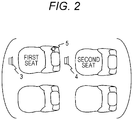
- the disposition of Fig. 2 is an example, and any disposition and number of the first seat speakers 6 and the second seat speakers 5 may be used as long as the first seat speaker 6 mainly radiates sound to the user at the first seat and the second seat speaker 5 mainly radiates sound to the user at the second seat.
- the first seat microphone 5 is a microphone disposed near the first seat as illustrated in Fig. 2 , for example.
- the first seat audio source 1 is a sound source that outputs sound of music or the like listened by the user at the first seat, and an output sound A1 of the first seat audio source 1 is output from the first seat speaker 3 via the first seat speaker adder 9.
- the second seat audio source 2 is a sound source that outputs sound of music or the like listened by the user at the second seat, and an output sound A2 of the second seat audio source 2 is output from the second seat speaker 4 via the second seat speaker adder 10.
- the selector 6 selectively outputs one of an uttered voice signal Dp output from the active noise control device 7 and the output sound A2 from the second seat audio source 2 to the active noise control device 7 as a reference sound Ref.
- the active noise control device 7 generates the uttered voice signal Dp and a cancel sound C from the reference sound Ref output from the selector 6, the output sound A2 from the second seat audio source 2, and a sound M collected by the first seat microphone 5, and outputs the uttered voice signal Dp and the cancel sound C. Then, the uttered voice signal Dp output from the active noise control device 7 is output to the selector 6, and also output from the second seat speaker 4 via the uttered voice relay unit 11 and the second seat speaker adder 10. The cancel sound C output from the active noise control device 7 is output from the first seat speaker 3 via the first seat speaker adder 9.
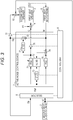
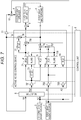
- Fig. 3 illustrates an embodiment of a configuration of the active noise control device 7.
- the active noise control device 7 includes a first variable filter 71, a first adaptive algorithm execution unit 72, a first estimation filter 73 in which a transfer function S ⁇ (z) is set in advance, a first subtractor 74, an auxiliary filter 75 in which a transfer function H(z) is set in advance, a first mute unit 76, a second estimation filter 77 in which the transfer function S ⁇ (z) is set in advance, and a second subtractor 78.
- the transfer function S ⁇ (z) is a transfer characteristic S ⁇ obtained by estimating a transfer function S(z) from the active noise control device 7 to the first seat microphone 5 by actual measurement or the like.
- the reference sound Ref input from the selector 6 passes through the first variable filter 71 and is output as the cancel sound C from the first seat speaker 3 via the first seat speaker adder 9.
- the first mute unit 76 silences (mutes) the output of the cancel sound C to the first seat speaker 3.
- the output of the first variable filter 71 is also transmitted to the second estimation filter 77, and the second estimation filter 77 convolves the transfer characteristic S ⁇ (z) with the output of the first variable filter 71 and outputs the result to the second subtractor 78.
- the second subtractor 78 subtracts the output of the second estimation filter 77 from the sound M collected by the first seat microphone 5.
- the output of the second subtractor 78 is transmitted the uttered voice signal Dp to the selector 6, and is output from the second seat speaker 4 via the uttered voice relay unit 11 and the second seat speaker adder 10.
- the reference sound Ref input from the selector 6 is sent to the first subtractor 74 through the auxiliary filter 75.
- the first subtractor 74 subtracts the output of the auxiliary filter 75 from the sound collected by the first seat microphone 5, and outputs the subtracted signal to the first adaptive algorithm execution unit 72.
- the transfer function H(z) for correcting a signal actually output by the first seat microphone 5 is preset in the auxiliary filter 75 so that the output of the first subtractor 74 becomes a signal output from the first seat microphone 5 when the first seat microphone 5 is located at the position of the ear of the user at the first seat.
- a method of setting the transfer function H(z) of the auxiliary filter 75 will be described later.
- the first estimation filter 73 convolves the transfer characteristic S ⁇ (z) with the output of the selector 6 and outputs the result to the first adaptive algorithm execution unit 72.
- the first variable filter 71, the first adaptive algorithm execution unit 72, and the estimation filter form a filtered-X adaptive filter.
- the first adaptive algorithm execution unit 72 uses the signal output from the first subtractor 74 as an error, executes an adaptive algorithm such as NLMS or LMS using the output of the estimation filter, and performs an adaptive operation of updating a transfer function W(z) of the first variable filter 71 so as to minimize the level of the signal output from the first subtractor 74.
- the present in-vehicle communication support system includes, as operation modes, an ICC mode in which the uttered voice of the user at the first seat collected by the first seat microphone 5 is output from the second seat speaker 4, and a non-ICC mode in which the uttered voice of the user at the first seat collected by the first seat microphone 5 is not output from the second seat speaker 4.
- control unit 8 causes the selector 6 to output the output sound A2 of the second seat audio source 2 to the active noise control device 7 as the reference sound Ref, and causes the uttered voice relay unit 11 to mute the output of the uttered voice signal Dp to the second seat speaker 4.
- the transfer function W(z) of the first variable filter 71 is updated by the adaptive operation of the first adaptive algorithm execution unit 72 such that the component of the output sound A2 of the second seat audio source 2 included in the output of the first subtractor 74 is minimized.
- the first variable filter 71 is adapted to output the cancel sound C that cancels the sound output from the second seat audio source 2 at the position of the ear of the user at the first seat.
- the control unit 8 unmutes the output of the uttered voice signal Dp of the uttered voice relay unit 11 to the second seat speaker 4, and causes the selector 6 to output the uttered voice signal Dp to the active noise control device 7 as the reference sound Ref.
- the transfer function W(z) of the first variable filter 71 is updated by the adaptive operation of the first adaptive algorithm execution unit 72 such that the component of the uttered voice signal Dp included in the output of the first subtractor 74 is minimized. Since the uttered voice signal Dp is obtained by removing the component of the cancel sound C included in the output of the first seat microphone 5 from the sound M collected by the first seat microphone 5, when the output of the first seat microphone 5 includes the uttered voice of the user at the first seat, the first variable filter 71 is adapted to output the cancel sound C that cancels the uttered voice component of the user at the first seat output from the second seat speaker 4 at the position of the ear of the user at the first seat.
- the output of the cancel sound C also cancels and suppresses the component of the uttered voice of the user at the first seat output from second seat speaker 4, the speech sound component being collected by the first seat microphone 5 near the position of the ear of the user at the first seat.
- the uttered voice signal Dp By outputting the uttered voice signal Dp to the second seat speaker 4, the uttered voice of the user in the first seat is output from the second seat speaker 4 to the user in the second seat.
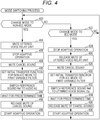
- Fig. 4 illustrates an embodiment of a procedure of the mode switching process.
- the control unit 8 first causes the uttered voice relay unit 11 to mute the output of the uttered voice signal Dp to the second seat speaker 4 (Step 404).
- the adaptive operation of the active noise control device 7 is stopped by stopping the update of the transfer function W(z) of the first variable filter 71 (Step 406). More specifically, the update of the transfer function W(z) of the first variable filter 71 is stopped by setting the step size for determining the gain for the update of the transfer function W(z) performed by the first adaptive algorithm execution unit 72 to 0.
- the first mute unit 76 is caused to mute the output of the cancel sound C (Step 408).
- an initial transfer function predetermined for the non-ICC mode is set as the transfer function W(z) in the first variable filter 71 (Step 410).
- the predetermined time is a time corresponding to a delay by each filter of the active noise control device 7.
- Step 416 the mute of the output of the cancel sound C of the first mute unit 76 is released (Step 416), and the adaptive operation of the active noise control device 7 is started (Step 418). More specifically, in Step 418, the step size for determining the gain for updating the transfer function W(z) performed by the first adaptive algorithm execution unit 72 is returned to the original value before the adaptive operation is stopped in Step 406.
- the control unit 8 stops the adaptive operation of the active noise control device 7 by stopping the update of the transfer function W(z) of the first variable filter 71 (Step 424), and releases the mute of the output of the uttered voice signal Dp of the uttered voice relay unit 11 to the second seat speaker 4 (Step 426).
- the first mute unit 76 is caused to mute the output of the cancel sound C (Step 428), and an initial transfer function predetermined for the ICC mode is set in the first variable filter 71 as the transfer function W(z) (Step 430).
- the predetermined time is a time corresponding to a delay by each filter of the active noise control device 7.
- the mute of the output of the cancel sound C of the first mute unit 76 is released (Step 436), and the adaptive operation of the active noise control device 7 is started (Step 438).
- the transfer function H(z) for the auxiliary filter 75 is set by, for example, performing a first-stage learning process and a second-stage learning process described below in advance while the sound output from the second seat audio source 2 is being output from the second seat speaker 4.
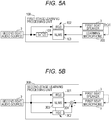
- the first-stage learning process may be performed using a first-stage learning processing unit 100 illustrated in Fig. 5A and a learning microphone 200 disposed at the position of the ear of the first seat user.
- the first-stage learning processing unit 100 includes a learning estimation filter 101 in which an estimation value Sv ⁇ (z) of a transfer function S ⁇ (z) from the first-stage learning processing unit 100 to the learning microphone 200 is set, a first-stage learning variable filter 102, and a first-stage learning adaptive algorithm execution unit 103.
- the sound output from the second seat audio source 2 is input to the first-stage learning variable filter 102, and output from the first-stage learning variable filter 102 is output to the first seat speaker 3.
- the first-stage learning adaptive algorithm execution unit 103 executes an adaptive algorithm such as NLMS or LMS using the output of the learning microphone 200 as an error while using the output of the learning estimation filter 101, and updates the transfer function W(z) of the first-stage learning variable filter 102.
- the adaptive algorithm is executed to obtain the transfer function W(z) of the converged and stabilized first-stage learning variable filter 102 as a result of the first-stage learning process.
- the second-stage learning process may be performed using a second-stage learning processing unit 300 illustrated in Fig. 5B .
- the second-stage learning processing unit 300 includes a second-stage learning fixed filter 301 in which the transfer function W(z) obtained as a result of the first-stage learning process is set as a transfer function, a second-stage learning variable filter 302, a second-stage learning adaptive algorithm execution unit 303, and a second-stage learning subtractor 304.
- the sound output from the second seat audio source 2 is output to the first seat speaker 3 through the second-stage learning fixed filter 301.
- the sound output from the second seat audio source 2 is transmitted to the second-stage learning subtractor 304 through the second-stage learning variable filter 302, and the second-stage learning subtractor 304 subtracts the output of the second-stage learning variable filter 302 from the signal picked up by the first seat microphone 5 and outputs the subtracted signal.
- the second-stage learning adaptive algorithm execution unit 303 executes an adaptive algorithm such as NLMS or LMS using the sound output from the second seat audio source 2 with the output of the second-stage learning subtractor 304 as an error, and updates the transfer function H(z) of the second-stage learning variable filter 302.
- the adaptive algorithm is executed to set the converged and stabilized transfer function H(z) as the transfer function H(z) for the auxiliary filter 75 of the active noise control device 7.
- the transfer function H(z) of the auxiliary filter 75 learned in this manner is a transfer function that can be expected that the output of the first subtractor 74 becomes a signal output from the first seat microphone 5 in a case where the first seat microphone 5 is located at the position of the ear of the user at the first seat in the active noise control device 7 as described above.
- the in-vehicle communication support system according to the second embodiment is obtained by applying the in-vehicle communication support system according to the first embodiment, and is different from the in-vehicle communication support system according to the first embodiment only in that the output sound A1 of the first audio source is input to the active noise control device 7, the internal configuration of the active noise control device 7, and the content of the mode switching process performed by the control unit 8 as illustrated in Fig. 6 .
- Fig. 7 illustrates an embodiment of a configuration of the active noise control device 7 according to the second embodiment.
- the active noise control device 7 has a configuration in which a first gain adjustment unit 701, a second gain adjustment unit 702, a third gain adjustment unit 703, a second variable filter 704, a second adaptive algorithm execution unit 705, a fixed filter 706, a third subtractor 707, and a first adder 708 are added to the configuration shown in the first embodiment.
- the output of the first subtractor 74 is sent to the third subtractor 707, and the output of the third subtractor 707 is output to the first adaptive algorithm execution unit 72 instead of the output of the first subtractor 74.
- the first gain adjustment unit 701 adjusts the gain of the reference sound Ref input from the selector 6 to the first variable filter 71, the first estimation filter 73, and the auxiliary filter 75.
- the second gain adjustment unit 702 adjusts the gain of the output sound A1 from the first seat audio source 1, and outputs the adjusted gain to the second variable filter 704 and the second adaptive algorithm execution unit 705.
- the third gain adjustment unit 703 adjusts the gain of the output sound A2 of the second seat audio source 2, and outputs the adjusted gain to the fixed filter 706.
- the third subtractor 707 outputs a signal obtained by subtracting the output of the second variable filter 704 from the output of the first subtractor 74 to the first adaptive algorithm execution unit 72 and the second adaptive algorithm execution unit 705.
- the first adaptive algorithm execution unit 72 executes an adaptive algorithm with the signal output from the third subtractor 707 as an error, and performs an adaptive operation of updating the transfer function W(z) of the first variable filter 71 so that the level of the signal output from the third subtractor 707 becomes minimum.
- the second variable filter 704 and the second adaptive algorithm execution unit 705 also form an adaptive filter, and the second adaptive algorithm execution unit 705 executes an adaptive algorithm such as NLMS or LMS using the output sound A1 of the first seat audio source 1 with the signal output from the third subtractor 707 as an error, and performs an adaptive operation of updating a transfer function U(z) of the second variable filter 704 so that the level of the signal output from the third subtractor 707 is minimized.
- the transfer function U(z) of the second variable filter 704 is updated such that the component of the output sound A1 of the first seat audio source 1 included in the signal output from the third subtractor 707 is minimized.
- the output of the fixed filter 706 is added to the output of the first variable filter 71 by the first adder 708, and output as a part of the cancel sound C from the first seat speaker 3 via the first seat speaker adder 9.
- control unit 8 causes the selector 6 to output the output sound A2 of the second seat audio source 2 to the active noise control device 7 as the reference sound Ref, causes the uttered voice relay unit 11 to mute the output of the uttered voice signal Dp to the second seat speaker 4, and stops the output of the fixed filter 706.
- the transfer function W(z) of the first variable filter 71 is updated by the adaptive operation of the first adaptive algorithm execution unit 72 such that the component of the output sound A2 of the second seat audio source 2 included in the output of the third subtractor 707 is minimized.
- the first variable filter 71 is adapted to output the cancel sound C that cancels the sound output from the second seat audio source 2 at the position of the ear of the user at the first seat.
- the adaptive operation of the first adaptive algorithm execution unit 72 is performed by the second variable filter 704, the second adaptive algorithm execution unit 705, and the third subtractor 707 using, as an error, a signal obtained by minimizing the component of the output sound A1 of the first seat audio source 1 being output from the first subtractor 74.
- the first variable filter 71 can more appropriately generate the cancel sound C that cancels the sound output from the second seat audio source 2 at the position of the ear of the user at the first seat.
- the control unit 8 operates the fixed filter 706 in a state where the transfer function W(z) of the first variable filter 71 in the non-ICC mode immediately before switching to the ICC mode is set as a transfer function R(z) in the fixed filter 706, releases the mute of the output of the uttered voice signal Dp of the uttered voice relay unit 11 to the second seat speaker 4, and causes the selector 6 to output the uttered voice signal Dp as the reference sound Ref to the active noise control device 7.
- the transfer function W(z) of the first variable filter 71 is updated by the adaptive operation of the first adaptive algorithm execution unit 72 such that the component of the uttered voice signal Dp included in the output of the first subtractor 74 is minimized, and the first variable filter 71 is adapted to output the cancel sound C for canceling the uttered voice component of the user at the first seat output from the second seat speaker 4 at the position of the ear of the user at the first seat.
- the second variable filter 704, the second adaptive algorithm execution unit 705, and the third subtractor 707 perform, as an error, a signal obtained by minimizing the component of the output sound A1 of the first seat audio source 1, which is being output from the first subtractor 74. Therefore, it can be expected that the first variable filter 71 can generate the cancel sound C that cancels, at the position of the ear of the user at the first seat, the uttered voice of the user at the first seat output from the second seat speaker 4 more appropriately.
- the uttered voice component of the user at the first seat output from the second seat speaker 4 collected by the first seat microphone 5 near the position of the ear of the user at the first seat is also canceled and suppressed by the output of the cancel sound C.
- the uttered voice signal Dp By outputting the uttered voice signal Dp to the second seat speaker 4, the uttered voice of the user in the first seat is output from the second seat speaker 4 to the user in the second seat.
- the sound output from the second seat audio source 2 can also be canceled at the position of the ear of the user at the first seat.
- Fig. 8 illustrates an embodiment of a procedure of the mode switching process.
- the control unit 8 causes the uttered voice relay unit 11 to mute the output of the uttered voice signal Dp to the second seat speaker 4 (Step 804), stops the update of the transfer function W(z) of the first variable filter 71 to stop the adaptive operation of the active noise control device 7 (Step 806), and causes the first mute unit 76 to mute the output of the cancel sound C (Step 808).
- Step 810 the output of the fixed filter 706 is stopped (Step 810), and an initial transfer function predetermined for the non-ICC mode is set in the first variable filter 71 as the transfer function W(z) (Step 812).
- the reference sound Ref output by the selector 6 is switched to the output sound A2 of the second audio source (Step 814), and the gains of the first gain adjustment unit 701, the second gain adjustment unit 702, and the third gain adjustment unit 703 are adjusted (Step 816).
- Step 818 the process waits for a predetermined time (Step 818), releases the mute of the output of the cancel sound C of the first mute unit 76 (Step 820), and starts the adaptive operation of the active noise control device 7 (Step 822).
- the control unit 8 stops the adaptive operation of the active noise control device 7 by stopping the update of the transfer function W(z) of the first variable filter 71 (Step 834), causes the uttered voice relay unit 11 to release the mute of the output of the uttered voice signal Dp to the second seat speaker 4 (Step 836), and causes the first mute unit 76 to mute the output of the cancel sound C (Step 838).
- the transfer function of the first variable filter 71 is acquired and set in the fixed filter 706 as the transfer function of the fixed filter 706, and the fixed filter 706 is operated (Step 840).
- an initial transfer function predetermined for the ICC mode is set as the transfer function W(z) in the first variable filter 71 (Step 842).
- Step 844 the reference sound Ref output from the selector 6 is switched to the uttered voice signal Dp (Step 844), and the gains of the first gain adjustment unit 701, the second gain adjustment unit 702, and the third gain adjustment unit 703 are adjusted (Step 846).
- Step 848 the process waits for a predetermined time (Step 848), releases the mute of the output of the cancel sound C of the first mute unit 76 (Step 850), and starts the adaptive operation of the active noise control device 7 (Step 852).
- the first seat speaker 3, the second seat speaker 4, and the first seat microphone 5 are provided one by one. However, a plurality of the first seat speakers 3, the second seat speakers 4, and the first seat microphones 5 may be provided.
- the case where the uttered voice of the user at the first seat is output to the second seat speaker 4 while canceling the sound of the second seat audio source 2 to the user at the first seat has been described.
- the invention and present embodiments can be similarly applied to a case where the uttered voice of the user at each seat is output to the speaker at the passenger's seat while canceling the sound of the audio source at the passenger's seat to the user at each seat for a plurality of seats.
- each of the above embodiments can be applied to a case where the audio source of each seat has a plurality of channels, or can be extended to cancel the sound of the audio source of the passenger's seat for each of the left and right ears of the user.
- auxiliary filter 75 of the active noise control device 7 of each of the above embodiments may be omitted, and in this case, a similar effect can be obtained to a predetermined extent.
Landscapes
- Engineering & Computer Science (AREA)
- Multimedia (AREA)
- Physics & Mathematics (AREA)
- Acoustics & Sound (AREA)
- Audiology, Speech & Language Pathology (AREA)
- Health & Medical Sciences (AREA)
- General Health & Medical Sciences (AREA)
- Mechanical Engineering (AREA)
- Computational Linguistics (AREA)
- Signal Processing (AREA)
- Human Computer Interaction (AREA)
- Soundproofing, Sound Blocking, And Sound Damping (AREA)
- Fittings On The Vehicle Exterior For Carrying Loads, And Devices For Holding Or Mounting Articles (AREA)
Abstract
Description
- The present invention relates to a technology for supporting communication by utterance in a vehicle.
- As a technique for supporting communication based on an utterance in a vehicle, a technique is known in which an uttered voice of a user seated on a first seat of an automobile is collected by a microphone for the first seat and is output from a speaker for a second seat of the automobile (for example,
JP 2002-51392 A - Further, in such a technique, there is also known a technique of canceling sound of music or the like output from a speaker for the first seat from sound collected by a microphone for the first seat and then outputting the sound from a speaker for the second seat (for example,
JP 2010-163054 A - Further, as a technique related to the invention, there is known a technology of active noise control (ANC) including: a microphone disposed near a noise cancel position; an adaptive filter configured to generate a cancel sound for canceling noise at the noise cancel position from an output signal of a noise source; and a speaker configured to output the cancel sound, in which in the adaptive filter, a transfer function is adaptively set using a signal obtained by correcting an output of the microphone using an auxiliary filter as an error signal (for example,
JP 2020-12917 A JP 2018-72770 A - Here, in this technology, a transfer function that corrects a signal actually output by the microphone is set in a signal output from the microphone when the microphone is arranged at the noise cancel position learned in advance in the auxiliary filter, and the noise is canceled at the noise cancel position different from the position of the microphone by using such an auxiliary filter.
- In a case where an uttered voice of a user seated on a first seat of an automobile is collected by a microphone for the first seat and output from a speaker for a second seat of the automobile in order to support communication based on an utterance in the vehicle, the uttered voice output from the speaker for the second seat may be collected again by the microphone for the first seat, causing howling, or giving the user seated on the first seat a sense of discomfort that the voice uttered by the user himself/herself is delayed and heard.
- Further, in a case where the user of the first seat and the user of the second seat listen to sounds of different sound sources, it is desirable that each user does not listen to a sound of a sound source listened by another user.
- An object of the invention is to suppress, in an environment where users at different seats of an automobile listen to sounds of different sound sources, one or more of the users from hearing the sounds of the sound sources listened by other users, and at the same time, to suppress the uttered voice collected by the microphone for the first seat of the automobile and output from the speaker for the second seat from being collected by the microphone for the first seat.
- The invention relates to an in-vehicle communication support system according to the appended claims. Embodiments are disclosed in the dependent claims.
- According to an aspect of the invention there is provided an in-vehicle communication support system mounted on an automobile having a first seat and a second seat which are different seats from each other, the in-vehicle communication support system including: a second seat sound source device that is a sound source device of the second seat; a second seat speaker configured to output an output sound of the second seat sound source device, the second seat speaker being a speaker for a user at the second seat; a microphone configured to collect sound of the first seat; a noise control unit configured to output a cancel sound and an uttered voice signal; a first seat speaker configured to output a cancel sound output by the noise control unit, the first seat speaker being a speaker for a user at the first seat; a selector configured to selectively output, to the noise control unit, one of an output sound of the second seat sound source device and the uttered voice signal output from the noise control unit as a reference sound; and a control unit. Here, the noise control unit includes: an error signal generation unit configured to generate, by using an output of the microphone, an error signal including a component of the reference sound being output from the microphone; a first adaptive filter configured to receive the reference sound as an input and perform an adaptive operation of updating a transfer function so as to reduce a magnitude of the error signal to generate the cancel sound; and an uttered voice signal generation unit configured to generate, as the uttered voice signal, a signal including a component of a voice uttered by the user at the first seat being output from the microphone. In addition, the in-vehicle communication support system has two operation modes: a first operation mode in which the second seat speaker does not output the uttered voice signal output from the noise control unit; and a second operation mode in which the second seat speaker outputs the uttered voice signal output from the noise control unit. The control unit causes the selector to output the output sound of the second seat sound source device as the reference sound to the noise control unit in the first operation mode, and causes the selector to output the uttered voice signal output from the noise control unit as the reference sound to the noise control unit in the second operation mode.
- Here, in an in-vehicle communication support system, it is also preferable that the uttered voice signal generation unit be configured to generate a signal obtained by removing the component of the cancel sound from the output of the microphone as the uttered voice signal.
- Further, the uttered voice signal generation unit may generate the uttered voice signal by subtracting, from the output of the microphone, a signal obtained by applying a transfer function of a transfer path of the cancel sound to the microphone to the cancel sound.
- According to an in-vehicle communication support system as described herein, in the second operation mode, the uttered voice of the user at the first seat is output from the second seat speaker, and communication between the user at the first seat and the user at the second seat by the uttered voice can be supported. In the second operation mode in which the second seat speaker outputs the uttered voice of the user at the first seat while canceling the output sound of the second seat sound source device output from the second seat speaker to the first seat user in the first operation mode in which the second seat speaker does not output the utterance sound of the first seat user, the same noise control unit can be used to cancel the uttered voice of the user at the first seat output from the second seat speaker to the first seat.
- Here, in the in-vehicle communication support system described above, the noise control unit may include an auxiliary filter that receives the reference sound as an input, and the error signal generation unit may generate, as the error signal, a signal obtained by subtracting at least the output of the auxiliary filter from the output of the microphone. However, a transfer function obtained in advance as a transfer function for correcting the sound collected by the microphone to the sound collected at the listening position of the sound of the user at the first seat is set to the auxiliary filter by subtracting the output of the auxiliary filter from the output of the microphone.
- The in-vehicle communication support system may include a first seat sound source device that is a sound source device for the first seat that outputs an output sound from the first seat speaker, and the noise control unit may include a second adaptive filter that receives the output sound of the first sound source device, performs an adaptive operation of updating a transfer function so as to reduce the magnitude of the error signal, and outputs a first seat sound source cancel sound, and the error signal generation unit may be configured to generate, as the error signal, a signal obtained by subtracting at least the first seat sound source cancel sound from the output of the microphone.
- In this way, the component of the output sound of the first sound source device output from the first seat speaker can be removed from the error signal used by the first adaptive filter for the adaptive operation, so that the first variable filter can be expected to generate a cancel sound that more appropriately cancels the output of the second seat speaker to the first seat.
- In addition, in an embodiment of the in-vehicle communication support system, the noise control unit includes: a fixed filter configured to receive an output sound of the second seat sound source device as an input and output a second seat sound source cancel sound; and an adding means configured to add the second seat sound source cancel sound to the cancel sound and output the cancel sound from the first seat speaker. The control unit may cause the adding means not to add the second seat sound source cancel sound to the cancel sound in the first operation mode, and cause the adding means to add the second seat sound source cancel sound to the cancel sound in the second operation mode.
- Here, in an embodiment of the in-vehicle communication support system, when the operation mode is switched from the first operation mode to the second operation mode, the control unit sets a transfer function of the first adaptive filter before the switching as a transfer function of the fixed filter in the fixed filter.
- Accordingly, even in the second operation mode, the output sound of the second seat sound source device output from the second seat speaker can be canceled for the first seat.
- As described above, according to the invention, in an environment where a user at each seat of an automobile listens to sounds of different sound sources, it is possible to prevent the user from hearing the sounds of the sound sources listened by other users, and at the same time, to suppress the uttered voice collected by the microphone for the first seat of the automobile and output from the speaker for the second seat from being collected by the microphone for the first seat.
-
Fig. 1 is a block diagram illustrating a configuration of an in-vehicle communication support system according to a first embodiment of the invention. -
Fig. 2 is a diagram illustrating an embodiment of an arrangement of a speaker and a first seat microphone of the in-vehicle communication support system according to the first embodiment of the invention. -
Fig. 3 is a block diagram illustrating an embodiment of a configuration of an active noise control device according to the first embodiment of the invention. -
Fig. 4 is a flowchart illustrating an embodiment of a mode switching process according to the first embodiment of the invention. -
Figs. 5A and 5B are block diagrams illustrating an embodiment of a configuration of learning of a transfer function of an auxiliary filter according to the first embodiment of the invention. -
Fig. 6 is a block diagram illustrating an embodiment of a configuration of an in-vehicle communication support system according to a second embodiment of the invention. -
Fig. 7 is a block diagram illustrating an embodiment of a configuration of an active noise control device according to the second embodiment of the invention. -
Fig. 8 is a flowchart illustrating an embodiment of a mode switching process according to the second embodiment of the invention. - In the following, embodiments of the invention will be described.
-
Fig. 1 illustrates a configuration of an in-vehicle communication support system according to a first embodiment. - The in-vehicle communication support system is a system mounted on an automobile, and particularly includes a first
seat audio source 1, a secondseat audio source 2, afirst seat speaker 3, asecond seat speaker 4, afirst seat microphone 5, a selector 6, an activenoise control device 7, acontrol unit 8, a firstseat speaker adder 9, a secondseat speaker adder 10, and an utteredvoice relay unit 11 as illustrated in the drawing. - As illustrated in
Fig. 2 , assuming that one seat of the automobile is a first seat and another seat other than the first seat is a second seat, thefirst seat speaker 3 is a speaker disposed near the first seat for a user at the first seat, and thesecond seat speaker 4 is a speaker disposed near the second seat for a user at the second seat. The disposition ofFig. 2 is an example, and any disposition and number of the first seat speakers 6 and thesecond seat speakers 5 may be used as long as the first seat speaker 6 mainly radiates sound to the user at the first seat and thesecond seat speaker 5 mainly radiates sound to the user at the second seat. - The first seat microphone 5 is a microphone disposed near the first seat as illustrated in
Fig. 2 , for example. - Returning to
Fig. 1 , the firstseat audio source 1 is a sound source that outputs sound of music or the like listened by the user at the first seat, and an output sound A1 of the firstseat audio source 1 is output from thefirst seat speaker 3 via the firstseat speaker adder 9. - The second
seat audio source 2 is a sound source that outputs sound of music or the like listened by the user at the second seat, and an output sound A2 of the secondseat audio source 2 is output from thesecond seat speaker 4 via the secondseat speaker adder 10. - The selector 6 selectively outputs one of an uttered voice signal Dp output from the active
noise control device 7 and the output sound A2 from the secondseat audio source 2 to the activenoise control device 7 as a reference sound Ref. - The active
noise control device 7 generates the uttered voice signal Dp and a cancel sound C from the reference sound Ref output from the selector 6, the output sound A2 from the secondseat audio source 2, and a sound M collected by thefirst seat microphone 5, and outputs the uttered voice signal Dp and the cancel sound C. Then, the uttered voice signal Dp output from the activenoise control device 7 is output to the selector 6, and also output from thesecond seat speaker 4 via the utteredvoice relay unit 11 and the secondseat speaker adder 10. The cancel sound C output from the activenoise control device 7 is output from thefirst seat speaker 3 via the firstseat speaker adder 9. - Next,
Fig. 3 illustrates an embodiment of a configuration of the activenoise control device 7. - As illustrated in the drawing, the active
noise control device 7 includes afirst variable filter 71, a first adaptivealgorithm execution unit 72, afirst estimation filter 73 in which a transfer function S^(z) is set in advance, afirst subtractor 74, anauxiliary filter 75 in which a transfer function H(z) is set in advance, afirst mute unit 76, asecond estimation filter 77 in which the transfer function S^(z) is set in advance, and asecond subtractor 78. - Here, the transfer function S^(z) is a transfer characteristic S^ obtained by estimating a transfer function S(z) from the active
noise control device 7 to thefirst seat microphone 5 by actual measurement or the like. - The reference sound Ref input from the selector 6 passes through the
first variable filter 71 and is output as the cancel sound C from thefirst seat speaker 3 via the firstseat speaker adder 9. Under the control of thecontrol unit 8, thefirst mute unit 76 silences (mutes) the output of the cancel sound C to thefirst seat speaker 3. - The output of the
first variable filter 71 is also transmitted to thesecond estimation filter 77, and thesecond estimation filter 77 convolves the transfer characteristic S^(z) with the output of thefirst variable filter 71 and outputs the result to thesecond subtractor 78. Thesecond subtractor 78 subtracts the output of thesecond estimation filter 77 from the sound M collected by thefirst seat microphone 5. The output of thesecond subtractor 78 is transmitted the uttered voice signal Dp to the selector 6, and is output from thesecond seat speaker 4 via the utteredvoice relay unit 11 and the secondseat speaker adder 10. - Further, the reference sound Ref input from the selector 6 is sent to the
first subtractor 74 through theauxiliary filter 75. - The
first subtractor 74 subtracts the output of theauxiliary filter 75 from the sound collected by thefirst seat microphone 5, and outputs the subtracted signal to the first adaptivealgorithm execution unit 72. - The transfer function H(z) for correcting a signal actually output by the first seat microphone 5 is preset in the
auxiliary filter 75 so that the output of thefirst subtractor 74 becomes a signal output from thefirst seat microphone 5 when the first seat microphone 5 is located at the position of the ear of the user at the first seat. A method of setting the transfer function H(z) of theauxiliary filter 75 will be described later. - Next, the
first estimation filter 73 convolves the transfer characteristic S^(z) with the output of the selector 6 and outputs the result to the first adaptivealgorithm execution unit 72. - The
first variable filter 71, the first adaptivealgorithm execution unit 72, and the estimation filter form a filtered-X adaptive filter. - The first adaptive
algorithm execution unit 72 uses the signal output from thefirst subtractor 74 as an error, executes an adaptive algorithm such as NLMS or LMS using the output of the estimation filter, and performs an adaptive operation of updating a transfer function W(z) of thefirst variable filter 71 so as to minimize the level of the signal output from thefirst subtractor 74. - The present in-vehicle communication support system includes, as operation modes, an ICC mode in which the uttered voice of the user at the first seat collected by the
first seat microphone 5 is output from thesecond seat speaker 4, and a non-ICC mode in which the uttered voice of the user at the first seat collected by thefirst seat microphone 5 is not output from thesecond seat speaker 4. - In the non-ICC mode, the
control unit 8 causes the selector 6 to output the output sound A2 of the secondseat audio source 2 to the activenoise control device 7 as the reference sound Ref, and causes the utteredvoice relay unit 11 to mute the output of the uttered voice signal Dp to thesecond seat speaker 4. - Therefore, in the non-ICC mode, the transfer function W(z) of the
first variable filter 71 is updated by the adaptive operation of the first adaptivealgorithm execution unit 72 such that the component of the output sound A2 of the secondseat audio source 2 included in the output of thefirst subtractor 74 is minimized. As a result, the firstvariable filter 71 is adapted to output the cancel sound C that cancels the sound output from the secondseat audio source 2 at the position of the ear of the user at the first seat. - On the other hand, in the ICC mode, the
control unit 8 unmutes the output of the uttered voice signal Dp of the utteredvoice relay unit 11 to thesecond seat speaker 4, and causes the selector 6 to output the uttered voice signal Dp to the activenoise control device 7 as the reference sound Ref. - Therefore, in the ICC mode, the transfer function W(z) of the first
variable filter 71 is updated by the adaptive operation of the first adaptivealgorithm execution unit 72 such that the component of the uttered voice signal Dp included in the output of thefirst subtractor 74 is minimized. Since the uttered voice signal Dp is obtained by removing the component of the cancel sound C included in the output of thefirst seat microphone 5 from the sound M collected by thefirst seat microphone 5, when the output of thefirst seat microphone 5 includes the uttered voice of the user at the first seat, the firstvariable filter 71 is adapted to output the cancel sound C that cancels the uttered voice component of the user at the first seat output from thesecond seat speaker 4 at the position of the ear of the user at the first seat. In addition, the output of the cancel sound C also cancels and suppresses the component of the uttered voice of the user at the first seat output fromsecond seat speaker 4, the speech sound component being collected by thefirst seat microphone 5 near the position of the ear of the user at the first seat. By outputting the uttered voice signal Dp to thesecond seat speaker 4, the uttered voice of the user in the first seat is output from thesecond seat speaker 4 to the user in the second seat. - Hereinafter, a mode switching process performed by the
control unit 8 at the time of switching between the ICC mode and the non-ICC mode will be described. -
Fig. 4 illustrates an embodiment of a procedure of the mode switching process. - As shown in the drawing, when the operation mode is switched from the ICC mode to the non-ICC mode (Step 402), the
control unit 8 first causes the utteredvoice relay unit 11 to mute the output of the uttered voice signal Dp to the second seat speaker 4 (Step 404). - Then, the adaptive operation of the active
noise control device 7 is stopped by stopping the update of the transfer function W(z) of the first variable filter 71 (Step 406). More specifically, the update of the transfer function W(z) of the firstvariable filter 71 is stopped by setting the step size for determining the gain for the update of the transfer function W(z) performed by the first adaptivealgorithm execution unit 72 to 0. - In addition, the first
mute unit 76 is caused to mute the output of the cancel sound C (Step 408). - Then, an initial transfer function predetermined for the non-ICC mode is set as the transfer function W(z) in the first variable filter 71 (Step 410).
- Next, the reference sound Ref output by the selector 6 is switched to the output sound A2 of the second audio source (Step 412), and a predetermined time is waited (Step 414). The predetermined time is a time corresponding to a delay by each filter of the active
noise control device 7. - Then, the mute of the output of the cancel sound C of the first
mute unit 76 is released (Step 416), and the adaptive operation of the activenoise control device 7 is started (Step 418). More specifically, inStep 418, the step size for determining the gain for updating the transfer function W(z) performed by the first adaptivealgorithm execution unit 72 is returned to the original value before the adaptive operation is stopped inStep 406. - On the other hand, when the operation mode is switched from the non-ICC mode to the ICC mode (Step 422), the
control unit 8 stops the adaptive operation of the activenoise control device 7 by stopping the update of the transfer function W(z) of the first variable filter 71 (Step 424), and releases the mute of the output of the uttered voice signal Dp of the utteredvoice relay unit 11 to the second seat speaker 4 (Step 426). - Then, the first
mute unit 76 is caused to mute the output of the cancel sound C (Step 428), and an initial transfer function predetermined for the ICC mode is set in the firstvariable filter 71 as the transfer function W(z) (Step 430). - Next, the reference sound Ref output of the selector 6 is switched to the uttered voice signal Dp (Step 432), and a predetermined time is waited (Step 434). The predetermined time is a time corresponding to a delay by each filter of the active
noise control device 7. - The mute of the output of the cancel sound C of the first
mute unit 76 is released (Step 436), and the adaptive operation of the activenoise control device 7 is started (Step 438). - The mode switching process performed by the
control unit 8 has been described above. - Next, a method for setting the transfer function H(z) of the
auxiliary filter 75 of the activenoise control device 7 described above will be described. - The transfer function H(z) for the
auxiliary filter 75 is set by, for example, performing a first-stage learning process and a second-stage learning process described below in advance while the sound output from the secondseat audio source 2 is being output from thesecond seat speaker 4. - The first-stage learning process may be performed using a first-stage
learning processing unit 100 illustrated inFig. 5A and alearning microphone 200 disposed at the position of the ear of the first seat user. - The first-stage
learning processing unit 100 includes a learningestimation filter 101 in which an estimation value Sv^(z) of a transfer function S^(z) from the first-stagelearning processing unit 100 to thelearning microphone 200 is set, a first-stage learningvariable filter 102, and a first-stage learning adaptivealgorithm execution unit 103. - In such a configuration, the sound output from the second
seat audio source 2 is input to the first-stage learningvariable filter 102, and output from the first-stage learningvariable filter 102 is output to thefirst seat speaker 3. In addition, the first-stage learning adaptivealgorithm execution unit 103 executes an adaptive algorithm such as NLMS or LMS using the output of the learningmicrophone 200 as an error while using the output of the learningestimation filter 101, and updates the transfer function W(z) of the first-stage learningvariable filter 102. - Then, the adaptive algorithm is executed to obtain the transfer function W(z) of the converged and stabilized first-stage learning
variable filter 102 as a result of the first-stage learning process. - Next, the second-stage learning process may be performed using a second-stage
learning processing unit 300 illustrated inFig. 5B . - The second-stage
learning processing unit 300 includes a second-stage learning fixedfilter 301 in which the transfer function W(z) obtained as a result of the first-stage learning process is set as a transfer function, a second-stage learningvariable filter 302, a second-stage learning adaptivealgorithm execution unit 303, and a second-stage learning subtractor 304. - In this configuration, the sound output from the second
seat audio source 2 is output to thefirst seat speaker 3 through the second-stage learning fixedfilter 301. - The sound output from the second
seat audio source 2 is transmitted to the second-stage learning subtractor 304 through the second-stage learningvariable filter 302, and the second-stage learning subtractor 304 subtracts the output of the second-stage learningvariable filter 302 from the signal picked up by thefirst seat microphone 5 and outputs the subtracted signal. - The second-stage learning adaptive
algorithm execution unit 303 executes an adaptive algorithm such as NLMS or LMS using the sound output from the secondseat audio source 2 with the output of the second-stage learning subtractor 304 as an error, and updates the transfer function H(z) of the second-stage learningvariable filter 302. - The adaptive algorithm is executed to set the converged and stabilized transfer function H(z) as the transfer function H(z) for the
auxiliary filter 75 of the activenoise control device 7. - Here, the transfer function H(z) of the
auxiliary filter 75 learned in this manner is a transfer function that can be expected that the output of thefirst subtractor 74 becomes a signal output from thefirst seat microphone 5 in a case where thefirst seat microphone 5 is located at the position of the ear of the user at the first seat in the activenoise control device 7 as described above. - Next, a second embodiment of the invention will be described.
- The in-vehicle communication support system according to the second embodiment is obtained by applying the in-vehicle communication support system according to the first embodiment, and is different from the in-vehicle communication support system according to the first embodiment only in that the output sound A1 of the first audio source is input to the active
noise control device 7, the internal configuration of the activenoise control device 7, and the content of the mode switching process performed by thecontrol unit 8 as illustrated inFig. 6 . -
Fig. 7 illustrates an embodiment of a configuration of the activenoise control device 7 according to the second embodiment. - As shown in the drawing, the active
noise control device 7 has a configuration in which a firstgain adjustment unit 701, a secondgain adjustment unit 702, a thirdgain adjustment unit 703, a secondvariable filter 704, a second adaptivealgorithm execution unit 705, a fixedfilter 706, athird subtractor 707, and afirst adder 708 are added to the configuration shown in the first embodiment. - However, in the second embodiment, the output of the
first subtractor 74 is sent to thethird subtractor 707, and the output of thethird subtractor 707 is output to the first adaptivealgorithm execution unit 72 instead of the output of thefirst subtractor 74. - The first
gain adjustment unit 701 adjusts the gain of the reference sound Ref input from the selector 6 to the firstvariable filter 71, thefirst estimation filter 73, and theauxiliary filter 75. - The second
gain adjustment unit 702 adjusts the gain of the output sound A1 from the firstseat audio source 1, and outputs the adjusted gain to the secondvariable filter 704 and the second adaptivealgorithm execution unit 705. - The third
gain adjustment unit 703 adjusts the gain of the output sound A2 of the secondseat audio source 2, and outputs the adjusted gain to the fixedfilter 706. - The
third subtractor 707 outputs a signal obtained by subtracting the output of the secondvariable filter 704 from the output of thefirst subtractor 74 to the first adaptivealgorithm execution unit 72 and the second adaptivealgorithm execution unit 705. - The first adaptive
algorithm execution unit 72 executes an adaptive algorithm with the signal output from thethird subtractor 707 as an error, and performs an adaptive operation of updating the transfer function W(z) of the firstvariable filter 71 so that the level of the signal output from thethird subtractor 707 becomes minimum. - The second
variable filter 704 and the second adaptivealgorithm execution unit 705 also form an adaptive filter, and the second adaptivealgorithm execution unit 705 executes an adaptive algorithm such as NLMS or LMS using the output sound A1 of the firstseat audio source 1 with the signal output from thethird subtractor 707 as an error, and performs an adaptive operation of updating a transfer function U(z) of the secondvariable filter 704 so that the level of the signal output from thethird subtractor 707 is minimized. By this adaptive operation, the transfer function U(z) of the secondvariable filter 704 is updated such that the component of the output sound A1 of the firstseat audio source 1 included in the signal output from thethird subtractor 707 is minimized. - The output of the fixed
filter 706 is added to the output of the firstvariable filter 71 by thefirst adder 708, and output as a part of the cancel sound C from thefirst seat speaker 3 via the firstseat speaker adder 9. - In the non-ICC mode, the
control unit 8 causes the selector 6 to output the output sound A2 of the secondseat audio source 2 to the activenoise control device 7 as the reference sound Ref, causes the utteredvoice relay unit 11 to mute the output of the uttered voice signal Dp to thesecond seat speaker 4, and stops the output of the fixedfilter 706. - Therefore, in the non-ICC mode, the transfer function W(z) of the first
variable filter 71 is updated by the adaptive operation of the first adaptivealgorithm execution unit 72 such that the component of the output sound A2 of the secondseat audio source 2 included in the output of thethird subtractor 707 is minimized. As a result, the firstvariable filter 71 is adapted to output the cancel sound C that cancels the sound output from the secondseat audio source 2 at the position of the ear of the user at the first seat. - Here, the adaptive operation of the first adaptive
algorithm execution unit 72 is performed by the secondvariable filter 704, the second adaptivealgorithm execution unit 705, and thethird subtractor 707 using, as an error, a signal obtained by minimizing the component of the output sound A1 of the firstseat audio source 1 being output from thefirst subtractor 74. - Therefore, it can be expected that the first
variable filter 71 can more appropriately generate the cancel sound C that cancels the sound output from the secondseat audio source 2 at the position of the ear of the user at the first seat. - On the other hand, in the ICC mode, the
control unit 8 operates the fixedfilter 706 in a state where the transfer function W(z) of the firstvariable filter 71 in the non-ICC mode immediately before switching to the ICC mode is set as a transfer function R(z) in the fixedfilter 706, releases the mute of the output of the uttered voice signal Dp of the utteredvoice relay unit 11 to thesecond seat speaker 4, and causes the selector 6 to output the uttered voice signal Dp as the reference sound Ref to the activenoise control device 7. - Therefore, in the ICC mode, the transfer function W(z) of the first
variable filter 71 is updated by the adaptive operation of the first adaptivealgorithm execution unit 72 such that the component of the uttered voice signal Dp included in the output of thefirst subtractor 74 is minimized, and the firstvariable filter 71 is adapted to output the cancel sound C for canceling the uttered voice component of the user at the first seat output from thesecond seat speaker 4 at the position of the ear of the user at the first seat. - Here, in the adaptive operation of the first adaptive
algorithm execution unit 72, the secondvariable filter 704, the second adaptivealgorithm execution unit 705, and thethird subtractor 707 perform, as an error, a signal obtained by minimizing the component of the output sound A1 of the firstseat audio source 1, which is being output from thefirst subtractor 74. Therefore, it can be expected that the firstvariable filter 71 can generate the cancel sound C that cancels, at the position of the ear of the user at the first seat, the uttered voice of the user at the first seat output from thesecond seat speaker 4 more appropriately. - The uttered voice component of the user at the first seat output from the
second seat speaker 4 collected by thefirst seat microphone 5 near the position of the ear of the user at the first seat is also canceled and suppressed by the output of the cancel sound C. By outputting the uttered voice signal Dp to thesecond seat speaker 4, the uttered voice of the user in the first seat is output from thesecond seat speaker 4 to the user in the second seat. - Further, since the output of the fixed
filter 706 in which the transfer function W(z) of the firstvariable filter 71 in the non-ICC mode is set as the transfer function R(z) is output as a part of the cancel sound C, the sound output from the secondseat audio source 2 can also be canceled at the position of the ear of the user at the first seat. - Hereinafter, in the second embodiment, a mode switching process performed by the
control unit 8 at the time of switching between the ICC mode and the non-ICC mode will be described. -
Fig. 8 illustrates an embodiment of a procedure of the mode switching process. - As shown in the drawing, when the operation mode is switched from the ICC mode to the non-ICC mode (Step 802), the
control unit 8 causes the utteredvoice relay unit 11 to mute the output of the uttered voice signal Dp to the second seat speaker 4 (Step 804), stops the update of the transfer function W(z) of the firstvariable filter 71 to stop the adaptive operation of the active noise control device 7 (Step 806), and causes the firstmute unit 76 to mute the output of the cancel sound C (Step 808). - Then, the output of the fixed
filter 706 is stopped (Step 810), and an initial transfer function predetermined for the non-ICC mode is set in the firstvariable filter 71 as the transfer function W(z) (Step 812). - Next, the reference sound Ref output by the selector 6 is switched to the output sound A2 of the second audio source (Step 814), and the gains of the first
gain adjustment unit 701, the secondgain adjustment unit 702, and the thirdgain adjustment unit 703 are adjusted (Step 816). - Then, assuming that the time corresponding to the delay by each filter of the active
noise control device 7 is a predetermined time, the process waits for a predetermined time (Step 818), releases the mute of the output of the cancel sound C of the first mute unit 76 (Step 820), and starts the adaptive operation of the active noise control device 7 (Step 822). - On the other hand, when the operation mode is switched from the non-ICC mode to the ICC mode (Step 832), the
control unit 8 stops the adaptive operation of the activenoise control device 7 by stopping the update of the transfer function W(z) of the first variable filter 71 (Step 834), causes the utteredvoice relay unit 11 to release the mute of the output of the uttered voice signal Dp to the second seat speaker 4 (Step 836), and causes the firstmute unit 76 to mute the output of the cancel sound C (Step 838). - Then, the transfer function of the first
variable filter 71 is acquired and set in the fixedfilter 706 as the transfer function of the fixedfilter 706, and the fixedfilter 706 is operated (Step 840). In addition, an initial transfer function predetermined for the ICC mode is set as the transfer function W(z) in the first variable filter 71 (Step 842). - Next, the reference sound Ref output from the selector 6 is switched to the uttered voice signal Dp (Step 844), and the gains of the first
gain adjustment unit 701, the secondgain adjustment unit 702, and the thirdgain adjustment unit 703 are adjusted (Step 846). - Then, assuming that the time corresponding to the delay by each filter of the active
noise control device 7 is a predetermined time, the process waits for a predetermined time (Step 848), releases the mute of the output of the cancel sound C of the first mute unit 76 (Step 850), and starts the adaptive operation of the active noise control device 7 (Step 852). - In each of the exemplary embodiments described above, the
first seat speaker 3, thesecond seat speaker 4, and thefirst seat microphone 5 are provided one by one. However, a plurality of thefirst seat speakers 3, thesecond seat speakers 4, and thefirst seat microphones 5 may be provided. - Further, in each of the above embodiments, the case where the uttered voice of the user at the first seat is output to the
second seat speaker 4 while canceling the sound of the secondseat audio source 2 to the user at the first seat has been described. However, the invention and present embodiments can be similarly applied to a case where the uttered voice of the user at each seat is output to the speaker at the passenger's seat while canceling the sound of the audio source at the passenger's seat to the user at each seat for a plurality of seats. - Further, the invention and each of the above embodiments can be applied to a case where the audio source of each seat has a plurality of channels, or can be extended to cancel the sound of the audio source of the passenger's seat for each of the left and right ears of the user.
- In addition, the
auxiliary filter 75 of the activenoise control device 7 of each of the above embodiments may be omitted, and in this case, a similar effect can be obtained to a predetermined extent. -
- 1
- first seat audio source
- 2
- second seat audio source
- 3
- first seat speaker
- 4
- second seat speaker
- 5
- first seat microphone
- 6
- selector
- 7
- active noise control device
- 8
- control unit
- 9
- first seat speaker adder
- 10
- second seat speaker adder
- 11
- uttered voice relay unit
- 71
- first variable filter
- 72
- first adaptive algorithm execution unit
- 73
- first estimation filter
- 74
- first subtractor
- 75
- auxiliary filter
- 76
- first mute unit
- 77
- second estimation filter
- 78
- second subtractor
- 100
- first-stage learning processing unit
- 101
- learning estimation filter
- 102
- first-stage learning variable filter
- 103
- first-stage learning adaptive algorithm execution unit
- 200
- learning microphone
- 300
- second-stage learning processing unit
- 301
- second-stage learning fixed filter
- 302
- second-stage learning variable filter
- 303
- second-stage learning adaptive algorithm execution unit
- 304
- second-stage learning subtractor
- 701
- first gain adjustment unit
- 702
- second gain adjustment unit
- 703
- third gain adjustment unit
- 704
- second variable filter
- 705
- second adaptive algorithm execution unit
- 706
- fixed filter
- 707
- third subtractor
- 708
- first adder
Claims (7)
- An in-vehicle communication support system mounted on an automobile having a first seat and a second seat which are different seats from each other, the in-vehicle communication support system comprising:a second seat sound source device that is a sound source device of the second seat;a second seat speaker (4) configured to output an output sound of the second seat sound source device, the second seat speaker (4) being a speaker for a user at the second seat;a microphone configured to collect sound at the first seat;a noise control unit configured to output a cancel sound and an uttered voice signal;a first seat speaker (3) configured to output a cancel sound output by the noise control unit, the first seat speaker (3) being a speaker for a user at the first seat;a selector (6) configured to selectively output, to the noise control unit, one of an output sound of the second seat sound source device and the uttered voice signal output from the noise control unit as a reference sound; anda control unit (8), whereinthe noise control unit includes:an error signal generation unit configured to generate, by using an output of the microphone, an error signal including a component of the reference sound being output from the microphone;a first adaptive filter configured to receive the reference sound as an input and perform an adaptive operation of updating a transfer function so as to reduce a magnitude of the error signal to generate the cancel sound; andan uttered voice signal generation unit configured to generate, as the uttered voice signal, a signal including a component of a voice uttered by the user at the first seat being output from the microphone, whereinthe in-vehicle communication support system has two operation modes: a first operation mode in which the second seat speaker (4) does not output the uttered voice signal output from the noise control unit; and a second operation mode in which the second seat speaker (4) outputs the uttered voice signal output from the noise control unit, andthe control unit (8) is configured to cause the selector (6) to output the output sound of the second seat sound source device as the reference sound to the noise control unit in the first operation mode, and to cause the selector (6) to output the uttered voice signal output from the noise control unit as the reference sound to the noise control unit in the second operation mode.
- The in-vehicle communication support system according to claim 1, wherein
the uttered voice signal generation unit is configured to generate, as the uttered voice signal, a signal obtained by removing a component of the cancel sound from the output of the microphone. - The in-vehicle communication support system according to claim 1 or 2, wherein
the uttered voice signal generation unit is configured to generate the uttered voice signal by subtracting a signal obtained by applying a transfer function of a transfer path of the cancel sound to the microphone from the output of the microphone. - The in-vehicle communication support system according to claim 1, 2, or 3, wherein
the noise control unit includes an auxiliary filter (75) that receives the reference sound as an input,
the error signal generation unit is configured to generate, as the error signal, a signal obtained by subtracting at least an output of the auxiliary filter (75) from the output of the microphone, and
a transfer function obtained in advance as a transfer function for correcting a sound collected by the microphone to a sound collected at a listening position of the sound of the user at the first seat by subtracting an output of the auxiliary filter (75) from the output of the microphone is set in the auxiliary filter (75). - The in-vehicle communication support system according to claim 1, 2, 3, or 4, comprising:a first seat sound source device configured by outputting an output sound from the first seat speaker (3), the first seat sound source device being a sound source device for the first seat, andthe noise control unit is configured to previously generate, as the error signal, a signal obtained by subtracting at least the first seat sound source cancel sound from the output of the microphone.
- The in-vehicle communication support system according to claim 1, 2, 3, 4, or 5, wherein
the noise control unit includes:a fixed filter (706) configured to receive an output sound of the second seat sound source device as an input and output a second seat sound source cancel sound; andan adder configured to add the second seat sound source cancel sound to the cancel sound and output the cancel sound from the first seat speaker (3), andthe control unit is configured to cause the adder not to add the second seat sound source cancel sound to the cancel sound in the first operation mode, and to cause the adder to add the second seat sound source cancel sound to the cancel sound in the second operation mode. - The in-vehicle communication support system according to claim 6, wherein
when the operation mode is switched from the first operation mode to the second operation mode, the control unit (8) is configured to set a transfer function of the first adaptive filter before the switching as a transfer function of the fixed filter (706) in the fixed filter (706).
Applications Claiming Priority (1)
| Application Number | Priority Date | Filing Date | Title |
|---|---|---|---|
| JP2020115649A JP7449182B2 (en) | 2020-07-03 | 2020-07-03 | In-car communication support system |
Publications (2)
| Publication Number | Publication Date |
|---|---|
| EP3933833A1 true EP3933833A1 (en) | 2022-01-05 |
| EP3933833B1 EP3933833B1 (en) | 2024-05-22 |
Family
ID=76601070
Family Applications (1)
| Application Number | Title | Priority Date | Filing Date |
|---|---|---|---|
| EP21181422.3A Active EP3933833B1 (en) | 2020-07-03 | 2021-06-24 | In-vehicle communication support system |
Country Status (4)
| Country | Link |
|---|---|
| US (1) | US11462203B2 (en) |
| EP (1) | EP3933833B1 (en) |
| JP (1) | JP7449182B2 (en) |
| CN (1) | CN113879236B (en) |
Families Citing this family (1)
| Publication number | Priority date | Publication date | Assignee | Title |
|---|---|---|---|---|
| US20240212689A1 (en) * | 2022-12-21 | 2024-06-27 | Qualcomm Incorporated | Speaker-specific speech filtering for multiple users |
Citations (8)
| Publication number | Priority date | Publication date | Assignee | Title |
|---|---|---|---|---|
| JP2002051392A (en) | 2000-08-01 | 2002-02-15 | Alpine Electronics Inc | In-vehicle conversation assisting device |
| US20100124337A1 (en) * | 2008-11-20 | 2010-05-20 | Harman International Industries, Incorporated | Quiet zone control system |
| JP2010163054A (en) | 2009-01-15 | 2010-07-29 | Fujitsu Ten Ltd | Conversation support device and conversation support method |
| EP2615853A2 (en) * | 2012-01-10 | 2013-07-17 | Nuance Communications, Inc. | In-car communication system for multiple acoustic zones |
| WO2013187932A1 (en) * | 2012-06-10 | 2013-12-19 | Nuance Communications, Inc. | Noise dependent signal processing for in-car communication systems with multiple acoustic zones |
| JP2018072770A (en) | 2016-11-04 | 2018-05-10 | 株式会社ヤクルト本社 | Active muffler and muffling system |
| US10491998B1 (en) * | 2018-08-27 | 2019-11-26 | Blackberry Limited | Vehicle communication systems and methods of operating vehicle communication systems |
| JP2020012917A (en) | 2018-07-13 | 2020-01-23 | アルパイン株式会社 | Active noise control system and in-vehicle audio system |
Family Cites Families (12)
| Publication number | Priority date | Publication date | Assignee | Title |
|---|---|---|---|---|
| JP4209247B2 (en) * | 2003-05-02 | 2009-01-14 | アルパイン株式会社 | Speech recognition apparatus and method |
| JP2006023588A (en) | 2004-07-08 | 2006-01-26 | Denso Corp | Vehicle noise suppression system |
| JP2008042390A (en) * | 2006-08-03 | 2008-02-21 | National Univ Corp Shizuoka Univ | In-car conversation support system |
| JP2009100187A (en) | 2007-10-16 | 2009-05-07 | Fujitsu Ten Ltd | Sound controller |
| JP2010156826A (en) | 2008-12-26 | 2010-07-15 | Fujitsu Ten Ltd | Acoustic control device |
| US9406310B2 (en) * | 2012-01-06 | 2016-08-02 | Nissan North America, Inc. | Vehicle voice interface system calibration method |
| JP6231042B2 (en) | 2015-03-24 | 2017-11-15 | 本田技研工業株式会社 | Active noise suppression system and vehicle active noise suppression system |
| JP2017083600A (en) * | 2015-10-27 | 2017-05-18 | パナソニックIpマネジメント株式会社 | In-vehicle sound collection device and sound collection method |
| KR101840205B1 (en) * | 2016-09-02 | 2018-05-04 | 현대자동차주식회사 | Sound control apparatus, vehicle and method of controlling thereof |
| JP6862871B2 (en) | 2017-02-02 | 2021-04-21 | ヤマハ株式会社 | In-vehicle sound processing device |
| JP7002278B2 (en) * | 2017-10-13 | 2022-01-20 | パナソニック インテレクチュアル プロパティ コーポレーション オブ アメリカ | Noise control device and noise control method |
| CN110148396A (en) * | 2019-04-26 | 2019-08-20 | 北京长城华冠汽车技术开发有限公司 | Interior noise reduction system and method |
-
2020
- 2020-07-03 JP JP2020115649A patent/JP7449182B2/en active Active
-
2021
- 2021-06-24 EP EP21181422.3A patent/EP3933833B1/en active Active
- 2021-06-30 US US17/363,306 patent/US11462203B2/en active Active
- 2021-07-02 CN CN202110748136.0A patent/CN113879236B/en active Active
Patent Citations (8)
| Publication number | Priority date | Publication date | Assignee | Title |
|---|---|---|---|---|
| JP2002051392A (en) | 2000-08-01 | 2002-02-15 | Alpine Electronics Inc | In-vehicle conversation assisting device |
| US20100124337A1 (en) * | 2008-11-20 | 2010-05-20 | Harman International Industries, Incorporated | Quiet zone control system |
| JP2010163054A (en) | 2009-01-15 | 2010-07-29 | Fujitsu Ten Ltd | Conversation support device and conversation support method |
| EP2615853A2 (en) * | 2012-01-10 | 2013-07-17 | Nuance Communications, Inc. | In-car communication system for multiple acoustic zones |
| WO2013187932A1 (en) * | 2012-06-10 | 2013-12-19 | Nuance Communications, Inc. | Noise dependent signal processing for in-car communication systems with multiple acoustic zones |
| JP2018072770A (en) | 2016-11-04 | 2018-05-10 | 株式会社ヤクルト本社 | Active muffler and muffling system |
| JP2020012917A (en) | 2018-07-13 | 2020-01-23 | アルパイン株式会社 | Active noise control system and in-vehicle audio system |
| US10491998B1 (en) * | 2018-08-27 | 2019-11-26 | Blackberry Limited | Vehicle communication systems and methods of operating vehicle communication systems |
Also Published As
| Publication number | Publication date |
|---|---|
| CN113879236B (en) | 2025-10-21 |
| JP7449182B2 (en) | 2024-03-13 |
| US20220005451A1 (en) | 2022-01-06 |
| JP2022013231A (en) | 2022-01-18 |
| US11462203B2 (en) | 2022-10-04 |
| CN113879236A (en) | 2022-01-04 |
| EP3933833B1 (en) | 2024-05-22 |
Similar Documents
| Publication | Publication Date | Title |
|---|---|---|
| US10854187B2 (en) | Active noise control system and on-vehicle audio system | |
| JP7466998B2 (en) | Active Noise Control System | |
| JP2022013122A (en) | Active noise control system | |
| EP3933833B1 (en) | In-vehicle communication support system | |
| EP3933837B1 (en) | In-vehicle communication support system | |
| CN114067777B (en) | Active noise control system | |
| JP7599787B2 (en) | Active Noise Control System | |
| JP5373473B2 (en) | Voice extraction device | |
| EP4280208A1 (en) | Active noise control system | |
| JP2022022742A (en) | Voice concealment system | |
| JP7780978B2 (en) | Communication Support System | |
| JP6632246B2 (en) | Noise reduction device, noise reduction method, and in-vehicle system | |
| JP2022018759A (en) | On-vehicle system | |
| JP2004309536A (en) | Speech processing unit | |
| JP4495581B2 (en) | Audio output device | |
| US20220293079A1 (en) | Active noise control system |
Legal Events
| Date | Code | Title | Description |
|---|---|---|---|
| PUAI | Public reference made under article 153(3) epc to a published international application that has entered the european phase |
Free format text: ORIGINAL CODE: 0009012 |
|
| STAA | Information on the status of an ep patent application or granted ep patent |
Free format text: STATUS: THE APPLICATION HAS BEEN PUBLISHED |
|
| AK | Designated contracting states |
Kind code of ref document: A1 Designated state(s): AL AT BE BG CH CY CZ DE DK EE ES FI FR GB GR HR HU IE IS IT LI LT LU LV MC MK MT NL NO PL PT RO RS SE SI SK SM TR |
|
| B565 | Issuance of search results under rule 164(2) epc |
Effective date: 20211125 |
|
| STAA | Information on the status of an ep patent application or granted ep patent |
Free format text: STATUS: REQUEST FOR EXAMINATION WAS MADE |
|
| 17P | Request for examination filed |
Effective date: 20220704 |
|
| RBV | Designated contracting states (corrected) |
Designated state(s): AL AT BE BG CH CY CZ DE DK EE ES FI FR GB GR HR HU IE IS IT LI LT LU LV MC MK MT NL NO PL PT RO RS SE SI SK SM TR |
|
| GRAP | Despatch of communication of intention to grant a patent |
Free format text: ORIGINAL CODE: EPIDOSNIGR1 |
|
| STAA | Information on the status of an ep patent application or granted ep patent |
Free format text: STATUS: GRANT OF PATENT IS INTENDED |
|
| INTG | Intention to grant announced |
Effective date: 20240110 |
|
| GRAS | Grant fee paid |
Free format text: ORIGINAL CODE: EPIDOSNIGR3 |
|
| GRAA | (expected) grant |
Free format text: ORIGINAL CODE: 0009210 |
|
| STAA | Information on the status of an ep patent application or granted ep patent |
Free format text: STATUS: THE PATENT HAS BEEN GRANTED |
|
| P01 | Opt-out of the competence of the unified patent court (upc) registered |
Effective date: 20240409 |
|
| AK | Designated contracting states |
Kind code of ref document: B1 Designated state(s): AL AT BE BG CH CY CZ DE DK EE ES FI FR GB GR HR HU IE IS IT LI LT LU LV MC MK MT NL NO PL PT RO RS SE SI SK SM TR |
|
| REG | Reference to a national code |
Ref country code: GB Ref legal event code: FG4D |
|
| REG | Reference to a national code |
Ref country code: CH Ref legal event code: EP |
|
| REG | Reference to a national code |
Ref country code: DE Ref legal event code: R096 Ref document number: 602021013481 Country of ref document: DE |
|
| REG | Reference to a national code |
Ref country code: IE Ref legal event code: FG4D |
|
| REG | Reference to a national code |
Ref country code: LT Ref legal event code: MG9D |
|
| REG | Reference to a national code |
Ref country code: NL Ref legal event code: MP Effective date: 20240522 |
|
| PG25 | Lapsed in a contracting state [announced via postgrant information from national office to epo] |
Ref country code: IS Free format text: LAPSE BECAUSE OF FAILURE TO SUBMIT A TRANSLATION OF THE DESCRIPTION OR TO PAY THE FEE WITHIN THE PRESCRIBED TIME-LIMIT Effective date: 20240922 |
|
| PG25 | Lapsed in a contracting state [announced via postgrant information from national office to epo] |
Ref country code: BG Free format text: LAPSE BECAUSE OF FAILURE TO SUBMIT A TRANSLATION OF THE DESCRIPTION OR TO PAY THE FEE WITHIN THE PRESCRIBED TIME-LIMIT Effective date: 20240522 |
|
| PG25 | Lapsed in a contracting state [announced via postgrant information from national office to epo] |
Ref country code: FI Free format text: LAPSE BECAUSE OF FAILURE TO SUBMIT A TRANSLATION OF THE DESCRIPTION OR TO PAY THE FEE WITHIN THE PRESCRIBED TIME-LIMIT Effective date: 20240522 Ref country code: HR Free format text: LAPSE BECAUSE OF FAILURE TO SUBMIT A TRANSLATION OF THE DESCRIPTION OR TO PAY THE FEE WITHIN THE PRESCRIBED TIME-LIMIT Effective date: 20240522 |
|
| PG25 | Lapsed in a contracting state [announced via postgrant information from national office to epo] |
Ref country code: GR Free format text: LAPSE BECAUSE OF FAILURE TO SUBMIT A TRANSLATION OF THE DESCRIPTION OR TO PAY THE FEE WITHIN THE PRESCRIBED TIME-LIMIT Effective date: 20240823 |
|
| PG25 | Lapsed in a contracting state [announced via postgrant information from national office to epo] |
Ref country code: PT Free format text: LAPSE BECAUSE OF FAILURE TO SUBMIT A TRANSLATION OF THE DESCRIPTION OR TO PAY THE FEE WITHIN THE PRESCRIBED TIME-LIMIT Effective date: 20240923 |
|
| REG | Reference to a national code |
Ref country code: AT Ref legal event code: MK05 Ref document number: 1689429 Country of ref document: AT Kind code of ref document: T Effective date: 20240522 |
|
| PG25 | Lapsed in a contracting state [announced via postgrant information from national office to epo] |
Ref country code: NL Free format text: LAPSE BECAUSE OF FAILURE TO SUBMIT A TRANSLATION OF THE DESCRIPTION OR TO PAY THE FEE WITHIN THE PRESCRIBED TIME-LIMIT Effective date: 20240522 |
|
| PG25 | Lapsed in a contracting state [announced via postgrant information from national office to epo] |
Ref country code: ES Free format text: LAPSE BECAUSE OF FAILURE TO SUBMIT A TRANSLATION OF THE DESCRIPTION OR TO PAY THE FEE WITHIN THE PRESCRIBED TIME-LIMIT Effective date: 20240522 |
|
| PG25 | Lapsed in a contracting state [announced via postgrant information from national office to epo] |
Ref country code: AT Free format text: LAPSE BECAUSE OF FAILURE TO SUBMIT A TRANSLATION OF THE DESCRIPTION OR TO PAY THE FEE WITHIN THE PRESCRIBED TIME-LIMIT Effective date: 20240522 |
|
| PG25 | Lapsed in a contracting state [announced via postgrant information from national office to epo] |
Ref country code: PL Free format text: LAPSE BECAUSE OF FAILURE TO SUBMIT A TRANSLATION OF THE DESCRIPTION OR TO PAY THE FEE WITHIN THE PRESCRIBED TIME-LIMIT Effective date: 20240522 |
|
| PG25 | Lapsed in a contracting state [announced via postgrant information from national office to epo] |
Ref country code: LV Free format text: LAPSE BECAUSE OF FAILURE TO SUBMIT A TRANSLATION OF THE DESCRIPTION OR TO PAY THE FEE WITHIN THE PRESCRIBED TIME-LIMIT Effective date: 20240522 |
|
| PG25 | Lapsed in a contracting state [announced via postgrant information from national office to epo] |
Ref country code: PT Free format text: LAPSE BECAUSE OF FAILURE TO SUBMIT A TRANSLATION OF THE DESCRIPTION OR TO PAY THE FEE WITHIN THE PRESCRIBED TIME-LIMIT Effective date: 20240923 Ref country code: PL Free format text: LAPSE BECAUSE OF FAILURE TO SUBMIT A TRANSLATION OF THE DESCRIPTION OR TO PAY THE FEE WITHIN THE PRESCRIBED TIME-LIMIT Effective date: 20240522 Ref country code: NO Free format text: LAPSE BECAUSE OF FAILURE TO SUBMIT A TRANSLATION OF THE DESCRIPTION OR TO PAY THE FEE WITHIN THE PRESCRIBED TIME-LIMIT Effective date: 20240822 Ref country code: NL Free format text: LAPSE BECAUSE OF FAILURE TO SUBMIT A TRANSLATION OF THE DESCRIPTION OR TO PAY THE FEE WITHIN THE PRESCRIBED TIME-LIMIT Effective date: 20240522 Ref country code: LV Free format text: LAPSE BECAUSE OF FAILURE TO SUBMIT A TRANSLATION OF THE DESCRIPTION OR TO PAY THE FEE WITHIN THE PRESCRIBED TIME-LIMIT Effective date: 20240522 Ref country code: IS Free format text: LAPSE BECAUSE OF FAILURE TO SUBMIT A TRANSLATION OF THE DESCRIPTION OR TO PAY THE FEE WITHIN THE PRESCRIBED TIME-LIMIT Effective date: 20240922 Ref country code: HR Free format text: LAPSE BECAUSE OF FAILURE TO SUBMIT A TRANSLATION OF THE DESCRIPTION OR TO PAY THE FEE WITHIN THE PRESCRIBED TIME-LIMIT Effective date: 20240522 Ref country code: GR Free format text: LAPSE BECAUSE OF FAILURE TO SUBMIT A TRANSLATION OF THE DESCRIPTION OR TO PAY THE FEE WITHIN THE PRESCRIBED TIME-LIMIT Effective date: 20240823 Ref country code: FI Free format text: LAPSE BECAUSE OF FAILURE TO SUBMIT A TRANSLATION OF THE DESCRIPTION OR TO PAY THE FEE WITHIN THE PRESCRIBED TIME-LIMIT Effective date: 20240522 Ref country code: ES Free format text: LAPSE BECAUSE OF FAILURE TO SUBMIT A TRANSLATION OF THE DESCRIPTION OR TO PAY THE FEE WITHIN THE PRESCRIBED TIME-LIMIT Effective date: 20240522 Ref country code: BG Free format text: LAPSE BECAUSE OF FAILURE TO SUBMIT A TRANSLATION OF THE DESCRIPTION OR TO PAY THE FEE WITHIN THE PRESCRIBED TIME-LIMIT Effective date: 20240522 Ref country code: AT Free format text: LAPSE BECAUSE OF FAILURE TO SUBMIT A TRANSLATION OF THE DESCRIPTION OR TO PAY THE FEE WITHIN THE PRESCRIBED TIME-LIMIT Effective date: 20240522 Ref country code: RS Free format text: LAPSE BECAUSE OF FAILURE TO SUBMIT A TRANSLATION OF THE DESCRIPTION OR TO PAY THE FEE WITHIN THE PRESCRIBED TIME-LIMIT Effective date: 20240822 |
|
| PG25 | Lapsed in a contracting state [announced via postgrant information from national office to epo] |
Ref country code: DK Free format text: LAPSE BECAUSE OF FAILURE TO SUBMIT A TRANSLATION OF THE DESCRIPTION OR TO PAY THE FEE WITHIN THE PRESCRIBED TIME-LIMIT Effective date: 20240522 |
|
| PG25 | Lapsed in a contracting state [announced via postgrant information from national office to epo] |
Ref country code: EE Free format text: LAPSE BECAUSE OF FAILURE TO SUBMIT A TRANSLATION OF THE DESCRIPTION OR TO PAY THE FEE WITHIN THE PRESCRIBED TIME-LIMIT Effective date: 20240522 |
|
| PG25 | Lapsed in a contracting state [announced via postgrant information from national office to epo] |
Ref country code: CZ Free format text: LAPSE BECAUSE OF FAILURE TO SUBMIT A TRANSLATION OF THE DESCRIPTION OR TO PAY THE FEE WITHIN THE PRESCRIBED TIME-LIMIT Effective date: 20240522 |
|
| PG25 | Lapsed in a contracting state [announced via postgrant information from national office to epo] |
Ref country code: SK Free format text: LAPSE BECAUSE OF FAILURE TO SUBMIT A TRANSLATION OF THE DESCRIPTION OR TO PAY THE FEE WITHIN THE PRESCRIBED TIME-LIMIT Effective date: 20240522 Ref country code: RO Free format text: LAPSE BECAUSE OF FAILURE TO SUBMIT A TRANSLATION OF THE DESCRIPTION OR TO PAY THE FEE WITHIN THE PRESCRIBED TIME-LIMIT Effective date: 20240522 |
|
| PG25 | Lapsed in a contracting state [announced via postgrant information from national office to epo] |
Ref country code: SK Free format text: LAPSE BECAUSE OF FAILURE TO SUBMIT A TRANSLATION OF THE DESCRIPTION OR TO PAY THE FEE WITHIN THE PRESCRIBED TIME-LIMIT Effective date: 20240522 Ref country code: RO Free format text: LAPSE BECAUSE OF FAILURE TO SUBMIT A TRANSLATION OF THE DESCRIPTION OR TO PAY THE FEE WITHIN THE PRESCRIBED TIME-LIMIT Effective date: 20240522 Ref country code: EE Free format text: LAPSE BECAUSE OF FAILURE TO SUBMIT A TRANSLATION OF THE DESCRIPTION OR TO PAY THE FEE WITHIN THE PRESCRIBED TIME-LIMIT Effective date: 20240522 Ref country code: DK Free format text: LAPSE BECAUSE OF FAILURE TO SUBMIT A TRANSLATION OF THE DESCRIPTION OR TO PAY THE FEE WITHIN THE PRESCRIBED TIME-LIMIT Effective date: 20240522 Ref country code: CZ Free format text: LAPSE BECAUSE OF FAILURE TO SUBMIT A TRANSLATION OF THE DESCRIPTION OR TO PAY THE FEE WITHIN THE PRESCRIBED TIME-LIMIT Effective date: 20240522 |
|
| REG | Reference to a national code |
Ref country code: CH Ref legal event code: PL |
|
| PG25 | Lapsed in a contracting state [announced via postgrant information from national office to epo] |
Ref country code: IT Free format text: LAPSE BECAUSE OF FAILURE TO SUBMIT A TRANSLATION OF THE DESCRIPTION OR TO PAY THE FEE WITHIN THE PRESCRIBED TIME-LIMIT Effective date: 20240522 Ref country code: MC Free format text: LAPSE BECAUSE OF FAILURE TO SUBMIT A TRANSLATION OF THE DESCRIPTION OR TO PAY THE FEE WITHIN THE PRESCRIBED TIME-LIMIT Effective date: 20240522 |
|
| PG25 | Lapsed in a contracting state [announced via postgrant information from national office to epo] |
Ref country code: LU Free format text: LAPSE BECAUSE OF NON-PAYMENT OF DUE FEES Effective date: 20240624 |
|
| REG | Reference to a national code |
Ref country code: DE Ref legal event code: R097 Ref document number: 602021013481 Country of ref document: DE |
|
| PLBE | No opposition filed within time limit |
Free format text: ORIGINAL CODE: 0009261 |
|
| STAA | Information on the status of an ep patent application or granted ep patent |
Free format text: STATUS: NO OPPOSITION FILED WITHIN TIME LIMIT |
|
| PG25 | Lapsed in a contracting state [announced via postgrant information from national office to epo] |
Ref country code: IE Free format text: LAPSE BECAUSE OF NON-PAYMENT OF DUE FEES Effective date: 20240624 |
|
| PG25 | Lapsed in a contracting state [announced via postgrant information from national office to epo] |
Ref country code: BE Free format text: LAPSE BECAUSE OF NON-PAYMENT OF DUE FEES Effective date: 20240630 Ref country code: SI Free format text: LAPSE BECAUSE OF FAILURE TO SUBMIT A TRANSLATION OF THE DESCRIPTION OR TO PAY THE FEE WITHIN THE PRESCRIBED TIME-LIMIT Effective date: 20240522 Ref country code: CH Free format text: LAPSE BECAUSE OF NON-PAYMENT OF DUE FEES Effective date: 20240630 |
|
| 26N | No opposition filed |
Effective date: 20250225 |
|
| REG | Reference to a national code |
Ref country code: BE Ref legal event code: MM Effective date: 20240630 |
|
| PGFP | Annual fee paid to national office [announced via postgrant information from national office to epo] |
Ref country code: DE Payment date: 20250618 Year of fee payment: 5 |
|
| PGFP | Annual fee paid to national office [announced via postgrant information from national office to epo] |
Ref country code: GB Payment date: 20250618 Year of fee payment: 5 |
|
| PGFP | Annual fee paid to national office [announced via postgrant information from national office to epo] |
Ref country code: FR Payment date: 20250627 Year of fee payment: 5 |
|
| PG25 | Lapsed in a contracting state [announced via postgrant information from national office to epo] |
Ref country code: SE Free format text: LAPSE BECAUSE OF FAILURE TO SUBMIT A TRANSLATION OF THE DESCRIPTION OR TO PAY THE FEE WITHIN THE PRESCRIBED TIME-LIMIT Effective date: 20240522 |
|
| PG25 | Lapsed in a contracting state [announced via postgrant information from national office to epo] |
Ref country code: SM Free format text: LAPSE BECAUSE OF FAILURE TO SUBMIT A TRANSLATION OF THE DESCRIPTION OR TO PAY THE FEE WITHIN THE PRESCRIBED TIME-LIMIT; INVALID AB INITIO Effective date: 20210624 |
|
| PG25 | Lapsed in a contracting state [announced via postgrant information from national office to epo] |
Ref country code: CY Free format text: LAPSE BECAUSE OF FAILURE TO SUBMIT A TRANSLATION OF THE DESCRIPTION OR TO PAY THE FEE WITHIN THE PRESCRIBED TIME-LIMIT; INVALID AB INITIO Effective date: 20210624 |
|
| PG25 | Lapsed in a contracting state [announced via postgrant information from national office to epo] |
Ref country code: HU Free format text: LAPSE BECAUSE OF FAILURE TO SUBMIT A TRANSLATION OF THE DESCRIPTION OR TO PAY THE FEE WITHIN THE PRESCRIBED TIME-LIMIT; INVALID AB INITIO Effective date: 20210624 |