EP3933714A1 - Method and system for optimal selection of parameters for privacy preserving machine learning applications using fully homomorphic encryption - Google Patents
Method and system for optimal selection of parameters for privacy preserving machine learning applications using fully homomorphic encryption Download PDFInfo
- Publication number
- EP3933714A1 EP3933714A1 EP21181481.9A EP21181481A EP3933714A1 EP 3933714 A1 EP3933714 A1 EP 3933714A1 EP 21181481 A EP21181481 A EP 21181481A EP 3933714 A1 EP3933714 A1 EP 3933714A1
- Authority
- EP
- European Patent Office
- Prior art keywords
- fhe
- library
- ijk
- constraints
- optimal
- Prior art date
- Legal status (The legal status is an assumption and is not a legal conclusion. Google has not performed a legal analysis and makes no representation as to the accuracy of the status listed.)
- Withdrawn
Links
Images




Classifications
-
- G—PHYSICS
- G06—COMPUTING OR CALCULATING; COUNTING
- G06F—ELECTRIC DIGITAL DATA PROCESSING
- G06F21/00—Security arrangements for protecting computers, components thereof, programs or data against unauthorised activity
- G06F21/60—Protecting data
- G06F21/62—Protecting access to data via a platform, e.g. using keys or access control rules
- G06F21/6218—Protecting access to data via a platform, e.g. using keys or access control rules to a system of files or objects, e.g. local or distributed file system or database
- G06F21/6245—Protecting personal data, e.g. for financial or medical purposes
- G06F21/6263—Protecting personal data, e.g. for financial or medical purposes during internet communication, e.g. revealing personal data from cookies
-
- G—PHYSICS
- G06—COMPUTING OR CALCULATING; COUNTING
- G06F—ELECTRIC DIGITAL DATA PROCESSING
- G06F21/00—Security arrangements for protecting computers, components thereof, programs or data against unauthorised activity
- G06F21/60—Protecting data
- G06F21/602—Providing cryptographic facilities or services
-
- H—ELECTRICITY
- H04—ELECTRIC COMMUNICATION TECHNIQUE
- H04L—TRANSMISSION OF DIGITAL INFORMATION, e.g. TELEGRAPHIC COMMUNICATION
- H04L9/00—Cryptographic mechanisms or cryptographic arrangements for secret or secure communications; Network security protocols
- H04L9/008—Cryptographic mechanisms or cryptographic arrangements for secret or secure communications; Network security protocols involving homomorphic encryption
-
- G—PHYSICS
- G06—COMPUTING OR CALCULATING; COUNTING
- G06N—COMPUTING ARRANGEMENTS BASED ON SPECIFIC COMPUTATIONAL MODELS
- G06N20/00—Machine learning
-
- G—PHYSICS
- G06—COMPUTING OR CALCULATING; COUNTING
- G06N—COMPUTING ARRANGEMENTS BASED ON SPECIFIC COMPUTATIONAL MODELS
- G06N3/00—Computing arrangements based on biological models
- G06N3/02—Neural networks
- G06N3/08—Learning methods
-
- G—PHYSICS
- G06—COMPUTING OR CALCULATING; COUNTING
- G06N—COMPUTING ARRANGEMENTS BASED ON SPECIFIC COMPUTATIONAL MODELS
- G06N5/00—Computing arrangements using knowledge-based models
- G06N5/01—Dynamic search techniques; Heuristics; Dynamic trees; Branch-and-bound
Definitions
- the disclosure herein generally relates to the field of privacy preserving in an application, and, more particularly, a method and a system for enabling privacy in an application using fully homomorphic encryption (FHE).
- FHE fully homomorphic encryption
- Machine learning provides an ability to automatically learn and improve from feedback or experience without the need for explicit programming.
- existing ML models operate at the cost of a user's data privacy as sensitive data is stored at third party organizations or third party cloud service providers, without any safeguards from the service provider.
- PPML Machine Learning or privacy preserving machine learning
- the existing state of art techniques for implementing PPML focuses on implementing PPML models to solve specific problems such as private genomic sequencing or encrypted computation on genomic data and so on in privacy preserving manner.
- these PPML techniques are optimized for a specific given use-case.
- the PPML techniques involve several complicated parameters and for the PPML technique to be efficient it is necessary to select the right parameters and the operating range of the selected parameters. Therefore, there is a need for generic framework that enables end-users to select an appropriate PPML scheme and its parameter set based on the requirements of the PPML applications.
- Embodiments of the present disclosure present technological improvements as solutions to one or more of the above-mentioned technical problems recognized by the inventors in conventional systems. For example, in one embodiment, a method and a system for enabling privacy in an application using fully homomorphic encryption is provided.
- a method for enabling privacy in an application using fully homomorphic encryption includes receiving, via a one or more hardware processors, the application, a set of input data to the application, a set of constraints and a user requirement, wherein the set of input data are indicative of one or more functions performed by the application, the set of constraints are indicative of functional performance and cost of the application, and the user requirement is indicative of an optimization task to be performed as per a user's requirement.
- the method further includes generating, via the one or more hardware processors, a set of inter-connected meta models based on an abstract data type (ADT) technique, wherein the set of inter-connected meta models comprises a plurality of meta model trees, wherein each of the plurality of meta model trees comprises a plurality of nodes that indicate a fully homomorphic encryption (FHE) library, a FHE functionality associated with the FHE library and an optimal configuration of the associated FHE functionality.
- ADT abstract data type
- the method further includes generating, via the one or more hardware processors, a set of instance models for the application based on the set of constraints using the set of inter-connected meta models, wherein each of the set of instance models comprises an FHE library, the FHE functionality associated with the FHE library and the optimal configuration of the associated FHE functionality identified from the meta models based on the set of constraints.
- the method further includes optimizing, via the one or more hardware processors, each of the set of instance models based on the optimization task to obtain a decision for each of the set of constraints, wherein the optimization task is identified from a set of optimization tasks based on the user requirement, the set of optimization tasks comprises one of a multi objective-multi constraint optimization task and a single objective- multi constraint optimization task.
- the method further includes identifying, via the one or more hardware processors, a pre-defined number of optimal instance models from the set of instance models using a ranking technique, wherein the ranking technique is performed based the set of constraints.
- the method further includes displaying, via the one or more hardware processors, an optimal instance model, wherein the optimal instance model is indicative of the privacy preservation using FHE to be enabled in the application.
- a system for enabling privacy in an application using fully homomorphic encryption is provided.
- the system is configured for receiving the application, a set of input data to the application, a set of constraints and a user requirement, wherein the set of input data are indicative of one or more functions performed by the application, the set of constraints are indicative of functional performance and cost of the application, and the user requirement is indicative of an optimization task to be performed as per a user's requirement.
- the system is further configured for generating a set of inter-connected meta models based on an abstract data type (ADT) technique, wherein the set of inter-connected meta models comprises a plurality of meta model trees, wherein each of the plurality of meta model trees comprises a plurality of nodes that indicate a fully homomorphic encryption (FHE) library, a FHE functionality associated with the FHE library and an optimal configuration of the associated FHE functionality.
- the system is further configured for generating a set of instance models for the application based on the set of constraints using the set of inter-connected meta models, wherein each of the set of instance models comprises an FHE library, the FHE functionality associated with the FHE library and the optimal configuration of the associated FHE functionality identified from the meta models based on the set of constraints.
- ADT abstract data type
- the system is further configured for optimizing each of the set of instance models based on the optimization task to obtain a decision for each of the set of constraints, wherein the optimization task is identified from a set of optimization tasks based on the user requirement, the set of optimization tasks comprises one of a multi objective-multi constraint optimization task and a single objective- multi constraint optimization task.
- the system is further configured for identifying a pre-defined number of optimal instance models from the set of instance models using a ranking technique, wherein the ranking technique is performed based the set of constraints.
- the system is further configured for displaying an optimal instance model, wherein the optimal instance model is indicative of the privacy preservation using FHE to be enabled in the application.
- a non-transitory computer readable medium for a for enabling privacy in an application using fully homomorphic encryption includes receiving, via a one or more hardware processors, the application, a set of input data to the application, a set of constraints and a user requirement, wherein the set of input data are indicative of one or more functions performed by the application, the set of constraints are indicative of functional performance and cost of the application, and the user requirement is indicative of an optimization task to be performed as per a user's requirement.
- the program further includes generating, via the one or more hardware processors, a set of inter-connected meta models based on an abstract data type (ADT) technique, wherein the set of inter-connected meta models comprises a plurality of meta model trees, wherein each of the plurality of meta model trees comprises a plurality of nodes that indicate a fully homomorphic encryption (FHE) library, a FHE functionality associated with the FHE library and an optimal configuration of the associated FHE functionality.
- ADT abstract data type
- the program further includes generating, via the one or more hardware processors, a set of instance models for the application based on the set of constraints using the set of inter-connected meta models, wherein each of the set of instance models comprises an FHE library, the FHE functionality associated with the FHE library and the optimal configuration of the associated FHE functionality identified from the meta models based on the set of constraints.
- the program further includes optimizing, via the one or more hardware processors, each of the set of instance models based on the optimization task to obtain a decision for each of the set of constraints, wherein the optimization task is identified from a set of optimization tasks based on the user requirement, the set of optimization tasks comprises one of a multi objective-multi constraint optimization task and a single objective- multi constraint optimization task.
- the program further includes identifying, via the one or more hardware processors, a pre-defined number of optimal instance models from the set of instance models using a ranking technique, wherein the ranking technique is performed based the set of constraints.
- the program further includes displaying, via the one or more hardware processors, an optimal instance model, wherein the optimal instance model is indicative of the privacy preservation using FHE to be enabled in the application.
- the embodiment discloses a method and a system for enabling privacy in an application using fully homomorphic encryption (FHE).
- FHE fully homomorphic encryption
- the disclosure more specifically refers to enabling a most optimal FHE for enabling privacy preserving for an application based on a set of constraints using a disclosed set of optimization tasks.
- the set of optimization tasks comprise a multi objective-multi constraint optimization task and a single objective- multi constraint optimization task, that identifies an optimal FHE library, along with an associated FHE functionality and optimal configuration of the associated FHE functionality based on the set of constraints.
- the identified FHE along with the associated FHE functionality and the optimal configuration of the associated FHE functionality facilitate optimal FHE implementation in applications.
- the expression "application” in the context of the present disclosure refers to a software/Information technology(IT) application for which privacy preservation is to be enabled.
- the application or the software application can refer to a machine learning application, wherein privacy preservation is to be enabled in for ML datasets or ML algorithms of the machine learning application.
- the application or the software application include private information retrieval and authentication systems.
- a computing device may include hardware and software collectively configured to host the IT application for performing various functions.
- FHE and FHE library have been used interchangeably in the description, wherein Fully homomorphic encryption (FHE) or FHE library enables arbitrary computations on encrypted data from an application without decrypting them.
- FHE Fully homomorphic encryption
- FHE library Given a set of ciphertexts corresponding to a set of messages, a function can be computed resulting in an encrypted output, which when decrypted is equal to the result of computation.
- a typical public key encryption algorithm has several functions that perform generation of public and private key pairs, encrypting a message with public key and decrypt a message with private key respectively.
- FHE encryption algorithms have an additional evaluation function that evaluates a given function over a set of input ciphertexts.
- the operations supported by FHE encryption schemes depend on the underlying mathematical structure of the ciphertexts.
- bit-wise encryption instantiation uses either bit-wise encryption instantiation or integer-wise encryption instantiation to encrypt data, however bit-wise encryption increases the size of data sets.
- the space required to store the ciphertext of a 1-bit integer in bit-wise encryption instantiation is 1-ciphertext units whereas integer-wise encryption requires only one ciphertext unit client than bit-wise encryption. Hence the challenge is to bring a balance between space and performance.
- FHE can be applied to machine learning applications in two scenarios: computation as a service and prediction as a service.
- a client requires to outsource ML computations to a cloud service providers (CSP) without revealing any information about the data to it.
- CSP cloud service providers
- the client is aware of the ML algorithm that is being outsourced and sends the algorithm and encrypted data to the CSP.
- the CSP performs the computations on the ciphertexts and sends the encrypted result back to the client.
- the service provider has proprietary machine learning algorithms that they do not wish to share with the client. In the same way, the client doesn't wish to share confidential data to the service provider.
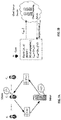
- FIG.3A and FIG.3B illustrates a use case block diagram of the two scenarios (FHE can be applied to machine learning applications in two scenarios) computation as a service and prediction as a service, respectively.
- FHE libraries include HElib, SEAL, HEAAN, PALISADE, TFHE and nGraph-HE.
- Each FHE library has multiple functionality, wherein the FHE functionality comprises a FHE scheme, an optimal configuration for a set of supporting features for the FHE library, a set of FHE parameters and an optimal configuration of the set of FHE parameters, wherein the set of supporting features comprises a packing technique and a noise management technique.
- the set of supporting features refer to limitation of the FHE library, that must be optimally configured for efficient privacy preserving in the application.
- FHE library primarily rely on hardness of three types of hardness assumptions:
- the set of supporting features comprises a packing technique and a noise management technique.
- Noise management is a major limitation of FHE. Every ciphertext has inherent noise associated which increases with number of computations. There are two ways for noise management, Bootstrapping and Modulus Switching. Bootstrapping is used to reduce the noise and get fresh ciphertext homomorphically at the expense of computation time. Modulus Switching helps in reducing noise but to certain extent only. Further considering noise management in ML, simple ML computations like Matrix multiplication or linear regression are linear in nature since they require only multiplication and addition operations, however, complex ML algorithms like logistic regression, neural networks require computing of exponents which are non-linear in nature and are hence hard to be computed in FHE setting.
- FIG. 1 through FIG. 8B where similar reference characters denote corresponding features consistently throughout the figures, there are shown preferred embodiments and these embodiments are described in the context of the following exemplary system and/or method.
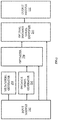
- FIG.1 is a functional block diagram of a system 100 for enabling fully homomorphic encryption (FHE) based privacy in an application in accordance with some embodiments of the present disclosure.
- FHE fully homomorphic encryption
- the system 100 includes a processor(s) 104, communication interface device(s), alternatively referred as input/output (I/O) interface(s) 106, and one or more data storage devices or a memory 102 operatively coupled to the processor(s) 104.
- the system 100 with one or more hardware processors is configured to execute functions of one or more functional blocks of the system 100.
- the processor(s) 104 can be one or more hardware processors 104.
- the one or more hardware processors 104 can be implemented as one or more microprocessors, microcomputers, microcontrollers, digital signal processors, central processing units, state machines, logic circuitries, and/or any devices that manipulate signals based on operational instructions.
- the one or more hardware processors 104 is configured to fetch and execute computer-readable instructions stored in the memory 102.
- the system 100 can be implemented in a variety of computing systems including laptop computers, notebooks, hand-held devices such as mobile phones, workstations, mainframe computers, servers, a network cloud and the like.
- the I/O interface(s) 106 can include a variety of software and hardware interfaces, for example, a web interface, a graphical user interface, a touch user interface (TUI) and the like and can facilitate multiple communications within a wide variety of networks N/W and protocol types, including wired networks, for example, LAN, cable, etc., and wireless networks, such as WLAN, cellular, or satellite.
- the I/O interface (s) 106 can include one or more ports for connecting a number of devices (nodes) of the system 100 to one another or to another server.
- the memory 102 may include any computer-readable medium known in the art including, for example, volatile memory, such as static random access memory (SRAM) and dynamic random access memory (DRAM), and/or non-volatile memory, such as read only memory (ROM), erasable programmable ROM, flash memories, hard disks, optical disks, and magnetic tapes.
- volatile memory such as static random access memory (SRAM) and dynamic random access memory (DRAM)
- DRAM dynamic random access memory
- non-volatile memory such as read only memory (ROM), erasable programmable ROM, flash memories, hard disks, optical disks, and magnetic tapes.
- the memory 102 may include a database 108.Thus, the memory 102 may comprise information pertaining to input(s)/output(s) of each step performed by the processor(s) 104 of the system 100 and methods of the present disclosure.
- the database 108 may be external (not shown) to the system 100 and coupled to the system via the I/O interface 106. Functions of the components of system 100 are explained in conjunction with functional overview of the system 100 in FIG. 1 and flow diagram of FIGS.8A and 8B for enabling privacy in an application using fully homomorphic encryption.
- the system 100 supports various connectivity options such as BLUETOOTH ® , USB, ZigBee and other cellular services.
- the network environment enables connection of various components of the system 100 using any communication link including Internet, WAN, MAN, and so on.
- the system 100 is implemented to operate as a stand-alone device.
- the system 100 may be implemented to work as a loosely coupled device to a smart computing environment. The components and functionalities of the system 100 are described further in detail.
- FIG.2 is a functional block diagram of the system 100 of FIG.1 , in accordance with some embodiments of the present disclosure. As depicted in the architecture, FIG.2 illustrates the functions of the components of the system 100 that includes enabling privacy in an application using fully homomorphic encryption.
- the system 100 for enabling privacy in an application using FHE includes an input module 202 configured for receiving, via a one or more hardware processors, an application, a set of input data pertaining to the application, a set of constraints and a user requirement.
- the set of input data are indicative of functions performed by the application
- the set of constraints are indicative of functional performance and cost of the application
- the user requirement is indicative of an optimization task to be performed as per a user's requirement.
- the application can refer to a machine learning application, wherein privacy preservation is to be enabled in for ML datasets or ML algorithms of the machine learning application.
- the set of constraints includes one of a user- defined constraints and a pre-defined constraints.
- the set of constraints comprises a computation time ( ⁇ f ), a memory consumption ( m f ), a communication cost ( comm f ) , a computation cost ( ⁇ f ) and a security level ( ⁇ ) as shown below;
- C ⁇ m comm ⁇
- the set of input data are indicative of functions performed by the application that include matrix multiplication, logistic regression, linear regression, neural networks.
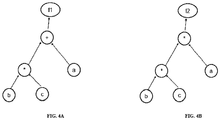
- a use case of the set of input data is illustrated in the FIG.4A and FIG.4B , wherein each node represents a leaf nodes represent the input ciphertexts and intermediate nodes represent a set of operations to be performed in a computation.
- the user requirement is indicative of an optimization task to be performed as per a user's requirement.
- the set of optimization tasks includes one of a multi objective-multi constraint optimization task and a single objective- multi constraint optimization task. Based on the user requirement, one optimization task from the set of optimization tasks is selected to be implemented for enabling privacy.
- the system 100 for enabling privacy in an application using FHE further comprises an meta model generator 204 configured for generating, via the one or more hardware processors, a set of inter-connected meta models based on an abstract data type (ADT) technique.
- the set of meta models comprises a plurality of meta model trees, wherein each of the plurality of meta model trees comprises a plurality of nodes that indicate a fully homomorphic encryption (FHE) library, an associated FHE functionality and an optimal configuration of the associated FHE functionality.
- FHE fully homomorphic encryption
- the abstract data type (ADT) technique comprises of a computation tree technique, JavaScript Object Notation (JSON) parsing, wherein the computation tree technique comprises representation of the application as a set of functions with a plurality of inter-connected nodes forming a tree structure.
- JSON JavaScript Object Notation
- fully homomorphic encryption or FHE library enables arbitrary computations on encrypted data from an application without decrypting them. Given a set of ciphertexts corresponding to a set of messages, a function can be computed resulting in an encrypted output, which when decrypted is equal to the result of computation.
- the FHE functionality comprises a FHE scheme, a set of supporting features and a set of FHE parameters and the optimal configuration of the associated FHE functionality comprises of an optimal configuration for the set of supporting features for the FHE and an optimal configuration for the set of FHE parameters.
- the FHE library includes a Homomorphic Encryption library (HElib), a Simple Encrypted Arithmetic Library (SEAL) , a Homomorphic Encryption for Arithmetic of Approximate Numbers (HEAAN), PALISADE, Torus Fully Homomorphic Encryption (TFHE) and nGraph-HE.
- HElib Homomorphic Encryption library
- SEAL Simple Encrypted Arithmetic Library
- HEAAN Homomorphic Encryption for Arithmetic of Approximate Numbers
- PALISADE Torus Fully Homomorphic Encryption
- TFHE Torus Fully Homomorphic Encryption
- nGraph-HE nGraph-HE.
- the FHE scheme includes brakerski, fan, vercauteren (BGV), Brakerski, Fan (BFE), Cheon, Kim, Kim, Song (CKKS)
- the set of supporting features comprises a packing technique and a noise management technique.
- Noise management is a major limitation of FHE. Every ciphertext has inherent noise associated which increases with number of computations. There are two ways for noise management, bootstrapping and modulus switching. Bootstrapping is used to reduce the noise and get fresh ciphertext homomorphically at the expense of computation time. Modulus switching helps in reducing noise but to certain extent only. Further considering noise management in ML, simple ML computations like matrix multiplication or linear regression are linear in nature since they require only multiplication and addition operations, however, complex ML algorithms such as logistic regression, neural networks require computing of exponents which are non-linear in nature and are hence hard to be computed in FHE setting.
- the set of FHE parameters are selected from an exhaustive set of FHE scheme parameters associated with the FHE library and the FHE schema, wherein the exhaustive set of FHE scheme parameters comprise a cyclotomic polynomial ( ), a degree of cyclotomic polynomial ( N ), a modulus for coefficients in plaintext ( p ), a plaintext modulus ( t ), a norm of secret key ( h ), a width of Gaussian distribution for sampling error ( ⁇ ) and an error distribution (X), which can be expressed as shown below:
- the set of FHE parameters and the optimal configuration for the set of FHE parameters is selected from the exhaustive set of FHE scheme parameters based on a circuit depth, a level of accuracy and the set of supporting features wherein the circuit depth and the level of accuracy is determined based on a multiplication operation between a set of nodes in the meta model trees of the meta-models.
- the set of inter-connected of meta models that is generated based on ADT techniques comprises a plurality of meta model trees, wherein each of the plurality of meta model trees comprises a plurality of nodes that indicate a fully homomorphic encryption (FHE) library, an associated FHE functionality and an optimal configuration of the associated FHE functionality.
- FHE fully homomorphic encryption
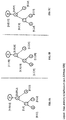
- FIG.5A, FIG.5B and FIG.5C wherein each node has a pair [a time, a memory] associated with it, wherein the time is represented as milliseconds and the memory represented as in kilobytes (KB).
- the memory represents a size of ciphertext after encryption (for a leaf node) and a resultant ciphertext after computation (for a intermediate node. Further for each of a leaf node, the time indicates an encryption time and for each of the intermediate nodes the time indicates the computation time.
- the table below summarizes the computation time and memory per ciphertext required for a given computation using SEAL library (BFV and CKKS) and HEAAN library (CKKS).
- Table 2 Tabulating constraints for a given computation Operation Without Packing SEAL (BFV) HEAAN (CKKS) SEAL (CKKS) Addition (ms) 0.019 0.26 0.06 Multiplication (ms) 1 3.36 0.17 a+b*c (ms) 1.619 7.2 0.83 Memory per ciphertext (KB) 2 26 4
- the system 100 for enabling privacy in an application using FHE further comprises an instance model generator 206 configured for generating, via the one or more hardware processors, a set of instance models for the application based on the set of constraints using the set of inter-connected meta models.
- Each of the set of instance models comprises a fully homomorphic encryption (FHE) technique, the associated FHE functionality and the optimal configuration of the associated FHE functionality identified from the meta models based on the set of constraints.
- FHE fully homomorphic encryption
- the set of instance models for the application based on the set of constraints uses the set of inter-connected meta models.
- Constraint 1 time ⁇ 2 ms
- Constraint 2 memory ⁇ 10 KB
- the set of instance models with plurality of nodes generated based on the set of constraints is illustrated in FIG.6A and FIG.6B wherein based on the time and memory constraints defined, the metamodels of FIG.4A and FIG.4C only are used for generating the instance models.
- the system 100 for enabling privacy in an application using FHE further comprises an optimizer 208 configured for optimizing, via the one or more hardware processors, each of the set of instance models by an optimization task to obtain a decision for each of the set of constraints.
- the optimization task is identified from a set of optimization tasks based on the user requirement and the set of optimization tasks comprises a multi objective-multi constraint optimization task and a single objective-multi constraint optimization task.
- the user requirement is indicative of an optimization task to be performed as per a user's requirement.
- the set of optimization tasks comprise the multi objective-multi constraint optimization task and the single objective- multi constraint optimization task, wherein one optimization task is identified from the set of optimization tasks to be implemented for enabling privacy preservation based on the user requirement.
- the multi objective - multi constraint optimization task optimizes the set of constraints that include minimize computation time ⁇ , memory consumption m, communication cost comm and computation cost of a function F in a privacy preserving manner and is represented as follows:
- F c ⁇ * argmin ⁇ F j c ⁇
- F j c ⁇ argmin F jk c ⁇
- F j argmin F jk
- the system 100 for enabling privacy in an application using FHE further comprises an optimal instance model identifier 210 configured for identifying, via the one or more hardware processors, a pre-defined number of optimal instance models from the set of instance models using a ranking technique.
- the ranking technique is performed based on the set of constraints.
- the ranking techniques includes, but are not limited to, weighted sum model, aggregated indices randomization and Technique for Order of Preference by Similarity to Ideal Solution (TOPSIS).
- TOPSIS Technique for Order of Preference by Similarity to Ideal Solution
- the ranking technique is performed based on set of constraints, wherein the user can prioritize among the set of constraints and the ranking process for the set of instance models is performed accordingly.
- the pre-defined number of optimal instance models is decided based on a user's requirement, wherein the user can choose how many optimal instance models the user may want to be displayed for a final selection of the privacy preserving technique to be used.
- the user wishes to see top 3 optimal instance models, then the top three optimal instance models from the ranked list is displayed for the user.
- the pre-defined number of optimal instance models identified from the set of instance models is illustrated in FIG. 7 wherein an optimal instance model is selected from the instance models (of FIG.6A and FIG.6B ) based on the set of constraints and the user's requirement.
- the system 100 for enabling privacy in an application using FHE further comprises an output module 212 configured for displaying, via the one or more hardware processors, the optimal instance model.
- the optimal instance model is indicative of the privacy preservation using FHE to be enabled in the application based on the fully homomorphic encryption (FHE) library, the associated FHE functionality and the optimal configuration of the associated FHE functionality in the optimal instance model
- the various modules of the system 100 for enabling privacy in an application using fully homomorphic encryption are implemented as at least one of a logically self-contained part of a software program, a self-contained hardware component, and/or, a self-contained hardware component with a logically self-contained part of a software program embedded into each of the hardware component that when executed perform the above method described herein.
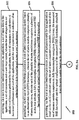
- FIG.8A and FIG.8B are an exemplary flow diagram illustrating a method (800) for using the system 100 of FIG.1 according to an embodiment of the present disclosure.
- the one or more hardware processors are configured receiving, in the input module 202, an application, a set of input data to the application, a set of constraints and a user requirement, wherein the set of input data are indicative of functions performed by the application, the set of constraints are indicative of functional performance and cost of the application, and the user requirement is indicative of an optimization task to be performed as per a user's requirement.
- the application can refer to a machine learning application, wherein privacy preservation is to be enabled in for ML datasets or ML algorithms of the machine learning application.
- the set of constraints comprises of either a user-defined constraint or a pre-defined constraint.
- the set of constraints comprises a a computation time ( ⁇ f ), a memory consumption ( m f ), a communication cost ( comm f ) , a computation cost ( ⁇ f ) and a security level ( ⁇ ).
- the set of input data are indicative of functions performed by the application that includes matrix multiplication, logistic regression, linear regression, neural networks.
- the user requirement is indicative of an optimization task to be performed as per a user's requirement.
- the set of optimization tasks comprise a multi objective-multi constraint optimization task and a single objective- multi constraint optimization task. Based on the user requirement one optimization task from the set of optimization tasks is selected to be implemented for enabling privacy preservation.
- the one or more hardware processors are configured for generating a set of inter-connected meta models based on an abstract data type (ADT) technique in the meta model generator 204.
- the set of meta models comprises a plurality of meta model trees, wherein each of the plurality of meta model trees comprises a plurality of nodes that indicate a fully homomorphic encryption (FHE) library, an associated FHE functionality and an optimal configuration of the associated FHE functionality.
- FHE fully homomorphic encryption
- the abstract data type (ADT) technique comprises of a computation tree technique, JSON parsing, wherein the computation tree technique comprises representation of the application as a set of functions with a plurality of inter-connected nodes forming a tree structure
- the one or more hardware processors are configured for generating a set of instance models for the application based on the set of constraints using the set of inter-connected meta models in the instance model generator 206.
- Each of the set of instance models comprises a fully homomorphic encryption (FHE) library, the associated FHE functionality and the optimal configuration of the associated FHE functionality identified from the meta models based on the set of constraints.
- FHE fully homomorphic encryption
- the one or more hardware processors are configured for optimizing each of the set of instance models by an optimization task to obtain a decision for each of the set of constraints in the optimizer 208.
- the optimization task is identified from a set of optimization tasks based on the user requirement and the set of optimization tasks comprises a multi objective-multi constraint optimization task and a single objective- multi constraint optimization task.
- the user requirement is indicative of an optimization task to be performed as per a user's requirement.
- the set of optimization tasks comprise the multi objective-multi constraint optimization task and the single objective- multi constraint optimization task, wherein one optimization task is identified from the set of optimization tasks to be implemented for enabling privacy preservation based on the user requirement.
- the multi objective - multi constraint optimization task optimizes the set of constraints that include minimize computation time ⁇ , memory consumption m, communication cost comm and computation cost of a function F in a privacy preserving manner and is represented as follows:
- F c ⁇ * argmin ⁇ F j c ⁇
- F j c ⁇ argmin F jk c ⁇
- F j argmin F jk
- the one or more hardware processors are configured for identifying a pre-defined number of optimal instance models from the set of instance models using a ranking technique in the optimal instance model identifier 210.
- the ranking technique is performed based on the decision for each of the set of constraints
- the ranking techniques includes weighted sum model and aggregated indices randomization.
- the ranking technique is performed based on set of constraints, wherein the user can prioritize among the set of constraints and the ranking process for the set of instance models is performed accordingly.
- the one or more hardware processors are configured for displaying the optimal instance model in the comprises an output module 212.
- the optimal instance model is indicative of the privacy preservation using FHE to be enabled in the application based on the fully homomorphic encryption (FHE) library, the associated FHE functionality and the optimal configuration of the associated FHE functionality in the optimal instance model
- the embodiments of present disclosure herein address the problem of enabling privacy in an application using fully homomorphic encryption.
- the disclosure more specifically refers to enabling a most optimal FHE for enabling privacy for an application based on a set of constraints using a disclosed set of optimization tasks.
- the set of optimization tasks comprise a multi objective-multi constraint optimization task and a single objective- multi constraint optimization task, that identifies an optimal FHE library, along with an associated FHE functionality and optimal configuration of the associated FHE functionality based on the set of constraints.
- the identified FHE along with the associated FHE functionality and the optimal configuration of the associated FHE functionality facilitate optimal implementation of privacy in applications.
- the hardware device can be any kind of device which can be programmed including e.g. any kind of computer like a server or a personal computer, or the like, or any combination thereof.
- the device may also include means which could be e.g. hardware means like e.g. an application-specific integrated circuit (ASIC), a field-programmable gate array (FPGA), or a combination of hardware and software means, e.g.
- ASIC application-specific integrated circuit
- FPGA field-programmable gate array
- the means can include both hardware means and software means.
- the method embodiments described herein could be implemented in hardware and software.
- the device may also include software means.
- the embodiments may be implemented on different hardware devices, e.g. using a plurality of CPUs.
- the embodiments herein can comprise hardware and software elements.
- the embodiments that are implemented in software include but are not limited to, firmware, resident software, microcode, etc.
- the functions performed by various components described herein may be implemented in other components or combinations of other components.
- a computer-usable or computer readable medium can be any apparatus that can comprise, store, communicate, propagate, or transport the program for use by or in connection with the instruction execution system, apparatus, or device.
- a computer-readable storage medium refers to any type of physical memory on which information or data readable by a processor may be stored.
- a computer-readable storage medium may store instructions for execution by one or more processors, including instructions for causing the processor(s) to perform steps or stages consistent with the embodiments described herein.
- the term "computer-readable medium” should be understood to include tangible items and exclude carrier waves and transient signals, i.e., be non-transitory. Examples include random access memory (RAM), read-only memory (ROM), volatile memory, nonvolatile memory, hard drives, CD ROMs, DVDs, flash drives, disks, and any other known physical storage media.
Landscapes
- Engineering & Computer Science (AREA)
- Theoretical Computer Science (AREA)
- Computer Security & Cryptography (AREA)
- General Health & Medical Sciences (AREA)
- Health & Medical Sciences (AREA)
- Bioethics (AREA)
- General Engineering & Computer Science (AREA)
- Computer Hardware Design (AREA)
- Software Systems (AREA)
- Physics & Mathematics (AREA)
- General Physics & Mathematics (AREA)
- Signal Processing (AREA)
- Computer Networks & Wireless Communication (AREA)
- Medical Informatics (AREA)
- Databases & Information Systems (AREA)
- Management, Administration, Business Operations System, And Electronic Commerce (AREA)
Abstract
Description
- The present application claims priority from
Indian provisional application no. 202021028022, filed on July 1, 2020 - The disclosure herein generally relates to the field of privacy preserving in an application, and, more particularly, a method and a system for enabling privacy in an application using fully homomorphic encryption (FHE).
- Data driven digital transformation has led to exponential increase of data. The exponential increase in data has increased dependence on cloud service providers (CSPs). Organizations are embracing cloud computing services to outsource storage and computations which can be efficiently managed with low cost over-head. With the increased dependence on cloud computing services, there is a growing concern for privacy of data as the data is stored and processed on third party cloud service providers. Of many solutions that enable privacy preserving computations on CSP, fully homomorphic encryption (FHE) is a promising solution. The FHE enables organizations to securely outsource data storage to CSPs while still allowing computations on the encrypted data without the need for decryption.
- Machine learning (ML) provides an ability to automatically learn and improve from feedback or experience without the need for explicit programming. However, existing ML models operate at the cost of a user's data privacy as sensitive data is stored at third party organizations or third party cloud service providers, without any safeguards from the service provider. Hence there is a demand to enable privacy of client's data, for which there is a need to perform privacy enabled Machine Learning or privacy preserving machine learning (PPML).
- The existing state of art techniques for implementing PPML focuses on implementing PPML models to solve specific problems such as private genomic sequencing or encrypted computation on genomic data and so on in privacy preserving manner. However these PPML techniques are optimized for a specific given use-case. Further the PPML techniques involve several complicated parameters and for the PPML technique to be efficient it is necessary to select the right parameters and the operating range of the selected parameters. Therefore, there is a need for generic framework that enables end-users to select an appropriate PPML scheme and its parameter set based on the requirements of the PPML applications.
- Embodiments of the present disclosure present technological improvements as solutions to one or more of the above-mentioned technical problems recognized by the inventors in conventional systems. For example, in one embodiment, a method and a system for enabling privacy in an application using fully homomorphic encryption is provided.
- In an aspect a method for enabling privacy in an application using fully homomorphic encryption is provided. The method includes receiving, via a one or more hardware processors, the application, a set of input data to the application, a set of constraints and a user requirement, wherein the set of input data are indicative of one or more functions performed by the application, the set of constraints are indicative of functional performance and cost of the application, and the user requirement is indicative of an optimization task to be performed as per a user's requirement. The method further includes generating, via the one or more hardware processors, a set of inter-connected meta models based on an abstract data type (ADT) technique, wherein the set of inter-connected meta models comprises a plurality of meta model trees, wherein each of the plurality of meta model trees comprises a plurality of nodes that indicate a fully homomorphic encryption (FHE) library, a FHE functionality associated with the FHE library and an optimal configuration of the associated FHE functionality. The method further includes generating, via the one or more hardware processors, a set of instance models for the application based on the set of constraints using the set of inter-connected meta models, wherein each of the set of instance models comprises an FHE library, the FHE functionality associated with the FHE library and the optimal configuration of the associated FHE functionality identified from the meta models based on the set of constraints. The method further includes optimizing, via the one or more hardware processors, each of the set of instance models based on the optimization task to obtain a decision for each of the set of constraints, wherein the optimization task is identified from a set of optimization tasks based on the user requirement, the set of optimization tasks comprises one of a multi objective-multi constraint optimization task and a single objective- multi constraint optimization task. The method further includes identifying, via the one or more hardware processors, a pre-defined number of optimal instance models from the set of instance models using a ranking technique, wherein the ranking technique is performed based the set of constraints. The method further includes displaying, via the one or more hardware processors, an optimal instance model, wherein the optimal instance model is indicative of the privacy preservation using FHE to be enabled in the application.
- In another aspect, a system for enabling privacy in an application using fully homomorphic encryption is provided. The system is configured for receiving the application, a set of input data to the application, a set of constraints and a user requirement, wherein the set of input data are indicative of one or more functions performed by the application, the set of constraints are indicative of functional performance and cost of the application, and the user requirement is indicative of an optimization task to be performed as per a user's requirement. The system is further configured for generating a set of inter-connected meta models based on an abstract data type (ADT) technique, wherein the set of inter-connected meta models comprises a plurality of meta model trees, wherein each of the plurality of meta model trees comprises a plurality of nodes that indicate a fully homomorphic encryption (FHE) library, a FHE functionality associated with the FHE library and an optimal configuration of the associated FHE functionality. The system is further configured for generating a set of instance models for the application based on the set of constraints using the set of inter-connected meta models, wherein each of the set of instance models comprises an FHE library, the FHE functionality associated with the FHE library and the optimal configuration of the associated FHE functionality identified from the meta models based on the set of constraints. The system is further configured for optimizing each of the set of instance models based on the optimization task to obtain a decision for each of the set of constraints, wherein the optimization task is identified from a set of optimization tasks based on the user requirement, the set of optimization tasks comprises one of a multi objective-multi constraint optimization task and a single objective- multi constraint optimization task. The system is further configured for identifying a pre-defined number of optimal instance models from the set of instance models using a ranking technique, wherein the ranking technique is performed based the set of constraints. The system is further configured for displaying an optimal instance model, wherein the optimal instance model is indicative of the privacy preservation using FHE to be enabled in the application.
- In yet another aspect, a non-transitory computer readable medium for a for enabling privacy in an application using fully homomorphic encryption is provided. The program includes receiving, via a one or more hardware processors, the application, a set of input data to the application, a set of constraints and a user requirement, wherein the set of input data are indicative of one or more functions performed by the application, the set of constraints are indicative of functional performance and cost of the application, and the user requirement is indicative of an optimization task to be performed as per a user's requirement. The program further includes generating, via the one or more hardware processors, a set of inter-connected meta models based on an abstract data type (ADT) technique, wherein the set of inter-connected meta models comprises a plurality of meta model trees, wherein each of the plurality of meta model trees comprises a plurality of nodes that indicate a fully homomorphic encryption (FHE) library, a FHE functionality associated with the FHE library and an optimal configuration of the associated FHE functionality. The program further includes generating, via the one or more hardware processors, a set of instance models for the application based on the set of constraints using the set of inter-connected meta models, wherein each of the set of instance models comprises an FHE library, the FHE functionality associated with the FHE library and the optimal configuration of the associated FHE functionality identified from the meta models based on the set of constraints. The program further includes optimizing, via the one or more hardware processors, each of the set of instance models based on the optimization task to obtain a decision for each of the set of constraints, wherein the optimization task is identified from a set of optimization tasks based on the user requirement, the set of optimization tasks comprises one of a multi objective-multi constraint optimization task and a single objective- multi constraint optimization task. The program further includes identifying, via the one or more hardware processors, a pre-defined number of optimal instance models from the set of instance models using a ranking technique, wherein the ranking technique is performed based the set of constraints. The program further includes displaying, via the one or more hardware processors, an optimal instance model, wherein the optimal instance model is indicative of the privacy preservation using FHE to be enabled in the application.
- It is to be understood that both the foregoing general description and the following detailed description are exemplary and explanatory only and are not restrictive of the invention, as claimed.
- The accompanying drawings, which are incorporated in and constitute a part of this disclosure, illustrate exemplary embodiments and, together with the description, serve to explain the disclosed principles:
-
FIG. 1 illustrates a functional block diagram of an exemplary system for enabling privacy in an application using fully homomorphic encryption (FHE) according to some embodiments of the present disclosure. -
FIG.2 is a functional block diagram for the system ofFIG. 1 according to some embodiments of the present disclosure. -
FIG.3A and FIG.3B illustrates a use case example block diagram wherein FHE can be applied to machine learning applications in two scenarios that include computation as a service and prediction as a service respectively, according to some embodiments of the present disclosure -
FIG.4A and FIG.4B illustrates a use case of the set of input data to the system for enabling privacy in an application using fully homomorphic encryption (FHE), according to some embodiments of the present disclosure. -
FIG.5A, FIG.5B and FIG.5C illustrates a use case of a set of meta models with plurality of nodes, according to some embodiments of the present disclosure -
FIG.6A and FIG.6B illustrates a use case of a set of instance models with plurality of nodes generated using the set of input data and the set of meta models, according to some embodiments of the present disclosure -
FIG.7 illustrates a use case of an optimal instance model with plurality of nodes generated using the set of instance models, according to some embodiments of the present disclosure -
FIG.8A andFIG.8B is a flow diagram illustrating a method for enabling privacy in an application using fully homomorphic encryption, in accordance with some embodiments of the present disclosure. - Exemplary embodiments are described with reference to the accompanying drawings. In the figures, the left-most digit(s) of a reference number identifies the figure in which the reference number first appears. Wherever convenient, the same reference numbers are used throughout the drawings to refer to the same or like parts. While examples and features of disclosed principles are described herein, modifications, adaptations, and other implementations are possible without departing from the scope of the disclosed embodiments. It is intended that the following detailed description be considered as exemplary only, with the true scope being indicated by the following claims.
- The embodiment discloses a method and a system for enabling privacy in an application using fully homomorphic encryption (FHE). The disclosure more specifically refers to enabling a most optimal FHE for enabling privacy preserving for an application based on a set of constraints using a disclosed set of optimization tasks. The set of optimization tasks comprise a multi objective-multi constraint optimization task and a single objective- multi constraint optimization task, that identifies an optimal FHE library, along with an associated FHE functionality and optimal configuration of the associated FHE functionality based on the set of constraints. The identified FHE along with the associated FHE functionality and the optimal configuration of the associated FHE functionality facilitate optimal FHE implementation in applications.
- The expression "application" in the context of the present disclosure refers to a software/Information technology(IT) application for which privacy preservation is to be enabled. In an embodiment, the application or the software application can refer to a machine learning application, wherein privacy preservation is to be enabled in for ML datasets or ML algorithms of the machine learning application. In another embodiment, the application or the software application include private information retrieval and authentication systems. A computing device may include hardware and software collectively configured to host the IT application for performing various functions.
- The terms FHE and FHE library have been used interchangeably in the description, wherein Fully homomorphic encryption (FHE) or FHE library enables arbitrary computations on encrypted data from an application without decrypting them. Given a set of ciphertexts corresponding to a set of messages, a function can be computed resulting in an encrypted output, which when decrypted is equal to the result of computation. A typical public key encryption algorithm has several functions that perform generation of public and private key pairs, encrypting a message with public key and decrypt a message with private key respectively. In addition to these functions, FHE encryption algorithms have an additional evaluation function that evaluates a given function over a set of input ciphertexts. The operations supported by FHE encryption schemes depend on the underlying mathematical structure of the ciphertexts.
- Applications based on fully homomorphic encryption use either bit-wise encryption instantiation or integer-wise encryption instantiation to encrypt data, however bit-wise encryption increases the size of data sets. The space required to store the ciphertext of a 1-bit integer in bit-wise encryption instantiation is 1-ciphertext units whereas integer-wise encryption requires only one ciphertext unit client than bit-wise encryption. Hence the challenge is to bring a balance between space and performance.
- FHE can be applied to machine learning applications in two scenarios: computation as a service and prediction as a service. In computation as a service model, a client requires to outsource ML computations to a cloud service providers (CSP) without revealing any information about the data to it. Here, the client is aware of the ML algorithm that is being outsourced and sends the algorithm and encrypted data to the CSP. The CSP performs the computations on the ciphertexts and sends the encrypted result back to the client. In prediction as a service scenario, the service provider has proprietary machine learning algorithms that they do not wish to share with the client. In the same way, the client doesn't wish to share confidential data to the service provider. Hence, using FHE, the client can provide encrypted inputs to the cloud service provider, who then feeds these encrypted inputs to the proprietary ML algorithm and develop model parameters. The CSP can then use this encrypted model to provide prediction as a service to the client. This way objectives of both client and server are realized. The
FIG.3A and FIG.3B illustrates a use case block diagram of the two scenarios (FHE can be applied to machine learning applications in two scenarios) computation as a service and prediction as a service, respectively. - Prominent open source implementations of FHE libraries include HElib, SEAL, HEAAN, PALISADE, TFHE and nGraph-HE. Each FHE library has multiple functionality, wherein the FHE functionality comprises a FHE scheme, an optimal configuration for a set of supporting features for the FHE library, a set of FHE parameters and an optimal configuration of the set of FHE parameters, wherein the set of supporting features comprises a packing technique and a noise management technique. The set of supporting features refer to limitation of the FHE library, that must be optimally configured for efficient privacy preserving in the application.
- FHE library primarily rely on hardness of three types of hardness assumptions:
- Lattice: Lattice schemes rely on hardness of lattice problems like Shortest Vector Problem (SVP) and Closest Vector Problem (CVP).
- LWE: LWE schemes rely on hardness of Learning with Errors problem. The problem with these schemes is that the key sizes are much larger.
- RLWE: RLWE schemes rely on hardness of Ring LWE problem which is efficient due to the underlying ring structure.
- M - the cyclotomic polynomial
- N - degree of cyclotomic polynomial N = Ø(M)
- p - modulus for co - efficient in the plaintext
- t = pr - plaintext modulus
- h - 1 - norm of the secret key (example : form of vector x is

- q is the co - efficient modulus for ciphertext and q 1 to ql are small primes
- α - the width of Gaussian distribution for sampling error
- X - the error distribution
- The set of supporting features comprises a packing technique and a noise management technique. Noise management is a major limitation of FHE. Every ciphertext has inherent noise associated which increases with number of computations. There are two ways for noise management, Bootstrapping and Modulus Switching. Bootstrapping is used to reduce the noise and get fresh ciphertext homomorphically at the expense of computation time. Modulus Switching helps in reducing noise but to certain extent only. Further considering noise management in ML, simple ML computations like Matrix multiplication or linear regression are linear in nature since they require only multiplication and addition operations, however, complex ML algorithms like logistic regression, neural networks require computing of exponents which are non-linear in nature and are hence hard to be computed in FHE setting.
- From PPML perspective, packing is required to improve the space efficiency and speed up the computation process of ML algorithms. To make the ML algorithms non-interactive, bootstrapping is required, which is expensive. However, to make ML algorithms more efficient and non-interactive, methodologies have to be designed to perform light weight bootstrapping on the packed ciphertexts.
- Hence to efficiently enable privacy for ML applications, it is extremly important to choose an optimal FHE and also ensure that the chosen FHE is optimally configured (FHE parameters) for better performance along with minimizing the limitations that include noise management and packing.
- Referring now to the drawings, and more particularly to
FIG. 1 through FIG. 8B where similar reference characters denote corresponding features consistently throughout the figures, there are shown preferred embodiments and these embodiments are described in the context of the following exemplary system and/or method. -
FIG.1 is a functional block diagram of asystem 100 for enabling fully homomorphic encryption (FHE) based privacy in an application in accordance with some embodiments of the present disclosure. - In an embodiment, the
system 100 includes a processor(s) 104, communication interface device(s), alternatively referred as input/output (I/O) interface(s) 106, and one or more data storage devices or amemory 102 operatively coupled to the processor(s) 104. Thesystem 100 with one or more hardware processors is configured to execute functions of one or more functional blocks of thesystem 100. - Referring to the components of
system 100, in an embodiment, the processor(s) 104, can be one ormore hardware processors 104. In an embodiment, the one ormore hardware processors 104 can be implemented as one or more microprocessors, microcomputers, microcontrollers, digital signal processors, central processing units, state machines, logic circuitries, and/or any devices that manipulate signals based on operational instructions. Among other capabilities, the one ormore hardware processors 104 is configured to fetch and execute computer-readable instructions stored in thememory 102. In an embodiment, thesystem 100 can be implemented in a variety of computing systems including laptop computers, notebooks, hand-held devices such as mobile phones, workstations, mainframe computers, servers, a network cloud and the like. - The I/O interface(s) 106 can include a variety of software and hardware interfaces, for example, a web interface, a graphical user interface, a touch user interface (TUI) and the like and can facilitate multiple communications within a wide variety of networks N/W and protocol types, including wired networks, for example, LAN, cable, etc., and wireless networks, such as WLAN, cellular, or satellite. In an embodiment, the I/O interface (s) 106 can include one or more ports for connecting a number of devices (nodes) of the
system 100 to one another or to another server. - The
memory 102 may include any computer-readable medium known in the art including, for example, volatile memory, such as static random access memory (SRAM) and dynamic random access memory (DRAM), and/or non-volatile memory, such as read only memory (ROM), erasable programmable ROM, flash memories, hard disks, optical disks, and magnetic tapes. - Further, the
memory 102 may include a database 108.Thus, thememory 102 may comprise information pertaining to input(s)/output(s) of each step performed by the processor(s) 104 of thesystem 100 and methods of the present disclosure. In an embodiment, thedatabase 108 may be external (not shown) to thesystem 100 and coupled to the system via the I/O interface 106. Functions of the components ofsystem 100 are explained in conjunction with functional overview of thesystem 100 inFIG. 1 and flow diagram ofFIGS.8A and8B for enabling privacy in an application using fully homomorphic encryption. - The
system 100 supports various connectivity options such as BLUETOOTH®, USB, ZigBee and other cellular services. The network environment enables connection of various components of thesystem 100 using any communication link including Internet, WAN, MAN, and so on. In an exemplary embodiment, thesystem 100 is implemented to operate as a stand-alone device. In another embodiment, thesystem 100 may be implemented to work as a loosely coupled device to a smart computing environment. The components and functionalities of thesystem 100 are described further in detail. -
FIG.2 is a functional block diagram of thesystem 100 ofFIG.1 , in accordance with some embodiments of the present disclosure. As depicted in the architecture,FIG.2 illustrates the functions of the components of thesystem 100 that includes enabling privacy in an application using fully homomorphic encryption. - The
system 100 for enabling privacy in an application using FHE includes aninput module 202 configured for receiving, via a one or more hardware processors, an application, a set of input data pertaining to the application, a set of constraints and a user requirement. The set of input data are indicative of functions performed by the application, the set of constraints are indicative of functional performance and cost of the application, and the user requirement is indicative of an optimization task to be performed as per a user's requirement. - In an embodiment, the application can refer to a machine learning application, wherein privacy preservation is to be enabled in for ML datasets or ML algorithms of the machine learning application.
- In an embodiment, the set of constraints includes one of a user- defined constraints and a pre-defined constraints. In an embodiment, the set of constraints comprises a computation time (τ f ), a memory consumption (mf ), a communication cost (commf ) , a computation cost (ξ f ) and a security level (λ) as shown below;

- In an embodiment, the set of input data are indicative of functions performed by the application that include matrix multiplication, logistic regression, linear regression, neural networks. A use case of the set of input data is illustrated in the
FIG.4A and FIG.4B , wherein each node represents a leaf nodes represent the input ciphertexts and intermediate nodes represent a set of operations to be performed in a computation. - In an embodiment, the user requirement is indicative of an optimization task to be performed as per a user's requirement. The set of optimization tasks includes one of a multi objective-multi constraint optimization task and a single objective- multi constraint optimization task. Based on the user requirement, one optimization task from the set of optimization tasks is selected to be implemented for enabling privacy.
- According to an embodiment of the disclosure, the
system 100 for enabling privacy in an application using FHE further comprises anmeta model generator 204 configured for generating, via the one or more hardware processors, a set of inter-connected meta models based on an abstract data type (ADT) technique. The set of meta models comprises a plurality of meta model trees, wherein each of the plurality of meta model trees comprises a plurality of nodes that indicate a fully homomorphic encryption (FHE) library, an associated FHE functionality and an optimal configuration of the associated FHE functionality. - In an embodiment, the abstract data type (ADT) technique comprises of a computation tree technique, JavaScript Object Notation (JSON) parsing, wherein the computation tree technique comprises representation of the application as a set of functions with a plurality of inter-connected nodes forming a tree structure.
- In an embodiment, fully homomorphic encryption (FHE) or FHE library enables arbitrary computations on encrypted data from an application without decrypting them. Given a set of ciphertexts corresponding to a set of messages, a function can be computed resulting in an encrypted output, which when decrypted is equal to the result of computation.
- In an embodiment, the FHE functionality comprises a FHE scheme, a set of supporting features and a set of FHE parameters and the optimal configuration of the associated FHE functionality comprises of an optimal configuration for the set of supporting features for the FHE and an optimal configuration for the set of FHE parameters.
- In an embodiment, the FHE library includes a Homomorphic Encryption library (HElib), a Simple Encrypted Arithmetic Library (SEAL) , a Homomorphic Encryption for Arithmetic of Approximate Numbers (HEAAN), PALISADE, Torus Fully Homomorphic Encryption (TFHE) and nGraph-HE. Further the FHE scheme includes brakerski, fan, vercauteren (BGV), Brakerski, Fan (BFE), Cheon, Kim, Kim, Song (CKKS)
- In an embodiment, the set of supporting features comprises a packing technique and a noise management technique. Noise management is a major limitation of FHE. Every ciphertext has inherent noise associated which increases with number of computations. There are two ways for noise management, bootstrapping and modulus switching. Bootstrapping is used to reduce the noise and get fresh ciphertext homomorphically at the expense of computation time. Modulus switching helps in reducing noise but to certain extent only. Further considering noise management in ML, simple ML computations like matrix multiplication or linear regression are linear in nature since they require only multiplication and addition operations, however, complex ML algorithms such as logistic regression, neural networks require computing of exponents which are non-linear in nature and are hence hard to be computed in FHE setting. Further the packing is required in order to improve the space efficiency and speed up the computation process of ML algorithms. To make the ML algorithms non-interactive, bootstrapping is required, which is expensive. However, to make ML algorithms more efficient and non-interactive, methodologies have to be designed to perform light weight bootstrapping on the packed ciphertexts.
- The set of FHE parameters are selected from an exhaustive set of FHE scheme parameters associated with the FHE library and the FHE schema, wherein the exhaustive set of FHE scheme parameters comprise a cyclotomic polynomial (), a degree of cyclotomic polynomial (N), a modulus for coefficients in plaintext (p), a plaintext modulus (t), a norm of secret key (h), a width of Gaussian distribution for sampling error (α) and an error distribution (X), which can be expressed as shown below:

- - the cyclotomic polynomial

- N - degree of cyclotomic polynomial N = Ø(M)
- p - modulus for co - efficient in the plaintext
- t = pr - plaintext modulus
- h - 1 - norm of the secret key (example :
form of vector x is
- q = q 1 * q 2 ::: ql where l = 1..L and L is the number of primes
- q is the co
- - efficient modulus for ciphertext and q 1 to ql are small primes
- α - the width of Gaussian distribution for sampling error
- X - the error distribution
- The set of FHE parameters and the optimal configuration for the set of FHE parameters is selected from the exhaustive set of FHE scheme parameters based on a circuit depth, a level of accuracy and the set of supporting features wherein the circuit depth and the level of accuracy is determined based on a multiplication operation between a set of nodes in the meta model trees of the meta-models.
- In an embodiment, the
FIG.4A and FIG.4B the circular depth can be expressed as shown below:

Table 1 : Approximation Polynomials for Sigmoid Approximation Polynomial Method 1 0.5 + 0.25x - 0.0208x 3 + 0.00208x 3 Taylor series 2 0.5 + 0.15x - 0.0015x 3 Least square approximation - Hence the set of inter-connected of meta models that is generated based on ADT techniques comprises a plurality of meta model trees, wherein each of the plurality of meta model trees comprises a plurality of nodes that indicate a fully homomorphic encryption (FHE) library, an associated FHE functionality and an optimal configuration of the associated FHE functionality. Considering the plurality of nodes involved are extremly complex and complicated as they are based on several features as explained above. In an embodiment, the meta models with plurality of nodes is illustrated in
FIG.5A, FIG.5B and FIG.5C wherein each node has a pair [a time, a memory] associated with it, wherein the time is represented as milliseconds and the memory represented as in kilobytes (KB). The memory represents a size of ciphertext after encryption (for a leaf node) and a resultant ciphertext after computation (for a intermediate node. Further for each of a leaf node, the time indicates an encryption time and for each of the intermediate nodes the time indicates the computation time. The table below summarizes the computation time and memory per ciphertext required for a given computation using SEAL library (BFV and CKKS) and HEAAN library (CKKS).Table 2 : Tabulating constraints for a given computation Operation Without Packing SEAL (BFV) HEAAN (CKKS) SEAL (CKKS) Addition (ms) 0.019 0.26 0.06 Multiplication (ms) 1 3.36 0.17 a+b*c (ms) 1.619 7.2 0.83 Memory per ciphertext (KB) 2 26 4 - According to an embodiment of the disclosure, the
system 100 for enabling privacy in an application using FHE further comprises aninstance model generator 206 configured for generating, via the one or more hardware processors, a set of instance models for the application based on the set of constraints using the set of inter-connected meta models. Each of the set of instance models comprises a fully homomorphic encryption (FHE) technique, the associated FHE functionality and the optimal configuration of the associated FHE functionality identified from the meta models based on the set of constraints. - The set of instance models for the application based on the set of constraints uses the set of inter-connected meta models. In an embodiment, considering a use case example wherein the set of constraints can be defined as follow:


- Based on the given constraints and the meta models (as shared in
FIG.4A, FIG.4B and FIG.4C ), the set of instance models with plurality of nodes generated based on the set of constraints is illustrated inFIG.6A and FIG.6B wherein based on the time and memory constraints defined, the metamodels ofFIG.4A and FIG.4C only are used for generating the instance models. - According to an embodiment of the disclosure, the
system 100 for enabling privacy in an application using FHE further comprises anoptimizer 208 configured for optimizing, via the one or more hardware processors, each of the set of instance models by an optimization task to obtain a decision for each of the set of constraints. The optimization task is identified from a set of optimization tasks based on the user requirement and the set of optimization tasks comprises a multi objective-multi constraint optimization task and a single objective-multi constraint optimization task. - In an embodiment, the user requirement is indicative of an optimization task to be performed as per a user's requirement. The set of optimization tasks comprise the multi objective-multi constraint optimization task and the single objective- multi constraint optimization task, wherein one optimization task is identified from the set of optimization tasks to be implemented for enabling privacy preservation based on the user requirement.
- In an embodiment, the multi objective - multi constraint optimization task optimizes the set of constraints that include minimize computation time τ , memory consumption m, communication cost comm and computation cost of a function F in a privacy preserving manner and is represented as follows:

such that
- set of constraints is represented by C = {τ,m,comm,ξ}, τ f is the computation time, mf is the memory consumption, commf is the communication cost, ξf is the computation cost and λ is the security level,
- is optimal instance model,

- F = {f 1, f 2, f 3, ... fn } : Set of sub-computations,
- Fjk: Instance model generated using jth FHE library and FHE scheme
-

-

-

- pq : Number of schemes supported by library 1
- λ j : Security level for FHE library j
- α : Number of FHE libraries
-

- || : Number of sub-functions

- fi∈F : ith sub computations of F
-
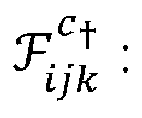
jk , where c † ∈ C - W c
† : User given priority for constraint computation time where time τ where c † ∈ C - In an embodiment, the single objective - multi constraint optimization task comprises:

such that


- set of constraints is represented by C = {τ,m,comm,ξ}, τ f is the computation time, mf is the memory consumption, commf is the communication cost, ξ f is the computation cost and λ is the security level,
- is optimal instance model,

- F = {f 1,f 2,f 3,...fn } : Set of sub-computations,
- Fjk: Instance model generated using jth FHE library and FHE scheme
-

-

-
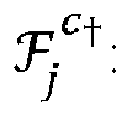
- pq : Number od schemes supported by library 1
- λ j : Security level for FHE library j
- α : Number of FHE libraries
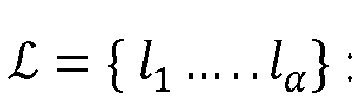
- || : Number of sub-functions

- fi∈F : ith sub computations of F
-

jk , where c † ∈ C - W c
† : User given priority for constraint computation time where time τ where c † ∈ C - According to an embodiment of the disclosure, the
system 100 for enabling privacy in an application using FHE further comprises an optimalinstance model identifier 210 configured for identifying, via the one or more hardware processors, a pre-defined number of optimal instance models from the set of instance models using a ranking technique. The ranking technique is performed based on the set of constraints. - In an embodiment, the ranking techniques includes, but are not limited to, weighted sum model, aggregated indices randomization and Technique for Order of Preference by Similarity to Ideal Solution (TOPSIS). In an embodiment, the ranking technique is performed based on set of constraints, wherein the user can prioritize among the set of constraints and the ranking process for the set of instance models is performed accordingly.
- In an embodiment, the pre-defined number of optimal instance models is decided based on a user's requirement, wherein the user can choose how many optimal instance models the user may want to be displayed for a final selection of the privacy preserving technique to be used. In a use case scenario, if the user wishes to see top 3 optimal instance models, then the top three optimal instance models from the ranked list is displayed for the user.
- In an embodiment, the pre-defined number of optimal instance models identified from the set of instance models is illustrated in
FIG. 7 wherein an optimal instance model is selected from the instance models (ofFIG.6A and FIG.6B ) based on the set of constraints and the user's requirement. - According to an embodiment of the disclosure, the
system 100 for enabling privacy in an application using FHE further comprises anoutput module 212 configured for displaying, via the one or more hardware processors, the optimal instance model. The optimal instance model is indicative of the privacy preservation using FHE to be enabled in the application based on the fully homomorphic encryption (FHE) library, the associated FHE functionality and the optimal configuration of the associated FHE functionality in the optimal instance model - The various modules of the
system 100 for enabling privacy in an application using fully homomorphic encryption are implemented as at least one of a logically self-contained part of a software program, a self-contained hardware component, and/or, a self-contained hardware component with a logically self-contained part of a software program embedded into each of the hardware component that when executed perform the above method described herein. - Functions of the components of the
system 100 are explained in conjunction with functional modules of thesystem 100 stored in thememory 102 and further explained in conjunction with flow diagram ofFIGS. 8A and8B . TheFIG.8A andFIG.8B , with reference toFIG.1 , is an exemplary flow diagram illustrating a method (800) for using thesystem 100 ofFIG.1 according to an embodiment of the present disclosure. - The steps of the method of the present disclosure will now be explained with reference to the components of the system(100) for enabling fully homomorphic encryption (FHE) based privacy preservation in an application and the modules (202-212) as depicted in
FIGS.2 and the flow diagrams as depicted inFIG.8A andFIG.8B . Although process steps, method steps, techniques or the like may be described in a sequential order, such processes, methods and techniques may be configured to work in alternate orders. In other words, any sequence or order of steps that may be described does not necessarily indicate a requirement that the steps to be performed in that order. The steps of processes described herein may be performed in any order practical. Further, some steps may be performed simultaneously. - At
step 802 of the method (800), the one or more hardware processors are configured receiving, in theinput module 202, an application, a set of input data to the application, a set of constraints and a user requirement, wherein the set of input data are indicative of functions performed by the application, the set of constraints are indicative of functional performance and cost of the application, and the user requirement is indicative of an optimization task to be performed as per a user's requirement. - In an embodiment, the application can refer to a machine learning application, wherein privacy preservation is to be enabled in for ML datasets or ML algorithms of the machine learning application.
- In an embodiment, the set of constraints comprises of either a user-defined constraint or a pre-defined constraint. The set of constraints comprises a a computation time (τ f ), a memory consumption (mf ), a communication cost (commf ) , a computation cost (ξ f ) and a security level (λ).
- In an embodiment, the set of input data are indicative of functions performed by the application that includes matrix multiplication, logistic regression, linear regression, neural networks.
- In an embodiment, the user requirement is indicative of an optimization task to be performed as per a user's requirement. The set of optimization tasks comprise a multi objective-multi constraint optimization task and a single objective- multi constraint optimization task. Based on the user requirement one optimization task from the set of optimization tasks is selected to be implemented for enabling privacy preservation.
- At
step 804 of the method (800), the one or more hardware processors are configured for generating a set of inter-connected meta models based on an abstract data type (ADT) technique in themeta model generator 204. The set of meta models comprises a plurality of meta model trees, wherein each of the plurality of meta model trees comprises a plurality of nodes that indicate a fully homomorphic encryption (FHE) library, an associated FHE functionality and an optimal configuration of the associated FHE functionality. - In an embodiment, in an embodiment, the abstract data type (ADT) technique comprises of a computation tree technique, JSON parsing, wherein the computation tree technique comprises representation of the application as a set of functions with a plurality of inter-connected nodes forming a tree structure
- At
step 806 of the method (800), the one or more hardware processors are configured for generating a set of instance models for the application based on the set of constraints using the set of inter-connected meta models in theinstance model generator 206. Each of the set of instance models comprises a fully homomorphic encryption (FHE) library, the associated FHE functionality and the optimal configuration of the associated FHE functionality identified from the meta models based on the set of constraints. - At
step 808 of the method (800), the one or more hardware processors are configured for optimizing each of the set of instance models by an optimization task to obtain a decision for each of the set of constraints in theoptimizer 208. The optimization task is identified from a set of optimization tasks based on the user requirement and the set of optimization tasks comprises a multi objective-multi constraint optimization task and a single objective- multi constraint optimization task. - In an embodiment, the user requirement is indicative of an optimization task to be performed as per a user's requirement. The set of optimization tasks comprise the multi objective-multi constraint optimization task and the single objective- multi constraint optimization task, wherein one optimization task is identified from the set of optimization tasks to be implemented for enabling privacy preservation based on the user requirement.
- In an embodiment, the multi objective - multi constraint optimization task optimizes the set of constraints that include minimize computation time τ , memory consumption m, communication cost comm and computation cost of a function F in a privacy preserving manner and is represented as follows:


- set of constraints is represented by C = {τ,m,comm,ξ}, τ f is the computation time, mf is the memory consumption, commf is the communication cost, ξf is the computation cost and λ is the security level,
- is optimal instance model,

- F = {f 1, f 2, f 3, ... fn } : Set of sub-computations,
- Fjk: Instance model generated using jth FHE library and FHE scheme
-

-

-

- pq : Number od schemes supported by library 1
- λj : Security level for FHE library j
- α : Number of FHE libraries
-

- || : Number of sub-functions

- fi∈F : ith sub computations of F
-

jk , where c † ∈ C - W c
† : User given priority for constraint computation time where time τ where c † ∈ C - In an embodiment, the single objective - multi constraint optimization task comprises:


- set of constraints is represented by C = {τ,m,comm,ξ}, τ f is the computation time, mf is the memory consumption, commf is the communication cost, ξf is the computation cost and λ is the security level,
- is optimal instance model,

- F = {f 1,f 2,f 3,... fn } : Set of sub-computations,
- Fjk: Instance model generated using jth FHE library and FHE scheme
-

-

-

- pq : Number od schemes supported by library 1
- λ j : Security level for FHE library j
- α : Number of FHE libraries
-

- || : Number of sub-functions

- fi∈F : ith sub computations of F
-

jk , where c † ∈ C - W c
† : User given priority for constraint computation time where time τ where c † ∈ C - At
step 810 of the method (800), the one or more hardware processors are configured for identifying a pre-defined number of optimal instance models from the set of instance models using a ranking technique in the optimalinstance model identifier 210. The ranking technique is performed based on the decision for each of the set of constraints - In an embodiment, the ranking techniques includes weighted sum model and aggregated indices randomization. The ranking technique is performed based on set of constraints, wherein the user can prioritize among the set of constraints and the ranking process for the set of instance models is performed accordingly.
- At
step 812 of the method (800), the one or more hardware processors are configured for displaying the optimal instance model in the comprises anoutput module 212. The optimal instance model is indicative of the privacy preservation using FHE to be enabled in the application based on the fully homomorphic encryption (FHE) library, the associated FHE functionality and the optimal configuration of the associated FHE functionality in the optimal instance model - The written description describes the subject matter herein to enable any person skilled in the art to make and use the embodiments. The scope of the subject matter embodiments is defined by the claims and may include other modifications that occur to those skilled in the art. Such other modifications are intended to be within the scope of the claims if they have similar elements that do not differ from the literal language of the claims or if they include equivalent elements with insubstantial differences from the literal language of the claims.
- Experimental Results :
The experiment has been conducted using the single objective - multi constraint optimization task optimization problem using a TOPSIS optimizer. Two sets of inputs are given to optimization solver (TOPSIS), set-I is Columns (2,3&4) and set-II is Columns (5 to 10). Set-I give estimates of each of the operations based on the computation of basic primitive operations. Using this the optimizer gave SEAL library as the optimal solution for matrix multiplication. For set-II, if time and memory consumption are given same weightage by the user, the optimizer gives SEAL-2 as the optimal solution, with HEAAN 2 as the second preference and SEAL as third. However, if memory is given higher weightage, then optimizer returns HEAAN-2 as the optimal solution, SEAL-2 and SEAL as second and third preference respectively.
The same has been documented in the table 4 below ;Table 4 :Experiment using TOPSIS 1 Operation Calculated estimates Practical w/o packing Practical with packing HElib SEAL HEAAN HElib SEAL HEAAN SEAL2 HEAAN2 Add + Mul (millisecs) 16 13.5 28.9 16 13.5 28.9 30 283 100x100 Matrix mult on 32 cores (secs) 330 200 1100 680 278 745 11.7 22.5 Memory per ciphertext (KB) 443 16 106 443 16 106 262144 1048 Memory for 100x100 matrix mult(GB) 44 0.16 1.06 11.4° 3.78° 17.78° 0.8* 0.14* Rank - Time and Mem equal weight 2 1 3 4 3 5 1 2 Rank - Mem more weight than Time 3 1 2 4 3 5 2 1 - Further the experimentation was conducted with two more sets of inputs to the recommendation system optimization solver (TOPSIS), set-I Columns (2&3g) and set-II Columns (4&5). The optimizer gives HEAAN as the best solution for both the sets as shown below in table 5 below :
Table 5 : Experiment using TOPSIS 2 Operation Calculated estimates Practical SEAL HEAAN SEAL HEAAN Add (millisecs) 2 0.88 2 0.88 Mul (millisecs) 62.8 470 62.8 470 Time - Linear Regression - 150x4 dataset (sees) 2 1.8 10 7.7 Memory per ciphertext (KB) 64 524 64 524 Memory for LR(MB) 151 0.01 921 * 0.469 * Rank 2 1 2 1 - The embodiments of present disclosure herein address the problem of enabling privacy in an application using fully homomorphic encryption. The disclosure more specifically refers to enabling a most optimal FHE for enabling privacy for an application based on a set of constraints using a disclosed set of optimization tasks. The set of optimization tasks comprise a multi objective-multi constraint optimization task and a single objective- multi constraint optimization task, that identifies an optimal FHE library, along with an associated FHE functionality and optimal configuration of the associated FHE functionality based on the set of constraints. The identified FHE along with the associated FHE functionality and the optimal configuration of the associated FHE functionality facilitate optimal implementation of privacy in applications.
- It is to be understood that the scope of the protection is extended to such a program and in addition to a computer-readable means having a message therein; such computer-readable storage means contain program-code means for implementation of one or more steps of the method, when the program runs on a server or mobile device or any suitable programmable device. The hardware device can be any kind of device which can be programmed including e.g. any kind of computer like a server or a personal computer, or the like, or any combination thereof. The device may also include means which could be e.g. hardware means like e.g. an application-specific integrated circuit (ASIC), a field-programmable gate array (FPGA), or a combination of hardware and software means, e.g. an ASIC and an FPGA, or at least one microprocessor and at least one memory with software processing components located therein. Thus, the means can include both hardware means and software means. The method embodiments described herein could be implemented in hardware and software. The device may also include software means. Alternatively, the embodiments may be implemented on different hardware devices, e.g. using a plurality of CPUs.
- The embodiments herein can comprise hardware and software elements. The embodiments that are implemented in software include but are not limited to, firmware, resident software, microcode, etc. The functions performed by various components described herein may be implemented in other components or combinations of other components. For the purposes of this description, a computer-usable or computer readable medium can be any apparatus that can comprise, store, communicate, propagate, or transport the program for use by or in connection with the instruction execution system, apparatus, or device.
- The illustrated steps are set out to explain the exemplary embodiments shown, and it should be anticipated that ongoing technological development will change the manner in which particular functions are performed. These examples are presented herein for purposes of illustration, and not limitation. Further, the boundaries of the functional building blocks have been arbitrarily defined herein for the convenience of the description. Alternative boundaries can be defined so long as the specified functions and relationships thereof are appropriately performed. Alternatives (including equivalents, extensions, variations, deviations, etc., of those described herein) will be apparent to persons skilled in the relevant art(s) based on the teachings contained herein. Such alternatives fall within the scope of the disclosed embodiments. Also, the words "comprising," "having," "containing," and "including," and other similar forms are intended to be equivalent in meaning and be open ended in that an item or items following any one of these words is not meant to be an exhaustive listing of such item or items, or meant to be limited to only the listed item or items. It must also be noted that as used herein and in the appended claims, the singular forms "a," "an," and "the" include plural references unless the context clearly dictates otherwise.
- Furthermore, one or more computer-readable storage media may be utilized in implementing embodiments consistent with the present disclosure. A computer-readable storage medium refers to any type of physical memory on which information or data readable by a processor may be stored. Thus, a computer-readable storage medium may store instructions for execution by one or more processors, including instructions for causing the processor(s) to perform steps or stages consistent with the embodiments described herein. The term "computer-readable medium" should be understood to include tangible items and exclude carrier waves and transient signals, i.e., be non-transitory. Examples include random access memory (RAM), read-only memory (ROM), volatile memory, nonvolatile memory, hard drives, CD ROMs, DVDs, flash drives, disks, and any other known physical storage media.
- It is intended that the disclosure and examples be considered as exemplary only, with a true scope of disclosed embodiments being indicated by the following claims


Claims (15)
- A processor-implemented method (800) for enabling privacy in an application using fully homomorphic encryption (FHE), the method comprising:receiving (802), via a one or more hardware processors, the application, a set of input data to the application, a set of constraints and a user requirement, wherein the set of input data are indicative of one or more functions performed by the application, the set of constraints are indicative of functional performance and cost of the application, and the user requirement is indicative of an optimization task to be performed as per a user's requirement;generating (804), via the one or more hardware processors, a set of inter-connected meta models based on an abstract data type (ADT) technique, wherein the set of inter-connected meta models comprises a plurality of meta model trees, wherein each of the plurality of meta model trees comprises a plurality of nodes that indicate a fully homomorphic encryption (FHE) library, a FHE functionality associated with the FHE library and an optimal configuration of the associated FHE functionality;generating (806), via the one or more hardware processors, a set of instance models for the application based on the set of constraints using the set of inter-connected meta models, wherein each of the set of instance models comprises an FHE library, the FHE functionality associated with the FHE library and the optimal configuration of the associated FHE functionality identified from the meta models based on the set of constraints;optimizing (808), via the one or more hardware processors, each of the set of instance models based on the optimization task to obtain a decision for each of the set of constraints, wherein the optimization task is identified from a set of optimization tasks based on the user requirement, the set of optimization tasks comprises one of a multi objective-multi constraint optimization task and a single objective- multi constraint optimization task;identifying (810), via the one or more hardware processors, a pre-defined number of optimal instance models from the set of instance models using a ranking technique, wherein the ranking technique is performed based the set of constraints; anddisplaying (812), via the one or more hardware processors, an optimal instance model, wherein the optimal instance model is indicative of the privacy preservation using FHE to be enabled in the application.
- The method according to claim 1, wherein the set of constraints comprises one of a user- defined constraints or a pre-defined constraints, where the set of constraints comprises a computation type, a computation time, a memory consumption, a communication cost, a computation cost and a security level.
- The method according to claim 1, wherein the ADT technique comprises of a computation tree technique, JavaScript Object Notation (JSON™) parsing, wherein the computation tree technique comprises representation of the application as a set of functions with a plurality of inter-connected nodes forming a tree structure.
- The method according to claim 1, wherein the FHE functionality comprises a FHE scheme, a set of supporting features and a set of FHE parameters and the optimal configuration of the associated FHE functionality comprises of an optimal configuration for the set of supporting features for the FHE and an optimal configuration for the set of FHE parameters.
- The method according to claim 4, wherein the set of supporting features comprises a packing technique and a noise management technique.
- The method according to claim 4, wherein the set of FHE parameters are selected from a set of FHE scheme parameters associated with the FHE library and the FHE schema, wherein the set of FHE scheme parameters comprises a cyclotomic polynomial, a degree of cyclotomic polynomial, a modulus for coefficients in plaintext, a plaintext modulus, a norm of secret key, a width of Gaussian distribution for sampling error and an error distribution.
- The method according to claim 6, wherein the set of FHE parameters and the optimal configuration for the set of FHE parameters are selected from the set of FHE scheme parameters based on a circuit depth, a level of accuracy and the set of supporting features wherein the circuit depth and the level of accuracy are determined based on a multiplication operation between a set of nodes in the meta model tree of the meta-models.
- The method according to claim 1, wherein the multi objective - multi constraint optimization task optimizes the set of constraints that comprises a minimize computation time τ, a memory consumption m, a communication cost comm and a computation cost of a function F in a privacy preserving manner and is represented as follows:


set of constraints is represented by C = {τ,m,comm,ξ}, τ f is the computation time, mf is the memory consumption, commf is the communication cost, ξf is the computation cost and λ is the security level,
is optimal instance model,
F = {f 1, f 2, f 3, ... fn } : Set of sub-computations,
Fjk: Instance model generated using jth FHE library and FHE scheme


pq : Number of schemes supported by library 1
λ j : Security level for FHE library j
α : Number of FHE libraries

|| : Number of sub-functions
fi∈F : ith sub computations of F

c † ∈ C
W c† : User given priority for constraint computation time where time τ where c † ∈ C
- The method according to claim 1, wherein the single objective - multi constraint optimization task comprises:


set of constraints is represented by C = {τ,m,comm,ξ}, τ f is the computation time, mf is the memory consumption, commf is the communication cost, ξf is the computation cost and λ is the security level,is optimal instance model,
F = {f 1, f 2, f 3, ... fn } : Set of sub-computations,
Fjk: Instance model generated using jth FHE library and FHE scheme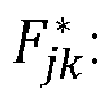


pq : Number of schemes supported by library 1
λ j : Security level for FHE library j
α : Number of FHE libraries
|| : Number of sub-functions
fi∈F : ith sub computations of F

jk , where c † ∈ C
W c† : User given priority for constraint computation time where time τ where c † ∈ C
- A system (100) for enabling privacy in an application using fully homomorphic encryption (FHE), comprising:one or more memories (102);one or more hardware processors (104);an input/output interface (106); andthe one or more memories (102) coupled to the one or more hardware processors (104), wherein the one or more hardware processors (104) are configured to execute programmed instructions stored in the one or more memories (104), to:receive the application, a set of input data to the application, a set of constraints and a user requirement, wherein the set of input data are indicative of one or more functions performed by the application, the set of constraints are indicative of functional performance and cost of the application, and the user requirement is indicative of an optimization task to be performed as per a user's requirement;generate, a set of inter-connected meta models based on an abstract data type (ADT) technique, wherein the set of inter-connected meta models comprises a plurality of meta model trees, wherein each of the plurality of meta model trees comprises a plurality of nodes that indicate a fully homomorphic encryption (FHE) library, a FHE functionality associated with the FHE library and an optimal configuration of the associated FHE functionality;generate a set of instance models for the application based on the set of constraints using the set of inter-connected meta models, wherein each of the set of instance models comprises an FHE library, the FHE functionality associated with the FHE library and the optimal configuration of the associated FHE functionality identified from the meta models based on the set of constraints;optimize each of the set of instance models based on the optimization task to obtain a decision for each of the set of constraints, wherein the optimization task is identified from a set of optimization tasks based on the user requirement, the set of optimization tasks comprises one of a multi objective-multi constraint optimization task and a single objective- multi constraint optimization task;identify a pre-defined number of optimal instance models from the set of instance models using a ranking technique, wherein the ranking technique is performed based the set of constraints; anddisplay an optimal instance model, wherein the optimal instance model is indicative of the privacy preservation using FHE to be enabled in the application.
- The system according to claim 10, wherein the abstract data type (ADT) technique are implemented by the one or more hardware processors that are further configured by the instructions to represent the input application as a set of functions with a plurality of inter-connected nodes forming a tree structure based on a the computation tree technique.
- The system according to claim 10, wherein the multi objective - multi constraint optimization task are implemented by the one or more hardware processors that are further configured by the instructions to perform optimization task using the multi objective - multi constraint optimization task as shown below:


set of constraints is represented by C = {τ,m,comm,ξ}, τ f is the computation time, mf is the memory consumption, commf is the communication cost, ξf is the computation cost and λ is the security level,is α optimal instance model,
F = {f 1,f 2,f 3,... fn } : Set of sub-computations,
Fjk: Instance model generated using jth FHE library and FHE scheme


pq : Number of schemes supported by library 1
λj : Security level for FHE library j
α : Number of FHE libraries
|| : Number of sub-functions
fi∈F : ith sub computations of F
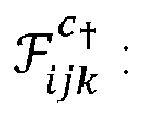
jk , where c † ∈ C
W c† : User given priority for constraint computation time where time τ where c † ∈ C
- The system according to claim 10, wherein the single objective-multi constraint optimization task are implemented by the one or more hardware processors that are further configured by the instructions to perform optimization task using the single objective- multi constraint optimization task as shown below:


set of constraints is represented by C = {τ,m,comm,ξ}, τ f is the computation time, mf is the memory consumption, commf is the communication cost, ξf is the computation cost and λ is the security level,is optimal instance model,
F = {f 1,f 2,f 3,...fn } : Set of sub-computations,
Fjk: Instance model generated using jth FHE library and FHE scheme


where c † ∈ C
pq : Number of schemes supported by library 1
λ j : Security level for FHE library j
α : Number of FHE libraries
|| : Number of sub-functions
fi∈F : ith sub computations of F

jk , where c † ∈ C
W c† : User given priority for constraint computation time where time τ where c † ∈ C
- The system according to claim 10, wherein the selection of set of FHE parameters and optimal configuration of the set of FHE parameters are implemented by the one or more hardware processors that are further configured by the instructions to select the set of FHE parameters and the optimal configuration of the set of FHE parameters from the exhaustive set of FHE scheme parameters based on a circuit depth, a level of accuracy and the set of supporting features wherein the circuit depth and the level of accuracy is determined based on a multiplication operation between a set of nodes in the meta model trees of the meta-models .
- A computer program product comprising a non-transitory computer readable medium having a computer readable program embodied therein, wherein the computer readable program, when executed on a computing device, causes the computing device to:receive the application, a set of input data to the application, a set of constraints and a user requirement, wherein the set of input data are indicative of one or more functions performed by the application, the set of constraints are indicative of functional performance and cost of the application, and the user requirement is indicative of an optimization task to be performed as per a user's requirement;generate, a set of inter-connected meta models based on an abstract data type (ADT) technique, wherein the set of inter-connected meta models comprises a plurality of meta model trees, wherein each of the plurality of meta model trees comprises a plurality of nodes that indicate a fully homomorphic encryption (FHE) library, a FHE functionality associated with the FHE library and an optimal configuration of the associated FHE functionality;generate a set of instance models for the application based on the set of constraints using the set of inter-connected meta models, wherein each of the set of instance models comprises an FHE library, the FHE functionality associated with the FHE library and the optimal configuration of the associated FHE functionality identified from the meta models based on the set of constraints;optimize each of the set of instance models based on the optimization task to obtain a decision for each of the set of constraints, wherein the optimization task is identified from a set of optimization tasks based on the user requirement, the set of optimization tasks comprises one of a multi objective-multi constraint optimization task and a single objective- multi constraint optimization task;identify a pre-defined number of optimal instance models from the set of instance models using a ranking technique, wherein the ranking technique is performed based the set of constraints; anddisplay an optimal instance model, wherein the optimal instance model is indicative of the privacy preservation using FHE to be enabled in the application.
Applications Claiming Priority (1)
| Application Number | Priority Date | Filing Date | Title |
|---|---|---|---|
| IN202021028022 | 2020-07-01 |
Publications (1)
| Publication Number | Publication Date |
|---|---|
| EP3933714A1 true EP3933714A1 (en) | 2022-01-05 |
Family
ID=76601105
Family Applications (1)
| Application Number | Title | Priority Date | Filing Date |
|---|---|---|---|
| EP21181481.9A Withdrawn EP3933714A1 (en) | 2020-07-01 | 2021-06-24 | Method and system for optimal selection of parameters for privacy preserving machine learning applications using fully homomorphic encryption |
Country Status (2)
| Country | Link |
|---|---|
| US (1) | US11681827B2 (en) |
| EP (1) | EP3933714A1 (en) |
Cited By (3)
| Publication number | Priority date | Publication date | Assignee | Title |
|---|---|---|---|---|
| CN116599648A (en) * | 2023-06-30 | 2023-08-15 | 北京航空航天大学 | Data universal computing method, device, equipment and medium based on fully homomorphic encryption |
| CN118378521A (en) * | 2024-04-18 | 2024-07-23 | 南京航空航天大学 | An adaptive sampling method for multi-model decision making based on weighted approximation to ideal points |
| US12284265B2 (en) | 2022-06-27 | 2025-04-22 | International Business Machines Corporation | Optimal profile selection for FHE based analytical models |
Families Citing this family (5)
| Publication number | Priority date | Publication date | Assignee | Title |
|---|---|---|---|---|
| EP3933714A1 (en) * | 2020-07-01 | 2022-01-05 | Tata Consultancy Services Limited | Method and system for optimal selection of parameters for privacy preserving machine learning applications using fully homomorphic encryption |
| US12362905B2 (en) * | 2021-12-09 | 2025-07-15 | Electronics And Telecommunications Research Institute | Computing apparatus and method of integrating different homomorphic operations in homomorphic encryption |
| CN116028953A (en) * | 2023-01-10 | 2023-04-28 | 北京八分量信息科技有限公司 | A Data Encryption Method Based on Privacy Computing |
| CN116089692A (en) * | 2023-02-14 | 2023-05-09 | 北京航空航天大学 | Database privacy protection and query method and device based on homomorphic encryption |
| CN117081721A (en) * | 2023-06-28 | 2023-11-17 | 曲阜师范大学 | A ciphertext training method based on BGV homomorphic encryption |
Citations (1)
| Publication number | Priority date | Publication date | Assignee | Title |
|---|---|---|---|---|
| US20060271210A1 (en) * | 2005-04-28 | 2006-11-30 | Subbu Rajesh V | Method and system for performing model-based multi-objective asset optimization and decision-making |
Family Cites Families (13)
| Publication number | Priority date | Publication date | Assignee | Title |
|---|---|---|---|---|
| US10333696B2 (en) * | 2015-01-12 | 2019-06-25 | X-Prime, Inc. | Systems and methods for implementing an efficient, scalable homomorphic transformation of encrypted data with minimal data expansion and improved processing efficiency |
| US10075289B2 (en) * | 2015-11-05 | 2018-09-11 | Microsoft Technology Licensing, Llc | Homomorphic encryption with optimized parameter selection |
| US20170317963A1 (en) * | 2016-04-27 | 2017-11-02 | Linkedin Corporation | Distribution of electronic messages |
| US10460402B2 (en) * | 2017-04-14 | 2019-10-29 | Microsoft Technology Licensing, Llc | Large scale multi-objective optimization |
| WO2018206406A1 (en) * | 2017-05-08 | 2018-11-15 | British Telecommunications Public Limited Company | Adaptation of machine learning algorithms |
| US11693662B2 (en) * | 2018-05-04 | 2023-07-04 | Cornami Inc. | Method and apparatus for configuring a reduced instruction set computer processor architecture to execute a fully homomorphic encryption algorithm |
| US11443182B2 (en) * | 2018-06-25 | 2022-09-13 | International Business Machines Corporation | Privacy enhancing deep learning cloud service using a trusted execution environment |
| US11177935B2 (en) * | 2018-08-31 | 2021-11-16 | Microsoft Technology Licensing, Llc | Homomorphic evaluation of tensor programs |
| EP3959839A1 (en) * | 2019-04-23 | 2022-03-02 | OneSpan NV | Methods and systems for privacy preserving evaluation of machine learning models |
| US12143465B2 (en) * | 2019-05-17 | 2024-11-12 | International Business Machines Corporation | Searching over encrypted model and encrypted data using secure single-and multi-party learning based on encrypted data |
| US11443240B2 (en) * | 2019-09-06 | 2022-09-13 | Oracle International Corporation | Privacy preserving collaborative learning with domain adaptation |
| US11502820B2 (en) * | 2020-05-27 | 2022-11-15 | International Business Machines Corporation | Privacy-enhanced decision tree-based inference on homomorphically-encrypted data |
| EP3933714A1 (en) * | 2020-07-01 | 2022-01-05 | Tata Consultancy Services Limited | Method and system for optimal selection of parameters for privacy preserving machine learning applications using fully homomorphic encryption |
-
2021
- 2021-06-24 EP EP21181481.9A patent/EP3933714A1/en not_active Withdrawn
- 2021-06-29 US US17/361,375 patent/US11681827B2/en active Active
Patent Citations (1)
| Publication number | Priority date | Publication date | Assignee | Title |
|---|---|---|---|---|
| US20060271210A1 (en) * | 2005-04-28 | 2006-11-30 | Subbu Rajesh V | Method and system for performing model-based multi-objective asset optimization and decision-making |
Non-Patent Citations (1)
| Title |
|---|
| SHAIK IMTIYAZUDDIN ET AL: "A Recommender System for Efficient Implementation of Privacy Preserving Machine Learning Primitives Based on FHE", CYBER SECURITY CRYPTOGRAPHY AND MACHINE LEARNING : FOURTH INTERNATIONAL SYMPOSIUM, CSCML 2020, BE'ER SHEVA, ISRAEL, JULY 2-3, 2020 : PROCEEDINGS; [LECTURE NOTES IN COMPUTER SCIENCE; LECT.NOTES COMPUTER; ISSN 0302-9743], SPRINGER INTERNATIONAL PUBLISH, vol. 12161, 25 June 2020 (2020-06-25), pages 193 - 218, XP047553272, ISBN: 978-3-030-49784-2, [retrieved on 20200625], DOI: 10.1007/978-3-030-49785-9_13 * |
Cited By (3)
| Publication number | Priority date | Publication date | Assignee | Title |
|---|---|---|---|---|
| US12284265B2 (en) | 2022-06-27 | 2025-04-22 | International Business Machines Corporation | Optimal profile selection for FHE based analytical models |
| CN116599648A (en) * | 2023-06-30 | 2023-08-15 | 北京航空航天大学 | Data universal computing method, device, equipment and medium based on fully homomorphic encryption |
| CN118378521A (en) * | 2024-04-18 | 2024-07-23 | 南京航空航天大学 | An adaptive sampling method for multi-model decision making based on weighted approximation to ideal points |
Also Published As
| Publication number | Publication date |
|---|---|
| US20220035951A1 (en) | 2022-02-03 |
| US11681827B2 (en) | 2023-06-20 |
Similar Documents
| Publication | Publication Date | Title |
|---|---|---|
| US11681827B2 (en) | Method and system for enabling privacy in an application using fully homomorphic encryption | |
| US10812252B2 (en) | String matching in encrypted data | |
| Kalyani et al. | An efficient approach for enhancing security in Internet of Things using the optimum authentication key | |
| US8756410B2 (en) | Polynomial evaluation delegation | |
| Giannotti et al. | Privacy-preserving mining of association rules from outsourced transaction databases | |
| CN105122721B (en) | For managing the method and system for being directed to the trustship of encryption data and calculating safely | |
| EP4387155B1 (en) | METHOD AND SYSTEM FOR A DIAPER-BASED HOMOMORPHIC RE-ENCRYPTION SCHEME | |
| US20200366459A1 (en) | Searching Over Encrypted Model and Encrypted Data Using Secure Single-and Multi-Party Learning Based on Encrypted Data | |
| Çetin et al. | Private queries on encrypted genomic data | |
| JP7774024B2 (en) | How to perform non-polynomial operations on homomorphic ciphertexts. | |
| Almutairi et al. | K-means clustering using homomorphic encryption and an updatable distance matrix: secure third party data clustering with limited data owner interaction | |
| US12106227B2 (en) | Non-interactive private decision tree evaluation | |
| US20230246807A1 (en) | Apparatus and method with homomorphic encryption using automorphism | |
| Huang et al. | Secure matrix multiplication based on fully homomorphic encryption: H. Huang, H. Zong | |
| US20090138698A1 (en) | Method of searching encrypted data using inner product operation and terminal and server therefor | |
| Lamba et al. | S4: A novel & secure method for enforcing privacy in cloud data warehouses | |
| CN109687952A (en) | Data processing method and its device, electronic device and storage medium | |
| US12155754B2 (en) | Secure integer comparison using binary trees | |
| CN115918028A (en) | Device and method for performing statistical operations on homomorphic ciphertext | |
| Zhu et al. | Secure outsourced matrix multiplication with fully homomorphic encryption | |
| KR102615381B1 (en) | Method for privacy preserving using homomorphic encryption with private variables and apparatus theroef | |
| Kjamilji et al. | Secure matrix operations for machine learning classifications over encrypted data in post quantum industrial IoT | |
| Hoang et al. | A multi-server oblivious dynamic searchable encryption framework | |
| Kumar et al. | Privacy preserving, verifiable and efficient outsourcing algorithm for matrix multiplication to a malicious cloud server | |
| Wang et al. | Search ranges efficiently and compatibly as keywords over encrypted data |
Legal Events
| Date | Code | Title | Description |
|---|---|---|---|
| PUAI | Public reference made under article 153(3) epc to a published international application that has entered the european phase |
Free format text: ORIGINAL CODE: 0009012 |
|
| STAA | Information on the status of an ep patent application or granted ep patent |
Free format text: STATUS: THE APPLICATION HAS BEEN PUBLISHED |
|
| AK | Designated contracting states |
Kind code of ref document: A1 Designated state(s): AL AT BE BG CH CY CZ DE DK EE ES FI FR GB GR HR HU IE IS IT LI LT LU LV MC MK MT NL NO PL PT RO RS SE SI SK SM TR |
|
| B565 | Issuance of search results under rule 164(2) epc |
Effective date: 20211201 |
|
| STAA | Information on the status of an ep patent application or granted ep patent |
Free format text: STATUS: REQUEST FOR EXAMINATION WAS MADE |
|
| 17P | Request for examination filed |
Effective date: 20220705 |
|
| RBV | Designated contracting states (corrected) |
Designated state(s): AL AT BE BG CH CY CZ DE DK EE ES FI FR GB GR HR HU IE IS IT LI LT LU LV MC MK MT NL NO PL PT RO RS SE SI SK SM TR |
|
| STAA | Information on the status of an ep patent application or granted ep patent |
Free format text: STATUS: EXAMINATION IS IN PROGRESS |
|
| 17Q | First examination report despatched |
Effective date: 20250311 |
|
| STAA | Information on the status of an ep patent application or granted ep patent |
Free format text: STATUS: THE APPLICATION HAS BEEN WITHDRAWN |
|
| 18W | Application withdrawn |
Effective date: 20250708 |