EP3933392A1 - Quick nmr method for identification and estimation of components in hand-rub formulations - Google Patents
Quick nmr method for identification and estimation of components in hand-rub formulations Download PDFInfo
- Publication number
- EP3933392A1 EP3933392A1 EP21181650.9A EP21181650A EP3933392A1 EP 3933392 A1 EP3933392 A1 EP 3933392A1 EP 21181650 A EP21181650 A EP 21181650A EP 3933392 A1 EP3933392 A1 EP 3933392A1
- Authority
- EP
- European Patent Office
- Prior art keywords
- ppm
- weight
- glycerol
- water
- hand
- Prior art date
- Legal status (The legal status is an assumption and is not a legal conclusion. Google has not performed a legal analysis and makes no representation as to the accuracy of the status listed.)
- Granted
Links
Images
Classifications
-
- G—PHYSICS
- G01—MEASURING; TESTING
- G01N—INVESTIGATING OR ANALYSING MATERIALS BY DETERMINING THEIR CHEMICAL OR PHYSICAL PROPERTIES
- G01N24/00—Investigating or analyzing materials by the use of nuclear magnetic resonance, electron paramagnetic resonance or other spin effects
- G01N24/08—Investigating or analyzing materials by the use of nuclear magnetic resonance, electron paramagnetic resonance or other spin effects by using nuclear magnetic resonance
- G01N24/082—Measurement of solid, liquid or gas content
-
- G—PHYSICS
- G01—MEASURING; TESTING
- G01N—INVESTIGATING OR ANALYSING MATERIALS BY DETERMINING THEIR CHEMICAL OR PHYSICAL PROPERTIES
- G01N24/00—Investigating or analyzing materials by the use of nuclear magnetic resonance, electron paramagnetic resonance or other spin effects
- G01N24/08—Investigating or analyzing materials by the use of nuclear magnetic resonance, electron paramagnetic resonance or other spin effects by using nuclear magnetic resonance
- G01N24/087—Structure determination of a chemical compound, e.g. of a biomolecule such as a protein
-
- A—HUMAN NECESSITIES
- A61—MEDICAL OR VETERINARY SCIENCE; HYGIENE
- A61K—PREPARATIONS FOR MEDICAL, DENTAL OR TOILETRY PURPOSES
- A61K8/00—Cosmetics or similar toiletry preparations
- A61K8/18—Cosmetics or similar toiletry preparations characterised by the composition
- A61K8/19—Cosmetics or similar toiletry preparations characterised by the composition containing inorganic ingredients
- A61K8/22—Peroxides; Oxygen; Ozone
-
- A—HUMAN NECESSITIES
- A61—MEDICAL OR VETERINARY SCIENCE; HYGIENE
- A61K—PREPARATIONS FOR MEDICAL, DENTAL OR TOILETRY PURPOSES
- A61K8/00—Cosmetics or similar toiletry preparations
- A61K8/18—Cosmetics or similar toiletry preparations characterised by the composition
- A61K8/30—Cosmetics or similar toiletry preparations characterised by the composition containing organic compounds
- A61K8/33—Cosmetics or similar toiletry preparations characterised by the composition containing organic compounds containing oxygen
- A61K8/34—Alcohols
-
- A—HUMAN NECESSITIES
- A61—MEDICAL OR VETERINARY SCIENCE; HYGIENE
- A61K—PREPARATIONS FOR MEDICAL, DENTAL OR TOILETRY PURPOSES
- A61K8/00—Cosmetics or similar toiletry preparations
- A61K8/18—Cosmetics or similar toiletry preparations characterised by the composition
- A61K8/30—Cosmetics or similar toiletry preparations characterised by the composition containing organic compounds
- A61K8/33—Cosmetics or similar toiletry preparations characterised by the composition containing organic compounds containing oxygen
- A61K8/34—Alcohols
- A61K8/345—Alcohols containing more than one hydroxy group
-
- A—HUMAN NECESSITIES
- A61—MEDICAL OR VETERINARY SCIENCE; HYGIENE
- A61Q—SPECIFIC USE OF COSMETICS OR SIMILAR TOILETRY PREPARATIONS
- A61Q17/00—Barrier preparations; Preparations brought into direct contact with the skin for affording protection against external influences, e.g. sunlight, X-rays or other harmful rays, corrosive materials, bacteria or insect stings
- A61Q17/005—Antimicrobial preparations
-
- G—PHYSICS
- G01—MEASURING; TESTING
- G01N—INVESTIGATING OR ANALYSING MATERIALS BY DETERMINING THEIR CHEMICAL OR PHYSICAL PROPERTIES
- G01N24/00—Investigating or analyzing materials by the use of nuclear magnetic resonance, electron paramagnetic resonance or other spin effects
- G01N24/08—Investigating or analyzing materials by the use of nuclear magnetic resonance, electron paramagnetic resonance or other spin effects by using nuclear magnetic resonance
- G01N24/084—Detection of potentially hazardous samples, e.g. toxic samples, explosives, drugs, firearms, weapons
-
- G—PHYSICS
- G01—MEASURING; TESTING
- G01N—INVESTIGATING OR ANALYSING MATERIALS BY DETERMINING THEIR CHEMICAL OR PHYSICAL PROPERTIES
- G01N24/00—Investigating or analyzing materials by the use of nuclear magnetic resonance, electron paramagnetic resonance or other spin effects
- G01N24/08—Investigating or analyzing materials by the use of nuclear magnetic resonance, electron paramagnetic resonance or other spin effects by using nuclear magnetic resonance
- G01N24/085—Analysis of materials for the purpose of controlling industrial production systems
-
- G—PHYSICS
- G01—MEASURING; TESTING
- G01R—MEASURING ELECTRIC VARIABLES; MEASURING MAGNETIC VARIABLES
- G01R33/00—Arrangements or instruments for measuring magnetic variables
- G01R33/20—Arrangements or instruments for measuring magnetic variables involving magnetic resonance
- G01R33/44—Arrangements or instruments for measuring magnetic variables involving magnetic resonance using nuclear magnetic resonance [NMR]
- G01R33/46—NMR spectroscopy
- G01R33/4625—Processing of acquired signals, e.g. elimination of phase errors, baseline fitting, chemometric analysis
Definitions
- the invention relates to a method based on proton NMR technique to differentiate genuine and spurious Hand-rub formulations. This method identifies and estimates all four components present in WHO-recommended Hand-rub formulations. Further, this method also identifies the presence of non-recommended/additional components present in Hand-rub formulations.
- CN 107561111 describes the methodology for detection of cassava syrup when mixed in honey. Extraction of the sample is done following the procedure described in the invention. Proton NMR is performed on the sample having a particular pH value. By analyzing the chemical shift of honey sample marker, it is determined whether honey is adulterated with cassava syrup or not.
- US 9775346 invention relates to sanitizers, specifically a hand sanitizer composition and method of manufacture.
- the composition includes a soothing agent in a therapeutically significant amount and a conditioner. But this invention does not disclose any methodology for analyzing the final composition of the sanitizer prepared.
- the components in the hand-rub formulation are an alcohol, a peroxide, glycerol, and water.
- the chemical shift of -OCH- signal of secondary hydrogen at 4.0 ppm is used for quantification of isopropanol
- chemical shift of -OCH- peak at 3.76 ppm is used for quantification of glycerol
- chemical shift of -OH at 5.5 ppm is used for quantification of hydrogen peroxide
- chemical shift of -OH at 4.77 ppm is used quantification of water.
- the chemical shifts in the proton NMR at 3.0 ppm to 6.0 ppm corresponding to isopropanol, glycerol, water, and hydrogen peroxide are used for quantification.
- Ip is an integration of 4.0 ppm peak
- Ig is an integration of 3.76 ppm peak
- Iw is an integration of 4.77 ppm peak divided by two after subtraction of isopropanol and glycerol -OH contributing protons
- Ih is an integration of 5.5 ppm peak divided by two.
- le is an integration of 1.14 ppm peak divided by three
- Ig is an integration of 3.8 to 3.4 ppm peak - Ie x two
- Iw is an integration of 4.7 ppm peak divided by two after subtraction of ethanol and glycerol -OH contributing protons
- Ih is an integration of 5.4 ppm peak divided by two.
- weight % of Ethanol (IE / IT) x 100
- weight % of Glycerol (IG / IT) x 100
- weight % of Water (IW / IT) x 100
- weight % of hydrogen peroxide (IH / IT) x100.
- method based on proton NMR comprises identification and quantification of all components in a hand sanitizer formulation and provides equations for quantification of components in a hand sanitizer formulation.
- method based on proton NMR further comprises identification of methanol in a hand sanitizer formulation, and a sharp singlet is observed at 3.3 ppm of -OCH3 for methanol.
- a primary objective of the invention is to provide a quick and reliable method for quality control and to differentiate genuine and spurious hand sanitizers based on proton NMR technique.
- Another objective of this invention is to provide a method that yield results based on proton NMR, makes use of only one sample, is reliable and allows quantification to be done within fifteen minutes.
- the present invention provides a method for identifying and quantifying components in a hand-rub formulation, the method comprising:
- a method of analyzing a sample containing one or more components which comprises alcohol, peroxide, glycerol, and water.
- the method includes steps of analyzing and characterizing the alcohol, analyzing and characterizing the peroxide, analyzing and characterizing the glycerol, analyzing and characterizing water, and determining the identity and quantity of all the components of the hand-rub formulation i.e., the sample using the results obtained from one or more of the analysis steps.
- the equation method comprises generating equations from the results obtained from one or more of the analysis steps and solving them.
- the method is based on proton NMR i.e., 1H NMR.
- Proton NMR experiment is the most common NMR experiment which involves the study of the hydrogen nucleus when subjected to nuclear magnetic resonance. Being the most sensitive nucleus, proton NMR usually yields sharp signals.
- each hydrogen atom will need a slightly different magnetic field applied to it to bring it into the resonance condition depending on what exactly it is attached to. Hence, the magnetic field required becomes a very useful guide to the hydrogen atoms environment in the molecule.
- the chemical shift of proton NMR spectrum of hand sanitizer used is from 0.0 ppm to 10.0 ppm.
- the chemical shifts in the proton NMR at 3.0 ppm to 6.0 ppm corresponding to isopropanol, glycerol, water, and hydrogen peroxide are used for quantification.
- the quantitative analysis was carried out using integral intensities obtained under each signal from proton NMR spectrum.
- the method based on proton NMR provides identification and estimation of all components in hand sanitizer formulations. In another embodiment, the method provides equations for estimation of components in hand sanitizer.
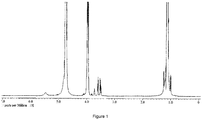
- Iso-propanol was identified by the chemical shift of -OCH- signal of secondary hydrogen at 4.0 ppm, the appearance of two resolved peaks of glycerol were observed at 3.76 ppm and 3.62 to 3.50 ppm corresponding to the chemical shift of hydrogen in -OCH- and -OCH 2 - respectively, the chemical shift of -OH was visible at 5.5 ppm of hydrogen peroxide, and the chemical shift of-OH at 4.77 ppm indicated the presence of water.
- Iso-propanol, glycerol, hydrogen peroxide, and water in a formulation prepared by other group (Fuel department) were quantified by derived equations using integration of their characteristics signals and it was found that 71.3 %, 2.3 %, 0.18 %, 26.2 % of Iso-propanol, Hydrogen peroxide, Glycerol, and water respectively was present against actual concentration values of 73.3 %, 2.3 %, 0.19 % and 24.81 % of Iso-propanol, Hydrogen peroxide, Glycerol, and water respectively given by the Automotive department formulator.
- Iso-propanol, glycerol, hydrogen peroxide, and water in a laboratory prepared blend 1 which was prepared by other group was quantified and concentration of Iso-propanol, Hydrogen peroxide, Glycerol, and water was found as 51.2 %, 9.2 %, 0.2 %, 39.4 % respectively against actual concentration values of 53.1 %, 8.5 %, 0.14 % and 38.26 % of Iso-propanol, Hydrogen peroxide, Glycerol, and water respectively given by formulator.
- a commercial hand sanitizer was analyzed and iso-propanol, glycerol and water were found at concentrations of 45.2 %, 1.10 %, and 52.0 % respectively, while 1.7 % of methanol which is a toxic chemical was observed.
- Five more commercial samples were analyzed by this method and the iso-propanol concentration was found to be below WHO recommended concentration for COVID-19 hand sanitizers.
Landscapes
- Health & Medical Sciences (AREA)
- Physics & Mathematics (AREA)
- Life Sciences & Earth Sciences (AREA)
- High Energy & Nuclear Physics (AREA)
- General Health & Medical Sciences (AREA)
- Chemical & Material Sciences (AREA)
- Pathology (AREA)
- Immunology (AREA)
- General Physics & Mathematics (AREA)
- Biochemistry (AREA)
- Analytical Chemistry (AREA)
- Animal Behavior & Ethology (AREA)
- Public Health (AREA)
- Veterinary Medicine (AREA)
- Epidemiology (AREA)
- Birds (AREA)
- Emergency Medicine (AREA)
- Molecular Biology (AREA)
- Toxicology (AREA)
- Crystallography & Structural Chemistry (AREA)
- Spectroscopy & Molecular Physics (AREA)
- Engineering & Computer Science (AREA)
- Bioinformatics & Cheminformatics (AREA)
- Inorganic Chemistry (AREA)
- Dermatology (AREA)
- Investigating Or Analyzing Non-Biological Materials By The Use Of Chemical Means (AREA)
- Agricultural Chemicals And Associated Chemicals (AREA)
- Medicinal Preparation (AREA)
- Cosmetics (AREA)
Abstract
Description
- The invention relates to a method based on proton NMR technique to differentiate genuine and spurious Hand-rub formulations. This method identifies and estimates all four components present in WHO-recommended Hand-rub formulations. Further, this method also identifies the presence of non-recommended/additional components present in Hand-rub formulations.
- In light of rapidly evolving COVID-19 pandemic and demand for Hand-rub formulations in global and Indian markets, many companies are manufacturing alcohol-based Hand-rub formulations and selling in the market. Though manufacturers produce and supply Hand-rub formulations as per guidelines by WHO, due to sudden demand, poor quality spurious Hand-rub formulations are also available in market which violets WHO guidelines. Considering this aspect, there is a need for quick and reliable method to analyze the alcohol-based Hand-rub formulations by analytical technique for quality control.
- WHO recommended two Hand-rub Formulations with Formulation I having final composition (v/v): as Ethanol (80%), Hydrogen peroxide (0.125%), Glycerol (1.45%), Sterile distilled or boiled cold water; and Formulation II having final composition (v/v): Isopropanol (75%), Hydrogen peroxide (0.125%), Glycerol (1.45%), Sterile distilled or cold, boiled water.
- After the final formulations are made, it is desirable to estimate the composition of the formulation to confirm that the required composition has been achieved. It is a very important step in quality control. As per the WHO's "Guide to Local Production: WHO-recommended Hand-rub Formulations", an alcoholmeter can be used to control the alcohol concentration of the final use solution. Hence, only the alcohol concentration in the final formulation can be identified.
-
US 8795697 describes a sanitizer composition and its method of preparation. It discloses the composition and its preparation by simply mixing together the correct quantities of alcohol, water and thickener and an activating agent to create a substantially thick liquid or gel of the desired viscosity. However, this document does not disclose any methodology for analyzing the final composition of the sanitizer prepared. -
US 8380445 describes the method based on two-dimensional NMR for differentiating complex mixtures having one or more chemical species. This method directs toward high-resolution NMR analysis of chemical structures, and more particularly to the use of selective total correlation spectroscopy ("TOCSY") to quantify and analyze a predetermined set of chemical species. 2D NMR is a long experiment and requires stringent conditioning of the NMR spectrometer. -
CN 107561111 describes the methodology for detection of cassava syrup when mixed in honey. Extraction of the sample is done following the procedure described in the invention. Proton NMR is performed on the sample having a particular pH value. By analyzing the chemical shift of honey sample marker, it is determined whether honey is adulterated with cassava syrup or not. -
US 9775346 - Nuclear magnetic resonance (NMR) spectroscopy is a well-known technique that provides highly detailed information on molecular structure. NMR is also quantitative because the detected signal is linearly proportional to the absolute number of active nuclei in the detected sample volume. Thus, relative numbers of hydrogen, carbon, or other atoms in a molecule can be directly measured, the relative number of different molecular species in a mixture can be computed, and by using an internal standard, the absolute concentration of species can be calculated.
- There is a need for an analytical method which is quick, reliable, and obtainable using one technique for quality control of hand sanitizer formulations. In open literature, each component as recommended in the hand sanitizer formulation is identified using different techniques and analytical methods. Hydrogen peroxide concentration is measured by titrimetry (oxidoreduction reaction by iodine in acidic conditions). A higher-level quality control can be performed using gas chromatography and titrimetric method to control the alcohol and the hydrogen peroxide, respectively in hand sanitizers. However, these methods take four to five hours to test one sample and require chemicals such as iodine and acids. Further, the identification of glyercol/ glycerin and water becomes quite challenging as they cannot be analyzed by these methods. There is no single method available to measure all four components and impurity of toxic chemicals such as methanol in WHO-recommended disinfectant formulations.
- In an aspect of the present invention, the present invention discloses a method for identifying and quantifying components in a hand-rub formulation, the method comprising, analyzing and characterizing the components by determining position of hydrogen attached to different atoms in each component based on proton NMR technique to obtain chemical shift of hydrogen as ppm peak results, quantifying the components using experimental parameters and solving equations with the results obtained in step a) to arrive at the weight % of each component, wherein weight % refers to the percentage by weight of each component in the hand-rub formulation.
- In a feature of the present invention, the components in the hand-rub formulation are an alcohol, a peroxide, glycerol, and water.
- In a feature of the present invention, method comprises analyzing and characterizing an alcohol, analyzing and characterizing a peroxide, analyzing and characterizing glycerol, analyzing and characterizing water.
- In a feature of the present invention, alcohol is ethanol or isopropanol, and peroxide is hydrogen peroxide.
- In a feature of the present invention, the chemical shift of -OCH- signal of secondary hydrogen at 4.0 ppm is used for quantification of isopropanol, chemical shift of -OCH- peak at 3.76 ppm is used for quantification of glycerol, chemical shift of -OH at 5.5 ppm is used for quantification of hydrogen peroxide, and chemical shift of -OH at 4.77 ppm is used quantification of water.
- In a feature of the present invention, the chemical shifts in the proton NMR at 3.0 ppm to 6.0 ppm corresponding to isopropanol, glycerol, water, and hydrogen peroxide are used for quantification.
- In a feature of the present invention, the weight % of each component in a hand-rub formulation based on isopropanol has been quantified by the equation IT = IP + IG + IW + IH, and wherein IT is total integral, IP is Ip x molecular weight of isopropanol, IG is Ig x molecular weight of glycerol, IW is Iw x molecular weight of water, IH is Ih x molecular weight of hydrogen peroxide, wherein Ip, Ig, Iw and Ih are "one proton integral intensity" of isopropanol, glycerol, water, and hydrogen peroxide and is calculated by corresponding integral intensity of proton NMR spectrum divided by number of protons of the group.
- In a feature of the present invention, Ip is an integration of 4.0 ppm peak, Ig is an integration of 3.76 ppm peak, Iw is an integration of 4.77 ppm peak divided by two after subtraction of isopropanol and glycerol -OH contributing protons, Ih is an integration of 5.5 ppm peak divided by two.
- In a feature of the present invention, weight % of Isopropanol = (IP / IT) x 100, weight % of Glycerol = (IG / IT) x 100, weight % of Water = (IW / IT) x 100, weight % of hydrogen peroxide = (IH / IT) x100.
- In a feature of the present invention, weight % of each component in a hand-rub formulation based on ethanol has been quantified by the equation IT = IE + IG + IW + IH, and wherein IE is le x molecular weight of ethanol, IG is Ig x molecular weight of glycerol, IW is Iw x molecular weight of water, and IH is Ih x molecular weight of hydrogen peroxide.
- In another feature of the present invention, le, Ig, Iw and Ih are "one proton integral intensity" of ethanol, glycerol, water, and hydrogen peroxide and is calculated by corresponding integral intensity of proton NMR spectrum divided by number of protons of that group.
- In another feature of the present invention, le is an integration of 1.14 ppm peak divided by three, Ig is an integration of 3.8 to 3.4 ppm peak - Ie x two, Iw is an integration of 4.7 ppm peak divided by two after subtraction of ethanol and glycerol -OH contributing protons, Ih is an integration of 5.4 ppm peak divided by two.
- In another feature of the present invention, weight % of Ethanol = (IE / IT) x 100, weight % of Glycerol = (IG / IT) x 100, weight % of Water = (IW / IT) x 100, weight % of hydrogen peroxide = (IH / IT) x100.
- In another feature of the present invention, method based on proton NMR comprises identification and quantification of all components in a hand sanitizer formulation and provides equations for quantification of components in a hand sanitizer formulation.
- In another feature of the present invention, the chemical shift of proton NMR spectrum of the hand sanitizer formulation used is in the range of 0.0 ppm to 10.0 ppm.
- In another feature of the present invention, method based on proton NMR further comprises identification of methanol in a hand sanitizer formulation, and a sharp singlet is observed at 3.3 ppm of -OCH3 for methanol.
- A primary objective of the invention is to provide a quick and reliable method for quality control and to differentiate genuine and spurious hand sanitizers based on proton NMR technique.
- A further objective of the invention is to provide a NMR method which estimates all four components (Ethanol or isopropanol, Glycerol, Hydrogen peroxide and water) in WHO-recommended Hand-rub Formulations.
- Another objective of this invention is to provide a method that yield results based on proton NMR, makes use of only one sample, is reliable and allows quantification to be done within fifteen minutes.
- To further clarify advantages and aspects of the invention, a more particular description of the invention will be rendered by reference to specific embodiments thereof, which is illustrated in the appended drawing(s). It is appreciated that the drawing(s) of the present invention depicts only typical embodiments of the invention and are therefore not to be considered limiting of its scope.
-
Figure 1 : depicts the NMR spectrum of the four components. - Those skilled in the art will be aware that the present disclosure is subject to variations 1H NMR spectrum of IPA based Sanitizer and modifications other than those specifically described. It is to be understood that the present disclosure includes all such variations and modifications. The disclosure also includes all such steps of the process, features of the product, referred to or indicated in this specification, individually or collectively, and any and all combinations of any or more of such steps or features.
- The present disclosure is not to be limited in scope by the specific embodiments described herein, which are intended for the purposes of exemplification only. Functionally equivalent products and methods are clearly within the scope of the disclosure, as described herein.
- The present invention provides a method related to the analysis of Hand-rub formulations. In particular, the invention relates to a method based on proton NMR technique i.e., 1H NMR. The invention also relates to the identification and estimation of the components in Hand-rub formulations. The method described in this invention utilizes experimental parameters and derived equations to quantify all four components in just fifteen minutes.
- In one embodiment, the present invention provides a method for identifying and quantifying components in a hand-rub formulation, the method comprising:
- a) analyzing and characterizing the components by determining position of hydrogen attached to different atoms in each component based on proton NMR technique to obtain chemical shift of hydrogen as ppm peak results, and
- b) quantifying the components using experimental parameters and solving equations with the results obtained in step a) to arrive at the weight % of each component,
- In one aspect of the invention, a method of analyzing a sample containing one or more components, which comprises alcohol, peroxide, glycerol, and water, is provided. In one embodiment, the method includes steps of analyzing and characterizing the alcohol, analyzing and characterizing the peroxide, analyzing and characterizing the glycerol, analyzing and characterizing water, and determining the identity and quantity of all the components of the hand-rub formulation i.e., the sample using the results obtained from one or more of the analysis steps. In another embodiment, the equation method comprises generating equations from the results obtained from one or more of the analysis steps and solving them.
- In an embodiment, the method is based on proton NMR i.e., 1H NMR. A person skilled in the art will acknowledge that Proton NMR experiment is the most common NMR experiment which involves the study of the hydrogen nucleus when subjected to nuclear magnetic resonance. Being the most sensitive nucleus, proton NMR usually yields sharp signals. At a given radio frequency, each hydrogen atom will need a slightly different magnetic field applied to it to bring it into the resonance condition depending on what exactly it is attached to. Hence, the magnetic field required becomes a very useful guide to the hydrogen atoms environment in the molecule. In an embodiment, the chemical shift of proton NMR spectrum of hand sanitizer used is from 0.0 ppm to 10.0 ppm.
- In one embodiment, the method provided includes determining the position of hydrogen attached to the different atoms in all the components. In one aspect of the invention, the position of hydrogen is secondary, if the alcohol in the sample is isopropanol and/or ethanol. In another embodiment, the chemical shift of -OCH- signal of secondary hydrogen of isopropanol at 4.0 ppm is used for quantification of isopropanol. In another aspect of the invention, if the alcohol is methanol, a sharp singlet is observed at 3.3 ppm of -OCH3.
- In an embodiment, the appearance of two resolved peaks of glycerol occurs at 3.76 ppm and 3.62-3.50 ppm corresponding to the chemical shift of hydrogen in -OCH- and -OCH2-, respectively. In another embodiment, the chemical shift of -OCH- peak at 3.76 is used for quantification of glycerol content.
- In an embodiment, the chemical shift of -OH at 5.5 ppm is used for quantification of hydrogen peroxide. In another embodiment, the chemical shift of -OH at 4.77 ppm is used quantification of water.
- In an embodiment, the chemical shifts in the proton NMR at 3.0 ppm to 6.0 ppm corresponding to isopropanol, glycerol, water, and hydrogen peroxide are used for quantification. In another embodiment, the quantitative analysis was carried out using integral intensities obtained under each signal from proton NMR spectrum.
- In an embodiment, for hand-rub formulation based on isopropanol, the percentage of each component by weight i.e., weight % has been estimated by following equation:

- IT is total integral,
- IP is Ip x molecular weight of isopropanol,
- IG is Ig x molecular weight of glycerol,
- IW is Iw x molecular weight of water,
- IH si Ih x molecular weight of hydrogen peroxide,
- and, Ip, Ig, Iw and Ih are "one proton integral intensity" of iso-propanol, glycerol, water and hydrogen peroxide. "One proton integral intensity" is calculated by corresponding integral intensity of proton NMR spectrum divided by number of protons of the group.
- Ip is an integration of 4.0 ppm peak,
- Ig is an integration of 3.76 ppm peak,
- Iw is an integration of 4.77 ppm peak, divided by two after subtraction of isopropanol and glycerol -OH contributing protons,
- Ih is integration of 5.5 ppm peak divided by two
- In another embodiment, for hand-rub formulation based on ethanol, the percentage of each component by weight i.e., weight % has been estimated by following equation:

- IE is le x molecular weight of ethanol,
- IG is Ig x molecular weight of glycerol,
- IW is Iw x molecular weight of water,
- IH is Ih x molecular weight of hydrogen peroxide,
- and, le, Ig, Iw and Ih are "one proton integral intensity" of ethanol, glycerol, water, and hydrogen peroxide. "One proton integral intensity" is calculated by corresponding integral intensity of proton NMR spectrum divided by number of protons of that group,
- le is an integration of 1.14 ppm peak divided by three,
- Ig is an integration of 3.8 to 3.4 ppm peak - Ie x two,
- Iw is an integration of 4.7 ppm peak, divided by two after subtraction of ethanol and glycerol - OH contributing protons,
- Ih is an integration of 5.4 ppm peak divided by two,
- In an embodiment, the method based on proton NMR provides identification and estimation of all components in hand sanitizer formulations. In another embodiment, the method provides equations for estimation of components in hand sanitizer.
- WHO recommended Hand-rub Formulation with Formulation II having final composition (v/v) of 75% of Iso-propanol, 0.125% of Hydrogen peroxide, 1.45% of Glycerol and Sterile distilled or boiled cold water was prepared and analyzed by proton NMR method to identify all components present in the formulation by following characteristic peaks. Iso-propanol was identified by the chemical shift of -OCH- signal of secondary hydrogen at 4.0 ppm, the appearance of two resolved peaks of glycerol were observed at 3.76 ppm and 3.62 to 3.50 ppm corresponding to the chemical shift of hydrogen in -OCH- and -OCH2- respectively, the chemical shift of -OH was visible at 5.5 ppm of hydrogen peroxide, and the chemical shift of-OH at 4.77 ppm indicated the presence of water.
- Iso-propanol, glycerol, hydrogen peroxide, and water in a formulation prepared by other group (Fuel department) were quantified by derived equations using integration of their characteristics signals and it was found that 71.3 %, 2.3 %, 0.18 %, 26.2 % of Iso-propanol, Hydrogen peroxide, Glycerol, and water respectively was present against actual concentration values of 73.3 %, 2.3 %, 0.19 % and 24.81 % of Iso-propanol, Hydrogen peroxide, Glycerol, and water respectively given by the Automotive department formulator.
- Iso-propanol, glycerol, hydrogen peroxide, and water in a laboratory prepared blend 1 which was prepared by other group was quantified and concentration of Iso-propanol, Hydrogen peroxide, Glycerol, and water was found as 51.2 %, 9.2 %, 0.2 %, 39.4 % respectively against actual concentration values of 53.1 %, 8.5 %, 0.14 % and 38.26 % of Iso-propanol, Hydrogen peroxide, Glycerol, and water respectively given by formulator.
- Concentration of Iso-propanol, glycerol, and water found in blend 2 was 61.2 %, 6.2 % and 32.6 % against actual concentrations of 63.9%, 5.9% and 29.94 % respectively in blend 2. Estimation of hydrogen peroxide (H2O2) was not possible in blend 2 due to high concentration of H2O2. At this concentration, the hydrogen peroxide and water peaks coalesce to form a single peak that is broadened. This phenomenon is attributed to the exchange of protons between water and hydrogen peroxide. As the concentration of hydrogen peroxide increases, the rate of proton exchange between water and hydrogen peroxide becomes significant, and as a result, a single broadened peak is observed.
- WHO recommended Hand-rub Formulation with Formulation I having final composition (wt/wt %) of 76.5% of ethanol, 0.20% of Hydrogen peroxide, 2.5% of Glycerol, and 20.8 of Sterile distilled or boiled cold water was prepared and concentration of Ethanol, Hydrogen peroxide, Glycerol, and water estimated by NMR method of the present invention was 75.4 %, 0.18 %, 2.4 % and 23.02 % respectively.
- A commercial hand sanitizer was analyzed and iso-propanol, glycerol and water were found at concentrations of 45.2 %, 1.10 %, and 52.0 % respectively, while 1.7 % of methanol which is a toxic chemical was observed. Five more commercial samples were analyzed by this method and the iso-propanol concentration was found to be below WHO recommended concentration for COVID-19 hand sanitizers.
-
- 1. Designed experiments and solvent system for separating all four components.
- 2. No organic solvent or standard used in this method.
- 3. Quick and less time taking (one sample in just fifteen minutes).
- 4. Derived the equations for quantification.
- 5. Able to identify the presence of non-recommended/additional components.


Claims (15)
- A method for identifying and quantifying components in a hand-rub formulation, the method comprising:a) analyzing and characterizing the components by determining position of hydrogen attached to different atoms in each component based on proton NMR technique to obtain chemical shift of hydrogen as ppm peak results,b) quantifying the components using experimental parameters and solving equations with the results obtained in step a) to arrive at the weight % of each component,wherein weight % refers to the percentage by weight of each component in the hand-rub formulation.
- The method as claimed in claim 1, wherein the components in the hand-rub formulation are an alcohol, a peroxide, glycerol, and water.
- The method as claimed in claim 2, wherein the method comprises analyzing and characterizing an alcohol, analyzing and characterizing a peroxide, analyzing and characterizing glycerol, analyzing and characterizing water.
- The method as claimed in claim 3, wherein the alcohol is ethanol or isopropanol, and peroxide is hydrogen peroxide.
- The method as claimed in claim 4, wherein the chemical shift of -OCH- signal of secondary hydrogen at 4.0 ppm is used for quantification of isopropanol, and chemical shift of -OCH- peak at 3.76 ppm is used for quantification of glycerol.
- The method as claimed in claim 5, wherein the chemical shift of -OH at 5.5 ppm and at 4.77 ppm is used for quantification of hydrogen peroxide and water, respectively.
- The method as claimed in claims 1-6, wherein the chemical shifts in the proton NMR at 3.0 ppm to 6.0 ppm corresponding to isopropanol, glycerol, water, and hydrogen peroxide are used for quantification.
- The method as claimed in claim 4, wherein the weight % of each component in a hand-rub formulation based on isopropanol has been quantified by the equation IT = IP + IG + IW + IH, and whereinIT is total integral,IP is Ip x molecular weight of isopropanol,IG is Ig x molecular weight of glycerol,IW is Iw x molecular weight of water,IH is Ih x molecular weight of hydrogen peroxide,wherein Ip, Ig, Iw and Ih are "one proton integral intensity" of isopropanol, glycerol, water, and hydrogen peroxide and is calculated by corresponding integral intensity of proton NMR spectrum divided by number of protons of the group.
- The method as claimed in claim 8, wherein,Ip is an integration of 4.0 ppm peak,Ig is an integration of 3.76 ppm peak,Iw is an integration of 4.77 ppm peak divided by two after subtraction of isopropanol and glycerol -OH contributing protons,Ih is an integration of 5.5 ppm peak divided by two.
- The method as claimed in claim 8, wherein,


- The method as claimed in claim 4, wherein the weight % of each component in a hand-rub formulation based on ethanol has been quantified by the equation IT = IE + IG + IW + IH, and whereinIE is le x molecular weight of ethanol,IG is Ig x molecular weight of glycerol,IW is Iw x molecular weight of water,IH is Ih x molecular weight of hydrogen peroxide,wherein le, Ig, Iw and Ih are "one proton integral intensity" of ethanol, glycerol, water, and hydrogen peroxide and is calculated by corresponding integral intensity of proton NMR spectrum divided by number of protons of that group.
- The method as claimed in claim 11, wherein,le is an integration of 1.14 ppm peak divided by three,Ig is an integration of 3.8 to 3.4 ppm peak - Ie x two,Iw is an integration of 4.7 ppm peak divided by two after subtraction of ethanol and glycerol -OH contributing protons,Ih is an integration of 5.4 ppm peak divided by two.
- The method as claimed in claim 11, wherein,


- The method as claimed in claim 1, wherein the method based on proton NMR comprises identification and quantification of all components in a hand sanitizer formulation and provides equations for quantification of components in a hand sanitizer formulation and the chemical shift of proton NMR spectrum of the hand sanitizer formulation used is in the range of 0.0 ppm to 10.0 ppm.
- The method as claimed in claim 14, wherein the method based on proton NMR further comprises identification of methanol in a hand sanitizer formulation and a sharp singlet is observed at 3.3 ppm of -OCH3 for methanol.
Applications Claiming Priority (1)
| Application Number | Priority Date | Filing Date | Title |
|---|---|---|---|
| IN202021027916 | 2020-07-01 |
Publications (2)
| Publication Number | Publication Date |
|---|---|
| EP3933392A1 true EP3933392A1 (en) | 2022-01-05 |
| EP3933392B1 EP3933392B1 (en) | 2025-01-15 |
Family
ID=76999578
Family Applications (1)
| Application Number | Title | Priority Date | Filing Date |
|---|---|---|---|
| EP21181650.9A Active EP3933392B1 (en) | 2020-07-01 | 2021-06-25 | Quick nmr method for identification and estimation of components in hand-rub formulations |
Country Status (5)
| Country | Link |
|---|---|
| US (1) | US11774383B2 (en) |
| EP (1) | EP3933392B1 (en) |
| JP (1) | JP7303248B2 (en) |
| CA (1) | CA3123183A1 (en) |
| ES (1) | ES3013607T3 (en) |
Citations (4)
| Publication number | Priority date | Publication date | Assignee | Title |
|---|---|---|---|---|
| US8380445B2 (en) | 2005-08-31 | 2013-02-19 | Purdue Research Foundation | NMR method for differentiating complex mixtures |
| US8795697B2 (en) | 2004-06-03 | 2014-08-05 | James S. Brown | Sanitizing composition and method of preparation |
| US9775346B1 (en) | 2016-04-01 | 2017-10-03 | Roger Wilson | Hand sanitizer composition and method of manufacture |
| CN107561111A (en) | 2017-08-25 | 2018-01-09 | 江苏出入境检验检疫局动植物与食品检测中心 | The NMR spectrum method of cassava syrup is mixed in a kind of quick discriminating honey |
Family Cites Families (2)
| Publication number | Priority date | Publication date | Assignee | Title |
|---|---|---|---|---|
| US20050062471A1 (en) * | 2002-09-23 | 2005-03-24 | General Electric Company | Component analysis of mixtures by nuclear magnetic resonance |
| KR101734610B1 (en) | 2010-09-14 | 2017-05-11 | 니치유 가부시키가이샤 | Antibacterial cleaning composition |
-
2021
- 2021-06-21 JP JP2021102244A patent/JP7303248B2/en active Active
- 2021-06-24 CA CA3123183A patent/CA3123183A1/en active Pending
- 2021-06-25 EP EP21181650.9A patent/EP3933392B1/en active Active
- 2021-06-25 ES ES21181650T patent/ES3013607T3/en active Active
- 2021-06-30 US US17/364,203 patent/US11774383B2/en active Active
Patent Citations (4)
| Publication number | Priority date | Publication date | Assignee | Title |
|---|---|---|---|---|
| US8795697B2 (en) | 2004-06-03 | 2014-08-05 | James S. Brown | Sanitizing composition and method of preparation |
| US8380445B2 (en) | 2005-08-31 | 2013-02-19 | Purdue Research Foundation | NMR method for differentiating complex mixtures |
| US9775346B1 (en) | 2016-04-01 | 2017-10-03 | Roger Wilson | Hand sanitizer composition and method of manufacture |
| CN107561111A (en) | 2017-08-25 | 2018-01-09 | 江苏出入境检验检疫局动植物与食品检测中心 | The NMR spectrum method of cassava syrup is mixed in a kind of quick discriminating honey |
Non-Patent Citations (3)
| Title |
|---|
| BONJOUR JESSICA L. ET AL: "Introducing High School Students to NMR Spectroscopy through Percent Composition Determination Using Low-Field Spectrometers", JOURNAL OF CHEMICAL EDUCATION, vol. 92, no. 3, 30 January 2015 (2015-01-30), US, pages 529 - 533, XP055858236, ISSN: 0021-9584, DOI: 10.1021/ed500731y * |
| RACKHAM D: "Quantitative analysis in pharmacy and pharmaceutical chemistry by nuclear magnetic resonance spectroscopy", TALANTA, vol. 17, no. 10, 1 October 1970 (1970-10-01), NL, pages 895 - 906, XP055858244, ISSN: 0039-9140, DOI: 10.1016/0039-9140(70)80132-1 * |
| U.S. DEPARTMENT OF HEALTH AND HUMAN SERVICES, FOOD AND DRUG ADMINISTRATION: "Contains Nonbinding Recommendations Temporary Policy for Preparation of Certain Alcohol-Based Hand Sanitizer Products During the Public Health Emergency (COVID-19) Guidance for Industry Pharmaceutical Quality/Manufacturing Standards (CGMP)/Over-the-Counter (OTC) Contains Nonbinding Recommendations", 1 June 2020 (2020-06-01), pages 1 - 19, XP055858180, Retrieved from the Internet <URL:https://web.archive.org/web/20200620164135if_/https://www.fda.gov/media/136289/download> [retrieved on 20211105] * |
Also Published As
| Publication number | Publication date |
|---|---|
| ES3013607T3 (en) | 2025-04-14 |
| JP7303248B2 (en) | 2023-07-04 |
| JP2022013763A (en) | 2022-01-18 |
| US20220003698A1 (en) | 2022-01-06 |
| US11774383B2 (en) | 2023-10-03 |
| EP3933392B1 (en) | 2025-01-15 |
| CA3123183A1 (en) | 2022-01-01 |
Similar Documents
| Publication | Publication Date | Title |
|---|---|---|
| Gouilleux et al. | High-throughput authentication of edible oils with benchtop Ultrafast 2D NMR | |
| Gougeon et al. | Wine analysis and authenticity using 1H-NMR metabolomics data: Application to Chinese wines | |
| Li et al. | Simultaneous determination of eight illegal dyes in chili products by liquid chromatography–tandem mass spectrometry | |
| Gimeno et al. | Analytical method for the identification and assay of 12 phthalates in cosmetic products: Application of the ISO 12787 international standard “Cosmetics–Analytical methods–Validation criteria for analytical results using chromatographic techniques” | |
| Choi et al. | Identification and quantification of seven volatile n-nitrosamines in cosmetics using gas chromatography/chemical ionization–mass spectrometry coupled with head space-solid phase microextraction | |
| Ferrer et al. | Pesticide residue analysis of fruit juices by LC–MS/MS direct injection. One year pilot survey | |
| US10001462B2 (en) | Method and system for detecting pesticide residue in agricultural products using mass spectrometry imaging analysis | |
| Park et al. | Determination of five alcohol compounds in fermented Korean foods via simple liquid extraction with dimethyl-sulfoxide followed by gas chromatography-mass spectrometry for Halal food certification | |
| Rhee et al. | Detection of honey adulteration using benchtop 1 H NMR spectroscopy | |
| Le Mao et al. | Application of 1H NMR metabolomics to French sparkling wines | |
| Luong et al. | Incorporating terpenes, monoterpenoids and alkanes into multiresidue organic biomarker analysis of archaeological stone artefacts from Liang Bua (Flores, Indonesia) | |
| CN112730710B (en) | Detection method for rapid real-time quantification of target analytes in a sample by introducing a series of different isotopic labels | |
| Mascrez et al. | Enhancement of volatile profiling using multiple-cumulative trapping solid-phase microextraction. Consideration on sample volume | |
| Dağdeviren et al. | A new method of UA_CPE coupled with spectrophotometry for the faster and cost-effective detection of proline in fruit juice, honey, and wine | |
| Gentile et al. | On the use of IRMS in forensic science: Proposals for a methodological approach | |
| CN109342633A (en) | The detection method of benzene, toluene and diformazan benzene metabolite in urine | |
| Lee et al. | Quantification of mixtures of analogues of illicit substances by benchtop NMR spectroscopy | |
| Lu et al. | Quantification of Trans-resveratrol in Red Wines Using QuEChERS Extraction Combined with Liquid Chromatography–Tandem Mass Spectrometry | |
| EP3933392B1 (en) | Quick nmr method for identification and estimation of components in hand-rub formulations | |
| Lee et al. | Isotope dilution-liquid chromatography/mass spectrometric method for the determination of riboflavin content in multivitamin tablets and infant formula | |
| Williams et al. | Volatile terpenoid profiling in gin and beer–A targeted approach | |
| Feng et al. | Development of a quantitative structure-response relationships to estimate concentrations of plasticizer metabolites in urine without reference standards using non-targeted analysis with liquid chromatography high-resolution mass spectrometry | |
| Adair et al. | High resolution techniques: general discussion | |
| CN118090982A (en) | Camellia oil and olive oil adulteration identification method based on 3 markers | |
| Fleischer et al. | Innovative software solution for special data evaluation in mass spectrometry |
Legal Events
| Date | Code | Title | Description |
|---|---|---|---|
| PUAI | Public reference made under article 153(3) epc to a published international application that has entered the european phase |
Free format text: ORIGINAL CODE: 0009012 |
|
| STAA | Information on the status of an ep patent application or granted ep patent |
Free format text: STATUS: THE APPLICATION HAS BEEN PUBLISHED |
|
| AK | Designated contracting states |
Kind code of ref document: A1 Designated state(s): AL AT BE BG CH CY CZ DE DK EE ES FI FR GB GR HR HU IE IS IT LI LT LU LV MC MK MT NL NO PL PT RO RS SE SI SK SM TR |
|
| B565 | Issuance of search results under rule 164(2) epc |
Effective date: 20211116 |
|
| STAA | Information on the status of an ep patent application or granted ep patent |
Free format text: STATUS: REQUEST FOR EXAMINATION WAS MADE |
|
| 17P | Request for examination filed |
Effective date: 20220315 |
|
| RBV | Designated contracting states (corrected) |
Designated state(s): AL AT BE BG CH CY CZ DE DK EE ES FI FR GB GR HR HU IE IS IT LI LT LU LV MC MK MT NL NO PL PT RO RS SE SI SK SM TR |
|
| P01 | Opt-out of the competence of the unified patent court (upc) registered |
Effective date: 20230712 |
|
| STAA | Information on the status of an ep patent application or granted ep patent |
Free format text: STATUS: EXAMINATION IS IN PROGRESS |
|
| 17Q | First examination report despatched |
Effective date: 20240222 |
|
| GRAP | Despatch of communication of intention to grant a patent |
Free format text: ORIGINAL CODE: EPIDOSNIGR1 |
|
| STAA | Information on the status of an ep patent application or granted ep patent |
Free format text: STATUS: GRANT OF PATENT IS INTENDED |
|
| RIC1 | Information provided on ipc code assigned before grant |
Ipc: G01R 33/46 20060101ALN20241018BHEP Ipc: A61Q 19/10 20060101ALI20241018BHEP Ipc: A61Q 17/00 20060101ALI20241018BHEP Ipc: A61K 8/34 20060101ALI20241018BHEP Ipc: G01N 24/08 20060101AFI20241018BHEP |
|
| INTG | Intention to grant announced |
Effective date: 20241105 |
|
| GRAS | Grant fee paid |
Free format text: ORIGINAL CODE: EPIDOSNIGR3 |
|
| GRAA | (expected) grant |
Free format text: ORIGINAL CODE: 0009210 |
|
| STAA | Information on the status of an ep patent application or granted ep patent |
Free format text: STATUS: THE PATENT HAS BEEN GRANTED |
|
| AK | Designated contracting states |
Kind code of ref document: B1 Designated state(s): AL AT BE BG CH CY CZ DE DK EE ES FI FR GB GR HR HU IE IS IT LI LT LU LV MC MK MT NL NO PL PT RO RS SE SI SK SM TR |
|
| REG | Reference to a national code |
Ref country code: CH Ref legal event code: EP Ref country code: GB Ref legal event code: FG4D |
|
| REG | Reference to a national code |
Ref country code: DE Ref legal event code: R096 Ref document number: 602021024878 Country of ref document: DE |
|
| REG | Reference to a national code |
Ref country code: IE Ref legal event code: FG4D |
|
| REG | Reference to a national code |
Ref country code: ES Ref legal event code: FG2A Ref document number: 3013607 Country of ref document: ES Kind code of ref document: T3 Effective date: 20250414 |
|
| REG | Reference to a national code |
Ref country code: NL Ref legal event code: MP Effective date: 20250115 |
|
| PG25 | Lapsed in a contracting state [announced via postgrant information from national office to epo] |
Ref country code: NL Free format text: LAPSE BECAUSE OF FAILURE TO SUBMIT A TRANSLATION OF THE DESCRIPTION OR TO PAY THE FEE WITHIN THE PRESCRIBED TIME-LIMIT Effective date: 20250115 |
|
| PG25 | Lapsed in a contracting state [announced via postgrant information from national office to epo] |
Ref country code: RS Free format text: LAPSE BECAUSE OF FAILURE TO SUBMIT A TRANSLATION OF THE DESCRIPTION OR TO PAY THE FEE WITHIN THE PRESCRIBED TIME-LIMIT Effective date: 20250415 |
|
| PG25 | Lapsed in a contracting state [announced via postgrant information from national office to epo] |
Ref country code: FI Free format text: LAPSE BECAUSE OF FAILURE TO SUBMIT A TRANSLATION OF THE DESCRIPTION OR TO PAY THE FEE WITHIN THE PRESCRIBED TIME-LIMIT Effective date: 20250115 |
|
| PG25 | Lapsed in a contracting state [announced via postgrant information from national office to epo] |
Ref country code: PL Free format text: LAPSE BECAUSE OF FAILURE TO SUBMIT A TRANSLATION OF THE DESCRIPTION OR TO PAY THE FEE WITHIN THE PRESCRIBED TIME-LIMIT Effective date: 20250115 |
|
| PGFP | Annual fee paid to national office [announced via postgrant information from national office to epo] |
Ref country code: GB Payment date: 20250628 Year of fee payment: 5 |
|
| REG | Reference to a national code |
Ref country code: LT Ref legal event code: MG9D |
|
| PG25 | Lapsed in a contracting state [announced via postgrant information from national office to epo] |
Ref country code: IS Free format text: LAPSE BECAUSE OF FAILURE TO SUBMIT A TRANSLATION OF THE DESCRIPTION OR TO PAY THE FEE WITHIN THE PRESCRIBED TIME-LIMIT Effective date: 20250515 Ref country code: NO Free format text: LAPSE BECAUSE OF FAILURE TO SUBMIT A TRANSLATION OF THE DESCRIPTION OR TO PAY THE FEE WITHIN THE PRESCRIBED TIME-LIMIT Effective date: 20250415 |
|
| REG | Reference to a national code |
Ref country code: AT Ref legal event code: MK05 Ref document number: 1760133 Country of ref document: AT Kind code of ref document: T Effective date: 20250115 |
|
| PG25 | Lapsed in a contracting state [announced via postgrant information from national office to epo] |
Ref country code: HR Free format text: LAPSE BECAUSE OF FAILURE TO SUBMIT A TRANSLATION OF THE DESCRIPTION OR TO PAY THE FEE WITHIN THE PRESCRIBED TIME-LIMIT Effective date: 20250115 |
|
| PG25 | Lapsed in a contracting state [announced via postgrant information from national office to epo] |
Ref country code: LV Free format text: LAPSE BECAUSE OF FAILURE TO SUBMIT A TRANSLATION OF THE DESCRIPTION OR TO PAY THE FEE WITHIN THE PRESCRIBED TIME-LIMIT Effective date: 20250115 Ref country code: PT Free format text: LAPSE BECAUSE OF FAILURE TO SUBMIT A TRANSLATION OF THE DESCRIPTION OR TO PAY THE FEE WITHIN THE PRESCRIBED TIME-LIMIT Effective date: 20250515 |
|
| PG25 | Lapsed in a contracting state [announced via postgrant information from national office to epo] |
Ref country code: GR Free format text: LAPSE BECAUSE OF FAILURE TO SUBMIT A TRANSLATION OF THE DESCRIPTION OR TO PAY THE FEE WITHIN THE PRESCRIBED TIME-LIMIT Effective date: 20250416 Ref country code: BG Free format text: LAPSE BECAUSE OF FAILURE TO SUBMIT A TRANSLATION OF THE DESCRIPTION OR TO PAY THE FEE WITHIN THE PRESCRIBED TIME-LIMIT Effective date: 20250115 |
|
| PG25 | Lapsed in a contracting state [announced via postgrant information from national office to epo] |
Ref country code: AT Free format text: LAPSE BECAUSE OF FAILURE TO SUBMIT A TRANSLATION OF THE DESCRIPTION OR TO PAY THE FEE WITHIN THE PRESCRIBED TIME-LIMIT Effective date: 20250115 |
|
| PG25 | Lapsed in a contracting state [announced via postgrant information from national office to epo] |
Ref country code: SE Free format text: LAPSE BECAUSE OF FAILURE TO SUBMIT A TRANSLATION OF THE DESCRIPTION OR TO PAY THE FEE WITHIN THE PRESCRIBED TIME-LIMIT Effective date: 20250115 |
|
| PG25 | Lapsed in a contracting state [announced via postgrant information from national office to epo] |
Ref country code: SM Free format text: LAPSE BECAUSE OF FAILURE TO SUBMIT A TRANSLATION OF THE DESCRIPTION OR TO PAY THE FEE WITHIN THE PRESCRIBED TIME-LIMIT Effective date: 20250115 |
|
| PGFP | Annual fee paid to national office [announced via postgrant information from national office to epo] |
Ref country code: ES Payment date: 20250701 Year of fee payment: 5 |
|
| PG25 | Lapsed in a contracting state [announced via postgrant information from national office to epo] |
Ref country code: DK Free format text: LAPSE BECAUSE OF FAILURE TO SUBMIT A TRANSLATION OF THE DESCRIPTION OR TO PAY THE FEE WITHIN THE PRESCRIBED TIME-LIMIT Effective date: 20250115 |
|
| PGFP | Annual fee paid to national office [announced via postgrant information from national office to epo] |
Ref country code: DE Payment date: 20250701 Year of fee payment: 5 |
|
| PGFP | Annual fee paid to national office [announced via postgrant information from national office to epo] |
Ref country code: IT Payment date: 20250630 Year of fee payment: 5 |
|
| REG | Reference to a national code |
Ref country code: DE Ref legal event code: R097 Ref document number: 602021024878 Country of ref document: DE |
|
| PG25 | Lapsed in a contracting state [announced via postgrant information from national office to epo] |
Ref country code: EE Free format text: LAPSE BECAUSE OF FAILURE TO SUBMIT A TRANSLATION OF THE DESCRIPTION OR TO PAY THE FEE WITHIN THE PRESCRIBED TIME-LIMIT Effective date: 20250115 Ref country code: CZ Free format text: LAPSE BECAUSE OF FAILURE TO SUBMIT A TRANSLATION OF THE DESCRIPTION OR TO PAY THE FEE WITHIN THE PRESCRIBED TIME-LIMIT Effective date: 20250115 |
|
| PG25 | Lapsed in a contracting state [announced via postgrant information from national office to epo] |
Ref country code: RO Free format text: LAPSE BECAUSE OF FAILURE TO SUBMIT A TRANSLATION OF THE DESCRIPTION OR TO PAY THE FEE WITHIN THE PRESCRIBED TIME-LIMIT Effective date: 20250115 |
|
| PG25 | Lapsed in a contracting state [announced via postgrant information from national office to epo] |
Ref country code: SK Free format text: LAPSE BECAUSE OF FAILURE TO SUBMIT A TRANSLATION OF THE DESCRIPTION OR TO PAY THE FEE WITHIN THE PRESCRIBED TIME-LIMIT Effective date: 20250115 |
|
| PLBE | No opposition filed within time limit |
Free format text: ORIGINAL CODE: 0009261 |
|
| STAA | Information on the status of an ep patent application or granted ep patent |
Free format text: STATUS: NO OPPOSITION FILED WITHIN TIME LIMIT |
|
| REG | Reference to a national code |
Ref country code: CH Ref legal event code: L10 Free format text: ST27 STATUS EVENT CODE: U-0-0-L10-L00 (AS PROVIDED BY THE NATIONAL OFFICE) Effective date: 20251126 |
|
| 26N | No opposition filed |
Effective date: 20251016 |
|
| REG | Reference to a national code |
Ref country code: CH Ref legal event code: H13 Free format text: ST27 STATUS EVENT CODE: U-0-0-H10-H13 (AS PROVIDED BY THE NATIONAL OFFICE) Effective date: 20260127 |
|
| PG25 | Lapsed in a contracting state [announced via postgrant information from national office to epo] |
Ref country code: MC Free format text: LAPSE BECAUSE OF FAILURE TO SUBMIT A TRANSLATION OF THE DESCRIPTION OR TO PAY THE FEE WITHIN THE PRESCRIBED TIME-LIMIT Effective date: 20250115 |
|
| PG25 | Lapsed in a contracting state [announced via postgrant information from national office to epo] |
Ref country code: LU Free format text: LAPSE BECAUSE OF NON-PAYMENT OF DUE FEES Effective date: 20250625 |
|
| REG | Reference to a national code |
Ref country code: BE Ref legal event code: MM Effective date: 20250630 |
|
| PG25 | Lapsed in a contracting state [announced via postgrant information from national office to epo] |
Ref country code: IE Free format text: LAPSE BECAUSE OF NON-PAYMENT OF DUE FEES Effective date: 20250625 |
|
| PG25 | Lapsed in a contracting state [announced via postgrant information from national office to epo] |
Ref country code: BE Free format text: LAPSE BECAUSE OF NON-PAYMENT OF DUE FEES Effective date: 20250630 |
|
| PG25 | Lapsed in a contracting state [announced via postgrant information from national office to epo] |
Ref country code: FR Free format text: LAPSE BECAUSE OF NON-PAYMENT OF DUE FEES Effective date: 20250630 |
|
| PG25 | Lapsed in a contracting state [announced via postgrant information from national office to epo] |
Ref country code: CH Free format text: LAPSE BECAUSE OF NON-PAYMENT OF DUE FEES Effective date: 20250630 |