EP3932311A1 - Emotion estimation device, emotion estimation method, and computer-readable recording medium - Google Patents
Emotion estimation device, emotion estimation method, and computer-readable recording medium Download PDFInfo
- Publication number
- EP3932311A1 EP3932311A1 EP19917143.0A EP19917143A EP3932311A1 EP 3932311 A1 EP3932311 A1 EP 3932311A1 EP 19917143 A EP19917143 A EP 19917143A EP 3932311 A1 EP3932311 A1 EP 3932311A1
- Authority
- EP
- European Patent Office
- Prior art keywords
- state
- emotion
- estimated
- tract
- respiratory tract
- Prior art date
- Legal status (The legal status is an assumption and is not a legal conclusion. Google has not performed a legal analysis and makes no representation as to the accuracy of the status listed.)
- Withdrawn
Links
- 230000008451 emotion Effects 0.000 title claims abstract description 158
- 238000000034 method Methods 0.000 title claims description 23
- 210000000613 ear canal Anatomy 0.000 claims abstract description 21
- 230000003595 spectral effect Effects 0.000 claims description 68
- 210000002345 respiratory system Anatomy 0.000 claims description 63
- 230000001755 vocal effect Effects 0.000 claims description 55
- 230000029058 respiratory gaseous exchange Effects 0.000 claims description 32
- 210000001260 vocal cord Anatomy 0.000 claims description 22
- 238000004364 calculation method Methods 0.000 description 31
- 210000000056 organ Anatomy 0.000 description 25
- 238000010586 diagram Methods 0.000 description 22
- 230000005236 sound signal Effects 0.000 description 15
- 230000006870 function Effects 0.000 description 13
- 230000007274 generation of a signal involved in cell-cell signaling Effects 0.000 description 11
- 210000004072 lung Anatomy 0.000 description 10
- 230000004044 response Effects 0.000 description 9
- 238000010183 spectrum analysis Methods 0.000 description 8
- 238000004891 communication Methods 0.000 description 7
- 238000012706 support-vector machine Methods 0.000 description 7
- 238000012546 transfer Methods 0.000 description 7
- 230000008921 facial expression Effects 0.000 description 4
- 238000010801 machine learning Methods 0.000 description 4
- 101100365087 Arabidopsis thaliana SCRA gene Proteins 0.000 description 3
- 230000005540 biological transmission Effects 0.000 description 3
- 238000000513 principal component analysis Methods 0.000 description 3
- 238000012545 processing Methods 0.000 description 3
- 238000000611 regression analysis Methods 0.000 description 3
- 238000004458 analytical method Methods 0.000 description 2
- 238000013528 artificial neural network Methods 0.000 description 2
- 238000011840 criminal investigation Methods 0.000 description 2
- 238000003066 decision tree Methods 0.000 description 2
- 230000007423 decrease Effects 0.000 description 2
- 230000000694 effects Effects 0.000 description 2
- 238000005401 electroluminescence Methods 0.000 description 2
- 238000012986 modification Methods 0.000 description 2
- 230000004048 modification Effects 0.000 description 2
- 238000010202 multivariate logistic regression analysis Methods 0.000 description 2
- 239000004065 semiconductor Substances 0.000 description 2
- 208000037656 Respiratory Sounds Diseases 0.000 description 1
- 210000000621 bronchi Anatomy 0.000 description 1
- 210000000624 ear auricle Anatomy 0.000 description 1
- 210000000883 ear external Anatomy 0.000 description 1
- 230000007613 environmental effect Effects 0.000 description 1
- 210000004704 glottis Anatomy 0.000 description 1
- 210000003128 head Anatomy 0.000 description 1
- 238000005286 illumination Methods 0.000 description 1
- 210000000867 larynx Anatomy 0.000 description 1
- 239000004973 liquid crystal related substance Substances 0.000 description 1
- 210000003928 nasal cavity Anatomy 0.000 description 1
- 230000003287 optical effect Effects 0.000 description 1
- 210000003800 pharynx Anatomy 0.000 description 1
- 210000003437 trachea Anatomy 0.000 description 1
- 210000003454 tympanic membrane Anatomy 0.000 description 1
Images





Classifications
-
- A—HUMAN NECESSITIES
- A61—MEDICAL OR VETERINARY SCIENCE; HYGIENE
- A61B—DIAGNOSIS; SURGERY; IDENTIFICATION
- A61B5/00—Measuring for diagnostic purposes; Identification of persons
- A61B5/68—Arrangements of detecting, measuring or recording means, e.g. sensors, in relation to patient
- A61B5/6801—Arrangements of detecting, measuring or recording means, e.g. sensors, in relation to patient specially adapted to be attached to or worn on the body surface
- A61B5/6813—Specially adapted to be attached to a specific body part
- A61B5/6814—Head
- A61B5/6815—Ear
- A61B5/6817—Ear canal
-
- G—PHYSICS
- G10—MUSICAL INSTRUMENTS; ACOUSTICS
- G10L—SPEECH ANALYSIS TECHNIQUES OR SPEECH SYNTHESIS; SPEECH RECOGNITION; SPEECH OR VOICE PROCESSING TECHNIQUES; SPEECH OR AUDIO CODING OR DECODING
- G10L25/00—Speech or voice analysis techniques not restricted to a single one of groups G10L15/00 - G10L21/00
- G10L25/48—Speech or voice analysis techniques not restricted to a single one of groups G10L15/00 - G10L21/00 specially adapted for particular use
- G10L25/51—Speech or voice analysis techniques not restricted to a single one of groups G10L15/00 - G10L21/00 specially adapted for particular use for comparison or discrimination
- G10L25/63—Speech or voice analysis techniques not restricted to a single one of groups G10L15/00 - G10L21/00 specially adapted for particular use for comparison or discrimination for estimating an emotional state
-
- A—HUMAN NECESSITIES
- A61—MEDICAL OR VETERINARY SCIENCE; HYGIENE
- A61B—DIAGNOSIS; SURGERY; IDENTIFICATION
- A61B1/00—Instruments for performing medical examinations of the interior of cavities or tubes of the body by visual or photographical inspection, e.g. endoscopes; Illuminating arrangements therefor
- A61B1/267—Instruments for performing medical examinations of the interior of cavities or tubes of the body by visual or photographical inspection, e.g. endoscopes; Illuminating arrangements therefor for the respiratory tract, e.g. laryngoscopes, bronchoscopes
- A61B1/2673—Instruments for performing medical examinations of the interior of cavities or tubes of the body by visual or photographical inspection, e.g. endoscopes; Illuminating arrangements therefor for the respiratory tract, e.g. laryngoscopes, bronchoscopes for monitoring movements of vocal chords
-
- A—HUMAN NECESSITIES
- A61—MEDICAL OR VETERINARY SCIENCE; HYGIENE
- A61B—DIAGNOSIS; SURGERY; IDENTIFICATION
- A61B5/00—Measuring for diagnostic purposes; Identification of persons
- A61B5/16—Devices for psychotechnics; Testing reaction times ; Devices for evaluating the psychological state
- A61B5/165—Evaluating the state of mind, e.g. depression, anxiety
-
- A—HUMAN NECESSITIES
- A61—MEDICAL OR VETERINARY SCIENCE; HYGIENE
- A61B—DIAGNOSIS; SURGERY; IDENTIFICATION
- A61B5/00—Measuring for diagnostic purposes; Identification of persons
- A61B5/48—Other medical applications
- A61B5/4803—Speech analysis specially adapted for diagnostic purposes
-
- G—PHYSICS
- G10—MUSICAL INSTRUMENTS; ACOUSTICS
- G10L—SPEECH ANALYSIS TECHNIQUES OR SPEECH SYNTHESIS; SPEECH RECOGNITION; SPEECH OR VOICE PROCESSING TECHNIQUES; SPEECH OR AUDIO CODING OR DECODING
- G10L25/00—Speech or voice analysis techniques not restricted to a single one of groups G10L15/00 - G10L21/00
- G10L25/03—Speech or voice analysis techniques not restricted to a single one of groups G10L15/00 - G10L21/00 characterised by the type of extracted parameters
- G10L25/18—Speech or voice analysis techniques not restricted to a single one of groups G10L15/00 - G10L21/00 characterised by the type of extracted parameters the extracted parameters being spectral information of each sub-band
-
- G—PHYSICS
- G10—MUSICAL INSTRUMENTS; ACOUSTICS
- G10L—SPEECH ANALYSIS TECHNIQUES OR SPEECH SYNTHESIS; SPEECH RECOGNITION; SPEECH OR VOICE PROCESSING TECHNIQUES; SPEECH OR AUDIO CODING OR DECODING
- G10L25/00—Speech or voice analysis techniques not restricted to a single one of groups G10L15/00 - G10L21/00
- G10L25/75—Speech or voice analysis techniques not restricted to a single one of groups G10L15/00 - G10L21/00 for modelling vocal tract parameters
-
- A—HUMAN NECESSITIES
- A61—MEDICAL OR VETERINARY SCIENCE; HYGIENE
- A61B—DIAGNOSIS; SURGERY; IDENTIFICATION
- A61B5/00—Measuring for diagnostic purposes; Identification of persons
- A61B5/08—Measuring devices for evaluating the respiratory organs
Definitions
- the present invention relates to an emotion estimation apparatus and emotion estimation method for estimating emotion, and further relates to a computer readable recording medium that includes recorded thereon, a program for realizing the emotion estimation apparatus and emotion estimation method.
- An apparatus for making communication smooth using a technique for estimating emotion.
- a technique for estimating emotion is used for smoothly performing conversation over telephone and conversation with a robot, for example.
- Patent Document 1 discloses an apparatus that estimates user's emotion and supports conversation, using user's voice input through a microphone, an image in which user's expression is captured that is captured using an image capturing apparatus, and the like.
- Patent Document 1 Japanese Patent Laid-Open Publication No. 2006-071936
- Patent Document 1 estimates emotion by further combining an image in which user's expression is captured to the user's voice.
- the image is likely to be influenced by illumination and the like, and as a result, the accuracy in estimating emotion is degraded.
- An example object of the invention is to provide an emotion estimation apparatus, an emotion estimation method, and a computer readable recording medium for improving the accuracy in estimating emotion.
- an emotion estimation apparatus includes:
- an emotion estimation method includes:
- a computer readable recording medium that includes a program recorded thereon according to an example aspect of the invention includes recorded thereon, a program including instructions that cause a computer to carry out:
- the states of the vocal and respiratory tracts can be estimated easily.
- FIG. 1 is a diagram illustrating one example of the emotion estimation apparatus.
- the emotion estimation apparatus illustrated in FIG. 1 is an apparatus for improving the accuracy in estimating emotion. Furthermore, as illustrated in FIG. 1 , the emotion estimation apparatus 1 includes a generation unit 2 and an estimation unit 3.
- the generation unit 2 generates acoustic characteristic information indicating an acoustic characteristic using an acoustic signal (first acoustic signal) output to the ear canal and an echo signal (second acoustic signal) produced by the acoustic signal echoing inside the body.
- the estimation unit 3 estimates emotion using the acoustic characteristic information.
- acoustic characteristic information such as an impulse response h(t) or a transfer function H( ⁇ ) or H(z) is generated using an acoustic signal x(t) output to the ear canal of a target user and an echo signal y(t) reflecting the states of organs inside the body.
- acoustic characteristic information such as an impulse response h(t) or a transfer function H( ⁇ ) or H(z) is generated using an acoustic signal x(t) output to the ear canal of a target user and an echo signal y(t) reflecting the states of organs inside the body.
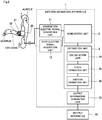
- FIG. 2 is a diagram illustrating one example of a system including the emotion estimation apparatus.
- the system in the example embodiment includes an ear-mounted apparatus 20 and an output apparatus 30, in addition to the emotion estimation apparatus 1.
- the emotion estimation apparatus 1 includes an examination electric signal generation unit 11, an echo electric signal acquisition unit 12, and an output information generation unit 13, in addition to the generation unit 2 and the estimation unit 3.
- the estimation unit 3 includes a calculation unit 14, a state estimation unit 15, and an emotion estimation unit 16.
- the ear-mounted apparatus 20 includes an examination sound signal reproduction unit 21 and an echo sound signal recording unit 22.
- the ear-mounted apparatus 20 includes the examination sound signal reproduction unit 21, which is for outputting an acoustic signal to the ear canal, and the echo sound signal recording unit 22, which is for receiving input of (measuring) an echo signal in the ear canal.
- the ear-mounted apparatus 20 is an apparatus that is used in a state in which the ear-mounted apparatus 20 is worn in the ear canal, as illustrated in the cross-sectional diagram of the outer ear (diagram illustrating the auricle, ear canal, and eardrum) in FIG. 2 .
- an earphone provided with a microphone is conceivable as the ear-mounted apparatus 20.
- the configuration of the ear-mounted apparatus 20 is not limited to that illustrated in FIG. 2 , and any configuration may be adopted as long as an echo signal corresponding to an acoustic signal can be measured.
- the examination sound signal reproduction unit 21 Upon receiving an electric signal generated by the examination electric signal generation unit 11 that corresponds to an acoustic signal, the examination sound signal reproduction unit 21 (acoustic signal output unit) generates the acoustic signal based on the received electric signal and outputs the generated acoustic signal to the ear canal.
- a speaker or the like for example, is conceivable as the examination sound signal reproduction unit 21.
- the echo sound signal recording unit 22 Upon receiving an echo signal corresponding to the acoustic signal output from the examination electric signal generation unit 11, the echo sound signal recording unit 22 (acoustic signal input unit) converts the echo signal into an electric signal and transmits the electric signal to the echo electric signal acquisition unit 12. Note that a microphone or the like, for example, is conceivable as the echo sound signal recording unit 22.
- the output apparatus 30 acquires the later-described output information, which has been converted into an outputtable format by the output information generation unit 13, and outputs images, sounds, etc., generated based on the output information.
- the output apparatus 30 is an image display device, etc., in which liquid crystal, organic electro-luminescence (EL), or a cathode ray tube (CRT) is used, for example.
- the image display device may include a sound output device such as a speaker.
- the output apparatus 30 may be a printing device such as a printer.
- the examination electric signal generation unit 11 generates the electric signal used to output the acoustic signal, and transmits the electric signal to the examination sound signal reproduction unit 21. Specifically, the examination electric signal generation unit 11 generates, as the electric signal corresponding to the acoustic signal, a maximal length sequence (M-sequence) signal, a time-stretched pulse (TSP) signal, a Log-TSP signal, or the like. Furthermore, the examination electric signal generation unit 11 transmits the electric signal corresponding to the acoustic signal to the generation unit 2.
- M-sequence maximal length sequence
- TSP time-stretched pulse
- Log-TSP Log-TSP signal
- a sweep signal, music, audio guidance, etc. may be included in the acoustic signal.
- the frequencies used for the acoustic signal are set in accordance with target organs.
- the frequency band of the acoustic signal is preferably set to 100-4k [Hz].
- this frequency band there is no limitation to this frequency band.
- the vocal tract is a path of voice, and is a cavity in the body through which sound produced by the vocal cords passes before being emitted to the outside of the body.
- the respiratory tract for example, is a path of respiratory sound and is involved in external respiration.
- the respiratory tract is formed from the upper respiratory tract (the nasal cavity, the pharynx, the larynx, etc.) and the lower respiratory tract (the trachea, the primary bronchi, the lungs, etc.).
- the echo electric signal acquisition unit 12 receives the electric signal corresponding to the echo signal from the echo sound signal recording unit 22, adjusts the received electric signal, and transmits the adjusted electric signal to the generation unit 2. Specifically, the echo electric signal acquisition unit 12 adjusts the received electric signal using a circuit including a filter, an amplifier, etc., and transmits the adjusted electric signal to the generation unit 2.
- the generation unit 2 generates acoustic characteristic information indicating an acoustic characteristic using an electric signal corresponding to an acoustic signal x(t) and an electric signal corresponding to an echo signal y(t). For example, an impulse response h(t), a transfer function H(co) or H(z) obtained by performing Fourier transform or Laplace transform on the impulse response, or the like is used as the acoustic characteristic.
- the generation unit 2 first receives the electric signal corresponding to the acoustic signal x(t) from the examination electric signal generation unit 11. Furthermore, the generation unit 2 receives the electric signal corresponding to the echo signal y(t) from the echo electric signal acquisition unit 12. Subsequently, the generation unit 2 generates the acoustic characteristic information (an impulse response h(t), a transfer function H( ⁇ ) or H(z), or the like) based on the received electric signals corresponding to the acoustic signal x(t) and the echo signal y(t).
- the acoustic characteristic information an impulse response h(t), a transfer function H( ⁇ ) or H(z), or the like
- the generation unit 2 stores the acoustic characteristic information to a storage unit, which is not illustrated.
- the storage unit may be provided inside or outside the emotion estimation apparatus 1.
- the echo signal y(t) reflects changes (changes in reflection ratio, attenuation rate, etc.) that are in accordance with the states of the subject's organs
- information relating to the states of organs inside the body can be extracted by generating the acoustic characteristic information, which is an impulse response h(t), a transfer function H( ⁇ ) or H(z), or the like.
- the echo signal includes an acoustic signal coming back from spaces (the ear canal, and the vocal and respiratory tracts) located between the head and the lungs, for example.
- the reflection ratio is the ratio of the reflection to the input
- the attenuation rate is the rate of attenuation per unit time or unit cycle.
- the estimation unit 3 estimates emotion using the acoustic characteristic information. Specifically, the estimation unit 3 estimates the state of the vocal tract and the state of the respiratory tract using the acoustic characteristic information, and estimates emotion using the estimated states of the vocal tract and the respiratory tract. Note that the estimation unit 3 estimates at least one or more states among whether the mouth is open or closed, whether the vocal cords are open or closed, the place of articulation, and the breathing type (lung breathing, diaphragmatic breathing, etc.), and sets the states as the state of the vocal tract and the state of the respiratory tract.
- the estimation unit 3 (calculation unit 14, state estimation unit 15, emotion estimation unit 16) will be described in detail.
- the calculation unit 14 calculates resonant frequency information including information indicating resonant frequencies (frequencies with peak values in frequency characteristics), or spectral shape information indicating a spectral shape.
- FIG. 3 is a diagram illustrating one example of resonant frequencies and a spectral shape.
- FIG. 3 illustrates resonant frequencies f1, f2, and f3 included in resonant frequency information, and a spectral shape included in spectral shape information.
- the calculation unit 14 first acquires the acoustic characteristic information from the generation unit 2. Subsequently, the calculation unit 14 performs spectral analysis using the acoustic characteristic, and calculates resonant frequencies for the subject. The calculation unit 14 calculates resonant frequencies using linear predictive coding (LPC), etc., as the spectral analysis, for example. Then, the calculation unit 14 generates resonant frequency information indicating the resonant frequencies, and stores the generated resonant frequency information to the storage unit. Note that the method for calculating resonant frequencies is not limited to LPC, and any method may be used as long as resonant frequencies can be calculated.
- LPC linear predictive coding
- the calculation unit 14 first acquires the acoustic characteristic information from the generation unit 2. Subsequently, the calculation unit 14 performs spectral analysis using the acoustic characteristic, and calculates a spectral shape (spectral envelope) for the subject. The calculation unit 14 calculates a spectral shape using cepstrum analysis, etc., as the spectral analysis, for example. Then, the calculation unit 14 generates spectral shape information indicating the spectral shape, and stores the generated spectral shape information to the storage unit.
- the state estimation unit 15 estimates the states of the subject's organs using the generated resonant frequency information or spectral shape information. Specifically, the state estimation unit 15 first acquires the generated resonant frequency information or spectral shape information.
- the state estimation unit 15 estimates the states of the subject's organs by using the resonant frequency information or spectral shape information and referring to state estimation information stored in advance.
- the states of organs are the state of the vocal tract, the state of the respiratory tract, etc.
- the air column length changes when the vocal cords (glottis) are opened and closed.
- the air column length from the mouth to the vocal cords or the air column length from the mouth to the lungs changes.
- the spectral shape and the formant frequencies including the resonant frequencies change when the positions of the tongue and teeth change.
- the size of the respiratory tract changes depending upon whether lung breathing (the lungs contract) or diaphragmatic breathing (the diaphragm moves up and down) is being performed.
- the state estimation unit 15 generates state information indicating the states of the organs, and stores the state information to the storage unit.
- the state information includes information indicating the state of the vocal tract and the state of the respiratory tract.
- the state of the vocal tract includes information indicating states such as whether the mouth is open or closed, whether the vocal cords are open or closed, the place of articulation, etc.
- the state of the respiratory tract includes information indicating breathing type, for example.
- the state estimation unit 15 first acquires the resonant frequency information generated by the calculation unit 14. Subsequently, the state estimation unit 15 calculates distances using the resonant frequency information and the state estimation information illustrated in FIG. 4 , and estimates the states of the organs using the calculated distances.
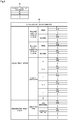
- FIG. 4 is a diagram illustrating one example of data structures of the resonant frequency information and the state estimation information.
- the state estimation unit 15 uses a feature amount characterized by resonant frequencies f1, f2, ... included in resonant frequency information 41 and calculates the distance to a feature amount characterized by resonant frequencies F11, F12, ... corresponding to "OPEN” included in "WHETHER MOUTH IS OPEN OR CLOSED” included in state estimation information 42 and the distance to a feature amount characterized by resonant frequencies F21, F22, ... corresponding to "CLOSED” included in "WHETHER MOUTH IS OPEN OR CLOSED” included in the state estimation information 42.
- the state estimation unit 15 selects the closer one of the feature amounts and sets the state corresponding to the selected feature amount as the state as to whether the mouth is open or closed. Similarly, the state estimation unit 15 performs the estimation of state also with regard to whether or not the vocal cords are open or closed, the place of articulation (the sounds “a”, “e, o”, “i”, “m, n", and “u”, etc.), and breathing type (lung breathing, diaphragmatic breathing). Subsequently, the state estimation unit 15 generates state information indicating the states of the organs, and stores the state information to the storage unit.
- the state estimation unit 15 first acquires the spectral shape information generated by the calculation unit 14. Subsequently, the state estimation unit 15 calculates distances using the spectral shape information and the state estimation information illustrated in FIG. 5 , and estimates the states of the organs using the calculated distances.
- FIG. 5 is a diagram illustrating one example of data structures of the spectral shape information and the state estimation information.
- the state estimation unit 15 uses a feature amount characterized by information sp1 indicating a spectral shape included in spectral shape information 51 and calculates the distance to a feature amount characterized by a spectral shape SP11 corresponding to "OPEN” included in "WHETHER MOUTH IS OPEN OR CLOSED” included in state estimation information 52 and the distance to a feature amount characterized by a spectral shape SP21 corresponding to "CLOSED" included in "WHETHER MOUTH IS OPEN OR CLOSED” included in the state estimation information 52.
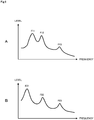
- FIG. 6 is a diagram illustrating one example of resonant frequencies and spectral shapes included in the state estimation information.
- the spectral shapes shown in portions A and B of FIG. 6 correspond to the spectral shapes SP11 and SP12 illustrated in FIG. 5 , for example.
- the state estimation unit 15 selects the state corresponding to the closer one of the feature amounts and sets the state as the state as to whether the mouth is open or closed. Similarly, the state estimation unit 15 performs the estimation of state also with regard to whether or not the vocal cords are open or closed, the place of articulation (the sounds “a”, “e, o”, “i”, “m, n", and “u”, etc.), and breathing type (lung breathing, diaphragmatic breathing). Subsequently, the state estimation unit 15 generates state information indicating the states of the organs, and stores the state information to the storage unit.
- the emotion estimation unit 16 estimates emotion using the estimated states of the vocal tract and the respiratory tract. Specifically, the emotion estimation unit 16 first acquires state information from the state estimation unit 15. Next, the emotion estimation unit 16 estimates emotion by referring to the emotion estimation information using the state information. Thereafter, the emotion estimation unit 16 transmits information indicating the estimated emotion to the output information generation unit 13.
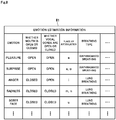
- FIG. 7 is a diagram illustrating an example of data structures of state information and emotion estimation information.
- the state information 71 includes information regarding whether the mouth is open or closed, whether the vocal cords are open or closed, the place of articulation, the state of the respiratory tract, and the breathing type, as shown in FIG. 7
- the emotion estimation unit 16 selects the emotion by referring to the emotion estimation information 72. In the example in FIG. 7 , "pleasure" is selected as the emotion.
- the emotion estimation unit 16 may estimate the emotion using a function generated using multi-variable analysis such as principal component analysis or multiple regression analysis.
- each piece of information included in the state information is used as a variable
- each emotion is used as a principal component (synthetic variable)
- a function is generated using weighting that is determined such that the synthetic variables include information (variance) of original variables as much as possible, for example. Then, the emotion estimation unit 16 estimates the emotion using the generated function.
- a regression formula is generated using each piece of information included in the state information as an explanatory variable, and using each emotion as an objective variable, for example. Then, the emotion estimation unit 16 estimates the emotion using the generated regression formula.
- the emotion estimation unit 16 may also estimate the emotion using SVM (Support Vector Machine). Specifically, the emotion estimation unit 16 is applied with a learning model for identifying the emotion, and estimates the emotion using the state information as an input. For example, the emotion estimation unit 16 estimates the emotion by inputting estimated items indicating whether the mouth is open or closed, whether the vocal cords are open or closed, the place of articulation, the state of the respiratory tract, the breathing type, and the like to the learning model.
- SVM Small Vector Machine
- the learning model is generated by performing learning using supervised data in a learning phase, in advance.
- a learning model generated based on machine learning other than SVM may also be applied to the emotion estimation unit 16.
- a neural network or a decision tree as the machine learning other than SVM
- the estimation unit 3 may also estimate the state of the vocal tract and the state of the respiratory tract using the acoustic characteristic information, and estimate the face expression of a subject using the estimated states of the vocal tract and the respiratory tract.
- a face expression such as "sober face” is added, as shown in FIG. 8.
- FIG. 8 is a diagram illustrating an example of a data structure of emotion estimation information of a modification.
- the output information generation unit 13 Upon acquiring the information indicating emotion from the emotion estimation unit 16, the output information generation unit 13 generates output information based on the information and transmits the output information to the output apparatus 30.
- the output apparatus 30 outputs the emotion of the subject based on the output information.
- FIG. 9 is a diagram illustrating one example of operations of the emotion estimation apparatus.
- FIGS. 2 to 8 will be referred to as needed in the following description.
- an emotion estimation method is implemented by causing the emotion estimation apparatus to operate. Accordingly, the following description of the operations of the emotion estimation apparatus is substituted for the description of the emotion estimation method in the example embodiment.
- the examination sound signal reproduction unit 21 first, upon receiving an electric signal that corresponds to an acoustic signal and that is generated by the examination electric signal generation unit 11, the examination sound signal reproduction unit 21 generates the acoustic signal based on the received electric signal and outputs the generated acoustic signal to the ear canal (step A1).
- the echo sound signal recording unit 22 receives input of (measures) an echo signal corresponding to the acoustic signal output from the examination electric signal generation unit 11 (step A2). Then, the echo sound signal recording unit 22 converts the received echo signal into an electric signal and transmits the electric signal to the echo electric signal acquisition unit 12.
- the generation unit 2 generates acoustic characteristic information indicating an acoustic characteristic using the electric signal corresponding to the acoustic signal x(t) and the electric signal corresponding to the echo signal y(t) (step A3).
- acoustic characteristic information indicating an acoustic characteristic using the electric signal corresponding to the acoustic signal x(t) and the electric signal corresponding to the echo signal y(t) (step A3).
- an impulse response h(t) a transfer function H( ⁇ ) or H(z) obtained by performing Fourier transform or Laplace transform on the impulse response, or the like is used as the acoustic characteristic.
- step A3 the generation unit 2 first receives the electric signal corresponding to the acoustic signal x(t) from the examination electric signal generation unit 11. Furthermore, the generation unit 2 receives the electric signal corresponding to the echo signal y(t) from the echo electric signal acquisition unit 12.
- step A3 the generation unit 2 generates the acoustic characteristic information (an impulse response h(t), a transfer function H( ⁇ ) or H(z), or the like) based on the received electric signals corresponding to the acoustic signal x(t) and the echo signal y(t). Furthermore, in step A3, the generation unit 2 stores the acoustic characteristic information to the storage unit, which is not illustrated.
- the acoustic characteristic information an impulse response h(t), a transfer function H( ⁇ ) or H(z), or the like
- the calculation unit 14 calculates resonant frequency information including information indicating resonant frequencies or spectral shape information indicating a spectral shape using the acoustic characteristic information (step A4).
- step A4 The calculation of resonant frequencies in step A4 will be described.
- step A4 the calculation unit 14 first acquires the acoustic characteristic information from the generation unit 2. Subsequently, the calculation unit 14 performs spectral analysis using the acoustic characteristic, and calculates resonant frequencies for the subject. The calculation unit 14 calculates resonant frequencies using linear predictive coding (LPC), etc., as the spectral analysis, for example. Then, in step A4, the calculation unit 14 generates resonant frequency information indicating the resonant frequencies, and stores the generated resonant frequency information to the storage unit.
- LPC linear predictive coding
- step A4 The calculation of a spectral shape in step A4 will be described.
- step A4 the calculation unit 14 first acquires the acoustic characteristic information from the generation unit 2. Subsequently, the calculation unit 14 performs spectral analysis using the acoustic characteristic, and calculates a spectral shape (spectral envelope) for the subject. The calculation unit 14 calculates a spectral shape using cepstrum analysis, etc., as the spectral analysis, for example. Then, in step A4, the calculation unit 14 generates spectral shape information indicating the spectral shape, and stores the generated spectral shape information to the storage unit.
- the state estimation unit 15 estimates the states of the subject's organs using the generated resonant frequency information or spectral shape information (step A5). Specifically, in step A5, the state estimation unit 15 first acquires the generated resonant frequency information or spectral shape information.
- step A5 the state estimation unit 15 estimates the states of the subject's organs by using the resonant frequency information or spectral shape information and referring to state estimation information stored in advance.
- the state estimation unit 15 generates state information indicating the states of the organs, and stores the state information to the storage unit.
- the state information includes information indicating the state of the vocal tract and the state of the respiratory tract.
- the state of the vocal tract includes information indicating states such as whether the mouth is open or closed, whether the vocal cords are open or closed, the place of articulation, etc.
- the state of the respiratory tract includes information indicating breathing type, for example.
- step A5 the state estimation unit 15 first acquires the resonant frequency information generated by the calculation unit 14. Subsequently, in step A5, the state estimation unit 15 calculates distances using the resonant frequency information and the state estimation information illustrated in FIG. 4 , and estimates the states of the organs using the calculated distances.
- the state estimation unit 15 uses a feature amount characterized by resonant frequencies f1, f2, ... included in resonant frequency information 41 and calculates the distance to a feature amount characterized by resonant frequencies F11, F12, ... corresponding to "OPEN” included in "WHETHER MOUTH IS OPEN OR CLOSED” included in state estimation information 42 and the distance to a feature amount characterized by resonant frequencies F21, F22, ... corresponding to "CLOSED” included in "WHETHER MOUTH IS OPEN OR CLOSED” included in the state estimation information 42.
- step A5 the state estimation unit 15 selects the closer one of the feature amounts and sets the state corresponding to the selected feature amount as the state as to whether the mouth is open or closed. Similarly, the state estimation unit 15 performs the estimation of state also with regard to whether or not the vocal cords are open or closed, the place of articulation (the sounds “a”, “e, o”, “i”, “m, n", and “u”, etc.), and breathing type (lung breathing, diaphragmatic breathing). Subsequently, the state estimation unit 15 generates state information indicating the states of the organs, and stores the state information to the storage unit.
- step 5 the state estimation unit 15 first acquires the spectral shape information generated by the calculation unit 14. Subsequently, in step 5, the state estimation unit 15 calculates distances using the spectral shape information and the state estimation information illustrated in FIG. 5 , and estimates the states of the organs using the calculated distances.
- the state estimation unit 15 uses a feature amount characterized by information sp1 indicating a spectral shape included in spectral shape information 51 and calculates the distance to a feature amount characterized by a spectral shape SP11 corresponding to "OPEN” included in "WHETHER MOUTH IS OPEN OR CLOSED” included in state estimation information 52 and the distance to a feature amount characterized by a spectral shape SP21 corresponding to "CLOSED” included in "WHETHER MOUTH IS OPEN OR CLOSED” included in the state estimation information 52.
- step 5 the state estimation unit 15 selects the state corresponding to the closer one of the feature amounts and sets the state as the state as to whether the mouth is open or closed. Similarly, the state estimation unit 15 performs the estimation of state also with regard to whether or not the vocal cords are open or closed, the place of articulation (the sounds “a”, “e, o”, “i”, “m, n", and “u”, etc.), and breathing type (lung breathing, diaphragmatic breathing). Subsequently, the state estimation unit 15 generates state information indicating the states of the organs, and stores the state information to the storage unit.
- the emotion estimation unit 16 estimates the emotion using the estimated states of the vocal tract and the respiratory tract (step A6). Specifically, in step A6, the emotion estimation unit 16 first acquires state information from the state estimation unit 15. Next, in step A6, the emotion estimation unit 16 estimates the emotion by referring to the emotion estimation information using the state information. Thereafter, in step A6, the state estimation unit 15 transmits information indicating the estimated emotion to the output information generation unit 13.
- the emotion estimation unit 16 selects the emotion by referring to the emotion estimation information 72. In the example in FIG. 7 , "pleasure" is selected as the emotion.
- the emotion estimation unit 16 may also estimate the emotion using a function generated using multi-variable analysis such as principal component analysis or multiple regression analysis.
- the emotion estimation unit 16 may estimate the emotion using SVM Specifically, the emotion estimation unit 16 is applied with a learning model for identifying emotion, and estimates the emotion using the state information as an input. For example, the emotion estimation unit 16 estimates the emotion by inputting estimated items indicating whether the mouth is open or closed, whether the vocal cords are open or closed, the place of articulation, the state of the respiratory tract, the breathing type, and the like to the learning model.
- the learning model is generated by performing learning using supervised data in a learning phase, in advance.
- a learning model generated based on machine learning other than SVM may also be applied to the emotion estimation unit 16.
- a neural network or a decision tree as the machine learning other than SVM
- the estimation unit 3 may also estimate the state of the vocal tract and the state of the respiratory tract using the acoustic characteristic information, and estimate the face expression of a subject using the estimated states of the vocal tract and the respiratory tract.
- a face expression such as "sober face” is added, as shown in FIG. 8 .
- the output information generation unit 13 upon acquiring the information indicating the emotion from the emotion estimation unit 16, the output information generation unit 13 generates output information based on the information (step A7). Furthermore, the output information generation unit 13 transmits the output information to the output apparatus 30. Subsequently, the output apparatus 30 outputs the emotion of the subject based on the output information (step A8).
- acoustic characteristic information such as an impulse response h(t) or a transfer function H(z) is generated using an acoustic signal x(t) output to the ear canal of a target user and an echo signal y(t) reflecting the states of organs inside the body. Therefore, the states of organs inside the body can be estimated from the acoustic characteristic information, and as a result, the emotion of a subject can be accurately estimated by using the states of organs.
- the emotion can be estimated by using the example embodiment, and therefore smooth communication can be realized in conversation over a telephone, conversation with a robot, and the like.
- the emotion can be estimated by using the example embodiment, and therefore the invention is useful for voice profiling and the like, in fields such as criminal investigation, marketing, and medical.
- a program in the example embodiment of the invention is a program that causes a computer to carry out steps A1 to A8 illustrated in FIG. 9 .
- the processor of the computer functions and performs processing as the generation unit 2, the estimation unit 3 (the calculation unit 14, the state estimation unit 15, and the emotion estimation unit 16), and the output information generation unit 13.
- the program in the example embodiment may be executed by a computer system formed from a plurality of computers.
- the computers may each function as one of the generation unit 2, the estimation unit 3 (the calculation unit 14, the state estimation unit 15, and the emotion estimation unit 16), and the output information generation unit 13, for example.
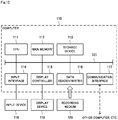
- FIG. 10 is a block diagram illustrating one example of a computer realizing the emotion estimation apparatus in the example embodiment of the invention.
- a computer 110 includes a CPU 111, a main memory 112, a storage device 113, an input interface 114, a display controller 115, a data reader/writer 116, and a communication interface 117. These components are connected via a bus 121 so as to be capable of performing data communication with one another.
- the computer 110 may include a graphics processing unit (GPU) or a field-programmable gate array (FPGA) in addition to the CPU 111 or in place of the CPU 111.
- GPU graphics processing unit
- FPGA field-programmable gate array
- the CPU 111 loads the program (codes) in the example embodiment, which is stored in the storage device 113, onto the main memory 112, and performs various computations by executing these codes in a predetermined order.
- the main memory 112 is typically a volatile storage device such as a dynamic random access memory (DRAM).
- DRAM dynamic random access memory
- the program in the example embodiment is provided in a state such that the program is stored in a computer readable recording medium 120.
- the program in the example embodiment may also be a program that is distributed on the Internet, to which the computer 110 is connected via the communication interface 117.
- the storage device 113 includes semiconductor storage devices such as a flash memory, in addition to hard disk drives.
- the input interface 114 mediates data transmission between the CPU 111 and input equipment 118 such as a keyboard and a mouse.
- the display controller 115 is connected to a display device 119, and controls the display performed by the display device 119.
- the data reader/writer 116 mediates data transmission between the CPU 111 and the recording medium 120, and executes the reading out of the program from the recording medium 120 and the writing of results of processing in the computer 110 to the recording medium 120.
- the communication interface 117 mediates data transmission between the CPU 111 and other computers.
- the recording medium 120 include a general-purpose semiconductor storage device such as a CompactFlash (registered trademark, CF) card or a Secure Digital (SD) card, a magnetic recording medium such as a flexible disk, and an optical recording medium such as a compact disk read-only memory (CD-ROM).
- a general-purpose semiconductor storage device such as a CompactFlash (registered trademark, CF) card or a Secure Digital (SD) card
- CF CompactFlash
- SD Secure Digital
- CD-ROM compact disk read-only memory
- the emotion estimation apparatus 1 in the example embodiment can also be realized by using pieces of hardware corresponding to the respective units, rather than using a computer on which the program is installed. Furthermore, a portion of the emotion estimation apparatus 1 may be realized by using a program, and the remaining portion of the emotion estimation apparatus 1 may be realized by using hardware.
- An emotion estimation apparatus comprising:
- the emotion estimation apparatus according to Supplementary note 1, wherein the estimation unit estimates the state of the vocal tract and the state of the respiratory tract using the acoustic characteristic information, and estimates the emotion using the estimated states of the vocal tract and the respiratory tract.
- the emotion estimation apparatus according to Supplementary note 2, wherein the estimation unit estimates the state of the vocal tract and the state of the respiratory tract, and estimates expression using the estimated states of the vocal tract and the respiratory tract.
- the emotion estimation apparatus estimates at least one or more states among whether the mouth is open or closed, whether the vocal cords are open or closed, the place of articulation, and breathing type, and sets the states as the state of the vocal tract and the state of the respiratory tract.
- the emotion estimation apparatus wherein the estimation unit generates resonant frequency information indicating resonant frequencies or spectral shape information indicating a spectral shape using the acoustic characteristic information, and estimates the state of the vocal tract and the state of the respiratory tract using the generated resonant frequency information or spectral shape information.
- the emotion estimation apparatus according to any one of Supplementary notes 1 to 5, further comprising:
- An emotion estimation method comprising:
- a computer readable recording medium that includes recorded thereon, a program including instructions that cause a computer to carry out:
- the accuracy in estimating emotion can be improved.
- the present invention is useful in a filed in which voice profiling or the like is needed. Specifically, the invention is useful in fields such as conversation over telephone, conversation with a robot, criminal investigation, marketing, and medical.
Landscapes
- Health & Medical Sciences (AREA)
- Engineering & Computer Science (AREA)
- Life Sciences & Earth Sciences (AREA)
- Physics & Mathematics (AREA)
- General Health & Medical Sciences (AREA)
- Surgery (AREA)
- Psychiatry (AREA)
- Animal Behavior & Ethology (AREA)
- Veterinary Medicine (AREA)
- Public Health (AREA)
- Biophysics (AREA)
- Pathology (AREA)
- Biomedical Technology (AREA)
- Heart & Thoracic Surgery (AREA)
- Medical Informatics (AREA)
- Molecular Biology (AREA)
- Audiology, Speech & Language Pathology (AREA)
- Acoustics & Sound (AREA)
- Computational Linguistics (AREA)
- Signal Processing (AREA)
- Multimedia (AREA)
- Human Computer Interaction (AREA)
- Child & Adolescent Psychology (AREA)
- Hospice & Palliative Care (AREA)
- Otolaryngology (AREA)
- Developmental Disabilities (AREA)
- Educational Technology (AREA)
- Psychology (AREA)
- Social Psychology (AREA)
- Spectroscopy & Molecular Physics (AREA)
- Physiology (AREA)
- Pulmonology (AREA)
- Nuclear Medicine, Radiotherapy & Molecular Imaging (AREA)
- Optics & Photonics (AREA)
- Radiology & Medical Imaging (AREA)
- Measurement Of The Respiration, Hearing Ability, Form, And Blood Characteristics Of Living Organisms (AREA)
- Prostheses (AREA)
- Circuit For Audible Band Transducer (AREA)
- Toys (AREA)
Abstract
Description
- The present invention relates to an emotion estimation apparatus and emotion estimation method for estimating emotion, and further relates to a computer readable recording medium that includes recorded thereon, a program for realizing the emotion estimation apparatus and emotion estimation method.
- An apparatus is known for making communication smooth using a technique for estimating emotion. Such a technique for estimating emotion is used for smoothly performing conversation over telephone and conversation with a robot, for example.
- As a related technique,
Patent Document 1 discloses an apparatus that estimates user's emotion and supports conversation, using user's voice input through a microphone, an image in which user's expression is captured that is captured using an image capturing apparatus, and the like. - Patent Document 1:
Japanese Patent Laid-Open Publication No. 2006-071936 - However, in the apparatus disclosed in
Patent Document 1 described above, user's voice is input using a microphone, and therefore the voice is likely to be influenced by noise such as environmental sound. Therefore, the accuracy in estimating emotion is degraded. - Therefore, the apparatus disclosed in
Patent Document 1 estimates emotion by further combining an image in which user's expression is captured to the user's voice. However, the image is likely to be influenced by illumination and the like, and as a result, the accuracy in estimating emotion is degraded. - An example object of the invention is to provide an emotion estimation apparatus, an emotion estimation method, and a computer readable recording medium for improving the accuracy in estimating emotion.
- In order to achieve the above-described object, an emotion estimation apparatus according to an example aspect of the invention includes:
- a generation unit configured to generate acoustic characteristic information indicating an acoustic characteristic using a first acoustic signal output to the ear canal and a second acoustic signal produced by the first acoustic signal echoing inside the body; and
- an estimation unit configured to estimate emotion using the acoustic characteristic information.
- In addition, in order to achieve the above-described object, an emotion estimation method according to an example aspect of the invention includes:
- (a) a step of generating acoustic characteristic information indicating an acoustic characteristic using a first acoustic signal output to the ear canal and a second acoustic signal produced by the first acoustic signal echoing inside the body; and
- (b) a step of estimating emotion using the acoustic characteristic information.
- Furthermore, in order to achieve the above-described object, a computer readable recording medium that includes a program recorded thereon according to an example aspect of the invention includes recorded thereon, a program including instructions that cause a computer to carry out:
- (a) a step of generating acoustic characteristic information indicating an acoustic characteristic using a first acoustic signal output to the ear canal and a second acoustic signal produced by the first acoustic signal echoing inside the body; and
- (b) a step of estimating emotion using the acoustic characteristic information.
- As described above, according to the invention, the states of the vocal and respiratory tracts can be estimated easily.
-
-
FIG. 1 is a diagram illustrating one example of an emotion estimation apparatus. -
FIG. 2 is a diagram illustrating one example of a system including the emotion estimation apparatus. -
FIG. 3 is a diagram illustrating one example of resonant frequencies and a spectral shape. -
FIG. 4 is a diagram illustrating one example of data structures of resonant frequency information and state estimation information. -
FIG. 5 is a diagram illustrating one example of data structures of spectral shape information and the state estimation information. -
FIG. 6 is a diagram illustrating one example of resonant frequencies and spectral shapes included in the state estimation information. -
FIG. 7 is a diagram illustrating an example of data structures of state information and emotion estimation information. -
FIG. 8 is a diagram illustrating an example of a data structure of emotion estimation information of a modification. -
FIG. 9 is a diagram illustrating one example of operations of the emotion estimation apparatus. -
FIG. 10 is a diagram illustrating one example of a computer for realizing the emotion estimation apparatus. - In the following, an example embodiment of the invention will be described with reference to
FIGS. 1 to 10 . - First, a configuration of an
emotion estimation apparatus 1 in the example embodiment will be described with reference toFIG. 1. FIG. 1 is a diagram illustrating one example of the emotion estimation apparatus. - The emotion estimation apparatus illustrated in
FIG. 1 is an apparatus for improving the accuracy in estimating emotion. Furthermore, as illustrated inFIG. 1 , theemotion estimation apparatus 1 includes ageneration unit 2 and anestimation unit 3. - Of the two units, the
generation unit 2 generates acoustic characteristic information indicating an acoustic characteristic using an acoustic signal (first acoustic signal) output to the ear canal and an echo signal (second acoustic signal) produced by the acoustic signal echoing inside the body. Theestimation unit 3 estimates emotion using the acoustic characteristic information. - In such a manner, in the example embodiment, acoustic characteristic information such as an impulse response h(t) or a transfer function H(ω) or H(z) is generated using an acoustic signal x(t) output to the ear canal of a target user and an echo signal y(t) reflecting the states of organs inside the body. Thus, since the states of organs inside the body can be estimated from the acoustic characteristic information, the emotion of a subject can be accurately estimated.
- Next, the configuration of the
emotion estimation apparatus 1 in the example embodiment will be described in detail with reference toFIG. 2. FIG. 2 is a diagram illustrating one example of a system including the emotion estimation apparatus. - As illustrated in
FIG. 2 , the system in the example embodiment includes an ear-mountedapparatus 20 and anoutput apparatus 30, in addition to theemotion estimation apparatus 1. Furthermore, theemotion estimation apparatus 1 includes an examination electricsignal generation unit 11, an echo electricsignal acquisition unit 12, and an outputinformation generation unit 13, in addition to thegeneration unit 2 and theestimation unit 3. Furthermore, theestimation unit 3 includes acalculation unit 14, astate estimation unit 15, and anemotion estimation unit 16. The ear-mountedapparatus 20 includes an examination soundsignal reproduction unit 21 and an echo soundsignal recording unit 22. - The ear-mounted
apparatus 20 includes the examination soundsignal reproduction unit 21, which is for outputting an acoustic signal to the ear canal, and the echo soundsignal recording unit 22, which is for receiving input of (measuring) an echo signal in the ear canal. Specifically, the ear-mountedapparatus 20 is an apparatus that is used in a state in which the ear-mountedapparatus 20 is worn in the ear canal, as illustrated in the cross-sectional diagram of the outer ear (diagram illustrating the auricle, ear canal, and eardrum) inFIG. 2 . For example, an earphone provided with a microphone is conceivable as the ear-mountedapparatus 20. - Note that the configuration of the ear-mounted
apparatus 20 is not limited to that illustrated inFIG. 2 , and any configuration may be adopted as long as an echo signal corresponding to an acoustic signal can be measured. - Upon receiving an electric signal generated by the examination electric
signal generation unit 11 that corresponds to an acoustic signal, the examination sound signal reproduction unit 21 (acoustic signal output unit) generates the acoustic signal based on the received electric signal and outputs the generated acoustic signal to the ear canal. Note that a speaker or the like, for example, is conceivable as the examination soundsignal reproduction unit 21. - Upon receiving an echo signal corresponding to the acoustic signal output from the examination electric
signal generation unit 11, the echo sound signal recording unit 22 (acoustic signal input unit) converts the echo signal into an electric signal and transmits the electric signal to the echo electricsignal acquisition unit 12. Note that a microphone or the like, for example, is conceivable as the echo soundsignal recording unit 22. - The
output apparatus 30 acquires the later-described output information, which has been converted into an outputtable format by the outputinformation generation unit 13, and outputs images, sounds, etc., generated based on the output information. Theoutput apparatus 30 is an image display device, etc., in which liquid crystal, organic electro-luminescence (EL), or a cathode ray tube (CRT) is used, for example. Furthermore, the image display device may include a sound output device such as a speaker. Note that theoutput apparatus 30 may be a printing device such as a printer. - The examination electric
signal generation unit 11 generates the electric signal used to output the acoustic signal, and transmits the electric signal to the examination soundsignal reproduction unit 21. Specifically, the examination electricsignal generation unit 11 generates, as the electric signal corresponding to the acoustic signal, a maximal length sequence (M-sequence) signal, a time-stretched pulse (TSP) signal, a Log-TSP signal, or the like. Furthermore, the examination electricsignal generation unit 11 transmits the electric signal corresponding to the acoustic signal to thegeneration unit 2. - Note that a sweep signal, music, audio guidance, etc., may be included in the acoustic signal. Furthermore, the frequencies used for the acoustic signal are set in accordance with target organs. For example, when the vocal and respiratory tracts, etc., are set as targets, the frequency band of the acoustic signal is preferably set to 100-4k [Hz]. However, there is no limitation to this frequency band.
- Here, the vocal tract (articulatory organs), for example, is a path of voice, and is a cavity in the body through which sound produced by the vocal cords passes before being emitted to the outside of the body. The respiratory tract (phonatory organs), for example, is a path of respiratory sound and is involved in external respiration. The respiratory tract is formed from the upper respiratory tract (the nasal cavity, the pharynx, the larynx, etc.) and the lower respiratory tract (the trachea, the primary bronchi, the lungs, etc.).
- The echo electric
signal acquisition unit 12 receives the electric signal corresponding to the echo signal from the echo soundsignal recording unit 22, adjusts the received electric signal, and transmits the adjusted electric signal to thegeneration unit 2. Specifically, the echo electricsignal acquisition unit 12 adjusts the received electric signal using a circuit including a filter, an amplifier, etc., and transmits the adjusted electric signal to thegeneration unit 2. - The
generation unit 2 generates acoustic characteristic information indicating an acoustic characteristic using an electric signal corresponding to an acoustic signal x(t) and an electric signal corresponding to an echo signal y(t). For example, an impulse response h(t), a transfer function H(co) or H(z) obtained by performing Fourier transform or Laplace transform on the impulse response, or the like is used as the acoustic characteristic. - Specifically, the
generation unit 2 first receives the electric signal corresponding to the acoustic signal x(t) from the examination electricsignal generation unit 11. Furthermore, thegeneration unit 2 receives the electric signal corresponding to the echo signal y(t) from the echo electricsignal acquisition unit 12. Subsequently, thegeneration unit 2 generates the acoustic characteristic information (an impulse response h(t), a transfer function H(ω) or H(z), or the like) based on the received electric signals corresponding to the acoustic signal x(t) and the echo signal y(t). - Subsequently, the
generation unit 2 stores the acoustic characteristic information to a storage unit, which is not illustrated. Note that the storage unit may be provided inside or outside theemotion estimation apparatus 1. - Since the echo signal y(t) reflects changes (changes in reflection ratio, attenuation rate, etc.) that are in accordance with the states of the subject's organs, information relating to the states of organs inside the body can be extracted by generating the acoustic characteristic information, which is an impulse response h(t), a transfer function H(ω) or H(z), or the like. Also, the echo signal includes an acoustic signal coming back from spaces (the ear canal, and the vocal and respiratory tracts) located between the head and the lungs, for example. Note that the reflection ratio is the ratio of the reflection to the input, and the attenuation rate is the rate of attenuation per unit time or unit cycle.
- The
estimation unit 3 estimates emotion using the acoustic characteristic information. Specifically, theestimation unit 3 estimates the state of the vocal tract and the state of the respiratory tract using the acoustic characteristic information, and estimates emotion using the estimated states of the vocal tract and the respiratory tract. Note that theestimation unit 3 estimates at least one or more states among whether the mouth is open or closed, whether the vocal cords are open or closed, the place of articulation, and the breathing type (lung breathing, diaphragmatic breathing, etc.), and sets the states as the state of the vocal tract and the state of the respiratory tract. - The estimation unit 3 (
calculation unit 14,state estimation unit 15, emotion estimation unit 16) will be described in detail. - Using the acoustic characteristic information, the
calculation unit 14 calculates resonant frequency information including information indicating resonant frequencies (frequencies with peak values in frequency characteristics), or spectral shape information indicating a spectral shape. -
FIG. 3 is a diagram illustrating one example of resonant frequencies and a spectral shape.FIG. 3 illustrates resonant frequencies f1, f2, and f3 included in resonant frequency information, and a spectral shape included in spectral shape information. - The calculation of resonant frequencies will be described.
- The
calculation unit 14 first acquires the acoustic characteristic information from thegeneration unit 2. Subsequently, thecalculation unit 14 performs spectral analysis using the acoustic characteristic, and calculates resonant frequencies for the subject. Thecalculation unit 14 calculates resonant frequencies using linear predictive coding (LPC), etc., as the spectral analysis, for example. Then, thecalculation unit 14 generates resonant frequency information indicating the resonant frequencies, and stores the generated resonant frequency information to the storage unit. Note that the method for calculating resonant frequencies is not limited to LPC, and any method may be used as long as resonant frequencies can be calculated. - The calculation of a spectral shape will be described.
- The
calculation unit 14 first acquires the acoustic characteristic information from thegeneration unit 2. Subsequently, thecalculation unit 14 performs spectral analysis using the acoustic characteristic, and calculates a spectral shape (spectral envelope) for the subject. Thecalculation unit 14 calculates a spectral shape using cepstrum analysis, etc., as the spectral analysis, for example. Then, thecalculation unit 14 generates spectral shape information indicating the spectral shape, and stores the generated spectral shape information to the storage unit. - The
state estimation unit 15 estimates the states of the subject's organs using the generated resonant frequency information or spectral shape information. Specifically, thestate estimation unit 15 first acquires the generated resonant frequency information or spectral shape information. - Subsequently, the
state estimation unit 15 estimates the states of the subject's organs by using the resonant frequency information or spectral shape information and referring to state estimation information stored in advance. For example, the states of organs are the state of the vocal tract, the state of the respiratory tract, etc. - Note that, as the state of the vocal tract, states such as whether the mouth is open or closed, whether the vocal cords are open or closed, and the place of articulation are conceivable, for example. As the state of the respiratory tract, breathing type is conceivable, for example.
- In regard to whether the mouth is open or closed, if the mouth is open, the sound pressure at low frequencies decreases since the pressure inside the mouth decreases. Furthermore, when the mouth is opened and closed, resonant frequencies change since the open and closed ends in the air column resonance model change.
- In regard to whether the vocal cords are open or closed, the air column length changes when the vocal cords (glottis) are opened and closed. For example, the air column length from the mouth to the vocal cords or the air column length from the mouth to the lungs changes.
- In regard to the place of articulation, the spectral shape and the formant frequencies including the resonant frequencies change when the positions of the tongue and teeth change.
- In regard to breathing type, the size of the respiratory tract changes depending upon whether lung breathing (the lungs contract) or diaphragmatic breathing (the diaphragm moves up and down) is being performed.
- Subsequently, the
state estimation unit 15 generates state information indicating the states of the organs, and stores the state information to the storage unit. For example, the state information includes information indicating the state of the vocal tract and the state of the respiratory tract. For example, the state of the vocal tract includes information indicating states such as whether the mouth is open or closed, whether the vocal cords are open or closed, the place of articulation, etc. Furthermore, the state of the respiratory tract includes information indicating breathing type, for example. - A case in which resonant frequencies are used will be described.
- The
state estimation unit 15 first acquires the resonant frequency information generated by thecalculation unit 14. Subsequently, thestate estimation unit 15 calculates distances using the resonant frequency information and the state estimation information illustrated inFIG. 4 , and estimates the states of the organs using the calculated distances. -
FIG. 4 is a diagram illustrating one example of data structures of the resonant frequency information and the state estimation information. For example, in a case in which thestate estimation unit 15 estimates whether the mouth is open or closed, thestate estimation unit 15 uses a feature amount characterized by resonant frequencies f1, f2, ... included inresonant frequency information 41 and calculates the distance to a feature amount characterized by resonant frequencies F11, F12, ... corresponding to "OPEN" included in "WHETHER MOUTH IS OPEN OR CLOSED" included instate estimation information 42 and the distance to a feature amount characterized by resonant frequencies F21, F22, ... corresponding to "CLOSED" included in "WHETHER MOUTH IS OPEN OR CLOSED" included in thestate estimation information 42. - Furthermore, the
state estimation unit 15 selects the closer one of the feature amounts and sets the state corresponding to the selected feature amount as the state as to whether the mouth is open or closed. Similarly, thestate estimation unit 15 performs the estimation of state also with regard to whether or not the vocal cords are open or closed, the place of articulation (the sounds "a", "e, o", "i", "m, n", and "u", etc.), and breathing type (lung breathing, diaphragmatic breathing). Subsequently, thestate estimation unit 15 generates state information indicating the states of the organs, and stores the state information to the storage unit. - A case in which spectral shapes are used will be described.
- The
state estimation unit 15 first acquires the spectral shape information generated by thecalculation unit 14. Subsequently, thestate estimation unit 15 calculates distances using the spectral shape information and the state estimation information illustrated inFIG. 5 , and estimates the states of the organs using the calculated distances. -
FIG. 5 is a diagram illustrating one example of data structures of the spectral shape information and the state estimation information. For example, in a case in which thestate estimation unit 15 estimates whether the mouth is open or closed, thestate estimation unit 15 uses a feature amount characterized by information sp1 indicating a spectral shape included inspectral shape information 51 and calculates the distance to a feature amount characterized by a spectral shape SP11 corresponding to "OPEN" included in "WHETHER MOUTH IS OPEN OR CLOSED" included instate estimation information 52 and the distance to a feature amount characterized by a spectral shape SP21 corresponding to "CLOSED" included in "WHETHER MOUTH IS OPEN OR CLOSED" included in thestate estimation information 52. -
FIG. 6 is a diagram illustrating one example of resonant frequencies and spectral shapes included in the state estimation information. The spectral shapes shown in portions A and B ofFIG. 6 correspond to the spectral shapes SP11 and SP12 illustrated inFIG. 5 , for example. - Then, the
state estimation unit 15 selects the state corresponding to the closer one of the feature amounts and sets the state as the state as to whether the mouth is open or closed. Similarly, thestate estimation unit 15 performs the estimation of state also with regard to whether or not the vocal cords are open or closed, the place of articulation (the sounds "a", "e, o", "i", "m, n", and "u", etc.), and breathing type (lung breathing, diaphragmatic breathing). Subsequently, thestate estimation unit 15 generates state information indicating the states of the organs, and stores the state information to the storage unit. - The
emotion estimation unit 16 estimates emotion using the estimated states of the vocal tract and the respiratory tract. Specifically, theemotion estimation unit 16 first acquires state information from thestate estimation unit 15. Next, theemotion estimation unit 16 estimates emotion by referring to the emotion estimation information using the state information. Thereafter, theemotion estimation unit 16 transmits information indicating the estimated emotion to the outputinformation generation unit 13. -
FIG. 7 is a diagram illustrating an example of data structures of state information and emotion estimation information. For example, when thestate information 71 includes information regarding whether the mouth is open or closed, whether the vocal cords are open or closed, the place of articulation, the state of the respiratory tract, and the breathing type, as shown inFIG. 7 , theemotion estimation unit 16 selects the emotion by referring to theemotion estimation information 72. In the example inFIG. 7 , "pleasure" is selected as the emotion. - Also, the
emotion estimation unit 16 may estimate the emotion using a function generated using multi-variable analysis such as principal component analysis or multiple regression analysis. - In a case of principal component analysis, each piece of information included in the state information is used as a variable, each emotion is used as a principal component (synthetic variable), and a function is generated using weighting that is determined such that the synthetic variables include information (variance) of original variables as much as possible, for example. Then, the
emotion estimation unit 16 estimates the emotion using the generated function. - In a case of multiple regression analysis, a regression formula is generated using each piece of information included in the state information as an explanatory variable, and using each emotion as an objective variable, for example. Then, the
emotion estimation unit 16 estimates the emotion using the generated regression formula. - Moreover, the
emotion estimation unit 16 may also estimate the emotion using SVM (Support Vector Machine). Specifically, theemotion estimation unit 16 is applied with a learning model for identifying the emotion, and estimates the emotion using the state information as an input. For example, theemotion estimation unit 16 estimates the emotion by inputting estimated items indicating whether the mouth is open or closed, whether the vocal cords are open or closed, the place of articulation, the state of the respiratory tract, the breathing type, and the like to the learning model. - Note that the learning model is generated by performing learning using supervised data in a learning phase, in advance.
- Also, a learning model generated based on machine learning other than SVM may also be applied to the
emotion estimation unit 16. For example, it is conceivable to use a neural network or a decision tree as the machine learning other than SVM - Moreover, the
estimation unit 3 may also estimate the state of the vocal tract and the state of the respiratory tract using the acoustic characteristic information, and estimate the face expression of a subject using the estimated states of the vocal tract and the respiratory tract. In this case, a face expression such as "sober face" is added, as shown inFIG. 8. FIG. 8 is a diagram illustrating an example of a data structure of emotion estimation information of a modification. - Upon acquiring the information indicating emotion from the
emotion estimation unit 16, the outputinformation generation unit 13 generates output information based on the information and transmits the output information to theoutput apparatus 30. Theoutput apparatus 30 outputs the emotion of the subject based on the output information. - Next, operations of the emotion estimation apparatus in the example embodiment of the invention will be described with reference to
FIG. 9. FIG. 9 is a diagram illustrating one example of operations of the emotion estimation apparatus.FIGS. 2 to 8 will be referred to as needed in the following description. Furthermore, in the example embodiment, an emotion estimation method is implemented by causing the emotion estimation apparatus to operate. Accordingly, the following description of the operations of the emotion estimation apparatus is substituted for the description of the emotion estimation method in the example embodiment. - As illustrated in
FIG. 9 , first, upon receiving an electric signal that corresponds to an acoustic signal and that is generated by the examination electricsignal generation unit 11, the examination soundsignal reproduction unit 21 generates the acoustic signal based on the received electric signal and outputs the generated acoustic signal to the ear canal (step A1). - Subsequently, the echo sound
signal recording unit 22 receives input of (measures) an echo signal corresponding to the acoustic signal output from the examination electric signal generation unit 11 (step A2). Then, the echo soundsignal recording unit 22 converts the received echo signal into an electric signal and transmits the electric signal to the echo electricsignal acquisition unit 12. - Subsequently, the
generation unit 2 generates acoustic characteristic information indicating an acoustic characteristic using the electric signal corresponding to the acoustic signal x(t) and the electric signal corresponding to the echo signal y(t) (step A3). For example, an impulse response h(t), a transfer function H(ω) or H(z) obtained by performing Fourier transform or Laplace transform on the impulse response, or the like is used as the acoustic characteristic. - Specifically, in step A3, the
generation unit 2 first receives the electric signal corresponding to the acoustic signal x(t) from the examination electricsignal generation unit 11. Furthermore, thegeneration unit 2 receives the electric signal corresponding to the echo signal y(t) from the echo electricsignal acquisition unit 12. - Subsequently, in step A3, the
generation unit 2 generates the acoustic characteristic information (an impulse response h(t), a transfer function H(ω) or H(z), or the like) based on the received electric signals corresponding to the acoustic signal x(t) and the echo signal y(t). Furthermore, in step A3, thegeneration unit 2 stores the acoustic characteristic information to the storage unit, which is not illustrated. - Subsequently, the
calculation unit 14 calculates resonant frequency information including information indicating resonant frequencies or spectral shape information indicating a spectral shape using the acoustic characteristic information (step A4). - The calculation of resonant frequencies in step A4 will be described.
- In step A4, the
calculation unit 14 first acquires the acoustic characteristic information from thegeneration unit 2. Subsequently, thecalculation unit 14 performs spectral analysis using the acoustic characteristic, and calculates resonant frequencies for the subject. Thecalculation unit 14 calculates resonant frequencies using linear predictive coding (LPC), etc., as the spectral analysis, for example. Then, in step A4, thecalculation unit 14 generates resonant frequency information indicating the resonant frequencies, and stores the generated resonant frequency information to the storage unit. - The calculation of a spectral shape in step A4 will be described.
- In step A4, the
calculation unit 14 first acquires the acoustic characteristic information from thegeneration unit 2. Subsequently, thecalculation unit 14 performs spectral analysis using the acoustic characteristic, and calculates a spectral shape (spectral envelope) for the subject. Thecalculation unit 14 calculates a spectral shape using cepstrum analysis, etc., as the spectral analysis, for example. Then, in step A4, thecalculation unit 14 generates spectral shape information indicating the spectral shape, and stores the generated spectral shape information to the storage unit. - Subsequently, the
state estimation unit 15 estimates the states of the subject's organs using the generated resonant frequency information or spectral shape information (step A5). Specifically, in step A5, thestate estimation unit 15 first acquires the generated resonant frequency information or spectral shape information. - Subsequently, in step A5, the
state estimation unit 15 estimates the states of the subject's organs by using the resonant frequency information or spectral shape information and referring to state estimation information stored in advance. - Subsequently, in step A5, the
state estimation unit 15 generates state information indicating the states of the organs, and stores the state information to the storage unit. For example, the state information includes information indicating the state of the vocal tract and the state of the respiratory tract. For example, the state of the vocal tract includes information indicating states such as whether the mouth is open or closed, whether the vocal cords are open or closed, the place of articulation, etc. Furthermore, the state of the respiratory tract includes information indicating breathing type, for example. - A case in which estimation is performed using resonant frequencies will be described.
- In step A5, the
state estimation unit 15 first acquires the resonant frequency information generated by thecalculation unit 14. Subsequently, in step A5, thestate estimation unit 15 calculates distances using the resonant frequency information and the state estimation information illustrated inFIG. 4 , and estimates the states of the organs using the calculated distances. - For example, in a case in which the
state estimation unit 15 estimates whether the mouth is open or closed, thestate estimation unit 15 uses a feature amount characterized by resonant frequencies f1, f2, ... included inresonant frequency information 41 and calculates the distance to a feature amount characterized by resonant frequencies F11, F12, ... corresponding to "OPEN" included in "WHETHER MOUTH IS OPEN OR CLOSED" included instate estimation information 42 and the distance to a feature amount characterized by resonant frequencies F21, F22, ... corresponding to "CLOSED" included in "WHETHER MOUTH IS OPEN OR CLOSED" included in thestate estimation information 42. - Then, in step A5 the
state estimation unit 15 selects the closer one of the feature amounts and sets the state corresponding to the selected feature amount as the state as to whether the mouth is open or closed. Similarly, thestate estimation unit 15 performs the estimation of state also with regard to whether or not the vocal cords are open or closed, the place of articulation (the sounds "a", "e, o", "i", "m, n", and "u", etc.), and breathing type (lung breathing, diaphragmatic breathing). Subsequently, thestate estimation unit 15 generates state information indicating the states of the organs, and stores the state information to the storage unit. - A case in which estimation is performed using a spectral shape will be described.
- In step 5, the
state estimation unit 15 first acquires the spectral shape information generated by thecalculation unit 14. Subsequently, in step 5, thestate estimation unit 15 calculates distances using the spectral shape information and the state estimation information illustrated inFIG. 5 , and estimates the states of the organs using the calculated distances. - For example, in a case in which the
state estimation unit 15 estimates whether the mouth is open or closed, thestate estimation unit 15 uses a feature amount characterized by information sp1 indicating a spectral shape included inspectral shape information 51 and calculates the distance to a feature amount characterized by a spectral shape SP11 corresponding to "OPEN" included in "WHETHER MOUTH IS OPEN OR CLOSED" included instate estimation information 52 and the distance to a feature amount characterized by a spectral shape SP21 corresponding to "CLOSED" included in "WHETHER MOUTH IS OPEN OR CLOSED" included in thestate estimation information 52. - Then, in step 5, the
state estimation unit 15 selects the state corresponding to the closer one of the feature amounts and sets the state as the state as to whether the mouth is open or closed. Similarly, thestate estimation unit 15 performs the estimation of state also with regard to whether or not the vocal cords are open or closed, the place of articulation (the sounds "a", "e, o", "i", "m, n", and "u", etc.), and breathing type (lung breathing, diaphragmatic breathing). Subsequently, thestate estimation unit 15 generates state information indicating the states of the organs, and stores the state information to the storage unit. - Next, the
emotion estimation unit 16 estimates the emotion using the estimated states of the vocal tract and the respiratory tract (step A6). Specifically, in step A6, theemotion estimation unit 16 first acquires state information from thestate estimation unit 15. Next, in step A6, theemotion estimation unit 16 estimates the emotion by referring to the emotion estimation information using the state information. Thereafter, in step A6, thestate estimation unit 15 transmits information indicating the estimated emotion to the outputinformation generation unit 13. - For example, when the
state information 71 includes information indicating whether the mouth is open or closed, whether the vocal cords are open or closed, the place of articulation, the state of the respiratory tract, and the breathing type, as shown inFIG. 7 , theemotion estimation unit 16 selects the emotion by referring to theemotion estimation information 72. In the example inFIG. 7 , "pleasure" is selected as the emotion. - Also, in step A6, the
emotion estimation unit 16 may also estimate the emotion using a function generated using multi-variable analysis such as principal component analysis or multiple regression analysis. - Moreover, the
emotion estimation unit 16 may estimate the emotion using SVM Specifically, theemotion estimation unit 16 is applied with a learning model for identifying emotion, and estimates the emotion using the state information as an input. For example, theemotion estimation unit 16 estimates the emotion by inputting estimated items indicating whether the mouth is open or closed, whether the vocal cords are open or closed, the place of articulation, the state of the respiratory tract, the breathing type, and the like to the learning model. - Note that the learning model is generated by performing learning using supervised data in a learning phase, in advance.
- Also, a learning model generated based on machine learning other than SVM may also be applied to the
emotion estimation unit 16. For example, it is conceivable to use a neural network or a decision tree as the machine learning other than SVM - Also, in step A6, the
estimation unit 3 may also estimate the state of the vocal tract and the state of the respiratory tract using the acoustic characteristic information, and estimate the face expression of a subject using the estimated states of the vocal tract and the respiratory tract. In this case, a face expression such as "sober face" is added, as shown inFIG. 8 . - Subsequently, upon acquiring the information indicating the emotion from the
emotion estimation unit 16, the outputinformation generation unit 13 generates output information based on the information (step A7). Furthermore, the outputinformation generation unit 13 transmits the output information to theoutput apparatus 30. Subsequently, theoutput apparatus 30 outputs the emotion of the subject based on the output information (step A8). - As described above, according to the example embodiment, acoustic characteristic information such as an impulse response h(t) or a transfer function H(z) is generated using an acoustic signal x(t) output to the ear canal of a target user and an echo signal y(t) reflecting the states of organs inside the body. Therefore, the states of organs inside the body can be estimated from the acoustic characteristic information, and as a result, the emotion of a subject can be accurately estimated by using the states of organs.
- Also, the emotion can be estimated by using the example embodiment, and therefore smooth communication can be realized in conversation over a telephone, conversation with a robot, and the like.
- Also, the emotion can be estimated by using the example embodiment, and therefore the invention is useful for voice profiling and the like, in fields such as criminal investigation, marketing, and medical.
- It suffices for a program in the example embodiment of the invention to be a program that causes a computer to carry out steps A1 to A8 illustrated in
FIG. 9 . By installing this program on a computer and executing the program, the emotion estimation apparatus and the emotion estimation method in the example embodiment can be realized. In this case, the processor of the computer functions and performs processing as thegeneration unit 2, the estimation unit 3 (thecalculation unit 14, thestate estimation unit 15, and the emotion estimation unit 16), and the outputinformation generation unit 13. - Furthermore, the program in the example embodiment may be executed by a computer system formed from a plurality of computers. In this case, the computers may each function as one of the
generation unit 2, the estimation unit 3 (thecalculation unit 14, thestate estimation unit 15, and the emotion estimation unit 16), and the outputinformation generation unit 13, for example. - Here, a computer that realizes the emotion estimation apparatus by executing the program in the example embodiment will be described with reference to
FIG. 10. FIG. 10 is a block diagram illustrating one example of a computer realizing the emotion estimation apparatus in the example embodiment of the invention. - As illustrated in
FIG. 10 , acomputer 110 includes aCPU 111, amain memory 112, astorage device 113, aninput interface 114, adisplay controller 115, a data reader/writer 116, and acommunication interface 117. These components are connected via abus 121 so as to be capable of performing data communication with one another. Note that thecomputer 110 may include a graphics processing unit (GPU) or a field-programmable gate array (FPGA) in addition to theCPU 111 or in place of theCPU 111. - The
CPU 111 loads the program (codes) in the example embodiment, which is stored in thestorage device 113, onto themain memory 112, and performs various computations by executing these codes in a predetermined order. Themain memory 112 is typically a volatile storage device such as a dynamic random access memory (DRAM). Furthermore, the program in the example embodiment is provided in a state such that the program is stored in a computerreadable recording medium 120. Note that the program in the example embodiment may also be a program that is distributed on the Internet, to which thecomputer 110 is connected via thecommunication interface 117. - In addition, specific examples of the
storage device 113 include semiconductor storage devices such as a flash memory, in addition to hard disk drives. Theinput interface 114 mediates data transmission between theCPU 111 andinput equipment 118 such as a keyboard and a mouse. Thedisplay controller 115 is connected to adisplay device 119, and controls the display performed by thedisplay device 119. - The data reader/
writer 116 mediates data transmission between theCPU 111 and therecording medium 120, and executes the reading out of the program from therecording medium 120 and the writing of results of processing in thecomputer 110 to therecording medium 120. Thecommunication interface 117 mediates data transmission between theCPU 111 and other computers. - Furthermore, specific examples of the
recording medium 120 include a general-purpose semiconductor storage device such as a CompactFlash (registered trademark, CF) card or a Secure Digital (SD) card, a magnetic recording medium such as a flexible disk, and an optical recording medium such as a compact disk read-only memory (CD-ROM). - Note that the
emotion estimation apparatus 1 in the example embodiment can also be realized by using pieces of hardware corresponding to the respective units, rather than using a computer on which the program is installed. Furthermore, a portion of theemotion estimation apparatus 1 may be realized by using a program, and the remaining portion of theemotion estimation apparatus 1 may be realized by using hardware. - In relation to the above example embodiment, the following Supplementary notes are further disclosed. While a part of or the entirety of the above-described example embodiment can be expressed by (Supplementary note 1) to (Supplementary note 16) described in the following, the invention is not limited to the following description.
- An emotion estimation apparatus comprising:
- a generation unit configured to generate acoustic characteristic information indicating an acoustic characteristic using a first acoustic signal output to the ear canal and a second acoustic signal produced by the first acoustic signal echoing inside the body; and
- an estimation unit configured to estimate emotion using the acoustic characteristic information.
- The emotion estimation apparatus according to
Supplementary note 1, wherein
the estimation unit estimates the state of the vocal tract and the state of the respiratory tract using the acoustic characteristic information, and estimates the emotion using the estimated states of the vocal tract and the respiratory tract. - The emotion estimation apparatus according to
Supplementary note 2, wherein
the estimation unit estimates the state of the vocal tract and the state of the respiratory tract, and estimates expression using the estimated states of the vocal tract and the respiratory tract. - The emotion estimation apparatus according to
Supplementary note
the estimation unit estimates at least one or more states among whether the mouth is open or closed, whether the vocal cords are open or closed, the place of articulation, and breathing type, and sets the states as the state of the vocal tract and the state of the respiratory tract. - The emotion estimation apparatus according to Supplementary note 4, wherein
the estimation unit generates resonant frequency information indicating resonant frequencies or spectral shape information indicating a spectral shape using the acoustic characteristic information, and estimates the state of the vocal tract and the state of the respiratory tract using the generated resonant frequency information or spectral shape information. - The emotion estimation apparatus according to any one of
Supplementary notes 1 to 5, further comprising: - an acoustic signal output unit configured to output the first acoustic signal to the ear canal; and
- an acoustic signal input unit configured to receive input of the second acoustic signal.
- An emotion estimation method comprising:
- (a) a step of generating acoustic characteristic information indicating an acoustic characteristic using a first acoustic signal output to the ear canal and a second acoustic signal produced by the first acoustic signal echoing inside the body; and
- (b) a step of estimating emotion using the acoustic characteristic information.
- The emotion estimation method according to Supplementary note 7, wherein
in the (b) step, the state of the vocal tract and the state of the respiratory tract are estimated using the acoustic characteristic information, and the emotion is estimated using the estimated states of the vocal tract and the respiratory tract. - The emotion estimation method according to Supplementary note 8, wherein
in the (b) step, the state of the vocal tract and the state of the respiratory tract are estimated, and expression is estimated using the estimated states of the vocal tract and the respiratory tract. - The emotion estimation method according to Supplementary note 8 or 9, wherein
in the (b) step, at least one or more states among whether the mouth is open or closed, whether the vocal cords are open or closed, the place of articulation, and breathing type are estimated and set as the state of the vocal tract and the state of the respiratory tract. - The emotion estimation method according to Supplementary note 10, wherein
in the (b) step, resonant frequency information indicating resonant frequencies or spectral shape information indicating a spectral shape is generated using the acoustic characteristic information, and the state of the vocal tract and the state of the respiratory tract are estimated using the generated resonant frequency information or spectral shape information. - A computer readable recording medium that includes recorded thereon, a program including instructions that cause a computer to carry out:
- (a) a step of generating acoustic characteristic information indicating an acoustic characteristic using a first acoustic signal output to the ear canal and a second acoustic signal produced by the first acoustic signal echoing inside the body; and
- (b) a step of estimating emotion using the acoustic characteristic information.
- The computer readable recording medium according to
Supplementary note 12, wherein
in the (b) step, the state of the vocal tract and the state of the respiratory tract are estimated using the acoustic characteristic information, and the emotion is estimated using the estimated states of the vocal tract and the respiratory tract. - The computer readable recording medium according to
Supplementary note 13, wherein
in the (b) step, the state of the vocal tract and the state of the respiratory tract are estimated, and expression is estimated using the estimated states of the vocal tract and the respiratory tract. - The computer readable recording medium according to
Supplementary note
in the (b) step, at least one or more states among whether the mouth is open or closed, whether the vocal cords are open or closed, the place of articulation, and breathing type are estimated and set as the state of the vocal tract and the state of the respiratory tract. - The computer readable recording medium according to
Supplementary note 15, wherein
in the (b) step, resonant frequency information indicating resonant frequencies or spectral shape information indicating a spectral shape is generated using the acoustic characteristic information, and the state of the vocal tract and the state of the respiratory tract are estimated using the generated resonant frequency information or spectral shape information. - The invention has been described with reference to an example embodiment above, but the invention is not limited to the above-described example embodiment. Within the scope of the invention, various changes that could be understood by a person skilled in the art could be applied to the configurations and details of the invention.
- As described above, according to the invention, the accuracy in estimating emotion can be improved. The present invention is useful in a filed in which voice profiling or the like is needed. Specifically, the invention is useful in fields such as conversation over telephone, conversation with a robot, criminal investigation, marketing, and medical.
-
- 1
- Emotion estimation apparatus
- 2
- Generation unit
- 3
- Estimation unit
- 11
- Examination electric signal generation unit
- 12
- Echo electric signal acquisition unit
- 13
- Output information generation unit
- 14
- Calculation unit
- 15
- State estimation unit
- 16
- Emotion estimation unit
- 20
- Ear-mounted apparatus
- 21
- Examination sound signal reproduction unit
- 22
- Echo sound signal recording unit
- 30
- Output apparatus
- 41
- Resonant frequency information
- 42
- State estimation information
- 51
- Spectral shape information
- 52
- State estimation information
- 71
- State information
- 72, 81
- Emotion estimation information
- 110
- Computer
- 111
- CPU
- 112
- Main memory
- 113
- Storage device
- 114
- Input interface
- 115
- Display controller
- 116
- Data reader/writer
- 117
- Communication interface
- 118
- Input equipment
- 119
- Display device
- 120
- Recording medium
- 121
- Bus
Claims (16)
- An emotion estimation apparatus comprising:a generation means for generating acoustic characteristic information indicating an acoustic characteristic using a first acoustic signal output to the ear canal and a second acoustic signal produced by the first acoustic signal echoing inside the body; andan estimation means for estimating emotion using the acoustic characteristic information.
- The emotion estimation apparatus according to claim 1, wherein
the estimation means estimates the state of the vocal tract and the state of the respiratory tract using the acoustic characteristic information, and estimates emotion using the estimated states of the vocal tract and the respiratory tract. - The emotion estimation apparatus according to claim 2, wherein
the estimation means estimates the state of the vocal tract and the state of the respiratory tract, and estimates expression using the estimated states of the vocal tract and the respiratory tract. - The emotion estimation apparatus according to claim 2 or 3, wherein
the estimation means estimates at least one or more states among whether the mouth is open or closed, whether the vocal cords are open or closed, the place of articulation, and breathing type, and sets the states as the state of the vocal tract and the state of the respiratory tract. - The emotion estimation apparatus according to claim 4, wherein
the estimation means generates resonant frequency information indicating resonant frequencies or spectral shape information indicating a spectral shape using the acoustic characteristic information, and estimates the state of the vocal tract and the state of the respiratory tract using the generated resonant frequency information or spectral shape information. - The emotion estimation apparatus according to any one of claims 1 to 5, further comprising:an acoustic signal output means for outputting the first acoustic signal to the ear canal; andan acoustic signal input means for receiving input of the second acoustic signal.
- An emotion estimation method comprising:(a) a step of generating acoustic characteristic information indicating an acoustic characteristic using a first acoustic signal output to an ear canal and a second acoustic signal produced by the first acoustic signal echoing inside the body; and(b) a step of estimating emotion using the acoustic characteristic information.
- The emotion estimation method according to claim 7, wherein
in the (b) step, the state of the vocal tract and the state of the respiratory tract are estimated using the acoustic characteristic information, and emotion is estimated using the estimated states of the vocal tract and the respiratory tract. - The emotion estimation method according to claim 8, wherein
in the (b) step, the state of the vocal tract and the state of the respiratory tract are estimated, and expression is estimated using the estimated states of the vocal tract and the respiratory tract. - The emotion estimation method according to claim 8 or 9, wherein
in the (b) step, at least one or more states among whether the mouth is open or closed, whether the vocal cords are open or closed, the place of articulation, and breathing type are estimated and set as the state of the vocal tract and the state of the respiratory tract. - The emotion estimation method according to claim 10, wherein
in the (b) step, resonant frequency information indicating resonant frequencies or spectral shape information indicating a spectral shape is generated using the acoustic characteristic information, and the state of the vocal tract and the state of the respiratory tract are estimated using the generated resonant frequency information or spectral shape information. - A computer readable recording medium that includes recorded thereon, a program including instructions that cause a computer to carry out:(a) a step of generating acoustic characteristic information indicating an acoustic characteristic using a first acoustic signal output to an ear canal and a second acoustic signal produced by the first acoustic signal echoing inside the body; and(b) a step of estimating emotion using the acoustic characteristic information.
- The computer readable recording medium according to claim 12, wherein
in the (b) step, the state of the vocal tract and the state of the respiratory tract are estimated using the acoustic characteristic information, and emotion is estimated using the estimated states of the vocal tract and the respiratory tract. - The computer readable recording medium according to claim 13, wherein
in the (b) step, the state of the vocal tract and the state of the respiratory tract are estimated, and expression is estimated using the estimated states of the vocal tract and the respiratory tract. - The computer readable recording medium according to claim 13 or 14, wherein
in the (b) step, at least one or more states among whether the mouth is open or closed, whether the vocal cords are open or closed, the place of articulation, and breathing type are estimated and set as the state of the vocal tract and the state of the respiratory tract. - The computer readable recording medium according to claim 15, wherein
in the (b) step, resonant frequency information indicating resonant frequencies or spectral shape information indicating a spectral shape is generated using the acoustic characteristic information, and the state of the vocal tract and the state of the respiratory tract are estimated using the generated resonant frequency information or spectral shape information.
Applications Claiming Priority (1)
| Application Number | Priority Date | Filing Date | Title |
|---|---|---|---|
| PCT/JP2019/007918 WO2020174680A1 (en) | 2019-02-28 | 2019-02-28 | Emotion estimation device, emotion estimation method, and computer-readable recording medium |
Publications (2)
| Publication Number | Publication Date |
|---|---|
| EP3932311A1 true EP3932311A1 (en) | 2022-01-05 |
| EP3932311A4 EP3932311A4 (en) | 2022-02-09 |
Family
ID=72238386
Family Applications (1)
| Application Number | Title | Priority Date | Filing Date |
|---|---|---|---|
| EP19917143.0A Withdrawn EP3932311A4 (en) | 2019-02-28 | 2019-02-28 | Emotion estimation device, emotion estimation method, and computer-readable recording medium |
Country Status (5)
| Country | Link |
|---|---|
| US (1) | US11984136B2 (en) |
| EP (1) | EP3932311A4 (en) |
| JP (1) | JP7115625B2 (en) |
| CN (1) | CN113473913B (en) |
| WO (1) | WO2020174680A1 (en) |
Families Citing this family (1)
| Publication number | Priority date | Publication date | Assignee | Title |
|---|---|---|---|---|
| EP4312732B1 (en) * | 2022-06-10 | 2025-08-27 | Google LLC | Audioplethysmography calibration |
Family Cites Families (15)
| Publication number | Priority date | Publication date | Assignee | Title |
|---|---|---|---|---|
| TWI221574B (en) * | 2000-09-13 | 2004-10-01 | Agi Inc | Sentiment sensing method, perception generation method and device thereof and software |
| JP2006071936A (en) | 2004-09-01 | 2006-03-16 | Matsushita Electric Works Ltd | Dialogue agent |
| US20060183980A1 (en) * | 2005-02-14 | 2006-08-17 | Chang-Ming Yang | Mental and physical health status monitoring, analyze and automatic follow up methods and its application on clothing |
| JP5141696B2 (en) * | 2008-02-22 | 2013-02-13 | 日本電気株式会社 | Biometric authentication device, biometric authentication method, and biometric authentication program |
| JP4609527B2 (en) * | 2008-06-03 | 2011-01-12 | 株式会社デンソー | Automotive information provision system |
| JP5543929B2 (en) * | 2009-02-05 | 2014-07-09 | 国立大学法人大阪大学 | Input device, wearable computer, and input method |
| US20110040155A1 (en) * | 2009-08-13 | 2011-02-17 | International Business Machines Corporation | Multiple sensory channel approach for translating human emotions in a computing environment |
| JP2014003502A (en) * | 2012-06-19 | 2014-01-09 | Toshiba Corp | Signal processing device and signal processing method |
| JP6151272B2 (en) | 2012-11-30 | 2017-06-21 | パナソニック インテレクチュアル プロパティ コーポレーション オブ アメリカPanasonic Intellectual Property Corporation of America | Information provision method |
| JP2015109964A (en) | 2013-11-11 | 2015-06-18 | 株式会社電通サイエンスジャム | Emotion estimation device, emotion estimation processing system, emotion estimation method, and emotion estimation program |
| JP6761598B2 (en) * | 2016-10-24 | 2020-09-30 | 富士ゼロックス株式会社 | Emotion estimation system, emotion estimation model generation system |
| JP6685891B2 (en) * | 2016-12-20 | 2020-04-22 | Kddi株式会社 | Biosignal processing apparatus, program and method using filter processing and frequency determination processing |
| CN108594991A (en) * | 2018-03-28 | 2018-09-28 | 努比亚技术有限公司 | A kind of method, apparatus and computer storage media that help user to adjust mood |
| CN108391207A (en) | 2018-03-30 | 2018-08-10 | 广东欧珀移动通信有限公司 | Data processing method, device, terminal, earphone and readable storage medium |
| CN109391870B (en) * | 2018-11-10 | 2021-01-15 | 上海麦克风文化传媒有限公司 | Method for automatically adjusting earphone audio signal playing based on human motion state |
-
2019
- 2019-02-28 WO PCT/JP2019/007918 patent/WO2020174680A1/en not_active Ceased
- 2019-02-28 CN CN201980092989.4A patent/CN113473913B/en active Active
- 2019-02-28 EP EP19917143.0A patent/EP3932311A4/en not_active Withdrawn
- 2019-02-28 JP JP2021501512A patent/JP7115625B2/en active Active
- 2019-02-28 US US17/433,694 patent/US11984136B2/en active Active
Also Published As
| Publication number | Publication date |
|---|---|
| JPWO2020174680A1 (en) | 2021-12-16 |
| CN113473913A (en) | 2021-10-01 |
| WO2020174680A1 (en) | 2020-09-03 |
| US20220148617A1 (en) | 2022-05-12 |
| EP3932311A4 (en) | 2022-02-09 |
| JP7115625B2 (en) | 2022-08-09 |
| US11984136B2 (en) | 2024-05-14 |
| CN113473913B (en) | 2024-09-06 |
Similar Documents
| Publication | Publication Date | Title |
|---|---|---|
| CN110364140B (en) | Singing voice synthesis model training method, singing voice synthesis model training device, computer equipment and storage medium | |
| KR101521368B1 (en) | Method, apparatus and machine-readable storage medium for decomposing a multichannel audio signal | |
| US20170263237A1 (en) | Speech synthesis from detected speech articulator movement | |
| CN112992109B (en) | Auxiliary singing system, auxiliary singing method and non-transient computer readable recording medium | |
| CN113658583B (en) | Ear voice conversion method, system and device based on generation countermeasure network | |
| JP6371516B2 (en) | Acoustic signal processing apparatus and method | |
| JP2012155339A (en) | Improvement in multisensor sound quality using sound state model | |
| CN117953912B (en) | A voice signal processing method and related equipment | |
| CN114999441A (en) | Avatar generation method, apparatus, device, storage medium, and program product | |
| US11984136B2 (en) | Emotion estimation apparatus, emotion estimation method, and computer readable recording medium | |
| CN116888665A (en) | Electronic equipment and control methods | |
| US12336856B2 (en) | State estimation apparatus, state estimation method, and computer readable recording medium | |
| Morales et al. | Glottal airflow estimation using neck surface acceleration and low-order Kalman smoothing | |
| JP7147954B2 (en) | Attribute estimation device, attribute estimation method, and program | |
| JP2005196020A (en) | Speech processing apparatus, method, and program | |
| CN112802462B (en) | Training method, electronic device and storage medium for sound conversion model | |
| JP4177751B2 (en) | Voice quality model generation method, voice quality conversion method, computer program therefor, recording medium recording the program, and computer programmed by the program | |
| JP4877112B2 (en) | Voice processing apparatus and program | |
| US20240428760A1 (en) | Sound generation method, sound generation system, and program | |
| JP2015040931A (en) | Signal processing device, voice processing device, signal processing method, and voice processing method | |
| CN117935817A (en) | Acoustic alarm recognition method and device | |
| WO2023141561A1 (en) | Data augmentation system and method for multi-microphone systems | |
| WO2023141557A1 (en) | Data augmentation system and method for multi-microphone systems | |
| Howard et al. | Towards an alternative to Magnetic Resonance Imaging for vocal tract shape measurement using the principles of evolution | |
| Palo | of the thesis: A wave equation model for vowels |
Legal Events
| Date | Code | Title | Description |
|---|---|---|---|
| STAA | Information on the status of an ep patent application or granted ep patent |
Free format text: STATUS: THE INTERNATIONAL PUBLICATION HAS BEEN MADE |
|
| PUAI | Public reference made under article 153(3) epc to a published international application that has entered the european phase |
Free format text: ORIGINAL CODE: 0009012 |
|
| STAA | Information on the status of an ep patent application or granted ep patent |
Free format text: STATUS: REQUEST FOR EXAMINATION WAS MADE |
|
| 17P | Request for examination filed |
Effective date: 20210928 |
|
| AK | Designated contracting states |
Kind code of ref document: A1 Designated state(s): AL AT BE BG CH CY CZ DE DK EE ES FI FR GB GR HR HU IE IS IT LI LT LU LV MC MK MT NL NO PL PT RO RS SE SI SK SM TR |
|
| A4 | Supplementary search report drawn up and despatched |
Effective date: 20220110 |
|
| RIC1 | Information provided on ipc code assigned before grant |
Ipc: A61B 8/08 20060101ALI20220103BHEP Ipc: A61B 7/00 20060101ALI20220103BHEP Ipc: A61B 1/267 20060101ALI20220103BHEP Ipc: G10L 25/63 20130101ALI20220103BHEP Ipc: A61B 5/00 20060101ALI20220103BHEP Ipc: A61B 5/16 20060101AFI20220103BHEP |
|
| DAV | Request for validation of the european patent (deleted) | ||
| DAX | Request for extension of the european patent (deleted) | ||
| STAA | Information on the status of an ep patent application or granted ep patent |
Free format text: STATUS: THE APPLICATION HAS BEEN WITHDRAWN |
|
| 18W | Application withdrawn |
Effective date: 20230127 |