EP3930507B1 - Article and system for generating aerosol - Google Patents
Article and system for generating aerosol Download PDFInfo
- Publication number
- EP3930507B1 EP3930507B1 EP21754689.4A EP21754689A EP3930507B1 EP 3930507 B1 EP3930507 B1 EP 3930507B1 EP 21754689 A EP21754689 A EP 21754689A EP 3930507 B1 EP3930507 B1 EP 3930507B1
- Authority
- EP
- European Patent Office
- Prior art keywords
- aerosol generating
- segment
- aerosol
- generating article
- medium portion
- Prior art date
- Legal status (The legal status is an assumption and is not a legal conclusion. Google has not performed a legal analysis and makes no representation as to the accuracy of the status listed.)
- Active
Links
Images

Classifications
-
- A—HUMAN NECESSITIES
- A24—TOBACCO; CIGARS; CIGARETTES; SIMULATED SMOKING DEVICES; SMOKERS' REQUISITES
- A24F—SMOKERS' REQUISITES; MATCH BOXES; SIMULATED SMOKING DEVICES
- A24F40/00—Electrically operated smoking devices; Component parts thereof; Manufacture thereof; Maintenance or testing thereof; Charging means specially adapted therefor
- A24F40/40—Constructional details, e.g. connection of cartridges and battery parts
-
- A—HUMAN NECESSITIES
- A24—TOBACCO; CIGARS; CIGARETTES; SIMULATED SMOKING DEVICES; SMOKERS' REQUISITES
- A24B—MANUFACTURE OR PREPARATION OF TOBACCO FOR SMOKING OR CHEWING; TOBACCO; SNUFF
- A24B15/00—Chemical features or treatment of tobacco; Tobacco substitutes, e.g. in liquid form
- A24B15/10—Chemical features of tobacco products or tobacco substitutes
- A24B15/12—Chemical features of tobacco products or tobacco substitutes of reconstituted tobacco
- A24B15/14—Chemical features of tobacco products or tobacco substitutes of reconstituted tobacco made of tobacco and a binding agent not derived from tobacco
-
- A—HUMAN NECESSITIES
- A24—TOBACCO; CIGARS; CIGARETTES; SIMULATED SMOKING DEVICES; SMOKERS' REQUISITES
- A24B—MANUFACTURE OR PREPARATION OF TOBACCO FOR SMOKING OR CHEWING; TOBACCO; SNUFF
- A24B15/00—Chemical features or treatment of tobacco; Tobacco substitutes, e.g. in liquid form
- A24B15/10—Chemical features of tobacco products or tobacco substitutes
- A24B15/16—Chemical features of tobacco products or tobacco substitutes of tobacco substitutes
- A24B15/167—Chemical features of tobacco products or tobacco substitutes of tobacco substitutes in liquid or vaporisable form, e.g. liquid compositions for electronic cigarettes
-
- A—HUMAN NECESSITIES
- A24—TOBACCO; CIGARS; CIGARETTES; SIMULATED SMOKING DEVICES; SMOKERS' REQUISITES
- A24B—MANUFACTURE OR PREPARATION OF TOBACCO FOR SMOKING OR CHEWING; TOBACCO; SNUFF
- A24B15/00—Chemical features or treatment of tobacco; Tobacco substitutes, e.g. in liquid form
- A24B15/18—Treatment of tobacco products or tobacco substitutes
- A24B15/28—Treatment of tobacco products or tobacco substitutes by chemical substances
- A24B15/30—Treatment of tobacco products or tobacco substitutes by chemical substances by organic substances
- A24B15/302—Treatment of tobacco products or tobacco substitutes by chemical substances by organic substances by natural substances obtained from animals or plants
-
- A—HUMAN NECESSITIES
- A24—TOBACCO; CIGARS; CIGARETTES; SIMULATED SMOKING DEVICES; SMOKERS' REQUISITES
- A24B—MANUFACTURE OR PREPARATION OF TOBACCO FOR SMOKING OR CHEWING; TOBACCO; SNUFF
- A24B15/00—Chemical features or treatment of tobacco; Tobacco substitutes, e.g. in liquid form
- A24B15/18—Treatment of tobacco products or tobacco substitutes
- A24B15/28—Treatment of tobacco products or tobacco substitutes by chemical substances
- A24B15/42—Treatment of tobacco products or tobacco substitutes by chemical substances by organic and inorganic substances
-
- A—HUMAN NECESSITIES
- A24—TOBACCO; CIGARS; CIGARETTES; SIMULATED SMOKING DEVICES; SMOKERS' REQUISITES
- A24D—CIGARS; CIGARETTES; TOBACCO SMOKE FILTERS; MOUTHPIECES OF CIGARS OR CIGARETTES; MANUFACTURE OF TOBACCO SMOKE FILTERS OR MOUTHPIECES
- A24D1/00—Cigars; Cigarettes
- A24D1/002—Cigars; Cigarettes with additives, e.g. for flavouring
-
- A—HUMAN NECESSITIES
- A24—TOBACCO; CIGARS; CIGARETTES; SIMULATED SMOKING DEVICES; SMOKERS' REQUISITES
- A24D—CIGARS; CIGARETTES; TOBACCO SMOKE FILTERS; MOUTHPIECES OF CIGARS OR CIGARETTES; MANUFACTURE OF TOBACCO SMOKE FILTERS OR MOUTHPIECES
- A24D1/00—Cigars; Cigarettes
- A24D1/02—Cigars; Cigarettes with special covers
-
- A—HUMAN NECESSITIES
- A24—TOBACCO; CIGARS; CIGARETTES; SIMULATED SMOKING DEVICES; SMOKERS' REQUISITES
- A24D—CIGARS; CIGARETTES; TOBACCO SMOKE FILTERS; MOUTHPIECES OF CIGARS OR CIGARETTES; MANUFACTURE OF TOBACCO SMOKE FILTERS OR MOUTHPIECES
- A24D1/00—Cigars; Cigarettes
- A24D1/04—Cigars; Cigarettes with mouthpieces or filter-tips
-
- A—HUMAN NECESSITIES
- A24—TOBACCO; CIGARS; CIGARETTES; SIMULATED SMOKING DEVICES; SMOKERS' REQUISITES
- A24D—CIGARS; CIGARETTES; TOBACCO SMOKE FILTERS; MOUTHPIECES OF CIGARS OR CIGARETTES; MANUFACTURE OF TOBACCO SMOKE FILTERS OR MOUTHPIECES
- A24D1/00—Cigars; Cigarettes
- A24D1/04—Cigars; Cigarettes with mouthpieces or filter-tips
- A24D1/045—Cigars; Cigarettes with mouthpieces or filter-tips with smoke filter means
-
- A—HUMAN NECESSITIES
- A24—TOBACCO; CIGARS; CIGARETTES; SIMULATED SMOKING DEVICES; SMOKERS' REQUISITES
- A24D—CIGARS; CIGARETTES; TOBACCO SMOKE FILTERS; MOUTHPIECES OF CIGARS OR CIGARETTES; MANUFACTURE OF TOBACCO SMOKE FILTERS OR MOUTHPIECES
- A24D1/00—Cigars; Cigarettes
- A24D1/20—Cigarettes specially adapted for simulated smoking devices
-
- A—HUMAN NECESSITIES
- A24—TOBACCO; CIGARS; CIGARETTES; SIMULATED SMOKING DEVICES; SMOKERS' REQUISITES
- A24D—CIGARS; CIGARETTES; TOBACCO SMOKE FILTERS; MOUTHPIECES OF CIGARS OR CIGARETTES; MANUFACTURE OF TOBACCO SMOKE FILTERS OR MOUTHPIECES
- A24D3/00—Tobacco smoke filters, e.g. filter tips or filtering inserts; Filters specially adapted for simulated smoking devices; Mouthpieces of cigars or cigarettes
- A24D3/02—Manufacture of tobacco smoke filters
- A24D3/0275—Manufacture of tobacco smoke filters for filters with special features
- A24D3/0287—Manufacture of tobacco smoke filters for filters with special features for composite filters
-
- A—HUMAN NECESSITIES
- A24—TOBACCO; CIGARS; CIGARETTES; SIMULATED SMOKING DEVICES; SMOKERS' REQUISITES
- A24D—CIGARS; CIGARETTES; TOBACCO SMOKE FILTERS; MOUTHPIECES OF CIGARS OR CIGARETTES; MANUFACTURE OF TOBACCO SMOKE FILTERS OR MOUTHPIECES
- A24D3/00—Tobacco smoke filters, e.g. filter tips or filtering inserts; Filters specially adapted for simulated smoking devices; Mouthpieces of cigars or cigarettes
- A24D3/06—Use of materials for tobacco smoke filters
- A24D3/061—Use of materials for tobacco smoke filters containing additives entrapped within capsules, sponge-like material or the like, for further release upon smoking
-
- A—HUMAN NECESSITIES
- A24—TOBACCO; CIGARS; CIGARETTES; SIMULATED SMOKING DEVICES; SMOKERS' REQUISITES
- A24D—CIGARS; CIGARETTES; TOBACCO SMOKE FILTERS; MOUTHPIECES OF CIGARS OR CIGARETTES; MANUFACTURE OF TOBACCO SMOKE FILTERS OR MOUTHPIECES
- A24D3/00—Tobacco smoke filters, e.g. filter tips or filtering inserts; Filters specially adapted for simulated smoking devices; Mouthpieces of cigars or cigarettes
- A24D3/06—Use of materials for tobacco smoke filters
- A24D3/067—Use of materials for tobacco smoke filters characterised by functional properties
-
- A—HUMAN NECESSITIES
- A24—TOBACCO; CIGARS; CIGARETTES; SIMULATED SMOKING DEVICES; SMOKERS' REQUISITES
- A24D—CIGARS; CIGARETTES; TOBACCO SMOKE FILTERS; MOUTHPIECES OF CIGARS OR CIGARETTES; MANUFACTURE OF TOBACCO SMOKE FILTERS OR MOUTHPIECES
- A24D3/00—Tobacco smoke filters, e.g. filter tips or filtering inserts; Filters specially adapted for simulated smoking devices; Mouthpieces of cigars or cigarettes
- A24D3/06—Use of materials for tobacco smoke filters
- A24D3/08—Use of materials for tobacco smoke filters of organic materials as carrier or major constituent
- A24D3/10—Use of materials for tobacco smoke filters of organic materials as carrier or major constituent of cellulose or cellulose derivatives
-
- A—HUMAN NECESSITIES
- A24—TOBACCO; CIGARS; CIGARETTES; SIMULATED SMOKING DEVICES; SMOKERS' REQUISITES
- A24D—CIGARS; CIGARETTES; TOBACCO SMOKE FILTERS; MOUTHPIECES OF CIGARS OR CIGARETTES; MANUFACTURE OF TOBACCO SMOKE FILTERS OR MOUTHPIECES
- A24D3/00—Tobacco smoke filters, e.g. filter tips or filtering inserts; Filters specially adapted for simulated smoking devices; Mouthpieces of cigars or cigarettes
- A24D3/06—Use of materials for tobacco smoke filters
- A24D3/14—Use of materials for tobacco smoke filters of organic materials as additive
-
- A—HUMAN NECESSITIES
- A24—TOBACCO; CIGARS; CIGARETTES; SIMULATED SMOKING DEVICES; SMOKERS' REQUISITES
- A24D—CIGARS; CIGARETTES; TOBACCO SMOKE FILTERS; MOUTHPIECES OF CIGARS OR CIGARETTES; MANUFACTURE OF TOBACCO SMOKE FILTERS OR MOUTHPIECES
- A24D3/00—Tobacco smoke filters, e.g. filter tips or filtering inserts; Filters specially adapted for simulated smoking devices; Mouthpieces of cigars or cigarettes
- A24D3/17—Filters specially adapted for simulated smoking devices
-
- A—HUMAN NECESSITIES
- A24—TOBACCO; CIGARS; CIGARETTES; SIMULATED SMOKING DEVICES; SMOKERS' REQUISITES
- A24F—SMOKERS' REQUISITES; MATCH BOXES; SIMULATED SMOKING DEVICES
- A24F40/00—Electrically operated smoking devices; Component parts thereof; Manufacture thereof; Maintenance or testing thereof; Charging means specially adapted therefor
- A24F40/20—Devices using solid inhalable precursors
-
- A—HUMAN NECESSITIES
- A24—TOBACCO; CIGARS; CIGARETTES; SIMULATED SMOKING DEVICES; SMOKERS' REQUISITES
- A24F—SMOKERS' REQUISITES; MATCH BOXES; SIMULATED SMOKING DEVICES
- A24F40/00—Electrically operated smoking devices; Component parts thereof; Manufacture thereof; Maintenance or testing thereof; Charging means specially adapted therefor
- A24F40/40—Constructional details, e.g. connection of cartridges and battery parts
- A24F40/46—Shape or structure of electric heating means
-
- A—HUMAN NECESSITIES
- A24—TOBACCO; CIGARS; CIGARETTES; SIMULATED SMOKING DEVICES; SMOKERS' REQUISITES
- A24F—SMOKERS' REQUISITES; MATCH BOXES; SIMULATED SMOKING DEVICES
- A24F40/00—Electrically operated smoking devices; Component parts thereof; Manufacture thereof; Maintenance or testing thereof; Charging means specially adapted therefor
- A24F40/50—Control or monitoring
-
- A—HUMAN NECESSITIES
- A24—TOBACCO; CIGARS; CIGARETTES; SIMULATED SMOKING DEVICES; SMOKERS' REQUISITES
- A24F—SMOKERS' REQUISITES; MATCH BOXES; SIMULATED SMOKING DEVICES
- A24F40/00—Electrically operated smoking devices; Component parts thereof; Manufacture thereof; Maintenance or testing thereof; Charging means specially adapted therefor
- A24F40/50—Control or monitoring
- A24F40/51—Arrangement of sensors
-
- A—HUMAN NECESSITIES
- A24—TOBACCO; CIGARS; CIGARETTES; SIMULATED SMOKING DEVICES; SMOKERS' REQUISITES
- A24F—SMOKERS' REQUISITES; MATCH BOXES; SIMULATED SMOKING DEVICES
- A24F40/00—Electrically operated smoking devices; Component parts thereof; Manufacture thereof; Maintenance or testing thereof; Charging means specially adapted therefor
- A24F40/30—Devices using two or more structurally separated inhalable precursors, e.g. using two liquid precursors in two cartridges
-
- H—ELECTRICITY
- H01—ELECTRIC ELEMENTS
- H01M—PROCESSES OR MEANS, e.g. BATTERIES, FOR THE DIRECT CONVERSION OF CHEMICAL ENERGY INTO ELECTRICAL ENERGY
- H01M2220/00—Batteries for particular applications
- H01M2220/30—Batteries in portable systems, e.g. mobile phone, laptop
Definitions
- One or more embodiments of the present disclosure of the invention relate to an aerosol generating article and a system thereof.
- KR 2019 0049135 A presents a heated aerosol generating article, which comprises: a cigarette raw material portion; and a filter portion coupled to at least one end of both ends of the cigarette raw material portion, wherein an aerosol forming base material of the cigarette raw material portion has a particle diameter of 0.7 to 1.18 mm.
- a non-heated aerosol generating article which comprises: a cigarette raw material portion; and a filter portion coupled to at least one end of both ends of the cigarette raw material portion, wherein an aerosol forming base material of the cigarette raw material portion has a particle diameter of 0.2 to 0.6 mm.
- One or more embodiments of the present disclosure provide an aerosol generating article capable of continuously and uniformly discharging nicotine even when heated to a low temperature.
- an aerosol generating article includes: a first segment arranged at an upstream end portion to be inserted into an aerosol generating device; a second segment arranged at a downstream end portion to contact a user's mouth; and a third segment arranged between the first segment and the second segment, and including a cooling element to cool an aerosol, wherein the first segment may include a first filter portion; a second filter portion; and a medium portion arranged between the first filter portion and the second filter portion, and comprising an aerosol generating substrate and a pH adjuster such that an aerosol containing 20 ⁇ g or more of nicotine is discharged per puff when the medium portion is heated at 120 °C or lower.
- an aerosol generating system includes: an aerosol generating article; and an aerosol generating device into which the aerosol generating article is inserted, wherein the aerosol generating device may include a battery and a heater heated by power supplied from the battery, and the aerosol generating article may include: a first segment arranged at an upstream end portion to be inserted into the aerosol generating device; a second segment arranged at a downstream end portion to contact a user's mouth; and a third segment arranged between the first segment and the second segment, and including a cooling element to cool an aerosol, wherein the first segment may include: a first filter portion; a second filter portion; and a medium portion arranged between the first filter portion and the second filter portion, comprising an aerosol generating substrate and a pH adjuster such that an aerosol containing 20 ⁇ g or more of nicotine is discharged per puff when the medium portion is heated at a temperature of 120°C or lower.
- the medium portion may be prevented from falling off by arranging the medium portion including the pH adjuster between the two filter portions. Since the aerosol generating article is made for a single use, it may enhance hygiene. Even if the aerosol generating article is heated at a low temperature, it may be possible to achieve sustained, uniform, and adequate nicotine transfer. In addition, according to one or more embodiments of the present disclosure, when the aerosol generating article is inserted into the aerosol generating device, a heater may be arranged to surround the medium portion, thereby increasing the efficiency of heat transfer and reducing power consumption.
- an aerosol generating article includes: a first segment arranged at an upstream end portion to be inserted into an aerosol generating device; a second segment arranged at a downstream end portion to contact a user's mouth; and a third segment arranged between the first segment and the second segment, and including a cooling element to cool an aerosol, wherein the first segment may include: a first filter portion; a second filter portion; and a medium portion arranged between the first filter portion and the second filter portion, and comprising an aerosol generating substrate and a pH adjuster such that an aerosol containing 20 ⁇ g or more of nicotine is discharged per puff when the medium portion is heated at 120 °C or lower.
- the first filter portion, the medium portion, and the second filter portion may be surrounded by a single wrapper.
- the pH adjuster includes potassium carbonate (K 2 CO 3 ).
- the medium portion may further include a binder, and the binder may include at least one of hydroxypropyl methylcellulose and gum.
- Lengths of the first filter portion, the medium portion, and the second filter portion may be in a range of 5 mm to 10 mm.
- a weight of the medium portion may be in a range of 70 mg to 120 mg.
- the aerosol generating substrate of the medium portion may include nicotine, and a weight of nicotine contained in the aerosol discharged from the medium portion after heating may be 10 % to 30 % of a weight of nicotine in the medium portion before heating.
- an aerosol containing 20 ⁇ g to 40 ⁇ g of nicotine per puff may be discharged during at least 10 consecutive puffs.
- an aerosol generating system includes: an aerosol generating article; and an aerosol generating device into which the aerosol generating article is inserted, wherein the aerosol generating device may include a battery and a heater heated by power supplied from the battery, and the aerosol generating article may include: a first segment arranged at an upstream end portion to be inserted into the aerosol generating device; a second segment arranged at a downstream end portion to contact a user's mouth; and a third segment arranged between the first segment and the second segment, and including a cooling element to cool an aerosol, wherein the first segment may include: a first filter portion; a second filter portion; and a medium portion arranged between the first filter portion and the second filter portion, comprising an aerosol generating substrate and a pH adjuster such that an aerosol containing 20 ⁇ g or more of nicotine is discharged per puff when the medium portion is heated at a temperature of 120 °C or lower.
- the heater When the aerosol generating article is inserted into the aerosol generating device, the heater may be arranged to surround at least a portion of an outer surface of the medium portion.
- aerosol generating article may refer to an article containing an aerosol generating material, which is combined with an aerosol generating device.
- the shape, size, material, and structure of the aerosol generating article may differ according to embodiments.
- Examples of the aerosol generating article may include, but are not limited to, a cigarette-shaped substrate (hereinafter "cigarette”) and a cartridge.
- upstream and downstream refer to a relative position or direction between segments that make up an aerosol generating article.
- air flows in a downstream direction.
- upstream a portion where air enters the aerosol generating article from the outside
- downstream a portion where air goes out of the aerosol generating article
- FIGS. 1 through 3 are diagrams showing examples in which a cigarette is inserted into an aerosol generating device.
- the aerosol generating system 100 may include aerosol generating device 1 and aerosol generating article 2 inserted the aerosol generating device 1.
- the aerosol generating device 1 may include a battery 11, a controller 12, and a heater 13. Referring to FIGS. 2 and 3 , the aerosol generating device 1 may further include a vaporizer 14. Also, the aerosol generating article 2 may be inserted into an inner space of the aerosol generating device 1.
- FIGS. 1 through 3 illustrate components of the aerosol generating device 1, which are related to the present embodiment. Therefore, it will be understood by one of ordinary skill in the art related to the present embodiment that other general-purpose components may be further included in the aerosol generating device 1, in addition to the components illustrated in FIGS. 1 through 3 .
- FIG. 1 illustrates that the battery 11, the controller 12, and the heater 13 are arranged in series.
- FIG. 2 illustrates that the battery 11, the controller 12, the vaporizer 14, and the heater 13 are arranged in series.
- FIG. 3 illustrates that the vaporizer 14 and the heater 13 are arranged in parallel.
- the internal structure of the aerosol generating device 1 is not limited to the structures illustrated in FIGS. 1 through 3 . In other words, according to the design of the aerosol generating device 1, the battery 11, the controller 12, the heater 13, and the vaporizer 14 may be differently arranged.
- the aerosol generating device 1 may operate the heater 13 and/or the vaporizer 14 to generate aerosol from the aerosol generating article 2 and/or the vaporizer 14.
- the aerosol generated by the heater 13 and/or the vaporizer 14 is delivered to a user by passing through the aerosol generating article 2.
- the aerosol generating device 1 may heat the heater 13.
- the battery 11 may supply power to be used for the aerosol generating device 1 to operate.
- the battery 11 may supply power to heat the heater 13 or the vaporizer 14, and may supply power for operating the controller 12.
- the battery 11 may supply power for operations of a display, a sensor, a motor, etc. mounted in the aerosol generating device 1.
- the controller 12 may generally control operations of the aerosol generating device 1. In detail, the controller 12 may control not only operations of the battery 11, the heater 13, and the vaporizer 14, but also operations of other components included in the aerosol generating device 1. Also, the controller 12 may check a state of each of the components of the aerosol generating device 1 to determine whether or not the aerosol generating device 1 is able to operate.
- the controller 12 may include at least one processor.
- a processor can be implemented as an array of a plurality of logic gates or can be implemented as a combination of a general-purpose microprocessor and a memory in which a program executable in the microprocessor is stored. It will be understood by one of ordinary skill in the art that the processor can be implemented in other forms of hardware.
- the heater 13 may be heated by the power supplied from the battery 11.
- the heater 13 may be located outside the aerosol generating article 2.
- the heated heater 13 may increase a temperature of an aerosol generating material in the aerosol generating article 2.
- the heater 13 may include an electro-resistive heater.
- the heater 13 may include an electrically conductive track, and the heater 13 may be heated when currents flow through the electrically conductive track.
- the heater 13 is not limited to the example described above and may include all heaters which may be heated to a desired temperature.
- the desired temperature may be pre-set in the aerosol generating device 1 or may be set by a user.
- the heater 13 may include a cylindrical-type heating element, a tube-type heating element, a plate-type heating element, a needle-type heating element, or a rod-type heating element, and may heat the inside or the outside of the aerosol generating article 2, according to the shape of the heating element.
- the aerosol generating device 1 may include a plurality of heaters 13.
- the plurality of heaters 13 may be inserted into the aerosol generating article 2 or may be arranged outside the aerosol generating article 2.
- some of the plurality of heaters 13 may be inserted into the aerosol generating article 2 and the others may be arranged outside the aerosol generating article 2.
- the shape of the heater 13 is not limited to the shapes illustrated in FIGS. 1 through 3 and may include various shapes.
- the vaporizer 14 may generate aerosol by heating a liquid composition and the generated aerosol may pass through the aerosol generating article 2 to be delivered to a user.
- the aerosol generated via the vaporizer 14 may move along an air flow passage of the aerosol generating device 1 and the air flow passage may be configured such that the aerosol generated via the vaporizer 14 passes through the aerosol generating article 2 to be delivered to the user.
- the vaporizer 14 may include a liquid storage, a liquid delivery element, and a heating element, but it is not limited thereto.
- the liquid storage, the liquid delivery element, and the heating element may be included in the aerosol generating device 1 as independent modules.
- the liquid storage may store a liquid composition.
- the liquid composition may be a liquid including a tobacco-containing material having a volatile tobacco flavor component, or a liquid including a non-tobacco material.
- the liquid storage may be formed to be detachable from the vaporizer 14 or may be formed integrally with the vaporizer 14.
- the liquid composition may include water, a solvent, ethanol, plant extract, spices, flavorings, or a vitamin mixture.
- the spices may include menthol, peppermint, spearmint oil, and various fruit-flavored ingredients, but are not limited thereto.
- the flavorings may include ingredients capable of providing various flavors or tastes to a user.
- Vitamin mixtures may be a mixture of at least one of vitamin A, vitamin B, vitamin C, and vitamin E, but are not limited thereto.
- the liquid composition may include an aerosol forming substance, such as glycerin and propylene glycol.
- the liquid delivery element may deliver the liquid composition of the liquid storage to the heating element.
- the liquid delivery element may be a wick such as cotton fiber, ceramic fiber, glass fiber, or porous ceramic, but is not limited thereto.
- the heating element is an element for heating the liquid composition delivered by the liquid delivery element.
- the heating element may be a metal heating wire, a metal hot plate, a ceramic heater, or the like, but is not limited thereto.
- the heating element may include a conductive filament such as nichrome wire and may be positioned as being wound around the liquid delivery element. The heating element may be heated by a current supply and may transfer heat to the liquid composition in contact with the heating element, thereby heating the liquid composition. As a result, the aerosol may be generated.
- the vaporizer 14 may be referred to as a cartomizer or an atomizer, but it is not limited thereto.
- the aerosol generating device 1 may further include general-purpose components in addition to the battery 11, the controller 12, the heater 13, and the vaporizer 14.
- the aerosol generating device 1 may include a display capable of outputting visual information and/or a motor for outputting haptic information.
- the aerosol generating device 1 may include at least one sensor.
- the aerosol generating device 1 may be formed as a structure that, even when the aerosol generating article 2 is inserted into the aerosol generating device 1, may introduce external air or discharge internal air.
- the aerosol generating article 2 may be divided into a first segment including an aerosol generating material, a second segment including a filter or the like, and a third segment including a cooling element.
- the first segment of the aerosol generating article 2 may include a filter or the like.
- the first segment may be completely inserted into the aerosol generating device 1, and the third segment and the second segment may be partially exposed to the outside.
- the first segment may be partially inserted into the aerosol generating device 1, or the entire first segment and a portion of the third segment may be inserted into the aerosol generating device 1.
- a user may inhale while holding the second segment by the mouth of the user. In that case, the aerosol is generated when air from the outside passes through the first segment, and the generated aerosol is delivered to the user's mouth through the third segment and the second segment.
- air may flow in from the outside through at least one air passage formed within the aerosol generating device 1.
- opening and closing of the air passage formed within the aerosol generating device 1 and/or a size of the air passage may be regulated by the user. Therefore, an amount of atomization and a smoking taste may be regulated by the user.
- air from the outside may flow into the aerosol generating article 2 through at least one hole formed on a surface of the aerosol generating article 2.
- FIG. 4 is a diagram illustrating a configuration of an aerosol generating article, according to an embodiment.
- an aerosol generating article 300 includes a first segment 310, a second segment 330, a third segment 320, and a wrapper 340.
- the first segment 310 may include a medium portion 312, a first filter portion 311, and a second filter portion 313.
- the aerosol generating article 300 may include an upstream end portion to be inserted into an aerosol generating device and a downstream end portion to contact a user's mouth.
- the first segment 310 may be arranged at the upstream end portion of the aerosol generating article 300.
- the first segment 310 may include the medium portion 312, the first filter portion 311 arranged to face an upstream end portion of the medium portion 312, and the second filter portion 313 arranged to face a downstream end portion of the medium portion 312.
- the first filter portion 311, the medium portion 312, and the second filter portion 313 may be arranged in a row, and the first filter portion 311 and the second filter portion 313 may be formed in a structure in which the first filter portion 311 and the second filter portion 313 seal the medium portion 312 on both sides of the medium portion 312. By doing so, the medium portion 312 may be prevented from falling off, and the medium portion 312 may be evenly distributed so that an amount of nicotine transfer may be uniform.
- the medium portion 312 of the first segment 310 may include an aerosol generating substrate (i.e., aerosol generating material).
- the aerosol generating substrate may include at least one of glycerin, propylene glycol, ethylene glycol, dipropylene glycol, diethylene glycol, triethylene glycol, tetraethylene glycol, and oleyl alcohol, but is not limited thereto.
- the aerosol generating substrate may include nicotine.
- the medium portion 312 may also contain other additives such as flavoring agents, wetting agents, and/or organic acids.
- the wetting agents maintain the moisture in granules at an appropriate level to soften the inherent taste and enrich the amount of atomization.
- the flavoring agents may include licorice, sucrose, fructose syrup, isosweet, cocoa, lavender, cinnamon, cardamom, celery, fenugreek, cascarilla, sandalwood, bergamot, geranium, honey essence, rose oil, Vanilla, lemon oil, orange oil, mint oil, cinnamon, caraway, cognac, jasmine, chamomile, menthol, cinnamon, ylang-ylang, sage, spearmint, ginger, cilantro, coffee, or the like.
- the medium portion 312 may include a pH adjuster.
- the pH adjuster includes potassium carbonate (K 2 CO 3 ), sodium hydrogen carbonate (NaHCO 3 ), and a mixture thereof.
- the pH adjuster may adjust the pH of the aerosol generating substrate to the alkali side, thereby promoting the release of flavor components from the aerosol generating substrate.
- the smoking taste when the aerosol generating article is heated at a low temperature may be equal or similar to that when the aerosol generating article is heated at a high temperature.
- K 2 CO 3 is added to the aerosol generating substrate when granules of the medium portion 312 are manufactured.
- a percentage of a content of the K 2 CO 3 in the aerosol generating substrate is 5 % to 10 %. It is desirable that the content of the K 2 CO 3 relative to the content of the aerosol generating substrate be 6.5 %, but is not limited thereto.
- the medium portion 312 may further include a binder.
- the binder may include at least one of hydroxypropyl methylcellulose (hereinafter referred to as HPMC), gum, pullulan, carboxymethyl cellulose, and starch.
- the medium portion 312 is formed of granules.
- the granules may be formed by drying a mixture of the aerosol generating substrate, the binder, and the pH adjuster dissolved in a liquid state.
- the medium portion formed of granules may contain 5.9 % moisture and 5.41 % nicotine, and the pH may correspond to 8.
- Content of the medium portion 312 of the aerosol generating article 300 may be appropriately employed from within a range of 70 mg to 120 mg.
- the content of the medium portion 312 formed of granules of the aerosol generating article 300 may be 100 mg, but is not limited thereto.
- the medium portion 312 When a heating temperature of the medium portion 312 is too low, an amount of nicotine transfer may not be adequate. However, since the medium portion 312 according to an embodiment includes the pH adjuster, an adequate amount of nicotine transfer may be provided even at a low temperature. Accordingly, even when the medium portion 312 is heated at 120 °C or lower, for example at 100 °C, an adequate amount of nicotine transfer may be provided.
- the medium portion 312 When the aerosol generating article 300 is inserted into an aerosol generating device, the medium portion 312 may be heated by a heater surrounding the medium portion 312. Since the medium portion 312 may provide an adequate amount of nicotine transfer even when heated at a low temperature, the heater may heat the medium portion 312 at a low temperature, and power consumption of the aerosol generating device may be reduced, accordingly. For example, the medium portion 312 may be heated at 100 °C by the cylindrical heater surrounding the medium portion 312.
- the medium portion 312 may be heated at 120 °C or lower, and an aerosol containing 20 ⁇ g or more of nicotine per puff may be discharged.
- the medium portion 312 may be heated at 100 °C and discharge an aerosol containing 28 ⁇ g of nicotine per puff, but is not limited thereto.
- the aerosol generating substrate of the medium portion 312 may include nicotine, and a percentage of a weight of nicotine contained in an aerosol discharged from the medium portion 312 after the medium portion 312 is heated relative to a weight of nicotine in the medium portion 312 before the medium portion 312 is heated may be 10 % to 30 %.
- the weight of nicotine in the medium portion 312 before the medium portion 312 is heated is 4.14 mg
- the weight of nicotine contained in 15 puffs of aerosol discharged from the medium portion 312 after the medium portion 312 is heated is 0.7 mg
- the percentage of the weight of nicotine contained in the aerosol relative to the weight of nicotine in the medium portion 312 is 17 %.
- an aerosol containing 20 ⁇ g to 40 ⁇ g of nicotine per puff may be discharged during at least 10 consecutive puffs. Even if the medium portion 312 of the aerosol generating article 300 is heated at a low temperature, a uniform and adequate amount of nicotine may be discharged during at least 10 consecutive puffs.
- a length of the medium portion 312 may be appropriately employed in a range of 5 mm to 10 mm. Preferably, the length of the medium portion 312 be 8 mm, but is not limited thereto.
- the first filter portion 311 may be arranged to face the upstream end portion of the medium portion 312, and the second filter portion 313 may be arranged to face the downstream end portion of the medium portion 312.
- the first filter portion 311 and the second filter portion 313 may be cellulose acetate filters.
- first filter portion 311 and of the second filter portion 313 there is no limitation on shapes of the first filter portion 311 and of the second filter portion 313.
- first filter portion 311 and the second filter portion 313 may have a cylindrical shape or a tube shape including a hollow therein.
- first filter portion 311 and the second filter portion 313 may have a recess shape.
- the first filter portion 311 and the second filter portion 313 may be manufactured in shapes different from each other.
- the first filter portion 311 and the second filter portion 313 may be manufactured to generate flavor.
- a flavoring liquid may be sprayed onto the first filter portion 311, or a separate fiber coated with the flavoring liquid may be inserted into the first filter portion 311.
- the first filter portion 311 and the second filter portion 313 may be arranged on both sides of the medium portion 312 to prevent the medium portion 312 from falling off and to prevent the liquefied aerosol from flowing into the aerosol generating device 1 of FIGS. 1 to 3 from the medium portion 312, during smoking.
- lengths of the first filter portion 311 and the second filter portion 313 may be within a range of 5 mm to 10 mm, respectively. It is desirable that the lengths of the first filter portion 311 and the second filter portion 313 be each 7 mm.
- embodiments of the present disclosure are not limited thereto.
- the first filter portion 311, the medium portion 312, and the second filter portion 313 of the first segment 310 may be wrapped by the wrapper 340. Since the first segment 310 is wrapped by the wrapper 340, it is possible to prevent the medium portion 312 from falling off and to prevent the aerosol liquefied from the medium portion 312 from sticking to the aerosol generating device 1 of FIGS. 1 to 3 , during smoking.
- the third segment 320 may be arranged between the first segment 310 and the second segment 330, and may include a cooling element to cool the aerosol.
- a length of the third segment 320 may be appropriately employed in a range of 10 mm and 20 mm.
- the length of the third segment 320 may be about 12 mm, but is not limited thereto.
- the third segment 320 cools the aerosol generated by heating the medium portion 312.
- the user may inhale the aerosol cooled to an appropriate temperature.
- the third segment 320 may be made of a polymer material or a biodegradable polymer material.
- the polymer material includes gelatin, polyethylene (PE), polypropylene (PP), polyurethane (PU), fluorinated ethylene propylene (FEP), and combinations thereof, but is not limited to.
- the biodegradable polymer material includes polylactic acid (PLA), polyhydroxybutyrate (PHB), cellulose acetate, polyepsilon-caprolactone (PCL), polyglycolic acid (PGA), polyhydroxyalkanoates (PHAs) and starch-based thermoplastic resins, but is not limited thereto.
- the third segment 320 may be made of pure PLA, and may be manufactured in an extrusion method or a fiber weaving method.
- the third segment 320 may be manufactured in various shapes in order to increase a surface area per unit area (surface area in contact with the aerosol).
- the third segment 320 may have a shape of a three-dimensional structure manufactured using one or more fiber strands (hereinafter, referred to as 'fiber strands') made of pure PLA.
- a thickness and length of the fiber strands, the number of the fiber strands constituting the third segment 320, and a shape of the fiber strands may vary.
- generation of a specific material may be prevented while the aerosol passes through the third segment 320.
- the second segment 330 may be arranged at a downstream end portion that contacts the user's mouth, and may include a filter element.
- a length of the second segment 330 may be appropriately employed in a range of 10 mm and 20 mm.
- the length of the second segment 330 may be about 14 mm, but is not limited thereto.
- the second segment 330 may be a cellulose acetate filter. There is no limitation on a shape of the second segment 330.
- the second segment 330 may have a cylinder shape or a tube shape including a hollow therein.
- the second segment 330 may have a recess shape. If the second segment 330 includes a plurality of segments, at least one of the plurality of segments may be manufactured in a different shape.
- the second segment 330 may be manufactured to generate flavor by spraying a flavoring liquid onto the second segment 330 in the process of manufacturing the same.
- a separate fiber coated with the flavoring liquid may be inserted into the second segment 330.
- the aerosol generated from the medium portion 312 is cooled while passing through the third segment 320, and the cooled aerosol is delivered to the user through the second segment 330. Therefore, if a flavoring element is added to the second segment 330, the flavor delivered to the user may last for a long time.
- the second segment 330 may include at least one capsule.
- the capsule may serve to generate flavor or an aerosol.
- the capsule may have a structure in which a liquid containing perfume is wrapped with a film.
- the capsule may have a spherical or cylindrical shape, but is not limited thereto.
- the aerosol generating article 300 may be packaged by another wrapper.
- the first segment 310 may be wrapped by the wrapper 340, and the first segment 310, the third segment 320 and the second segment 330 packaged by the wrapper 340 are combined to each other, and the entire segments may be completely repackaged by another wrapper.
- manners in which the aerosol generating article 300 and components constituting the same are packaged by a wrapper are not limited thereto.
- Table 1 shows components of the granules of the medium portion 312, according to an experimental example.
- the medium portion 312 including selected granules having a size of 1.0 mm to 1.12 mm was manufactured. That is, the medium portion 312 including granules having a size of 16 Mesh to 18 Mesh was manufactured.
- [Table 1] No. Raw material names Weights (g) 1 KF125 100 2 10% HPMC liquid 10 3 K 2 CO 3 (food additive) 6.5 4 Purified water 18.4 5 Ethanol 36.6 6 Manufacturing methods Wet
- the granules may be manufactured in a wet manner using 100 g of KF125, 10 g of 10% HPMC liquid, 6.5 g of K 2 CO 3 , 18.4 g of purified water, and 36.6 g of ethanol.
- KF125 may be the aerosol generating substrate
- HPMC may be the binder
- K 2 CO 3 may be the pH adjuster.
- the granules prepared according to Table 1 may be dried for about 6 hours, a moisture content of the dried granules may be 5.9 %, nicotine content may be 5.41 %, and the pH may be 7.98.
- Table 2 below shows nicotine content in the aerosol corresponding to 15 puffs, according to an experimental example.
- a granule content of the medium portion 312 is about 80 mg.
- the aerosol generating article 300 having a moisture content of 7.05% of the granules of the medium portion 312, nicotine content of 4.14 mg of the medium portion 312, and the pH of 7.5 was used.
- the aerosol generating article 300 was preheated for 10 seconds and then heated at 100 °C.
- Table 2 shows an amount of nicotine generated from 15 puffs. [Table 2] Division s Puf f No.
- Granul e weight s (mg) Nicotin e ( ⁇ g) Average ( ⁇ g) Nicotin e (%) Averag e (%) Aerosol 15 81.3 509.0 478.9 0.63 0.59 15 81.4 548.7 0.67 15 80.9 378.9 0.47 Granules (residues ) 15 - 3033.2 3008.0 3.73 3.70 15 - 2977.4 3.66 15 - 3013.3 3.72 Material s (residues ) 15 - 683.6 658.2 0.84 0.81 15 - 658.8 0.81 15 - 632.1 0.78 Total sums 4145.0 5.10
- Table 3 below shows nicotine content in the aerosol according to the number of puffs.
- the aerosol generating article 300 having a granule content of about 80 mg of the medium portion 312, a moisture content of 7.05 % of the granules before a puff, nicotine content of 4.14 mg, and the pH of 7.5 was used.
- the aerosol generating article 300 was preheated for 10 seconds and then heated at 100°C.
- Table 3 shows an amount of nicotine generated per puff. Since an operation of the aerosol generating device was suspended after the 14th puff, nicotine was not detected during the 15th puff. [Table 3] Puff sections Puff No.
- Nicotine ( ⁇ g) Nicotine (mg) Aerosol 1 1 27.1 0.027 2 1 23.5 0.024 3 1 28.0 0.028 4 1 28.0 0.028 5 1 31.0 0.031 6 1 30.6 0.031 7 1 36.0 0.036 8 1 32.9 0.033 9 1 28.8 0.029 10 1 26.2 0.026 11 1 27.3 0.027 12 1 24.4 0.024 13 1 22.9 0.023 14 1 24.7 0.025 15 1 granules (residues) 1468.3 1.47 1476.2 1.48 materials (residues) 320.9 0.32 307.1 0.31
- an amount of nicotine in the aerosol of the first puff is 27.1 ⁇ g
- an amount of nicotine in the aerosol of the fifth puff in 5 consecutive puffs is 31.0 ⁇ g
- an amount of nicotine in the aerosol of the tenth puff in 10 consecutive puffs is 26.2 ⁇ g.
- an amount of nicotine in the aerosol of the 11th puff is similar to an amount of nicotine in the aerosol of the 12th puff, which are 27.3 ⁇ g and 24.4 ⁇ g, respectively.
- an amount of nicotine in the aerosol during consecutive puffs is in the range of 20 ⁇ g to 40 ⁇ g.
- an amount of nicotine transfer was uniform even if the aerosol generating article 300 was heated at a low temperature (120 °C or lower).
- Table 4 shows an amount of the aerosol collected by a filter within the aerosol generating article 300, according to an experimental example.
- a total particulate matter (TPM) may refer to an amount of components collected by the filter during puffing.
- Table 4 shows a total amount of aerosols collected by the filter after 8 puffs.
- a cylindrical heater was used, and the aerosol generating article 300 was heated at 100 °C, 110 °C, 120 °C, 130 °C, 140 °C, 150 °C, and 160 °C.
- the TPM when a heating temperature was 100 °C, 110 °C and 120 °C, the TPM was 0.0315 mg, 0.0311 mg, and 0.0321 mg, respectively.
- the heating temperature was 140 °C and 150 °C, the filter started to be deformed, and thus, the TPM rapidly decreased to 0.0286 mg and 0.0272 mg.
- the filter contracted due to severe deformation, and thus the TPM increased again to 0.0313 mg.
- the filter was not damaged or deformed, so the function was executed smoothly. Therefore, it is desirable to set the heating temperature of the aerosol generating article 300 to 120 °C or lower.
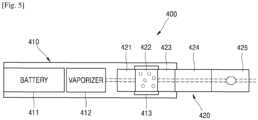
- FIG. 5 is a diagram illustrating an aerosol generating device and an aerosol generating article, according to an embodiment.
- an aerosol generating system 400 may include an aerosol generating device 410 and an aerosol generating article 420.
- the aerosol generating system 400, the aerosol generating device 410, a battery 411, and a heater 413 of FIG. 5 may respectively correspond to the aerosol generating system 100, the aerosol generating device 1, the battery 11, and the heater 13 of FIGS. 1 to 3 .
- a vaporizer 412 of FIG. 5 may correspond to the vaporizer 14 of FIGS. 2 to 3 .
- the aerosol generating article 420, a first filter portion 421, a medium portion 422, a second filter portion 423, a third segment 424, and a second segment 425 of FIG. 5 may respectively correspond to the aerosol generating article 300, the first filter portion 311, the medium portion 312, the second filter portion 313, the third segment 320, and the second segment 330 of FIG. 4 . Therefore, redundant descriptions thereof will be omitted herein.
- the aerosol generating device 410 may include the battery 411, the vaporizer 412, and the heater 413 heated by power supplied from the battery 411.
- the heater 413 when the aerosol generating article 420 is inserted into the aerosol generating device 410, the heater 413 may be arranged to surround at least a portion of an outer surface of the medium portion 422 of the aerosol generating article 420.
- the heater 413 may be arranged only in the medium portion 422 of the aerosol generating article 420.
- embodiments of the present disclosure are not limited thereto.
- the medium portion 422 may be heated to generate an adequate amount of nicotine, heat transfer efficiency to the medium portion 422 may be increased, and power consumption may be reduced.
- the first filter portion 421 and the second filter portion 423 may be prevented from being deformed at a high temperature.
- the first segment 421, 422, and 423 may be completely inserted into the aerosol generating device 410, and the third segment 424 and the second segment 425 may be exposed to the outside. Alternatively, the entire first segment 421, 422, and 423 and a portion of the third segment 424 may be inserted into the aerosol generating device 410.
- At least one of the components, elements, modules or units may be embodied as various numbers of hardware, software and/or firmware structures that execute respective functions described above, according to an exemplary embodiment.
- at least one of these components may use a direct circuit structure, such as a memory, a processor, a logic circuit, a look-up table, etc. that may execute the respective functions through controls of one or more microprocessors or other control apparatuses.
- At least one of these components may be specifically embodied by a module, a program, or a part of code, which contains one or more executable instructions for performing specified logic functions, and executed by one or more microprocessors or other control apparatuses.
- at least one of these components may include or may be implemented by a processor such as a central processing unit (CPU) that performs the respective functions, a microprocessor, or the like. Two or more of these components may be combined into one single component which performs all operations or functions of the combined two or more components. Also, at least part of functions of at least one of these components may be performed by another of these components.
- a bus is not illustrated in the above block diagrams, communication between the components may be performed through the bus. Functional aspects of the above exemplary embodiments may be implemented in algorithms that execute on one or more processors.
- the components represented by a block or processing steps may employ any number of related art techniques for electronics configuration, signal processing and/or control, data processing and the like.
Landscapes
- Chemical & Material Sciences (AREA)
- Chemical Kinetics & Catalysis (AREA)
- General Chemical & Material Sciences (AREA)
- Engineering & Computer Science (AREA)
- Materials Engineering (AREA)
- General Health & Medical Sciences (AREA)
- Health & Medical Sciences (AREA)
- Toxicology (AREA)
- Life Sciences & Earth Sciences (AREA)
- Agronomy & Crop Science (AREA)
- Botany (AREA)
- Cigarettes, Filters, And Manufacturing Of Filters (AREA)
- Manufacture Of Tobacco Products (AREA)
Description
- One or more embodiments of the present disclosure of the invention relate to an aerosol generating article and a system thereof.
- Recently, the demand for an alternative to traditional combustive cigarettes has increased. For example, there is growing demand for an aerosol generating device which generates an aerosol by heating an aerosol generating material, instead of combusting aerosol generating materials. Accordingly, researches on a heating-type aerosol generating articles or heating-type aerosol generating device has been actively conducted.
- In addition, there is a need for an aerosol generating article that is hygienic and capable of continuously and uniformly discharging nicotine even when heated to a low temperature.
-
KR 2019 0049135 A - One or more embodiments of the present disclosure provide an aerosol generating article capable of continuously and uniformly discharging nicotine even when heated to a low temperature.
- Additional aspects will be set forth in part in the description which follows and, in part, will be apparent from the description, or may be learned by the practice of the presented embodiments.
- One or more objects of the present technique are achieved by the invention set out by the features of the independent claim(s).
- According to one aspect of the present disclosure, an aerosol generating article includes: a first segment arranged at an upstream end portion to be inserted into an aerosol generating device; a second segment arranged at a downstream end portion to contact a user's mouth; and a third segment arranged between the first segment and the second segment, and including a cooling element to cool an aerosol, wherein the first segment may include a first filter portion; a second filter portion; and a medium portion arranged between the first filter portion and the second filter portion, and comprising an aerosol generating substrate and a pH adjuster such that an aerosol containing 20 µg or more of nicotine is discharged per puff when the medium portion is heated at 120 °C or lower.
- According to another aspect of the present disclosure, an aerosol generating system includes: an aerosol generating article; and an aerosol generating device into which the aerosol generating article is inserted, wherein the aerosol generating device may include a battery and a heater heated by power supplied from the battery, and the aerosol generating article may include: a first segment arranged at an upstream end portion to be inserted into the aerosol generating device; a second segment arranged at a downstream end portion to contact a user's mouth; and a third segment arranged between the first segment and the second segment, and including a cooling element to cool an aerosol, wherein the first segment may include: a first filter portion; a second filter portion; and a medium portion arranged between the first filter portion and the second filter portion, comprising an aerosol generating substrate and a pH adjuster such that an aerosol containing 20 µg or more of nicotine is discharged per puff when the medium portion is heated at a temperature of 120°C or lower.
- According to one or more embodiments of the present disclosure, the medium portion may be prevented from falling off by arranging the medium portion including the pH adjuster between the two filter portions. Since the aerosol generating article is made for a single use, it may enhance hygiene. Even if the aerosol generating article is heated at a low temperature, it may be possible to achieve sustained, uniform, and adequate nicotine transfer. In addition, according to one or more embodiments of the present disclosure, when the aerosol generating article is inserted into the aerosol generating device, a heater may be arranged to surround the medium portion, thereby increasing the efficiency of heat transfer and reducing power consumption.
- Embodiments of the present disclosure are not limited thereto. It is to be appreciated that the scope of the disclosure should be defined by the appended claims.
-
-
FIGS. 1 through 3 are diagrams showing examples in which a cigarette is inserted into an aerosol generating device. -
FIG. 4 is a diagram illustrating a configuration of an aerosol generating article, according to an embodiment. -
FIG. 5 is a diagram illustrating an aerosol generating device and an aerosol generating article, according to an embodiment. - According to one aspect of the present disclosure, an aerosol generating article includes: a first segment arranged at an upstream end portion to be inserted into an aerosol generating device; a second segment arranged at a downstream end portion to contact a user's mouth; and a third segment arranged between the first segment and the second segment, and including a cooling element to cool an aerosol, wherein the first segment may include: a first filter portion; a second filter portion; and a medium portion arranged between the first filter portion and the second filter portion, and comprising an aerosol generating substrate and a pH adjuster such that an aerosol containing 20 µg or more of nicotine is discharged per puff when the medium portion is heated at 120 °C or lower.
- The first filter portion, the medium portion, and the second filter portion may be surrounded by a single wrapper.
- The pH adjuster includes potassium carbonate (K2CO3).
- The medium portion may further include a binder, and the binder may include at least one of hydroxypropyl methylcellulose and gum.
- Lengths of the first filter portion, the medium portion, and the second filter portion may be in a range of 5 mm to 10 mm.
- A weight of the medium portion may be in a range of 70 mg to 120 mg.
- The aerosol generating substrate of the medium portion may include nicotine, and a weight of nicotine contained in the aerosol discharged from the medium portion after heating may be 10 % to 30 % of a weight of nicotine in the medium portion before heating.
- When the medium portion is heated at a temperature of 120 °C or lower, an aerosol containing 20 µg to 40 µg of nicotine per puff may be discharged during at least 10 consecutive puffs.
- According to another aspect of the present disclosure, an aerosol generating system includes: an aerosol generating article; and an aerosol generating device into which the aerosol generating article is inserted, wherein the aerosol generating device may include a battery and a heater heated by power supplied from the battery, and the aerosol generating article may include: a first segment arranged at an upstream end portion to be inserted into the aerosol generating device; a second segment arranged at a downstream end portion to contact a user's mouth; and a third segment arranged between the first segment and the second segment, and including a cooling element to cool an aerosol, wherein the first segment may include: a first filter portion; a second filter portion; and a medium portion arranged between the first filter portion and the second filter portion, comprising an aerosol generating substrate and a pH adjuster such that an aerosol containing 20 µg or more of nicotine is discharged per puff when the medium portion is heated at a temperature of 120 °C or lower.
- When the aerosol generating article is inserted into the aerosol generating device, the heater may be arranged to surround at least a portion of an outer surface of the medium portion.
- With respect to the terms used to describe the various embodiments, general terms which are currently and widely used are selected in consideration of functions of structural elements in the various embodiments of the present disclosure. However, meanings of the terms can be changed according to intention, a judicial precedence, the appearance of new technology, and the like. In addition, in certain cases, a term which is not commonly used can be selected. In such a case, the meaning of the term will be described in detail at the corresponding portion in the description of the present disclosure. Therefore, the terms used in the various embodiments of the present disclosure should be defined based on the meanings of the terms and the descriptions provided herein.
- In addition, unless explicitly described to the contrary, the word "comprise" and variations such as "comprises" or "comprising" will be understood to imply the inclusion of stated elements but not the exclusion of any other elements. Expressions such as "at least one of," when preceding a list of elements, modify the entire list of elements and do not modify the individual elements of the list. For example, the expression, "at least one of a, b, and c," should be understood as including only a, only b, only c, both a and b, both a and c, both b and c, or all of a, b, and c.
- It will be understood that when an element or layer is referred to as being "over," "above," "on," "connected to" or "coupled to" another element or layer, it can be directly over, above, on, connected or coupled to the other element or layer or intervening elements or layers may be present. In contrast, when an element is referred to as being "directly over," "directly above," "directly on," "directly connected to" or "directly coupled to" another element or layer, there are no intervening elements or layers present. Like numerals refer to like elements throughout.
- The term "aerosol generating article" may refer to an article containing an aerosol generating material, which is combined with an aerosol generating device. The shape, size, material, and structure of the aerosol generating article may differ according to embodiments. Examples of the aerosol generating article may include, but are not limited to, a cigarette-shaped substrate (hereinafter "cigarette") and a cartridge.
- As used herein, terms including an ordinal number such as "first" or "second" may be used to describe various components, but the components should not be limited by the terms. The terms may be used for the purpose of distinguishing one component from other components.
- In the following embodiments, terms "upstream" and "downstream" refer to a relative position or direction between segments that make up an aerosol generating article. When a user inhales air on a smoking article, air flows in a downstream direction. In other words, a portion where air enters the aerosol generating article from the outside is "upstream" and a portion where air goes out of the aerosol generating article is "downstream".
- Hereinafter, the present disclosure will now be described more fully with reference to the accompanying drawings, in which exemplary embodiments of the present disclosure are shown such that one of ordinary skill in the art may easily work the present disclosure. The disclosure may, however, be embodied in many different forms and should not be construed as being limited to the embodiments set forth herein.
- Hereinafter, embodiments of the present disclosure will be described in detail with reference to the drawings.
-
FIGS. 1 through 3 are diagrams showing examples in which a cigarette is inserted into an aerosol generating device. - Referring to
FIG. 1 through 3 , theaerosol generating system 100 may include aerosol generatingdevice 1 andaerosol generating article 2 inserted theaerosol generating device 1. - The
aerosol generating device 1 may include abattery 11, acontroller 12, and aheater 13. Referring toFIGS. 2 and 3 , theaerosol generating device 1 may further include avaporizer 14. Also, theaerosol generating article 2 may be inserted into an inner space of theaerosol generating device 1. -
FIGS. 1 through 3 illustrate components of theaerosol generating device 1, which are related to the present embodiment. Therefore, it will be understood by one of ordinary skill in the art related to the present embodiment that other general-purpose components may be further included in theaerosol generating device 1, in addition to the components illustrated inFIGS. 1 through 3 . -
FIG. 1 illustrates that thebattery 11, thecontroller 12, and theheater 13 are arranged in series. Also,FIG. 2 illustrates that thebattery 11, thecontroller 12, thevaporizer 14, and theheater 13 are arranged in series. Also,FIG. 3 illustrates that thevaporizer 14 and theheater 13 are arranged in parallel. However, the internal structure of theaerosol generating device 1 is not limited to the structures illustrated inFIGS. 1 through 3 . In other words, according to the design of theaerosol generating device 1, thebattery 11, thecontroller 12, theheater 13, and thevaporizer 14 may be differently arranged. - When the
aerosol generating article 2 is inserted into theaerosol generating device 1, theaerosol generating device 1 may operate theheater 13 and/or thevaporizer 14 to generate aerosol from theaerosol generating article 2 and/or thevaporizer 14. The aerosol generated by theheater 13 and/or thevaporizer 14 is delivered to a user by passing through theaerosol generating article 2. - As necessary, even when the
aerosol generating article 2 is not inserted into theaerosol generating device 1, theaerosol generating device 1 may heat theheater 13. - The
battery 11 may supply power to be used for theaerosol generating device 1 to operate. For example, thebattery 11 may supply power to heat theheater 13 or thevaporizer 14, and may supply power for operating thecontroller 12. Also, thebattery 11 may supply power for operations of a display, a sensor, a motor, etc. mounted in theaerosol generating device 1. - The
controller 12 may generally control operations of theaerosol generating device 1. In detail, thecontroller 12 may control not only operations of thebattery 11, theheater 13, and thevaporizer 14, but also operations of other components included in theaerosol generating device 1. Also, thecontroller 12 may check a state of each of the components of theaerosol generating device 1 to determine whether or not theaerosol generating device 1 is able to operate. - The
controller 12 may include at least one processor. A processor can be implemented as an array of a plurality of logic gates or can be implemented as a combination of a general-purpose microprocessor and a memory in which a program executable in the microprocessor is stored. It will be understood by one of ordinary skill in the art that the processor can be implemented in other forms of hardware. - The
heater 13 may be heated by the power supplied from thebattery 11. For example, when theaerosol generating article 2 is inserted into theaerosol generating device 1, theheater 13 may be located outside theaerosol generating article 2. Thus, theheated heater 13 may increase a temperature of an aerosol generating material in theaerosol generating article 2. - The
heater 13 may include an electro-resistive heater. For example, theheater 13 may include an electrically conductive track, and theheater 13 may be heated when currents flow through the electrically conductive track. However, theheater 13 is not limited to the example described above and may include all heaters which may be heated to a desired temperature. Here, the desired temperature may be pre-set in theaerosol generating device 1 or may be set by a user. - The
heater 13 may include a cylindrical-type heating element, a tube-type heating element, a plate-type heating element, a needle-type heating element, or a rod-type heating element, and may heat the inside or the outside of theaerosol generating article 2, according to the shape of the heating element. - Also, the
aerosol generating device 1 may include a plurality ofheaters 13. Here, the plurality ofheaters 13 may be inserted into theaerosol generating article 2 or may be arranged outside theaerosol generating article 2. Also, some of the plurality ofheaters 13 may be inserted into theaerosol generating article 2 and the others may be arranged outside theaerosol generating article 2. In addition, the shape of theheater 13 is not limited to the shapes illustrated inFIGS. 1 through 3 and may include various shapes. - The
vaporizer 14 may generate aerosol by heating a liquid composition and the generated aerosol may pass through theaerosol generating article 2 to be delivered to a user. In other words, the aerosol generated via thevaporizer 14 may move along an air flow passage of theaerosol generating device 1 and the air flow passage may be configured such that the aerosol generated via thevaporizer 14 passes through theaerosol generating article 2 to be delivered to the user. - For example, the
vaporizer 14 may include a liquid storage, a liquid delivery element, and a heating element, but it is not limited thereto. For example, the liquid storage, the liquid delivery element, and the heating element may be included in theaerosol generating device 1 as independent modules. - The liquid storage may store a liquid composition. For example, the liquid composition may be a liquid including a tobacco-containing material having a volatile tobacco flavor component, or a liquid including a non-tobacco material. The liquid storage may be formed to be detachable from the
vaporizer 14 or may be formed integrally with thevaporizer 14. - For example, the liquid composition may include water, a solvent, ethanol, plant extract, spices, flavorings, or a vitamin mixture. The spices may include menthol, peppermint, spearmint oil, and various fruit-flavored ingredients, but are not limited thereto. The flavorings may include ingredients capable of providing various flavors or tastes to a user. Vitamin mixtures may be a mixture of at least one of vitamin A, vitamin B, vitamin C, and vitamin E, but are not limited thereto. Also, the liquid composition may include an aerosol forming substance, such as glycerin and propylene glycol.
- The liquid delivery element may deliver the liquid composition of the liquid storage to the heating element. For example, the liquid delivery element may be a wick such as cotton fiber, ceramic fiber, glass fiber, or porous ceramic, but is not limited thereto.
- The heating element is an element for heating the liquid composition delivered by the liquid delivery element. For example, the heating element may be a metal heating wire, a metal hot plate, a ceramic heater, or the like, but is not limited thereto. In addition, the heating element may include a conductive filament such as nichrome wire and may be positioned as being wound around the liquid delivery element. The heating element may be heated by a current supply and may transfer heat to the liquid composition in contact with the heating element, thereby heating the liquid composition. As a result, the aerosol may be generated.
- For example, the
vaporizer 14 may be referred to as a cartomizer or an atomizer, but it is not limited thereto. - The
aerosol generating device 1 may further include general-purpose components in addition to thebattery 11, thecontroller 12, theheater 13, and thevaporizer 14. For example, theaerosol generating device 1 may include a display capable of outputting visual information and/or a motor for outputting haptic information. Also, theaerosol generating device 1 may include at least one sensor. Also, theaerosol generating device 1 may be formed as a structure that, even when theaerosol generating article 2 is inserted into theaerosol generating device 1, may introduce external air or discharge internal air. - The
aerosol generating article 2 may be divided into a first segment including an aerosol generating material, a second segment including a filter or the like, and a third segment including a cooling element. Alternatively, the first segment of theaerosol generating article 2 may include a filter or the like. - The first segment may be completely inserted into the
aerosol generating device 1, and the third segment and the second segment may be partially exposed to the outside. Alternatively, the first segment may be partially inserted into theaerosol generating device 1, or the entire first segment and a portion of the third segment may be inserted into theaerosol generating device 1. A user may inhale while holding the second segment by the mouth of the user. In that case, the aerosol is generated when air from the outside passes through the first segment, and the generated aerosol is delivered to the user's mouth through the third segment and the second segment. - As an example, air may flow in from the outside through at least one air passage formed within the
aerosol generating device 1. For example, opening and closing of the air passage formed within theaerosol generating device 1 and/or a size of the air passage may be regulated by the user. Therefore, an amount of atomization and a smoking taste may be regulated by the user. As another example, air from the outside may flow into theaerosol generating article 2 through at least one hole formed on a surface of theaerosol generating article 2. - Hereinafter, the
aerosol generating article 2 will be described in detail with reference toFIG. 4 . -
FIG. 4 is a diagram illustrating a configuration of an aerosol generating article, according to an embodiment. - Referring to
FIG. 4 , anaerosol generating article 300 includes afirst segment 310, asecond segment 330, athird segment 320, and awrapper 340. Thefirst segment 310 may include amedium portion 312, afirst filter portion 311, and asecond filter portion 313. - The
aerosol generating article 300 may include an upstream end portion to be inserted into an aerosol generating device and a downstream end portion to contact a user's mouth. Thefirst segment 310 may be arranged at the upstream end portion of theaerosol generating article 300. - The
first segment 310 may include themedium portion 312, thefirst filter portion 311 arranged to face an upstream end portion of themedium portion 312, and thesecond filter portion 313 arranged to face a downstream end portion of themedium portion 312. Thefirst filter portion 311, themedium portion 312, and thesecond filter portion 313 may be arranged in a row, and thefirst filter portion 311 and thesecond filter portion 313 may be formed in a structure in which thefirst filter portion 311 and thesecond filter portion 313 seal themedium portion 312 on both sides of themedium portion 312. By doing so, themedium portion 312 may be prevented from falling off, and themedium portion 312 may be evenly distributed so that an amount of nicotine transfer may be uniform. - The
medium portion 312 of thefirst segment 310 may include an aerosol generating substrate (i.e., aerosol generating material). For example, the aerosol generating substrate may include at least one of glycerin, propylene glycol, ethylene glycol, dipropylene glycol, diethylene glycol, triethylene glycol, tetraethylene glycol, and oleyl alcohol, but is not limited thereto. The aerosol generating substrate may include nicotine. - The
medium portion 312 may also contain other additives such as flavoring agents, wetting agents, and/or organic acids. The wetting agents maintain the moisture in granules at an appropriate level to soften the inherent taste and enrich the amount of atomization. The flavoring agents may include licorice, sucrose, fructose syrup, isosweet, cocoa, lavender, cinnamon, cardamom, celery, fenugreek, cascarilla, sandalwood, bergamot, geranium, honey essence, rose oil, Vanilla, lemon oil, orange oil, mint oil, cinnamon, caraway, cognac, jasmine, chamomile, menthol, cinnamon, ylang-ylang, sage, spearmint, ginger, cilantro, coffee, or the like. - The
medium portion 312 may include a pH adjuster. The pH adjuster includes potassium carbonate (K2CO3), sodium hydrogen carbonate (NaHCO3), and a mixture thereof. The pH adjuster may adjust the pH of the aerosol generating substrate to the alkali side, thereby promoting the release of flavor components from the aerosol generating substrate. Thus, the smoking taste when the aerosol generating article is heated at a low temperature may be equal or similar to that when the aerosol generating article is heated at a high temperature. - According to the invention, K2CO3 is added to the aerosol generating substrate when granules of the
medium portion 312 are manufactured. When manufacturing the granules, a percentage of a content of the K2CO3 in the aerosol generating substrate is 5 % to 10 %. It is desirable that the content of the K2CO3 relative to the content of the aerosol generating substrate be 6.5 %, but is not limited thereto. - The
medium portion 312 may further include a binder. By including the binder, themedium portion 312 may be formed into granules. For example, the binder may include at least one of hydroxypropyl methylcellulose (hereinafter referred to as HPMC), gum, pullulan, carboxymethyl cellulose, and starch. - According to the invention, the
medium portion 312 is formed of granules. The granules may be formed by drying a mixture of the aerosol generating substrate, the binder, and the pH adjuster dissolved in a liquid state. The medium portion formed of granules may contain 5.9 % moisture and 5.41 % nicotine, and the pH may correspond to 8. - Content of the
medium portion 312 of theaerosol generating article 300 may be appropriately employed from within a range of 70 mg to 120 mg. The content of themedium portion 312 formed of granules of theaerosol generating article 300 may be 100 mg, but is not limited thereto. - When a heating temperature of the
medium portion 312 is too low, an amount of nicotine transfer may not be adequate. However, since themedium portion 312 according to an embodiment includes the pH adjuster, an adequate amount of nicotine transfer may be provided even at a low temperature. Accordingly, even when themedium portion 312 is heated at 120 °C or lower, for example at 100 °C, an adequate amount of nicotine transfer may be provided. - When the
aerosol generating article 300 is inserted into an aerosol generating device, themedium portion 312 may be heated by a heater surrounding themedium portion 312. Since themedium portion 312 may provide an adequate amount of nicotine transfer even when heated at a low temperature, the heater may heat themedium portion 312 at a low temperature, and power consumption of the aerosol generating device may be reduced, accordingly. For example, themedium portion 312 may be heated at 100 °C by the cylindrical heater surrounding themedium portion 312. - According to an embodiment, the
medium portion 312 may be heated at 120 °C or lower, and an aerosol containing 20 µg or more of nicotine per puff may be discharged. For example, themedium portion 312 may be heated at 100 °C and discharge an aerosol containing 28 µg of nicotine per puff, but is not limited thereto. - According to an embodiment, the aerosol generating substrate of the
medium portion 312 may include nicotine, and a percentage of a weight of nicotine contained in an aerosol discharged from themedium portion 312 after themedium portion 312 is heated relative to a weight of nicotine in themedium portion 312 before themedium portion 312 is heated may be 10 % to 30 %. For example, assuming that the weight of nicotine in themedium portion 312 before themedium portion 312 is heated is 4.14 mg, and the weight of nicotine contained in 15 puffs of aerosol discharged from themedium portion 312 after themedium portion 312 is heated is 0.7 mg, the percentage of the weight of nicotine contained in the aerosol relative to the weight of nicotine in themedium portion 312 is 17 %. - According to an embodiment, when the
medium portion 312 of theaerosol generating article 300 is heated at a temperature of 120 °C or lower, an aerosol containing 20 µg to 40 µg of nicotine per puff may be discharged during at least 10 consecutive puffs. Even if themedium portion 312 of theaerosol generating article 300 is heated at a low temperature, a uniform and adequate amount of nicotine may be discharged during at least 10 consecutive puffs. - A length of the
medium portion 312 may be appropriately employed in a range of 5 mm to 10 mm. Preferably, the length of themedium portion 312 be 8 mm, but is not limited thereto. - The
first filter portion 311 may be arranged to face the upstream end portion of themedium portion 312, and thesecond filter portion 313 may be arranged to face the downstream end portion of themedium portion 312. Thefirst filter portion 311 and thesecond filter portion 313 may be cellulose acetate filters. - There is no limitation on shapes of the
first filter portion 311 and of thesecond filter portion 313. For example, thefirst filter portion 311 and thesecond filter portion 313 may have a cylindrical shape or a tube shape including a hollow therein. Alternatively, thefirst filter portion 311 and thesecond filter portion 313 may have a recess shape. Thefirst filter portion 311 and thesecond filter portion 313 may be manufactured in shapes different from each other. - The
first filter portion 311 and thesecond filter portion 313 may be manufactured to generate flavor. For example, a flavoring liquid may be sprayed onto thefirst filter portion 311, or a separate fiber coated with the flavoring liquid may be inserted into thefirst filter portion 311. - The
first filter portion 311 and thesecond filter portion 313 may be arranged on both sides of themedium portion 312 to prevent themedium portion 312 from falling off and to prevent the liquefied aerosol from flowing into theaerosol generating device 1 ofFIGS. 1 to 3 from themedium portion 312, during smoking. - According to an embodiment, lengths of the
first filter portion 311 and thesecond filter portion 313 may be within a range of 5 mm to 10 mm, respectively. It is desirable that the lengths of thefirst filter portion 311 and thesecond filter portion 313 be each 7 mm. However, embodiments of the present disclosure are not limited thereto. - According to an embodiment, the
first filter portion 311, themedium portion 312, and thesecond filter portion 313 of thefirst segment 310 may be wrapped by thewrapper 340. Since thefirst segment 310 is wrapped by thewrapper 340, it is possible to prevent themedium portion 312 from falling off and to prevent the aerosol liquefied from themedium portion 312 from sticking to theaerosol generating device 1 ofFIGS. 1 to 3 , during smoking. - The
third segment 320 may be arranged between thefirst segment 310 and thesecond segment 330, and may include a cooling element to cool the aerosol. A length of thethird segment 320 may be appropriately employed in a range of 10 mm and 20 mm. For example, the length of thethird segment 320 may be about 12 mm, but is not limited thereto. - The
third segment 320 cools the aerosol generated by heating themedium portion 312. Thus, the user may inhale the aerosol cooled to an appropriate temperature. - According to an embodiment, the
third segment 320 may be made of a polymer material or a biodegradable polymer material. Here, the polymer material includes gelatin, polyethylene (PE), polypropylene (PP), polyurethane (PU), fluorinated ethylene propylene (FEP), and combinations thereof, but is not limited to. In addition, the biodegradable polymer material includes polylactic acid (PLA), polyhydroxybutyrate (PHB), cellulose acetate, polyepsilon-caprolactone (PCL), polyglycolic acid (PGA), polyhydroxyalkanoates (PHAs) and starch-based thermoplastic resins, but is not limited thereto. - According to an embodiment, the
third segment 320 may be made of pure PLA, and may be manufactured in an extrusion method or a fiber weaving method. Thethird segment 320 may be manufactured in various shapes in order to increase a surface area per unit area (surface area in contact with the aerosol). For example, thethird segment 320 may have a shape of a three-dimensional structure manufactured using one or more fiber strands (hereinafter, referred to as 'fiber strands') made of pure PLA. Here, a thickness and length of the fiber strands, the number of the fiber strands constituting thethird segment 320, and a shape of the fiber strands may vary. As thethird segment 320 is made of pure PLA, generation of a specific material may be prevented while the aerosol passes through thethird segment 320. - The
second segment 330 may be arranged at a downstream end portion that contacts the user's mouth, and may include a filter element. A length of thesecond segment 330 may be appropriately employed in a range of 10 mm and 20 mm. For example, the length of thesecond segment 330 may be about 14 mm, but is not limited thereto. - The
second segment 330 may be a cellulose acetate filter. There is no limitation on a shape of thesecond segment 330. For example, thesecond segment 330 may have a cylinder shape or a tube shape including a hollow therein. Alternatively, thesecond segment 330 may have a recess shape. If thesecond segment 330 includes a plurality of segments, at least one of the plurality of segments may be manufactured in a different shape. - The
second segment 330 may be manufactured to generate flavor by spraying a flavoring liquid onto thesecond segment 330 in the process of manufacturing the same. Alternatively, a separate fiber coated with the flavoring liquid may be inserted into thesecond segment 330. The aerosol generated from themedium portion 312 is cooled while passing through thethird segment 320, and the cooled aerosol is delivered to the user through thesecond segment 330. Therefore, if a flavoring element is added to thesecond segment 330, the flavor delivered to the user may last for a long time. - In addition, the
second segment 330 may include at least one capsule. Here, the capsule may serve to generate flavor or an aerosol. For example, the capsule may have a structure in which a liquid containing perfume is wrapped with a film. The capsule may have a spherical or cylindrical shape, but is not limited thereto. - According to an embodiment, the
aerosol generating article 300 may be packaged by another wrapper. For example, thefirst segment 310 may be wrapped by thewrapper 340, and thefirst segment 310, thethird segment 320 and thesecond segment 330 packaged by thewrapper 340 are combined to each other, and the entire segments may be completely repackaged by another wrapper. However, manners in which theaerosol generating article 300 and components constituting the same are packaged by a wrapper are not limited thereto. - Table 1 shows components of the granules of the
medium portion 312, according to an experimental example. Themedium portion 312 including selected granules having a size of 1.0 mm to 1.12 mm was manufactured. That is, themedium portion 312 including granules having a size of 16 Mesh to 18 Mesh was manufactured.[Table 1] No. Raw material names Weights (g) ① KF125 100 ② 10% HPMC liquid 10 ③ K2CO3 (food additive) 6.5 ④ Purified water 18.4 ⑤ Ethanol 36.6 ⑥ Manufacturing methods Wet - It may be identified that according to Table 1, the granules may be manufactured in a wet manner using 100 g of KF125, 10 g of 10% HPMC liquid, 6.5 g of K2CO3, 18.4 g of purified water, and 36.6 g of ethanol. KF125 may be the aerosol generating substrate, HPMC may be the binder, and K2CO3 may be the pH adjuster.
- In addition, the granules prepared according to Table 1 may be dried for about 6 hours, a moisture content of the dried granules may be 5.9 %, nicotine content may be 5.41 %, and the pH may be 7.98.
- Table 2 below shows nicotine content in the aerosol corresponding to 15 puffs, according to an experimental example. According to one experimental example, a granule content of the
medium portion 312 is about 80 mg. Theaerosol generating article 300 having a moisture content of 7.05% of the granules of themedium portion 312, nicotine content of 4.14 mg of themedium portion 312, and the pH of 7.5 was used. Theaerosol generating article 300 was preheated for 10 seconds and then heated at 100 °C. Table 2 shows an amount of nicotine generated from 15 puffs.[Table 2] Division s Puf f No. Granul e weight s (mg) Nicotin e (µg) Average (µg) Nicotin e (%) Averag e (%) Aerosol 15 81.3 509.0 478.9 0.63 0.59 15 81.4 548.7 0.67 15 80.9 378.9 0.47 Granules (residues ) 15 - 3033.2 3008.0 3.73 3.70 15 - 2977.4 3.66 15 - 3013.3 3.72 Material s (residues ) 15 - 683.6 658.2 0.84 0.81 15 - 658.8 0.81 15 - 632.1 0.78 Total sums 4145.0 5.10 - According to Table 2, in the experiment where a granule weight of the
medium portion 312 is 81.3 mg, after 15 puffs, an amount of nicotine in the generated aerosol is 509 µg, an amount of nicotine remaining in the granules is 3033.2 µg, and an amount of nicotine remaining in thefirst filter portion 311, thesecond filter portion 313, thethird segment 320, and thesecond segment 330 is 683.6 µg. - In the experiment where a weight of the granules of the
medium portion 312 is 81.4 mg, after 15 puffs, an amount of nicotine in the generated aerosol is 548.7 µg, an amount of nicotine remaining in the granules is 2977.4 µg, and an amount of nicotine remaining in thefirst filter portion 311, thesecond filter portion 313, thethird segment 320, and thesecond segment 330 is 658.8 µg. - In the experiment where a granule weight of the
medium portion 312 is 80.9 mg, after 15 puffs, an amount of nicotine in the generated aerosol is 378.9 µg, an amount of nicotine remaining in the granules is 3013.3 µg, and an amount of nicotine remaining in thefirst filter portion 311, thesecond filter portion 313, thethird segment 320, and thesecond segment 330 is 632.1 µg. Moreover, even when theaerosol generating article 300 under the same conditions was heated at 120°C or lower, results similar to those of Table 2 were obtained. - When the
aerosol generating article 300 was heated at a low temperature of 100 °C, average nicotine content in the aerosol discharged from themedium portion 312 was 478.9 µg, which indicates that an amount of nicotine transfer was adequate. In addition, it may be identified that nicotine content in the aerosol discharged from themedium portion 312 relative to nicotine content of the aerosol generating substrate before a puff is 12%. Thus, it is desirable to set the nicotine content in the aerosol discharged from themedium portion 312 relative to the nicotine content of the aerosol generating substrate to 10 % to 30 %. - Table 3 below shows nicotine content in the aerosol according to the number of puffs. In this experimental example, the
aerosol generating article 300 having a granule content of about 80 mg of themedium portion 312, a moisture content of 7.05 % of the granules before a puff, nicotine content of 4.14 mg, and the pH of 7.5 was used. Theaerosol generating article 300 was preheated for 10 seconds and then heated at 100°C. Table 3 shows an amount of nicotine generated per puff. Since an operation of the aerosol generating device was suspended after the 14th puff, nicotine was not detected during the 15th puff.[Table 3] Puff sections Puff No. Nicotine (µg) Nicotine (mg) Aerosol 1 1 27.1 0.027 2 1 23.5 0.024 3 1 28.0 0.028 4 1 28.0 0.028 5 1 31.0 0.031 6 1 30.6 0.031 7 1 36.0 0.036 8 1 32.9 0.033 9 1 28.8 0.029 10 1 26.2 0.026 11 1 27.3 0.027 12 1 24.4 0.024 13 1 22.9 0.023 14 1 24.7 0.025 15 1 granules (residues) 1468.3 1.47 1476.2 1.48 materials (residues) 320.9 0.32 307.1 0.31 - It may be identified that according to Table 3, an amount of nicotine in the aerosol of the first puff is 27.1 µg, an amount of nicotine in the aerosol of the fifth puff in 5 consecutive puffs is 31.0 µg, and an amount of nicotine in the aerosol of the tenth puff in 10 consecutive puffs is 26.2 µg. It may be identified that an amount of nicotine in the aerosol of the 11th puff is similar to an amount of nicotine in the aerosol of the 12th puff, which are 27.3 µg and 24.4 µg, respectively.
- As shown above, an amount of nicotine in the aerosol during consecutive puffs is in the range of 20 µg to 40 µg. Thus, it can be seen that an amount of nicotine transfer was uniform even if the
aerosol generating article 300 was heated at a low temperature (120 °C or lower). - Table 4 shows an amount of the aerosol collected by a filter within the
aerosol generating article 300, according to an experimental example. A total particulate matter (TPM) may refer to an amount of components collected by the filter during puffing. Table 4 shows a total amount of aerosols collected by the filter after 8 puffs. In this experiment, a cylindrical heater was used, and theaerosol generating article 300 was heated at 100 °C, 110 °C, 120 °C, 130 °C, 140 °C, 150 °C, and 160 °C.[Table 4] Heating temperatures (°C) Before smoking (mg) After smoking (mg) TPM(mg) 100 40.0492 40.0807 0.0315 110 39.9842 40.0153 0.0311 120 40.1740 40.2061 0.0321 130 39.6121 39.6433 0.0312 140 40.0003 40.0289 0.0286 150 40.1389 40.1661 0.0272 160 40.1375 40.1688 0.0313 - It may be identified that according to Table 4, when a heating temperature was 100 °C, 110 °C and 120 °C, the TPM was 0.0315 mg, 0.0311 mg, and 0.0321 mg, respectively. When the heating temperature was 140 °C and 150 °C, the filter started to be deformed, and thus, the TPM rapidly decreased to 0.0286 mg and 0.0272 mg. At 160 °C, the filter contracted due to severe deformation, and thus the TPM increased again to 0.0313 mg.
- It may be identified that when a heating temperature was 100 °C, 110 °C, and 120 °C, the filter was not damaged or deformed, so the function was executed smoothly. Therefore, it is desirable to set the heating temperature of the
aerosol generating article 300 to 120 °C or lower. -
FIG. 5 is a diagram illustrating an aerosol generating device and an aerosol generating article, according to an embodiment. - Referring to
FIG. 5 , anaerosol generating system 400 may include anaerosol generating device 410 and anaerosol generating article 420. Theaerosol generating system 400, theaerosol generating device 410, abattery 411, and aheater 413 ofFIG. 5 may respectively correspond to theaerosol generating system 100, theaerosol generating device 1, thebattery 11, and theheater 13 ofFIGS. 1 to 3 . Also, avaporizer 412 ofFIG. 5 may correspond to thevaporizer 14 ofFIGS. 2 to 3 . Also, and theaerosol generating article 420, afirst filter portion 421, amedium portion 422, asecond filter portion 423, athird segment 424, and asecond segment 425 ofFIG. 5 may respectively correspond to theaerosol generating article 300, thefirst filter portion 311, themedium portion 312, thesecond filter portion 313, thethird segment 320, and thesecond segment 330 ofFIG. 4 . Therefore, redundant descriptions thereof will be omitted herein. - The
aerosol generating article 420 may include an upstream end portion to be inserted into theaerosol generating device 410 and a downstream end portion that contacts a user's mouth. Theaerosol generating article 420 may include thefirst segment second segment 425 arranged at the downstream end portion, and thethird segment 424 arranged between thefirst segment second segment 425. Thefirst segment medium portion 422, thefirst filter portion 421 arranged to face an upstream end portion of themedium portion 422, and thesecond filter portion 423 arranged to face a downstream end portion of themedium portion 422. - The
aerosol generating device 410 may include thebattery 411, thevaporizer 412, and theheater 413 heated by power supplied from thebattery 411. - According to an embodiment, when the
aerosol generating article 420 is inserted into theaerosol generating device 410, theheater 413 may be arranged to surround at least a portion of an outer surface of themedium portion 422 of theaerosol generating article 420. For example, theheater 413 may be arranged only in themedium portion 422 of theaerosol generating article 420. However, embodiments of the present disclosure are not limited thereto. - By arranging the
heater 413 near themedium portion 422 of theaerosol generating article 420, themedium portion 422 may be heated to generate an adequate amount of nicotine, heat transfer efficiency to themedium portion 422 may be increased, and power consumption may be reduced. In addition, thefirst filter portion 421 and thesecond filter portion 423 may be prevented from being deformed at a high temperature. - The
first segment aerosol generating device 410, and thethird segment 424 and thesecond segment 425 may be exposed to the outside. Alternatively, the entirefirst segment third segment 424 may be inserted into theaerosol generating device 410. - At least one of the components, elements, modules or units (collectively "components" in this paragraph) represented by a block in the drawings, such as the
controller 12, may be embodied as various numbers of hardware, software and/or firmware structures that execute respective functions described above, according to an exemplary embodiment. For example, at least one of these components may use a direct circuit structure, such as a memory, a processor, a logic circuit, a look-up table, etc. that may execute the respective functions through controls of one or more microprocessors or other control apparatuses. Also, at least one of these components may be specifically embodied by a module, a program, or a part of code, which contains one or more executable instructions for performing specified logic functions, and executed by one or more microprocessors or other control apparatuses. Further, at least one of these components may include or may be implemented by a processor such as a central processing unit (CPU) that performs the respective functions, a microprocessor, or the like. Two or more of these components may be combined into one single component which performs all operations or functions of the combined two or more components. Also, at least part of functions of at least one of these components may be performed by another of these components. Further, although a bus is not illustrated in the above block diagrams, communication between the components may be performed through the bus. Functional aspects of the above exemplary embodiments may be implemented in algorithms that execute on one or more processors. Furthermore, the components represented by a block or processing steps may employ any number of related art techniques for electronics configuration, signal processing and/or control, data processing and the like. - The descriptions of the above-described embodiments are merely examples. Therefore, the scope of the disclosure is defined by the appended claims.
Claims (7)
- An aerosol generating article (300, 420) comprising:a first segment (310) arranged at an upstream end portion to be inserted into an aerosol generating device (410);a second segment (330, 425) arranged at a downstream end portion to contact a user's mouth; anda third segment (320, 424) arranged between the first segment (310) and the second segment (330, 425), and comprising a cooling element,wherein the first segment (310) comprises: a first filter portion (311, 421); and a medium portion (312, 422) comprising an aerosol generating substrate and a pH adjuster; characterized in that:the first segment (310) further comprises: a second filter portion (313, 423), and the medium portion (312, 422) is arranged between the first filter portion (311, 421) and the second filter portion (313, 423), andwherein a weight of the medium portion (312, 422) is in a range of 70 mg to 120 mg and the medium portion (312) is formed of granules, the pH adjuster comprises potassium carbonate and the content of the potassium carbonate relative to the content of the aerosol generating substrate is 5% to 10%.
- The aerosol generating article (300, 420) of claim 1, wherein the first filter portion (311, 421), the medium portion (312, 422), and the second filter portion (313, 423) are wrapped by a single wrapper (340).
- The aerosol generating article (300, 420) of claim 1, whereinthe medium portion (312, 422) further comprises a binder, andthe binder comprises at least one of hydroxypropyl methylcellulose and gum.
- The aerosol generating article (300, 420) of claim 1, wherein lengths of the first filter portion (311, 421), the medium portion (312, 422), and the second filter portion (313, 423) are in a range of 5 mm to 10 mm.
- The aerosol generating article (300, 420) of claim 1, whereinthe aerosol generating substrate of the medium portion (312, 422) comprises nicotine, anda weight of nicotine contained in the aerosol discharged from the medium portion (312, 422) after the medium portion (312, 422) is heated is 10 % to 30 % of a weight of nicotine in the medium portion (312, 422) before the medium portion (312, 422) is heated.
- An aerosol generating system comprising:an aerosol generating article (300, 420); andan aerosol generating device (410) configured to combine with the aerosol generating article (300, 420), and comprising a heater (413) configured to heat the aerosol generating article (300, 420),wherein the aerosol generating article (300, 420) is according to any one of the preceding claims.
- The aerosol generating system of claim 6, wherein the heater (413) is arranged to surround at least a portion of an outer surface of the medium portion (312, 422) when the aerosol generating article (300, 420) is inserted into the aerosol generating device (410).
Applications Claiming Priority (2)
| Application Number | Priority Date | Filing Date | Title |
|---|---|---|---|
| KR1020200054768A KR20210136474A (en) | 2020-05-07 | 2020-05-07 | Article and systen for generating aerosol |
| PCT/KR2021/004366 WO2021225291A1 (en) | 2020-05-07 | 2021-04-07 | Article and system for generating aerosol |
Publications (3)
| Publication Number | Publication Date |
|---|---|
| EP3930507A1 EP3930507A1 (en) | 2022-01-05 |
| EP3930507A4 EP3930507A4 (en) | 2022-04-13 |
| EP3930507B1 true EP3930507B1 (en) | 2025-03-05 |
Family
ID=77520682
Family Applications (1)
| Application Number | Title | Priority Date | Filing Date |
|---|---|---|---|
| EP21754689.4A Active EP3930507B1 (en) | 2020-05-07 | 2021-04-07 | Article and system for generating aerosol |
Country Status (6)
| Country | Link |
|---|---|
| US (1) | US12507726B2 (en) |
| EP (1) | EP3930507B1 (en) |
| JP (1) | JP7291240B2 (en) |
| KR (2) | KR20210136474A (en) |
| CN (1) | CN113924013B (en) |
| WO (1) | WO2021225291A1 (en) |
Families Citing this family (22)
| Publication number | Priority date | Publication date | Assignee | Title |
|---|---|---|---|---|
| WO2023195679A1 (en) * | 2022-04-04 | 2023-10-12 | Kt&G Corporation | Aerosol generating article and system |
| US20250325019A1 (en) * | 2022-05-04 | 2025-10-23 | Kt&G Corporation | Aerosol generation product |
| EP4512257A4 (en) * | 2022-05-04 | 2025-08-27 | Kt & G Corp | AEROSOL GENERATION PRODUCT AND AEROSOL GENERATION SYSTEM |
| KR20230156248A (en) * | 2022-05-04 | 2023-11-14 | 주식회사 케이티앤지 | Aerosol generating article |
| US20250287993A1 (en) * | 2022-05-04 | 2025-09-18 | Kt&G Corporation | Aerosol-generating article and aerosol-generating system |
| JP2025515000A (en) * | 2022-05-04 | 2025-05-13 | ケーティー アンド ジー コーポレイション | Aerosol generating article and aerosol generating system |
| CN119136689A (en) * | 2022-05-04 | 2024-12-13 | 韩国烟草人参公社 | Aerosol generating products and aerosol generating systems |
| WO2023214679A1 (en) * | 2022-05-04 | 2023-11-09 | 주식회사 케이티앤지 | Aerosol-generating article and aerosol-generating system |
| WO2023214672A1 (en) * | 2022-05-04 | 2023-11-09 | 주식회사 케이티앤지 | Aerosol-generating articles and aerosol-generating systems |
| KR102838716B1 (en) * | 2022-05-04 | 2025-07-29 | 주식회사 케이티앤지 | Smoking article and aerosol-generating systems comprising thereof |
| EP4497335A4 (en) * | 2022-05-04 | 2025-06-25 | KT&G Corporation | AEROSOL GENERATION ARTICLES AND AEROSOL GENERATION SYSTEM |
| US20250338888A1 (en) * | 2022-05-04 | 2025-11-06 | Kt&G Corporation | Aerosol-generating article and aerosol-generating system |
| KR102690637B1 (en) * | 2022-05-20 | 2024-08-05 | 주식회사 케이티앤지 | Aerosol generating article and aerosol generating system |
| KR102842865B1 (en) * | 2022-05-30 | 2025-08-07 | 주식회사 케이티앤지 | Aerosol generating article and aerosol generating system |
| KR102831739B1 (en) * | 2022-06-23 | 2025-07-09 | 주식회사 케이티앤지 | System for manufacturing aerosol generating medium, method for manufacturing aerosol generating article, aerosol generating article and aerosol generating system |
| KR102881998B1 (en) * | 2022-12-28 | 2025-11-10 | 주식회사 케이티앤지 | Aerosol Generating Article and Method for Manufacturing the same |
| KR102887621B1 (en) * | 2022-12-28 | 2025-11-20 | 주식회사 케이티앤지 | Aerosol generating article and aerosol generating system |
| CN120603510A (en) * | 2023-02-01 | 2025-09-05 | 韩国烟草人参公社 | Aerosol generating device and aerosol generating system including the same |
| KR20250016638A (en) | 2023-07-21 | 2025-02-04 | 주식회사 엘지에너지솔루션 | Battery pack, battery module and cell assembly made of a battery having a cable type |
| CN119366675A (en) * | 2023-07-26 | 2025-01-28 | 思摩尔国际控股有限公司 | An aerosol generating product and an aerosol generating system |
| WO2025114132A1 (en) * | 2023-11-27 | 2025-06-05 | Philip Morris Products S.A. | An aerosol-generating article comprising a plurality of aerosol-generating elements |
| KR20250149316A (en) * | 2024-04-09 | 2025-10-16 | 주식회사 케이티앤지 | Non-heating aerosol generating article and aerosol generating system comprising the same |
Family Cites Families (26)
| Publication number | Priority date | Publication date | Assignee | Title |
|---|---|---|---|---|
| US5396911A (en) * | 1990-08-15 | 1995-03-14 | R. J. Reynolds Tobacco Company | Substrate material for smoking articles |
| US5499636A (en) * | 1992-09-11 | 1996-03-19 | Philip Morris Incorporated | Cigarette for electrical smoking system |
| EP1856991B1 (en) | 2005-02-02 | 2014-12-31 | Daicel Chemical Industries, Ltd. | Cigarette filter material and cigarette filter |
| US8617263B2 (en) * | 2008-09-18 | 2013-12-31 | R. J. Reynolds Tobacco Company | Method for preparing fuel element for smoking article |
| AU2010226152B2 (en) | 2009-03-17 | 2014-09-25 | Philip Morris Products Sa | Tobacco-based nicotine aerosol generation system |
| JP5719932B2 (en) | 2011-07-15 | 2015-05-20 | 日本たばこ産業株式会社 | Perfume-carrying low adsorptive particles, cigarette filter, cigarette with filter, and method for producing perfume-carrying low adsorbent particles |
| CN103974640B (en) * | 2011-12-30 | 2017-03-08 | 菲利普莫里斯生产公司 | There is the aerosol generating device of improved Temperature Distribution |
| AR089602A1 (en) | 2011-12-30 | 2014-09-03 | Philip Morris Products Sa | AEROSOL GENERATOR ARTICLE FOR USE WITH AN AEROSOL GENERATOR DEVICE |
| MY170381A (en) * | 2011-12-30 | 2019-07-27 | Philip Morris Products Sa | Smoking article with front-plug and aerosol-forming substrate and method |
| UA115437C2 (en) * | 2011-12-30 | 2017-11-10 | Філіп Морріс Продактс С.А. | Smoking article with front-plug and method |
| US20140041655A1 (en) * | 2012-08-11 | 2014-02-13 | Grenco Science, Inc | Portable Vaporizer |
| WO2014166055A1 (en) * | 2013-04-09 | 2014-10-16 | 吉瑞高新科技股份有限公司 | Electronic cigarette |
| RU2667883C2 (en) * | 2014-01-02 | 2018-09-24 | Филип Моррис Продактс С.А. | Aerosol-generating system comprising cylindrical polymeric capsule |
| CN204048041U (en) * | 2014-08-15 | 2014-12-31 | 云南中烟工业有限责任公司 | A kind of device electronic cigarette with Microencapsulated Slow |
| EP2921065A1 (en) * | 2015-03-31 | 2015-09-23 | Philip Morris Products S.a.s. | Extended heating and heating assembly for an aerosol generating system |
| TW201703660A (en) * | 2015-06-23 | 2017-02-01 | 菲利浦莫里斯製品股份有限公司 | Aerosol-generating article and method of producing aerosol-generating article |
| KR102134249B1 (en) | 2015-12-18 | 2020-07-15 | 니뽄 다바코 산교 가부시키가이샤 | Smoking product and filter |
| GB2562764A (en) | 2017-05-24 | 2018-11-28 | Robert Hopps Jason | Tobacco-containing consumable for aerosol generating devices |
| CN107087811B (en) * | 2017-05-26 | 2019-10-11 | 湖北中烟工业有限责任公司 | Low temperature cigarette with reduced smoke temperature and prevention of thermal collapse of the mouthpiece |
| WO2018224679A1 (en) | 2017-06-09 | 2018-12-13 | Philip Morris Products S.A. | Aerosol-generating article having fibrous filter segment |
| GB201711534D0 (en) | 2017-07-18 | 2017-08-30 | British American Tobacco Investments Ltd | Tobacco constituent releasing components |
| MY205044A (en) | 2017-10-30 | 2024-09-29 | Kt & G Corp | Aerosol generating device and method for controlling same |
| KR102330282B1 (en) * | 2017-11-01 | 2021-11-24 | 주식회사 케이티앤지 | Aerosols generating article |
| CN108065456B (en) * | 2017-12-22 | 2020-07-24 | 安徽中烟工业有限责任公司 | A heat-not-burn tobacco product comprising tobacco particles and preparation method |
| US11019850B2 (en) * | 2018-02-26 | 2021-06-01 | Rai Strategic Holdings, Inc. | Heat conducting substrate for electrically heated aerosol delivery device |
| CN109393558B (en) * | 2018-12-19 | 2022-03-25 | 湖北金叶玉阳化纤有限公司 | PLA cooling filter rod and preparation method thereof |
-
2020
- 2020-05-07 KR KR1020200054768A patent/KR20210136474A/en not_active Ceased
-
2021
- 2021-04-07 CN CN202180003360.5A patent/CN113924013B/en active Active
- 2021-04-07 JP JP2021556895A patent/JP7291240B2/en active Active
- 2021-04-07 WO PCT/KR2021/004366 patent/WO2021225291A1/en not_active Ceased
- 2021-04-07 US US17/432,356 patent/US12507726B2/en active Active
- 2021-04-07 EP EP21754689.4A patent/EP3930507B1/en active Active
-
2023
- 2023-06-20 KR KR1020230079268A patent/KR102786559B1/en active Active
Also Published As
| Publication number | Publication date |
|---|---|
| EP3930507A1 (en) | 2022-01-05 |
| CN113924013A (en) | 2022-01-11 |
| CN113924013B (en) | 2024-04-16 |
| US20230133325A1 (en) | 2023-05-04 |
| US12507726B2 (en) | 2025-12-30 |
| JP2022536013A (en) | 2022-08-12 |
| EP3930507A4 (en) | 2022-04-13 |
| KR102786559B1 (en) | 2025-03-27 |
| WO2021225291A1 (en) | 2021-11-11 |
| KR20210136474A (en) | 2021-11-17 |
| JP7291240B2 (en) | 2023-06-14 |
| KR20230095049A (en) | 2023-06-28 |
Similar Documents
| Publication | Publication Date | Title |
|---|---|---|
| EP3930507B1 (en) | Article and system for generating aerosol | |
| JP7473239B2 (en) | cigarette | |
| JP7173667B2 (en) | aerosol-generating article | |
| CN113993398B (en) | Method for manufacturing a smoking article comprising a tubular filter and smoking article | |
| US12144368B2 (en) | Externally heated aerosol generation device and cigarette used in aerosol generation device | |
| KR102363395B1 (en) | Article for generating aerosol | |
| KR102625305B1 (en) | Aerosol generating apparatus and method controlling heating time of heater | |
| CN115666286A (en) | Electronic smokeless tobacco with flavoring tablets | |
| KR20210121969A (en) | Non-combustible type smoking article containing smoking material treated with basic and manufacturing method thereof | |
| JP2023517125A (en) | Aerosol-generating article comprising porous tobacco solids and method of making porous tobacco solids | |
| JP7260225B2 (en) | Method and system for generating an aerosol with increased transfer of nicotine contained in the medium | |
| US20240268451A1 (en) | Aerosol-generating device and medium receiving rod | |
| US20250160398A1 (en) | Aerosol generating article and aerosol generating system | |
| JP7521863B2 (en) | Aerosol generating device and control method thereof | |
| US20250318572A1 (en) | Flavored non-heating-type aerosol generating article for preventing reduction of amount of nicotine transfer and aerosol generating system including the same | |
| KR102881998B1 (en) | Aerosol Generating Article and Method for Manufacturing the same | |
| KR20220003290A (en) | Reconstituted tobacco sheet and manufacturing method thereof, and a non-combustible type smoking article including the reconstituted tobacco sheet | |
| JP7813898B2 (en) | Aerosol product and aerosol generating device containing the same | |
| KR20250103065A (en) | Tobacco granules comprising blend of two types of tobacco leaves, producing method therof, and aerosol generating article comprising the same | |
| KR20250150270A (en) | A composition for non-heated aerosol genereating systems comprising cooling agents with improved menthol transfer |
Legal Events
| Date | Code | Title | Description |
|---|---|---|---|
| STAA | Information on the status of an ep patent application or granted ep patent |
Free format text: STATUS: UNKNOWN |
|
| STAA | Information on the status of an ep patent application or granted ep patent |
Free format text: STATUS: THE INTERNATIONAL PUBLICATION HAS BEEN MADE |
|
| PUAI | Public reference made under article 153(3) epc to a published international application that has entered the european phase |
Free format text: ORIGINAL CODE: 0009012 |
|
| STAA | Information on the status of an ep patent application or granted ep patent |
Free format text: STATUS: REQUEST FOR EXAMINATION WAS MADE |
|
| 17P | Request for examination filed |
Effective date: 20210823 |
|
| AK | Designated contracting states |
Kind code of ref document: A1 Designated state(s): AL AT BE BG CH CY CZ DE DK EE ES FI FR GB GR HR HU IE IS IT LI LT LU LV MC MK MT NL NO PL PT RO RS SE SI SK SM TR |
|
| A4 | Supplementary search report drawn up and despatched |
Effective date: 20220314 |
|
| RIC1 | Information provided on ipc code assigned before grant |
Ipc: A24D 1/20 20200101ALI20220307BHEP Ipc: A24D 3/06 20060101ALI20220307BHEP Ipc: A24F 40/50 20200101ALI20220307BHEP Ipc: A24F 40/10 20200101ALI20220307BHEP Ipc: A24F 40/40 20200101AFI20220307BHEP |
|
| P01 | Opt-out of the competence of the unified patent court (upc) registered |
Effective date: 20230526 |
|
| DAV | Request for validation of the european patent (deleted) | ||
| DAX | Request for extension of the european patent (deleted) | ||
| STAA | Information on the status of an ep patent application or granted ep patent |
Free format text: STATUS: EXAMINATION IS IN PROGRESS |
|
| 17Q | First examination report despatched |
Effective date: 20231221 |
|
| REG | Reference to a national code |
Ref legal event code: R079 Ipc: A24D0003100000 Ref country code: DE Ref legal event code: R079 Ref document number: 602021027195 Country of ref document: DE Free format text: PREVIOUS MAIN CLASS: A24F0040400000 Ipc: A24D0003100000 |
|
| RIC1 | Information provided on ipc code assigned before grant |
Ipc: A24D 3/06 20060101ALI20240822BHEP Ipc: A24D 1/20 20200101ALI20240822BHEP Ipc: A24D 3/14 20060101ALI20240822BHEP Ipc: A24D 3/10 20060101AFI20240822BHEP |
|
| GRAP | Despatch of communication of intention to grant a patent |
Free format text: ORIGINAL CODE: EPIDOSNIGR1 |
|
| STAA | Information on the status of an ep patent application or granted ep patent |
Free format text: STATUS: GRANT OF PATENT IS INTENDED |
|
| INTG | Intention to grant announced |
Effective date: 20240930 |
|
| GRAS | Grant fee paid |
Free format text: ORIGINAL CODE: EPIDOSNIGR3 |
|
| GRAA | (expected) grant |
Free format text: ORIGINAL CODE: 0009210 |
|
| STAA | Information on the status of an ep patent application or granted ep patent |
Free format text: STATUS: THE PATENT HAS BEEN GRANTED |
|
| AK | Designated contracting states |
Kind code of ref document: B1 Designated state(s): AL AT BE BG CH CY CZ DE DK EE ES FI FR GB GR HR HU IE IS IT LI LT LU LV MC MK MT NL NO PL PT RO RS SE SI SK SM TR |
|
| REG | Reference to a national code |
Ref country code: GB Ref legal event code: FG4D |
|
| REG | Reference to a national code |
Ref country code: CH Ref legal event code: EP |
|
| REG | Reference to a national code |
Ref country code: DE Ref legal event code: R096 Ref document number: 602021027195 Country of ref document: DE |
|
| REG | Reference to a national code |
Ref country code: IE Ref legal event code: FG4D |
|
| PG25 | Lapsed in a contracting state [announced via postgrant information from national office to epo] |
Ref country code: RS Free format text: LAPSE BECAUSE OF FAILURE TO SUBMIT A TRANSLATION OF THE DESCRIPTION OR TO PAY THE FEE WITHIN THE PRESCRIBED TIME-LIMIT Effective date: 20250605 |
|
| PG25 | Lapsed in a contracting state [announced via postgrant information from national office to epo] |
Ref country code: FI Free format text: LAPSE BECAUSE OF FAILURE TO SUBMIT A TRANSLATION OF THE DESCRIPTION OR TO PAY THE FEE WITHIN THE PRESCRIBED TIME-LIMIT Effective date: 20250305 |
|
| PGFP | Annual fee paid to national office [announced via postgrant information from national office to epo] |
Ref country code: DE Payment date: 20250429 Year of fee payment: 5 |
|
| REG | Reference to a national code |
Ref country code: NL Ref legal event code: MP Effective date: 20250305 |
|
| PG25 | Lapsed in a contracting state [announced via postgrant information from national office to epo] |
Ref country code: ES Free format text: LAPSE BECAUSE OF FAILURE TO SUBMIT A TRANSLATION OF THE DESCRIPTION OR TO PAY THE FEE WITHIN THE PRESCRIBED TIME-LIMIT Effective date: 20250305 |
|
| REG | Reference to a national code |
Ref country code: LT Ref legal event code: MG9D |
|
| PG25 | Lapsed in a contracting state [announced via postgrant information from national office to epo] |
Ref country code: NO Free format text: LAPSE BECAUSE OF FAILURE TO SUBMIT A TRANSLATION OF THE DESCRIPTION OR TO PAY THE FEE WITHIN THE PRESCRIBED TIME-LIMIT Effective date: 20250605 |
|
| PG25 | Lapsed in a contracting state [announced via postgrant information from national office to epo] |
Ref country code: HR Free format text: LAPSE BECAUSE OF FAILURE TO SUBMIT A TRANSLATION OF THE DESCRIPTION OR TO PAY THE FEE WITHIN THE PRESCRIBED TIME-LIMIT Effective date: 20250305 |
|
| PG25 | Lapsed in a contracting state [announced via postgrant information from national office to epo] |
Ref country code: LV Free format text: LAPSE BECAUSE OF FAILURE TO SUBMIT A TRANSLATION OF THE DESCRIPTION OR TO PAY THE FEE WITHIN THE PRESCRIBED TIME-LIMIT Effective date: 20250305 |
|
| PG25 | Lapsed in a contracting state [announced via postgrant information from national office to epo] |
Ref country code: GR Free format text: LAPSE BECAUSE OF FAILURE TO SUBMIT A TRANSLATION OF THE DESCRIPTION OR TO PAY THE FEE WITHIN THE PRESCRIBED TIME-LIMIT Effective date: 20250606 Ref country code: BG Free format text: LAPSE BECAUSE OF FAILURE TO SUBMIT A TRANSLATION OF THE DESCRIPTION OR TO PAY THE FEE WITHIN THE PRESCRIBED TIME-LIMIT Effective date: 20250305 |
|
| REG | Reference to a national code |
Ref country code: AT Ref legal event code: MK05 Ref document number: 1772026 Country of ref document: AT Kind code of ref document: T Effective date: 20250305 |
|
| PG25 | Lapsed in a contracting state [announced via postgrant information from national office to epo] |
Ref country code: NL Free format text: LAPSE BECAUSE OF FAILURE TO SUBMIT A TRANSLATION OF THE DESCRIPTION OR TO PAY THE FEE WITHIN THE PRESCRIBED TIME-LIMIT Effective date: 20250305 |
|
| PG25 | Lapsed in a contracting state [announced via postgrant information from national office to epo] |
Ref country code: SE Free format text: LAPSE BECAUSE OF FAILURE TO SUBMIT A TRANSLATION OF THE DESCRIPTION OR TO PAY THE FEE WITHIN THE PRESCRIBED TIME-LIMIT Effective date: 20250305 |
|
| PG25 | Lapsed in a contracting state [announced via postgrant information from national office to epo] |
Ref country code: SM Free format text: LAPSE BECAUSE OF FAILURE TO SUBMIT A TRANSLATION OF THE DESCRIPTION OR TO PAY THE FEE WITHIN THE PRESCRIBED TIME-LIMIT Effective date: 20250305 |
|
| PG25 | Lapsed in a contracting state [announced via postgrant information from national office to epo] |
Ref country code: PT Free format text: LAPSE BECAUSE OF FAILURE TO SUBMIT A TRANSLATION OF THE DESCRIPTION OR TO PAY THE FEE WITHIN THE PRESCRIBED TIME-LIMIT Effective date: 20250707 |
|
| PG25 | Lapsed in a contracting state [announced via postgrant information from national office to epo] |
Ref country code: PL Free format text: LAPSE BECAUSE OF FAILURE TO SUBMIT A TRANSLATION OF THE DESCRIPTION OR TO PAY THE FEE WITHIN THE PRESCRIBED TIME-LIMIT Effective date: 20250305 |
|
| PGFP | Annual fee paid to national office [announced via postgrant information from national office to epo] |
Ref country code: IT Payment date: 20250702 Year of fee payment: 5 |
|
| PG25 | Lapsed in a contracting state [announced via postgrant information from national office to epo] |
Ref country code: AT Free format text: LAPSE BECAUSE OF FAILURE TO SUBMIT A TRANSLATION OF THE DESCRIPTION OR TO PAY THE FEE WITHIN THE PRESCRIBED TIME-LIMIT Effective date: 20250305 |
|
| PG25 | Lapsed in a contracting state [announced via postgrant information from national office to epo] |
Ref country code: CZ Free format text: LAPSE BECAUSE OF FAILURE TO SUBMIT A TRANSLATION OF THE DESCRIPTION OR TO PAY THE FEE WITHIN THE PRESCRIBED TIME-LIMIT Effective date: 20250305 Ref country code: EE Free format text: LAPSE BECAUSE OF FAILURE TO SUBMIT A TRANSLATION OF THE DESCRIPTION OR TO PAY THE FEE WITHIN THE PRESCRIBED TIME-LIMIT Effective date: 20250305 |
|
| PG25 | Lapsed in a contracting state [announced via postgrant information from national office to epo] |
Ref country code: RO Free format text: LAPSE BECAUSE OF FAILURE TO SUBMIT A TRANSLATION OF THE DESCRIPTION OR TO PAY THE FEE WITHIN THE PRESCRIBED TIME-LIMIT Effective date: 20250305 |
|
| PG25 | Lapsed in a contracting state [announced via postgrant information from national office to epo] |
Ref country code: SK Free format text: LAPSE BECAUSE OF FAILURE TO SUBMIT A TRANSLATION OF THE DESCRIPTION OR TO PAY THE FEE WITHIN THE PRESCRIBED TIME-LIMIT Effective date: 20250305 |
|
| PG25 | Lapsed in a contracting state [announced via postgrant information from national office to epo] |
Ref country code: IS Free format text: LAPSE BECAUSE OF FAILURE TO SUBMIT A TRANSLATION OF THE DESCRIPTION OR TO PAY THE FEE WITHIN THE PRESCRIBED TIME-LIMIT Effective date: 20250705 |
|
| REG | Reference to a national code |
Ref country code: CH Ref legal event code: H13 Free format text: ST27 STATUS EVENT CODE: U-0-0-H10-H13 (AS PROVIDED BY THE NATIONAL OFFICE) Effective date: 20251125 |
|
| REG | Reference to a national code |
Ref country code: DE Ref legal event code: R097 Ref document number: 602021027195 Country of ref document: DE |
|
| PG25 | Lapsed in a contracting state [announced via postgrant information from national office to epo] |
Ref country code: LU Free format text: LAPSE BECAUSE OF NON-PAYMENT OF DUE FEES Effective date: 20250407 |
|
| PG25 | Lapsed in a contracting state [announced via postgrant information from national office to epo] |
Ref country code: MC Free format text: LAPSE BECAUSE OF FAILURE TO SUBMIT A TRANSLATION OF THE DESCRIPTION OR TO PAY THE FEE WITHIN THE PRESCRIBED TIME-LIMIT Effective date: 20250305 |
|
| REG | Reference to a national code |
Ref country code: BE Ref legal event code: MM Effective date: 20250430 |
|
| PLBE | No opposition filed within time limit |
Free format text: ORIGINAL CODE: 0009261 |
|
| STAA | Information on the status of an ep patent application or granted ep patent |
Free format text: STATUS: NO OPPOSITION FILED WITHIN TIME LIMIT |
|
| PG25 | Lapsed in a contracting state [announced via postgrant information from national office to epo] |
Ref country code: DK Free format text: LAPSE BECAUSE OF FAILURE TO SUBMIT A TRANSLATION OF THE DESCRIPTION OR TO PAY THE FEE WITHIN THE PRESCRIBED TIME-LIMIT Effective date: 20250305 |
|
| REG | Reference to a national code |
Ref country code: CH Ref legal event code: L10 Free format text: ST27 STATUS EVENT CODE: U-0-0-L10-L00 (AS PROVIDED BY THE NATIONAL OFFICE) Effective date: 20260114 |
|
| PG25 | Lapsed in a contracting state [announced via postgrant information from national office to epo] |
Ref country code: BE Free format text: LAPSE BECAUSE OF NON-PAYMENT OF DUE FEES Effective date: 20250430 |
|
| PG25 | Lapsed in a contracting state [announced via postgrant information from national office to epo] |
Ref country code: CH Free format text: LAPSE BECAUSE OF NON-PAYMENT OF DUE FEES Effective date: 20250430 |
|
| 26N | No opposition filed |
Effective date: 20251208 |
|
| PGFP | Annual fee paid to national office [announced via postgrant information from national office to epo] |
Ref country code: GB Payment date: 20260324 Year of fee payment: 6 |
|
| PG25 | Lapsed in a contracting state [announced via postgrant information from national office to epo] |
Ref country code: IE Free format text: LAPSE BECAUSE OF NON-PAYMENT OF DUE FEES Effective date: 20250407 |
|
| PGFP | Annual fee paid to national office [announced via postgrant information from national office to epo] |
Ref country code: FR Payment date: 20260323 Year of fee payment: 6 |