EP3930395A1 - Method for wireless communication and terminal device - Google Patents
Method for wireless communication and terminal device Download PDFInfo
- Publication number
- EP3930395A1 EP3930395A1 EP19922312.4A EP19922312A EP3930395A1 EP 3930395 A1 EP3930395 A1 EP 3930395A1 EP 19922312 A EP19922312 A EP 19922312A EP 3930395 A1 EP3930395 A1 EP 3930395A1
- Authority
- EP
- European Patent Office
- Prior art keywords
- sidelink
- data
- resource
- terminal device
- terminal
- Prior art date
- Legal status (The legal status is an assumption and is not a legal conclusion. Google has not performed a legal analysis and makes no representation as to the accuracy of the status listed.)
- Granted
Links
Images

Classifications
-
- H—ELECTRICITY
- H04—ELECTRIC COMMUNICATION TECHNIQUE
- H04W—WIRELESS COMMUNICATION NETWORKS
- H04W28/00—Network traffic management; Network resource management
- H04W28/02—Traffic management, e.g. flow control or congestion control
- H04W28/0278—Traffic management, e.g. flow control or congestion control using buffer status reports
-
- H—ELECTRICITY
- H04—ELECTRIC COMMUNICATION TECHNIQUE
- H04W—WIRELESS COMMUNICATION NETWORKS
- H04W72/00—Local resource management
- H04W72/50—Allocation or scheduling criteria for wireless resources
- H04W72/54—Allocation or scheduling criteria for wireless resources based on quality criteria
-
- H—ELECTRICITY
- H04—ELECTRIC COMMUNICATION TECHNIQUE
- H04W—WIRELESS COMMUNICATION NETWORKS
- H04W72/00—Local resource management
- H04W72/20—Control channels or signalling for resource management
- H04W72/21—Control channels or signalling for resource management in the uplink direction of a wireless link, i.e. towards the network
-
- H—ELECTRICITY
- H04—ELECTRIC COMMUNICATION TECHNIQUE
- H04W—WIRELESS COMMUNICATION NETWORKS
- H04W72/00—Local resource management
- H04W72/20—Control channels or signalling for resource management
- H04W72/25—Control channels or signalling for resource management between terminals via a wireless link, e.g. sidelink
-
- H—ELECTRICITY
- H04—ELECTRIC COMMUNICATION TECHNIQUE
- H04W—WIRELESS COMMUNICATION NETWORKS
- H04W72/00—Local resource management
- H04W72/50—Allocation or scheduling criteria for wireless resources
- H04W72/54—Allocation or scheduling criteria for wireless resources based on quality criteria
- H04W72/543—Allocation or scheduling criteria for wireless resources based on quality criteria based on requested quality, e.g. QoS
-
- H—ELECTRICITY
- H04—ELECTRIC COMMUNICATION TECHNIQUE
- H04W—WIRELESS COMMUNICATION NETWORKS
- H04W72/00—Local resource management
- H04W72/50—Allocation or scheduling criteria for wireless resources
- H04W72/56—Allocation or scheduling criteria for wireless resources based on priority criteria
- H04W72/566—Allocation or scheduling criteria for wireless resources based on priority criteria of the information or information source or recipient
-
- H—ELECTRICITY
- H04—ELECTRIC COMMUNICATION TECHNIQUE
- H04W—WIRELESS COMMUNICATION NETWORKS
- H04W74/00—Wireless channel access
- H04W74/08—Non-scheduled access, e.g. ALOHA
- H04W74/0833—Random access procedures, e.g. with 4-step access
- H04W74/0836—Random access procedures, e.g. with 4-step access with 2-step access
-
- H—ELECTRICITY
- H04—ELECTRIC COMMUNICATION TECHNIQUE
- H04W—WIRELESS COMMUNICATION NETWORKS
- H04W92/00—Interfaces specially adapted for wireless communication networks
- H04W92/16—Interfaces between hierarchically similar devices
- H04W92/18—Interfaces between hierarchically similar devices between terminal devices
-
- H—ELECTRICITY
- H04—ELECTRIC COMMUNICATION TECHNIQUE
- H04W—WIRELESS COMMUNICATION NETWORKS
- H04W28/00—Network traffic management; Network resource management
- H04W28/02—Traffic management, e.g. flow control or congestion control
- H04W28/0215—Traffic management, e.g. flow control or congestion control based on user or device properties, e.g. MTC-capable devices
-
- H—ELECTRICITY
- H04—ELECTRIC COMMUNICATION TECHNIQUE
- H04W—WIRELESS COMMUNICATION NETWORKS
- H04W4/00—Services specially adapted for wireless communication networks; Facilities therefor
- H04W4/30—Services specially adapted for particular environments, situations or purposes
- H04W4/40—Services specially adapted for particular environments, situations or purposes for vehicles, e.g. vehicle-to-pedestrians [V2P]
- H04W4/46—Services specially adapted for particular environments, situations or purposes for vehicles, e.g. vehicle-to-pedestrians [V2P] for vehicle-to-vehicle communication [V2V]
-
- H—ELECTRICITY
- H04—ELECTRIC COMMUNICATION TECHNIQUE
- H04W—WIRELESS COMMUNICATION NETWORKS
- H04W72/00—Local resource management
- H04W72/50—Allocation or scheduling criteria for wireless resources
- H04W72/54—Allocation or scheduling criteria for wireless resources based on quality criteria
- H04W72/542—Allocation or scheduling criteria for wireless resources based on quality criteria using measured or perceived quality
-
- H—ELECTRICITY
- H04—ELECTRIC COMMUNICATION TECHNIQUE
- H04W—WIRELESS COMMUNICATION NETWORKS
- H04W72/00—Local resource management
- H04W72/50—Allocation or scheduling criteria for wireless resources
- H04W72/56—Allocation or scheduling criteria for wireless resources based on priority criteria
- H04W72/566—Allocation or scheduling criteria for wireless resources based on priority criteria of the information or information source or recipient
- H04W72/569—Allocation or scheduling criteria for wireless resources based on priority criteria of the information or information source or recipient of the traffic information
Definitions
- Embodiments of the present disclosure relate to the field of communications, and in particular to a method and terminal device for wireless communication.
- a terminal device may trigger a buffer state report (BSR) to request an uplink resource from a network device.
- BSR buffer state report
- SR scheduling request
- D2D communication is a sidelink transmission technology based on a D2D technology.
- a vehicle to everything system is a system based on the D2D technology.
- a terminal-to-terminal direct communication may be adopted in the vehicle to everything system, thereby realizing higher spectrum efficiency and lower transmission latency.
- the terminal device In a communication system that supports the sidelink transmission technology, the terminal device needs the sidelink resource for sidelink communication. Therefore, for the terminal device, how to request the sidelink resource is an urgent problem to be solved.
- Embodiments of the present disclosure provide a method and terminal device for wireless communication.
- the terminal device may trigger a sidelink BSR when a sidelink data transmission is needed, and further determine whether to trigger a SR to request a sidelink resource based on first information.
- a method for wireless communication including: triggering, by a first terminal, a sidelink buffer state report (BSR), and the sidelink BSR is used for requesting a sidelink resource for first sidelink data to be sent; and determining, by the first terminal, whether to trigger a scheduling request (SR) used for requesting the sidelink resource according to first information.
- BSR sidelink buffer state report
- a terminal device configured to perform the method in the first aspect or any of the implementations thereof.
- the terminal device includes functional units configured to perform the method in the first aspect or any of the implementations thereof.
- a terminal device including a processor and a memory.
- the memory is configured to store a computer program
- the processor is configured to call and run the computer program stored in the memory to execute the method in the first aspect or any of the implementations thereof.
- a chip configured to perform the method in the first aspect or any of the implementations thereof.
- the chip includes: a processor, configured to call and run a computer program from a memory, so that a device installed with the chip performs the method in the first aspect or any of the implementations thereof.
- a computer-readable storage medium configured to store a computer program that causes a computer to perform the method in the first aspect or any of the implementations thereof.
- a computer program product including computer program instructions, which cause the computer to perform the method in the first aspect or any of the implementations thereof.
- a computer program which, when run on a computer, causes the computer to perform the method in the first aspect or any of the implementations thereof.
- the terminal device may trigger the sidelink BSR when a sidelink data transmission is needed, and further determine whether to trigger the SR based on first information, which facilitates to ensure that the requested sidelink resource meets actual transmission demands.
- D2D Device to Device
- LTE long term evolution
- NR-V2X new radio vehicle to everything
- a communication system which is based on by the vehicle to everything system may be a Global System for Mobile communications ("GSM” for short) system, a Code Division Multiple Access (“CDMA” for short) system, a Wideband Code Division Multiple Access (“WCDMA” for short) system, a General Packet Radio Service (“GPRS” for short), a LTE system, an LTE Frequency Division Duplex (“FDD” for short) system, an LTE Time Division Duplex (“TDD” for short), a Universal Mobile Telecommunication System (“UMTS” for short), a Worldwide Interoperability for Microwave Access (“WiMAX” for short) communications system, a 5G new radio (“NR” for short) system, or the like.
- GSM Global System for Mobile communications
- CDMA Code Division Multiple Access
- WCDMA Wideband Code Division Multiple Access
- GPRS General Packet Radio Service
- LTE system LTE Frequency Division Duplex
- TDD Time Division Duplex
- UMTS Universal Mobile Telecommunication System
- WiMAX Worldwide Interoperability
- the terminal device in the embodiments of the present disclosure may be a terminal device capable of implementing D2D communication.
- it may be a vehicle-mounted terminal device, a terminal device in a 5G network, or a terminal device in a public land mobile network (PLMN) that will evolve in the future, which is not limited by the embodiments of the present disclosure.
- PLMN public land mobile network
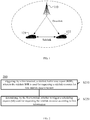
- FIG. 1 is a schematic diagram of an application scenario of an embodiment of the present disclosure.
- FIG. 1 exemplarily illustrates one network device and two of UEs.
- the wireless communication system 100 in the embodiment of the present disclosure may include a plurality of network devices, and a coverage range of each network device may include other numbers of UEs, which is not limited by the embodiment of the present disclosure.
- the wireless communication system may also include other network entities such as a mobile management entity (MME), a serving gateway (S-GW), a packet data network gateway (P-GW), etc. Entity, or, the wireless communication system may also include other network entities such as a session management function (SMF), an unified data management (UDM), an authentication server function (AUSF), which is not limited by the embodiment of the present disclosure.
- MME mobile management entity
- S-GW serving gateway
- P-GW packet data network gateway
- AUSF authentication server function
- the terminal device may perform communication in mode A and mode B.
- the terminal device 121 and the terminal device 122 may communicate in a D2D communication mode.
- the terminal device 121 and the terminal device 122 directly communicate through a D2D link, that is, a sidelink (SL).
- a D2D link that is, a sidelink (SL).
- the transmission resources of the terminal device are assigned by the base station, and the terminal device performs data transmission on the SL based on the resources assigned by the base station.
- the base station may allocate resources for a single transmission for the terminal device, or may allocate resources for semi-persistent static transmission for the terminal device.
- the terminal device uses the transmission mode of sensing and reservation, and the terminal device autonomously selects the transmission resources from the SL resources. Specifically, the terminal device obtains a set of available resources from the resource pool by sensing, and randomly selects a resource from the set of available resources for data transmission.
- mode A and mode B are only exemplary descriptions of two transmission modes, and other transmission modes may be defined.
- mode C and mode D are introduced in NR-V2X.
- the mode C indicates that the sidelink transmission resources of the terminal device are allocated by the base station, and the mode D indicates that the sidelink transmission resources of the terminal device are selected by the terminal
- D2D communication may refer to a vehicle to vehicle (“V2V” for short) communication or a vehicle to everything (V2X) communication.
- V2V vehicle to vehicle
- V2X vehicle to everything
- X may generally refer to any device with wireless receiving and sending capabilities, such as but not limited to slow-moving wireless devices, fast-moving vehicle-mounted devices, or any network control node with wireless transmission and reception capabilities. It should be understood that the embodiments of the present disclosure is mainly applied to a V2X communication scenario, but can also be applied to any other D2D communication scenario, which is not limited in the embodiments of the present disclosure.
- system and “network” herein may often be interchanged herein.
- the term “and/or” herein is only an association relationship that describes associated objects, and represents that there may be three relationships. For example, A and/or B may represent that: A exists alone, A and B exist simultaneously, and B exists alone.
- the character “/” herein generally indicates that front and back associated objects are in an "or” relationship.
- FIG. 2 is a schematic flowchart of a method for wireless communication according to an embodiment of the present disclosure.
- the method may be executed by a terminal device in the vehicle to everything system, such as the terminal device 121 or the terminal device 122.
- the method 200 includes:
- the first terminal needs to send sidelink data to other terminals, such as a second terminal, it needs the sidelink resource. If there is no sidelink resource, it needs to request the sidelink resource from the network device.
- the terminal device may trigger the sidelink BSR, which is used for requesting sidelink resource for sidelink data transmission.
- the first sidelink data to be sent may be a logical channel that triggers the sidelink BSR, or a logical channel group (LCG) that triggers the sidelink BSR.
- LCG logical channel group
- the first terminal may trigger the sidelink BSR.
- the first terminal triggers the sidelink BSR, and the sidelink BSR is in a pending state at this time, that is, the first terminal is ready to send but has not sent the sidelink B SR to the network device.
- the first sidelink data includes data in a data radio bearer (DRB) and/or data in a signaling radio bearer (SRB).
- DRB data radio bearer
- SRB signaling radio bearer
- the SRB may be used for carrying a radio resource control (RRC) signaling for sidelink and/or a sidelink PC5 signaling (PC5-S).
- RRC radio resource control
- PC5-S sidelink PC5 signaling
- a QoS attribute of the SRB is configured by a network device or is pre-configured.
- the QoS attribute of the SRB may include priority, and optionally, may also include other attributes such as latency.
- the first terminal may determine whether to trigger the SR according to the first information when the sidelink BSR is triggered, so as to request the sidelink resource through the SR.
- the sidelink BSR may not be sent.
- the network device may allocate the sidelink resource to the first terminal. If the sidelink resource cannot meet a transmission demand of the sidelink data, for example, if a size of the sidelink resource is not enough to transmit the first sidelink data to be sent, the first terminal may further trigger the sidelink BSR to request the sidelink resource from the network device through the sidelink BSR
- the first terminal may also initiate a random access process to request the uplink grant resource from the network device.
- the first information may include: whether the first terminal has an available sidelink resource for initial transmission, and/or whether the available sidelink resource for the initial transmission meets a transmission demand of the first sidelink data.
- the first terminal may determine to trigger the SR, and further send the SR to the network device.
- the first terminal may determine not to trigger the SR.
- the first terminal may determine whether to trigger the SR according to whether there is the available sidelink resource for the initial transmission (i.e., a new transmission).
- the first terminal may further determine whether to trigger SR according to whether the available sidelink resource meets the transmission demand of the first sidelink resource. In this way, it is helpful to ensure that the requested sidelink resource may meet the transmission demand of the sidelink data.
- the first terminal may determine to trigger the SR, and further send the SR to the network device.
- the first terminal may determine not to trigger the SR, and use the available sidelink resource to send the first sidelink data.
- the available sidelink failing to meet the transmission demand of the first sidelink data includes at least one of the following:
- the first terminal in a case where the first terminal is configured with the available link resource, the first terminal may further determine whether to trigger the SR according to whether the attribute of the available link resource meets an actual transmission demand, so that the SR is triggered, and the sidelink resource is further requested through the SR in a case where the available link resource does not meet the actual transmission demand, which is beneficial to ensure that the sidelink resource that meets the actual transmission demand is requested.
- the transmission demand of the sidelink data may also include other parameters that affect a transmission performance, such as, a quality-of-service (QoS) requirement, a priority, a reliability demand, etc., which are not specifically limited in the embodiments of the present disclosure.
- QoS quality-of-service
- the first mapping relationship may be a mapping relationship between sidelink data that triggers the sidelink BSR and an attribute of the sidelink resource.
- the first mapping relationship may be a relationship between the logical channel or the logical channel group that triggers the sidelink BSR and the attribute of the sidelink resource.
- the sidelink data that triggers the sidelink BSR requires the sidelink resource corresponding to a specific attribute. If the attribute of the available sidelink resource is different from the attribute of the sidelink resource mapped by the first sidelink data, the available sidelink resource and the first sidelink data do not meet the first mapping relationship.
- the first terminal may trigger the SR, and further request the sidelink resource through the SR, which facilitates to request the sidelink resource that meets the specific attribute of the first mapping relationship.
- the first terminal may further determine whether to trigger the SR based on a packing condition of current data. For example, if the data has been packed, that is, the BSR can no longer be assembled into the data packet, in this case, the first terminal may trigger the SR. Specifically, it may send a physical uplink control channel (PUCCH) to the network device, and send the SR to the network device through the PUCCH.
- PUCCH physical uplink control channel
- the first information may also include at least one of the following: whether the first terminal has an available physical uplink control channel (PUCCH) resource, and/or information on conflict data of the SR.
- PUCCH physical uplink control channel
- the PUCCH resource is a PUCCH resource mapped by the logical channel or the logical channel group corresponding to the first sidelink data.
- Embodiment three the first terminal determines whether to trigger the SR according to whether the first terminal is configured with an available PUCCH resource.
- the SR may be sent through the PUCCH resource.
- the first terminal determines whether to trigger the SR according to whether the first terminal is configured with the available PUCCH resource. For example, in a case where the first terminal is configured with the available PUCCH resource, the first terminal determines to trigger the SR, or in a case where the first terminal is not configured with the available PUCCH resource, the first terminal determines not to trigger the SR.
- the first terminal may also determine whether to trigger the SR according to the information on the conflict data of the SR.
- the information on the conflict data of the SR includes at least one of the following:
- the first terminal may only send the uplink data or the sidelink data at a same time point. Therefore, in the embodiments of the present disclosure, the first terminal may determine whether to trigger SR according to whether there is the uplink data and/or the sidelink data to be sent that conflict with the SR at present. Alternatively, in the case where there is the uplink data and/or sidelink data to be sent, the first terminal may further combine an attribute of the uplink data and/or the sidelink data to be sent to determine whether to trigger SR.
- Embodiment five the first terminal determines whether to trigger the SR according to whether there is the uplink data to be sent that conflicts with the SR.
- the first terminal may determine not to trigger the SR when there is the uplink data to be sent that conflicts with the SR, or determine to trigger the SR when there is no uplink data to be sent that conflicts with the SR.
- Embodiment six the first terminal determines whether to trigger the SR according to the importance level of the uplink data to be sent that conflicts with the SR.
- the first terminal may determine to trigger the SR when the importance level of the uplink data is lower than the importance level of the first sidelink data, that is, prioritize the transmission of the SR to request the sidelink resource of the first sidelink data.
- the importance level of the SR is higher than the importance level of the uplink data, or in other words, the priority of the SR is higher than the priority of the uplink data.
- the first terminal may determine to trigger the SR when the importance level of the uplink data is lower than a specific importance level threshold, that is, prioritize the transmission of the SR to request the sidelink resource of the first sidelink data.
- the importance level of the uplink message in the random access process may be considered to be high.
- the first terminal may determine to trigger the SR when the uplink data is not the uplink message in the random access process.
- the uplink message in the random access process is a message 3 (MSG3) for requesting the uplink resource in the random access process.
- MSG3 message 3
- Embodiment seven the first terminal determines whether to trigger the SR according to the transmission demand of the uplink data to be sent that conflicts with the SR.
- the transmission demand of the uplink data is higher than the transmission demand of the first sidelink data, that is, transmission of the uplink data needs to be prioritized.
- the priority of the SR may be considered lower than the priority of the uplink data
- the first terminal may determine not to trigger the SR, and prioritize the transmission of the uplink data.
- the transmission demand of the uplink data is lower than the transmission demand of the first sidelink data, that is, transmission of the first sidelink data needs to be prioritized.
- the priority of the SR can be considered higher than that of the uplink data.
- the first terminal may determine to trigger the SR, and prioritize the transmission of the SR to request the sidelink resource for sending the first sidelink data.
- the first terminal may determine to trigger the SR, and prioritize the transmission of the SR to request the sidelink resource for sending the first sidelink data.
- the first terminal may determine not to trigger the SR and prioritize the transmission of the uplink data.
- the transmission demand may be a latency requirement, a QoS requirement, a reliability requirement, etc.
- the transmission demand threshold may be a latency requirement threshold, a QoS requirement threshold, a reliability requirement threshold, etc.
- the transmission demand of the uplink data being lower than the transmission demand of the first sidelink data includes at least one of the following:
- the first QoS requirement set may be pre-configured or configured by the network device.
- the network device may configure one or more QoS requirements to form the first QoS requirement set.
- the QoS requirement in the first QoS requirement set is lower than a specific QoS requirement threshold.
- the QoS requirement in the first QoS requirement set may be regarded as a QoS requirement with lower priority.
- the first terminal may determine to trigger the SR.
- the latency requirement of the uplink data being lower than the latency requirement of the first sidelink data includes: the uplink data does not include voice data.
- the first terminal may further combine the transmission demand of the uplink data to determine whether to trigger the SR. For example, in the case where the transmission demand of the uplink data is lower than that of the first sidelink data, transmission of the SR is prioritized to request the sidelink resource for the first sidelink data. Alternatively, in the case where the transmission demand of the uplink data is higher than the transmission demand of the first sidelink data, transmission of the uplink data is prioritized to meet the transmission demand of the uplink data first.
- Embodiment eight the first terminal determines whether to trigger the SR according to whether there is the sidelink data to be sent that conflicts with the SR.
- the first terminal may determine not to trigger the SR when there is the sidelink data to be sent that conflicts with the SR, or determine to trigger the SR when there is no sidelink data to be sent that conflicts with the SR.
- Embodiment nine the first terminal determines whether to trigger the SR according to the transmission demand of second sidelink data to be sent that conflicts with the SR.
- the first terminal may determine not to trigger the SR and prioritize the transmission of the second sidelink data.
- the first terminal may determine to trigger the SR and prioritize the transmission of the SR, so as to request the sidelink resource for the first sidelink data.
- the first terminal may determine to trigger the SR, prioritize the transmission of the SR, so as to request the sidelink resource for the first sidelink data.
- the first terminal may determine not to trigger SR, prioritize the transmission of the second sidelink data, so as to meet the transmission demand of the second sidelink data.
- the transmission demand may be a latency requirement, a QoS requirement, a reliability requirement, etc.
- the transmission demand threshold may be a latency requirement threshold, a QoS requirement threshold, a reliability requirement threshold, etc.
- the transmission demand of the second sidelink data being lower than the transmission demand of the first sidelink data includes at least one of the following:
- the second QoS requirement set is pre-configured or configured by the network device.
- the network device may configure one or more QoS requirements to form the second QoS requirement set.
- the QoS requirement in the second QoS requirement set is lower than a specific QoS requirement threshold.
- the QoS requirement in the second QoS requirement set can be considered as a QoS requirement with lower priority.
- the first terminal may determine to trigger the SR.
- the first terminal may further determine whether to trigger the SR in conjunction with the transmission demand of the second sidelink data. For example, in the case where the transmission demand of the second sidelink data is lower than the transmission demand of the first sidelink data, transmission of the SR prioritized to request the sidelink resource for the first sidelink data. Alternatively, in the case where the transmission demand of the second sidelink data is higher than the transmission demand of the first sidelink data, transmission of the second sidelink data is prioritized to meet the transmission demand of the second sidelink data first.
- the first terminal may further implement the embodiment four to the embodiment nine when there is the PUCCH resource.
- the first terminal may further determine whether to trigger the SR based on the information on the conflict data of the SR.
- the first terminal may determine whether to trigger the SR in conjunction with the important level and the transmission demand of the uplink data that conflicts with the SR.
- the first terminal may determine to trigger the SR when the uplink data is the uplink message in the random access process, or when the uplink data is not the uplink message in the random access process, the first terminal may further determine whether to trigger the SR in conjunction with the transmission demand of the uplink data, which is not limited in the embodiments of the present disclosure.
- the first information may only include the content included in the first information in the embodiment one, or may only include the content included in the first information in the embodiment two, or it may also include the both, which is not limited in the embodiments of the present disclosure.
- the first terminal may determine whether to trigger the SR based on the available sidelink resource, the available PUCCH resource and the data conflicting with the SR, which facilitates to ensure that when the currently available sidelink resource does not meet the demand, a new sidelink resource is requested through the SR.
- FIG. 3 shows a schematic block diagram of a terminal device 400 according to an embodiment of the present disclosure.
- the device 400 includes:
- the first information includes: whether the terminal device has an available sidelink resource for initial transmission, and/or whether the available sidelink resource for the initial transmission meets a transmission demand of the first sidelink data.
- the determining module 420 is specifically configured to:
- the available sidelink failing to meet the transmission demand of the first sidelink data includes at least one of the following:
- the first mapping relationship is a mapping relationship between sidelink data that triggers the sidelink BSR and an attribute of the sidelink resource.
- the first information includes: whether the terminal device has an available physical uplink control channel (PUCCH) resource, and/or information on conflict data of the SR.
- PUCCH physical uplink control channel
- the information on the conflict data of the SR includes at least one of the following:
- the determining module 420 is specifically configured to:
- the importance level of the uplink data being lower than the importance level of the SR includes: the uplink data does not include an uplink message in a random access process.
- the uplink message is a message 3 for requesting an uplink resource in the random access process.
- the transmission demand of the uplink data being lower than the transmission demand of the first sidelink data includes at least one of the following:
- the first QoS requirement set is pre-configured or configured by a network device.
- the QoS requirement in the first QoS requirement set is lower than a specific QoS requirement threshold.
- the latency requirement of the uplink data being lower than the latency requirement of the first sidelink data includes: the uplink data does not include voice data.
- the transmission demand of the second sidelink data being lower than the transmission demand of the first sidelink data includes at least one of the following:
- the QoS requirement in the second QoS requirement set is lower than the specific QoS requirement threshold.
- the QoS requirement in the second QoS requirement set is lower than a specific QoS requirement threshold.
- the PUCCH resource is a PUCCH resource mapped by a logical channel or a logical channel group corresponding to the first sidelink data.
- the first sidelink data that triggers the sidelink BSR includes at least one of the following: a logical channel that triggers the sidelink BSR, and a logical channel group that triggers the sidelink BSR.
- the first sidelink data includes data in a data radio bearer (DRB), and/or data in a signaling radio bearer (SRB).
- DRB data radio bearer
- SRB signaling radio bearer
- the SRB is used for carrying a radio resource control (RRC) signaling for sidelink and/or a sidelink PC5 signaling (PC5-S).
- RRC radio resource control
- PC5-S sidelink PC5 signaling
- a QoS attribute of the SRB is configured by the network device or is pre-configured.
- the QoS attribute of the SRB may include priority, and optionally, may also include other attributes such as latency.
- terminal device 400 may correspond to the first terminal in the method embodiments of the present disclosure, and the foregoing and other operations and/or functions of the individual units in the terminal device 400 are respectively intended to realize the corresponding process of the first terminal in the method 200 shown in FIG. 2 , and for the sake of brevity, details are not described herein again.
- FIG. 4 is a schematic structural diagram of a communication device 600 according to an embodiment of the present disclosure.
- the communication device 600 shown in FIG. 4 includes a processor 610.
- the processor 610 may invoke a computer program from a memory and run the computer program, to implement the method in the embodiments of the present disclosure.
- the communication device 600 may further include a memory 620.
- the processor 610 may invoke the computer program from the memory 620 and run the computer program, to implement the method in the embodiments of the present disclosure.
- the memory 620 may be a component independent of the processor 610, or may be integrated into the processor 610.
- the communication device 600 may further include a transceiver 630.
- the processor 610 may control the transceiver 630 to communicate with another device, and specifically, the transceiver 630 may transmit information or data to another device, or receive information or data transmitted by another device.
- the transceiver 630 may include a transmitter and a receiver.
- the transceiver 630 may further include an antenna. There may be one or more antennas.
- the communication device 600 may be the first terminal in the embodiments of the present disclosure, and the communication device 600 can implement corresponding procedures implemented by the first terminal in various methods in the embodiments of the present disclosure. For brevity, details are not described herein again.
- FIG. 5 is a schematic structural diagram of a chip according to an embodiment of the present disclosure.
- the chip 700 shown in FIG. 5 includes a processor 710.
- the processor 710 may invoke a computer program from a memory and run the computer program, to implement the method in the embodiments of the present disclosure.
- the chip 700 may further include a memory 720.
- the processor 710 may invoke the computer program from the memory 720 and run the computer program, to implement the method in the embodiments of the present disclosure.
- the memory 720 may be a component independent of the processor 610, or may be integrated into the processor 710.
- the chip 700 may further include an input interface 730.
- the processor 710 may control the input interface 730 to communicate with another device or chip, and specifically, the input interface 730 may obtain information or data transmitted by another device or chip.
- the chip 700 may further include an output interface 740.
- the processor 710 may control the output interface 740 to communicate with another device or chip, and specifically, the output interface 740 may output information or data to another device or chip
- the chip may be applied in the first terminal according to embodiments of the present disclosure, and the chip can implement corresponding procedures implemented by the first terminal in various methods in the embodiments of the present disclosure.
- the chip can implement corresponding procedures implemented by the first terminal in various methods in the embodiments of the present disclosure.
- the chip mentioned in the embodiments of the present disclosure may also be referred to as a system-level chip, a system chip, a chip system, a system on chip, or the like.
- the processor of the embodiments of the present disclosure may be an integrated circuit chip, has a signal processing capability, the steps of the foregoing method embodiment may be implemented by using a hardware integrated logic circuit in the processor and/or implemented by using an instruction in a software form.
- the foregoing processor may be a general purpose processor, a digital signal processor (DSP), a field programmable gate array (FPGA), an application specific integrated circuit (ASIC) or another programmable logic device, a transistor logic device, or a discrete hardware component.
- DSP digital signal processor
- FPGA field programmable gate array
- ASIC application specific integrated circuit
- the foregoing general purpose processor may be a microprocessor, or may be any conventional processor, or the like.
- Steps of the methods disclosed with reference to the embodiments of the present disclosure may be directly executed and completed by means of a hardware decoding processor, or may be executed and completed by using a combination of hardware and software modules in the decoding processor.
- the software module may be located in a mature storage medium in the field, such as a random access memory, a flash memory, a read-only memory, a programmable read-only memory, an electrically-erasable programmable memory, or a register.
- the storage medium is located in the memory, and the processor reads information in the memory and completes the steps in the foregoing method embodiments in combination with hardware of the processor.
- the memory in the embodiments of the present disclosure may be a volatile memory or a non-volatile memory, or may include both a volatile memory and a non-volatile memory.
- the non-volatile memory may be a read-only memory (ROM), a programmable ROM (PROM), an erasable PROM (EPROM), an electrically EPROM (EEPROM), or a flash memory.
- the volatile memory may be a random access memory (RAM), and is used as an external cache.
- RAM random access memory
- DRAM dynamic random access memory
- SDRAM synchronous dynamic random access memory
- DDRSDRAM double data rate synchronous dynamic random access memory
- ESDRAM enhanced synchronous dynamic random access memory
- SLDRAM synclink dynamic random access memory
- DRRAM direct rambus random access memory
- the memory is an example but is not intended for limitation.
- the memory in the embodiments of the present disclosure may alternatively be a static RAM (SRAM), a dynamic RAM (DRAM), a synchronous DRAM (SDRAM), a double data rate SDRAM (DDR SDRAM), an enhanced SDRAM (ESDRAM), a synch link DRAM (SLDRAM), a direct rambus RAM (DR RAM), and the like. That is, the memory described in this embodiment of the present disclosure is intended to include but is not limited to these memories and any other suitable type of memory.
- An embodiment of the present disclosure further provides a computer readable storage medium.
- the computer readable storage medium is configured to store a computer program.
- the computer readable storage medium may be applied to the network device in the embodiments of the present disclosure, and the computer program enables a computer to execute a corresponding procedure implemented by the network device in the methods of the embodiments of the present disclosure.
- the computer program enables a computer to execute a corresponding procedure implemented by the network device in the methods of the embodiments of the present disclosure.
- the computer readable storage medium may be applied to the mobile terminal/terminal device in the embodiments of the present disclosure, and the computer program enables the computer to execute a corresponding procedure implemented by the mobile terminal/terminal device in the methods of the embodiments of the present disclosure.
- the computer program enables the computer to execute a corresponding procedure implemented by the mobile terminal/terminal device in the methods of the embodiments of the present disclosure.
- the present disclosure further provides a computer program product.
- the computer program product includes a computer program instruction.
- the computer program product may be applied to the network device in the embodiments of the present disclosure, and the computer program instruction enables the computer to execute a corresponding procedure implemented by the network device in the methods of the embodiments of the present disclosure.
- the computer program instruction enables the computer to execute a corresponding procedure implemented by the network device in the methods of the embodiments of the present disclosure.
- the computer program product may be applied to the mobile terminal/terminal device in the embodiments of the present disclosure, and the computer program instruction enables the computer to execute a corresponding procedure implemented by the mobile terminal/terminal device in the methods of the embodiments of the present disclosure.
- the computer program instruction enables the computer to execute a corresponding procedure implemented by the mobile terminal/terminal device in the methods of the embodiments of the present disclosure.
- the present disclosure further provides a computer program.
- the computer program may be applied to the network device in the embodiments of the present disclosure, and when run on a computer, the computer program instruction enables the computer to execute a corresponding procedure implemented by the network device in the methods of the embodiments of the present disclosure.
- the computer program instruction enables the computer to execute a corresponding procedure implemented by the network device in the methods of the embodiments of the present disclosure.
- the computer program may be applied to the mobile terminal/terminal device in the embodiments of the present disclosure, and when run on a computer, the computer program instruction enables the computer to execute a corresponding procedure implemented by the mobile terminal/terminal device in the methods of the embodiments of the present disclosure.
- the computer program instruction enables the computer to execute a corresponding procedure implemented by the mobile terminal/terminal device in the methods of the embodiments of the present disclosure.
- the disclosed system, apparatus, and method may be implemented in other manners.
- the apparatus embodiments described above are merely examples.
- the unit division is merely logical function division, and there may be other division manners in actual implementation.
- a plurality of units or components may be combined or integrated into another system, or some features may be ignored or not performed.
- the displayed or discussed mutual couplings or direct couplings or communication connections may be implemented by using some interfaces.
- the indirect couplings or communication connections between the apparatuses or units may be implemented in electrical, mechanical, or other forms.
- the units described as separate parts may or may not be physically separate, and the parts displayed as units may or may not be physical units, may be located in one position, or may be distributed on multiple network units. Some of or all of the units may be selected according to actual needs to achieve the objectives of the solutions of the embodiments.
- the functions When the functions are implemented in the form of a software functional unit and sold or used as an independent product, the functions may be stored in a computer-readable storage medium.
- the software product is stored in a storage medium, and includes several instructions for instructing a computer device (which may be a personal computer, a server, or a network device) to perform all or some of the steps of the methods described in the embodiments of the present disclosure.
- the foregoing storage medium includes: any medium that can store program code, such as a USB flash drive, a removable hard disk, a read-only memory (ROM), a random access memory (RAM), a magnetic disk, or an optical disc.
Landscapes
- Engineering & Computer Science (AREA)
- Computer Networks & Wireless Communication (AREA)
- Signal Processing (AREA)
- Quality & Reliability (AREA)
- Mobile Radio Communication Systems (AREA)
Abstract
Description
- Embodiments of the present disclosure relate to the field of communications, and in particular to a method and terminal device for wireless communication.
- In a cellular communication system, a terminal device may trigger a buffer state report (BSR) to request an uplink resource from a network device. In the absence of an uplink grant (UL grant), the terminal device may trigger a scheduling request (SR) to request the uplink resource from the network device.
- Device-to-device (D2D) communication is a sidelink transmission technology based on a D2D technology. A vehicle to everything system is a system based on the D2D technology. In contrast to the traditional cellular communication system in which the network device is required for data transmission and reception, a terminal-to-terminal direct communication may be adopted in the vehicle to everything system, thereby realizing higher spectrum efficiency and lower transmission latency.
- In a communication system that supports the sidelink transmission technology, the terminal device needs the sidelink resource for sidelink communication. Therefore, for the terminal device, how to request the sidelink resource is an urgent problem to be solved.
- Embodiments of the present disclosure provide a method and terminal device for wireless communication. The terminal device may trigger a sidelink BSR when a sidelink data transmission is needed, and further determine whether to trigger a SR to request a sidelink resource based on first information.
- In a first aspect, there is provided a method for wireless communication, including: triggering, by a first terminal, a sidelink buffer state report (BSR), and the sidelink BSR is used for requesting a sidelink resource for first sidelink data to be sent; and determining, by the first terminal, whether to trigger a scheduling request (SR) used for requesting the sidelink resource according to first information.
- In a second aspect, there is provided a terminal device configured to perform the method in the first aspect or any of the implementations thereof. Specifically, the terminal device includes functional units configured to perform the method in the first aspect or any of the implementations thereof.
- In a third aspect, there is provided a terminal device, including a processor and a memory. The memory is configured to store a computer program, and the processor is configured to call and run the computer program stored in the memory to execute the method in the first aspect or any of the implementations thereof.
- In a fourth aspect, there is provided a chip, configured to perform the method in the first aspect or any of the implementations thereof. Specifically, the chip includes: a processor, configured to call and run a computer program from a memory, so that a device installed with the chip performs the method in the first aspect or any of the implementations thereof.
- In a fifth aspect, there is provided a computer-readable storage medium, configured to store a computer program that causes a computer to perform the method in the first aspect or any of the implementations thereof.
- In a sixth aspect, there is provided a computer program product, including computer program instructions, which cause the computer to perform the method in the first aspect or any of the implementations thereof.
- In a seventh aspect, there is provided a computer program which, when run on a computer, causes the computer to perform the method in the first aspect or any of the implementations thereof.
- Based on the above technical solutions, the terminal device may trigger the sidelink BSR when a sidelink data transmission is needed, and further determine whether to trigger the SR based on first information, which facilitates to ensure that the requested sidelink resource meets actual transmission demands.
-
-
FIG. 1 is a schematic diagram of a communication system architecture provided by an embodiment of the present disclosure. -
FIG. 2 is a schematic diagram of a method for wireless communication provided by an embodiment of the present disclosure. -
FIG. 3 is a schematic block diagram of a terminal device provided by an embodiment of the present disclosure. -
FIG. 4 is a schematic block diagram of a communication device according to another embodiment of the present disclosure. -
FIG. 5 is a schematic block diagram of a chip provided by an embodiment of the present disclosure. - The technical solutions in the embodiments of the present disclosure will be described below with reference to the accompanying drawings in the embodiments of the present disclosure. Obviously, the described embodiments are part of the embodiments of the present disclosure, but not all of the embodiments. Based on the embodiments in the present disclosure, all other embodiments obtained by a person of ordinary skill in the art without creative efforts shall fall within the protection scope of the present disclosure.
- It should be understood that technical solutions of the embodiments of the present disclosure may be applied to a Device to Device (D2D) communication system, for example, a vehicle to everything system based on long term evolution (LTE) for D2D communication, or a new radio vehicle to everything (NR-V2X) system. Unlike a traditional LTE system in which communication data between terminals is received or sent through a network device (for example, a base station), the vehicle to everything system adopts a terminal-to-terminal direct communication, and it has higher spectrum efficiency and lower transmission latency.
- Optionally, a communication system which is based on by the vehicle to everything system may be a Global System for Mobile communications ("GSM" for short) system, a Code Division Multiple Access ("CDMA" for short) system, a Wideband Code Division Multiple Access ("WCDMA" for short) system, a General Packet Radio Service ("GPRS" for short), a LTE system, an LTE Frequency Division Duplex ("FDD" for short) system, an LTE Time Division Duplex ("TDD" for short), a Universal Mobile Telecommunication System ("UMTS" for short), a Worldwide Interoperability for Microwave Access ("WiMAX" for short) communications system, a 5G new radio ("NR" for short) system, or the like.
- The terminal device in the embodiments of the present disclosure may be a terminal device capable of implementing D2D communication. For example, it may be a vehicle-mounted terminal device, a terminal device in a 5G network, or a terminal device in a public land mobile network (PLMN) that will evolve in the future, which is not limited by the embodiments of the present disclosure.
-
FIG. 1 is a schematic diagram of an application scenario of an embodiment of the present disclosure.FIG. 1 exemplarily illustrates one network device and two of UEs. Optionally, the wireless communication system 100 in the embodiment of the present disclosure may include a plurality of network devices, and a coverage range of each network device may include other numbers of UEs, which is not limited by the embodiment of the present disclosure. - Optionally, the wireless communication system may also include other network entities such as a mobile management entity (MME), a serving gateway (S-GW), a packet data network gateway (P-GW), etc. Entity, or, the wireless communication system may also include other network entities such as a session management function (SMF), an unified data management (UDM), an authentication server function (AUSF), which is not limited by the embodiment of the present disclosure.
- In this vehicle to everything system, the terminal device may perform communication in mode A and mode B.
- Specifically, the
terminal device 121 and theterminal device 122 may communicate in a D2D communication mode. When performing the D2D communication, theterminal device 121 and theterminal device 122 directly communicate through a D2D link, that is, a sidelink (SL). In the mode A, the transmission resources of the terminal device are assigned by the base station, and the terminal device performs data transmission on the SL based on the resources assigned by the base station. The base station may allocate resources for a single transmission for the terminal device, or may allocate resources for semi-persistent static transmission for the terminal device. In the mode B, the terminal device uses the transmission mode of sensing and reservation, and the terminal device autonomously selects the transmission resources from the SL resources. Specifically, the terminal device obtains a set of available resources from the resource pool by sensing, and randomly selects a resource from the set of available resources for data transmission. - It should be understood that the above-mentioned mode A and mode B are only exemplary descriptions of two transmission modes, and other transmission modes may be defined. For example, mode C and mode D are introduced in NR-V2X. The mode C indicates that the sidelink transmission resources of the terminal device are allocated by the base station, and the mode D indicates that the sidelink transmission resources of the terminal device are selected by the terminal
- D2D communication may refer to a vehicle to vehicle ("V2V" for short) communication or a vehicle to everything (V2X) communication. In the V2X communication, X may generally refer to any device with wireless receiving and sending capabilities, such as but not limited to slow-moving wireless devices, fast-moving vehicle-mounted devices, or any network control node with wireless transmission and reception capabilities. It should be understood that the embodiments of the present disclosure is mainly applied to a V2X communication scenario, but can also be applied to any other D2D communication scenario, which is not limited in the embodiments of the present disclosure.
- It should be understood that the terms "system" and "network" herein may often be interchanged herein. The term "and/or" herein is only an association relationship that describes associated objects, and represents that there may be three relationships. For example, A and/or B may represent that: A exists alone, A and B exist simultaneously, and B exists alone. In addition, the character "/" herein generally indicates that front and back associated objects are in an "or" relationship.
-
FIG. 2 is a schematic flowchart of a method for wireless communication according to an embodiment of the present disclosure. For example, the method may be executed by a terminal device in the vehicle to everything system, such as theterminal device 121 or theterminal device 122. As shown inFIG. 2 , themethod 200 includes: - in S210, a first terminal triggers a sidelink buffer state report (BSR), and the sidelink BSR is used for requesting a sidelink resource for first sidelink data to be sent; and
- in S220, the first terminal determines whether to trigger a scheduling request (SR) used for requesting the sidelink resource according to first information.
- Specifically, when the first terminal needs to send sidelink data to other terminals, such as a second terminal, it needs the sidelink resource. If there is no sidelink resource, it needs to request the sidelink resource from the network device. In this case, the terminal device may trigger the sidelink BSR, which is used for requesting sidelink resource for sidelink data transmission.
- Optionally, in the embodiments of the present disclosure, the first sidelink data to be sent may be a logical channel that triggers the sidelink BSR, or a logical channel group (LCG) that triggers the sidelink BSR.
- In other words, when data in the logical channel or the logical channel group needs to be sent to other terminal devices, the first terminal may trigger the sidelink BSR.
- It should be understood that, in the embodiments of the present disclosure, the first terminal triggers the sidelink BSR, and the sidelink BSR is in a pending state at this time, that is, the first terminal is ready to send but has not sent the sidelink B SR to the network device.
- Optionally, the first sidelink data includes data in a data radio bearer (DRB) and/or data in a signaling radio bearer (SRB).
- Optionally, in some embodiments, the SRB may be used for carrying a radio resource control (RRC) signaling for sidelink and/or a sidelink PC5 signaling (PC5-S).
- Optionally, in some embodiments, a QoS attribute of the SRB is configured by a network device or is pre-configured.
- Optionally, the QoS attribute of the SRB may include priority, and optionally, may also include other attributes such as latency.
- Optionally, in some embodiments, the first terminal may determine whether to trigger the SR according to the first information when the sidelink BSR is triggered, so as to request the sidelink resource through the SR.
- It should be understood that in the embodiments of the present disclosure, if it is determined to trigger the SR, the sidelink BSR may not be sent. After the first terminal sends the SR to the network device, the network device may allocate the sidelink resource to the first terminal. If the sidelink resource cannot meet a transmission demand of the sidelink data, for example, if a size of the sidelink resource is not enough to transmit the first sidelink data to be sent, the first terminal may further trigger the sidelink BSR to request the sidelink resource from the network device through the sidelink BSR
- Optionally, in some embodiments, if the first terminal determines not to trigger SR, for example, no uplink grant resource is configured for the first terminal, the first terminal may also initiate a random access process to request the uplink grant resource from the network device.
- In the following, in conjunction with specific embodiments, a SR trigger mode is described.
- Optionally, as an embodiment, denoted as embodiment one, the first information may include:
whether the first terminal has an available sidelink resource for initial transmission, and/or whether the available sidelink resource for the initial transmission meets a transmission demand of the first sidelink data. - For example, if the first terminal is not configured with the available sidelink resource for the initial transmission, the first terminal may determine to trigger the SR, and further send the SR to the network device.
- For another example, if the first terminal is configured with the available sidelink resource for the initial transmission, the first terminal may determine not to trigger the SR.
- Therefore, the first terminal may determine whether to trigger the SR according to whether there is the available sidelink resource for the initial transmission (i.e., a new transmission).
- In other embodiments, if the first terminal is configured with the available sidelink resource for the initial transmission, the first terminal may further determine whether to trigger SR according to whether the available sidelink resource meets the transmission demand of the first sidelink resource. In this way, it is helpful to ensure that the requested sidelink resource may meet the transmission demand of the sidelink data.
- For example, if the first terminal is configured with the available sidelink resource for the initial transmission, but if the available sidelink resource cannot meet the transmission demand of the first sidelink data, the first terminal may determine to trigger the SR, and further send the SR to the network device.
- Alternatively, if the first terminal is configured with the available sidelink resource for the initial transmission, but if the available sidelink resource can meet the transmission demand of the first sidelink data to be sent, the first terminal may determine not to trigger the SR, and use the available sidelink resource to send the first sidelink data.
- As an example and not a limitation, the available sidelink failing to meet the transmission demand of the first sidelink data includes at least one of the following:
- the available sidelink resource and the first sidelink data do not meet a first mapping relationship;
- the available sidelink resource does not meet a latency requirement of the first sidelink data; and
- the size of the available sidelink resource is not enough to transmit the first sidelink data.
- Therefore, in the embodiments of the present disclosure, in a case where the first terminal is configured with the available link resource, the first terminal may further determine whether to trigger the SR according to whether the attribute of the available link resource meets an actual transmission demand, so that the SR is triggered, and the sidelink resource is further requested through the SR in a case where the available link resource does not meet the actual transmission demand, which is beneficial to ensure that the sidelink resource that meets the actual transmission demand is requested.
- It should be understood that, in the embodiments of the present disclosure, the case where the available sidelink resource cannot meet the transmission demand of the first sidelink data is only an example, and the transmission demand of the sidelink data may also include other parameters that affect a transmission performance, such as, a quality-of-service (QoS) requirement, a priority, a reliability demand, etc., which are not specifically limited in the embodiments of the present disclosure.
- Optionally, in some embodiments, the first mapping relationship may be a mapping relationship between sidelink data that triggers the sidelink BSR and an attribute of the sidelink resource.
- For example, the first mapping relationship may be a relationship between the logical channel or the logical channel group that triggers the sidelink BSR and the attribute of the sidelink resource.
- That is to say, the sidelink data that triggers the sidelink BSR requires the sidelink resource corresponding to a specific attribute. If the attribute of the available sidelink resource is different from the attribute of the sidelink resource mapped by the first sidelink data, the available sidelink resource and the first sidelink data do not meet the first mapping relationship. In this case, the first terminal may trigger the SR, and further request the sidelink resource through the SR, which facilitates to request the sidelink resource that meets the specific attribute of the first mapping relationship.
- Optionally, in some embodiments, if the first terminal is configured with the available sidelink resource for the initial transmission, the first terminal may further determine whether to trigger the SR based on a packing condition of current data. For example, if the data has been packed, that is, the BSR can no longer be assembled into the data packet, in this case, the first terminal may trigger the SR. Specifically, it may send a physical uplink control channel (PUCCH) to the network device, and send the SR to the network device through the PUCCH.
- Optionally, as another embodiment, denoted as embodiment two, the first information may also include at least one of the following:
whether the first terminal has an available physical uplink control channel (PUCCH) resource, and/or information on conflict data of the SR. - Optionally, the PUCCH resource is a PUCCH resource mapped by the logical channel or the logical channel group corresponding to the first sidelink data.
- Hereinafter, in conjunction with embodiment three to embodiment nine, a specific implementation of the embodiment two will be described.
- Embodiment three: the first terminal determines whether to trigger the SR according to whether the first terminal is configured with an available PUCCH resource.
- The SR may be sent through the PUCCH resource. In some specific embodiments, the first terminal determines whether to trigger the SR according to whether the first terminal is configured with the available PUCCH resource. For example, in a case where the first terminal is configured with the available PUCCH resource, the first terminal determines to trigger the SR, or in a case where the first terminal is not configured with the available PUCCH resource, the first terminal determines not to trigger the SR.
- Embodiment four: the first terminal may also determine whether to trigger the SR according to the information on the conflict data of the SR.
- As an example and not a limitation, the information on the conflict data of the SR includes at least one of the following:
- whether there is uplink data to be sent that conflicts with the SR;
- an importance level of the uplink data that conflicts with the SR;
- a transmission demand of the uplink data that conflicts with the SR;
- whether there is sidelink data to be sent that conflicts with the SR; and
- a transmission demand of sidelink data that conflicts with the SR.
- Generally speaking, the first terminal may only send the uplink data or the sidelink data at a same time point. Therefore, in the embodiments of the present disclosure, the first terminal may determine whether to trigger SR according to whether there is the uplink data and/or the sidelink data to be sent that conflict with the SR at present. Alternatively, in the case where there is the uplink data and/or sidelink data to be sent, the first terminal may further combine an attribute of the uplink data and/or the sidelink data to be sent to determine whether to trigger SR.
- In conjunction with embodiment five to embodiment nine, a specific implementation of the embodiment four will be described.
- Embodiment five: the first terminal determines whether to trigger the SR according to whether there is the uplink data to be sent that conflicts with the SR.
- For example, the first terminal may determine not to trigger the SR when there is the uplink data to be sent that conflicts with the SR, or determine to trigger the SR when there is no uplink data to be sent that conflicts with the SR.
- Embodiment six: the first terminal determines whether to trigger the SR according to the importance level of the uplink data to be sent that conflicts with the SR.
- For example, the first terminal may determine to trigger the SR when the importance level of the uplink data is lower than the importance level of the first sidelink data, that is, prioritize the transmission of the SR to request the sidelink resource of the first sidelink data. In this case, it may be considered that the importance level of the SR is higher than the importance level of the uplink data, or in other words, the priority of the SR is higher than the priority of the uplink data.
- For another example, the first terminal may determine to trigger the SR when the importance level of the uplink data is lower than a specific importance level threshold, that is, prioritize the transmission of the SR to request the sidelink resource of the first sidelink data.
- The importance level of the uplink message in the random access process may be considered to be high. In some specific embodiments, the first terminal may determine to trigger the SR when the uplink data is not the uplink message in the random access process.
- Optionally, the uplink message in the random access process is a message 3 (MSG3) for requesting the uplink resource in the random access process.
- Embodiment seven: the first terminal determines whether to trigger the SR according to the transmission demand of the uplink data to be sent that conflicts with the SR.
- For example, if the transmission demand of the uplink data is higher than the transmission demand of the first sidelink data, that is, transmission of the uplink data needs to be prioritized. In this case, the priority of the SR may be considered lower than the priority of the uplink data, the first terminal may determine not to trigger the SR, and prioritize the transmission of the uplink data.
- Alternatively, if the transmission demand of the uplink data is lower than the transmission demand of the first sidelink data, that is, transmission of the first sidelink data needs to be prioritized. In this case, the priority of the SR can be considered higher than that of the uplink data. The first terminal may determine to trigger the SR, and prioritize the transmission of the SR to request the sidelink resource for sending the first sidelink data.
- For another example, if the transmission demand of the uplink data is lower than a transmission demand threshold, in this case, it can be considered that the priority of the SR is higher than the priority of the uplink data, and the first terminal may determine to trigger the SR, and prioritize the transmission of the SR to request the sidelink resource for sending the first sidelink data.
- Alternatively, if the transmission demand of the uplink data is higher than the specific transmission demand threshold, in this case, it can be considered that the priority of the SR is lower than the priority of the uplink data, and the first terminal may determine not to trigger the SR and prioritize the transmission of the uplink data.
- As an example and not a limitation, the transmission demand may be a latency requirement, a QoS requirement, a reliability requirement, etc. Correspondingly, the transmission demand threshold may be a latency requirement threshold, a QoS requirement threshold, a reliability requirement threshold, etc.
- Optionally, in some embodiments, the transmission demand of the uplink data being lower than the transmission demand of the first sidelink data includes at least one of the following:
- a priority of the uplink data is lower than a priority of the first sidelink data;
- a quality of service (QoS) requirement of the uplink data is lower than a QoS requirement of the first sidelink data;
- the QoS requirement of the uplink data is a QoS requirement in a first QoS requirement set; and
- a latency requirement of the uplink data is lower than a latency requirement of the first sidelink data.
- Optionally, the first QoS requirement set may be pre-configured or configured by the network device.
- For example, the network device may configure one or more QoS requirements to form the first QoS requirement set. Optionally, the QoS requirement in the first QoS requirement set is lower than a specific QoS requirement threshold.
- The QoS requirement in the first QoS requirement set may be regarded as a QoS requirement with lower priority. When the QoS requirement of the uplink data is the QoS requirement in the first QoS requirement set, the first terminal may determine to trigger the SR.
- Optionally, in some embodiments, the latency requirement of the uplink data being lower than the latency requirement of the first sidelink data includes: the uplink data does not include voice data.
- Therefore, in a case where there is the uplink data that conflicts with the SR, the first terminal may further combine the transmission demand of the uplink data to determine whether to trigger the SR. For example, in the case where the transmission demand of the uplink data is lower than that of the first sidelink data, transmission of the SR is prioritized to request the sidelink resource for the first sidelink data. Alternatively, in the case where the transmission demand of the uplink data is higher than the transmission demand of the first sidelink data, transmission of the uplink data is prioritized to meet the transmission demand of the uplink data first.
- Embodiment eight: the first terminal determines whether to trigger the SR according to whether there is the sidelink data to be sent that conflicts with the SR.
- For example, the first terminal may determine not to trigger the SR when there is the sidelink data to be sent that conflicts with the SR, or determine to trigger the SR when there is no sidelink data to be sent that conflicts with the SR.
- Embodiment nine: the first terminal determines whether to trigger the SR according to the transmission demand of second sidelink data to be sent that conflicts with the SR.
- For example, if the transmission demand of the second sidelink data is higher than the transmission demand of the first sidelink data, that is, transmission of the second sidelink data needs to be prioritized. In this case, it may be considered that the priority of the SR is lower than the priority of the second sidelink data, the first terminal may determine not to trigger the SR and prioritize the transmission of the second sidelink data.
- Alternatively, if the transmission demand of the second sidelink data is lower than the transmission demand of the first sidelink data, that is, transmission of the first sidelink data needs to be prioritized. In this case, it may be considered that the priority of the SR is higher than the priority of the second sidelink data, the first terminal may determine to trigger the SR and prioritize the transmission of the SR, so as to request the sidelink resource for the first sidelink data.
- For another example, if the transmission demand of the second sidelink data is lower than the transmission demand threshold, in this case, it can be considered that the priority of the SR is higher than the priority of the second sidelink data, and the first terminal may determine to trigger the SR, prioritize the transmission of the SR, so as to request the sidelink resource for the first sidelink data.
- Alternatively, if the transmission demand of the second sidelink data is higher than the specific transmission demand threshold. In this case, it can be considered that the priority of the SR is lower than the priority of the second sidelink data, and the first terminal may determine not to trigger SR, prioritize the transmission of the second sidelink data, so as to meet the transmission demand of the second sidelink data.
- As an example and not a limitation, the transmission demand may be a latency requirement, a QoS requirement, a reliability requirement, etc. Correspondingly, the transmission demand threshold may be a latency requirement threshold, a QoS requirement threshold, a reliability requirement threshold, etc.
- Optionally, in some embodiments, the transmission demand of the second sidelink data being lower than the transmission demand of the first sidelink data includes at least one of the following:
- a priority of the second sidelink data is lower than a priority of the first sidelink data;
- a QoS requirement of the second sidelink data is lower than the QoS requirement of the first sidelink data;
- a latency requirement of the second sidelink data is lower than the latency requirement of the first sidelink data;
- the QoS requirement of the second sidelink data is a QoS requirement in a second QoS requirement set.
- Optionally, the second QoS requirement set is pre-configured or configured by the network device.
- For example, the network device may configure one or more QoS requirements to form the second QoS requirement set. Optionally, the QoS requirement in the second QoS requirement set is lower than a specific QoS requirement threshold.
- The QoS requirement in the second QoS requirement set can be considered as a QoS requirement with lower priority. When the QoS requirement of the sidelink data is the QoS requirement in the second QoS requirement set, the first terminal may determine to trigger the SR.
- Therefore, in the case where there is the second sidelink data that conflicts with the SR, the first terminal may further determine whether to trigger the SR in conjunction with the transmission demand of the second sidelink data. For example, in the case where the transmission demand of the second sidelink data is lower than the transmission demand of the first sidelink data, transmission of the SR prioritized to request the sidelink resource for the first sidelink data. Alternatively, in the case where the transmission demand of the second sidelink data is higher than the transmission demand of the first sidelink data, transmission of the second sidelink data is prioritized to meet the transmission demand of the second sidelink data first.
- It should also be understood that the above embodiments may be implemented separately or in combination, which is not limited in the embodiments of the present disclosure. For example, the first terminal may further implement the embodiment four to the embodiment nine when there is the PUCCH resource. For example, when the PUCCH resource is available, the first terminal may further determine whether to trigger the SR based on the information on the conflict data of the SR. For example, the first terminal may determine whether to trigger the SR in conjunction with the important level and the transmission demand of the uplink data that conflicts with the SR. For example, the first terminal may determine to trigger the SR when the uplink data is the uplink message in the random access process, or when the uplink data is not the uplink message in the random access process, the first terminal may further determine whether to trigger the SR in conjunction with the transmission demand of the uplink data, which is not limited in the embodiments of the present disclosure.
- It should be noted that the first information may only include the content included in the first information in the embodiment one, or may only include the content included in the first information in the embodiment two, or it may also include the both, which is not limited in the embodiments of the present disclosure.
- Therefore, according to the method for wireless communication of the embodiments of the present disclosure, the first terminal may determine whether to trigger the SR based on the available sidelink resource, the available PUCCH resource and the data conflicting with the SR, which facilitates to ensure that when the currently available sidelink resource does not meet the demand, a new sidelink resource is requested through the SR.
- The foregoing describes the method for wireless communication according to the embodiments of the present disclosure from a perspective of the first terminal in conjunction with
FIG. 2 in detail. The following describes device embodiments of the present disclosure in detail with reference toFIGS. 3 to 5 . It should be understood that the device embodiments and the method embodiments correspond to each other, and similar descriptions may refer to the method embodiments. -
FIG. 3 shows a schematic block diagram of a terminal device 400 according to an embodiment of the present disclosure. As shown inFIG. 3 , the device 400 includes: - a triggering module 410, configured to trigger a sidelink buffer state report (BSR), and the sidelink BSR is used for requesting a sidelink resource for first sidelink data to be sent; and
- a determining module 420, configured to determine whether to trigger a scheduling request (SR) used for requesting the sidelink resource according to first information.
- Optionally, in some embodiments, the first information includes:
whether the terminal device has an available sidelink resource for initial transmission, and/or whether the available sidelink resource for the initial transmission meets a transmission demand of the first sidelink data. - Optionally, in some embodiments, the determining module 420 is specifically configured to:
- determine to trigger the SR, if at least one of the following conditions is met:
- the terminal device does not have the available sidelink resource for the initial transmission;
- the terminal device has the available sidelink resource for the initial transmission, and the available sidelink resource fails to meet the transmission demand of the first sidelink data;
- the terminal device has the available sidelink resource for the initial transmission, and data has been packed.
- Optionally, in some embodiments, the available sidelink failing to meet the transmission demand of the first sidelink data includes at least one of the following:
- the available sidelink resource and the first sidelink data do not meet a first mapping relationship;
- the available sidelink resource does not meet a latency requirement of the first sidelink data.
- Optionally, in some embodiments, the first mapping relationship is a mapping relationship between sidelink data that triggers the sidelink BSR and an attribute of the sidelink resource.
- Optionally, in some embodiments, the first information includes:
whether the terminal device has an available physical uplink control channel (PUCCH) resource, and/or information on conflict data of the SR. - Optionally, in some embodiments, the information on the conflict data of the SR includes at least one of the following:
- whether there is uplink data to be sent that conflicts with the SR;
- an importance level of the uplink data that conflicts with the SR;
- a transmission demand of the uplink data that conflicts with the SR;
- whether there is sidelink data to be sent that conflicts with the SR; and
- a transmission demand of sidelink data that conflicts with the SR.
- Optionally, in some embodiments, the determining module 420 is specifically configured to:
- determine to trigger the SR, if at least one of the following conditions is met:
- the terminal device has the available physical uplink control channel (PUCCH) resource;
- the terminal device does not have the uplink data to be sent that conflicts with the SR;
- the terminal device has the uplink data to be sent that conflicts with the SR, and the importance level of the uplink data is lower than an importance level of the SR;
- the terminal device has the uplink data to be sent that conflicts with the SR, and a transmission demand of the uplink data is lower than a transmission demand of the first sidelink data;
- the terminal device does not have second sidelink data to be sent that conflicts with the SR; and
- the terminal device has the second sidelink data to be sent that conflicts with the SR, and a transmission demand of the second sidelink data is lower than a transmission demand of the first sidelink data.
- Optionally, in some embodiments, the importance level of the uplink data being lower than the importance level of the SR includes:
the uplink data does not include an uplink message in a random access process. - Optionally, in some embodiments, the uplink message is a message 3 for requesting an uplink resource in the random access process.
- Optionally, in some embodiments, the transmission demand of the uplink data being lower than the transmission demand of the first sidelink data includes at least one of the following:
- a priority of the uplink data is lower than a priority of the first sidelink data;
- a quality of service (QoS) requirement of the uplink data is lower than a QoS requirement of the first sidelink data;
- the QoS requirement of the uplink data is a QoS requirement in a first QoS requirement set; and
- a latency requirement of the uplink data is lower than a latency requirement of the first sidelink data.
- Optionally, in some embodiments, the first QoS requirement set is pre-configured or configured by a network device.
- Optionally, in some embodiments, the QoS requirement in the first QoS requirement set is lower than a specific QoS requirement threshold.
- Optionally, in some embodiments, the latency requirement of the uplink data being lower than the latency requirement of the first sidelink data includes: the uplink data does not include voice data.
- Optionally, in some embodiments, the transmission demand of the second sidelink data being lower than the transmission demand of the first sidelink data includes at least one of the following:
- a priority of the second sidelink data is lower than a priority of the first sidelink data;
- a QoS requirement of the second sidelink data is lower than the QoS requirement of the first sidelink data;
- a latency requirement of the second sidelink data is lower than the latency requirement of the first sidelink data;
- the QoS requirement of the second sidelink data is a QoS requirement in a second QoS requirement set.
- Optionally, in some embodiments, the QoS requirement in the second QoS requirement set is lower than the specific QoS requirement threshold.
- Optionally, in some embodiments, the QoS requirement in the second QoS requirement set is lower than a specific QoS requirement threshold.
- Optionally, in some embodiments, the PUCCH resource is a PUCCH resource mapped by a logical channel or a logical channel group corresponding to the first sidelink data.
- Optionally, in some embodiments, the first sidelink data that triggers the sidelink BSR includes at least one of the following:
a logical channel that triggers the sidelink BSR, and a logical channel group that triggers the sidelink BSR. - Optionally, in some embodiments, the first sidelink data includes data in a data radio bearer (DRB), and/or data in a signaling radio bearer (SRB).
- Optionally, in some embodiments, the SRB is used for carrying a radio resource control (RRC) signaling for sidelink and/or a sidelink PC5 signaling (PC5-S).
- Optionally, in some embodiments, a QoS attribute of the SRB is configured by the network device or is pre-configured.
- Optionally, the QoS attribute of the SRB may include priority, and optionally, may also include other attributes such as latency.
- It should be understood that the terminal device 400 according to the embodiments of the present disclosure may correspond to the first terminal in the method embodiments of the present disclosure, and the foregoing and other operations and/or functions of the individual units in the terminal device 400 are respectively intended to realize the corresponding process of the first terminal in the
method 200 shown inFIG. 2 , and for the sake of brevity, details are not described herein again. -
FIG. 4 is a schematic structural diagram of acommunication device 600 according to an embodiment of the present disclosure. Thecommunication device 600 shown inFIG. 4 includes aprocessor 610. Theprocessor 610 may invoke a computer program from a memory and run the computer program, to implement the method in the embodiments of the present disclosure. - Optionally, as shown in
FIG. 4 , thecommunication device 600 may further include amemory 620. Theprocessor 610 may invoke the computer program from thememory 620 and run the computer program, to implement the method in the embodiments of the present disclosure. - The
memory 620 may be a component independent of theprocessor 610, or may be integrated into theprocessor 610. - Optionally, as shown in
FIG. 4 , thecommunication device 600 may further include atransceiver 630. Theprocessor 610 may control thetransceiver 630 to communicate with another device, and specifically, thetransceiver 630 may transmit information or data to another device, or receive information or data transmitted by another device. - The
transceiver 630 may include a transmitter and a receiver. Thetransceiver 630 may further include an antenna. There may be one or more antennas. - Optionally, the
communication device 600 may be the first terminal in the embodiments of the present disclosure, and thecommunication device 600 can implement corresponding procedures implemented by the first terminal in various methods in the embodiments of the present disclosure. For brevity, details are not described herein again. -
FIG. 5 is a schematic structural diagram of a chip according to an embodiment of the present disclosure. Thechip 700 shown inFIG. 5 includes aprocessor 710. Theprocessor 710 may invoke a computer program from a memory and run the computer program, to implement the method in the embodiments of the present disclosure. - Optionally, as shown in
FIG. 5 , thechip 700 may further include amemory 720. Theprocessor 710 may invoke the computer program from thememory 720 and run the computer program, to implement the method in the embodiments of the present disclosure. - The
memory 720 may be a component independent of theprocessor 610, or may be integrated into theprocessor 710. - Optionally, the
chip 700 may further include aninput interface 730. Theprocessor 710 may control theinput interface 730 to communicate with another device or chip, and specifically, theinput interface 730 may obtain information or data transmitted by another device or chip. - Optionally, the
chip 700 may further include anoutput interface 740. Theprocessor 710 may control theoutput interface 740 to communicate with another device or chip, and specifically, theoutput interface 740 may output information or data to another device or chip - Optionally, the chip may be applied in the first terminal according to embodiments of the present disclosure, and the chip can implement corresponding procedures implemented by the first terminal in various methods in the embodiments of the present disclosure. For brevity, details are not described herein again.
- It should be noted that, the chip mentioned in the embodiments of the present disclosure may also be referred to as a system-level chip, a system chip, a chip system, a system on chip, or the like.
- It should be understood that, the processor of the embodiments of the present disclosure may be an integrated circuit chip, has a signal processing capability, the steps of the foregoing method embodiment may be implemented by using a hardware integrated logic circuit in the processor and/or implemented by using an instruction in a software form. The foregoing processor may be a general purpose processor, a digital signal processor (DSP), a field programmable gate array (FPGA), an application specific integrated circuit (ASIC) or another programmable logic device, a transistor logic device, or a discrete hardware component. The foregoing general purpose processor may be a microprocessor, or may be any conventional processor, or the like. Steps of the methods disclosed with reference to the embodiments of the present disclosure may be directly executed and completed by means of a hardware decoding processor, or may be executed and completed by using a combination of hardware and software modules in the decoding processor. The software module may be located in a mature storage medium in the field, such as a random access memory, a flash memory, a read-only memory, a programmable read-only memory, an electrically-erasable programmable memory, or a register. The storage medium is located in the memory, and the processor reads information in the memory and completes the steps in the foregoing method embodiments in combination with hardware of the processor.
- It should be understood that, the memory in the embodiments of the present disclosure may be a volatile memory or a non-volatile memory, or may include both a volatile memory and a non-volatile memory. The non-volatile memory may be a read-only memory (ROM), a programmable ROM (PROM), an erasable PROM (EPROM), an electrically EPROM (EEPROM), or a flash memory. The volatile memory may be a random access memory (RAM), and is used as an external cache. By way of examples but of no limitation, many forms of RAM are available, for example, a static random access memory (SRAM), a dynamic random access memory (DRAM), a synchronous dynamic random access memory (SDRAM), a double data rate synchronous dynamic random access memory (DDRSDRAM), an enhanced synchronous dynamic random access memory (ESDRAM), a synclink dynamic random access memory (SLDRAM), and a direct rambus random access memory (DRRAM). It should be noted that, the memory of the system and the method described in this embodiment of the present disclosure is intended to include but is not limited to these memories and any other suitable type of memory.
- It should be understood that, the memory is an example but is not intended for limitation. For example, the memory in the embodiments of the present disclosure may alternatively be a static RAM (SRAM), a dynamic RAM (DRAM), a synchronous DRAM (SDRAM), a double data rate SDRAM (DDR SDRAM), an enhanced SDRAM (ESDRAM), a synch link DRAM (SLDRAM), a direct rambus RAM (DR RAM), and the like. That is, the memory described in this embodiment of the present disclosure is intended to include but is not limited to these memories and any other suitable type of memory.
- An embodiment of the present disclosure further provides a computer readable storage medium. The computer readable storage medium is configured to store a computer program.
- Optionally, the computer readable storage medium may be applied to the network device in the embodiments of the present disclosure, and the computer program enables a computer to execute a corresponding procedure implemented by the network device in the methods of the embodiments of the present disclosure. For brevity, details are not described herein again.
- Optionally, the computer readable storage medium may be applied to the mobile terminal/terminal device in the embodiments of the present disclosure, and the computer program enables the computer to execute a corresponding procedure implemented by the mobile terminal/terminal device in the methods of the embodiments of the present disclosure. For brevity, details are not described herein again.
- The present disclosure further provides a computer program product. The computer program product includes a computer program instruction.
- Optionally, the computer program product may be applied to the network device in the embodiments of the present disclosure, and the computer program instruction enables the computer to execute a corresponding procedure implemented by the network device in the methods of the embodiments of the present disclosure. For brevity, details are not described herein again.
- Optionally, the computer program product may be applied to the mobile terminal/terminal device in the embodiments of the present disclosure, and the computer program instruction enables the computer to execute a corresponding procedure implemented by the mobile terminal/terminal device in the methods of the embodiments of the present disclosure. For brevity, details are not described herein again.
- The present disclosure further provides a computer program.
- Optionally, the computer program may be applied to the network device in the embodiments of the present disclosure, and when run on a computer, the computer program instruction enables the computer to execute a corresponding procedure implemented by the network device in the methods of the embodiments of the present disclosure. For brevity, details are not described herein again.
- Optionally, the computer program may be applied to the mobile terminal/terminal device in the embodiments of the present disclosure, and when run on a computer, the computer program instruction enables the computer to execute a corresponding procedure implemented by the mobile terminal/terminal device in the methods of the embodiments of the present disclosure. For brevity, details are not described herein again.
- A person of ordinary skill in the art may be aware that, in combination with the examples described in the embodiments disclosed in this specification, units and algorithm steps may be implemented by using electronic hardware or a combination of computer software and electronic hardware. Whether these functions are executed by means of hardware or software depends on specific applications and design constraints of the technical solutions. A person skilled in the art may use different methods to implement the described functions for each particular application, but it should not be considered that the implementation goes beyond the scope of the present disclosure.
- A person skilled in the art may clearly understand that, for simple and clear description, for specific work processes of the foregoing described system, apparatus, and unit, reference may be made to corresponding process in the foregoing method embodiments, and details are not described herein again.
- In the several embodiments provided in the present disclosure, it should be understood that the disclosed system, apparatus, and method may be implemented in other manners. For example, the apparatus embodiments described above are merely examples. For example, the unit division is merely logical function division, and there may be other division manners in actual implementation. For example, a plurality of units or components may be combined or integrated into another system, or some features may be ignored or not performed. In addition, the displayed or discussed mutual couplings or direct couplings or communication connections may be implemented by using some interfaces. The indirect couplings or communication connections between the apparatuses or units may be implemented in electrical, mechanical, or other forms.
- The units described as separate parts may or may not be physically separate, and the parts displayed as units may or may not be physical units, may be located in one position, or may be distributed on multiple network units. Some of or all of the units may be selected according to actual needs to achieve the objectives of the solutions of the embodiments.
- In addition, functional units in the embodiments of the present disclosure may be integrated into one processing unit, or each of the units may exist alone physically, or two or more units may be integrated into one unit.
- When the functions are implemented in the form of a software functional unit and sold or used as an independent product, the functions may be stored in a computer-readable storage medium. Based on such an understanding, the technical solutions of the present disclosure essentially, or the part contributing to the prior art, or some of the technical solutions may be implemented in a form of a software product. The software product is stored in a storage medium, and includes several instructions for instructing a computer device (which may be a personal computer, a server, or a network device) to perform all or some of the steps of the methods described in the embodiments of the present disclosure. The foregoing storage medium includes: any medium that can store program code, such as a USB flash drive, a removable hard disk, a read-only memory (ROM), a random access memory (RAM), a magnetic disk, or an optical disc.
- Described above are merely specific implementations of the present disclosure, but the protection scope of the present disclosure is not limited thereto. Changes or replacements readily figured out by any person skilled in the art within the technical scope disclosed in the present disclosure shall be covered by the protection scope of the present disclosure. Therefore, the protection scope of the present disclosure shall be subject to the protection scope of the claims.
Claims (49)
- A method for wireless communication, comprising:triggering, by a first terminal, a sidelink buffer state report, BSR, wherein the sidelink BSR is used for requesting a sidelink resource for first sidelink data to be sent; anddetermining, by the first terminal, whether to trigger a scheduling request, SR, used for requesting the sidelink resource according to first information.
- The method according to claim 1, wherein the first information comprises:
whether the first terminal has an available sidelink resource for initial transmission, and/or whether the available sidelink resource for the initial transmission meets a transmission demand of the first sidelink data. - The method according to claim 2, wherein the determining, by the first terminal, whether to trigger the scheduling request, SR, used for requesting the sidelink resource comprises:
determining, by the first terminal, to trigger the SR, if at least one of following conditions is met:the first terminal does not have the available sidelink resource for the initial transmission;the first terminal has the available sidelink resource for the initial transmission, and the available sidelink resource fails to meet the transmission demand of the first sidelink data;the first terminal has the available sidelink resource for the initial transmission, and data has been packed. - The method according to claim 3, wherein the available sidelink failing to meet the transmission demand of the first sidelink data comprises at least one of following:the available sidelink resource and the first sidelink data do not meet a first mapping relationship; andthe available sidelink resource does not meet a latency requirement of the first sidelink data.
- The method according to claim 4, wherein the first mapping relationship is a mapping relationship between sidelink data that triggers the sidelink BSR and an attribute of the sidelink resource.
- The method according to any one of claims 1 to 5, wherein the first information comprises:
whether the first terminal has an available physical uplink control channel, PUCCH, resource, and/or information on conflict data of the SR. - The method according to claim 6, wherein the information on the conflict data of the SR comprises at least one of following:whether there is uplink data to be sent that conflicts with the SR;an importance level of the uplink data that conflicts with the SR;a transmission demand of the uplink data that conflicts with the SR;whether there is sidelink data to be sent that conflicts with the SR; anda transmission demand of sidelink data that conflicts with the SR.
- The method according to claim 7, wherein the determining, by the first terminal, whether to trigger the scheduling request, SR, used for requesting the sidelink resource comprises:
determining, by the first terminal, to trigger the SR, if at least one of following conditions is met:the first terminal has the available physical uplink control channel, PUCCH, resource;the first terminal does not have the uplink data to be sent that conflicts with the SR;the first terminal has the uplink data to be sent that conflicts with the SR, and the importance level of the uplink data is lower than an importance level of the SR;the first terminal has the uplink data to be sent that conflicts with the SR, and the transmission demand of the uplink data is lower than the transmission demand of the first sidelink data;the first terminal does not have second sidelink data to be sent that conflicts with the SR; andthe first terminal has the second sidelink data to be sent that conflicts with the SR, and a transmission demand of the second sidelink data is lower than the transmission demand of the first sidelink data. - The method according to claim 8, wherein the importance level of the uplink data being lower than the importance level of the SR comprises:
the uplink data does not comprise an uplink message in a random access process. - The method according to claim 9, wherein the uplink message is a message 3 for requesting an uplink resource in the random access process.
- The method according to any one of claims 8 to 10, wherein the transmission demand of the uplink data being lower than the transmission demand of the first sidelink data comprises at least one of following:a priority of the uplink data is lower than a priority of the first sidelink data;a quality of service, QoS, requirement of the uplink data is lower than a QoS requirement of the first sidelink data;the QoS requirement of the uplink data is a QoS requirement in a first QoS requirement set; anda latency requirement of the uplink data is lower than the latency requirement of the first sidelink data.
- The method according to claim 11, wherein the first QoS requirement set is pre-configured or configured by a network device.
- The method according to claim 11 or 12, wherein the QoS requirement in the first QoS requirement set is lower than a specific QoS requirement threshold.
- The method according to any one of claims 11 to 13, wherein the latency requirement of the uplink data being lower than the latency requirement of the first sidelink data comprises: the uplink data does not comprise voice data.
- The method according to any one of claims 8 to 14, wherein the transmission demand of the second sidelink data being lower than the transmission demand of the first sidelink data comprises at least one of following:a priority of the second sidelink data is lower than the priority of the first sidelink data;a QoS requirement of the second sidelink data is lower than the QoS requirement of the first sidelink data;a latency requirement of the second sidelink data is lower than the latency requirement of the first sidelink data; andthe QoS requirement of the second sidelink data is a QoS requirement in a second QoS requirement set.
- The method according to claim 15, wherein the second QoS requirement set is pre-configured or configured by the network device.
- The method according to claim 15 or 16, wherein the QoS requirement in the second QoS requirement set is lower than the specific QoS requirement threshold.
- The method according to any one of claims 8 to 17, wherein the PUCCH resource is a PUCCH resource mapped by a logical channel or a logical channel group corresponding to the first sidelink data.
- The method according to any one of claims 1 to 18, wherein the first sidelink data that triggers the sidelink BSR comprises at least one of following:
a logical channel that triggers the sidelink BSR, and a logical channel group that triggers the sidelink BSR. - The method according to any one of claims 1 to 19, wherein the first sidelink data comprises data in a data radio bearer, DRB, and/or data in a signaling radio bearer, SRB.
- The method according to claim 20, wherein the SRB is used for carrying a radio resource control, RRC, signaling for sidelink and/or a sidelink PC5 signaling, PC5-S.
- The method according to claim 20 or 21, wherein a QoS attribute of the SRB is configured by the network device or is pre-configured.
- A terminal device, comprising:a triggering module, configured to trigger a sidelink buffer state report, BSR, wherein the sidelink BSR is used for requesting a sidelink resource for first sidelink data to be sent; anda determining module, configured to determine whether to trigger a scheduling request, SR, used for requesting the sidelink resource according to first information.
- The terminal device according to claim 23, wherein the first information comprises:
whether the terminal device has an available sidelink resource for initial transmission, and/or whether the available sidelink resource for the initial transmission meets a transmission demand of the first sidelink data. - The terminal device according to claim 24, wherein the determining module is specifically configured to:
determine to trigger the SR, if at least one of following conditions is met:the terminal device does not have the available sidelink resource for the initial transmission;the terminal device has the available sidelink resource for the initial transmission, and the available sidelink resource fails to meet the transmission demand of the first sidelink data; andthe terminal device has the available sidelink resource for the initial transmission, and data has been packed. - The terminal device according to claim 25, wherein the available sidelink failing to meet the transmission demand of the first sidelink data comprises at least one of following:the available sidelink resource and the first sidelink data do not meet a first mapping relationship; andthe available sidelink resource does not meet a latency requirement of the first sidelink data.
- The terminal device according to claim 26, wherein the first mapping relationship is a mapping relationship between sidelink data that triggers the sidelink BSR and an attribute of the sidelink resource.
- The terminal device according to any one of claims 23 to 27, wherein the first information comprises:
whether the terminal device has an available physical uplink control channel, PUCCH, resource, and/or information on conflict data of the SR. - The terminal device according to claim 28, wherein the information on the conflict data of the SR comprises at least one of following:whether there is uplink data to be sent that conflicts with the SR;an importance level of the uplink data that conflicts with the SR;a transmission demand of the uplink data that conflicts with the SR;whether there is sidelink data to be sent that conflicts with the SR; anda transmission demand of sidelink data that conflicts with the SR.
- The terminal device according to claim 29, wherein the determining module is specifically configured to:
determine to trigger the SR, if at least one of following conditions is met:the terminal device has the available physical uplink control channel, PUCCH, resource;the terminal device does not have the uplink data to be sent that conflicts with the SR;the terminal device has the uplink data to be sent that conflicts with the SR, and the importance level of the uplink data is lower than an importance level of the SR;the terminal device has the uplink data to be sent that conflicts with the SR, and the transmission demand of the uplink data is lower than the transmission demand of the first sidelink data;the terminal device does not have second sidelink data to be sent that conflicts with the SR; andthe terminal device has the second sidelink data to be sent that conflicts with the SR, and a transmission demand of the second sidelink data is lower than the transmission demand of the first sidelink data. - The terminal device according to claim 30, wherein the importance level of the uplink data being lower than the importance level of the SR comprises:
the uplink data does not comprise an uplink message in a random access process. - The terminal device according to claim 31, wherein the uplink message is a message 3 for requesting an uplink resource in the random access process.
- The terminal device according to any one of claims 30 to 32, wherein the transmission demand of the uplink data being lower than the transmission demand of the first sidelink data comprises at least one of following:a priority of the uplink data is lower than a priority of the first sidelink data;a quality of service, QoS, requirement of the uplink data is lower than a QoS requirement of the first sidelink data;the QoS requirement of the uplink data is a QoS requirement in a first QoS requirement set; anda latency requirement of the uplink data is lower than the latency requirement of the first sidelink data.
- The terminal device according to claim 33, wherein the first QoS requirement set is pre-configured or configured by a network device.
- The terminal device according to claim 33 or 34, wherein the QoS requirement in the first QoS requirement set is lower than a specific QoS requirement threshold.
- The terminal device according to any one of claims 33 to 35, wherein the latency requirement of the uplink data being lower than the latency requirement of the first sidelink data comprises: the uplink data does not comprise voice data.
- The terminal device according to any one of claims 30 to 36, wherein the transmission demand of the second sidelink data being lower than the transmission demand of the first sidelink data comprises at least one of following:a priority of the second sidelink data is lower than the priority of the first sidelink data;a QoS requirement of the second sidelink data is lower than the QoS requirement of the first sidelink data;a latency requirement of the second sidelink data is lower than the latency requirement of the first sidelink data;the QoS requirement of the second sidelink data is a QoS requirement in a second QoS requirement set.
- The terminal device according to claim 37, wherein the second QoS requirement set is pre-configured or configured by the network device.
- The terminal device according to claim 37 or 38, wherein the QoS requirement in the second QoS requirement set is lower than the specific QoS requirement threshold.
- The terminal device according to any one of claims 30 to 39, wherein the PUCCH resource is a PUCCH resource mapped by a logical channel or a logical channel group corresponding to the first sidelink data.
- The terminal device according to any one of claims 23 to 40, wherein the first sidelink data that triggers the sidelink BSR comprises at least one of following:
a logical channel that triggers the sidelink BSR, and a logical channel group that triggers the sidelink BSR. - The terminal device according to any one of claims 23 to 41, wherein the first sidelink data comprises data in a data radio bearer, DRB, and/or data in a signaling radio bearer, SRB.
- The terminal device according to claim 42, wherein the SRB is used for carrying a radio resource control, RRC, signaling for sidelink and/or a sidelink PC5 signaling, PC5-S.
- The terminal device according to claim 42 or 43, wherein a QoS attribute of the SRB is configured by the network device or is pre-configured.
- A terminal device, comprising: a processor and a memory, wherein the memory is configured to store a computer program, and the processor is configured to call and run the computer program stored in the memory, and execute the method according to any one of claims 1 to 22.
- A chip, comprising: a processor, configured to call and run a computer program from a memory, so that a device installed with the chip executes the method according to any one of claims 1 to 22.
- A computer-readable storage medium, configured to store a computer program, wherein the computer program causes a computer to execute the method according to any one of claims 1 to 22.
- A computer program product, comprising computer program instructions, wherein the computer program instructions cause a computer to execute the method according to any one of claims 1 to 22.
- A computer program, wherein the computer program causes a computer to execute the method according to any one of claims 1 to 22.
Applications Claiming Priority (1)
| Application Number | Priority Date | Filing Date | Title |
|---|---|---|---|
| PCT/CN2019/081585 WO2020199218A1 (en) | 2019-04-04 | 2019-04-04 | Method for wireless communication and terminal device |
Publications (3)
| Publication Number | Publication Date |
|---|---|
| EP3930395A1 true EP3930395A1 (en) | 2021-12-29 |
| EP3930395A4 EP3930395A4 (en) | 2022-03-23 |
| EP3930395B1 EP3930395B1 (en) | 2023-09-13 |
Family
ID=72664725
Family Applications (1)
| Application Number | Title | Priority Date | Filing Date |
|---|---|---|---|
| EP19922312.4A Active EP3930395B1 (en) | 2019-04-04 | 2019-04-04 | Method for wireless communication and terminal device |
Country Status (7)
| Country | Link |
|---|---|
| US (1) | US20220022230A1 (en) |
| EP (1) | EP3930395B1 (en) |
| JP (2) | JP7476227B2 (en) |
| KR (1) | KR20210148175A (en) |
| CN (2) | CN113348710A (en) |
| BR (1) | BR112021019008A2 (en) |
| WO (1) | WO2020199218A1 (en) |
Families Citing this family (4)
| Publication number | Priority date | Publication date | Assignee | Title |
|---|---|---|---|---|
| CN113473614B (en) * | 2020-03-30 | 2024-11-26 | 华为技术有限公司 | Method and device for determining resources |
| US12557175B2 (en) | 2021-03-10 | 2026-02-17 | Qualcomm Incorporated | Transmission of grant requests for discontinuous reception (DRX) cycles |
| US11792841B2 (en) * | 2022-01-13 | 2023-10-17 | Qualcomm Incorporated | Sidelink intra-UE prioritization |
| KR20240127200A (en) * | 2023-02-15 | 2024-08-22 | 삼성전자주식회사 | Method and apparatus for handling xr traffic with different importance in wireless communication system |
Family Cites Families (10)
| Publication number | Priority date | Publication date | Assignee | Title |
|---|---|---|---|---|
| HUE042226T2 (en) * | 2014-03-21 | 2019-06-28 | Sun Patent Trust | Scheduling request procedure for D2D communication |
| US9907056B2 (en) * | 2014-08-06 | 2018-02-27 | Futurewei Technologies, Inc. | System and method for allocating resources for device-to-device communications |
| US10064212B2 (en) * | 2015-05-14 | 2018-08-28 | Blackberry Limited | Transmitting a scheduling request for a device-to-device transmission |
| CN107333334B (en) * | 2016-04-29 | 2020-01-31 | 普天信息技术有限公司 | Configuration method and device for secondary link semi-persistent scheduling |
| CN108347784B (en) * | 2017-01-23 | 2023-10-13 | 华为技术有限公司 | A resource scheduling method and wireless access network equipment and terminal equipment |
| CN110268747B (en) * | 2017-02-15 | 2020-12-01 | 华为技术有限公司 | Data transmission method and device |
| CN108633074B (en) * | 2017-03-23 | 2022-05-13 | 华硕电脑股份有限公司 | Method and apparatus for reporting auxiliary information of side link service in wireless communication system |
| CN116437465A (en) * | 2017-03-24 | 2023-07-14 | 北京三星通信技术研究有限公司 | Method and device for reporting scheduling request in narrowband internet of things system |
| US11889514B2 (en) * | 2018-06-28 | 2024-01-30 | Interdigital Patent Holdings, Inc. | Sidelink buffer status reports and scheduling requests for new radio vehicle sidelink shared channel data transmissions |
| US11706721B2 (en) * | 2019-06-17 | 2023-07-18 | Ofinno, Llc | Power control of sidelink operation |
-
2019
- 2019-04-04 EP EP19922312.4A patent/EP3930395B1/en active Active
- 2019-04-04 CN CN201980089689.0A patent/CN113348710A/en active Pending
- 2019-04-04 BR BR112021019008A patent/BR112021019008A2/en not_active IP Right Cessation
- 2019-04-04 JP JP2021558859A patent/JP7476227B2/en active Active
- 2019-04-04 CN CN202111108931.XA patent/CN113873572A/en active Pending
- 2019-04-04 KR KR1020217032655A patent/KR20210148175A/en not_active Ceased
- 2019-04-04 WO PCT/CN2019/081585 patent/WO2020199218A1/en not_active Ceased
-
2021
- 2021-09-28 US US17/488,072 patent/US20220022230A1/en active Pending
-
2023
- 2023-09-28 JP JP2023168427A patent/JP7691467B2/en active Active
Also Published As
| Publication number | Publication date |
|---|---|
| JP7691467B2 (en) | 2025-06-11 |
| BR112021019008A2 (en) | 2021-11-30 |
| EP3930395B1 (en) | 2023-09-13 |
| WO2020199218A1 (en) | 2020-10-08 |
| CN113348710A (en) | 2021-09-03 |
| JP2022532471A (en) | 2022-07-15 |
| JP7476227B2 (en) | 2024-04-30 |
| CN113873572A (en) | 2021-12-31 |
| KR20210148175A (en) | 2021-12-07 |
| US20220022230A1 (en) | 2022-01-20 |
| EP3930395A4 (en) | 2022-03-23 |
| JP2023169410A (en) | 2023-11-29 |
Similar Documents
| Publication | Publication Date | Title |
|---|---|---|
| US11129217B2 (en) | Data sending method and apparatus, and base station | |
| US20220022230A1 (en) | Method for wireless communication and terminal device | |
| US20220159696A1 (en) | Wireless communication method, terminal device, and network device | |
| US20250081186A1 (en) | Information transmission method and terminal apparatus | |
| WO2019242452A1 (en) | Channel access method and apparatus for physical random access channel transmission, and program | |
| KR102436797B1 (en) | How to allocate resources, network devices and communication devices | |
| WO2020020332A1 (en) | Random access method, terminal device, and storage medium | |
| EP3637896B1 (en) | Resource scheduling method, terminal device, and network device | |
| WO2020056696A1 (en) | Resource allocation method and apparatus, and terminal | |
| US11785471B2 (en) | Method for transmitting information and receiving information and communication device | |
| KR102704718B1 (en) | Wireless communication method, network device, computer-readable storage medium and computer program | |
| JP7774021B2 (en) | Feedback information transmission method and terminal device | |
| WO2020056606A1 (en) | Method and apparatus for determining number of uplink control information transmission resources, and program | |
| WO2021026928A1 (en) | Method and device for wireless communication | |
| CA3104503A1 (en) | Method for indicating channel access type, terminal device and network device | |
| AU2018422333A1 (en) | Communication method and terminal device | |
| US12010720B2 (en) | Terminal connection method, first terminal and second terminal | |
| WO2021012282A1 (en) | Wireless communication method, terminal device and network device | |
| WO2020042977A1 (en) | Ui display method and apparatus, terminal device, and storage medium |
Legal Events
| Date | Code | Title | Description |
|---|---|---|---|
| STAA | Information on the status of an ep patent application or granted ep patent |
Free format text: STATUS: THE INTERNATIONAL PUBLICATION HAS BEEN MADE |
|
| PUAI | Public reference made under article 153(3) epc to a published international application that has entered the european phase |
Free format text: ORIGINAL CODE: 0009012 |
|
| STAA | Information on the status of an ep patent application or granted ep patent |
Free format text: STATUS: REQUEST FOR EXAMINATION WAS MADE |
|
| 17P | Request for examination filed |
Effective date: 20210921 |
|
| AK | Designated contracting states |
Kind code of ref document: A1 Designated state(s): AL AT BE BG CH CY CZ DE DK EE ES FI FR GB GR HR HU IE IS IT LI LT LU LV MC MK MT NL NO PL PT RO RS SE SI SK SM TR |
|
| A4 | Supplementary search report drawn up and despatched |
Effective date: 20220222 |
|
| RIC1 | Information provided on ipc code assigned before grant |
Ipc: H04W 28/02 20090101ALI20220216BHEP Ipc: H04W 72/04 20090101AFI20220216BHEP |
|
| DAV | Request for validation of the european patent (deleted) | ||
| DAX | Request for extension of the european patent (deleted) | ||
| STAA | Information on the status of an ep patent application or granted ep patent |
Free format text: STATUS: EXAMINATION IS IN PROGRESS |
|
| 17Q | First examination report despatched |
Effective date: 20221005 |
|
| GRAP | Despatch of communication of intention to grant a patent |
Free format text: ORIGINAL CODE: EPIDOSNIGR1 |
|
| STAA | Information on the status of an ep patent application or granted ep patent |
Free format text: STATUS: GRANT OF PATENT IS INTENDED |
|
| INTG | Intention to grant announced |
Effective date: 20230515 |
|
| GRAS | Grant fee paid |
Free format text: ORIGINAL CODE: EPIDOSNIGR3 |
|
| GRAA | (expected) grant |
Free format text: ORIGINAL CODE: 0009210 |
|
| STAA | Information on the status of an ep patent application or granted ep patent |
Free format text: STATUS: THE PATENT HAS BEEN GRANTED |
|
| AK | Designated contracting states |
Kind code of ref document: B1 Designated state(s): AL AT BE BG CH CY CZ DE DK EE ES FI FR GB GR HR HU IE IS IT LI LT LU LV MC MK MT NL NO PL PT RO RS SE SI SK SM TR |
|
| REG | Reference to a national code |
Ref country code: CH Ref legal event code: EP |
|
| REG | Reference to a national code |
Ref country code: DE Ref legal event code: R096 Ref document number: 602019037656 Country of ref document: DE |
|
| REG | Reference to a national code |
Ref country code: IE Ref legal event code: FG4D |
|
| P01 | Opt-out of the competence of the unified patent court (upc) registered |
Effective date: 20231016 |
|
| REG | Reference to a national code |
Ref country code: LT Ref legal event code: MG9D |
|
| REG | Reference to a national code |
Ref country code: NL Ref legal event code: MP Effective date: 20230913 |
|
| PG25 | Lapsed in a contracting state [announced via postgrant information from national office to epo] |
Ref country code: GR Free format text: LAPSE BECAUSE OF FAILURE TO SUBMIT A TRANSLATION OF THE DESCRIPTION OR TO PAY THE FEE WITHIN THE PRESCRIBED TIME-LIMIT Effective date: 20231214 |
|
| PG25 | Lapsed in a contracting state [announced via postgrant information from national office to epo] |
Ref country code: SE Free format text: LAPSE BECAUSE OF FAILURE TO SUBMIT A TRANSLATION OF THE DESCRIPTION OR TO PAY THE FEE WITHIN THE PRESCRIBED TIME-LIMIT Effective date: 20230913 Ref country code: RS Free format text: LAPSE BECAUSE OF FAILURE TO SUBMIT A TRANSLATION OF THE DESCRIPTION OR TO PAY THE FEE WITHIN THE PRESCRIBED TIME-LIMIT Effective date: 20230913 Ref country code: NO Free format text: LAPSE BECAUSE OF FAILURE TO SUBMIT A TRANSLATION OF THE DESCRIPTION OR TO PAY THE FEE WITHIN THE PRESCRIBED TIME-LIMIT Effective date: 20231213 Ref country code: LV Free format text: LAPSE BECAUSE OF FAILURE TO SUBMIT A TRANSLATION OF THE DESCRIPTION OR TO PAY THE FEE WITHIN THE PRESCRIBED TIME-LIMIT Effective date: 20230913 Ref country code: LT Free format text: LAPSE BECAUSE OF FAILURE TO SUBMIT A TRANSLATION OF THE DESCRIPTION OR TO PAY THE FEE WITHIN THE PRESCRIBED TIME-LIMIT Effective date: 20230913 Ref country code: HR Free format text: LAPSE BECAUSE OF FAILURE TO SUBMIT A TRANSLATION OF THE DESCRIPTION OR TO PAY THE FEE WITHIN THE PRESCRIBED TIME-LIMIT Effective date: 20230913 Ref country code: GR Free format text: LAPSE BECAUSE OF FAILURE TO SUBMIT A TRANSLATION OF THE DESCRIPTION OR TO PAY THE FEE WITHIN THE PRESCRIBED TIME-LIMIT Effective date: 20231214 Ref country code: FI Free format text: LAPSE BECAUSE OF FAILURE TO SUBMIT A TRANSLATION OF THE DESCRIPTION OR TO PAY THE FEE WITHIN THE PRESCRIBED TIME-LIMIT Effective date: 20230913 |
|
| REG | Reference to a national code |
Ref country code: AT Ref legal event code: MK05 Ref document number: 1612578 Country of ref document: AT Kind code of ref document: T Effective date: 20230913 |
|
| PG25 | Lapsed in a contracting state [announced via postgrant information from national office to epo] |
Ref country code: NL Free format text: LAPSE BECAUSE OF FAILURE TO SUBMIT A TRANSLATION OF THE DESCRIPTION OR TO PAY THE FEE WITHIN THE PRESCRIBED TIME-LIMIT Effective date: 20230913 |
|
| PG25 | Lapsed in a contracting state [announced via postgrant information from national office to epo] |
Ref country code: IS Free format text: LAPSE BECAUSE OF FAILURE TO SUBMIT A TRANSLATION OF THE DESCRIPTION OR TO PAY THE FEE WITHIN THE PRESCRIBED TIME-LIMIT Effective date: 20240113 |
|
| PG25 | Lapsed in a contracting state [announced via postgrant information from national office to epo] |
Ref country code: AT Free format text: LAPSE BECAUSE OF FAILURE TO SUBMIT A TRANSLATION OF THE DESCRIPTION OR TO PAY THE FEE WITHIN THE PRESCRIBED TIME-LIMIT Effective date: 20230913 |
|
| PG25 | Lapsed in a contracting state [announced via postgrant information from national office to epo] |
Ref country code: ES Free format text: LAPSE BECAUSE OF FAILURE TO SUBMIT A TRANSLATION OF THE DESCRIPTION OR TO PAY THE FEE WITHIN THE PRESCRIBED TIME-LIMIT Effective date: 20230913 |
|
| PG25 | Lapsed in a contracting state [announced via postgrant information from national office to epo] |
Ref country code: SM Free format text: LAPSE BECAUSE OF FAILURE TO SUBMIT A TRANSLATION OF THE DESCRIPTION OR TO PAY THE FEE WITHIN THE PRESCRIBED TIME-LIMIT Effective date: 20230913 Ref country code: RO Free format text: LAPSE BECAUSE OF FAILURE TO SUBMIT A TRANSLATION OF THE DESCRIPTION OR TO PAY THE FEE WITHIN THE PRESCRIBED TIME-LIMIT Effective date: 20230913 Ref country code: IS Free format text: LAPSE BECAUSE OF FAILURE TO SUBMIT A TRANSLATION OF THE DESCRIPTION OR TO PAY THE FEE WITHIN THE PRESCRIBED TIME-LIMIT Effective date: 20240113 Ref country code: ES Free format text: LAPSE BECAUSE OF FAILURE TO SUBMIT A TRANSLATION OF THE DESCRIPTION OR TO PAY THE FEE WITHIN THE PRESCRIBED TIME-LIMIT Effective date: 20230913 Ref country code: EE Free format text: LAPSE BECAUSE OF FAILURE TO SUBMIT A TRANSLATION OF THE DESCRIPTION OR TO PAY THE FEE WITHIN THE PRESCRIBED TIME-LIMIT Effective date: 20230913 Ref country code: CZ Free format text: LAPSE BECAUSE OF FAILURE TO SUBMIT A TRANSLATION OF THE DESCRIPTION OR TO PAY THE FEE WITHIN THE PRESCRIBED TIME-LIMIT Effective date: 20230913 Ref country code: AT Free format text: LAPSE BECAUSE OF FAILURE TO SUBMIT A TRANSLATION OF THE DESCRIPTION OR TO PAY THE FEE WITHIN THE PRESCRIBED TIME-LIMIT Effective date: 20230913 Ref country code: SK Free format text: LAPSE BECAUSE OF FAILURE TO SUBMIT A TRANSLATION OF THE DESCRIPTION OR TO PAY THE FEE WITHIN THE PRESCRIBED TIME-LIMIT Effective date: 20230913 Ref country code: PT Free format text: LAPSE BECAUSE OF FAILURE TO SUBMIT A TRANSLATION OF THE DESCRIPTION OR TO PAY THE FEE WITHIN THE PRESCRIBED TIME-LIMIT Effective date: 20240115 |
|
| PG25 | Lapsed in a contracting state [announced via postgrant information from national office to epo] |
Ref country code: PL Free format text: LAPSE BECAUSE OF FAILURE TO SUBMIT A TRANSLATION OF THE DESCRIPTION OR TO PAY THE FEE WITHIN THE PRESCRIBED TIME-LIMIT Effective date: 20230913 Ref country code: IT Free format text: LAPSE BECAUSE OF FAILURE TO SUBMIT A TRANSLATION OF THE DESCRIPTION OR TO PAY THE FEE WITHIN THE PRESCRIBED TIME-LIMIT Effective date: 20230913 |
|
| REG | Reference to a national code |
Ref country code: DE Ref legal event code: R097 Ref document number: 602019037656 Country of ref document: DE |
|
| PG25 | Lapsed in a contracting state [announced via postgrant information from national office to epo] |
Ref country code: DK Free format text: LAPSE BECAUSE OF FAILURE TO SUBMIT A TRANSLATION OF THE DESCRIPTION OR TO PAY THE FEE WITHIN THE PRESCRIBED TIME-LIMIT Effective date: 20230913 |
|
| PLBE | No opposition filed within time limit |
Free format text: ORIGINAL CODE: 0009261 |
|
| STAA | Information on the status of an ep patent application or granted ep patent |
Free format text: STATUS: NO OPPOSITION FILED WITHIN TIME LIMIT |
|
| PG25 | Lapsed in a contracting state [announced via postgrant information from national office to epo] |
Ref country code: DK Free format text: LAPSE BECAUSE OF FAILURE TO SUBMIT A TRANSLATION OF THE DESCRIPTION OR TO PAY THE FEE WITHIN THE PRESCRIBED TIME-LIMIT Effective date: 20230913 |
|
| 26N | No opposition filed |
Effective date: 20240614 |
|
| PG25 | Lapsed in a contracting state [announced via postgrant information from national office to epo] |
Ref country code: SI Free format text: LAPSE BECAUSE OF FAILURE TO SUBMIT A TRANSLATION OF THE DESCRIPTION OR TO PAY THE FEE WITHIN THE PRESCRIBED TIME-LIMIT Effective date: 20230913 |
|
| PG25 | Lapsed in a contracting state [announced via postgrant information from national office to epo] |
Ref country code: SI Free format text: LAPSE BECAUSE OF FAILURE TO SUBMIT A TRANSLATION OF THE DESCRIPTION OR TO PAY THE FEE WITHIN THE PRESCRIBED TIME-LIMIT Effective date: 20230913 |
|
| PG25 | Lapsed in a contracting state [announced via postgrant information from national office to epo] |
Ref country code: BG Free format text: LAPSE BECAUSE OF FAILURE TO SUBMIT A TRANSLATION OF THE DESCRIPTION OR TO PAY THE FEE WITHIN THE PRESCRIBED TIME-LIMIT Effective date: 20230913 |
|
| PG25 | Lapsed in a contracting state [announced via postgrant information from national office to epo] |
Ref country code: MC Free format text: LAPSE BECAUSE OF FAILURE TO SUBMIT A TRANSLATION OF THE DESCRIPTION OR TO PAY THE FEE WITHIN THE PRESCRIBED TIME-LIMIT Effective date: 20230913 |
|
| PG25 | Lapsed in a contracting state [announced via postgrant information from national office to epo] |
Ref country code: MC Free format text: LAPSE BECAUSE OF FAILURE TO SUBMIT A TRANSLATION OF THE DESCRIPTION OR TO PAY THE FEE WITHIN THE PRESCRIBED TIME-LIMIT Effective date: 20230913 Ref country code: BG Free format text: LAPSE BECAUSE OF FAILURE TO SUBMIT A TRANSLATION OF THE DESCRIPTION OR TO PAY THE FEE WITHIN THE PRESCRIBED TIME-LIMIT Effective date: 20230913 |
|
| REG | Reference to a national code |
Ref country code: CH Ref legal event code: PL |
|
| PG25 | Lapsed in a contracting state [announced via postgrant information from national office to epo] |
Ref country code: LU Free format text: LAPSE BECAUSE OF NON-PAYMENT OF DUE FEES Effective date: 20240404 |
|
| REG | Reference to a national code |
Ref country code: BE Ref legal event code: MM Effective date: 20240430 |
|
| PG25 | Lapsed in a contracting state [announced via postgrant information from national office to epo] |
Ref country code: LU Free format text: LAPSE BECAUSE OF NON-PAYMENT OF DUE FEES Effective date: 20240404 |
|
| PG25 | Lapsed in a contracting state [announced via postgrant information from national office to epo] |
Ref country code: BE Free format text: LAPSE BECAUSE OF NON-PAYMENT OF DUE FEES Effective date: 20240430 |
|
| PG25 | Lapsed in a contracting state [announced via postgrant information from national office to epo] |
Ref country code: BE Free format text: LAPSE BECAUSE OF NON-PAYMENT OF DUE FEES Effective date: 20240430 Ref country code: CH Free format text: LAPSE BECAUSE OF NON-PAYMENT OF DUE FEES Effective date: 20240430 |
|
| PG25 | Lapsed in a contracting state [announced via postgrant information from national office to epo] |
Ref country code: IE Free format text: LAPSE BECAUSE OF NON-PAYMENT OF DUE FEES Effective date: 20240404 |
|
| PGFP | Annual fee paid to national office [announced via postgrant information from national office to epo] |
Ref country code: DE Payment date: 20250417 Year of fee payment: 7 |
|
| PGFP | Annual fee paid to national office [announced via postgrant information from national office to epo] |
Ref country code: FR Payment date: 20250430 Year of fee payment: 7 |
|
| PG25 | Lapsed in a contracting state [announced via postgrant information from national office to epo] |
Ref country code: CY Free format text: LAPSE BECAUSE OF FAILURE TO SUBMIT A TRANSLATION OF THE DESCRIPTION OR TO PAY THE FEE WITHIN THE PRESCRIBED TIME-LIMIT; INVALID AB INITIO Effective date: 20190404 |
|
| PG25 | Lapsed in a contracting state [announced via postgrant information from national office to epo] |
Ref country code: HU Free format text: LAPSE BECAUSE OF FAILURE TO SUBMIT A TRANSLATION OF THE DESCRIPTION OR TO PAY THE FEE WITHIN THE PRESCRIBED TIME-LIMIT; INVALID AB INITIO Effective date: 20190404 |
|
| PG25 | Lapsed in a contracting state [announced via postgrant information from national office to epo] |
Ref country code: TR Free format text: LAPSE BECAUSE OF FAILURE TO SUBMIT A TRANSLATION OF THE DESCRIPTION OR TO PAY THE FEE WITHIN THE PRESCRIBED TIME-LIMIT Effective date: 20230913 |
|
| PGFP | Annual fee paid to national office [announced via postgrant information from national office to epo] |
Ref country code: GB Payment date: 20260327 Year of fee payment: 8 |