EP3930376A1 - Multi-connectivity restriction for services demanding single-path or single access - Google Patents
Multi-connectivity restriction for services demanding single-path or single access Download PDFInfo
- Publication number
- EP3930376A1 EP3930376A1 EP20181783.0A EP20181783A EP3930376A1 EP 3930376 A1 EP3930376 A1 EP 3930376A1 EP 20181783 A EP20181783 A EP 20181783A EP 3930376 A1 EP3930376 A1 EP 3930376A1
- Authority
- EP
- European Patent Office
- Prior art keywords
- service
- access mode
- single access
- mapping table
- information
- Prior art date
- Legal status (The legal status is an assumption and is not a legal conclusion. Google has not performed a legal analysis and makes no representation as to the accuracy of the status listed.)
- Pending
Links
Images


Classifications
-
- H—ELECTRICITY
- H04—ELECTRIC COMMUNICATION TECHNIQUE
- H04W—WIRELESS COMMUNICATION NETWORKS
- H04W28/00—Network traffic management; Network resource management
- H04W28/02—Traffic management, e.g. flow control or congestion control
- H04W28/08—Load balancing or load distribution
- H04W28/0858—Load balancing or load distribution among entities in the uplink
-
- H—ELECTRICITY
- H04—ELECTRIC COMMUNICATION TECHNIQUE
- H04W—WIRELESS COMMUNICATION NETWORKS
- H04W48/00—Access restriction; Network selection; Access point selection
- H04W48/02—Access restriction performed under specific conditions
- H04W48/06—Access restriction performed under specific conditions based on traffic conditions
-
- H—ELECTRICITY
- H04—ELECTRIC COMMUNICATION TECHNIQUE
- H04W—WIRELESS COMMUNICATION NETWORKS
- H04W28/00—Network traffic management; Network resource management
- H04W28/02—Traffic management, e.g. flow control or congestion control
- H04W28/08—Load balancing or load distribution
- H04W28/082—Load balancing or load distribution among bearers or channels
-
- H—ELECTRICITY
- H04—ELECTRIC COMMUNICATION TECHNIQUE
- H04W—WIRELESS COMMUNICATION NETWORKS
- H04W28/00—Network traffic management; Network resource management
- H04W28/02—Traffic management, e.g. flow control or congestion control
- H04W28/08—Load balancing or load distribution
- H04W28/09—Management thereof
- H04W28/0925—Management thereof using policies
-
- H—ELECTRICITY
- H04—ELECTRIC COMMUNICATION TECHNIQUE
- H04W—WIRELESS COMMUNICATION NETWORKS
- H04W40/00—Communication routing or communication path finding
- H04W40/24—Connectivity information management, e.g. connectivity discovery or connectivity update
- H04W40/248—Connectivity information update
-
- H—ELECTRICITY
- H04—ELECTRIC COMMUNICATION TECHNIQUE
- H04W—WIRELESS COMMUNICATION NETWORKS
- H04W48/00—Access restriction; Network selection; Access point selection
- H04W48/16—Discovering, processing access restriction or access information
-
- H—ELECTRICITY
- H04—ELECTRIC COMMUNICATION TECHNIQUE
- H04W—WIRELESS COMMUNICATION NETWORKS
- H04W48/00—Access restriction; Network selection; Access point selection
- H04W48/20—Selecting an access point
Definitions
- the invention relates to a method, a user equipment and a communication system in a multi-connectivity framework.
- Internet network operators provide one or multiple access like fixed (e.g. xDSL), Wi-Fi (e.g. public Hotspots) or cellular (e.g. 2G-5G) to customers. These different accesses provide the data traffic via respective communication links. Each of the different accesses/communication links are based on a different transmission technology. Hybrid access or 3GPP ATSSS communication environments are based on those multiple accesses.
- UE User Equipment
- smartphone is in principle capable of connecting to multiple accesses simultaneously.
- multi-connectivity technologies are not used very frequently because no multi-connectivity functionality is being implemented by requested services and/or by many providers of services.
- the typical situation is as follows, the smartphone is capable of multi-connectivity to a Wi-Fi network and at the same time to a cellular network, while the requested application is restricted to only one access and is therefore unable to benefit from a second available access in terms of reliability and speed. It is not possible to access such a service in multi-connectivity mode of the smartphone.
- Standardized multi-connectivity architectures like 3GPP ATSSS "3GPP Technical Specification: 23.501, Version 16.3.0, 22 December 2019 " promise to provide remedy and use such protocols between UEs and access operator networks. Furthermore, this offers a comprehensive traffic management capability to operators of such architectures.
- ATSSS manages simultaneous connectivity for UEs over cellular (3GPP access) and non-cellular access (untrusted non-3GPP access e.g. Wi-Fi) and is depicted in Fig. 1 .
- FIG. 1 illustrates an exemplary ATSSS architecture as defined by the 3GPP TS 23.501.
- the ATSSS manages simultaneous connectivity for UEs over cellular (3GPP access) and non-cellular access (untrusted non-3GPP access e.g. Wi-Fi).
- the UE connects to a Data Network (DN) over cellular (3GPP Access) and Wi-Fi (Untrusted Non-3GPP access) using the N3 interface towards the ATSSS-UPF (User Plane Function) part of a 5G Core.
- DN Data Network
- Wi-Fi Untrusted Non-3GPP access
- the untrusted non-3GPP access path is interconnected with the 5G Core through the non-3GPP Interworking (N31WF) entity/function, which is responsible to attach the non-3GPP access to the 5G core.
- the UPF can be understood as the interface between UE and Data Network (e.g. Internet) taking responsibility for traffic management.
- Other entities/functions forming part of the 5G Core as shown in FIG. 1 are: Authentication Server Function (AUSF), Unified Data Management (UDM), Access and Mobility Management Function (AMF), Session Management Function (SMF), Policy Control Function (PCF) and Application Function (AF) including the control plane and user plane.
- FIG. 1 also shows the name of the interfaces that are exposed by each of these entities.
- Hybrid Access The BBF and the Internet Engineering Task Force (IETF) specifies the residential use case, known as Hybrid Access.
- BBF re-defines Hybrid Access to work with ATSSS also.
- Hybrid Access combines therefore fixed access (xDSL or fiber) and cellular access within a Residential Gateway (RG).
- Multi-connectivity network architectures independent from a particular access provider are exemplary depicted in Fig. 2 .
- FIG. 2 illustrates the ATSSS protocol stack for untrusted 3GPP access (Wi-Fi) with Internet Protocol Security (IPsec) tunneling as defined by the 3GPP ( FIG. 1 ).
- IPsec is a secure network protocol that authenticates and encrypts the packets of data to provide secure encrypted communication between two devices over an Internet Protocol network.
- ATSSS defines an implementation of the multi-connectivity termination point (ATSSS UPF) into the cellular 5G network and integrates the potential independent Wi-Fi through IPsec tunneling.
- the IPsec tunnel is built between the UE and the Non 3GPP Interworking Function (N3IWF) entity (depicted in FIG. 2 as part of the protocol stack) over Wi-Fi (untrusted non-3GPP access network) and encapsulates 3GPP related information and the user plane traffic exchanged between UE and UPF.
- N3IWF Non 3GPP Interworking Function
- US 2013 discloses a wireless communication device that includes a cellular telephony module to access a cellular network, a wireless communication module to access a non-cellular network, an antenna configured to be in wireless communication with a plurality of compatible and currently accessible communication networks including the cellular and non-cellular networks, and a mobile network selector to select a compatible and currently accessible communication network for current access by the wireless communication device based on a network characteristic other than network speed.
- the invention provides a method to restrict a multi-connectivity functionality of a User Equipment, UE, the method comprising the following steps:
- the bypass-entity bypasses a multi-path-entity of the UE. This provides the advantage that computational resources within the UE are efficiently used.
- the bypass-entity can be arranged ahead of the multi-path-entity with respect to the direction of the data traffic. This provides the advantage that there is no need to activate the multipath entity within the UE.
- mapping table is dynamically updated. This provides the advantage that the mapping table can be adjusted to new requirements of the requested services or even to the requirements of new services.
- a mapping table update can be realized by replacing the old mapping table with a new mapping table, by replacing entries of an existing mapping table with new interests or by simply adding new entries at the end of the existing mapping table.
- the UE receives a signal to update the mapping table.
- the signal can be an external update-signal. This provides the advantage, that the mapping table can be efficiently updated without the need that the UE does actively look for new versions of the mapping table. The UE is informed by the means of the update-signal that a new version of the mapping table is existing.
- the update is provided by the OS, UE vendor/manufacturer, by services and/or by multi-connectivity provider. If the services provide the updates, this provides the advantage that the updates can be provided in very short time periods, whereas if the updates are provided by the OS, UE vendor/manufacturer and/or by multi-connectivity provider these can perform additional security checks and act as trusted update authorities because it is not always the case that all services offered in the Internet are trustworthy. Those updates can be made available in the app stores, like Google Play Store or iOS App store.
- the service-information is identified by an application name, a calling URL, a protocol, an IP-Address, an IP-Subnet, a Port and/or deep packet inspection, DPI. This provides the advantage that the service-information can be obtained by multiple means offering a high flexibility.
- the selected single access mode is based on a certain security level demand of the requested service. This provides the advantage that critical services can use the single access mode which offers the highest security level. For example, a cellular communication link has generally a higher security level than on and trusted public Wi-Fi hotspot.
- the UE detects provider-information and/or access-information and wherein the selected single access mode is based on the provider-information and/or access-information.
- the entries of the mapping table are based on policy considerations or technical considerations of the network. If the mapping table is based on technical consideration of the network this enables in principle maximum data throughput. While on the other hand, if the entries of the mapping table are based on policy could considerations this offers maximum flexibility in choosing the desired selected single access mode. Policies can include maximum data throughput but the policies can also be optimized with respect to minimal costs of the data transfer.
- an User Equipment in particular a smart phone, or a tablet, a residential gateway or any other mobile device, wherein the user equipment is configured to perform a method according to the first aspect of the invention, wherein the UE comprises
- a communication system comprising
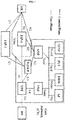
- Fig. 3 shows a communication system 10 with a UE according to the invention.
- a smartphone 12 as the user equipment, is connected to a multipath-termination-endpoint 30 (MP-TE) over a communication network 28 that comprises at least a first communication link 24 and a second communication link 26.
- the first communication link 24 is established as a cellular communication link 24, wherein the second communication link 26 is established as a Wi-Fi communication link 26.
- a network interface unit 23 of the smartphone 12 provides a first network interface that enables a first single access mode 24a to the first communication link and a second network interface that enables a second single access mode 26a to the second communication link 26 for the data transfer of the smartphone 12 with the communication network.
- the smartphone 12 has a computing unit 14 that comprises a processor on which an algorithm is implemented to execute commands.
- a memory unit 16 is connected to the computing unit 14 by means of an internal communication link 18.
- a mapping table 16a is stored in the memory unit 16, wherein the mapping table comprises entries about various services, identifiers associated to individual services and another entry which specifies which single access mode corresponds to an individual service.
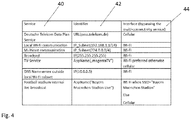
- Fig. 4 shows an exemplary mapping table and will be explained in the following.
- the internal communication link 18 also connects a bypass-entity with the computing unit 14. If the computing unit 14 receives service-information about a requested service, it can compare these service-information with entries of the mapping table 16a.
- the algorithm evaluates that the data traffic with the requested service shall be transmitted over the first single access mode 24a according to the mapping table, then the data can be directed through the means of the bypass-entity 20 directly to the first single access mode 24a. In principle it is also possible to directly address the second single access mode 26a by the bypass-entity 20.
- the smartphone 12 communicates with the MP-TE 30 only by using the first single access mode 24a without using any multipath functionality of the smartphone 12. This can be called a "hard multipath breakout".
- bypass-entity 20 provides a mean to bypass a multi-path-entity 22, which is implemented in almost all state-of-the-art smartphones 12.
- Another option to communicate with a required service that demands data transfer over only one single access mode can be called a "soft multipath breakout/restriction”.
- the multi-path - entity 22 comprises a multipath-scheduler 22a that is configured to distribute, in other words schedule, the data to the first single access mode 24a and/or to the second single access mode 26a. If the evaluation of the mapping table 16a yields that only the first single access mode 24a is to be used for the communication with the requested service, then the computing unit transmits appropriate commands to the multipath-scheduler 22a that then efficiently blocks the second single access mode 26a and redirect all the data for the communication with the requested service to the first single access mode 24a. If the smartphone 12 communicates in parallel with another service it is in principle possible that the data corresponding to a first service is purely scheduled to the first single access mode 24a and that the data corresponding to the other service is purely scheduled to the second single access mode 26a.
- a multi-connectivity provider can provide an interface, which will be used from services or network providers or access providers, to specify entries of the mapping table 16a from the outside.
- the mapping table 16a can then be updated with this information.
- mapping table 16a can change dynamically, e.g. cellular provider services are defined to send on the physical cellular interface. Possibly the detection is done with the help of SIM card information, cell information, APN, SSID, Wi-Fi beacons, etc. Eventually the mapping table is converted to become part of an OS routing table.
- Fig. 4 shows an exemplary mapping table 16a:
- the mapping table 16a shows three columns, whereas the number of lines of the mapping table 16a corresponds to the number entries of the respective services.
- the first column 40 indicates the specific services
- the second column 42 specifies identifiers that help to identify the respective services of the first column 40
- the third column 44 shows the single access mode that shall be selected for the communication of the smartphone 12 with the requested service.
- the service “DeutscheInstitut Data Plan Service” is being identified by its URL (pass.telekom.de).
- the algorithm evaluates to choose the cellular access mode as the selected single access mode.
- a "Broadcast" service is being identified by its IP number (255.255.255.255). The algorithm then evaluates to choose the Wi-Fi access mode as the selected single access mode.
Landscapes
- Engineering & Computer Science (AREA)
- Computer Networks & Wireless Communication (AREA)
- Signal Processing (AREA)
- Computer Security & Cryptography (AREA)
- Mobile Radio Communication Systems (AREA)
Abstract
Storing a mapping table on a memory of the UE, wherein the mapping table provides assignment-information about a respective single access mode out of multiple accesses modes assigned to a service requestable by the UE;
Receiving service-information about a requested service via a network interface of the UE;
Comparing the service-information to entries of the mapping table by an algorithm running on a processor of the UE, wherein the algorithm selects the single access mode assigned to the requested service;
wherein
the multi-connectivity functionality of the UE is restricted by
• a bypass-entity redirecting data traffic associated to the requested service directly to the selected single access mode;
or
a multipath scheduler that schedules data traffic associated to the requested service to a communication link that corresponds to the selected single access mode.
Description
- The invention relates to a method, a user equipment and a communication system in a multi-connectivity framework.
- Typically, Internet network operators provide one or multiple access like fixed (e.g. xDSL), Wi-Fi (e.g. public Hotspots) or cellular (e.g. 2G-5G) to customers. These different accesses provide the data traffic via respective communication links. Each of the different accesses/communication links are based on a different transmission technology. Hybrid access or 3GPP ATSSS communication environments are based on those multiple accesses.
- User Equipment, UE, like smartphones is in principle capable of connecting to multiple accesses simultaneously. However, currently multi-connectivity technologies are not used very frequently because no multi-connectivity functionality is being implemented by requested services and/or by many providers of services. The typical situation is as follows, the smartphone is capable of multi-connectivity to a Wi-Fi network and at the same time to a cellular network, while the requested application is restricted to only one access and is therefore unable to benefit from a second available access in terms of reliability and speed. It is not possible to access such a service in multi-connectivity mode of the smartphone.
- Network protocols which can leverage the potential of multiple accesses like MPTCP, (MP-)QUIC, MPDCCP and SCTP are not widely adopted and usually require an end-to-end implementation. A broad and fast availability is therefore unlikely.
- Standardized multi-connectivity architectures like 3GPP ATSSS "3GPP Technical Specification: 23.501, Version 16.3.0, 22 December 2019" promise to provide remedy and use such protocols between UEs and access operator networks. Furthermore, this offers a comprehensive traffic management capability to operators of such architectures. ATSSS manages simultaneous connectivity for UEs over cellular (3GPP access) and non-cellular access (untrusted non-3GPP access e.g. Wi-Fi) and is depicted in
Fig. 1 . -
FIG. 1 illustrates an exemplary ATSSS architecture as defined by the 3GPP TS 23.501. InFIG. 1 , the ATSSS manages simultaneous connectivity for UEs over cellular (3GPP access) and non-cellular access (untrusted non-3GPP access e.g. Wi-Fi). As shown inFIG. 1 , the UE connects to a Data Network (DN) over cellular (3GPP Access) and Wi-Fi (Untrusted Non-3GPP access) using the N3 interface towards the ATSSS-UPF (User Plane Function) part of a 5G Core. - In
FIG. 1 , the untrusted non-3GPP access path is interconnected with the 5G Core through the non-3GPP Interworking (N31WF) entity/function, which is responsible to attach the non-3GPP access to the 5G core. The UPF can be understood as the interface between UE and Data Network (e.g. Internet) taking responsibility for traffic management. Other entities/functions forming part of the 5G Core as shown inFIG. 1 are: Authentication Server Function (AUSF), Unified Data Management (UDM), Access and Mobility Management Function (AMF), Session Management Function (SMF), Policy Control Function (PCF) and Application Function (AF) including the control plane and user plane. Further,FIG. 1 also shows the name of the interfaces that are exposed by each of these entities. - The BBF and the Internet Engineering Task Force (IETF) specifies the residential use case, known as Hybrid Access. Currently BBF re-defines Hybrid Access to work with ATSSS also. Hybrid Access combines therefore fixed access (xDSL or fiber) and cellular access within a Residential Gateway (RG).
- Multi-connectivity network architectures independent from a particular access provider, are exemplary depicted in
Fig. 2 . -
FIG. 2 illustrates the ATSSS protocol stack for untrusted 3GPP access (Wi-Fi) with Internet Protocol Security (IPsec) tunneling as defined by the 3GPP (FIG. 1 ). IPsec is a secure network protocol that authenticates and encrypts the packets of data to provide secure encrypted communication between two devices over an Internet Protocol network. In this scenario ATSSS defines an implementation of the multi-connectivity termination point (ATSSS UPF) into the cellular 5G network and integrates the potential independent Wi-Fi through IPsec tunneling. The IPsec tunnel is built between the UE and the Non 3GPP Interworking Function (N3IWF) entity (depicted inFIG. 2 as part of the protocol stack) over Wi-Fi (untrusted non-3GPP access network) and encapsulates 3GPP related information and the user plane traffic exchanged between UE and UPF. - US 2013 discloses a wireless communication device that includes a cellular telephony module to access a cellular network, a wireless communication module to access a non-cellular network, an antenna configured to be in wireless communication with a plurality of compatible and currently accessible communication networks including the cellular and non-cellular networks, and a mobile network selector to select a compatible and currently accessible communication network for current access by the wireless communication device based on a network characteristic other than network speed.
- However, there are services existing, which have a special demand on being transmitted via only a single access. However, so far there is no possibility to provide a UE in a multi-connectivity scenario with information regarding that a particular service is only accessible via a single access or via only a single commination link with a defined transmission technique.
- In the view of above, it is an object of the present invention to provide a method, a UE and a Communication system that enable to take single access restrictions of services into account.
- This object is solved by the features of the independent claims.
- The features of the various aspects of the invention described below or the various examples of implementation may be combined with each other, unless this is explicitly excluded or is technically impossible.
- According to a first aspect, the invention provides a method to restrict a multi-connectivity functionality of a User Equipment, UE, the method comprising the following steps:
- Storing a mapping table on a memory-unit of the UE, wherein the mapping table provides assignment-information about a respective single access mode out of multiple accesses modes assigned to a service requestable by the UE;
∘ the mapping table can also provide assignment-information assigned to multiple services requestable by the UE. Generally, a respective single access mode corresponds to a specific transmission technology in multipath access scenarios. For example, a Wi-Fi single access mode corresponds to a Wi-Fi communication link and a cellular single access mode corresponds to a cellular communication link. Therefore, the table can provide the information that the service "xy" is only accessible via cellular single access; - Receiving service-information about a requested service via a network interface of the UE;
∘ for example, this service-information can be send by the requested service itself, by a multipath termination endpoint. In an embodiment, the multipath termination point is a service termination point or it is placed between the UE and the service termination point like in ATSSS and Hybrid Access scenarios. In principle, this service-information can be present via all the communication links in the multipath scenario or especially via the communication link that corresponds to the single access mode required by the requested service; - Comparing the service-information to entries of the mapping table by an algorithm running on a processor of the UE, wherein the algorithm selects the single access mode assigned to the requested service;
∘ The table can provide the information that the service "xy" is only accessible via cellular single access. Consequently, the algorithm selects the cellular single access for the requested service "xy"; - a bypass-entity redirecting data traffic associated to the requested service directly to the selected single access mode;
∘ This provides the advantage, that the bypass-entity bypasses a multipath-entity of the UE. This saves resources and computational power since no multiple communication links need to be established as it is the common case when using multipath functionalities that are provided by the multipath-entity. Only the appropriate selected single access mode is used. Hence, this enables efficient communication with services which are only accessible in a single access mode and which are not accessible in a multipath scenario. Storing this information in a mapping table offers the advantage that in principle every service can be stored into this mapping table which offers a most flexible solution. There are several reasons existing, why a service is only accessible in a single access mode. A common reason is that no multipath functionality is implemented with respect to that service. The single access can be either any existing access or a very specific access that still needs to be set up by the UE. This alternative can be called a "hard" multi-connectivity breakout;
or - a multipath scheduler that schedules data traffic associated to the requested service to a communication link that corresponds to the selected single access mode.
∘ This provides the advantage that the UE can establish its data transfer with the requested service only via the selected single access mode but that the UE can at the same time communicate with other services via another access mode. This provides full flexibility since there is a trend even in smart phones to execute multiple services in parallel. Hence, this alternative maximizes the overall data throughput, especially if the UE communicates with more than one service over the communication network at a time. This alternative can be called a "soft" multi-connectivity breakout/restriction. Even locally in today's UE there is no known implementation, which can store the information for individual services and map them to non-multi-connectivity transmission modes. - This provides a very flexible solution that can only depend on policy set up by a network provider and/or by a service provider.
- In an embodiment, the bypass-entity bypasses a multi-path-entity of the UE. This provides the advantage that computational resources within the UE are efficiently used.
- The bypass-entity can be arranged ahead of the multi-path-entity with respect to the direction of the data traffic. This provides the advantage that there is no need to activate the multipath entity within the UE.
- Preferably, the mapping table is dynamically updated. This provides the advantage that the mapping table can be adjusted to new requirements of the requested services or even to the requirements of new services. A mapping table update can be realized by replacing the old mapping table with a new mapping table, by replacing entries of an existing mapping table with new interests or by simply adding new entries at the end of the existing mapping table.
- In an embodiment, the UE receives a signal to update the mapping table. The signal can be an external update-signal. This provides the advantage, that the mapping table can be efficiently updated without the need that the UE does actively look for new versions of the mapping table. The UE is informed by the means of the update-signal that a new version of the mapping table is existing.
- In an embodiment, the update is provided by the OS, UE vendor/manufacturer, by services and/or by multi-connectivity provider. If the services provide the updates, this provides the advantage that the updates can be provided in very short time periods, whereas if the updates are provided by the OS, UE vendor/manufacturer and/or by multi-connectivity provider these can perform additional security checks and act as trusted update authorities because it is not always the case that all services offered in the Internet are trustworthy. Those updates can be made available in the app stores, like Google Play Store or iOS App store.
- In an embodiment, the service-information is identified by an application name, a calling URL, a protocol, an IP-Address, an IP-Subnet, a Port and/or deep packet inspection, DPI. This provides the advantage that the service-information can be obtained by multiple means offering a high flexibility.
- In an embodiment, the selected single access mode is based on a certain security level demand of the requested service. This provides the advantage that critical services can use the single access mode which offers the highest security level. For example, a cellular communication link has generally a higher security level than on and trusted public Wi-Fi hotspot.
- In an embodiment, the UE detects provider-information and/or access-information and wherein the selected single access mode is based on the provider-information and/or access-information. This provides the advantage that the selected single path access is of a type that is actually supported be the network provider that establishes the connection of the UE with the internet. If the provider only supports cellular access, the selection of a Wi-Fi cellular access as the single access mode would technically not work.
- In an embodiment, the entries of the mapping table are based on policy considerations or technical considerations of the network. If the mapping table is based on technical consideration of the network this enables in principle maximum data throughput. While on the other hand, if the entries of the mapping table are based on policy could considerations this offers maximum flexibility in choosing the desired selected single access mode. Policies can include maximum data throughput but the policies can also be optimized with respect to minimal costs of the data transfer.
- According to a second aspect of the invention, an User Equipment, in particular a smart phone, or a tablet, a residential gateway or any other mobile device, is provided, wherein the user equipment is configured to perform a method according to the first aspect of the invention, wherein the UE comprises
- a memory configured to store a mapping table, wherein the mapping table provides assignment-information about a respective single access mode out of multiple accesses modes assigned to various service requestable by the UE;
- a network interface configured to receive service-information about a requested service;
- a processor on which an algorithm is implemented that is configured to compare the service-information to entries of the mapping table, wherein the algorithm selects the single access mode assigned to the requested service;
- a bypass-entity of the UE, wherein the bypass-entity is configured to redirect data traffic associated to the requested service directly to the selected single access mode;
or - a multipath scheduler of the UE that is configured to schedule data traffic associated to the requested service to a communication link that corresponds to the selected single access mode.
- This provides basically the same advantages as the first aspect of the invention.
- According to a third aspect of the invention, a communication system is provided, wherein the communication system comprises
- a communication network, wherein the communication network is configured to provide multipath functionality over multiple communication links;
- a User Equipment according to the second aspect of the invention;
- a multipath termination endpoint (MP-TE), wherein the User Equipment is connected to the multipath termination endpoint via the communication network,
- In the following, preferred implementation examples of the present invention are explained with reference to the accompanying figure:
- Fig. 1:
- illustrates an exemplary ATSSS architecture as defined by the 3GPP TS 23.501.
- Fig. 2:
- illustrates the ATSSS protocol stack for untrusted 3GPP access (Wi-Fi) with IPsec tunneling as defined by the 3GPP TS 23.501.
- Fig. 3:
- shows a communication system with a UE according to the invention.
- Fig. 4:
- shows an exemplary mapping table.
- In the following, numerous features of the present invention are explained in detail by means of preferred embodiments. The present disclosure is not limited to the specifically named combinations of features. Rather, the features mentioned here can be combined arbitrarily into inventive embodiments, unless this is expressly excluded below.
-
Fig. 3 shows acommunication system 10 with a UE according to the invention. Asmartphone 12, as the user equipment, is connected to a multipath-termination-endpoint 30 (MP-TE) over acommunication network 28 that comprises at least afirst communication link 24 and asecond communication link 26. Thefirst communication link 24 is established as acellular communication link 24, wherein thesecond communication link 26 is established as a Wi-Fi communication link 26. Anetwork interface unit 23 of thesmartphone 12 provides a first network interface that enables a firstsingle access mode 24a to the first communication link and a second network interface that enables a secondsingle access mode 26a to thesecond communication link 26 for the data transfer of thesmartphone 12 with the communication network. - The
smartphone 12 has acomputing unit 14 that comprises a processor on which an algorithm is implemented to execute commands. A memory unit 16 is connected to thecomputing unit 14 by means of aninternal communication link 18. A mapping table 16a is stored in the memory unit 16, wherein the mapping table comprises entries about various services, identifiers associated to individual services and another entry which specifies which single access mode corresponds to an individual service.Fig. 4 shows an exemplary mapping table and will be explained in the following. Theinternal communication link 18 also connects a bypass-entity with thecomputing unit 14. If thecomputing unit 14 receives service-information about a requested service, it can compare these service-information with entries of the mapping table 16a. If the algorithm evaluates that the data traffic with the requested service shall be transmitted over the firstsingle access mode 24a according to the mapping table, then the data can be directed through the means of the bypass-entity 20 directly to the firstsingle access mode 24a. In principle it is also possible to directly address the secondsingle access mode 26a by the bypass-entity 20. In the following, thesmartphone 12 communicates with the MP-TE 30 only by using the firstsingle access mode 24a without using any multipath functionality of thesmartphone 12. This can be called a "hard multipath breakout". - Hence, the bypass-
entity 20 provides a mean to bypass a multi-path-entity 22, which is implemented in almost all state-of-the-art smartphones 12. - Another option to communicate with a required service that demands data transfer over only one single access mode can be called a "soft multipath breakout/restriction".
- In this case the data is directed to the multi-path-
entity 22 that is connected to thecomputing unit 14 by theinternal communication link 18. The multi-path -entity 22 comprises a multipath-scheduler 22a that is configured to distribute, in other words schedule, the data to the firstsingle access mode 24a and/or to the secondsingle access mode 26a. If the evaluation of the mapping table 16a yields that only the firstsingle access mode 24a is to be used for the communication with the requested service, then the computing unit transmits appropriate commands to the multipath-scheduler 22a that then efficiently blocks the secondsingle access mode 26a and redirect all the data for the communication with the requested service to the firstsingle access mode 24a. If thesmartphone 12 communicates in parallel with another service it is in principle possible that the data corresponding to a first service is purely scheduled to the firstsingle access mode 24a and that the data corresponding to the other service is purely scheduled to the secondsingle access mode 26a. - A multi-connectivity provider can provide an interface, which will be used from services or network providers or access providers, to specify entries of the mapping table 16a from the outside. The mapping table 16a can then be updated with this information.
- In addition, based on access and provider detection, the mapping table 16a can change dynamically, e.g. cellular provider services are defined to send on the physical cellular interface. Possibly the detection is done with the help of SIM card information, cell information, APN, SSID, Wi-Fi beacons, etc. Eventually the mapping table is converted to become part of an OS routing table.
-
Fig. 4 shows an exemplary mapping table 16a: The mapping table 16a shows three columns, whereas the number of lines of the mapping table 16a corresponds to the number entries of the respective services. - The
first column 40 indicates the specific services, thesecond column 42 specifies identifiers that help to identify the respective services of thefirst column 40, whereas thethird column 44 shows the single access mode that shall be selected for the communication of thesmartphone 12 with the requested service. - For example, the service "Deutsche Telekom Data Plan Service" is being identified by its URL (pass.telekom.de). The algorithm then evaluates to choose the cellular access mode as the selected single access mode.
- As another example, a "Broadcast" service is being identified by its IP number (255.255.255.255). The algorithm then evaluates to choose the Wi-Fi access mode as the selected single access mode.
Claims (13)
- A method to restrict a multi-connectivity functionality of a User Equipment, UE, the method comprising the following steps:Storing a mapping table on a memory unit (16) of the UE (12), wherein the mapping table provides assignment-information about a respective single access mode out of multiple accesses modes assigned to a service requestable by the UE (12);Receiving service-information about a requested service via a network interface (23) of the UE (12);Comparing the service-information to entries of the mapping table by an algorithm running on a processor (14) of the UE (12), wherein the algorithm selects the single access mode assigned to the requested service;characterized in thatthe multi-connectivity functionality of the UE (12) is restricted by• a bypass-entity (20) redirecting data traffic associated to the requested service directly to the selected single access mode;
or• a multipath scheduler (22a) that schedules data traffic associated to the requested service to a communication link (24,26) that corresponds to the selected single access mode. - The method of claim 1, wherein the bypass-entity (20) bypasses a multi-path-entity (22) of the UE (12).
- The method of claim 2, wherein the bypass-entity (20) is arranged ahead of the multi-path-entity (22) with respect to the direction of the data traffic.
- The method of any of the claims, wherein the mapping table is dynamically updated.
- The method of claim 4, wherein the UE (12) receives a signal to update the mapping table.
- The method of any of the claims 4 to 5, wherein the update is provided by the OS, UE (12) vendor/manufacturer, by services and/or by multi-connectivity provider.
- The method of any of the claims, wherein the service-information is identified by an application name, a calling URL, a protocol, an IP-Address, an IP-Subnet, a Port and or DPI.
- The method of any of the claims, wherein the selected single access mode is based on a certain security level demand of the requested service.
- The method of any of the claims, wherein the UE (12) detects provider-information and wherein the selected single access mode is based on the provider-information.
- The method of any of the claims, wherein the entries of the mapping table are based on policy considerations or technical considerations of the network.
- The method of any of the claims, wherein the mapping table is converted to become part of an OS routing table.
- A User Equipment configured to perform a method of any of the claims 1-11, wherein the UE (12) comprisesa memory unit (16) configured to store a mapping table, wherein the mapping table provides assignment-information about a respective single access mode out of multiple accesses modes assigned to various service requestable by the UE (12);a network interface (23) configured to receive service-information about a requested service;a processor (14) on which an algorithm is implemented that is configured to compare the service-information to entries of the mapping table, wherein the algorithm selects the single access mode assigned to the requested service;characterized in thatthe UE (12) is configured to restrict its multi-connectivity functionality by using a• a bypass-entity (20) of the UE (12), wherein the bypass-entity (20) is configured to redirect data traffic associated to the requested service directly to the selected single access mode;
or• a multipath scheduler (22a) of the UE (12) that is configured to schedule data traffic associated to the requested service to a communication link (24,26) that corresponds to the selected single access mode. - A communication system comprisinga communication network (28), wherein the communication network (28) is configured to provide multipath functionality over multiple communication links (24, 26);a User Equipment according to claim 12;a multipath termination endpoint, MP-TE, (30), wherein the User Equipment (12) is connected to the multipath termination endpoint (30) via the communication network (28),wherein the UE (12) is configured to request a service that is provided by the multipath termination endpoint (30) and wherein the multipath termination endpoint (30) transmits service-information of the requested service to the UE (12) via the communication network.
Priority Applications (2)
| Application Number | Priority Date | Filing Date | Title |
|---|---|---|---|
| EP20181783.0A EP3930376A1 (en) | 2020-06-23 | 2020-06-23 | Multi-connectivity restriction for services demanding single-path or single access |
| US17/353,831 US11700570B2 (en) | 2020-06-23 | 2021-06-22 | Multi-connectivity restriction for services demanding single-path or single access |
Applications Claiming Priority (1)
| Application Number | Priority Date | Filing Date | Title |
|---|---|---|---|
| EP20181783.0A EP3930376A1 (en) | 2020-06-23 | 2020-06-23 | Multi-connectivity restriction for services demanding single-path or single access |
Publications (1)
| Publication Number | Publication Date |
|---|---|
| EP3930376A1 true EP3930376A1 (en) | 2021-12-29 |
Family
ID=71138614
Family Applications (1)
| Application Number | Title | Priority Date | Filing Date |
|---|---|---|---|
| EP20181783.0A Pending EP3930376A1 (en) | 2020-06-23 | 2020-06-23 | Multi-connectivity restriction for services demanding single-path or single access |
Country Status (2)
| Country | Link |
|---|---|
| US (1) | US11700570B2 (en) |
| EP (1) | EP3930376A1 (en) |
Families Citing this family (1)
| Publication number | Priority date | Publication date | Assignee | Title |
|---|---|---|---|---|
| US12231356B2 (en) * | 2021-07-30 | 2025-02-18 | Qualcomm Incorporated | Uplink frequency hopping and scheduling |
Citations (3)
| Publication number | Priority date | Publication date | Assignee | Title |
|---|---|---|---|---|
| WO2019192528A1 (en) * | 2018-04-04 | 2019-10-10 | Guangdong Oppo Mobile Telecommunications Corp., Ltd. | Apparatus and method for access traffic steering, switching, and/or splitting operation |
| WO2019197016A1 (en) * | 2018-04-09 | 2019-10-17 | Lenovo (Singapore) Pte. Ltd. | Data packet steering on a multi-access data connection |
| US20190394833A1 (en) * | 2018-06-21 | 2019-12-26 | Peyman TALEBI FARD | Multi Access Packet/Protocol Data Unit Session |
Family Cites Families (1)
| Publication number | Priority date | Publication date | Assignee | Title |
|---|---|---|---|---|
| US20130076654A1 (en) | 2011-09-27 | 2013-03-28 | Imerj LLC | Handset states and state diagrams: open, closed transitional and easel |
-
2020
- 2020-06-23 EP EP20181783.0A patent/EP3930376A1/en active Pending
-
2021
- 2021-06-22 US US17/353,831 patent/US11700570B2/en active Active
Patent Citations (3)
| Publication number | Priority date | Publication date | Assignee | Title |
|---|---|---|---|---|
| WO2019192528A1 (en) * | 2018-04-04 | 2019-10-10 | Guangdong Oppo Mobile Telecommunications Corp., Ltd. | Apparatus and method for access traffic steering, switching, and/or splitting operation |
| WO2019197016A1 (en) * | 2018-04-09 | 2019-10-17 | Lenovo (Singapore) Pte. Ltd. | Data packet steering on a multi-access data connection |
| US20190394833A1 (en) * | 2018-06-21 | 2019-12-26 | Peyman TALEBI FARD | Multi Access Packet/Protocol Data Unit Session |
Also Published As
| Publication number | Publication date |
|---|---|
| US20210400563A1 (en) | 2021-12-23 |
| US11700570B2 (en) | 2023-07-11 |
Similar Documents
| Publication | Publication Date | Title |
|---|---|---|
| EP4000287B1 (en) | Mechanism to facilitate signaling traffic | |
| US6853851B1 (en) | Dual mode terminal for accessing a cellular network directly or via a wireless intranet | |
| JP4927939B2 (en) | Automatic home agent selection | |
| US7280832B2 (en) | Method and apparatus for automatically selecting a bearer for a wireless connection | |
| FI105135B (en) | A system and method for transmitting a call and a mobile station | |
| JP5059913B2 (en) | Early determination of network support for mobile IP | |
| US8396027B2 (en) | Communication control system, communication system and communication control method | |
| JP2005209194A (en) | User profile service | |
| EP3329655B1 (en) | Method and system for routing ip based messaging, voice and video calling based on the network parameters the device is connected to and the location | |
| US8010150B2 (en) | Technique for negotiating on behalf of a mobile ambient network within a multi-operator wireless communication system | |
| US20240314675A1 (en) | Traffic Routing Towards Local Area Data Network Per Application Function Request | |
| US11259171B2 (en) | Techniques for routing a registration request of a roaming user equipment by a bridge entity | |
| US11700570B2 (en) | Multi-connectivity restriction for services demanding single-path or single access | |
| US11844129B2 (en) | Access to a home network within a multi-connectivity framework | |
| EP1794972B1 (en) | Operating and supporting dual mode user equipment | |
| EP1379053A1 (en) | Method for transferring a user-ID password pair, and a wireless network | |
| EP1816842A1 (en) | Digital cable network telephone service provider supporting local wireless networks | |
| EP4102774B1 (en) | Techniques for provisioning of a fixed line user device | |
| US20250142507A1 (en) | End-to-End (E2E) Secure Edge Application Service | |
| EP4002766A1 (en) | Method and system for reachability of services specific to one specific network access over a different network access and system thereof | |
| JP4680017B2 (en) | Exchange and communication system | |
| EP3902209A1 (en) | Internet access provider with an independent multi-connectivity framework | |
| Pattem | Research on Detection and Prevention of Rogue Base Stations in the 5G Network | |
| WO2004004231A1 (en) | Communications system and method | |
| HK1130377A (en) | Automatic selection of a home agent |
Legal Events
| Date | Code | Title | Description |
|---|---|---|---|
| PUAI | Public reference made under article 153(3) epc to a published international application that has entered the european phase |
Free format text: ORIGINAL CODE: 0009012 |
|
| STAA | Information on the status of an ep patent application or granted ep patent |
Free format text: STATUS: THE APPLICATION HAS BEEN PUBLISHED |
|
| AK | Designated contracting states |
Kind code of ref document: A1 Designated state(s): AL AT BE BG CH CY CZ DE DK EE ES FI FR GB GR HR HU IE IS IT LI LT LU LV MC MK MT NL NO PL PT RO RS SE SI SK SM TR |
|
| B565 | Issuance of search results under rule 164(2) epc |
Effective date: 20201112 |
|
| STAA | Information on the status of an ep patent application or granted ep patent |
Free format text: STATUS: REQUEST FOR EXAMINATION WAS MADE |
|
| 17P | Request for examination filed |
Effective date: 20220502 |
|
| RBV | Designated contracting states (corrected) |
Designated state(s): AL AT BE BG CH CY CZ DE DK EE ES FI FR GB GR HR HU IE IS IT LI LT LU LV MC MK MT NL NO PL PT RO RS SE SI SK SM TR |
|
| STAA | Information on the status of an ep patent application or granted ep patent |
Free format text: STATUS: EXAMINATION IS IN PROGRESS |
|
| 17Q | First examination report despatched |
Effective date: 20231205 |