EP3930276A1 - Method for a joint time-frequency synchronization of user equipment in nb-iot networks - Google Patents
Method for a joint time-frequency synchronization of user equipment in nb-iot networks Download PDFInfo
- Publication number
- EP3930276A1 EP3930276A1 EP20181705.3A EP20181705A EP3930276A1 EP 3930276 A1 EP3930276 A1 EP 3930276A1 EP 20181705 A EP20181705 A EP 20181705A EP 3930276 A1 EP3930276 A1 EP 3930276A1
- Authority
- EP
- European Patent Office
- Prior art keywords
- subframe
- stage
- iot
- time
- values
- Prior art date
- Legal status (The legal status is an assumption and is not a legal conclusion. Google has not performed a legal analysis and makes no representation as to the accuracy of the status listed.)
- Withdrawn
Links
- 238000000034 method Methods 0.000 title claims abstract description 36
- 239000011159 matrix material Substances 0.000 claims abstract description 12
- 238000013459 approach Methods 0.000 claims description 6
- 230000001427 coherent effect Effects 0.000 claims description 3
- 230000005540 biological transmission Effects 0.000 description 9
- 238000001514 detection method Methods 0.000 description 6
- 239000000969 carrier Substances 0.000 description 3
- 238000004891 communication Methods 0.000 description 2
- 125000004122 cyclic group Chemical group 0.000 description 2
- 238000013461 design Methods 0.000 description 2
- 108010076504 Protein Sorting Signals Proteins 0.000 description 1
- 239000000654 additive Substances 0.000 description 1
- 230000000996 additive effect Effects 0.000 description 1
- 230000009286 beneficial effect Effects 0.000 description 1
- 230000001413 cellular effect Effects 0.000 description 1
- 230000006735 deficit Effects 0.000 description 1
- 230000000977 initiatory effect Effects 0.000 description 1
- 230000010354 integration Effects 0.000 description 1
- 238000013507 mapping Methods 0.000 description 1
- 238000012544 monitoring process Methods 0.000 description 1
- 230000011664 signaling Effects 0.000 description 1
- 230000003068 static effect Effects 0.000 description 1
- 230000008685 targeting Effects 0.000 description 1
Images
Classifications
-
- H—ELECTRICITY
- H04—ELECTRIC COMMUNICATION TECHNIQUE
- H04L—TRANSMISSION OF DIGITAL INFORMATION, e.g. TELEGRAPHIC COMMUNICATION
- H04L27/00—Modulated-carrier systems
- H04L27/26—Systems using multi-frequency codes
- H04L27/2601—Multicarrier modulation systems
- H04L27/2647—Arrangements specific to the receiver only
- H04L27/2655—Synchronisation arrangements
- H04L27/2657—Carrier synchronisation
-
- H—ELECTRICITY
- H04—ELECTRIC COMMUNICATION TECHNIQUE
- H04L—TRANSMISSION OF DIGITAL INFORMATION, e.g. TELEGRAPHIC COMMUNICATION
- H04L27/00—Modulated-carrier systems
- H04L27/26—Systems using multi-frequency codes
- H04L27/2601—Multicarrier modulation systems
- H04L27/2647—Arrangements specific to the receiver only
- H04L27/2655—Synchronisation arrangements
-
- H—ELECTRICITY
- H04—ELECTRIC COMMUNICATION TECHNIQUE
- H04L—TRANSMISSION OF DIGITAL INFORMATION, e.g. TELEGRAPHIC COMMUNICATION
- H04L27/00—Modulated-carrier systems
- H04L27/26—Systems using multi-frequency codes
- H04L27/2601—Multicarrier modulation systems
- H04L27/2647—Arrangements specific to the receiver only
- H04L27/2655—Synchronisation arrangements
- H04L27/2668—Details of algorithms
- H04L27/2669—Details of algorithms characterised by the domain of operation
- H04L27/2672—Frequency domain
-
- H—ELECTRICITY
- H04—ELECTRIC COMMUNICATION TECHNIQUE
- H04L—TRANSMISSION OF DIGITAL INFORMATION, e.g. TELEGRAPHIC COMMUNICATION
- H04L27/00—Modulated-carrier systems
- H04L27/26—Systems using multi-frequency codes
- H04L27/2601—Multicarrier modulation systems
- H04L27/2647—Arrangements specific to the receiver only
- H04L27/2655—Synchronisation arrangements
- H04L27/2668—Details of algorithms
- H04L27/2673—Details of algorithms characterised by synchronisation parameters
- H04L27/2675—Pilot or known symbols
Definitions
- the invention relates to a method for a joint time-frequency synchronization of User Equipment in NB-IoT Networks already connected to a serving cell obtaining an optimal time-frequency offset estimation.
- Narrowband Internet-of-Things is a LTE based communication standard of 3GPP (see: 3GPP. Physical channels and modulation. TS 36.211 V15.6.0, July 2019 .), targeting cellular based IoT communication with low power consumption, low device costs and extended range of the radio link. Similar to the baseline LTE standard, specific synchronization sequences as well as reference symbols are part of the 3GPP specification for NB-IoT. For NB-IoT UEs, it is very important to sustain the time-frequency synchronization after sleep or longer transmission periods.
- NB-IoT A straightforward but slow implementation for NB-IoT is to perform a cell search from scratch as for instance shown in R1-161981 NB-PSS and NB-SSS Design.doc http://www.3gpp.org/ftp/TSG_RAN/WG1_RL1/TSGR1_AH/LTE_NB-IoT_1603/Docs/R1-161981.zip.
- NB-IoT Narrowband Primary Synchronization Signal
- NSSS Narrowband Secondary Synchronization Signal
- NNBCH Narrowband Physical Broadcast Channel
- NPSS Narrowband Primary Synchronization Signal
- NSSS Narrowband Secondary Synchronization Signal
- NPBCH Narrowband Physical Broadcast Channel
- NPSS Narrowband Primary Synchronization Signal
- NSSS Narrowband Secondary Synchronization Signal
- NBCH Narrowband Physical Broadcast Channel
- NB-IoT physical channels and signals are primarily multiplexed in time.
- a radio signal which is transmitted from a base station to a UE is hierarchically structured into subframes of duration one millisecond, 10 subframes forming a frame, 1024 frames forming a hyper frame, and 1024 hyper frames being the ambiguity period after which such pattern repeats, i. e., every 2 hours and 55 minutes.
- each NB-IoT subframe spans over one physical resource block (PRB) (i
- Synchronization sequences as well as reference symbols can be used for time and frequency offset estimation.
- the way how synchronization is accomplished depends on the state with regard to the attachment to the network. In case of initial cell search nothing is known about subframe timing and the frequency offset. During an initial cell search the user equipment (UE) must usually perform several synchronization tasks in a consecutive manner as described next.
- UE user equipment
- the UE For a first synchronization between a UE and a base station in frame and subframe and in order to determine the cell ID the UE uses the narrowband primary synchronization signal (NPSS) and the narrowband secondary synchronization signal (NSSS), where NPSS provides initial time-frequency synchronization and NSSS yields cell-ID and frame timing.
- NPSS narrowband primary synchronization signal
- NSSS narrowband secondary synchronization signal
- NPSS provides initial time-frequency synchronization
- NSSS yields cell-ID and frame timing.
- the UE receives the narrowband physical broadcast channel (NPBCH) and the system information block 1 (SIB1), before initiating a first transmission from UE to base station via the narrowband physical random-access channel (NPRACH).
- NPBCH narrowband physical broadcast channel
- SIB1 system information block 1
- the UE If, however, the UE is already attached to the network at a certain serving cell, subframe scheduling is known and the frequency offset has already been compensated. In this case, the UE needs to keep track of time and frequency offset due to drifts, in order to provide reliable detection of the physical downlink channels.
- a particular problem related to NB-IoT downlink synchronization is the fact, that update of the time-frequency estimation can be challenging if very low power consumption is targeted. Because performing time-frequency re-synchronization based on an initial cell search may require a relative long active reception (RX) on time, which is in particular undesirable for battery powered devices.
- RX relative long active reception
- NRS Narrowband Reference Symbols
- NPDCCH Narrowband Physical downlink control channel
- NPDSCH Narrowband Physical downlink shared channel
- UEs User equipment
- 3GPP introduces uplink (UL) transmission gaps of 40 ms after a transmission period of 256 ms. During this relative short duration of the uplink (UL) transmission gap an efficient method for synchronization is required, especially since this must be accomplished at relative low SNR less than -10dB.
- NPSS Nearband Primary Synchronization Signal
- NSSS Narrowband Secondary Synchronization Signal
- the NPSS contains 121 resource elements at subframe #5 while a subframe containing NRS may contain up to 16 resource elements only.
- NPSS and NSSS are more useful if re-synchronization needs to be performed apart from normal receive operation at connected mode.
- NPSS is transmitted in subframe #5 in every 10 ms frame, using the last 11 OFDM symbols in the subframe.
- NPSS detection is one of the most computationally demanding operations from a UE perspective.
- NB-IoT uses hierarchical sequence. For each of the 11 NPSS OFDM symbols in a subframe, either p or - p is transmitted, where p is the base sequence generated based on a length-11 Zadoff-Chu (ZC) sequence with root index 5. Each of the length-11 ZC sequence is mapped to the lowest 11 subcarriers within the NB-IoT PRB.
- ZC Zadoff-Chu
- NSSS has 20 ms periodicity and is transmitted in subframe #9, also using the last 11 OFDM symbols that consist of 132 resource elements overall.
- NSSS is a length-132 frequency-domain sequence, with each element mapped to a resource element.
- NSSS is generated by element-wise multiplication between a ZC sequence and a binary scrambling sequence. The root of the ZC sequence and binary scrambling sequence are determined by narrowband physical cell identity (NB-PCID). The cyclic shift of the ZC sequence is further determined by the frame number.
- NB-PCID narrowband physical cell identity
- NPBCH carries the master information block (MIB) and is transmitted in subframe #0 in every frame. A MIB remains unchanged over the 640 ms transmission time interval (TTI).
- MIB master information block
- TTI transmission time interval
- NWUS Narrowband Wakup Signal
- Time-frequency offset estimation using NPSS and NSSS is usually based on a boot strap approach, see e. g. (Qualcomm Incorporated. NB-PSS and NB-SSS Design. R1-161981, March 2016).
- a boot strap approach see e. g. (Qualcomm Incorporated. NB-PSS and NB-SSS Design. R1-161981, March 2016).
- the presence of a NPSS is detected along with a coarse estimate of the time and the frequency offset.
- Additional detection of the NSSS provides information of the cell identity and the frame structure. It can be also used for fine frequency offset estimation.
- Such a boot-strap approach is sub-optimal if the cell ID is already known along with its subframe scheduling.
- the objective of the invention will be solved by a method for a joint time-frequency synchronization of User Equipment (UE) in NB-IoT Networks already connected to a serving cell obtaining an optimal time-frequency offset estimation, the method comprising the following stages:
- the key idea of the inventive method is to demodulate a received NB-IoT subframe with regard to all the resource elements of the expected (ideal) subframe.
- R is the matrix corresponding to the resource elements of the received subframe (in the frequency domain)
- ⁇ 1 is the time offset of the start of the l -th OFDM symbol within a subframe.
- the start ⁇ 1 of the l -th OFDM symbol is defined as the time right after its corresponding cyclic prefix.
- V (w k,l ) be the demodulated subframe according to equation (1) with unknown time and frequency offset.
- F is the set of 2N F + 1 frequency steps with a frequency resolution of ⁇ F.
- T ⁇ - N FT ⁇ T, (- N T + 1) ⁇ T,.., - ⁇ T, 0, ⁇ T, ( N T - 1) ⁇ T,N T ⁇ T ⁇ is the set of 2N T + 1 time offsets steps with a time offset resolution of ⁇ T.
- the advantage of this third stage is that for a very low signal to noise ratio, observation of a single subframe may still lead to large estimation errors, which can be reduced by combining multiple subframes.
- the approach of this invention is to non-coherently combine the metric V as described above.
- stage 5 the non-coherently combined new metric U m (f,t) is compared with the reference value S m .
- the threshold K Threshold controls the targeted estimation error, the larger the threshold, the smaller the resulting estimation error.
- threshold K Threshold should (in general) be a function of m, since the threshold can relax with increasing number of m.
- the computation of the metric V m (f,t) is done in a two-stage approach, at which in a first stage intermediate values c k (f) are first computed based on the discrete frequency offset values f ⁇ F and in a second stage the metric values V m (f,t) are computed based on the intermediate values c k (f) of the first stage and based on the discrete values t ⁇ T and f ⁇ F.
- the overall computational complexity is then of the order O 1 N c ⁇ N s ⁇ 2 N F + 1 + O 2 N c ⁇ 2 N F + 1 ⁇ 2 N T + 1 .
- the inventive method comprises for the demodulation of a particular NB-IoT subframe a pre-computation of a reference NB-IoT subframe B m containing expected resource elements in the frequency domain, whereas the pre-computed resource elements of B m are derived from information of the serving cell, with m being a natural number equal or greater than 0 and presenting the m -th processed subframe.
- the complex conjugate of the expected (ideal) resource elements, stored in matrix B * are necessary. This is more or less complex depending on the particular subframe, as outlined below.
- the Narrowband-Primary-Synchronization-Signal (NPSS) transmitted on subframe #5 of an anchor carrier is demodulated in stage 1, whereas the pre-computed reference NB-IoT subframe B m is constant regardless of the LTE frame number.
- NPSS Narrowband-Primary-Synchronization-Signal
- the Narrowband-Secondary-Synchronization-Signal (NSSS) transmitted on subframe #9 of an anchor carrier for every even LTE frame number is demodulated in stage 1, whereas the pre-computation of the reference NB-IoT subframe B m depends on the cell-ID.
- NSSS Narrowband-Secondary-Synchronization-Signal
- matrix B * can be initially pre-computed according to http://www.3gpp.org/ftp/TSG_RAN/WG1_RL1/TSGR1_AH/LTE_NB-IoT_1603/Docs/R1-161981.zip, section 10.2.7.2 (not repeated here for clarity issues), depending on the cell-ID.
- Demodulation is performed at subframe #9 of an anchor carrier for every even valued LTE frame number.
- MIB master information Block
- the master information Block (MIB) payload information which is delivered in the Narrowband-Physical-Broadcast-Channel (NPBCH) is used to demodulate NPBCH in stage 1, whereas the pre-computation of the reference NB-IoT subframe B m is performed at the beginning of the synchronization procedure and depends on the re-encoding of the resource elements of the NPBCH.
- MIB master information Block
- NPBCH Narrowband-Physical-Broadcast-Channel
- MIB is delivered in NPBCH, which uses the first subframe of each system frame.
- MIB payload is usually static and known to the UE from the very first cell search, which is why it can be used as known reference data to demodulate NPBCH.
- MIB payload needs to be re-modulated, following the steps described in http://www.3gpp.org/ftp/TSG_RAN/WG1_RL1/TSGR1_AH/LTE_NB-IoT_1603/Docs/R1-161981.zip, section 10.2.4 (not repeated here for clarity issues). This comprises bitstream encoding, rate matching, scrambling, and QPSK modulation.
- the conjugated QPSK symbols are mapped to the resource elements of the NPBCH subframe, representing the matrix B* .
- MIB is spread over eight subframes, leading to eight different matrices, where the right one is selected according to the current frame timing.
- NB-IoT supports space-frequency block coding, i. e. the broadcast channel (as well as physical downlink channels) might be transmitted by two concurrent signals that superimpose on the receiver side.
- the symbol mapping to both transmit antennas follows the Alamouti scheme, whose orthogonality property allows demodulation at low complexity.
- NPBCH can hence be demodulated both with respect to the first transmit antenna and with respect to the second transmit antenna, resulting in two demodulation results.
- the Narrowband-Wakeup-Signal (NWUS) is demodulated in stage 1, whereas the pre-computation of the reference NB-IoT subframe B m depends on the cell-ID and the time of the paging occasion to which NWUS is associated.
- matrix B * can be pre-computed according to http://www.3gpp.org/ftp/TSG_RAN/WG1_RL1/TSGR1_AH/LTE_NB-IoT_1603/Docs/R1-161981.zip, section 10.2.6B (not repeated here for clarity issues), depending on the cell-ID and the time of the paging occasion to which NWUS is associated.
- the Zadoff-Chu sequence is equivalent to the one of the NSSS.
- ⁇ /2-rotation of resource elements (depending on a scrambler state) is required.
- Equation (8) For a subframe in which SystemInformationBlockType1-NB (SIB-1) is transmitted or a subframe in which an System Information (SI) message is transmitted, the integration according to equations (6) and (7) should be ommited, since no NWUS signal is transmitted at those subframes.
- the reliability check of equation (8) can be used for detection of the presence or absence of the NWUS.
- the NSSS was used without additive noise.
- the time-frequency estimation is based on the demodulation of a complete received NB-IoT subframe with respect to all the resource elements of the expected (ideal) content of the subframe.
- This re-synchronization can be based on the sequences NPSS and NSSS but also on the NPBCH.
- detection and re-synchronization can be based on the NWUS.
- the inventive procedure provides optimized time-frequency synchronization of a UE, whereby the UE can operate more power efficiently and with a better performance.
- the inventive method is running on the NB-IoT modem of the UE side.
Landscapes
- Engineering & Computer Science (AREA)
- Computer Networks & Wireless Communication (AREA)
- Signal Processing (AREA)
- Mobile Radio Communication Systems (AREA)
Abstract
- demodulating a received NB-IoT subframe Rm with regard to a pre-computed reference NB-IoT subframe Bm derived from information of the serving cell, and storing Wm in matrix W;
- computing a metric Vm(f,t) and recursively combining it with Wm, resulting in a new metric Um(f,t);
- recursively computing a reference value Sm over Wm;
- comparing the metric Um(f,t) with the Sm, whereas
- if a normalized value of Um(f,t)/Sm does not exceed a threshold Kthres(m), stages 1 to 5 of the method are recursively repeated up to a maximum number Mmax have been demodulated, otherwise
- if the normalized value of Um(f,t)/Sm exceeds the threshold Kthres(m), arg-max values with regard to the discrete frequency offset values f ∈F and the discrete time offset
Description
- The invention relates to a method for a joint time-frequency synchronization of User Equipment in NB-IoT Networks already connected to a serving cell obtaining an optimal time-frequency offset estimation.
- Narrowband Internet-of-Things (NB-IoT) is a LTE based communication standard of 3GPP (see: 3GPP. Physical channels and modulation. TS 36.211 V15.6.0, July 2019.), targeting cellular based IoT communication with low power consumption, low device costs and extended range of the radio link. Similar to the baseline LTE standard, specific synchronization sequences as well as reference symbols are part of the 3GPP specification for NB-IoT. For NB-IoT UEs, it is very important to sustain the time-frequency synchronization after sleep or longer transmission periods. A straightforward but slow implementation for NB-IoT is to perform a cell search from scratch as for instance shown in R1-161981 NB-PSS and NB-SSS Design.doc http://www.3gpp.org/ftp/TSG_RAN/WG1_RL1/TSGR1_AH/LTE_NB-IoT_1603/Docs/R1-161981.zip.
- For NB-IoT different physical signals and channels in the downlink are provided by the standard, e. g. Narrowband Primary Synchronization Signal (NPSS), Narrowband Secondary Synchronization Signal (NSSS) and Narrowband Physical Broadcast Channel (NPBCH). These NB-IoT physical channels and signals are primarily multiplexed in time. Generally, a radio signal which is transmitted from a base station to a UE, is hierarchically structured into subframes of duration one millisecond, 10 subframes forming a frame, 1024 frames forming a hyper frame, and 1024 hyper frames being the ambiguity period after which such pattern repeats, i. e., every 2 hours and 55 minutes. Furthermore, each NB-IoT subframe spans over one physical resource block (PRB) (i.e. 12 subcarriers) in the frequency domain.
- Synchronization sequences as well as reference symbols can be used for time and frequency offset estimation. The way how synchronization is accomplished depends on the state with regard to the attachment to the network. In case of initial cell search nothing is known about subframe timing and the frequency offset. During an initial cell search the user equipment (UE) must usually perform several synchronization tasks in a consecutive manner as described next.
- For a first synchronization between a UE and a base station in frame and subframe and in order to determine the cell ID the UE uses the narrowband primary synchronization signal (NPSS) and the narrowband secondary synchronization signal (NSSS), where NPSS provides initial time-frequency synchronization and NSSS yields cell-ID and frame timing. In a next step the UE receives the narrowband physical broadcast channel (NPBCH) and the system information block 1 (SIB1), before initiating a first transmission from UE to base station via the narrowband physical random-access channel (NPRACH).
- If, however, the UE is already attached to the network at a certain serving cell, subframe scheduling is known and the frequency offset has already been compensated. In this case, the UE needs to keep track of time and frequency offset due to drifts, in order to provide reliable detection of the physical downlink channels.
- A particular problem related to NB-IoT downlink synchronization is the fact, that update of the time-frequency estimation can be challenging if very low power consumption is targeted. Because performing time-frequency re-synchronization based on an initial cell search may require a relative long active reception (RX) on time, which is in particular undesirable for battery powered devices.
- During connected mode, the use of Narrowband Reference Symbols (NRS) may be sufficient in order to sustain reliable synchronization estimates while decoding data from the physical downlink channels NPDCCH (Narrowband Physical downlink control channel) and NPDSCH (Narrowband Physical downlink shared channel). If, however, the UE monitors paging during idle mode, long sleep periods are essential for reduced power consumption. For very long sleep periods (Extended Discontinuous Reception (eDRX), Power Save Mode (PSM)) the UE can in principle start synchronization always from scratch with an initial cell search after wakeup. For shorter sleep periods, however, NRS based re-synchronization after wakeup may not work, since the catch range of the time and frequency deviation is too small. On the other hand, synchronization from scratch based on initial cell search may take too long as mentioned above. So in some use-cases, a more optimized re-synchronization method between the two extremes is beneficial.
- Another use-case for re-synchronization is related to some NB-IoT specific aspects of uplink transmission. User equipment (UEs) of NB-IoT are required to support half-duplex operation only, hence there is no obvious way to track the synchronization parameters during a long transmission. In order to provide a means for synchronization during transmission, 3GPP introduces uplink (UL) transmission gaps of 40 ms after a transmission period of 256 ms. During this relative short duration of the uplink (UL) transmission gap an efficient method for synchronization is required, especially since this must be accomplished at relative low SNR less than -10dB.
- The synchronization sequences NPSS (Narrowband Primary Synchronization Signal) and NSSS Narrowband Secondary Synchronization Signal) are transmitted in certain subframes. In contrast to the relative sparse occurrence of NRS distributed over several subframes, both NPSS and NSSS occupy many resource elements within the subframe interval.
- For instance, the NPSS contains 121 resource elements at
subframe # 5 while a subframe containing NRS may contain up to 16 resource elements only. Hence, NPSS and NSSS are more useful if re-synchronization needs to be performed apart from normal receive operation at connected mode. - In theory, NPSS is transmitted in
subframe # 5 in every 10 ms frame, using the last 11 OFDM symbols in the subframe. NPSS detection is one of the most computationally demanding operations from a UE perspective. To allow efficient implementation of NPSS detection, NB-IoT uses hierarchical sequence. For each of the 11 NPSS OFDM symbols in a subframe, either p or - p is transmitted, where p is the base sequence generated based on a length-11 Zadoff-Chu (ZC) sequence withroot index 5. Each of the length-11 ZC sequence is mapped to the lowest 11 subcarriers within the NB-IoT PRB. - NSSS has 20 ms periodicity and is transmitted in subframe #9, also using the last 11 OFDM symbols that consist of 132 resource elements overall. NSSS is a length-132 frequency-domain sequence, with each element mapped to a resource element. NSSS is generated by element-wise multiplication between a ZC sequence and a binary scrambling sequence. The root of the ZC sequence and binary scrambling sequence are determined by narrowband physical cell identity (NB-PCID). The cyclic shift of the ZC sequence is further determined by the frame number.
- NPBCH carries the master information block (MIB) and is transmitted in
subframe # 0 in every frame. A MIB remains unchanged over the 640 ms transmission time interval (TTI). - With release 15 of the NB-IoT standard (see: 3GPP. Physical channels and modulation. TS 36.211 V15.6.0, July 2019.), further power reduction during paging monitoring at idle mode can be obtained by means of a specific Narrowband Wakup Signal (NWUS). This signal is associated to certain paging occasions. In case the NWUS is present, time-frequency offset estimation can be directly obtained from the signal sequences of NWUS.
- Time-frequency offset estimation using NPSS and NSSS is usually based on a boot strap approach, see e. g. (Qualcomm Incorporated. NB-PSS and NB-SSS Design. R1-161981, March 2016). First, the presence of a NPSS is detected along with a coarse estimate of the time and the frequency offset. Additional detection of the NSSS provides information of the cell identity and the frame structure. It can be also used for fine frequency offset estimation. Such a boot-strap approach is sub-optimal if the cell ID is already known along with its subframe scheduling.
- It is therefore an objective of the present invention to provide a procedure that permits optimized time-frequency synchronization of a UE, whereby quantities already known to the UE are used to operate the UE power efficiently and with a better performance.
- The objective of the invention will be solved by a method for a joint time-frequency synchronization of User Equipment (UE) in NB-IoT Networks already connected to a serving cell obtaining an optimal time-frequency offset estimation, the method comprising the following stages:
- demodulating a received NB-IoT subframe Rm containing resource elements in the frequency domain with regard to a pre-computed reference NB-IoT subframe Bm containing expected resource elements in the frequency domain, whereas the pre-computed resource elements of Bm are derived from information of the serving cell, and storing resource elements of the demodulated NB-IoT subframe Wm in matrix W, with m being a natural number equal or greater than 0 and presenting the m-th processed subframe (stage 1) ;
- computing a metric Vm(f,t) with regard to a region of pre-defined discrete frequency offset values f ∈ F and discrete time offset values t ∈ T (stage 2);
- recursively combining the metric Vm(f,t) in a non-coherent way over multiple demodulated NB-IoT subframes Wm resulting in a new metric Um(f,t) (stage 3);
- recursively computing a reference value Sm over multiple demodulated NB-IoT subframes Wm , based on a subframe energy of the presently processed demodulated NB-IoT subframe Wm (stage 4);
- comparing the non-coherently combined new metric Um(f,t) with the reference value Sm (stage 5), whereas
- if a metric value of Um(f,t) does not exceed a threshold KThreshold(m), stages 1 to 5 of the method are recursively repeated up to a pre-defined maximum number of subframes Mmax have been demodulated with Mmax being a natural number greater than 0, otherwise
- if a metric value of Um(f,t) exceeds the threshold KThreshold (m), arg-max values with regard to the discrete frequency offset values f ∈ F and the discrete time offset values t ∈ T are computed based on the non-coherently combined metric values of Um(f,t) obtaining an optimal value of the time-frequency offset estimate, provided the number of combined subframes Wm has not exceeded Mmax (stage 6) .
- The key idea of the inventive method is to demodulate a received NB-IoT subframe with regard to all the resource elements of the expected (ideal) subframe. Let the ideal subframe be defined by the matrix B = (bk,l) k = 0,1,...,Nc - 1, l = 0,1,...,Ns - 1 denoting the (k,l) expected resource elements over the Nc = 12 carriers and Ns = 14 OFDM symbols per subframe.
- If R is the matrix corresponding to the resource elements of the received subframe (in the frequency domain), then let the matrix W be defined as


- In case of a frequency offset fo in units of Hz,

- In case of a time offset to , the equation (2) changes to


- Now, let W = (wk,l) be the demodulated subframe according to equation (1) with unknown time and frequency offset. Let V define the metric

- Hence, if R = B + N with N being a noise matrix where all elements are zero mean white Gaussian noise of equal variance, then (f̂,t̂) = arg - max f∈F,t∈ TV(f,t) are the optimal estimates of frequency and time with regard to a certain frequency offset region F and a time offset region T. From a practical point of view, the sets T and F can be discrete with some useful resolution.
- For instance, the set F can be defined as

- Hence, F is the set of 2NF + 1 frequency steps with a frequency resolution of ΔF.
- Similarly, T = {-NFTΔT, (-NT + 1)ΔT,..,-ΔT,0,ΔT,(NT - 1)ΔT,NT ΔT} is the set of 2NT + 1 time offsets steps with a time offset resolution of ΔT.
- In a next stage (stage 3) a new metric

- Instead of applying a summation over a pre-defined number of subframes M ≥ 1, it is desirable to terminate the summation automatically, once a reliable estimate is available. In order to do this, one computes a reference value (stage 4)


- In
stage 5 the non-coherently combined new metric Um(f,t) is compared with the reference value Sm . - The summation can be stopped at
subframe 0 ≤ m0 ≤ M-1 if
0 (f,t) (stage 6), otherwise stages 1 to 5 of the method are recursively repeated up to a pre-defined maximum number of subframes Mmax have been demodulated with M being a natural number greater than 0. The threshold KThreshold controls the targeted estimation error, the larger the threshold, the smaller the resulting estimation error. - In case condition (8) is never true for some pre-defined value M = Mmax, no reliable estimate can be found. Note that threshold KThreshold should (in general) be a function of m, since the threshold can relax with increasing number of m.
- In a variant of the invention all complex exponentials with regard to the discrete frequency offset values f ∈ F for all Ns = 14 OFDM symbols are pre-computed and stored in a look-up table.
- And in a further variant of the inventive method, all complex exponentials with regard to the discrete time offset values t ∈ T for all Nc = 12 OFDM symbols are pre-computed and stored in a look-up table.
- It is a straightforward approach for the metric computation of equation (5) to transform elements wk,1 to elements w̃k,l = w̃ k,l(-f,-t) according to equation (4) for each f ∈ F and t ∈ T. Assuming values p1(-f) according to equation (2) are pre-computed for all l ∈ 0,1,...Ns - 1 and all f ∈ F and stored in a look-up table of size Ns × (2NF + 1). Similarly, all values qk (-t) with regard to equation (3) are pre-computed for all carriers k ∈ 0,1,...Nc - 1 and all t ∈ T and stored in a look-up table of size Nsc × (2NT + 1).
- The overall computational complexity would be of the order 0(Nc ▪ Ns ▪ (2NF + 1) ▪ (2NT + 1)).
- In another variant of the inventive method and to reduce the computational complexity, the computation of the metric Vm(f,t) is done in a two-stage approach, at which in a first stage intermediate values ck(f) are first computed based on the discrete frequency offset values f ∈ F and in a second stage the metric values Vm(f,t) are computed based on the intermediate values ck(f) of the first stage and based on the discrete values t ∈ T and f ∈ F.
- The intermediate values are computed by

- Based on the values ck(f), one can compute

- The overall computational complexity is then of the order

- The inventive method comprises for the demodulation of a particular NB-IoT subframe a pre-computation of a reference NB-IoT subframe Bm containing expected resource elements in the frequency domain, whereas the pre-computed resource elements of Bm are derived from information of the serving cell, with m being a natural number equal or greater than 0 and presenting the m-th processed subframe. For the pre-computation the complex conjugate of the expected (ideal) resource elements, stored in matrix B* are necessary. This is more or less complex depending on the particular subframe, as outlined below.
- So, in a variant of the inventive method, the Narrowband-Primary-Synchronization-Signal (NPSS) transmitted on
subframe # 5 of an anchor carrier is demodulated in stage 1, whereas the pre-computed reference NB-IoT subframe Bm is constant regardless of the LTE frame number. - Demodulation of the NPSS is straightforward, since the matrix B is constant regardless of the LTE frame number, which can be comprehended in http://www.3gpp.org/ftp/TSG_RAN/WG1_RL1/TSGR1_AH/LTE_NB-IoT_1603/Docs/R1-161981.zip, section 10.2.7.1., which is not repeated here for clarity issues. All elements of

subframe # 5 of an anchor carrier. - In another variant of the inventive method, the Narrowband-Secondary-Synchronization-Signal (NSSS) transmitted on subframe #9 of an anchor carrier for every even LTE frame number is demodulated in stage 1, whereas the pre-computation of the reference NB-IoT subframe Bm depends on the cell-ID.
- For NSSS demodulation, matrix B* can be initially pre-computed according to http://www.3gpp.org/ftp/TSG_RAN/WG1_RL1/TSGR1_AH/LTE_NB-IoT_1603/Docs/R1-161981.zip, section 10.2.7.2 (not repeated here for clarity issues), depending on the cell-ID. Demodulation is performed at subframe #9 of an anchor carrier for every even valued LTE frame number. From a practical point of view, the roots of unity


- In addition, π/2-rotation of resource elements (depending on the LTE frame number) is required. Hence the pre-computation of B* is relative simple.
- Besides subframes that are carrying synchronization signals, those subframes carrying broadcast data like master information Block (MIB) can be exploited for synchronization as well.
- Hence, in another further variant of the inventive method, the master information Block (MIB) payload information which is delivered in the Narrowband-Physical-Broadcast-Channel (NPBCH) is used to demodulate NPBCH in stage 1, whereas the pre-computation of the reference NB-IoT subframe Bm is performed at the beginning of the synchronization procedure and depends on the re-encoding of the resource elements of the NPBCH.
- In NB-IoT, MIB is delivered in NPBCH, which uses the first subframe of each system frame. MIB payload is usually static and known to the UE from the very first cell search, which is why it can be used as known reference data to demodulate NPBCH. For this purpose, MIB payload needs to be re-modulated, following the steps described in http://www.3gpp.org/ftp/TSG_RAN/WG1_RL1/TSGR1_AH/LTE_NB-IoT_1603/Docs/R1-161981.zip, section 10.2.4 (not repeated here for clarity issues). This comprises bitstream encoding, rate matching, scrambling, and QPSK modulation. The conjugated QPSK symbols are mapped to the resource elements of the NPBCH subframe, representing the matrix B* . MIB is spread over eight subframes, leading to eight different matrices, where the right one is selected according to the current frame timing. The pre-computation of the B* has to be performed at the beginning of the synchronization procedure. Since the upper 4 bits of the frame timing are part of the MIB payload, a re-computation of B* at frame boundaries SFN % 64 = 0 is required.
- NB-IoT supports space-frequency block coding, i. e. the broadcast channel (as well as physical downlink channels) might be transmitted by two concurrent signals that superimpose on the receiver side. The symbol mapping to both transmit antennas follows the Alamouti scheme, whose orthogonality property allows demodulation at low complexity. Regarding synchronization in a two-transmit antenna system, NPBCH can hence be demodulated both with respect to the first transmit antenna and with respect to the second transmit antenna, resulting in two demodulation results.
- In a further variant of the inventive method, the Narrowband-Wakeup-Signal (NWUS) is demodulated in stage 1, whereas the pre-computation of the reference NB-IoT subframe Bm depends on the cell-ID and the time of the paging occasion to which NWUS is associated.
- For NWUS demodulation, matrix B* can be pre-computed according to http://www.3gpp.org/ftp/TSG_RAN/WG1_RL1/TSGR1_AH/LTE_NB-IoT_1603/Docs/R1-161981.zip, section 10.2.6B (not repeated here for clarity issues), depending on the cell-ID and the time of the paging occasion to which NWUS is associated. The Zadoff-Chu sequence is equivalent to the one of the NSSS. In addition, π/2-rotation of resource elements (depending on a scrambler state) is required. For a subframe in which SystemInformationBlockType1-NB (SIB-1) is transmitted or a subframe in which an System Information (SI) message is transmitted, the integration according to equations (6) and (7) should be ommited, since no NWUS signal is transmitted at those subframes. The reliability check of equation (8) can be used for detection of the presence or absence of the NWUS.
- The invention will be explained in more detail using an exemplary embodiment.
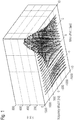
- The appended drawing shows
- Fig.
- Example of the computed metrics Vm(f,t) summarized in a function V(f,t) for f0 = -400Hz and t0 = 2.5µs.
- The figure shows an example of the two-dimensional function V, with frequency offset f0 =400Hz and time offset t0 = 2500ns. In this case, the resolution for frequency offset was set to ΔF = 80Hz with NF = 15. So the catch range with regard to frequency deviation is approx. ±1.2kHz. The time resolution was set to ΔT = 790ns with NT = 10 supporting a catch range of approx. ±7.9µs. For demodulation, the NSSS was used without additive noise. The optimal estimation values with regard to the maximum of V(f,t) are f̂ =400Hz and t̂ = 2370ns.
- Summarizing, an optimal joint time-frequency offset estimate in case the serving cell is already known and other information can be derived from the knowledge of the serving cell is disclosed. In particular, the time-frequency estimation is based on the demodulation of a complete received NB-IoT subframe with respect to all the resource elements of the expected (ideal) content of the subframe. This re-synchronization can be based on the sequences NPSS and NSSS but also on the NPBCH. For paging with NWUS signaling, detection and re-synchronization can be based on the NWUS.
- The inventive procedure provides optimized time-frequency synchronization of a UE, whereby the UE can operate more power efficiently and with a better performance. The inventive method is running on the NB-IoT modem of the UE side.
Claims (8)
- A method for a joint time-frequency synchronization of User Equipment, UE, in NB-IoT Networks already connected to a serving cell obtaining an optimal time-frequency offset estimation, the method comprising the following stages:- (stage 1) demodulating a received NB-IoT subframe Rm containing resource elements in the frequency domain with regard to a pre-computed reference NB-IoT subframe Bm containing expected resource elements in the frequency domain, whereas the pre-computed resource elements of Bm are derived from information of the serving cell, and storing resource elements of the demodulated NB-IoT subframe Wm in matrix W, with m being a natural number equal or greater than 0 and presenting the m-th processed subframe,- (stage 2) computing a metric Vm(f,t) with regard to a region of pre-defined discrete frequency offset values f ∈ F and discrete time offset values t ∈ T,- (stage 3) recursively combining the metric Vm(f,t) in a non-coherent way over multiple demodulated NB-IoT subframes Wm resulting in a new metric Um(f,t),- (stage 4) recursively computing a reference value Sm over multiple demodulated NB-IoT subframes Wm , based on a subframe energy of the presently processed demodulated NB-IoT subframe Wm ,- (stage 5) comparing the non-coherently combined new metric Um(f,t) with the reference value Sm, whereas- if a normalized metric value of Um(f,t)/Sm does not exceed a threshold KThreshold (m), stages 1 to 5 of the method are recursively repeated up to a pre-defined maximum number of subframes Mmax have been demodulated with Mmax being a natural number greater than 0, otherwise- (stage 6) if the normalized metric value of Um(f,t)/Sm exceeds the threshold KThreshold (m), arg-max values with regard to the discrete frequency offset values f ∈ F and the discrete time offset values t ∈ T are computed based on the non-coherently combined metric values of Um(f,t) obtaining an optimal value of the time-frequency offset estimate, provided the number of combined subframes Wm has not exceeded Mmax.
- The method for a joint time-frequency synchronization of UE according to claim 1, wherein all complex exponentials with regard to the discrete frequency offset values f ∈ F for all Ns = 14 OFDM symbols are pre-computed and stored in a look-up table.
- The method for a joint time-frequency synchronization of UE according to claim 1, wherein all complex exponentials with regard to the discrete time offset values t ∈ T for all Nc = 12 OFDM symbols are pre-computed and stored in a look-up table.
- The method for a joint time-frequency synchronization of UE according to claim 1, wherein the computation of the metric Vm(f,t) is done in a two-stage approach, at which in a first stage intermediate values ck(f) are first computed based on the discrete frequency offset values f ∈ F and in a second stage the metric values Vm(f,t) are computed based on the intermediate values ck(f) of the first stage and based on the discrete values t ∈ T and f ∈ F.
- The method for a joint time-frequency synchronization of UE according to claim 1, wherein the Narrowband-Primary-synchronization-Signal transmitted on subframe #5 of an anchor carrier is demodulated in stage 1, whereas the pre-computed reference NB-IoT subframe Bm is constant regardless of the LTE frame number.
- The method for a joint time-frequency synchronization of UE according to claim 1, wherein the Narrowband-Secondary-Synchronization-Signal transmitted on subframe 9 of an anchor carrier for every even LTE frame number is demodulated in stage 1, whereas the pre-computation of the reference NB-IoT subframe Bm depends on the cell-ID.
- The method for a joint time-frequency synchronization of UE according to claim 1, wherein the master information Bit, MIB, payload information which is delivered in the Narrowband-Physical-Broadcast-Channel, NPBCH, is demodulated in stage 1, whereas the pre-computation of the reference NB-IoT subframe Bm is performed at the beginning of the synchronization procedure and depends on the re-encoding of the resource elements of the NPBCH.
- The method for a joint time-frequency synchronization of UE according to claim 1, wherein the Narrowband-Wakeup-Signal, NWUS, is demodulated in stage 1, whereas the pre-computation of the reference NB-IoT subframe Bm depends on the cell-ID and the time of the paging occasion to which NWUS is associated.
Priority Applications (4)
| Application Number | Priority Date | Filing Date | Title |
|---|---|---|---|
| EP20181705.3A EP3930276A1 (en) | 2020-06-23 | 2020-06-23 | Method for a joint time-frequency synchronization of user equipment in nb-iot networks |
| EP21701664.1A EP3884633B1 (en) | 2020-01-09 | 2021-01-07 | Method for a joint time-frequency synchronization of user equipment in nb-iot networks |
| PCT/EP2021/050162 WO2021140137A1 (en) | 2020-01-09 | 2021-01-07 | Method for a joint time-frequency synchronization of user equipment in nb-iot networks |
| CN202180006930.6A CN114762303B (en) | 2020-01-09 | 2021-01-07 | Joint time-frequency synchronization method for user equipment in NB-IoT network |
Applications Claiming Priority (1)
| Application Number | Priority Date | Filing Date | Title |
|---|---|---|---|
| EP20181705.3A EP3930276A1 (en) | 2020-06-23 | 2020-06-23 | Method for a joint time-frequency synchronization of user equipment in nb-iot networks |
Publications (1)
| Publication Number | Publication Date |
|---|---|
| EP3930276A1 true EP3930276A1 (en) | 2021-12-29 |
Family
ID=71138571
Family Applications (1)
| Application Number | Title | Priority Date | Filing Date |
|---|---|---|---|
| EP20181705.3A Withdrawn EP3930276A1 (en) | 2020-01-09 | 2020-06-23 | Method for a joint time-frequency synchronization of user equipment in nb-iot networks |
Country Status (1)
| Country | Link |
|---|---|
| EP (1) | EP3930276A1 (en) |
Cited By (2)
| Publication number | Priority date | Publication date | Assignee | Title |
|---|---|---|---|---|
| CN116828586A (en) * | 2023-08-30 | 2023-09-29 | 芯迈微半导体(上海)有限公司 | A synchronization method and device for a terminal in standby mode |
| CN117295149A (en) * | 2023-11-23 | 2023-12-26 | 西华大学 | A low-complexity ELM-assisted frame synchronization method and system |
Citations (2)
| Publication number | Priority date | Publication date | Assignee | Title |
|---|---|---|---|---|
| US20170264406A1 (en) * | 2016-03-11 | 2017-09-14 | Qualcomm Incorporated | Narrowband wireless communications cell search |
| US20200053673A1 (en) * | 2017-05-12 | 2020-02-13 | Telefonaktiebolaget Lm Ericsson (Publ) | Wireless communication device, network node, method and computer program for achieving synchronization |
-
2020
- 2020-06-23 EP EP20181705.3A patent/EP3930276A1/en not_active Withdrawn
Patent Citations (2)
| Publication number | Priority date | Publication date | Assignee | Title |
|---|---|---|---|---|
| US20170264406A1 (en) * | 2016-03-11 | 2017-09-14 | Qualcomm Incorporated | Narrowband wireless communications cell search |
| US20200053673A1 (en) * | 2017-05-12 | 2020-02-13 | Telefonaktiebolaget Lm Ericsson (Publ) | Wireless communication device, network node, method and computer program for achieving synchronization |
Non-Patent Citations (2)
| Title |
|---|
| MEDIATEK INC: "On design aspects for NB-IoT Wake Up Signal", vol. RAN WG1, no. Reno, Nevado, USA; 20171127 - 20171201, 18 November 2017 (2017-11-18), XP051369405, Retrieved from the Internet <URL:http://www.3gpp.org/ftp/tsg%5Fran/WG1%5FRL1/TSGR1%5F91/Docs/> [retrieved on 20171118] * |
| MEDIATEK INC: "Performance Analysis of PSS in Initial Time-Frequency Uncertainty", vol. RAN WG1, no. Reno, USA; 20161114 - 20161118, 13 November 2016 (2016-11-13), XP051176083, Retrieved from the Internet <URL:http://www.3gpp.org/ftp/Meetings_3GPP_SYNC/RAN1/Docs/> [retrieved on 20161113] * |
Cited By (4)
| Publication number | Priority date | Publication date | Assignee | Title |
|---|---|---|---|---|
| CN116828586A (en) * | 2023-08-30 | 2023-09-29 | 芯迈微半导体(上海)有限公司 | A synchronization method and device for a terminal in standby mode |
| CN116828586B (en) * | 2023-08-30 | 2023-11-14 | 芯迈微半导体(上海)有限公司 | Synchronization method and device for terminal in standby state |
| CN117295149A (en) * | 2023-11-23 | 2023-12-26 | 西华大学 | A low-complexity ELM-assisted frame synchronization method and system |
| CN117295149B (en) * | 2023-11-23 | 2024-01-30 | 西华大学 | A low-complexity ELM-assisted frame synchronization method and system |
Similar Documents
| Publication | Publication Date | Title |
|---|---|---|
| US12289189B2 (en) | Method and system for providing code cover to OFDM symbols in multiple user system | |
| US11277871B2 (en) | Initial access channel for scalable wireless mobile communication networks | |
| US10727969B2 (en) | Method and apparatus for transmitting or detecting a primary synchronization signal | |
| US9843466B2 (en) | Method and apparatus for generating an uplink reference signal sequence in a wireless communication system | |
| EP2074707B1 (en) | A method for transmitting information using sequence. | |
| US9735938B2 (en) | Pilot signal transmission method and radio communication apparatus | |
| US8179780B2 (en) | Method and apparatus for transmitting and receiving control information to randomize inter-cell interference in a mobile communication system | |
| KR100933599B1 (en) | Method and apparatus for pilot signal transmission | |
| EP2479948B1 (en) | Method and apparatus for transmitting a reference signal | |
| US7706249B2 (en) | Method and apparatus for a synchronization channel in an OFDMA system | |
| US8130715B2 (en) | Base station and method of generating a synchronization channel | |
| EP3884633B1 (en) | Method for a joint time-frequency synchronization of user equipment in nb-iot networks | |
| US20160330700A1 (en) | Method and apparatus for transmitting data between wireless devices in wireless communication system | |
| US20100220695A1 (en) | Method and apparatus for generating and transmitting code sequence in a wireless communication system | |
| US20100080112A1 (en) | Frequency Offset Estimation in Orthogonal Frequency Division Multiple Access Wireless Networks | |
| US8654696B2 (en) | Radio communication base station apparatus and pilot transmitting method | |
| US20100261472A1 (en) | Method for performing cell search procedure in wireless communication system | |
| WO2008136614A2 (en) | Method and apparatus for transmitting and receiving data in an orthogonal frequency multiplexing system | |
| GB2573531A (en) | Method for estimating carrier frequency offset | |
| CN101431368A (en) | Signal channel estimation method and apparatus | |
| KR20080087646A (en) | Wireless signal transmission method | |
| JP2004357339A (en) | Multicarrier transmitting device, multicarrier receiving device, and multicarrier wireless communication method |
Legal Events
| Date | Code | Title | Description |
|---|---|---|---|
| PUAI | Public reference made under article 153(3) epc to a published international application that has entered the european phase |
Free format text: ORIGINAL CODE: 0009012 |
|
| STAA | Information on the status of an ep patent application or granted ep patent |
Free format text: STATUS: THE APPLICATION HAS BEEN PUBLISHED |
|
| AK | Designated contracting states |
Kind code of ref document: A1 Designated state(s): AL AT BE BG CH CY CZ DE DK EE ES FI FR GB GR HR HU IE IS IT LI LT LU LV MC MK MT NL NO PL PT RO RS SE SI SK SM TR |
|
| B565 | Issuance of search results under rule 164(2) epc |
Effective date: 20201203 |
|
| RAP1 | Party data changed (applicant data changed or rights of an application transferred) |
Owner name: SHENZHEN GOODIX TECHNOLOGY CO., LTD. |
|
| STAA | Information on the status of an ep patent application or granted ep patent |
Free format text: STATUS: THE APPLICATION IS DEEMED TO BE WITHDRAWN |
|
| 18D | Application deemed to be withdrawn |
Effective date: 20220630 |