EP3930025B1 - Battery module, battery pack, and vehicle - Google Patents
Battery module, battery pack, and vehicle Download PDFInfo
- Publication number
- EP3930025B1 EP3930025B1 EP20866471.4A EP20866471A EP3930025B1 EP 3930025 B1 EP3930025 B1 EP 3930025B1 EP 20866471 A EP20866471 A EP 20866471A EP 3930025 B1 EP3930025 B1 EP 3930025B1
- Authority
- EP
- European Patent Office
- Prior art keywords
- limiting portion
- body portion
- battery
- main body
- battery module
- Prior art date
- Legal status (The legal status is an assumption and is not a legal conclusion. Google has not performed a legal analysis and makes no representation as to the accuracy of the status listed.)
- Active
Links
Images



Classifications
-
- H—ELECTRICITY
- H01—ELECTRIC ELEMENTS
- H01M—PROCESSES OR MEANS, e.g. BATTERIES, FOR THE DIRECT CONVERSION OF CHEMICAL ENERGY INTO ELECTRICAL ENERGY
- H01M10/00—Secondary cells; Manufacture thereof
- H01M10/04—Construction or manufacture in general
- H01M10/0431—Cells with wound or folded electrodes
-
- H—ELECTRICITY
- H01—ELECTRIC ELEMENTS
- H01M—PROCESSES OR MEANS, e.g. BATTERIES, FOR THE DIRECT CONVERSION OF CHEMICAL ENERGY INTO ELECTRICAL ENERGY
- H01M10/00—Secondary cells; Manufacture thereof
- H01M10/60—Heating or cooling; Temperature control
- H01M10/65—Means for temperature control structurally associated with the cells
- H01M10/658—Means for temperature control structurally associated with the cells by thermal insulation or shielding
-
- H—ELECTRICITY
- H01—ELECTRIC ELEMENTS
- H01M—PROCESSES OR MEANS, e.g. BATTERIES, FOR THE DIRECT CONVERSION OF CHEMICAL ENERGY INTO ELECTRICAL ENERGY
- H01M50/00—Constructional details or processes of manufacture of the non-active parts of electrochemical cells other than fuel cells, e.g. hybrid cells
- H01M50/20—Mountings; Secondary casings or frames; Racks, modules or packs; Suspension devices; Shock absorbers; Transport or carrying devices; Holders
- H01M50/204—Racks, modules or packs for multiple batteries or multiple cells
- H01M50/207—Racks, modules or packs for multiple batteries or multiple cells characterised by their shape
- H01M50/209—Racks, modules or packs for multiple batteries or multiple cells characterised by their shape adapted for prismatic or rectangular cells
-
- H—ELECTRICITY
- H01—ELECTRIC ELEMENTS
- H01M—PROCESSES OR MEANS, e.g. BATTERIES, FOR THE DIRECT CONVERSION OF CHEMICAL ENERGY INTO ELECTRICAL ENERGY
- H01M50/00—Constructional details or processes of manufacture of the non-active parts of electrochemical cells other than fuel cells, e.g. hybrid cells
- H01M50/20—Mountings; Secondary casings or frames; Racks, modules or packs; Suspension devices; Shock absorbers; Transport or carrying devices; Holders
- H01M50/289—Mountings; Secondary casings or frames; Racks, modules or packs; Suspension devices; Shock absorbers; Transport or carrying devices; Holders characterised by spacing elements or positioning means within frames, racks or packs
- H01M50/291—Mountings; Secondary casings or frames; Racks, modules or packs; Suspension devices; Shock absorbers; Transport or carrying devices; Holders characterised by spacing elements or positioning means within frames, racks or packs characterised by their shape
-
- H—ELECTRICITY
- H01—ELECTRIC ELEMENTS
- H01M—PROCESSES OR MEANS, e.g. BATTERIES, FOR THE DIRECT CONVERSION OF CHEMICAL ENERGY INTO ELECTRICAL ENERGY
- H01M50/00—Constructional details or processes of manufacture of the non-active parts of electrochemical cells other than fuel cells, e.g. hybrid cells
- H01M50/20—Mountings; Secondary casings or frames; Racks, modules or packs; Suspension devices; Shock absorbers; Transport or carrying devices; Holders
- H01M50/289—Mountings; Secondary casings or frames; Racks, modules or packs; Suspension devices; Shock absorbers; Transport or carrying devices; Holders characterised by spacing elements or positioning means within frames, racks or packs
- H01M50/293—Mountings; Secondary casings or frames; Racks, modules or packs; Suspension devices; Shock absorbers; Transport or carrying devices; Holders characterised by spacing elements or positioning means within frames, racks or packs characterised by the material
-
- H—ELECTRICITY
- H01—ELECTRIC ELEMENTS
- H01M—PROCESSES OR MEANS, e.g. BATTERIES, FOR THE DIRECT CONVERSION OF CHEMICAL ENERGY INTO ELECTRICAL ENERGY
- H01M2220/00—Batteries for particular applications
- H01M2220/20—Batteries in motive systems, e.g. vehicle, ship, plane
-
- H—ELECTRICITY
- H01—ELECTRIC ELEMENTS
- H01M—PROCESSES OR MEANS, e.g. BATTERIES, FOR THE DIRECT CONVERSION OF CHEMICAL ENERGY INTO ELECTRICAL ENERGY
- H01M50/00—Constructional details or processes of manufacture of the non-active parts of electrochemical cells other than fuel cells, e.g. hybrid cells
- H01M50/20—Mountings; Secondary casings or frames; Racks, modules or packs; Suspension devices; Shock absorbers; Transport or carrying devices; Holders
- H01M50/233—Mountings; Secondary casings or frames; Racks, modules or packs; Suspension devices; Shock absorbers; Transport or carrying devices; Holders characterised by physical properties of casings or racks, e.g. dimensions
- H01M50/242—Mountings; Secondary casings or frames; Racks, modules or packs; Suspension devices; Shock absorbers; Transport or carrying devices; Holders characterised by physical properties of casings or racks, e.g. dimensions adapted for protecting batteries against vibrations, collision impact or swelling
-
- Y—GENERAL TAGGING OF NEW TECHNOLOGICAL DEVELOPMENTS; GENERAL TAGGING OF CROSS-SECTIONAL TECHNOLOGIES SPANNING OVER SEVERAL SECTIONS OF THE IPC; TECHNICAL SUBJECTS COVERED BY FORMER USPC CROSS-REFERENCE ART COLLECTIONS [XRACs] AND DIGESTS
- Y02—TECHNOLOGIES OR APPLICATIONS FOR MITIGATION OR ADAPTATION AGAINST CLIMATE CHANGE
- Y02E—REDUCTION OF GREENHOUSE GAS [GHG] EMISSIONS, RELATED TO ENERGY GENERATION, TRANSMISSION OR DISTRIBUTION
- Y02E60/00—Enabling technologies; Technologies with a potential or indirect contribution to GHG emissions mitigation
- Y02E60/10—Energy storage using batteries
-
- Y—GENERAL TAGGING OF NEW TECHNOLOGICAL DEVELOPMENTS; GENERAL TAGGING OF CROSS-SECTIONAL TECHNOLOGIES SPANNING OVER SEVERAL SECTIONS OF THE IPC; TECHNICAL SUBJECTS COVERED BY FORMER USPC CROSS-REFERENCE ART COLLECTIONS [XRACs] AND DIGESTS
- Y02—TECHNOLOGIES OR APPLICATIONS FOR MITIGATION OR ADAPTATION AGAINST CLIMATE CHANGE
- Y02P—CLIMATE CHANGE MITIGATION TECHNOLOGIES IN THE PRODUCTION OR PROCESSING OF GOODS
- Y02P70/00—Climate change mitigation technologies in the production process for final industrial or consumer products
- Y02P70/50—Manufacturing or production processes characterised by the final manufactured product
Definitions
- the present application relates to the technical field of batteries, and in particular, relates to a battery module, a battery pack and a vehicle.
- a battery module usually includes a plurality of batteries grouped together.
- a buffer element is usually arranged between two adjacent batteries.
- the existing buffer element is usually a flat-plate structure, thus it has the following problems in a grouping process: (1) a positioning installation with the corresponding battery cannot be implemented, resulting in a low grouping efficiency; (2) the buffer element is easy to install improperly (that is, there is a certain misalignment between the buffer element and the corresponding battery), which affects an absorption effect of the buffer element on the expansion force of the battery.
- EP2200112A1 discloses a battery pack formed by arranging a plurality of unit batteries, it is possible to maintain safety and efficiency even after a long use.
- the battery pack includes: a plurality of unit batteries each having a rectangular-solid sealed metal unit battery case and two voltage terminals protruding from a terminal surface of the unit battery case; a spacer arranged between two main surfaces of adjacent unit batteries opposing to each other so as to maintain a gap between the main surfaces; and a connection portion which electrically connects the voltage terminals of different unit batteries.
- the spacer has a plurality of protrusions for supporting the corner portions of the unit battery cases and through holes formed at positions opposing to the main surfaces which can receive expanded portions when the main surfaces of the unit battery cases are expanded by inner pressure of the unit battery cases.
- CN107302070A discloses a plug-in series battery bracket and a battery module.
- the plug-in series battery bracket comprises two end part brackets, and at least one middle bracket, wherein one end part bracket, the middle bracket and the other end bracket are sequentially assembled in a plug-in manner; battery cores are arranged between the end part brackets and the middle bracket or between two middle brackets separately; each end part bracket comprises a first baffle plate, a first plug connector, a second plug connector and a first bottom baffle edge; each first plug connector is arranged on the edge of the corresponding first baffle plate; each middle bracket comprises a second baffle plate, a third plug connector and a second bottom baffle edge; each third plug connector is arranged on the edge of the corresponding second baffle plate; and the first plug connectors and the second plug connectors are assembled with the corresponding third plug connectors in a plug manner separately.
- the invention further discloses a battery module using the battery bracket.
- the plug-in series battery bracket has the advantages that sufficient expansion clearance and breathing distance between the battery cores are ensured, heat dissipation between the battery cores is ensured, the plug-in series battery bracket is flexible to assemble, high in universality and good in heat insulation effect between the battery cores, and the security of the battery module is ensured.
- CN106531914A discloses a square cell module including a plurality of square cell monomers, a plurality of cell electrically conductive connection pieces and a module frame.
- the square cell module is characterized in that the module frame includes two module end plates, two module fixing steel angles and a module top beam; the module end plates are square flat plates, and two corners of the lower end of each square flat plate and the middle part of the upper end of each square flat plate are each provided with an end plate riveting through hole; end parts of two ends of each module fixing steel angle are each provided with a steel angle riveting through hole; end parts of two ends of the module top beam are each provided with a top beam riveting through hole; the module fixing steel angles and the module top beam are respectively connected with the module end plates in a riveting mode, and thus the plurality of square cell monomers are accommodated and fixed.
- the square cell module provided by the invention has the advantages of simple structure, high space utilization rate, high universality, and convenient installation and transport, and is suitable for scaling and mechanized production; and the
- CN106711363A discloses a battery grouping framework including a battery spacing plate, a bottom plate, a front vertical plate, a rear vertical plate and an upper cover plate;
- the battery spacing plate is a square flat plate;
- the bottom plate, the front vertical plate, the rear vertical plate and the upper cover plate form vertical T-shaped structures with the battery spacing plate respectively and are distributed at four side faces of the battery spacing plate;
- the end face of the upper cover plate is provided with a groove sunken from the edge to the interior;
- the bottom plate and the upper cover plate are provided with splicing grooves and splicing bosses respectively.
- the voltage and capacity of a grouped battery module are changed by freely changing the number of battery monomers, the convenience of the battery grouping is increased, the battery information collection wiring harness arrangement is specified, the assembly process of the battery module is simplified, the battery grouping framework is suitable for large-scale production, and the cost of manufacturing of a battery system is effectively reduced.
- the connected grouped battery system has excellent heat dissipation performance.
- US 2014/120391 A1 discloses a battery module according to the preamble of claim 1.
- connection should be understood broadly, for example, the “connection” may either be a fixed connection, or a detachable connection, or an integrated connection, or an electrical connection, or a signal connection; and the “connection” may either be a direct connection, or an indirect connection through an intermediary. Those of ordinary skill in the art may appreciate the specific meanings of the foregoing terms in the present application according to specific conditions.
- a vehicle of the present application includes a vehicle body, a battery pack and a power source. Both the battery pack and the power source are installed on the vehicle body, and the battery pack is electrically connected to the power source to supply electricity to the power source.
- the vehicle may be a new energy automobile.
- the new energy automobile may be a pure electric automobile, a hybrid automobile or an extended-range automobile.
- the battery pack may be horizontally arranged at a bottom of the vehicle body.
- the battery pack includes a box body and a battery module.
- the number of a battery module 1 may be one or more, and each battery module 1 may be fixed to the box body by a corresponding fastener (such as a bolt), or each battery module 1 may be fixed to the box body by a bonding method.
- the battery module may include a plurality of batteries 1, a buffer element 2, an insulation element 3, an upper cover plate 4 and an end plate 5.
- the plurality of batteries 1 are arranged side by side along a second direction Y, and each battery 1 includes an electrode assembly 11, a housing 12, a top cover assembly 13 and an electrolyte accommodated in the housing 12.
- the electrode assembly 11 is accommodated in the housing 12, and for a composition structure of the electrode assembly 11, the electrode assembly 11 may include a first electrode sheet 11a, a second electrode sheet 12b, and an isolation film 11c arranged between the first electrode sheet 11a and the second electrode sheet 11b.
- the electrode assembly 11 may be a rolled electrode assembly.
- the first electrode sheet 11a, the second electrode sheet 11b and the isolation film 11c are all in banded structures
- the first electrode sheet 11a, the second electrode sheet 11b and the isolation film 11c are stacked in sequence and are rolled more than two turns to form the electrode assembly 11, and the electrode assembly 11 is in a flat shape.
- the electrode assembly 11 may be firstly rolled into a hollow cylindrical structure, and then flattened into a flat shape after being rolled.
- the electrode assembly 11 may have a body portion 111, a first corner portion 112 and a second corner portion 113, the body portion 111 extends along the first direction X, the first corner portion 112 and the second corner portion 113 are located at both sides of the body portion 111 in the first direction X, and the first corner portion 112 and the second corner portion 113 are connected to the body portion 111 and protrude from the body portion 111 in the first direction X, where an outer surface of the first corner portion 112 and an outer surface of the second corner portion 113 are formed in an arc shape.
- the housing 12 can be made of metal materials or composite materials.
- the whole housing 12 is made of metal materials such aluminum, aluminum alloy or nickel-plated steel.
- the housing 12 may also include a base and an insulation layer.
- the base is made of metal materials such aluminum, aluminum alloy or nickel-plated steel, and the insulation layer may be arranged on an outer surface of the base by coating, bonding or the like. In this case, the metal base may ensure strength of the housing 12, and the insulation layer may improve an insulation property of the housing 12.
- the housing 12 may have a hexahedral shape or another shape.
- the housing 12 has an opening, and the electrode assembly 11 may be disposed in the housing 12 through the opening.
- the top cover assembly 13 may include a top cover plate 13a and electrode terminals 13b, and the electrode terminals 13b are arranged on the top cover plate 13a.
- the top cover plate 13a may be made of metal materials such as aluminum or aluminum alloy, and a size of the top cover plate 13a is adapted to a size of the opening of the housing 12.
- the top cover plate 13a may be connected to the housing 12 by welding and cover the opening of the housing 12, thereby sealing the electrode assembly 11 and the electrolyte in the housing 12.
- the electrode terminals 13b may be fixed to the top cover plate 13a by welding, riveting or the like. There are two electrode terminals 13b, and they are electrically connected to the first electrode sheet 11a and the second electrode sheet 11b, respectively.
- the buffer element 2 is arranged between two adjacent batteries 1.
- the buffer element 2 may be made of hard materials (such as PC, PP and the like).
- the buffer element 2 is incompressible, so that an assembly preload and a reserved expansion gap between each two adjacent batteries 1 may be ensured to be consistent, thereby improving a reliability of a module structure during a long-term use.
- the buffer element 2 may have a main body portion 21, a first limiting portion 22 and a second limiting portion 23. According to actual situations, the buffer element 2 may also have a third limiting portion 24.
- the main body portion 21 of the buffer element 2 is provided with an opening S penetratingly along the second direction Y to form a loop structure.
- the first limiting portion 22 and the second limiting portion 23 are located at both ends of the main body portion 21 in the first direction X and are arranged at intervals from the opening S (that is, a distance between the first limiting portion 22 and the second limiting 23 in the first direction X is greater than a size of the opening S in the first direction), and the first limiting portion 22 and the second limiting portion 23 are connected to the main body portion 21 and protrude from the main body portion 21 in the second direction Y
- the housing 12 of a battery 1 faces the opening S in the second direction Y and abuts against the main body portion 21 of the buffer element 2, and is located between the first limiting portion 22 and the second limiting portion 23 in the first direction X.
- the main body portion 21 of the buffer element 2, the first limiting portion 22 and the second limiting portion 23 together limit an installation position of the battery 1, thereby improving a grouping efficiency of the battery module.
- the opening S of the buffer element 2 faces the battery 1 in the second direction Y, so that the opening S may absorb expansion and deformation generated by the battery 1 in time, and based on an arrangement of the first limiting portion 22 and the second limiting portion 23, the battery 1 may not be misaligned relative to the buffer element 2 in the first direction X, which improves an absorption effect of the buffer element 2 on the expansion and deformation of the battery 1, thereby increasing a service life of the battery module.
- the first limiting portion 22 may be formed at one side or both sides of the main body portion 21 in the second direction Y (as shown in FIG. 3 and FIG. 4 ). Accordingly, the second limiting portion 23 may be formed at one side or both sides of the main body portion 21 in the second direction Y (as shown in FIG. 3 and FIG. 4 ).
- the first limiting portion 22 may span the entire main body portion 21 in a third direction Z, that is, the first limiting portion 22 extends from one end of the main body portion 21 to the other end in the third direction Z.
- the first limiting portion 22 may also span a part of the main body portion 21 in the third direction Z, which helps to save materials of the buffer element 2 at this time, thereby reducing costs.
- the first limiting portion 22 is arranged in the middle of the main body portion 21 in the third direction Z (as shown in FIG. 9 ).
- the second limiting portion 23 spans the entire main body portion 21 in the third direction Z, that is, the second limiting portion 23 extends from one end of the main body portion 21 to the other end in the third direction Z.
- the second limiting portion 23 may also span the part of the main body portion 21 in the third direction Z.
- the second limiting portion 23 is arranged in the middle of the main body portion 21 in the third direction Z (as shown in FIG. 9 ).
- the first limiting portion 22 spans the part of the main body portion 21 in the third direction Z and the second limiting portion 23 also spans the part of the main body portion 21 in the third direction Z
- the first limiting portion 22 and the second limiting portion 23 may be arranged to be diametrically opposite to each other (as shown in FIG. 9 ) or arranged in a misalignment manner in the third direction Z.
- the "diametrically opposite arrangement” means that a projection of the first limiting portion 22 in the first direction X and a projection of the second limiting portion 23 in the first direction X overlap
- the “misaligning arrangement” means that the projection of the first limiting portion 22 in the first direction X and the projection of the second limiting portion 23 in the first direction X partially overlap or do not overlap.
- the third limiting portion 24 is connected to the main body portion 21 and protrudes from the main body portion 21 in the second direction Y, and the third limiting portion 24 supports the corresponding battery 1 in the third direction Z. Since the first limiting portion 22 and the second limiting portion 23 of the buffer element 2 together limit a position of the battery 1 in the first direction X, and the third limiting portion 24 limits a position of the battery 1 in the third direction Z, when the battery module is grouped, it is only necessary to dispose the battery 1 in an area formed by the third limiting portion 24, the first limiting portion 22 and the second limiting portion 23, thereby improving the grouping efficiency of the battery module.
- the third limiting portion 24 may span (that is, the third limiting portion 24 extends from one end of the main body portion 21 to the other end in the first direction X, as shown in FIG. 10 ) the entire main body portion 21 in the first direction X and is connected to the first limiting portion 22 and the second limiting portion 23.
- the third limiting portion 24 may also span the part of the main body portion 21 in the first direction X.
- the third limiting portion 24 is arranged in the middle of the main body portion 21 in the first direction X.
- the third limiting portion 24 may also be formed at both ends of the main body portion 21 in the first direction X, and the first limiting portion 22 and the second limiting portion 23 are connected to a corresponding third limiting portion 24, respectively.
- the insulation element 3 extends along the second direction Y and is arranged at both sides of the plurality of the batteries 1 in the first direction X, and the insulation element 3 is bonded to the plurality of the batteries 1 to insulate the plurality of the batteries 1.
- a surface of the battery 1 is further provided with a protective film, and the insulation element 3 is bonded to the protective film of surfaces of the plurality of the batteries 1.
- a size of the battery 1 in the second direction Y is W
- a size of the first limiting portion 22 in the second direction Y is H
- H ⁇ W / 20 is W
- H > W / 20 the size H of the first limiting portion 22 in the second direction Y is too large, then a part of a side of the battery 1 corresponding to the first limiting portion 22 is too large, and a part of the side of the battery 1 that may be bonded to the insulation element 3 is shorter, thereby resulting in that a bonding effect between the insulation element 3 and the battery 1 is poor and even the insulation element 3 may not be bonded to the battery 1, further resulting in that the protective film of the surface of the battery 1 is worn, and resulting in an insulation failure of the battery 1 accordingly.
- the housing 12 of the battery 1 is formed with a first fillet, and a radius of the first fillet is R 1 , a size of the first limiting portion 22 in the second direction Y is H, and H ⁇ R 1 .
- a size H of the first limiting portion 22 in the second direction Y is too small, so that when the battery module is subjected to external shock and vibration, the battery 1 is likely to fall out between the first limiting portion 22 and the second limiting portion 23, which may not guarantee an limiting effect of the battery module on the battery 1 during the long-term use.
- a junction between the first limiting portion 22 and the main body portion 21 is formed with a second fillet, and a radius of the second fillet is R 2 , R 1 ⁇ R 2 , and at this time, assembly between the battery 1 and the buffer element 2 is facilitated.
- a junction between the first limiting portion 22 and the main body portion 21 may also be formed into a right angle.
- a certain expansion space is reserved between the electrode assembly 11 and the corresponding housing 12, that is, a distance between a junction of the first corner portion 112 and the body portion 111 of the electrode assembly 11 and an outer side surface corresponding to the housing 12 in the first direction X is L 1 , a distance between a junction of the second corner portion 113 and the body portion 111 and the outer side surface corresponding to the housing 12 in the first direction X is L 2 , a distance between the body portion 111 and a lower surface of the housing 12 in the third direction Z is L 3 , and a distance between the body portion 111 and an upper surface of the housing 12 in the third direction Z is L 4 , as shown in FIG. 3 and FIG. 5 .
- the main body portion 21 of the buffer element 2 has an inner peripheral surface enclosing the opening S, and the inner peripheral surface includes a first surface 21A, a second surface 21B, a third surface 21C and a fourth surface 21D, and the first surface 21A and the second surface 21B are arranged oppositely in the first direction X, and the third surface 21C and the fourth surface 21D are arranged oppositely in the third direction Z.
- the first surface 21A is arranged close to the first limiting portion 22 and a distance between the first surface 21A and the first limiting portion 22 in the first direction X is W 1
- the second surface 21B is arranged close to the second limiting portion 23 and a distance between the second surface 21B and the second limiting portion 23 in the first direction X is W 2 , as shown in FIG. 3 and FIG. 7 .
- the third surface 21C is arranged close to the third limiting portion 24 and a distance between the third surface 21C and the third limiting portion 24 in the third direction Z is W 3 , a distance between the fourth surface 21D and an upper surface of the main body portion 21 in the third direction Z is W 4 , as shown in FIG. 7 .
- W 3 ⁇ L 3 , W 4 ⁇ L 4 that is, the whole electrode assembly 11 is located inside the opening S in the third direction Z, thereby avoiding the damage to the electrode assembly 11 due to the stress concentration.
- a surface of each battery 1 facing the opening S is also provided with a bonding adhesive T, and two adjacent batteries 1 are connected together through the corresponding bonding adhesive T.
- the bonding adhesive T of the surface of the battery 1 is located inside the main body portion 21 and is arranged close to the main body portion 21. At this time, the bonding adhesive T is formed into the loop structure, as shown in FIG. 8 .
- a width of the bonding adhesive T in a circumferential direction may be selected between 5 millimeters (mm) and 15 millimeters (mm).
Landscapes
- Chemical & Material Sciences (AREA)
- Chemical Kinetics & Catalysis (AREA)
- Electrochemistry (AREA)
- General Chemical & Material Sciences (AREA)
- Engineering & Computer Science (AREA)
- Manufacturing & Machinery (AREA)
- Battery Mounting, Suspending (AREA)
- Connection Of Batteries Or Terminals (AREA)
Description
- The present application relates to the technical field of batteries, and in particular, relates to a battery module, a battery pack and a vehicle.
- A battery module usually includes a plurality of batteries grouped together. In a grouping technology, in order to alleviate an impact of an expansion force of a battery on a battery life, a buffer element is usually arranged between two adjacent batteries. However, the existing buffer element is usually a flat-plate structure, thus it has the following problems in a grouping process: (1) a positioning installation with the corresponding battery cannot be implemented, resulting in a low grouping efficiency; (2) the buffer element is easy to install improperly (that is, there is a certain misalignment between the buffer element and the corresponding battery), which affects an absorption effect of the buffer element on the expansion force of the battery.
-
EP2200112A1 discloses a battery pack formed by arranging a plurality of unit batteries, it is possible to maintain safety and efficiency even after a long use. The battery pack includes: a plurality of unit batteries each having a rectangular-solid sealed metal unit battery case and two voltage terminals protruding from a terminal surface of the unit battery case; a spacer arranged between two main surfaces of adjacent unit batteries opposing to each other so as to maintain a gap between the main surfaces; and a connection portion which electrically connects the voltage terminals of different unit batteries. The spacer has a plurality of protrusions for supporting the corner portions of the unit battery cases and through holes formed at positions opposing to the main surfaces which can receive expanded portions when the main surfaces of the unit battery cases are expanded by inner pressure of the unit battery cases. -
CN107302070A discloses a plug-in series battery bracket and a battery module. The plug-in series battery bracket comprises two end part brackets, and at least one middle bracket, wherein one end part bracket, the middle bracket and the other end bracket are sequentially assembled in a plug-in manner; battery cores are arranged between the end part brackets and the middle bracket or between two middle brackets separately; each end part bracket comprises a first baffle plate, a first plug connector, a second plug connector and a first bottom baffle edge; each first plug connector is arranged on the edge of the corresponding first baffle plate; each middle bracket comprises a second baffle plate, a third plug connector and a second bottom baffle edge; each third plug connector is arranged on the edge of the corresponding second baffle plate; and the first plug connectors and the second plug connectors are assembled with the corresponding third plug connectors in a plug manner separately. The invention further discloses a battery module using the battery bracket. The plug-in series battery bracket has the advantages that sufficient expansion clearance and breathing distance between the battery cores are ensured, heat dissipation between the battery cores is ensured, the plug-in series battery bracket is flexible to assemble, high in universality and good in heat insulation effect between the battery cores, and the security of the battery module is ensured. -
CN106531914A discloses a square cell module including a plurality of square cell monomers, a plurality of cell electrically conductive connection pieces and a module frame. The square cell module is characterized in that the module frame includes two module end plates, two module fixing steel angles and a module top beam; the module end plates are square flat plates, and two corners of the lower end of each square flat plate and the middle part of the upper end of each square flat plate are each provided with an end plate riveting through hole; end parts of two ends of each module fixing steel angle are each provided with a steel angle riveting through hole; end parts of two ends of the module top beam are each provided with a top beam riveting through hole; the module fixing steel angles and the module top beam are respectively connected with the module end plates in a riveting mode, and thus the plurality of square cell monomers are accommodated and fixed. The square cell module provided by the invention has the advantages of simple structure, high space utilization rate, high universality, and convenient installation and transport, and is suitable for scaling and mechanized production; and the grouping production efficiency of the cell module can be improved, and the production cost is reduced. -
CN106711363A discloses a battery grouping framework including a battery spacing plate, a bottom plate, a front vertical plate, a rear vertical plate and an upper cover plate; the battery spacing plate is a square flat plate; the bottom plate, the front vertical plate, the rear vertical plate and the upper cover plate form vertical T-shaped structures with the battery spacing plate respectively and are distributed at four side faces of the battery spacing plate; the end face of the upper cover plate is provided with a groove sunken from the edge to the interior; the bottom plate and the upper cover plate are provided with splicing grooves and splicing bosses respectively. The voltage and capacity of a grouped battery module are changed by freely changing the number of battery monomers, the convenience of the battery grouping is increased, the battery information collection wiring harness arrangement is specified, the assembly process of the battery module is simplified, the battery grouping framework is suitable for large-scale production, and the cost of manufacturing of a battery system is effectively reduced. In addition, the connected grouped battery system has excellent heat dissipation performance. -
US 2014/120391 A1 discloses a battery module according to the preamble ofclaim 1. - The invention is set out in the appended set of claims.
-
-
FIG. 1 is an exploded view of a battery module of the present application. -
FIG. 2 is an assembly diagram ofFIG. 1 . -
FIG. 3 is a sectional view before a buffer element and a corresponding battery are assembled inFIG. 1 . -
FIG. 4 is a modified example of a buffer element in 3. -
FIG. 5 is a schematic diagram of an internal structure of a battery in a battery module. -
FIG. 6 is a perspective view of a buffer element inFIG. 1 . -
FIG. 7 is a front view ofFIG. 6 . -
FIG. 8 is a schematic diagram of a positional relationship between a buffer element and a bonding adhesive on a surface of a battery. -
FIG. 9 is a modified example ofFIG. 6 . -
FIG. 10 is another modified example ofFIG. 6 . -
FIG. 11 is yet another modified example ofFIG. 6 . -
FIG. 12 is an exploded view of a battery. -
FIG. 13 is a schematic diagram of an outline of an electrode assembly inFIG. 12 . - Reference signs are explained as follows:
- 1 battery
- 11 electrode assembly
- 111 body portion
- 112 first corner portion
- 113 second corner portion
- 11a first electrode sheet
- 11b second electrode sheet
- 11c isolation film
- 12 housing
- 13 top cover assembly
- 13a top cover plate
- 13b electrode terminal
- 11 electrode assembly
- 2 buffer element
- 21 main body portion
- 21A first surface
- 21B second surface
- 21C third surface
- 21D fourth surface
- 22 first limiting portion
- 23 second limiting portion
- 24 third limiting portion
- 21 main body portion
- 3 insulation element
- 4 upper cover plate
- 5 end plate
- T bonding adhesive
- S opening
- X first direction
- Y second direction Z third direction
- To make the objectives, technical solutions, and advantages of the present application clearer and more comprehensible, the present application will be further described below in detail with reference to the accompanying drawings and embodiments. It should be understood that the specific embodiments described herein are merely used to explain the present application, but are not intended to limit the present application.
- In the description of the present application, unless otherwise specified and limited explicitly, the terms "first", "second" and "third" are merely intended for a purpose of description, and may not be understood as an indication or implication of relative importance. The term "a plurality of" refers to more than two (including two). Unless otherwise specified or illustrated, the term "connection" should be understood broadly, for example, the "connection" may either be a fixed connection, or a detachable connection, or an integrated connection, or an electrical connection, or a signal connection; and the "connection" may either be a direct connection, or an indirect connection through an intermediary. Those of ordinary skill in the art may appreciate the specific meanings of the foregoing terms in the present application according to specific conditions.
- In the description of the specification, it should be understood that the terms representing directions such as "up" and "down" described in the embodiments of the present application are described from the angles shown in the accompanying drawings, and should not be understood as limitation on the embodiments of the present application. The present application will be further described below in detail through the specific embodiments with reference to the accompanying drawings.
- A vehicle of the present application includes a vehicle body, a battery pack and a power source. Both the battery pack and the power source are installed on the vehicle body, and the battery pack is electrically connected to the power source to supply electricity to the power source. Where the vehicle may be a new energy automobile. In one implementation manner, the new energy automobile may be a pure electric automobile, a hybrid automobile or an extended-range automobile. Preferably, the battery pack may be horizontally arranged at a bottom of the vehicle body.
- The battery pack includes a box body and a battery module. The number of a
battery module 1 may be one or more, and eachbattery module 1 may be fixed to the box body by a corresponding fastener (such as a bolt), or eachbattery module 1 may be fixed to the box body by a bonding method. - Referring to
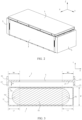
FIG. 1 andFIG. 2 , the battery module may include a plurality ofbatteries 1, abuffer element 2, aninsulation element 3, anupper cover plate 4 and anend plate 5. - The plurality of
batteries 1 are arranged side by side along a second direction Y, and eachbattery 1 includes anelectrode assembly 11, ahousing 12, a top cover assembly 13 and an electrolyte accommodated in thehousing 12. - The
electrode assembly 11 is accommodated in thehousing 12, and for a composition structure of theelectrode assembly 11, theelectrode assembly 11 may include afirst electrode sheet 11a, a second electrode sheet 12b, and anisolation film 11c arranged between thefirst electrode sheet 11a and thesecond electrode sheet 11b. In one embodiment, referring toFIG. 12 and FIG. 13 , theelectrode assembly 11 may be a rolled electrode assembly. In one implementation manner, thefirst electrode sheet 11a, thesecond electrode sheet 11b and theisolation film 11c are all in banded structures, thefirst electrode sheet 11a, thesecond electrode sheet 11b and theisolation film 11c are stacked in sequence and are rolled more than two turns to form theelectrode assembly 11, and theelectrode assembly 11 is in a flat shape. When producing theelectrode assembly 11, theelectrode assembly 11 may be firstly rolled into a hollow cylindrical structure, and then flattened into a flat shape after being rolled. - For different parts of the
electrode assembly 11 in a first direction X, referring toFIG. 3 andFIG. 13 , theelectrode assembly 11 may have abody portion 111, afirst corner portion 112 and asecond corner portion 113, thebody portion 111 extends along the first direction X, thefirst corner portion 112 and thesecond corner portion 113 are located at both sides of thebody portion 111 in the first direction X, and thefirst corner portion 112 and thesecond corner portion 113 are connected to thebody portion 111 and protrude from thebody portion 111 in the first direction X, where an outer surface of thefirst corner portion 112 and an outer surface of thesecond corner portion 113 are formed in an arc shape. - The
housing 12 can be made of metal materials or composite materials. For example, in one embodiment, thewhole housing 12 is made of metal materials such aluminum, aluminum alloy or nickel-plated steel. Or in another embodiment, thehousing 12 may also include a base and an insulation layer. The base is made of metal materials such aluminum, aluminum alloy or nickel-plated steel, and the insulation layer may be arranged on an outer surface of the base by coating, bonding or the like. In this case, the metal base may ensure strength of thehousing 12, and the insulation layer may improve an insulation property of thehousing 12. - Referring to
FIG. 12 , thehousing 12 may have a hexahedral shape or another shape. Thehousing 12 has an opening, and theelectrode assembly 11 may be disposed in thehousing 12 through the opening. - Referring to
FIG. 12 , the top cover assembly 13 may include a top cover plate 13a andelectrode terminals 13b, and theelectrode terminals 13b are arranged on the top cover plate 13a. The top cover plate 13a may be made of metal materials such as aluminum or aluminum alloy, and a size of the top cover plate 13a is adapted to a size of the opening of thehousing 12. The top cover plate 13a may be connected to thehousing 12 by welding and cover the opening of thehousing 12, thereby sealing theelectrode assembly 11 and the electrolyte in thehousing 12. - The
electrode terminals 13b may be fixed to the top cover plate 13a by welding, riveting or the like. There are twoelectrode terminals 13b, and they are electrically connected to thefirst electrode sheet 11a and thesecond electrode sheet 11b, respectively. - Referring to
FIG. 1 , thebuffer element 2 is arranged between twoadjacent batteries 1. In one implementation manner, thebuffer element 2 may be made of hard materials (such as PC, PP and the like). At this time, thebuffer element 2 is incompressible, so that an assembly preload and a reserved expansion gap between each twoadjacent batteries 1 may be ensured to be consistent, thereby improving a reliability of a module structure during a long-term use. - Referring to
FIGS. 3 to 11 , thebuffer element 2 may have amain body portion 21, a first limitingportion 22 and a second limitingportion 23. According to actual situations, thebuffer element 2 may also have a third limitingportion 24. - The
main body portion 21 of thebuffer element 2 is provided with an opening S penetratingly along the second direction Y to form a loop structure. The first limitingportion 22 and the second limitingportion 23 are located at both ends of themain body portion 21 in the first direction X and are arranged at intervals from the opening S (that is, a distance between the first limitingportion 22 and the second limiting 23 in the first direction X is greater than a size of the opening S in the first direction), and the first limitingportion 22 and the second limitingportion 23 are connected to themain body portion 21 and protrude from themain body portion 21 in the second direction Y When the battery module is grouped, thehousing 12 of abattery 1 faces the opening S in the second direction Y and abuts against themain body portion 21 of thebuffer element 2, and is located between the first limitingportion 22 and the second limitingportion 23 in the first direction X. - In a grouping process of the battery module, the
main body portion 21 of thebuffer element 2, the first limitingportion 22 and the second limitingportion 23 together limit an installation position of thebattery 1, thereby improving a grouping efficiency of the battery module. And during use of the battery module, the opening S of thebuffer element 2 faces thebattery 1 in the second direction Y, so that the opening S may absorb expansion and deformation generated by thebattery 1 in time, and based on an arrangement of the first limitingportion 22 and the second limitingportion 23, thebattery 1 may not be misaligned relative to thebuffer element 2 in the first direction X, which improves an absorption effect of thebuffer element 2 on the expansion and deformation of thebattery 1, thereby increasing a service life of the battery module. - The first limiting
portion 22 may be formed at one side or both sides of themain body portion 21 in the second direction Y (as shown inFIG. 3 andFIG. 4 ). Accordingly, the second limitingportion 23 may be formed at one side or both sides of themain body portion 21 in the second direction Y (as shown inFIG. 3 andFIG. 4 ). - In order to ensure strength of the first limiting
portion 22, referring toFIG. 6 and FIG. 7 , the first limitingportion 22 may span the entiremain body portion 21 in a third direction Z, that is, the first limitingportion 22 extends from one end of themain body portion 21 to the other end in the third direction Z. Of course, the first limitingportion 22 may also span a part of themain body portion 21 in the third direction Z, which helps to save materials of thebuffer element 2 at this time, thereby reducing costs. In one implementation manner, the first limitingportion 22 is arranged in the middle of themain body portion 21 in the third direction Z (as shown inFIG. 9 ). - Accordingly, referring to
FIG. 6 and FIG. 7 , the second limitingportion 23 spans the entiremain body portion 21 in the third direction Z, that is, the second limitingportion 23 extends from one end of themain body portion 21 to the other end in the third direction Z. Of course, the second limitingportion 23 may also span the part of themain body portion 21 in the third direction Z. At this time, in one implementation manner, the second limitingportion 23 is arranged in the middle of themain body portion 21 in the third direction Z (as shown inFIG. 9 ). - When the first limiting
portion 22 spans the part of themain body portion 21 in the third direction Z and the second limitingportion 23 also spans the part of themain body portion 21 in the third direction Z, the first limitingportion 22 and the second limitingportion 23 may be arranged to be diametrically opposite to each other (as shown inFIG. 9 ) or arranged in a misalignment manner in the third direction Z. It should be noted that the "diametrically opposite arrangement" means that a projection of the first limitingportion 22 in the first direction X and a projection of the second limitingportion 23 in the first direction X overlap, and the "misaligning arrangement" means that the projection of the first limitingportion 22 in the first direction X and the projection of the second limitingportion 23 in the first direction X partially overlap or do not overlap. - Referring to
FIGS. 6 to 11 , the third limitingportion 24 is connected to themain body portion 21 and protrudes from themain body portion 21 in the second direction Y, and the third limitingportion 24 supports thecorresponding battery 1 in the third direction Z. Since the first limitingportion 22 and the second limitingportion 23 of thebuffer element 2 together limit a position of thebattery 1 in the first direction X, and the third limitingportion 24 limits a position of thebattery 1 in the third direction Z, when the battery module is grouped, it is only necessary to dispose thebattery 1 in an area formed by the third limitingportion 24, the first limitingportion 22 and the second limitingportion 23, thereby improving the grouping efficiency of the battery module. - In order to ensure strength of the third limiting
portion 24, the third limitingportion 24 may span (that is, the third limitingportion 24 extends from one end of themain body portion 21 to the other end in the first direction X, as shown inFIG. 10 ) the entiremain body portion 21 in the first direction X and is connected to the first limitingportion 22 and the second limitingportion 23. Of course, in order to save the materials of thebuffer element 2 to reduce the costs, the third limitingportion 24 may also span the part of themain body portion 21 in the first direction X. In one implementation manner, the third limitingportion 24 is arranged in the middle of themain body portion 21 in the first direction X. Referring toFIG. 11 , the third limitingportion 24 may also be formed at both ends of themain body portion 21 in the first direction X, and the first limitingportion 22 and the second limitingportion 23 are connected to a corresponding third limitingportion 24, respectively. - Referring to
FIG. 1 andFIG. 2 , theinsulation element 3 extends along the second direction Y and is arranged at both sides of the plurality of thebatteries 1 in the first direction X, and theinsulation element 3 is bonded to the plurality of thebatteries 1 to insulate the plurality of thebatteries 1. In one implementation manner, a surface of thebattery 1 is further provided with a protective film, and theinsulation element 3 is bonded to the protective film of surfaces of the plurality of thebatteries 1. - Referring to
FIG. 3 , a size of thebattery 1 in the second direction Y is W, a size of the first limitingportion 22 in the second direction Y is H, and H ≤ W / 20 . This is because when H > W / 20, the size H of the first limitingportion 22 in the second direction Y is too large, then a part of a side of thebattery 1 corresponding to the first limitingportion 22 is too large, and a part of the side of thebattery 1 that may be bonded to theinsulation element 3 is shorter, thereby resulting in that a bonding effect between theinsulation element 3 and thebattery 1 is poor and even theinsulation element 3 may not be bonded to thebattery 1, further resulting in that the protective film of the surface of thebattery 1 is worn, and resulting in an insulation failure of thebattery 1 accordingly. - Referring to
FIG. 3 , thehousing 12 of thebattery 1 is formed with a first fillet, and a radius of the first fillet is R 1, a size of the first limitingportion 22 in the second direction Y is H, and H ≥ R 1. This is because when H < R 1, a size H of the first limitingportion 22 in the second direction Y is too small, so that when the battery module is subjected to external shock and vibration, thebattery 1 is likely to fall out between the first limitingportion 22 and the second limitingportion 23, which may not guarantee an limiting effect of the battery module on thebattery 1 during the long-term use. - Referring to
FIG. 4 , a junction between the first limitingportion 22 and themain body portion 21 is formed with a second fillet, and a radius of the second fillet is R 2, R 1 ≤ R 2, and at this time, assembly between thebattery 1 and thebuffer element 2 is facilitated. Of course, a junction between the first limitingportion 22 and themain body portion 21 may also be formed into a right angle. - Inside the
housing 12 of thebattery 1, in order to alleviate expansion and deformation generated by theelectrode assembly 11, a certain expansion space is reserved between theelectrode assembly 11 and thecorresponding housing 12, that is, a distance between a junction of thefirst corner portion 112 and thebody portion 111 of theelectrode assembly 11 and an outer side surface corresponding to thehousing 12 in the first direction X is L 1, a distance between a junction of thesecond corner portion 113 and thebody portion 111 and the outer side surface corresponding to thehousing 12 in the first direction X is L 2, a distance between thebody portion 111 and a lower surface of thehousing 12 in the third direction Z is L 3, and a distance between thebody portion 111 and an upper surface of thehousing 12 in the third direction Z is L 4, as shown inFIG. 3 andFIG. 5 . - Referring to
FIG. 6 and FIG. 7 , themain body portion 21 of thebuffer element 2 has an inner peripheral surface enclosing the opening S, and the inner peripheral surface includes afirst surface 21A, a second surface 21B, a third surface 21C and afourth surface 21D, and thefirst surface 21A and the second surface 21B are arranged oppositely in the first direction X, and the third surface 21C and thefourth surface 21D are arranged oppositely in the third direction Z. - The
first surface 21A is arranged close to the first limitingportion 22 and a distance between thefirst surface 21A and the first limitingportion 22 in the first direction X is W 1, the second surface 21B is arranged close to the second limitingportion 23 and a distance between the second surface 21B and the second limitingportion 23 in the first direction X is W 2, as shown inFIG. 3 andFIG. 7 . During an expansion and deformation process of theelectrode assembly 11, in order to prevent an expansion force generated by theelectrode assembly 11 and themain body portion 21 of thebuffer element 2 from being pressed against each other, W 1 ≤ L 1, W 2 ≤ L 2 (that is, thewhole electrode assembly 11 is located inside the opening S in the first direction X), thereby avoiding a damage to theelectrode assembly 11 due to stress concentration. - The third surface 21C is arranged close to the third limiting
portion 24 and a distance between the third surface 21C and the third limitingportion 24 in the third direction Z is W 3, a distance between thefourth surface 21D and an upper surface of themain body portion 21 in the third direction Z is W 4, as shown inFIG. 7 . During the expansion and deformation process of theelectrode assembly 11, in order to prevent the expansion force generated by theelectrode assembly 11 and themain body portion 21 of thebuffer element 2 from being pressed against each other, W3 ≤ L 3, W 4 ≤ L 4 (that is, thewhole electrode assembly 11 is located inside the opening S in the third direction Z), thereby avoiding the damage to theelectrode assembly 11 due to the stress concentration. - A surface of each
battery 1 facing the opening S is also provided with a bonding adhesive T, and twoadjacent batteries 1 are connected together through the corresponding bonding adhesive T. In order to prevent thebattery 1 from causing a bonding failure under an action of an expansion force, the bonding adhesive T of the surface of thebattery 1 is located inside themain body portion 21 and is arranged close to themain body portion 21. At this time, the bonding adhesive T is formed into the loop structure, as shown inFIG. 8 . In addition, according to requirements of the battery module for a bonding strength between the twoadjacent batteries 1, a width of the bonding adhesive T in a circumferential direction may be selected between 5 millimeters (mm) and 15 millimeters (mm).
Claims (14)
- A battery module, comprising a plurality of batteries (1), a buffer element (2) and an insulation element (3);the plurality of batteries (1) are arranged side by side along a second direction (Y);the buffer element (2) is arranged between two adjacent batteries (1) and has a main body portion (21), a first limiting portion (22) and a second limiting portion (23);the main body portion (21) is provided with an opening (S) penetratingly along the second direction (Y), the first limiting portion (22) and the second limiting portion (23) are located at both ends of the main body portion (21) in a first direction (X), respectively, and are arranged at intervals from the opening (S), and the first limiting portion (22) and the second limiting portion (23) are connected to the main body portion (21) and protrude from the main body portion (21) in the second direction (Y); anda battery (1) faces the opening (S) in the second direction (Y) and abuts against the main body portion (21), and the battery (1) is located between the first limiting portion (22) and the second limiting portion (23) in the first direction (X);characterized in that,the insulation element (3) is arranged at both sides of the plurality of the batteries (1) in the first direction (X) and is bonded to the plurality of the batteries (1); anda size of the battery (1) in the second direction (Y) is W, a size of the first limiting portion (22) in the second direction (Y) is H, and H ≤ W / 20.
- The battery module according to claim 1, whereinthe first limiting portion (22) spans the entire main body portion (21) in a third direction (Z); and/orthe second limiting portion (23) spans the entire main body portion (21) in the third direction (Z).
- The battery module according to any one of claims 1-2, wherein the first limiting portion (22) and the second limiting portion (23) are arranged to be diametrically opposite to each other or arranged in a misalignment manner in the third direction (Z).
- The battery module according to any one of claims 1-3, wherein the buffer element (2) further has a third limiting portion (24), the third limiting portion (24) is connected to the main body portion (21) and protrudes from the main body portion (21) in the second direction (Y), and the third limiting portion (24) supports the corresponding battery (1) in the third direction (Z).
- The battery module according to claim 4, whereinthe third limiting portion (24) spans the entire main body portion (21) in the first direction (X) and is connected to the first limiting portion (22) and the second limiting portion (23); orthe third limiting portion (24) is formed at both ends of the main body portion (24) in the first direction (X), and the first limiting portion (22) and the second limiting portion (23) are connected to a corresponding third limiting portion (24), respectively.
- The battery module according to any one of claims 1-5, whereinthe battery (1) comprises an electrode assembly (11) and a housing (12) accommodating the electrode assembly (11);the housing (12) is formed with a first fillet, and a radius of the first fillet is R 1; anda size of the first limiting portion (22) in the second direction (Y) is H, and R 1 ≤ H.
- The battery module according to claim 6, wherein a junction between the first limiting portion (22) and the main body portion (21) is formed with a second fillet, and a radius of the second fillet is R 2, and R 1 ≤ R 2.
- The battery module according to any one of claims 4-7, whereinthe battery (1) comprises the electrode assembly (11) and the housing (12) accommodating the electrode assembly (11);the electrode assembly (11) has a body portion (111), a first corner portion (112) and a second corner portion (113), the first corner portion (112) and the second corner portion (113) are located at both sides of the body portion (111) in the first direction (X), respectively, and the first corner portion (112) and the second corner portion (113) are connected to the body portion (111) and protrude from the body portion (111) in the first direction (X) ;a distance between a junction of the first corner portion (112) and the body portion (111) and an outer side surface corresponding to the housing (12) in the first direction (X) is L 1, and a distance between a junction of the second corner portion (113) and the body portion (111) and the outer side surface corresponding to the housing (12) in the first direction (X) is L 2;the main body portion (21) of the buffer element (2) has an inner peripheral surface enclosing the opening (S), and the inner peripheral surface comprises a first surface (21A) and a second surface (21B), and the first surface (21A) and the second surface (21B) are arranged oppositely in the first direction (X); andthe first surface (21A) is close to the first limiting portion (22) and a distance between the first surface (21A) and the first limiting portion (22) in the first direction (X) is W 1, the second surface (21B) is close to the second limiting portion (23) and a distance between the second surface (21B) and the second limiting portion (23) in the first direction (X) is W 2, and W 1 ≤ L 1 , W 2 ≤ L 2.
- The battery module according to claim 8, whereina distance between the body portion (111) and a lower surface of the housing (12) in the third direction (Z) is L 3, and a distance between the body portion (111) and an upper surface of the housing (12) in the third direction (Z) is L 4;the inner peripheral surface further comprises a third surface (21C) and a fourth surface (21D), and the third surface (21C) and the fourth surface (21D) are arranged oppositely in the third direction (Z); andthe third surface (21C) is close to the third limiting portion (24) and a distance between the third surface (21C) and the third limiting portion (24) in the third direction (Z) is W 3, a distance between the fourth surface (21D) and an upper surface of the main body portion (21) in the third direction (Z) is W 4, and W 3 ≤ L 3, W 4 ≤ L 4.
- The battery module according to any one of claims 6-9, wherein the electrode assembly (11) is a rolled electrode assembly.
- The battery module according to claim 1, wherein the buffer element (2) is made of a hard material.
- The battery module according to claim 1, wherein a surface of each battery (1) facing the opening (S) is provided with a bonding adhesive (T), and the bonding adhesive (T) is located at an inner side of the main body portion (21) and is arranged close to the main body portion (21).
- A battery pack comprising a box body and the battery module according to any one of claims 1-12.
- A vehicle comprising the battery module according to any one of claims 1-12, and the battery module is configured to supply electric energy to the vehicle.
Applications Claiming Priority (2)
| Application Number | Priority Date | Filing Date | Title |
|---|---|---|---|
| CN201921576330.XU CN210576107U (en) | 2019-09-20 | 2019-09-20 | Battery module, battery pack and vehicle |
| PCT/CN2020/104675 WO2021052004A1 (en) | 2019-09-20 | 2020-07-25 | Battery module, battery pack, and vehicle |
Publications (3)
| Publication Number | Publication Date |
|---|---|
| EP3930025A1 EP3930025A1 (en) | 2021-12-29 |
| EP3930025A4 EP3930025A4 (en) | 2022-06-08 |
| EP3930025B1 true EP3930025B1 (en) | 2024-07-17 |
Family
ID=70638619
Family Applications (1)
| Application Number | Title | Priority Date | Filing Date |
|---|---|---|---|
| EP20866471.4A Active EP3930025B1 (en) | 2019-09-20 | 2020-07-25 | Battery module, battery pack, and vehicle |
Country Status (5)
| Country | Link |
|---|---|
| US (1) | US20220021067A1 (en) |
| EP (1) | EP3930025B1 (en) |
| CN (1) | CN210576107U (en) |
| HU (1) | HUE068267T2 (en) |
| WO (1) | WO2021052004A1 (en) |
Families Citing this family (6)
| Publication number | Priority date | Publication date | Assignee | Title |
|---|---|---|---|---|
| TWI819481B (en) | 2016-11-16 | 2023-10-21 | 美商易諾維公司 | Three-dimensional batteries with compressible cathodes |
| CN210576107U (en) * | 2019-09-20 | 2020-05-19 | 宁德时代新能源科技股份有限公司 | Battery module, battery pack and vehicle |
| CN215988963U (en) * | 2021-07-21 | 2022-03-08 | 宁德时代新能源科技股份有限公司 | Battery cell, battery and power consumption device |
| CN217182353U (en) * | 2022-03-31 | 2022-08-12 | 宁德时代新能源科技股份有限公司 | A top cover assembly, a battery and an electrical device |
| CN114784448B (en) * | 2022-05-17 | 2023-07-25 | 广东科学技术职业学院 | New forms of energy lithium cell protection buffer |
| CN222785369U (en) * | 2024-04-03 | 2025-04-22 | 宁德时代新能源科技股份有限公司 | Batteries and electrical devices |
Family Cites Families (12)
| Publication number | Priority date | Publication date | Assignee | Title |
|---|---|---|---|---|
| EP2067194B8 (en) * | 2006-09-25 | 2018-07-18 | Lg Chem, Ltd. | Cell-module cartridge and mid-large battery module including the same |
| KR101223848B1 (en) * | 2007-02-21 | 2013-01-17 | 닛본 덴끼 가부시끼가이샤 | Packaged battery, stacked battery assembly, and film-covered battery |
| JP5279226B2 (en) * | 2007-09-27 | 2013-09-04 | 株式会社東芝 | Assembled battery |
| KR101934396B1 (en) * | 2012-10-30 | 2019-01-02 | 삼성에스디아이 주식회사 | Battery assembly |
| JP6247486B2 (en) * | 2013-09-24 | 2017-12-13 | 日立オートモティブシステムズ株式会社 | Assembled battery |
| CN204885244U (en) * | 2015-07-22 | 2015-12-16 | 北京普莱德新能源电池科技有限公司 | battery pack frame |
| CN106711363A (en) * | 2015-07-22 | 2017-05-24 | 北京普莱德新能源电池科技有限公司 | Battery grouping framework |
| CN106531914A (en) * | 2015-09-15 | 2017-03-22 | 北京普莱德新能源电池科技有限公司 | Square cell module |
| CN107302070A (en) * | 2017-07-17 | 2017-10-27 | 镇江科信动力系统设计研究有限公司 | The battery bracket and battery modules of a kind of plug-in type series connection |
| CN207743362U (en) * | 2017-12-06 | 2018-08-17 | 东莞市宝博电子有限公司 | A kind of lithium battery fire-retarding device |
| CN208955063U (en) * | 2018-10-30 | 2019-06-07 | 宁德时代新能源科技股份有限公司 | Battery modules |
| CN210576107U (en) * | 2019-09-20 | 2020-05-19 | 宁德时代新能源科技股份有限公司 | Battery module, battery pack and vehicle |
-
2019
- 2019-09-20 CN CN201921576330.XU patent/CN210576107U/en active Active
-
2020
- 2020-07-25 HU HUE20866471A patent/HUE068267T2/en unknown
- 2020-07-25 WO PCT/CN2020/104675 patent/WO2021052004A1/en not_active Ceased
- 2020-07-25 EP EP20866471.4A patent/EP3930025B1/en active Active
-
2021
- 2021-09-29 US US17/488,504 patent/US20220021067A1/en active Pending
Also Published As
| Publication number | Publication date |
|---|---|
| EP3930025A4 (en) | 2022-06-08 |
| US20220021067A1 (en) | 2022-01-20 |
| WO2021052004A1 (en) | 2021-03-25 |
| EP3930025A1 (en) | 2021-12-29 |
| CN210576107U (en) | 2020-05-19 |
| HUE068267T2 (en) | 2024-12-28 |
Similar Documents
| Publication | Publication Date | Title |
|---|---|---|
| EP3930025B1 (en) | Battery module, battery pack, and vehicle | |
| JP7577119B2 (en) | Battery packs and electric vehicles | |
| US11264669B2 (en) | Battery box and battery module | |
| KR101326196B1 (en) | Battery Pack of Compact Structure | |
| EP2755257B1 (en) | Battery module assembly having improved reliability,and medium and large-sized battery pack including same | |
| US12300828B2 (en) | Battery module and battery pack | |
| JP2022550613A (en) | SECONDARY BATTERY, BATTERY MODULE, BATTERY PACK, APPARATUS AND MANUFACTURING METHOD | |
| KR20220101692A (en) | Battery packs and electric vehicles | |
| CN111937178B (en) | Power supply unit and vehicle having the same | |
| KR20230015253A (en) | Battery, power consumption device, battery manufacturing method and device | |
| US20230420783A1 (en) | Battery, electrical device and manufacturing method for battery | |
| KR20250103694A (en) | Battery mounting devices, batteries and electrical appliances | |
| WO2025208801A9 (en) | Battery and electric device | |
| JP2024540705A (en) | Batteries and Electrical Devices | |
| KR20240041431A (en) | Battery module and battery pack including same | |
| CN115411421A (en) | Battery module, battery package and consumer | |
| CN212907959U (en) | Battery module and electric automobile | |
| CN221447295U (en) | Battery and electric equipment | |
| CN205429046U (en) | Battery frame frame and battery frame frame subassembly and battery module | |
| CN116031551B (en) | Module panels, battery modules and battery packs | |
| CN222749664U (en) | Battery cell, battery and electricity utilization device | |
| CN219350522U (en) | Battery module | |
| CN216529214U (en) | Power battery module structure | |
| CN216958237U (en) | Heat insulation structure, battery module and electric equipment | |
| CN223427618U (en) | Battery device and electricity utilization device |
Legal Events
| Date | Code | Title | Description |
|---|---|---|---|
| STAA | Information on the status of an ep patent application or granted ep patent |
Free format text: STATUS: THE INTERNATIONAL PUBLICATION HAS BEEN MADE |
|
| PUAI | Public reference made under article 153(3) epc to a published international application that has entered the european phase |
Free format text: ORIGINAL CODE: 0009012 |
|
| STAA | Information on the status of an ep patent application or granted ep patent |
Free format text: STATUS: REQUEST FOR EXAMINATION WAS MADE |
|
| 17P | Request for examination filed |
Effective date: 20210920 |
|
| AK | Designated contracting states |
Kind code of ref document: A1 Designated state(s): AL AT BE BG CH CY CZ DE DK EE ES FI FR GB GR HR HU IE IS IT LI LT LU LV MC MK MT NL NO PL PT RO RS SE SI SK SM TR |
|
| REG | Reference to a national code |
Ref country code: DE Ref legal event code: R079 Free format text: PREVIOUS MAIN CLASS: H99Z9999999999 Ipc: H01M0050291000 Ref country code: DE Ref legal event code: R079 Ref document number: 602020034278 Country of ref document: DE Free format text: PREVIOUS MAIN CLASS: H99Z9999999999 Ipc: H01M0050291000 |
|
| A4 | Supplementary search report drawn up and despatched |
Effective date: 20220510 |
|
| RIC1 | Information provided on ipc code assigned before grant |
Ipc: H01M 10/04 20060101ALI20220503BHEP Ipc: H01M 10/658 20140101ALI20220503BHEP Ipc: H01M 50/293 20210101ALI20220503BHEP Ipc: H01M 50/242 20210101ALI20220503BHEP Ipc: H01M 50/209 20210101ALI20220503BHEP Ipc: H01M 50/291 20210101AFI20220503BHEP |
|
| STAA | Information on the status of an ep patent application or granted ep patent |
Free format text: STATUS: EXAMINATION IS IN PROGRESS |
|
| 17Q | First examination report despatched |
Effective date: 20221005 |
|
| DAV | Request for validation of the european patent (deleted) | ||
| DAX | Request for extension of the european patent (deleted) | ||
| GRAP | Despatch of communication of intention to grant a patent |
Free format text: ORIGINAL CODE: EPIDOSNIGR1 |
|
| STAA | Information on the status of an ep patent application or granted ep patent |
Free format text: STATUS: GRANT OF PATENT IS INTENDED |
|
| GRAS | Grant fee paid |
Free format text: ORIGINAL CODE: EPIDOSNIGR3 |
|
| GRAA | (expected) grant |
Free format text: ORIGINAL CODE: 0009210 |
|
| STAA | Information on the status of an ep patent application or granted ep patent |
Free format text: STATUS: THE PATENT HAS BEEN GRANTED |
|
| INTG | Intention to grant announced |
Effective date: 20240522 |
|
| AK | Designated contracting states |
Kind code of ref document: B1 Designated state(s): AL AT BE BG CH CY CZ DE DK EE ES FI FR GB GR HR HU IE IS IT LI LT LU LV MC MK MT NL NO PL PT RO RS SE SI SK SM TR |
|
| RAP3 | Party data changed (applicant data changed or rights of an application transferred) |
Owner name: CONTEMPORARY AMPEREX TECHNOLOGY CO., LIMITED |
|
| REG | Reference to a national code |
Ref country code: CH Ref legal event code: EP |
|
| REG | Reference to a national code |
Ref country code: DE Ref legal event code: R096 Ref document number: 602020034278 Country of ref document: DE |
|
| REG | Reference to a national code |
Ref country code: DE Ref legal event code: R081 Ref document number: 602020034278 Country of ref document: DE Owner name: CONTEMPORARY AMPEREX TECHNOLOGY (HONG KONG) LI, HK Free format text: FORMER OWNER: CONTEMPORARY AMPEREX TECHNOLOGY CO., LIMITED, NINGDE, FUJIAN, CN |
|
| REG | Reference to a national code |
Ref country code: IE Ref legal event code: FG4D |
|
| REG | Reference to a national code |
Ref country code: NL Ref legal event code: PD Owner name: CONTEMPORARY AMPEREX TECHNOLOGY (HONG KONG) LIMITED; CN Free format text: DETAILS ASSIGNMENT: CHANGE OF OWNER(S), ASSIGNMENT; FORMER OWNER NAME: CONTEMPORARY AMPEREX TECHNOLOGY CO., LIMITED Effective date: 20240819 |
|
| REG | Reference to a national code |
Ref country code: NL Ref legal event code: FP |
|
| REG | Reference to a national code |
Ref country code: GB Ref legal event code: 732E Free format text: REGISTERED BETWEEN 20240829 AND 20240904 |
|
| RAP2 | Party data changed (patent owner data changed or rights of a patent transferred) |
Owner name: CONTEMPORARY AMPEREX TECHNOLOGY(HONG KONG) LIMITED |
|
| REG | Reference to a national code |
Ref country code: LT Ref legal event code: MG9D |
|
| P01 | Opt-out of the competence of the unified patent court (upc) registered |
Free format text: CASE NUMBER: APP_52997/2024 Effective date: 20240923 |
|
| PG25 | Lapsed in a contracting state [announced via postgrant information from national office to epo] |
Ref country code: PT Free format text: LAPSE BECAUSE OF FAILURE TO SUBMIT A TRANSLATION OF THE DESCRIPTION OR TO PAY THE FEE WITHIN THE PRESCRIBED TIME-LIMIT Effective date: 20241118 |
|
| REG | Reference to a national code |
Ref country code: AT Ref legal event code: MK05 Ref document number: 1705014 Country of ref document: AT Kind code of ref document: T Effective date: 20240717 |
|
| REG | Reference to a national code |
Ref country code: HU Ref legal event code: AG4A Ref document number: E068267 Country of ref document: HU |
|
| PG25 | Lapsed in a contracting state [announced via postgrant information from national office to epo] |
Ref country code: PT Free format text: LAPSE BECAUSE OF FAILURE TO SUBMIT A TRANSLATION OF THE DESCRIPTION OR TO PAY THE FEE WITHIN THE PRESCRIBED TIME-LIMIT Effective date: 20241118 |
|
| PG25 | Lapsed in a contracting state [announced via postgrant information from national office to epo] |
Ref country code: NO Free format text: LAPSE BECAUSE OF FAILURE TO SUBMIT A TRANSLATION OF THE DESCRIPTION OR TO PAY THE FEE WITHIN THE PRESCRIBED TIME-LIMIT Effective date: 20241017 |
|
| PG25 | Lapsed in a contracting state [announced via postgrant information from national office to epo] |
Ref country code: FI Free format text: LAPSE BECAUSE OF FAILURE TO SUBMIT A TRANSLATION OF THE DESCRIPTION OR TO PAY THE FEE WITHIN THE PRESCRIBED TIME-LIMIT Effective date: 20240717 Ref country code: PL Free format text: LAPSE BECAUSE OF FAILURE TO SUBMIT A TRANSLATION OF THE DESCRIPTION OR TO PAY THE FEE WITHIN THE PRESCRIBED TIME-LIMIT Effective date: 20240717 Ref country code: GR Free format text: LAPSE BECAUSE OF FAILURE TO SUBMIT A TRANSLATION OF THE DESCRIPTION OR TO PAY THE FEE WITHIN THE PRESCRIBED TIME-LIMIT Effective date: 20241018 |
|
| PG25 | Lapsed in a contracting state [announced via postgrant information from national office to epo] |
Ref country code: BG Free format text: LAPSE BECAUSE OF FAILURE TO SUBMIT A TRANSLATION OF THE DESCRIPTION OR TO PAY THE FEE WITHIN THE PRESCRIBED TIME-LIMIT Effective date: 20240717 |
|
| PG25 | Lapsed in a contracting state [announced via postgrant information from national office to epo] |
Ref country code: LV Free format text: LAPSE BECAUSE OF FAILURE TO SUBMIT A TRANSLATION OF THE DESCRIPTION OR TO PAY THE FEE WITHIN THE PRESCRIBED TIME-LIMIT Effective date: 20240717 |
|
| PG25 | Lapsed in a contracting state [announced via postgrant information from national office to epo] |
Ref country code: IS Free format text: LAPSE BECAUSE OF FAILURE TO SUBMIT A TRANSLATION OF THE DESCRIPTION OR TO PAY THE FEE WITHIN THE PRESCRIBED TIME-LIMIT Effective date: 20241117 Ref country code: AT Free format text: LAPSE BECAUSE OF FAILURE TO SUBMIT A TRANSLATION OF THE DESCRIPTION OR TO PAY THE FEE WITHIN THE PRESCRIBED TIME-LIMIT Effective date: 20240717 |
|
| PG25 | Lapsed in a contracting state [announced via postgrant information from national office to epo] |
Ref country code: HR Free format text: LAPSE BECAUSE OF FAILURE TO SUBMIT A TRANSLATION OF THE DESCRIPTION OR TO PAY THE FEE WITHIN THE PRESCRIBED TIME-LIMIT Effective date: 20240717 |
|
| PG25 | Lapsed in a contracting state [announced via postgrant information from national office to epo] |
Ref country code: ES Free format text: LAPSE BECAUSE OF FAILURE TO SUBMIT A TRANSLATION OF THE DESCRIPTION OR TO PAY THE FEE WITHIN THE PRESCRIBED TIME-LIMIT Effective date: 20240717 Ref country code: RS Free format text: LAPSE BECAUSE OF FAILURE TO SUBMIT A TRANSLATION OF THE DESCRIPTION OR TO PAY THE FEE WITHIN THE PRESCRIBED TIME-LIMIT Effective date: 20241017 |
|
| PG25 | Lapsed in a contracting state [announced via postgrant information from national office to epo] |
Ref country code: RS Free format text: LAPSE BECAUSE OF FAILURE TO SUBMIT A TRANSLATION OF THE DESCRIPTION OR TO PAY THE FEE WITHIN THE PRESCRIBED TIME-LIMIT Effective date: 20241017 Ref country code: PL Free format text: LAPSE BECAUSE OF FAILURE TO SUBMIT A TRANSLATION OF THE DESCRIPTION OR TO PAY THE FEE WITHIN THE PRESCRIBED TIME-LIMIT Effective date: 20240717 Ref country code: NO Free format text: LAPSE BECAUSE OF FAILURE TO SUBMIT A TRANSLATION OF THE DESCRIPTION OR TO PAY THE FEE WITHIN THE PRESCRIBED TIME-LIMIT Effective date: 20241017 Ref country code: LV Free format text: LAPSE BECAUSE OF FAILURE TO SUBMIT A TRANSLATION OF THE DESCRIPTION OR TO PAY THE FEE WITHIN THE PRESCRIBED TIME-LIMIT Effective date: 20240717 Ref country code: IS Free format text: LAPSE BECAUSE OF FAILURE TO SUBMIT A TRANSLATION OF THE DESCRIPTION OR TO PAY THE FEE WITHIN THE PRESCRIBED TIME-LIMIT Effective date: 20241117 Ref country code: HR Free format text: LAPSE BECAUSE OF FAILURE TO SUBMIT A TRANSLATION OF THE DESCRIPTION OR TO PAY THE FEE WITHIN THE PRESCRIBED TIME-LIMIT Effective date: 20240717 Ref country code: GR Free format text: LAPSE BECAUSE OF FAILURE TO SUBMIT A TRANSLATION OF THE DESCRIPTION OR TO PAY THE FEE WITHIN THE PRESCRIBED TIME-LIMIT Effective date: 20241018 Ref country code: FI Free format text: LAPSE BECAUSE OF FAILURE TO SUBMIT A TRANSLATION OF THE DESCRIPTION OR TO PAY THE FEE WITHIN THE PRESCRIBED TIME-LIMIT Effective date: 20240717 Ref country code: ES Free format text: LAPSE BECAUSE OF FAILURE TO SUBMIT A TRANSLATION OF THE DESCRIPTION OR TO PAY THE FEE WITHIN THE PRESCRIBED TIME-LIMIT Effective date: 20240717 Ref country code: BG Free format text: LAPSE BECAUSE OF FAILURE TO SUBMIT A TRANSLATION OF THE DESCRIPTION OR TO PAY THE FEE WITHIN THE PRESCRIBED TIME-LIMIT Effective date: 20240717 Ref country code: AT Free format text: LAPSE BECAUSE OF FAILURE TO SUBMIT A TRANSLATION OF THE DESCRIPTION OR TO PAY THE FEE WITHIN THE PRESCRIBED TIME-LIMIT Effective date: 20240717 |
|
| REG | Reference to a national code |
Ref country code: CH Ref legal event code: PL |
|
| PG25 | Lapsed in a contracting state [announced via postgrant information from national office to epo] |
Ref country code: LU Free format text: LAPSE BECAUSE OF NON-PAYMENT OF DUE FEES Effective date: 20240725 |
|
| PG25 | Lapsed in a contracting state [announced via postgrant information from national office to epo] |
Ref country code: LU Free format text: LAPSE BECAUSE OF NON-PAYMENT OF DUE FEES Effective date: 20240725 |
|
| PG25 | Lapsed in a contracting state [announced via postgrant information from national office to epo] |
Ref country code: RO Free format text: LAPSE BECAUSE OF FAILURE TO SUBMIT A TRANSLATION OF THE DESCRIPTION OR TO PAY THE FEE WITHIN THE PRESCRIBED TIME-LIMIT Effective date: 20240717 Ref country code: DK Free format text: LAPSE BECAUSE OF FAILURE TO SUBMIT A TRANSLATION OF THE DESCRIPTION OR TO PAY THE FEE WITHIN THE PRESCRIBED TIME-LIMIT Effective date: 20240717 Ref country code: SM Free format text: LAPSE BECAUSE OF FAILURE TO SUBMIT A TRANSLATION OF THE DESCRIPTION OR TO PAY THE FEE WITHIN THE PRESCRIBED TIME-LIMIT Effective date: 20240717 |
|
| REG | Reference to a national code |
Ref country code: DE Ref legal event code: R097 Ref document number: 602020034278 Country of ref document: DE |
|
| PG25 | Lapsed in a contracting state [announced via postgrant information from national office to epo] |
Ref country code: BE Free format text: LAPSE BECAUSE OF NON-PAYMENT OF DUE FEES Effective date: 20240731 Ref country code: EE Free format text: LAPSE BECAUSE OF FAILURE TO SUBMIT A TRANSLATION OF THE DESCRIPTION OR TO PAY THE FEE WITHIN THE PRESCRIBED TIME-LIMIT Effective date: 20240717 Ref country code: MC Free format text: LAPSE BECAUSE OF FAILURE TO SUBMIT A TRANSLATION OF THE DESCRIPTION OR TO PAY THE FEE WITHIN THE PRESCRIBED TIME-LIMIT Effective date: 20240717 Ref country code: CH Free format text: LAPSE BECAUSE OF NON-PAYMENT OF DUE FEES Effective date: 20240731 |
|
| PG25 | Lapsed in a contracting state [announced via postgrant information from national office to epo] |
Ref country code: CZ Free format text: LAPSE BECAUSE OF FAILURE TO SUBMIT A TRANSLATION OF THE DESCRIPTION OR TO PAY THE FEE WITHIN THE PRESCRIBED TIME-LIMIT Effective date: 20240717 |
|
| PG25 | Lapsed in a contracting state [announced via postgrant information from national office to epo] |
Ref country code: SK Free format text: LAPSE BECAUSE OF FAILURE TO SUBMIT A TRANSLATION OF THE DESCRIPTION OR TO PAY THE FEE WITHIN THE PRESCRIBED TIME-LIMIT Effective date: 20240717 |
|
| PLBE | No opposition filed within time limit |
Free format text: ORIGINAL CODE: 0009261 |
|
| STAA | Information on the status of an ep patent application or granted ep patent |
Free format text: STATUS: NO OPPOSITION FILED WITHIN TIME LIMIT |
|
| REG | Reference to a national code |
Ref country code: BE Ref legal event code: MM Effective date: 20240731 |
|
| 26N | No opposition filed |
Effective date: 20250422 |
|
| PG25 | Lapsed in a contracting state [announced via postgrant information from national office to epo] |
Ref country code: IE Free format text: LAPSE BECAUSE OF NON-PAYMENT OF DUE FEES Effective date: 20240725 |
|
| PGFP | Annual fee paid to national office [announced via postgrant information from national office to epo] |
Ref country code: HU Payment date: 20250702 Year of fee payment: 6 |
|
| PGFP | Annual fee paid to national office [announced via postgrant information from national office to epo] |
Ref country code: NL Payment date: 20250722 Year of fee payment: 6 |
|
| PG25 | Lapsed in a contracting state [announced via postgrant information from national office to epo] |
Ref country code: SE Free format text: LAPSE BECAUSE OF FAILURE TO SUBMIT A TRANSLATION OF THE DESCRIPTION OR TO PAY THE FEE WITHIN THE PRESCRIBED TIME-LIMIT Effective date: 20240717 |
|
| PGFP | Annual fee paid to national office [announced via postgrant information from national office to epo] |
Ref country code: DE Payment date: 20250724 Year of fee payment: 6 |
|
| PGFP | Annual fee paid to national office [announced via postgrant information from national office to epo] |
Ref country code: GB Payment date: 20250722 Year of fee payment: 6 |
|
| PGFP | Annual fee paid to national office [announced via postgrant information from national office to epo] |
Ref country code: FR Payment date: 20250722 Year of fee payment: 6 |
|
| PG25 | Lapsed in a contracting state [announced via postgrant information from national office to epo] |
Ref country code: IT Free format text: LAPSE BECAUSE OF FAILURE TO SUBMIT A TRANSLATION OF THE DESCRIPTION OR TO PAY THE FEE WITHIN THE PRESCRIBED TIME-LIMIT Effective date: 20240717 Ref country code: CY Free format text: LAPSE BECAUSE OF FAILURE TO SUBMIT A TRANSLATION OF THE DESCRIPTION OR TO PAY THE FEE WITHIN THE PRESCRIBED TIME-LIMIT; INVALID AB INITIO Effective date: 20200725 |