EP3929569A1 - Methods for detecting antimicrobial surface coatings using fluorescent indicators - Google Patents
Methods for detecting antimicrobial surface coatings using fluorescent indicators Download PDFInfo
- Publication number
- EP3929569A1 EP3929569A1 EP21181532.9A EP21181532A EP3929569A1 EP 3929569 A1 EP3929569 A1 EP 3929569A1 EP 21181532 A EP21181532 A EP 21181532A EP 3929569 A1 EP3929569 A1 EP 3929569A1
- Authority
- EP
- European Patent Office
- Prior art keywords
- substrate
- antimicrobial
- detectable
- coating
- dye compound
- Prior art date
- Legal status (The legal status is an assumption and is not a legal conclusion. Google has not performed a legal analysis and makes no representation as to the accuracy of the status listed.)
- Granted
Links
Images


Classifications
-
- G—PHYSICS
- G01—MEASURING; TESTING
- G01N—INVESTIGATING OR ANALYSING MATERIALS BY DETERMINING THEIR CHEMICAL OR PHYSICAL PROPERTIES
- G01N21/00—Investigating or analysing materials by the use of optical means, i.e. using sub-millimetre waves, infrared, visible or ultraviolet light
- G01N21/62—Systems in which the material investigated is excited whereby it emits light or causes a change in wavelength of the incident light
- G01N21/63—Systems in which the material investigated is excited whereby it emits light or causes a change in wavelength of the incident light optically excited
- G01N21/64—Fluorescence; Phosphorescence
- G01N21/6428—Measuring fluorescence of fluorescent products of reactions or of fluorochrome labelled reactive substances, e.g. measuring quenching effects, using measuring "optrodes"
- G01N21/643—Measuring fluorescence of fluorescent products of reactions or of fluorochrome labelled reactive substances, e.g. measuring quenching effects, using measuring "optrodes" non-biological material
-
- C—CHEMISTRY; METALLURGY
- C09—DYES; PAINTS; POLISHES; NATURAL RESINS; ADHESIVES; COMPOSITIONS NOT OTHERWISE PROVIDED FOR; APPLICATIONS OF MATERIALS NOT OTHERWISE PROVIDED FOR
- C09D—COATING COMPOSITIONS, e.g. PAINTS, VARNISHES OR LACQUERS; FILLING PASTES; CHEMICAL PAINT OR INK REMOVERS; INKS; CORRECTING FLUIDS; WOODSTAINS; PASTES OR SOLIDS FOR COLOURING OR PRINTING; USE OF MATERIALS THEREFOR
- C09D7/00—Features of coating compositions, not provided for in group C09D5/00; Processes for incorporating ingredients in coating compositions
- C09D7/40—Additives
- C09D7/60—Additives non-macromolecular
- C09D7/61—Additives non-macromolecular inorganic
-
- G—PHYSICS
- G01—MEASURING; TESTING
- G01N—INVESTIGATING OR ANALYSING MATERIALS BY DETERMINING THEIR CHEMICAL OR PHYSICAL PROPERTIES
- G01N21/00—Investigating or analysing materials by the use of optical means, i.e. using sub-millimetre waves, infrared, visible or ultraviolet light
- G01N21/62—Systems in which the material investigated is excited whereby it emits light or causes a change in wavelength of the incident light
- G01N21/63—Systems in which the material investigated is excited whereby it emits light or causes a change in wavelength of the incident light optically excited
- G01N21/64—Fluorescence; Phosphorescence
- G01N2021/6497—Miscellaneous applications
-
- G—PHYSICS
- G01—MEASURING; TESTING
- G01N—INVESTIGATING OR ANALYSING MATERIALS BY DETERMINING THEIR CHEMICAL OR PHYSICAL PROPERTIES
- G01N21/00—Investigating or analysing materials by the use of optical means, i.e. using sub-millimetre waves, infrared, visible or ultraviolet light
- G01N21/84—Systems specially adapted for particular applications
- G01N21/8422—Investigating thin films, e.g. matrix isolation method
- G01N2021/8427—Coatings
- G01N2021/8433—Comparing coated/uncoated parts
-
- G—PHYSICS
- G01—MEASURING; TESTING
- G01N—INVESTIGATING OR ANALYSING MATERIALS BY DETERMINING THEIR CHEMICAL OR PHYSICAL PROPERTIES
- G01N21/00—Investigating or analysing materials by the use of optical means, i.e. using sub-millimetre waves, infrared, visible or ultraviolet light
- G01N21/62—Systems in which the material investigated is excited whereby it emits light or causes a change in wavelength of the incident light
- G01N21/63—Systems in which the material investigated is excited whereby it emits light or causes a change in wavelength of the incident light optically excited
- G01N21/64—Fluorescence; Phosphorescence
- G01N21/6428—Measuring fluorescence of fluorescent products of reactions or of fluorochrome labelled reactive substances, e.g. measuring quenching effects, using measuring "optrodes"
-
- G—PHYSICS
- G01—MEASURING; TESTING
- G01N—INVESTIGATING OR ANALYSING MATERIALS BY DETERMINING THEIR CHEMICAL OR PHYSICAL PROPERTIES
- G01N21/00—Investigating or analysing materials by the use of optical means, i.e. using sub-millimetre waves, infrared, visible or ultraviolet light
- G01N21/62—Systems in which the material investigated is excited whereby it emits light or causes a change in wavelength of the incident light
- G01N21/63—Systems in which the material investigated is excited whereby it emits light or causes a change in wavelength of the incident light optically excited
- G01N21/64—Fluorescence; Phosphorescence
- G01N21/6447—Fluorescence; Phosphorescence by visual observation
-
- G—PHYSICS
- G01—MEASURING; TESTING
- G01N—INVESTIGATING OR ANALYSING MATERIALS BY DETERMINING THEIR CHEMICAL OR PHYSICAL PROPERTIES
- G01N21/00—Investigating or analysing materials by the use of optical means, i.e. using sub-millimetre waves, infrared, visible or ultraviolet light
- G01N21/84—Systems specially adapted for particular applications
- G01N21/8422—Investigating thin films, e.g. matrix isolation method
Definitions
- the present disclosure is directed generally to antimicrobials and more particularly to antimicrobial surface coatings and methods for detecting a presence or absence of an antimicrobial surface coating using a fluorescent indicator.
- Quaternary ammonium compounds are commonly used in antimicrobial surface coatings due to their ability to neutralize microbes. That same ability can also be used to bond anionic dyes, for instance bromophenol blue (BPB), to detect the presence of antimicrobial coatings via dye bonding and visual inspection. While effective, the process of bonding visible dyes to surface coatings can permanently stain the surface under test and are reliant on absorbance, which is not inherently sensitive.
- anionic dyes for instance bromophenol blue (BPB)
- the present disclosure provides a method for detecting the presence or absence of an antimicrobial surface coating.
- the method includes providing a substrate to be tested, applying a detectable fluorophoric dye compound to a surface of the substrate, irradiating the surface of the substrate with ultraviolet radiation in the 100-415 nm wavelength range to excite the detectable fluorophoric dye compound, observing fluorescence corresponding to the excited, detectable fluorophoric dye compound, and determining, based on the observed fluorescence, a presence or absence of an antimicrobial surface coating.
- the method may further include the step of pre-treating the substrate with an antimicrobial surface coating solution comprising an antimicrobial component configured to covalently bond to the substrate.
- the step of applying the detectable fluorophoric dye compound to the surface of the substrate may include the steps of depositing the detectable fluorophoric dye compound on the surface of the substrate, allowing the detectable fluorophoric dye compound to stand on the surface of the substrate for at least 30 seconds, removing excess detectable fluorophoric dye compound, and drying the substrate.
- the detectable fluorophoric dye compound may be provided as a water-based or alcohol-based solution.
- the substrate may be associated with a passenger cabin of a conveyance, for instance an aircraft, train, subway, bus, automobile, or vessel.
- the substrate may be an element of a passenger seat, a passenger suite, a passenger amenity, a control unit, a closet or stowage/luggage bin, a lavatory, a self-serve bar or kiosk, or a galley.
- the substrate may be a mechanism for actuating an element in a passenger cabin environment.
- the present disclosure further provides a method of coating a substrate with an antimicrobial coating including a detectable fluorescent indicator.
- the method includes providing a substrate, providing an antimicrobial coating solution comprising an antimicrobial component configured to covalently bond to a surface of the substrate and a detectable, water-soluble fluorescent indicator configured to absorb ultraviolet radiation in the 100-415 nm wavelength range and emit radiation in the 100-1000 nm wavelength range, preferably in the 380-740 nm wavelength range, applying the antimicrobial coating solution to the surface of the substrate, and allowing the antimicrobial coating solution to dry on the surface of the substrate to form the antimicrobial coating.
- the method may further include the steps of irradiating the surface of the antimicrobial coated substrate with ultraviolet radiation in the 100-415 nm wavelength range to excite the detectable fluorescent indicator, observing fluorescence corresponding to the excited detectable fluorescent indicator, and confirming, based on the observed fluorescence, at least one of a presence and coverage of the antimicrobial surface coating.
- the step of allowing the antimicrobial solution to dry on the surface of the substrate may include allowing the antimicrobial coating solution to stand on the surface of the substrate for a time duration of at least 6 hours.
- the method may further include the steps of rinsing and drying the surface of the antimicrobial coated substrate.
- the method may further include the step of, in the absence of fluorescence or due to inadequate coverage, reapplying the antimicrobial coating solution to the surface of the substrate.
- the substrate may be associated with a passenger cabin of a conveyance, for instance an aircraft.
- the substrate may be an element of a passenger seat, a passenger suite, a passenger amenity, a control unit, a closet or stowage/luggage bin, a lavatory, a self-serve bar or kiosk, or a galley and/or may correspond to a mechanism for actuating an element in a passenger cabin environment.
- a letter following a reference numeral is intended to reference an embodiment of the feature or element that may be similar, but not necessarily identical, to a previously described element or feature bearing the same reference numeral (e.g., 1, 1a, 1b).
- reference numeral e.g. 1, 1a, 1b
- Such shorthand notations are used for purposes of convenience only and should not be construed to limit the disclosure in any way unless expressly stated to the contrary.
- any reference to “one embodiment” or “some embodiments” means that a particular element, feature, structure, or characteristic described in connection with the embodiment is included in at least one embodiment disclosed herein.
- the appearances of the phrase “in some embodiments” in various places in the specification are not necessarily all referring to the same embodiment, and embodiments may include one or more of the features expressly described or inherently present herein, or any combination or sub-combination of two or more such features, along with any other features which may not necessarily be expressly described or inherently present in the instant disclosure.
- the present disclosure provides embodiments of methods for detecting antimicrobial surface coatings, detectable antimicrobial surface coating solutions, and methods for forming detectable antimicrobial surface coatings.
- FIG. 1 illustrates a first method 100 according to the present disclosure.
- a substrate is provided and an antimicrobial surface coating solution is applied to at least a portion of a surface of the substrate via, for example, a conventional coating process including but not limited to electrostatic spray application, dipping, wiping, or other common application methods.
- the antimicrobial solution may stand on the surface of the substrate until dry to form the antimicrobial surface coating.
- the antimicrobial coating solution may stand on the surface of the substrate for a predetermined time duration, for example, about 30 minutes to about 6 hours to form the antimicrobial surface coating. Excess (e.g., unbonded) antimicrobial surface coating solution may be removed in one or more optional rinsing steps and the coated substrate may be dried in one or more optional drying steps.
- the substrate may be any substrate type, for instance a high-contact substrate located in a passenger cabin of a conveyance such as an aircraft.
- substrates include, but are not limited to, synthetic or natural fabric surfaces, plastics, metals, composites and composite finishes, wood, glass, leather, and other non-cationic substrates.
- Substrate environments may include, but are not limited to, passenger cabins, crew quarters, lavatories, and galleys. Other environments may include schools, hospitals, public buildings, etc.
- the substrate may be an element of, for example, a passenger seat, a passenger suite, interior panels, luggage bins, doors, walls, passengers amenities, control panels, passenger service units, lavatory fixtures, galley equipment, and beverage carts.
- a substrate may be a mechanism operable for manipulating an element, for example, a handle, lock, latch, switch, control panel, etc.
- the antimicrobial coating solution may include a quaternary ammonium compound (QACs, "quats) or other static/non-leachable compound (e.g., silane-functionalized QACs, "SiQuat” or “silquat”) configured to attract negatively-charged microorganisms to the surface where the microorganisms are neutralized.
- QACs and other static compounds may covalently bond to the substrates to which they are applied, resulting in sustainable layers of antimicrobial coatings that may persist for extended periods of time (e.g., 12 months or longer).
- the antimicrobial layers may be of no more than nanometer-level thickness, which means that while such antimicrobial or antiviral coatings are invisible under normal conditions, they may be susceptible to wear or erosion due to physical contact.
- a tester may perform a field assessment of the substrate under test by applying a detectable fluorophoric compound to the substrate surface.
- the substrate under test e.g., or a control portion thereof
- the substrate under test may be fully or partially immersed in one or more fluorophore-containing solutions (e.g., a solution of 0.05 to 0.28 volume percent in water or alcohol).
- the fluorophore-containing solution may be applied to the substrate by a process such as spraying, wiping, and via a pen-type applicator for direct application to the surface.
- a detectable fluorophoric compound may occur within minutes of application of the antimicrobial coating, rather than during field assessment.
- the fluorophore-containing solution may stand on the surface of the substrate for a predetermined time duration, for example, about 30 seconds up to about 5 minutes, more preferably about 30 seconds up to about 6 hours or more.
- the substrate surface may be rinsed to remove excess fluorophore-containing solution and then dried.
- fluorophoric solutions applied to the substrate under test may bond to QACs or other static antimicrobial compounds.
- fluorophores may be applied to a control portion of the substrate under test.
- the substrate under test having the applied fluorophoric solution is irradiated with ultraviolet radiation in the 100-415 nm wavelength range, more preferably in the 365-415 nm wavelength range, to excite the at least one detectable fluorophoric dye compound.
- the tester may apply long-wave ultraviolet (UV) light (e.g., "blacklight") to the treated substrate under test.
- UV long-wave ultraviolet
- the fluorescence corresponding to the excited fluorophoric dye compound is observed.
- the applied fluorophores may be imperceptible under normal visible light (e.g., and therefore may not present as a "stain"
- the fluorophores may fluoresce under UV light.
- a presence or absence, or coverage, of the antimicrobial surface coating is determined based on the observed fluorescence.
- the substrate under test may be flagged for further action, for instance reapplication of the antimicrobial surface coating, servicing, or replacement of the associated substrate, element or component.
- the substrate under test may be washed with an aqueous solution containing sufficient concentrations of cationic species, such as cetyltrimethylammonium chloride or ammonium bicarbonate, to remove the detectable fluorophoric dye compound to 'reactivate' the antimicrobial properties of the underlying QACs or coatings.
- cationic species such as cetyltrimethylammonium chloride or ammonium bicarbonate
- the detectable fluorophoric dye compounds may be anionic dye compounds capable of bonding to QACs or other static antimicrobial coatings, e.g., via sulfonate or carboxylic acid functional groups.
- anionic dye compounds of ⁇ ex ⁇ 500 nm and ⁇ em > 400 nm may be ideally invisible under normal visible light and fluoresce under UV light (e.g.,Tetrasodium 4,4'-bis[[4-[bis(2-hydroxyethyl)amino]-6-(4-sulphonatoanilino)-1,3,5-triazin-2-yl]amino]stilbene-2,2'-disulphonate], Disodium;5-[[4-anilino-6-[2-hydroxyethyl(methyl)amino]-1,3,5-triazin-2-yl]amino]-2-[2-[4-[[4-anilino-6-[2-hydroxyethyl(methyl)amino
- the first method 100 including both coating formation steps coating detection/identification steps, it is envisioned and intended that the detection/identification steps can be practiced alone in the case of a substrate under test considered to already include an antimicrobial surface coating or a substrate under in which the presence or absence of an antimicrobial surface coating is unknown.
- the detection steps can be practiced alone to determine antimicrobial coating presence, coverage area, wear, etc., for the purpose of determining the need for coating, recoating, spot-coating, replacement, etc.
- the recited rinsing, washing and drying steps can be optional or additional rinsing, washing and drying steps can be performed.
- Coating application, dye compound application, rinsing, washing and drying procedures may vary depending on the substrate type, coating type, fluorophoric dye compound type, substrate location, and testing environment, among other factors. The foregoing is applicable to the recited method 100 and methods discussed further below.
- FIG. 2 illustrates a second method 200 according to the present disclosure.
- the second method 200 includes the steps of preparing an antimicrobial surface coating solution including a detectable fluorescent indicator component, coating a substrate with the prepared solution to form an antimicrobial surface coating, and detecting the presence or absence of the applied antimicrobial surface coating.
- the antimicrobial surface coating solution may include an antimicrobial component and a detectable, water-soluble fluorescent indicator provided as a mixture to be coated on a substrate to impart antimicrobial properties to the coated substrate.
- the solution may be a water-based or alcohol-based solution.
- an antimicrobial surface coating solution is prepared including at least a quaternary ammonium compound or other static/non-leachable compound and a detectable fluorescent indicator.
- fluorescent indicators according to the present disclosure may include any fluorescent compound capable of absorption in the UV spectrum and emission in the visible spectrum.
- the fluorescent compound may absorb radiation in the 100-415 nm wavelength range, more preferably in the 300-415 nm wavelength range, and most preferably in the 365-415 nm wavelength range, and emit radiation in the 100-1000 nm wavelength range, more preferably emit visible light in the 380-740 nm wavelength range.
- Suitable fluorescent compounds may be transparent in the presence of visible light and uncolored so as not to alter the color and/or transparency of the coating.
- Suitable fluorescent compounds can include, but are not limited to, commercially available fluorescent dyes, pigments, colorants and brighteners.
- a specific, non-limiting example of a suitable fluorescent compound can include 5-[[4-[bis(2-hydroxyethyl)amino]-6-(4-sulfonatoanilino)-1,3,5-triazin-2-yl]amino]-2-[(E)-2-[4-[[4-[bis(2-hydroxyethyl)amino]-6-(4-sulfonatoanilino)-1,3,5-triazin-2-yl]amino]-2-sulfonatophenyl]ethenyl]benzenesulfonate.
- the prepared solution is applied to the predetermined substrate and allowed to stand on the surface of the substrate until dry to form the antimicrobial surface coating.
- the antimicrobial coating solution may be allowed to stand on the surface of the substrate for a predetermined time duration, for example, at least about 6 hours to form the antimicrobial surface coating.
- the coated substrate may be rinsed or wiped to remove excess surface coating solution and subsequently dried.
- the substrate under test having the formed surface coating is irradiated with ultraviolet radiation, for example, in the 100-415 nm wavelength range, more preferably in the 365-415 nm wavelength range, to excite the detectable fluorescent indicator.
- ultraviolet radiation for example, in the 100-415 nm wavelength range, more preferably in the 365-415 nm wavelength range, to excite the detectable fluorescent indicator.
- UV light may be directed to the substrate under test.
- the fluorescence corresponding to the excited fluorescent indicator is observed.
- a presence or absence, or coating coverage, of the antimicrobial surface coating is determined based on the observed fluorescence. For example, areas of the substrate that fluoresce are indicative of bonded antimicrobial surface coating, while areas of the substrate that do not fluorescence are indicative of uncoated substrate.
- the determination step 212 may include comparing the intensity of fluoresce to a predetermined threshold value and/or compared to a control area known to be coated or known to lack a coating.
- intensity level data for a particular substrate may be saved for comparison against future data to track wear and/or coating performance.
- the methods disclosed herein can be used to determine the level of coating wear between areas of a substrate by comparing the level of fluorescent intensity between different predetermined areas. For example, obtained data can be used to determine frequent touchpoints that may require more frequent recoating, more robust coating, and/or additional coating layers.
- the substrate under test may be flagged for further action, for instance reapplication of antimicrobial surface coating, servicing or replacement of the associated substrate, element or component.
- the method includes providing a substrate coated with an antimicrobial surface coating containing a fluorescent indicator, exposing the coated substrate to UV light to excite the fluorescent indicator, and observing the presence or absence of fluorescence to detect coating presence and wear.
- the method may include measuring the intensity of fluorescence across a coated substrate exposed to UV light and comparing the measured intensity to predefined threshold values corresponding to predefined wear indicators. Collected data may be analyzed to determine coating performance, compare performance between substrates, measure usage and wear, etc.
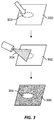
- FIG. 3 shows schematically a substrate 300 under test, a detectable fluorescent indicator 302 (e.g., provided as an applied fluorophoric compound according to the first method 100 or as a component of the formed antimicrobial surface coating according to the second method 200), application of the appropriate radiation 304 to be absorbed by the fluorescent indicator 302, and emission of light in the visible spectrum 306 indicating the presence of an antimicrobial surface coating.
- a detectable fluorescent indicator 302 e.g., provided as an applied fluorophoric compound according to the first method 100 or as a component of the formed antimicrobial surface coating according to the second method 200
- Antimicrobial surface coatings according to the present disclosure find widespread application in the field of antimicrobials and may be used to surface treat any substrate benefitting from the advantages of an antimicrobial surface coating.
- embodiments of the methods disclosed herein may include one or more of the steps described herein. Further, such steps may be carried out in any desired order and two or more of the steps may be carried out simultaneously with one another. Two or more of the steps disclosed herein may be combined in a single step, and in some embodiments, one or more of the steps may be carried out as two or more sub-steps. Further, other steps or sub-steps may be carried in addition to, or as substitutes to one or more of the steps disclosed herein.
Landscapes
- Health & Medical Sciences (AREA)
- Chemical & Material Sciences (AREA)
- Physics & Mathematics (AREA)
- Life Sciences & Earth Sciences (AREA)
- Immunology (AREA)
- General Health & Medical Sciences (AREA)
- Pathology (AREA)
- General Physics & Mathematics (AREA)
- Analytical Chemistry (AREA)
- Biochemistry (AREA)
- Nuclear Medicine, Radiotherapy & Molecular Imaging (AREA)
- Chemical Kinetics & Catalysis (AREA)
- Optics & Photonics (AREA)
- Molecular Biology (AREA)
- Inorganic Chemistry (AREA)
- Engineering & Computer Science (AREA)
- Materials Engineering (AREA)
- Wood Science & Technology (AREA)
- Organic Chemistry (AREA)
- Mathematical Physics (AREA)
- Paints Or Removers (AREA)
- Application Of Or Painting With Fluid Materials (AREA)
- Investigating, Analyzing Materials By Fluorescence Or Luminescence (AREA)
Abstract
Description
- This nonprovisional patent application claims the benefit of
U.S. Provisional Application No. 63/043,661 filed June 24, 2020 U.S. Provisional Application No. 63/062,855 filed August 7, 2020 - The present disclosure is directed generally to antimicrobials and more particularly to antimicrobial surface coatings and methods for detecting a presence or absence of an antimicrobial surface coating using a fluorescent indicator.
- It is well known that various surfaces can harbor microbes. It is also well known that contact with contaminated surfaces can spread infectious agents such as bacteria and viruses. For example, high-contact interior surfaces in a conveyance such as a passenger aircraft have a high potential to transfer microbes between passengers. While these high-contact surfaces can be disinfected during regular cleanings, comprehensive cleaning and sterilization solutions can be time-consuming. Further, there remains the potential for microbe transfer between cleanings. This potential can be alleviated using antimicrobial surface coatings. While effective, antimicrobial surface coatings can degrade and wear away over time and therefore must be checked to ensure their continued presence and reapplied, as necessary.
- Quaternary ammonium compounds (QACs) are commonly used in antimicrobial surface coatings due to their ability to neutralize microbes. That same ability can also be used to bond anionic dyes, for instance bromophenol blue (BPB), to detect the presence of antimicrobial coatings via dye bonding and visual inspection. While effective, the process of bonding visible dyes to surface coatings can permanently stain the surface under test and are reliant on absorbance, which is not inherently sensitive.
- Therefore, what is needed are methods for detecting the presence or absence of antimicrobial surface coatings without the need for complicated procedures and without any negative effect on the cosmetic appearance of the coated surface, while having the sensitivity to detect even monolayers of coating.
- To achieve the foregoing and other advantages, in a first aspect the present disclosure provides a method for detecting the presence or absence of an antimicrobial surface coating. In embodiments, the method includes providing a substrate to be tested, applying a detectable fluorophoric dye compound to a surface of the substrate, irradiating the surface of the substrate with ultraviolet radiation in the 100-415 nm wavelength range to excite the detectable fluorophoric dye compound, observing fluorescence corresponding to the excited, detectable fluorophoric dye compound, and determining, based on the observed fluorescence, a presence or absence of an antimicrobial surface coating.
- In some embodiments, the method may further include the step of pre-treating the substrate with an antimicrobial surface coating solution comprising an antimicrobial component configured to covalently bond to the substrate.
- In some embodiments, the step of applying the detectable fluorophoric dye compound to the surface of the substrate may include the steps of depositing the detectable fluorophoric dye compound on the surface of the substrate, allowing the detectable fluorophoric dye compound to stand on the surface of the substrate for at least 30 seconds, removing excess detectable fluorophoric dye compound, and drying the substrate.
- In some embodiments, the detectable fluorophoric dye compound may be provided as a water-based or alcohol-based solution.
- In some embodiments, the substrate may be associated with a passenger cabin of a conveyance, for instance an aircraft, train, subway, bus, automobile, or vessel.
- In some embodiments, the substrate may be an element of a passenger seat, a passenger suite, a passenger amenity, a control unit, a closet or stowage/luggage bin, a lavatory, a self-serve bar or kiosk, or a galley.
- In some embodiments, the substrate may be a mechanism for actuating an element in a passenger cabin environment.
- The present disclosure further provides a method of coating a substrate with an antimicrobial coating including a detectable fluorescent indicator. In embodiments, the method includes providing a substrate, providing an antimicrobial coating solution comprising an antimicrobial component configured to covalently bond to a surface of the substrate and a detectable, water-soluble fluorescent indicator configured to absorb ultraviolet radiation in the 100-415 nm wavelength range and emit radiation in the 100-1000 nm wavelength range, preferably in the 380-740 nm wavelength range, applying the antimicrobial coating solution to the surface of the substrate, and allowing the antimicrobial coating solution to dry on the surface of the substrate to form the antimicrobial coating.
- In some embodiments, the method may further include the steps of irradiating the surface of the antimicrobial coated substrate with ultraviolet radiation in the 100-415 nm wavelength range to excite the detectable fluorescent indicator, observing fluorescence corresponding to the excited detectable fluorescent indicator, and confirming, based on the observed fluorescence, at least one of a presence and coverage of the antimicrobial surface coating.
- In some embodiments, the step of allowing the antimicrobial solution to dry on the surface of the substrate may include allowing the antimicrobial coating solution to stand on the surface of the substrate for a time duration of at least 6 hours.
- In some embodiments, the method may further include the steps of rinsing and drying the surface of the antimicrobial coated substrate.
- In some embodiments, the method may further include the step of, in the absence of fluorescence or due to inadequate coverage, reapplying the antimicrobial coating solution to the surface of the substrate.
- In some embodiments, the substrate may be associated with a passenger cabin of a conveyance, for instance an aircraft.
- In some embodiments, the substrate may be an element of a passenger seat, a passenger suite, a passenger amenity, a control unit, a closet or stowage/luggage bin, a lavatory, a self-serve bar or kiosk, or a galley and/or may correspond to a mechanism for actuating an element in a passenger cabin environment.
- This brief summary is provided solely as an introduction to subject matter that is fully described in the detailed description and illustrated in the drawings. This brief summary should not be considered to describe essential features nor be used to determine the scope of the claims. Moreover, it is to be understood that both the foregoing summary and the following detailed description are exemplary and explanatory only and are not necessarily restrictive of the subject matter claimed.
- The detailed description is described with reference to the accompanying figures. The use of the same reference numbers in different instances in the description and the figures may indicate similar or identical items. Various embodiments or examples ("examples") of the present disclosure are disclosed in the following detailed description and the accompanying drawings. The drawings are not necessarily to scale. In general, operations of disclosed processes may be performed in an arbitrary order, unless otherwise provided in the claims. In the drawings:
-
FIG. 1 is a flowchart illustrating a method for applying an antimicrobial surface coating to a substrate and detecting the presence of the coating using a detectable fluorescent indicator; -
FIG. 2 is a flowchart illustrating a method for forming an antimicrobial surface coating including a detectable fluorescent indicator, and detecting the formed antimicrobial surface coating using the detectable fluorescent indicator; and -
FIG. 3 illustrates schematically the implementation of the disclosed methodologies to determine a presence or absence of an antimicrobial surface coating. - Before explaining one or more embodiments of the disclosure in detail, it is to be understood that the embodiments are not limited in their application to the details of construction and the arrangement of the components or steps or methodologies set forth in the following description or illustrated in the drawings. In the following detailed description of embodiments, numerous specific details may be set forth to provide a more thorough understanding of the disclosure. However, it will be apparent to one of ordinary skill in the art having the benefit of the instant disclosure that the embodiments disclosed herein may be practiced without some of these specific details. In other instances, well-known features may not be described in detail to avoid unnecessarily complicating the instant disclosure.
- As used herein a letter following a reference numeral is intended to reference an embodiment of the feature or element that may be similar, but not necessarily identical, to a previously described element or feature bearing the same reference numeral (e.g., 1, 1a, 1b). Such shorthand notations are used for purposes of convenience only and should not be construed to limit the disclosure in any way unless expressly stated to the contrary.
- Further, unless expressly stated to the contrary, "or" refers to an inclusive or and not to an exclusive or. For example, a condition A or B is satisfied by any one of the following: A is true (or present) and B is false (or not present), A is false (or not present) and B is true (or present), and both A and B are true (or present).
- In addition, use of "a" or "an" may be employed to describe elements and components of embodiments disclosed herein. This is done merely for convenience and "a" and "an" are intended to include "one" or "at least one," and the singular also includes the plural unless it is obvious that it is meant otherwise.
- Finally, as used herein any reference to "one embodiment" or "some embodiments" means that a particular element, feature, structure, or characteristic described in connection with the embodiment is included in at least one embodiment disclosed herein. The appearances of the phrase "in some embodiments" in various places in the specification are not necessarily all referring to the same embodiment, and embodiments may include one or more of the features expressly described or inherently present herein, or any combination or sub-combination of two or more such features, along with any other features which may not necessarily be expressly described or inherently present in the instant disclosure.
- Broadly speaking, the present disclosure provides embodiments of methods for detecting antimicrobial surface coatings, detectable antimicrobial surface coating solutions, and methods for forming detectable antimicrobial surface coatings.
-
FIG. 1 illustrates afirst method 100 according to the present disclosure. In astep 102, a substrate is provided and an antimicrobial surface coating solution is applied to at least a portion of a surface of the substrate via, for example, a conventional coating process including but not limited to electrostatic spray application, dipping, wiping, or other common application methods. In astep 104, the antimicrobial solution may stand on the surface of the substrate until dry to form the antimicrobial surface coating. In some embodiments, the antimicrobial coating solution may stand on the surface of the substrate for a predetermined time duration, for example, about 30 minutes to about 6 hours to form the antimicrobial surface coating. Excess (e.g., unbonded) antimicrobial surface coating solution may be removed in one or more optional rinsing steps and the coated substrate may be dried in one or more optional drying steps. - In one or more of the embodiments of the present disclosure, the substrate may be any substrate type, for instance a high-contact substrate located in a passenger cabin of a conveyance such as an aircraft. Examples of substrates include, but are not limited to, synthetic or natural fabric surfaces, plastics, metals, composites and composite finishes, wood, glass, leather, and other non-cationic substrates. Substrate environments may include, but are not limited to, passenger cabins, crew quarters, lavatories, and galleys. Other environments may include schools, hospitals, public buildings, etc. In the case of a passenger conveyance, the substrate may be an element of, for example, a passenger seat, a passenger suite, interior panels, luggage bins, doors, walls, passengers amenities, control panels, passenger service units, lavatory fixtures, galley equipment, and beverage carts. In some embodiments, a substrate may be a mechanism operable for manipulating an element, for example, a handle, lock, latch, switch, control panel, etc.
- In one or more embodiments of the present disclosure, the antimicrobial coating solution may include a quaternary ammonium compound (QACs, "quats) or other static/non-leachable compound (e.g., silane-functionalized QACs, "SiQuat" or "silquat") configured to attract negatively-charged microorganisms to the surface where the microorganisms are neutralized. To an extent, QACs and other such static compounds may covalently bond to the substrates to which they are applied, resulting in sustainable layers of antimicrobial coatings that may persist for extended periods of time (e.g., 12 months or longer). In some embodiments, the antimicrobial layers may be of no more than nanometer-level thickness, which means that while such antimicrobial or antiviral coatings are invisible under normal conditions, they may be susceptible to wear or erosion due to physical contact.
- In a
step 106, a tester, for instance a crewmember or maintenance staff, may perform a field assessment of the substrate under test by applying a detectable fluorophoric compound to the substrate surface. For example, the substrate under test (e.g., or a control portion thereof) may be fully or partially immersed in one or more fluorophore-containing solutions (e.g., a solution of 0.05 to 0.28 volume percent in water or alcohol). Alternatively or additionally, the fluorophore-containing solution may be applied to the substrate by a process such as spraying, wiping, and via a pen-type applicator for direct application to the surface. Alternatively, application of a detectable fluorophoric compound may occur within minutes of application of the antimicrobial coating, rather than during field assessment. In astep 108, the fluorophore-containing solution may stand on the surface of the substrate for a predetermined time duration, for example, about 30 seconds up to about 5 minutes, more preferably about 30 seconds up to about 6 hours or more. In astep 110, the substrate surface may be rinsed to remove excess fluorophore-containing solution and then dried. In embodiments, fluorophoric solutions applied to the substrate under test may bond to QACs or other static antimicrobial compounds. In some embodiments, fluorophores may be applied to a control portion of the substrate under test. - In a
step 112, the substrate under test having the applied fluorophoric solution is irradiated with ultraviolet radiation in the 100-415 nm wavelength range, more preferably in the 365-415 nm wavelength range, to excite the at least one detectable fluorophoric dye compound. For example, the tester may apply long-wave ultraviolet (UV) light (e.g., "blacklight") to the treated substrate under test. In astep 114, the fluorescence corresponding to the excited fluorophoric dye compound is observed. For example, while the applied fluorophores may be imperceptible under normal visible light (e.g., and therefore may not present as a "stain"), the fluorophores may fluoresce under UV light. In astep 116, a presence or absence, or coverage, of the antimicrobial surface coating is determined based on the observed fluorescence. - For example, areas of the substrate under test where the fluorophores have bonded to antimicrobial QACs fluoresce and therefore are clearly visible under UV light, indicating areas where the antimicrobial coating is present. Similarly, a lack of fluorescence under UV light indicates the absence of an antimicrobial surface coating, for example, attenuated by wear or erosion. In an optional
additional step 118, the substrate under test may be flagged for further action, for instance reapplication of the antimicrobial surface coating, servicing, or replacement of the associated substrate, element or component. In anoptional step 120, the substrate under test may be washed with an aqueous solution containing sufficient concentrations of cationic species, such as cetyltrimethylammonium chloride or ammonium bicarbonate, to remove the detectable fluorophoric dye compound to 'reactivate' the antimicrobial properties of the underlying QACs or coatings. - In embodiments, the detectable fluorophoric dye compounds may be anionic dye compounds capable of bonding to QACs or other static antimicrobial coatings, e.g., via sulfonate or carboxylic acid functional groups. For example, anionic dye compounds of λex < 500 nm and λem > 400 nm may be ideally invisible under normal visible light and fluoresce under UV light (e.g.,Tetrasodium 4,4'-bis[[4-[bis(2-hydroxyethyl)amino]-6-(4-sulphonatoanilino)-1,3,5-triazin-2-yl]amino]stilbene-2,2'-disulphonate], Disodium;5-[[4-anilino-6-[2-hydroxyethyl(methyl)amino]-1,3,5-triazin-2-yl]amino]-2-[2-[4-[[4-anilino-6-[2-hydroxyethyl(methyl)amino]-1,3,5-triazin-2-yl]amino]-2-sulfonatophenyl]ethenyl]benzenesulfonate, Disodium 4,4'-bis(4-anilino-6-morpholino-s-triazin-2-ylamino)-2,2'-stilbenedisulfonate, Disodium;5-[[4-(2-methylanilino)-6-morpholin-4-yl-1,3,5-triazin-2-yl]amino]-2-[2-[4-[[4-(2-methylanilino)-6-morpholin-4-yl-1,3,5-triazin-2-yl]amino]-2-sulfonatophenyl]ethenyl]benzenesulfonate, Hexasodium;2-[[4-[(3-amino-3-oxopropyl)-(2-hydroxyethyl)amino]-6-[4-[2-[4-[[4-[(3-amino-3-oxopropyl)-(2-hydroxyethyl)amino]-6-(2,5-disulfonatoanilino)-1,3,5-triazin-2-yl]amino]-2-sulfonatophenyl]ethenyl]-3-sulfonatoanilino]-1,3,5-triazin-2-yl]amino]benzene-1,4-disulfonate, and related, as well as fluorescein-SA, Lucifer yellow, sulforhodamine-B or sulforhodamine-101, pyranine, HPTS or HPTS(Lys)3, MPTS, CTR, TSPP, TCPP, PTCA).
- While the
first method 100 is disclosed including both coating formation steps coating detection/identification steps, it is envisioned and intended that the detection/identification steps can be practiced alone in the case of a substrate under test considered to already include an antimicrobial surface coating or a substrate under in which the presence or absence of an antimicrobial surface coating is unknown. For instance, the detection steps can be practiced alone to determine antimicrobial coating presence, coverage area, wear, etc., for the purpose of determining the need for coating, recoating, spot-coating, replacement, etc. Further, the recited rinsing, washing and drying steps can be optional or additional rinsing, washing and drying steps can be performed. Coating application, dye compound application, rinsing, washing and drying procedures may vary depending on the substrate type, coating type, fluorophoric dye compound type, substrate location, and testing environment, among other factors. The foregoing is applicable to the recitedmethod 100 and methods discussed further below. -
FIG. 2 illustrates asecond method 200 according to the present disclosure. Broadly speaking, thesecond method 200 includes the steps of preparing an antimicrobial surface coating solution including a detectable fluorescent indicator component, coating a substrate with the prepared solution to form an antimicrobial surface coating, and detecting the presence or absence of the applied antimicrobial surface coating. In some embodiments, the antimicrobial surface coating solution may include an antimicrobial component and a detectable, water-soluble fluorescent indicator provided as a mixture to be coated on a substrate to impart antimicrobial properties to the coated substrate. In some embodiments, the solution may be a water-based or alcohol-based solution. - In a
step 202, an antimicrobial surface coating solution is prepared including at least a quaternary ammonium compound or other static/non-leachable compound and a detectable fluorescent indicator. In some embodiments, fluorescent indicators according to the present disclosure may include any fluorescent compound capable of absorption in the UV spectrum and emission in the visible spectrum. For example, the fluorescent compound may absorb radiation in the 100-415 nm wavelength range, more preferably in the 300-415 nm wavelength range, and most preferably in the 365-415 nm wavelength range, and emit radiation in the 100-1000 nm wavelength range, more preferably emit visible light in the 380-740 nm wavelength range. Suitable fluorescent compounds may be transparent in the presence of visible light and uncolored so as not to alter the color and/or transparency of the coating. Suitable fluorescent compounds can include, but are not limited to, commercially available fluorescent dyes, pigments, colorants and brighteners. A specific, non-limiting example of a suitable fluorescent compound can include 5-[[4-[bis(2-hydroxyethyl)amino]-6-(4-sulfonatoanilino)-1,3,5-triazin-2-yl]amino]-2-[(E)-2-[4-[[4-[bis(2-hydroxyethyl)amino]-6-(4-sulfonatoanilino)-1,3,5-triazin-2-yl]amino]-2-sulfonatophenyl]ethenyl]benzenesulfonate. - In a
step 204, the prepared solution is applied to the predetermined substrate and allowed to stand on the surface of the substrate until dry to form the antimicrobial surface coating. In some embodiments, the antimicrobial coating solution may be allowed to stand on the surface of the substrate for a predetermined time duration, for example, at least about 6 hours to form the antimicrobial surface coating. In anoptional step 206, the coated substrate may be rinsed or wiped to remove excess surface coating solution and subsequently dried. - In a
step 208, the substrate under test having the formed surface coating is irradiated with ultraviolet radiation, for example, in the 100-415 nm wavelength range, more preferably in the 365-415 nm wavelength range, to excite the detectable fluorescent indicator. For example, UV light may be directed to the substrate under test. In astep 210, the fluorescence corresponding to the excited fluorescent indicator is observed. In astep 212, a presence or absence, or coating coverage, of the antimicrobial surface coating is determined based on the observed fluorescence. For example, areas of the substrate that fluoresce are indicative of bonded antimicrobial surface coating, while areas of the substrate that do not fluorescence are indicative of uncoated substrate. - In some embodiments, the
determination step 212 may include comparing the intensity of fluoresce to a predetermined threshold value and/or compared to a control area known to be coated or known to lack a coating. In some embodiments, intensity level data for a particular substrate may be saved for comparison against future data to track wear and/or coating performance. In some embodiments, the methods disclosed herein can be used to determine the level of coating wear between areas of a substrate by comparing the level of fluorescent intensity between different predetermined areas. For example, obtained data can be used to determine frequent touchpoints that may require more frequent recoating, more robust coating, and/or additional coating layers. In an optionaladditional step 214, the substrate under test may be flagged for further action, for instance reapplication of antimicrobial surface coating, servicing or replacement of the associated substrate, element or component. - Methods according to the present disclosure can be used to verify the presence or absence of an antimicrobial coating, for example, to verify the application and quality of the coating during manufacturing, and/or detect wear in the coating during service. In some embodiments, the method includes providing a substrate coated with an antimicrobial surface coating containing a fluorescent indicator, exposing the coated substrate to UV light to excite the fluorescent indicator, and observing the presence or absence of fluorescence to detect coating presence and wear. In further embodiments, the method may include measuring the intensity of fluorescence across a coated substrate exposed to UV light and comparing the measured intensity to predefined threshold values corresponding to predefined wear indicators. Collected data may be analyzed to determine coating performance, compare performance between substrates, measure usage and wear, etc.
-
FIG. 3 shows schematically asubstrate 300 under test, a detectable fluorescent indicator 302 (e.g., provided as an applied fluorophoric compound according to thefirst method 100 or as a component of the formed antimicrobial surface coating according to the second method 200), application of theappropriate radiation 304 to be absorbed by thefluorescent indicator 302, and emission of light in thevisible spectrum 306 indicating the presence of an antimicrobial surface coating. - Antimicrobial surface coatings according to the present disclosure find widespread application in the field of antimicrobials and may be used to surface treat any substrate benefitting from the advantages of an antimicrobial surface coating.
- It is to be understood that embodiments of the methods disclosed herein may include one or more of the steps described herein. Further, such steps may be carried out in any desired order and two or more of the steps may be carried out simultaneously with one another. Two or more of the steps disclosed herein may be combined in a single step, and in some embodiments, one or more of the steps may be carried out as two or more sub-steps. Further, other steps or sub-steps may be carried in addition to, or as substitutes to one or more of the steps disclosed herein.
Claims (15)
- A method for detecting an antimicrobial surface coating, comprising the steps of:providing (102) a substrate (300);applying (106) a detectable fluorophoric dye compound (302) to a surface of the substrate;irradiating (112) the surface of the substrate with ultraviolet radiation in the 100-415 nm wavelength range to excite the detectable fluorophoric dye compound;observing (114) fluorescence corresponding to the excited detectable fluorophoric dye compound; anddetermining (116), based on the observed fluorescence, a presence or an absence of an antimicrobial surface coating.
- The method according to claim 1, further comprising the step of pre-treating (202) the substrate with an antimicrobial surface coating solution comprising an antimicrobial component configured to covalently bond to the substrate.
- The method according to claim 1 or 2, wherein the step of applying the detectable fluorophoric dye compound to the surface of the substrate comprises:depositing the detectable fluorophoric dye compound on the surface of the substrate;allowing the detectable fluorophoric dye compound to stand on the surface of the substrate for a predetermined time duration;removing excess deposited detectable fluorophoric dye from the surface of the substrate; anddrying the surface of the substrate.
- The method according to any preceding claim, wherein the detectable fluorophoric dye compound is provided in a water-based or alcohol-based solution.
- The method according to any preceding claim, wherein the substrate is located in a passenger cabin of a conveyance.
- The method according to claim 5, wherein the substrate is an element of a passenger seat, a passenger suite, a passenger amenity, a control unit, a stowage/luggage bin, a self-service bar or kiosk, a lavatory, or a galley.
- The method according to claim 5, wherein the substrate is part of a mechanism for actuating an element in a passenger cabin environment.
- A method for forming an antimicrobial coating, comprising the steps of:providing a substrate;providing (202) an antimicrobial coating solution comprising an antimicrobial component configured to covalently bond to a surface of the substrate and a detectable fluorescent indicator configured to absorb ultraviolet radiation in the 100-415 nm wavelength range and, upon being excited, emit radiation in the 100-1000 nm wavelength range, wherein the emitted radiation wavelength and the absorbed ultraviolet radiation wavelength are different wavelengths;applying (204) the antimicrobial coating solution to the surface of the substrate; andallowing the antimicrobial coating solution to stand on the surface of the substrate to form the antimicrobial coating.
- The method according to claim 8, wherein the detectable fluorescent indicator is configured to absorb ultraviolet radiation in the 300-415 nm wavelength range and, upon being excited, emit visible light in the 380-740 nm wavelength range.
- The method according to claim 8 or 9, further comprising the steps of:irradiating (208) the surface of the antimicrobial coated substrate with ultraviolet radiation in the 100-415 nm wavelength range to excite the detectable fluorescent indicator;observing (210) fluorescence corresponding to the excited detectable fluorescent indicator; andverifying, based on the observed fluorescence, a presence of the antimicrobial surface coating.
- The method according to claim 10, further comprising the step of:
in the absence of fluorescence or observed fluorescence less than a predetermined threshold value, reapplying the antimicrobial coating solution to at least a portion of the surface of the substrate. - The method according to any of claims 8 to 11, further comprising the steps of, subsequent to the step of allowing the antimicrobial solution to stand on the surface of the substrate, removing excess applied antimicrobial solution from the surface of the substrate and drying the surface of the antimicrobial coated substrate.
- The method according to any of claims 8 to 12, wherein the substrate is located in a passenger cabin of an aircraft.
- The method according to claim 13, wherein the substrate is an element of a passenger seat, a passenger suite, a passenger amenity, a control unit, a stowage/luggage bin, a lavatory, a self-service bar or kiosk, or a galley.
- The method according to any of claims 8 to 14, wherein the substrate is part of a mechanism for actuating an element in a passenger cabin environment.
Applications Claiming Priority (3)
| Application Number | Priority Date | Filing Date | Title |
|---|---|---|---|
| US202063043661P | 2020-06-24 | 2020-06-24 | |
| US202063062855P | 2020-08-07 | 2020-08-07 | |
| US17/071,781 US11536662B2 (en) | 2020-06-24 | 2020-10-15 | Methods for detecting antimicrobial surface coatings using fluorescent indicators |
Publications (2)
| Publication Number | Publication Date |
|---|---|
| EP3929569A1 true EP3929569A1 (en) | 2021-12-29 |
| EP3929569B1 EP3929569B1 (en) | 2023-12-20 |
Family
ID=76958695
Family Applications (1)
| Application Number | Title | Priority Date | Filing Date |
|---|---|---|---|
| EP21181532.9A Active EP3929569B1 (en) | 2020-06-24 | 2021-06-24 | Methods for forming antimicrobial surface coatings comprising fluorescent indicators |
Country Status (2)
| Country | Link |
|---|---|
| US (1) | US11536662B2 (en) |
| EP (1) | EP3929569B1 (en) |
Cited By (1)
| Publication number | Priority date | Publication date | Assignee | Title |
|---|---|---|---|---|
| EP3970495A1 (en) * | 2020-09-21 | 2022-03-23 | B/E Aerospace, Inc. | Detecting antimicrobial surfaces |
Families Citing this family (4)
| Publication number | Priority date | Publication date | Assignee | Title |
|---|---|---|---|---|
| US20210388217A1 (en) * | 2020-06-10 | 2021-12-16 | Ami Industries, Inc. | Enhanced maintenance antiviral coatings for cabin surfaces |
| US12332180B2 (en) * | 2020-06-24 | 2025-06-17 | B/E Aerospace, Inc. | Antimicrobial surface coating formation, detection, quantification and reactivation systems and methods |
| US12038268B2 (en) * | 2021-12-27 | 2024-07-16 | Hamilton Sundstrand Corporation | Method of detecting coating wear |
| EP4472682A4 (en) * | 2022-02-01 | 2026-02-18 | Hrl Lab Llc | Sensors for antimicrobial biphase polymers and systems and methods using them |
Citations (1)
| Publication number | Priority date | Publication date | Assignee | Title |
|---|---|---|---|---|
| WO2008157323A1 (en) * | 2007-06-13 | 2008-12-24 | 3M Innovative Properties Company | Antimicrobial film-forming composition, antimicrobial film, and method of verifying the presence of an antimicrobial film |
Family Cites Families (28)
| Publication number | Priority date | Publication date | Assignee | Title |
|---|---|---|---|---|
| JPH03122553A (en) | 1989-10-04 | 1991-05-24 | Olympus Optical Co Ltd | Photosensor |
| US20030147925A1 (en) * | 1998-09-11 | 2003-08-07 | Samuel P. Sawan | Topical dermal antimicrobial compositions, methods for generating same, and monitoring methods utilizing same |
| US6864489B2 (en) * | 2001-10-30 | 2005-03-08 | 3M Innovative Properties Company | Method of detecting wear on a substrate using a fluorescent indicator |
| US8282951B2 (en) * | 2003-01-13 | 2012-10-09 | EnviroCare Corporation | Antimicrobial coatings for treatment of surfaces in a building setting and method of applying same |
| GB2407581A (en) | 2003-11-01 | 2005-05-04 | Reckitt Benckiser Inc | Hard surface cleaning and disinfecting compositions |
| US8999357B2 (en) | 2005-02-07 | 2015-04-07 | Sishield Technologies, Inc. | Methods and compositions for biocidal treatments |
| US7718395B2 (en) | 2005-03-30 | 2010-05-18 | Kleancheck Systems, Llc | Monitoring cleaning of surfaces |
| US20060246019A1 (en) | 2005-04-29 | 2006-11-02 | Cole Curtis A | Topical composition detection |
| CA2658147A1 (en) | 2006-07-14 | 2008-01-17 | Ciba Holding Inc. | Polysiloxane antimicrobials |
| US20100003198A1 (en) * | 2008-07-07 | 2010-01-07 | Patrick John Stolmeier | Antimicrobial Topical and Other Preparations Containing Fluorescent or Illumination Dye and Tracer Agents or Compounds |
| AU2009338189B2 (en) | 2009-01-22 | 2012-10-25 | Colgate-Palmolive Company | Alkyl quaternium silicone compounds |
| WO2011123623A2 (en) | 2010-03-31 | 2011-10-06 | Ap Goldshield, Llc | Skin, nail and hair topical antimicrobial methods using formulations containing organosilane quaternaries |
| US9095731B2 (en) | 2010-11-23 | 2015-08-04 | Medivators Inc. | Anti-microbial composition |
| US8519360B2 (en) | 2011-02-28 | 2013-08-27 | BOS Innovations Ltd. | Method and apparatus for disinfection verification |
| WO2013112207A1 (en) | 2012-01-25 | 2013-08-01 | Diversey, Inc. | Compositions and methods for cleaning management |
| US8822719B1 (en) | 2013-03-05 | 2014-09-02 | Ecolab Usa Inc. | Peroxycarboxylic acid compositions suitable for inline optical or conductivity monitoring |
| US9810630B1 (en) | 2013-03-12 | 2017-11-07 | Ecolab Usa Inc. | Fluorescent marking gel compositions and methods of use |
| US9624423B2 (en) | 2014-07-01 | 2017-04-18 | Ecolab Usa Inc. | Use of fluorescent polymers in marking compositions for the diagnostic determination of cleaning performance |
| WO2017100398A1 (en) | 2015-12-10 | 2017-06-15 | Chemia Corporation | Compositions comprising an ultraviolet indicator |
| US20170273307A1 (en) * | 2016-03-28 | 2017-09-28 | Trent University | Silane-based antimicrobial coatings and methods of making and using the same |
| US20180368648A1 (en) * | 2017-06-23 | 2018-12-27 | Allied Bioscience, Inc. | Antimicrobial sponges |
| US10806140B2 (en) | 2018-04-12 | 2020-10-20 | Physical Sciences, Inc. | Antimicrobial compound |
| CN108586751A (en) | 2018-05-16 | 2018-09-28 | 山东交通学院 | A kind of ethenyl blocking polysiloxanes containing quaternary ammonium salt and its synthesis and the application in preparing intrinsic quaternary antibacterial silicon rubber |
| US11118144B2 (en) | 2018-05-29 | 2021-09-14 | Clearstream Technologies, Llc | Antimicrobial surface cleansers and biostatic coatings for removable dental prosthetic appliances and oral devices |
| AU2020210650B2 (en) * | 2019-01-25 | 2021-03-18 | Allied Bioscience, Inc. | Analysis of antimicrobial coatings using XRF |
| CN110044913A (en) | 2019-03-27 | 2019-07-23 | 易安基自动化设备(北京)有限公司 | A kind of method and device of the surface cleanness of detection object |
| WO2021178849A1 (en) * | 2020-03-06 | 2021-09-10 | Mshield Holdings Inc. | Tracking application coverage and degradation of antimicrobial chemical coatings |
| US20210388217A1 (en) * | 2020-06-10 | 2021-12-16 | Ami Industries, Inc. | Enhanced maintenance antiviral coatings for cabin surfaces |
-
2020
- 2020-10-15 US US17/071,781 patent/US11536662B2/en active Active
-
2021
- 2021-06-24 EP EP21181532.9A patent/EP3929569B1/en active Active
Patent Citations (1)
| Publication number | Priority date | Publication date | Assignee | Title |
|---|---|---|---|---|
| WO2008157323A1 (en) * | 2007-06-13 | 2008-12-24 | 3M Innovative Properties Company | Antimicrobial film-forming composition, antimicrobial film, and method of verifying the presence of an antimicrobial film |
Non-Patent Citations (3)
| Title |
|---|
| LUKASZ M. POROSA ET AL: "Synthesis, structures and properties of self-assembling quaternary ammonium dansyl fluorescent tags for porous and non-porous surfaces", JOURNAL OF MATERIALS CHEMISTRY. B, vol. 2, no. 11, 2014, GB, pages 1509, XP055280973, ISSN: 2050-750X, DOI: 10.1039/c3tb21633k * |
| SHUM RACHEL L. ET AL: "UV-Curable Surface-Attached Antimicrobial Polymeric Onium Coatings: Designing Effective, Solvent-Resistant Coatings for Plastic Surfaces", ACS APPLIED BIO MATERIALS, vol. 3, no. 7, 9 June 2020 (2020-06-09), US, pages 4302 - 4315, XP055851710, ISSN: 2576-6422, DOI: 10.1021/acsabm.0c00359 * |
| SJOLLEMA JELMER ET AL: "In vitromethods for the evaluation of antimicrobial surface designs", ACTA BIOMATERIALIA, ELSEVIER, AMSTERDAM , NL, vol. 70, 10 February 2018 (2018-02-10), pages 12 - 24, XP085367324, ISSN: 1742-7061, DOI: 10.1016/J.ACTBIO.2018.02.001 * |
Cited By (2)
| Publication number | Priority date | Publication date | Assignee | Title |
|---|---|---|---|---|
| EP3970495A1 (en) * | 2020-09-21 | 2022-03-23 | B/E Aerospace, Inc. | Detecting antimicrobial surfaces |
| US12326443B2 (en) | 2020-09-21 | 2025-06-10 | B/E Aerospace Inc. | Detecting antimicrobial surfaces |
Also Published As
| Publication number | Publication date |
|---|---|
| US20210404959A1 (en) | 2021-12-30 |
| US11536662B2 (en) | 2022-12-27 |
| EP3929569B1 (en) | 2023-12-20 |
Similar Documents
| Publication | Publication Date | Title |
|---|---|---|
| US11536662B2 (en) | Methods for detecting antimicrobial surface coatings using fluorescent indicators | |
| EP4144805A1 (en) | Surface textured barrier coatings and methods for texturing barrier coatings to impart hydrophobicity | |
| US12332180B2 (en) | Antimicrobial surface coating formation, detection, quantification and reactivation systems and methods | |
| EP3936858B1 (en) | Antimicrobial surface coating detection, quantification and reactivation methods | |
| EP1928961B1 (en) | Coloured coating and formulation comprising an indicator facilitating determining the coating thickness | |
| JP7685319B2 (en) | Method for measuring the amount of copper deposited on component surfaces | |
| EP4113106B1 (en) | Antimicrobial surface coating detection, quantification and reactivation methods | |
| Yamaguchi et al. | Rhodamine B adsorption on anodic porous alumina in sodium dodecyl sulfate solutions | |
| EP4148420A1 (en) | Methods for measuring and quantifying surface cleanability of articles | |
| GB2434447A (en) | Fluorescent coating for the detection of corrosion at an aluminium based substrate | |
| DE102004027118B4 (en) | Method for detecting the photocatalytic degradation of organic dyes by fluorescence analysis | |
| EP4279563B1 (en) | Methods and systems for indicating a sanitation status of a surface | |
| US12338365B2 (en) | Pigmented multifunctional barrier coating compositions | |
| EP4223845A1 (en) | Methods for forming multifunctional barrier coatings with enhanced component positioning | |
| Farrier et al. | Sample preparation and characterization of artificially aged aircraft coatings for microstructural analysis | |
| CA2622540A1 (en) | Method for detecting residues on a component | |
| EP4060336A1 (en) | Systems and methods for detecting antimicrobial surface coatings | |
| US20210332249A1 (en) | Additive for quality determination of conversion coatings | |
| US9580646B2 (en) | Method for treating a steel band or plate provided with a metal coating with an after-treatment agent, and a steel band or plate provided with a metal coating | |
| JP2022036890A (en) | Method for determining antimicrobial performance of antimicrobial member, method for measuring antimicrobial performance, method for determining good product of antimicrobial member, method for reusing antimicrobial member, method for monitoring business of antimicrobial member, and method for measuring deposition of copper (i) of member surface | |
| EP3670740B1 (en) | Amphiphobic cellulosic materials, production thereof and uses | |
| Garbacz | Influence of Laboratory Ageing on the Preservation of Anti-graffiti Properties for Paint Systems Used in Rolling Stock | |
| Pratz et al. | Physical Evaluation of Cleaning Performance: We Are Only Fooling Ourselves | |
| JP2001321676A (en) | Photocatalyst coating agent and photocatalyst coating method | |
| Nömayr | UV-Stability and Associated Failure Mechanism of Thin Film Automotive Paints |
Legal Events
| Date | Code | Title | Description |
|---|---|---|---|
| PUAI | Public reference made under article 153(3) epc to a published international application that has entered the european phase |
Free format text: ORIGINAL CODE: 0009012 |
|
| STAA | Information on the status of an ep patent application or granted ep patent |
Free format text: STATUS: THE APPLICATION HAS BEEN PUBLISHED |
|
| AK | Designated contracting states |
Kind code of ref document: A1 Designated state(s): AL AT BE BG CH CY CZ DE DK EE ES FI FR GB GR HR HU IE IS IT LI LT LU LV MC MK MT NL NO PL PT RO RS SE SI SK SM TR |
|
| B565 | Issuance of search results under rule 164(2) epc |
Effective date: 20211028 |
|
| STAA | Information on the status of an ep patent application or granted ep patent |
Free format text: STATUS: REQUEST FOR EXAMINATION WAS MADE |
|
| 17P | Request for examination filed |
Effective date: 20220629 |
|
| RBV | Designated contracting states (corrected) |
Designated state(s): AL AT BE BG CH CY CZ DE DK EE ES FI FR GB GR HR HU IE IS IT LI LT LU LV MC MK MT NL NO PL PT RO RS SE SI SK SM TR |
|
| GRAP | Despatch of communication of intention to grant a patent |
Free format text: ORIGINAL CODE: EPIDOSNIGR1 |
|
| STAA | Information on the status of an ep patent application or granted ep patent |
Free format text: STATUS: GRANT OF PATENT IS INTENDED |
|
| RIC1 | Information provided on ipc code assigned before grant |
Ipc: G01N 21/84 20060101ALI20230601BHEP Ipc: G01N 21/64 20060101AFI20230601BHEP |
|
| INTG | Intention to grant announced |
Effective date: 20230703 |
|
| P01 | Opt-out of the competence of the unified patent court (upc) registered |
Effective date: 20230922 |
|
| GRAS | Grant fee paid |
Free format text: ORIGINAL CODE: EPIDOSNIGR3 |
|
| GRAA | (expected) grant |
Free format text: ORIGINAL CODE: 0009210 |
|
| STAA | Information on the status of an ep patent application or granted ep patent |
Free format text: STATUS: THE PATENT HAS BEEN GRANTED |
|
| AK | Designated contracting states |
Kind code of ref document: B1 Designated state(s): AL AT BE BG CH CY CZ DE DK EE ES FI FR GB GR HR HU IE IS IT LI LT LU LV MC MK MT NL NO PL PT RO RS SE SI SK SM TR |
|
| REG | Reference to a national code |
Ref country code: GB Ref legal event code: FG4D |
|
| REG | Reference to a national code |
Ref country code: DE Ref legal event code: R096 Ref document number: 602021007822 Country of ref document: DE |
|
| REG | Reference to a national code |
Ref country code: CH Ref legal event code: EP |
|
| REG | Reference to a national code |
Ref country code: IE Ref legal event code: FG4D |
|
| PG25 | Lapsed in a contracting state [announced via postgrant information from national office to epo] |
Ref country code: GR Free format text: LAPSE BECAUSE OF FAILURE TO SUBMIT A TRANSLATION OF THE DESCRIPTION OR TO PAY THE FEE WITHIN THE PRESCRIBED TIME-LIMIT Effective date: 20240321 |
|
| REG | Reference to a national code |
Ref country code: LT Ref legal event code: MG9D |
|
| PG25 | Lapsed in a contracting state [announced via postgrant information from national office to epo] |
Ref country code: LT Free format text: LAPSE BECAUSE OF FAILURE TO SUBMIT A TRANSLATION OF THE DESCRIPTION OR TO PAY THE FEE WITHIN THE PRESCRIBED TIME-LIMIT Effective date: 20231220 |
|
| REG | Reference to a national code |
Ref country code: NL Ref legal event code: MP Effective date: 20231220 |
|
| PG25 | Lapsed in a contracting state [announced via postgrant information from national office to epo] |
Ref country code: ES Free format text: LAPSE BECAUSE OF FAILURE TO SUBMIT A TRANSLATION OF THE DESCRIPTION OR TO PAY THE FEE WITHIN THE PRESCRIBED TIME-LIMIT Effective date: 20231220 |
|
| PG25 | Lapsed in a contracting state [announced via postgrant information from national office to epo] |
Ref country code: LT Free format text: LAPSE BECAUSE OF FAILURE TO SUBMIT A TRANSLATION OF THE DESCRIPTION OR TO PAY THE FEE WITHIN THE PRESCRIBED TIME-LIMIT Effective date: 20231220 Ref country code: GR Free format text: LAPSE BECAUSE OF FAILURE TO SUBMIT A TRANSLATION OF THE DESCRIPTION OR TO PAY THE FEE WITHIN THE PRESCRIBED TIME-LIMIT Effective date: 20240321 Ref country code: FI Free format text: LAPSE BECAUSE OF FAILURE TO SUBMIT A TRANSLATION OF THE DESCRIPTION OR TO PAY THE FEE WITHIN THE PRESCRIBED TIME-LIMIT Effective date: 20231220 Ref country code: ES Free format text: LAPSE BECAUSE OF FAILURE TO SUBMIT A TRANSLATION OF THE DESCRIPTION OR TO PAY THE FEE WITHIN THE PRESCRIBED TIME-LIMIT Effective date: 20231220 Ref country code: BG Free format text: LAPSE BECAUSE OF FAILURE TO SUBMIT A TRANSLATION OF THE DESCRIPTION OR TO PAY THE FEE WITHIN THE PRESCRIBED TIME-LIMIT Effective date: 20240320 |
|
| REG | Reference to a national code |
Ref country code: AT Ref legal event code: MK05 Ref document number: 1642866 Country of ref document: AT Kind code of ref document: T Effective date: 20231220 |
|
| PG25 | Lapsed in a contracting state [announced via postgrant information from national office to epo] |
Ref country code: NL Free format text: LAPSE BECAUSE OF FAILURE TO SUBMIT A TRANSLATION OF THE DESCRIPTION OR TO PAY THE FEE WITHIN THE PRESCRIBED TIME-LIMIT Effective date: 20231220 |
|
| PG25 | Lapsed in a contracting state [announced via postgrant information from national office to epo] |
Ref country code: SE Free format text: LAPSE BECAUSE OF FAILURE TO SUBMIT A TRANSLATION OF THE DESCRIPTION OR TO PAY THE FEE WITHIN THE PRESCRIBED TIME-LIMIT Effective date: 20231220 Ref country code: RS Free format text: LAPSE BECAUSE OF FAILURE TO SUBMIT A TRANSLATION OF THE DESCRIPTION OR TO PAY THE FEE WITHIN THE PRESCRIBED TIME-LIMIT Effective date: 20231220 Ref country code: NO Free format text: LAPSE BECAUSE OF FAILURE TO SUBMIT A TRANSLATION OF THE DESCRIPTION OR TO PAY THE FEE WITHIN THE PRESCRIBED TIME-LIMIT Effective date: 20240320 Ref country code: NL Free format text: LAPSE BECAUSE OF FAILURE TO SUBMIT A TRANSLATION OF THE DESCRIPTION OR TO PAY THE FEE WITHIN THE PRESCRIBED TIME-LIMIT Effective date: 20231220 Ref country code: LV Free format text: LAPSE BECAUSE OF FAILURE TO SUBMIT A TRANSLATION OF THE DESCRIPTION OR TO PAY THE FEE WITHIN THE PRESCRIBED TIME-LIMIT Effective date: 20231220 Ref country code: HR Free format text: LAPSE BECAUSE OF FAILURE TO SUBMIT A TRANSLATION OF THE DESCRIPTION OR TO PAY THE FEE WITHIN THE PRESCRIBED TIME-LIMIT Effective date: 20231220 |
|
| PG25 | Lapsed in a contracting state [announced via postgrant information from national office to epo] |
Ref country code: IS Free format text: LAPSE BECAUSE OF FAILURE TO SUBMIT A TRANSLATION OF THE DESCRIPTION OR TO PAY THE FEE WITHIN THE PRESCRIBED TIME-LIMIT Effective date: 20240420 |
|
| PG25 | Lapsed in a contracting state [announced via postgrant information from national office to epo] |
Ref country code: CZ Free format text: LAPSE BECAUSE OF FAILURE TO SUBMIT A TRANSLATION OF THE DESCRIPTION OR TO PAY THE FEE WITHIN THE PRESCRIBED TIME-LIMIT Effective date: 20231220 Ref country code: AT Free format text: LAPSE BECAUSE OF FAILURE TO SUBMIT A TRANSLATION OF THE DESCRIPTION OR TO PAY THE FEE WITHIN THE PRESCRIBED TIME-LIMIT Effective date: 20231220 |
|
| PG25 | Lapsed in a contracting state [announced via postgrant information from national office to epo] |
Ref country code: SK Free format text: LAPSE BECAUSE OF FAILURE TO SUBMIT A TRANSLATION OF THE DESCRIPTION OR TO PAY THE FEE WITHIN THE PRESCRIBED TIME-LIMIT Effective date: 20231220 |
|
| PG25 | Lapsed in a contracting state [announced via postgrant information from national office to epo] |
Ref country code: SM Free format text: LAPSE BECAUSE OF FAILURE TO SUBMIT A TRANSLATION OF THE DESCRIPTION OR TO PAY THE FEE WITHIN THE PRESCRIBED TIME-LIMIT Effective date: 20231220 Ref country code: SK Free format text: LAPSE BECAUSE OF FAILURE TO SUBMIT A TRANSLATION OF THE DESCRIPTION OR TO PAY THE FEE WITHIN THE PRESCRIBED TIME-LIMIT Effective date: 20231220 Ref country code: RO Free format text: LAPSE BECAUSE OF FAILURE TO SUBMIT A TRANSLATION OF THE DESCRIPTION OR TO PAY THE FEE WITHIN THE PRESCRIBED TIME-LIMIT Effective date: 20231220 Ref country code: IT Free format text: LAPSE BECAUSE OF FAILURE TO SUBMIT A TRANSLATION OF THE DESCRIPTION OR TO PAY THE FEE WITHIN THE PRESCRIBED TIME-LIMIT Effective date: 20231220 Ref country code: IS Free format text: LAPSE BECAUSE OF FAILURE TO SUBMIT A TRANSLATION OF THE DESCRIPTION OR TO PAY THE FEE WITHIN THE PRESCRIBED TIME-LIMIT Effective date: 20240420 Ref country code: EE Free format text: LAPSE BECAUSE OF FAILURE TO SUBMIT A TRANSLATION OF THE DESCRIPTION OR TO PAY THE FEE WITHIN THE PRESCRIBED TIME-LIMIT Effective date: 20231220 Ref country code: CZ Free format text: LAPSE BECAUSE OF FAILURE TO SUBMIT A TRANSLATION OF THE DESCRIPTION OR TO PAY THE FEE WITHIN THE PRESCRIBED TIME-LIMIT Effective date: 20231220 Ref country code: AT Free format text: LAPSE BECAUSE OF FAILURE TO SUBMIT A TRANSLATION OF THE DESCRIPTION OR TO PAY THE FEE WITHIN THE PRESCRIBED TIME-LIMIT Effective date: 20231220 |
|
| PG25 | Lapsed in a contracting state [announced via postgrant information from national office to epo] |
Ref country code: PT Free format text: LAPSE BECAUSE OF FAILURE TO SUBMIT A TRANSLATION OF THE DESCRIPTION OR TO PAY THE FEE WITHIN THE PRESCRIBED TIME-LIMIT Effective date: 20240422 Ref country code: PL Free format text: LAPSE BECAUSE OF FAILURE TO SUBMIT A TRANSLATION OF THE DESCRIPTION OR TO PAY THE FEE WITHIN THE PRESCRIBED TIME-LIMIT Effective date: 20231220 |
|
| PG25 | Lapsed in a contracting state [announced via postgrant information from national office to epo] |
Ref country code: PT Free format text: LAPSE BECAUSE OF FAILURE TO SUBMIT A TRANSLATION OF THE DESCRIPTION OR TO PAY THE FEE WITHIN THE PRESCRIBED TIME-LIMIT Effective date: 20240422 Ref country code: PL Free format text: LAPSE BECAUSE OF FAILURE TO SUBMIT A TRANSLATION OF THE DESCRIPTION OR TO PAY THE FEE WITHIN THE PRESCRIBED TIME-LIMIT Effective date: 20231220 |
|
| REG | Reference to a national code |
Ref country code: DE Ref legal event code: R097 Ref document number: 602021007822 Country of ref document: DE |
|
| PG25 | Lapsed in a contracting state [announced via postgrant information from national office to epo] |
Ref country code: DK Free format text: LAPSE BECAUSE OF FAILURE TO SUBMIT A TRANSLATION OF THE DESCRIPTION OR TO PAY THE FEE WITHIN THE PRESCRIBED TIME-LIMIT Effective date: 20231220 |
|
| PLBE | No opposition filed within time limit |
Free format text: ORIGINAL CODE: 0009261 |
|
| STAA | Information on the status of an ep patent application or granted ep patent |
Free format text: STATUS: NO OPPOSITION FILED WITHIN TIME LIMIT |
|
| PG25 | Lapsed in a contracting state [announced via postgrant information from national office to epo] |
Ref country code: SI Free format text: LAPSE BECAUSE OF FAILURE TO SUBMIT A TRANSLATION OF THE DESCRIPTION OR TO PAY THE FEE WITHIN THE PRESCRIBED TIME-LIMIT Effective date: 20231220 |
|
| PG25 | Lapsed in a contracting state [announced via postgrant information from national office to epo] |
Ref country code: SI Free format text: LAPSE BECAUSE OF FAILURE TO SUBMIT A TRANSLATION OF THE DESCRIPTION OR TO PAY THE FEE WITHIN THE PRESCRIBED TIME-LIMIT Effective date: 20231220 Ref country code: DK Free format text: LAPSE BECAUSE OF FAILURE TO SUBMIT A TRANSLATION OF THE DESCRIPTION OR TO PAY THE FEE WITHIN THE PRESCRIBED TIME-LIMIT Effective date: 20231220 |
|
| 26N | No opposition filed |
Effective date: 20240923 |
|
| PG25 | Lapsed in a contracting state [announced via postgrant information from national office to epo] |
Ref country code: MC Free format text: LAPSE BECAUSE OF FAILURE TO SUBMIT A TRANSLATION OF THE DESCRIPTION OR TO PAY THE FEE WITHIN THE PRESCRIBED TIME-LIMIT Effective date: 20231220 |
|
| REG | Reference to a national code |
Ref country code: CH Ref legal event code: PL |
|
| PG25 | Lapsed in a contracting state [announced via postgrant information from national office to epo] |
Ref country code: LU Free format text: LAPSE BECAUSE OF NON-PAYMENT OF DUE FEES Effective date: 20240624 |
|
| PG25 | Lapsed in a contracting state [announced via postgrant information from national office to epo] |
Ref country code: IE Free format text: LAPSE BECAUSE OF NON-PAYMENT OF DUE FEES Effective date: 20240624 |
|
| PG25 | Lapsed in a contracting state [announced via postgrant information from national office to epo] |
Ref country code: BE Free format text: LAPSE BECAUSE OF NON-PAYMENT OF DUE FEES Effective date: 20240630 Ref country code: CH Free format text: LAPSE BECAUSE OF NON-PAYMENT OF DUE FEES Effective date: 20240630 |
|
| REG | Reference to a national code |
Ref country code: BE Ref legal event code: MM Effective date: 20240630 |
|
| PGFP | Annual fee paid to national office [announced via postgrant information from national office to epo] |
Ref country code: DE Payment date: 20250520 Year of fee payment: 5 |
|
| PGFP | Annual fee paid to national office [announced via postgrant information from national office to epo] |
Ref country code: GB Payment date: 20250520 Year of fee payment: 5 |
|
| PGFP | Annual fee paid to national office [announced via postgrant information from national office to epo] |
Ref country code: FR Payment date: 20250520 Year of fee payment: 5 |
|
| PG25 | Lapsed in a contracting state [announced via postgrant information from national office to epo] |
Ref country code: CY Free format text: LAPSE BECAUSE OF FAILURE TO SUBMIT A TRANSLATION OF THE DESCRIPTION OR TO PAY THE FEE WITHIN THE PRESCRIBED TIME-LIMIT; INVALID AB INITIO Effective date: 20210624 |
|
| PG25 | Lapsed in a contracting state [announced via postgrant information from national office to epo] |
Ref country code: HU Free format text: LAPSE BECAUSE OF FAILURE TO SUBMIT A TRANSLATION OF THE DESCRIPTION OR TO PAY THE FEE WITHIN THE PRESCRIBED TIME-LIMIT; INVALID AB INITIO Effective date: 20210624 |