EP3929557B1 - A steering wheel actuation device and method for vehicle testing - Google Patents
A steering wheel actuation device and method for vehicle testing Download PDFInfo
- Publication number
- EP3929557B1 EP3929557B1 EP21181298.7A EP21181298A EP3929557B1 EP 3929557 B1 EP3929557 B1 EP 3929557B1 EP 21181298 A EP21181298 A EP 21181298A EP 3929557 B1 EP3929557 B1 EP 3929557B1
- Authority
- EP
- European Patent Office
- Prior art keywords
- steering wheel
- actuator
- actuation device
- vehicle
- testing
- Prior art date
- Legal status (The legal status is an assumption and is not a legal conclusion. Google has not performed a legal analysis and makes no representation as to the accuracy of the status listed.)
- Active
Links
Images


Classifications
-
- B—PERFORMING OPERATIONS; TRANSPORTING
- B62—LAND VEHICLES FOR TRAVELLING OTHERWISE THAN ON RAILS
- B62D—MOTOR VEHICLES; TRAILERS
- B62D6/00—Arrangements for automatically controlling steering depending on driving conditions sensed and responded to, e.g. control circuits
- B62D6/008—Control of feed-back to the steering input member, e.g. simulating road feel in steer-by-wire applications
-
- B—PERFORMING OPERATIONS; TRANSPORTING
- B60—VEHICLES IN GENERAL
- B60S—SERVICING, CLEANING, REPAIRING, SUPPORTING, LIFTING, OR MANOEUVRING OF VEHICLES, NOT OTHERWISE PROVIDED FOR
- B60S5/00—Servicing, maintaining, repairing, or refitting of vehicles
-
- B—PERFORMING OPERATIONS; TRANSPORTING
- B62—LAND VEHICLES FOR TRAVELLING OTHERWISE THAN ON RAILS
- B62D—MOTOR VEHICLES; TRAILERS
- B62D1/00—Steering controls, i.e. means for initiating a change of direction of the vehicle
-
- B—PERFORMING OPERATIONS; TRANSPORTING
- B62—LAND VEHICLES FOR TRAVELLING OTHERWISE THAN ON RAILS
- B62D—MOTOR VEHICLES; TRAILERS
- B62D1/00—Steering controls, i.e. means for initiating a change of direction of the vehicle
- B62D1/02—Steering controls, i.e. means for initiating a change of direction of the vehicle vehicle-mounted
- B62D1/16—Steering columns
- B62D1/18—Steering columns yieldable or adjustable, e.g. tiltable
- B62D1/183—Steering columns yieldable or adjustable, e.g. tiltable adjustable between in-use and out-of-use positions, e.g. to improve access
-
- B—PERFORMING OPERATIONS; TRANSPORTING
- B62—LAND VEHICLES FOR TRAVELLING OTHERWISE THAN ON RAILS
- B62D—MOTOR VEHICLES; TRAILERS
- B62D15/00—Steering not otherwise provided for
- B62D15/02—Steering position indicators ; Steering position determination; Steering aids
- B62D15/025—Active steering aids, e.g. helping the driver by actively influencing the steering system after environment evaluation
-
- G—PHYSICS
- G01—MEASURING; TESTING
- G01M—TESTING STATIC OR DYNAMIC BALANCE OF MACHINES OR STRUCTURES; TESTING OF STRUCTURES OR APPARATUS, NOT OTHERWISE PROVIDED FOR
- G01M17/00—Testing of vehicles
- G01M17/007—Wheeled or endless-tracked vehicles
- G01M17/06—Steering behaviour; Rolling behaviour
Definitions
- the present invention relates to a steering wheel actuation device, for use in steering a vehicle in vehicle testing, including but not limited to, the testing of Advanced Driver Assistance Systems (ADAS).
- ADAS Advanced Driver Assistance Systems
- the present invention also relates to a vehicle for testing comprising the steering wheel actuation device and to a method of steering a vehicle during a vehicle test using a steering wheel actuation device.
- ADAS Advanced Driver Assistance Systems
- a steering wheel actuator may be used to control a steering wheel of a vehicle, to steer the vehicle so as to follow a predetermined path or manoeuvre.
- ADAS are configured to sense if a driver's hands are on or off the steering wheel. If the ADAS senses that the driver's hands are off the steering wheel then it may, for example, be arranged to issue an alert and/or the ADAS may react differently to how it reacts when the driver's hands are on the steering wheel. In some ADAS the system may be arranged to measure how firmly the driver is gripping the steering wheel.
- the present invention seeks to address or mitigate at least some of the above mentioned problems. Alternatively, or additionally, the present invention seeks to provide an improved steering wheel actuation device for steering a vehicle in vehicle testing. Alternatively, or additionally, the present invention seeks to provide an improved vehicle for vehicle testing. Alternatively, or additionally, the present invention seeks to provide an improved method of steering a vehicle during a vehicle test.
- US3,648,539 discloses a soft rubber roller for driving a steering wheel.
- the roller may be moved between an operative position during testing and a retracted position pre-installation. During testing the roller may be driven by a motor to cause the steering wheel to be turned in either direction or stopped at will.
- WO94/20340 discloses a set of jaws for moving a steering wheel. To enable the jaws to be installed they are moveable between an engaged configuration and a disengaged configuration.
- DE3303588 discloses a friction roller for driving a steering wheel, which may be padded to avoid damage.
- US2019/0041847 discloses the use of an actuator arm for moving a steering wheel there being a compliant coupling between the end of the arm and the attachment to the steering wheel, for simulating a less attentive driver.
- US7,628,239 CN111175058 each described belts for actuating a steering wheel, but not with the belt in direct contact with the steering wheel.
- a steering wheel actuation device for steering a vehicle in vehicle testing, the actuation device being as defined in claim 1.
- the device comprises a steering wheel actuator, which is selectively moveable during testing between an engaged configuration for imparting an actuation force to a vehicle steering wheel and a disengaged configuration.
- the steering wheel actuator is selectively moveable, during testing, between the engaged and disengaged configurations, it can be selectively moved to the engaged configuration to steer the vehicle (during testing) or to the disengaged configuration to simulate a driver taking their hands off the steering wheel (for example, in embodiments in which the testing is ADAS testing, to test how the ADAS responds).
- the steering wheel actuator when the steering wheel actuator is in its disengaged configuration it is not able to impart any actuation force to the steering wheel, as a result of being moved out of contact, for example. In the disengaged configuration, the steering wheel actuator may therefore have no influence on the inertia of the steering wheel, thereby accurately modelling the driver's hands being off the wheel.
- the steering wheel actuator In the disengaged configuration, there is preferably no part of the steering wheel actuator connected to, or otherwise influencing, the steering wheel.
- the steering wheel When the steering wheel actuator is in the disengaged configuration, the steering wheel may be in its default, non-testing, form (for example, the steering wheel may be in its form as intended to be sold and used with the vehicle).
- the engaged configuration may be an engaged position.
- the disengaged configuration may be a disengaged position. In the disengaged position the steering wheel actuator may be remote from the steering wheel.
- the steering wheel When the steering wheel actuator is in the disengaged position, the steering wheel preferably remains operable (for example, the steering wheel preferably remains coupled to the steering column and the steering shaft).
- Embodiments of the invention are applicable to vehicle testing.
- the vehicle testing may be vehicle system testing (i.e. testing of system(s) on the vehicle).
- the testing is more preferably ADAS testing.
- the testing may be dynamics testing.
- the testing may be durability testing.
- the vehicle may be a non-autonomous vehicle (e.g. a manually-driven car).
- the vehicle may be autonomous or semi-autonomous.
- the steering wheel actuator is movably mounted such that, during testing, it is selectively moveable between the engaged and disengaged configurations. Furthermore, this may allow the selective engagement and disengagement to be automated, for example using an engagement actuator (see below), which is particularly advantageous for use during testing where fast and accurate control of the engagement and disengagement may be required in certain tests.
- the steering wheel actuator may be mounted at a location remote from the steering wheel.
- the steering wheel actuator may be mounted on an arm that is movably mounted such that, during testing, the arm is movable to move the steering wheel actuator between the engaged and disengaged configurations.
- the steering wheel actuator When the steering wheel actuator is in the engaged configuration it may, in principle, contact any part of the steering wheel such that it actuates the steering wheel. In preferred embodiments, the steering wheel actuator contacts the steering wheel rim. This is particularly advantageous, as this is where a driver would typically place their hands to steer the wheel.
- the steering wheel actuation device may be configured such that, when the steering wheel actuator is in the engaged configuration, it is for imparting the actuation force to the steering wheel by means of a frictional force. This may facilitate a convenient way of engaging and disengaging the actuator with the steering wheel, for example by moving the actuator into and out of contact with the steering wheel.
- the steering wheel actuation device may be configured to provide automated engagement and disengagement of the actuator from an engaged configuration wherein the steering wheel actuator contacts the steering wheel, to a disengaged configuration wherein the steering wheel actuator is remote from the steering wheel.
- the steering wheel actuation device may be configured such that when the steering wheel actuator is in the engaged configuration it is not fixedly attached to the steering wheel.
- the steering wheel actuator may be arranged to impart the actuation force to the steering wheel by a rolling contact with the steering wheel.
- the steering wheel actuator may comprise a drivable rolling surface for contacting the steering wheel to impart the actuation force to the steering wheel.
- the steering wheel actuator is conformable to the shape of a steering wheel that it is in contact with. This allows the steering wheel actuation device to be used with steering wheels of different shapes.
- the steering wheel actuator may have one or more contact surfaces which are conformable to the shape of a steering wheel with which the actuator is in contact.
- the one or more contact surfaces may comprise a resilient material. Such a resilient material may deform to mould to the shape of the steering wheel rim in the engaged configuration.
- the one or more contact surfaces may comprise a relatively thin sheet comprising a flexible material. Such a sheet may flex to conform to the shape of the steering wheel rim, for example wrapping around the steering wheel rim, in the engaged configuration.
- the one or more contact surfaces may be arranged to make contact with the steering wheel over a relatively large surface area in the engaged configuration.
- the one or more contact surfaces may be arranged to make contact with the steering wheel over -4-5% of the outer circumference of the steering wheel in the engaged configuration.
- the steering wheel actuator may comprise a belt.
- the belt may extend over a plurality of, spaced apart, rotary members. This may provide an effective means of imparting the force to the steering wheel in a relatively uniformly distributed way. This may also provide a relatively reliable and convenient way of selectively engaging the disengaging a steering wheel.
- the belt and rotary members may be arranged so that the tension in the belt is low enough that the belt has a flexibility such that it can conform to the shape of the portion of the steering wheel that it is in contact with, when in the engaged configuration.
- the steering wheel actuator may comprise a plurality, or a multiplicity, of rollers for engaging the steering wheel.
- the rollers may be biased towards an extended position such when engaging the steering wheel, each roller is urged against the surface of the steering wheel by a respective biasing force.
- the multiplicity of rollers may be conformable to the shape of a steering wheel with which the actuator is in contact.
- the actuation device comprises an engagement actuator configured to move the steering wheel actuator between its engaged and disengaged configurations.
- the steering wheel actuator may be biased against the steering wheel.
- the actuation device may comprise a biasing member configured to bias the steering wheel actuator against the steering wheel.
- the steering wheel actuator may be moveable, for example rotatable, about a joint.
- the biasing member may be arranged to bias the steering wheel actuator about the j oint. Such an arrangement may enable the steering wheel actuator to remain in contact with a non-circular steering wheel as that steering wheel rotates.
- the actuation device may comprise a control unit.
- the control unit may be configured to control the engagement actuator so as to control the movement of the steering wheel actuator between its engaged and disengaged configurations.
- the control unit may enable automated selective engagement and disengagement of the actuator, for example between an engaged configuration wherein the steering wheel actuator contacts the steering wheel, to a disengaged configuration wherein the steering wheel actuator is remote from the steering wheel.
- the control unit may be configured to control the engagement actuator so as to control the pressure exerted by the steering wheel actuator on the steering wheel, in the engaged configuration.
- the engagement actuator may comprise a linear actuator to which the control unit is connected. The control unit may control the linear actuator to automate selective movement between the engaged and disengaged configurations.
- control unit may be configured to control the steering wheel actuator, in its engaged configuration, so as to control the actuation of the steering wheel.
- the actuation device is configured such that the steering wheel actuator can engage the steering wheel to provide a variety of different levels of resistance to turning of the steering wheel.
- Such an arrangement may enable the actuation device, in the engaged configuration, to simulate different grip strengths by a driver.
- the steering wheel actuator may be configured to be urged against the steering wheel at differing biasing forces (for example via a biasing member or an actuator), to provide the corresponding variety of different levels of resistance to turning of the steering wheel.
- the steering wheel actuator in the engaged configuration, is arranged to contact the steering wheel rim.
- the steering wheel rim may be substantially circular.
- the steering wheel rim may be substantially non-circular.
- the actuation device may also be configured to vary the magnitude of the resistance it creates to the turning of the steering wheel during testing.
- the steering wheel actuator is movably mounted such that, during testing, it is movable to vary the magnitude of the resistance it creates to the turning of the steering wheel during testing.
- the steering wheel actuator may be mounted on an arm that is movable to vary the pressure exerted by the steering wheel actuator on a steering wheel.
- the steering wheel actuator may be configured to impart the actuation force to the vehicle steering wheel when it is in an engaged configuration, and to vary the contact pressure exerted by it on the steering wheel when it is in the engaged configuration.
- the steering wheel actuator may also be moveable to a disengaged configuration. In the disengaged configuration, the steering wheel actuator may no longer be in contact with the steering wheel.
- a vehicle for testing comprising a steering wheel and a steering wheel actuation device according to the first aspect of the invention arranged to actuate the steering wheel during testing.
- a method of steering a vehicle during a test for example an ADAS test, using a steering wheel actuation device, the method being as defined in claim 13.
- the method comprises engaging a steering wheel actuator with the steering wheel of the vehicle, imparting an actuation force, from the steering wheel actuator, to the steering wheel to steer the vehicle; and disengaging the steering wheel actuator from the steering wheel.
- the method may comprise a step, with the steering wheel actuator engaged with the steering wheel, of varying the magnitude of the resistance it creates to the turning of the steering wheel during testing, for example by varying the pressure exerted by the steering wheel actuator on the steering wheel.
- any aspect of the invention may be incorporated into other aspects of the present invention.
- the method of any aspect of the invention may incorporate any of the features described with reference to the apparatus of any aspect of the invention and vice versa.
- the testing is ADAS testing.
- features described herein with reference to ADAS testing may be equally applicable to embodiments for other testing (e.g. systems, dynamics and/or durability testing), and vice versa.
- FIG. 1 to 4 there is shown a steering wheel actuation device 1, according to an embodiment of the invention, and a steering wheel 2 of a vehicle that is undergoing testing of its Advanced Driver Assistance Systems (ADAS).
- ADAS Advanced Driver Assistance Systems
- the vehicle is a four-wheeled car.
- the steering wheel actuation device 1 may be used with any type of steerable vehicle, to steer the vehicle in ADAS testing, or other vehicle testing.
- the steering wheel actuation device 1 comprises a steering wheel actuator, in the form of a belt 3, which is selectively moveable, during ADAS testing, between an engaged configuration (shown in Figures 3 and 4 ) for imparting an actuation force to the vehicle steering wheel 2, to steer the vehicle and a disengaged configuration (shown in Figures 1 and 2 ).
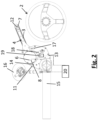
- the actuation device 1 comprises an elongate mounting arm 4 that extends, in a longitudinal direction, from a first end 11 to a second 12 (see Figure 2 ), with first and second rollers 6, 7 rotatably mounted to the arm 4, towards the first and second ends 11, 12 of the arm 4 respectively.
- the arm 4 comprises first and second laterally spaced plates 4a, 4b, with the rollers 6, 7 rotatably mounted between the plates 4a, 4b.
- Each roller 6, 7 is mounted on a respective shaft received in aligned apertures in the plates 4a, 4b such that the roller 6, 7 is rotatable about an axis that is parallel to the lateral direction of the arm 4.
- the belt 3 is elongate and mounted on the rollers 6, 7.
- the belt 3 passes in a longitudinal direction from the first roller 6 to the second roller 7, around the second roller 7 back to the first roller 6 and around the first roller 6 to form an endless loop.
- the belt 3 is an endless conveyor belt that is mounted on the rollers 6, 7, so as to rotate as the rollers 6, 7 rotate.
- the first roller 6 is rotatably driven by an electric motor 8 (see Figure 2 ) so as to drive the belt 3 in the longitudinal direction.
- the electric motor 8 is driveable in both rotational directions so as to drive the belt 3, and therefore the steering wheel 2, in both rotational directions (as described below).
- the arm 4 is pivotally mounted at its first end 11, by a rotational joint 14, to a mounting frame 13.
- the mounting frame 13 is attached to an end of a support rod 15 which is mounted, via a suction cup attachment 16, to a support structure of the vehicle, such as the vehicle windscreen, so as to react the forces produced by the steering wheel actuator 3, in use.
- a linear actuator 19 (shown schematically in Figures 2 and 4 , but not shown in Figures 1 and 3 ) is arranged to rotate the arm 4, about the rotational joint 14, so as to rotate the belt 3 between a disengaged configuration (shown in Figures 1 and 2 ) and an engaged configuration (shown in Figures 3 and 4 ).
- a first end of the linear actuator 19 is mounted to the frame 13 and a second end of the linear actuator 19 is connected to the pivoted lever arm 18.
- the lever arm 18 is attached to one end of a spring 17 (only partially visible in Figures 1 and 2 , but shown fully in Figures 3 and 4 , where the plate 13 is shown partially transparent).
- the opposite end of the spring 17 is attached to the underside of the arm 4, such that movement of the lever arm 18, by the linear actuator 19, pulls (via spring 17) the arm 4 towards the steering wheel 2 such that the steering wheel actuator presses against the steering wheel. This places the steering wheel actuator into the engaged configuration.
- the movement of the lever arm 18, and resulting movement of the steering wheel actuator on arm 4 is evident when comparing Figures 1 and 2 , with Figures 3 and 4 .
- the actuator 19 rotates the lever arm 18 in the opposite direction, thereby pushing (via the spring 17) the arm 4 away from the steering wheel.
- the linear actuator 19 connected to the lever arm 18 is connected to a control unit 20 (shown schematically in Figures 2 and 4 ), which is configured to control the linear actuator 19 so as to control the selective movement of the arm 4 and belt 3, during ADAS testing, between the engaged and disengaged configurations.
- the control unit 20 is also configured to control the linear actuator 19 so as to controllably vary the contact pressure exerted by the belt 3 on the rim of the steering wheel 2, in the engaged configuration. This may allow for testing of an ADAS system that measures how firmly the driver is gripping the steering wheel 2, because the steering wheel actuation device 1 can simulate that gripping force, and the change in resistance to rotation, by varying the pressure exerted by the belt 3 on the steering wheel 2.
- the control unit 20 is also configured to control the motor 8 so as to control the rotation of the belt 3, to control the steering of the wheel 2, when the belt 3 is engaged with the wheel 2 (described below).
- control unit 20 comprises a computer processing unit that is suitably programmed with software to automate the above control of the actuation device 1.
- control may be achieved by means other than software.
- control unit 20 may be omitted, with the actuation device 1 controlled manually, for example by a person sitting in the driver's seat.
- the use of an actuator 17 and control unit 20 to control the selective engagement of the belt 3 with the steering wheel 2, and to control the steering of the wheel 2 by the belt 3, is particularly advantageous for ADAS testing, where fast and accurate control may be required in certain tests.
- the belt 3 When the belt 3 is in the engaged configuration it is positioned (by the rotational position of the arm 4) in rolling contact with the rim of the steering wheel 2.
- the frictional force between the contacting surfaces of the belt 3 and steering wheel rim imparts an actuation force to the steering wheel rim, which acts to rotate the steering wheel 2.
- the belt 3 is not fixedly attached to the steering wheel 2 and rotates the steering wheel 2 only by means of this frictional force.
- This is advantageous in that it provides a relatively simple way of selectively engaging and disengaging the belt 3 with the steering wheel 2, simply by moving the belt 3 into and out of contact with the steering wheel rim.
- the belt 3 and rollers 6, 7 are arranged so that the tension in the belt 3 is low enough that the belt 3 is flexible enough to conform to the shape of the portion of the steering wheel rim that it is in contact with. This is advantageous in that it allows the steering wheel actuation device 1 to be used with steering wheels 2 of a variety of different shapes.
- the presence of the spring 17, and the rotational joint 14, also allows the arrangement to accommodate non-circular steering wheels.
- the spring 17 biases the arm 4 towards the wheel (thereby ensuring contact is maintained when the local radius of the steering wheel rim, at the contact area, decreases), whilst the joint 14 also allows movement in reverse (thereby ensuring contact is maintained when the local radius of the steering wheel rim, at the contact area, increases).
- the arm 4 When the belt 3 is in the disengaged configuration, the arm 4 is in a rotational position such that the belt 3 is not in contact with the steering wheel 2. In this position the belt 3 is not able to impart any actuation force to the steering wheel 2. In the disengaged configuration the belt 3 may therefore have no influence on the inertia of the steering wheel 2. This is advantageous in that the belt 3 no longer adds any additional inertia to the steering wheel 2 and so the ADAS would interpret this as the driver having taken their hands off the wheel 2.
- the belt 3 can be selectively moved to the engaged configuration to steer the vehicle (during ADAS testing) or to the disengaged configuration to simulate a driver taking their hands off the steering wheel 2, to test how the ADAS responds.
- the actuation device 1 can vary the contact pressure exerted by the belt 3 on the rim of the steering wheel 2, to adjust the resistance to rotation exhibited by the steering wheel. This may be used to test a system that is influenced by, or measures, how firmly the driver is gripping the steering wheel 2.
- the belt 3 is mounted on an arm 3 that is rotated to move the belt 3 between its engaged and disengaged configurations.
- the belt 3 may be movably mounted such that it translates between its engaged and disengaged configurations.
- the steering wheel actuator is a belt 3.
- the steering wheel actuator may comprise a plurality, or a multiplicity, of rollers for engaging the steering wheel.
- the rollers may be biased towards an extended position such when engaging the steering wheel, each roller is urged against the surface of the steering wheel by a respective biasing force.
- the multiplicity of rollers may be conformable to the shape of a steering wheel with which the actuator is in contact.
- the belt 3 when the belt 3 is in the engaged configuration it contacts the rim of the steering wheel 2. It may, in principle, contact any part of the steering wheel such that it actuates the steering wheel. However, contacting the rim is particularly advantageous, as this is where a driver would typically place their hands to steer the wheel 2.
Landscapes
- Engineering & Computer Science (AREA)
- Mechanical Engineering (AREA)
- Chemical & Material Sciences (AREA)
- Combustion & Propulsion (AREA)
- Transportation (AREA)
- Physics & Mathematics (AREA)
- General Physics & Mathematics (AREA)
- Steering Controls (AREA)
- Force Measurement Appropriate To Specific Purposes (AREA)
- Steering Control In Accordance With Driving Conditions (AREA)
Description
- The present invention relates to a steering wheel actuation device, for use in steering a vehicle in vehicle testing, including but not limited to, the testing of Advanced Driver Assistance Systems (ADAS). The present invention also relates to a vehicle for testing comprising the steering wheel actuation device and to a method of steering a vehicle during a vehicle test using a steering wheel actuation device.
- Many modern vehicles now include Advanced Driver Assistance Systems (ADAS). To test ADAS in vehicles, it is desirable to replicate real-world scenarios in a consistently repeatable manner, and to measure how the ADAS reacts. In ADAS testing a steering wheel actuator may be used to control a steering wheel of a vehicle, to steer the vehicle so as to follow a predetermined path or manoeuvre.
- Increasingly, ADAS are configured to sense if a driver's hands are on or off the steering wheel. If the ADAS senses that the driver's hands are off the steering wheel then it may, for example, be arranged to issue an alert and/or the ADAS may react differently to how it reacts when the driver's hands are on the steering wheel. In some ADAS the system may be arranged to measure how firmly the driver is gripping the steering wheel.
- Current steering wheel actuators, used in vehicle testing, including ADAS testing, typically have an impact on the inertia of the steering wheel. It has been identified that they are therefore unable to fully simulate when a driver's hands are off the steering wheel, even when they provide no resistive force as such. They are also unable to simulate how firmly the driver is gripping the steering wheel.
- The present invention seeks to address or mitigate at least some of the above mentioned problems. Alternatively, or additionally, the present invention seeks to provide an improved steering wheel actuation device for steering a vehicle in vehicle testing. Alternatively, or additionally, the present invention seeks to provide an improved vehicle for vehicle testing. Alternatively, or additionally, the present invention seeks to provide an improved method of steering a vehicle during a vehicle test.
- There are various examples in the prior art of devices for actuating a steering wheel, some of which will now be acknowledged.
US3,648,539 discloses a soft rubber roller for driving a steering wheel. The roller may be moved between an operative position during testing and a retracted position pre-installation. During testing the roller may be driven by a motor to cause the steering wheel to be turned in either direction or stopped at will.WO94/20340 DE3303588 discloses a friction roller for driving a steering wheel, which may be padded to avoid damage.US2019/0041847 discloses the use of an actuator arm for moving a steering wheel there being a compliant coupling between the end of the arm and the attachment to the steering wheel, for simulating a less attentive driver.US7,628,239 CN111175058 each described belts for actuating a steering wheel, but not with the belt in direct contact with the steering wheel. - According to a first aspect of the invention there is provided a steering wheel actuation device, for steering a vehicle in vehicle testing, the actuation device being as defined in
claim 1. The device comprises a steering wheel actuator, which is selectively moveable during testing between an engaged configuration for imparting an actuation force to a vehicle steering wheel and a disengaged configuration. - As the steering wheel actuator is selectively moveable, during testing, between the engaged and disengaged configurations, it can be selectively moved to the engaged configuration to steer the vehicle (during testing) or to the disengaged configuration to simulate a driver taking their hands off the steering wheel (for example, in embodiments in which the testing is ADAS testing, to test how the ADAS responds). It will be understood that when the steering wheel actuator is in its disengaged configuration it is not able to impart any actuation force to the steering wheel, as a result of being moved out of contact, for example. In the disengaged configuration, the steering wheel actuator may therefore have no influence on the inertia of the steering wheel, thereby accurately modelling the driver's hands being off the wheel. In the disengaged configuration, there is preferably no part of the steering wheel actuator connected to, or otherwise influencing, the steering wheel. When the steering wheel actuator is in the disengaged configuration, the steering wheel may be in its default, non-testing, form (for example, the steering wheel may be in its form as intended to be sold and used with the vehicle). The engaged configuration may be an engaged position. The disengaged configuration may be a disengaged position. In the disengaged position the steering wheel actuator may be remote from the steering wheel. When the steering wheel actuator is in the disengaged position, the steering wheel preferably remains operable (for example, the steering wheel preferably remains coupled to the steering column and the steering shaft).
- Embodiments of the invention are applicable to vehicle testing. The vehicle testing may be vehicle system testing (i.e. testing of system(s) on the vehicle). The testing is more preferably ADAS testing. In some embodiments, the testing may be dynamics testing. In some embodiments the testing may be durability testing. The vehicle may be a non-autonomous vehicle (e.g. a manually-driven car). In some embodiments, the vehicle may be autonomous or semi-autonomous.
- Optionally the steering wheel actuator is movably mounted such that, during testing, it is selectively moveable between the engaged and disengaged configurations. Furthermore, this may allow the selective engagement and disengagement to be automated, for example using an engagement actuator (see below), which is particularly advantageous for use during testing where fast and accurate control of the engagement and disengagement may be required in certain tests. The steering wheel actuator may be mounted at a location remote from the steering wheel.
- The steering wheel actuator may be mounted on an arm that is movably mounted such that, during testing, the arm is movable to move the steering wheel actuator between the engaged and disengaged configurations.
- When the steering wheel actuator is in the engaged configuration it may, in principle, contact any part of the steering wheel such that it actuates the steering wheel. In preferred embodiments, the steering wheel actuator contacts the steering wheel rim. This is particularly advantageous, as this is where a driver would typically place their hands to steer the wheel.
- The steering wheel actuation device may be configured such that, when the steering wheel actuator is in the engaged configuration, it is for imparting the actuation force to the steering wheel by means of a frictional force. This may facilitate a convenient way of engaging and disengaging the actuator with the steering wheel, for example by moving the actuator into and out of contact with the steering wheel. The steering wheel actuation device may be configured to provide automated engagement and disengagement of the actuator from an engaged configuration wherein the steering wheel actuator contacts the steering wheel, to a disengaged configuration wherein the steering wheel actuator is remote from the steering wheel.
- This may be by means of a frictional force only. In this respect, the steering wheel actuation device may be configured such that when the steering wheel actuator is in the engaged configuration it is not fixedly attached to the steering wheel.
- The steering wheel actuator may be arranged to impart the actuation force to the steering wheel by a rolling contact with the steering wheel. In this respect, the steering wheel actuator may comprise a drivable rolling surface for contacting the steering wheel to impart the actuation force to the steering wheel.
- The steering wheel actuator is conformable to the shape of a steering wheel that it is in contact with. This allows the steering wheel actuation device to be used with steering wheels of different shapes. For example, the steering wheel actuator may have one or more contact surfaces which are conformable to the shape of a steering wheel with which the actuator is in contact. The one or more contact surfaces may comprise a resilient material. Such a resilient material may deform to mould to the shape of the steering wheel rim in the engaged configuration. The one or more contact surfaces may comprise a relatively thin sheet comprising a flexible material. Such a sheet may flex to conform to the shape of the steering wheel rim, for example wrapping around the steering wheel rim, in the engaged configuration. Alternatively or in addition, the one or more contact surfaces may be arranged to make contact with the steering wheel over a relatively large surface area in the engaged configuration. For example, the one or more contact surfaces may be arranged to make contact with the steering wheel over -4-5% of the outer circumference of the steering wheel in the engaged configuration.
- In some embodiments, the steering wheel actuator may comprise a belt. The belt may extend over a plurality of, spaced apart, rotary members. This may provide an effective means of imparting the force to the steering wheel in a relatively uniformly distributed way. This may also provide a relatively reliable and convenient way of selectively engaging the disengaging a steering wheel. The belt and rotary members may be arranged so that the tension in the belt is low enough that the belt has a flexibility such that it can conform to the shape of the portion of the steering wheel that it is in contact with, when in the engaged configuration.
- In some embodiments, the steering wheel actuator may comprise a plurality, or a multiplicity, of rollers for engaging the steering wheel. The rollers may be biased towards an extended position such when engaging the steering wheel, each roller is urged against the surface of the steering wheel by a respective biasing force. The multiplicity of rollers may be conformable to the shape of a steering wheel with which the actuator is in contact.
- Optionally the actuation device comprises an engagement actuator configured to move the steering wheel actuator between its engaged and disengaged configurations.
- In the engaged configuration, the steering wheel actuator may be biased against the steering wheel. For example, the actuation device may comprise a biasing member configured to bias the steering wheel actuator against the steering wheel. In the engaged configuration, the steering wheel actuator may be moveable, for example rotatable, about a joint. The biasing member may be arranged to bias the steering wheel actuator about the j oint. Such an arrangement may enable the steering wheel actuator to remain in contact with a non-circular steering wheel as that steering wheel rotates.
- The actuation device may comprise a control unit. The control unit may be configured to control the engagement actuator so as to control the movement of the steering wheel actuator between its engaged and disengaged configurations. The control unit may enable automated selective engagement and disengagement of the actuator, for example between an engaged configuration wherein the steering wheel actuator contacts the steering wheel, to a disengaged configuration wherein the steering wheel actuator is remote from the steering wheel. The control unit may be configured to control the engagement actuator so as to control the pressure exerted by the steering wheel actuator on the steering wheel, in the engaged configuration. The engagement actuator may comprise a linear actuator to which the control unit is connected. The control unit may control the linear actuator to automate selective movement between the engaged and disengaged configurations.
- Alternatively, or additionally, the control unit may be configured to control the steering wheel actuator, in its engaged configuration, so as to control the actuation of the steering wheel.
- Optionally the actuation device is configured such that the steering wheel actuator can engage the steering wheel to provide a variety of different levels of resistance to turning of the steering wheel. Such an arrangement may enable the actuation device, in the engaged configuration, to simulate different grip strengths by a driver. The steering wheel actuator may be configured to be urged against the steering wheel at differing biasing forces (for example via a biasing member or an actuator), to provide the corresponding variety of different levels of resistance to turning of the steering wheel.
- Optionally the steering wheel actuator, in the engaged configuration, is arranged to contact the steering wheel rim. The steering wheel rim may be substantially circular. The steering wheel rim may be substantially non-circular.
- The actuation device may also be configured to vary the magnitude of the resistance it creates to the turning of the steering wheel during testing.
- This may allow for testing of a vehicle system that measures, or is otherwise impacted by, how firmly the driver is gripping the steering wheel, because the steering wheel actuation device can simulate that gripping force by varying the magnitude of the resistance it creates to the turning of the steering wheel.
- Optionally the steering wheel actuator is movably mounted such that, during testing, it is movable to vary the magnitude of the resistance it creates to the turning of the steering wheel during testing. For example, the steering wheel actuator may be mounted on an arm that is movable to vary the pressure exerted by the steering wheel actuator on a steering wheel.
- The steering wheel actuator may be configured to impart the actuation force to the vehicle steering wheel when it is in an engaged configuration, and to vary the contact pressure exerted by it on the steering wheel when it is in the engaged configuration. The steering wheel actuator may also be moveable to a disengaged configuration. In the disengaged configuration, the steering wheel actuator may no longer be in contact with the steering wheel.
- According to a second aspect of the invention there is provided a vehicle for testing, the vehicle comprising a steering wheel and a steering wheel actuation device according to the first aspect of the invention arranged to actuate the steering wheel during testing.
- According to a third aspect of the invention there is provided a method of steering a vehicle during a test, for example an ADAS test, using a steering wheel actuation device, the method being as defined in
claim 13. The method comprises engaging a steering wheel actuator with the steering wheel of the vehicle, imparting an actuation force, from the steering wheel actuator, to the steering wheel to steer the vehicle; and disengaging the steering wheel actuator from the steering wheel. - The method may comprise a step, with the steering wheel actuator engaged with the steering wheel, of varying the magnitude of the resistance it creates to the turning of the steering wheel during testing, for example by varying the pressure exerted by the steering wheel actuator on the steering wheel.
- It will of course be appreciated that features described in relation to one aspect of the present invention may be incorporated into other aspects of the present invention. For example, the method of any aspect of the invention may incorporate any of the features described with reference to the apparatus of any aspect of the invention and vice versa. In preferred embodiments of the invention, the testing is ADAS testing. Unless otherwise specified, features described herein with reference to ADAS testing may be equally applicable to embodiments for other testing (e.g. systems, dynamics and/or durability testing), and vice versa.
- Other preferred and advantageous features of the invention will be apparent from the following description.
- Embodiments of the present invention will now be described by way of example only with reference to the accompanying drawings of which:
-
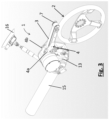
Figure 1 shows a perspective view of a steering wheel actuation device, according to an embodiment of the invention, and of a steering wheel, where a steering wheel actuator, of the device, in a disengaged configuration; -
Figure 2 is a front view of the steering wheel actuation device, where the steering wheel actuator is in the configuration shown inFigure 1 , and -
Figures 3 and4 are views corresponding to those ofFigures 1 and2 but where the steering wheel actuator is in an engaged configuration. - Referring to
Figures 1 to 4 there is shown a steeringwheel actuation device 1, according to an embodiment of the invention, and asteering wheel 2 of a vehicle that is undergoing testing of its Advanced Driver Assistance Systems (ADAS). - In the currently described embodiment the vehicle is a four-wheeled car. However, it will be appreciated that the steering
wheel actuation device 1 may be used with any type of steerable vehicle, to steer the vehicle in ADAS testing, or other vehicle testing. - The steering
wheel actuation device 1 comprises a steering wheel actuator, in the form of abelt 3, which is selectively moveable, during ADAS testing, between an engaged configuration (shown inFigures 3 and4 ) for imparting an actuation force to thevehicle steering wheel 2, to steer the vehicle and a disengaged configuration (shown inFigures 1 and2 ). - The
actuation device 1 comprises an elongate mountingarm 4 that extends, in a longitudinal direction, from afirst end 11 to a second 12 (seeFigure 2 ), with first andsecond rollers arm 4, towards the first and second ends 11, 12 of thearm 4 respectively. - The
arm 4 comprises first and second laterally spacedplates rollers plates roller plates roller arm 4. - The
belt 3 is elongate and mounted on therollers belt 3 passes in a longitudinal direction from thefirst roller 6 to thesecond roller 7, around thesecond roller 7 back to thefirst roller 6 and around thefirst roller 6 to form an endless loop. In this respect, thebelt 3 is an endless conveyor belt that is mounted on therollers rollers - The
first roller 6 is rotatably driven by an electric motor 8 (seeFigure 2 ) so as to drive thebelt 3 in the longitudinal direction. Theelectric motor 8 is driveable in both rotational directions so as to drive thebelt 3, and therefore thesteering wheel 2, in both rotational directions (as described below). - The
arm 4 is pivotally mounted at itsfirst end 11, by a rotational joint 14, to a mountingframe 13. The mountingframe 13 is attached to an end of asupport rod 15 which is mounted, via asuction cup attachment 16, to a support structure of the vehicle, such as the vehicle windscreen, so as to react the forces produced by thesteering wheel actuator 3, in use. - A linear actuator 19 (shown schematically in
Figures 2 and4 , but not shown inFigures 1 and3 ) is arranged to rotate thearm 4, about the rotational joint 14, so as to rotate thebelt 3 between a disengaged configuration (shown inFigures 1 and2 ) and an engaged configuration (shown inFigures 3 and4 ). - In this respect, a first end of the
linear actuator 19 is mounted to theframe 13 and a second end of thelinear actuator 19 is connected to the pivotedlever arm 18. Thelever arm 18 is attached to one end of a spring 17 (only partially visible inFigures 1 and2 , but shown fully inFigures 3 and4 , where theplate 13 is shown partially transparent). The opposite end of thespring 17 is attached to the underside of thearm 4, such that movement of thelever arm 18, by thelinear actuator 19, pulls (via spring 17) thearm 4 towards thesteering wheel 2 such that the steering wheel actuator presses against the steering wheel. This places the steering wheel actuator into the engaged configuration. The movement of thelever arm 18, and resulting movement of the steering wheel actuator onarm 4, is evident when comparingFigures 1 and2 , withFigures 3 and4 . In reverse, theactuator 19 rotates thelever arm 18 in the opposite direction, thereby pushing (via the spring 17) thearm 4 away from the steering wheel. - The
linear actuator 19 connected to thelever arm 18 is connected to a control unit 20 (shown schematically inFigures 2 and4 ), which is configured to control thelinear actuator 19 so as to control the selective movement of thearm 4 andbelt 3, during ADAS testing, between the engaged and disengaged configurations. - The
control unit 20 is also configured to control thelinear actuator 19 so as to controllably vary the contact pressure exerted by thebelt 3 on the rim of thesteering wheel 2, in the engaged configuration. This may allow for testing of an ADAS system that measures how firmly the driver is gripping thesteering wheel 2, because the steeringwheel actuation device 1 can simulate that gripping force, and the change in resistance to rotation, by varying the pressure exerted by thebelt 3 on thesteering wheel 2. - The
control unit 20 is also configured to control themotor 8 so as to control the rotation of thebelt 3, to control the steering of thewheel 2, when thebelt 3 is engaged with the wheel 2 (described below). - In the currently described embodiment the
control unit 20 comprises a computer processing unit that is suitably programmed with software to automate the above control of theactuation device 1. However, it will be appreciated that the control may be achieved by means other than software. For example a suitably arranged electronic circuit, whether or not comprising a programmable processing unit, could achieve an equivalent function. In some embodiments thecontrol unit 20 may be omitted, with theactuation device 1 controlled manually, for example by a person sitting in the driver's seat. However, the use of anactuator 17 andcontrol unit 20 to control the selective engagement of thebelt 3 with thesteering wheel 2, and to control the steering of thewheel 2 by thebelt 3, is particularly advantageous for ADAS testing, where fast and accurate control may be required in certain tests. - When the
belt 3 is in the engaged configuration it is positioned (by the rotational position of the arm 4) in rolling contact with the rim of thesteering wheel 2. The frictional force between the contacting surfaces of thebelt 3 and steering wheel rim imparts an actuation force to the steering wheel rim, which acts to rotate thesteering wheel 2. - In this respect, the
belt 3 is not fixedly attached to thesteering wheel 2 and rotates thesteering wheel 2 only by means of this frictional force. This is advantageous in that it provides a relatively simple way of selectively engaging and disengaging thebelt 3 with thesteering wheel 2, simply by moving thebelt 3 into and out of contact with the steering wheel rim. - The
belt 3 androllers belt 3 is low enough that thebelt 3 is flexible enough to conform to the shape of the portion of the steering wheel rim that it is in contact with. This is advantageous in that it allows the steeringwheel actuation device 1 to be used withsteering wheels 2 of a variety of different shapes. The presence of thespring 17, and the rotational joint 14, also allows the arrangement to accommodate non-circular steering wheels. In that respect, when the steering wheel actuator is in the engaged configuration, thespring 17 biases thearm 4 towards the wheel (thereby ensuring contact is maintained when the local radius of the steering wheel rim, at the contact area, decreases), whilst the joint 14 also allows movement in reverse (thereby ensuring contact is maintained when the local radius of the steering wheel rim, at the contact area, increases). - When the
belt 3 is in the disengaged configuration, thearm 4 is in a rotational position such that thebelt 3 is not in contact with thesteering wheel 2. In this position thebelt 3 is not able to impart any actuation force to thesteering wheel 2. In the disengaged configuration thebelt 3 may therefore have no influence on the inertia of thesteering wheel 2. This is advantageous in that thebelt 3 no longer adds any additional inertia to thesteering wheel 2 and so the ADAS would interpret this as the driver having taken their hands off thewheel 2. - In summary, as the
belt 3 is selectively moveable, during ADAS testing, between the engaged and disengaged configurations, it can be selectively moved to the engaged configuration to steer the vehicle (during ADAS testing) or to the disengaged configuration to simulate a driver taking their hands off thesteering wheel 2, to test how the ADAS responds. Also, theactuation device 1 can vary the contact pressure exerted by thebelt 3 on the rim of thesteering wheel 2, to adjust the resistance to rotation exhibited by the steering wheel. This may be used to test a system that is influenced by, or measures, how firmly the driver is gripping thesteering wheel 2. - Whilst the present invention has been described and illustrated with reference to particular embodiments, it will be appreciated by those of ordinary skill in the art that the invention lends itself to many different variations not specifically illustrated herein.
- For example, in the described embodiment the
belt 3 is mounted on anarm 3 that is rotated to move thebelt 3 between its engaged and disengaged configurations. Alternatively, or additionally, thebelt 3 may be movably mounted such that it translates between its engaged and disengaged configurations. - In the described embodiment the steering wheel actuator is a
belt 3. However, it will be appreciated that any suitable type of steering wheel actuator may be used. For example, the steering wheel actuator may comprise a plurality, or a multiplicity, of rollers for engaging the steering wheel. The rollers may be biased towards an extended position such when engaging the steering wheel, each roller is urged against the surface of the steering wheel by a respective biasing force. The multiplicity of rollers may be conformable to the shape of a steering wheel with which the actuator is in contact. - In the described embodiment when the
belt 3 is in the engaged configuration it contacts the rim of thesteering wheel 2. It may, in principle, contact any part of the steering wheel such that it actuates the steering wheel. However, contacting the rim is particularly advantageous, as this is where a driver would typically place their hands to steer thewheel 2. - Reference should be made to the claims for determining the true scope of the present invention.
Claims (15)
- A steering wheel actuation device (1), for steering a vehicle in testing, for example in ADAS testing, the actuation device comprising:a steering wheel actuator;wherein the steering wheel actuator is selectively moveable during testing between an engaged configuration for imparting an actuation force to a vehicle steering wheel (2) and a disengaged configurationCHARACTERISED IN THATthe steering wheel actuator is conformable to the shape of a steering wheel (2) that it is in contact with so that the steering wheel actuation device can be used with steering wheels of different shapes.
- A steering wheel actuation device according to claim 1 wherein the steering wheel actuator is movably mounted such that, during testing, it is selectively moveable between the engaged and disengaged configurations.
- A steering wheel actuation device according to any preceding claim wherein the steering wheel actuator has one or more contact surfaces which are conformable to the shape of a steering wheel with which the actuator is in contact.
- A steering wheel actuation device according to any preceding claim wherein the steering wheel actuator comprises a belt (3) extending over a plurality of spaced apart rotary members (6, 7).
- A steering wheel actuation device according to any preceding claim wherein the actuation device comprises an engagement actuator (19) configured to move the steering wheel actuator between its engaged and disengaged configurations.
- A steering wheel actuation device according to claim 5 wherein the actuation device comprises a control unit (20) configured to control the engagement actuator so as to control the movement of the steering wheel actuator between its engaged and disengaged configurations.
- A steering wheel actuation device according to claim 6, wherein the control unit (20) is configured to control the steering wheel actuator, in its engaged configuration, so as to control the actuation of the steering wheel (2).
- A steering wheel actuation device according to any preceding claim wherein the actuation device is configured such that the steering wheel actuator can engage the steering wheel to provide a variety of different levels of resistance to turning of the steering wheel.
- A steering wheel actuation device according to any preceding claim wherein the steering wheel actuator, in the engaged configuration, is arranged to contact the steering wheel rim.
- A steering wheel actuation device according to any preceding claim wherein the actuation device is also configured to vary the magnitude of the resistance it creates to the turning of the steering wheel during testing.
- A steering wheel actuation device according to claim 10 wherein the steering wheel actuator is movably mounted such that, during testing, it is movable to vary the pressure exerted by it on a steering wheel.
- A vehicle for vehicle testing, the vehicle comprising a steering wheel (2) and a steering wheel actuation device (1) according to any preceding claim arranged to actuate the steering wheel during testing.
- A method of steering a vehicle during a test, for example an ADAS test, using a steering wheel actuation device (1), wherein the method comprises:engaging a steering wheel actuator with the steering wheel (2) of the vehicle;imparting an actuation force, from the steering wheel actuator, to the steering wheel to steer the vehicle; anddisengaging the steering wheel actuator from the steering wheel,
CHARACTERISED IN THATthe steering wheel actuator is conformable to the shape of a steering wheel that it is in contact with so that the steering wheel actuation device can be used with steering wheels of different shapes. - A method according to claim 13, wherein the method comprises, with the steering wheel actuator engaged with the steering wheel, varying the magnitude of the resistance it creates to the turning of the steering wheel during testing.
- A method according to claim 14, wherein varying the magnitude of the resistance includes varying the pressure exerted by the steering wheel actuator on the steering wheel.
Applications Claiming Priority (1)
| Application Number | Priority Date | Filing Date | Title |
|---|---|---|---|
| GB2009715.0A GB2596332B (en) | 2020-06-25 | 2020-06-25 | A steering wheel actuation device and method for vehicle testing |
Publications (2)
| Publication Number | Publication Date |
|---|---|
| EP3929557A1 EP3929557A1 (en) | 2021-12-29 |
| EP3929557B1 true EP3929557B1 (en) | 2024-07-17 |
Family
ID=71949602
Family Applications (1)
| Application Number | Title | Priority Date | Filing Date |
|---|---|---|---|
| EP21181298.7A Active EP3929557B1 (en) | 2020-06-25 | 2021-06-23 | A steering wheel actuation device and method for vehicle testing |
Country Status (6)
| Country | Link |
|---|---|
| US (1) | US11999425B2 (en) |
| EP (1) | EP3929557B1 (en) |
| JP (1) | JP2022008229A (en) |
| CN (1) | CN113848076A (en) |
| ES (1) | ES2985336T3 (en) |
| GB (1) | GB2596332B (en) |
Families Citing this family (2)
| Publication number | Priority date | Publication date | Assignee | Title |
|---|---|---|---|---|
| US11820356B2 (en) | 2019-12-20 | 2023-11-21 | Humanetics Austria Gmbh | System and method for force compensation in a robotic driving system |
| US20230182814A1 (en) * | 2021-12-13 | 2023-06-15 | Doo Hwang | Steering wheel attachment device |
Family Cites Families (11)
| Publication number | Priority date | Publication date | Assignee | Title |
|---|---|---|---|---|
| US3465577A (en) | 1967-09-28 | 1969-09-09 | Rca Corp | Automobile control manipulating apparatus |
| US3648539A (en) * | 1970-01-28 | 1972-03-14 | Robert J Rouis | Electrically operated, remote controlled wheel turner |
| DE3303588A1 (en) * | 1982-02-03 | 1983-08-11 | Volkswagenwerk Ag, 3180 Wolfsburg | Device for the automatic actuation of operating levers of a motor vehicle on a roller test stand |
| IT1271979B (en) * | 1993-03-05 | 1997-06-10 | Sergio Cordioli | REMOTE CONTROLLED DEVICE SUITABLE TO TURN THE STEERING WHEEL OF A VEHICLE AND THEN PUT IT BACK TO THE INITIAL POSITION. |
| US7628239B1 (en) * | 2006-08-30 | 2009-12-08 | The United States Of America As Represented By The Secretary Of The Navy | Adaptable remote control driving system |
| US8973701B2 (en) * | 2013-07-25 | 2015-03-10 | GM Global Technology Operations LLC | Assembly for selectively connecting a shifter to the steering wheel or steering column |
| US10379007B2 (en) * | 2015-06-24 | 2019-08-13 | Perrone Robotics, Inc. | Automated robotic test system for automated driving systems |
| US10585429B2 (en) * | 2017-08-01 | 2020-03-10 | Dynamic Research, Inc. | Robotic steering controller for optimal free response evaluation |
| DE102017123272A1 (en) * | 2017-10-06 | 2019-04-11 | Trw Automotive Gmbh | Method of operating a steering system and steering system |
| CN107962575A (en) | 2017-12-11 | 2018-04-27 | 南京理工大学 | A kind of quick-installed Vehicle Driver Robot steering mechanical hand |
| CN111175058A (en) * | 2020-02-14 | 2020-05-19 | 吉林大学 | A New Test Bench for Electric Power Steering System |
-
2020
- 2020-06-25 GB GB2009715.0A patent/GB2596332B/en active Active
-
2021
- 2021-06-23 ES ES21181298T patent/ES2985336T3/en active Active
- 2021-06-23 JP JP2021104220A patent/JP2022008229A/en active Pending
- 2021-06-23 EP EP21181298.7A patent/EP3929557B1/en active Active
- 2021-06-25 US US17/358,424 patent/US11999425B2/en active Active
- 2021-06-25 CN CN202110711785.3A patent/CN113848076A/en active Pending
Also Published As
| Publication number | Publication date |
|---|---|
| GB202009715D0 (en) | 2020-08-12 |
| US20210403084A1 (en) | 2021-12-30 |
| GB2596332A (en) | 2021-12-29 |
| CN113848076A (en) | 2021-12-28 |
| GB2596332B (en) | 2024-01-10 |
| ES2985336T3 (en) | 2024-11-05 |
| EP3929557A1 (en) | 2021-12-29 |
| US11999425B2 (en) | 2024-06-04 |
| JP2022008229A (en) | 2022-01-13 |
Similar Documents
| Publication | Publication Date | Title |
|---|---|---|
| US11999425B2 (en) | Steering wheel actuation device and method for vehicle testing | |
| EP0860692B1 (en) | Robot for operating motor vehicle control | |
| CN109307061B (en) | Electronic transmission system | |
| US11932162B2 (en) | Ratchet with force indicator | |
| US9970529B2 (en) | Shift lever assembly with electronic detection of modes of transmission | |
| JPH07234628A (en) | Simulated steering device | |
| JP4971308B2 (en) | Power transmission belt running motion display device | |
| US5615581A (en) | Remotely controlled device for rotating the steering-wheel of a motor vehicle and then taking it back to the starting position | |
| EP3643592A1 (en) | An electric vehicle movable on motorized directional balls | |
| JPWO2022255237A5 (en) | ||
| KR20010089807A (en) | Improved steering system | |
| US4572418A (en) | Print paper feeding apparatus | |
| CN113084700A (en) | Grinding device of machine arm and machine arm | |
| KR20180070141A (en) | Electric personal mobility vehicle | |
| EP2845775B1 (en) | System and method for testing crash avoidance technologies | |
| JP3341879B2 (en) | Gear change lever operating method and operating device for automatic vehicle driving robot | |
| JP2017217935A (en) | Steering switch device | |
| JP2000018938A (en) | On-vehicle type distance measuring apparatus | |
| US5958175A (en) | Labelling machine | |
| JP2009122047A (en) | Angle detector | |
| JP4207172B2 (en) | Heavy object inversion method and apparatus | |
| WO2003091081A1 (en) | Apparatus for limiting rotation of shaft | |
| JP5702543B2 (en) | Passenger rice transplanter | |
| KR100527767B1 (en) | Apparatus for braking a restitution of Steering wheel | |
| KR101116328B1 (en) | Steering device of infants' electric vehicle and its control method |
Legal Events
| Date | Code | Title | Description |
|---|---|---|---|
| PUAI | Public reference made under article 153(3) epc to a published international application that has entered the european phase |
Free format text: ORIGINAL CODE: 0009012 |
|
| STAA | Information on the status of an ep patent application or granted ep patent |
Free format text: STATUS: THE APPLICATION HAS BEEN PUBLISHED |
|
| AK | Designated contracting states |
Kind code of ref document: A1 Designated state(s): AL AT BE BG CH CY CZ DE DK EE ES FI FR GB GR HR HU IE IS IT LI LT LU LV MC MK MT NL NO PL PT RO RS SE SI SK SM TR |
|
| B565 | Issuance of search results under rule 164(2) epc |
Effective date: 20211123 |
|
| STAA | Information on the status of an ep patent application or granted ep patent |
Free format text: STATUS: REQUEST FOR EXAMINATION WAS MADE |
|
| 17P | Request for examination filed |
Effective date: 20220622 |
|
| RBV | Designated contracting states (corrected) |
Designated state(s): AL AT BE BG CH CY CZ DE DK EE ES FI FR GB GR HR HU IE IS IT LI LT LU LV MC MK MT NL NO PL PT RO RS SE SI SK SM TR |
|
| GRAP | Despatch of communication of intention to grant a patent |
Free format text: ORIGINAL CODE: EPIDOSNIGR1 |
|
| STAA | Information on the status of an ep patent application or granted ep patent |
Free format text: STATUS: GRANT OF PATENT IS INTENDED |
|
| INTG | Intention to grant announced |
Effective date: 20240221 |
|
| GRAS | Grant fee paid |
Free format text: ORIGINAL CODE: EPIDOSNIGR3 |
|
| GRAA | (expected) grant |
Free format text: ORIGINAL CODE: 0009210 |
|
| STAA | Information on the status of an ep patent application or granted ep patent |
Free format text: STATUS: THE PATENT HAS BEEN GRANTED |
|
| AK | Designated contracting states |
Kind code of ref document: B1 Designated state(s): AL AT BE BG CH CY CZ DE DK EE ES FI FR GB GR HR HU IE IS IT LI LT LU LV MC MK MT NL NO PL PT RO RS SE SI SK SM TR |
|
| REG | Reference to a national code |
Ref country code: CH Ref legal event code: EP |
|
| REG | Reference to a national code |
Ref country code: DE Ref legal event code: R096 Ref document number: 602021015698 Country of ref document: DE |
|
| REG | Reference to a national code |
Ref country code: IE Ref legal event code: FG4D |
|
| REG | Reference to a national code |
Ref country code: ES Ref legal event code: FG2A Ref document number: 2985336 Country of ref document: ES Kind code of ref document: T3 Effective date: 20241105 |
|
| REG | Reference to a national code |
Ref country code: LT Ref legal event code: MG9D |
|
| REG | Reference to a national code |
Ref country code: AT Ref legal event code: UEP Ref document number: 1704562 Country of ref document: AT Kind code of ref document: T Effective date: 20240717 |
|
| REG | Reference to a national code |
Ref country code: NL Ref legal event code: MP Effective date: 20240717 |
|
| PG25 | Lapsed in a contracting state [announced via postgrant information from national office to epo] |
Ref country code: PT Free format text: LAPSE BECAUSE OF FAILURE TO SUBMIT A TRANSLATION OF THE DESCRIPTION OR TO PAY THE FEE WITHIN THE PRESCRIBED TIME-LIMIT Effective date: 20241118 |
|
| PG25 | Lapsed in a contracting state [announced via postgrant information from national office to epo] |
Ref country code: NL Free format text: LAPSE BECAUSE OF FAILURE TO SUBMIT A TRANSLATION OF THE DESCRIPTION OR TO PAY THE FEE WITHIN THE PRESCRIBED TIME-LIMIT Effective date: 20240717 |
|
| PG25 | Lapsed in a contracting state [announced via postgrant information from national office to epo] |
Ref country code: PT Free format text: LAPSE BECAUSE OF FAILURE TO SUBMIT A TRANSLATION OF THE DESCRIPTION OR TO PAY THE FEE WITHIN THE PRESCRIBED TIME-LIMIT Effective date: 20241118 Ref country code: NL Free format text: LAPSE BECAUSE OF FAILURE TO SUBMIT A TRANSLATION OF THE DESCRIPTION OR TO PAY THE FEE WITHIN THE PRESCRIBED TIME-LIMIT Effective date: 20240717 |
|
| PG25 | Lapsed in a contracting state [announced via postgrant information from national office to epo] |
Ref country code: NO Free format text: LAPSE BECAUSE OF FAILURE TO SUBMIT A TRANSLATION OF THE DESCRIPTION OR TO PAY THE FEE WITHIN THE PRESCRIBED TIME-LIMIT Effective date: 20241017 |
|
| PG25 | Lapsed in a contracting state [announced via postgrant information from national office to epo] |
Ref country code: FI Free format text: LAPSE BECAUSE OF FAILURE TO SUBMIT A TRANSLATION OF THE DESCRIPTION OR TO PAY THE FEE WITHIN THE PRESCRIBED TIME-LIMIT Effective date: 20240717 Ref country code: PL Free format text: LAPSE BECAUSE OF FAILURE TO SUBMIT A TRANSLATION OF THE DESCRIPTION OR TO PAY THE FEE WITHIN THE PRESCRIBED TIME-LIMIT Effective date: 20240717 Ref country code: GR Free format text: LAPSE BECAUSE OF FAILURE TO SUBMIT A TRANSLATION OF THE DESCRIPTION OR TO PAY THE FEE WITHIN THE PRESCRIBED TIME-LIMIT Effective date: 20241018 |
|
| PG25 | Lapsed in a contracting state [announced via postgrant information from national office to epo] |
Ref country code: BG Free format text: LAPSE BECAUSE OF FAILURE TO SUBMIT A TRANSLATION OF THE DESCRIPTION OR TO PAY THE FEE WITHIN THE PRESCRIBED TIME-LIMIT Effective date: 20240717 |
|
| PG25 | Lapsed in a contracting state [announced via postgrant information from national office to epo] |
Ref country code: LV Free format text: LAPSE BECAUSE OF FAILURE TO SUBMIT A TRANSLATION OF THE DESCRIPTION OR TO PAY THE FEE WITHIN THE PRESCRIBED TIME-LIMIT Effective date: 20240717 |
|
| PG25 | Lapsed in a contracting state [announced via postgrant information from national office to epo] |
Ref country code: IS Free format text: LAPSE BECAUSE OF FAILURE TO SUBMIT A TRANSLATION OF THE DESCRIPTION OR TO PAY THE FEE WITHIN THE PRESCRIBED TIME-LIMIT Effective date: 20241117 |
|
| PG25 | Lapsed in a contracting state [announced via postgrant information from national office to epo] |
Ref country code: HR Free format text: LAPSE BECAUSE OF FAILURE TO SUBMIT A TRANSLATION OF THE DESCRIPTION OR TO PAY THE FEE WITHIN THE PRESCRIBED TIME-LIMIT Effective date: 20240717 |
|
| PG25 | Lapsed in a contracting state [announced via postgrant information from national office to epo] |
Ref country code: RS Free format text: LAPSE BECAUSE OF FAILURE TO SUBMIT A TRANSLATION OF THE DESCRIPTION OR TO PAY THE FEE WITHIN THE PRESCRIBED TIME-LIMIT Effective date: 20241017 |
|
| PG25 | Lapsed in a contracting state [announced via postgrant information from national office to epo] |
Ref country code: RS Free format text: LAPSE BECAUSE OF FAILURE TO SUBMIT A TRANSLATION OF THE DESCRIPTION OR TO PAY THE FEE WITHIN THE PRESCRIBED TIME-LIMIT Effective date: 20241017 Ref country code: PL Free format text: LAPSE BECAUSE OF FAILURE TO SUBMIT A TRANSLATION OF THE DESCRIPTION OR TO PAY THE FEE WITHIN THE PRESCRIBED TIME-LIMIT Effective date: 20240717 Ref country code: NO Free format text: LAPSE BECAUSE OF FAILURE TO SUBMIT A TRANSLATION OF THE DESCRIPTION OR TO PAY THE FEE WITHIN THE PRESCRIBED TIME-LIMIT Effective date: 20241017 Ref country code: LV Free format text: LAPSE BECAUSE OF FAILURE TO SUBMIT A TRANSLATION OF THE DESCRIPTION OR TO PAY THE FEE WITHIN THE PRESCRIBED TIME-LIMIT Effective date: 20240717 Ref country code: IS Free format text: LAPSE BECAUSE OF FAILURE TO SUBMIT A TRANSLATION OF THE DESCRIPTION OR TO PAY THE FEE WITHIN THE PRESCRIBED TIME-LIMIT Effective date: 20241117 Ref country code: HR Free format text: LAPSE BECAUSE OF FAILURE TO SUBMIT A TRANSLATION OF THE DESCRIPTION OR TO PAY THE FEE WITHIN THE PRESCRIBED TIME-LIMIT Effective date: 20240717 Ref country code: GR Free format text: LAPSE BECAUSE OF FAILURE TO SUBMIT A TRANSLATION OF THE DESCRIPTION OR TO PAY THE FEE WITHIN THE PRESCRIBED TIME-LIMIT Effective date: 20241018 Ref country code: FI Free format text: LAPSE BECAUSE OF FAILURE TO SUBMIT A TRANSLATION OF THE DESCRIPTION OR TO PAY THE FEE WITHIN THE PRESCRIBED TIME-LIMIT Effective date: 20240717 Ref country code: BG Free format text: LAPSE BECAUSE OF FAILURE TO SUBMIT A TRANSLATION OF THE DESCRIPTION OR TO PAY THE FEE WITHIN THE PRESCRIBED TIME-LIMIT Effective date: 20240717 |
|
| PG25 | Lapsed in a contracting state [announced via postgrant information from national office to epo] |
Ref country code: DK Free format text: LAPSE BECAUSE OF FAILURE TO SUBMIT A TRANSLATION OF THE DESCRIPTION OR TO PAY THE FEE WITHIN THE PRESCRIBED TIME-LIMIT Effective date: 20240717 Ref country code: RO Free format text: LAPSE BECAUSE OF FAILURE TO SUBMIT A TRANSLATION OF THE DESCRIPTION OR TO PAY THE FEE WITHIN THE PRESCRIBED TIME-LIMIT Effective date: 20240717 Ref country code: SM Free format text: LAPSE BECAUSE OF FAILURE TO SUBMIT A TRANSLATION OF THE DESCRIPTION OR TO PAY THE FEE WITHIN THE PRESCRIBED TIME-LIMIT Effective date: 20240717 |
|
| REG | Reference to a national code |
Ref country code: DE Ref legal event code: R097 Ref document number: 602021015698 Country of ref document: DE |
|
| PG25 | Lapsed in a contracting state [announced via postgrant information from national office to epo] |
Ref country code: EE Free format text: LAPSE BECAUSE OF FAILURE TO SUBMIT A TRANSLATION OF THE DESCRIPTION OR TO PAY THE FEE WITHIN THE PRESCRIBED TIME-LIMIT Effective date: 20240717 |
|
| PG25 | Lapsed in a contracting state [announced via postgrant information from national office to epo] |
Ref country code: CZ Free format text: LAPSE BECAUSE OF FAILURE TO SUBMIT A TRANSLATION OF THE DESCRIPTION OR TO PAY THE FEE WITHIN THE PRESCRIBED TIME-LIMIT Effective date: 20240717 |
|
| PG25 | Lapsed in a contracting state [announced via postgrant information from national office to epo] |
Ref country code: SK Free format text: LAPSE BECAUSE OF FAILURE TO SUBMIT A TRANSLATION OF THE DESCRIPTION OR TO PAY THE FEE WITHIN THE PRESCRIBED TIME-LIMIT Effective date: 20240717 |
|
| PLBE | No opposition filed within time limit |
Free format text: ORIGINAL CODE: 0009261 |
|
| STAA | Information on the status of an ep patent application or granted ep patent |
Free format text: STATUS: NO OPPOSITION FILED WITHIN TIME LIMIT |
|
| 26N | No opposition filed |
Effective date: 20250422 |
|
| PGFP | Annual fee paid to national office [announced via postgrant information from national office to epo] |
Ref country code: FR Payment date: 20250630 Year of fee payment: 5 |
|
| PGFP | Annual fee paid to national office [announced via postgrant information from national office to epo] |
Ref country code: AT Payment date: 20250721 Year of fee payment: 5 |
|
| PG25 | Lapsed in a contracting state [announced via postgrant information from national office to epo] |
Ref country code: SE Free format text: LAPSE BECAUSE OF FAILURE TO SUBMIT A TRANSLATION OF THE DESCRIPTION OR TO PAY THE FEE WITHIN THE PRESCRIBED TIME-LIMIT Effective date: 20240717 |
|
| PGFP | Annual fee paid to national office [announced via postgrant information from national office to epo] |
Ref country code: ES Payment date: 20250729 Year of fee payment: 5 |
|
| PGFP | Annual fee paid to national office [announced via postgrant information from national office to epo] |
Ref country code: DE Payment date: 20250702 Year of fee payment: 5 |
|
| PGFP | Annual fee paid to national office [announced via postgrant information from national office to epo] |
Ref country code: GB Payment date: 20250703 Year of fee payment: 5 |
|
| REG | Reference to a national code |
Ref country code: CH Ref legal event code: H13 Free format text: ST27 STATUS EVENT CODE: U-0-0-H10-H13 (AS PROVIDED BY THE NATIONAL OFFICE) Effective date: 20260127 |
|
| PG25 | Lapsed in a contracting state [announced via postgrant information from national office to epo] |
Ref country code: IT Free format text: LAPSE BECAUSE OF FAILURE TO SUBMIT A TRANSLATION OF THE DESCRIPTION OR TO PAY THE FEE WITHIN THE PRESCRIBED TIME-LIMIT Effective date: 20240717 |
|
| PG25 | Lapsed in a contracting state [announced via postgrant information from national office to epo] |
Ref country code: MC Free format text: LAPSE BECAUSE OF FAILURE TO SUBMIT A TRANSLATION OF THE DESCRIPTION OR TO PAY THE FEE WITHIN THE PRESCRIBED TIME-LIMIT Effective date: 20240717 |
|
| PG25 | Lapsed in a contracting state [announced via postgrant information from national office to epo] |
Ref country code: LU Free format text: LAPSE BECAUSE OF NON-PAYMENT OF DUE FEES Effective date: 20250623 |
|
| REG | Reference to a national code |
Ref country code: BE Ref legal event code: MM Effective date: 20250630 |
|
| PG25 | Lapsed in a contracting state [announced via postgrant information from national office to epo] |
Ref country code: IE Free format text: LAPSE BECAUSE OF NON-PAYMENT OF DUE FEES Effective date: 20250623 |
|
| PG25 | Lapsed in a contracting state [announced via postgrant information from national office to epo] |
Ref country code: BE Free format text: LAPSE BECAUSE OF NON-PAYMENT OF DUE FEES Effective date: 20250630 |
|
| PG25 | Lapsed in a contracting state [announced via postgrant information from national office to epo] |
Ref country code: CH Free format text: LAPSE BECAUSE OF NON-PAYMENT OF DUE FEES Effective date: 20250630 |