EP3929064B1 - Differential drive device and agv - Google Patents
Differential drive device and agv Download PDFInfo
- Publication number
- EP3929064B1 EP3929064B1 EP20818056.2A EP20818056A EP3929064B1 EP 3929064 B1 EP3929064 B1 EP 3929064B1 EP 20818056 A EP20818056 A EP 20818056A EP 3929064 B1 EP3929064 B1 EP 3929064B1
- Authority
- EP
- European Patent Office
- Prior art keywords
- differential drive
- drive unit
- rolling member
- outer cover
- drive device
- Prior art date
- Legal status (The legal status is an assumption and is not a legal conclusion. Google has not performed a legal analysis and makes no representation as to the accuracy of the status listed.)
- Active
Links
Images



Classifications
-
- B—PERFORMING OPERATIONS; TRANSPORTING
- B62—LAND VEHICLES FOR TRAVELLING OTHERWISE THAN ON RAILS
- B62D—MOTOR VEHICLES; TRAILERS
- B62D11/00—Steering non-deflectable wheels; Steering endless tracks or the like
- B62D11/02—Steering non-deflectable wheels; Steering endless tracks or the like by differentially driving ground-engaging elements on opposite vehicle sides
- B62D11/04—Steering non-deflectable wheels; Steering endless tracks or the like by differentially driving ground-engaging elements on opposite vehicle sides by means of separate power sources
-
- B—PERFORMING OPERATIONS; TRANSPORTING
- B60—VEHICLES IN GENERAL
- B60K—ARRANGEMENT OR MOUNTING OF PROPULSION UNITS OR OF TRANSMISSIONS IN VEHICLES; ARRANGEMENT OR MOUNTING OF PLURAL DIVERSE PRIME-MOVERS IN VEHICLES; AUXILIARY DRIVES FOR VEHICLES; INSTRUMENTATION OR DASHBOARDS FOR VEHICLES; ARRANGEMENTS IN CONNECTION WITH COOLING, AIR INTAKE, GAS EXHAUST OR FUEL SUPPLY OF PROPULSION UNITS IN VEHICLES
- B60K17/00—Arrangement or mounting of transmissions in vehicles
- B60K17/04—Arrangement or mounting of transmissions in vehicles characterised by arrangement, location or kind of gearing
- B60K17/16—Arrangement or mounting of transmissions in vehicles characterised by arrangement, location or kind of gearing of differential gearing
-
- B—PERFORMING OPERATIONS; TRANSPORTING
- B60—VEHICLES IN GENERAL
- B60K—ARRANGEMENT OR MOUNTING OF PROPULSION UNITS OR OF TRANSMISSIONS IN VEHICLES; ARRANGEMENT OR MOUNTING OF PLURAL DIVERSE PRIME-MOVERS IN VEHICLES; AUXILIARY DRIVES FOR VEHICLES; INSTRUMENTATION OR DASHBOARDS FOR VEHICLES; ARRANGEMENTS IN CONNECTION WITH COOLING, AIR INTAKE, GAS EXHAUST OR FUEL SUPPLY OF PROPULSION UNITS IN VEHICLES
- B60K17/00—Arrangement or mounting of transmissions in vehicles
- B60K17/04—Arrangement or mounting of transmissions in vehicles characterised by arrangement, location or kind of gearing
- B60K17/16—Arrangement or mounting of transmissions in vehicles characterised by arrangement, location or kind of gearing of differential gearing
- B60K17/165—Arrangement or mounting of transmissions in vehicles characterised by arrangement, location or kind of gearing of differential gearing provided between independent half axles
-
- B—PERFORMING OPERATIONS; TRANSPORTING
- B60—VEHICLES IN GENERAL
- B60K—ARRANGEMENT OR MOUNTING OF PROPULSION UNITS OR OF TRANSMISSIONS IN VEHICLES; ARRANGEMENT OR MOUNTING OF PLURAL DIVERSE PRIME-MOVERS IN VEHICLES; AUXILIARY DRIVES FOR VEHICLES; INSTRUMENTATION OR DASHBOARDS FOR VEHICLES; ARRANGEMENTS IN CONNECTION WITH COOLING, AIR INTAKE, GAS EXHAUST OR FUEL SUPPLY OF PROPULSION UNITS IN VEHICLES
- B60K7/00—Disposition of motor in, or adjacent to, traction wheel
- B60K7/0007—Disposition of motor in, or adjacent to, traction wheel the motor being electric
-
- B—PERFORMING OPERATIONS; TRANSPORTING
- B66—HOISTING; LIFTING; HAULING
- B66F—HOISTING, LIFTING, HAULING OR PUSHING, NOT OTHERWISE PROVIDED FOR, e.g. DEVICES WHICH APPLY A LIFTING OR PUSHING FORCE DIRECTLY TO THE SURFACE OF A LOAD
- B66F9/00—Devices for lifting or lowering bulky or heavy goods for loading or unloading purposes
- B66F9/06—Devices for lifting or lowering bulky or heavy goods for loading or unloading purposes movable, with their loads, on wheels or the like, e.g. fork-lift trucks
- B66F9/063—Automatically guided
-
- B—PERFORMING OPERATIONS; TRANSPORTING
- B66—HOISTING; LIFTING; HAULING
- B66F—HOISTING, LIFTING, HAULING OR PUSHING, NOT OTHERWISE PROVIDED FOR, e.g. DEVICES WHICH APPLY A LIFTING OR PUSHING FORCE DIRECTLY TO THE SURFACE OF A LOAD
- B66F9/00—Devices for lifting or lowering bulky or heavy goods for loading or unloading purposes
- B66F9/06—Devices for lifting or lowering bulky or heavy goods for loading or unloading purposes movable, with their loads, on wheels or the like, e.g. fork-lift trucks
- B66F9/075—Constructional features or details
- B66F9/07568—Steering arrangements
-
- F—MECHANICAL ENGINEERING; LIGHTING; HEATING; WEAPONS; BLASTING
- F16—ENGINEERING ELEMENTS AND UNITS; GENERAL MEASURES FOR PRODUCING AND MAINTAINING EFFECTIVE FUNCTIONING OF MACHINES OR INSTALLATIONS; THERMAL INSULATION IN GENERAL
- F16C—SHAFTS; FLEXIBLE SHAFTS; ELEMENTS OR CRANKSHAFT MECHANISMS; ROTARY BODIES OTHER THAN GEARING ELEMENTS; BEARINGS
- F16C35/00—Rigid support of bearing units; Housings, e.g. caps, covers
- F16C35/04—Rigid support of bearing units; Housings, e.g. caps, covers in the case of ball or roller bearings
- F16C35/06—Mounting or dismounting of ball or roller bearings; Fixing them onto shaft or in housing
-
- B—PERFORMING OPERATIONS; TRANSPORTING
- B60—VEHICLES IN GENERAL
- B60K—ARRANGEMENT OR MOUNTING OF PROPULSION UNITS OR OF TRANSMISSIONS IN VEHICLES; ARRANGEMENT OR MOUNTING OF PLURAL DIVERSE PRIME-MOVERS IN VEHICLES; AUXILIARY DRIVES FOR VEHICLES; INSTRUMENTATION OR DASHBOARDS FOR VEHICLES; ARRANGEMENTS IN CONNECTION WITH COOLING, AIR INTAKE, GAS EXHAUST OR FUEL SUPPLY OF PROPULSION UNITS IN VEHICLES
- B60K17/00—Arrangement or mounting of transmissions in vehicles
- B60K17/04—Arrangement or mounting of transmissions in vehicles characterised by arrangement, location or kind of gearing
- B60K17/043—Transmission unit disposed in on near the vehicle wheel, or between the differential gear unit and the wheel
-
- B—PERFORMING OPERATIONS; TRANSPORTING
- B60—VEHICLES IN GENERAL
- B60K—ARRANGEMENT OR MOUNTING OF PROPULSION UNITS OR OF TRANSMISSIONS IN VEHICLES; ARRANGEMENT OR MOUNTING OF PLURAL DIVERSE PRIME-MOVERS IN VEHICLES; AUXILIARY DRIVES FOR VEHICLES; INSTRUMENTATION OR DASHBOARDS FOR VEHICLES; ARRANGEMENTS IN CONNECTION WITH COOLING, AIR INTAKE, GAS EXHAUST OR FUEL SUPPLY OF PROPULSION UNITS IN VEHICLES
- B60K7/00—Disposition of motor in, or adjacent to, traction wheel
- B60K2007/0038—Disposition of motor in, or adjacent to, traction wheel the motor moving together with the wheel axle
-
- B—PERFORMING OPERATIONS; TRANSPORTING
- B60—VEHICLES IN GENERAL
- B60K—ARRANGEMENT OR MOUNTING OF PROPULSION UNITS OR OF TRANSMISSIONS IN VEHICLES; ARRANGEMENT OR MOUNTING OF PLURAL DIVERSE PRIME-MOVERS IN VEHICLES; AUXILIARY DRIVES FOR VEHICLES; INSTRUMENTATION OR DASHBOARDS FOR VEHICLES; ARRANGEMENTS IN CONNECTION WITH COOLING, AIR INTAKE, GAS EXHAUST OR FUEL SUPPLY OF PROPULSION UNITS IN VEHICLES
- B60K7/00—Disposition of motor in, or adjacent to, traction wheel
- B60K2007/0046—Disposition of motor in, or adjacent to, traction wheel the motor moving together with the vehicle body, i.e. moving independently from the wheel axle
-
- B—PERFORMING OPERATIONS; TRANSPORTING
- B60—VEHICLES IN GENERAL
- B60K—ARRANGEMENT OR MOUNTING OF PROPULSION UNITS OR OF TRANSMISSIONS IN VEHICLES; ARRANGEMENT OR MOUNTING OF PLURAL DIVERSE PRIME-MOVERS IN VEHICLES; AUXILIARY DRIVES FOR VEHICLES; INSTRUMENTATION OR DASHBOARDS FOR VEHICLES; ARRANGEMENTS IN CONNECTION WITH COOLING, AIR INTAKE, GAS EXHAUST OR FUEL SUPPLY OF PROPULSION UNITS IN VEHICLES
- B60K7/00—Disposition of motor in, or adjacent to, traction wheel
- B60K2007/0061—Disposition of motor in, or adjacent to, traction wheel the motor axle being parallel to the wheel axle
-
- B—PERFORMING OPERATIONS; TRANSPORTING
- B60—VEHICLES IN GENERAL
- B60Y—INDEXING SCHEME RELATING TO ASPECTS CROSS-CUTTING VEHICLE TECHNOLOGY
- B60Y2200/00—Type of vehicle
- B60Y2200/60—Industrial applications, e.g. pipe inspection vehicles
- B60Y2200/62—Conveyors, floor conveyors
-
- B—PERFORMING OPERATIONS; TRANSPORTING
- B60—VEHICLES IN GENERAL
- B60Y—INDEXING SCHEME RELATING TO ASPECTS CROSS-CUTTING VEHICLE TECHNOLOGY
- B60Y2200/00—Type of vehicle
- B60Y2200/80—Other vehicles not covered by groups B60Y2200/10 - B60Y2200/60
-
- B—PERFORMING OPERATIONS; TRANSPORTING
- B60—VEHICLES IN GENERAL
- B60Y—INDEXING SCHEME RELATING TO ASPECTS CROSS-CUTTING VEHICLE TECHNOLOGY
- B60Y2200/00—Type of vehicle
- B60Y2200/90—Vehicles comprising electric prime movers
-
- F—MECHANICAL ENGINEERING; LIGHTING; HEATING; WEAPONS; BLASTING
- F16—ENGINEERING ELEMENTS AND UNITS; GENERAL MEASURES FOR PRODUCING AND MAINTAINING EFFECTIVE FUNCTIONING OF MACHINES OR INSTALLATIONS; THERMAL INSULATION IN GENERAL
- F16C—SHAFTS; FLEXIBLE SHAFTS; ELEMENTS OR CRANKSHAFT MECHANISMS; ROTARY BODIES OTHER THAN GEARING ELEMENTS; BEARINGS
- F16C2361/00—Apparatus or articles in engineering in general
- F16C2361/61—Toothed gear systems, e.g. support of pinion shafts
Definitions
- the present application relates to the technical field of wheeled drivers, in particular to a differential drive device and an AGV.
- the current automated guided vehicle is mostly driven by a differential drive device.
- the differential drive device refers to an integrated mechanical structure which integrates a drive motor, a reducer, a driving wheel, etc. Compared with the traditional AGV differential control mode, the differential drive device has high integration and strong adaptability, which can rapidly deploy AGVs, mobile robots, etc.
- the slewing bearing is generally used to realize the rotation connection between the differential drive device and the vehicle body.
- the slewing bearing must occupy the height of the differential drive device in the vertical direction, which leads to the problem that the total height of the differential drive device is relatively large and its application is limited in the scene with high requirements for height space.
- DE 102016107451A1 discloses a transport and lifting unit in which both a height adjustment is integrated and a reliable load pick-up and transport is possible and which can also be used universally and independently and can be moved as desired.
- Self-propelled transport and lifting unit (1) for lifting and moving objects (3) comprising a controller, an energy supply, two drive wheels (2), each with its own drive, a centrally and vertically arranged nut/spindle unit (4, 5 ), wherein in the transport and lifting unit (1) there is an internal thread (4) for the nut/spindle unit (4, 5) and the spindle (5) is arranged in the internal thread (4) and wherein at the upper end of the A lifting plate (6) is arranged on the spindle (5), the lifting plate (6) being connected to the spindle (5) in a torsion-proof manner and the axis of rotation of the drive wheels (2) crossing the axis of rotation of the spindle (5).
- CN 107035188A discloses a novel super-thin AGV carrier.
- the novel super-thin AGV carrier is composed of two vehicle body units of the same front and back structure, and the two vehicle body units are connected through middle telescopic connecting mechanisms.
- Each vehicle body unit comprises a walking part, a wheel holding lifting part and a frame structure.
- Each walking part comprises two driving wheel modules and four driven wheel modules, wherein the driving wheel modules are used for achieving plane all-direction walking of a carrier body, and the driven wheel modules are used for assisting driving wheels to share load weight and balance and support the vehicle body.
- Each wheel holding lifting part comprises two wheel holding lifting assemblies located on the two sides of the corresponding frame structure.
- Each wheel holding lifting assembly comprises a driving mechanism, a transmission mechanism and a wheel holding mechanism, wherein the driving mechanism provides power output, the transmission mechanism achieves movement speed reduction and power amplification, and the wheel holding mechanism finally lifts a vehicle away from the ground.
- WO 2018/211481A1 discloses a low-profile robotic mover of pallets, carts or other loads includes multiple, independently operated compact drive units housed into separate but connected structural elements of the device. These connection(s) pivot and telescope and can be locked in a telescoped position.
- This invention can also uses differential drive units which then provides many features beneficial to robotic load moving devices. This device remains ultra-low profile even when heavy loads need to be lifted and moved as more drive units can be added as needed.
- the pivoting/telescoping connections between structural elements allows the device to modify its own size or shape to better match the dimensions of the load to be moved. Combining the connecting pivot(s) with the with the drive wheel assembly pivots means all driven wheels maintain traction regardless of wheel orientation or variations in floor height or angles, allowing the device to automatically and predictably navigate uneven floors.
- An object of the embodiments of the present application is to provide a differential drive device and an AGV to effectively reduce the total height of the differential drive device.
- the specific technical solutions are as follows:
- An embodiment of the present application provides a differential drive device including a differential drive unit, a top plate and an outer cover.
- the top plate is installed on a top end of the outer cover.
- the differential drive unit is located in the outer cover at a lower side of the top plate.
- the top plate is supported above the differential drive unit.
- An inner side wall of the outer cover is characterized in that a first rolling member is provided on a side of the differential drive unit. The first rolling member is in rolling connection with the lower side of the top plate.
- two first rolling members are installed on the side of the differential drive unit.
- the two first rolling members are arranged symmetrically about a center of slewing of the differential drive unit.
- a second rolling member is provided on the side of the differential drive unit.
- the second rolling member is in rolling connection with the inner side wall of the outer cover.
- two second rolling members are installed on the side of the differential drive unit.
- the two second rolling members are arranged symmetrically about the center of slewing of the differential drive unit.
- a first rolling member is provided on the side of the differential drive unit.
- the first rolling member is in rolling connection with the lower side of the top plate.
- An end of the first rolling member close to the inner side wall of the outer cover is provided with a groove, and a second rolling member is installed in the groove.
- the second rolling member partially protrudes out of the groove and is rotatably connected to the inner side wall of the outer cover.
- the second rolling member is a roller bearing.
- a bearing seat is provided on a side wall of the differential drive unit, and the roller bearing is installed on the bearing seat.
- a top end of the first rolling member is higher than the differential drive unit.
- a slewing diameter of the differential drive unit is smaller than an inner diameter of the outer cover.
- a pin shaft is provided on the side of the differential drive unit.
- An annular limiting slot is provided at a position on the inner side wall of the outer cover corresponding to the pin shaft. An end of the pin shaft close to the outer cover is located in the limiting slot.
- the differential drive unit includes a first motor, a second motor, a first reducer, a second reducer, a first driving wheel and a second driving wheel, wherein the first motor and the second motor are arranged side by side, and output shafts of the first motor and the second motor face away from each other; the first reducer is connected to the output shaft of the first motor, and the second reducer is connected to the output shaft of the second motor; the first driving wheel is installed on a side of the first reducer facing away from the first motor, and the second driving wheel is installed on a side of the second reducer facing away from the second motor.
- a through-hole is provided on the top plate, and the differential drive unit is connected to the AGV through the through-hole.
- the differential drive unit further includes: a support body;
- the support is a horizontal support plate
- the differential drive unit is arranged below the horizontal support plate.
- the differential drive device further includes a connecting shaft.
- the differential drive unit and the horizontal support plate are connected by the connecting shaft, and a central axis of the connecting shaft coincides with the transverse axis.
- the support body includes two vertical plates arranged at intervals, and the differential drive unit is arranged between the two vertical plates.
- the differential drive device further includes a connecting shaft, the two vertical plates and the differential drive unit are connected by the connecting shaft, and the central axis of the connecting shaft coincides with the transverse axis.
- a ring-shaped limiting slot is formed on the side wall of the receptacle cavity.
- the end of the connecting shaft extends out of the differential drive unit and is arranged in the limiting slot.
- the differential drive device further includes a first rolling member, and the first rolling member is arranged between the differential drive unit and the outer cover or between the support body and the outer cover.
- the first rolling member is a ball, a roller or a bearing.
- the differential drive device further includes a plurality of second rolling members arranged on the support body, and the support body supports the top plate through the plurality of second rolling members.
- the second rolling member is a ball, a roller or a bearing.
- the differential drive unit includes a driving wheel and a power unit connected to the driving wheel, and the power unit is hinged to the support body.
- an axle of the driving wheel is perpendicular to the transverse axis.
- the embodiment of the present application further provides an AGV including the differential drive device described above.
- the embodiment of the present application provides a differential drive device and an AGV.
- a differential drive unit is located in an inverted barrel-shaped container composed of a top plate and an outer cover.
- the top plate is supported by the differential drive unit, and a bottom end of the outer cover is higher than a bottom end of the differential drive unit, so that the differential drive unit can move away from the top plate and the outer cover. Since the differential drive unit itself can rotate, the differential drive unit can rotate relative to the top plate and the outer cover.
- the differential drive device can realize the functions of differential rotation in-situ and forward and backward walking.
- the differential drive device according to the present embodiment uses the top plate and the outer cover instead of a slewing bearing. Since the thickness of the top plate can be much smaller than the height of the slewing bearing, the differential drive device according to the present embodiment can effectively reduce the total height of the differential drive device.
- the embodiments of the present application provide a differential drive device and an AGV, which can effectively reduce the total height of the differential drive device.
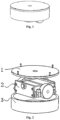
- Fig. 1 and Fig. 2 are schematic structural diagrams of the differential drive device according to an embodiment of the present application.
- the differential drive device of this embodiment includes a differential drive unit 2, a top plate 1 and an outer cover 3.
- the top plate 1 is installed on a top end of the outer cover 3.
- the differential drive unit 2 is located in the outer cover 3 at a lower side of the top plate 1.
- the top plate 1 is supported above the differential drive unit 2.
- An inner side wall of the outer cover 3 is circular-shaped.
- the differential drive unit refers to an integrated mechanical structure which integrates a drive motor, a reducer and a driving wheel, which can not only travel in a straight line and can also realize the function of steering.
- the differential drive unit is located in an inverted barrel-shaped container composed of the top plate and the outer cover, and the top plate is supported above the differential drive unit, i.e. the top plate is supported by the differential drive unit.
- a bottom end of the outer cover is higher than a bottom end of the differential drive unit, so that the differential drive unit can move away from the top plate and the outer cover.
- the differential drive unit can rotate relative to the top plate and the outer cover. At this time, sliding friction occurs between the top end of the differential drive unit and the top plate, and sliding friction occurs between the side of the differential drive unit and the inner side wall of the outer cover.
- the differential drive device can realize the functions of differential rotation in-situ and forward and backward walking.
- the AGV refers to a transport vehicle equipped with electromagnetic or optical automatic guidance devices, which can travel along a defined guidance path, have safety protection and various transfer functions.
- the AGV belongs to the category of Wheeled Mobile Robot (WMR).
- a through-hole is provided on the top plate, and the differential drive unit is connected to the automated guided vehicle through the through-hole.
- the top plate and/or the outer cover is fixed on the body of the AGV, and the through-hole can be open on the top plate.
- the wiring between the differential drive unit and the AGV is realized through the through-hole opened on the top plate (for example, motor power supply line of the differential drive unit needs to be connected to battery of the AGV), that is, the differential drive device is applied to the AGV, thereby realizing the relative rotation between the differential drive unit and the vehicle body.
- the differential drive device provided by this embodiment uses the top plate and the outer cover instead of the slewing bearing. Since the thickness of the top plate can be much smaller than the height of the slewing bearing, the differential drive device provided by this embodiment can effectively reduce the total height of the differential drive device.
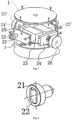
- a first rolling member 21 is provided on a side of the differential drive unit 2.
- the first rolling element 21 is in rolling connection with the lower side of the top plate 1.
- the first rolling member rotatably connected to the lower side of the top plate can reduce the friction between the differential drive unit and the top plate, thereby reducing the wear of the differential drive unit and the top plate, extending the service life of the differential drive device, and improving the motion accuracy of the differential drive unit.
- the first rolling member is arranged at the side instead of the top of the differential drive unit, which can reduce the influence of the overall height of the first rolling member on the total height of the differential drive device. For example, when installing the first rolling member, the highest point of the first rolling member should be higher than the differential drive unit.
- the first rolling member is installed at the side of the differential drive unit, which can effectively reduce the overall height of the differential drive unit compared with the current technical solution where the slewing bearing is installed on the top end of the differential drive unit.
- two first rolling members 21 are installed on the side of the differential drive unit 2.
- the two first rolling members 21 are arranged symmetrically about a center of slewing of the differential drive unit 2.
- the two first rolling members are arranged symmetrically about the center of slewing of the differential drive unit, which can balance the force when the differential drive unit contacts the top plate, thereby reducing the situation that the differential drive unit tilts under the pressure of the top plate. In turn, the stability of the differential drive device is improved.
- the first rolling member 21 can be a roller bearing.
- the roller bearing has the characteristics of simple installation structure and easy installation. Therefore, the use of the roller bearing for the first rolling member can simplify the structure of the differential drive device and improve the assembly efficiency of the differential drive device.
- the first rolling member can also be a ball, a bullseye wheel, etc., which can also achieve the effect of reducing the friction between the differential drive unit and the top plate.
- a side plate 28 is connected to the side of the differential drive unit 2, and the roller bearing is installed on the side plate 28.
- an axis of the first rolling member is horizontal.
- the rolling connection between the roller bearing and the top plate can be realized by installing a shaft head of the roller bearing on the side plate. And the roller bearing and the top plate are in line contact, which can reduce the local force on the top plate and increase the service life of the top plate.
- the installation method of the roller bearing is simple. For example, if the roller bearing with threads on the shaft head and the side plate with threaded holes are selected, the roller bearing and the side plate can be connected by threads.
- the threaded connection method is simple and reliable, which improves the convenience of installation and disassembly of the first rolling member.
- the first rolling member is installed on the side plate instead of directly on the differential drive unit, which can reduce the installation positions on the differential drive unit and improve the structural strength of the differential drive unit.
- the first rolling member After the first rolling member is assembled with the side plate as a whole, it can be connected to the side wall of the differential drive unit by a fastener.
- the two first rolling members 21 are installed on the side of the differential drive unit 2
- the two first rolling members 21 are symmetrically arranged about the center of slewing of the differential drive unit 2
- the center axis of slewing of the roller bearing can be perpendicular to and intersect with the center axis of slewing of the differential drive unit 2 when the first rolling member 21 is a roller bearing and is installed on the side of the differential drive unit 2.
- the roller bearing is arranged as described above, which can reduce the rolling friction between the roller bearing and the top plate, and can also balance the force on the two symmetrically arranged roller bearings, so that the differential drive unit can achieve differential rotation in situ as much as possible.
- a second rolling member 22 is provided on the side of the differential drive unit 2.
- the second rolling member 22 is in rolling connection with the inner side wall of the outer cover 3.
- the second rolling member rotatably connected to the inner side wall of the outer cover can reduce the friction between the differential drive unit and the outer cover, thereby reducing the wear of the differential drive unit and the outer cover, extending the service life of the differential drive device, and improving the motion accuracy of the differential drive unit.
- the second rolling member is arranged on the side wall instead of the top or the bottom of the differential drive unit, so that the highest point of the second rolling member can be lower than the highest point of the differential drive unit and the lowest point being can be higher than the lowest point of the differential drive unit when arranging the second rolling member. In this way, the second rolling member does not affect the overall height of the differential drive device.
- the second rolling member 22 can also be the roller bearing.
- the roller bearing is vertically installed on the side of the differential drive unit.
- the roller bearing has the characteristics of simple installation structure and easy installation. Therefore, the use of the roller bearing for the second rolling member can simplify the structure of the differential drive device and improve the assembly efficiency of the differential drive device.
- two second rolling members 22 are installed on the side of the differential drive unit 2.
- the two second rolling members 22 are arranged symmetrically about the center of slewing of the differential drive unit 2.
- the two second rolling members are symmetrically arranged on both sides of the differential drive unit, which can not only balance the force on the differential drive unit, but also limit the differential drive unit, thereby reducing the occurrence of the contact between other parts of the differential drive unit and the outer cover during the movement
- the second rolling member 22 is the roller bearing.
- a bearing seat 26 is provided on the side wall of the differential drive unit 2, and the roller bearing is installed on the bearing seat 26.
- an axis of the roller bearing is vertical.
- the rolling connection between the roller bearing and the inner wall of the outer cover can be realized by installing a shaft head of the roller bearing on the bearing seat. And the roller bearing and the outer cover are in line contact, which can reduce the local force on the outer cover and increase the service life of the outer cover.
- the installation method of the roller bearing is simpler than that of other bearings. For example, if the roller bearing with threads on the shaft head and the mounting seat with threaded holes are selected, the roller bearing and the mounting seat can be connected by threads.
- the threaded connection method is simple and reliable, which improves the convenience of installation and disassembly of the second rolling member.
- the second rolling member can also be a ball, a bullseye wheel, etc., which can also achieve the effect of reducing the friction between the differential drive unit and the outer cover.
- the first rolling member 21 is provided on the side of the differential drive unit 2.
- the first rolling member 21 is in rolling connection with the lower side of the top plate 1.
- One end of the first rolling member 21 close to the inner side wall of the outer cover 3 is provided with a groove, and the second rolling member 22 is installed in the groove.
- the second rolling member 22 partially protrudes out of the groove and is in rolling connection with the inner side wall of the outer cover 3.
- the differential drive unit is in rolling connection with the top plate through the first rolling member.
- the first rolling member can reduce the friction between the differential drive unit and the top plate, and on the other hand, it can also be used to carry the force in the vertical direction from the top plate.
- the differential drive unit is in rolling connection with the inner side wall of the outer cover through the second rolling member.
- the second rolling member can reduce the friction between the differential drive unit and the outer cover, and on the other hand, it can also be used to carry the force in the horizontal direction from the outer cover.
- the first rolling member and the second rolling member are assembled together. Compared with the technical solution in which the first rolling member and the second rolling member are individually installed on the differential drive unit, the installation positions arranged on the differential drive unit can be reduced, thereby improving the structural strength of the differential drive unit.
- first rolling member and the second rolling member is not limited in the embodiments of the present application, and those skilled in the art can make reasonable selections according to actual needs.
- a top end of the first rolling member 21 is higher than the differential drive unit 2 (see Fig. 3 or Fig. 6 ).
- the slewing diameter of the differential drive unit 2 is smaller than an inner diameter of the outer cover 3.
- the first rolling member also constitutes the function of the balance bridge: the differential drive unit is contacted with the top plate through the first rolling member, so the differential drive unit can rotate around the first rolling member, that is, during the operation of the differential drive unit, when the ground is uneven, the differential drive unit can swing around the first rolling member (that is, when one of the driving wheels is raised, the other driving wheel can still keep in contact with the ground).
- the two driving wheels can be kept in good contact with the ground through this swing, thus reducing the situation that the driving wheels are overhead, which cannot be achieved by using the slewing bearing in the existing differential drive device.
- connection line of the two first rolling members 21 can be perpendicular to the connection line of the two driving wheels of the differential drive unit 2 (see Fig. 3 or Fig. 6 ).
- the two first rolling members constitutes the function of the balance bridge: the differential drive unit is contacted with the top plate through the two first rolling members, so the differential drive unit can rotate around the connection line of the two first rolling members.
- the differential drive unit can keep the two driving wheels in good contact with the ground through this swing, thereby avoiding the drive wheels from being overhead.
- a pin shaft 27 is provided on the side of the differential drive unit 2.
- An annular limiting slot is provided at a position on the inner side wall of the outer cover 3 corresponding to the pin shaft 27. An end of the pin shaft 27 close to the outer cover 3 is located in the limiting slot.
- the limiting slot can limit the differential drive unit, prevent the differential drive unit from coming out of the outer cover, and keep the entire differential drive unit as a whole.
- This embodiment does not limit the number of the pin shafts, and multiple pin shafts can be arranged on the side of the differential drive unit.
- the outer cover is provided with an installation slot on the lower side of the limiting slot.
- An upper end of the installation slot communicates with the limiting slot, and a lower end of the installation slot communicates with the lower side of the outer cover.
- the installation slot is provided with a sealing block detachably connected to the outer cover.
- the pin shaft 27 is installed on the bearing seat 26.
- the pin shaft is installed on the bearing seat, which can reduce the installation positions on the differential drive unit and improve the structural strength of the differential drive unit.
- one end of the pin shaft is provided with threads
- the bearing seat is provided with threaded holes
- the pin shaft and the bearing seat are connected through the threaded holes.
- the differential drive unit 2 includes a first motor 23, a second motor 23', a first reducer 24, a second reducer 24', a first driving wheel 25 and a second driving wheel 25'; wherein: the first motor 23 and the second motor 23' are arranged side by side, and the output shafts of the first motor 23 and the second motor 23' face away from each other; the first reducer 24 is connected to the output shaft of the first motor 23, and the second reducer 24' is connected to the output shaft of the second motor 23'; the first driving wheel 25 is installed on a side of the first reducer 24 facing away from the first motor 23, and the second driving wheel 25' is installed on a side of the second reducer 24' facing away from the second motor 23'.
- the first driving wheel is driven by the first motor
- the second driving wheel is driven by the second motor.
- the differential drive unit can realize the functions of differential rotation in-situ and forward and backward walking by controlling the speed and the steering of the first motor and the second motor.
- each of the components in the differential drive unit are arranged in a symmetrical manner, which can balance the forces on the two driving wheels of the differential drive unit, thereby enabling the differential drive unit to move more smoothly.
- two limiting posts are provided on the side wall of the differential drive unit, a limiting plate is provided on the lower side of the top plate, and the limiting plate is located on the movement track of the limiting posts.
- the limiting posts arranged on the side wall of the differential drive unit will rotate with the differential drive unit relative to the top plate; when the differential drive unit is installed on the AGV, the differential drive unit will connect to the AGV through the through-hole opened on the top plate (for example, the motor power supply line needs to be connected to the battery on the AGV).
- the limiting plate on the top plate is matched with the limiting posts arranged on the differential drive unit to limit the rotation angle of the differential drive unit, thereby avoiding the situation that the differential drive unit rotates infinitely relative to the top plate and causes the connection to be twisted off.
- Chassis structure of existing AGV is relatively complex and requires higher road surface flatness. Only one driving wheel may land on the ground when driving on the uneven road, resulting in insufficient traction, slipping, out of control and other phenomena.
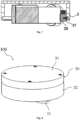
- the differential drive device 100 includes a differential drive unit 10, a support body 20, and a mounting frame 30 formed by enclosing a top plate 31 and an outer cover 32.
- the differential drive unit 10 is hinged to the support body 20 so that the differential drive unit 10 swings around the transverse axis relative to the support body 20.
- a receptacle cavity is formed in the mounting frame 30, and the support body 20 and the differential drive unit 10 are arranged in the receptacle cavity.
- the support body 20 supports the mounting frame 30, and the differential drive unit 10 is arranged to be rotatable around a longitudinal axis of the receptacle cavity. It can be understood that when the differential drive device 100 is applied to an AGV, it can be connected to a bottom of the AGV through the mounting frame 30.
- the top plate 31 and/or the outer cover 32 can be used to connect to the vehicle body of the AGV. After the mounting frame 30 is connected to the vehicle body, the top plate 31 is arranged horizontally.
- the receptacle cavity is formed in the mounting frame 30, and the support body 20 and the differential drive unit 10 are arranged in the receptacle cavity.
- the support body 20 supports the mounting frame 30, and the differential drive unit 10 is arranged to be rotatable around a longitudinal axis of the receptacle cavity.
- the differential drive unit 10 is hinged to the support body 20 so that the differential drive unit 10 can swing around the transverse axis relative to the support body 20.
- a "universal joint" structure is formed between the differential drive unit 10 and the mounting frame 30.
- the differential drive unit 10 has two degrees of freedom of rotation relative to the mounting frame 30, first degree of freedom is the degree of freedom that the differential drive unit 10 can rotate about the longitudinal axis, and second degree of freedom is the degree of freedom that the differential drive unit 10 can swing about the transverse axis.
- the first degree of freedom is used to realize the steering function of the AGV under the action of the differential drive unit 10
- the second degree of freedom is used to adapt the differential drive unit 10 to the fluctuations of the road surface, so that the differential drive unit 10 maintains effective contact with the road surface, so as to avoid the phenomenon of slipping and out of control caused by insufficient traction. It can be seen that when the differential drive device 100 of the embodiment of the present application is applied to an AGV, it can effectively reduce AGV's requirements for the flatness of the road surface.
- the support body 20 is a horizontal support plate (as shown in Fig. 9 ), and the differential drive unit 10 is arranged below the horizontal support plate.
- the horizontal support plate refers to a plate structure arranged in the horizontal direction.
- a direction parallel to the road surface can be understood as the horizontal direction.
- the differential drive unit 10 is arranged below the horizontal support body, so that the horizontal support body can support the mounting frame 30.
- the differential drive device 100 further includes a connecting shaft 40.
- the differential drive unit 10 and the horizontal support body are connected by the connecting shaft 40, and a central axis of the connecting shaft 40 coincides with the transverse axis.
- the differential drive unit 10 is hinged to and the support body 20, so that the differential drive unit 10 can swing about the transverse axis relative to the support body 20.
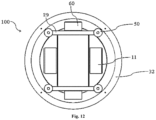
- the support body 20 includes two vertical plates 29 arranged at intervals (as shown in Fig. 10 to Fig. 12 ), and the differential drive unit 10 is arranged between the two vertical plates 29.
- the vertical plate 29 refers to a plate structure with the plate surface arranged in the vertical direction.
- the mounting frame 30 can also be supported by the two vertical plates 29 arranged at intervals.
- the differential drive device 100 also includes a connecting shaft 40.
- the two vertical plates 29 and the differential drive unit 10 are connected by the connecting shaft 40, and the central axis of the connecting shaft 40 coincides with the transverse axis.
- a middle of the connecting shaft 40 passes through the differential drive unit 10, and two ends of the connecting shaft 40 correspondingly pass through the two vertical plates 29.
- the differential drive unit 10 is hinged to the support body 20, so that the differential drive unit 10 can swing around the transverse axis relative to the support body 20.
- the differential drive device 100 further includes a first rolling member 50, and the first rolling member 50 is arranged between the differential drive unit 10 and the outer cover 32 or between the support 20 and the outer cover 32.
- the first rolling member 50 is used to enable the differential drive unit 10 to rotate around the longitudinal axis of the receptacle cavity, and is beneficial to ensure smooth and stable rotation of the differential drive device.
- the first rolling members 50 there are a plurality of the first rolling members 50, and the plurality of the first rolling members 50 are arranged at intervals from each other, thereby facilitating a stable rotation relationship between the differential drive unit 10 and the mounting frame 30.
- the first rolling member 50 may be a ball, a roller or a bearing, etc.
- the first rolling member 50 may be arranged both on the differential drive unit 10 and the horizontal support plate.
- the rotation of the differential drive unit 10 around the longitudinal axis of the receptacle cavity can be realized by the rolling of the first rolling member 50 on the inner wall of the outer cover 32.
- the first rolling member 50 can be arranged on the differential drive unit 10 or the vertical plate 29, wherein since the differential drive unit 10 is arranged between the two vertical plates 29, in order to reduce the possibility of mutual interference between the components, it is a better way to arrange the first rolling member 50 on the vertical plate 29.
- the differential drive device 100 further includes a plurality of second rolling members 60 arranged on the support body 20, and the support body 20 supports the top plate 31 through the plurality of second rolling members 60.
- the weight of the vehicle body of the AGV is mainly transmitted to the support body 20 through the second rolling member 60, so that the first rolling member 50 does not bear the weight of the vehicle body, thereby preventing the first rolling member 50 from being deformed or even damaged.
- the second rolling member 60 may be a ball, a roller or a bearing, etc.
- the second rolling member 60 when the support body 20 is a horizontal support plate, the second rolling member 60 can be arranged at the corner of the horizontal support plate. Specifically, a protrusion can be formed at the corner of the horizontal support plate, and then the second rolling member 60 can be installed on the protrusion. As a result, the second rolling member 60 is less likely to interfere with other structures.
- the second rolling member 60 is a roller or bearing, the rotating shaft thereof can be arranged parallel to the plate surface of the horizontal support plate, so that the second rolling member 60 can provide a more stable support for the top plate 31.
- the second rolling member 60 can be arranged on the outer side of the vertical plate 29 (a side facing away from the differential drive unit 10).
- the second rolling member 60 is a roller or bearing, the rotating shaft thereof can be arranged parallel to the plate surface of the horizontal support plate, so that the second rolling member 60 can provide a more stable support for the top plate 31.
- rotating shaft of the second rolling member 60 and the connecting shaft 40 can also be integrated as an integral part, that is, the end of the connecting shaft 40 can be extended, and the second rolling member 60 can be installed on the end of the connecting shaft 40, so that the number of parts can be reduced and the cost can be saved.
- the differential drive unit 10 includes a driving wheel 11 and a power unit 12 connected to the driving wheel 11, wherein the power unit 12 provides power for the rotation of the driving wheel 11, and the power unit 12 is hinged to the support body 20.
- an axle of the driving wheel 11 is perpendicular to the transverse axis.
- the height of the driving wheel 11 changes most significant, so that the driving wheel 11 can adapt to the height change of the road surface to the greatest extent.
- the number of the driving wheels 11 is two, and the forward direction of the AGV can be controlled by implementing different control methods for the two driving wheels 11.
- the AGV can be driven forward; when the two driving wheels 11 rotate in the opposite directions at the same speed, the AGV can be driven backward; and when the two driving wheels 11 rotate forward at different speeds or when one of the two driving wheels 11 rotates forward and the other rotates backward, the AGV can be driven to turn.
- a supporting wheel may be additionally provided at the bottom of the AGV to cooperate with the differential drive device 100 to support the AGV and make the AGV moving on the ground.
- a plurality of differential drive devices 100 can also be arranged at the bottom of the AGV to make the AGV obtaining stable support.
- the power unit 12 includes a motor and a reduction mechanism (not shown in the figure).
- the motor is connected to the driving wheel 11 through a reduction mechanism (for example, a gear reduction mechanism, a planetary gear reduction mechanism, etc.), thereby reducing the output speed of the motor and increasing the output torque of the motor.
- a reduction mechanism for example, a gear reduction mechanism, a planetary gear reduction mechanism, etc.
- the number of the motor is one.
- the reduction mechanism can choose a differential reducer.
- the two driving wheels 11 can be controlled by one motor to rotate in the same direction at the same speed, in the same direction at different speeds, or to rotate in opposite directions, so that the driving wheels 11 can drive the AGV forward, backward and turn.
- the number of the motors and the reduction mechanisms can also be two respectively, that is, each of the motors is connected to one driving wheel 11 through one reduction mechanism.
- the corresponding driving wheels 11 are controlled by different motors, so as to achieve that the two driving wheels 11 rotate in the same direction at the same speed, in the same direction at different speeds, or in the opposite directions to each other, and the like.
- a ring-shaped limiting slot is formed on the side wall of the receptacle cavity (not shown in the drawings).
- the end of the connecting shaft 40 extends out of the differential drive unit 10 and is arranged in the limiting slot.
- the connecting shaft 40 is always in a horizontal direction, so that the support body 20 can form an effective and stable support for the mounting frame 30.
- An embodiment of the present application also provides an AGV which includes the differential drive device in any of the embodiments described above.
- a receptacle cavity is formed in the mounting frame of the differential drive device thereof.
- the support body and the differential drive unit are arranged in the receptacle cavity, the support body supports the mounting frame, and the differential drive unit is arranged to be rotatable around the longitudinal axis of the receptacle cavity.
- the differential drive unit is hinged to the support body, so that the differential drive unit swings around the transverse axis relative to the support body.
- a "universal joint" structure is formed between the differential drive unit and the mounting frame.
- the differential drive unit has two degrees of freedom of rotation relative to the mounting frame, first degree of freedom is the degree of freedom that the differential drive unit can rotate about the longitudinal axis, and second degree of freedom is the degree of freedom that the differential drive unit can swing about the transverse axis.
- the first degree of freedom is used to realize the steering function of the AGV under the action of the differential drive unit
- the second degree of freedom is used to adapt the differential drive unit to the fluctuations of the road surface, so that the differential drive unit maintains effective contact with the road surface, so as to avoid the phenomenon of slipping and out of control caused by insufficient traction.
Landscapes
- Engineering & Computer Science (AREA)
- Transportation (AREA)
- Mechanical Engineering (AREA)
- Chemical & Material Sciences (AREA)
- Combustion & Propulsion (AREA)
- Structural Engineering (AREA)
- Civil Engineering (AREA)
- General Engineering & Computer Science (AREA)
- Life Sciences & Earth Sciences (AREA)
- Geology (AREA)
- Retarders (AREA)
- Non-Deflectable Wheels, Steering Of Trailers, Or Other Steering (AREA)
- Arrangement Or Mounting Of Propulsion Units For Vehicles (AREA)
- Motor Power Transmission Devices (AREA)
Description
- The present application relates to the technical field of wheeled drivers, in particular to a differential drive device and an AGV.
- The current automated guided vehicle (AGV) is mostly driven by a differential drive device. The differential drive device refers to an integrated mechanical structure which integrates a drive motor, a reducer, a driving wheel, etc. Compared with the traditional AGV differential control mode, the differential drive device has high integration and strong adaptability, which can rapidly deploy AGVs, mobile robots, etc.
- The slewing bearing is generally used to realize the rotation connection between the differential drive device and the vehicle body. However, the slewing bearing must occupy the height of the differential drive device in the vertical direction, which leads to the problem that the total height of the differential drive device is relatively large and its application is limited in the scene with high requirements for height space.
- Also, in the art are known some methods or devices as described in their respective documents.
- For example,
DE 102016107451A1 discloses a transport and lifting unit in which both a height adjustment is integrated and a reliable load pick-up and transport is possible and which can also be used universally and independently and can be moved as desired. Self-propelled transport and lifting unit (1) for lifting and moving objects (3), comprising a controller, an energy supply, two drive wheels (2), each with its own drive, a centrally and vertically arranged nut/spindle unit (4, 5 ), wherein in the transport and lifting unit (1) there is an internal thread (4) for the nut/spindle unit (4, 5) and the spindle (5) is arranged in the internal thread (4) and wherein at the upper end of the A lifting plate (6) is arranged on the spindle (5), the lifting plate (6) being connected to the spindle (5) in a torsion-proof manner and the axis of rotation of the drive wheels (2) crossing the axis of rotation of the spindle (5). -
CN 107035188A discloses a novel super-thin AGV carrier. The novel super-thin AGV carrier is composed of two vehicle body units of the same front and back structure, and the two vehicle body units are connected through middle telescopic connecting mechanisms. Each vehicle body unit comprises a walking part, a wheel holding lifting part and a frame structure. Each walking part comprises two driving wheel modules and four driven wheel modules, wherein the driving wheel modules are used for achieving plane all-direction walking of a carrier body, and the driven wheel modules are used for assisting driving wheels to share load weight and balance and support the vehicle body. Each wheel holding lifting part comprises two wheel holding lifting assemblies located on the two sides of the corresponding frame structure. Each wheel holding lifting assembly comprises a driving mechanism, a transmission mechanism and a wheel holding mechanism, wherein the driving mechanism provides power output, the transmission mechanism achieves movement speed reduction and power amplification, and the wheel holding mechanism finally lifts a vehicle away from the ground. -
WO 2018/211481A1 discloses a low-profile robotic mover of pallets, carts or other loads includes multiple, independently operated compact drive units housed into separate but connected structural elements of the device. These connection(s) pivot and telescope and can be locked in a telescoped position. This invention can also uses differential drive units which then provides many features beneficial to robotic load moving devices. This device remains ultra-low profile even when heavy loads need to be lifted and moved as more drive units can be added as needed. The pivoting/telescoping connections between structural elements allows the device to modify its own size or shape to better match the dimensions of the load to be moved. Combining the connecting pivot(s) with the with the drive wheel assembly pivots means all driven wheels maintain traction regardless of wheel orientation or variations in floor height or angles, allowing the device to automatically and predictably navigate uneven floors. - An object of the embodiments of the present application is to provide a differential drive device and an AGV to effectively reduce the total height of the differential drive device. The specific technical solutions are as follows:
An embodiment of the present application provides a differential drive device including a differential drive unit, a top plate and an outer cover. The top plate is installed on a top end of the outer cover. The differential drive unit is located in the outer cover at a lower side of the top plate. The top plate is supported above the differential drive unit. An inner side wall of the outer cover is characterized in that a first rolling member is provided on a side of the differential drive unit. The first rolling member is in rolling connection with the lower side of the top plate. - Optionally, two first rolling members are installed on the side of the differential drive unit. The two first rolling members are arranged symmetrically about a center of slewing of the differential drive unit.
- Optionally, a second rolling member is provided on the side of the differential drive unit. The second rolling member is in rolling connection with the inner side wall of the outer cover.
- Optionally, two second rolling members are installed on the side of the differential drive unit. The two second rolling members are arranged symmetrically about the center of slewing of the differential drive unit.
- Optionally, a first rolling member is provided on the side of the differential drive unit. The first rolling member is in rolling connection with the lower side of the top plate. An end of the first rolling member close to the inner side wall of the outer cover is provided with a groove, and a second rolling member is installed in the groove. The second rolling member partially protrudes out of the groove and is rotatably connected to the inner side wall of the outer cover.
- Optionally, the second rolling member is a roller bearing. A bearing seat is provided on a side wall of the differential drive unit, and the roller bearing is installed on the bearing seat.
- Optionally, a top end of the first rolling member is higher than the differential drive unit. A slewing diameter of the differential drive unit is smaller than an inner diameter of the outer cover.
- Optionally, a pin shaft is provided on the side of the differential drive unit. An annular limiting slot is provided at a position on the inner side wall of the outer cover corresponding to the pin shaft. An end of the pin shaft close to the outer cover is located in the limiting slot.
- Optionally, the differential drive unit includes a first motor, a second motor, a first reducer, a second reducer, a first driving wheel and a second driving wheel, wherein the first motor and the second motor are arranged side by side, and output shafts of the first motor and the second motor face away from each other; the first reducer is connected to the output shaft of the first motor, and the second reducer is connected to the output shaft of the second motor; the first driving wheel is installed on a side of the first reducer facing away from the first motor, and the second driving wheel is installed on a side of the second reducer facing away from the second motor.
- Optionally, a through-hole is provided on the top plate, and the differential drive unit is connected to the AGV through the through-hole.
- Optionally, the differential drive unit further includes: a support body;
- the differential drive unit is hinged to the support body, so that the differential drive unit swings around a transverse axis relative to the support body;
- the top plate and the outer cover are enclosed to form a mounting frame, and a receptacle cavity is formed in the mounting frame, the support body and the differential drive unit are arranged in the receptacle cavity, the support body supports the mounting frame, and the differential drive unit is arranged in a rotatable manner around a longitudinal axis of the receptacle cavity.
- Optionally, the support is a horizontal support plate, and the differential drive unit is arranged below the horizontal support plate.
- Optionally, the differential drive device further includes a connecting shaft. The differential drive unit and the horizontal support plate are connected by the connecting shaft, and a central axis of the connecting shaft coincides with the transverse axis.
- Optionally, the support body includes two vertical plates arranged at intervals, and the differential drive unit is arranged between the two vertical plates.
- Optionally, the differential drive device further includes a connecting shaft, the two vertical plates and the differential drive unit are connected by the connecting shaft, and the central axis of the connecting shaft coincides with the transverse axis.
- Optionally, a ring-shaped limiting slot is formed on the side wall of the receptacle cavity. The end of the connecting shaft extends out of the differential drive unit and is arranged in the limiting slot.
- Optionally, the differential drive device further includes a first rolling member, and the first rolling member is arranged between the differential drive unit and the outer cover or between the support body and the outer cover.
- Optionally, the first rolling member is a ball, a roller or a bearing.
- Optionally, the differential drive device further includes a plurality of second rolling members arranged on the support body, and the support body supports the top plate through the plurality of second rolling members.
- Optionally, the second rolling member is a ball, a roller or a bearing.
- Optionally, the differential drive unit includes a driving wheel and a power unit connected to the driving wheel, and the power unit is hinged to the support body.
- Optionally, an axle of the driving wheel is perpendicular to the transverse axis.
- The embodiment of the present application further provides an AGV including the differential drive device described above.
- The embodiment of the present application provides a differential drive device and an AGV. A differential drive unit is located in an inverted barrel-shaped container composed of a top plate and an outer cover. The top plate is supported by the differential drive unit, and a bottom end of the outer cover is higher than a bottom end of the differential drive unit, so that the differential drive unit can move away from the top plate and the outer cover. Since the differential drive unit itself can rotate, the differential drive unit can rotate relative to the top plate and the outer cover. In summary, the differential drive device can realize the functions of differential rotation in-situ and forward and backward walking. The differential drive device according to the present embodiment uses the top plate and the outer cover instead of a slewing bearing. Since the thickness of the top plate can be much smaller than the height of the slewing bearing, the differential drive device according to the present embodiment can effectively reduce the total height of the differential drive device.
- In order to more clearly describe the technical solutions of the embodiments of the present application or of the prior art, drawings that need to be used in embodiments and the prior art will be briefly described below. Obviously, the drawings provided below are for only some embodiments of the present application; those skilled in the art can also obtain other drawings based on these drawings without any creative efforts.
-
Fig. 1 is an isometric view of a differential drive device according to an embodiment of the present application; -
Fig. 2 is a partial exploded view of a differential drive device according to an embodiment of the present application; -
Fig. 3 is an overall exploded view of a differential drive device according to an embodiment of the present application; -
Fig. 4 is a partial exploded view of a differential drive device according to another embodiment of the present application; -
Fig. 5 is an overall exploded view of a differential drive device according to another embodiment of the present application; -
Fig. 6 is an isometric view of a first rolling member and a second rolling member of the differential drive device according to an embodiment of the present application; -
Fig. 7 is a cross-sectional view of a differential drive device according to an embodiment of the present application; -
Fig. 8 is a schematic structural diagram of a differential drive device according to an embodiment of the present application; -
Fig. 9 is an overall exploded view of a differential drive device according to still another embodiment of the present application; -
Fig. 10 is an overall exploded view of a differential drive device according to yet another embodiment of the present application; -
FIG. 11 is a schematic front view of a differential drive device according to an embodiment of the present application (a top plate is omitted); -
Fig. 12 is a schematic top view of a differential drive device according to an embodiment of the present application (a top plate is omitted). - In order to make the objectives, technical solutions, and advantages of the present application clearer and more understandable, the present application will be described in more detail below with reference to the appended drawings and embodiments. Obviously, the described embodiments are only some, and not all, of the embodiments of the present application. All other embodiments obtained based on the embodiments of the present application by those skilled in the art without any creative efforts fall into the scope of protection defined by the present application.
- The embodiments of the present application provide a differential drive device and an AGV, which can effectively reduce the total height of the differential drive device.
-
Fig. 1 and Fig. 2 are schematic structural diagrams of the differential drive device according to an embodiment of the present application. As shown inFig. 1 and Fig. 2 , the differential drive device of this embodiment includes adifferential drive unit 2, atop plate 1 and anouter cover 3. Thetop plate 1 is installed on a top end of theouter cover 3. Thedifferential drive unit 2 is located in theouter cover 3 at a lower side of thetop plate 1. Thetop plate 1 is supported above thedifferential drive unit 2. An inner side wall of theouter cover 3 is circular-shaped. - In this embodiment, the differential drive unit refers to an integrated mechanical structure which integrates a drive motor, a reducer and a driving wheel, which can not only travel in a straight line and can also realize the function of steering. The differential drive unit is located in an inverted barrel-shaped container composed of the top plate and the outer cover, and the top plate is supported above the differential drive unit, i.e. the top plate is supported by the differential drive unit. A bottom end of the outer cover is higher than a bottom end of the differential drive unit, so that the differential drive unit can move away from the top plate and the outer cover.
- Also, since the differential drive unit itself can rotate, the differential drive unit can rotate relative to the top plate and the outer cover. At this time, sliding friction occurs between the top end of the differential drive unit and the top plate, and sliding friction occurs between the side of the differential drive unit and the inner side wall of the outer cover. In summary, the differential drive device can realize the functions of differential rotation in-situ and forward and backward walking.
- When the differential drive device is applied to an AGV, the AGV refers to a transport vehicle equipped with electromagnetic or optical automatic guidance devices, which can travel along a defined guidance path, have safety protection and various transfer functions. The AGV belongs to the category of Wheeled Mobile Robot (WMR).
- Optionally, a through-hole is provided on the top plate, and the differential drive unit is connected to the automated guided vehicle through the through-hole.
- The top plate and/or the outer cover is fixed on the body of the AGV, and the through-hole can be open on the top plate. The wiring between the differential drive unit and the AGV is realized through the through-hole opened on the top plate (for example, motor power supply line of the differential drive unit needs to be connected to battery of the AGV), that is, the differential drive device is applied to the AGV, thereby realizing the relative rotation between the differential drive unit and the vehicle body. The differential drive device provided by this embodiment uses the top plate and the outer cover instead of the slewing bearing. Since the thickness of the top plate can be much smaller than the height of the slewing bearing, the differential drive device provided by this embodiment can effectively reduce the total height of the differential drive device.
- As shown in
Fig. 3 , a first rollingmember 21 is provided on a side of thedifferential drive unit 2. Thefirst rolling element 21 is in rolling connection with the lower side of thetop plate 1. - In this embodiment of the invention, when the differential drive unit rotates relative to the top plate, the first rolling member rotatably connected to the lower side of the top plate can reduce the friction between the differential drive unit and the top plate, thereby reducing the wear of the differential drive unit and the top plate, extending the service life of the differential drive device, and improving the motion accuracy of the differential drive unit. In addition, the first rolling member is arranged at the side instead of the top of the differential drive unit, which can reduce the influence of the overall height of the first rolling member on the total height of the differential drive device. For example, when installing the first rolling member, the highest point of the first rolling member should be higher than the differential drive unit. As for the height difference between the highest point of the first rolling member and the highest point of the differential drive unit, it can be adjusted accordingly according to actual needs. In this embodiment, the first rolling member is installed at the side of the differential drive unit, which can effectively reduce the overall height of the differential drive unit compared with the current technical solution where the slewing bearing is installed on the top end of the differential drive unit.
- As shown in
Fig. 3 , optionally, two first rollingmembers 21 are installed on the side of thedifferential drive unit 2. The two first rollingmembers 21 are arranged symmetrically about a center of slewing of thedifferential drive unit 2. - In this embodiment, the two first rolling members are arranged symmetrically about the center of slewing of the differential drive unit, which can balance the force when the differential drive unit contacts the top plate, thereby reducing the situation that the differential drive unit tilts under the pressure of the top plate. In turn, the stability of the differential drive device is improved.
- As shown in
Fig. 3 , optionally, the first rollingmember 21 can be a roller bearing. The roller bearing has the characteristics of simple installation structure and easy installation. Therefore, the use of the roller bearing for the first rolling member can simplify the structure of the differential drive device and improve the assembly efficiency of the differential drive device. - It can be understood that the first rolling member can also be a ball, a bullseye wheel, etc., which can also achieve the effect of reducing the friction between the differential drive unit and the top plate.
- As shown in
Fig. 3 , in the case of the first rollingmember 21 being the roller bearing, optionally, aside plate 28 is connected to the side of thedifferential drive unit 2, and the roller bearing is installed on theside plate 28. - In this embodiment, an axis of the first rolling member is horizontal. The rolling connection between the roller bearing and the top plate can be realized by installing a shaft head of the roller bearing on the side plate. And the roller bearing and the top plate are in line contact, which can reduce the local force on the top plate and increase the service life of the top plate. In addition, the installation method of the roller bearing is simple. For example, if the roller bearing with threads on the shaft head and the side plate with threaded holes are selected, the roller bearing and the side plate can be connected by threads. The threaded connection method is simple and reliable, which improves the convenience of installation and disassembly of the first rolling member.
- Also, the first rolling member is installed on the side plate instead of directly on the differential drive unit, which can reduce the installation positions on the differential drive unit and improve the structural strength of the differential drive unit. After the first rolling member is assembled with the side plate as a whole, it can be connected to the side wall of the differential drive unit by a fastener.
- As shown in
Fig. 3 , optionally, when the two first rollingmembers 21 are installed on the side of thedifferential drive unit 2, the two first rollingmembers 21 are symmetrically arranged about the center of slewing of thedifferential drive unit 2, and the center axis of slewing of the roller bearing can be perpendicular to and intersect with the center axis of slewing of thedifferential drive unit 2 when the first rollingmember 21 is a roller bearing and is installed on the side of thedifferential drive unit 2. - In this embodiment, the roller bearing is arranged as described above, which can reduce the rolling friction between the roller bearing and the top plate, and can also balance the force on the two symmetrically arranged roller bearings, so that the differential drive unit can achieve differential rotation in situ as much as possible.
- As shown in
Fig. 3 , optionally, a second rollingmember 22 is provided on the side of thedifferential drive unit 2. The second rollingmember 22 is in rolling connection with the inner side wall of theouter cover 3. - In this embodiment, when the differential drive unit rotates relative to the outer cover, the second rolling member rotatably connected to the inner side wall of the outer cover can reduce the friction between the differential drive unit and the outer cover, thereby reducing the wear of the differential drive unit and the outer cover, extending the service life of the differential drive device, and improving the motion accuracy of the differential drive unit. In addition, the second rolling member is arranged on the side wall instead of the top or the bottom of the differential drive unit, so that the highest point of the second rolling member can be lower than the highest point of the differential drive unit and the lowest point being can be higher than the lowest point of the differential drive unit when arranging the second rolling member. In this way, the second rolling member does not affect the overall height of the differential drive device.
- As shown in
Fig. 3 , optionally, the second rollingmember 22 can also be the roller bearing. In this case, the roller bearing is vertically installed on the side of the differential drive unit. The roller bearing has the characteristics of simple installation structure and easy installation. Therefore, the use of the roller bearing for the second rolling member can simplify the structure of the differential drive device and improve the assembly efficiency of the differential drive device. - As shown in
Fig. 3 , optionally, twosecond rolling members 22 are installed on the side of thedifferential drive unit 2. The twosecond rolling members 22 are arranged symmetrically about the center of slewing of thedifferential drive unit 2. - In this embodiment, the two second rolling members are symmetrically arranged on both sides of the differential drive unit, which can not only balance the force on the differential drive unit, but also limit the differential drive unit, thereby reducing the occurrence of the contact between other parts of the differential drive unit and the outer cover during the movement
- As shown in
Fig. 3 , optionally, the second rollingmember 22 is the roller bearing. A bearingseat 26 is provided on the side wall of thedifferential drive unit 2, and the roller bearing is installed on the bearingseat 26. - In this embodiment, an axis of the roller bearing is vertical. The rolling connection between the roller bearing and the inner wall of the outer cover can be realized by installing a shaft head of the roller bearing on the bearing seat. And the roller bearing and the outer cover are in line contact, which can reduce the local force on the outer cover and increase the service life of the outer cover. In addition, the installation method of the roller bearing is simpler than that of other bearings. For example, if the roller bearing with threads on the shaft head and the mounting seat with threaded holes are selected, the roller bearing and the mounting seat can be connected by threads. The threaded connection method is simple and reliable, which improves the convenience of installation and disassembly of the second rolling member.
- It can be understood that the second rolling member can also be a ball, a bullseye wheel, etc., which can also achieve the effect of reducing the friction between the differential drive unit and the outer cover.
- As shown in
Fig. 4 andFig. 6 , optionally, the first rollingmember 21 is provided on the side of thedifferential drive unit 2. The first rollingmember 21 is in rolling connection with the lower side of thetop plate 1. One end of the first rollingmember 21 close to the inner side wall of theouter cover 3 is provided with a groove, and the second rollingmember 22 is installed in the groove. The second rollingmember 22 partially protrudes out of the groove and is in rolling connection with the inner side wall of theouter cover 3. - In this embodiment, the differential drive unit is in rolling connection with the top plate through the first rolling member. On the one hand, the first rolling member can reduce the friction between the differential drive unit and the top plate, and on the other hand, it can also be used to carry the force in the vertical direction from the top plate. The differential drive unit is in rolling connection with the inner side wall of the outer cover through the second rolling member. On the one hand, the second rolling member can reduce the friction between the differential drive unit and the outer cover, and on the other hand, it can also be used to carry the force in the horizontal direction from the outer cover. In this embodiment, the first rolling member and the second rolling member are assembled together. Compared with the technical solution in which the first rolling member and the second rolling member are individually installed on the differential drive unit, the installation positions arranged on the differential drive unit can be reduced, thereby improving the structural strength of the differential drive unit.
- It can be understood that the number of the first rolling member and the second rolling member is not limited in the embodiments of the present application, and those skilled in the art can make reasonable selections according to actual needs.
- As shown in
Fig. 2 orFig. 4 , optionally, a top end of the first rollingmember 21 is higher than the differential drive unit 2 (seeFig. 3 orFig. 6 ). The slewing diameter of thedifferential drive unit 2 is smaller than an inner diameter of theouter cover 3. - In this embodiment, the first rolling member also constitutes the function of the balance bridge: the differential drive unit is contacted with the top plate through the first rolling member, so the differential drive unit can rotate around the first rolling member, that is, during the operation of the differential drive unit, when the ground is uneven, the differential drive unit can swing around the first rolling member (that is, when one of the driving wheels is raised, the other driving wheel can still keep in contact with the ground). The two driving wheels can be kept in good contact with the ground through this swing, thus reducing the situation that the driving wheels are overhead, which cannot be achieved by using the slewing bearing in the existing differential drive device.
- As shown in
Fig. 2 orFig. 4 , optionally, when the two first rollingmembers 21 are installed on the side of thedifferential drive unit 2 and the two first rollingmembers 21 are symmetrically arranged about the center of slewing of thedifferential drive unit 2, the connection line of the two first rollingmembers 21 can be perpendicular to the connection line of the two driving wheels of the differential drive unit 2 (seeFig. 3 orFig. 6 ). - In this embodiment, the two first rolling members constitutes the function of the balance bridge: the differential drive unit is contacted with the top plate through the two first rolling members, so the differential drive unit can rotate around the connection line of the two first rolling members. When the ground is uneven, the differential drive unit can keep the two driving wheels in good contact with the ground through this swing, thereby avoiding the drive wheels from being overhead.
- As shown in
Fig. 7 , optionally, apin shaft 27 is provided on the side of thedifferential drive unit 2. An annular limiting slot is provided at a position on the inner side wall of theouter cover 3 corresponding to thepin shaft 27. An end of thepin shaft 27 close to theouter cover 3 is located in the limiting slot. - In this embodiment, the limiting slot can limit the differential drive unit, prevent the differential drive unit from coming out of the outer cover, and keep the entire differential drive unit as a whole. This embodiment does not limit the number of the pin shafts, and multiple pin shafts can be arranged on the side of the differential drive unit.
- Optionally, the outer cover is provided with an installation slot on the lower side of the limiting slot. An upper end of the installation slot communicates with the limiting slot, and a lower end of the installation slot communicates with the lower side of the outer cover. The installation slot is provided with a sealing block detachably connected to the outer cover. In this embodiment, when the differential drive unit and the outer cover are installed as a whole, the sealing block is firstly removed, then the pin shaft is aligned with the lower end of the installation slot, the differential drive unit is pushed upwards, and until the pin shaft is located in the limiting slot, the sealing block is fixed in the installation slot to prevent the pin shaft from falling out, and it finally plays a role in preventing the differential drive unit from falling out of the outer cover.
- In this embodiment, the process of removing the differential drive unit from the outer cover and the process of assembling the differential drive unit with the outer cover as a whole are reverse to each other, and will not be repeated here.
- As shown in
Fig. 3 andFig. 7 , optionally, thepin shaft 27 is installed on the bearingseat 26. - In this embodiment, the pin shaft is installed on the bearing seat, which can reduce the installation positions on the differential drive unit and improve the structural strength of the differential drive unit. Optionally, one end of the pin shaft is provided with threads, the bearing seat is provided with threaded holes, and the pin shaft and the bearing seat are connected through the threaded holes.
- As shown in
Fig. 5 , optionally, thedifferential drive unit 2 includes afirst motor 23, a second motor 23', afirst reducer 24, a second reducer 24', afirst driving wheel 25 and a second driving wheel 25'; wherein: thefirst motor 23 and the second motor 23' are arranged side by side, and the output shafts of thefirst motor 23 and the second motor 23' face away from each other; thefirst reducer 24 is connected to the output shaft of thefirst motor 23, and the second reducer 24' is connected to the output shaft of the second motor 23'; thefirst driving wheel 25 is installed on a side of thefirst reducer 24 facing away from thefirst motor 23, and the second driving wheel 25' is installed on a side of the second reducer 24' facing away from the second motor 23'. - In this embodiment, the first driving wheel is driven by the first motor, and the second driving wheel is driven by the second motor. In the actual movement process, the differential drive unit can realize the functions of differential rotation in-situ and forward and backward walking by controlling the speed and the steering of the first motor and the second motor. In this embodiment, each of the components in the differential drive unit are arranged in a symmetrical manner, which can balance the forces on the two driving wheels of the differential drive unit, thereby enabling the differential drive unit to move more smoothly.
- As an optional implementation of the embodiments of the present application, two limiting posts are provided on the side wall of the differential drive unit, a limiting plate is provided on the lower side of the top plate, and the limiting plate is located on the movement track of the limiting posts. In this embodiment, the limiting posts arranged on the side wall of the differential drive unit will rotate with the differential drive unit relative to the top plate; when the differential drive unit is installed on the AGV, the differential drive unit will connect to the AGV through the through-hole opened on the top plate (for example, the motor power supply line needs to be connected to the battery on the AGV). Therefore, the limiting plate on the top plate is matched with the limiting posts arranged on the differential drive unit to limit the rotation angle of the differential drive unit, thereby avoiding the situation that the differential drive unit rotates infinitely relative to the top plate and causes the connection to be twisted off.
- Chassis structure of existing AGV is relatively complex and requires higher road surface flatness. Only one driving wheel may land on the ground when driving on the uneven road, resulting in insufficient traction, slipping, out of control and other phenomena.
- In order to solve the above technical problems, as shown in
Fig. 8 to Fig. 12 , an embodiment of the present application provides adifferential drive device 100. Thedifferential drive device 100 includes adifferential drive unit 10, asupport body 20, and a mountingframe 30 formed by enclosing atop plate 31 and anouter cover 32. Specifically, thedifferential drive unit 10 is hinged to thesupport body 20 so that thedifferential drive unit 10 swings around the transverse axis relative to thesupport body 20. A receptacle cavity is formed in the mountingframe 30, and thesupport body 20 and thedifferential drive unit 10 are arranged in the receptacle cavity. Thesupport body 20 supports the mountingframe 30, and thedifferential drive unit 10 is arranged to be rotatable around a longitudinal axis of the receptacle cavity. It can be understood that when thedifferential drive device 100 is applied to an AGV, it can be connected to a bottom of the AGV through the mountingframe 30. Thetop plate 31 and/or theouter cover 32 can be used to connect to the vehicle body of the AGV. After the mountingframe 30 is connected to the vehicle body, thetop plate 31 is arranged horizontally. - According to the
differential drive device 100 of the embodiments of the present application, the receptacle cavity is formed in the mountingframe 30, and thesupport body 20 and thedifferential drive unit 10 are arranged in the receptacle cavity. Thesupport body 20 supports the mountingframe 30, and thedifferential drive unit 10 is arranged to be rotatable around a longitudinal axis of the receptacle cavity. At the same time, thedifferential drive unit 10 is hinged to thesupport body 20 so that thedifferential drive unit 10 can swing around the transverse axis relative to thesupport body 20. As a result, a "universal joint" structure is formed between thedifferential drive unit 10 and the mountingframe 30. That is to say, thedifferential drive unit 10 has two degrees of freedom of rotation relative to the mountingframe 30, first degree of freedom is the degree of freedom that thedifferential drive unit 10 can rotate about the longitudinal axis, and second degree of freedom is the degree of freedom that thedifferential drive unit 10 can swing about the transverse axis. The first degree of freedom is used to realize the steering function of the AGV under the action of thedifferential drive unit 10, and the second degree of freedom is used to adapt thedifferential drive unit 10 to the fluctuations of the road surface, so that thedifferential drive unit 10 maintains effective contact with the road surface, so as to avoid the phenomenon of slipping and out of control caused by insufficient traction. It can be seen that when thedifferential drive device 100 of the embodiment of the present application is applied to an AGV, it can effectively reduce AGV's requirements for the flatness of the road surface. - Optionally, the
support body 20 is a horizontal support plate (as shown inFig. 9 ), and thedifferential drive unit 10 is arranged below the horizontal support plate. The horizontal support plate refers to a plate structure arranged in the horizontal direction. In addition, in the case of the AGV running on the road, a direction parallel to the road surface can be understood as the horizontal direction. In this embodiment, thedifferential drive unit 10 is arranged below the horizontal support body, so that the horizontal support body can support the mountingframe 30. - Optionally, the
differential drive device 100 further includes a connectingshaft 40. Thedifferential drive unit 10 and the horizontal support body are connected by the connectingshaft 40, and a central axis of the connectingshaft 40 coincides with the transverse axis. Thus, thedifferential drive unit 10 is hinged to and thesupport body 20, so that thedifferential drive unit 10 can swing about the transverse axis relative to thesupport body 20. - Optionally, the
support body 20 includes twovertical plates 29 arranged at intervals (as shown inFig. 10 to Fig. 12 ), and thedifferential drive unit 10 is arranged between the twovertical plates 29. Thevertical plate 29 refers to a plate structure with the plate surface arranged in the vertical direction. In this embodiment, the mountingframe 30 can also be supported by the twovertical plates 29 arranged at intervals. Further, thedifferential drive device 100 also includes a connectingshaft 40. The twovertical plates 29 and thedifferential drive unit 10 are connected by the connectingshaft 40, and the central axis of the connectingshaft 40 coincides with the transverse axis. Specifically, a middle of the connectingshaft 40 passes through thedifferential drive unit 10, and two ends of the connectingshaft 40 correspondingly pass through the twovertical plates 29. Thus, thedifferential drive unit 10 is hinged to thesupport body 20, so that thedifferential drive unit 10 can swing around the transverse axis relative to thesupport body 20. - Optionally, the
differential drive device 100 further includes a first rollingmember 50, and the first rollingmember 50 is arranged between thedifferential drive unit 10 and theouter cover 32 or between thesupport 20 and theouter cover 32. The first rollingmember 50 is used to enable thedifferential drive unit 10 to rotate around the longitudinal axis of the receptacle cavity, and is beneficial to ensure smooth and stable rotation of the differential drive device. - Optionally, there are a plurality of the first rolling
members 50, and the plurality of the first rollingmembers 50 are arranged at intervals from each other, thereby facilitating a stable rotation relationship between thedifferential drive unit 10 and the mountingframe 30. Further, the first rollingmember 50 may be a ball, a roller or a bearing, etc. - Optionally, as shown in
Fig. 9 , when thesupport 20 is a horizontal support plate, the first rollingmember 50 may be arranged both on thedifferential drive unit 10 and the horizontal support plate. The rotation of thedifferential drive unit 10 around the longitudinal axis of the receptacle cavity can be realized by the rolling of the first rollingmember 50 on the inner wall of theouter cover 32. - As shown in
Fig. 10 , when thesupport 20 adopts twovertical plates 29, the first rollingmember 50 can be arranged on thedifferential drive unit 10 or thevertical plate 29, wherein since thedifferential drive unit 10 is arranged between the twovertical plates 29, in order to reduce the possibility of mutual interference between the components, it is a better way to arrange the first rollingmember 50 on thevertical plate 29. - Optionally, the
differential drive device 100 further includes a plurality of second rollingmembers 60 arranged on thesupport body 20, and thesupport body 20 supports thetop plate 31 through the plurality of second rollingmembers 60. As a result, the weight of the vehicle body of the AGV is mainly transmitted to thesupport body 20 through the second rollingmember 60, so that the first rollingmember 50 does not bear the weight of the vehicle body, thereby preventing the first rollingmember 50 from being deformed or even damaged. - Further, the second rolling
member 60 may be a ball, a roller or a bearing, etc. - Optionally, as shown in
Fig. 9 , when thesupport body 20 is a horizontal support plate, the second rollingmember 60 can be arranged at the corner of the horizontal support plate. Specifically, a protrusion can be formed at the corner of the horizontal support plate, and then the second rollingmember 60 can be installed on the protrusion. As a result, the second rollingmember 60 is less likely to interfere with other structures. In addition, if the second rollingmember 60 is a roller or bearing, the rotating shaft thereof can be arranged parallel to the plate surface of the horizontal support plate, so that the second rollingmember 60 can provide a more stable support for thetop plate 31. - As shown in
Fig. 10 , when thesupport 20 adopts twovertical plates 29, the second rollingmember 60 can be arranged on the outer side of the vertical plate 29 (a side facing away from the differential drive unit 10). In addition, if the second rollingmember 60 is a roller or bearing, the rotating shaft thereof can be arranged parallel to the plate surface of the horizontal support plate, so that the second rollingmember 60 can provide a more stable support for thetop plate 31. - In addition, the rotating shaft of the second rolling
member 60 and the connectingshaft 40 can also be integrated as an integral part, that is, the end of the connectingshaft 40 can be extended, and the second rollingmember 60 can be installed on the end of the connectingshaft 40, so that the number of parts can be reduced and the cost can be saved. - Optionally, the
differential drive unit 10 includes adriving wheel 11 and apower unit 12 connected to thedriving wheel 11, wherein thepower unit 12 provides power for the rotation of thedriving wheel 11, and thepower unit 12 is hinged to thesupport body 20. - Optionally, an axle of the
driving wheel 11 is perpendicular to the transverse axis. In this case, when thepower unit 12 swings around the transverse axis, the height of thedriving wheel 11 changes most significant, so that thedriving wheel 11 can adapt to the height change of the road surface to the greatest extent. - Optionally, the number of the driving
wheels 11 is two, and the forward direction of the AGV can be controlled by implementing different control methods for the two drivingwheels 11. For example, when the two drivingwheels 11 rotate in the positive direction at the same speed, the AGV can be driven forward; when the two drivingwheels 11 rotate in the opposite directions at the same speed, the AGV can be driven backward; and when the two drivingwheels 11 rotate forward at different speeds or when one of the two drivingwheels 11 rotates forward and the other rotates backward, the AGV can be driven to turn. - It can be understood that a supporting wheel may be additionally provided at the bottom of the AGV to cooperate with the
differential drive device 100 to support the AGV and make the AGV moving on the ground. Alternatively, a plurality ofdifferential drive devices 100 can also be arranged at the bottom of the AGV to make the AGV obtaining stable support. - Optionally, the
power unit 12 includes a motor and a reduction mechanism (not shown in the figure). The motor is connected to thedriving wheel 11 through a reduction mechanism (for example, a gear reduction mechanism, a planetary gear reduction mechanism, etc.), thereby reducing the output speed of the motor and increasing the output torque of the motor. - Optionally, the number of the motor is one. At this time, the reduction mechanism can choose a differential reducer. As a result, the two driving
wheels 11 can be controlled by one motor to rotate in the same direction at the same speed, in the same direction at different speeds, or to rotate in opposite directions, so that the drivingwheels 11 can drive the AGV forward, backward and turn. - Optionally, the number of the motors and the reduction mechanisms can also be two respectively, that is, each of the motors is connected to one
driving wheel 11 through one reduction mechanism. As a result, thecorresponding driving wheels 11 are controlled by different motors, so as to achieve that the two drivingwheels 11 rotate in the same direction at the same speed, in the same direction at different speeds, or in the opposite directions to each other, and the like. - Optionally, a ring-shaped limiting slot is formed on the side wall of the receptacle cavity (not shown in the drawings). The end of the connecting
shaft 40 extends out of thedifferential drive unit 10 and is arranged in the limiting slot. As a result, it can be ensured that the connectingshaft 40 is always in a horizontal direction, so that thesupport body 20 can form an effective and stable support for the mountingframe 30. - An embodiment of the present application also provides an AGV which includes the differential drive device in any of the embodiments described above.
- According to the AGV of the embodiment of the present application, a receptacle cavity is formed in the mounting frame of the differential drive device thereof. The support body and the differential drive unit are arranged in the receptacle cavity, the support body supports the mounting frame, and the differential drive unit is arranged to be rotatable around the longitudinal axis of the receptacle cavity. At the same time, the differential drive unit is hinged to the support body, so that the differential drive unit swings around the transverse axis relative to the support body. As a result, a "universal joint" structure is formed between the differential drive unit and the mounting frame. That is to say, the differential drive unit has two degrees of freedom of rotation relative to the mounting frame, first degree of freedom is the degree of freedom that the differential drive unit can rotate about the longitudinal axis, and second degree of freedom is the degree of freedom that the differential drive unit can swing about the transverse axis. The first degree of freedom is used to realize the steering function of the AGV under the action of the differential drive unit, and the second degree of freedom is used to adapt the differential drive unit to the fluctuations of the road surface, so that the differential drive unit maintains effective contact with the road surface, so as to avoid the phenomenon of slipping and out of control caused by insufficient traction. It can be seen that when the differential drive device of the embodiment of the present application is applied to an AGV, it can effectively reduce AGV's requirements for the flatness of the road surface.
Claims (15)
- A differential drive device, whereinthe device comprises a differential drive unit (2), a top plate (1) and an outer cover (3), wherein the top plate (1) is installed on a top end of the outer cover (3), the differential drive unit (2) is located in the outer cover (3) at a lower side of the top plate (1), the top plate (1) is supported above the differential drive unit (2), an inner side wall of the outer cover (3) is circular-shaped;characterized in thata first rolling member (21) is provided on a side of the differential drive unit (2), the first rolling member (21) is in rolling connection with the lower side of the top plate (1).
- The differential drive device according to claim 1, wherein two first rolling members (21) are installed on the side of the differential drive unit (2), the two first rolling members (21) are arranged symmetrically about a center of slewing of the differential drive unit (2).
- The differential drive device according to claim 1, wherein a second rolling member (22) is provided on the side of the differential drive unit (2), the second rolling member (22) is in rolling connection with the inner side wall of the outer cover (3);preferably, wherein two second rolling members (22) are installed on the side of the differential drive unit (2), the two second rolling members (22) are arranged symmetrically about the center of slewing of the differential drive unit (2);preferably, wherein the second rolling member (22) is a roller bearing, a bearing seat (26) is provided on a side wall of the differential drive unit (2), and the roller bearing is installed on the bearing seat (26).
- The differential drive device according to claim 1, wherein a first rolling member (21) is provided on the side of the differential drive unit (2), the first rolling member (21) is in rolling connection with the lower side of the top plate (1);
an end of the first rolling member (21) close to the inner side wall of the outer cover (3) is provided with a groove, a second rolling member (22) is installed in the groove, and the second rolling member (22) partially protrudes out of the groove and is in rolling connection with the inner side wall of the outer cover (3). - The differential drive device according to claim 2 or 4, wherein a top end of the first rolling member (21) is higher than the differential drive unit (2);
a slewing diameter of the differential drive unit (2) is smaller than an inner diameter of the outer cover (3). - The differential drive device according to any one of claims 1 to 4, wherein a pin shaft (27) is provided on the side of the differential drive unit (2), an annular limiting slot is provided at a position on the inner side wall of the outer cover (3) corresponding to the pin shaft (27), an end of the pin shaft (27) close to the outer cover (3) is located in the limiting slot.
- The differential drive device according to claim 1, wherein the differential drive unit (2) comprises a first motor (23), a second motor (23'), a first reducer (24), a second reducer (24'), a first driving wheel (25) and a second driving wheel (25'); whereinthe first motor (23) and the second motor (23') are arranged side by side, and output shafts of the first motor (23) and the second motor (23') face away from each other;the first reducer (24) is connected to the output shaft of the first motor (23), and the second reducer (24') is connected to the output shaft of the second motor (23');the first driving wheel (25) is installed on a side of the first reducer facing away from the first motor (24), and the second driving wheel (25') is installed on a side of the second reducer (24') facing away from the second motor (23').
- The differential drive device according to claim 1, wherein a through-hole is provided on the top plate (1), and the differential drive unit (2) is connected to an automated guided vehicle (AGV) through the through-hole.
- The differential drive device according to claim 1, further comprising: a support body (20);the differential drive unit (10) is hinged to the support body (20), so that the differential drive unit (10) swings around a transverse axis relative to the support body (20);the top plate (31) and the outer cover (32) are enclosed to form a mounting frame (30), and a receptacle cavity is formed in the mounting frame (30), the support body (20) and the differential drive unit (10) are arranged in the receptacle cavity, the support body (20) supports the mounting frame (30), and the differential drive unit (10) is arranged in a rotatable manner around a longitudinal axis of the receptacle cavity.
- The differential drive device according to claim 9, wherein the support body (20) is a horizontal support plate, and the differential drive unit (10) is arranged below the horizontal support plate; preferably, the differential drive device further comprises a connecting shaft (40), the differential drive unit (10) and the horizontal support plate are connected by the connecting shaft (40), and a central axis of the connecting shaft (40) coincides with the transverse axis;
or wherein the support body (20) comprises two vertical plates (29) arranged at intervals, and the differential drive unit (10) is arranged between the two vertical plates (29). - The differential drive device according to claim 10, wherein further comprising a connecting shaft (40), the two vertical plates (29) and the differential drive unit (10) are connected by the connecting shaft (40), and the central axis of the connecting shaft (40) coincides with the transverse axis.
- The differential drive device according to claim 10 or 11, wherein a ring-shaped limiting slot is formed on the side wall of the receptacle cavity, the end of the connecting shaft (40) extends out of the differential drive unit (10) and is arranged in the limiting slot.
- The differential drive device according to claim 9, further comprising a first rolling member (50), the first rolling member (50) is arranged between the differential drive unit (10) and the outer cover (32) or between the support body (20) and the outer cover (32);preferably, the differential drive device further comprises a plurality of second rolling members (60) arranged on the support body (20), the support body (20) supports the top plate (31) through the plurality of second rolling members (60);preferably, the first rolling member (50) or the second rolling member (60) is a ball, a roller or a bearing.
- The differential drive device according to any one of claims 9 to 13, wherein the differential drive unit (10) comprises a driving wheel (11) and a power unit (12) connected to the driving wheel (11), and the power unit (12) is hinged to the support body (20);
preferably, an axle of the driving wheel (11) is perpendicular to the transverse axis. - An AGV, characterized in that the AGV comprises the differential drive device according to any one of claims 1-14.
Applications Claiming Priority (4)
| Application Number | Priority Date | Filing Date | Title |
|---|---|---|---|
| CN201920858917.3U CN210027020U (en) | 2019-06-06 | 2019-06-06 | a differential drive |
| CN201910494728.7A CN112046278B (en) | 2019-06-06 | 2019-06-06 | Differential driving device |
| CN202010322808.7A CN113525552B (en) | 2020-04-22 | 2020-04-22 | Driving device and AGV with same |
| PCT/CN2020/087264 WO2020244341A1 (en) | 2019-06-06 | 2020-04-27 | Differential drive device and agv |
Publications (3)
| Publication Number | Publication Date |
|---|---|
| EP3929064A1 EP3929064A1 (en) | 2021-12-29 |
| EP3929064A4 EP3929064A4 (en) | 2022-04-27 |
| EP3929064B1 true EP3929064B1 (en) | 2025-01-01 |
Family
ID=73652079
Family Applications (1)
| Application Number | Title | Priority Date | Filing Date |
|---|---|---|---|
| EP20818056.2A Active EP3929064B1 (en) | 2019-06-06 | 2020-04-27 | Differential drive device and agv |
Country Status (5)
| Country | Link |
|---|---|
| US (1) | US12221155B2 (en) |
| EP (1) | EP3929064B1 (en) |
| JP (1) | JP7252371B2 (en) |
| KR (1) | KR102704661B1 (en) |
| WO (1) | WO2020244341A1 (en) |
Families Citing this family (2)
| Publication number | Priority date | Publication date | Assignee | Title |
|---|---|---|---|---|
| CN112918743A (en) * | 2021-02-08 | 2021-06-08 | 余良 | Parcel letter sorting AGV equipment with anticollision structure |
| KR20240032560A (en) | 2022-09-02 | 2024-03-12 | 국립금오공과대학교 산학협력단 | Vehicle for Transporting Cargo |
Citations (1)
| Publication number | Priority date | Publication date | Assignee | Title |
|---|---|---|---|---|
| DE102020108095A1 (en) * | 2020-03-24 | 2021-09-30 | Schaeffler Technologies AG & Co. KG | Vehicle drive unit and vehicle with a vehicle drive unit |
Family Cites Families (20)
| Publication number | Priority date | Publication date | Assignee | Title |
|---|---|---|---|---|
| JPH0872707A (en) | 1994-06-29 | 1996-03-19 | Bridgestone Corp | Automatic guided vehicle |
| CN202911548U (en) | 2012-10-24 | 2013-05-01 | 上海竞舸自动化科技有限公司 | Differential driver unit of automatic guided vehicle (AGV) |
| DE102016107451A1 (en) * | 2015-04-21 | 2016-10-27 | Gesellschaft Für Ingenieurdienste Mbh | Self-propelled transport and lifting unit and method for moving objects by means of the transport and lifting unit |
| CN205113439U (en) | 2015-08-25 | 2016-03-30 | 福建省鲤东精密机械有限公司 | A drive steering mechanism for AGV |
| US9582001B1 (en) | 2015-10-07 | 2017-02-28 | X Development Llc | Motor system for vehicle steering and locomotion |
| CN206125225U (en) | 2016-09-21 | 2017-04-26 | 东莞市日博机电科技有限公司 | AGV differential drive |
| AU2017356672A1 (en) | 2016-11-09 | 2019-06-20 | Filipe CASIMIRO | 3D drive units and systems |
| WO2018211481A1 (en) * | 2017-05-19 | 2018-11-22 | Newell Gregory | Low profile robotic pallet mover |
| CN107035188B (en) | 2017-06-21 | 2023-08-11 | 山东大学 | Ultra-thin AGV vehicle carrier |
| CN207536016U (en) | 2017-10-21 | 2018-06-26 | 四川工商职业技术学院 | A kind of AGV differential drive units |
| CN207697493U (en) | 2017-12-29 | 2018-08-07 | 湖北三丰机器人有限公司 | A kind of AGV differential drive mechanisms being adapted to uneven road surface walking |
| CN207657586U (en) | 2017-12-29 | 2018-07-27 | 山东泰诚机器人技术有限公司 | A kind of vibration-damping radiating Double direction differential AGV driving structures |
| CN208344384U (en) | 2018-06-19 | 2019-01-08 | 北京京东尚科信息技术有限公司 | AGV body chassis and AGV trolley with the mechanism |
| CN108945147B (en) | 2018-06-22 | 2023-06-27 | 深圳市功夫机器人有限公司 | Differential wheel and omnidirectional mobile platform |
| CN208360357U (en) | 2018-06-28 | 2019-01-11 | 北京京东尚科信息技术有限公司 | A kind of swing mechanism and the automatic guided vehicle using it |
| CN209159801U (en) | 2018-11-12 | 2019-07-26 | 浙江迈睿机器人有限公司 | Differential control steering wheel mechanism and AGV trolley |
| CN109703649A (en) | 2019-01-15 | 2019-05-03 | 哈工大机器人(昆山)有限公司 | A kind of AGV transport vehicle of Novel transmission and suspension and its load 500kG compact |
| CN209535282U (en) | 2019-03-14 | 2019-10-25 | 航天通用技术(北京)有限公司 | Automated guided vehicle |
| CN209888988U (en) | 2019-04-30 | 2020-01-03 | 杭州海康机器人技术有限公司 | Transport vehicle and drive module thereof |
| CN210027020U (en) | 2019-06-06 | 2020-02-07 | 杭州海康机器人技术有限公司 | a differential drive |
-
2020
- 2020-04-27 US US17/437,328 patent/US12221155B2/en active Active
- 2020-04-27 WO PCT/CN2020/087264 patent/WO2020244341A1/en not_active Ceased
- 2020-04-27 JP JP2021556352A patent/JP7252371B2/en active Active
- 2020-04-27 EP EP20818056.2A patent/EP3929064B1/en active Active
- 2020-04-27 KR KR1020217043432A patent/KR102704661B1/en active Active
Patent Citations (1)
| Publication number | Priority date | Publication date | Assignee | Title |
|---|---|---|---|---|
| DE102020108095A1 (en) * | 2020-03-24 | 2021-09-30 | Schaeffler Technologies AG & Co. KG | Vehicle drive unit and vehicle with a vehicle drive unit |
Also Published As
| Publication number | Publication date |
|---|---|
| EP3929064A1 (en) | 2021-12-29 |
| KR20220016231A (en) | 2022-02-08 |
| JP2022526118A (en) | 2022-05-23 |
| WO2020244341A1 (en) | 2020-12-10 |
| EP3929064A4 (en) | 2022-04-27 |
| JP7252371B2 (en) | 2023-04-04 |
| KR102704661B1 (en) | 2024-09-06 |
| US12221155B2 (en) | 2025-02-11 |
| US20220177032A1 (en) | 2022-06-09 |
Similar Documents
| Publication | Publication Date | Title |
|---|---|---|
| WO2020010575A1 (en) | Suspension system and full piggy-back mobile robot | |
| CN111287523A (en) | Parking robots for motor vehicles | |
| KR100961692B1 (en) | Auto guided vehicle | |
| EP3929064B1 (en) | Differential drive device and agv | |
| CN111362190A (en) | Fork transport AGV | |
| CN210212574U (en) | Differential vertical steering wheel | |
| JP5862986B2 (en) | Automated guided vehicle | |
| CN210212575U (en) | Vertical helm of wobbling difference | |
| CN110561999A (en) | Shock attenuation and automatic lifting device and be equipped with device's automatic direction transport vechicle | |
| CN210178052U (en) | A parking AGV | |
| CN212220365U (en) | Driving wheel mechanism of multidirectional driving transfer vehicle | |
| CN110526172A (en) | A kind of four fulcrum narrow opening radial type fork trucks | |
| WO2024259793A1 (en) | Omnidirectionally-traveling industrial handling vehicle | |
| CN110589722A (en) | A three-point multi-steering narrow roadway articulated forklift | |
| CN113525552B (en) | Driving device and AGV with same | |
| EP1861276A2 (en) | Omnidirectional wheel modules and vehicles and methods employing same | |
| CN211078372U (en) | Rotary track forklift | |
| CN111348122B (en) | Load support device for automated guided vehicle | |
| CN222907439U (en) | Mobile chassis, lifting and telescoping composite device thereof and mobile robot | |
| CN119898175B (en) | High-density miniature differential electric control wheel | |
| CN222987968U (en) | Motion chassis and storage robot | |
| CN223722694U (en) | A type of transport vehicle | |
| CN221027413U (en) | Lifting frame | |
| CN219009838U (en) | Omnidirectional forklift | |
| US20250171286A1 (en) | Lift vehicle drive system |
Legal Events
| Date | Code | Title | Description |
|---|---|---|---|
| STAA | Information on the status of an ep patent application or granted ep patent |
Free format text: STATUS: THE INTERNATIONAL PUBLICATION HAS BEEN MADE |
|
| PUAI | Public reference made under article 153(3) epc to a published international application that has entered the european phase |
Free format text: ORIGINAL CODE: 0009012 |
|
| STAA | Information on the status of an ep patent application or granted ep patent |
Free format text: STATUS: REQUEST FOR EXAMINATION WAS MADE |
|
| 17P | Request for examination filed |
Effective date: 20210921 |
|
| AK | Designated contracting states |
Kind code of ref document: A1 Designated state(s): AL AT BE BG CH CY CZ DE DK EE ES FI FR GB GR HR HU IE IS IT LI LT LU LV MC MK MT NL NO PL PT RO RS SE SI SK SM TR |
|
| A4 | Supplementary search report drawn up and despatched |
Effective date: 20220324 |
|
| RIC1 | Information provided on ipc code assigned before grant |
Ipc: B60K 1/02 20060101ALI20220319BHEP Ipc: B60K 7/00 20060101ALI20220319BHEP Ipc: B60K 17/16 20060101ALI20220319BHEP Ipc: B62D 11/04 20060101AFI20220319BHEP |
|
| DAV | Request for validation of the european patent (deleted) | ||
| DAX | Request for extension of the european patent (deleted) | ||
| RAP3 | Party data changed (applicant data changed or rights of an application transferred) |
Owner name: HANGZHOU HIKROBOT CO., LTD. |
|
| GRAP | Despatch of communication of intention to grant a patent |
Free format text: ORIGINAL CODE: EPIDOSNIGR1 |
|
| STAA | Information on the status of an ep patent application or granted ep patent |
Free format text: STATUS: GRANT OF PATENT IS INTENDED |
|
| INTG | Intention to grant announced |
Effective date: 20240822 |
|
| GRAS | Grant fee paid |
Free format text: ORIGINAL CODE: EPIDOSNIGR3 |
|
| GRAA | (expected) grant |
Free format text: ORIGINAL CODE: 0009210 |
|
| STAA | Information on the status of an ep patent application or granted ep patent |
Free format text: STATUS: THE PATENT HAS BEEN GRANTED |
|
| AK | Designated contracting states |
Kind code of ref document: B1 Designated state(s): AL AT BE BG CH CY CZ DE DK EE ES FI FR GB GR HR HU IE IS IT LI LT LU LV MC MK MT NL NO PL PT RO RS SE SI SK SM TR |
|
| REG | Reference to a national code |
Ref country code: GB Ref legal event code: FG4D |
|
| REG | Reference to a national code |
Ref country code: CH Ref legal event code: EP |
|
| REG | Reference to a national code |
Ref country code: DE Ref legal event code: R096 Ref document number: 602020044190 Country of ref document: DE |
|
| REG | Reference to a national code |
Ref country code: IE Ref legal event code: FG4D |
|
| REG | Reference to a national code |
Ref country code: NL Ref legal event code: FP |
|
| P01 | Opt-out of the competence of the unified patent court (upc) registered |
Free format text: CASE NUMBER: APP_11819/2025 Effective date: 20250311 |
|
| REG | Reference to a national code |
Ref country code: LT Ref legal event code: MG9D |
|
| REG | Reference to a national code |
Ref country code: AT Ref legal event code: MK05 Ref document number: 1755976 Country of ref document: AT Kind code of ref document: T Effective date: 20250101 |
|
| PG25 | Lapsed in a contracting state [announced via postgrant information from national office to epo] |
Ref country code: FI Free format text: LAPSE BECAUSE OF FAILURE TO SUBMIT A TRANSLATION OF THE DESCRIPTION OR TO PAY THE FEE WITHIN THE PRESCRIBED TIME-LIMIT Effective date: 20250101 |
|
| PG25 | Lapsed in a contracting state [announced via postgrant information from national office to epo] |
Ref country code: PL Free format text: LAPSE BECAUSE OF FAILURE TO SUBMIT A TRANSLATION OF THE DESCRIPTION OR TO PAY THE FEE WITHIN THE PRESCRIBED TIME-LIMIT Effective date: 20250101 |
|
| PGFP | Annual fee paid to national office [announced via postgrant information from national office to epo] |
Ref country code: DE Payment date: 20250411 Year of fee payment: 6 |
|
| PG25 | Lapsed in a contracting state [announced via postgrant information from national office to epo] |
Ref country code: ES Free format text: LAPSE BECAUSE OF FAILURE TO SUBMIT A TRANSLATION OF THE DESCRIPTION OR TO PAY THE FEE WITHIN THE PRESCRIBED TIME-LIMIT Effective date: 20250101 |
|
| PGFP | Annual fee paid to national office [announced via postgrant information from national office to epo] |
Ref country code: GB Payment date: 20250417 Year of fee payment: 6 |
|
| PG25 | Lapsed in a contracting state [announced via postgrant information from national office to epo] |
Ref country code: IS Free format text: LAPSE BECAUSE OF FAILURE TO SUBMIT A TRANSLATION OF THE DESCRIPTION OR TO PAY THE FEE WITHIN THE PRESCRIBED TIME-LIMIT Effective date: 20250501 Ref country code: NO Free format text: LAPSE BECAUSE OF FAILURE TO SUBMIT A TRANSLATION OF THE DESCRIPTION OR TO PAY THE FEE WITHIN THE PRESCRIBED TIME-LIMIT Effective date: 20250401 |
|
| PG25 | Lapsed in a contracting state [announced via postgrant information from national office to epo] |
Ref country code: HR Free format text: LAPSE BECAUSE OF FAILURE TO SUBMIT A TRANSLATION OF THE DESCRIPTION OR TO PAY THE FEE WITHIN THE PRESCRIBED TIME-LIMIT Effective date: 20250101 |
|
| PG25 | Lapsed in a contracting state [announced via postgrant information from national office to epo] |
Ref country code: PT Free format text: LAPSE BECAUSE OF FAILURE TO SUBMIT A TRANSLATION OF THE DESCRIPTION OR TO PAY THE FEE WITHIN THE PRESCRIBED TIME-LIMIT Effective date: 20250502 Ref country code: LV Free format text: LAPSE BECAUSE OF FAILURE TO SUBMIT A TRANSLATION OF THE DESCRIPTION OR TO PAY THE FEE WITHIN THE PRESCRIBED TIME-LIMIT Effective date: 20250101 |
|
| PGFP | Annual fee paid to national office [announced via postgrant information from national office to epo] |
Ref country code: FR Payment date: 20250429 Year of fee payment: 6 |
|
| PG25 | Lapsed in a contracting state [announced via postgrant information from national office to epo] |
Ref country code: GR Free format text: LAPSE BECAUSE OF FAILURE TO SUBMIT A TRANSLATION OF THE DESCRIPTION OR TO PAY THE FEE WITHIN THE PRESCRIBED TIME-LIMIT Effective date: 20250402 Ref country code: BG Free format text: LAPSE BECAUSE OF FAILURE TO SUBMIT A TRANSLATION OF THE DESCRIPTION OR TO PAY THE FEE WITHIN THE PRESCRIBED TIME-LIMIT Effective date: 20250101 |
|
| PG25 | Lapsed in a contracting state [announced via postgrant information from national office to epo] |
Ref country code: AT Free format text: LAPSE BECAUSE OF FAILURE TO SUBMIT A TRANSLATION OF THE DESCRIPTION OR TO PAY THE FEE WITHIN THE PRESCRIBED TIME-LIMIT Effective date: 20250101 |
|
| PG25 | Lapsed in a contracting state [announced via postgrant information from national office to epo] |
Ref country code: CZ Free format text: LAPSE BECAUSE OF FAILURE TO SUBMIT A TRANSLATION OF THE DESCRIPTION OR TO PAY THE FEE WITHIN THE PRESCRIBED TIME-LIMIT Effective date: 20250101 |
|
| PG25 | Lapsed in a contracting state [announced via postgrant information from national office to epo] |
Ref country code: SE Free format text: LAPSE BECAUSE OF FAILURE TO SUBMIT A TRANSLATION OF THE DESCRIPTION OR TO PAY THE FEE WITHIN THE PRESCRIBED TIME-LIMIT Effective date: 20250101 |
|
| REG | Reference to a national code |
Ref country code: DE Ref legal event code: R097 Ref document number: 602020044190 Country of ref document: DE |
|
| PG25 | Lapsed in a contracting state [announced via postgrant information from national office to epo] |
Ref country code: SM Free format text: LAPSE BECAUSE OF FAILURE TO SUBMIT A TRANSLATION OF THE DESCRIPTION OR TO PAY THE FEE WITHIN THE PRESCRIBED TIME-LIMIT Effective date: 20250101 |
|
| PG25 | Lapsed in a contracting state [announced via postgrant information from national office to epo] |
Ref country code: DK Free format text: LAPSE BECAUSE OF FAILURE TO SUBMIT A TRANSLATION OF THE DESCRIPTION OR TO PAY THE FEE WITHIN THE PRESCRIBED TIME-LIMIT Effective date: 20250101 |
|
| PG25 | Lapsed in a contracting state [announced via postgrant information from national office to epo] |
Ref country code: IT Free format text: LAPSE BECAUSE OF FAILURE TO SUBMIT A TRANSLATION OF THE DESCRIPTION OR TO PAY THE FEE WITHIN THE PRESCRIBED TIME-LIMIT Effective date: 20250101 |
|
| PG25 | Lapsed in a contracting state [announced via postgrant information from national office to epo] |
Ref country code: EE Free format text: LAPSE BECAUSE OF FAILURE TO SUBMIT A TRANSLATION OF THE DESCRIPTION OR TO PAY THE FEE WITHIN THE PRESCRIBED TIME-LIMIT Effective date: 20250101 |
|
| PG25 | Lapsed in a contracting state [announced via postgrant information from national office to epo] |
Ref country code: RO Free format text: LAPSE BECAUSE OF FAILURE TO SUBMIT A TRANSLATION OF THE DESCRIPTION OR TO PAY THE FEE WITHIN THE PRESCRIBED TIME-LIMIT Effective date: 20250101 |
|
| PG25 | Lapsed in a contracting state [announced via postgrant information from national office to epo] |
Ref country code: SK Free format text: LAPSE BECAUSE OF FAILURE TO SUBMIT A TRANSLATION OF THE DESCRIPTION OR TO PAY THE FEE WITHIN THE PRESCRIBED TIME-LIMIT Effective date: 20250101 |
|
| PLBE | No opposition filed within time limit |
Free format text: ORIGINAL CODE: 0009261 |
|
| STAA | Information on the status of an ep patent application or granted ep patent |
Free format text: STATUS: NO OPPOSITION FILED WITHIN TIME LIMIT |
|
| REG | Reference to a national code |
Ref country code: CH Ref legal event code: L10 Free format text: ST27 STATUS EVENT CODE: U-0-0-L10-L00 (AS PROVIDED BY THE NATIONAL OFFICE) Effective date: 20251112 |
|
| REG | Reference to a national code |
Ref country code: CH Ref legal event code: H13 Free format text: ST27 STATUS EVENT CODE: U-0-0-H10-H13 (AS PROVIDED BY THE NATIONAL OFFICE) Effective date: 20251125 |
|
| 26N | No opposition filed |
Effective date: 20251002 |
|
| PG25 | Lapsed in a contracting state [announced via postgrant information from national office to epo] |
Ref country code: LU Free format text: LAPSE BECAUSE OF NON-PAYMENT OF DUE FEES Effective date: 20250427 |
|
| PG25 | Lapsed in a contracting state [announced via postgrant information from national office to epo] |
Ref country code: MC Free format text: LAPSE BECAUSE OF FAILURE TO SUBMIT A TRANSLATION OF THE DESCRIPTION OR TO PAY THE FEE WITHIN THE PRESCRIBED TIME-LIMIT Effective date: 20250101 |
|
| REG | Reference to a national code |
Ref country code: BE Ref legal event code: MM Effective date: 20250430 |
|
| PG25 | Lapsed in a contracting state [announced via postgrant information from national office to epo] |
Ref country code: BE Free format text: LAPSE BECAUSE OF NON-PAYMENT OF DUE FEES Effective date: 20250430 |
|
| PG25 | Lapsed in a contracting state [announced via postgrant information from national office to epo] |
Ref country code: CH Free format text: LAPSE BECAUSE OF NON-PAYMENT OF DUE FEES Effective date: 20250430 |
|
| PG25 | Lapsed in a contracting state [announced via postgrant information from national office to epo] |
Ref country code: IE Free format text: LAPSE BECAUSE OF NON-PAYMENT OF DUE FEES Effective date: 20250427 |
|
| PGFP | Annual fee paid to national office [announced via postgrant information from national office to epo] |
Ref country code: NL Payment date: 20260326 Year of fee payment: 7 |