EP3928799A1 - Optimal ps modification pattern for heteronucleic acids - Google Patents
Optimal ps modification pattern for heteronucleic acids Download PDFInfo
- Publication number
- EP3928799A1 EP3928799A1 EP20758455.8A EP20758455A EP3928799A1 EP 3928799 A1 EP3928799 A1 EP 3928799A1 EP 20758455 A EP20758455 A EP 20758455A EP 3928799 A1 EP3928799 A1 EP 3928799A1
- Authority
- EP
- European Patent Office
- Prior art keywords
- oligonucleotide
- nucleic acid
- double
- stranded nucleic
- acid complex
- Prior art date
- Legal status (The legal status is an assumption and is not a legal conclusion. Google has not performed a legal analysis and makes no representation as to the accuracy of the status listed.)
- Withdrawn
Links
- 238000012986 modification Methods 0.000 title claims abstract description 78
- 230000004048 modification Effects 0.000 title claims abstract description 77
- 239000002253 acid Substances 0.000 title description 5
- 150000007513 acids Chemical class 0.000 title description 3
- 108020004707 nucleic acids Proteins 0.000 claims abstract description 145
- 102000039446 nucleic acids Human genes 0.000 claims abstract description 145
- 150000007523 nucleic acids Chemical class 0.000 claims abstract description 140
- 230000000692 anti-sense effect Effects 0.000 claims abstract description 87
- 108091034117 Oligonucleotide Proteins 0.000 claims description 163
- 125000003729 nucleotide group Chemical group 0.000 claims description 93
- 239000002773 nucleotide Substances 0.000 claims description 68
- 230000000295 complement effect Effects 0.000 claims description 26
- 101000740587 Botryotinia fuckeliana Presilphiperfolan-8-beta-ol synthase Proteins 0.000 claims description 6
- 101000581802 Homo sapiens Lithostathine-1-alpha Proteins 0.000 claims description 6
- 102100027361 Lithostathine-1-alpha Human genes 0.000 claims description 6
- OIWCYIUQAVBPGV-DAQGAKHBSA-N {1-O-hexadecanoyl-2-O-[(Z)-octadec-9-enoyl]-sn-glycero-3-phospho}serine Chemical compound CCCCCCCCCCCCCCCC(=O)OC[C@H](COP(O)(=O)OC[C@H](N)C(O)=O)OC(=O)CCCCCCC\C=C/CCCCCCCC OIWCYIUQAVBPGV-DAQGAKHBSA-N 0.000 claims description 6
- 239000003446 ligand Substances 0.000 claims description 5
- 230000000694 effects Effects 0.000 abstract description 43
- 108091032973 (ribonucleotides)n+m Proteins 0.000 abstract description 40
- 108090000623 proteins and genes Proteins 0.000 abstract description 28
- 230000014509 gene expression Effects 0.000 abstract description 22
- 108020004999 messenger RNA Proteins 0.000 abstract description 20
- 239000003814 drug Substances 0.000 abstract description 10
- 230000002829 reductive effect Effects 0.000 abstract description 5
- 238000000576 coating method Methods 0.000 abstract description 2
- 230000001939 inductive effect Effects 0.000 abstract description 2
- 230000005764 inhibitory process Effects 0.000 abstract description 2
- 238000012545 processing Methods 0.000 abstract description 2
- 239000011248 coating agent Substances 0.000 abstract 1
- 231100000053 low toxicity Toxicity 0.000 abstract 1
- 108091027963 non-coding RNA Proteins 0.000 abstract 1
- 102000042567 non-coding RNA Human genes 0.000 abstract 1
- 108091007767 MALAT1 Proteins 0.000 description 39
- 108010027006 Apolipoproteins B Proteins 0.000 description 38
- 102000018616 Apolipoproteins B Human genes 0.000 description 36
- 108020004414 DNA Proteins 0.000 description 24
- 241000699666 Mus <mouse, genus> Species 0.000 description 21
- 210000004185 liver Anatomy 0.000 description 21
- 239000000047 product Substances 0.000 description 18
- 108091081021 Sense strand Proteins 0.000 description 17
- -1 glycoside compound Chemical class 0.000 description 17
- 102000014160 PTEN Phosphohydrolase Human genes 0.000 description 16
- 108010011536 PTEN Phosphohydrolase Proteins 0.000 description 16
- 210000004369 blood Anatomy 0.000 description 15
- 239000008280 blood Substances 0.000 description 15
- 239000000203 mixture Substances 0.000 description 15
- 238000013518 transcription Methods 0.000 description 15
- 230000035897 transcription Effects 0.000 description 15
- 230000009471 action Effects 0.000 description 14
- HVYWMOMLDIMFJA-DPAQBDIFSA-N cholesterol Chemical compound C1C=C2C[C@@H](O)CC[C@]2(C)[C@@H]2[C@@H]1[C@@H]1CC[C@H]([C@H](C)CCCC(C)C)[C@@]1(C)CC2 HVYWMOMLDIMFJA-DPAQBDIFSA-N 0.000 description 12
- 235000000346 sugar Nutrition 0.000 description 12
- 239000002777 nucleoside Substances 0.000 description 11
- 238000000034 method Methods 0.000 description 10
- 150000003833 nucleoside derivatives Chemical class 0.000 description 10
- 239000003981 vehicle Substances 0.000 description 10
- 230000015572 biosynthetic process Effects 0.000 description 9
- 230000006870 function Effects 0.000 description 9
- 238000003786 synthesis reaction Methods 0.000 description 9
- 238000010586 diagram Methods 0.000 description 7
- 231100000419 toxicity Toxicity 0.000 description 7
- 230000001988 toxicity Effects 0.000 description 7
- NBIIXXVUZAFLBC-UHFFFAOYSA-N Phosphoric acid Chemical compound OP(O)(O)=O NBIIXXVUZAFLBC-UHFFFAOYSA-N 0.000 description 6
- 230000001154 acute effect Effects 0.000 description 6
- 125000004432 carbon atom Chemical group C* 0.000 description 6
- 235000012000 cholesterol Nutrition 0.000 description 6
- 150000001875 compounds Chemical class 0.000 description 6
- UYTPUPDQBNUYGX-UHFFFAOYSA-N guanine Chemical compound O=C1NC(N)=NC2=C1N=CN2 UYTPUPDQBNUYGX-UHFFFAOYSA-N 0.000 description 6
- 125000002467 phosphate group Chemical group [H]OP(=O)(O[H])O[*] 0.000 description 6
- 108091033319 polynucleotide Proteins 0.000 description 6
- 102000040430 polynucleotide Human genes 0.000 description 6
- 239000002157 polynucleotide Substances 0.000 description 6
- PIWKPBJCKXDKJR-UHFFFAOYSA-N Isoflurane Chemical compound FC(F)OC(Cl)C(F)(F)F PIWKPBJCKXDKJR-UHFFFAOYSA-N 0.000 description 5
- 101710163270 Nuclease Proteins 0.000 description 5
- 108091093037 Peptide nucleic acid Proteins 0.000 description 5
- 101150006308 botA gene Proteins 0.000 description 5
- 125000002637 deoxyribonucleotide group Chemical group 0.000 description 5
- 208000037265 diseases, disorders, signs and symptoms Diseases 0.000 description 5
- 229960002725 isoflurane Drugs 0.000 description 5
- 230000036961 partial effect Effects 0.000 description 5
- 150000004713 phosphodiesters Chemical class 0.000 description 5
- 210000002381 plasma Anatomy 0.000 description 5
- 239000013641 positive control Substances 0.000 description 5
- 125000002652 ribonucleotide group Chemical group 0.000 description 5
- 238000007920 subcutaneous administration Methods 0.000 description 5
- GVJHHUAWPYXKBD-UHFFFAOYSA-N (±)-α-Tocopherol Chemical compound OC1=C(C)C(C)=C2OC(CCCC(C)CCCC(C)CCCC(C)C)(C)CCC2=C1C GVJHHUAWPYXKBD-UHFFFAOYSA-N 0.000 description 4
- 108091027305 Heteroduplex Proteins 0.000 description 4
- 108091028664 Ribonucleotide Proteins 0.000 description 4
- PYMYPHUHKUWMLA-LMVFSUKVSA-N aldehydo-D-ribose Chemical compound OC[C@@H](O)[C@@H](O)[C@@H](O)C=O PYMYPHUHKUWMLA-LMVFSUKVSA-N 0.000 description 4
- PYMYPHUHKUWMLA-UHFFFAOYSA-N arabinose Natural products OCC(O)C(O)C(O)C=O PYMYPHUHKUWMLA-UHFFFAOYSA-N 0.000 description 4
- SRBFZHDQGSBBOR-UHFFFAOYSA-N beta-D-Pyranose-Lyxose Natural products OC1COC(O)C(O)C1O SRBFZHDQGSBBOR-UHFFFAOYSA-N 0.000 description 4
- 238000005893 bromination reaction Methods 0.000 description 4
- 239000003153 chemical reaction reagent Substances 0.000 description 4
- OPTASPLRGRRNAP-UHFFFAOYSA-N cytosine Chemical compound NC=1C=CNC(=O)N=1 OPTASPLRGRRNAP-UHFFFAOYSA-N 0.000 description 4
- 239000005547 deoxyribonucleotide Substances 0.000 description 4
- 238000009396 hybridization Methods 0.000 description 4
- 230000006872 improvement Effects 0.000 description 4
- 238000007069 methylation reaction Methods 0.000 description 4
- 210000000056 organ Anatomy 0.000 description 4
- 108090000765 processed proteins & peptides Proteins 0.000 description 4
- 125000006239 protecting group Chemical group 0.000 description 4
- 230000001603 reducing effect Effects 0.000 description 4
- 230000009467 reduction Effects 0.000 description 4
- 239000002336 ribonucleotide Substances 0.000 description 4
- 239000000523 sample Substances 0.000 description 4
- 239000000126 substance Substances 0.000 description 4
- RYYWUUFWQRZTIU-UHFFFAOYSA-K thiophosphate Chemical compound [O-]P([O-])([O-])=S RYYWUUFWQRZTIU-UHFFFAOYSA-K 0.000 description 4
- GFFGJBXGBJISGV-UHFFFAOYSA-N Adenine Chemical compound NC1=NC=NC2=C1N=CN2 GFFGJBXGBJISGV-UHFFFAOYSA-N 0.000 description 3
- 229930024421 Adenine Natural products 0.000 description 3
- 238000011740 C57BL/6 mouse Methods 0.000 description 3
- 102000004190 Enzymes Human genes 0.000 description 3
- 108090000790 Enzymes Proteins 0.000 description 3
- 238000002123 RNA extraction Methods 0.000 description 3
- FAPWRFPIFSIZLT-UHFFFAOYSA-M Sodium chloride Chemical compound [Na+].[Cl-] FAPWRFPIFSIZLT-UHFFFAOYSA-M 0.000 description 3
- JLCPHMBAVCMARE-UHFFFAOYSA-N [3-[[3-[[3-[[3-[[3-[[3-[[3-[[3-[[3-[[3-[[3-[[5-(2-amino-6-oxo-1H-purin-9-yl)-3-[[3-[[3-[[3-[[3-[[3-[[5-(2-amino-6-oxo-1H-purin-9-yl)-3-[[5-(2-amino-6-oxo-1H-purin-9-yl)-3-hydroxyoxolan-2-yl]methoxy-hydroxyphosphoryl]oxyoxolan-2-yl]methoxy-hydroxyphosphoryl]oxy-5-(5-methyl-2,4-dioxopyrimidin-1-yl)oxolan-2-yl]methoxy-hydroxyphosphoryl]oxy-5-(6-aminopurin-9-yl)oxolan-2-yl]methoxy-hydroxyphosphoryl]oxy-5-(6-aminopurin-9-yl)oxolan-2-yl]methoxy-hydroxyphosphoryl]oxy-5-(6-aminopurin-9-yl)oxolan-2-yl]methoxy-hydroxyphosphoryl]oxy-5-(6-aminopurin-9-yl)oxolan-2-yl]methoxy-hydroxyphosphoryl]oxyoxolan-2-yl]methoxy-hydroxyphosphoryl]oxy-5-(5-methyl-2,4-dioxopyrimidin-1-yl)oxolan-2-yl]methoxy-hydroxyphosphoryl]oxy-5-(4-amino-2-oxopyrimidin-1-yl)oxolan-2-yl]methoxy-hydroxyphosphoryl]oxy-5-(5-methyl-2,4-dioxopyrimidin-1-yl)oxolan-2-yl]methoxy-hydroxyphosphoryl]oxy-5-(5-methyl-2,4-dioxopyrimidin-1-yl)oxolan-2-yl]methoxy-hydroxyphosphoryl]oxy-5-(6-aminopurin-9-yl)oxolan-2-yl]methoxy-hydroxyphosphoryl]oxy-5-(6-aminopurin-9-yl)oxolan-2-yl]methoxy-hydroxyphosphoryl]oxy-5-(4-amino-2-oxopyrimidin-1-yl)oxolan-2-yl]methoxy-hydroxyphosphoryl]oxy-5-(4-amino-2-oxopyrimidin-1-yl)oxolan-2-yl]methoxy-hydroxyphosphoryl]oxy-5-(4-amino-2-oxopyrimidin-1-yl)oxolan-2-yl]methoxy-hydroxyphosphoryl]oxy-5-(6-aminopurin-9-yl)oxolan-2-yl]methoxy-hydroxyphosphoryl]oxy-5-(4-amino-2-oxopyrimidin-1-yl)oxolan-2-yl]methyl [5-(6-aminopurin-9-yl)-2-(hydroxymethyl)oxolan-3-yl] hydrogen phosphate Polymers Cc1cn(C2CC(OP(O)(=O)OCC3OC(CC3OP(O)(=O)OCC3OC(CC3O)n3cnc4c3nc(N)[nH]c4=O)n3cnc4c3nc(N)[nH]c4=O)C(COP(O)(=O)OC3CC(OC3COP(O)(=O)OC3CC(OC3COP(O)(=O)OC3CC(OC3COP(O)(=O)OC3CC(OC3COP(O)(=O)OC3CC(OC3COP(O)(=O)OC3CC(OC3COP(O)(=O)OC3CC(OC3COP(O)(=O)OC3CC(OC3COP(O)(=O)OC3CC(OC3COP(O)(=O)OC3CC(OC3COP(O)(=O)OC3CC(OC3COP(O)(=O)OC3CC(OC3COP(O)(=O)OC3CC(OC3COP(O)(=O)OC3CC(OC3COP(O)(=O)OC3CC(OC3COP(O)(=O)OC3CC(OC3COP(O)(=O)OC3CC(OC3CO)n3cnc4c(N)ncnc34)n3ccc(N)nc3=O)n3cnc4c(N)ncnc34)n3ccc(N)nc3=O)n3ccc(N)nc3=O)n3ccc(N)nc3=O)n3cnc4c(N)ncnc34)n3cnc4c(N)ncnc34)n3cc(C)c(=O)[nH]c3=O)n3cc(C)c(=O)[nH]c3=O)n3ccc(N)nc3=O)n3cc(C)c(=O)[nH]c3=O)n3cnc4c3nc(N)[nH]c4=O)n3cnc4c(N)ncnc34)n3cnc4c(N)ncnc34)n3cnc4c(N)ncnc34)n3cnc4c(N)ncnc34)O2)c(=O)[nH]c1=O JLCPHMBAVCMARE-UHFFFAOYSA-N 0.000 description 3
- 229960000643 adenine Drugs 0.000 description 3
- 229910000147 aluminium phosphate Inorganic materials 0.000 description 3
- 239000000074 antisense oligonucleotide Substances 0.000 description 3
- 238000012230 antisense oligonucleotides Methods 0.000 description 3
- 230000023555 blood coagulation Effects 0.000 description 3
- 210000004027 cell Anatomy 0.000 description 3
- 238000006243 chemical reaction Methods 0.000 description 3
- 239000005549 deoxyribonucleoside Substances 0.000 description 3
- 201000010099 disease Diseases 0.000 description 3
- 238000003682 fluorination reaction Methods 0.000 description 3
- 238000003633 gene expression assay Methods 0.000 description 3
- 125000002887 hydroxy group Chemical group [H]O* 0.000 description 3
- 230000001965 increasing effect Effects 0.000 description 3
- 150000002632 lipids Chemical class 0.000 description 3
- 239000013642 negative control Substances 0.000 description 3
- 238000002360 preparation method Methods 0.000 description 3
- 102000004169 proteins and genes Human genes 0.000 description 3
- 238000003753 real-time PCR Methods 0.000 description 3
- 238000010839 reverse transcription Methods 0.000 description 3
- 239000011780 sodium chloride Substances 0.000 description 3
- 238000012360 testing method Methods 0.000 description 3
- 210000003462 vein Anatomy 0.000 description 3
- YBJHBAHKTGYVGT-ZKWXMUAHSA-N (+)-Biotin Chemical compound N1C(=O)N[C@@H]2[C@H](CCCCC(=O)O)SC[C@@H]21 YBJHBAHKTGYVGT-ZKWXMUAHSA-N 0.000 description 2
- PGOHTUIFYSHAQG-LJSDBVFPSA-N (2S)-6-amino-2-[[(2S)-5-amino-2-[[(2S)-2-[[(2S)-2-[[(2S)-2-[[(2S)-4-amino-2-[[(2S)-2-[[(2S)-2-[[(2S)-2-[[(2S)-2-[[(2S)-5-amino-2-[[(2S)-5-amino-2-[[(2S)-2-[[(2S)-2-[[(2S)-2-[[(2S,3R)-2-[[(2S)-5-amino-2-[[(2S)-2-[[(2S)-2-[[(2S,3R)-2-[[(2S)-2-[[(2S)-2-[[(2S)-2-[[(2S)-2-[[(2S)-5-amino-2-[[(2S)-1-[(2S,3R)-2-[[(2S)-2-[[(2S)-2-[[(2R)-2-[[(2S)-2-[[(2S)-2-[[2-[[(2S)-2-[[(2S)-2-[[(2S)-2-[[(2S)-1-[(2S)-2-[[(2S)-2-[[(2S)-2-[[(2S)-2-amino-4-methylsulfanylbutanoyl]amino]-3-(1H-indol-3-yl)propanoyl]amino]-5-carbamimidamidopentanoyl]amino]propanoyl]pyrrolidine-2-carbonyl]amino]-3-methylbutanoyl]amino]-4-methylpentanoyl]amino]-4-methylpentanoyl]amino]acetyl]amino]-3-hydroxypropanoyl]amino]-4-methylpentanoyl]amino]-3-sulfanylpropanoyl]amino]-4-methylsulfanylbutanoyl]amino]-5-carbamimidamidopentanoyl]amino]-3-hydroxybutanoyl]pyrrolidine-2-carbonyl]amino]-5-oxopentanoyl]amino]-3-hydroxypropanoyl]amino]-3-hydroxypropanoyl]amino]-3-(1H-imidazol-5-yl)propanoyl]amino]-4-methylpentanoyl]amino]-3-hydroxybutanoyl]amino]-3-(1H-indol-3-yl)propanoyl]amino]-5-carbamimidamidopentanoyl]amino]-5-oxopentanoyl]amino]-3-hydroxybutanoyl]amino]-3-hydroxypropanoyl]amino]-3-carboxypropanoyl]amino]-3-hydroxypropanoyl]amino]-5-oxopentanoyl]amino]-5-oxopentanoyl]amino]-3-phenylpropanoyl]amino]-5-carbamimidamidopentanoyl]amino]-3-methylbutanoyl]amino]-4-methylpentanoyl]amino]-4-oxobutanoyl]amino]-5-carbamimidamidopentanoyl]amino]-3-(1H-indol-3-yl)propanoyl]amino]-4-carboxybutanoyl]amino]-5-oxopentanoyl]amino]hexanoic acid Chemical compound CSCC[C@H](N)C(=O)N[C@@H](Cc1c[nH]c2ccccc12)C(=O)N[C@@H](CCCNC(N)=N)C(=O)N[C@@H](C)C(=O)N1CCC[C@H]1C(=O)N[C@@H](C(C)C)C(=O)N[C@@H](CC(C)C)C(=O)N[C@@H](CC(C)C)C(=O)NCC(=O)N[C@@H](CO)C(=O)N[C@@H](CC(C)C)C(=O)N[C@@H](CS)C(=O)N[C@@H](CCSC)C(=O)N[C@@H](CCCNC(N)=N)C(=O)N[C@@H]([C@@H](C)O)C(=O)N1CCC[C@H]1C(=O)N[C@@H](CCC(N)=O)C(=O)N[C@@H](CO)C(=O)N[C@@H](CO)C(=O)N[C@@H](Cc1cnc[nH]1)C(=O)N[C@@H](CC(C)C)C(=O)N[C@@H]([C@@H](C)O)C(=O)N[C@@H](Cc1c[nH]c2ccccc12)C(=O)N[C@@H](CCCNC(N)=N)C(=O)N[C@@H](CCC(N)=O)C(=O)N[C@@H]([C@@H](C)O)C(=O)N[C@@H](CO)C(=O)N[C@@H](CC(O)=O)C(=O)N[C@@H](CO)C(=O)N[C@@H](CCC(N)=O)C(=O)N[C@@H](CCC(N)=O)C(=O)N[C@@H](Cc1ccccc1)C(=O)N[C@@H](CCCNC(N)=N)C(=O)N[C@@H](C(C)C)C(=O)N[C@@H](CC(C)C)C(=O)N[C@@H](CC(N)=O)C(=O)N[C@@H](CCCNC(N)=N)C(=O)N[C@@H](Cc1c[nH]c2ccccc12)C(=O)N[C@@H](CCC(O)=O)C(=O)N[C@@H](CCC(N)=O)C(=O)N[C@@H](CCCCN)C(O)=O PGOHTUIFYSHAQG-LJSDBVFPSA-N 0.000 description 2
- GJJVAFUKOBZPCB-ZGRPYONQSA-N (r)-3,4-dihydro-2-methyl-2-(4,8,12-trimethyl-3,7,11-tridecatrienyl)-2h-1-benzopyran-6-ol Chemical class OC1=CC=C2OC(CC/C=C(C)/CC/C=C(C)/CCC=C(C)C)(C)CCC2=C1 GJJVAFUKOBZPCB-ZGRPYONQSA-N 0.000 description 2
- ZVQAVWAHRUNNPG-LMVFSUKVSA-N 2-deoxy-alpha-D-ribopyranose Chemical compound O[C@@H]1C[C@H](O)[C@H](O)CO1 ZVQAVWAHRUNNPG-LMVFSUKVSA-N 0.000 description 2
- KDCGOANMDULRCW-UHFFFAOYSA-N 7H-purine Chemical compound N1=CNC2=NC=NC2=C1 KDCGOANMDULRCW-UHFFFAOYSA-N 0.000 description 2
- IJGRMHOSHXDMSA-UHFFFAOYSA-N Atomic nitrogen Chemical compound N#N IJGRMHOSHXDMSA-UHFFFAOYSA-N 0.000 description 2
- RTZKZFJDLAIYFH-UHFFFAOYSA-N Diethyl ether Chemical compound CCOCC RTZKZFJDLAIYFH-UHFFFAOYSA-N 0.000 description 2
- 101710127406 Glycoprotein 5 Proteins 0.000 description 2
- 102000004895 Lipoproteins Human genes 0.000 description 2
- 108090001030 Lipoproteins Proteins 0.000 description 2
- 241001465754 Metazoa Species 0.000 description 2
- CZPWVGJYEJSRLH-UHFFFAOYSA-N Pyrimidine Chemical compound C1=CN=CN=C1 CZPWVGJYEJSRLH-UHFFFAOYSA-N 0.000 description 2
- 238000011529 RT qPCR Methods 0.000 description 2
- 102000002262 Thromboplastin Human genes 0.000 description 2
- 108010000499 Thromboplastin Proteins 0.000 description 2
- IQFYYKKMVGJFEH-XLPZGREQSA-N Thymidine Chemical compound O=C1NC(=O)C(C)=CN1[C@@H]1O[C@H](CO)[C@@H](O)C1 IQFYYKKMVGJFEH-XLPZGREQSA-N 0.000 description 2
- ISAKRJDGNUQOIC-UHFFFAOYSA-N Uracil Chemical compound O=C1C=CNC(=O)N1 ISAKRJDGNUQOIC-UHFFFAOYSA-N 0.000 description 2
- 229930003427 Vitamin E Natural products 0.000 description 2
- 125000002252 acyl group Chemical group 0.000 description 2
- 125000000217 alkyl group Chemical group 0.000 description 2
- 125000003277 amino group Chemical group 0.000 description 2
- 235000013361 beverage Nutrition 0.000 description 2
- 230000008859 change Effects 0.000 description 2
- 239000003795 chemical substances by application Substances 0.000 description 2
- 238000003776 cleavage reaction Methods 0.000 description 2
- 229940104302 cytosine Drugs 0.000 description 2
- 230000001419 dependent effect Effects 0.000 description 2
- 238000013461 design Methods 0.000 description 2
- 238000001514 detection method Methods 0.000 description 2
- 238000011161 development Methods 0.000 description 2
- 150000005690 diesters Chemical class 0.000 description 2
- 208000035475 disorder Diseases 0.000 description 2
- 239000000839 emulsion Substances 0.000 description 2
- 230000002708 enhancing effect Effects 0.000 description 2
- 238000006911 enzymatic reaction Methods 0.000 description 2
- 150000002148 esters Chemical class 0.000 description 2
- 235000013305 food Nutrition 0.000 description 2
- WIGCFUFOHFEKBI-UHFFFAOYSA-N gamma-tocopherol Natural products CC(C)CCCC(C)CCCC(C)CCCC1CCC2C(C)C(O)C(C)C(C)C2O1 WIGCFUFOHFEKBI-UHFFFAOYSA-N 0.000 description 2
- 229930182470 glycoside Natural products 0.000 description 2
- 239000008187 granular material Substances 0.000 description 2
- ZFGMDIBRIDKWMY-PASTXAENSA-N heparin Chemical compound CC(O)=N[C@@H]1[C@@H](O)[C@H](O)[C@@H](COS(O)(=O)=O)O[C@@H]1O[C@@H]1[C@@H](C(O)=O)O[C@@H](O[C@H]2[C@@H]([C@@H](OS(O)(=O)=O)[C@@H](O[C@@H]3[C@@H](OC(O)[C@H](OS(O)(=O)=O)[C@H]3O)C(O)=O)O[C@@H]2O)CS(O)(=O)=O)[C@H](O)[C@H]1O ZFGMDIBRIDKWMY-PASTXAENSA-N 0.000 description 2
- 229920000669 heparin Polymers 0.000 description 2
- 229960001008 heparin sodium Drugs 0.000 description 2
- 231100000304 hepatotoxicity Toxicity 0.000 description 2
- 229910052739 hydrogen Inorganic materials 0.000 description 2
- 239000001257 hydrogen Substances 0.000 description 2
- 238000002372 labelling Methods 0.000 description 2
- 230000003908 liver function Effects 0.000 description 2
- 238000005259 measurement Methods 0.000 description 2
- 230000007246 mechanism Effects 0.000 description 2
- 239000000178 monomer Substances 0.000 description 2
- 125000003835 nucleoside group Chemical group 0.000 description 2
- 125000004430 oxygen atom Chemical group O* 0.000 description 2
- 239000002957 persistent organic pollutant Substances 0.000 description 2
- 238000006116 polymerization reaction Methods 0.000 description 2
- 238000000746 purification Methods 0.000 description 2
- 230000003252 repetitive effect Effects 0.000 description 2
- 230000007017 scission Effects 0.000 description 2
- 239000000243 solution Substances 0.000 description 2
- 239000002904 solvent Substances 0.000 description 2
- 125000001424 substituent group Chemical group 0.000 description 2
- 229910052717 sulfur Inorganic materials 0.000 description 2
- 125000004434 sulfur atom Chemical group 0.000 description 2
- 230000001629 suppression Effects 0.000 description 2
- 239000004094 surface-active agent Substances 0.000 description 2
- 125000003396 thiol group Chemical group [H]S* 0.000 description 2
- RWQNBRDOKXIBIV-UHFFFAOYSA-N thymine Chemical compound CC1=CNC(=O)NC1=O RWQNBRDOKXIBIV-UHFFFAOYSA-N 0.000 description 2
- 229930003799 tocopherol Natural products 0.000 description 2
- 239000011732 tocopherol Substances 0.000 description 2
- 125000002640 tocopherol group Chemical class 0.000 description 2
- 235000019149 tocopherols Nutrition 0.000 description 2
- 229930003802 tocotrienol Natural products 0.000 description 2
- 239000011731 tocotrienol Substances 0.000 description 2
- 229940068778 tocotrienols Drugs 0.000 description 2
- 235000019148 tocotrienols Nutrition 0.000 description 2
- 235000019165 vitamin E Nutrition 0.000 description 2
- 239000011709 vitamin E Substances 0.000 description 2
- 229940046009 vitamin E Drugs 0.000 description 2
- NJYXSKVOTDPOAT-LMVFSUKVSA-N (2r,3r,4r)-2-fluoro-3,4,5-trihydroxypentanal Chemical compound OC[C@@H](O)[C@@H](O)[C@@H](F)C=O NJYXSKVOTDPOAT-LMVFSUKVSA-N 0.000 description 1
- ALNDFFUAQIVVPG-NGJCXOISSA-N (2r,3r,4r)-3,4,5-trihydroxy-2-methoxypentanal Chemical compound CO[C@@H](C=O)[C@H](O)[C@H](O)CO ALNDFFUAQIVVPG-NGJCXOISSA-N 0.000 description 1
- YIMATHOGWXZHFX-WCTZXXKLSA-N (2r,3r,4r,5r)-5-(hydroxymethyl)-3-(2-methoxyethoxy)oxolane-2,4-diol Chemical class COCCO[C@H]1[C@H](O)O[C@H](CO)[C@H]1O YIMATHOGWXZHFX-WCTZXXKLSA-N 0.000 description 1
- STGXGJRRAJKJRG-JDJSBBGDSA-N (3r,4r,5r)-5-(hydroxymethyl)-3-methoxyoxolane-2,4-diol Chemical compound CO[C@H]1C(O)O[C@H](CO)[C@H]1O STGXGJRRAJKJRG-JDJSBBGDSA-N 0.000 description 1
- MXHRCPNRJAMMIM-ULQXZJNLSA-N 1-[(2r,4s,5r)-4-hydroxy-5-(hydroxymethyl)oxolan-2-yl]-5-tritiopyrimidine-2,4-dione Chemical compound O=C1NC(=O)C([3H])=CN1[C@@H]1O[C@H](CO)[C@@H](O)C1 MXHRCPNRJAMMIM-ULQXZJNLSA-N 0.000 description 1
- HWPZZUQOWRWFDB-UHFFFAOYSA-N 1-methylcytosine Chemical compound CN1C=CC(N)=NC1=O HWPZZUQOWRWFDB-UHFFFAOYSA-N 0.000 description 1
- FPIPGXGPPPQFEQ-UHFFFAOYSA-N 13-cis retinol Natural products OCC=C(C)C=CC=C(C)C=CC1=C(C)CCCC1(C)C FPIPGXGPPPQFEQ-UHFFFAOYSA-N 0.000 description 1
- OTDJAMXESTUWLO-UUOKFMHZSA-N 2-amino-9-[(2R,3R,4S,5R)-3,4-dihydroxy-5-(hydroxymethyl)-2-oxolanyl]-3H-purine-6-thione Chemical compound C12=NC(N)=NC(S)=C2N=CN1[C@@H]1O[C@H](CO)[C@@H](O)[C@H]1O OTDJAMXESTUWLO-UUOKFMHZSA-N 0.000 description 1
- OVONXEQGWXGFJD-UHFFFAOYSA-N 4-sulfanylidene-1h-pyrimidin-2-one Chemical compound SC=1C=CNC(=O)N=1 OVONXEQGWXGFJD-UHFFFAOYSA-N 0.000 description 1
- NLLCDONDZDHLCI-UHFFFAOYSA-N 6-amino-5-hydroxy-1h-pyrimidin-2-one Chemical compound NC=1NC(=O)N=CC=1O NLLCDONDZDHLCI-UHFFFAOYSA-N 0.000 description 1
- CKOMXBHMKXXTNW-UHFFFAOYSA-N 6-methyladenine Chemical compound CNC1=NC=NC2=C1N=CN2 CKOMXBHMKXXTNW-UHFFFAOYSA-N 0.000 description 1
- 208000035657 Abasia Diseases 0.000 description 1
- 206010002091 Anaesthesia Diseases 0.000 description 1
- 108090001008 Avidin Proteins 0.000 description 1
- DWRXFEITVBNRMK-UHFFFAOYSA-N Beta-D-1-Arabinofuranosylthymine Natural products O=C1NC(=O)C(C)=CN1C1C(O)C(O)C(CO)O1 DWRXFEITVBNRMK-UHFFFAOYSA-N 0.000 description 1
- UXVMQQNJUSDDNG-UHFFFAOYSA-L Calcium chloride Chemical compound [Cl-].[Cl-].[Ca+2] UXVMQQNJUSDDNG-UHFFFAOYSA-L 0.000 description 1
- 108010004942 Chylomicron Remnants Proteins 0.000 description 1
- 108010004103 Chylomicrons Proteins 0.000 description 1
- 102000053602 DNA Human genes 0.000 description 1
- 102000004163 DNA-directed RNA polymerases Human genes 0.000 description 1
- 108090000626 DNA-directed RNA polymerases Proteins 0.000 description 1
- 239000004606 Fillers/Extenders Substances 0.000 description 1
- GHASVSINZRGABV-UHFFFAOYSA-N Fluorouracil Chemical compound FC1=CNC(=O)NC1=O GHASVSINZRGABV-UHFFFAOYSA-N 0.000 description 1
- WQZGKKKJIJFFOK-GASJEMHNSA-N Glucose Natural products OC[C@H]1OC(O)[C@H](O)[C@@H](O)[C@@H]1O WQZGKKKJIJFFOK-GASJEMHNSA-N 0.000 description 1
- 229930186217 Glycolipid Natural products 0.000 description 1
- NYHBQMYGNKIUIF-UUOKFMHZSA-N Guanosine Chemical compound C1=NC=2C(=O)NC(N)=NC=2N1[C@@H]1O[C@H](CO)[C@@H](O)[C@H]1O NYHBQMYGNKIUIF-UUOKFMHZSA-N 0.000 description 1
- 206010019851 Hepatotoxicity Diseases 0.000 description 1
- 102100034343 Integrase Human genes 0.000 description 1
- 101710203526 Integrase Proteins 0.000 description 1
- ODKSFYDXXFIFQN-BYPYZUCNSA-N L-arginine Chemical compound OC(=O)[C@@H](N)CCCN=C(N)N ODKSFYDXXFIFQN-BYPYZUCNSA-N 0.000 description 1
- KDXKERNSBIXSRK-YFKPBYRVSA-N L-lysine Chemical compound NCCCC[C@H](N)C(O)=O KDXKERNSBIXSRK-YFKPBYRVSA-N 0.000 description 1
- 102000003960 Ligases Human genes 0.000 description 1
- 108090000364 Ligases Proteins 0.000 description 1
- 108060001084 Luciferase Proteins 0.000 description 1
- 239000005089 Luciferase Substances 0.000 description 1
- 241000699670 Mus sp. Species 0.000 description 1
- 230000008615 N-4 methylation of cytosine Effects 0.000 description 1
- 206010028980 Neoplasm Diseases 0.000 description 1
- 108091092724 Noncoding DNA Proteins 0.000 description 1
- 101150073900 PTEN gene Proteins 0.000 description 1
- MEFKEPWMEQBLKI-AIRLBKTGSA-O S-adenosyl-L-methionine Chemical compound O[C@@H]1[C@H](O)[C@@H](C[S+](CC[C@H]([NH3+])C([O-])=O)C)O[C@H]1N1C2=NC=NC(N)=C2N=C1 MEFKEPWMEQBLKI-AIRLBKTGSA-O 0.000 description 1
- CZMRCDWAGMRECN-UGDNZRGBSA-N Sucrose Chemical compound O[C@H]1[C@H](O)[C@@H](CO)O[C@@]1(CO)O[C@@H]1[C@H](O)[C@@H](O)[C@H](O)[C@@H](CO)O1 CZMRCDWAGMRECN-UGDNZRGBSA-N 0.000 description 1
- 229930006000 Sucrose Natural products 0.000 description 1
- 102000003929 Transaminases Human genes 0.000 description 1
- 108090000340 Transaminases Proteins 0.000 description 1
- FPIPGXGPPPQFEQ-BOOMUCAASA-N Vitamin A Natural products OC/C=C(/C)\C=C\C=C(\C)/C=C/C1=C(C)CCCC1(C)C FPIPGXGPPPQFEQ-BOOMUCAASA-N 0.000 description 1
- 229930003316 Vitamin D Natural products 0.000 description 1
- QYSXJUFSXHHAJI-XFEUOLMDSA-N Vitamin D3 Natural products C1(/[C@@H]2CC[C@@H]([C@]2(CCC1)C)[C@H](C)CCCC(C)C)=C/C=C1\C[C@@H](O)CCC1=C QYSXJUFSXHHAJI-XFEUOLMDSA-N 0.000 description 1
- 238000010521 absorption reaction Methods 0.000 description 1
- 239000004480 active ingredient Substances 0.000 description 1
- 239000000654 additive Substances 0.000 description 1
- 239000000443 aerosol Substances 0.000 description 1
- 125000003342 alkenyl group Chemical group 0.000 description 1
- 125000003545 alkoxy group Chemical group 0.000 description 1
- 125000004414 alkyl thio group Chemical group 0.000 description 1
- FPIPGXGPPPQFEQ-OVSJKPMPSA-N all-trans-retinol Chemical compound OC\C=C(/C)\C=C\C=C(/C)\C=C\C1=C(C)CCCC1(C)C FPIPGXGPPPQFEQ-OVSJKPMPSA-N 0.000 description 1
- 230000037005 anaesthesia Effects 0.000 description 1
- 238000010171 animal model Methods 0.000 description 1
- 239000003945 anionic surfactant Substances 0.000 description 1
- 239000002215 arabinonucleoside Substances 0.000 description 1
- PYMYPHUHKUWMLA-WDCZJNDASA-N arabinose Chemical compound OC[C@@H](O)[C@@H](O)[C@H](O)C=O PYMYPHUHKUWMLA-WDCZJNDASA-N 0.000 description 1
- 125000006615 aromatic heterocyclic group Chemical group 0.000 description 1
- 125000002029 aromatic hydrocarbon group Chemical group 0.000 description 1
- 125000003710 aryl alkyl group Chemical group 0.000 description 1
- 125000003118 aryl group Chemical group 0.000 description 1
- 239000002585 base Substances 0.000 description 1
- WQZGKKKJIJFFOK-VFUOTHLCSA-N beta-D-glucose Chemical compound OC[C@H]1O[C@@H](O)[C@H](O)[C@@H](O)[C@@H]1O WQZGKKKJIJFFOK-VFUOTHLCSA-N 0.000 description 1
- IQFYYKKMVGJFEH-UHFFFAOYSA-N beta-L-thymidine Natural products O=C1NC(=O)C(C)=CN1C1OC(CO)C(O)C1 IQFYYKKMVGJFEH-UHFFFAOYSA-N 0.000 description 1
- 239000011230 binding agent Substances 0.000 description 1
- 229960002685 biotin Drugs 0.000 description 1
- 235000020958 biotin Nutrition 0.000 description 1
- 239000011616 biotin Substances 0.000 description 1
- 230000037396 body weight Effects 0.000 description 1
- 210000004556 brain Anatomy 0.000 description 1
- 239000006172 buffering agent Substances 0.000 description 1
- 239000002775 capsule Substances 0.000 description 1
- 239000000969 carrier Substances 0.000 description 1
- 230000015556 catabolic process Effects 0.000 description 1
- 238000007385 chemical modification Methods 0.000 description 1
- HGCIXCUEYOPUTN-UHFFFAOYSA-N cis-cyclohexene Natural products C1CCC=CC1 HGCIXCUEYOPUTN-UHFFFAOYSA-N 0.000 description 1
- 239000003086 colorant Substances 0.000 description 1
- 239000000470 constituent Substances 0.000 description 1
- 238000007796 conventional method Methods 0.000 description 1
- 125000005159 cyanoalkoxy group Chemical group 0.000 description 1
- 125000000753 cycloalkyl group Chemical group 0.000 description 1
- 230000003247 decreasing effect Effects 0.000 description 1
- 230000006735 deficit Effects 0.000 description 1
- 238000006731 degradation reaction Methods 0.000 description 1
- 238000010520 demethylation reaction Methods 0.000 description 1
- 235000014113 dietary fatty acids Nutrition 0.000 description 1
- 230000001079 digestive effect Effects 0.000 description 1
- 239000003085 diluting agent Substances 0.000 description 1
- 239000007884 disintegrant Substances 0.000 description 1
- 239000002552 dosage form Substances 0.000 description 1
- 229940079593 drug Drugs 0.000 description 1
- 239000003995 emulsifying agent Substances 0.000 description 1
- 230000004887 epithelial permeability Effects 0.000 description 1
- LYCAIKOWRPUZTN-UHFFFAOYSA-N ethylene glycol Natural products OCCO LYCAIKOWRPUZTN-UHFFFAOYSA-N 0.000 description 1
- 229930195729 fatty acid Natural products 0.000 description 1
- 239000000194 fatty acid Substances 0.000 description 1
- 150000004665 fatty acids Chemical class 0.000 description 1
- 239000007888 film coating Substances 0.000 description 1
- 238000009501 film coating Methods 0.000 description 1
- 239000000796 flavoring agent Substances 0.000 description 1
- 108091006047 fluorescent proteins Proteins 0.000 description 1
- 102000034287 fluorescent proteins Human genes 0.000 description 1
- 229960002949 fluorouracil Drugs 0.000 description 1
- 235000013355 food flavoring agent Nutrition 0.000 description 1
- 235000003599 food sweetener Nutrition 0.000 description 1
- 238000009472 formulation Methods 0.000 description 1
- 239000012634 fragment Substances 0.000 description 1
- 239000003205 fragrance Substances 0.000 description 1
- 239000008103 glucose Substances 0.000 description 1
- 125000005456 glyceride group Chemical group 0.000 description 1
- 150000002338 glycosides Chemical class 0.000 description 1
- 230000036541 health Effects 0.000 description 1
- 230000007686 hepatotoxicity Effects 0.000 description 1
- 125000000623 heterocyclic group Chemical class 0.000 description 1
- 150000002402 hexoses Chemical class 0.000 description 1
- 125000004435 hydrogen atom Chemical group [H]* 0.000 description 1
- WGCNASOHLSPBMP-UHFFFAOYSA-N hydroxyacetaldehyde Natural products OCC=O WGCNASOHLSPBMP-UHFFFAOYSA-N 0.000 description 1
- 238000001727 in vivo Methods 0.000 description 1
- 208000015181 infectious disease Diseases 0.000 description 1
- 239000007924 injection Substances 0.000 description 1
- 238000002347 injection Methods 0.000 description 1
- 238000001361 intraarterial administration Methods 0.000 description 1
- 238000007918 intramuscular administration Methods 0.000 description 1
- 238000007912 intraperitoneal administration Methods 0.000 description 1
- 238000001990 intravenous administration Methods 0.000 description 1
- 229940124280 l-arginine Drugs 0.000 description 1
- 230000000670 limiting effect Effects 0.000 description 1
- 210000005228 liver tissue Anatomy 0.000 description 1
- 244000144972 livestock Species 0.000 description 1
- 239000006210 lotion Substances 0.000 description 1
- 239000000314 lubricant Substances 0.000 description 1
- 238000012423 maintenance Methods 0.000 description 1
- 150000004667 medium chain fatty acids Chemical class 0.000 description 1
- 208000030159 metabolic disease Diseases 0.000 description 1
- 239000002207 metabolite Substances 0.000 description 1
- 239000000693 micelle Substances 0.000 description 1
- 210000004877 mucosa Anatomy 0.000 description 1
- 229910052757 nitrogen Inorganic materials 0.000 description 1
- 239000002736 nonionic surfactant Substances 0.000 description 1
- 239000002674 ointment Substances 0.000 description 1
- 150000007530 organic bases Chemical class 0.000 description 1
- 239000006072 paste Substances 0.000 description 1
- 239000008188 pellet Substances 0.000 description 1
- 150000002972 pentoses Chemical class 0.000 description 1
- 239000008194 pharmaceutical composition Substances 0.000 description 1
- 239000000546 pharmaceutical excipient Substances 0.000 description 1
- 239000002504 physiological saline solution Substances 0.000 description 1
- 239000006187 pill Substances 0.000 description 1
- 229920001308 poly(aminoacid) Polymers 0.000 description 1
- 244000144977 poultry Species 0.000 description 1
- 235000013594 poultry meat Nutrition 0.000 description 1
- 239000000843 powder Substances 0.000 description 1
- 239000002243 precursor Substances 0.000 description 1
- 239000003755 preservative agent Substances 0.000 description 1
- 102000004196 processed proteins & peptides Human genes 0.000 description 1
- 150000003212 purines Chemical class 0.000 description 1
- 150000003230 pyrimidines Chemical class 0.000 description 1
- 108091008146 restriction endonucleases Proteins 0.000 description 1
- 239000002342 ribonucleoside Substances 0.000 description 1
- 150000003839 salts Chemical class 0.000 description 1
- 125000003808 silyl group Chemical group [H][Si]([H])([H])[*] 0.000 description 1
- 239000003381 stabilizer Substances 0.000 description 1
- 239000005720 sucrose Substances 0.000 description 1
- 150000008163 sugars Chemical class 0.000 description 1
- 125000000472 sulfonyl group Chemical group *S(*)(=O)=O 0.000 description 1
- 239000006228 supernatant Substances 0.000 description 1
- 239000000829 suppository Substances 0.000 description 1
- 239000000375 suspending agent Substances 0.000 description 1
- 239000000725 suspension Substances 0.000 description 1
- 239000003765 sweetening agent Substances 0.000 description 1
- 208000024891 symptom Diseases 0.000 description 1
- 239000006188 syrup Substances 0.000 description 1
- 235000020357 syrup Nutrition 0.000 description 1
- 239000003826 tablet Substances 0.000 description 1
- 239000002562 thickening agent Substances 0.000 description 1
- 229940104230 thymidine Drugs 0.000 description 1
- 229940113082 thymine Drugs 0.000 description 1
- 238000013519 translation Methods 0.000 description 1
- 150000004670 unsaturated fatty acids Chemical class 0.000 description 1
- 235000021122 unsaturated fatty acids Nutrition 0.000 description 1
- 229940035893 uracil Drugs 0.000 description 1
- 235000015112 vegetable and seed oil Nutrition 0.000 description 1
- 239000008158 vegetable oil Substances 0.000 description 1
- 229930003231 vitamin Natural products 0.000 description 1
- 239000011782 vitamin Substances 0.000 description 1
- 235000013343 vitamin Nutrition 0.000 description 1
- 229940088594 vitamin Drugs 0.000 description 1
- 235000019155 vitamin A Nutrition 0.000 description 1
- 239000011719 vitamin A Substances 0.000 description 1
- 235000019166 vitamin D Nutrition 0.000 description 1
- 239000011710 vitamin D Substances 0.000 description 1
- 150000003710 vitamin D derivatives Chemical class 0.000 description 1
- 229940045997 vitamin a Drugs 0.000 description 1
- 229940046008 vitamin d Drugs 0.000 description 1
- 229940046010 vitamin k Drugs 0.000 description 1
- XLYOFNOQVPJJNP-UHFFFAOYSA-N water Substances O XLYOFNOQVPJJNP-UHFFFAOYSA-N 0.000 description 1
Images


Classifications
-
- C—CHEMISTRY; METALLURGY
- C12—BIOCHEMISTRY; BEER; SPIRITS; WINE; VINEGAR; MICROBIOLOGY; ENZYMOLOGY; MUTATION OR GENETIC ENGINEERING
- C12N—MICROORGANISMS OR ENZYMES; COMPOSITIONS THEREOF; PROPAGATING, PRESERVING, OR MAINTAINING MICROORGANISMS; MUTATION OR GENETIC ENGINEERING; CULTURE MEDIA
- C12N15/00—Mutation or genetic engineering; DNA or RNA concerning genetic engineering, vectors, e.g. plasmids, or their isolation, preparation or purification; Use of hosts therefor
- C12N15/09—Recombinant DNA-technology
- C12N15/11—DNA or RNA fragments; Modified forms thereof; Non-coding nucleic acids having a biological activity
- C12N15/111—General methods applicable to biologically active non-coding nucleic acids
-
- C—CHEMISTRY; METALLURGY
- C12—BIOCHEMISTRY; BEER; SPIRITS; WINE; VINEGAR; MICROBIOLOGY; ENZYMOLOGY; MUTATION OR GENETIC ENGINEERING
- C12N—MICROORGANISMS OR ENZYMES; COMPOSITIONS THEREOF; PROPAGATING, PRESERVING, OR MAINTAINING MICROORGANISMS; MUTATION OR GENETIC ENGINEERING; CULTURE MEDIA
- C12N15/00—Mutation or genetic engineering; DNA or RNA concerning genetic engineering, vectors, e.g. plasmids, or their isolation, preparation or purification; Use of hosts therefor
- C12N15/09—Recombinant DNA-technology
- C12N15/11—DNA or RNA fragments; Modified forms thereof; Non-coding nucleic acids having a biological activity
- C12N15/113—Non-coding nucleic acids modulating the expression of genes, e.g. antisense oligonucleotides; Antisense DNA or RNA; Triplex- forming oligonucleotides; Catalytic nucleic acids, e.g. ribozymes; Nucleic acids used in co-suppression or gene silencing
-
- C—CHEMISTRY; METALLURGY
- C12—BIOCHEMISTRY; BEER; SPIRITS; WINE; VINEGAR; MICROBIOLOGY; ENZYMOLOGY; MUTATION OR GENETIC ENGINEERING
- C12N—MICROORGANISMS OR ENZYMES; COMPOSITIONS THEREOF; PROPAGATING, PRESERVING, OR MAINTAINING MICROORGANISMS; MUTATION OR GENETIC ENGINEERING; CULTURE MEDIA
- C12N2310/00—Structure or type of the nucleic acid
- C12N2310/10—Type of nucleic acid
- C12N2310/11—Antisense
-
- C—CHEMISTRY; METALLURGY
- C12—BIOCHEMISTRY; BEER; SPIRITS; WINE; VINEGAR; MICROBIOLOGY; ENZYMOLOGY; MUTATION OR GENETIC ENGINEERING
- C12N—MICROORGANISMS OR ENZYMES; COMPOSITIONS THEREOF; PROPAGATING, PRESERVING, OR MAINTAINING MICROORGANISMS; MUTATION OR GENETIC ENGINEERING; CULTURE MEDIA
- C12N2310/00—Structure or type of the nucleic acid
- C12N2310/10—Type of nucleic acid
- C12N2310/14—Type of nucleic acid interfering nucleic acids [NA]
-
- C—CHEMISTRY; METALLURGY
- C12—BIOCHEMISTRY; BEER; SPIRITS; WINE; VINEGAR; MICROBIOLOGY; ENZYMOLOGY; MUTATION OR GENETIC ENGINEERING
- C12N—MICROORGANISMS OR ENZYMES; COMPOSITIONS THEREOF; PROPAGATING, PRESERVING, OR MAINTAINING MICROORGANISMS; MUTATION OR GENETIC ENGINEERING; CULTURE MEDIA
- C12N2310/00—Structure or type of the nucleic acid
- C12N2310/30—Chemical structure
- C12N2310/31—Chemical structure of the backbone
- C12N2310/315—Phosphorothioates
-
- C—CHEMISTRY; METALLURGY
- C12—BIOCHEMISTRY; BEER; SPIRITS; WINE; VINEGAR; MICROBIOLOGY; ENZYMOLOGY; MUTATION OR GENETIC ENGINEERING
- C12N—MICROORGANISMS OR ENZYMES; COMPOSITIONS THEREOF; PROPAGATING, PRESERVING, OR MAINTAINING MICROORGANISMS; MUTATION OR GENETIC ENGINEERING; CULTURE MEDIA
- C12N2310/00—Structure or type of the nucleic acid
- C12N2310/30—Chemical structure
- C12N2310/32—Chemical structure of the sugar
- C12N2310/323—Chemical structure of the sugar modified ring structure
- C12N2310/3231—Chemical structure of the sugar modified ring structure having an additional ring, e.g. LNA, ENA
-
- C—CHEMISTRY; METALLURGY
- C12—BIOCHEMISTRY; BEER; SPIRITS; WINE; VINEGAR; MICROBIOLOGY; ENZYMOLOGY; MUTATION OR GENETIC ENGINEERING
- C12N—MICROORGANISMS OR ENZYMES; COMPOSITIONS THEREOF; PROPAGATING, PRESERVING, OR MAINTAINING MICROORGANISMS; MUTATION OR GENETIC ENGINEERING; CULTURE MEDIA
- C12N2310/00—Structure or type of the nucleic acid
- C12N2310/30—Chemical structure
- C12N2310/33—Chemical structure of the base
- C12N2310/334—Modified C
- C12N2310/3341—5-Methylcytosine
-
- C—CHEMISTRY; METALLURGY
- C12—BIOCHEMISTRY; BEER; SPIRITS; WINE; VINEGAR; MICROBIOLOGY; ENZYMOLOGY; MUTATION OR GENETIC ENGINEERING
- C12N—MICROORGANISMS OR ENZYMES; COMPOSITIONS THEREOF; PROPAGATING, PRESERVING, OR MAINTAINING MICROORGANISMS; MUTATION OR GENETIC ENGINEERING; CULTURE MEDIA
- C12N2310/00—Structure or type of the nucleic acid
- C12N2310/30—Chemical structure
- C12N2310/34—Spatial arrangement of the modifications
- C12N2310/341—Gapmers, i.e. of the type ===---===
-
- C—CHEMISTRY; METALLURGY
- C12—BIOCHEMISTRY; BEER; SPIRITS; WINE; VINEGAR; MICROBIOLOGY; ENZYMOLOGY; MUTATION OR GENETIC ENGINEERING
- C12N—MICROORGANISMS OR ENZYMES; COMPOSITIONS THEREOF; PROPAGATING, PRESERVING, OR MAINTAINING MICROORGANISMS; MUTATION OR GENETIC ENGINEERING; CULTURE MEDIA
- C12N2310/00—Structure or type of the nucleic acid
- C12N2310/30—Chemical structure
- C12N2310/34—Spatial arrangement of the modifications
- C12N2310/343—Spatial arrangement of the modifications having patterns, e.g. ==--==--==--
-
- C—CHEMISTRY; METALLURGY
- C12—BIOCHEMISTRY; BEER; SPIRITS; WINE; VINEGAR; MICROBIOLOGY; ENZYMOLOGY; MUTATION OR GENETIC ENGINEERING
- C12N—MICROORGANISMS OR ENZYMES; COMPOSITIONS THEREOF; PROPAGATING, PRESERVING, OR MAINTAINING MICROORGANISMS; MUTATION OR GENETIC ENGINEERING; CULTURE MEDIA
- C12N2310/00—Structure or type of the nucleic acid
- C12N2310/30—Chemical structure
- C12N2310/35—Nature of the modification
- C12N2310/351—Conjugate
- C12N2310/3515—Lipophilic moiety, e.g. cholesterol
-
- C—CHEMISTRY; METALLURGY
- C12—BIOCHEMISTRY; BEER; SPIRITS; WINE; VINEGAR; MICROBIOLOGY; ENZYMOLOGY; MUTATION OR GENETIC ENGINEERING
- C12N—MICROORGANISMS OR ENZYMES; COMPOSITIONS THEREOF; PROPAGATING, PRESERVING, OR MAINTAINING MICROORGANISMS; MUTATION OR GENETIC ENGINEERING; CULTURE MEDIA
- C12N2320/00—Applications; Uses
- C12N2320/50—Methods for regulating/modulating their activity
- C12N2320/53—Methods for regulating/modulating their activity reducing unwanted side-effects
Definitions
- the present invention relates to a structure which reduces side effects of a double-stranded nucleic acid having activity that inhibits or suppresses expression of a target gene by an antisense effect, and more particularly to a double-stranded nucleic acid in which an optimum PS modification pattern is formed in an antisense strand to enable both maintenance of the antisense effect and reduction of side effects such as toxicity.
- the antisense method is a method in which an oligonucleotide complementary to a partial sequence of mRNA (sense strand) of a target gene (antisense oligonucleotide (ASO)) is introduced into cells to selectively inhibit or control expression of proteins encoded by the target gene.
- ASO antisense oligonucleotide
- ASO single-stranded antisense oligonucleotide
- examples of the single-stranded antisense oligonucleotide include those having an action mechanism in which a double strand is formed by, for example, hybridization to target messenger RNA and a RNA strand is then degraded by RNase H to suppress expression of the target messenger RNA; and those that utilize an action mechanism in which ASO is hybridized to exon (encoding region) or intron (non-coding region) of target pre messenger RNA to remove a portion that is spliced as an exon portion in the absence of ASO under a normal action by inducing exon skipping during processing of pre-mRNA to generate full-length mRNA.
- Patent Literature 1 describes that significant improvement of nuclease resistance can be achieved by replacing one of oxygen atoms of a phosphate group of a phosphodiester linkage, which is an inter-nucleic acid linkage of a natural oligonucleotide, with a sulfur atom to perform phosphorothioation (PS formation).
- PS formation phosphorothioation
- ASO containing an excessive number of phosphorothioated nucleic acids exhibits intense hepatotoxicity (Non Patent Literature 1 and Non Patent Literature 2) as a side effect which is not dependent on the sequence.
- Patent Literature 2 describes a nucleic acid drug which has a double strand including ASO having a sequence hybridizable to target messenger RNA and a nucleic acid strand complementary to the ASO, where the inter-nucleic acid linkage of the ASO has a structure in which phosphodiester linkages (POs) and phosphorothioate linkages (PSs) are repeated alternately (Patent Literature 2).
- ASO phosphodiester linkages
- PSs phosphorothioate linkages
- the present inventors recognize that a hetero-duplex oligonucleotide exhibits a high gene expression suppressing effect in various organs, but has problems including (1) a side effect as a tendency to bleed in the administration acute stage and (2) low bioavailability in subcutaneous administration.
- An object of the present invention is to provide a double-stranded nucleic acid complex having a reduced number of PS modifications in an antisense strand (which means that side effects such as toxicity are reduced) and maintaining an antisense effect.
- an object of the present invention is to provide a double-stranded nucleic acid complex having a reduced number of PS modifications in an antisense strand (which means that side effects such as toxicity are reduced) in a structure other than the previously proposed configuration with repeated PSs and POs and maintaining an antisense effect.
- the present inventors have found that when an antisense strand that is a first nucleotide of a double-stranded nucleic acid complex forms a PS modification pattern that is (POPOPS)n [PS represents a phosphorothioated PS-modified internucleotide linkage, PO represents a non-phosphorothioated natural internucleotide linkage, and n represents a natural number] or that has m number of contiguous PS-modified internucleotide linkages from the 5'-end to the 3'-end of the first oligonucleotide (m is a natural number equal to or less than 2/3, preferably equal to or less than 1/2, of the number of nucleic acids present in the first oligonucleotide), it is possible to obtain an effect of reducing a side effect as toxicity while maintaining an antisense effect.
- PS represents a phosphorothioated PS-modified internucleotide linkage
- PO represents a non
- the present invention relates to the following.
- an antisense strand that is a first oligonucleotide has a PS modification pattern that is (POPOPS)n [PS represents a phosphorothioated PS-modified internucleotide linkage, PO represents a non-phosphorothioated natural internucleotide linkage, and n represents a natural number] or that has m number of contiguous PS-modified internucleotide linkages from the 5'-end to the 3'-end of the first oligonucleotide (m is a natural number equal to or less than 2/3, preferably equal to or less than 1/2, of the number of nucleic acids present in the first oligonucleotide), it is possible to obtain an effect of reducing a side effect as toxicity while maintaining an antisense effect.
- PS represents a phosphorothioated PS-modified internucleotide linkage
- PO represents a non-phosphorothioated natural internucleotide linkage
- the present invention provides a double-stranded nucleic acid complex comprising a first oligonucleotide, and a second oligonucleotide having a sequence complementary to the first oligonucleotide, wherein the first oligonucleotide and the second oligonucleotide are hybridized to each other, wherein the first oligonucleotide sequence is (POPOPS)n (n is a natural number), or has m number of contiguous PS-modified nucleotides linkages from the 5'-end to the 3'-end of the first oligonucleotide (m is a natural number equal to or less than 2/3, preferably equal to or less than 1/2, of the number of nucleic acids present in the first oligonucleotide).
- the first oligonucleotide is an antisense nucleic acid comprising an antisense strand, and has an antisense effect.
- the first oligonucleotide is called an antisense strand
- the second oligonucleotide is called a sense strand.
- the antisense nucleic acid is a nucleic acid complementary to a target transcription product such as a target gene transcription product, and has an antisense effect on a target gene.
- the "antisense effect” means suppression of expression of a target gene or a target transcription product level which is caused by hybridization of a target transcription product (RNA sense strand) to, for example, a DNA strand complementary to a partial sequence of the target transcription product, a strand normally designed to produce an antisense effect, or the like.
- the antisense effect means inhibition of translation which can be caused by covering the transcription product with a hybridization product or a splicing function converting effect such as exon skipping, and/or the suppression that occurs due to degradation of the transcription product which can be caused by recognition of a hybridized portion.
- the "target gene” or “target transcription product”, whose expression is suppressed by the antisense effect, is not particularly limited, and examples thereof include genes whose expression is elevated in various diseases.
- the "target gene transcription product” is mRNA transcripted from genome DNA that encodes a target gene, and includes mRNA which has not been subjected to modification with a base, and mRNA precursors which have not been subjected to splicing.
- the “transcription product” may be any RNA that is synthesized by DNA-dependent RNA polymerase.
- complementary means a relationship which enables formation of a so-called Watson-Crick base pair (natural base pair) or non-Watson-Crick base pair (e.g. Hoogsteen base pair) via a hydrogen bond here.
- Watson-Crick base pair natural base pair
- non-Watson-Crick base pair e.g. Hoogsteen base pair
- a non-complementary nucleic acid base between the antisense strand and the target nucleic acid can be accepted under the condition that the antisense strand can be hybridized specifically to a target nucleic acid.
- an antisense compound can be hybridized to one or more segments of a desired nucleic acid, and accordingly, intervening or adjacent segments (e.g. loop structures, mismatch or hairpin structures) are not involved in the hybridization event.
- an antisense strand which is a first oligonucleotide, is complementary to a target nucleic acid by 80 to 100%, preferably 90 to 100%, more preferably 95 to 100%, 96 to 100%, 97 to 100%, 98 to 100%, 99 to 100% or 100%.
- the ratio of complementarity of the antisense strand to the target nucleic acid can be determined using a conventional method.
- nucleic acid bases of the antisense strand are complementary to the target region, and therefore the specifically hybridized antisense strand has complementarity at 80 percent.
- complementary nucleic acid bases can collect or can scatter at the remaining non-complementary nucleic acid bases, and these non-complementary nucleic acid bases are not required to be adjacent one another or to the complementary nucleic acid bases.
- nucleic acid refers to a natural nucleic acid, a non-natural nucleic acid and/or a nucleic acid analog
- nucleic acid may mean a monomer nucleotide, or mean an oligonucleotide or polynucleotide including a plurality of monomers.
- nucleic acid strand is also used for referring to an oligonucleotide or polynucleotide.
- the whole or a part of the nucleic acid strand may be prepared by a chemical synthesis method involving, for example, use of an automatic synthesis machine, or may be prepared by enzyme treatment using, without limitation, polymerase, ligase or a restriction enzyme reaction.
- the polynucleotide in the antisense nucleic acid (and the polynucleotide in the complementary strand) according to the present invention is one artificially prepared by chemical synthesis or an enzymatic reaction.
- nucleotide means a compound in which a sugar portion of a nucleoside forms an ester with phosphoric acid
- nucleoside means a glycoside compound in which an organic base containing nitrogen, such as a purine base or a pyrimidine base, is bound to a reducing group of a sugar through a glycoside linkage.
- the "deoxyribonucleotide” is a nucleotide with a sugar portion including D-2-deoxyribose, and is also referred to as a "DNA nucleotide".
- the "ribonucleotide” is a nucleotide with a sugar portion including D-ribose, and is also referred to as an "RNA nucleotide”.
- the "deoxyribonucleoside” is a nucleoside with a sugar portion including D-2-deoxyribose, and is also referred to as a "DNA nucleotide".
- the "ribonucleoside” is a nucleoside with a sugar portion including D-ribose, and is also referred to as a "RNA nucleoside”.
- oligonucleotide means a chain substance having a nucleotide as a basic unit and obtained by polymerization of a plurality of nucleotides which are connected with phosphoric acid forming a bridge of diester linkage between 3'- and 5'-position carbon atoms of a sugar between the nucleotides.
- the oligonucleotide may be referred to as a polynucleotide.
- the nucleotide (in a polymerized state) present in such an oligonucleotide as its constituent unit may be also referred to as a "nucleotide".
- the "natural nucleic acid” refers to a naturally occurring polynucleotide having a nucleotide as a basic unit and obtained by polymerization of nucleotides which are connected with phosphoric acid forming a bridge of diester linkage between 3'- and 5'-position carbon atoms of a sugar between the nucleotides.
- RNA in which ribonucleotides having any of the bases of adenine, guanine, cytosine and uracil are connected and/or DNA in which deoxyribonucleotides having any of the bases of adenine, guanine, cytosine and thymine correspond to the natural nucleic acid.
- the linkage between the nucleotides is also referred to as an "inter-nucleic acid linkage".
- the "non-natural nucleic acid” includes or consists of non-natural nucleotides.
- the "non-natural nucleotide” is an artificially constructed or artificially chemically modified nucleotide which does not naturally occur, where the nucleotide is similar in properties and/or structure to the naturally occurring nucleotide, or contains a nucleoside or a base similar in properties and/or structure to a naturally occurring nucleoside or base. Examples thereof include nucleotides having abasic nucleosides, arabinonucleosides, 2'-deoxyuridine, ⁇ -deoxyribonucleosides, ⁇ -L-deoxyribonucleosides, and having other sugar modifications.
- examples thereof include nucleotides having sugar modifications including substituted pentoses (2'-O-methylribose, 2'-deoxy-2'-fluororibose, 3'-O-methylribose and 1',2'-deoxyribose), arabinose, substituted arabinose sugars, substituted hexoses and alfa-anomers.
- the non-natural nucleotide also includes nucleotides including artificially constructed base analogs or artificially chemically modified bases (modified bases).
- Examples of the modification include 5-methylation, 5-fluorination, 5-bromination, 5-iodation and N4-methylation of cytosine; 5-demethylation, 5-fluorination, 5-bromination and 5-iodation of thymidine; N6-methylation and 8-bromination of adenine; N2-methylation and 8-bromination of guanine; and methylphosphonation, methylthiophosphonation, chiral-methylphosphonation, phosphorodithioation, phosphoroamidatation, 2'-O-methylation, 2'-methoxyethyl (MOE) ation, 2'-aminopropyl (AP) ation and 2'-fluorination.
- MOE methoxyethyl
- AP aminopropyl
- Examples of the "base analog” include a 2-oxo(1H)-pyridin-3-yl group, a 5-position-substituted 2-oxo(1H)-pyridin-3-yl group, a 2-amino-6-(2-thiazolyl)purin-9-yl group, a 2-amino-6-(2-thiazolyl)purin-9-yl group, and a 2-amino-6-(2-oxazolyl)purin-9-yl group.
- Examples of the "modified base” include modified pyrimidines (e.g. 5-hydroxycytosine, 5-fluorouracil and 4-thiouracil), modified purines (e.g.
- the non-natural nucleotide may also include modified nucleotides and nucleic acid analogs such as methylphosphonate-type DNA/RNA, phosphorothioate-type DNA/RNA (i.e. DNA/RNA having a thiophosphate linkage), phosphoramidate-type DNA/RNA and 2'-O-methyl-type DNA/RNA.
- modified nucleotides and nucleic acid analogs such as methylphosphonate-type DNA/RNA, phosphorothioate-type DNA/RNA (i.e. DNA/RNA having a thiophosphate linkage), phosphoramidate-type DNA/RNA and 2'-O-methyl-type DNA/RNA.
- phosphorothioated internucleotide linkages are present in a certain pattern. The pattern in which the phosphorothioated internucleotide linkages are present will be described later.
- the non-natural nucleotide includes nucleotide analogs which are artificially constructed compounds similar in structure and/or properties to natural nucleic acids.
- the "nucleotide analog” is any nucleic acid in which affinity to a complementary strand or a partial sequence of a target transcription product and/or resistance of the nucleic acid to a nuclease is enhanced by a modification (e.g.
- a bridge group or a substituent examples thereof may include peptide nucleic acids (PNAs), peptide nucleic acids having a phosphate group (PHONAs), bridged nucleic acids/locked nucleic acids (BNAs/LNAs), morpholino nucleic acids, hexitol nucleic acids (HNAs), cyclohexene nucleic acids (CeNAs), glycol nucleic acids (GNAs), threose nucleic acids (TNAs), tricyclo-DNAs (tcDNAs), 2'-O-methylated nucleic acids, 2'-MOE (2'-O-methoxyethyl)ated nucleic acids, 2'-AP(2'-O-aminopropyl)ated nucleic acids, 2'-fluorinated nucleic acids, 2'F-arabinonucleic acids (2'-F-ANA) and basic polyamino acids (Poly L-Lys, Poly L-L
- modified nucleic acids are also referred to collectively as "modified nucleotides”.
- the modified nucleotide and the modified nucleotide analog are not limited to the modified nucleotides and the modified nucleotide analogs exemplified in the present description.
- the nucleotide analog is LNA represented by the following formula (1).
- Base represents an aromatic heterocyclic group or an aromatic hydrocarbon ring group optionally having a substituent, for example a base site (purine base or pyrimidine base) of a natural nucleoside, or a base site of a non-natural (modified) nucleoside. Examples of the modification of the base site are as described above.
- R 1 and R 2 may be the same or different, and each represent a hydrogen atom, a protective group for hydroxyl groups for synthesis of nucleic acids, an alkyl group, an alkenyl group, a cycloalkyl group, an aryl group, an aralkyl group, an acyl group, a sulfonyl group, a silyl group, a phosphate group, a phosphate group protected with a protective group for synthesis of nucleic acids, or -P(R 4 )R 5 [where R 4 and R 5 may be the same or different, and each represent a hydroxyl group, a hydroxyl group protected with a protective group for synthesis of nucleic acids, a mercapto group, a mercapto group protected with a protective group for synthesis of nucleic acids, an amino group, an alkoxy group having 1 to 5 carbon atoms, an alkylthio group having 1 to 5 carbon atoms, a cyanoal
- the compound represented by the formula is a nucleoside
- "LNA” and normally “BNA” in an embodiment include a form (nucleotide) in which a phosphate group is bound to the nucleoside. That is, BNA such as LNA is incorporated as a nucleotide in a nucleic acid strand containing a double-stranded nucleic acid complex.
- the oligonucleotide contains modified nucleotides.
- the oligonucleotide containing an antisense strand may contain nucleotides and optionally modified nucleotides, or may contain only modified nucleotides.
- the antisense oligonucleotide may contain any number of modified nucleotides at any location for the purpose of making the inter-nucleic acid linkage stronger than that of natural nucleic acids.
- the length of the first oligonucleotide in the double-stranded nucleic acid complex of the present invention is not limited, and is 5 to 100 nucleotides, preferably 7 to 50 nucleotides, more preferably 7 to 30 nucleotides, still more preferably 7 to 25 nucleotides, even more preferably 7 to 20 nucleotides.
- the length of the second oligonucleotide is not limited as long as it is annealed with the first oligonucleotide, and the length of the second oligonucleotide may be the same as or different from the length of the first oligonucleotide, and is preferably the same as the length of the first oligonucleotide.
- the first oligonucleotide contains a gap region, a 5'-wing region connected to the 5'-end of the gap region, and a 3'-wing region connected to the 3'-end of the gap region. That is, the first oligonucleotide has wing regions at both ends of the gap region, and are composed of these regions. Preferably, the wing region is disposed at the 5'-end and/or the 3'-end of the antisense nucleic acid.
- the gap region is also referred to as a central nucleotide region.
- the 5'-wing region may be referred to as a first wing region, and the 3'-wing region may be referred to as a second wing region.
- the gap region contains 4 or more continuous nucleotides or modified nucleotides which can be recognized by RNAse H, preferably 4 or more continuous DNA nucleotides or modified DNA nucleotides.
- the length of the gap region is 4 to 28 bases, preferably 4 to 20 bases, more preferably 5 to 16 bases, still more preferably 6 to 16 bases.
- the 5'-wing region and the 3'-wing region are independent of each other, and may contain at least one modified nucleotide.
- the preferred modified nucleotide include LNAs, and all the nucleotides of the 5'-wing region and the 3'-wing region may be LNAs.
- DNA having a strand length of at least 4 bases is disposed at the center, and LNA (or another BNA) having a high binding capability with RNA (i.e. target transcription product) is disposed on each of both ends, whereby such a complex strand promotes cleavage of target RNA by RNaseH.
- the lengths of the 5'-wing region and the 3'-wing region are each independently 1 to 10 bases, preferably 1 to 7 bases, more preferably 1 to 4 bases, still more preferably 2 to 4 bases, or 2 to 5 bases.
- the wing region is a segment in which chemically modified nucleotides are disposed for enhancing mainly the nuclease resistance of the antisense nucleic acid and the affinity of such a nucleic acid to mRNA as a target.
- the first oligonucleotide containing an antisense strand has a sequence represented by (first wing region)r-(gap region)s-(second wing region)r.
- the first wing region is a 5'-wing region
- the second wing region is a 3'-wing region.
- r and s represent the number of bases forming the wing region and the gap region, respectively, and r is 1 to 10, preferably 1 to 7, more preferably 1 to 4, still more preferably 2 to 4, or 2 to 5 or 1 to 4.
- s is 4 to 28, preferably 4 to 20, more preferably 5 to 16, still more preferably 6 to 16.
- the second oligonucleotide is an oligonucleotide including at least one nucleic acid selected from the group consisting of RNA, DNA, PNA (peptide nucleic acid) and BNA (e.g. LNA).
- RNA RNA oligonucleotide
- PNA peptide nucleic acid
- BNA BNA
- the double-stranded nucleic acid complex is referred to as a hetero-duplex oligonucleotide.
- the second oligonucleotide is preferably RNA from the viewpoint of ensuring that the double-stranded nucleic acid complex is recognized by RNaseH in cells, and the second oligonucleotide is degraded to facilitate exhibition of the antisense effect of the first oligonucleotide, but the second oligonucleotide is not limited to RNA.
- the RNA may be modified, and may be 2-O-methylribose (2'-O-methyl-modified RNA).
- the nucleotide complementary to the 5'-wing region and the 3'-wing region of the first oligonucleotide may be 2'-O-methyl-modified RNA.
- the oligonucleotide containing a gap region, a 5'-wing region connected to the 5'-end of the gap region and a 3'-wing region connected to the 3'-end of the gap region is referred to as a gapmer.
- a gapmer an oligonucleotide in which the number of bases in the 5'-wing region is r, the number of bases in the gap region is s and the number of bases in the 3'-wing region is r is referred to as an oligonucleotide having a gapmer structure of r-s-r.
- the antisense strand includes a deoxyribonucleotide (DNA nucleotide) or an optionally chemically modified deoxyribonucleotide (modified DNA nucleotide).
- the nucleotide of the gap region may be a DNA nucleotide, or all the nucleotides may be DNA nucleotides.
- the second oligonucleotide having a sequence complementary to the first oligonucleotide includes a ribonucleotide (RNA nucleotide) or an optionally chemically modified ribonucleotide (modified RNA nucleotide).
- RNA nucleotide ribonucleotide
- modified RNA nucleotide modified RNA nucleotide
- the phosphorothioated internucleotide linkage which is one form of the modified nucleotide, i.e. phosphorothioate-type DNA/RNA (i.e. DNA/RNA having a thiophosphate linkage), is referred to as a PS-modified internucleotide linkage.
- the phosphorothioated internucleotide linkage refers to an oligonucleotide which has a phosphodiester linkage and in which an oxygen atom of a phosphate group is replaced by a sulfur atom.
- the internucleotide linkage which is not phosphorothioated is referred to as a natural (PO) internucleotide linkage.
- PO natural internucleotide linkage
- PS-modified internucleotide linkages in the first oligonucleotide are present in a certain pattern.
- the pattern of PS-modified internucleotide linkages is referred to as a PS modification pattern or simply as a modification pattern.
- the PS-modified internucleotide linkage means that a linkage between a nucleotide and a nucleotide on the 3'-side thereof is phosphorothioated, and a nucleotide on the 5'-side of two nucleotides connected by the phosphorothioated internucleotide linkages is referred to as a PS-modified nucleotide.
- the modification pattern of internucleotide linkages in the first oligonucleotide includes, for example, a pattern of (POPOPS)n with any internucleotide linkage added selected from PO, PS, POPO, PSPS, POPS and PSPO.
- the modification pattern of internucleotide linkages in the sequence of the gap region of the first oligonucleotide is represented by, for example, a pattern of (POPS)n with any internucleotide linkage added selected from PO, PS, POPO, PSPS, POPS and PSPO.
- PS represents a phosphorothioated PS-modified internucleotide linkage
- PO represents a natural internucleotide linkage which is not phosphorothioated
- n represents a natural number, and is preferably 1 to 9.
- the number of internucleotide linkages in the sequence of the gap region of the first oligonucleotide is p
- the number of bases in the gap region of the first oligonucleotide is p + 1.
- the number of internucleotide linkages is 9.
- the first oligonucleotide includes a pattern having m number of contiguous PS-modified internucleotide linkages from the 5'-end to the 3'-end of the first oligonucleotide (m is a natural number equal to or less than 2/3, preferably equal to or less than 1/2, of the number of nucleic acids present in the first oligonucleotide).
- the internucleotide linkages in the sequence of the gap region of the first oligonucleotide have a pattern having m number of contiguous PS-modified internucleotide linkages from the 5'-end to the 3'-end of the first oligonucleotide (m is a natural number equal to or less than 2/3, preferably equal to or less than 1/2, of the number of nucleic acids present in the first oligonucleotide).
- the internucleotide linkages in the 5'-wing region and the 3'-wing region of the first oligonucleotide may be PS-modified internucleotide linkages, may be PO internucleotide linkages, or may include both of PS-modified internucleotide linkages and PO internucleotide linkages.
- one or more PS-modified internucleotide linkages may be present, or all the internucleotide linkages may be PS-modified internucleotide linkages.
- the internucleotide linkage on the 5'-end of the 5'-wing region and the internucleotide linkage on the 3'-end of the 3'-wing region are PS-modified internucleotide linkages.
- the modification patterns for internucleotide linkages in the sequence of the first oligonucleotide, preferably from the 5'-side of the sequence of the gap region, are shown below.
- a functional portion may be bound to the second oligonucleotide.
- the linkage between the second oligonucleotide and the functional portion may be a direct linkage, or an indirect linkage through another substance.
- the structure of the "functional portion” is not particularly limited, and a desired function is imparted to a double-stranded nucleic acid complex and/or a nucleic acid strand to which the functional portion is bound.
- the desired function include a labeling function, a purification function and a function of delivery to a target.
- the portion that imparts a labeling function include compounds such as fluorescent proteins and luciferase.
- the portion that imparts a purification function include compounds such as biotin, avidin, His-tagged peptide, GST-tagged peptide and FLAG-tagged peptide.
- molecules having activity that delivers a double-stranded nucleic acid complex in a certain embodiment to the target site be bound to the second oligonucleotide as a functional portion.
- Examples of the portion of the "function of delivery to a target" include lipids from the viewpoint of being able to efficiently deliver a double-stranded nucleic acid complex in an embodiment to the liver or the like with high specificity.
- examples of the lipids include cholesterol, lipids such as fatty acids (e.g. vitamin E (tocopherols and tocotrienols), vitamin A and vitamin D), fat-soluble vitamins such as vitamin k (e.g. acyl carnitine), intermediate metabolites such as acyl CoA, glycolipids, glycerides, and derivatives thereof, and of these, cholesterol and vitamin E (tocopherols and tocotrienols) are preferably used in an embodiment from the viewpoint of higher safety.
- fatty acids e.g. vitamin E (tocopherols and tocotrienols)
- vitamin A and vitamin D e.g. acyl carnitine
- intermediate metabolites such as acyl CoA, glycolipids, glycerides
- Examples of the "functional portion” in an embodiment include sugars (e.g. glucose and sucrose) from the viewpoint of being able to efficiently deliver the double-stranded nucleic acid of the present invention to the brain with high specificity.
- Examples of the "functional portion” in an embodiment include peptides or proteins such as ligands and antibodies for receptors and/or fragments thereof from the viewpoint of being able to efficiently deliver a double-stranded nucleic acid complex in an embodiment to each organ by binding to various proteins on cell surfaces of the organ with high specificity.
- a double-stranded nucleic acid complex in some embodiments is efficiently delivered to a target site with high specificity and can very effectively suppress expression of a target gene or a target transcription product level as shown in Examples described below. Therefore, the present invention can provide a composition which contains a double-stranded nucleic acid complex in some embodiments as an active ingredient and is intended to, for example, suppress expression of a target gene by an antisense effect.
- a double-stranded nucleic acid complex in some embodiments enables high drug efficacy to be obtained by administration at a low concentration and also enables reduction of side effects by suppressing the distribution of an antisense nucleic acid in organs other than a delivery target region, and therefore a pharmaceutical composition for treating or preventing diseases associated with increased expression of a target gene, such as metabolic diseases, tumors and infections, can be provided in some embodiments.
- a composition containing a double-stranded nucleic acid complex in some embodiments can be formulated by a known pharmaceutical method.
- the composition can be used enterally (e.g. orally) or non-enterally as, for example, capsules, tablets, pills, solutions, powders, granules, subtle granules, film coating preparations, pellets, troches, sublingual preparations, masticatories, buccals, pastes, syrups, suspensions, elixirs, emulsions, embrocations, ointments, plasters, cataplasms, transdermal absorption preparations, lotions, inhalants, aerosols, injections and suppositories.
- the composition can be appropriately combined with carriers acceptable pharmacologically or as a food or beverage product, specifically sterilized water, physiological saline, vegetable oil, solvents, bases, emulsifiers, suspending agents, surfactants, pH regulators, stabilizers, flavoring agents, fragrances, excipients, vehicles, preservatives, binders, diluents, tonicity agents, soothing agents, extenders, disintegrants, buffering agents, coatings, lubricants, colorants, sweeteners, thickening agents, taste and odor correctives, solubilizers or other additives.
- carriers acceptable pharmacologically or as a food or beverage product specifically sterilized water, physiological saline, vegetable oil, solvents, bases, emulsifiers, suspending agents, surfactants, pH regulators, stabilizers, flavoring agents, fragrances, excipients, vehicles, preservatives, binders, diluents, tonicity agents, soothing agents, extenders, dis
- a complex with a lipoprotein such as chylomicron or chylomicron remnant may be formed.
- a complex mixed micelle or emulsion
- a substance having a large-intestinal mucosa epithelial permeability increasing action e.g. a medium-chain fatty acid, a long-chain unsaturated fatty acid or a derivative (a salt, an ester or an ether) thereof
- a surfactant a nonionic surfactant or an anionic surfactant
- the preferred dosage form of a composition in some embodiments is not particularly limited, and examples thereof include enteric (oral) or non-enteric administration, more specifically intravenous administration, intraarterial administration, intraperitoneal administration, subcutaneous administration, intradermal administration, intratracheal administration, rectal administration, intramuscular administration, and administration by transfusion.
- enteric oral
- non-enteric administration more specifically intravenous administration, intraarterial administration, intraperitoneal administration, subcutaneous administration, intradermal administration, intratracheal administration, rectal administration, intramuscular administration, and administration by transfusion.
- a composition in some embodiments can be used for animals including humans, animals other than humans are not particularly limited, and various live stocks, poultries, pets, experimental animals and the like may be subjects.
- the dose or intake thereof is appropriately selected according to the age, the body weight, the symptom or the health condition of a subject, or the type of the composition (e.g. medicament or food or beverage product), and the effective intake of a composition according to an embodiment is preferably 0.001 mg/kg/day to 50 mg/kg/day in terms of nucleotide.
- a double-stranded nucleic acid in some embodiments is efficiently delivered to a target site with high specificity and can very effectively suppress expression of a target gene or a target transcription product level as shown in Examples described below. Therefore, some embodiments can provide a method in which a double-stranded nucleic acid complex in some embodiments is administered to a subject to suppress expression of a target gene or a target transcription product by an antisense effect. It is also possible to provide a method for treating or preventing various diseases associated with increased expression of a target gene by administering a composition in some embodiments to a subject.
- PSs at 6 positions were turned to a natural type (PO), there were found 2 patterns of PS-introduced sites where effectivity did not decrease at 7 positions. Accordingly, avoidance of a side effect as a tendency to bleed in the administration acute stage and improvement in bioavailability in subcutaneous administration were achieved.
- HDOs heteroduplex oligonucleotides
- the wing portion contained 2'-O-methyl-modified RNA and RNA was disposed in the gap region.
- the inter-nucleic acid linkages at 2 positions from each of both ends of the sense strand were subjected to PS modification, and cholesterol (Chol) was added to the 5'-end as a ligand. The synthesis of the oligo was commissioned to Gene design Inc.
- the lowercase character represents DNA
- the uppercase character represents RNA
- N(L) represents a LNA modification [e.g. A(L), T(L), G(L), mC (LNA methylcytosine) is 5(L)]
- ⁇ (chevron mark) represents a PS-modified internucleotide linkage
- the uppercase character (M) represents 2'-O-methyl-modified RNA [e.g. A(M), G(M), C(M), U(M)]
- Chol represents cholesterol.
- sequences of the antisense strands of 1 to 7 in the table above are the sequences of SEQ ID NOs: 1 to 7, respectively, and the sequence of the sense strand is the sequence of SEQ ID NO: 8 in the sequence listing.
- the PS modifications in the internucleotide linkages at 13 positions in the antisense strands of the 7 types of HDOs were designed as follows.
- the internucleotide linkages in the gap region i.e. the PS modification patterns for the third to eleventh internucleotide linkages below, are important.
- the knockdown action in the liver when 7 types of PTEN HDOs (14 mer) having different PS modification patterns for antisense strands were administered to a c57BL/6 mouse was examined.
- Vehicle saline
- all-PS-modified PTEN-1 was used as a positive control.
- the dose of PTEN HDO was set to 100 nmol/kg, and the PTEN HDO was administered in a single dose (10 ml/kg) through the tail vein of the mouse.
- the mouse was subjected to intracardiac blood collection under isoflurane anesthesia, and the liver was isolated.
- PTEN-4 in which only three inter-nucleic acid linkages from the 5'-end in the gap region were PS-modified (7 PSs) showed a knockdown action at 24% of that of Vehicle.
- PTEN-5 having a repetitive sequence of three POPOPS modifications in the gap region (7 PSs) showed a knockdown action at 33% of that of the Vehicle administration group.
- the knockdown rate of PTEN-5 was equivalent to that of all-PS-modified PTEN-1 (13 PSs). It is very interesting that PTEN-5 showed higher knockdown activity over PTEN-6 and PTEN-7 having a repetitive sequence of three PSPSPO modification patterns. The above results revealed that PTEN-5 can have a smaller number of PS modifications without decreasing knockdown activity as compared to PTEN-1.
- FIG. 1 A mouse was subjected to the treatment described in Example 1. 3 days after the administration, the mouse was anesthetized with isoflurane, and then subjected to intracardiac blood collection using a syringe treated with heparin sodium in advance, and the liver was then isolated.
- Figure 2 shows changes in mouse liver weight 3 days after 7 types of PTEN HDOs (14 mer) having different PS modification patterns for antisense strands are administered. There was no significant difference in liver weight between the Vehicle administration group and each of the PTEN HDO administration groups regardless of the PS modification pattern.
- a mouse was subjected to the treatment described in Example 1. 3 days after the administration, the mouse was anesthetized with isoflurane, and then subjected to intracardiac blood collection using a syringe treated with heparin sodium in advance, and the liver was then isolated. The blood was centrifuged, and using the supernatant, blood liver deviation enzyme (ALT) activity was measured with Transaminase CII-Test Wako (FUJIFILM Wako Pure Chemical Corporation).
- Figure 3 shows changes in blood ALT activity of the mouse 3 days after 7 types of PTEN HDOs (14 mer) having different PS modification patterns for antisense strands are administered. There was no significant difference in blood ALT activity between the Vehicle administration group and each of the PTEN HDO administration groups regardless of the PS modification pattern.
- HDOs hetero-duplex oligonucleotides selected from MALAT1 and ApoB genes, having a 3-10-3 gapmer structure and including antisense strands having different PS modification patterns, i.e. an all-PS-modification and two types of patterns having different PS modification patterns: (POPOPS)n and m number of contiguous PS-modified nucleotides from the 5'-end (m is equal to or less than 2/3, preferably equal to or less than 1/2, of the strand length of the antisense strand), were designed.
- the wing portion contained 2'-O-methyl-modified RNA and RNA was disposed in the gap region.
- inter-nucleic acid linkages at 3 positions from each of both ends of the sense strand were subjected to PS modification, and cholesterol (Chol) was added to the 5'-end as a ligand.
- cholesterol Chol
- n DNA
- N RNA
- N(L) a LNA modification [A(L), T(L), G(L), mC is 5(L)]
- ⁇ represents a PS modification
- N(M) 2'-O-methyl-modified RNA [A(M), G(M), C(M), U(M)]
- Chol represents cholesterol
- sequences of the antisense strand and the sense strand of MALAT1 in Table 2 are set forth as SEQ ID NOs: 9 and 10, respectively, in the sequence listing, and the sequences of the antisense strand and the sense strand of ApoB are set forth as SEQ ID NOs: 11 and 12, respectively, in the sequence listing.
- PS modifications in three types of 3-10-3 gapmers, the antisense strands of HDOs, and the antisense strands of single-stranded antisense oligomers (ASOs) selected from MALAT1 genes and ApoB genes were designed as follows.
- MALAT1 HDO MALAT1(2) and MALAT1(3), 16 mer
- Vehicle saline
- all-PS-modified MLAT1(1) was used as a positive control.
- the dose of MALAT1 HDO was set to 100 nmol/kg, the mouse was anesthetized with isoflurane, and the MALAT1 HDO was then administered in a single dose (10 ml/kg) through the tail vein.
- LightCycler registered trademark
- the reagents from TaqMan Gene Expression Assays were used as primers and probes for qPCR detection, and the mRNA expression level was calculated by the ⁇ Ct method.
- ApoB HDO ApoB(2) and ApoB(3), 16 mer
- ApoB mRNA expression in the liver was examined using a c57BL/6 mouse.
- Vehicle saline
- ApoB(1) was used as a positive control.
- the dose of ApoB HDO was set to 100 nmol/kg, the mouse was anesthetized with isoflurane, and the ApoB HDO was then administered in a single dose (10 ml/kg) through the tail vein.
- LightCycler registered trademark
- the reagents from TaqMan Gene Expression Assays were used as primers and probes for qPCR detection, and the mRNA expression level was calculated by the ⁇ Ct method.
- the effect of the PS-modified oligo on the tendency to bleed in the administration acute stage was examined by use of activated partial thromboplastin time (APTT).
- All-PS-modified MALAT1 ASO (16 mer, single strand) was used as a positive control.
- the same number of test tubes as the number of blood plasma samples were prepared, and 0.1 mL of an APTT reagent was taken into each test tube, and heated at 37°C for 1 minute.
- 0.1 mL of each of a blood plasma sample from a normal mouse and blood plasma samples from mice given ASO, MALAT1(1), HDO MALAT1(1), (2) and (3), and HDO ApoB(1), (2) and (3) was added and mixed, and the mixture was heated at 37°C for 2 minutes.
- the activated partial thromboplastin time (aPTT) of plasma adjusted by adding 0.1 mL of a calcium chloride solution heated to 37°C in advance to each tube was measured using an automatic blood coagulation measuring apparatus CA-50 (Sysmex Corporation).
- Table 3 shows the results.
- the APTT of the untreated blood (normal) was 24.3 seconds.
- the APTT with all-PS-modified MALAT1 HDO was 59.7 seconds, and each of the APTT times with MALAT1(2) and MALAT1(3) having a smaller number of PS modifications was 48.6 seconds, and shorter by about 20% than the APTT with all-PS-modified MALAT1 HDO.
- the APTT with all-PS-modified ApoB(1) was 55.3 seconds
- the APTT times with ApoB(2) and ApoB(3) were 45.6 seconds and 45.8 seconds, respectively, and shorter by about 20% than the APTT with all-PS-modified ApoB(1).
- the APTT with all-PS-modified MALAT1 ASO(1) as a positive control was 75.8 seconds, and about 3 times longer than the APTT of the untreated blood (normal), which was 24.3 seconds.
- the APTT is an index such that the standard value (normal value) is 25.0 to 40.0 seconds, and the possibility of liver function disorder increases as the APTT becomes farther from the standard value.
- Each of the APTT times with ApoB(2) and ApoB(3) was shorter than the APTT time with ApoB(1), that is, liver function disorder which is a side effect as a tendency to bleed in the administration acute stage was improved.
- the double-stranded nucleic acid complex of the present invention can be used as a nucleic acid drug.
Landscapes
- Health & Medical Sciences (AREA)
- Engineering & Computer Science (AREA)
- Life Sciences & Earth Sciences (AREA)
- Genetics & Genomics (AREA)
- Biomedical Technology (AREA)
- Chemical & Material Sciences (AREA)
- Organic Chemistry (AREA)
- Molecular Biology (AREA)
- Biotechnology (AREA)
- General Engineering & Computer Science (AREA)
- Zoology (AREA)
- Bioinformatics & Cheminformatics (AREA)
- Wood Science & Technology (AREA)
- Microbiology (AREA)
- Plant Pathology (AREA)
- Biophysics (AREA)
- Biochemistry (AREA)
- General Health & Medical Sciences (AREA)
- Physics & Mathematics (AREA)
- Pharmaceuticals Containing Other Organic And Inorganic Compounds (AREA)
- Medicines That Contain Protein Lipid Enzymes And Other Medicines (AREA)
- Saccharide Compounds (AREA)
Abstract
Description
- The present invention relates to a structure which reduces side effects of a double-stranded nucleic acid having activity that inhibits or suppresses expression of a target gene by an antisense effect, and more particularly to a double-stranded nucleic acid in which an optimum PS modification pattern is formed in an antisense strand to enable both maintenance of the antisense effect and reduction of side effects such as toxicity.
- In recent years, development of an oligonucleotide as a medicament referred to as a nucleic acid drug has been progressed, and in particular, from the viewpoint of high selectivity of a target gene, development of a nucleic acid drug with the utilization of an antisense method has been steadily progressed. The antisense method is a method in which an oligonucleotide complementary to a partial sequence of mRNA (sense strand) of a target gene (antisense oligonucleotide (ASO)) is introduced into cells to selectively inhibit or control expression of proteins encoded by the target gene. Examples of the single-stranded antisense oligonucleotide (hereinafter "ASO") include those having an action mechanism in which a double strand is formed by, for example, hybridization to target messenger RNA and a RNA strand is then degraded by RNase H to suppress expression of the target messenger RNA; and those that utilize an action mechanism in which ASO is hybridized to exon (encoding region) or intron (non-coding region) of target premessenger RNA to remove a portion that is spliced as an exon portion in the absence of ASO under a normal action by inducing exon skipping during processing of pre-mRNA to generate full-length mRNA.
- ASO is required to have improved nuclease resistance for functioning as a nucleic acid drug.
Patent Literature 1 describes that significant improvement of nuclease resistance can be achieved by replacing one of oxygen atoms of a phosphate group of a phosphodiester linkage, which is an inter-nucleic acid linkage of a natural oligonucleotide, with a sulfur atom to perform phosphorothioation (PS formation). However, it is known that as a nucleic acid drug, ASO containing an excessive number of phosphorothioated nucleic acids exhibits intense hepatotoxicity (Non Patent Literature 1 and Non Patent Literature 2) as a side effect which is not dependent on the sequence. Thus, it is required to improve nuclease resistance as compared to an oligomer with a phosphodiester linkage while suppressing a side effect manifesting as intense hepatoxicity, and improve activity of binding to target mRNA. As one means for solving this, it has been proposed that the inter-nucleic acid linkage of ASO has a configuration in which phosphodiester linkages (POs) and phosphorothioate linkages (PSs) are repeated alternately (Patent Literature 1). -
Patent Literature 2 describes a nucleic acid drug which has a double strand including ASO having a sequence hybridizable to target messenger RNA and a nucleic acid strand complementary to the ASO, where the inter-nucleic acid linkage of the ASO has a structure in which phosphodiester linkages (POs) and phosphorothioate linkages (PSs) are repeated alternately (Patent Literature 2). -
- Patent Literature 1:
WO00/03720A1 - Patent Literature 2:
WO2018/051762A1 -
- Non Patent Literature 1: Nucleic Acids Res., 16, pp. 3209-3221 (1998)
- Non Patent Literature 2: Trends Biotechnol. 1996 Oct; 14 (10): 376-87
- The present inventors recognize that a hetero-duplex oligonucleotide exhibits a high gene expression suppressing effect in various organs, but has problems including (1) a side effect as a tendency to bleed in the administration acute stage and (2) low bioavailability in subcutaneous administration.
- It has been heretofore known that reduction in the number of PS modifications in an antisense strand leads to a decrease in side effects such as toxicity, but since the PS modification is essential for maintaining the stability of nucleic acids, reduction in the number of PSs destabilizes heteronucleic acids, resulting in impairment of effectivity.
- An object of the present invention is to provide a double-stranded nucleic acid complex having a reduced number of PS modifications in an antisense strand (which means that side effects such as toxicity are reduced) and maintaining an antisense effect.
- In addition, an object of the present invention is to provide a double-stranded nucleic acid complex having a reduced number of PS modifications in an antisense strand (which means that side effects such as toxicity are reduced) in a structure other than the previously proposed configuration with repeated PSs and POs and maintaining an antisense effect.
- The present inventors have found that when an antisense strand that is a first nucleotide of a double-stranded nucleic acid complex forms a PS modification pattern that is (POPOPS)n [PS represents a phosphorothioated PS-modified internucleotide linkage, PO represents a non-phosphorothioated natural internucleotide linkage, and n represents a natural number] or that has m number of contiguous PS-modified internucleotide linkages from the 5'-end to the 3'-end of the first oligonucleotide (m is a natural number equal to or less than 2/3, preferably equal to or less than 1/2, of the number of nucleic acids present in the first oligonucleotide), it is possible to obtain an effect of reducing a side effect as toxicity while maintaining an antisense effect.
- Accordingly, the present invention relates to the following.
- 1. A double-stranded nucleic acid complex comprising: a first oligonucleotide comprising an antisense strand consisting of 7 to 30 nucleotides; and a second oligonucleotide having a sequence complementary to the first oligonucleotide and hybridized to the first oligonucleotide, wherein a modification pattern of internucleotide linkages in the first oligonucleotide comprises a pattern of (POPOPS)n with any internucleotide linkage added selected from PO, PS, POPO, PSPS, POPS and PSPO [PS represents a phosphorothioated PS-modified internucleotide linkage, PO represents a non-phosphorothioated natural internucleotide linkage, and n represents a natural number] or a pattern having m number of contiguous PS-modified internucleotide linkages from the 5'-end to the 3'-end of the first oligonucleotide (m is a natural number equal to or less than 2/3 of the number of nucleic acids present in the first oligonucleotide).
- 2. The double-stranded nucleic acid complex according to 1, comprising: a first oligonucleotide comprising an antisense strand consisting of 7 to 30 nucleotides; and a second oligonucleotide having a sequence complementary to the first oligonucleotide and hybridized to the first oligonucleotide, wherein the modification pattern of internucleotide linkages in the first oligonucleotide comprises a pattern of (POPOPS)n with any internucleotide linkage added selected from PO, PS, POPO, PSPS, POPS and PSPO [PS represents a phosphorothioated PS-modified internucleotide linkage, PO represents a non-phosphorothioated natural internucleotide linkage, and n is 1 to 9].
- 3. The double-stranded nucleic acid complex according to 2, wherein the modification pattern of internucleotide linkages in the first oligonucleotide is any of the following:
- POPOPS (n = 1)
- POPOPSPO
- POPOPSPS
- POPOPSPOPO
- POPOPSPSPS
- POPOPSPOPS
- POPOPSPSPO
- POPOPSPOPOPS (n = 2)
- POPOPSPOPOPSPO
- POPOPSPOPOPSPS
- POPOPSPOPOPSPOPO
- POPOPSPOPOPSPSPS
- POPOPSPOPOPSPOPS
- POPOPSPOPOPSPSPO
- POPOPSPOPOPSPOPOPS (n = 3)
- POPOPSPOPOPSPOPOPSPO
- POPOPSPOPOPSPOPOPSPS
- POPOPSPOPOPSPOPOPSPOPO
- POPOPSPOPOPSPOPOPSPSPS
- POPOPSPOPOPSPOPOPSPOPS
- POPOPSPOPOPSPOPOPSPSPO
- POPOPSPOPOPSPOPOPSPOPOPS (n = 4)
- POPOPSPOPOPSPOPOPSPOPOPSPO
- POPOPSPOPOPSPOPOPSPOPOPSPS
- POPOPSPOPOPSPOPOPSPOPOPSPOPO
- POPOPSPOPOPSPOPOPSPOPOPSPSPS
- POPOPSPOPOPSPOPOPSPOPOPSPOPS
- POPOPSPOPOPSPOPOPSPOPOPSPSPO
- POPOPSPOPOPSPOPOPSPOPOPSPOPOPS (n = 5)
- POPOPSPOPOPSPOPOPSPOPOPSPOPOPSPO
- POPOPSPOPOPSPOPOPSPOPOPSPOPOPSPS
- POPOPSPOPOPSPOPOPSPOPOPSPOPOPSPOPO
- POPOPSPOPOPSPOPOPSPOPOPSPOPOPSPSPS
- POPOPSPOPOPSPOPOPSPOPOPSPOPOPSPOPS
- POPOPSPOPOPSPOPOPSPOPOPSPOPOPSPSPO
- POPOPSPOPOPSPOPOPSPOPOPSPOPOPSPOPOPS (n = 6)
- POPOPSPOPOPSPOPOPSPOPOPSPOPOPSPOPOPSPO
- POPOPSPOPOPSPOPOPSPOPOPSPOPOPSPOPOPSPS
- POPOPSPOPOPSPOPOPSPOPOPSPOPOPSPOPOPSPOPO
- POPOPSPOPOPSPOPOPSPOPOPSPOPOPSPOPOPSPSPS
- POPOPSPOPOPSPOPOPSPOPOPSPOPOPSPOPOPSPOPS
- POPOPSPOPOPSPOPOPSPOPOPSPOPOPSPOPOPSPSPO
- POPOPSPOPOPSPOPOPSPOPOPSPOPOPSPOPOPSPOPOPS (n = 7)
- POPOPSPOPOPSPOPOPSPOPOPSPOPOPSPOPOPSPOPOPSPO
- POPOPSPOPOPSPOPOPSPOPOPSPOPOPSPOPOPSPOPOPSPS
- POPOPSPOPOPSPOPOPSPOPOPSPOPOPSPOPOPSPOPOPSPOPO
- POPOPSPOPOPSPOPOPSPOPOPSPOPOPSPOPOPSPOPOPSPSPS
- POPOPSPOPOPSPOPOPSPOPOPSPOPOPSPOPOPSPOPOPSPOPS
- POPOPSPOPOPSPOPOPSPOPOPSPOPOPSPOPOPSPOPOPSPSPO
- POPOPSPOPOPSPOPOPSPOPOPSPOPOPSPOPOPSPOPOPSPOPOPS (n = 8)
- POPOPSPOPOPSPOPOPSPOPOPSPOPOPSPOPOPSPOPOPSPOPOPSPO
- POPOPSPOPOPSPOPOPSPOPOPSPOPOPSPOPOPSPOPOPSPOPOPSPS
- POPOPSPOPOPSPOPOPSPOPOPSPOPOPSPOPOPSPOPOPSPOPOPSPOPO
- POPOPSPOPOPSPOPOPSPOPOPSPOPOPSPOPOPSPOPOPSPOPOPSPSPS
- POPOPSPOPOPSPOPOPSPOPOPSPOPOPSPOPOPSPOPOPSPOPOPSPOPS
- POPOPSPOPOPSPOPOPSPOPOPSPOPOPSPOPOPSPOPOPSPOPOPSPSPO
- POPOPSPOPOPSPOPOPSPOPOPSPOPOPSPOPOPSPOPOPSPOPOPSPOPOPS (n = 9)
- POPOPSPOPOPSPOPOPSPOPOPSPOPOPSPOPOPSPOPOPSPOPOPSPOPOPSPO
- POPOPSPOPOPSPOPOPSPOPOPSPOPOPSPOPOPSPOPOPSPOPOPSPOPOPSPS
- POPOPSPOPOPSPOPOPSPOPOPSPOPOPSPOPOPSPOPOPSPOPOPSPOPOPSPOPO
- POPOPSPOPOPSPOPOPSPOPOPSPOPOPSPOPOPSPOPOPSPOPOPSPOPOPSPSPS
- POPOPSPOPOPSPOPOPSPOPOPSPOPOPSPOPOPSPOPOPSPOPOPSPOPOPSPOPS
- POPOPSPOPOPSPOPOPSPOPOPSPOPOPSPOPOPSPOPOPSPOPOPSPOPOPSPSPO.
- 4. The double-stranded nucleic acid complex according to 3, wherein the modification pattern of internucleotide linkages in the first oligonucleotide is POPOPSPOPOPSPOPOPS.
- 5. A double-stranded nucleic acid complex comprising: a first oligonucleotide comprising an antisense strand consisting of 7 to 30 nucleotides; and a second oligonucleotide having a sequence complementary to the first oligonucleotide and hybridized to the first oligonucleotide, wherein a modification pattern of internucleotide linkages in the first oligonucleotide comprises a pattern having m number of contiguous PS-modified internucleotide linkages from the 5'-end to the 3'-end of the first oligonucleotide (m is a natural number equal to or less than 2/3 of the number of nucleic acids present in the first oligonucleotide).
- 6. A double-stranded nucleic acid complex comprising: a first oligonucleotide comprising an antisense strand consisting of 7 to 28 nucleotides; and a second oligonucleotide having a sequence complementary to the first oligonucleotide and hybridized to the first oligonucleotide, wherein a modification pattern of internucleotide linkages in the first oligonucleotide comprises a pattern having m number of contiguous PS-modified internucleotide linkages from the 5'-end to the 3'-end of the first oligonucleotide (m is a natural number equal to or less than 2/3 of the number of nucleic acids present in the first oligonucleotide, which is in the range of 1 to 13).
- 7. The double-stranded nucleic acid complex according to 6, wherein the modification pattern of internucleotide linkages in the first oligonucleotide is any of the following:
- PSPOPOPO
- PSPOPOPOPO
- PSPOPOPOPOPO
- PSPOPOPOPOPOPO
- PSPOPOPOPOPOPOPO
- PSPOPOPOPOPOPOPOPO
- PSPOPOPOPOPOPOPOPOPO
- PSPOPOPOPOPOPOPOPOPOPO
- PSPOPOPOPOPOPOPOPOPOPOPO
- PSPOPOPOPOPOPOPOPOPOPOPOPO
- PSPOPOPOPOPOPOPOPOPOPOPOPOPO
- PSPOPOPOPOPOPOPOPOPOPOPOPOPOPO
- PSPOPOPOPOPOPOPOPOPOPOPOPOPOPOPO
- PSPOPOPOPOPOPOPOPOPOPOPOPOPOPOPOPO
- PSPOPOPOPOPOPOPOPOPOPOPOPOPOPOPOPOPO
- PSPOPOPOPOPOPOPOPOPOPOPOPOPOPOPOPOPOPO
- PSPOPOPOPOPOPOPOPOPOPOPOPOPOPOPOPOPOPOPO
- PSPOPOPOPOPOPOPOPOPOPOPOPOPOPOPOPOPOPOPOPO
- PSPOPOPOPOPOPOPOPOPOPOPOPOPOPOPOPOPOPOPOPOPO
- PSPOPOPOPOPOPOPOPOPOPOPOPOPOPOPOPOPOPOPOPOPOPO
- PSPOPOPOPOPOPOPOPOPOPOPOPOPOPOPOPOPOPOPOPOPOPOPO
- PSPOPOPOPOPOPOPOPOPOPOPOPOPOPOPOPOPOPOPOPOPOPOPOPO
- PSPOPOPOPOPOPOPOPOPOPOPOPOPOPOPOPOPOPOPOPOPOPOPOPOPO
- PSPOPOPOPOPOPOPOPOPOPOPOPOPOPOPOPOPOPOPOPOPOPOPOPOPOPO
- PSPSPOPO
- PSPSPOPOPO
- PSPSPOPOPOPO
- PSPSPOPOPOPOPO
- PSPSPOPOPOPOPOPO
- PSPSPOPOPOPOPOPOPO
- PSPSPOPOPOPOPOPOPOPO
- PSPSPOPOPOPOPOPOPOPOPO
- PSPSPOPOPOPOPOPOPOPOPOPO
- PSPSPOPOPOPOPOPOPOPOPOPOPO
- PSPSPOPOPOPOPOPOPOPOPOPOPOPO
- PSPSPOPOPOPOPOPOPOPOPOPOPOPOPO
- PSPSPOPOPOPOPOPOPOPOPOPOPOPOPOPO
- PSPSPOPOPOPOPOPOPOPOPOPOPOPOPOPOPO
- PSPSPOPOPOPOPOPOPOPOPOPOPOPOPOPOPOPO
- PSPSPOPOPOPOPOPOPOPOPOPOPOPOPOPOPOPOPO
- PSPSPOPOPOPOPOPOPOPOPOPOPOPOPOPOPOPOPOPO
- PSPSPOPOPOPOPOPOPOPOPOPOPOPOPOPOPOPOPOPOPO
- PSPSPOPOPOPOPOPOPOPOPOPOPOPOPOPOPOPOPOPOPOPO
- PSPSPOPOPOPOPOPOPOPOPOPOPOPOPOPOPOPOPOPOPOPOPO
- PSPSPOPOPOPOPOPOPOPOPOPOPOPOPOPOPOPOPOPOPOPOPOPO
- PSPSPOPOPOPOPOPOPOPOPOPOPOPOPOPOPOPOPOPOPOPOPOPOPO
- PSPSPOPOPOPOPOPOPOPOPOPOPOPOPOPOPOPOPOPOPOPOPOPOPOPO
- PSPSPOPOPOPOPOPOPOPOPOPOPOPOPOPOPOPOPOPOPOPOPOPOPOPOPO
- PSPSPSPOPOPO
- PSPSPSPOPOPOPO
- PSPSPSPOPOPOPOPO
- PSPSPSPOPOPOPOPOPO
- PSPSPSPOPOPOPOPOPOPO
- PSPSPSPOPOPOPOPOPOPOPO
- PSPSPSPOPOPOPOPOPOPOPOPO
- PSPSPSPOPOPOPOPOPOPOPOPOPO
- PSPSPSPOPOPOPOPOPOPOPOPOPOPO
- PSPSPSPOPOPOPOPOPOPOPOPOPOPOPO
- PSPSPSPOPOPOPOPOPOPOPOPOPOPOPOPO
- PSPSPSPOPOPOPOPOPOPOPOPOPOPOPOPOPO
- PSPSPSPOPOPOPOPOPOPOPOPOPOPOPOPOPOPO
- PSPSPSPOPOPOPOPOPOPOPOPOPOPOPOPOPOPOPO
- PSPSPSPOPOPOPOPOPOPOPOPOPOPOPOPOPOPOPOPO
- PSPSPSPOPOPOPOPOPOPOPOPOPOPOPOPOPOPOPOPOPO
- PSPSPSPOPOPOPOPOPOPOPOPOPOPOPOPOPOPOPOPOPOPO
- PSPSPSPOPOPOPOPOPOPOPOPOPOPOPOPOPOPOPOPOPOPOPO
- PSPSPSPOPOPOPOPOPOPOPOPOPOPOPOPOPOPOPOPOPOPOPOPO
- PSPSPSPOPOPOPOPOPOPOPOPOPOPOPOPOPOPOPOPOPOPOPOPOPO
- PSPSPSPOPOPOPOPOPOPOPOPOPOPOPOPOPOPOPOPOPOPOPOPOPOPO
- PSPSPSPOPOPOPOPOPOPOPOPOPOPOPOPOPOPOPOPOPOPOPOPOPOPOPO
- PSPSPSPSPOPOPOPO
- PSPSPSPSPOPOPOPOPO
- PSPSPSPSPOPOPOPOPOPO
- PSPSPSPSPOPOPOPOPOPOPO
- PSPSPSPSPOPOPOPOPOPOPOPO
- PSPSPSPSPOPOPOPOPOPOPOPOPO
- PSPSPSPSPOPOPOPOPOPOPOPOPOPO
- PSPSPSPSPOPOPOPOPOPOPOPOPOPOPO
- PSPSPSPSPOPOPOPOPOPOPOPOPOPOPOPO
- PSPSPSPSPOPOPOPOPOPOPOPOPOPOPOPOPO
- PSPSPSPSPOPOPOPOPOPOPOPOPOPOPOPOPOPO
- PSPSPSPSPOPOPOPOPOPOPOPOPOPOPOPOPOPOPO
- PSPSPSPSPOPOPOPOPOPOPOPOPOPOPOPOPOPOPOPO
- PSPSPSPSPOPOPOPOPOPOPOPOPOPOPOPOPOPOPOPOPO
- PSPSPSPSPOPOPOPOPOPOPOPOPOPOPOPOPOPOPOPOPOPO
- PSPSPSPSPOPOPOPOPOPOPOPOPOPOPOPOPOPOPOPOPOPOPO
- PSPSPSPSPOPOPOPOPOPOPOPOPOPOPOPOPOPOPOPOPOPOPOPO
- PSPSPSPSPOPOPOPOPOPOPOPOPOPOPOPOPOPOPOPOPOPOPOPOPO
- PSPSPSPSPOPOPOPOPOPOPOPOPOPOPOPOPOPOPOPOPOPOPOPOPOPO
- PSPSPSPSPOPOPOPOPOPOPOPOPOPOPOPOPOPOPOPOPOPOPOPOPOPOPO
- PSPSPSPSPSPOPOPOPOPO
- PSPSPSPSPSPOPOPOPOPOPO
- PSPSPSPSPSPOPOPOPOPOPOPO
- PSPSPSPSPSPOPOPOPOPOPOPOPO
- PSPSPSPSPSPOPOPOPOPOPOPOPOPO
- PSPSPSPSPSPOPOPOPOPOPOPOPOPOPO
- PSPSPSPSPSPOPOPOPOPOPOPOPOPOPOPO
- PSPSPSPSPSPOPOPOPOPOPOPOPOPOPOPOPO
- PSPSPSPSPSPOPOPOPOPOPOPOPOPOPOPOPOPO
- PSPSPSPSPSPOPOPOPOPOPOPOPOPOPOPOPOPOPO
- PSPSPSPSPSPOPOPOPOPOPOPOPOPOPOPOPOPOPOPO
- PSPSPSPSPSPOPOPOPOPOPOPOPOPOPOPOPOPOPOPOPO
- PSPSPSPSPSPOPOPOPOPOPOPOPOPOPOPOPOPOPOPOPOPO
- PSPSPSPSPSPOPOPOPOPOPOPOPOPOPOPOPOPOPOPOPOPOPO
- PSPSPSPSPSPOPOPOPOPOPOPOPOPOPOPOPOPOPOPOPOPOPOPO
- PSPSPSPSPSPOPOPOPOPOPOPOPOPOPOPOPOPOPOPOPOPOPOPOPO
- PSPSPSPSPSPOPOPOPOPOPOPOPOPOPOPOPOPOPOPOPOPOPOPOPOPO
- PSPSPSPSPSPOPOPOPOPOPOPOPOPOPOPOPOPOPOPOPOPOPOPOPOPOPO
- PSPSPSPSPSPSPOPOPOPOPOPOPO
- PSPSPSPSPSPSPOPOPOPOPOPOPOPO
- PSPSPSPSPSPSPOPOPOPOPOPOPOPOPO
- PSPSPSPSPSPSPOPOPOPOPOPOPOPOPOPO
- PSPSPSPSPSPSPOPOPOPOPOPOPOPOPOPOPO
- PSPSPSPSPSPSPOPOPOPOPOPOPOPOPOPOPOPO
- PSPSPSPSPSPSPOPOPOPOPOPOPOPOPOPOPOPOPO
- PSPSPSPSPSPSPOPOPOPOPOPOPOPOPOPOPOPOPOPO
- PSPSPSPSPSPSPOPOPOPOPOPOPOPOPOPOPOPOPOPOPO
- PSPSPSPSPSPSPOPOPOPOPOPOPOPOPOPOPOPOPOPOPOPO
- PSPSPSPSPSPSPOPOPOPOPOPOPOPOPOPOPOPOPOPOPOPOPO
- PSPSPSPSPSPSPOPOPOPOPOPOPOPOPOPOPOPOPOPOPOPOPOPO
- PSPSPSPSPSPSPOPOPOPOPOPOPOPOPOPOPOPOPOPOPOPOPOPOPO
- PSPSPSPSPSPSPOPOPOPOPOPOPOPOPOPOPOPOPOPOPOPOPOPOPOPO
- PSPSPSPSPSPSPOPOPOPOPOPOPOPOPOPOPOPOPOPOPOPOPOPOPOPOPO
- PSPSPSPSPSPSPSPOPOPOPOPOPOPOPO
- PSPSPSPSPSPSPSPOPOPOPOPOPOPOPOPO
- PSPSPSPSPSPSPSPOPOPOPOPOPOPOPOPOPO
- PSPSPSPSPSPSPSPOPOPOPOPOPOPOPOPOPOPO
- PSPSPSPSPSPSPSPOPOPOPOPOPOPOPOPOPOPOPO
- PSPSPSPSPSPSPSPOPOPOPOPOPOPOPOPOPOPOPOPO
- PSPSPSPSPSPSPSPOPOPOPOPOPOPOPOPOPOPOPOPOPO
- PSPSPSPSPSPSPSPOPOPOPOPOPOPOPOPOPOPOPOPOPOPO
- PSPSPSPSPSPSPSPOPOPOPOPOPOPOPOPOPOPOPOPOPOPOPO
- PSPSPSPSPSPSPSPOPOPOPOPOPOPOPOPOPOPOPOPOPOPOPOPO
- PSPSPSPSPSPSPSPOPOPOPOPOPOPOPOPOPOPOPOPOPOPOPOPOPO
- PSPSPSPSPSPSPSPOPOPOPOPOPOPOPOPOPOPOPOPOPOPOPOPOPOPO
- PSPSPSPSPSPSPSPOPOPOPOPOPOPOPOPOPOPOPOPOPOPOPOPOPOPOPO
- PSPSPSPSPSPSPSPSPOPOPOPOPOPOPOPOPO
- PSPSPSPSPSPSPSPSPOPOPOPOPOPOPOPOPOPO
- PSPSPSPSPSPSPSPSPOPOPOPOPOPOPOPOPOPOPO
- PSPSPSPSPSPSPSPSPOPOPOPOPOPOPOPOPOPOPOPO
- PSPSPSPSPSPSPSPSPOPOPOPOPOPOPOPOPOPOPOPOPO
- PSPSPSPSPSPSPSPSPOPOPOPOPOPOPOPOPOPOPOPOPOPO
- PSPSPSPSPSPSPSPSPOPOPOPOPOPOPOPOPOPOPOPOPOPOPO
- PSPSPSPSPSPSPSPSPOPOPOPOPOPOPOPOPOPOPOPOPOPOPOPO
- PSPSPSPSPSPSPSPSPOPOPOPOPOPOPOPOPOPOPOPOPOPOPOPOPO
- PSPSPSPSPSPSPSPSPOPOPOPOPOPOPOPOPOPOPOPOPOPOPOPOPOPO
- PSPSPSPSPSPSPSPSPOPOPOPOPOPOPOPOPOPOPOPOPOPOPOPOPOPOPO
- PSPSPSPSPSPSPSPSPSPOPOPOPOPOPOPOPOPOPO
- PSPSPSPSPSPSPSPSPSPOPOPOPOPOPOPOPOPOPOPO
- PSPSPSPSPSPSPSPSPSPOPOPOPOPOPOPOPOPOPOPOPO
- PSPSPSPSPSPSPSPSPSPOPOPOPOPOPOPOPOPOPOPOPOPO
- PSPSPSPSPSPSPSPSPSPOPOPOPOPOPOPOPOPOPOPOPOPOPO
- PSPSPSPSPSPSPSPSPSPOPOPOPOPOPOPOPOPOPOPOPOPOPOPO
- PSPSPSPSPSPSPSPSPSPOPOPOPOPOPOPOPOPOPOPOPOPOPOPOPO
- PSPSPSPSPSPSPSPSPSPOPOPOPOPOPOPOPOPOPOPOPOPOPOPOPOPO
- PSPSPSPSPSPSPSPSPSPOPOPOPOPOPOPOPOPOPOPOPOPOPOPOPOPOPO
- PSPSPSPSPSPSPSPSPSPSPOPOPOPOPOPOPOPOPOPOPO
- PSPSPSPSPSPSPSPSPSPSPOPOPOPOPOPOPOPOPOPOPOPO
- PSPSPSPSPSPSPSPSPSPSPOPOPOPOPOPOPOPOPOPOPOPOPO
- PSPSPSPSPSPSPSPSPSPSPOPOPOPOPOPOPOPOPOPOPOPOPOPO
- PSPSPSPSPSPSPSPSPSPSPOPOPOPOPOPOPOPOPOPOPOPOPOPOPO
- PSPSPSPSPSPSPSPSPSPSPOPOPOPOPOPOPOPOPOPOPOPOPOPOPOPO
- PSPSPSPSPSPSPSPSPSPSPOPOPOPOPOPOPOPOPOPOPOPOPOPOPOPOPO
- PSPSPSPSPSPSPSPSPSPSPSPOPOPOPOPOPOPOPOPOPOPOPO
- PSPSPSPSPSPSPSPSPSPSPSPOPOPOPOPOPOPOPOPOPOPOPOPO
- PSPSPSPSPSPSPSPSPSPSPSPOPOPOPOPOPOPOPOPOPOPOPOPOPO
- PSPSPSPSPSPSPSPSPSPSPSPOPOPOPOPOPOPOPOPOPOPOPOPOPOPO
- PSPSPSPSPSPSPSPSPSPSPSPOPOPOPOPOPOPOPOPOPOPOPOPOPOPOPO
- PSPSPSPSPSPSPSPSPSPSPSPSPOPOPOPOPOPOPOPOPOPOPOPOPO
- PSPSPSPSPSPSPSPSPSPSPSPSPOPOPOPOPOPOPOPOPOPOPOPOPOPO
- PSPSPSPSPSPSPSPSPSPSPSPSPOPOPOPOPOPOPOPOPOPOPOPOPOPOPO
- PSPSPSPSPSPSPSPSPSPSPSPSPSPOPOPOPOPOPOPOPOPOPOPOPOPOPO.
- 8. The double-stranded nucleic acid complex according to 7, wherein the modification pattern of internucleotide linkages in the first oligonucleotide is PsPsPsPOPOPOPOPOPO.
- 9. The double-stranded nucleic acid complex according to any one of 1 to 8, wherein the first oligonucleotide includes a gap region and a wing region located at each of both ends of the gap region, and the modification pattern of internucleotide linkages in the first oligonucleotide is a modification pattern of internucleotide linkages in the gap region.
- 10. The double-stranded nucleic acid complex according to any one of 1 to 9, wherein a ligand is bound to the second oligonucleotide.
- 11. The double-stranded nucleic acid complex according to any one of 1 to 10, wherein the wing region of the first oligonucleotide includes 1 to 4 nucleic acids.
- 12. The double-stranded nucleic acid complex according to any one of 1 to 11, wherein the first oligonucleotide has a structure represented by (first wing region)r-(gap region)s-(second wing region)r [r is 1 to 10 and s is 4 to 28].
- 13. The double-stranded nucleic acid complex according to any one of 1 to 12, wherein the wing region of the first oligonucleotide comprises one or more PS-modified internucleotide linkages.
- 14. The double-stranded nucleic acid complex according to any one of 1 to 12, wherein all the internucleotide linkages in the wing region of the first oligonucleotide are PS-modified internucleotide linkages.
- 15. The double-stranded nucleic acid complex according to any one of 1 to 12, wherein the internucleotide linkage on the 5'-end of a first wing region of the first oligonucleotide and the internucleotide linkage on the 3'-end of a second wing region are PS-modified internucleotide linkages.
- 16. The double-stranded nucleic acid complex according to any one of 1 to 15, wherein the gap region of the first oligonucleotide includes DNA or a DNA-modified nucleotide, and the second oligonucleotide includes RNA or a RNA-modified nucleotide.
- The present description encompasses the disclosure of
JP Patent Application No. 2019- 030635 - Since in a double-stranded nucleic acid complex, an antisense strand that is a first oligonucleotide has a PS modification pattern that is (POPOPS)n [PS represents a phosphorothioated PS-modified internucleotide linkage, PO represents a non-phosphorothioated natural internucleotide linkage, and n represents a natural number] or that has m number of contiguous PS-modified internucleotide linkages from the 5'-end to the 3'-end of the first oligonucleotide (m is a natural number equal to or less than 2/3, preferably equal to or less than 1/2, of the number of nucleic acids present in the first oligonucleotide), it is possible to obtain an effect of reducing a side effect as toxicity while maintaining an antisense effect.
- In addition, according to the present invention, it is possible to avoid a side effect as a tendency to bleed in the administration acute stage and achieve improvement in bioavailability in subcutaneous administration.
-
- [
Figure 1] Figure 1 is a diagram showing a comparison of knockdown action in the liver when 7 types of PTEN HDOs (14 mer) having different PS modification patterns for antisense strands are administered to a mouse (n = 4). - [
Figure 2] Figure 2 is a diagram showing changes in mouse liver weight when 7 types of PTEN HDOs (14 mer) having different PS modification patterns for antisense strands are administered (n = 4). - [
Figure 3] Figure 3 is a diagram showing changes in blood ALT activity when 7 types of PTEN HDOs (14 mer) having different PS modification patterns for antisense strands are administered to a mouse (n = 4). - [
Figure 4] Figure 4 is a diagram showing the results of comparison of knockdown action in the mouse liver by two types of MALAT1 HDOs (16 mer) having different PS modification patterns. - [
Figure 5] Figure 5 is a diagram showing changes in blood ALT activity when MALAT1 HDOs having different numbers of PS modifications are administered. - [
Figure 6] Figure 6 is a diagram showing the results of comparison of knockdown action in the mouse liver by two types of MALAT1 HDOs (16 mer) having different PS modification patterns. - [
Figure 7] Figure 7 is a diagram showing changes in blood ALT activity when ApoB HDOs having different numbers of PS modifications are administered. - The present invention provides a double-stranded nucleic acid complex comprising a first oligonucleotide, and a second oligonucleotide having a sequence complementary to the first oligonucleotide, wherein the first oligonucleotide and the second oligonucleotide are hybridized to each other, wherein the first oligonucleotide sequence is (POPOPS)n (n is a natural number), or has m number of contiguous PS-modified nucleotides linkages from the 5'-end to the 3'-end of the first oligonucleotide (m is a natural number equal to or less than 2/3, preferably equal to or less than 1/2, of the number of nucleic acids present in the first oligonucleotide).
- The first oligonucleotide is an antisense nucleic acid comprising an antisense strand, and has an antisense effect. The first oligonucleotide is called an antisense strand, and the second oligonucleotide is called a sense strand.
- The antisense nucleic acid is a nucleic acid complementary to a target transcription product such as a target gene transcription product, and has an antisense effect on a target gene. The "antisense effect" means suppression of expression of a target gene or a target transcription product level which is caused by hybridization of a target transcription product (RNA sense strand) to, for example, a DNA strand complementary to a partial sequence of the target transcription product, a strand normally designed to produce an antisense effect, or the like. In certain cases, the antisense effect means inhibition of translation which can be caused by covering the transcription product with a hybridization product or a splicing function converting effect such as exon skipping, and/or the suppression that occurs due to degradation of the transcription product which can be caused by recognition of a hybridized portion.
- The "target gene" or "target transcription product", whose expression is suppressed by the antisense effect, is not particularly limited, and examples thereof include genes whose expression is elevated in various diseases. The "target gene transcription product" is mRNA transcripted from genome DNA that encodes a target gene, and includes mRNA which has not been subjected to modification with a base, and mRNA precursors which have not been subjected to splicing. Normally, the "transcription product" may be any RNA that is synthesized by DNA-dependent RNA polymerase.
- The term "complementary" means a relationship which enables formation of a so-called Watson-Crick base pair (natural base pair) or non-Watson-Crick base pair (e.g. Hoogsteen base pair) via a hydrogen bond here. When a sufficient number of nucleic acid bases of the antisense strand can be hydrogen-bonded to corresponding nucleic acid bases of the target nucleic acid, the antisense strand and the target nucleic acid are complementary to each other. A non-complementary nucleic acid base between the antisense strand and the target nucleic acid can be accepted under the condition that the antisense strand can be hybridized specifically to a target nucleic acid. Further, an antisense compound can be hybridized to one or more segments of a desired nucleic acid, and accordingly, intervening or adjacent segments (e.g. loop structures, mismatch or hairpin structures) are not involved in the hybridization event.
- In a certain embodiment, an antisense strand, which is a first oligonucleotide, is complementary to a target nucleic acid by 80 to 100%, preferably 90 to 100%, more preferably 95 to 100%, 96 to 100%, 97 to 100%, 98 to 100%, 99 to 100% or 100%. The ratio of complementarity of the antisense strand to the target nucleic acid can be determined using a conventional method.
- For example, 16 of 20 nucleic acid bases of the antisense strand are complementary to the target region, and therefore the specifically hybridized antisense strand has complementarity at 80 percent. In this example, complementary nucleic acid bases can collect or can scatter at the remaining non-complementary nucleic acid bases, and these non-complementary nucleic acid bases are not required to be adjacent one another or to the complementary nucleic acid bases.
- In the present description, the "nucleic acid" refers to a natural nucleic acid, a non-natural nucleic acid and/or a nucleic acid analog, and the "nucleic acid" may mean a monomer nucleotide, or mean an oligonucleotide or polynucleotide including a plurality of monomers. Here, the term "nucleic acid strand" is also used for referring to an oligonucleotide or polynucleotide. The whole or a part of the nucleic acid strand may be prepared by a chemical synthesis method involving, for example, use of an automatic synthesis machine, or may be prepared by enzyme treatment using, without limitation, polymerase, ligase or a restriction enzyme reaction. In one embodiment of the present invention, the polynucleotide in the antisense nucleic acid (and the polynucleotide in the complementary strand) according to the present invention is one artificially prepared by chemical synthesis or an enzymatic reaction.
- In the present description, the "nucleotide" means a compound in which a sugar portion of a nucleoside forms an ester with phosphoric acid, where the "nucleoside" means a glycoside compound in which an organic base containing nitrogen, such as a purine base or a pyrimidine base, is bound to a reducing group of a sugar through a glycoside linkage.
- The "deoxyribonucleotide" is a nucleotide with a sugar portion including D-2-deoxyribose, and is also referred to as a "DNA nucleotide". The "ribonucleotide" is a nucleotide with a sugar portion including D-ribose, and is also referred to as an "RNA nucleotide". The "deoxyribonucleoside" is a nucleoside with a sugar portion including D-2-deoxyribose, and is also referred to as a "DNA nucleotide". The "ribonucleoside" is a nucleoside with a sugar portion including D-ribose, and is also referred to as a "RNA nucleoside".
- The "oligonucleotide" means a chain substance having a nucleotide as a basic unit and obtained by polymerization of a plurality of nucleotides which are connected with phosphoric acid forming a bridge of diester linkage between 3'- and 5'-position carbon atoms of a sugar between the nucleotides. The oligonucleotide may be referred to as a polynucleotide. In the present description, the nucleotide (in a polymerized state) present in such an oligonucleotide as its constituent unit may be also referred to as a "nucleotide".
- In the present description, the "natural nucleic acid" refers to a naturally occurring polynucleotide having a nucleotide as a basic unit and obtained by polymerization of nucleotides which are connected with phosphoric acid forming a bridge of diester linkage between 3'- and 5'-position carbon atoms of a sugar between the nucleotides. Normally, RNA in which ribonucleotides having any of the bases of adenine, guanine, cytosine and uracil are connected and/or DNA in which deoxyribonucleotides having any of the bases of adenine, guanine, cytosine and thymine correspond to the natural nucleic acid. In the present description, the linkage between the nucleotides is also referred to as an "inter-nucleic acid linkage".
- In the present description, the "non-natural nucleic acid" includes or consists of non-natural nucleotides. Here, the "non-natural nucleotide" is an artificially constructed or artificially chemically modified nucleotide which does not naturally occur, where the nucleotide is similar in properties and/or structure to the naturally occurring nucleotide, or contains a nucleoside or a base similar in properties and/or structure to a naturally occurring nucleoside or base. Examples thereof include nucleotides having abasic nucleosides, arabinonucleosides, 2'-deoxyuridine, α-deoxyribonucleosides, β-L-deoxyribonucleosides, and having other sugar modifications. Further, examples thereof include nucleotides having sugar modifications including substituted pentoses (2'-O-methylribose, 2'-deoxy-2'-fluororibose, 3'-O-methylribose and 1',2'-deoxyribose), arabinose, substituted arabinose sugars, substituted hexoses and alfa-anomers. The non-natural nucleotide also includes nucleotides including artificially constructed base analogs or artificially chemically modified bases (modified bases). Examples of the modification include 5-methylation, 5-fluorination, 5-bromination, 5-iodation and N4-methylation of cytosine; 5-demethylation, 5-fluorination, 5-bromination and 5-iodation of thymidine; N6-methylation and 8-bromination of adenine; N2-methylation and 8-bromination of guanine; and methylphosphonation, methylthiophosphonation, chiral-methylphosphonation, phosphorodithioation, phosphoroamidatation, 2'-O-methylation, 2'-methoxyethyl (MOE) ation, 2'-aminopropyl (AP) ation and 2'-fluorination. Examples of the "base analog" include a 2-oxo(1H)-pyridin-3-yl group, a 5-position-substituted 2-oxo(1H)-pyridin-3-yl group, a 2-amino-6-(2-thiazolyl)purin-9-yl group, a 2-amino-6-(2-thiazolyl)purin-9-yl group, and a 2-amino-6-(2-oxazolyl)purin-9-yl group. Examples of the "modified base" include modified pyrimidines (e.g. 5-hydroxycytosine, 5-fluorouracil and 4-thiouracil), modified purines (e.g. 6-methyladenine and 6-thioguanosine) and other heterocyclic bases. The non-natural nucleotide may also include modified nucleotides and nucleic acid analogs such as methylphosphonate-type DNA/RNA, phosphorothioate-type DNA/RNA (i.e. DNA/RNA having a thiophosphate linkage), phosphoramidate-type DNA/RNA and 2'-O-methyl-type DNA/RNA. However, for the first oligonucleotide, phosphorothioated internucleotide linkages are present in a certain pattern. The pattern in which the phosphorothioated internucleotide linkages are present will be described later. The non-natural nucleotide includes nucleotide analogs which are artificially constructed compounds similar in structure and/or properties to natural nucleic acids. The "nucleotide analog" is any nucleic acid in which affinity to a complementary strand or a partial sequence of a target transcription product and/or resistance of the nucleic acid to a nuclease is enhanced by a modification (e.g. a bridge group or a substituent), and examples thereof may include peptide nucleic acids (PNAs), peptide nucleic acids having a phosphate group (PHONAs), bridged nucleic acids/locked nucleic acids (BNAs/LNAs), morpholino nucleic acids, hexitol nucleic acids (HNAs), cyclohexene nucleic acids (CeNAs), glycol nucleic acids (GNAs), threose nucleic acids (TNAs), tricyclo-DNAs (tcDNAs), 2'-O-methylated nucleic acids, 2'-MOE (2'-O-methoxyethyl)ated nucleic acids, 2'-AP(2'-O-aminopropyl)ated nucleic acids, 2'-fluorinated nucleic acids, 2'F-arabinonucleic acids (2'-F-ANA) and basic polyamino acids (Poly L-Lys, Poly L-Arg). In the present description, these nucleic acids are also referred to collectively as "modified nucleotides". The modified nucleotide and the modified nucleotide analog are not limited to the modified nucleotides and the modified nucleotide analogs exemplified in the present description.
- In an embodiment, the nucleotide analog is LNA represented by the following formula (1).


- R1 and R2 may be the same or different, and each represent a hydrogen atom, a protective group for hydroxyl groups for synthesis of nucleic acids, an alkyl group, an alkenyl group, a cycloalkyl group, an aryl group, an aralkyl group, an acyl group, a sulfonyl group, a silyl group, a phosphate group, a phosphate group protected with a protective group for synthesis of nucleic acids, or -P(R4)R5 [where R4 and R5 may be the same or different, and each represent a hydroxyl group, a hydroxyl group protected with a protective group for synthesis of nucleic acids, a mercapto group, a mercapto group protected with a protective group for synthesis of nucleic acids, an amino group, an alkoxy group having 1 to 5 carbon atoms, an alkylthio group having 1 to 5 carbon atoms, a cyanoalkoxy group having 1 to 6 carbon atoms, or an amino group substituted with an alkyl group having 1 to 5 carbon atoms.])
- The compound represented by the formula is a nucleoside, and "LNA" and normally "BNA" in an embodiment include a form (nucleotide) in which a phosphate group is bound to the nucleoside. That is, BNA such as LNA is incorporated as a nucleotide in a nucleic acid strand containing a double-stranded nucleic acid complex.
- In a certain embodiment, the oligonucleotide contains modified nucleotides. In an embodiment, as long as the oligonucleotide containing an antisense strand has a certain pattern in which phosphorothioated internucleotide linkages are present, the oligonucleotide may contain nucleotides and optionally modified nucleotides, or may contain only modified nucleotides. For preventing cleavage of the nucleic acid strand by the digestive action of an enzyme in vivo, the antisense oligonucleotide may contain any number of modified nucleotides at any location for the purpose of making the inter-nucleic acid linkage stronger than that of natural nucleic acids.
- The length of the first oligonucleotide in the double-stranded nucleic acid complex of the present invention is not limited, and is 5 to 100 nucleotides, preferably 7 to 50 nucleotides, more preferably 7 to 30 nucleotides, still more preferably 7 to 25 nucleotides, even more preferably 7 to 20 nucleotides.
- The length of the second oligonucleotide is not limited as long as it is annealed with the first oligonucleotide, and the length of the second oligonucleotide may be the same as or different from the length of the first oligonucleotide, and is preferably the same as the length of the first oligonucleotide.
- Preferably, the first oligonucleotide contains a gap region, a 5'-wing region connected to the 5'-end of the gap region, and a 3'-wing region connected to the 3'-end of the gap region. That is, the first oligonucleotide has wing regions at both ends of the gap region, and are composed of these regions. Preferably, the wing region is disposed at the 5'-end and/or the 3'-end of the antisense nucleic acid. The gap region is also referred to as a central nucleotide region. The 5'-wing region may be referred to as a first wing region, and the 3'-wing region may be referred to as a second wing region.
- The gap region contains 4 or more continuous nucleotides or modified nucleotides which can be recognized by RNAse H, preferably 4 or more continuous DNA nucleotides or modified DNA nucleotides. The length of the gap region is 4 to 28 bases, preferably 4 to 20 bases, more preferably 5 to 16 bases, still more preferably 6 to 16 bases.
- The 5'-wing region and the 3'-wing region are independent of each other, and may contain at least one modified nucleotide. Examples of the preferred modified nucleotide include LNAs, and all the nucleotides of the 5'-wing region and the 3'-wing region may be LNAs. In the first oligonucleotide, DNA having a strand length of at least 4 bases is disposed at the center, and LNA (or another BNA) having a high binding capability with RNA (i.e. target transcription product) is disposed on each of both ends, whereby such a complex strand promotes cleavage of target RNA by RNaseH.
- The lengths of the 5'-wing region and the 3'-wing region are each independently 1 to 10 bases, preferably 1 to 7 bases, more preferably 1 to 4 bases, still more preferably 2 to 4 bases, or 2 to 5 bases.
- The wing region is a segment in which chemically modified nucleotides are disposed for enhancing mainly the nuclease resistance of the antisense nucleic acid and the affinity of such a nucleic acid to mRNA as a target.
- In one aspect of the present invention, the first oligonucleotide containing an antisense strand has a sequence represented by (first wing region)r-(gap region)s-(second wing region)r. Here, the first wing region is a 5'-wing region, and the second wing region is a 3'-wing region. In addition, r and s represent the number of bases forming the wing region and the gap region, respectively, and r is 1 to 10, preferably 1 to 7, more preferably 1 to 4, still more preferably 2 to 4, or 2 to 5 or 1 to 4. s is 4 to 28, preferably 4 to 20, more preferably 5 to 16, still more preferably 6 to 16.
- The second oligonucleotide is an oligonucleotide including at least one nucleic acid selected from the group consisting of RNA, DNA, PNA (peptide nucleic acid) and BNA (e.g. LNA). When the second oligonucleotide is an RNA oligonucleotide, the double-stranded nucleic acid complex is referred to as a hetero-duplex oligonucleotide. The second oligonucleotide is preferably RNA from the viewpoint of ensuring that the double-stranded nucleic acid complex is recognized by RNaseH in cells, and the second oligonucleotide is degraded to facilitate exhibition of the antisense effect of the first oligonucleotide, but the second oligonucleotide is not limited to RNA. The RNA may be modified, and may be 2-O-methylribose (2'-O-methyl-modified RNA). For example, the nucleotide complementary to the 5'-wing region and the 3'-wing region of the first oligonucleotide may be 2'-O-methyl-modified RNA.
- The oligonucleotide containing a gap region, a 5'-wing region connected to the 5'-end of the gap region and a 3'-wing region connected to the 3'-end of the gap region is referred to as a gapmer. For example, an oligonucleotide in which the number of bases in the 5'-wing region is r, the number of bases in the gap region is s and the number of bases in the 3'-wing region is r is referred to as an oligonucleotide having a gapmer structure of r-s-r.
- In one aspect of the present invention, the antisense strand includes a deoxyribonucleotide (DNA nucleotide) or an optionally chemically modified deoxyribonucleotide (modified DNA nucleotide). The nucleotide of the gap region may be a DNA nucleotide, or all the nucleotides may be DNA nucleotides.
- In one aspect of the present invention, the second oligonucleotide having a sequence complementary to the first oligonucleotide includes a ribonucleotide (RNA nucleotide) or an optionally chemically modified ribonucleotide (modified RNA nucleotide). Some of the nucleotides may be RNA nucleotides, or all the nucleotides may be RNA nucleotides.
- In the present description, the phosphorothioated internucleotide linkage, which is one form of the modified nucleotide, i.e. phosphorothioate-type DNA/RNA (i.e. DNA/RNA having a thiophosphate linkage), is referred to as a PS-modified internucleotide linkage. The phosphorothioated internucleotide linkage refers to an oligonucleotide which has a phosphodiester linkage and in which an oxygen atom of a phosphate group is replaced by a sulfur atom. The internucleotide linkage which is not phosphorothioated is referred to as a natural (PO) internucleotide linkage. Those skilled in the art can appropriately select and perform relevantly possible chemical modification according to the type of nucleotide (e.g. deoxyribonucleotide or ribonucleotide) or the type of nucleic acid analog.
- PS-modified internucleotide linkages in the first oligonucleotide, particularly PS-modified internucleotide linkages in the gap region of the first oligonucleotide, are present in a certain pattern. The pattern of PS-modified internucleotide linkages is referred to as a PS modification pattern or simply as a modification pattern. Here, the PS-modified internucleotide linkage means that a linkage between a nucleotide and a nucleotide on the 3'-side thereof is phosphorothioated, and a nucleotide on the 5'-side of two nucleotides connected by the phosphorothioated internucleotide linkages is referred to as a PS-modified nucleotide.
- The modification pattern of internucleotide linkages in the first oligonucleotide includes, for example, a pattern of (POPOPS)n with any internucleotide linkage added selected from PO, PS, POPO, PSPS, POPS and PSPO. Preferably, the modification pattern of internucleotide linkages in the sequence of the gap region of the first oligonucleotide is represented by, for example, a pattern of (POPOPS)n with any internucleotide linkage added selected from PO, PS, POPO, PSPS, POPS and PSPO. Here, PS represents a phosphorothioated PS-modified internucleotide linkage, PO represents a natural internucleotide linkage which is not phosphorothioated, and n represents a natural number, and is preferably 1 to 9. When the number of internucleotide linkages in the sequence of the gap region of the first oligonucleotide is p, the number of bases in the gap region of the first oligonucleotide is p + 1. For example, specifically, when the number of bases in the gap region of the oligonucleotide is 10, the number of internucleotide linkages is 9. Alternatively, the first oligonucleotide includes a pattern having m number of contiguous PS-modified internucleotide linkages from the 5'-end to the 3'-end of the first oligonucleotide (m is a natural number equal to or less than 2/3, preferably equal to or less than 1/2, of the number of nucleic acids present in the first oligonucleotide). Preferably, the internucleotide linkages in the sequence of the gap region of the first oligonucleotide have a pattern having m number of contiguous PS-modified internucleotide linkages from the 5'-end to the 3'-end of the first oligonucleotide (m is a natural number equal to or less than 2/3, preferably equal to or less than 1/2, of the number of nucleic acids present in the first oligonucleotide).
- The internucleotide linkages in the 5'-wing region and the 3'-wing region of the first oligonucleotide may be PS-modified internucleotide linkages, may be PO internucleotide linkages, or may include both of PS-modified internucleotide linkages and PO internucleotide linkages. For example, one or more PS-modified internucleotide linkages may be present, or all the internucleotide linkages may be PS-modified internucleotide linkages. The internucleotide linkage on the 5'-end of the 5'-wing region and the internucleotide linkage on the 3'-end of the 3'-wing region are PS-modified internucleotide linkages.
- The modification patterns for internucleotide linkages in the sequence of the first oligonucleotide, preferably from the 5'-side of the sequence of the gap region, are shown below.
- POPOPS (n = 1)
- POPOPSPO
- POPOPSPS
- POPOPSPOPO
- POPOPSPSPS
- POPOPSPOPS
- POPOPSPSPO
- POPOPSPOPOPS (n = 2)
- POPOPSPOPOPSPO
- POPOPSPOPOPSPS
- POPOPSPOPOPSPOPO
- POPOPSPOPOPSPSPS
- POPOPSPOPOPSPOPS
- POPOPSPOPOPSPSPO
- POPOPSPOPOPSPOPOPS (n = 3)
- POPOPSPOPOPSPOPOPSPO
- POPOPSPOPOPSPOPOPSPS
- POPOPSPOPOPSPOPOPSPOPO
- POPOPSPOPOPSPOPOPSPSPS
- POPOPSPOPOPSPOPOPSPOPS
- POPOPSPOPOPSPOPOPSPSPO
- POPOPSPOPOPSPOPOPSPOPOPS (n = 4)
- POPOPSPOPOPSPOPOPSPOPOPSPO
- POPOPSPOPOPSPOPOPSPOPOPSPS
- POPOPSPOPOPSPOPOPSPOPOPSPOPO
- POPOPSPOPOPSPOPOPSPOPOPSPSPS
- POPOPSPOPOPSPOPOPSPOPOPSPOPS
- POPOPSPOPOPSPOPOPSPOPOPSPSPO
- POPOPSPOPOPSPOPOPSPOPOPSPOPOPS (n = 5)
- POPOPSPOPOPSPOPOPSPOPOPSPOPOPSPO
- POPOPSPOPOPSPOPOPSPOPOPSPOPOPSPS
- POPOPSPOPOPSPOPOPSPOPOPSPOPOPSPOPO
- POPOPSPOPOPSPOPOPSPOPOPSPOPOPSPSPS
- POPOPSPOPOPSPOPOPSPOPOPSPOPOPSPOPS
- POPOPSPOPOPSPOPOPSPOPOPSPOPOPSPSPO
- POPOPSPOPOPSPOPOPSPOPOPSPOPOPSPOPOPS (n = 6)
- POPOPSPOPOPSPOPOPSPOPOPSPOPOPSPOPOPSPO
- POPOPSPOPOPSPOPOPSPOPOPSPOPOPSPOPOPSPS
- POPOPSPOPOPSPOPOPSPOPOPSPOPOPSPOPOPSPOPO
- POPOPSPOPOPSPOPOPSPOPOPSPOPOPSPOPOPSPSPS
- POPOPSPOPOPSPOPOPSPOPOPSPOPOPSPOPOPSPOPS
- POPOPSPOPOPSPOPOPSPOPOPSPOPOPSPOPOPSPSPO
- POPOPSPOPOPSPOPOPSPOPOPSPOPOPSPOPOPSPOPOPS (n = 7)
- POPOPSPOPOPSPOPOPSPOPOPSPOPOPSPOPOPSPOPOPSPO
- POPOPSPOPOPSPOPOPSPOPOPSPOPOPSPOPOPSPOPOPSPS
- POPOPSPOPOPSPOPOPSPOPOPSPOPOPSPOPOPSPOPOPSPOPO
- POPOPSPOPOPSPOPOPSPOPOPSPOPOPSPOPOPSPOPOPSPSPS
- POPOPSPOPOPSPOPOPSPOPOPSPOPOPSPOPOPSPOPOPSPOPS
- POPOPSPOPOPSPOPOPSPOPOPSPOPOPSPOPOPSPOPOPSPSPO
- POPOPSPOPOPSPOPOPSPOPOPSPOPOPSPOPOPSPOPOPSPOPOPS (n = 8)
- POPOPSPOPOPSPOPOPSPOPOPSPOPOPSPOPOPSPOPOPSPOPOPSPO
- POPOPSPOPOPSPOPOPSPOPOPSPOPOPSPOPOPSPOPOPSPOPOPSPS
- POPOPSPOPOPSPOPOPSPOPOPSPOPOPSPOPOPSPOPOPSPOPOPSPOPO
- POPOPSPOPOPSPOPOPSPOPOPSPOPOPSPOPOPSPOPOPSPOPOPSPSPS
- POPOPSPOPOPSPOPOPSPOPOPSPOPOPSPOPOPSPOPOPSPOPOPSPOPS
- POPOPSPOPOPSPOPOPSPOPOPSPOPOPSPOPOPSPOPOPSPOPOPSPSPO
- POPOPSPOPOPSPOPOPSPOPOPSPOPOPSPOPOPSPOPOPSPOPOPSPOPOPS (n =9)
- POPOPSPOPOPSPOPOPSPOPOPSPOPOPSPOPOPSPOPOPSPOPOPSPOPOPSPO
- POPOPSPOPOPSPOPOPSPOPOPSPOPOPSPOPOPSPOPOPSPOPOPSPOPOPSPS
- POPOPSPOPOPSPOPOPSPOPOPSPOPOPSPOPOPSPOPOPSPOPOPSPOPOPSPOPO
- POPOPSPOPOPSPOPOPSPOPOPSPOPOPSPOPOPSPOPOPSPOPOPSPOPOPSPSPS
- POPOPSPOPOPSPOPOPSPOPOPSPOPOPSPOPOPSPOPOPSPOPOPSPOPOPSPOPS
- POPOPSPOPOPSPOPOPSPOPOPSPOPOPSPOPOPSPOPOPSPOPOPSPOPOPSPSPO
- PSPOPOPO
- PSPOPOPOPO
- PSPOPOPOPOPO
- PSPOPOPOPOPOPO
- PSPOPOPOPOPOPOPO
- PSPOPOPOPOPOPOPOPO
- PSPOPOPOPOPOPOPOPOPO
- PSPOPOPOPOPOPOPOPOPOPO
- PSPOPOPOPOPOPOPOPOPOPOPO
- PSPOPOPOPOPOPOPOPOPOPOPOPO
- PSPOPOPOPOPOPOPOPOPOPOPOPOPO
- PSPOPOPOPOPOPOPOPOPOPOPOPOPOPO
- PSPOPOPOPOPOPOPOPOPOPOPOPOPOPOPO
- PSPOPOPOPOPOPOPOPOPOPOPOPOPOPOPOPO
- PSPOPOPOPOPOPOPOPOPOPOPOPOPOPOPOPOPO
- PSPOPOPOPOPOPOPOPOPOPOPOPOPOPOPOPOPOPO
- PSPOPOPOPOPOPOPOPOPOPOPOPOPOPOPOPOPOPOPO
- PSPOPOPOPOPOPOPOPOPOPOPOPOPOPOPOPOPOPOPOPO
- PSPOPOPOPOPOPOPOPOPOPOPOPOPOPOPOPOPOPOPOPOPO
- PSPOPOPOPOPOPOPOPOPOPOPOPOPOPOPOPOPOPOPOPOPOPO
- PSPOPOPOPOPOPOPOPOPOPOPOPOPOPOPOPOPOPOPOPOPOPOPO
- PSPOPOPOPOPOPOPOPOPOPOPOPOPOPOPOPOPOPOPOPOPOPOPOPO
- PSPOPOPOPOPOPOPOPOPOPOPOPOPOPOPOPOPOPOPOPOPOPOPOPOPO
- PSPOPOPOPOPOPOPOPOPOPOPOPOPOPOPOPOPOPOPOPOPOPOPOPOPOPO
- PSPSPOPO
- PSPSPOPOPO
- PSPSPOPOPOPO
- PSPSPOPOPOPOPO
- PSPSPOPOPOPOPOPO
- PSPSPOPOPOPOPOPOPO
- PSPSPOPOPOPOPOPOPOPO
- PSPSPOPOPOPOPOPOPOPOPO
- PSPSPOPOPOPOPOPOPOPOPOPO
- PSPSPOPOPOPOPOPOPOPOPOPOPO
- PSPSPOPOPOPOPOPOPOPOPOPOPOPO
- PSPSPOPOPOPOPOPOPOPOPOPOPOPOPO
- PSPSPOPOPOPOPOPOPOPOPOPOPOPOPOPO
- PSPSPOPOPOPOPOPOPOPOPOPOPOPOPOPOPO
- PSPSPOPOPOPOPOPOPOPOPOPOPOPOPOPOPOPO
- PSPSPOPOPOPOPOPOPOPOPOPOPOPOPOPOPOPOPO
- PSPSPOPOPOPOPOPOPOPOPOPOPOPOPOPOPOPOPOPO
- PSPSPOPOPOPOPOPOPOPOPOPOPOPOPOPOPOPOPOPOPO
- PSPSPOPOPOPOPOPOPOPOPOPOPOPOPOPOPOPOPOPOPOPO
- PSPSPOPOPOPOPOPOPOPOPOPOPOPOPOPOPOPOPOPOPOPOPO
- PSPSPOPOPOPOPOPOPOPOPOPOPOPOPOPOPOPOPOPOPOPOPOPO
- PSPSPOPOPOPOPOPOPOPOPOPOPOPOPOPOPOPOPOPOPOPOPOPOPO
- PSPSPOPOPOPOPOPOPOPOPOPOPOPOPOPOPOPOPOPOPOPOPOPOPOPO
- PSPSPOPOPOPOPOPOPOPOPOPOPOPOPOPOPOPOPOPOPOPOPOPOPOPOPO
- PSPSPSPOPOPO
- PSPSPSPOPOPOPO
- PSPSPSPOPOPOPOPO
- PSPSPSPOPOPOPOPOPO
- PSPSPSPOPOPOPOPOPOPO
- PSPSPSPOPOPOPOPOPOPOPO
- PSPSPSPOPOPOPOPOPOPOPOPO
- PSPSPSPOPOPOPOPOPOPOPOPOPO
- PSPSPSPOPOPOPOPOPOPOPOPOPOPO
- PSPSPSPOPOPOPOPOPOPOPOPOPOPOPO
- PSPSPSPOPOPOPOPOPOPOPOPOPOPOPOPO
- PSPSPSPOPOPOPOPOPOPOPOPOPOPOPOPOPO
- PSPSPSPOPOPOPOPOPOPOPOPOPOPOPOPOPOPO
- PSPSPSPOPOPOPOPOPOPOPOPOPOPOPOPOPOPOPO
- PSPSPSPOPOPOPOPOPOPOPOPOPOPOPOPOPOPOPOPO
- PSPSPSPOPOPOPOPOPOPOPOPOPOPOPOPOPOPOPOPOPO
- PSPSPSPOPOPOPOPOPOPOPOPOPOPOPOPOPOPOPOPOPOPO
- PSPSPSPOPOPOPOPOPOPOPOPOPOPOPOPOPOPOPOPOPOPOPO
- PSPSPSPOPOPOPOPOPOPOPOPOPOPOPOPOPOPOPOPOPOPOPOPO
- PSPSPSPOPOPOPOPOPOPOPOPOPOPOPOPOPOPOPOPOPOPOPOPOPO
- PSPSPSPOPOPOPOPOPOPOPOPOPOPOPOPOPOPOPOPOPOPOPOPOPOPO
- PSPSPSPOPOPOPOPOPOPOPOPOPOPOPOPOPOPOPOPOPOPOPOPOPOPOPO
- PSPSPSPSPOPOPOPO
- PSPSPSPSPOPOPOPOPO
- PSPSPSPSPOPOPOPOPOPO
- PSPSPSPSPOPOPOPOPOPOPO
- PSPSPSPSPOPOPOPOPOPOPOPO
- PSPSPSPSPOPOPOPOPOPOPOPOPO
- PSPSPSPSPOPOPOPOPOPOPOPOPOPO
- PSPSPSPSPOPOPOPOPOPOPOPOPOPOPO
- PSPSPSPSPOPOPOPOPOPOPOPOPOPOPOPO
- PSPSPSPSPOPOPOPOPOPOPOPOPOPOPOPOPO
- PSPSPSPSPOPOPOPOPOPOPOPOPOPOPOPOPOPO
- PSPSPSPSPOPOPOPOPOPOPOPOPOPOPOPOPOPOPO
- PSPSPSPSPOPOPOPOPOPOPOPOPOPOPOPOPOPOPOPO
- PSPSPSPSPOPOPOPOPOPOPOPOPOPOPOPOPOPOPOPOPO
- PSPSPSPSPOPOPOPOPOPOPOPOPOPOPOPOPOPOPOPOPOPO
- PSPSPSPSPOPOPOPOPOPOPOPOPOPOPOPOPOPOPOPOPOPOPO
- PSPSPSPSPOPOPOPOPOPOPOPOPOPOPOPOPOPOPOPOPOPOPOPO
- PSPSPSPSPOPOPOPOPOPOPOPOPOPOPOPOPOPOPOPOPOPOPOPOPO
- PSPSPSPSPOPOPOPOPOPOPOPOPOPOPOPOPOPOPOPOPOPOPOPOPOPO
- PSPSPSPSPOPOPOPOPOPOPOPOPOPOPOPOPOPOPOPOPOPOPOPOPOPOPO
- PSPSPSPSPSPOPOPOPOPO
- PSPSPSPSPSPOPOPOPOPOPO
- PSPSPSPSPSPOPOPOPOPOPOPO
- PSPSPSPSPSPOPOPOPOPOPOPOPO
- PSPSPSPSPSPOPOPOPOPOPOPOPOPO
- PSPSPSPSPSPOPOPOPOPOPOPOPOPOPO
- PSPSPSPSPSPOPOPOPOPOPOPOPOPOPOPO
- PSPSPSPSPSPOPOPOPOPOPOPOPOPOPOPOPO
- PSPSPSPSPSPOPOPOPOPOPOPOPOPOPOPOPOPO
- PSPSPSPSPSPOPOPOPOPOPOPOPOPOPOPOPOPOPO
- PSPSPSPSPSPOPOPOPOPOPOPOPOPOPOPOPOPOPOPO
- PSPSPSPSPSPOPOPOPOPOPOPOPOPOPOPOPOPOPOPOPO
- PSPSPSPSPSPOPOPOPOPOPOPOPOPOPOPOPOPOPOPOPOPO
- PSPSPSPSPSPOPOPOPOPOPOPOPOPOPOPOPOPOPOPOPOPOPO
- PSPSPSPSPSPOPOPOPOPOPOPOPOPOPOPOPOPOPOPOPOPOPOPO
- PSPSPSPSPSPOPOPOPOPOPOPOPOPOPOPOPOPOPOPOPOPOPOPOPO
- PSPSPSPSPSPOPOPOPOPOPOPOPOPOPOPOPOPOPOPOPOPOPOPOPOPO
- PSPSPSPSPSPOPOPOPOPOPOPOPOPOPOPOPOPOPOPOPOPOPOPOPOPOPO
- PSPSPSPSPSPSPOPOPOPOPOPOPO
- PSPSPSPSPSPSPOPOPOPOPOPOPOPO
- PSPSPSPSPSPSPOPOPOPOPOPOPOPOPO
- PSPSPSPSPSPSPOPOPOPOPOPOPOPOPOPO
- PSPSPSPSPSPSPOPOPOPOPOPOPOPOPOPOPO
- PSPSPSPSPSPSPOPOPOPOPOPOPOPOPOPOPOPO
- PSPSPSPSPSPSPOPOPOPOPOPOPOPOPOPOPOPOPO
- PSPSPSPSPSPSPOPOPOPOPOPOPOPOPOPOPOPOPOPO
- PSPSPSPSPSPSPOPOPOPOPOPOPOPOPOPOPOPOPOPOPO
- PSPSPSPSPSPSPOPOPOPOPOPOPOPOPOPOPOPOPOPOPOPO
- PSPSPSPSPSPSPOPOPOPOPOPOPOPOPOPOPOPOPOPOPOPOPO
- PSPSPSPSPSPSPOPOPOPOPOPOPOPOPOPOPOPOPOPOPOPOPOPO
- PSPSPSPSPSPSPOPOPOPOPOPOPOPOPOPOPOPOPOPOPOPOPOPOPO
- PSPSPSPSPSPSPOPOPOPOPOPOPOPOPOPOPOPOPOPOPOPOPOPOPOPO
- PSPSPSPSPSPSPOPOPOPOPOPOPOPOPOPOPOPOPOPOPOPOPOPOPOPOPO
- PSPSPSPSPSPSPSPOPOPOPOPOPOPOPO
- PSPSPSPSPSPSPSPOPOPOPOPOPOPOPOPO
- PSPSPSPSPSPSPSPOPOPOPOPOPOPOPOPOPO
- PSPSPSPSPSPSPSPOPOPOPOPOPOPOPOPOPOPO
- PSPSPSPSPSPSPSPOPOPOPOPOPOPOPOPOPOPOPO
- PSPSPSPSPSPSPSPOPOPOPOPOPOPOPOPOPOPOPOPO
- PSPSPSPSPSPSPSPOPOPOPOPOPOPOPOPOPOPOPOPOPO
- PSPSPSPSPSPSPSPOPOPOPOPOPOPOPOPOPOPOPOPOPOPO
- PSPSPSPSPSPSPSPOPOPOPOPOPOPOPOPOPOPOPOPOPOPOPO
- PSPSPSPSPSPSPSPOPOPOPOPOPOPOPOPOPOPOPOPOPOPOPOPO
- PSPSPSPSPSPSPSPOPOPOPOPOPOPOPOPOPOPOPOPOPOPOPOPOPO
- PSPSPSPSPSPSPSPOPOPOPOPOPOPOPOPOPOPOPOPOPOPOPOPOPOPO
- PSPSPSPSPSPSPSPOPOPOPOPOPOPOPOPOPOPOPOPOPOPOPOPOPOPOPO
- PSPSPSPSPSPSPSPSPOPOPOPOPOPOPOPOPO
- PSPSPSPSPSPSPSPSPOPOPOPOPOPOPOPOPOPO
- PSPSPSPSPSPSPSPSPOPOPOPOPOPOPOPOPOPOPO
- PSPSPSPSPSPSPSPSPOPOPOPOPOPOPOPOPOPOPOPO
- PSPSPSPSPSPSPSPSPOPOPOPOPOPOPOPOPOPOPOPOPO
- PSPSPSPSPSPSPSPSPOPOPOPOPOPOPOPOPOPOPOPOPOPO
- PSPSPSPSPSPSPSPSPOPOPOPOPOPOPOPOPOPOPOPOPOPOPO
- PSPSPSPSPSPSPSPSPOPOPOPOPOPOPOPOPOPOPOPOPOPOPOPO
- PSPSPSPSPSPSPSPSPOPOPOPOPOPOPOPOPOPOPOPOPOPOPOPOPO
- PSPSPSPSPSPSPSPSPOPOPOPOPOPOPOPOPOPOPOPOPOPOPOPOPOPO
- PSPSPSPSPSPSPSPSPOPOPOPOPOPOPOPOPOPOPOPOPOPOPOPOPOPOPO
- PSPSPSPSPSPSPSPSPSPOPOPOPOPOPOPOPOPOPO
- PSPSPSPSPSPSPSPSPSPOPOPOPOPOPOPOPOPOPOPO
- PSPSPSPSPSPSPSPSPSPOPOPOPOPOPOPOPOPOPOPOPO
- PSPSPSPSPSPSPSPSPSPOPOPOPOPOPOPOPOPOPOPOPOPO
- PSPSPSPSPSPSPSPSPSPOPOPOPOPOPOPOPOPOPOPOPOPOPO
- PSPSPSPSPSPSPSPSPSPOPOPOPOPOPOPOPOPOPOPOPOPOPOPO
- PSPSPSPSPSPSPSPSPSPOPOPOPOPOPOPOPOPOPOPOPOPOPOPOPO
- PSPSPSPSPSPSPSPSPSPOPOPOPOPOPOPOPOPOPOPOPOPOPOPOPOPO
- PSPSPSPSPSPSPSPSPSPOPOPOPOPOPOPOPOPOPOPOPOPOPOPOPOPOPO
- PSPSPSPSPSPSPSPSPSPSPOPOPOPOPOPOPOPOPOPOPO
- PSPSPSPSPSPSPSPSPSPSPOPOPOPOPOPOPOPOPOPOPOPO
- PSPSPSPSPSPSPSPSPSPSPOPOPOPOPOPOPOPOPOPOPOPOPO
- PSPSPSPSPSPSPSPSPSPSPOPOPOPOPOPOPOPOPOPOPOPOPOPO
- PSPSPSPSPSPSPSPSPSPSPOPOPOPOPOPOPOPOPOPOPOPOPOPOPO
- PSPSPSPSPSPSPSPSPSPSPOPOPOPOPOPOPOPOPOPOPOPOPOPOPOPO
- PSPSPSPSPSPSPSPSPSPSPOPOPOPOPOPOPOPOPOPOPOPOPOPOPOPOPO
- PSPSPSPSPSPSPSPSPSPSPSPOPOPOPOPOPOPOPOPOPOPOPO
- PSPSPSPSPSPSPSPSPSPSPSPOPOPOPOPOPOPOPOPOPOPOPOPO
- PSPSPSPSPSPSPSPSPSPSPSPOPOPOPOPOPOPOPOPOPOPOPOPOPO
- PSPSPSPSPSPSPSPSPSPSPSPOPOPOPOPOPOPOPOPOPOPOPOPOPOPO
- PSPSPSPSPSPSPSPSPSPSPSPOPOPOPOPOPOPOPOPOPOPOPOPOPOPOPO
- PSPSPSPSPSPSPSPSPSPSPSPSPOPOPOPOPOPOPOPOPOPOPOPOPO
- PSPSPSPSPSPSPSPSPSPSPSPSPOPOPOPOPOPOPOPOPOPOPOPOPOPO
- PSPSPSPSPSPSPSPSPSPSPSPSPOPOPOPOPOPOPOPOPOPOPOPOPOPOPO
- PSPSPSPSPSPSPSPSPSPSPSPSPSPOPOPOPOPOPOPOPOPOPOPOPOPOPO
- In a double-stranded nucleic acid complex in a certain embodiment, a functional portion may be bound to the second oligonucleotide. The linkage between the second oligonucleotide and the functional portion may be a direct linkage, or an indirect linkage through another substance. In an embodiment, it is preferable that the second oligonucleotide be directly bound to the functional portion via a covalent bond, an ionic bond, a hydrogen bond or the like, and a covalent bond is more preferable from the viewpoint of obtaining a more stable linkage.
- In an embodiment, the structure of the "functional portion" is not particularly limited, and a desired function is imparted to a double-stranded nucleic acid complex and/or a nucleic acid strand to which the functional portion is bound. Examples of the desired function include a labeling function, a purification function and a function of delivery to a target. Examples of the portion that imparts a labeling function include compounds such as fluorescent proteins and luciferase. Examples of the portion that imparts a purification function include compounds such as biotin, avidin, His-tagged peptide, GST-tagged peptide and FLAG-tagged peptide.
- From the viewpoint of efficiently delivering the first oligonucleotide to a target site with high specificity and very effectively suppressing expression of a target gene by the nucleic acid, it is preferable that molecules having activity that delivers a double-stranded nucleic acid complex in a certain embodiment to the target site be bound to the second oligonucleotide as a functional portion.
- Examples of the portion of the "function of delivery to a target" include lipids from the viewpoint of being able to efficiently deliver a double-stranded nucleic acid complex in an embodiment to the liver or the like with high specificity. Examples of the lipids include cholesterol, lipids such as fatty acids (e.g. vitamin E (tocopherols and tocotrienols), vitamin A and vitamin D), fat-soluble vitamins such as vitamin k (e.g. acyl carnitine), intermediate metabolites such as acyl CoA, glycolipids, glycerides, and derivatives thereof, and of these, cholesterol and vitamin E (tocopherols and tocotrienols) are preferably used in an embodiment from the viewpoint of higher safety. Examples of the "functional portion" in an embodiment include sugars (e.g. glucose and sucrose) from the viewpoint of being able to efficiently deliver the double-stranded nucleic acid of the present invention to the brain with high specificity. Examples of the "functional portion" in an embodiment include peptides or proteins such as ligands and antibodies for receptors and/or fragments thereof from the viewpoint of being able to efficiently deliver a double-stranded nucleic acid complex in an embodiment to each organ by binding to various proteins on cell surfaces of the organ with high specificity.
- A double-stranded nucleic acid complex in some embodiments is efficiently delivered to a target site with high specificity and can very effectively suppress expression of a target gene or a target transcription product level as shown in Examples described below. Therefore, the present invention can provide a composition which contains a double-stranded nucleic acid complex in some embodiments as an active ingredient and is intended to, for example, suppress expression of a target gene by an antisense effect. In particular, a double-stranded nucleic acid complex in some embodiments enables high drug efficacy to be obtained by administration at a low concentration and also enables reduction of side effects by suppressing the distribution of an antisense nucleic acid in organs other than a delivery target region, and therefore a pharmaceutical composition for treating or preventing diseases associated with increased expression of a target gene, such as metabolic diseases, tumors and infections, can be provided in some embodiments.
- A composition containing a double-stranded nucleic acid complex in some embodiments can be formulated by a known pharmaceutical method. The composition can be used enterally (e.g. orally) or non-enterally as, for example, capsules, tablets, pills, solutions, powders, granules, subtle granules, film coating preparations, pellets, troches, sublingual preparations, masticatories, buccals, pastes, syrups, suspensions, elixirs, emulsions, embrocations, ointments, plasters, cataplasms, transdermal absorption preparations, lotions, inhalants, aerosols, injections and suppositories.
- For such formulation, the composition can be appropriately combined with carriers acceptable pharmacologically or as a food or beverage product, specifically sterilized water, physiological saline, vegetable oil, solvents, bases, emulsifiers, suspending agents, surfactants, pH regulators, stabilizers, flavoring agents, fragrances, excipients, vehicles, preservatives, binders, diluents, tonicity agents, soothing agents, extenders, disintegrants, buffering agents, coatings, lubricants, colorants, sweeteners, thickening agents, taste and odor correctives, solubilizers or other additives.
- In a double-stranded nucleic acid complex in some embodiments, a complex with a lipoprotein such as chylomicron or chylomicron remnant may be formed. Further, from the viewpoint of enhancing the efficiency of enteric administration, a complex (mixed micelle or emulsion) with a substance having a large-intestinal mucosa epithelial permeability increasing action (e.g. a medium-chain fatty acid, a long-chain unsaturated fatty acid or a derivative (a salt, an ester or an ether) thereof) and a surfactant (a nonionic surfactant or an anionic surfactant) in addition to the lipoprotein may be formed.
- The preferred dosage form of a composition in some embodiments is not particularly limited, and examples thereof include enteric (oral) or non-enteric administration, more specifically intravenous administration, intraarterial administration, intraperitoneal administration, subcutaneous administration, intradermal administration, intratracheal administration, rectal administration, intramuscular administration, and administration by transfusion.
- A composition in some embodiments can be used for animals including humans, animals other than humans are not particularly limited, and various live stocks, poultries, pets, experimental animals and the like may be subjects.
- When a composition in some embodiments is administered or ingested, the dose or intake thereof is appropriately selected according to the age, the body weight, the symptom or the health condition of a subject, or the type of the composition (e.g. medicament or food or beverage product), and the effective intake of a composition according to an embodiment is preferably 0.001 mg/kg/day to 50 mg/kg/day in terms of nucleotide.
- A double-stranded nucleic acid in some embodiments is efficiently delivered to a target site with high specificity and can very effectively suppress expression of a target gene or a target transcription product level as shown in Examples described below. Therefore, some embodiments can provide a method in which a double-stranded nucleic acid complex in some embodiments is administered to a subject to suppress expression of a target gene or a target transcription product by an antisense effect. It is also possible to provide a method for treating or preventing various diseases associated with increased expression of a target gene by administering a composition in some embodiments to a subject.
- The present invention will be described in detail by way of Examples below, which should not be construed as limiting the present invention.
- Even when among PS (phosphorothioation modification)-introduced sites in internucleotide linkages at 13 positions on an antisense strand which is a first oligonucleotide including a gapmer structure of a heteronucleic acid having a strand length of 14 mer, PSs at 6 positions were turned to a natural type (PO), there were found 2 patterns of PS-introduced sites where effectivity did not decrease at 7 positions. Accordingly, avoidance of a side effect as a tendency to bleed in the administration acute stage and improvement in bioavailability in subcutaneous administration were achieved.
- In the present invention, 7 types of heteroduplex oligonucleotides (HDOs) selected from the PTEN gene, having a gapmer structure of 2-10-2 and including antisense strands having different patterns of PS modification were designed. In the sense strands which are second oligonucleotides of these HDOs, the wing portion contained 2'-O-methyl-modified RNA and RNA was disposed in the gap region. Further, the inter-nucleic acid linkages at 2 positions from each of both ends of the sense strand were subjected to PS modification, and cholesterol (Chol) was added to the 5'-end as a ligand. The synthesis of the oligo was commissioned to Gene design Inc.
[Table 1] Sequence of PTEN HDO Nº Designation Added to 5'-end Sequence (5' → 3') 1 PTEN-1 Antisense strand T(L)^5(L)^a^t^g^g^c^t^g^c^a^g^5(L)^T(L) Sense strand Chol A(M)^G(M)^CUGCAGCCAU^G(M)^A(M) 2 PTEN-2 Antisense strand T(L)^5(L)a^t^g^g^c^t^g^c^a^g5(L)^T(L) Sense strand Chol A(M)^G(M)^CUGCAGCCAU^G(M)^A(M) 3 PTEN-3 Antisense strand T(L)^5(L)^atggctg^c^a^g^5(L)^T(L) Sense strand Chol A(M)^G(M)^CUGCAGCCAU^G(M)^A(M) 4 PTEN-4 Antisense strand T(L)^5(L)^a^t^g^gctgcag^5(L)^T(L) Sense strand Chol A(M)^G(M)^CUGCAGCCAU^G(M)^A(M) 5 PTEN-5 Antisense strand T(L)^5(L)^atg^gct^gca^g^5(L)^T(L) Sense strand Chol A(M)^G(M)^CUGCAGCCAU^G(M)^A(M) 6 PTEN-6 Antisense strand T(L)^5(L)^a^t^gg^c^tg^c^ag^5(L)^T(L) Sense strand Chol A(M)^G(M)^CUGCAGCCAU^G(M)^A(M) 7 PTEN-7 Antisense strand T(L)^5(L)^at^gg^ct^gc^ag^5(L)^T(L) Sense strand Chol A(M)^G(M)^CUGCAGCCAU^G(M)^A(M) - The lowercase character represents DNA, the uppercase character represents RNA, N(L) represents a LNA modification [e.g. A(L), T(L), G(L), mC (LNA methylcytosine) is 5(L)], Λ (chevron mark) represents a PS-modified internucleotide linkage, the uppercase character (M) represents 2'-O-methyl-modified RNA [e.g. A(M), G(M), C(M), U(M)], and Chol represents cholesterol.
- The sequences of the antisense strands of 1 to 7 in the table above are the sequences of SEQ ID NOs: 1 to 7, respectively, and the sequence of the sense strand is the sequence of SEQ ID NO: 8 in the sequence listing.
- The PS modifications in the internucleotide linkages at 13 positions in the antisense strands of the 7 types of HDOs were designed as follows. In the present invention, the internucleotide linkages in the gap region, i.e. the PS modification patterns for the third to eleventh internucleotide linkages below, are important.
-
- PTEN-1 PsPs PsPsPsPsPsPsPsPsPs PsPs (Ps:PO = 13:0)
- PTEN-2 PsPO PsPsPsPsPsPsPsPsPs POPs (Ps:PO = 11:2)
- PTEN-3 PsPs POPOPOPOPOPOPsPsPs PsPs (Ps:PO = 7:6)
- PTEN-4 PsPs PsPsPsPOPOPOPOPOPO PsPs (Ps:PO = 7:6)
- PTEN-5 PsPs POPOPsPOPOPsPOPOPs PsPs (Ps:PO = 7:6)
- PTEN-6 PsPs PsPsPOPsPsPOPsPsPO PsPs (Ps:PO = 10:3)
- PTEN-7 PsPO PsPsPOPsPsPOPsPsPO POPs (Ps:PO = 8:5)
- The knockdown action in the liver when 7 types of PTEN HDOs (14 mer) having different PS modification patterns for antisense strands were administered to a c57BL/6 mouse was examined. Vehicle (saline) was used as a negative control, and all-PS-modified PTEN-1 was used as a positive control. The dose of PTEN HDO was set to 100 nmol/kg, and the PTEN HDO was administered in a single dose (10 ml/kg) through the tail vein of the mouse. On
day 3 after the administration, the mouse was subjected to intracardiac blood collection under isoflurane anesthesia, and the liver was isolated. Total RNA was extracted from the liver tissues using SV Total RNA Isolation System (Promega KK), a reverse transcription reaction was carried out using PrimeScript (registered trademark) RT Master Mix (Takara Bio, Inc.), and quantitative PCR was then carried out using LightCycler (registered trademark) 480 System II (F. Hoffmann-La Roche, Ltd.). The reagents from TaqMan Gene Expression Assays (Thermo Fisher Scientific, Inc.) were used as primers and probes for PTEN and 18SrRNA, and the mRNA expression level was calculated by the ΔΔCt method. - As shown in
Figure 1 , PTEN-4 in which only three inter-nucleic acid linkages from the 5'-end in the gap region were PS-modified (7 PSs) showed a knockdown action at 24% of that of Vehicle. PTEN-5 having a repetitive sequence of three POPOPS modifications in the gap region (7 PSs) showed a knockdown action at 33% of that of the Vehicle administration group. The knockdown rate of PTEN-5 was equivalent to that of all-PS-modified PTEN-1 (13 PSs). It is very interesting that PTEN-5 showed higher knockdown activity over PTEN-6 and PTEN-7 having a repetitive sequence of three PSPSPO modification patterns. The above results revealed that PTEN-5 can have a smaller number of PS modifications without decreasing knockdown activity as compared to PTEN-1. - Since PTEN-4 and PTEN-5 showed knockdown activity in Example 1, whether or not a side effect as toxicity occurred at 100 nmol/kg, i.e. the same dose of PTEN HDO as in Example 1, was determined.
- A mouse was subjected to the treatment described in Example 1. 3 days after the administration, the mouse was anesthetized with isoflurane, and then subjected to intracardiac blood collection using a syringe treated with heparin sodium in advance, and the liver was then isolated.
Figure 2 shows changes inmouse liver weight 3 days after 7 types of PTEN HDOs (14 mer) having different PS modification patterns for antisense strands are administered. There was no significant difference in liver weight between the Vehicle administration group and each of the PTEN HDO administration groups regardless of the PS modification pattern. - A mouse was subjected to the treatment described in Example 1. 3 days after the administration, the mouse was anesthetized with isoflurane, and then subjected to intracardiac blood collection using a syringe treated with heparin sodium in advance, and the liver was then isolated. The blood was centrifuged, and using the supernatant, blood liver deviation enzyme (ALT) activity was measured with Transaminase CII-Test Wako (FUJIFILM Wako Pure Chemical Corporation).
Figure 3 shows changes in blood ALT activity of themouse 3 days after 7 types of PTEN HDOs (14 mer) having different PS modification patterns for antisense strands are administered. There was no significant difference in blood ALT activity between the Vehicle administration group and each of the PTEN HDO administration groups regardless of the PS modification pattern. - In this Example, three types of hetero-duplex oligonucleotides (HDOs) selected from MALAT1 and ApoB genes, having a 3-10-3 gapmer structure and including antisense strands having different PS modification patterns, i.e. an all-PS-modification and two types of patterns having different PS modification patterns: (POPOPS)n and m number of contiguous PS-modified nucleotides from the 5'-end (m is equal to or less than 2/3, preferably equal to or less than 1/2, of the strand length of the antisense strand), were designed. In the sense strands of these HDOs, the wing portion contained 2'-O-methyl-modified RNA and RNA was disposed in the gap region. Further, the inter-nucleic acid linkages at 3 positions from each of both ends of the sense strand were subjected to PS modification, and cholesterol (Chol) was added to the 5'-end as a ligand. The synthesis of the oligo was commissioned to Gene design Inc.
[Table 2] Sequences of MALAT1 and ApoB HDO Nº Designation Added to 5'-end Sequence (5' → 3') 1 MALAT1 Antisense strand 5(L)^T(L)^A(L)^g^t^t^c^a^c^t^g^a^a^T(L)^G (L)^5(L) Sense strand Chol G(M)^C(M)^A(M)^UUCAGUGAAC^U(M)^A(M)^G(M) 2 ApoB Antisense strand 5(L)^A(L)^G(L)^c^a^t^t^g^g^t^a^t^t^5(L)^A (L)^G(L) Sense strand Chol C(M)^U(M)^G(M)^AAUACCAAUG^C(M)^U(M)^G(M) - In Table 2, n represents DNA, N represents RNA, N(L) represents a LNA modification [A(L), T(L), G(L), mC is 5(L)], Λ represents a PS modification, N(M) represents 2'-O-methyl-modified RNA [A(M), G(M), C(M), U(M)], and Chol represents cholesterol.
- The sequences of the antisense strand and the sense strand of MALAT1 in Table 2 are set forth as SEQ ID NOs: 9 and 10, respectively, in the sequence listing, and the sequences of the antisense strand and the sense strand of ApoB are set forth as SEQ ID NOs: 11 and 12, respectively, in the sequence listing.
- PS modifications in three types of 3-10-3 gapmers, the antisense strands of HDOs, and the antisense strands of single-stranded antisense oligomers (ASOs) selected from MALAT1 genes and ApoB genes were designed as follows.
-
- MALAT1(1) PsPsPs PsPsPsPsPsPsPsPsPs PsPsPs (Ps:PO = 15:0)
- MALAT1(2) PsPsPs PsPsPsPoPoPoPoPoPo PsPsPs (Ps:Po = 9:6)
- MALAT1(3) PsPsPs PoPoPsPoPoPsPoPoPs PsPsPs (Ps:Po = 9:6)
- ApoB (1) PsPsPs PsPsPsPsPsPsPsPsPs PsPsPs (Ps:PO = 15:0)
- ApoB (2) PsPsPs PsPsPsPoPoPoPoPoPo PsPsPs (Ps:Po = 9:6)
- ApoB (3) PsPsPs PoPoPsPoPoPsPoPoPs PsPsPs (Ps:Po = 9:6)
- The knockdown action of MALAT1 HDO (MALAT1(2) and MALAT1(3), 16 mer) on MALAT1 mRNA of the liver was examined using a c57BL/6 mouse. Vehicle (saline) was used as a negative control, and all-PS-modified MLAT1(1) was used as a positive control. The dose of MALAT1 HDO was set to 100 nmol/kg, the mouse was anesthetized with isoflurane, and the MALAT1 HDO was then administered in a single dose (10 ml/kg) through the tail vein. 3 days after the administration, total RNA was extracted from the mouse liver using SV Total RNA Isolation System (Promega KK), a reverse transcription reaction was carried out using PrimeScript RT Master Mix (Takara Bio, Inc.), and quantitative PCR was then carried out using LightCycler (registered trademark) 480 System II (F. Hoffmann-La Roche, Ltd.). The reagents from TaqMan Gene Expression Assays (Thermo Fisher Scientific, Inc.) were used as primers and probes for qPCR detection, and the mRNA expression level was calculated by the ΔΔCt method.
- As shown in
Figure 4 , the all-PS-modified MALAT1(1) (15 PSs) showed the highest knockdown activity (93%). In contrast, MALAT1(2) and MALAT1(3) (9 PSs) suppressed MALAT1 mRNA expression in the liver by 70% and 62%, respectively. - In any of the MALAT1 HDO administration groups, the
blood ALT activity 3 days after the administration of MALAT1 HDO was not significantly different from that in the Vehicle administration group.Figure 5 shows the ALT activity measurement results. - The knockdown action of ApoB HDO (ApoB(2) and ApoB(3), 16 mer) on ApoB mRNA expression in the liver was examined using a c57BL/6 mouse. Vehicle (saline) was used as a negative control, and all-PS-modified ApoB(1) was used as a positive control. The dose of ApoB HDO was set to 100 nmol/kg, the mouse was anesthetized with isoflurane, and the ApoB HDO was then administered in a single dose (10 ml/kg) through the tail vein. 3 days after the administration, total RNA was extracted from the mouse liver using SV Total RNA Isolation System (Promega KK), a reverse transcription reaction was carried out using PrimeScript RT Master Mix (Takara Bio, Inc.), and quantitative PCR was then carried out using LightCycler (registered trademark) 480 System II (F. Hoffmann-La Roche, Ltd.). The reagents from TaqMan Gene Expression Assays (Thermo Fisher Scientific, Inc.) were used as primers and probes for qPCR detection, and the mRNA expression level was calculated by the ΔΔCt method.
- As shown in
Figure 6 , the all-PS-modified ApoB(1) (15 PSs) knocked down ApoB mRNA expression in the liver by 50%. In contrast, ApoB(2) and ApoB(3) (9 PSs) suppressed ApoB mRNA expression in the liver by 39% and 38%, respectively. - In any of the ApoB HDO administration groups, the
blood ALT activity 3 days after the administration of ApoB HDO was not significantly different from that in the Vehicle administration group.Figure 7 shows the ALT activity measurement results. - The effect of the PS-modified oligo on the tendency to bleed in the administration acute stage was examined by use of activated partial thromboplastin time (APTT). All-PS-modified MALAT1 ASO (16 mer, single strand) was used as a positive control. The same number of test tubes as the number of blood plasma samples were prepared, and 0.1 mL of an APTT reagent was taken into each test tube, and heated at 37°C for 1 minute. Next, 0.1 mL of each of a blood plasma sample from a normal mouse and blood plasma samples from mice given ASO, MALAT1(1), HDO MALAT1(1), (2) and (3), and HDO ApoB(1), (2) and (3) was added and mixed, and the mixture was heated at 37°C for 2 minutes. Next, the activated partial thromboplastin time (aPTT) of plasma adjusted by adding 0.1 mL of a calcium chloride solution heated to 37°C in advance to each tube was measured using an automatic blood coagulation measuring apparatus CA-50 (Sysmex Corporation).
- Table 3 shows the results. The APTT of the untreated blood (normal) was 24.3 seconds. On the other hand, the APTT with all-PS-modified MALAT1 HDO was 59.7 seconds, and each of the APTT times with MALAT1(2) and MALAT1(3) having a smaller number of PS modifications was 48.6 seconds, and shorter by about 20% than the APTT with all-PS-modified MALAT1 HDO. The APTT with all-PS-modified ApoB(1) was 55.3 seconds, and the APTT times with ApoB(2) and ApoB(3) were 45.6 seconds and 45.8 seconds, respectively, and shorter by about 20% than the APTT with all-PS-modified ApoB(1). The APTT with all-PS-modified MALAT1 ASO(1) as a positive control was 75.8 seconds, and about 3 times longer than the APTT of the untreated blood (normal), which was 24.3 seconds. The APTT is an index such that the standard value (normal value) is 25.0 to 40.0 seconds, and the possibility of liver function disorder increases as the APTT becomes farther from the standard value. Each of the APTT times with ApoB(2) and ApoB(3) was shorter than the APTT time with ApoB(1), that is, liver function disorder which is a side effect as a tendency to bleed in the administration acute stage was improved.
[Table 3] Effect on APTT (Amount equivalent to 5 mg/kg) No. APTT (sec) Plasma - - - 24.3 ASO MALAT1 16 mer (1) 75.8 HDO MALAT1 16 mer (1) 59.7 MALAT1 16 mer (2) 48.6 MALAT1 16 mer (3) 48.6 ApoB 16 mer (1) 55.3 ApoB 16 mer (2) 45.6 ApoB 16 mer (3) 45.8 - In Examples 4, 5, 6 and 7, some of PSs in each of MALAT1(1) and ApoB(2) which are all-PS-modified patterns containing PSs at 15 positions in an antisense strand including the gapmer structure of a heteronucleic acid having a strand length of 16 mer were changed to POs to obtain 2 types of patterns: MALAT1(2) and MALAT1(3) and ApoB(2) and ApoB(3), which did not cause a decrease in effectivity and shortened the APTT time. Accordingly, avoidance of a side effect as a tendency to bleed in the administration acute stage and improvement in bioavailability in subcutaneous administration were achieved.
- The double-stranded nucleic acid complex of the present invention can be used as a nucleic acid drug.
- All publications, patents and patent applications cited in the present description are incorporated herein by reference in their entirety.


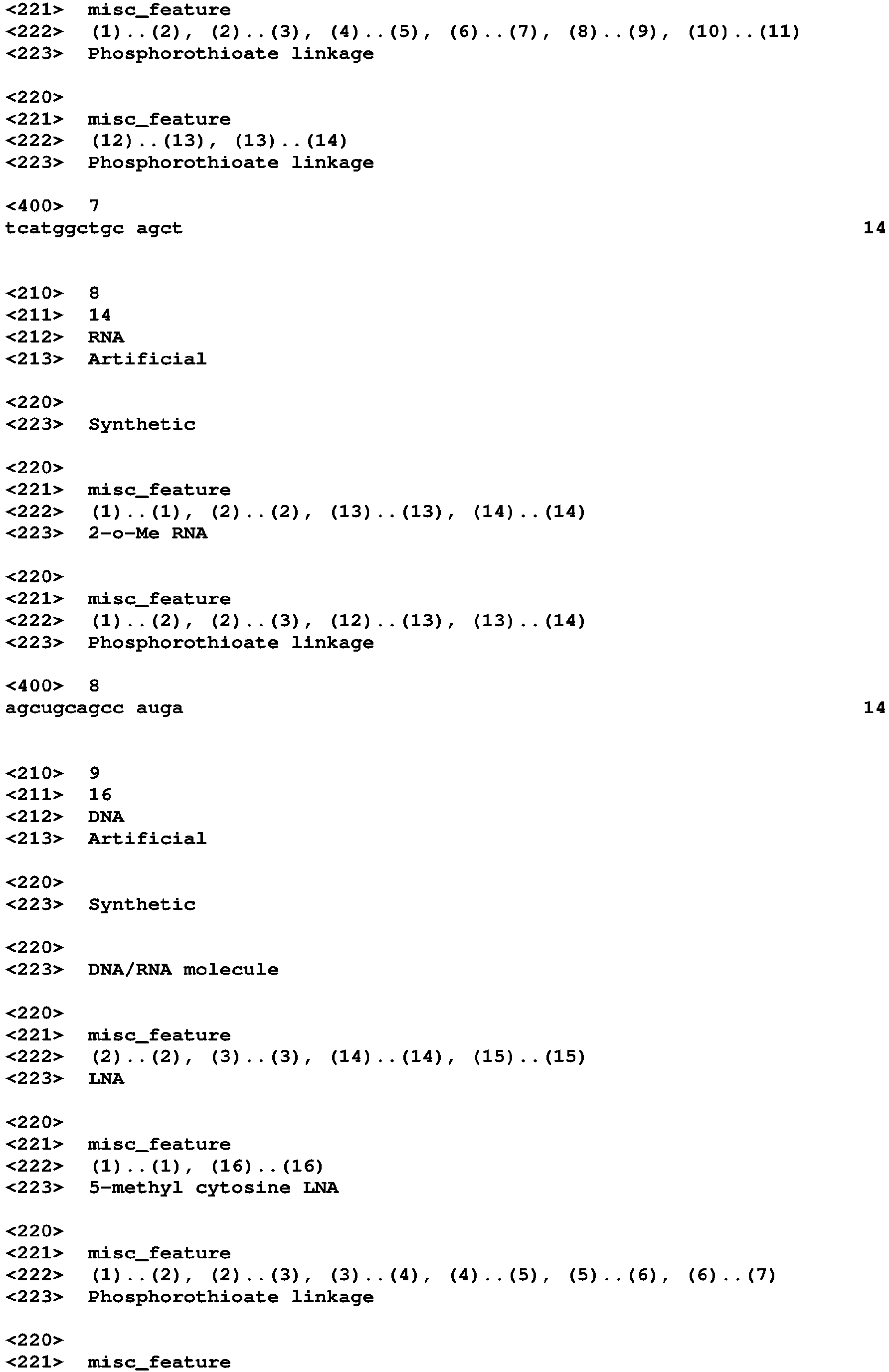

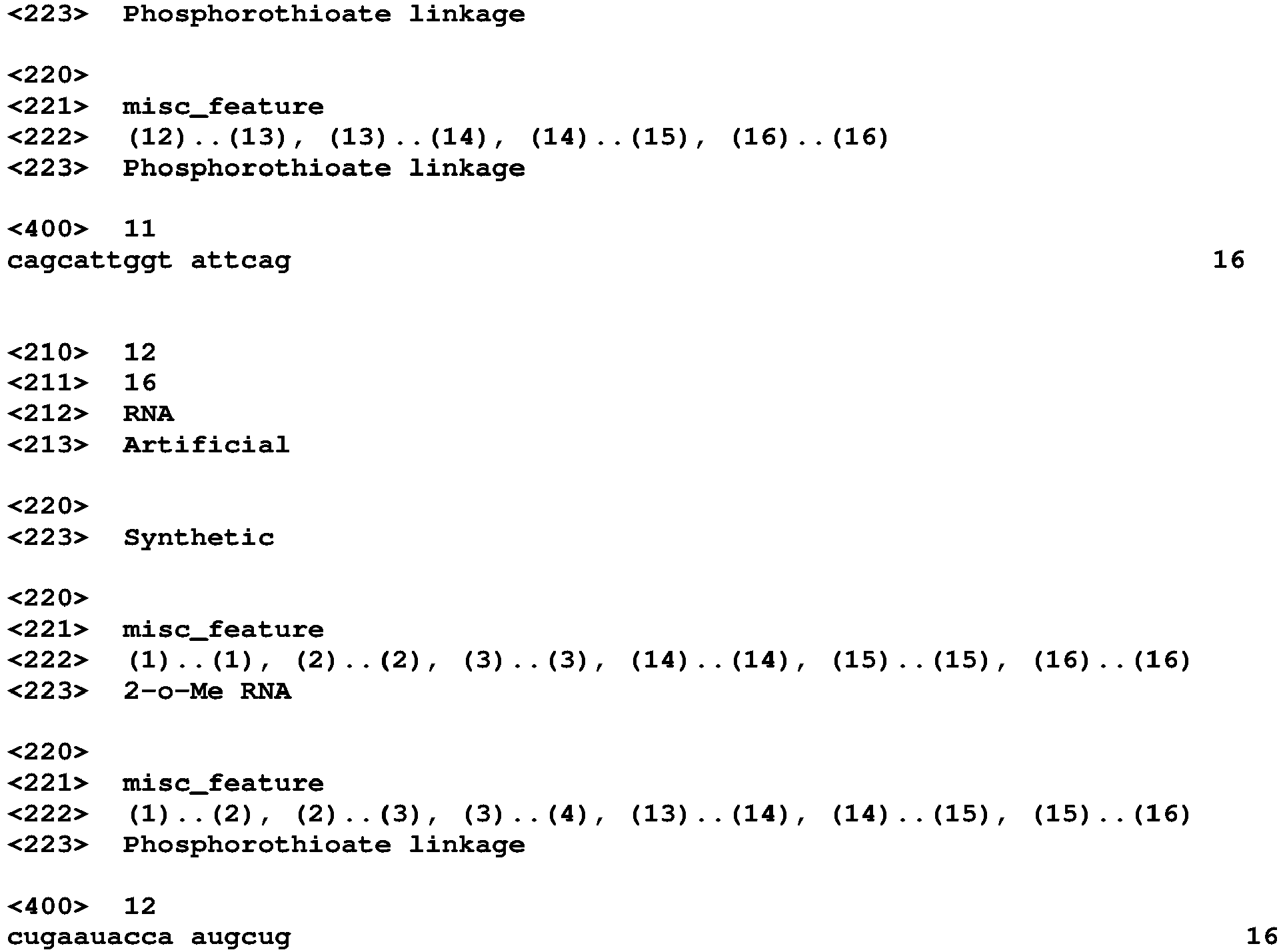
Claims (16)
- A double-stranded nucleic acid complex comprising: a first oligonucleotide comprising an antisense strand consisting of 7 to 30 nucleotides; and a second oligonucleotide having a sequence complementary to the first oligonucleotide and hybridized to the first oligonucleotide, wherein a modification pattern of internucleotide linkages in the first oligonucleotide comprises a pattern of (POPOPS)n with any internucleotide linkage added selected from PO, PS, POPO, PSPS, POPS and PSPO [PS represents a phosphorothioated PS-modified internucleotide linkage, PO represents a non-phosphorothioated natural internucleotide linkage, and n represents a natural number] or a pattern having m number of contiguous PS-modified internucleotide linkages from the 5'-end to the 3'-end of the first oligonucleotide (m is a natural number equal to or less than 2/3 of the number of nucleic acids present in the first oligonucleotide).
- The double-stranded nucleic acid complex according to claim 1, comprising: a first oligonucleotide comprising an antisense strand consisting of 7 to 30 nucleotides; and a second oligonucleotide having a sequence complementary to the first oligonucleotide and hybridized to the first oligonucleotide, wherein the modification pattern of internucleotide linkages in the first oligonucleotide comprises a pattern of (POPOPS)n with any internucleotide linkage added selected from PO, PS, POPO, PSPS, POPS and PSPO [PS represents a phosphorothioated PS-modified internucleotide linkage, PO represents a non-phosphorothioated natural internucleotide linkage, and n is 1 to 9].
- The double-stranded nucleic acid complex according to claim 2, wherein the modification pattern of internucleotide linkages in the first oligonucleotide is any of the following:POPOPS (n = 1)POPOPSPOPOPOPSPSPOPOPSPOPOPOPOPSPSPSPOPOPSPOPSPOPOPSPSPOPOPOPSPOPOPS (n = 2)POPOPSPOPOPSPOPOPOPSPOPOPSPSPOPOPSPOPOPSPOPOPOPOPSPOPOPSPSPSPOPOPSPOPOPSPOPSPOPOPSPOPOPSPSPOPOPOPSPOPOPSPOPOPS (n = 3)POPOPSPOPOPSPOPOPSPOPOPOPSPOPOPSPOPOPSPSPOPOPSPOPOPSPOPOPSPOPOPOPOPSPOPOPSPOPOPSPSPSPOPOPSPOPOPSPOPOPSPOPSPOPOPSPOPOPSPOPOPSPSPOPOPOPSPOPOPSPOPOPSPOPOPS (n = 4)POPOPSPOPOPSPOPOPSPOPOPSPOPOPOPSPOPOPSPOPOPSPOPOPSPSPOPOPSPOPOPSPOPOPSPOPOPSPOPOPOPOPSPOPOPSPOPOPSPOPOPSPSPSPOPOPSPOPOPSPOPOPSPOPOPSPOPSPOPOPSPOPOPSPOPOPSPOPOPSPSPOPOPOPSPOPOPSPOPOPSPOPOPSPOPOPS (n = 5)POPOPSPOPOPSPOPOPSPOPOPSPOPOPSPOPOPOPSPOPOPSPOPOPSPOPOPSPOPOPSPSPOPOPSPOPOPSPOPOPSPOPOPSPOPOPSPOPOPOPOPSPOPOPSPOPOPSPOPOPSPOPOPSPSPSPOPOPSPOPOPSPOPOPSPOPOPSPOPOPSPOPSPOPOPSPOPOPSPOPOPSPOPOPSPOPOPSPSPOPOPOPSPOPOPSPOPOPSPOPOPSPOPOPSPOPOPS (n = 6)POPOPSPOPOPSPOPOPSPOPOPSPOPOPSPOPOPSPOPOPOPSPOPOPSPOPOPSPOPOPSPOPOPSPOPOPSPSPOPOPSPOPOPSPOPOPSPOPOPSPOPOPSPOPOPSPOPOPOPOPSPOPOPSPOPOPSPOPOPSPOPOPSPOPOPSPSPSPOPOPSPOPOPSPOPOPSPOPOPSPOPOPSPOPOPSPOPSPOPOPSPOPOPSPOPOPSPOPOPSPOPOPSPOPOPSPSPOPOPOPSPOPOPSPOPOPSPOPOPSPOPOPSPOPOPSPOPOPS (n = 7)POPOPSPOPOPSPOPOPSPOPOPSPOPOPSPOPOPSPOPOPSPOPOPOPSPOPOPSPOPOPSPOPOPSPOPOPSPOPOPSPOPOPSPSPOPOPSPOPOPSPOPOPSPOPOPSPOPOPSPOPOPSPOPOPSPOPOPOPOPSPOPOPSPOPOPSPOPOPSPOPOPSPOPOPSPOPOPSPSPSPOPOPSPOPOPSPOPOPSPOPOPSPOPOPSPOPOPSPOPOPSPOPSPOPOPSPOPOPSPOPOPSPOPOPSPOPOPSPOPOPSPOPOPSPSPOPOPOPSPOPOPSPOPOPSPOPOPSPOPOPSPOPOPSPOPOPSPOPOPS (n = 8)POPOPSPOPOPSPOPOPSPOPOPSPOPOPSPOPOPSPOPOPSPOPOPSPOPOPOPSPOPOPSPOPOPSPOPOPSPOPOPSPOPOPSPOPOPSPOPOPSPSPOPOPSPOPOPSPOPOPSPOPOPSPOPOPSPOPOPSPOPOPSPOPOPSPOPOPOPOPSPOPOPSPOPOPSPOPOPSPOPOPSPOPOPSPOPOPSPOPOPSPSPSPOPOPSPOPOPSPOPOPSPOPOPSPOPOPSPOPOPSPOPOPSPOPOPSPOPSPOPOPSPOPOPSPOPOPSPOPOPSPOPOPSPOPOPSPOPOPSPOPOPSPSPOPOPOPSPOPOPSPOPOPSPOPOPSPOPOPSPOPOPSPOPOPSPOPOPSPOPOPS (n = 9)POPOPSPOPOPSPOPOPSPOPOPSPOPOPSPOPOPSPOPOPSPOPOPSPOPOPSPOPOPOPSPOPOPSPOPOPSPOPOPSPOPOPSPOPOPSPOPOPSPOPOPSPOPOPSPSPOPOPSPOPOPSPOPOPSPOPOPSPOPOPSPOPOPSPOPOPSPOPOPSPOPOPSPOPOPOPOPSPOPOPSPOPOPSPOPOPSPOPOPSPOPOPSPOPOPSPOPOPSPOPOPSPSPSPOPOPSPOPOPSPOPOPSPOPOPSPOPOPSPOPOPSPOPOPSPOPOPSPOPOPSPOPSPOPOPSPOPOPSPOPOPSPOPOPSPOPOPSPOPOPSPOPOPSPOPOPSPOPOPSPSPO.
- The double-stranded nucleic acid complex according to claim 3, wherein the modification pattern of internucleotide linkages in the first oligonucleotide is POPOPSPOPOPSPOPOPS.
- A double-stranded nucleic acid complex comprising: a first oligonucleotide comprising an antisense strand consisting of 7 to 30 nucleotides; and a second oligonucleotide having a sequence complementary to the first oligonucleotide and hybridized to the first oligonucleotide, wherein a modification pattern of internucleotide linkages in the first oligonucleotide comprises a pattern having m number of contiguous PS-modified internucleotide linkages from the 5'-end to the 3'-end of the first oligonucleotide (m is a natural number equal to or less than 2/3 of the number of nucleic acids present in the first oligonucleotide).
- A double-stranded nucleic acid complex comprising: a first oligonucleotide comprising an antisense strand consisting of 7 to 28 nucleotides; and a second oligonucleotide having a sequence complementary to the first oligonucleotide and hybridized to the first oligonucleotide, wherein a modification pattern of internucleotide linkages in the first oligonucleotide comprises a pattern having m number of contiguous PS-modified internucleotide linkages from the 5'-end to the 3'-end of the first oligonucleotide (m is a natural number equal to or less than 2/3 of the number of nucleic acids present in the first oligonucleotide, which is in the range of 1 to 13).
- The double-stranded nucleic acid complex according to claim 6, wherein the modification pattern of internucleotide linkages in the first oligonucleotide is any of the following:PSPOPOPOPSPOPOPOPOPSPOPOPOPOPOPSPOPOPOPOPOPOPSPOPOPOPOPOPOPOPSPOPOPOPOPOPOPOPOPSPOPOPOPOPOPOPOPOPOPSPOPOPOPOPOPOPOPOPOPOPSPOPOPOPOPOPOPOPOPOPOPOPSPOPOPOPOPOPOPOPOPOPOPOPOPSPOPOPOPOPOPOPOPOPOPOPOPOPOPSPOPOPOPOPOPOPOPOPOPOPOPOPOPOPSPOPOPOPOPOPOPOPOPOPOPOPOPOPOPOPSPOPOPOPOPOPOPOPOPOPOPOPOPOPOPOPOPSPOPOPOPOPOPOPOPOPOPOPOPOPOPOPOPOPOPSPOPOPOPOPOPOPOPOPOPOPOPOPOPOPOPOPOPOPSPOPOPOPOPOPOPOPOPOPOPOPOPOPOPOPOPOPOPOPSPOPOPOPOPOPOPOPOPOPOPOPOPOPOPOPOPOPOPOPOPSPOPOPOPOPOPOPOPOPOPOPOPOPOPOPOPOPOPOPOPOPOPSPOPOPOPOPOPOPOPOPOPOPOPOPOPOPOPOPOPOPOPOPOPOPSPOPOPOPOPOPOPOPOPOPOPOPOPOPOPOPOPOPOPOPOPOPOPOPSPOPOPOPOPOPOPOPOPOPOPOPOPOPOPOPOPOPOPOPOPOPOPOPOPSPOPOPOPOPOPOPOPOPOPOPOPOPOPOPOPOPOPOPOPOPOPOPOPOPOPSPOPOPOPOPOPOPOPOPOPOPOPOPOPOPOPOPOPOPOPOPOPOPOPOPOPOPSPSPOPOPSPSPOPOPOPSPSPOPOPOPOPSPSPOPOPOPOPOPSPSPOPOPOPOPOPOPSPSPOPOPOPOPOPOPOPSPSPOPOPOPOPOPOPOPOPSPSPOPOPOPOPOPOPOPOPOPSPSPOPOPOPOPOPOPOPOPOPOPSPSPOPOPOPOPOPOPOPOPOPOPOPSPSPOPOPOPOPOPOPOPOPOPOPOPOPSPSPOPOPOPOPOPOPOPOPOPOPOPOPOPSPSPOPOPOPOPOPOPOPOPOPOPOPOPOPOPSPSPOPOPOPOPOPOPOPOPOPOPOPOPOPOPOPSPSPOPOPOPOPOPOPOPOPOPOPOPOPOPOPOPOPSPSPOPOPOPOPOPOPOPOPOPOPOPOPOPOPOPOPOPSPSPOPOPOPOPOPOPOPOPOPOPOPOPOPOPOPOPOPOPSPSPOPOPOPOPOPOPOPOPOPOPOPOPOPOPOPOPOPOPOPSPSPOPOPOPOPOPOPOPOPOPOPOPOPOPOPOPOPOPOPOPOPSPSPOPOPOPOPOPOPOPOPOPOPOPOPOPOPOPOPOPOPOPOPOPSPSPOPOPOPOPOPOPOPOPOPOPOPOPOPOPOPOPOPOPOPOPOPOPSPSPOPOPOPOPOPOPOPOPOPOPOPOPOPOPOPOPOPOPOPOPOPOPOPSPSPOPOPOPOPOPOPOPOPOPOPOPOPOPOPOPOPOPOPOPOPOPOPOPOPSPSPOPOPOPOPOPOPOPOPOPOPOPOPOPOPOPOPOPOPOPOPOPOPOPOPOPSPSPSPOPOPOPSPSPSPOPOPOPOPSPSPSPOPOPOPOPOPSPSPSPOPOPOPOPOPOPSPSPSPOPOPOPOPOPOPOPSPSPSPOPOPOPOPOPOPOPOPSPSPSPOPOPOPOPOPOPOPOPOPSPSPSPOPOPOPOPOPOPOPOPOPOPSPSPSPOPOPOPOPOPOPOPOPOPOPOPSPSPSPOPOPOPOPOPOPOPOPOPOPOPOPSPSPSPOPOPOPOPOPOPOPOPOPOPOPOPOPSPSPSPOPOPOPOPOPOPOPOPOPOPOPOPOPOPSPSPSPOPOPOPOPOPOPOPOPOPOPOPOPOPOPOPSPSPSPOPOPOPOPOPOPOPOPOPOPOPOPOPOPOPOPSPSPSPOPOPOPOPOPOPOPOPOPOPOPOPOPOPOPOPOPSPSPSPOPOPOPOPOPOPOPOPOPOPOPOPOPOPOPOPOPOPSPSPSPOPOPOPOPOPOPOPOPOPOPOPOPOPOPOPOPOPOPOPSPSPSPOPOPOPOPOPOPOPOPOPOPOPOPOPOPOPOPOPOPOPOPSPSPSPOPOPOPOPOPOPOPOPOPOPOPOPOPOPOPOPOPOPOPOPOPSPSPSPOPOPOPOPOPOPOPOPOPOPOPOPOPOPOPOPOPOPOPOPOPOPSPSPSPOPOPOPOPOPOPOPOPOPOPOPOPOPOPOPOPOPOPOPOPOPOPOPSPSPSPOPOPOPOPOPOPOPOPOPOPOPOPOPOPOPOPOPOPOPOPOPOPOPOPSPSPSPSPOPOPOPOPSPSPSPSPOPOPOPOPOPSPSPSPSPOPOPOPOPOPOPSPSPSPSPOPOPOPOPOPOPOPSPSPSPSPOPOPOPOPOPOPOPOPSPSPSPSPOPOPOPOPOPOPOPOPOPSPSPSPSPOPOPOPOPOPOPOPOPOPOPSPSPSPSPOPOPOPOPOPOPOPOPOPOPOPSPSPSPSPOPOPOPOPOPOPOPOPOPOPOPOPSPSPSPSPOPOPOPOPOPOPOPOPOPOPOPOPOPSPSPSPSPOPOPOPOPOPOPOPOPOPOPOPOPOPOPSPSPSPSPOPOPOPOPOPOPOPOPOPOPOPOPOPOPOPSPSPSPSPOPOPOPOPOPOPOPOPOPOPOPOPOPOPOPOPSPSPSPSPOPOPOPOPOPOPOPOPOPOPOPOPOPOPOPOPOPSPSPSPSPOPOPOPOPOPOPOPOPOPOPOPOPOPOPOPOPOPOPSPSPSPSPOPOPOPOPOPOPOPOPOPOPOPOPOPOPOPOPOPOPOPSPSPSPSPOPOPOPOPOPOPOPOPOPOPOPOPOPOPOPOPOPOPOPOPSPSPSPSPOPOPOPOPOPOPOPOPOPOPOPOPOPOPOPOPOPOPOPOPOPSPSPSPSPOPOPOPOPOPOPOPOPOPOPOPOPOPOPOPOPOPOPOPOPOPOPSPSPSPSPOPOPOPOPOPOPOPOPOPOPOPOPOPOPOPOPOPOPOPOPOPOPOPSPSPSPSPSPOPOPOPOPOPSPSPSPSPSPOPOPOPOPOPOPSPSPSPSPSPOPOPOPOPOPOPOPSPSPSPSPSPOPOPOPOPOPOPOPOPSPSPSPSPSPOPOPOPOPOPOPOPOPOPSPSPSPSPSPOPOPOPOPOPOPOPOPOPOPSPSPSPSPSPOPOPOPOPOPOPOPOPOPOPOPSPSPSPSPSPOPOPOPOPOPOPOPOPOPOPOPOPSPSPSPSPSPOPOPOPOPOPOPOPOPOPOPOPOPOPSPSPSPSPSPOPOPOPOPOPOPOPOPOPOPOPOPOPOPSPSPSPSPSPOPOPOPOPOPOPOPOPOPOPOPOPOPOPOPSPSPSPSPSPOPOPOPOPOPOPOPOPOPOPOPOPOPOPOPOPSPSPSPSPSPOPOPOPOPOPOPOPOPOPOPOPOPOPOPOPOPOPSPSPSPSPSPOPOPOPOPOPOPOPOPOPOPOPOPOPOPOPOPOPOPSPSPSPSPSPOPOPOPOPOPOPOPOPOPOPOPOPOPOPOPOPOPOPOPSPSPSPSPSPOPOPOPOPOPOPOPOPOPOPOPOPOPOPOPOPOPOPOPOPSPSPSPSPSPOPOPOPOPOPOPOPOPOPOPOPOPOPOPOPOPOPOPOPOPOPSPSPSPSPSPOPOPOPOPOPOPOPOPOPOPOPOPOPOPOPOPOPOPOPOPOPOPSPSPSPSPSPSPOPOPOPOPOPOPOPSPSPSPSPSPSPOPOPOPOPOPOPOPOPSPSPSPSPSPSPOPOPOPOPOPOPOPOPOPSPSPSPSPSPSPOPOPOPOPOPOPOPOPOPOPSPSPSPSPSPSPOPOPOPOPOPOPOPOPOPOPOPSPSPSPSPSPSPOPOPOPOPOPOPOPOPOPOPOPOPSPSPSPSPSPSPOPOPOPOPOPOPOPOPOPOPOPOPOPSPSPSPSPSPSPOPOPOPOPOPOPOPOPOPOPOPOPOPOPSPSPSPSPSPSPOPOPOPOPOPOPOPOPOPOPOPOPOPOPOPSPSPSPSPSPSPOPOPOPOPOPOPOPOPOPOPOPOPOPOPOPOPSPSPSPSPSPSPOPOPOPOPOPOPOPOPOPOPOPOPOPOPOPOPOPSPSPSPSPSPSPOPOPOPOPOPOPOPOPOPOPOPOPOPOPOPOPOPOPSPSPSPSPSPSPOPOPOPOPOPOPOPOPOPOPOPOPOPOPOPOPOPOPOPSPSPSPSPSPSPOPOPOPOPOPOPOPOPOPOPOPOPOPOPOPOPOPOPOPOPSPSPSPSPSPSPOPOPOPOPOPOPOPOPOPOPOPOPOPOPOPOPOPOPOPOPOPSPSPSPSPSPSPSPOPOPOPOPOPOPOPOPSPSPSPSPSPSPSPOPOPOPOPOPOPOPOPOPSPSPSPSPSPSPSPOPOPOPOPOPOPOPOPOPOPSPSPSPSPSPSPSPOPOPOPOPOPOPOPOPOPOPOPSPSPSPSPSPSPSPOPOPOPOPOPOPOPOPOPOPOPOPSPSPSPSPSPSPSPOPOPOPOPOPOPOPOPOPOPOPOPOPSPSPSPSPSPSPSPOPOPOPOPOPOPOPOPOPOPOPOPOPOPSPSPSPSPSPSPSPOPOPOPOPOPOPOPOPOPOPOPOPOPOPOPSPSPSPSPSPSPSPOPOPOPOPOPOPOPOPOPOPOPOPOPOPOPOPSPSPSPSPSPSPSPOPOPOPOPOPOPOPOPOPOPOPOPOPOPOPOPOPSPSPSPSPSPSPSPOPOPOPOPOPOPOPOPOPOPOPOPOPOPOPOPOPOPSPSPSPSPSPSPSPOPOPOPOPOPOPOPOPOPOPOPOPOPOPOPOPOPOPOPSPSPSPSPSPSPSPOPOPOPOPOPOPOPOPOPOPOPOPOPOPOPOPOPOPOPOPSPSPSPSPSPSPSPSPOPOPOPOPOPOPOPOPOPSPSPSPSPSPSPSPSPOPOPOPOPOPOPOPOPOPOPSPSPSPSPSPSPSPSPOPOPOPOPOPOPOPOPOPOPOPSPSPSPSPSPSPSPSPOPOPOPOPOPOPOPOPOPOPOPOPSPSPSPSPSPSPSPSPOPOPOPOPOPOPOPOPOPOPOPOPOPSPSPSPSPSPSPSPSPOPOPOPOPOPOPOPOPOPOPOPOPOPOPSPSPSPSPSPSPSPSPOPOPOPOPOPOPOPOPOPOPOPOPOPOPOPSPSPSPSPSPSPSPSPOPOPOPOPOPOPOPOPOPOPOPOPOPOPOPOPSPSPSPSPSPSPSPSPOPOPOPOPOPOPOPOPOPOPOPOPOPOPOPOPOPSPSPSPSPSPSPSPSPOPOPOPOPOPOPOPOPOPOPOPOPOPOPOPOPOPOPSPSPSPSPSPSPSPSPOPOPOPOPOPOPOPOPOPOPOPOPOPOPOPOPOPOPOPSPSPSPSPSPSPSPSPSPOPOPOPOPOPOPOPOPOPOPSPSPSPSPSPSPSPSPSPOPOPOPOPOPOPOPOPOPOPOPSPSPSPSPSPSPSPSPSPOPOPOPOPOPOPOPOPOPOPOPOPSPSPSPSPSPSPSPSPSPOPOPOPOPOPOPOPOPOPOPOPOPOPSPSPSPSPSPSPSPSPSPOPOPOPOPOPOPOPOPOPOPOPOPOPOPSPSPSPSPSPSPSPSPSPOPOPOPOPOPOPOPOPOPOPOPOPOPOPOPSPSPSPSPSPSPSPSPSPOPOPOPOPOPOPOPOPOPOPOPOPOPOPOPOPSPSPSPSPSPSPSPSPSPOPOPOPOPOPOPOPOPOPOPOPOPOPOPOPOPOPSPSPSPSPSPSPSPSPSPOPOPOPOPOPOPOPOPOPOPOPOPOPOPOPOPOPOPSPSPSPSPSPSPSPSPSPSPOPOPOPOPOPOPOPOPOPOPOPSPSPSPSPSPSPSPSPSPSPOPOPOPOPOPOPOPOPOPOPOPOPSPSPSPSPSPSPSPSPSPSPOPOPOPOPOPOPOPOPOPOPOPOPOPSPSPSPSPSPSPSPSPSPSPOPOPOPOPOPOPOPOPOPOPOPOPOPOPSPSPSPSPSPSPSPSPSPSPOPOPOPOPOPOPOPOPOPOPOPOPOPOPOPSPSPSPSPSPSPSPSPSPSPOPOPOPOPOPOPOPOPOPOPOPOPOPOPOPOPSPSPSPSPSPSPSPSPSPSPOPOPOPOPOPOPOPOPOPOPOPOPOPOPOPOPOPSPSPSPSPSPSPSPSPSPSPSPOPOPOPOPOPOPOPOPOPOPOPOPSPSPSPSPSPSPSPSPSPSPSPOPOPOPOPOPOPOPOPOPOPOPOPOPSPSPSPSPSPSPSPSPSPSPSPOPOPOPOPOPOPOPOPOPOPOPOPOPOPSPSPSPSPSPSPSPSPSPSPSPOPOPOPOPOPOPOPOPOPOPOPOPOPOPOPSPSPSPSPSPSPSPSPSPSPSPOPOPOPOPOPOPOPOPOPOPOPOPOPOPOPOPSPSPSPSPSPSPSPSPSPSPSPSPOPOPOPOPOPOPOPOPOPOPOPOPOPSPSPSPSPSPSPSPSPSPSPSPSPOPOPOPOPOPOPOPOPOPOPOPOPOPOPSPSPSPSPSPSPSPSPSPSPSPSPOPOPOPOPOPOPOPOPOPOPOPOPOPOPOPSPSPSPSPSPSPSPSPSPSPSPSPSPOPOPOPOPOPOPOPOPOPOPOPOPOPO.
- The double-stranded nucleic acid complex according to claim 7, wherein the modification pattern of internucleotide linkages in the first oligonucleotide is PsPsPsPOPOPOPOPOPO.
- The double-stranded nucleic acid complex according to any one of claims 1 to 8, wherein the first oligonucleotide includes a gap region and a wing region located at each of both ends of the gap region, and the modification pattern of internucleotide linkages in the first oligonucleotide is a modification pattern of internucleotide linkages in the gap region.
- The double-stranded nucleic acid complex according to any one of claims 1 to 9, wherein a ligand is bound to the second oligonucleotide.
- The double-stranded nucleic acid complex according to any one of claims 1 to 10, wherein the wing region of the first oligonucleotide includes 1 to 4 nucleic acids.
- The double-stranded nucleic acid complex according to any one of claims 1 to 11, wherein the first oligonucleotide has a structure represented by (first wing region)r-(gap region)s-(second wing region)r [r is 1 to 10 and s is 4 to 28].
- The double-stranded nucleic acid complex according to any one of claims 1 to 12, wherein the wing region of the first oligonucleotide comprises one or more PS-modified internucleotide linkages.
- The double-stranded nucleic acid complex according to any one of claims 1 to 12, wherein all the internucleotide linkages in the wing region of the first oligonucleotide are PS-modified internucleotide linkages.
- The double-stranded nucleic acid complex according to any one of claims 1 to 12, wherein the internucleotide linkage on the 5'-end of a first wing region of the first oligonucleotide and the internucleotide linkage on the 3'-end of a second wing region are PS-modified internucleotide linkages.
- The double-stranded nucleic acid complex according to any one of claims 1 to 15, wherein the gap region of the first oligonucleotide includes DNA or a DNA-modified nucleotide, and the second oligonucleotide includes RNA or a RNA-modified nucleotide.
Applications Claiming Priority (2)
| Application Number | Priority Date | Filing Date | Title |
|---|---|---|---|
| JP2019030635 | 2019-02-22 | ||
| PCT/JP2020/006660 WO2020171149A1 (en) | 2019-02-22 | 2020-02-20 | Optimal ps modification pattern for heteronucleic acids |
Publications (2)
| Publication Number | Publication Date |
|---|---|
| EP3928799A1 true EP3928799A1 (en) | 2021-12-29 |
| EP3928799A4 EP3928799A4 (en) | 2023-10-18 |
Family
ID=72144538
Family Applications (1)
| Application Number | Title | Priority Date | Filing Date |
|---|---|---|---|
| EP20758455.8A Withdrawn EP3928799A4 (en) | 2019-02-22 | 2020-02-20 | OPTIMAL PS MODIFICATION PATTERN FOR HETEROPOLY ACIDS |
Country Status (5)
| Country | Link |
|---|---|
| US (1) | US20220135972A1 (en) |
| EP (1) | EP3928799A4 (en) |
| JP (1) | JPWO2020171149A1 (en) |
| CN (1) | CN113453727A (en) |
| WO (1) | WO2020171149A1 (en) |
Cited By (1)
| Publication number | Priority date | Publication date | Assignee | Title |
|---|---|---|---|---|
| WO2024084048A1 (en) | 2022-10-21 | 2024-04-25 | Proqr Therapeutics Ii B.V. | Heteroduplex rna editing oligonucleotide complexes |
Families Citing this family (1)
| Publication number | Priority date | Publication date | Assignee | Title |
|---|---|---|---|---|
| CA3202708A1 (en) | 2020-11-23 | 2022-05-27 | Alpha Anomeric Sas | Nucleic acid duplexes |
Family Cites Families (6)
| Publication number | Priority date | Publication date | Assignee | Title |
|---|---|---|---|---|
| US6277967B1 (en) * | 1998-07-14 | 2001-08-21 | Isis Pharmaceuticals, Inc. | Carbohydrate or 2′-modified oligonucleotides having alternating internucleoside linkages |
| WO2014132671A1 (en) * | 2013-03-01 | 2014-09-04 | National University Corporation Tokyo Medical And Dental University | Chimeric single-stranded antisense polynucleotides and double-stranded antisense agent |
| WO2017048843A1 (en) * | 2015-09-14 | 2017-03-23 | Alnylam Pharmaceuticals, Inc. | Compositions and methods for inhibiting expression of the alas1 gene |
| JP2018528967A (en) * | 2015-09-22 | 2018-10-04 | ミラゲン セラピューティクス, インコーポレイテッド | Mir-19 modulator and use thereof |
| WO2018051762A1 (en) * | 2016-09-14 | 2018-03-22 | レナセラピューティクス株式会社 | Antisense oligonucleotide with reduced side effects |
| US10228622B2 (en) | 2017-06-26 | 2019-03-12 | The Boeing Company | Systems and methods for operating a light system |
-
2020
- 2020-02-20 US US17/432,858 patent/US20220135972A1/en not_active Abandoned
- 2020-02-20 JP JP2021502116A patent/JPWO2020171149A1/en active Pending
- 2020-02-20 CN CN202080015872.9A patent/CN113453727A/en active Pending
- 2020-02-20 WO PCT/JP2020/006660 patent/WO2020171149A1/en not_active Ceased
- 2020-02-20 EP EP20758455.8A patent/EP3928799A4/en not_active Withdrawn
Cited By (1)
| Publication number | Priority date | Publication date | Assignee | Title |
|---|---|---|---|---|
| WO2024084048A1 (en) | 2022-10-21 | 2024-04-25 | Proqr Therapeutics Ii B.V. | Heteroduplex rna editing oligonucleotide complexes |
Also Published As
| Publication number | Publication date |
|---|---|
| CN113453727A (en) | 2021-09-28 |
| JPWO2020171149A1 (en) | 2021-12-16 |
| US20220135972A1 (en) | 2022-05-05 |
| WO2020171149A1 (en) | 2020-08-27 |
| EP3928799A4 (en) | 2023-10-18 |
Similar Documents
| Publication | Publication Date | Title |
|---|---|---|
| US20250101422A1 (en) | METHODS AND MODIFICATIONS THAT PRODUCE ssRNAi COMPOUNDS WITH ENHANCED ACTIVITY, POTENCY AND DURATION OF EFFECT | |
| KR101722541B1 (en) | Treatment of tristetraproline(ttp) related diseases by inhibition of natural antisense transcript to ttp | |
| EP3354734B1 (en) | Oligonucleotide-based inhibitors comprising locked nucleic acid motif | |
| EP3004347B1 (en) | Double-stranded agents for delivering therapeutic oligonucleotides | |
| WO2020196662A1 (en) | Double-stranded nucleic acid complex and use thereof | |
| EP2961841B1 (en) | Chimeric single-stranded antisense polynucleotides and double-stranded antisense agent | |
| JP7043078B2 (en) | Heteroduplex nucleic acid that crosses the blood-brain barrier | |
| AU2022202991A1 (en) | Organic compositions to treat KRAS-related diseases | |
| WO2014203518A1 (en) | Double-stranded antisense nucleic acid with exon-skipping effect | |
| JP6326433B2 (en) | Tricyclic nucleosides and oligomeric compounds prepared therefrom | |
| AU2010258875A1 (en) | Chemical modification motifs for miRNA inhibitors and mimetics | |
| EP3366773A1 (en) | Nucleic acid complex | |
| JP2025156522A (en) | Modified heterogeneous nucleic acid | |
| EP3366774A1 (en) | Nucleic acid complex having at least one bulge structure | |
| US20220135972A1 (en) | Optimal ps modification pattern for heteronucleic acids | |
| JP6974872B2 (en) | Heteroduplex antimiR | |
| JP7773730B2 (en) | Prevention or treatment of aneurysms with miR-33b inhibitors | |
| EP3628737A1 (en) | Ena antisense oligonucleotide for inhibition of alpha-synuclein expression | |
| JP2021535079A (en) | MicroRNA inhibitors for use in the treatment of metabolic disorders | |
| CN121628902A (en) | Double-stranded RNAs, conjugates, and applications that inhibit DGAT2 expression | |
| JP2024089860A (en) | Nucleic acid complex for regulating ZIC5 expression |
Legal Events
| Date | Code | Title | Description |
|---|---|---|---|
| STAA | Information on the status of an ep patent application or granted ep patent |
Free format text: STATUS: THE INTERNATIONAL PUBLICATION HAS BEEN MADE |
|
| PUAI | Public reference made under article 153(3) epc to a published international application that has entered the european phase |
Free format text: ORIGINAL CODE: 0009012 |
|
| STAA | Information on the status of an ep patent application or granted ep patent |
Free format text: STATUS: REQUEST FOR EXAMINATION WAS MADE |
|
| 17P | Request for examination filed |
Effective date: 20210908 |
|
| AK | Designated contracting states |
Kind code of ref document: A1 Designated state(s): AL AT BE BG CH CY CZ DE DK EE ES FI FR GB GR HR HU IE IS IT LI LT LU LV MC MK MT NL NO PL PT RO RS SE SI SK SM TR |
|
| DAV | Request for validation of the european patent (deleted) | ||
| DAX | Request for extension of the european patent (deleted) | ||
| A4 | Supplementary search report drawn up and despatched |
Effective date: 20230915 |
|
| RIC1 | Information provided on ipc code assigned before grant |
Ipc: A61K 31/711 20060101ALI20230911BHEP Ipc: C12N 15/113 20100101ALI20230911BHEP Ipc: A61K 48/00 20060101AFI20230911BHEP |
|
| STAA | Information on the status of an ep patent application or granted ep patent |
Free format text: STATUS: THE APPLICATION IS DEEMED TO BE WITHDRAWN |
|
| 18D | Application deemed to be withdrawn |
Effective date: 20240416 |