EP3928649B1 - Garment - Google Patents
Garment Download PDFInfo
- Publication number
- EP3928649B1 EP3928649B1 EP21181070.0A EP21181070A EP3928649B1 EP 3928649 B1 EP3928649 B1 EP 3928649B1 EP 21181070 A EP21181070 A EP 21181070A EP 3928649 B1 EP3928649 B1 EP 3928649B1
- Authority
- EP
- European Patent Office
- Prior art keywords
- garment
- band
- rear piece
- incisions
- fastener
- Prior art date
- Legal status (The legal status is an assumption and is not a legal conclusion. Google has not performed a legal analysis and makes no representation as to the accuracy of the status listed.)
- Active
Links
Images
Classifications
-
- A—HUMAN NECESSITIES
- A41—WEARING APPAREL
- A41D—OUTERWEAR; PROTECTIVE GARMENTS; ACCESSORIES
- A41D13/00—Professional, industrial or sporting protective garments, e.g. surgeons' gowns or garments protecting against blows or punches
- A41D13/12—Surgeons' or patients' gowns or dresses
- A41D13/1236—Patients' garments
- A41D13/1245—Patients' garments for the upper part of the body
-
- A—HUMAN NECESSITIES
- A41—WEARING APPAREL
- A41D—OUTERWEAR; PROTECTIVE GARMENTS; ACCESSORIES
- A41D13/00—Professional, industrial or sporting protective garments, e.g. surgeons' gowns or garments protecting against blows or punches
- A41D13/04—Aprons; Fastening devices for aprons
-
- A—HUMAN NECESSITIES
- A41—WEARING APPAREL
- A41D—OUTERWEAR; PROTECTIVE GARMENTS; ACCESSORIES
- A41D13/00—Professional, industrial or sporting protective garments, e.g. surgeons' gowns or garments protecting against blows or punches
- A41D13/05—Professional, industrial or sporting protective garments, e.g. surgeons' gowns or garments protecting against blows or punches protecting only a particular body part
- A41D13/055—Protector fastening, e.g. on the human body
- A41D13/0556—Protector fastening, e.g. on the human body with releasable fastening means
- A41D13/0568—Protector fastening, e.g. on the human body with releasable fastening means with straps
-
- A—HUMAN NECESSITIES
- A41—WEARING APPAREL
- A41D—OUTERWEAR; PROTECTIVE GARMENTS; ACCESSORIES
- A41D13/00—Professional, industrial or sporting protective garments, e.g. surgeons' gowns or garments protecting against blows or punches
- A41D13/12—Surgeons' or patients' gowns or dresses
- A41D13/1209—Surgeons' gowns or dresses
-
- A—HUMAN NECESSITIES
- A41—WEARING APPAREL
- A41D—OUTERWEAR; PROTECTIVE GARMENTS; ACCESSORIES
- A41D13/00—Professional, industrial or sporting protective garments, e.g. surgeons' gowns or garments protecting against blows or punches
- A41D13/12—Surgeons' or patients' gowns or dresses
- A41D13/129—Donning facilities, e.g. characterized by the opening
-
- A—HUMAN NECESSITIES
- A41—WEARING APPAREL
- A41D—OUTERWEAR; PROTECTIVE GARMENTS; ACCESSORIES
- A41D2300/00—Details of garments
- A41D2300/30—Closures
- A41D2300/33—Closures using straps or ties
Definitions
- the solution relates to garments in general.
- the solution relates to protective garments.
- Protective garments may make use of fasteners to keep a garment on its wearer.
- the garment comprises at least one fastener, the fastener being manufactured by forming a band-like part, on a first part of a rear piece of the garment, wherein the band-like part is formed from the same panel as the first part of the rear piece by cutting a band-like part along the vertical side of the first part, and by forming, to a second part of the rear piece, substantially at a height corresponding to a height at which the band-like part is attached to the first part of the rear piece, at least one incision, whose height substantially corresponds to the width of the band-like part.
- the preferred embodiments are disclosed in the dependent claims.
- Garments in particular protective garments, are used in various kinds of operating environments to protect a person carrying out a task, and their other clothing.
- the purpose of protective garments is to protect against the spread of bacteria and other impurities from a person or their clothing to the operating environment and to protect a wearer against potential pathogens.
- a sterile environment may even be a requirement for the level of hygiene.
- a second person may help the performing person to dress into required sterile protective garments, whereby he need not touch anything unnecessary. It is in such a case advantageous for a protective garment that it is as simple as possible to dress and fasten on a second person.
- a typical solution is a protective garment open at the back, which an assisting person can easily dress on a person being assisted. After performing the procedure, the requirement for sterility decreases, but touching one's own protective garment, for example, at the back must be avoided even when taking off the protective garment.
- the coat-like garment consists of a front piece 8, sleeves 2, and two rear pieces 3, 4.
- the rear pieces 3, 4 are sewn to the front piece 8 at the shoulders and under the armpits, and by the rear part of the sleeve 2 to the sleeve.
- the rear pieces are open and unsewn together whereby dressing the garment on succeeds from the rear by passing the hands into the sleeves and lifting the garment in place by the shoulders, for example.
- the rear pieces 3, 4 of the coat-like garment go on top of each other on the back side.
- Dressing on a second person or assisting in dressing can be done from the back side, because the rear pieces are not sewn together. In addition, there is no need to lift the garment unnecessarily to put it over the head, for example.
- the simple structure speeds up putting on the protective garment. Dressing up fast is beneficial in an emergency situation, for example.
- the rear pieces that go over each other on the back side are fastened with a fastener 5, located at substantially the top part of the garment, near the neck.
- the location of the fastener behind the neck is of advantage if the protective garment is put on without assistance.
- the garment may, if needed, comprise more fasteners, such as two, three, four, or more. When the garment comprises several fasteners, they are distributed over the distance of the vertical side of the rear piece as required by each purpose of use.
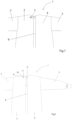
- the example of Figure 2 shows the garment 1 with the fastener 5 open.
- the fastener comprises a band-like part 6 cut on a first side of the rear piece, and parallel vertical incisions 9, 10, 11 cut on a second side and substantially corresponding to the width of the band.
- the fastener is made by cutting a band-like part, conforming to a vertical side of a rear piece of the garment, to a first part of the rear piece, and by forming, to a second part of the rear piece, substantially at a height corresponding to the band-like part, three parallel incisions whose height substantially corresponds to the width of the band-like part.
- the incisions may be substantially vertically-running vertical incisions.
- the length of the incision may also vary in relation to the width of the band, being in some cases shorter than the width of the band and in some cases longer than the width of the band.
- the incisions are located in the first back member, vertically at essentially the same height as the band-like part comprised by and attached to the second back member.
- the width of the band-like part may be 20 to 60 cm, for example, and the length 150 to 300 mm, for example.
- the opening may be formed in the shape of a circle, oval, square, or diamond.
- the fastener may be closed by threading the band-like part through at least one incision from inside the garment to outside, or vice versa.
- the fastener is closed by threading the band from outside the garment through the first incision 11, as seen from the centre part of the back, inside the garment, and then through the last incision 9, as seen from the centre part of the back, back to outside the garment, and then, seen from the exit opening towards the centre of the back, from the next incision 10 inside from outside the garment, and back through the next incision 11, as seen from the centre part of the back, from inside the garment to outside the garment.
- the threading may also be carried out as a mirror image, beginning from the other side.
- a fastening is achieved, which keeps the back members attached to each other essentially from the vicinity of the fasteners.
- the fastenings created by threading are opened by pulling the fastened pieces away from each other.
- the fastening when using the fastening in, for example, in a healthcare protective garment in the rear piece of the garment, it is possible to take off the garment without touching the rear piece on the back side by pulling the garment from the front piece to such an extent that the fastening either loosens to remove the garment over the head, or the fastening detaches entirely whereby the garment may be taken off from the front.
- An advantage of the procedure is that the wearer of the garment need not touch the rear piece of the garment, and that taking it off works out without an assisting person. Furthermore, the garment can also be taken off very fast, which may be of specific advantage in a first aid situation where protective garments have to replaced fast once they have become dirty.
- the number of incisions may in addition to one, two, and three vary from four to ten, for example.
- the threading may start at any point of the parallel incisions; at the beginning, middle, or end, as seen from the middle of the back.
- the threading may be started either from the inside or outside of the garment, and the band may be threaded either by making use of adjacent incisions, or by skipping over one or more incisions before threading through an incision from one side of the fabric to the other. Threading may take place from the middle of the back towards the armpit, and the direction may be changed once or more often.
- the fastening may, in addition to keeping the garment fastened, be utilised to adjust the garment size as needed.
- the advantage of the chance to adjust the garment size is that the same garment size fits a plurality persons of different sizes, whereby the need for different size garments is reduced, the garments are simpler to handle and require less work.
- the fastener parts band 6 and incisions 9, 10, 11 are formed of the same material blank as the rear pieces 3, 4 of the garment. Forming may take place by cutting with a chisel, for example, or a mould.
- An advantage of the manufacturing method is that all the cuts are performed at the same work stage as cutting the rest of the blank, reducing work time.
- a further advantage is savings in the material, when the incision parts do not require any material, and the band part, too, is easily formed of the same material. Saving material is also ecological.
- the fastener may also use another material than the garment material. For example, the neckline may be neatened with a band made of another material, one end of which may be left overlong and used as the band for the fastener.
- the garment may be made of various materials. Suitable materials include all the materials applicable to protective clothes, such as fabric materials.
- the garment may be made of a fabric, such as a nonwoven fabric.
- the fabric may be, for example, a Fibrella fabric, such as Fibrella 50-55g/m2 100% PP, Thermoembossed, Fibrella 75g/m2 100% PP, Thermoembossed, WALKI Apron 45 PPNW 30/ Thermoplastic Polymer, or nonwoven fabric 15-80g/m2.
- An advantage of making the garment of a fabric is that the garment may be washed after use and therefore be used a plurality of times. Compared to single-use products, a washable garment is an environment-saving option.
- the fastener is suitable for use in other than coat-like garments.
- it may be used to fasten an apron-like or robe-like garment.
- the fastener may also be arranged on the front side of the garment.
Landscapes
- Health & Medical Sciences (AREA)
- General Health & Medical Sciences (AREA)
- Physical Education & Sports Medicine (AREA)
- Engineering & Computer Science (AREA)
- Textile Engineering (AREA)
- Professional, Industrial, Or Sporting Protective Garments (AREA)
- Slide Fasteners, Snap Fasteners, And Hook Fasteners (AREA)
- Details Of Garments (AREA)
Description
- The solution relates to garments in general. In particular, the solution relates to protective garments. Protective garments may make use of fasteners to keep a garment on its wearer.
- Document
US20190357607A1 discloses an adjustable smock that facilitates attachment and detachment from a person with the features of the preamble ofclaim 1. - Document
US3729747A discloses a hospital gown. - Document
US20020152535A1 discloses a hospital gown. - The object in a new type of garment, such as a protective garment, as well as a fastener and fastening arrangement for keeping the garment on its wearer. The solution according to the invention is characterised by what is stated in the independent claim.
- On its back side, the garment comprises at least one fastener, the fastener being manufactured by forming a band-like part, on a first part of a rear piece of the garment, wherein the band-like part is formed from the same panel as the first part of the rear piece by cutting a band-like part along the vertical side of the first part, and by forming, to a second part of the rear piece, substantially at a height corresponding to a height at which the band-like part is attached to the first part of the rear piece, at least one incision, whose height substantially corresponds to the width of the band-like part. The preferred embodiments are disclosed in the dependent claims.
- The invention will now be described in closer detail with reference to the accompanying drawings in which:
-
Figure 1 is a schematic view of a protective garment in which a fastening member is closed. -
Figure 2 is a schematic view of a protective garment in which a fastening member is open. - Garments, in particular protective garments, are used in various kinds of operating environments to protect a person carrying out a task, and their other clothing. On the other hand, in certain environments, such as healthcare, the purpose of protective garments is to protect against the spread of bacteria and other impurities from a person or their clothing to the operating environment and to protect a wearer against potential pathogens. In healthcare, a sterile environment may even be a requirement for the level of hygiene.
- When operating in a sterile environment or with infectious diseases, it is necessary to avoid all touching that is unnecessary for the task being performed, for example, to surfaces, tools, or utensils. When preparing for a procedure, such as an operation, it is typical that a second person may help the performing person to dress into required sterile protective garments, whereby he need not touch anything unnecessary. It is in such a case advantageous for a protective garment that it is as simple as possible to dress and fasten on a second person. A typical solution is a protective garment open at the back, which an assisting person can easily dress on a person being assisted. After performing the procedure, the requirement for sterility decreases, but touching one's own protective garment, for example, at the back must be avoided even when taking off the protective garment.
- The solution discloses a
garment 1 which may be used as a protective garment in healthcare, for example. In the example ofFigure 1 , the coat-like garment consists of afront piece 8,sleeves 2, and tworear pieces rear pieces front piece 8 at the shoulders and under the armpits, and by the rear part of thesleeve 2 to the sleeve. At the centre of the back, the rear pieces are open and unsewn together whereby dressing the garment on succeeds from the rear by passing the hands into the sleeves and lifting the garment in place by the shoulders, for example. Therear pieces fastener 5, located at substantially the top part of the garment, near the neck. The location of the fastener behind the neck is of advantage if the protective garment is put on without assistance. The garment may, if needed, comprise more fasteners, such as two, three, four, or more. When the garment comprises several fasteners, they are distributed over the distance of the vertical side of the rear piece as required by each purpose of use. - The example of
Figure 2 shows thegarment 1 with thefastener 5 open. The fastener comprises a band-like part 6 cut on a first side of the rear piece, and parallelvertical incisions - The fastener may be closed by threading the band-like part through at least one incision from inside the garment to outside, or vice versa.
- If there are three or more incisions, the fastener is closed by threading the band from outside the garment through the
first incision 11, as seen from the centre part of the back, inside the garment, and then through thelast incision 9, as seen from the centre part of the back, back to outside the garment, and then, seen from the exit opening towards the centre of the back, from thenext incision 10 inside from outside the garment, and back through thenext incision 11, as seen from the centre part of the back, from inside the garment to outside the garment. The threading may also be carried out as a mirror image, beginning from the other side. - By threading the band in any of the manners described in the above, a fastening is achieved, which keeps the back members attached to each other essentially from the vicinity of the fasteners. The fastenings created by threading are opened by pulling the fastened pieces away from each other. In such a case, when using the fastening in, for example, in a healthcare protective garment in the rear piece of the garment, it is possible to take off the garment without touching the rear piece on the back side by pulling the garment from the front piece to such an extent that the fastening either loosens to remove the garment over the head, or the fastening detaches entirely whereby the garment may be taken off from the front. An advantage of the procedure is that the wearer of the garment need not touch the rear piece of the garment, and that taking it off works out without an assisting person. Furthermore, the garment can also be taken off very fast, which may be of specific advantage in a first aid situation where protective garments have to replaced fast once they have become dirty.
- The number of incisions may in addition to one, two, and three vary from four to ten, for example. In such a case, the threading may start at any point of the parallel incisions; at the beginning, middle, or end, as seen from the middle of the back. The threading may be started either from the inside or outside of the garment, and the band may be threaded either by making use of adjacent incisions, or by skipping over one or more incisions before threading through an incision from one side of the fabric to the other. Threading may take place from the middle of the back towards the armpit, and the direction may be changed once or more often.
- When forming a fastening with the use of at least three incisions, the fastening may, in addition to keeping the garment fastened, be utilised to adjust the garment size as needed. The advantage of the chance to adjust the garment size is that the same garment size fits a plurality persons of different sizes, whereby the need for different size garments is reduced, the garments are simpler to handle and require less work.
- In the
garments 1 shown as examples inFigures 1 and 2 , the fastener parts band 6 andincisions rear pieces - The garment may be made of various materials. Suitable materials include all the materials applicable to protective clothes, such as fabric materials. The garment may be made of a fabric, such as a nonwoven fabric. The fabric may be, for example, a Fibrella fabric, such as Fibrella 50-55g/m2 100% PP, Thermoembossed, Fibrella 75g/m2 100% PP, Thermoembossed, WALKI Apron 45 PPNW 30/ Thermoplastic Polymer, or nonwoven fabric 15-80g/m2. An advantage of making the garment of a fabric is that the garment may be washed after use and therefore be used a plurality of times. Compared to single-use products, a washable garment is an environment-saving option.
- The fastener is suitable for use in other than coat-like garments. For example, it may be used to fasten an apron-like or robe-like garment. The fastener may also be arranged on the front side of the garment.
- Those skilled in the art will find it obvious that, as technology advances, the basic idea of the invention may be implemented in many different ways. The invention and its embodiments are thus not restricted to the examples described above but may vary within the scope of the claims.
Claims (5)
- A garment (1) comprising at least one fastener (5) on its back side,the fastener (5) being manufactured by forming a band-like part (6), on a first part (4) of a rear piece of the garment (1), and by forming, on a second part (3) of the rear piece, substantially at a height corresponding to a height at which the band-like part (6) is attached to the first part (4) of the rear piece (4), at least one incision (9, 10, 11),whose height substantially corresponds with the width of the band-like part (6)characterised in that the fastener (5) is manufactured by forming a band-like part (6), on a first part (4) of a rear piece of the garment (1), wherein the band-like part (6) is formed from the same panel as the first part (4) of the rear piece by cutting a band-like part along the vertical side of the first part (4) of the rear piece.
- A garment (1) as claimed in claim 1, characterised in that the garment (1) comprises, in the second part (3) of the rear piece, substantially at a height corresponding to the part fastened to the rear piece of the band-like part (6), at least three incisions (9, 10, 11) whose height substantially corresponds with the width of the band-like part (6).
- A garment (1) as claimed in claim 1 or 2, characterised in that the incisions (9,10,11) are made by cutting from the same blank as the rear pieces (3) of the garment (1).
- A garment (1) as claimed in any one of claims 1 to 3, character- ised in that the incisions (9, 10, 11) are vertical incisions.
- A garment (1) as claimed in any one of claims 1 to 4, character- ised in that the material is a nonwoven fabric.
Applications Claiming Priority (1)
| Application Number | Priority Date | Filing Date | Title |
|---|---|---|---|
| FIU20204099U FI12750Y1 (en) | 2020-06-24 | 2020-06-24 | Garment |
Publications (3)
| Publication Number | Publication Date |
|---|---|
| EP3928649A1 EP3928649A1 (en) | 2021-12-29 |
| EP3928649B1 true EP3928649B1 (en) | 2024-12-11 |
| EP3928649C0 EP3928649C0 (en) | 2024-12-11 |
Family
ID=72669178
Family Applications (1)
| Application Number | Title | Priority Date | Filing Date |
|---|---|---|---|
| EP21181070.0A Active EP3928649B1 (en) | 2020-06-24 | 2021-06-23 | Garment |
Country Status (4)
| Country | Link |
|---|---|
| EP (1) | EP3928649B1 (en) |
| ES (1) | ES3014178T3 (en) |
| FI (1) | FI12750Y1 (en) |
| PL (1) | PL3928649T3 (en) |
Families Citing this family (1)
| Publication number | Priority date | Publication date | Assignee | Title |
|---|---|---|---|---|
| IT202100000329U1 (en) * | 2021-01-26 | 2022-07-26 | Camac S R L | Article of medical and/or professional clothing. |
Family Cites Families (3)
| Publication number | Priority date | Publication date | Assignee | Title |
|---|---|---|---|---|
| US3729747A (en) * | 1971-04-29 | 1973-05-01 | N Belkin | Hospital garment |
| US6499143B2 (en) * | 2001-04-09 | 2002-12-31 | Ann Garza | Hospital gown |
| US11191310B2 (en) * | 2018-05-24 | 2021-12-07 | Bob Barker Company, Inc. | Smock |
-
2020
- 2020-06-24 FI FIU20204099U patent/FI12750Y1/en active IP Right Grant
-
2021
- 2021-06-23 PL PL21181070.0T patent/PL3928649T3/en unknown
- 2021-06-23 ES ES21181070T patent/ES3014178T3/en active Active
- 2021-06-23 EP EP21181070.0A patent/EP3928649B1/en active Active
Also Published As
| Publication number | Publication date |
|---|---|
| PL3928649T3 (en) | 2025-05-19 |
| ES3014178T3 (en) | 2025-04-21 |
| EP3928649A1 (en) | 2021-12-29 |
| FI12750Y1 (en) | 2020-08-20 |
| EP3928649C0 (en) | 2024-12-11 |
Similar Documents
| Publication | Publication Date | Title |
|---|---|---|
| KR101116311B1 (en) | Disposable protection gown | |
| US2701364A (en) | Patient's hospital gown | |
| US3218649A (en) | Protective gown | |
| US6272685B1 (en) | Patient's examination clothing | |
| US5799330A (en) | Medical treatment garment | |
| US4969215A (en) | Medical patient's gown | |
| US20120204317A1 (en) | Dignity hospital gown | |
| US6763527B1 (en) | Medical assistant outer garment | |
| US5392466A (en) | Upper garment for patients | |
| US5829059A (en) | Coveralls with access opening | |
| US8312564B2 (en) | Protective garment | |
| US10595575B2 (en) | Bonding garment | |
| JPH05125604A (en) | Personal protective clothing | |
| EP3928649A1 (en) | Garment | |
| EP2928333B1 (en) | Patient garment | |
| US20170273372A1 (en) | Hospital Garment | |
| BE1022078B1 (en) | BREAST FEEDING CLOTHING | |
| EP1626632B1 (en) | A clean room overall and a method for dressing and undressing the same | |
| EP2622302B1 (en) | Cut resistant garment | |
| US12383003B2 (en) | Medical gown with tear guide feature | |
| US5920904A (en) | Torso garment | |
| KR101118707B1 (en) | Disposable protection gown which have different color on both side | |
| CN206101710U (en) | Sick clothes of area restraint function | |
| CN212325547U (en) | A operation auxiliary device that is used for nasal part plastic surgery to use | |
| US9549574B1 (en) | Halo shirt |
Legal Events
| Date | Code | Title | Description |
|---|---|---|---|
| PUAI | Public reference made under article 153(3) epc to a published international application that has entered the european phase |
Free format text: ORIGINAL CODE: 0009012 |
|
| STAA | Information on the status of an ep patent application or granted ep patent |
Free format text: STATUS: THE APPLICATION HAS BEEN PUBLISHED |
|
| AK | Designated contracting states |
Kind code of ref document: A1 Designated state(s): AL AT BE BG CH CY CZ DE DK EE ES FI FR GB GR HR HU IE IS IT LI LT LU LV MC MK MT NL NO PL PT RO RS SE SI SK SM TR |
|
| B565 | Issuance of search results under rule 164(2) epc |
Effective date: 20211111 |
|
| STAA | Information on the status of an ep patent application or granted ep patent |
Free format text: STATUS: REQUEST FOR EXAMINATION WAS MADE |
|
| 17P | Request for examination filed |
Effective date: 20220620 |
|
| RBV | Designated contracting states (corrected) |
Designated state(s): AL AT BE BG CH CY CZ DE DK EE ES FI FR GB GR HR HU IE IS IT LI LT LU LV MC MK MT NL NO PL PT RO RS SE SI SK SM TR |
|
| STAA | Information on the status of an ep patent application or granted ep patent |
Free format text: STATUS: EXAMINATION IS IN PROGRESS |
|
| 17Q | First examination report despatched |
Effective date: 20230605 |
|
| GRAP | Despatch of communication of intention to grant a patent |
Free format text: ORIGINAL CODE: EPIDOSNIGR1 |
|
| STAA | Information on the status of an ep patent application or granted ep patent |
Free format text: STATUS: GRANT OF PATENT IS INTENDED |
|
| RIC1 | Information provided on ipc code assigned before grant |
Ipc: A41D 13/04 20060101ALI20240613BHEP Ipc: A41D 13/12 20060101AFI20240613BHEP |
|
| INTG | Intention to grant announced |
Effective date: 20240708 |
|
| GRAS | Grant fee paid |
Free format text: ORIGINAL CODE: EPIDOSNIGR3 |
|
| GRAA | (expected) grant |
Free format text: ORIGINAL CODE: 0009210 |
|
| STAA | Information on the status of an ep patent application or granted ep patent |
Free format text: STATUS: THE PATENT HAS BEEN GRANTED |
|
| RAP3 | Party data changed (applicant data changed or rights of an application transferred) |
Owner name: TELLA OY |
|
| AK | Designated contracting states |
Kind code of ref document: B1 Designated state(s): AL AT BE BG CH CY CZ DE DK EE ES FI FR GB GR HR HU IE IS IT LI LT LU LV MC MK MT NL NO PL PT RO RS SE SI SK SM TR |
|
| REG | Reference to a national code |
Ref country code: GB Ref legal event code: FG4D |
|
| REG | Reference to a national code |
Ref country code: CH Ref legal event code: EP |
|
| REG | Reference to a national code |
Ref country code: IE Ref legal event code: FG4D |
|
| REG | Reference to a national code |
Ref country code: DE Ref legal event code: R096 Ref document number: 602021023142 Country of ref document: DE |
|
| U01 | Request for unitary effect filed |
Effective date: 20250109 |
|
| U07 | Unitary effect registered |
Designated state(s): AT BE BG DE DK EE FI FR IT LT LU LV MT NL PT RO SE SI Effective date: 20250116 |
|
| PG25 | Lapsed in a contracting state [announced via postgrant information from national office to epo] |
Ref country code: HR Free format text: LAPSE BECAUSE OF FAILURE TO SUBMIT A TRANSLATION OF THE DESCRIPTION OR TO PAY THE FEE WITHIN THE PRESCRIBED TIME-LIMIT Effective date: 20241211 |
|
| REG | Reference to a national code |
Ref country code: ES Ref legal event code: FG2A Ref document number: 3014178 Country of ref document: ES Kind code of ref document: T3 Effective date: 20250421 |
|
| PG25 | Lapsed in a contracting state [announced via postgrant information from national office to epo] |
Ref country code: GR Free format text: LAPSE BECAUSE OF FAILURE TO SUBMIT A TRANSLATION OF THE DESCRIPTION OR TO PAY THE FEE WITHIN THE PRESCRIBED TIME-LIMIT Effective date: 20250312 |
|
| PG25 | Lapsed in a contracting state [announced via postgrant information from national office to epo] |
Ref country code: RS Free format text: LAPSE BECAUSE OF FAILURE TO SUBMIT A TRANSLATION OF THE DESCRIPTION OR TO PAY THE FEE WITHIN THE PRESCRIBED TIME-LIMIT Effective date: 20250311 |
|
| PG25 | Lapsed in a contracting state [announced via postgrant information from national office to epo] |
Ref country code: SM Free format text: LAPSE BECAUSE OF FAILURE TO SUBMIT A TRANSLATION OF THE DESCRIPTION OR TO PAY THE FEE WITHIN THE PRESCRIBED TIME-LIMIT Effective date: 20241211 |
|
| PG25 | Lapsed in a contracting state [announced via postgrant information from national office to epo] |
Ref country code: IS Free format text: LAPSE BECAUSE OF FAILURE TO SUBMIT A TRANSLATION OF THE DESCRIPTION OR TO PAY THE FEE WITHIN THE PRESCRIBED TIME-LIMIT Effective date: 20250411 |
|
| U20 | Renewal fee for the european patent with unitary effect paid |
Year of fee payment: 5 Effective date: 20250613 |
|
| PG25 | Lapsed in a contracting state [announced via postgrant information from national office to epo] |
Ref country code: SK Free format text: LAPSE BECAUSE OF FAILURE TO SUBMIT A TRANSLATION OF THE DESCRIPTION OR TO PAY THE FEE WITHIN THE PRESCRIBED TIME-LIMIT Effective date: 20241211 |
|
| PG25 | Lapsed in a contracting state [announced via postgrant information from national office to epo] |
Ref country code: CZ Free format text: LAPSE BECAUSE OF FAILURE TO SUBMIT A TRANSLATION OF THE DESCRIPTION OR TO PAY THE FEE WITHIN THE PRESCRIBED TIME-LIMIT Effective date: 20241211 |
|
| PGFP | Annual fee paid to national office [announced via postgrant information from national office to epo] |
Ref country code: ES Payment date: 20250903 Year of fee payment: 5 |
|
| PLBE | No opposition filed within time limit |
Free format text: ORIGINAL CODE: 0009261 |
|
| STAA | Information on the status of an ep patent application or granted ep patent |
Free format text: STATUS: NO OPPOSITION FILED WITHIN TIME LIMIT |
|
| PGFP | Annual fee paid to national office [announced via postgrant information from national office to epo] |
Ref country code: CH Payment date: 20250701 Year of fee payment: 5 |
|
| REG | Reference to a national code |
Ref country code: CH Ref legal event code: L10 Free format text: ST27 STATUS EVENT CODE: U-0-0-L10-L00 (AS PROVIDED BY THE NATIONAL OFFICE) Effective date: 20251022 |
|
| 26N | No opposition filed |
Effective date: 20250912 |
|
| PG25 | Lapsed in a contracting state [announced via postgrant information from national office to epo] |
Ref country code: MC Free format text: LAPSE BECAUSE OF FAILURE TO SUBMIT A TRANSLATION OF THE DESCRIPTION OR TO PAY THE FEE WITHIN THE PRESCRIBED TIME-LIMIT Effective date: 20241211 |
|
| PG25 | Lapsed in a contracting state [announced via postgrant information from national office to epo] |
Ref country code: IE Free format text: LAPSE BECAUSE OF NON-PAYMENT OF DUE FEES Effective date: 20250623 |
|
| REG | Reference to a national code |
Ref country code: CH Ref legal event code: U11 Free format text: ST27 STATUS EVENT CODE: U-0-0-U10-U11 (AS PROVIDED BY THE NATIONAL OFFICE) Effective date: 20260701 |
|
| U20 | Renewal fee for the european patent with unitary effect paid |
Year of fee payment: 6 Effective date: 20260604 |
|
| PGFP | Annual fee paid to national office [announced via postgrant information from national office to epo] |
Ref country code: GB Payment date: 20260625 Year of fee payment: 6 Ref country code: PL Payment date: 20260616 Year of fee payment: 6 |
|
| PGFP | Annual fee paid to national office [announced via postgrant information from national office to epo] |
Ref country code: NO Payment date: 20260624 Year of fee payment: 6 |
|
| PGFP | Annual fee paid to national office [announced via postgrant information from national office to epo] |
Ref country code: TR Payment date: 20260608 Year of fee payment: 6 |
|
| PG25 | Lapsed in a contracting state [announced via postgrant information from national office to epo] |
Ref country code: CY Free format text: LAPSE BECAUSE OF FAILURE TO SUBMIT A TRANSLATION OF THE DESCRIPTION OR TO PAY THE FEE WITHIN THE PRESCRIBED TIME-LIMIT Effective date: 20241211 |