EP3927632B1 - Belt contact surface with inserts, and a conveyor system using same - Google Patents
Belt contact surface with inserts, and a conveyor system using same Download PDFInfo
- Publication number
- EP3927632B1 EP3927632B1 EP20758944.1A EP20758944A EP3927632B1 EP 3927632 B1 EP3927632 B1 EP 3927632B1 EP 20758944 A EP20758944 A EP 20758944A EP 3927632 B1 EP3927632 B1 EP 3927632B1
- Authority
- EP
- European Patent Office
- Prior art keywords
- belt
- endless belt
- inserts
- wear plates
- rinsing
- Prior art date
- Legal status (The legal status is an assumption and is not a legal conclusion. Google has not performed a legal analysis and makes no representation as to the accuracy of the status listed.)
- Withdrawn - After Issue
Links
Images
















Classifications
-
- B—PERFORMING OPERATIONS; TRANSPORTING
- B65—CONVEYING; PACKING; STORING; HANDLING THIN OR FILAMENTARY MATERIAL
- B65G—TRANSPORT OR STORAGE DEVICES, e.g. CONVEYORS FOR LOADING OR TIPPING, SHOP CONVEYOR SYSTEMS OR PNEUMATIC TUBE CONVEYORS
- B65G15/00—Conveyors having endless load-conveying surfaces, i.e. belts and like continuous members, to which tractive effort is transmitted by means other than endless driving elements of similar configuration
- B65G15/30—Belts or like endless load-carriers
-
- B—PERFORMING OPERATIONS; TRANSPORTING
- B60—VEHICLES IN GENERAL
- B60S—SERVICING, CLEANING, REPAIRING, SUPPORTING, LIFTING, OR MANOEUVRING OF VEHICLES, NOT OTHERWISE PROVIDED FOR
- B60S3/00—Vehicle cleaning apparatus not integral with vehicles
- B60S3/004—Conveyors for vehicle cleaning apparatus
-
- B—PERFORMING OPERATIONS; TRANSPORTING
- B65—CONVEYING; PACKING; STORING; HANDLING THIN OR FILAMENTARY MATERIAL
- B65G—TRANSPORT OR STORAGE DEVICES, e.g. CONVEYORS FOR LOADING OR TIPPING, SHOP CONVEYOR SYSTEMS OR PNEUMATIC TUBE CONVEYORS
- B65G15/00—Conveyors having endless load-conveying surfaces, i.e. belts and like continuous members, to which tractive effort is transmitted by means other than endless driving elements of similar configuration
- B65G15/60—Arrangements for supporting or guiding belts, e.g. by fluid jets
- B65G15/62—Guides for sliding belts
-
- B—PERFORMING OPERATIONS; TRANSPORTING
- B65—CONVEYING; PACKING; STORING; HANDLING THIN OR FILAMENTARY MATERIAL
- B65G—TRANSPORT OR STORAGE DEVICES, e.g. CONVEYORS FOR LOADING OR TIPPING, SHOP CONVEYOR SYSTEMS OR PNEUMATIC TUBE CONVEYORS
- B65G45/00—Lubricating, cleaning, or clearing devices
- B65G45/10—Cleaning devices
- B65G45/22—Cleaning devices comprising fluid applying means
Definitions
- the present disclosure relates to the field of conveyor systems, and in particular to a belt contact surface with inserts, and a conveyor system using same.
- Conveyor systems have long been used to assist in the transport of materials from one location to another, in particular with respect to heavy and cumbersome items.
- the use of conveyor systems in assembly lines is well documented, with perhaps Henry Ford being the most famous proponent of the technology of the 20 th century.
- Conveyors come in a variety of configurations, suiting a wide array of implementations.
- Belt conveyors in particular have been widely adopted due to their wide versatility and adaptability.
- belt conveyors are commonly used in the warehousing, manufacturing, and mining sectors.
- belt conveyors have found application in the automotive industry, in particular with respect to automated car wash stations.
- Some car washes employ single or synchronous dual belt conveyor systems for moving the vehicle through the wash tunnel.
- the belts are made from plastics and metals as these materials provide a relatively long life, and generally resist stretching and water corrosion.
- the conveyor belts are supported by and travel across support decks that are conventionally made of a metal, such as steel or a steel alloy.
- both the conveyor belts and the support decks wear mainly as a result of friction between the automotive vehicle-laden conveyor belts and the support decks. This wear is exacerbated by the presence of debris that is commonly removed from automotive vehicles and trapped between the conveyor belts and the support decks during the washing process. As the conveyor belts and the support decks wear, they can fatigue and/or rupture, requiring their replacement. The replacement of the conveyor belts can be particularly costly and labor-intensive.
- FR2735113A1 discloses a static transverse support element, as a replacement for conventional rollers, for supporting a lower side or an upper side of an endless conveyor belt.
- the support element has an upper face formed by two longitudinal parts included at an angle of 3 to 10 degrees with respect to a plane perpendicular to parallel longitudinal faces.
- the support element is made of polyurethane or high molecular weight polyethylene.
- the junction of the two parts comprises a longitudinal wear indicator of extra thickness, which may consist of an insert and have higher hardness than the rest of the support element.
- FR2735113A1 discloses a conveyor system according to the preamble of claim 1 and a belt contact surface according to the preamble of claim 12.
- a conveyor system comprising an endless belt mounted in a longitudinal direction through a service line, the endless belt having an upper transport portion adapted to move a wheeled structure through the service line, and a lower return portion, and a support deck positioned below the upper transport portion of the endless belt to support the endless belt, the support deck having a belt contact surface extending along a top of the support deck and in contact with the upper transport portion of the endless belt, the belt contact surface being at least partially constructed from a material that is at least partially a polymer, the belt contact surface having a set of inserts having a greater abrasion resistance than the material.
- the belt contact surface includes a set of wear plates formed from the material.
- the material can be, for example, at least partially thermoplastic, polyethylene, ultra-high-molecular-weight polyethylene, or high-density polyethylene.
- the conveyor system can further include a belt rinsing system including a rinsing system conduit arrangement connectable to a source of rinsing system liquid, and at least one belt rinsing arrangement, wherein each of the at least one belt rinsing arrangement includes a rinsing system dirt pass-through aperture in the support deck, over which the upper transport portion of the endless belt travels during operation, and at least one rinsing system outlet from the rinsing system conduit arrangement positioned proximate to the rinsing system dirt pass-through aperture and positioned to eject rinsing system liquid onto the endless belt upstream from a downstream edge of the rinsing system dirt pass-through aperture in order to capture at least some of the ejected liquid through the rinsing system dirt pass-through aperture.
- a belt rinsing system including a rinsing system conduit arrangement connectable to a source of rinsing system liquid, and at least one belt rins
- each of the set of wear plates has openings in which the set of inserts are received.
- the inserts can have lateral sides, each of the lateral sides being oblique to a longitudinal direction of travel of the endless belt.
- Each of the set of inserts can have four lateral sides, each of the lateral sides forming an angle with the longitudinal direction of travel of the endless belt of between 40 degrees and 50 degrees.
- Each of the set of wear plates can have a leading edge and a trailing edge dimensioned to mate with the leading edge of another of the set of wear plates, each of the leading edge and the trailing edge having oblique edge segments oblique to the longitudinal direction of travel of the endless belt and generally parallel to a closest one of the lateral sides of an adjacent one of the set of inserts.
- the set of inserts can be configured in a central band extending along the longitudinal direction of travel of the endless belt, the central band extending laterally across between 30% and 80% of a lateral width of the set of wear plates.
- the conveyor system can further comprise a belt rinsing system including a rinsing system conduit arrangement connectable to a source of rinsing system liquid, and at least one belt rinsing arrangement, wherein each of the at least one belt rinsing arrangement includes a rinsing system dirt pass-through aperture in the support deck positioned, over which the upper transport portion of the endless belt travels during operation, and at least one rinsing system outlet from the rinsing system conduit arrangement positioned proximate to the rinsing system dirt pass-through aperture and positioned to eject rinsing system liquid onto the endless belt upstream from a downstream edge of the rinsing system dirt pass-through aperture in order to capture at least some of the ejected liquid through the rinsing system dirt pass-through aperture.
- a belt rinsing system including a rinsing system conduit arrangement connectable to a source of rinsing system liquid, and at least one belt r
- the set of inserts can be configured in a central band extending along the longitudinal direction of travel of the endless belt, the central band extending laterally across between 30% and 80% of a lateral width of the set of wear plates.
- the rinsing system dirt pass-through aperture can be spaced laterally from the central band.
- the openings and the set of inserts can be designed so that the openings are at least partially unobstructed when the set of inserts are positioned therein, thereby defining the rinsing system dirt pass-through aperture.
- the inserts and the openings can be dimensioned to inhibit upward escape of the inserts from the openings when the wear plates are positioned at the top of the support structure.
- a compressible layer is positioned under the inserts to facilitate depression of the set of inserts relative to the set of wear plates.
- the conveyor system has an endless belt mounted in a longitudinal direction through a service line, the endless belt having an upper transport portion adapted to move a wheeled structure through the service line, and a lower return portion, a support deck positioned below the upper transport portion of the endless belt to support the endless belt, the belt contact surface being dimensioned to extend along a top of the support deck and contact the upper transport portion of the endless belt, the belt contact surface being constructed from a material that is at least partially polymer, the belt contact surface being interspersed with inserts having a greater abrasion resistance than the material, wherein the belt contact surface comprises a set of wear plates formed from the material, and each of the set of wear plates has openings in which the set of inserts are received, and wherein a compressible layer is positioned under the inserts to facilitate depression of the set of inserts relative to the set of wear plates.
- FIG. 1 shows a service line 10 having a conveyor system 20 for moving a wheeled structure 11, in accordance with an embodiment.
- the term service line is not intended to be restrictive, and may encompass for example an automatic vehicle wash station (e.g., for cars, commercial trucks, etc.), a manufacturing or assembly line (e.g., for cars, trucks, non-powered mobile units, etc.) as well as a repair or detailing station (e.g., for cars, trucks, etc.).
- an automatic vehicle wash station e.g., for cars, commercial trucks, etc.
- a manufacturing or assembly line e.g., for cars, trucks, non-powered mobile units, etc.
- a repair or detailing station e.g., for cars, trucks, etc.
- wheeled structure is not intended to be restrictive, and may encompass for example powered landborne vehicles (e.g., trucks, automobiles, tractors, recreational vehicles, etc.), non-powered landborne mobile units (e.g., recreational trailers, utility trailers, etc.), and airborne vehicles (e.g., airplanes, etc.).
- powered landborne vehicles e.g., trucks, automobiles, tractors, recreational vehicles, etc.
- non-powered landborne mobile units e.g., recreational trailers, utility trailers, etc.
- airborne vehicles e.g., airplanes, etc.
- the conveyor system 20 is adapted to transport a wheeled structure along a longitudinal length of the service line 10.
- service line 10 is shown in the form of a car wash station having a wash tunnel 22.
- the conveyor system 20 includes a service zone 24 within the region of the wash tunnel 22 through which the vehicle is transported for a wash cycle.
- the conveyor system 20 also may also include a loading zone 26 adjacent a tunnel entrance 28, where vehicles align and initially load onto the conveyor system 20.
- the conveyor system 20 is configured as a dual-belt system comprising a pair of endless belts mounted in a longitudinal direction through the service line 10.
- the endless belts 36a, 36b are positioned in parallel and spaced-apart relationship relative to one another through the loading and service zones 26, 24. In the region between the pair of endless belts 36a, 36b, there may be positioned a central stationary platform 38 of removable panels that permit access to regions under the pair of endless belts 36a, 36b, in particular for servicing and maintenance. It will be appreciated that where the conveyor system 20 is provided with two or more endless belts to transport the wheeled structure along the service line 10, the endless belts will move in synchronous motion. As the arrangement for each of the endless belts 36a, 36b is substantially identical, the endless belts 36a, 36b are herein collectively referred to as the endless belt 36 unless otherwise specified.
- the endless belts 36a, 36b are made of a plurality of plastic belt segments that are hingedly coupled via pins that are typically made of metal or plastic.
- the plastic of the belt segments has a hardness H BS that enables the belt segments to withstand the load of a vehicle positioned thereon.
- the conveyor system 20 is generally supported within a trench 40 having a depth suitable to house the required drive and guide mechanisms, and to permit maneuverability to service personnel.
- the endless belt 36 has an upper transport portion 42 and a lower return portion 44, and extends along the conveyor system 20 between a drive end 46 and an idler end 48.
- the drive end 46 and idler end 48 provide axially elongated rollers 50 and 52, respectively, which are rotatably supported on a conveyor frame 54, to guide the endless belt 36 around the respective drive and idler ends 46 and 48.
- the drive end 46 includes a drive module 56 adapted to engage and move the endless belt around the drive and idler ends 46 and 48.
- the drive module 56 may be an electric motor as shown, and may include at least one drive member 58 to engage the endless belt 36 and move it around the respective drive and idler ends 46 and 48.
- the drive member 58 is provided in the form of at least one sprocket 60 provided with sprocket teeth 62 to engage complementary tracks (not shown) on the inward surface 64 of the endless belt 36.
- the conveyor system 20 will additionally include guide members 66 supported upon the conveyor frame 54 to support the lower return portion 44 of the endless belt 36 as it moves back towards the idler end 48 on the underside of the conveyor system 20.
- the guide members 66 are provided in the form of rollers.
- the upper transport portion 42 of the endless belt 36 moves in tension from the idler end 48 towards the drive end 46 by drive member 58, while the lower return portion 44 moves in a slackened state from the drive end 46 towards the idler end 48.
- FIGS. 3a and 3b shown is an enlarged view of the conveyor system 20 with the endless belt 36 and associated support structure removed to highlight features of the conveyor frame 54.
- the conveyor frame 54 includes a plurality of cross-members 68 positioned transversely relative to the longitudinal direction of the service line 10.
- the cross-members 68 are dimensioned to span the width of the trench 40, and are adapted to mount on opposing surfaces 70 and 72.
- Each cross-member 68 also provides at least one footing 74 at approximately a midpoint thereof, extending to a floor 76 of the trench 40 to provide additional load-bearing performance to the conveyor frame 54.
- the conveyor frame 54 additionally provides a plurality of support rails that extend the longitudinal length of the service line 10, from the idler end 48 to the drive end 46.
- the support rails are arranged as two inner support rails 78a, 78b and two outer support rails 80a, 80b.
- the inner support rails 78a, 78b are generally positioned symmetrically about the longitudinal centerline of the service line 10, while the two outer support rails 80a, 80b are situated proximal to the longitudinal walls of the trench 40.
- the inner support rails 78a, 78b and the outer support rails 80a, 80b may be fixedly attached in place by rivets, threaded fasteners (e.g., bolts), metallurgic bonding (e.g., welded attachment), or any other suitable means to achieve a secure attachment.
- threaded fasteners e.g., bolts
- metallurgic bonding e.g., welded attachment
- the inner support rails 78a, 78b cooperatively define a gap spacing for the central stationary platform 38 provided between the endless belts 36a, 36b.
- the inner support rails 78a, 78b each provide a respective seat 82a, 82b configured to receive and support the central stationary platform 38.
- the central stationary platform 38 is provided in the form of fiberglass or thermoplastic grating.
- the respective opposing inner and outer rails 78a, 80a define a gap spacing to receive a support deck 84.
- the support deck 84 generally includes a plurality of modular grid panels 86 adapted to be positioned end to end relative to one another along the longitudinal length of the service line 10.
- the modular grid panels are provided with a length that aligns the point of contact between adjacent grid panels on a transverse cross-member 68, providing weight-bearing support thereto.
- the support deck 84 is positioned between the upper transport portion 42 and lower return portion 44 of the endless belt 36, generally in close proximity to the upper transport portion 42. In this way, the support deck 84 provides support to the upper transport portion 42 of the endless belt 36, and thereby a load placed thereon from a wheeled structure placed upon the conveyor system 20.
- a belt contact surface in the form of a plurality of wear plates 88 is provided between the upper transport portion 42 and the support deck 84.
- the belt contact surface is the portion of the support deck 84 facing the endless belt 36 during normal use.
- the belt contact surface can have a thickness so that, as it wears through use with the endless belt 36, it continues to facilitate sliding of the endless belt 36 thereover until the belt contact surface is worn out.
- the wear plates 88 form a structure that extends along a top of the support deck 84 and contacts the upper transport portion 42 of the endless belt 36.
- the arrangement of the inner and outer support rails 78a, 78b, 80a, 80b may additionally be used to mount the guide member 66 supporting the lower return portion 44 of the endless belt 36.
- the inner and outer support rails 78a, 80a provide respective guide hangers 90, 92 that support the guide member 66 in a transverse direction relative to the longitudinal direction of the service line 10.
- the guide member 66 is provided with a plurality of rollers 94 that support an outward surface 96 of the endless belt 36 along the lower return portion 44.
- a debris deflector 98 also provided between the upper transport portion 42 and the lower return portion 44 of the endless belt 36, and in particular between the support deck 84 and the lower return portion 44 is a debris deflector 98.
- the debris deflector 98 provides a barrier to protect the lower return portion 44 from debris falling from the support deck 84, in particular where the support deck 84 is provided in the form of the modular grid panels.
- the debris deflector 98 is generally mounted on an angle directed downwardly towards the longitudinal centerline of the service line.
- the debris deflector 98 may be mounted on dedicated brackets, or may be mounted on the guide hangers 90 and 92 used for supporting the guide members 66 (as shown).
- the debris deflector 98 is generally configured to provide a contiguous barrier between adjacent cross-members, so as to maximize the protection from falling debris.
- the debris deflector 98 may be provided in the form of multiple panels arranged and fastened in side-by-side relationship to one another.
- the arrangement of the support deck 84, the debris deflector 98 and the longitudinally-spaced cross-members 68 define a partial enclosure in the region between the upper transport portion 42 and the lower return portion 44 of the endless belt 36.
- at least a portion of the conveyor system 20 may include a heater in these partial enclosures between adjacent cross-members 68.
- the conveyor system 20 provides a heater 100 positioned between the support deck 84 and the debris deflector 98, extending in the longitudinal direction across one or more of the partial enclosures delimited longitudinally between adjacent cross members 68.
- the partial enclosures containing the heater 100 provide a region of higher heat concentration relative to other areas within the trench 40, in particular the area below the debris deflector 98.
- the support deck 84, the endless belt 36 supported thereon, and the plurality of wear plates 88 positioned therebetween receive heat from the region of higher heat concentration, thereby reducing the likelihood of a freeze event in the conveyor system 20. It will be appreciated that freeze events in conveyor systems can result in extensive damage to the endless belt 36 and/or drive module 56.
- the cross-members 68 are adapted with one or more pass-through apertures 102, depending on whether the heater is adapted to pass once through the desired heated portion, or in a serpentine path therethrough. In the embodiment shown in FIG. 4 , two pass-through apertures are provided for each side of the conveyor system 20.
- the heater 100 may take on a variety of forms.
- the heater 100 may be configured as a convective heater, such as a convective tube heater including both smooth and finned-tube varieties.
- a convective tube heater will generally be part of a fluid circuit having an electric or gas-fired heater module to deliver a heated fluid therein.
- the heater 100 may also be configured as a radiant heater such as a gas-fired radiant tube heater, or a resistive electrical heating element.
- the debris deflector 98 may be formed from any suitable material including but not limited to metal (e.g., stainless steel, galvanized steel, aluminum, etc.), thermoplastics (e.g., polypropylene, polyethylene, etc.) and composites.
- the debris deflector 98 may be adapted with at least a selected level of thermal reflectivity.
- the thermal reflectivity may be achieved by constructing the debris deflector 98 in the form of a radiant barrier.
- a radiant barrier may be separately formed and applied to the debris deflector 98, for example in the form of a thin radiant barrier sheet attached thereto.
- Radiant barriers are typically highly reflective materials (e.g., aluminum or polished stainless steel foil) applied to a substrate.
- Exemplary substrates may include kraft paper, oriented strand board, plastic films and plywood.
- the substrate may be of metal or thermoplastic construction.
- Exemplary thermoplastic substrates may include polypropylene or polyethylene foam core.
- the material applied to the substrate should exhibit an emittance of less than 0.25, as measured by ASTM C1371.
- low-emittance coatings such as metal oxide may be used on a suitable substrate.
- the side of the debris deflector 98, or separately formed sheet, facing the support deck 84 is the side adapted to receive the highly reflective material.
- the highly reflective material, and thus the effective side of the radiant barrier is intended to face the region of higher heat concentration between the debris deflector 98 and the support deck 84.
- the debris deflector 198 includes a debris portion 110 that is positioned under the support deck 84, and a water collection portion 112 that extends outwardly therefrom, towards a respective side wall of the trench 40.
- the water collection portion 112 is intended to facilitate cleaning of the debris portion 110 of the debris deflector 198, without the need for substantial disassembly and associated downtime of the conveyor system.
- a sprayer or suitable wash nozzle 114 may be positioned as shown to deliver a stream of water directly upon the water collection portion 112 of the debris deflector 198, promoting a wash effect to remove accumulated debris from the debris portion 110.
- Access to the water collection portion 112 may be achieved by removing side panels 116, or where the side panels 116 are provided in the form of fiberglass or thermoplastic grating, wash water may be delivered directly therethrough.
- the use of grates for the side panels 116 will also permit a greater volume of wash and rinse water from the wash tunnel to be captured by the water collection portion 112, enhancing the cleaning effect of the debris deflector 198 during normal wash tunnel usage.
- the water collection portion 112 of the debris deflector 198 is generally arranged at an angle relative to the debris portion 110, with its terminal lateral edge 120 being positioned proximal the underside 122 of the side panel 116.
- the debris deflector 198 is provided with a curved transition 124 between the water collection portion 112 and the debris portion 110 to deflect the impingement of rinse water, with reduced turbulence, therein resulting in an effective flushing of debris from the debris portion 110 of the debris deflector 198.
- the debris deflector 98, 198 may be formed of stamped or formed stainless steel, or galvanized steel to provide a rust-inhibiting effect.
- the debris deflectors 98, 198 may be formed of a thermoplastic material, for example a polyolefin, a low or high-density polyethylene, polyvinyl chloride, or an acrylonitrile butadiene styrene (ABS), and may include suitable fillers or additives to achieve the desired performance characteristics.
- suitable materials will exhibit resistance to wear, corrosion and pitting, as well as low moisture absorption and low reactivity to chemicals.
- the debris deflector 98, 198 may be formed of polypropylene or polyethylene, and may include glass fibers to improve impact performance at low temperature.
- the debris deflector 98, 198 may be formed via any suitable molding process, including but not limited to vacuum forming, compression molding and thermoforming.
- a thermoplastic debris deflector may incorporate one or more structural ribs 126 (as seen in FIG. 6 ). The structural ribs 126 provide additional rigidity to the debris deflector 98, 198, and establish sluice-like channel-ways 128 that direct water flow, enhancing the wash effect.
- the upper transport portion 42 of the endless belt 36 moves in tension from the idler end 48 towards the drive end 46 by drive member 56, while the lower return portion 44 moves in a slackened state from the drive end 46 towards the idler end 48.
- the lower return portion 44 of the endless belt 36 may be subject to greater lateral movement, having the potential to create belt tracking and alignment issues. This is particularly evident at the idler end 48 where the axially elongated roller 52 is not provided with engagement teeth as found on the opposing drive member 58 at the drive end 46.
- Misalignment and poor tracking of the endless belt 36 can cause excessive wear on the conveyor mechanism, necessitating increased maintenance and associated downtime. Issues of misalignment of the endless belt 36 can increase upon aging of the endless belt 36, generally due to belt stretch. Accordingly, in an alternative embodiment, a least one pair of lateral guide rollers are incorporated into the conveyor system 20.
- the wear plates 88 are made from a material that is at least partially thermoplastic, and, in particular, at least partially polyethylene, such as an ultra-high-molecular-weight polyethylene (“UHMWPE”), which is also known as high-modulus polyethylene (“HMPE”).
- UHMWPE is a thermoplastic polyethylene that has extremely long chains. The longer chains serve to transfer load more effectively to the polymer framework by reinforcing intermolecular interactions. Further, UHMWPE has low moisture absorption, a very low coefficient of friction, a high strength, and is highly resistant to abrasion as a result of the longer chains, especially in comparison to carbon steel. Further, UHMWPE is very resistant to corrosion.
- Some particular exemplary materials that can be used to manufacture the wear plates are virgin UHMWPE such as available from Röchling Engineering Plastics and the Garland Manufacturing Company, reprocessed UHMWPE such as available from Röchling Engineering Plastics, glass filled UHMWPE such as available from Quadrant Plastic Composites Inc., ceramic filled UHMWPE such as available from Polymer Industries Inc. and Quadrant Plastic Composites Inc., and cross-linked UHMWPE such as available from Röchling Engineering Plastics and Polymer Industries Inc.
- the wear plates can be made from a material that is at least partially high-density polyethylene ("HDPE"). HDPE is also suitable for use for construction of the wear plates 88.
- a proprietary polyethylene, Polystone TM sold by Röchling Engineering Plastics can be used to manufacture the wear plates.
- the material of the wear plates 88 can be selected it has a hardness H WP that is lesser than the hardness H BS of the plastic belt segments in some scenarios.
- the costs for the manufacturing of wear plates form these materials ranges from 63% to over 200% of the price using stainless steel in some cases, based on the current prices of stainless steel and these thermoplastics.
- suitable thickness ranges are in the 3/16 inch to 3/8 inch range (5-10 mm) in some scenarios.
- the belt contact surface i.e., the wear plates 88
- the wear plates 88 the belt contact surface from a softer material than stainless steel that is traditionally used, and by rinsing away debris from the interface between the endless belts 36a, 36b and the support deck, the lifetime of the endless belts 36a, 36b can be increased as a result of the lower wear from contact with the wear plates 88.
- thermoplastics are generally have a hardness H WP that is lesser than the hardness H BS of the belt segments of the endless belts 36a, 36b.
- H WP hardness of the belt segments of the endless belts 36a, 36b.
- the wear plates 88 are designed to improve the lifetime of the endless belt 36 by sacrificing the lifetime of the wear plates 88.
- the wear plates 88 have a longitudinal length of approximately 111 cm (44 inches) and have been found to expand and contract +/- 0.508 cm ( +/- 0.2 inches) over a typical operational ambient temperature range. In order to compensate for these expansions and contractions, expansion gaps between the leading and trailing edges 166 and 168 of the wear plates 88 of 0.508 cm (0.2 inches) or greater are provided
- Each wear plate 88 is provided with a plurality of debris slots 170 that permit the evacuation of debris therethrough, so as to reduce the accumulation of debris between the endless belt and the wear plates 88.
- Each debris slot 170 includes a first slot end 172 and a second slot end 174, and is provided with a width of 10 mm, although widths of between 8 to 25 mm may be implemented.
- Each debris slot 170 may be linear (i.e., straight) and may be arranged at an angle ⁇ relative a longitudinal centerline L of the wear plate 88. As shown, the debris slot 170 is outwardly angled from the longitudinal centerline L in the direction of the first slot end 172 towards the second slot end 174.
- each debris slot 170 is 35° relative to the longitudinal centerline L of the wear plate 88, although angles between 25° to 45° may be implemented.
- angle selection is based on observed belt wear. It has been determined that angles within this range, and in particular at 35° relative to the longitudinal centerline L of the wear plate 88 result in the least amount of endless belt wear during use, therein increasing the usable lifespan of the endless belt and wear plates.
- each debris slot 170 can be provided with an inwardly sloped bevel 176, as shown in FIG. 9a . It has been determined that maximum wear of the endless belt occurs where the endless belt passes over a sharp edge perpendicular to the direction of belt travel. Accordingly, with the first and second slot ends 172 and 174 having the inwardly sloped bevel 176, in particular at the second slot end 174, the extent of belt wear is reduced, particularly when the wear plates are constructed of stainless steel. Between the first and second slot ends 172 and 174 of the debris slot 170, the opposing edges 178a and 178b remain unbeveled, that is they remain as sharp edges, as shown in FIG. 9b .
- the extent of belt wear is minimal. Moreover, by maintaining these edges sharp as shown, they provide a stripping action to remove debris from the underside of the endless belt, without excessive wear thereto.
- first and second slot ends 172 and 174 are shown as being beveled, in some embodiments, only one of the first and second slot ends 172 and 174 is beveled. In an alternative embodiment, only the second slot end 174 is beveled.
- each wear plate 88 provides 8 debris slots 170, generally presented in two rows of 4 arranged across the wear plate 88. Within each row, the 4 debris slots are arranged in two paired sets of debris slots, with the two paired sets of debris slots being longitudinally offset relative to one another. The arrangement of the debris slots 170 is such that the leading and trailing ends 172 and 174 of successive debris slots 170 align, so as to reduce the number of locations having increased potential for belt wear. As shown, alignment between successive debris slots occurs along longitudinal centerline L, as well as alignment line AL A and alignment line ALs.
- each wear plate 88 is shown as having 8 debris slots 170, in other embodiments, the number of debris slots 170 may be fewer or greater, depending on the extend of debris removal required. While the leading and trailing ends 172 and 174 of all debris slots 170 may be machined with the aforementioned inwardly sloped bevel, in some embodiments, only the debris slots 170 arranged proximal the longitudinal centerline L of the wear plate 88 may be beveled. In other preferred embodiments, the debris slots 170 are not beveled.
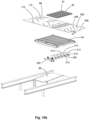
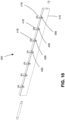
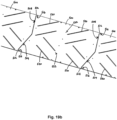
- FIGS. 10a-13 shows the conveyor system 20 with an optional rinsing system 300.
- the rinsing system 300 includes a rinsing system conduit arrangement 302 (a portion of which is shown in FIGS. 10a and 10b ), which is connectable to a source of rinsing system liquid (e.g., a city water supply).
- the rinsing system 300 further includes at least one belt rinsing arrangement 304.
- the rinsing system 300 includes a plurality of belt rinsing arrangements 304 spaced longitudinally apart for rinsing the upper transport portion 42 of the endless belt 36.
- Each belt rinsing arrangement 304 includes a rinsing system dirt pass-through aperture 306 in the support deck 84, over which the upper transport portion 42 of the endless belt 36 travels during operation.
- the rinsing system dirt pass-through aperture 306 is provided in a rinsing system wear plate 308.
- the rinsing system dirt pass-through aperture 306 may be similar to the debris slots 170 in the wear plates 88, but may be wider in the direction of travel (shown at Dt) of the endless belt 36 for reasons provided below.
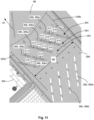
- Each belt rinsing arrangement 304 further includes at least one rinsing system outlet 310 from the rinsing system conduit arrangement 302 positioned proximate to the rinsing system dirt pass-through aperture 306a and positioned to eject rinsing system liquid (shown at 312 in FIGS. 11 and 12 ) onto the endless belt 36 upstream from a downstream edge 314 of the rinsing system dirt pass-through aperture 306a in order to capture at least some of the ejected liquid 312 through the rinsing system dirt pass-through aperture 306a.
- the terms 'upstream' and 'downstream' are both in relation to the direction of travel Dt of the upper transport portion 42 of the endless belt 36.
- the upstream edge of the rinsing system dirt pass-through aperture 306a is shown at 315. Additional rinsing system dirt pass-through apertures 306b enables the flushing of ejected liquid 312 downstream of the rinsing system dirt pass-through apertures 306a.
- the rinsing system 300 can rinse off dirt from the endless belt 36 so as to prevent that dirt from causing wear on the belt 36 as the belt 36 moves along during operation.
- the dirt may be present directly at the sliding interface between the belt 36 and the wear plates 88 and 308. Additionally, the dirt may be present at the pins (shown at 316) that pivotally connect belt segments (shown at 318) that make up the belt 36.
- Pockets (shown at 320) are present in the endless belt 36 and some portions of the pins 316 are exposed in the pockets 320. It is therefore beneficial for the rinsing system 300 to be able to eject rinsing system liquid into the pockets 320 to rinse dirt from the pins 316. This inhibits dirt from migrating into the interface between the pins 316 and the associated surfaces of the belt segments 318, which reduces the wear that can occur on the belt segments 318 at that interface. Such wear contributes to ovalizing of the apertures in the belt segments 318 in which the pins 316 reside, causing the belt 36 to lengthen and contributing to accelerated wear and failure of the belt 36.
- the endless belt includes a plurality of belt segments 318 that are pivotally connected to one another via at least one pin 316 that extends laterally.
- the endless belt 36 includes at least one pocket 320 that exposes the at least one pin 316.
- the at least one rinsing system outlet 310 is positioned to eject rinsing system liquid into the at least one pocket 320 onto the at least one pin 316 to remove dirt from the at least one pin 316.
- the rinsing system outlet 310 may be any suitable type of outlet that is capable of ejecting rinsing system liquid the distance needed to remove dirt from the endless belt 36.
- the pressure of the rinsing system liquid at the rinsing system outlet 310 may be about 138 kPa (20 psi) or higher. In some examples, it may be 276 kPa (40 psi) or higher.
- the rinsing system outlet 310 may, for example, be a nozzle.
- the rinsing system outlets 310 are positioned below the wear plates 308 and are positioned to eject the rinsing system liquid up through the rinsing system dirt pass-through aperture 306 into the belt 36.
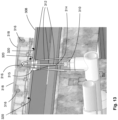
- the rinsing system dirt pass-through aperture 306 has an elongate cross-sectional shape and is sized to permit the ejecta 312 (i.e., the rinsing system liquid ejected therefrom) to leave upwardly from the rinsing system dirt pass-through aperture 306, to hit the endless belt 36 and to fall through the rinsing system dirt pass-through aperture 306 after hitting the endless belt, bringing dirt with it, as shown in FIG. 13 .
- the outlet 310 is well below the wear plate 308 and so the ejecta 312 pass upwardly through the rinsing system dirt pass-through aperture 306, hit the belt 36 and then fall back down through the aperture 306.
- the apertures 306 are shown as being angled, similarly to the apertures (slots) 170 in the wear plates 88, for the purpose of ensuring that segments of the belt 36 are always supported and do not impact against an aperture edge. This is the same reason described for the angle of the slots 170. Similar angular ranges may be used for the orientation (i.e., the angle) of the apertures 306.
- each rinsing system outlet 310 is in the form of a fan jet nozzle configured for ejecting rinsing system liquid 312 in the form of ejecta 312 having an elongate cross-sectional shape (e.g., a flat spray pattern).
- dashed lines shown at 330a and 330b represent the side edges of the endless belt 36.
- the belt 36 has a width W.
- the at least one belt rinsing arrangement 302 includes enough of the rinsing system outlets 306 to eject rinsing system liquid 312 (i.e., ejecta 312) on the entire width of the belt 36.
- ejecta 312 eject rinsing system liquid 312
- a debris deflector 332 is provided and may be similar to any of the debris deflectors shown and described herein.
- the debris deflector 332 is positioned underneath the rinsing system dirt pass-through aperture 306 to collect dirt falling through the rinsing system dirt pass-through aperture 306, and sloped downwardly away from the rinsing system dirt pass-through aperture 306 in order to transport collected dirt towards a dirt collection area shown at 334.
- FIGS. 14 and 15 show another rinsing system 340, which includes a rinsing system conduit arrangement 342 which is connectable to a source of rinsing system liquid (e.g., a city water supply or a reclaim water system).
- the rinsing system 340 further includes at least one sprocket rinsing arrangement 344 configured to rinse and remove dirt from a sprocket arrangement 352 that is used to drive the belt 36.
- the sprocket arrangement 352 in the present example includes a plurality of sprockets 354 that are mounted on a drive shaft 356. Alternatively, the sprocket arrangement 352 could include a single sprocket 354.
- the drive shaft 356 in the present example is square and passes through square apertures in the sprockets 354, however it will be understood that other shapes for the drive shaft 356 and apertures are possible.
- the sprocket arrangement 352 has sprocket teeth 358 that engage the belt 36 to drive the belt 36. The direction of rotation of the sprocket arrangement 352 is shown at Ds in FIG. 14 .
- Each belt rinsing arrangement 344 further includes at least one rinsing system outlet 360 from the rinsing system conduit arrangement 342.
- the at least one rinsing system outlet 360 is positioned proximate to the sprocket arrangement 352 and is positioned to eject rinsing system liquid 312 onto the sprocket arrangement 352.
- rinsing system liquid 312 As rinsing system liquid 312 is ejected onto the sprocket arrangement 352, it rinses some dirt off a portion of the surface of the sprocket arrangement 352 prior to engagement between that portion of the surface of the sprocket arrangement 352 and the belt 36. As a result, there is less dirt that would cause wear of the belt 36 during engagement with the sprocket arrangement 352. Such wear on the belt 36 can reduce the efficacy of the engagement with the teeth 358 on the sprocket arrangement 352. Additionally, the presence of the dirt itself can inhibit good engagement between the teeth 358 and the belt 36 which can result in increases stresses on certain areas of the belt 36 during such engagement.
- a debris collection guide 362 is provided underneath the at least one rinsing system outlet 360 to collect at least some of the liquid that has hit the sprocket arrangement 352 and reflected or dripped off the sprocket arrangement 352 thereafter along with any dislodged dirt or any dirt entrained in the reflected liquid or the liquid that has dripped off the sprocket arrangement 352.
- the debris collection guide 362 guides collected debris to a debris collection area (not shown).
- Some rinsing system liquid 312 may wind up on the lower return portion 44 of the belt 36 instead of in the debris collection guide 362. This is not considered problematic, since the inner surface of the lower return portion (shown in FIG. 14 at 364) does not engage any surfaces with significant force until reaching the idler drum at the other end of the conveyor system 20. Some of the dirt and liquid collected on the inner surface 364 of the lower return portion 44 of the belt 36 will have fallen off the belt 36 by the time it reaches the other end. As noted above, the rinsing system 300 can be provided at the upstream end of the upper transport portion 42 of the conveyor system 20, so as to rinse off dirt thereon prior to a lot of sliding engagement with the wear plates 88.
- Figure 15 is a perspective view of the rinsing system 340, but with the sprocket arrangement 352 removed.
- the rinsing system outlets 360 may be in the form of fan (flat spray) jet nozzles, and may be configured to eject rinsing system liquid 312 in flow patterns that overlap with one another and which are configured to cover the width of the sprocket arrangement 352.
- the rinsing system 340 further includes at least one belt rinsing arrangement including at least one rinsing system outlet 360 positioned to spray rinsing system liquid 312 on the outer face (shown at 366) of the belt 36, to further clean the belt 36 while the belt 36 is engaged with the sprocket arrangement 352.
- FIGS. 16 and 17 show a flooder system 400 for the conveyor system 20.
- the flooder system 400 is used to introduce liquid between the endless belt 36 and the wear plate (e.g., wear plate 88 or wear plate 308).
- the flooder system 400 includes a flooder system conduit arrangement 402 connectable to a source of flooder system liquid (such as city water, or a source of city water mixed with soap, wax or some other lubricant), and at least one belt flooding member 404.
- Each belt flooding member 404 includes at least one flooding system outlet 406 (and optionally a plurality of outlets 406 which are spaced apart laterally) from the flooding system conduit arrangement 402.
- the outlet or outlets 406 are positioned underneath the endless belt 36 and are positioned to introduce flooding system liquid 408 between the endless belt 36 and the wear plate.
- the liquid 408 introduced helps to reduce friction between the belt 36 and the wear plate 88 or 308 in part by entraining dirt that may be present therebetween.
- the liquid pressure at the outlets 406 may be relatively low, lower than the pressure at the outlets 310.
- the pressure may be about 13.8 kPa (2 psi), but is preferably higher, such as in the range of 34.5 - 68.9 kPa (5 - 10 psi) or even higher.
- the support deck (e.g., the wear plates 88 and 308) includes a plurality of dirt pass-through apertures as described above. These apertures will permit the dirt and liquid from the flooding system to fall through, thereby removing dirt from the interface between the belt 36 and the wear plates 88 and 308.
- the flooding system 400 may include a plurality of belt flooding members 404 positioned at selected distances longitudinally from one another, such as, for example, about every 6.1 to 9.1 meters (20 to 30 feet) from one another.
- each belt flooding member 404 is positioned between gratings 412 that support the wear plate 88 or 308 and thus may act as a spacer between these gratings 412.
- the gratings 412 need not be gratings and may also be identified more broadly as wear plate support members 412.
- the wear plate 88 or 308 has flooding system apertures 414.
- Each flooding member 404 may include a bar 416 that acts as a manifold and that has a plurality of outlets 406 thereon.
- the flooding member 404 may further include seal members 418 (e.g., rubber bushings) that are positioned between the outlets 406 and the underside (shown at 420) of the wear plate 88 or 308 to form a seal therebetween.
- FIGS. 19a to 19c show wear plates 500 in accordance with another embodiment.
- the wear plates 500 are similar in size and construction to wear plates 88 shown in FIGS. 7 , 8 , 11a, and 11b.
- each of the wear plates 500 includes a leading edge 504 and a trailing edge 508, wherein the leading and trailing edges 504 and 508 are provided with complementary profiles to facilitate fit and alignment between adjacently positioned wear plates 500.
- the complementary profile is provided generally in the form of a chevron aligned to the direction of travel of the vehicle through the wash tunnel.
- At least one of the leading and trailing edges 504 and 508 of the wear plates 500 may be chamfered to reduce the likelihood of wear upon the endless belt.
- the wear plates 500 expand and contract with temperature changes. To allow for this expansion and contraction, the wear plates 500 are secured via fasteners inserted through fastener holes 522 that fit within slotted holes of the modular grid panels of the support deck. This arrangement allows a degree of freedom of movement (or, more to the point, expansion) of the wear plates 500. It can also be desirable to maintain the leading and trailing edges 504 and 508 in lateral alignment to avoid changes in the lateral profile of the belt contact surface (i.e., the wear plates 500) in the longitudinal direction that can serve to more quickly wear and/or damage the endless belt.
- the wear plates 500 have mating features inhibiting lateral shifting of the wear plates 500 relative to one another in the form of fingers 512 that extend longitudinally (i.e., generally along the direction of travel of the endless belt) forward from lateral ends of the leading edges 504, and corresponding finger recesses 516 that extend longitudinally from lateral ends of the trailing edges 508.
- the fingers 512 mate with the finger recesses of adjacent wear plates 500 to maintain the wear plates 500 in lateral alignment while the wear plates 500 expand to reduce an expansion gap 518 between the wear plates 500, and contract.
- the fingers can extend longitudinally from the trailing edge and mate with corresponding finger recesses of the leading edge of an adjacent wear plate.
- a finger and a recess can be located on opposite lateral ends of each leading and trailing edge and mate with the corresponding features of adjacent wear plates.
- Other types of mating features that inhibit lateral shifting of the wear plates will occur to those skilled in the art.
- the wear plates 500 also have debris slots 520 that permit the evacuation of debris therethrough, so as to reduce the accumulation of debris between the endless belt and the wear plates 500.
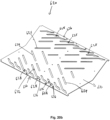
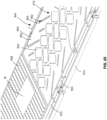
- FIGS. 20a and 20b show two variants of the design of the wear plates.
- a wear plate 600 shown in FIG. 20a has fingers 604 that extend longitudinally (i.e., generally along the direction of travel of the endless belt) forward from lateral ends of the leading edge 606, and corresponding finger recesses 608 that extend longitudinally from lateral ends of the trailing edge 610.
- the fingers 604 mate with the finger recesses of adjacent wear plates 600 to maintain the wear plates 600 in lateral alignment while the wear plates 600 expand to reduce an expansion gap between the wear plates 600, and contract.
- a set of four locating slots 612 are positioned two along each lateral side of the wear plate 600.
- the wear plate 600 has a pattern of debris slots 616 that differs from those shown in the previous figures. In particular, the debris slots 616 are wider and shorter, enabling ample drainage without significantly affecting the structural integrity of the wear plate 600. That is, there are no portions of the wear plate 600 that are connected to the remainder of the wear plate 600 only by narrow sections.
- a wear plate 620 shown in FIG. 20b has similar features to the wear plate 600 of FIG. 20a , but has different pattern of varying dimensioned debris slots.
- a first set of longitudinal debris slots 624 are generally rectangular with rounded corners, similar to the debris slots described and illustrated above, and are located centrally between the lateral sides 626 of the wear plate 620.
- a second set of peripheral debris slots 628 extend adjacent to the lateral sides 626 of the wear plate 620.
- Each of the peripheral debris slots 628 has a longitudinal portion 632 extending along a similar direction as the longitudinal debris slots 624, and a lateral portion 636 that deviates from the longitudinal portion 632 and extends along the travel direction dt of the belt.
- FIG. 21 shows locating features of a wear plate 700 and an edge guide 704 that assist with maintaining the correct alignment of the wear plates 700 while enabling them to expand and contract as a result of fluctuations in the operating temperature.
- the wear plates 700 have locating slots 708 along their lateral edges.
- the edge guide 704 is made of 14 gauge stainless steel that has a curved profile, enabling it to be deflected as the wear plates 700 are being positioned. Locating tabs 712 of the edge guide 704 mate with the locating slots 708 of the wear plates 700. The size of the locating tabs 712 and the locating slots 708 are selected to enable the wear plates 700 to expand and contract.
- FIGS. 22 to 26 show a wear plate 800 and a set of the wear plates 800 in use in a conveyor system according to the invention.
- the conveyor system is similar to those shown in FIGS. 1 to 18 .
- a set of the wear plates 800 are shown deployed as part of a support deck 804 for an endless belt 808, a portion of which is shown.
- the support deck 804 is similar to the support deck 84 shown in FIGS. 4 to 8 , 10a to 13 except that it is adapted for the wear plates 800.
- the support deck 804 generally includes a plurality of modular grid panels 812 adapted to be positioned end to end relative to one another along the longitudinal length of the service line.
- the modular grid panels 812 are made of fibre-reinforced plastic (hereinafter "FRP") or another material that is suitably hard.
- FRP is more economical than stainless steel for grid panels, but does not possess the same resistance to bending that stainless steel has.
- the modular grid panels 812 are positioned atop of three inner support rails 813, with the central inner support rail 813 supporting the centre of the modular grid panels 812 that generally bears the most load when a vehicle is being transported by the conveyor system.
- a pair of carryway channels 814 extend along either side of the support deck 804 and are bolted to transverse I-beams, such as those shown in FIG. 16 .
- the support deck 804 is positioned between an upper transport portion of the endless belt 808, shown in FIG. 25 , and a lower return portion of the endless belt 808. In this way, the support deck 804 provides support to the upper transport portion of the endless belt 808, and thereby a load placed thereon from a wheeled structure placed upon the conveyor system.
- a belt contact surface 816 is provided on an upper surface of the support deck 804.
- the belt contact surface 816 is the portion of the support deck 804 facing the upper transport portion of the endless belt 808 during normal use.
- the belt contact surface 816 includes a set of the wear plates 800 as well as a set of ceramic inserts 820 positioned within openings 824 of the wear plates 800.
- the wear plates 800 are similar in size and construction to the wear plates of FIGS. 19a to 21 , and are made from a material that is at least partially from a polymer.
- the polymer can be a thermoplastic, such as a polyethylene, in some implementations.
- the material is an ultra-high-molecular-weight polyethylene or a high-density polyethylene.
- Each of the wear plates 800 includes a leading edge 828, a trailing edge 832, and two parallel lateral edges 836 that are generally straight.
- a pair of securement apertures 839 are positioned adjacent to each of the lateral edges 836.
- the leading edge 828 and the trailing edge 832 are designed so that the trailing edge 832 of the wear plate 800 mates with the leading edge 828 of an adjacent wear plate 800.
- a set of clamping edge guides 853 are secured to the carryway channels 814 via a set of bolts or any other suitable means after positioning of the wear plates 80 on the modular grid panels 812.
- Each of the clamping edge guides 853 has a clamping portion 854 that clamps one or more wear plates 800 (depending on the sizing, but two halves in the illustrated embodiment) towards the modular grid panels 812 close to the lateral edges 836. Retaining tabs 855 of the clamping portion 854 fit within the securement apertures 839.
- the clamping edge guides 853 restrict lateral movement of the endless belt 808 as it travels over the belt contact surface 816.
- the wear plates 800 expand and contract with temperature changes. To allow for this expansion and contraction, the wear plates 800 are secured via the clamping edge guides 853 so that their general longitudinal position along the modular grid panels 812 is fixed via the retaining tabs 855 inserted into the securement apertures 839.
- the securement apertures 839 of the wear panels 800 extend further longitudinally than the retaining tabs 855 of the clamping edge guides 853, thus enabling expansion of the wear plates 800 longitudinally.
- the wear plates 800 have mating features inhibiting lateral shifting of the wear plates 800 relative to one another in the form of fingers 864 that extend longitudinally (i.e., generally along the direction of travel of the endless belt) forward from lateral ends of the leading edges 828, and corresponding finger recesses 868 that extend longitudinally from lateral ends of the trailing edges 832.
- the fingers 864 mate with the finger recesses 868 of adjacent wear plates 800 to maintain the wear plates 800 in lateral alignment while the wear plates 800 expand to reduce an expansion gap 872 between the wear plates 800, and contract.
- the fingers can extend longitudinally from the trailing edge and mate with corresponding finger recesses of the leading edge of an adjacent wear plate.
- a finger and a recess can be located on opposite lateral ends of each leading and trailing edge and mate with the corresponding features of adjacent wear plates.
- Other types of mating features that inhibit lateral shifting of the wear plates will occur to those skilled in the art.
- Each of the ceramic inserts 820 is rectangular, having four lateral sides 840 that meet at right angles.
- the ceramic inserts 820 may be commercially available ceramic tiles or may be custom-made.
- the ceramic inserts 820 may be ceramic tiles produced for lining chutes in mining operations that are made of approximately 92 percent aluminum oxide, and other agents, such as a bonding agent or agents.
- the ceramic insert 820 is bonded to a compressible layer in the form of a compressible backing 844 that enables slight downward depression of the ceramic insert 820 when positioned in one of the openings 824.
- the compressible backing 844 is made at least partially of a neoprene rubber of suitable durometer and thickness, but, in other embodiments, any other suitably resilient and compressible material can be employed.
- the compressible backing 844 is positioned under the ceramic inserts 820 to facilitate depression of the ceramic inserts 820 relative to the wear plate 800.
- the compressible layer can be omitted or can be deployed under both the wear plates 800 and the ceramic inserts 820 with corresponding cut-outs for rinsing system dirt pass-through apertures and flooder apertures.
- the top of the modular grid panels 812 are generally level to reduce uneven load on the ceramic inserts 820 as the wheels of a vehicle positioned on the endless belt 808 travel thereover. It has been found that a gritty side of the modular grid panels 812 is more level than the non-gritty side as the gritty substance applied to the gritty side forms a more uniformly level surface.
- the wear plates 800 are manufactured via molding to have a thickness t wp .
- the thickness t wp of the wear plates 800 may be selected to be slightly greater than the thickness t ci of the ceramic inserts 820 so that any acceptable variances in the thickness t ci of the ceramic inserts 820 won't exceed the thickness t wp of the wear plates 824 to thereby avoid fracturing of the ceramic inserts 820.
- the ceramic inserts 820 are oriented in a pattern along a central band B c of the wear plate 800.
- the ceramic inserts 820 are oriented so that the lateral sides 840 of the ceramic inserts 820 are at angles between 40 degrees and 50 degrees, and preferably at 45 degrees, to a longitudinal direction of travel d t of an endless belt traveling thereover.
- the orientation of the lateral sides 840 of the ceramic inserts 820 at 45 degrees has been found to reduce wear on an endless belt in comparison to other orientations, particularly where the lateral sides 840 of the ceramic inserts 820 are oriented perpendicular to the direction of travel dt of the endless belt.
- Segments of the leading edge 828 and the trailing edge 832 of the wear plate 800 that are adjacent to ceramic inserts 820 are generally parallel to a closest one of the lateral sides 840 of the adjacent ceramic insert 820.
- Traditional wear plates typically have leading and trailing edges that are transverse to the longitudinal direction of travel dt of the endless belt 804. If such transverse edges were employed with the wear plate 800 with the obliquely oriented ceramic inserts 820, the gap between the ceramic inserts 820 would be significant.
- the gap between the pattern of obliquely oriented ceramic inserts 820 on adjacent wear plates 800 can be significantly reduced, and, thus, wear on the central band B c around the leading and trailing edges 828 and 832 can be reduced.
- the position of a wheel atop of the endless belt 808 is shown generally at W. It has been found with conventional wear plates that, as wheels of a vehicle are generally more likely to be centrally positioned on an endless belt traveling over the wear plates, the greatest wear occurs along a central region of the belt contact surface 816 extending longitudinally. By employing the ceramic inserts 820, which have a relatively high resistance to abrasion, along the central band B c , along which wheels such as wheel W are most likely to be positioned, the wear plates 800 wear more evenly, thus extending the lifetime of the wear plates 800 and the overall maintenance cost of the conveyor system.
- the openings 824 within the wear plate 800 in which the ceramic inserts 820 are received are formed via any suitable known means such as milling, water jet cutting, etc. Each opening 824 is dimensioned so that is at least partially unobstructed when one of the ceramic inserts 820 is positioned therein. In particular, when the ceramic inserts 820 are inserted into the openings 824, one or more gaps 848 are present between the wear plate 800 and each of the ceramic inserts 820. The gaps 848 extend through the wear plate 800.
- the openings 824 are sufficiently spaced from one another so that the strength of the wear plate 800 is not significantly compromised. A minimum spacing between openings 824 factors in the presence of the gaps 848.
- the pattern of the ceramic inserts 820 along the central band B c is selected based on a number of factors. Increasing the surface area of the central band B c of the wear plate 800 covered by ceramic inserts 820 increases the resistance to abrasion of the belt contact surface 816 provided by the wear plates 800 and the ceramic inserts 820. Increases in the size of the ceramic inserts 820 can lead to a greater chance of fracturing of the ceramic inserts 820.
- Increasing the spacing between ceramic inserts 820 improves the strength of the wear plates 800, but decreases the resistance to abrasion of the belt contact surface 816. It has been found that, by using rectangular ceramic inserts 820 and arranging the openings 824 for the ceramic inserts 820 as closely as possible without significantly deteriorating the strength of the wear plate 800 so that the lateral sides 840 of the ceramic inserts 820 are positioned at 45 degree angles relative to the direction of travel d t , various advantages can be realized. Currently produced ceramic tiles can be used as ceramic inserts 820, thereby reducing the cost of production. Further, the strength of the wear plate 800 is maintained at a desirable level. Still further, degradation of the endless belt traveling thereacross is improved relative to conventional belt contact surfaces.
- the central band B c is spaced from the lateral edges 836 of the wear plate 800 by peripheral bands B p .
- a number of rinsing system dirt pass-through apertures 852 are situated along the peripheral bands B p to facilitate rinsing of debris from between an endless belt positioned thereon and the belt contact surface 816 provided by the wear plate 800 and the ceramic inserts 820.
- Each of the rinsing system dirt pass-through apertures 852 is aligned with at least one rinsing system outlet from a rinsing system conduit arrangement positioned proximate to the rinsing system dirt pass-through aperture 852 and positioned to eject rinsing system liquid onto an endless belt upstream from a downstream edge of the rinsing system dirt pass-through aperture 852 in order to capture at least some of the ejected liquid through the rinsing system dirt pass-through aperture 852.
- a belt rinsing system is provided in the conveyor system, and includes a rinsing system conduit arrangement 856 that is connected to a source of rinsing system liquid and at least one belt rinsing arrangement.
- Each belt rinsing arrangement includes at least one rinsing system outlet 857 that is positioned proximate to one of the rinsing system dirt pass-through aperture 852 and the gaps 848 (which acts as a rinsing system dirt pass-through aperture) to eject rinsing system liquid onto the endless belt 808 upstream from a downstream edge of the rinsing system dirt pass-through aperture in order to capture at least some of the ejected liquid through the rinsing system dirt pass-through aperture.
- the rinsing system liquid rinses away debris from between the belt contact surface 816 and the endless belt 808 positioned thereon.
- a flooder system 860 similar to that illustrated in FIG. 18 is employed to introduce liquid between the endless belt 808 and the belt contact surface 816 via the gaps 848 and the rinsing system dirt pass-through apertures 852.
- the rinsing system and the flooder system 860 induce the clearing of debris from between the belt contact surface 816 and the endless belt 808 and introduce water therebetween to facilitate travel of the endless belt 808 over the belt contact surface 816.
- the width of the central band B c is between 30% and 80% of the entire width of the wear plate 800, and in particular, between 60% and 75%. In other embodiments, where a mass being transported on an endless belt atop of a belt contact surface is distributed more uniformly across a lateral width of the belt contact surface, it may be desirable to have the central band B c cover more or all of the lateral width of the belt contact surface.
- the belt contact surface 816 is more highly resistant to wear from travel of the endless belt 808 thereover than without the ceramic inserts 820, thereby enabling the central band B c to wear at roughly the same rate as the peripheral bands B p .
- FIG. 27 shows a ceramic insert 876 that is circular in form. Ceramic inserts that lack corners or have corners of less acute angles, such as the circular ceramic insert 876, or hexagonal or octagonal ceramic inserts, for example, may be more resistant to fracturing in some scenarios. Further, it can be desirable to use ceramic inserts of a smaller size in some circumstances. While the number of joints in the belt contact surface encountered by an endless belt may increase, the probability of fracturing of the ceramic inserts can decrease.
- the dimensions of the cells of the support structure under the belt contact surface can be varied to more evenly distribute the load on the ceramic inserts as vehicles positioned in an endless belt pass thereover.
- FIG. 28 shows a cross-section of a portion of a wear plate 900 and a ceramic insert 904 in accordance with an alternative embodiment.
- a horizontal profile of the ceramic insert 904 and an opening in the wear plate 900 in which the ceramic insert 904 is received decreases in size towards a top surface 904 of the wear plate 900 and the ceramic insert 904.
- the dimensions of the opening in the wear plate 900 and the ceramic insert 904 inhibit upward escape of the ceramic insert 904 from the opening when the wear plate 900 is positioned at the top of the support structure.
- the opening in the wear plate 900 can be dimensioned to define one or more gaps adjacent the ceramic insert 904 when the ceramic insert 904 is inserted into the opening. These gaps can serve as rinsing system dirt pass-through apertures and/or flooder system apertures.
- the inserts are at least partially ceramic
- the inserts are made of any material having a higher resistance to abrasion than the wear plates.
- materials can be more brittle or expensive, it may not be desirable to construct wear plates entirely out of them.
- the overall effective lifetime of the wear plate can be increased by using the inserts at least where wear otherwise occurs the most in a uniform polymer wear plate. Further, the cost of producing the belt contact surface can be reduced by reducing the amount of the more abrasion-resistant material.
- Exemplary materials for the inserts can include, for example, stainless steel, aluminum, high-performance plastic, titanium, and ceramic bonded to steel.
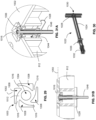
- FIG. 29 shows a holddown 1000 for a wear plate in accordance with another embodiment.
- the holddown 1000 is formed by water jet cutting a set of apertures in a polymer wear plate 1002.
- a central bolt aperture 1004 is formed, as well as a set of surrounding apertures 1008.
- the surrounding apertures 1008, with the bolt aperture 1004, define a bolt support ring 1012 that is supported by four bolt support stays 1016. While four bolt support stays 1016 are used in this embodiment, it will be appreciated that fewer or more bolt support stays can be employed.
- the bolt support stays 1016 are non-radial so that depression of the bolt support ring 1012 relative to a plane of the wear plate 1002 is possible via tensioning and torqueing of the bolt support stays 1016.
- the apertures 1004, 1008 can be formed via any other suitable cutting, routing, or molding means.
- FIG. 30 shows a toggle anchor 1020 that is used in conjunction with the holddown 1000 of FIG. 29 .
- the toggle anchor 1020 has a pair of plastic rails 1024, a first end of each of which is pivotally secured a toggle 1028.
- the toggle 1028 has a central threaded through hole 1030.
- the rails 1024 have a set of teeth on their outer surface. When the rails 1024 are aligned longitudinally, the toggle 1028 is oriented perpendicularly to a longitudinal axis of the rails 1024.
- a finger grip 1032 is secured to a second end of each of the rails 1024.
- the finger grips 1032 have a shape or surface features to enable sliding longitudinal displacement relative to one the other.
- the rails 1024 pass through an interior aperture of a retention plate 1036.
- Longitudinal axial displacement of the finger grips 1032 causes a longitudinal axis of the toggle 1028 to pivot towards the longitudinal axis of the rails 1024 to enable the fitting of the toggle 1028 and the rails 1024 through the aperture 1004 of the wear plate 1002 when the wear plate 1002 is positioned atop of the set of modular grid panels 812.
- the finger grips 1032 can be realigned axially to cause the toggle 1028 to pivot towards a perpendicular orientation relative to the longitudinal axis of the rails 1024.
- the toggle anchor 1020 can then be pulled upward to cause the toggle 1028 to engage a bottom surface of the modular grid panel 812.
- the retention plate 1036 can then be slid down the rails 1024 towards the bolt support ring 1012 with some force to pass over the teeth of the rails 1024 until the retention plate 1036 abuts against the bolt support ring 1012 and is held from movement along the longitudinal axis of the rails 1024 to retain the toggle 1028 firmly against the modular grid panel 812.
- the upper portion of the rails 1024 extending above the retention plate 1036 can then be snapped off.
- FIGS. 31A and 31B show the wear plate 1002 secured to a modular grid panel 812 via the toggle anchor 1020.
- the wear plate 100 when positioned atop of the modular grid panel 812, has its holddown 1000 positioned generally centrally over an open cell 1044 of the modular grid panel 812.
- a bolt 1048 is inserted into the bolt aperture 1004 and threaded into the threaded through hole 1030 of the toggle 1028 to secure the toggle against the modular grid panel 812.
- the holddown 1000 is deformed, with the bolt support ring 1012 being pulled towards the toggle 1028, thereby deforming the bolt support stays 1016 and securing the wear plate 1002 to the modular grid panel 812.
- the head of the bolt 1048 becomes recessed below the top plane of the wear plate 1002.
- Rotation of the bolt 1044 is terminated once the head of the bolt 1044 sits at least below a maximum wear level 1050 of the wear plate 1002. As the wear plate 1002 is scheduled to be replaced on or before wearing down of the surface of the wear plate 1002 to the maximum wear level 1050, an endless belt travelling over the wear plate 1002 should not contact the bolt 1048.
- FIG. 32 shows a support deck 1052 similar to that of FIG. 25 , wherein a set of wear plates 1056 similar to those of FIGS. 22 , 24 , and 25 have been produced with the holddowns 100 of FIGS. 29 to 31B .
- the holddowns 1000 when secured to the modular grid panels 812, exposed in a region where the ceramic inserts 820 have not yet been placed in the openings 824 of the wear plates 1056.
- the holddown arrangement of FIGS. 29 to 31 is particularly useful where it is desired to secure the wear plate 1056 to the modular grid panels 812 between lateral sides of the wear plates 1056 to avoid shifting and warping thereof.
- the bolt support stays 1016 of the holddowns 1000 enable some degree of deformation, and as the cells of the modular grid panels 812 are somewhat large, expansion of the wear plates 1056 is permitted.
- holddowns like those of FIGS. 29 to 32 can be used to hold down the wear plates at least where they are not held down by the edge guides to the modular grid panels or other support structure.
Landscapes
- Engineering & Computer Science (AREA)
- Mechanical Engineering (AREA)
- Belt Conveyors (AREA)
- Chain Conveyers (AREA)
Description
- The present disclosure relates to the field of conveyor systems, and in particular to a belt contact surface with inserts, and a conveyor system using same.
- Conveyor systems have long been used to assist in the transport of materials from one location to another, in particular with respect to heavy and cumbersome items. The use of conveyor systems in assembly lines is well documented, with perhaps Henry Ford being the most famous proponent of the technology of the 20th century.
- Conveyors come in a variety of configurations, suiting a wide array of implementations. Belt conveyors in particular have been widely adopted due to their wide versatility and adaptability. For example, belt conveyors are commonly used in the warehousing, manufacturing, and mining sectors. More recently, belt conveyors have found application in the automotive industry, in particular with respect to automated car wash stations.
- Some car washes employ single or synchronous dual belt conveyor systems for moving the vehicle through the wash tunnel. The belts are made from plastics and metals as these materials provide a relatively long life, and generally resist stretching and water corrosion.
- The conveyor belts are supported by and travel across support decks that are conventionally made of a metal, such as steel or a steel alloy.
- Over time, both the conveyor belts and the support decks wear mainly as a result of friction between the automotive vehicle-laden conveyor belts and the support decks. This wear is exacerbated by the presence of debris that is commonly removed from automotive vehicles and trapped between the conveyor belts and the support decks during the washing process. As the conveyor belts and the support decks wear, they can fatigue and/or rupture, requiring their replacement. The replacement of the conveyor belts can be particularly costly and labor-intensive.
-
FR2735113A1 FR2735113A1 - According to the invention, there is provided a conveyor system, comprising an endless belt mounted in a longitudinal direction through a service line, the endless belt having an upper transport portion adapted to move a wheeled structure through the service line, and a lower return portion, and a support deck positioned below the upper transport portion of the endless belt to support the endless belt, the support deck having a belt contact surface extending along a top of the support deck and in contact with the upper transport portion of the endless belt, the belt contact surface being at least partially constructed from a material that is at least partially a polymer, the belt contact surface having a set of inserts having a greater abrasion resistance than the material.
- According to the invention, the belt contact surface includes a set of wear plates formed from the material. The material can be, for example, at least partially thermoplastic, polyethylene, ultra-high-molecular-weight polyethylene, or high-density polyethylene.
- The conveyor system can further include a belt rinsing system including a rinsing system conduit arrangement connectable to a source of rinsing system liquid, and at least one belt rinsing arrangement, wherein each of the at least one belt rinsing arrangement includes a rinsing system dirt pass-through aperture in the support deck, over which the upper transport portion of the endless belt travels during operation, and at least one rinsing system outlet from the rinsing system conduit arrangement positioned proximate to the rinsing system dirt pass-through aperture and positioned to eject rinsing system liquid onto the endless belt upstream from a downstream edge of the rinsing system dirt pass-through aperture in order to capture at least some of the ejected liquid through the rinsing system dirt pass-through aperture.
- According to the invention, each of the set of wear plates has openings in which the set of inserts are received. The inserts can have lateral sides, each of the lateral sides being oblique to a longitudinal direction of travel of the endless belt. Each of the set of inserts can have four lateral sides, each of the lateral sides forming an angle with the longitudinal direction of travel of the endless belt of between 40 degrees and 50 degrees.
- Each of the set of wear plates can have a leading edge and a trailing edge dimensioned to mate with the leading edge of another of the set of wear plates, each of the leading edge and the trailing edge having oblique edge segments oblique to the longitudinal direction of travel of the endless belt and generally parallel to a closest one of the lateral sides of an adjacent one of the set of inserts.
- The set of inserts can be configured in a central band extending along the longitudinal direction of travel of the endless belt, the central band extending laterally across between 30% and 80% of a lateral width of the set of wear plates.
- The conveyor system can further comprise a belt rinsing system including a rinsing system conduit arrangement connectable to a source of rinsing system liquid, and at least one belt rinsing arrangement, wherein each of the at least one belt rinsing arrangement includes a rinsing system dirt pass-through aperture in the support deck positioned, over which the upper transport portion of the endless belt travels during operation, and at least one rinsing system outlet from the rinsing system conduit arrangement positioned proximate to the rinsing system dirt pass-through aperture and positioned to eject rinsing system liquid onto the endless belt upstream from a downstream edge of the rinsing system dirt pass-through aperture in order to capture at least some of the ejected liquid through the rinsing system dirt pass-through aperture.
- The set of inserts can be configured in a central band extending along the longitudinal direction of travel of the endless belt, the central band extending laterally across between 30% and 80% of a lateral width of the set of wear plates.
- The rinsing system dirt pass-through aperture can be spaced laterally from the central band.
- The openings and the set of inserts can be designed so that the openings are at least partially unobstructed when the set of inserts are positioned therein, thereby defining the rinsing system dirt pass-through aperture.
- The inserts and the openings can be dimensioned to inhibit upward escape of the inserts from the openings when the wear plates are positioned at the top of the support structure.
- According to the invention, a compressible layer is positioned under the inserts to facilitate depression of the set of inserts relative to the set of wear plates.
- According to the invention, the conveyor system has an endless belt mounted in a longitudinal direction through a service line, the endless belt having an upper transport portion adapted to move a wheeled structure through the service line, and a lower return portion, a support deck positioned below the upper transport portion of the endless belt to support the endless belt, the belt contact surface being dimensioned to extend along a top of the support deck and contact the upper transport portion of the endless belt, the belt contact surface being constructed from a material that is at least partially polymer, the belt contact surface being interspersed with inserts having a greater abrasion resistance than the material, wherein the belt contact surface comprises a set of wear plates formed from the material, and each of the set of wear plates has openings in which the set of inserts are received, and wherein a compressible layer is positioned under the inserts to facilitate depression of the set of inserts relative to the set of wear plates.
- For a better understanding of the various embodiments described herein and to show more clearly how they may be carried into effect, reference will now be made, by way of example only, to the accompanying drawings in which:
-
FIG. 1 is a plan view of the conveyor system according to an embodiment hereof; -
FIG. 2a is a partial side sectional view of the conveyor system according to the embodiment ofFIG. 1 ; -
FIG. 2b is a partial side sectional view of the conveyor system with reference toline 2b-2b ofFIG. 2a ; -
FIG. 2c is a partial side sectional view of the conveyor system with reference toline 2c-2c ofFIG. 2a ; -
FIG. 3a is a partial isometric view of the conveyor system according to the embodiment ofFIG. 1 , highlighting features of the conveyor frame; -
FIG. 3b is a partial isometric view of the conveyor system with reference toline 3b-3b ofFIG. 3a ; -
FIG. 4 is a partial transverse sectional view of the conveyor system according toFIG. 1 , highlighting features in the region of the endless belt; -
FIG. 5 is a partial transverse section view of the conveyor system according toFIG. 1 , showing an alternative embodiment of the debris deflector; -
FIG. 6 is a partial isometric of the debris deflector according to the embodiment ofFIG. 5 ; -
FIG. 7 is a partial isometric view of the conveyor system according toFIG. 1 , detailing features of the wear plates; -
FIG. 8 is a partial plan view of the conveyor system according toFIG. 1 , detailing features of the wear plates; -
FIG. 9a is a sectional view of one of the wear plates with reference toline 9a-9a ofFIG. 8 , showing features of the debris slot; -
FIG. 9b is a sectional view of one of the wear plates with reference toline 9b-9b ofFIG. 9a , showing features of the debris slot; -
FIGS. 10a-13 show a rinsing system for the conveyor system; -
FIGS. 14-18 show a flooding system for the conveyor system; -
FIGS. 19a-19c show wear plates according to an alternative embodiment; -
FIGS. 20a and20b show wear plates according to other alternative embodiments; -
Fig 21 shows the mating features of edge guides and wear plates according to an alternative embodiment; -
FIG. 22 shows a wear plate having ceramic inserts in accordance with another embodiment; -
FIG. 23 is a perspective view of one of the ceramic inserts ofFIG. 22 ; -
FIG. 24 is a perspective section view of a set of wear plates ofFIG. 22 deployed as part of a support deck for an endless belt; -
FIG. 25 is a perspective view of the support deck ofFIG. 23 having a portion of an endless belt deployed thereon; -
FIG. 26 is a cross-sectional elevation view of the support deck ofFIGS. 24 and25 ; -
FIG. 27 is a perspective view of a round ceramic insert for use with wear plates similar to those ofFIG. 22 in accordance with another embodiment; -
FIG. 28 is a cross-sectional elevation view of a wear plate and ceramic inserts in accordance with a further embodiment; -
FIG. 29 shows a top view of a holddown of a wear plate in accordance with another embodiment; -
FIG. 30 shows a bolt anchor for use with the wear plate ofFIG. 29 ; -
FIGS. 31A and 31B show the wear plate ofFIG. 29 after being secured to a modular grid panel using the bolt anchor ofFIG. 30 ; and -
FIG. 32 is a perspective view of a support deck similar to that ofFIG. 25 employing a set of wear plates including holddowns as shown inFIG. 29 to 31B . - For simplicity and clarity of illustration, where considered appropriate, reference numerals may be repeated among the Figures to indicate corresponding or analogous elements. In addition, numerous specific details are set forth in order to provide a thorough understanding of the embodiments described herein. However, it will be understood by those of ordinary skill in the art that the embodiments described herein may be practiced without these specific details. In other instances, well-known methods, procedures and components have not been described in detail so as not to obscure the embodiments described herein. Also, the description is not to be considered as limiting the scope of the embodiments described herein.
- Various terms used throughout the present description may be read and understood as follows, unless the context indicates otherwise: "or" as used throughout is inclusive, as though written "and/or"; singular articles and pronouns as used throughout include their plural forms, and vice versa; similarly, gendered pronouns include their counterpart pronouns so that pronouns should not be understood as limiting anything described herein to use, implementation, performance, etc. by a single gender; "exemplary" should be understood as "illustrative" or "exemplifying" and not necessarily as "preferred" over other embodiments. Further definitions for terms may be set out herein; these may apply to prior and subsequent instances of those terms, as will be understood from a reading of the present description.
- Reference is made to
FIG. 1 , which shows aservice line 10 having aconveyor system 20 for moving awheeled structure 11, in accordance with an embodiment. As used herein, the term service line is not intended to be restrictive, and may encompass for example an automatic vehicle wash station (e.g., for cars, commercial trucks, etc.), a manufacturing or assembly line (e.g., for cars, trucks, non-powered mobile units, etc.) as well as a repair or detailing station (e.g., for cars, trucks, etc.). In addition, the term wheeled structure is not intended to be restrictive, and may encompass for example powered landborne vehicles (e.g., trucks, automobiles, tractors, recreational vehicles, etc.), non-powered landborne mobile units (e.g., recreational trailers, utility trailers, etc.), and airborne vehicles (e.g., airplanes, etc.). - The
conveyor system 20 is adapted to transport a wheeled structure along a longitudinal length of theservice line 10. As presented inFIG. 1 ,service line 10 is shown in the form of a car wash station having awash tunnel 22. Accordingly, theconveyor system 20 includes aservice zone 24 within the region of thewash tunnel 22 through which the vehicle is transported for a wash cycle. Theconveyor system 20 also may also include aloading zone 26 adjacent atunnel entrance 28, where vehicles align and initially load onto theconveyor system 20. - The
conveyor system 20 is configured as a dual-belt system comprising a pair of endless belts mounted in a longitudinal direction through theservice line 10. Theendless belts service zones endless belts stationary platform 38 of removable panels that permit access to regions under the pair ofendless belts conveyor system 20 is provided with two or more endless belts to transport the wheeled structure along theservice line 10, the endless belts will move in synchronous motion. As the arrangement for each of theendless belts endless belts endless belt 36 unless otherwise specified. - The
endless belts - Turning now to
FIGS. 2a ,2b and2c , theconveyor system 20 is generally supported within atrench 40 having a depth suitable to house the required drive and guide mechanisms, and to permit maneuverability to service personnel. Theendless belt 36 has anupper transport portion 42 and alower return portion 44, and extends along theconveyor system 20 between adrive end 46 and anidler end 48. Thedrive end 46 andidler end 48 provide axially elongatedrollers conveyor frame 54, to guide theendless belt 36 around the respective drive and idler ends 46 and 48. - The
drive end 46 includes adrive module 56 adapted to engage and move the endless belt around the drive and idler ends 46 and 48. Thedrive module 56 may be an electric motor as shown, and may include at least onedrive member 58 to engage theendless belt 36 and move it around the respective drive and idler ends 46 and 48. As shown, thedrive member 58 is provided in the form of at least onesprocket 60 provided withsprocket teeth 62 to engage complementary tracks (not shown) on theinward surface 64 of theendless belt 36. Theconveyor system 20 will additionally includeguide members 66 supported upon theconveyor frame 54 to support thelower return portion 44 of theendless belt 36 as it moves back towards theidler end 48 on the underside of theconveyor system 20. As shown, theguide members 66 are provided in the form of rollers. - In motion, the
upper transport portion 42 of theendless belt 36 moves in tension from theidler end 48 towards thedrive end 46 bydrive member 58, while thelower return portion 44 moves in a slackened state from thedrive end 46 towards theidler end 48. - Turning now to
FIGS. 3a and3b , shown is an enlarged view of theconveyor system 20 with theendless belt 36 and associated support structure removed to highlight features of theconveyor frame 54. Theconveyor frame 54 includes a plurality ofcross-members 68 positioned transversely relative to the longitudinal direction of theservice line 10. The cross-members 68 are dimensioned to span the width of thetrench 40, and are adapted to mount on opposingsurfaces footing 74 at approximately a midpoint thereof, extending to afloor 76 of thetrench 40 to provide additional load-bearing performance to theconveyor frame 54. - Arranged in the longitudinal direction, the
conveyor frame 54 additionally provides a plurality of support rails that extend the longitudinal length of theservice line 10, from theidler end 48 to thedrive end 46. The support rails are arranged as twoinner support rails outer support rails inner support rails service line 10, while the twoouter support rails trench 40. Theinner support rails outer support rails - Having reference to
FIG. 4 , theinner support rails stationary platform 38 provided between theendless belts inner support rails respective seat stationary platform 38. In the embodiment shown, the centralstationary platform 38 is provided in the form of fiberglass or thermoplastic grating. In addition, for eachendless belt 36, the respective opposing inner andouter rails support deck 84. Thesupport deck 84 generally includes a plurality ofmodular grid panels 86 adapted to be positioned end to end relative to one another along the longitudinal length of theservice line 10. The modular grid panels are provided with a length that aligns the point of contact between adjacent grid panels on atransverse cross-member 68, providing weight-bearing support thereto. Thesupport deck 84 is positioned between theupper transport portion 42 andlower return portion 44 of theendless belt 36, generally in close proximity to theupper transport portion 42. In this way, thesupport deck 84 provides support to theupper transport portion 42 of theendless belt 36, and thereby a load placed thereon from a wheeled structure placed upon theconveyor system 20. To facilitate sliding of the endless belt over thesupport deck 84, a belt contact surface in the form of a plurality ofwear plates 88 is provided between theupper transport portion 42 and thesupport deck 84. The belt contact surface is the portion of thesupport deck 84 facing theendless belt 36 during normal use. The belt contact surface can have a thickness so that, as it wears through use with theendless belt 36, it continues to facilitate sliding of theendless belt 36 thereover until the belt contact surface is worn out. - The
wear plates 88 form a structure that extends along a top of thesupport deck 84 and contacts theupper transport portion 42 of theendless belt 36. The arrangement of the inner andouter support rails guide member 66 supporting thelower return portion 44 of theendless belt 36. As shown, the inner andouter support rails respective guide hangers guide member 66 in a transverse direction relative to the longitudinal direction of theservice line 10. As shown, theguide member 66 is provided with a plurality ofrollers 94 that support anoutward surface 96 of theendless belt 36 along thelower return portion 44. - Continuing with
FIG. 4 , also provided between theupper transport portion 42 and thelower return portion 44 of theendless belt 36, and in particular between thesupport deck 84 and thelower return portion 44 is adebris deflector 98. Thedebris deflector 98 provides a barrier to protect thelower return portion 44 from debris falling from thesupport deck 84, in particular where thesupport deck 84 is provided in the form of the modular grid panels. Thedebris deflector 98 is generally mounted on an angle directed downwardly towards the longitudinal centerline of the service line. Thedebris deflector 98 may be mounted on dedicated brackets, or may be mounted on theguide hangers debris deflector 98 is generally configured to provide a contiguous barrier between adjacent cross-members, so as to maximize the protection from falling debris. In some embodiments, thedebris deflector 98 may be provided in the form of multiple panels arranged and fastened in side-by-side relationship to one another. - It will be recognized that the arrangement of the
support deck 84, thedebris deflector 98 and the longitudinally-spacedcross-members 68 define a partial enclosure in the region between theupper transport portion 42 and thelower return portion 44 of theendless belt 36. To assist in reducing the likelihood of freezing conditions on theconveyor system 10, in particular sections exposed to the outside environment, such as theloading zone 26 shown inFIG. 1 , at least a portion of theconveyor system 20 may include a heater in these partial enclosures between adjacent cross-members 68. Referring toFIGS. 3 and4 , theconveyor system 20 provides aheater 100 positioned between thesupport deck 84 and thedebris deflector 98, extending in the longitudinal direction across one or more of the partial enclosures delimited longitudinally betweenadjacent cross members 68. Accordingly, the partial enclosures containing theheater 100 provide a region of higher heat concentration relative to other areas within thetrench 40, in particular the area below thedebris deflector 98. In this way, thesupport deck 84, theendless belt 36 supported thereon, and the plurality ofwear plates 88 positioned therebetween receive heat from the region of higher heat concentration, thereby reducing the likelihood of a freeze event in theconveyor system 20. It will be appreciated that freeze events in conveyor systems can result in extensive damage to theendless belt 36 and/or drivemodule 56. - To enable passage of the
heater 100 between adjacent partial enclosures separated by the cross-members 68, the cross-members 68 are adapted with one or more pass-throughapertures 102, depending on whether the heater is adapted to pass once through the desired heated portion, or in a serpentine path therethrough. In the embodiment shown inFIG. 4 , two pass-through apertures are provided for each side of theconveyor system 20. - It will be appreciated that the
heater 100 may take on a variety of forms. For example, theheater 100 may be configured as a convective heater, such as a convective tube heater including both smooth and finned-tube varieties. A convective tube heater will generally be part of a fluid circuit having an electric or gas-fired heater module to deliver a heated fluid therein. Theheater 100 may also be configured as a radiant heater such as a gas-fired radiant tube heater, or a resistive electrical heating element. - The
debris deflector 98 may be formed from any suitable material including but not limited to metal (e.g., stainless steel, galvanized steel, aluminum, etc.), thermoplastics (e.g., polypropylene, polyethylene, etc.) and composites. To promote direction of the emitted heat fromheater 100 towards thesupport deck 84, thedebris deflector 98 may be adapted with at least a selected level of thermal reflectivity. The thermal reflectivity may be achieved by constructing thedebris deflector 98 in the form of a radiant barrier. Alternatively, a radiant barrier may be separately formed and applied to thedebris deflector 98, for example in the form of a thin radiant barrier sheet attached thereto. Radiant barriers are typically highly reflective materials (e.g., aluminum or polished stainless steel foil) applied to a substrate. Exemplary substrates may include kraft paper, oriented strand board, plastic films and plywood. For environments that experience high moisture levels, for example a car wash tunnel, the substrate may be of metal or thermoplastic construction. Exemplary thermoplastic substrates may include polypropylene or polyethylene foam core. In general, the material applied to the substrate should exhibit an emittance of less than 0.25, as measured by ASTM C1371. In addition to polished metallic films, low-emittance coatings such as metal oxide may be used on a suitable substrate. It will be appreciated that the side of thedebris deflector 98, or separately formed sheet, facing thesupport deck 84 is the side adapted to receive the highly reflective material. In other words, the highly reflective material, and thus the effective side of the radiant barrier is intended to face the region of higher heat concentration between thedebris deflector 98 and thesupport deck 84. - Having regard to
FIGS. 5 and6 , shown is adebris deflector 198 according an alternative embodiment. As thedebris deflector 198 is arranged in theconveyor system 20 in substantially the same way asdebris deflector 98, only the differences associated with this alternative embodiment are discussed. Thedebris deflector 198 includes adebris portion 110 that is positioned under thesupport deck 84, and awater collection portion 112 that extends outwardly therefrom, towards a respective side wall of thetrench 40. Thewater collection portion 112 is intended to facilitate cleaning of thedebris portion 110 of thedebris deflector 198, without the need for substantial disassembly and associated downtime of the conveyor system. With this arrangement, a sprayer orsuitable wash nozzle 114 may be positioned as shown to deliver a stream of water directly upon thewater collection portion 112 of thedebris deflector 198, promoting a wash effect to remove accumulated debris from thedebris portion 110. Access to thewater collection portion 112 may be achieved by removingside panels 116, or where theside panels 116 are provided in the form of fiberglass or thermoplastic grating, wash water may be delivered directly therethrough. The use of grates for theside panels 116 will also permit a greater volume of wash and rinse water from the wash tunnel to be captured by thewater collection portion 112, enhancing the cleaning effect of thedebris deflector 198 during normal wash tunnel usage. - As shown, the
water collection portion 112 of thedebris deflector 198 is generally arranged at an angle relative to thedebris portion 110, with its terminallateral edge 120 being positioned proximal theunderside 122 of theside panel 116. Thedebris deflector 198 is provided with acurved transition 124 between thewater collection portion 112 and thedebris portion 110 to deflect the impingement of rinse water, with reduced turbulence, therein resulting in an effective flushing of debris from thedebris portion 110 of thedebris deflector 198. - The
debris deflector debris deflectors debris deflector - When formed of thermoplastic material, the
debris deflector FIG. 6 ). Thestructural ribs 126 provide additional rigidity to thedebris deflector - As stated earlier, and having regard to
FIG. 2a , theupper transport portion 42 of theendless belt 36 moves in tension from theidler end 48 towards thedrive end 46 bydrive member 56, while thelower return portion 44 moves in a slackened state from thedrive end 46 towards theidler end 48. In the slackened state, thelower return portion 44 of theendless belt 36 may be subject to greater lateral movement, having the potential to create belt tracking and alignment issues. This is particularly evident at theidler end 48 where the axially elongatedroller 52 is not provided with engagement teeth as found on the opposingdrive member 58 at thedrive end 46. Misalignment and poor tracking of theendless belt 36 can cause excessive wear on the conveyor mechanism, necessitating increased maintenance and associated downtime. Issues of misalignment of theendless belt 36 can increase upon aging of theendless belt 36, generally due to belt stretch. Accordingly, in an alternative embodiment, a least one pair of lateral guide rollers are incorporated into theconveyor system 20. - The
wear plates 88 are made from a material that is at least partially thermoplastic, and, in particular, at least partially polyethylene, such as an ultra-high-molecular-weight polyethylene ("UHMWPE"), which is also known as high-modulus polyethylene ("HMPE"). UHMWPE is a thermoplastic polyethylene that has extremely long chains. The longer chains serve to transfer load more effectively to the polymer framework by reinforcing intermolecular interactions. Further, UHMWPE has low moisture absorption, a very low coefficient of friction, a high strength, and is highly resistant to abrasion as a result of the longer chains, especially in comparison to carbon steel. Further, UHMWPE is very resistant to corrosion. Some particular exemplary materials that can be used to manufacture the wear plates are virgin UHMWPE such as available from Röchling Engineering Plastics and the Garland Manufacturing Company, reprocessed UHMWPE such as available from Röchling Engineering Plastics, glass filled UHMWPE such as available from Quadrant Plastic Composites Inc., ceramic filled UHMWPE such as available from Polymer Industries Inc. and Quadrant Plastic Composites Inc., and cross-linked UHMWPE such as available from Röchling Engineering Plastics and Polymer Industries Inc. - Alternatively, in other embodiments, the wear plates can be made from a material that is at least partially high-density polyethylene ("HDPE"). HDPE is also suitable for use for construction of the
wear plates 88. In another embodiment, a proprietary polyethylene, Polystone™ sold by Röchling Engineering Plastics, can be used to manufacture the wear plates. - The material of the
wear plates 88 can be selected it has a hardness HWP that is lesser than the hardness HBS of the plastic belt segments in some scenarios. - The costs for the manufacturing of wear plates form these materials ranges from 63% to over 200% of the price using stainless steel in some cases, based on the current prices of stainless steel and these thermoplastics. Depending on the material selected and application, suitable thickness ranges are in the 3/16 inch to 3/8 inch range (5-10 mm) in some scenarios.
- Traditionally, the use of such materials for belt contact surfaces was deemed unsuitable as dirt trapped between the endless belts and the belt contact surfaces caused the belt contact surfaces to wear at an unsatisfactory rate without significant improvements to the wear of the endless belts. Wearing of the endless belts and the belt contact surface occurs in the form of erosion. As the endless belts are worn down, the pins holding belt segments together are exposed and can be deformed and pop out, allowing the belt segments to separate. Erosion of the belt contact surface can accelerate endless belt wear where the endless belt is in contact with the underlying structures.
- It has been found that, by using a belt rinsing system that introduces and drains a rinsing fluid between the endless belts and the belt contact surfaces, the dirt trapped between the endless belts and the belt contact surfaces can be reduced and that the wear rate of both the endless belts and the belt contact surfaces can be reduced.
- That is, by making the belt contact surface (i.e., the wear plates 88) from a softer material than stainless steel that is traditionally used, and by rinsing away debris from the interface between the
endless belts endless belts wear plates 88. - Certain thermoplastics, such as UHMWPE and HDPE have been found to be suitable due to their possession of certain characteristics. These materials provide a sufficiently low coefficient of friction, and are sufficiently resistant to abrasion. The
wear plates 88 are inexpensive to replace relative to the replacement cost of theendless belts endless belt - Another characteristic of thermoplastics is that they generally have a hardness HWP that is lesser than the hardness HBS of the belt segments of the
endless belts wear plates 88 are designed to improve the lifetime of theendless belt 36 by sacrificing the lifetime of thewear plates 88. - Polyethylenes and other thermoplastics are subject to thermal expansion and contraction. In the car wash environment, the range of temperatures that the
wear plates 88 are subject to is significant. Thewear plates 88 have a longitudinal length of approximately 111 cm (44 inches) and have been found to expand and contract +/- 0.508 cm ( +/- 0.2 inches) over a typical operational ambient temperature range. In order to compensate for these expansions and contractions, expansion gaps between the leading and trailingedges wear plates 88 of 0.508 cm (0.2 inches) or greater are provided - Each
wear plate 88 is provided with a plurality ofdebris slots 170 that permit the evacuation of debris therethrough, so as to reduce the accumulation of debris between the endless belt and thewear plates 88. Eachdebris slot 170 includes afirst slot end 172 and asecond slot end 174, and is provided with a width of 10 mm, although widths of between 8 to 25 mm may be implemented. Eachdebris slot 170 may be linear (i.e., straight) and may be arranged at an angle θ relative a longitudinal centerline L of thewear plate 88. As shown, thedebris slot 170 is outwardly angled from the longitudinal centerline L in the direction of thefirst slot end 172 towards thesecond slot end 174. The angle θ of eachdebris slot 170 is 35° relative to the longitudinal centerline L of thewear plate 88, although angles between 25° to 45° may be implemented. In general, angle selection is based on observed belt wear. It has been determined that angles within this range, and in particular at 35° relative to the longitudinal centerline L of thewear plate 88 result in the least amount of endless belt wear during use, therein increasing the usable lifespan of the endless belt and wear plates. - The
first slot end 172 and thesecond slot end 174 of eachdebris slot 170 can be provided with an inwardly slopedbevel 176, as shown inFIG. 9a . It has been determined that maximum wear of the endless belt occurs where the endless belt passes over a sharp edge perpendicular to the direction of belt travel. Accordingly, with the first and second slot ends 172 and 174 having the inwardly slopedbevel 176, in particular at thesecond slot end 174, the extent of belt wear is reduced, particularly when the wear plates are constructed of stainless steel. Between the first and second slot ends 172 and 174 of thedebris slot 170, the opposingedges FIG. 9b . As the endless belt is passing over these sections of thedebris slot 170 at an angle (i.e., 35° relative to the longitudinal centerline L of the wear plate 88), the extent of belt wear is minimal. Moreover, by maintaining these edges sharp as shown, they provide a stripping action to remove debris from the underside of the endless belt, without excessive wear thereto. - It will be appreciated that while both the first and second slot ends 172 and 174 are shown as being beveled, in some embodiments, only one of the first and second slot ends 172 and 174 is beveled. In an alternative embodiment, only the
second slot end 174 is beveled. - By using certain thermoplastics that are softer than stainless steel, have a low coefficient of friction, and/or a high resistance to abrasion in constructing the wear plates, it has been found that the beveling of the
debris slots 170 as shown inFIGS. 9a and 9b can be omitted without materially increasing wear on theendless belt 36. The beveling of thedebris slots 170 adds to the manufacturing costs of thewear plates 88 and, thus, the ability to omit this feature without materially impacting the lifetime of theendless belt 36 is another benefit to the use of thermoplastics in the construction of thewear plates 88. - In the embodiment shown in
FIG. 8 , eachwear plate 88 provides 8debris slots 170, generally presented in two rows of 4 arranged across thewear plate 88. Within each row, the 4 debris slots are arranged in two paired sets of debris slots, with the two paired sets of debris slots being longitudinally offset relative to one another. The arrangement of thedebris slots 170 is such that the leading and trailing ends 172 and 174 ofsuccessive debris slots 170 align, so as to reduce the number of locations having increased potential for belt wear. As shown, alignment between successive debris slots occurs along longitudinal centerline L, as well as alignment line ALA and alignment line ALs. - It will be appreciated that while each wear
plate 88 is shown as having 8debris slots 170, in other embodiments, the number ofdebris slots 170 may be fewer or greater, depending on the extend of debris removal required. While the leading and trailing ends 172 and 174 of alldebris slots 170 may be machined with the aforementioned inwardly sloped bevel, in some embodiments, only thedebris slots 170 arranged proximal the longitudinal centerline L of thewear plate 88 may be beveled. In other preferred embodiments, thedebris slots 170 are not beveled. - Reference is made to
FIGS. 10a-13 , which shows theconveyor system 20 with anoptional rinsing system 300. Therinsing system 300 includes a rinsing system conduit arrangement 302 (a portion of which is shown inFIGS. 10a and10b ), which is connectable to a source of rinsing system liquid (e.g., a city water supply). Therinsing system 300 further includes at least onebelt rinsing arrangement 304. In the present example, therinsing system 300 includes a plurality ofbelt rinsing arrangements 304 spaced longitudinally apart for rinsing theupper transport portion 42 of theendless belt 36. - Each
belt rinsing arrangement 304 includes a rinsing system dirt pass-throughaperture 306 in thesupport deck 84, over which theupper transport portion 42 of theendless belt 36 travels during operation. As can be seen, in the embodiment shown inFigure 10a , the rinsing system dirt pass-throughaperture 306 is provided in a rinsing system wearplate 308. The rinsing system dirt pass-throughaperture 306 may be similar to thedebris slots 170 in thewear plates 88, but may be wider in the direction of travel (shown at Dt) of theendless belt 36 for reasons provided below. - Each
belt rinsing arrangement 304 further includes at least onerinsing system outlet 310 from the rinsingsystem conduit arrangement 302 positioned proximate to the rinsing system dirt pass-through aperture 306a and positioned to eject rinsing system liquid (shown at 312 inFIGS. 11 and12 ) onto theendless belt 36 upstream from adownstream edge 314 of the rinsing system dirt pass-through aperture 306a in order to capture at least some of the ejected liquid 312 through the rinsing system dirt pass-through aperture 306a. The terms 'upstream' and 'downstream' are both in relation to the direction of travel Dt of theupper transport portion 42 of theendless belt 36. The upstream edge of the rinsing system dirt pass-through aperture 306a is shown at 315. Additional rinsing system dirt pass-through apertures 306b enables the flushing of ejected liquid 312 downstream of the rinsing system dirt pass-through apertures 306a. - Put another way, the
rinsing system 300 can rinse off dirt from theendless belt 36 so as to prevent that dirt from causing wear on thebelt 36 as thebelt 36 moves along during operation. The dirt may be present directly at the sliding interface between thebelt 36 and thewear plates belt 36. - Pockets (shown at 320) are present in the
endless belt 36 and some portions of thepins 316 are exposed in thepockets 320. It is therefore beneficial for therinsing system 300 to be able to eject rinsing system liquid into thepockets 320 to rinse dirt from thepins 316. This inhibits dirt from migrating into the interface between thepins 316 and the associated surfaces of thebelt segments 318, which reduces the wear that can occur on thebelt segments 318 at that interface. Such wear contributes to ovalizing of the apertures in thebelt segments 318 in which thepins 316 reside, causing thebelt 36 to lengthen and contributing to accelerated wear and failure of thebelt 36. - Thus it may be said that the endless belt includes a plurality of
belt segments 318 that are pivotally connected to one another via at least onepin 316 that extends laterally. Theendless belt 36 includes at least onepocket 320 that exposes the at least onepin 316. The at least onerinsing system outlet 310 is positioned to eject rinsing system liquid into the at least onepocket 320 onto the at least onepin 316 to remove dirt from the at least onepin 316. - The
rinsing system outlet 310 may be any suitable type of outlet that is capable of ejecting rinsing system liquid the distance needed to remove dirt from theendless belt 36. In some examples, the pressure of the rinsing system liquid at therinsing system outlet 310 may be about 138 kPa (20 psi) or higher. In some examples, it may be 276 kPa (40 psi) or higher. Therinsing system outlet 310 may, for example, be a nozzle. - Reference is made to
Figure 13 . As can be seen, the rinsingsystem outlets 310 are positioned below thewear plates 308 and are positioned to eject the rinsing system liquid up through the rinsing system dirt pass-throughaperture 306 into thebelt 36. The rinsing system dirt pass-throughaperture 306 has an elongate cross-sectional shape and is sized to permit the ejecta 312 (i.e., the rinsing system liquid ejected therefrom) to leave upwardly from the rinsing system dirt pass-throughaperture 306, to hit theendless belt 36 and to fall through the rinsing system dirt pass-throughaperture 306 after hitting the endless belt, bringing dirt with it, as shown inFIG. 13 . For example, in the embodiment shown, theoutlet 310 is well below thewear plate 308 and so theejecta 312 pass upwardly through the rinsing system dirt pass-throughaperture 306, hit thebelt 36 and then fall back down through theaperture 306. - The
apertures 306 are shown as being angled, similarly to the apertures (slots) 170 in thewear plates 88, for the purpose of ensuring that segments of thebelt 36 are always supported and do not impact against an aperture edge. This is the same reason described for the angle of theslots 170. Similar angular ranges may be used for the orientation (i.e., the angle) of theapertures 306. - As can be seen, each rinsing
system outlet 310 is in the form of a fan jet nozzle configured for ejecting rinsing system liquid 312 in the form ofejecta 312 having an elongate cross-sectional shape (e.g., a flat spray pattern). - Referring to
FIG. 11 , dashed lines shown at 330a and 330b represent the side edges of theendless belt 36. Thebelt 36 has a width W. As can be seen, the at least onebelt rinsing arrangement 302 includes enough of therinsing system outlets 306 to eject rinsing system liquid 312 (i.e., ejecta 312) on the entire width of thebelt 36. There is some offset between the apparent position of theejecta 312 and the position of the side edges 330a and 330b of thebelt 36 in the view shown inFIG. 11 however, it will be understood that this is merely a result of the difference in elevation of theoutlets 310 and thebelt 36. - In
FIG. 12 , adebris deflector 332 is provided and may be similar to any of the debris deflectors shown and described herein. Thedebris deflector 332 is positioned underneath the rinsing system dirt pass-throughaperture 306 to collect dirt falling through the rinsing system dirt pass-throughaperture 306, and sloped downwardly away from the rinsing system dirt pass-throughaperture 306 in order to transport collected dirt towards a dirt collection area shown at 334. - Reference is made to
FIGS. 14 and15 , which show another rinsing system 340, which includes a rinsingsystem conduit arrangement 342 which is connectable to a source of rinsing system liquid (e.g., a city water supply or a reclaim water system). The rinsing system 340 further includes at least onesprocket rinsing arrangement 344 configured to rinse and remove dirt from asprocket arrangement 352 that is used to drive thebelt 36. Thesprocket arrangement 352 in the present example includes a plurality ofsprockets 354 that are mounted on adrive shaft 356. Alternatively, thesprocket arrangement 352 could include asingle sprocket 354. - The
drive shaft 356 in the present example is square and passes through square apertures in thesprockets 354, however it will be understood that other shapes for thedrive shaft 356 and apertures are possible. Thesprocket arrangement 352 has sprocketteeth 358 that engage thebelt 36 to drive thebelt 36. The direction of rotation of thesprocket arrangement 352 is shown at Ds inFIG. 14 . - Each
belt rinsing arrangement 344 further includes at least onerinsing system outlet 360 from the rinsingsystem conduit arrangement 342. The at least onerinsing system outlet 360 is positioned proximate to thesprocket arrangement 352 and is positioned to eject rinsing system liquid 312 onto thesprocket arrangement 352. - As rinsing
system liquid 312 is ejected onto thesprocket arrangement 352, it rinses some dirt off a portion of the surface of thesprocket arrangement 352 prior to engagement between that portion of the surface of thesprocket arrangement 352 and thebelt 36. As a result, there is less dirt that would cause wear of thebelt 36 during engagement with thesprocket arrangement 352. Such wear on thebelt 36 can reduce the efficacy of the engagement with theteeth 358 on thesprocket arrangement 352. Additionally, the presence of the dirt itself can inhibit good engagement between theteeth 358 and thebelt 36 which can result in increases stresses on certain areas of thebelt 36 during such engagement. - A
debris collection guide 362 is provided underneath the at least onerinsing system outlet 360 to collect at least some of the liquid that has hit thesprocket arrangement 352 and reflected or dripped off thesprocket arrangement 352 thereafter along with any dislodged dirt or any dirt entrained in the reflected liquid or the liquid that has dripped off thesprocket arrangement 352. Thedebris collection guide 362 guides collected debris to a debris collection area (not shown). - Some rinsing system liquid 312 may wind up on the
lower return portion 44 of thebelt 36 instead of in thedebris collection guide 362. This is not considered problematic, since the inner surface of the lower return portion (shown inFIG. 14 at 364) does not engage any surfaces with significant force until reaching the idler drum at the other end of theconveyor system 20. Some of the dirt and liquid collected on theinner surface 364 of thelower return portion 44 of thebelt 36 will have fallen off thebelt 36 by the time it reaches the other end. As noted above, therinsing system 300 can be provided at the upstream end of theupper transport portion 42 of theconveyor system 20, so as to rinse off dirt thereon prior to a lot of sliding engagement with thewear plates 88. -
Figure 15 is a perspective view of the rinsing system 340, but with thesprocket arrangement 352 removed. As shown inFigure 15 , the rinsingsystem outlets 360 may be in the form of fan (flat spray) jet nozzles, and may be configured to eject rinsing system liquid 312 in flow patterns that overlap with one another and which are configured to cover the width of thesprocket arrangement 352. - As can be seen in
Figures 14 and15 , optionally, the rinsing system 340 further includes at least one belt rinsing arrangement including at least onerinsing system outlet 360 positioned to spray rinsing system liquid 312 on the outer face (shown at 366) of thebelt 36, to further clean thebelt 36 while thebelt 36 is engaged with thesprocket arrangement 352. - Reference is made to
FIGS. 16 and17 , which show aflooder system 400 for theconveyor system 20. Theflooder system 400 is used to introduce liquid between theendless belt 36 and the wear plate (e.g., wearplate 88 or wear plate 308). Theflooder system 400 includes a flooder system conduit arrangement 402 connectable to a source of flooder system liquid (such as city water, or a source of city water mixed with soap, wax or some other lubricant), and at least onebelt flooding member 404. Eachbelt flooding member 404 includes at least one flooding system outlet 406 (and optionally a plurality ofoutlets 406 which are spaced apart laterally) from the flooding system conduit arrangement 402. The outlet oroutlets 406 are positioned underneath theendless belt 36 and are positioned to introduce flooding system liquid 408 between theendless belt 36 and the wear plate. The liquid 408 introduced helps to reduce friction between thebelt 36 and thewear plate - The liquid pressure at the
outlets 406 may be relatively low, lower than the pressure at theoutlets 310. For example, the pressure may be about 13.8 kPa (2 psi), but is preferably higher, such as in the range of 34.5 - 68.9 kPa (5 - 10 psi) or even higher. - The support deck (e.g., the
wear plates 88 and 308) includes a plurality of dirt pass-through apertures as described above. These apertures will permit the dirt and liquid from the flooding system to fall through, thereby removing dirt from the interface between thebelt 36 and thewear plates flooding system 400 may include a plurality ofbelt flooding members 404 positioned at selected distances longitudinally from one another, such as, for example, about every 6.1 to 9.1 meters (20 to 30 feet) from one another. Optionally, eachbelt flooding member 404 is positioned between gratings 412 that support thewear plate wear plate flooding member 404 may include abar 416 that acts as a manifold and that has a plurality ofoutlets 406 thereon. Theflooding member 404 may further include seal members 418 (e.g., rubber bushings) that are positioned between theoutlets 406 and the underside (shown at 420) of thewear plate -
FIGS. 19a to 19c show wear plates 500 in accordance with another embodiment. Thewear plates 500 are similar in size and construction to wearplates 88 shown inFIGS. 7 ,8 , 11a, and 11b. In particular, each of thewear plates 500 includes aleading edge 504 and a trailingedge 508, wherein the leading and trailingedges wear plates 500. In the embodiment shown, the complementary profile is provided generally in the form of a chevron aligned to the direction of travel of the vehicle through the wash tunnel. At least one of the leading and trailingedges wear plates 500 may be chamfered to reduce the likelihood of wear upon the endless belt. - Like the
wear plates 88, thewear plates 500 expand and contract with temperature changes. To allow for this expansion and contraction, thewear plates 500 are secured via fasteners inserted throughfastener holes 522 that fit within slotted holes of the modular grid panels of the support deck. This arrangement allows a degree of freedom of movement (or, more to the point, expansion) of thewear plates 500. It can also be desirable to maintain the leading and trailingedges - To this end, the
wear plates 500 have mating features inhibiting lateral shifting of thewear plates 500 relative to one another in the form offingers 512 that extend longitudinally (i.e., generally along the direction of travel of the endless belt) forward from lateral ends of theleading edges 504, and corresponding finger recesses 516 that extend longitudinally from lateral ends of the trailingedges 508. Thefingers 512 mate with the finger recesses ofadjacent wear plates 500 to maintain thewear plates 500 in lateral alignment while thewear plates 500 expand to reduce anexpansion gap 518 between thewear plates 500, and contract. - In other embodiments, the fingers can extend longitudinally from the trailing edge and mate with corresponding finger recesses of the leading edge of an adjacent wear plate. Alternatively, a finger and a recess can be located on opposite lateral ends of each leading and trailing edge and mate with the corresponding features of adjacent wear plates. Other types of mating features that inhibit lateral shifting of the wear plates will occur to those skilled in the art.
- The
wear plates 500 also havedebris slots 520 that permit the evacuation of debris therethrough, so as to reduce the accumulation of debris between the endless belt and thewear plates 500. -
FIGS. 20a and20b show two variants of the design of the wear plates. Awear plate 600 shown inFIG. 20a hasfingers 604 that extend longitudinally (i.e., generally along the direction of travel of the endless belt) forward from lateral ends of theleading edge 606, and corresponding finger recesses 608 that extend longitudinally from lateral ends of the trailingedge 610. Thefingers 604 mate with the finger recesses ofadjacent wear plates 600 to maintain thewear plates 600 in lateral alignment while thewear plates 600 expand to reduce an expansion gap between thewear plates 600, and contract. A set of four locatingslots 612 are positioned two along each lateral side of thewear plate 600. Thewear plate 600 has a pattern ofdebris slots 616 that differs from those shown in the previous figures. In particular, thedebris slots 616 are wider and shorter, enabling ample drainage without significantly affecting the structural integrity of thewear plate 600. That is, there are no portions of thewear plate 600 that are connected to the remainder of thewear plate 600 only by narrow sections. - A
wear plate 620 shown inFIG. 20b has similar features to thewear plate 600 ofFIG. 20a , but has different pattern of varying dimensioned debris slots. A first set oflongitudinal debris slots 624 are generally rectangular with rounded corners, similar to the debris slots described and illustrated above, and are located centrally between thelateral sides 626 of thewear plate 620. A second set ofperipheral debris slots 628 extend adjacent to thelateral sides 626 of thewear plate 620. Each of theperipheral debris slots 628 has alongitudinal portion 632 extending along a similar direction as thelongitudinal debris slots 624, and alateral portion 636 that deviates from thelongitudinal portion 632 and extends along the travel direction dt of the belt. It has been found that, in some cases, debris travels down the lateral sides of the endless belts and gets underneath between the endless belt and the wear plates. Theperipheral debris slots 628, and theirlateral portions 636 in particular, assist in quickly flushing away this debris to reduce its chances of lingering between the endless belt and thewear plate 600. -
FIG. 21 shows locating features of awear plate 700 and anedge guide 704 that assist with maintaining the correct alignment of thewear plates 700 while enabling them to expand and contract as a result of fluctuations in the operating temperature. Thewear plates 700 have locatingslots 708 along their lateral edges. Theedge guide 704 is made of 14 gauge stainless steel that has a curved profile, enabling it to be deflected as thewear plates 700 are being positioned. Locatingtabs 712 of theedge guide 704 mate with the locatingslots 708 of thewear plates 700. The size of the locatingtabs 712 and the locatingslots 708 are selected to enable thewear plates 700 to expand and contract. -
FIGS. 22 to 26 show awear plate 800 and a set of thewear plates 800 in use in a conveyor system according to the invention. The conveyor system is similar to those shown inFIGS. 1 to 18 . - A set of the
wear plates 800 are shown deployed as part of asupport deck 804 for anendless belt 808, a portion of which is shown. Thesupport deck 804 is similar to thesupport deck 84 shown inFIGS. 4 to 8 ,10a to 13 except that it is adapted for thewear plates 800. Thesupport deck 804 generally includes a plurality ofmodular grid panels 812 adapted to be positioned end to end relative to one another along the longitudinal length of the service line. Themodular grid panels 812 are made of fibre-reinforced plastic (hereinafter "FRP") or another material that is suitably hard. FRP is more economical than stainless steel for grid panels, but does not possess the same resistance to bending that stainless steel has. Accordingly, themodular grid panels 812 are positioned atop of three inner support rails 813, with the centralinner support rail 813 supporting the centre of themodular grid panels 812 that generally bears the most load when a vehicle is being transported by the conveyor system. A pair ofcarryway channels 814 extend along either side of thesupport deck 804 and are bolted to transverse I-beams, such as those shown inFIG. 16 . - The
support deck 804 is positioned between an upper transport portion of theendless belt 808, shown inFIG. 25 , and a lower return portion of theendless belt 808. In this way, thesupport deck 804 provides support to the upper transport portion of theendless belt 808, and thereby a load placed thereon from a wheeled structure placed upon the conveyor system. - To facilitate sliding of the upper transport portion of the
endless belt 808 over thesupport deck 804, abelt contact surface 816 is provided on an upper surface of thesupport deck 804. Thebelt contact surface 816 is the portion of thesupport deck 804 facing the upper transport portion of theendless belt 808 during normal use. Thebelt contact surface 816 includes a set of thewear plates 800 as well as a set ofceramic inserts 820 positioned withinopenings 824 of thewear plates 800. - The
wear plates 800 are similar in size and construction to the wear plates ofFIGS. 19a to 21 , and are made from a material that is at least partially from a polymer. The polymer can be a thermoplastic, such as a polyethylene, in some implementations. Preferably, the material is an ultra-high-molecular-weight polyethylene or a high-density polyethylene. - Each of the
wear plates 800 includes aleading edge 828, a trailingedge 832, and two parallellateral edges 836 that are generally straight. A pair ofsecurement apertures 839 are positioned adjacent to each of the lateral edges 836. Theleading edge 828 and the trailingedge 832 are designed so that the trailingedge 832 of thewear plate 800 mates with theleading edge 828 of anadjacent wear plate 800. - A set of clamping edge guides 853 are secured to the
carryway channels 814 via a set of bolts or any other suitable means after positioning of the wear plates 80 on themodular grid panels 812. Each of the clamping edge guides 853 has a clampingportion 854 that clamps one or more wear plates 800 (depending on the sizing, but two halves in the illustrated embodiment) towards themodular grid panels 812 close to the lateral edges 836. Retainingtabs 855 of the clampingportion 854 fit within thesecurement apertures 839. The clamping edge guides 853 restrict lateral movement of theendless belt 808 as it travels over thebelt contact surface 816. - The
wear plates 800 expand and contract with temperature changes. To allow for this expansion and contraction, thewear plates 800 are secured via the clamping edge guides 853 so that their general longitudinal position along themodular grid panels 812 is fixed via the retainingtabs 855 inserted into thesecurement apertures 839. Thesecurement apertures 839 of thewear panels 800 extend further longitudinally than the retainingtabs 855 of the clamping edge guides 853, thus enabling expansion of thewear plates 800 longitudinally. Thewear plates 800 have mating features inhibiting lateral shifting of thewear plates 800 relative to one another in the form offingers 864 that extend longitudinally (i.e., generally along the direction of travel of the endless belt) forward from lateral ends of theleading edges 828, and corresponding finger recesses 868 that extend longitudinally from lateral ends of the trailingedges 832. Thefingers 864 mate with the finger recesses 868 ofadjacent wear plates 800 to maintain thewear plates 800 in lateral alignment while thewear plates 800 expand to reduce anexpansion gap 872 between thewear plates 800, and contract. - In other embodiments, the fingers can extend longitudinally from the trailing edge and mate with corresponding finger recesses of the leading edge of an adjacent wear plate. Alternatively, a finger and a recess can be located on opposite lateral ends of each leading and trailing edge and mate with the corresponding features of adjacent wear plates. Other types of mating features that inhibit lateral shifting of the wear plates will occur to those skilled in the art.
- Each of the ceramic inserts 820 is rectangular, having four
lateral sides 840 that meet at right angles. The ceramic inserts 820 may be commercially available ceramic tiles or may be custom-made. In particular, the ceramic inserts 820 may be ceramic tiles produced for lining chutes in mining operations that are made of approximately 92 percent aluminum oxide, and other agents, such as a bonding agent or agents. - According to the invention and as illustrated in
FIG. 23 , theceramic insert 820 is bonded to a compressible layer in the form of acompressible backing 844 that enables slight downward depression of theceramic insert 820 when positioned in one of theopenings 824. In particular, thecompressible backing 844 is made at least partially of a neoprene rubber of suitable durometer and thickness, but, in other embodiments, any other suitably resilient and compressible material can be employed. It has been found that, by using thecompressible backing 844 with theceramic inserts 820, the incidence of fracturing of theceramic inserts 820 as a result of slight variations in the thickness of thewear plates 800 or the flatness of a support surface upon which thewear plates 800 and theceramic inserts 820 are positioned is significantly less frequent. In this manner, thecompressible backing 844 is positioned under theceramic inserts 820 to facilitate depression of theceramic inserts 820 relative to thewear plate 800. - In other embodiments not part of the invention, however, the compressible layer can be omitted or can be deployed under both the
wear plates 800 and theceramic inserts 820 with corresponding cut-outs for rinsing system dirt pass-through apertures and flooder apertures. - Further, it can be advantageous to ensure that the top of the
modular grid panels 812 are generally level to reduce uneven load on theceramic inserts 820 as the wheels of a vehicle positioned on theendless belt 808 travel thereover. It has been found that a gritty side of themodular grid panels 812 is more level than the non-gritty side as the gritty substance applied to the gritty side forms a more uniformly level surface. - The
wear plates 800 are manufactured via molding to have a thickness twp. A thickness tci of theceramic inserts 820 and thecompressible backing 844, if present, corresponds generally to the thickness twp of thewear plates 800. The thickness twp of thewear plates 800 may be selected to be slightly greater than the thickness tci of theceramic inserts 820 so that any acceptable variances in the thickness tci of theceramic inserts 820 won't exceed the thickness twp of thewear plates 824 to thereby avoid fracturing of the ceramic inserts 820. Where compressible backing is not deployed with theceramic inserts 820, it may be more desirable to select a thickness twp for thewear plates 800 that is marginally greater than in scenarios where thecompressible backing 844 is deployed, as thecompressible backing 844 provides tolerance to slight projection of aceramic insert 820 over thewear plate 800. - The ceramic inserts 820 are oriented in a pattern along a central band Bc of the
wear plate 800. In particular, the ceramic inserts 820 are oriented so that thelateral sides 840 of theceramic inserts 820 are at angles between 40 degrees and 50 degrees, and preferably at 45 degrees, to a longitudinal direction of travel dt of an endless belt traveling thereover. The orientation of thelateral sides 840 of theceramic inserts 820 at 45 degrees has been found to reduce wear on an endless belt in comparison to other orientations, particularly where thelateral sides 840 of theceramic inserts 820 are oriented perpendicular to the direction of travel dt of the endless belt. - Segments of the
leading edge 828 and the trailingedge 832 of thewear plate 800 that are adjacent toceramic inserts 820 are generally parallel to a closest one of thelateral sides 840 of the adjacentceramic insert 820. Traditional wear plates typically have leading and trailing edges that are transverse to the longitudinal direction of travel dt of theendless belt 804. If such transverse edges were employed with thewear plate 800 with the obliquely orientedceramic inserts 820, the gap between theceramic inserts 820 would be significant. By jagging the leading and trailingedges wear plates 800, the gap between the pattern of obliquely orientedceramic inserts 820 onadjacent wear plates 800 can be significantly reduced, and, thus, wear on the central band Bc around the leading and trailingedges - The position of a wheel atop of the
endless belt 808 is shown generally at W. It has been found with conventional wear plates that, as wheels of a vehicle are generally more likely to be centrally positioned on an endless belt traveling over the wear plates, the greatest wear occurs along a central region of thebelt contact surface 816 extending longitudinally. By employing the ceramic inserts 820, which have a relatively high resistance to abrasion, along the central band Bc, along which wheels such as wheel W are most likely to be positioned, thewear plates 800 wear more evenly, thus extending the lifetime of thewear plates 800 and the overall maintenance cost of the conveyor system. - The
openings 824 within thewear plate 800 in which the ceramic inserts 820 are received are formed via any suitable known means such as milling, water jet cutting, etc. Eachopening 824 is dimensioned so that is at least partially unobstructed when one of the ceramic inserts 820 is positioned therein. In particular, when theceramic inserts 820 are inserted into theopenings 824, one ormore gaps 848 are present between thewear plate 800 and each of the ceramic inserts 820. Thegaps 848 extend through thewear plate 800. - The
openings 824 are sufficiently spaced from one another so that the strength of thewear plate 800 is not significantly compromised. A minimum spacing betweenopenings 824 factors in the presence of thegaps 848. The pattern of theceramic inserts 820 along the central band Bc is selected based on a number of factors. Increasing the surface area of the central band Bc of thewear plate 800 covered byceramic inserts 820 increases the resistance to abrasion of thebelt contact surface 816 provided by thewear plates 800 and the ceramic inserts 820. Increases in the size of theceramic inserts 820 can lead to a greater chance of fracturing of the ceramic inserts 820. Increasing the spacing betweenceramic inserts 820 improves the strength of thewear plates 800, but decreases the resistance to abrasion of thebelt contact surface 816. It has been found that, by using rectangular ceramic inserts 820 and arranging theopenings 824 for theceramic inserts 820 as closely as possible without significantly deteriorating the strength of thewear plate 800 so that thelateral sides 840 of theceramic inserts 820 are positioned at 45 degree angles relative to the direction of travel dt, various advantages can be realized. Currently produced ceramic tiles can be used asceramic inserts 820, thereby reducing the cost of production. Further, the strength of thewear plate 800 is maintained at a desirable level. Still further, degradation of the endless belt traveling thereacross is improved relative to conventional belt contact surfaces. - The central band Bc is spaced from the
lateral edges 836 of thewear plate 800 by peripheral bands Bp. A number of rinsing system dirt pass-throughapertures 852 are situated along the peripheral bands Bp to facilitate rinsing of debris from between an endless belt positioned thereon and thebelt contact surface 816 provided by thewear plate 800 and the ceramic inserts 820. Each of the rinsing system dirt pass-throughapertures 852 is aligned with at least one rinsing system outlet from a rinsing system conduit arrangement positioned proximate to the rinsing system dirt pass-throughaperture 852 and positioned to eject rinsing system liquid onto an endless belt upstream from a downstream edge of the rinsing system dirt pass-throughaperture 852 in order to capture at least some of the ejected liquid through the rinsing system dirt pass-throughaperture 852. - A belt rinsing system is provided in the conveyor system, and includes a rinsing
system conduit arrangement 856 that is connected to a source of rinsing system liquid and at least one belt rinsing arrangement. Each belt rinsing arrangement includes at least onerinsing system outlet 857 that is positioned proximate to one of the rinsing system dirt pass-throughaperture 852 and the gaps 848 (which acts as a rinsing system dirt pass-through aperture) to eject rinsing system liquid onto theendless belt 808 upstream from a downstream edge of the rinsing system dirt pass-through aperture in order to capture at least some of the ejected liquid through the rinsing system dirt pass-through aperture. The rinsing system liquid rinses away debris from between thebelt contact surface 816 and theendless belt 808 positioned thereon. Still further, aflooder system 860 similar to that illustrated inFIG. 18 is employed to introduce liquid between theendless belt 808 and thebelt contact surface 816 via thegaps 848 and the rinsing system dirt pass-throughapertures 852. The rinsing system and theflooder system 860 induce the clearing of debris from between thebelt contact surface 816 and theendless belt 808 and introduce water therebetween to facilitate travel of theendless belt 808 over thebelt contact surface 816. - In a preferred embodiment, the width of the central band Bc is between 30% and 80% of the entire width of the
wear plate 800, and in particular, between 60% and 75%. In other embodiments, where a mass being transported on an endless belt atop of a belt contact surface is distributed more uniformly across a lateral width of the belt contact surface, it may be desirable to have the central band Bc cover more or all of the lateral width of the belt contact surface. - When wear plates are manufactured at least partially from a polymer such as UHMWPE or HDPE, and especially when the wear plates are like the
wear plates 800 that have theceramic inserts 820 inserted in openings thereof along the central band Bc, thebelt contact surface 816 is more highly resistant to wear from travel of theendless belt 808 thereover than without theceramic inserts 820, thereby enabling the central band Bc to wear at roughly the same rate as the peripheral bands Bp. - As will be appreciated, the size and shape of the ceramic inserts can be varied.
FIG. 27 shows aceramic insert 876 that is circular in form. Ceramic inserts that lack corners or have corners of less acute angles, such as the circularceramic insert 876, or hexagonal or octagonal ceramic inserts, for example, may be more resistant to fracturing in some scenarios. Further, it can be desirable to use ceramic inserts of a smaller size in some circumstances. While the number of joints in the belt contact surface encountered by an endless belt may increase, the probability of fracturing of the ceramic inserts can decrease. - The dimensions of the cells of the support structure under the belt contact surface can be varied to more evenly distribute the load on the ceramic inserts as vehicles positioned in an endless belt pass thereover.
-
FIG. 28 shows a cross-section of a portion of awear plate 900 and aceramic insert 904 in accordance with an alternative embodiment. A horizontal profile of theceramic insert 904 and an opening in thewear plate 900 in which theceramic insert 904 is received decreases in size towards atop surface 904 of thewear plate 900 and theceramic insert 904. Thus, the dimensions of the opening in thewear plate 900 and theceramic insert 904 inhibit upward escape of theceramic insert 904 from the opening when thewear plate 900 is positioned at the top of the support structure. As will be appreciated, the opening in thewear plate 900 can be dimensioned to define one or more gaps adjacent theceramic insert 904 when theceramic insert 904 is inserted into the opening. These gaps can serve as rinsing system dirt pass-through apertures and/or flooder system apertures. - While, in the above-described embodiments, the inserts are at least partially ceramic, in other embodiments, the inserts are made of any material having a higher resistance to abrasion than the wear plates. As such materials can be more brittle or expensive, it may not be desirable to construct wear plates entirely out of them. By using the materials in a sparing manner, in the form of inserts, the overall effective lifetime of the wear plate can be increased by using the inserts at least where wear otherwise occurs the most in a uniform polymer wear plate. Further, the cost of producing the belt contact surface can be reduced by reducing the amount of the more abrasion-resistant material. Exemplary materials for the inserts can include, for example, stainless steel, aluminum, high-performance plastic, titanium, and ceramic bonded to steel.
-
FIG. 29 shows aholddown 1000 for a wear plate in accordance with another embodiment. Theholddown 1000 is formed by water jet cutting a set of apertures in apolymer wear plate 1002. In particular, acentral bolt aperture 1004 is formed, as well as a set of surroundingapertures 1008. The surroundingapertures 1008, with thebolt aperture 1004, define abolt support ring 1012 that is supported by four bolt support stays 1016. While four bolt support stays 1016 are used in this embodiment, it will be appreciated that fewer or more bolt support stays can be employed. The bolt support stays 1016 are non-radial so that depression of thebolt support ring 1012 relative to a plane of thewear plate 1002 is possible via tensioning and torqueing of the bolt support stays 1016. In other embodiments, theapertures -
FIG. 30 shows atoggle anchor 1020 that is used in conjunction with theholddown 1000 ofFIG. 29 . Thetoggle anchor 1020 has a pair ofplastic rails 1024, a first end of each of which is pivotally secured atoggle 1028. Thetoggle 1028 has a central threaded throughhole 1030. Therails 1024 have a set of teeth on their outer surface. When therails 1024 are aligned longitudinally, thetoggle 1028 is oriented perpendicularly to a longitudinal axis of therails 1024. Afinger grip 1032 is secured to a second end of each of therails 1024. The finger grips 1032 have a shape or surface features to enable sliding longitudinal displacement relative to one the other. Therails 1024 pass through an interior aperture of aretention plate 1036. Longitudinal axial displacement of the finger grips 1032 causes a longitudinal axis of thetoggle 1028 to pivot towards the longitudinal axis of therails 1024 to enable the fitting of thetoggle 1028 and therails 1024 through theaperture 1004 of thewear plate 1002 when thewear plate 1002 is positioned atop of the set ofmodular grid panels 812. Once thetoggle 1028 is fitted through theaperture 1004 and positioned through a cell of one of themodular grid panels 812, the finger grips 1032 can be realigned axially to cause thetoggle 1028 to pivot towards a perpendicular orientation relative to the longitudinal axis of therails 1024. Thetoggle anchor 1020 can then be pulled upward to cause thetoggle 1028 to engage a bottom surface of themodular grid panel 812. Theretention plate 1036 can then be slid down therails 1024 towards thebolt support ring 1012 with some force to pass over the teeth of therails 1024 until theretention plate 1036 abuts against thebolt support ring 1012 and is held from movement along the longitudinal axis of therails 1024 to retain thetoggle 1028 firmly against themodular grid panel 812. The upper portion of therails 1024 extending above theretention plate 1036 can then be snapped off. -
FIGS. 31A and 31B show thewear plate 1002 secured to amodular grid panel 812 via thetoggle anchor 1020. Thewear plate 1002, when positioned atop of themodular grid panel 812, has itsholddown 1000 positioned generally centrally over anopen cell 1044 of themodular grid panel 812. Abolt 1048 is inserted into thebolt aperture 1004 and threaded into the threaded throughhole 1030 of thetoggle 1028 to secure the toggle against themodular grid panel 812. As thebolt 1048 is turned, theholddown 1000 is deformed, with thebolt support ring 1012 being pulled towards thetoggle 1028, thereby deforming the bolt support stays 1016 and securing thewear plate 1002 to themodular grid panel 812. The head of thebolt 1048 becomes recessed below the top plane of thewear plate 1002. Rotation of thebolt 1044 is terminated once the head of thebolt 1044 sits at least below amaximum wear level 1050 of thewear plate 1002. As thewear plate 1002 is scheduled to be replaced on or before wearing down of the surface of thewear plate 1002 to themaximum wear level 1050, an endless belt travelling over thewear plate 1002 should not contact thebolt 1048. -
FIG. 32 shows asupport deck 1052 similar to that ofFIG. 25 , wherein a set ofwear plates 1056 similar to those ofFIGS. 22 ,24 , and25 have been produced with theholddowns 100 ofFIGS. 29 to 31B . Theholddowns 1000 when secured to themodular grid panels 812, exposed in a region where theceramic inserts 820 have not yet been placed in theopenings 824 of thewear plates 1056. The holddown arrangement ofFIGS. 29 to 31 is particularly useful where it is desired to secure thewear plate 1056 to themodular grid panels 812 between lateral sides of thewear plates 1056 to avoid shifting and warping thereof. As the bolt support stays 1016 of theholddowns 1000 enable some degree of deformation, and as the cells of themodular grid panels 812 are somewhat large, expansion of thewear plates 1056 is permitted. - In other embodiments where the wear plates do not fully span the distance between the edge guides, holddowns like those of
FIGS. 29 to 32 can be used to hold down the wear plates at least where they are not held down by the edge guides to the modular grid panels or other support structure. - Persons skilled in the art will appreciate that there are yet more alternative implementations and modifications possible, and that the above examples are only illustrations of one or more implementations. The scope, therefore, is only to be limited by the claims appended hereto and any amendments made thereto.
Claims (12)
- A conveyor system, comprising:an endless belt (808) mounted in a longitudinal direction through a service line (10), the endless belt (808) having an upper transport portion adapted to move a wheeled structure (11) through the service line (10), and a lower return portion; anda support deck (804) positioned below the upper transport portion of the endless belt (808) to support the endless belt (808), the support deck (804) having a belt contact surface (816) extending along a top of the support deck (804) and in contact with the upper transport portion of the endless belt (808), the belt contact surface (816) being at least partially constructed from a material that is at least partially a polymer, the belt contact surface (816) having a set of inserts (820) having a greater abrasion resistance than the material,characterized in that:
the belt contact surface (816) comprises a set of wear plates (800) formed from the material, and each of the set of wear plates (800) has openings (824) in which the set of inserts (820) are received, and wherein a compressible layer (844) is positioned under the inserts (820) to facilitate depression of the set of inserts (820) relative to the set of wear plates (800). - The conveyor system of claim 1, wherein the material is at least partially thermoplastic.
- The conveyor system of claim 2, wherein the material is at least partially ultra-high-molecular-weight polyethylene.
- The conveyor system of claim 3, wherein the material is at least partially high-density polyethylene.
- The conveyor system of claim 1, wherein the inserts (820) have lateral sides, each of the lateral sides (840) being oblique to a longitudinal direction of travel (dt) of the endless belt (808).
- The conveyor system of claim 5, wherein each of the set of inserts (820) has four lateral sides (840), each of the lateral sides (840) forming an angle with the longitudinal direction of travel (dt) of the endless belt (808) of between 40 degrees and 50 degrees.
- The conveyor system of claim 5, wherein each of the set of wear plates (800) has a leading edge (828) and a trailing edge (832) dimensioned to mate with the leading edge (828) of another of the set of wear plates (800), each of the leading edge (828) and the trailing edge (832) having oblique edge segments oblique to the longitudinal direction of travel (dt) of the endless belt (808) and generally parallel to a closest one of the lateral sides (840) of an adjacent one of the set of inserts (820).
- The conveyor system of claim 5, wherein the set of inserts (820) are configured in a central band (Bc) extending along the longitudinal direction of travel (dt) of the endless belt (808), the central band (Bc) extending laterally across between 30% and 80% of a lateral width of the set of wear plates (800).
- The conveyor system of claim 1, further comprising:
a belt rinsing system including a rinsing system conduit arrangement (856) connectable to a source of rinsing system liquid, and at least one belt rinsing arrangement, wherein each of the at least one belt rinsing arrangement includesa rinsing system dirt pass-through aperture (852) in the support deck (804) positioned, over which the upper transport portion of the endless belt (808) travels during operation; andat least one rinsing system outlet (857) from the rinsing system conduit arrangement (856) positioned proximate to the rinsing system dirt pass-through aperture (852) and positioned to eject rinsing system liquid onto the endless belt (808) upstream from a downstream edge of the rinsing system dirt pass-through aperture (852) in order to capture at least some of the ejected liquid through the rinsing system dirt pass-through aperture (852). - The conveyor system of claim 9, wherein the openings (824) and the set of inserts (820) are designed so that the openings (824) are at least partially unobstructed when the set of inserts (820) are positioned therein, thereby defining the rinsing system dirt pass-through aperture (852).
- The conveyor system of claim 1, wherein the inserts (820) and the openings (824) are dimensioned to inhibit upward escape of the inserts (820) from the openings (824) when the wear plates (800) are positioned at the top of a support structure.
- A belt contact surface (816) for a conveyor system, the conveyor system having an endless belt (808) mounted in a longitudinal direction through a service line (10), the endless belt (808) having an upper transport portion adapted to move a wheeled structure (11) through the service line (10), and a lower return portion, a support deck (804) positioned below the upper transport portion of the endless belt (808) to support the endless belt (808), the belt contact surface (816) being dimensioned to extend along a top of the support deck (804) and contact the upper transport portion of the endless belt (808), the belt contact surface (816) being constructed from a material that is at least partially polymer, the belt contact surface (816) being interspersed with inserts (820) having a greater abrasion resistance than the material,
characterized in that:
the belt contact surface (816) comprises a set of wear plates (800) formed from the material, and each of the set of wear plates (800) has openings (824) in which the set of inserts (820) are received, and wherein a compressible layer (844) is positioned under the inserts (820) to facilitate depression of the set of inserts (820) relative to the set of wear plates (800).
Applications Claiming Priority (2)
| Application Number | Priority Date | Filing Date | Title |
|---|---|---|---|
| US16/281,653 US10414591B1 (en) | 2019-02-21 | 2019-02-21 | Belt contact surface with inserts, and a conveyor system using same |
| PCT/CA2020/050220 WO2020168430A1 (en) | 2019-02-21 | 2020-02-20 | Belt contact surface with inserts, and a conveyor system using same |
Publications (3)
| Publication Number | Publication Date |
|---|---|
| EP3927632A1 EP3927632A1 (en) | 2021-12-29 |
| EP3927632A4 EP3927632A4 (en) | 2022-11-23 |
| EP3927632B1 true EP3927632B1 (en) | 2025-04-16 |
Family
ID=67908805
Family Applications (1)
| Application Number | Title | Priority Date | Filing Date |
|---|---|---|---|
| EP20758944.1A Withdrawn - After Issue EP3927632B1 (en) | 2019-02-21 | 2020-02-20 | Belt contact surface with inserts, and a conveyor system using same |
Country Status (6)
| Country | Link |
|---|---|
| US (1) | US10414591B1 (en) |
| EP (1) | EP3927632B1 (en) |
| AU (1) | AU2020226295A1 (en) |
| CA (1) | CA3120010A1 (en) |
| IL (1) | IL285533A (en) |
| WO (1) | WO2020168430A1 (en) |
Families Citing this family (5)
| Publication number | Priority date | Publication date | Assignee | Title |
|---|---|---|---|---|
| US10414591B1 (en) * | 2019-02-21 | 2019-09-17 | Stephenson Technologies Inc. | Belt contact surface with inserts, and a conveyor system using same |
| CN112499113A (en) * | 2020-11-12 | 2021-03-16 | 吕仲民 | Material supporting device of polishing machine |
| US11560273B2 (en) * | 2020-11-18 | 2023-01-24 | Stephenson Technologies Inc. | Vehicle conveyor system and surface system for a vehicle conveyor |
| US20250011102A1 (en) * | 2021-10-13 | 2025-01-09 | Stephenson Technologies Inc. | Conveyor system for wheeled structures and improvements thereto |
| CN115367460B (en) * | 2022-09-23 | 2025-06-27 | 珠海丽珠试剂股份有限公司 | Grasping mechanism, transmission system and automatic analysis system |
Family Cites Families (32)
| Publication number | Priority date | Publication date | Assignee | Title |
|---|---|---|---|---|
| US2446936A (en) * | 1947-02-11 | 1948-08-10 | Proctor & Schwartz Inc | Conveyer |
| US3260219A (en) * | 1964-06-05 | 1966-07-12 | A J Ind Inc | Conveyor structure |
| US3338386A (en) | 1965-09-07 | 1967-08-29 | Fmc Corp | Scraper |
| US4226325A (en) | 1979-03-15 | 1980-10-07 | Mcgraw-Edison Company | Conveyor lubricating and washing apparatus |
| US4300721A (en) | 1980-05-23 | 1981-11-17 | Oneida General Corporation | System for collecting liquid spillage at rail facilities |
| GB8813196D0 (en) * | 1988-06-03 | 1988-07-06 | Gbe International Plc | Cutting machine |
| EP0406425B1 (en) * | 1988-06-05 | 1994-08-24 | Kabushiki Kaisha Yoko | Belt conveyor supporting arrangement |
| US4889147A (en) | 1988-10-05 | 1989-12-26 | Chandler David A | Car wash apparatus |
| US5111929A (en) | 1991-04-24 | 1992-05-12 | Checker Machine, Inc. | Spiral conveyor cleaning system |
| JPH05162842A (en) | 1991-12-11 | 1993-06-29 | Kawasaki Steel Corp | Adhesion remover for conveyor belt surface |
| US5353920A (en) * | 1993-09-23 | 1994-10-11 | S&S Slides, Inc. | Extensible continuous haulage system |
| FR2735113B1 (en) * | 1995-06-06 | 1997-08-22 | Getin Ghislaine | STATIC SHOE FOR SUPPORTING THE LOWER OR UPPER STRAND OF AN ENDLESS BELT CONVEYOR |
| US5601180A (en) * | 1995-06-08 | 1997-02-11 | Steeber; Dorian F. | Conveyor apparatus having a belt and object guide with a nodular contact surface |
| US5779027A (en) * | 1996-02-14 | 1998-07-14 | Rexnord Corporation | Sideflexing conveyor including lubrication inserts |
| US6270305B1 (en) * | 1999-06-11 | 2001-08-07 | Btu International, Inc. | High temperature conveyor furnace with low friction conveyor travel surface |
| US6360879B1 (en) | 2000-02-24 | 2002-03-26 | George N. Crawford | Low profile belt conveyor |
| ITMO20020077A1 (en) * | 2002-03-29 | 2003-09-29 | Luigi Pedrini | CONVEYOR BELT SLIDING PLATE WITH ANTI-CLUTCH AND ANTI-WEAR SLIDING SURFACE |
| US7278435B2 (en) | 2003-11-14 | 2007-10-09 | Roles Jr Joseph W | Assembly and system for isolation of waste water in outdoor, open-air wash station |
| US6978880B2 (en) | 2004-03-09 | 2005-12-27 | Paul Barrett | Conveyor belt cleaning devices, methods, and systems |
| US7527144B2 (en) * | 2006-07-06 | 2009-05-05 | Nelson-Williams Linings, Inc. | Impact bed for conveyor systems |
| US8413669B2 (en) | 2006-11-23 | 2013-04-09 | Suncor Energy Inc. | Heating system for outdoor conveyors in a carwash |
| US8182083B2 (en) * | 2009-03-02 | 2012-05-22 | Pitney Bowes, Inc. | Print module having pivotable support/instrumentation rack for print head assembly |
| CN201538554U (en) * | 2009-09-28 | 2010-08-04 | 彭兵 | Wear liner of bearing conveying belt |
| DE102010005852A1 (en) * | 2010-01-26 | 2011-07-28 | Dünnwald, Wilfried, 47475 | Device for reducing the impact stress of a conveyor belt |
| US20110272256A1 (en) * | 2010-05-07 | 2011-11-10 | Qubicaamf Worldwide Llc | Anti idling channel and corner block mechanism and method of installation |
| NL2010186C2 (en) * | 2013-01-25 | 2014-07-28 | Jonge Poerink Conveyors B V | Conveyor and method of producing a conveyor. |
| US9248974B2 (en) | 2013-03-08 | 2016-02-02 | Mark S. Grill | Cleaning apparatus, methods of making cleaning apparatus, and methods of cleaning |
| US9745142B2 (en) * | 2016-02-02 | 2017-08-29 | Stephenson Technologies Inc. | Conveyor assembly |
| US9650218B1 (en) | 2016-02-02 | 2017-05-16 | Stephenson Technologies Inc. | Vehicle conveyor assembly with heater |
| CA2929335C (en) | 2016-02-02 | 2020-04-14 | Stephenson Technologies Inc. | Improved conveyor assembly |
| CA2971777C (en) * | 2017-03-09 | 2021-03-16 | Stephenson Technologies Inc. | Liquid introduction systems for conveyor system |
| US10414591B1 (en) * | 2019-02-21 | 2019-09-17 | Stephenson Technologies Inc. | Belt contact surface with inserts, and a conveyor system using same |
-
2019
- 2019-02-21 US US16/281,653 patent/US10414591B1/en active Active
-
2020
- 2020-02-20 CA CA3120010A patent/CA3120010A1/en active Pending
- 2020-02-20 EP EP20758944.1A patent/EP3927632B1/en not_active Withdrawn - After Issue
- 2020-02-20 WO PCT/CA2020/050220 patent/WO2020168430A1/en not_active Ceased
- 2020-02-20 AU AU2020226295A patent/AU2020226295A1/en not_active Abandoned
-
2021
- 2021-08-11 IL IL285533A patent/IL285533A/en unknown
Also Published As
| Publication number | Publication date |
|---|---|
| CA3120010A1 (en) | 2020-08-27 |
| EP3927632A1 (en) | 2021-12-29 |
| IL285533A (en) | 2021-09-30 |
| US10414591B1 (en) | 2019-09-17 |
| AU2020226295A1 (en) | 2021-06-24 |
| WO2020168430A1 (en) | 2020-08-27 |
| EP3927632A4 (en) | 2022-11-23 |
Similar Documents
| Publication | Publication Date | Title |
|---|---|---|
| EP3927632B1 (en) | Belt contact surface with inserts, and a conveyor system using same | |
| US10947051B2 (en) | Conveyor system assembly | |
| US11053079B2 (en) | Connector structures for conveyor system assembly | |
| US10266154B2 (en) | Conveyor assembly | |
| US11851284B2 (en) | Conveyor system for wheeled structures and improvements thereto | |
| US7299917B2 (en) | Belt conveyor and associated equipment | |
| US7624858B2 (en) | Modular plastic conveyor belt for spiral conversion | |
| US9650218B1 (en) | Vehicle conveyor assembly with heater | |
| US10479329B2 (en) | Liquid introduction systems for conveyor system | |
| EP3724110B1 (en) | Belt contact surface for conveyor system | |
| CA2929335C (en) | Improved conveyor assembly | |
| CA2919812C (en) | Conveyor assembly |
Legal Events
| Date | Code | Title | Description |
|---|---|---|---|
| STAA | Information on the status of an ep patent application or granted ep patent |
Free format text: STATUS: THE INTERNATIONAL PUBLICATION HAS BEEN MADE |
|
| PUAI | Public reference made under article 153(3) epc to a published international application that has entered the european phase |
Free format text: ORIGINAL CODE: 0009012 |
|
| STAA | Information on the status of an ep patent application or granted ep patent |
Free format text: STATUS: REQUEST FOR EXAMINATION WAS MADE |
|
| 17P | Request for examination filed |
Effective date: 20210921 |
|
| AK | Designated contracting states |
Kind code of ref document: A1 Designated state(s): AL AT BE BG CH CY CZ DE DK EE ES FI FR GB GR HR HU IE IS IT LI LT LU LV MC MK MT NL NO PL PT RO RS SE SI SK SM TR |
|
| DAV | Request for validation of the european patent (deleted) | ||
| DAX | Request for extension of the european patent (deleted) | ||
| REG | Reference to a national code |
Ref country code: DE Ref legal event code: R079 Free format text: PREVIOUS MAIN CLASS: B65G0015600000 Ipc: B60S0003000000 Ref country code: DE Ref legal event code: R079 Ref document number: 602020049568 Country of ref document: DE Free format text: PREVIOUS MAIN CLASS: B65G0015600000 Ipc: B60S0003000000 |
|
| A4 | Supplementary search report drawn up and despatched |
Effective date: 20221021 |
|
| RIC1 | Information provided on ipc code assigned before grant |
Ipc: B65G 45/22 20060101ALI20221017BHEP Ipc: B65G 15/62 20060101ALI20221017BHEP Ipc: B60S 3/00 20060101AFI20221017BHEP |
|
| GRAP | Despatch of communication of intention to grant a patent |
Free format text: ORIGINAL CODE: EPIDOSNIGR1 |
|
| STAA | Information on the status of an ep patent application or granted ep patent |
Free format text: STATUS: GRANT OF PATENT IS INTENDED |
|
| INTG | Intention to grant announced |
Effective date: 20241106 |
|
| GRAS | Grant fee paid |
Free format text: ORIGINAL CODE: EPIDOSNIGR3 |
|
| GRAA | (expected) grant |
Free format text: ORIGINAL CODE: 0009210 |
|
| STAA | Information on the status of an ep patent application or granted ep patent |
Free format text: STATUS: THE PATENT HAS BEEN GRANTED |
|
| AK | Designated contracting states |
Kind code of ref document: B1 Designated state(s): AL AT BE BG CH CY CZ DE DK EE ES FI FR GB GR HR HU IE IS IT LI LT LU LV MC MK MT NL NO PL PT RO RS SE SI SK SM TR |
|
| REG | Reference to a national code |
Ref country code: GB Ref legal event code: FG4D |
|
| RAP4 | Party data changed (patent owner data changed or rights of a patent transferred) |
Owner name: STEPHENSON TECHNOLOGIES INC. |
|
| PUAC | Information related to the publication of a b1 document modified or deleted |
Free format text: ORIGINAL CODE: 0009299EPPU |
|
| STAA | Information on the status of an ep patent application or granted ep patent |
Free format text: STATUS: GRANT OF PATENT IS INTENDED |
|
| REG | Reference to a national code |
Ref country code: CH Ref legal event code: PK Free format text: DIE ERTEILUNG WURDE VOM EPA WIDERRUFEN. Ref country code: CH Ref legal event code: EP |
|
| APAV | Appeal reference deleted |
Free format text: ORIGINAL CODE: EPIDOSDREFNE |
|
| REG | Reference to a national code |
Ref country code: IE Ref legal event code: FG4D |
|
| DB1 | Publication of patent cancelled |
Effective date: 20250425 |
|
| REG | Reference to a national code |
Ref country code: DE Ref legal event code: R107 |
|
| REG | Reference to a national code |
Ref country code: AT Ref legal event code: REZ Ref document number: 1785412 Country of ref document: AT Kind code of ref document: T Effective date: 20250416 |
|
| PG25 | Lapsed in a contracting state [announced via postgrant information from national office to epo] |
Ref country code: FR Free format text: LAPSE BECAUSE OF NON-PAYMENT OF DUE FEES Effective date: 20250430 |
|
| APAF | Appeal reference modified |
Free format text: ORIGINAL CODE: EPIDOSCREFNE |
|
| APBV | Interlocutory revision of appeal recorded |
Free format text: ORIGINAL CODE: EPIDOSNIRAPE |
|
| GRAJ | Information related to disapproval of communication of intention to grant by the applicant or resumption of examination proceedings by the epo deleted |
Free format text: ORIGINAL CODE: EPIDOSDIGR1 |
|
| GRAL | Information related to payment of fee for publishing/printing deleted |
Free format text: ORIGINAL CODE: EPIDOSDIGR3 |
|
| STAA | Information on the status of an ep patent application or granted ep patent |
Free format text: STATUS: REQUEST FOR EXAMINATION WAS MADE |
|
| STAA | Information on the status of an ep patent application or granted ep patent |
Free format text: STATUS: EXAMINATION IS IN PROGRESS |
|
| INTC | Intention to grant announced (deleted) | ||
| 17Q | First examination report despatched |
Effective date: 20250807 |
|
| PG25 | Lapsed in a contracting state [announced via postgrant information from national office to epo] |
Ref country code: FI Free format text: LAPSE BECAUSE OF FAILURE TO SUBMIT A TRANSLATION OF THE DESCRIPTION OR TO PAY THE FEE WITHIN THE PRESCRIBED TIME-LIMIT Effective date: 20250416 |
|
| REG | Reference to a national code |
Ref country code: LT Ref legal event code: MG9D |
|
| PG25 | Lapsed in a contracting state [announced via postgrant information from national office to epo] |
Ref country code: NO Free format text: LAPSE BECAUSE OF FAILURE TO SUBMIT A TRANSLATION OF THE DESCRIPTION OR TO PAY THE FEE WITHIN THE PRESCRIBED TIME-LIMIT Effective date: 20250716 Ref country code: GR Free format text: LAPSE BECAUSE OF FAILURE TO SUBMIT A TRANSLATION OF THE DESCRIPTION OR TO PAY THE FEE WITHIN THE PRESCRIBED TIME-LIMIT Effective date: 20250717 |
|
| PG25 | Lapsed in a contracting state [announced via postgrant information from national office to epo] |
Ref country code: PL Free format text: LAPSE BECAUSE OF FAILURE TO SUBMIT A TRANSLATION OF THE DESCRIPTION OR TO PAY THE FEE WITHIN THE PRESCRIBED TIME-LIMIT Effective date: 20250416 |
|
| PG25 | Lapsed in a contracting state [announced via postgrant information from national office to epo] |
Ref country code: RS Free format text: LAPSE BECAUSE OF FAILURE TO SUBMIT A TRANSLATION OF THE DESCRIPTION OR TO PAY THE FEE WITHIN THE PRESCRIBED TIME-LIMIT Effective date: 20250716 |
|
| PG25 | Lapsed in a contracting state [announced via postgrant information from national office to epo] |
Ref country code: IS Free format text: LAPSE BECAUSE OF FAILURE TO SUBMIT A TRANSLATION OF THE DESCRIPTION OR TO PAY THE FEE WITHIN THE PRESCRIBED TIME-LIMIT Effective date: 20250816 |
|
| PG25 | Lapsed in a contracting state [announced via postgrant information from national office to epo] |
Ref country code: LV Free format text: LAPSE BECAUSE OF FAILURE TO SUBMIT A TRANSLATION OF THE DESCRIPTION OR TO PAY THE FEE WITHIN THE PRESCRIBED TIME-LIMIT Effective date: 20250416 |
|
| PG25 | Lapsed in a contracting state [announced via postgrant information from national office to epo] |
Ref country code: SM Free format text: LAPSE BECAUSE OF FAILURE TO SUBMIT A TRANSLATION OF THE DESCRIPTION OR TO PAY THE FEE WITHIN THE PRESCRIBED TIME-LIMIT Effective date: 20250416 |
|
| PG25 | Lapsed in a contracting state [announced via postgrant information from national office to epo] |
Ref country code: RO Free format text: LAPSE BECAUSE OF FAILURE TO SUBMIT A TRANSLATION OF THE DESCRIPTION OR TO PAY THE FEE WITHIN THE PRESCRIBED TIME-LIMIT Effective date: 20250416 Ref country code: SK Free format text: LAPSE BECAUSE OF FAILURE TO SUBMIT A TRANSLATION OF THE DESCRIPTION OR TO PAY THE FEE WITHIN THE PRESCRIBED TIME-LIMIT Effective date: 20250416 |
|
| PG25 | Lapsed in a contracting state [announced via postgrant information from national office to epo] |
Ref country code: IT Free format text: LAPSE BECAUSE OF FAILURE TO SUBMIT A TRANSLATION OF THE DESCRIPTION OR TO PAY THE FEE WITHIN THE PRESCRIBED TIME-LIMIT Effective date: 20250416 |
|
| STAA | Information on the status of an ep patent application or granted ep patent |
Free format text: STATUS: THE APPLICATION IS DEEMED TO BE WITHDRAWN |
|
| PG25 | Lapsed in a contracting state [announced via postgrant information from national office to epo] |
Ref country code: DK Free format text: LAPSE BECAUSE OF FAILURE TO SUBMIT A TRANSLATION OF THE DESCRIPTION OR TO PAY THE FEE WITHIN THE PRESCRIBED TIME-LIMIT Effective date: 20250602 |
|
| 18D | Application deemed to be withdrawn |
Effective date: 20251209 |