EP3926734B1 - Battery module and battery pack including the esame - Google Patents
Battery module and battery pack including the esame Download PDFInfo
- Publication number
- EP3926734B1 EP3926734B1 EP20875291.5A EP20875291A EP3926734B1 EP 3926734 B1 EP3926734 B1 EP 3926734B1 EP 20875291 A EP20875291 A EP 20875291A EP 3926734 B1 EP3926734 B1 EP 3926734B1
- Authority
- EP
- European Patent Office
- Prior art keywords
- rib
- end plate
- battery
- module
- battery module
- Prior art date
- Legal status (The legal status is an assumption and is not a legal conclusion. Google has not performed a legal analysis and makes no representation as to the accuracy of the status listed.)
- Active
Links
Images



Classifications
-
- H—ELECTRICITY
- H01—ELECTRIC ELEMENTS
- H01M—PROCESSES OR MEANS, e.g. BATTERIES, FOR THE DIRECT CONVERSION OF CHEMICAL ENERGY INTO ELECTRICAL ENERGY
- H01M50/00—Constructional details or processes of manufacture of the non-active parts of electrochemical cells other than fuel cells, e.g. hybrid cells
- H01M50/20—Mountings; Secondary casings or frames; Racks, modules or packs; Suspension devices; Shock absorbers; Transport or carrying devices; Holders
- H01M50/258—Modular batteries; Casings provided with means for assembling
-
- H—ELECTRICITY
- H01—ELECTRIC ELEMENTS
- H01M—PROCESSES OR MEANS, e.g. BATTERIES, FOR THE DIRECT CONVERSION OF CHEMICAL ENERGY INTO ELECTRICAL ENERGY
- H01M50/00—Constructional details or processes of manufacture of the non-active parts of electrochemical cells other than fuel cells, e.g. hybrid cells
- H01M50/20—Mountings; Secondary casings or frames; Racks, modules or packs; Suspension devices; Shock absorbers; Transport or carrying devices; Holders
-
- H—ELECTRICITY
- H01—ELECTRIC ELEMENTS
- H01M—PROCESSES OR MEANS, e.g. BATTERIES, FOR THE DIRECT CONVERSION OF CHEMICAL ENERGY INTO ELECTRICAL ENERGY
- H01M50/00—Constructional details or processes of manufacture of the non-active parts of electrochemical cells other than fuel cells, e.g. hybrid cells
- H01M50/20—Mountings; Secondary casings or frames; Racks, modules or packs; Suspension devices; Shock absorbers; Transport or carrying devices; Holders
- H01M50/204—Racks, modules or packs for multiple batteries or multiple cells
- H01M50/207—Racks, modules or packs for multiple batteries or multiple cells characterised by their shape
- H01M50/209—Racks, modules or packs for multiple batteries or multiple cells characterised by their shape adapted for prismatic or rectangular cells
-
- H—ELECTRICITY
- H01—ELECTRIC ELEMENTS
- H01M—PROCESSES OR MEANS, e.g. BATTERIES, FOR THE DIRECT CONVERSION OF CHEMICAL ENERGY INTO ELECTRICAL ENERGY
- H01M50/00—Constructional details or processes of manufacture of the non-active parts of electrochemical cells other than fuel cells, e.g. hybrid cells
- H01M50/20—Mountings; Secondary casings or frames; Racks, modules or packs; Suspension devices; Shock absorbers; Transport or carrying devices; Holders
- H01M50/204—Racks, modules or packs for multiple batteries or multiple cells
- H01M50/207—Racks, modules or packs for multiple batteries or multiple cells characterised by their shape
- H01M50/211—Racks, modules or packs for multiple batteries or multiple cells characterised by their shape adapted for pouch cells
-
- H—ELECTRICITY
- H01—ELECTRIC ELEMENTS
- H01M—PROCESSES OR MEANS, e.g. BATTERIES, FOR THE DIRECT CONVERSION OF CHEMICAL ENERGY INTO ELECTRICAL ENERGY
- H01M50/00—Constructional details or processes of manufacture of the non-active parts of electrochemical cells other than fuel cells, e.g. hybrid cells
- H01M50/20—Mountings; Secondary casings or frames; Racks, modules or packs; Suspension devices; Shock absorbers; Transport or carrying devices; Holders
- H01M50/218—Mountings; Secondary casings or frames; Racks, modules or packs; Suspension devices; Shock absorbers; Transport or carrying devices; Holders characterised by the material
- H01M50/22—Mountings; Secondary casings or frames; Racks, modules or packs; Suspension devices; Shock absorbers; Transport or carrying devices; Holders characterised by the material of the casings or racks
- H01M50/222—Inorganic material
- H01M50/224—Metals
-
- H—ELECTRICITY
- H01—ELECTRIC ELEMENTS
- H01M—PROCESSES OR MEANS, e.g. BATTERIES, FOR THE DIRECT CONVERSION OF CHEMICAL ENERGY INTO ELECTRICAL ENERGY
- H01M50/00—Constructional details or processes of manufacture of the non-active parts of electrochemical cells other than fuel cells, e.g. hybrid cells
- H01M50/20—Mountings; Secondary casings or frames; Racks, modules or packs; Suspension devices; Shock absorbers; Transport or carrying devices; Holders
- H01M50/233—Mountings; Secondary casings or frames; Racks, modules or packs; Suspension devices; Shock absorbers; Transport or carrying devices; Holders characterised by physical properties of casings or racks, e.g. dimensions
- H01M50/24—Mountings; Secondary casings or frames; Racks, modules or packs; Suspension devices; Shock absorbers; Transport or carrying devices; Holders characterised by physical properties of casings or racks, e.g. dimensions adapted for protecting batteries from their environment, e.g. from corrosion
-
- H—ELECTRICITY
- H01—ELECTRIC ELEMENTS
- H01M—PROCESSES OR MEANS, e.g. BATTERIES, FOR THE DIRECT CONVERSION OF CHEMICAL ENERGY INTO ELECTRICAL ENERGY
- H01M50/00—Constructional details or processes of manufacture of the non-active parts of electrochemical cells other than fuel cells, e.g. hybrid cells
- H01M50/20—Mountings; Secondary casings or frames; Racks, modules or packs; Suspension devices; Shock absorbers; Transport or carrying devices; Holders
- H01M50/233—Mountings; Secondary casings or frames; Racks, modules or packs; Suspension devices; Shock absorbers; Transport or carrying devices; Holders characterised by physical properties of casings or racks, e.g. dimensions
- H01M50/242—Mountings; Secondary casings or frames; Racks, modules or packs; Suspension devices; Shock absorbers; Transport or carrying devices; Holders characterised by physical properties of casings or racks, e.g. dimensions adapted for protecting batteries against vibrations, collision impact or swelling
-
- H—ELECTRICITY
- H01—ELECTRIC ELEMENTS
- H01M—PROCESSES OR MEANS, e.g. BATTERIES, FOR THE DIRECT CONVERSION OF CHEMICAL ENERGY INTO ELECTRICAL ENERGY
- H01M50/00—Constructional details or processes of manufacture of the non-active parts of electrochemical cells other than fuel cells, e.g. hybrid cells
- H01M50/20—Mountings; Secondary casings or frames; Racks, modules or packs; Suspension devices; Shock absorbers; Transport or carrying devices; Holders
- H01M50/244—Secondary casings; Racks; Suspension devices; Carrying devices; Holders characterised by their mounting method
-
- H—ELECTRICITY
- H01—ELECTRIC ELEMENTS
- H01M—PROCESSES OR MEANS, e.g. BATTERIES, FOR THE DIRECT CONVERSION OF CHEMICAL ENERGY INTO ELECTRICAL ENERGY
- H01M50/00—Constructional details or processes of manufacture of the non-active parts of electrochemical cells other than fuel cells, e.g. hybrid cells
- H01M50/20—Mountings; Secondary casings or frames; Racks, modules or packs; Suspension devices; Shock absorbers; Transport or carrying devices; Holders
- H01M50/262—Mountings; Secondary casings or frames; Racks, modules or packs; Suspension devices; Shock absorbers; Transport or carrying devices; Holders with fastening means, e.g. locks
-
- H—ELECTRICITY
- H01—ELECTRIC ELEMENTS
- H01M—PROCESSES OR MEANS, e.g. BATTERIES, FOR THE DIRECT CONVERSION OF CHEMICAL ENERGY INTO ELECTRICAL ENERGY
- H01M50/00—Constructional details or processes of manufacture of the non-active parts of electrochemical cells other than fuel cells, e.g. hybrid cells
- H01M50/20—Mountings; Secondary casings or frames; Racks, modules or packs; Suspension devices; Shock absorbers; Transport or carrying devices; Holders
- H01M50/271—Lids or covers for the racks or secondary casings
-
- H—ELECTRICITY
- H01—ELECTRIC ELEMENTS
- H01M—PROCESSES OR MEANS, e.g. BATTERIES, FOR THE DIRECT CONVERSION OF CHEMICAL ENERGY INTO ELECTRICAL ENERGY
- H01M50/00—Constructional details or processes of manufacture of the non-active parts of electrochemical cells other than fuel cells, e.g. hybrid cells
- H01M50/20—Mountings; Secondary casings or frames; Racks, modules or packs; Suspension devices; Shock absorbers; Transport or carrying devices; Holders
- H01M50/271—Lids or covers for the racks or secondary casings
- H01M50/273—Lids or covers for the racks or secondary casings characterised by the material
- H01M50/276—Inorganic material
-
- Y—GENERAL TAGGING OF NEW TECHNOLOGICAL DEVELOPMENTS; GENERAL TAGGING OF CROSS-SECTIONAL TECHNOLOGIES SPANNING OVER SEVERAL SECTIONS OF THE IPC; TECHNICAL SUBJECTS COVERED BY FORMER USPC CROSS-REFERENCE ART COLLECTIONS [XRACs] AND DIGESTS
- Y02—TECHNOLOGIES OR APPLICATIONS FOR MITIGATION OR ADAPTATION AGAINST CLIMATE CHANGE
- Y02E—REDUCTION OF GREENHOUSE GAS [GHG] EMISSIONS, RELATED TO ENERGY GENERATION, TRANSMISSION OR DISTRIBUTION
- Y02E60/00—Enabling technologies; Technologies with a potential or indirect contribution to GHG emissions mitigation
- Y02E60/10—Energy storage using batteries
Definitions
- the present disclosure relates to a battery module and a battery pack including the same, and more particularly to a battery module having improved productivity, and a battery pack including the same.
- Secondary batteries which are easily applied to various product groups and has electrical characteristics such as high energy density, are universally applied not only for a portable device but also for an electric vehicle or a hybrid electric vehicle, an energy storage system or the like, which is driven by an electric driving source.
- Such secondary battery is attracting attention as a new environment-friendly energy source for improving energy efficiency since it gives a primary advantage of remarkably reducing the use of fossil fuels and also does not generate by-products from the use of energy at all.
- the lithium secondary battery has come into the spotlight because they have advantages, for example, hardly exhibiting memory effects compared to nickel-based secondary batteries and thus being freely charged and discharged, and having very low self-discharge rate and high energy density.
- Such lithium secondary battery mainly uses a lithium-based oxide and a carbonaceous material as a positive electrode active material and a negative electrode active material, respectively.
- the lithium secondary battery includes an electrode assembly in which a positive electrode plate and a negative electrode plate respectively coated with the positive electrode active material and the negative electrode active material are disposed with a separator being interposed between them, and an exterior material, i.e., battery case, which seals and accommodates the electrode assembly together with an electrolyte.
- the lithium secondary battery may be classified based on the shape of the exterior material into a prismatic secondary battery in which the electrode assembly is embedded in a metal can, and a pouch-type secondary battery in which the electrode assembly is embedded in a pouch of an aluminum laminate sheet.
- Small-sized mobile devices use one to three battery cells for each device, whereas middle- or large-sized devices such as vehicles require high power and large capacity. Therefore, a middle- or large-sized battery module having a plurality of battery cells electrically connected to one another is used.
- the middle- or large-sized battery module is preferably manufactured so as to have as small a size and weight as possible. Consequently, a prismatic battery or a pouch-shaped battery, which can be stacked with high integration and has a small weight relative to capacity, is usually used as a battery cell of the middle- or large-sized battery module.
- the battery module may include a module frame which accommodates the battery cell stack in an internal space.
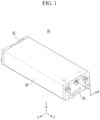
- FIG. 1 is a perspective view illustrating a battery module 10 according to the related art.
- the battery module 10 of the related art may include a module frame 20 accommodating a battery cell stack in the interior thereof and end plates 30 covering an opened front surface (Y-axis direction) and the other surface (the opposite direction of Y-axis) of the module frame 20.
- FIG. 2 is a cross-sectional view illustrating a part of a cross-section taken along cutting line A of FIG. 1 .
- a laser welding may be performed for the welding, but either the laser itself passing therethrough during a welding process or weld spatters may cause damage to the internal components, including the battery cells.
- Embodiments of the present disclosure have been designed in an effort to solve the above-mentioned problems, and an object thereof is to provide a battery module which improves the efficiency of temporary assembly of a module frame and an end plate, and can protect internal components during welding, and a battery pack including the same.
- the battery module includes a battery cell stack, in which a plurality of battery cells are stacked, a module frame configured to accommodate the battery cell stack, and of which a front surface and a rear surface facing each other are opened, and an end plate configured to cover each of the front surface and the rear surface of the module frame, wherein the module frame includes a first bonding surface formed at edges constituting each of the front surface and the rear surface, and wherein the end plate includes a second bonding surface bonded to the first bonding surface, and a rib located closer toward the center of the end plate than the second bonding surface and protruding toward the module frame, wherein a chamfer for improving an assembling efficiency of the end plate and the module frame is formed in the rib.
- the rib may be integrated with the end plate.
- the rib may extend along a direction that is parallel to the edges of the end plate.
- the chamfer may be formed at an edge making contact with an inside surface of the module frame, among the edges of the rib.
- the rib may be located to be adjacent to the first bonding surface and the second bonding surface.
- the first bonding surface and the second bonding surface may be weld-coupled to each other.
- the thickness of the rib located at an upper edge of the edges of the end plate may be different from the thickness of the rib located at a lower edge of the edges of the end plate.
- a rib groove may be formed on a side surface of the rib, a rib groove locking portion inserted into the rib groove may be formed in the module frame, and the rib groove locking portion may be coupled to be locked to the rib groove.
- the rib groove locking portion may be located at the inside surface of the module frame to form a triangular cross-section.
- the rib groove locking portion may be configured such that a slope in a direction in which the first bonding surface is located, is more gentle than a slope in a direction opposite to the direction in which the first bonding surface is located.
- the rib groove may be recessed in a shape corresponding to the rib groove locking portion.
- the module frame may be a mono frame, of which a top surface, a lower surface, and both side surfaces are integrated.
- the module frame may include a U-shaped frame, of which a front surface, a rear surface, and a top surface are opened, and a top cover configured to cover the opened top surface of the U-shaped frame.
- the temporary assembly efficiency of the module frame and the end plate can be improved through the rib formed at the end plate prior to the welding.
- the rib can prevent the laser passing therethrough or the weld spatter from damaging the internal components.
- planar when referred to as “planar”, it means when a target portion is viewed from the top, and when referred to as “cross-sectional”, it means when a target portion is viewed from the side of a cross section cut vertically.
- FIG. 3 is a perspective view illustrating a battery module 100 according to an embodiment of the present disclosure
- FIG. 4 is an exploded perspective view illustrating the battery module 100 of FIG. 3 .
- a battery module 100 of the present embodiment includes a battery cell stack, a module frame 200 configured to accommodate the battery cell stack, and of which a front surface (Y-axis direction) and a rear surface (the opposite direction of Y-axis) facing each other are opened, and an end plate 300 configured to cover each of the front surface and the rear surface of the module frame 200.
- the battery cell stack is a structure, in which a plurality of battery cells are stacked, and is accommodated in the module frame 200.
- the module frame 200 is a structure in which the front surface and the rear surface, which face each other are opened, and can protect the battery cell stack from the outside.
- the end plate 300 can cover the front surface and the rear surface of the module frame 200 to protect an electrode lead or a busbar.
- the end plate 300 may be a metal plate having a predetermined strength, and in order to prevent the end plate 300 from making contact with the electrode lead or the busbar and thus causing a risk, such as a short circuit, an insulation member 400 may be interposed between the battery cell stack and the end plate 300.
- FIG. 5 is a cross-sectional view illustrating a part of a cross-section taken along cutting line B of FIG. 3 .
- a first bonding surface 250 of the module frame 200 and a second bonding surface 350 of the end plate 300 are welded in a state of being in contact with each other, and the end plate 300 is bonded to the module frame 200.
- the first bonding surface 250 is located at edges 210, 220, 230, and 240, which constitute the front surface (Y-axis direction) and the rear surface (the opposite direction of Y-axis) of the module frame 200.
- the second bonding surface 350 is provided to correspond to the first bonding surface 250 at the edges of the end plate 300, and the first bonding surface 250 and the second bonding surface 350 are bonded to each other through welding. That is, the first bonding surface 250 and the second bonding surface 350 are weld-coupled to each other.
- the welding method is not limited, but it is preferable to perform a laser welding.
- the laser beam may pass through the module frame 200 and the end plate 300 to cause damage to the battery cell stack or the other internal components.
- a weld spatter phenomenon in which welding flame is scattered in all directions, occurs and the welding spatter may also damage the battery cell stack or the other internal components.
- the end plate 300 of the present embodiment includes a rib located closer toward the center of the end plate 300 than the second bonding surface 350 and protruding toward the module frame 200.
- the rib 360 extends along a direction parallel to the edges of the end plate 300, and may prevent the transmitted laser beam or the weld spatter from affecting the battery cell stack or the other internal components.
- the module frame 200 and the end plate 300 are welded in a fixed state so as to correspond to each other in a specific location.
- the rib 360 is inserted into the interior space of the module frame 200, so that the end plate 300 can be coupled in the correct location without any misalignment. That is, the rib 360 functions to improve temporary assembly efficiency between the module frame 200 and the end plate 300.
- the end plate 300 may be fixed to a specific location due to the rib 360.
- the rib 360 has to be located adjacent to the first bonding surface 250 and the second bonding surface 350 as illustrated in FIG. 5 , so that it may be effective in preventing the end plate 300 from deviating therefrom or fixing the end plate 300.
- the rib 360 structure can prevent a distortion in a weld area due to the generated heat, and even if a slight distortion occurs, the rib 360 structure may prevent a distortion or a protrusion in the weld area from affecting the battery cell stack or the other internal components.
- FIG. 6 is a perspective view illustrating end plate 300 of FIG. 4 .
- the second bonding surfaces 350 are located at four edges 310, 320, 330, and 340 of the end plate 300, which correspond to four edges 210, 220, 230, and 240 of the module frame 200 in FIG. 4 , respectively.
- the ribs 360 are located closer toward the center of the end plate 300 than the second bonding surfaces 350.
- the rib 360 may be formed at at least one site of the four edges 310, 320, 330, and 340 of the end plate 300, but it is preferable that the rib 360 is formed at all of the four edges 310, 320, 330, and 340 as illustrated in FIG. 6 . This is because it has to be formed at all of four edges 310, 320, 330, and 340 to effectively achieve the proper position or fixation of the above-described end plate 300.
- the rib 360 extends along a direction parallel to one of the four edges 310, 320, 330, and 340 of the end plate 300.
- the rib 360 may be integrated with the end plate 300, and the end plate 300 including the rib 360 may be manufactured by molding processing. As the preset rib-shaped plate is not bonded, a separate bonding process is not required.
- the thickness of the rib 360 for each of an upper edge 310, a lower edge 340, and both side edges 320 and 330 may be differently set, and thus degree of freedom improves.
- the thicknesses of the rib 360 located at the upper edge 310 and the rib 360 located at the lower edge 340 may be different from each other.
- the sizes of rib 360, especially thicknesses need to be differently set, respectively.
- the preset rib-shaped plate since the preset rib-shaped plate is not bonded, it is more free to change the rib 360 and easier to take the weld range large or small.
- the degree of freedom in the shape of the end plate 300 manufactured is large, and thus a chamfer structure or a rib groove structure described hereinafter is easily implemented. In addition, it can be manufactured with a thinner thickness as compared with extrusion molding.
- a chamfer 361 for improving the assembling efficiency of the end plate 300 and the module frame 200 may be formed in the rib 360.
- the chamfer 361 may be formed at an edge making contact with an inside surface of the module frame 200, among the edges of the rib 360.
- the ribs 360 may be located to be adjacent to the first bonding surface 250 and the second bonding surface 350, which may make it difficult to insert the ribs 360 into the interior space of the module frame 200.
- the chamfer 361 can prevent this and improve the assembling efficiency of the end plate 300 and the module frame 200.
- FIG. 7 is a modified embodiment and a cross-sectional view illustrating the battery module including a rib groove and a rib groove locking portion.
- a rib groove 362 may be formed on a side surface of the rib 360a, a rib groove locking portion 262 inserted into the rib groove 362 may be formed in the module frame 200a, and the rib groove locking portion 262 may be locked and coupled to the rib groove 362.
- the rib groove 362 may be recessed in a shape corresponding to the rib groove locking portion 262.
- the rib groove locking portion 262 is locked and coupled to the rib groove 362, so that the coupling between an end plate 300a and a module frame 200a may be further strengthened. This can improve the temporary assembly efficiency of the end plate 300a prior to welding, and prevent the end plate 300a from deviating therefrom during welding.
- the rib groove locking portion 262 may be located on the inside surface of the module frame 200a to form a triangular cross-section.
- the slope of the rib groove locking portion 262 may be differently set depending on the direction.
- the slope of the direction (Y-axis direction) in which a first bonding surface 250a is located may be gently and relatively set, so that the end plate 300a may be easily inserted, and the slope in a direction that is opposite to the direction (opposite direction of Y-axis) in which a first bonding surface 250a is located may be relatively rapidly set to strengthen the coupling between the end plate 300a and the module frame 200a.
- the module frame 200 of the present disclosure may be a mono frame and a U-shaped frame.
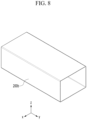
- FIGS. 8 and 9 illustrate this, FIG. 8 is a perspective view illustrating the mono frame 200b, and FIG. 9 is a perspective view illustrating the U-shaped frame 200c and a top cover 210c. Illustrations of the other configurations are omitted for convenience of description.
- the module frame of the present disclosure may be the mono frame 200b.
- the mono frame 200b may have a metal plate structure, in which a front surface (Y-axis direction) and a rear surface (the opposite direction of the Y-axis) thereof are opened, and a top surface (Z-axis direction), a lower surface (the opposite direction of Z-axis), and both side surfaces (X-axis direction and the opposite direction thereof) are integrated.
- the above-mentioned end plates 600 are coupled to the opened the front surface and the rear surface of the mono frame 200b.
- the module frame of the present disclosure may include the U-shaped frame 200c and the top cover 210c.
- the U-shaped frame 200c may have a structure, in which a front surface (X-axis direction), a rear surface (the opposite direction of X-axis), and a top surface (Z-axis direction) are opened, and a bottom part 211 and both side surface parts 212 extending upwards from both ends of the bottom part 211, which face each other, are provided.
- the top cover 210c may be coupled to the opened top surface of the U-shaped frame 200c, and the above-mentioned end plates may be coupled to the opened front surface and rear surface of the U-shaped frame 200c, respectively.
- the U-shaped frame 200c may be coupled to the top cover 210c through welding coupling.
- the module frame 200 and the end plate 300 are preferably a metal plate material having a predetermined strength, especially, it is preferable to include an aluminum alloy.
- the module frame 200 may include Al-Mg-Si-based alloys such as Al 5052 or Al-Mg-Si-based alloys such as Al 6063
- the end plate 300 may include Al-Si-Cu-based alloys such as ADC12 alloys, or Al-Si-based alloys having Mg and Mn added thereto such as Silafont-36 alloys.
- the above-mentioned one or more battery modules according to the present embodiment can be mounted together with various control and protection systems such as a battery management system (BMS) and a cooling system to form a battery pack.
- BMS battery management system
- a cooling system to form a battery pack.
- the battery module or the battery pack can be applied to various devices. These devices may be applied to vehicles such as an electric bicycle, an electric vehicle, a hybrid vehicle, but the present disclosure is not limited thereto and can be applied to various devices that can use the battery module and the battery pack including the same, which also belongs to the scope of the present disclosure.
Landscapes
- Chemical & Material Sciences (AREA)
- Chemical Kinetics & Catalysis (AREA)
- Electrochemistry (AREA)
- General Chemical & Material Sciences (AREA)
- Inorganic Chemistry (AREA)
- Battery Mounting, Suspending (AREA)
- Engineering & Computer Science (AREA)
- Manufacturing & Machinery (AREA)
Description
- This application claims the benefit of
Korean Patent Application No. 10-2019-0125310 filed on October 10, 2019 - The present disclosure relates to a battery module and a battery pack including the same, and more particularly to a battery module having improved productivity, and a battery pack including the same.
- Secondary batteries, which are easily applied to various product groups and has electrical characteristics such as high energy density, are universally applied not only for a portable device but also for an electric vehicle or a hybrid electric vehicle, an energy storage system or the like, which is driven by an electric driving source. Such secondary battery is attracting attention as a new environment-friendly energy source for improving energy efficiency since it gives a primary advantage of remarkably reducing the use of fossil fuels and also does not generate by-products from the use of energy at all.
- Currently commercialized secondary batteries include a nickel cadmium battery, a nickel hydrogen battery, a nickel zinc battery, a lithium secondary battery, and the like. Among them, the lithium secondary battery has come into the spotlight because they have advantages, for example, hardly exhibiting memory effects compared to nickel-based secondary batteries and thus being freely charged and discharged, and having very low self-discharge rate and high energy density.
- Such lithium secondary battery mainly uses a lithium-based oxide and a carbonaceous material as a positive electrode active material and a negative electrode active material, respectively. The lithium secondary battery includes an electrode assembly in which a positive electrode plate and a negative electrode plate respectively coated with the positive electrode active material and the negative electrode active material are disposed with a separator being interposed between them, and an exterior material, i.e., battery case, which seals and accommodates the electrode assembly together with an electrolyte.
- Generally, the lithium secondary battery may be classified based on the shape of the exterior material into a prismatic secondary battery in which the electrode assembly is embedded in a metal can, and a pouch-type secondary battery in which the electrode assembly is embedded in a pouch of an aluminum laminate sheet.
- Small-sized mobile devices use one to three battery cells for each device, whereas middle- or large-sized devices such as vehicles require high power and large capacity. Therefore, a middle- or large-sized battery module having a plurality of battery cells electrically connected to one another is used.
- The middle- or large-sized battery module is preferably manufactured so as to have as small a size and weight as possible. Consequently, a prismatic battery or a pouch-shaped battery, which can be stacked with high integration and has a small weight relative to capacity, is usually used as a battery cell of the middle- or large-sized battery module.
- Meanwhile, in order to protect the cell stack from external shock, heat, or vibration, the battery module may include a module frame which accommodates the battery cell stack in an internal space.
-
FIG. 1 is a perspective view illustrating abattery module 10 according to the related art. - Referring to
FIG. 1 , thebattery module 10 of the related art may include amodule frame 20 accommodating a battery cell stack in the interior thereof andend plates 30 covering an opened front surface (Y-axis direction) and the other surface (the opposite direction of Y-axis) of themodule frame 20. -
FIG. 2 is a cross-sectional view illustrating a part of a cross-section taken along cutting line A ofFIG. 1 . - Referring to
FIG. 2 , in order to bond themodule frame 20 and theend plate 30, welding is performed on the bonding surface in a state where themodule frame 20 and theend plate 30 are located to face each other. - In this case, for the welding, it is necessary to fix the
module frame 20 and theend plate 30 so that the bonding surfaces of themodule frame 20 and theend plate 30 are located so as to correspond to each other. However, there is a limit to the fixation of themodule frame 20 and theend plate 30 to closely correspond to each other, which causes a problem that the welding is not smoothly performed. - In addition, a laser welding may be performed for the welding, but either the laser itself passing therethrough during a welding process or weld spatters may cause damage to the internal components, including the battery cells.
- Therefore, there is a need for a technology capable of solving this problem of the prior art.
- Further prior art is described in
EP 2 819 210 B1 . - Embodiments of the present disclosure have been designed in an effort to solve the above-mentioned problems, and an object thereof is to provide a battery module which improves the efficiency of temporary assembly of a module frame and an end plate, and can protect internal components during welding, and a battery pack including the same.
- However, the problem to be solved by the embodiments of the present disclosure is not limited to the above-described problems, and can be variously expanded within the scope of the technical idea included in the present disclosure.
- The battery module according to an embodiment of the present disclosure includes a battery cell stack, in which a plurality of battery cells are stacked, a module frame configured to accommodate the battery cell stack, and of which a front surface and a rear surface facing each other are opened, and an end plate configured to cover each of the front surface and the rear surface of the module frame, wherein the module frame includes a first bonding surface formed at edges constituting each of the front surface and the rear surface, and wherein the end plate includes a second bonding surface bonded to the first bonding surface, and a rib located closer toward the center of the end plate than the second bonding surface and protruding toward the module frame, wherein a chamfer for improving an assembling efficiency of the end plate and the module frame is formed in the rib.
- The rib may be integrated with the end plate.
- The rib may extend along a direction that is parallel to the edges of the end plate.
- The chamfer may be formed at an edge making contact with an inside surface of the module frame, among the edges of the rib.
- The rib may be located to be adjacent to the first bonding surface and the second bonding surface.
- The first bonding surface and the second bonding surface may be weld-coupled to each other.
- The thickness of the rib located at an upper edge of the edges of the end plate may be different from the thickness of the rib located at a lower edge of the edges of the end plate.
- A rib groove may be formed on a side surface of the rib, a rib groove locking portion inserted into the rib groove may be formed in the module frame, and the rib groove locking portion may be coupled to be locked to the rib groove.
- The rib groove locking portion may be located at the inside surface of the module frame to form a triangular cross-section.
- The rib groove locking portion may be configured such that a slope in a direction in which the first bonding surface is located, is more gentle than a slope in a direction opposite to the direction in which the first bonding surface is located.
- The rib groove may be recessed in a shape corresponding to the rib groove locking portion.
- The module frame may be a mono frame, of which a top surface, a lower surface, and both side surfaces are integrated.
- The module frame may include a U-shaped frame, of which a front surface, a rear surface, and a top surface are opened, and a top cover configured to cover the opened top surface of the U-shaped frame.
- According to the embodiments of the present disclosure, the temporary assembly efficiency of the module frame and the end plate can be improved through the rib formed at the end plate prior to the welding.
- In addition, the rib can prevent the laser passing therethrough or the weld spatter from damaging the internal components.
-
-
FIG. 1 is a perspective view illustrating a battery module according to the related art. -
FIG. 2 is a cross-sectional view illustrating a part of a cross-section taken along cutting line A ofFIG. 1 . -
FIG. 3 is a perspective view illustrating a battery module according to an embodiment of the present disclosure. -
FIG. 4 is an exploded perspective view illustrating the battery module ofFIG. 3 . -
FIG. 5 is a cross-sectional view illustrating a part of a cross-section taken along cutting line B ofFIG. 3 . -
FIG. 6 is a perspective view illustrating an end plate ofFIG. 4 . -
FIG. 7 is a cross-sectional view illustrating the battery module including a rib groove and a rib groove locking portion. -
FIG. 8 is a perspective view illustrating a mono frame. -
FIG. 9 is a perspective view illustrating a U-shaped frame and a top cover. - Hereinafter, various embodiments of the present disclosure will be described in detail with reference to the accompanying figures so that those skilled in the art can easily implement them. The present disclosure may be modified in various different ways, and is not limited to the embodiments set forth herein.
- Parts that are irrelevant to the description will be omitted to clearly describe the present disclosure, and like reference numerals designate like elements throughout the specification.
- Further, in the figures, the size and thickness of each element are arbitrarily illustrated for convenience of description, and the present disclosure is not necessarily limited to those illustrated in the figures. In the figures, the thickness of layers, regions, etc. are exaggerated for clarity. In the figures, for convenience of description, the thicknesses of some layers and regions are shown to be exaggerated.
- In addition, it will be understood that when an element such as a layer, film, region, or plate is referred to as being "on" or "above" another element, it can be directly on the other element or intervening elements may also be present. In contrast, when an element is referred to as being "directly on" another element, it means that other intervening elements are not present. Further, the word "on" or "above" means disposed on or below a reference portion, and does not necessarily mean being disposed on the upper end of the reference portion toward the opposite direction of gravity.
- Further, throughout the specification, when a part is referred to as "including" or "comprising" a certain component, it means that it can further include other components, without excluding the other components, unless otherwise stated.
- Further, throughout the specification, when referred to as "planar", it means when a target portion is viewed from the top, and when referred to as "cross-sectional", it means when a target portion is viewed from the side of a cross section cut vertically.
-
FIG. 3 is a perspective view illustrating abattery module 100 according to an embodiment of the present disclosure, andFIG. 4 is an exploded perspective view illustrating thebattery module 100 ofFIG. 3 . - Referring to
FIGS. 3 and4 , abattery module 100 of the present embodiment includes a battery cell stack, amodule frame 200 configured to accommodate the battery cell stack, and of which a front surface (Y-axis direction) and a rear surface (the opposite direction of Y-axis) facing each other are opened, and anend plate 300 configured to cover each of the front surface and the rear surface of themodule frame 200. - Although not illustrated in
FIG. 4 in detail, the battery cell stack is a structure, in which a plurality of battery cells are stacked, and is accommodated in themodule frame 200. - The
module frame 200 is a structure in which the front surface and the rear surface, which face each other are opened, and can protect the battery cell stack from the outside. - The
end plate 300 can cover the front surface and the rear surface of themodule frame 200 to protect an electrode lead or a busbar. In this case, theend plate 300 may be a metal plate having a predetermined strength, and in order to prevent theend plate 300 from making contact with the electrode lead or the busbar and thus causing a risk, such as a short circuit, aninsulation member 400 may be interposed between the battery cell stack and theend plate 300. -
FIG. 5 is a cross-sectional view illustrating a part of a cross-section taken along cutting line B ofFIG. 3 . - Referring to
FIG. 5 together withFIG. 4 , afirst bonding surface 250 of themodule frame 200 and asecond bonding surface 350 of theend plate 300 are welded in a state of being in contact with each other, and theend plate 300 is bonded to themodule frame 200. - The
first bonding surface 250 is located atedges module frame 200. Thesecond bonding surface 350 is provided to correspond to thefirst bonding surface 250 at the edges of theend plate 300, and thefirst bonding surface 250 and thesecond bonding surface 350 are bonded to each other through welding. That is, thefirst bonding surface 250 and thesecond bonding surface 350 are weld-coupled to each other. - The welding method is not limited, but it is preferable to perform a laser welding.
- However, if a laser beam is shot for welding, the laser beam may pass through the
module frame 200 and theend plate 300 to cause damage to the battery cell stack or the other internal components. In addition, during welding process, a weld spatter phenomenon, in which welding flame is scattered in all directions, occurs and the welding spatter may also damage the battery cell stack or the other internal components. - Accordingly, the
end plate 300 of the present embodiment includes a rib located closer toward the center of theend plate 300 than thesecond bonding surface 350 and protruding toward themodule frame 200. - The
rib 360 extends along a direction parallel to the edges of theend plate 300, and may prevent the transmitted laser beam or the weld spatter from affecting the battery cell stack or the other internal components. - Moreover, it is preferable that the
module frame 200 and theend plate 300 are welded in a fixed state so as to correspond to each other in a specific location. In the present embodiment, when theend plate 300 is coupled to themodule frame 200, therib 360 is inserted into the interior space of themodule frame 200, so that theend plate 300 can be coupled in the correct location without any misalignment. That is, therib 360 functions to improve temporary assembly efficiency between themodule frame 200 and theend plate 300. - In addition, even in the process of welding, the
end plate 300 may be fixed to a specific location due to therib 360. - The
rib 360 has to be located adjacent to thefirst bonding surface 250 and thesecond bonding surface 350 as illustrated inFIG. 5 , so that it may be effective in preventing theend plate 300 from deviating therefrom or fixing theend plate 300. - Additionally, the
rib 360 structure can prevent a distortion in a weld area due to the generated heat, and even if a slight distortion occurs, therib 360 structure may prevent a distortion or a protrusion in the weld area from affecting the battery cell stack or the other internal components. -
FIG. 6 is a perspective view illustratingend plate 300 ofFIG. 4 . - Referring to
FIG. 6 , the second bonding surfaces 350 are located at fouredges end plate 300, which correspond to fouredges module frame 200 inFIG. 4 , respectively. - The
ribs 360 are located closer toward the center of theend plate 300 than the second bonding surfaces 350. - The
rib 360 may be formed at at least one site of the fouredges end plate 300, but it is preferable that therib 360 is formed at all of the fouredges FIG. 6 . This is because it has to be formed at all of fouredges end plate 300. - In addition, the
rib 360 extends along a direction parallel to one of the fouredges end plate 300. - Meanwhile, the
rib 360 may be integrated with theend plate 300, and theend plate 300 including therib 360 may be manufactured by molding processing. As the preset rib-shaped plate is not bonded, a separate bonding process is not required. - In addition, the thickness of the
rib 360 for each of anupper edge 310, alower edge 340, and both side edges 320 and 330 may be differently set, and thus degree of freedom improves. In particular, among theedges end plate 300, the thicknesses of therib 360 located at theupper edge 310 and therib 360 located at thelower edge 340 may be different from each other. - In detail, in order to secure a clearance for interference between other components of the interior of
end plate 300 and therib 360 or a close range section, the sizes ofrib 360, especially thicknesses, need to be differently set, respectively. In this case, according to the present disclosure, since the preset rib-shaped plate is not bonded, it is more free to change therib 360 and easier to take the weld range large or small. - In the case of molding processing, the degree of freedom in the shape of the
end plate 300 manufactured is large, and thus a chamfer structure or a rib groove structure described hereinafter is easily implemented. In addition, it can be manufactured with a thinner thickness as compared with extrusion molding. - Meanwhile, referring to
FIGS. 5 and6 together, achamfer 361 for improving the assembling efficiency of theend plate 300 and themodule frame 200 may be formed in therib 360. In detail, thechamfer 361 may be formed at an edge making contact with an inside surface of themodule frame 200, among the edges of therib 360. - As mentioned above, the
ribs 360 may be located to be adjacent to thefirst bonding surface 250 and thesecond bonding surface 350, which may make it difficult to insert theribs 360 into the interior space of themodule frame 200. Thechamfer 361 can prevent this and improve the assembling efficiency of theend plate 300 and themodule frame 200. -
FIG. 7 is a modified embodiment and a cross-sectional view illustrating the battery module including a rib groove and a rib groove locking portion. - Referring to
FIG. 7 , arib groove 362 may be formed on a side surface of therib 360a, a ribgroove locking portion 262 inserted into therib groove 362 may be formed in themodule frame 200a, and the ribgroove locking portion 262 may be locked and coupled to therib groove 362. - In order to be locked and coupled, the
rib groove 362 may be recessed in a shape corresponding to the ribgroove locking portion 262. - The rib
groove locking portion 262 is locked and coupled to therib groove 362, so that the coupling between anend plate 300a and amodule frame 200a may be further strengthened. This can improve the temporary assembly efficiency of theend plate 300a prior to welding, and prevent theend plate 300a from deviating therefrom during welding. - The rib
groove locking portion 262 may be located on the inside surface of themodule frame 200a to form a triangular cross-section. - Further, the slope of the rib
groove locking portion 262 may be differently set depending on the direction. In detail, in the ribgroove locking portion 262, the slope of the direction (Y-axis direction) in which afirst bonding surface 250a is located may be gently and relatively set, so that theend plate 300a may be easily inserted, and the slope in a direction that is opposite to the direction (opposite direction of Y-axis) in which afirst bonding surface 250a is located may be relatively rapidly set to strengthen the coupling between theend plate 300a and themodule frame 200a. - Meanwhile, the
module frame 200 of the the present disclosure may be a mono frame and a U-shaped frame.FIGS. 8 and9 illustrate this,FIG. 8 is a perspective view illustrating themono frame 200b, andFIG. 9 is a perspective view illustrating theU-shaped frame 200c and atop cover 210c. Illustrations of the other configurations are omitted for convenience of description. - First, referring to
FIG. 8 , the module frame of the present disclosure may be themono frame 200b. - The
mono frame 200b may have a metal plate structure, in which a front surface (Y-axis direction) and a rear surface (the opposite direction of the Y-axis) thereof are opened, and a top surface (Z-axis direction), a lower surface (the opposite direction of Z-axis), and both side surfaces (X-axis direction and the opposite direction thereof) are integrated. The above-mentioned end plates 600 are coupled to the opened the front surface and the rear surface of themono frame 200b. - Next, referring to
FIG. 9 , the module frame of the present disclosure may include theU-shaped frame 200c and thetop cover 210c. - The
U-shaped frame 200c may have a structure, in which a front surface (X-axis direction), a rear surface (the opposite direction of X-axis), and a top surface (Z-axis direction) are opened, and abottom part 211 and both side surface parts 212 extending upwards from both ends of thebottom part 211, which face each other, are provided. - The
top cover 210c may be coupled to the opened top surface of theU-shaped frame 200c, and the above-mentioned end plates may be coupled to the opened front surface and rear surface of theU-shaped frame 200c, respectively. - The
U-shaped frame 200c may be coupled to thetop cover 210c through welding coupling. - Meanwhile, the
module frame 200 and theend plate 300 are preferably a metal plate material having a predetermined strength, especially, it is preferable to include an aluminum alloy. In more detail, themodule frame 200 may include Al-Mg-Si-based alloys such as Al 5052 or Al-Mg-Si-based alloys such as Al 6063, and theend plate 300 may include Al-Si-Cu-based alloys such as ADC12 alloys, or Al-Si-based alloys having Mg and Mn added thereto such as Silafont-36 alloys. - The above-mentioned one or more battery modules according to the present embodiment can be mounted together with various control and protection systems such as a battery management system (BMS) and a cooling system to form a battery pack.
- The battery module or the battery pack can be applied to various devices. These devices may be applied to vehicles such as an electric bicycle, an electric vehicle, a hybrid vehicle, but the present disclosure is not limited thereto and can be applied to various devices that can use the battery module and the battery pack including the same, which also belongs to the scope of the present disclosure.
-
- 100:
- battery module
- 200, 200a:
- module frame
- 250:
- first bonding surface
- 300:
- end plate
- 350:
- second bonding surface
- 360:
- rib
- 361:
- chamfer
- 400:
- insulation member
Claims (14)
- A battery module (100) comprising:a battery cell stack, in which a plurality of battery cells are stacked;a module frame (200) configured to accommodate the battery cell stack, and of which a front surface and a rear surface facing each other are opened; andan end plate (300) configured to cover each of the front surface and the rear surface of the module frame (200),wherein the module frame (200) comprises a first bonding surface (250) formed at edges constituting each of the front surface and the rear surface, andwherein the end plate (300) comprises a second bonding surface (350) bonded to the first bonding surface (250), and a rib (360) located closer toward the center of the end plate (300) than the second bonding surface (350) and protruding toward the module frame (200),characterized in that a chamfer (361) for improving an assembling efficiency of the end plate (300) and the module frame (200) is formed in the rib (360).
- The battery module (100) of claim 1, wherein the rib (360) is integrated with the end plate (300).
- The battery module (100) of claim 1, wherein the rib (360) extends along a direction that is parallel to the edges of the end plate (300).
- The battery module (100) of claim 1, wherein the chamfer (361) is formed at an edge making contact with an inside surface of the module frame (200), among the edges of the rib (360).
- The battery module (100) of claim 1, wherein the rib (360) is located to be adjacent to the first bonding surface (250) and the second bonding surface (350).
- The battery module (100) of claim 1, wherein the first bonding surface (250) and the second bonding surface (350) are weld-coupled to each other.
- The battery module (100) of claim 1, wherein a thickness of the rib (360) located at an upper edge (310) of the edges (310, 320, 330, 340) of the end plate (300) is different from a thickness of the rib (360) located at a lower edge (340) of the edges (310, 320, 330, 340) of the end plate (300).
- The battery module (100) of claim 1, wherein a rib groove (362) is formed on a side surface of the rib (360), a rib groove locking portion (262) inserted into the rib groove (362) is formed in the module frame (200), and the rib groove locking portion (262) is coupled to be locked to the rib groove (362).
- The battery module (100) of claim 8, wherein the rib groove locking portion (262) is located at the inside surface of the module frame (200) to form a triangular cross-section.
- The battery module (100) of claim 8, wherein the rib groove locking portion (262) is configured such that a slope in a direction in which the first bonding surface (250) is located, is more gentle than a slope in a direction opposite to the direction in which the first bonding surface (250) is located.
- The battery module (100) of claim 8, wherein the rib groove (362) is recessed in a shape corresponding to the rib groove locking portion (262).
- The battery module (100) of claim 1, wherein the module frame is a mono frame (200b), of which a top surface, a lower surface, and both side surfaces are integrated.
- The battery module (100) of claim 1, wherein the module frame comprises a U-shaped frame (200c), of which a front surface, a rear surface, and a top surface are opened, and a top cover (210c) configured to cover the opened top surface of the U-shaped frame (200c).
- A battery pack comprising one or more battery modules (100) of claim 1.
Applications Claiming Priority (2)
| Application Number | Priority Date | Filing Date | Title |
|---|---|---|---|
| KR1020190125310A KR102398574B1 (en) | 2019-10-10 | 2019-10-10 | Battery module and battery pack including the same |
| PCT/KR2020/008520 WO2021071056A1 (en) | 2019-10-10 | 2020-06-30 | Battery module and battery pack including same |
Publications (4)
| Publication Number | Publication Date |
|---|---|
| EP3926734A1 EP3926734A1 (en) | 2021-12-22 |
| EP3926734A4 EP3926734A4 (en) | 2023-08-09 |
| EP3926734B1 true EP3926734B1 (en) | 2024-12-25 |
| EP3926734B8 EP3926734B8 (en) | 2025-01-15 |
Family
ID=75437213
Family Applications (1)
| Application Number | Title | Priority Date | Filing Date |
|---|---|---|---|
| EP20875291.5A Active EP3926734B8 (en) | 2019-10-10 | 2020-06-30 | Battery module and battery pack including the same |
Country Status (9)
| Country | Link |
|---|---|
| US (1) | US12107289B2 (en) |
| EP (1) | EP3926734B8 (en) |
| JP (1) | JP7416518B2 (en) |
| KR (1) | KR102398574B1 (en) |
| CN (1) | CN113632303A (en) |
| DE (1) | DE202020005993U1 (en) |
| ES (1) | ES3009898T3 (en) |
| HU (1) | HUE069792T2 (en) |
| WO (1) | WO2021071056A1 (en) |
Families Citing this family (9)
| Publication number | Priority date | Publication date | Assignee | Title |
|---|---|---|---|---|
| WO2023229343A1 (en) * | 2022-05-27 | 2023-11-30 | 주식회사 엘지에너지솔루션 | Battery module and method for manufacturing same |
| JP2025517507A (en) * | 2022-05-27 | 2025-06-05 | エルジー エナジー ソリューション リミテッド | Battery module case and battery module including same |
| KR20240057122A (en) | 2022-10-24 | 2024-05-02 | 에스케이온 주식회사 | Battery module |
| KR102574499B1 (en) * | 2023-04-10 | 2023-09-06 | 신성에스티 주식회사 | End Plate for Battery Module |
| WO2024214896A1 (en) * | 2023-04-10 | 2024-10-17 | 신성에스티 주식회사 | Battery module end plates |
| KR20250028694A (en) * | 2023-08-22 | 2025-03-04 | 주식회사 엘지에너지솔루션 | Battery module and battery pack including the same |
| KR20250035918A (en) * | 2023-09-06 | 2025-03-13 | 주식회사 엘지에너지솔루션 | Battery module and battery pack including the same |
| KR102677972B1 (en) * | 2023-11-22 | 2024-06-25 | 신성에스티 주식회사 | End Plate for Battery Module |
| KR20250132815A (en) * | 2024-02-29 | 2025-09-05 | 에스케이온 주식회사 | Battery module comprising module case and battery pack comprising the same |
Family Cites Families (37)
| Publication number | Priority date | Publication date | Assignee | Title |
|---|---|---|---|---|
| JPH11339737A (en) * | 1998-05-28 | 1999-12-10 | Matsushita Electric Ind Co Ltd | Prismatic battery |
| JP3805275B2 (en) | 2002-04-30 | 2006-08-02 | 松下電器産業株式会社 | Batteries and battery modules |
| US9184425B2 (en) * | 2009-01-13 | 2015-11-10 | Samsung Sdi Co., Ltd. | Battery pack |
| WO2010141854A1 (en) * | 2009-06-05 | 2010-12-09 | K2 Energy Solutions, Inc. | Lithium ion battery pack having passive cooling |
| JP5605252B2 (en) | 2011-02-08 | 2014-10-15 | トヨタ自動車株式会社 | Power storage device |
| JP6024092B2 (en) | 2011-10-26 | 2016-11-09 | 株式会社Gsユアサ | Metal container manufacturing method, metal container, power storage element, and power storage module |
| KR101658027B1 (en) * | 2011-11-22 | 2016-09-21 | 삼성에스디아이 주식회사 | Battery pack |
| KR101669118B1 (en) * | 2013-01-03 | 2016-10-25 | 삼성에스디아이 주식회사 | Battery pack |
| JP6226413B2 (en) | 2013-02-20 | 2017-11-08 | 株式会社Gsユアサ | Storage element and method for manufacturing lid plate |
| US9537125B2 (en) | 2013-06-27 | 2017-01-03 | Samsung Sdi Co., Ltd. | Battery module |
| KR101794265B1 (en) | 2013-07-18 | 2017-11-07 | 삼성에스디아이 주식회사 | Battery pack having reinforcement bead |
| KR101688486B1 (en) * | 2013-08-29 | 2016-12-21 | 삼성에스디아이 주식회사 | Battery pack |
| KR20150031095A (en) * | 2013-09-13 | 2015-03-23 | 삼성에스디아이 주식회사 | Battery pack |
| JP6217453B2 (en) | 2014-02-28 | 2017-10-25 | 株式会社Gsユアサ | Power storage device |
| JP2016167350A (en) | 2015-03-09 | 2016-09-15 | 株式会社Gsユアサ | Power storage element and power storage device |
| DE102015209259A1 (en) | 2015-05-20 | 2016-11-24 | Carl Zeiss Smt Gmbh | POSITIVE SENSOR DEVICE AND METHOD FOR DETERMINING A POSITION AT LEAST ONE MIRROR OF A LITHOGRAPHIC APPARATUS |
| WO2017052296A1 (en) | 2015-09-24 | 2017-03-30 | 주식회사 엘지화학 | Battery module |
| KR102468338B1 (en) | 2015-11-02 | 2022-11-16 | 삼성에스디아이 주식회사 | Rechargeable battery module |
| KR101916720B1 (en) * | 2016-01-05 | 2018-11-08 | 엘지전자 주식회사 | Battery module, menufacturing method for the same, and electronic vehicle using the same |
| US9722223B1 (en) * | 2016-03-02 | 2017-08-01 | Ford Global Technologies, Llc | Battery pack retention assembly and method |
| KR102065098B1 (en) * | 2016-08-12 | 2020-01-10 | 주식회사 엘지화학 | Secondary battery module improved in frame structure and frame assembly for the same |
| CN109643777B (en) | 2016-08-29 | 2022-04-26 | 三洋电机株式会社 | Power supply device |
| KR20190125310A (en) | 2017-03-10 | 2019-11-06 | 퀴아펙 파마슈티칼스 에이비 | Releasable conjugate |
| KR102063821B1 (en) | 2018-01-03 | 2020-01-08 | 한국과학기술연구원 | Electrolyte system and lithium metal battery comprising the same |
| KR102256733B1 (en) * | 2017-06-13 | 2021-05-26 | 주식회사 엘지에너지솔루션 | Battery module, battery pack including the same, and energy storage system including the same |
| CN107785516B (en) * | 2017-10-31 | 2024-02-13 | 深圳市宝尔爱迪科技有限公司 | Self-removable battery cover structure |
| CN109840777A (en) | 2017-11-28 | 2019-06-04 | 云南三江并流农业科技股份有限公司 | New retail management integrated system is experienced based on the unmanned supermarket of technology of Internet of things+kitchen meal |
| KR102203250B1 (en) | 2017-11-29 | 2021-01-13 | 주식회사 엘지화학 | Battery Module Having End Frame |
| KR102292722B1 (en) * | 2017-12-20 | 2021-08-20 | 주식회사 엘지에너지솔루션 | Battery module, battery pack comprising the battery module |
| CN207800714U (en) | 2018-02-05 | 2018-08-31 | 宁德时代新能源科技股份有限公司 | Shell and battery modules for battery modules |
| CN208848959U (en) * | 2018-09-21 | 2019-05-10 | 杭州捷能科技有限公司 | A kind of battery modules protection cap |
| CN208986045U (en) * | 2018-09-28 | 2019-06-14 | 宁德时代新能源科技股份有限公司 | Case assemblies and battery modules |
| CN209200033U (en) * | 2018-12-28 | 2019-08-02 | 蜂巢能源科技有限公司 | Power battery box and power battery pack |
| CN209374538U (en) | 2019-03-27 | 2019-09-10 | 蜂巢能源科技有限公司 | Battery module housings, battery modules, battery packs, and automobiles |
| CN210379142U (en) | 2019-06-21 | 2020-04-21 | 恒大新能源科技集团有限公司 | Module shell, battery module and vehicle |
| KR102325808B1 (en) | 2019-07-17 | 2021-11-12 | 주식회사 에스엘바이오닉스 | Semiconductor light emitting device and method of manufacturing the same |
| KR102471092B1 (en) | 2019-07-18 | 2022-11-24 | 주식회사 엘지에너지솔루션 | Battery module, method of manufacturing the same and battery pack |
-
2019
- 2019-10-10 KR KR1020190125310A patent/KR102398574B1/en active Active
-
2020
- 2020-06-30 ES ES20875291T patent/ES3009898T3/en active Active
- 2020-06-30 EP EP20875291.5A patent/EP3926734B8/en active Active
- 2020-06-30 WO PCT/KR2020/008520 patent/WO2021071056A1/en not_active Ceased
- 2020-06-30 JP JP2021547251A patent/JP7416518B2/en active Active
- 2020-06-30 US US17/437,178 patent/US12107289B2/en active Active
- 2020-06-30 DE DE202020005993.5U patent/DE202020005993U1/en active Active
- 2020-06-30 HU HUE20875291A patent/HUE069792T2/en unknown
- 2020-06-30 CN CN202080022525.9A patent/CN113632303A/en active Pending
Also Published As
| Publication number | Publication date |
|---|---|
| WO2021071056A1 (en) | 2021-04-15 |
| JP2022520411A (en) | 2022-03-30 |
| JP7416518B2 (en) | 2024-01-17 |
| EP3926734A4 (en) | 2023-08-09 |
| HUE069792T2 (en) | 2025-04-28 |
| DE202020005993U1 (en) | 2024-01-15 |
| EP3926734A1 (en) | 2021-12-22 |
| ES3009898T3 (en) | 2025-03-31 |
| KR102398574B1 (en) | 2022-05-13 |
| KR20210042585A (en) | 2021-04-20 |
| CN113632303A (en) | 2021-11-09 |
| EP3926734B8 (en) | 2025-01-15 |
| US12107289B2 (en) | 2024-10-01 |
| US20220173467A1 (en) | 2022-06-02 |
Similar Documents
| Publication | Publication Date | Title |
|---|---|---|
| EP3926734B1 (en) | Battery module and battery pack including the esame | |
| EP3971925B1 (en) | Battery module and battery pack including the same | |
| JP7047220B2 (en) | Battery module including rechargeable battery and bus bar | |
| US12327850B2 (en) | Battery module and battery pack including the same | |
| US11984612B2 (en) | Battery module comprising module housing | |
| US12230819B2 (en) | Battery module and battery pack including the same | |
| EP3923370A1 (en) | Battery module, manufacturing method therefor, and battery pack | |
| EP4199208B1 (en) | Battery pack | |
| EP4376184B1 (en) | Battery pack | |
| US12603341B2 (en) | Pouch-type secondary battery and battery module including the same | |
| EP4539227A1 (en) | Battery pack and device including the same | |
| US20250007085A1 (en) | Battery module | |
| EP4607670A1 (en) | Battery module and battery pack including same | |
| EP4607672A1 (en) | Battery module and battery pack including same | |
| KR102754503B1 (en) | Battery module and device including the same | |
| US20230327279A1 (en) | Flame arrester and battery pack including the same | |
| EP4576410A1 (en) | Battery module, and battery pack and vehicle comprising same | |
| US20250364656A1 (en) | Battery module and battery pack including the same | |
| KR20240101188A (en) | Battery module and battery pack including the same | |
| KR20240081284A (en) | Battery module, battery pack and vehicle comprising the same |
Legal Events
| Date | Code | Title | Description |
|---|---|---|---|
| REG | Reference to a national code |
Ref country code: DE Ref legal event code: R138 Ref document number: 202020005993 Country of ref document: DE Free format text: GERMAN DOCUMENT NUMBER IS 602020043830 |
|
| STAA | Information on the status of an ep patent application or granted ep patent |
Free format text: STATUS: THE INTERNATIONAL PUBLICATION HAS BEEN MADE |
|
| PUAI | Public reference made under article 153(3) epc to a published international application that has entered the european phase |
Free format text: ORIGINAL CODE: 0009012 |
|
| STAA | Information on the status of an ep patent application or granted ep patent |
Free format text: STATUS: REQUEST FOR EXAMINATION WAS MADE |
|
| 17P | Request for examination filed |
Effective date: 20210917 |
|
| AK | Designated contracting states |
Kind code of ref document: A1 Designated state(s): AL AT BE BG CH CY CZ DE DK EE ES FI FR GB GR HR HU IE IS IT LI LT LU LV MC MK MT NL NO PL PT RO RS SE SI SK SM TR |
|
| RAP3 | Party data changed (applicant data changed or rights of an application transferred) |
Owner name: LG ENERGY SOLUTION, LTD. |
|
| DAV | Request for validation of the european patent (deleted) | ||
| DAX | Request for extension of the european patent (deleted) | ||
| A4 | Supplementary search report drawn up and despatched |
Effective date: 20230706 |
|
| RIC1 | Information provided on ipc code assigned before grant |
Ipc: H01M 50/271 20210101ALI20230630BHEP Ipc: H01M 50/244 20210101ALI20230630BHEP Ipc: H01M 50/211 20210101ALI20230630BHEP Ipc: H01M 10/625 20140101ALI20230630BHEP Ipc: H01M 10/615 20140101ALI20230630BHEP Ipc: H01M 10/613 20140101ALI20230630BHEP Ipc: H01M 10/6553 20140101ALI20230630BHEP Ipc: H01M 10/6572 20140101AFI20230630BHEP |
|
| GRAP | Despatch of communication of intention to grant a patent |
Free format text: ORIGINAL CODE: EPIDOSNIGR1 |
|
| STAA | Information on the status of an ep patent application or granted ep patent |
Free format text: STATUS: GRANT OF PATENT IS INTENDED |
|
| RIC1 | Information provided on ipc code assigned before grant |
Ipc: H01M 50/271 20210101ALI20240818BHEP Ipc: H01M 50/244 20210101ALI20240818BHEP Ipc: H01M 50/211 20210101ALI20240818BHEP Ipc: H01M 10/625 20140101ALI20240818BHEP Ipc: H01M 10/615 20140101ALI20240818BHEP Ipc: H01M 10/613 20140101ALI20240818BHEP Ipc: H01M 10/6553 20140101ALI20240818BHEP Ipc: H01M 10/6572 20140101AFI20240818BHEP |
|
| INTG | Intention to grant announced |
Effective date: 20240925 |
|
| GRAS | Grant fee paid |
Free format text: ORIGINAL CODE: EPIDOSNIGR3 |
|
| GRAA | (expected) grant |
Free format text: ORIGINAL CODE: 0009210 |
|
| STAA | Information on the status of an ep patent application or granted ep patent |
Free format text: STATUS: THE PATENT HAS BEEN GRANTED |
|
| P01 | Opt-out of the competence of the unified patent court (upc) registered |
Free format text: CASE NUMBER: APP_56678/2024 Effective date: 20241017 |
|
| AK | Designated contracting states |
Kind code of ref document: B1 Designated state(s): AL AT BE BG CH CY CZ DE DK EE ES FI FR GB GR HR HU IE IS IT LI LT LU LV MC MK MT NL NO PL PT RO RS SE SI SK SM TR |
|
| REG | Reference to a national code |
Ref country code: GB Ref legal event code: FG4D |
|
| REG | Reference to a national code |
Ref country code: CH Ref legal event code: EP |
|
| REG | Reference to a national code |
Ref country code: DE Ref legal event code: R096 Ref document number: 602020043830 Country of ref document: DE |
|
| REG | Reference to a national code |
Ref country code: IE Ref legal event code: FG4D |
|
| REG | Reference to a national code |
Ref country code: ES Ref legal event code: FG2A Ref document number: 3009898 Country of ref document: ES Kind code of ref document: T3 Effective date: 20250331 |
|
| REG | Reference to a national code |
Ref country code: LT Ref legal event code: MG9D |
|
| PG25 | Lapsed in a contracting state [announced via postgrant information from national office to epo] |
Ref country code: HR Free format text: LAPSE BECAUSE OF FAILURE TO SUBMIT A TRANSLATION OF THE DESCRIPTION OR TO PAY THE FEE WITHIN THE PRESCRIBED TIME-LIMIT Effective date: 20241225 |
|
| PG25 | Lapsed in a contracting state [announced via postgrant information from national office to epo] |
Ref country code: FI Free format text: LAPSE BECAUSE OF FAILURE TO SUBMIT A TRANSLATION OF THE DESCRIPTION OR TO PAY THE FEE WITHIN THE PRESCRIBED TIME-LIMIT Effective date: 20241225 |
|
| PG25 | Lapsed in a contracting state [announced via postgrant information from national office to epo] |
Ref country code: BG Free format text: LAPSE BECAUSE OF FAILURE TO SUBMIT A TRANSLATION OF THE DESCRIPTION OR TO PAY THE FEE WITHIN THE PRESCRIBED TIME-LIMIT Effective date: 20241225 |
|
| PG25 | Lapsed in a contracting state [announced via postgrant information from national office to epo] |
Ref country code: NO Free format text: LAPSE BECAUSE OF FAILURE TO SUBMIT A TRANSLATION OF THE DESCRIPTION OR TO PAY THE FEE WITHIN THE PRESCRIBED TIME-LIMIT Effective date: 20250325 |
|
| PG25 | Lapsed in a contracting state [announced via postgrant information from national office to epo] |
Ref country code: LV Free format text: LAPSE BECAUSE OF FAILURE TO SUBMIT A TRANSLATION OF THE DESCRIPTION OR TO PAY THE FEE WITHIN THE PRESCRIBED TIME-LIMIT Effective date: 20241225 Ref country code: GR Free format text: LAPSE BECAUSE OF FAILURE TO SUBMIT A TRANSLATION OF THE DESCRIPTION OR TO PAY THE FEE WITHIN THE PRESCRIBED TIME-LIMIT Effective date: 20250326 |
|
| REG | Reference to a national code |
Ref country code: HU Ref legal event code: AG4A Ref document number: E069792 Country of ref document: HU |
|
| PG25 | Lapsed in a contracting state [announced via postgrant information from national office to epo] |
Ref country code: RS Free format text: LAPSE BECAUSE OF FAILURE TO SUBMIT A TRANSLATION OF THE DESCRIPTION OR TO PAY THE FEE WITHIN THE PRESCRIBED TIME-LIMIT Effective date: 20250325 |
|
| REG | Reference to a national code |
Ref country code: NL Ref legal event code: MP Effective date: 20241225 |
|
| PG25 | Lapsed in a contracting state [announced via postgrant information from national office to epo] |
Ref country code: NL Free format text: LAPSE BECAUSE OF FAILURE TO SUBMIT A TRANSLATION OF THE DESCRIPTION OR TO PAY THE FEE WITHIN THE PRESCRIBED TIME-LIMIT Effective date: 20241225 |
|
| REG | Reference to a national code |
Ref country code: AT Ref legal event code: MK05 Ref document number: 1754984 Country of ref document: AT Kind code of ref document: T Effective date: 20241225 |
|
| PG25 | Lapsed in a contracting state [announced via postgrant information from national office to epo] |
Ref country code: SM Free format text: LAPSE BECAUSE OF FAILURE TO SUBMIT A TRANSLATION OF THE DESCRIPTION OR TO PAY THE FEE WITHIN THE PRESCRIBED TIME-LIMIT Effective date: 20241225 |
|
| PG25 | Lapsed in a contracting state [announced via postgrant information from national office to epo] |
Ref country code: PL Free format text: LAPSE BECAUSE OF FAILURE TO SUBMIT A TRANSLATION OF THE DESCRIPTION OR TO PAY THE FEE WITHIN THE PRESCRIBED TIME-LIMIT Effective date: 20241225 |
|
| PGFP | Annual fee paid to national office [announced via postgrant information from national office to epo] |
Ref country code: DE Payment date: 20250520 Year of fee payment: 6 |
|
| PGFP | Annual fee paid to national office [announced via postgrant information from national office to epo] |
Ref country code: GB Payment date: 20250520 Year of fee payment: 6 |
|
| PG25 | Lapsed in a contracting state [announced via postgrant information from national office to epo] |
Ref country code: IS Free format text: LAPSE BECAUSE OF FAILURE TO SUBMIT A TRANSLATION OF THE DESCRIPTION OR TO PAY THE FEE WITHIN THE PRESCRIBED TIME-LIMIT Effective date: 20250425 |
|
| PG25 | Lapsed in a contracting state [announced via postgrant information from national office to epo] |
Ref country code: PT Free format text: LAPSE BECAUSE OF FAILURE TO SUBMIT A TRANSLATION OF THE DESCRIPTION OR TO PAY THE FEE WITHIN THE PRESCRIBED TIME-LIMIT Effective date: 20250428 |
|
| PGFP | Annual fee paid to national office [announced via postgrant information from national office to epo] |
Ref country code: HU Payment date: 20250623 Year of fee payment: 6 Ref country code: FR Payment date: 20250521 Year of fee payment: 6 |
|
| PG25 | Lapsed in a contracting state [announced via postgrant information from national office to epo] |
Ref country code: RO Free format text: LAPSE BECAUSE OF FAILURE TO SUBMIT A TRANSLATION OF THE DESCRIPTION OR TO PAY THE FEE WITHIN THE PRESCRIBED TIME-LIMIT Effective date: 20241225 Ref country code: AT Free format text: LAPSE BECAUSE OF FAILURE TO SUBMIT A TRANSLATION OF THE DESCRIPTION OR TO PAY THE FEE WITHIN THE PRESCRIBED TIME-LIMIT Effective date: 20241225 |
|
| PG25 | Lapsed in a contracting state [announced via postgrant information from national office to epo] |
Ref country code: SK Free format text: LAPSE BECAUSE OF FAILURE TO SUBMIT A TRANSLATION OF THE DESCRIPTION OR TO PAY THE FEE WITHIN THE PRESCRIBED TIME-LIMIT Effective date: 20241225 |
|
| PG25 | Lapsed in a contracting state [announced via postgrant information from national office to epo] |
Ref country code: CZ Free format text: LAPSE BECAUSE OF FAILURE TO SUBMIT A TRANSLATION OF THE DESCRIPTION OR TO PAY THE FEE WITHIN THE PRESCRIBED TIME-LIMIT Effective date: 20241225 |
|
| PG25 | Lapsed in a contracting state [announced via postgrant information from national office to epo] |
Ref country code: IT Free format text: LAPSE BECAUSE OF FAILURE TO SUBMIT A TRANSLATION OF THE DESCRIPTION OR TO PAY THE FEE WITHIN THE PRESCRIBED TIME-LIMIT Effective date: 20241225 |
|
| PG25 | Lapsed in a contracting state [announced via postgrant information from national office to epo] |
Ref country code: SE Free format text: LAPSE BECAUSE OF FAILURE TO SUBMIT A TRANSLATION OF THE DESCRIPTION OR TO PAY THE FEE WITHIN THE PRESCRIBED TIME-LIMIT Effective date: 20241225 |
|
| REG | Reference to a national code |
Ref country code: DE Ref legal event code: R097 Ref document number: 602020043830 Country of ref document: DE |
|
| PGFP | Annual fee paid to national office [announced via postgrant information from national office to epo] |
Ref country code: ES Payment date: 20250714 Year of fee payment: 6 |
|
| PG25 | Lapsed in a contracting state [announced via postgrant information from national office to epo] |
Ref country code: DK Free format text: LAPSE BECAUSE OF FAILURE TO SUBMIT A TRANSLATION OF THE DESCRIPTION OR TO PAY THE FEE WITHIN THE PRESCRIBED TIME-LIMIT Effective date: 20241225 |
|
| PLBE | No opposition filed within time limit |
Free format text: ORIGINAL CODE: 0009261 |
|
| STAA | Information on the status of an ep patent application or granted ep patent |
Free format text: STATUS: NO OPPOSITION FILED WITHIN TIME LIMIT |
|
| REG | Reference to a national code |
Ref country code: CH Ref legal event code: L10 Free format text: ST27 STATUS EVENT CODE: U-0-0-L10-L00 (AS PROVIDED BY THE NATIONAL OFFICE) Effective date: 20251105 |
|
| 26N | No opposition filed |
Effective date: 20250926 |
|
| REG | Reference to a national code |
Ref country code: CH Ref legal event code: H13 Free format text: ST27 STATUS EVENT CODE: U-0-0-H10-H13 (AS PROVIDED BY THE NATIONAL OFFICE) Effective date: 20260127 |
|
| PG25 | Lapsed in a contracting state [announced via postgrant information from national office to epo] |
Ref country code: MC Free format text: LAPSE BECAUSE OF FAILURE TO SUBMIT A TRANSLATION OF THE DESCRIPTION OR TO PAY THE FEE WITHIN THE PRESCRIBED TIME-LIMIT Effective date: 20241225 |
|
| PG25 | Lapsed in a contracting state [announced via postgrant information from national office to epo] |
Ref country code: LU Free format text: LAPSE BECAUSE OF NON-PAYMENT OF DUE FEES Effective date: 20250630 |
|
| REG | Reference to a national code |
Ref country code: BE Ref legal event code: MM Effective date: 20250630 |
|
| PG25 | Lapsed in a contracting state [announced via postgrant information from national office to epo] |
Ref country code: IE Free format text: LAPSE BECAUSE OF NON-PAYMENT OF DUE FEES Effective date: 20250630 |
|
| PG25 | Lapsed in a contracting state [announced via postgrant information from national office to epo] |
Ref country code: BE Free format text: LAPSE BECAUSE OF NON-PAYMENT OF DUE FEES Effective date: 20250630 |
|
| PG25 | Lapsed in a contracting state [announced via postgrant information from national office to epo] |
Ref country code: CH Free format text: LAPSE BECAUSE OF NON-PAYMENT OF DUE FEES Effective date: 20250630 |