EP3926072A1 - Electromagnetic steel sheet having insulation coating film attached thereto - Google Patents
Electromagnetic steel sheet having insulation coating film attached thereto Download PDFInfo
- Publication number
- EP3926072A1 EP3926072A1 EP19915318.0A EP19915318A EP3926072A1 EP 3926072 A1 EP3926072 A1 EP 3926072A1 EP 19915318 A EP19915318 A EP 19915318A EP 3926072 A1 EP3926072 A1 EP 3926072A1
- Authority
- EP
- European Patent Office
- Prior art keywords
- steel sheet
- insulating coating
- electrical steel
- coating
- composite
- Prior art date
- Legal status (The legal status is an assumption and is not a legal conclusion. Google has not performed a legal analysis and makes no representation as to the accuracy of the status listed.)
- Pending
Links
- 238000000576 coating method Methods 0.000 title claims abstract description 123
- 239000011248 coating agent Substances 0.000 title claims abstract description 116
- 229910000831 Steel Inorganic materials 0.000 title description 9
- 239000010959 steel Substances 0.000 title description 9
- 238000009413 insulation Methods 0.000 title description 3
- 229910000976 Electrical steel Inorganic materials 0.000 claims abstract description 56
- 239000002131 composite material Substances 0.000 claims abstract description 36
- 239000002245 particle Substances 0.000 claims abstract description 25
- 229910052782 aluminium Inorganic materials 0.000 claims abstract description 13
- 229920005989 resin Polymers 0.000 claims description 20
- 239000011347 resin Substances 0.000 claims description 20
- 238000000034 method Methods 0.000 abstract description 28
- NBIIXXVUZAFLBC-UHFFFAOYSA-N Phosphoric acid Chemical compound OP(O)(O)=O NBIIXXVUZAFLBC-UHFFFAOYSA-N 0.000 description 20
- 239000007788 liquid Substances 0.000 description 20
- 150000001875 compounds Chemical class 0.000 description 12
- 235000011007 phosphoric acid Nutrition 0.000 description 11
- 150000003013 phosphoric acid derivatives Chemical class 0.000 description 9
- 229910000147 aluminium phosphate Inorganic materials 0.000 description 8
- 239000010408 film Substances 0.000 description 8
- 239000007787 solid Substances 0.000 description 8
- 238000000137 annealing Methods 0.000 description 7
- 230000000052 comparative effect Effects 0.000 description 6
- 239000000126 substance Substances 0.000 description 6
- 238000012360 testing method Methods 0.000 description 6
- XEEYBQQBJWHFJM-UHFFFAOYSA-N Iron Chemical compound [Fe] XEEYBQQBJWHFJM-UHFFFAOYSA-N 0.000 description 5
- 229910019142 PO4 Inorganic materials 0.000 description 5
- PNEYBMLMFCGWSK-UHFFFAOYSA-N aluminium oxide Inorganic materials [O-2].[O-2].[O-2].[Al+3].[Al+3] PNEYBMLMFCGWSK-UHFFFAOYSA-N 0.000 description 5
- ILRRQNADMUWWFW-UHFFFAOYSA-K aluminium phosphate Chemical compound O1[Al]2OP1(=O)O2 ILRRQNADMUWWFW-UHFFFAOYSA-K 0.000 description 5
- XLYOFNOQVPJJNP-UHFFFAOYSA-N water Substances O XLYOFNOQVPJJNP-UHFFFAOYSA-N 0.000 description 5
- 239000004925 Acrylic resin Substances 0.000 description 4
- VYPSYNLAJGMNEJ-UHFFFAOYSA-N Silicium dioxide Chemical compound O=[Si]=O VYPSYNLAJGMNEJ-UHFFFAOYSA-N 0.000 description 4
- 238000003917 TEM image Methods 0.000 description 4
- MCMNRKCIXSYSNV-UHFFFAOYSA-N Zirconium dioxide Chemical compound O=[Zr]=O MCMNRKCIXSYSNV-UHFFFAOYSA-N 0.000 description 4
- 238000005260 corrosion Methods 0.000 description 4
- 230000007797 corrosion Effects 0.000 description 4
- 239000003822 epoxy resin Substances 0.000 description 4
- 229920000647 polyepoxide Polymers 0.000 description 4
- 239000010409 thin film Substances 0.000 description 4
- 229920000178 Acrylic resin Polymers 0.000 description 3
- 125000004429 atom Chemical group 0.000 description 3
- 229910000152 cobalt phosphate Inorganic materials 0.000 description 3
- ZBDSFTZNNQNSQM-UHFFFAOYSA-H cobalt(2+);diphosphate Chemical compound [Co+2].[Co+2].[Co+2].[O-]P([O-])([O-])=O.[O-]P([O-])([O-])=O ZBDSFTZNNQNSQM-UHFFFAOYSA-H 0.000 description 3
- 239000008367 deionised water Substances 0.000 description 3
- 229910021641 deionized water Inorganic materials 0.000 description 3
- 239000000839 emulsion Substances 0.000 description 3
- 238000002149 energy-dispersive X-ray emission spectroscopy Methods 0.000 description 3
- 238000011156 evaluation Methods 0.000 description 3
- 239000000203 mixture Substances 0.000 description 3
- 150000007524 organic acids Chemical class 0.000 description 3
- NBIIXXVUZAFLBC-UHFFFAOYSA-K phosphate Chemical compound [O-]P([O-])([O-])=O NBIIXXVUZAFLBC-UHFFFAOYSA-K 0.000 description 3
- 239000010452 phosphate Substances 0.000 description 3
- 125000004437 phosphorous atom Chemical group 0.000 description 3
- 230000002829 reductive effect Effects 0.000 description 3
- VEXZGXHMUGYJMC-UHFFFAOYSA-N Hydrochloric acid Chemical compound Cl VEXZGXHMUGYJMC-UHFFFAOYSA-N 0.000 description 2
- PPBRXRYQALVLMV-UHFFFAOYSA-N Styrene Chemical compound C=CC1=CC=CC=C1 PPBRXRYQALVLMV-UHFFFAOYSA-N 0.000 description 2
- QAOWNCQODCNURD-UHFFFAOYSA-N Sulfuric acid Chemical compound OS(O)(=O)=O QAOWNCQODCNURD-UHFFFAOYSA-N 0.000 description 2
- GWEVSGVZZGPLCZ-UHFFFAOYSA-N Titan oxide Chemical compound O=[Ti]=O GWEVSGVZZGPLCZ-UHFFFAOYSA-N 0.000 description 2
- 229910052791 calcium Inorganic materials 0.000 description 2
- 230000000694 effects Effects 0.000 description 2
- 238000005516 engineering process Methods 0.000 description 2
- 238000010438 heat treatment Methods 0.000 description 2
- 239000003112 inhibitor Substances 0.000 description 2
- 150000002484 inorganic compounds Chemical class 0.000 description 2
- 229910010272 inorganic material Inorganic materials 0.000 description 2
- 229910052749 magnesium Inorganic materials 0.000 description 2
- 229910001465 mixed metal phosphate Inorganic materials 0.000 description 2
- 239000002105 nanoparticle Substances 0.000 description 2
- 150000002894 organic compounds Chemical class 0.000 description 2
- 238000001394 phosphorus-31 nuclear magnetic resonance spectrum Methods 0.000 description 2
- 238000002360 preparation method Methods 0.000 description 2
- 238000012545 processing Methods 0.000 description 2
- 239000000377 silicon dioxide Substances 0.000 description 2
- 229910052725 zinc Inorganic materials 0.000 description 2
- SMZOUWXMTYCWNB-UHFFFAOYSA-N 2-(2-methoxy-5-methylphenyl)ethanamine Chemical compound COC1=CC=C(C)C=C1CCN SMZOUWXMTYCWNB-UHFFFAOYSA-N 0.000 description 1
- NIXOWILDQLNWCW-UHFFFAOYSA-N 2-Propenoic acid Natural products OC(=O)C=C NIXOWILDQLNWCW-UHFFFAOYSA-N 0.000 description 1
- KXGFMDJXCMQABM-UHFFFAOYSA-N 2-methoxy-6-methylphenol Chemical compound [CH]OC1=CC=CC([CH])=C1O KXGFMDJXCMQABM-UHFFFAOYSA-N 0.000 description 1
- 239000004640 Melamine resin Substances 0.000 description 1
- 229920000877 Melamine resin Polymers 0.000 description 1
- UEZVMMHDMIWARA-UHFFFAOYSA-N Metaphosphoric acid Chemical compound OP(=O)=O UEZVMMHDMIWARA-UHFFFAOYSA-N 0.000 description 1
- 229910000565 Non-oriented electrical steel Inorganic materials 0.000 description 1
- XTXRWKRVRITETP-UHFFFAOYSA-N Vinyl acetate Chemical compound CC(=O)OC=C XTXRWKRVRITETP-UHFFFAOYSA-N 0.000 description 1
- SJMOVCIUDRUJNG-UHFFFAOYSA-K [H+].[H+].[H+].[Al+3].[O-]P([O-])([O-])=O.[O-]P([O-])([O-])=O Chemical compound [H+].[H+].[H+].[Al+3].[O-]P([O-])([O-])=O.[O-]P([O-])([O-])=O SJMOVCIUDRUJNG-UHFFFAOYSA-K 0.000 description 1
- 229940114077 acrylic acid Drugs 0.000 description 1
- 239000000654 additive Substances 0.000 description 1
- 230000000996 additive effect Effects 0.000 description 1
- 230000002411 adverse Effects 0.000 description 1
- 239000003513 alkali Substances 0.000 description 1
- 229920000180 alkyd Polymers 0.000 description 1
- 239000003963 antioxidant agent Substances 0.000 description 1
- 239000002585 base Substances 0.000 description 1
- 230000005540 biological transmission Effects 0.000 description 1
- 230000015572 biosynthetic process Effects 0.000 description 1
- KGBXLFKZBHKPEV-UHFFFAOYSA-N boric acid Chemical compound OB(O)O KGBXLFKZBHKPEV-UHFFFAOYSA-N 0.000 description 1
- 239000004327 boric acid Substances 0.000 description 1
- YYRMJZQKEFZXMX-UHFFFAOYSA-L calcium bis(dihydrogenphosphate) Chemical compound [Ca+2].OP(O)([O-])=O.OP(O)([O-])=O YYRMJZQKEFZXMX-UHFFFAOYSA-L 0.000 description 1
- 239000001506 calcium phosphate Substances 0.000 description 1
- 230000015556 catabolic process Effects 0.000 description 1
- 239000000084 colloidal system Substances 0.000 description 1
- 239000000356 contaminant Substances 0.000 description 1
- 238000001816 cooling Methods 0.000 description 1
- 229920001577 copolymer Polymers 0.000 description 1
- 238000005520 cutting process Methods 0.000 description 1
- 125000004122 cyclic group Chemical group 0.000 description 1
- 230000007423 decrease Effects 0.000 description 1
- 230000007547 defect Effects 0.000 description 1
- 238000006731 degradation reaction Methods 0.000 description 1
- 238000005238 degreasing Methods 0.000 description 1
- YPPBTFOGOGUDCJ-UHFFFAOYSA-J dicalcium;dihydrogen phosphate;hydrogen phosphate Chemical compound [Ca+2].[Ca+2].OP(O)([O-])=O.OP(O)([O-])=O.OP([O-])([O-])=O YPPBTFOGOGUDCJ-UHFFFAOYSA-J 0.000 description 1
- MHJAJDCZWVHCPF-UHFFFAOYSA-L dimagnesium phosphate Chemical compound [Mg+2].OP([O-])([O-])=O MHJAJDCZWVHCPF-UHFFFAOYSA-L 0.000 description 1
- 239000006185 dispersion Substances 0.000 description 1
- 239000000428 dust Substances 0.000 description 1
- 229920006226 ethylene-acrylic acid Polymers 0.000 description 1
- 125000000524 functional group Chemical group 0.000 description 1
- 238000000227 grinding Methods 0.000 description 1
- 125000002887 hydroxy group Chemical group [H]O* 0.000 description 1
- 239000012535 impurity Substances 0.000 description 1
- 238000007373 indentation Methods 0.000 description 1
- 230000006698 induction Effects 0.000 description 1
- 230000002401 inhibitory effect Effects 0.000 description 1
- 229910052742 iron Inorganic materials 0.000 description 1
- JEIPFZHSYJVQDO-UHFFFAOYSA-N iron(III) oxide Inorganic materials O=[Fe]O[Fe]=O JEIPFZHSYJVQDO-UHFFFAOYSA-N 0.000 description 1
- 230000000670 limiting effect Effects 0.000 description 1
- 239000000314 lubricant Substances 0.000 description 1
- 239000004137 magnesium phosphate Substances 0.000 description 1
- 238000012423 maintenance Methods 0.000 description 1
- 238000004519 manufacturing process Methods 0.000 description 1
- 239000000463 material Substances 0.000 description 1
- 238000002156 mixing Methods 0.000 description 1
- 229910000150 monocalcium phosphate Inorganic materials 0.000 description 1
- 235000019691 monocalcium phosphate Nutrition 0.000 description 1
- 229910000401 monomagnesium phosphate Inorganic materials 0.000 description 1
- 235000019785 monomagnesium phosphate Nutrition 0.000 description 1
- -1 monomagnesium phosphate phosphate salt Monomagnesium Phosphate Chemical compound 0.000 description 1
- 229920001568 phenolic resin Polymers 0.000 description 1
- 239000005011 phenolic resin Substances 0.000 description 1
- 150000003016 phosphoric acids Chemical class 0.000 description 1
- 238000005554 pickling Methods 0.000 description 1
- 239000000049 pigment Substances 0.000 description 1
- QVLTXCYWHPZMCA-UHFFFAOYSA-N po4-po4 Chemical compound OP(O)(O)=O.OP(O)(O)=O QVLTXCYWHPZMCA-UHFFFAOYSA-N 0.000 description 1
- 229920001225 polyester resin Polymers 0.000 description 1
- 239000004645 polyester resin Substances 0.000 description 1
- 229920000642 polymer Polymers 0.000 description 1
- 229920005672 polyolefin resin Polymers 0.000 description 1
- 229920000137 polyphosphoric acid Polymers 0.000 description 1
- 230000001681 protective effect Effects 0.000 description 1
- 230000005855 radiation Effects 0.000 description 1
- 150000003839 salts Chemical class 0.000 description 1
- 238000005070 sampling Methods 0.000 description 1
- 239000007921 spray Substances 0.000 description 1
- 239000004094 surface-active agent Substances 0.000 description 1
- 239000000725 suspension Substances 0.000 description 1
- 229920002803 thermoplastic polyurethane Polymers 0.000 description 1
Images
Classifications
-
- C—CHEMISTRY; METALLURGY
- C23—COATING METALLIC MATERIAL; COATING MATERIAL WITH METALLIC MATERIAL; CHEMICAL SURFACE TREATMENT; DIFFUSION TREATMENT OF METALLIC MATERIAL; COATING BY VACUUM EVAPORATION, BY SPUTTERING, BY ION IMPLANTATION OR BY CHEMICAL VAPOUR DEPOSITION, IN GENERAL; INHIBITING CORROSION OF METALLIC MATERIAL OR INCRUSTATION IN GENERAL
- C23C—COATING METALLIC MATERIAL; COATING MATERIAL WITH METALLIC MATERIAL; SURFACE TREATMENT OF METALLIC MATERIAL BY DIFFUSION INTO THE SURFACE, BY CHEMICAL CONVERSION OR SUBSTITUTION; COATING BY VACUUM EVAPORATION, BY SPUTTERING, BY ION IMPLANTATION OR BY CHEMICAL VAPOUR DEPOSITION, IN GENERAL
- C23C22/00—Chemical surface treatment of metallic material by reaction of the surface with a reactive liquid, leaving reaction products of surface material in the coating, e.g. conversion coatings, passivation of metals
- C23C22/73—Chemical surface treatment of metallic material by reaction of the surface with a reactive liquid, leaving reaction products of surface material in the coating, e.g. conversion coatings, passivation of metals characterised by the process
- C23C22/74—Chemical surface treatment of metallic material by reaction of the surface with a reactive liquid, leaving reaction products of surface material in the coating, e.g. conversion coatings, passivation of metals characterised by the process for obtaining burned-in conversion coatings
-
- C—CHEMISTRY; METALLURGY
- C23—COATING METALLIC MATERIAL; COATING MATERIAL WITH METALLIC MATERIAL; CHEMICAL SURFACE TREATMENT; DIFFUSION TREATMENT OF METALLIC MATERIAL; COATING BY VACUUM EVAPORATION, BY SPUTTERING, BY ION IMPLANTATION OR BY CHEMICAL VAPOUR DEPOSITION, IN GENERAL; INHIBITING CORROSION OF METALLIC MATERIAL OR INCRUSTATION IN GENERAL
- C23C—COATING METALLIC MATERIAL; COATING MATERIAL WITH METALLIC MATERIAL; SURFACE TREATMENT OF METALLIC MATERIAL BY DIFFUSION INTO THE SURFACE, BY CHEMICAL CONVERSION OR SUBSTITUTION; COATING BY VACUUM EVAPORATION, BY SPUTTERING, BY ION IMPLANTATION OR BY CHEMICAL VAPOUR DEPOSITION, IN GENERAL
- C23C22/00—Chemical surface treatment of metallic material by reaction of the surface with a reactive liquid, leaving reaction products of surface material in the coating, e.g. conversion coatings, passivation of metals
- C23C22/05—Chemical surface treatment of metallic material by reaction of the surface with a reactive liquid, leaving reaction products of surface material in the coating, e.g. conversion coatings, passivation of metals using aqueous solutions
- C23C22/06—Chemical surface treatment of metallic material by reaction of the surface with a reactive liquid, leaving reaction products of surface material in the coating, e.g. conversion coatings, passivation of metals using aqueous solutions using aqueous acidic solutions with pH less than 6
- C23C22/07—Chemical surface treatment of metallic material by reaction of the surface with a reactive liquid, leaving reaction products of surface material in the coating, e.g. conversion coatings, passivation of metals using aqueous solutions using aqueous acidic solutions with pH less than 6 containing phosphates
- C23C22/08—Orthophosphates
- C23C22/20—Orthophosphates containing aluminium cations
-
- C—CHEMISTRY; METALLURGY
- C09—DYES; PAINTS; POLISHES; NATURAL RESINS; ADHESIVES; COMPOSITIONS NOT OTHERWISE PROVIDED FOR; APPLICATIONS OF MATERIALS NOT OTHERWISE PROVIDED FOR
- C09D—COATING COMPOSITIONS, e.g. PAINTS, VARNISHES OR LACQUERS; FILLING PASTES; CHEMICAL PAINT OR INK REMOVERS; INKS; CORRECTING FLUIDS; WOODSTAINS; PASTES OR SOLIDS FOR COLOURING OR PRINTING; USE OF MATERIALS THEREFOR
- C09D201/00—Coating compositions based on unspecified macromolecular compounds
-
- C—CHEMISTRY; METALLURGY
- C23—COATING METALLIC MATERIAL; COATING MATERIAL WITH METALLIC MATERIAL; CHEMICAL SURFACE TREATMENT; DIFFUSION TREATMENT OF METALLIC MATERIAL; COATING BY VACUUM EVAPORATION, BY SPUTTERING, BY ION IMPLANTATION OR BY CHEMICAL VAPOUR DEPOSITION, IN GENERAL; INHIBITING CORROSION OF METALLIC MATERIAL OR INCRUSTATION IN GENERAL
- C23C—COATING METALLIC MATERIAL; COATING MATERIAL WITH METALLIC MATERIAL; SURFACE TREATMENT OF METALLIC MATERIAL BY DIFFUSION INTO THE SURFACE, BY CHEMICAL CONVERSION OR SUBSTITUTION; COATING BY VACUUM EVAPORATION, BY SPUTTERING, BY ION IMPLANTATION OR BY CHEMICAL VAPOUR DEPOSITION, IN GENERAL
- C23C22/00—Chemical surface treatment of metallic material by reaction of the surface with a reactive liquid, leaving reaction products of surface material in the coating, e.g. conversion coatings, passivation of metals
- C23C22/05—Chemical surface treatment of metallic material by reaction of the surface with a reactive liquid, leaving reaction products of surface material in the coating, e.g. conversion coatings, passivation of metals using aqueous solutions
- C23C22/06—Chemical surface treatment of metallic material by reaction of the surface with a reactive liquid, leaving reaction products of surface material in the coating, e.g. conversion coatings, passivation of metals using aqueous solutions using aqueous acidic solutions with pH less than 6
- C23C22/07—Chemical surface treatment of metallic material by reaction of the surface with a reactive liquid, leaving reaction products of surface material in the coating, e.g. conversion coatings, passivation of metals using aqueous solutions using aqueous acidic solutions with pH less than 6 containing phosphates
- C23C22/08—Orthophosphates
- C23C22/22—Orthophosphates containing alkaline earth metal cations
Definitions
- the present invention relates to an electrical steel sheet having an insulating coating, the electrical steel sheet having excellent coating peel resistance such that the coating is prevented from peeling off the steel sheet during stamping process, and thus, sticking of the coating to a stamping die is inhibited.
- Electrical steel sheets are used in various applications, and, therefore, a variety of insulating coatings suitable for different applications have been developed.
- the electrical steel sheet is stamped into blanks having a predetermined shape, and thereafter the blanks are stacked and subjected to forming.
- punch oil is typically used for preventing galling in a die or cooling of a die.
- a reason that the customers opt for oil-free stamping is that in an instance where punch oil is used, dust from the air, iron powder generated during stamping, or the like adheres to the oil and forms contaminants, which can clog a tube for a motor and gears.
- Successive stampings of an electrical steel sheet are performed at a very high speed, and, in many cases, several hundreds of thousands of shots are performed for one die maintenance cycle. Accordingly, adhesion between the electrical steel sheet and an insulating coating is important.
- the insulating coating is one that easily peels off when an impact is applied thereto during stamping, it is impossible to guarantee, in a case where the steel sheet is formed to be a core, insulation between the blanks of the steel sheet.
- the peeled-off pieces of the insulating coating accumulate within the die and thus contaminate the die.
- punch oil is used, the peeled-off pieces of the insulating coating are washed away by the oil to some extent.
- the insulating coating strongly adheres to the die and could cause a defect, such as an indentation, in a surface of the steel sheet.
- Insulating coatings can be generally classified into (1) inorganic coatings, (2) resin-containing inorganic coatings (i.e., semi-organic coatings), and (3) organic coatings.
- inorganic coatings i.e., inorganic coatings
- resin-containing inorganic coatings i.e., semi-organic coatings
- organic coatings In recent years, there have been many cases in which stress relief annealing at a temperature of approximately 700 to 800°C for removing residual strain is performed; accordingly, (2) semi-organic coatings, which have excellent blankability due to the presence of the resin and is resistant to stress relief annealing, are typically used in many cases.
- Patent Literature 1 proposes an electrical steel sheet having a chromium-free insulating coating, the insulating coating including a Zr compound and including phosphoric acid and/or a phosphate salt; the electrical steel sheet can form a product sheet (sheet before stress relief annealing) having excellent corrosion resistance, powdering resistance, and appearance and can form a stress relief annealed sheet having excellent scratch resistance.
- the sum of a content of the Zr compound calculated as ZrO 2 and a content of the phosphoric acid and/or the phosphate salt calculated as PO 4 is 45 to 90 mass% relative to a mass of the total solids of the insulating coating; a ratio between the contents, which is a ratio of PO 4 /ZrO 2 , is 0.01 to 0.40; and the insulating coating includes an Al compound, a Si compound, or a titania sol as a balance component, which is a component other than the Zr compound or the phosphoric acid and/or the phosphate salt.
- Patent Literature 2 proposes an insulating film composition of a non-oriented electrical steel sheet.
- the insulating film composition includes a mixed metal phosphate consisting of aluminum phosphate and cobalt phosphate; and an organic/inorganic composite consisting of epoxy resin and silica nanoparticle substituted on the functional group of the epoxy resin, with the size of the silica nanoparticle being 5 to 50 nm, wherein the mixing ratio by weight between the cobalt phosphate and aluminum phosphate (cobalt phosphate/aluminum phosphate) mixed in the mixed metal phosphate is 0.05 to 0.2.
- Patent Literature 3 proposes an electrical steel sheet in which an insulating film contains a phosphate of one or more selected from the group consisting of Al, Zn, Mg and Ca, wherein a proportion of an amount by mole (mol) of Fe atoms relative to an amount by mole (mol) of P atoms in the insulating film is more than 0.1 and not more than 0.65.
- Patent Literature 4 proposes an electrical steel sheet in which an insulating film contains a phosphate of one or more selected from the group consisting of Al, Zn, Mg and Ca, wherein the phosphate exhibits a specific peak having a top within a range of -26 ppm to -16 ppm in a solid 31 P-NMR spectrum, and a proportion of an integrated intensity of the specific peak relative to an integrated intensity of all peaks in the solid 31 P-NMR spectrum is 30% or more.
- a phosphate of one or more selected from the group consisting of Al, Zn, Mg and Ca wherein the phosphate exhibits a specific peak having a top within a range of -26 ppm to -16 ppm in a solid 31 P-NMR spectrum, and a proportion of an integrated intensity of the specific peak relative to an integrated intensity of all peaks in the solid 31 P-NMR spectrum is 30% or more.
- Patent Literature 5 proposes an electrical steel sheet in which predetermined conditions are satisfied in a region of 50 area % or more of a cross section parallel to a thickness direction of the insulating film.
- Patent Literature 1 or 2 general properties necessary for an insulating coating can be satisfied; however, in Patent Literature 1 or 2, no reference is made to a coating peel property that can be exhibited during stamping process, or, sticking properties associated with a die. According to Patent Literature 3, 4, or 5, good anti-rust properties can be achieved; however, in Patent Literature 3, 4, or 5, no discussion is made regarding a coating peel property that can be exhibited during stamping process, or, sticking to a die. In particular, in instances where oil-free stamping is performed, a concern arises that peeled-off pieces of the coating (peeled coating) may accumulate within a die and stick to the die.
- An object of the present invention is to provide an electrical steel sheet having an insulating coating, the electrical steel sheet having excellent coating peel resistance that can be exhibited during stamping process, so that sticking of the coating to a die is inhibited.
- the inventors diligently performed studies to solve the problems described above and discovered that, by including a composite in the insulating coating, peeling of the coating during stamping process can be significantly reduced, and, therefore, sticking thereof to a die can be inhibited; the composite contains P and Al and has a predetermined aspect ratio and particle diameter.
- the present invention is based on the knowledge described above. Specifically, a summary of features of the present invention is as follows.
- an electrical steel sheet having an insulating coating is provided, the electrical steel sheet having excellent coating peel resistance that can be exhibited during stamping process, so that sticking of the coating to a die is inhibited.
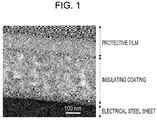
- Fig. 1 is a TEM image of an electrical steel sheet having an insulating coating of the present invention, the TEM image showing a cross section of the insulating coating.
- the electrical steel sheet that is used in the present invention is not limited to a particular electrical steel sheet.
- the electrical steel sheets include electrical steel sheets having a typical chemical composition.
- components included in a typical electrical steel sheet include Si and A1.
- the balance of the electrical steel sheet is Fe and incidental impurities.
- a Si content be within a range of 0.05 to 7.0 mass%
- an Al content be within a range of 2.0 mass% or less.
- the insulating coating includes a composite containing P and Al and having an aspect ratio of 1 to 10.
- the present inventors diligently performed studies to improve a coating peel property that can be exhibited during stamping process. As a result, it was discovered that in cases where the composite containing P and Al has a predetermined shape and a predetermined particle diameter, good coating peel resistance can be exhibited even in severe stamping process. A reason for the improvement in the coating peel resistance is believed to be that when the composite has a predetermined shape and a predetermined particle diameter, sufficient progression of the bonding between P atoms and Al atoms has been achieved, which increases a strength of the coating.
- Fig. 1 is a TEM image of a cross section of an insulating coating of the present invention.
- a thin film sample was introduced into a transmission electron microscope (FE-TEM instrument: HF2100, manufactured by Hitachi High-Technologies Corporation), and image observation was performed. Furthermore, the coating portion was analyzed by using an energy dispersive X-ray spectrometer (EDX analyzer: Noran System Six, manufactured by Thermo Fisher Scientific) attached to the TEM instrument.
- FE-TEM instrument HF2100, manufactured by Hitachi High-Technologies Corporation
- the thin film sample was prepared as follows: a sample was introduced into an FIB system (FB-2100, manufactured by Hitachi High-Technologies Corporation); a C-CVD film, which was a protective film, was then deposited on the coating; and subsequently, the preparation was performed by using a micro-sampling unit included in the FIB system.
- Fig. 1 shows the existence of particles in the insulating coating, as indicated by gray elliptical portions, which are the composite.
- EDX analysis confirmed that the particles in the insulating coating were a composite containing P and A1.
- the insulating coating of the present invention will be described below.
- the composite of the present invention contains P and A1.
- the "composite” is an assembly of inorganic components that are integrated at an atomic or a molecular level, and the composite may contain one or more other components, in addition to P and A1.
- P and Al included in the composite particles of the composite can readily form a network together, which results in the formation of a rigid coating.
- An example of a method for including P and Al in the composite of the insulating coating of the present invention is as follows: aluminum phosphate is added to a coating liquid that is to be applied to an electrical steel sheet (a treatment liquid for forming the insulating coating).
- a combination of phosphoric acid or a phosphate salt with an Al compound may be used.
- the phosphate salt that can be used in the present invention may be an industrially available product and is not particularly limited. Preferred examples include orthophosphoric acid, anhydrous phosphoric acid, linear polyphosphoric acid, and cyclic metaphosphoric acid.
- the phosphate salt may be a water-soluble salt, such as monomagnesium phosphate or monocalcium phosphate.
- the Al compound may be an Al compound containing a hydroxy group and organic acid, or, a dehydrated product thereof.
- the Al compound include alumina sols.
- the Al compound may be one that is soluble in water or dispersible in water in the form of a colloid or a suspension. This is preferable because the coating liquid to be applied to the steel sheet for baking is to be an aqueous coating liquid.
- the Al compound may have any shape, and examples of the shape include feathery shapes and spherical shapes.
- the composite in the insulating coating of the present invention has an aspect ratio (a major axis/a minor axis) within a range of 1 to 10. If the aspect ratio is greater than 10, it is difficult to densely fill the insulating coating with the composite, and as a result, the strength of the coating decreases, and the coating peel resistance is significantly degraded. Note that the aspect ratio is preferably less than or equal to 4.
- the composite in the insulating coating of the present invention which contains P and Al, has a particle diameter of 10 nm to 1000 nm. If the particle diameter is less than 10 nm, the bonding between P atoms and Al atoms is not sufficiently formed, and as a result, the coating peel resistance is degraded. On the other hand, if the particle diameter is greater than 1000 nm, adhesion between the composite and the steel sheet is degraded, and as a result, the coating peel resistance is reduced. Note that the particle diameter is preferably greater than or equal to 50 nm and less than or equal to 500 nm.
- the aspect ratio and the particle diameter of the composite in the insulating coating of the present invention can be determined as follows, for example.
- a thin film sample of the insulating coating is prepared by FIB processing, and a cross section of the insulating coating is observed with a TEM at a magnification of 30,000x.
- the aspect ratios and the particle diameters of all of the particles of the composite in three fields of view are determined, and the arithmetic means of the values are determined.
- the aspect ratio is determined as follows: in the TEM observation, the lengths of the major axis and the minor axis of the particles of the composite are measured, and the aspect ratio is calculated as "major axis/minor axis".
- the particle diameter is an average particle diameter calculated as follows: (major axis + minor axis)/2.
- the presence of P and Al in the composite can be confirmed by performing EDX analysis.
- the aspect ratio and the particle diameter of the composite in the insulating coating of the present invention can be controlled through a baking temperature (PMT), which is a temperature used for performing baking after the treatment liquid for forming the insulating coating is applied onto the steel sheet.
- PMT baking temperature
- the insulating coating of the present invention has a thickness of 500 nm to 2000 nm. If the thickness is less than 500 nm, insulation of a projecting portion of the steel sheet cannot be guaranteed. If the thickness is greater than 2000 nm, an amount of peeling of the insulating coating during stamping process increases; as a result, an amount of peeled coating that accumulates in the die increases, and, therefore, a stamping process property is adversely affected.
- the thickness can be determined by observing a cross section of the insulating coating revealed by cleaving, by using an SEM. This method is a non-limiting example. Note that the thickness of the insulating coating is preferably greater than or equal to 700 nm and less than or equal to 1500 nm.
- the insulating coating of the present invention may include an organic resin. Including an organic resin in the insulating coating further enhances performance of the coating.
- Organic resins that can be used in the present invention are not particularly limited, and any of known organic resins that are used in the related art may be advantageously employed. Examples thereof include aqueous resins (emulsions, dispersions, and water-soluble resins), such as those of an acrylic resin, an alkyd resin, a polyolefin resin, a styrene resin, a vinyl acetate resin, an epoxy resin, a phenolic resin, a polyester resin, a urethane resin, and a melamine resin.
- aqueous resins emulsions, dispersions, and water-soluble resins
- an emulsion of an acrylic resin and an emulsion of an ethylene-acrylic acid resin are preferable.
- an organic resin is included, corrosion resistance is enhanced.
- the organic resin protects the die, and, therefore, lubricity during stamping process is enhanced; as a result, an effect of inhibiting degradation of the cutting edge of the stamping die can be expected.
- the insulating coating may include, in addition to the components described above, one or more other components, a commonly used additive, such as surfactants, corrosion inhibitors, lubricants and antioxidants, and other inorganic compound or organic compound.
- a commonly used additive such as surfactants, corrosion inhibitors, lubricants and antioxidants
- the organic compound include an organic acid, which may be used as an inhibitor that inhibits contact between the inorganic component and the organic resin.
- examples of the organic acid include acrylic-acid-containing polymers or copolymers.
- the inorganic compound include boric acid and pigments.
- the electrical steel sheet with which the electrical steel sheet having an insulating coating is to be manufactured may be a common electrical steel sheet as described above. Accordingly, an electrical steel sheet manufactured by a common method or a commercially available electrical steel sheet may be employed.
- the electrical steel sheet which is the base material. That is, the electrical steel sheet may be untreated; however, it is advantageous to subject the electrical steel sheet to a degreasing treatment that uses, for example, alkali, and/or to a pickling treatment that uses, for example, hydrochloric acid, sulfuric acid, or phosphoric acid.
- a treatment liquid to be used to form the insulating coating is prepared.
- the treatment liquid can be prepared, for example, by adding monoaluminum phosphate to deionized water. Note that the treatment liquid may be adjusted by adding, as necessary, phosphoric acid, a phosphate salt, an alumina sol, an organic resin, or other component to deionized water.
- a solids concentration of the treatment liquid be within a range of 10% or greater and 50% or less.
- the aspect ratio of the composite in the insulating coating falls within a range desired in the present invention. For this reason, such a solids concentration is preferable.
- the treatment liquid is applied to a surface of the electrical steel sheet.
- Methods for applying the treatment liquid to the surface of the electrical steel sheet are not particularly limited, and any of a variety of methods that are industrially commonly used may be employed; examples of such methods include those using a roll coater, a flow coater, a spray, or a knife coater.
- baking is performed on the treatment liquid that has been applied onto the electrical steel sheet, so that the insulating coating is formed from the applied treatment liquid.
- Methods for the baking are not particularly limited, and a method that is typically implemented may be employed; examples of the method include methods using hot air heating, methods using infrared radiation, and methods using induction heating.
- the baking temperature (PMT) for the baking is important in controlling the particle diameter of the composite of the insulating coating. In the present invention, it is preferable to set the baking temperature (PMT) to be within a range of 200°C or greater and 350°C or less.
- the baking temperature (PMT) is less than 200°C, the bonding between P and Al in the composite is not sufficiently formed; as a result, the coating peel resistance is reduced, and the desired particle diameter is not satisfied. Furthermore, if the baking temperature (PMT) is greater than 350°C, cracks (microcracks) form in the insulating coating as a result of the excessive baking, and the portions with cracks are highly susceptible to peeling of the coating; therefore, the coating peel resistance is significantly degraded.
- a baking time is not particularly limited, and, for example, a time within a range of 1 second to 10 minutes may be appropriately selected.
- the electrical steel sheet having an insulating coating of the present invention may be subjected to stress relief annealing so that strain due to blanking, for example, can be removed.
- an atmosphere for the stress relief annealing include atmospheres in which iron is unlikely to be oxidized, such as N 2 atmospheres and DX gas atmospheres.
- a dew point (Dp) may be set to be a high Dp temperature of, for example, approximately 5 to 60°C to allow the surface and the cut edge surfaces to be slightly oxidized, which further enhances the corrosion resistance.
- a temperature for the stress relief annealing is preferably 700 to 900°C and more preferably 700 to 800°C. A longer holding time at the temperature for the stress relief annealing is preferable. More preferably, the holding time is greater than or equal to 1 hour.
- the insulating coating be provided on both surfaces of the electrical steel sheet.
- the insulating coating may be provided only on one of the surfaces.
- the insulating coating may be provided on only one of the surfaces, and a different insulating coating may be provided on the other surface.
- Treatment liquids were prepared as follows. At least one of phosphoric acid, phosphate salts, and an alumina sol, listed in Table 1, were added to deionized water; optionally, an organic resin, listed in Table 1, was also added. The solids concentration of each of the treatment liquids was as shown in Table 2.
- Each of the treatment liquids was applied to a surface of a test specimen by using a roll coater, and baking was performed in a hot-air baking oven at a baking temperature (PMT) for a baking time as shown in Table 2.
- the test specimen was one cut from an electrical steel sheet [A360 (JIS C2552(2000))] having a sheet thickness of 0.35 mm and had a size of 150 mm in width and 300 mm in length. After baking, the test specimen was allowed to cool to room temperature, and, accordingly, an insulating coating was formed.
- the thickness of the insulating coating was measured by observing a cross section of the coating revealed by cleaving, by using an SEM. Furthermore, the particle diameter and the aspect ratio of the composite were determined by performing TEM observation of a thin film sample, which was prepared by FIB processing. Note that the particle diameter and the aspect ratio of the composite were measured in accordance with the method described above.
- stamping test using a stamping machine was conducted on the above-described test specimen of the electrical steel sheet, on which an insulating coating had been formed.
- the stamping machine used was a hydraulic bench press AP-5KL, manufactured by Atsugi Motor Parts Co., Ltd.
- the die was made of SKD-11 and had a die diameter of ⁇ 100 mm.
- a sample measuring 20 mm ⁇ 100 mm was cut.
- a pressure during the stamping was 4.5 kN, a holding time was 0.5 s/run, a press speed was 36 mm/s, and the number of times of stamping was 500.
- the surface of the die was polished with sandpaper in advance such that the surface had a roughness Ra of 0.03 ⁇ m. After the test, the surface of the sample was observed, and evaluations were made based on an area fraction of the peeled-off pieces of the coating. For the observation, a microscope DSX510, manufactured by Olympus Corporation, was used.
Landscapes
- Chemical & Material Sciences (AREA)
- Materials Engineering (AREA)
- Organic Chemistry (AREA)
- Engineering & Computer Science (AREA)
- Metallurgy (AREA)
- Mechanical Engineering (AREA)
- Chemical Kinetics & Catalysis (AREA)
- General Chemical & Material Sciences (AREA)
- Life Sciences & Earth Sciences (AREA)
- Wood Science & Technology (AREA)
- Chemical Treatment Of Metals (AREA)
- Soft Magnetic Materials (AREA)
- Manufacturing Of Steel Electrode Plates (AREA)
- Laminated Bodies (AREA)
- Other Surface Treatments For Metallic Materials (AREA)
Abstract
Description
- The present invention relates to an electrical steel sheet having an insulating coating, the electrical steel sheet having excellent coating peel resistance such that the coating is prevented from peeling off the steel sheet during stamping process, and thus, sticking of the coating to a stamping die is inhibited.
- Electrical steel sheets are used in various applications, and, therefore, a variety of insulating coatings suitable for different applications have been developed. When an electrical steel sheet is to be used as a core of a motor or the like, the electrical steel sheet is stamped into blanks having a predetermined shape, and thereafter the blanks are stacked and subjected to forming.
- In blanking (stamping), punch oil is typically used for preventing galling in a die or cooling of a die. In recent years, however, an increasing number of customers, particularly in Europe, have been opting for oil-free stamping. A reason that the customers opt for oil-free stamping is that in an instance where punch oil is used, dust from the air, iron powder generated during stamping, or the like adheres to the oil and forms contaminants, which can clog a tube for a motor and gears. Successive stampings of an electrical steel sheet are performed at a very high speed, and, in many cases, several hundreds of thousands of shots are performed for one die maintenance cycle. Accordingly, adhesion between the electrical steel sheet and an insulating coating is important. If the insulating coating is one that easily peels off when an impact is applied thereto during stamping, it is impossible to guarantee, in a case where the steel sheet is formed to be a core, insulation between the blanks of the steel sheet. In addition, if the insulating coating peels off during stamping, the peeled-off pieces of the insulating coating accumulate within the die and thus contaminate the die. In instances where punch oil is used, the peeled-off pieces of the insulating coating are washed away by the oil to some extent. However, in oil-free stamping, the insulating coating strongly adheres to the die and could cause a defect, such as an indentation, in a surface of the steel sheet.
- Insulating coatings can be generally classified into (1) inorganic coatings, (2) resin-containing inorganic coatings (i.e., semi-organic coatings), and (3) organic coatings. In recent years, there have been many cases in which stress relief annealing at a temperature of approximately 700 to 800°C for removing residual strain is performed; accordingly, (2) semi-organic coatings, which have excellent blankability due to the presence of the resin and is resistant to stress relief annealing, are typically used in many cases. For example, Patent Literature 1 proposes an electrical steel sheet having a chromium-free insulating coating, the insulating coating including a Zr compound and including phosphoric acid and/or a phosphate salt; the electrical steel sheet can form a product sheet (sheet before stress relief annealing) having excellent corrosion resistance, powdering resistance, and appearance and can form a stress relief annealed sheet having excellent scratch resistance. In the electrical steel sheet, the sum of a content of the Zr compound calculated as ZrO2 and a content of the phosphoric acid and/or the phosphate salt calculated as PO4 is 45 to 90 mass% relative to a mass of the total solids of the insulating coating; a ratio between the contents, which is a ratio of PO4/ZrO2, is 0.01 to 0.40; and the insulating coating includes an Al compound, a Si compound, or a titania sol as a balance component, which is a component other than the Zr compound or the phosphoric acid and/or the phosphate salt.
- Furthermore, Patent Literature 2 proposes an insulating film composition of a non-oriented electrical steel sheet. The insulating film composition includes a mixed metal phosphate consisting of aluminum phosphate and cobalt phosphate; and an organic/inorganic composite consisting of epoxy resin and silica nanoparticle substituted on the functional group of the epoxy resin, with the size of the silica nanoparticle being 5 to 50 nm, wherein the mixing ratio by weight between the cobalt phosphate and aluminum phosphate (cobalt phosphate/aluminum phosphate) mixed in the mixed metal phosphate is 0.05 to 0.2.
- Patent Literature 3 proposes an electrical steel sheet in which an insulating film contains a phosphate of one or more selected from the group consisting of Al, Zn, Mg and Ca, wherein a proportion of an amount by mole (mol) of Fe atoms relative to an amount by mole (mol) of P atoms in the insulating film is more than 0.1 and not more than 0.65. Patent Literature 4 proposes an electrical steel sheet in which an insulating film contains a phosphate of one or more selected from the group consisting of Al, Zn, Mg and Ca, wherein the phosphate exhibits a specific peak having a top within a range of -26 ppm to -16 ppm in a solid 31P-NMR spectrum, and a proportion of an integrated intensity of the specific peak relative to an integrated intensity of all peaks in the solid 31P-NMR spectrum is 30% or more.
- Patent Literature 5 proposes an electrical steel sheet in which predetermined conditions are satisfied in a region of 50 area % or more of a cross section parallel to a thickness direction of the insulating film.
-
- PTL 1:
Japanese Patent No. 4725094 - PTL 2:
Japanese Patent No. 5877252 - PTL 3: International Publication No.
2016/104407 - PTL 4: International Publication No.
2016/104512 - PTL 5: International Publication No.
2016/104404 - According to Patent Literature 1 or 2, general properties necessary for an insulating coating can be satisfied; however, in Patent Literature 1 or 2, no reference is made to a coating peel property that can be exhibited during stamping process, or, sticking properties associated with a die. According to Patent Literature 3, 4, or 5, good anti-rust properties can be achieved; however, in Patent Literature 3, 4, or 5, no discussion is made regarding a coating peel property that can be exhibited during stamping process, or, sticking to a die. In particular, in instances where oil-free stamping is performed, a concern arises that peeled-off pieces of the coating (peeled coating) may accumulate within a die and stick to the die.
- The present invention was made in view of the above circumstances. An object of the present invention is to provide an electrical steel sheet having an insulating coating, the electrical steel sheet having excellent coating peel resistance that can be exhibited during stamping process, so that sticking of the coating to a die is inhibited.
- The inventors diligently performed studies to solve the problems described above and discovered that, by including a composite in the insulating coating, peeling of the coating during stamping process can be significantly reduced, and, therefore, sticking thereof to a die can be inhibited; the composite contains P and Al and has a predetermined aspect ratio and particle diameter.
- The present invention is based on the knowledge described above. Specifically, a summary of features of the present invention is as follows.
- [1] An electrical steel sheet having an insulating coating, including an electrical steel sheet and an insulating coating disposed on at least one of surfaces of the electrical steel sheet, wherein the insulating coating includes a composite containing P and Al and having an aspect ratio of 1 to 10, the composite has a particle diameter of 10 nm to 1000 nm, and the insulating coating has a thickness of 500 nm to 2000 nm.
- [2] The electrical steel sheet having an insulating coating according to [1], wherein the insulating coating includes an organic resin.
- With the present invention, an electrical steel sheet having an insulating coating is provided, the electrical steel sheet having excellent coating peel resistance that can be exhibited during stamping process, so that sticking of the coating to a die is inhibited.
- [
Fig. 1] Fig. 1 is a TEM image of an electrical steel sheet having an insulating coating of the present invention, the TEM image showing a cross section of the insulating coating. - An embodiment of the present invention will be described below. Note that the present invention is not limited to the embodiment described below.
- The electrical steel sheet that is used in the present invention is not limited to a particular electrical steel sheet. Examples of the electrical steel sheets include electrical steel sheets having a typical chemical composition. Examples of components included in a typical electrical steel sheet include Si and A1. Furthermore, the balance of the electrical steel sheet is Fe and incidental impurities. Typically, it is preferable that a Si content be within a range of 0.05 to 7.0 mass%, and an Al content be within a range of 2.0 mass% or less.
- In an electrical steel sheet having an insulating coating of the present invention, the insulating coating includes a composite containing P and Al and having an aspect ratio of 1 to 10.
- The present inventors diligently performed studies to improve a coating peel property that can be exhibited during stamping process. As a result, it was discovered that in cases where the composite containing P and Al has a predetermined shape and a predetermined particle diameter, good coating peel resistance can be exhibited even in severe stamping process. A reason for the improvement in the coating peel resistance is believed to be that when the composite has a predetermined shape and a predetermined particle diameter, sufficient progression of the bonding between P atoms and Al atoms has been achieved, which increases a strength of the coating.
-
Fig. 1 is a TEM image of a cross section of an insulating coating of the present invention. For the TEM image of the cross section, a thin film sample was introduced into a transmission electron microscope (FE-TEM instrument: HF2100, manufactured by Hitachi High-Technologies Corporation), and image observation was performed. Furthermore, the coating portion was analyzed by using an energy dispersive X-ray spectrometer (EDX analyzer: Noran System Six, manufactured by Thermo Fisher Scientific) attached to the TEM instrument. Note that the thin film sample was prepared as follows: a sample was introduced into an FIB system (FB-2100, manufactured by Hitachi High-Technologies Corporation); a C-CVD film, which was a protective film, was then deposited on the coating; and subsequently, the preparation was performed by using a micro-sampling unit included in the FIB system.Fig. 1 shows the existence of particles in the insulating coating, as indicated by gray elliptical portions, which are the composite. EDX analysis confirmed that the particles in the insulating coating were a composite containing P and A1. - The insulating coating of the present invention will be described below.
- The composite of the present invention contains P and A1. As referred to in the present invention, the "composite" is an assembly of inorganic components that are integrated at an atomic or a molecular level, and the composite may contain one or more other components, in addition to P and A1. By virtue of the P and Al included in the composite, particles of the composite can readily form a network together, which results in the formation of a rigid coating.
- An example of a method for including P and Al in the composite of the insulating coating of the present invention is as follows: aluminum phosphate is added to a coating liquid that is to be applied to an electrical steel sheet (a treatment liquid for forming the insulating coating). A combination of phosphoric acid or a phosphate salt with an Al compound may be used. The phosphate salt that can be used in the present invention may be an industrially available product and is not particularly limited. Preferred examples include orthophosphoric acid, anhydrous phosphoric acid, linear polyphosphoric acid, and cyclic metaphosphoric acid. Preferably, the phosphate salt may be a water-soluble salt, such as monomagnesium phosphate or monocalcium phosphate. These phosphoric acids and phosphate salts may be used alone or in a combination of two or more. Preferably, the Al compound may be an Al compound containing a hydroxy group and organic acid, or, a dehydrated product thereof. Examples of the Al compound include alumina sols. The Al compound may be one that is soluble in water or dispersible in water in the form of a colloid or a suspension. This is preferable because the coating liquid to be applied to the steel sheet for baking is to be an aqueous coating liquid. Furthermore, the Al compound may have any shape, and examples of the shape include feathery shapes and spherical shapes.
- Furthermore, the composite in the insulating coating of the present invention has an aspect ratio (a major axis/a minor axis) within a range of 1 to 10. If the aspect ratio is greater than 10, it is difficult to densely fill the insulating coating with the composite, and as a result, the strength of the coating decreases, and the coating peel resistance is significantly degraded. Note that the aspect ratio is preferably less than or equal to 4.
- The composite in the insulating coating of the present invention, which contains P and Al, has a particle diameter of 10 nm to 1000 nm. If the particle diameter is less than 10 nm, the bonding between P atoms and Al atoms is not sufficiently formed, and as a result, the coating peel resistance is degraded. On the other hand, if the particle diameter is greater than 1000 nm, adhesion between the composite and the steel sheet is degraded, and as a result, the coating peel resistance is reduced. Note that the particle diameter is preferably greater than or equal to 50 nm and less than or equal to 500 nm.
- The aspect ratio and the particle diameter of the composite in the insulating coating of the present invention can be determined as follows, for example. A thin film sample of the insulating coating is prepared by FIB processing, and a cross section of the insulating coating is observed with a TEM at a magnification of 30,000x. The aspect ratios and the particle diameters of all of the particles of the composite in three fields of view are determined, and the arithmetic means of the values are determined. Note that the aspect ratio is determined as follows: in the TEM observation, the lengths of the major axis and the minor axis of the particles of the composite are measured, and the aspect ratio is calculated as "major axis/minor axis". The particle diameter is an average particle diameter calculated as follows: (major axis + minor axis)/2. Furthermore, the presence of P and Al in the composite can be confirmed by performing EDX analysis.
- Furthermore, as will be described later, the aspect ratio and the particle diameter of the composite in the insulating coating of the present invention can be controlled through a baking temperature (PMT), which is a temperature used for performing baking after the treatment liquid for forming the insulating coating is applied onto the steel sheet.
- The insulating coating of the present invention has a thickness of 500 nm to 2000 nm. If the thickness is less than 500 nm, insulation of a projecting portion of the steel sheet cannot be guaranteed. If the thickness is greater than 2000 nm, an amount of peeling of the insulating coating during stamping process increases; as a result, an amount of peeled coating that accumulates in the die increases, and, therefore, a stamping process property is adversely affected. The thickness can be determined by observing a cross section of the insulating coating revealed by cleaving, by using an SEM. This method is a non-limiting example. Note that the thickness of the insulating coating is preferably greater than or equal to 700 nm and less than or equal to 1500 nm.
- The insulating coating of the present invention may include an organic resin. Including an organic resin in the insulating coating further enhances performance of the coating. Organic resins that can be used in the present invention are not particularly limited, and any of known organic resins that are used in the related art may be advantageously employed. Examples thereof include aqueous resins (emulsions, dispersions, and water-soluble resins), such as those of an acrylic resin, an alkyd resin, a polyolefin resin, a styrene resin, a vinyl acetate resin, an epoxy resin, a phenolic resin, a polyester resin, a urethane resin, and a melamine resin. In particular, an emulsion of an acrylic resin and an emulsion of an ethylene-acrylic acid resin are preferable. In cases where an organic resin is included, corrosion resistance is enhanced. In addition, during stamping process, the organic resin protects the die, and, therefore, lubricity during stamping process is enhanced; as a result, an effect of inhibiting degradation of the cutting edge of the stamping die can be expected.
- Furthermore, in the present invention, the insulating coating may include, in addition to the components described above, one or more other components, a commonly used additive, such as surfactants, corrosion inhibitors, lubricants and antioxidants, and other inorganic compound or organic compound. Note that examples of the organic compound include an organic acid, which may be used as an inhibitor that inhibits contact between the inorganic component and the organic resin. Examples of the organic acid include acrylic-acid-containing polymers or copolymers. Examples of the inorganic compound include boric acid and pigments.
- Now, a method for manufacturing the electrical steel sheet having an insulating coating will be described.
- The electrical steel sheet with which the electrical steel sheet having an insulating coating is to be manufactured may be a common electrical steel sheet as described above. Accordingly, an electrical steel sheet manufactured by a common method or a commercially available electrical steel sheet may be employed.
- In the present invention, no particular limitations are imposed on a pretreatment of the electrical steel sheet, which is the base material. That is, the electrical steel sheet may be untreated; however, it is advantageous to subject the electrical steel sheet to a degreasing treatment that uses, for example, alkali, and/or to a pickling treatment that uses, for example, hydrochloric acid, sulfuric acid, or phosphoric acid.
- Subsequently, a treatment liquid to be used to form the insulating coating is prepared. The treatment liquid can be prepared, for example, by adding monoaluminum phosphate to deionized water. Note that the treatment liquid may be adjusted by adding, as necessary, phosphoric acid, a phosphate salt, an alumina sol, an organic resin, or other component to deionized water.
- In the preparation of the treatment liquid, it is preferable that an adjustment be made such that a solids concentration of the treatment liquid be within a range of 10% or greater and 50% or less. In the case where the solids concentration of the treatment liquid is within the range of 10% or greater and 50% or less, the aspect ratio of the composite in the insulating coating falls within a range desired in the present invention. For this reason, such a solids concentration is preferable.
- Subsequently, the treatment liquid is applied to a surface of the electrical steel sheet. Methods for applying the treatment liquid to the surface of the electrical steel sheet are not particularly limited, and any of a variety of methods that are industrially commonly used may be employed; examples of such methods include those using a roll coater, a flow coater, a spray, or a knife coater.
- Subsequently, baking is performed on the treatment liquid that has been applied onto the electrical steel sheet, so that the insulating coating is formed from the applied treatment liquid. Methods for the baking are not particularly limited, and a method that is typically implemented may be employed; examples of the method include methods using hot air heating, methods using infrared radiation, and methods using induction heating. The baking temperature (PMT) for the baking is important in controlling the particle diameter of the composite of the insulating coating. In the present invention, it is preferable to set the baking temperature (PMT) to be within a range of 200°C or greater and 350°C or less. If the baking temperature (PMT) is less than 200°C, the bonding between P and Al in the composite is not sufficiently formed; as a result, the coating peel resistance is reduced, and the desired particle diameter is not satisfied. Furthermore, if the baking temperature (PMT) is greater than 350°C, cracks (microcracks) form in the insulating coating as a result of the excessive baking, and the portions with cracks are highly susceptible to peeling of the coating; therefore, the coating peel resistance is significantly degraded. A baking time is not particularly limited, and, for example, a time within a range of 1 second to 10 minutes may be appropriately selected.
- The electrical steel sheet having an insulating coating of the present invention may be subjected to stress relief annealing so that strain due to blanking, for example, can be removed. Preferred examples of an atmosphere for the stress relief annealing include atmospheres in which iron is unlikely to be oxidized, such as N2 atmospheres and DX gas atmospheres. In this regard, a dew point (Dp) may be set to be a high Dp temperature of, for example, approximately 5 to 60°C to allow the surface and the cut edge surfaces to be slightly oxidized, which further enhances the corrosion resistance. Furthermore, a temperature for the stress relief annealing is preferably 700 to 900°C and more preferably 700 to 800°C. A longer holding time at the temperature for the stress relief annealing is preferable. More preferably, the holding time is greater than or equal to 1 hour.
- It is preferable that the insulating coating be provided on both surfaces of the electrical steel sheet. For some purposes, the insulating coating may be provided only on one of the surfaces. Furthermore, for some purposes, the insulating coating may be provided on only one of the surfaces, and a different insulating coating may be provided on the other surface.
- Treatment liquids were prepared as follows. At least one of phosphoric acid, phosphate salts, and an alumina sol, listed in Table 1, were added to deionized water; optionally, an organic resin, listed in Table 1, was also added. The solids concentration of each of the treatment liquids was as shown in Table 2.
- Each of the treatment liquids was applied to a surface of a test specimen by using a roll coater, and baking was performed in a hot-air baking oven at a baking temperature (PMT) for a baking time as shown in Table 2. The test specimen was one cut from an electrical steel sheet [A360 (JIS C2552(2000))] having a sheet thickness of 0.35 mm and had a size of 150 mm in width and 300 mm in length. After baking, the test specimen was allowed to cool to room temperature, and, accordingly, an insulating coating was formed.
- The thickness of the insulating coating was measured by observing a cross section of the coating revealed by cleaving, by using an SEM. Furthermore, the particle diameter and the aspect ratio of the composite were determined by performing TEM observation of a thin film sample, which was prepared by FIB processing. Note that the particle diameter and the aspect ratio of the composite were measured in accordance with the method described above.
- Furthermore, the coating peel resistance of the electrical steel sheet having an insulating coating was investigated. The evaluation method and the evaluation criteria are described below in detail.
- To investigate the coating peel property that can be exhibited during stamping process, a stamping test using a stamping machine was conducted on the above-described test specimen of the electrical steel sheet, on which an insulating coating had been formed. The stamping machine used was a hydraulic bench press AP-5KL, manufactured by Atsugi Motor Parts Co., Ltd. The die was made of SKD-11 and had a die diameter of ϕ100 mm. A sample measuring 20 mm × 100 mm was cut. A pressure during the stamping was 4.5 kN, a holding time was 0.5 s/run, a press speed was 36 mm/s, and the number of times of stamping was 500. The surface of the die was polished with sandpaper in advance such that the surface had a roughness Ra of 0.03 µm. After the test, the surface of the sample was observed, and evaluations were made based on an area fraction of the peeled-off pieces of the coating. For the observation, a microscope DSX510, manufactured by Olympus Corporation, was used.
-
- ⊙: The area fraction of peeling was 0% or greater and less than 10%.
- ○: The area fraction of peeling was 10% or greater and less than 20%.
- ×: The area fraction of peeling was 20% or greater.
- The results are shown in Table 2.
[Table 1] Symbol Designation Class Trade name P1 orthophosphoric acid phosphoric acid Phosphoric Acid (Mitsui Chemicals) P2 monoaluminum phosphate phosphate salt 50L (Taki Chemical) P3 monomagnesium phosphate phosphate salt Monomagnesium Phosphate (Taihei Chemical Industrial) P4 monocalcium phosphate phosphate salt Monocalcium Phosphate (Mitejima Chemical) A1 alumina sol alumina sol AS-520-A (Nissan Chemical) R1 acrylic resin organic resin Voncoat (DIC) R2 epoxy resin organic resin EFD-5560 (DIC) [Table 2] No. Insulating coating Thickness (nm) Solids concentration of treatment liquid (%) Baking temperature (°C) Baking time (s) Coating property Inorganic component Organic resin Area fraction of peeled coating (%) Compound used in treatment liquid Particle diameter of composite (nm) Aspect ratio of composite Type P1 P2 P3 P4 A1 Invention example 1 ○ 10 2 - 1000 18 240 20 ○ Invention example 2 ○ 50 2 - 1000 18 270 20 ⊙ Invention example 3 ○ 100 2 - 1000 18 320 20 ⊙ Invention example 4 ○ 500 2 - 1000 18 340 20 ⊙ Invention example 5 ○ 1000 2 - 1000 36 350 20 ○ Invention example 6 ○ 100 1 - 1000 10 320 20 ⊙ Invention example 7 ○ 100 5 - 1000 18 320 20 ○ Invention example 8 ○ 100 10 - 1000 50 320 20 ○ Invention example 9 ○ 100 2 R1 1000 18 320 20 ⊙ Invention example 10 ○ 100 2 R2 1000 18 320 20 ⊙ Invention example 11 ○ 100 2 - 500 18 320 20 ⊙ Invention example 12 ○ 100 2 - 2000 18 320 20 ○ Invention example 13 ○ ○ 100 2 - 1000 18 320 20 ⊙ Invention example 14 ○ ○ 100 2 - 1000 18 320 20 ⊙ Invention example 15 ○ ○ ○ 100 2 - 1000 18 320 20 ⊙ Invention example 16 ○ ○ ○ 100 2 - 1000 18 320 20 ⊙ Invention example 17 ○ ○ 100 2 - 1000 18 320 20 ⊙ Comparative example 1 ○ 5 2 - 1000 18 180 20 × Comparative example 2 ○ 1500 2 - 1000 50 360 20 × Comparative example 3 ○ 100 15 - 1000 60 320 20 × Comparative example 4 ○ 100 2 - 2500 18 320 20 × Comparative example 5 ○ 100 2 - 1000 18 320 20 × Comparative example 6 ○ 100 2 - 1000 18 320 20 × - From the results shown in Table 2, it is apparent that all of the Invention Examples were excellent in terms of performance of the coating.
Claims (2)
- An electrical steel sheet having an insulating coating, comprising:an electrical steel sheet; andan insulating coating disposed on at least one of surfaces of the electrical steel sheet, whereinthe insulating coating includes a composite containing P and Al and having an aspect ratio of 1 to 10,the composite has a particle diameter of 10 nm to 1000 nm, andthe insulating coating has a thickness of 500 nm to 2000 nm.
- The electrical steel sheet having an insulating coating according to Claim 1, wherein the insulating coating includes an organic resin.
Applications Claiming Priority (2)
| Application Number | Priority Date | Filing Date | Title |
|---|---|---|---|
| JP2019024445 | 2019-02-14 | ||
| PCT/JP2019/038026 WO2020166121A1 (en) | 2019-02-14 | 2019-09-26 | Electromagnetic steel sheet having insulation coating film attached thereto |
Publications (2)
| Publication Number | Publication Date |
|---|---|
| EP3926072A1 true EP3926072A1 (en) | 2021-12-22 |
| EP3926072A4 EP3926072A4 (en) | 2022-03-23 |
Family
ID=72043897
Family Applications (1)
| Application Number | Title | Priority Date | Filing Date |
|---|---|---|---|
| EP19915318.0A Pending EP3926072A4 (en) | 2019-02-14 | 2019-09-26 | ELECTROMAGNETIC STEEL SHEET WITH INSULATION COATING FILM ATTACHED |
Country Status (9)
| Country | Link |
|---|---|
| US (1) | US12252792B2 (en) |
| EP (1) | EP3926072A4 (en) |
| JP (2) | JP7080255B2 (en) |
| KR (1) | KR20210110703A (en) |
| CN (1) | CN113423868A (en) |
| CA (1) | CA3125898A1 (en) |
| MX (1) | MX2021009779A (en) |
| TW (1) | TWI730440B (en) |
| WO (1) | WO2020166121A1 (en) |
Family Cites Families (21)
| Publication number | Priority date | Publication date | Assignee | Title |
|---|---|---|---|---|
| JPS4725094Y1 (en) | 1968-03-23 | 1972-08-05 | ||
| JP2727553B2 (en) * | 1988-02-29 | 1998-03-11 | 日本鋼管株式会社 | Method of forming a green coating with excellent heat resistance on the surface of electrical steel sheet |
| JPH0578855A (en) * | 1991-09-25 | 1993-03-30 | Nisshin Steel Co Ltd | Composition for forming magnetic steel sheet insulating film and method therefor |
| JP3718638B2 (en) | 2001-02-23 | 2005-11-24 | 住友金属工業株式会社 | Electrical steel sheet with insulating film and method for producing the same. |
| JP4725094B2 (en) | 2004-12-14 | 2011-07-13 | Jfeスチール株式会社 | Electrical steel sheet with insulation coating |
| KR101247481B1 (en) | 2008-06-20 | 2013-03-29 | 신닛테츠스미킨 카부시키카이샤 | Non-oriented electromagnetic steel plate and manufacturing method thereof |
| JP5596300B2 (en) | 2009-04-30 | 2014-09-24 | 新日鐵住金株式会社 | Electrical steel sheet having insulating film, method for producing the same and treatment liquid |
| WO2011033943A1 (en) * | 2009-09-15 | 2011-03-24 | 新日本製鐵株式会社 | Electromagnetic steel sheet and method for producing same |
| KR101264231B1 (en) * | 2009-12-23 | 2013-05-22 | 주식회사 포스코 | Coating solution with excellent insulating property, method for forming insulating film of non-oriented electrical steel sheet and non-oriented electrical steel sheet by using it |
| JP5471849B2 (en) * | 2010-06-01 | 2014-04-16 | 新日鐵住金株式会社 | Electrical steel sheet and manufacturing method thereof |
| JP5589639B2 (en) * | 2010-07-22 | 2014-09-17 | Jfeスチール株式会社 | Electrical steel sheet with semi-organic insulation coating |
| JP5093411B2 (en) * | 2010-07-23 | 2012-12-12 | 新日本製鐵株式会社 | Magnetic steel sheet used for resin-molded laminated iron core and manufacturing method thereof |
| EP2634288B1 (en) * | 2010-10-29 | 2017-11-29 | Nippon Steel & Sumitomo Metal Corporation | Electrical steel sheet and method of manufacturing the same |
| JP5522013B2 (en) * | 2010-12-10 | 2014-06-18 | 新日鐵住金株式会社 | Magnetic steel sheet with chrome-free insulation film |
| KR101324260B1 (en) | 2011-12-28 | 2013-11-01 | 주식회사 포스코 | Insulation coating material for non-oriented electrical steel sheet and method for manufacturing the same |
| JP5978009B2 (en) * | 2012-05-30 | 2016-08-24 | 新日鐵住金株式会社 | INSULATION COATING FORMING LIQUID AND METHOD FOR PRODUCING ELECTRIC STEEL STEEL WITH INSULATING COATING |
| JP2014105146A (en) | 2012-11-29 | 2014-06-09 | Hitachi Ltd | Preparation method of an alumina crystal particle-dispersed alumina sol, alumina crystal particle-dispersed alumina sol obtained by the same, and alumina-coated member prepared by using the same |
| WO2016104404A1 (en) | 2014-12-26 | 2016-06-30 | 新日鐵住金株式会社 | Electromagnetic steel sheet |
| EP3239354B1 (en) | 2014-12-26 | 2021-11-17 | Nippon Steel Corporation | Electrical steel sheet |
| CN107109655B (en) | 2014-12-26 | 2022-04-08 | 日本制铁株式会社 | Electromagnetic steel sheet |
| US11499059B2 (en) | 2017-03-23 | 2022-11-15 | Nippon Steel Corporation | Electrical steel sheet |
-
2019
- 2019-09-26 WO PCT/JP2019/038026 patent/WO2020166121A1/en not_active Ceased
- 2019-09-26 JP JP2019563909A patent/JP7080255B2/en active Active
- 2019-09-26 KR KR1020217024895A patent/KR20210110703A/en not_active Ceased
- 2019-09-26 CA CA3125898A patent/CA3125898A1/en active Pending
- 2019-09-26 MX MX2021009779A patent/MX2021009779A/en unknown
- 2019-09-26 US US17/430,626 patent/US12252792B2/en active Active
- 2019-09-26 CN CN201980091928.6A patent/CN113423868A/en active Pending
- 2019-09-26 EP EP19915318.0A patent/EP3926072A4/en active Pending
- 2019-10-07 TW TW108136211A patent/TWI730440B/en active
-
2021
- 2021-03-12 JP JP2021039824A patent/JP2021101044A/en active Pending
Also Published As
| Publication number | Publication date |
|---|---|
| KR20210110703A (en) | 2021-09-08 |
| US12252792B2 (en) | 2025-03-18 |
| TW202030275A (en) | 2020-08-16 |
| WO2020166121A1 (en) | 2020-08-20 |
| EP3926072A4 (en) | 2022-03-23 |
| JPWO2020166121A1 (en) | 2021-02-18 |
| JP7080255B2 (en) | 2022-06-03 |
| TWI730440B (en) | 2021-06-11 |
| CA3125898A1 (en) | 2020-08-20 |
| US20220106689A1 (en) | 2022-04-07 |
| MX2021009779A (en) | 2021-09-08 |
| CN113423868A (en) | 2021-09-21 |
| JP2021101044A (en) | 2021-07-08 |
Similar Documents
| Publication | Publication Date | Title |
|---|---|---|
| KR101472228B1 (en) | Magnetic steel sheet with semi-organic insulation coating | |
| EP2752503B1 (en) | Electromagnetic steel sheet having insulating coating | |
| KR101006033B1 (en) | Electronic steel sheet having an insulating coating and a manufacturing method thereof | |
| EP1291451A1 (en) | Electrical sheet having insulating coating and insulating coating | |
| US20120301744A1 (en) | Electrical steel sheet provided with insulating coating which has inorganic with some organic materials | |
| US12278024B2 (en) | Method of making an electrical steel sheet provided with insulating coating | |
| EP3282039B1 (en) | Electromagnetic steel sheet with insulating film | |
| JP5830833B2 (en) | Electrical steel sheet with semi-organic insulation coating | |
| US12252792B2 (en) | Electrical steel sheet having insulating coating | |
| JP5741190B2 (en) | Electrical steel sheet with semi-organic insulation coating | |
| JP7332948B2 (en) | Non-oriented electrical steel sheet and manufacturing method thereof | |
| JP5471081B2 (en) | Electrical steel sheet with semi-organic insulation coating | |
| JP7774408B2 (en) | Manufacturing method for chrome-free insulating coated electrical steel sheet |
Legal Events
| Date | Code | Title | Description |
|---|---|---|---|
| STAA | Information on the status of an ep patent application or granted ep patent |
Free format text: STATUS: THE INTERNATIONAL PUBLICATION HAS BEEN MADE |
|
| PUAI | Public reference made under article 153(3) epc to a published international application that has entered the european phase |
Free format text: ORIGINAL CODE: 0009012 |
|
| STAA | Information on the status of an ep patent application or granted ep patent |
Free format text: STATUS: REQUEST FOR EXAMINATION WAS MADE |
|
| 17P | Request for examination filed |
Effective date: 20210804 |
|
| AK | Designated contracting states |
Kind code of ref document: A1 Designated state(s): AL AT BE BG CH CY CZ DE DK EE ES FI FR GB GR HR HU IE IS IT LI LT LU LV MC MK MT NL NO PL PT RO RS SE SI SK SM TR |
|
| A4 | Supplementary search report drawn up and despatched |
Effective date: 20220222 |
|
| RIC1 | Information provided on ipc code assigned before grant |
Ipc: C23C 22/74 20060101ALI20220216BHEP Ipc: C23C 22/22 20060101ALI20220216BHEP Ipc: C23C 22/20 20060101ALI20220216BHEP Ipc: C23C 22/00 20060101AFI20220216BHEP |
|
| DAV | Request for validation of the european patent (deleted) | ||
| DAX | Request for extension of the european patent (deleted) |