EP3925987A1 - Hybrid supported metallocene catalyst, and method for preparing polypropylene using same - Google Patents
Hybrid supported metallocene catalyst, and method for preparing polypropylene using same Download PDFInfo
- Publication number
- EP3925987A1 EP3925987A1 EP20822860.1A EP20822860A EP3925987A1 EP 3925987 A1 EP3925987 A1 EP 3925987A1 EP 20822860 A EP20822860 A EP 20822860A EP 3925987 A1 EP3925987 A1 EP 3925987A1
- Authority
- EP
- European Patent Office
- Prior art keywords
- alkyl
- metallocene catalyst
- hybrid supported
- supported metallocene
- independently
- Prior art date
- Legal status (The legal status is an assumption and is not a legal conclusion. Google has not performed a legal analysis and makes no representation as to the accuracy of the status listed.)
- Granted
Links
- BHTIUGJPZZMLKC-UHFFFAOYSA-N CC(Cc1c2cccc1-c1ccc(C(C)(C)C)cc1)C2[SiH-](C)(C)C1C2Sc3ccccc3C2C(C)C1C Chemical compound CC(Cc1c2cccc1-c1ccc(C(C)(C)C)cc1)C2[SiH-](C)(C)C1C2Sc3ccccc3C2C(C)C1C BHTIUGJPZZMLKC-UHFFFAOYSA-N 0.000 description 1
Classifications
-
- C—CHEMISTRY; METALLURGY
- C08—ORGANIC MACROMOLECULAR COMPOUNDS; THEIR PREPARATION OR CHEMICAL WORKING-UP; COMPOSITIONS BASED THEREON
- C08F—MACROMOLECULAR COMPOUNDS OBTAINED BY REACTIONS ONLY INVOLVING CARBON-TO-CARBON UNSATURATED BONDS
- C08F4/00—Polymerisation catalysts
- C08F4/42—Metals; Metal hydrides; Metallo-organic compounds; Use thereof as catalyst precursors
- C08F4/44—Metals; Metal hydrides; Metallo-organic compounds; Use thereof as catalyst precursors selected from light metals, zinc, cadmium, mercury, copper, silver, gold, boron, gallium, indium, thallium, rare earths or actinides
- C08F4/60—Metals; Metal hydrides; Metallo-organic compounds; Use thereof as catalyst precursors selected from light metals, zinc, cadmium, mercury, copper, silver, gold, boron, gallium, indium, thallium, rare earths or actinides together with refractory metals, iron group metals, platinum group metals, manganese, rhenium technetium or compounds thereof
- C08F4/62—Refractory metals or compounds thereof
- C08F4/64—Titanium, zirconium, hafnium or compounds thereof
- C08F4/659—Component covered by group C08F4/64 containing a transition metal-carbon bond
- C08F4/6592—Component covered by group C08F4/64 containing a transition metal-carbon bond containing at least one cyclopentadienyl ring, condensed or not, e.g. an indenyl or a fluorenyl ring
- C08F4/65922—Component covered by group C08F4/64 containing a transition metal-carbon bond containing at least one cyclopentadienyl ring, condensed or not, e.g. an indenyl or a fluorenyl ring containing at least two cyclopentadienyl rings, fused or not
- C08F4/65927—Component covered by group C08F4/64 containing a transition metal-carbon bond containing at least one cyclopentadienyl ring, condensed or not, e.g. an indenyl or a fluorenyl ring containing at least two cyclopentadienyl rings, fused or not two cyclopentadienyl rings being mutually bridged
-
- C—CHEMISTRY; METALLURGY
- C08—ORGANIC MACROMOLECULAR COMPOUNDS; THEIR PREPARATION OR CHEMICAL WORKING-UP; COMPOSITIONS BASED THEREON
- C08F—MACROMOLECULAR COMPOUNDS OBTAINED BY REACTIONS ONLY INVOLVING CARBON-TO-CARBON UNSATURATED BONDS
- C08F110/00—Homopolymers of unsaturated aliphatic hydrocarbons having only one carbon-to-carbon double bond
- C08F110/04—Monomers containing three or four carbon atoms
- C08F110/06—Propene
-
- C—CHEMISTRY; METALLURGY
- C07—ORGANIC CHEMISTRY
- C07F—ACYCLIC, CARBOCYCLIC OR HETEROCYCLIC COMPOUNDS CONTAINING ELEMENTS OTHER THAN CARBON, HYDROGEN, HALOGEN, OXYGEN, NITROGEN, SULFUR, SELENIUM OR TELLURIUM
- C07F17/00—Metallocenes
-
- C—CHEMISTRY; METALLURGY
- C08—ORGANIC MACROMOLECULAR COMPOUNDS; THEIR PREPARATION OR CHEMICAL WORKING-UP; COMPOSITIONS BASED THEREON
- C08F—MACROMOLECULAR COMPOUNDS OBTAINED BY REACTIONS ONLY INVOLVING CARBON-TO-CARBON UNSATURATED BONDS
- C08F4/00—Polymerisation catalysts
- C08F4/02—Carriers therefor
- C08F4/025—Metal oxides
-
- C—CHEMISTRY; METALLURGY
- C08—ORGANIC MACROMOLECULAR COMPOUNDS; THEIR PREPARATION OR CHEMICAL WORKING-UP; COMPOSITIONS BASED THEREON
- C08F—MACROMOLECULAR COMPOUNDS OBTAINED BY REACTIONS ONLY INVOLVING CARBON-TO-CARBON UNSATURATED BONDS
- C08F4/00—Polymerisation catalysts
- C08F4/42—Metals; Metal hydrides; Metallo-organic compounds; Use thereof as catalyst precursors
- C08F4/44—Metals; Metal hydrides; Metallo-organic compounds; Use thereof as catalyst precursors selected from light metals, zinc, cadmium, mercury, copper, silver, gold, boron, gallium, indium, thallium, rare earths or actinides
- C08F4/60—Metals; Metal hydrides; Metallo-organic compounds; Use thereof as catalyst precursors selected from light metals, zinc, cadmium, mercury, copper, silver, gold, boron, gallium, indium, thallium, rare earths or actinides together with refractory metals, iron group metals, platinum group metals, manganese, rhenium technetium or compounds thereof
- C08F4/62—Refractory metals or compounds thereof
- C08F4/64—Titanium, zirconium, hafnium or compounds thereof
- C08F4/646—Catalysts comprising at least two different metals, in metallic form or as compounds thereof, in addition to the component covered by group C08F4/64
- C08F4/6465—Catalysts comprising at least two different metals, in metallic form or as compounds thereof, in addition to the component covered by group C08F4/64 containing silicium
-
- C—CHEMISTRY; METALLURGY
- C08—ORGANIC MACROMOLECULAR COMPOUNDS; THEIR PREPARATION OR CHEMICAL WORKING-UP; COMPOSITIONS BASED THEREON
- C08F—MACROMOLECULAR COMPOUNDS OBTAINED BY REACTIONS ONLY INVOLVING CARBON-TO-CARBON UNSATURATED BONDS
- C08F4/00—Polymerisation catalysts
- C08F4/42—Metals; Metal hydrides; Metallo-organic compounds; Use thereof as catalyst precursors
- C08F4/44—Metals; Metal hydrides; Metallo-organic compounds; Use thereof as catalyst precursors selected from light metals, zinc, cadmium, mercury, copper, silver, gold, boron, gallium, indium, thallium, rare earths or actinides
- C08F4/60—Metals; Metal hydrides; Metallo-organic compounds; Use thereof as catalyst precursors selected from light metals, zinc, cadmium, mercury, copper, silver, gold, boron, gallium, indium, thallium, rare earths or actinides together with refractory metals, iron group metals, platinum group metals, manganese, rhenium technetium or compounds thereof
- C08F4/62—Refractory metals or compounds thereof
- C08F4/64—Titanium, zirconium, hafnium or compounds thereof
- C08F4/647—Catalysts containing a specific non-metal or metal-free compound
- C08F4/649—Catalysts containing a specific non-metal or metal-free compound organic
- C08F4/6496—Catalysts containing a specific non-metal or metal-free compound organic containing sulfur
-
- C—CHEMISTRY; METALLURGY
- C08—ORGANIC MACROMOLECULAR COMPOUNDS; THEIR PREPARATION OR CHEMICAL WORKING-UP; COMPOSITIONS BASED THEREON
- C08F—MACROMOLECULAR COMPOUNDS OBTAINED BY REACTIONS ONLY INVOLVING CARBON-TO-CARBON UNSATURATED BONDS
- C08F4/00—Polymerisation catalysts
- C08F4/42—Metals; Metal hydrides; Metallo-organic compounds; Use thereof as catalyst precursors
- C08F4/44—Metals; Metal hydrides; Metallo-organic compounds; Use thereof as catalyst precursors selected from light metals, zinc, cadmium, mercury, copper, silver, gold, boron, gallium, indium, thallium, rare earths or actinides
- C08F4/60—Metals; Metal hydrides; Metallo-organic compounds; Use thereof as catalyst precursors selected from light metals, zinc, cadmium, mercury, copper, silver, gold, boron, gallium, indium, thallium, rare earths or actinides together with refractory metals, iron group metals, platinum group metals, manganese, rhenium technetium or compounds thereof
- C08F4/62—Refractory metals or compounds thereof
- C08F4/64—Titanium, zirconium, hafnium or compounds thereof
- C08F4/659—Component covered by group C08F4/64 containing a transition metal-carbon bond
- C08F4/65904—Component covered by group C08F4/64 containing a transition metal-carbon bond in combination with another component of C08F4/64
-
- C—CHEMISTRY; METALLURGY
- C08—ORGANIC MACROMOLECULAR COMPOUNDS; THEIR PREPARATION OR CHEMICAL WORKING-UP; COMPOSITIONS BASED THEREON
- C08F—MACROMOLECULAR COMPOUNDS OBTAINED BY REACTIONS ONLY INVOLVING CARBON-TO-CARBON UNSATURATED BONDS
- C08F4/00—Polymerisation catalysts
- C08F4/42—Metals; Metal hydrides; Metallo-organic compounds; Use thereof as catalyst precursors
- C08F4/44—Metals; Metal hydrides; Metallo-organic compounds; Use thereof as catalyst precursors selected from light metals, zinc, cadmium, mercury, copper, silver, gold, boron, gallium, indium, thallium, rare earths or actinides
- C08F4/60—Metals; Metal hydrides; Metallo-organic compounds; Use thereof as catalyst precursors selected from light metals, zinc, cadmium, mercury, copper, silver, gold, boron, gallium, indium, thallium, rare earths or actinides together with refractory metals, iron group metals, platinum group metals, manganese, rhenium technetium or compounds thereof
- C08F4/62—Refractory metals or compounds thereof
- C08F4/64—Titanium, zirconium, hafnium or compounds thereof
- C08F4/659—Component covered by group C08F4/64 containing a transition metal-carbon bond
- C08F4/65908—Component covered by group C08F4/64 containing a transition metal-carbon bond in combination with an ionising compound other than alumoxane, e.g. (C6F5)4B-X+
-
- C—CHEMISTRY; METALLURGY
- C08—ORGANIC MACROMOLECULAR COMPOUNDS; THEIR PREPARATION OR CHEMICAL WORKING-UP; COMPOSITIONS BASED THEREON
- C08F—MACROMOLECULAR COMPOUNDS OBTAINED BY REACTIONS ONLY INVOLVING CARBON-TO-CARBON UNSATURATED BONDS
- C08F2420/00—Metallocene catalysts
-
- C—CHEMISTRY; METALLURGY
- C08—ORGANIC MACROMOLECULAR COMPOUNDS; THEIR PREPARATION OR CHEMICAL WORKING-UP; COMPOSITIONS BASED THEREON
- C08F—MACROMOLECULAR COMPOUNDS OBTAINED BY REACTIONS ONLY INVOLVING CARBON-TO-CARBON UNSATURATED BONDS
- C08F2420/00—Metallocene catalysts
- C08F2420/07—Heteroatom-substituted Cp, i.e. Cp or analog where at least one of the substituent of the Cp or analog ring is or contains a heteroatom
-
- C—CHEMISTRY; METALLURGY
- C08—ORGANIC MACROMOLECULAR COMPOUNDS; THEIR PREPARATION OR CHEMICAL WORKING-UP; COMPOSITIONS BASED THEREON
- C08F—MACROMOLECULAR COMPOUNDS OBTAINED BY REACTIONS ONLY INVOLVING CARBON-TO-CARBON UNSATURATED BONDS
- C08F4/00—Polymerisation catalysts
- C08F4/42—Metals; Metal hydrides; Metallo-organic compounds; Use thereof as catalyst precursors
- C08F4/44—Metals; Metal hydrides; Metallo-organic compounds; Use thereof as catalyst precursors selected from light metals, zinc, cadmium, mercury, copper, silver, gold, boron, gallium, indium, thallium, rare earths or actinides
- C08F4/60—Metals; Metal hydrides; Metallo-organic compounds; Use thereof as catalyst precursors selected from light metals, zinc, cadmium, mercury, copper, silver, gold, boron, gallium, indium, thallium, rare earths or actinides together with refractory metals, iron group metals, platinum group metals, manganese, rhenium technetium or compounds thereof
- C08F4/62—Refractory metals or compounds thereof
- C08F4/64—Titanium, zirconium, hafnium or compounds thereof
- C08F4/659—Component covered by group C08F4/64 containing a transition metal-carbon bond
- C08F4/65912—Component covered by group C08F4/64 containing a transition metal-carbon bond in combination with an organoaluminium compound
-
- C—CHEMISTRY; METALLURGY
- C08—ORGANIC MACROMOLECULAR COMPOUNDS; THEIR PREPARATION OR CHEMICAL WORKING-UP; COMPOSITIONS BASED THEREON
- C08F—MACROMOLECULAR COMPOUNDS OBTAINED BY REACTIONS ONLY INVOLVING CARBON-TO-CARBON UNSATURATED BONDS
- C08F4/00—Polymerisation catalysts
- C08F4/42—Metals; Metal hydrides; Metallo-organic compounds; Use thereof as catalyst precursors
- C08F4/44—Metals; Metal hydrides; Metallo-organic compounds; Use thereof as catalyst precursors selected from light metals, zinc, cadmium, mercury, copper, silver, gold, boron, gallium, indium, thallium, rare earths or actinides
- C08F4/60—Metals; Metal hydrides; Metallo-organic compounds; Use thereof as catalyst precursors selected from light metals, zinc, cadmium, mercury, copper, silver, gold, boron, gallium, indium, thallium, rare earths or actinides together with refractory metals, iron group metals, platinum group metals, manganese, rhenium technetium or compounds thereof
- C08F4/62—Refractory metals or compounds thereof
- C08F4/64—Titanium, zirconium, hafnium or compounds thereof
- C08F4/659—Component covered by group C08F4/64 containing a transition metal-carbon bond
- C08F4/65916—Component covered by group C08F4/64 containing a transition metal-carbon bond supported on a carrier, e.g. silica, MgCl2, polymer
-
- Y—GENERAL TAGGING OF NEW TECHNOLOGICAL DEVELOPMENTS; GENERAL TAGGING OF CROSS-SECTIONAL TECHNOLOGIES SPANNING OVER SEVERAL SECTIONS OF THE IPC; TECHNICAL SUBJECTS COVERED BY FORMER USPC CROSS-REFERENCE ART COLLECTIONS [XRACs] AND DIGESTS
- Y02—TECHNOLOGIES OR APPLICATIONS FOR MITIGATION OR ADAPTATION AGAINST CLIMATE CHANGE
- Y02P—CLIMATE CHANGE MITIGATION TECHNOLOGIES IN THE PRODUCTION OR PROCESSING OF GOODS
- Y02P20/00—Technologies relating to chemical industry
- Y02P20/50—Improvements relating to the production of bulk chemicals
- Y02P20/52—Improvements relating to the production of bulk chemicals using catalysts, e.g. selective catalysts
Definitions
- the present invention relates to a hybrid supported metallocene catalyst, and a method of preparing a polypropylene using the same.
- Olefin polymerization catalyst systems may be divided into Ziegler-Natta and metallocene catalyst systems. These highly active catalyst systems have been developed in accordance with their characteristics.
- the Ziegler-Natta catalyst has been widely applied to commercial processes since it was developed in the 1950's.
- the Ziegler-Natta catalyst is a multi-active site catalyst in which a plurality of active sites are mixed, it has a feature that a resulting polymer has a broad molecular weight distribution. Since a compositional distribution of comonomers is not uniform, there is a problem in that it is difficult to obtain desired physical properties.
- the metallocene catalyst consists of a combination of a main catalyst having a transition metal compound as a main component and an organometallic compound cocatalyst having aluminum as a main component.
- a catalyst is a single active site catalyst which is a homogeneous complex catalyst, and offers a polymer having a narrow molecular weight distribution and a uniform compositional distribution of comonomers, due to the single active site characteristics.
- the tacticity, copolymerization characteristics, molecular weight, crystallinity, and the like. of the resulting polymer may be controlled by changing a ligand structure of the catalyst and polymerization conditions.
- existing polypropylenes are general-purpose resins, and have advantages of being lightweight due to low density and of having high stiffness and heat resistance and low hygroscopicity, but have disadvantages of low impact strength and melt strength.
- a current commercial process of producing polypropylenes with high melt strength is mostly performed in a post-treatment stage, that is, post-modification (Irradiation, Grafted polymerization as crosslinking).
- post-modification Irradiation, Grafted polymerization as crosslinking
- hybrid supported metallocene catalyst which is useful in the preparation of a polypropylene having relatively high melt strength, while having superior catalytic activity in propylene polymerization.
- hybrid supported metallocene catalyst including one or more first metallocene compounds selected from compounds represented by the following Chemical Formula 1; one or more second metallocene compounds selected from compounds represented by the following Chemical Formula 2; and a carrier supporting the first and second metallocene compounds: in Chemical Formula 1,
- Q 1 and Q 2 are each C 1-6 alkyl, Y 1 and Y 2 are each halogen, A 1 is silicon (Si), and M 1 is zirconium (Zr) or hafnium (Hf).
- R 1 to R 3 may be each C 1-6 linear alkyl, and specifically, may be each methyl.
- R 4 may be phenyl or naphthyl unsubstituted or substituted with C 3-6 branched alkyl, and specifically, phenyl, 4-(tert-butyl)phenyl, 3,5-di-(tert-butyl)phenyl, or naphthyl.
- R 5 to R 7 may be each hydrogen, or two neighboring groups of the R5 to R7may be connected to each other to form a cyclopentyl group.
- any one of X 1 or X 2 may be S, and the other of X 1 or X 2 may be a single bond.
- the first metallocene compound may be represented by any one of the following structural formulae:
- Y 3 and Y 4 are each halogen, A 2 is silicon (Si), and M 2 is zirconium (Zr) or hafnium (Hf).
- R 9 and R 14 are the same as or different from each other, and may be each C 1-6 or C 1-3 linear or branched alkyl.
- R 10 and R 15 are the same as or different from each other, and may be each a phenyl group substituted with a C 3-6 branched alkyl group.
- R 11 to R 13 and R 16 to R 18 may be each hydrogen or C 1-6 linear or branched alkyl.
- Q 3 and Q 4 are the same as each other, and may be a C 2-4 linear alkyl group, specifically, ethyl.
- the second metallocene compound may be a compound represented by the following structural formula:
- the first metallocene compound and the second metallocene compound may be supported at a molar ratio of 1:1 to 1:8.
- the carrier may include hydroxyl groups and siloxane groups on the surface thereof, and may be preferably at least one selected from the group consisting of silica, silica-alumina, or silica-magnesia.
- hybrid supported metallocene catalyst of the present invention may further include one or more cocatalysts selected from the group consisting of compounds represented by the following Chemical Formulae 3 to 5: [Chemical Formula 3] -[Al(R 31 )-O] c - in Chemical Formula 3,
- the present invention provides a method of preparing a polypropylene, the method including the step of polymerizing propylene monomers in the presence of the above-described hybrid supported metallocene catalyst.
- the polypropylene may be a homopolymer, and the polypropylene may be polymerized by using the hybrid supported catalyst, in which the first and second metallocene compounds having specific substituents and structures as described are supported to exhibit high catalytic activity, and may have remarkably improved melt strength by introducing long chain branches (LCB) into polypropylene molecules.
- LCB long chain branches
- the singular expression may include the plural expression unless it is differently expressed contextually.
- the present invention may be variously modified and have various forms, and specific exemplary embodiments will be illustrated and described in detail below. However, it is not intended to limit the present invention to the specific exemplary embodiments and it must be understood that the present invention includes every modifications, equivalents, or replacements included in the spirit and technical scope of the present invention.
- a hybrid supported metallocene catalyst including one or more first metallocene compounds selected from compounds represented by the following Chemical Formula 1; one or more second metallocene compounds selected from compounds represented by the following Chemical Formula 2; and a carrier supporting the first and second metallocene compounds: in Chemical Formula 1,
- the halogen may be fluorine (F), chlorine (CI), bromine (Br), or iodine (I).
- the alkyl having 1 to 20 carbons may be a linear, branched, or cyclic alkyl.
- the C 1-20 alkyl may be C 1-20 linear alkyl; C 1-15 linear alkyl; C 1-5 linear alkyl; C 3-20 branched or cyclic alkyl; C 3-15 branched or cyclic alkyl; or C 3-10 branched or cyclic alkyl.
- the C 1-20 alkyl may be methyl, ethyl, propyl, isopropyl, n-butyl, tert-butyl, pentyl, hexyl, heptyl, octyl, cyclopropyl, cyclobutyl, cyclopentyl, cyclohexyl, cycloheptyl, cyclooctyl, and the like, but is not limited thereto.
- the alkenyl having 2 to 20 carbons may include linear or branched alkenyl, and specifically, may include allyl, ethenyl, propenyl, butenyl, pentenyl, and the like, but is not limited thereto.
- the alkoxy having 1 to 20 carbons may include methoxy, ethoxy, isopropoxy, n-butoxy, tert-butoxy, cyclohexyloxy, and the like, but is not limited thereto.
- the alkoxyalkyl having 2 to 20 carbons (C 2-20 ) is a functional group, in which one or more hydrogens of the above-mentioned alkyl are substituted with alkoxy, and specifically, may include alkoxyalkyl such as methoxymethyl, methoxyethyl, ethoxymethyl, iso-propoxymethyl, iso-propoxyethyl, iso-propoxypropyl, iso-propoxyhexyl, tert-butoxymethyl, tert-butoxyethyl, tert-butoxypropyl, tert-butoxyhexyl, and the like, but is not limited thereto.
- alkoxyalkyl such as methoxymethyl, methoxyethyl, ethoxymethyl, iso-propoxymethyl, iso-propoxyethyl, iso-propoxypropyl, iso-propoxyhexyl, tert-butoxymethyl, tert-butoxyethyl,
- the aryloxy having 6 to 40 carbons may include phenoxy, biphenoxyl, naphthoxy, and the like, but is not limited thereto.
- the aryloxyalkyl having 7 to 40 carbons (C 7-40 ) is a functional group, in which one or more hydrogens of the above-mentioned alkyl are substituted with aryloxy, and specifically, may include phenoxymethyl, phenoxyethyl, phenoxyhexyl, and the like, but is not limited thereto.
- the alkylsilyl having 1 to 20 carbons (C 1-20 ) or the alkoxysilyl having 1 to 20 carbons (C 1-20 ) is a functional group in which 1 to 3 hydrogens of -SiH 3 are substituted with 1 to 3 alkyl or alkoxy described above, and specifically, may include alkylsilyl such as methylsilyl, dimethylsilyl, trimethylsilyl, dimethylethylsilyl, diethylmethylsilyl, dimethylpropylsilyl, and the like.; alkoxysilyl such as methoxysilyl, dimethoxysilyl, trimethoxysilyl, dimethoxyethoxysilyl, and the like.; or alkoxyalkylsilyl such as methoxydimethylsilyl, diethoxymethylsilyl, dimethoxypropylsilyl, and the like, but is not limited thereto.
- alkylsilyl such as methylsilyl,
- the silylalkyl having 1 to 20 carbons is a functional group, in which one or more hydrogens of the above-mentioned alkyl are substituted with silyl, and specifically, may include -CH 2 -SiH 3 , methylsilylmethyl, dimethylethoxysilylpropyl, and the like, but is not limited thereto.
- alkylene having 1 to 20 carbons is the same as the above-mentioned alkyl, except that it is a divalent substituent, and specifically, may include methylene, ethylene, propylene, butylene, pentylene, hexylene, heptylene, octylene, cyclopropylene, cyclobutylene, cyclopentylene, cyclohexylene, cycloheptylene, cyclooctylene, and the like, but is not limited thereto.
- the aryl having 6 to 20 carbons (C 6-20 ) may be a monocyclic, bicyclic, or tricyclic aromatic hydrocarbon.
- the aryl having 6 to 20 carbons (C 6-20 ) may include phenyl, biphenyl, naphthyl, anthracenyl, phenanthrenyl, fluorenyl, and the like, but is not limited thereto.
- the alkylaryl having 7 to 20 carbons (C 7-20 ) may refer to a substituent in which one or more hydrogens of the aromatic ring are substituted with the above-mentioned alkyl.
- the alkylaryl having 7 to 20 carbons (C 7-20 ) may include methylphenyl, ethylphenyl, methylbiphenyl, methylnaphthyl, and the like, but is not limited thereto.
- the arylalkyl having 7 to 20 carbons (C 7-20 ) may refer to a substituent in which one or more hydrogens of the alkyl are substituted with the above-mentioned alkyl.
- the arylalkyl having 7 to 20 carbons (C 7-20 ) may include phenylmethyl, phenylethyl, biphenylmethyl, naphthylmethyl, and the like, but is not limited thereto.
- arylene having 6 to 20 carbons is the same as the above-mentioned aryl, except that it is a divalent substituent, and specifically, may include phenylene, biphenylene, naphthylene, anthracenylene, phenanthrenylene, fluorenylene, and the like, but is not limited thereto.
- the Group 4 transition metal may be titanium (Ti), zirconium (Zr), hafnium (Hf), or rutherfordium (Rf), specifically, titanium (Ti), zirconium (Zr), or hafnium (Hf), and more specifically, zirconium (Zr), or hafnium (Hf), but is not limited thereto.
- the Group 13 element may be boron (B), aluminum (Al), gallium (Ga), indium (In), or thallium (TI), and specifically, boron (B) or aluminum (Al), but is not limited thereto.
- substituents may be optionally substituted with one or more substituents selected from the group consisting of a hydroxy group; halogen; alkyl or alkenyl, aryl, alkoxy; alkyl or alkenyl, aryl, alkoxy containing one or more heteroatoms of Groups 14 to 16 heteroatoms; silyl; alkylsilyl or alkoxysilyl; a phosphine group; a phosphide group; a sulfonate group; and a sulfone group within a range to exert the same or similar effect as the desired effect.
- substituents selected from the group consisting of a hydroxy group; halogen; alkyl or alkenyl, aryl, alkoxy; alkyl or alkenyl, aryl, alkoxy containing one or more heteroatoms of Groups 14 to 16 heteroatoms; silyl; alkylsilyl or alkoxysilyl; a phosphine group
- the hybrid supported catalyst of the present invention in which the first metallocene compound forming a double bond at the end and the second metallocene compound having high molecular weight properties during propylene polymerization are hybrid-supported, exhibits high activity in propylene polymerization, and is usefully applied to the preparation of polypropylenes with high melt strength by introducing long chain branches (LCB) into the polypropylene molecules.
- LCB long chain branches
- the first metallocene compound of Chemical Formula 1 includes S having unshared pairs of electrons in the ligand structure, and thus more abundant electrons may be provided for metal atoms, thereby stabilizing vacant sites of the transition metal included in a bridge group. Accordingly, it is possible to induce beta-hydride elimination of the polymer chain to form a macromer having a double bond at the end, and in particular, a vinyl end group that may serve as a monomer may be included in a high ratio, thereby introducing long chain branches (LCB) into the polypropylene molecule.
- LCB long chain branches
- a polymer having a terminal group (or end group) saturated with hydrogen is produced upon chain termination in the presence of hydrogen.
- Production of a polymer having a double bond as a terminal group may be caused by structural characteristics of a catalyst.
- M is a metal element
- H is a hydrogen atom
- Me is methyl
- beta-hydrogen elimination occurs more easily, but a vinylidene end group produced at this time is replaced by a substituent to lose its role as a monomer, and thus it is inactive as a macromonomer.
- the vinyl end group generated by the beta-methyl elimination is active, and may serve as a monomer.
- the first metallocene compound of Chemical Formula 1 includes S having unshared pairs of electrons in the ligand structure, thereby providing more abundant electrons for metal atoms. Accordingly, even when the metal atoms have vacant sites, they may maintain stability, and thus a vinyl end group may be generated.
- the transition metal compound according to the present invention when a metal atom has a vacant site, it forms a metal-hydrogen bond (Metal-H bond) to become stable, and thus an inactive vinylidene end group is generated. Accordingly, when the transition metal compound according to the present invention is used as a catalyst for the polymer preparation, it is possible to generate a polymer having a high proportion of vinyl end group and a low proportion of vinylidene end group.
- the first metallocene compound of Chemical Formula 1 since the first metallocene compound of Chemical Formula 1 includes two ligand structures having different asymmetric structures, it may have various characteristics of the two different ligands or may selectively take advantages thereof, and as a result, it may exhibit superior catalytic activity.
- C 1-20 alkyl(R 1 and R 2 ) is substituted at the 2 and 3-positions, respectively
- a second ligand having an indene structure or a structure, in which an aliphatic ring is further fused to the benzene ring of the indene C 1-20 alkyl(R 3 ) is substituted at the 2-position, and C 6-20 aryl(R 4 ) unsubstituted or substituted with C 1-20 alkyl is substituted at the 4-position, respectively.
- R 4 substituted at the 4-position of the second ligand includes an aryl group to increase aromaticity of the first metallocene compound, thereby further improving the catalytic activity.
- the first metallocene compound includes a functional group A 1 disubstituted with C 1-20 alkyl (Q 1 and Q 2 ) as a bridge group connecting the two ligands to each other.
- Q 1 and Q 2 which are substituents of A 1 may increase solubility of the transition metal compound to improve the supporting efficiency during preparation of the supported catalyst.
- the second metallocene compound represented by Chemical Formula 2 includes a divalent functional group A 2 disubstituted with the same alkyl groups having two or more carbons as a bridge group connecting the two indenyl ligands to each other.
- its atomic size increases, as compared with existing carbon bridges, and the available angle increases, and accordingly, monomers may be easily accessible, thereby achieving superior catalytic activity.
- the second metallocene compound represented by Chemical Formula 2 has superior tacticity to the first metallocene compound represented by Chemical Formula 1, it is suitable for propylene polymerization and has superior catalytic activity, and thus plays a role in polymerizing a polymer chain having a high molecular weight.
- the hybrid supported metallocene catalyst further includes the second metallocene compound, in addition to the first metallocene compound, that is, the hybrid supported metallocene catalyst includes two or more different kinds of metallocene compounds, thereby exhibiting high activity in the propylene polymerization and preparing a polypropylene having excellent physical properties, in particular, improved melt strength by introducing long chain branches (LCB) into the polypropylene molecules.
- the hybrid supported metallocene catalyst includes two or more different kinds of metallocene compounds, thereby exhibiting high activity in the propylene polymerization and preparing a polypropylene having excellent physical properties, in particular, improved melt strength by introducing long chain branches (LCB) into the polypropylene molecules.
- LLB long chain branches
- Q 1 and Q 2 may be the same as or different from each other, and may be each C 1-6 or C 1-5 alkyl, and specifically, methyl, ethyl, or n-hexyl.
- Y 1 and Y 2 may be each halogen, and specifically, chlorine.
- a 1 may be silicon (Si).
- M 1 may be zirconium (Zr) or hafnium (Hf), and specifically, zirconium (Zr). Since Zr has more electron-accepting orbitals than other Group 4 transition metals such as Hf, and the like, it may easily bind to monomers with higher affinity, thereby achieving superior catalytic activity. In addition, Zr may improve storage stability of a metal complex.
- R 1 to R 3 may be each independently C 1-20 , or C 1-12 , or C 1-6 linear or branched alkyl, and more specifically, C 1-6 or C 1-4 linear alkyl such as methyl, ethyl, propyl, or n-butyl. More specifically, R 1 to R 3 may be each methyl.
- R 4 may be C 6-12 aryl unsubstituted or substituted with C 1-8 linear or branched alkyl, and more specifically, phenyl or naphthyl unsubstituted or substituted with C 3-6 branched alkyl.
- the aryl When substituted with alkyl, the aryl may be substituted with one or more alkyls, more specifically, one alkyl or two alkyls.
- R 4 may include phenyl, 4-(tert-butyl)phenyl, 3,5-di-(tert-butyl)phenyl, naphthyl, and the like.
- R 4 is phenyl substituted with C 3-6 branched alkyl
- the substitution position of the C 3-6 branched alkyl group to the phenyl group may be the 4-position corresponding to a para position or 3- or 5-position corresponding a meta position with respect to the R4 position bound to the indenyl group.
- R 5 to R 7 may be each independently any one of hydrogen, C 1-12 alkyl, C 2-12 alkenyl, C 6-18 aryl, C 7-20 alkylaryl, or C 7-20 arylalkyl, or two neighboring functional groups, for example, R 5 and R 6 , or R 6 and R 7 are connected to each other to form a C 3-12 , or C 4-8 , or C 5-6 aliphatic ring group (or aliphatic ring structure) such as cyclopentyl.
- R 8 may be any one of hydrogen, C 1-12 alkyl, C 2-12 alkenyl, C 6-12 aryl, C 7-15 alkylaryl, or C 7-15 arylalkyl. More specifically, R 8 may be any one of hydrogen or C 1-6 linear or branched alkyl. Specific examples of R 8 may be hydrogen, methyl, ethyl, propyl, n-butyl, or t-butyl, and the like. Preferably, R 8 may be hydrogen.
- X 1 and X 2 may be each independently a single bond, S or CR a R b , wherein any one of X 1 or X 2 may be S, and more specifically, any one of X 1 or X 2 may be S, and the other of X 1 or X 2 may be a single bond.
- X 1 may be S and X 2 may be a single bond
- X 1 may be a single bond and X 2 may be S.
- R a and R b may be, more specifically, each independently, any one of hydrogen, C 1-10 alkyl, C 2-10 alkenyl, C 6-12 aryl, C 7-13 alkylaryl, or C 7-13 arylalkyl.
- Q 1 and Q 2 may be each independently C 1-6 or C 1-5 linear alkyl, and more specifically, methyl, ethyl, or n-hexyl
- R 1 to R 3 may be each independently C 1-6 or C 1-4 linear alkyl, and more specifically, all of R 1 to R 3 may be methyl
- R 4 may be phenyl or naphthyl unsubstituted or substituted with C 3-6 branched alkyl, and more specifically, phenyl, 4-tbutylphenyl, 3,5-di-tbutylphenyl, or naphthyl
- R 5 to R 7 may be each independently hydrogen, or two neighboring groups of R 5 to R 7 are connected to each other to form a cyclopentyl group, and any one of X 1 or X 2 may be S, and the other of X 1 or X 2 may be a single bond.
- a 1 may be silicon
- M 1 may be zirconium
- Q 1 and Q 2 may be each independently C 1-6 or C 1-5 linear alkyl, and more specifically, methyl, ethyl, or n-hexyl
- R 1 to R 3 may be each independently C 1-6 or C 1-4 linear alkyl, and more specifically, all of R 1 to R 3 may be methyl
- R 4 may be phenyl or naphthyl unsubstituted or substituted with C 3-6 branched alkyl, and more specifically, phenyl, 4-tbutylphenyl, 3,5-di-tbutylphenyl, or naphthyl
- R 5 to R 7 may be each independently hydrogen, or two neighboring groups of R 5 to R 7 are connected to each other to form a cyclopentyl group, and any one of X 1 or X 2 may be S, and the other of X 1 or X 2 may be a single bond.
- R 8 may be hydrogen.
- first metallocene compound represented by Chemical Formula 1 may be represented by any one of the following structural formulae:
- the hybrid supported metallocene catalyst of the present invention may further include the second metallocene compound, in addition to the above-described first metallocene compound.
- Y 3 and Y 4 may be each halogen, and specifically, chlorine.
- a 2 may be silicon (Si).
- M 2 may be zirconium (Zr) or hafnium (Hf), and specifically zirconium (Zr). Since Zr has more electron-accepting orbitals than other Group 4 transition metals such as Hf, and the like, it may easily bind to monomers with higher affinity, thereby achieving superior catalytic activity. In addition, Zr may improve storage stability of a metal complex.
- R 9 and R 14 may be each independently C 1-20 , or C 1-6 , or C 1-4 linear or branched alkyl or C 6-20 or C 6-12 aryl, and more specifically, C 1-6 or C 1-4 linear or branched alkyl such as methyl, ethyl, or i-propyl. More specifically, R 9 and R 14 may be each methyl.
- R 11 to R 13 and R 16 to R 18 may be each independently hydrogen, methyl, ethyl, propyl, isopropyl, n-butyl, tert-butyl, pentyl, hexyl, heptyl, octyl, trimethylsilylmethyl, or two or more neighboring groups of R 11 to R 13 or R 16 to R 18 are connected to each other to form an aromatic ring unsubstituted or substituted with methyl or phenyl, but is not limited thereto.
- R 10 and R 15 may be each C 6-12 aryl unsubstituted or substituted with C 1-8 linear or branched alkyl, and more specifically, phenyl or naphthyl unsubstituted or substituted with C 3-6 branched alkyl.
- R 10 and R 15 may include phenyl substituted with C 3-6 branched alkyl, and preferably, tert-butylphenyl.
- R 10 and R 15 are phenyl substituted with C 3-6 branched alkyl
- the substitution position of the C 3-6 branched alkyl group to the phenyl group may be the 4-position corresponding to a para position with respect to R 10 and R 15 positions bound to an indenyl group.
- Q 3 and Q 4 may be the same as each other, and may be C 2-4 linear alkyl, and preferably, ethyl.
- Q 3 and Q 4 may be the same as each other, and may be C 2-4 linear alkyl, and more specifically, Q 3 and Q 4 may be ethyl
- R 9 and R 14 may be each independently C 1-6 or C 1-3 linear or branched alkyl, and more specifically, all of R 9 and R 14 may be methyl
- R 10 and R 15 may be phenyl substituted with C 3-6 branched alkyl, and more specifically, 4-t-butylphenyl
- R 11 to R 13 and R 16 to R 18 may be each independently hydrogen or C 1-3 linear or branched alkyl, and more specifically, R 11 to R 13 and R 16 to R 18 may be hydrogen.
- a 2 may be silicon
- M 2 may be zirconium
- Q 3 and Q 4 may be the same as each other, and may be C 2-4 linear alkyl, and more specifically, Q 3 and Q 4 may be ethyl
- R 9 and R 14 may be each independently C 1-6 or C 1-3 linear or branched alkyl, and more specifically, all of R 9 and R 14 may be methyl
- R 10 and R 15 may be phenyl substituted with C 3-6 branched alkyl, and more specifically, 4-t-butylphenyl
- R 11 to R 13 and R 16 to R 18 may be each independently hydrogen or C 1-3 linear or branched alkyl, and more specifically, R 11 to R 13 and R 16 to R 18 may be hydrogen.
- the second metallocene compound may include a compound represented by the following structural formula, but is not limited thereto:
- the first metallocene compound and the second metallocene compound may be each a mesoisomer, a racemic isomer, or a mixture thereof.
- racemic form means that the same substituents on the two cyclopentadienyl moieties exist on the opposite side with respect to the plane containing the transition metal represented by M 1 or M 2 in Chemical Formula 1 or Chemical Formula 2, e.g., zirconium (Zr) or hafnium (Hf), and the center of the cyclopentadienyl moieties.
- the term "meso form” or “meso isomer”, which is a stereoisomer of a racemic form, means that the same substituents on the two cyclopentadienyl moieties exist on the same side with respect to the plane containing the transition metal represented by M 1 or M 2 in Chemical Formula 1 or Chemical Formula 2, e.g., zirconium (Zr) or hafnium (Hf), and the center of the cyclopentadienyl moieties.
- the first metallocene compound and the second metallocene compound may be supported at a molar ratio of about 1:1 to about 1:8.
- the supporting ratio is less than about 1:1, only the first metallocene compound plays a leading role, and thus tacticity is significantly lowered during propylene polymerization, and the catalyst becomes highly sticky, which may make it difficult to form the polymer itself.
- the supporting ratio is higher than about 1:8, only the second metallocene compound plays a leading role, and the content of long chain branches (LCB) in the polypropylene molecule is lowered, which may lower melt strength.
- LCB long chain branches
- the hybrid supported metallocene catalyst in which the first metallocene compound and the second metallocene compound are supported at a molar ratio of about 1:1 to about 1:6 or at a molar ratio of about 1:1 to about 1:5, may introduce long chain branches (LCB) in the polypropylene molecule while exhibiting high activity in propylene polymerization, thereby preferably preparing a polypropylene with excellent physical properties, in particular, improved melt strength.
- LCB long chain branches
- the hybrid supported metallocene catalyst of the present invention in which the first metallocene compound and the second metallocene compound are supported at the above molar ratio, may further improve melt strength of polypropylene due to interaction between two or more kinds of catalysts.
- a carrier including a hydroxy group on the surface thereof may be used as the carrier for supporting the first metallocene compound and the second metallocene compound, and preferably, the carrier may be a carrier including a highly reactive hydroxyl group or siloxane group, of which the surface is dried and removed of moisture.
- silica, silica-alumina, and silica-magnesia dried at a high temperature may be used.
- These carriers may usually include oxide, carbonate, sulfate, and nitrate components such as Na 2 O, K 2 CO 3 , BaSO 4 , Mg(NO 3 ) 2 , and the like.
- a temperature, at which the carrier is dried may be preferably about 200 °C to about 800 °C, and more preferably, about 300 °C to about 600 °C, and most preferably, about 300 °C to about 400 °C.
- the temperature, at which the carrier is dried is lower than 200 °C, moisture is excessive so that the moisture on the surface may react with a cocatalyst described below, and when the temperature is higher than 800 °C, pores on the carrier surface are combined to decrease a surface area, and many hydroxy groups on the surface are lost so that only siloxane groups are left. Thus, reactive sites with the cocatalyst may be reduced, which is not preferable.
- An amount of the hydroxy group on the carrier surface may be preferably about 0.1 mmol/g to about 10 mmol/g, and more preferably about 0.5 mmol/g to about 5 mmol/g.
- the amount of the hydroxy group on the carrier surface may be adjusted by the preparation method and preparation conditions or drying conditions of the carrier, for example, temperature, time, vacuum or spray drying, and the like.
- the amount of the hydroxy group is smaller than about 0.1 mmol/g, the number of reaction sites with the cocatalyst is small, and when the amount is larger than about 10 mmol/g, the hydroxy group may result from the moisture other than the hydroxy group present on the surface of carrier particles, which is not preferable.
- the hybrid supported metallocene catalyst one or more first metallocene compounds and one or more second metallocene compounds are supported together with a cocatalyst compound on the carrier.
- the cocatalyst may be any cocatalyst, as long as it is a cocatalyst used for olefin polymerization in the presence of the common metallocene catalyst.
- Such a cocatalyst allows formation of a bond between the hydroxy groups on the carrier and the Group 13 transition metal.
- the cocatalyst exists only the surface of the carrier, it may contribute to obtaining intrinsic characteristics of the specific hybrid catalyst composition of the present invention without a fouling phenomenon, in which polymer particles stick to the wall surface of a reactor or stick to each other.
- the hybrid supported metallocene catalyst may further include one or more cocatalysts selected from the group consisting of compounds represented by the following Chemical Formulae 3 to 5: [Chemical Formula 3] -[Al(R 31 )-O] c - in Chemical Formula 3,
- the compound represented by Chemical Formula 3 may be, for example, alkylaluminoxane, such as modified methyl aluminoxane (MMAO), methyl aluminoxane (MAO), ethylaluminoxane, isobutylaluminoxane, butylaluminoxane, and the like.
- alkylaluminoxane such as modified methyl aluminoxane (MMAO), methyl aluminoxane (MAO), ethylaluminoxane, isobutylaluminoxane, butylaluminoxane, and the like.
- the alkyl metal compound represented by Chemical Formula 4 may be, for example, trimethylaluminum, triethylaluminum, triisobutylaluminum, tripropylaluminum, tributylaluminum, dimethylchloroaluminum, dimethylisobutylaluminum, dimethylethylaluminum, diethylchloroaluminum, triisopropylaluminum, tri-s-butylaluminum, tricyclopentylaluminum, tripentylaluminum, triisopentylaluminum, trihexylaluminum, ethyldimethylaluminum, methyldiethylaluminum, triphenylaluminum, tri-p-tolylaluminum, dimethylaluminummethoxide, dimethylaluminumethoxide, trimethylboron, triethylboron, triisobutylboron, tripropylboron,
- the compound represented by Chemical Formula 5 may be, for example, triethylammonium tetraphenylboron, tributylammonium tetraphenylboron, trimethylammonium tetraphenylboron, tripropylammonium tetraphenylboron, trimethylammonium tetra(p-tolyl)boron, tripropylammonium tetra(p-tolyl)boron, triethylammonium tetra(o,p-dimethylphenyl)boron, trimethylammonium tetra(o,p-dimethylphenyl)boron, tributylammonium tetra(p-trifluoromethylphenyl)boron, trimethylammonium tetra(p-trifluoromethylphenyl)boron, tributylammonium tetrapentafluorophenylboron, N,N-diethylan
- the hybrid supported metallocene catalyst may include the cocatalyst and the first metallocene compound at a molar ratio of about 1:1 to about 1:10000, preferably, at a molar ratio of about 1:1 to about 1: 1000, and more preferably, at a molar ratio of about 1:10 to about 1:100.
- the hybrid supported metallocene catalyst may include the cocatalyst and the second metallocene compound at a molar ratio of about 1:1 to about 1:10000, preferably, at a molar ratio of about 1:1 to about 1: 1000, and more preferably, at a molar ratio of about 1:10 to about 1:100.
- the metal content in the cocatalyst is too low, and thus the catalytic active species is not well formed, and the activity may be lowered.
- the molar ratio is more than about 10000, it is apprehended that the metal of the cocatalyst may rather act as a catalyst poison.
- the supporting amount of the cocatalyst may be about 5 mmol to about 20 mmol, based on 1 g of the carrier.
- the hybrid supported metallocene catalyst may be prepared by a preparation method including the steps of supporting the cocatalyst on the carrier; supporting the first metallocene compound on the cocatalyst-supported carrier; and supporting the second metallocene compound on the cocatalyst- and the first metallocene compound-supported carrier.
- the hybrid supported metallocene catalyst may be prepared by a preparation method including the steps of supporting the cocatalyst on the carrier; supporting the second metallocene compound on the cocatalyst-supported carrier; and supporting the first metallocene compound on the cocatalyst- and the second metallocene compound-supported carrier.
- the hybrid supported metallocene catalyst may be prepared by a preparation method including the steps of supporting the first metallocene compound on the carrier; supporting the cocatalyst on the first metallocene compound-supported carrier; and supporting the second metallocene compound on the cocatalyst- and the first metallocene compound-supported carrier.
- the supporting conditions are not particularly limited, and the supporting may be performed within a range well known to those skilled in the art.
- the supporting may be appropriately performed at a high temperature and at a low temperature.
- the supporting temperature may be in the range of about -30 °C to 150 °C, and may be preferably about 50 °C to about 98 °C, or about 55 °C to about 95 °C.
- the supporting time may be appropriately controlled depending on the amount of the first metallocene compound to be supported.
- the reacted supported catalyst may be used as it is, after the reaction solvent is removed through filtration or distillation under reduced pressure, or subjected to Soxhlet filtering using aromatic hydrocarbon such as toluene, if necessary.
- the preparation of the supported catalyst may be carried out in the presence of a solvent or without a solvent.
- a solvent may include aliphatic hydrocarbon solvents such as hexane or pentane, aromatic hydrocarbon solvents such as toluene or benzene, chlorinated hydrocarbon solvents such as dichloromethane, ether solvents such as diethylether or tetrahydrofuran (THF), and common organic solvents such as acetone or ethylacetate.
- aliphatic hydrocarbon solvents such as hexane or pentane
- aromatic hydrocarbon solvents such as toluene or benzene
- chlorinated hydrocarbon solvents such as dichloromethane
- ether solvents such as diethylether or tetrahydrofuran (THF)
- common organic solvents such as acetone or ethylacetate.
- Preferred are hexane, heptane, toluene and dichlorome
- equivalent (eq) means a molar equivalent (eq/mol).
- the present invention provides a method of preparing a polypropylene, the method including the step of polymerizing propylene monomers in the presence of the hybrid supported metallocene catalyst.
- the polymerization reaction may be performed by homopolymerizing propylene using a single continuous slurry polymerization reactor, loop slurry reactor, gas phase reactor, or solution reactor.
- the polymerization temperature may be about 25 °C to about 500 °C, or about 25 °C to about 300 °C, or about 30 °C to about 200 °C, or about 50 °C to about 150 °C, or about 60 °C to about 120 °C.
- the polymerization pressure may be about 1 kgf/cm 2 to about 100 kgf/cm 2 , or about 1 kgf/cm 2 to about 50 kgf/cm 2 , or about 5 kgf/cm 2 to about 45 kgf/cm 2 , or about 10 kgf/cm 2 to about 40 kgf/cm 2 , or about 15 kgf/cm 2 to about 35 kgf/cm 2 .
- the supported metallocene catalyst may be injected after being dissolved or diluted in a C 5 to C 12 aliphatic hydrocarbon solvent such as pentane, hexane, heptane, nonane, decane and an isomer thereof, in an aromatic hydrocarbon solvent such as toluene and benzene, or in a chlorinated hydrocarbon solvent such as dichloromethane and chlorobenzene.
- a C 5 to C 12 aliphatic hydrocarbon solvent such as pentane, hexane, heptane, nonane, decane and an isomer thereof
- an aromatic hydrocarbon solvent such as toluene and benzene
- chlorinated hydrocarbon solvent such as dichloromethane and chlorobenzene.
- the solvent used herein is preferably used after removing a small amount of water or air, which acts as a catalyst poison, by treating with a small amount of alkyl aluminum. It is also possible to further use the cocataly
- the hybrid supported metallocene catalyst according to the present invention exhibits high activity in the propylene polymerization, and is usefully applied to the preparation of polypropylenes with excellent physical properties, in particular, improved melt strength by introducing long chain branches (LCB) into the polypropylene molecules.
- the catalyst precursor of Chemical Formula 2 exhibiting high molecular weight properties during propylene polymerization is used together with the catalyst precursor of Chemical Formula 1 for the synthesis of a macromer having a double bond at the end
- the hybrid supported metallocene catalyst of the present invention is advantageous in achieving high melt strength by introducing long chain branches (LCB) into the polypropylene molecule.
- the step of polymerizing may be performed by injecting about 1500 ppm or less, or about 200 ppm to about 1500 ppm, about 1000 ppm or less, or about 250 ppm to about 1000 ppm, or about 850 ppm or less, or about 300 ppm to about 850 ppm of hydrogen gas, based on the content of propylene monomer.
- the transition metal compound of the present invention may exhibit high catalytic activity.
- the catalytic activity may be about 7.8 kg PP/g ⁇ cat ⁇ hr or more, or about 7.8 kg PP/g ⁇ cat ⁇ hr to about 50 kg PP/g ⁇ cat ⁇ hr, specifically 8.5 kg PP/g ⁇ cat ⁇ hr or more, or about 8.5 kg PP/g ⁇ cat ⁇ hr to about 40 kg PP/g ⁇ cat ⁇ hr, specifically, 9.5 kg PP/g ⁇ cat ⁇ hr or more, or about 9.5 kg PP/g ⁇ cat ⁇ hr to about 35 kg PP/g ⁇ cat ⁇ hr, as calculated as a ratio of the weight (kg PP) of the produced polypropylene to the weight (g) of the used supported catalyst, based on unit time (h).
- the step of polymerizing may be a step of homopolymerizing propylene monomers alone.
- the hybrid supported metallocene catalyst in which two or more kinds of metallocene compounds having specific substituents and structures as described are supported on a carrier, is used during polypropylene polymerization, high catalytic activity may be achieved in the polymerization process, and melt strength may be remarkably improved by introducing long chain branches into polypropylene molecules.
- the polypropylene having such properties may be applied to a wide range of products with different grades, depending on hydrogen reactivity.
- a melting point (Tm) of the polypropylene may be 150 °C or lower, or 115 °C to 150 °C, or 148 °C or lower, or 118 °C to 148 °C, or 145 °C or lower, or 120 °C to 145 °C, or 140 °C or lower, or 125 °C to 140 °C.
- the polypropylene may have a melting point (Tm) of 150 °C or lower, in terms of exhibiting high melt strength through the introduction of long chain branches (LCB) into the polymer molecule.
- the melting point (Tm) of the polypropylene may be 115 °C or higher.
- the melting point (Tm) may be measured using a differential scanning calorimeter (DSC, device name: DSC 2920, manufacturer: TA instrument).
- DSC differential scanning calorimeter
- the polypropylene polymer is heated to 200 °C by increasing the temperature, and then maintained at the same temperature for 5 minutes, followed by lowering the temperature to 30 °C. Then, the temperature is increased again, and the temperature corresponding to a peak in the DSC (Differential Scanning Calorimeter, manufactured by TA) curve is determined as the melting point (Tm).
- the temperature is increased and decreased at a rate of 10 °C/min, respectively, and the melting point (Tm) is a result measured at a second temperature increase and decrease section.
- a detailed method of measuring the melting point (Tm) is as described in Experimental Example below.
- the polypropylene may have tacticity (Pentad sequence distribution, mmmm) of 60% to 95.8%, or 65% to 95.5%, or 70% to 95%, or 75% to 94.5%.
- tacticity Pentad sequence distribution, mmmm
- the polypropylene may maintain tacticity (Pentad sequence distribution, mmmm) in the above range.
- tacticity may be measured using quantitative nuclear magnetic resonance (NMR) spectroscopy.
- NMR quantitative nuclear magnetic resonance
- % of the pentad (mmmm) sequences having tacticity with respect to all pentad sequences is expressed as % of the pentad (mmmm) sequences having tacticity with respect to all pentad sequences.
- mmmm% is a value based on moles.
- the hybrid supported metallocene catalyst according to the present invention may exhibit high activity in propylene polymerization and may prepare a polypropylene having high melt strength by introducing long chain branches into the polypropylene molecule.
- transition metal compound (1,2-dimethyl-3H-benzo[d]cyclopenta[b]thiophen-3-yl) dimethyl(2-methyl-4-(4'-tert-butylphenyl)-1H-inden-1-yl)silane zirconium dichloride
- a transition metal compound having the title structure was prepared in the same manner as in Synthesis Example 1, except that 4-(3',5'-di-tert-butylphenyl)-2-methyl-1,5,6,7-tetrahydro-s-indacene was used as a reactant instead of 4-(4'-tert-butylphenyl)-2-methyl-1H-indene in Synthesis Example 1.
- a transition metal compound having the title structure was prepared in the same manner as in Synthesis Example 1, except that 2-methyl-4-naphthyl-1H-indene was used as a reactant instead of 4-(4'-tert-butylphenyl)-2-methyl-1H-indene in Synthesis Example 1.
- a transition metal compound having the title structure was prepared in the same manner as in Synthesis Example 1, except that 2-methyl-4-phenyl-1H-indene was used as a reactant instead of 4-(4'-tert-butylphenyl)-2-methyl-1H-indene in Synthesis Example 1.
- a transition metal compound having the title structure was prepared in the same manner as in Synthesis Example 1, except that 4-(3',5'-di-tert-butylphenyl)-2-methyl-1H-indene was used as a reactant instead of 4-(4'-tert-butylphenyl)-2-methyl-1H-indene in Synthesis Example 1.
- a transition metal compound having the title structure was prepared in the same manner as in Synthesis Example 1, except that 4-naphthyl-2-methyl-1,5,6,7-tetrahydro-s-indacene was used as a reactant instead of 4-(4'-tert-butylphenyl)-2-methyl-1H-indene in Synthesis Example 1.
- a transition metal compound having the title structure was prepared in the same manner as in Synthesis Example 1, except that 4-phenyl-2-methyl-1,5,6,7-tetrahydro-s-indacene was used as a reactant instead of 4-(4'-tert-butylphenyl)-2-methyl-1H-indene in Synthesis Example 1.
- a transition metal compound having the title structure was prepared in the same manner as in Synthesis Example 1, except that 4-(4'-tert-butylphenyl)-2-methyl-1,5,6,7-tetrahydro-s-indacene was used as a reactant instead of 4-(4'-tert-butylphenyl)-2-methyl-1H-indene in Synthesis Example 1.
- a transition metal compound having the title structure was prepared in the same manner as in Synthesis Example 1, except that 1,2-dimethyl-3H-benzo[b]cyclopenta[d]thiophene was used instead of 1,2-dimethyl-3H-benzo[d]cyclopenta[b]thiophene in Synthesis Example 1.
- a transition metal compound having the title structure was prepared in the same manner as in Synthesis Example 2, except that 1,2-dimethyl-3H-benzo[b]cyclopenta[d]thiophene was used as a reactant instead of 1,2-dimethyl-3H-benzo[d]cyclopenta[b]thiophene in Synthesis Example 2.
- a transition metal compound having the title structure was prepared in the same manner as in Synthesis Example 3, except that 1,2-dimethyl-3H-benzo[b]cyclopenta[d]thiophene was used instead of 1,2-dimethyl-3H-benzo[d]cyclopenta[b]thiophene in Synthesis Example 3.
- a transition metal compound having the title structure was prepared in the same manner as in Synthesis Example 4, except that 1,2-dimethyl-3H-benzo[b]cyclopenta[d]thiophene was used as a reactant instead of 1,2-dimethyl-3H-benzo[d]cyclopenta[b]thiophene in Synthesis Example 4.
- a transition metal compound having the title structure was prepared in the same manner as in Synthesis Example 5, except that 1,2-dimethyl-3H-benzo[b]cyclopenta[d]thiophene was used as a reactant instead of 1,2-dimethyl-3H-benzo[d]cyclopenta[b]thiophene in Synthesis Example 5.
- a transition metal compound having the title structure was prepared in the same manner as in Synthesis Example 6, except that 1,2-dimethyl-3H-benzo[b]cyclopenta[d]thiophene was used as a reactant instead of 1,2-dimethyl-3H-benzo[d]cyclopenta[b]thiophene in Synthesis Example 6.
- a transition metal compound having the title structure was prepared in the same manner as in Synthesis Example 7, except that 1,2-dimethyl-3H-benzo[b]cyclopenta[d]thiophene was used as a reactant instead of 1,2-dimethyl-3H-benzo[d]cyclopenta[b]thiophene in Synthesis Example 7.
- a transition metal compound having the title structure was prepared in the same manner as in Synthesis Example 8, except that 1,2-dimethyl-3H-benzo[b]cyclopenta[d]thiophene was used as a reactant instead of 1,2-dimethyl-3H-benzo[d]cyclopenta[b]thiophene in Synthesis Example 8.
- a transition metal compound having the title structure was prepared in the same manner as in Synthesis Example 1, except that dichlorodiethylsilane was used instead of dichlorodimethylsilane in Synthesis Example 1.
- a transition metal compound having the title structure was prepared in the same manner as in Synthesis Example 8, except that dichlorohexylmethylsilane was used instead of dichlorodimethylsilane in Synthesis Example 1.
- a solution prepared by diluting zirconium chloride (8.9 g) with toluene (20 mL) was slowly added dropwise at -78 °C, and stirred at room temperature for one day.
- the resulting product was primarily dried at room temperature under reduced pressure for 5 hours, and then secondarily dried at 40 °C under reduced pressure for 4 hours to obtain a hybrid supported catalyst.
- a hybrid supported metallocene catalyst was prepared in the same manner as in Preparation Example 1, except that 60 ⁇ mol of the metallocene compound prepared in Synthesis Example 1 was added, and 60 ⁇ mol of the metallocene compound prepared in Synthesis Example 17 was added.
- a hybrid supported metallocene catalyst was prepared in the same manner as in Preparation Example 1, except that 12 ⁇ mol of the metallocene compound prepared in Synthesis Example 1 was added, and 60 ⁇ mol of the metallocene compound prepared in Synthesis Example 17 was added.
- a hybrid supported metallocene catalyst was prepared in the same manner as in Preparation Example 1, except that the metallocene compound prepared in Synthesis Example 2 was used instead of the first metallocene compound prepared in Synthesis Example 1.
- a hybrid supported metallocene catalyst was prepared in the same manner as in Preparation Example 1, except that the metallocene compound prepared in Synthesis Example 3 was used instead of the first metallocene compound prepared in Synthesis Example 1.
- a hybrid supported metallocene catalyst was prepared in the same manner as in Preparation Example 1, except that the metallocene compound prepared in Synthesis Example 4 was used instead of the first metallocene compound prepared in Synthesis Example 1.
- a hybrid supported metallocene catalyst was prepared in the same manner as in Preparation Example 1, except that the metallocene compound prepared in Synthesis Example 5 was used instead of the first metallocene compound prepared in Synthesis Example 1.
- a hybrid supported metallocene catalyst was prepared in the same manner as in Preparation Example 1, except that the metallocene compound prepared in Synthesis Example 6 was used instead of the first metallocene compound prepared in Synthesis
- a hybrid supported metallocene catalyst was prepared in the same manner as in Preparation Example 1, except that the metallocene compound prepared in Synthesis Example 7 was used instead of the first metallocene compound prepared in Synthesis Example 1.
- a hybrid supported metallocene catalyst was prepared in the same manner as in Preparation Example 1, except that the metallocene compound prepared in Synthesis Example 8 was used instead of the first metallocene compound prepared in Synthesis Example 1.
- a hybrid supported metallocene catalyst was prepared in the same manner as in Preparation Example 1, except that the metallocene compound prepared in Synthesis Example 9 was used instead of the first metallocene compound prepared in Synthesis Example 1.
- a hybrid supported metallocene catalyst was prepared in the same manner as in Preparation Example 1, except that the metallocene compound prepared in Synthesis Example 10 was used instead of the first metallocene compound prepared in Synthesis Example 1.
- a hybrid supported metallocene catalyst was prepared in the same manner as in Preparation Example 1, except that the metallocene compound prepared in Synthesis Example 11 was used instead of the first metallocene compound prepared in Synthesis Example 1.
- a hybrid supported metallocene catalyst was prepared in the same manner as in Preparation Example 1, except that the metallocene compound prepared in Synthesis Example 12 was used instead of the first metallocene compound prepared in Synthesis Example 1.
- a hybrid supported metallocene catalyst was prepared in the same manner as in Preparation Example 1, except that the metallocene compound prepared in Synthesis Example 13 was used instead of the first metallocene compound prepared in Synthesis Example 1.
- a hybrid supported metallocene catalyst was prepared in the same manner as in Preparation Example 1, except that the metallocene compound prepared in Synthesis Example 14 was used instead of the first metallocene compound prepared in Synthesis Example 1.
- a hybrid supported metallocene catalyst was prepared in the same manner as in Preparation Example 1, except that the metallocene compound prepared in Synthesis Example 15 was used instead of the first metallocene compound prepared in Synthesis Example 1.
- a hybrid supported metallocene catalyst was prepared in the same manner as in Preparation Example 1, except that the metallocene compound prepared in Synthesis Example 16 was used instead of the first metallocene compound prepared in Synthesis Example 1.
- a hybrid supported metallocene catalyst was prepared in the same manner as in Preparation Example 1, except that the metallocene compound prepared in Synthesis Example 17 was used instead of the first metallocene compound prepared in Synthesis Example 1.
- a hybrid supported metallocene catalyst was prepared in the same manner as in Preparation Example 1, except that the metallocene compound prepared in Synthesis Example 18 was used instead of the first metallocene compound prepared in Synthesis Example 1.
- the resulting product was primarily dried at room temperature under reduced pressure for 5 hours, and then secondarily dried at 40 °C under reduced pressure for 4 hours to obtain a single supported catalyst.
- a single supported metallocene catalyst was prepared in the same manner as in Comparative Preparation Example 1, except that the first metallocene compound prepared in Synthesis Example 1 was used instead of the second metallocene compound prepared in Synthesis Example 19.
- a single supported metallocene catalyst was prepared in the same manner as in Comparative Preparation Example 1, except that the first metallocene compound prepared in Synthesis Example 2 was used instead of the second metallocene compound prepared in Synthesis Example 19.
- a hybrid supported metallocene catalyst was prepared in the same manner as in Preparation Example 1, except that 1-(1-((2,3-dimethyl-3a,8b-dihydro-1H-benzo[b]cyclopenta[d]thiophen-1-yl)dimethylsilyl)-2-methyl-1H-inden-4-yl)-1 ,2,3,4-tetrahydroquinoline zirconium dichloride having the following structural formula was used as the first metallocene compound instead of the first metallocene compound prepared in Synthesis Example 1.
- a hybrid supported metallocene catalyst was prepared in the same manner as in Preparation Example 1, except that [(diethylsilane-diyl)-bis(4-tert-butyl-phenylindenyl)]zirconium dichloride having the following structural formula was used as the second metallocene compound instead of the second metallocene compound prepared in Synthesis Example 19.
- a hybrid supported metallocene catalyst was prepared in the same manner as in Preparation Example 1, except that [(methyl-tert-butoxyhexylsilane-diyl)-bis((2-methyl-4-tert-butyl-phenylindenyl)]zirconium dichloride having the following structural formula was used as the second metallocene compound instead of the second metallocene compound prepared in Synthesis Example 19.
- a 2 L stainless steel reactor was vacuum-dried at 65 °C, and cooled down. 3 mL of triethylaluminum was placed in the reactor at room temperature, 820 ppm of hydrogen gas was injected, and then 1.5 L of propylene was added.
- the injection amount of hydrogen gas is a value based on the content of propylene monomer.
- Each homopolypropylene was prepared in the same manner as in Example 1, except that each of the hybrid supported metallocene catalysts prepared in Preparation Examples 2 to 20 was used instead of the hybrid supported metallocene catalyst prepared in Preparation Example 1.
- Each homopolypropylene was prepared in the same manner as in Example 1, except that each of the single supported catalysts prepared in Comparative Preparation Examples 1 to 3 or each of the hybrid supported metallocene catalysts prepared in Comparative Preparation Examples 4 to 6 was used instead of the hybrid supported metallocene catalyst prepared in Preparation Example 1.
- Activity was calculated by a ratio of the weight of the produced homopolypropylene (kg PP) to the weight of the used supported catalyst (g) per unit time (h).
- a melting point (Tm) of the propylene polymer was measured using a differential scanning calorimeter (DSC, device name: DSC 2920, manufacturer: TA instrument).
- DSC differential scanning calorimeter
- the polymer was heated to 220 °C by increasing the temperature, and then maintained at the same temperature for 5 minutes, followed by lowering the temperature to 20 °C. Then, the temperature was increased again, and the temperature corresponding to a peak in the DSC (Differential Scanning Calorimeter, manufactured by TA) curve was determined as the melting point.
- the temperature was increased and decreased at a rate of 10 °C/min, respectively, and the melting point was a result measured at a second temperature increase and decrease section.
- Tacticity of the propylene polymer was measured using quantitative nuclear magnetic resonance (NMR) spectroscopy as in a paper ( V. Busico and R. Cipullo, Progress in Polymer Science, 2001, 26, 443-533 ).
- tacticity (Pentad sequence distribution) of the homopolypropylenes of Examples and Comparative Examples was expressed as % of the pentad (mmmm) sequences having tacticity with respect to all pentad sequences.
- mmmm% is a value based on moles.
- TCE-d 2 1.1.2.2-tetrachloroethane
- Examples 1 to 20 in which the hybrid supported metallocene catalysts of Preparation Examples 1 to 20 according to exemplary embodiments of the present invention were used, respectively, showed a melting point of 125.3 °C to 138.7 °C while exhibiting high activity during propylene polymerization, suggesting that homopolypropylenes having improved melt strength were prepared by effectively controlling the tacticity of the molecular structure of the polypropylenes and introducing long chain branches (LCB) into the molecules.
- LCB long chain branches
- Comparative Example 1 in which only the second metallocene compound of Chemical Formula 2 was supported alone, showed reduced melt strength because long chain branches (LCB) were not introduced into the polypropylene molecules, and showed a high melting point of 153 °C. Further, Comparative Examples 2 and 3, in which only the first metallocene compound of Chemical Formula 1 was supported alone, showed remarkably low tacticity during propylene polymerization, and the resulting polypropylenes had a highly viscous atactic form.
- LCB long chain branches
- Comparative Example 4 in which the compound prepared by changing the substituent of the indene ligand in Chemical Formula 1 was used as a first precursor
- Comparative Examples 5 and 6 in which the compound prepared by changing the substituent of the indene ligand in Chemical Formula 2 or the compound prepared by changing the bridge substituent was used as a second precursor, showed reduced melt strength due to the reduced content of long chain branches (LCB) in the polypropylene molecule, and showed a high melting point of 153 °C, 154 °C, and 151 °C, respectively, and remarkably lowered catalytic activity of 7.6 kg PP/g Cat.hr, 6.5 kg PP/g Cat.hr, and 7.0 kg PP/g Cat.hr, respectively.
- LCB long chain branches
Landscapes
- Chemical & Material Sciences (AREA)
- Organic Chemistry (AREA)
- Health & Medical Sciences (AREA)
- Chemical Kinetics & Catalysis (AREA)
- Medicinal Chemistry (AREA)
- Polymers & Plastics (AREA)
- Engineering & Computer Science (AREA)
- Materials Engineering (AREA)
- Crystallography & Structural Chemistry (AREA)
- Transition And Organic Metals Composition Catalysts For Addition Polymerization (AREA)
Abstract
Description
- The present application is based on, and claims priority from,
Korean Patent Application Nos. 10-2019-0069973 10-2019-0123776 10-2020-0070125, filed on June 13, 2019 - The present invention relates to a hybrid supported metallocene catalyst, and a method of preparing a polypropylene using the same.
- Olefin polymerization catalyst systems may be divided into Ziegler-Natta and metallocene catalyst systems. These highly active catalyst systems have been developed in accordance with their characteristics.
- The Ziegler-Natta catalyst has been widely applied to commercial processes since it was developed in the 1950's. However, since the Ziegler-Natta catalyst is a multi-active site catalyst in which a plurality of active sites are mixed, it has a feature that a resulting polymer has a broad molecular weight distribution. Since a compositional distribution of comonomers is not uniform, there is a problem in that it is difficult to obtain desired physical properties.
- On the other hand, the metallocene catalyst consists of a combination of a main catalyst having a transition metal compound as a main component and an organometallic compound cocatalyst having aluminum as a main component. Such a catalyst is a single active site catalyst which is a homogeneous complex catalyst, and offers a polymer having a narrow molecular weight distribution and a uniform compositional distribution of comonomers, due to the single active site characteristics. The tacticity, copolymerization characteristics, molecular weight, crystallinity, and the like. of the resulting polymer may be controlled by changing a ligand structure of the catalyst and polymerization conditions.
- Recent changes in environmental awareness are seeking to reduce generation of volatile organic compounds (VOCs) in many product groups. However, Ziegler-Natta catalysts (Z/N) used in the preparation of polypropylene have a problem of generating high total volatile organic compounds (TVOCs). In particular, although most of various commercially available polypropylenes are products to which Ziegler-Natta catalysts are applied, polypropylenes are being converted more and more into products with less odor and low elution characteristics, to which metallocene catalysts are applied.
- In particular, existing polypropylenes are general-purpose resins, and have advantages of being lightweight due to low density and of having high stiffness and heat resistance and low hygroscopicity, but have disadvantages of low impact strength and melt strength. Moreover, a current commercial process of producing polypropylenes with high melt strength is mostly performed in a post-treatment stage, that is, post-modification (Irradiation, Grafted polymerization as crosslinking). There has been a continuous demand for a technology to prepare polypropylenes, into which long chain branches are introduced, in a reactor by applying a catalyst technology.
- Accordingly, it is necessary to develop a method of preparing polypropylenes with high melt strength by introducing long chain branches (LCB) into the polypropylene molecule using a metallocene-based catalyst exhibiting high activity in the propylene polymerization.
- There is provided a hybrid supported metallocene catalyst which is useful in the preparation of a polypropylene having relatively high melt strength, while having superior catalytic activity in propylene polymerization.
- There is also provided a method of preparing a polypropylene using the hybrid supported metallocene catalyst.
- Provided is a hybrid supported metallocene catalyst including one or more first metallocene compounds selected from compounds represented by the following Chemical Formula 1; one or more second metallocene compounds selected from compounds represented by the following Chemical Formula 2; and a carrier supporting the first and second metallocene compounds:

- M1 is a Group 4 transition metal,
- A1 is carbon (C), silicon (Si), or germanium (Ge),
- Q1 and Q2 are each independently C1-20 alkyl,
- R1 to R3 are each independently C1-20 alkyl,
- R4 is C6-20 aryl unsubstituted or substituted with C1-20 alkyl,
- R5 to R7 are each independently any one of hydrogen, C1-20 alkyl, C2-20 alkenyl, C6-30 aryl, C7-30 alkylaryl, or C7-30 arylalkyl, or two neighboring groups of the R5 to R7 are connected to each other to form an aliphatic ring group,
- R8 is any one of hydrogen, C1-20 alkyl, C2-20 alkenyl, C6-30 aryl, C7-30 alkylaryl, or C7-30 arylalkyl,
- X1 and X2 are each independently a single bond, or S or CRaRb, wherein at least one of X1 orX2 is S, and Ra and Rb are each independently any one of hydrogen, C1-20 alkyl, C2-20 alkenyl, C6-30 aryl, C7-30 alkylaryl, or C7-30 arylalkyl,
- Y1 and Y2 are each independently halogen, and
- m is an integer of 1 to 4,
- M2 is a Group 4 transition metal;
- A2 is carbon (C), silicon (Si), or germanium (Ge),
- Y3 and Y4 are each independently halogen,
- R9 and R14 are each independently C1-20 alkyl or C6-20 aryl,
- R10 and R15 are each independently C6-40 aryl unsubstituted or substituted with C1-20 alkyl,
- R11 to R13 and R16 to R18 are each independently any one of hydrogen, halogen, C1-20 alkyl, C2-20 alkenyl, C1-20 alkylsilyl, C1-20 silylalkyl, C1-20 alkoxysilyl, C1-20 ether, C1-20 silylether, C1-20 alkoxy, C6-40 aryl, C7-20 alkylaryl, or C7-20 arylalkyl, and
- Q3 and Q4 are the same as each other, and are C2-20 alkyl.
- Further, in Chemical Formula 1, Q1 and Q2 are each C1-6 alkyl, Y1 and Y2 are each halogen, A1 is silicon (Si), and M1 is zirconium (Zr) or hafnium (Hf).
- Further, in Chemical Formula 1, R1 to R3 may be each C1-6 linear alkyl, and specifically, may be each methyl.
- Further, in Chemical Formula 1, R4 may be phenyl or naphthyl unsubstituted or substituted with C3-6 branched alkyl, and specifically, phenyl, 4-(tert-butyl)phenyl, 3,5-di-(tert-butyl)phenyl, or naphthyl.
- Further, in Chemical Formula 1, R5 to R7 may be each hydrogen, or two neighboring groups of the R5 to R7may be connected to each other to form a cyclopentyl group.
- Further, in Chemical Formula 1, any one of X1 or X2 may be S, and the other of X1 or X2 may be a single bond.
- The first metallocene compound may be represented by any one of the following structural formulae:


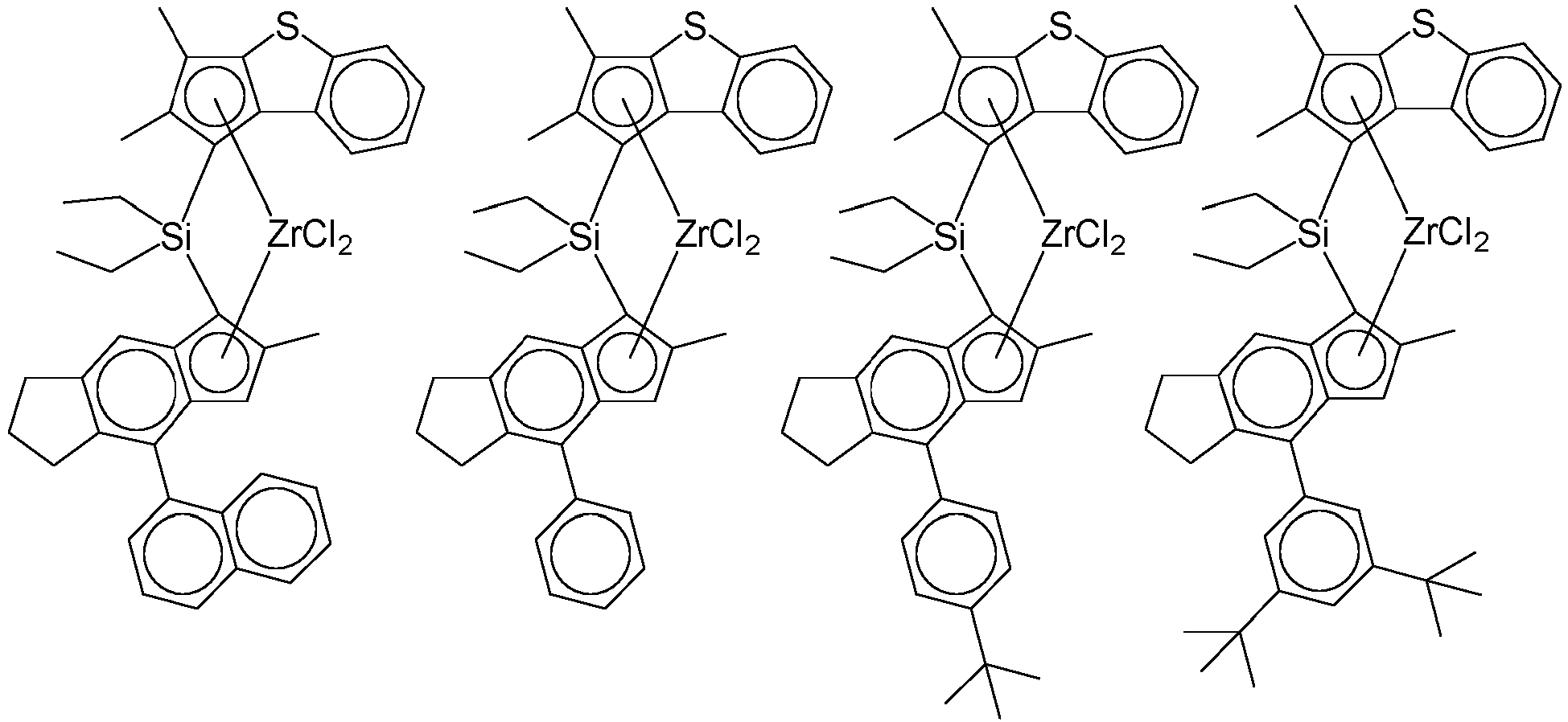

- Meanwhile, in Chemical Formula 2, Y3 and Y4 are each halogen, A2 is silicon (Si), and M2 is zirconium (Zr) or hafnium (Hf).
- Further, in Chemical Formula 2, R9 and R14 are the same as or different from each other, and may be each C1-6 or C1-3 linear or branched alkyl.
- Further, in Chemical Formula 2, R10 and R15 are the same as or different from each other, and may be each a phenyl group substituted with a C3-6 branched alkyl group.
- Further, in Chemical Formula 2, R11 to R13 and R16 to R18 may be each hydrogen or C1-6 linear or branched alkyl.
- Further, in Chemical Formula 2, Q3 and Q4 are the same as each other, and may be a C2-4 linear alkyl group, specifically, ethyl.
- The second metallocene compound may be a compound represented by the following structural formula:

- The first metallocene compound and the second metallocene compound may be supported at a molar ratio of 1:1 to 1:8.
- Further, the carrier may include hydroxyl groups and siloxane groups on the surface thereof, and may be preferably at least one selected from the group consisting of silica, silica-alumina, or silica-magnesia.
- Further, the hybrid supported metallocene catalyst of the present invention may further include one or more cocatalysts selected from the group consisting of compounds represented by the following Chemical Formulae 3 to 5:
[Chemical Formula 3] -[Al(R31)-O]c-
in Chemical Formula 3, - R31 is each independently halogen, C1-20 alkyl, or C1-20 haloalkyl, and
- c is an integer of 2 or more,
- D is aluminum or boron, and
- R41 is each independently hydrogen, halogen, C1-20 hydrocarbyl, or halogen-substituted C1-20 hydrocarbyl,
- L is a neutral or cationic Lewis base,
- [L-H]+ is a Bronsted acid,
- Q is B3+ or Al3+, and
- E is each independently C6-40 aryl or C1-20 alkyl, wherein C6-40 aryl or C1-20 alkyl is unsubstituted or substituted with one or more substituents selected from the group consisting of halogen, C1-20 alkyl, C1-20 alkoxy, or C6-40 aryloxy.
- Meanwhile, the present invention provides a method of preparing a polypropylene, the method including the step of polymerizing propylene monomers in the presence of the above-described hybrid supported metallocene catalyst.
- In this regard, the polypropylene may be a homopolymer, and the polypropylene may be polymerized by using the hybrid supported catalyst, in which the first and second metallocene compounds having specific substituents and structures as described are supported to exhibit high catalytic activity, and may have remarkably improved melt strength by introducing long chain branches (LCB) into polypropylene molecules.
- The terms used in this description are just for explaining exemplary embodiments and it is not intended to restrict the present invention.
- The singular expression may include the plural expression unless it is differently expressed contextually.
- It must be understood that the term "include", "equip", or "have" in the present description is only used for designating the existence of characteristics taken effect, numbers, steps, components, or combinations thereof, and do not exclude the existence or the possibility of addition of one or more different characteristics, numbers, steps, components or combinations thereof beforehand.
- In the present specification, when a layer or an element is mentioned to be formed "on" or "above" layers or elements, it means that each layer or element is directly formed on the layers or elements, or other layers or elements may be formed between the layers, subjects, or substrates.
- The present invention may be variously modified and have various forms, and specific exemplary embodiments will be illustrated and described in detail below. However, it is not intended to limit the present invention to the specific exemplary embodiments and it must be understood that the present invention includes every modifications, equivalents, or replacements included in the spirit and technical scope of the present invention.
- Hereinafter, the present invention will be described in detail.
- According to an aspect of the present invention, provided is a hybrid supported metallocene catalyst including one or more first metallocene compounds selected from compounds represented by the following Chemical Formula 1; one or more second metallocene compounds selected from compounds represented by the following Chemical Formula 2; and a carrier supporting the first and second metallocene compounds:


- M1 is a Group 4 transition metal,
- A1 is carbon (C), silicon (Si), or germanium (Ge),
- Q1 and Q2 are each independently C1-20 alkyl,
- R1 to R3 are each independently C1-20 alkyl,
- R4 is C6-20 aryl unsubstituted or substituted with C1-20 alkyl,
- R5 to R7 are each independently any one of hydrogen, C1-20 alkyl, C2-20 alkenyl, C6-30 aryl, C7-30 alkylaryl, or C7-30 arylalkyl, or two neighboring groups of the R5 to R7are connected to each other to form an aliphatic ring group,
- R8 is any one of hydrogen, C1-20 alkyl, C2-20 alkenyl, C6-30 aryl, C7-30 alkylaryl, or C7-30 arylalkyl,
- X1 and X2 are each independently a single bond, or S or CRaRb, wherein at least one of X1 or X2 is S, and Ra and Rb are each independently any one of hydrogen, C1-20 alkyl, C2-20 alkenyl, C6-30 aryl, C7-30 alkylaryl, or C7-30 arylalkyl,
- Y1 and Y2 are each independently halogen, and
- m is an integer of 1 to 4,
- M2 is a Group 4 transition metal;
- A2 is carbon (C), silicon (Si), or germanium (Ge),
- Y3 and Y4 are each independently halogen,
- R9 and R14 are each independently C1-20 alkyl or C6-20 aryl,
- R10 and R15 are each independently C6-40 aryl unsubstituted or substituted with C1-20 alkyl,
- R11 to R13 and R16 to R18 are each independently any one of hydrogen, halogen, C1-20 alkyl, C2-20 alkenyl, C1-20 alkylsilyl, C1-20 silylalkyl, C1-20 alkoxysilyl, C1-20 ether, C1-20 silylether, C1-20 alkoxy, C6-40 aryl, C7-20 alkylaryl, or C7-20 arylalkyl, and
- Q3 and Q4 are the same as each other, and are C2-20 alkyl.
- Unless otherwise specified herein, the following terms may be defined as follows.
- The halogen may be fluorine (F), chlorine (CI), bromine (Br), or iodine (I).
- The alkyl having 1 to 20 carbons (C1-20) may be a linear, branched, or cyclic alkyl. Specifically, the C1-20 alkyl may be C1-20 linear alkyl; C1-15 linear alkyl; C1-5 linear alkyl; C3-20 branched or cyclic alkyl; C3-15 branched or cyclic alkyl; or C3-10 branched or cyclic alkyl. For example, the C1-20 alkyl may be methyl, ethyl, propyl, isopropyl, n-butyl, tert-butyl, pentyl, hexyl, heptyl, octyl, cyclopropyl, cyclobutyl, cyclopentyl, cyclohexyl, cycloheptyl, cyclooctyl, and the like, but is not limited thereto.
- The alkenyl having 2 to 20 carbons (C2-20) may include linear or branched alkenyl, and specifically, may include allyl, ethenyl, propenyl, butenyl, pentenyl, and the like, but is not limited thereto.
- The alkoxy having 1 to 20 carbons (C1-20) may include methoxy, ethoxy, isopropoxy, n-butoxy, tert-butoxy, cyclohexyloxy, and the like, but is not limited thereto.
- The alkoxyalkyl having 2 to 20 carbons (C2-20) is a functional group, in which one or more hydrogens of the above-mentioned alkyl are substituted with alkoxy, and specifically, may include alkoxyalkyl such as methoxymethyl, methoxyethyl, ethoxymethyl, iso-propoxymethyl, iso-propoxyethyl, iso-propoxypropyl, iso-propoxyhexyl, tert-butoxymethyl, tert-butoxyethyl, tert-butoxypropyl, tert-butoxyhexyl, and the like, but is not limited thereto.
- The aryloxy having 6 to 40 carbons (C6-40) may include phenoxy, biphenoxyl, naphthoxy, and the like, but is not limited thereto.
- The aryloxyalkyl having 7 to 40 carbons (C7-40) is a functional group, in which one or more hydrogens of the above-mentioned alkyl are substituted with aryloxy, and specifically, may include phenoxymethyl, phenoxyethyl, phenoxyhexyl, and the like, but is not limited thereto.
- The alkylsilyl having 1 to 20 carbons (C1-20) or the alkoxysilyl having 1 to 20 carbons (C1-20) is a functional group in which 1 to 3 hydrogens of -SiH3 are substituted with 1 to 3 alkyl or alkoxy described above, and specifically, may include alkylsilyl such as methylsilyl, dimethylsilyl, trimethylsilyl, dimethylethylsilyl, diethylmethylsilyl, dimethylpropylsilyl, and the like.; alkoxysilyl such as methoxysilyl, dimethoxysilyl, trimethoxysilyl, dimethoxyethoxysilyl, and the like.; or alkoxyalkylsilyl such as methoxydimethylsilyl, diethoxymethylsilyl, dimethoxypropylsilyl, and the like, but is not limited thereto.
- The silylalkyl having 1 to 20 carbons (C1-20) is a functional group, in which one or more hydrogens of the above-mentioned alkyl are substituted with silyl, and specifically, may include -CH2-SiH3, methylsilylmethyl, dimethylethoxysilylpropyl, and the like, but is not limited thereto.
- Further, the alkylene having 1 to 20 carbons (C1-20) is the same as the above-mentioned alkyl, except that it is a divalent substituent, and specifically, may include methylene, ethylene, propylene, butylene, pentylene, hexylene, heptylene, octylene, cyclopropylene, cyclobutylene, cyclopentylene, cyclohexylene, cycloheptylene, cyclooctylene, and the like, but is not limited thereto.
- The aryl having 6 to 20 carbons (C6-20) may be a monocyclic, bicyclic, or tricyclic aromatic hydrocarbon. For example, the aryl having 6 to 20 carbons (C6-20) may include phenyl, biphenyl, naphthyl, anthracenyl, phenanthrenyl, fluorenyl, and the like, but is not limited thereto.
- The alkylaryl having 7 to 20 carbons (C7-20) may refer to a substituent in which one or more hydrogens of the aromatic ring are substituted with the above-mentioned alkyl. For example, the alkylaryl having 7 to 20 carbons (C7-20) may include methylphenyl, ethylphenyl, methylbiphenyl, methylnaphthyl, and the like, but is not limited thereto.
- The arylalkyl having 7 to 20 carbons (C7-20) may refer to a substituent in which one or more hydrogens of the alkyl are substituted with the above-mentioned alkyl. For example, the arylalkyl having 7 to 20 carbons (C7-20) may include phenylmethyl, phenylethyl, biphenylmethyl, naphthylmethyl, and the like, but is not limited thereto.
- In addition, the arylene having 6 to 20 carbons (C6-20) is the same as the above-mentioned aryl, except that it is a divalent substituent, and specifically, may include phenylene, biphenylene, naphthylene, anthracenylene, phenanthrenylene, fluorenylene, and the like, but is not limited thereto.
- The Group 4 transition metal may be titanium (Ti), zirconium (Zr), hafnium (Hf), or rutherfordium (Rf), specifically, titanium (Ti), zirconium (Zr), or hafnium (Hf), and more specifically, zirconium (Zr), or hafnium (Hf), but is not limited thereto.
- Further, the Group 13 element may be boron (B), aluminum (Al), gallium (Ga), indium (In), or thallium (TI), and specifically, boron (B) or aluminum (Al), but is not limited thereto.
- The above-mentioned substituents may be optionally substituted with one or more substituents selected from the group consisting of a hydroxy group; halogen; alkyl or alkenyl, aryl, alkoxy; alkyl or alkenyl, aryl, alkoxy containing one or more heteroatoms of Groups 14 to 16 heteroatoms; silyl; alkylsilyl or alkoxysilyl; a phosphine group; a phosphide group; a sulfonate group; and a sulfone group within a range to exert the same or similar effect as the desired effect.
- Meanwhile, the hybrid supported catalyst of the present invention, in which the first metallocene compound forming a double bond at the end and the second metallocene compound having high molecular weight properties during propylene polymerization are hybrid-supported, exhibits high activity in propylene polymerization, and is usefully applied to the preparation of polypropylenes with high melt strength by introducing long chain branches (LCB) into the polypropylene molecules.
- Specifically, the first metallocene compound of Chemical Formula 1 includes S having unshared pairs of electrons in the ligand structure, and thus more abundant electrons may be provided for metal atoms, thereby stabilizing vacant sites of the transition metal included in a bridge group. Accordingly, it is possible to induce beta-hydride elimination of the polymer chain to form a macromer having a double bond at the end, and in particular, a vinyl end group that may serve as a monomer may be included in a high ratio, thereby introducing long chain branches (LCB) into the polypropylene molecule.
- In general, a polymer having a terminal group (or end group) saturated with hydrogen is produced upon chain termination in the presence of hydrogen. Production of a polymer having a double bond as a terminal group may be caused by structural characteristics of a catalyst.
- The production of a polymer having a double bond at the end is performed according to two mechanisms: beta-hydrogen-elimination or beta-methyl-extraction, as shown in Reaction Scheme 1 below.


- In Reaction Scheme 1, M is a metal element, H is a hydrogen atom, and Me is methyl.
- In general, beta-hydrogen elimination (β-hydrogen-elimination) occurs more easily, but a vinylidene end group produced at this time is replaced by a substituent to lose its role as a monomer, and thus it is inactive as a macromonomer. In contrast, the vinyl end group generated by the beta-methyl elimination is active, and may serve as a monomer.
- In particular, the first metallocene compound of Chemical Formula 1 includes S having unshared pairs of electrons in the ligand structure, thereby providing more abundant electrons for metal atoms. Accordingly, even when the metal atoms have vacant sites, they may maintain stability, and thus a vinyl end group may be generated. In contrast, with regard to general transition metal compounds, when a metal atom has a vacant site, it forms a metal-hydrogen bond (Metal-H bond) to become stable, and thus an inactive vinylidene end group is generated. Accordingly, when the transition metal compound according to the present invention is used as a catalyst for the polymer preparation, it is possible to generate a polymer having a high proportion of vinyl end group and a low proportion of vinylidene end group.
- In addition, since the first metallocene compound of Chemical Formula 1 includes two ligand structures having different asymmetric structures, it may have various characteristics of the two different ligands or may selectively take advantages thereof, and as a result, it may exhibit superior catalytic activity.
- Of the two ligands in the first metallocene compound of Chemical Formula 1, in a first ligand including a cyclopentadienyl group, in which S is included and two ring structures are fused, C1-20 alkyl(R1 and R2) is substituted at the 2 and 3-positions, respectively, and in a second ligand having an indene structure or a structure, in which an aliphatic ring is further fused to the benzene ring of the indene, C1-20 alkyl(R3) is substituted at the 2-position, and C6-20 aryl(R4) unsubstituted or substituted with C1-20 alkyl is substituted at the 4-position, respectively. Therefore, superior catalytic activity may be achieved due to an induction effect of providing sufficient electrons, and when the first metallocene compound is used as a catalyst for polypropylene polymerization, tacticity of the molecular structure of polypropylene may be easily controlled to lower a melting point. In particular, R4 substituted at the 4-position of the second ligand includes an aryl group to increase aromaticity of the first metallocene compound, thereby further improving the catalytic activity.
- Further, the first metallocene compound includes a functional group A1 disubstituted with C1-20 alkyl (Q1 and Q2) as a bridge group connecting the two ligands to each other. Thus, the atomic size increases and the available angle increases, and accordingly, monomers may be easily accessible, thereby achieving superior catalytic activity. In addition, Q1 and Q2 which are substituents of A1 may increase solubility of the transition metal compound to improve the supporting efficiency during preparation of the supported catalyst.
- Meanwhile, the second metallocene compound represented by Chemical Formula 2 includes a divalent functional group A2 disubstituted with the same alkyl groups having two or more carbons as a bridge group connecting the two indenyl ligands to each other. Thus, its atomic size increases, as compared with existing carbon bridges, and the available angle increases, and accordingly, monomers may be easily accessible, thereby achieving superior catalytic activity. In particular, since the second metallocene compound represented by Chemical Formula 2 has superior tacticity to the first metallocene compound represented by Chemical Formula 1, it is suitable for propylene polymerization and has superior catalytic activity, and thus plays a role in polymerizing a polymer chain having a high molecular weight.
- Therefore, the hybrid supported metallocene catalyst further includes the second metallocene compound, in addition to the first metallocene compound, that is, the hybrid supported metallocene catalyst includes two or more different kinds of metallocene compounds, thereby exhibiting high activity in the propylene polymerization and preparing a polypropylene having excellent physical properties, in particular, improved melt strength by introducing long chain branches (LCB) into the polypropylene molecules.
- Specifically, in Chemical Formula 1, Q1 and Q2 may be the same as or different from each other, and may be each C1-6 or C1-5 alkyl, and specifically, methyl, ethyl, or n-hexyl.
- Further, in Chemical Formula 1, Y1 and Y2 may be each halogen, and specifically, chlorine.
- Further, in Chemical Formula 1, A1 may be silicon (Si).
- Further, in Chemical Formula 1, M1 may be zirconium (Zr) or hafnium (Hf), and specifically, zirconium (Zr). Since Zr has more electron-accepting orbitals than other Group 4 transition metals such as Hf, and the like, it may easily bind to monomers with higher affinity, thereby achieving superior catalytic activity. In addition, Zr may improve storage stability of a metal complex.
- Further, in Chemical Formula 1, R1 to R3 may be each independently C1-20, or C1-12, or C1-6 linear or branched alkyl, and more specifically, C1-6 or C1-4 linear alkyl such as methyl, ethyl, propyl, or n-butyl. More specifically, R1 to R3 may be each methyl.
- Further, in Chemical Formula 1, R4 may be C6-12 aryl unsubstituted or substituted with C1-8 linear or branched alkyl, and more specifically, phenyl or naphthyl unsubstituted or substituted with C3-6 branched alkyl. When substituted with alkyl, the aryl may be substituted with one or more alkyls, more specifically, one alkyl or two alkyls. Specific examples of R4 may include phenyl, 4-(tert-butyl)phenyl, 3,5-di-(tert-butyl)phenyl, naphthyl, and the like. Further, when R4 is phenyl substituted with C3-6 branched alkyl, the substitution position of the C3-6 branched alkyl group to the phenyl group may be the 4-position corresponding to a para position or 3- or 5-position corresponding a meta position with respect to the R4 position bound to the indenyl group.
- Further, in Chemical Formula 1, R5 to R7 may be each independently any one of hydrogen, C1-12 alkyl, C2-12 alkenyl, C6-18 aryl, C7-20 alkylaryl, or C7-20 arylalkyl, or two neighboring functional groups, for example, R5 and R6, or R6 and R7 are connected to each other to form a C3-12, or C4-8, or C5-6 aliphatic ring group (or aliphatic ring structure) such as cyclopentyl.
- Further, in Chemical Formula 1, R8 may be any one of hydrogen, C1-12 alkyl, C2-12 alkenyl, C6-12 aryl, C7-15 alkylaryl, or C7-15 arylalkyl. More specifically, R8 may be any one of hydrogen or C1-6 linear or branched alkyl. Specific examples of R8 may be hydrogen, methyl, ethyl, propyl, n-butyl, or t-butyl, and the like. Preferably, R8 may be hydrogen.
- Further, in Chemical Formula 1, X1 and X2 may be each independently a single bond, S or CRaRb, wherein any one of X1 or X2 may be S, and more specifically, any one of X1 or X2 may be S, and the other of X1 or X2 may be a single bond. For example, X1 may be S and X2 may be a single bond, or X1 may be a single bond and X2 may be S. In addition, when X1 or X2 is CRaRb, Ra and Rb may be, more specifically, each independently, any one of hydrogen, C1-10 alkyl, C2-10 alkenyl, C6-12 aryl, C7-13 alkylaryl, or C7-13 arylalkyl.
- Further, in Chemical Formula 1, Q1 and Q2 may be each independently C1-6 or C1-5 linear alkyl, and more specifically, methyl, ethyl, or n-hexyl, R1 to R3 may be each independently C1-6 or C1-4 linear alkyl, and more specifically, all of R1 to R3 may be methyl, R4 may be phenyl or naphthyl unsubstituted or substituted with C3-6 branched alkyl, and more specifically, phenyl, 4-tbutylphenyl, 3,5-di-tbutylphenyl, or naphthyl, R5 to R7 may be each independently hydrogen, or two neighboring groups of R5 to R7 are connected to each other to form a cyclopentyl group, and any one of X1 or X2 may be S, and the other of X1 or X2 may be a single bond.
- Further, in Chemical Formula 1, A1 may be silicon, M1 may be zirconium, Q1 and Q2 may be each independently C1-6 or C1-5 linear alkyl, and more specifically, methyl, ethyl, or n-hexyl, R1 to R3 may be each independently C1-6 or C1-4 linear alkyl, and more specifically, all of R1 to R3 may be methyl, R4 may be phenyl or naphthyl unsubstituted or substituted with C3-6 branched alkyl, and more specifically, phenyl, 4-tbutylphenyl, 3,5-di-tbutylphenyl, or naphthyl, R5 to R7 may be each independently hydrogen, or two neighboring groups of R5 to R7 are connected to each other to form a cyclopentyl group, and any one of X1 or X2 may be S, and the other of X1 or X2 may be a single bond. In this regard, R8 may be hydrogen.
- Further, the first metallocene compound represented by Chemical Formula 1 may be represented by any one of the following structural formulae:


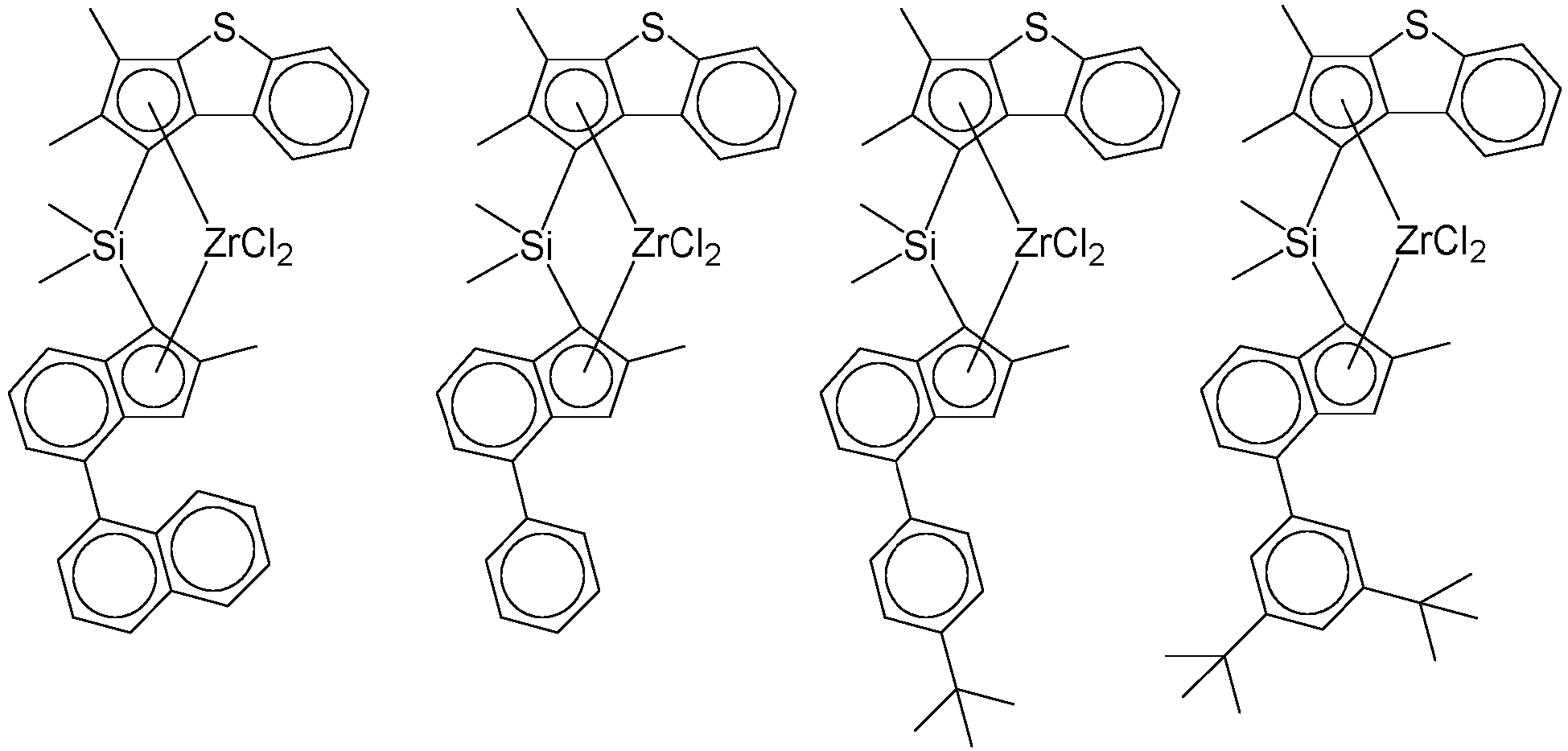


- Meanwhile, the hybrid supported metallocene catalyst of the present invention may further include the second metallocene compound, in addition to the above-described first metallocene compound.
- Specifically, in Chemical Formula 2, Y3 and Y4 may be each halogen, and specifically, chlorine.
- Further, in Chemical Formula 2, A2 may be silicon (Si).
- Further, in Chemical Formula 2, M2 may be zirconium (Zr) or hafnium (Hf), and specifically zirconium (Zr). Since Zr has more electron-accepting orbitals than other Group 4 transition metals such as Hf, and the like, it may easily bind to monomers with higher affinity, thereby achieving superior catalytic activity. In addition, Zr may improve storage stability of a metal complex.
- Further, in Chemical Formula 2, R9 and R14 may be each independently C1-20, or C1-6, or C1-4 linear or branched alkyl or C6-20 or C6-12 aryl, and more specifically, C1-6 or C1-4 linear or branched alkyl such as methyl, ethyl, or i-propyl. More specifically, R9 and R14 may be each methyl.
- Further, in Chemical Formula 2, R11 to R13 and R16 to R18 may be each independently hydrogen, methyl, ethyl, propyl, isopropyl, n-butyl, tert-butyl, pentyl, hexyl, heptyl, octyl, trimethylsilylmethyl, or two or more neighboring groups of R11 to R13 or R16 to R18 are connected to each other to form an aromatic ring unsubstituted or substituted with methyl or phenyl, but is not limited thereto.
- Further, in Chemical Formula 2, R10 and R15 may be each C6-12 aryl unsubstituted or substituted with C1-8 linear or branched alkyl, and more specifically, phenyl or naphthyl unsubstituted or substituted with C3-6 branched alkyl. Specific examples of R10 and R15 may include phenyl substituted with C3-6 branched alkyl, and preferably, tert-butylphenyl. Further, when R10 and R15 are phenyl substituted with C3-6 branched alkyl, the substitution position of the C3-6 branched alkyl group to the phenyl group may be the 4-position corresponding to a para position with respect to R10 and R15 positions bound to an indenyl group.
- Further, in Chemical Formula 2, Q3 and Q4 may be the same as each other, and may be C2-4 linear alkyl, and preferably, ethyl.
- Further, in Chemical Formula 2, Q3 and Q4 may be the same as each other, and may be C2-4 linear alkyl, and more specifically, Q3 and Q4 may be ethyl, R9 and R14 may be each independently C1-6 or C1-3 linear or branched alkyl, and more specifically, all of R9 and R14 may be methyl, R10 and R15 may be phenyl substituted with C3-6 branched alkyl, and more specifically, 4-t-butylphenyl, R11 to R13 and R16 to R18 may be each independently hydrogen or C1-3 linear or branched alkyl, and more specifically, R11 to R13 and R16 to R18 may be hydrogen.
- Further, in Chemical Formula 2, A2 may be silicon, M2 may be zirconium, Q3 and Q4 may be the same as each other, and may be C2-4 linear alkyl, and more specifically, Q3 and Q4 may be ethyl, R9 and R14 may be each independently C1-6 or C1-3 linear or branched alkyl, and more specifically, all of R9 and R14 may be methyl, R10 and R15 may be phenyl substituted with C3-6 branched alkyl, and more specifically, 4-t-butylphenyl, R11 to R13 and R16 to R18 may be each independently hydrogen or C1-3 linear or branched alkyl, and more specifically, R11 to R13 and R16 to R18 may be hydrogen.
- Further, in Chemical Formula 2, the second metallocene compound may include a compound represented by the following structural formula, but is not limited thereto:

- Meanwhile, in the present invention, the first metallocene compound and the second metallocene compound may be each a mesoisomer, a racemic isomer, or a mixture thereof.
- As used herein, the "racemic form", "racemate", or "racemic isomer" means that the same substituents on the two cyclopentadienyl moieties exist on the opposite side with respect to the plane containing the transition metal represented by M1 or M2 in Chemical Formula 1 or Chemical Formula 2, e.g., zirconium (Zr) or hafnium (Hf), and the center of the cyclopentadienyl moieties.
- As used herein, the term "meso form" or "meso isomer", which is a stereoisomer of a racemic form, means that the same substituents on the two cyclopentadienyl moieties exist on the same side with respect to the plane containing the transition metal represented by M1 or M2 in Chemical Formula 1 or Chemical Formula 2, e.g., zirconium (Zr) or hafnium (Hf), and the center of the cyclopentadienyl moieties.
- In the hybrid supported metallocene catalyst of the present invention, the first metallocene compound and the second metallocene compound may be supported at a molar ratio of about 1:1 to about 1:8. When the supporting ratio is less than about 1:1, only the first metallocene compound plays a leading role, and thus tacticity is significantly lowered during propylene polymerization, and the catalyst becomes highly sticky, which may make it difficult to form the polymer itself. Further, when the supporting ratio is higher than about 1:8, only the second metallocene compound plays a leading role, and the content of long chain branches (LCB) in the polypropylene molecule is lowered, which may lower melt strength.
- Specifically, the hybrid supported metallocene catalyst, in which the first metallocene compound and the second metallocene compound are supported at a molar ratio of about 1:1 to about 1:6 or at a molar ratio of about 1:1 to about 1:5, may introduce long chain branches (LCB) in the polypropylene molecule while exhibiting high activity in propylene polymerization, thereby preferably preparing a polypropylene with excellent physical properties, in particular, improved melt strength.
- In other words, the hybrid supported metallocene catalyst of the present invention, in which the first metallocene compound and the second metallocene compound are supported at the above molar ratio, may further improve melt strength of polypropylene due to interaction between two or more kinds of catalysts.
- In the hybrid supported metallocene catalyst of the present invention, a carrier including a hydroxy group on the surface thereof may be used as the carrier for supporting the first metallocene compound and the second metallocene compound, and preferably, the carrier may be a carrier including a highly reactive hydroxyl group or siloxane group, of which the surface is dried and removed of moisture.
- For example, silica, silica-alumina, and silica-magnesia dried at a high temperature may be used. These carriers may usually include oxide, carbonate, sulfate, and nitrate components such as Na2O, K2CO3, BaSO4, Mg(NO3)2, and the like.
- A temperature, at which the carrier is dried, may be preferably about 200 °C to about 800 °C, and more preferably, about 300 °C to about 600 °C, and most preferably, about 300 °C to about 400 °C. When the temperature, at which the carrier is dried, is lower than 200 °C, moisture is excessive so that the moisture on the surface may react with a cocatalyst described below, and when the temperature is higher than 800 °C, pores on the carrier surface are combined to decrease a surface area, and many hydroxy groups on the surface are lost so that only siloxane groups are left. Thus, reactive sites with the cocatalyst may be reduced, which is not preferable.
- An amount of the hydroxy group on the carrier surface may be preferably about 0.1 mmol/g to about 10 mmol/g, and more preferably about 0.5 mmol/g to about 5 mmol/g. The amount of the hydroxy group on the carrier surface may be adjusted by the preparation method and preparation conditions or drying conditions of the carrier, for example, temperature, time, vacuum or spray drying, and the like.
- When the amount of the hydroxy group is smaller than about 0.1 mmol/g, the number of reaction sites with the cocatalyst is small, and when the amount is larger than about 10 mmol/g, the hydroxy group may result from the moisture other than the hydroxy group present on the surface of carrier particles, which is not preferable.
- Further, in the hybrid supported metallocene catalyst, one or more first metallocene compounds and one or more second metallocene compounds are supported together with a cocatalyst compound on the carrier. The cocatalyst may be any cocatalyst, as long as it is a cocatalyst used for olefin polymerization in the presence of the common metallocene catalyst. Such a cocatalyst allows formation of a bond between the hydroxy groups on the carrier and the Group 13 transition metal. Further, since the cocatalyst exists only the surface of the carrier, it may contribute to obtaining intrinsic characteristics of the specific hybrid catalyst composition of the present invention without a fouling phenomenon, in which polymer particles stick to the wall surface of a reactor or stick to each other.
- Specifically, the hybrid supported metallocene catalyst may further include one or more cocatalysts selected from the group consisting of compounds represented by the following Chemical Formulae 3 to 5:
[Chemical Formula 3] -[Al(R31)-O]c-
in Chemical Formula 3, - R31 is each independently halogen, C1-20 alkyl, or C1-20 haloalkyl, and
- c is an integer of 2 or more,
- D is aluminum or boron, and
- R41 is each independently hydrogen, halogen, C1-20 hydrocarbyl or halogen-substituted C1-20 hydrocarbyl,
- L is a neutral or cationic Lewis base,
- [L-H]+ is a Bronsted acid,
- Q is B3+ or Al3+, and
- E is each independently C6-40 aryl or C1-20 alkyl, wherein C6-40 aryl or C1-20 alkyl is unsubstituted or substituted with one or more substituents selected from the group consisting of halogen, C1-20 alkyl, C1-20 alkoxy, and phenoxy.
- The compound represented by Chemical Formula 3 may be, for example, alkylaluminoxane, such as modified methyl aluminoxane (MMAO), methyl aluminoxane (MAO), ethylaluminoxane, isobutylaluminoxane, butylaluminoxane, and the like.
- The alkyl metal compound represented by Chemical Formula 4 may be, for example, trimethylaluminum, triethylaluminum, triisobutylaluminum, tripropylaluminum, tributylaluminum, dimethylchloroaluminum, dimethylisobutylaluminum, dimethylethylaluminum, diethylchloroaluminum, triisopropylaluminum, tri-s-butylaluminum, tricyclopentylaluminum, tripentylaluminum, triisopentylaluminum, trihexylaluminum, ethyldimethylaluminum, methyldiethylaluminum, triphenylaluminum, tri-p-tolylaluminum, dimethylaluminummethoxide, dimethylaluminumethoxide, trimethylboron, triethylboron, triisobutylboron, tripropylboron, tributylboron, and the like.
- The compound represented by Chemical Formula 5 may be, for example, triethylammonium tetraphenylboron, tributylammonium tetraphenylboron, trimethylammonium tetraphenylboron, tripropylammonium tetraphenylboron, trimethylammonium tetra(p-tolyl)boron, tripropylammonium tetra(p-tolyl)boron, triethylammonium tetra(o,p-dimethylphenyl)boron, trimethylammonium tetra(o,p-dimethylphenyl)boron, tributylammonium tetra(p-trifluoromethylphenyl)boron, trimethylammonium tetra(p-trifluoromethylphenyl)boron, tributylammonium tetrapentafluorophenylboron, N,N-diethylanilinium tetraphenylboron, N,N-diethylanilinium tetrapentafluorophenylboron, diethylammonium tetrapentafluorophenylboron, triphenylphosphonium tetraphenylboron, trimethylphosphonium tetraphenylboron, triethylammonium tetraphenylaluminum, tributylammonium tetraphenylaluminum, trimethylammonium tetraphenylaluminum, tripropylammonium tetraphenylaluminum, trimethylammonium tetra(p-tolyl)aluminum, tripropylammonium tetra(p-tolyl)aluminum, triethylammonium tetra(o,p-dimethylphenyl)aluminum, tributylammonium tetra(p-trifluoromethylphenyl)aluminum, trimethylammonium tetra(p-trifluoromethylphenyl)aluminum, tributylammonium tetrapentafluorophenylaluminum, N,N-diethylanilinium tetraphenylaluminum, N,N-diethylanilinium tetrapentafluorophenylaluminum, diethylammonium tetrapentafluorophenylaluminum, triphenylphosphonium tetraphenylaluminum, trimethylphosphonium tetraphenylaluminum, triphenylcarbonium tetraphenylboron, triphenylcarbonium tetraphenylaluminum, triphenylcarbonium tetra(p-trifluoromethylphenyl)boron, triphenylcarbonium tetrapentafluorophenylboron, and the like.
- In addition, the hybrid supported metallocene catalyst may include the cocatalyst and the first metallocene compound at a molar ratio of about 1:1 to about 1:10000, preferably, at a molar ratio of about 1:1 to about 1: 1000, and more preferably, at a molar ratio of about 1:10 to about 1:100.
- In addition, the hybrid supported metallocene catalyst may include the cocatalyst and the second metallocene compound at a molar ratio of about 1:1 to about 1:10000, preferably, at a molar ratio of about 1:1 to about 1: 1000, and more preferably, at a molar ratio of about 1:10 to about 1:100.
- In this regard, when the molar ratio is less than 1, the metal content in the cocatalyst is too low, and thus the catalytic active species is not well formed, and the activity may be lowered. When the molar ratio is more than about 10000, it is apprehended that the metal of the cocatalyst may rather act as a catalyst poison.
- The supporting amount of the cocatalyst may be about 5 mmol to about 20 mmol, based on 1 g of the carrier.
- Meanwhile, the hybrid supported metallocene catalyst may be prepared by a preparation method including the steps of supporting the cocatalyst on the carrier; supporting the first metallocene compound on the cocatalyst-supported carrier; and supporting the second metallocene compound on the cocatalyst- and the first metallocene compound-supported carrier.
- Alternatively, the hybrid supported metallocene catalyst may be prepared by a preparation method including the steps of supporting the cocatalyst on the carrier; supporting the second metallocene compound on the cocatalyst-supported carrier; and supporting the first metallocene compound on the cocatalyst- and the second metallocene compound-supported carrier.
- Alternatively, the hybrid supported metallocene catalyst may be prepared by a preparation method including the steps of supporting the first metallocene compound on the carrier; supporting the cocatalyst on the first metallocene compound-supported carrier; and supporting the second metallocene compound on the cocatalyst- and the first metallocene compound-supported carrier.
- In the above method, the supporting conditions are not particularly limited, and the supporting may be performed within a range well known to those skilled in the art. For example, the supporting may be appropriately performed at a high temperature and at a low temperature. For example, the supporting temperature may be in the range of about -30 °C to 150 °C, and may be preferably about 50 °C to about 98 °C, or about 55 °C to about 95 °C. The supporting time may be appropriately controlled depending on the amount of the first metallocene compound to be supported. The reacted supported catalyst may be used as it is, after the reaction solvent is removed through filtration or distillation under reduced pressure, or subjected to Soxhlet filtering using aromatic hydrocarbon such as toluene, if necessary.
- The preparation of the supported catalyst may be carried out in the presence of a solvent or without a solvent. When the solvent is used, it may include aliphatic hydrocarbon solvents such as hexane or pentane, aromatic hydrocarbon solvents such as toluene or benzene, chlorinated hydrocarbon solvents such as dichloromethane, ether solvents such as diethylether or tetrahydrofuran (THF), and common organic solvents such as acetone or ethylacetate. Preferred are hexane, heptane, toluene and dichloromethane.
- In the present invention, in the method of preparing the metallocene compound or the supported catalyst, equivalent (eq) means a molar equivalent (eq/mol).
- Meanwhile, the present invention provides a method of preparing a polypropylene, the method including the step of polymerizing propylene monomers in the presence of the hybrid supported metallocene catalyst.
- The polymerization reaction may be performed by homopolymerizing propylene using a single continuous slurry polymerization reactor, loop slurry reactor, gas phase reactor, or solution reactor.
- Further, the polymerization temperature may be about 25 °C to about 500 °C, or about 25 °C to about 300 °C, or about 30 °C to about 200 °C, or about 50 °C to about 150 °C, or about 60 °C to about 120 °C. Further, the polymerization pressure may be about 1 kgf/cm2 to about 100 kgf/cm2, or about 1 kgf/cm2 to about 50 kgf/cm2, or about 5 kgf/cm2 to about 45 kgf/cm2, or about 10 kgf/cm2 to about 40 kgf/cm2, or about 15 kgf/cm2 to about 35 kgf/cm2.
- The supported metallocene catalyst may be injected after being dissolved or diluted in a C5 to C12 aliphatic hydrocarbon solvent such as pentane, hexane, heptane, nonane, decane and an isomer thereof, in an aromatic hydrocarbon solvent such as toluene and benzene, or in a chlorinated hydrocarbon solvent such as dichloromethane and chlorobenzene. The solvent used herein is preferably used after removing a small amount of water or air, which acts as a catalyst poison, by treating with a small amount of alkyl aluminum. It is also possible to further use the cocatalyst.
- In particular, the hybrid supported metallocene catalyst according to the present invention exhibits high activity in the propylene polymerization, and is usefully applied to the preparation of polypropylenes with excellent physical properties, in particular, improved melt strength by introducing long chain branches (LCB) into the polypropylene molecules. Specifically, since the catalyst precursor of Chemical Formula 2 exhibiting high molecular weight properties during propylene polymerization is used together with the catalyst precursor of Chemical Formula 1 for the synthesis of a macromer having a double bond at the end, the hybrid supported metallocene catalyst of the present invention is advantageous in achieving high melt strength by introducing long chain branches (LCB) into the polypropylene molecule.
- For example, the step of polymerizing may be performed by injecting about 1500 ppm or less, or about 200 ppm to about 1500 ppm, about 1000 ppm or less, or about 250 ppm to about 1000 ppm, or about 850 ppm or less, or about 300 ppm to about 850 ppm of hydrogen gas, based on the content of propylene monomer.
- In such a propylene polymerization process, the transition metal compound of the present invention may exhibit high catalytic activity. For example, during propylene polymerization, the catalytic activity may be about 7.8 kg PP/g · cat · hr or more, or about 7.8 kg PP/g · cat · hr to about 50 kg PP/g · cat · hr, specifically 8.5 kg PP/g · cat · hr or more, or about 8.5 kg PP/g · cat · hr to about 40 kg PP/g · cat · hr, specifically, 9.5 kg PP/g · cat · hr or more, or about 9.5 kg PP/g · cat · hr to about 35 kg PP/g · cat · hr, as calculated as a ratio of the weight (kg PP) of the produced polypropylene to the weight (g) of the used supported catalyst, based on unit time (h).
- The step of polymerizing may be a step of homopolymerizing propylene monomers alone.
- In the present invention, when the hybrid supported metallocene catalyst, in which two or more kinds of metallocene compounds having specific substituents and structures as described are supported on a carrier, is used during polypropylene polymerization, high catalytic activity may be achieved in the polymerization process, and melt strength may be remarkably improved by introducing long chain branches into polypropylene molecules. The polypropylene having such properties may be applied to a wide range of products with different grades, depending on hydrogen reactivity.
- For example, a melting point (Tm) of the polypropylene may be 150 °C or lower, or 115 °C to 150 °C, or 148 °C or lower, or 118 °C to 148 °C, or 145 °C or lower, or 120 °C to 145 °C, or 140 °C or lower, or 125 °C to 140 °C. The polypropylene may have a melting point (Tm) of 150 °C or lower, in terms of exhibiting high melt strength through the introduction of long chain branches (LCB) into the polymer molecule. However, in terms of preventing the occurrence of fouling in the polymerization process, the melting point (Tm) of the polypropylene may be 115 °C or higher.
- In the present invention, the melting point (Tm) may be measured using a differential scanning calorimeter (DSC, device name: DSC 2920, manufacturer: TA instrument). In detail, the polypropylene polymer is heated to 200 °C by increasing the temperature, and then maintained at the same temperature for 5 minutes, followed by lowering the temperature to 30 °C. Then, the temperature is increased again, and the temperature corresponding to a peak in the DSC (Differential Scanning Calorimeter, manufactured by TA) curve is determined as the melting point (Tm). In this regard, the temperature is increased and decreased at a rate of 10 °C/min, respectively, and the melting point (Tm) is a result measured at a second temperature increase and decrease section. A detailed method of measuring the melting point (Tm) is as described in Experimental Example below.
- Further, the polypropylene may have tacticity (Pentad sequence distribution, mmmm) of 60% to 95.8%, or 65% to 95.5%, or 70% to 95%, or 75% to 94.5%. In terms of effectively controlling tacticity of the molecular structure of the polymer and improving melt strength by introducing long chain branches (LCB) into the polypropylene molecules, the polypropylene may maintain tacticity (Pentad sequence distribution, mmmm) in the above range.
- In the present invention, tacticity (Pentad sequence distribution, mmmm) may be measured using quantitative nuclear magnetic resonance (NMR) spectroscopy. In detail, after measuring the sequence distribution at the pentad level by 13C-NMR analysis, it is expressed as % of the pentad (mmmm) sequences having tacticity with respect to all pentad sequences. mmmm% is a value based on moles. A detailed method of measuring tacticity (Pentad sequence distribution, mmmm) is as described in Experimental Example below.
- The hybrid supported metallocene catalyst according to the present invention may exhibit high activity in propylene polymerization and may prepare a polypropylene having high melt strength by introducing long chain branches into the polypropylene molecule.
- Hereinafter, the actions and effects of the present invention will be described in more detail with reference to the specific exemplary embodiments. However, these exemplary embodiments are provided only for illustrating the present invention, and the scope of the present invention is not limited thereto.
-

- In a reactor, 1 equivalent of 1,2-dimethyl-3H-benzo[d]cyclopenta[b]thiophene was dissolved in tetrahydrofuran (THF) (0.7 M), and n-butyl lithium (n-BuLi, 1.05 eq) was slowly added dropwise at -25 °C, followed by stirring at room temperature for 3 hours. Thereafter, dichlorodimethylsilane (1.05 eq) was added at -10 °C, and stirred at room temperature for 24 hours to prepare a mono-Si solution.
- Separately, in another reactor, 1 equivalent of 4-(4'-tert-butylphenyl)-2-methyl-1H-indene was dissolved in a mixed solvent of toluene and THF (mixing volume ratio =5:1, 0.7 M), and n-BuLi (1.05 eq) was slowly added dropwise at -25 °C, followed by stirring at room temperature for 3 hours. Thereafter, CuCN (2 mol%) was added, followed by stirring for 30 minutes. Then, the same equivalent of the mono-Si solution previously prepared was added, followed by stirring at room temperature for 24 hours. After work-up with water, the resultant was dried to obtain a ligand compound.
- The prepared ligand compound was added to and dissolved in a mixed solvent of toluene and ether (mixing volume ratio=2:1, 0.7 M), and n-BuLi (2.05 eq) was added at-25 °C, followed by stirring at room temperature for 5 hours.
- In a separate flask, ZrCl4 (1 eq) was mixed with toluene (0.17 M) to prepare a slurry, and the prepared slurry was added to the ligand solution, followed by stirring at room temperature overnight.
- When the reaction was completed, the solvent was dried under vacuum. Dichloromethane was added again, and then LiCI was removed by filtration. The filtrate was dried under vacuum, and toluene was added thereto, followed by recrystallization at room temperature. The resulting solid was filtered and dried under vacuum to obtain the title transition metal compound.
- 1H-NMR (CDCl3, 500 MHz): 0.66(4H, m), 0.94 (6H, t), 1.33 (9H, s), 1.79 (6H, s), 2.12 (3H, s), 6.36 (1H, s), 7.30-7.49 (8H, m), 7.93 (1H, d)., 8.05 (1H, d)., 8.29 (1H, d).
-
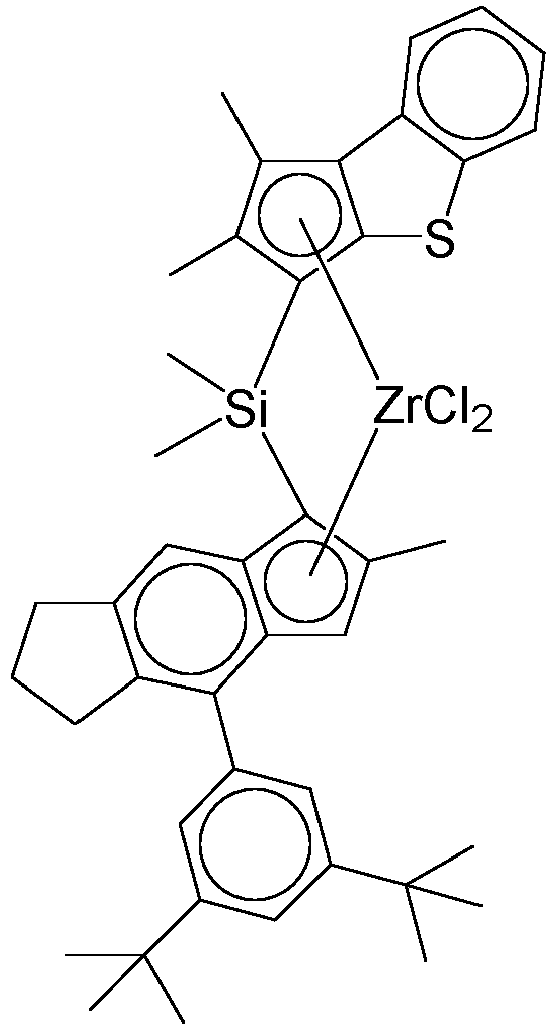
- A transition metal compound having the title structure was prepared in the same manner as in Synthesis Example 1, except that 4-(3',5'-di-tert-butylphenyl)-2-methyl-1,5,6,7-tetrahydro-s-indacene was used as a reactant instead of 4-(4'-tert-butylphenyl)-2-methyl-1H-indene in Synthesis Example 1.
- 1H-NMR (CDCl3, 500 MHz): 0.22(6H, s), 1.33(18H, s) 1.79(6H, s), 1.95 (2H, q), 2.30(3H, s) 2.97-3.02 (4H, m), 6.44(1H, s), 7.38-7.48 (3H, m), 7.73 (1H, d)., 7.95(1H, d). 8.01 (1H, d).
-
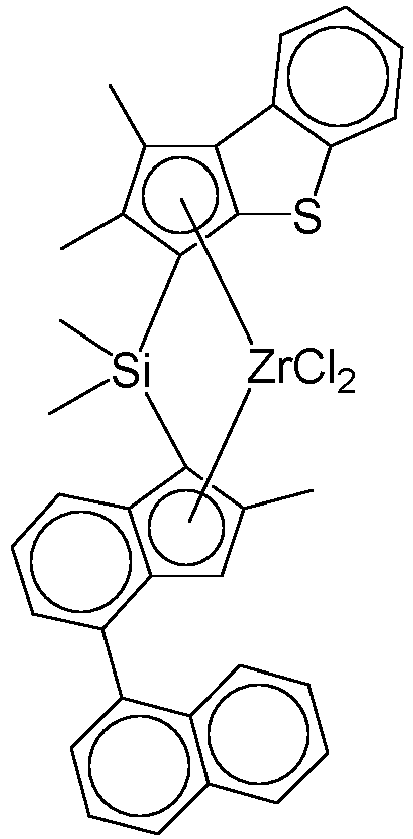
- A transition metal compound having the title structure was prepared in the same manner as in Synthesis Example 1, except that 2-methyl-4-naphthyl-1H-indene was used as a reactant instead of 4-(4'-tert-butylphenyl)-2-methyl-1H-indene in Synthesis Example 1.
- 1H-NMR (CDCl3, 500 MHz): 0.66(4H, m), 0.94 (6H, t), 1.79 (6H, s), 2.12 (3H, s), 6.36 (1H, s), 7.39-7.52 (6H, m), 7.77 (1H, t), 7.93 (1H, d)., 8.05-8.09 (2H, m), 8.20 (1H, d)., 8.29 (1H, d)., 8.50 (1H, d)., 8.95 (1H, d).
-
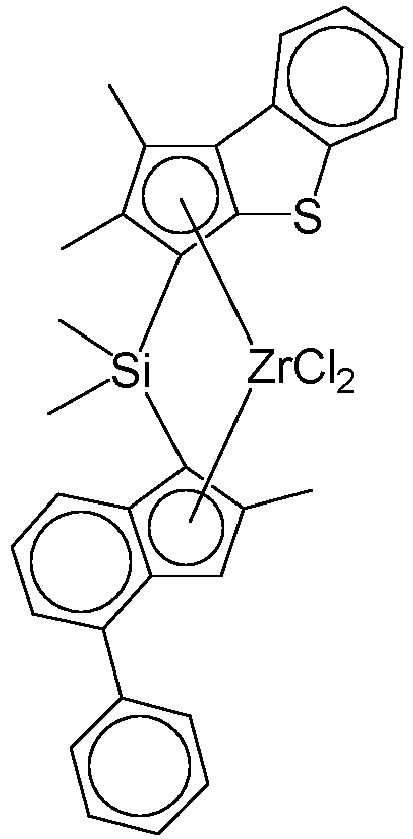
- A transition metal compound having the title structure was prepared in the same manner as in Synthesis Example 1, except that 2-methyl-4-phenyl-1H-indene was used as a reactant instead of 4-(4'-tert-butylphenyl)-2-methyl-1H-indene in Synthesis Example 1.
- 1H-NMR (CDCl3, 500 MHz): 0.21(6H, s), 1.79 (6H, s), 2.12 (3H, s), 6.36 (1H, s), 7.41-7.51 (9H, m), 7.93 (1H, d)., 8.05 (1H, d)., 8.29 (1H, d).
-

- A transition metal compound having the title structure was prepared in the same manner as in Synthesis Example 1, except that 4-(3',5'-di-tert-butylphenyl)-2-methyl-1H-indene was used as a reactant instead of 4-(4'-tert-butylphenyl)-2-methyl-1H-indene in Synthesis Example 1.
- 1H-NMR (CDCl3, 500 MHz): 0.66(4H, m), 0.94 (6H, t), 1.32 (18H, s) 1.79 (6H, s), 2.12 (3H, s), 6.36 (1H, s), 7.42-7.55 (5H, m), 7.73 (2H, s), 7.93 (1H, d)., 8.05 (1H, d)., 8.29 (1H, d).
-
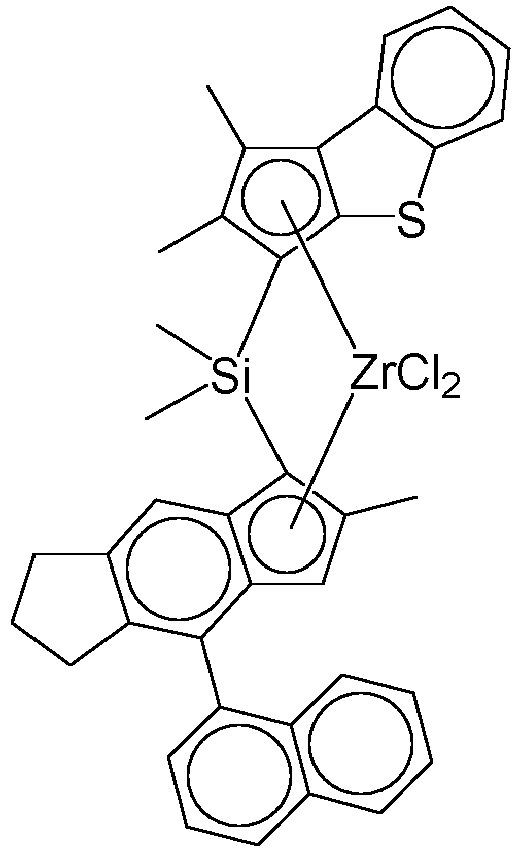
- A transition metal compound having the title structure was prepared in the same manner as in Synthesis Example 1, except that 4-naphthyl-2-methyl-1,5,6,7-tetrahydro-s-indacene was used as a reactant instead of 4-(4'-tert-butylphenyl)-2-methyl-1H-indene in Synthesis Example 1.
- 1H-NMR (CDCl3, 500 MHz): 0.21(6H, s) 1.79(6H, s), 1.94 (2H, q), 2.12 (3H,s) 2.85-2.90 (4H, m), 6.36 (1H, s), 7.30-7.52 (5H, m), 7.75 (1H, m), 7.93 (1H, d)., 8.01-8.05 (2H, m), 8.20 (1H, d)., 8.50 (1H, d)., 8.95(1H, d).
-

- A transition metal compound having the title structure was prepared in the same manner as in Synthesis Example 1, except that 4-phenyl-2-methyl-1,5,6,7-tetrahydro-s-indacene was used as a reactant instead of 4-(4'-tert-butylphenyl)-2-methyl-1H-indene in Synthesis Example 1.
- 1H-NMR (CDCl3, 500 MHz): 0.23(6H, s) 1.77(6H, s), 1.98 (2H, q), 2.26(3H, s) 2.97-3.02 (4H, m), 6.40 (1H, s), 7.32-7.52 (8H, m), 7.83 (1H, d)., 8.05 (1H, m).
-

- A transition metal compound having the title structure was prepared in the same manner as in Synthesis Example 1, except that 4-(4'-tert-butylphenyl)-2-methyl-1,5,6,7-tetrahydro-s-indacene was used as a reactant instead of 4-(4'-tert-butylphenyl)-2-methyl-1H-indene in Synthesis Example 1.
- 1H-NMR (CDCl3, 500 MHz): 0.22(6H, s), 1.33(9H, s) 1.79(6H, s), 1.95 (2H, q), 2.30(3H, s) 2.97-3.02 (4H, m), 6.44(1H, s), 7.38-7.48 (5H, m), 7.73 (1H, d)., 8.01 (1H, d).
-

- A transition metal compound having the title structure was prepared in the same manner as in Synthesis Example 1, except that 1,2-dimethyl-3H-benzo[b]cyclopenta[d]thiophene was used instead of 1,2-dimethyl-3H-benzo[d]cyclopenta[b]thiophene in Synthesis Example 1.
- 1H-NMR (CDCl3, 500 MHz): 0.24(6H, s), 1.40 (9H, s), 1.79(6H, s), 2.12 (3H, s), 6.36(1H, s), 7.30-7.51 (8H, m), 7.70 (1H, d)., 7.90 (1H, d)., 8.10 (1H, d).
-

- A transition metal compound having the title structure was prepared in the same manner as in Synthesis Example 2, except that 1,2-dimethyl-3H-benzo[b]cyclopenta[d]thiophene was used as a reactant instead of 1,2-dimethyl-3H-benzo[d]cyclopenta[b]thiophene in Synthesis Example 2.
- 1H-NMR (CDCl3, 500 MHz): 0.23(6H, s), 1.32 (18H, s), 1.75(6H, s), 1.90 (2H, q), 2.28 (3H, s), 2.85(4H, m), 6.35(1H, s), 7.45-7.49 (3H, m), 7.74 (3H, m), 7.90(1H, d).
-

- A transition metal compound having the title structure was prepared in the same manner as in Synthesis Example 3, except that 1,2-dimethyl-3H-benzo[b]cyclopenta[d]thiophene was used instead of 1,2-dimethyl-3H-benzo[d]cyclopenta[b]thiophene in Synthesis Example 3.
- 1H-NMR (CDCl3, 500 MHz): 0.21 (6H, s), 1.79 (6H, s), 2.18 (6H, s), 6.95 (1H, s), 7.323-7.42 (6H, m), 7.73-7.79 (2H, m), 7.95 (1H, d)., 8.10 (1H, d)., 8.18 (1H, d)., 8.25 (1H, d)., 8.38 (1H, d)., 8.59 (1H, d).
-

- A transition metal compound having the title structure was prepared in the same manner as in Synthesis Example 4, except that 1,2-dimethyl-3H-benzo[b]cyclopenta[d]thiophene was used as a reactant instead of 1,2-dimethyl-3H-benzo[d]cyclopenta[b]thiophene in Synthesis Example 4.
- 1H-NMR (CDCl3, 500 MHz): 0.24 (6H, s), 1.79 (6H, s), 2.20 (3H, s), 7.30-7.49 (9H, m), 7.79 (1H, d)., 7.93 (1H, d)., 8.10 (1H, d).
-
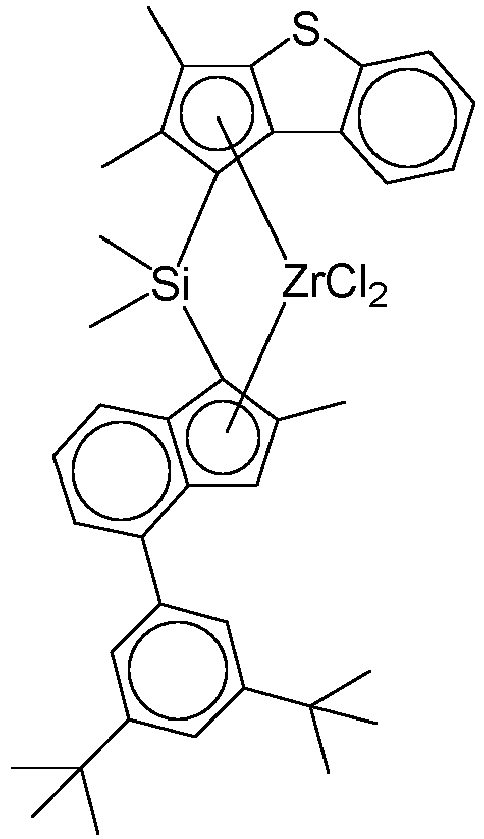
- A transition metal compound having the title structure was prepared in the same manner as in Synthesis Example 5, except that 1,2-dimethyl-3H-benzo[b]cyclopenta[d]thiophene was used as a reactant instead of 1,2-dimethyl-3H-benzo[d]cyclopenta[b]thiophene in Synthesis Example 5.
- 1H-NMR (CDCl3, 500 MHz): 0.24 (6H, s), 1.35 (18H, s), 1.70(6H, s), 2.17 (3H, s), 6.29(1H, s), 7.30-7.43 (5H, m), 7.74 (1H, d)., 7.80 (1H, d)., 8.17 (1H, d).
-

- A transition metal compound having the title structure was prepared in the same manner as in Synthesis Example 6, except that 1,2-dimethyl-3H-benzo[b]cyclopenta[d]thiophene was used as a reactant instead of 1,2-dimethyl-3H-benzo[d]cyclopenta[b]thiophene in Synthesis Example 6.
- 1H-NMR (CDCl3, 500 MHz): 0.20 (6H, s), 1.74(6H, s), 1.95 (2H, q), 2.18 (3H, s), 2.80(4H, m), 6.37(1H, s), 7.40-7.43 (5H, m), 7.70 (2H, m), 7.90 (1H, d), 7.99 (1H, d)., 8.17 (1H, d)., 8.45 (1H, d)., 8.79 (1H, d).
-

- A transition metal compound having the title structure was prepared in the same manner as in Synthesis Example 7, except that 1,2-dimethyl-3H-benzo[b]cyclopenta[d]thiophene was used as a reactant instead of 1,2-dimethyl-3H-benzo[d]cyclopenta[b]thiophene in Synthesis Example 7.
- 1H-NMR (CDCl3, 500 MHz): 0.25 (6H, s), 1.79(6H, s), 1.89 (2H, q), 2.18 (3H, s), 2.80(4H, m), 6.35(1H, s), 7.39-7.43 (8H, m), 7.74 (1H, d)., 7.93(1H, d).
-

- A transition metal compound having the title structure was prepared in the same manner as in Synthesis Example 8, except that 1,2-dimethyl-3H-benzo[b]cyclopenta[d]thiophene was used as a reactant instead of 1,2-dimethyl-3H-benzo[d]cyclopenta[b]thiophene in Synthesis Example 8.
- 1H-NMR (CDCl3, 500 MHz): 0.22(6H, s), 1.33 (9H, s), 1.71(6H, s), 1.95 (2H, q), 2.28 (3H, s), 2.85(4H, m), 6.35(1H, s), 7.30-7.43 (7H, m), 7.74 (1H, d)., 7.90(1H, d).
-

- A transition metal compound having the title structure was prepared in the same manner as in Synthesis Example 1, except that dichlorodiethylsilane was used instead of dichlorodimethylsilane in Synthesis Example 1.
- 1H-NMR (CDCl3, 500MHz): 0.66(4H, m), 0.94 (6H, t), 1.33 (9H, s), 1.79 (6H, s), 2.12 (3H, s), 6.36 (1H, s), 7.30-7.49 (8H, m), 7.93 (1H, d)., 8.05 (1H, d)., 8.29 (1H, d).
-

- A transition metal compound having the title structure was prepared in the same manner as in Synthesis Example 8, except that dichlorohexylmethylsilane was used instead of dichlorodimethylsilane in Synthesis Example 1.
- 1H-NMR (CDCl3, 500 MHz): 0.21(3H, s), 0.60 (2H, t), 0.88(2H, t), 1.23-1.29 (6H, m), 1.33 (9H, s), 1.79 (6H, s), 2.12 (3H, s), 6.36 (1H, s), 7.30-7.49 (8H, m), 7.93 (1H, d)., 8.05 (1H, d)., 8.29 (1H, d).
-
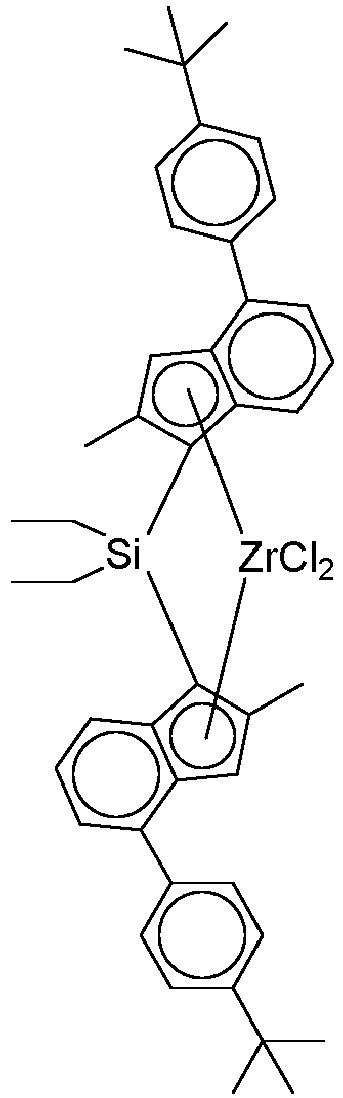
- 2-methyl-4-tert-butyl-phenylindene (20.0 g) was dissolved in a toluene/THF=10/1 solution (220 mL), and n-butyl lithium solution (2.5 M, hexane solvent, 22.2 g) was slowly added dropwise at 0 °C, followed by stirring at room temperature for one day. Thereafter, diethyldichlorosilane (6.2 g) was slowly added dropwise to the mixed solution at -78 °C, and stirred at for about 10 minutes, and then stirred at room temperature for one day. Thereafter, water was added to separate an organic layer, and then the solvent was distilled under reduced pressure to obtain (diethylsilane-diyl)-bis((2-methyl-4-tert-butyl-phenylindenyl)silane.
- The (diethylsilane-diyl)-bis((2-methyl-4-tert-butyl-phenylindenyl)silane prepared in 19-1 was dissolved in a toluene/THF=5/1 solution (120 mL), and then n-butyl lithium solution (2.5 M, hexane solvent, 22.2 g) was slowly added dropwise at -78 °C, followed by stirring at room temperature for one day. To the resulted reactant solution, a solution prepared by diluting zirconium chloride (8.9 g) with toluene (20 mL) was slowly added dropwise at -78 °C, and stirred at room temperature for one day. From the reactant solution, the solvent was removed under reduced pressure, and dichloromethane was added, followed by filtering. The filtrate was removed by distillation under reduced pressure. Recrystallization was performed using toluene and hexane to obtain high-purity rac-[(diethylsilane-diyl)-bis((2-methyl-4-tert-butyl-phenylindenyl)]zirconium dichloride (10.1 g, 34%, rac:meso=20:1).
- 100 mL of a toluene solution was put in a high-pressure reactor, and the reactor temperature was maintained at 40 °C. 10 g of silica(SP2408HT) which was dehydrated under vacuum at a temperature of 600 °C for 12 hours was put in a 500 L reactor, and 12 mmol of methylaluminoxane(MAO) was added, and allowed to react at 95 °C for 12 hours. Thereafter, 30 µmol of the first metallocene compound of Synthesis Example 1 and 60 µmol of the second metallocene compound of Synthesis Example 17 were dissolved in toluene, and allowed to react for 5 hours under stirring at 200 rpm at 50 °C.
- When the reaction was completed, the stirring was stopped, followed by washing with a sufficient amount of toluene. Then, 50 mL of toluene was added again, and stirred for 10 minutes. Then, the stirring was stopped, and washing was performed using a sufficient amount of toluene to remove compounds which did not participate in the reaction. Thereafter, 50 mL of hexane was added, followed by stirring. This hexane slurry was transferred to a filter to perform filtration.
- The resulting product was primarily dried at room temperature under reduced pressure for 5 hours, and then secondarily dried at 40 °C under reduced pressure for 4 hours to obtain a hybrid supported catalyst.
- A hybrid supported metallocene catalyst was prepared in the same manner as in Preparation Example 1, except that 60 µmol of the metallocene compound prepared in Synthesis Example 1 was added, and 60 µmol of the metallocene compound prepared in Synthesis Example 17 was added.
- A hybrid supported metallocene catalyst was prepared in the same manner as in Preparation Example 1, except that 12 µmol of the metallocene compound prepared in Synthesis Example 1 was added, and 60 µmol of the metallocene compound prepared in Synthesis Example 17 was added.
- A hybrid supported metallocene catalyst was prepared in the same manner as in Preparation Example 1, except that the metallocene compound prepared in Synthesis Example 2 was used instead of the first metallocene compound prepared in Synthesis Example 1.
- A hybrid supported metallocene catalyst was prepared in the same manner as in Preparation Example 1, except that the metallocene compound prepared in Synthesis Example 3 was used instead of the first metallocene compound prepared in Synthesis Example 1.
- A hybrid supported metallocene catalyst was prepared in the same manner as in Preparation Example 1, except that the metallocene compound prepared in Synthesis Example 4 was used instead of the first metallocene compound prepared in Synthesis Example 1.
- A hybrid supported metallocene catalyst was prepared in the same manner as in Preparation Example 1, except that the metallocene compound prepared in Synthesis Example 5 was used instead of the first metallocene compound prepared in Synthesis Example 1.
- A hybrid supported metallocene catalyst was prepared in the same manner as in Preparation Example 1, except that the metallocene compound prepared in Synthesis Example 6 was used instead of the first metallocene compound prepared in Synthesis
- A hybrid supported metallocene catalyst was prepared in the same manner as in Preparation Example 1, except that the metallocene compound prepared in Synthesis Example 7 was used instead of the first metallocene compound prepared in Synthesis Example 1.
- A hybrid supported metallocene catalyst was prepared in the same manner as in Preparation Example 1, except that the metallocene compound prepared in Synthesis Example 8 was used instead of the first metallocene compound prepared in Synthesis Example 1.
- A hybrid supported metallocene catalyst was prepared in the same manner as in Preparation Example 1, except that the metallocene compound prepared in Synthesis Example 9 was used instead of the first metallocene compound prepared in Synthesis Example 1.
- A hybrid supported metallocene catalyst was prepared in the same manner as in Preparation Example 1, except that the metallocene compound prepared in Synthesis Example 10 was used instead of the first metallocene compound prepared in Synthesis Example 1.
- A hybrid supported metallocene catalyst was prepared in the same manner as in Preparation Example 1, except that the metallocene compound prepared in Synthesis Example 11 was used instead of the first metallocene compound prepared in Synthesis Example 1.
- A hybrid supported metallocene catalyst was prepared in the same manner as in Preparation Example 1, except that the metallocene compound prepared in Synthesis Example 12 was used instead of the first metallocene compound prepared in Synthesis Example 1.
- A hybrid supported metallocene catalyst was prepared in the same manner as in Preparation Example 1, except that the metallocene compound prepared in Synthesis Example 13 was used instead of the first metallocene compound prepared in Synthesis Example 1.
- A hybrid supported metallocene catalyst was prepared in the same manner as in Preparation Example 1, except that the metallocene compound prepared in Synthesis Example 14 was used instead of the first metallocene compound prepared in Synthesis Example 1.
- A hybrid supported metallocene catalyst was prepared in the same manner as in Preparation Example 1, except that the metallocene compound prepared in Synthesis Example 15 was used instead of the first metallocene compound prepared in Synthesis Example 1.
- A hybrid supported metallocene catalyst was prepared in the same manner as in Preparation Example 1, except that the metallocene compound prepared in Synthesis Example 16 was used instead of the first metallocene compound prepared in Synthesis Example 1.
- A hybrid supported metallocene catalyst was prepared in the same manner as in Preparation Example 1, except that the metallocene compound prepared in Synthesis Example 17 was used instead of the first metallocene compound prepared in Synthesis Example 1.
- A hybrid supported metallocene catalyst was prepared in the same manner as in Preparation Example 1, except that the metallocene compound prepared in Synthesis Example 18 was used instead of the first metallocene compound prepared in Synthesis Example 1.
- 100 mL of a toluene solution was put in a high-pressure reactor, and the reactor temperature was maintained at 40°C. 10 g of silica(SP2408HT) which was dehydrated under vacuum at a temperature of 600°C for 12 hours was put in a 500 L reactor, and 12 mmol of methylaluminoxane(MAO) was added, and allowed to react at 95°C for 12 hours. Thereafter, 90 µmol of the second metallocene compound prepared in Synthesis Example 19 was dissolved in toluene, and added thereto, and allowed to react for 5 hours under stirring at 200 rpm at 50°C.
- When the reaction was completed, the stirring was stopped, followed by washing with a sufficient amount of toluene. Then, 50 mL of toluene was added again, and stirred for 10 minutes. Then, the stirring was stopped, and washing was performed using a sufficient amount of toluene to remove compounds which did not participate in the reaction. Thereafter, 50 mL of hexane was added, followed by stirring. This hexane slurry was transferred to a filter to perform filtration.
- The resulting product was primarily dried at room temperature under reduced pressure for 5 hours, and then secondarily dried at 40 °C under reduced pressure for 4 hours to obtain a single supported catalyst.
- A single supported metallocene catalyst was prepared in the same manner as in Comparative Preparation Example 1, except that the first metallocene compound prepared in Synthesis Example 1 was used instead of the second metallocene compound prepared in Synthesis Example 19.
- A single supported metallocene catalyst was prepared in the same manner as in Comparative Preparation Example 1, except that the first metallocene compound prepared in Synthesis Example 2 was used instead of the second metallocene compound prepared in Synthesis Example 19.
- A hybrid supported metallocene catalyst was prepared in the same manner as in Preparation Example 1, except that 1-(1-((2,3-dimethyl-3a,8b-dihydro-1H-benzo[b]cyclopenta[d]thiophen-1-yl)dimethylsilyl)-2-methyl-1H-inden-4-yl)-1 ,2,3,4-tetrahydroquinoline zirconium dichloride having the following structural formula was used as the first metallocene compound instead of the first metallocene compound prepared in Synthesis Example 1.

- A hybrid supported metallocene catalyst was prepared in the same manner as in Preparation Example 1, except that [(diethylsilane-diyl)-bis(4-tert-butyl-phenylindenyl)]zirconium dichloride having the following structural formula was used as the second metallocene compound instead of the second metallocene compound prepared in Synthesis Example 19.

- A hybrid supported metallocene catalyst was prepared in the same manner as in Preparation Example 1, except that [(methyl-tert-butoxyhexylsilane-diyl)-bis((2-methyl-4-tert-butyl-phenylindenyl)]zirconium dichloride having the following structural formula was used as the second metallocene compound instead of the second metallocene compound prepared in Synthesis Example 19.

- A 2 L stainless steel reactor was vacuum-dried at 65 °C, and cooled down. 3 mL of triethylaluminum was placed in the reactor at room temperature, 820 ppm of hydrogen gas was injected, and then 1.5 L of propylene was added. In this regard, the injection amount of hydrogen gas is a value based on the content of propylene monomer.
- After stirring for 10 minutes, 30 mg of the hybrid supported metallocene catalyst of Preparation Example 1 and 20 mL of hexane slurry were prepared at 20 °C, and added to the reactor under an argon (Ar) condition. After the reactor temperature was gradually raised to 70 °C, homopolymerization of propylene was performed at a pressure of 30 bar for 1 hour, and unreacted propylene was vented.
- Each homopolypropylene was prepared in the same manner as in Example 1, except that each of the hybrid supported metallocene catalysts prepared in Preparation Examples 2 to 20 was used instead of the hybrid supported metallocene catalyst prepared in Preparation Example 1.
- Each homopolypropylene was prepared in the same manner as in Example 1, except that each of the single supported catalysts prepared in Comparative Preparation Examples 1 to 3 or each of the hybrid supported metallocene catalysts prepared in Comparative Preparation Examples 4 to 6 was used instead of the hybrid supported metallocene catalyst prepared in Preparation Example 1.
- The activities of the metallocene catalysts used in the polymerization processes according to Examples and Comparative Examples and physical properties of the homopolypropylenes prepared using the supported catalysts were evaluated in the following manner. The results are shown in Table 1 below.
- Activity was calculated by a ratio of the weight of the produced homopolypropylene (kg PP) to the weight of the used supported catalyst (g) per unit time (h).
- A melting point (Tm) of the propylene polymer was measured using a differential scanning calorimeter (DSC, device name: DSC 2920, manufacturer: TA instrument). In detail, the polymer was heated to 220 °C by increasing the temperature, and then maintained at the same temperature for 5 minutes, followed by lowering the temperature to 20 °C. Then, the temperature was increased again, and the temperature corresponding to a peak in the DSC (Differential Scanning Calorimeter, manufactured by TA) curve was determined as the melting point. In this regard, the temperature was increased and decreased at a rate of 10 °C/min, respectively, and the melting point was a result measured at a second temperature increase and decrease section.
- Tacticity of the propylene polymer was measured using quantitative nuclear magnetic resonance (NMR) spectroscopy as in a paper (V. Busico and R. Cipullo, Progress in Polymer Science, 2001, 26, 443-533).
- In detail, after measuring the sequence distribution at the pentad level by 13C-NMR analysis, tacticity (Pentad sequence distribution) of the homopolypropylenes of Examples and Comparative Examples was expressed as % of the pentad (mmmm) sequences having tacticity with respect to all pentad sequences. mmmm% is a value based on moles.
- In this regard, Bruker 500 MHz NMR was used as a measuring instrument, and the polypropylene was dissolved in 1.1.2.2-tetrachloroethane (TCE-d2) solvent, and measured at an absolute temperature of 393K (13C; pulse sequence=zgig30, ns=4096, d1=10 sec, 1H; pulse sequence=zg30, ns=128, d1=3 sec). The sequence distribution was analyzed with reference to an analysis method AMT-3989-0k, and tacticity (mmmm%) was calculated according to a paper V. Busico and R. Cipullo, Progress in Polymer Science, 2001, 26, 443-533.
[Table 1] Catalyst Molar ratio of catalyst precursors* Activity (kg PP/g Cat.hr) Tm (°C) Pentad sequence distribution (mmmm, %) Example 1 Preparation Example 1 1:2 13.3 137.2 88 Example 2 Preparation Example 2 1:1 9.8 125.3 76.8 Example 3 Preparation Example 3 1:5 13.8 146.6 94.2 Example 4 Preparation Example 4 1:2 12.2 138.7 89.6 Example 5 Preparation Example 5 1:2 12.5 136.8 88.8 Example 6 Preparation Example 6 1:2 13.1 137.2 87.9 Example 7 Preparation Example 7 1:2 13.5 136.2 88.7 Example 8 Preparation Example 8 1:2 12.5 138.1 87.4 Example 9 Preparation Example 9 1:2 13.5 136.5 88.9 Example10 Preparation Example 10 1:2 12.7 135.8 89.1 Example 11 Preparation Example 11 1:2 12.9 136.2 87.9 Example 12 Preparation Example 12 1:2 13.1 136.8 87.6 Example 13 Preparation Example 13 1:2 12.8 137.1 89.1 Example 14 Preparation Example 14 1:2 13.2 136.1 87.4 Example 15 Preparation Example 15 1:2 12.2 135.9 87.8 Example 16 Preparation Example 16 1:2 13.2 135.4 88.8 Example 17 Preparation Example 17 1:2 12.8 134.8 88.0 Example 18 Preparation Example 18 1:2 13.8 136.1 89.1 Example 19 Preparation Example 19 1:2 13.4 136.0 88.1 Example 20 Preparation Example 20 1:2 13.6 135.8 87.8 Comparative Example 1 Comparative Preparation Example 1 Single supported 13.0 153 98 Comparative Example 2** Comparative Preparation Example 2 Single supported 12.1 not measurable 24.8 Comparative Example 3** Comparative Preparation Example 3 Single supported 11.0 not measurable 25.6 Comparative Example 4 Comparative Preparation Example 4 1:2 7.6 153 97.7 Comparative Example 5 Comparative Preparation Example 5 1:2 6.5 154 45.5 Comparative Example 6 Comparative Preparation Example 6 1:2 7.0 151 96.8 *A molar ratio of catalyst precursors represents a molar ratio of a first metallocene compound: a second metallocene compound. **Comparative Examples 2 and 3 showed sticky polymers, of which physical properties were not measurable. - Referring to Table 1, Examples 1 to 20, in which the hybrid supported metallocene catalysts of Preparation Examples 1 to 20 according to exemplary embodiments of the present invention were used, respectively, showed a melting point of 125.3 °C to 138.7 °C while exhibiting high activity during propylene polymerization, suggesting that homopolypropylenes having improved melt strength were prepared by effectively controlling the tacticity of the molecular structure of the polypropylenes and introducing long chain branches (LCB) into the molecules.
- In contrast, Comparative Example 1, in which only the second metallocene compound of Chemical Formula 2 was supported alone, showed reduced melt strength because long chain branches (LCB) were not introduced into the polypropylene molecules, and showed a high melting point of 153 °C. Further, Comparative Examples 2 and 3, in which only the first metallocene compound of Chemical Formula 1 was supported alone, showed remarkably low tacticity during propylene polymerization, and the resulting polypropylenes had a highly viscous atactic form.
- Further, Comparative Example 4, in which the compound prepared by changing the substituent of the indene ligand in Chemical Formula 1 was used as a first precursor, and Comparative Examples 5 and 6, in which the compound prepared by changing the substituent of the indene ligand in Chemical Formula 2 or the compound prepared by changing the bridge substituent was used as a second precursor, showed reduced melt strength due to the reduced content of long chain branches (LCB) in the polypropylene molecule, and showed a high melting point of 153 °C, 154 °C, and 151 °C, respectively, and remarkably lowered catalytic activity of 7.6 kg PP/g Cat.hr, 6.5 kg PP/g Cat.hr, and 7.0 kg PP/g Cat.hr, respectively.

[Chemical Formula 4] D(R41)3
in Chemical Formula 4,
[Chemical Formula 5] [L-H]+[Q(E)4]- or [L]+[Q(E)4]-
in Chemical Formula 5,

[Chemical Formula 4] D(R41)3
in Chemical Formula 4,
[Chemical Formula 5] [L-H]+[Q(E)4]- or [L]+[Q(E)4]-
in Chemical Formula 5,
Claims (23)
- A hybrid supported metallocene catalyst comprising one or more first metallocene compounds selected from compounds represented by the following Chemical Formula 1; one or more second metallocene compounds selected from compounds represented by the following Chemical Formula 2; and a carrier supporting the first and second metallocene compounds:
 M1 is a Group 4 transition metal,A1 is carbon, silicon, or germanium,Q1 and Q2 are each independently C1-20 alkyl,R1 to R3 are each independently C1-20 alkyl,R4 is C6-20 aryl unsubstituted or substituted with C1-20 alkyl,R5 to R7 are each independently hydrogen, C1-20 alkyl, C2-20 alkenyl, C6-30 aryl, C7-30 alkylaryl, or C7-30 arylalkyl, or two neighboring groups of the R5 to R7 are connected to each other to form an aliphatic ring group,R8 is hydrogen, C1-20 alkyl, C2-20 alkenyl, C6-30 aryl, C7-30 alkylaryl, or C7-30 arylalkyl,X1 and X2 are each independently a single bond, or S or CRaRb, wherein at least one of X1 or X2 is S, and Ra and Rb are each independently hydrogen, C1-20 alkyl, C2-20 alkenyl, C6-30 aryl, C7-30 alkylaryl, or C7-30 arylalkyl,Y1 and Y2 are each independently halogen, andm is an integer of 1 to 4,
 M2 is a Group 4 transition metal;A2 is carbon (C), silicon (Si), or germanium (Ge),Y3 and Y4 are each independently halogen,R9 and R14 are each independently C1-20 alkyl or C6-20 aryl,R10 and R15 are each independently C6-40 aryl unsubstituted or substituted with C1-20 alkyl,R11 to R13 and R16 to R18 are each independently hydrogen, halogen, C1-20 alkyl, C2-20 alkenyl, C1-20 alkylsilyl, C1-20 silylalkyl, C1-20 alkoxysilyl, C1-20 ether, C1-20 silylether, C1-20 alkoxy, C6-40 aryl, C7-20 alkylaryl, or C7-20 arylalkyl, andQ3 and Q4 are the same as each other, and are each C2-20 alkyl.
- The hybrid supported metallocene catalyst of Claim 1, wherein Q1 and Q2 are each independently C1-6 alkyl, Y1 and Y2 are each independently halogen, A1 is silicon, and M1 is zirconium or hafnium.
- The hybrid supported metallocene catalyst of Claim 1, wherein R1 to R3 are each independently C1-6 linear alkyl.
- The hybrid supported metallocene catalyst of Claim 1, wherein R1 to R3 are each methyl.
- The hybrid supported metallocene catalyst of Claim 1, wherein R4 is phenyl or naphthyl unsubstituted or substituted with C3-6 branched alkyl.
- The hybrid supported metallocene catalyst of Claim 1, wherein R4 is phenyl, 4-(tert-butyl)phenyl, 3,5-di-(tert-butyl)phenyl, or naphthyl.
- The hybrid supported metallocene catalyst of Claim 1, wherein R5 to R7 are each hydrogen, or two neighboring groups of the R5 to R7 are connected to each other to form a cyclopentyl group.
- The hybrid supported metallocene catalyst of Claim 1, wherein any one of X1 or X2 is S, and the other of X1 or X2 is a single bond.
- The hybrid supported metallocene catalyst of Claim 1, wherein the first metallocene compound is represented by any one of the following structural formulae:

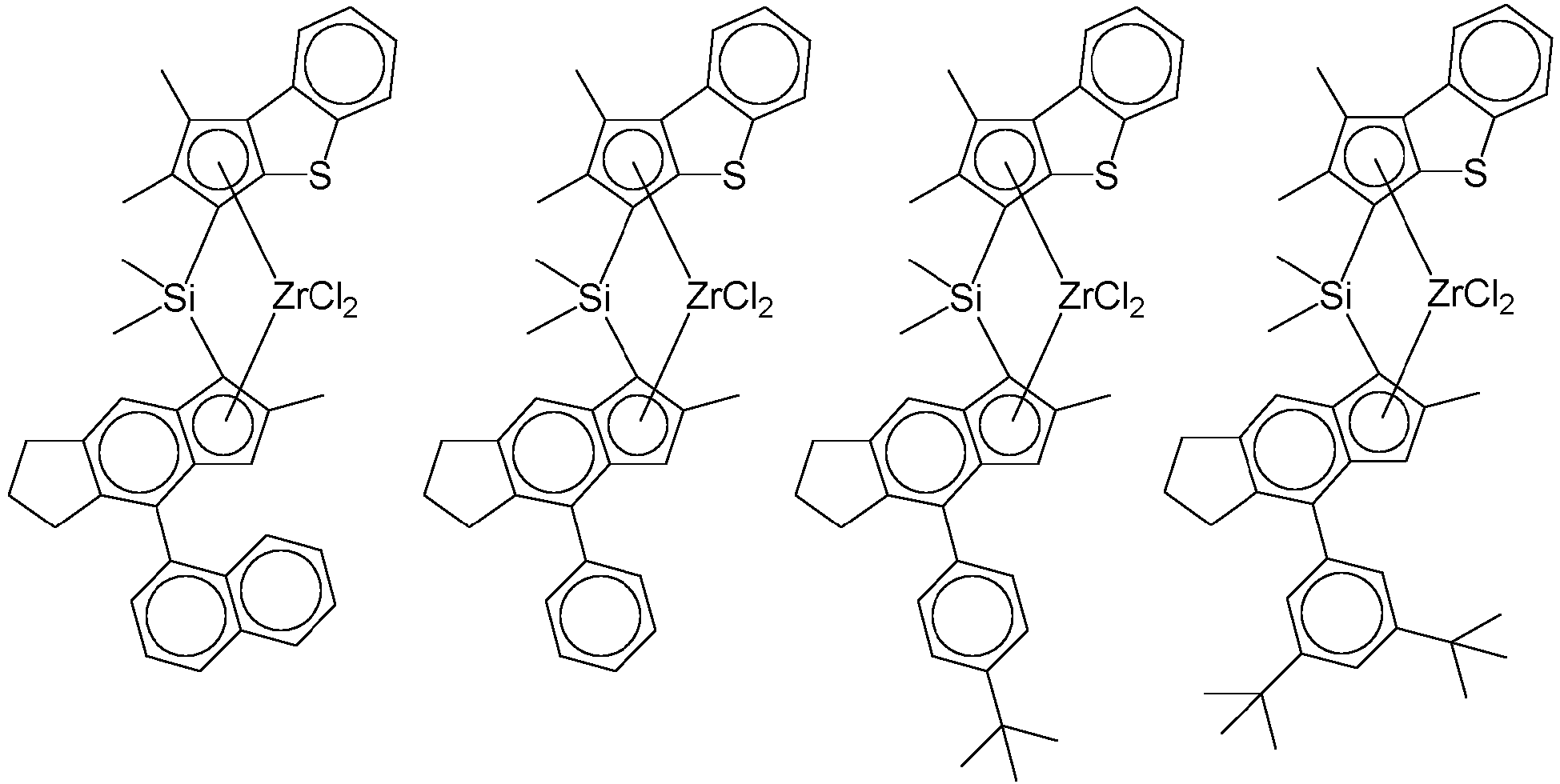


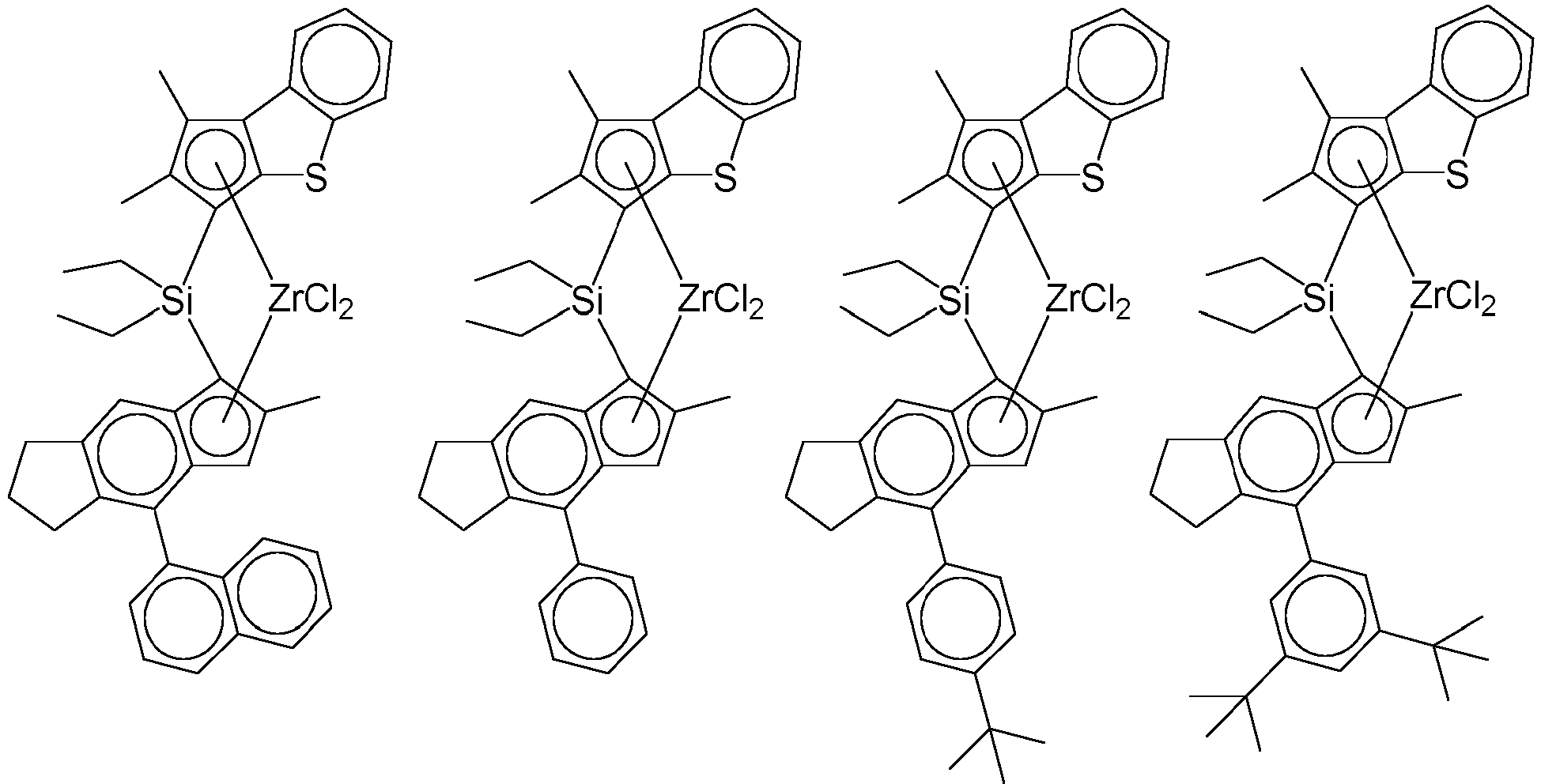


- The hybrid supported metallocene catalyst of Claim 1, wherein Y3 and Y4 are each independently halogen, A2 is silicon, and M2 is zirconium or hafnium.
- The hybrid supported metallocene catalyst of Claim 1, wherein R9 and R14 are each independently C1-6 linear or branched alkyl.
- The hybrid supported metallocene catalyst of Claim 1, wherein R9 and R14 are each methyl.
- The hybrid supported metallocene catalyst of Claim 1, wherein R10 and R15 are each independently phenyl substituted with C3-6 branched alkyl.
- The hybrid supported metallocene catalyst of Claim 1, wherein R10 and R15 are each 4-(tert-butyl)phenyl.
- The hybrid supported metallocene catalyst of Claim 1, wherein Q3 and Q4 are the same as each other, and are each C2-4 linear alkyl.
- The hybrid supported metallocene catalyst of Claim 1, wherein both of Q3 and Q4 are ethyl.
- The hybrid supported metallocene catalyst of Claim 1, wherein the second metallocene compound is a compound represented by the following structural formula:
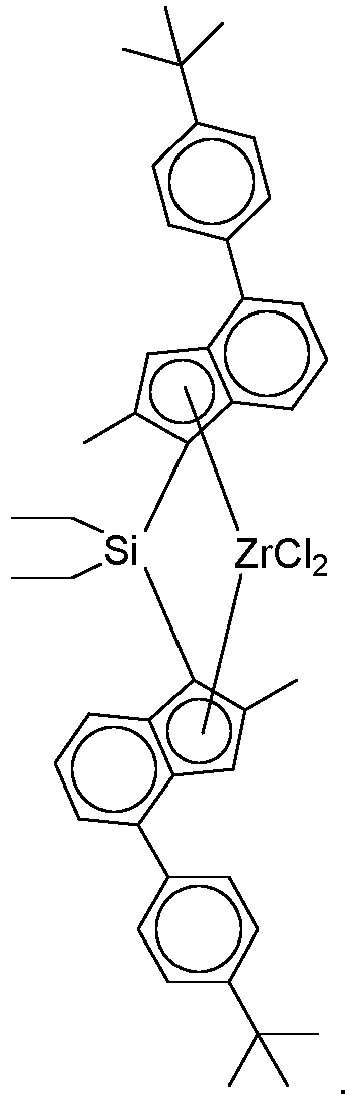
- The hybrid supported metallocene catalyst of Claim 1, wherein the first metallocene compound and the second metallocene compound are supported at a molar ratio of 1:1 to 1:8.
- The hybrid supported metallocene catalyst of Claim 1, wherein the carrier includes hydroxy groups and siloxane groups on the surface thereof.
- The hybrid supported metallocene catalyst of Claim 19, wherein the carrier is at least one selected from the group consisting of silica, silica-alumina, or silica-magnesia.
- The hybrid supported metallocene catalyst of Claim 1, further comprising one or more cocatalysts selected from the group consisting of compounds represented by the following Chemical Formulae 3 to 5:
[Chemical Formula 3] -[Al(R31)-O]c-
in Chemical Formula 3,R31 is each independently halogen, C1-20 alkyl, or C1-20 haloalkyl, andc is an integer of 2 or more,
[Chemical Formula 4] D(R41)3
in Chemical Formula 4,D is aluminum or boron, andR41 is each independently hydrogen, halogen, C1-20 hydrocarbyl, or halogen-substituted C1-20 hydrocarbyl,
[Chemical Formula 5] [L-H]+[Q(E)4]- or [L]+[Q(E)4]-
in Chemical Formula 5,L is a neutral or cationic Lewis base,[L-H]+ is a Bronsted acid,Q is B3+ or Al3+, andE is each independently C6-40 aryl or C1-20 alkyl, wherein C6-40 aryl or C1-20 alkyl is unsubstituted or substituted with one or more substituents selected from the group consisting of halogen, C1-20 alkyl, C1-20 alkoxy, or C6-40 aryloxy. - A method of preparing a polypropylene, the method comprising the step of polymerizing propylene monomers in the presence of the hybrid supported metallocene catalyst of Claim 1.
- The method of claim 22, wherein the polypropylene is a homopolymer.
Applications Claiming Priority (4)
| Application Number | Priority Date | Filing Date | Title |
|---|---|---|---|
| KR20190069973 | 2019-06-13 | ||
| KR20190123776 | 2019-10-07 | ||
| KR1020200070125A KR102488629B1 (en) | 2019-06-13 | 2020-06-10 | Hybride supported metallocene catalyst and method for preparing polypropylene using the same |
| PCT/KR2020/007548 WO2020251265A1 (en) | 2019-06-13 | 2020-06-11 | Hybrid supported metallocene catalyst, and method for preparing polypropylene using same |
Publications (3)
| Publication Number | Publication Date |
|---|---|
| EP3925987A1 true EP3925987A1 (en) | 2021-12-22 |
| EP3925987A4 EP3925987A4 (en) | 2022-04-27 |
| EP3925987B1 EP3925987B1 (en) | 2026-01-28 |
Family
ID=73782194
Family Applications (1)
| Application Number | Title | Priority Date | Filing Date |
|---|---|---|---|
| EP20822860.1A Active EP3925987B1 (en) | 2019-06-13 | 2020-06-11 | Hybrid supported metallocene catalyst and method of preparing polypropylene using same |
Country Status (3)
| Country | Link |
|---|---|
| US (1) | US12421334B2 (en) |
| EP (1) | EP3925987B1 (en) |
| WO (1) | WO2020251265A1 (en) |
Cited By (2)
| Publication number | Priority date | Publication date | Assignee | Title |
|---|---|---|---|---|
| EP3971198A4 (en) * | 2019-06-13 | 2022-11-23 | Lg Chem, Ltd. | NEW TRANSITION METAL COMPOUND AND METHOD FOR PREPARING POLYPROPYLENE USING THE SAME |
| US12421334B2 (en) | 2019-06-13 | 2025-09-23 | Lg Chem, Ltd. | Hybrid supported metallocene catalyst and method of preparing polypropylene using the same |
Family Cites Families (40)
| Publication number | Priority date | Publication date | Assignee | Title |
|---|---|---|---|---|
| JPH11130807A (en) | 1997-10-29 | 1999-05-18 | Idemitsu Petrochem Co Ltd | Transition metal compound, propylene polymerization catalyst, method for producing propylene polymer using the catalyst, and propylene polymer |
| US6117962A (en) | 1997-12-10 | 2000-09-12 | Exxon Chemical Patents Inc. | Vinyl-containing stereospecific polypropylene macromers |
| DE19903306A1 (en) | 1999-01-28 | 2000-08-03 | Targor Gmbh | Organometallic compound, catalyst system containing this organometallic compound and its use |
| DE10158656A1 (en) * | 2001-11-30 | 2003-06-26 | Basell Polyolefine Gmbh | Organo transition metal compound, biscyclopentadienyl ligand system, catalyst system and process for making polyolefins |
| KR100579843B1 (en) | 2003-04-01 | 2006-05-12 | 주식회사 엘지화학 | Hybrid supported metallocene catalyst and its preparation method and polyolefin production method using the same |
| DE10352139A1 (en) | 2003-11-04 | 2005-06-09 | Basell Polyolefine Gmbh | Organometallic transition metal compound used for catalyst system for polymerization of olefin, is new |
| DE10358082A1 (en) | 2003-12-10 | 2005-07-14 | Basell Polyolefine Gmbh | Organometallic transition metal compound used in catalyst system for preparation of polyolefins, uses biscyclopentadienyl ligand systems in its preparation |
| DE602004026627D1 (en) | 2003-12-10 | 2010-05-27 | Basell Polyolefine Gmbh | ORGANOMETALLIC TRANSITION METAL COMPOUND, BISCYD PREPARATION OF POLYOLEFINES |
| US7199073B2 (en) | 2004-11-10 | 2007-04-03 | Chevron Phillips Chemical Company, Lp | Resins that yield low haze films and the process for their production |
| US7613618B2 (en) | 2005-10-11 | 2009-11-03 | Florists' Transworld Delivery, Inc. | Quality assurance in a delivery report |
| CA2706822C (en) | 2007-11-19 | 2013-05-28 | Mitsui Chemicals, Inc. | Bridged metallocene compound, olefin polymerization catalyst containing the same, and ethylene polymer obtained with the catalyst |
| JP5286154B2 (en) | 2008-05-13 | 2013-09-11 | 日本ポリプロ株式会社 | Propylene polymer |
| JP5242485B2 (en) | 2009-04-09 | 2013-07-24 | 電気化学工業株式会社 | Thermoplastic resin composition |
| JP5256245B2 (en) * | 2010-05-13 | 2013-08-07 | 日本ポリプロ株式会社 | Method for producing propylene-based polymer having long chain branching |
| KR101499819B1 (en) | 2011-11-03 | 2015-03-10 | 주식회사 엘지화학 | Non-supported heterogeous catalyst composition for polymerizing polyolefin and preparation method of the same |
| CN104797586B (en) | 2013-10-16 | 2017-08-08 | 株式会社Lg化学 | Transition metal compounds having heteroatoms, catalyst compositions containing them, and methods for preparing polymers using them |
| KR101644113B1 (en) | 2013-10-18 | 2016-07-29 | 주식회사 엘지화학 | Supported hybrid metallocene catalyst |
| JP2016540076A (en) | 2013-12-06 | 2016-12-22 | トタル リサーチ アンド テクノロジー フエリユイ | Polypropylene with long branches |
| KR101785764B1 (en) | 2014-07-16 | 2017-10-16 | 주식회사 엘지화학 | Method of preparing novel ligand compound and transition metal compound |
| KR101743327B1 (en) | 2014-07-16 | 2017-06-02 | 주식회사 엘지화학 | Novel ligand compound and transition metal compound |
| KR101719064B1 (en) | 2014-11-13 | 2017-03-22 | 주식회사 엘지화학 | Ligand compound, transition metal compound, and catalyst composition comprising the same |
| CN105985372B (en) * | 2015-02-02 | 2018-07-13 | 中国石油天然气股份有限公司 | Bridged metallocene compound containing sulfur or oxygen heterocyclic structure, preparation method and application |
| KR101917911B1 (en) | 2015-07-02 | 2018-11-12 | 주식회사 엘지화학 | Transition metal compound and catalystic composition comprising the same |
| WO2017056946A1 (en) | 2015-09-28 | 2017-04-06 | デンカ株式会社 | Cross-copolymer and method for producing same |
| KR102124102B1 (en) | 2015-12-18 | 2020-06-17 | 주식회사 엘지화학 | Supported hybrid catalyst and method for preparing of olefin based polymer using the same |
| KR102080640B1 (en) * | 2015-12-23 | 2020-05-27 | 주식회사 엘지화학 | Supported hybrid catalyst and method for preparing of olefin based polymer using the same |
| KR101711788B1 (en) * | 2016-03-09 | 2017-03-14 | 한화케미칼 주식회사 | Hybride catalyst compositon, preparation method thereof, and manufactured polyolefin using the same |
| KR101725004B1 (en) | 2016-04-27 | 2017-04-18 | 한화케미칼 주식회사 | Supported hybrid metallocene catalyst and good processability polyolefin using the same |
| US10562987B2 (en) | 2016-06-30 | 2020-02-18 | Exxonmobil Chemical Patents Inc. | Polymers produced via use of quinolinyldiamido transition metal complexes and vinyl transfer agents |
| KR102288988B1 (en) * | 2016-11-08 | 2021-08-10 | 주식회사 엘지화학 | Process for preparing polypropylene |
| KR102064411B1 (en) | 2016-11-22 | 2020-01-09 | 주식회사 엘지화학 | Metallocene supported catalyst and method for preparing polypropylene using the same |
| KR102226823B1 (en) | 2016-12-13 | 2021-03-10 | 주식회사 엘지화학 | Catalyst composition for preparing polyolefin having an excellent flexural modulus using the same |
| KR101773722B1 (en) | 2016-12-16 | 2017-08-31 | 한화케미칼 주식회사 | High density ethylene polymer with excellent processability using supported hybrid metallocene catalyst and methods for producing the same |
| JP7189714B2 (en) * | 2017-09-27 | 2022-12-14 | 三井化学株式会社 | Method for producing ethylene polymer |
| KR102326791B1 (en) | 2017-11-27 | 2021-11-16 | 주식회사 엘지화학 | Polypropylene and method for preparing the same |
| CN109369837A (en) * | 2018-09-19 | 2019-02-22 | 朱博源 | A kind of metallocene catalyst composition for α-olefin polymerization and its application |
| KR102624685B1 (en) | 2019-01-28 | 2024-01-11 | 주식회사 엘지화학 | Transition metal compound, catalyst composition and method for preparing polypropylene using the same |
| KR102524952B1 (en) | 2019-06-13 | 2023-04-24 | 주식회사 엘지화학 | Novel transition metal compound and method for preparing polypropylene with the same |
| US12421334B2 (en) | 2019-06-13 | 2025-09-23 | Lg Chem, Ltd. | Hybrid supported metallocene catalyst and method of preparing polypropylene using the same |
| KR102521571B1 (en) | 2019-08-16 | 2023-04-13 | 주식회사 엘지화학 | Hybride supported metallocene catalyst and method for preparing polypropylene using the same |
-
2020
- 2020-06-11 US US17/438,174 patent/US12421334B2/en active Active
- 2020-06-11 WO PCT/KR2020/007548 patent/WO2020251265A1/en not_active Ceased
- 2020-06-11 EP EP20822860.1A patent/EP3925987B1/en active Active
Cited By (3)
| Publication number | Priority date | Publication date | Assignee | Title |
|---|---|---|---|---|
| EP3971198A4 (en) * | 2019-06-13 | 2022-11-23 | Lg Chem, Ltd. | NEW TRANSITION METAL COMPOUND AND METHOD FOR PREPARING POLYPROPYLENE USING THE SAME |
| US12358938B2 (en) | 2019-06-13 | 2025-07-15 | Lg Chem, Ltd. | Transition metal compound and method of preparing polypropylene using the same |
| US12421334B2 (en) | 2019-06-13 | 2025-09-23 | Lg Chem, Ltd. | Hybrid supported metallocene catalyst and method of preparing polypropylene using the same |
Also Published As
| Publication number | Publication date |
|---|---|
| US20220144983A1 (en) | 2022-05-12 |
| EP3925987A4 (en) | 2022-04-27 |
| WO2020251265A1 (en) | 2020-12-17 |
| EP3925987B1 (en) | 2026-01-28 |
| US12421334B2 (en) | 2025-09-23 |
Similar Documents
| Publication | Publication Date | Title |
|---|---|---|
| CN113508123B (en) | Transition metal compounds and catalyst compositions containing the same | |
| EP3925988B1 (en) | Hybride supported metallocene catalyst and method for preparing polypropylene using the same | |
| EP3173429B1 (en) | Metallocene compound, metallocene supported catalyst, and method for preparing polyolefin using same | |
| KR20170076550A (en) | Method for preparing of supported hybrid metallocene catalyst, the supported hybrid metallocene catalyst prepared by the same method, and method for preparing polyolefin using the same | |
| US11731123B2 (en) | Method of preparing supported metallocene catalyst and method of preparing polypropylene using catalyst prepared thereby | |
| KR102732934B1 (en) | Supported hybrid metallocene catalyst, and method for preparing homo polyethylene using the same | |
| EP3925987B1 (en) | Hybrid supported metallocene catalyst and method of preparing polypropylene using same | |
| EP3892626B1 (en) | Transition metal compound, catalyst composition, and method for producing polypropylene using same | |
| EP3786195B1 (en) | Novel transition metal compound and method for preparing polypropylene using the same | |
| KR102524952B1 (en) | Novel transition metal compound and method for preparing polypropylene with the same | |
| KR102784703B1 (en) | Hybride supported metallocene catalyst and process for preparing polyethylene copolymer using the same | |
| KR102765045B1 (en) | Hybride supported metallocene catalyst and method for preparing polypropylene using the same | |
| US12258432B2 (en) | Hybrid supported metallocene catalyst and method for preparing polypropylene using the same | |
| KR102488629B1 (en) | Hybride supported metallocene catalyst and method for preparing polypropylene using the same | |
| KR20220048444A (en) | Polypropylene | |
| KR20250169102A (en) | Transition metal compound, catalyst composition and method for preparing polypropylene using the same | |
| KR20250016857A (en) | Process for preparing polypropylene | |
| KR20220017201A (en) | Polypropylene |
Legal Events
| Date | Code | Title | Description |
|---|---|---|---|
| STAA | Information on the status of an ep patent application or granted ep patent |
Free format text: STATUS: THE INTERNATIONAL PUBLICATION HAS BEEN MADE |
|
| PUAI | Public reference made under article 153(3) epc to a published international application that has entered the european phase |
Free format text: ORIGINAL CODE: 0009012 |
|
| STAA | Information on the status of an ep patent application or granted ep patent |
Free format text: STATUS: REQUEST FOR EXAMINATION WAS MADE |
|
| 17P | Request for examination filed |
Effective date: 20210915 |
|
| AK | Designated contracting states |
Kind code of ref document: A1 Designated state(s): AL AT BE BG CH CY CZ DE DK EE ES FI FR GB GR HR HU IE IS IT LI LT LU LV MC MK MT NL NO PL PT RO RS SE SI SK SM TR |
|
| A4 | Supplementary search report drawn up and despatched |
Effective date: 20220330 |
|
| RIC1 | Information provided on ipc code assigned before grant |
Ipc: C08F 110/06 20060101ALI20220324BHEP Ipc: C08F 4/6592 20060101ALI20220324BHEP Ipc: C08F 4/659 20060101AFI20220324BHEP |
|
| DAV | Request for validation of the european patent (deleted) | ||
| DAX | Request for extension of the european patent (deleted) | ||
| REG | Reference to a national code |
Ref country code: DE Ref legal event code: R079 Free format text: PREVIOUS MAIN CLASS: C08F0110060000 Ipc: C08F0004659000 Ref document number: 602020066119 Country of ref document: DE |
|
| GRAP | Despatch of communication of intention to grant a patent |
Free format text: ORIGINAL CODE: EPIDOSNIGR1 |
|
| STAA | Information on the status of an ep patent application or granted ep patent |
Free format text: STATUS: GRANT OF PATENT IS INTENDED |
|
| RIC1 | Information provided on ipc code assigned before grant |
Ipc: C08F 4/659 20060101AFI20250919BHEP Ipc: C08F 4/6592 20060101ALI20250919BHEP Ipc: C08F 110/06 20060101ALI20250919BHEP |
|
| INTG | Intention to grant announced |
Effective date: 20251008 |
|
| GRAS | Grant fee paid |
Free format text: ORIGINAL CODE: EPIDOSNIGR3 |
|
| GRAA | (expected) grant |
Free format text: ORIGINAL CODE: 0009210 |
|
| STAA | Information on the status of an ep patent application or granted ep patent |
Free format text: STATUS: THE PATENT HAS BEEN GRANTED |
|
| AK | Designated contracting states |
Kind code of ref document: B1 Designated state(s): AL AT BE BG CH CY CZ DE DK EE ES FI FR GB GR HR HU IE IS IT LI LT LU LV MC MK MT NL NO PL PT RO RS SE SI SK SM TR |
|
| REG | Reference to a national code |
Ref country code: CH Ref legal event code: F10 Free format text: ST27 STATUS EVENT CODE: U-0-0-F10-F00 (AS PROVIDED BY THE NATIONAL OFFICE) Effective date: 20260128 Ref country code: GB Ref legal event code: FG4D |
|
| REG | Reference to a national code |
Ref country code: DE Ref legal event code: R096 Ref document number: 602020066119 Country of ref document: DE |
|
| REG | Reference to a national code |
Ref country code: IE Ref legal event code: FG4D |
|
| REG | Reference to a national code |
Ref country code: NL Ref legal event code: MP Effective date: 20260128 |
|
| PG25 | Lapsed in a contracting state [announced via postgrant information from national office to epo] |
Ref country code: NL Free format text: LAPSE BECAUSE OF FAILURE TO SUBMIT A TRANSLATION OF THE DESCRIPTION OR TO PAY THE FEE WITHIN THE PRESCRIBED TIME-LIMIT Effective date: 20260128 |
|
| REG | Reference to a national code |
Ref country code: AT Ref legal event code: MK05 Ref document number: 1881182 Country of ref document: AT Kind code of ref document: T Effective date: 20260128 |
|
| PG25 | Lapsed in a contracting state [announced via postgrant information from national office to epo] |
Ref country code: RS Free format text: LAPSE BECAUSE OF FAILURE TO SUBMIT A TRANSLATION OF THE DESCRIPTION OR TO PAY THE FEE WITHIN THE PRESCRIBED TIME-LIMIT Effective date: 20260428 |
|
| PG25 | Lapsed in a contracting state [announced via postgrant information from national office to epo] |
Ref country code: ES Free format text: LAPSE BECAUSE OF FAILURE TO SUBMIT A TRANSLATION OF THE DESCRIPTION OR TO PAY THE FEE WITHIN THE PRESCRIBED TIME-LIMIT Effective date: 20260128 |
|
| PG25 | Lapsed in a contracting state [announced via postgrant information from national office to epo] |
Ref country code: PL Free format text: LAPSE BECAUSE OF FAILURE TO SUBMIT A TRANSLATION OF THE DESCRIPTION OR TO PAY THE FEE WITHIN THE PRESCRIBED TIME-LIMIT Effective date: 20260128 |
|
| PGFP | Annual fee paid to national office [announced via postgrant information from national office to epo] |
Ref country code: GB Payment date: 20260526 Year of fee payment: 7 |
|
| PG25 | Lapsed in a contracting state [announced via postgrant information from national office to epo] |
Ref country code: GR Free format text: LAPSE BECAUSE OF FAILURE TO SUBMIT A TRANSLATION OF THE DESCRIPTION OR TO PAY THE FEE WITHIN THE PRESCRIBED TIME-LIMIT Effective date: 20260429 |
|
| PGFP | Annual fee paid to national office [announced via postgrant information from national office to epo] |
Ref country code: IT Payment date: 20260521 Year of fee payment: 7 |
|
| REG | Reference to a national code |
Ref country code: LT Ref legal event code: MG9D |
|
| PG25 | Lapsed in a contracting state [announced via postgrant information from national office to epo] |
Ref country code: LT Free format text: LAPSE BECAUSE OF FAILURE TO SUBMIT A TRANSLATION OF THE DESCRIPTION OR TO PAY THE FEE WITHIN THE PRESCRIBED TIME-LIMIT Effective date: 20260128 |
|
| PGFP | Annual fee paid to national office [announced via postgrant information from national office to epo] |
Ref country code: DE Payment date: 20260520 Year of fee payment: 7 |
|
| PG25 | Lapsed in a contracting state [announced via postgrant information from national office to epo] |
Ref country code: NO Free format text: LAPSE BECAUSE OF FAILURE TO SUBMIT A TRANSLATION OF THE DESCRIPTION OR TO PAY THE FEE WITHIN THE PRESCRIBED TIME-LIMIT Effective date: 20260428 |
|
| PG25 | Lapsed in a contracting state [announced via postgrant information from national office to epo] |
Ref country code: AT Free format text: LAPSE BECAUSE OF FAILURE TO SUBMIT A TRANSLATION OF THE DESCRIPTION OR TO PAY THE FEE WITHIN THE PRESCRIBED TIME-LIMIT Effective date: 20260128 Ref country code: SE Free format text: LAPSE BECAUSE OF FAILURE TO SUBMIT A TRANSLATION OF THE DESCRIPTION OR TO PAY THE FEE WITHIN THE PRESCRIBED TIME-LIMIT Effective date: 20260128 Ref country code: FI Free format text: LAPSE BECAUSE OF FAILURE TO SUBMIT A TRANSLATION OF THE DESCRIPTION OR TO PAY THE FEE WITHIN THE PRESCRIBED TIME-LIMIT Effective date: 20260128 |
|
| PG25 | Lapsed in a contracting state [announced via postgrant information from national office to epo] |
Ref country code: HR Free format text: LAPSE BECAUSE OF FAILURE TO SUBMIT A TRANSLATION OF THE DESCRIPTION OR TO PAY THE FEE WITHIN THE PRESCRIBED TIME-LIMIT Effective date: 20260128 |
|
| PG25 | Lapsed in a contracting state [announced via postgrant information from national office to epo] |
Ref country code: IS Free format text: LAPSE BECAUSE OF FAILURE TO SUBMIT A TRANSLATION OF THE DESCRIPTION OR TO PAY THE FEE WITHIN THE PRESCRIBED TIME-LIMIT Effective date: 20260528 Ref country code: PT Free format text: LAPSE BECAUSE OF FAILURE TO SUBMIT A TRANSLATION OF THE DESCRIPTION OR TO PAY THE FEE WITHIN THE PRESCRIBED TIME-LIMIT Effective date: 20260528 |
|
| PGFP | Annual fee paid to national office [announced via postgrant information from national office to epo] |
Ref country code: FR Payment date: 20260527 Year of fee payment: 7 |
|
| PG25 | Lapsed in a contracting state [announced via postgrant information from national office to epo] |
Ref country code: LV Free format text: LAPSE BECAUSE OF FAILURE TO SUBMIT A TRANSLATION OF THE DESCRIPTION OR TO PAY THE FEE WITHIN THE PRESCRIBED TIME-LIMIT Effective date: 20260128 |
|
| PG25 | Lapsed in a contracting state [announced via postgrant information from national office to epo] |
Ref country code: BG Free format text: LAPSE BECAUSE OF FAILURE TO SUBMIT A TRANSLATION OF THE DESCRIPTION OR TO PAY THE FEE WITHIN THE PRESCRIBED TIME-LIMIT Effective date: 20260128 |