EP3925955A1 - Method for asymmetrically preparing nicotine - Google Patents
Method for asymmetrically preparing nicotine Download PDFInfo
- Publication number
- EP3925955A1 EP3925955A1 EP20911299.4A EP20911299A EP3925955A1 EP 3925955 A1 EP3925955 A1 EP 3925955A1 EP 20911299 A EP20911299 A EP 20911299A EP 3925955 A1 EP3925955 A1 EP 3925955A1
- Authority
- EP
- European Patent Office
- Prior art keywords
- group
- amino
- nicotine
- compound
- reaction mixture
- Prior art date
- Legal status (The legal status is an assumption and is not a legal conclusion. Google has not performed a legal analysis and makes no representation as to the accuracy of the status listed.)
- Pending
Links
- 0 *N(CC=C1)C1c1cnccc1 Chemical compound *N(CC=C1)C1c1cnccc1 0.000 description 8
- IUSCNDXMUIGSQI-ZDUSSCGKSA-N CC(C)(C)OC(N(C)CCC[C@@H](c1cnccc1)Cl)=O Chemical compound CC(C)(C)OC(N(C)CCC[C@@H](c1cnccc1)Cl)=O IUSCNDXMUIGSQI-ZDUSSCGKSA-N 0.000 description 1
- DZGIQCPDVXEYKQ-QUAVJEBZSA-N CCC(C(C1)C1=C1)C([C@H](C)NCC(OC2)=N[C@H]2C(C)(C)C)[C@@H]1P(c1ccccc1)c1ccccc1 Chemical compound CCC(C(C1)C1=C1)C([C@H](C)NCC(OC2)=N[C@H]2C(C)(C)C)[C@@H]1P(c1ccccc1)c1ccccc1 DZGIQCPDVXEYKQ-QUAVJEBZSA-N 0.000 description 1
- WDMRKCLBICRBFB-UHFFFAOYSA-N CCC(C)NCC=C Chemical compound CCC(C)NCC=C WDMRKCLBICRBFB-UHFFFAOYSA-N 0.000 description 1
- SNICXCGAKADSCV-JTQLQIEISA-N CN(CCC1)[C@@H]1c1cccnc1 Chemical compound CN(CCC1)[C@@H]1c1cccnc1 SNICXCGAKADSCV-JTQLQIEISA-N 0.000 description 1
- SNICXCGAKADSCV-SNVBAGLBSA-N CN(CCC1)[C@H]1c1cnccc1 Chemical compound CN(CCC1)[C@H]1c1cnccc1 SNICXCGAKADSCV-SNVBAGLBSA-N 0.000 description 1
- NJOSIQRTTLCTQE-DCFPTJEASA-N C[C@@H](C(C1CC=C2)[C@@]12P(c1ccccc1)c1ccccc1)/N=C/c1nc(cccc2)c2[n]1-c1c(cccc2)c2cc2c1cccc2 Chemical compound C[C@@H](C(C1CC=C2)[C@@]12P(c1ccccc1)c1ccccc1)/N=C/c1nc(cccc2)c2[n]1-c1c(cccc2)c2cc2c1cccc2 NJOSIQRTTLCTQE-DCFPTJEASA-N 0.000 description 1
- WHMCLKZWJQNAHZ-LIZQOKTPSA-N C[C@H](C1C2C1)C=C2[Fe] Chemical compound C[C@H](C1C2C1)C=C2[Fe] WHMCLKZWJQNAHZ-LIZQOKTPSA-N 0.000 description 1
- PXHHIBMOFPCBJQ-ZCFIWIBFSA-N C[C@H]1N(C)CCC1 Chemical compound C[C@H]1N(C)CCC1 PXHHIBMOFPCBJQ-ZCFIWIBFSA-N 0.000 description 1
- JUJWROOIHBZHMG-UHFFFAOYSA-N c1ccncc1 Chemical compound c1ccncc1 JUJWROOIHBZHMG-UHFFFAOYSA-N 0.000 description 1
Images


Classifications
-
- C—CHEMISTRY; METALLURGY
- C07—ORGANIC CHEMISTRY
- C07D—HETEROCYCLIC COMPOUNDS
- C07D213/00—Heterocyclic compounds containing six-membered rings, not condensed with other rings, with one nitrogen atom as the only ring hetero atom and three or more double bonds between ring members or between ring members and non-ring members
- C07D213/02—Heterocyclic compounds containing six-membered rings, not condensed with other rings, with one nitrogen atom as the only ring hetero atom and three or more double bonds between ring members or between ring members and non-ring members having three double bonds between ring members or between ring members and non-ring members
- C07D213/04—Heterocyclic compounds containing six-membered rings, not condensed with other rings, with one nitrogen atom as the only ring hetero atom and three or more double bonds between ring members or between ring members and non-ring members having three double bonds between ring members or between ring members and non-ring members having no bond between the ring nitrogen atom and a non-ring member or having only hydrogen or carbon atoms directly attached to the ring nitrogen atom
- C07D213/24—Heterocyclic compounds containing six-membered rings, not condensed with other rings, with one nitrogen atom as the only ring hetero atom and three or more double bonds between ring members or between ring members and non-ring members having three double bonds between ring members or between ring members and non-ring members having no bond between the ring nitrogen atom and a non-ring member or having only hydrogen or carbon atoms directly attached to the ring nitrogen atom with substituted hydrocarbon radicals attached to ring carbon atoms
- C07D213/36—Radicals substituted by singly-bound nitrogen atoms
- C07D213/38—Radicals substituted by singly-bound nitrogen atoms having only hydrogen or hydrocarbon radicals attached to the substituent nitrogen atom
-
- C—CHEMISTRY; METALLURGY
- C07—ORGANIC CHEMISTRY
- C07D—HETEROCYCLIC COMPOUNDS
- C07D401/00—Heterocyclic compounds containing two or more hetero rings, having nitrogen atoms as the only ring hetero atoms, at least one ring being a six-membered ring with only one nitrogen atom
- C07D401/02—Heterocyclic compounds containing two or more hetero rings, having nitrogen atoms as the only ring hetero atoms, at least one ring being a six-membered ring with only one nitrogen atom containing two hetero rings
- C07D401/04—Heterocyclic compounds containing two or more hetero rings, having nitrogen atoms as the only ring hetero atoms, at least one ring being a six-membered ring with only one nitrogen atom containing two hetero rings directly linked by a ring-member-to-ring-member bond
-
- C—CHEMISTRY; METALLURGY
- C07—ORGANIC CHEMISTRY
- C07D—HETEROCYCLIC COMPOUNDS
- C07D213/00—Heterocyclic compounds containing six-membered rings, not condensed with other rings, with one nitrogen atom as the only ring hetero atom and three or more double bonds between ring members or between ring members and non-ring members
- C07D213/02—Heterocyclic compounds containing six-membered rings, not condensed with other rings, with one nitrogen atom as the only ring hetero atom and three or more double bonds between ring members or between ring members and non-ring members having three double bonds between ring members or between ring members and non-ring members
- C07D213/04—Heterocyclic compounds containing six-membered rings, not condensed with other rings, with one nitrogen atom as the only ring hetero atom and three or more double bonds between ring members or between ring members and non-ring members having three double bonds between ring members or between ring members and non-ring members having no bond between the ring nitrogen atom and a non-ring member or having only hydrogen or carbon atoms directly attached to the ring nitrogen atom
- C07D213/24—Heterocyclic compounds containing six-membered rings, not condensed with other rings, with one nitrogen atom as the only ring hetero atom and three or more double bonds between ring members or between ring members and non-ring members having three double bonds between ring members or between ring members and non-ring members having no bond between the ring nitrogen atom and a non-ring member or having only hydrogen or carbon atoms directly attached to the ring nitrogen atom with substituted hydrocarbon radicals attached to ring carbon atoms
- C07D213/28—Radicals substituted by singly-bound oxygen or sulphur atoms
- C07D213/30—Oxygen atoms
-
- C—CHEMISTRY; METALLURGY
- C07—ORGANIC CHEMISTRY
- C07D—HETEROCYCLIC COMPOUNDS
- C07D213/00—Heterocyclic compounds containing six-membered rings, not condensed with other rings, with one nitrogen atom as the only ring hetero atom and three or more double bonds between ring members or between ring members and non-ring members
- C07D213/02—Heterocyclic compounds containing six-membered rings, not condensed with other rings, with one nitrogen atom as the only ring hetero atom and three or more double bonds between ring members or between ring members and non-ring members having three double bonds between ring members or between ring members and non-ring members
- C07D213/04—Heterocyclic compounds containing six-membered rings, not condensed with other rings, with one nitrogen atom as the only ring hetero atom and three or more double bonds between ring members or between ring members and non-ring members having three double bonds between ring members or between ring members and non-ring members having no bond between the ring nitrogen atom and a non-ring member or having only hydrogen or carbon atoms directly attached to the ring nitrogen atom
- C07D213/24—Heterocyclic compounds containing six-membered rings, not condensed with other rings, with one nitrogen atom as the only ring hetero atom and three or more double bonds between ring members or between ring members and non-ring members having three double bonds between ring members or between ring members and non-ring members having no bond between the ring nitrogen atom and a non-ring member or having only hydrogen or carbon atoms directly attached to the ring nitrogen atom with substituted hydrocarbon radicals attached to ring carbon atoms
- C07D213/36—Radicals substituted by singly-bound nitrogen atoms
- C07D213/40—Acylated substituent nitrogen atom
-
- C—CHEMISTRY; METALLURGY
- C07—ORGANIC CHEMISTRY
- C07D—HETEROCYCLIC COMPOUNDS
- C07D213/00—Heterocyclic compounds containing six-membered rings, not condensed with other rings, with one nitrogen atom as the only ring hetero atom and three or more double bonds between ring members or between ring members and non-ring members
- C07D213/02—Heterocyclic compounds containing six-membered rings, not condensed with other rings, with one nitrogen atom as the only ring hetero atom and three or more double bonds between ring members or between ring members and non-ring members having three double bonds between ring members or between ring members and non-ring members
- C07D213/04—Heterocyclic compounds containing six-membered rings, not condensed with other rings, with one nitrogen atom as the only ring hetero atom and three or more double bonds between ring members or between ring members and non-ring members having three double bonds between ring members or between ring members and non-ring members having no bond between the ring nitrogen atom and a non-ring member or having only hydrogen or carbon atoms directly attached to the ring nitrogen atom
- C07D213/24—Heterocyclic compounds containing six-membered rings, not condensed with other rings, with one nitrogen atom as the only ring hetero atom and three or more double bonds between ring members or between ring members and non-ring members having three double bonds between ring members or between ring members and non-ring members having no bond between the ring nitrogen atom and a non-ring member or having only hydrogen or carbon atoms directly attached to the ring nitrogen atom with substituted hydrocarbon radicals attached to ring carbon atoms
- C07D213/44—Radicals substituted by doubly-bound oxygen, sulfur, or nitrogen atoms, or by two such atoms singly-bound to the same carbon atom
- C07D213/46—Oxygen atoms
- C07D213/50—Ketonic radicals
-
- C—CHEMISTRY; METALLURGY
- C07—ORGANIC CHEMISTRY
- C07B—GENERAL METHODS OF ORGANIC CHEMISTRY; APPARATUS THEREFOR
- C07B2200/00—Indexing scheme relating to specific properties of organic compounds
- C07B2200/07—Optical isomers
Definitions
- This application relates to chemical synthesis, and more particularly relates to a method for preparing nicotine through asymmetric reduction of an intermediate pyridyl alkyl ketone.
- Nicotine is an alkaloid found in Solanaceae plants, and is an important active ingredient in tobacco.
- Naturally-occurring nicotine (( S )-nicotine) is a chiral amine alkaloid containing pyridine and tetrahydropyrrole, and has unique physiological activity due to its special structure. Nicotine has a wide application range, on one hand, nicotinic compounds are widely used as insecticides in agricultural production; and on the other hand, the nicotine can be used in the medicine field. It has been clinically demonstrated that the nicotine can act on acetylcholine receptors, and thus is expected to be effective in the treatment of central nervous system diseases such as dementia, parkinsonism, schizophrenia and depression.
- ( S )-nicotine can also be used as a chiral ionic liquid in various asymmetric chemical reactions in the chemical synthesis.
- This method has simple synthesis, but it involves large consumption of chiral selectors, leading to complicated separation and purification and increased cost (Tungstate-catalyzed oxidation of secondary amines to nitrones. ⁇ -Substitution of secondary amines via nitrones. Journal of Organic Chemistry, 1990, 55, 1736-1744 ; Synthesis of nornicotine, nicotine and other functionalised derivatives using solid-supported reagents and scavengers. Journal of the Chemical Society, Perkin Transactions I, 2002(2), 143-154 ; Synthesis of nicotine and diverse analogues using intramolecular [3+2] cycloaddition.
- ( S )-nicotine with optical activity is prepared directly by asymmetric synthesis without additional chiral selectors.
- these methods are not suitable for the large-scale preparation of ( S )-nicotine due to the high cost, and it still has not been reported on the commercial synthesis of ( S )-nicotine. Chavdarian et al. (Synthesis of optically active nicotinoids[J].
- An object of this application is to provide a method for efficiently preparing nicotine. Specifically, a pyridinyl alkyl ketone is asymmetrically reduced to obtain a chiral alcohol intermediate with high reactivity and stereoselectivity, which then undergo a two-step reaction to obtain the target product ( S )-nicotine.
- the preparation route provided herein is economical.
- the present disclosure provides a method for preparing an intermediate of formula (5) for the preparation of nicotine, comprising: subjecting compound (4) to asymmetric reduction in the presence of a catalyst to produce the intermediate (5), as shown in the following reaction scheme: wherein R 2 is selected from the group consisting of C 1-2 alkyl, heteroatom-substituted alkyl, aryl and amino-protecting group; the catalyst is prepared through complexation of a metal salt with a chiral ligand; the metal salt is an inorganic salt of a transition element selected from the group consisting of ruthenium, rhodium, iridium and palladium; and the chiral ligand is selected from the group consisting of: wherein a carbon atom specified by ⁇ is R or S configuration.
- the amino-protecting group is selected from the group consisting of benzyloxycarbonyl (Cbz), tert -butoxycarbonyl (Boc), fluorenylmethyloxycarbonyl (Fmoc), allyloxycarbonyl (Alloc), (trimethylsilyl)ethoxycarbonyl (Teoc), methoxycarbonyl, ethoxycarbonyl, phthaloyl (Pht), p -toluenesulfonyl (Ts), trifluoroacetyl (Tfa), nitrobenzenesulfonyl (Ns), pivaloyl, benzoyl, trityl (Trt), 2,4-dimethoxybenzyl (Dmb), p -methoxybenzyl (PMB) and benzyl (Bn).
- R 2 is preferably tert -butoxycarbonyl (Boc); a structure of the compound (4) is and a structure of the intermediate (5) is
- the asymmetric reduction is performed in a solvent selected from the group consisting of methanol, ethanol, isopropanol, tetrahydrofuran, dichloromethane, toluene and a combination thereof.
- the asymmetric reduction is performed in the presence of a base; and the base is selected from the group consisting of potassium tert -butoxide, sodium tert -butoxide, lithium tert -butoxide, potassium hydroxide, sodium hydroxide, sodium carbonate, potassium carbonate, cesium carbonate and a combination thereof.
- the asymmetric reduction is performed at a temperature of 25-80°C and a hydrogen pressure of 2-6 MPa for 16-24 h.
- this application provides a compound of formula (4) or formula (5): wherein R 2 is selected from the group consisting of C 1-2 alkyl, heteroatom-substituted alkyl, aryl and amino-protecting group; the amino-protecting group is selected from the group consisting of benzyloxycarbonyl (Cbz), tert -butoxycarbonyl (Boc), fluorenylmethyloxycarbonyl (Fmoc), allyloxycarbonyl (Alloc), (trimethylsilyl)ethoxycarbonyl (Teoc), methoxycarbonyl, ethoxycarbonyl, phthaloyl (Pht), p -toluenesulfonyl (Ts), trifluoroacetyl (Tfa), nitrobenzenesulfonyl (Ns), pivaloyl, benzoyl, trityl (Trt), 2,4-dimethoxybenzyl (Cbz),
- the compound of formula (4) is selected from the group consisting of:
- the compound of formula (5) is selected from the group consisting of:
- the catalyst is [Ir(COD)Cl] 2 ; and the chiral ligand is:
- this application further provides a method for preparing nicotine, comprising: reacting a nicotinate (1) with N -methylpyrrolidone (2) in the presence of a base and HCl to produce 4-methylamino-1-(3-pyridine)-butanone hydrochloride (3); reacting the 4-methylamino-1-(3-pyridine)-butanone hydrochloride (3) with an amino-protecting reagent to produce a pyridyl alkyl ketone (4); subjecting the pyridyl alkyl ketone (4) to asymmetric reduction in the presence of a transition metal catalyst to produce an intermediate (5); subjecting the intermediate (5) to derivatization to produce a compound (6); and removing an amino-protecting group R 2 from the compound (6) followed by intramolecular cyclization under a basic condition to produce nicotine; as shown in the following reaction scheme: wherein the intermediate (5) is prepared by the above-mentioned method.
- the method comprises:
- the reagent for the deprotection is hydrochloric acid or trifluoroacetic acid.
- R 1 is ethyl
- R 3 is OMs.
- N -methylpyrrolidone 2 (5g, 50 mmol) was dissolved with 50 mL of ultra-dry tetrahydrofuran, and then added with sodium hydride powder (6.05 g, 150 mmol, mass fraction 60%) in batches to obtain a reaction mixture.
- the reaction mixture was reacted under stirring at room temperature for 15 min.
- the reaction mixture was slowly added with ethyl nicotinate 1 (13.8 mL, 100 mmol) dropwise, and then heated to reflux. The reaction was continued for 24 h. Then the reaction mixture was placed in a cold bath at 0°C, and the reaction was quenched by dropping a concentrated hydrochloric acid (4M).
- Solid sodium hydroxide particles were added into the reaction mixture to adjust a reaction pH to about 4.
- the reaction mixture was extracted three times with 90 mL of dichloromethane, and an organic phase was obtained.
- the organic phase was dried by anhydrous sodium sulfate, and a solvent was removed under vacuum to obtain 10 g of a brown oily crude product.
- the crude product was added 100 mL of concentrated hydrochloric acid (5M), and was heated and refluxed for 72 h to obtain a reaction liquid.
- the reaction liquid was concentrated under vacuum, and added with 100 mL deionized water and then filtrated to obtain a brown solid residue.
- the brown solid residue was recrystallized with an EtOH/H 2 O mixed system, so as to obtain 5.67 g of an off-white solid as the intermediate 3, the off-white solid (45% yield).
- the intermediate ( R )- 6a-2 (7.2 g, 20 mmol) was dissolved with 50 mL concentrated hydrochloric acid (5M) dropwise and stirred at room temperature for 2 h. Then the mixture was dissolved by 100 mL of water, placed in a cold bath at 0°C, and added with 150 mL of a sodium hydroxide solution (2 M) dropwise during stirring. The reaction mixture was extracted three times with 150 mL of ethyl acetate to obtain an organic phase. The organic phase was dried by anhydrous sodium sulfate, and a solvent was removed under vacuum, so as obtain a yellow oily liquid. The yellow oily liquid was purified by distillation under vacuum to obtain 3 g of a colorless oily liquid as the ( S )-Nicotine 7a , the colorless oily liquid ( 84% yield; ee 98%).
- 5M concentrated hydrochloric acid
- Fig. 1 The synthesis route was referred to Fig. 1; Fig. 2 was a 1 H NMR spectrum (400 MHz, CDCl 3 ) of nicotine; Fig. 3 was a 13 C ⁇ 1 H ⁇ NMR spectrum (101 MHz, CDCl 3 ) of nicotine; and Fig. 4 was a HPLC spectrum of a nicotine raceme.
- the intermediate (S)-6b-2 (7.2 g, 20 mmol) was dissolved with 50 mL concentrated hydrochloric acid (5M) dropwise and stirred at room temperature for 2 h. Then the mixture was dissolved by 100 mL of water, placed in a cold bath at 0°C, and added with 150 mL of a sodium hydroxide solution (2 M) dropwise during stirring. The reaction mixture was extracted three times with 150 mL of ethyl acetate to obtain an organic phase. The organic phase was dried by anhydrous sodium sulfate, and a solvent was removed under vacuum, so as obtain a yellow oily liquid. The yellow oily liquid was purified by distillation under vacuum to obtain 2.9 g of a colorless oily liquid as the ( R )-Nicotine 7b (80% yield; ee 98%).
- the intermediate ( S ) -6b-1 (7.2 g, 20 mmol) was dissolved with 50 mL concentrated hydrochloric acid (5M) dropwise and stirred at room temperature for 2 h. Then the mixture was dissolved by 100 mL of water, placed in a cold bath at 0°C, and added with 150 mL of a sodium hydroxide solution (2 M) dropwise during stirring. The reaction mixture was extracted three times with 150 mL of ethyl acetate to obtain an organic phase. The organic phase was dried by anhydrous sodium sulfate, and a solvent was removed under vacuum, so as obtain a yellow oily liquid. The yellow oily liquid was purified by distillation under vacuum to obtain 3 g of a colorless oily liquid as the ( S )-Nicotine 7a (yield 85%; ee 98%).
- the intermediate ( R )- 6a-1 (7.2 g, 20 mmol) was dissolved with 50 mL concentrated hydrochloric acid (5M) dropwise and stirred at room temperature for 2 h. Then the mixture was dissolved by 100 mL of water, placed in a cold bath at 0°C, and added with 150 mL of a sodium hydroxide solution (2 M) dropwise during stirring. The reaction mixture was extracted three times with 150 mL of ethyl acetate to obtain an organic phase. The organic phase was dried by anhydrous sodium sulfate, and a solvent was removed under vacuum, so as obtain a yellow oily liquid. The yellow oily liquid was purified by distillation under vacuum to obtain 2.9 g of a colorless oily liquid as the ( R )-Nicotine 7b , the colorless oily liquid (82% yield; ee 98%).
- 5M concentrated hydrochloric acid
Landscapes
- Chemical & Material Sciences (AREA)
- Organic Chemistry (AREA)
- Organic Low-Molecular-Weight Compounds And Preparation Thereof (AREA)
- Plural Heterocyclic Compounds (AREA)
- Pyridine Compounds (AREA)
Abstract
Description
- This application is a continuation of International Patent Application No.
PCT/CN2020/136696, filed on December 16, 2020 Chinese Patent Application No. 202010321477.5, filed on April 22, 2020 - This application relates to chemical synthesis, and more particularly relates to a method for preparing nicotine through asymmetric reduction of an intermediate pyridyl alkyl ketone.
- Nicotine is an alkaloid found in Solanaceae plants, and is an important active ingredient in tobacco. Naturally-occurring nicotine ((S)-nicotine) is a chiral amine alkaloid containing pyridine and tetrahydropyrrole, and has unique physiological activity due to its special structure. Nicotine has a wide application range, on one hand, nicotinic compounds are widely used as insecticides in agricultural production; and on the other hand, the nicotine can be used in the medicine field. It has been clinically demonstrated that the nicotine can act on acetylcholine receptors, and thus is expected to be effective in the treatment of central nervous system diseases such as dementia, parkinsonism, schizophrenia and depression. In addition, (S)-nicotine can also be used as a chiral ionic liquid in various asymmetric chemical reactions in the chemical synthesis.
- It has been scientifically confirmed that the affinity of (S)-nicotine to acetylcholine receptors is 10-100 times that of (R)-nicotine. Therefore, the (S)-nicotine has a wider application in the market. However, the commercially-available (S)-nicotine is mainly derived from plants, and thus its resource is affected by many factors such as raw materials, climate and growth cycle. In view of this, the extraction of (S)-nicotine from plants cannot meet the commercial needs, and it is of great significance to develop a chemical synthesis approach of (S)-nicotine to achieve the large-scale production of (S)-nicotine.

- Extensive researches have been conducted on the chemical synthesis of nicotine. As early as 1828, the natural nicotine was first isolated from tobacco by German chemists Posselt and Reimann, and in 1904, the nicotine was experimentally synthesized for the first time by A. Pictet and Crepieux. After more than one hundred years of development, there have been many research reports on the chemical preparation of (S)-nicotine. Currently, there are mainly two kinds of approaches for the chemical synthesis of (S)-nicotine. In the first method, a racemic nicotine is synthesized first, and then undergo chiral resolution to obtain (S)-nicotine. This method has simple synthesis, but it involves large consumption of chiral selectors, leading to complicated separation and purification and increased cost (Tungstate-catalyzed oxidation of secondary amines to nitrones. α-Substitution of secondary amines via nitrones. Journal of Organic Chemistry, 1990, 55, 1736-1744; Synthesis of nornicotine, nicotine and other functionalised derivatives using solid-supported reagents and scavengers. Journal of the Chemical Society, Perkin Transactions I, 2002(2), 143-154; Synthesis of nicotine and diverse analogues using intramolecular [3+2] cycloaddition. Synlett, 2009(15), 2497-2499; Anew and efficient approach to the synthesis of nicotine and anabasine analogues. Journal of Heterocyclic Chemistry, 2009, 46(6), 1252-1258;
Chinese patent publication No. 102617547A ; andChinese patent publication No. 107406411A ). - With regard to the second method, (S)-nicotine with optical activity is prepared directly by asymmetric synthesis without additional chiral selectors. However, these methods are not suitable for the large-scale preparation of (S)-nicotine due to the high cost, and it still has not been reported on the commercial synthesis of (S)-nicotine. Chavdarian et al. (Synthesis of optically active nicotinoids[J]. J.org.chem, 1982, 47(6):1069-1073) reported the asymmetric synthesis of (S)-nicotine for the first time (reaction route 1), in which (L)-proline was used as the raw material to prepare a chiral amino alcohol, and then the chiral amino alcohol underwent five steps of reaction to produce the target product (S)-nicotine. However, the target product (S)-nicotine only had 24% ee.

- Helmchen et al. (Enantioselective synthesis of (+)(R)- and (-)(S)-nicotine based on Ir-catalysed allylic amination.[J]. Organic&Biomolecular Chemistry, 2005, 3(18):3266-3268) reported an asymmetric synthesis of (S)-nicotine by catalyzing the reductive amination of allyl with metal iridium, and the ee value was as high as 99% (reaction route 2).

- O'Brien et al. (Enantioselective, palladium-catalyzed α-arylation of N-Boc pyrrolidine: in situ react IR spectroscopic monitoring, scope, and synthetic applications. [J]. Journal of Organic Chemistry, 2011, 76(15):5936-5953) reported an asymmetric synthesis of (S)-nicotine from readily-available N-Boc-tetrahydropyrrole through Negishi coupling reaction consisting of lithiation, transmetalation and metal palladium catalysis, and the ee value was as high as 84% (reaction route 3).

-
Chinese patent publication No. 104341390A disclosed the use of an iridium-phosphooxazoline chiral catalyst to catalyze the hydrogenation of a cyclic imine containing a pyridine group, so as to obtain a chiral intermediate with a high ee value, which then underwent a two-step reaction to form (S)-nicotine with 98% ee (reaction route 4).

- To sum up, the existing asymmetric synthesis methods of (S)-nicotine not only require expensive reagents and low-temperature reaction condition, but also have multiple reaction steps and complex separation and purification operations, allowing for high cost. Therefore, the above-mentioned methods are not suitable for the industrial production.
- An object of this application is to provide a method for efficiently preparing nicotine. Specifically, a pyridinyl alkyl ketone is asymmetrically reduced to obtain a chiral alcohol intermediate with high reactivity and stereoselectivity, which then undergo a two-step reaction to obtain the target product (S)-nicotine. The preparation route provided herein is economical.
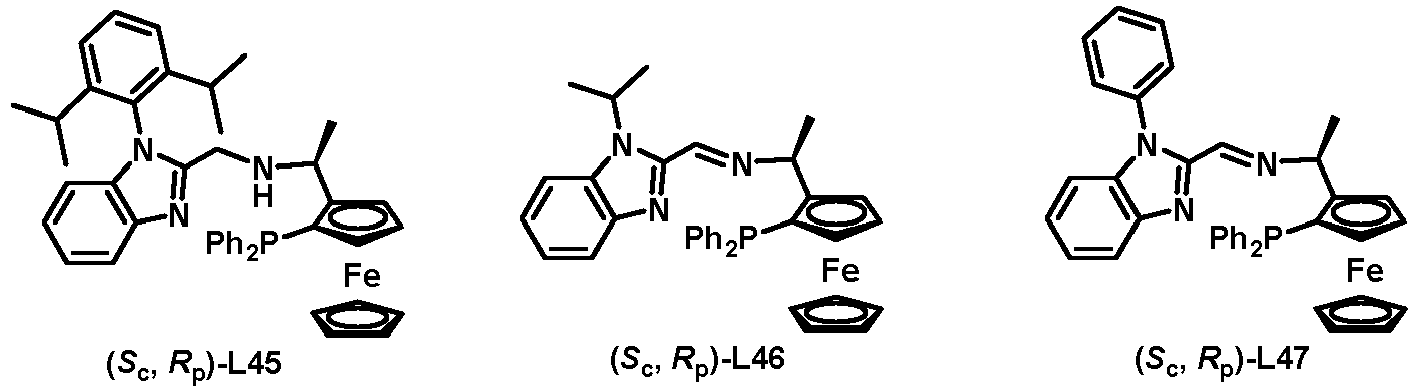
- In a first aspect, the present disclosure provides a method for preparing an intermediate of formula (5) for the preparation of nicotine, comprising: subjecting compound (4) to asymmetric reduction in the presence of a catalyst to produce the intermediate (5), as shown in the following reaction scheme:



- In some embodiments, the amino-protecting group is selected from the group consisting of benzyloxycarbonyl (Cbz), tert-butoxycarbonyl (Boc), fluorenylmethyloxycarbonyl (Fmoc), allyloxycarbonyl (Alloc), (trimethylsilyl)ethoxycarbonyl (Teoc), methoxycarbonyl, ethoxycarbonyl, phthaloyl (Pht), p-toluenesulfonyl (Ts), trifluoroacetyl (Tfa), nitrobenzenesulfonyl (Ns), pivaloyl, benzoyl, trityl (Trt), 2,4-dimethoxybenzyl (Dmb), p-methoxybenzyl (PMB) and benzyl (Bn).
- In some embodiments, R2 is preferably tert-butoxycarbonyl (Boc); a structure of the compound (4) is


- In some embodiments, the asymmetric reduction is performed in a solvent selected from the group consisting of methanol, ethanol, isopropanol, tetrahydrofuran, dichloromethane, toluene and a combination thereof.
- In some embodiments, the asymmetric reduction is performed in the presence of a base; and the base is selected from the group consisting of potassium tert-butoxide, sodium tert-butoxide, lithium tert-butoxide, potassium hydroxide, sodium hydroxide, sodium carbonate, potassium carbonate, cesium carbonate and a combination thereof.
- In some embodiments, the asymmetric reduction is performed at a temperature of 25-80°C and a hydrogen pressure of 2-6 MPa for 16-24 h.
- In a second aspect, this application provides a compound of formula (4) or formula (5):

- In some embodiments, the compound of formula (4) is selected from the group consisting of:


- In some embodiments, the compound of formula (5) is selected from the group consisting of:


- In some embodiments, the catalyst is [Ir(COD)Cl]2; and the chiral ligand is:

- In a third aspect, this application further provides a method for preparing nicotine, comprising:
reacting a nicotinate (1) with N-methylpyrrolidone (2) in the presence of a base and HCl to produce 4-methylamino-1-(3-pyridine)-butanone hydrochloride (3); reacting the 4-methylamino-1-(3-pyridine)-butanone hydrochloride (3) with an amino-protecting reagent to produce a pyridyl alkyl ketone (4); subjecting the pyridyl alkyl ketone (4) to asymmetric reduction in the presence of a transition metal catalyst to produce an intermediate (5); subjecting the intermediate (5) to derivatization to produce a compound (6); and removing an amino-protecting group R2 from the compound (6) followed by intramolecular cyclization under a basic condition to produce nicotine; as shown in the following reaction scheme:
- In some embodiments, the method comprises:
- 1) subjecting a nicotinic acid alkyl ester (1) and N-methylpyrrolidone (2) to a condensation reaction under a mild condition in the presence of an anhydrous solvent and a base to produce a condensation product; and heating the condensation product in the presence of HCl followed by purification in a solvent to obtain the 4-methylamino-1-(3-pyridine)-butanone hydrochloride (3);
wherein the nicotinic acid alkyl ester (3) comprises a short-chain alkyl group, and R1 is a C1-3 alkyl; - 2) reacting 4-methylamino-1-(3-pyridine)-butanone hydrochloride (3) with the amino-protecting reagent to obtain the compound (4); wherein R2 is selected from the group consisting of C1-2 alkyl, heteroatom-substituted alkyl, aryl and amino-protecting group; and the amino-protecting group is selected from the group consisting of benzyloxycarbonyl (Cbz), tert-butoxycarbonyl (Boc), fluorenylmethyloxycarbonyl (Fmoc), allyloxycarbonyl (Alloc), (trimethylsilyl)ethoxycarbonyl (Teoc), methoxycarbonyl, ethoxycarbonyl, phthaloyl (Pht), p-toluenesulfonyl (Ts), trifluoroacetyl (Tfa), nitrobenzenesulfonyl (Ns), pivaloyl, benzoyl, trityl (Trt), 2,4-dimethoxybenzyl (Dmb), p-methoxybenzyl (PMB) and benzyl (Bn);
- 3) subjecting the compound (4) to the asymmetric reduction in the presence of the transition metal catalyst and a base in a solvent under hydrogen atmosphere in a reactor at room temperature; after the asymmetric reduction is completed, releasing gas in the reactor; and subjecting the reaction mixture to rotary evaporation and purification by silica gel column chromatography to obtain the intermediate (5); wherein the intermediate (5) is a chiral alcohol;
- 4) reacting the intermediate (5) with a reagent to convert an alcoholic hydroxy group of the intermediate (5) into R3 to obtain the compound (6); wherein R3 is a leaving group selected from the group consisting of halogen, sulfonate and phosphate; the halogen is selected from the group consisting of fluorine, chlorine, bromine and iodine; and the sulfonate is selected from the group consisting of mesylate (OMs), trifluoromethanesulfonate (OTf), p-toluenesulfonate (OTs) and nitrosulfonate (ONs); and
- 5) subjecting the compound (6) to deprotection in the presence of a reagent to remove the amino-protecting group R2followed by intramolecular nucleophilic cyclization under basic condition; subjecting the reaction mixture to extraction with ethyl acetate; collection and concentrating an organic phase to obtain a crude product; and subjecting the crude product to vacuum distillation to obtain (S)-nicotine.
- In some embodiments, when R2 is tert-butoxycarbonyl (Boc), the reagent for the deprotection is hydrochloric acid or trifluoroacetic acid.
- In some embodiments, R1 is ethyl.
- In some embodiments, R3 is OMs.
- The beneficial effects of the disclosure are described as follows.
- (1) In regard to the method provided herein for preparing nicotine, a pyridyl alkyl ketone undergoes an asymmetric hydrogenation under the catalysis to efficiently produce a chiral alcohol intermediate. The reaction has high stability and reactivity, and effectively realizes the steric control. An enantioselectivity of the chiral alcohol intermediate is greater than 99%.
- (2) It has been demonstrated by extensive researches that the asymmetric hydrogenation has a high reactivity in the presence of the catalyst system Ir/f-amphox with a turnover number (TON) as high as 50,000.
- (3) The method provided herein has simple operation, low cost and less energy consumption, and thus has a promising prospect in the industrial application.
-
- FIG. 1
- depicts a synthesis route in accordance with an embodiment of the present disclosure;
- FIG. 2
- is a 1H NMR spectrum (400 MHz, CDCl3) of nicotine;
- FIG. 3
- is a 13C {1H}NMR spectrum (101 MHz, CDCl3) of nicotine;
- FIG. 4
- is a HPLC spectrum of a nicotine raceme; and
- FIG. 5
- is a HPLC spectrum of (S)-nicotine.
- The present disclosure will be further described in detail below with reference to the embodiments and accompanying drawings. The embodiments are illustrative, and not intended to limit the disclosure. Unless otherwise specified, experiments in the examples are conducted using a conventional approach under conventional conditions or as recommended by the manufacturer; and the materials and reagents used herein are all commercially available.
- Synthesis of hydrogenation product 5a (S/C= 10000; R2=Boc)

- Under argon atmosphere, [Ir(COD)Cl]2 (3.4 mg, 0.005 mol) and a chiral ligand f-amphox- t Bu-L3 (5.8 mg, 0.0105 mmol) were dissolved with 4 mL of isopropanol, and stirred at room temperature for 3 h to obtain a clear orange solution. 145 µL of the orange solution was pipetted, and added into a mixed system consisting of compound 4 (1 g, 3.6 mmol), isopropanol (2 mL) and potassium tert-butoxide (4 mg, 0.036 mmol). The reaction mixture was transferred to an autoclave. Gas in the autoclave was replaced with hydrogen three times, and then the autoclave was filled with 40 atm of hydrogen. The reaction mixture was reacted at 50°C for 24 h. After the reaction was completed, the gas in the autoclave was slowly discharged, and the reaction mixture was added with 50 mL of dichloromethane, washed with water and saturated saline solution, dried with anhydrous sodium sulfate and concentrated under vacuum to obtain 1.1 g of a red oily liquid. As analyzed by high performance liquid chromatography (HPLC), the desired product 5a had a yield of 98% and 99% ee.
- Synthesis of hydrogenation product 5b(S/C=10000; R2 = Boc)

- Under argon atmosphere, [Ir(COD)Cl]2 (3.4 mg, 0.005 mol) and a chiral ligand f-amphox- t Bu-L3 (5.8 mg, 0.0105 mmol) that had an opposite configuration of Example 1 were dissolved with 4 mL of isopropanol, and stirred at room temperature for 3 h to obtain a clear orange solution. 145 µL of the orange solution was pipetted, and added into a mixed system consisting of compound 4 (1 g, 3.6 mmol), isopropanol (2 mL) and potassium tert-butoxide (4 mg, 0.036 mmol). The reaction mixture was transferred to an autoclave. Gas in the autoclave was replaced with hydrogen three times, and then the autoclave was filled with 40 atm of hydrogen. The reaction mixture was reacted at 50°C for 24 h. After the reaction was completed, the gas in the autoclave was slowly discharged, and the reaction mixture was added with 50 mL of dichloromethane, washed with water and saturated saline solution, dried with anhydrous sodium sulfate and concentrated under vacuum to obtain 1.1 g of a red oily liquid. As analyzed by high performance liquid chromatography (HPLC), the desired product 5b had a yield of 99% and an ee value of more than 99%.
- Synthesis of hydrogenation product 5a (S/C=10000; R2 = Boc)

- Under argon atmosphere, [Ir(COD)Cl]2 (3.4 mg, 0.005 mol) and a chiral ligand f-amphox- t Bu-L3 (5.8 mg, 0.0105 mmol) were dissolved with 4 mL of isopropanol, and stirred at room temperature for 3 h to obtain a clear orange solution. 145 µL of the orange solution was pipetted, and added into a mixed system consisting of compound 4 (1 g, 3.6 mmol), isopropanol (2 mL) and potassium carbonate (5 mg, 0.036 mmol). The reaction mixture was transferred to an autoclave. Gas in the autoclave was replaced with hydrogen three times, and then the autoclave was filled with 40 atm of hydrogen. The reaction mixture was reacted at 50°C for 24 h. After the reaction was completed, the gas in the autoclave was slowly discharged, and the reaction mixture was added with 50 mL of dichloromethane, washed with water and saturated saline solution, dried with anhydrous sodium sulfate and concentrated under vacuum to obtain 1.1 g of a red oily liquid. As analyzed by high performance liquid chromatography (HPLC), the desired product 5a had a yield of 99% and an ee value of more than 99%.
- Synthesis of hydrogenation product 5a (S/C=10000; R2 = Boc)

- Under argon atmosphere, [Ir(COD)Cl]2 (3.4 mg, 0.005 mol) and a chiral ligand f-amphox- t Bu-L3 (5.8 mg, 0.0105 mmol) were dissolved with 4 mL of isopropanol, and stirred at room temperature for 3 h to obtain a clear orange solution. 145 µL of the orange solution was pipetted, and added into a mixed system consisting of compound 4 (1 g, 3.6 mmol), isopropanol (2 mL) and sodium hydroxide (1.4 mg, 0.036 mmol). The reaction mixture was transferred to an autoclave. Gas in the autoclave was replaced with hydrogen three times, and then the autoclave was filled with 40 atm of hydrogen. The reaction mixture was reacted at 50°C for 24 h. After the reaction was completed, the gas in the autoclave was slowly discharged, and the reaction mixture was added with 50 mL of dichloromethane, washed with water and saturated saline solution, dried with anhydrous sodium sulfate and concentrated under vacuum to obtain 1.1 g of a red oily liquid. As analyzed by high performance liquid chromatography (HPLC), the desired product 5a had a yield of 98% and an ee value of 99%.
- Synthesis of hydrogenation product 5a (S/C=50000; R2 = Boc)

- Under argon atmosphere, [Ir(COD)Cl]2 (3.4 mg, 0.005 mol) and a chiral ligand f-amphox- t Bu-L3 (5.8 mg, 0.0105 mmol) were dissolved with 4 mL of isopropanol, and stirred at room temperature for 3 h to obtain a clear solution. 29 µL of the orange solution was pipetted, and added into a mixed system consisting of compound 4 (1 g, 3.6 mmol), isopropanol (2 mL) and potassium tert-butoxide (4 mg, 0.036 mmol). The reaction mixture was transferred to an autoclave. Gas in the autoclave was replaced with hydrogen three times, and then the autoclave was filled with 40 atm of hydrogen. The reaction mixture was reacted at 50°C for 24 h. After the reaction was completed, the gas in the autoclave was slowly discharged, and the reaction mixture was added with 50 mL of dichloromethane, washed with water and saturated saline solution, dried with anhydrous sodium sulfate and concentrated under vacuum to obtain 1.1 g of a red oily liquid. As analyzed by high performance liquid chromatography (HPLC), the desired product 5a had a yield of 99% and an ee value of more than 99%.
- Synthesis of hydrogenation product 5a (S/C=10000; R2 = Boc)

- Under argon atmosphere, [Ir(COD)Cl]2 (3.4 mg, 0.005 mol) and a chiral ligand f-amphol-L8 (7.9 mg, 0.0105 mmol) were dissolved with 4 mL of isopropanol, and stirred at room temperature for 3 h to obtain a clear orange solution. 145 µL of the orange solution was pipetted, and added into a mixed system consisting of compound 4 (1 g, 3.6 mmol), isopropanol (2 mL) and potassium tert-butoxide (4 mg, 0.036 mmol). The reaction mixture was added into an autoclave. Gas in the autoclave was replaced with hydrogen three times, and then the autoclave was filled with 40 atm of hydrogen. The reaction mixture was reacted at 50°C for 24 h. After the reaction was completed, the gas in the autoclave was slowly discharged, and the reaction mixture was added with 50 mL of dichloromethane, washed with water and saturated saline solution, dried with anhydrous sodium sulfate and concentrated under vacuum to obtain 1.1 g of a red oily liquid. As analyzed by high performance liquid chromatography (HPLC), the desired 5a had a yield of 99% and an ee value of 89%.
- Synthesis of hydrogenation product 5a (S/C=10000; R2 = Boc)

- Under argon atmosphere, [Ir(COD)Cl]2 (3.4 mg, 0.005 mol) and a chiral ligand f-ampha-L15 (8.1 mg, 0.0105 mmol) were dissolved with 4 mL of isopropanol, and stirred at room temperature for 3 h to obtain a clear orange solution. 145 µL of the orange solution was pipetted, and added into a mixed system consisting of compound 4 (1g, 3.6 mmol), isopropanol (2mL) and potassium tert-butoxide (4 mg, 0.036 mmol). The reaction mixture was transferred to an autoclave. Gas in the autoclave was replaced with hydrogen three times, and then the autoclave was filled with 40 atm of hydrogen. The reaction mixture was reacted at 50°C for 24 h. After the reaction was completed, the gas in the autoclave was slowly discharged, and the reaction mixture was added with 50 mL of dichloromethane, washed with water and saturated saline solution, dried with anhydrous sodium sulfate and concentrated under vacuum to obtain 1.1 g of a red oily liquid. As analyzed by high performance liquid chromatography (HPLC), the desired product 5a had a yield of 99% and an ee value of 66%.
- Synthesis of hydrogenation product 5a (S/C=10000; R2 = Boc)

- Under argon atmosphere, [Ir(COD)Cl]2 (3.4 mg, 0.005 mol) and a chiral ligand f-amphamide-L16 (6.4 mg, 0.0105 mmol) were dissolved with 4 mL of isopropanol, and stirred at room temperature for 3 h to obtain a clear orange solution. 145 µL of the orange solution was pipetted, and added into a mixed system consisting of compound 4 (1 g, 3.6 mmol), isopropanol (2 mL) and potassium tert-butoxide (4 mg, 0.036 mmol). The reaction mixture was transferred to an autoclave. Gas in the autoclave was replaced with hydrogen three times, and then the autoclave was filled with 40 atm of hydrogen. The reaction mixture was reacted at 50°C for 24 h. After the reaction was completed, the gas in the autoclave was slowly discharged, and the reaction mixture was added with 50 mL of dichloromethane, washed with water and saturated saline solution, dried with anhydrous sodium sulfate and concentrated under vacuum to obtain 1.1 g of a red oily liquid. As analyzed by high performance liquid chromatography (HPLC), the desired product 5a had a yield of 99% and an ee value of 96%.
- Synthesis of hydrogenation product 5a (S/C=10000; R2 = Boc)

- Under argon atmosphere, [Ir(COD)Cl]2 (3.4 mg, 0.005 mol) and a chiral ligand f-amphamide-L17 (8.8 mg, 0.0105 mmol) were dissolved with 4 mL of isopropanol, and stirred at room temperature for 3 h to obtain a clear orange solution. 145 µL of the orange solution was pipetted, and added into a mixed system consisting of compound 4 (1 g, 3.6 mmol), isopropanol (2 mL) and potassium tert-butoxide (4 mg, 0.036 mmol). The reaction mixture was transferred to an autoclave. Gas in the autoclave was replaced with hydrogen three times, and then the autoclave was filled with 40 atm of hydrogen. The reaction mixture was reacted at 50°C for 24 h. After the reaction was completed, the gas in the autoclave was slowly discharged, and the reaction mixture was added with 50 mL of dichloromethane, washed with water and saturated saline solution, dried with anhydrous sodium sulfate and concentrated under vacuum to obtain 1.1 g of a red oily liquid. As analyzed by high performance liquid chromatography (HPLC), the desired product 5a had a yield of 99% and an ee value of 99%.
- Synthesis of hydrogenation product 5a (S/C=10000; R2 = Boc)

- Under argon atmosphere, [Ir(COD)Cl]2 (3.4 mg, 0.005 mol) and a chiral ligand (Rc, Sp, R, R)-L28 (7.3 mg, 0.0105 mmol) were dissolved with 4 mL of isopropanol, and stirred at room temperature for 3 h to obtain a clear orange solution. 145 µL of the orange solution was pipetted, and added into a mixed system consisting of compound 4 (1 g, 3.6 mmol), isopropanol (2 mL) and potassium tert-butoxide (4 mg, 0.036 mmol). The reaction mixture was transferred to an autoclave. Gas in the autoclave was replaced with hydrogen three times, and then the autoclave was filled with 40 atm of hydrogen. The reaction mixture was reacted at 50°C for 24 h. After the reaction was completed, the gas in the autoclave was slowly discharged, and the reaction mixture was added with 50 mL of dichloromethane, washed with water and saturated saline solution, dried with anhydrous sodium sulfate and concentrated under vacuum to obtain 1.1 g of a red oily liquid. As analyzed by high performance liquid chromatography (HPLC), the desired product 5a had a yield of 99% and an ee value of 99%.
- Synthesis of hydrogenation product 5b (S/C=10000; R2 = Boc)

- Under argon atmosphere, [Ir(COD)Cl]2 (3.4 mg, 0.005 mol) and a chiral ligand (Rc, Sp, R, R)-L28 (7.3 mg, 0.0105 mmol) that has an opposite configuration of Example 10 was added into 4 mL of isopropanol, and stirred at room temperature for 3 h to obtain an apparent orange solution. 145 µL of the orange solution was pipetted, and mixed with intermediate 4 (1 g, 3.6 mmol), isopropanol (2 mL) and potassium tert-butoxide (4 mg, 0.036 mmol) to obtain a reaction mixture. The reaction mixture was added into an autoclave. Gas in the autoclave was replaced with hydrogen three times, and then the autoclave was filled with 40 atm hydrogen. A reaction was performed at 50°C for 24 h. After the reaction, the gas in the autoclave was slowly released, and 50 mL of dichloromethane was added into the autoclave. A product of the reaction was washed with water, and then washed with saturated saline solution. The washed product was dried by anhydrous sodium sulfate, and concentrated under vacuum to obtain 1.1 g of a red oily liquid. The hydrogenated product 5b had a yield of 99%, and an ee value determined by high performance liquid chromatography (HPLC) was 99%.
- Synthesis of hydrogenation product 5a-1 (S/C=10000; R2 =Ts)

- Under argon atmosphere, [Ir(COD)Cl]2 (3.4 mg, 0.005 mol) and a chiral ligand f-amphox- t Bu-L3 (5.8 mg, 0.0105 mmol) were dissolved with 4 mL of isopropanol, and stirred at room temperature for 3 h to obtain a clear orange solution. 145 µL of the orange solution was pipetted, and added into a mixed system consisting of compound 4 (1.2 g, 3.6 mmol), isopropanol (2 mL) and potassium tert-butoxide (4 mg, 0.036 mmol). The reaction mixture was transferred to an autoclave. Gas in the autoclave was replaced with hydrogen three times, and then the autoclave was filled with 40 atm of hydrogen. The reaction mixture was reacted at 50°C for 24 h. After the reaction was completed, the gas in the autoclave was slowly discharged, and the reaction mixture was added with 50 mL of dichloromethane, washed with water and saturated saline solution, dried with anhydrous sodium sulfate and concentrated under vacuum to obtain 1.2 g of a red oily liquid. As analyzed by high performance liquid chromatography (HPLC), the desired product 5a-1 had a yield of 99% and an ee value of 62%.
- Synthesis of hydrogenation product 5a-2 (S/C= 10000; R2 = Cbz)

- Under argon atmosphere, [Ir(COD)Cl]2 (3.4 mg, 0.005 mol) and a chiral ligand f-amphox- t Bu-L3 (5.8 mg, 0.0105 mmol) were dissolved with 4 mL of isopropanol, and stirred at room temperature for 3 h to obtain a clear orange solution. 145 µL of the orange solution was pipetted, and added into a mixed system consisting of compound 4 (1.12 g, 3.6 mmol), isopropanol (2 mL) and potassium tert-butoxide (4 mg, 0.036 mmol). The reaction mixture was transferred to an autoclave. Gas in the autoclave was replaced with hydrogen three times, and then the autoclave was filled with 40 atm of hydrogen. The reaction mixture was reacted at 50°C for 24 h. After the reaction was completed, the gas in the autoclave was slowly discharged, and the reaction mixture was added with 50 mL of dichloromethane, washed with water and saturated saline solution, dried with anhydrous sodium sulfate and concentrated under vacuum to obtain 1.1 g of a red oily liquid. As analyzed by high performance liquid chromatography (HPLC), the desired product 5a-2 had a yield of 98% and an ee value of 99%.
- Synthesis of 4-methylamino-1-(3-pyridine)-butanone hydrochloride (R1 = ethyl)

- N-methylpyrrolidone 2 (5g, 50 mmol) was dissolved with 50 mL of ultra-dry tetrahydrofuran, and then added with sodium hydride powder (6.05 g, 150 mmol, mass fraction 60%) in batches to obtain a reaction mixture. The reaction mixture was reacted under stirring at room temperature for 15 min. The reaction mixture was slowly added with ethyl nicotinate 1 (13.8 mL, 100 mmol) dropwise, and then heated to reflux. The reaction was continued for 24 h. Then the reaction mixture was placed in a cold bath at 0°C, and the reaction was quenched by dropping a concentrated hydrochloric acid (4M). Solid sodium hydroxide particles were added into the reaction mixture to adjust a reaction pH to about 4. The reaction mixture was extracted three times with 90 mL of dichloromethane, and an organic phase was obtained. The organic phase was dried by anhydrous sodium sulfate, and a solvent was removed under vacuum to obtain 10 g of a brown oily crude product. The crude product was added 100 mL of concentrated hydrochloric acid (5M), and was heated and refluxed for 72 h to obtain a reaction liquid. The reaction liquid was concentrated under vacuum, and added with 100 mL deionized water and then filtrated to obtain a brown solid residue. The brown solid residue was recrystallized with an EtOH/H2O mixed system, so as to obtain 5.67 g of an off-white solid as the intermediate 3, the off-white solid (45% yield).
- Synthesis of intermediate 4a-1 (R2 = Boc)

- Intermediate 3 (66 g, 263 mmol) was dissolved with 500 mL of deionized water and 300 mL of dioxane, and then added with sodium carbonate powder (42 g, 395 mmol) during stirring to obtain a reaction mixture. The reaction mixture was stirred and reacted for 20 min, and was added with di-tert-butyl dicarbonate (63.2 g, 289.3 mmol) dropwise. Thin-layer chromatography was adopted to monitor the reaction mixture, and the reaction mixture was stirred and reacted at room temperature for 15 h. After the reaction, the dioxane solvent was removed under vacuum. Then the reaction mixture was extracted three times with 800 mL of ethyl acetate to obtain an organic phase. The organic phase was dried with anhydrous sodium sulfate, and the ethyl acetate was removed under vacuum. The organic phase was purified using a silica column, so as to obtain 60 g of a light-yellow oily liquid as the intermediate 4a-1 (83% yield).
- 1HNMR (400 MHz, CDCl3): δ 9.26-9.07 (m, 1H), 8.84-8.72 (m, 1H), 8.31-8.17 (m, 1H), 7.49-7.39 (m, 1H), 3.35 (t, J = 6.8 Hz, 2H), 3.02 (t, J = 7.0 Hz, 2H), 2.87 (s, 3H), 2.07-1.92 (m, 2H), 1.41 (s, 9H).13C {1H}NMR (101 MHz, CDCl3): δ 197.8, 155.6, 153.2, 149.3, 135.0, 131.8, 123.4, 79.1, 47.5, 35.3, 33.8, 28.1, 21.4.
- Synthesis of intermediate 4a-2 (R2 = Ts)

- Intermediate 3 (6.6 g, 26.3 mmol) was dissolved with 50 mL of deionized water and 30 mL of dichloromethane, and then added with sodium carbonate powder (4.2 g, 39.5 mmol) during stirring to obtain a reaction mixture. The reaction mixture was stirred and reacted for 20 min, and an organic phase was separated out. Then p-toluenesulfonyl chloride (5.5 g, 29 mmol) was added dropwise into the organic phase. Thin-layer chromatography was adopted to monitor the reaction mixture, and the reaction mixture was stirred and reacted at room temperature for 5 h. After the reaction, the reaction mixture was washed with a saturated sodium carbonate solution. Organic phases were combined, dried with anhydrous sodium sulfate and concentrated. The concentrated organic phase was purified using a silica column, so as to obtain 3.6 g of a light-yellow solid as the intermediate 4a-2 (50% yield).
- 1H NMR (400 MHz, CDCl3): δ 9.25-9.10 (m, 1H), 8.86-8.73 (m, 1H), 8.30-8.21 (m, 1H), 7.70-7.62 (m, 2H), 7.47-7.39 (m, 1H), 7.34-7.28 (m, 2H), 3.23-3.02 (m, 4H), 2.74 (s, 3H), 2.42 (s, 3H), 2.13-1.93 (m, 2H). 13C {1H}NMR (101 MHz, CDCl3): δ 198.4, 153.5, 149.6, 143.4, 135.4, 134.3, 132.1, 129.7, 127.4, 123.6, 49.3, 35.3, 34.8, 21.5, 21.2.
- Synthesis of intermediate 4a-3 (R2 = Cbz)

- Intermediate 3 (6.6 g, 26.3 mmol) was dissolved with 50 mL of deionized water and 30 mL of dichloromethane, and then added with sodium carbonate powder (4.2 g, 39.5 mmol) during stirring to obtain a reaction mixture. The reaction mixture was stirred and reacted for 20 min, and an organic phase was separated out. Then benzyl chloroformate (4.9 g, 29 mmol) was added dropwise into the organic phase. Thin-layer chromatography was adopted to monitor the reaction mixture, and the reaction mixture was stirred and reacted at room temperature for 5 h. After the reaction, the reaction mixture was washed with a saturated sodium carbonate solution. Organic phases were combined, dried with anhydrous sodium sulfate and concentrated. The concentrated organic phase was purified using a silica column, so as to obtain 7 g of a light-yellow solid as the intermediate 4a-3 (85% yield).
- Synthesis of intermediate (R)-6a-1 (R3 = Cl)
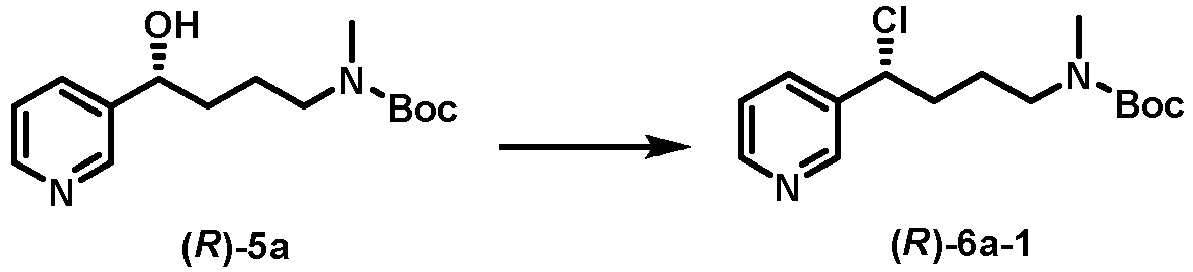
- 5.6 g (20 mmol) of the compound 5a was dissolved with 50 mL of dichloromethane to obtain a reaction mixture. The reaction mixture was placed in a cold bath at 0°C, and slowly added with 1.6 mL (22 mmol) of thionyl chloride dropwise during stirring. The reaction mixture was heated and refluxed for 2 h. After the reaction, the reaction mixture was washed with saturated sodium carbonate, extracted three times with 60 mL of dichloromethane, and purified using a silica column to obtain 5.6 g of a yellow oily liquid as the intermediate (R)-6a-1 (83% yield).
- Synthesis of intermediate (S)-6a-1 (R3 = Cl)

- 5.6 g (20 mmol) of the compound 5b was dissolved with 50 mL of dichloromethane to obtain a reaction mixture. The reaction mixture was placed in a cold bath at 0°C, and slowly added with 1.6 mL (22 mmol) of thionyl chloride dropwise during stirring. The reaction mixture was heated and refluxed for 2 h. After the reaction, the reaction mixture was washed with saturated sodium carbonate, extracted three times with 60 mL of dichloromethane, and purified using a silica column to obtain 5.9 g of a yellow oily liquid as the intermediate (S)-6b-1 (85% yield).
- Synthesis of intermediate (R)-6a-2 (R3 = OMs)

- 5.6 g (20 mmol) of the compound 5a was dissolved with 50 mL of dichloromethane and added 5.6 (40 mmol) of triethylamine dropwise to obtain a reaction mixture. The reaction mixture was placed in a cold bath at 0°C, and slowly added with 1.7 mL (22 mmol) of methanesulfonyl chloride dropwise during stirring. The reaction mixture was performed at 0°C for 30 min. After the reaction, the reaction mixture was washed with saturated sodium carbonate, extracted three times with 60 mL of dichloromethane, and purified using a silica column to obtain 7.1 g of a yellow oily liquid as the intermediate (R)-6a-2 (98% yield).
- Synthesis of intermediate (S)- 6a-2 (R3 = OMs)

- 5.6 g (20 mmol) of the compound 5b was dissolved with 50 mL of dichloromethane and added 5.6 (40 mmol) of triethylamine dropwise to obtain a reaction mixture. The reaction mixture was placed in a cold bath at 0°C, and slowly added with 1.7 mL (22 mmol) of methanesulfonyl chloride dropwise during stirring. The reaction mixture was performed at 0°C for 30 min. After the reaction, the reaction mixture was washed with saturated sodium carbonate, extracted three times with 60 mL of dichloromethane, and purified using a silica column to obtain 7 g of a yellow oily liquid as the intermediate (S)-6a-2 (96% yield).
- Synthesis of (S)-nicotine 7 (R3= OMs)

- The intermediate (R)-6a-2 (7.2 g, 20 mmol) was dissolved with 50 mL concentrated hydrochloric acid (5M) dropwise and stirred at room temperature for 2 h. Then the mixture was dissolved by 100 mL of water, placed in a cold bath at 0°C, and added with 150 mL of a sodium hydroxide solution (2 M) dropwise during stirring. The reaction mixture was extracted three times with 150 mL of ethyl acetate to obtain an organic phase. The organic phase was dried by anhydrous sodium sulfate, and a solvent was removed under vacuum, so as obtain a yellow oily liquid. The yellow oily liquid was purified by distillation under vacuum to obtain 3 g of a colorless oily liquid as the (S)-Nicotine 7a, the colorless oily liquid ( 84% yield; ee 98%).
- The synthesis route was referred to
Fig. 1; Fig. 2 was a 1H NMR spectrum (400 MHz, CDCl3) of nicotine;Fig. 3 was a 13C {1H}NMR spectrum (101 MHz, CDCl3) of nicotine; andFig. 4 was a HPLC spectrum of a nicotine raceme. - Synthesis of (R)-nicotine 7 (R3 = OMs)

- The intermediate (S)-6b-2 (7.2 g, 20 mmol) was dissolved with 50 mL concentrated hydrochloric acid (5M) dropwise and stirred at room temperature for 2 h. Then the mixture was dissolved by 100 mL of water, placed in a cold bath at 0°C, and added with 150 mL of a sodium hydroxide solution (2 M) dropwise during stirring. The reaction mixture was extracted three times with 150 mL of ethyl acetate to obtain an organic phase. The organic phase was dried by anhydrous sodium sulfate, and a solvent was removed under vacuum, so as obtain a yellow oily liquid. The yellow oily liquid was purified by distillation under vacuum to obtain 2.9 g of a colorless oily liquid as the (R)-Nicotine 7b (80% yield; ee 98%).
- Synthesis of (S)-nicotine 7 (R3 = Cl)

- The intermediate (S)-6b-1 (7.2 g, 20 mmol) was dissolved with 50 mL concentrated hydrochloric acid (5M) dropwise and stirred at room temperature for 2 h. Then the mixture was dissolved by 100 mL of water, placed in a cold bath at 0°C, and added with 150 mL of a sodium hydroxide solution (2 M) dropwise during stirring. The reaction mixture was extracted three times with 150 mL of ethyl acetate to obtain an organic phase. The organic phase was dried by anhydrous sodium sulfate, and a solvent was removed under vacuum, so as obtain a yellow oily liquid. The yellow oily liquid was purified by distillation under vacuum to obtain 3 g of a colorless oily liquid as the (S)-Nicotine 7a (yield 85%; ee 98%).
- Synthesis of (R)-nicotine 7 (R3 = chlorine Cl)

- The intermediate (R)-6a-1 (7.2 g, 20 mmol) was dissolved with 50 mL concentrated hydrochloric acid (5M) dropwise and stirred at room temperature for 2 h. Then the mixture was dissolved by 100 mL of water, placed in a cold bath at 0°C, and added with 150 mL of a sodium hydroxide solution (2 M) dropwise during stirring. The reaction mixture was extracted three times with 150 mL of ethyl acetate to obtain an organic phase. The organic phase was dried by anhydrous sodium sulfate, and a solvent was removed under vacuum, so as obtain a yellow oily liquid. The yellow oily liquid was purified by distillation under vacuum to obtain 2.9 g of a colorless oily liquid as the (R)-Nicotine 7b, the colorless oily liquid (82% yield; ee 98%).
- [α]25 D = -98.2 (c = 1, CHCl3), 1H NMR (400 MHz, CDCl3): δ 8.56-8.47 (m, 2H), 7.75-7.67 (m, 1H), 7.27-7.23 (m, 1H), 3.32-3.21 (m, 1H), 3.10 (t, J = 8.3 Hz, 1H), 2.39-2.28 (m, 1H), 2.28-2.19 (m, 1H), 2.17 (s, 3H), 2.04-1.91 (m, 1H), 1.89-1.79 (m, 1H), 1.78-1.66 (m, 1H).13C {1H}NMR(101 MHz, CDCl3): δ 149.5, 148.6, 138.6, 134.9, 123.6, 68.9, 57.0, 40.3, 35.1, 22.6. HPLC: Chiralpak OD-H column, n-hexane (+0.1% diethanolamine)/isopropanol = 98/2; flow rate = 1.0 mL/min; UV 260 nm; tR(S) = 7.1 min (main peak), tR (R) = 8.4 min (small peak).
Fig. 5 was a HPLC spectrum of (S)-nicotine. - The above-mentioned embodiments are merely preferred embodiments of the disclosure, and not intended to limit the disclosure. Any changes, modifications, replacements, combinations and simplifications made by those skilled in the art without departing from the spirit of the present disclosure should fall within the scope of the disclosure defined by the appended claims.
Claims (10)
- A method for preparing an intermediate of formula (5) in the preparation of nicotine, comprising:
subjecting compound (4) to asymmetric reduction in the presence of a catalyst to produce the intermediate (5), as shown in the following reaction scheme:


- The method of claim 1, wherein the amino-protecting group is selected from the group consisting of benzyloxycarbonyl (Cbz), tert-butoxycarbonyl (Boc), fluorenylmethyloxycarbonyl (Fmoc), allyloxycarbonyl (Alloc), (trimethylsilyl)ethoxycarbonyl (Teoc), methoxycarbonyl, ethoxycarbonyl, phthaloyl (Pht), p-toluenesulfonyl (Ts), trifluoroacetyl (Tfa), nitrobenzenesulfonyl (Ns), pivaloyl, benzoyl, trityl (Trt), 2,4-dimethoxybenzyl (Dmb), p-methoxybenzyl (PMB) and benzyl (Bn).
- The method of claim 1, wherein the R2 is preferably tert-butoxycarbonyl (Boc); a structure of the compound (4) is


- The method of claim 1, wherein the asymmetric reduction is performed in a solvent selected from the group consisting of methanol, ethanol, isopropanol, tetrahydrofuran, dichloromethane, toluene and a combination thereof; the asymmetric reduction is performed in the presence of a base; and the base is selected from the group consisting of potassium tert-butoxide, sodium tert-butoxide, lithium tert-butoxide, potassium hydroxide, sodium hydroxide, sodium carbonate, potassium carbonate, cesium carbonate and a combination thereof.
- The method of claim 1, wherein the asymmetric reduction is performed at a temperature of 25-80°C and a hydrogen pressure of 2-6 MPa for 16-24 h.
- A compound of formula (4) or formula (5):

- A method for preparing nicotine, comprising:
reacting a nicotinate (1) with N-methylpyrrolidone (2) in the presence of a base and HCl to produce 4-methylamino-1-(3-pyridine)-butanone hydrochloride (3); reacting the 4-methylamino-1-(3-pyridine)-butanone hydrochloride (3) with an amino-protecting reagent to produce a pyridyl alkyl ketone (4); subjecting the pyridyl alkyl ketone (4) to asymmetric reduction in the presence of a transition metal catalyst to produce an intermediate (5); subjecting the intermediate (5) to derivatization to produce a compound (6); and removing an amino-protecting group R2 from the compound (6) followed by intramolecular cyclization under a basic condition to produce nicotine; as shown in the following reaction scheme:
- The method of claim 7, wherein R2 is selected from the group consisting of C1-2 alkyl, heteroatom-substituted alkyl, aryl group and amino-protecting group; and the amino-protecting group is selected from the group consisting of benzyloxycarbonyl (Cbz), tert-butoxycarbonyl (Boc), fluorenylmethyloxycarbonyl (Fmoc), allyloxycarbonyl (Alloc), (trimethylsilyl)ethoxycarbonyl (Teoc), methoxycarbonyl, ethoxycarbonyl, phthaloyl (Pht), p-toluenesulfonyl (Ts), trifluoroacetyl (Tfa), nitrobenzenesulfonyl (Ns), pivaloyl, benzoyl, trityl (Trt), 2,4-dimethoxybenzyl (Dmb), p-methoxybenzyl (PMB) and benzyl (Bn).
- The method of claim 7, wherein when R2 is tert-butoxycarbonyl (Boc), a reagent for a deprotection is hydrochloric acid or trifluoroacetic acid.
- The method of claim 7, comprising:1) subjecting a nicotinic acid alkyl ester (1) and N-methylpyrrolidone (2) to a condensation reaction under a mild condition in the presence of an anhydrous solvent and a base to produce a condensation product; and heating the condensation product in the presence of HCl followed by purification in a solvent to obtain the 4-methylamino-1-(3-pyridine)-butanone hydrochloride (3);
wherein the nicotinic acid alkyl ester (3) comprises a short-chain alkyl group, and R1 is a C1-3 alkyl;2) reacting 4-methylamino-1-(3-pyridine)-butanone hydrochloride (3) with the amino-protecting reagent to obtain the compound (4); wherein R2 is selected from the group consisting of C1-2 alkyl, heteroatom-substituted alkyl, aryl and amino-protecting group; and the amino-protecting group is benzyloxycarbonyl (Cbz), tert-butoxycarbonyl (Boc), fluorenylmethyloxycarbonyl (Fmoc), allyloxycarbonyl (Alloc), (trimethylsilyl)ethoxycarbonyl (Teoc), methoxycarbonyl, ethoxycarbonyl, phthaloyl (Pht), p-toluenesulfonyl (Ts), trifluoroacetyl (Tfa), nitrobenzenesulfonyl (Ns), pivaloyl, benzoyl, trityl (Trt), 2,4-dimethoxybenzyl (Dmb), p-methoxybenzyl (PMB) and benzyl (Bn);3) subjecting the compound (4) to the asymmetric reduction in the presence of the transition metal catalyst and a base in a solvent under hydrogen atmosphere in a reactor at room temperature; after the asymmetric reduction is completed, releasing gas in the reactor; and subjecting the reaction mixture to rotary evaporation and purification by silica gel column chromatography to obtain the intermediate (5); wherein the intermediate (5) is a chiral alcohol;4) reacting the intermediate (5) with a reagent to convert an alcoholic hydroxy group of the intermediate (5) into R3 to obtain the compound (6); wherein R3 is a leaving group selected from the group consisting of halogen, sulfonate and phosphate; the halogen is selected from the group consisting of fluorine, chlorine, bromine and iodine; and the sulfonate is selected from the group consisting of mesylate (OMs), trifluoromethanesulfonate (OTf), p-toluenesulfonate (OTs) and nitrosulfonate (ONs); and5) subjecting the compound (6) to deprotection in the presence of a reagent to remove the amino-protecting group R2followed by intramolecular nucleophilic cyclization under basic condition; subjecting the reaction mixture to extraction with ethyl acetate; collection and concentrating an organic phase to obtain a crude product; and subjecting the crude product to vacuum distillation to obtain (S)-nicotine.
Applications Claiming Priority (2)
| Application Number | Priority Date | Filing Date | Title |
|---|---|---|---|
| CN202010321477.5A CN113527187B (en) | 2020-04-22 | 2020-04-22 | A kind of asymmetric preparation method of nicotine |
| PCT/CN2020/136696 WO2021212880A1 (en) | 2020-04-22 | 2020-12-16 | Method for asymmetrically preparing nicotine |
Publications (2)
| Publication Number | Publication Date |
|---|---|
| EP3925955A1 true EP3925955A1 (en) | 2021-12-22 |
| EP3925955A4 EP3925955A4 (en) | 2022-10-19 |
Family
ID=78123941
Family Applications (1)
| Application Number | Title | Priority Date | Filing Date |
|---|---|---|---|
| EP20911299.4A Pending EP3925955A4 (en) | 2020-04-22 | 2020-12-16 | METHOD FOR THE ASYMMETRICAL PREPARATION OF NICOTINE |
Country Status (4)
| Country | Link |
|---|---|
| US (1) | US12497380B2 (en) |
| EP (1) | EP3925955A4 (en) |
| CN (1) | CN113527187B (en) |
| WO (1) | WO2021212880A1 (en) |
Cited By (2)
| Publication number | Priority date | Publication date | Assignee | Title |
|---|---|---|---|---|
| EP4140992A4 (en) * | 2021-07-10 | 2023-12-06 | Shenzhen Zinwi Bio-tech Co., Ltd | Method for preparing s-nicotine |
| US11981653B2 (en) | 2021-07-10 | 2024-05-14 | Shenzhen Zinwi Bio-Tech Co., Ltd | Synthesis method of chiral (S)-nicotine |
Families Citing this family (6)
| Publication number | Priority date | Publication date | Assignee | Title |
|---|---|---|---|---|
| CN115073251B (en) * | 2021-03-15 | 2023-06-27 | 凯特立斯(深圳)科技有限公司 | Asymmetric catalytic synthesis method of nicotine |
| CN114702474B (en) * | 2021-04-21 | 2023-03-28 | 黄冈中有生物科技有限公司 | Preparation method of levo-nicotine |
| CN116102464B (en) * | 2021-11-10 | 2024-11-05 | 凯特立斯(深圳)科技有限公司 | A method for preparing amino alcohols by asymmetric hydrogenation and its application |
| EP4516776A4 (en) * | 2022-04-26 | 2025-08-20 | Shenzhen Catalyst Tech Co Ltd | METHOD FOR THE UNPROTECTED ASYMMETRICAL PRODUCTION OF NICOTINE |
| CN116396272B (en) * | 2023-03-15 | 2025-06-20 | 苏州大学 | A method for preparing 2,5-dihydropyrrolidine derivatives and racemic nicotine |
| CN119899219B (en) * | 2025-01-20 | 2026-03-10 | 河北工业大学 | Pyrrolidinyl bifunctional catalyst linked with photosensitizer and preparation method and application thereof |
Family Cites Families (6)
| Publication number | Priority date | Publication date | Assignee | Title |
|---|---|---|---|---|
| CN102617547B (en) | 2011-01-27 | 2016-02-10 | 上海特化医药科技有限公司 | A kind of method preparing racemic nicotine |
| IL225900A0 (en) * | 2013-04-22 | 2014-03-31 | Perrigo Api Ltd | A process for the preparation of nicotine comprising the enzymatic reduction of 4-(methylamino)-1-(pyridin-3-yl)butan-1-one |
| WO2016065209A2 (en) | 2014-10-22 | 2016-04-28 | Next Generation Labs, LLC | Process for the preparation of (r,s)-nicotine |
| CN104341390B (en) | 2014-11-04 | 2016-09-07 | 南开大学 | A kind of botanical pesticide nicotine and the method for asymmetric synthesis of anabasine |
| US9809567B2 (en) * | 2014-12-09 | 2017-11-07 | Njoy, Llc | Synthesis and resolution of nicotine |
| CN108101820B (en) * | 2018-02-10 | 2020-04-03 | 上海鑫凯化学科技有限公司 | Synthesis process and intermediate of chiral pyrrolidine |
-
2020
- 2020-04-22 CN CN202010321477.5A patent/CN113527187B/en active Active
- 2020-12-16 WO PCT/CN2020/136696 patent/WO2021212880A1/en not_active Ceased
- 2020-12-16 EP EP20911299.4A patent/EP3925955A4/en active Pending
-
2021
- 2021-11-26 US US17/535,812 patent/US12497380B2/en active Active
Cited By (2)
| Publication number | Priority date | Publication date | Assignee | Title |
|---|---|---|---|---|
| EP4140992A4 (en) * | 2021-07-10 | 2023-12-06 | Shenzhen Zinwi Bio-tech Co., Ltd | Method for preparing s-nicotine |
| US11981653B2 (en) | 2021-07-10 | 2024-05-14 | Shenzhen Zinwi Bio-Tech Co., Ltd | Synthesis method of chiral (S)-nicotine |
Also Published As
| Publication number | Publication date |
|---|---|
| CN113527187A (en) | 2021-10-22 |
| US20220089564A1 (en) | 2022-03-24 |
| CN113527187B (en) | 2023-12-26 |
| EP3925955A4 (en) | 2022-10-19 |
| US12497380B2 (en) | 2025-12-16 |
| WO2021212880A1 (en) | 2021-10-28 |
Similar Documents
| Publication | Publication Date | Title |
|---|---|---|
| US12497380B2 (en) | Method of asymmetrically synthesizing nicotine | |
| Szawkało et al. | Enantioselective synthesis of some tetrahydroisoquinoline and tetrahydro-β-carboline alkaloids | |
| CN115073251B (en) | Asymmetric catalytic synthesis method of nicotine | |
| CN112409327A (en) | Preparation method of high-optical-purity nicotine | |
| CN114874134B (en) | An unprotected asymmetric process for preparing nicotine | |
| KR20050083764A (en) | Process for the preparation of (s,s)-cis-2-benzhydryl-3-benzylaminoquinuclidine | |
| Zhu et al. | Asymmetric addition of 3-substituted benzofuran-2-ones to isatin N-Boc ketimines catalyzed by chiral biscinchona alkaloid catalyst | |
| CN114230553B (en) | Asymmetric synthesis method of levorotatory nicotine | |
| CN117466870A (en) | Benzo seven-membered ring bifunctional compounds and their applications | |
| Monterde et al. | Stereocontrolled chemoenzymatic synthesis of 2, 3-disubstituted piperidines | |
| Prévost et al. | Synthesis of substituted piperidines, decahydroquinolines and octahydroindolizines by radical rearrangement reactions of 2-alkylideneaziridines | |
| CN109456253B (en) | Method for synthesizing (S) -3- (4-bromophenyl) -piperidine or salt thereof through chiral induction | |
| CN115594662A (en) | A kind of preparation method of (S)-nicotine | |
| Van et al. | Synthesis of chiral cis-1, 2, 3-trisubstituted aziridines | |
| Patti et al. | Synthesis of α, β-disubstituted ferrocenes via a ferrocenylepoxide intermediate. Preparation and catalytic activity of a new chiral ferrocenyloxazoline | |
| Takemoto et al. | Asymmetric synthesis of enantiomerically pure spiro [((2S)-hydroxy) indane-1, 4′-piperidine] | |
| JP3598277B2 (en) | Method for producing ethanesulfonylpiperidine derivative | |
| EP0365064B1 (en) | Substituted aromatic compounds having an action on the central nervous system | |
| Castellnou et al. | Polystyrene-supported amino alcohol ligands for the heterogeneous asymmetric addition of phenyl zinc reagents to aldehydes | |
| CN115286504B (en) | Method for synthesizing (R) -2- (2- (tert-butoxy) -2-oxyethyl) pentanoic acid | |
| CN115894441A (en) | A kind of asymmetric synthesis method of L-nicotine | |
| Uiterweerd et al. | (S)-1-Aminoindane: synthesis by chirality transfer using (R)-phenylglycine amide as chiral auxiliary | |
| Grajewska et al. | Total synthesis of (R)-(+)-salsolidine by hydride addition to (R)-N-tert-butanesulfinyl ketimine | |
| CA2106840A1 (en) | Heteroarylazetidines and -pyrrolidines, process for their preparation and pharmaceutical compositions containing them | |
| CN115894338B (en) | A chemical-biological enzyme coupling method for preparing Ritlecitinib intermediates |
Legal Events
| Date | Code | Title | Description |
|---|---|---|---|
| STAA | Information on the status of an ep patent application or granted ep patent |
Free format text: STATUS: UNKNOWN |
|
| STAA | Information on the status of an ep patent application or granted ep patent |
Free format text: STATUS: THE INTERNATIONAL PUBLICATION HAS BEEN MADE |
|
| PUAI | Public reference made under article 153(3) epc to a published international application that has entered the european phase |
Free format text: ORIGINAL CODE: 0009012 |
|
| STAA | Information on the status of an ep patent application or granted ep patent |
Free format text: STATUS: REQUEST FOR EXAMINATION WAS MADE |
|
| 17P | Request for examination filed |
Effective date: 20210712 |
|
| AK | Designated contracting states |
Kind code of ref document: A1 Designated state(s): AL AT BE BG CH CY CZ DE DK EE ES FI FR GB GR HR HU IE IS IT LI LT LU LV MC MK MT NL NO PL PT RO RS SE SI SK SM TR |
|
| A4 | Supplementary search report drawn up and despatched |
Effective date: 20220916 |
|
| RIC1 | Information provided on ipc code assigned before grant |
Ipc: C07D 213/50 20060101ALI20220912BHEP Ipc: C07D 213/30 20060101ALI20220912BHEP Ipc: C07C 215/30 20060101ALI20220912BHEP Ipc: C07C 213/00 20060101ALI20220912BHEP Ipc: C07D 401/04 20060101AFI20220912BHEP |
|
| DAV | Request for validation of the european patent (deleted) | ||
| DAX | Request for extension of the european patent (deleted) | ||
| GRAP | Despatch of communication of intention to grant a patent |
Free format text: ORIGINAL CODE: EPIDOSNIGR1 |
|
| STAA | Information on the status of an ep patent application or granted ep patent |
Free format text: STATUS: GRANT OF PATENT IS INTENDED |