EP3925544A1 - Suture device - Google Patents
Suture device Download PDFInfo
- Publication number
- EP3925544A1 EP3925544A1 EP20180257.6A EP20180257A EP3925544A1 EP 3925544 A1 EP3925544 A1 EP 3925544A1 EP 20180257 A EP20180257 A EP 20180257A EP 3925544 A1 EP3925544 A1 EP 3925544A1
- Authority
- EP
- European Patent Office
- Prior art keywords
- weft
- body region
- strands
- strand
- warp
- Prior art date
- Legal status (The legal status is an assumption and is not a legal conclusion. Google has not performed a legal analysis and makes no representation as to the accuracy of the status listed.)
- Withdrawn
Links
- 210000000746 body region Anatomy 0.000 claims abstract description 89
- 238000010276 construction Methods 0.000 claims abstract description 74
- 238000004519 manufacturing process Methods 0.000 claims description 9
- 230000007704 transition Effects 0.000 claims description 8
- 210000001519 tissue Anatomy 0.000 description 25
- 239000000463 material Substances 0.000 description 19
- 239000004753 textile Substances 0.000 description 12
- 239000004744 fabric Substances 0.000 description 11
- 238000000034 method Methods 0.000 description 11
- 229920000139 polyethylene terephthalate Polymers 0.000 description 7
- 239000005020 polyethylene terephthalate Substances 0.000 description 7
- 239000004699 Ultra-high molecular weight polyethylene Substances 0.000 description 4
- 238000009954 braiding Methods 0.000 description 4
- 238000010348 incorporation Methods 0.000 description 4
- -1 polyethylene terephthalate Polymers 0.000 description 4
- 239000011148 porous material Substances 0.000 description 4
- 230000008439 repair process Effects 0.000 description 4
- 238000001356 surgical procedure Methods 0.000 description 4
- 239000003356 suture material Substances 0.000 description 4
- 229920000785 ultra high molecular weight polyethylene Polymers 0.000 description 4
- 210000000988 bone and bone Anatomy 0.000 description 3
- 238000005520 cutting process Methods 0.000 description 3
- 210000004872 soft tissue Anatomy 0.000 description 3
- 239000004677 Nylon Substances 0.000 description 2
- 239000004696 Poly ether ether ketone Substances 0.000 description 2
- 239000004698 Polyethylene Substances 0.000 description 2
- 239000004743 Polypropylene Substances 0.000 description 2
- 229920010741 Ultra High Molecular Weight Polyethylene (UHMWPE) Polymers 0.000 description 2
- 239000011248 coating agent Substances 0.000 description 2
- 238000000576 coating method Methods 0.000 description 2
- 230000008878 coupling Effects 0.000 description 2
- 238000010168 coupling process Methods 0.000 description 2
- 238000005859 coupling reaction Methods 0.000 description 2
- 238000009945 crocheting Methods 0.000 description 2
- 239000000835 fiber Substances 0.000 description 2
- 238000009940 knitting Methods 0.000 description 2
- 238000010030 laminating Methods 0.000 description 2
- 210000003041 ligament Anatomy 0.000 description 2
- 230000007246 mechanism Effects 0.000 description 2
- 239000000203 mixture Substances 0.000 description 2
- 229920001778 nylon Polymers 0.000 description 2
- 229920001652 poly(etherketoneketone) Polymers 0.000 description 2
- 229920002530 polyetherether ketone Polymers 0.000 description 2
- 229920000573 polyethylene Polymers 0.000 description 2
- 229920001155 polypropylene Polymers 0.000 description 2
- 230000008569 process Effects 0.000 description 2
- 238000009941 weaving Methods 0.000 description 2
- OKTJSMMVPCPJKN-UHFFFAOYSA-N Carbon Chemical compound [C] OKTJSMMVPCPJKN-UHFFFAOYSA-N 0.000 description 1
- 229920000742 Cotton Polymers 0.000 description 1
- 239000004952 Polyamide Substances 0.000 description 1
- 238000010521 absorption reaction Methods 0.000 description 1
- 230000009471 action Effects 0.000 description 1
- 239000000853 adhesive Substances 0.000 description 1
- 230000001070 adhesive effect Effects 0.000 description 1
- 239000003086 colorant Substances 0.000 description 1
- 230000001419 dependent effect Effects 0.000 description 1
- 238000009826 distribution Methods 0.000 description 1
- 230000000694 effects Effects 0.000 description 1
- 229910021389 graphene Inorganic materials 0.000 description 1
- 238000002513 implantation Methods 0.000 description 1
- 230000003993 interaction Effects 0.000 description 1
- 210000003205 muscle Anatomy 0.000 description 1
- 230000000399 orthopedic effect Effects 0.000 description 1
- 230000000149 penetrating effect Effects 0.000 description 1
- 229920002647 polyamide Polymers 0.000 description 1
- 239000000622 polydioxanone Substances 0.000 description 1
- 229920001296 polysiloxane Polymers 0.000 description 1
- 239000004810 polytetrafluoroethylene Substances 0.000 description 1
- 229920001343 polytetrafluoroethylene Polymers 0.000 description 1
- 239000000126 substance Substances 0.000 description 1
- 210000002435 tendon Anatomy 0.000 description 1
Images





Classifications
-
- A—HUMAN NECESSITIES
- A61—MEDICAL OR VETERINARY SCIENCE; HYGIENE
- A61B—DIAGNOSIS; SURGERY; IDENTIFICATION
- A61B17/00—Surgical instruments, devices or methods
- A61B17/04—Surgical instruments, devices or methods for suturing wounds; Holders or packages for needles or suture materials
- A61B17/06—Needles ; Sutures; Needle-suture combinations; Holders or packages for needles or suture materials
- A61B17/06166—Sutures
-
- D—TEXTILES; PAPER
- D03—WEAVING
- D03D—WOVEN FABRICS; METHODS OF WEAVING; LOOMS
- D03D1/00—Woven fabrics designed to make specified articles
-
- D—TEXTILES; PAPER
- D03—WEAVING
- D03D—WOVEN FABRICS; METHODS OF WEAVING; LOOMS
- D03D3/00—Woven fabrics characterised by their shape
- D03D3/005—Tapes or ribbons not otherwise provided for
-
- D—TEXTILES; PAPER
- D03—WEAVING
- D03D—WOVEN FABRICS; METHODS OF WEAVING; LOOMS
- D03D9/00—Open-work fabrics
-
- A—HUMAN NECESSITIES
- A61—MEDICAL OR VETERINARY SCIENCE; HYGIENE
- A61B—DIAGNOSIS; SURGERY; IDENTIFICATION
- A61B17/00—Surgical instruments, devices or methods
- A61B2017/00526—Methods of manufacturing
-
- A—HUMAN NECESSITIES
- A61—MEDICAL OR VETERINARY SCIENCE; HYGIENE
- A61B—DIAGNOSIS; SURGERY; IDENTIFICATION
- A61B17/00—Surgical instruments, devices or methods
- A61B17/04—Surgical instruments, devices or methods for suturing wounds; Holders or packages for needles or suture materials
- A61B17/0401—Suture anchors, buttons or pledgets, i.e. means for attaching sutures to bone, cartilage or soft tissue; Instruments for applying or removing suture anchors
- A61B2017/0404—Buttons
-
- A—HUMAN NECESSITIES
- A61—MEDICAL OR VETERINARY SCIENCE; HYGIENE
- A61B—DIAGNOSIS; SURGERY; IDENTIFICATION
- A61B17/00—Surgical instruments, devices or methods
- A61B17/04—Surgical instruments, devices or methods for suturing wounds; Holders or packages for needles or suture materials
- A61B17/0401—Suture anchors, buttons or pledgets, i.e. means for attaching sutures to bone, cartilage or soft tissue; Instruments for applying or removing suture anchors
- A61B2017/0406—Pledgets
-
- A—HUMAN NECESSITIES
- A61—MEDICAL OR VETERINARY SCIENCE; HYGIENE
- A61B—DIAGNOSIS; SURGERY; IDENTIFICATION
- A61B17/00—Surgical instruments, devices or methods
- A61B17/04—Surgical instruments, devices or methods for suturing wounds; Holders or packages for needles or suture materials
- A61B17/0469—Suturing instruments for use in minimally invasive surgery, e.g. endoscopic surgery
- A61B2017/0475—Suturing instruments for use in minimally invasive surgery, e.g. endoscopic surgery using sutures having a slip knot
-
- A—HUMAN NECESSITIES
- A61—MEDICAL OR VETERINARY SCIENCE; HYGIENE
- A61B—DIAGNOSIS; SURGERY; IDENTIFICATION
- A61B17/00—Surgical instruments, devices or methods
- A61B17/04—Surgical instruments, devices or methods for suturing wounds; Holders or packages for needles or suture materials
- A61B17/06—Needles ; Sutures; Needle-suture combinations; Holders or packages for needles or suture materials
- A61B17/06166—Sutures
- A61B2017/0618—Sutures elastic, e.g. stretchable
-
- A—HUMAN NECESSITIES
- A61—MEDICAL OR VETERINARY SCIENCE; HYGIENE
- A61B—DIAGNOSIS; SURGERY; IDENTIFICATION
- A61B17/00—Surgical instruments, devices or methods
- A61B17/04—Surgical instruments, devices or methods for suturing wounds; Holders or packages for needles or suture materials
- A61B17/06—Needles ; Sutures; Needle-suture combinations; Holders or packages for needles or suture materials
- A61B17/06166—Sutures
- A61B2017/06185—Sutures hollow or tubular
-
- A—HUMAN NECESSITIES
- A61—MEDICAL OR VETERINARY SCIENCE; HYGIENE
- A61B—DIAGNOSIS; SURGERY; IDENTIFICATION
- A61B90/00—Instruments, implements or accessories specially adapted for surgery or diagnosis and not covered by any of the groups A61B1/00 - A61B50/00, e.g. for luxation treatment or for protecting wound edges
- A61B90/90—Identification means for patients or instruments, e.g. tags
- A61B90/92—Identification means for patients or instruments, e.g. tags coded with colour
-
- D—TEXTILES; PAPER
- D10—INDEXING SCHEME ASSOCIATED WITH SUBLASSES OF SECTION D, RELATING TO TEXTILES
- D10B—INDEXING SCHEME ASSOCIATED WITH SUBLASSES OF SECTION D, RELATING TO TEXTILES
- D10B2509/00—Medical; Hygiene
- D10B2509/04—Sutures
Definitions
- the invention relates to a medical device which may be a suture device for orthopedic repairs, such as to reattach muscle or ligament to the tissue from which it has become detached, to anchor grafts and prosthetic devices to underlying tissue, or to reconstruct damaged or torn tissue.
- a medical device which may be a suture device for orthopedic repairs, such as to reattach muscle or ligament to the tissue from which it has become detached, to anchor grafts and prosthetic devices to underlying tissue, or to reconstruct damaged or torn tissue.
- a suture to engage with soft tissue such as a tendon or ligament, or hard tissue such as bone.
- a suture is typically constructed with a relatively small diameter which results in a small contact area and high contact forces which may cause it to cut into the adjacent tissue.
- the problem to be solved is to provide an enhanced suture tape having a flatter and wider profile, and providing improved utility for a range of surgical applications, whilst allowing use with existing instrumentation, improved contact pressure during the surgical repair, and the ability to integrate with adjacent tissue.
- a suture device including at least one weft strand interwoven with a plurality of warp strands to define a body region having a substantially open mesh construction and at least a first elongate end region axially extending from and being one part with the body region having a substantially closed mesh construction and a width substantially less than a width of the body portion.
- the suture device may include a body region located between an adjacent first end region and an optional second end region. The construction of the body region may provide resistance to tissue pull-through and the construction of the adjacent end regions allow the device to be manipulated during surgical procedures.
- the body region and the at least one end region may include a textile fabric.
- a textile fabric is intended to include a selection of constructions, interlaced and non-interlaced, whether made by braiding, weaving, knitting, crocheting, plaiting, twisting, plying, embroidery, bonding, laminating, non-woven or other processes and combinations thereof.
- the textile structures may be fabricated from strands.
- the term 'strands' is intended to include fibre, monofilament, multi-filament yarns that may or may not be twisted, textile constructions such as braids, or a combination of these.
- Strands may have uniform or varying shape or size. Strands may consist of uniform material, or a combination of various materials.
- the discrete strands may include the same material or different materials. Variations between strands in terms of construction, shape, size, material, coating, or mechanical properties, may be equally geometrically arranged, or irregularly spaced.
- the device may include a plurality of interwoven strands comprising a plurality of warps, which may be aligned substantially parallel with the longitudinal axis. It may further include a plurality of wefts which may be aligned substantially transverse to the longitudinal axis.
- the wefts may be provided by a single weft strand extending through the warps.
- the weft strand may extend substantially perpendicularly back and forth across the device with respect to a longitudinal axis thereof and partially along the edge portions of the device substantially parallel with the longitudinal axis of the device.
- the weft strand may be thicker than the warp strands.
- the weft may substantially be hollow.
- the warps may be arranged in adjacent pairs and may be interwoven with the weft strand to create a leno-weave construction which is also known as a gauze weave or cross weave.
- the strands may include twisted fibres.
- the device includes a second elongate end region axially extending from the body region in an opposed direction to the first end region and being one part with the body region.
- the device may include a tapered transition region defined between and being one part with the body region and/or end regions.
- the plurality of warp strands includes sets of at least two warp strands.
- the sets of warp strands may include groups of adjacent pairs of warp strands.
- a first warp strand of the sets of warp strands is substantially planar and a second warp strand of the sets is interwoven with the at least one weft strand.
- a set of warp strands includes a greater number of said first warp strands than said second warp strands.
- a thickness of said first warp strand is greater than a thickness of said second warp strand.
- the sets of warp strands of the body region are substantially parallel and spaced apart to define the open mesh construction.
- the at least one weft strand extending through at least a portion of the body region and/or at least a portion of the at least one end region includes a plurality of weft strands.
- At least one end portion of the body region includes the plurality of weft strands whereas a central portion of the body region includes a single weft strand.
- both end portions of the body region include the plurality of weft strands.
- At least one of the weft strands of the at least one end portion of the body region are relatively stiff whereas the weft strand of the central portion of the body region is relatively flexible.
- the relatively stiff weft strand includes a braided cord and the relatively flexible weft strand includes at least one filament.
- a first weft strand of the plurality of weft strands is thicker than a second weft strand of the plurality of weft strands.
- the at least one weft strand extends substantially longitudinally from a portion of the body region.
- the at least one weft strand extends substantially along at least one edge of a central portion of the body region.
- the at least one weft strand extends substantially along opposed edges of a central portion of the body region.
- the at least one weft strand of the at least one end region includes at least one corded construction.
- At least an end portion of the at least one corded construction is substantially hollow.
- free ends of the warp strands of the at least one end region are located inside the at least one corded construction by one or more splices to define at least one corded end region.
- At least one weft strand is provided by a corded construction.
- At least one warp strand is provided by a corded construction.
- a first portion of the free ends of the warp strands of the at least one end region are located inside a first corded construction by one or more splices to define a first corded end region and a second portion of the free ends of the warp strands of the at least one end region are located inside a second corded construction by one or more splices to define a second corded end region.
- first and second corded end regions are connected to form at least one looped end region.
- the at least one looped end region is adjustable in length by passing at least the first corded end region within the second corded end region.
- the at least one looped end region is adjustable in length by passing at least one of the first and second corded end regions within itself.
- one or more fixation buttons are attached to the at least one looped end region.
- the body region is substantially planar or tubular.
- a method of manufacturing a suture device including the steps of:
- the method includes providing a tapered transition region between and being one part with the body region and/or an end region.
- the method includes providing sets of at least two warp strands wherein a first warp strand of a set of warp strands is substantially planar and a second warp strand of a set is interwoven with the at least one weft strand.
- a thickness of said first warp strand is greater than a thickness of said second warp strand.
- interweaving includes extending a plurality of weft strands through at least a portion of the body region and/or at least a portion of the at least one end region.
- the method includes locating free ends of the warp strands of the at least one end region inside a corded and hollow construction of the at least one weft strand by one or more splices to define at least one corded end region.
- the method includes locating free ends of the warp strands of the at least one end region inside a corded and hollow construction of the at least one warp strand by one or more splices to define at least one corded end region.
- the method includes cutting the at least one end region proximal the urged together warp strands.
- the method includes binding free ends of the warp strands and/or the at least one weft strand together.
- a surgical suture device 100 includes a continuous length of suture material.
- the suture material has one or more regions of defined construction.
- the device includes a body region 102 located between an adjacent first end region 104 and an optional second end region 106.
- the construction of the body region provides resistance to tissue pull-through and the construction of the adjacent end regions allow the device to be manipulated during surgical procedures.
- the body region may have a substantially flat, circular, or tubular profile. It may be fabricated from sheet, a textile fabric, or a combination of these constructions.
- a tapered transition region 108,110 Provided between an end region and the body region is a tapered transition region 108,110.
- the body region 102 and the at least one end region 104,106 include a textile fabric.
- a textile fabric may include a selection of constructions, interlaced and non-interlaced, whether made by braiding, weaving, knitting, crocheting, plaiting, twisting, plying, embroidery, bonding, laminating, non-woven or other processes and combinations thereof.
- the textile structures may be fabricated from strands.
- the term 'strands' is intended to include fibre, monofilament, multi-filament yarns that may or may not be twisted, textile constructions such as braids, or a combination of these.
- Strands may have uniform or varying shape or size. Strands may consist of uniform material, or a combination of various materials. The discrete strands may be the same material or different materials. Variations between strands in terms of construction, shape, size, material, coating, or mechanical properties, may be equally geometrically arranged, or irregularly spaced.
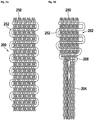
- the device 200 aptly includes a plurality of interwoven strands comprising a plurality of warp strands 250 (aligned substantially parallel with the longitudinal axis) and a plurality of weft strands 252 (aligned substantially transverse to the longitudinal axis).
- the wefts are provided by a single weft strand extending through the warps.
- the weft strand extends substantially perpendicularly back and forth across the device with respect to a longitudinal axis thereof and partially along an edge portion of the device substantially parallel with the longitudinal axis of the device, as illustrated.
- the weft strand is thicker than a warp strand.
- the weft is substantially hollow.
- the warps are arranged in adjacent pairs and are interwoven with the weft strand to create a leno-weave construction (also known as a gauze weave or cross weave).
- the strands include twisted fibres.
- a body region 202 and at least one end region 204 are created by pulling the weft strand 252 out of the construction to create a run.
- the run is pulled until the weft binds and locks to the warp strands 250 which draws the warp strands towards the central longitudinal axis of the device and creates a tapered transition region 208 between the body region 202 and the at least one end region 204.
- Loose strands at the ends of the at least one end region 204 are aptly coated with a wax, silicone, PTFE, adhesive, or the like to bind them together.
- the first and second end regions are being one part with the body region to provide a continuous suture device.
- a surgical suture system 300 includes a continuous length of suture material.
- the body region 302 includes a textile construction, aptly a leno-weave construction, having a plurality of warps and one or more wefts, the weft/s preferably comprising a corded construction.
- the weft cord is provided by interwoven strands of a knitted, braided or woven construction.
- the weft cord is a braided construction with a round hollow profile.
- the strands include twisted fibres.
- the weft cord changes orientation as it extends along the device from one region to the adjacent region.
- the cord extends back and forth across the device (substantially perpendicularly to the longitudinal axis) and extends for a relatively shorter distance along an edge portion of the device and substantially parallel with the longitudinal axis.
- the weft cord may include a flat (or tube) woven structure (as opposed to a flat, densely packed braid) for the wider body region, where a weave is formed from the multiple warps which are positioned parallel to the long axis of the device, that are intertwined by one or more wefts which run at substantially 90 degrees to the longitudinal axis.
- the weft has a relatively wide cross section compared to the warp strands and is also a hollow tube to act as a hollow suture.
- the tapered transition 308 located between the body region 302 and the end region 304 is created by pulling the weft cord (i.e. applying a tension to the weft cord) in substantially the longitudinal direction and out of the construction to provide a run which locks the warp strands and draws them towards the central axis.
- the weft cord is oriented substantially parallel with the warp strands. Loose strands adjacent to the taper are aptly placed inside the longitudinally orientated hollow weft cord via a single or series of splices, residing throughout the inside of the length of the end regions 304, 306, or terminating at a distance from the ends.
- the regions 312 and 314 are the weft cord after being repositioned into the warp direction.
- the free ends of the mesh of body region 302 are then pulled inside this hollow tubular weft cord.
- this mesh material travels inside the cord for a short distance, i.e. between the taper 310 at the end of the body region 302 and the start of the end region 306, which may be relatively thin.
- the end region 306 is the same weft cord, whilst it does not have any of the mesh construction inside it.
- the run causes the weft cord to lock the warps at the taper whilst providing the taper itself.
- This arrangement also allows for easier splicing, provides a smooth tapered transition from the body region 302 to the end region 306 which allows for easy passage through tissue, and provides a thin dense cord end for ease of threading through surgical instruments and creating a fixation mechanism.
- the surgical device may include an open mesh structure which allows a relatively wide profile to be created from a similar quantity of material. This provides an increased footprint to enhance engagement with adjacent tissue and also facilitates tissue ingrowth and post-surgical repair.
- the body region 402 may include an open mesh structure with similar or equal spaced pairs of warp strands 450 to create a Leno-Weave structure.
- the warp strands 450 interweave with the weft strand 452.
- a high number of warp strands or relatively large warp strands may be provided per unit width of the fabric which reduces the pore size and in turn may compromise tissue incorporation.
- two or more spaced apart sets of adjacent pairs of warp strands 550 are provided which allows more strands to be incorporated per width of the fabric to thereby increase the strength thereof, whilst also enabling the pore size to be increased and optimised for tissue incorporation.
- two or more spaced apart sets of adjacent pairs of warp strands 650 are provided wherein a pair includes a 'parallel' strand 651.
- a pair includes a 'parallel' strand 651.
- one strand 651 from a warp pair is placed 'parallel' (substantially planar) in the fabric while the other strand 653 of the warp pair interweaves with the weft strand 652 to thereby bind the parallel warp strands and the weft strand.
- the parallel warp strands take the majority of the applied axial load and, due to their parallel orientation, the structure provides increased resistance to elongation when placed under an axial load.
- the construction may incorporate a greater number of parallel warp strands 751 than the 'binding' warp strands 753. This construction may be desirable in situations where increased stiffness of the fabric may be provided.
- the parallel warp strands 751 have a larger diameter than the binding warp strands 753. This allows a particularly desirable fabric to be created having a relatively high strength (greater number of warps), relatively high stiffness (parallel warps), and optimum pore size for tissue incorporation.
- one or more binding warp strands may have a similar, larger or smaller diameter to the other strands.
- One or more parallel warp strands may have a similar, larger or smaller diameter to the other strands.
- One or more weft strands may have a similar, larger or smaller diameter to the other strands.
- One or more warp and/or weft strands may be equally or not equally spaced.
- the transverse portions 1453 of the weft strand 1452 may be substantially parallel and equally spaced relative to the other.
- the transverse portions 1453 of the weft strand 1452 may be substantially parallel with the other but not equally spaced relative to the other.
- the transverse portions 1453 of the weft strand 1452 may not be parallel to the other.
- the body region of the device may include an open mesh construction and the at least one end region may be of a thinner structure to facilitate threading through tissue and eyelets in surgical instruments.
- the thinner end region/s may be formed by a series of tapers, binding and/or splicing, as previously described.
- the body region 802 of the device may include an open mesh construction comprising a plurality of weft strands 852, 854 to create the leno-weave structure. This provides the ability for different constructions along the length of the device.
- portions of the body region 902 may have more or less weft yarns than adjacent portions.
- the end portions 903,905 of the body region may have multiple weft strands, while a central portion 901 of the body region may have less weft strands.
- This provides a central portion 901 of the body region having an optimised structure for tissue incorporation and end body portions 903,905 having a structure for optimised coupling with bone, soft tissue, fixation devices, or the like.
- the central portion 901 has more weft strands than the adjacent end portions 903,905.
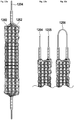
- one or more wefts in one or both end portions of the body region 1002 may include a braided cord into which the warps and further weft/s can be spliced to form an end region 1004.
- the other weft strands, together with the warp strands are formed from filaments, which provides a soft and pliable middle portion 1001 of body region 1002 for enhanced tissue ingrowth, while the end portions 1003,1005 of the body region 1002 have an optimised structure to aid fixation and create the transition to the end cord.
- the wefts in the end portions 1103,1105 of the body region 1102 are continuous, with one or more wefts 1152 running at least partially along the edge of a central portion 1101 the body region and substantially parallel to the longitudinal axis.
- This arrangement provides a soft and pliable middle portion to the body region 1102 for enhanced tissue ingrowth, while the edge portions of the body region have increased strength provided by the second weft.
- Figure 11a illustrates a device having with one end region 1106, and
- Figure 11b illustrates a device having two end regions 1104,1106.
- a first cord end 1260 is spliced inside a second cord end 1262 together with the remaining wefts and warps to provide a single end region 1204.
- a weft cord is a discrete end to provide a pair of spaced apart end portions 1204,1205 extending from at least one end region of the device.
- a weft cord is a discrete end which are then spliced together to form a loop 1206.
- a weft cord is a discrete end which are then spliced to form an adjustable length loop 1207.
- This arrangement provides a fixation mechanism to allow the device to be attached to tissue.
- the adjustable length loop may be formed by a weft cord penetrating the suture wall of the opposing weft.
- Weft 1204 penetrates opposing weft 1205, entering at point 1208 and residing along the interior lumen of the opposing weft 1205, and exiting the weft 1205 at point 1210 thereby creating a loop which is adjustable in length when free end of cord 1211 is pulled, and locked in length when the loop 1207 is under load.
- weft 1205 penetrates opposing weft 1204 at point 1213, passes within weft 1204, and exits weft 1204 at point 1215 to create free end of cord 1217.
- any weft cord may form a discrete adjustable loop by passing within itself.
- a button may be attached to one or more loops to aid fixation.
- the device is aptly configured to facilitate cutting away surplus material following implantation.
- open mesh structures are unstable when cut to length, with the strands at the end of the device fraying and splaying with the textile construction becoming unravelled.
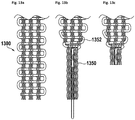
- a method is described by which the device 1300 is cut to a first length ( Figure 13a ), a run is created by pulling the weft strand 1352 until the weft binds and locks to the warp strands 1350 ( Figure 13b ), the device may then be cut to a second length that is shorter than the first length whist retaining the bound strands ( Figure 13c ). This creates a stable end to the device which would not further unravel past the bind.
- the spacing between adjacent passes of the weft strand are set to facilitate this action.
- the run takes 16mm of length to be pulled before binding and if adjacent weft passes are spaced 2mm, when the bind may be located at a particular position (for example adjacent to a knot), counting back 8 weft passes from the desired location and making the first cut to length will then position the bind at the desired location.
- the weft has a larger diameter than the warps, and is formed from a braided construction and has a different colour to the warps, so that it is easily identifiable to facilitate this method.
- one or more warp cords may be used.
- a first warp cord 1502 runs along the edge of a central portion 1501 of the body region and substantially parallel to the longitudinal axis.
- a second warp cord 1503 runs along the opposite edge of a central portion 1501 of the body region.
- a warp cord 1502, 1503 is paired with a warp strand 1506, 1507 to bind the warp cord to the body region. This arrangement provides a soft and pliable middle portion to the body region 1501 for enhanced tissue ingrowth, while the edge portions of the body region have increased strength provided by the warp cord.
- each warp cord 1555 is bound to the body region by one or more weft strands 1552 and adjacent pairs of warp strands 1550.
- end portions extending from at least one end region of the device are formed by splicing warp cords and warp filaments into one or more wefts which may include a braided cord.
- end portions extending from at least one end region of the device are formed by splicing wefts and warp filaments into one or more warp cords.
- end portions extending from at least one end region of the device are formed by splicing weft cords, warp cords and warp filaments.
- any region of the device in regards to width, length, cross sectional shape, density, pore size, material type and mechanical properties may be adapted for its function, whereby the mechanical properties may include one or a combination of; strength, stiffness, wettability, flexibility and rate of absorption, and any region may have, for example, a variance in any one or a combination of the above mentioned physical or mechanical properties.
- Variations in the properties of the warp or weft strands may be substantially equally or unequally spaced relative to one another.
- One or more of the warp strands may include a different cross-sectional size to other warp strands.
- the warp strands may be equal to, greater than and/or smaller than the denier of the weft strands.
- the body region of the device may have undulations in the surface to provide increased frictional resistance to aid knot tying.
- One or more of the warp strands may include a larger cross-sectional area to create one or more ridges.
- One or more of the weft strands may include a larger cross-sectional area to create one or more ridges.
- the body region may be planer or tubular in cross section.
- the suture material may include a single or a blend of materials.
- the materials that create the textile fabric may include bioabsorbable or non-bioabsorbable substances from natural or artificial sources including for example, gut, silk, cotton, ultra-high molecular weight polyethylene (UHMWPE) polyamide (Nylon), polyethylene terephthalate (PET), polyethylene (PE), polypropylene (PP), polydi-oxanone polyetheretherketone (PEEK), polyetherketoneketone (PEKK), graphene, or bioabsorbable materials whether as a single material or as a blend of materials.
- UHMWPE ultra-high molecular weight polyethylene
- nylon polyamide
- PET polyethylene terephthalate
- PET polyethylene
- PE polypropylene
- PEEK polydi-oxanone polyetheretherketone
- PEKK polyetherketoneketone
- a combination of ultra-high molecular weight polyethylene (UHMWPE) and polyethylene terephthalate (PET) may be used to provide strength and improved knotting characteristics respectively.
- Pairs of warp strands may be used where one of the strands is UHMWPE and one PET.
- the UHMWPE has a larger cross-sectional area, in effect a greater denier, and is substantially parallel to transmit the load, where the smaller denier PET strand acts to bind the UHMWPE strand to the weft strands.
- Coloured strands may be incorporated to enhance visibility during use. Coloured strands are aptly fashioned from dyed fibres of UHMWPE, PET or nylon. Different colours or patterns of colour may be used in different regions for identification.
- Embodiments provide a suture device that provides improved utility for a range of surgical applications, whilst allowing the device to be used with existing surgical instrumentation.
- the device is configured to improve pressure distribution to adjacent tissue during and after a surgical repair and to reduce/eliminate any undesirable contact forces which could result in cutting of the adjacent tissue.
- the device is configured to provide improved strength and optimised coupling with bone, soft tissue or fixation devices.
- the device includes a relatively wide and open mesh main body region to create a large footprint resistant to tissue pull-through and to encourage tissue interaction.
- the relatively thin end regions are adapted to pass through relatively small eyelets in standard surgical instruments to facilitate efficient transit through tissue during surgical procedures.
Landscapes
- Health & Medical Sciences (AREA)
- Engineering & Computer Science (AREA)
- Life Sciences & Earth Sciences (AREA)
- Surgery (AREA)
- Textile Engineering (AREA)
- Medical Informatics (AREA)
- Biomedical Technology (AREA)
- Heart & Thoracic Surgery (AREA)
- Nuclear Medicine, Radiotherapy & Molecular Imaging (AREA)
- Molecular Biology (AREA)
- Animal Behavior & Ethology (AREA)
- General Health & Medical Sciences (AREA)
- Public Health (AREA)
- Veterinary Medicine (AREA)
- Prostheses (AREA)
- Woven Fabrics (AREA)
- Materials For Medical Uses (AREA)
Abstract
A suture device comprises at least one weft strand interwoven with a plurality of warp strands to define a body region. The body region has a substantially open mesh construction and at least a first elongate end region axially extending from and being one part with the body region having a substantially closed mesh construction. The width of the end region is substantially less than a width of the body region.
Description
- The invention relates to a medical device which may be a suture device for orthopedic repairs, such as to reattach muscle or ligament to the tissue from which it has become detached, to anchor grafts and prosthetic devices to underlying tissue, or to reconstruct damaged or torn tissue.
- Conventional surgical techniques require the use of a suture to engage with soft tissue such as a tendon or ligament, or hard tissue such as bone. A suture is typically constructed with a relatively small diameter which results in a small contact area and high contact forces which may cause it to cut into the adjacent tissue.
- The problem to be solved is to provide an enhanced suture tape having a flatter and wider profile, and providing improved utility for a range of surgical applications, whilst allowing use with existing instrumentation, improved contact pressure during the surgical repair, and the ability to integrate with adjacent tissue.
- Solutions of the problem are described in the independent claims. The dependent claims relate to further improvements.
- In a first embodiment there is provided a suture device including at least one weft strand interwoven with a plurality of warp strands to define a body region having a substantially open mesh construction and at least a first elongate end region axially extending from and being one part with the body region having a substantially closed mesh construction and a width substantially less than a width of the body portion. The suture device may include a body region located between an adjacent first end region and an optional second end region. The construction of the body region may provide resistance to tissue pull-through and the construction of the adjacent end regions allow the device to be manipulated during surgical procedures.
- The body region and the at least one end region may include a textile fabric. A textile fabric is intended to include a selection of constructions, interlaced and non-interlaced, whether made by braiding, weaving, knitting, crocheting, plaiting, twisting, plying, embroidery, bonding, laminating, non-woven or other processes and combinations thereof. The textile structures may be fabricated from strands. The term 'strands' is intended to include fibre, monofilament, multi-filament yarns that may or may not be twisted, textile constructions such as braids, or a combination of these. Strands may have uniform or varying shape or size. Strands may consist of uniform material, or a combination of various materials. The discrete strands may include the same material or different materials. Variations between strands in terms of construction, shape, size, material, coating, or mechanical properties, may be equally geometrically arranged, or irregularly spaced.
- The device may include a plurality of interwoven strands comprising a plurality of warps, which may be aligned substantially parallel with the longitudinal axis. It may further include a plurality of wefts which may be aligned substantially transverse to the longitudinal axis. The wefts may be provided by a single weft strand extending through the warps. The weft strand may extend substantially perpendicularly back and forth across the device with respect to a longitudinal axis thereof and partially along the edge portions of the device substantially parallel with the longitudinal axis of the device. The weft strand may be thicker than the warp strands. The weft may substantially be hollow. The warps may be arranged in adjacent pairs and may be interwoven with the weft strand to create a leno-weave construction which is also known as a gauze weave or cross weave. The strands may include twisted fibres.
- In an embodiment, the device includes a second elongate end region axially extending from the body region in an opposed direction to the first end region and being one part with the body region.
- Further, the device may include a tapered transition region defined between and being one part with the body region and/or end regions.
- In an embodiment, the plurality of warp strands includes sets of at least two warp strands.
- In an embodiment, the sets of warp strands may include groups of adjacent pairs of warp strands.
- In an embodiment, a first warp strand of the sets of warp strands is substantially planar and a second warp strand of the sets is interwoven with the at least one weft strand.
- In an embodiment, a set of warp strands includes a greater number of said first warp strands than said second warp strands.
- In an embodiment, a thickness of said first warp strand is greater than a thickness of said second warp strand.
- In an embodiment, the sets of warp strands of the body region are substantially parallel and spaced apart to define the open mesh construction.
- In an embodiment, the at least one weft strand extending through at least a portion of the body region and/or at least a portion of the at least one end region includes a plurality of weft strands.
- In an embodiment, at least one end portion of the body region includes the plurality of weft strands whereas a central portion of the body region includes a single weft strand.
- In an embodiment, both end portions of the body region include the plurality of weft strands.
- In an embodiment, at least one of the weft strands of the at least one end portion of the body region are relatively stiff whereas the weft strand of the central portion of the body region is relatively flexible.
- In an embodiment, the relatively stiff weft strand includes a braided cord and the relatively flexible weft strand includes at least one filament.
- In an embodiment, a first weft strand of the plurality of weft strands is thicker than a second weft strand of the plurality of weft strands.
- In an embodiment, the at least one weft strand extends substantially longitudinally from a portion of the body region.
- In an embodiment, the at least one weft strand extends substantially along at least one edge of a central portion of the body region.
- In an embodiment, the at least one weft strand extends substantially along opposed edges of a central portion of the body region.
- In an embodiment, the at least one weft strand of the at least one end region includes at least one corded construction.
- In an embodiment, at least an end portion of the at least one corded construction is substantially hollow.
- In an embodiment, free ends of the warp strands of the at least one end region are located inside the at least one corded construction by one or more splices to define at least one corded end region.
- In an embodiment, at least one weft strand is provided by a corded construction.
- In an embodiment, at least one warp strand is provided by a corded construction.
- In an embodiment, a first portion of the free ends of the warp strands of the at least one end region are located inside a first corded construction by one or more splices to define a first corded end region and a second portion of the free ends of the warp strands of the at least one end region are located inside a second corded construction by one or more splices to define a second corded end region.
- In an embodiment, the first and second corded end regions are connected to form at least one looped end region.
- In an embodiment, the at least one looped end region is adjustable in length by passing at least the first corded end region within the second corded end region.
- In an embodiment, the at least one looped end region is adjustable in length by passing at least one of the first and second corded end regions within itself.
- In an embodiment, one or more fixation buttons are attached to the at least one looped end region.
- In an embodiment, the body region is substantially planar or tubular.
- According to another embodiment, a method of manufacturing a suture device is provided. The method including the steps of:
- interweaving at least one weft strand with a plurality of warp strands to define a substantially open mesh construction; and
- applying a tension to the at least one weft strand to urge the warp strands together and define a body region having a substantially open mesh construction and at least a first elongate end region axially extending from and being one part with the body region having a substantially closed mesh construction and a width substantially less than a width of the body portion.
- In an embodiment, the method includes providing a tapered transition region between and being one part with the body region and/or an end region.
- In an embodiment, the method includes providing sets of at least two warp strands wherein a first warp strand of a set of warp strands is substantially planar and a second warp strand of a set is interwoven with the at least one weft strand.
- In an embodiment, a thickness of said first warp strand is greater than a thickness of said second warp strand.
- In an embodiment, interweaving includes extending a plurality of weft strands through at least a portion of the body region and/or at least a portion of the at least one end region.
- In an embodiment, the method includes locating free ends of the warp strands of the at least one end region inside a corded and hollow construction of the at least one weft strand by one or more splices to define at least one corded end region.
- In an embodiment, the method includes locating free ends of the warp strands of the at least one end region inside a corded and hollow construction of the at least one warp strand by one or more splices to define at least one corded end region.
- In an embodiment, the method includes cutting the at least one end region proximal the urged together warp strands.
- In an embodiment, the method includes binding free ends of the warp strands and/or the at least one weft strand together.
- In the following the invention will be described by way of example, without limitation of the general inventive concept, on examples of embodiment with reference to the drawings.
-
Figure 1 illustrates a suture; -
Figure 2a illustrates the construction of the suture device during a first stage of manufacture; -
Figure 2b illustrates the construction of the suture device during a further stage of manufacture; -
Figure 3 illustrates a further suture; -
Figure 4 illustrates the construction of the body region of a first suture; -
Figure 5 illustrates the construction of the body region of a second suture; -
Figure 6 illustrates the construction of the body region of a third suture; -
Figure 7 illustrates the construction of the body region of a fourth suture; -
Figure 8 illustrates the construction of the body region of a fifth suture; -
Figure 9 illustrates the construction of the body region of a sixth suture; -
Figure 10a illustrates the construction of a seventh suture during a first stage of manufacture; -
Figure 10b illustrates the construction of the seventh suture during a further stage of manufacture; -
Figure 10c illustrates the construction of the seventh suture during a further stage of manufacture; -
Figure 11a illustrates the construction of an eighth suture; -
Figure 11b illustrates the construction of a ninth suture; -
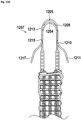
Figure 12a illustrates the construction of a tenth suture; -
Figure 12b illustrates the construction of an eleventh suture; -
Figure 12c illustrates the construction of a twelfth suture; -
Figure 12d illustrates the construction of a thirteenth suture; -
Figures 13a to 13c illustrate a method of manufacturing a suture; -
Figures 14a to 14c illustrate the construction of the body region of a further suture; -
Figures 15a to 15b illustrate a method of manufacturing a suture. - As illustrated in
Figure 1 , asurgical suture device 100 according to an embodiment includes a continuous length of suture material. The suture material has one or more regions of defined construction. The device includes abody region 102 located between an adjacentfirst end region 104 and an optionalsecond end region 106. The construction of the body region provides resistance to tissue pull-through and the construction of the adjacent end regions allow the device to be manipulated during surgical procedures. The body region may have a substantially flat, circular, or tubular profile. It may be fabricated from sheet, a textile fabric, or a combination of these constructions. Provided between an end region and the body region is a tapered transition region 108,110. - Aptly, the
body region 102 and the at least one end region 104,106 include a textile fabric. A textile fabric may include a selection of constructions, interlaced and non-interlaced, whether made by braiding, weaving, knitting, crocheting, plaiting, twisting, plying, embroidery, bonding, laminating, non-woven or other processes and combinations thereof. The textile structures may be fabricated from strands. The term 'strands' is intended to include fibre, monofilament, multi-filament yarns that may or may not be twisted, textile constructions such as braids, or a combination of these. Strands may have uniform or varying shape or size. Strands may consist of uniform material, or a combination of various materials. The discrete strands may be the same material or different materials. Variations between strands in terms of construction, shape, size, material, coating, or mechanical properties, may be equally geometrically arranged, or irregularly spaced. - As illustrated in
Figure 2a , thedevice 200 aptly includes a plurality of interwoven strands comprising a plurality of warp strands 250 (aligned substantially parallel with the longitudinal axis) and a plurality of weft strands 252 (aligned substantially transverse to the longitudinal axis). Aptly, the wefts are provided by a single weft strand extending through the warps. Aptly, the weft strand extends substantially perpendicularly back and forth across the device with respect to a longitudinal axis thereof and partially along an edge portion of the device substantially parallel with the longitudinal axis of the device, as illustrated. Aptly, the weft strand is thicker than a warp strand. Aptly, the weft is substantially hollow. - Aptly, the warps are arranged in adjacent pairs and are interwoven with the weft strand to create a leno-weave construction (also known as a gauze weave or cross weave). Aptly, the strands include twisted fibres.
- As illustrated in
Figure 2b , abody region 202 and at least oneend region 204 are created by pulling theweft strand 252 out of the construction to create a run. The run is pulled until the weft binds and locks to thewarp strands 250 which draws the warp strands towards the central longitudinal axis of the device and creates a taperedtransition region 208 between thebody region 202 and the at least oneend region 204. Loose strands at the ends of the at least oneend region 204 are aptly coated with a wax, silicone, PTFE, adhesive, or the like to bind them together. Desirably, the first and second end regions are being one part with the body region to provide a continuous suture device. - As illustrated in
Figure 3 , asurgical suture system 300 according to an embodiment includes a continuous length of suture material. Thebody region 302 includes a textile construction, aptly a leno-weave construction, having a plurality of warps and one or more wefts, the weft/s preferably comprising a corded construction. The weft cord is provided by interwoven strands of a knitted, braided or woven construction. Aptly, the weft cord is a braided construction with a round hollow profile. Preferably, the strands include twisted fibres. Preferably the weft cord changes orientation as it extends along the device from one region to the adjacent region. For example, as illustrated, the cord extends back and forth across the device (substantially perpendicularly to the longitudinal axis) and extends for a relatively shorter distance along an edge portion of the device and substantially parallel with the longitudinal axis. The weft cord may include a flat (or tube) woven structure (as opposed to a flat, densely packed braid) for the wider body region, where a weave is formed from the multiple warps which are positioned parallel to the long axis of the device, that are intertwined by one or more wefts which run at substantially 90 degrees to the longitudinal axis. The weft has a relatively wide cross section compared to the warp strands and is also a hollow tube to act as a hollow suture. - The tapered
transition 308 located between thebody region 302 and theend region 304 is created by pulling the weft cord (i.e. applying a tension to the weft cord) in substantially the longitudinal direction and out of the construction to provide a run which locks the warp strands and draws them towards the central axis. The weft cord is oriented substantially parallel with the warp strands. Loose strands adjacent to the taper are aptly placed inside the longitudinally orientated hollow weft cord via a single or series of splices, residing throughout the inside of the length of theend regions - The
regions body region 302 are then pulled inside this hollow tubular weft cord. As illustrated inFigure 3 , this mesh material travels inside the cord for a short distance, i.e. between thetaper 310 at the end of thebody region 302 and the start of theend region 306, which may be relatively thin. As such, theend region 306 is the same weft cord, whilst it does not have any of the mesh construction inside it. - The run causes the weft cord to lock the warps at the taper whilst providing the taper itself. This arrangement also allows for easier splicing, provides a smooth tapered transition from the
body region 302 to theend region 306 which allows for easy passage through tissue, and provides a thin dense cord end for ease of threading through surgical instruments and creating a fixation mechanism. - According to an alternative embodiment, the surgical device may include an open mesh structure which allows a relatively wide profile to be created from a similar quantity of material. This provides an increased footprint to enhance engagement with adjacent tissue and also facilitates tissue ingrowth and post-surgical repair.
- As illustrated in
Figure 4 , thebody region 402 may include an open mesh structure with similar or equal spaced pairs ofwarp strands 450 to create a Leno-Weave structure. Thewarp strands 450 interweave with theweft strand 452. However, in order to achieve the desired strength for some applications, a high number of warp strands or relatively large warp strands may be provided per unit width of the fabric which reduces the pore size and in turn may compromise tissue incorporation. - As illustrated in
Figure 5 , two or more spaced apart sets of adjacent pairs ofwarp strands 550 are provided which allows more strands to be incorporated per width of the fabric to thereby increase the strength thereof, whilst also enabling the pore size to be increased and optimised for tissue incorporation. - As illustrated in
Figure 6 , two or more spaced apart sets of adjacent pairs ofwarp strands 650 are provided wherein a pair includes a 'parallel'strand 651. For example, onestrand 651 from a warp pair is placed 'parallel' (substantially planar) in the fabric while theother strand 653 of the warp pair interweaves with theweft strand 652 to thereby bind the parallel warp strands and the weft strand. The parallel warp strands take the majority of the applied axial load and, due to their parallel orientation, the structure provides increased resistance to elongation when placed under an axial load. - Aptly, as illustrated in
Figure 7 , the construction may incorporate a greater number ofparallel warp strands 751 than the 'binding'warp strands 753. This construction may be desirable in situations where increased stiffness of the fabric may be provided. - Preferably, the
parallel warp strands 751 have a larger diameter than thebinding warp strands 753. This allows a particularly desirable fabric to be created having a relatively high strength (greater number of warps), relatively high stiffness (parallel warps), and optimum pore size for tissue incorporation. - Alternatively, one or more binding warp strands may have a similar, larger or smaller diameter to the other strands. One or more parallel warp strands may have a similar, larger or smaller diameter to the other strands. One or more weft strands may have a similar, larger or smaller diameter to the other strands. One or more warp and/or weft strands may be equally or not equally spaced. For example, as illustrated in
Figure 14a , thetransverse portions 1453 of theweft strand 1452 may be substantially parallel and equally spaced relative to the other. Alternatively, as illustrated inFigure 14b , thetransverse portions 1453 of theweft strand 1452 may be substantially parallel with the other but not equally spaced relative to the other. Further alternatively, as illustrated inFigure 14c , thetransverse portions 1453 of theweft strand 1452 may not be parallel to the other. - According to an alternative embodiment, the body region of the device may include an open mesh construction and the at least one end region may be of a thinner structure to facilitate threading through tissue and eyelets in surgical instruments. The thinner end region/s may be formed by a series of tapers, binding and/or splicing, as previously described.
- As illustrated in
Figure 8 , thebody region 802 of the device according to an alternative embodiment may include an open mesh construction comprising a plurality ofweft strands 852, 854 to create the leno-weave structure. This provides the ability for different constructions along the length of the device. - As illustrated in
Figure 9 , portions of thebody region 902 may have more or less weft yarns than adjacent portions. For example, the end portions 903,905 of the body region may have multiple weft strands, while acentral portion 901 of the body region may have less weft strands. This provides acentral portion 901 of the body region having an optimised structure for tissue incorporation and end body portions 903,905 having a structure for optimised coupling with bone, soft tissue, fixation devices, or the like. Alternatively, thecentral portion 901 has more weft strands than the adjacent end portions 903,905. - According to an alternative embodiment, as illustrated in
Figures 10a to 10c , one or more wefts in one or both end portions of thebody region 1002 may include a braided cord into which the warps and further weft/s can be spliced to form anend region 1004. The other weft strands, together with the warp strands are formed from filaments, which provides a soft and pliablemiddle portion 1001 ofbody region 1002 for enhanced tissue ingrowth, while theend portions body region 1002 have an optimised structure to aid fixation and create the transition to the end cord. - According to an alternative embodiment, the wefts in the
end portions body region 1102 are continuous, with one ormore wefts 1152 running at least partially along the edge of acentral portion 1101 the body region and substantially parallel to the longitudinal axis. This arrangement provides a soft and pliable middle portion to thebody region 1102 for enhanced tissue ingrowth, while the edge portions of the body region have increased strength provided by the second weft.Figure 11a illustrates a device having with oneend region 1106, andFigure 11b illustrates a device having twoend regions - According to an alternative embodiment, multiple sets of wefts may be used. In a first example, as illustrated in
Figure 12a , afirst cord end 1260 is spliced inside asecond cord end 1262 together with the remaining wefts and warps to provide asingle end region 1204. In a second example, as illustrated inFigure 12b , a weft cord is a discrete end to provide a pair of spaced apart endportions Figure 12c , a weft cord is a discrete end which are then spliced together to form aloop 1206. In a fourth example, as illustrated inFigure 12d , a weft cord is a discrete end which are then spliced to form anadjustable length loop 1207. This arrangement provides a fixation mechanism to allow the device to be attached to tissue. For example, the adjustable length loop may be formed by a weft cord penetrating the suture wall of the opposing weft. -
Weft 1204 penetrates opposingweft 1205, entering atpoint 1208 and residing along the interior lumen of the opposingweft 1205, and exiting theweft 1205 atpoint 1210 thereby creating a loop which is adjustable in length when free end ofcord 1211 is pulled, and locked in length when theloop 1207 is under load. Similarly,weft 1205 penetrates opposingweft 1204 atpoint 1213, passes withinweft 1204, and exitsweft 1204 atpoint 1215 to create free end ofcord 1217. Alternatively, any weft cord may form a discrete adjustable loop by passing within itself. Alternatively, a button may be attached to one or more loops to aid fixation. - According to an alternative embodiment, the device is aptly configured to facilitate cutting away surplus material following implantation. Typically, such open mesh structures are unstable when cut to length, with the strands at the end of the device fraying and splaying with the textile construction becoming unravelled. A method is described by which the
device 1300 is cut to a first length (Figure 13a ), a run is created by pulling theweft strand 1352 until the weft binds and locks to the warp strands 1350 (Figure 13b ), the device may then be cut to a second length that is shorter than the first length whist retaining the bound strands (Figure 13c ). This creates a stable end to the device which would not further unravel past the bind. Aptly, the spacing between adjacent passes of the weft strand are set to facilitate this action. By way of example, if the run takes 16mm of length to be pulled before binding and if adjacent weft passes are spaced 2mm, when the bind may be located at a particular position (for example adjacent to a knot), counting back 8 weft passes from the desired location and making the first cut to length will then position the bind at the desired location. Aptly, the weft has a larger diameter than the warps, and is formed from a braided construction and has a different colour to the warps, so that it is easily identifiable to facilitate this method. - According to an alternative embodiment, one or more warp cords may be used. In a first example, as illustrated in
Figure 15a , afirst warp cord 1502 runs along the edge of acentral portion 1501 of the body region and substantially parallel to the longitudinal axis. Asecond warp cord 1503 runs along the opposite edge of acentral portion 1501 of the body region. Awarp cord warp strand body region 1501 for enhanced tissue ingrowth, while the edge portions of the body region have increased strength provided by the warp cord. In a second example, as illustrated inFigure 15b , eachwarp cord 1555 is bound to the body region by one ormore weft strands 1552 and adjacent pairs ofwarp strands 1550. Preferably end portions extending from at least one end region of the device are formed by splicing warp cords and warp filaments into one or more wefts which may include a braided cord. According to an embodiment, end portions extending from at least one end region of the device are formed by splicing wefts and warp filaments into one or more warp cords. According to an embodiment, end portions extending from at least one end region of the device are formed by splicing weft cords, warp cords and warp filaments. - The construction of any region of the device in regards to width, length, cross sectional shape, density, pore size, material type and mechanical properties may be adapted for its function, whereby the mechanical properties may include one or a combination of; strength, stiffness, wettability, flexibility and rate of absorption, and any region may have, for example, a variance in any one or a combination of the above mentioned physical or mechanical properties. Variations in the properties of the warp or weft strands may be substantially equally or unequally spaced relative to one another. One or more of the warp strands may include a different cross-sectional size to other warp strands. The warp strands may be equal to, greater than and/or smaller than the denier of the weft strands. The body region of the device may have undulations in the surface to provide increased frictional resistance to aid knot tying. One or more of the warp strands may include a larger cross-sectional area to create one or more ridges. One or more of the weft strands may include a larger cross-sectional area to create one or more ridges. The body region may be planer or tubular in cross section.
- The suture material may include a single or a blend of materials. The materials that create the textile fabric may include bioabsorbable or non-bioabsorbable substances from natural or artificial sources including for example, gut, silk, cotton, ultra-high molecular weight polyethylene (UHMWPE) polyamide (Nylon), polyethylene terephthalate (PET), polyethylene (PE), polypropylene (PP), polydi-oxanone polyetheretherketone (PEEK), polyetherketoneketone (PEKK), graphene, or bioabsorbable materials whether as a single material or as a blend of materials. A combination of ultra-high molecular weight polyethylene (UHMWPE) and polyethylene terephthalate (PET) may be used to provide strength and improved knotting characteristics respectively. Pairs of warp strands may be used where one of the strands is UHMWPE and one PET. Preferably the UHMWPE has a larger cross-sectional area, in effect a greater denier, and is substantially parallel to transmit the load, where the smaller denier PET strand acts to bind the UHMWPE strand to the weft strands. Coloured strands may be incorporated to enhance visibility during use. Coloured strands are aptly fashioned from dyed fibres of UHMWPE, PET or nylon. Different colours or patterns of colour may be used in different regions for identification.
- Embodiments provide a suture device that provides improved utility for a range of surgical applications, whilst allowing the device to be used with existing surgical instrumentation. The device is configured to improve pressure distribution to adjacent tissue during and after a surgical repair and to reduce/eliminate any undesirable contact forces which could result in cutting of the adjacent tissue. The device is configured to provide improved strength and optimised coupling with bone, soft tissue or fixation devices. The device includes a relatively wide and open mesh main body region to create a large footprint resistant to tissue pull-through and to encourage tissue interaction. The relatively thin end regions are adapted to pass through relatively small eyelets in standard surgical instruments to facilitate efficient transit through tissue during surgical procedures.
Claims (15)
- A suture device (100) comprising:
at least one weft strand (252) interwoven with a plurality of warp strands (250) to define a body region (102) having a substantially open mesh construction and at least a first elongate end region (104) axially extending from and being one part with the body region (102) having a substantially closed mesh construction and a width substantially less than a width of the body region (102). - The device according to claim 1, comprising a second elongate end region (106) axially extending from the body region (102) in an opposed direction to the first end region (104) and being one part with the body region (102).
- The device according to claim 1 or 2, comprising a tapered transition region (108, 110) defined between and being one part with the body region (102) and/or an end region (104, 106).
- The device according to any preceding claim, wherein the plurality of warp strands (250) comprises sets of at least two warp strands (250), wherein any set of warp strands (250) may comprise groups of adjacent pairs of warp strands (250).
- The device according to claim 4, wherein a first warp strand (250) of a set of warp strands (250) is substantially planar and a second warp strand (250) of a set is interwoven with the at least one weft strand (252), wherein any set of warp strands (250) may comprise a greater number of said first warp strands (250) than said second warp strands (250) and/or a thickness of said first warp strand (250) may be greater than a thickness of said second warp strand.
- The device according to any of claims 4 to 5, wherein the sets of warp strands (250) of the body region (102) are substantially parallel and spaced apart to define the open mesh construction.
- The device according to any preceding claim, wherein the at least one weft strand (252) extending through at least a portion of the body region (102) and/or at least a portion of the at least one end region (104, 106) comprises a plurality of weft strands (252).
- The device according to claim 7, wherein at least one end portion of the body region (102) comprises the plurality of weft strands (252) whereas a central portion of the body region (102) comprises a single weft strand (252).
- The device according to claim 8, wherein both end portions of the body region (102) comprise the plurality of weft strands (252).
- The device according to claim 8, wherein at least one of the weft strands (252) of the at least one end portion of the body region (102) are relatively stiff whereas the weft strand (252) of the central portion of the body region (102) is relatively flexible and
wherein the relatively stiff weft strand (252) comprises a braided cord and the relatively flexible weft strand (252) comprises at least one filament. - The device according to any of claims 7 to 10, wherein a first weft strand (252) of the plurality of weft strands (252) is thicker than a second weft strand (252) of the plurality of weft strands (252).
- The device according to any preceding claims, wherein the at least one weft strand (252) extends substantially longitudinally from a portion of the body region (102) and
wherein the at least one weft strand (252) may extend substantially along at least one edge of a central portion of the body region (102), and
wherein the at least one weft strand (252) may extend substantially along opposed edges of a central portion of the body region (102). - The device according to any preceding claim, wherein the at least one weft strand (252) of the at least one end region (104, 106) comprises at least one corded construction.
- The device according to claim 13, wherein at least an end portion of the at least one corded construction is substantially hollow and
wherein free ends of the warp strands (250) of the at least one end region (104, 106) may be located inside the at least one corded construction by one or more splices to define at least one corded end region (104, 106). - A method of manufacturing a suture device, comprising:interweaving at least one weft strand (252) with a plurality of warp strands (250) to define a substantially open mesh construction; andapplying a tension to the at least one weft strand (252) to urge the warp strands (250) together and define a body region (102) having a substantially open mesh construction and at least a first elongate end region (104, 106) axially extending from and being one part with the body region (102) having a substantially closed mesh construction and a width substantially less than a width of the body portion.
Priority Applications (6)
| Application Number | Priority Date | Filing Date | Title |
|---|---|---|---|
| EP20180257.6A EP3925544A1 (en) | 2020-06-16 | 2020-06-16 | Suture device |
| PCT/US2021/024611 WO2021257149A2 (en) | 2020-06-16 | 2021-03-29 | Suture device |
| US17/996,509 US20230099945A1 (en) | 2020-06-16 | 2021-03-29 | Suture Device |
| CN202180042773.4A CN115768361A (en) | 2020-06-16 | 2021-03-29 | suturing device |
| AU2021293512A AU2021293512B2 (en) | 2020-06-16 | 2021-03-29 | Suture device |
| EP21718470.4A EP4164506A2 (en) | 2020-06-16 | 2021-03-29 | Suture device |
Applications Claiming Priority (1)
| Application Number | Priority Date | Filing Date | Title |
|---|---|---|---|
| EP20180257.6A EP3925544A1 (en) | 2020-06-16 | 2020-06-16 | Suture device |
Publications (1)
| Publication Number | Publication Date |
|---|---|
| EP3925544A1 true EP3925544A1 (en) | 2021-12-22 |
Family
ID=71105224
Family Applications (2)
| Application Number | Title | Priority Date | Filing Date |
|---|---|---|---|
| EP20180257.6A Withdrawn EP3925544A1 (en) | 2020-06-16 | 2020-06-16 | Suture device |
| EP21718470.4A Pending EP4164506A2 (en) | 2020-06-16 | 2021-03-29 | Suture device |
Family Applications After (1)
| Application Number | Title | Priority Date | Filing Date |
|---|---|---|---|
| EP21718470.4A Pending EP4164506A2 (en) | 2020-06-16 | 2021-03-29 | Suture device |
Country Status (5)
| Country | Link |
|---|---|
| US (1) | US20230099945A1 (en) |
| EP (2) | EP3925544A1 (en) |
| CN (1) | CN115768361A (en) |
| AU (1) | AU2021293512B2 (en) |
| WO (1) | WO2021257149A2 (en) |
Families Citing this family (1)
| Publication number | Priority date | Publication date | Assignee | Title |
|---|---|---|---|---|
| AU2024217545A1 (en) * | 2023-02-09 | 2025-09-18 | Deep Blue Medical Advances, Inc. | Porous suture and method of use |
Citations (5)
| Publication number | Priority date | Publication date | Assignee | Title |
|---|---|---|---|---|
| EP0126520A2 (en) * | 1983-02-16 | 1984-11-28 | Bahaa Botros Seedhom | Prosthetic ligament and instruments for use in the surgical replacement of ligaments |
| US20080188936A1 (en) * | 2007-02-02 | 2008-08-07 | Tornier, Inc. | System and method for repairing tendons and ligaments |
| WO2009109778A2 (en) * | 2008-03-04 | 2009-09-11 | Xiros Plc | Implantable prosthetic cord |
| GB2474866A (en) * | 2009-10-29 | 2011-05-04 | Xiros Ltd | A woven surgical cord with an alternating width profile to reduce knot slippage |
| WO2012121986A2 (en) * | 2011-03-08 | 2012-09-13 | Mimedx, Inc.. | Collagen fiber ribbons with integrated fixation sutures and methods of making the same |
Family Cites Families (10)
| Publication number | Priority date | Publication date | Assignee | Title |
|---|---|---|---|---|
| US4530113A (en) * | 1983-05-20 | 1985-07-23 | Intervascular, Inc. | Vascular grafts with cross-weave patterns |
| GB9510637D0 (en) * | 1995-05-25 | 1995-07-19 | Ellis Dev Ltd | Device for the repair of the rotator cuff of the shoulder |
| US6708056B2 (en) * | 2000-04-25 | 2004-03-16 | Impres Medical, Inc. | Method and apparatus for creating intrauterine adhesions |
| US20050070930A1 (en) * | 2003-09-30 | 2005-03-31 | Gene W. Kammerer | Implantable surgical mesh |
| US9387280B2 (en) * | 2008-09-05 | 2016-07-12 | Synovis Orthopedic And Woundcare, Inc. | Device for soft tissue repair or replacement |
| CN105063875A (en) * | 2008-12-15 | 2015-11-18 | 阿勒根公司 | Manufacturing method for knitted mesh of prosthetic device |
| EP2387970B1 (en) * | 2010-05-17 | 2013-07-03 | Tornier, Inc. | Endoprosthetic textile scaffold, especially for repairing rotator cuff tissue of human shoulder |
| AU2011265360B2 (en) * | 2010-12-30 | 2014-03-06 | Cook Medical Technologies Llc | Composite woven fabric for endoluminal devices |
| US11654023B2 (en) * | 2017-01-23 | 2023-05-23 | Edwards Lifesciences Corporation | Covered prosthetic heart valve |
| EP3887580A1 (en) * | 2018-11-30 | 2021-10-06 | The Secant Group, LLC | Medical textile having low denier per filament yarn |
-
2020
- 2020-06-16 EP EP20180257.6A patent/EP3925544A1/en not_active Withdrawn
-
2021
- 2021-03-29 CN CN202180042773.4A patent/CN115768361A/en active Pending
- 2021-03-29 US US17/996,509 patent/US20230099945A1/en active Pending
- 2021-03-29 AU AU2021293512A patent/AU2021293512B2/en active Active
- 2021-03-29 WO PCT/US2021/024611 patent/WO2021257149A2/en not_active Ceased
- 2021-03-29 EP EP21718470.4A patent/EP4164506A2/en active Pending
Patent Citations (5)
| Publication number | Priority date | Publication date | Assignee | Title |
|---|---|---|---|---|
| EP0126520A2 (en) * | 1983-02-16 | 1984-11-28 | Bahaa Botros Seedhom | Prosthetic ligament and instruments for use in the surgical replacement of ligaments |
| US20080188936A1 (en) * | 2007-02-02 | 2008-08-07 | Tornier, Inc. | System and method for repairing tendons and ligaments |
| WO2009109778A2 (en) * | 2008-03-04 | 2009-09-11 | Xiros Plc | Implantable prosthetic cord |
| GB2474866A (en) * | 2009-10-29 | 2011-05-04 | Xiros Ltd | A woven surgical cord with an alternating width profile to reduce knot slippage |
| WO2012121986A2 (en) * | 2011-03-08 | 2012-09-13 | Mimedx, Inc.. | Collagen fiber ribbons with integrated fixation sutures and methods of making the same |
Also Published As
| Publication number | Publication date |
|---|---|
| WO2021257149A3 (en) | 2022-01-20 |
| AU2021293512B2 (en) | 2025-01-16 |
| US20230099945A1 (en) | 2023-03-30 |
| WO2021257149A2 (en) | 2021-12-23 |
| AU2021293512A1 (en) | 2023-01-19 |
| CN115768361A (en) | 2023-03-07 |
| EP4164506A2 (en) | 2023-04-19 |
Similar Documents
| Publication | Publication Date | Title |
|---|---|---|
| AU2009309443B2 (en) | Tubular implantable cord | |
| EP0170358B1 (en) | Surgical element | |
| US20110054524A1 (en) | Implantable prosthetic cord | |
| JP5005126B2 (en) | Improved multifilament surgical thread | |
| US4795466A (en) | Artificial crucial ligament for a knee joint | |
| EP1820889B1 (en) | Yarns useful for constructing graft materials | |
| EP2513363B1 (en) | Ultra-thin fabric and manufacturing method | |
| CN108712885B (en) | Implantable fabric anchor | |
| EP2739242B1 (en) | Connective tissue repair pad | |
| GB2468307A (en) | Suture having a core and a braided mantle including strands running parallel to the axis of the suture | |
| GB2474866A (en) | A woven surgical cord with an alternating width profile to reduce knot slippage | |
| US20190380693A1 (en) | Flat surgical suture constructs with loops and methods of tissue fixation | |
| AU2021293512B2 (en) | Suture device | |
| GB2159846A (en) | Surgical element | |
| EP0373944A2 (en) | Woven vascular graft | |
| US20250207306A1 (en) | Rigid Composite Textile | |
| CN224039399U (en) | Artificial ligament of leno tissue | |
| US20250049429A1 (en) | Variable Density Soft Anchors and Methods of Tissue Repairs | |
| JP2018057587A (en) | Medical gauze weaving method |
Legal Events
| Date | Code | Title | Description |
|---|---|---|---|
| PUAI | Public reference made under article 153(3) epc to a published international application that has entered the european phase |
Free format text: ORIGINAL CODE: 0009012 |
|
| STAA | Information on the status of an ep patent application or granted ep patent |
Free format text: STATUS: THE APPLICATION HAS BEEN PUBLISHED |
|
| AK | Designated contracting states |
Kind code of ref document: A1 Designated state(s): AL AT BE BG CH CY CZ DE DK EE ES FI FR GB GR HR HU IE IS IT LI LT LU LV MC MK MT NL NO PL PT RO RS SE SI SK SM TR |
|
| B565 | Issuance of search results under rule 164(2) epc |
Effective date: 20200922 |
|
| STAA | Information on the status of an ep patent application or granted ep patent |
Free format text: STATUS: THE APPLICATION IS DEEMED TO BE WITHDRAWN |
|
| 18D | Application deemed to be withdrawn |
Effective date: 20220623 |