EP3925534A1 - Method and system for assessment of cognitive load from bio-potentials measured using wearable endosomatic device - Google Patents
Method and system for assessment of cognitive load from bio-potentials measured using wearable endosomatic device Download PDFInfo
- Publication number
- EP3925534A1 EP3925534A1 EP20216888.6A EP20216888A EP3925534A1 EP 3925534 A1 EP3925534 A1 EP 3925534A1 EP 20216888 A EP20216888 A EP 20216888A EP 3925534 A1 EP3925534 A1 EP 3925534A1
- Authority
- EP
- European Patent Office
- Prior art keywords
- task
- bio
- features
- cognitive
- data
- Prior art date
- Legal status (The legal status is an assumption and is not a legal conclusion. Google has not performed a legal analysis and makes no representation as to the accuracy of the status listed.)
- Granted
Links
Images

Classifications
-
- A—HUMAN NECESSITIES
- A61—MEDICAL OR VETERINARY SCIENCE; HYGIENE
- A61B—DIAGNOSIS; SURGERY; IDENTIFICATION
- A61B5/00—Measuring for diagnostic purposes; Identification of persons
- A61B5/16—Devices for psychotechnics; Testing reaction times ; Devices for evaluating the psychological state
-
- A—HUMAN NECESSITIES
- A61—MEDICAL OR VETERINARY SCIENCE; HYGIENE
- A61B—DIAGNOSIS; SURGERY; IDENTIFICATION
- A61B5/00—Measuring for diagnostic purposes; Identification of persons
- A61B5/16—Devices for psychotechnics; Testing reaction times ; Devices for evaluating the psychological state
- A61B5/165—Evaluating the state of mind, e.g. depression, anxiety
-
- A—HUMAN NECESSITIES
- A61—MEDICAL OR VETERINARY SCIENCE; HYGIENE
- A61B—DIAGNOSIS; SURGERY; IDENTIFICATION
- A61B5/00—Measuring for diagnostic purposes; Identification of persons
- A61B5/05—Detecting, measuring or recording for diagnosis by means of electric currents or magnetic fields; Measuring using microwaves or radio waves
- A61B5/053—Measuring electrical impedance or conductance of a portion of the body
- A61B5/0531—Measuring skin impedance
- A61B5/0533—Measuring galvanic skin response
-
- A—HUMAN NECESSITIES
- A61—MEDICAL OR VETERINARY SCIENCE; HYGIENE
- A61B—DIAGNOSIS; SURGERY; IDENTIFICATION
- A61B5/00—Measuring for diagnostic purposes; Identification of persons
- A61B5/24—Detecting, measuring or recording bioelectric or biomagnetic signals of the body or parts thereof
-
- A—HUMAN NECESSITIES
- A61—MEDICAL OR VETERINARY SCIENCE; HYGIENE
- A61B—DIAGNOSIS; SURGERY; IDENTIFICATION
- A61B5/00—Measuring for diagnostic purposes; Identification of persons
- A61B5/72—Signal processing specially adapted for physiological signals or for diagnostic purposes
- A61B5/7235—Details of waveform analysis
- A61B5/7264—Classification of physiological signals or data, e.g. using neural networks, statistical classifiers, expert systems or fuzzy systems
- A61B5/7267—Classification of physiological signals or data, e.g. using neural networks, statistical classifiers, expert systems or fuzzy systems involving training the classification device
-
- A—HUMAN NECESSITIES
- A61—MEDICAL OR VETERINARY SCIENCE; HYGIENE
- A61B—DIAGNOSIS; SURGERY; IDENTIFICATION
- A61B5/00—Measuring for diagnostic purposes; Identification of persons
- A61B5/72—Signal processing specially adapted for physiological signals or for diagnostic purposes
- A61B5/7271—Specific aspects of physiological measurement analysis
- A61B5/7278—Artificial waveform generation or derivation, e.g. synthesizing signals from measured signals
-
- G—PHYSICS
- G06—COMPUTING OR CALCULATING; COUNTING
- G06N—COMPUTING ARRANGEMENTS BASED ON SPECIFIC COMPUTATIONAL MODELS
- G06N20/00—Machine learning
-
- G—PHYSICS
- G16—INFORMATION AND COMMUNICATION TECHNOLOGY [ICT] SPECIALLY ADAPTED FOR SPECIFIC APPLICATION FIELDS
- G16H—HEALTHCARE INFORMATICS, i.e. INFORMATION AND COMMUNICATION TECHNOLOGY [ICT] SPECIALLY ADAPTED FOR THE HANDLING OR PROCESSING OF MEDICAL OR HEALTHCARE DATA
- G16H10/00—ICT specially adapted for the handling or processing of patient-related medical or healthcare data
- G16H10/60—ICT specially adapted for the handling or processing of patient-related medical or healthcare data for patient-specific data, e.g. for electronic patient records
-
- G—PHYSICS
- G16—INFORMATION AND COMMUNICATION TECHNOLOGY [ICT] SPECIALLY ADAPTED FOR SPECIFIC APPLICATION FIELDS
- G16H—HEALTHCARE INFORMATICS, i.e. INFORMATION AND COMMUNICATION TECHNOLOGY [ICT] SPECIALLY ADAPTED FOR THE HANDLING OR PROCESSING OF MEDICAL OR HEALTHCARE DATA
- G16H40/00—ICT specially adapted for the management or administration of healthcare resources or facilities; ICT specially adapted for the management or operation of medical equipment or devices
- G16H40/60—ICT specially adapted for the management or administration of healthcare resources or facilities; ICT specially adapted for the management or operation of medical equipment or devices for the operation of medical equipment or devices
- G16H40/67—ICT specially adapted for the management or administration of healthcare resources or facilities; ICT specially adapted for the management or operation of medical equipment or devices for the operation of medical equipment or devices for remote operation
-
- G—PHYSICS
- G16—INFORMATION AND COMMUNICATION TECHNOLOGY [ICT] SPECIALLY ADAPTED FOR SPECIFIC APPLICATION FIELDS
- G16H—HEALTHCARE INFORMATICS, i.e. INFORMATION AND COMMUNICATION TECHNOLOGY [ICT] SPECIALLY ADAPTED FOR THE HANDLING OR PROCESSING OF MEDICAL OR HEALTHCARE DATA
- G16H50/00—ICT specially adapted for medical diagnosis, medical simulation or medical data mining; ICT specially adapted for detecting, monitoring or modelling epidemics or pandemics
- G16H50/70—ICT specially adapted for medical diagnosis, medical simulation or medical data mining; ICT specially adapted for detecting, monitoring or modelling epidemics or pandemics for mining of medical data, e.g. analysing previous cases of other patients
Definitions
- the disclosure herein generally relates to automated assessment of cognitive load, and, more particularly, to a method and system for assessment of cognitive load from bio-potentials measured using wearable endosomatic device.
- Cognitive load is the amount of mental resources required to execute a task.
- Psychophysiological research shows variations in the electrodermal activity of the skin with variations in cognitive load.
- An optimum amount of cognitive load is required for executing the task successfully, beyond which the performance of an individual degrades drastically, leading to psychological conditions like stress, anxiety etc.
- measuring the overall cognitive load imparted on an individual is important.
- Various approaches are used for assessment of cognitive load. State of the art studies mostly use exosomatic approach like Galvanic Skin Resistance (GSR) for measuring electrodermal activity (EDA) and assess cognitive load experienced by a subject.
- Subjective measurement includes questionnaires like NASA-TLX, SWAT etc., whereas performance based measures like task completion time, error rate etc., are also used.
- Electrodermal activity is defined as the variation of electrical characteristics of the skin, which is typically governed by the sweat gland activity. Sweat secretion, usually driven by autonomic nervous system, causes the variation in the electrical property of the skin.
- Two alternative approaches used for measuring electrodermal activity are exosomatic measurements and endosomatic measurements. In the exosomatic approach, AC/DC current is passed through two electrodes placed on the skin that results in measurable changes in skin conductance level. In contrast, the endosomatic method measures the bio-potential of the skin without application of any electrical stimulus.
- Endosomatic approach which is related to both sympathetic and parasympathetic nervous system, is considered to be more reliable and physiological, compared to the exosomatic approach. Besides, the signal level in exosomatic measurements is dependent on the skin conductance level and hence, people with dry or calloused hands have significantly lower GSR value. In spite of these limitations, exosomatic approach has been used extensively to measure cognition effect as there are a number of wearable devices available in the market for exosomatic measurements. However, using endosomatic EDA has multiple challenges for practical usage of cognitive load assessment.
- Embodiments of the present disclosure present technological improvements as solutions to one or more of the above-mentioned technical problems recognized by the inventors in conventional systems. For example, in one embodiment, a method for assessment of cognitive load from bio-potentials measured using a wearable endosomatic device is provided.
- the method comprising acquiring via a multichannel wearable endosomatic device, a plurality of bio-potential signals providing a task specific data of a subject performing a cognitive task, wherein the plurality of bio-potential signals are time stamped.
- the baseline data corresponds to segment of each of the plurality of bio-potential signals when the subject experiences a nil cognitive load
- the task data corresponds to segment of each of the plurality of bio-potential signals when the subject experiences an active cognitive load during the cognitive task being performed.
- a system for assessment of cognitive load from bio-potentials measured using a wearable endosomatic device comprising: a memory storing instructions; one or more Input/Output (I/O) interfaces; and one or more hardware processors coupled to the memory via the one or more I/O interfaces, wherein the one or more hardware processors are configured by the instructions for: acquiring via a multichannel wearable endosomatic device, a plurality of bio-potential signals providing a task specific data of a subject performing a cognitive task, wherein the plurality of bio-potential signals are time stamped.
- I/O Input/Output
- a baseline data and a task data based on time stamps associated with each of the plurality of bio-potential signals Further extracting a baseline data and a task data based on time stamps associated with each of the plurality of bio-potential signals, by the one or more hardware processors, wherein the baseline data corresponds to segment of each of the plurality of bio-potential signals when the subject experiences a nil cognitive load and the task data corresponds to segment of each of the plurality of bio-potential signals when the subject experiences an active cognitive load during the cognitive task being performed.
- one or more non-transitory machine-readable information storage mediums comprising one or more instructions, which when executed by one or more hardware processors causes a method for assessment of cognitive load from bio-potentials measured using a wearable endosomatic device.
- the method comprises acquiring via a multichannel wearable endosomatic device, a plurality of bio-potential signals providing a task specific data of a subject performing a cognitive task, wherein the plurality of bio-potential signals are time stamped.
- the baseline data corresponds to segment of each of the plurality of bio-potential signals when the subject experiences a nil cognitive load
- the task data corresponds to segment of each of the plurality of bio-potential signals when the subject experiences an active cognitive load during the cognitive task being performed.
- Embodiments herein provide a method and system for assessment of cognitive load from bio-potentials measured using wearable endosomatic device.
- the method disclosed provides a solution to the technical challenges in the art while directly using the bio-potential signals (interchangeably referred as bio-signals) to implement endosomatic approach by:
- FIG. 1 through FIG. 5B where similar reference characters denote corresponding features consistently throughout the figures, there are shown preferred embodiments and these embodiments are described in the context of the following exemplary system and/or method.
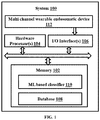
- FIG. 1 illustrates a system for assessment of cognitive load from bio-potentials measured using a wearable endosomatic device, according to some embodiments of the present disclosure.
- the system 100 includes one or more processors 104, communication interface device(s) or input/output (I/O) interface(s) 106, and one or more data storage devices or memory 102 operatively coupled to the one or more processors 104.
- the memory 102 comprises a database 108.
- the one or more processors 104 that are hardware processors can be implemented as one or more microprocessors, microcomputers, microcontrollers, digital signal processors, central processing units, state machines, logic circuitries, and/or any devices that manipulate signals based on operational instructions.
- the processor(s) is configured to fetch and execute computer-readable instructions stored in the memory.
- the system 100 can be implemented in a variety of computing systems, such as laptop computers, notebooks, hand-held devices, workstations, mainframe computers, servers, a network cloud and the like.
- the I/O interface device(s) 106 can include a variety of software and hardware interfaces, for example, a web interface, a graphical user interface, and the like and can facilitate multiple communications within a wide variety of networks N/W and protocol types, including wired networks, for example, LAN, cable, etc., and wireless networks, such as WLAN, cellular, or satellite.
- the I/O interface device(s) can include one or more ports for connecting a number of devices to one another or to another server.
- the memory 102 may include any computer-readable medium known in the art including, for example, volatile memory, such as static random access memory (SRAM) and dynamic random access memory (DRAM), and/or non-volatile memory, such as read only memory (ROM), erasable programmable ROM, flash memories, hard disks, optical disks, and magnetic tapes.
- volatile memory such as static random access memory (SRAM) and dynamic random access memory (DRAM)
- DRAM dynamic random access memory
- non-volatile memory such as read only memory (ROM), erasable programmable ROM, flash memories, hard disks, optical disks, and magnetic tapes.
- the database 108 may store information but is not limited the acquired bio-potentials using a multichannel endosomatic wearable device 112, the set of statistical features and the set of spectral features extracted from the bio-potentials. Further, the database 108 stores information pertaining to inputs fed to the system 100 and/or outputs generated by the system (e.g. at each stage), specific to the methodology described herein. Specifically, the database 108 stores information being processed at each step of the proposed methodology.
- the memory 102 includes multiple modules (not shown) such as an optimum feature selection module like a Feature discovery platform (FDP). Also, the memory 102 includes a ML based classifier 110 that is trained using the features acquired bio-potential signals by utilizing the optimum features of the bio-signals.
- FDP Feature discovery platform
- the trained ML based classifier 110 can then be used in real time scenarios to classify the cognitive load experienced buy a subject under observation and wearing a multichannel endosomatic device 112.
- the multichannel endosomatic device is capable of capturing bio-potential signal directly from a subject and provide calibrated bio-potential signals with both static calibration and dynamic calibration.
- the patent application No. 201931038304 limits to design of the EDA device and does not focus on detailed approach of usage of captured bio-potential signals for cognitive load assessment, which is provided by the method disclosed herein.
- the details of the multi-channel endosomatic EDA device, which is typically a four channel device are not explained in detail herein for brevity, however explained in brief in the experimental set up described below.
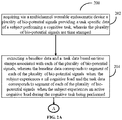
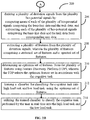
- FIG. 2 is a flowchart illustrating a method for assessment of cognitive load from bio-potentials measured using wearable endosomatic device, according to some embodiments of the present disclosure.
- the system 100 comprises one or more data storage devices or the memory 102 operatively coupled to the processor(s) 104 and is configured to store instructions for execution of steps of the method depicted in FIGS 2 through 4 by the processor(s) or one or more hardware processors 104.
- the steps of the method of the present disclosure will now be explained with reference to the components or blocks of the system 100 as depicted in FIG. 1 and the steps of flow diagram as depicted in FIG. 2 .
- process steps, method steps, techniques or the like may be described in a sequential order, such processes, methods and techniques may be configured to work in alternate orders. In other words, any sequence or order of steps that may be described does not necessarily indicate a requirement that the steps to be performed in that order.
- the steps of processes described herein may be performed in any order practical. Further, some steps may be performed simultaneously.
- the method 200 is further explained in conjunction with FIG. 3 and 4 supported with experimental results.
- the one or more hardware processors 104 are configured to acquire via the multichannel wearable endosomatic device 112 a plurality of bio-potential signals providing a task specific data of a user or subject performing a cognitive task, wherein the plurality of acquired bio-signals are time stamped. Furthermore, the acquired bio-potential signal are priori processed by the multichannel bio-potential device for static calibration and dynamic calibration and provide calibrated bio-potentials for further processing.
- the one or more hardware processors 104 are configured to extract from each of the plurality of bio-potential signals a baseline data and a task data based on time stamps associated with plurality of bio-potential signals.
- the baseline data corresponds to segment of each of the plurality of bio-potential signals when the user experiences a nil cognitive load and the task data corresponds to segment of each of the plurality of bio-potential signals when the user experiences an active cognitive load during the cognitive task being performed;
- the one or more hardware processors 104 are configured to derive a plurality of deviation signals from the plurality bio-potential signals by: a) computing mean of each of the plurality of bio-potential signals comprising the base-line data and the task data; and b) subtracting the base-line data and the task data from corresponding acquired bio-potential signals, alternatively referred as raw data.
- the one or more hardware processors 104 are configured to extract a plurality of features from the plurality of deviation signals, wherein the plurality of features comprising a statistical set of features and a spectral set of features.
- the set of statistical features comprises computing by using the task data mean, median, standard deviation, skewness, kurtosis, minimum and maximum levels of the plurality of bio-potential signals. Also computed is normalized kurtosis and normalized variance values with respect to the baseline data and the task data.
- the set of spectral features comprises total power, mean power, mean frequency, power at mean frequency, median frequency, power at median frequency, peak frequency, peak power, signal band-power, first moment, second moment and third moment.
- the one or more hardware processors 104 are configured to determine an optimum set of features from the plurality of features using Feature Discovery Platform (FDP), wherein the FDP selects the optimum feature set in accordance with the cognitive task.
- FDP Feature Discovery Platform
- the one or more hardware processors 104 are configured to train the classifier (ML based classifier) 112 for classifying the cognitive task into high load task and low load task using the optimum set of features.
- the classifier ML based classifier
- the one or more hardware processors 104 are configured to utilize the trained classifier to classify the cognitive task performed by the user in real time into the high load task and the low load task.
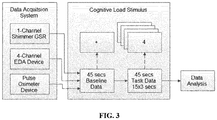
- FIG. 3 is an architectural overview of the system of FIG. 1 , according to some embodiments of the present disclosure.
- the method disclosed herein identifies the bio-markers of mental workload (cognitive load) from bio-potentials measured using endosomatic EDA, alternatively referred simply as EDA.
- EDA endosomatic EDA
- a four channel wearable endosomatic device (the multichannel wearable endosomatic device 112) records the bio-potentials from fingers of both hands and both legs of a subject while performing the task.
- the bandwidth of the EDA signal lies in the range 0-3Hz, thus the sampling frequency of the wearable endosomatic device was set to 20 samples/seconds.
- a Shimmer TM GSR device is used for recording skin conductance response in order to correlate the findings obtained from EDA response with that of GSR.
- the sampling frequency of the Shimmer TM is set to 51.2 Hz. Also used a finger wearable pulse oximeter to check that pulse rate of the participants (subjects) were well within the normal range (60-140 BPM) throughout the experiment. Bio-potentials recorded during execution of tasks from hands and feet are directly acquired into the system 100 without applying any filters. Systematic static calibration and dynamic calibration of the bio-potential acquisition system is performed.
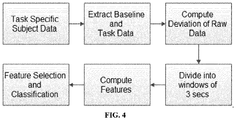
- the overall approach adopted for processing sensor data is depicted with a functional block diagram of the system 100 of FIG.1 , according to some embodiments of the present disclosure.
- Recorded sensor data (acquired bio-potentials signals) are first divided into the task data and the baseline data based on timestamps. These data are then processed to derive features. Finally, optimum feature set selection technique such as the feature discovery platform is used to select an optimum set of features, which are then fed to a classifier (ML based classifier 112) for classification of low and high cognitive loads.
- the acquired bio-potential signals are analyzed in terms of deviation signal of the measured bio-potentials.
- the mean of the whole signal (baseline + task) is computed and then subtracted from the data acquired during the task.
- the deviation signals under rest condition typically lie within +/-20 mV range, as reported in one of the prior works.
- the method disclosed herein identifies that during task interval, 99% of the EDA deviation signals lie within +/- 10 mV range.
- the deviation signals obtained from the recorded left and right hand bio-potentials are then identified as LH and RH signals respectively.
- those obtained from left and right leg bio-potentials are identified as LL and RL signals respectively. From these signals, some statistical features like mean, median, standard deviation, skewness, kurtosis, minimum and maximum levels.
- normalized kurtosis and normalized variance respectively that measure of change in power distribution w.r.t baseline.
- normalized kurtosis and variance values obtained during each task window with respect to the subject specific baseline values of the respective features.
- frequency distribution of these deviation signals are also analyzed, by using tools such as MATLAB's TM "pwelch" function for estimating the power spectral density of the signals.
- Spectral features considered include total power, mean power, mean frequency, power at mean frequency, median frequency, power at median frequency, peak frequency, peak power, signal band-power, first moment, second moment and third moment.
- the feature vector consisted of total 21 features (9 statistical and 12 spectral).
- Four such feature vectors were obtained for 4 different EDA channels (LH, RH, LL, RL).
- the raw GSR data collected using Shimmer device, is passed through a Finite Impulse Response (FIR) filter having passband between 0-4Hz, since most of the skin conductance response lies within that range.
- FIR Finite Impulse Response
- the same 21 features (9 statistical and 12 spectral features) are also computed from filtered GSR data also.
- the EDA and GSR features obtained during execution of low load and high load tasks have been classified using a number of classifiers. However, random forest was found to outperform all.
- Both EDA and GSR task data were subdivided into a number of windows and all features were calculated on these windowed data. For estimating the performance of the classifier, 10 fold cross-validation was performed.
- the classification accuracy is calculated using GSR features as well as using endosomatic EDA features only.
- the method disclosed comprises selecting the most significant features using the state of art FDP, which is an automated framework, used to perform time-series analytics.
- FDP extracts signal property based generic features (SPGF) and provides a recommended set of features and learn by exploiting novel relax greedy search approach that efficiently searches over ranked feature space.
- Recommended features along with learned model (classifier with tuned hyper parameters) are used to derive the inference in the test data.
- SPGF signal property based generic features
- This platform enables fusing any domain specific features along with SPGF and does the recommendation of features on the augmented feature space.
- the method disclosed also uses maximal information coefficient (MIC) based approach for feature selection for comparative study.
- MIC maximal information coefficient
- the population is selected based on an understanding that students are best fit for studies involving cognitive load.
- a written consent was taken from all the participants before data collection. All the participants appeared for both low and high load tasks. For half of the participants, the low load task was administered first followed by high load task. Reverse order was followed for remaining participants.
- the numbers were shown on the LCD screen placed at a distance of approximately 60 cm from the participant.
- skin bio-potentials were recorded using the multichannel endosomatic device 112. This is a 4-channel device (multichannel wearable endosomatic device 112) and hence we collected skin potentials from both hands (left and right) and leg (left and right).
- the sensors are connected to legs.
- the electrodes were attached to the middle phalanges of middle and index fingers of the hands and of second and middle toes of the legs.
- Shimmer device was connected in lower phalanges of index and middle finger of the left hand.
- a black cross was shown on the white screen for 45 seconds. Participants were asked to concentrate on the cross and this period was treated as baseline period. After this, either low or high load task (45 seconds) was administered. Once a task session (low load or high load) is over, 10 minutes rest period was given, during which the participants were instructed to relax. After that, the second task was administered.
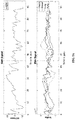
- FIG. 5A and FIG. 5B depict Galvanic Skin Conductance (GSR) deviation signals and endosomatic electrodermal activity (EDA) deviation signals for low load task and high load cognitive tasks respectively, according to some embodiments of the present disclosure.
- FIGS. 5A and 5B show the deviation GSR data and EDA deviation signals for all 4-channels for a particular participant (subject) for low and high load tasks respectively.
- the vertical dotted line in the plot indicates start time of the low/high load task. Hence, left side of this line represents the baseline signal and right side indicates the signals acquired during task interval.
- Shimmer TM is an active device which sends a very small amount of current for measuring the skin conductance level.
- endosomatic EDA is a uses a passive device (multichannel wearable endosomatic device 112). It was observed that the EDA bio-potentials get affected to some extent if both Shimmer and EDA device are connected together. However, results show that it is still possible to find reliable bio-markers of cognitive load from EDA data. This characteristics was observed for all the participants (subjects). Table 1 shows the average classification performance obtained for GSR and proposed approach using various classifiers.
- Table 1 Comparison of Average classification metrics using GSR and Proposed system Classifier GSR Proposed System LH RH LL RL All SVM f-score 0.57 0.54 0.56 0.64 0.60 0.69 Sensitivity 0.58 0.54 0.54 0.65 0.63 0.96 Specificity 0.57 0.57 0.62 0.63 0.54 0.19 Random forest f-score 0.71 0.60 0.64 0.72 0.69 0.83 Sensitivity 0. 70 0.60 0.63 0.69 0.72 0.85 Specificity 0. 72 0.61 0.68 0.76 0.64 0.81 KN N f-score 0.56 0.52 0.64 0.63 0.55 0.71 Sensitivity 0.56 0.52 0.63 0.62 0.55 0.71 Specificity 0.58 0.53 0.66 0.64 0.56 0.71
- a support vector machine(SVM) is used random forest and KNN classifiers. Both GSR (21 features) and proposed EDA features (all 84 features) were calculated over windows of duration 3 seconds. The window duration was chosen to be 3 seconds as since presented or displayed a number to the participants under test in every 3 seconds. The results are generated using 10 fold cross validation. We have used classification algorithms of MATLAB TM for generating Table 1. It is observed that for both GSR and EDA signals, random forest classifier is the best situated one. Also observed is that the average accuracy for hand channels (LH and RH) are less compared to that obtained for legs (LL and RL).
- maximum f-score value obtained is 0.83, which corresponds to an accuracy of 83%, when we consider all 4 available EDA channels in union.
- best performance is obtained with random forest classifier with a f-score of 0.71 and corresponding accuracy of 71.5%.
- an optimum set of features was derived from the from EDA signal using a FDP for recommending best suited features.
- the tool 16 features were selected as most significant features.
- all 84 features 21 features per channel for 4 channels
- 30 features as the most significant ones.
- 15 features corresponds to left and right hand signals. Remaining 15 features corresponds to leg signals.
- FDP gives classification performance on 5-fold cross-validation and the recommended classifier is ensemble AdaBoost.
- Maximal information coefficient (MIC) based approach is tried for selecting most significant features. The results are presented in Table 2.
- EDA MIC based approach recommended 25 features giving an average classification accuracy of 86.5% with an f-score of 0.86. It is observed that, out of these 25 features, 16 features corresponds to leg signals and remaining 9 features corresponds to hand signals.
- GSR MIC recommends 15 features giving an average accuracy of 73.4%.
- random forest classifier is used, and classification performances are calculated using 10-fold cross validation.
- the FDP recommended features were used and to perform 10-fold cross-validation using random forest classifier. Resultant average accuracy obtained is 86.6%.
- the method and system disclosed herein utilizes endosomatic approach for assessment of cognitive load.
- results suggest that bio-potential deviation signals vary significantly with different levels of cognitive load.
- endosomatic EDA approach disclosed herein gives better classification accuracy compared to GSR signal.
- Statistical and frequency domain features of EDA signals gives a maximum classification accuracy of 83% (with specificity and sensitivity of 0.85 and 0.81) using 10 fold cross-validation approach. These performances are consistent even if FDP selected features or optimum set of features selected using FDP and MIC are used in random forest classifier for 10-fold cross validation.
- classification performance of EDA is better than GSR.
- by combining most significant GSR and EDA features we obtained a classification accuracy of 89% using random forest classifier.
- the endosomatic EDA signal in accordance with the system and method disclosed herein can alone be used to successfully differentiate between low and high cognitive load conditions and the results are consistent across various classifiers and feature selection algorithms.
- Assessment of cognitive load from endosomatic EDA signals have hardly been attempted before.
- the cognitive task used herein refers to mental addition task
- the method and system disclosed herein can be used for analysis of other cognitive tasks as well as for mental conditions like stress, anxiety etc.
- the external current applied changes the internal steady state equilibrium of our body, thereby changing the bio-potentials.
- the endosomatic approach for measuring cognitive load can be used in various applications like student assessment, cognitive assessment, mental health screening etc.
- the hardware device can be any kind of device which can be programmed including e.g. any kind of computer like a server or a personal computer, or the like, or any combination thereof.
- the device may also include means which could be e.g. hardware means like e.g. an application-specific integrated circuit (ASIC), a field-programmable gate array (FPGA), or a combination of hardware and software means, e.g.
- ASIC application-specific integrated circuit
- FPGA field-programmable gate array
- the means can include both hardware means, and software means.
- the method embodiments described herein could be implemented in hardware and software.
- the device may also include software means.
- the embodiments may be implemented on different hardware devices, e.g. using a plurality of CPUs.
- the embodiments herein can comprise hardware and software elements.
- the embodiments that are implemented in software include but are not limited to, firmware, resident software, microcode, etc.
- the functions performed by various components described herein may be implemented in other components or combinations of other components.
- a computer-usable or computer readable medium can be any apparatus that can comprise, store, communicate, propagate, or transport the program for use by or in connection with the instruction execution system, apparatus, or device.
- a computer-readable storage medium refers to any type of physical memory on which information or data readable by a processor may be stored.
- a computer-readable storage medium may store instructions for execution by one or more processors, including instructions for causing the processor(s) to perform steps or stages consistent with the embodiments described herein.
- the term "computer-readable medium” should be understood to include tangible items and exclude carrier waves and transient signals, i.e., be non-transitory. Examples include random access memory (RAM), read-only memory (ROM), volatile memory, nonvolatile memory, hard drives, CD ROMs, DVDs, flash drives, disks, and any other known physical storage media.
Landscapes
- Health & Medical Sciences (AREA)
- Engineering & Computer Science (AREA)
- Life Sciences & Earth Sciences (AREA)
- Medical Informatics (AREA)
- Public Health (AREA)
- General Health & Medical Sciences (AREA)
- Biomedical Technology (AREA)
- Physics & Mathematics (AREA)
- Pathology (AREA)
- Artificial Intelligence (AREA)
- Heart & Thoracic Surgery (AREA)
- Molecular Biology (AREA)
- Surgery (AREA)
- Animal Behavior & Ethology (AREA)
- Biophysics (AREA)
- Veterinary Medicine (AREA)
- Psychiatry (AREA)
- Computer Vision & Pattern Recognition (AREA)
- Epidemiology (AREA)
- Primary Health Care (AREA)
- Data Mining & Analysis (AREA)
- Evolutionary Computation (AREA)
- Signal Processing (AREA)
- Physiology (AREA)
- Mathematical Physics (AREA)
- Theoretical Computer Science (AREA)
- Software Systems (AREA)
- Dermatology (AREA)
- Psychology (AREA)
- Educational Technology (AREA)
- Child & Adolescent Psychology (AREA)
- Fuzzy Systems (AREA)
- Developmental Disabilities (AREA)
- Social Psychology (AREA)
- Hospice & Palliative Care (AREA)
- General Business, Economics & Management (AREA)
- Business, Economics & Management (AREA)
- Databases & Information Systems (AREA)
- Nuclear Medicine, Radiotherapy & Molecular Imaging (AREA)
- Computing Systems (AREA)
Abstract
Description
- The present application claims priority from Indian provisional patent application no.
IN-202021025764, filed on 18 June 2020 - The disclosure herein generally relates to automated assessment of cognitive load, and, more particularly, to a method and system for assessment of cognitive load from bio-potentials measured using wearable endosomatic device.
- Cognitive load is the amount of mental resources required to execute a task. Psychophysiological research shows variations in the electrodermal activity of the skin with variations in cognitive load. An optimum amount of cognitive load is required for executing the task successfully, beyond which the performance of an individual degrades drastically, leading to psychological conditions like stress, anxiety etc. Thus, measuring the overall cognitive load imparted on an individual is important. Various approaches are used for assessment of cognitive load. State of the art studies mostly use exosomatic approach like Galvanic Skin Resistance (GSR) for measuring electrodermal activity (EDA) and assess cognitive load experienced by a subject. Subjective measurement includes questionnaires like NASA-TLX, SWAT etc., whereas performance based measures like task completion time, error rate etc., are also used. Research is being conducted for using various physiological parameters like heart rate, brain signals, skin conductance level, and breathing signals as markers of the cognitive load. However, continuous monitoring of cognitive load in daily life scenarios is still in an exploratory stage and requires a low cost wearable device for ease of use. Recent studies show the possibility of detecting the cognitive load from a variety of wearable sensors. One of the works in literature uses a smart watch for recording cardiac signal and extracted respiratory signal from it, which in turn is used for assessing cognitive load, while another existing work uses a combination of sensors like galvanic skin conductance(GSR) and Heart rate (HR) etc., being used for measuring mental workload in one scenario. Most of the available wearable devices either employ a GSR sensor (measuring the variations in skin conductance) or a photoplethysmogram (PPG) sensor or a combination of both.
- Electrodermal activity is defined as the variation of electrical characteristics of the skin, which is typically governed by the sweat gland activity. Sweat secretion, usually driven by autonomic nervous system, causes the variation in the electrical property of the skin. Two alternative approaches used for measuring electrodermal activity are exosomatic measurements and endosomatic measurements. In the exosomatic approach, AC/DC current is passed through two electrodes placed on the skin that results in measurable changes in skin conductance level. In contrast, the endosomatic method measures the bio-potential of the skin without application of any electrical stimulus.
- Endosomatic approach, which is related to both sympathetic and parasympathetic nervous system, is considered to be more reliable and physiological, compared to the exosomatic approach. Besides, the signal level in exosomatic measurements is dependent on the skin conductance level and hence, people with dry or calloused hands have significantly lower GSR value. In spite of these limitations, exosomatic approach has been used extensively to measure cognition effect as there are a number of wearable devices available in the market for exosomatic measurements. However, using endosomatic EDA has multiple challenges for practical usage of cognitive load assessment. Thus, very few prior works refer to possibility of usage of Endosomatic EDA for cognitive load detection/classification, instead prefer the exosomatic approach stating multiple challenges in using the endosomatic EDA approach. It can be noted that for the endosomatic EDA approach randomly picking bio- potential signals (bio-signals) from any part of body does not suffice to obtain accurate task classification results. Further bio-signals being of very low amplitude require specific preprocessing. Furthermore, to assess cognitive load from bio- signals into high load and low load requires right combination of features to be selected from the bio-signal, which can be then used to train a classifier for cognitive load with required accuracy. Thus, hardly any attempts have been made to address the technical challenges in using endosomatic EDA.
- Embodiments of the present disclosure present technological improvements as solutions to one or more of the above-mentioned technical problems recognized by the inventors in conventional systems. For example, in one embodiment, a method for assessment of cognitive load from bio-potentials measured using a wearable endosomatic device is provided.
- The method comprising acquiring via a multichannel wearable endosomatic device, a plurality of bio-potential signals providing a task specific data of a subject performing a cognitive task, wherein the plurality of bio-potential signals are time stamped.
- Further comprising extracting a baseline data and a task data based on time stamps associated with each of the plurality of bio-potential signals, by the one or more hardware processors, wherein the baseline data corresponds to segment of each of the plurality of bio-potential signals when the subject experiences a nil cognitive load and the task data corresponds to segment of each of the plurality of bio-potential signals when the subject experiences an active cognitive load during the cognitive task being performed.
- Furthermore comprising deriving a plurality of deviation signals from the plurality bio-potential signals by: computing mean of each of the plurality of bio-potential signals comprising the base-line data and the task data; and subtracting each of the base-line data and the task data from the corresponding plurality of bio-potential signals.
- Thereafter, extracting a plurality of features from the plurality of deviation signals, wherein the plurality of features comprising a statistical set of features and a spectral set of features and determining an optimum set of features from the plurality of features using a Feature Discovery Platform (FDP), wherein the FDP selects the optimum feature set in accordance with the cognitive task.
- Furthermore, training a classifier for classifying the cognitive task into one of a high load task and a low load task using the optimum set of features and utilizing the trained classifier to classify the cognitive task performed by the subject in real time into the high load task and the low load task.
- In another aspect, a system for assessment of cognitive load from bio-potentials measured using a wearable endosomatic device, the system comprising: a memory storing instructions; one or more Input/Output (I/O) interfaces; and one or more hardware processors coupled to the memory via the one or more I/O interfaces, wherein the one or more hardware processors are configured by the instructions for: acquiring via a multichannel wearable endosomatic device, a plurality of bio-potential signals providing a task specific data of a subject performing a cognitive task, wherein the plurality of bio-potential signals are time stamped.
- Further extracting a baseline data and a task data based on time stamps associated with each of the plurality of bio-potential signals, by the one or more hardware processors, wherein the baseline data corresponds to segment of each of the plurality of bio-potential signals when the subject experiences a nil cognitive load and the task data corresponds to segment of each of the plurality of bio-potential signals when the subject experiences an active cognitive load during the cognitive task being performed.
- Furthermore deriving a plurality of deviation signals from the plurality bio-potential signals by: computing mean of each of the plurality of bio-potential signals comprising the base-line data and the task data; and subtracting each of the base-line data and the task data from the corresponding plurality of bio-potential signals.
- Thereafter, extracting a plurality of features from the plurality of deviation signals, wherein the plurality of features comprising a statistical set of features and a spectral set of features and determining an optimum set of features from the plurality of features using a Feature Discovery Platform (FDP), wherein the FDP selects the optimum feature set in accordance with the cognitive task.
- Furthermore, training a classifier for classifying the cognitive task into one of a high load task and a low load task using the optimum set of features and utilizing the trained classifier to classify the cognitive task performed by the subject in real time into the high load task and the low load task.
- In yet another aspect, there are provided one or more non-transitory machine-readable information storage mediums comprising one or more instructions, which when executed by one or more hardware processors causes a method for assessment of cognitive load from bio-potentials measured using a wearable endosomatic device. The method comprises acquiring via a multichannel wearable endosomatic device, a plurality of bio-potential signals providing a task specific data of a subject performing a cognitive task, wherein the plurality of bio-potential signals are time stamped.
- Further comprising extracting a baseline data and a task data based on time stamps associated with each of the plurality of bio-potential signals, by the one or more hardware processors, wherein the baseline data corresponds to segment of each of the plurality of bio-potential signals when the subject experiences a nil cognitive load and the task data corresponds to segment of each of the plurality of bio-potential signals when the subject experiences an active cognitive load during the cognitive task being performed.
- Furthermore comprising deriving a plurality of deviation signals from the plurality bio-potential signals by: computing mean of each of the plurality of bio-potential signals comprising the base-line data and the task data; and subtracting each of the base-line data and the task data from the corresponding plurality of bio-potential signals.
- Thereafter, extracting a plurality of features from the plurality of deviation signals, wherein the plurality of features comprising a statistical set of features and a spectral set of features and determining an optimum set of features from the plurality of features using a Feature Discovery Platform (FDP), wherein the FDP selects the optimum feature set in accordance with the cognitive task.
- Furthermore, training a classifier for classifying the cognitive task into one of a high load task and a low load task using the optimum set of features and utilizing the trained classifier to classify the cognitive task performed by the subject in real time into the high load task and the low load task.
- It is to be understood that both the foregoing general description and the following detailed description are exemplary and explanatory only and are not restrictive of the invention, as claimed.
- The accompanying drawings, which are incorporated in and constitute a part of this disclosure, illustrate exemplary embodiments and, together with the description, serve to explain the disclosed principles:
-
FIG. 1 illustrates a system for assessment of cognitive load from bio-potentials measured using a wearable endosomatic device, according to some embodiments of the present disclosure. -
FIG. 2 is a flowchart illustrating a method for assessment of cognitive load from bio-potentials measured using wearable endosomatic device, according to some embodiments of the present disclosure. -
FIG. 3 is an architectural overview of the system ofFIG. 1 , according to some embodiments of the present disclosure. -
FIG. 4 illustrates functional block diagram of the system ofFIG.1 , according to some embodiments of the present disclosure. -
FIG. 5A andFIG. 5B depict Galvanic Skin Conductance (GSR) deviation signals and endosomatic electrodermal activity (EDA) deviation signals for low load task and high load cognitive tasks respectively, according to some embodiments of the present disclosure. - It should be appreciated by those skilled in the art that any block diagrams herein represent conceptual views of illustrative systems and devices embodying the principles of the present subject matter. Similarly, it will be appreciated that any flow charts, flow diagrams, and the like represent various processes which may be substantially represented in computer readable medium and so executed by a computer or processor, whether or not such computer or processor is explicitly shown.
- Exemplary embodiments are described with reference to the accompanying drawings. In the figures, the left-most digit(s) of a reference number identifies the figure in which the reference number first appears. Wherever convenient, the same reference numbers are used throughout the drawings to refer to the same or like parts. While examples and features of disclosed principles are described herein, modifications, adaptations, and other implementations are possible without departing from the scope of the disclosed embodiments. It is intended that the following detailed description be considered as exemplary only, with the true scope being indicated by the following embodiments described herein , with the true scope being indicated by the following claims.
- Embodiments herein provide a method and system for assessment of cognitive load from bio-potentials measured using wearable endosomatic device. The method disclosed provides a solution to the technical challenges in the art while directly using the bio-potential signals (interchangeably referred as bio-signals) to implement endosomatic approach by:
- 1) Utilizing a multichannel wearable endosomatic device capable of acquiring and combining multiple bio-potentials, which are biomarkers of cognitive load experienced by a subject performing a cognitive task. The multiple bio-potentials are associated with appropriately chosen multiple body parts. Bio-potentials, alternatively referred as skin potentials, when measured at different body locations might not give a good biomarker of cognitive load, however, when combined together, they serve as a reliable biomarker. The multichannel wearable device used is a device referred in one of the patent application No.
201931038304 201931038304 201931038304 - 2) Extracting information required, for classification of the cognitive load, from the acquired bio-signals using a set of statistical and a set of spectral features.
- 3) Utilizing a feature selection approach to identify a set of optimum features to train a Machine Learning (ML) based task classifier to classify the cognitive load experienced by a subject into high load task and low load task.
- 4) Further, in an embodiment the method disclosed combines bio-potentials acquired from GSR and bio-potential features via the wearable endosomatic device for increasing overall classification accuracy.
- Referring now to the drawings, and more particularly to
FIG. 1 through FIG. 5B , where similar reference characters denote corresponding features consistently throughout the figures, there are shown preferred embodiments and these embodiments are described in the context of the following exemplary system and/or method. -
FIG. 1 illustrates a system for assessment of cognitive load from bio-potentials measured using a wearable endosomatic device, according to some embodiments of the present disclosure. - In an embodiment, the
system 100 includes one ormore processors 104, communication interface device(s) or input/output (I/O) interface(s) 106, and one or more data storage devices ormemory 102 operatively coupled to the one ormore processors 104. Thememory 102 comprises adatabase 108. The one ormore processors 104 that are hardware processors can be implemented as one or more microprocessors, microcomputers, microcontrollers, digital signal processors, central processing units, state machines, logic circuitries, and/or any devices that manipulate signals based on operational instructions. Among other capabilities, the processor(s) is configured to fetch and execute computer-readable instructions stored in the memory. In an embodiment, thesystem 100 can be implemented in a variety of computing systems, such as laptop computers, notebooks, hand-held devices, workstations, mainframe computers, servers, a network cloud and the like. - The I/O interface device(s) 106 can include a variety of software and hardware interfaces, for example, a web interface, a graphical user interface, and the like and can facilitate multiple communications within a wide variety of networks N/W and protocol types, including wired networks, for example, LAN, cable, etc., and wireless networks, such as WLAN, cellular, or satellite. In an embodiment, the I/O interface device(s) can include one or more ports for connecting a number of devices to one another or to another server.
- The
memory 102 may include any computer-readable medium known in the art including, for example, volatile memory, such as static random access memory (SRAM) and dynamic random access memory (DRAM), and/or non-volatile memory, such as read only memory (ROM), erasable programmable ROM, flash memories, hard disks, optical disks, and magnetic tapes. - The
database 108 may store information but is not limited the acquired bio-potentials using a multichannel endosomaticwearable device 112, the set of statistical features and the set of spectral features extracted from the bio-potentials. Further, thedatabase 108 stores information pertaining to inputs fed to thesystem 100 and/or outputs generated by the system (e.g. at each stage), specific to the methodology described herein. Specifically, thedatabase 108 stores information being processed at each step of the proposed methodology. Thememory 102 includes multiple modules (not shown) such as an optimum feature selection module like a Feature discovery platform (FDP). Also, thememory 102 includes a ML basedclassifier 110 that is trained using the features acquired bio-potential signals by utilizing the optimum features of the bio-signals. The trained ML basedclassifier 110 can then be used in real time scenarios to classify the cognitive load experienced buy a subject under observation and wearing a multichannelendosomatic device 112. As explained above, the multichannel endosomatic device is capable of capturing bio-potential signal directly from a subject and provide calibrated bio-potential signals with both static calibration and dynamic calibration. However, the patent application No.201931038304 - Functions of the components of
system 100 are explained in conjunction with flow diagrams depicted inFIGS. 2 , and architectural and functional block diagrams ofsystem 100 as depicted inFIG. 3 andFIG. 4 . -
FIG. 2 is a flowchart illustrating a method for assessment of cognitive load from bio-potentials measured using wearable endosomatic device, according to some embodiments of the present disclosure. - In an embodiment, the
system 100 comprises one or more data storage devices or thememory 102 operatively coupled to the processor(s) 104 and is configured to store instructions for execution of steps of the method depicted inFIGS 2 through 4 by the processor(s) or one ormore hardware processors 104. The steps of the method of the present disclosure will now be explained with reference to the components or blocks of thesystem 100 as depicted inFIG. 1 and the steps of flow diagram as depicted inFIG. 2 . Although process steps, method steps, techniques or the like may be described in a sequential order, such processes, methods and techniques may be configured to work in alternate orders. In other words, any sequence or order of steps that may be described does not necessarily indicate a requirement that the steps to be performed in that order. The steps of processes described herein may be performed in any order practical. Further, some steps may be performed simultaneously. Themethod 200 is further explained in conjunction withFIG. 3 and4 supported with experimental results. - Referring to the steps of the
method 200 inFIG. 2 , atstep 202, the one ormore hardware processors 104 are configured to acquire via the multichannel wearable endosomatic device 112 a plurality of bio-potential signals providing a task specific data of a user or subject performing a cognitive task, wherein the plurality of acquired bio-signals are time stamped. Furthermore, the acquired bio-potential signal are priori processed by the multichannel bio-potential device for static calibration and dynamic calibration and provide calibrated bio-potentials for further processing. - At
step 204, the one ormore hardware processors 104 are configured to extract from each of the plurality of bio-potential signals a baseline data and a task data based on time stamps associated with plurality of bio-potential signals. The baseline data corresponds to segment of each of the plurality of bio-potential signals when the user experiences a nil cognitive load and the task data corresponds to segment of each of the plurality of bio-potential signals when the user experiences an active cognitive load during the cognitive task being performed; - At
step 206, the one ormore hardware processors 104 are configured to derive a plurality of deviation signals from the plurality bio-potential signals by: a) computing mean of each of the plurality of bio-potential signals comprising the base-line data and the task data; and b) subtracting the base-line data and the task data from corresponding acquired bio-potential signals, alternatively referred as raw data. - At
step 210, the one ormore hardware processors 104 are configured to extract a plurality of features from the plurality of deviation signals, wherein the plurality of features comprising a statistical set of features and a spectral set of features. The set of statistical features comprises computing by using the task data mean, median, standard deviation, skewness, kurtosis, minimum and maximum levels of the plurality of bio-potential signals. Also computed is normalized kurtosis and normalized variance values with respect to the baseline data and the task data. The set of spectral features comprises total power, mean power, mean frequency, power at mean frequency, median frequency, power at median frequency, peak frequency, peak power, signal band-power, first moment, second moment and third moment. Thus, a total of 21 features per channel, with a four channel device takes the total features to 21∗4=84. - At
step 212, the one ormore hardware processors 104 are configured to determine an optimum set of features from the plurality of features using Feature Discovery Platform (FDP), wherein the FDP selects the optimum feature set in accordance with the cognitive task. - At
step 214, the one ormore hardware processors 104 are configured to train the classifier (ML based classifier) 112 for classifying the cognitive task into high load task and low load task using the optimum set of features. - At step 216, the one or
more hardware processors 104 are configured to utilize the trained classifier to classify the cognitive task performed by the user in real time into the high load task and the low load task. -
FIG. 3 is an architectural overview of the system ofFIG. 1 , according to some embodiments of the present disclosure. - Data acquisition and analysis: The method disclosed herein identifies the bio-markers of mental workload (cognitive load) from bio-potentials measured using endosomatic EDA, alternatively referred simply as EDA. As depicted in in
FIG. 3 a four channel wearable endosomatic device (the multichannel wearable endosomatic device 112) records the bio-potentials from fingers of both hands and both legs of a subject while performing the task. Typically, the bandwidth of the EDA signal lies in the range 0-3Hz, thus the sampling frequency of the wearable endosomatic device was set to 20 samples/seconds. Additionally, a Shimmer™ GSR device is used for recording skin conductance response in order to correlate the findings obtained from EDA response with that of GSR. The sampling frequency of the Shimmer™ is set to 51.2 Hz. Also used a finger wearable pulse oximeter to check that pulse rate of the participants (subjects) were well within the normal range (60-140 BPM) throughout the experiment. Bio-potentials recorded during execution of tasks from hands and feet are directly acquired into thesystem 100 without applying any filters. Systematic static calibration and dynamic calibration of the bio-potential acquisition system is performed. - The overall approach adopted for processing sensor data is depicted with a functional block diagram of the
system 100 ofFIG.1 , according to some embodiments of the present disclosure. Recorded sensor data (acquired bio-potentials signals) are first divided into the task data and the baseline data based on timestamps. These data are then processed to derive features. Finally, optimum feature set selection technique such as the feature discovery platform is used to select an optimum set of features, which are then fed to a classifier (ML based classifier 112) for classification of low and high cognitive loads. The acquired bio-potential signals are analyzed in terms of deviation signal of the measured bio-potentials. For deriving the deviation signals, the mean of the whole signal (baseline + task) is computed and then subtracted from the data acquired during the task. The deviation signals under rest condition typically lie within +/-20 mV range, as reported in one of the prior works. However, the method disclosed herein identifies that during task interval, 99% of the EDA deviation signals lie within +/- 10 mV range. The deviation signals obtained from the recorded left and right hand bio-potentials are then identified as LH and RH signals respectively. Similarly, those obtained from left and right leg bio-potentials are identified as LL and RL signals respectively. From these signals, some statistical features like mean, median, standard deviation, skewness, kurtosis, minimum and maximum levels. For analyzing the individual responses to mental workload, two new features are used, which are termed as normalized kurtosis and normalized variance respectively that measure of change in power distribution w.r.t baseline. These normalized kurtosis and variance values obtained during each task window with respect to the subject specific baseline values of the respective features. Hence, in total 9 statistical features are computed. In addition, the frequency distribution of these deviation signals are also analyzed, by using tools such as MATLAB's ™ "pwelch" function for estimating the power spectral density of the signals. Spectral features considered include total power, mean power, mean frequency, power at mean frequency, median frequency, power at median frequency, peak frequency, peak power, signal band-power, first moment, second moment and third moment. Hence, the feature vector consisted of total 21 features (9 statistical and 12 spectral). Four such feature vectors were obtained for 4 different EDA channels (LH, RH, LL, RL). The raw GSR data, collected using Shimmer device, is passed through a Finite Impulse Response (FIR) filter having passband between 0-4Hz, since most of the skin conductance response lies within that range. The same 21 features (9 statistical and 12 spectral features) are also computed from filtered GSR data also. The EDA and GSR features obtained during execution of low load and high load tasks have been classified using a number of classifiers. However, random forest was found to outperform all. Both EDA and GSR task data were subdivided into a number of windows and all features were calculated on these windowed data. For estimating the performance of the classifier, 10 fold cross-validation was performed. The classification accuracy is calculated using GSR features as well as using endosomatic EDA features only. - Once the plurality of features as extracted, the method disclosed comprises selecting the most significant features using the state of art FDP, which is an automated framework, used to perform time-series analytics. In case of classification task, the FDP extracts signal property based generic features (SPGF) and provides a recommended set of features and learn by exploiting novel relax greedy search approach that efficiently searches over ranked feature space. Recommended features along with learned model (classifier with tuned hyper parameters) are used to derive the inference in the test data. This platform enables fusing any domain specific features along with SPGF and does the recommendation of features on the augmented feature space. In addition to this, the method disclosed also uses maximal information coefficient (MIC) based approach for feature selection for comparative study.
- Experiment design and data collection: A mental addition task explained in prior work 'Estimation of cognitive load based on the pupil size dilation' is used for imparting low and high cognitive load. A set of numbers were presented to the participants one after another. Participants were instructed to add these numbers mentally and report at the end of the session. Each number was shown on the screen for a duration of 3 seconds. In a particular session, 15 such numbers were shown one after another. Single digit numbers (1,2, 3 and 5) were used for low cognitive load session and double digit numbers (7 through 19 except 10 and 15) were used to impart high cognitive load. 24 healthy university students (14 male, 10 female, mean age: 25+/-4 years) volunteered for the study. Ethical clearance was obtained from a relevant committee of the university. The population is selected based on an understanding that students are best fit for studies involving cognitive load. A written consent was taken from all the participants before data collection. All the participants appeared for both low and high load tasks. For half of the participants, the low load task was administered first followed by high load task. Reverse order was followed for remaining participants.
- The numbers were shown on the LCD screen placed at a distance of approximately 60 cm from the participant. During execution of the task, skin bio-potentials were recorded using the
multichannel endosomatic device 112. This is a 4-channel device (multichannel wearable endosomatic device 112) and hence we collected skin potentials from both hands (left and right) and leg (left and right). The sensors are connected to legs. The electrodes were attached to the middle phalanges of middle and index fingers of the hands and of second and middle toes of the legs. Shimmer device was connected in lower phalanges of index and middle finger of the left hand. At the beginning of each session, a black cross was shown on the white screen for 45 seconds. Participants were asked to concentrate on the cross and this period was treated as baseline period. After this, either low or high load task (45 seconds) was administered. Once a task session (low load or high load) is over, 10 minutes rest period was given, during which the participants were instructed to relax. After that, the second task was administered. - EXPERIMENTAL SET UP AND RESULTS:
FIG. 5A andFIG. 5B depict Galvanic Skin Conductance (GSR) deviation signals and endosomatic electrodermal activity (EDA) deviation signals for low load task and high load cognitive tasks respectively, according to some embodiments of the present disclosure.FIGS. 5A and5B show the deviation GSR data and EDA deviation signals for all 4-channels for a particular participant (subject) for low and high load tasks respectively. The vertical dotted line in the plot indicates start time of the low/high load task. Hence, left side of this line represents the baseline signal and right side indicates the signals acquired during task interval. It is observed that all 4 deviation signals mostly correlate with the GSR signals, although with some variable lag (usually GSR lags EDA signal by few seconds). We have also observed that across participants maximum deviation is obtained in the leg signals (both RL and LL) and also, there are visible differences between EDA signals recorded for low and high load tasks. Literature suggest that there are differences in electrodermal activities recorded from left and right hand. Prior works have shown significant difference in left and right EDA (exosomatic) during long term daily wear for assessing stress. Also analyzed is if this bilateral asymmetry is observable in the deviation signals for various levels of cognitive load. Significant differences were not observed between left and right deviation signals for low and high cognitive loads. Shimmer™ is an active device which sends a very small amount of current for measuring the skin conductance level. On the other hand, endosomatic EDA is a uses a passive device (multichannel wearable endosomatic device 112). It was observed that the EDA bio-potentials get affected to some extent if both Shimmer and EDA device are connected together. However, results show that it is still possible to find reliable bio-markers of cognitive load from EDA data. This characteristics was observed for all the participants (subjects). Table 1 shows the average classification performance obtained for GSR and proposed approach using various classifiers.Table 1: Comparison of Average classification metrics using GSR and Proposed system Classifier GSR Proposed System LH RH LL RL All SVM f-score 0.57 0.54 0.56 0.64 0.60 0.69 Sensitivity 0.58 0.54 0.54 0.65 0.63 0.96 Specificity 0.57 0.57 0.62 0.63 0.54 0.19 Random forest f-score 0.71 0.60 0.64 0.72 0.69 0.83 Sensitivity 0. 70 0.60 0.63 0.69 0.72 0.85 Specificity 0. 72 0.61 0.68 0.76 0.64 0.81 KN N f-score 0.56 0.52 0.64 0.63 0.55 0.71 Sensitivity 0.56 0.52 0.63 0.62 0.55 0.71 Specificity 0.58 0.53 0.66 0.64 0.56 0.71 - A support vector machine(SVM) is used random forest and KNN classifiers. Both GSR (21 features) and proposed EDA features (all 84 features) were calculated over windows of
duration 3 seconds. The window duration was chosen to be 3 seconds as since presented or displayed a number to the participants under test in every 3 seconds. The results are generated using 10 fold cross validation. We have used classification algorithms of MATLAB™ for generating Table 1. It is observed that for both GSR and EDA signals, random forest classifier is the best situated one. Also observed is that the average accuracy for hand channels (LH and RH) are less compared to that obtained for legs (LL and RL). It is to be observed that maximum f-score value obtained is 0.83, which corresponds to an accuracy of 83%, when we consider all 4 available EDA channels in union. For GSR, best performance is obtained with random forest classifier with a f-score of 0.71 and corresponding accuracy of 71.5%. Next, an optimum set of features was derived from the from EDA signal using a FDP for recommending best suited features. For GSR data the tool, 16 features were selected as most significant features. Similarly, for the method and system disclosed herein, all 84 features (21 features per channel for 4 channels) into the tool and it selected 30 features as the most significant ones. Out of these 30 features, 15 features corresponds to left and right hand signals. Remaining 15 features corresponds to leg signals. Corresponding classification performance is presented in Table 2.Table 2: Comparison of Classification metrics based on feature selection methods Feature Selection Method and Classifier Sensor No. Of Selected Features f-score Sensitivity Specificity FDP: 5-fold Cross Validation on Ensemble AdaBoost GSR 16 0.77 0.77 0.76 EDA 30 0.89 0.9 0.89 MIC: 10-fold Cross Validation on Random forest GSR 15 0.72 0.74 0.73 EDA 25 0.85 0.87 0.86 FDP: 10-fold Cross Validation on Random Forest EDA| 30 0.86 0.86 0.86 FDP ∩ MIC: 10-fold Cross Validation on Random Forest EDA 15 0.85 0.86 0.86 MIC: 10-fold Cross Validation on Random Forest GSR and EDA 40 0.89 0.90 0.89 - It is to be noted that FDP gives classification performance on 5-fold cross-validation and the recommended classifier is ensemble AdaBoost. Also, Maximal information coefficient (MIC) based approach is tried for selecting most significant features. The results are presented in Table 2. For EDA, MIC based approach recommended 25 features giving an average classification accuracy of 86.5% with an f-score of 0.86. It is observed that, out of these 25 features, 16 features corresponds to leg signals and remaining 9 features corresponds to hand signals. For GSR, MIC recommends 15 features giving an average accuracy of 73.4%. Here random forest classifier is used, and classification performances are calculated using 10-fold cross validation. Next, the FDP recommended features were used and to perform 10-fold cross-validation using random forest classifier. Resultant average accuracy obtained is 86.6%. Next, attempt was made to derive a common set of features from FDP recommended features and MIC recommended features. It was observed that there are 15 features which are common to both the feature sets. Classification performance was derived using these common features only and obtained a classification accuracy of 86.1% using random forest classifier on 10 fold cross-validation as shown in Table 2. It was observed that classification performances are consistent across classifiers and feature sets selected by both FDP and MIC. Finally, we tried to merge GSR and EDA features. Average classification accuracy obtained with this merged set is 89.4% with an f-score of 0.89. Thus, the system and method disclosed herein can provide more accurate endosomatic EDA based approach for classification of low and high cognitive load.
- Thus, the method and system disclosed herein utilizes endosomatic approach for assessment of cognitive load. Results suggest that bio-potential deviation signals vary significantly with different levels of cognitive load. It is observed that endosomatic EDA approach disclosed herein gives better classification accuracy compared to GSR signal. Statistical and frequency domain features of EDA signals gives a maximum classification accuracy of 83% (with specificity and sensitivity of 0.85 and 0.81) using 10 fold cross-validation approach. These performances are consistent even if FDP selected features or optimum set of features selected using FDP and MIC are used in random forest classifier for 10-fold cross validation. In all the above approaches, classification performance of EDA is better than GSR. Finally, by combining most significant GSR and EDA features, we obtained a classification accuracy of 89% using random forest classifier. Thus, it can be concluded that the endosomatic EDA signal in accordance with the system and method disclosed herein can alone be used to successfully differentiate between low and high cognitive load conditions and the results are consistent across various classifiers and feature selection algorithms. Assessment of cognitive load from endosomatic EDA signals have hardly been attempted before. Further, even though the cognitive task used herein refers to mental addition task, the method and system disclosed herein can be used for analysis of other cognitive tasks as well as for mental conditions like stress, anxiety etc. It was also observed that in exosomatic measurements, the external current applied changes the internal steady state equilibrium of our body, thereby changing the bio-potentials. The endosomatic approach for measuring cognitive load can be used in various applications like student assessment, cognitive assessment, mental health screening etc.
- The written description describes the subject matter herein to enable any person skilled in the art to make and use the embodiments. The scope of the subject matter embodiments is defined herein and may include other modifications that occur to those skilled in the art. Such other modifications are intended to be within the scope of the present disclosure if they have similar elements that do not differ from the literal language of the present disclosure or if they include equivalent elements with insubstantial differences from the literal language of the embodiments described herein.
- It is to be understood that the scope of the protection is extended to such a program and in addition to a computer-readable means having a message therein; such computer-readable storage means contain program-code means for implementation of one or more steps of the method, when the program runs on a server or mobile device or any suitable programmable device. The hardware device can be any kind of device which can be programmed including e.g. any kind of computer like a server or a personal computer, or the like, or any combination thereof. The device may also include means which could be e.g. hardware means like e.g. an application-specific integrated circuit (ASIC), a field-programmable gate array (FPGA), or a combination of hardware and software means, e.g. an ASIC and an FPGA, or at least one microprocessor and at least one memory with software processing components located therein. Thus, the means can include both hardware means, and software means. The method embodiments described herein could be implemented in hardware and software. The device may also include software means. Alternatively, the embodiments may be implemented on different hardware devices, e.g. using a plurality of CPUs.
- The embodiments herein can comprise hardware and software elements. The embodiments that are implemented in software include but are not limited to, firmware, resident software, microcode, etc. The functions performed by various components described herein may be implemented in other components or combinations of other components. For the purposes of this description, a computer-usable or computer readable medium can be any apparatus that can comprise, store, communicate, propagate, or transport the program for use by or in connection with the instruction execution system, apparatus, or device.
- The illustrated steps are set out to explain the exemplary embodiments shown, and it should be anticipated that ongoing technological development will change the manner in which particular functions are performed. These examples are presented herein for purposes of illustration, and not limitation. Further, the boundaries of the functional building blocks have been arbitrarily defined herein for the convenience of the description. Alternative boundaries can be defined so long as the specified functions and relationships thereof are appropriately performed. Alternatives (including equivalents, extensions, variations, deviations, etc., of those described herein) will be apparent to persons skilled in the relevant art(s) based on the teachings contained herein. Such alternatives fall within the scope of the disclosed embodiments. Also, the words "comprising," "having," "containing," and "including," and other similar forms are intended to be equivalent in meaning and be open ended in that an item or items following any one of these words is not meant to be an exhaustive listing of such item or items, or meant to be limited to only the listed item or items. It must also be noted that as used herein, the singular forms "a," "an," and "the" include plural references unless the context clearly dictates otherwise.
- Furthermore, one or more computer-readable storage media may be utilized in implementing embodiments consistent with the present disclosure. A computer-readable storage medium refers to any type of physical memory on which information or data readable by a processor may be stored. Thus, a computer-readable storage medium may store instructions for execution by one or more processors, including instructions for causing the processor(s) to perform steps or stages consistent with the embodiments described herein. The term "computer-readable medium" should be understood to include tangible items and exclude carrier waves and transient signals, i.e., be non-transitory. Examples include random access memory (RAM), read-only memory (ROM), volatile memory, nonvolatile memory, hard drives, CD ROMs, DVDs, flash drives, disks, and any other known physical storage media.
- It is intended that the disclosure and examples be considered as exemplary only, with a true scope of disclosed embodiments being indicated by the following claims.
Claims (10)
- A processor implemented method (200) for assessment of cognitive load from bio-potentials, the method comprising:acquiring (202), via a multichannel wearable endosomatic device by one or more hardware processors, a plurality of bio-potential signals providing a task specific data of a subject performing a cognitive task, wherein the plurality of bio-potential signals are time stamped;extracting (204) a baseline data and a task data based on time stamps associated with each of the plurality of bio-potential signals, by the one or more hardware processors, wherein the baseline data corresponds to segment of each of the plurality of bio-potential signals when the subject experiences a nil cognitive load and the task data corresponds to segment of each of the plurality of bio-potential signals when the subject experiences an active cognitive load during the cognitive task being performed;deriving (206), by the one or more hardware processors, a plurality of deviation signals from the plurality bio-potential signals by:computing mean of each of the plurality of bio-potential signals comprising the base-line data and the task data; andsubtracting each of the base-line data and the task data from the corresponding plurality of bio-potential signals;extracting (208), by the one or more hardware processors, a plurality of features from the plurality of deviation signals, wherein the plurality of features comprising a statistical set of features and a spectral set of features;determining (210), by the one or more hardware processors, an optimum set of features from the plurality of features using a Feature Discovery Platform (FDP), wherein the FDP selects the optimum feature set in accordance with the cognitive task; andtraining (212)a classifier for classifying the cognitive task into one of a high load task and a low load task using the optimum set of features, by the one or more hardware processors.
- The method as claimed in claim 1, wherein the method comprises utilizing (214) the trained classifier to classify the cognitive task performed by the subject in real time into the high load task and the low load task.
- The method as claimed in claim 1 wherein the set of statistical features comprises computing:mean, median, standard deviation, skewness, kurtosis, minimum levels and maximum levels of the plurality of bio-potential signals using the task data; andnormalized kurtosis and normalized variance values with respect to the baseline data and the task data.
- The method as claimed in claim 1 wherein the set of spectral features comprises a mean frequency, power at the mean frequency, total power, mean power, median frequency, power at median frequency, peak frequency, peak power, signal band-power, first moment, second moment, and third moment.
- A system (100) for assessment of cognitive load from bio-potentials , the system (100) comprising:a memory (202) storing instructions;one or more Input/Output (I/O) interfaces (206); andone or more hardware processors (204) coupled to the memory (202) via the one or more I/O interfaces (206), wherein the one or more hardware processors (204) are configured by the instructions to:acquire via a multichannel wearable endosomatic device, a plurality of bio-potential signals providing a task specific data of a subject performing a cognitive task, wherein the plurality of bio-potential signals are time stamped;extract a baseline data and a task data based on time stamps associated with each of the plurality of bio-potential signals, by the one or more hardware processors, wherein the baseline data corresponds to segment of each of the plurality of bio-potential signals when the subject experiences a nil cognitive load and the task data corresponds to segment of each of the plurality of bio-potential signals when the subject experiences an active cognitive load during the cognitive task being performed;derive a plurality of deviation signals from the plurality bio-potential signals by:computing mean of each of the plurality of bio-potential signals comprising the base-line data and the task data; andsubtracting each of the base-line data and the task data from the corresponding plurality of bio-potential signals;extract a plurality of features from the plurality of deviation signals, wherein the plurality of features comprising a statistical set of features and a spectral set of features;determine an optimum set of features from the plurality of features using a Feature Discovery Platform (FDP), wherein the FDP selects the optimum feature set in accordance with the cognitive task; andtrain a classifier for classifying the cognitive task into one of a high load task and a low load task using the optimum set of features.
- The system as claimed in claim 5, wherein the one or more hardware processors are configured to utilize the trained classifier to classify the cognitive task performed by the subject in real time into the high load task and the low load task.
- The system as claimed in claim 5, wherein the set of statistical features comprises computing:mean, median, standard deviation, skewness, kurtosis, minimum levels and maximum levels of the plurality of bio-potential signals using the task data; andnormalized kurtosis and normalized variance values with respect to the baseline data and the task data.
- The system as claimed in claim 5, wherein the set of spectral features comprises a mean frequency, power at the mean frequency, total power, mean power, median frequency, power at median frequency, peak frequency, peak power, signal band-power, first moment, second moment, and third moment.
- One or more non-transitory machine-readable information storage mediums comprising one or more instructions, which when executed by one or more hardware processors causes:acquiring, via a multichannel wearable endosomatic device, a plurality of bio-potential signals providing a task specific data of a subject performing a cognitive task, wherein the plurality of bio-potential signals are time stamped;extracting a baseline data and a task data based on time stamps associated with each of the plurality of bio-potential signals, by the one or more hardware processors, wherein the baseline data corresponds to segment of each of the plurality of bio-potential signals when the subject experiences a nil cognitive load and the task data corresponds to segment of each of the plurality of bio-potential signals when the subject experiences an active cognitive load during the cognitive task being performed;deriving, by the one or more hardware processors, a plurality of deviation signals from the plurality bio-potential signals by:computing mean of each of the plurality of bio-potential signals comprising the base-line data and the task data; andsubtracting each of the base-line data and the task data from the corresponding plurality of bio-potential signals;extracting, by the one or more hardware processors, a plurality of features from the plurality of deviation signals, wherein the plurality of features comprising a statistical set of features and a spectral set of features;determining, by the one or more hardware processors, an optimum set of features from the plurality of features using a Feature Discovery Platform (FDP), wherein the FDP selects the optimum feature set in accordance with the cognitive task; andtraining a classifier for classifying the cognitive task into one of a high load task and a low load task using the optimum set of features, by the one or more hardware processors.
- The one or more non-transitory machine-readable information storage mediums as claimed in claim 9, further causes utilizing the trained classifier to classify the cognitive task performed by the subject in real time into the high load task and the low load task.
Applications Claiming Priority (1)
| Application Number | Priority Date | Filing Date | Title |
|---|---|---|---|
| IN202021025764 | 2020-06-18 |
Publications (3)
| Publication Number | Publication Date |
|---|---|
| EP3925534A1 true EP3925534A1 (en) | 2021-12-22 |
| EP3925534C0 EP3925534C0 (en) | 2024-10-09 |
| EP3925534B1 EP3925534B1 (en) | 2024-10-09 |
Family
ID=74183011
Family Applications (1)
| Application Number | Title | Priority Date | Filing Date |
|---|---|---|---|
| EP20216888.6A Active EP3925534B1 (en) | 2020-06-18 | 2020-12-23 | Method and system for assessment of cognitive load from bio-potentials measured using wearable endosomatic device |
Country Status (2)
| Country | Link |
|---|---|
| US (1) | US11872040B2 (en) |
| EP (1) | EP3925534B1 (en) |
Families Citing this family (5)
| Publication number | Priority date | Publication date | Assignee | Title |
|---|---|---|---|---|
| US20240212838A1 (en) * | 2021-04-29 | 2024-06-27 | Hewlett-Packard Development Company, L.P. | Predicting mental state characteristics of users of wearable devices |
| EP4109469B1 (en) * | 2021-06-23 | 2025-10-22 | Tata Consultancy Services Limited | Method and system for classification of cognitive load using data obtained from wearable sensors |
| US11311220B1 (en) * | 2021-10-11 | 2022-04-26 | King Abdulaziz University | Deep learning model-based identification of stress resilience using electroencephalograph (EEG) |
| CN119226897B (en) * | 2024-12-03 | 2025-03-14 | 合肥工业大学 | Human-machine system-oriented cognitive load assessment method, system, equipment and medium |
| CN120114063B (en) * | 2025-05-13 | 2026-01-09 | 中国飞行试验研究院 | A multi-channel cognitive load monitoring method, system, and terminal based on feature mapping |
Family Cites Families (4)
| Publication number | Priority date | Publication date | Assignee | Title |
|---|---|---|---|---|
| US10499823B2 (en) * | 2014-11-06 | 2019-12-10 | Tata Consultancy Services Limited | Selection of electroencephalography (EEG) channels valid for determining cognitive load of a subject |
| US10722164B2 (en) | 2016-06-24 | 2020-07-28 | Tata Consultancy Services Limited | Method and system for detection and analysis of cognitive flow |
| WO2018042261A1 (en) * | 2016-09-02 | 2018-03-08 | Tata Consultancy Services Limited | Method and system for monitoring of mental effort |
| EP3498169B1 (en) * | 2017-12-13 | 2024-06-12 | Tata Consultancy Services Limited | System and method for classification and quantitative estimation of cognitive stress |
-
2020
- 2020-12-23 EP EP20216888.6A patent/EP3925534B1/en active Active
- 2020-12-29 US US17/136,899 patent/US11872040B2/en active Active
Non-Patent Citations (4)
| Title |
|---|
| AFFANNI A. ET AL: "Design and characterization of a real-time, wearable, endosomatic electrodermal system", MEASUREMENT., vol. 75, 1 November 2015 (2015-11-01), GB, pages 111 - 121, XP055806808, ISSN: 0263-2241, DOI: 10.1016/j.measurement.2015.07.047 * |
| HUANG YUEH-MIN ET AL: "Exploring the Correlation Between Attention and Cognitive Load Through Association Rule Mining by Using a Brainwave Sensing Headband", IEEE ACCESS, IEEE, USA, vol. 8, 19 February 2020 (2020-02-19), pages 38880 - 38891, XP011775965, DOI: 10.1109/ACCESS.2020.2975054 * |
| JUHA PARKKA ET AL: "Automatic feature selection and classification of physical and mental load using data from wearable sensors", INFORMATION TECHNOLOGY AND APPLICATIONS IN BIOMEDICINE (ITAB), 2010 10TH IEEE INTERNATIONAL CONFERENCE ON, IEEE, PISCATAWAY, NJ, USA, 3 November 2010 (2010-11-03), pages 1 - 5, XP031849438, ISBN: 978-1-4244-6559-0 * |
| SARKAR PRITAM ET AL: "Classification of Cognitive Load and Expertise for Adaptive Simulation using Deep Multitask Learning", 2019 8TH INTERNATIONAL CONFERENCE ON AFFECTIVE COMPUTING AND INTELLIGENT INTERACTION (ACII), IEEE, 3 September 2019 (2019-09-03), pages 1 - 7, XP033670800, DOI: 10.1109/ACII.2019.8925507 * |
Also Published As
| Publication number | Publication date |
|---|---|
| US11872040B2 (en) | 2024-01-16 |
| EP3925534C0 (en) | 2024-10-09 |
| EP3925534B1 (en) | 2024-10-09 |
| US20210393182A1 (en) | 2021-12-23 |
Similar Documents
| Publication | Publication Date | Title |
|---|---|---|
| EP3925534B1 (en) | Method and system for assessment of cognitive load from bio-potentials measured using wearable endosomatic device | |
| Han et al. | Objective stress monitoring based on wearable sensors in everyday settings | |
| Buettner et al. | Development of a machine learning based algorithm to accurately detect schizophrenia based on one-minute EEG recordings | |
| Ollander et al. | A comparison of wearable and stationary sensors for stress detection | |
| CN106413541B (en) | System and method for diagnosing sleep | |
| Konar et al. | A novel human stress level detection technique using EEG | |
| EP3466338B1 (en) | Cognitive load estimation based on pupil dilation | |
| Jortberg et al. | A novel adhesive biosensor system for detecting respiration, cardiac, and limb movement signals during sleep: Validation with polysomnography | |
| Konstantinou et al. | Comparing apples and oranges or different types of citrus fruits? Using wearable versus stationary devices to analyze psychophysiological data | |
| Hu et al. | From lab to life: Evaluating the reliability and validity of psychophysiological data from wearable devices in laboratory and ambulatory settings | |
| Wang et al. | Detecting disorders of consciousness in brain injuries from EEG connectivity through machine learning | |
| WO2023214957A1 (en) | Machine learning models for estimating physiological biomarkers | |
| Amalan et al. | Electrodermal activity based classification of induced stress in a controlled setting | |
| Patil et al. | A method for detection and reduction of stress using EEG | |
| Jaiswal et al. | Assessment of cognitive load from bio-potentials measured using wearable endosomatic device | |
| CN120072289A (en) | Interpretable multi-modal information system for postoperative chronic pain assessment | |
| Wei et al. | Validation and user experience of a dry electrode based Health Patch for heart rate and respiration rate monitoring | |
| Medikonda et al. | Unsupervised machine learning approach for stress level classification using electrodermal activity signals | |
| US20220338801A1 (en) | Wearable System for Automated, Objective and Continuous Quantification of Pain | |
| US20250099014A1 (en) | Method and system for real-time calibration of ear-eeg device | |
| US11432779B2 (en) | Method and device for capacitive touch panel based biosignal measurement | |
| Kong et al. | Multi-level pain quantification using a smartphone and electrodermal activity | |
| Paul et al. | Mental stress detection using multimodal characterization of PPG signal for personal healthcare applications | |
| EP3305181B1 (en) | Method and system for determining inactive state and its implication over cognitive load computation of a person | |
| Gholamipour et al. | Estimation of the independent components reliability of EEG signal in a clinical application |
Legal Events
| Date | Code | Title | Description |
|---|---|---|---|
| PUAI | Public reference made under article 153(3) epc to a published international application that has entered the european phase |
Free format text: ORIGINAL CODE: 0009012 |
|
| STAA | Information on the status of an ep patent application or granted ep patent |
Free format text: STATUS: THE APPLICATION HAS BEEN PUBLISHED |
|
| AK | Designated contracting states |
Kind code of ref document: A1 Designated state(s): AL AT BE BG CH CY CZ DE DK EE ES FI FR GB GR HR HU IE IS IT LI LT LU LV MC MK MT NL NO PL PT RO RS SE SI SK SM TR |
|
| B565 | Issuance of search results under rule 164(2) epc |
Effective date: 20210604 |
|
| STAA | Information on the status of an ep patent application or granted ep patent |
Free format text: STATUS: REQUEST FOR EXAMINATION WAS MADE |
|
| 17P | Request for examination filed |
Effective date: 20220622 |
|
| RBV | Designated contracting states (corrected) |
Designated state(s): AL AT BE BG CH CY CZ DE DK EE ES FI FR GB GR HR HU IE IS IT LI LT LU LV MC MK MT NL NO PL PT RO RS SE SI SK SM TR |
|
| GRAP | Despatch of communication of intention to grant a patent |
Free format text: ORIGINAL CODE: EPIDOSNIGR1 |
|
| STAA | Information on the status of an ep patent application or granted ep patent |
Free format text: STATUS: GRANT OF PATENT IS INTENDED |
|
| INTG | Intention to grant announced |
Effective date: 20240701 |
|
| GRAS | Grant fee paid |
Free format text: ORIGINAL CODE: EPIDOSNIGR3 |
|
| GRAA | (expected) grant |
Free format text: ORIGINAL CODE: 0009210 |
|
| STAA | Information on the status of an ep patent application or granted ep patent |
Free format text: STATUS: THE PATENT HAS BEEN GRANTED |
|
| AK | Designated contracting states |
Kind code of ref document: B1 Designated state(s): AL AT BE BG CH CY CZ DE DK EE ES FI FR GB GR HR HU IE IS IT LI LT LU LV MC MK MT NL NO PL PT RO RS SE SI SK SM TR |
|
| REG | Reference to a national code |
Ref country code: CH Ref legal event code: EP |
|
| REG | Reference to a national code |
Ref country code: DE Ref legal event code: R096 Ref document number: 602020038987 Country of ref document: DE |
|
| REG | Reference to a national code |
Ref country code: IE Ref legal event code: FG4D |
|
| U01 | Request for unitary effect filed |
Effective date: 20241009 |
|
| U07 | Unitary effect registered |
Designated state(s): AT BE BG DE DK EE FI FR IT LT LU LV MT NL PT RO SE SI Effective date: 20241024 |
|
| U20 | Renewal fee for the european patent with unitary effect paid |
Year of fee payment: 5 Effective date: 20241225 |
|
| PG25 | Lapsed in a contracting state [announced via postgrant information from national office to epo] |
Ref country code: IS Free format text: LAPSE BECAUSE OF FAILURE TO SUBMIT A TRANSLATION OF THE DESCRIPTION OR TO PAY THE FEE WITHIN THE PRESCRIBED TIME-LIMIT Effective date: 20250209 Ref country code: HR Free format text: LAPSE BECAUSE OF FAILURE TO SUBMIT A TRANSLATION OF THE DESCRIPTION OR TO PAY THE FEE WITHIN THE PRESCRIBED TIME-LIMIT Effective date: 20241009 |
|
| PG25 | Lapsed in a contracting state [announced via postgrant information from national office to epo] |
Ref country code: ES Free format text: LAPSE BECAUSE OF FAILURE TO SUBMIT A TRANSLATION OF THE DESCRIPTION OR TO PAY THE FEE WITHIN THE PRESCRIBED TIME-LIMIT Effective date: 20241009 |
|
| PG25 | Lapsed in a contracting state [announced via postgrant information from national office to epo] |
Ref country code: NO Free format text: LAPSE BECAUSE OF FAILURE TO SUBMIT A TRANSLATION OF THE DESCRIPTION OR TO PAY THE FEE WITHIN THE PRESCRIBED TIME-LIMIT Effective date: 20250109 |
|
| PG25 | Lapsed in a contracting state [announced via postgrant information from national office to epo] |
Ref country code: GR Free format text: LAPSE BECAUSE OF FAILURE TO SUBMIT A TRANSLATION OF THE DESCRIPTION OR TO PAY THE FEE WITHIN THE PRESCRIBED TIME-LIMIT Effective date: 20250110 |
|
| PG25 | Lapsed in a contracting state [announced via postgrant information from national office to epo] |
Ref country code: PL Free format text: LAPSE BECAUSE OF FAILURE TO SUBMIT A TRANSLATION OF THE DESCRIPTION OR TO PAY THE FEE WITHIN THE PRESCRIBED TIME-LIMIT Effective date: 20241009 |
|
| PG25 | Lapsed in a contracting state [announced via postgrant information from national office to epo] |
Ref country code: RS Free format text: LAPSE BECAUSE OF FAILURE TO SUBMIT A TRANSLATION OF THE DESCRIPTION OR TO PAY THE FEE WITHIN THE PRESCRIBED TIME-LIMIT Effective date: 20250109 |
|
| PG25 | Lapsed in a contracting state [announced via postgrant information from national office to epo] |
Ref country code: SM Free format text: LAPSE BECAUSE OF FAILURE TO SUBMIT A TRANSLATION OF THE DESCRIPTION OR TO PAY THE FEE WITHIN THE PRESCRIBED TIME-LIMIT Effective date: 20241009 |
|
| PG25 | Lapsed in a contracting state [announced via postgrant information from national office to epo] |
Ref country code: MC Free format text: LAPSE BECAUSE OF FAILURE TO SUBMIT A TRANSLATION OF THE DESCRIPTION OR TO PAY THE FEE WITHIN THE PRESCRIBED TIME-LIMIT Effective date: 20241009 |
|
| PG25 | Lapsed in a contracting state [announced via postgrant information from national office to epo] |
Ref country code: SK Free format text: LAPSE BECAUSE OF FAILURE TO SUBMIT A TRANSLATION OF THE DESCRIPTION OR TO PAY THE FEE WITHIN THE PRESCRIBED TIME-LIMIT Effective date: 20241009 |
|
| PG25 | Lapsed in a contracting state [announced via postgrant information from national office to epo] |
Ref country code: CZ Free format text: LAPSE BECAUSE OF FAILURE TO SUBMIT A TRANSLATION OF THE DESCRIPTION OR TO PAY THE FEE WITHIN THE PRESCRIBED TIME-LIMIT Effective date: 20241009 |
|
| PLBE | No opposition filed within time limit |
Free format text: ORIGINAL CODE: 0009261 |
|
| STAA | Information on the status of an ep patent application or granted ep patent |
Free format text: STATUS: NO OPPOSITION FILED WITHIN TIME LIMIT |
|
| 26N | No opposition filed |
Effective date: 20250710 |
|
| PG25 | Lapsed in a contracting state [announced via postgrant information from national office to epo] |
Ref country code: IE Free format text: LAPSE BECAUSE OF NON-PAYMENT OF DUE FEES Effective date: 20241223 |
|
| REG | Reference to a national code |
Ref country code: CH Ref legal event code: U11 Free format text: ST27 STATUS EVENT CODE: U-0-0-U10-U11 (AS PROVIDED BY THE NATIONAL OFFICE) Effective date: 20260101 |
|
| PGFP | Annual fee paid to national office [announced via postgrant information from national office to epo] |
Ref country code: GB Payment date: 20251223 Year of fee payment: 6 |
|
| U20 | Renewal fee for the european patent with unitary effect paid |
Year of fee payment: 6 Effective date: 20251223 |
|
| PGFP | Annual fee paid to national office [announced via postgrant information from national office to epo] |
Ref country code: CH Payment date: 20260101 Year of fee payment: 6 |