EP3924609B1 - Cooling system for recuperated gas turbine engines - Google Patents
Cooling system for recuperated gas turbine engines Download PDFInfo
- Publication number
- EP3924609B1 EP3924609B1 EP20755623.4A EP20755623A EP3924609B1 EP 3924609 B1 EP3924609 B1 EP 3924609B1 EP 20755623 A EP20755623 A EP 20755623A EP 3924609 B1 EP3924609 B1 EP 3924609B1
- Authority
- EP
- European Patent Office
- Prior art keywords
- gas turbine
- bleed
- recuperated gas
- flow path
- recuperator
- Prior art date
- Legal status (The legal status is an assumption and is not a legal conclusion. Google has not performed a legal analysis and makes no representation as to the accuracy of the status listed.)
- Active
Links
Images


Classifications
-
- F—MECHANICAL ENGINEERING; LIGHTING; HEATING; WEAPONS; BLASTING
- F02—COMBUSTION ENGINES; HOT-GAS OR COMBUSTION-PRODUCT ENGINE PLANTS
- F02C—GAS-TURBINE PLANTS; AIR INTAKES FOR JET-PROPULSION PLANTS; CONTROLLING FUEL SUPPLY IN AIR-BREATHING JET-PROPULSION PLANTS
- F02C6/00—Plural gas-turbine plants; Combinations of gas-turbine plants with other apparatus; Adaptations of gas-turbine plants for special use
- F02C6/04—Gas-turbine plants providing heated or pressurised working fluid for other apparatus, e.g. without mechanical power output
- F02C6/06—Gas-turbine plants providing heated or pressurised working fluid for other apparatus, e.g. without mechanical power output providing compressed gas
- F02C6/08—Gas-turbine plants providing heated or pressurised working fluid for other apparatus, e.g. without mechanical power output providing compressed gas the gas being bled from the gas-turbine compressor
-
- F—MECHANICAL ENGINEERING; LIGHTING; HEATING; WEAPONS; BLASTING
- F02—COMBUSTION ENGINES; HOT-GAS OR COMBUSTION-PRODUCT ENGINE PLANTS
- F02C—GAS-TURBINE PLANTS; AIR INTAKES FOR JET-PROPULSION PLANTS; CONTROLLING FUEL SUPPLY IN AIR-BREATHING JET-PROPULSION PLANTS
- F02C7/00—Features, components parts, details or accessories, not provided for in, or of interest apart form groups F02C1/00 - F02C6/00; Air intakes for jet-propulsion plants
- F02C7/12—Cooling of plants
- F02C7/16—Cooling of plants characterised by cooling medium
- F02C7/18—Cooling of plants characterised by cooling medium the medium being gaseous, e.g. air
-
- F—MECHANICAL ENGINEERING; LIGHTING; HEATING; WEAPONS; BLASTING
- F01—MACHINES OR ENGINES IN GENERAL; ENGINE PLANTS IN GENERAL; STEAM ENGINES
- F01D—NON-POSITIVE DISPLACEMENT MACHINES OR ENGINES, e.g. STEAM TURBINES
- F01D25/00—Component parts, details, or accessories, not provided for in, or of interest apart from, other groups
- F01D25/08—Cooling; Heating; Heat-insulation
- F01D25/12—Cooling
-
- F—MECHANICAL ENGINEERING; LIGHTING; HEATING; WEAPONS; BLASTING
- F01—MACHINES OR ENGINES IN GENERAL; ENGINE PLANTS IN GENERAL; STEAM ENGINES
- F01D—NON-POSITIVE DISPLACEMENT MACHINES OR ENGINES, e.g. STEAM TURBINES
- F01D9/00—Stators
- F01D9/02—Nozzles; Nozzle boxes; Stator blades; Guide conduits, e.g. individual nozzles
- F01D9/023—Transition ducts between combustor cans and first stage of the turbine in gas-turbine engines; their cooling or sealings
-
- F—MECHANICAL ENGINEERING; LIGHTING; HEATING; WEAPONS; BLASTING
- F01—MACHINES OR ENGINES IN GENERAL; ENGINE PLANTS IN GENERAL; STEAM ENGINES
- F01D—NON-POSITIVE DISPLACEMENT MACHINES OR ENGINES, e.g. STEAM TURBINES
- F01D9/00—Stators
- F01D9/02—Nozzles; Nozzle boxes; Stator blades; Guide conduits, e.g. individual nozzles
- F01D9/026—Scrolls for radial machines or engines
-
- F—MECHANICAL ENGINEERING; LIGHTING; HEATING; WEAPONS; BLASTING
- F02—COMBUSTION ENGINES; HOT-GAS OR COMBUSTION-PRODUCT ENGINE PLANTS
- F02C—GAS-TURBINE PLANTS; AIR INTAKES FOR JET-PROPULSION PLANTS; CONTROLLING FUEL SUPPLY IN AIR-BREATHING JET-PROPULSION PLANTS
- F02C7/00—Features, components parts, details or accessories, not provided for in, or of interest apart form groups F02C1/00 - F02C6/00; Air intakes for jet-propulsion plants
- F02C7/08—Heating air supply before combustion, e.g. by exhaust gases
-
- F—MECHANICAL ENGINEERING; LIGHTING; HEATING; WEAPONS; BLASTING
- F02—COMBUSTION ENGINES; HOT-GAS OR COMBUSTION-PRODUCT ENGINE PLANTS
- F02C—GAS-TURBINE PLANTS; AIR INTAKES FOR JET-PROPULSION PLANTS; CONTROLLING FUEL SUPPLY IN AIR-BREATHING JET-PROPULSION PLANTS
- F02C7/00—Features, components parts, details or accessories, not provided for in, or of interest apart form groups F02C1/00 - F02C6/00; Air intakes for jet-propulsion plants
- F02C7/08—Heating air supply before combustion, e.g. by exhaust gases
- F02C7/10—Heating air supply before combustion, e.g. by exhaust gases by means of regenerative heat-exchangers
-
- F—MECHANICAL ENGINEERING; LIGHTING; HEATING; WEAPONS; BLASTING
- F02—COMBUSTION ENGINES; HOT-GAS OR COMBUSTION-PRODUCT ENGINE PLANTS
- F02C—GAS-TURBINE PLANTS; AIR INTAKES FOR JET-PROPULSION PLANTS; CONTROLLING FUEL SUPPLY IN AIR-BREATHING JET-PROPULSION PLANTS
- F02C9/00—Controlling gas-turbine plants; Controlling fuel supply in air- breathing jet-propulsion plants
- F02C9/16—Control of working fluid flow
- F02C9/18—Control of working fluid flow by bleeding, bypassing or acting on variable working fluid interconnections between turbines or compressors or their stages
-
- F—MECHANICAL ENGINEERING; LIGHTING; HEATING; WEAPONS; BLASTING
- F05—INDEXING SCHEMES RELATING TO ENGINES OR PUMPS IN VARIOUS SUBCLASSES OF CLASSES F01-F04
- F05D—INDEXING SCHEME FOR ASPECTS RELATING TO NON-POSITIVE-DISPLACEMENT MACHINES OR ENGINES, GAS-TURBINES OR JET-PROPULSION PLANTS
- F05D2270/00—Control
- F05D2270/01—Purpose of the control system
- F05D2270/20—Purpose of the control system to optimize the performance of a machine
-
- F—MECHANICAL ENGINEERING; LIGHTING; HEATING; WEAPONS; BLASTING
- F05—INDEXING SCHEMES RELATING TO ENGINES OR PUMPS IN VARIOUS SUBCLASSES OF CLASSES F01-F04
- F05D—INDEXING SCHEME FOR ASPECTS RELATING TO NON-POSITIVE-DISPLACEMENT MACHINES OR ENGINES, GAS-TURBINES OR JET-PROPULSION PLANTS
- F05D2270/00—Control
- F05D2270/30—Control parameters, e.g. input parameters
- F05D2270/306—Mass flow
- F05D2270/3061—Mass flow of the working fluid
-
- F—MECHANICAL ENGINEERING; LIGHTING; HEATING; WEAPONS; BLASTING
- F05—INDEXING SCHEMES RELATING TO ENGINES OR PUMPS IN VARIOUS SUBCLASSES OF CLASSES F01-F04
- F05D—INDEXING SCHEME FOR ASPECTS RELATING TO NON-POSITIVE-DISPLACEMENT MACHINES OR ENGINES, GAS-TURBINES OR JET-PROPULSION PLANTS
- F05D2270/00—Control
- F05D2270/30—Control parameters, e.g. input parameters
- F05D2270/306—Mass flow
- F05D2270/3062—Mass flow of the auxiliary fluid for heating or cooling purposes
-
- Y—GENERAL TAGGING OF NEW TECHNOLOGICAL DEVELOPMENTS; GENERAL TAGGING OF CROSS-SECTIONAL TECHNOLOGIES SPANNING OVER SEVERAL SECTIONS OF THE IPC; TECHNICAL SUBJECTS COVERED BY FORMER USPC CROSS-REFERENCE ART COLLECTIONS [XRACs] AND DIGESTS
- Y02—TECHNOLOGIES OR APPLICATIONS FOR MITIGATION OR ADAPTATION AGAINST CLIMATE CHANGE
- Y02T—CLIMATE CHANGE MITIGATION TECHNOLOGIES RELATED TO TRANSPORTATION
- Y02T50/00—Aeronautics or air transport
- Y02T50/60—Efficient propulsion technologies, e.g. for aircraft
Definitions
- the invention relates to cooling systems for axial and radial gas turbine engines having a recuperator.
- cooling of hot engine parts is essential to reduce thermal stresses and deformations, which shorten turbine lifetime.
- the flow of air from an air compressor is used to cool critical engine parts, such as turbine blades, turbine discs, and the walls of an internal combustion chamber, or combustor.
- the energy loss due to a reduction in pressure and temperature of the air flow can reach up to 15% of the energy output of an uncooled gas turbine.
- GB Patent 836135 to James Hodge, dated 1-June-1960 and entitled “Improvements in and relating to Gas Turbine Plant”, discloses a gas turbine plant including a combustion chamber, a first entry to supply primary combustion air and a second entry to the combustion chamber, a compressor, a turbine coupled to the compressor, a heat-exchanger arranged to heat air before entry to the combustion chamber, a duct by-passing the heat-exchanger to connect the turbine exhaust directly with atmosphere, and a duct connected to pass air directly from the compressor to the second entry, the second entry being so located in the combustion chamber that air entering through the second entry serves as a cooling air stream and at least a part of the secondary combustion air.
- Cooling the outside of the engine with air flow or with external fluid also causes a loss of energy due to energy consumption by pumps or fans.
- An alternative solution, involving isolating the engine surface from the outside, has the undesired effect of causing thermal stress and distortions that may damage mechanical and geometric integrity, lower safety margins, and reduce turbine lifetime.
- recuperated gas turbine engine having the features of claim 1.
- a cooling system for cooling a radial or axial gas turbine engine, with a recuperator heat exchanger provides engine cooling without loss of thermal efficiency.
- Air flow leaving a compressor is split between a recuperator flow path and a bleed flow path. Air in the bleed flow path flows through hot parts of the engine, thereby cooling the engine and heating the air.
- the air in the bleed flow path is combined with the output flow from a combustor and directed into a turbine inlet.
- a reduction of air flow in the recuperator flow path increases the thermal effectiveness of the recuperator heat exchanger by increasing a ratio of hot and cold flows inside the heat exchanger. The increase in thermal effectiveness of the heat exchanger compensates for energy losses incurred by diverting a portion of the compressor air flow for cooling.
- a cooling system for cooling hot components of a radial or axial gas turbine engine includes a compressor having a compressor outlet, a turbine having a turbine inlet and a turbine outlet, a recuperator heat exchanger, a recuperator flow path, and a bleed flow path.
- air flows from the compressor outlet to the recuperator heat exchanger.
- bleed flow path air flows from the compressor outlet to hot components of the recuperated gas turbine engine and to the turbine inlet.
- a bleed fraction which is greater than or equal to zero and less than or equal to one, is equal to the ratio of a mass flow in the bleed flow path to a mass flow in the compressor outlet.
- a mass flow in the recuperator flow path is approximately equal to the mass flow in the compressor outlet minus the mass flow in the bleed flow path.
- the bleed fraction is less than or equal to one-half.
- the compressor outlet includes a diffuser.
- a thermal effectiveness of the recuperator heat exchanger increases with increasing values of the bleed fraction.
- the hot components of the recuperated gas turbine engine include a turbine volute.
- the turbine volute includes a cooling insert through which air in the bleed flow path passes.
- the cooling insert includes a gap having a width of between 0.5 mm. and 2.0 mm. through which air in the bleed flow path passes.
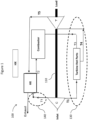
- FIG. 1 shows a cycle flow diagram for a gas turbine 100, according to an embodiment of the invention.
- Turbo-shaft 110 mechanically links compressor C to turbine T and to a load. Air leaving compressor C, at temperature T1, is split into a bleed path 130 and a recuperator path 140.
- a bleed fraction is defined as the ratio of the mass flow in the bleed path to the total mass flow from the compressor output.
- the value of m 0 is typically greater than or equal to zero and less than or equal one.
- the bleed fraction is 0.3.
- the air flowing in the bleed path increases in temperature from T1 to T4 as it flows around hot components of the turbine engine.
- the bleed air flow is combined with the output flow of the combustor at temperature T3, and the combined flow arrives at the inlet of turbine T with a temperature T4 which is typically slightly less than T3.
- recuperator path 140 air flows from an outlet of compressor C into a recuperator heat exchanger (HX).
- the outlet of the compressor may be a diffuser.
- the mass flow in the recuperator flow path 140 is approximately equal to the mass flow in the compressor outlet minus the mass flow in the bleed flow path.
- the mass flow in path 140 is approximately equal to (1-m 0 ) multiplied by the mass flow from the compressor outlet.
- the air flow leaving the recuperator and entering the combustor has a temperature T2, which is greater than T1. On leaving the combustor, the air flow temperature is further increased to T3.
- Exhaust air from the turbine T, at temperature T5, is used to increase the efficiency of the recuperator heat exchanger HX, before being released to the ambient environment.
- FIG. 2(a) is a perspective drawing of a turbine volute 200 with a cooling insert 220, according to an embodiment of the invention. Details of the cooling insert 220 are shown in FIG. 2(b) . Arrow 240 shows the direction of cooling air flow, entering volute 200 through a gap 230 having a width typically in a range of 0.5 to 2.0 millimeters (mm).
- Eff T2 ⁇ T1 / T5 ⁇ T1
- Rhc hot-to-cold flow ratio
- NTU number of transfer units
- FIG. 4 is a schematic diagram showing gas turbine station points in an exemplary 40 kW gas turbine according to the present invention.
- the station point numbers and their locations inside the gas turbine engine are explained in TABLE 1.
- Compressorinlet 3 Compressor outlet 4
- Combustor outlet 5 Turbine outlet 6
- Recuperator hot outlet 8 Exhaust outlet 31
- Recuperator cold inlet 35
- Recuperator cold outlet 41 Turbine inlet 49 Turbine outlet
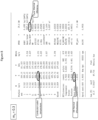
- the values of the combustor outlet temperature (T3 in FIG. 1 ), the recuperator HX thermal effectiveness (Eff), and the overall cycle thermal efficiency are indicated.
- the improved efficiency compensates for energy losses incurred by use of the cooling air.
- compressor bleeding air for cooling obviates the need for an external ventilation system, which would require additional energy input, as well as the need for isolation of the external envelope of the turbine in order to reduce radiation losses.
Landscapes
- Engineering & Computer Science (AREA)
- Chemical & Material Sciences (AREA)
- Combustion & Propulsion (AREA)
- Mechanical Engineering (AREA)
- General Engineering & Computer Science (AREA)
- Physics & Mathematics (AREA)
- Fluid Mechanics (AREA)
- Structures Of Non-Positive Displacement Pumps (AREA)
Description
- The invention relates to cooling systems for axial and radial gas turbine engines having a recuperator.
- In the design of gas turbines, cooling of hot engine parts is essential to reduce thermal stresses and deformations, which shorten turbine lifetime. Typically, the flow of air from an air compressor is used to cool critical engine parts, such as turbine blades, turbine discs, and the walls of an internal combustion chamber, or combustor. The energy loss due to a reduction in pressure and temperature of the air flow can reach up to 15% of the energy output of an uncooled gas turbine.
-
GB Patent 836135 to James Hodge, dated 1-June-1960 - Cooling the outside of the engine with air flow or with external fluid also causes a loss of energy due to energy consumption by pumps or fans. An alternative solution, involving isolating the engine surface from the outside, has the undesired effect of causing thermal stress and distortions that may damage mechanical and geometric integrity, lower safety margins, and reduce turbine lifetime.
- According to the invention, there is provided a recuperated gas turbine engine having the features of
claim 1. - A cooling system for cooling a radial or axial gas turbine engine, with a recuperator heat exchanger, provides engine cooling without loss of thermal efficiency. Air flow leaving a compressor is split between a recuperator flow path and a bleed flow path. Air in the bleed flow path flows through hot parts of the engine, thereby cooling the engine and heating the air. The air in the bleed flow path is combined with the output flow from a combustor and directed into a turbine inlet. A reduction of air flow in the recuperator flow path increases the thermal effectiveness of the recuperator heat exchanger by increasing a ratio of hot and cold flows inside the heat exchanger. The increase in thermal effectiveness of the heat exchanger compensates for energy losses incurred by diverting a portion of the compressor air flow for cooling.
- In the invention, a cooling system for cooling hot components of a radial or axial gas turbine engine includes a compressor having a compressor outlet, a turbine having a turbine inlet and a turbine outlet, a recuperator heat exchanger, a recuperator flow path, and a bleed flow path. In the recuperator flow path, air flows from the compressor outlet to the recuperator heat exchanger. In the bleed flow path, air flows from the compressor outlet to hot components of the recuperated gas turbine engine and to the turbine inlet. A bleed fraction, which is greater than or equal to zero and less than or equal to one, is equal to the ratio of a mass flow in the bleed flow path to a mass flow in the compressor outlet.
- According to one feature of the cooling system of the invention, a mass flow in the recuperator flow path is approximately equal to the mass flow in the compressor outlet minus the mass flow in the bleed flow path.
- According to another feature of the cooling system of the invention, the bleed fraction is less than or equal to one-half.
- According to yet another feature of the cooling system of the invention, the compressor outlet includes a diffuser.
- According to yet another feature of the cooling system of the invention, a thermal effectiveness of the recuperator heat exchanger increases with increasing values of the bleed fraction.
- The hot components of the recuperated gas turbine engine include a turbine volute.
- According to another feature of the cooling system of the invention, the turbine volute includes a cooling insert through which air in the bleed flow path passes.
- According to a further feature of the cooling system of the invention, the cooling insert includes a gap having a width of between 0.5 mm. and 2.0 mm. through which air in the bleed flow path passes.
- The invention is described herein, by way of example only, with reference to the accompanying drawings, wherein:
-
FIG. 1 : A cycle flow diagram for a gas turbine, according to an embodiment of the invention. -
Figs. 2(a) and 2(b) : Perspective drawings of a turbine volute with a cooling insert, according to an embodiment of the invention. -
FIG. 3 : A graph showing thermal effectiveness of a cross-flow recuperator heat exchanger. -
FIG. 4 : A schematic diagram showing gas turbine station points used in thermodynamic calculations. -
FIG. 5 : Thermodynamic results for an exemplary 40 kW gas turbine with a bleed fraction of zero. -
FIG. 6 : Thermodynamic results for an exemplary 40 kW gas turbine with a bleed fraction of 0.1. -
FIG. 7 : Thermodynamic results for an exemplary 40 kW gas turbine with a bleed fraction of 0.2. -
FIG. 8 : Thermodynamic results for an exemplary 40 kW gas turbine with a bleed fraction of 0.3. -
FIG. 1 shows a cycle flow diagram for agas turbine 100, according to an embodiment of the invention. Turbo-shaft 110 mechanically links compressor C to turbine T and to a load. Air leaving compressor C, at temperature T1, is split into ableed path 130 and arecuperator path 140. - A bleed fraction, denoted by m0, is defined as the ratio of the mass flow in the bleed path to the total mass flow from the compressor output. The value of m0 is typically greater than or equal to zero and less than or equal one. In an exemplary embodiment of the invention, the bleed fraction is 0.3. The air flowing in the bleed path increases in temperature from T1 to T4 as it flows around hot components of the turbine engine. The bleed air flow is combined with the output flow of the combustor at temperature T3, and the combined flow arrives at the inlet of turbine T with a temperature T4 which is typically slightly less than T3.
- In
recuperator path 140, air flows from an outlet of compressor C into a recuperator heat exchanger (HX). The outlet of the compressor may be a diffuser. The mass flow in therecuperator flow path 140 is approximately equal to the mass flow in the compressor outlet minus the mass flow in the bleed flow path. Thus, the mass flow inpath 140 is approximately equal to (1-m0) multiplied by the mass flow from the compressor outlet. The air flow leaving the recuperator and entering the combustor has a temperature T2, which is greater than T1. On leaving the combustor, the air flow temperature is further increased to T3. - Exhaust air from the turbine T, at temperature T5, is used to increase the efficiency of the recuperator heat exchanger HX, before being released to the ambient environment.
-
FIG. 2(a) is a perspective drawing of a turbine volute 200 with a cooling insert 220, according to an embodiment of the invention. Details of the cooling insert 220 are shown inFIG. 2(b) . Arrow 240 shows the direction of cooling air flow, enteringvolute 200 through a gap 230 having a width typically in a range of 0.5 to 2.0 millimeters (mm). - The following thermodynamic equation relates the value of temperature T3 to the values of temperatures T1 and T4:

- The thermal energy Q required to heat air from temperature T2 to T3 in the combustion chamber is given by:

- The thermal effectiveness of a cross-flow recuperator heat exchanger, Eff, is given by:

FIG. 3 shows an exemplary graph of Eff versus NTU, for various ratios Rhc. Note that Eff increases with increasing NTU and with decreasing Rhc. -
FIG. 4 is a schematic diagram showing gas turbine station points in an exemplary 40 kW gas turbine according to the present invention. The station point numbers and their locations inside the gas turbine engine are explained in TABLE 1.TABLE 1 Station # Turbine Location 2 Compressorinlet 3 Compressor outlet 4 Combustor outlet 5 Turbine outlet 6 Recuperator hot inlet 7 Recuperator hot outlet 8 Exhaust outlet 31 Recuperator cold inlet 35 Recuperator cold outlet 41 Turbine inlet 49 Turbine outlet - Results of exemplary thermodynamic simulations, carried out using GasTurb simulation software developed by Joachim Kurzke and available from GasTurb GmbH (http://www.gasturb.de), are summarized in TABLE 2. In the exemplary simulations, the gas turbine engine provides a nominal output power of 40 kW, and turbine inlet temperature, T4, is approximately 1277 degrees Kelvin (oK). TABLE 2 presents results for values of the bleed fraction, m0, ranging from 0 to 0.3.
TABLE 2 Bleed fraction m0 Cycle Efficiency Heat Exchanger Efficiency Combustor Outlet Temperature oK 0 32.0% 83% 1277 0.1 35.2% 88% 1310 0.2 36.4% 91% 1348 0.3 36.3% 91% 1395 - Further details of the thermodynamic simulations, corresponding to bleed fractions of m0= 0, 0.1, 0.2, and 0.3, are found in
Figs. 5 ,6 ,7 , and8 , respectively. In each figure, the values of the combustor outlet temperature (T3 inFIG. 1 ), the recuperator HX thermal effectiveness (Eff), and the overall cycle thermal efficiency are indicated. - Referring to Table 2, the cycle and heat exchanger efficiencies increase monotonically with increasing values of m0. Most of the improvement is found in going from m0=0 to m0=0.2, which accounts for an increase in cycle efficiency from 32.0% to 36.4%, which is a relative increase of (36.4-32.0)/32.0 = 13.8%. The corresponding relative increase in heat exchanger efficiency is (91-83)/83 = 9.6%. A further increase of m0 from 0.2 to 0.3 does not appear to be worthwhile, as there is no further increase in cycle and heat exchanger efficiencies.
- Maintaining constant power increases the combustor outlet temperature to 1348 oK at the optimal bleed fraction of m0=0.2. However, after mixing the gas from the combustor with the cooling bleed air, the gas temperature (T4) at the inlet to the turbine drops to 1277 oK.
- The improved efficiency of the heat exchanger when m0=0.2 is a consequence of a decrease in the hot-to-cold flow ratio, Rhc, in accordance with the graph in
FIG. 3 . The improved efficiency compensates for energy losses incurred by use of the cooling air. - In addition, the use of compressor bleeding air for cooling obviates the need for an external ventilation system, which would require additional energy input, as well as the need for isolation of the external envelope of the turbine in order to reduce radiation losses.
- Although the invention has been described in conjunction with specific embodiments, it is evident that many alternatives, modifications, and variations will be apparent to those skilled in the art. Accordingly, the invention is intended to embrace all such modifications that fall within the scope of the appended claims.
Claims (9)
- A recuperated gas turbine engine (100) comprising a cooling system for cooling hot components of the engine, the cooling system comprising:a compressor (C) comprising a compressor outlet;a turbine (T) comprising a turbine inlet and a turbine outlet;a recuperator heat exchanger (HX);a recuperator flow path (140) in fluid communication with the compressor outlet and the recuperator heat exchanger (HX); anda bleed flow path (130) in fluid communication with the compressor outlet, the hot components of the recuperated gas turbine engine, and the turbine inlet;wherein the hot components of the engine comprise a turbine volute (200) in fluid communication with the bleed flow path (130); anda ratio of a mass flow in the bleed flow path (130) to a mass flow in the compressor outlet is equal to a bleed fraction which is greater than or equal to zero and less than or equal to one.
- The recuperated gas turbine engine of claim 1 wherein a mass flow in the recuperator flow path (140) is approximately equal to the mass flow in the compressor outlet minus the mass flow in the bleed flow path (130).
- The recuperated gas turbine engine of claim 1 wherein the bleed fraction is less than or equal to one-half.
- The recuperated gas turbine engine of claim 1 wherein the compressor outlet comprises a diffuser.
- The recuperated gas turbine engine of claim 1 wherein a temperature (T2) of an air flow leaving the recuperator heat exchanger (HX) is greater than a temperature (T1) of an air flow leaving the compressor (C).
- The recuperated gas turbine engine of claim 1 wherein the recuperator heat exchanger provides engine cooling without loss of thermal efficiency.
- The recuperated gas turbine engine of claim 1 wherein a thermal effectiveness of the recuperator heat exchanger (HX) increases with increasing values of the bleed fraction.
- The recuperated gas turbine engine of claim 1 wherein said turbine volute (200) further comprises a cooling insert (220) in fluid communication with the bleed flow path (130).
- The recuperated gas turbine engine of claim 8 wherein said cooling insert (220) comprises a gap (230) having a width of between 0.5 mm. and 2.0 mm.
Applications Claiming Priority (2)
| Application Number | Priority Date | Filing Date | Title |
|---|---|---|---|
| US201962804779P | 2019-02-13 | 2019-02-13 | |
| PCT/IB2020/051130 WO2020165790A1 (en) | 2019-02-13 | 2020-02-12 | Cooling system for recuperated gas turbine engines |
Publications (3)
| Publication Number | Publication Date |
|---|---|
| EP3924609A1 EP3924609A1 (en) | 2021-12-22 |
| EP3924609A4 EP3924609A4 (en) | 2022-04-06 |
| EP3924609B1 true EP3924609B1 (en) | 2024-05-08 |
Family
ID=72044197
Family Applications (1)
| Application Number | Title | Priority Date | Filing Date |
|---|---|---|---|
| EP20755623.4A Active EP3924609B1 (en) | 2019-02-13 | 2020-02-12 | Cooling system for recuperated gas turbine engines |
Country Status (3)
| Country | Link |
|---|---|
| US (1) | US11725579B2 (en) |
| EP (1) | EP3924609B1 (en) |
| WO (1) | WO2020165790A1 (en) |
Citations (1)
| Publication number | Priority date | Publication date | Assignee | Title |
|---|---|---|---|---|
| US3849022A (en) * | 1973-07-12 | 1974-11-19 | Gen Motors Corp | Turbine blade coolant distributor |
Family Cites Families (9)
| Publication number | Priority date | Publication date | Assignee | Title |
|---|---|---|---|---|
| GB836135A (en) * | 1957-01-18 | 1960-06-01 | Power Jets Res & Dev Ltd | Improvements in and relating to gas turbine plant |
| US3866674A (en) * | 1973-10-01 | 1975-02-18 | Gen Electric | Gas turbine regenerator |
| US3936223A (en) * | 1974-09-23 | 1976-02-03 | General Motors Corporation | Compressor diffuser |
| US4083181A (en) * | 1976-06-14 | 1978-04-11 | The United States Of America As Represented By The Administrator Of The National Aeronautics And Space Administration | Gas turbine engine with recirculating bleed |
| US20140230400A1 (en) * | 2013-02-15 | 2014-08-21 | Kevin M. Light | Heat retention and distribution system for gas turbine engines |
| GB201414661D0 (en) * | 2014-08-19 | 2014-10-01 | Rolls Royce Plc | Gas turbine engine and method of operation |
| US10316696B2 (en) * | 2015-05-08 | 2019-06-11 | General Electric Company | System and method for improving exhaust energy recovery |
| US10619568B2 (en) * | 2016-05-27 | 2020-04-14 | General Elecric Company | System and method of compressor inlet temperature control with mixing chamber |
| US12392289B2 (en) * | 2017-05-22 | 2025-08-19 | Rtx Corporation | Active bleed flow modulation |
-
2020
- 2020-02-12 EP EP20755623.4A patent/EP3924609B1/en active Active
- 2020-02-12 US US17/430,347 patent/US11725579B2/en active Active
- 2020-02-12 WO PCT/IB2020/051130 patent/WO2020165790A1/en not_active Ceased
Patent Citations (1)
| Publication number | Priority date | Publication date | Assignee | Title |
|---|---|---|---|---|
| US3849022A (en) * | 1973-07-12 | 1974-11-19 | Gen Motors Corp | Turbine blade coolant distributor |
Also Published As
| Publication number | Publication date |
|---|---|
| EP3924609A1 (en) | 2021-12-22 |
| EP3924609A4 (en) | 2022-04-06 |
| US20220128002A1 (en) | 2022-04-28 |
| US11725579B2 (en) | 2023-08-15 |
| WO2020165790A1 (en) | 2020-08-20 |
Similar Documents
| Publication | Publication Date | Title |
|---|---|---|
| US6250061B1 (en) | Compressor system and methods for reducing cooling airflow | |
| US8763363B2 (en) | Method and system for cooling fluid in a turbine engine | |
| EP2519723B1 (en) | Gas turbine engine | |
| US8475112B1 (en) | Multiple staged compressor with last stage airfoil cooling | |
| US9797310B2 (en) | Heat pipe temperature management system for a turbomachine | |
| EP3095990B1 (en) | Gas turbine engine and method of operating the same | |
| CA2991449C (en) | Heat exchanger assembly for engine bleed air | |
| US8438835B2 (en) | Methods and apparatus for mixing fluid in turbine engines | |
| EP0173774B1 (en) | Gas turbine engine | |
| EP2615276B1 (en) | Air recovery system for precooler heat-exchanger and corresponding method | |
| EP2519724B1 (en) | Gas turbine engine and cooling system | |
| KR102297668B1 (en) | Power generation system and method with partially recuperated flow path | |
| US8516791B2 (en) | Methods and apparatus for mixing fluid in turbine engines | |
| US20170002741A1 (en) | Air cooled air cooler for gas turbine engine air system | |
| CA1119584A (en) | Thermal management of heat exchanger structure | |
| GB2041090A (en) | By-pass gas turbine engines | |
| EP0911505A3 (en) | Gas turbine in-line intercooler | |
| US8794907B1 (en) | Multiple staged compressor with last stage airfoil cooling | |
| US8429891B2 (en) | Anti-icing system using radiant infrared energy from turbine exhaust flues | |
| EP3660294A1 (en) | Gas turbine engine | |
| US6422020B1 (en) | Cast heat exchanger system for gas turbine | |
| EP3159496B1 (en) | Gas turbine with a valve cooling system | |
| EP3924609B1 (en) | Cooling system for recuperated gas turbine engines | |
| US8721265B1 (en) | Multiple staged compressor with last stage airfoil cooling | |
| EP3848570B1 (en) | Cooling system for a gas turbine engine |
Legal Events
| Date | Code | Title | Description |
|---|---|---|---|
| STAA | Information on the status of an ep patent application or granted ep patent |
Free format text: STATUS: THE INTERNATIONAL PUBLICATION HAS BEEN MADE |
|
| PUAI | Public reference made under article 153(3) epc to a published international application that has entered the european phase |
Free format text: ORIGINAL CODE: 0009012 |
|
| STAA | Information on the status of an ep patent application or granted ep patent |
Free format text: STATUS: REQUEST FOR EXAMINATION WAS MADE |
|
| 17P | Request for examination filed |
Effective date: 20210818 |
|
| AK | Designated contracting states |
Kind code of ref document: A1 Designated state(s): AL AT BE BG CH CY CZ DE DK EE ES FI FR GB GR HR HU IE IS IT LI LT LU LV MC MK MT NL NO PL PT RO RS SE SI SK SM TR |
|
| A4 | Supplementary search report drawn up and despatched |
Effective date: 20220307 |
|
| RIC1 | Information provided on ipc code assigned before grant |
Ipc: F01D 25/12 20060101ALI20220301BHEP Ipc: F01D 9/02 20060101ALI20220301BHEP Ipc: F02C 7/08 20060101ALI20220301BHEP Ipc: F02C 9/18 20060101AFI20220301BHEP |
|
| DAV | Request for validation of the european patent (deleted) | ||
| DAX | Request for extension of the european patent (deleted) | ||
| GRAP | Despatch of communication of intention to grant a patent |
Free format text: ORIGINAL CODE: EPIDOSNIGR1 |
|
| STAA | Information on the status of an ep patent application or granted ep patent |
Free format text: STATUS: GRANT OF PATENT IS INTENDED |
|
| INTG | Intention to grant announced |
Effective date: 20231219 |
|
| GRAS | Grant fee paid |
Free format text: ORIGINAL CODE: EPIDOSNIGR3 |
|
| GRAA | (expected) grant |
Free format text: ORIGINAL CODE: 0009210 |
|
| STAA | Information on the status of an ep patent application or granted ep patent |
Free format text: STATUS: THE PATENT HAS BEEN GRANTED |
|
| AK | Designated contracting states |
Kind code of ref document: B1 Designated state(s): AL AT BE BG CH CY CZ DE DK EE ES FI FR GB GR HR HU IE IS IT LI LT LU LV MC MK MT NL NO PL PT RO RS SE SI SK SM TR |
|
| REG | Reference to a national code |
Ref country code: GB Ref legal event code: FG4D |
|
| REG | Reference to a national code |
Ref country code: CH Ref legal event code: EP |
|
| REG | Reference to a national code |
Ref country code: DE Ref legal event code: R096 Ref document number: 602020030650 Country of ref document: DE |
|
| REG | Reference to a national code |
Ref country code: IE Ref legal event code: FG4D |
|
| REG | Reference to a national code |
Ref country code: LT Ref legal event code: MG9D |
|
| REG | Reference to a national code |
Ref country code: NL Ref legal event code: MP Effective date: 20240508 |
|
| PG25 | Lapsed in a contracting state [announced via postgrant information from national office to epo] |
Ref country code: IS Free format text: LAPSE BECAUSE OF FAILURE TO SUBMIT A TRANSLATION OF THE DESCRIPTION OR TO PAY THE FEE WITHIN THE PRESCRIBED TIME-LIMIT Effective date: 20240908 |
|
| PG25 | Lapsed in a contracting state [announced via postgrant information from national office to epo] |
Ref country code: BG Free format text: LAPSE BECAUSE OF FAILURE TO SUBMIT A TRANSLATION OF THE DESCRIPTION OR TO PAY THE FEE WITHIN THE PRESCRIBED TIME-LIMIT Effective date: 20240508 |
|
| PG25 | Lapsed in a contracting state [announced via postgrant information from national office to epo] |
Ref country code: HR Free format text: LAPSE BECAUSE OF FAILURE TO SUBMIT A TRANSLATION OF THE DESCRIPTION OR TO PAY THE FEE WITHIN THE PRESCRIBED TIME-LIMIT Effective date: 20240508 Ref country code: FI Free format text: LAPSE BECAUSE OF FAILURE TO SUBMIT A TRANSLATION OF THE DESCRIPTION OR TO PAY THE FEE WITHIN THE PRESCRIBED TIME-LIMIT Effective date: 20240508 |
|
| PG25 | Lapsed in a contracting state [announced via postgrant information from national office to epo] |
Ref country code: GR Free format text: LAPSE BECAUSE OF FAILURE TO SUBMIT A TRANSLATION OF THE DESCRIPTION OR TO PAY THE FEE WITHIN THE PRESCRIBED TIME-LIMIT Effective date: 20240809 |
|
| PG25 | Lapsed in a contracting state [announced via postgrant information from national office to epo] |
Ref country code: PT Free format text: LAPSE BECAUSE OF FAILURE TO SUBMIT A TRANSLATION OF THE DESCRIPTION OR TO PAY THE FEE WITHIN THE PRESCRIBED TIME-LIMIT Effective date: 20240909 |
|
| REG | Reference to a national code |
Ref country code: AT Ref legal event code: MK05 Ref document number: 1685170 Country of ref document: AT Kind code of ref document: T Effective date: 20240508 |
|
| PG25 | Lapsed in a contracting state [announced via postgrant information from national office to epo] |
Ref country code: NL Free format text: LAPSE BECAUSE OF FAILURE TO SUBMIT A TRANSLATION OF THE DESCRIPTION OR TO PAY THE FEE WITHIN THE PRESCRIBED TIME-LIMIT Effective date: 20240508 |
|
| PG25 | Lapsed in a contracting state [announced via postgrant information from national office to epo] |
Ref country code: ES Free format text: LAPSE BECAUSE OF FAILURE TO SUBMIT A TRANSLATION OF THE DESCRIPTION OR TO PAY THE FEE WITHIN THE PRESCRIBED TIME-LIMIT Effective date: 20240508 |
|
| PG25 | Lapsed in a contracting state [announced via postgrant information from national office to epo] |
Ref country code: AT Free format text: LAPSE BECAUSE OF FAILURE TO SUBMIT A TRANSLATION OF THE DESCRIPTION OR TO PAY THE FEE WITHIN THE PRESCRIBED TIME-LIMIT Effective date: 20240508 |
|
| PG25 | Lapsed in a contracting state [announced via postgrant information from national office to epo] |
Ref country code: PL Free format text: LAPSE BECAUSE OF FAILURE TO SUBMIT A TRANSLATION OF THE DESCRIPTION OR TO PAY THE FEE WITHIN THE PRESCRIBED TIME-LIMIT Effective date: 20240508 |
|
| PG25 | Lapsed in a contracting state [announced via postgrant information from national office to epo] |
Ref country code: LV Free format text: LAPSE BECAUSE OF FAILURE TO SUBMIT A TRANSLATION OF THE DESCRIPTION OR TO PAY THE FEE WITHIN THE PRESCRIBED TIME-LIMIT Effective date: 20240508 |
|
| PG25 | Lapsed in a contracting state [announced via postgrant information from national office to epo] |
Ref country code: PT Free format text: LAPSE BECAUSE OF FAILURE TO SUBMIT A TRANSLATION OF THE DESCRIPTION OR TO PAY THE FEE WITHIN THE PRESCRIBED TIME-LIMIT Effective date: 20240909 Ref country code: PL Free format text: LAPSE BECAUSE OF FAILURE TO SUBMIT A TRANSLATION OF THE DESCRIPTION OR TO PAY THE FEE WITHIN THE PRESCRIBED TIME-LIMIT Effective date: 20240508 Ref country code: NO Free format text: LAPSE BECAUSE OF FAILURE TO SUBMIT A TRANSLATION OF THE DESCRIPTION OR TO PAY THE FEE WITHIN THE PRESCRIBED TIME-LIMIT Effective date: 20240808 Ref country code: NL Free format text: LAPSE BECAUSE OF FAILURE TO SUBMIT A TRANSLATION OF THE DESCRIPTION OR TO PAY THE FEE WITHIN THE PRESCRIBED TIME-LIMIT Effective date: 20240508 Ref country code: LV Free format text: LAPSE BECAUSE OF FAILURE TO SUBMIT A TRANSLATION OF THE DESCRIPTION OR TO PAY THE FEE WITHIN THE PRESCRIBED TIME-LIMIT Effective date: 20240508 Ref country code: IS Free format text: LAPSE BECAUSE OF FAILURE TO SUBMIT A TRANSLATION OF THE DESCRIPTION OR TO PAY THE FEE WITHIN THE PRESCRIBED TIME-LIMIT Effective date: 20240908 Ref country code: HR Free format text: LAPSE BECAUSE OF FAILURE TO SUBMIT A TRANSLATION OF THE DESCRIPTION OR TO PAY THE FEE WITHIN THE PRESCRIBED TIME-LIMIT Effective date: 20240508 Ref country code: GR Free format text: LAPSE BECAUSE OF FAILURE TO SUBMIT A TRANSLATION OF THE DESCRIPTION OR TO PAY THE FEE WITHIN THE PRESCRIBED TIME-LIMIT Effective date: 20240809 Ref country code: FI Free format text: LAPSE BECAUSE OF FAILURE TO SUBMIT A TRANSLATION OF THE DESCRIPTION OR TO PAY THE FEE WITHIN THE PRESCRIBED TIME-LIMIT Effective date: 20240508 Ref country code: ES Free format text: LAPSE BECAUSE OF FAILURE TO SUBMIT A TRANSLATION OF THE DESCRIPTION OR TO PAY THE FEE WITHIN THE PRESCRIBED TIME-LIMIT Effective date: 20240508 Ref country code: BG Free format text: LAPSE BECAUSE OF FAILURE TO SUBMIT A TRANSLATION OF THE DESCRIPTION OR TO PAY THE FEE WITHIN THE PRESCRIBED TIME-LIMIT Effective date: 20240508 Ref country code: AT Free format text: LAPSE BECAUSE OF FAILURE TO SUBMIT A TRANSLATION OF THE DESCRIPTION OR TO PAY THE FEE WITHIN THE PRESCRIBED TIME-LIMIT Effective date: 20240508 Ref country code: RS Free format text: LAPSE BECAUSE OF FAILURE TO SUBMIT A TRANSLATION OF THE DESCRIPTION OR TO PAY THE FEE WITHIN THE PRESCRIBED TIME-LIMIT Effective date: 20240808 |
|
| PG25 | Lapsed in a contracting state [announced via postgrant information from national office to epo] |
Ref country code: DK Free format text: LAPSE BECAUSE OF FAILURE TO SUBMIT A TRANSLATION OF THE DESCRIPTION OR TO PAY THE FEE WITHIN THE PRESCRIBED TIME-LIMIT Effective date: 20240508 |
|
| PG25 | Lapsed in a contracting state [announced via postgrant information from national office to epo] |
Ref country code: EE Free format text: LAPSE BECAUSE OF FAILURE TO SUBMIT A TRANSLATION OF THE DESCRIPTION OR TO PAY THE FEE WITHIN THE PRESCRIBED TIME-LIMIT Effective date: 20240508 |
|
| PG25 | Lapsed in a contracting state [announced via postgrant information from national office to epo] |
Ref country code: CZ Free format text: LAPSE BECAUSE OF FAILURE TO SUBMIT A TRANSLATION OF THE DESCRIPTION OR TO PAY THE FEE WITHIN THE PRESCRIBED TIME-LIMIT Effective date: 20240508 |
|
| PG25 | Lapsed in a contracting state [announced via postgrant information from national office to epo] |
Ref country code: RO Free format text: LAPSE BECAUSE OF FAILURE TO SUBMIT A TRANSLATION OF THE DESCRIPTION OR TO PAY THE FEE WITHIN THE PRESCRIBED TIME-LIMIT Effective date: 20240508 Ref country code: SK Free format text: LAPSE BECAUSE OF FAILURE TO SUBMIT A TRANSLATION OF THE DESCRIPTION OR TO PAY THE FEE WITHIN THE PRESCRIBED TIME-LIMIT Effective date: 20240508 |
|
| PG25 | Lapsed in a contracting state [announced via postgrant information from national office to epo] |
Ref country code: SM Free format text: LAPSE BECAUSE OF FAILURE TO SUBMIT A TRANSLATION OF THE DESCRIPTION OR TO PAY THE FEE WITHIN THE PRESCRIBED TIME-LIMIT Effective date: 20240508 |
|
| PG25 | Lapsed in a contracting state [announced via postgrant information from national office to epo] |
Ref country code: SM Free format text: LAPSE BECAUSE OF FAILURE TO SUBMIT A TRANSLATION OF THE DESCRIPTION OR TO PAY THE FEE WITHIN THE PRESCRIBED TIME-LIMIT Effective date: 20240508 Ref country code: SK Free format text: LAPSE BECAUSE OF FAILURE TO SUBMIT A TRANSLATION OF THE DESCRIPTION OR TO PAY THE FEE WITHIN THE PRESCRIBED TIME-LIMIT Effective date: 20240508 Ref country code: RO Free format text: LAPSE BECAUSE OF FAILURE TO SUBMIT A TRANSLATION OF THE DESCRIPTION OR TO PAY THE FEE WITHIN THE PRESCRIBED TIME-LIMIT Effective date: 20240508 Ref country code: EE Free format text: LAPSE BECAUSE OF FAILURE TO SUBMIT A TRANSLATION OF THE DESCRIPTION OR TO PAY THE FEE WITHIN THE PRESCRIBED TIME-LIMIT Effective date: 20240508 Ref country code: DK Free format text: LAPSE BECAUSE OF FAILURE TO SUBMIT A TRANSLATION OF THE DESCRIPTION OR TO PAY THE FEE WITHIN THE PRESCRIBED TIME-LIMIT Effective date: 20240508 Ref country code: CZ Free format text: LAPSE BECAUSE OF FAILURE TO SUBMIT A TRANSLATION OF THE DESCRIPTION OR TO PAY THE FEE WITHIN THE PRESCRIBED TIME-LIMIT Effective date: 20240508 |
|
| PG25 | Lapsed in a contracting state [announced via postgrant information from national office to epo] |
Ref country code: IT Free format text: LAPSE BECAUSE OF FAILURE TO SUBMIT A TRANSLATION OF THE DESCRIPTION OR TO PAY THE FEE WITHIN THE PRESCRIBED TIME-LIMIT Effective date: 20240508 |
|
| REG | Reference to a national code |
Ref country code: DE Ref legal event code: R097 Ref document number: 602020030650 Country of ref document: DE |
|
| PLBE | No opposition filed within time limit |
Free format text: ORIGINAL CODE: 0009261 |
|
| STAA | Information on the status of an ep patent application or granted ep patent |
Free format text: STATUS: NO OPPOSITION FILED WITHIN TIME LIMIT |
|
| 26N | No opposition filed |
Effective date: 20250211 |
|
| PG25 | Lapsed in a contracting state [announced via postgrant information from national office to epo] |
Ref country code: SI Free format text: LAPSE BECAUSE OF FAILURE TO SUBMIT A TRANSLATION OF THE DESCRIPTION OR TO PAY THE FEE WITHIN THE PRESCRIBED TIME-LIMIT Effective date: 20240508 |
|
| PG25 | Lapsed in a contracting state [announced via postgrant information from national office to epo] |
Ref country code: SE Free format text: LAPSE BECAUSE OF FAILURE TO SUBMIT A TRANSLATION OF THE DESCRIPTION OR TO PAY THE FEE WITHIN THE PRESCRIBED TIME-LIMIT Effective date: 20240508 |
|
| PG25 | Lapsed in a contracting state [announced via postgrant information from national office to epo] |
Ref country code: MC Free format text: LAPSE BECAUSE OF FAILURE TO SUBMIT A TRANSLATION OF THE DESCRIPTION OR TO PAY THE FEE WITHIN THE PRESCRIBED TIME-LIMIT Effective date: 20240508 |
|
| PG25 | Lapsed in a contracting state [announced via postgrant information from national office to epo] |
Ref country code: LU Free format text: LAPSE BECAUSE OF NON-PAYMENT OF DUE FEES Effective date: 20250212 |
|
| REG | Reference to a national code |
Ref country code: BE Ref legal event code: MM Effective date: 20250228 |
|
| PG25 | Lapsed in a contracting state [announced via postgrant information from national office to epo] |
Ref country code: BE Free format text: LAPSE BECAUSE OF NON-PAYMENT OF DUE FEES Effective date: 20250228 |
|
| PG25 | Lapsed in a contracting state [announced via postgrant information from national office to epo] |
Ref country code: IE Free format text: LAPSE BECAUSE OF NON-PAYMENT OF DUE FEES Effective date: 20250212 |
|
| REG | Reference to a national code |
Ref country code: CH Ref legal event code: U11 Free format text: ST27 STATUS EVENT CODE: U-0-0-U10-U11 (AS PROVIDED BY THE NATIONAL OFFICE) Effective date: 20260301 |
|
| PGFP | Annual fee paid to national office [announced via postgrant information from national office to epo] |
Ref country code: GB Payment date: 20260217 Year of fee payment: 7 |
|
| PGFP | Annual fee paid to national office [announced via postgrant information from national office to epo] |
Ref country code: DE Payment date: 20260217 Year of fee payment: 7 |
|
| PGFP | Annual fee paid to national office [announced via postgrant information from national office to epo] |
Ref country code: FR Payment date: 20260217 Year of fee payment: 7 |
|
| PGFP | Annual fee paid to national office [announced via postgrant information from national office to epo] |
Ref country code: CH Payment date: 20260301 Year of fee payment: 7 |