EP3924332B1 - Production processes of s- and o-diacylated gamma-glutamyl-cysteamine prodrugs - Google Patents
Production processes of s- and o-diacylated gamma-glutamyl-cysteamine prodrugs Download PDFInfo
- Publication number
- EP3924332B1 EP3924332B1 EP20707783.5A EP20707783A EP3924332B1 EP 3924332 B1 EP3924332 B1 EP 3924332B1 EP 20707783 A EP20707783 A EP 20707783A EP 3924332 B1 EP3924332 B1 EP 3924332B1
- Authority
- EP
- European Patent Office
- Prior art keywords
- formula
- compound
- acid
- alkyl
- iii
- Prior art date
- Legal status (The legal status is an assumption and is not a legal conclusion. Google has not performed a legal analysis and makes no representation as to the accuracy of the status listed.)
- Active
Links
Images


Classifications
-
- C—CHEMISTRY; METALLURGY
- C07—ORGANIC CHEMISTRY
- C07C—ACYCLIC OR CARBOCYCLIC COMPOUNDS
- C07C319/00—Preparation of thiols, sulfides, hydropolysulfides or polysulfides
- C07C319/14—Preparation of thiols, sulfides, hydropolysulfides or polysulfides of sulfides
- C07C319/20—Preparation of thiols, sulfides, hydropolysulfides or polysulfides of sulfides by reactions not involving the formation of sulfide groups
-
- C—CHEMISTRY; METALLURGY
- C07—ORGANIC CHEMISTRY
- C07C—ACYCLIC OR CARBOCYCLIC COMPOUNDS
- C07C327/00—Thiocarboxylic acids
- C07C327/20—Esters of monothiocarboxylic acids
- C07C327/30—Esters of monothiocarboxylic acids having sulfur atoms of esterified thiocarboxyl groups bound to carbon atoms of hydrocarbon radicals substituted by nitrogen atoms, not being part of nitro or nitroso groups
-
- C—CHEMISTRY; METALLURGY
- C07—ORGANIC CHEMISTRY
- C07B—GENERAL METHODS OF ORGANIC CHEMISTRY; APPARATUS THEREFOR
- C07B45/00—Formation or introduction of functional groups containing sulfur
- C07B45/06—Formation or introduction of functional groups containing sulfur of mercapto or sulfide groups
-
- C—CHEMISTRY; METALLURGY
- C07—ORGANIC CHEMISTRY
- C07C—ACYCLIC OR CARBOCYCLIC COMPOUNDS
- C07C323/00—Thiols, sulfides, hydropolysulfides or polysulfides substituted by halogen, oxygen or nitrogen atoms, or by sulfur atoms not being part of thio groups
- C07C323/23—Thiols, sulfides, hydropolysulfides or polysulfides substituted by halogen, oxygen or nitrogen atoms, or by sulfur atoms not being part of thio groups containing thio groups and nitrogen atoms, not being part of nitro or nitroso groups, bound to the same carbon skeleton
- C07C323/24—Thiols, sulfides, hydropolysulfides or polysulfides substituted by halogen, oxygen or nitrogen atoms, or by sulfur atoms not being part of thio groups containing thio groups and nitrogen atoms, not being part of nitro or nitroso groups, bound to the same carbon skeleton having the sulfur atoms of the thio groups bound to acyclic carbon atoms of the carbon skeleton
- C07C323/25—Thiols, sulfides, hydropolysulfides or polysulfides substituted by halogen, oxygen or nitrogen atoms, or by sulfur atoms not being part of thio groups containing thio groups and nitrogen atoms, not being part of nitro or nitroso groups, bound to the same carbon skeleton having the sulfur atoms of the thio groups bound to acyclic carbon atoms of the carbon skeleton the carbon skeleton being acyclic and saturated
Definitions
- This invention relates to a method of synthesising prodrug derivatives of cysteamine.
- Cysteamine is a treatment for the rare genetic disease cystinosis.
- the use of cysteamine as a treatment does, however, have several disadvantages which result in non-compliance in patients.
- Several prodrugs of cysteamine have been developed in an attempt to overcome these disadvantages.
- the synthesis of diacylated ⁇ -glutamyl-cysteamine prodrugs is demonstrated by L. Frost et al., Eur. J. Med. Chem., 2016, 109, 206-215 .
- Higashiura et al. J. Chem. Research (S), 1992, 250-251 ) discloses the conversion of C-terminal ⁇ -amino acids in peptides into corresponding unsubstituted or 2-substituted taurines, involving the performic acid oxidation of an acetylthio into a sulfo group.
- Snider et al. discloses the use of the MPoc group as a protecting group for amines that is orthogonal to other common carbamate protecting groups.
- the invention provides a method for the synthesis of a compound of formula ( X ).
- the compound of formula ( X ) is typically provided as a salt, as this is expected to have a longer shelf life than the corresponding free base (compound of formula ( IX )).
- R 1 is -C(CH 3 ) 3 .
- R 2 is selected from -H, -C 1 -C 4 -alkyl, -C 2 -C 4 -alkenyl, and -C 1 -C 4 -alkyl-aryl.
- the aryl may be a phenyl (Ph).
- R 3 is selected from -C(O)H and -C(O)C 1 -C 4 -alkyl.
- A is a halide or other counterion of a strong acid.
- X is a halide; wherein reacting the compound of formula ( III ) with the compounds of formula ( V ) is performed in the presence of a base having a pKa in water of less than 9.
- substituent groups are specified by their conventional chemical formulae, written from left to right, they equally encompass the chemically identical substituents that would result from writing the structure from right to left, e.g., -CH 2 O- is equivalent to -OCH 2 -.
- alkyl by itself or as part of another substituent, means, unless otherwise stated, a straight (i.e. unbranched) or branched chain, or combination thereof, which is fully saturated and can include di- and multivalent moieties, having the number of carbon atoms designated (i.e. C 1 -C 10 means one to ten carbons).
- saturated hydrocarbon moieties include groups such as methyl, ethyl, n-propyl, isopropyl, n-butyl, t-butyl, isobutyl, sec-butyl, cyclohexyl, (cyclohexyl)methyl, cyclopropylmethyl, homologs and isomers of, for example, n-pentyl, n-hexyl, n-heptyl, n-octyl, and the like.
- An unsaturated alkyl group is one having one or more double bonds or triple bonds.
- unsaturated alkyl groups include vinyl, 2-propenyl, crotyl, 2-isopentenyl, 2-(butadienyl), 2,4-pentadienyl, 3-(1,4-pentadienyl), ethynyl, 1- and 3-propynyl, 3-butynyl, and the higher homologs and isomers.
- alkylene by itself or as part of another substituent means a divalent moiety derived from an alkyl, as exemplified by -CH 2 CH 2 CH 2 CH 2 -.
- an alkyl (or alkylene) group will have from 1 to 24 carbon atoms, with those groups having 10 or fewer carbon atoms being preferred in the present invention.
- a “lower alkyl” or “lower alkylene” is a shorter chain alkyl or alkylene group, generally having 8 or fewer carbon atoms, for example having 6 or fewer (or 4 or fewer) carbon atoms.
- halo or halogen
- haloalkyl by themselves or as part of another substituent, mean, unless otherwise stated, a fluorine, chlorine, bromine, or iodine atom.
- terms such as “haloalkyl,” are meant to include monohaloalkyl and polyhaloalkyl.
- halo(C 1 -C 4 )alkyl is meant to include, for instance, trifluoromethyl, 2,2,2-trifluoroethyl, 4-chlorobutyl, and 3-bromopropyl.
- aryl means, unless otherwise stated, a polyunsaturated, aromatic, hydrocarbon substituent which can be a single ring or multiple rings (preferably from 1 to 3 rings) which are fused together or linked covalently.
- heteroaryl refers to aryl groups (or rings) that contain from one to four heteroatoms selected from N, O, and S, wherein the nitrogen and sulfur atoms are optionally oxidized, and the nitrogen atom(s) are optionally quaternized.
- a heteroaryl group can be attached to the remainder of the molecule through a carbon or heteroatom.
- aryl and heteroaryl groups include phenyl, 1-naphthyl, 2-naphthyl, 4-biphenyl, 1-pyrrolyl, 2-pyrrolyl, 3-pyrrolyl, 3-pyrazolyl, 2-imidazolyl, 4-imidazolyl, pyrazinyl, 2-oxazolyl, 4-oxazolyl, 2-phenyl-4-oxazolyl, 5-oxazolyl, 3-isoxazolyl, 4-isoxazolyl, 5-isoxazolyl, 2-thiazolyl, 4-thiazolyl, 5-thiazolyl, 2-furyl, 3-furyl, 2-thienyl, 3-thienyl, 2-pyridyl, 3-pyridyl, 4-pyridyl, 2-pyrimidyl, 4-pyrimidyl, 5-benzothiazolyl, purinyl, 2-benzimidazolyl, 5-indolyl, 1-isoquinolyl, 5-iso
- aryl and heteroaryl ring systems are selected from the group of acceptable substituents described below.
- “Arylene” and “heteroarylene” refers to a divalent moiety derived from an aryl and heteroaryl, respectively.
- oxo as used herein means an oxygen that is double bonded to a carbon atom.
- salts are meant to include salts of the active compounds which are prepared with relatively nontoxic acids or bases, depending on the particular substituents found on the compounds described herein. Exemplary pharmaceutically acceptable salts are provided in Pharmaceutical Salts: Properties, Selection and Use, 2011, Wiley, 2nd Edition, ISBN 9783906390512 .
- acid addition salts can be obtained by contacting the neutral form of such compounds with a sufficient amount of the desired acid, either neat or in a suitable inert solvent.
- the desired acid may be a strong acid (e.g.
- hydrochloric acid hydrobromic acid, sulfuric acid, phosphoric acid, mesylic acid, benzenesulfonic acid, 4-methylbenzenesulfonic acid, nosylic acid
- a weak acid e.g. acetic acid, maleic acid, fumaric acid, tartaric acid, citric acid, succinamic acid, lactic acid.
- Examples of pharmaceutically acceptable acid addition salts include those derived from inorganic acids like hydrochloric, hydrobromic, nitric, carbonic, monohydrogencarbonic, phosphoric, monohydrogenphosphoric, dihydrogenphosphoric, sulfuric, monohydrogensulfuric, hydriodic, or phosphorous acids and the like, as well as the salts derived from relatively nontoxic organic acids like acetic, propionic, isobutyric, maleic, malonic, benzoic, succinic, suberic, fumaric, lactic, mandelic, phthalic, benzenesulfonic, p-tolylsulfonic, citric, tartaric, or methanesulfonic acid.
- inorganic acids like hydrochloric, hydrobromic, nitric, carbonic, monohydrogencarbonic, phosphoric, monohydrogenphosphoric, dihydrogenphosphoric, sulfuric, monohydrogensulfuric, hydriodic, or phosphorous acids and the like
- salts of amino acids such as arginate
- salts of organic acids like glucuronic or galactunoric acids
- the anions provided by removing one or more hydrogen ions from these acids provide exemplary pharmaceutical acceptable anions.
- Compounds of formula ( IX ) described herein contain a primary amine and may be converted into an acid addition salt, e.g. of formula ( X ).
- the compounds may exist as salts with pharmaceutically acceptable acids.
- the present invention includes such salts.
- examples of such salts include hydrochlorides, hydrobromides, sulfates, methanesulfonates, nitrates, maleates, acetates, citrates, fumarates, tartrates (e.g. (+)-tartrates, (-)-tartrates or mixtures thereof including racemic mixtures), succinates, benzoates and salts with amino acids such as glutamic acid.
- These salts may be prepared by methods known to those skilled in the art, for example from the amine free base form of the compound (e.g. from a compound of formula ( IX )).
- the neutral forms of the compounds are preferably regenerated by contacting the salt with a base or acid and isolating the parent compound in the conventional manner.
- the parent form of the compound differs from the various salt forms in certain physical properties, such as solubility in polar solvents.
- This method does not, however, work well for compounds of formula ( X ), which represent acid addition salts of the compounds of formula ( IX ). The reason for this is that we have determined that compounds of formula ( IX ) have limited stability in base. Therefore reacting compounds of formula ( X ) with base results in the formation of various decomposition products of the compounds of formula ( IX ).
- the present invention provides a method of producing a compound of formula ( X ), which is in a prodrug form.
- a prodrug is a compound that readily undergoes chemical change under physiological conditions to provide an active compound of the present disclosure, such as cysteamine. Additionally, prodrugs can be converted to active compounds of the present disclosure by chemical or biochemical methods in an ex vivo environment.
- Certain compounds prepared in the present disclosure or invention can exist in unsolvated forms as well as solvated forms, including hydrated forms. In general, the solvated forms are equivalent to unsolvated forms and are encompassed within the scope of the present invention. Certain compounds may exist in multiple crystalline or amorphous forms. In general, all physical forms are equivalent for the uses contemplated by the present disclosure.
- Certain compounds disclosed herein possess asymmetric carbon atoms (optical centers) or double bonds; the racemates, diastereoisomers, tautomers, geometric isomers and individual isomers are encompassed within the scope of the method of the present invention disclosed herein.
- the compounds prepared according to the method of the present invention do not include those which are known in the art to be too unstable to synthesize and/or isolate.
- protecting group as used herein is given its ordinary meaning which is readily understandable to those of skill in the art. It is used herein to refer to a group suitable for protecting a nitrogen or thiol. Exemplary protecting groups suitable for protecting a nitrogen include tert -butyloxycarbonyl group (BOC group) and benzylmethanoate group (PhCH 2 OC(O)-). Exemplary protecting groups suitable for protecting a thiol include alkanal, e.g. -C(O)H or -C(O)C 1 -C 4 -alkyl.
- CF10 is used herein as a shorthand version of the compound 4- ⁇ [2-( S )-(acetylsulfanyl)ethyl]carbamoyl ⁇ -1-ethoxy-1-oxobutan-2-aminium chloride. If appropriate in a given context, CF10 may also refer to the base form of this compound, i.e. the compound 4- ⁇ [2-( S )-(acetylsulfanyl)ethyl]carbamoyl ⁇ -1-ethoxy-1-oxobutan-2-amine and / or pharmaceutically acceptable salts thereof.
- the present invention provides methods for the synthesis of a compound of formula ( X ). Accordingly to the present invention, a compound of formula ( X ) may be synthesised, for example, according to Reaction Scheme 1. According to the disclosure (and not the invention), a compound of formula ( X ) may be synthesised, for example, according to comparative Reaction Scheme 2.
- step (i) comprises reacting the compound of formula (I) with a base and an alkylating reagent of formula halo-R 2 to form a compound of formula ( II ).
- step (ii) comprises reducing the compound of formula ( II ) to form a compound of formula ( III ).
- Step (iii) comprises adding a protecting group of formula -R 3 to the thiol group of the compound of formula ( IV ) to form a compound of formula ( V ).
- Step (iv) comprises reacting the compound of formula ( III ) with the compound of formula ( V ) to form the compound of formula ( VI ).
- Step (v) comprises cleaving the R 1 -oxycarbonyl amide of the compound of formula ( VI ) to form the compound of formula ( X ).
- R 1 is -C(CH 3 ) 3 and A is a halide.
- R 2 , R 3 , X and Y are as defined herein.
- step (iv) is typically performed in the presence of coupling agents, base and solvent.
- step (iv) we have identified that in step (iv), the relative amounts of the coupling agents, base and solvent used when performing the coupling reaction have a significant effect on the products formed.
- triethylamine pK a 10.75
- an impurity identified as an N/S-amide isomerisation product of compound ( V ).
- pK a 7.38 the weaker base N -methyl morpholine
- step (iv) base is used having a pK a in water of less than 9 (e.g. a pK a of about 7.2 to 9). It therefore may be advantageous in step (iv) to use the base at a sub-stoichiometric amount.
- the base may be provided in an amount of not more than 0.9 mol equiv. (such as 0.5 to 0.9 mol equiv., e.g. about 0.8 mol equiv.) compared to the compounds of formulae ( III ) and ( V ).
- step (i) comprises adding a protecting group of formula R 1 -OC(O)- to the amine group of the compound of formula ( VIII ) to form the compound of formula ( III ).
- step (ia) comprises adding a protecting group of formula -R 3 to the thiol group of the compound cysteamine to form a compound of formula ( VII ).
- step (ii) comprises reacting the compound of formula ( III ) with the protected cysteamine formed in step (ia) to form the compound of formula ( VI ).
- Step (iii) comprises reducing the compound of formula ( VI ) to form a compound of formula ( IX ).
- Step (iv) comprises reacting a compound of formula ( IX ) with an acid, to form a compound of formula ( X ).
- R 1 is -CH 2 Ph.
- R 2 , R 3 , A and Z are as defined herein.
- Reaction Scheme 1 and comparative Reaction Scheme 2 are stereospecific with the choice of appropriate starting materials.
- the compound of formula ( I ) may be provided as the ( S )-isomer in Reaction Scheme 1, wherein this stereochemistry would be retained in the compounds of formulae ( II ), ( III ), ( VI ) and ( X ).
- the compound of formula ( VII ) may be provided as the ( S )-isomer in comparative Reaction Scheme 2, wherein this stereochemistry would be retained in the compounds of formulae ( III ), ( VI ), ( IX ) and ( X ).
- R 1 is -CH 2 Ph.
- R 2 is selected from -H, -C 1 -C 4 -alkyl, -C 2 -C 4 -alkenyl and -C 1 -C 4 -alkyl-aryl.
- the aryl may be a phenyl (Ph).
- R 3 is selected from -C(O)H and -C(O)C 1 -C 4 -alkyl.
- A is a pharmaceutically acceptable anion.
- R 2 may be selected from -H and -C 1 -C 4 -alkyl.
- R 2 may be -H.
- R 2 may be -C 1 -C 4 -alkyl.
- R 2 may be -CH 3 .
- R 2 may be -CH 2 CH 3 .
- R 2 may be -C 1 -C 4 -alkyl-aryl, for example R 2 may be - C 1 -C 4 -alkyl-Ph.
- R 2 may be -CH 2 CH 2 -Ph, or -CH 2 -Ph.
- R 3 may be -C(O)C 1 -C 4 -alkyl.
- R 3 may be -C(O)CH 3 .
- A is indicated as a monovalent anion for convenience in formula ( X )
- A may be a divalent or trivalent anion, in which case formula ( X ) is represented by formula ( X ⁇ ) or formula ( X ⁇ ):
- a reference to a compound of formula ( X ) includes reference to a compound of formula ( X ⁇ ) and/or ( X ⁇ ).
- A may be selected from halide (e.g. chloride, bromide), sulfate, methanesulfonate, nitrate, maleate, acetate, citrate, fumarate, tartrate, succinate, benzoate, glutamate and aspartate.
- A may be selected from chloride or bromide, e.g. chloride.
- A may be tartrate or fumarate.
- Reducing the compound of formula ( VI ) may comprise dissolving the compound of formula ( VI ) in a suitable solvent and reducing the dissolved compound with H 2 in the presence of a catalyst.
- the solvent may be an alcohol or an ester, e.g. a C 1 -C 6 alcohol or a C 2 -C 6 ester.
- the solvent may be selected from methanol, ethanol, propan-1-ol, propan-2-ol, butan-1-ol, butan-2-ol, methylethanoate and ethylethanoate.
- the catalyst may be an insoluble metal hydrogenation catalyst, e.g. Pd-C, PtO 2 , or Ra-Ni.
- the H 2 may be provided at a pressure of 1 atm or greater.
- the reducing may be performed for a period of at least 1 hour.
- Reacting the compound of formula ( IX ) with an acid of formula HA may comprise dissolving the compound of formula ( IX ) in a solution comprising the acid of formula HA.
- the solution may comprise a solvent that is or comprises an alcohol, e.g. a C 1 -C 6 alcohol.
- the solvent may be selected from methanol, ethanol, propan-1-ol, propan-2-ol, butan-1-ol, or butan-2-ol.
- the compound of formula ( X ) may be isolated from the solution using conventional means.
- the compound of formula (VI) may be formed by reacting a compound of formula ( III ) with a compound of formula ( VII ):
- the amide bond may be formed by dissolving the compounds of formulae ( III ) and ( VII ) in a suitable solvent system, activating the carboxyl group of the compound formula ( III ) and allowing the activated carboxyl to react with the amine group of the compound of formula ( VII ).
- the compound of formula ( III ) may be dissolved in a suitable solvent system, its carboxyl group may be activated and the compound of formula ( VII ) may then be added, thereby allowing the activated carboxyl to react with the amine group of the compound of formula ( VII ).
- a suitable activating agent is 1-ethyl-3-(3-dimethylaminopropyl)carbodiimide (EDCI).
- EDCI 1-ethyl-3-(3-dimethylaminopropyl)carbodiimide
- a suitable solvent system may comprise of or consist of at least one ester (e.g. ethylethanoate) or ether (e.g. tetrahydrofuran).
- the compound of formula ( VII ) may be formed by alkylating or acylating the thiol of cysteamine.
- the alkylating may be performed by reacting a compound of formula R 3 -halide or acylating by R 3 -O-R 3 in the presence of a base with cysteamine.
- the compound of formula ( III ) may be formed by adding a protecting group of formula R 1 -OC(O)- to the amine group of a compound of formula ( VIII ): wherein Z is a halide, optionally wherein Z is a chloride.
- the present invention provides a method of forming a compound of formula ( X ), the method comprising reacting a compound of formula ( III ) with a compound of formula ( V ) to form the compound of formula ( VI ): and cleaving the R 1 -oxycarbonyl amide of the compound of formula ( VI ) with an acid HA to form the compound of formula ( X ):
- R 1 is -C(CH 3 ) 3;
- R 2 , R 3 and A are as defined herein.
- X is a halide.
- the acid HA may be added to compound of formula ( VI ).
- the acid HA may be formed in situ.
- an acid HA could be formed in situ from a solvent system comprising an acyl halide and an alcohol; e.g. acetyl chloride would react with isopropyl alcohol to generate HCl. Forming the acid in situ may provide advantages in material handling, providing a more readily scalable procedure.
- the amide bond may be formed by dissolving the compounds of formulae ( III ) and ( V ) in a suitable solvent system, activating the carboxyl group of the compound formula ( III ) and allowing the activated carboxyl to react with the amine group of the compound of formula ( V ).
- the compound of formula ( III ) may be dissolved in a suitable solvent system, its carboxyl group may be activated and the compound of formula ( V ) may then be added, thereby allowing the activated carboxyl to react with the amine group of the compound of formula ( V ).
- a suitable activating agent may be a carbodiimide, such as 1-ethyl-3-(3-dimethylaminopropyl)carbodiimide or dicyclohexylcarbodiimide.
- a suitable activating agent is 1-ethyl-3-(3-dimethylaminopropyl)carbodiimide.
- a suitable activating agent is dicyclohexylcarbodiimide.
- a suitable solvent system may comprise a halocarbon (e.g. dichloromethane).
- a suitable solvent system comprises a base, e.g. an organic base. A mild base (and optionally a sub-stoichiometric amount of the base) is employed to minimise the undesirable isomerisation during the formation of the compound of formula ( VI ).
- a mild base is an organic base having a pK a in water of less than 9 (e.g. a pK a of about 7.2 to 9).
- exemplary mild organic bases include N -alkyl morpholines (e.g. N -methyl or N -ethyl morpholine), N -acyl piperazine, 1-alkylsulfonyl piperizine, 1-tosyl piperazine; e.g. N -methyl morpholine.
- a sub-stoichiometric amount of the base (less than 1 mol equiv.) may be a base provided in an amount of not more than 0.9 mol equiv. (such as 0.5 to 0.9 mol equiv., e.g. about 0.8 mol equiv.) compared to the compounds of formulae ( III ) and ( V ).
- Cleaving the R 1 -oxycarbonyl amide of the compound of formula ( VI ) with an acid may comprise dissolving the compound of formula ( VI ) in a solution comprising a solvent and an acid of formula HA and allowing the compound of formula ( X ) to form.
- the solvent may be an organic solvent.
- the solvent may comprise or consist of at least one C 2 -C 4 ether (e.g. diethylether).
- the compound of formula ( V ) may be formed by adding a protecting group of formula -R 3 to the thiol group of formula ( IV ).
- Y is a halide.
- Adding a protecting group of formula -R 3 to the thiol group of the compound of formula ( IV ) may comprise reacting the compound with an anhydride of formula R 3 -O-R 3 .
- Adding a protecting group of formula -R 3 to the thiol group of the compound of formula ( IV ) may comprise reacting the compound with an acyl halide (e.g. acyl chloride) of formula R 3 -Y.
- an acyl halide e.g. acyl chloride
- the compound of formula ( III ) may be formed by reducing a compound of formula ( II ):
- Reducing the compound of formula ( II ) may comprise dissolving the compound of formula ( II ) in a suitable solvent and reducing the dissolved compound with H 2 in the presence of a catalyst.
- the solvent may be an alcohol or an ester, e.g. a C 1 -C 6 alcohol or a C 2 -C 6 ester.
- the solvent may be selected from methanol, ethanol, propan-1-ol, propan-2-ol, butan-1-ol, butan-2-ol, methylethanoate and ethylethanoate; e.g. the solvent may be methanol or ethanol.
- the solvent may be an alcohol of formula R 2 -OH.
- the catalyst may be an insoluble metal hydrogenation catalyst, e.g. Pd-C, PtO 2 , or Ra-Ni.
- the H 2 may be provided at a pressure of 1 atm or greater.
- the reducing may be performed for a period of at least 1 hour.
- the compound of formula ( II ) may be formed by (i) reacting a compound of formula ( I ) with an alkylating reagent of formula halo-R 2 :
- Converting a compound of formula ( I ) into a compound of formula ( II ) according to (i) may comprise dissolving the compound of formula ( I ) in a suitable solvent system and adding base until the pH is about 7 (e.g. a pH of 6.5 - 7.5).
- a suitable solvent system may comprise or consist of a halocarbon (e.g. dichloromethane).
- a suitable base may comprise aqueous carbonate (e.g. Cs 2 CO 3 ). The mixture may then be treated with the alkylating reagent of formula halo-R 2 .
- R 2 may be selected from -H and -C 1 -C 4 - alkyl.
- R 2 may be -H.
- R 2 may be -C 1 -C 4 -alkyl.
- R 2 may be -CH 3 .
- R 2 may be -CH 2 CH 3 .
- R 2 may be -C 1 -C 4 -alkyl-aryl, for example R 2 may be -C 1 -C 4 -alkyl-Ph.
- R 2 may be -CH 2 CH 2 -Ph, or -CH 2 -Ph.
- R 3 may be -C(O)C 1 -C 4 -alkyl.
- R 3 may be -C(O)CH 3 .
- A is indicated as a monovalent anion for convenience in formula ( X )
- A may be a divalent or trivalent anion, in which case formula ( X ) is represented by formula ( X ⁇ ) or formula ( X ⁇ ):
- a reference to a compound of formula ( X ) includes reference to a compound of formula ( X ⁇ ) and/or ( X ⁇ ).
- A may be selected from chloride, bromide, sulfate, phosphate, methanesulfonate, benzenesulfonate, tosylate, or nosylate.
- A may be a halide, for example A may be selected from chloride or bromide, e.g. chloride.
- A may be a counterion of a non-halide strong acid, for example A may be selected from sulfate, monohydrogensulfate, phosphate, monohydrogenphosphate, dihydrogenphosphate, methanesulfonate, benzenesulfonate, tosylate, or nosylate.
- X may be chloride or bromide. X may be chloride.
- Y may be chloride or bromide.
- Y may be chloride.
- Z may be chloride or bromide. Z may be chloride.
- the compounds of formulae ( I ), ( II ), ( III ), ( VI ), ( VIII ), ( IX ) and ( X ) each comprise an asymmetric (chiral) carbon.
- the disclosed methods accordingly include the racemates and optical isomers of these compounds.
- the compound of formula (I) may be a compound of formula ( Ia ): and/or
- A is indicated as a monovalent anion for convenience in formula ( Xa )
- A may be a divalent or trivalent anion, in which case formula ( Xa ) is represented by formula ( Xa ⁇ ) or formula ( Xa ⁇ ):
- a reference to a compound of formula ( Xa ) includes reference to a compound of formula ( Xa ⁇ ) and/or ( Xa ⁇ ).
- the method comprises forming the free base of CF10 prior to conversion into the salt form, as set out in the following reaction scheme:
- the cysteamine (NH 2 CH 2 CH 2 SH) starting material may be provided as a base, as indicated above, or in a pharmaceutically acceptable salt form, such as cysteamine hydrochloride.
- the method of comparative example 2 may provide a number of benefits. For example, because the free base is formed before the salt form, any acid that provides an appropriate anion, e.g. pharmaceutically acceptable anion, may be used for the final step. This provides a method to obtain salt forms of CF10 with various desired anions.
- the salt form is typically desired, as the salt form will usually have a longer shelf life than the free amine base, if the free amine base is desired it is also possible to isolate the CF10 free base.
- the method of comparative example 2 may also provide other improvements over the methods disclosed in L. Frost et al., Eur. J. Med. Chem., 2016, 109, 206-215 , such as improvements in yield, purity, and/or tractability, etc.
- Cysteamine hydrochloride (compound 4, 1 mol equiv.) was suspended in CH 2 Cl 2 (5 vol equiv.) and treated with acetyl chloride at reflux over 30 mins. The mixture was heated at reflux for a further 4 h before cooling to room temperature. The resulting solid was then collected by filtration then washed with CH 2 Cl 2 (2.5 vol eq.). The wet cake was treated with CH 2 Cl 2 (5 vol equiv.) for 30 mins at reflux, then cooled to room temperature. The resulting solid was collected by filtration and then washed with CH 2 Cl 2 (2.5 vol equiv.).
- the method of example 3 may provide a number of benefits. For example, this synthesis provides a readily scalable route to CF10 and has a good impurity profile. Additionally, the reactants and intermediates used in this synthesis provide improved handling characteristics.
Landscapes
- Chemical & Material Sciences (AREA)
- Organic Chemistry (AREA)
- Chemical Kinetics & Catalysis (AREA)
- Organic Low-Molecular-Weight Compounds And Preparation Thereof (AREA)
- Acyclic And Carbocyclic Compounds In Medicinal Compositions (AREA)
- Pharmaceuticals Containing Other Organic And Inorganic Compounds (AREA)
Description
- This invention relates to a method of synthesising prodrug derivatives of cysteamine.
- Cysteamine is a treatment for the rare genetic disease cystinosis. The use of cysteamine as a treatment does, however, have several disadvantages which result in non-compliance in patients. Several prodrugs of cysteamine have been developed in an attempt to overcome these disadvantages. For example, the synthesis of diacylated γ-glutamyl-cysteamine prodrugs is demonstrated by L. Frost et al., Eur. J. Med. Chem., 2016, 109, 206-215. Here, they investigate the therapeutic efficacy of a number of cysteamine prodrugs and their usefulness in treating cystinosis and provide methods of synthesising cysteamine prodrugs at small scale. These methods suffer from a number of disadvantages, such as modest yields. In addition, we have identified that there is a risk of contamination of the final product through hydrolysis of the thioester protecting groups producing pungent thiol byproducts. Higashiura et al. (J. Chem. Research (S), 1992, 250-251) discloses the conversion of C-terminal α-amino acids in peptides into corresponding unsubstituted or 2-substituted taurines, involving the performic acid oxidation of an acetylthio into a sulfo group. Snider et al. (Tet. Lett., 2011, 52 (25), 3171-3174) discloses the use of the MPoc group as a protecting group for amines that is orthogonal to other common carbamate protecting groups.
- It is therefore desirable to find alternative and/or improved methods of synthesising cysteamine prodrugs.
- The invention provides a method for the synthesis of a compound of formula (X). The compound of formula (X) is typically provided as a salt, as this is expected to have a longer shelf life than the corresponding free base (compound of formula (IX)).
- In accordance with the present invention, there is provided a method of forming a compound of formula (X), the method comprising: reacting a compound of formula (III) with the compound of formula (V) to form the compound of formula (VI):

cleaving the R1-oxycarbonyl amide of the compound of formula (VI) with an acid (e.g. of formula HA) to form the compound of formula (X):
- Embodiments of the invention and other disclosure are further described hereinafter with reference to the accompanying drawings, in which:
-
Figure 1 providesReaction Scheme 1 for the synthesis of a compound of formula (X) in accordance with the present invention. -
Figure 2 provides comparative Reaction Scheme 2 (not of the present invention) for the synthesis of a compound of formula (X). - The abbreviations used herein have their conventional meaning within the chemical and biological arts.
- Throughout the description and claims of this specification, the words "comprise" and "contain" and variations of them mean "including but not limited to", and they are not intended to (and do not) exclude other moieties, additives, components, integers or steps. Throughout the description and claims of this specification, the singular encompasses the plural unless the context otherwise requires. In particular, where the indefinite article is used, the specification is to be understood as contemplating plurality as well as singularity, unless the context requires otherwise.
- Features, integers, characteristics, compounds, chemical moieties or groups described in conjunction with a particular aspect, embodiment or example of the invention are to be understood to be applicable to any other aspect, embodiment or example described herein unless incompatible therewith. All of the features disclosed in this specification (including any accompanying claims, abstract and drawings), and/or all of the steps of any method or process so disclosed, may be combined in any combination, except combinations where at least some of such features and/or steps are mutually exclusive. The invention is not restricted to the details of any foregoing embodiments.
- Where substituent groups are specified by their conventional chemical formulae, written from left to right, they equally encompass the chemically identical substituents that would result from writing the structure from right to left, e.g., -CH2O- is equivalent to -OCH2-.
- The term "alkyl," by itself or as part of another substituent, means, unless otherwise stated, a straight (i.e. unbranched) or branched chain, or combination thereof, which is fully saturated and can include di- and multivalent moieties, having the number of carbon atoms designated (i.e. C1-C10 means one to ten carbons). Examples of saturated hydrocarbon moieties include groups such as methyl, ethyl, n-propyl, isopropyl, n-butyl, t-butyl, isobutyl, sec-butyl, cyclohexyl, (cyclohexyl)methyl, cyclopropylmethyl, homologs and isomers of, for example, n-pentyl, n-hexyl, n-heptyl, n-octyl, and the like. An unsaturated alkyl group is one having one or more double bonds or triple bonds. Examples of unsaturated alkyl groups include vinyl, 2-propenyl, crotyl, 2-isopentenyl, 2-(butadienyl), 2,4-pentadienyl, 3-(1,4-pentadienyl), ethynyl, 1- and 3-propynyl, 3-butynyl, and the higher homologs and isomers.
- The term "alkylene" by itself or as part of another substituent means a divalent moiety derived from an alkyl, as exemplified by -CH2CH2CH2CH2-. Typically, an alkyl (or alkylene) group will have from 1 to 24 carbon atoms, with those groups having 10 or fewer carbon atoms being preferred in the present invention. A "lower alkyl" or "lower alkylene" is a shorter chain alkyl or alkylene group, generally having 8 or fewer carbon atoms, for example having 6 or fewer (or 4 or fewer) carbon atoms.
- The terms "halo" or "halogen," by themselves or as part of another substituent, mean, unless otherwise stated, a fluorine, chlorine, bromine, or iodine atom. Additionally, terms such as "haloalkyl," are meant to include monohaloalkyl and polyhaloalkyl. For example, the term "halo(C1-C4)alkyl" is meant to include, for instance, trifluoromethyl, 2,2,2-trifluoroethyl, 4-chlorobutyl, and 3-bromopropyl.
- The term "aryl" means, unless otherwise stated, a polyunsaturated, aromatic, hydrocarbon substituent which can be a single ring or multiple rings (preferably from 1 to 3 rings) which are fused together or linked covalently. The term "heteroaryl" refers to aryl groups (or rings) that contain from one to four heteroatoms selected from N, O, and S, wherein the nitrogen and sulfur atoms are optionally oxidized, and the nitrogen atom(s) are optionally quaternized. A heteroaryl group can be attached to the remainder of the molecule through a carbon or heteroatom. Examples of aryl and heteroaryl groups include phenyl, 1-naphthyl, 2-naphthyl, 4-biphenyl, 1-pyrrolyl, 2-pyrrolyl, 3-pyrrolyl, 3-pyrazolyl, 2-imidazolyl, 4-imidazolyl, pyrazinyl, 2-oxazolyl, 4-oxazolyl, 2-phenyl-4-oxazolyl, 5-oxazolyl, 3-isoxazolyl, 4-isoxazolyl, 5-isoxazolyl, 2-thiazolyl, 4-thiazolyl, 5-thiazolyl, 2-furyl, 3-furyl, 2-thienyl, 3-thienyl, 2-pyridyl, 3-pyridyl, 4-pyridyl, 2-pyrimidyl, 4-pyrimidyl, 5-benzothiazolyl, purinyl, 2-benzimidazolyl, 5-indolyl, 1-isoquinolyl, 5-isoquinolyl, 2-quinoxalinyl, 5-quinoxalinyl, 3-quinolyl, and 6-quinolyl. Substituents for each of the above noted aryl and heteroaryl ring systems are selected from the group of acceptable substituents described below. "Arylene" and "heteroarylene" refers to a divalent moiety derived from an aryl and heteroaryl, respectively.
- The term "oxo" as used herein means an oxygen that is double bonded to a carbon atom.
- The term "pharmaceutically acceptable salts" is meant to include salts of the active compounds which are prepared with relatively nontoxic acids or bases, depending on the particular substituents found on the compounds described herein. Exemplary pharmaceutically acceptable salts are provided in Pharmaceutical Salts: Properties, Selection and Use, 2011, Wiley, 2nd Edition, ISBN 9783906390512. When compounds of the present invention contain relatively basic functionalities (such as one or more amine groups), acid addition salts can be obtained by contacting the neutral form of such compounds with a sufficient amount of the desired acid, either neat or in a suitable inert solvent. The desired acid may be a strong acid (e.g. hydrochloric acid, hydrobromic acid, sulfuric acid, phosphoric acid, mesylic acid, benzenesulfonic acid, 4-methylbenzenesulfonic acid, nosylic acid) or a weak acid (e.g. acetic acid, maleic acid, fumaric acid, tartaric acid, citric acid, succinamic acid, lactic acid). Examples of pharmaceutically acceptable acid addition salts include those derived from inorganic acids like hydrochloric, hydrobromic, nitric, carbonic, monohydrogencarbonic, phosphoric, monohydrogenphosphoric, dihydrogenphosphoric, sulfuric, monohydrogensulfuric, hydriodic, or phosphorous acids and the like, as well as the salts derived from relatively nontoxic organic acids like acetic, propionic, isobutyric, maleic, malonic, benzoic, succinic, suberic, fumaric, lactic, mandelic, phthalic, benzenesulfonic, p-tolylsulfonic, citric, tartaric, or methanesulfonic acid. Also included are salts of amino acids such as arginate, and salts of organic acids like glucuronic or galactunoric acids (see, for example, Berge et al., "Pharmaceutical Salts", J. Pharm. Sci., 1977, 66, 1-19). The anions provided by removing one or more hydrogen ions from these acids provide exemplary pharmaceutical acceptable anions. Compounds of formula (IX) described herein contain a primary amine and may be converted into an acid addition salt, e.g. of formula (X).
- Thus, the compounds may exist as salts with pharmaceutically acceptable acids. The present invention includes such salts. Examples of such salts include hydrochlorides, hydrobromides, sulfates, methanesulfonates, nitrates, maleates, acetates, citrates, fumarates, tartrates (e.g. (+)-tartrates, (-)-tartrates or mixtures thereof including racemic mixtures), succinates, benzoates and salts with amino acids such as glutamic acid. These salts may be prepared by methods known to those skilled in the art, for example from the amine free base form of the compound (e.g. from a compound of formula (IX)).
- The neutral forms of the compounds are preferably regenerated by contacting the salt with a base or acid and isolating the parent compound in the conventional manner. The parent form of the compound differs from the various salt forms in certain physical properties, such as solubility in polar solvents. This method does not, however, work well for compounds of formula (X), which represent acid addition salts of the compounds of formula (IX). The reason for this is that we have determined that compounds of formula (IX) have limited stability in base. Therefore reacting compounds of formula (X) with base results in the formation of various decomposition products of the compounds of formula (IX).
- In addition to salt forms, the present invention provides a method of producing a compound of formula (X), which is in a prodrug form. A prodrug is a compound that readily undergoes chemical change under physiological conditions to provide an active compound of the present disclosure, such as cysteamine. Additionally, prodrugs can be converted to active compounds of the present disclosure by chemical or biochemical methods in an ex vivo environment.
- Certain compounds prepared in the present disclosure or invention can exist in unsolvated forms as well as solvated forms, including hydrated forms. In general, the solvated forms are equivalent to unsolvated forms and are encompassed within the scope of the present invention. Certain compounds may exist in multiple crystalline or amorphous forms. In general, all physical forms are equivalent for the uses contemplated by the present disclosure.
- Certain compounds disclosed herein possess asymmetric carbon atoms (optical centers) or double bonds; the racemates, diastereoisomers, tautomers, geometric isomers and individual isomers are encompassed within the scope of the method of the present invention disclosed herein. The compounds prepared according to the method of the present invention do not include those which are known in the art to be too unstable to synthesize and/or isolate.
- The term "protecting group" as used herein is given its ordinary meaning which is readily understandable to those of skill in the art. It is used herein to refer to a group suitable for protecting a nitrogen or thiol. Exemplary protecting groups suitable for protecting a nitrogen include tert-butyloxycarbonyl group (BOC group) and benzylmethanoate group (PhCH2OC(O)-). Exemplary protecting groups suitable for protecting a thiol include alkanal, e.g. -C(O)H or -C(O)C1-C4-alkyl.
- It will typically be necessary to prepare the protected compounds by first protecting one moiety with a protecting group which is orthogonal to those which will be used to protect another moiety (i.e. a first protecting group can be removed without also removing a second protecting group).
- The term "CF10" is used herein as a shorthand version of the compound 4-{[2-(S)-(acetylsulfanyl)ethyl]carbamoyl}-1-ethoxy-1-oxobutan-2-aminium chloride. If appropriate in a given context, CF10 may also refer to the base form of this compound, i.e. the compound 4-{[2-(S)-(acetylsulfanyl)ethyl]carbamoyl}-1-ethoxy-1-oxobutan-2-amine and / or pharmaceutically acceptable salts thereof.
- The present invention provides methods for the synthesis of a compound of formula (X). Accordingly to the present invention, a compound of formula (X) may be synthesised, for example, according to
Reaction Scheme 1. According to the disclosure (and not the invention), a compound of formula (X) may be synthesised, for example, according to comparative Reaction Scheme 2. - In Reaction Scheme 1 (
Figure 1 ), step (i) comprises reacting the compound of formula (I) with a base and an alkylating reagent of formula halo-R2 to form a compound of formula (II). Step (ii) comprises reducing the compound of formula (II) to form a compound of formula (III). Step (iii) comprises adding a protecting group of formula -R3 to the thiol group of the compound of formula (IV) to form a compound of formula (V). Step (iv) comprises reacting the compound of formula (III) with the compound of formula (V) to form the compound of formula (VI). Step (v) comprises cleaving the R1-oxycarbonyl amide of the compound of formula (VI) to form the compound of formula (X). R1 is -C(CH3)3 and A is a halide. R2, R3, X and Y are as defined herein. - The reaction of step (iv) is typically performed in the presence of coupling agents, base and solvent. Surprisingly, we have identified that in step (iv), the relative amounts of the coupling agents, base and solvent used when performing the coupling reaction have a significant effect on the products formed. For example, using triethylamine (pKa 10.75) at 1 mol equiv. resulted in formation of an impurity, identified as an N/S-amide isomerisation product of compound (V). Using the weaker base N-methyl morpholine (pKa 7.38) at 0.8 mol equiv. resulted in a higher yield and significantly lower levels of N/S-amide isomerisation product impurity. Without wishing to be bound by any theory, it is believed that using a relatively strong base at stoichiometric or higher levels favours the following undesirable reaction (where R is H or alkyl, e.g. methyl):

- In comparative Reaction Scheme 2 (
Figure 2 ), step (i) comprises adding a protecting group of formula R1-OC(O)- to the amine group of the compound of formula (VIII) to form the compound of formula (III). Step (ia) comprises adding a protecting group of formula -R3 to the thiol group of the compound cysteamine to form a compound of formula (VII). Step (ii) comprises reacting the compound of formula (III) with the protected cysteamine formed in step (ia) to form the compound of formula (VI). Step (iii) comprises reducing the compound of formula (VI) to form a compound of formula (IX). Step (iv) comprises reacting a compound of formula (IX) with an acid, to form a compound of formula (X). R1 is -CH2Ph. R2, R3, A and Z are as defined herein. - As will be appreciated by the skilled person,
Reaction Scheme 1 and comparative Reaction Scheme 2 are stereospecific with the choice of appropriate starting materials. For example, the compound of formula (I) may be provided as the (S)-isomer inReaction Scheme 1, wherein this stereochemistry would be retained in the compounds of formulae (II), (III), (VI) and (X). For example, the compound of formula (VII) may be provided as the (S)-isomer in comparative Reaction Scheme 2, wherein this stereochemistry would be retained in the compounds of formulae (III), (VI), (IX) and (X). - In an example of the disclosure (and not of the present invention) there is provided a method of forming a compound of formula (X), the method comprising reducing a compound of formula (VI) to give a compound of formula (IX):


- R2 may be selected from -H and -C1-C4-alkyl. R2 may be -H. R2 may be -C1-C4-alkyl. R2 may be -CH3. R2 may be -CH2CH3. R2 may be -C1-C4-alkyl-aryl, for example R2 may be - C1-C4-alkyl-Ph. R2 may be -CH2CH2-Ph, or -CH2-Ph.
- R3 may be -C(O)C1-C4-alkyl. For example, R3 may be -C(O)CH3.
- While A is indicated as a monovalent anion for convenience in formula (X), A may be a divalent or trivalent anion, in which case formula (X) is represented by formula (Xα) or formula (Xβ):

- A may be selected from halide (e.g. chloride, bromide), sulfate, methanesulfonate, nitrate, maleate, acetate, citrate, fumarate, tartrate, succinate, benzoate, glutamate and aspartate. A may be selected from chloride or bromide, e.g. chloride. A may be tartrate or fumarate.
- Reducing the compound of formula (VI) may comprise dissolving the compound of formula (VI) in a suitable solvent and reducing the dissolved compound with H2 in the presence of a catalyst. The solvent may be an alcohol or an ester, e.g. a C1-C6 alcohol or a C2-C6 ester. For example, the solvent may be selected from methanol, ethanol, propan-1-ol, propan-2-ol, butan-1-ol, butan-2-ol, methylethanoate and ethylethanoate. The catalyst may be an insoluble metal hydrogenation catalyst, e.g. Pd-C, PtO2, or Ra-Ni. The H2 may be provided at a pressure of 1 atm or greater. The reducing may be performed for a period of at least 1 hour.
- Reacting the compound of formula (IX) with an acid of formula HA may comprise dissolving the compound of formula (IX) in a solution comprising the acid of formula HA. The solution may comprise a solvent that is or comprises an alcohol, e.g. a C1-C6 alcohol. For example, the solvent may be selected from methanol, ethanol, propan-1-ol, propan-2-ol, butan-1-ol, or butan-2-ol. The compound of formula (X) may be isolated from the solution using conventional means.
- In the present disclosure (and not in the present invention) the compound of formula (VI) may be formed by reacting a compound of formula (III) with a compound of formula (VII):

- The compound of formula (VII) may be formed by alkylating or acylating the thiol of cysteamine. The alkylating may be performed by reacting a compound of formula R3-halide or acylating by R3-O-R3 in the presence of a base with cysteamine.
- The compound of formula (III) may be formed by adding a protecting group of formula R1-OC(O)- to the amine group of a compound of formula (VIII):

- The present invention provides a method of forming a compound of formula (X), the method comprising reacting a compound of formula (III) with a compound of formula (V) to form the compound of formula (VI):


- The acid HA may be added to compound of formula (VI). The acid HA may be formed in situ. For example, an acid HA could be formed in situ from a solvent system comprising an acyl halide and an alcohol; e.g. acetyl chloride would react with isopropyl alcohol to generate HCl. Forming the acid in situ may provide advantages in material handling, providing a more readily scalable procedure.
- Reacting the compound of formula (III) with the compound of formula (V) forms an amide bond. The amide bond may be formed by dissolving the compounds of formulae (III) and (V) in a suitable solvent system, activating the carboxyl group of the compound formula (III) and allowing the activated carboxyl to react with the amine group of the compound of formula (V). Alternatively, the compound of formula (III) may be dissolved in a suitable solvent system, its carboxyl group may be activated and the compound of formula (V) may then be added, thereby allowing the activated carboxyl to react with the amine group of the compound of formula (V). A suitable activating agent may be a carbodiimide, such as 1-ethyl-3-(3-dimethylaminopropyl)carbodiimide or dicyclohexylcarbodiimide. A suitable activating agent is 1-ethyl-3-(3-dimethylaminopropyl)carbodiimide. A suitable activating agent is dicyclohexylcarbodiimide. A suitable solvent system may comprise a halocarbon (e.g. dichloromethane). A suitable solvent system comprises a base, e.g. an organic base. A mild base (and optionally a sub-stoichiometric amount of the base) is employed to minimise the undesirable isomerisation during the formation of the compound of formula (VI). A mild base is an organic base having a pKa in water of less than 9 (e.g. a pKa of about 7.2 to 9). Exemplary mild organic bases include N-alkyl morpholines (e.g. N-methyl or N-ethyl morpholine), N-acyl piperazine, 1-alkylsulfonyl piperizine, 1-tosyl piperazine; e.g. N-methyl morpholine. A sub-stoichiometric amount of the base (less than 1 mol equiv.) may be a base provided in an amount of not more than 0.9 mol equiv. (such as 0.5 to 0.9 mol equiv., e.g. about 0.8 mol equiv.) compared to the compounds of formulae (III) and (V).
- Cleaving the R1-oxycarbonyl amide of the compound of formula (VI) with an acid may comprise dissolving the compound of formula (VI) in a solution comprising a solvent and an acid of formula HA and allowing the compound of formula (X) to form. The solvent may be an organic solvent. The solvent may comprise or consist of at least one C2-C4 ether (e.g. diethylether).
- The compound of formula (V) may be formed by adding a protecting group of formula -R3 to the thiol group of formula (IV).

- The compound of formula (III) may be formed by reducing a compound of formula (II):

- Reducing the compound of formula (II) may comprise dissolving the compound of formula (II) in a suitable solvent and reducing the dissolved compound with H2 in the presence of a catalyst. The solvent may be an alcohol or an ester, e.g. a C1-C6 alcohol or a C2-C6 ester. For example, the solvent may be selected from methanol, ethanol, propan-1-ol, propan-2-ol, butan-1-ol, butan-2-ol, methylethanoate and ethylethanoate; e.g. the solvent may be methanol or ethanol. The solvent may be an alcohol of formula R2-OH. Using an alcohol of formula R2-OH may avoid impurities related to possible transesterification side reaction during reducing the compound of formula (II). The catalyst may be an insoluble metal hydrogenation catalyst, e.g. Pd-C, PtO2, or Ra-Ni. The H2 may be provided at a pressure of 1 atm or greater. The reducing may be performed for a period of at least 1 hour.
- The compound of formula (II) may be formed by (i) reacting a compound of formula (I) with an alkylating reagent of formula halo-R2:

- Converting a compound of formula (I) into a compound of formula (II) according to (i) may comprise dissolving the compound of formula (I) in a suitable solvent system and adding base until the pH is about 7 (e.g. a pH of 6.5 - 7.5). A suitable solvent system may comprise or consist of a halocarbon (e.g. dichloromethane). A suitable base may comprise aqueous carbonate (e.g. Cs2CO3). The mixture may then be treated with the alkylating reagent of formula halo-R2.
- R2 may be selected from -H and -C1-C4- alkyl. R2 may be -H. R2 may be -C1-C4-alkyl. R2 may be -CH3. R2 may be -CH2CH3. R2 may be -C1-C4-alkyl-aryl, for example R2 may be -C1-C4-alkyl-Ph. R2 may be -CH2CH2-Ph, or -CH2-Ph.
- R3 may be -C(O)C1-C4-alkyl. For example, R3 may be -C(O)CH3.
- While A is indicated as a monovalent anion for convenience in formula (X), A may be a divalent or trivalent anion, in which case formula (X) is represented by formula (Xα) or formula (Xβ):

- A may be selected from chloride, bromide, sulfate, phosphate, methanesulfonate, benzenesulfonate, tosylate, or nosylate. A may be a halide, for example A may be selected from chloride or bromide, e.g. chloride. A may be a counterion of a non-halide strong acid, for example A may be selected from sulfate, monohydrogensulfate, phosphate, monohydrogenphosphate, dihydrogenphosphate, methanesulfonate, benzenesulfonate, tosylate, or nosylate.
- X may be chloride or bromide. X may be chloride.
- Y may be chloride or bromide. Y may be chloride.
- Z may be chloride or bromide. Z may be chloride.
- The compounds of formulae (I), (II), (III), (VI), (VIII), (IX) and (X) each comprise an asymmetric (chiral) carbon. The disclosed methods accordingly include the racemates and optical isomers of these compounds. In particular, in accordance with the methods disclosed herein, the compound of formula (I) may be a compound of formula (Ia):

- the compound of formula (II) may be a compound of formula (IIa):

- the compound of formula (III) may be a compound of formula (IIIa):

- the compound of formula (VI) may be a compound of formula (VIa):

- the compound of formula (IX) may be a compound of formula (IXa):

- the compound of formula (X) may be a compound of formula (Xa):

- the compound of formula (VIII) may be a compound of formula (VIIIa):

- While A is indicated as a monovalent anion for convenience in formula (Xa), A may be a divalent or trivalent anion, in which case formula (Xa) is represented by formula (Xaα) or formula (Xaβ):

- The following examples demonstrate synthetic routes to prodrug derivatives of cysteamine.
-

-

- To a cooled solution of Boc-Glu(OBzl)-OH (1 mol equiv.) in DMF (1 g in 3.5 mL) at 5 °C was added K2CO3 (1.1 mol equivalents). The mixture was stirred for 10 mins before charging ethyl bromide (1.5 mol equiv.) and stirring for a further 30 mins at 5 °C. The reaction mixture was warmed to room temperature and stirred out for a further 4 h. The mixture was then diluted with EtOAc, washed sequentially with water, brine, and concentrated under vacuum to give the crude product (2) (Yield ~ 97%) which was carried forward without further purification.
-

- To a solution of Compound 2 (1 mol equivalent), was charged MeOH (1 g in 8 mL), followed by 10% Pd/C (50% H2O, 0.012 mol equiv.). The mixture was then hydrogenated at 4 bar for 6 hours at 20 to 25 °C. Upon completion of the reaction, the catalyst was removed by filtration before concentrating the solution under vacuum at 40 °C to give the crude product (3) (Yield ~ 100%) which was used in the next step without any further purification.
-

- Cysteamine hydrochloride (
compound 4, 1 mol equivalent) was suspended in CH2Cl2 (1 g in 5 mL). Acetyl chloride (2.0 mol equiv.) was then added over 15 mins. The mixture was then heated at reflux (40 °C) for 3 h before cooling back to room temperature. The resulting solid was collected by filtration then washed with CH2Cl2 and dried under vacuum to give a white crystalline solid. The crude material was recrystallised from isopropyl alcohol and H2O, isolated by filtration, then washed with isopropyl alcohol at 5 °C. After drying under vacuum at 50 °C a white crystalline solid (5) was obtained (Yield ~ 64%); m.p. 146 to 148 °C. -

- Compound 3 (1 mol equivalent) was dissolved in dry DCM (1 g in 20 mL) and to this was added HOBt (1.2 mol equiv.) and 1-ethyl-3-(3-dimethylaminopropyl)carbodiimide (EDCI) (1.2 mol equiv.). The mixture was stirred for 5 mins, charged with N-methyl morpholine (0.8 mol equiv.) and stirred for a further 15 mins at 0 °C. Compound 5 (1 mol equiv.) was then added and the mixture stirred for an additional 45 mins at 0 °C, before warming gradually to room temperature and left to stir for 18 h. The solution was then washed sequentially with aqueous sodium bicarbonate (5% w/v), aqueous citric acid (10% w/v) and brine, and concentrated under vacuum at 30 °C to give the crude product (6) as a white solid (Yield ~ 64%).
-

- Compound 6 (1 mol equivalent) was stirred in HCl (2 M) in diethyl ether overnight (1 g in 8.66 mL). The slurry was stirred for 18 h, filtered and the solid washed with diethyl ether to give the crude product as a fine white powder. The crude product was slurried in isopropyl alcohol at 40 °C before cooling back to 0 to 5 °C. The product was then collected by filtration, washed with isopropyl alcohol, diethyl ether, and dried under vacuum at 35 °C to give CF10 as a fine white powder (Yield ~ 76%).
- The method comprises forming the free base of CF10 prior to conversion into the salt form, as set out in the following reaction scheme:

- In this reaction scheme the cysteamine (NH2CH2CH2SH) starting material may be provided as a base, as indicated above, or in a pharmaceutically acceptable salt form, such as cysteamine hydrochloride. The method of comparative example 2 may provide a number of benefits. For example, because the free base is formed before the salt form, any acid that provides an appropriate anion, e.g. pharmaceutically acceptable anion, may be used for the final step. This provides a method to obtain salt forms of CF10 with various desired anions. In addition, while the salt form is typically desired, as the salt form will usually have a longer shelf life than the free amine base, if the free amine base is desired it is also possible to isolate the CF10 free base. The method of comparative example 2 may also provide other improvements over the methods disclosed in L. Frost et al., Eur. J. Med. Chem., 2016, 109, 206-215, such as improvements in yield, purity, and/or tractability, etc.
-

- K2CO3 (1.1 eq.) was added to a cooled solution of Boc-Glu(OBzl)-OH (1 eq.) in DMF (1.14 L) at 5 °C. The mixture was stirred for 10 mins before charging with ethyl bromide (1.5 eq.) and stirred for a further 30 mins at 5 °C. The reaction mixture was warmed to room temperature and stirred for a further 4 hrs. The mixture was then diluted with EtOAc (1.14 L), washed with water (2 x 1.14 L), brine (1.14 L), and concentrated under vacuum to give (2) (Yield ~ 97%) which was used without further purification.
-

- 2-(S)-tert-Butoxycarbonylamino-pentanedioic acid 5-benzyl ester 1-ethyl ester (2) (90 g, 0.25 mol) and 10% Pd/C (50% H2O, 6.0 g, 0.003 mol) were added to MeOH (700 mL). The mixture was hydrogenated at 4 bar for 6 h at 20 to 25 °C. Upon completion of the reaction, the Pd/C catalyst was removed by filtration and the resulting solution concentrated under vacuum at 40 °C to give the crude product (3) (68 g, 0.25 mol, Yield ~ 100%) which was used in the next step without any further purification.
-

- Cysteamine hydrochloride (
compound 4, 1 mol equiv.) was suspended in CH2Cl2 (5 vol equiv.) and treated with acetyl chloride at reflux over 30 mins. The mixture was heated at reflux for a further 4 h before cooling to room temperature. The resulting solid was then collected by filtration then washed with CH2Cl2 (2.5 vol eq.). The wet cake was treated with CH2Cl2 (5 vol equiv.) for 30 mins at reflux, then cooled to room temperature. The resulting solid was collected by filtration and then washed with CH2Cl2 (2.5 vol equiv.). The subsequent wet cake was further treated with CH2Cl2 (5 vol equiv.) for 30 mins at reflux, then cooled to room temperature. The resulting solid was collected by filtration and then washed with CH2Cl2 (2.5 vol equiv.). After drying under vacuum, a white solid (5) was obtained (Yield ~ 96.4%). -
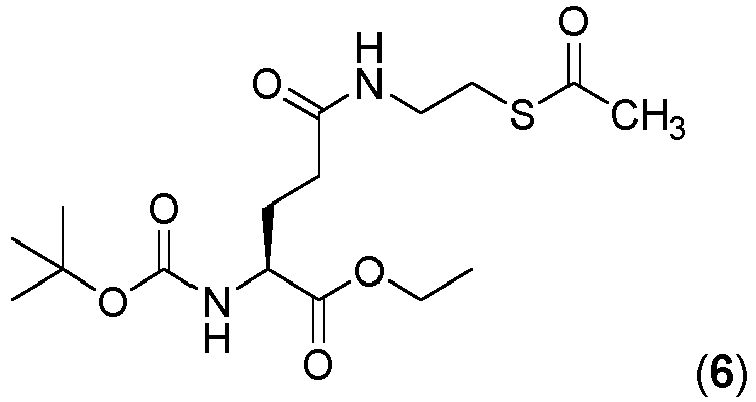
- 2-(S)-tert-Butoxycarbonylamino-pentanedioic acid 1-ethyl ester (3) (1 mol equiv.) in dry dichloromethane (175 mL) was chilled to 0°C under nitrogen. A solution of dicyclohexylcarbodiimide (1.25 mol equiv.) dissolved in dichloromethane (125mL) was charged to the 2-(S)-tert-butoxycarbonylamino-pentanedioic acid 1-ethyl ester solution, maintaining a temperature of 0 °C and stirred for 15 mins. 1-[(2-Aminoethyl)sulfanyl]ethan-1-one hydrochloride (5) (1 mol equiv.) and N-methylmorpholine (1 mol equiv.) were then added to the reaction mixture and this was maintained at a temperature of 0 °C. The reaction mixture was stirred overnight allowing to reach room temperature. The slurry was filtered, washed with dichloromethane and the combined filtrates washed sequentially with aqueous citric acid (10% w/v), aqueous sodium bicarbonate solution (5% w/v), then brine before concentrating. The material was triturated with isopropyl acetate (100 mL) and filtered. The filtrate was charged with n-heptane, cooled to -5 °C to 5 °C and a crystallisation seed was added. The batch was stirred at 0 °C for 1-2 h and then filtered. The resultant solids were washed with a mixture of isopropyl acetate:n-heptane (1:2 v/v) and dried under vacuum at 35-40 °C to yield the desired product (6) (Yield ~ 62%).
-

- 4-(2-Acetylsulfanyl-ethylcarbamoyl)-2- (S)-tert-butoxycarbonylamino-butyric acid ethyl ester (6) (25 g, 0.06 mol) was stirred in acetyl chloride/isopropyl alcohol/isopropyl acetate mixture at ambient temperature overnight until a slurry was formed. The slurry was filtered, washed with isopropyl acetate (30 mL) and then reslurried in warm isopropyl acetate, cooled and filtered. The filter cake was washed with isopropyl acetate and the resulting solid dried under vacuum, yielding a white solid CF10 (Yield ~ 79%).
- The method of example 3 may provide a number of benefits. For example, this synthesis provides a readily scalable route to CF10 and has a good impurity profile. Additionally, the reactants and intermediates used in this synthesis provide improved handling characteristics.
Claims (15)
- A method of forming a compound of formula (X), the method comprising reacting the compound of formula (III) with the compound of formula (V) to form the compound of formula (VI):

cleaving the R1-oxycarbonyl amide of the compound of formula (VI) with an acid to form the compound of formula (X): R1 is -C(CH3)3;R2 is selected from -H, -C1-C4-alkyl, -C2-C4-alkenyl and C1-C4-alkyl-aryl;R3 is selected from -C(O)H and -C(O)C1-C4-alkyl;X is a halide; andA is a halide or other counterion of a strong acid,wherein reacting the compound of formula (III) with the compound of formula (V) is performed in the presence of a base having a pKa in water of less than 9.
 - The method of claim 1, wherein the compound of formula (III) is a compound of formula (IIIa):
 the compound of formula (VI) is a compound of formula (VIa):
 the compound of formula (X) is a compound of formula (Xa):
- The method of claim 1 or claim 2, wherein the base used in reacting the compound of formula (III) or formula (IIIa) with the compound of formula (V) is provided in an amount of not more than 0.9 mol equiv. compared to the amount of the compounds of formulae (III) and (V), or the amount of the compounds of formulae (IIIa) and (V).
- The method of any of claims 1 to 3, wherein R2 is -C1-C4-alkyl.
- The method of any of claims 1 to 3, wherein R2 is -C1-C4-alkyl-aryl.
- The method of claim 5, wherein R2 is -C1-C4-alkyl-phenyl.
- The method of any of claims 1 to 6, wherein R3 is -C(O)C1-C4-alkyl.
- The method of any of claims 1 to 7, wherein R3 is -C(O)CH3.
- The method of any of claims 1 to 8, wherein the acid is formed in situ, optionally by reaction of an acyl halide with an alcohol.
- The method of any of claims 1 to 9, wherein A is selected from chloride or bromide.
- The method of any of claims 1 to 10, wherein the compound of formula (V) is formed by adding a protecting group of formula -R3 to the thiol group of formula (IV)

- The method of any of claims 1 to 11, wherein the compound of formula (III) is formed by reducing a compound of formula (II):

- The method of claim 12, wherein the compound of formula (II) is a compound of formula (IIa):

the compound of formula (III) is a compound of formula (IIIa):
- The method of claim 12 or 13, wherein the compound of formula (II) is formed by (i) reacting a compound of formula (I) with an alkylating reagent of formula halo-R2:

- The method of claim 14, wherein the compound of formula (I) is a compound of formula (Ia):

the compound of formula (II) is a compound of formula (IIa):
Applications Claiming Priority (2)
| Application Number | Priority Date | Filing Date | Title |
|---|---|---|---|
| GB1902018.9A GB2581362A (en) | 2019-02-14 | 2019-02-14 | Chemical synthesis |
| PCT/GB2020/050347 WO2020165601A1 (en) | 2019-02-14 | 2020-02-14 | Production processes of s- and o-diacylated gamma-glutamyl-cysteamine prodrugs |
Publications (3)
| Publication Number | Publication Date |
|---|---|
| EP3924332A1 EP3924332A1 (en) | 2021-12-22 |
| EP3924332C0 EP3924332C0 (en) | 2024-11-06 |
| EP3924332B1 true EP3924332B1 (en) | 2024-11-06 |
Family
ID=65998707
Family Applications (1)
| Application Number | Title | Priority Date | Filing Date |
|---|---|---|---|
| EP20707783.5A Active EP3924332B1 (en) | 2019-02-14 | 2020-02-14 | Production processes of s- and o-diacylated gamma-glutamyl-cysteamine prodrugs |
Country Status (11)
| Country | Link |
|---|---|
| US (1) | US12060315B2 (en) |
| EP (1) | EP3924332B1 (en) |
| JP (1) | JP7555126B2 (en) |
| KR (1) | KR102844817B1 (en) |
| CN (1) | CN113423688A (en) |
| AU (1) | AU2020221681B2 (en) |
| CA (1) | CA3126206A1 (en) |
| ES (1) | ES2994516T3 (en) |
| GB (1) | GB2581362A (en) |
| MX (1) | MX2021009810A (en) |
| WO (1) | WO2020165601A1 (en) |
Family Cites Families (10)
| Publication number | Priority date | Publication date | Assignee | Title |
|---|---|---|---|---|
| US5624955A (en) * | 1995-05-03 | 1997-04-29 | Regents Of The University Of Minnesota | Compounds that enhance the concentration of glutathione in tissues |
| EP3659588A1 (en) | 2006-01-27 | 2020-06-03 | The Regents of The University of California | Enterically coated cysteamine and salts thereof |
| WO2015069888A2 (en) | 2013-11-06 | 2015-05-14 | Raptor Pharmaceuticals Inc. | Use of cysteamine and derivatives thereof to treat mitochondrial diseases |
| MA41031A (en) | 2014-11-26 | 2017-10-03 | Catabasis Pharmaceuticals Inc | CYSTEAMINE-FATTY ACID CONJUGATES AND THEIR USE AS AUTOPHAGIC ACTIVATORS |
| JP2018525350A (en) | 2015-07-02 | 2018-09-06 | ホライズン オルファン エルエルシー | ADO-resistant cysteamine analogues and uses thereof |
| US9630917B2 (en) | 2015-09-19 | 2017-04-25 | Mark Quang Nguyen | Cysteamine prodrugs, pharmaceutical compositions thereof, and methods of use |
| US10537528B2 (en) | 2015-11-16 | 2020-01-21 | The Regents Of The University Of California | Methods of treating non-alcoholic steatohepatitis (NASH) using cysteamine compounds |
| US10143665B2 (en) | 2015-11-17 | 2018-12-04 | Horizon Orphan Llc | Methods for storing cysteamine formulations and related methods of treatment |
| WO2018224813A1 (en) | 2017-06-06 | 2018-12-13 | Novabiotics Limited | Use of cysteamine compositions |
| ES3024932T3 (en) | 2017-09-20 | 2025-06-05 | Thiogenesis Therapeutics Inc | Compounds for the treatment of cysteamine sensitive disorders |
-
2019
- 2019-02-14 GB GB1902018.9A patent/GB2581362A/en not_active Withdrawn
-
2020
- 2020-02-14 US US17/425,038 patent/US12060315B2/en active Active
- 2020-02-14 WO PCT/GB2020/050347 patent/WO2020165601A1/en not_active Ceased
- 2020-02-14 CN CN202080014380.8A patent/CN113423688A/en active Pending
- 2020-02-14 CA CA3126206A patent/CA3126206A1/en active Pending
- 2020-02-14 AU AU2020221681A patent/AU2020221681B2/en active Active
- 2020-02-14 KR KR1020217024504A patent/KR102844817B1/en active Active
- 2020-02-14 JP JP2021547585A patent/JP7555126B2/en active Active
- 2020-02-14 EP EP20707783.5A patent/EP3924332B1/en active Active
- 2020-02-14 MX MX2021009810A patent/MX2021009810A/en unknown
- 2020-02-14 ES ES20707783T patent/ES2994516T3/en active Active
Also Published As
| Publication number | Publication date |
|---|---|
| US12060315B2 (en) | 2024-08-13 |
| EP3924332A1 (en) | 2021-12-22 |
| KR20210126575A (en) | 2021-10-20 |
| CA3126206A1 (en) | 2020-08-20 |
| WO2020165601A1 (en) | 2020-08-20 |
| AU2020221681B2 (en) | 2025-04-03 |
| ES2994516T3 (en) | 2025-01-24 |
| GB2581362A (en) | 2020-08-19 |
| MX2021009810A (en) | 2021-09-08 |
| GB201902018D0 (en) | 2019-04-03 |
| US20220106267A1 (en) | 2022-04-07 |
| JP2022520458A (en) | 2022-03-30 |
| BR112021013421A2 (en) | 2021-10-05 |
| JP7555126B2 (en) | 2024-09-24 |
| KR102844817B1 (en) | 2025-08-11 |
| EP3924332C0 (en) | 2024-11-06 |
| AU2020221681A1 (en) | 2021-07-01 |
| CN113423688A (en) | 2021-09-21 |
Similar Documents
| Publication | Publication Date | Title |
|---|---|---|
| EP2589590B1 (en) | Process for preparation of optically active diamine derivative salt | |
| JP5652628B2 (en) | Process for producing 2-amino-N- (2,2,2-trifluoroethyl) acetamide compound or a salt thereof | |
| CN102348680A (en) | Method for producing optically active diamine derivative | |
| JP2023116769A (en) | Method for producing edoxaban | |
| KR20160095161A (en) | Process methods for phosphatidylinositol 3-kinase inhibitors | |
| EP3412666A1 (en) | Process and intermediates for the preparation of bcl-2 inhibitors including venetoclax through reductive amination | |
| US20020061930A1 (en) | Process for preparing substituted cyclopentane derivatives and novel crystalline structures thereof | |
| JP7379384B2 (en) | Manufacturing method of Refitegrast | |
| EP4073051B1 (en) | Process and intermediate for the preparation of oxetan-2-ylmethanamine | |
| JP7555126B2 (en) | Method for preparing S- and O-diacetylated gamma-glutamylcysteamine prodrugs | |
| HK40062226B (en) | Production processes of s- and o-diacylated gamma-glutamyl-cysteamine prodrugs | |
| HK40062226A (en) | Production processes of s- and o-diacylated gamma-glutamyl-cysteamine prodrugs | |
| BR112021013421B1 (en) | METHODS OF FORMATION OF CYSTEAMINE DERIVATIVE COMPOUNDS | |
| JPWO2002018403A1 (en) | Method for producing erythromycin derivatives | |
| TWI849432B (en) | Process for the production of 5-(4-((2s,5s)-5-(4-chlorobenzyl)-2-methylmorpholino)piperidin-1-yl)-1h-1,2,4-triazol-3-amine | |
| JP7279134B2 (en) | Method for producing prolinamide compound | |
| KR102548504B1 (en) | Method for manufacturing of guanidino-benzoate sulfonic acid compound | |
| JP2000281676A (en) | New production method of ampa antagonistic compound | |
| AU2024312719A1 (en) | New synthesis method | |
| JP2023100917A (en) | Method for producing prolinamide compound | |
| TW202606999A (en) | Process for the production of substituted 2-[2-(phenyl)ethylamino]alkaneamide derivatives | |
| JPWO2001004088A1 (en) | Method for producing aniline derivatives | |
| HK1184134A (en) | Process for preparation of optically active diamine derivative salt |
Legal Events
| Date | Code | Title | Description |
|---|---|---|---|
| STAA | Information on the status of an ep patent application or granted ep patent |
Free format text: STATUS: UNKNOWN |
|
| STAA | Information on the status of an ep patent application or granted ep patent |
Free format text: STATUS: THE INTERNATIONAL PUBLICATION HAS BEEN MADE |
|
| PUAI | Public reference made under article 153(3) epc to a published international application that has entered the european phase |
Free format text: ORIGINAL CODE: 0009012 |
|
| STAA | Information on the status of an ep patent application or granted ep patent |
Free format text: STATUS: REQUEST FOR EXAMINATION WAS MADE |
|
| 17P | Request for examination filed |
Effective date: 20210901 |
|
| AK | Designated contracting states |
Kind code of ref document: A1 Designated state(s): AL AT BE BG CH CY CZ DE DK EE ES FI FR GB GR HR HU IE IS IT LI LT LU LV MC MK MT NL NO PL PT RO RS SE SI SK SM TR |
|
| DAV | Request for validation of the european patent (deleted) | ||
| DAX | Request for extension of the european patent (deleted) | ||
| REG | Reference to a national code |
Ref country code: HK Ref legal event code: DE Ref document number: 40062226 Country of ref document: HK |
|
| STAA | Information on the status of an ep patent application or granted ep patent |
Free format text: STATUS: EXAMINATION IS IN PROGRESS |
|
| 17Q | First examination report despatched |
Effective date: 20221216 |
|
| GRAP | Despatch of communication of intention to grant a patent |
Free format text: ORIGINAL CODE: EPIDOSNIGR1 |
|
| STAA | Information on the status of an ep patent application or granted ep patent |
Free format text: STATUS: GRANT OF PATENT IS INTENDED |
|
| INTG | Intention to grant announced |
Effective date: 20230913 |
|
| GRAJ | Information related to disapproval of communication of intention to grant by the applicant or resumption of examination proceedings by the epo deleted |
Free format text: ORIGINAL CODE: EPIDOSDIGR1 |
|
| STAA | Information on the status of an ep patent application or granted ep patent |
Free format text: STATUS: EXAMINATION IS IN PROGRESS |
|
| GRAP | Despatch of communication of intention to grant a patent |
Free format text: ORIGINAL CODE: EPIDOSNIGR1 |
|
| STAA | Information on the status of an ep patent application or granted ep patent |
Free format text: STATUS: GRANT OF PATENT IS INTENDED |
|
| INTC | Intention to grant announced (deleted) | ||
| INTG | Intention to grant announced |
Effective date: 20240201 |
|
| GRAJ | Information related to disapproval of communication of intention to grant by the applicant or resumption of examination proceedings by the epo deleted |
Free format text: ORIGINAL CODE: EPIDOSDIGR1 |
|
| STAA | Information on the status of an ep patent application or granted ep patent |
Free format text: STATUS: EXAMINATION IS IN PROGRESS |
|
| GRAP | Despatch of communication of intention to grant a patent |
Free format text: ORIGINAL CODE: EPIDOSNIGR1 |
|
| STAA | Information on the status of an ep patent application or granted ep patent |
Free format text: STATUS: GRANT OF PATENT IS INTENDED |
|
| INTG | Intention to grant announced |
Effective date: 20240612 |
|
| GRAS | Grant fee paid |
Free format text: ORIGINAL CODE: EPIDOSNIGR3 |
|
| GRAA | (expected) grant |
Free format text: ORIGINAL CODE: 0009210 |
|
| STAA | Information on the status of an ep patent application or granted ep patent |
Free format text: STATUS: THE PATENT HAS BEEN GRANTED |
|
| AK | Designated contracting states |
Kind code of ref document: B1 Designated state(s): AL AT BE BG CH CY CZ DE DK EE ES FI FR GB GR HR HU IE IS IT LI LT LU LV MC MK MT NL NO PL PT RO RS SE SI SK SM TR |
|
| REG | Reference to a national code |
Ref country code: GB Ref legal event code: FG4D |
|
| REG | Reference to a national code |
Ref country code: CH Ref legal event code: EP |
|
| REG | Reference to a national code |
Ref country code: DE Ref legal event code: R096 Ref document number: 602020040764 Country of ref document: DE |
|
| REG | Reference to a national code |
Ref country code: IE Ref legal event code: FG4D |
|
| U01 | Request for unitary effect filed |
Effective date: 20241106 |
|
| U07 | Unitary effect registered |
Designated state(s): AT BE BG DE DK EE FI FR IT LT LU LV MT NL PT RO SE SI Effective date: 20241113 |
|
| U20 | Renewal fee for the european patent with unitary effect paid |
Year of fee payment: 6 Effective date: 20241218 |
|
| REG | Reference to a national code |
Ref country code: ES Ref legal event code: FG2A Ref document number: 2994516 Country of ref document: ES Kind code of ref document: T3 Effective date: 20250124 |
|
| PG25 | Lapsed in a contracting state [announced via postgrant information from national office to epo] |
Ref country code: IS Free format text: LAPSE BECAUSE OF FAILURE TO SUBMIT A TRANSLATION OF THE DESCRIPTION OR TO PAY THE FEE WITHIN THE PRESCRIBED TIME-LIMIT Effective date: 20250306 Ref country code: HR Free format text: LAPSE BECAUSE OF FAILURE TO SUBMIT A TRANSLATION OF THE DESCRIPTION OR TO PAY THE FEE WITHIN THE PRESCRIBED TIME-LIMIT Effective date: 20241106 |
|
| PG25 | Lapsed in a contracting state [announced via postgrant information from national office to epo] |
Ref country code: NO Free format text: LAPSE BECAUSE OF FAILURE TO SUBMIT A TRANSLATION OF THE DESCRIPTION OR TO PAY THE FEE WITHIN THE PRESCRIBED TIME-LIMIT Effective date: 20250206 |
|
| PG25 | Lapsed in a contracting state [announced via postgrant information from national office to epo] |
Ref country code: GR Free format text: LAPSE BECAUSE OF FAILURE TO SUBMIT A TRANSLATION OF THE DESCRIPTION OR TO PAY THE FEE WITHIN THE PRESCRIBED TIME-LIMIT Effective date: 20250207 |
|
| PG25 | Lapsed in a contracting state [announced via postgrant information from national office to epo] |
Ref country code: PL Free format text: LAPSE BECAUSE OF FAILURE TO SUBMIT A TRANSLATION OF THE DESCRIPTION OR TO PAY THE FEE WITHIN THE PRESCRIBED TIME-LIMIT Effective date: 20241106 |
|
| PG25 | Lapsed in a contracting state [announced via postgrant information from national office to epo] |
Ref country code: RS Free format text: LAPSE BECAUSE OF FAILURE TO SUBMIT A TRANSLATION OF THE DESCRIPTION OR TO PAY THE FEE WITHIN THE PRESCRIBED TIME-LIMIT Effective date: 20250206 |
|
| PG25 | Lapsed in a contracting state [announced via postgrant information from national office to epo] |
Ref country code: SM Free format text: LAPSE BECAUSE OF FAILURE TO SUBMIT A TRANSLATION OF THE DESCRIPTION OR TO PAY THE FEE WITHIN THE PRESCRIBED TIME-LIMIT Effective date: 20241106 |
|
| PG25 | Lapsed in a contracting state [announced via postgrant information from national office to epo] |
Ref country code: SK Free format text: LAPSE BECAUSE OF FAILURE TO SUBMIT A TRANSLATION OF THE DESCRIPTION OR TO PAY THE FEE WITHIN THE PRESCRIBED TIME-LIMIT Effective date: 20241106 |
|
| PG25 | Lapsed in a contracting state [announced via postgrant information from national office to epo] |
Ref country code: CZ Free format text: LAPSE BECAUSE OF FAILURE TO SUBMIT A TRANSLATION OF THE DESCRIPTION OR TO PAY THE FEE WITHIN THE PRESCRIBED TIME-LIMIT Effective date: 20241106 |
|
| PLBE | No opposition filed within time limit |
Free format text: ORIGINAL CODE: 0009261 |
|
| STAA | Information on the status of an ep patent application or granted ep patent |
Free format text: STATUS: NO OPPOSITION FILED WITHIN TIME LIMIT |
|
| PG25 | Lapsed in a contracting state [announced via postgrant information from national office to epo] |
Ref country code: MC Free format text: LAPSE BECAUSE OF FAILURE TO SUBMIT A TRANSLATION OF THE DESCRIPTION OR TO PAY THE FEE WITHIN THE PRESCRIBED TIME-LIMIT Effective date: 20241106 |
|
| 26N | No opposition filed |
Effective date: 20250807 |
|
| PG25 | Lapsed in a contracting state [announced via postgrant information from national office to epo] |
Ref country code: IE Free format text: LAPSE BECAUSE OF NON-PAYMENT OF DUE FEES Effective date: 20250214 |
|
| REG | Reference to a national code |
Ref country code: CH Ref legal event code: U11 Free format text: ST27 STATUS EVENT CODE: U-0-0-U10-U11 (AS PROVIDED BY THE NATIONAL OFFICE) Effective date: 20260311 |
|
| U20 | Renewal fee for the european patent with unitary effect paid |
Year of fee payment: 7 Effective date: 20260211 |
|
| PGFP | Annual fee paid to national office [announced via postgrant information from national office to epo] |
Ref country code: GB Payment date: 20260203 Year of fee payment: 7 |
|
| PGFP | Annual fee paid to national office [announced via postgrant information from national office to epo] |
Ref country code: ES Payment date: 20260302 Year of fee payment: 7 |
|
| PGFP | Annual fee paid to national office [announced via postgrant information from national office to epo] |
Ref country code: CH Payment date: 20260311 Year of fee payment: 7 |