EP3924054B1 - 3-(1-oxo-5-(piperidin-4-yl)isoindolin-2-yl)piperidine-2,6-dione derivatives and uses thereof - Google Patents
3-(1-oxo-5-(piperidin-4-yl)isoindolin-2-yl)piperidine-2,6-dione derivatives and uses thereof Download PDFInfo
- Publication number
- EP3924054B1 EP3924054B1 EP20708198.5A EP20708198A EP3924054B1 EP 3924054 B1 EP3924054 B1 EP 3924054B1 EP 20708198 A EP20708198 A EP 20708198A EP 3924054 B1 EP3924054 B1 EP 3924054B1
- Authority
- EP
- European Patent Office
- Prior art keywords
- alkyl
- optionally substituted
- heteroatoms selected
- cycloalkyl
- halogen
- Prior art date
- Legal status (The legal status is an assumption and is not a legal conclusion. Google has not performed a legal analysis and makes no representation as to the accuracy of the status listed.)
- Active
Links
Classifications
-
- A—HUMAN NECESSITIES
- A61—MEDICAL OR VETERINARY SCIENCE; HYGIENE
- A61K—PREPARATIONS FOR MEDICAL, DENTAL OR TOILETRY PURPOSES
- A61K31/00—Medicinal preparations containing organic active ingredients
- A61K31/33—Heterocyclic compounds
- A61K31/395—Heterocyclic compounds having nitrogen as a ring hetero atom, e.g. guanethidine or rifamycins
- A61K31/435—Heterocyclic compounds having nitrogen as a ring hetero atom, e.g. guanethidine or rifamycins having six-membered rings with one nitrogen as the only ring hetero atom
- A61K31/44—Non condensed pyridines; Hydrogenated derivatives thereof
- A61K31/445—Non condensed piperidines, e.g. piperocaine
- A61K31/4523—Non condensed piperidines, e.g. piperocaine containing further heterocyclic ring systems
- A61K31/4545—Non condensed piperidines, e.g. piperocaine containing further heterocyclic ring systems containing a six-membered ring with nitrogen as a ring hetero atom, e.g. pipamperone, anabasine
-
- A—HUMAN NECESSITIES
- A61—MEDICAL OR VETERINARY SCIENCE; HYGIENE
- A61K—PREPARATIONS FOR MEDICAL, DENTAL OR TOILETRY PURPOSES
- A61K31/00—Medicinal preparations containing organic active ingredients
- A61K31/33—Heterocyclic compounds
- A61K31/395—Heterocyclic compounds having nitrogen as a ring hetero atom, e.g. guanethidine or rifamycins
- A61K31/495—Heterocyclic compounds having nitrogen as a ring hetero atom, e.g. guanethidine or rifamycins having six-membered rings with two or more nitrogen atoms as the only ring heteroatoms, e.g. piperazine or tetrazines
- A61K31/4965—Non-condensed pyrazines
- A61K31/497—Non-condensed pyrazines containing further heterocyclic rings
-
- A—HUMAN NECESSITIES
- A61—MEDICAL OR VETERINARY SCIENCE; HYGIENE
- A61K—PREPARATIONS FOR MEDICAL, DENTAL OR TOILETRY PURPOSES
- A61K31/00—Medicinal preparations containing organic active ingredients
- A61K31/33—Heterocyclic compounds
- A61K31/395—Heterocyclic compounds having nitrogen as a ring hetero atom, e.g. guanethidine or rifamycins
- A61K31/495—Heterocyclic compounds having nitrogen as a ring hetero atom, e.g. guanethidine or rifamycins having six-membered rings with two or more nitrogen atoms as the only ring heteroatoms, e.g. piperazine or tetrazines
- A61K31/50—Pyridazines; Hydrogenated pyridazines
- A61K31/501—Pyridazines; Hydrogenated pyridazines not condensed and containing further heterocyclic rings
-
- A—HUMAN NECESSITIES
- A61—MEDICAL OR VETERINARY SCIENCE; HYGIENE
- A61K—PREPARATIONS FOR MEDICAL, DENTAL OR TOILETRY PURPOSES
- A61K31/00—Medicinal preparations containing organic active ingredients
- A61K31/33—Heterocyclic compounds
- A61K31/395—Heterocyclic compounds having nitrogen as a ring hetero atom, e.g. guanethidine or rifamycins
- A61K31/495—Heterocyclic compounds having nitrogen as a ring hetero atom, e.g. guanethidine or rifamycins having six-membered rings with two or more nitrogen atoms as the only ring heteroatoms, e.g. piperazine or tetrazines
- A61K31/505—Pyrimidines; Hydrogenated pyrimidines, e.g. trimethoprim
- A61K31/506—Pyrimidines; Hydrogenated pyrimidines, e.g. trimethoprim not condensed and containing further heterocyclic rings
-
- A—HUMAN NECESSITIES
- A61—MEDICAL OR VETERINARY SCIENCE; HYGIENE
- A61P—SPECIFIC THERAPEUTIC ACTIVITY OF CHEMICAL COMPOUNDS OR MEDICINAL PREPARATIONS
- A61P35/00—Antineoplastic agents
-
- C—CHEMISTRY; METALLURGY
- C07—ORGANIC CHEMISTRY
- C07D—HETEROCYCLIC COMPOUNDS
- C07D401/00—Heterocyclic compounds containing two or more hetero rings, having nitrogen atoms as the only ring hetero atoms, at least one ring being a six-membered ring with only one nitrogen atom
- C07D401/02—Heterocyclic compounds containing two or more hetero rings, having nitrogen atoms as the only ring hetero atoms, at least one ring being a six-membered ring with only one nitrogen atom containing two hetero rings
- C07D401/04—Heterocyclic compounds containing two or more hetero rings, having nitrogen atoms as the only ring hetero atoms, at least one ring being a six-membered ring with only one nitrogen atom containing two hetero rings directly linked by a ring-member-to-ring-member bond
-
- C—CHEMISTRY; METALLURGY
- C07—ORGANIC CHEMISTRY
- C07D—HETEROCYCLIC COMPOUNDS
- C07D401/00—Heterocyclic compounds containing two or more hetero rings, having nitrogen atoms as the only ring hetero atoms, at least one ring being a six-membered ring with only one nitrogen atom
- C07D401/14—Heterocyclic compounds containing two or more hetero rings, having nitrogen atoms as the only ring hetero atoms, at least one ring being a six-membered ring with only one nitrogen atom containing three or more hetero rings
-
- C—CHEMISTRY; METALLURGY
- C07—ORGANIC CHEMISTRY
- C07D—HETEROCYCLIC COMPOUNDS
- C07D405/00—Heterocyclic compounds containing both one or more hetero rings having oxygen atoms as the only ring hetero atoms, and one or more rings having nitrogen as the only ring hetero atom
- C07D405/14—Heterocyclic compounds containing both one or more hetero rings having oxygen atoms as the only ring hetero atoms, and one or more rings having nitrogen as the only ring hetero atom containing three or more hetero rings
Definitions
- the present invention relates to 3-(1-oxo-5-(piperidin-4-yl)isoindolin-2-yl)piperidine-2,6-dione compounds and compositions and their use for the treatment of IKAROS Family Zinc Finger 2 (IKZF2)-dependent diseases or disorders or where reduction of IKZF2 or IKZF4 protein levels can ameliorate a disease or disorder.
- IKAROS Family Zinc Finger 2 IKZF2
- IKAROS Family Zinc Finger 2 (also known as Helios) is one of the five members of the Ikaros family of transcription factors found in mammals.
- IKZF2 contains four zinc finger domains near the N-terminus, which are involved in DNA binding, and two zinc finger domains at the C-terminus, which are involved in protein dimerization.
- IKZF2 is about 50% identical with Ikaros family members, Ikaros (IKZF1), Aiolos (IKZF3), and Eos (IKZF4) with highest homology in the zinc finger regions (80%+ identity).
- IKZF1 Ikaros
- IKZF3 Aiolos
- Eos IKZF4
- IKZF5 The fifth Ikaros family protein, Pegasus (IKZF5), is only 25% identical to IKZF2, binds a different DNA site than other Ikaros family members and does not readily heterodimerize with the other Ikaros family proteins.
- IKZF2, IKZF1 and IKZF3 are expressed mainly in hematopoietic cells while IKZF4 and IKZF5 are expressed in a wide variety of tissues.
- IKZF2 is believed to have an important role in the function and stability of regulatory T cells (Tregs). IKZF2 is highly expressed at the mRNA and protein level by regulatory T-cell populations. Knockdown of IKZF2 by siRNA has been shown to result in downregulation of FoxP3 and to impair the ability of isolated human CD4+ CD25+ Tregs to block T-cell activation in vitro. Moreover, overexpression of IKZF2 in isolated murine Tregs has been shown to increase expression of Treg related markers such as CD103 and GITR and the IKZF2 overexpressing cells showed increased suppression of responder T-cells. IKZF2 has also been found to bind the promoter of FoxP3, the defining transcription factor of the regulatory T-cell lineage, and to affect FoxP3 expression.
- IKZF2 knockout mutant mice develop autoimmune disease by 6-8 months of age, with increased numbers of activated CD4 and CD8 T cells, follicular helper T cells and germinal center B cells. This observed effect is believed to be cell intrinsic, as Rag2-/- mice given bone marrow from IKZF2 knockout mice, but not bone marrow from IKZF2+/+ develop autoimmune disease.
- IKZF2 affects regulatory T-cell function
- mice in which IKZF2 was deleted only in FoxP3 expressing cells FoxP3-YFP-Cre Heliosfl/fl.
- the results showed that the mice also develop autoimmune disease with similar features as observed in the whole animal IKZF2 knockout.
- pathway analysis of a CHIP-SEQ experiment has also suggested that IKZF2 is affecting expression of genes in the STAT5/IL-2R ⁇ pathway in regulatory T-cells.
- Ikaros isoforms which lack the DNA binding regions have been shown to be associated with multiple human haematological malignancies. Recently, mutations in the IKZF2 gene, which lead to abnormal splicing variants, have been identified in adult T-cell leukemias and low hypodiploid acute lymphoblastic leukemia. It has been proposed that these isoforms, which are capable of dimerization, have a dominant negative effect on Ikaros family transcription factors which primes the development of lymphomas. IKZF2 knockout mutants that survive into adulthood do not develop lymphomas, supporting this hypothesis ( Asanuma, S., et al., (2013), Cancer Sci. 104:1097-1106 ; Zhang, Z., et al., (2007), Blood 109:2190-2197 ; Kataoka, D., et al., (2015), Nature Genetics 47:1304-1315 .)
- Iberdomide (CC-220) is an orally available immunomodulatory compound under development for the treatment of SLE and relapsed/refractory multiple myeloma ( Schafer, P. H., et al., (2016), Annals of the Rheumatic Diseases 77: 1516-1523 .)
- anti-CTLA4 antibodies are used in the clinic to target Tregs in tumors.
- targeting CTLA4 often causes systemic activation of T-effector cells, resulting in excessive toxicity and limiting therapeutic utility.
- Up to 3/4 of patients treated with a combination of anti-PD1 and anti-CTLA4 have reported grade 3 or higher adverse events.
- An IKZF2-specific degrader has the potential to focus the enhanced immune response to areas within or near tumors providing a potentially more tolerable and less toxic therapeutic agent for the treatment of cancer.
- the compounds of the invention have use as therapeutic agents, particularly for cancers and related diseases.
- the compounds of the invention have IKZF2 degrader activity, preferably having such activity at or below the 50 ⁇ M level, and more preferably having such activity at or below the 10 ⁇ M level.
- the compounds of the invention have degrader activity for IKZF2 that is selective over one or more of IKZF1, IKZF3, IKZF4, and/or IKZF5.
- the compounds of the invention have degrader activity for both IKZF2 and IKZF4.
- the compounds of the invention have usefulness in treating cancer and other diseases for which such degrader activity would be beneficial for the patient.
- the present invention provides novel IKZF2 degraders useful for the treatment of cancer and other diseases.
- a first aspect of the present invention relates to compounds of Formula (I) wherein:
- the hydrogens in the compound of Formula (I) are present in their normal isotopic abundances.
- the hydrogens are isotopically enriched in deuterium (D), and in a particularly preferred aspect of the invention the hydrogen at position R x is enriched in D, as discussed in more detail concerning isotopes and isotopic enrichment below.
- the present invention relates to a compound selected from: or pharmaceutically acceptable salts, hydrates, solvates, stereoisomers, and tautomers thereof.
- Another aspect of the present invention relates to a pharmaceutical composition
- a pharmaceutical composition comprising a therapeutically effective amount of a compound of Formula (I), or a pharmaceutically acceptable salt, hydrate, solvate, stereoisomer, or tautomer thereof, and a pharmaceutically acceptable carrier or excipient.
- the pharmaceutical composition is useful in the treatment of IKZF2-dependent diseases or disorders.
- the pharmaceutical composition may further comprise at least one additional pharmaceutical agent.
- the present invention relates to a pharmaceutical composition
- a pharmaceutical composition comprising a therapeutically effective amount of a compound of Formula (I), or a pharmaceutically acceptable salt, hydrate, solvate, stereoisomer, or tautomer thereof, and a pharmaceutically acceptable carrier or excipient for use in the treatment of an IKZF2-dependent disease or disorder by reducing IKZF2 protein levels wherein reduction of IKZF2 protein levels treats the IKZF2-dependent disease or disorder.
- the pharmaceutical composition is useful in the treatment of diseases or disorders affected by the reduction of IKZF2 protein levels.
- the pharmaceutical composition may further comprise at least one additional pharmaceutical agent.
- Another aspect of the present invention relates to a pharmaceutical composition
- a pharmaceutical composition comprising a therapeutically effective amount of a compound selected from compound (I-1), (I-2), (I-3), (I-4) , (I-5), (I-6), (I-7), (1-8), (I-9), (I-10), (I-11), (I-12), (I-13), (I-14), (I-15), (I-16), (I-17), (I-18), (I-24), (I-25), (I-26), (I-27), (I-28), (1-29), (I-30), (1-31), (I-32), (I-33), (I-34), (I-34), (I-36), (I-37), and (I-38), or a pharmaceutically acceptable salt, hydrate, solvate, stereoisomer, or tautomer thereof, and a pharmaceutically acceptable carrier or excipient.
- the pharmaceutical composition is useful in the treatment of diseases or disorders affected by the reduction of IKZF2 protein levels.
- the pharmaceutical composition is useful in the treatment
- the present invention provides degraders of IKZF2 that are therapeutic agents in the treatment of diseases such as cancer and metastasis, in the treatment of diseases affected by the modulation of IKZF2 protein levels, and in the treatment IKZF2-dependent diseases or disorders.
- the disease or disorder that can be treated by the compounds of the present invention is selected from non-small cell lung cancer (NSCLC), melanoma, triple-negative breast cancer (TNBC), nasopharyngeal cancer (NPC), microsatellite stable colorectal cancer (mssCRC), thymoma, carcinoid, gastrointestinal stromal tumor (GIST), prostate cancer, breast carcinoma, lymphomas, leukaemia, myeloma, bladder carcinoma, colon cancer, cutaneous melanoma, hepatocellular carcinoma, endometrial cancer, ovarian cancer, cervical cancer, lung cancer, renal cancer, glioblastoma multiform, glioma, thyroid cancer, parathyroid tumor, nasopharyngeal cancer, tongue cancer, pancreatic cancer, esophageal cancer, cholangiocarcinoma, gastric cancer, soft tissue sarcomas, rhabdomyosarcoma (RMS), synovi
- the present invention provides agents with novel mechanisms of action toward IKZF2 proteins in the treatment of various types of diseases including cancer and metastasis, in the treatment of diseases affected by the modulation of IKZF2 protein levels, and in the treatment IKZF2-dependent diseases or disorders.
- the present invention provides the medical community with a novel pharmacological strategy for the treatment of diseases and disorders associated with IKZF2 proteins.
- the present invention relates to compounds and compositions that are capable of modulating IKZF2 protein levels.
- the invention features methods of treating, preventing, or ameliorating a disease or disorder in which IKZF2 plays a role by administering to a patient in need thereof a therapeutically effective amount of a compound of Formula (I), or a pharmaceutically acceptable salt, hydrate, solvate, stereoisomer, or tautomer thereof.
- the compounds of the present invention can be used in the treatment of a variety of IKZF2-dependent diseases and disorders by modulating IKZF2 protein levels. Modulation of IKZF2 protein levels through degradation provides a novel approach to the treatment, prevention, or amelioration of diseases including, but not limited to, cancer and metathesis, and other IKZF2-dependent diseases or disorders.
- the compounds of the invention have use as therapeutic agents, particularly for cancers and related diseases.
- the compounds of the invention have IKZF2 degradation activity, preferably having such activity at or below the 50 ⁇ M level, and more preferably having such activity at or below the 10 ⁇ M level.
- the compounds of the invention have degrader activity for IKZF2 that is selective over one or more of IKZF1, IKZF3, IKZF4, and/or IKZF5.
- the compounds of the invention have degrader activity for both IKZF2 and IKZF4.
- the compounds of the invention have usefulness in treating cancer and other diseases for which such degradation activity would be beneficial for the patient.
- the present invention provides novel IKZF2 degraders useful for the treatment of cancer and other diseases.
- the compounds of Formula (I) are described: or pharmaceutically acceptable salts, hydrates, solvates, stereoisomers, and tautomers thereof, wherein R 1 , R 2 , R 3 , R x , and n are as described herein above.
- (C 1 -C 10 )alkyl means an alkyl group or radical having 1 to 10 carbon atoms.
- the last named group is the radical attachment point, for example, "alkylaryl” means a monovalent radical of the formula alkyl-aryl-, while “arylalkyl” means a monovalent radical of the formula aryl-alkyl-.
- alkylaryl means a monovalent radical of the formula alkyl-aryl-
- arylalkyl means a monovalent radical of the formula aryl-alkyl-.
- designating a monovalent radical where a divalent radical is appropriate shall be construed to designate the respective divalent radical and vice versa.
- an alkyl group that is optionally substituted can be a fully saturated alkyl chain (e.g., a pure hydrocarbon).
- the same optionally substituted alkyl group can have substituents different from hydrogen. For instance, it can, at any point along the chain be bounded to a halogen atom, a hydroxyl group, or any other substituent described herein.
- the term “optionally substituted” means that a given chemical moiety has the potential to contain other functional groups, but does not necessarily have any further functional groups.
- Suitable substituents used in the optional substitution of the described groups include, without limitation, halogen, oxo, -OH, -CN, -COOH, -CH 2 CN, -O-(C 1 -C 6 )alkyl, (C 1 -C 6 )alkyl, (C 1 -C 6 )alkoxy, (C 1 -C 6 )haloalkyl, (C 1 -C 6 )haloalkoxy, -O-(C 2 -C 6 )alkenyl, -O-(C 2 -C 6 )alkynyl, (C 2 -C 6 )alkenyl, (C 2 -C 6 )alkynyl, -OH, - OP(O)(OH) 2 , -OC(O)(C 1 -C 6 )alkyl, -C(O)(C 1 -C 6 )alkyl, -OC(O)O(C 1 -
- substituted means that the specified group or moiety bears one or more suitable substituents wherein the substituents may connect to the specified group or moiety at one or more positions.
- an aryl substituted with a cycloalkyl may indicate that the cycloalkyl connects to one atom of the aryl with a bond or by fusing with the aryl and sharing two or more common atoms.
- aryl means a cyclic, aromatic hydrocarbon group having 1 to 3 aromatic rings, including monocyclic or bicyclic groups such as phenyl, biphenyl, or naphthyl.
- aromatic rings of the aryl group are optionally joined at a single point (e.g., biphenyl), or fused (e.g., naphthyl).
- the aryl group is optionally substituted by one or more substituents, e.g., 1 to 5 substituents, at any point of attachment.
- substituents include, but are not limited to, -H, -halogen, -CN, -O-(C 1 -C 6 )alkyl, (C 1 -C 6 )alkyl, -O-(C 2 -C 6 )alkenyl, -O-(C 2 -C 6 )alkynyl, (C 2 -C 6 )alkenyl, (C 2 -C 6 )alkynyl, -OH, -OP(O)(OH) 2 , -OC(O)(C 1 -C 6 )alkyl, -C(O)(C 1 -C 6 )alkyl, - OC(O)O(C 1 -C 6 ) alkyl, NH 2 , NH((C 1 -C 6 )alkyl), N((C 1 -C 6 )alkyl) 2 , -S(O) 2 -(C 1 -C 6 )alky
- the substituents are themselves optionally substituted.
- the aryl groups when containing two fused rings, optionally have an unsaturated or partially saturated ring fused with a fully saturated ring.
- Exemplary ring systems of these aryl groups include, but are not limited to, phenyl, biphenyl, naphthyl, anthracenyl, phenalenyl, phenanthrenyl, indanyl, indenyl, tetrahydronaphthalenyl, tetrahydrobenzoannulenyl, and the like.
- heteroaryl means a monovalent monocyclic aromatic radical of 5 to 24 ring atoms or a polycyclic aromatic radical, containing one or more ring heteroatoms selected from N, O, or S, the remaining ring atoms being C.
- Heteroaryl as herein defined also means a bicyclic heteroaromatic group wherein the heteroatom is selected from N, O, or S.
- the aromatic radical is optionally substituted independently with one or more substituents described herein.
- Examples include, but are not limited to, furyl, thienyl, pyrrolyl, pyridyl, pyrazolyl, pyrimidinyl, imidazolyl, isoxazolyl, oxazolyl, oxadiazolyl, pyrazinyl, indolyl, thiophen-2-yl, quinolyl, benzopyranyl, isothiazolyl, thiazolyl, thiadiazole, indazole, benzimidazolyl, thieno[3,2-b]thiophene, triazolyl, triazinyl, imidazo[1,2-b]pyrazolyl, furo[2,3-c]pyridinyl, imidazo[1,2-a]pyridinyl, indazolyl, pyrrolo[2,3-c]pyridinyl, pyrrolo[3,2-c]pyridinyl, pyrazolo[3,4-c]pyridin
- the aryl groups herein defined may have an unsaturated or partially saturated ring fused with a fully saturated ring.
- exemplary ring systems of these heteroaryl groups include indolinyl, indolinonyl, dihydrobenzothiophenyl, dihydrobenzofuran, chromanyl, thiochromanyl, tetrahydroquinolinyl, dihydrobenzothiazine,3,4-dihydro-lH-isoquinolinyl, 2,3-dihydrobenzofuran, indolinyl, indolyl, and dihydrobenzoxanyl.
- Halogen or "halo" mean fluorine, chlorine, bromine, or iodine.
- Alkyl means a straight or branched chain saturated hydrocarbon containing 1-12 carbon atoms.
- Examples of a (C 1 -C 6 )alkyl group include, but are not limited to, methyl, ethyl, propyl, butyl, pentyl, hexyl, isopropyl, isobutyl, sec -butyl, tert -butyl , isopentyl, neopentyl, and isohexyl.
- Alkoxy means a straight or branched chain saturated hydrocarbon containing 1-12 carbon atoms containing a terminal "O" in the chain, e.g., -O(alkyl).
- alkoxy groups include, without limitation, methoxy, ethoxy, propoxy, butoxy, t-butoxy, or pentoxy groups.
- alkenyl means a straight or branched chain unsaturated hydrocarbon containing 2-12 carbon atoms.
- the "alkenyl” group contains at least one double bond in the chain.
- the double bond of an alkenyl group can be unconjugated or conjugated to another unsaturated group.
- alkenyl groups include ethenyl, propenyl, n -butenyl, iso-butenyl, pentenyl, or hexenyl.
- An alkenyl group can be unsubstituted or substituted and may be straight or branched.
- Alkynyl means a straight or branched chain unsaturated hydrocarbon containing 2-12 carbon atoms.
- the "alkynyl” group contains at least one triple bond in the chain.
- alkenyl groups include ethynyl, propargyl, n -butynyl, iso-butynyl, pentynyl, or hexynyl.
- An alkynyl group can be unsubstituted or substituted.
- Alkylene or "alkylenyl” means a divalent alkyl radical. Any of the above mentioned monovalent alkyl groups may be an alkylene by abstraction of a second hydrogen atom from the alkyl. As herein defined, alkylene may also be a (C 1 -C 6 )alkylene. An alkylene may further be a (C 1 -C 4 )alkylene.
- Typical alkylene groups include, but are not limited to, -CH 2 -, -CH(CH 3 )-, -C(CH 3 ) 2 -, -CH 2 CH 2 -, -CH 2 CH(CH 3 )-, - CH 2 C(CH 3 ) 2 -, -CH 2 CH 2 CH 2 -, -CH 2 CH 2 CH 2 CH-, and the like.
- Cycloalkyl or “carbocyclyl” means a monocyclic or polycyclic saturated or partially unsaturated non-aromatic carbon ring containing 3-18 carbon atoms.
- Examples of cycloalkyl groups include, without limitations, cyclopropyl, cyclobutyl, cyclopentyl, cyclohexyl, cycloheptanyl, cyclooctanyl, norboranyl, norborenyl, bicyclo[2.2.2]octanyl, or bicyclo[2.2.2]octenyl and derivatives thereof.
- a (C 3 -C 8 )cycloalkyl is a cycloalkyl group containing between 3 and 8 carbon atoms.
- a cycloalkyl group can be fused (e.g., decalin) or bridged (e.g., norbornane).
- Heterocyclyl or “heterocycloalkyl” means a saturated or partially saturated monocyclic or polycyclic ring containing carbon and at least one heteroatom selected from oxygen, nitrogen, or sulfur (O, N, or S) and wherein there is not delocalized n electrons (aromaticity) shared among the ring carbon or heteroatoms.
- the heterocycloalkyl ring structure may be substituted by one or more substituents. The substituents can themselves be optionally substituted.
- heterocyclyl rings include, but are not limited to, oxetanyl, azetadinyl, tetrahydrofuranyl, tetrahydropyranyl, pyrrolidinyl, oxazolinyl, oxazolidinyl, thiazolinyl, thiazolidinyl, pyranyl, thiopyranyl, tetrahydropyranyl, dioxalinyl, piperidinyl, morpholinyl, thiomorpholinyl, thiomorpholinyl S-oxide, thiomorpholinyl S-dioxide, piperazinyl, azepinyl, oxepinyl, diazepinyl, tropanyl, oxazolidinonyl, 1,4-dioxanyl, dihydrofuranyl, 1,3-dioxolanyl, imidazolidinyl, imidazolinyl
- Hydroalkyl means an alkyl group substituted with one or more -OH groups. Examples of hydroxyalkyl groups include HO-CH 2 -, HO-CH 2 CH 2 -, and CH 2 -CH(OH)-.
- Haloalkyl means an alkyl group substituted with one or more halogens.
- haloalkyl groups include, but are not limited to, trifluoromethyl, difluoromethyl, pentafluoroethyl, trichloromethyl, etc.
- Haloalkoxy means an alkoxy group substituted with one or more halogens.
- haloalkyl groups include, but are not limited to, trifluoromethoxy, difluoromethoxy, pentafluoroethoxy, trichloromethoxy, etc.
- Cyano means a substituent having a carbon atom joined to a nitrogen atom by a triple bond, e.g., C ⁇ N.
- Amino means a substituent containing at least one nitrogen atom (e.g., NH 2 ).
- Pomalidomide or 4-amino-2-(2,6-dioxopiperidin-3-yl)isoindoline-1,3-dione has the following structure:
- Salt means an ionic form of the parent compound or the product of the reaction between the parent compound with a suitable acid or base to make the acid salt or base salt of the parent compound.
- Salts of the compounds of the present invention can be synthesized from the parent compounds which contain a basic or acidic moiety by conventional chemical methods. Generally, the salts are prepared by reacting the free base or acid parent compound with stoichiometric amounts or with an excess of the desired salt-forming inorganic or organic acid or base in a suitable solvent or various combinations of solvents.
- “Pharmaceutically acceptable salt” means a salt of a compound of the invention which is, within the scope of sound medical judgment, suitable for use in contact with the tissues of humans and lower animals without undue toxicity, irritation, allergic response, and the like, commensurate with a reasonable benefit/risk ratio, generally water or oil-soluble or dispersible, and effective for their intended use.
- the term includes pharmaceutically-acceptable acid addition salts and pharmaceutically-acceptable base addition salts.
- the compounds of the present invention are useful in both free base and salt form, in practice, the use of the salt form amounts to use of the base form. Lists of suitable salts are found in, e.g., S.M. Birge et al., J. Pharm. Sci., 1977, 66, pp. 1-19 .
- “Pharmaceutically-acceptable acid addition salt” means those salts which retain the biological effectiveness and properties of the free bases and which are not biologically or otherwise undesirable, formed with inorganic acids such as hydrochloric acid, hydrobromic acid, hydroiodic acid, sulfuric acid, sulfamic acid, nitric acid, phosphoric acid, and the like, and organic acids such as acetic acid, trichloroacetic acid, trifluoroacetic acid, adipic acid, alginic acid, ascorbic acid, aspartic acid, benzenesulfonic acid, benzoic acid, 2-acetoxybenzoic acid, butyric acid, camphoric acid, camphorsulfonic acid, cinnamic acid, citric acid, digluconic acid, ethanesulfonic acid, glutamic acid, glycolic acid, glycerophosphoric acid, hemisulfic acid, heptanoic acid, hexanoic acid, formic acid, fum
- “Pharmaceutically-acceptable base addition salt” means those salts which retain the biological effectiveness and properties of the free acids and which are not biologically or otherwise undesirable, formed with inorganic bases such as ammonia or hydroxide, carbonate, or bicarbonate of ammonium or a metal cation such as sodium, potassium, lithium, calcium, magnesium, iron, zinc, copper, manganese, aluminum, and the like. Particularly preferred are the ammonium, potassium, sodium, calcium, and magnesium salts.
- Salts derived from pharmaceutically-acceptable organic nontoxic bases include salts of primary, secondary, and tertiary amines, quaternary amine compounds, substituted amines including naturally occurring substituted amines, cyclic amines and basic ion-exchange resins, such as methylamine, dimethylamine, trimethylamine, ethylamine, diethylamine, triethylamine, isopropylamine, tripropylamine, tributylamine, ethanolamine, diethanolamine, 2-dimethylaminoethanol, 2-diethylaminoethanol, dicyclohexylamine, lysine, arginine, histidine, caffeine, hydrabamine, choline, betaine, ethylenediamine, glucosamine, methylglucamine, theobromine, purines, piperazine, piperidine, N-ethylpiperidine, tetramethylammonium compounds, tetraethylammonium
- solute means a complex of variable stoichiometry formed by a solute, for example, a compound of Formula (I)) and solvent, for example, water, ethanol, or acetic acid. This physical association may involve varying degrees of ionic and covalent bonding, including hydrogen bonding.
- the solvate will be capable of isolation, for example, when one or more solvent molecules are incorporated in the crystal lattice of the crystalline solid. In general, such solvents selected for the purpose of the invention do not interfere with the biological activity of the solute.
- Solvates encompasses both solution-phase and isolatable solvates. Representative solvates include hydrates, ethanolates, methanolates, and the like.
- Hydrophilate means a solvate wherein the solvent molecule(s) is/are water.
- the compounds of the present invention as discussed below include the free base or acid thereof, their salts, and solvates, and may include oxidized sulfur atoms or quaternized nitrogen atoms in their structure, although not explicitly stated or shown, particularly the pharmaceutically acceptable forms thereof. Such forms, particularly the pharmaceutically acceptable forms, are intended to be embraced by the appended claims.
- “Isomers” means compounds having the same number and kind of atoms, and hence the same molecular weight, but differing with respect to the arrangement or configuration of the atoms in space.
- the term includes stereoisomers and geometric isomers.
- Steps or “optical isomer” mean a stable isomer that has at least one chiral atom or restricted rotation giving rise to perpendicular dissymmetric planes (e.g., certain biphenyls, allenes, and spiro compounds) and can rotate plane-polarized light. Because asymmetric centers and other chemical structure exist in the compounds of the invention, which may give rise to stereoisomerism, the invention contemplates stereoisomers and mixtures thereof.
- the compounds of the invention and their salts include asymmetric carbon atoms and may therefore exist as single stereoisomers, racemates, and as mixtures of enantiomers and diastereomers. Typically, such compounds will be prepared as a racemic mixture.
- stereoisomers can be prepared or isolated as pure stereoisomers, i.e., as individual enantiomers or diastereomers, or as stereoisomer-enriched mixtures.
- individual stereoisomers of compounds are prepared by synthesis from optically active starting materials containing the desired chiral centers or by preparation of mixtures of enantiomeric products followed by separation or resolution, such as conversion to a mixture of diastereomers followed by separation or recrystallization, chromatographic techniques, use of chiral resolving agents, or direct separation of the enantiomers on chiral chromatographic columns.
- Starting compounds of particular stereochemistry are either commercially available or are made by the methods described below and resolved by techniques well-known in the art.
- Enantiomers means a pair of stereoisomers that are non-superimposable mirror images of each other.
- Diastereoisomers or “diastereomers” mean optical isomers which are not mirror images of each other.
- Racemic mixture or “racemate” mean a mixture containing equal parts of individual enantiomers.
- Non-racemic mixture means a mixture containing unequal parts of individual enantiomers.
- Some of the compounds of the invention can exist in more than one tautomeric form. As mentioned above, the compounds of the invention include all such tautomers.
- enantiomers often exhibit strikingly different biological activity including differences in pharmacokinetic properties, including metabolism, protein binding, and the like, and pharmacological properties, including the type of activity displayed, the degree of activity, toxicity, and the like.
- one enantiomer may be more active or may exhibit beneficial effects when enriched relative to the other enantiomer or when separated from the other enantiomer.
- one skilled in the art would know how to separate, enrich, or selectively prepare the enantiomers of the compounds of the invention from this invention and the knowledge of the prior art.
- racemic form of drug may be used, it is often less effective than administering an equal amount of enantiomerically pure drug; indeed, in some cases, one enantiomer may be pharmacologically inactive and would merely serve as a simple diluent.
- ibuprofen had been previously administered as a racemate, it has been shown that only the S-isomer of ibuprofen is effective as an anti-inflammatory agent (in the case of ibuprofen, however, although the R-isomer is inactive, it is converted in vivo to the S-isomer, thus, the rapidity of action of the racemic form of the drug is less than that of the pure S-isomer).
- enantiomers may have distinct biological activity.
- S-penicillamine is a therapeutic agent for chronic arthritis, while R-penicillamine is toxic.
- R-penicillamine is toxic.
- some purified enantiomers have advantages over the racemates, as it has been reported that purified individual isomers have faster transdermal penetration rates compared to the racemic mixture. See U.S. Pat. Nos. 5,114,946 and 4,818,541 .
- one enantiomer is pharmacologically more active, less toxic, or has a preferred disposition in the body than the other enantiomer, it would be therapeutically more beneficial to administer that enantiomer preferentially. In this way, the patient undergoing treatment would be exposed to a lower total dose of the drug and to a lower dose of an enantiomer that is possibly toxic or an inhibitor of the other enantiomer.
- Preparation of pure enantiomers or mixtures of desired enantiomeric excess (ee) or enantiomeric purity are accomplished by one or more of the many methods of (a) separation or resolution of enantiomers, or (b) enantioselective synthesis known to those of skill in the art, or a combination thereof.
- These resolution methods generally rely on chiral recognition and include, for example, chromatography using chiral stationary phases, enantioselective host-guest complexation, resolution or synthesis using chiral auxiliaries, enantioselective synthesis, enzymatic and nonenzymatic kinetic resolution, or spontaneous enantioselective crystallization.
- a "patient” or “subject” is a mammal, e.g., a human, mouse, rat, guinea pig, dog, cat, horse, cow, pig, or nonhuman primate, such as a monkey, chimpanzee, baboon or, rhesus.
- the subject is a primate.
- the subject is a human.
- an “effective amount” or “therapeutically effective amount” when used in connection with a compound means an amount of a compound of the present invention that (i) treats or prevents the particular disease, condition, or disorder, (ii) attenuates, ameliorates, or eliminates one or more symptoms of the particular disease, condition, or disorder, or (iii) prevents or delays the onset of one or more symptoms of the particular disease, condition, or disorder described herein.
- pharmaceutically effective amount or “therapeutically effective amount” means an amount of a compound according to the invention which, when administered to a patient in need thereof, is sufficient to effect treatment for disease-states, conditions, or disorders for which the compounds have utility. Such an amount would be sufficient to elicit the biological or medical response of a tissue, system, or patient that is sought by a researcher or clinician.
- the amount of a compound of according to the invention which constitutes a therapeutically effective amount will vary depending on such factors as the compound and its biological activity, the composition used for administration, the time of administration, the route of administration, the rate of excretion of the compound, the duration of treatment, the type of disease-state or disorder being treated and its severity, drugs used in combination with or coincidentally with the compounds of the invention, and the age, body weight, general health, sex, and diet of the patient.
- a therapeutically effective amount can be determined routinely by one of ordinary skill in the art having regard to their own knowledge, the prior art, and this invention.
- composition refers to a compound of the invention, or a pharmaceutically acceptable salt, hydrate, solvate, stereoisomer, or tautomer thereof, together with at least one pharmaceutically acceptable carrier, in a form suitable for oral or parenteral administration.
- Carrier encompasses carriers, excipients, and diluents and means a material, composition or vehicle, such as a liquid or solid filler, diluent, excipient, solvent or encapsulating material, involved in carrying or transporting a pharmaceutical agent from one organ, or portion of the body, to another organ, or portion of the body of a subject.
- a subject is "in need of” a treatment if such subject would benefit biologically, medically, or in quality of life from such treatment (preferably, a human).
- the term “inhibit”, “inhibition”, or “inhibiting” refers to the reduction or suppression of a given condition, symptom, or disorder, or disease, or a significant decrease in the baseline activity of a biological activity or process.
- treat refers to alleviating or ameliorating the disease or disorder (i.e., slowing or arresting the development of the disease or at least one of the clinical symptoms thereof); or alleviating or ameliorating at least one physical parameter or biomarker associated with the disease or disorder, including those which may not be discernible to the patient.
- the term “prevent”, “preventing”, or “prevention” of any disease or disorder refers to the prophylactic treatment of the disease or disorder; or delaying the onset or progression of the disease or disorder.
- “Pharmaceutically acceptable” means that the substance or composition must be compatible chemically and/or toxicologically, with the other ingredients comprising a formulation, and/or the mammal being treated therewith.
- Disorder means, and is used interchangeably with, the terms disease, condition, or illness, unless otherwise indicated.
- administering means to either directly administering a disclosed compound or pharmaceutically acceptable salt of the disclosed compound or a composition to a subject, which can form an equivalent amount of active compound within the subject's body.
- Compounds of the present invention refer to compounds of Formulae (I), (Ia), and (Ib), and compounds (I-1), (I-2), (I-3), (I-4), (I-5), (I-6), (I-7), (I-8), (I-9), (I-10), (I-11), (I-12), (I-13), (I-14), (I-15), (I-16), (I-17), (I-18), (I-24), (I-25), (I-26), (I-27), (I-28), (I-29), (I-30), (I-31), (I-32), (I-33), (I-34), (I-34), (I-36), (I-37), and (I-38), as herein described including the tautomers, salts particularly the pharmaceutically acceptable salts, and the solvates and hydrates thereof, where the context so permits thereof, as well as all stereoisomers (including diastereoisomers and enantiomers),
- solvates and hydrates are generally considered compositions.
- the compounds of the invention and the formulas designating the compounds of the invention are understood to only include the stable compounds thereof and exclude unstable compounds, even if an unstable compound might be considered to be literally embraced by the compound formula.
- reference to intermediates, whether or not they themselves are claimed, is meant to embrace their salts and solvates, where the context so permits. For the sake of clarity, particular instances when the context so permits are sometimes indicated in the text, but these instances are purely illustrative and it is not intended to exclude other instances when the context so permits.
- “Stable compound” or “stable structure” means a compound that is sufficiently robust to survive isolation to a useful degree of purity from a reaction mixture, and formulation into an efficacious therapeutic or diagnostic agent.
- a compound, which would have a "dangling valency" or is a carbanion is not a compound contemplated by the invention.
- the term “about” or “approximately” means within 20%, preferably within 10%, and more preferably within 5% of a given value or range.
- Cancer means any cancer caused by the proliferation of malignant neoplastic cells, such as tumors, neoplasms, carcinomas, sarcomas, leukemias, lymphomas, and the like.
- cancers include, but are not limited to, mesothelioma, leukemias, and lymphomas such as cutaneous T-cell lymphomas (CTCL), noncutaneous peripheral T-cell lymphomas, lymphomas associated with human T-cell lymphotrophic virus (HTLV) such as adult T-cell leukemia/lymphoma (ATLL), B-cell lymphoma, acute nonlymphocytic leukemias, chronic lymphocytic leukemia, chronic myelogenous leukemia, acute myelogenous leukemia, lymphomas, and multiple myeloma, non-Hodgkin lymphoma, acute lymphatic leukemia (ALL), chronic lymphatic leukemia (CLL), Hodgkin's lymphoma, Burkitt lymphoma, adult T-cell leukemia lymphoma, acute-myeloid leukemia (AML), chronic myeloid leukemia (CML), or hepatocellular carcinoma.
- CCL cutaneous T-cell lympho
- myelodisplastic syndrome childhood solid tumors such as brain tumors, neuroblastoma, retinoblastoma, Wilms' tumor, bone tumors, and soft-tissue sarcomas, common solid tumors of adults such as head and neck cancers (e.g., oral, laryngeal, and nasopharyngeal), esophageal cancer, genitourinary cancers (e.g., prostate, bladder, renal, uterine, ovarian, testicular), lung cancer (e.g., small-cell and non-small cell), breast cancer, pancreatic cancer, melanoma, and other skin cancers, stomach cancer, brain tumors, tumors related to Gorlin's syndrome (e.g., medulloblastoma, meningioma, etc.), and liver cancer.
- childhood solid tumors such as brain tumors, neuroblastoma, retinoblastoma, Wilms' tumor, bone tumors, and
- Additional exemplary forms of cancer which may be treated by the subject compounds include, but are not limited to, cancer of skeletal or smooth muscle, stomach cancer, cancer of the small intestine, rectum carcinoma, cancer of the salivary gland, endometrial cancer, adrenal cancer, anal cancer, rectal cancer, parathyroid cancer, and pituitary cancer.
- cancers include, but are not limited to, labial carcinoma, larynx carcinoma, hypopharynx carcinoma, tongue carcinoma, salivary gland carcinoma, gastric carcinoma, adenocarcinoma, thyroid cancer (medullary and papillary thyroid carcinoma), renal carcinoma, kidney parenchyma carcinoma, cervix carcinoma, uterine corpus carcinoma, endometrium carcinoma, chorion carcinoma, testis carcinoma, urinary carcinoma, melanoma, brain tumors such as glioblastoma, astrocytoma, meningioma, medulloblastoma and peripheral neuroectodermal tumors, gall bladder carcinoma, bronchial carcinoma, multiple myeloma, basalioma, teratoma, retin
- “Simultaneously” or “simultaneous” when referring to a method of treating or a therapeutic use means with a combination of a compound of Formula (I) or Embodiment 16, 17, or 35, or a pharmaceutically acceptable salt, hydrate, solvate, stereoisomer, or tautomer thereof, and one or more second agent(s) means administration of the compound and the one or more second agent(s) by the same route and at the same time.
- “Separately” or “separate” when referring to a method of treating or a therapeutic use means with a combination of a compound of Formula (I) or Embodiment 16, 17, or 35, or a pharmaceutically acceptable salt, hydrate, solvate, stereoisomer, or tautomer thereof, and one or more second agent(s) means administration of the compound and the one or more second agent(s) by different routes and at approximately the same time.
- therapeutic administration means, when referring to a method of treating or a therapeutic use with a combination of a compound of Formula (I) or Embodiment 16, 17, or 35, or a pharmaceutically acceptable salt, hydrate, solvate, stereoisomer, or tautomer thereof, and one or more second agent(s), administration of the compound and the one or more second agent(s) by the same or different routes and at different times.
- the administration of the compound or the one or more second agent(s) occurs before the administration of the other begins.
- a one of the active ingredients i.e., a compound of Formula (I) or Embodiment 16, 17, or 35, or a pharmaceutically acceptable salt, hydrate, solvate, stereoisomer, or tautomer thereof, or one or more second agent(s)
- Another therapeutic administration over a period of time consists of the administration over time of the two or more active ingredients of the combination using different frequencies of administration for each of the active ingredients, whereby at certain time points in time simultaneous administration of all of the active ingredients takes place whereas at other time points in time only a part of the active ingredients of the combination may be administered (e.g., for example.
- IKZF2-dependent disease or disorder means any disease or disorder which is directly or indirectly affected by the modulation of IKZF2 protein levels.
- IKZF4-dependent disease or disorder means any disease or disorder which is directly or indirectly affected by the modulation of IKZF4 protein levels.
- the present invention relates to compounds or pharmaceutically acceptable salts, hydrates, solvates, stereoisomers, or tautomers thereof, capable of modulating IKZF2 protein levels, which are useful for the treatment of diseases and disorders associated with modulation of IKZF2 protein levels.
- the invention further relates to compounds, or pharmaceutically acceptable salts, hydrates, solvates, stereoisomers, or tautomers thereof, which are useful for reducing or decreasing IKZF2 protein levels.
- the compounds of Formula (I) have the structure of Formula (Ia): or pharmaceutically acceptable salts, hydrates, solvates, stereoisomers, and tautomers thereof.
- the compounds of Formula (I) have the structure of Formula (Ib): or pharmaceutically acceptable salts, hydrates, solvates, stereoisomers, and tautomers thereof.
- R x is D. In another embodiment, R x is H.
- R 1 is (C 1 -C 6 )alkyl, (C 1 -C 6 )alkoxy, (C 1 -C 6 )haloalkyl, (C 1 -C 6 )haloalkoxy, (C 1 -C 6 )hydroxyalkyl, halogen, -OH, -(CH 2 ) 0-2 NH 2 , -(CH 2 ) 0-2 NH(C 1 -C 6 )alkyl, -(CH 2 ) 0-2 N((C 1 -C 6 )alkyl) 2 , or CN.
- R 1 is -C(O)NH 2 , -C(O)OH, or CN.
- R 1 is (C 1 -C 6 )alkyl, (C 1 -C 6 )alkoxy, (C 1 -C 6 )haloalkyl, (C 1 -C 6 )haloalkoxy, (C 1 -C 6 )hydroxyalkyl, or halogen.
- R 1 is -OH, -(CH 2 ) 0-2 NH 2 , -(CH 2 ) 0-2 NH(C 1 -C 6 )alkyl, -(CH 2 ) 0-2 N((C 1 -C 6 )alkyl) 2 , -C(O)NH 2 , -C(O)OH, or CN.
- R 1 is (C 1 -C 6 )alkyl, (C 1 -C 6 )alkoxy, (C 1 -C 6 )haloalkyl, (C 1 -C 6 )haloalkoxy, (C 1 -C 6 )hydroxyalkyl, halogen, -OH, -(CH 2 ) 0-2 NH 2 , or CN.
- R 1 is (C 1 -C 6 )alkoxy, (C 1 -C 6 )haloalkyl, (C 1 -C 6 )haloalkoxy, (C 1 -C 6 )hydroxyalkyl, halogen, -OH, -(CH 2 ) 0-2 NH 2 , or CN.
- R 1 is (C 1 -C 6 )alkoxy, (C 1 -C 6 )hydroxyalkyl, halogen, -OH, -(CH 2 ) 0-2 NH 2 , or CN.
- R 1 is (C 1 -C 6 )alkoxy, halogen, -OH, -(CH 2 ) 0-2 NH 2 , or CN. In yet another embodiment, R 1 is (C 1 -C 6 )alkoxy, halogen, -OH, - NH 2 , or CN.
- each R 2 is independently (C 1 -C 6 )haloalkyl, (C 1 -C 6 )hydroxyalkyl, CN, or halogen. In another embodiment, each R 2 is independently (C 1 -C 6 )alkyl, (C 1 -C 6 )haloalkyl, CN, or halogen. In yet another embodiment, each R 2 is independently (C 1 -C 6 )alkyl, (C 1 -C 6 )hydroxyalkyl, CN, or halogen. In another embodiment, each R 2 is independently (C 1 -C 6 )alkyl, (C 1 -C 6 )haloalkyl, CN, or halogen. In yet another embodiment, each R 2 is independently (C 1 -C 6 )alkyl or (C 1 -C 6 )haloalkyl.
- each R 2 is independently (C 1 -C 6 )haloalkyl, (C 1 -C 6 )hydroxyalkyl, or halogen. In another embodiment, each R 2 is independently (C 1 -C 6 )alkyl, (C 1 -C 6 )haloalkyl, or halogen. In yet another embodiment, each R 2 is independently (C 1 -C 6 )alkyl, (C 1 -C 6 )hydroxyalkyl, or halogen. In another embodiment, each R 2 is independently (C 1 -C 6 )alkyl, (C 1 -C 6 )haloalkyl, or halogen.
- each R 2 is independently (C 1 -C 6 )alkyl or (C 1 -C 6 )haloalkyl. In another embodiment, each R 2 is independently (C 1 -C 6 )alkyl or halogen. In yet another embodiment, each R 2 is independently (C 1 -C 6 )haloalkyl or halogen. In another embodiment, each R 2 is independently (C 1 -C 6 )alkyl.
- R 1 and R 2 together with the carbon atoms to which they are attached form a (C 3 -C 7 )cycloalkyl or a 4- to 6- membered heterocycloalkyl ring comprising 1 to 3 heteroatoms selected from O, N, and S.
- R 1 and R 2 together with the carbon atoms to which they are attached form a (C 3 -C 7 )cycloalkyl or a 5- or 6- membered heterocycloalkyl ring comprising 1 to 3 heteroatoms selected from O, N, and S.
- R 1 and R 2 together with the carbon atoms to which they are attached form a (C 3 -C 7 )cycloalkyl or a 4- or 5- membered heterocycloalkyl ring comprising 1 to 3 heteroatoms selected from O, N, and S.
- R 1 and R 2 together with the carbon atoms to which they are attached form a (C 4 -C 7 )cycloalkyl or a 4- to 6-membered heterocycloalkyl ring comprising 1 to 3 heteroatoms selected from O, N, and S.
- R 1 and R 2 together with the carbon atoms to which they are attached form a (C 4 -C 6 )cycloalkyl or a 4- to 6- membered heterocycloalkyl ring comprising 1 to 3 heteroatoms selected from O, N, and S.
- R 1 and R 2 together with the carbon atoms to which they are attached form a (C 3 -C 7 )cycloalkyl. In yet another embodiment, R 1 and R 2 together with the carbon atoms to which they are attached form a (C 3 -C 6 )cycloalkyl. In another embodiment, R 1 and R 2 together with the carbon atoms to which they are attached form a (C 4 -C 7 )cycloalkyl. In yet another embodiment, R 1 and R 2 together with the carbon atoms to which they are attached form a (C 5 -C 7 )cycloalkyl.
- R 1 and R 2 together with the carbon atoms to which they are attached form a (C 6 -C 7 )cycloalkyl. In yet another embodiment, R 1 and R 2 together with the carbon atoms to which they are attached form a (C 5 -C 6 )cycloalkyl. In another embodiment, R 1 and R 2 together with the carbon atoms to which they are attached form a (C 4 -C 6 )cycloalkyl. In yet another embodiment, R 1 and R 2 together with the carbon atoms to which they are attached form a (C 3 -C 6 )cycloalkyl.
- R 1 and R 2 together with the carbon atoms to which they are attached form a (C 3 -C 5 )cycloalkyl.
- R 1 and R 2 together with the carbon atoms to which they are attached form a 4- to 6- membered heterocycloalkyl ring comprising 1 to 3 heteroatoms selected from O, N, and S.
- R 1 and R 2 together with the carbon atoms to which they are attached form a 5- or 6- membered heterocycloalkyl ring comprising 1 to 3 heteroatoms selected from O, N, and S.
- R 1 and R 2 together with the carbon atoms to which they are attached form a 4- or 5- membered heterocycloalkyl ring comprising 1 to 3 heteroatoms selected from O, N, and S.
- two R 2 together with the carbon atoms to which they are attached form a (C 3 -C 7 )cycloalkyl or a 4- to 6- membered heterocycloalkyl ring comprising 1 to 3 heteroatoms selected from O, N, and S.
- two R 2 together with the carbon atoms to which they are attached form a (C 3 -C 7 )cycloalkyl or a 5- or 6- membered heterocycloalkyl ring comprising 1 to 3 heteroatoms selected from O, N, and S.
- two R 2 together with the carbon atoms to which they are attached form a (C 3 -C 7 )cycloalkyl or a 4- or 5- membered heterocycloalkyl ring comprising 1 to 3 heteroatoms selected from O, N, and S.
- two R 2 together with the carbon atoms to which they are attached form a (C 4 -C 7 )cycloalkyl or a 4- to 6- membered heterocycloalkyl ring comprising 1 to 3 heteroatoms selected from O, N, and S.
- two R 2 together with the carbon atoms to which they are attached form a (C 4 -C 6 )cycloalkyl or a 4- to 6- membered heterocycloalkyl ring comprising 1 to 3 heteroatoms selected from O, N, and S.
- two R 2 together with the carbon atoms to which they are attached form a (C 3 -C 7 )cycloalkyl.
- two R 2 together with the carbon atoms to which they are attached form a (C 3 -C 6 )cycloalkyl.
- two R 2 together with the carbon atoms to which they are attached form a (C 4 -C 7 )cycloalkyl.
- two R 2 together with the carbon atoms to which they are attached form a (C 5 -C 7 )cycloalkyl.
- two R 2 together with the carbon atoms to which they are attached form a (C 6 -C 7 )cycloalkyl.
- two R 2 together with the carbon atoms to which they are attached form a (C 5 -C 6 )cycloalkyl. In another embodiment, two R 2 together with the carbon atoms to which they are attached form a (C 4 -C 6 )cycloalkyl. In yet another embodiment, two R 2 together with the carbon atoms to which they are attached form a (C 3 -C 6 )cycloalkyl. In another embodiment, two R 2 together with the carbon atoms to which they are attached form a (C 3 -C 5 )cycloalkyl.
- two R 2 together with the carbon atoms to which they are attached form a 4- to 6- membered heterocycloalkyl ring comprising 1 to 3 heteroatoms selected from O, N, and S.
- two R 2 together with the carbon atoms to which they are attached form a 5- or 6-membered heterocycloalkyl ring comprising 1 to 3 heteroatoms selected from O, N, and S.
- two R 2 together with the carbon atoms to which they are attached form a 4- or 5- membered heterocycloalkyl ring comprising 1 to 3 heteroatoms selected from O, N, and S.
- R 3 is (C 1 -C 6 )alkyl, (C 6 -C 10 )aryl, 5- or 6-membered heteroaryl comprising 1 to 3 heteroatoms selected from O, N, and S, (C 3 -C 8 )cycloalkyl, or 4- to 7-membered heterocycloalkyl comprising 1 to 3 heteroatoms selected from O, N, and S, wherein the alkyl is optionally substituted with one to four R 4 ; and the aryl, heteroaryl, cycloalkyl, and heterocycloalkyl are optionally substituted with one to four R 5 .
- R 3 is (C 1 -C 6 )alkyl, (C 6 -C 10 )aryl, 5- or 6-membered heteroaryl comprising 1 to 3 heteroatoms selected from O, N, and S, (C 3 -C 8 )cycloalkyl, or 5- to 7-membered heterocycloalkyl comprising 1 to 3 heteroatoms selected from O, N, and S, wherein the alkyl is optionally substituted with one to four R 4 ; and the aryl, heteroaryl, cycloalkyl, and heterocycloalkyl are optionally substituted with one to four R 5 .
- R 3 is (C 1 -C 4 )alkyl, (C 6 -C 10 )aryl, (C 3 -C 8 )cycloalkyl, or 5- to 7-membered heterocycloalkyl comprising 1 to 3 heteroatoms selected from O, N, and S, wherein the alkyl is optionally substituted with one to three R 4 ; and wherein the aryl, cycloalkyl, and heterocycloalkyl are optionally substituted with one to three R 5 .
- R 3 is (C 1 -C 4 )alkyl, 5- or 6-membered heteroaryl comprising 1 to 3 heteroatoms selected from O, N, and S, (C 3 -C 8 )cycloalkyl, or 5- to 7-membered heterocycloalkyl comprising 1 to 3 heteroatoms selected from O, N, and S, wherein the alkyl is optionally substituted with one to three R 4 ; and wherein the heteroaryl, cycloalkyl, and heterocycloalkyl are optionally substituted with one to three R 5 .
- R 3 is (C 1 -C 4 )alkyl, (C 6 -C 10 )aryl, 5- or 6-membered heteroaryl comprising 1 to 3 heteroatoms selected from O, N, and S, or (C 3 -C 8 )cycloalkyl, wherein the alkyl is optionally substituted with one to three R 4 ; and wherein the aryl, heteroaryl, and cycloalkyl, are optionally substituted with one to three R 5 .
- R 3 is (C 6 -C 10 )aryl, 5- or 6-membered heteroaryl comprising 1 to 3 heteroatoms selected from O, N, and S, (C 3 -C 8 )cycloalkyl, or 5- to 7-membered heterocycloalkyl comprising 1 to 3 heteroatoms selected from O, N, and S, wherein the aryl, heteroaryl, cycloalkyl, and heterocycloalkyl are optionally substituted with one to three R 5 .
- R 3 is (C 6 -C 10 )aryl, (C 3 -C 8 )cycloalkyl, or 5- to 7-membered heterocycloalkyl comprising 1 to 3 heteroatoms selected from O, N, and S, wherein the aryl, cycloalkyl, and heterocycloalkyl are optionally substituted with one to three R 5 .
- R 3 is phenyl, (C 3 -C 8 )cycloalkyl, or 5- to 7-membered heterocycloalkyl comprising 1 to 3 heteroatoms selected from O, N, and S, wherein the phenyl, cycloalkyl, and heterocycloalkyl are optionally substituted with one to three R 5 .
- R 3 is (C 1 -C 3 )alkyl optionally substituted with one to three R 4 .
- R 3 is (C 1 -C 3 )alkyl substituted with one to three R 4 .
- R 3 is (C 3 -C 8 )cycloalkyl or 5- to 7-membered heterocycloalkyl comprising 1 to 3 heteroatoms selected from O, N, and S, wherein the cycloalkyl and heterocycloalkyl are optionally substituted with one to three R 5 .
- R 3 is (C 6 -C 10 )aryl or 5- or 6-membered heteroaryl comprising 1 to 3 heteroatoms selected from O, N, and S, wherein the aryl and heteroaryl are optionally substituted with one to three R 5 .
- R 3 is (C 3 -C 8 )cycloalkyl or (C 6 -C 10 )aryl, wherein the cycloalkyl and aryl are optionally substituted with one to three R 5 .
- R 3 is 5- or 6-membered heteroaryl comprising 1 to 3 heteroatoms selected from O, N, and S, or 5- to 7-membered heterocycloalkyl comprising 1 to 3 heteroatoms selected from O, N, and S, wherein the heteroaryl and heterocycloalkyl are optionally substituted with one to three R 5 .
- R 3 is (C 6 -C 10 )aryl optionally substituted with one to three R 5 .
- R 3 is 5- or 6-membered heteroaryl comprising 1 to 3 heteroatoms selected from O, N, and S, optionally substituted with one to three R 5 .
- R 3 is (C 3 -C 8 )cycloalkyl optionally substituted with one to three R 5 .
- R 3 is 5- to 7-membered heterocycloalkyl comprising 1 to 3 heteroatoms selected from O, N, and S, optionally substituted with one to three R 5 .
- each R 4 is independently selected from -C(O)OR 6 , - C(O)NR 6 R 6' , -NR 6 C(O)R 6' , halogen, -OH, -NH 2 , CN, (C 6 -C 10 )aryl, 5- or 6-membered heteroaryl comprising 1 to 4 heteroatoms selected from O, N, and S, (C 3 -C 8 )cycloalkyl, and 4- to 7-membered heterocycloalkyl ring comprising 1 to 3 heteroatoms selected from O, N, and S, wherein the aryl, heteroaryl, cycloalkyl, and heterocycloalkyl groups are optionally substituted with one to four R 7 .
- each R 4 is independently selected from -C(O)OR 6 , -C(O)NR 6 R 6' , -NR 6 C(O)R 6' , halogen, -OH, -NH 2 , CN, (C 6 -C 10 )aryl, 5- or 6-membered heteroaryl comprising 1 to 4 heteroatoms selected from O, N, and S, (C 3 -C 8 )cycloalkyl, and 5- to 7-membered heterocycloalkyl ring comprising 1 to 3 heteroatoms selected from O, N, and S, wherein the aryl, heteroaryl, cycloalkyl, and heterocycloalkyl groups are optionally substituted with one to four R 7 .
- each R 4 is independently selected from -C(O)OR 6 , -C(O)NR 6 R 6' , - NR 6 C(O)R 6' , halogen, -OH, -NH 2 , or CN. In another embodiment, each R 4 is independently selected from -C(O)OR 6 , -C(O)NR 6 R 6' , -NR 6 C(O)R 6' , halogen, or -OH.
- each R 4 is independently selected from halogen, -OH, (C 6 -C 10 )aryl, 5- or 6-membered heteroaryl comprising 1 to 4 heteroatoms selected from O, N, and S, (C 3 -C 8 )cycloalkyl, and 5- to 7-membered heterocycloalkyl ring comprising 1 to 3 heteroatoms selected from O, N, and S, wherein the aryl, heteroaryl, cycloalkyl, and heterocycloalkyl groups are optionally substituted with one to four R 7 .
- each R 4 is independently selected from halogen, -OH, (C 6 -C 10 )aryl, 5- or 6-membered heteroaryl comprising 1 to 3 heteroatoms selected from O, N, and S, (C 3 -C 8 )cycloalkyl, and 5- to 7-membered heterocycloalkyl ring comprising 1 to 3 heteroatoms selected from O, N, and S, wherein the aryl, heteroaryl, cycloalkyl, and heterocycloalkyl groups are optionally substituted with one to four R 7 .
- each R 4 is independently selected from -C(O)OR 6 , -C(O)NR 6 R 6' , and - NR 6 C(O)R 6' .
- each R 4 is independently selected from -C(O)OR 6 , (C 6 -C 10 )aryl, 5- or 6-membered heteroaryl comprising 1 to 3 heteroatoms selected from O, N, and S, (C 3 -C 8 )cycloalkyl, and 5- to 7-membered heterocycloalkyl comprising 1 to 3 heteroatoms selected from O, N, and S, wherein the aryl, heteroaryl, cycloalkyl, and heterocycloalkyl groups are optionally substituted with one to four R 7 .
- each R 4 is independently selected from (C 6 -C 10 )aryl, 5- or 6-membered heteroaryl comprising 1 to 3 heteroatoms selected from O, N, and S, (C 3 -C 8 )cycloalkyl, and 5- to 7-membered heterocycloalkyl comprising 1 to 3 heteroatoms selected from O, N, and S, wherein the aryl, heteroaryl, cycloalkyl, and heterocycloalkyl groups are optionally substituted with one to four R 7 .
- each R 4 is independently selected from (C 6 -C 10 )aryl, 5- or 6-membered heteroaryl comprising 1 to 3 heteroatoms selected from O, N, and S, (C 3 -C 8 )cycloalkyl, and 5- to 7-membered heterocycloalkyl comprising 1 to 3 heteroatoms selected from O, N, and S, wherein the aryl, heteroaryl, cycloalkyl, and heterocycloalkyl groups are optionally substituted with one to three R 7 .
- each R 4 is independently selected from (C 6 -C 10 )aryl and 5- or 6-membered heteroaryl comprising 1 to 3 heteroatoms selected from O, N, and S, wherein the aryl and heteroaryl are optionally substituted with one to three R 7 .
- each R 4 is independently selected from (C 6 -C 10 )aryl and 5- or 6-membered heteroaryl comprising 1 to 3 heteroatoms selected from O, N, and S, wherein the aryl and heteroaryl are substituted with one to three R 7 .
- each R 4 is independently selected from (C 3 -C 8 )cycloalkyl and 5- to 7-membered heterocycloalkyl comprising 1 to 3 heteroatoms selected from O, N, and S, wherein the cycloalkyl and heterocycloalkyl groups are optionally substituted with one to three R 7 .
- each R 4 is independently selected from (C 3 -C 8 )cycloalkyl and 5- to 7-membered heterocycloalkyl comprising 1 to 3 heteroatoms selected from O, N, and S, wherein the cycloalkyl and heterocycloalkyl groups are substituted with one to three R 7 .
- each R 4 is independently (C 6 -C 10 )aryl optionally substituted with one to three R 7 .
- each R 4 is independently 5- or 6-membered heteroaryl comprising 1 to 3 heteroatoms selected from O, N, and S, optionally substituted with one to three R 7 .
- each R 4 is (C 3 -C 8 )cycloalkyl optionally substituted with one to three R 7 .
- each R 4 is independently 5- to 7-membered heterocycloalkyl comprising 1 to 3 heteroatoms selected from O, N, and S, optionally substituted with one to three R 7 .
- each R 5 is independently selected from (C 1 -C 6 )alkyl, (C 2 -C 6 )alkenyl, (C 2 -C 6 )alkynyl, (C 1 -C 6 )alkoxy, (C 1 -C 6 )haloalkyl, (C 1 -C 6 )haloalkoxy, (C 1 -C 6 )hydroxyalkyl, halogen, -OH, -NH 2 , CN, (C 3 -C 7 )cycloalkyl, 5- to 7-membered heterocycloalkyl comprising 1 to 3 heteroatoms selected from O, N, and S, (C 6 -C 10 )aryl, and 5- or 6-membered heteroaryl comprising 1 to 3 heteroatoms selected from O, N, and S.
- each R 5 is independently selected from (C 1 -C 6 )alkyl, (C 2 -C 6 )alkenyl, (C 2 -C 6 )alkynyl, (C 1 -C 6 )alkoxy, (C 1 -C 6 )haloalkyl, (C 1 -C 6 )haloalkoxy, (C 1 -C 6 )hydroxyalkyl, halogen, -OH, -NH 2 , and CN.
- each R 5 is independently selected from (C 3 -C 7 )cycloalkyl, 5- to 7-membered heterocycloalkyl comprising 1 to 3 heteroatoms selected from O, N, and S, (C 6 -C 10 )aryl, and 5- or 6-membered heteroaryl comprising 1 to 3 heteroatoms selected from O, N, and S.
- each R 5 is independently selected from (C 1 -C 6 )alkyl, (C 1 -C 6 )alkoxy, (C 1 -C 6 )haloalkyl, (C 1 -C 6 )haloalkoxy, (C 1 -C 6 )hydroxyalkyl, halogen, -OH, -NH 2 , CN, (C 3 -C 7 )cycloalkyl, 5- to 7-membered heterocycloalkyl comprising 1 to 3 heteroatoms selected from O, N, and S, (C 6 -C 10 )aryl, and 5- or 6-membered heteroaryl comprising 1 to 3 heteroatoms selected from O, N, and S.
- each R 5 is independently selected from (C 1 -C 6 )alkyl, (C 1 -C 6 )alkoxy, (C 1 -C 6 )haloalkyl, and (C 1 -C 6 )haloalkoxy.
- each R 5 is independently selected from (C 1 -C 6 )hydroxyalkyl, halogen, -OH, -NH 2 , and CN.
- each R 5 is independently selected from (C 1 -C 6 )alkyl, (C 1 -C 6 )alkoxy, (C 1 -C 6 )haloalkyl, (C 1 -C 6 )haloalkoxy, (C 1 -C 6 )hydroxyalkyl, halogen, -OH, and CN.
- two R 5 when on adjacent atoms, together with the atoms to which they are attached form a (C 6 -C 10 )aryl ring or a 5- or 6-membered heteroaryl ring comprising 1 to 3 heteroatoms selected from O, N, and S, optionally substituted with one to four R 10 .
- two R 5 when on adjacent atoms, together with the atoms to which they are attached form a (C 6 -C 10 )aryl ring or a 5- or 6-membered heteroaryl ring comprising 1 to 3 heteroatoms selected from O, N, and S, optionally substituted with one to three R 10 .
- two R 5 when on adjacent atoms, together with the atoms to which they are attached form a (C 6 -C 10 )aryl ring or a 5-membered heteroaryl ring comprising 1 to 3 heteroatoms selected from O, N, and S, optionally substituted with one to three R 10 .
- two R 5 when on adjacent atoms, together with the atoms to which they are attached form a (C 6 -C 10 )aryl ring or a 6-membered heteroaryl ring comprising 1 to 3 heteroatoms selected from O, N, and S, optionally substituted with one to three R 10 .
- two R 5 when on adjacent atoms, together with the atoms to which they are attached form a phenyl ring or a 5- or 6-membered heteroaryl ring comprising 1 to 3 heteroatoms selected from O, N, and S, optionally substituted with one to three R 10 .
- two R 5 when on adjacent atoms, together with the atoms to which they are attached form a phenyl ring or a 5-membered heteroaryl ring comprising 1 to 3 heteroatoms selected from O, N, and S, optionally substituted with one to three R 10 .
- two R 5 when on adjacent atoms, together with the atoms to which they are attached form a phenyl ring or a 6-membered heteroaryl ring comprising 1 to 3 heteroatoms selected from O, N, and S, optionally substituted with one to three R 10 .
- two R 5 when on adjacent atoms, together with the atoms to which they are attached form a (C 6 -C 10 )aryl ring optionally substituted with one to three R 10 .
- two R 5 when on adjacent atoms, together with the atoms to which they are attached form a phenyl ring optionally substituted with one to three R 10 .
- two R 5 when on adjacent atoms, together with the atoms to which they are attached form a 5- or 6-membered heteroaryl ring comprising 1 to 3 heteroatoms selected from O, N, and S, optionally substituted with one to three R 10 .
- two R 5 when on adjacent atoms, together with the atoms to which they are attached form a 5-membered heteroaryl ring comprising 1 to 3 heteroatoms selected from O, N, and S, optionally substituted with one to three R 10 .
- two R 5 when on adjacent atoms, together with the atoms to which they are attached form a 6-membered heteroaryl ring comprising 1 to 3 heteroatoms selected from O, N, and S, optionally substituted with one to three R 10 .
- two R 5 together with the atoms to which they are attached form a (C 3 -C 7 )cycloalkyl ring or a 4- to 7-membered heterocycloalkyl ring comprising 1 to 3 heteroatoms selected from O, N, and S optionally substituted with one to four R 10 .
- two R 5 together with the atoms to which they are attached form a (C 3 -C 7 )cycloalkyl ring or a 4- to 7-membered heterocycloalkyl ring comprising 1 to 3 heteroatoms selected from O, N, and S optionally substituted with one to three R 10 .
- two R 5 together with the atoms to which they are attached form a (C 3 -C 7 )cycloalkyl ring or a 5- to 7-membered heterocycloalkyl ring comprising 1 to 3 heteroatoms selected from O, N, and S optionally substituted with one to three R 10 .
- two R 5 together with the atoms to which they are attached form a (C 3 -C 7 )cycloalkyl ring or a 6- or 7-membered heterocycloalkyl ring comprising 1 to 3 heteroatoms selected from O, N, and S optionally substituted with one to three R 10 .
- two R 5 together with the atoms to which they are attached form a (C 3 -C 7 )cycloalkyl ring or a 5- or 6-membered heterocycloalkyl ring comprising 1 to 3 heteroatoms selected from O, N, and S optionally substituted with one to three R 10 .
- two R 5 together with the atoms to which they are attached form a (C 3 -C 7 )cycloalkyl ring or a 4- to 6-membered heterocycloalkyl ring comprising 1 to 3 heteroatoms selected from O, N, and S optionally substituted with one to three R 10 .
- two R 5 together with the atoms to which they are attached form a (C 3 -C 7 )cycloalkyl ring or a 4- or 5-membered heterocycloalkyl ring comprising 1 to 3 heteroatoms selected from O, N, and S optionally substituted with one to three R 10 .
- two R 5 together with the atoms to which they are attached form a (C 3 -C 7 )cycloalkyl ring or a 5- to 7-membered heterocycloalkyl ring comprising 1 to 3 heteroatoms selected from O, N, and S optionally substituted with one three R 10 .
- two R 5 together with the atoms to which they are attached form a (C 4 -C 7 )cycloalkyl ring or a 5- to 7-membered heterocycloalkyl ring comprising 1 to 3 heteroatoms selected from O, N, and S optionally substituted with one three R 10 .
- two R 5 together with the atoms to which they are attached form a (C 5 -C 7 )cycloalkyl ring or a 5- to 7-membered heterocycloalkyl ring comprising 1 to 3 heteroatoms selected from O, N, and S optionally substituted with one three R 10 .
- two R 5 together with the atoms to which they are attached form a (C 6 -C 7 )cycloalkyl ring or a 5- to 7-membered heterocycloalkyl ring comprising 1 to 3 heteroatoms selected from O, N, and S optionally substituted with one three R 10 .
- two R 5 together with the atoms to which they are attached form a (C 5 -C 6 )cycloalkyl ring or a 5- to 7-membered heterocycloalkyl ring comprising 1 to 3 heteroatoms selected from O, N, and S optionally substituted with one three R 10 .
- two R 5 together with the atoms to which they are attached form a (C 4 -C 6 )cycloalkyl ring or a 5- to 7-membered heterocycloalkyl ring comprising 1 to 3 heteroatoms selected from O, N, and S optionally substituted with one three R 10 .
- two R 5 together with the atoms to which they are attached form a (C 3 -C 6 )cycloalkyl ring or a 5- to 7-membered heterocycloalkyl ring comprising 1 to 3 heteroatoms selected from O, N, and S optionally substituted with one three R 10 .
- two R 5 together with the atoms to which they are attached form a (C 3 -C 5 )cycloalkyl ring or a 5- to 7-membered heterocycloalkyl ring comprising 1 to 3 heteroatoms selected from O, N, and S optionally substituted with one three R 10 .
- two R 5 together with the atoms to which they are attached form a (C 3 -C 4 )cycloalkyl ring or a 5- to 7-membered heterocycloalkyl ring comprising 1 to 3 heteroatoms selected from O, N, and S optionally substituted with one three R 10 .
- two R 5 together with the atoms to which they are attached form a (C 3 -C 7 )cycloalkyl ring optionally substituted with one three R 10 .
- two R 5 together with the atoms to which they are attached form a (C 4 -C 7 )cycloalkyl ring optionally substituted with one three R 10 .
- two R 5 together with the atoms to which they are attached form a (C 5 -C 7 )cycloalkyl ring optionally substituted with one three R 10 .
- two R 5 together with the atoms to which they are attached form a (C 6 -C 7 )cycloalkyl ring optionally substituted with one three R 10 .
- two R 5 together with the atoms to which they are attached form a (C 3 -C 6 )cycloalkyl ring optionally substituted with one three R 10 .
- two R 5 together with the atoms to which they are attached form a (C 3 -C 5 )cycloalkyl ring optionally substituted with one three R 10 .
- two R 5 together with the atoms to which they are attached form a (C 3 -C 4 )cycloalkyl ring optionally substituted with one three R 10 .
- two R 5 together with the atoms to which they are attached form a 4- to 7-membered heterocycloalkyl ring comprising 1 to 3 heteroatoms selected from O, N, and S optionally substituted with one three R 10 .
- two R 5 together with the atoms to which they are attached form a 5- to 7-membered heterocycloalkyl ring comprising 1 to 3 heteroatoms selected from O, N, and S optionally substituted with one three R 10 .
- two R 5 together with the atoms to which they are attached form a 6- or 7-membered heterocycloalkyl ring comprising 1 to 3 heteroatoms selected from O, N, and S optionally substituted with one three R 10 .
- two R 5 together with the atoms to which they are attached form a 5- or 6-membered heterocycloalkyl ring comprising 1 to 3 heteroatoms selected from O, N, and S optionally substituted with one three R 10 .
- two R 5 together with the atoms to which they are attached form a 4- or 5-membered heterocycloalkyl ring comprising 1 to 3 heteroatoms selected from O, N, and S optionally substituted with one three R 10 .
- two R 5 together with the atoms to which they are attached form a 4-to 6-membered heterocycloalkyl ring comprising 1 to 3 heteroatoms selected from O, N, and S optionally substituted with one three R 10 .
- R 6 is H or (C 1 -C 3 )alkyl. In another embodiment, R 6 is H or (C 6 -C 10 )aryl. In yet another embodiment, R 6 is (C 1 -C 3 )alkyl or (C 6 -C 10 )aryl. In another embodiment, R 6 is H, methyl, ethyl, n-propyl, or isopropyl. In another embodiment, R 6 is H, methyl or ethyl. In yet another embodiment, R 6 is H or methyl. In another embodiment, R 6 is H.
- R 6' is H or (C 1 -C 3 )alkyl. In another embodiment, R 6' is H or (C 6 -C 10 )aryl. In yet another embodiment, R 6' is (C 1 -C 3 )alkyl or (C 6 -C 10 )aryl. In another embodiment, R 6' is H, methyl, ethyl, n-propyl, or isopropyl. In another embodiment, R 6' is H, methyl or ethyl. In yet another embodiment, R 6' is H or methyl. In another embodiment, R 6' is H.
- each R 7 is independently selected from (C 1 -C 6 )alkyl, (C 2 -C 6 )alkenyl, (C 2 -C 6 )alkynyl, (C 1 -C 6 )alkoxy, (C 1 -C 6 )haloalkyl, (C 1 -C 6 )haloalkoxy, -C(O)R 8 , -(CH 2 ) 0-3 C(O)OR 8 , -C(O)NR 8 R 9 , -NR 8 C(O)R 9 , -NR 8 C(O)OR 9 , -S(O) p NR 8 R 9 , -S(O) p R 12 , (C 1 -C 6 )hydroxyalkyl, halogen, -OH, -O(CH 2 ) 1-3 CN, -NH 2 , CN, -O(CH 2 ) 0-3 (C 6 -C 10
- each R 7 is independently selected from (C 1 -C 6 )alkyl, (C 2 -C 6 )alkenyl, (C 2 -C 6 )alkynyl, (C 1 -C 6 )alkoxy, (C 1 -C 6 )haloalkyl, (C 1 -C 6 )haloalkoxy, -C(O)R 8 , - (CH 2 ) 0-3 C(O)OR 8 , -C(O)NR 8 R 9 , -NR 8 C(O)R 9 , -NR 8 C(O)OR 9 , -S(O) p NR 8 R 9 , -S(O) p R 12 , (C 1 -C 6 )hydroxyalkyl, halogen, -OH, -O(CH 2 ) 1-3 CN, -NH 2 , CN, -O(CH 2 ) 0-3 (C 6 -C 10 )aryl,
- each R 7 is independently selected from (C 1 -C 6 )alkyl, (C 1 -C 6 )alkoxy, (C 1 -C 6 )haloalkyl, (C 1 -C 6 )haloalkoxy, -C(O)R 8 , -(CH 2 ) 0-3 C(O)OR 8 , -C(O)NR 8 R 9 , -NR 8 C(O)R 9 , -NR 8 C(O)OR 9 , -S(O) p NR 8 R 9 , -S(O) p R 12 , (C 1 -C 6 )hydroxyalkyl, halogen, -OH, -O(CH 2 ) 1-3 CN, -NH 2 , CN, -O(CH 2 ) 0-3 (C 6 -C 10 )aryl, -O(CH 2 ) 0-3 -5- or 6-membered heteroaryl comprising 1 to 3 heteroatoms
- each R 7 is independently selected from -(CH 2 ) 0-3 C(O)OR 8 , -NR 8 C(O)OR 9 , -S(O) p NR 8 R 9 , -S(O) p R 12 , (C 1 -C 6 )hydroxyalkyl, halogen, -OH, -O(CH 2 ) 1-3 CN, -NH 2 , CN, -O(CH 2 ) 0-3 (C 6 -C 10 )aryl, -O(CH 2 ) 0-3 -5- or 6-membered heteroaryl comprising 1 to 3 heteroatoms selected from O, N, and S, bicyclic 9- or 10-membered heteroaryl comprising 1 to 3 heteroatoms selected from O, N, and S, wherein the aryl and heteroaryl and heterocycloalkyl are optionally substituted with one or more substituent each independently selected from halogen, (C 1 -C 6 )alkyl, (C
- each R 7 is independently selected from (C 1 -C 6 )alkyl, (C 2 -C 6 )alkenyl, (C 2 -C 6 )alkynyl, (C 1 -C 6 )alkoxy, (C 1 -C 6 )haloalkyl, (C 1 -C 6 )haloalkoxy, -C(O)R 8 , -C(O)OR 8 , -C(O)NR 8 R 9 , - NR 8 C(O)R 9 , (C 1 -C 6 )hydroxyalkyl, halogen, -OH, -NH 2 , CN, (C 6 -C 10 )aryl, 5- or 6-membered heteroaryl comprising 1 to 3 heteroatoms selected from O, N, and S, (C 3 -C 7 )cycloalkyl, and 5- to 7-membered heterocycloalkyl comprising 1 to 3 heteroatoms selected from O, N, and S
- each R 7 is independently selected from (C 1 -C 6 )alkyl, (C 2 -C 6 )alkenyl, (C 2 -C 6 )alkynyl, (C 1 -C 6 )alkoxy, (C 1 -C 6 )haloalkyl, (C 1 -C 6 )haloalkoxy, -C(O)R 8 , -C(O)OR 8 , -C(O)NR 8 R 9 , -NR 8 C(O)R 9 , (C 1 -C 6 )hydroxyalkyl, halogen, -OH, -NH 2 , and CN.
- each R 7 is independently selected from (C 1 -C 6 )alkyl, (C 1 -C 6 )alkoxy, (C 1 -C 6 )haloalkyl, (C 1 -C 6 )haloalkoxy, -C(O)R 8 , -C(O)OR 8 , -C(O)NR 8 R 9 , -NR 8 C(O)R 9 , (C 1 -C 6 )hydroxyalkyl, halogen, -OH, -NH 2 , and CN.
- each R 7 is independently selected from (C 1 -C 6 )alkyl, (C 1 -C 6 )alkoxy, (C 1 -C 6 )haloalkyl, (C 1 -C 6 )haloalkoxy.
- each R 7 is independently selected from -C(O)R 8 , -C(O)OR 8 , -C(O)NR 8 R 9 , -NR 8 C(O)R 9 , (C 1 -C 6 )hydroxyalkyl, halogen, -OH, -NH 2 , and CN.
- each R 7 is independently selected from (C 6 -C 10 )aryl, 5- or 6-membered heteroaryl comprising 1 to 3 heteroatoms selected from O, N, and S, (C 3 -C 7 )cycloalkyl, and 5- to 7-membered heterocycloalkyl comprising 1 to 3 heteroatoms selected from O, N, and S.
- each R 7 is independently selected from (C 1 -C 6 )alkyl, (C 1 -C 6 )alkoxy, (C 1 -C 6 )haloalkyl, (C 1 -C 6 )haloalkoxy, -C(O)R 8 , -C(O)OR 8 , -C(O)NR 8 R 9 , -NR 8 C(O)R 9 , (C 1 -C 6 )hydroxyalkyl, halogen, -OH, -NH 2 , CN, (C 6 -C 10 )aryl, 5- or 6-membered heteroaryl comprising 1 to 3 heteroatoms selected from O, N, and S, (C 3 -C 7 )cycloalkyl, and 5- to 7-membered heterocycloalkyl comprising 1 to 3 heteroatoms selected from O, N, and S.
- each R 7 is independently selected from (C 1 -C 6 )alkyl, (C 1 -C 6 )al
- two R 7 when on adjacent atoms, together with the atoms to which they are attached form a (C 6 -C 10 )aryl ring or a 5- or 6-membered heteroaryl ring comprising 1 to 3 heteroatoms selected from O, N, and S, optionally substituted with one or more R 10 .
- two R 7 when on adjacent atoms, together with the atoms to which they are attached form a (C 6 -C 10 )aryl ring optionally substituted with one or more R 10 .
- two R 7 when on adjacent atoms, together with the atoms to which they are attached form a 5- or 6-membered heteroaryl ring comprising 1 to 3 heteroatoms selected from O, N, and S, optionally substituted with one or more R 10 .
- two R 7 together with the atoms to which they are attached form a (C 5 -C 7 ) cycloalkyl ring optionally substituted with one or more R 10 .
- two R 7 together with the atoms to which they are attached form a 5- to 7-membered heterocycloalkyl ring comprising 1 to 3 heteroatoms selected from O, N, and S, optionally substituted with one or more R 10 .
- two R 7 when on adjacent atoms, together with the atoms to which they are attached form a (C 6 -C 10 )aryl ring or a 5- or 6-membered heteroaryl ring comprising 1 to 3 heteroatoms selected from O, N, and S, optionally substituted with one to four R 10 , or two R 7 , when on adjacent atoms, together with the atoms to which they are attached form a (C 5 -C 7 )cycloalkyl ring or a 5- to 7-membered heterocycloalkyl ring comprising 1 to 3 heteroatoms selected from O, N, and S, optionally substituted with one to four R 10 .
- two R 7 when on adjacent atoms, together with the atoms to which they are attached form a (C 5 -C 7 )cycloalkyl ring or a 5- to 7-membered heterocycloalkyl ring comprising 1 to 3 heteroatoms selected from O, N, and S, optionally substituted with one to four R 10 .
- two R 7 when on adjacent atoms, together with the atoms to which they are attached form a (C 5 -C 7 )cycloalkyl ring optionally substituted with one to four R 10 .
- two R 7 when on adjacent atoms, together with the atoms to which they are attached form a 5- to 7-membered heterocycloalkyl ring comprising 1 to 3 heteroatoms selected from O, N, and S, optionally substituted with one to four R 10 .
- R 8 is H or (C 1 -C 3 )alkyl. In another embodiment, R 8 is H, methyl, ethyl, n-propyl, or isopropyl. In another embodiment, R 8 is H, methyl or ethyl. In yet another embodiment, R 8 is H or methyl. In another embodiment, R 8 is H
- R 9 is H or (C 1 -C 3 )alkyl. In another embodiment, R 9 is H, methyl, ethyl, n-propyl, or isopropyl. In another embodiment, R 9 is H, methyl or ethyl. In yet another embodiment, R 9 is H or methyl. In another embodiment, R 9 is H.
- each R 10 is independently selected from (C 1 -C 6 )alkyl, (C 1 -C 6 )alkoxy, (C 1 -C 6 )haloalkyl, (C 1 -C 6 )haloalkoxy, (C 1 -C 6 )hydroxyalkyl, and halogen.
- each R 10 is independently selected from -OH, -NH 2 , and CN.
- each R 10 is independently selected from (C 1 -C 6 )alkyl, (C 1 -C 6 )alkoxy, (C 1 -C 6 )haloalkyl, (C 1 -C 6 )haloalkoxy, and halogen.
- each R 10 is independently selected from (C 1 -C 6 )alkyl, (C 1 -C 6 )haloalkyl, and halogen. In yet another embodiment, each R 10 is independently selected from (C 1 -C 6 )alkyl and halogen.
- each R 11 is independently selected from CN, (C 1 -C 6 )alkoxy, (C 6 -C 10 )aryl, and 5- to 7-membered heterocycloalkyl comprising 1 to 3 heteroatoms selected from O, N, and S, wherein the aryl and heterocycloalkyl are optionally substituted with one to four substituents each independently selected from (C 1 -C 6 )alkyl, (C 1 -C 6 )alkoxy, (C 1 -C 6 )haloalkyl, (C 1 -C 6 )haloalkoxy, (C 1 -C 6 )hydroxyalkyl, halogen, -OH, -NH 2 , and CN.
- each R 11 is independently selected from CN, (C 1 -C 6 )alkoxy, (C 6 -C 10 )aryl, and 5- to 7-membered heterocycloalkyl comprising 1 to 3 heteroatoms selected from O, N, and S, wherein the aryl and heterocycloalkyl are optionally substituted with one to three substituents each independently selected from (C 1 -C 6 )alkyl, (C 1 -C 6 )alkoxy, (C 1 -C 6 )haloalkyl, (C 1 -C 6 )haloalkoxy, (C 1 -C 6 )hydroxyalkyl, halogen, -OH, -NH 2 , and CN.
- each R 11 is independently selected from CN, (C 1 -C 6 )alkoxy, and (C 6 -C 10 )aryl, wherein the aryl is optionally substituted with one to three substituents each independently selected from (C 1 -C 6 )alkyl, (C 1 -C 6 )alkoxy, (C 1 -C 6 )haloalkyl, (C 1 -C 6 )haloalkoxy, (C 1 -C 6 )hydroxyalkyl, halogen, -OH, -NH 2 , and CN.
- each R 11 is independently selected from CN, (C 1 -C 6 )alkoxy, and 5- to 7-membered heterocycloalkyl comprising 1 to 3 heteroatoms selected from O, N, and S, wherein the heterocycloalkyl is optionally substituted with one to four substituents each independently selected from (C 1 -C 6 )alkyl, (C 1 -C 6 )alkoxy, (C 1 -C 6 )haloalkyl, (C 1 -C 6 )haloalkoxy, (C 1 -C 6 )hydroxyalkyl, halogen, -OH, - NH 2 , and CN.
- each R 11 is independently selected from CN and (C 1 -C 6 )alkoxy.
- each R 11 is independently selected from (C 6 -C 10 )aryl and 5- to 7-membered heterocycloalkyl comprising 1 to 3 heteroatoms selected from O, N, and S, wherein the aryl and heterocycloalkyl are optionally substituted with one to four substituents each independently selected from (C 1 -C 6 )alkyl, (C 1 -C 6 )alkoxy, (C 1 -C 6 )haloalkyl, (C 1 -C 6 )haloalkoxy, (C 1 -C 6 )hydroxyalkyl, halogen, -OH, - NH 2 , and CN.
- R 12 is (C 1 -C 6 )alkyl, (C 1 -C 6 )haloalkyl, (C 6 -C 10 )aryl, or 5- or 6-membered heterocycloalkyl comprising 1 to 3 heteroatoms selected from O, N, and S.
- R 12 is (C 1 -C 6 )alkyl, (C 1 -C 6 )haloalkyl, phenyl, or 5- or 6-membered heterocycloalkyl comprising 1 to 3 heteroatoms selected from O, N, and S.
- R 12 is (C 1 -C 4 )alkyl, (C 1 -C 4 )haloalkyl, phenyl, or 5- or 6-membered heterocycloalkyl comprising 1 to 3 heteroatoms selected from O, N, and S.
- n is 0, 1, or 2. In another embodiment, n is 1, 2, or 3. In another embodiment, n is 0 or 1. In yet another embodiment, n is 1 or 2. In another embodiment, n is 2 or 3. In yet another embodiment, n is 0. In yet another embodiment, n is 1. In another embodiment, n is 2. In yet another embodiment, n is 3.
- R x is H and n is 0. In another embodiment, R x is H and n is 1. In another embodiment, R x is H and n is 2.
- R x is H, n is 0, and R 1 is (C 1 -C 6 )alkyl, (C 1 -C 6 )alkoxy, (C 1 -C 6 )haloalkyl, (C 1 -C 6 )haloalkoxy, (C 1 -C 6 )hydroxyalkyl, halogen, -OH, -(CH 2 ) 0-2 NH 2 , -(CH 2 ) 0-2 NH(C 1 -C 6 )alkyl, -(CH 2 ) 0-2 N((C 1 -C 6 )alkyl) 2 , -C(O)NH 2 , -C(O)OH or CN.
- R x is H, n is 0,
- R 1 is (C 1 -C 6 )alkyl, (C 1 -C 6 )alkoxy, (C 1 -C 6 )haloalkyl, (C 1 -C 6 )haloalkoxy, (C 1 -C 6 )hydroxyalkyl, halogen, - OH, -(CH 2 ) 0-2 NH 2 , -(CH 2 ) 0-2 NH(C 1 -C 6 )alkyl, -(CH 2 ) 0-2 N((C 1 -C 6 )alkyl) 2 , -C(O)NH 2 , -C(O)OH or CN
- R 3 is (C 1 -C 6 )alkyl optionally substituted with one to three R 4 .
- R x is H, n is 0,
- R 1 is (C 1 -C 6 )alkyl, (C 1 -C 6 )alkoxy, (C 1 -C 6 )haloalkyl, (C 1 -C 6 )haloalkoxy, (C 1 -C 6 )hydroxyalkyl, halogen, -OH, - (CH 2 ) 0-2 NH 2 , -(CH 2 ) 0-2 NH(C 1 -C 6 )alkyl, -(CH 2 ) 0-2 N((C 1 -C 6 )alkyl) 2 , -C(O)NH 2 , -C(O)OH or CN
- R 3 is (C 1 -C 6 )alkyl substituted with one to three R 4 .
- R x is H, n is 0,
- R 1 is (C 1 -C 6 )alkyl, (C 1 -C 6 )alkoxy, (C 1 -C 6 )haloalkyl, (C 1 -C 6 )haloalkoxy, (C 1 -C 6 )hydroxyalkyl, halogen, -OH, -(CH 2 ) 0-2 NH 2 , -(CH 2 ) 0-2 NH(C 1 -C 6 )alkyl, -(CH 2 ) 0-2 N((C 1 -C 6 )alkyl) 2 , -C(O)NH 2 , -C(O)OH or CN
- R 3 is (C 1 -C 6 )alkyl optionally substituted with one to three R 4 , and each R 4 is independently selected from -C(O)OR 6 , (C 6 -C 10 )aryl, 5- or 6-membered heteroary
- R x is H, n is 0,
- R 1 is (C 1 -C 6 )alkyl, (C 1 -C 6 )alkoxy, (C 1 -C 6 )haloalkyl, (C 1 -C 6 )haloalkoxy, (C 1 -C 6 )hydroxyalkyl, halogen, -OH, -(CH 2 ) 0-2 NH 2 , -(CH 2 ) 0-2 NH(C 1 -C 6 )alkyl, -(CH 2 ) 0-2 N((C 1 -C 6 )alkyl) 2 , - C(O)NH 2 , -C(O)OH or CN
- R 3 is (C 1 -C 6 )alkyl substituted with one to three R 4 , and each R 4 is independently selected from -C(O)OR 6 , (C 6 -C 10 )aryl, 5- or 6-membered heteroaryl comprising 1 to 3 heteroatom
- R x is H, n is 0,
- R 1 is (C 1 -C 6 )alkyl, (C 1 -C 6 )alkoxy, (C 1 -C 6 )haloalkyl, (C 1 -C 6 )haloalkoxy, (C 1 -C 6 )hydroxyalkyl, halogen, -OH, -(CH 2 ) 0-2 NH 2 , -(CH 2 ) 0-2 NH(C 1 -C 6 )alkyl, -(CH 2 ) 0-2 N((C 1 -C 6 )alkyl) 2 , -C(O)NH 2 , -C(O)OH or CN
- R 3 is (C 1 -C 6 )alkyl optionally substituted with one to three R 4 , and each R 4 is independently selected from (C 6 -C 10 )aryl, 5- or 6-membered heteroaryl comprising 1 to 3 heteroatoms selected
- R x is H, n is 0,
- R 1 is (C 1 -C 6 )alkyl, (C 1 -C 6 )alkoxy, (C 1 -C 6 )haloalkyl, (C 1 -C 6 )haloalkoxy, (C 1 -C 6 )hydroxyalkyl, halogen, -OH, -(CH 2 ) 0-2 NH 2 , -(CH 2 ) 0-2 NH(C 1 -C 6 )alkyl, -(CH 2 ) 0-2 N((C 1 -C 6 )alkyl) 2 , - C(O)NH 2 , -C(O)OH or CN
- R 3 is (C 1 -C 6 )alkyl substituted with one to three R 4 , and each R 4 is independently selected from (C 6 -C 10 )aryl, 5- or 6-membered heteroaryl comprising 1 to 3 heteroatoms selected from O, N, and S,
- R x is H, n is 0,
- R 1 is (C 1 -C 6 )alkyl, (C 1 -C 6 )alkoxy, (C 1 -C 6 )haloalkyl, (C 1 -C 6 )haloalkoxy, (C 1 -C 6 )hydroxyalkyl, halogen, -OH, -(CH 2 ) 0-2 NH 2 , -(CH 2 ) 0-2 NH(C 1 -C 6 )alkyl, -(CH 2 ) 0-2 N((C 1 -C 6 )alkyl) 2 , -C(O)NH 2 , -C(O)OH or CN
- R 3 is (C 1 -C 6 )alkyl optionally substituted with one to three R 4 , and each R 4 is independently selected from halogen, -OH, (C 6 -C 10 )aryl, 5- or 6-membered heteroaryl comprising
- R x is H, n is 0,
- R 1 is (C 1 -C 6 )alkyl, (C 1 -C 6 )alkoxy, (C 1 -C 6 )haloalkyl, (C 1 -C 6 )haloalkoxy, (C 1 -C 6 )hydroxyalkyl, halogen, -OH, -(CH 2 ) 0-2 NH 2 , -(CH 2 ) 0-2 NH(C 1 -C 6 )alkyl, -(CH 2 ) 0-2 N((C 1 -C 6 )alkyl) 2 , - C(O)NH 2 , -C(O)OH or CN
- R 3 is (C 1 -C 6 )alkyl substituted with one to three R 4 , and each R 4 is independently selected from halogen, -OH, (C 6 -C 10 )aryl, 5- or 6-membered heteroaryl comprising 1 to 3 heteroatoms selected
- R x is H, n is 0,
- R 1 is (C 1 -C 6 )alkyl, (C 1 -C 6 )alkoxy, (C 1 -C 6 )haloalkyl, (C 1 -C 6 )haloalkoxy, (C 1 -C 6 )hydroxyalkyl, halogen, -OH, -(CH 2 ) 0-2 NH 2 , -(CH 2 ) 0-2 NH(C 1 -C 6 )alkyl, -(CH 2 ) 0-2 N((C 1 -C 6 )alkyl) 2 , -C(O)NH 2 , -C(O)OH or CN
- R 3 is (C 1 -C 6 )alkyl optionally substituted with one to three R 4 , and each R 4 is independently selected from halogen, -OH, phenyl, 5- or 6-membered heteroaryl comprising 1 to 3 heteroatoms
- R x is H, n is 0,
- R 1 is (C 1 -C 6 )alkyl, (C 1 -C 6 )alkoxy, (C 1 -C 6 )haloalkyl, (C 1 -C 6 )haloalkoxy, (C 1 -C 6 )hydroxyalkyl, halogen, -OH, -(CH 2 ) 0-2 NH 2 , -(CH 2 ) 0-2 NH(C 1 -C 6 )alkyl, -(CH 2 ) 0-2 N((C 1 -C 6 )alkyl) 2 , - C(O)NH 2 , -C(O)OH or CN
- R 3 is (C 1 -C 6 )alkyl substituted with one to three R 4 , and each R 4 is independently selected from halogen, -OH, phenyl, 5- or 6-membered heteroaryl comprising 1 to 3 heteroatoms selected from O, N, and S
- R x is H, n is 0,
- R 1 is (C 1 -C 6 )alkyl, (C 1 -C 6 )alkoxy, (C 1 -C 6 )haloalkyl, (C 1 -C 6 )haloalkoxy, (C 1 -C 6 )hydroxyalkyl, halogen, -OH, -(CH 2 ) 0-2 NH 2 , -(CH 2 ) 0-2 NH(C 1 -C 6 )alkyl, -(CH 2 ) 0-2 N((C 1 -C 6 )alkyl) 2 , -C(O)NH 2 , -C(O)OH or CN
- R 3 is (C 1 -C 6 )alkyl optionally substituted with one to three R 4 , and each R 4 is independently selected from phenyl, 5- or 6-membered heteroaryl comprising 1 to 3 heteroatoms selected from O, N, and S
- R x is H, n is 0,
- R 1 is (C 1 -C 6 )alkyl, (C 1 -C 6 )alkoxy, (C 1 -C 6 )haloalkyl, (C 1 -C 6 )haloalkoxy, (C 1 -C 6 )hydroxyalkyl, halogen, -OH, -(CH 2 ) 0-2 NH 2 , -(CH 2 ) 0-2 NH(C 1 -C 6 )alkyl, -(CH 2 ) 0-2 N((C 1 -C 6 )alkyl) 2 , - C(O)NH 2 , -C(O)OH or CN
- R 3 is (C 1 -C 6 )alkyl substituted with one to three R 4 , and each R 4 is independently selected from phenyl, 5- or 6-membered heteroaryl comprising 1 to 3 heteroatoms selected from O, N, and S, (C 3 -C 8
- R x is H, n is 0,
- R 1 is (C 1 -C 6 )alkyl, (C 1 -C 6 )alkoxy, (C 1 -C 6 )haloalkyl, (C 1 -C 6 )haloalkoxy, (C 1 -C 6 )hydroxyalkyl, halogen, -OH, -(CH 2 ) 0-2 NH 2 , -(CH 2 ) 0-2 NH(C 1 -C 6 )alkyl, -(CH 2 ) 0-2 N((C 1 -C 6 )alkyl) 2 , -C(O)NH 2 , -C(O)OH or CN
- R 3 is (C 1 -C 6 )alkyl optionally substituted with one to three R 4 , and each R 4 is independently selected from phenyl and 5- or 6-membered heteroaryl comprising 1 to 3 heteroatoms selected from O, N, and S
- R x is H, n is 0,
- R 1 is (C 1 -C 6 )alkyl, (C 1 -C 6 )alkoxy, (C 1 -C 6 )haloalkyl, (C 1 -C 6 )haloalkoxy, (C 1 -C 6 )hydroxyalkyl, halogen, -OH, -(CH 2 ) 0-2 NH 2 , - (CH 2 ) 0-2 NH(C 1 -C 6 )alkyl, -(CH 2 ) 0-2 N((C 1 -C 6 )alkyl) 2 , -C(O)NH 2 , -C(O)OH or CN
- R 3 is (C 1 -C 6 )alkyl substituted with one to three R 4 , and each R 4 is independently selected from phenyl and 5- or 6-membered heteroaryl comprising 1 to 3 heteroatoms selected from O, N, and S, wherein the phenyl
- R x is H, n is 0,
- R 1 is (C 1 -C 6 )alkyl, (C 1 -C 6 )alkoxy, (C 1 -C 6 )haloalkyl, (C 1 -C 6 )haloalkoxy, (C 1 -C 6 )hydroxyalkyl, halogen, -OH, -(CH 2 ) 0-2 NH 2 , -(CH 2 ) 0-2 NH(C 1 -C 6 )alkyl, -(CH 2 ) 0-2 N((C 1 -C 6 )alkyl) 2 , -C(O)NH 2 , -C(O)OH or CN
- R 3 is (C 1 -C 6 )alkyl optionally substituted with one to three R 4 , and each R 4 is phenyl optionally substituted with one to three R 7 .
- R x is H, n is 0,
- R 1 is (C 1 -C 6 )alkyl, (C 1 -C 6 )alkoxy, (C 1 -C 6 )haloalkyl, (C 1 -C 6 )haloalkoxy, (C 1 -C 6 )hydroxyalkyl, halogen, -OH, -(CH 2 ) 0-2 NH 2 , -(CH 2 ) 0-2 NH(C 1 -C 6 )alkyl, -(CH 2 ) 0-2 N((C 1 -C 6 )alkyl) 2 , - C(O)NH 2 , -C(O)OH or CN
- R 3 is (C 1 -C 6 )alkyl substituted with one to three R 4 , and each R 4 is phenyl optionally substituted with one to three R 7 .
- R x is H, n is 0,
- R 1 is (C 1 -C 6 )alkyl, (C 1 -C 6 )alkoxy, (C 1 -C 6 )haloalkyl, (C 1 -C 6 )haloalkoxy, (C 1 -C 6 )hydroxyalkyl, halogen, -OH, -(CH 2 ) 0-2 NH 2 , -(CH 2 ) 0-2 NH(C 1 -C 6 )alkyl, -(CH 2 ) 0-2 N((C 1 -C 6 )alkyl) 2 , -C(O)NH 2 , -C(O)OH or CN
- R 3 is (C 1 -C 6 )alkyl optionally substituted with one to three R 4 , and each R 4 is 5- or 6-membered heteroaryl comprising 1 to 3 heteroatoms selected from O, N, and S, optionally substituted with one to
- R x is H, n is 0,
- R 1 is (C 1 -C 6 )alkyl, (C 1 -C 6 )alkoxy, (C 1 -C 6 )haloalkyl, (C 1 -C 6 )haloalkoxy, (C 1 -C 6 )hydroxyalkyl, halogen, -OH, - (CH 2 ) 0-2 NH 2 , -(CH 2 ) 0-2 NH(C 1 -C 6 )alkyl, -(CH 2 ) 0-2 N((C 1 -C 6 )alkyl) 2 , -C(O)NH 2 , -C(O)OH or CN
- R 3 is (C 1 -C 6 )alkyl substituted with one to three R 4 , and each R 4 is 5- or 6-membered heteroaryl comprising 1 to 3 heteroatoms selected from O, N, and S, optionally substituted with one to three R 7 .
- R x is H, n is 0,
- R 1 is (C 1 -C 6 )alkyl, (C 1 -C 6 )alkoxy, (C 1 -C 6 )haloalkyl, (C 1 -C 6 )haloalkoxy, (C 1 -C 6 )hydroxyalkyl, halogen, -OH, -(CH 2 ) 0-2 NH 2 , -(CH 2 ) 0-2 NH(C 1 -C 6 )alkyl, -(CH 2 ) 0-2 N((C 1 -C 6 )alkyl) 2 , -C(O)NH 2 , -C(O)OH or CN
- R 3 is (C 1 -C 6 )alkyl optionally substituted with one to three R 4
- each R 4 is (C 3 -C 8 )cycloalkyl optionally substituted with one to three R 7 .
- R x is H, n is 0,
- R 1 is (C 1 -C 6 )alkyl, (C 1 -C 6 )alkoxy, (C 1 -C 6 )haloalkyl, (C 1 -C 6 )haloalkoxy, (C 1 -C 6 )hydroxyalkyl, halogen, -OH, -(CH 2 ) 0-2 NH 2 , -(CH 2 ) 0-2 NH(C 1 -C 6 )alkyl, -(CH 2 ) 0-2 N((C 1 -C 6 )alkyl) 2 , - C(O)NH 2 , -C(O)OH or CN
- R 3 is (C 1 -C 6 )alkyl substituted with one to three R 4
- each R 4 is (C 3 -C 8 )cycloalkyl optionally substituted with one to three R 7 .
- R x is H, n is 0,
- R 1 is (C 1 -C 6 )alkyl, (C 1 -C 6 )alkoxy, (C 1 -C 6 )haloalkyl, (C 1 -C 6 )haloalkoxy, (C 1 -C 6 )hydroxyalkyl, halogen, -OH, -(CH 2 ) 0-2 NH 2 , -(CH 2 ) 0-2 NH(C 1 -C 6 )alkyl, -(CH 2 ) 0-2 N((C 1 -C 6 )alkyl) 2 , -C(O)NH 2 , -C(O)OH or CN
- R 3 is (C 1 -C 6 )alkyl optionally substituted with one to three R 4 , and each R 4 is 5- to 7-membered heterocycloalkyl comprising 1 to 3 heteroatoms selected from O, N, and S, optionally substitute
- R x is H, n is 0,
- R 1 is (C 1 -C 6 )alkyl, (C 1 -C 6 )alkoxy, (C 1 -C 6 )haloalkyl, (C 1 -C 6 )haloalkoxy, (C 1 -C 6 )hydroxyalkyl, halogen, -OH, -(CH 2 ) 0-2 NH 2 , -(CH 2 ) 0-2 NH(C 1 -C 6 )alkyl, -(CH 2 ) 0-2 N((C 1 -C 6 )alkyl) 2 , -C(O)NH 2 , -C(O)OH or CN
- R 3 is (C 1 -C 6 )alkyl substituted with one to three R 4 , and each R 4 is 5- to 7-membered heterocycloalkyl comprising 1 to 3 heteroatoms selected from O, N, and S, optionally substituted with one to three R 7
- R x is H, n is 0,
- R 1 is (C 1 -C 6 )alkyl, (C 1 -C 6 )alkoxy, (C 1 -C 6 )haloalkyl, (C 1 -C 6 )haloalkoxy, (C 1 -C 6 )hydroxyalkyl, halogen, -OH, -(CH 2 ) 0-2 NH 2 , -(CH 2 ) 0-2 NH(C 1 -C 6 )alkyl, -(CH 2 ) 0-2 N((C 1 -C 6 )alkyl) 2 , -C(O)NH 2 , -C(O)OH or CN
- R 3 is (C 6 -C 10 )aryl, (C 3 -C 8 )cycloalkyl, or 5- to 7-membered heterocycloalkyl comprising 1 to 3 heteroatoms selected from O, N, and S, wherein the
- R x is H, n is 0,
- R 1 is (C 1 -C 6 )alkyl, (C 1 -C 6 )alkoxy, (C 1 -C 6 )haloalkyl, (C 1 -C 6 )haloalkoxy, (C 1 -C 6 )hydroxyalkyl, halogen, -OH, -(CH 2 ) 0-2 NH 2 , -(CH 2 ) 0-2 NH(C 1 -C 6 )alkyl, -(CH 2 ) 0-2 N((C 1 -C 6 )alkyl) 2 , -C(O)NH 2 , -C(O)OH or CN
- R 3 is (C 6 -C 10 )aryl, (C 3 -C 8 )cycloalkyl, or 5- to 7-membered heterocycloalkyl comprising 1 to 3 heteroatoms selected from O, N, and S.
- R x is H, n is 0,
- R 1 is (C 1 -C 6 )alkyl, (C 1 -C 6 )alkoxy, (C 1 -C 6 )haloalkyl, (C 1 -C 6 )haloalkoxy, (C 1 -C 6 )hydroxyalkyl, halogen, -OH, -(CH 2 ) 0-2 NH 2 , -(CH 2 ) 0-2 NH(C 1 -C 6 )alkyl, -(CH 2 ) 0-2 N((C 1 -C 6 )alkyl) 2 , -C(O)NH 2 , -C(O)OH or CN
- R 3 is (C 6 -C 10 )aryl, 5- or 6-membered heteroaryl comprising 1 to 3 heteroatoms selected from O, N, and S, or (C 3 -C 8 )cycloalkyl, wherein the aryl,
- R x is H, n is 0,
- R 1 is (C 1 -C 6 )alkyl, (C 1 -C 6 )alkoxy, (C 1 -C 6 )haloalkyl, (C 1 -C 6 )haloalkoxy, (C 1 -C 6 )hydroxyalkyl, halogen, -OH, -(CH 2 ) 0-2 NH 2 , -(CH 2 ) 0-2 NH(C 1 -C 6 )alkyl, -(CH 2 ) 0-2 N((C 1 -C 6 )alkyl) 2 , -C(O)NH 2 , -C(O)OH or CN
- R 3 is (C 6 -C 10 )aryl, 5- or 6-membered heteroaryl comprising 1 to 3 heteroatoms selected from O, N, and S, or (C 3 -C 8 )cycloalkyl.
- R x is H, n is 0,
- R 1 is (C 1 -C 6 )alkyl, (C 1 -C 6 )alkoxy, (C 1 -C 6 )haloalkyl, (C 1 -C 6 )haloalkoxy, (C 1 -C 6 )hydroxyalkyl, halogen, -OH, -(CH 2 ) 0-2 NH 2 , -(CH 2 ) 0-2 NH(C 1 -C 6 )alkyl, -(CH 2 ) 0-2 N((C 1 -C 6 )alkyl) 2 , -C(O)NH 2 , -C(O)OH or CN
- R 3 is (C 6 -C 10 )aryl optionally substituted with one to three R 5 .
- R x is H, n is 0,
- R 1 is (C 1 -C 6 )alkyl, (C 1 -C 6 )alkoxy, (C 1 -C 6 )haloalkyl, (C 1 -C 6 )haloalkoxy, (C 1 -C 6 )hydroxyalkyl, halogen, -OH, -(CH 2 ) 0-2 NH 2 , -(CH 2 ) 0-2 NH(C 1 -C 6 )alkyl, -(CH 2 ) 0-2 N((C 1 -C 6 )alkyl) 2 , -C(O)NH 2 , -C(O)OH or CN
- R 3 is 5- or 6-membered heteroaryl comprising 1 to 3 heteroatoms selected from O, N, and S optionally substituted with one to three R 5 .
- R x is H, n is 0,
- R 1 is (C 1 -C 6 )alkyl, (C 1 -C 6 )alkoxy, (C 1 -C 6 )haloalkyl, (C 1 -C 6 )haloalkoxy, (C 1 -C 6 )hydroxyalkyl, halogen, -OH, -(CH 2 ) 0-2 NH 2 , -(CH 2 ) 0-2 NH(C 1 -C 6 )alkyl, -(CH 2 ) 0-2 N((C 1 -C 6 )alkyl) 2 , -C(O)NH 2 , -C(O)OH or CN
- R 3 is (C 3 -C 8 )cycloalkyl optionally substituted with one to three R 5 .
- R x is H, n is 0,
- R 1 is (C 1 -C 6 )alkyl, (C 1 -C 6 )alkoxy, (C 1 -C 6 )haloalkyl, (C 1 -C 6 )haloalkoxy, (C 1 -C 6 )hydroxyalkyl, halogen, -OH, -(CH 2 ) 0-2 NH 2 , -(CH 2 ) 0-2 NH(C 1 -C 6 )alkyl, -(CH 2 ) 0-2 N((C 1 -C 6 )alkyl) 2 , -C(O)NH 2 , -C(O)OH or CN
- R 3 is 5- to 7-membered heterocycloalkyl comprising 1 to 3 heteroatoms selected from O, N, and S, optionally substituted with one to three R 5 .
- R x is H, n is 1, and R 1 is (C 1 -C 6 )alkyl, (C 1 -C 6 )alkoxy, (C 1 -C 6 )haloalkyl, (C 1 -C 6 )haloalkoxy, (C 1 -C 6 )hydroxyalkyl, halogen, -OH, -(CH 2 ) 0-2 NH 2 , -(CH 2 ) 0-2 NH(C 1 -C 6 )alkyl, -(CH 2 ) 0-2 N((C 1 -C 6 )alkyl) 2 , -C(O)NH 2 , -C(O)OH or CN.
- R x is H, n is 1, R 1 is (C 1 -C 6 )alkyl, (C 1 -C 6 )alkoxy, (C 1 -C 6 )haloalkyl, (C 1 -C 6 )haloalkoxy, (C 1 -C 6 )hydroxyalkyl, halogen, - OH, -(CH 2 ) 0-2 NH 2 , -(CH 2 ) 0-2 NH(C 1 -C 6 )alkyl, -(CH 2 ) 0-2 N((C 1 -C 6 )alkyl) 2 , -C(O)NH 2 , -C(O)OH or CN, and R 3 is (C 1 -C 6 )alkyl optionally substituted with one to three R 4 .
- R x is H, n is 1, R 1 is (C 1 -C 6 )alkyl, (C 1 -C 6 )alkoxy, (C 1 -C 6 )haloalkyl, (C 1 -C 6 )haloalkoxy, (C 1 -C 6 )hydroxyalkyl, halogen, -OH, - (CH 2 ) 0-2 NH 2 , -(CH 2 ) 0-2 NH(C 1 -C 6 )alkyl, -(CH 2 ) 0-2 N((C 1 -C 6 )alkyl) 2 , -C(O)NH 2 , -C(O)OH or CN, and R 3 is (C 1 -C 6 )alkyl substituted with one to three R 4 .
- R x is H, n is 1,
- R 1 is (C 1 -C 6 )alkyl, (C 1 -C 6 )alkoxy, (C 1 -C 6 )haloalkyl, (C 1 -C 6 )haloalkoxy, (C 1 -C 6 )hydroxyalkyl, halogen, -OH, -(CH 2 ) 0-2 NH 2 , -(CH 2 ) 0-2 NH(C 1 -C 6 )alkyl, -(CH 2 ) 0-2 N((C 1 -C 6 )alkyl) 2 , -C(O)NH 2 , -C(O)OH or CN
- R 3 is (C 1 -C 6 )alkyl optionally substituted with one to three R 4 , and each R 4 is independently selected from -C(O)OR 6 , (C 6 -C 10 )aryl, 5- or 6-membered heteroary
- R x is H, n is 1,
- R 1 is (C 1 -C 6 )alkyl, (C 1 -C 6 )alkoxy, (C 1 -C 6 )haloalkyl, (C 1 -C 6 )haloalkoxy, (C 1 -C 6 )hydroxyalkyl, halogen, -OH, -(CH 2 ) 0-2 NH 2 , -(CH 2 ) 0-2 NH(C 1 -C 6 )alkyl, -(CH 2 ) 0-2 N((C 1 -C 6 )alkyl) 2 , - C(O)NH 2 , -C(O)OH or CN
- R 3 is (C 1 -C 6 )alkyl substituted with one to three R 4 , and each R 4 is independently selected from -C(O)OR 6 , (C 6 -C 10 )aryl, 5- or 6-membered heteroaryl comprising 1 to 3 heteroatom
- R x is H, n is 1,
- R 1 is (C 1 -C 6 )alkyl, (C 1 -C 6 )alkoxy, (C 1 -C 6 )haloalkyl, (C 1 -C 6 )haloalkoxy, (C 1 -C 6 )hydroxyalkyl, halogen, -OH, -(CH 2 ) 0-2 NH 2 , -(CH 2 ) 0-2 NH(C 1 -C 6 )alkyl, -(CH 2 ) 0-2 N((C 1 -C 6 )alkyl) 2 , -C(O)NH 2 , -C(O)OH or CN
- R 3 is (C 1 -C 6 )alkyl optionally substituted with one to three R 4 , and each R 4 is independently selected from (C 6 -C 10 )aryl, 5- or 6-membered heteroaryl comprising 1 to 3 heteroatoms selected
- R x is H, n is 1, R 1 is (C 1 -C 6 )alkyl, (C 1 -C 6 )alkoxy, (C 1 -C 6 )haloalkyl, (C 1 -C 6 )haloalkoxy, (C 1 -C 6 )hydroxyalkyl, halogen, -OH, -(CH 2 ) 0-2 NH 2 , -(CH 2 ) 0-2 NH(C 1 -C 6 )alkyl, -(CH 2 ) 0-2 N((C 1 -C 6 )alkyl) 2 , - C(O)NH 2 , -C(O)OH or CN, R 3 is (C 1 -C 6 )alkyl substituted with one to three R 4 , and each R 4 is independently selected from (C 6 -C 10 )aryl, 5- or 6-membered heteroaryl comprising 1 to 3 heteroatoms selected from O, N, and S,
- R x is H, n is 1,
- R 1 is (C 1 -C 6 )alkyl, (C 1 -C 6 )alkoxy, (C 1 -C 6 )haloalkyl, (C 1 -C 6 )haloalkoxy, (C 1 -C 6 )hydroxyalkyl, halogen, -OH, -(CH 2 ) 0-2 NH 2 , -(CH 2 ) 0-2 NH(C 1 -C 6 )alkyl, -(CH 2 ) 0-2 N((C 1 -C 6 )alkyl) 2 , -C(O)NH 2 , -C(O)OH or CN
- R 3 is (C 1 -C 6 )alkyl optionally substituted with one to three R 4 , and each R 4 is independently selected from halogen, -OH, (C 6 -C 10 )aryl, 5- or 6-membered heteroaryl comprising
- R x is H, n is 1,
- R 1 is (C 1 -C 6 )alkyl, (C 1 -C 6 )alkoxy, (C 1 -C 6 )haloalkyl, (C 1 -C 6 )haloalkoxy, (C 1 -C 6 )hydroxyalkyl, halogen, -OH, -(CH 2 ) 0-2 NH 2 , -(CH 2 ) 0-2 NH(C 1 -C 6 )alkyl, -(CH 2 ) 0-2 N((C 1 -C 6 )alkyl) 2 , - C(O)NH 2 , -C(O)OH or CN
- R 3 is (C 1 -C 6 )alkyl substituted with one to three R 4 , and each R 4 is independently selected from halogen, -OH, (C 6 -C 10 )aryl, 5- or 6-membered heteroaryl comprising 1 to 3 heteroatoms selected
- R x is H, n is 1,
- R 1 is (C 1 -C 6 )alkyl, (C 1 -C 6 )alkoxy, (C 1 -C 6 )haloalkyl, (C 1 -C 6 )haloalkoxy, (C 1 -C 6 )hydroxyalkyl, halogen, -OH, -(CH 2 ) 0-2 NH 2 , -(CH 2 ) 0-2 NH(C 1 -C 6 )alkyl, -(CH 2 ) 0-2 N((C 1 -C 6 )alkyl) 2 , -C(O)NH 2 , -C(O)OH or CN
- R 3 is (C 1 -C 6 )alkyl optionally substituted with one to three R 4 , and each R 4 is independently selected from halogen, -OH, phenyl, 5- or 6-membered heteroaryl comprising 1 to 3 heteroatoms
- R x is H, n is 1,
- R 1 is (C 1 -C 6 )alkyl, (C 1 -C 6 )alkoxy, (C 1 -C 6 )haloalkyl, (C 1 -C 6 )haloalkoxy, (C 1 -C 6 )hydroxyalkyl, halogen, -OH, -(CH 2 ) 0-2 NH 2 , -(CH 2 ) 0-2 NH(C 1 -C 6 )alkyl, -(CH 2 ) 0-2 N((C 1 -C 6 )alkyl) 2 , - C(O)NH 2 , -C(O)OH or CN
- R 3 is (C 1 -C 6 )alkyl substituted with one to three R 4 , and each R 4 is independently selected from halogen, -OH, phenyl, 5- or 6-membered heteroaryl comprising 1 to 3 heteroatoms selected from O, N, and S
- R x is H, n is 1,
- R 1 is (C 1 -C 6 )alkyl, (C 1 -C 6 )alkoxy, (C 1 -C 6 )haloalkyl, (C 1 -C 6 )haloalkoxy, (C 1 -C 6 )hydroxyalkyl, halogen, -OH, -(CH 2 ) 0-2 NH 2 , -(CH 2 ) 0-2 NH(C 1 -C 6 )alkyl, -(CH 2 ) 0-2 N((C 1 -C 6 )alkyl) 2 , -C(O)NH 2 , -C(O)OH or CN
- R 3 is (C 1 -C 6 )alkyl optionally substituted with one to three R 4 , and each R 4 is independently selected from phenyl, 5- or 6-membered heteroaryl comprising 1 to 3 heteroatoms selected from O, N, and S
- R x is H, n is 1,
- R 1 is (C 1 -C 6 )alkyl, (C 1 -C 6 )alkoxy, (C 1 -C 6 )haloalkyl, (C 1 -C 6 )haloalkoxy, (C 1 -C 6 )hydroxyalkyl, halogen, -OH, -(CH 2 ) 0-2 NH 2 , -(CH 2 ) 0-2 NH(C 1 -C 6 )alkyl, -(CH 2 ) 0-2 N((C 1 -C 6 )alkyl) 2 , - C(O)NH 2 , -C(O)OH or CN
- R 3 is (C 1 -C 6 )alkyl substituted with one to three R 4 , and each R 4 is independently selected from phenyl, 5- or 6-membered heteroaryl comprising 1 to 3 heteroatoms selected from O, N, and S, (C 3 -C 8
- R x is H, n is 1,
- R 1 is (C 1 -C 6 )alkyl, (C 1 -C 6 )alkoxy, (C 1 -C 6 )haloalkyl, (C 1 -C 6 )haloalkoxy, (C 1 -C 6 )hydroxyalkyl, halogen, -OH, -(CH 2 ) 0-2 NH 2 , -(CH 2 ) 0-2 NH(C 1 -C 6 )alkyl, -(CH 2 ) 0-2 N((C 1 -C 6 )alkyl) 2 , -C(O)NH 2 , -C(O)OH or CN
- R 3 is (C 1 -C 6 )alkyl optionally substituted with one to three R 4 , and each R 4 is independently selected from phenyl and 5- or 6-membered heteroaryl comprising 1 to 3 heteroatoms selected from O, N, and S
- R x is H, n is 1, R 1 is (C 1 -C 6 )alkyl, (C 1 -C 6 )alkoxy, (C 1 -C 6 )haloalkyl, (C 1 -C 6 )haloalkoxy, (C 1 -C 6 )hydroxyalkyl, halogen, -OH, -(CH 2 ) 0-2 NH 2 , - (CH 2 ) 0-2 NH(C 1 -C 6 )alkyl, -(CH 2 ) 0-2 N((C 1 -C 6 )alkyl) 2 , -C(O)NH 2 , -C(O)OH or CN, R 3 is (C 1 -C 6 )alkyl substituted with one to three R 4 , and each R 4 is independently selected from phenyl and 5- or 6-membered heteroaryl comprising 1 to 3 heteroatoms selected from O, N, and S, wherein the phenyl
- R x is H, n is 1, R 1 is (C 1 -C 6 )alkyl, (C 1 -C 6 )alkoxy, (C 1 -C 6 )haloalkyl, (C 1 -C 6 )haloalkoxy, (C 1 -C 6 )hydroxyalkyl, halogen, -OH, -(CH 2 ) 0-2 NH 2 , -(CH 2 ) 0-2 NH(C 1 -C 6 )alkyl, -(CH 2 ) 0-2 N((C 1 -C 6 )alkyl) 2 , -C(O)NH 2 , -C(O)OH or CN, R 3 is (C 1 -C 6 )alkyl optionally substituted with one to three R 4 , and each R 4 is phenyl optionally substituted with one to three R 7 .
- R x is H, n is 1, R 1 is (C 1 -C 6 )alkyl, (C 1 -C 6 )alkoxy, (C 1 -C 6 )haloalkyl, (C 1 -C 6 )haloalkoxy, (C 1 -C 6 )hydroxyalkyl, halogen, -OH, -(CH 2 ) 0-2 NH 2 , -(CH 2 ) 0-2 NH(C 1 -C 6 )alkyl, -(CH 2 ) 0-2 N((C 1 -C 6 )alkyl) 2 , - C(O)NH 2 , -C(O)OH or CN, R 3 is (C 1 -C 6 )alkyl substituted with one to three R 4 , and each R 4 is phenyl optionally substituted with one to three R 7 .
- R x is H, n is 1,
- R 1 is (C 1 -C 6 )alkyl, (C 1 -C 6 )alkoxy, (C 1 -C 6 )haloalkyl, (C 1 -C 6 )haloalkoxy, (C 1 -C 6 )hydroxyalkyl, halogen, -OH, -(CH 2 ) 0-2 NH 2 , -(CH 2 ) 0-2 NH(C 1 -C 6 )alkyl, -(CH 2 ) 0-2 N((C 1 -C 6 )alkyl) 2 , -C(O)NH 2 , -C(O)OH or CN
- R 3 is (C 1 -C 6 )alkyl optionally substituted with one to three R 4 , and each R 4 is 5- or 6-membered heteroaryl comprising 1 to 3 heteroatoms selected from O, N, and S, optionally substituted with one to
- R x is H, n is 1, R 1 is (C 1 -C 6 )alkyl, (C 1 -C 6 )alkoxy, (C 1 -C 6 )haloalkyl, (C 1 -C 6 )haloalkoxy, (C 1 -C 6 )hydroxyalkyl, halogen, -OH, - (CH 2 ) 0-2 NH 2 , -(CH 2 ) 0-2 NH(C 1 -C 6 )alkyl, -(CH 2 ) 0-2 N((C 1 -C 6 )alkyl) 2 , -C(O)NH 2 , -C(O)OH or CN, R 3 is (C 1 -C 6 )alkyl substituted with one to three R 4 , and each R 4 is 5- or 6-membered heteroaryl comprising 1 to 3 heteroatoms selected from O, N, and S, optionally substituted with one to three R 7 .
- R x is H, n is 1, R 1 is (C 1 -C 6 )alkyl, (C 1 -C 6 )alkoxy, (C 1 -C 6 )haloalkyl, (C 1 -C 6 )haloalkoxy, (C 1 -C 6 )hydroxyalkyl, halogen, -OH, -(CH 2 ) 0-2 NH 2 , -(CH 2 ) 0-2 NH(C 1 -C 6 )alkyl, -(CH 2 ) 0-2 N((C 1 -C 6 )alkyl) 2 , -C(O)NH 2 , -C(O)OH or CN, R 3 is (C 1 -C 6 )alkyl optionally substituted with one to three R 4 , and each R 4 is (C 3 -C 8 )cycloalkyl optionally substituted with one to three R 7 .
- R x is H, n is 1, R 1 is (C 1 -C 6 )alkyl, (C 1 -C 6 )alkoxy, (C 1 -C 6 )haloalkyl, (C 1 -C 6 )haloalkoxy, (C 1 -C 6 )hydroxyalkyl, halogen, -OH, -(CH 2 ) 0-2 NH 2 , -(CH 2 ) 0-2 NH(C 1 -C 6 )alkyl, -(CH 2 ) 0-2 N((C 1 -C 6 )alkyl) 2 , -C(O)NH 2 , -C(O)OH or CN, R 3 is (C 1 -C 6 )alkyl substituted with one to three R 4 , and each R 4 is (C 3 -C 8 )cycloalkyl optionally substituted with one to three R 7 .
- R x is H, n is 1,
- R 1 is (C 1 -C 6 )alkyl, (C 1 -C 6 )alkoxy, (C 1 -C 6 )haloalkyl, (C 1 -C 6 )haloalkoxy, (C 1 -C 6 )hydroxyalkyl, halogen, -OH, -(CH 2 ) 0-2 NH 2 , -(CH 2 ) 0-2 NH(C 1 -C 6 )alkyl, -(CH 2 ) 0-2 N((C 1 -C 6 )alkyl) 2 , -C(O)NH 2 , -C(O)OH or CN
- R 3 is (C 1 -C 6 )alkyl optionally substituted with one to three R 4 , and each R 4 is 5- to 7-membered heterocycloalkyl comprising 1 to 3 heteroatoms selected from O, N, and S, optionally substitute
- R x is H, n is 1, R 1 is (C 1 -C 6 )alkyl, (C 1 -C 6 )alkoxy, (C 1 -C 6 )haloalkyl, (C 1 -C 6 )haloalkoxy, (C 1 -C 6 )hydroxyalkyl, halogen, -OH, -(CH 2 ) 0-2 NH 2 , -(CH 2 ) 0-2 NH(C 1 -C 6 )alkyl, -(CH 2 ) 0-2 N((C 1 -C 6 )alkyl) 2 , -C(O)NH 2 , -C(O)OH or CN, R 3 is (C 1 -C 6 )alkyl substituted with one to three R 4 , and each R 4 is 5- to 7-membered heterocycloalkyl comprising 1 to 3 heteroatoms selected from O, N, and S, optionally substituted with one to three R 7
- R x is H, n is 1,
- R 1 is (C 1 -C 6 )alkyl, (C 1 -C 6 )alkoxy, (C 1 -C 6 )haloalkyl, (C 1 -C 6 )haloalkoxy, (C 1 -C 6 )hydroxyalkyl, halogen, -OH, -(CH 2 ) 0-2 NH 2 , -(CH 2 ) 0-2 NH(C 1 -C 6 )alkyl, -(CH 2 ) 0-2 N((C 1 -C 6 )alkyl) 2 , -C(O)NH 2 , -C(O)OH or CN
- R 3 is (C 6 -C 10 )aryl, (C 3 -C 8 )cycloalkyl, or 5- to 7-membered heterocycloalkyl comprising 1 to 3 heteroatoms selected from O, N, and S, wherein the
- R x is H, n is 1,
- R 1 is (C 1 -C 6 )alkyl, (C 1 -C 6 )alkoxy, (C 1 -C 6 )haloalkyl, (C 1 -C 6 )haloalkoxy, (C 1 -C 6 )hydroxyalkyl, halogen, -OH, -(CH 2 ) 0-2 NH 2 , -(CH 2 ) 0-2 NH(C 1 -C 6 )alkyl, -(CH 2 ) 0-2 N((C 1 -C 6 )alkyl) 2 , -C(O)NH 2 , -C(O)OH or CN
- R 3 is (C 6 -C 10 )aryl, (C 3 -C 8 )cycloalkyl, or 5- to 7-membered heterocycloalkyl comprising 1 to 3 heteroatoms selected from O, N, and S.
- R x is H, n is 1, R 1 is (C 1 -C 6 )alkyl, (C 1 -C 6 )alkoxy, (C 1 -C 6 )haloalkyl, (C 1 -C 6 )haloalkoxy, (C 1 -C 6 )hydroxyalkyl, halogen, -OH, -(CH 2 ) 0-2 NH 2 , -(CH 2 ) 0-2 NH(C 1 -C 6 )alkyl, -(CH 2 ) 0-2 N((C 1 -C 6 )alkyl) 2 , -C(O)NH 2 , -C(O)OH or CN, and R 3 is (C 6 -C 10 )aryl, 5- or 6-membered heteroaryl comprising 1 to 3 heteroatoms selected from O, N, and S, or (C 3 -C 8 )cycloalkyl, wherein the aryl,
- R x is H, n is 1, R 1 is (C 1 -C 6 )alkyl, (C 1 -C 6 )alkoxy, (C 1 -C 6 )haloalkyl, (C 1 -C 6 )haloalkoxy, (C 1 -C 6 )hydroxyalkyl, halogen, -OH, -(CH 2 ) 0-2 NH 2 , -(CH 2 ) 0-2 NH(C 1 -C 6 )alkyl, -(CH 2 ) 0-2 N((C 1 -C 6 )alkyl) 2 , -C(O)NH 2 , -C(O)OH or CN, and R 3 is (C 6 -C 10 )aryl, 5- or 6-membered heteroaryl comprising 1 to 3 heteroatoms selected from O, N, and S, or (C 3 -C 8 )cycloalkyl.
- R x is H, n is 1, R 1 is (C 1 -C 6 )alkyl, (C 1 -C 6 )alkoxy, (C 1 -C 6 )haloalkyl, (C 1 -C 6 )haloalkoxy, (C 1 -C 6 )hydroxyalkyl, halogen, -OH, -(CH 2 ) 0-2 NH 2 , -(CH 2 ) 0-2 NH(C 1 -C 6 )alkyl, -(CH 2 ) 0-2 N((C 1 -C 6 )alkyl) 2 , -C(O)NH 2 , -C(O)OH or CN, and R 3 is (C 6 -C 10 )aryl optionally substituted with one to three R 5 .
- R x is H, n is 1, R 1 is (C 1 -C 6 )alkyl, (C 1 -C 6 )alkoxy, (C 1 -C 6 )haloalkyl, (C 1 -C 6 )haloalkoxy, (C 1 -C 6 )hydroxyalkyl, halogen, -OH, -(CH 2 ) 0-2 NH 2 , -(CH 2 ) 0-2 NH(C 1 -C 6 )alkyl, -(CH 2 ) 0-2 N((C 1 -C 6 )alkyl) 2 , -C(O)NH 2 , -C(O)OH or CN, and R 3 is 5- or 6-membered heteroaryl comprising 1 to 3 heteroatoms selected from O, N, and S optionally substituted with one to three R 5 .
- R x is H, n is 1, R 1 is (C 1 -C 6 )alkyl, (C 1 -C 6 )alkoxy, (C 1 -C 6 )haloalkyl, (C 1 -C 6 )haloalkoxy, (C 1 -C 6 )hydroxyalkyl, halogen, -OH, -(CH 2 ) 0-2 NH 2 , -(CH 2 ) 0-2 NH(C 1 -C 6 )alkyl, -(CH 2 ) 0-2 N((C 1 -C 6 )alkyl) 2 , -C(O)NH 2 , -C(O)OH or CN, and R 3 is (C 3 -C 8 )cycloalkyl optionally substituted with one to three R 5 .
- R x is H, n is 1, R 1 is (C 1 -C 6 )alkyl, (C 1 -C 6 )alkoxy, (C 1 -C 6 )haloalkyl, (C 1 -C 6 )haloalkoxy, (C 1 -C 6 )hydroxyalkyl, halogen, -OH, -(CH 2 ) 0-2 NH 2 , -(CH 2 ) 0-2 NH(C 1 -C 6 )alkyl, -(CH 2 ) 0-2 N((C 1 -C 6 )alkyl) 2 , -C(O)NH 2 , -C(O)OH or CN, and R 3 is 5- to 7-membered heterocycloalkyl comprising 1 to 3 heteroatoms selected from O, N, and S, optionally substituted with one to three R 5 .
- R x is H, n is 2, and R 1 is (C 1 -C 6 )alkyl, (C 1 -C 6 )alkoxy, (C 1 -C 6 )haloalkyl, (C 1 -C 6 )haloalkoxy, (C 1 -C 6 )hydroxyalkyl, halogen, -OH, -(CH 2 ) 0-2 NH 2 , -(CH 2 ) 0-2 NH(C 1 -C 6 )alkyl, -(CH 2 ) 0-2 N((C 1 -C 6 )alkyl) 2 , -C(O)NH 2 , -C(O)OH or CN.
- R x is H, n is 0, and R 1 is (C 1 -C 6 )alkyl, (C 1 -C 6 )alkoxy, (C 1 -C 6 )haloalkyl, (C 1 -C 6 )haloalkoxy, (C 1 -C 6 )hydroxyalkyl, halogen, -OH, -(CH 2 ) 0-2 NH 2 , -(CH 2 ) 0-2 NH(C 1 -C 6 )alkyl, -(CH 2 ) 0-2 N((C 1 -C 6 )alkyl) 2 , or CN.
- R x is H, n is 0,
- R 1 is (C 1 -C 6 )alkyl, (C 1 -C 6 )alkoxy, (C 1 -C 6 )haloalkyl, (C 1 -C 6 )haloalkoxy, (C 1 -C 6 )hydroxyalkyl, halogen, -OH, -(CH 2 ) 0-2 NH 2 , - (CH 2 ) 0-2 NH(C 1 -C 6 )alkyl, -(CH 2 ) 0-2 N((C 1 -C 6 )alkyl) 2 , or CN
- R 3 is (C 1 -C 6 )alkyl optionally substituted with one to three R 4 .
- R x is H, n is 0,
- R 1 is (C 1 -C 6 )alkyl, (C 1 -C 6 )alkoxy, (C 1 -C 6 )haloalkyl, (C 1 -C 6 )haloalkoxy, (C 1 -C 6 )hydroxyalkyl, halogen, -OH, -(CH 2 ) 0-2 NH 2 , -(CH 2 ) 0-2 NH(C 1 -C 6 )alkyl, -(CH 2 ) 0-2 N((C 1 -C 6 )alkyl) 2 , or CN
- R 3 is (C 1 -C 6 )alkyl substituted with one to three R 4 .
- R x is H, n is 0,
- R 1 is (C 1 -C 6 )alkyl, (C 1 -C 6 )alkoxy, (C 1 -C 6 )haloalkyl, (C 1 -C 6 )haloalkoxy, (C 1 -C 6 )hydroxyalkyl, halogen, -OH, -(CH 2 ) 0-2 NH 2 , -(CH 2 ) 0-2 NH(C 1 -C 6 )alkyl, -(CH 2 ) 0-2 N((C 1 -C 6 )alkyl) 2 , or CN
- R 3 is (C 1 -C 6 )alkyl optionally substituted with one to three R 4 , and each R 4 is independently selected from -C(O)OR 6 , (C 6 -C 10 )aryl, 5- or 6-membered heteroaryl comprising 1 to 3 heteroatoms selected from O, N, and S
- R x is H, n is 0,
- R 1 is (C 1 -C 6 )alkyl, (C 1 -C 6 )alkoxy, (C 1 -C 6 )haloalkyl, (C 1 -C 6 )haloalkoxy, (C 1 -C 6 )hydroxyalkyl, halogen, -OH, -(CH 2 ) 0-2 NH 2 , -(CH 2 ) 0-2 NH(C 1 -C 6 )alkyl, -(CH 2 ) 0-2 N((C 1 -C 6 )alkyl) 2 , or CN
- R 3 is (C 1 -C 6 )alkyl substituted with one to three R 4 , and each R 4 is independently selected from -C(O)OR 6 , (C 6 -C 10 )aryl, 5- or 6-membered heteroaryl comprising 1 to 3 heteroatoms selected from O, N, and S, (C 3 -C 8
- R x is H, n is 0,
- R 1 is (C 1 -C 6 )alkyl, (C 1 -C 6 )alkoxy, (C 1 -C 6 )haloalkyl, (C 1 -C 6 )haloalkoxy, (C 1 -C 6 )hydroxyalkyl, halogen, -OH, -(CH 2 ) 0-2 NH 2 , -(CH 2 ) 0-2 NH(C 1 -C 6 )alkyl, -(CH 2 ) 0-2 N((C 1 -C 6 )alkyl) 2 , or CN
- R 3 is (C 1 -C 6 )alkyl optionally substituted with one to three R 4 , and each R 4 is independently selected from (C 6 -C 10 )aryl, 5- or 6-membered heteroaryl comprising 1 to 3 heteroatoms selected from O, N, and S, (C 3 -C 8 )
- R x is H, n is 0,
- R 1 is (C 1 -C 6 )alkyl, (C 1 -C 6 )alkoxy, (C 1 -C 6 )haloalkyl, (C 1 -C 6 )haloalkoxy, (C 1 -C 6 )hydroxyalkyl, halogen, -OH, -(CH 2 ) 0-2 NH 2 , -(CH 2 ) 0-2 NH(C 1 -C 6 )alkyl, -(CH 2 ) 0-2 N((C 1 -C 6 )alkyl) 2 , or CN
- R 3 is (C 1 -C 6 )alkyl substituted with one to three R 4 , and each R 4 is independently selected from (C 6 -C 10 )aryl, 5- or 6-membered heteroaryl comprising 1 to 3 heteroatoms selected from O, N, and S, (C 3 -C 8 )cycloalkyl, and 5-
- R x is H, n is 0,
- R 1 is (C 1 -C 6 )alkyl, (C 1 -C 6 )alkoxy, (C 1 -C 6 )haloalkyl, (C 1 -C 6 )haloalkoxy, (C 1 -C 6 )hydroxyalkyl, halogen, -OH, -(CH 2 ) 0-2 NH 2 , -(CH 2 ) 0-2 NH(C 1 -C 6 )alkyl, -(CH 2 ) 0-2 N((C 1 -C 6 )alkyl) 2 , or CN
- R 3 is (C 1 -C 6 )alkyl optionally substituted with one to three R 4 , and each R 4 is independently selected from halogen, -OH, (C 6 -C 10 )aryl, 5- or 6-membered heteroaryl comprising 1 to 3 heteroatoms selected from O, N, and S, (
- R x is H, n is 0,
- R 1 is (C 1 -C 6 )alkyl, (C 1 -C 6 )alkoxy, (C 1 -C 6 )haloalkyl, (C 1 -C 6 )haloalkoxy, (C 1 -C 6 )hydroxyalkyl, halogen, -OH, -(CH 2 ) 0-2 NH 2 , -(CH 2 ) 0-2 NH(C 1 -C 6 )alkyl, -(CH 2 ) 0-2 N((C 1 -C 6 )alkyl) 2 , or CN
- R 3 is (C 1 -C 6 )alkyl substituted with one to three R 4 , and each R 4 is independently selected from halogen, - OH, (C 6 -C 10 )aryl, 5- or 6-membered heteroaryl comprising 1 to 3 heteroatoms selected from O, N, and S, (C 3 -C 8
- R x is H, n is 0,
- R 1 is (C 1 -C 6 )alkyl, (C 1 -C 6 )alkoxy, (C 1 -C 6 )haloalkyl, (C 1 -C 6 )haloalkoxy, (C 1 -C 6 )hydroxyalkyl, halogen, -OH, -(CH 2 ) 0-2 NH 2 , -(CH 2 ) 0-2 NH(C 1 -C 6 )alkyl, -(CH 2 ) 0-2 N((C 1 -C 6 )alkyl) 2 , or CN
- R 3 is (C 1 -C 6 )alkyl optionally substituted with one to three R 4 , and each R 4 is independently selected from halogen, -OH, phenyl, 5- or 6-membered heteroaryl comprising 1 to 3 heteroatoms selected from O, N, and S, (C 3 -C 8
- R x is H, n is 0,
- R 1 is (C 1 -C 6 )alkyl, (C 1 -C 6 )alkoxy, (C 1 -C 6 )haloalkyl, (C 1 -C 6 )haloalkoxy, (C 1 -C 6 )hydroxyalkyl, halogen, -OH, -(CH 2 ) 0-2 NH 2 , -(CH 2 ) 0-2 NH(C 1 -C 6 )alkyl, -(CH 2 ) 0-2 N((C 1 -C 6 )alkyl) 2 , or CN
- R 3 is (C 1 -C 6 )alkyl substituted with one to three R 4 , and each R 4 is independently selected from halogen, -OH, phenyl, 5- or 6-membered heteroaryl comprising 1 to 3 heteroatoms selected from O, N, and S, (C 3 -C 8 )cycloalkyl, and
- R x is H, n is 0,
- R 1 is (C 1 -C 6 )alkyl, (C 1 -C 6 )alkoxy, (C 1 -C 6 )haloalkyl, (C 1 -C 6 )haloalkoxy, (C 1 -C 6 )hydroxyalkyl, halogen, -OH, -(CH 2 ) 0-2 NH 2 , -(CH 2 ) 0-2 NH(C 1 -C 6 )alkyl, -(CH 2 ) 0-2 N((C 1 -C 6 )alkyl) 2 , or CN
- R 3 is (C 1 -C 6 )alkyl optionally substituted with one to three R 4 , and each R 4 is independently selected from phenyl, 5- or 6-membered heteroaryl comprising 1 to 3 heteroatoms selected from O, N, and S, (C 3 -C 8 )cycloalkyl, and
- R x is H, n is 0,
- R 1 is (C 1 -C 6 )alkyl, (C 1 -C 6 )alkoxy, (C 1 -C 6 )haloalkyl, (C 1 -C 6 )haloalkoxy, (C 1 -C 6 )hydroxyalkyl, halogen, -OH, -(CH 2 ) 0-2 NH 2 , -(CH 2 ) 0-2 NH(C 1 -C 6 )alkyl, -(CH 2 ) 0-2 N((C 1 -C 6 )alkyl) 2 , or CN
- R 3 is (C 1 -C 6 )alkyl substituted with one to three R 4 , and each R 4 is independently selected from phenyl, 5- or 6-membered heteroaryl comprising 1 to 3 heteroatoms selected from O, N, and S, (C 3 -C 8 )cycloalkyl, and 5- to 7-membered hetero
- R x is H, n is 0,
- R 1 is (C 1 -C 6 )alkyl, (C 1 -C 6 )alkoxy, (C 1 -C 6 )haloalkyl, (C 1 -C 6 )haloalkoxy, (C 1 -C 6 )hydroxyalkyl, halogen, -OH, -(CH 2 ) 0-2 NH 2 , -(CH 2 ) 0-2 NH(C 1 -C 6 )alkyl, -(CH 2 ) 0-2 N((C 1 -C 6 )alkyl) 2 , or CN
- R 3 is (C 1 -C 6 )alkyl optionally substituted with one to three R 4 , and each R 4 is independently selected from phenyl and 5- or 6-membered heteroaryl comprising 1 to 3 heteroatoms selected from O, N, and S, wherein the phenyl and heteroaryl groups are optionally substitute
- R x is H, n is 0,
- R 1 is (C 1 -C 6 )alkyl, (C 1 -C 6 )alkoxy, (C 1 -C 6 )haloalkyl, (C 1 -C 6 )haloalkoxy, (C 1 -C 6 )hydroxyalkyl, halogen, -OH, -(CH 2 ) 0-2 NH 2 , -(CH 2 ) 0-2 NH(C 1 -C 6 )alkyl, -(CH 2 ) 0-2 N((C 1 -C 6 )alkyl) 2 , or CN
- R 3 is (C 1 -C 6 )alkyl substituted with one to three R 4 , and each R 4 is independently selected from phenyl and 5- or 6-membered heteroaryl comprising 1 to 3 heteroatoms selected from O, N, and S, wherein the phenyl and heteroaryl groups are optionally substituted with one to three R 7
- R x is H, n is 0,
- R 1 is (C 1 -C 6 )alkyl, (C 1 -C 6 )alkoxy, (C 1 -C 6 )haloalkyl, (C 1 -C 6 )haloalkoxy, (C 1 -C 6 )hydroxyalkyl, halogen, -OH, -(CH 2 ) 0-2 NH 2 , -(CH 2 ) 0-2 NH(C 1 -C 6 )alkyl, -(CH 2 ) 0-2 N((C 1 -C 6 )alkyl) 2 , or CN
- R 3 is (C 1 -C 6 )alkyl optionally substituted with one to three R 4
- each R 4 is phenyl optionally substituted with one to three R 7 .
- R x is H, n is 0,
- R 1 is (C 1 -C 6 )alkyl, (C 1 -C 6 )alkoxy, (C 1 -C 6 )haloalkyl, (C 1 -C 6 )haloalkoxy, (C 1 -C 6 )hydroxyalkyl, halogen, - OH, -(CH 2 ) 0-2 NH 2 , -(CH 2 ) 0-2 NH(C 1 -C 6 )alkyl, -(CH 2 ) 0-2 N((C 1 -C 6 )alkyl) 2 , or CN
- R 3 is (C 1 -C 6 )alkyl substituted with one to three R 4 , and each R 4 is phenyl optionally substituted with one to three R 7 .
- R x is H, n is 0,
- R 1 is (C 1 -C 6 )alkyl, (C 1 -C 6 )alkoxy, (C 1 -C 6 )haloalkyl, (C 1 -C 6 )haloalkoxy, (C 1 -C 6 )hydroxyalkyl, halogen, -OH, -(CH 2 ) 0-2 NH 2 , -(CH 2 ) 0-2 NH(C 1 -C 6 )alkyl, -(CH 2 ) 0-2 N((C 1 -C 6 )alkyl) 2 , or CN
- R 3 is (C 1 -C 6 )alkyl optionally substituted with one to three R 4
- each R 4 is 5- or 6-membered heteroaryl comprising 1 to 3 heteroatoms selected from O, N, and S, optionally substituted with one to three R 7 .
- R x is H, n is 0,
- R 1 is (C 1 -C 6 )alkyl, (C 1 -C 6 )alkoxy, (C 1 -C 6 )haloalkyl, (C 1 -C 6 )haloalkoxy, (C 1 -C 6 )hydroxyalkyl, halogen, -OH, -(CH 2 ) 0-2 NH 2 , - (CH 2 ) 0-2 NH(C 1 -C 6 )alkyl, -(CH 2 ) 0-2 N((C 1 -C 6 )alkyl) 2 , or CN
- R 3 is (C 1 -C 6 )alkyl substituted with one to three R 4 , and each R 4 is 5- or 6-membered heteroaryl comprising 1 to 3 heteroatoms selected from O, N, and S, optionally substituted with one to three R 7 .
- R x is H, n is 0,
- R 1 is (C 1 -C 6 )alkyl, (C 1 -C 6 )alkoxy, (C 1 -C 6 )haloalkyl, (C 1 -C 6 )haloalkoxy, (C 1 -C 6 )hydroxyalkyl, halogen, -OH, -(CH 2 ) 0-2 NH 2 , -(CH 2 ) 0-2 NH(C 1 -C 6 )alkyl, -(CH 2 ) 0-2 N((C 1 -C 6 )alkyl) 2 , or CN
- R 3 is (C 1 -C 6 )alkyl optionally substituted with one to three R 4
- each R 4 is (C 3 -C 8 )cycloalkyl optionally substituted with one to three R 7 .
- R x is H, n is 0,
- R 1 is (C 1 -C 6 )alkyl, (C 1 -C 6 )alkoxy, (C 1 -C 6 )haloalkyl, (C 1 -C 6 )haloalkoxy, (C 1 -C 6 )hydroxyalkyl, halogen, -OH, -(CH 2 ) 0-2 NH 2 , -(CH 2 ) 0-2 NH(C 1 -C 6 )alkyl, -(CH 2 ) 0-2 N((C 1 -C 6 )alkyl) 2 , or CN
- R 3 is (C 1 -C 6 )alkyl substituted with one to three R 4
- each R 4 is (C 3 -C 8 )cycloalkyl optionally substituted with one to three R 7 .
- R x is H, n is 0,
- R 1 is (C 1 -C 6 )alkyl, (C 1 -C 6 )alkoxy, (C 1 -C 6 )haloalkyl, (C 1 -C 6 )haloalkoxy, (C 1 -C 6 )hydroxyalkyl, halogen, -OH, -(CH 2 ) 0-2 NH 2 , -(CH 2 ) 0-2 NH(C 1 -C 6 )alkyl, -(CH 2 ) 0-2 N((C 1 -C 6 )alkyl) 2 , or CN
- R 3 is (C 1 -C 6 )alkyl optionally substituted with one to three R 4
- each R 4 is 5- to 7-membered heterocycloalkyl comprising 1 to 3 heteroatoms selected from O, N, and S, optionally substituted with one to three R 7 .
- R x is H, n is 0,
- R 1 is (C 1 -C 6 )alkyl, (C 1 -C 6 )alkoxy, (C 1 -C 6 )haloalkyl, (C 1 -C 6 )haloalkoxy, (C 1 -C 6 )hydroxyalkyl, halogen, -OH, -(CH 2 ) 0-2 NH 2 , - (CH 2 ) 0-2 NH(C 1 -C 6 )alkyl, -(CH 2 ) 0-2 N((C 1 -C 6 )alkyl) 2 , or CN
- R 3 is (C 1 -C 6 )alkyl substituted with one to three R 4 , and each R 4 is 5- to 7-membered heterocycloalkyl comprising 1 to 3 heteroatoms selected from O, N, and S, optionally substituted with one to three R 7 .
- R x is H, n is 0,
- R 1 is (C 1 -C 6 )alkyl, (C 1 -C 6 )alkoxy, (C 1 -C 6 )haloalkyl, (C 1 -C 6 )haloalkoxy, (C 1 -C 6 )hydroxyalkyl, halogen, -OH, -(CH 2 ) 0-2 NH 2 , -(CH 2 ) 0-2 NH(C 1 -C 6 )alkyl, -(CH 2 ) 0-2 N((C 1 -C 6 )alkyl) 2 , or CN
- R 3 is (C 6 -C 10 )aryl, (C 3 -C 8 )cycloalkyl, or 5- to 7-membered heterocycloalkyl comprising 1 to 3 heteroatoms selected from O, N, and S, wherein the aryl, cycloalkyl, and heterocycloalkyl
- R x is H, n is 0,
- R 1 is (C 1 -C 6 )alkyl, (C 1 -C 6 )alkoxy, (C 1 -C 6 )haloalkyl, (C 1 -C 6 )haloalkoxy, (C 1 -C 6 )hydroxyalkyl, halogen, - OH, -(CH 2 ) 0-2 NH 2 , -(CH 2 ) 0-2 NH(C 1 -C 6 )alkyl, -(CH 2 ) 0-2 N((C 1 -C 6 )alkyl) 2 , or CN
- R 3 is (C 6 -C 10 )aryl, (C 3 -C 8 )cycloalkyl, or 5- to 7-membered heterocycloalkyl comprising 1 to 3 heteroatoms selected from O, N, and S, wherein the aryl, cycloalkyl, and heterocycloalkyl are optionally substitute
- R x is H, n is 0,
- R 1 is (C 1 -C 6 )alkyl, (C 1 -C 6 )alkoxy, (C 1 -C 6 )haloalkyl, (C 1 -C 6 )haloalkoxy, (C 1 -C 6 )hydroxyalkyl, halogen, -OH, -(CH 2 ) 0-2 NH 2 , -(CH 2 ) 0-2 NH(C 1 -C 6 )alkyl, -(CH 2 ) 0-2 N((C 1 -C 6 )alkyl) 2 , or CN
- R 3 is (C 6 -C 10 )aryl, (C 3 -C 8 )cycloalkyl, or 5- to 7-membered heterocycloalkyl comprising 1 to 3 heteroatoms selected from O, N, and S.
- R x is H, n is 0,
- R 1 is (C 1 -C 6 )alkyl, (C 1 -C 6 )alkoxy, (C 1 -C 6 )haloalkyl, (C 1 -C 6 )haloalkoxy, (C 1 -C 6 )hydroxyalkyl, halogen, -OH, -(CH 2 ) 0-2 NH 2 , -(CH 2 ) 0-2 NH(C 1 -C 6 )alkyl, -(CH 2 ) 0-2 N((C 1 -C 6 )alkyl) 2 , or CN
- R 3 is (C 6 -C 10 )aryl, 5- or 6-membered heteroaryl comprising 1 to 3 heteroatoms selected from O, N, and S, or (C 3 -C 8 )cycloalkyl, wherein the aryl, heteroaryl and cycloalkyl are optionally substituted with one
- R x is H, n is 0,
- R 1 is (C 1 -C 6 )alkyl, (C 1 -C 6 )alkoxy, (C 1 -C 6 )haloalkyl, (C 1 -C 6 )haloalkoxy, (C 1 -C 6 )hydroxyalkyl, halogen, -OH, - (CH 2 ) 0-2 NH 2 , -(CH 2 ) 0-2 NH(C 1 -C 6 )alkyl, -(CH 2 ) 0-2 N((C 1 -C 6 )alkyl) 2 , or CN
- R 3 is (C 6 -C 10 )aryl, 5- or 6-membered heteroaryl comprising 1 to 3 heteroatoms selected from O, N, and S, or (C 3 -C 8 )cycloalkyl, wherein the aryl, heteroaryl and cycloalkyl are optionally substituted with one to three R 5 .
- R x is H, n is 0,
- R 1 is (C 1 -C 6 )alkyl, (C 1 -C 6 )alkoxy, (C 1 -C 6 )haloalkyl, (C 1 -C 6 )haloalkoxy, (C 1 -C 6 )hydroxyalkyl, halogen, -OH, -(CH 2 ) 0-2 NH 2 , -(CH 2 ) 0-2 NH(C 1 -C 6 )alkyl, -(CH 2 ) 0-2 N((C 1 -C 6 )alkyl) 2 , or CN
- R 3 is (C 6 -C 10 )aryl, 5- or 6-membered heteroaryl comprising 1 to 3 heteroatoms selected from O, N, and S, or (C 3 -C 8 )cycloalkyl.
- R x is H, n is 0,
- R 1 is (C 1 -C 6 )alkyl, (C 1 -C 6 )alkoxy, (C 1 -C 6 )haloalkyl, (C 1 -C 6 )haloalkoxy, (C 1 -C 6 )hydroxyalkyl, halogen, - OH, -(CH 2 ) 0-2 NH 2 , -(CH 2 ) 0-2 NH(C 1 -C 6 )alkyl, -(CH 2 ) 0-2 N((C 1 -C 6 )alkyl) 2 , or CN
- R 3 is (C 6 -C 10 )aryl, 5-or 6-membered heteroaryl comprising 1 to 3 heteroatoms selected from O, N, and S, or (C 3 -C 8 )cycloalkyl.
- R x is H, n is 0,
- R 1 is (C 1 -C 6 )alkyl, (C 1 -C 6 )alkoxy, (C 1 -C 6 )haloalkyl, (C 1 -C 6 )haloalkoxy, (C 1 -C 6 )hydroxyalkyl, halogen, -OH, -(CH 2 ) 0-2 NH 2 , -(CH 2 ) 0-2 NH(C 1 -C 6 )alkyl, -(CH 2 ) 0-2 N((C 1 -C 6 )alkyl) 2 , or CN
- R 3 is (C 6 -C 10 )aryl optionally substituted with one to three R 5 .
- R x is H, n is 0,
- R 1 is (C 1 -C 6 )alkyl, (C 1 -C 6 )alkoxy, (C 1 -C 6 )haloalkyl, (C 1 -C 6 )haloalkoxy, (C 1 -C 6 )hydroxyalkyl, halogen, -OH, -(CH 2 ) 0-2 NH 2 , -(CH 2 ) 0-2 NH(C 1 -C 6 )alkyl, -(CH 2 ) 0-2 N((C 1 -C 6 )alkyl) 2 , or CN
- R 3 is 5- or 6-membered heteroaryl comprising 1 to 3 heteroatoms selected from O, N, and S optionally substituted with one to three R 5 .
- R x is H, n is 0,
- R 1 is (C 1 -C 6 )alkyl, (C 1 -C 6 )alkoxy, (C 1 -C 6 )haloalkyl, (C 1 -C 6 )haloalkoxy, (C 1 -C 6 )hydroxyalkyl, halogen, -OH, -(CH 2 ) 0-2 NH 2 , -(CH 2 ) 0-2 NH(C 1 -C 6 )alkyl, -(CH 2 ) 0-2 N((C 1 -C 6 )alkyl) 2 , or CN
- R 3 is (C 3 -C 8 )cycloalkyl optionally substituted with one to three R 5 .
- R x is H, n is 0,
- R 1 is (C 1 -C 6 )alkyl, (C 1 -C 6 )alkoxy, (C 1 -C 6 )haloalkyl, (C 1 -C 6 )haloalkoxy, (C 1 -C 6 )hydroxyalkyl, halogen, -OH, -(CH 2 ) 0-2 NH 2 , -(CH 2 ) 0-2 NH(C 1 -C 6 )alkyl, -(CH 2 ) 0-2 N((C 1 -C 6 )alkyl) 2 , or CN
- R 3 is 5- to 7-membered heterocycloalkyl comprising 1 to 3 heteroatoms selected from O, N, and S, optionally substituted with one to three R 5 .
- R x is H, n is 1, and R 1 is (C 1 -C 6 )alkyl, (C 1 -C 6 )alkoxy, (C 1 -C 6 )haloalkyl, (C 1 -C 6 )haloalkoxy, (C 1 -C 6 )hydroxyalkyl, halogen, -OH, -(CH 2 ) 0-2 NH 2 , -(CH 2 ) 0-2 NH(C 1 -C 6 )alkyl, -(CH 2 ) 0-2 N((C 1 -C 6 )alkyl) 2 , or CN.
- R x is H, n is 1, R 1 is (C 1 -C 6 )alkyl, (C 1 -C 6 )alkoxy, (C 1 -C 6 )haloalkyl, (C 1 -C 6 )haloalkoxy, (C 1 -C 6 )hydroxyalkyl, halogen, -OH, -(CH 2 ) 0-2 NH 2 , - (CH 2 ) 0-2 NH(C 1 -C 6 )alkyl, -(CH 2 ) 0-2 N((C 1 -C 6 )alkyl) 2 , or CN, and each R 2 is independently (C 1 -C 6 )alkyl.
- R x is H, n is 1, R 1 is (C 1 -C 6 )alkyl, (C 1 -C 6 )alkoxy, (C 1 -C 6 )haloalkyl, (C 1 -C 6 )haloalkoxy, (C 1 -C 6 )hydroxyalkyl, halogen, -OH, -(CH 2 ) 0-2 NH 2 , -(CH 2 ) 0-2 NH(C 1 -C 6 )alkyl, -(CH 2 ) 0-2 N((C 1 -C 6 )alkyl) 2 , or CN, each R 2 is independently (C 1 -C 6 )alkyl, and R 3 is (C 1 -C 6 )alkyl optionally substituted with one to three R 4 .
- R x is H, n is 1, R 1 is (C 1 -C 6 )alkyl, (C 1 -C 6 )alkoxy, (C 1 -C 6 )haloalkyl, (C 1 -C 6 )haloalkoxy, (C 1 -C 6 )hydroxyalkyl, halogen, -OH, -(CH 2 ) 0-2 NH 2 , -(CH 2 ) 0-2 NH(C 1 -C 6 )alkyl, -(CH 2 ) 0-2 N((C 1 -C 6 )alkyl) 2 , or CN, each R 2 is independently (C 1 -C 6 )alkyl, and R 3 is (C 1 -C 6 )alkyl substituted with one to three R 4 .
- R x is H, n is 1,
- R 1 is (C 1 -C 6 )alkyl, (C 1 -C 6 )alkoxy, (C 1 -C 6 )haloalkyl, (C 1 -C 6 )haloalkoxy, (C 1 -C 6 )hydroxyalkyl, halogen, -OH, -(CH 2 ) 0-2 NH 2 , -(CH 2 ) 0-2 NH(C 1 -C 6 )alkyl, -(CH 2 ) 0-2 N((C 1 -C 6 )alkyl) 2 , or CN, each R 2 is independently (C 1 -C 6 )alkyl, R 3 is (C 1 -C 6 )alkyl optionally substituted with one to three R 4 , and each R 4 is independently selected from -C(O)OR 6 , (C 6 -C 10 )aryl, 5- or 6-membered hetero
- R x is H, n is 1, R 1 is (C 1 -C 6 )alkyl, (C 1 -C 6 )alkoxy, (C 1 -C 6 )haloalkyl, (C 1 -C 6 )haloalkoxy, (C 1 -C 6 )hydroxyalkyl, halogen, -OH, -(CH 2 ) 0-2 NH 2 , -(CH 2 ) 0-2 NH(C 1 -C 6 )alkyl, -(CH 2 ) 0-2 N((C 1 -C 6 )alkyl) 2 , or CN, each R 2 is independently (C 1 -C 6 )alkyl, R 3 is (C 1 -C 6 )alkyl substituted with one to three R 4 , and each R 4 is independently selected from -C(O)OR 6 , (C 6 -C 10 )aryl, 5- or 6-membered heteroaryl comprising 1 to 3 hetero
- R x is H, n is 1, R 1 is (C 1 -C 6 )alkyl, (C 1 -C 6 )alkoxy, (C 1 -C 6 )haloalkyl, (C 1 -C 6 )haloalkoxy, (C 1 -C 6 )hydroxyalkyl, halogen, -OH, -(CH 2 ) 0-2 NH 2 , -(CH 2 ) 0-2 NH(C 1 -C 6 )alkyl, -(CH 2 ) 0-2 N((C 1 -C 6 )alkyl) 2 , or CN, each R 2 is independently (C 1 -C 6 )alkyl, R 3 is (C 1 -C 6 )alkyl optionally substituted with one to three R 4 , and each R 4 is independently selected from (C 6 -C 10 )aryl, 5- or 6-membered heteroaryl comprising 1 to 3 heteroatoms
- R x is H, n is 1, R 1 is (C 1 -C 6 )alkyl, (C 1 -C 6 )alkoxy, (C 1 -C 6 )haloalkyl, (C 1 -C 6 )haloalkoxy, (C 1 -C 6 )hydroxyalkyl, halogen, -OH, -(CH 2 ) 0-2 NH 2 , -(CH 2 ) 0-2 NH(C 1 -C 6 )alkyl, -(CH 2 ) 0-2 N((C 1 -C 6 )alkyl) 2 , or CN, each R 2 is independently (C 1 -C 6 )alkyl, R 3 is (C 1 -C 6 )alkyl substituted with one to three R 4 , and each R 4 is independently selected from (C 6 -C 10 )aryl, 5- or 6-membered heteroaryl comprising 1 to 3 heteroatoms selected from O, N, and S
- R x is H, n is 1,
- R 1 is (C 1 -C 6 )alkyl, (C 1 -C 6 )alkoxy, (C 1 -C 6 )haloalkyl, (C 1 -C 6 )haloalkoxy, (C 1 -C 6 )hydroxyalkyl, halogen, -OH, -(CH 2 ) 0-2 NH 2 , -(CH 2 ) 0-2 NH(C 1 -C 6 )alkyl, -(CH 2 ) 0-2 N((C 1 -C 6 )alkyl) 2 , or CN, each R 2 is independently (C 1 -C 6 )alkyl, R 3 is (C 1 -C 6 )alkyl optionally substituted with one to three R 4 , and each R 4 is independently selected from halogen, -OH, (C 6 -C 10 )aryl, 5- or 6-membered heteroaryl
- R x is H, n is 1, R 1 is (C 1 -C 6 )alkyl, (C 1 -C 6 )alkoxy, (C 1 -C 6 )haloalkyl, (C 1 -C 6 )haloalkoxy, (C 1 -C 6 )hydroxyalkyl, halogen, -OH, -(CH 2 ) 0-2 NH 2 , -(CH 2 ) 0-2 NH(C 1 -C 6 )alkyl, -(CH 2 ) 0-2 N((C 1 -C 6 )alkyl) 2 , or CN, each R 2 is independently (C 1 -C 6 )alkyl, R 3 is (C 1 -C 6 )alkyl substituted with one to three R 4 , and each R 4 is independently selected from halogen, -OH, (C 6 -C 10 )aryl, 5- or 6-membered heteroaryl comprising 1 to 3 heteroatoms
- R x is H, n is 1,
- R 1 is (C 1 -C 6 )alkyl, (C 1 -C 6 )alkoxy, (C 1 -C 6 )haloalkyl, (C 1 -C 6 )haloalkoxy, (C 1 -C 6 )hydroxyalkyl, halogen, -OH, -(CH 2 ) 0-2 NH 2 , -(CH 2 ) 0-2 NH(C 1 -C 6 )alkyl, -(CH 2 ) 0-2 N((C 1 -C 6 )alkyl) 2 , or CN, each R 2 is independently (C 1 -C 6 )alkyl, R 3 is (C 1 -C 6 )alkyl optionally substituted with one to three R 4 , and each R 4 is independently selected from halogen, -OH, phenyl, 5- or 6-membered heteroaryl comprising 1 to 3 heteroatom
- R x is H, n is 1, R 1 is (C 1 -C 6 )alkyl, (C 1 -C 6 )alkoxy, (C 1 -C 6 )haloalkyl, (C 1 -C 6 )haloalkoxy, (C 1 -C 6 )hydroxyalkyl, halogen, -OH, -(CH 2 ) 0-2 NH 2 , -(CH 2 ) 0-2 NH(C 1 -C 6 )alkyl, -(CH 2 ) 0-2 N((C 1 -C 6 )alkyl) 2 , or CN, each R 2 is independently (C 1 -C 6 )alkyl, R 3 is (C 1 -C 6 )alkyl substituted with one to three R 4 , and each R 4 is independently selected from halogen, -OH, phenyl, 5- or 6-membered heteroaryl comprising 1 to 3 heteroatoms selected from O, N, and
- R x is H, n is 1, R 1 is (C 1 -C 6 )alkyl, (C 1 -C 6 )alkoxy, (C 1 -C 6 )haloalkyl, (C 1 -C 6 )haloalkoxy, (C 1 -C 6 )hydroxyalkyl, halogen, -OH, -(CH 2 ) 0-2 NH 2 , -(CH 2 ) 0-2 NH(C 1 -C 6 )alkyl, -(CH 2 ) 0-2 N((C 1 -C 6 )alkyl) 2 , or CN, each R 2 is independently (C 1 -C 6 )alkyl, R 3 is (C 1 -C 6 )alkyl optionally substituted with one to three R 4 , and each R 4 is independently selected from phenyl, 5- or 6-membered heteroaryl comprising 1 to 3 heteroatoms selected from O, N, and
- R x is H, n is 1, R 1 is (C 1 -C 6 )alkyl, (C 1 -C 6 )alkoxy, (C 1 -C 6 )haloalkyl, (C 1 -C 6 )haloalkoxy, (C 1 -C 6 )hydroxyalkyl, halogen, -OH, -(CH 2 ) 0-2 NH 2 , -(CH 2 ) 0-2 NH(C 1 -C 6 )alkyl, -(CH 2 ) 0-2 N((C 1 -C 6 )alkyl) 2 , or CN, each R 2 is independently (C 1 -C 6 )alkyl, R 3 is (C 1 -C 6 )alkyl substituted with one to three R 4 , and each R 4 is independently selected from phenyl, 5- or 6-membered heteroaryl comprising 1 to 3 heteroatoms selected from O, N, and S, (C 3 -C
- R x is H, n is 1, R 1 is (C 1 -C 6 )alkyl, (C 1 -C 6 )alkoxy, (C 1 -C 6 )haloalkyl, (C 1 -C 6 )haloalkoxy, (C 1 -C 6 )hydroxyalkyl, halogen, -OH, -(CH 2 ) 0-2 NH 2 , -(CH 2 ) 0-2 NH(C 1 -C 6 )alkyl, -(CH 2 ) 0-2 N((C 1 -C 6 )alkyl) 2 , or CN, each R 2 is independently (C 1 -C 6 )alkyl, R 3 is (C 1 -C 6 )alkyl optionally substituted with one to three R 4 , and each R 4 is independently selected from phenyl and 5- or 6-membered heteroaryl comprising 1 to 3 heteroatoms selected from O, N, and
- R x is H, n is 1, R 1 is (C 1 -C 6 )alkyl, (C 1 -C 6 )alkoxy, (C 1 -C 6 )haloalkyl, (C 1 -C 6 )haloalkoxy, (C 1 -C 6 )hydroxyalkyl, halogen, - OH, -(CH 2 ) 0-2 NH 2 , -(CH 2 ) 0-2 NH(C 1 -C 6 )alkyl, -(CH 2 ) 0-2 N((C 1 -C 6 )alkyl) 2 , or CN, each R 2 is independently (C 1 -C 6 )alkyl, R 3 is (C 1 -C 6 )alkyl substituted with one to three R 4 , and each R 4 is independently selected from phenyl and 5- or 6-membered heteroaryl comprising 1 to 3 heteroatoms selected from O, N, and S, wherein the phen
- R x is H, n is 1, R 1 is (C 1 -C 6 )alkyl, (C 1 -C 6 )alkoxy, (C 1 -C 6 )haloalkyl, (C 1 -C 6 )haloalkoxy, (C 1 -C 6 )hydroxyalkyl, halogen, -OH, -(CH 2 ) 0-2 NH 2 , -(CH 2 ) 0-2 NH(C 1 -C 6 )alkyl, -(CH 2 ) 0-2 N((C 1 -C 6 )alkyl) 2 , or CN, each R 2 is independently (C 1 -C 6 )alkyl, R 3 is (C 1 -C 6 )alkyl optionally substituted with one to three R 4 , and each R 4 is phenyl optionally substituted with one to three R 7 .
- R x is H, n is 1, R 1 is (C 1 -C 6 )alkyl, (C 1 -C 6 )alkoxy, (C 1 -C 6 )haloalkyl, (C 1 -C 6 )haloalkoxy, (C 1 -C 6 )hydroxyalkyl, halogen, -OH, -(CH 2 ) 0-2 NH 2 , -(CH 2 ) 0-2 NH(C 1 -C 6 )alkyl, -(CH 2 ) 0-2 N((C 1 -C 6 )alkyl) 2 , or CN, each R 2 is independently (C 1 -C 6 )alkyl, R 3 is (C 1 -C 6 )alkyl substituted with one to three R 4 , and each R 4 is phenyl optionally substituted with one to three R 7 .
- R x is H, n is 1,
- R 1 is (C 1 -C 6 )alkyl, (C 1 -C 6 )alkoxy, (C 1 -C 6 )haloalkyl, (C 1 -C 6 )haloalkoxy, (C 1 -C 6 )hydroxyalkyl, halogen, -OH, -(CH 2 ) 0-2 NH 2 , -(CH 2 ) 0-2 NH(C 1 -C 6 )alkyl, -(CH 2 ) 0-2 N((C 1 -C 6 )alkyl) 2 , or CN, each R 2 is independently (C 1 -C 6 )alkyl, R 3 is (C 1 -C 6 )alkyl optionally substituted with one to three R 4 , and each R 4 is 5- or 6-membered heteroaryl comprising 1 to 3 heteroatoms selected from O, N, and S, optionally substituted with one
- R x is H, n is 1, R 1 is (C 1 -C 6 )alkyl, (C 1 -C 6 )alkoxy, (C 1 -C 6 )haloalkyl, (C 1 -C 6 )haloalkoxy, (C 1 -C 6 )hydroxyalkyl, halogen, -OH, -(CH 2 ) 0-2 NH 2 , -(CH 2 ) 0-2 NH(C 1 -C 6 )alkyl, -(CH 2 ) 0-2 N((C 1 -C 6 )alkyl) 2 , or CN, each R 2 is independently (C 1 -C 6 )alkyl, R 3 is (C 1 -C 6 )alkyl substituted with one to three R 4 , and each R 4 is 5- or 6-membered heteroaryl comprising 1 to 3 heteroatoms selected from O, N, and S, optionally substituted with one to three R 7 .
- R x is H, n is 1, R 1 is (C 1 -C 6 )alkyl, (C 1 -C 6 )alkoxy, (C 1 -C 6 )haloalkyl, (C 1 -C 6 )haloalkoxy, (C 1 -C 6 )hydroxyalkyl, halogen, -OH, -(CH 2 ) 0-2 NH 2 , -(CH 2 ) 0-2 NH(C 1 -C 6 )alkyl, -(CH 2 ) 0-2 N((C 1 -C 6 )alkyl) 2 , or CN, each R 2 is independently (C 1 -C 6 )alkyl, R 3 is (C 1 -C 6 )alkyl optionally substituted with one to three R 4 , and each R 4 is (C 3 -C 8 )cycloalkyl optionally substituted with one to three R 7 .
- R x is H, n is 1, R 1 is (C 1 -C 6 )alkyl, (C 1 -C 6 )alkoxy, (C 1 -C 6 )haloalkyl, (C 1 -C 6 )haloalkoxy, (C 1 -C 6 )hydroxyalkyl, halogen, -OH, -(CH 2 ) 0-2 NH 2 , -(CH 2 ) 0-2 NH(C 1 -C 6 )alkyl, -(CH 2 ) 0-2 N((C 1 -C 6 )alkyl) 2 , or CN, each R 2 is independently (C 1 -C 6 )alkyl, R 3 is (C 1 -C 6 )alkyl substituted with one to three R 4 , and each R 4 is (C 3 -C 8 )cycloalkyl optionally substituted with one to three R 7 .
- R x is H, n is 1, R 1 is (C 1 -C 6 )alkyl, (C 1 -C 6 )alkoxy, (C 1 -C 6 )haloalkyl, (C 1 -C 6 )haloalkoxy, (C 1 -C 6 )hydroxyalkyl, halogen, -OH, -(CH 2 ) 0-2 NH 2 , -(CH 2 ) 0-2 NH(C 1 -C 6 )alkyl, -(CH 2 ) 0-2 N((C 1 -C 6 )alkyl) 2 , or CN, each R 2 is independently (C 1 -C 6 )alkyl, R 3 is (C 1 -C 6 )alkyl optionally substituted with one to three R 4 , and each R 4 is 5- to 7-membered heterocycloalkyl comprising 1 to 3 heteroatoms selected from O, N, and S, optionally
- R x is H, n is 1, R 1 is (C 1 -C 6 )alkyl, (C 1 -C 6 )alkoxy, (C 1 -C 6 )haloalkyl, (C 1 -C 6 )haloalkoxy, (C 1 -C 6 )hydroxyalkyl, halogen, -OH, -(CH 2 ) 0-2 NH 2 , -(CH 2 ) 0-2 NH(C 1 -C 6 )alkyl, -(CH 2 ) 0-2 N((C 1 -C 6 )alkyl) 2 , or CN, each R 2 is independently (C 1 -C 6 )alkyl, R 3 is (C 1 -C 6 )alkyl substituted with one to three R 4 , and each R 4 is 5-to 7-membered heterocycloalkyl comprising 1 to 3 heteroatoms selected from O, N, and S, optionally substituted with one to three R 7
- R x is H, n is 1, R 1 is (C 1 -C 6 )alkyl, (C 1 -C 6 )alkoxy, (C 1 -C 6 )haloalkyl, (C 1 -C 6 )haloalkoxy, (C 1 -C 6 )hydroxyalkyl, halogen, -OH, -(CH 2 ) 0-2 NH 2 , -(CH 2 ) 0-2 NH(C 1 -C 6 )alkyl, -(CH 2 ) 0-2 N((C 1 -C 6 )alkyl) 2 , or CN, each R 2 is independently (C 1 -C 6 )alkyl, and R 3 is (C 6 -C 10 )aryl, (C 3 -C 8 )cycloalkyl, or 5- to 7-membered heterocycloalkyl comprising 1 to 3 heteroatoms selected from O, N, and S, wherein
- R x is H, n is 1,
- R 1 is (C 1 -C 6 )alkyl, (C 1 -C 6 )alkoxy, (C 1 -C 6 )haloalkyl, (C 1 -C 6 )haloalkoxy, (C 1 -C 6 )hydroxyalkyl, halogen, -OH, -(CH 2 ) 0-2 NH 2 , -(CH 2 ) 0-2 NH(C 1 -C 6 )alkyl, -(CH 2 ) 0-2 N((C 1 -C 6 )alkyl) 2 , or CN, each R 2 is independently (C 1 -C 6 )alkyl, and R 3 is (C 6 -C 10 )aryl, (C 3 -C 8 )cycloalkyl, or 5- to 7-membered heterocycloalkyl comprising 1 to 3 heteroatoms selected from O, N, and S.
- R x is H, n is 1,
- R 1 is (C 1 -C 6 )alkyl, (C 1 -C 6 )alkoxy, (C 1 -C 6 )haloalkyl, (C 1 -C 6 )haloalkoxy, (C 1 -C 6 )hydroxyalkyl, halogen, -OH, -(CH 2 ) 0-2 NH 2 , -(CH 2 ) 0-2 NH(C 1 -C 6 )alkyl, -(CH 2 ) 0-2 N((C 1 -C 6 )alkyl) 2 , or CN, each R 2 is independently (C 1 -C 6 )alkyl, and R 3 is (C 6 -C 10 )aryl, 5- or 6-membered heteroaryl comprising 1 to 3 heteroatoms selected from O, N, and S, or (C 3 -C 8 )cycloalkyl, wherein the aryl
- R x is H, n is 1, R 1 is (C 1 -C 6 )alkyl, (C 1 -C 6 )alkoxy, (C 1 -C 6 )haloalkyl, (C 1 -C 6 )haloalkoxy, (C 1 -C 6 )hydroxyalkyl, halogen, -OH, -(CH 2 ) 0-2 NH 2 , -(CH 2 ) 0-2 NH(C 1 -C 6 )alkyl, -(CH 2 ) 0-2 N((C 1 -C 6 )alkyl) 2 , or CN, each R 2 is independently (C 1 -C 6 )alkyl, and R 3 is (C 6 -C 10 )aryl, 5- or 6-membered heteroaryl comprising 1 to 3 heteroatoms selected from O, N, and S, or (C 3 -C 8 )cycloalkyl.
- R x is H, n is 1, R 1 is (C 1 -C 6 )alkyl, (C 1 -C 6 )alkoxy, (C 1 -C 6 )haloalkyl, (C 1 -C 6 )haloalkoxy, (C 1 -C 6 )hydroxyalkyl, halogen, -OH, -(CH 2 ) 0-2 NH 2 , -(CH 2 ) 0-2 NH(C 1 -C 6 )alkyl, -(CH 2 ) 0-2 N((C 1 -C 6 )alkyl) 2 , or CN, each R 2 is independently (C 1 -C 6 )alkyl, and R 3 is (C 6 -C 10 )aryl optionally substituted with one to three Rs.
- R x is H, n is 1, R 1 is (C 1 -C 6 )alkyl, (C 1 -C 6 )alkoxy, (C 1 -C 6 )haloalkyl, (C 1 -C 6 )haloalkoxy, (C 1 -C 6 )hydroxyalkyl, halogen, -OH, -(CH 2 ) 0-2 NH 2 , -(CH 2 ) 0-2 NH(C 1 -C 6 )alkyl, -(CH 2 ) 0-2 N((C 1 -C 6 )alkyl) 2 , or CN, each R 2 is independently (C 1 -C 6 )alkyl, and R 3 is 5- or 6-membered heteroaryl comprising 1 to 3 heteroatoms selected from O, N, and S optionally substituted with one to three R 5 .
- R x is H, n is 1, R 1 is (C 1 -C 6 )alkyl, (C 1 -C 6 )alkoxy, (C 1 -C 6 )haloalkyl, (C 1 -C 6 )haloalkoxy, (C 1 -C 6 )hydroxyalkyl, halogen, -OH, -(CH 2 ) 0-2 NH 2 , -(CH 2 ) 0-2 NH(C 1 -C 6 )alkyl, -(CH 2 ) 0-2 N((C 1 -C 6 )alkyl) 2 , or CN, each R 2 is independently (C 1 -C 6 )alkyl, and R 3 is (C 3 -C 8 )cycloalkyl optionally substituted with one to three R 5 .
- R x is H, n is 1, R 1 is (C 1 -C 6 )alkyl, (C 1 -C 6 )alkoxy, (C 1 -C 6 )haloalkyl, (C 1 -C 6 )haloalkoxy, (C 1 -C 6 )hydroxyalkyl, halogen, -OH, -(CH 2 ) 0-2 NH 2 , -(CH 2 ) 0-2 NH(C 1 -C 6 )alkyl, -(CH 2 ) 0-2 N((C 1 -C 6 )alkyl) 2 , or CN, each R 2 is independently (C 1 -C 6 )alkyl, and R 3 is 5- to 7-membered heterocycloalkyl comprising 1 to 3 heteroatoms selected from O, N, and S, optionally substituted with one to three R 5 .
- R x is H, n is 0 or 1
- R 1 is (C 1 -C 6 )alkyl, (C 1 -C 6 )alkoxy, (C 1 -C 6 )haloalkyl, (C 1 -C 6 )haloalkoxy, (C 1 -C 6 )hydroxyalkyl, halogen, -OH, -(CH 2 ) 0-2 NH 2 , - (CH 2 ) 0-2 NH(C 1 -C 6 )alkyl, -(CH 2 ) 0-2 N((C 1 -C 6 )alkyl) 2 , or CN.
- R x is H, n is 0 or 1
- R 1 is (C 1 -C 6 )alkyl, (C 1 -C 6 )alkoxy, (C 1 -C 6 )haloalkyl, (C 1 -C 6 )haloalkoxy, (C 1 -C 6 )hydroxyalkyl, halogen, -OH, -(CH 2 ) 0-2 NH 2 , -(CH 2 ) 0-2 NH(C 1 -C 6 )alkyl, -(CH 2 ) 0-2 N((C 1 -C 6 )alkyl) 2 , or CN, and each R 2 is independently (C 1 -C 6 )alkyl.
- R x is H, n is 0 or 1
- R 1 is (C 1 -C 6 )alkyl, (C 1 -C 6 )alkoxy, (C 1 -C 6 )haloalkyl, (C 1 -C 6 )haloalkoxy, (C 1 -C 6 )hydroxyalkyl, halogen, -OH, -(CH 2 ) 0-2 NH 2 , -(CH 2 ) 0-2 NH(C 1 -C 6 )alkyl, -(CH 2 ) 0-2 N((C 1 -C 6 )alkyl) 2 , or CN, each R 2 is independently (C 1 -C 6 )alkyl, and R 3 is (C 1 -C 6 )alkyl optionally substituted with one to three R 4 .
- R x is H, n is 0 or 1
- R 1 is (C 1 -C 6 )alkyl, (C 1 -C 6 )alkoxy, (C 1 -C 6 )haloalkyl, (C 1 -C 6 )haloalkoxy, (C 1 -C 6 )hydroxyalkyl, halogen, -OH, -(CH 2 ) 0-2 NH 2 , - (CH 2 ) 0-2 NH(C 1 -C 6 )alkyl, -(CH 2 ) 0-2 N((C 1 -C 6 )alkyl) 2 , or CN, each R 2 is independently (C 1 -C 6 )alkyl, and R 3 is (C 1 -C 6 )alkyl substituted with one to three R 4 .
- R x is H, n is 0 or 1
- R 1 is (C 1 -C 6 )alkyl, (C 1 -C 6 )alkoxy, (C 1 -C 6 )haloalkyl, (C 1 -C 6 )haloalkoxy, (C 1 -C 6 )hydroxyalkyl, halogen, -OH, -(CH 2 ) 0-2 NH 2 , -(CH 2 ) 0-2 NH(C 1 -C 6 )alkyl, -(CH 2 ) 0-2 N((C 1 -C 6 )alkyl) 2 , or CN
- each R 2 is independently (C 1 -C 6 )alkyl
- R 3 is (C 1 -C 6 )alkyl optionally substituted with one to three R 4
- each R 4 is independently selected from -C(O)OR 6 , (C 6 -C 10 )aryl, 5- or 6-member
- R x is H, n is 0 or 1
- R 1 is (C 1 -C 6 )alkyl, (C 1 -C 6 )alkoxy, (C 1 -C 6 )haloalkyl, (C 1 -C 6 )haloalkoxy, (C 1 -C 6 )hydroxyalkyl, halogen, -OH, -(CH 2 ) 0-2 NH 2 , -(CH 2 ) 0-2 NH(C 1 -C 6 )alkyl, -(CH 2 ) 0-2 N((C 1 -C 6 )alkyl) 2 , or CN
- each R 2 is independently (C 1 -C 6 )alkyl
- R 3 is (C 1 -C 6 )alkyl substituted with one to three R 4
- each R 4 is independently selected from -C(O)OR 6 , (C 6 -C 10 )aryl, 5- or 6-membered heteroaryl comprising 1
- R x is H, n is 0 or 1
- R 1 is (C 1 -C 6 )alkyl, (C 1 -C 6 )alkoxy, (C 1 -C 6 )haloalkyl, (C 1 -C 6 )haloalkoxy, (C 1 -C 6 )hydroxyalkyl, halogen, -OH, -(CH 2 ) 0-2 NH 2 , -(CH 2 ) 0-2 NH(C 1 -C 6 )alkyl, -(CH 2 ) 0-2 N((C 1 -C 6 )alkyl) 2 , or CN
- each R 2 is independently (C 1 -C 6 )alkyl
- R 3 is (C 1 -C 6 )alkyl optionally substituted with one to three R 4
- each R 4 is independently selected from (C 6 -C 10 )aryl, 5- or 6-membered heteroaryl comprising 1 to 3
- R x is H, n is 0 or 1
- R 1 is (C 1 -C 6 )alkyl, (C 1 -C 6 )alkoxy, (C 1 -C 6 )haloalkyl, (C 1 -C 6 )haloalkoxy, (C 1 -C 6 )hydroxyalkyl, halogen, -OH, -(CH 2 ) 0-2 NH 2 , -(CH 2 ) 0-2 NH(C 1 -C 6 )alkyl, -(CH 2 ) 0-2 N((C 1 -C 6 )alkyl) 2 , or CN
- each R 2 is independently (C 1 -C 6 )alkyl
- R 3 is (C 1 -C 6 )alkyl substituted with one to three R 4
- each R 4 is independently selected from (C 6 -C 10 )aryl, 5- or 6-membered heteroaryl comprising 1 to 3 heteroatoms selected from O, N
- R x is H, n is 0 or 1
- R 1 is (C 1 -C 6 )alkyl, (C 1 -C 6 )alkoxy, (C 1 -C 6 )haloalkyl, (C 1 -C 6 )haloalkoxy, (C 1 -C 6 )hydroxyalkyl, halogen, -OH, -(CH 2 ) 0-2 NH 2 , -(CH 2 ) 0-2 NH(C 1 -C 6 )alkyl, -(CH 2 ) 0-2 N((C 1 -C 6 )alkyl) 2 , or CN
- each R 2 is independently (C 1 -C 6 )alkyl
- R 3 is (C 1 -C 6 )alkyl optionally substituted with one to three R 4
- each R 4 is independently selected from halogen, -OH, (C 6 -C 10 )aryl, 5- or 6-membered
- R x is H, n is 0 or 1
- R 1 is (C 1 -C 6 )alkyl, (C 1 -C 6 )alkoxy, (C 1 -C 6 )haloalkyl, (C 1 -C 6 )haloalkoxy, (C 1 -C 6 )hydroxyalkyl, halogen, -OH, -(CH 2 ) 0-2 NH 2 , -(CH 2 ) 0-2 NH(C 1 -C 6 )alkyl, -(CH 2 ) 0-2 N((C 1 -C 6 )alkyl) 2 , or CN
- each R 2 is independently (C 1 -C 6 )alkyl
- R 3 is (C 1 -C 6 )alkyl substituted with one to three R 4
- each R 4 is independently selected from halogen, -OH, (C 6 -C 10 )aryl, 5-or 6-membered heteroaryl comprising 1 to 3
- R x is H, n is 0 or 1
- R 1 is (C 1 -C 6 )alkyl, (C 1 -C 6 )alkoxy, (C 1 -C 6 )haloalkyl, (C 1 -C 6 )haloalkoxy, (C 1 -C 6 )hydroxyalkyl, halogen, -OH, -(CH 2 ) 0-2 NH 2 , -(CH 2 ) 0-2 NH(C 1 -C 6 )alkyl, -(CH 2 ) 0-2 N((C 1 -C 6 )alkyl) 2 , or CN
- each R 2 is independently (C 1 -C 6 )alkyl
- R 3 is (C 1 -C 6 )alkyl optionally substituted with one to three R 4
- each R 4 is independently selected from halogen, -OH, phenyl, 5- or 6-membered heteroaryl comprising 1 to
- R x is H, n is 0 or 1
- R 1 is (C 1 -C 6 )alkyl, (C 1 -C 6 )alkoxy, (C 1 -C 6 )haloalkyl, (C 1 -C 6 )haloalkoxy, (C 1 -C 6 )hydroxyalkyl, halogen, -OH, -(CH 2 ) 0-2 NH 2 , -(CH 2 ) 0-2 NH(C 1 -C 6 )alkyl, -(CH 2 ) 0-2 N((C 1 -C 6 )alkyl) 2 , or CN
- each R 2 is independently (C 1 -C 6 )alkyl
- R 3 is (C 1 -C 6 )alkyl substituted with one to three R 4
- each R 4 is independently selected from halogen, -OH, phenyl, 5- or 6-membered heteroaryl comprising 1 to 3 heteroatoms selected from O,
- R x is H, n is 0 or 1
- R 1 is (C 1 -C 6 )alkyl, (C 1 -C 6 )alkoxy, (C 1 -C 6 )haloalkyl, (C 1 -C 6 )haloalkoxy, (C 1 -C 6 )hydroxyalkyl, halogen, -OH, -(CH 2 ) 0-2 NH 2 , -(CH 2 ) 0-2 NH(C 1 -C 6 )alkyl, -(CH 2 ) 0-2 N((C 1 -C 6 )alkyl) 2 , or CN
- each R 2 is independently (C 1 -C 6 )alkyl
- R 3 is (C 1 -C 6 )alkyl optionally substituted with one to three R 4
- each R 4 is independently selected from phenyl, 5- or 6-membered heteroaryl comprising 1 to 3 heteroatoms selected from O,
- R x is H, n is 0 or 1
- R 1 is (C 1 -C 6 )alkyl, (C 1 -C 6 )alkoxy, (C 1 -C 6 )haloalkyl, (C 1 -C 6 )haloalkoxy, (C 1 -C 6 )hydroxyalkyl, halogen, -OH, -(CH 2 ) 0-2 NH 2 , -(CH 2 ) 0-2 NH(C 1 -C 6 )alkyl, -(CH 2 ) 0-2 N((C 1 -C 6 )alkyl) 2 , or CN
- each R 2 is independently (C 1 -C 6 )alkyl
- R 3 is (C 1 -C 6 )alkyl substituted with one to three R 4
- each R 4 is independently selected from phenyl, 5- or 6-membered heteroaryl comprising 1 to 3 heteroatoms selected from O, N, and S, (C 3
- R x is H, n is 0 or 1
- R 1 is (C 1 -C 6 )alkyl, (C 1 -C 6 )alkoxy, (C 1 -C 6 )haloalkyl, (C 1 -C 6 )haloalkoxy, (C 1 -C 6 )hydroxyalkyl, halogen, -OH, -(CH 2 ) 0-2 NH 2 , -(CH 2 ) 0-2 NH(C 1 -C 6 )alkyl, -(CH 2 ) 0-2 N((C 1 -C 6 )alkyl) 2 , or CN
- each R 2 is independently (C 1 -C 6 )alkyl
- R 3 is (C 1 -C 6 )alkyl optionally substituted with one to three R 4
- each R 4 is independently selected from phenyl and 5- or 6-membered heteroaryl comprising 1 to 3 heteroatoms selected from O,
- R x is H, n is 0 or 1
- R 1 is (C 1 -C 6 )alkyl, (C 1 -C 6 )alkoxy, (C 1 -C 6 )haloalkyl, (C 1 -C 6 )haloalkoxy, (C 1 -C 6 )hydroxyalkyl, halogen, - OH, -(CH 2 ) 0-2 NH 2 , -(CH 2 ) 0-2 NH(C 1 -C 6 )alkyl, -(CH 2 ) 0-2 N((C 1 -C 6 )alkyl) 2 , or CN
- each R 2 is independently (C 1 -C 6 )alkyl
- R 3 is (C 1 -C 6 )alkyl substituted with one to three R 4
- each R 4 is independently selected from phenyl and 5- or 6-membered heteroaryl comprising 1 to 3 heteroatoms selected from O, N, and S, wherein
- R x is H, n is 0 or 1
- R 1 is (C 1 -C 6 )alkyl, (C 1 -C 6 )alkoxy, (C 1 -C 6 )haloalkyl, (C 1 -C 6 )haloalkoxy, (C 1 -C 6 )hydroxyalkyl, halogen, -OH, -(CH 2 ) 0-2 NH 2 , -(CH 2 ) 0-2 NH(C 1 -C 6 )alkyl, -(CH 2 ) 0-2 N((C 1 -C 6 )alkyl) 2 , or CN
- each R 2 is independently (C 1 -C 6 )alkyl
- R 3 is (C 1 -C 6 )alkyl optionally substituted with one to three R 4
- each R 4 is phenyl optionally substituted with one to three R 7 .
- R x is H, n is 0 or 1
- R 1 is (C 1 -C 6 )alkyl, (C 1 -C 6 )alkoxy, (C 1 -C 6 )haloalkyl, (C 1 -C 6 )haloalkoxy, (C 1 -C 6 )hydroxyalkyl, halogen, -OH, -(CH 2 ) 0-2 NH 2 , -(CH 2 ) 0-2 NH(C 1 -C 6 )alkyl, -(CH 2 ) 0-2 N((C 1 -C 6 )alkyl) 2 , or CN, each R 2 is independently (C 1 -C 6 )alkyl, R 3 is (C 1 -C 6 )alkyl substituted with one to three R 4 , and each R 4 is phenyl optionally substituted with one to three R 7 .
- R x is H, n is 0 or 1
- R 1 is (C 1 -C 6 )alkyl, (C 1 -C 6 )alkoxy, (C 1 -C 6 )haloalkyl, (C 1 -C 6 )haloalkoxy, (C 1 -C 6 )hydroxyalkyl, halogen, -OH, -(CH 2 ) 0-2 NH 2 , -(CH 2 ) 0-2 NH(C 1 -C 6 )alkyl, -(CH 2 ) 0-2 N((C 1 -C 6 )alkyl) 2 , or CN
- each R 2 is independently (C 1 -C 6 )alkyl
- R 3 is (C 1 -C 6 )alkyl optionally substituted with one to three R 4
- each R 4 is 5- or 6-membered heteroaryl comprising 1 to 3 heteroatoms selected from O, N, and S, optionally substitute
- R x is H, n is 0 or 1
- R 1 is (C 1 -C 6 )alkyl, (C 1 -C 6 )alkoxy, (C 1 -C 6 )haloalkyl, (C 1 -C 6 )haloalkoxy, (C 1 -C 6 )hydroxyalkyl, halogen, -OH, -(CH 2 ) 0-2 NH 2 , -(CH 2 ) 0-2 NH(C 1 -C 6 )alkyl, -(CH 2 ) 0-2 N((C 1 -C 6 )alkyl) 2 , or CN
- each R 2 is independently (C 1 -C 6 )alkyl
- R 3 is (C 1 -C 6 )alkyl substituted with one to three R 4
- each R 4 is 5- or 6-membered heteroaryl comprising 1 to 3 heteroatoms selected from O, N, and S, optionally substituted with one to three R 7
- R x is H, n is 0 or 1
- R 1 is (C 1 -C 6 )alkyl, (C 1 -C 6 )alkoxy, (C 1 -C 6 )haloalkyl, (C 1 -C 6 )haloalkoxy, (C 1 -C 6 )hydroxyalkyl, halogen, -OH, -(CH 2 ) 0-2 NH 2 , -(CH 2 ) 0-2 NH(C 1 -C 6 )alkyl, -(CH 2 ) 0-2 N((C 1 -C 6 )alkyl) 2 , or CN
- each R 2 is independently (C 1 -C 6 )alkyl
- R 3 is (C 1 -C 6 )alkyl optionally substituted with one to three R 4
- each R 4 is (C 3 -C 8 )cycloalkyl optionally substituted with one to three R 7 .
- R x is H, n is 0 or 1
- R 1 is (C 1 -C 6 )alkyl, (C 1 -C 6 )alkoxy, (C 1 -C 6 )haloalkyl, (C 1 -C 6 )haloalkoxy, (C 1 -C 6 )hydroxyalkyl, halogen, -OH, -(CH 2 ) 0-2 NH 2 , -(CH 2 ) 0-2 NH(C 1 -C 6 )alkyl, -(CH 2 ) 0-2 N((C 1 -C 6 )alkyl) 2 , or CN
- each R 2 is independently (C 1 -C 6 )alkyl
- R 3 is (C 1 -C 6 )alkyl substituted with one to three R 4
- each R 4 is (C 3 -C 8 )cycloalkyl optionally substituted with one to three R 7 .
- R x is H, n is 0 or 1
- R 1 is (C 1 -C 6 )alkyl, (C 1 -C 6 )alkoxy, (C 1 -C 6 )haloalkyl, (C 1 -C 6 )haloalkoxy, (C 1 -C 6 )hydroxyalkyl, halogen, -OH, -(CH 2 ) 0-2 NH 2 , -(CH 2 ) 0-2 NH(C 1 -C 6 )alkyl, -(CH 2 ) 0-2 N((C 1 -C 6 )alkyl) 2 , or CN
- each R 2 is independently (C 1 -C 6 )alkyl
- R 3 is (C 1 -C 6 )alkyl optionally substituted with one to three R 4
- each R 4 is 5- to 7-membered heterocycloalkyl comprising 1 to 3 heteroatoms selected from O, N, and S
- R x is H, n is 0 or 1
- R 1 is (C 1 -C 6 )alkyl, (C 1 -C 6 )alkoxy, (C 1 -C 6 )haloalkyl, (C 1 -C 6 )haloalkoxy, (C 1 -C 6 )hydroxyalkyl, halogen, -OH, -(CH 2 ) 0-2 NH 2 , -(CH 2 ) 0-2 NH(C 1 -C 6 )alkyl, -(CH 2 ) 0-2 N((C 1 -C 6 )alkyl) 2 , or CN
- each R 2 is independently (C 1 -C 6 )alkyl
- R 3 is (C 1 -C 6 )alkyl substituted with one to three R 4
- each R 4 is 5- to 7-membered heterocycloalkyl comprising 1 to 3 heteroatoms selected from O, N, and S, optionally substituted with one to
- R x is H, n is 0 or 1
- R 1 is (C 1 -C 6 )alkyl, (C 1 -C 6 )alkoxy, (C 1 -C 6 )haloalkyl, (C 1 -C 6 )haloalkoxy, (C 1 -C 6 )hydroxyalkyl, halogen, -OH, -(CH 2 ) 0-2 NH 2 , -(CH 2 ) 0-2 NH(C 1 -C 6 )alkyl, -(CH 2 ) 0-2 N((C 1 -C 6 )alkyl) 2 , or CN
- each R 2 is independently (C 1 -C 6 )alkyl
- R 3 is (C 6 -C 10 )aryl, (C 3 -C 8 )cycloalkyl, or 5- to 7-membered heterocycloalkyl comprising 1 to 3 heteroatoms selected from O, N, and S
- R x is H, n is 0 or 1
- R 1 is (C 1 -C 6 )alkyl, (C 1 -C 6 )alkoxy, (C 1 -C 6 )haloalkyl, (C 1 -C 6 )haloalkoxy, (C 1 -C 6 )hydroxyalkyl, halogen, -OH, -(CH 2 ) 0-2 NH 2 , -(CH 2 ) 0-2 NH(C 1 -C 6 )alkyl, -(CH 2 ) 0-2 N((C 1 -C 6 )alkyl) 2 , or CN
- each R 2 is independently (C 1 -C 6 )alkyl
- R 3 is (C 6 -C 10 )aryl, (C 3 -C 8 )cycloalkyl, or 5- to 7-membered heterocycloalkyl comprising 1 to 3 heteroatoms selected from O, N, and S, wherein the ary
- R x is H, n is 0 or 1
- R 1 is (C 1 -C 6 )alkyl, (C 1 -C 6 )alkoxy, (C 1 -C 6 )haloalkyl, (C 1 -C 6 )haloalkoxy, (C 1 -C 6 )hydroxyalkyl, halogen, -OH, -(CH 2 ) 0-2 NH 2 , -(CH 2 ) 0-2 NH(C 1 -C 6 )alkyl, -(CH 2 ) 0-2 N((C 1 -C 6 )alkyl) 2 , or CN
- each R 2 is independently (C 1 -C 6 )alkyl
- R 3 is (C 6 -C 10 )aryl, (C 3 -C 8 )cycloalkyl, or 5- to 7-membered heterocycloalkyl comprising 1 to 3 heteroatoms selected from O, N, and S
- R x is H, n is 0 or 1
- R 1 is (C 1 -C 6 )alkyl, (C 1 -C 6 )alkoxy, (C 1 -C 6 )haloalkyl, (C 1 -C 6 )haloalkoxy, (C 1 -C 6 )hydroxyalkyl, halogen, -OH, -(CH 2 ) 0-2 NH 2 , -(CH 2 ) 0-2 NH(C 1 -C 6 )alkyl, -(CH 2 ) 0-2 N((C 1 -C 6 )alkyl) 2 , or CN
- each R 2 is independently (C 1 -C 6 )alkyl
- R 3 is (C 6 -C 10 )aryl, (C 3 -C 8 )cycloalkyl, or 5- to 7-membered heterocycloalkyl comprising 1 to 3 heteroatoms selected from O, N, and S.
- R x is H, n is 0 or 1
- R 1 is (C 1 -C 6 )alkyl, (C 1 -C 6 )alkoxy, (C 1 -C 6 )haloalkyl, (C 1 -C 6 )haloalkoxy, (C 1 -C 6 )hydroxyalkyl, halogen, -OH, -(CH 2 ) 0-2 NH 2 , -(CH 2 ) 0-2 NH(C 1 -C 6 )alkyl, -(CH 2 ) 0-2 N((C 1 -C 6 )alkyl) 2 , or CN
- each R 2 is independently (C 1 -C 6 )alkyl
- R 3 is (C 6 -C 10 )aryl, 5- or 6-membered heteroaryl comprising 1 to 3 heteroatoms selected from O, N, and S, or (C 3 -C 8 )cycloalkyl, wherein the
- R x is H, n is 0 or 1
- R 1 is (C 1 -C 6 )alkyl, (C 1 -C 6 )alkoxy, (C 1 -C 6 )haloalkyl, (C 1 -C 6 )haloalkoxy, (C 1 -C 6 )hydroxyalkyl, halogen, -OH, -(CH 2 ) 0-2 NH 2 , -(CH 2 ) 0-2 NH(C 1 -C 6 )alkyl, -(CH 2 ) 0-2 N((C 1 -C 6 )alkyl) 2 , or CN
- each R 2 is independently (C 1 -C 6 )alkyl
- R 3 is (C 6 -C 10 )aryl, 5- or 6-membered heteroaryl comprising 1 to 3 heteroatoms selected from O, N, and S, or (C 3 -C 8 )cycloalkyl, wherein the aryl, heteroary
- R x is H, n is 0 or 1
- R 1 is (C 1 -C 6 )alkyl, (C 1 -C 6 )alkoxy, (C 1 -C 6 )haloalkyl, (C 1 -C 6 )haloalkoxy, (C 1 -C 6 )hydroxyalkyl, halogen, -OH, -(CH 2 ) 0-2 NH 2 , -(CH 2 ) 0-2 NH(C 1 -C 6 )alkyl, -(CH 2 ) 0-2 N((C 1 -C 6 )alkyl) 2 , or CN, each R 2 is independently (C 1 -C 6 )alkyl, and R 3 is (C 6 -C 10 )aryl, 5- or 6-membered heteroaryl comprising 1 to 3 heteroatoms selected from O, N, and S, or (C 3 -C 8 )cycloalkyl.
- R x is H, n is 0 or 1
- R 1 is (C 1 -C 6 )alkyl, (C 1 -C 6 )alkoxy, (C 1 -C 6 )haloalkyl, (C 1 -C 6 )haloalkoxy, (C 1 -C 6 )hydroxyalkyl, halogen, -OH, -(CH 2 ) 0-2 NH 2 , -(CH 2 ) 0-2 NH(C 1 -C 6 )alkyl, -(CH 2 ) 0-2 N((C 1 -C 6 )alkyl) 2 , or CN, each R 2 is independently (C 1 -C 6 )alkyl, and R 3 is (C 6 -C 10 )aryl optionally substituted with one to three Rs.
- R x is H, n is 0 or 1
- R 1 is (C 1 -C 6 )alkyl, (C 1 -C 6 )alkoxy, (C 1 -C 6 )haloalkyl, (C 1 -C 6 )haloalkoxy, (C 1 -C 6 )hydroxyalkyl, halogen, -OH, -(CH 2 ) 0-2 NH 2 , - (CH 2 ) 0-2 NH(C 1 -C 6 )alkyl, -(CH 2 ) 0-2 N((C 1 -C 6 )alkyl) 2 , or CN, each R 2 is independently (C 1 -C 6 )alkyl, and R 3 is (C 6 -C 10 )aryl optionally substituted with one to three R 5 .
- R x is H, n is 0 or 1
- R 1 is (C 1 -C 6 )alkyl, (C 1 -C 6 )alkoxy, (C 1 -C 6 )haloalkyl, (C 1 -C 6 )haloalkoxy, (C 1 -C 6 )hydroxyalkyl, halogen, -OH, -(CH 2 ) 0-2 NH 2 , -(CH 2 ) 0-2 NH(C 1 -C 6 )alkyl, -(CH 2 ) 0-2 N((C 1 -C 6 )alkyl) 2 , or CN, each R 2 is independently (C 1 -C 6 )alkyl, and R 3 is 5- or 6-membered heteroaryl comprising 1 to 3 heteroatoms selected from O, N, and S optionally substituted with one to three Rs.
- R x is H, n is 0 or 1
- R 1 is (C 1 -C 6 )alkyl, (C 1 -C 6 )alkoxy, (C 1 -C 6 )haloalkyl, (C 1 -C 6 )haloalkoxy, (C 1 -C 6 )hydroxyalkyl, halogen, -OH, -(CH 2 ) 0-2 NH 2 , -(CH 2 ) 0-2 NH(C 1 -C 6 )alkyl, -(CH 2 ) 0-2 N((C 1 -C 6 )alkyl) 2 , or CN, each R 2 is independently (C 1 -C 6 )alkyl, and R 3 is 5- or 6-membered heteroaryl comprising 1 to 3 heteroatoms selected from O, N, and S optionally substituted with one to three R 5 .
- R x is H, n is 0 or 1
- R 1 is (C 1 -C 6 )alkyl, (C 1 -C 6 )alkoxy, (C 1 -C 6 )haloalkyl, (C 1 -C 6 )haloalkoxy, (C 1 -C 6 )hydroxyalkyl, halogen, -OH, -(CH 2 ) 0-2 NH 2 , -(CH 2 ) 0-2 NH(C 1 -C 6 )alkyl, -(CH 2 ) 0-2 N((C 1 -C 6 )alkyl) 2 , or CN, each R 2 is independently (C 1 -C 6 )alkyl, and R 3 is (C 3 -C 8 )cycloalkyl optionally substituted with one to three Rs.
- R x is H, n is 0 or 1
- R 1 is (C 1 -C 6 )alkyl, (C 1 -C 6 )alkoxy, (C 1 -C 6 )haloalkyl, (C 1 -C 6 )haloalkoxy, (C 1 -C 6 )hydroxyalkyl, halogen, -OH, - (CH 2 ) 0-2 NH 2 , -(CH 2 ) 0-2 NH(C 1 -C 6 )alkyl, -(CH 2 ) 0-2 N((C 1 -C 6 )alkyl) 2 , or CN, each R 2 is independently (C 1 -C 6 )alkyl, and R 3 is (C 3 -C 8 )cycloalkyl optionally substituted with one to three Rs.
- R x is H, n is 0 or 1
- R 1 is (C 1 -C 6 )alkyl, (C 1 -C 6 )alkoxy, (C 1 -C 6 )haloalkyl, (C 1 -C 6 )haloalkoxy, (C 1 -C 6 )hydroxyalkyl, halogen, -OH, -(CH 2 ) 0-2 NH 2 , -(CH 2 ) 0-2 NH(C 1 -C 6 )alkyl, -(CH 2 ) 0-2 N((C 1 -C 6 )alkyl) 2 , or CN, each R 2 is independently (C 1 -C 6 )alkyl, and R 3 is 5- to 7-membered heterocycloalkyl comprising 1 to 3 heteroatoms selected from O, N, and S, optionally substituted with one to three R 5 .
- R x is H, n is 0, 1, or 2 and R 1 is (C 1 -C 6 )alkyl, (C 1 -C 6 )alkoxy, (C 1 -C 6 )haloalkyl, (C 1 -C 6 )haloalkoxy, (C 1 -C 6 )hydroxyalkyl, halogen, -OH, -(CH 2 ) 0-2 NH 2 , - (CH 2 ) 0-2 NH(C 1 -C 6 )alkyl, -(CH 2 ) 0-2 N((C 1 -C 6 )alkyl) 2 , or CN.
- R x is H, n is 0, 1, or 2 and R 1 is (C 1 -C 6 )alkyl, (C 1 -C 6 )alkoxy, (C 1 -C 6 )haloalkyl, (C 1 -C 6 )haloalkoxy, (C 1 -C 6 )hydroxyalkyl, halogen, -OH, -(CH 2 ) 0-2 NH 2 , -(CH 2 ) 0-2 NH(C 1 -C 6 )alkyl, -(CH 2 ) 0-2 N((C 1 -C 6 )alkyl) 2 , or CN, and each R 2 is independently (C 1 -C 6 )alkyl.
- R x is H, n is 0, 1, or 2 and R 1 is (C 1 -C 6 )alkyl, (C 1 -C 6 )alkoxy, (C 1 -C 6 )haloalkyl, (C 1 -C 6 )haloalkoxy, (C 1 -C 6 )hydroxyalkyl, halogen, -OH, -(CH 2 ) 0-2 NH 2 , - (CH 2 ) 0-2 NH(C 1 -C 6 )alkyl, -(CH 2 ) 0-2 N((C 1 -C 6 )alkyl) 2 , or CN, each R 2 is independently (C 1 -C 6 )alkyl, and R 3 is (C 1 -C 6 )alkyl optionally substituted with one to three R 4 .
- R x is H, n is 0, 1, or 2 and R 1 is (C 1 -C 6 )alkyl, (C 1 -C 6 )alkoxy, (C 1 -C 6 )haloalkyl, (C 1 -C 6 )haloalkoxy, (C 1 -C 6 )hydroxyalkyl, halogen, -OH, -(CH 2 ) 0-2 NH 2 , -(CH 2 ) 0-2 NH(C 1 -C 6 )alkyl, -(CH 2 ) 0-2 N((C 1 -C 6 )alkyl) 2 , or CN, each R 2 is independently (C 1 -C 6 )alkyl, and R 3 is (C 1 -C 6 )alkyl substituted with one to three R 4 .
- R x is H, n is 0, 1, or 2
- R 1 is (C 1 -C 6 )alkyl, (C 1 -C 6 )alkoxy, (C 1 -C 6 )haloalkyl, (C 1 -C 6 )haloalkoxy, (C 1 -C 6 )hydroxyalkyl, halogen, -OH, -(CH 2 ) 0-2 NH 2 , - (CH 2 ) 0-2 NH(C 1 -C 6 )alkyl, -(CH 2 ) 0-2 N((C 1 -C 6 )alkyl) 2 , or CN
- each R 2 is independently (C 1 -C 6 )alkyl
- R 3 is (C 1 -C 6 )alkyl optionally substituted with one to three R 4
- each R 4 is independently selected from - C(O)OR 6 , (C 6 -C 10 )aryl, 5- or 6-
- R x is H, n is 0, 1, or 2 and R 1 is (C 1 -C 6 )alkyl, (C 1 -C 6 )alkoxy, (C 1 -C 6 )haloalkyl, (C 1 -C 6 )haloalkoxy, (C 1 -C 6 )hydroxyalkyl, halogen, -OH, -(CH 2 ) 0-2 NH 2 ,-(CH 2 ) 0-2 NH(C 1 -C 6 )alkyl, -(CH 2 ) 0-2 N((C 1 -C 6 )alkyl) 2 , or CN, each R 2 is independently (C 1 -C 6 )alkyl, R 3 is (C 1 -C 6 )alkyl substituted with one to three R 4 , and each R 4 is independently selected from -C(O)OR 6 , (C 6 -C 10 )aryl, 5- or 6-membered heteroaryl comprising 1
- R x is H, n is 0, 1, or 2 and R 1 is (C 1 -C 6 )alkyl, (C 1 -C 6 )alkoxy, (C 1 -C 6 )haloalkyl, (C 1 -C 6 )haloalkoxy, (C 1 -C 6 )hydroxyalkyl, halogen, -OH, -(CH 2 ) 0-2 NH 2 , - (CH 2 ) 0-2 NH(C 1 -C 6 )alkyl, -(CH 2 ) 0-2 N((C 1 -C 6 )alkyl) 2 , or CN, each R 2 is independently (C 1 -C 6 )alkyl, R 3 is (C 1 -C 6 )alkyl optionally substituted with one to three R 4 , and each R 4 is independently selected from (C 6 -C 10 )aryl, 5- or 6-membered heteroaryl comprising 1 to
- R x is H, n is 0, 1, or 2 and R 1 is (C 1 -C 6 )alkyl, (C 1 -C 6 )alkoxy, (C 1 -C 6 )haloalkyl, (C 1 -C 6 )haloalkoxy, (C 1 -C 6 )hydroxyalkyl, halogen, -OH, -(CH 2 ) 0-2 NH 2 , -(CH 2 ) 0-2 NH(C 1 -C 6 )alkyl, -(CH 2 ) 0-2 N((C 1 -C 6 )alkyl) 2 , or CN, each R 2 is independently (C 1 -C 6 )alkyl, R 3 is (C 1 -C 6 )alkyl substituted with one to three R 4 , and each R 4 is independently selected from (C 6 -C 10 )aryl, 5- or 6-membered heteroaryl comprising 1 to 3 heteroatoms selected from O,
- R x is H, n is 0, 1, or 2 and R 1 is (C 1 -C 6 )alkyl, (C 1 -C 6 )alkoxy, (C 1 -C 6 )haloalkyl, (C 1 -C 6 )haloalkoxy, (C 1 -C 6 )hydroxyalkyl, halogen, -OH, -(CH 2 ) 0-2 NH 2 , - (CH 2 ) 0-2 NH(C 1 -C 6 )alkyl, -(CH 2 ) 0-2 N((C 1 -C 6 )alkyl) 2 , or CN, each R 2 is independently (C 1 -C 6 )alkyl, R 3 is (C 1 -C 6 )alkyl optionally substituted with one to three R 4 , and each R 4 is independently selected from halogen, -OH, (C 6 -C 10 )aryl, 5- or 6-membere
- R x is H, n is 0, 1, or 2 and R 1 is (C 1 -C 6 )alkyl, (C 1 -C 6 )alkoxy, (C 1 -C 6 )haloalkyl, (C 1 -C 6 )haloalkoxy, (C 1 -C 6 )hydroxyalkyl, halogen, -OH, -(CH 2 ) 0-2 NH 2 , -(CH 2 ) 0-2 NH(C 1 -C 6 )alkyl, -(CH 2 ) 0-2 N((C 1 -C 6 )alkyl) 2 , or CN, each R 2 is independently (C 1 -C 6 )alkyl, R 3 is (C 1 -C 6 )alkyl substituted with one to three R 4 , and each R 4 is independently selected from halogen, -OH, (C 6 -C 10 )aryl, 5- or 6-membered heteroaryl comprising 1 to
- R x is H, n is 0, 1, or 2 and R 1 is (C 1 -C 6 )alkyl, (C 1 -C 6 )alkoxy, (C 1 -C 6 )haloalkyl, (C 1 -C 6 )haloalkoxy, (C 1 -C 6 )hydroxyalkyl, halogen, -OH, -(CH 2 ) 0-2 NH 2 , - (CH 2 ) 0-2 NH(C 1 -C 6 )alkyl, -(CH 2 ) 0-2 N((C 1 -C 6 )alkyl) 2 , or CN, each R 2 is independently (C 1 -C 6 )alkyl, R 3 is (C 1 -C 6 )alkyl optionally substituted with one to three R 4 , and each R 4 is independently selected from halogen, -OH, phenyl, 5- or 6-membered heteroaryl comprising 1
- R x is H, n is 0, 1, or 2 and R 1 is (C 1 -C 6 )alkyl, (C 1 -C 6 )alkoxy, (C 1 -C 6 )haloalkyl, (C 1 -C 6 )haloalkoxy, (C 1 -C 6 )hydroxyalkyl, halogen, -OH, -(CH 2 ) 0-2 NH 2 , -(CH 2 ) 0-2 NH(C 1 -C 6 )alkyl, -(CH 2 ) 0-2 N((C 1 -C 6 )alkyl) 2 , or CN, each R 2 is independently (C 1 -C 6 )alkyl, R 3 is (C 1 -C 6 )alkyl substituted with one to three R 4 , and each R 4 is independently selected from halogen, -OH, phenyl, 5- or 6-membered heteroaryl comprising 1 to 3 heteroatoms selected from O
- R x is H, n is 0, 1, or 2 and R 1 is (C 1 -C 6 )alkyl, (C 1 -C 6 )alkoxy, (C 1 -C 6 )haloalkyl, (C 1 -C 6 )haloalkoxy, (C 1 -C 6 )hydroxyalkyl, halogen, -OH, -(CH 2 ) 0-2 NH 2 , - (CH 2 ) 0-2 NH(C 1 -C 6 )alkyl, -(CH 2 ) 0-2 N((C 1 -C 6 )alkyl) 2 , or CN, each R 2 is independently (C 1 -C 6 )alkyl, R 3 is (C 1 -C 6 )alkyl optionally substituted with one to three R 4 , and each R 4 is independently selected from phenyl, 5- or 6-membered heteroaryl comprising 1 to 3 heteroatoms selected from O
- R x is H, n is 0, 1, or 2 and R 1 is (C 1 -C 6 )alkyl, (C 1 -C 6 )alkoxy, (C 1 -C 6 )haloalkyl, (C 1 -C 6 )haloalkoxy, (C 1 -C 6 )hydroxyalkyl, halogen, -OH, -(CH 2 ) 0-2 NH 2 , -(CH 2 ) 0-2 NH(C 1 -C 6 )alkyl, -(CH 2 ) 0-2 N((C 1 -C 6 )alkyl) 2 , or CN, each R 2 is independently (C 1 -C 6 )alkyl, R 3 is (C 1 -C 6 )alkyl substituted with one to three R 4 , and each R 4 is independently selected from phenyl, 5- or 6-membered heteroaryl comprising 1 to 3 heteroatoms selected from O, N, and S, (C 1 -
- R x is H, n is 0, 1, or 2 and R 1 is (C 1 -C 6 )alkyl, (C 1 -C 6 )alkoxy, (C 1 -C 6 )haloalkyl, (C 1 -C 6 )haloalkoxy, (C 1 -C 6 )hydroxyalkyl, halogen, -OH, -(CH 2 ) 0-2 NH 2 , - (CH 2 ) 0-2 NH(C 1 -C 6 )alkyl, -(CH 2 ) 0-2 N((C 1 -C 6 )alkyl) 2 , or CN, each R 2 is independently (C 1 -C 6 )alkyl, R 3 is (C 1 -C 6 )alkyl optionally substituted with one to three R 4 , and each R 4 is independently selected from phenyl and 5- or 6-membered heteroaryl comprising 1 to 3 heteroatoms selected from O
- R x is H, n is 0, 1, or 2 and R 1 is (C 1 -C 6 )alkyl, (C 1 -C 6 )alkoxy, (C 1 -C 6 )haloalkyl, (C 1 -C 6 )haloalkoxy, (C 1 -C 6 )hydroxyalkyl, halogen, -OH, -(CH 2 ) 0-2 NH 2 , -(CH 2 ) 0-2 NH(C 1 -C 6 )alkyl, -(CH 2 ) 0-2 N((C 1 -C 6 )alkyl) 2 , or CN, each R 2 is independently (C 1 -C 6 )alkyl, R 3 is (C 1 -C 6 )alkyl substituted with one to three R 4 , and each R 4 is independently selected from phenyl and 5- or 6-membered heteroaryl comprising 1 to 3 heteroatoms selected from O, N, and S, wherein
- R x is H, n is 0, 1, or 2 and R 1 is (C 1 -C 6 )alkyl, (C 1 -C 6 )alkoxy, (C 1 -C 6 )haloalkyl, (C 1 -C 6 )haloalkoxy, (C 1 -C 6 )hydroxyalkyl, halogen, -OH, -(CH 2 ) 0-2 NH 2 , - (CH 2 ) 0-2 NH(C 1 -C 6 )alkyl, -(CH 2 ) 0-2 N((C 1 -C 6 )alkyl) 2 , or CN, each R 2 is independently (C 1 -C 6 )alkyl, R 3 is (C 1 -C 6 )alkyl optionally substituted with one to three R 4 , and each R 4 is phenyl optionally substituted with one to three R 7 .
- R x is H, n is 0, 1, or 2 and R 1 is (C 1 -C 6 )alkyl, (C 1 -C 6 )alkoxy, (C 1 -C 6 )haloalkyl, (C 1 -C 6 )haloalkoxy, (C 1 -C 6 )hydroxyalkyl, halogen, -OH, -(CH 2 ) 0-2 NH 2 , -(CH 2 ) 0-2 NH(C 1 -C 6 )alkyl, -(CH 2 ) 0-2 N((C 1 -C 6 )alkyl) 2 , or CN, each R 2 is independently (C 1 -C 6 )alkyl, R 3 is (C 1 -C 6 )alkyl substituted with one to three R 4 , and each R 4 is phenyl optionally substituted with one to three R 7 .
- R x is H, n is 0, 1, or 2 and R 1 is (C 1 -C 6 )alkyl, (C 1 -C 6 )alkoxy, (C 1 -C 6 )haloalkyl, (C 1 -C 6 )haloalkoxy, (C 1 -C 6 )hydroxyalkyl, halogen, -OH, -(CH 2 ) 0-2 NH 2 , - (CH 2 ) 0-2 NH(C 1 -C 6 )alkyl, -(CH 2 ) 0-2 N((C 1 -C 6 )alkyl) 2 , or CN, each R 2 is independently (C 1 -C 6 )alkyl, R 3 is (C 1 -C 6 )alkyl optionally substituted with one to three R 4 , and each R 4 is 5- or 6-membered heteroaryl comprising 1 to 3 heteroatoms selected from O, N, and S, optionally
- R x is H, n is 0, 1, or 2 and R 1 is (C 1 -C 6 )alkyl, (C 1 -C 6 )alkoxy, (C 1 -C 6 )haloalkyl, (C 1 -C 6 )haloalkoxy, (C 1 -C 6 )hydroxyalkyl, halogen, -OH, -(CH 2 ) 0-2 NH 2 , -(CH 2 ) 0-2 NH(C 1 -C 6 )alkyl, -(CH 2 ) 0-2 N((C 1 -C 6 )alkyl) 2 , or CN, each R 2 is independently (C 1 -C 6 )alkyl, R 3 is (C 1 -C 6 )alkyl substituted with one to three R 4 , and each R 4 is 5- or 6-membered heteroaryl comprising 1 to 3 heteroatoms selected from O, N, and S, optionally substituted with one to three R 7
- R x is H, n is 0, 1, or 2 and R 1 is (C 1 -C 6 )alkyl, (C 1 -C 6 )alkoxy, (C 1 -C 6 )haloalkyl, (C 1 -C 6 )haloalkoxy, (C 1 -C 6 )hydroxyalkyl, halogen, -OH, -(CH 2 ) 0-2 NH 2 , - (CH 2 ) 0-2 NH(C 1 -C 6 )alkyl, -(CH 2 ) 0-2 N((C 1 -C 6 )alkyl) 2 , or CN, each R 2 is independently (C 1 -C 6 )alkyl, R 3 is (C 1 -C 6 )alkyl optionally substituted with one to three R 4 , and each R 4 is (C 3 -C 8 )cycloalkyl optionally substituted with one to three R 7 .
- R x is H, n is 0, 1, or 2 and R 1 is (C 1 -C 6 )alkyl, (C 1 -C 6 )alkoxy, (C 1 -C 6 )haloalkyl, (C 1 -C 6 )haloalkoxy, (C 1 -C 6 )hydroxyalkyl, halogen, -OH, -(CH 2 ) 0-2 NH 2 , - (CH 2 ) 0-2 NH(C 1 -C 6 )alkyl, -(CH 2 ) 0-2 N((C 1 -C 6 )alkyl) 2 , or CN, each R 2 is independently (C 1 -C 6 )alkyl, R 3 is (C 1 -C 6 )alkyl substituted with one to three R 4 , and each R 4 is (C 3 -C 8 )cycloalkyl optionally substituted with one to three R 7 .
- R x is H, n is 0, 1, or 2 and R 1 is (C 1 -C 6 )alkyl, (C 1 -C 6 )alkoxy, (C 1 -C 6 )haloalkyl, (C 1 -C 6 )haloalkoxy, (C 1 -C 6 )hydroxyalkyl, halogen, -OH, -(CH 2 ) 0-2 NH 2 , - (CH 2 ) 0-2 NH(C 1 -C 6 )alkyl, -(CH 2 ) 0-2 N((C 1 -C 6 )alkyl) 2 , or CN, each R 2 is independently (C 1 -C 6 )alkyl, R 3 is (C 1 -C 6 )alkyl optionally substituted with one to three R 4 , and each R 4 is 5- to 7-membered heterocycloalkyl comprising 1 to 3 heteroatoms selected from O, N, and
- R x is H, n is 0, 1, or 2 and R 1 is (C 1 -C 6 )alkyl, (C 1 -C 6 )alkoxy, (C 1 -C 6 )haloalkyl, (C 1 -C 6 )haloalkoxy, (C 1 -C 6 )hydroxyalkyl, halogen, -OH, -(CH 2 ) 0-2 NH 2 , -(CH 2 ) 0-2 NH(C 1 -C 6 )alkyl, -(CH 2 ) 0-2 N((C 1 -C 6 )alkyl) 2 , or CN, each R 2 is independently (C 1 -C 6 )alkyl, R 3 is (C 1 -C 6 )alkyl substituted with one to three R 4 , and each R 4 is 5- to 7-membered heterocycloalkyl comprising 1 to 3 heteroatoms selected from O, N, and S, optionally substituted with one
- R x is H, n is 0, 1, or 2 and R 1 is (C 1 -C 6 )alkyl, (C 1 -C 6 )alkoxy, (C 1 -C 6 )haloalkyl, (C 1 -C 6 )haloalkoxy, (C 1 -C 6 )hydroxyalkyl, halogen, -OH, -(CH 2 ) 0-2 NH 2 , - (CH 2 ) 0-2 NH(C 1 -C 6 )alkyl, -(CH 2 ) 0-2 N((C 1 -C 6 )alkyl) 2 , or CN, each R 2 is independently (C 1 -C 6 )alkyl, and R 3 is (C 6 -C 10 )aryl, (C 3 -C 8 )cycloalkyl, or 5- to 7-membered heterocycloalkyl comprising 1 to 3 heteroatoms selected from O, N, and
- R x is H, n is 0, 1, or 2 and R 1 is (C 1 -C 6 )alkyl, (C 1 -C 6 )alkoxy, (C 1 -C 6 )haloalkyl, (C 1 -C 6 )haloalkoxy, (C 1 -C 6 )hydroxyalkyl, halogen, -OH, -(CH 2 ) 0-2 NH 2 , - (CH 2 ) 0-2 NH(C 1 -C 6 )alkyl, -(CH 2 ) 0-2 N((C 1 -C 6 )alkyl) 2 , or CN, each R 2 is independently (C 1 -C 6 )alkyl, and R 3 is (C 6 -C 10 )aryl, (C 3 -C 8 )cycloalkyl, or 5- to 7-membered heterocycloalkyl comprising 1 to 3 heteroatoms selected from O, N, and
- R x is H, n is 0, 1, or 2 and R 1 is (C 1 -C 6 )alkyl, (C 1 -C 6 )alkoxy, (C 1 -C 6 )haloalkyl, (C 1 -C 6 )haloalkoxy, (C 1 -C 6 )hydroxyalkyl, halogen, -OH, -(CH 2 ) 0-2 NH 2 , - (CH 2 ) 0-2 NH(C 1 -C 6 )alkyl, -(CH 2 ) 0-2 N((C 1 -C 6 )alkyl) 2 , or CN, each R 2 is independently (C 1 -C 6 )alkyl, and R 3 is (C 6 -C 10 )aryl, 5- or 6-membered heteroaryl comprising 1 to 3 heteroatoms selected from O, N, and S, or (C 3 -C 8 )cycloalkyl, wherein
- R x is H, n is 0, 1, or 2 and R 1 is (C 1 -C 6 )alkyl, (C 1 -C 6 )alkoxy, (C 1 -C 6 )haloalkyl, (C 1 -C 6 )haloalkoxy, (C 1 -C 6 )hydroxyalkyl, halogen, -OH, -(CH 2 ) 0-2 NH 2 , - (CH 2 ) 0-2 NH(C 1 -C 6 )alkyl, -(CH 2 ) 0-2 N((C 1 -C 6 )alkyl) 2 , or CN, each R 2 is independently (C 1 -C 6 )alkyl, and R 3 is (C 6 -C 10 )aryl, 5- or 6-membered heteroaryl comprising 1 to 3 heteroatoms selected from O, N, and S, or (C 3 -C 8 )cycloalkyl.
- R x is H, n is 0, 1, or 2 and R 1 is (C 1 -C 6 )alkyl, (C 1 -C 6 )alkoxy, (C 1 -C 6 )haloalkyl, (C 1 -C 6 )haloalkoxy, (C 1 -C 6 )hydroxyalkyl, halogen, -OH, -(CH 2 ) 0-2 NH 2 , - (CH 2 ) 0-2 NH(C 1 -C 6 )alkyl, -(CH 2 ) 0-2 N((C 1 -C 6 )alkyl) 2 , or CN, each R 2 is independently (C 1 -C 6 )alkyl, and R 3 is (C 6 -C 10 )aryl optionally substituted with one to three R 5 .
- R x is H, n is 0, 1, or 2 and R 1 is (C 1 -C 6 )alkyl, (C 1 -C 6 )alkoxy, (C 1 -C 6 )haloalkyl, (C 1 -C 6 )haloalkoxy, (C 1 -C 6 )hydroxyalkyl, halogen, -OH, -(CH 2 ) 0-2 NH 2 , - (CH 2 ) 0-2 NH(C 1 -C 6 )alkyl, -(CH 2 ) 0-2 N((C 1 -C 6 )alkyl) 2 , or CN, each R 2 is independently (C 1 -C 6 )alkyl, and R 3 is 5- or 6-membered heteroaryl comprising 1 to 3 heteroatoms selected from O, N, and S optionally substituted with one to three R 5 .
- R x is H, n is 0, 1, or 2 and R 1 is (C 1 -C 6 )alkyl, (C 1 -C 6 )alkoxy, (C 1 -C 6 )haloalkyl, (C 1 -C 6 )haloalkoxy, (C 1 -C 6 )hydroxyalkyl, halogen, -OH, -(CH 2 ) 0-2 NH 2 , - (CH 2 ) 0-2 NH(C 1 -C 6 )alkyl, -(CH 2 ) 0-2 N((C 1 -C 6 )alkyl) 2 , or CN, each R 2 is independently (C 1 -C 6 )alkyl, and R 3 is (C 3 -C 8 )cycloalkyl optionally substituted with one to three R 5 .
- R x is H, n is 0, 1, or 2 and R 1 is (C 1 -C 6 )alkyl, (C 1 -C 6 )alkoxy, (C 1 -C 6 )haloalkyl, (C 1 -C 6 )haloalkoxy, (C 1 -C 6 )hydroxyalkyl, halogen, -OH, -(CH 2 ) 0-2 NH 2 , - (CH 2 ) 0-2 NH(C 1 -C 6 )alkyl, -(CH 2 ) 0-2 N((C 1 -C 6 )alkyl) 2 , or CN, each R 2 is independently (C 1 -C 6 )alkyl, and R 3 is 5- to 7-membered heterocycloalkyl comprising 1 to 3 heteroatoms selected from O, N, and S, optionally substituted with one to three R 5 .
- R x is H, n is 1 or 2, and R 1 is (C 1 -C 6 )alkyl, (C 1 -C 6 )alkoxy, (C 1 -C 6 )haloalkyl, (C 1 -C 6 )haloalkoxy, (C 1 -C 6 )hydroxyalkyl, halogen, -OH, -(CH 2 ) 0-2 NH 2 , - (CH 2 ) 0-2 NH(C 1 -C 6 )alkyl, -(CH 2 ) 0-2 N((C 1 -C 6 )alkyl) 2 , or CN.
- R x is H, n is 1 or 2
- R 1 is (C 1 -C 6 )alkyl, (C 1 -C 6 )alkoxy, (C 1 -C 6 )haloalkyl, (C 1 -C 6 )haloalkoxy, (C 1 -C 6 )hydroxyalkyl, halogen, -OH, -(CH 2 ) 0-2 NH 2 , -(CH 2 ) 0-2 NH(C 1 -C 6 )alkyl, -(CH 2 ) 0-2 N((C 1 -C 6 )alkyl) 2 , or CN, and each R 2 is independently (C 1 -C 6 )alkyl.
- R x is H, n is 1 or 2
- R 1 is (C 1 -C 6 )alkyl, (C 1 -C 6 )alkoxy, (C 1 -C 6 )haloalkyl, (C 1 -C 6 )haloalkoxy, (C 1 -C 6 )hydroxyalkyl, halogen, -OH, -(CH 2 ) 0-2 NH 2 , -(CH 2 ) 0-2 NH(C 1 -C 6 )alkyl, -(CH 2 ) 0-2 N((C 1 -C 6 )alkyl) 2 , or CN, each R 2 is independently (C 1 -C 6 )alkyl, and R 3 is (C 1 -C 6 )alkyl optionally substituted with one to three R 4 .
- R x is H, n is 1 or 2
- R 1 is (C 1 -C 6 )alkyl, (C 1 -C 6 )alkoxy, (C 1 -C 6 )haloalkyl, (C 1 -C 6 )haloalkoxy, (C 1 -C 6 )hydroxyalkyl, halogen, -OH, - (CH 2 ) 0-2 NH 2 , -(CH 2 ) 0-2 NH(C 1 -C 6 )alkyl, -(CH 2 ) 0-2 N((C 1 -C 6 )alkyl) 2 , or CN, each R 2 is independently (C 1 -C 6 )alkyl, and R 3 is (C 1 -C 6 )alkyl substituted with one to three R 4 .
- R x is H, n is 1 or 2
- R 1 is (C 1 -C 6 )alkyl, (C 1 -C 6 )alkoxy, (C 1 -C 6 )haloalkyl, (C 1 -C 6 )haloalkoxy, (C 1 -C 6 )hydroxyalkyl, halogen, -OH, -(CH 2 ) 0-2 NH 2 , -(CH 2 ) 0-2 NH(C 1 -C 6 )alkyl, -(CH 2 ) 0-2 N((C 1 -C 6 )alkyl) 2 , or CN
- each R 2 is independently (C 1 -C 6 )alkyl
- R 3 is (C 1 -C 6 )alkyl optionally substituted with one to three R 4
- each R 4 is independently selected from halogen, -OH, phenyl, 5- or 6-membered heteroaryl comprising 1 to 3
- R x is H, n is 1 or 2
- R 1 is (C 1 -C 6 )alkyl, (C 1 -C 6 )alkoxy, (C 1 -C 6 )haloalkyl, (C 1 -C 6 )haloalkoxy, (C 1 -C 6 )hydroxyalkyl, halogen, -OH, -(CH 2 ) 0-2 NH 2 , -(CH 2 ) 0-2 NH(C 1 -C 6 )alkyl, -(CH 2 ) 0-2 N((C 1 -C 6 )alkyl) 2 , or CN
- each R 2 is independently (C 1 -C 6 )alkyl
- R 3 is (C 1 -C 6 )alkyl optionally substituted with one to three R 4
- each R 4 is independently selected from phenyl, 5- or 6-membered heteroaryl comprising 1 to 3 heteroatoms selected from O, N
- R x is H, n is 1 or 2
- R 1 is (C 1 -C 6 )alkyl, (C 1 -C 6 )alkoxy, (C 1 -C 6 )haloalkyl, (C 1 -C 6 )haloalkoxy, (C 1 -C 6 )hydroxyalkyl, halogen, - OH, -(CH 2 ) 0-2 NH 2 , -(CH 2 ) 0-2 NH(C 1 -C 6 )alkyl, -(CH 2 ) 0-2 N((C 1 -C 6 )alkyl) 2 , or CN
- each R 2 is independently (C 1 -C 6 )alkyl
- R 3 is (C 1 -C 6 )alkyl substituted with one to three R 4
- each R 4 is independently selected from phenyl and 5- or 6-membered heteroaryl comprising 1 to 3 heteroatoms selected from O, N, and S, wherein the
- R x is H, n is 1 or 2
- R 1 is (C 1 -C 6 )alkyl, (C 1 -C 6 )alkoxy, (C 1 -C 6 )haloalkyl, (C 1 -C 6 )haloalkoxy, (C 1 -C 6 )hydroxyalkyl, halogen, -OH, -(CH 2 ) 0-2 NH 2 , -(CH 2 ) 0-2 NH(C 1 -C 6 )alkyl, -(CH 2 ) 0-2 N((C 1 -C 6 )alkyl) 2 , or CN
- each R 2 is independently (C 1 -C 6 )alkyl
- R 3 is (C 1 -C 6 )alkyl optionally substituted with one to three R 4
- each R 4 is phenyl optionally substituted with one to three R 7 .
- R x is H, n is 1 or 2
- R 1 is (C 1 -C 6 )alkyl, (C 1 -C 6 )alkoxy, (C 1 -C 6 )haloalkyl, (C 1 -C 6 )haloalkoxy, (C 1 -C 6 )hydroxyalkyl, halogen, -OH, -(CH 2 ) 0-2 NH 2 , -(CH 2 ) 0-2 NH(C 1 -C 6 )alkyl, -(CH 2 ) 0-2 N((C 1 -C 6 )alkyl) 2 , or CN
- each R 2 is independently (C 1 -C 6 )alkyl
- R 3 is (C 1 -C 6 )alkyl optionally substituted with one to three R 4
- each R 4 is 5- or 6-membered heteroaryl comprising 1 to 3 heteroatoms selected from O, N, and S, optionally substituted
- R x is H, n is 1 or 2
- R 1 is (C 1 -C 6 )alkyl, (C 1 -C 6 )alkoxy, (C 1 -C 6 )haloalkyl, (C 1 -C 6 )haloalkoxy, (C 1 -C 6 )hydroxyalkyl, halogen, -OH, -(CH 2 ) 0-2 NH 2 , -(CH 2 ) 0-2 NH(C 1 -C 6 )alkyl, -(CH 2 ) 0-2 N((C 1 -C 6 )alkyl) 2 , or CN
- each R 2 is independently (C 1 -C 6 )alkyl
- R 3 is (C 1 -C 6 )alkyl substituted with one to three R 4
- each R 4 is (C 3 -C 8 )cycloalkyl optionally substituted with one to three R 7 .
- R x is H, n is 1 or 2
- R 1 is (C 1 -C 6 )alkyl, (C 1 -C 6 )alkoxy, (C 1 -C 6 )haloalkyl, (C 1 -C 6 )haloalkoxy, (C 1 -C 6 )hydroxyalkyl, halogen, -OH, -(CH 2 ) 0-2 NH 2 , -(CH 2 ) 0-2 NH(C 1 -C 6 )alkyl, -(CH 2 ) 0-2 N((C 1 -C 6 )alkyl) 2 , or CN
- each R 2 is independently (C 1 -C 6 )alkyl
- R 3 is (C 1 -C 6 )alkyl optionally substituted with one to three R 4
- each R 4 is 5- to 7-membered heterocycloalkyl comprising 1 to 3 heteroatoms selected from O, N, and S,
- R x is H, n is 1 or 2
- R 1 is (C 1 -C 6 )alkyl, (C 1 -C 6 )alkoxy, (C 1 -C 6 )haloalkyl, (C 1 -C 6 )haloalkoxy, (C 1 -C 6 )hydroxyalkyl, halogen, -OH, -(CH 2 ) 0-2 NH 2 , -(CH 2 ) 0-2 NH(C 1 -C 6 )alkyl, -(CH 2 ) 0-2 N((C 1 -C 6 )alkyl) 2 , or CN
- each R 2 is independently (C 1 -C 6 )alkyl
- R 3 is (C 1 -C 6 )alkyl substituted with one to three R 4
- each R 4 is 5- to 7-membered heterocycloalkyl comprising 1 to 3 heteroatoms selected from O, N, and S, optionally substituted with one to three
- R x is H, n is 1 or 2
- R 1 is (C 1 -C 6 )alkyl, (C 1 -C 6 )alkoxy, (C 1 -C 6 )haloalkyl, (C 1 -C 6 )haloalkoxy, (C 1 -C 6 )hydroxyalkyl, halogen, -OH, -(CH 2 ) 0-2 NH 2 , -(CH 2 ) 0-2 NH(C 1 -C 6 )alkyl, -(CH 2 ) 0-2 N((C 1 -C 6 )alkyl) 2 , or CN
- each R 2 is independently (C 1 -C 6 )alkyl
- R 3 is (C 6 -C 10 )aryl, (C 3 -C 8 )cycloalkyl, or 5- to 7-membered heterocycloalkyl comprising 1 to 3 heteroatoms selected from O, N, and S.
- R x is H, n is 1 or 2
- R 1 is (C 1 -C 6 )alkyl, (C 1 -C 6 )alkoxy, (C 1 -C 6 )haloalkyl, (C 1 -C 6 )haloalkoxy, (C 1 -C 6 )hydroxyalkyl, halogen, -OH, -(CH 2 ) 0-2 NH 2 , -(CH 2 ) 0-2 NH(C 1 -C 6 )alkyl, -(CH 2 ) 0-2 N((C 1 -C 6 )alkyl) 2 , or CN
- each R 2 is independently (C 1 -C 6 )alkyl
- R 3 is (C 6 -C 10 )aryl, 5- or 6-membered heteroaryl comprising 1 to 3 heteroatoms selected from O, N, and S, or (C 3 -C 8 )cycloalkyl.
- R x is H, n is 1 or 2
- R 1 is (C 1 -C 6 )alkyl, (C 1 -C 6 )alkoxy, (C 1 -C 6 )haloalkyl, (C 1 -C 6 )haloalkoxy, (C 1 -C 6 )hydroxyalkyl, halogen, -OH, -(CH 2 ) 0-2 NH 2 , -(CH 2 ) 0-2 NH(C 1 -C 6 )alkyl, -(CH 2 ) 0-2 N((C 1 -C 6 )alkyl) 2 , or CN, each R 2 is independently (C 1 -C 6 )alkyl, and R 3 is (C 6 -C 10 )aryl optionally substituted with one to three R 5 .
- R x is H, n is 1 or 2
- R 1 is (C 1 -C 6 )alkyl, (C 1 -C 6 )alkoxy, (C 1 -C 6 )haloalkyl, (C 1 -C 6 )haloalkoxy, (C 1 -C 6 )hydroxyalkyl, halogen, -OH, -(CH 2 ) 0-2 NH 2 , -(CH 2 ) 0-2 NH(C 1 -C 6 )alkyl, -(CH 2 ) 0-2 N((C 1 -C 6 )alkyl) 2 , or CN, each R 2 is independently (C 1 -C 6 )alkyl, and R 3 is 5- or 6-membered heteroaryl comprising 1 to 3 heteroatoms selected from O, N, and S optionally substituted with one to three R 5 .
- R x is H, n is 1 or 2
- R 1 is (C 1 -C 6 )alkyl, (C 1 -C 6 )alkoxy, (C 1 -C 6 )haloalkyl, (C 1 -C 6 )haloalkoxy, (C 1 -C 6 )hydroxyalkyl, halogen, -OH, -(CH 2 ) 0-2 NH 2 , -(CH 2 ) 0-2 NH(C 1 -C 6 )alkyl, -(CH 2 ) 0-2 N((C 1 -C 6 )alkyl) 2 , or CN, each R 2 is independently (C 1 -C 6 )alkyl, and R 3 is (C 3 -C 8 )cycloalkyl optionally substituted with one to three R 5 .
- R x is H, n is 1 or 2
- R 1 is (C 1 -C 6 )alkyl, (C 1 -C 6 )alkoxy, (C 1 -C 6 )haloalkyl, (C 1 -C 6 )haloalkoxy, (C 1 -C 6 )hydroxyalkyl, halogen, -OH, -(CH 2 ) 0-2 NH 2 , -(CH 2 ) 0-2 NH(C 1 -C 6 )alkyl, -(CH 2 ) 0-2 N((C 1 -C 6 )alkyl) 2 , or CN
- each R 2 is independently (C 1 -C 6 )alkyl
- R 3 is 5- to 7-membered heterocycloalkyl comprising 1 to 3 heteroatoms selected from O, N, and S, optionally substituted with one to three R 5 .
- R x is H, n is 2, and R 1 is (C 1 -C 6 )alkyl, (C 1 -C 6 )alkoxy, (C 1 -C 6 )haloalkyl, (C 1 -C 6 )haloalkoxy, (C 1 -C 6 )hydroxyalkyl, halogen, -OH, -(CH 2 ) 0-2 NH 2 , -(CH 2 ) 0-2 NH(C 1 -C 6 )alkyl, -(CH 2 ) 0-2 N((C 1 -C 6 )alkyl) 2 , or CN.
- R x is H, n is 2, and R 1 is (C 1 -C 6 )alkyl, (C 1 -C 6 )alkoxy, (C 1 -C 6 )haloalkyl, (C 1 -C 6 )haloalkoxy, (C 1 -C 6 )hydroxyalkyl, halogen, -OH, -(CH 2 ) 0-2 NH 2 , - (CH 2 ) 0-2 NH(C 1 -C 6 )alkyl, -(CH 2 ) 0-2 N((C 1 -C 6 )alkyl) 2 , or CN, and each R 2 is independently (C 1 -C 6 )alkyl.
- R x is H, n is 2, and R 1 is (C 1 -C 6 )alkyl, (C 1 -C 6 )alkoxy, (C 1 -C 6 )haloalkyl, (C 1 -C 6 )haloalkoxy, (C 1 -C 6 )hydroxyalkyl, halogen, -OH, -(CH 2 ) 0-2 NH 2 , -(CH 2 ) 0-2 NH(C 1 -C 6 )alkyl, -(CH 2 ) 0-2 N((C 1 -C 6 )alkyl) 2 , or CN, each R 2 is independently (C 1 -C 6 )alkyl.
- R 3 is (C 1 -C 6 )alkyl optionally substituted with one to three R 4 .
- R x is H
- n is 2
- R 1 is (C 1 -C 6 )alkyl, (C 1 -C 6 )alkoxy, (C 1 -C 6 )haloalkyl, (C 1 -C 6 )haloalkoxy, (C 1 -C 6 )hydroxyalkyl, halogen, -OH, -(CH 2 ) 0-2 NH 2 , - (CH 2 ) 0-2 NH(C 1 -C 6 )alkyl, -(CH 2 ) 0-2 N((C 1 -C 6 )alkyl) 2 , or CN, each R 2 is independently (C 1 -C 6 )alkyl, and R 3 is (C 1 -C 6 )alkyl substituted with one to three R 4 .
- R x is H, n is 2, and R 1 is (C 1 -C 6 )alkyl, (C 1 -C 6 )alkoxy, (C 1 -C 6 )haloalkyl, (C 1 -C 6 )haloalkoxy, (C 1 -C 6 )hydroxyalkyl, halogen, -OH, -(CH 2 ) 0-2 NH 2 , -(CH 2 ) 0-2 NH(C 1 -C 6 )alkyl, -(CH 2 ) 0-2 N((C 1 -C 6 )alkyl) 2 , or CN, each R 2 is independently (C 1 -C 6 )alkyl.
- R 3 is (C 1 -C 6 )alkyl optionally substituted with one to three R 4 , and each R 4 is independently selected from -C(O)OR 6 , (C 6 -C 10 )aryl, 5- or 6-membered heteroaryl comprising 1 to 3 heteroatoms selected from O, N, and S, (C 3 -C 8 )cycloalkyl, and 5- to 7-membered heterocycloalkyl comprising 1 to 3 heteroatoms selected from O, N, and S, wherein the aryl, heteroaryl, cycloalkyl, and heterocycloalkyl groups are optionally substituted with one to three R 7 .
- R x is H, n is 2, and R 1 is (C 1 -C 6 )alkyl, (C 1 -C 6 )alkoxy, (C 1 -C 6 )haloalkyl, (C 1 -C 6 )haloalkoxy, (C 1 -C 6 )hydroxyalkyl, halogen, -OH, -(CH 2 ) 0-2 NH 2 , -(CH 2 ) 0-2 NH(C 1 -C 6 )alkyl, -(CH 2 ) 0-2 N((C 1 -C 6 )alkyl) 2 , or CN, each R 2 is independently (C 1 -C 6 )alkyl.
- R 3 is (C 1 -C 6 )alkyl substituted with one to three R 4 , and each R 4 is independently selected from -C(O)OR 6 , (C 6 -C 10 )aryl, 5- or 6-membered heteroaryl comprising 1 to 3 heteroatoms selected from O, N, and S, (C 3 -C 8 )cycloalkyl, and 5- to 7-membered heterocycloalkyl comprising 1 to 3 heteroatoms selected from O, N, and S, wherein the aryl, heteroaryl, cycloalkyl, and heterocycloalkyl groups are optionally substituted with one to three R 7 .
- R x is H, n is 2, and R 1 is (C 1 -C 6 )alkyl, (C 1 -C 6 )alkoxy, (C 1 -C 6 )haloalkyl, (C 1 -C 6 )haloalkoxy, (C 1 -C 6 )hydroxyalkyl, halogen, -OH, -(CH 2 ) 0-2 NH 2 , -(CH 2 ) 0-2 NH(C 1 -C 6 )alkyl, -(CH 2 ) 0-2 N((C 1 -C 6 )alkyl) 2 , or CN, each R 2 is independently (C 1 -C 6 )alkyl.
- R 3 is (C 1 -C 6 )alkyl optionally substituted with one to three R 4 , and each R 4 is independently selected from (C 6 -C 10 )aryl, 5- or 6-membered heteroaryl comprising 1 to 3 heteroatoms selected from O, N, and S, (C 3 -C 8 )cycloalkyl, and 5- to 7-membered heterocycloalkyl comprising 1 to 3 heteroatoms selected from O, N, and S, wherein the aryl, heteroaryl, cycloalkyl, and heterocycloalkyl groups are optionally substituted with one to three R 7 .
- R x is H, n is 2, and R 1 is (C 1 -C 6 )alkyl, (C 1 -C 6 )alkoxy, (C 1 -C 6 )haloalkyl, (C 1 -C 6 )haloalkoxy, (C 1 -C 6 )hydroxyalkyl, halogen, -OH, -(CH 2 ) 0-2 NH 2 , -(CH 2 ) 0-2 NH(C 1 -C 6 )alkyl, -(CH 2 ) 0-2 N((C 1 -C 6 )alkyl) 2 , or CN, each R 2 is independently (C 1 -C 6 )alkyl.
- R 3 is (C 1 -C 6 )alkyl substituted with one to three R 4 , and each R 4 is independently selected from (C 6 -C 10 )aryl, 5- or 6-membered heteroaryl comprising 1 to 3 heteroatoms selected from O, N, and S, (C 3 -C 8 )cycloalkyl, and 5- to 7-membered heterocycloalkyl comprising 1 to 3 heteroatoms selected from O, N, and S, wherein the aryl, heteroaryl, cycloalkyl, and heterocycloalkyl groups are optionally substituted with one to three R 7 .
- R x is H, n is 2, and R 1 is (C 1 -C 6 )alkyl, (C 1 -C 6 )alkoxy, (C 1 -C 6 )haloalkyl, (C 1 -C 6 )haloalkoxy, (C 1 -C 6 )hydroxyalkyl, halogen, -OH, -(CH 2 ) 0-2 NH 2 , -(CH 2 ) 0-2 NH(C 1 -C 6 )alkyl, -(CH 2 ) 0-2 N((C 1 -C 6 )alkyl) 2 , or CN, each R 2 is independently (C 1 -C 6 )alkyl.
- R 3 is (C 1 -C 6 )alkyl optionally substituted with one to three R 4 , and each R 4 is independently selected from halogen, -OH, (C 6 -C 10 )aryl, 5- or 6-membered heteroaryl comprising 1 to 3 heteroatoms selected from O, N, and S, (C 3 -C 8 )cycloalkyl, and 5- to 7-membered heterocycloalkyl comprising 1 to 3 heteroatoms selected from O, N, and S, wherein the aryl, heteroaryl, cycloalkyl, and heterocycloalkyl groups are optionally substituted with one to three R 7 .
- R x is H, n is 2, and R 1 is (C 1 -C 6 )alkyl, (C 1 -C 6 )alkoxy, (C 1 -C 6 )haloalkyl, (C 1 -C 6 )haloalkoxy, (C 1 -C 6 )hydroxyalkyl, halogen, -OH, -(CH 2 ) 0-2 NH 2 , -(CH 2 ) 0-2 NH(C 1 -C 6 )alkyl, -(CH 2 ) 0-2 N((C 1 -C 6 )alkyl) 2 , or CN, each R 2 is independently (C 1 -C 6 )alkyl.
- R 3 is (C 1 -C 6 )alkyl substituted with one to three R 4 , and each R 4 is independently selected from halogen, -OH, (C 6 -C 10 )aryl, 5- or 6-membered heteroaryl comprising 1 to 3 heteroatoms selected from O, N, and S, (C 3 -C 8 )cycloalkyl, and 5- to 7-membered heterocycloalkyl comprising 1 to 3 heteroatoms selected from O, N, and S, wherein the aryl, heteroaryl, cycloalkyl, and heterocycloalkyl groups are optionally substituted with one to three R 7 .
- R x is H, n is 2, and R 1 is (C 1 -C 6 )alkyl, (C 1 -C 6 )alkoxy, (C 1 -C 6 )haloalkyl, (C 1 -C 6 )haloalkoxy, (C 1 -C 6 )hydroxyalkyl, halogen, -OH, -(CH 2 ) 0-2 NH 2 , -(CH 2 ) 0-2 NH(C 1 -C 6 )alkyl, -(CH 2 ) 0-2 N((C 1 -C 6 )alkyl) 2 , or CN, each R 2 is independently (C 1 -C 6 )alkyl.
- R 3 is (C 1 -C 6 )alkyl optionally substituted with one to three R 4 , and each R 4 is independently selected from halogen, -OH, phenyl, 5- or 6-membered heteroaryl comprising 1 to 3 heteroatoms selected from O, N, and S, (C 3 -C 8 )cycloalkyl, and 5- to 7-membered heterocycloalkyl comprising 1 to 3 heteroatoms selected from O, N, and S, wherein the phenyl, heteroaryl, cycloalkyl, and heterocycloalkyl groups are optionally substituted with one to three R 7 .
- R x is H, n is 2, and R 1 is (C 1 -C 6 )alkyl, (C 1 -C 6 )alkoxy, (C 1 -C 6 )haloalkyl, (C 1 -C 6 )haloalkoxy, (C 1 -C 6 )hydroxyalkyl, halogen, -OH, -(CH 2 ) 0-2 NH 2 , -(CH 2 ) 0-2 NH(C 1 -C 6 )alkyl, -(CH 2 ) 0-2 N((C 1 -C 6 )alkyl) 2 , or CN, each R 2 is independently (C 1 -C 6 )alkyl.
- R 3 is (C 1 -C 6 )alkyl substituted with one to three R 4 , and each R 4 is independently selected from halogen, -OH, phenyl, 5- or 6-membered heteroaryl comprising 1 to 3 heteroatoms selected from O, N, and S, (C 3 -C 8 )cycloalkyl, and 5-to 7-membered heterocycloalkyl comprising 1 to 3 heteroatoms selected from O, N, and S, wherein the phenyl, heteroaryl, cycloalkyl, and heterocycloalkyl groups are optionally substituted with one to three R 7 .
- R x is H, n is 2, and R 1 is (C 1 -C 6 )alkyl, (C 1 -C 6 )alkoxy, (C 1 -C 6 )haloalkyl, (C 1 -C 6 )haloalkoxy, (C 1 -C 6 )hydroxyalkyl, halogen, -OH, -(CH 2 ) 0-2 NH 2 , -(CH 2 ) 0-2 NH(C 1 -C 6 )alkyl, -(CH 2 ) 0-2 N((C 1 -C 6 )alkyl) 2 , or CN, each R 2 is independently (C 1 -C 6 )alkyl.
- R 3 is (C 1 -C 6 )alkyl optionally substituted with one to three R 4 , and each R 4 is independently selected from phenyl, 5- or 6-membered heteroaryl comprising 1 to 3 heteroatoms selected from O, N, and S, (C 3 -C 8 )cycloalkyl, and 5-to 7-membered heterocycloalkyl comprising 1 to 3 heteroatoms selected from O, N, and S, wherein the phenyl, heteroaryl, cycloalkyl, and heterocycloalkyl groups are optionally substituted with one to three R 7 .
- R x is H, n is 2, and R 1 is (C 1 -C 6 )alkyl, (C 1 -C 6 )alkoxy, (C 1 -C 6 )haloalkyl, (C 1 -C 6 )haloalkoxy, (C 1 -C 6 )hydroxyalkyl, halogen, -OH, -(CH 2 ) 0-2 NH 2 , -(CH 2 ) 0-2 NH(C 1 -C 6 )alkyl, -(CH 2 ) 0-2 N((C 1 -C 6 )alkyl) 2 , or CN, each R 2 is independently (C 1 -C 6 )alkyl.
- R 3 is (C 1 -C 6 )alkyl substituted with one to three R 4 , and each R 4 is independently selected from phenyl, 5- or 6-membered heteroaryl comprising 1 to 3 heteroatoms selected from O, N, and S, (C 3 -C 8 )cycloalkyl, and 5- to 7-membered heterocycloalkyl comprising 1 to 3 heteroatoms selected from O, N, and S, wherein the phenyl, heteroaryl, cycloalkyl, and heterocycloalkyl groups are optionally substituted with one to three R 7 .
- R x is H, n is 2, and R 1 is (C 1 -C 6 )alkyl, (C 1 -C 6 )alkoxy, (C 1 -C 6 )haloalkyl, (C 1 -C 6 )haloalkoxy, (C 1 -C 6 )hydroxyalkyl, halogen, -OH, -(CH 2 ) 0-2 NH 2 , -(CH 2 ) 0-2 NH(C 1 -C 6 )alkyl, -(CH 2 ) 0-2 N((C 1 -C 6 )alkyl) 2 , or CN, each R 2 is independently (C 1 -C 6 )alkyl.
- R 3 is (C 1 -C 6 )alkyl optionally substituted with one to three R 4 , and each R 4 is independently selected from phenyl and 5- or 6-membered heteroaryl comprising 1 to 3 heteroatoms selected from O, N, and S, wherein the phenyl and heteroaryl groups are optionally substituted with one to three R 7 .
- R x is H, n is 2, and R 1 is (C 1 -C 6 )alkyl, (C 1 -C 6 )alkoxy, (C 1 -C 6 )haloalkyl, (C 1 -C 6 )haloalkoxy, (C 1 -C 6 )hydroxyalkyl, halogen, -OH, -(CH 2 ) 0-2 NH 2 , -(CH 2 ) 0-2 NH(C 1 -C 6 )alkyl, -(CH 2 ) 0-2 N((C 1 -C 6 )alkyl) 2 , or CN, each R 2 is independently (C 1 -C 6 )alkyl.
- R 3 is (C 1 -C 6 )alkyl substituted with one to three R 4 , and each R 4 is independently selected from phenyl and 5- or 6-membered heteroaryl comprising 1 to 3 heteroatoms selected from O, N, and S, wherein the phenyl and heteroaryl groups are optionally substituted with one to three R 7 .
- R x is H, n is 2, and R 1 is (C 1 -C 6 )alkyl, (C 1 -C 6 )alkoxy, (C 1 -C 6 )haloalkyl, (C 1 -C 6 )haloalkoxy, (C 1 -C 6 )hydroxyalkyl, halogen, -OH, -(CH 2 ) 0-2 NH 2 , -(CH 2 ) 0-2 NH(C 1 -C 6 )alkyl, -(CH 2 ) 0-2 N((C 1 -C 6 )alkyl) 2 , or CN, each R 2 is independently (C 1 -C 6 )alkyl.
- R 3 is (C 1 -C 6 )alkyl optionally substituted with one to three R 4 , and each R 4 is phenyl optionally substituted with one to three R 7 .
- R x is H
- n is 2
- R 1 is (C 1 -C 6 )alkyl, (C 1 -C 6 )alkoxy, (C 1 -C 6 )haloalkyl, (C 1 -C 6 )haloalkoxy, (C 1 -C 6 )hydroxyalkyl, halogen, -OH, -(CH 2 ) 0-2 NH 2 , -(CH 2 ) 0-2 NH(C 1 -C 6 )alkyl, -(CH 2 ) 0-2 N((C 1 -C 6 )alkyl) 2 , or CN, each R 2 is independently (C 1 -C 6 )alkyl.
- R 3 is (C 1 -C 6 )alkyl substituted with
- R x is H, n is 2, and R 1 is (C 1 -C 6 )alkyl, (C 1 -C 6 )alkoxy, (C 1 -C 6 )haloalkyl, (C 1 -C 6 )haloalkoxy, (C 1 -C 6 )hydroxyalkyl, halogen, -OH, -(CH 2 ) 0-2 NH 2 , -(CH 2 ) 0-2 NH(C 1 -C 6 )alkyl, -(CH 2 ) 0-2 N((C 1 -C 6 )alkyl) 2 , or CN, each R 2 is independently (C 1 -C 6 )alkyl.
- R 3 is (C 1 -C 6 )alkyl optionally substituted with one to three R 4 , and each R 4 is 5- or 6-membered heteroaryl comprising 1 to 3 heteroatoms selected from O, N, and S, optionally substituted with one to three R 7 .
- R x is H, n is 2, and R 1 is (C 1 -C 6 )alkyl, (C 1 -C 6 )alkoxy, (C 1 -C 6 )haloalkyl, (C 1 -C 6 )haloalkoxy, (C 1 -C 6 )hydroxyalkyl, halogen, -OH, -(CH 2 ) 0-2 NH 2 , -(CH 2 ) 0-2 NH(C 1 -C 6 )alkyl, -(CH 2 ) 0-2 N((C 1 -C 6 )alkyl) 2 , or CN, each R 2 is independently (C 1 -C 6 )alkyl.
- R 3 is (C 1 -C 6 )alkyl substituted with one to three R 4 , and each R 4 is 5-or 6-membered heteroaryl comprising 1 to 3 heteroatoms selected from O, N, and S, optionally substituted with one to three R 7 .
- R x is H, n is 2, and R 1 is (C 1 -C 6 )alkyl, (C 1 -C 6 )alkoxy, (C 1 -C 6 )haloalkyl, (C 1 -C 6 )haloalkoxy, (C 1 -C 6 )hydroxyalkyl, halogen, -OH, -(CH 2 ) 0-2 NH 2 , -(CH 2 ) 0-2 NH(C 1 -C 6 )alkyl, -(CH 2 ) 0-2 N((C 1 -C 6 )alkyl) 2 , or CN, each R 2 is independently (C 1 -C 6 )alkyl.
- R 3 is (C 1 -C 6 )alkyl optionally substituted with one to three R 4 , and each R 4 is (C 3 -C 8 )cycloalkyl optionally substituted with one to three R 7 .
- R x is H
- n is 2
- R 1 is (C 1 -C 6 )alkyl, (C 1 -C 6 )alkoxy, (C 1 -C 6 )haloalkyl, (C 1 -C 6 )haloalkoxy, (C 1 -C 6 )hydroxyalkyl, halogen, -OH, -(CH 2 ) 0-2 NH 2 , -(CH 2 ) 0-2 NH(C 1 -C 6 )alkyl, -(CH 2 ) 0-2 N((C 1 -C 6 )alkyl) 2 , or CN, each R 2 is independently (C 1 -C 6 )alkyl.
- R 3 is (C 1 -
- R x is H, n is 2, and R 1 is (C 1 -C 6 )alkyl, (C 1 -C 6 )alkoxy, (C 1 -C 6 )haloalkyl, (C 1 -C 6 )haloalkoxy, (C 1 -C 6 )hydroxyalkyl, halogen, -OH, -(CH 2 ) 0-2 NH 2 , -(CH 2 ) 0-2 NH(C 1 -C 6 )alkyl, -(CH 2 ) 0-2 N((C 1 -C 6 )alkyl) 2 , or CN, each R 2 is independently (C 1 -C 6 )alkyl.
- R 3 is (C 1 -C 6 )alkyl optionally substituted with one to three R 4 , and each R 4 is 5- to 7-membered heterocycloalkyl comprising 1 to 3 heteroatoms selected from O, N, and S, optionally substituted with one to three R 7 .
- R x is H, n is 2, and R 1 is (C 1 -C 6 )alkyl, (C 1 -C 6 )alkoxy, (C 1 -C 6 )haloalkyl, (C 1 -C 6 )haloalkoxy, (C 1 -C 6 )hydroxyalkyl, halogen, -OH, -(CH 2 ) 0-2 NH 2 , -(CH 2 ) 0-2 NH(C 1 -C 6 )alkyl, -(CH 2 ) 0-2 N((C 1 -C 6 )alkyl) 2 , or CN, each R 2 is independently (C 1 -C 6 )alkyl.
- R 3 is (C 1 -C 6 )alkyl substituted with one to three R 4 , and each R 4 is 5- to 7-membered heterocycloalkyl comprising 1 to 3 heteroatoms selected from O, N, and S, optionally substituted with one to three R 7 .
- R x is H, n is 2, and R 1 is (C 1 -C 6 )alkyl, (C 1 -C 6 )alkoxy, (C 1 -C 6 )haloalkyl, (C 1 -C 6 )haloalkoxy, (C 1 -C 6 )hydroxyalkyl, halogen, -OH, -(CH 2 ) 0-2 NH 2 , -(CH 2 ) 0-2 NH(C 1 -C 6 )alkyl, -(CH 2 ) 0-2 N((C 1 -C 6 )alkyl) 2 , or CN, each R 2 is independently (C 1 -C 6 )alkyl.
- R 3 is (C 6 -C 10 )aryl, (C 3 -C 8 )cycloalkyl, or 5- to 7-membered heterocycloalkyl comprising 1 to 3 heteroatoms selected from O, N, and S, wherein the aryl, cycloalkyl, and heterocycloalkyl are optionally substituted with one to three R 5 .
- R x is H, n is 2, and R 1 is (C 1 -C 6 )alkyl, (C 1 -C 6 )alkoxy, (C 1 -C 6 )haloalkyl, (C 1 -C 6 )haloalkoxy, (C 1 -C 6 )hydroxyalkyl, halogen, -OH, -(CH 2 ) 0-2 NH 2 , -(CH 2 ) 0-2 NH(C 1 -C 6 )alkyl, -(CH 2 ) 0-2 N((C 1 -C 6 )alkyl) 2 , or CN, each R 2 is independently (C 1 -C 6 )alkyl. and R 3 is (C 6 -C 10 )aryl, (C 3 -C 8 )cycloalkyl, or 5- to 7-membered heterocycloalkyl comprising 1 to 3 heteroatoms selected from O, N, and S.
- R x is H, n is 2, and R 1 is (C 1 -C 6 )alkyl, (C 1 -C 6 )alkoxy, (C 1 -C 6 )haloalkyl, (C 1 -C 6 )haloalkoxy, (C 1 -C 6 )hydroxyalkyl, halogen, -OH, -(CH 2 ) 0-2 NH 2 , -(CH 2 ) 0-2 NH(C 1 -C 6 )alkyl, -(CH 2 ) 0-2 N((C 1 -C 6 )alkyl) 2 , or CN, each R 2 is independently (C 1 -C 6 )alkyl, and R 3 is (C 6 -C 10 )aryl, 5- or 6-membered heteroaryl comprising 1 to 3 heteroatoms selected from O, N, and S, or (C 3 -C 8 )cycloalkyl, wherein the ary
- R x is H, n is 2, and R 1 is (C 1 -C 6 )alkyl, (C 1 -C 6 )alkoxy, (C 1 -C 6 )haloalkyl, (C 1 -C 6 )haloalkoxy, (C 1 -C 6 )hydroxyalkyl, halogen, -OH, -(CH 2 ) 0-2 NH 2 , -(CH 2 ) 0-2 NH(C 1 -C 6 )alkyl, -(CH 2 ) 0-2 N((C 1 -C 6 )alkyl) 2 , or CN, each R 2 is independently (C 1 -C 6 )alkyl, and R 3 is (C 6 -C 10 )aryl, 5- or 6-membered heteroaryl comprising 1 to 3 heteroatoms selected from O, N, and S, or (C 3 -C 8 )cycloalkyl.
- R x is H, n is 2, and R 1 is (C 1 -C 6 )alkyl, (C 1 -C 6 )alkoxy, (C 1 -C 6 )haloalkyl, (C 1 -C 6 )haloalkoxy, (C 1 -C 6 )hydroxyalkyl, halogen, -OH, -(CH 2 ) 0-2 NH 2 , -(CH 2 ) 0-2 NH(C 1 -C 6 )alkyl, -(CH 2 ) 0-2 N((C 1 -C 6 )alkyl) 2 , or CN, each R 2 is independently (C 1 -C 6 )alkyl, and R 3 is (C 6 -C 10 )aryl optionally substituted with one to three R 5 .
- R x is H, n is 2, and R 1 is (C 1 -C 6 )alkyl, (C 1 -C 6 )alkoxy, (C 1 -C 6 )haloalkyl, (C 1 -C 6 )haloalkoxy, (C 1 -C 6 )hydroxyalkyl, halogen, -OH, -(CH 2 ) 0-2 NH 2 , -(CH 2 ) 0-2 NH(C 1 -C 6 )alkyl, -(CH 2 ) 0-2 N((C 1 -C 6 )alkyl) 2 , or CN, each R 2 is independently (C 1 -C 6 )alkyl, and R 3 is 5- or 6-membered heteroaryl comprising 1 to 3 heteroatoms selected from O, N, and S optionally substituted with one to three R 5 .
- R x is H, n is 2, and R 1 is (C 1 -C 6 )alkyl, (C 1 -C 6 )alkoxy, (C 1 -C 6 )haloalkyl, (C 1 -C 6 )haloalkoxy, (C 1 -C 6 )hydroxyalkyl, halogen, -OH, -(CH 2 ) 0-2 NH 2 , -(CH 2 ) 0-2 NH(C 1 -C 6 )alkyl, -(CH 2 ) 0-2 N((C 1 -C 6 )alkyl) 2 , or CN, each R 2 is independently (C 1 -C 6 )alkyl, and R 3 is (C 3 -C 8 )cycloalkyl optionally substituted with one to three R 5 .
- R x is H, n is 2, and R 1 is (C 1 -C 6 )alkyl, (C 1 -C 6 )alkoxy, (C 1 -C 6 )haloalkyl, (C 1 -C 6 )haloalkoxy, (C 1 -C 6 )hydroxyalkyl, halogen, -OH, -(CH 2 ) 0-2 NH 2 , -(CH 2 ) 0-2 NH(C 1 -C 6 )alkyl, -(CH 2 ) 0-2 N((C 1 -C 6 )alkyl) 2 , or CN, each R 2 is independently (C 1 -C 6 )alkyl, and R 3 is 5- to 7-membered heterocycloalkyl comprising 1 to 3 heteroatoms selected from O, N, and S, optionally substituted with one to three R 5 .
- R x is H, n is 0, and R 1 is (C 1 -C 6 )alkoxy, halogen, - OH, -(CH 2 ) 0-2 NH 2 , -(CH 2 ) 0-2 NH(C 1 -C 6 )alkyl, -(CH 2 ) 0-2 N((C 1 -C 6 )alkyl) 2 , or CN.
- R x is H, n is 0,
- R 1 is (C 1 -C 6 )alkoxy, halogen, -OH, -(CH 2 ) 0-2 NH 2 , -(CH 2 ) 0-2 NH(C 1 -C 6 )alkyl, -(CH 2 ) 0-2 N((C 1 -C 6 )alkyl) 2 , or CN
- R 3 is (C 1 -C 6 )alkyl optionally substituted with one to three R 4 .
- R x is H, n is 0,
- R 1 is (C 1 -C 6 )alkoxy, halogen, -OH, -(CH 2 ) 0-2 NH 2 , -(CH 2 ) 0-2 NH(C 1 -C 6 )alkyl, -(CH 2 ) 0-2 N((C 1 -C 6 )alkyl) 2 , or CN
- R 3 is (C 1 -C 6 )alkyl substituted with one to three R 4 .
- R x is H, n is 0,
- R 1 is (C 1 -C 6 )alkoxy, halogen, -OH, - (CH 2 ) 0-2 NH 2 , -(CH 2 ) 0-2 NH(C 1 -C 6 )alkyl, -(CH 2 ) 0-2 N((C 1 -C 6 )alkyl) 2 , or CN
- R 3 is (C 1 -C 6 )alkyl optionally substituted with one to three R 4
- each R 4 is independently selected from -C(O)OR 6 , (C 6 -C 10 )aryl, 5- or 6-membered heteroaryl comprising 1 to 3 heteroatoms selected from O, N, and S, (C 3 -C 8 )cycloalkyl, and 5- to 7-membered heterocycloalkyl comprising 1 to 3 heteroatoms selected from O, N, and S, wherein the aryl, heteroaryl
- R x is H, n is 0,
- R 1 is (C 1 -C 6 )alkoxy, halogen, -OH, -(CH 2 ) 0-2 NH 2 , -(CH 2 ) 0-2 NH(C 1 -C 6 )alkyl, -(CH 2 ) 0-2 N((C 1 -C 6 )alkyl) 2 , or CN
- R 3 is (C 1 -C 6 )alkyl substituted with one to three R 4 , and each R 4 is independently selected from -C(O)OR 6 , (C 6 -C 10 )aryl, 5- or 6-membered heteroaryl comprising 1 to 3 heteroatoms selected from O, N, and S, (C 3 -C 8 )cycloalkyl, and 5- to 7-membered heterocycloalkyl comprising 1 to 3 heteroatoms selected from O, N, and S, wherein the aryl, heteroaryl, cycloalkyl,
- R x is H, n is 0,
- R 1 is (C 1 -C 6 )alkoxy, halogen, -OH, - (CH 2 ) 0-2 NH 2 , -(CH 2 ) 0-2 NH(C 1 -C 6 )alkyl, -(CH 2 ) 0-2 N((C 1 -C 6 )alkyl) 2 , or CN
- R 3 is (C 1 -C 6 )alkyl optionally substituted with one to three R 4
- each R 4 is independently selected from (C 6 -C 10 )aryl, 5- or 6-membered heteroaryl comprising 1 to 3 heteroatoms selected from O, N, and S, (C 3 -C 8 )cycloalkyl, and 5- to 7-membered heterocycloalkyl comprising 1 to 3 heteroatoms selected from O, N, and S, wherein the aryl, heteroaryl, cycloalkyl, and hetero
- R x is H, n is 0,
- R 1 is (C 1 -C 6 )alkoxy, halogen, -OH, -(CH 2 ) 0-2 NH 2 , -(CH 2 ) 0-2 NH(C 1 -C 6 )alkyl, -(CH 2 ) 0-2 N((C 1 -C 6 )alkyl) 2 , or CN
- R 3 is (C 1 -C 6 )alkyl substituted with one to three R 4
- each R 4 is independently selected from (C 6 -C 10 )aryl, 5- or 6-membered heteroaryl comprising 1 to 3 heteroatoms selected from O, N, and S, (C 3 -C 8 )cycloalkyl, and 5- to 7-membered heterocycloalkyl comprising 1 to 3 heteroatoms selected from O, N, and S, wherein the aryl, heteroaryl, cycloalkyl, and heterocycloalkyl groups are optional
- R x is H, n is 0,
- R 1 is (C 1 -C 6 )alkoxy, halogen, -OH, - (CH 2 ) 0-2 NH 2 , -(CH 2 ) 0-2 NH(C 1 -C 6 )alkyl, -(CH 2 ) 0-2 N((C 1 -C 6 )alkyl) 2 , or CN
- R 3 is (C 1 -C 6 )alkyl optionally substituted with one to three R 4
- each R 4 is independently selected from halogen, -OH, (C 6 -C 10 )aryl, 5- or 6-membered heteroaryl comprising 1 to 3 heteroatoms selected from O, N, and S, (C 3 -C 8 )cycloalkyl, and 5- to 7-membered heterocycloalkyl comprising 1 to 3 heteroatoms selected from O, N, and S, wherein the aryl, heteroaryl,
- R x is H, n is 0,
- R 1 is (C 1 -C 6 )alkoxy, halogen, -OH, -(CH 2 ) 0-2 NH 2 , -(CH 2 ) 0-2 NH(C 1 -C 6 )alkyl, -(CH 2 ) 0-2 N((C 1 -C 6 )alkyl) 2 , or CN
- R 3 is (C 1 -C 6 )alkyl substituted with one to three R 4 , and each R 4 is independently selected from halogen, -OH, (C 6 -C 10 )aryl, 5- or 6-membered heteroaryl comprising 1 to 3 heteroatoms selected from O, N, and S, (C 3 -C 8 )cycloalkyl, and 5- to 7-membered heterocycloalkyl comprising 1 to 3 heteroatoms selected from O, N, and S, wherein the aryl, heteroaryl, cycloalkyl, and hetero
- R x is H, n is 0,
- R 1 is (C 1 -C 6 )alkoxy, halogen, -OH, - (CH 2 ) 0-2 NH 2 , -(CH 2 ) 0-2 NH(C 1 -C 6 )alkyl, -(CH 2 ) 0-2 N((C 1 -C 6 )alkyl) 2 , or CN
- R 3 is (C 1 -C 6 )alkyl optionally substituted with one to three R 4 , and each R 4 is independently selected from halogen, -OH, phenyl, 5- or 6-membered heteroaryl comprising 1 to 3 heteroatoms selected from O, N, and S, (C 3 -C 8 )cycloalkyl, and 5-to 7-membered heterocycloalkyl comprising 1 to 3 heteroatoms selected from O, N, and S, wherein the phenyl, heteroaryl, cycloalkyl,
- R x is H, n is 0,
- R 1 is (C 1 -C 6 )alkoxy, halogen, -OH, -(CH 2 ) 0-2 NH 2 , -(CH 2 ) 0-2 NH(C 1 -C 6 )alkyl, -(CH 2 ) 0-2 N((C 1 -C 6 )alkyl) 2 , or CN
- R 3 is (C 1 -C 6 )alkyl substituted with one to three R 4 , and each R 4 is independently selected from halogen, -OH, phenyl, 5- or 6-membered heteroaryl comprising 1 to 3 heteroatoms selected from O, N, and S, (C 3 -C 8 )cycloalkyl, and 5- to 7-membered heterocycloalkyl comprising 1 to 3 heteroatoms selected from O, N, and S, wherein the phenyl, heteroaryl, cycloalkyl, and heterocycloalkyl groups
- R x is H, n is 0,
- R 1 is (C 1 -C 6 )alkoxy, halogen, -OH, - (CH 2 ) 0-2 NH 2 , -(CH 2 ) 0-2 NH(C 1 -C 6 )alkyl, -(CH 2 ) 0-2 N((C 1 -C 6 )alkyl) 2 , or CN
- R 3 is (C 1 -C 6 )alkyl optionally substituted with one to three R 4
- each R 4 is independently selected from phenyl, 5- or 6-membered heteroaryl comprising 1 to 3 heteroatoms selected from O, N, and S, (C 3 -C 8 )cycloalkyl, and 5- to 7-membered heterocycloalkyl comprising 1 to 3 heteroatoms selected from O, N, and S, wherein the phenyl, heteroaryl, cycloalkyl, and heterocycloalkyl groups
- R x is H, n is 0,
- R 1 is (C 1 -C 6 )alkoxy, halogen, -OH, -(CH 2 ) 0-2 NH 2 , -(CH 2 ) 0-2 NH(C 1 -C 6 )alkyl, -(CH 2 ) 0-2 N((C 1 -C 6 )alkyl) 2 , or CN
- R 3 is (C 1 -C 6 )alkyl substituted with one to three R 4 , and each R 4 is independently selected from phenyl, 5- or 6-membered heteroaryl comprising 1 to 3 heteroatoms selected from O, N, and S, (C 3 -C 8 )cycloalkyl, and 5- to 7-membered heterocycloalkyl comprising 1 to 3 heteroatoms selected from O, N, and S, wherein the phenyl, heteroaryl, cycloalkyl, and heterocycloalkyl groups are optionally substituted with one to
- R x is H, n is 0,
- R 1 is (C 1 -C 6 )alkoxy, halogen, -OH, - (CH 2 ) 0-2 NH 2 , -(CH 2 ) 0-2 NH(C 1 -C 6 )alkyl, -(CH 2 ) 0-2 N((C 1 -C 6 )alkyl) 2 , or CN
- R 3 is (C 1 -C 6 )alkyl optionally substituted with one to three R 4
- each R 4 is independently selected from phenyl and 5- or 6-membered heteroaryl comprising 1 to 3 heteroatoms selected from O, N, and S, wherein the phenyl and heteroaryl groups are optionally substituted with one to three R 7 .
- R x is H, n is 0,
- R 1 is (C 1 -C 6 )alkoxy, halogen, -OH, -(CH 2 ) 0-2 NH 2 , -(CH 2 ) 0-2 NH(C 1 -C 6 )alkyl, -(CH 2 ) 0-2 N((C 1 -C 6 )alkyl) 2 , or CN
- R 3 is (C 1 -C 6 )alkyl substituted with one to three R 4
- each R 4 is independently selected from phenyl and 5- or 6-membered heteroaryl comprising 1 to 3 heteroatoms selected from O, N, and S, wherein the phenyl and heteroaryl groups are optionally substituted with one to three R 7 .
- R x is H, n is 0,
- R 1 is (C 1 -C 6 )alkoxy, halogen, -OH, - (CH 2 ) 0-2 NH 2 , -(CH 2 ) 0-2 NH(C 1 -C 6 )alkyl, -(CH 2 ) 0-2 N((C 1 -C 6 )alkyl) 2 , or CN
- R 3 is (C 1 -C 6 )alkyl optionally substituted with one to three R 4
- each R 4 is phenyl optionally substituted with one to three R 7 .
- R x is H, n is 0,
- R 1 is (C 1 -C 6 )alkoxy, halogen, -OH, -(CH 2 ) 0-2 NH 2 , -(CH 2 ) 0-2 NH(C 1 -C 6 )alkyl, - (CH 2 ) 0-2 N((C 1 -C 6 )alkyl) 2 , or CN
- R 3 is (C 1 -C 6 )alkyl substituted with one to three R 4
- each R 4 is phenyl optionally substituted with one to three R 7 .
- R x is H, n is 0,
- R 1 is (C 1 -C 6 )alkoxy, halogen, -OH, - (CH 2 ) 0-2 NH 2 , -(CH 2 ) 0-2 NH(C 1 -C 6 )alkyl, -(CH 2 ) 0-2 N((C 1 -C 6 )alkyl) 2 , or CN
- R 3 is (C 1 -C 6 )alkyl optionally substituted with one to three R 4
- each R 4 is 5- or 6-membered heteroaryl comprising 1 to 3 heteroatoms selected from O, N, and S, optionally substituted with one to three R 7 .
- R x is H, n is 0,
- R 1 is (C 1 -C 6 )alkoxy, halogen, -OH, -(CH 2 ) 0-2 NH 2 , -(CH 2 ) 0-2 NH(C 1 -C 6 )alkyl, -(CH 2 ) 0-2 N((C 1 -C 6 )alkyl) 2 , or CN
- R 3 is (C 1 -C 6 )alkyl substituted with one to three R 4
- each R 4 is 5- or 6-membered heteroaryl comprising 1 to 3 heteroatoms selected from O, N, and S, optionally substituted with one to three R 7 .
- R x is H, n is 0,
- R 1 is (C 1 -C 6 )alkoxy, halogen, -OH, - (CH 2 ) 0-2 NH 2 , -(CH 2 ) 0-2 NH(C 1 -C 6 )alkyl, -(CH 2 ) 0-2 N((C 1 -C 6 )alkyl) 2 , or CN
- R 3 is (C 1 -C 6 )alkyl optionally substituted with one to three R 4
- each R 4 is (C 3 -C 8 )cycloalkyl optionally substituted with one to three R 7 .
- R x is H, n is 0,
- R 1 is (C 1 -C 6 )alkoxy, halogen, -OH, -(CH 2 ) 0-2 NH 2 , -(CH 2 ) 0-2 NH(C 1 -C 6 )alkyl, -(CH 2 ) 0-2 N((C 1 -C 6 )alkyl) 2 , or CN
- R 3 is (C 1 -C 6 )alkyl substituted with one to three R 4
- each R 4 is (C 3 -C 8 )cycloalkyl optionally substituted with one to three R 7 .
- R x is H, n is 0,
- R 1 is (C 1 -C 6 )alkoxy, halogen, -OH, - (CH 2 ) 0-2 NH 2 , -(CH 2 ) 0-2 NH(C 1 -C 6 )alkyl, -(CH 2 ) 0-2 N((C 1 -C 6 )alkyl) 2 , or CN
- R 3 is (C 1 -C 6 )alkyl optionally substituted with one to three R 4
- each R 4 is 5- to 7-membered heterocycloalkyl comprising 1 to 3 heteroatoms selected from O, N, and S, optionally substituted with one to three R 7 .
- R x is H, n is 0,
- R 1 is (C 1 -C 6 )alkoxy, halogen, -OH, -(CH 2 ) 0-2 NH 2 , -(CH 2 ) 0-2 NH(C 1 -C 6 )alkyl, -(CH 2 ) 0-2 N((C 1 -C 6 )alkyl) 2 , or CN
- R 3 is (C 1 -C 6 )alkyl substituted with one to three R 4
- each R 4 is 5- to 7-membered heterocycloalkyl comprising 1 to 3 heteroatoms selected from O, N, and S, optionally substituted with one to three R 7 .
- R x is H, n is 0,
- R 1 is (C 1 -C 6 )alkoxy, halogen, -OH, - (CH 2 ) 0-2 NH 2 , -(CH 2 ) 0-2 NH(C 1 -C 6 )alkyl, -(CH 2 ) 0-2 N((C 1 -C 6 )alkyl) 2 , or CN
- R 3 is (C 6 -C 10 )aryl, (C 3 -C 8 )cycloalkyl, or 5- to 7-membered heterocycloalkyl comprising 1 to 3 heteroatoms selected from O, N, and S, wherein the aryl, cycloalkyl, and heterocycloalkyl are optionally substituted with one to three R 5 .
- R x is H, n is 0,
- R 1 is (C 1 -C 6 )alkoxy, halogen, -OH, - (CH 2 ) 0-2 NH 2 , -(CH 2 ) 0-2 NH(C 1 -C 6 )alkyl, -(CH 2 ) 0-2 N((C 1 -C 6 )alkyl) 2 , or CN
- R 3 is (C 6 -C 10 )aryl, (C 3 -C 8 )cycloalkyl, or 5- to 7-membered heterocycloalkyl comprising 1 to 3 heteroatoms selected from O, N, and S.
- R x is H, n is 0,
- R 1 is (C 1 -C 6 )alkoxy, halogen, -OH, - (CH 2 ) 0-2 NH 2 , -(CH 2 ) 0-2 NH(C 1 -C 6 )alkyl, -(CH 2 ) 0-2 N((C 1 -C 6 )alkyl) 2 , or CN
- R 3 is (C 6 -C 10 )aryl, 5- or 6-membered heteroaryl comprising 1 to 3 heteroatoms selected from O, N, and S, or (C 3 -C 8 )cycloalkyl, wherein the aryl, heteroaryl and cycloalkyl are optionally substituted with one to three R 5 .
- R x is H, n is 0,
- R 1 is (C 1 -C 6 )alkoxy, halogen, -OH, - (CH 2 ) 0-2 NH 2 , -(CH 2 ) 0-2 NH(C 1 -C 6 )alkyl, -(CH 2 ) 0-2 N((C 1 -C 6 )alkyl) 2 , or CN
- R 3 is (C 6 -C 10 )aryl, 5- or 6-membered heteroaryl comprising 1 to 3 heteroatoms selected from O, N, and S, or (C 3 -C 8 )cycloalkyl.
- R x is H, n is 0,
- R 1 is (C 1 -C 6 )alkoxy, halogen, -OH, - (CH 2 ) 0-2 NH 2 , -(CH 2 ) 0-2 NH(C 1 -C 6 )alkyl, -(CH 2 ) 0-2 N((C 1 -C 6 )alkyl) 2 , or CN
- R 3 is (C 6 -C 10 )aryl optionally substituted with one to three R 5 .
- R x is H, n is 0,
- R 1 is (C 1 -C 6 )alkoxy, halogen, -OH, - (CH 2 ) 0-2 NH 2 , -(CH 2 ) 0-2 NH(C 1 -C 6 )alkyl, -(CH 2 ) 0-2 N((C 1 -C 6 )alkyl) 2 , or CN
- R 3 is 5- or 6-membered heteroaryl comprising 1 to 3 heteroatoms selected from O, N, and S optionally substituted with one to three R 5 .
- R x is H, n is 0,
- R 1 is (C 1 -C 6 )alkoxy, halogen, -OH, - (CH 2 ) 0-2 NH 2 , -(CH 2 ) 0-2 NH(C 1 -C 6 )alkyl, -(CH 2 ) 0-2 N((C 1 -C 6 )alkyl) 2 , or CN
- R 3 is (C 3 -C 8 )cycloalkyl optionally substituted with one to three R 5 .
- R x is H, n is 0,
- R 1 is (C 1 -C 6 )alkoxy, halogen, -OH, - (CH 2 ) 0-2 NH 2 , -(CH 2 ) 0-2 NH(C 1 -C 6 )alkyl, -(CH 2 ) 0-2 N((C 1 -C 6 )alkyl) 2 , or CN
- R 3 is 5- to 7-membered heterocycloalkyl comprising 1 to 3 heteroatoms selected from O, N, and S, optionally substituted with one to three R 5 .
- R x is H, n is 0, and R 1 is (C 1 -C 6 )alkoxy, halogen, - OH, -(CH 2 ) 0-2 NH 2 , or CN.
- R x is H, n is 0, R 1 is (C 1 -C 6 )alkoxy, halogen, -OH, - (CH 2 ) 0-2 NH 2 , or CN, and R 3 is (C 1 -C 6 )alkyl optionally substituted with one to three R 4 .
- R x is H, n is 0, R 1 is (C 1 -C 6 )alkoxy, halogen, -OH, -(CH 2 ) 0-2 NH 2 , or CN, and R 3 is (C 1 -C 6 )alkyl substituted with one to three R 4 .
- R x is H, n is 0, R 1 is (C 1 -C 6 )alkoxy, halogen, -OH, - (CH 2 ) 0-2 NH 2 , or CN, R 3 is (C 1 -C 6 )alkyl optionally substituted with one to three R 4 , and each R 4 is independently selected from -C(O)OR 6 , (C 6 -C 10 )aryl, 5- or 6-membered heteroaryl comprising 1 to 3 heteroatoms selected from O, N, and S, (C 3 -C 8 )cycloalkyl, and 5- to 7-membered heterocycloalkyl comprising 1 to 3 heteroatoms selected from O, N, and S, wherein the aryl, heteroaryl, cycloalkyl, and heterocycloalkyl groups are optionally substituted with one to three R 7 .
- R x is H, n is 0, R 1 is (C 1 -C 6 )alkoxy, halogen, -OH, -(CH 2 ) 0-2 NH 2 , or CN, and R 3 is (C 1 -C 6 )alkyl substituted with one to three R 4 , and each R 4 is independently selected from -C(O)OR 6 , (C 6 -C 10 )aryl, 5- or 6-membered heteroaryl comprising 1 to 3 heteroatoms selected from O, N, and S, (C 3 -C 8 )cycloalkyl, and 5- to 7-membered heterocycloalkyl comprising 1 to 3 heteroatoms selected from O, N, and S, wherein the aryl, heteroaryl, cycloalkyl, and heterocycloalkyl groups are optionally substituted with one to three R 7 .
- R x is H, n is 0, R 1 is (C 1 -C 6 )alkoxy, halogen, -OH, - (CH 2 ) 0-2 NH 2 , or CN, R 3 is (C 1 -C 6 )alkyl optionally substituted with one to three R 4 , and each R 4 is independently selected from (C 6 -C 10 )aryl, 5- or 6-membered heteroaryl comprising 1 to 3 heteroatoms selected from O, N, and S, (C 3 -C 8 )cycloalkyl, and 5- to 7-membered heterocycloalkyl comprising 1 to 3 heteroatoms selected from O, N, and S, wherein the aryl, heteroaryl, cycloalkyl, and heterocycloalkyl groups are optionally substituted with one to three R 7 .
- R x is H, n is 0, R 1 is (C 1 -C 6 )alkoxy, halogen, -OH, -(CH 2 ) 0-2 NH 2 , or CN, and R 3 is (C 1 -C 6 )alkyl substituted with one to three R 4 , and each R 4 is independently selected from (C 6 -C 10 )aryl, 5- or 6-membered heteroaryl comprising 1 to 3 heteroatoms selected from O, N, and S, (C 3 -C 8 )cycloalkyl, and 5- to 7-membered heterocycloalkyl comprising 1 to 3 heteroatoms selected from O, N, and S, wherein the aryl, heteroaryl, cycloalkyl, and heterocycloalkyl groups are optionally substituted with one to three R 7 .
- R x is H, n is 0, R 1 is (C 1 -C 6 )alkoxy, halogen, -OH, - (CH 2 ) 0-2 NH 2 , or CN, R 3 is (C 1 -C 6 )alkyl optionally substituted with one to three R 4 , and each R 4 is independently selected from halogen, -OH, (C 6 -C 10 )aryl, 5- or 6-membered heteroaryl comprising 1 to 3 heteroatoms selected from O, N, and S, (C 3 -C 8 )cycloalkyl, and 5- to 7-membered heterocycloalkyl comprising 1 to 3 heteroatoms selected from O, N, and S, wherein the aryl, heteroaryl, cycloalkyl, and heterocycloalkyl groups are optionally substituted with one to three R 7 .
- R x is H, n is 0, R 1 is (C 1 -C 6 )alkoxy, halogen, -OH, -(CH 2 ) 0-2 NH 2 , or CN, and R 3 is (C 1 -C 6 )alkyl substituted with one to three R 4 , and each R 4 is independently selected from halogen, -OH, (C 6 -C 10 )aryl, 5- or 6-membered heteroaryl comprising 1 to 3 heteroatoms selected from O, N, and S, (C 3 -C 8 )cycloalkyl, and 5- to 7-membered heterocycloalkyl comprising 1 to 3 heteroatoms selected from O, N, and S, wherein the aryl, heteroaryl, cycloalkyl, and heterocycloalkyl groups are optionally substituted with one to three R 7 .
- R x is H, n is 0, R 1 is (C 1 -C 6 )alkoxy, halogen, -OH, - (CH 2 ) 0-2 NH 2 , or CN, R 3 is (C 1 -C 6 )alkyl optionally substituted with one to three R 4 , and each R 4 is independently selected from halogen, -OH, phenyl, 5- or 6-membered heteroaryl comprising 1 to 3 heteroatoms selected from O, N, and S, (C 3 -C 8 )cycloalkyl, and 5- to 7-membered heterocycloalkyl comprising 1 to 3 heteroatoms selected from O, N, and S, wherein the phenyl, heteroaryl, cycloalkyl, and heterocycloalkyl groups are optionally substituted with one to three R 7 .
- R x is H, n is 0, R 1 is (C 1 -C 6 )alkoxy, halogen, -OH, -(CH 2 ) 0-2 NH 2 , or CN, and R 3 is (C 1 -C 6 )alkyl substituted with one to three R 4 , and each R 4 is independently selected from halogen, -OH, phenyl, 5- or 6-membered heteroaryl comprising 1 to 3 heteroatoms selected from O, N, and S, (C 3 -C 8 )cycloalkyl, and 5- to 7-membered heterocycloalkyl comprising 1 to 3 heteroatoms selected from O, N, and S, wherein the phenyl, heteroaryl, cycloalkyl, and heterocycloalkyl groups are optionally substituted with one to three R 7 .
- R x is H, n is 0, R 1 is (C 1 -C 6 )alkoxy, halogen, -OH, - (CH 2 ) 0-2 NH 2 , or CN, R 3 is (C 1 -C 6 )alkyl optionally substituted with one to three R 4 , and each R 4 is independently selected from phenyl, 5- or 6-membered heteroaryl comprising 1 to 3 heteroatoms selected from O, N, and S, (C 3 -C 8 )cycloalkyl, and 5- to 7-membered heterocycloalkyl comprising 1 to 3 heteroatoms selected from O, N, and S, wherein the phenyl, heteroaryl, cycloalkyl, and heterocycloalkyl groups are optionally substituted with one to three R 7 .
- R x is H, n is 0, R 1 is (C 1 -C 6 )alkoxy, halogen, -OH, -(CH 2 ) 0-2 NH 2 , or CN, and R 3 is (C 1 -C 6 )alkyl substituted with one to three R 4 , and each R 4 is independently selected from phenyl, 5- or 6-membered heteroaryl comprising 1 to 3 heteroatoms selected from O, N, and S, (C 3 -C 8 )cycloalkyl, and 5- to 7-membered heterocycloalkyl comprising 1 to 3 heteroatoms selected from O, N, and S, wherein the phenyl, heteroaryl, cycloalkyl, and heterocycloalkyl groups are optionally substituted with one to three R 7 .
- R x is H, n is 0, R 1 is (C 1 -C 6 )alkoxy, halogen, -OH, - (CH 2 ) 0-2 NH 2 , or CN, R 3 is (C 1 -C 6 )alkyl optionally substituted with one to three R 4 , and each R 4 is independently selected from phenyl and 5- or 6-membered heteroaryl comprising 1 to 3 heteroatoms selected from O, N, and S, wherein the phenyl and heteroaryl groups are optionally substituted with one to three R 7 .
- R x is H, n is 0, R 1 is (C 1 -C 6 )alkoxy, halogen, -OH, -(CH 2 ) 0-2 NH 2 , or CN, and R 3 is (C 1 -C 6 )alkyl substituted with one to three R 4 , and each R 4 is independently selected from phenyl and 5- or 6-membered heteroaryl comprising 1 to 3 heteroatoms selected from O, N, and S, wherein the phenyl and heteroaryl groups are optionally substituted with one to three R 7 .
- R x is H, n is 0, R 1 is (C 1 -C 6 )alkoxy, halogen, -OH, - (CH 2 ) 0-2 NH 2 , or CN, R 3 is (C 1 -C 6 )alkyl optionally substituted with one to three R 4 , and each R 4 is phenyl optionally substituted with one to three R 7 .
- R x is H, n is 0, R 1 is (C 1 -C 6 )alkoxy, halogen, -OH, -(CH 2 ) 0-2 NH 2 , or CN, and R 3 is (C 1 -C 6 )alkyl substituted with one to three R 4 , and each R 4 is phenyl optionally substituted with one to three R 7 .
- R x is H, n is 0, R 1 is (C 1 -C 6 )alkoxy, halogen, -OH, - (CH 2 ) 0-2 NH 2 , or CN, R 3 is (C 1 -C 6 )alkyl optionally substituted with one to three R 4 , and each R 4 is 5- or 6-membered heteroaryl comprising 1 to 3 heteroatoms selected from O, N, and S, optionally substituted with one to three R 7 .
- R x is H, n is 0, R 1 is (C 1 -C 6 )alkoxy, halogen, -OH, -(CH 2 ) 0-2 NH 2 , or CN, and R 3 is (C 1 -C 6 )alkyl substituted with one to three R 4 , and each R 4 is 5- or 6-membered heteroaryl comprising 1 to 3 heteroatoms selected from O, N, and S, optionally substituted with one to three R 7 .
- R x is H, n is 0, R 1 is (C 1 -C 6 )alkoxy, halogen, -OH, - (CH 2 ) 0-2 NH 2 , or CN, R 3 is (C 1 -C 6 )alkyl optionally substituted with one to three R 4 , and each R 4 is (C 3 -C 8 )cycloalkyl optionally substituted with one to three R 7 .
- R x is H, n is 0, R 1 is (C 1 -C 6 )alkoxy, halogen, -OH, -(CH 2 ) 0-2 NH 2 , or CN, and R 3 is (C 1 -C 6 )alkyl substituted with one to three R 4 , and each R 4 is (C 3 -C 8 )cycloalkyl optionally substituted with one to three R 7 .
- R x is H, n is 0, R 1 is (C 1 -C 6 )alkoxy, halogen, -OH, - (CH 2 ) 0-2 NH 2 , or CN, R 3 is (C 1 -C 6 )alkyl optionally substituted with one to three R 4 , and each R 4 is 5- to 7-membered heterocycloalkyl comprising 1 to 3 heteroatoms selected from O, N, and S, optionally substituted with one to three R 7 .
- R x is H, n is 0, R 1 is (C 1 -C 6 )alkoxy, halogen, -OH, -(CH 2 ) 0-2 NH 2 , or CN, and R 3 is (C 1 -C 6 )alkyl substituted with one to three R 4 , and each R 4 is 5- to 7-membered heterocycloalkyl comprising 1 to 3 heteroatoms selected from O, N, and S, optionally substituted with one to three R 7 .
- R x is H, n is 0, R 1 is (C 1 -C 6 )alkoxy, halogen, -OH, - (CH 2 ) 0-2 NH 2 , or CN, and R 3 is (C 6 -C 10 )aryl, (C 3 -C 8 )cycloalkyl, or 5- to 7-membered heterocycloalkyl comprising 1 to 3 heteroatoms selected from O, N, and S, wherein the aryl, cycloalkyl, and heterocycloalkyl are optionally substituted with one to three R 5 .
- R x is H, n is 0, R 1 is (C 1 -C 6 )alkoxy, halogen, -OH, - (CH 2 ) 0-2 NH 2 , or CN, and R 3 is (C 6 -C 10 )aryl, (C 3 -C 8 )cycloalkyl, or 5- to 7-membered heterocycloalkyl comprising 1 to 3 heteroatoms selected from O, N, and S.
- R x is H, n is 0, R 1 is (C 1 -C 6 )alkoxy, halogen, -OH, - (CH 2 ) 0-2 NH 2 , or CN, and R 3 is (C 6 -C 10 )aryl, 5- or 6-membered heteroaryl comprising 1 to 3 heteroatoms selected from O, N, and S, or (C 3 -C 8 )cycloalkyl, wherein the aryl, heteroaryl and cycloalkyl are optionally substituted with one to three R 5 .
- R x is H, n is 0, R 1 is (C 1 -C 6 )alkoxy, halogen, -OH, - (CH 2 ) 0-2 NH 2 , or CN, and R 3 is (C 6 -C 10 )aryl, 5- or 6-membered heteroaryl comprising 1 to 3 heteroatoms selected from O, N, and S, or (C 3 -C 8 )cycloalkyl.
- R x is H, n is 0, R 1 is (C 1 -C 6 )alkoxy, halogen, -OH, - (CH 2 ) 0-2 NH 2 , or CN, and R 3 is (C 6 -C 10 )aryl optionally substituted with one to three R 5 .
- R x is H, n is 0, R 1 is (C 1 -C 6 )alkoxy, halogen, -OH, - (CH 2 ) 0-2 NH 2 , or CN, and R 3 is 5- or 6-membered heteroaryl comprising 1 to 3 heteroatoms selected from O, N, and S optionally substituted with one to three R 5 .
- R x is H, n is 0, R 1 is (C 1 -C 6 )alkoxy, halogen, -OH, - (CH 2 ) 0-2 NH 2 , or CN, and R 3 is (C 3 -C 8 )cycloalkyl optionally substituted with one to three R 5 .
- R x is H, n is 0, R 1 is (C 1 -C 6 )alkoxy, halogen, -OH, - (CH 2 ) 0-2 NH 2 , or CN, and R 3 is 5- to 7-membered heterocycloalkyl comprising 1 to 3 heteroatoms selected from O, N, and S, optionally substituted with one to three R 5 .
- R x is H, n is 1, and each R 2 is independently (C 1 -C 6 )alkyl.
- R x is H, n is 1, each R 2 is independently (C 1 -C 6 )alkyl, and R 1 is (C 1 -C 6 )alkoxy, halogen, -OH, -(CH 2 ) 0-2 NH 2 , or CN.
- R x is H, n is 1, each R 2 is independently (C 1 -C 6 )alkyl, R 1 is (C 1 -C 6 )alkoxy, halogen, -OH, -(CH 2 ) 0-2 NH 2 , or CN, and R 3 is (C 1 -C 6 )alkyl optionally substituted with one to three R 4 .
- R x is H, n is 1, each R 2 is independently (C 1 -C 6 )alkyl, R 1 is (C 1 -C 6 )alkoxy, halogen, -OH, -(CH 2 ) 0-2 NH 2 , or CN, and R 3 is (C 1 -C 6 )alkyl substituted with one to three R 4 .
- R x is H, n is 1, each R 2 is independently (C 1 -C 6 )alkyl, R 1 is (C 1 -C 6 )alkoxy, halogen, -OH, -(CH 2 ) 0-2 NH 2 , or CN, R 3 is (C 1 -C 6 )alkyl optionally substituted with one to three R 4 , and each R 4 is independently selected from -C(O)OR 6 , (C 6 -C 10 )aryl, 5- or 6-membered heteroaryl comprising 1 to 3 heteroatoms selected from O, N, and S, (C 3 -C 8 )cycloalkyl, and 5- to 7-membered heterocycloalkyl comprising 1 to 3 heteroatoms selected from O, N, and S, wherein the aryl, heteroaryl, cycloalkyl, and heterocycloalkyl groups are optionally substituted with one to three R 7 .
- R x is H, n is 1, each R 2 is independently (C 1 -C 6 )alkyl, R 1 is (C 1 -C 6 )alkoxy, halogen, -OH, -(CH 2 ) 0-2 NH 2 , or CN, R 3 is (C 1 -C 6 )alkyl substituted with one to three R 4 , and each R 4 is independently selected from -C(O)OR 6 , (C 6 -C 10 )aryl, 5- or 6-membered heteroaryl comprising 1 to 3 heteroatoms selected from O, N, and S, (C 3 -C 8 )cycloalkyl, and 5- to 7-membered heterocycloalkyl comprising 1 to 3 heteroatoms selected from O, N, and S, wherein the aryl, heteroaryl, cycloalkyl, and heterocycloalkyl groups are optionally substituted with one to three R 7 .
- R x is H, n is 1, each R 2 is independently (C 1 -C 6 )alkyl, R 1 is (C 1 -C 6 )alkoxy, halogen, -OH, -(CH 2 ) 0-2 NH 2 , or CN, R 3 is (C 1 -C 6 )alkyl optionally substituted with one to three R 4 , and each R 4 is independently selected from (C 6 -C 10 )aryl, 5- or 6-membered heteroaryl comprising 1 to 3 heteroatoms selected from O, N, and S, (C 3 -C 8 )cycloalkyl, and 5- to 7-membered heterocycloalkyl comprising 1 to 3 heteroatoms selected from O, N, and S, wherein the aryl, heteroaryl, cycloalkyl, and heterocycloalkyl groups are optionally substituted with one to three R 7 .
- R x is H, n is 1, each R 2 is independently (C 1 -C 6 )alkyl, R 1 is (C 1 -C 6 )alkoxy, halogen, -OH, - (CH 2 ) 0-2 NH 2 , or CN, R 3 is (C 1 -C 6 )alkyl substituted with one to three R 4 , and each R 4 is independently selected from (C 6 -C 10 )aryl, 5- or 6-membered heteroaryl comprising 1 to 3 heteroatoms selected from O, N, and S, (C 3 -C 8 )cycloalkyl, and 5- to 7-membered heterocycloalkyl comprising 1 to 3 heteroatoms selected from O, N, and S, wherein the aryl, heteroaryl, cycloalkyl, and heterocycloalkyl groups are optionally substituted with one to three R 7 .
- R x is H, n is 1, each R 2 is independently (C 1 -C 6 )alkyl, R 1 is (C 1 -C 6 )alkoxy, halogen, -OH, -(CH 2 ) 0-2 NH 2 , or CN, R 3 is (C 1 -C 6 )alkyl optionally substituted with one to three R 4 , and each R 4 is independently selected from halogen, -OH, (C 6 -C 10 )aryl, 5- or 6-membered heteroaryl comprising 1 to 3 heteroatoms selected from O, N, and S, (C 3 -C 8 )cycloalkyl, and 5- to 7-membered heterocycloalkyl comprising 1 to 3 heteroatoms selected from O, N, and S, wherein the aryl, heteroaryl, cycloalkyl, and heterocycloalkyl groups are optionally substituted with one to three R 7 .
- R x is H, n is 1, each R 2 is independently (C 1 -C 6 )alkyl, R 1 is (C 1 -C 6 )alkoxy, halogen, -OH, -(CH 2 ) 0-2 NH 2 , or CN, R 3 is (C 1 -C 6 )alkyl substituted with one to three R 4 , and each R 4 is independently selected from halogen, -OH, (C 6 -C 10 )aryl, 5- or 6-membered heteroaryl comprising 1 to 3 heteroatoms selected from O, N, and S, (C 3 -C 8 )cycloalkyl, and 5- to 7-membered heterocycloalkyl comprising 1 to 3 heteroatoms selected from O, N, and S, wherein the aryl, heteroaryl, cycloalkyl, and heterocycloalkyl groups are optionally substituted with one to three R 7 .
- R x is H, n is 1, each R 2 is independently (C 1 -C 6 )alkyl, R 1 is (C 1 -C 6 )alkoxy, halogen, -OH, -(CH 2 ) 0-2 NH 2 , or CN, R 3 is (C 1 -C 6 )alkyl optionally substituted with one to three R 4 , and each R 4 is independently selected from halogen, -OH, phenyl, 5- or 6-membered heteroaryl comprising 1 to 3 heteroatoms selected from O, N, and S, (C 3 -C 8 )cycloalkyl, and 5- to 7-membered heterocycloalkyl comprising 1 to 3 heteroatoms selected from O, N, and S, wherein the phenyl, heteroaryl, cycloalkyl, and heterocycloalkyl groups are optionally substituted with one to three R 7 .
- R x is H, n is 1, each R 2 is independently (C 1 -C 6 )alkyl, R 1 is (C 1 -C 6 )alkoxy, halogen, -OH, - (CH 2 ) 0-2 NH 2 , or CN, R 3 is (C 1 -C 6 )alkyl substituted with one to three R 4 , and each R 4 is independently selected from halogen, -OH, phenyl, 5- or 6-membered heteroaryl comprising 1 to 3 heteroatoms selected from O, N, and S, (C 3 -C 8 )cycloalkyl, and 5- to 7-membered heterocycloalkyl comprising 1 to 3 heteroatoms selected from O, N, and S, wherein the phenyl, heteroaryl, cycloalkyl, and heterocycloalkyl groups are optionally substituted with one to three R 7 .
- R x is H, n is 1, each R 2 is independently (C 1 -C 6 )alkyl, R 1 is (C 1 -C 6 )alkoxy, halogen, -OH, -(CH 2 ) 0-2 NH 2 , or CN, R 3 is (C 1 -C 6 )alkyl optionally substituted with one to three R 4 , and each R 4 is independently selected from phenyl, 5- or 6-membered heteroaryl comprising 1 to 3 heteroatoms selected from O, N, and S, (C 3 -C 8 )cycloalkyl, and 5- to 7-membered heterocycloalkyl comprising 1 to 3 heteroatoms selected from O, N, and S, wherein the phenyl, heteroaryl, cycloalkyl, and heterocycloalkyl groups are optionally substituted with one to three R 7 .
- R x is H, n is 1, each R 2 is independently (C 1 -C 6 )alkyl, R 1 is (C 1 -C 6 )alkoxy, halogen, -OH, -(CH 2 ) 0-2 NH 2 , or CN, R 3 is (C 1 -C 6 )alkyl substituted with one to three R 4 , and each R 4 is independently selected from phenyl, 5- or 6-membered heteroaryl comprising 1 to 3 heteroatoms selected from O, N, and S, (C 3 -C 8 )cycloalkyl, and 5-to 7-membered heterocycloalkyl comprising 1 to 3 heteroatoms selected from O, N, and S, wherein the phenyl, heteroaryl, cycloalkyl, and heterocycloalkyl groups are optionally substituted with one to three R 7 .
- R x is H, n is 1, each R 2 is independently (C 1 -C 6 )alkyl, R 1 is (C 1 -C 6 )alkoxy, halogen, -OH, -(CH 2 ) 0-2 NH 2 , or CN, R 3 is (C 1 -C 6 )alkyl substituted with one to three R 4 , and each R 4 is independently selected from phenyl and 5- or 6-membered heteroaryl comprising 1 to 3 heteroatoms selected from O, N, and S, wherein the phenyl and heteroaryl groups are optionally substituted with one to three R 7 .
- R x is H, n is 1, each R 2 is independently (C 1 -C 6 )alkyl, R 1 is (C 1 -C 6 )alkoxy, halogen, -OH, -(CH 2 ) 0-2 NH 2 , or CN, R 3 is (C 1 -C 6 )alkyl optionally substituted with one to three R 4 , and each R 4 is 5- or 6-membered heteroaryl comprising 1 to 3 heteroatoms selected from O, N, and S, optionally substituted with one to three R 7 .
- R x is H, n is 1, each R 2 is independently (C 1 -C 6 )alkyl, R 1 is (C 1 -C 6 )alkoxy, halogen, -OH, -(CH 2 ) 0-2 NH 2 , or CN, R 3 is (C 1 -C 6 )alkyl substituted with one to three R 4 , and each R 4 is 5- or 6-membered heteroaryl comprising 1 to 3 heteroatoms selected from O, N, and S, optionally substituted with one to three R 7 .
- R x is H, n is 1, each R 2 is independently (C 1 -C 6 )alkyl, R 1 is (C 1 -C 6 )alkoxy, halogen, -OH, -(CH 2 ) 0-2 NH 2 , or CN, R 3 is (C 1 -C 6 )alkyl optionally substituted with one to three R 4 , and each R 4 is (C 3 -C 8 )cycloalkyl optionally substituted with one to three R 7 .
- R x is H, n is 1, each R 2 is independently (C 1 -C 6 )alkyl, R 1 is (C 1 -C 6 )alkoxy, halogen, -OH, -(CH 2 ) 0-2 NH 2 , or CN, R 3 is (C 1 -C 6 )alkyl substituted with one to three R 4 , and each R 4 is 5- to 7-membered heterocycloalkyl comprising 1 to 3 heteroatoms selected from O, N, and S, optionally substituted with one to three R 7 .
- R x is H, n is 1, each R 2 is independently (C 1 -C 6 )alkyl, R 1 is (C 1 -C 6 )alkoxy, halogen, -OH, -(CH 2 ) 0-2 NH 2 , or CN, and R 3 is (C 6 -C 10 )aryl, (C 3 -C 8 )cycloalkyl, or 5- to 7-membered heterocycloalkyl comprising 1 to 3 heteroatoms selected from O, N, and S.
- R x is H, n is 1, each R 2 is independently (C 1 -C 6 )alkyl, R 1 is (C 1 -C 6 )alkoxy, halogen, -OH, -(CH 2 ) 0-2 NH 2 , or CN, and R 3 is (C 6 -C 10 )aryl, 5- or 6-membered heteroaryl comprising 1 to 3 heteroatoms selected from O, N, and S, or (C 3 -C 8 )cycloalkyl, wherein the aryl, heteroaryl and cycloalkyl are optionally substituted with one to three R 5 .
- R x is H, n is 1, each R 2 is independently (C 1 -C 6 )alkyl, R 1 is (C 1 -C 6 )alkoxy, halogen, -OH, -(CH 2 ) 0-2 NH 2 , or CN, and R 3 is (C 6 -C 10 )aryl, 5- or 6-membered heteroaryl comprising 1 to 3 heteroatoms selected from O, N, and S, or (C 3 -C 8 )cycloalkyl.
- R x is H, n is 1, each R 2 is independently (C 1 -C 6 )alkyl, R 1 is (C 1 -C 6 )alkoxy, halogen, -OH, -(CH 2 ) 0-2 NH 2 , or CN, and R 3 is (C 6 -C 10 )aryl optionally substituted with one to three R 5 .
- R x is H, n is 1, each R 2 is independently (C 1 -C 6 )alkyl, R 1 is (C 1 -C 6 )alkoxy, halogen, -OH, -(CH 2 ) 0-2 NH 2 , or CN, and R 3 is 5- or 6-membered heteroaryl comprising 1 to 3 heteroatoms selected from O, N, and S optionally substituted with one to three R 5 .
- R x is H, n is 1, each R 2 is independently (C 1 -C 6 )alkyl, R 1 is (C 1 -C 6 )alkoxy, halogen, -OH, -(CH 2 ) 0-2 NH 2 , or CN, and R 3 is (C 3 -C 8 )cycloalkyl optionally substituted with one to three R 5 .
- R x is H, n is 1, each R 2 is independently (C 1 -C 6 )alkyl, R 1 is (C 1 -C 6 )alkoxy, halogen, -OH, -(CH 2 ) 0-2 NH 2 , or CN, and R 3 is 5- to 7-membered heterocycloalkyl comprising 1 to 3 heteroatoms selected from O, N, and S, optionally substituted with one to three R 5 .
- R x is H, n is 0 or 1, and each R 2 is independently (C 1 -C 6 )alkyl.
- R x is H, n is 0 or 1
- each R 2 is independently (C 1 -C 6 )alkyl
- R 1 is (C 1 -C 6 )alkoxy, halogen, -OH, -(CH 2 ) 0-2 NH 2 , or CN.
- R x is H, n is 0 or 1
- each R 2 is independently (C 1 -C 6 )alkyl
- R 1 is (C 1 -C 6 )alkoxy, halogen, -OH, -(CH 2 ) 0-2 NH 2 , or CN
- R 3 is (C 1 -C 6 )alkyl optionally substituted with one to three R 4 .
- R x is H, n is 0 or 1
- each R 2 is independently (C 1 -C 6 )alkyl
- R 1 is (C 1 -C 6 )alkoxy, halogen, -OH, -(CH 2 ) 0-2 NH 2 , or CN
- R 3 is (C 1 -C 6 )alkyl substituted with one to three R 4 .
- R x is H, n is 0 or 1
- each R 2 is independently (C 1 -C 6 )alkyl
- R 1 is (C 1 -C 6 )alkoxy, halogen, -OH, -(CH 2 ) 0-2 NH 2 , or CN
- R 3 is (C 1 -C 6 )alkyl optionally substituted with one to three R 4
- each R 4 is independently selected from -C(O)OR 6 , (C 6 -C 10 )aryl, 5- or 6-membered heteroaryl comprising 1 to 3 heteroatoms selected from O, N, and S, (C 3 -C 8 )cycloalkyl, and 5- to 7-membered heterocycloalkyl comprising 1 to 3 heteroatoms selected from O, N, and S, wherein the aryl, heteroaryl, cycloalkyl, and heterocycloalkyl groups are optionally substituted with one to three R 7 .
- R x is H, n is 0 or 1
- each R 2 is independently (C 1 -C 6 )alkyl
- R 1 is (C 1 -C 6 )alkoxy, halogen, -OH, -(CH 2 ) 0-2 NH 2 , or CN
- R 3 is (C 1 -C 6 )alkyl substituted with one to three R 4
- each R 4 is independently selected from -C(O)OR 6 , (C 6 -C 10 )aryl, 5- or 6-membered heteroaryl comprising 1 to 3 heteroatoms selected from O, N, and S, (C 3 -C 8 )cycloalkyl, and 5- to 7-membered heterocycloalkyl comprising 1 to 3 heteroatoms selected from O, N, and S, wherein the aryl, heteroaryl, cycloalkyl, and heterocycloalkyl groups are optionally substituted with one to three R 7 .
- R x is H, n is 0 or 1
- each R 2 is independently (C 1 -C 6 )alkyl
- R 1 is (C 1 -C 6 )alkoxy, halogen, -OH, -(CH 2 ) 0-2 NH 2 , or CN
- R 3 is (C 1 -C 6 )alkyl optionally substituted with one to three R 4
- each R 4 is independently selected from (C 6 -C 10 )aryl, 5- or 6-membered heteroaryl comprising 1 to 3 heteroatoms selected from O, N, and S, (C 3 -C 8 )cycloalkyl, and 5- to 7-membered heterocycloalkyl comprising 1 to 3 heteroatoms selected from O, N, and S, wherein the aryl, heteroaryl, cycloalkyl, and heterocycloalkyl groups are optionally substituted with one to three R 7 .
- R x is H, n is 0 or 1
- each R 2 is independently (C 1 -C 6 )alkyl
- R 1 is (C 1 -C 6 )alkoxy, halogen, -OH, -(CH 2 ) 0-2 NH 2 , or CN
- R 3 is (C 1 -C 6 )alkyl substituted with one to three R 4
- each R 4 is independently selected from (C 6 -C 10 )aryl, 5- or 6-membered heteroaryl comprising 1 to 3 heteroatoms selected from O, N, and S, (C 3 -C 8 )cycloalkyl, and 5- to 7-membered heterocycloalkyl comprising 1 to 3 heteroatoms selected from O, N, and S, wherein the aryl, heteroaryl, cycloalkyl, and heterocycloalkyl groups are optionally substituted with one to three R 7 .
- R x is H, n is 0 or 1
- each R 2 is independently (C 1 -C 6 )alkyl
- R 1 is (C 1 -C 6 )alkoxy, halogen, -OH, -(CH 2 ) 0-2 NH 2 , or CN
- R 3 is (C 1 -C 6 )alkyl optionally substituted with one to three R 4
- each R 4 is independently selected from halogen, -OH, (C 6 -C 10 )aryl, 5- or 6-membered heteroaryl comprising 1 to 3 heteroatoms selected from O, N, and S, (C 3 -C 8 )cycloalkyl, and 5-to 7-membered heterocycloalkyl comprising 1 to 3 heteroatoms selected from O, N, and S, wherein the aryl, heteroaryl, cycloalkyl, and heterocycloalkyl groups are optionally substituted with one to three R 7 .
- R x is H, n is 0 or 1
- each R 2 is independently (C 1 -C 6 )alkyl
- R 1 is (C 1 -C 6 )alkoxy, halogen, -OH, -(CH 2 ) 0-2 NH 2 , or CN
- R 3 is (C 1 -C 6 )alkyl substituted with one to three R 4
- each R 4 is independently selected from halogen, -OH, (C 6 -C 10 )aryl, 5- or 6-membered heteroaryl comprising 1 to 3 heteroatoms selected from O, N, and S, (C 3 -C 8 )cycloalkyl, and 5- to 7-membered heterocycloalkyl comprising 1 to 3 heteroatoms selected from O, N, and S, wherein the aryl, heteroaryl, cycloalkyl, and heterocycloalkyl groups are optionally substituted with one to three R 7 .
- R x is H, n is 0 or 1
- each R 2 is independently (C 1 -C 6 )alkyl
- R 1 is (C 1 -C 6 )alkoxy, halogen, -OH, -(CH 2 ) 0-2 NH 2 , or CN
- R 3 is (C 1 -C 6 )alkyl optionally substituted with one to three R 4
- each R 4 is independently selected from halogen, -OH, phenyl, 5- or 6-membered heteroaryl comprising 1 to 3 heteroatoms selected from O, N, and S, (C 3 -C 8 )cycloalkyl, and 5- to 7-membered heterocycloalkyl comprising 1 to 3 heteroatoms selected from O, N, and S, wherein the phenyl, heteroaryl, cycloalkyl, and heterocycloalkyl groups are optionally substituted with one to three R 7 .
- R x is H, n is 0 or 1
- each R 2 is independently (C 1 -C 6 )alkyl
- R 1 is (C 1 -C 6 )alkoxy, halogen, -OH, -(CH 2 ) 0-2 NH 2 , or CN
- R 3 is (C 1 -C 6 )alkyl substituted with one to three R 4
- each R 4 is independently selected from halogen, -OH, phenyl, 5- or 6-membered heteroaryl comprising 1 to 3 heteroatoms selected from O, N, and S, (C 3 -C 8 )cycloalkyl, and 5- to 7-membered heterocycloalkyl comprising 1 to 3 heteroatoms selected from O, N, and S, wherein the phenyl, heteroaryl, cycloalkyl, and heterocycloalkyl groups are optionally substituted with one to three R 7 .
- R x is H, n is 0 or 1
- each R 2 is independently (C 1 -C 6 )alkyl
- R 1 is (C 1 -C 6 )alkoxy, halogen, -OH, -(CH 2 ) 0-2 NH 2 , or CN
- R 3 is (C 1 -C 6 )alkyl optionally substituted with one to three R 4
- each R 4 is independently selected from phenyl, 5- or 6-membered heteroaryl comprising 1 to 3 heteroatoms selected from O, N, and S, (C 3 -C 8 )cycloalkyl, and 5- to 7-membered heterocycloalkyl comprising 1 to 3 heteroatoms selected from O, N, and S, wherein the phenyl, heteroaryl, cycloalkyl, and heterocycloalkyl groups are optionally substituted with one to three R 7 .
- R x is H, n is 0 or 1
- each R 2 is independently (C 1 -C 6 )alkyl
- R 1 is (C 1 -C 6 )alkoxy, halogen, -OH, -(CH 2 ) 0-2 NH 2 , or CN
- R 3 is (C 1 -C 6 )alkyl substituted with one to three R 4
- each R 4 is independently selected from phenyl, 5- or 6-membered heteroaryl comprising 1 to 3 heteroatoms selected from O, N, and S, (C 3 -C 8 )cycloalkyl, and 5- to 7-membered heterocycloalkyl comprising 1 to 3 heteroatoms selected from O, N, and S, wherein the phenyl, heteroaryl, cycloalkyl, and heterocycloalkyl groups are optionally substituted with one to three R 7 .
- R x is H, n is 0 or 1
- each R 2 is independently (C 1 -C 6 )alkyl
- R 1 is (C 1 -C 6 )alkoxy, halogen, -OH, -(CH 2 ) 0-2 NH 2 , or CN
- R 3 is (C 1 -C 6 )alkyl optionally substituted with one to three R 4
- each R 4 is independently selected from phenyl and 5- or 6-membered heteroaryl comprising 1 to 3 heteroatoms selected from O, N, and S, wherein the phenyl and heteroaryl groups are optionally substituted with one to three R 7 .
- R x is H, n is 0 or 1
- each R 2 is independently (C 1 -C 6 )alkyl
- R 1 is (C 1 -C 6 )alkoxy, halogen, -OH, -(CH 2 ) 0-2 NH 2 , or CN
- R 3 is (C 1 -C 6 )alkyl substituted with one to three R 4
- each R 4 is independently selected from phenyl and 5- or 6-membered heteroaryl comprising 1 to 3 heteroatoms selected from O, N, and S, wherein the phenyl and heteroaryl groups are optionally substituted with one to three R 7 .
- R x is H, n is 0 or 1
- each R 2 is independently (C 1 -C 6 )alkyl
- R 1 is (C 1 -C 6 )alkoxy, halogen, -OH, -(CH 2 ) 0-2 NH 2 , or CN
- R 3 is (C 1 -C 6 )alkyl optionally substituted with one to three R 4
- each R 4 is phenyl optionally substituted with one to three R 7 .
- R x is H, n is 0 or 1
- each R 2 is independently (C 1 -C 6 )alkyl
- R 1 is (C 1 -C 6 )alkoxy, halogen, -OH, -(CH 2 ) 0-2 NH 2 , or CN
- R 3 is (C 1 -C 6 )alkyl substituted with one to three R 4
- each R 4 is phenyl optionally substituted with one to three R 7 .
- R x is H, n is 0 or 1
- each R 2 is independently (C 1 -C 6 )alkyl
- R 1 is (C 1 -C 6 )alkoxy, halogen, -OH, -(CH 2 ) 0-2 NH 2 , or CN
- R 3 is (C 1 -C 6 )alkyl optionally substituted with one to three R 4
- each R 4 is 5- or 6-membered heteroaryl comprising 1 to 3 heteroatoms selected from O, N, and S, optionally substituted with one to three R 7 .
- R x is H, n is 0 or 1
- each R 2 is independently (C 1 -C 6 )alkyl
- R 1 is (C 1 -C 6 )alkoxy, halogen, -OH, -(CH 2 ) 0-2 NH 2 , or CN
- R 3 is (C 1 -C 6 )alkyl substituted with one to three R 4
- each R 4 is 5- or 6-membered heteroaryl comprising 1 to 3 heteroatoms selected from O, N, and S, optionally substituted with one to three R 7 .
- R x is H, n is 0 or 1
- each R 2 is independently (C 1 -C 6 )alkyl
- R 1 is (C 1 -C 6 )alkoxy, halogen, -OH, -(CH 2 ) 0-2 NH 2 , or CN
- R 3 is (C 1 -C 6 )alkyl optionally substituted with one to three R 4
- each R 4 is (C 3 -C 8 )cycloalkyl optionally substituted with one to three R 7 .
- R x is H, n is 0 or 1
- each R 2 is independently (C 1 -C 6 )alkyl
- R 1 is (C 1 -C 6 )alkoxy, halogen, -OH, -(CH 2 ) 0-2 NH 2 , or CN
- R 3 is (C 1 -C 6 )alkyl substituted with one to three R 4
- each R 4 is (C 3 -C 8 )cycloalkyl optionally substituted with one to three R 7 .
- R x is H, n is 0 or 1
- each R 2 is independently (C 1 -C 6 )alkyl
- R 1 is (C 1 -C 6 )alkoxy, halogen, -OH, -(CH 2 ) 0-2 NH 2 , or CN
- R 3 is (C 1 -C 6 )alkyl optionally substituted with one to three R 4
- each R 4 is 5- to 7-membered heterocycloalkyl comprising 1 to 3 heteroatoms selected from O, N, and S, optionally substituted with one to three R 7 .
- R x is H, n is 0 or 1
- each R 2 is independently (C 1 -C 6 )alkyl
- R 1 is (C 1 -C 6 )alkoxy, halogen, -OH, -(CH 2 ) 0-2 NH 2 , or CN
- R 3 is (C 1 -C 6 )alkyl substituted with one to three R 4
- each R 4 is 5- to 7-membered heterocycloalkyl comprising 1 to 3 heteroatoms selected from O, N, and S, optionally substituted with one to three R 7 .
- R x is H, n is 0 or 1
- each R 2 is independently (C 1 -C 6 )alkyl
- R 1 is (C 1 -C 6 )alkoxy, halogen, -OH, -(CH 2 ) 0-2 NH 2 , or CN
- R 3 is (C 6 -C 10 )aryl, (C 3 -C 8 )cycloalkyl, or 5- to 7-membered heterocycloalkyl comprising 1 to 3 heteroatoms selected from O, N, and S, wherein the aryl, cycloalkyl, and heterocycloalkyl are optionally substituted with one to three R 5 .
- R x is H, n is 0 or 1
- each R 2 is independently (C 1 -C 6 )alkyl
- R 1 is (C 1 -C 6 )alkoxy, halogen, -OH, -(CH 2 ) 0-2 NH 2 , or CN
- R 3 is (C 6 -C 10 )aryl, (C 3 -C 8 )cycloalkyl, or 5- to 7-membered heterocycloalkyl comprising 1 to 3 heteroatoms selected from O, N, and S.
- R x is H, n is 0 or 1
- each R 2 is independently (C 1 -C 6 )alkyl
- R 1 is (C 1 -C 6 )alkoxy, halogen, -OH, -(CH 2 ) 0-2 NH 2 , or CN
- R 3 is (C 6 -C 10 )aryl, 5- or 6-membered heteroaryl comprising 1 to 3 heteroatoms selected from O, N, and S, or (C 3 -C 8 )cycloalkyl, wherein the aryl, heteroaryl and cycloalkyl are optionally substituted with one to three R 5 .
- R x is H, n is 0 or 1
- each R 2 is independently (C 1 -C 6 )alkyl
- R 1 is (C 1 -C 6 )alkoxy, halogen, -OH, -(CH 2 ) 0-2 NH 2 , or CN
- R 3 is (C 6 -C 10 )aryl, 5- or 6-membered heteroaryl comprising 1 to 3 heteroatoms selected from O, N, and S, or (C 3 -C 8 )cycloalkyl.
- R x is H, n is 0 or 1
- each R 2 is independently (C 1 -C 6 )alkyl
- R 1 is (C 1 -C 6 )alkoxy, halogen, -OH, -(CH 2 ) 0-2 NH 2 , or CN
- R 3 is (C 6 -C 10 )aryl optionally substituted with one to three R 5 .
- R x is H, n is 0 or 1
- each R 2 is independently (C 1 -C 6 )alkyl
- R 1 is (C 1 -C 6 )alkoxy, halogen, -OH, -(CH 2 ) 0-2 NH 2 , or CN
- R 3 is 5- or 6-membered heteroaryl comprising 1 to 3 heteroatoms selected from O, N, and S optionally substituted with one to three R 5 .
- R x is H, n is 0 or 1
- each R 2 is independently (C 1 -C 6 )alkyl
- R 1 is (C 1 -C 6 )alkoxy, halogen, -OH, -(CH 2 ) 0-2 NH 2 , or CN
- R 3 is (C 3 -C 8 )cycloalkyl optionally substituted with one to three R 5 .
- R x is H, n is 0 or 1
- each R 2 is independently (C 1 -C 6 )alkyl
- R 1 is (C 1 -C 6 )alkoxy, halogen, -OH, -(CH 2 ) 0-2 NH 2 , or CN
- R 3 is 5- to 7-membered heterocycloalkyl comprising 1 to 3 heteroatoms selected from O, N, and S, optionally substituted with one to three R 5 .
- R x is H, n is 1 or 2, and each R 2 is independently (C 1 -C 6 )alkyl.
- R x is H, n is 1, each R 2 is independently (C 1 -C 6 )alkyl, and R 1 is (C 1 -C 6 )alkoxy, halogen, -OH, -(CH 2 ) 0-2 NH 2 , or CN.
- R x is H, n is 1 or 2, each R 2 is independently (C 1 -C 6 )alkyl, R 1 is (C 1 -C 6 )alkoxy, halogen, -OH, -(CH 2 ) 0-2 NH 2 , or CN, and R 3 is (C 1 -C 6 )alkyl optionally substituted with one to three R 4 .
- R x is H, n is 1 or 2, each R 2 is independently (C 1 -C 6 )alkyl, R 1 is (C 1 -C 6 )alkoxy, halogen, -OH, -(CH 2 ) 0-2 NH 2 , or CN, and R 3 is (C 1 -C 6 )alkyl substituted with one to three R 4 .
- R x is H, n is 1 or 2
- each R 2 is independently (C 1 -C 6 )alkyl
- R 1 is (C 1 -C 6 )alkoxy, halogen, -OH, -(CH 2 ) 0-2 NH 2 , or CN
- R 3 is (C 1 -C 6 )alkyl optionally substituted with one to three R 4
- each R 4 is independently selected from -C(O)OR 6 , (C 6 -C 10 )aryl, 5- or 6-membered heteroaryl comprising 1 to 3 heteroatoms selected from O, N, and S, (C 3 -C 8 )cycloalkyl, and 5- to 7-membered heterocycloalkyl comprising 1 to 3 heteroatoms selected from O, N, and S, wherein the aryl, heteroaryl, cycloalkyl, and heterocycloalkyl groups are optionally substituted with one to three R 7 .
- R x is H, n is 1 or 2, each R 2 is independently (C 1 -C 6 )alkyl, R 1 is (C 1 -C 6 )alkoxy, halogen, -OH, -(CH 2 ) 0-2 NH 2 , or CN, R 3 is (C 1 -C 6 )alkyl substituted with one to three R 4 , and each R 4 is independently selected from -C(O)OR 6 , (C 6 -C 10 )aryl, 5- or 6-membered heteroaryl comprising 1 to 3 heteroatoms selected from O, N, and S, (C 3 -C 8 )cycloalkyl, and 5- to 7-membered heterocycloalkyl comprising 1 to 3 heteroatoms selected from O, N, and S, wherein the aryl, heteroaryl, cycloalkyl, and heterocycloalkyl groups are optionally substituted with one to three R 7 .
- R x is H, n is 1 or 2
- each R 2 is independently (C 1 -C 6 )alkyl
- R 1 is (C 1 -C 6 )alkoxy, halogen, -OH, -(CH 2 ) 0-2 NH 2 , or CN
- R 3 is (C 1 -C 6 )alkyl optionally substituted with one to three R 4
- each R 4 is independently selected from (C 6 -C 10 )aryl, 5- or 6-membered heteroaryl comprising 1 to 3 heteroatoms selected from O, N, and S, (C 3 -C 8 )cycloalkyl, and 5- to 7-membered heterocycloalkyl comprising 1 to 3 heteroatoms selected from O, N, and S, wherein the aryl, heteroaryl, cycloalkyl, and heterocycloalkyl groups are optionally substituted with one to three R 7 .
- R x is H, n is 1 or 2, each R 2 is independently (C 1 -C 6 )alkyl, R 1 is (C 1 -C 6 )alkoxy, halogen, -OH, -(CH 2 ) 0-2 NH 2 , or CN, R 3 is (C 1 -C 6 )alkyl substituted with one to three R 4 , and each R 4 is independently selected from (C 6 -C 10 )aryl, 5- or 6-membered heteroaryl comprising 1 to 3 heteroatoms selected from O, N, and S, (C 3 -C 8 )cycloalkyl, and 5- to 7-membered heterocycloalkyl comprising 1 to 3 heteroatoms selected from O, N, and S, wherein the aryl, heteroaryl, cycloalkyl, and heterocycloalkyl groups are optionally substituted with one to three R 7 .
- R x is H, n is 1 or 2
- each R 2 is independently (C 1 -C 6 )alkyl
- R 1 is (C 1 -C 6 )alkoxy, halogen, -OH, -(CH 2 ) 0-2 NH 2 , or CN
- R 3 is (C 1 -C 6 )alkyl optionally substituted with one to three R 4
- each R 4 is independently selected from halogen, -OH, (C 6 -C 10 )aryl, 5- or 6-membered heteroaryl comprising 1 to 3 heteroatoms selected from O, N, and S, (C 3 -C 8 )cycloalkyl, and 5-to 7-membered heterocycloalkyl comprising 1 to 3 heteroatoms selected from O, N, and S, wherein the aryl, heteroaryl, cycloalkyl, and heterocycloalkyl groups are optionally substituted with one to three R 7 .
- R x is H, n is 1 or 2, each R 2 is independently (C 1 -C 6 )alkyl, R 1 is (C 1 -C 6 )alkoxy, halogen, -OH, -(CH 2 ) 0-2 NH 2 , or CN, R 3 is (C 1 -C 6 )alkyl substituted with one to three R 4 , and each R 4 is independently selected from halogen, -OH, (C 6 -C 10 )aryl, 5- or 6-membered heteroaryl comprising 1 to 3 heteroatoms selected from O, N, and S, (C 3 -C 8 )cycloalkyl, and 5- to 7-membered heterocycloalkyl comprising 1 to 3 heteroatoms selected from O, N, and S, wherein the aryl, heteroaryl, cycloalkyl, and heterocycloalkyl groups are optionally substituted with one to three R 7 .
- R x is H, n is 1 or 2
- each R 2 is independently (C 1 -C 6 )alkyl
- R 1 is (C 1 -C 6 )alkoxy, halogen, -OH, -(CH 2 ) 0-2 NH 2 , or CN
- R 3 is (C 1 -C 6 )alkyl optionally substituted with one to three R 4
- each R 4 is independently selected from halogen, -OH, phenyl, 5- or 6-membered heteroaryl comprising 1 to 3 heteroatoms selected from O, N, and S, (C 3 -C 8 )cycloalkyl, and 5- to 7-membered heterocycloalkyl comprising 1 to 3 heteroatoms selected from O, N, and S, wherein the phenyl, heteroaryl, cycloalkyl, and heterocycloalkyl groups are optionally substituted with one to three R 7 .
- R x is H, n is 1 or 2, each R 2 is independently (C 1 -C 6 )alkyl, R 1 is (C 1 -C 6 )alkoxy, halogen, -OH, -(CH 2 ) 0-2 NH 2 , or CN, R 3 is (C 1 -C 6 )alkyl substituted with one to three R 4 , and each R 4 is independently selected from halogen, -OH, phenyl, 5- or 6-membered heteroaryl comprising 1 to 3 heteroatoms selected from O, N, and S, (C 3 -C 8 )cycloalkyl, and 5- to 7-membered heterocycloalkyl comprising 1 to 3 heteroatoms selected from O, N, and S, wherein the phenyl, heteroaryl, cycloalkyl, and heterocycloalkyl groups are optionally substituted with one to three R 7 .
- R x is H, n is 1 or 2
- each R 2 is independently (C 1 -C 6 )alkyl
- R 1 is (C 1 -C 6 )alkoxy, halogen, -OH, -(CH 2 ) 0-2 NH 2 , or CN
- R 3 is (C 1 -C 6 )alkyl optionally substituted with one to three R 4
- each R 4 is independently selected from phenyl, 5- or 6-membered heteroaryl comprising 1 to 3 heteroatoms selected from O, N, and S, (C 3 -C 8 )cycloalkyl, and 5- to 7-membered heterocycloalkyl comprising 1 to 3 heteroatoms selected from O, N, and S, wherein the phenyl, heteroaryl, cycloalkyl, and heterocycloalkyl groups are optionally substituted with one to three R 7 .
- R x is H, n is 1 or 2, each R 2 is independently (C 1 -C 6 )alkyl, R 1 is (C 1 -C 6 )alkoxy, halogen, -OH, -(CH 2 ) 0-2 NH 2 , or CN, R 3 is (C 1 -C 6 )alkyl substituted with one to three R 4 , and each R 4 is independently selected from phenyl, 5- or 6-membered heteroaryl comprising 1 to 3 heteroatoms selected from O, N, and S, (C 3 -C 8 )cycloalkyl, and 5- to 7-membered heterocycloalkyl comprising 1 to 3 heteroatoms selected from O, N, and S, wherein the phenyl, heteroaryl, cycloalkyl, and heterocycloalkyl groups are optionally substituted with one to three R 7 .
- R x is H, n is 1 or 2
- each R 2 is independently (C 1 -C 6 )alkyl
- R 1 is (C 1 -C 6 )alkoxy, halogen, -OH, -(CH 2 ) 0-2 NH 2 , or CN
- R 3 is (C 1 -C 6 )alkyl optionally substituted with one to three R 4
- each R 4 is independently selected from phenyl and 5- or 6-membered heteroaryl comprising 1 to 3 heteroatoms selected from O, N, and S, wherein the phenyl and heteroaryl groups are optionally substituted with one to three R 7 .
- R x is H, n is 1 or 2, each R 2 is independently (C 1 -C 6 )alkyl, R 1 is (C 1 -C 6 )alkoxy, halogen, -OH, -(CH 2 ) 0-2 NH 2 , or CN, R 3 is (C 1 -C 6 )alkyl substituted with one to three R 4 , and each R 4 is independently selected from phenyl and 5- or 6-membered heteroaryl comprising 1 to 3 heteroatoms selected from O, N, and S, wherein the phenyl and heteroaryl groups are optionally substituted with one to three R 7 .
- R x is H, n is 1 or 2
- each R 2 is independently (C 1 -C 6 )alkyl
- R 1 is (C 1 -C 6 )alkoxy, halogen, -OH, -(CH 2 ) 0-2 NH 2 , or CN
- R 3 is (C 1 -C 6 )alkyl optionally substituted with one to three R 4
- each R 4 is phenyl optionally substituted with one to three R 7 .
- R x is H, n is 1 or 2, each R 2 is independently (C 1 -C 6 )alkyl, R 1 is (C 1 -C 6 )alkoxy, halogen, -OH, -(CH 2 ) 0-2 NH 2 , or CN, R 3 is (C 1 -C 6 )alkyl substituted with one to three R 4 , and each R 4 is phenyl optionally substituted with one to three R 7 .
- R x is H, n is 1 or 2
- each R 2 is independently (C 1 -C 6 )alkyl
- R 1 is (C 1 -C 6 )alkoxy, halogen, -OH, -(CH 2 ) 0-2 NH 2 , or CN
- R 3 is (C 1 -C 6 )alkyl optionally substituted with one to three R 4
- each R 4 is 5- or 6-membered heteroaryl comprising 1 to 3 heteroatoms selected from O, N, and S, optionally substituted with one to three R 7 .
- R x is H, n is 1 or 2, each R 2 is independently (C 1 -C 6 )alkyl, R 1 is (C 1 -C 6 )alkoxy, halogen, -OH, -(CH 2 ) 0-2 NH 2 , or CN, R 3 is (C 1 -C 6 )alkyl substituted with one to three R 4 , and each R 4 is 5- or 6-membered heteroaryl comprising 1 to 3 heteroatoms selected from O, N, and S, optionally substituted with one to three R 7 .
- R x is H, n is 1 or 2
- each R 2 is independently (C 1 -C 6 )alkyl
- R 1 is (C 1 -C 6 )alkoxy, halogen, -OH, -(CH 2 ) 0-2 NH 2 , or CN
- R 3 is (C 1 -C 6 )alkyl optionally substituted with one to three R 4
- each R 4 is (C 3 -C 8 )cycloalkyl optionally substituted with one to three R 7 .
- R x is H, n is 1 or 2, each R 2 is independently (C 1 -C 6 )alkyl, R 1 is (C 1 -C 6 )alkoxy, halogen, -OH, -(CH 2 ) 0-2 NH 2 , or CN, R 3 is (C 1 -C 6 )alkyl substituted with one to three R 4 , and each R 4 is (C 3 -C 8 )cycloalkyl optionally substituted with one to three R 7 .
- R x is H, n is 1 or 2
- each R 2 is independently (C 1 -C 6 )alkyl
- R 1 is (C 1 -C 6 )alkoxy, halogen, -OH, -(CH 2 ) 0-2 NH 2 , or CN
- R 3 is (C 1 -C 6 )alkyl optionally substituted with one to three R 4
- each R 4 is 5- to 7-membered heterocycloalkyl comprising 1 to 3 heteroatoms selected from O, N, and S, optionally substituted with one to three R 7 .
- R x is H, n is 1 or 2
- each R 2 is independently (C 1 -C 6 )alkyl
- R 1 is (C 1 -C 6 )alkoxy, halogen, -OH, -(CH 2 ) 0-2 NH 2 , or CN
- R 3 is (C 1 -C 6 )alkyl substituted with one to three R 4
- each R 4 is 5- to 7-membered heterocycloalkyl comprising 1 to 3 heteroatoms selected from O, N, and S, optionally substituted with one to three R 7 .
- R x is H, n is 1 or 2
- each R 2 is independently (C 1 -C 6 )alkyl
- R 1 is (C 1 -C 6 )alkoxy, halogen, -OH, -(CH 2 ) 0-2 NH 2 , or CN
- R 3 is (C 6 -C 10 )aryl, (C 3 -C 8 )cycloalkyl, or 5- to 7-membered heterocycloalkyl comprising 1 to 3 heteroatoms selected from O, N, and S, wherein the aryl, cycloalkyl, and heterocycloalkyl are optionally substituted with one to three R 5 .
- R x is H, n is 1 or 2
- each R 2 is independently (C 1 -C 6 )alkyl
- R 1 is (C 1 -C 6 )alkoxy, halogen, -OH, -(CH 2 ) 0-2 NH 2 , or CN
- R 3 is (C 6 -C 10 )aryl, (C 3 -C 8 )cycloalkyl, or 5- to 7-membered heterocycloalkyl comprising 1 to 3 heteroatoms selected from O, N, and S.
- R x is H, n is 1 or 2, each R 2 is independently (C 1 -C 6 )alkyl, R 1 is (C 1 -C 6 )alkoxy, halogen, -OH, -(CH 2 ) 0-2 NH 2 , or CN, and R 3 is (C 6 -C 10 )aryl, 5- or 6-membered heteroaryl comprising 1 to 3 heteroatoms selected from O, N, and S, or (C 3 -C 8 )cycloalkyl, wherein the aryl, heteroaryl and cycloalkyl are optionally substituted with one to three R 5 .
- R x is H, n is 1 or 2
- each R 2 is independently (C 1 -C 6 )alkyl
- R 1 is (C 1 -C 6 )alkoxy, halogen, -OH, -(CH 2 ) 0-2 NH 2 , or CN
- R 3 is (C 6 -C 10 )aryl, 5- or 6-membered heteroaryl comprising 1 to 3 heteroatoms selected from O, N, and S, or (C 3 -C 8 )cycloalkyl.
- R x is H, n is 1 or 2, each R 2 is independently (C 1 -C 6 )alkyl, R 1 is (C 1 -C 6 )alkoxy, halogen, -OH, -(CH 2 ) 0-2 NH 2 , or CN, and R 3 is (C 6 -C 10 )aryl optionally substituted with one to three R 5 .
- R x is H, n is 1 or 2
- each R 2 is independently (C 1 -C 6 )alkyl
- R 1 is (C 1 -C 6 )alkoxy, halogen, -OH, -(CH 2 ) 0-2 NH 2 , or CN
- R 3 is 5- or 6-membered heteroaryl comprising 1 to 3 heteroatoms selected from O, N, and S optionally substituted with one to three R 5 .
- R x is H, n is 1 or 2, each R 2 is independently (C 1 -C 6 )alkyl, R 1 is (C 1 -C 6 )alkoxy, halogen, -OH, -(CH 2 ) 0-2 NH 2 , or CN, and R 3 is (C 3 -C 8 )cycloalkyl optionally substituted with one to three R 5 .
- R x is H, n is 1 or 2
- each R 2 is independently (C 1 -C 6 )alkyl
- R 1 is (C 1 -C 6 )alkoxy, halogen, -OH, -(CH 2 ) 0-2 NH 2 , or CN
- R 3 is 5- to 7-membered heterocycloalkyl comprising 1 to 3 heteroatoms selected from O, N, and S, optionally substituted with one to three R 5 .
- R x is H, n is 2, and each R 2 is independently (C 1 -C 6 )alkyl.
- R x is H, n is 2, each R 2 is independently (C 1 -C 6 )alkyl, and R 1 is (C 1 -C 6 )alkoxy, halogen, -OH, -(CH 2 ) 0-2 NH 2 , or CN.
- R x is H, n is 2, each R 2 is independently (C 1 -C 6 )alkyl, R 1 is (C 1 -C 6 )alkoxy, halogen, -OH, -(CH 2 ) 0-2 NH 2 , or CN, and R 3 is (C 1 -C 6 )alkyl optionally substituted with one to three R 4 .
- R x is H, n is 2, each R 2 is independently (C 1 -C 6 )alkyl, R 1 is (C 1 -C 6 )alkoxy, halogen, -OH, -(CH 2 ) 0-2 NH 2 , or CN, and R 3 is (C 1 -C 6 )alkyl substituted with one to three R 4 .
- R x is H, n is 2, each R 2 is independently (C 1 -C 6 )alkyl, R 1 is (C 1 -C 6 )alkoxy, halogen, -OH, -(CH 2 ) 0-2 NH 2 , or CN, R 3 is (C 1 -C 6 )alkyl optionally substituted with one to three R 4 , and each R 4 is independently selected from -C(O)OR 6 , (C 6 -C 10 )aryl, 5- or 6-membered heteroaryl comprising 1 to 3 heteroatoms selected from O, N, and S, (C 3 -C 8 )cycloalkyl, and 5- to 7-membered heterocycloalkyl comprising 1 to 3 heteroatoms selected from O, N, and S, wherein the aryl, heteroaryl, cycloalkyl, and heterocycloalkyl groups are optionally substituted with one to three R 7 .
- R x is H, n is 2, each R 2 is independently (C 1 -C 6 )alkyl, R 1 is (C 1 -C 6 )alkoxy, halogen, -OH, -(CH 2 ) 0-2 NH 2 , or CN, R 3 is (C 1 -C 6 )alkyl substituted with one to three R 4 , and each R 4 is independently selected from -C(O)OR 6 , (C 6 -C 10 )aryl, 5- or 6-membered heteroaryl comprising 1 to 3 heteroatoms selected from O, N, and S, (C 3 -C 8 )cycloalkyl, and 5- to 7-membered heterocycloalkyl comprising 1 to 3 heteroatoms selected from O, N, and S, wherein the aryl, heteroaryl, cycloalkyl, and heterocycloalkyl groups are optionally substituted with one to three R 7 .
- R x is H, n is 2, each R 2 is independently (C 1 -C 6 )alkyl, R 1 is (C 1 -C 6 )alkoxy, halogen, -OH, -(CH 2 ) 0-2 NH 2 , or CN, R 3 is (C 1 -C 6 )alkyl optionally substituted with one to three R 4 , and each R 4 is independently selected from (C 6 -C 10 )aryl, 5- or 6-membered heteroaryl comprising 1 to 3 heteroatoms selected from O, N, and S, (C 3 -C 8 )cycloalkyl, and 5- to 7-membered heterocycloalkyl comprising 1 to 3 heteroatoms selected from O, N, and S, wherein the aryl, heteroaryl, cycloalkyl, and heterocycloalkyl groups are optionally substituted with one to three R 7 .
- R x is H, n is 2, each R 2 is independently (C 1 -C 6 )alkyl, R 1 is (C 1 -C 6 )alkoxy, halogen, -OH, - (CH 2 ) 0-2 NH 2 , or CN, R 3 is (C 1 -C 6 )alkyl substituted with one to three R 4 , and each R 4 is independently selected from (C 6 -C 10 )aryl, 5- or 6-membered heteroaryl comprising 1 to 3 heteroatoms selected from O, N, and S, (C 3 -C 8 )cycloalkyl, and 5- to 7-membered heterocycloalkyl comprising 1 to 3 heteroatoms selected from O, N, and S, wherein the aryl, heteroaryl, cycloalkyl, and heterocycloalkyl groups are optionally substituted with one to three R 7 .
- R x is H, n is 2, each R 2 is independently (C 1 -C 6 )alkyl, R 1 is (C 1 -C 6 )alkoxy, halogen, -OH, -(CH 2 ) 0-2 NH 2 , or CN, R 3 is (C 1 -C 6 )alkyl optionally substituted with one to three R 4 , and each R 4 is independently selected from halogen, -OH, (C 6 -C 10 )aryl, 5- or 6-membered heteroaryl comprising 1 to 3 heteroatoms selected from O, N, and S, (C 3 -C 8 )cycloalkyl, and 5- to 7-membered heterocycloalkyl comprising 1 to 3 heteroatoms selected from O, N, and S, wherein the aryl, heteroaryl, cycloalkyl, and heterocycloalkyl groups are optionally substituted with one to three R 7 .
- R x is H, n is 2, each R 2 is independently (C 1 -C 6 )alkyl, R 1 is (C 1 -C 6 )alkoxy, halogen, -OH, -(CH 2 ) 0-2 NH 2 , or CN, R 3 is (C 1 -C 6 )alkyl substituted with one to three R 4 , and each R 4 is independently selected from halogen, -OH, (C 6 -C 10 )aryl, 5- or 6-membered heteroaryl comprising 1 to 3 heteroatoms selected from O, N, and S, (C 3 -C 8 )cycloalkyl, and 5- to 7-membered heterocycloalkyl comprising 1 to 3 heteroatoms selected from O, N, and S, wherein the aryl, heteroaryl, cycloalkyl, and heterocycloalkyl groups are optionally substituted with one to three R 7 .
- R x is H, n is 2, each R 2 is independently (C 1 -C 6 )alkyl, R 1 is (C 1 -C 6 )alkoxy, halogen, -OH, -(CH 2 ) 0-2 NH 2 , or CN, R 3 is (C 1 -C 6 )alkyl optionally substituted with one to three R 4 , and each R 4 is independently selected from halogen, -OH, phenyl, 5- or 6-membered heteroaryl comprising 1 to 3 heteroatoms selected from O, N, and S, (C 3 -C 8 )cycloalkyl, and 5- to 7-membered heterocycloalkyl comprising 1 to 3 heteroatoms selected from O, N, and S, wherein the aryl, heteroaryl, cycloalkyl, and heterocycloalkyl groups are optionally substituted with one to three R 7 .
- R x is H, n is 2, each R 2 is independently (C 1 -C 6 )alkyl, R 1 is (C 1 -C 6 )alkoxy, halogen, -OH, - (CH 2 ) 0-2 NH 2 , or CN, R 3 is (C 1 -C 6 )alkyl substituted with one to three R 4 , and each R 4 is independently selected from halogen, -OH, phenyl, 5- or 6-membered heteroaryl comprising 1 to 3 heteroatoms selected from O, N, and S, (C 3 -C 8 )cycloalkyl, and 5- to 7-membered heterocycloalkyl comprising 1 to 3 heteroatoms selected from O, N, and S, wherein the phenyl, heteroaryl, cycloalkyl, and heterocycloalkyl groups are optionally substituted with one to three R 7 .
- R x is H, n is 2, each R 2 is independently (C 1 -C 6 )alkyl, R 1 is (C 1 -C 6 )alkoxy, halogen, -OH, -(CH 2 ) 0-2 NH 2 , or CN, R 3 is (C 1 -C 6 )alkyl optionally substituted with one to three R 4 , and each R 4 is independently selected from phenyl, 5- or 6-membered heteroaryl comprising 1 to 3 heteroatoms selected from O, N, and S, (C 3 -C 8 )cycloalkyl, and 5- to 7-membered heterocycloalkyl comprising 1 to 3 heteroatoms selected from O, N, and S, wherein the phenyl, heteroaryl, cycloalkyl, and heterocycloalkyl groups are optionally substituted with one to three R 7 .
- R x is H, n is 2, each R 2 is independently (C 1 -C 6 )alkyl, R 1 is (C 1 -C 6 )alkoxy, halogen, -OH, -(CH 2 ) 0-2 NH 2 , or CN, R 3 is (C I -C 6 )alkyl substituted with one to three R 4 , and each R 4 is independently selected from phenyl, 5- or 6-membered heteroaryl comprising 1 to 3 heteroatoms selected from O, N, and S, (C 3 -C 8 )cycloalkyl, and 5-to 7-membered heterocycloalkyl comprising 1 to 3 heteroatoms selected from O, N, and S, wherein the phenyl, heteroaryl, cycloalkyl, and heterocycloalkyl groups are optionally substituted with one to three R 7 .
- R x is H, n is 2, each R 2 is independently (C 1 -C 6 )alkyl, R 1 is (C 1 -C 6 )alkoxy, halogen, -OH, -(CH 2 ) 0-2 NH 2 , or CN, R 3 is (C 1 -C 6 )alkyl optionally substituted with one to three R 4 , and each R 4 is independently selected from phenyl and 5- or 6-membered heteroaryl comprising 1 to 3 heteroatoms selected from O, N, and S, wherein the aryl and heteroaryl groups are optionally substituted with one to three R 7 .
- R x is H, n is 2, each R 2 is independently (C 1 -C 6 )alkyl, R 1 is (C 1 -C 6 )alkoxy, halogen, -OH, -(CH 2 ) 0-2 NH 2 , or CN, R 3 is (C I -C 6 )alkyl substituted with one to three R 4 , and each R 4 is independently selected from phenyl and 5- or 6-membered heteroaryl comprising 1 to 3 heteroatoms selected from O, N, and S, wherein the aryl and heteroaryl groups are optionally substituted with one to three R 7 .
- R x is H, n is 2, each R 2 is independently (C 1 -C 6 )alkyl, R 1 is (C 1 -C 6 )alkoxy, halogen, -OH, -(CH 2 ) 0-2 NH 2 , or CN, R 3 is (C 1 -C 6 )alkyl optionally substituted with one to three R 4 , and each R 4 is phenyl optionally substituted with one to three R 7 .
- R x is H, n is 2, each R 2 is independently (C 1 -C 6 )alkyl, R 1 is (C 1 -C 6 )alkoxy, halogen, -OH, -(CH 2 ) 0-2 NH 2 , or CN, R 3 is (C 1 -C 6 )alkyl substituted with one to three R 4 , and each R 4 is phenyl optionally substituted with one to three R 7 .
- R x is H, n is 2, each R 2 is independently (C 1 -C 6 )alkyl, R 1 is (C 1 -C 6 )alkoxy, halogen, -OH, -(CH 2 ) 0-2 NH 2 , or CN, R 3 is (C 1 -C 6 )alkyl optionally substituted with one to three R 4 , and each R 4 is 5- or 6-membered heteroaryl comprising 1 to 3 heteroatoms selected from O, N, and S, optionally substituted with one to three R 7 .
- R x is H, n is 2, each R 2 is independently (C 1 -C 6 )alkyl, R 1 is (C 1 -C 6 )alkoxy, halogen, -OH, -(CH 2 ) 0-2 NH 2 , or CN, R 3 is (C 1 -C 6 )alkyl substituted with one to three R 4 , and each R 4 is 5- or 6-membered heteroaryl comprising 1 to 3 heteroatoms selected from O, N, and S, optionally substituted with one to three R 7 .
- R x is H, n is 2, each R 2 is independently (C 1 -C 6 )alkyl, R 1 is (C 1 -C 6 )alkoxy, halogen, -OH, -(CH 2 ) 0-2 NH 2 , or CN, R 3 is (C 1 -C 6 )alkyl optionally substituted with one to three R 4 , and each R 4 is (C 3 -C 8 )cycloalkyl optionally substituted with one to three R 7 .
- R x is H, n is 2, each R 2 is independently (C 1 -C 6 )alkyl, R 1 is (C 1 -C 6 )alkoxy, halogen, -OH, - (CH 2 ) 0-2 NH 2 , or CN, R 3 is (C 1 -C 6 )alkyl substituted with one to three R 4 , and each R 4 is (C 3 -C 8 )cycloalkyl optionally substituted with one to three R 7 .
- R x is H, n is 2, each R 2 is independently (C 1 -C 6 )alkyl, R 1 is (C 1 -C 6 )alkoxy, halogen, -OH, -(CH 2 ) 0-2 NH 2 , or CN, R 3 is (C 1 -C 6 )alkyl optionally substituted with one to three R 4 , and each R 4 is 5- to 7-membered heterocycloalkyl comprising 1 to 3 heteroatoms selected from O, N, and S, optionally substituted with one to three R 7 .
- R x is H, n is 2, each R 2 is independently (C 1 -C 6 )alkyl, R 1 is (C 1 -C 6 )alkoxy, halogen, -OH, -(CH 2 ) 0-2 NH 2 , or CN, R 3 is (C 1 -C 6 )alkyl substituted with one to three R 4 , and each R 4 is 5- to 7-membered heterocycloalkyl comprising 1 to 3 heteroatoms selected from O, N, and S, optionally substituted with one to three R 7 .
- R x is H, n is 2, each R 2 is independently (C 1 -C 6 )alkyl, R 1 is (C 1 -C 6 )alkoxy, halogen, -OH, -(CH 2 ) 0-2 NH 2 , or CN, and R 3 is (C 6 -C 10 )aryl, (C 3 -C 8 )cycloalkyl, or 5- to 7-membered heterocycloalkyl comprising 1 to 3 heteroatoms selected from O, N, and S, wherein the aryl, cycloalkyl, and heterocycloalkyl are optionally substituted with one to three R 5 .
- R x is H, n is 2, each R 2 is independently (C 1 -C 6 )alkyl, R 1 is (C 1 -C 6 )alkoxy, halogen, -OH, -(CH 2 ) 0-2 NH 2 , or CN, and R 3 is (C 6 -C 10 )aryl, (C 3 -C 8 )cycloalkyl, or 5- to 7-membered heterocycloalkyl comprising 1 to 3 heteroatoms selected from O, N, and S.
- R x is H, n is 2, each R 2 is independently (C 1 -C 6 )alkyl, R 1 is (C 1 -C 6 )alkoxy, halogen, -OH, -(CH 2 ) 0-2 NH 2 , or CN, and R 3 is (C 6 -C 10 )aryl, 5- or 6-membered heteroaryl comprising 1 to 3 heteroatoms selected from O, N, and S, or (C 3 -C 8 )cycloalkyl, wherein the aryl, heteroaryl and cycloalkyl are optionally substituted with one to three R 5 .
- R x is H, n is 2, each R 2 is independently (C 1 -C 6 )alkyl, R 1 is (C 1 -C 6 )alkoxy, halogen, -OH, -(CH 2 ) 0-2 NH 2 , or CN, and R 3 is (C 6 -C 10 )aryl, 5- or 6-membered heteroaryl comprising 1 to 3 heteroatoms selected from O, N, and S, or (C 3 -C 8 )cycloalkyl.
- R x is H, n is 2, each R 2 is independently (C 1 -C 6 )alkyl, R 1 is (C 1 -C 6 )alkoxy, halogen, -OH, -(CH 2 ) 0-2 NH 2 , or CN, and R 3 is (C 6 -C 10 )aryl optionally substituted with one to three R 5 .
- R x is H, n is 2, each R 2 is independently (C 1 -C 6 )alkyl, R 1 is (C 1 -C 6 )alkoxy, halogen, -OH, -(CH 2 ) 0-2 NH 2 , or CN, and R 3 is 5- or 6-membered heteroaryl comprising 1 to 3 heteroatoms selected from O, N, and S optionally substituted with one to three R 5 .
- R x is H, n is 2, each R 2 is independently (C 1 -C 6 )alkyl, R 1 is (C 1 -C 6 )alkoxy, halogen, -OH, -(CH 2 ) 0-2 NH 2 , or CN, and R 3 is (C 3 -C 8 )cycloalkyl optionally substituted with one to three R 5 .
- R x is H, n is 2, each R 2 is independently (C 1 -C 6 )alkyl, R 1 is (C 1 -C 6 )alkoxy, halogen, -OH, -(CH 2 ) 0-2 NH 2 , or CN, and R 3 is 5- to 7-membered heterocycloalkyl comprising 1 to 3 heteroatoms selected from O, N, and S, optionally substituted with one to three R 5 .
- R x is H
- n is 2
- each R 2 is independently (C 1 -C 6 )alkyl, or two R 2 together with the carbon atoms to which they are attached form (C 3 -C 7 )cycloalkyl or a 4- to 6- membered heterocycloalkyl ring comprising 1 to 3 heteroatoms selected from O, N, and S.
- R x is H, n is 2, each R 2 is independently (C 1 -C 6 )alkyl, or two R 2 together with the carbon atoms to which they are attached form (C 3 -C 7 )cycloalkyl or a 4- to 6- membered heterocycloalkyl ring comprising 1 to 3 heteroatoms selected from O, N, and S, and R 1 is (C 1 -C 6 )alkoxy, halogen, -OH, - (CH 2 ) 0-2 NH 2 , or CN.
- R x is H
- n 2
- each R 2 is independently (C 1 -C 6 )alkyl, or two R 2 together with the carbon atoms to which they are attached form (C 3 -C 7 )cycloalkyl or a 4- to 6- membered heterocycloalkyl ring comprising 1 to 3 heteroatoms selected from O, N, and S
- R 1 is (C 1 -C 6 )alkoxy, halogen, -OH, -(CH 2 ) 0-2 NH 2 , or CN
- R 3 is (C 1 -C 6 )alkyl optionally substituted with one to three R 4 .
- R x is H
- n 2
- each R 2 is independently (C 1 -C 6 )alkyl, or two R 2 together with the carbon atoms to which they are attached form (C 3 -C 7 )cycloalkyl or a 4- to 6- membered heterocycloalkyl ring comprising 1 to 3 heteroatoms selected from O, N, and S
- R 1 is (C 1 -C 6 )alkoxy, halogen, -OH, -(CH 2 ) 0-2 NH 2 , or CN
- R 3 is (C I -C 6 )alkyl substituted with one to three R 4 .
- R x is H
- n 2
- each R 2 is independently (C 1 -C 6 )alkyl, or two R 2 together with the carbon atoms to which they are attached form (C 3 -C 7 )cycloalkyl or a 4- to 6-membered heterocycloalkyl ring comprising 1 to 3 heteroatoms selected from O, N, and S
- R 1 is (C 1 -C 6 )alkoxy, halogen, -OH, -(CH 2 ) 0-2 NH 2 , or CN
- R 3 is (C 1 -C 6 )alkyl optionally substituted with one to three R 4
- each R 4 is independently selected from -C(O)OR 6 , (C 6 -C 10 )aryl, 5- or 6-membered heteroaryl comprising 1 to 3 heteroatoms selected from O, N, and S, (C 3 -C 8 )cycloalkyl, and 5- to 7-membered heterocyclo
- R x is H
- n 2
- each R 2 is independently (C 1 -C 6 )alkyl, or two R 2 together with the carbon atoms to which they are attached form (C 3 -C 7 )cycloalkyl or a 4- to 6- membered heterocycloalkyl ring comprising 1 to 3 heteroatoms selected from O, N, and S
- R 1 is (C 1 -C 6 )alkoxy, halogen, -OH, -(CH 2 ) 0-2 NH 2 , or CN
- R 3 is (C 1 -C 6 )alkyl substituted with one to three R 4
- each R 4 is independently selected from - C(O)OR 6 , (C 6 -C 10 )aryl, 5- or 6-membered heteroaryl comprising 1 to 3 heteroatoms selected from O, N, and S, (C 3 -C 8 )cycloalkyl, and 5- to 7-membered heterocycloalkyl comprising 1 to 3
- R x is H
- n 2
- each R 2 is independently (C 1 -C 6 )alkyl, or two R 2 together with the carbon atoms to which they are attached form (C 3 -C 7 )cycloalkyl or a 4- to 6-membered heterocycloalkyl ring comprising 1 to 3 heteroatoms selected from O, N, and S
- R 1 is (C 1 -C 6 )alkoxy, halogen, -OH, -(CH 2 ) 0-2 NH 2 , or CN
- R 3 is (C 1 -C 6 )alkyl optionally substituted with one to three R 4
- each R 4 is independently selected from (C 6 -C 10 )aryl, 5- or 6-membered heteroaryl comprising 1 to 3 heteroatoms selected from O, N, and S, (C 3 -C 8 )cycloalkyl, and 5- to 7-membered heterocycloalkyl comprising 1 to 3 heteroatom
- R x is H
- n 2
- each R 2 is independently (C 1 -C 6 )alkyl, or two R 2 together with the carbon atoms to which they are attached form (C 3 -C 7 )cycloalkyl or a 4- to 6- membered heterocycloalkyl ring comprising 1 to 3 heteroatoms selected from O, N, and S
- R 1 is (C 1 -C 6 )alkoxy, halogen, -OH, -(CH 2 ) 0-2 NH 2 , or CN
- R 3 is (C 1 -C 6 )alkyl substituted with one to three R 4
- each R 4 is independently selected from (C 6 -C 10 )aryl, 5- or 6-membered heteroaryl comprising 1 to 3 heteroatoms selected from O, N, and S, (C 3 -C 8 )cycloalkyl, and 5-to 7-membered heterocycloalkyl comprising 1 to 3 heteroatoms selected from O, N, and
- R x is H
- n 2
- each R 2 is independently (C 1 -C 6 )alkyl, or two R 2 together with the carbon atoms to which they are attached form (C 3 -C 7 )cycloalkyl or a 4- to 6-membered heterocycloalkyl ring comprising 1 to 3 heteroatoms selected from O, N, and S
- R 1 is (C 1 -C 6 )alkoxy, halogen, -OH, -(CH 2 ) 0-2 NH 2 , or CN
- R 3 is (C 1 -C 6 )alkyl optionally substituted with one to three R 4
- each R 4 is independently selected from halogen, -OH, (C 6 -C 10 )aryl, 5- or 6-membered heteroaryl comprising 1 to 3 heteroatoms selected from O, N, and S, (C 3 -C 8 )cycloalkyl, and 5- to 7-membered heterocycloalkyl, and 5- to 7
- R x is H, n is 2, each R 2 is independently (C 1 -C 6 )alkyl, or two R 2 together with the carbon atoms to which they are attached form (C 3 -C 7 )cycloalkyl or a 4- to 6- membered heterocycloalkyl ring comprising 1 to 3 heteroatoms selected from O, N, and S, R 1 is (C 1 -C 6 )alkoxy, halogen, -OH, -(CH 2 ) 0-2 NH 2 , or CN, R 3 is (C 1 -C 6 )alkyl substituted with one to three R 4 , and each R 4 is independently selected from halogen, -OH, (C 6 -C 10 )aryl, 5- or 6-membered heteroaryl comprising 1 to 3 heteroatoms selected from O, N, and S, (C 3 -C 8 )cycloalkyl, and 5- to 7-membered heterocycloalkyl comprising 1 to 3 heteroatom
- R x is H
- n 2
- each R 2 is independently (C 1 -C 6 )alkyl, or two R 2 together with the carbon atoms to which they are attached form (C 3 -C 7 )cycloalkyl or a 4- to 6-membered heterocycloalkyl ring comprising 1 to 3 heteroatoms selected from O, N, and S
- R 1 is (C 1 -C 6 )alkoxy, halogen, -OH, -(CH 2 ) 0-2 NH 2 , or CN
- R 3 is (C 1 -C 6 )alkyl optionally substituted with one to three R 4
- each R 4 is independently selected from halogen, -OH, phenyl, 5- or 6-membered heteroaryl comprising 1 to 3 heteroatoms selected from O, N, and S, (C 3 -C 8 )cycloalkyl, and 5- to 7-membered heterocycloalkyl comprising 1 to 3 hetero
- R x is H, n is 2, each R 2 is independently (C 1 -C 6 )alkyl, or two R 2 together with the carbon atoms to which they are attached form (C 3 -C 7 )cycloalkyl or a 4- to 6- membered heterocycloalkyl ring comprising 1 to 3 heteroatoms selected from O, N, and S, R 1 is (C 1 -C 6 )alkoxy, halogen, -OH, -(CH 2 ) 0-2 NH 2 , or CN, R 3 is (C 1 -C 6 )alkyl substituted with one to three R 4 , and each R 4 is independently selected from halogen, -OH, phenyl, 5- or 6-membered heteroaryl comprising 1 to 3 heteroatoms selected from O, N, and S, (C 3 -C 8 )cycloalkyl, and 5- to 7-membered heterocycloalkyl comprising 1 to 3 heteroatoms selected from O, N,
- R x is H
- n 2
- each R 2 is independently (C 1 -C 6 )alkyl, or two R 2 together with the carbon atoms to which they are attached form (C 3 -C 7 )cycloalkyl or a 4- to 6-membered heterocycloalkyl ring comprising 1 to 3 heteroatoms selected from O, N, and S
- R 1 is (C 1 -C 6 )alkoxy, halogen, -OH, -(CH 2 ) 0-2 NH 2 , or CN
- R 3 is (C 1 -C 6 )alkyl optionally substituted with one to three R 4
- each R 4 is independently selected from phenyl, 5- or 6-membered heteroaryl comprising 1 to 3 heteroatoms selected from O, N, and S, (C 3 -C 8 )cycloalkyl, and 5- to 7-membered heterocycloalkyl comprising 1 to 3 heteroatoms selected from O, N,
- R x is H
- n 2
- each R 2 is independently (C 1 -C 6 )alkyl, or two R 2 together with the carbon atoms to which they are attached form (C 3 -C 7 )cycloalkyl or a 4- to 6- membered heterocycloalkyl ring comprising 1 to 3 heteroatoms selected from O, N, and S
- R 1 is (C 1 -C 6 )alkoxy, halogen, -OH, -(CH 2 ) 0-2 NH 2 , or CN
- R 3 is (C 1 -C 6 )alkyl substituted with one to three R 4
- each R 4 is independently selected from phenyl, 5- or 6-membered heteroaryl comprising 1 to 3 heteroatoms selected from O, N, and S, (C 3 -C 8 )cycloalkyl, and 5-to 7-membered heterocycloalkyl comprising 1 to 3 heteroatoms selected from O, N, and S, wherein the phen
- R x is H
- n 2
- each R 2 is independently (C 1 -C 6 )alkyl, or two R 2 together with the carbon atoms to which they are attached form (C 3 -C 7 )cycloalkyl or a 4- to 6-membered heterocycloalkyl ring comprising 1 to 3 heteroatoms selected from O, N, and S
- R 1 is (C 1 -C 6 )alkoxy, halogen, -OH, -(CH 2 ) 0-2 NH 2 , or CN
- R 3 is (C 1 -C 6 )alkyl optionally substituted with one to three R 4
- each R 4 is independently selected from phenyl and 5- or 6-membered heteroaryl comprising 1 to 3 heteroatoms selected from O, N, and S, wherein the phenyl and heteroaryl groups are optionally substituted with one to three R 7 .
- R x is H
- n 2
- each R 2 is independently (C 1 -C 6 )alkyl, or two R 2 together with the carbon atoms to which they are attached form (C 3 -C 7 )cycloalkyl or a 4- to 6- membered heterocycloalkyl ring comprising 1 to 3 heteroatoms selected from O, N, and S
- R 1 is (C 1 -C 6 )alkoxy, halogen, -OH, -(CH 2 ) 0-2 NH 2 , or CN
- R 3 is (C 1 -C 6 )alkyl substituted with one to three R 4
- each R 4 is independently selected from phenyl and 5- or 6-membered heteroaryl comprising 1 to 3 heteroatoms selected from O, N, and S, wherein the phenyl and heteroaryl groups are optionally substituted with one to three R 7 .
- R x is H
- n 2
- each R 2 is independently (C 1 -C 6 )alkyl, or two R 2 together with the carbon atoms to which they are attached form (C 3 -C 7 )cycloalkyl or a 4- to 6-membered heterocycloalkyl ring comprising 1 to 3 heteroatoms selected from O, N, and S
- R 1 is (C 1 -C 6 )alkoxy, halogen, -OH, -(CH 2 ) 0-2 NH 2
- R 3 is (C 1 -C 6 )alkyl optionally substituted with one to three R 4
- each R 4 is phenyl optionally substituted with one to three R 7 .
- R x is H
- n 2
- each R 2 is independently (C 1 -C 6 )alkyl, or two R 2 together with the carbon atoms to which they are attached form (C 3 -C 7 )cycloalkyl or a 4- to 6- membered heterocycloalkyl ring comprising 1 to 3 heteroatoms selected from O, N, and S
- R 1 is (C 1 -C 6 )alkoxy, halogen, -OH, -(CH 2 ) 0-2 NH 2
- R 3 is (C 1 -C 6 )alkyl substituted with one to three R 4
- each R 4 is phenyl optionally substituted with one to three R 7 .
- R x is H
- n 2
- each R 2 is independently (C 1 -C 6 )alkyl, or two R 2 together with the carbon atoms to which they are attached form (C 3 -C 7 )cycloalkyl or a 4- to 6-membered heterocycloalkyl ring comprising 1 to 3 heteroatoms selected from O, N, and S
- R 1 is (C 1 -C 6 )alkoxy, halogen, -OH, -(CH 2 ) 0-2 NH 2 , or CN
- R 3 is (C 1 -C 6 )alkyl optionally substituted with one to three R 4
- each R 4 is 5- or 6-membered heteroaryl comprising 1 to 3 heteroatoms selected from O, N, and S, optionally substituted with one to three R 7 .
- R x is H
- n 2
- each R 2 is independently (C 1 -C 6 )alkyl, or two R 2 together with the carbon atoms to which they are attached form (C 3 -C 7 )cycloalkyl or a 4- to 6- membered heterocycloalkyl ring comprising 1 to 3 heteroatoms selected from O, N, and S
- R 1 is (C 1 -C 6 )alkoxy, halogen, -OH, -(CH 2 ) 0-2 NH 2 , or CN
- R 3 is (C 1 -C 6 )alkyl substituted with one to three R 4
- each R 4 is 5- or 6-membered heteroaryl comprising 1 to 3 heteroatoms selected from O, N, and S, optionally substituted with one to three R 7 .
- R x is H
- n 2
- each R 2 is independently (C 1 -C 6 )alkyl, or two R 2 together with the carbon atoms to which they are attached form (C 3 -C 7 )cycloalkyl or a 4- to 6-membered heterocycloalkyl ring comprising 1 to 3 heteroatoms selected from O, N, and S
- R 1 is (C 1 -C 6 )alkoxy, halogen, -OH, -(CH 2 ) 0-2 NH 2
- R 3 is (C 1 -C 6 )alkyl optionally substituted with one to three R 4
- each R 4 is (C 3 -C 8 )cycloalkyl optionally substituted with one to three R 7 .
- R x is H
- n 2
- each R 2 is independently (C 1 -C 6 )alkyl, or two R 2 together with the carbon atoms to which they are attached form (C 3 -C 7 )cycloalkyl or a 4- to 6- membered heterocycloalkyl ring comprising 1 to 3 heteroatoms selected from O, N, and S
- R 1 is (C 1 -C 6 )alkoxy, halogen, -OH, -(CH 2 ) 0-2 NH 2
- R 3 is (C 1 -C 6 )alkyl substituted with one to three R 4
- each R 4 is (C 3 -C 8 )cycloalkyl optionally substituted with one to three R 7 .
- R x is H
- n 2
- each R 2 is independently (C 1 -C 6 )alkyl, or two R 2 together with the carbon atoms to which they are attached form (C 3 -C 7 )cycloalkyl or a 4- to 6-membered heterocycloalkyl ring comprising 1 to 3 heteroatoms selected from O, N, and S
- R 1 is (C 1 -C 6 )alkoxy, halogen, -OH, -(CH 2 ) 0-2 NH 2 , or CN
- R 3 is (C 1 -C 6 )alkyl optionally substituted with one to three R 4
- each R 4 is 5- to 7-membered heterocycloalkyl comprising 1 to 3 heteroatoms selected from O, N, and S, optionally substituted with one to three R 7 .
- R x is H
- n 2
- each R 2 is independently (C 1 -C 6 )alkyl, or two R 2 together with the carbon atoms to which they are attached form (C 3 -C 7 )cycloalkyl or a 4- to 6- membered heterocycloalkyl ring comprising 1 to 3 heteroatoms selected from O, N, and S
- R 1 is (C 1 -C 6 )alkoxy, halogen, -OH, -(CH 2 ) 0-2 NH 2 , or CN
- R 3 is (C 1 -C 6 )alkyl substituted with one to three R 4
- each R 4 is 5- to 7-membered heterocycloalkyl comprising 1 to 3 heteroatoms selected from O, N, and S, optionally substituted with one to three R 7 .
- R x is H, n is 2, each R 2 is independently (C 1 -C 6 )alkyl, or two R 2 together with the carbon atoms to which they are attached form (C 3 -C 7 )cycloalkyl or a 4- to 6-membered heterocycloalkyl ring comprising 1 to 3 heteroatoms selected from O, N, and S, R 1 is (C 1 -C 6 )alkoxy, halogen, -OH, -(CH 2 ) 0-2 NH 2 , or CN, and R 3 is (C 6 -C 10 )aryl, (C 3 -C 8 )cycloalkyl, or 5- to 7-membered heterocycloalkyl comprising 1 to 3 heteroatoms selected from O, N, and S, wherein the aryl, cycloalkyl, and heterocycloalkyl are optionally substituted with one to three R 5 .
- R x is H
- n 2
- each R 2 is independently (C 1 -C 6 )alkyl, or two R 2 together with the carbon atoms to which they are attached form (C 3 -C 7 )cycloalkyl or a 4- to 6-membered heterocycloalkyl ring comprising 1 to 3 heteroatoms selected from O, N, and S
- R 1 is (C 1 -C 6 )alkoxy, halogen, -OH, -(CH 2 ) 0-2 NH 2 , or CN
- R 3 is (C 6 -C 10 )aryl, (C 3 -C 8 )cycloalkyl, or 5- to 7-membered heterocycloalkyl comprising 1 to 3 heteroatoms selected from O, N, and S.
- R x is H
- n 2
- each R 2 is independently (C 1 -C 6 )alkyl, or two R 2 together with the carbon atoms to which they are attached form (C 3 -C 7 )cycloalkyl or a 4- to 6-membered heterocycloalkyl ring comprising 1 to 3 heteroatoms selected from O, N, and S
- R 1 is (C 1 -C 6 )alkoxy, halogen, -OH, -(CH 2 ) 0-2 NH 2 , or CN
- R 3 is (C 6 -C 10 )aryl, 5- or 6-membered heteroaryl comprising 1 to 3 heteroatoms selected from O, N, and S, or (C 3 -C 8 )cycloalkyl, wherein the aryl, heteroaryl and cycloalkyl are optionally substituted with one to three R 5 .
- R x is H
- n 2
- each R 2 is independently (C 1 -C 6 )alkyl, or two R 2 together with the carbon atoms to which they are attached form (C 3 -C 7 )cycloalkyl or a 4- to 6-membered heterocycloalkyl ring comprising 1 to 3 heteroatoms selected from O, N, and S
- R 1 is (C 1 -C 6 )alkoxy, halogen, -OH, -(CH 2 ) 0-2 NH 2 , or CN
- R 3 is (C 6 -C 10 )aryl, 5- or 6-membered heteroaryl comprising 1 to 3 heteroatoms selected from O, N, and S, or (C 3 -C 8 )cycloalkyl.
- R x is H
- n 2
- each R 2 is independently (C 1 -C 6 )alkyl, or two R 2 together with the carbon atoms to which they are attached form (C 3 -C 7 )cycloalkyl or a 4- to 6-membered heterocycloalkyl ring comprising 1 to 3 heteroatoms selected from O, N, and S
- R 1 is (C 1 -C 6 )alkoxy, halogen, -OH, -(CH 2 ) 0-2 NH 2 , or CN
- R 3 is (C 6 -C 10 )aryl optionally substituted with one to three R 5 .
- R x is H
- n 2
- each R 2 is independently (C 1 -C 6 )alkyl, or two R 2 together with the carbon atoms to which they are attached form (C 3 -C 7 )cycloalkyl or a 4- to 6-membered heterocycloalkyl ring comprising 1 to 3 heteroatoms selected from O, N, and S
- R 1 is (C 1 -C 6 )alkoxy, halogen, -OH, -(CH 2 ) 0-2 NH 2 , or CN
- R 3 is 5- or 6-membered heteroaryl comprising 1 to 3 heteroatoms selected from O, N, and S optionally substituted with one to three R 5 .
- R x is H
- n 2
- each R 2 is independently (C 1 -C 6 )alkyl, or two R 2 together with the carbon atoms to which they are attached form (C 3 -C 7 )cycloalkyl or a 4- to 6-membered heterocycloalkyl ring comprising 1 to 3 heteroatoms selected from O, N, and S
- R 1 is (C 1 -C 6 )alkoxy, halogen, -OH, -(CH 2 ) 0-2 NH 2 , or CN
- R 3 is (C 3 -C 8 )cycloalkyl optionally substituted with one to three R 5 .
- R x is H
- n 2
- each R 2 is independently (C 1 -C 6 )alkyl, or two R 2 together with the carbon atoms to which they are attached form (C 3 -C 7 )cycloalkyl or a 4- to 6-membered heterocycloalkyl ring comprising 1 to 3 heteroatoms selected from O, N, and S
- R 1 is (C 1 -C 6 )alkoxy, halogen, -OH, -(CH 2 ) 0-2 NH 2 , or CN
- R 3 is 5- to 7-membered heterocycloalkyl comprising 1 to 3 heteroatoms selected from O, N, and S, optionally substituted with one to three R 5 .
- R x is H, n is 3, and each R 2 is independently (C 1 -C 6 )alkyl, or two R 2 together with the carbon atoms to which they are attached form (C 3 -C 7 )cycloalkyl or a 4- to 6- membered heterocycloalkyl ring comprising 1 to 3 heteroatoms selected from O, N, and S.
- R x is H, n is 3, each R 2 is independently (C 1 -C 6 )alkyl, or two R 2 together with the carbon atoms to which they are attached form (C 3 -C 7 )cycloalkyl or a 4- to 6- membered heterocycloalkyl ring comprising 1 to 3 heteroatoms selected from O, N, and S, and R 1 is (C 1 -C 6 )alkoxy, halogen, -OH, - (CH 2 ) 0-2 NH 2 , or CN.
- R x is H, n is 3, each R 2 is independently (C 1 -C 6 )alkyl, or two R 2 together with the carbon atoms to which they are attached form (C 3 -C 7 )cycloalkyl or a 4- to 6- membered heterocycloalkyl ring comprising 1 to 3 heteroatoms selected from O, N, and S, R 1 is (C 1 -C 6 )alkoxy, halogen, -OH, -(CH 2 ) 0-2 NH 2 , or CN, and R 3 is (C 1 -C 6 )alkyl optionally substituted with one to three R 4 .
- R x is H, n is 3, each R 2 is independently (C 1 -C 6 )alkyl, or two R 2 together with the carbon atoms to which they are attached form (C 3 -C 7 )cycloalkyl or a 4- to 6- membered heterocycloalkyl ring comprising 1 to 3 heteroatoms selected from O, N, and S, R 1 is (C 1 -C 6 )alkoxy, halogen, -OH, -(CH 2 ) 0-2 NH 2 , or CN, and R 3 is (C 1 -C 6 )alkyl substituted with one to three R 4 .
- R x is H
- n is 3
- each R 2 is independently (C 1 -C 6 )alkyl, or two R 2 together with the carbon atoms to which they are attached form (C 3 -C 7 )cycloalkyl or a 4- to 6-membered heterocycloalkyl ring comprising 1 to 3 heteroatoms selected from O, N, and S
- R 1 is (C 1 -C 6 )alkoxy, halogen, -OH, -(CH 2 ) 0-2 NH 2 , or CN
- R 3 is (C 1 -C 6 )alkyl optionally substituted with one to three R 4
- each R 4 is independently selected from -C(O)OR 6 , (C 6 -C 10 )aryl, 5- or 6-membered heteroaryl comprising 1 to 3 heteroatoms selected from O, N, and S, (C 3 -C 8 )cycloalkyl, and 5- to 7-membered heterocyclo
- R x is H, n is 3, each R 2 is independently (C 1 -C 6 )alkyl, or two R 2 together with the carbon atoms to which they are attached form (C 3 -C 7 )cycloalkyl or a 4- to 6- membered heterocycloalkyl ring comprising 1 to 3 heteroatoms selected from O, N, and S, R 1 is (C 1 -C 6 )alkoxy, halogen, -OH, -(CH 2 ) 0-2 NH 2 , or CN, R 3 is (C 1 -C 6 )alkyl substituted with one to three R 4 , and each R 4 is independently selected from - C(O)OR 6 , (C 6 -C 10 )aryl, 5- or 6-membered heteroaryl comprising 1 to 3 heteroatoms selected from O, N, and S, (C 3 -C 8 )cycloalkyl, and 5- to 7-membered heterocycloalkyl comprising 1 to 3
- R x is H
- n is 3
- each R 2 is independently (C 1 -C 6 )alkyl, or two R 2 together with the carbon atoms to which they are attached form (C 3 -C 7 )cycloalkyl or a 4- to 6-membered heterocycloalkyl ring comprising 1 to 3 heteroatoms selected from O, N, and S
- R 1 is (C 1 -C 6 )alkoxy, halogen, -OH, -(CH 2 ) 0-2 NH 2 , or CN
- R 3 is (C 1 -C 6 )alkyl optionally substituted with one to three R 4
- each R 4 is independently selected from (C 6 -C 10 )aryl, 5- or 6-membered heteroaryl comprising 1 to 3 heteroatoms selected from O, N, and S, (C 3 -C 8 )cycloalkyl, and 5- to 7-membered heterocycloalkyl comprising 1 to 3 heteroatom
- R x is H, n is 3, each R 2 is independently (C 1 -C 6 )alkyl, or two R 2 together with the carbon atoms to which they are attached form (C 3 -C 7 )cycloalkyl or a 4- to 6- membered heterocycloalkyl ring comprising 1 to 3 heteroatoms selected from O, N, and S, R 1 is (C 1 -C 6 )alkoxy, halogen, -OH, -(CH 2 ) 0-2 NH 2 , or CN, R 3 is (C 1 -C 6 )alkyl substituted with one to three R 4 , and each R 4 is independently selected from (C 6 -C 10 )aryl, 5- or 6-membered heteroaryl comprising 1 to 3 heteroatoms selected from O, N, and S, (C 3 -C 8 )cycloalkyl, and 5-to 7-membered heterocycloalkyl comprising 1 to 3 heteroatoms selected from O, N, and
- R x is H
- n is 3
- each R 2 is independently (C 1 -C 6 )alkyl, or two R 2 together with the carbon atoms to which they are attached form (C 3 -C 7 )cycloalkyl or a 4- to 6-membered heterocycloalkyl ring comprising 1 to 3 heteroatoms selected from O, N, and S
- R 1 is (C 1 -C 6 )alkoxy, halogen, -OH, -(CH 2 ) 0-2 NH 2 , or CN
- R 3 is (C 1 -C 6 )alkyl optionally substituted with one to three R 4
- each R 4 is independently selected from halogen, -OH, (C 6 -C 10 )aryl, 5- or 6-membered heteroaryl comprising 1 to 3 heteroatoms selected from O, N, and S, (C 3 -C 8 )cycloalkyl, and 5- to 7-membered heterocycloalkyl, and 5-
- R x is H, n is 3, each R 2 is independently (C 1 -C 6 )alkyl, or two R 2 together with the carbon atoms to which they are attached form (C 3 -C 7 )cycloalkyl or a 4- to 6- membered heterocycloalkyl ring comprising 1 to 3 heteroatoms selected from O, N, and S, R 1 is (C 1 -C 6 )alkoxy, halogen, -OH, -(CH 2 ) 0-2 NH 2 , or CN, R 3 is (C 1 -C 6 )alkyl substituted with one to three R 4 , and each R 4 is independently selected from halogen, -OH, (C 6 -C 10 )aryl, 5- or 6-membered heteroaryl comprising 1 to 3 heteroatoms selected from O, N, and S, (C 3 -C 8 )cycloalkyl, and 5- to 7-membered heterocycloalkyl comprising 1 to 3 heteroatom
- R x is H
- n is 3
- each R 2 is independently (C 1 -C 6 )alkyl, or two R 2 together with the carbon atoms to which they are attached form (C 3 -C 7 )cycloalkyl or a 4- to 6-membered heterocycloalkyl ring comprising 1 to 3 heteroatoms selected from O, N, and S
- R 1 is (C 1 -C 6 )alkoxy, halogen, -OH, -(CH 2 ) 0-2 NH 2 , or CN
- R 3 is (C 1 -C 6 )alkyl optionally substituted with one to three R 4
- each R 4 is independently selected from halogen, -OH, phenyl, 5- or 6-membered heteroaryl comprising 1 to 3 heteroatoms selected from O, N, and S, (C 3 -C 8 )cycloalkyl, and 5- to 7-membered heterocycloalkyl comprising 1 to 3 hetero
- R x is H, n is 3, each R 2 is independently (C 1 -C 6 )alkyl, or two R 2 together with the carbon atoms to which they are attached form (C 3 -C 7 )cycloalkyl or a 4- to 6- membered heterocycloalkyl ring comprising 1 to 3 heteroatoms selected from O, N, and S, R 1 is (C 1 -C 6 )alkoxy, halogen, -OH, -(CH 2 ) 0-2 NH 2 , or CN, R 3 is (C 1 -C 6 )alkyl substituted with one to three R 4 , and each R 4 is independently selected from halogen, -OH, phenyl, 5- or 6-membered heteroaryl comprising 1 to 3 heteroatoms selected from O, N, and S, (C 3 -C 8 )cycloalkyl, and 5- to 7-membered heterocycloalkyl comprising 1 to 3 heteroatoms selected from O, N,
- R x is H
- n is 3
- each R 2 is independently (C 1 -C 6 )alkyl, or two R 2 together with the carbon atoms to which they are attached form (C 3 -C 7 )cycloalkyl or a 4- to 6-membered heterocycloalkyl ring comprising 1 to 3 heteroatoms selected from O, N, and S
- R 1 is (C 1 -C 6 )alkoxy, halogen, -OH, -(CH 2 ) 0-2 NH 2 , or CN
- R 3 is (C 1 -C 6 )alkyl optionally substituted with one to three R 4
- each R 4 is independently selected from phenyl, 5- or 6-membered heteroaryl comprising 1 to 3 heteroatoms selected from O, N, and S, (C 3 -C 8 )cycloalkyl, and 5- to 7-membered heterocycloalkyl comprising 1 to 3 heteroatoms selected from O, N,
- R x is H, n is 3, each R 2 is independently (C 1 -C 6 )alkyl, or two R 2 together with the carbon atoms to which they are attached form (C 3 -C 7 )cycloalkyl or a 4- to 6- membered heterocycloalkyl ring comprising 1 to 3 heteroatoms selected from O, N, and S, R 1 is (C 1 -C 6 )alkoxy, halogen, -OH, -(CH 2 ) 0-2 NH 2 , or CN, R 3 is (C 1 -C 6 )alkyl substituted with one to three R 4 , and each R 4 is independently selected from phenyl, 5- or 6-membered heteroaryl comprising 1 to 3 heteroatoms selected from O, N, and S, (C 3 -C 8 )cycloalkyl, and 5-to 7-membered heterocycloalkyl comprising 1 to 3 heteroatoms selected from O, N, and S, wherein the phen
- R x is H
- n is 3
- each R 2 is independently (C 1 -C 6 )alkyl, or two R 2 together with the carbon atoms to which they are attached form (C 3 -C 7 )cycloalkyl or a 4- to 6-membered heterocycloalkyl ring comprising 1 to 3 heteroatoms selected from O, N, and S
- R 1 is (C 1 -C 6 )alkoxy, halogen, -OH, -(CH 2 ) 0-2 NH 2 , or CN
- R 3 is (C 1 -C 6 )alkyl optionally substituted with one to three R 4
- each R 4 is independently selected from phenyl and 5- or 6-membered heteroaryl comprising 1 to 3 heteroatoms selected from O, N, and S, wherein the phenyl and heteroaryl groups are optionally substituted with one to three R 7 .
- R x is H, n is 3, each R 2 is independently (C 1 -C 6 )alkyl, or two R 2 together with the carbon atoms to which they are attached form (C 3 -C 7 )cycloalkyl or a 4- to 6- membered heterocycloalkyl ring comprising 1 to 3 heteroatoms selected from O, N, and S, R 1 is (C 1 -C 6 )alkoxy, halogen, -OH, -(CH 2 ) 0-2 NH 2 , or CN, R 3 is (C 1 -C 6 )alkyl substituted with one to three R 4 , and each R 4 is independently selected from phenyl and 5- or 6-membered heteroaryl comprising 1 to 3 heteroatoms selected from O, N, and S, wherein the phenyl and heteroaryl groups are optionally substituted with one to three R 7 .
- R x is H
- n is 3
- each R 2 is independently (C 1 -C 6 )alkyl, or two R 2 together with the carbon atoms to which they are attached form (C 3 -C 7 )cycloalkyl or a 4- to 6-membered heterocycloalkyl ring comprising 1 to 3 heteroatoms selected from O, N, and S
- R 1 is (C 1 -C 6 )alkoxy, halogen, -OH, -(CH 2 ) 0-2 NH 2
- R 3 is (C 1 -C 6 )alkyl optionally substituted with one to three R 4
- each R 4 is phenyl optionally substituted with one to three R 7 .
- R x is H
- n is 3
- each R 2 is independently (C 1 -C 6 )alkyl, or two R 2 together with the carbon atoms to which they are attached form (C 3 -C 7 )cycloalkyl or a 4- to 6- membered heterocycloalkyl ring comprising 1 to 3 heteroatoms selected from O, N, and S
- R 1 is (C 1 -C 6 )alkoxy, halogen, -OH, -(CH 2 ) 0-2 NH 2 , or CN
- R 3 is (C 1 -C 6 )alkyl substituted with one to three R 4
- each R 4 is phenyl optionally substituted with one to three R 7 .
- R x is H
- n is 3
- each R 2 is independently (C 1 -C 6 )alkyl, or two R 2 together with the carbon atoms to which they are attached form (C 3 -C 7 )cycloalkyl or a 4- to 6-membered heterocycloalkyl ring comprising 1 to 3 heteroatoms selected from O, N, and S
- R 1 is (C 1 -C 6 )alkoxy, halogen, -OH, -(CH 2 ) 0-2 NH 2 , or CN
- R 3 is (C 1 -C 6 )alkyl optionally substituted with one to three R 4
- each R 4 is 5- or 6-membered heteroaryl comprising 1 to 3 heteroatoms selected from O, N, and S, optionally substituted with one to three R 7 .
- R x is H, n is 3, each R 2 is independently (C 1 -C 6 )alkyl, or two R 2 together with the carbon atoms to which they are attached form (C 3 -C 7 )cycloalkyl or a 4- to 6- membered heterocycloalkyl ring comprising 1 to 3 heteroatoms selected from O, N, and S, R 1 is (C 1 -C 6 )alkoxy, halogen, -OH, -(CH 2 ) 0-2 NH 2 , or CN, R 3 is (C 1 -C 6 )alkyl substituted with one to three R 4 , and each R 4 is 5- or 6-membered heteroaryl comprising 1 to 3 heteroatoms selected from O, N, and S, optionally substituted with one to three R 7 .
- R x is H
- n is 3
- each R 2 is independently (C 1 -C 6 )alkyl, or two R 2 together with the carbon atoms to which they are attached form (C 3 -C 7 )cycloalkyl or a 4- to 6-membered heterocycloalkyl ring comprising 1 to 3 heteroatoms selected from O, N, and S
- R 1 is (C 1 -C 6 )alkoxy, halogen, -OH, -(CH 2 ) 0-2 NH 2 , or CN
- R 3 is (C 1 -C 6 )alkyl optionally substituted with one to three R 4
- each R 4 is (C 3 -C 8 )cycloalkyl optionally substituted with one to three R 7 .
- R x is H, n is 3, each R 2 is independently (C 1 -C 6 )alkyl, or two R 2 together with the carbon atoms to which they are attached form (C 3 -C 7 )cycloalkyl or a 4- to 6- membered heterocycloalkyl ring comprising 1 to 3 heteroatoms selected from O, N, and S,
- R 1 is (C 1 -C 6 )alkoxy, halogen, -OH, -(CH 2 ) 0-2 NH 2 , or CN
- R 3 is (C 1 -C 6 )alkyl substituted with one to three R 4
- each R 4 is (C 3 -C 8 )cycloalkyl optionally substituted with one to three R 7 .
- R x is H
- n is 3
- each R 2 is independently (C 1 -C 6 )alkyl, or two R 2 together with the carbon atoms to which they are attached form (C 3 -C 7 )cycloalkyl or a 4- to 6-membered heterocycloalkyl ring comprising 1 to 3 heteroatoms selected from O, N, and S
- R 1 is (C 1 -C 6 )alkoxy, halogen, -OH, -(CH 2 ) 0-2 NH 2 , or CN
- R 3 is (C 1 -C 6 )alkyl optionally substituted with one to three R 4
- each R 4 is 5- to 7-membered heterocycloalkyl comprising 1 to 3 heteroatoms selected from O, N, and S, optionally substituted with one to three R 7 .
- R x is H, n is 3, each R 2 is independently (C 1 -C 6 )alkyl, or two R 2 together with the carbon atoms to which they are attached form (C 3 -C 7 )cycloalkyl or a 4- to 6- membered heterocycloalkyl ring comprising 1 to 3 heteroatoms selected from O, N, and S, R 1 is (C 1 -C 6 )alkoxy, halogen, -OH, -(CH 2 ) 0-2 NH 2 , or CN, R 3 is (C 1 -C 6 )alkyl substituted with one to three R 4 , and each R 4 is 5- to 7-membered heterocycloalkyl comprising 1 to 3 heteroatoms selected from O, N, and S, optionally substituted with one to three R 7 .
- R x is H, n is 3, each R 2 is independently (C 1 -C 6 )alkyl, or two R 2 together with the carbon atoms to which they are attached form (C 3 -C 7 )cycloalkyl or a 4- to 6-membered heterocycloalkyl ring comprising 1 to 3 heteroatoms selected from O, N, and S, R 1 is (C 1 -C 6 )alkoxy, halogen, -OH, -(CH 2 ) 0-2 NH 2 , or CN, and R 3 is (C 6 -C 10 )aryl, (C 3 -C 8 )cycloalkyl, or 5- to 7-membered heterocycloalkyl comprising 1 to 3 heteroatoms selected from O, N, and S, wherein the aryl, cycloalkyl, and heterocycloalkyl are optionally substituted with one to three R 5 .
- R x is H, n is 3, each R 2 is independently (C 1 -C 6 )alkyl, or two R 2 together with the carbon atoms to which they are attached form (C 3 -C 7 )cycloalkyl or a 4- to 6-membered heterocycloalkyl ring comprising 1 to 3 heteroatoms selected from O, N, and S, R 1 is (C 1 -C 6 )alkoxy, halogen, -OH, -(CH 2 ) 0-2 NH 2 , or CN, and R 3 is (C 6 -C 10 )aryl, (C 3 -C 8 )cycloalkyl, or 5- to 7-membered heterocycloalkyl comprising 1 to 3 heteroatoms selected from O, N, and S.
- R x is H, n is 3, each R 2 is independently (C 1 -C 6 )alkyl, or two R 2 together with the carbon atoms to which they are attached form (C 3 -C 7 )cycloalkyl or a 4- to 6-membered heterocycloalkyl ring comprising 1 to 3 heteroatoms selected from O, N, and S, R 1 is (C 1 -C 6 )alkoxy, halogen, -OH, -(CH 2 ) 0-2 NH 2 , or CN, and R 3 is (C 6 -C 10 )aryl, 5- or 6-membered heteroaryl comprising 1 to 3 heteroatoms selected from O, N, and S, or (C 3 -C 8 )cycloalkyl, wherein the aryl, heteroaryl and cycloalkyl are optionally substituted with one to three R 5 .
- Removal of the glutarimide protecting group can be accomplished in the presence of strong acid (e.g., HCl or TFA) optionally in a solvent (e.g., THF, 1,2-dichloroethane, dioxane, or dichloromethane (DCM)) and optionally followed by treatment with a base (e.g., TEA) in a solvent and in the presence of N1,N2-dimethylethane-1,2-diamine (when P 1 is SEM) provides the desired compound of Formula (I) wherein R 1 is OH. wherein R x , R 2 , R 3 and n are as defined herein above.
- strong acid e.g., HCl or TFA
- a solvent e.g., THF, 1,2-dichloroethane, dioxane, or dichloromethane (DCM)
- a base e.g., TEA
- TMSCN trimethylsilyl cyanide
- a Lewis Acid e.g., zinc(II) iodide (ZnI 2 ), scandium(III) triflate (Sc(OTf) 3 ), tin(IV) chloride (SnCl 4 ), indium(III) chloride (InCl 3 ), or titanium montmorillonite
- a solvent e.g., DCM
- DCM solvent
- Removal of the glutarimide protecting group e.g., para -methoxybenzyl (PMB) or [2-(Trimethylsilyl)ethoxy]methyl acetal (SEM)
- PMB para -methoxybenzyl
- SEM Trimethylsilylethoxy]methyl acetal
- strong acid e.g., HCl or TFA
- solvent e.g., THF, 1,2-dichloroethane, dioxane or dichloromethane (DCM)
- a base e.g., TEA
- Any resulting racemates of compounds of the present invention or of intermediates can be resolved into the optical antipodes by known methods, e.g., by separation of the diastereomeric salts thereof, obtained with an optically active acid or base, and liberating the optically active acidic or basic compound.
- Any resulting mixtures of stereoisomers can be separated on the basis of the physicochemical differences of the constituents, into the pure or substantially pure geometric or optical isomers, diastereomers, racemates, for example, by chromatography and/or fractional crystallization.
- the present invention relates to a compound of Formula (I), or a pharmaceutically acceptable salt, hydrate, solvate, stereoisomer, or tautomer thereof, or a composition comprising a compound of Formula (I), or a compound of formula (I-1), (I-2), (I-3), (I-4), (I-5), (I-6), (I-7), (I-8), (I-9), (I-10), (I-11), (I-12), (I-13), (I-14), (I-15), (I-16), (I-17), (I-18), (I-24), (I-25), (I-26), (I-27), (I-28), (I-29), (I-30), (I-31), (I-32), (I-33), (I-34), (I-34), (I-36), (I-37), or (I-38) , or a pharmaceutically acceptable salt, hydrate, solvate, stereoisomer, or tautomer thereof, for use in the treatment of cancer.
- the present invention relates to a compound of Formula (I), or a pharmaceutically acceptable salt, hydrate, solvate, stereoisomer, or tautomer thereof, or a composition comprising a compound of Formula (I), or a compound of formula (I-1), (I-2), (I-3), (I-4), (I-5), (I-6), (I-7), (I-8), (I-9), (I-10), (I-11), (I-12), (I-13), (I-14), (I-15), (I-16), (I-17), (I-18), (I-24), (I-25), (I-26), (I-27), (I-28), (I-29), (I-30), (I-31), (I-32), (I-33), (I-34), (I-34), (I-36), (I-37), or (I-38), for use in the treatment of an IKZF2-dependent cancer.
- Another aspect of the invention relates to a compound of Formula (I), or a pharmaceutically acceptable salt, hydrate, solvate, stereoisomer, or tautomer thereof, or a composition comprising a compound of Formula (I), or a compound of formula (I-1), (I-2), (I-3), (I-4), (I-5), (I-6), (I-7), (I-8), (I-9), (I-10), (I-11), (I-12), (I-13), (I-14), (I-15), (I-16), (I-17), (I-18), (I-24), (I-25), (I-26), (I-27), (I-28), (I-29), (I-30), (I-31), (I-32), (I-33), (I-34), (I-34), (I-36), (I-37), or (I-38), for use in the treatment of a disease or disorder that is affected by the reduction of IKZF2 protein levels.
- the compounds of the present invention can be used for the treatment, of a disease or disorder selected from liposarcoma, neuroblastoma, glioblastoma, bladder cancer, adrenocortical cancer, multiple myeloma, colorectal cancer, non-small cell lung cancer, Human Papilloma Virus-associated cervical, oropharyngeal, penis, anal, thyroid, or vaginal cancer or Epstein-Barr Virus-associated nasopharyngeal carcinoma, gastric cancer, rectal cancer, thyroid cancer, Hodgkin lymphoma or diffuse large B-cell lymphoma.
- a disease or disorder selected from liposarcoma, neuroblastoma, glioblastoma, bladder cancer, adrenocortical cancer, multiple myeloma, colorectal cancer, non-small cell lung cancer, Human Papilloma Virus-associated cervical, oropharyngeal, penis, anal, thyroid, or va
- the IKZF2-dependent disease or disorder is a disease or disorder is selected from non-small cell lung cancer (NSCLC), melanoma, triple-negative breast cancer (TNBC), nasopharyngeal cancer (NPC), microsatellite stable colorectal cancer (mssCRC), thymoma, carcinoid, and gastrointestinal stromal tumor (GIST).
- NSCLC non-small cell lung cancer
- TNBC triple-negative breast cancer
- NPC nasopharyngeal cancer
- mssCRC microsatellite stable colorectal cancer
- thymoma thymoma
- carcinoid gastrointestinal stromal tumor
- the cancer is selected from non-small cell lung cancer (NSCLC), melanoma, triple-negative breast cancer (TNBC), nasopharyngeal cancer (NPC), microsatellite stable colorectal cancer (mssCRC), thymoma, carcinoid, acute myelogenous leukemia, and gastrointestinal stromal tumor (GIST).
- the IKZF2-dependent disease or disorder is a disease or disorder is selected from non-small cell lung cancer (NSCLC), melanoma, triple-negative breast cancer (TNBC), nasopharyngeal cancer (NPC), and microsatellite stable colorectal cancer (mssCRC).
- the compounds of the invention can be administered in effective amounts to treat or prevent a disorder and/or prevent the development thereof in subjects.
- Administration of the disclosed compounds can be accomplished via any mode of administration for therapeutic agents. These modes include systemic or local administration such as oral, nasal, parenteral, transdermal, subcutaneous, vaginal, buccal, rectal or topical administration modes.
- compositions can be in solid, semi-solid or liquid dosage form, such as, for example, injectables, tablets, suppositories, pills, time-release capsules, elixirs, tinctures, emulsions, syrups, powders, liquids, suspensions, or the like, sometimes in unit dosages and consistent with conventional pharmaceutical practices.
- injectables tablets, suppositories, pills, time-release capsules, elixirs, tinctures, emulsions, syrups, powders, liquids, suspensions, or the like, sometimes in unit dosages and consistent with conventional pharmaceutical practices.
- they can also be administered in intravenous (both bolus and infusion), intraperitoneal, subcutaneous or intramuscular form, and all using forms well known to those skilled in the pharmaceutical arts.
- Illustrative pharmaceutical compositions are tablets and gelatin capsules comprising a compound of the invention and a pharmaceutically acceptable carrier, such as a) a diluent, e.g., purified water, triglyceride oils, such as hydrogenated or partially hydrogenated vegetable oil, or mixtures thereof, com oil, olive oil, sunflower oil, safflower oil, fish oils, such as EPA or DHA, or their esters or triglycerides or mixtures thereof, omega-3 fatty acids or derivatives thereof, lactose, dextrose, sucrose, mannitol, sorbitol, cellulose, sodium, saccharin, glucose and/or glycine; b) a lubricant, e.g., silica, talcum, stearic acid, its magnesium or calcium salt, sodium oleate, sodium stearate, magnesium stearate, sodium benzoate, sodium acetate, sodium chloride, and/or polyethylene glycol; for tablets also;
- Liquid, particularly injectable, compositions can, for example, be prepared by dissolution, dispersion, etc.
- the disclosed compound is dissolved in or mixed with a pharmaceutically acceptable solvent such as, for example, water, saline, aqueous dextrose, glycerol, ethanol, and the like, to thereby form an injectable isotonic solution or suspension.
- a pharmaceutically acceptable solvent such as, for example, water, saline, aqueous dextrose, glycerol, ethanol, and the like.
- Proteins such as albumin, chylomicron particles, or serum proteins can be used to solubilize the disclosed compounds.
- the disclosed compounds can be also formulated as a suppository that can be prepared from fatty emulsions or suspensions; using polyalkylene glycols such as propylene glycol, as the carrier.
- the disclosed compounds can also be administered in the form of liposome delivery systems, such as small unilamellar vesicles, large unilamellar vesicles, and multilamellar vesicles.
- Liposomes can be formed from a variety of phospholipids, containing cholesterol, stearylamine or phosphatidylcholines.
- a film of lipid components is hydrated with an aqueous solution of drug to a form lipid layer encapsulating the drug, as described in U.S. Pat. No. 5,262,564 .
- Disclosed compounds can also be delivered by the use of monoclonal antibodies as individual carriers to which the disclosed compounds are coupled.
- the disclosed compounds can also be coupled with soluble polymers as targetable drug carriers.
- Such polymers can include polyvinylpyrrolidone, pyran copolymer, polyhydroxypropylmethacrylamide-phenol, polyhydroxyethylaspanamidephenol, or polyethyleneoxidepolylysine substituted with palmitoyl residues.
- the disclosed compounds can be coupled to a class of biodegradable polymers useful in achieving controlled release of a drug, for example, polylactic acid, polyepsilon caprolactone, polyhydroxy butyric acid, polyorthoesters, polyacetals, polydihydropyrans, polycyanoacrylates, and cross-linked or amphipathic block copolymers of hydrogels.
- a polymer e.g., a polycarboxylic acid polymer, or a polyacrylate.
- Parental injectable administration is generally used for subcutaneous, intramuscular or intravenous injections and infusions.
- Injectables can be prepared in conventional forms, either as liquid solutions or suspensions or solid forms suitable for dissolving in liquid prior to injection.
- compositions comprising a compound of Formula (I), and a pharmaceutically acceptable carrier.
- the pharmaceutical acceptable carrier may further include an excipient, diluent, or surfactant.
- compositions comprising a compound of (I-1), (I-2), (I-3), (I-4), (I-5), (I-6), (I-7), (I-8), (I-9), (I-10), (I-11), (I-12), (I-13), (I-14), (I-15), (I-16), (I-17), (I-18), (I-24), (I-25), (I-26), (I-27), (I-28), (I-29), (I-30), (I-31), (I-32), (I-33), (I-34), (I-34), (I-36), (I-37), or (I-38), and a pharmaceutically acceptable carrier.
- the pharmaceutical acceptable carrier may further include an excipient, diluent, or surfactant.
- compositions can be prepared according to conventional mixing, granulating or coating methods, respectively, and the present pharmaceutical compositions can contain from about 0.1% to about 99%, from about 5% to about 90%, or from about 1% to about 20% of the disclosed compound by weight or volume.
- the invention provides a kit comprising two or more separate pharmaceutical compositions, at least one of which contains a compound of the present invention.
- the kit comprises means for separately retaining said compositions, such as a container, divided bottle, or divided foil packet.
- a container, divided bottle, or divided foil packet An example of such a kit is a blister pack, as typically used for the packaging of tablets, capsules and the like.
- the kit of the invention may be used for administering different dosage forms, for example, oral and parenteral, for administering the separate compositions at different dosage intervals, or for titrating the separate compositions against one another.
- the kit of the invention typically comprises directions for administration.
- the dosage regimen utilizing the disclosed compound is selected in accordance with a variety of factors including type, species, age, weight, sex, and medical condition of the patient; the severity of the condition to be treated; the route of administration; the renal or hepatic function of the patient; and the particular disclosed compound employed.
- a physician or veterinarian of ordinary skill in the art can readily determine and prescribe the effective amount of the drug required to prevent, counter or arrest the progress of the condition.
- Effective dosage amounts of the disclosed compounds when used for the indicated effects, range from about 0.5 mg to about 5000 mg of the disclosed compound as needed to treat the condition.
- Compositions for in vivo or in vitro use can contain about 0.5, 5, 20, 50, 75, 100, 150, 250, 500, 750, 1000, 1250, 2500, 3500, or 5000 mg of the disclosed compound, or, in a range of from one amount to another amount in the list of doses.
- the compositions are in the form of a tablet that can be scored.
- the compounds of the invention can be administered in therapeutically effective amounts in a combinational therapy with one or more therapeutic agents (pharmaceutical combinations) or modalities, e.g., non-drug therapies.
- therapeutic agents pharmaceutical combinations
- modalities e.g., non-drug therapies.
- synergistic effects can occur with other cancer agents.
- dosages of the co-administered compounds will of course vary depending on the type of co-drug employed, on the specific drug employed, on the condition being treated and so forth.
- the compounds can be administered simultaneously (as a single preparation or separate preparation), sequentially, separately, or over a period of time to the other drug therapy or treatment modality.
- a combination therapy envisions administration of two or more drugs during a single cycle or course of therapy.
- a therapeutic agent is, for example, a chemical compound, peptide, antibody, antibody fragment or nucleic acid, which is therapeutically active or enhances the therapeutic activity when administered to a patient in combination with a compound of the present invention.
- a compound of formula (I), or (I-1), (I-2), (I-3), (I-4), (I-5), (I-6), (I-7), (I-8), (I-9), (I-10), (I-11), (I-12), (I-13), (I-14), (I-15), (I-16), (I-17), (I-18), (I-24), (I-25), (I-26), (I-27), (I-28), (I-29), (I-30), (I-31), (I-32), (I-33), (I-34), (I-34), (I-36), (I-37), or (I-38), or a pharmaceutically acceptable salt, hydrate, solvate, stereoisomer, or tautomer thereof, can be combined with other therapeutic agents, such as other anti-cancer agents, anti-allergic agents, anti-nausea agents (or anti-emetics), pain relievers, cytoprotective agents, and combinations thereof.
- the compounds of the invention, or a pharmaceutically acceptable salt, hydrate, solvate, stereoisomer, or tautomer thereof of the present invention are administered in combination with one or more second agent(s) selected from a PD-1 inhibitor, a PD-L1 inhibitor, a LAG-3 inhibitor, a cytokine, an A2A antagonist, a GITR agonist, a TIM-3 inhibitor, a STING agonist, and a TLR7 agonist, to treat a disease, e.g., cancer.
- a second agent(s) selected from a PD-1 inhibitor, a PD-L1 inhibitor, a LAG-3 inhibitor, a cytokine, an A2A antagonist, a GITR agonist, a TIM-3 inhibitor, a STING agonist, and a TLR7 agonist
- the compounds of the invention are used in combination with one or more other anti-HER2 antibodies, e.g., trastuzumab, pertuzumab, margetuximab, or HT-19 described above, or with other anti-HER2 conjugates, e.g., ado-trastuzumab emtansine (also known as Kadcyla ® , or T-DM1).
- anti-HER2 antibodies e.g., trastuzumab, pertuzumab, margetuximab, or HT-19 described above
- other anti-HER2 conjugates e.g., ado-trastuzumab emtansine (also known as Kadcyla ® , or T-DM1).
- the compounds of the invention are used in combination with one or more tyrosine kinase inhibitors, including but not limited to, EGFR inhibitors, Her3 inhibitors, IGFR inhibitors, and Met inhibitors, for treating a disease, e.g., cancer.
- tyrosine kinase inhibitors including but not limited to, EGFR inhibitors, Her3 inhibitors, IGFR inhibitors, and Met inhibitors, for treating a disease, e.g., cancer.
- the compounds of the invention are used in combination with one or more proliferation signaling pathway inhibitors, including but not limited to, MEK inhibitors, BRAF inhibitors, PI3K/Akt inhibitors, SHP2 inhibitors, and also mTOR inhibitors, and CDK inhibitors, for treating a disease, e.g., cancer.
- one or more proliferation signaling pathway inhibitors including but not limited to, MEK inhibitors, BRAF inhibitors, PI3K/Akt inhibitors, SHP2 inhibitors, and also mTOR inhibitors, and CDK inhibitors, for treating a disease, e.g., cancer.
- the compounds of the invention are used in combination with one or more pro-apoptotics, including but not limited to, IAP inhibitors, BCL2 inhibitors, MCL1 inhibitors, TRAIL agents, CHK inhibitors, for treating a disease, e.g., cancer.
- pro-apoptotics including but not limited to, IAP inhibitors, BCL2 inhibitors, MCL1 inhibitors, TRAIL agents, CHK inhibitors, for treating a disease, e.g., cancer.
- the compounds of the invention are used in combination with one or more immunomodulators (e.g., one or more of an activator of a costimulatory molecule or an inhibitor of an immune checkpoint molecule), for treating a disease, e.g., cancer..
- immunomodulators e.g., one or more of an activator of a costimulatory molecule or an inhibitor of an immune checkpoint molecule
- the combination disclosed herein is suitable for the treatment of cancer in vivo.
- the combination can be used to inhibit the growth of cancerous tumors.
- the combination can also be used in combination with one or more of: a standard of care treatment (e.g., for cancers or infectious disorders), a vaccine (e.g., a therapeutic cancer vaccine), a cell therapy, a radiation therapy, surgery, or any other therapeutic agent or modality, to treat a disorder herein.
- a standard of care treatment e.g., for cancers or infectious disorders
- a vaccine e.g., a therapeutic cancer vaccine
- a cell therapy e.g., a radiation therapy, surgery, or any other therapeutic agent or modality
- the combination can be administered together with an antigen of interest.
- Compounds of the present invention may be prepared by methods known in the art of organic synthesis. In all of the methods it is understood that protecting groups for sensitive or reactive groups may be employed where necessary in accordance with general principles of chemistry. Protecting groups are manipulated according to standard methods of organic synthesis ( T.W. Green and P.G.M. Wuts (1999) Protective Groups in Organic Synthesis, 3rd edition, John Wiley & Sons ). These groups are removed at a convenient stage of the compound synthesis using methods that are readily apparent to those skilled in the art.
- Mass spectra were collected using a Waters System (Acquity UPLC and a Micromass ZQ mass spectrometer) or Agilent-1260 Infinity (6120 Quadrupole); all masses reported are the m/z of the protonated parent ions unless recorded otherwise.
- the sample was dissolved in a suitable solvent such as MeCN, DMSO, or MeOH and was injected directly into the column using an automated sample handler.
- reaction mixture was filtered through a short pad of Celite ® filter aid and eluted with MeCN.
- the obtained solution was concentrated by azeotroping with heptane.
- the crude product was purified via chromatography on silica gel eluting with MeOH in DCM to afford 1f (21.7 mg, 0.051 mmol, 57% yield) as a white solid.
- Example 8 3-(5-(1-(((1r,4r)-4-(fluoromethyl)cyclohexyl)methyl)piperidin-4-yl)-1-oxoisoindolin-2-yl)piperidine-2,6-dione trifluoroacetate (I-10) and 3-(5-(1-(((S)-4-methylcyclohex-3-en-1-yl)methyl)piperidin-4-yl)-1-oxoisoindolin-2-yl)piperidine-2,6-dione trifluoroacetate (I-14)
- the obtained material was further purified by prep HPLC (ZORBAX XDB C18, (21.2mm x 150mm), Mobile phase: 0.1% TFA in H 2 O (A): MeCN (B), Flow: 20 mL/min, Time/%B: 0/20, 2/30, 9/40) to afford I-10 as an off-white solid (5 mg, 0.01 mmol, 6% yield, TFA salt) and I-14 as an off-white solid (22 mg, 0.05 mmol, 23% yield, TFA salt).
- MS [M+H] + 436.4.
- Step 7 3-(5-(2,6-dimethylpiperidin-4-yl)-1-oxoisoindolin-2-yl)piperidine-2,6-dione hydrochloride (I-4)
Landscapes
- Health & Medical Sciences (AREA)
- Chemical & Material Sciences (AREA)
- Organic Chemistry (AREA)
- General Health & Medical Sciences (AREA)
- Pharmacology & Pharmacy (AREA)
- Life Sciences & Earth Sciences (AREA)
- Animal Behavior & Ethology (AREA)
- Medicinal Chemistry (AREA)
- Public Health (AREA)
- Veterinary Medicine (AREA)
- Epidemiology (AREA)
- Chemical Kinetics & Catalysis (AREA)
- General Chemical & Material Sciences (AREA)
- Nuclear Medicine, Radiotherapy & Molecular Imaging (AREA)
- Pharmaceuticals Containing Other Organic And Inorganic Compounds (AREA)
- Plural Heterocyclic Compounds (AREA)
Description
- The present invention relates to 3-(1-oxo-5-(piperidin-4-yl)isoindolin-2-yl)piperidine-2,6-dione compounds and compositions and their use for the treatment of IKAROS Family Zinc Finger 2 (IKZF2)-dependent diseases or disorders or where reduction of IKZF2 or IKZF4 protein levels can ameliorate a disease or disorder.
- IKAROS Family Zinc Finger 2 (IKZF2) (also known as Helios) is one of the five members of the Ikaros family of transcription factors found in mammals. IKZF2 contains four zinc finger domains near the N-terminus, which are involved in DNA binding, and two zinc finger domains at the C-terminus, which are involved in protein dimerization. IKZF2 is about 50% identical with Ikaros family members, Ikaros (IKZF1), Aiolos (IKZF3), and Eos (IKZF4) with highest homology in the zinc finger regions (80%+ identity). These four Ikaros family transcription factors bind to the same DNA consensus site and can heterodimerize with each other when co-expressed in cells. The fifth Ikaros family protein, Pegasus (IKZF5), is only 25% identical to IKZF2, binds a different DNA site than other Ikaros family members and does not readily heterodimerize with the other Ikaros family proteins. IKZF2, IKZF1 and IKZF3 are expressed mainly in hematopoietic cells while IKZF4 and IKZF5 are expressed in a wide variety of tissues. (John, L.B., et al., (2011), Mol. Immunol. 48:1272-1278; Perdomo, J., et al., (2000), J. Biol. Chem. 275:38347-38354.)
- IKZF2 is believed to have an important role in the function and stability of regulatory T cells (Tregs). IKZF2 is highly expressed at the mRNA and protein level by regulatory T-cell populations. Knockdown of IKZF2 by siRNA has been shown to result in downregulation of FoxP3 and to impair the ability of isolated human CD4+ CD25+ Tregs to block T-cell activation in vitro. Moreover, overexpression of IKZF2 in isolated murine Tregs has been shown to increase expression of Treg related markers such as CD103 and GITR and the IKZF2 overexpressing cells showed increased suppression of responder T-cells. IKZF2 has also been found to bind the promoter of FoxP3, the defining transcription factor of the regulatory T-cell lineage, and to affect FoxP3 expression.
- Knockout of IKZF2 within FoxP3-expressing Tregs in mice has been shown to cause activated Tregs to lose their inhibitory properties, to express T-effector cytokines, and to take on T-effector functions. IKZF2 knockout mutant mice develop autoimmune disease by 6-8 months of age, with increased numbers of activated CD4 and CD8 T cells, follicular helper T cells and germinal center B cells. This observed effect is believed to be cell intrinsic, as Rag2-/- mice given bone marrow from IKZF2 knockout mice, but not bone marrow from IKZF2+/+ develop autoimmune disease. Direct evidence that IKZF2 affects regulatory T-cell function has been shown in the analysis of mice in which IKZF2 was deleted only in FoxP3 expressing cells (FoxP3-YFP-Cre Heliosfl/fl). The results showed that the mice also develop autoimmune disease with similar features as observed in the whole animal IKZF2 knockout. Moreover, pathway analysis of a CHIP-SEQ experiment has also suggested that IKZF2 is affecting expression of genes in the STAT5/IL-2Rα pathway in regulatory T-cells. This effect of IKZF2 loss was shown to be more apparent after an immune challenge (viral infection or injection with sheep's blood), and it was noted that after immune stimulation, the IKZF2 negative regulatory T cells began to take on features of effector T cells. (Getnet, D., et al., Mol. Immunol. (2010), 47:1595-1600; Bin Dhuban, K.., et al., (2015), J. Immunol. 194 :3687-96; Kim, H-J., et al., (2015), Science 350 :334-339; Nakawaga, H., et al., (2016) PNAS, 113: 6248-6253)
- Overexpression of Ikaros isoforms which lack the DNA binding regions have been shown to be associated with multiple human haematological malignancies. Recently, mutations in the IKZF2 gene, which lead to abnormal splicing variants, have been identified in adult T-cell leukemias and low hypodiploid acute lymphoblastic leukemia. It has been proposed that these isoforms, which are capable of dimerization, have a dominant negative effect on Ikaros family transcription factors which primes the development of lymphomas. IKZF2 knockout mutants that survive into adulthood do not develop lymphomas, supporting this hypothesis (Asanuma, S., et al., (2013), Cancer Sci. 104:1097-1106; Zhang, Z., et al., (2007), Blood 109:2190-2197; Kataoka, D., et al., (2015), Nature Genetics 47:1304-1315.)
- Iberdomide (CC-220) is an orally available immunomodulatory compound under development for the treatment of SLE and relapsed/refractory multiple myeloma (Schafer, P. H., et al., (2018), Annals of the Rheumatic Diseases 77: 1516-1523.)
- Currently, anti-CTLA4 antibodies are used in the clinic to target Tregs in tumors. However, targeting CTLA4 often causes systemic activation of T-effector cells, resulting in excessive toxicity and limiting therapeutic utility. Up to 3/4 of patients treated with a combination of anti-PD1 and anti-CTLA4 have reported grade 3 or higher adverse events. Thus, a strong need exists to provide compounds that target Tregs in tumors without causing systemic activation of T-effector cells.
- An IKZF2-specific degrader has the potential to focus the enhanced immune response to areas within or near tumors providing a potentially more tolerable and less toxic therapeutic agent for the treatment of cancer.
- The compounds of the invention have use as therapeutic agents, particularly for cancers and related diseases. In one aspect, the compounds of the invention have IKZF2 degrader activity, preferably having such activity at or below the 50 µM level, and more preferably having such activity at or below the 10 µM level. In another aspect, the compounds of the invention have degrader activity for IKZF2 that is selective over one or more of IKZF1, IKZF3, IKZF4, and/or IKZF5. In another aspect, the compounds of the invention have degrader activity for both IKZF2 and IKZF4. The compounds of the invention have usefulness in treating cancer and other diseases for which such degrader activity would be beneficial for the patient. For example, while not intending to be bound by any theory, the inventors believe that reducing levels of IKZF2 in Tregs in a tumor may allow the patient immune system to more effectively attack the disease. In summary, the present invention provides novel IKZF2 degraders useful for the treatment of cancer and other diseases.
- A first aspect of the present invention relates to compounds of Formula (I)

- R1 is (C1-C6)alkyl, (C1-C6)alkoxy, (C1-C6)haloalkyl, (C1-C6)haloalkoxy, (C1-C6)hydroxyalkyl, halogen, -OH, -(CH2)0-2NH2, -(CH2)0-2NH(C1-C6)alkyl, -(CH2)0-2N((C1-C6)alkyl)2, -C(O)NH2, -C(O)OH or CN;
- each R2 is independently (C1-C6)alkyl, (C1-C6)haloalkyl, (C1-C6)hydroxyalkyl, CN, or halogen, or
- R1 and R2 together with the carbon atoms to which they are attached form a (C3-C7)cycloalkyl or a 4- to 6- membered heterocycloalkyl ring comprising 1 to 3 heteroatoms selected from O, N, and S, or
- two R2 together with the carbon atoms to which they are attached form (C3-C7)cycloalkyl or a 4- to 6-membered heterocycloalkyl ring comprising 1 to 3 heteroatoms selected from O, N, and S;
- R3 is (C1-C6)alkyl, (C6-C10)aryl, 5- or 6-membered heteroaryl comprising 1 to 3 heteroatoms selected from O, N, and S, (C3-C8)cycloalkyl, or 4- to 7-membered heterocycloalkyl comprising 1 to 3 heteroatoms selected from O, N, and S, wherein the alkyl is optionally substituted with one or more R4; and the aryl, heteroaryl, cycloalkyl, and heterocycloalkyl are optionally substituted with one or more R5, or
- R2 and R3, when on adjacent atoms, together with the atoms to which they are attached form a 5- or 6-membered heterocycloalkyl ring;
- each R4 is independently selected from -C(O)OR6, -C(O)NR6R6', -NR6C(O)R6', halogen, -OH, -NH2, CN, (C6-C10)aryl, 5- or 6-membered heteroaryl comprising 1 to 4 heteroatoms selected from O, N, and S, (C3-C8)cycloalkyl, and 4- to 7-membered heterocycloalkyl ring comprising 1 to 3 heteroatoms selected from O, N, and S, wherein the aryl, heteroaryl, cycloalkyl, and heterocycloalkyl groups are optionally substituted with one or more R7;
- each R5 is independently selected from (C1-C6)alkyl, (C2-C6)alkenyl, (C2-C6)alkynyl, (C1-C6)alkoxy, (C1-C6)haloalkyl, (C1-C6)haloalkoxy, (C1-C6)hydroxyalkyl, halogen, -OH, -NH2, CN, (C3-C7)cycloalkyl, 5- to 7-membered heterocycloalkyl comprising 1 to 3 heteroatoms selected from O, N, and S, (C6-C10)aryl, and 5- or 6-membered heteroaryl comprising 1 to 3 heteroatoms selected from O, N, and S, or
- two R5, when on adjacent atoms, together with the atoms to which they are attached form a (C6-C10)aryl ring or a 5- or 6-membered heteroaryl ring comprising 1 to 3 heteroatoms selected from O, N, and S, optionally substituted with one or more R10, or
- two R5 together with the atoms to which they are attached form a (C3-C7)cycloalkyl ring or a 4- to 7-membered heterocycloalkyl ring comprising 1 to 3 heteroatoms selected from O, N, and S optionally substituted with one or more R10;
- R6 and R6' are each independently H, (C1-C6)alkyl, or (C6-C10)aryl;
- each R7 is independently selected from (C1-C6)alkyl, (C2-C6)alkenyl, (C2-C6)alkynyl, (C1-C6)alkoxy, (C1-C6)haloalkyl, (C1-C6)haloalkoxy, -C(O)R8, -(CH2)0-3C(O)OR8, -C(O)NR8R9, -NR8C(O)R9, - NR8C(O)OR9, -S(O)pNR8R9, -S(O)pR12, (C1-C6)hydroxyalkyl, halogen, -OH, -O(CH2)1-3CN, -NH2, CN, -O(CH2)0-3(C6-C10)aryl, adamantyl, -O(CH2)0-3-5- or 6-membered heteroaryl comprising 1 to 3 heteroatoms selected from O, N, and S, (C6-C10)aryl, monocyclic or bicyclic 5- to 10-membered heteroaryl comprising 1 to 3 heteroatoms selected from O, N, and S, (C3-C7)cycloalkyl, and 5- to 7-membered heterocycloalkyl comprising 1 to 3 heteroatoms selected from O, N, and S, wherein the alkyl is optionally substituted with one or more R11, and the aryl, heteroaryl, and heterocycloalkyl are optionally substituted with one or more substituents each independently selected from halogen, (C1-C6)alkyl, (C1-C6)haloalkyl, and (C1-C6)alkoxy, or
- two R7 together with the carbon atom to which they are attached form a =(O), or
- two R7, when on adjacent atoms, together with the atoms to which they are attached form a (C6-C10)aryl ring or a 5- or 6-membered heteroaryl ring comprising 1 to 3 heteroatoms selected from O, N, and S, optionally substituted with one or more R10, or
- two R7 together with the atoms to which they are attached form a (C5-C7) cycloalkyl ring or a 5- to 7-membered heterocycloalkyl ring comprising 1 to 3 heteroatoms selected from O, N, and S, optionally substituted with one or more R10;
- R5 and R9 are each independently H or (C1-C6)alkyl;
- each R10 is independently selected from (C1-C6)alkyl, (C1-C6)alkoxy, (C1-C6)haloalkyl, (C1-C6)haloalkoxy, (C1-C6)hydroxyalkyl, halogen, -OH, -NH2, and CN, or
- two R10 together with the carbon atom to which they are attached form a =(O);
- each R11 is independently selected from CN, (C1-C6)alkoxy, (C6-C10)aryl, and 5- to 7-membered heterocycloalkyl comprising 1 to 3 heteroatoms selected from O, N, and S, wherein the aryl and heterocycloalkyl are optionally substituted with one or more substituents each independently selected from (C1-C6)alkyl, (C1-C6)alkoxy, (C1-C6)haloalkyl, (C1-C6)haloalkoxy, (C1-C6)hydroxyalkyl, halogen, -OH, -NH2, and CN;
- R12 is (C1-C6)alkyl, (C1-C6)haloalkyl, (C6-C10)aryl, or 5- to 7-membered heterocycloalkyl comprising 1 to 3 heteroatoms selected from O, N, and S;
- Rx is H or D; and
- n is 0, 1, 2, or 3;
- In one aspect of the invention, the hydrogens in the compound of Formula (I) are present in their normal isotopic abundances. In a preferred aspect of the invention, the hydrogens are isotopically enriched in deuterium (D), and in a particularly preferred aspect of the invention the hydrogen at position Rx is enriched in D, as discussed in more detail concerning isotopes and isotopic enrichment below.
- In another aspect, the present invention relates to a compound selected from:











- Another aspect of the present invention relates to a pharmaceutical composition comprising a therapeutically effective amount of a compound of Formula (I), or a pharmaceutically acceptable salt, hydrate, solvate, stereoisomer, or tautomer thereof, and a pharmaceutically acceptable carrier or excipient. The pharmaceutical composition is useful in the treatment of IKZF2-dependent diseases or disorders. The pharmaceutical composition may further comprise at least one additional pharmaceutical agent.
- In another aspect, the present invention relates to a pharmaceutical composition comprising a therapeutically effective amount of a compound of Formula (I), or a pharmaceutically acceptable salt, hydrate, solvate, stereoisomer, or tautomer thereof, and a pharmaceutically acceptable carrier or excipient for use in the treatment of an IKZF2-dependent disease or disorder by reducing IKZF2 protein levels wherein reduction of IKZF2 protein levels treats the IKZF2-dependent disease or disorder. The pharmaceutical composition is useful in the treatment of diseases or disorders affected by the reduction of IKZF2 protein levels. The pharmaceutical composition may further comprise at least one additional pharmaceutical agent.
- Another aspect of the present invention relates to a pharmaceutical composition comprising a therapeutically effective amount of a compound selected from compound (I-1), (I-2), (I-3), (I-4), (I-5), (I-6), (I-7), (1-8), (I-9), (I-10), (I-11), (I-12), (I-13), (I-14), (I-15), (I-16), (I-17), (I-18), (I-24), (I-25), (I-26), (I-27), (I-28), (1-29), (I-30), (1-31), (I-32), (I-33), (I-34), (I-34), (I-36), (I-37), and (I-38), or a pharmaceutically acceptable salt, hydrate, solvate, stereoisomer, or tautomer thereof, and a pharmaceutically acceptable carrier or excipient. The pharmaceutical composition is useful in the treatment of diseases or disorders affected by the reduction of IKZF2 protein levels. The pharmaceutical composition is useful in the treatment of IKZF2-dependent diseases or disorders. The pharmaceutical composition may further comprise at least one additional pharmaceutical agent.
- The present invention provides degraders of IKZF2 that are therapeutic agents in the treatment of diseases such as cancer and metastasis, in the treatment of diseases affected by the modulation of IKZF2 protein levels, and in the treatment IKZF2-dependent diseases or disorders.
- In one embodiment, the disease or disorder that can be treated by the compounds of the present invention is selected from non-small cell lung cancer (NSCLC), melanoma, triple-negative breast cancer (TNBC), nasopharyngeal cancer (NPC), microsatellite stable colorectal cancer (mssCRC), thymoma, carcinoid, gastrointestinal stromal tumor (GIST), prostate cancer, breast carcinoma, lymphomas, leukaemia, myeloma, bladder carcinoma, colon cancer, cutaneous melanoma, hepatocellular carcinoma, endometrial cancer, ovarian cancer, cervical cancer, lung cancer, renal cancer, glioblastoma multiform, glioma, thyroid cancer, parathyroid tumor, nasopharyngeal cancer, tongue cancer, pancreatic cancer, esophageal cancer, cholangiocarcinoma, gastric cancer, soft tissue sarcomas, rhabdomyosarcoma (RMS), synovial sarcoma, osteosarcoma, rhabdoid cancers, and Ewing's sarcoma. In another embodiment, the IKZF2-dependent disease or disorder is a cancer for which the immune response is deficient or an immunogenic cancer.
- The present invention provides agents with novel mechanisms of action toward IKZF2 proteins in the treatment of various types of diseases including cancer and metastasis, in the treatment of diseases affected by the modulation of IKZF2 protein levels, and in the treatment IKZF2-dependent diseases or disorders. Ultimately the present invention provides the medical community with a novel pharmacological strategy for the treatment of diseases and disorders associated with IKZF2 proteins.
- The present invention provides agents with novel mechanisms of action toward IKZF2 proteins in the treatment of various types of diseases including cancer and metastasis, in the treatment of diseases affected by the modulation of IKZF2 protein levels, and in the treatment IKZF2-dependent diseases or disorders. Ultimately, the present invention provides the medical community with a novel pharmacological strategy for the treatment of diseases and disorders associated with IKZF2 proteins.
- The present invention relates to compounds and compositions that are capable of modulating IKZF2 protein levels. The invention features methods of treating, preventing, or ameliorating a disease or disorder in which IKZF2 plays a role by administering to a patient in need thereof a therapeutically effective amount of a compound of Formula (I), or a pharmaceutically acceptable salt, hydrate, solvate, stereoisomer, or tautomer thereof. The compounds of the present invention can be used in the treatment of a variety of IKZF2-dependent diseases and disorders by modulating IKZF2 protein levels. Modulation of IKZF2 protein levels through degradation provides a novel approach to the treatment, prevention, or amelioration of diseases including, but not limited to, cancer and metathesis, and other IKZF2-dependent diseases or disorders.
- In one aspect, the compounds of the invention have use as therapeutic agents, particularly for cancers and related diseases. In one aspect, the compounds of the invention have IKZF2 degradation activity, preferably having such activity at or below the 50 µM level, and more preferably having such activity at or below the 10 µM level. In another aspect, the compounds of the invention have degrader activity for IKZF2 that is selective over one or more of IKZF1, IKZF3, IKZF4, and/or IKZF5. In another aspect, the compounds of the invention have degrader activity for both IKZF2 and IKZF4. The compounds of the invention have usefulness in treating cancer and other diseases for which such degradation activity would be beneficial for the patient. For example, while not intending to be bound by any theory, the inventors believe that reducing levels of IKZF2 in Tregs in a tumor may allow the patient immune system to more effectively attack the disease. In summary, the present invention provides novel IKZF2 degraders useful for the treatment of cancer and other diseases.
- In a first aspect of the invention, the compounds of Formula (I) are described:

- The details of the invention are set forth in the accompanying description below. Although methods and materials similar or equivalent to those described herein can be used in the practice or testing of the present invention, illustrative methods and materials are now described. Other features, objects, and advantages of the invention will be apparent from the description and from the claims. In the specification and the appended claims, the singular forms also include the plural unless the context clearly dictates otherwise. Unless defined otherwise, all technical and scientific terms used herein have the same meaning as commonly understood by one of ordinary skill in the art to which this invention belongs.
- Terms not specifically defined herein should be given the meanings that would be given to them by one of skill in the art in light of the invention and the context. As used in the specification and appended claims, however, unless specified to the contrary, the following terms have the meaning indicated and the following conventions are adhered to.
- In the groups, radicals, or moieties defined below, the number of carbon atoms is often specified preceding the group, for example, (C1-C10)alkyl means an alkyl group or radical having 1 to 10 carbon atoms. In general, for groups comprising two or more subgroups, the last named group is the radical attachment point, for example, "alkylaryl" means a monovalent radical of the formula alkyl-aryl-, while "arylalkyl" means a monovalent radical of the formula aryl-alkyl-. Furthermore, the use of a term designating a monovalent radical where a divalent radical is appropriate shall be construed to designate the respective divalent radical and vice versa. Unless otherwise specified, conventional definitions of terms control and conventional stable atom valences are presumed and achieved in all formulas and groups. The articles "a" and "an" refer to one or more than one (e.g., to at least one) of the grammatical object of the article. By way of example, "an element" means one element or more than one element.
- The term "and/or" means either "and" or "or" unless indicated otherwise.
- The term "optionally substituted" means that a given chemical moiety (e.g., an alkyl group) can (but is not required to) be bonded other substituents (e.g., heteroatoms). For instance, an alkyl group that is optionally substituted can be a fully saturated alkyl chain (e.g., a pure hydrocarbon). Alternatively, the same optionally substituted alkyl group can have substituents different from hydrogen. For instance, it can, at any point along the chain be bounded to a halogen atom, a hydroxyl group, or any other substituent described herein. Thus, the term "optionally substituted" means that a given chemical moiety has the potential to contain other functional groups, but does not necessarily have any further functional groups. Suitable substituents used in the optional substitution of the described groups include, without limitation, halogen, oxo, -OH, -CN, -COOH, -CH2CN, -O-(C1-C6)alkyl, (C1-C6)alkyl, (C1-C6)alkoxy, (C1-C6)haloalkyl, (C1-C6)haloalkoxy, -O-(C2-C6)alkenyl, -O-(C2-C6)alkynyl, (C2-C6)alkenyl, (C2-C6)alkynyl, -OH, - OP(O)(OH)2, -OC(O)(C1-C6)alkyl, -C(O)(C1-C6)alkyl, -OC(O)O(C1-C6)alkyl, -NH2, -NH((C1-C6)alkyl), - N((C1-C6)alkyl)2, -NHC(O)(C1-C6)alkyl, -C(O)NH(C1-C6)alkyl, -S(O)2(C1-C6)alkyl, -S(O)NH(C1-C6)alkyl, and S(O)N((C1-C6)alkyl)2. The substituents can themselves be optionally substituted. "Optionally substituted" as used herein also refers to substituted or unsubstituted whose meaning is described below.
- The term "substituted" means that the specified group or moiety bears one or more suitable substituents wherein the substituents may connect to the specified group or moiety at one or more positions. For example, an aryl substituted with a cycloalkyl may indicate that the cycloalkyl connects to one atom of the aryl with a bond or by fusing with the aryl and sharing two or more common atoms.
- The term "unsubstituted" means that the specified group bears no substituents.
- Unless otherwise specifically defined, "aryl" means a cyclic, aromatic hydrocarbon group having 1 to 3 aromatic rings, including monocyclic or bicyclic groups such as phenyl, biphenyl, or naphthyl. When containing two aromatic rings (bicyclic, etc.), the aromatic rings of the aryl group are optionally joined at a single point (e.g., biphenyl), or fused (e.g., naphthyl). The aryl group is optionally substituted by one or more substituents, e.g., 1 to 5 substituents, at any point of attachment. Exemplary substituents include, but are not limited to, -H, -halogen, -CN, -O-(C1-C6)alkyl, (C1-C6)alkyl, -O-(C2-C6)alkenyl, -O-(C2-C6)alkynyl, (C2-C6)alkenyl, (C2-C6)alkynyl, -OH, -OP(O)(OH)2, -OC(O)(C1-C6)alkyl, -C(O)(C1-C6)alkyl, - OC(O)O(C1-C6) alkyl, NH2, NH((C1-C6)alkyl), N((C1-C6)alkyl)2, -S(O)2-(C1-C6)alkyl, -S(O)NH(C1-C6)alkyl, and S(O)N((C1-C6)alkyl)2. The substituents are themselves optionally substituted. Furthermore, when containing two fused rings, the aryl groups optionally have an unsaturated or partially saturated ring fused with a fully saturated ring. Exemplary ring systems of these aryl groups include, but are not limited to, phenyl, biphenyl, naphthyl, anthracenyl, phenalenyl, phenanthrenyl, indanyl, indenyl, tetrahydronaphthalenyl, tetrahydrobenzoannulenyl, and the like.
- Unless otherwise specifically defined, "heteroaryl" means a monovalent monocyclic aromatic radical of 5 to 24 ring atoms or a polycyclic aromatic radical, containing one or more ring heteroatoms selected from N, O, or S, the remaining ring atoms being C. Heteroaryl as herein defined also means a bicyclic heteroaromatic group wherein the heteroatom is selected from N, O, or S. The aromatic radical is optionally substituted independently with one or more substituents described herein. Examples include, but are not limited to, furyl, thienyl, pyrrolyl, pyridyl, pyrazolyl, pyrimidinyl, imidazolyl, isoxazolyl, oxazolyl, oxadiazolyl, pyrazinyl, indolyl, thiophen-2-yl, quinolyl, benzopyranyl, isothiazolyl, thiazolyl, thiadiazole, indazole, benzimidazolyl, thieno[3,2-b]thiophene, triazolyl, triazinyl, imidazo[1,2-b]pyrazolyl, furo[2,3-c]pyridinyl, imidazo[1,2-a]pyridinyl, indazolyl, pyrrolo[2,3-c]pyridinyl, pyrrolo[3,2-c]pyridinyl, pyrazolo[3,4-c]pyridinyl, thieno[3,2-c]pyridinyl, thieno[2,3-c]pyridinyl, thieno[2,3-b]pyridinyl, benzothiazolyl, indolyl, indolinyl, indolinonyl, dihydrobenzothiophenyl, dihydrobenzofuranyl, benzofuran, chromanyl, thiochromanyl, tetrahydroquinolinyl, dihydrobenzothiazine, dihydrobenzoxanyl, quinolinyl, isoquinolinyl, 1,6-naphthyridinyl, benzo[de]isoquinolinyl, pyrido[4,3-b][1,6]naphthyridinyl, thieno[2,3-b]pyrazinyl, quinazolinyl, tetrazolo[1,5-a]pyridinyl, [1,2,4]triazolo[4,3-a]pyridinyl, isoindolyl, pyrrolo[2,3-b]pyridinyl, pyrrolo[3,4-b]pyridinyl, pyrrolo[3,2-b]pyridinyl, imidazo[5,4-b]pyridinyl, pyrrolo[1,2-a]pyrimidinyl, tetrahydropyrrolo[1,2-a]pyrimidinyl, 3,4-dihydro-2H-1Δ2-pyrrolo[2,1-b]pyrimidine, dibenzo[b,d]thiophene, pyridin-2-one, furo[3,2-c]pyridinyl, furo[2,3-c]pyridinyl, 1H-pyrido[3,4-b][1,4]thiazinyl, benzooxazolyl, benzoisoxazolyl, furo[2,3-b]pyridinyl, benzothiophenyl, 1,5-naphthyridinyl, furo[3,2-b]pyridine, [1,2,4]triazolo[1,5-a]pyridinyl, benzo[1,2,3]triazolyl, imidazo[1,2-a]pyrimidinyl, [1,2,4]triazolo[4,3-b]pyridazinyl, benzo[c][1,2,5]thiadiazolyl, benzo[c][1,2,5]oxadiazole, 1,3-dihydro-2H-benzo[d]imidazol-2-one, 3,4-dihydro-2H-pyrazolo[1,5-b][1,2]oxazinyl, 4,5,6,7-tetrahydropyrazolo[1,5-a]pyridinyl, thiazolo[5,4 d]thiazolyl, imidazo[2,1-b][1,3,4]thiadiazolyl, thieno[2,3-b]pyrrolyl, 3H-indolyl, and derivatives thereof. Furthermore, when containing two fused rings the aryl groups herein defined may have an unsaturated or partially saturated ring fused with a fully saturated ring. Exemplary ring systems of these heteroaryl groups include indolinyl, indolinonyl, dihydrobenzothiophenyl, dihydrobenzofuran, chromanyl, thiochromanyl, tetrahydroquinolinyl, dihydrobenzothiazine,3,4-dihydro-lH-isoquinolinyl, 2,3-dihydrobenzofuran, indolinyl, indolyl, and dihydrobenzoxanyl.
- Halogen or "halo" mean fluorine, chlorine, bromine, or iodine.
- "Alkyl" means a straight or branched chain saturated hydrocarbon containing 1-12 carbon atoms. Examples of a (C1-C6)alkyl group include, but are not limited to, methyl, ethyl, propyl, butyl, pentyl, hexyl, isopropyl, isobutyl, sec-butyl, tert-butyl, isopentyl, neopentyl, and isohexyl.
- "Alkoxy" means a straight or branched chain saturated hydrocarbon containing 1-12 carbon atoms containing a terminal "O" in the chain, e.g., -O(alkyl). Examples of alkoxy groups include, without limitation, methoxy, ethoxy, propoxy, butoxy, t-butoxy, or pentoxy groups.
- "Alkenyl" means a straight or branched chain unsaturated hydrocarbon containing 2-12 carbon atoms. The "alkenyl" group contains at least one double bond in the chain. The double bond of an alkenyl group can be unconjugated or conjugated to another unsaturated group. Examples of alkenyl groups include ethenyl, propenyl, n-butenyl, iso-butenyl, pentenyl, or hexenyl. An alkenyl group can be unsubstituted or substituted and may be straight or branched.
- "Alkynyl" means a straight or branched chain unsaturated hydrocarbon containing 2-12 carbon atoms. The "alkynyl" group contains at least one triple bond in the chain. Examples of alkenyl groups include ethynyl, propargyl, n-butynyl, iso-butynyl, pentynyl, or hexynyl. An alkynyl group can be unsubstituted or substituted.
- "Alkylene" or "alkylenyl" means a divalent alkyl radical. Any of the above mentioned monovalent alkyl groups may be an alkylene by abstraction of a second hydrogen atom from the alkyl. As herein defined, alkylene may also be a (C1-C6)alkylene. An alkylene may further be a (C1-C4)alkylene. Typical alkylene groups include, but are not limited to, -CH2-, -CH(CH3)-, -C(CH3)2-, -CH2CH2-, -CH2CH(CH3)-, - CH2C(CH3)2-, -CH2CH2CH2-, -CH2CH2CH2CH-, and the like.
- "Cycloalkyl" or "carbocyclyl" means a monocyclic or polycyclic saturated or partially unsaturated non-aromatic carbon ring containing 3-18 carbon atoms. Examples of cycloalkyl groups include, without limitations, cyclopropyl, cyclobutyl, cyclopentyl, cyclohexyl, cycloheptanyl, cyclooctanyl, norboranyl, norborenyl, bicyclo[2.2.2]octanyl, or bicyclo[2.2.2]octenyl and derivatives thereof. A (C3-C8)cycloalkyl is a cycloalkyl group containing between 3 and 8 carbon atoms. A cycloalkyl group can be fused (e.g., decalin) or bridged (e.g., norbornane).
- "Heterocyclyl" or "heterocycloalkyl" means a saturated or partially saturated monocyclic or polycyclic ring containing carbon and at least one heteroatom selected from oxygen, nitrogen, or sulfur (O, N, or S) and wherein there is not delocalized n electrons (aromaticity) shared among the ring carbon or heteroatoms. The heterocycloalkyl ring structure may be substituted by one or more substituents. The substituents can themselves be optionally substituted. Examples of heterocyclyl rings include, but are not limited to, oxetanyl, azetadinyl, tetrahydrofuranyl, tetrahydropyranyl, pyrrolidinyl, oxazolinyl, oxazolidinyl, thiazolinyl, thiazolidinyl, pyranyl, thiopyranyl, tetrahydropyranyl, dioxalinyl, piperidinyl, morpholinyl, thiomorpholinyl, thiomorpholinyl S-oxide, thiomorpholinyl S-dioxide, piperazinyl, azepinyl, oxepinyl, diazepinyl, tropanyl, oxazolidinonyl, 1,4-dioxanyl, dihydrofuranyl, 1,3-dioxolanyl, imidazolidinyl, imidazolinyl, dithiolanyl, and homotropanyl.
- "Hydroxyalkyl" means an alkyl group substituted with one or more -OH groups. Examples of hydroxyalkyl groups include HO-CH2-, HO-CH2CH2-, and CH2-CH(OH)-.
- "Haloalkyl" means an alkyl group substituted with one or more halogens. Examples of haloalkyl groups include, but are not limited to, trifluoromethyl, difluoromethyl, pentafluoroethyl, trichloromethyl, etc.
- "Haloalkoxy" means an alkoxy group substituted with one or more halogens. Examples of haloalkyl groups include, but are not limited to, trifluoromethoxy, difluoromethoxy, pentafluoroethoxy, trichloromethoxy, etc.
- "Cyano" means a substituent having a carbon atom joined to a nitrogen atom by a triple bond, e.g., C≡N.
- "Amino" means a substituent containing at least one nitrogen atom (e.g., NH2).
- "Pomalidomide" or 4-amino-2-(2,6-dioxopiperidin-3-yl)isoindoline-1,3-dione has the following structure:

- "Salt" means an ionic form of the parent compound or the product of the reaction between the parent compound with a suitable acid or base to make the acid salt or base salt of the parent compound. Salts of the compounds of the present invention can be synthesized from the parent compounds which contain a basic or acidic moiety by conventional chemical methods. Generally, the salts are prepared by reacting the free base or acid parent compound with stoichiometric amounts or with an excess of the desired salt-forming inorganic or organic acid or base in a suitable solvent or various combinations of solvents.
- "Pharmaceutically acceptable salt" means a salt of a compound of the invention which is, within the scope of sound medical judgment, suitable for use in contact with the tissues of humans and lower animals without undue toxicity, irritation, allergic response, and the like, commensurate with a reasonable benefit/risk ratio, generally water or oil-soluble or dispersible, and effective for their intended use. The term includes pharmaceutically-acceptable acid addition salts and pharmaceutically-acceptable base addition salts. As the compounds of the present invention are useful in both free base and salt form, in practice, the use of the salt form amounts to use of the base form. Lists of suitable salts are found in, e.g., S.M. Birge et al., J. Pharm. Sci., 1977, 66, pp. 1-19.
- "Pharmaceutically-acceptable acid addition salt" means those salts which retain the biological effectiveness and properties of the free bases and which are not biologically or otherwise undesirable, formed with inorganic acids such as hydrochloric acid, hydrobromic acid, hydroiodic acid, sulfuric acid, sulfamic acid, nitric acid, phosphoric acid, and the like, and organic acids such as acetic acid, trichloroacetic acid, trifluoroacetic acid, adipic acid, alginic acid, ascorbic acid, aspartic acid, benzenesulfonic acid, benzoic acid, 2-acetoxybenzoic acid, butyric acid, camphoric acid, camphorsulfonic acid, cinnamic acid, citric acid, digluconic acid, ethanesulfonic acid, glutamic acid, glycolic acid, glycerophosphoric acid, hemisulfic acid, heptanoic acid, hexanoic acid, formic acid, fumaric acid, 2-hydroxyethanesulfonic acid (isethionic acid), lactic acid, maleic acid, hydroxymaleic acid, malic acid, malonic acid, mandelic acid, mesitylenesulfonic acid, methanesulfonic acid, naphthalenesulfonic acid, nicotinic acid, 2-naphthalenesulfonic acid, oxalic acid, pamoic acid, pectinic acid, phenylacetic acid, 3-phenylpropionic acid, picric acid, pivalic acid, propionic acid, pyruvic acid, pyruvic acid, salicylic acid, stearic acid, succinic acid, sulfanilic acid, tartaric acid, p-toluenesulfonic acid, undecanoic acid, and the like.
- "Pharmaceutically-acceptable base addition salt" means those salts which retain the biological effectiveness and properties of the free acids and which are not biologically or otherwise undesirable, formed with inorganic bases such as ammonia or hydroxide, carbonate, or bicarbonate of ammonium or a metal cation such as sodium, potassium, lithium, calcium, magnesium, iron, zinc, copper, manganese, aluminum, and the like. Particularly preferred are the ammonium, potassium, sodium, calcium, and magnesium salts. Salts derived from pharmaceutically-acceptable organic nontoxic bases include salts of primary, secondary, and tertiary amines, quaternary amine compounds, substituted amines including naturally occurring substituted amines, cyclic amines and basic ion-exchange resins, such as methylamine, dimethylamine, trimethylamine, ethylamine, diethylamine, triethylamine, isopropylamine, tripropylamine, tributylamine, ethanolamine, diethanolamine, 2-dimethylaminoethanol, 2-diethylaminoethanol, dicyclohexylamine, lysine, arginine, histidine, caffeine, hydrabamine, choline, betaine, ethylenediamine, glucosamine, methylglucamine, theobromine, purines, piperazine, piperidine, N-ethylpiperidine, tetramethylammonium compounds, tetraethylammonium compounds, pyridine, N,N-dimethylaniline, N-methylpiperidine, N-methylmorpholine, dicyclohexylamine, dibenzylamine, N,N-dibenzylphenethylamine, 1-ephenamine, N,N'-dibenzylethylenediamine, polyamine resins, and the like. Particularly preferred organic nontoxic bases are isopropylamine, diethylamine, ethanolamine, trimethylamine, dicyclohexylamine, choline, and caffeine.
- "Solvate" means a complex of variable stoichiometry formed by a solute, for example, a compound of Formula (I)) and solvent, for example, water, ethanol, or acetic acid. This physical association may involve varying degrees of ionic and covalent bonding, including hydrogen bonding. In certain instances, the solvate will be capable of isolation, for example, when one or more solvent molecules are incorporated in the crystal lattice of the crystalline solid. In general, such solvents selected for the purpose of the invention do not interfere with the biological activity of the solute. Solvates encompasses both solution-phase and isolatable solvates. Representative solvates include hydrates, ethanolates, methanolates, and the like.
- "Hydrate" means a solvate wherein the solvent molecule(s) is/are water.
- The compounds of the present invention as discussed below include the free base or acid thereof, their salts, and solvates, and may include oxidized sulfur atoms or quaternized nitrogen atoms in their structure, although not explicitly stated or shown, particularly the pharmaceutically acceptable forms thereof. Such forms, particularly the pharmaceutically acceptable forms, are intended to be embraced by the appended claims.
- "Isomers" means compounds having the same number and kind of atoms, and hence the same molecular weight, but differing with respect to the arrangement or configuration of the atoms in space. The term includes stereoisomers and geometric isomers.
- "Stereoisomer" or "optical isomer" mean a stable isomer that has at least one chiral atom or restricted rotation giving rise to perpendicular dissymmetric planes (e.g., certain biphenyls, allenes, and spiro compounds) and can rotate plane-polarized light. Because asymmetric centers and other chemical structure exist in the compounds of the invention, which may give rise to stereoisomerism, the invention contemplates stereoisomers and mixtures thereof. The compounds of the invention and their salts include asymmetric carbon atoms and may therefore exist as single stereoisomers, racemates, and as mixtures of enantiomers and diastereomers. Typically, such compounds will be prepared as a racemic mixture. If desired, however, such compounds can be prepared or isolated as pure stereoisomers, i.e., as individual enantiomers or diastereomers, or as stereoisomer-enriched mixtures. As discussed in more detail below, individual stereoisomers of compounds are prepared by synthesis from optically active starting materials containing the desired chiral centers or by preparation of mixtures of enantiomeric products followed by separation or resolution, such as conversion to a mixture of diastereomers followed by separation or recrystallization, chromatographic techniques, use of chiral resolving agents, or direct separation of the enantiomers on chiral chromatographic columns. Starting compounds of particular stereochemistry are either commercially available or are made by the methods described below and resolved by techniques well-known in the art.
- "Enantiomers" means a pair of stereoisomers that are non-superimposable mirror images of each other.
- "Diastereoisomers" or "diastereomers" mean optical isomers which are not mirror images of each other.
- "Racemic mixture" or "racemate" mean a mixture containing equal parts of individual enantiomers.
- "Non-racemic mixture" means a mixture containing unequal parts of individual enantiomers.
- "Geometrical isomer" means a stable isomer, which results from restricted freedom of rotation about double bonds (e.g., cis-2-butene and trans-2-butene) or in a cyclic structure (e.g., cis-1,3-dichlorocyclobutane and trans-1,3-dichlorocyclobutane). Because carbon-carbon double (olefinic) bonds, C=N double bonds, cyclic structures, and the like may be present in the compounds of the invention, the invention contemplates each of the various stable geometric isomers and mixtures thereof resulting from the arrangement of substituents around these double bonds and in these cyclic structures. The substituents and the isomers are designated using the cis/trans convention or using the E or Z system, wherein the term "E" means higher order substituents on opposite sides of the double bond, and the term "Z" means higher order substituents on the same side of the double bond. A thorough discussion of E and Z isomerism is provided in J. March, Advanced Organic Chemistry: Reactions, Mechanisms, and Structure, 4th ed., John Wiley & Sons, 1992. Several of the following examples represent single E isomers, single Z isomers, and mixtures of E/Z isomers. Determination of the E and Z isomers can be done by analytical methods such as x-ray crystallography, 1H NMR, and 13C NMR.
- Some of the compounds of the invention can exist in more than one tautomeric form. As mentioned above, the compounds of the invention include all such tautomers.
- It is well-known in the art that the biological and pharmacological activity of a compound is sensitive to the stereochemistry of the compound. Thus, for example, enantiomers often exhibit strikingly different biological activity including differences in pharmacokinetic properties, including metabolism, protein binding, and the like, and pharmacological properties, including the type of activity displayed, the degree of activity, toxicity, and the like. Thus, one skilled in the art will appreciate that one enantiomer may be more active or may exhibit beneficial effects when enriched relative to the other enantiomer or when separated from the other enantiomer. Additionally, one skilled in the art would know how to separate, enrich, or selectively prepare the enantiomers of the compounds of the invention from this invention and the knowledge of the prior art.
- Thus, although the racemic form of drug may be used, it is often less effective than administering an equal amount of enantiomerically pure drug; indeed, in some cases, one enantiomer may be pharmacologically inactive and would merely serve as a simple diluent. For example, although ibuprofen had been previously administered as a racemate, it has been shown that only the S-isomer of ibuprofen is effective as an anti-inflammatory agent (in the case of ibuprofen, however, although the R-isomer is inactive, it is converted in vivo to the S-isomer, thus, the rapidity of action of the racemic form of the drug is less than that of the pure S-isomer). Furthermore, the pharmacological activities of enantiomers may have distinct biological activity. For example, S-penicillamine is a therapeutic agent for chronic arthritis, while R-penicillamine is toxic. Indeed, some purified enantiomers have advantages over the racemates, as it has been reported that purified individual isomers have faster transdermal penetration rates compared to the racemic mixture. See
U.S. Pat. Nos. 5,114,946 and4,818,541 . - Thus, if one enantiomer is pharmacologically more active, less toxic, or has a preferred disposition in the body than the other enantiomer, it would be therapeutically more beneficial to administer that enantiomer preferentially. In this way, the patient undergoing treatment would be exposed to a lower total dose of the drug and to a lower dose of an enantiomer that is possibly toxic or an inhibitor of the other enantiomer.
- Preparation of pure enantiomers or mixtures of desired enantiomeric excess (ee) or enantiomeric purity are accomplished by one or more of the many methods of (a) separation or resolution of enantiomers, or (b) enantioselective synthesis known to those of skill in the art, or a combination thereof. These resolution methods generally rely on chiral recognition and include, for example, chromatography using chiral stationary phases, enantioselective host-guest complexation, resolution or synthesis using chiral auxiliaries, enantioselective synthesis, enzymatic and nonenzymatic kinetic resolution, or spontaneous enantioselective crystallization. Such methods are disclosed generally in Chiral Separation Techniques: A Practical Approach (2nd Ed.), G. Subramanian (ed.), Wiley-VCH, 2000; T.E. Beesley and R.P.W. Scott, Chiral Chromatography, John Wiley & Sons, 1999; and Satinder Ahuja, Chiral Separations by Chromatography, Am. Chem. Soc., 2000. Furthermore, there are equally well-known methods for the quantitation of enantiomeric excess or purity, for example, GC, HPLC, CE, or NMR, and assignment of absolute configuration and conformation, for example, CD ORD, X-ray crystallography, or NMR.
- In general, all tautomeric forms and isomeric forms and mixtures, whether individual geometric isomers or stereoisomers or racemic or non-racemic mixtures, of a chemical structure or compound is intended, unless the specific stereochemistry or isomeric form is specifically indicated in the compound name or structure.
- A "patient" or "subject" is a mammal, e.g., a human, mouse, rat, guinea pig, dog, cat, horse, cow, pig, or nonhuman primate, such as a monkey, chimpanzee, baboon or, rhesus. In certain embodiments, the subject is a primate. In yet other embodiments, the subject is a human.
- An "effective amount" or "therapeutically effective amount" when used in connection with a compound means an amount of a compound of the present invention that (i) treats or prevents the particular disease, condition, or disorder, (ii) attenuates, ameliorates, or eliminates one or more symptoms of the particular disease, condition, or disorder, or (iii) prevents or delays the onset of one or more symptoms of the particular disease, condition, or disorder described herein.
- The terms "pharmaceutically effective amount" or "therapeutically effective amount" means an amount of a compound according to the invention which, when administered to a patient in need thereof, is sufficient to effect treatment for disease-states, conditions, or disorders for which the compounds have utility. Such an amount would be sufficient to elicit the biological or medical response of a tissue, system, or patient that is sought by a researcher or clinician. The amount of a compound of according to the invention which constitutes a therapeutically effective amount will vary depending on such factors as the compound and its biological activity, the composition used for administration, the time of administration, the route of administration, the rate of excretion of the compound, the duration of treatment, the type of disease-state or disorder being treated and its severity, drugs used in combination with or coincidentally with the compounds of the invention, and the age, body weight, general health, sex, and diet of the patient. Such a therapeutically effective amount can be determined routinely by one of ordinary skill in the art having regard to their own knowledge, the prior art, and this invention.
- As used herein, the term "pharmaceutical composition" refers to a compound of the invention, or a pharmaceutically acceptable salt, hydrate, solvate, stereoisomer, or tautomer thereof, together with at least one pharmaceutically acceptable carrier, in a form suitable for oral or parenteral administration.
- "Carrier" encompasses carriers, excipients, and diluents and means a material, composition or vehicle, such as a liquid or solid filler, diluent, excipient, solvent or encapsulating material, involved in carrying or transporting a pharmaceutical agent from one organ, or portion of the body, to another organ, or portion of the body of a subject.
- A subject is "in need of" a treatment if such subject would benefit biologically, medically, or in quality of life from such treatment (preferably, a human).
- As used herein, the term "inhibit", "inhibition", or "inhibiting" refers to the reduction or suppression of a given condition, symptom, or disorder, or disease, or a significant decrease in the baseline activity of a biological activity or process.
- As used herein, the term "treat", "treating", or "treatment" of any disease or disorder refers to alleviating or ameliorating the disease or disorder (i.e., slowing or arresting the development of the disease or at least one of the clinical symptoms thereof); or alleviating or ameliorating at least one physical parameter or biomarker associated with the disease or disorder, including those which may not be discernible to the patient.
- As used herein, the term "prevent", "preventing", or "prevention" of any disease or disorder refers to the prophylactic treatment of the disease or disorder; or delaying the onset or progression of the disease or disorder.
- "Pharmaceutically acceptable" means that the substance or composition must be compatible chemically and/or toxicologically, with the other ingredients comprising a formulation, and/or the mammal being treated therewith.
- "Disorder" means, and is used interchangeably with, the terms disease, condition, or illness, unless otherwise indicated.
- "Administer", "administering", or "administration" means to either directly administering a disclosed compound or pharmaceutically acceptable salt of the disclosed compound or a composition to a subject, which can form an equivalent amount of active compound within the subject's body.
- "Compounds of the present invention", "compounds of the invention", and equivalent expressions (unless specifically identified otherwise) refer to compounds of Formulae (I), (Ia), and (Ib), and compounds (I-1), (I-2), (I-3), (I-4), (I-5), (I-6), (I-7), (I-8), (I-9), (I-10), (I-11), (I-12), (I-13), (I-14), (I-15), (I-16), (I-17), (I-18), (I-24), (I-25), (I-26), (I-27), (I-28), (I-29), (I-30), (I-31), (I-32), (I-33), (I-34), (I-34), (I-36), (I-37), and (I-38), as herein described including the tautomers, salts particularly the pharmaceutically acceptable salts, and the solvates and hydrates thereof, where the context so permits thereof, as well as all stereoisomers (including diastereoisomers and enantiomers), rotamers, tautomers, and isotopically labelled compounds (including deuterium substitutions), as well as inherently formed moieties (e.g., polymorphs, solvates and/or hydrates). For purposes of this invention, solvates and hydrates are generally considered compositions. In general and preferably, the compounds of the invention and the formulas designating the compounds of the invention are understood to only include the stable compounds thereof and exclude unstable compounds, even if an unstable compound might be considered to be literally embraced by the compound formula. Similarly, reference to intermediates, whether or not they themselves are claimed, is meant to embrace their salts and solvates, where the context so permits. For the sake of clarity, particular instances when the context so permits are sometimes indicated in the text, but these instances are purely illustrative and it is not intended to exclude other instances when the context so permits.
- "Stable compound" or "stable structure" means a compound that is sufficiently robust to survive isolation to a useful degree of purity from a reaction mixture, and formulation into an efficacious therapeutic or diagnostic agent. For example, a compound, which would have a "dangling valency" or is a carbanion is not a compound contemplated by the invention.
- In a specific embodiment, the term "about" or "approximately" means within 20%, preferably within 10%, and more preferably within 5% of a given value or range.
- The yield of each of the reactions described herein is expressed as a percentage of the theoretical yield. "Cancer" means any cancer caused by the proliferation of malignant neoplastic cells, such as tumors, neoplasms, carcinomas, sarcomas, leukemias, lymphomas, and the like. For example, cancers include, but are not limited to, mesothelioma, leukemias, and lymphomas such as cutaneous T-cell lymphomas (CTCL), noncutaneous peripheral T-cell lymphomas, lymphomas associated with human T-cell lymphotrophic virus (HTLV) such as adult T-cell leukemia/lymphoma (ATLL), B-cell lymphoma, acute nonlymphocytic leukemias, chronic lymphocytic leukemia, chronic myelogenous leukemia, acute myelogenous leukemia, lymphomas, and multiple myeloma, non-Hodgkin lymphoma, acute lymphatic leukemia (ALL), chronic lymphatic leukemia (CLL), Hodgkin's lymphoma, Burkitt lymphoma, adult T-cell leukemia lymphoma, acute-myeloid leukemia (AML), chronic myeloid leukemia (CML), or hepatocellular carcinoma. Further examples include myelodisplastic syndrome, childhood solid tumors such as brain tumors, neuroblastoma, retinoblastoma, Wilms' tumor, bone tumors, and soft-tissue sarcomas, common solid tumors of adults such as head and neck cancers (e.g., oral, laryngeal, and nasopharyngeal), esophageal cancer, genitourinary cancers (e.g., prostate, bladder, renal, uterine, ovarian, testicular), lung cancer (e.g., small-cell and non-small cell), breast cancer, pancreatic cancer, melanoma, and other skin cancers, stomach cancer, brain tumors, tumors related to Gorlin's syndrome (e.g., medulloblastoma, meningioma, etc.), and liver cancer. Additional exemplary forms of cancer which may be treated by the subject compounds include, but are not limited to, cancer of skeletal or smooth muscle, stomach cancer, cancer of the small intestine, rectum carcinoma, cancer of the salivary gland, endometrial cancer, adrenal cancer, anal cancer, rectal cancer, parathyroid cancer, and pituitary cancer.
- Additional cancers that the compounds described herein may be useful in preventing, treating, and studying are, for example, colon carcinoma, familiary adenomatous polyposis carcinoma, and hereditary non-polyposis colorectal cancer, or melanoma. Further, cancers include, but are not limited to, labial carcinoma, larynx carcinoma, hypopharynx carcinoma, tongue carcinoma, salivary gland carcinoma, gastric carcinoma, adenocarcinoma, thyroid cancer (medullary and papillary thyroid carcinoma), renal carcinoma, kidney parenchyma carcinoma, cervix carcinoma, uterine corpus carcinoma, endometrium carcinoma, chorion carcinoma, testis carcinoma, urinary carcinoma, melanoma, brain tumors such as glioblastoma, astrocytoma, meningioma, medulloblastoma and peripheral neuroectodermal tumors, gall bladder carcinoma, bronchial carcinoma, multiple myeloma, basalioma, teratoma, retinoblastoma, choroidea melanoma, seminoma, rhabdomyosarcoma, craniopharyngeoma, osteosarcoma, chondrosarcoma, myosarcoma, liposarcoma, fibrosarcoma, Ewing's sarcoma, and plasmocytoma.
- "Simultaneously" or "simultaneous" when referring to a method of treating or a therapeutic use means with a combination of a compound of Formula (I) or Embodiment 16, 17, or 35, or a pharmaceutically acceptable salt, hydrate, solvate, stereoisomer, or tautomer thereof, and one or more second agent(s) means administration of the compound and the one or more second agent(s) by the same route and at the same time.
- "Separately" or "separate" when referring to a method of treating or a therapeutic use means with a combination of a compound of Formula (I) or Embodiment 16, 17, or 35, or a pharmaceutically acceptable salt, hydrate, solvate, stereoisomer, or tautomer thereof, and one or more second agent(s) means administration of the compound and the one or more second agent(s) by different routes and at approximately the same time.
- By therapeutic administration "over a period of time" means, when referring to a method of treating or a therapeutic use with a combination of a compound of Formula (I) or Embodiment 16, 17, or 35, or a pharmaceutically acceptable salt, hydrate, solvate, stereoisomer, or tautomer thereof, and one or more second agent(s), administration of the compound and the one or more second agent(s) by the same or different routes and at different times. In some embodiments, the administration of the compound or the one or more second agent(s) occurs before the administration of the other begins. In this way, it is possible to administer a one of the active ingredients (i.e., a compound of Formula (I) or Embodiment 16, 17, or 35, or a pharmaceutically acceptable salt, hydrate, solvate, stereoisomer, or tautomer thereof, or one or more second agent(s)) for several months before administering the other active ingredient or ingredients. In this case, no simultaneous administration occurs. Another therapeutic administration over a period of time consists of the administration over time of the two or more active ingredients of the combination using different frequencies of administration for each of the active ingredients, whereby at certain time points in time simultaneous administration of all of the active ingredients takes place whereas at other time points in time only a part of the active ingredients of the combination may be administered (e.g., for example. a compound of Formula (I) or a compound of formula (I-1), (I-2), (I-3), (I-4), (I-5), (I-6), (I-7), (I-8), (I-9), (I-10), (I-11), (I-12), (I-13), (I-14), (I-15), (I-16), (I-17), (I-18), (I-24), (I-25), (I-26), (I-27), (I-28), (I-29), (I-30), (I-31), (I-32), (I-33), (I-34), (I-34), (I-36), (I-37), or (I-38), or a pharmaceutically acceptable salt, hydrate, solvate, stereoisomer, or tautomer thereof, and the one or more second agents the therapeutic administration over a period of time could be such that a compound of Formula (I) or (I-1), (I-2), (I-3), (I-4), (I-5), (I-6), (I-7), (I-8), (I-9), (I-10), (I-11), (I-12), (I-13), (I-14), (I-15), (I-16), (I-17), (I-18), (I-24), (1-25), (I-26), (1-27), (1-28), (I-29), (1-30), (1-31), (I-32), (I-33), (I-34), (I-34), (I-36), (I-37), or (I-38), , or a pharmaceutically acceptable salt, hydrate, solvate, stereoisomer, or tautomer thereof, is administered once a day and the one or more second agent(s) is administered once every four weeks.)
- "IKZF2-dependent disease or disorder" means any disease or disorder which is directly or indirectly affected by the modulation of IKZF2 protein levels.
- "IKZF4-dependent disease or disorder" means any disease or disorder which is directly or indirectly affected by the modulation of IKZF4 protein levels.
- The present invention relates to compounds or pharmaceutically acceptable salts, hydrates, solvates, stereoisomers, or tautomers thereof, capable of modulating IKZF2 protein levels, which are useful for the treatment of diseases and disorders associated with modulation of IKZF2 protein levels. The invention further relates to compounds, or pharmaceutically acceptable salts, hydrates, solvates, stereoisomers, or tautomers thereof, which are useful for reducing or decreasing IKZF2 protein levels.
- In one embodiment, the compounds of Formula (I) have the structure of Formula (Ia):

- In another embodiment, the compounds of Formula (I) have the structure of Formula (Ib):

- In some embodiments of the formulae above (i.e., Formula (I), Formula (Ia), and/or Formula (Ib)),
- R3 is (C1-C6)alkyl, (C6-C10)aryl, 5- or 6-membered heteroaryl comprising 1 to 3 heteroatoms selected from O, N, and S, (C3-C8)cycloalkyl, or 4- to 7-membered heterocycloalkyl comprising 1 to 3 heteroatoms selected from O, N, and S, wherein the alkyl is optionally substituted with one to four R4; and the aryl, heteroaryl, cycloalkyl, and heterocycloalkyl are optionally substituted with one to four R5, or
- each R4 is independently selected from -C(O)OR6, -C(O)NR6R6', -NR6C(O)R6', halogen, -OH, - NH2, CN, (C6-C10)aryl, 5- or 6-membered heteroaryl comprising 1 to 4 heteroatoms selected from O, N, and S, (C3-C8)cycloalkyl, and 4- to 7-membered heterocycloalkyl ring comprising 1 to 3 heteroatoms selected from O, N, and S, wherein the aryl, heteroaryl, cycloalkyl, and heterocycloalkyl groups are optionally substituted with one to four R7;
- each R5 is independently selected from (C1-C6)alkyl, (C2-C6)alkenyl, (C2-C6)alkynyl, (C1-C6)alkoxy, (C1-C6)haloalkyl, (C1-C6)haloalkoxy, (C1-C6)hydroxyalkyl, halogen, -OH, -NH2, CN, (C3-C7)cycloalkyl, 5- to 7-membered heterocycloalkyl comprising 1 to 3 heteroatoms selected from O, N, and S, (C6-C10)aryl, and 5- or 6-membered heteroaryl comprising 1 to 3 heteroatoms selected from O, N, and S, or
- two R5, when on adjacent atoms, together with the atoms to which they are attached form a (C6-C10)aryl ring or a 5- or 6-membered heteroaryl ring comprising 1 to 3 heteroatoms selected from O, N, and S, optionally substituted with one to four R10, or
- two R5 together with the atoms to which they are attached form a (C3-C7)cycloalkyl ring or a 4- to 7-membered heterocycloalkyl ring comprising 1 to 3 heteroatoms selected from O, N, and S optionally substituted with one to four R10;
- each R7 is independently selected from (C1-C6)alkyl, (C2-C6)alkenyl, (C2-C6)alkynyl, (C1-C6)alkoxy, (C1-C6)haloalkyl, (C1-C6)haloalkoxy, -C(O)R8, -(CH2)0-3C(O)OR8, -C(O)NR8R9, -NR8C(O)R9, -NR8C(O)OR9, -S(O)pNR8R9, -S(O)pR12, (C1-C6)hydroxyalkyl, halogen, -OH, -O(CH2)1-3CN, -NH2, CN, - O(CH2)0-3(C6-C10)aryl, adamantyl, -O(CH2)0-3-5- or 6-membered heteroaryl comprising 1 to 3 heteroatoms selected from O, N, and S, (C6-C10)aryl, monocyclic or bicyclic 5- to 10-membered heteroaryl comprising 1 to 3 heteroatoms selected from O, N, and S, (C3-C7)cycloalkyl, and 5- to 7-membered heterocycloalkyl comprising 1 to 3 heteroatoms selected from O, N, and S, wherein the alkyl is optionally substituted with one to four R11, and the aryl, heteroaryl, and heterocycloalkyl are optionally substituted with one to four substituents each independently selected from halogen, (C1-C6)alkyl, (C1-C6)haloalkyl, and (C1-C6)alkoxy, or
- two R7 together with the carbon atom to which they are attached form a =(O), or
- two R7, when on adjacent atoms, together with the atoms to which they are attached form a (C6-C10)aryl ring or a 5- or 6-membered heteroaryl ring comprising 1 to 3 heteroatoms selected from O, N, and S, optionally substituted with one to four R10, or
- two R7 together with the atoms to which they are attached form a (C5-C7) cycloalkyl ring or a 5-to 7-membered heterocycloalkyl ring comprising 1 to 3 heteroatoms selected from O, N, and S, optionally substituted with one to four R10;
- each R11 is independently selected from CN, (C1-C6)alkoxy, (C6-C10)aryl, and 5- to 7-membered heterocycloalkyl comprising 1 to 3 heteroatoms selected from O, N, and S, wherein the aryl and heterocycloalkyl are optionally substituted with one to four substituents each independently selected from (C1-C6)alkyl, (C1-C6)alkoxy, (C1-C6)haloalkyl, (C1-C6)haloalkoxy, (C1-C6)hydroxyalkyl, halogen, -OH, - NH2, and CN;
- or a pharmaceutically acceptable salt, hydrate, solvate, stereoisomer, or tautomer thereof.
- In some embodiments of the formulae above, Rx is D. In another embodiment, Rx is H.
- In some embodiments of the formulae above, R1 is (C1-C6)alkyl, (C1-C6)alkoxy, (C1-C6)haloalkyl, (C1-C6)haloalkoxy, (C1-C6)hydroxyalkyl, halogen, -OH, -(CH2)0-2NH2, -(CH2)0-2NH(C1-C6)alkyl, -(CH2)0-2N((C1-C6)alkyl)2, or CN. In another embodiment, R1 is -C(O)NH2, -C(O)OH, or CN. In yet another embodiment, R1 is (C1-C6)alkyl, (C1-C6)alkoxy, (C1-C6)haloalkyl, (C1-C6)haloalkoxy, (C1-C6)hydroxyalkyl, or halogen. In another embodiment, R1 is -OH, -(CH2)0-2NH2, -(CH2)0-2NH(C1-C6)alkyl, -(CH2)0-2N((C1-C6)alkyl)2, -C(O)NH2, -C(O)OH, or CN. In yet another embodiment, R1 is (C1-C6)alkyl, (C1-C6)alkoxy, (C1-C6)haloalkyl, (C1-C6)haloalkoxy, (C1-C6)hydroxyalkyl, halogen, -OH, -(CH2)0-2NH2, or CN. In another embodiment, R1 is (C1-C6)alkoxy, (C1-C6)haloalkyl, (C1-C6)haloalkoxy, (C1-C6)hydroxyalkyl, halogen, -OH, -(CH2)0-2NH2, or CN. In yet another embodiment, R1 is (C1-C6)alkoxy, (C1-C6)hydroxyalkyl, halogen, -OH, -(CH2)0-2NH2, or CN. In another embodiment, R1 is (C1-C6)alkoxy, halogen, -OH, -(CH2)0-2NH2, or CN. In yet another embodiment, R1 is (C1-C6)alkoxy, halogen, -OH, - NH2, or CN.
- In some embodiments of the formulae above, each R2 is independently (C1-C6)haloalkyl, (C1-C6)hydroxyalkyl, CN, or halogen. In another embodiment, each R2 is independently (C1-C6)alkyl, (C1-C6)haloalkyl, CN, or halogen. In yet another embodiment, each R2 is independently (C1-C6)alkyl, (C1-C6)hydroxyalkyl, CN, or halogen. In another embodiment, each R2 is independently (C1-C6)alkyl, (C1-C6)haloalkyl, CN, or halogen. In yet another embodiment, each R2 is independently (C1-C6)alkyl or (C1-C6)haloalkyl.
- In another embodiment, each R2 is independently (C1-C6)haloalkyl, (C1-C6)hydroxyalkyl, or halogen. In another embodiment, each R2 is independently (C1-C6)alkyl, (C1-C6)haloalkyl, or halogen. In yet another embodiment, each R2 is independently (C1-C6)alkyl, (C1-C6)hydroxyalkyl, or halogen. In another embodiment, each R2 is independently (C1-C6)alkyl, (C1-C6)haloalkyl, or halogen. In yet another embodiment, each R2 is independently (C1-C6)alkyl or (C1-C6)haloalkyl. In another embodiment, each R2 is independently (C1-C6)alkyl or halogen. In yet another embodiment, each R2 is independently (C1-C6)haloalkyl or halogen. In another embodiment, each R2 is independently (C1-C6)alkyl.
- In some embodiments of the formulae above, R1 and R2 together with the carbon atoms to which they are attached form a (C3-C7)cycloalkyl or a 4- to 6- membered heterocycloalkyl ring comprising 1 to 3 heteroatoms selected from O, N, and S. In another embodiment, R1 and R2 together with the carbon atoms to which they are attached form a (C3-C7)cycloalkyl or a 5- or 6- membered heterocycloalkyl ring comprising 1 to 3 heteroatoms selected from O, N, and S. In yet another embodiment, R1 and R2 together with the carbon atoms to which they are attached form a (C3-C7)cycloalkyl or a 4- or 5- membered heterocycloalkyl ring comprising 1 to 3 heteroatoms selected from O, N, and S. In another embodiment, R1 and R2 together with the carbon atoms to which they are attached form a (C4-C7)cycloalkyl or a 4- to 6-membered heterocycloalkyl ring comprising 1 to 3 heteroatoms selected from O, N, and S. In yet another embodiment, R1 and R2 together with the carbon atoms to which they are attached form a (C4-C6)cycloalkyl or a 4- to 6- membered heterocycloalkyl ring comprising 1 to 3 heteroatoms selected from O, N, and S.
- In another embodiment, R1 and R2 together with the carbon atoms to which they are attached form a (C3-C7)cycloalkyl. In yet another embodiment, R1 and R2 together with the carbon atoms to which they are attached form a (C3-C6)cycloalkyl. In another embodiment, R1 and R2 together with the carbon atoms to which they are attached form a (C4-C7)cycloalkyl. In yet another embodiment, R1 and R2 together with the carbon atoms to which they are attached form a (C5-C7)cycloalkyl. In another embodiment, R1 and R2 together with the carbon atoms to which they are attached form a (C6-C7)cycloalkyl. In yet another embodiment, R1 and R2 together with the carbon atoms to which they are attached form a (C5-C6)cycloalkyl. In another embodiment, R1 and R2 together with the carbon atoms to which they are attached form a (C4-C6)cycloalkyl. In yet another embodiment, R1 and R2 together with the carbon atoms to which they are attached form a (C3-C6)cycloalkyl. In another embodiment, R1 and R2 together with the carbon atoms to which they are attached form a (C3-C5)cycloalkyl. In yet another embodiment, R1 and R2 together with the carbon atoms to which they are attached form a 4- to 6- membered heterocycloalkyl ring comprising 1 to 3 heteroatoms selected from O, N, and S. In another embodiment, R1 and R2 together with the carbon atoms to which they are attached form a 5- or 6- membered heterocycloalkyl ring comprising 1 to 3 heteroatoms selected from O, N, and S. In yet another embodiment, R1 and R2 together with the carbon atoms to which they are attached form a 4- or 5- membered heterocycloalkyl ring comprising 1 to 3 heteroatoms selected from O, N, and S.
- In some embodiments of the formulae above, two R2 together with the carbon atoms to which they are attached form a (C3-C7)cycloalkyl or a 4- to 6- membered heterocycloalkyl ring comprising 1 to 3 heteroatoms selected from O, N, and S. In another embodiment, two R2 together with the carbon atoms to which they are attached form a (C3-C7)cycloalkyl or a 5- or 6- membered heterocycloalkyl ring comprising 1 to 3 heteroatoms selected from O, N, and S. In yet another embodiment, two R2 together with the carbon atoms to which they are attached form a (C3-C7)cycloalkyl or a 4- or 5- membered heterocycloalkyl ring comprising 1 to 3 heteroatoms selected from O, N, and S. In another embodiment, two R2 together with the carbon atoms to which they are attached form a (C4-C7)cycloalkyl or a 4- to 6- membered heterocycloalkyl ring comprising 1 to 3 heteroatoms selected from O, N, and S. In yet another embodiment, two R2 together with the carbon atoms to which they are attached form a (C4-C6)cycloalkyl or a 4- to 6- membered heterocycloalkyl ring comprising 1 to 3 heteroatoms selected from O, N, and S.
- In another embodiment, two R2 together with the carbon atoms to which they are attached form a (C3-C7)cycloalkyl. In yet another embodiment, two R2 together with the carbon atoms to which they are attached form a (C3-C6)cycloalkyl. In another embodiment, two R2 together with the carbon atoms to which they are attached form a (C4-C7)cycloalkyl. In yet another embodiment, two R2 together with the carbon atoms to which they are attached form a (C5-C7)cycloalkyl. In another embodiment, two R2 together with the carbon atoms to which they are attached form a (C6-C7)cycloalkyl. In yet another embodiment, two R2 together with the carbon atoms to which they are attached form a (C5-C6)cycloalkyl. In another embodiment, two R2 together with the carbon atoms to which they are attached form a (C4-C6)cycloalkyl. In yet another embodiment, two R2 together with the carbon atoms to which they are attached form a (C3-C6)cycloalkyl. In another embodiment, two R2 together with the carbon atoms to which they are attached form a (C3-C5)cycloalkyl. In yet another embodiment, two R2 together with the carbon atoms to which they are attached form a 4- to 6- membered heterocycloalkyl ring comprising 1 to 3 heteroatoms selected from O, N, and S. In another embodiment, two R2 together with the carbon atoms to which they are attached form a 5- or 6-membered heterocycloalkyl ring comprising 1 to 3 heteroatoms selected from O, N, and S. In yet another embodiment, two R2 together with the carbon atoms to which they are attached form a 4- or 5- membered heterocycloalkyl ring comprising 1 to 3 heteroatoms selected from O, N, and S.
- In some embodiments of the formulae above, R3 is (C1-C6)alkyl, (C6-C10)aryl, 5- or 6-membered heteroaryl comprising 1 to 3 heteroatoms selected from O, N, and S, (C3-C8)cycloalkyl, or 4- to 7-membered heterocycloalkyl comprising 1 to 3 heteroatoms selected from O, N, and S, wherein the alkyl is optionally substituted with one to four R4; and the aryl, heteroaryl, cycloalkyl, and heterocycloalkyl are optionally substituted with one to four R5. In another embodiment, R3 is (C1-C6)alkyl, (C6-C10)aryl, 5- or 6-membered heteroaryl comprising 1 to 3 heteroatoms selected from O, N, and S, (C3-C8)cycloalkyl, or 5- to 7-membered heterocycloalkyl comprising 1 to 3 heteroatoms selected from O, N, and S, wherein the alkyl is optionally substituted with one to four R4; and the aryl, heteroaryl, cycloalkyl, and heterocycloalkyl are optionally substituted with one to four R5.
- In another embodiment, R3 is (C1-C4)alkyl, (C6-C10)aryl, (C3-C8)cycloalkyl, or 5- to 7-membered heterocycloalkyl comprising 1 to 3 heteroatoms selected from O, N, and S, wherein the alkyl is optionally substituted with one to three R4; and wherein the aryl, cycloalkyl, and heterocycloalkyl are optionally substituted with one to three R5. In yet another embodiment, R3 is (C1-C4)alkyl, 5- or 6-membered heteroaryl comprising 1 to 3 heteroatoms selected from O, N, and S, (C3-C8)cycloalkyl, or 5- to 7-membered heterocycloalkyl comprising 1 to 3 heteroatoms selected from O, N, and S, wherein the alkyl is optionally substituted with one to three R4; and wherein the heteroaryl, cycloalkyl, and heterocycloalkyl are optionally substituted with one to three R5. In another embodiment, R3 is (C1-C4)alkyl, (C6-C10)aryl, 5- or 6-membered heteroaryl comprising 1 to 3 heteroatoms selected from O, N, and S, or (C3-C8)cycloalkyl, wherein the alkyl is optionally substituted with one to three R4; and wherein the aryl, heteroaryl, and cycloalkyl, are optionally substituted with one to three R5. In another embodiment, R3 is (C1-C4)alkyl, (C6-C10)aryl, 5- or 6-membered heteroaryl comprising 1 to 3 heteroatoms selected from O, N, and S, or 5- to 7-membered heterocycloalkyl comprising 1 to 3 heteroatoms selected from O, N, and S, wherein the alkyl is optionally substituted with one to three R4; and wherein the aryl, heteroaryl, and heterocycloalkyl are optionally substituted with one to three R5.
- In another embodiment, R3 is (C6-C10)aryl, 5- or 6-membered heteroaryl comprising 1 to 3 heteroatoms selected from O, N, and S, (C3-C8)cycloalkyl, or 5- to 7-membered heterocycloalkyl comprising 1 to 3 heteroatoms selected from O, N, and S, wherein the aryl, heteroaryl, cycloalkyl, and heterocycloalkyl are optionally substituted with one to three R5. In another embodiment, R3 is (C6-C10)aryl, (C3-C8)cycloalkyl, or 5- to 7-membered heterocycloalkyl comprising 1 to 3 heteroatoms selected from O, N, and S, wherein the aryl, cycloalkyl, and heterocycloalkyl are optionally substituted with one to three R5. In yet another embodiment, R3 is phenyl, (C3-C8)cycloalkyl, or 5- to 7-membered heterocycloalkyl comprising 1 to 3 heteroatoms selected from O, N, and S, wherein the phenyl, cycloalkyl, and heterocycloalkyl are optionally substituted with one to three R5. In another embodiment, R3 is (C1-C3)alkyl optionally substituted with one to three R4. In yet another embodiment, R3 is (C1-C3)alkyl substituted with one to three R4.
- In another embodiment, R3 is (C3-C8)cycloalkyl or 5- to 7-membered heterocycloalkyl comprising 1 to 3 heteroatoms selected from O, N, and S, wherein the cycloalkyl and heterocycloalkyl are optionally substituted with one to three R5. In yet another embodiment, R3 is (C6-C10)aryl or 5- or 6-membered heteroaryl comprising 1 to 3 heteroatoms selected from O, N, and S, wherein the aryl and heteroaryl are optionally substituted with one to three R5. In another embodiment, R3 is (C3-C8)cycloalkyl or (C6-C10)aryl, wherein the cycloalkyl and aryl are optionally substituted with one to three R5. In yet another embodiment, R3 is 5- or 6-membered heteroaryl comprising 1 to 3 heteroatoms selected from O, N, and S, or 5- to 7-membered heterocycloalkyl comprising 1 to 3 heteroatoms selected from O, N, and S, wherein the heteroaryl and heterocycloalkyl are optionally substituted with one to three R5. In another embodiment, R3 is (C6-C10)aryl optionally substituted with one to three R5. In yet another embodiment, R3 is 5- or 6-membered heteroaryl comprising 1 to 3 heteroatoms selected from O, N, and S, optionally substituted with one to three R5. In another embodiment, R3 is (C3-C8)cycloalkyl optionally substituted with one to three R5. In yet another embodiment, R3 is 5- to 7-membered heterocycloalkyl comprising 1 to 3 heteroatoms selected from O, N, and S, optionally substituted with one to three R5.
- In some embodiments of the formulae above, each R4 is independently selected from -C(O)OR6, - C(O)NR6R6', -NR6C(O)R6', halogen, -OH, -NH2, CN, (C6-C10)aryl, 5- or 6-membered heteroaryl comprising 1 to 4 heteroatoms selected from O, N, and S, (C3-C8)cycloalkyl, and 4- to 7-membered heterocycloalkyl ring comprising 1 to 3 heteroatoms selected from O, N, and S, wherein the aryl, heteroaryl, cycloalkyl, and heterocycloalkyl groups are optionally substituted with one to four R7. In another embodiment, each R4 is independently selected from -C(O)OR6, -C(O)NR6R6', -NR6C(O)R6', halogen, -OH, -NH2, CN, (C6-C10)aryl, 5- or 6-membered heteroaryl comprising 1 to 4 heteroatoms selected from O, N, and S, (C3-C8)cycloalkyl, and 5- to 7-membered heterocycloalkyl ring comprising 1 to 3 heteroatoms selected from O, N, and S, wherein the aryl, heteroaryl, cycloalkyl, and heterocycloalkyl groups are optionally substituted with one to four R7.
- In another embodiment, each R4 is independently selected from -C(O)OR6, -C(O)NR6R6', - NR6C(O)R6', halogen, -OH, -NH2, or CN. In another embodiment, each R4 is independently selected from -C(O)OR6, -C(O)NR6R6', -NR6C(O)R6', halogen, or -OH. In another embodiment, each R4 is independently selected from halogen, -OH, (C6-C10)aryl, 5- or 6-membered heteroaryl comprising 1 to 4 heteroatoms selected from O, N, and S, (C3-C8)cycloalkyl, and 5- to 7-membered heterocycloalkyl ring comprising 1 to 3 heteroatoms selected from O, N, and S, wherein the aryl, heteroaryl, cycloalkyl, and heterocycloalkyl groups are optionally substituted with one to four R7. In another embodiment, each R4 is independently selected from halogen, -OH, (C6-C10)aryl, 5- or 6-membered heteroaryl comprising 1 to 3 heteroatoms selected from O, N, and S, (C3-C8)cycloalkyl, and 5- to 7-membered heterocycloalkyl ring comprising 1 to 3 heteroatoms selected from O, N, and S, wherein the aryl, heteroaryl, cycloalkyl, and heterocycloalkyl groups are optionally substituted with one to four R7.
- In another embodiment, each R4 is independently selected from -C(O)OR6, -C(O)NR6R6', and - NR6C(O)R6'. In another embodiment, each R4 is independently selected from -C(O)OR6, (C6-C10)aryl, 5- or 6-membered heteroaryl comprising 1 to 3 heteroatoms selected from O, N, and S, (C3-C8)cycloalkyl, and 5- to 7-membered heterocycloalkyl comprising 1 to 3 heteroatoms selected from O, N, and S, wherein the aryl, heteroaryl, cycloalkyl, and heterocycloalkyl groups are optionally substituted with one to four R7. In yet another embodiment, each R4 is independently selected from (C6-C10)aryl, 5- or 6-membered heteroaryl comprising 1 to 3 heteroatoms selected from O, N, and S, (C3-C8)cycloalkyl, and 5- to 7-membered heterocycloalkyl comprising 1 to 3 heteroatoms selected from O, N, and S, wherein the aryl, heteroaryl, cycloalkyl, and heterocycloalkyl groups are optionally substituted with one to four R7. In another embodiment, each R4 is independently selected from (C6-C10)aryl, 5- or 6-membered heteroaryl comprising 1 to 3 heteroatoms selected from O, N, and S, (C3-C8)cycloalkyl, and 5- to 7-membered heterocycloalkyl comprising 1 to 3 heteroatoms selected from O, N, and S, wherein the aryl, heteroaryl, cycloalkyl, and heterocycloalkyl groups are optionally substituted with one to three R7.
- In another embodiment, each R4 is independently selected from (C6-C10)aryl and 5- or 6-membered heteroaryl comprising 1 to 3 heteroatoms selected from O, N, and S, wherein the aryl and heteroaryl are optionally substituted with one to three R7. In yet another embodiment, each R4 is independently selected from (C6-C10)aryl and 5- or 6-membered heteroaryl comprising 1 to 3 heteroatoms selected from O, N, and S, wherein the aryl and heteroaryl are substituted with one to three R7.
- In another embodiment, each R4 is independently selected from (C3-C8)cycloalkyl and 5- to 7-membered heterocycloalkyl comprising 1 to 3 heteroatoms selected from O, N, and S, wherein the cycloalkyl and heterocycloalkyl groups are optionally substituted with one to three R7. In another embodiment, each R4 is independently selected from (C3-C8)cycloalkyl and 5- to 7-membered heterocycloalkyl comprising 1 to 3 heteroatoms selected from O, N, and S, wherein the cycloalkyl and heterocycloalkyl groups are substituted with one to three R7.
- In another embodiment, each R4 is independently (C6-C10)aryl optionally substituted with one to three R7. In yet another embodiment, each R4 is independently 5- or 6-membered heteroaryl comprising 1 to 3 heteroatoms selected from O, N, and S, optionally substituted with one to three R7.
- In another embodiment, each R4 is (C3-C8)cycloalkyl optionally substituted with one to three R7. In another embodiment, each R4 is independently 5- to 7-membered heterocycloalkyl comprising 1 to 3 heteroatoms selected from O, N, and S, optionally substituted with one to three R7.
- In some embodiments of the formulae above, each R5 is independently selected from (C1-C6)alkyl, (C2-C6)alkenyl, (C2-C6)alkynyl, (C1-C6)alkoxy, (C1-C6)haloalkyl, (C1-C6)haloalkoxy, (C1-C6)hydroxyalkyl, halogen, -OH, -NH2, CN, (C3-C7)cycloalkyl, 5- to 7-membered heterocycloalkyl comprising 1 to 3 heteroatoms selected from O, N, and S, (C6-C10)aryl, and 5- or 6-membered heteroaryl comprising 1 to 3 heteroatoms selected from O, N, and S. In another embodiment, each R5 is independently selected from (C1-C6)alkyl, (C2-C6)alkenyl, (C2-C6)alkynyl, (C1-C6)alkoxy, (C1-C6)haloalkyl, (C1-C6)haloalkoxy, (C1-C6)hydroxyalkyl, halogen, -OH, -NH2, and CN. In yet another embodiment, each R5 is independently selected from (C3-C7)cycloalkyl, 5- to 7-membered heterocycloalkyl comprising 1 to 3 heteroatoms selected from O, N, and S, (C6-C10)aryl, and 5- or 6-membered heteroaryl comprising 1 to 3 heteroatoms selected from O, N, and S.
- In another embodiment, each R5 is independently selected from (C1-C6)alkyl, (C1-C6)alkoxy, (C1-C6)haloalkyl, (C1-C6)haloalkoxy, (C1-C6)hydroxyalkyl, halogen, -OH, -NH2, CN, (C3-C7)cycloalkyl, 5- to 7-membered heterocycloalkyl comprising 1 to 3 heteroatoms selected from O, N, and S, (C6-C10)aryl, and 5- or 6-membered heteroaryl comprising 1 to 3 heteroatoms selected from O, N, and S.
- In another embodiment, each R5 is independently selected from (C1-C6)alkyl, (C1-C6)alkoxy, (C1-C6)haloalkyl, and (C1-C6)haloalkoxy. In yet another embodiment, each R5 is independently selected from (C1-C6)hydroxyalkyl, halogen, -OH, -NH2, and CN. In another embodiment, each R5 is independently selected from (C1-C6)alkyl, (C1-C6)alkoxy, (C1-C6)haloalkyl, (C1-C6)haloalkoxy, (C1-C6)hydroxyalkyl, halogen, -OH, and CN.
- In some embodiments of the formulae above, two R5, when on adjacent atoms, together with the atoms to which they are attached form a (C6-C10)aryl ring or a 5- or 6-membered heteroaryl ring comprising 1 to 3 heteroatoms selected from O, N, and S, optionally substituted with one to four R10. In another embodiment, two R5, when on adjacent atoms, together with the atoms to which they are attached form a (C6-C10)aryl ring or a 5- or 6-membered heteroaryl ring comprising 1 to 3 heteroatoms selected from O, N, and S, optionally substituted with one to three R10. In another embodiment, two R5, when on adjacent atoms, together with the atoms to which they are attached form a (C6-C10)aryl ring or a 5-membered heteroaryl ring comprising 1 to 3 heteroatoms selected from O, N, and S, optionally substituted with one to three R10. In another embodiment, two R5, when on adjacent atoms, together with the atoms to which they are attached form a (C6-C10)aryl ring or a 6-membered heteroaryl ring comprising 1 to 3 heteroatoms selected from O, N, and S, optionally substituted with one to three R10.
- In another embodiment, two R5, when on adjacent atoms, together with the atoms to which they are attached form a phenyl ring or a 5- or 6-membered heteroaryl ring comprising 1 to 3 heteroatoms selected from O, N, and S, optionally substituted with one to three R10. In yet another embodiment, two R5, when on adjacent atoms, together with the atoms to which they are attached form a phenyl ring or a 5-membered heteroaryl ring comprising 1 to 3 heteroatoms selected from O, N, and S, optionally substituted with one to three R10. In another embodiment, two R5, when on adjacent atoms, together with the atoms to which they are attached form a phenyl ring or a 6-membered heteroaryl ring comprising 1 to 3 heteroatoms selected from O, N, and S, optionally substituted with one to three R10.
- In another embodiment, two R5, when on adjacent atoms, together with the atoms to which they are attached form a (C6-C10)aryl ring optionally substituted with one to three R10. In yet another embodiment, two R5, when on adjacent atoms, together with the atoms to which they are attached form a phenyl ring optionally substituted with one to three R10. In another embodiment, two R5, when on adjacent atoms, together with the atoms to which they are attached form a 5- or 6-membered heteroaryl ring comprising 1 to 3 heteroatoms selected from O, N, and S, optionally substituted with one to three R10. In yet another embodiment, two R5, when on adjacent atoms, together with the atoms to which they are attached form a 5-membered heteroaryl ring comprising 1 to 3 heteroatoms selected from O, N, and S, optionally substituted with one to three R10. In another embodiment, two R5, when on adjacent atoms, together with the atoms to which they are attached form a 6-membered heteroaryl ring comprising 1 to 3 heteroatoms selected from O, N, and S, optionally substituted with one to three R10.
- In some embodiments of the formulae above, two R5 together with the atoms to which they are attached form a (C3-C7)cycloalkyl ring or a 4- to 7-membered heterocycloalkyl ring comprising 1 to 3 heteroatoms selected from O, N, and S optionally substituted with one to four R10. In another embodiment, two R5 together with the atoms to which they are attached form a (C3-C7)cycloalkyl ring or a 4- to 7-membered heterocycloalkyl ring comprising 1 to 3 heteroatoms selected from O, N, and S optionally substituted with one to three R10. In yet another embodiment, two R5 together with the atoms to which they are attached form a (C3-C7)cycloalkyl ring or a 5- to 7-membered heterocycloalkyl ring comprising 1 to 3 heteroatoms selected from O, N, and S optionally substituted with one to three R10. In another embodiment, two R5 together with the atoms to which they are attached form a (C3-C7)cycloalkyl ring or a 6- or 7-membered heterocycloalkyl ring comprising 1 to 3 heteroatoms selected from O, N, and S optionally substituted with one to three R10.
- In another embodiment, two R5 together with the atoms to which they are attached form a (C3-C7)cycloalkyl ring or a 5- or 6-membered heterocycloalkyl ring comprising 1 to 3 heteroatoms selected from O, N, and S optionally substituted with one to three R10. In yet another embodiment, two R5 together with the atoms to which they are attached form a (C3-C7)cycloalkyl ring or a 4- to 6-membered heterocycloalkyl ring comprising 1 to 3 heteroatoms selected from O, N, and S optionally substituted with one to three R10. In another embodiment, two R5 together with the atoms to which they are attached form a (C3-C7)cycloalkyl ring or a 4- or 5-membered heterocycloalkyl ring comprising 1 to 3 heteroatoms selected from O, N, and S optionally substituted with one to three R10. In yet another embodiment, two R5 together with the atoms to which they are attached form a (C3-C7)cycloalkyl ring or a 5- to 7-membered heterocycloalkyl ring comprising 1 to 3 heteroatoms selected from O, N, and S optionally substituted with one three R10. In another embodiment, two R5 together with the atoms to which they are attached form a (C4-C7)cycloalkyl ring or a 5- to 7-membered heterocycloalkyl ring comprising 1 to 3 heteroatoms selected from O, N, and S optionally substituted with one three R10.
- In another embodiment, two R5 together with the atoms to which they are attached form a (C5-C7)cycloalkyl ring or a 5- to 7-membered heterocycloalkyl ring comprising 1 to 3 heteroatoms selected from O, N, and S optionally substituted with one three R10. In another embodiment, two R5 together with the atoms to which they are attached form a (C6-C7)cycloalkyl ring or a 5- to 7-membered heterocycloalkyl ring comprising 1 to 3 heteroatoms selected from O, N, and S optionally substituted with one three R10. In another embodiment, two R5 together with the atoms to which they are attached form a (C5-C6)cycloalkyl ring or a 5- to 7-membered heterocycloalkyl ring comprising 1 to 3 heteroatoms selected from O, N, and S optionally substituted with one three R10. In another embodiment, two R5 together with the atoms to which they are attached form a (C4-C6)cycloalkyl ring or a 5- to 7-membered heterocycloalkyl ring comprising 1 to 3 heteroatoms selected from O, N, and S optionally substituted with one three R10. In another embodiment, two R5 together with the atoms to which they are attached form a (C3-C6)cycloalkyl ring or a 5- to 7-membered heterocycloalkyl ring comprising 1 to 3 heteroatoms selected from O, N, and S optionally substituted with one three R10. In another embodiment, two R5 together with the atoms to which they are attached form a (C3-C5)cycloalkyl ring or a 5- to 7-membered heterocycloalkyl ring comprising 1 to 3 heteroatoms selected from O, N, and S optionally substituted with one three R10. In another embodiment, two R5 together with the atoms to which they are attached form a (C3-C4)cycloalkyl ring or a 5- to 7-membered heterocycloalkyl ring comprising 1 to 3 heteroatoms selected from O, N, and S optionally substituted with one three R10.
- In another embodiment, two R5, together with the atoms to which they are attached form a (C3-C7)cycloalkyl ring optionally substituted with one three R10. In another embodiment, two R5, together with the atoms to which they are attached form a (C4-C7)cycloalkyl ring optionally substituted with one three R10. In another embodiment, two R5, together with the atoms to which they are attached form a (C5-C7)cycloalkyl ring optionally substituted with one three R10. In yet another embodiment, two R5, together with the atoms to which they are attached form a (C6-C7)cycloalkyl ring optionally substituted with one three R10. In another embodiment, two R5, together with the atoms to which they are attached form a (C3-C6)cycloalkyl ring optionally substituted with one three R10. In yet another embodiment, two R5, together with the atoms to which they are attached form a (C3-C5)cycloalkyl ring optionally substituted with one three R10. In another embodiment, two R5, together with the atoms to which they are attached form a (C3-C4)cycloalkyl ring optionally substituted with one three R10.
- In another embodiment, two R5 together with the atoms to which they are attached form a 4- to 7-membered heterocycloalkyl ring comprising 1 to 3 heteroatoms selected from O, N, and S optionally substituted with one three R10. In yet another embodiment, two R5 together with the atoms to which they are attached form a 5- to 7-membered heterocycloalkyl ring comprising 1 to 3 heteroatoms selected from O, N, and S optionally substituted with one three R10. In another embodiment, two R5 together with the atoms to which they are attached form a 6- or 7-membered heterocycloalkyl ring comprising 1 to 3 heteroatoms selected from O, N, and S optionally substituted with one three R10. In yet another embodiment, two R5 together with the atoms to which they are attached form a 5- or 6-membered heterocycloalkyl ring comprising 1 to 3 heteroatoms selected from O, N, and S optionally substituted with one three R10. In another embodiment, two R5 together with the atoms to which they are attached form a 4- or 5-membered heterocycloalkyl ring comprising 1 to 3 heteroatoms selected from O, N, and S optionally substituted with one three R10. In another embodiment, two R5 together with the atoms to which they are attached form a 4-to 6-membered heterocycloalkyl ring comprising 1 to 3 heteroatoms selected from O, N, and S optionally substituted with one three R10.
- In some embodiments of the formulae above, R6 is H or (C1-C3)alkyl. In another embodiment, R6 is H or (C6-C10)aryl. In yet another embodiment, R6 is (C1-C3)alkyl or (C6-C10)aryl. In another embodiment, R6 is H, methyl, ethyl, n-propyl, or isopropyl. In another embodiment, R6 is H, methyl or ethyl. In yet another embodiment, R6 is H or methyl. In another embodiment, R6 is H.
- In some embodiments of the formulae above, R6' is H or (C1-C3)alkyl. In another embodiment, R6' is H or (C6-C10)aryl. In yet another embodiment, R6' is (C1-C3)alkyl or (C6-C10)aryl. In another embodiment, R6' is H, methyl, ethyl, n-propyl, or isopropyl. In another embodiment, R6' is H, methyl or ethyl. In yet another embodiment, R6' is H or methyl. In another embodiment, R6' is H.
- In some embodiments of the formulae above, each R7 is independently selected from (C1-C6)alkyl, (C2-C6)alkenyl, (C2-C6)alkynyl, (C1-C6)alkoxy, (C1-C6)haloalkyl, (C1-C6)haloalkoxy, -C(O)R8, -(CH2)0-3C(O)OR8, -C(O)NR8R9, -NR8C(O)R9, -NR8C(O)OR9, -S(O)pNR8R9, -S(O)pR12, (C1-C6)hydroxyalkyl, halogen, -OH, -O(CH2)1-3CN, -NH2, CN, -O(CH2)0-3(C6-C10)aryl, adamantyl, -O(CH2)0-3-5- or 6-membered heteroaryl comprising 1 to 3 heteroatoms selected from O, N, and S, (C6-C10)aryl, monocyclic or bicyclic 5- to 10-membered heteroaryl comprising 1 to 3 heteroatoms selected from O, N, and S, (C3-C7)cycloalkyl, and 5- to 7-membered heterocycloalkyl comprising 1 to 3 heteroatoms selected from O, N, and S, wherein the alkyl is optionally substituted with one to four R11, and the aryl, heteroaryl, and heterocycloalkyl are optionally substituted with one to four substituent each independently selected from halogen, (C1-C6)alkyl, (C1-C6)haloalkyl, and (C1-C6)alkoxy. In another embodiment, each R7 is independently selected from (C1-C6)alkyl, (C2-C6)alkenyl, (C2-C6)alkynyl, (C1-C6)alkoxy, (C1-C6)haloalkyl, (C1-C6)haloalkoxy, -C(O)R8, - (CH2)0-3C(O)OR8, -C(O)NR8R9, -NR8C(O)R9, -NR8C(O)OR9, -S(O)pNR8R9, -S(O)pR12, (C1-C6)hydroxyalkyl, halogen, -OH, -O(CH2)1-3CN, -NH2, CN, -O(CH2)0-3(C6-C10)aryl, -O(CH2)0-3-5- or 6-membered heteroaryl comprising 1 to 3 heteroatoms selected from O, N, and S, (C6-C10)aryl, monocyclic or bicyclic 5- to 10-membered heteroaryl comprising 1 to 3 heteroatoms selected from O, N, and S, (C3-C7)cycloalkyl, and 5- to 7-membered heterocycloalkyl comprising 1 to 3 heteroatoms selected from O, N, and S, wherein the alkyl is optionally substituted with one to four R11, and the aryl, heteroaryl, and heterocycloalkyl are optionally substituted with one to four substituent each independently selected from halogen, (C1-C6)alkyl, (C1-C6)haloalkyl, and (C1-C6)alkoxy.
- In another embodiment, each R7 is independently selected from (C1-C6)alkyl, (C1-C6)alkoxy, (C1-C6)haloalkyl, (C1-C6)haloalkoxy, -C(O)R8, -(CH2)0-3C(O)OR8, -C(O)NR8R9, -NR8C(O)R9, -NR8C(O)OR9, -S(O)pNR8R9, -S(O)pR12, (C1-C6)hydroxyalkyl, halogen, -OH, -O(CH2)1-3CN, -NH2, CN, -O(CH2)0-3(C6-C10)aryl, -O(CH2)0-3-5- or 6-membered heteroaryl comprising 1 to 3 heteroatoms selected from O, N, and S, (C6-C10)aryl, monocyclic or bicyclic 5- to 10-membered heteroaryl comprising 1 to 3 heteroatoms selected from O, N, and S, (C3-C7)cycloalkyl, and 5- to 7-membered heterocycloalkyl comprising 1 to 3 heteroatoms selected from O, N, and S, wherein the alkyl is optionally substituted with one to four R11, and the aryl, heteroaryl, and heterocycloalkyl are optionally substituted with one to four substituent each independently selected from halogen, (C1-C6)alkyl, (C1-C6)haloalkyl, and (C1-C6)alkoxy.
- In another embodiment, each R7 is independently selected from -(CH2)0-3C(O)OR8, -NR8C(O)OR9, -S(O)pNR8R9, -S(O)pR12, (C1-C6)hydroxyalkyl, halogen, -OH, -O(CH2)1-3CN, -NH2, CN, -O(CH2)0-3(C6-C10)aryl, -O(CH2)0-3-5- or 6-membered heteroaryl comprising 1 to 3 heteroatoms selected from O, N, and S, bicyclic 9- or 10-membered heteroaryl comprising 1 to 3 heteroatoms selected from O, N, and S, wherein the aryl and heteroaryl and heterocycloalkyl are optionally substituted with one or more substituent each independently selected from halogen, (C1-C6)alkyl, (C1-C6)haloalkyl, and (C1-C6)alkoxy.
- In another embodiment, each R7 is independently selected from (C1-C6)alkyl, (C2-C6)alkenyl, (C2-C6)alkynyl, (C1-C6)alkoxy, (C1-C6)haloalkyl, (C1-C6)haloalkoxy, -C(O)R8, -C(O)OR8, -C(O)NR8R9, - NR8C(O)R9, (C1-C6)hydroxyalkyl, halogen, -OH, -NH2, CN, (C6-C10)aryl, 5- or 6-membered heteroaryl comprising 1 to 3 heteroatoms selected from O, N, and S, (C3-C7)cycloalkyl, and 5- to 7-membered heterocycloalkyl comprising 1 to 3 heteroatoms selected from O, N, and S. In another embodiment, each R7 is independently selected from (C1-C6)alkyl, (C2-C6)alkenyl, (C2-C6)alkynyl, (C1-C6)alkoxy, (C1-C6)haloalkyl, (C1-C6)haloalkoxy, -C(O)R8, -C(O)OR8, -C(O)NR8R9, -NR8C(O)R9, (C1-C6)hydroxyalkyl, halogen, -OH, -NH2, and CN.
- In another embodiment, each R7 is independently selected from (C1-C6)alkyl, (C1-C6)alkoxy, (C1-C6)haloalkyl, (C1-C6)haloalkoxy, -C(O)R8, -C(O)OR8, -C(O)NR8R9, -NR8C(O)R9, (C1-C6)hydroxyalkyl, halogen, -OH, -NH2, and CN. In yet another embodiment, each R7 is independently selected from (C1-C6)alkyl, (C1-C6)alkoxy, (C1-C6)haloalkyl, (C1-C6)haloalkoxy. In another embodiment, each R7 is independently selected from -C(O)R8, -C(O)OR8, -C(O)NR8R9, -NR8C(O)R9, (C1-C6)hydroxyalkyl, halogen, -OH, -NH2, and CN. In another embodiment, each R7 is independently selected from (C6-C10)aryl, 5- or 6-membered heteroaryl comprising 1 to 3 heteroatoms selected from O, N, and S, (C3-C7)cycloalkyl, and 5- to 7-membered heterocycloalkyl comprising 1 to 3 heteroatoms selected from O, N, and S.
- In another embodiment, each R7 is independently selected from (C1-C6)alkyl, (C1-C6)alkoxy, (C1-C6)haloalkyl, (C1-C6)haloalkoxy, -C(O)R8, -C(O)OR8, -C(O)NR8R9, -NR8C(O)R9, (C1-C6)hydroxyalkyl, halogen, -OH, -NH2, CN, (C6-C10)aryl, 5- or 6-membered heteroaryl comprising 1 to 3 heteroatoms selected from O, N, and S, (C3-C7)cycloalkyl, and 5- to 7-membered heterocycloalkyl comprising 1 to 3 heteroatoms selected from O, N, and S. In yet another embodiment, each R7 is independently selected from (C1-C6)alkyl, (C1-C6)alkoxy, halogen, -OH, CN, and (C6-C10)aryl.
- In some embodiments of the formulae above, two R7, when on adjacent atoms, together with the atoms to which they are attached form a (C6-C10)aryl ring or a 5- or 6-membered heteroaryl ring comprising 1 to 3 heteroatoms selected from O, N, and S, optionally substituted with one or more R10. In another embodiment, two R7, when on adjacent atoms, together with the atoms to which they are attached form a (C6-C10)aryl ring optionally substituted with one or more R10. In another embodiment, two R7, when on adjacent atoms, together with the atoms to which they are attached form a 5- or 6-membered heteroaryl ring comprising 1 to 3 heteroatoms selected from O, N, and S, optionally substituted with one or more R10. In another embodiment, two R7 together with the atoms to which they are attached form a (C5-C7) cycloalkyl ring optionally substituted with one or more R10. In another embodiment, two R7 together with the atoms to which they are attached form a 5- to 7-membered heterocycloalkyl ring comprising 1 to 3 heteroatoms selected from O, N, and S, optionally substituted with one or more R10.
- In another embodiment, two R7, when on adjacent atoms, together with the atoms to which they are attached form a (C6-C10)aryl ring or a 5- or 6-membered heteroaryl ring comprising 1 to 3 heteroatoms selected from O, N, and S, optionally substituted with one to four R10, or two R7, when on adjacent atoms, together with the atoms to which they are attached form a (C5-C7)cycloalkyl ring or a 5- to 7-membered heterocycloalkyl ring comprising 1 to 3 heteroatoms selected from O, N, and S, optionally substituted with one to four R10.
- In another embodiment, two R7, when on adjacent atoms, together with the atoms to which they are attached form a (C5-C7)cycloalkyl ring or a 5- to 7-membered heterocycloalkyl ring comprising 1 to 3 heteroatoms selected from O, N, and S, optionally substituted with one to four R10. In another embodiment, two R7, when on adjacent atoms, together with the atoms to which they are attached form a (C5-C7)cycloalkyl ring optionally substituted with one to four R10.In another embodiment, two R7, when on adjacent atoms, together with the atoms to which they are attached form a 5- to 7-membered heterocycloalkyl ring comprising 1 to 3 heteroatoms selected from O, N, and S, optionally substituted with one to four R10.
- In some embodiments of the formulae above, R8 is H or (C1-C3)alkyl. In another embodiment, R8 is H, methyl, ethyl, n-propyl, or isopropyl. In another embodiment, R8 is H, methyl or ethyl. In yet another embodiment, R8 is H or methyl. In another embodiment, R8 is H
- In some embodiments of the formulae above, R9 is H or (C1-C3)alkyl. In another embodiment, R9 is H, methyl, ethyl, n-propyl, or isopropyl. In another embodiment, R9 is H, methyl or ethyl. In yet another embodiment, R9 is H or methyl. In another embodiment, R9 is H.
- In some embodiments of the formulae above, each R10 is independently selected from (C1-C6)alkyl, (C1-C6)alkoxy, (C1-C6)haloalkyl, (C1-C6)haloalkoxy, (C1-C6)hydroxyalkyl, and halogen. In another embodiment, each R10 is independently selected from -OH, -NH2, and CN. In yet another embodiment, each R10 is independently selected from (C1-C6)alkyl, (C1-C6)alkoxy, (C1-C6)haloalkyl, (C1-C6)haloalkoxy, and halogen. In another embodiment, each R10 is independently selected from (C1-C6)alkyl, (C1-C6)haloalkyl, and halogen. In yet another embodiment, each R10 is independently selected from (C1-C6)alkyl and halogen.
- In some embodiments of the formulae above, two R10 together with the carbon atom to which they are attached form a =(O).
- In some embodiments of the formulae above, each R11 is independently selected from CN, (C1-C6)alkoxy, (C6-C10)aryl, and 5- to 7-membered heterocycloalkyl comprising 1 to 3 heteroatoms selected from O, N, and S, wherein the aryl and heterocycloalkyl are optionally substituted with one to four substituents each independently selected from (C1-C6)alkyl, (C1-C6)alkoxy, (C1-C6)haloalkyl, (C1-C6)haloalkoxy, (C1-C6)hydroxyalkyl, halogen, -OH, -NH2, and CN. In another embodiment, each R11 is independently selected from CN, (C1-C6)alkoxy, (C6-C10)aryl, and 5- to 7-membered heterocycloalkyl comprising 1 to 3 heteroatoms selected from O, N, and S, wherein the aryl and heterocycloalkyl are optionally substituted with one to three substituents each independently selected from (C1-C6)alkyl, (C1-C6)alkoxy, (C1-C6)haloalkyl, (C1-C6)haloalkoxy, (C1-C6)hydroxyalkyl, halogen, -OH, -NH2, and CN. In yet another embodiment, each R11 is independently selected from CN, (C1-C6)alkoxy, and (C6-C10)aryl, wherein the aryl is optionally substituted with one to three substituents each independently selected from (C1-C6)alkyl, (C1-C6)alkoxy, (C1-C6)haloalkyl, (C1-C6)haloalkoxy, (C1-C6)hydroxyalkyl, halogen, -OH, -NH2, and CN.
- In another embodiment, each R11 is independently selected from CN, (C1-C6)alkoxy, and 5- to 7-membered heterocycloalkyl comprising 1 to 3 heteroatoms selected from O, N, and S, wherein the heterocycloalkyl is optionally substituted with one to four substituents each independently selected from (C1-C6)alkyl, (C1-C6)alkoxy, (C1-C6)haloalkyl, (C1-C6)haloalkoxy, (C1-C6)hydroxyalkyl, halogen, -OH, - NH2, and CN. In another embodiment, each R11 is independently selected from CN and (C1-C6)alkoxy. In yet another embodiment, each R11 is independently selected from (C6-C10)aryl and 5- to 7-membered heterocycloalkyl comprising 1 to 3 heteroatoms selected from O, N, and S, wherein the aryl and heterocycloalkyl are optionally substituted with one to four substituents each independently selected from (C1-C6)alkyl, (C1-C6)alkoxy, (C1-C6)haloalkyl, (C1-C6)haloalkoxy, (C1-C6)hydroxyalkyl, halogen, -OH, - NH2, and CN.
- In some embodiments of the formulae above, R12 is (C1-C6)alkyl, (C1-C6)haloalkyl, (C6-C10)aryl, or 5- or 6-membered heterocycloalkyl comprising 1 to 3 heteroatoms selected from O, N, and S. In another embodiment, R12 is (C1-C6)alkyl, (C1-C6)haloalkyl, phenyl, or 5- or 6-membered heterocycloalkyl comprising 1 to 3 heteroatoms selected from O, N, and S. In another embodiment, R12 is (C1-C4)alkyl, (C1-C4)haloalkyl, phenyl, or 5- or 6-membered heterocycloalkyl comprising 1 to 3 heteroatoms selected from O, N, and S.
- In some embodiments of the formulae above, n is 0, 1, or 2. In another embodiment, n is 1, 2, or 3. In another embodiment, n is 0 or 1. In yet another embodiment, n is 1 or 2. In another embodiment, n is 2 or 3. In yet another embodiment, n is 0. In yet another embodiment, n is 1. In another embodiment, n is 2. In yet another embodiment, n is 3.
- In some embodiments of the formulae above, Rx is H and n is 0. In another embodiment, Rx is H and n is 1. In another embodiment, Rx is H and n is 2.
- In some embodiments of the formulae above, Rx is H, n is 0, and R1 is (C1-C6)alkyl, (C1-C6)alkoxy, (C1-C6)haloalkyl, (C1-C6)haloalkoxy, (C1-C6)hydroxyalkyl, halogen, -OH, -(CH2)0-2NH2, -(CH2)0-2NH(C1-C6)alkyl, -(CH2)0-2N((C1-C6)alkyl)2, -C(O)NH2, -C(O)OH or CN. In another embodiment, Rx is H, n is 0, R1 is (C1-C6)alkyl, (C1-C6)alkoxy, (C1-C6)haloalkyl, (C1-C6)haloalkoxy, (C1-C6)hydroxyalkyl, halogen, - OH, -(CH2)0-2NH2, -(CH2)0-2NH(C1-C6)alkyl, -(CH2)0-2N((C1-C6)alkyl)2, -C(O)NH2, -C(O)OH or CN, and R3 is (C1-C6)alkyl optionally substituted with one to three R4. In another embodiment, Rx is H, n is 0, R1 is (C1-C6)alkyl, (C1-C6)alkoxy, (C1-C6)haloalkyl, (C1-C6)haloalkoxy, (C1-C6)hydroxyalkyl, halogen, -OH, - (CH2)0-2NH2, -(CH2)0-2NH(C1-C6)alkyl, -(CH2)0-2N((C1-C6)alkyl)2, -C(O)NH2, -C(O)OH or CN, and R3 is (C1-C6)alkyl substituted with one to three R4.
- In some embodiments of the formulae above, Rx is H, n is 0, R1 is (C1-C6)alkyl, (C1-C6)alkoxy, (C1-C6)haloalkyl, (C1-C6)haloalkoxy, (C1-C6)hydroxyalkyl, halogen, -OH, -(CH2)0-2NH2, -(CH2)0-2NH(C1-C6)alkyl, -(CH2)0-2N((C1-C6)alkyl)2, -C(O)NH2, -C(O)OH or CN, R3 is (C1-C6)alkyl optionally substituted with one to three R4, and each R4 is independently selected from -C(O)OR6, (C6-C10)aryl, 5- or 6-membered heteroaryl comprising 1 to 3 heteroatoms selected from O, N, and S, (C3-C8)cycloalkyl, and 5- to 7-membered heterocycloalkyl comprising 1 to 3 heteroatoms selected from O, N, and S, wherein the aryl, heteroaryl, cycloalkyl, and heterocycloalkyl groups are optionally substituted with one to three R7. In another embodiment, Rx is H, n is 0, R1 is (C1-C6)alkyl, (C1-C6)alkoxy, (C1-C6)haloalkyl, (C1-C6)haloalkoxy, (C1-C6)hydroxyalkyl, halogen, -OH, -(CH2)0-2NH2, -(CH2)0-2NH(C1-C6)alkyl, -(CH2)0-2N((C1-C6)alkyl)2, - C(O)NH2, -C(O)OH or CN, R3 is (C1-C6)alkyl substituted with one to three R4, and each R4 is independently selected from -C(O)OR6, (C6-C10)aryl, 5- or 6-membered heteroaryl comprising 1 to 3 heteroatoms selected from O, N, and S, (C3-C8)cycloalkyl, and 5- to 7-membered heterocycloalkyl comprising 1 to 3 heteroatoms selected from O, N, and S, wherein the aryl, heteroaryl, cycloalkyl, and heterocycloalkyl groups are optionally substituted with one to three R7.
- In some embodiments of the formulae above, Rx is H, n is 0, R1 is (C1-C6)alkyl, (C1-C6)alkoxy, (C1-C6)haloalkyl, (C1-C6)haloalkoxy, (C1-C6)hydroxyalkyl, halogen, -OH, -(CH2)0-2NH2, -(CH2)0-2NH(C1-C6)alkyl, -(CH2)0-2N((C1-C6)alkyl)2, -C(O)NH2, -C(O)OH or CN, R3 is (C1-C6)alkyl optionally substituted with one to three R4, and each R4 is independently selected from (C6-C10)aryl, 5- or 6-membered heteroaryl comprising 1 to 3 heteroatoms selected from O, N, and S, (C3-C8)cycloalkyl, and 5- to 7-membered heterocycloalkyl comprising 1 to 3 heteroatoms selected from O, N, and S, wherein the aryl, heteroaryl, cycloalkyl, and heterocycloalkyl groups are optionally substituted with one to three R7. In another embodiment, Rx is H, n is 0, R1 is (C1-C6)alkyl, (C1-C6)alkoxy, (C1-C6)haloalkyl, (C1-C6)haloalkoxy, (C1-C6)hydroxyalkyl, halogen, -OH, -(CH2)0-2NH2, -(CH2)0-2NH(C1-C6)alkyl, -(CH2)0-2N((C1-C6)alkyl)2, - C(O)NH2, -C(O)OH or CN, R3 is (C1-C6)alkyl substituted with one to three R4, and each R4 is independently selected from (C6-C10)aryl, 5- or 6-membered heteroaryl comprising 1 to 3 heteroatoms selected from O, N, and S, (C3-C8)cycloalkyl, and 5- to 7-membered heterocycloalkyl comprising 1 to 3 heteroatoms selected from O, N, and S, wherein the aryl, heteroaryl, cycloalkyl, and heterocycloalkyl groups are optionally substituted with one to three R7.
- In some embodiments of the formulae above, Rx is H, n is 0, R1 is (C1-C6)alkyl, (C1-C6)alkoxy, (C1-C6)haloalkyl, (C1-C6)haloalkoxy, (C1-C6)hydroxyalkyl, halogen, -OH, -(CH2)0-2NH2, -(CH2)0-2NH(C1-C6)alkyl, -(CH2)0-2N((C1-C6)alkyl)2, -C(O)NH2, -C(O)OH or CN, R3 is (C1-C6)alkyl optionally substituted with one to three R4, and each R4 is independently selected from halogen, -OH, (C6-C10)aryl, 5- or 6-membered heteroaryl comprising 1 to 3 heteroatoms selected from O, N, and S, (C3-C8)cycloalkyl, and 5-to 7-membered heterocycloalkyl comprising 1 to 3 heteroatoms selected from O, N, and S, wherein the aryl, heteroaryl, cycloalkyl, and heterocycloalkyl groups are optionally substituted with one to three R7. In another embodiment, Rx is H, n is 0, R1 is (C1-C6)alkyl, (C1-C6)alkoxy, (C1-C6)haloalkyl, (C1-C6)haloalkoxy, (C1-C6)hydroxyalkyl, halogen, -OH, -(CH2)0-2NH2, -(CH2)0-2NH(C1-C6)alkyl, -(CH2)0-2N((C1-C6)alkyl)2, - C(O)NH2, -C(O)OH or CN, R3 is (C1-C6)alkyl substituted with one to three R4, and each R4 is independently selected from halogen, -OH, (C6-C10)aryl, 5- or 6-membered heteroaryl comprising 1 to 3 heteroatoms selected from O, N, and S, (C3-C8)cycloalkyl, and 5- to 7-membered heterocycloalkyl comprising 1 to 3 heteroatoms selected from O, N, and S, wherein the aryl, heteroaryl, cycloalkyl, and heterocycloalkyl groups are optionally substituted with one to three R7.
- In some embodiments of the formulae above, Rx is H, n is 0, R1 is (C1-C6)alkyl, (C1-C6)alkoxy, (C1-C6)haloalkyl, (C1-C6)haloalkoxy, (C1-C6)hydroxyalkyl, halogen, -OH, -(CH2)0-2NH2, -(CH2)0-2NH(C1-C6)alkyl, -(CH2)0-2N((C1-C6)alkyl)2, -C(O)NH2, -C(O)OH or CN, R3 is (C1-C6)alkyl optionally substituted with one to three R4, and each R4 is independently selected from halogen, -OH, phenyl, 5- or 6-membered heteroaryl comprising 1 to 3 heteroatoms selected from O, N, and S, (C3-C8)cycloalkyl, and 5- to 7-membered heterocycloalkyl comprising 1 to 3 heteroatoms selected from O, N, and S, wherein the phenyl, heteroaryl, cycloalkyl, and heterocycloalkyl groups are optionally substituted with one to three R7. In another embodiment, Rx is H, n is 0, R1 is (C1-C6)alkyl, (C1-C6)alkoxy, (C1-C6)haloalkyl, (C1-C6)haloalkoxy, (C1-C6)hydroxyalkyl, halogen, -OH, -(CH2)0-2NH2, -(CH2)0-2NH(C1-C6)alkyl, -(CH2)0-2N((C1-C6)alkyl)2, - C(O)NH2, -C(O)OH or CN, R3 is (C1-C6)alkyl substituted with one to three R4, and each R4 is independently selected from halogen, -OH, phenyl, 5- or 6-membered heteroaryl comprising 1 to 3 heteroatoms selected from O, N, and S, (C3-C8)cycloalkyl, and 5- to 7-membered heterocycloalkyl comprising 1 to 3 heteroatoms selected from O, N, and S, wherein the phenyl, heteroaryl, cycloalkyl, and heterocycloalkyl groups are optionally substituted with one to three R7.
- In some embodiments of the formulae above, Rx is H, n is 0, R1 is (C1-C6)alkyl, (C1-C6)alkoxy, (C1-C6)haloalkyl, (C1-C6)haloalkoxy, (C1-C6)hydroxyalkyl, halogen, -OH, -(CH2)0-2NH2, -(CH2)0-2NH(C1-C6)alkyl, -(CH2)0-2N((C1-C6)alkyl)2, -C(O)NH2, -C(O)OH or CN, R3 is (C1-C6)alkyl optionally substituted with one to three R4, and each R4 is independently selected from phenyl, 5- or 6-membered heteroaryl comprising 1 to 3 heteroatoms selected from O, N, and S, (C3-C8)cycloalkyl, and 5- to 7-membered heterocycloalkyl comprising 1 to 3 heteroatoms selected from O, N, and S, wherein the phenyl, heteroaryl, cycloalkyl, and heterocycloalkyl groups are optionally substituted with one to three R7. In another embodiment, Rx is H, n is 0, R1 is (C1-C6)alkyl, (C1-C6)alkoxy, (C1-C6)haloalkyl, (C1-C6)haloalkoxy, (C1-C6)hydroxyalkyl, halogen, -OH, -(CH2)0-2NH2, -(CH2)0-2NH(C1-C6)alkyl, -(CH2)0-2N((C1-C6)alkyl)2, - C(O)NH2, -C(O)OH or CN, R3 is (C1-C6)alkyl substituted with one to three R4, and each R4 is independently selected from phenyl, 5- or 6-membered heteroaryl comprising 1 to 3 heteroatoms selected from O, N, and S, (C3-C8)cycloalkyl, and 5- to 7-membered heterocycloalkyl comprising 1 to 3 heteroatoms selected from O, N, and S, wherein the phenyl, heteroaryl, cycloalkyl, and heterocycloalkyl groups are optionally substituted with one to three R7.
- In some embodiments of the formulae above, Rx is H, n is 0, R1 is (C1-C6)alkyl, (C1-C6)alkoxy, (C1-C6)haloalkyl, (C1-C6)haloalkoxy, (C1-C6)hydroxyalkyl, halogen, -OH, -(CH2)0-2NH2, -(CH2)0-2NH(C1-C6)alkyl, -(CH2)0-2N((C1-C6)alkyl)2, -C(O)NH2, -C(O)OH or CN, R3 is (C1-C6)alkyl optionally substituted with one to three R4, and each R4 is independently selected from phenyl and 5- or 6-membered heteroaryl comprising 1 to 3 heteroatoms selected from O, N, and S, wherein the phenyl and heteroaryl groups are optionally substituted with one to three R7. In another embodiment, Rx is H, n is 0, R1 is (C1-C6)alkyl, (C1-C6)alkoxy, (C1-C6)haloalkyl, (C1-C6)haloalkoxy, (C1-C6)hydroxyalkyl, halogen, -OH, -(CH2)0-2NH2, - (CH2)0-2NH(C1-C6)alkyl, -(CH2)0-2N((C1-C6)alkyl)2, -C(O)NH2, -C(O)OH or CN, R3 is (C1-C6)alkyl substituted with one to three R4, and each R4 is independently selected from phenyl and 5- or 6-membered heteroaryl comprising 1 to 3 heteroatoms selected from O, N, and S, wherein the phenyl and heteroaryl groups are optionally substituted with one to three R7.
- In some embodiments of the formulae above, Rx is H, n is 0, R1 is (C1-C6)alkyl, (C1-C6)alkoxy, (C1-C6)haloalkyl, (C1-C6)haloalkoxy, (C1-C6)hydroxyalkyl, halogen, -OH, -(CH2)0-2NH2, -(CH2)0-2NH(C1-C6)alkyl, -(CH2)0-2N((C1-C6)alkyl)2, -C(O)NH2, -C(O)OH or CN, R3 is (C1-C6)alkyl optionally substituted with one to three R4, and each R4 is phenyl optionally substituted with one to three R7. In another embodiment, Rx is H, n is 0, R1 is (C1-C6)alkyl, (C1-C6)alkoxy, (C1-C6)haloalkyl, (C1-C6)haloalkoxy, (C1-C6)hydroxyalkyl, halogen, -OH, -(CH2)0-2NH2, -(CH2)0-2NH(C1-C6)alkyl, -(CH2)0-2N((C1-C6)alkyl)2, - C(O)NH2, -C(O)OH or CN, R3 is (C1-C6)alkyl substituted with one to three R4, and each R4 is phenyl optionally substituted with one to three R7.
- In some embodiments of the formulae above, Rx is H, n is 0, R1 is (C1-C6)alkyl, (C1-C6)alkoxy, (C1-C6)haloalkyl, (C1-C6)haloalkoxy, (C1-C6)hydroxyalkyl, halogen, -OH, -(CH2)0-2NH2, -(CH2)0-2NH(C1-C6)alkyl, -(CH2)0-2N((C1-C6)alkyl)2, -C(O)NH2, -C(O)OH or CN, R3 is (C1-C6)alkyl optionally substituted with one to three R4, and each R4 is 5- or 6-membered heteroaryl comprising 1 to 3 heteroatoms selected from O, N, and S, optionally substituted with one to three R7. In another embodiment, Rx is H, n is 0, R1 is (C1-C6)alkyl, (C1-C6)alkoxy, (C1-C6)haloalkyl, (C1-C6)haloalkoxy, (C1-C6)hydroxyalkyl, halogen, -OH, - (CH2)0-2NH2, -(CH2)0-2NH(C1-C6)alkyl, -(CH2)0-2N((C1-C6)alkyl)2, -C(O)NH2, -C(O)OH or CN, R3 is (C1-C6)alkyl substituted with one to three R4, and each R4 is 5- or 6-membered heteroaryl comprising 1 to 3 heteroatoms selected from O, N, and S, optionally substituted with one to three R7.
- In some embodiments of the formulae above, Rx is H, n is 0, R1 is (C1-C6)alkyl, (C1-C6)alkoxy, (C1-C6)haloalkyl, (C1-C6)haloalkoxy, (C1-C6)hydroxyalkyl, halogen, -OH, -(CH2)0-2NH2, -(CH2)0-2NH(C1-C6)alkyl, -(CH2)0-2N((C1-C6)alkyl)2, -C(O)NH2, -C(O)OH or CN, R3 is (C1-C6)alkyl optionally substituted with one to three R4, and each R4 is (C3-C8)cycloalkyl optionally substituted with one to three R7. In another embodiment, Rx is H, n is 0, R1 is (C1-C6)alkyl, (C1-C6)alkoxy, (C1-C6)haloalkyl, (C1-C6)haloalkoxy, (C1-C6)hydroxyalkyl, halogen, -OH, -(CH2)0-2NH2, -(CH2)0-2NH(C1-C6)alkyl, -(CH2)0-2N((C1-C6)alkyl)2, - C(O)NH2, -C(O)OH or CN, R3 is (C1-C6)alkyl substituted with one to three R4, and each R4 is (C3-C8)cycloalkyl optionally substituted with one to three R7.
- In some embodiments of the formulae above, Rx is H, n is 0, R1 is (C1-C6)alkyl, (C1-C6)alkoxy, (C1-C6)haloalkyl, (C1-C6)haloalkoxy, (C1-C6)hydroxyalkyl, halogen, -OH, -(CH2)0-2NH2, -(CH2)0-2NH(C1-C6)alkyl, -(CH2)0-2N((C1-C6)alkyl)2, -C(O)NH2, -C(O)OH or CN, R3 is (C1-C6)alkyl optionally substituted with one to three R4, and each R4 is 5- to 7-membered heterocycloalkyl comprising 1 to 3 heteroatoms selected from O, N, and S, optionally substituted with one to three R7.
- In another embodiment, Rx is H, n is 0, R1 is (C1-C6)alkyl, (C1-C6)alkoxy, (C1-C6)haloalkyl, (C1-C6)haloalkoxy, (C1-C6)hydroxyalkyl, halogen, -OH, -(CH2)0-2NH2, -(CH2)0-2NH(C1-C6)alkyl, -(CH2)0-2N((C1-C6)alkyl)2, -C(O)NH2, -C(O)OH or CN, R3 is (C1-C6)alkyl substituted with one to three R4, and each R4 is 5- to 7-membered heterocycloalkyl comprising 1 to 3 heteroatoms selected from O, N, and S, optionally substituted with one to three R7.
- In some embodiments of the formulae above, Rx is H, n is 0, R1 is (C1-C6)alkyl, (C1-C6)alkoxy, (C1-C6)haloalkyl, (C1-C6)haloalkoxy, (C1-C6)hydroxyalkyl, halogen, -OH, -(CH2)0-2NH2, -(CH2)0-2NH(C1-C6)alkyl, -(CH2)0-2N((C1-C6)alkyl)2, -C(O)NH2, -C(O)OH or CN, and R3 is (C6-C10)aryl, (C3-C8)cycloalkyl, or 5- to 7-membered heterocycloalkyl comprising 1 to 3 heteroatoms selected from O, N, and S, wherein the aryl, cycloalkyl, and heterocycloalkyl are optionally substituted with one to three R5.
- In some embodiments of the formulae above, Rx is H, n is 0, R1 is (C1-C6)alkyl, (C1-C6)alkoxy, (C1-C6)haloalkyl, (C1-C6)haloalkoxy, (C1-C6)hydroxyalkyl, halogen, -OH, -(CH2)0-2NH2, -(CH2)0-2NH(C1-C6)alkyl, -(CH2)0-2N((C1-C6)alkyl)2, -C(O)NH2, -C(O)OH or CN, and R3 is (C6-C10)aryl, (C3-C8)cycloalkyl, or 5- to 7-membered heterocycloalkyl comprising 1 to 3 heteroatoms selected from O, N, and S.
- In some embodiments of the formulae above, Rx is H, n is 0, R1 is (C1-C6)alkyl, (C1-C6)alkoxy, (C1-C6)haloalkyl, (C1-C6)haloalkoxy, (C1-C6)hydroxyalkyl, halogen, -OH, -(CH2)0-2NH2, -(CH2)0-2NH(C1-C6)alkyl, -(CH2)0-2N((C1-C6)alkyl)2, -C(O)NH2, -C(O)OH or CN, and R3 is (C6-C10)aryl, 5- or 6-membered heteroaryl comprising 1 to 3 heteroatoms selected from O, N, and S, or (C3-C8)cycloalkyl, wherein the aryl, heteroaryl and cycloalkyl are optionally substituted with one to three R5.
- In some embodiments of the formulae above, Rx is H, n is 0, R1 is (C1-C6)alkyl, (C1-C6)alkoxy, (C1-C6)haloalkyl, (C1-C6)haloalkoxy, (C1-C6)hydroxyalkyl, halogen, -OH, -(CH2)0-2NH2, -(CH2)0-2NH(C1-C6)alkyl, -(CH2)0-2N((C1-C6)alkyl)2, -C(O)NH2, -C(O)OH or CN, and R3 is (C6-C10)aryl, 5- or 6-membered heteroaryl comprising 1 to 3 heteroatoms selected from O, N, and S, or (C3-C8)cycloalkyl.
- In some embodiments of the formulae above, Rx is H, n is 0, R1 is (C1-C6)alkyl, (C1-C6)alkoxy, (C1-C6)haloalkyl, (C1-C6)haloalkoxy, (C1-C6)hydroxyalkyl, halogen, -OH, -(CH2)0-2NH2, -(CH2)0-2NH(C1-C6)alkyl, -(CH2)0-2N((C1-C6)alkyl)2, -C(O)NH2, -C(O)OH or CN, and R3 is (C6-C10)aryl optionally substituted with one to three R5.
- In some embodiments of the formulae above, Rx is H, n is 0, R1 is (C1-C6)alkyl, (C1-C6)alkoxy, (C1-C6)haloalkyl, (C1-C6)haloalkoxy, (C1-C6)hydroxyalkyl, halogen, -OH, -(CH2)0-2NH2, -(CH2)0-2NH(C1-C6)alkyl, -(CH2)0-2N((C1-C6)alkyl)2, -C(O)NH2, -C(O)OH or CN, and R3 is 5- or 6-membered heteroaryl comprising 1 to 3 heteroatoms selected from O, N, and S optionally substituted with one to three R5.
- In some embodiments of the formulae above, Rx is H, n is 0, R1 is (C1-C6)alkyl, (C1-C6)alkoxy, (C1-C6)haloalkyl, (C1-C6)haloalkoxy, (C1-C6)hydroxyalkyl, halogen, -OH, -(CH2)0-2NH2, -(CH2)0-2NH(C1-C6)alkyl, -(CH2)0-2N((C1-C6)alkyl)2, -C(O)NH2, -C(O)OH or CN, and R3 is (C3-C8)cycloalkyl optionally substituted with one to three R5.
- In some embodiments of the formulae above, Rx is H, n is 0, R1 is (C1-C6)alkyl, (C1-C6)alkoxy, (C1-C6)haloalkyl, (C1-C6)haloalkoxy, (C1-C6)hydroxyalkyl, halogen, -OH, -(CH2)0-2NH2, -(CH2)0-2NH(C1-C6)alkyl, -(CH2)0-2N((C1-C6)alkyl)2, -C(O)NH2, -C(O)OH or CN, and R3 is 5- to 7-membered heterocycloalkyl comprising 1 to 3 heteroatoms selected from O, N, and S, optionally substituted with one to three R5.
- In some embodiments of the formulae above, Rx is H, n is 1, and R1 is (C1-C6)alkyl, (C1-C6)alkoxy, (C1-C6)haloalkyl, (C1-C6)haloalkoxy, (C1-C6)hydroxyalkyl, halogen, -OH, -(CH2)0-2NH2, -(CH2)0-2NH(C1-C6)alkyl, -(CH2)0-2N((C1-C6)alkyl)2, -C(O)NH2, -C(O)OH or CN. In another embodiment, Rx is H, n is 1, R1 is (C1-C6)alkyl, (C1-C6)alkoxy, (C1-C6)haloalkyl, (C1-C6)haloalkoxy, (C1-C6)hydroxyalkyl, halogen, - OH, -(CH2)0-2NH2, -(CH2)0-2NH(C1-C6)alkyl, -(CH2)0-2N((C1-C6)alkyl)2, -C(O)NH2, -C(O)OH or CN, and R3 is (C1-C6)alkyl optionally substituted with one to three R4. In another embodiment, Rx is H, n is 1, R1 is (C1-C6)alkyl, (C1-C6)alkoxy, (C1-C6)haloalkyl, (C1-C6)haloalkoxy, (C1-C6)hydroxyalkyl, halogen, -OH, - (CH2)0-2NH2, -(CH2)0-2NH(C1-C6)alkyl, -(CH2)0-2N((C1-C6)alkyl)2, -C(O)NH2, -C(O)OH or CN, and R3 is (C1-C6)alkyl substituted with one to three R4.
- In some embodiments of the formulae above, Rx is H, n is 1, R1 is (C1-C6)alkyl, (C1-C6)alkoxy, (C1-C6)haloalkyl, (C1-C6)haloalkoxy, (C1-C6)hydroxyalkyl, halogen, -OH, -(CH2)0-2NH2, -(CH2)0-2NH(C1-C6)alkyl, -(CH2)0-2N((C1-C6)alkyl)2, -C(O)NH2, -C(O)OH or CN, R3 is (C1-C6)alkyl optionally substituted with one to three R4, and each R4 is independently selected from -C(O)OR6, (C6-C10)aryl, 5- or 6-membered heteroaryl comprising 1 to 3 heteroatoms selected from O, N, and S, (C3-C8)cycloalkyl, and 5- to 7-membered heterocycloalkyl comprising 1 to 3 heteroatoms selected from O, N, and S, wherein the aryl, heteroaryl, cycloalkyl, and heterocycloalkyl groups are optionally substituted with one to three R7. In another embodiment, Rx is H, n is 1, R1 is (C1-C6)alkyl, (C1-C6)alkoxy, (C1-C6)haloalkyl, (C1-C6)haloalkoxy, (C1-C6)hydroxyalkyl, halogen, -OH, -(CH2)0-2NH2, -(CH2)0-2NH(C1-C6)alkyl, -(CH2)0-2N((C1-C6)alkyl)2, - C(O)NH2, -C(O)OH or CN, R3 is (C1-C6)alkyl substituted with one to three R4, and each R4 is independently selected from -C(O)OR6, (C6-C10)aryl, 5- or 6-membered heteroaryl comprising 1 to 3 heteroatoms selected from O, N, and S, (C3-C8)cycloalkyl, and 5- to 7-membered heterocycloalkyl comprising 1 to 3 heteroatoms selected from O, N, and S, wherein the aryl, heteroaryl, cycloalkyl, and heterocycloalkyl groups are optionally substituted with one to three R7.
- In some embodiments of the formulae above, Rx is H, n is 1, R1 is (C1-C6)alkyl, (C1-C6)alkoxy, (C1-C6)haloalkyl, (C1-C6)haloalkoxy, (C1-C6)hydroxyalkyl, halogen, -OH, -(CH2)0-2NH2, -(CH2)0-2NH(C1-C6)alkyl, -(CH2)0-2N((C1-C6)alkyl)2, -C(O)NH2, -C(O)OH or CN, R3 is (C1-C6)alkyl optionally substituted with one to three R4, and each R4 is independently selected from (C6-C10)aryl, 5- or 6-membered heteroaryl comprising 1 to 3 heteroatoms selected from O, N, and S, (C3-C8)cycloalkyl, and 5- to 7-membered heterocycloalkyl comprising 1 to 3 heteroatoms selected from O, N, and S, wherein the aryl, heteroaryl, cycloalkyl, and heterocycloalkyl groups are optionally substituted with one to three R7. In another embodiment, Rx is H, n is 1, R1 is (C1-C6)alkyl, (C1-C6)alkoxy, (C1-C6)haloalkyl, (C1-C6)haloalkoxy, (C1-C6)hydroxyalkyl, halogen, -OH, -(CH2)0-2NH2, -(CH2)0-2NH(C1-C6)alkyl, -(CH2)0-2N((C1-C6)alkyl)2, - C(O)NH2, -C(O)OH or CN, R3 is (C1-C6)alkyl substituted with one to three R4, and each R4 is independently selected from (C6-C10)aryl, 5- or 6-membered heteroaryl comprising 1 to 3 heteroatoms selected from O, N, and S, (C3-C8)cycloalkyl, and 5- to 7-membered heterocycloalkyl comprising 1 to 3 heteroatoms selected from O, N, and S, wherein the aryl, heteroaryl, cycloalkyl, and heterocycloalkyl groups are optionally substituted with one to three R7.
- In some embodiments of the formulae above, Rx is H, n is 1, R1 is (C1-C6)alkyl, (C1-C6)alkoxy, (C1-C6)haloalkyl, (C1-C6)haloalkoxy, (C1-C6)hydroxyalkyl, halogen, -OH, -(CH2)0-2NH2, -(CH2)0-2NH(C1-C6)alkyl, -(CH2)0-2N((C1-C6)alkyl)2, -C(O)NH2, -C(O)OH or CN, R3 is (C1-C6)alkyl optionally substituted with one to three R4, and each R4 is independently selected from halogen, -OH, (C6-C10)aryl, 5- or 6-membered heteroaryl comprising 1 to 3 heteroatoms selected from O, N, and S, (C3-C8)cycloalkyl, and 5-to 7-membered heterocycloalkyl comprising 1 to 3 heteroatoms selected from O, N, and S, wherein the aryl, heteroaryl, cycloalkyl, and heterocycloalkyl groups are optionally substituted with one to three R7. In another embodiment, Rx is H, n is 1, R1 is (C1-C6)alkyl, (C1-C6)alkoxy, (C1-C6)haloalkyl, (C1-C6)haloalkoxy, (C1-C6)hydroxyalkyl, halogen, -OH, -(CH2)0-2NH2, -(CH2)0-2NH(C1-C6)alkyl, -(CH2)0-2N((C1-C6)alkyl)2, - C(O)NH2, -C(O)OH or CN, R3 is (C1-C6)alkyl substituted with one to three R4, and each R4 is independently selected from halogen, -OH, (C6-C10)aryl, 5- or 6-membered heteroaryl comprising 1 to 3 heteroatoms selected from O, N, and S, (C3-C8)cycloalkyl, and 5- to 7-membered heterocycloalkyl comprising 1 to 3 heteroatoms selected from O, N, and S, wherein the aryl, heteroaryl, cycloalkyl, and heterocycloalkyl groups are optionally substituted with one to three R7.
- In some embodiments of the formulae above, Rx is H, n is 1, R1 is (C1-C6)alkyl, (C1-C6)alkoxy, (C1-C6)haloalkyl, (C1-C6)haloalkoxy, (C1-C6)hydroxyalkyl, halogen, -OH, -(CH2)0-2NH2, -(CH2)0-2NH(C1-C6)alkyl, -(CH2)0-2N((C1-C6)alkyl)2, -C(O)NH2, -C(O)OH or CN, R3 is (C1-C6)alkyl optionally substituted with one to three R4, and each R4 is independently selected from halogen, -OH, phenyl, 5- or 6-membered heteroaryl comprising 1 to 3 heteroatoms selected from O, N, and S, (C3-C8)cycloalkyl, and 5- to 7-membered heterocycloalkyl comprising 1 to 3 heteroatoms selected from O, N, and S, wherein the phenyl, heteroaryl, cycloalkyl, and heterocycloalkyl groups are optionally substituted with one to three R7. In another embodiment, Rx is H, n is 1, R1 is (C1-C6)alkyl, (C1-C6)alkoxy, (C1-C6)haloalkyl, (C1-C6)haloalkoxy, (C1-C6)hydroxyalkyl, halogen, -OH, -(CH2)0-2NH2, -(CH2)0-2NH(C1-C6)alkyl, -(CH2)0-2N((C1-C6)alkyl)2, - C(O)NH2, -C(O)OH or CN, R3 is (C1-C6)alkyl substituted with one to three R4, and each R4 is independently selected from halogen, -OH, phenyl, 5- or 6-membered heteroaryl comprising 1 to 3 heteroatoms selected from O, N, and S, (C3-C8)cycloalkyl, and 5- to 7-membered heterocycloalkyl comprising 1 to 3 heteroatoms selected from O, N, and S, wherein the phenyl, heteroaryl, cycloalkyl, and heterocycloalkyl groups are optionally substituted with one to three R7.
- In some embodiments of the formulae above, Rx is H, n is 1, R1 is (C1-C6)alkyl, (C1-C6)alkoxy, (C1-C6)haloalkyl, (C1-C6)haloalkoxy, (C1-C6)hydroxyalkyl, halogen, -OH, -(CH2)0-2NH2, -(CH2)0-2NH(C1-C6)alkyl, -(CH2)0-2N((C1-C6)alkyl)2, -C(O)NH2, -C(O)OH or CN, R3 is (C1-C6)alkyl optionally substituted with one to three R4, and each R4 is independently selected from phenyl, 5- or 6-membered heteroaryl comprising 1 to 3 heteroatoms selected from O, N, and S, (C3-C8)cycloalkyl, and 5- to 7-membered heterocycloalkyl comprising 1 to 3 heteroatoms selected from O, N, and S, wherein the phenyl, heteroaryl, cycloalkyl, and heterocycloalkyl groups are optionally substituted with one to three R7. In another embodiment, Rx is H, n is 1, R1 is (C1-C6)alkyl, (C1-C6)alkoxy, (C1-C6)haloalkyl, (C1-C6)haloalkoxy, (C1-C6)hydroxyalkyl, halogen, -OH, -(CH2)0-2NH2, -(CH2)0-2NH(C1-C6)alkyl, -(CH2)0-2N((C1-C6)alkyl)2, - C(O)NH2, -C(O)OH or CN, R3 is (C1-C6)alkyl substituted with one to three R4, and each R4 is independently selected from phenyl, 5- or 6-membered heteroaryl comprising 1 to 3 heteroatoms selected from O, N, and S, (C3-C8)cycloalkyl, and 5- to 7-membered heterocycloalkyl comprising 1 to 3 heteroatoms selected from O, N, and S, wherein the phenyl, heteroaryl, cycloalkyl, and heterocycloalkyl groups are optionally substituted with one to three R7.
- In some embodiments of the formulae above, Rx is H, n is 1, R1 is (C1-C6)alkyl, (C1-C6)alkoxy, (C1-C6)haloalkyl, (C1-C6)haloalkoxy, (C1-C6)hydroxyalkyl, halogen, -OH, -(CH2)0-2NH2, -(CH2)0-2NH(C1-C6)alkyl, -(CH2)0-2N((C1-C6)alkyl)2, -C(O)NH2, -C(O)OH or CN, R3 is (C1-C6)alkyl optionally substituted with one to three R4, and each R4 is independently selected from phenyl and 5- or 6-membered heteroaryl comprising 1 to 3 heteroatoms selected from O, N, and S, wherein the phenyl and heteroaryl groups are optionally substituted with one to three R7. In another embodiment, Rx is H, n is 1, R1 is (C1-C6)alkyl, (C1-C6)alkoxy, (C1-C6)haloalkyl, (C1-C6)haloalkoxy, (C1-C6)hydroxyalkyl, halogen, -OH, -(CH2)0-2NH2, - (CH2)0-2NH(C1-C6)alkyl, -(CH2)0-2N((C1-C6)alkyl)2, -C(O)NH2, -C(O)OH or CN, R3 is (C1-C6)alkyl substituted with one to three R4, and each R4 is independently selected from phenyl and 5- or 6-membered heteroaryl comprising 1 to 3 heteroatoms selected from O, N, and S, wherein the phenyl and heteroaryl groups are optionally substituted with one to three R7.
- In some embodiments of the formulae above, Rx is H, n is 1, R1 is (C1-C6)alkyl, (C1-C6)alkoxy, (C1-C6)haloalkyl, (C1-C6)haloalkoxy, (C1-C6)hydroxyalkyl, halogen, -OH, -(CH2)0-2NH2, -(CH2)0-2NH(C1-C6)alkyl, -(CH2)0-2N((C1-C6)alkyl)2, -C(O)NH2, -C(O)OH or CN, R3 is (C1-C6)alkyl optionally substituted with one to three R4, and each R4 is phenyl optionally substituted with one to three R7. In another embodiment, Rx is H, n is 1, R1 is (C1-C6)alkyl, (C1-C6)alkoxy, (C1-C6)haloalkyl, (C1-C6)haloalkoxy, (C1-C6)hydroxyalkyl, halogen, -OH, -(CH2)0-2NH2, -(CH2)0-2NH(C1-C6)alkyl, -(CH2)0-2N((C1-C6)alkyl)2, - C(O)NH2, -C(O)OH or CN, R3 is (C1-C6)alkyl substituted with one to three R4, and each R4 is phenyl optionally substituted with one to three R7.
- In some embodiments of the formulae above, Rx is H, n is 1, R1 is (C1-C6)alkyl, (C1-C6)alkoxy, (C1-C6)haloalkyl, (C1-C6)haloalkoxy, (C1-C6)hydroxyalkyl, halogen, -OH, -(CH2)0-2NH2, -(CH2)0-2NH(C1-C6)alkyl, -(CH2)0-2N((C1-C6)alkyl)2, -C(O)NH2, -C(O)OH or CN, R3 is (C1-C6)alkyl optionally substituted with one to three R4, and each R4 is 5- or 6-membered heteroaryl comprising 1 to 3 heteroatoms selected from O, N, and S, optionally substituted with one to three R7. In another embodiment, Rx is H, n is 1, R1 is (C1-C6)alkyl, (C1-C6)alkoxy, (C1-C6)haloalkyl, (C1-C6)haloalkoxy, (C1-C6)hydroxyalkyl, halogen, -OH, - (CH2)0-2NH2, -(CH2)0-2NH(C1-C6)alkyl, -(CH2)0-2N((C1-C6)alkyl)2, -C(O)NH2, -C(O)OH or CN, R3 is (C1-C6)alkyl substituted with one to three R4, and each R4 is 5- or 6-membered heteroaryl comprising 1 to 3 heteroatoms selected from O, N, and S, optionally substituted with one to three R7.
- In some embodiments of the formulae above, Rx is H, n is 1, R1 is (C1-C6)alkyl, (C1-C6)alkoxy, (C1-C6)haloalkyl, (C1-C6)haloalkoxy, (C1-C6)hydroxyalkyl, halogen, -OH, -(CH2)0-2NH2, -(CH2)0-2NH(C1-C6)alkyl, -(CH2)0-2N((C1-C6)alkyl)2, -C(O)NH2, -C(O)OH or CN, R3 is (C1-C6)alkyl optionally substituted with one to three R4, and each R4 is (C3-C8)cycloalkyl optionally substituted with one to three R7.
- In another embodiment, Rx is H, n is 1, R1 is (C1-C6)alkyl, (C1-C6)alkoxy, (C1-C6)haloalkyl, (C1-C6)haloalkoxy, (C1-C6)hydroxyalkyl, halogen, -OH, -(CH2)0-2NH2, -(CH2)0-2NH(C1-C6)alkyl, -(CH2)0-2N((C1-C6)alkyl)2, -C(O)NH2, -C(O)OH or CN, R3 is (C1-C6)alkyl substituted with one to three R4, and each R4 is (C3-C8)cycloalkyl optionally substituted with one to three R7.
- In some embodiments of the formulae above, Rx is H, n is 1, R1 is (C1-C6)alkyl, (C1-C6)alkoxy, (C1-C6)haloalkyl, (C1-C6)haloalkoxy, (C1-C6)hydroxyalkyl, halogen, -OH, -(CH2)0-2NH2, -(CH2)0-2NH(C1-C6)alkyl, -(CH2)0-2N((C1-C6)alkyl)2, -C(O)NH2, -C(O)OH or CN, R3 is (C1-C6)alkyl optionally substituted with one to three R4, and each R4 is 5- to 7-membered heterocycloalkyl comprising 1 to 3 heteroatoms selected from O, N, and S, optionally substituted with one to three R7.
- In another embodiment, Rx is H, n is 1, R1 is (C1-C6)alkyl, (C1-C6)alkoxy, (C1-C6)haloalkyl, (C1-C6)haloalkoxy, (C1-C6)hydroxyalkyl, halogen, -OH, -(CH2)0-2NH2, -(CH2)0-2NH(C1-C6)alkyl, -(CH2)0-2N((C1-C6)alkyl)2, -C(O)NH2, -C(O)OH or CN, R3 is (C1-C6)alkyl substituted with one to three R4, and each R4 is 5- to 7-membered heterocycloalkyl comprising 1 to 3 heteroatoms selected from O, N, and S, optionally substituted with one to three R7.
- In some embodiments of the formulae above, Rx is H, n is 1, R1 is (C1-C6)alkyl, (C1-C6)alkoxy, (C1-C6)haloalkyl, (C1-C6)haloalkoxy, (C1-C6)hydroxyalkyl, halogen, -OH, -(CH2)0-2NH2, -(CH2)0-2NH(C1-C6)alkyl, -(CH2)0-2N((C1-C6)alkyl)2, -C(O)NH2, -C(O)OH or CN, and R3 is (C6-C10)aryl, (C3-C8)cycloalkyl, or 5- to 7-membered heterocycloalkyl comprising 1 to 3 heteroatoms selected from O, N, and S, wherein the aryl, cycloalkyl, and heterocycloalkyl are optionally substituted with one to three R5.
- In some embodiments of the formulae above, Rx is H, n is 1, R1 is (C1-C6)alkyl, (C1-C6)alkoxy, (C1-C6)haloalkyl, (C1-C6)haloalkoxy, (C1-C6)hydroxyalkyl, halogen, -OH, -(CH2)0-2NH2, -(CH2)0-2NH(C1-C6)alkyl, -(CH2)0-2N((C1-C6)alkyl)2, -C(O)NH2, -C(O)OH or CN, and R3 is (C6-C10)aryl, (C3-C8)cycloalkyl, or 5- to 7-membered heterocycloalkyl comprising 1 to 3 heteroatoms selected from O, N, and S.
- In some embodiments of the formulae above, Rx is H, n is 1, R1 is (C1-C6)alkyl, (C1-C6)alkoxy, (C1-C6)haloalkyl, (C1-C6)haloalkoxy, (C1-C6)hydroxyalkyl, halogen, -OH, -(CH2)0-2NH2, -(CH2)0-2NH(C1-C6)alkyl, -(CH2)0-2N((C1-C6)alkyl)2, -C(O)NH2, -C(O)OH or CN, and R3 is (C6-C10)aryl, 5- or 6-membered heteroaryl comprising 1 to 3 heteroatoms selected from O, N, and S, or (C3-C8)cycloalkyl, wherein the aryl, heteroaryl and cycloalkyl are optionally substituted with one to three R5.
- In some embodiments of the formulae above, Rx is H, n is 1, R1 is (C1-C6)alkyl, (C1-C6)alkoxy, (C1-C6)haloalkyl, (C1-C6)haloalkoxy, (C1-C6)hydroxyalkyl, halogen, -OH, -(CH2)0-2NH2, -(CH2)0-2NH(C1-C6)alkyl, -(CH2)0-2N((C1-C6)alkyl)2, -C(O)NH2, -C(O)OH or CN, and R3 is (C6-C10)aryl, 5- or 6-membered heteroaryl comprising 1 to 3 heteroatoms selected from O, N, and S, or (C3-C8)cycloalkyl.
- In some embodiments of the formulae above, Rx is H, n is 1, R1 is (C1-C6)alkyl, (C1-C6)alkoxy, (C1-C6)haloalkyl, (C1-C6)haloalkoxy, (C1-C6)hydroxyalkyl, halogen, -OH, -(CH2)0-2NH2, -(CH2)0-2NH(C1-C6)alkyl, -(CH2)0-2N((C1-C6)alkyl)2, -C(O)NH2, -C(O)OH or CN, and R3 is (C6-C10)aryl optionally substituted with one to three R5.
- In some embodiments of the formulae above, Rx is H, n is 1, R1 is (C1-C6)alkyl, (C1-C6)alkoxy, (C1-C6)haloalkyl, (C1-C6)haloalkoxy, (C1-C6)hydroxyalkyl, halogen, -OH, -(CH2)0-2NH2, -(CH2)0-2NH(C1-C6)alkyl, -(CH2)0-2N((C1-C6)alkyl)2, -C(O)NH2, -C(O)OH or CN, and R3 is 5- or 6-membered heteroaryl comprising 1 to 3 heteroatoms selected from O, N, and S optionally substituted with one to three R5.
- In some embodiments of the formulae above, Rx is H, n is 1, R1 is (C1-C6)alkyl, (C1-C6)alkoxy, (C1-C6)haloalkyl, (C1-C6)haloalkoxy, (C1-C6)hydroxyalkyl, halogen, -OH, -(CH2)0-2NH2, -(CH2)0-2NH(C1-C6)alkyl, -(CH2)0-2N((C1-C6)alkyl)2, -C(O)NH2, -C(O)OH or CN, and R3 is (C3-C8)cycloalkyl optionally substituted with one to three R5.
- In some embodiments of the formulae above, Rx is H, n is 1, R1 is (C1-C6)alkyl, (C1-C6)alkoxy, (C1-C6)haloalkyl, (C1-C6)haloalkoxy, (C1-C6)hydroxyalkyl, halogen, -OH, -(CH2)0-2NH2, -(CH2)0-2NH(C1-C6)alkyl, -(CH2)0-2N((C1-C6)alkyl)2, -C(O)NH2, -C(O)OH or CN, and R3 is 5- to 7-membered heterocycloalkyl comprising 1 to 3 heteroatoms selected from O, N, and S, optionally substituted with one to three R5.
- In some embodiments of the formulae above, Rx is H, n is 2, and R1 is (C1-C6)alkyl, (C1-C6)alkoxy, (C1-C6)haloalkyl, (C1-C6)haloalkoxy, (C1-C6)hydroxyalkyl, halogen, -OH, -(CH2)0-2NH2, -(CH2)0-2NH(C1-C6)alkyl, -(CH2)0-2N((C1-C6)alkyl)2, -C(O)NH2, -C(O)OH or CN.
- In some embodiments of the formulae above, Rx is H, n is 0, and R1 is (C1-C6)alkyl, (C1-C6)alkoxy, (C1-C6)haloalkyl, (C1-C6)haloalkoxy, (C1-C6)hydroxyalkyl, halogen, -OH, -(CH2)0-2NH2, -(CH2)0-2NH(C1-C6)alkyl, -(CH2)0-2N((C1-C6)alkyl)2, or CN. In another embodiment, Rx is H, n is 0, R1 is (C1-C6)alkyl, (C1-C6)alkoxy, (C1-C6)haloalkyl, (C1-C6)haloalkoxy, (C1-C6)hydroxyalkyl, halogen, -OH, -(CH2)0-2NH2, - (CH2)0-2NH(C1-C6)alkyl, -(CH2)0-2N((C1-C6)alkyl)2, or CN, and R3 is (C1-C6)alkyl optionally substituted with one to three R4. In another embodiment, Rx is H, n is 0, R1 is (C1-C6)alkyl, (C1-C6)alkoxy, (C1-C6)haloalkyl, (C1-C6)haloalkoxy, (C1-C6)hydroxyalkyl, halogen, -OH, -(CH2)0-2NH2, -(CH2)0-2NH(C1-C6)alkyl, -(CH2)0-2N((C1-C6)alkyl)2, or CN, and R3 is (C1-C6)alkyl substituted with one to three R4.
- In some embodiments of the formulae above, Rx is H, n is 0, R1 is (C1-C6)alkyl, (C1-C6)alkoxy, (C1-C6)haloalkyl, (C1-C6)haloalkoxy, (C1-C6)hydroxyalkyl, halogen, -OH, -(CH2)0-2NH2, -(CH2)0-2NH(C1-C6)alkyl, -(CH2)0-2N((C1-C6)alkyl)2, or CN, R3 is (C1-C6)alkyl optionally substituted with one to three R4, and each R4 is independently selected from -C(O)OR6, (C6-C10)aryl, 5- or 6-membered heteroaryl comprising 1 to 3 heteroatoms selected from O, N, and S, (C3-C8)cycloalkyl, and 5- to 7-membered heterocycloalkyl comprising 1 to 3 heteroatoms selected from O, N, and S, wherein the aryl, heteroaryl, cycloalkyl, and heterocycloalkyl groups are optionally substituted with one to three R7. In another embodiment, Rx is H, n is 0, R1 is (C1-C6)alkyl, (C1-C6)alkoxy, (C1-C6)haloalkyl, (C1-C6)haloalkoxy, (C1-C6)hydroxyalkyl, halogen, -OH, -(CH2)0-2NH2, -(CH2)0-2NH(C1-C6)alkyl, -(CH2)0-2N((C1-C6)alkyl)2, or CN, R3 is (C1-C6)alkyl substituted with one to three R4, and each R4 is independently selected from -C(O)OR6, (C6-C10)aryl, 5- or 6-membered heteroaryl comprising 1 to 3 heteroatoms selected from O, N, and S, (C3-C8)cycloalkyl, and 5- to 7-membered heterocycloalkyl comprising 1 to 3 heteroatoms selected from O, N, and S, wherein the aryl, heteroaryl, cycloalkyl, and heterocycloalkyl groups are optionally substituted with one to three R7.
- In some embodiments of the formulae above, Rx is H, n is 0, R1 is (C1-C6)alkyl, (C1-C6)alkoxy, (C1-C6)haloalkyl, (C1-C6)haloalkoxy, (C1-C6)hydroxyalkyl, halogen, -OH, -(CH2)0-2NH2, -(CH2)0-2NH(C1-C6)alkyl, -(CH2)0-2N((C1-C6)alkyl)2, or CN, R3 is (C1-C6)alkyl optionally substituted with one to three R4, and each R4 is independently selected from (C6-C10)aryl, 5- or 6-membered heteroaryl comprising 1 to 3 heteroatoms selected from O, N, and S, (C3-C8)cycloalkyl, and 5- to 7-membered heterocycloalkyl comprising 1 to 3 heteroatoms selected from O, N, and S, wherein the aryl, heteroaryl, cycloalkyl, and heterocycloalkyl groups are optionally substituted with one to three R7. In another embodiment, Rx is H, n is 0, R1 is (C1-C6)alkyl, (C1-C6)alkoxy, (C1-C6)haloalkyl, (C1-C6)haloalkoxy, (C1-C6)hydroxyalkyl, halogen, -OH, -(CH2)0-2NH2, -(CH2)0-2NH(C1-C6)alkyl, -(CH2)0-2N((C1-C6)alkyl)2, or CN, R3 is (C1-C6)alkyl substituted with one to three R4, and each R4 is independently selected from (C6-C10)aryl, 5- or 6-membered heteroaryl comprising 1 to 3 heteroatoms selected from O, N, and S, (C3-C8)cycloalkyl, and 5- to 7-membered heterocycloalkyl comprising 1 to 3 heteroatoms selected from O, N, and S, wherein the aryl, heteroaryl, cycloalkyl, and heterocycloalkyl groups are optionally substituted with one to three R7.
- In some embodiments of the formulae above, Rx is H, n is 0, R1 is (C1-C6)alkyl, (C1-C6)alkoxy, (C1-C6)haloalkyl, (C1-C6)haloalkoxy, (C1-C6)hydroxyalkyl, halogen, -OH, -(CH2)0-2NH2, -(CH2)0-2NH(C1-C6)alkyl, -(CH2)0-2N((C1-C6)alkyl)2, or CN, R3 is (C1-C6)alkyl optionally substituted with one to three R4, and each R4 is independently selected from halogen, -OH, (C6-C10)aryl, 5- or 6-membered heteroaryl comprising 1 to 3 heteroatoms selected from O, N, and S, (C3-C8)cycloalkyl, and 5- to 7-membered heterocycloalkyl comprising 1 to 3 heteroatoms selected from O, N, and S, wherein the aryl, heteroaryl, cycloalkyl, and heterocycloalkyl groups are optionally substituted with one to three R7. In another embodiment, Rx is H, n is 0, R1 is (C1-C6)alkyl, (C1-C6)alkoxy, (C1-C6)haloalkyl, (C1-C6)haloalkoxy, (C1-C6)hydroxyalkyl, halogen, -OH, -(CH2)0-2NH2, -(CH2)0-2NH(C1-C6)alkyl, -(CH2)0-2N((C1-C6)alkyl)2, or CN, R3 is (C1-C6)alkyl substituted with one to three R4, and each R4 is independently selected from halogen, - OH, (C6-C10)aryl, 5- or 6-membered heteroaryl comprising 1 to 3 heteroatoms selected from O, N, and S, (C3-C8)cycloalkyl, and 5- to 7-membered heterocycloalkyl comprising 1 to 3 heteroatoms selected from O, N, and S, wherein the aryl, heteroaryl, cycloalkyl, and heterocycloalkyl groups are optionally substituted with one to three R7.
- In some embodiments of the formulae above, Rx is H, n is 0, R1 is (C1-C6)alkyl, (C1-C6)alkoxy, (C1-C6)haloalkyl, (C1-C6)haloalkoxy, (C1-C6)hydroxyalkyl, halogen, -OH, -(CH2)0-2NH2, -(CH2)0-2NH(C1-C6)alkyl, -(CH2)0-2N((C1-C6)alkyl)2, or CN, R3 is (C1-C6)alkyl optionally substituted with one to three R4, and each R4 is independently selected from halogen, -OH, phenyl, 5- or 6-membered heteroaryl comprising 1 to 3 heteroatoms selected from O, N, and S, (C3-C8)cycloalkyl, and 5- to 7-membered heterocycloalkyl comprising 1 to 3 heteroatoms selected from O, N, and S, wherein the phenyl, heteroaryl, cycloalkyl, and heterocycloalkyl groups are optionally substituted with one to three R7. In another embodiment, Rx is H, n is 0, R1 is (C1-C6)alkyl, (C1-C6)alkoxy, (C1-C6)haloalkyl, (C1-C6)haloalkoxy, (C1-C6)hydroxyalkyl, halogen, -OH, -(CH2)0-2NH2, -(CH2)0-2NH(C1-C6)alkyl, -(CH2)0-2N((C1-C6)alkyl)2, or CN, R3 is (C1-C6)alkyl substituted with one to three R4, and each R4 is independently selected from halogen, -OH, phenyl, 5- or 6-membered heteroaryl comprising 1 to 3 heteroatoms selected from O, N, and S, (C3-C8)cycloalkyl, and 5-to 7-membered heterocycloalkyl comprising 1 to 3 heteroatoms selected from O, N, and S, wherein the phenyl, heteroaryl, cycloalkyl, and heterocycloalkyl groups are optionally substituted with one to three R7.
- In some embodiments of the formulae above, Rx is H, n is 0, R1 is (C1-C6)alkyl, (C1-C6)alkoxy, (C1-C6)haloalkyl, (C1-C6)haloalkoxy, (C1-C6)hydroxyalkyl, halogen, -OH, -(CH2)0-2NH2, -(CH2)0-2NH(C1-C6)alkyl, -(CH2)0-2N((C1-C6)alkyl)2, or CN, R3 is (C1-C6)alkyl optionally substituted with one to three R4, and each R4 is independently selected from phenyl, 5- or 6-membered heteroaryl comprising 1 to 3 heteroatoms selected from O, N, and S, (C3-C8)cycloalkyl, and 5- to 7-membered heterocycloalkyl comprising 1 to 3 heteroatoms selected from O, N, and S, wherein the phenyl, heteroaryl, cycloalkyl, and heterocycloalkyl groups are optionally substituted with one to three R7. In another embodiment, Rx is H, n is 0, R1 is (C1-C6)alkyl, (C1-C6)alkoxy, (C1-C6)haloalkyl, (C1-C6)haloalkoxy, (C1-C6)hydroxyalkyl, halogen, -OH, -(CH2)0-2NH2, -(CH2)0-2NH(C1-C6)alkyl, -(CH2)0-2N((C1-C6)alkyl)2, or CN, R3 is (C1-C6)alkyl substituted with one to three R4, and each R4 is independently selected from phenyl, 5- or 6-membered heteroaryl comprising 1 to 3 heteroatoms selected from O, N, and S, (C3-C8)cycloalkyl, and 5- to 7-membered heterocycloalkyl comprising 1 to 3 heteroatoms selected from O, N, and S, wherein the phenyl, heteroaryl, cycloalkyl, and heterocycloalkyl groups are optionally substituted with one to three R7.
- In some embodiments of the formulae above, Rx is H, n is 0, R1 is (C1-C6)alkyl, (C1-C6)alkoxy, (C1-C6)haloalkyl, (C1-C6)haloalkoxy, (C1-C6)hydroxyalkyl, halogen, -OH, -(CH2)0-2NH2, -(CH2)0-2NH(C1-C6)alkyl, -(CH2)0-2N((C1-C6)alkyl)2, or CN, R3 is (C1-C6)alkyl optionally substituted with one to three R4, and each R4 is independently selected from phenyl and 5- or 6-membered heteroaryl comprising 1 to 3 heteroatoms selected from O, N, and S, wherein the phenyl and heteroaryl groups are optionally substituted with one to three R7. In another embodiment, Rx is H, n is 0, R1 is (C1-C6)alkyl, (C1-C6)alkoxy, (C1-C6)haloalkyl, (C1-C6)haloalkoxy, (C1-C6)hydroxyalkyl, halogen, -OH, -(CH2)0-2NH2, -(CH2)0-2NH(C1-C6)alkyl, -(CH2)0-2N((C1-C6)alkyl)2, or CN, R3 is (C1-C6)alkyl substituted with one to three R4, and each R4 is independently selected from phenyl and 5- or 6-membered heteroaryl comprising 1 to 3 heteroatoms selected from O, N, and S, wherein the phenyl and heteroaryl groups are optionally substituted with one to three R7.
- In some embodiments of the formulae above, Rx is H, n is 0, R1 is (C1-C6)alkyl, (C1-C6)alkoxy, (C1-C6)haloalkyl, (C1-C6)haloalkoxy, (C1-C6)hydroxyalkyl, halogen, -OH, -(CH2)0-2NH2, -(CH2)0-2NH(C1-C6)alkyl, -(CH2)0-2N((C1-C6)alkyl)2, or CN, R3 is (C1-C6)alkyl optionally substituted with one to three R4, and each R4 is phenyl optionally substituted with one to three R7. In another embodiment, Rx is H, n is 0, R1 is (C1-C6)alkyl, (C1-C6)alkoxy, (C1-C6)haloalkyl, (C1-C6)haloalkoxy, (C1-C6)hydroxyalkyl, halogen, - OH, -(CH2)0-2NH2, -(CH2)0-2NH(C1-C6)alkyl, -(CH2)0-2N((C1-C6)alkyl)2, or CN, R3 is (C1-C6)alkyl substituted with one to three R4, and each R4 is phenyl optionally substituted with one to three R7.
- In some embodiments of the formulae above, Rx is H, n is 0, R1 is (C1-C6)alkyl, (C1-C6)alkoxy, (C1-C6)haloalkyl, (C1-C6)haloalkoxy, (C1-C6)hydroxyalkyl, halogen, -OH, -(CH2)0-2NH2, -(CH2)0-2NH(C1-C6)alkyl, -(CH2)0-2N((C1-C6)alkyl)2, or CN, R3 is (C1-C6)alkyl optionally substituted with one to three R4, and each R4 is 5- or 6-membered heteroaryl comprising 1 to 3 heteroatoms selected from O, N, and S, optionally substituted with one to three R7. In another embodiment, Rx is H, n is 0, R1 is (C1-C6)alkyl, (C1-C6)alkoxy, (C1-C6)haloalkyl, (C1-C6)haloalkoxy, (C1-C6)hydroxyalkyl, halogen, -OH, -(CH2)0-2NH2, - (CH2)0-2NH(C1-C6)alkyl, -(CH2)0-2N((C1-C6)alkyl)2, or CN, R3 is (C1-C6)alkyl substituted with one to three R4, and each R4 is 5- or 6-membered heteroaryl comprising 1 to 3 heteroatoms selected from O, N, and S, optionally substituted with one to three R7.
- In some embodiments of the formulae above, Rx is H, n is 0, R1 is (C1-C6)alkyl, (C1-C6)alkoxy, (C1-C6)haloalkyl, (C1-C6)haloalkoxy, (C1-C6)hydroxyalkyl, halogen, -OH, -(CH2)0-2NH2, -(CH2)0-2NH(C1-C6)alkyl, -(CH2)0-2N((C1-C6)alkyl)2, or CN, R3 is (C1-C6)alkyl optionally substituted with one to three R4, and each R4 is (C3-C8)cycloalkyl optionally substituted with one to three R7. In another embodiment, Rx is H, n is 0, R1 is (C1-C6)alkyl, (C1-C6)alkoxy, (C1-C6)haloalkyl, (C1-C6)haloalkoxy, (C1-C6)hydroxyalkyl, halogen, -OH, -(CH2)0-2NH2, -(CH2)0-2NH(C1-C6)alkyl, -(CH2)0-2N((C1-C6)alkyl)2, or CN, R3 is (C1-C6)alkyl substituted with one to three R4, and each R4 is (C3-C8)cycloalkyl optionally substituted with one to three R7.
- In some embodiments of the formulae above, Rx is H, n is 0, R1 is (C1-C6)alkyl, (C1-C6)alkoxy, (C1-C6)haloalkyl, (C1-C6)haloalkoxy, (C1-C6)hydroxyalkyl, halogen, -OH, -(CH2)0-2NH2, -(CH2)0-2NH(C1-C6)alkyl, -(CH2)0-2N((C1-C6)alkyl)2, or CN, R3 is (C1-C6)alkyl optionally substituted with one to three R4, and each R4 is 5- to 7-membered heterocycloalkyl comprising 1 to 3 heteroatoms selected from O, N, and S, optionally substituted with one to three R7. In another embodiment, Rx is H, n is 0, R1 is (C1-C6)alkyl, (C1-C6)alkoxy, (C1-C6)haloalkyl, (C1-C6)haloalkoxy, (C1-C6)hydroxyalkyl, halogen, -OH, -(CH2)0-2NH2, - (CH2)0-2NH(C1-C6)alkyl, -(CH2)0-2N((C1-C6)alkyl)2, or CN, R3 is (C1-C6)alkyl substituted with one to three R4, and each R4 is 5- to 7-membered heterocycloalkyl comprising 1 to 3 heteroatoms selected from O, N, and S, optionally substituted with one to three R7.
- In some embodiments of the formulae above, Rx is H, n is 0, R1 is (C1-C6)alkyl, (C1-C6)alkoxy, (C1-C6)haloalkyl, (C1-C6)haloalkoxy, (C1-C6)hydroxyalkyl, halogen, -OH, -(CH2)0-2NH2, -(CH2)0-2NH(C1-C6)alkyl, -(CH2)0-2N((C1-C6)alkyl)2, or CN, and R3 is (C6-C10)aryl, (C3-C8)cycloalkyl, or 5- to 7-membered heterocycloalkyl comprising 1 to 3 heteroatoms selected from O, N, and S, wherein the aryl, cycloalkyl, and heterocycloalkyl are optionally substituted with one to three R5. In another embodiment, Rx is H, n is 0, R1 is (C1-C6)alkyl, (C1-C6)alkoxy, (C1-C6)haloalkyl, (C1-C6)haloalkoxy, (C1-C6)hydroxyalkyl, halogen, - OH, -(CH2)0-2NH2, -(CH2)0-2NH(C1-C6)alkyl, -(CH2)0-2N((C1-C6)alkyl)2, or CN, and R3 is (C6-C10)aryl, (C3-C8)cycloalkyl, or 5- to 7-membered heterocycloalkyl comprising 1 to 3 heteroatoms selected from O, N, and S, wherein the aryl, cycloalkyl, and heterocycloalkyl are optionally substituted with one to three R5.
- In some embodiments of the formulae above, Rx is H, n is 0, R1 is (C1-C6)alkyl, (C1-C6)alkoxy, (C1-C6)haloalkyl, (C1-C6)haloalkoxy, (C1-C6)hydroxyalkyl, halogen, -OH, -(CH2)0-2NH2, -(CH2)0-2NH(C1-C6)alkyl, -(CH2)0-2N((C1-C6)alkyl)2, or CN, and R3 is (C6-C10)aryl, (C3-C8)cycloalkyl, or 5- to 7-membered heterocycloalkyl comprising 1 to 3 heteroatoms selected from O, N, and S. In another embodiment, Rx is H, n is 0, R1 is (C1-C6)alkyl, (C1-C6)alkoxy, (C1-C6)haloalkyl, (C1-C6)haloalkoxy, (C1-C6)hydroxyalkyl, halogen, -OH, -(CH2)0-2NH2, -(CH2)0-2NH(C1-C6)alkyl, -(CH2)0-2N((C1-C6)alkyl)2, or CN, and R3 is (C6-C10)aryl, (C3-C8)cycloalkyl, or 5- to 7-membered heterocycloalkyl comprising 1 to 3 heteroatoms selected from O, N, and S.
- In some embodiments of the formulae above, Rx is H, n is 0, R1 is (C1-C6)alkyl, (C1-C6)alkoxy, (C1-C6)haloalkyl, (C1-C6)haloalkoxy, (C1-C6)hydroxyalkyl, halogen, -OH, -(CH2)0-2NH2, -(CH2)0-2NH(C1-C6)alkyl, -(CH2)0-2N((C1-C6)alkyl)2, or CN, and R3 is (C6-C10)aryl, 5- or 6-membered heteroaryl comprising 1 to 3 heteroatoms selected from O, N, and S, or (C3-C8)cycloalkyl, wherein the aryl, heteroaryl and cycloalkyl are optionally substituted with one to three R5. In another embodiment, Rx is H, n is 0, R1 is (C1-C6)alkyl, (C1-C6)alkoxy, (C1-C6)haloalkyl, (C1-C6)haloalkoxy, (C1-C6)hydroxyalkyl, halogen, -OH, - (CH2)0-2NH2, -(CH2)0-2NH(C1-C6)alkyl, -(CH2)0-2N((C1-C6)alkyl)2, or CN, and R3 is (C6-C10)aryl, 5- or 6-membered heteroaryl comprising 1 to 3 heteroatoms selected from O, N, and S, or (C3-C8)cycloalkyl, wherein the aryl, heteroaryl and cycloalkyl are optionally substituted with one to three R5.
- In some embodiments of the formulae above, Rx is H, n is 0, R1 is (C1-C6)alkyl, (C1-C6)alkoxy, (C1-C6)haloalkyl, (C1-C6)haloalkoxy, (C1-C6)hydroxyalkyl, halogen, -OH, -(CH2)0-2NH2, -(CH2)0-2NH(C1-C6)alkyl, -(CH2)0-2N((C1-C6)alkyl)2, or CN, and R3 is (C6-C10)aryl, 5- or 6-membered heteroaryl comprising 1 to 3 heteroatoms selected from O, N, and S, or (C3-C8)cycloalkyl. In another embodiment, Rx is H, n is 0, R1 is (C1-C6)alkyl, (C1-C6)alkoxy, (C1-C6)haloalkyl, (C1-C6)haloalkoxy, (C1-C6)hydroxyalkyl, halogen, - OH, -(CH2)0-2NH2, -(CH2)0-2NH(C1-C6)alkyl, -(CH2)0-2N((C1-C6)alkyl)2, or CN, and R3 is (C6-C10)aryl, 5-or 6-membered heteroaryl comprising 1 to 3 heteroatoms selected from O, N, and S, or (C3-C8)cycloalkyl.
- In some embodiments of the formulae above, Rx is H, n is 0, R1 is (C1-C6)alkyl, (C1-C6)alkoxy, (C1-C6)haloalkyl, (C1-C6)haloalkoxy, (C1-C6)hydroxyalkyl, halogen, -OH, -(CH2)0-2NH2, -(CH2)0-2NH(C1-C6)alkyl, -(CH2)0-2N((C1-C6)alkyl)2, or CN, and R3 is (C6-C10)aryl optionally substituted with one to three R5. In another embodiment, Rx is H, n is 0, R1 is (C1-C6)alkyl, (C1-C6)alkoxy, (C1-C6)haloalkyl, (C1-C6)haloalkoxy, (C1-C6)hydroxyalkyl, halogen, -OH, -(CH2)0-2NH2, -(CH2)0-2NH(C1-C6)alkyl, -(CH2)0-2N((C1-C6)alkyl)2, or CN, and R3 is (C6-C10)aryl optionally substituted with one to three R5.
- In some embodiments of the formulae above, Rx is H, n is 0, R1 is (C1-C6)alkyl, (C1-C6)alkoxy, (C1-C6)haloalkyl, (C1-C6)haloalkoxy, (C1-C6)hydroxyalkyl, halogen, -OH, -(CH2)0-2NH2, -(CH2)0-2NH(C1-C6)alkyl, -(CH2)0-2N((C1-C6)alkyl)2, or CN, and R3 is 5- or 6-membered heteroaryl comprising 1 to 3 heteroatoms selected from O, N, and S optionally substituted with one to three R5. In another embodiment, Rx is H, n is 0, R1 is (C1-C6)alkyl, (C1-C6)alkoxy, (C1-C6)haloalkyl, (C1-C6)haloalkoxy, (C1-C6)hydroxyalkyl, halogen, -OH, -(CH2)0-2NH2, -(CH2)0-2NH(C1-C6)alkyl, -(CH2)0-2N((C1-C6)alkyl)2, or CN, and R3 is 5- or 6-membered heteroaryl comprising 1 to 3 heteroatoms selected from O, N, and S optionally substituted with one to three R5.
- In some embodiments of the formulae above, Rx is H, n is 0, R1 is (C1-C6)alkyl, (C1-C6)alkoxy, (C1-C6)haloalkyl, (C1-C6)haloalkoxy, (C1-C6)hydroxyalkyl, halogen, -OH, -(CH2)0-2NH2, -(CH2)0-2NH(C1-C6)alkyl, -(CH2)0-2N((C1-C6)alkyl)2, or CN, and R3 is (C3-C8)cycloalkyl optionally substituted with one to three R5. In another embodiment, Rx is H, n is 0, R1 is (C1-C6)alkyl, (C1-C6)alkoxy, (C1-C6)haloalkyl, (C1-C6)haloalkoxy, (C1-C6)hydroxyalkyl, halogen, -OH, -(CH2)0-2NH2, -(CH2)0-2NH(C1-C6)alkyl, -(CH2)0-2N((C1-C6)alkyl)2, or CN, and R3 is (C3-C8)cycloalkyl optionally substituted with one to three R5.
- In some embodiments of the formulae above, Rx is H, n is 0, R1 is (C1-C6)alkyl, (C1-C6)alkoxy, (C1-C6)haloalkyl, (C1-C6)haloalkoxy, (C1-C6)hydroxyalkyl, halogen, -OH, -(CH2)0-2NH2, -(CH2)0-2NH(C1-C6)alkyl, -(CH2)0-2N((C1-C6)alkyl)2, or CN, and R3 is 5- to 7-membered heterocycloalkyl comprising 1 to 3 heteroatoms selected from O, N, and S, optionally substituted with one to three R5. In another embodiment, Rx is H, n is 0, R1 is (C1-C6)alkyl, (C1-C6)alkoxy, (C1-C6)haloalkyl, (C1-C6)haloalkoxy, (C1-C6)hydroxyalkyl, halogen, -OH, -(CH2)0-2NH2, -(CH2)0-2NH(C1-C6)alkyl, -(CH2)0-2N((C1-C6)alkyl)2, or CN, and R3 is 5- to 7-membered heterocycloalkyl comprising 1 to 3 heteroatoms selected from O, N, and S, optionally substituted with one to three R5.
- In some embodiments of the formulae above, Rx is H, n is 1, and R1 is (C1-C6)alkyl, (C1-C6)alkoxy, (C1-C6)haloalkyl, (C1-C6)haloalkoxy, (C1-C6)hydroxyalkyl, halogen, -OH, -(CH2)0-2NH2, -(CH2)0-2NH(C1-C6)alkyl, -(CH2)0-2N((C1-C6)alkyl)2, or CN. In another embodiment, Rx is H, n is 1, R1 is (C1-C6)alkyl, (C1-C6)alkoxy, (C1-C6)haloalkyl, (C1-C6)haloalkoxy, (C1-C6)hydroxyalkyl, halogen, -OH, -(CH2)0-2NH2, - (CH2)0-2NH(C1-C6)alkyl, -(CH2)0-2N((C1-C6)alkyl)2, or CN, and each R2 is independently (C1-C6)alkyl. In yet another embodiment, Rx is H, n is 1, R1 is (C1-C6)alkyl, (C1-C6)alkoxy, (C1-C6)haloalkyl, (C1-C6)haloalkoxy, (C1-C6)hydroxyalkyl, halogen, -OH, -(CH2)0-2NH2, -(CH2)0-2NH(C1-C6)alkyl, -(CH2)0-2N((C1-C6)alkyl)2, or CN, each R2 is independently (C1-C6)alkyl, and R3 is (C1-C6)alkyl optionally substituted with one to three R4. In another embodiment, Rx is H, n is 1, R1 is (C1-C6)alkyl, (C1-C6)alkoxy, (C1-C6)haloalkyl, (C1-C6)haloalkoxy, (C1-C6)hydroxyalkyl, halogen, -OH, -(CH2)0-2NH2, -(CH2)0-2NH(C1-C6)alkyl, -(CH2)0-2N((C1-C6)alkyl)2, or CN, each R2 is independently (C1-C6)alkyl, and R3 is (C1-C6)alkyl substituted with one to three R4.
- In some embodiments of the formulae above, Rx is H, n is 1, R1 is (C1-C6)alkyl, (C1-C6)alkoxy, (C1-C6)haloalkyl, (C1-C6)haloalkoxy, (C1-C6)hydroxyalkyl, halogen, -OH, -(CH2)0-2NH2, -(CH2)0-2NH(C1-C6)alkyl, -(CH2)0-2N((C1-C6)alkyl)2, or CN, each R2 is independently (C1-C6)alkyl, R3 is (C1-C6)alkyl optionally substituted with one to three R4, and each R4 is independently selected from -C(O)OR6, (C6-C10)aryl, 5- or 6-membered heteroaryl comprising 1 to 3 heteroatoms selected from O, N, and S, (C3-C8)cycloalkyl, and 5- to 7-membered heterocycloalkyl comprising 1 to 3 heteroatoms selected from O, N, and S, wherein the aryl, heteroaryl, cycloalkyl, and heterocycloalkyl groups are optionally substituted with one to three R7. In another embodiment, Rx is H, n is 1, R1 is (C1-C6)alkyl, (C1-C6)alkoxy, (C1-C6)haloalkyl, (C1-C6)haloalkoxy, (C1-C6)hydroxyalkyl, halogen, -OH, -(CH2)0-2NH2, -(CH2)0-2NH(C1-C6)alkyl, -(CH2)0-2N((C1-C6)alkyl)2, or CN, each R2 is independently (C1-C6)alkyl, R3 is (C1-C6)alkyl substituted with one to three R4, and each R4 is independently selected from -C(O)OR6, (C6-C10)aryl, 5- or 6-membered heteroaryl comprising 1 to 3 heteroatoms selected from O, N, and S, (C3-C8)cycloalkyl, and 5- to 7-membered heterocycloalkyl comprising 1 to 3 heteroatoms selected from O, N, and S, wherein the aryl, heteroaryl, cycloalkyl, and heterocycloalkyl groups are optionally substituted with one to three R7.
- In some embodiments of the formulae above, Rx is H, n is 1, R1 is (C1-C6)alkyl, (C1-C6)alkoxy, (C1-C6)haloalkyl, (C1-C6)haloalkoxy, (C1-C6)hydroxyalkyl, halogen, -OH, -(CH2)0-2NH2, -(CH2)0-2NH(C1-C6)alkyl, -(CH2)0-2N((C1-C6)alkyl)2, or CN, each R2 is independently (C1-C6)alkyl, R3 is (C1-C6)alkyl optionally substituted with one to three R4, and each R4 is independently selected from (C6-C10)aryl, 5- or 6-membered heteroaryl comprising 1 to 3 heteroatoms selected from O, N, and S, (C3-C8)cycloalkyl, and 5- to 7-membered heterocycloalkyl comprising 1 to 3 heteroatoms selected from O, N, and S, wherein the aryl, heteroaryl, cycloalkyl, and heterocycloalkyl groups are optionally substituted with one to three R7. In another embodiment, Rx is H, n is 1, R1 is (C1-C6)alkyl, (C1-C6)alkoxy, (C1-C6)haloalkyl, (C1-C6)haloalkoxy, (C1-C6)hydroxyalkyl, halogen, -OH, -(CH2)0-2NH2, -(CH2)0-2NH(C1-C6)alkyl, -(CH2)0-2N((C1-C6)alkyl)2, or CN, each R2 is independently (C1-C6)alkyl, R3 is (C1-C6)alkyl substituted with one to three R4, and each R4 is independently selected from (C6-C10)aryl, 5- or 6-membered heteroaryl comprising 1 to 3 heteroatoms selected from O, N, and S, (C3-C8)cycloalkyl, and 5- to 7-membered heterocycloalkyl comprising 1 to 3 heteroatoms selected from O, N, and S, wherein the aryl, heteroaryl, cycloalkyl, and heterocycloalkyl groups are optionally substituted with one to three R7.
- In some embodiments of the formulae above, Rx is H, n is 1, R1 is (C1-C6)alkyl, (C1-C6)alkoxy, (C1-C6)haloalkyl, (C1-C6)haloalkoxy, (C1-C6)hydroxyalkyl, halogen, -OH, -(CH2)0-2NH2, -(CH2)0-2NH(C1-C6)alkyl, -(CH2)0-2N((C1-C6)alkyl)2, or CN, each R2 is independently (C1-C6)alkyl, R3 is (C1-C6)alkyl optionally substituted with one to three R4, and each R4 is independently selected from halogen, -OH, (C6-C10)aryl, 5- or 6-membered heteroaryl comprising 1 to 3 heteroatoms selected from O, N, and S, (C3-C8)cycloalkyl, and 5- to 7-membered heterocycloalkyl comprising 1 to 3 heteroatoms selected from O, N, and S, wherein the aryl, heteroaryl, cycloalkyl, and heterocycloalkyl groups are optionally substituted with one to three R7. In another embodiment, Rx is H, n is 1, R1 is (C1-C6)alkyl, (C1-C6)alkoxy, (C1-C6)haloalkyl, (C1-C6)haloalkoxy, (C1-C6)hydroxyalkyl, halogen, -OH, -(CH2)0-2NH2, -(CH2)0-2NH(C1-C6)alkyl, -(CH2)0-2N((C1-C6)alkyl)2, or CN, each R2 is independently (C1-C6)alkyl, R3 is (C1-C6)alkyl substituted with one to three R4, and each R4 is independently selected from halogen, -OH, (C6-C10)aryl, 5- or 6-membered heteroaryl comprising 1 to 3 heteroatoms selected from O, N, and S, (C3-C8)cycloalkyl, and 5- to 7-membered heterocycloalkyl comprising 1 to 3 heteroatoms selected from O, N, and S, wherein the aryl, heteroaryl, cycloalkyl, and heterocycloalkyl groups are optionally substituted with one to three R7.
- In some embodiments of the formulae above, Rx is H, n is 1, R1 is (C1-C6)alkyl, (C1-C6)alkoxy, (C1-C6)haloalkyl, (C1-C6)haloalkoxy, (C1-C6)hydroxyalkyl, halogen, -OH, -(CH2)0-2NH2, -(CH2)0-2NH(C1-C6)alkyl, -(CH2)0-2N((C1-C6)alkyl)2, or CN, each R2 is independently (C1-C6)alkyl, R3 is (C1-C6)alkyl optionally substituted with one to three R4, and each R4 is independently selected from halogen, -OH, phenyl, 5- or 6-membered heteroaryl comprising 1 to 3 heteroatoms selected from O, N, and S, (C3-C8)cycloalkyl, and 5- to 7-membered heterocycloalkyl comprising 1 to 3 heteroatoms selected from O, N, and S, wherein the phenyl, heteroaryl, cycloalkyl, and heterocycloalkyl groups are optionally substituted with one to three R7. In another embodiment, Rx is H, n is 1, R1 is (C1-C6)alkyl, (C1-C6)alkoxy, (C1-C6)haloalkyl, (C1-C6)haloalkoxy, (C1-C6)hydroxyalkyl, halogen, -OH, -(CH2)0-2NH2, -(CH2)0-2NH(C1-C6)alkyl, -(CH2)0-2N((C1-C6)alkyl)2, or CN, each R2 is independently (C1-C6)alkyl, R3 is (C1-C6)alkyl substituted with one to three R4, and each R4 is independently selected from halogen, -OH, phenyl, 5- or 6-membered heteroaryl comprising 1 to 3 heteroatoms selected from O, N, and S, (C3-C8)cycloalkyl, and 5-to 7-membered heterocycloalkyl comprising 1 to 3 heteroatoms selected from O, N, and S, wherein the phenyl, heteroaryl, cycloalkyl, and heterocycloalkyl groups are optionally substituted with one to three R7.
- In some embodiments of the formulae above, Rx is H, n is 1, R1 is (C1-C6)alkyl, (C1-C6)alkoxy, (C1-C6)haloalkyl, (C1-C6)haloalkoxy, (C1-C6)hydroxyalkyl, halogen, -OH, -(CH2)0-2NH2, -(CH2)0-2NH(C1-C6)alkyl, -(CH2)0-2N((C1-C6)alkyl)2, or CN, each R2 is independently (C1-C6)alkyl, R3 is (C1-C6)alkyl optionally substituted with one to three R4, and each R4 is independently selected from phenyl, 5- or 6-membered heteroaryl comprising 1 to 3 heteroatoms selected from O, N, and S, (C3-C8)cycloalkyl, and 5-to 7-membered heterocycloalkyl comprising 1 to 3 heteroatoms selected from O, N, and S, wherein the phenyl, heteroaryl, cycloalkyl, and heterocycloalkyl groups are optionally substituted with one to three R7. In another embodiment, Rx is H, n is 1, R1 is (C1-C6)alkyl, (C1-C6)alkoxy, (C1-C6)haloalkyl, (C1-C6)haloalkoxy, (C1-C6)hydroxyalkyl, halogen, -OH, -(CH2)0-2NH2, -(CH2)0-2NH(C1-C6)alkyl, -(CH2)0-2N((C1-C6)alkyl)2, or CN, each R2 is independently (C1-C6)alkyl, R3 is (C1-C6)alkyl substituted with one to three R4, and each R4 is independently selected from phenyl, 5- or 6-membered heteroaryl comprising 1 to 3 heteroatoms selected from O, N, and S, (C3-C8)cycloalkyl, and 5- to 7-membered heterocycloalkyl comprising 1 to 3 heteroatoms selected from O, N, and S, wherein the phenyl, heteroaryl, cycloalkyl, and heterocycloalkyl groups are optionally substituted with one to three R7.
- In some embodiments of the formulae above, Rx is H, n is 1, R1 is (C1-C6)alkyl, (C1-C6)alkoxy, (C1-C6)haloalkyl, (C1-C6)haloalkoxy, (C1-C6)hydroxyalkyl, halogen, -OH, -(CH2)0-2NH2, -(CH2)0-2NH(C1-C6)alkyl, -(CH2)0-2N((C1-C6)alkyl)2, or CN, each R2 is independently (C1-C6)alkyl, R3 is (C1-C6)alkyl optionally substituted with one to three R4, and each R4 is independently selected from phenyl and 5- or 6-membered heteroaryl comprising 1 to 3 heteroatoms selected from O, N, and S, wherein the phenyl and heteroaryl groups are optionally substituted with one to three R7. In another embodiment, Rx is H, n is 1, R1 is (C1-C6)alkyl, (C1-C6)alkoxy, (C1-C6)haloalkyl, (C1-C6)haloalkoxy, (C1-C6)hydroxyalkyl, halogen, - OH, -(CH2)0-2NH2, -(CH2)0-2NH(C1-C6)alkyl, -(CH2)0-2N((C1-C6)alkyl)2, or CN, each R2 is independently (C1-C6)alkyl, R3 is (C1-C6)alkyl substituted with one to three R4, and each R4 is independently selected from phenyl and 5- or 6-membered heteroaryl comprising 1 to 3 heteroatoms selected from O, N, and S, wherein the phenyl and heteroaryl groups are optionally substituted with one to three R7.
- In some embodiments of the formulae above, Rx is H, n is 1, R1 is (C1-C6)alkyl, (C1-C6)alkoxy, (C1-C6)haloalkyl, (C1-C6)haloalkoxy, (C1-C6)hydroxyalkyl, halogen, -OH, -(CH2)0-2NH2, -(CH2)0-2NH(C1-C6)alkyl, -(CH2)0-2N((C1-C6)alkyl)2, or CN, each R2 is independently (C1-C6)alkyl, R3 is (C1-C6)alkyl optionally substituted with one to three R4, and each R4 is phenyl optionally substituted with one to three R7. In another embodiment, Rx is H, n is 1, R1 is (C1-C6)alkyl, (C1-C6)alkoxy, (C1-C6)haloalkyl, (C1-C6)haloalkoxy, (C1-C6)hydroxyalkyl, halogen, -OH, -(CH2)0-2NH2, -(CH2)0-2NH(C1-C6)alkyl, -(CH2)0-2N((C1-C6)alkyl)2, or CN, each R2 is independently (C1-C6)alkyl, R3 is (C1-C6)alkyl substituted with one to three R4, and each R4 is phenyl optionally substituted with one to three R7.
- In some embodiments of the formulae above, Rx is H, n is 1, R1 is (C1-C6)alkyl, (C1-C6)alkoxy, (C1-C6)haloalkyl, (C1-C6)haloalkoxy, (C1-C6)hydroxyalkyl, halogen, -OH, -(CH2)0-2NH2, -(CH2)0-2NH(C1-C6)alkyl, -(CH2)0-2N((C1-C6)alkyl)2, or CN, each R2 is independently (C1-C6)alkyl, R3 is (C1-C6)alkyl optionally substituted with one to three R4, and each R4 is 5- or 6-membered heteroaryl comprising 1 to 3 heteroatoms selected from O, N, and S, optionally substituted with one to three R7. In another embodiment, Rx is H, n is 1, R1 is (C1-C6)alkyl, (C1-C6)alkoxy, (C1-C6)haloalkyl, (C1-C6)haloalkoxy, (C1-C6)hydroxyalkyl, halogen, -OH, -(CH2)0-2NH2, -(CH2)0-2NH(C1-C6)alkyl, -(CH2)0-2N((C1-C6)alkyl)2, or CN, each R2 is independently (C1-C6)alkyl, R3 is (C1-C6)alkyl substituted with one to three R4, and each R4 is 5- or 6-membered heteroaryl comprising 1 to 3 heteroatoms selected from O, N, and S, optionally substituted with one to three R7.
- In some embodiments of the formulae above, Rx is H, n is 1, R1 is (C1-C6)alkyl, (C1-C6)alkoxy, (C1-C6)haloalkyl, (C1-C6)haloalkoxy, (C1-C6)hydroxyalkyl, halogen, -OH, -(CH2)0-2NH2, -(CH2)0-2NH(C1-C6)alkyl, -(CH2)0-2N((C1-C6)alkyl)2, or CN, each R2 is independently (C1-C6)alkyl, R3 is (C1-C6)alkyl optionally substituted with one to three R4, and each R4 is (C3-C8)cycloalkyl optionally substituted with one to three R7. In another embodiment, Rx is H, n is 1, R1 is (C1-C6)alkyl, (C1-C6)alkoxy, (C1-C6)haloalkyl, (C1-C6)haloalkoxy, (C1-C6)hydroxyalkyl, halogen, -OH, -(CH2)0-2NH2, -(CH2)0-2NH(C1-C6)alkyl, -(CH2)0-2N((C1-C6)alkyl)2, or CN, each R2 is independently (C1-C6)alkyl, R3 is (C1-C6)alkyl substituted with one to three R4, and each R4 is (C3-C8)cycloalkyl optionally substituted with one to three R7.
- In some embodiments of the formulae above, Rx is H, n is 1, R1 is (C1-C6)alkyl, (C1-C6)alkoxy, (C1-C6)haloalkyl, (C1-C6)haloalkoxy, (C1-C6)hydroxyalkyl, halogen, -OH, -(CH2)0-2NH2, -(CH2)0-2NH(C1-C6)alkyl, -(CH2)0-2N((C1-C6)alkyl)2, or CN, each R2 is independently (C1-C6)alkyl, R3 is (C1-C6)alkyl optionally substituted with one to three R4, and each R4 is 5- to 7-membered heterocycloalkyl comprising 1 to 3 heteroatoms selected from O, N, and S, optionally substituted with one to three R7. In another embodiment, Rx is H, n is 1, R1 is (C1-C6)alkyl, (C1-C6)alkoxy, (C1-C6)haloalkyl, (C1-C6)haloalkoxy, (C1-C6)hydroxyalkyl, halogen, -OH, -(CH2)0-2NH2, -(CH2)0-2NH(C1-C6)alkyl, -(CH2)0-2N((C1-C6)alkyl)2, or CN, each R2 is independently (C1-C6)alkyl, R3 is (C1-C6)alkyl substituted with one to three R4, and each R4 is 5-to 7-membered heterocycloalkyl comprising 1 to 3 heteroatoms selected from O, N, and S, optionally substituted with one to three R7.
- In some embodiments of the formulae above, Rx is H, n is 1, R1 is (C1-C6)alkyl, (C1-C6)alkoxy, (C1-C6)haloalkyl, (C1-C6)haloalkoxy, (C1-C6)hydroxyalkyl, halogen, -OH, -(CH2)0-2NH2, -(CH2)0-2NH(C1-C6)alkyl, -(CH2)0-2N((C1-C6)alkyl)2, or CN, each R2 is independently (C1-C6)alkyl, and R3 is (C6-C10)aryl, (C3-C8)cycloalkyl, or 5- to 7-membered heterocycloalkyl comprising 1 to 3 heteroatoms selected from O, N, and S, wherein the aryl, cycloalkyl, and heterocycloalkyl are optionally substituted with one to three Rs.
- In some embodiments of the formulae above, Rx is H, n is 1, R1 is (C1-C6)alkyl, (C1-C6)alkoxy, (C1-C6)haloalkyl, (C1-C6)haloalkoxy, (C1-C6)hydroxyalkyl, halogen, -OH, -(CH2)0-2NH2, -(CH2)0-2NH(C1-C6)alkyl, -(CH2)0-2N((C1-C6)alkyl)2, or CN, each R2 is independently (C1-C6)alkyl, and R3 is (C6-C10)aryl, (C3-C8)cycloalkyl, or 5- to 7-membered heterocycloalkyl comprising 1 to 3 heteroatoms selected from O, N, and S.
- In some embodiments of the formulae above, Rx is H, n is 1, R1 is (C1-C6)alkyl, (C1-C6)alkoxy, (C1-C6)haloalkyl, (C1-C6)haloalkoxy, (C1-C6)hydroxyalkyl, halogen, -OH, -(CH2)0-2NH2, -(CH2)0-2NH(C1-C6)alkyl, -(CH2)0-2N((C1-C6)alkyl)2, or CN, each R2 is independently (C1-C6)alkyl, and R3 is (C6-C10)aryl, 5- or 6-membered heteroaryl comprising 1 to 3 heteroatoms selected from O, N, and S, or (C3-C8)cycloalkyl, wherein the aryl, heteroaryl and cycloalkyl are optionally substituted with one to three Rs.
- In some embodiments of the formulae above, Rx is H, n is 1, R1 is (C1-C6)alkyl, (C1-C6)alkoxy, (C1-C6)haloalkyl, (C1-C6)haloalkoxy, (C1-C6)hydroxyalkyl, halogen, -OH, -(CH2)0-2NH2, -(CH2)0-2NH(C1-C6)alkyl, -(CH2)0-2N((C1-C6)alkyl)2, or CN, each R2 is independently (C1-C6)alkyl, and R3 is (C6-C10)aryl, 5- or 6-membered heteroaryl comprising 1 to 3 heteroatoms selected from O, N, and S, or (C3-C8)cycloalkyl.
- In some embodiments of the formulae above, Rx is H, n is 1, R1 is (C1-C6)alkyl, (C1-C6)alkoxy, (C1-C6)haloalkyl, (C1-C6)haloalkoxy, (C1-C6)hydroxyalkyl, halogen, -OH, -(CH2)0-2NH2, -(CH2)0-2NH(C1-C6)alkyl, -(CH2)0-2N((C1-C6)alkyl)2, or CN, each R2 is independently (C1-C6)alkyl, and R3 is (C6-C10)aryl optionally substituted with one to three Rs.
- In some embodiments of the formulae above, Rx is H, n is 1, R1 is (C1-C6)alkyl, (C1-C6)alkoxy, (C1-C6)haloalkyl, (C1-C6)haloalkoxy, (C1-C6)hydroxyalkyl, halogen, -OH, -(CH2)0-2NH2, -(CH2)0-2NH(C1-C6)alkyl, -(CH2)0-2N((C1-C6)alkyl)2, or CN, each R2 is independently (C1-C6)alkyl, and R3 is 5- or 6-membered heteroaryl comprising 1 to 3 heteroatoms selected from O, N, and S optionally substituted with one to three R5.
- In some embodiments of the formulae above, Rx is H, n is 1, R1 is (C1-C6)alkyl, (C1-C6)alkoxy, (C1-C6)haloalkyl, (C1-C6)haloalkoxy, (C1-C6)hydroxyalkyl, halogen, -OH, -(CH2)0-2NH2, -(CH2)0-2NH(C1-C6)alkyl, -(CH2)0-2N((C1-C6)alkyl)2, or CN, each R2 is independently (C1-C6)alkyl, and R3 is (C3-C8)cycloalkyl optionally substituted with one to three R5.
- In some embodiments of the formulae above, Rx is H, n is 1, R1 is (C1-C6)alkyl, (C1-C6)alkoxy, (C1-C6)haloalkyl, (C1-C6)haloalkoxy, (C1-C6)hydroxyalkyl, halogen, -OH, -(CH2)0-2NH2, -(CH2)0-2NH(C1-C6)alkyl, -(CH2)0-2N((C1-C6)alkyl)2, or CN, each R2 is independently (C1-C6)alkyl, and R3 is 5- to 7-membered heterocycloalkyl comprising 1 to 3 heteroatoms selected from O, N, and S, optionally substituted with one to three R5.
- In some embodiments of the formulae above, Rx is H, n is 0 or 1, and R1 is (C1-C6)alkyl, (C1-C6)alkoxy, (C1-C6)haloalkyl, (C1-C6)haloalkoxy, (C1-C6)hydroxyalkyl, halogen, -OH, -(CH2)0-2NH2, - (CH2)0-2NH(C1-C6)alkyl, -(CH2)0-2N((C1-C6)alkyl)2, or CN. In another embodiment, Rx is H, n is 0 or 1, R1 is (C1-C6)alkyl, (C1-C6)alkoxy, (C1-C6)haloalkyl, (C1-C6)haloalkoxy, (C1-C6)hydroxyalkyl, halogen, -OH, -(CH2)0-2NH2, -(CH2)0-2NH(C1-C6)alkyl, -(CH2)0-2N((C1-C6)alkyl)2, or CN, and each R2 is independently (C1-C6)alkyl. In another embodiment, Rx is H, n is 0 or 1, R1 is (C1-C6)alkyl, (C1-C6)alkoxy, (C1-C6)haloalkyl, (C1-C6)haloalkoxy, (C1-C6)hydroxyalkyl, halogen, -OH, -(CH2)0-2NH2, -(CH2)0-2NH(C1-C6)alkyl, -(CH2)0-2N((C1-C6)alkyl)2, or CN, each R2 is independently (C1-C6)alkyl, and R3 is (C1-C6)alkyl optionally substituted with one to three R4. In another embodiment, Rx is H, n is 0 or 1, R1 is (C1-C6)alkyl, (C1-C6)alkoxy, (C1-C6)haloalkyl, (C1-C6)haloalkoxy, (C1-C6)hydroxyalkyl, halogen, -OH, -(CH2)0-2NH2, - (CH2)0-2NH(C1-C6)alkyl, -(CH2)0-2N((C1-C6)alkyl)2, or CN, each R2 is independently (C1-C6)alkyl, and R3 is (C1-C6)alkyl substituted with one to three R4.
- In some embodiments of the formulae above, Rx is H, n is 0 or 1, R1 is (C1-C6)alkyl, (C1-C6)alkoxy, (C1-C6)haloalkyl, (C1-C6)haloalkoxy, (C1-C6)hydroxyalkyl, halogen, -OH, -(CH2)0-2NH2, -(CH2)0-2NH(C1-C6)alkyl, -(CH2)0-2N((C1-C6)alkyl)2, or CN, each R2 is independently (C1-C6)alkyl, R3 is (C1-C6)alkyl optionally substituted with one to three R4, and each R4 is independently selected from -C(O)OR6, (C6-C10)aryl, 5- or 6-membered heteroaryl comprising 1 to 3 heteroatoms selected from O, N, and S, (C3-C8)cycloalkyl, and 5- to 7-membered heterocycloalkyl comprising 1 to 3 heteroatoms selected from O, N, and S, wherein the aryl, heteroaryl, cycloalkyl, and heterocycloalkyl groups are optionally substituted with one to three R7. In another embodiment, Rx is H, n is 0 or 1, R1 is (C1-C6)alkyl, (C1-C6)alkoxy, (C1-C6)haloalkyl, (C1-C6)haloalkoxy, (C1-C6)hydroxyalkyl, halogen, -OH, -(CH2)0-2NH2, -(CH2)0-2NH(C1-C6)alkyl, -(CH2)0-2N((C1-C6)alkyl)2, or CN, each R2 is independently (C1-C6)alkyl, R3 is (C1-C6)alkyl substituted with one to three R4, and each R4 is independently selected from -C(O)OR6, (C6-C10)aryl, 5- or 6-membered heteroaryl comprising 1 to 3 heteroatoms selected from O, N, and S, (C3-C8)cycloalkyl, and 5- to 7-membered heterocycloalkyl comprising 1 to 3 heteroatoms selected from O, N, and S, wherein the aryl, heteroaryl, cycloalkyl, and heterocycloalkyl groups are optionally substituted with one to three R7.
- In some embodiments of the formulae above, Rx is H, n is 0 or 1, R1 is (C1-C6)alkyl, (C1-C6)alkoxy, (C1-C6)haloalkyl, (C1-C6)haloalkoxy, (C1-C6)hydroxyalkyl, halogen, -OH, -(CH2)0-2NH2, -(CH2)0-2NH(C1-C6)alkyl, -(CH2)0-2N((C1-C6)alkyl)2, or CN, each R2 is independently (C1-C6)alkyl, R3 is (C1-C6)alkyl optionally substituted with one to three R4, and each R4 is independently selected from (C6-C10)aryl, 5- or 6-membered heteroaryl comprising 1 to 3 heteroatoms selected from O, N, and S, (C3-C8)cycloalkyl, and 5- to 7-membered heterocycloalkyl comprising 1 to 3 heteroatoms selected from O, N, and S, wherein the aryl, heteroaryl, cycloalkyl, and heterocycloalkyl groups are optionally substituted with one to three R7. In another embodiment, Rx is H, n is 0 or 1, R1 is (C1-C6)alkyl, (C1-C6)alkoxy, (C1-C6)haloalkyl, (C1-C6)haloalkoxy, (C1-C6)hydroxyalkyl, halogen, -OH, -(CH2)0-2NH2, -(CH2)0-2NH(C1-C6)alkyl, -(CH2)0-2N((C1-C6)alkyl)2, or CN, each R2 is independently (C1-C6)alkyl, R3 is (C1-C6)alkyl substituted with one to three R4, and each R4 is independently selected from (C6-C10)aryl, 5- or 6-membered heteroaryl comprising 1 to 3 heteroatoms selected from O, N, and S, (C3-C8)cycloalkyl, and 5- to 7-membered heterocycloalkyl comprising 1 to 3 heteroatoms selected from O, N, and S, wherein the aryl, heteroaryl, cycloalkyl, and heterocycloalkyl groups are optionally substituted with one to three R7.
- In some embodiments of the formulae above, Rx is H, n is 0 or 1, R1 is (C1-C6)alkyl, (C1-C6)alkoxy, (C1-C6)haloalkyl, (C1-C6)haloalkoxy, (C1-C6)hydroxyalkyl, halogen, -OH, -(CH2)0-2NH2, -(CH2)0-2NH(C1-C6)alkyl, -(CH2)0-2N((C1-C6)alkyl)2, or CN, each R2 is independently (C1-C6)alkyl, R3 is (C1-C6)alkyl optionally substituted with one to three R4, and each R4 is independently selected from halogen, -OH, (C6-C10)aryl, 5- or 6-membered heteroaryl comprising 1 to 3 heteroatoms selected from O, N, and S, (C3-C8)cycloalkyl, and 5- to 7-membered heterocycloalkyl comprising 1 to 3 heteroatoms selected from O, N, and S, wherein the aryl, heteroaryl, cycloalkyl, and heterocycloalkyl groups are optionally substituted with one to three R7. In another embodiment, Rx is H, n is 0 or 1, R1 is (C1-C6)alkyl, (C1-C6)alkoxy, (C1-C6)haloalkyl, (C1-C6)haloalkoxy, (C1-C6)hydroxyalkyl, halogen, -OH, -(CH2)0-2NH2, -(CH2)0-2NH(C1-C6)alkyl, -(CH2)0-2N((C1-C6)alkyl)2, or CN, each R2 is independently (C1-C6)alkyl, R3 is (C1-C6)alkyl substituted with one to three R4, and each R4 is independently selected from halogen, -OH, (C6-C10)aryl, 5-or 6-membered heteroaryl comprising 1 to 3 heteroatoms selected from O, N, and S, (C3-C8)cycloalkyl, and 5- to 7-membered heterocycloalkyl comprising 1 to 3 heteroatoms selected from O, N, and S, wherein the aryl, heteroaryl, cycloalkyl, and heterocycloalkyl groups are optionally substituted with one to three R7.
- In some embodiments of the formulae above, Rx is H, n is 0 or 1, R1 is (C1-C6)alkyl, (C1-C6)alkoxy, (C1-C6)haloalkyl, (C1-C6)haloalkoxy, (C1-C6)hydroxyalkyl, halogen, -OH, -(CH2)0-2NH2, -(CH2)0-2NH(C1-C6)alkyl, -(CH2)0-2N((C1-C6)alkyl)2, or CN, each R2 is independently (C1-C6)alkyl, R3 is (C1-C6)alkyl optionally substituted with one to three R4, and each R4 is independently selected from halogen, -OH, phenyl, 5- or 6-membered heteroaryl comprising 1 to 3 heteroatoms selected from O, N, and S, (C3-C8)cycloalkyl, and 5- to 7-membered heterocycloalkyl comprising 1 to 3 heteroatoms selected from O, N, and S, wherein the phenyl, heteroaryl, cycloalkyl, and heterocycloalkyl groups are optionally substituted with one to three R7. In another embodiment, Rx is H, n is 0 or 1, R1 is (C1-C6)alkyl, (C1-C6)alkoxy, (C1-C6)haloalkyl, (C1-C6)haloalkoxy, (C1-C6)hydroxyalkyl, halogen, -OH, -(CH2)0-2NH2, -(CH2)0-2NH(C1-C6)alkyl, -(CH2)0-2N((C1-C6)alkyl)2, or CN, each R2 is independently (C1-C6)alkyl, R3 is (C1-C6)alkyl substituted with one to three R4, and each R4 is independently selected from halogen, -OH, phenyl, 5- or 6-membered heteroaryl comprising 1 to 3 heteroatoms selected from O, N, and S, (C3-C8)cycloalkyl, and 5-to 7-membered heterocycloalkyl comprising 1 to 3 heteroatoms selected from O, N, and S, wherein the phenyl, heteroaryl, cycloalkyl, and heterocycloalkyl groups are optionally substituted with one to three R7.
- In some embodiments of the formulae above, Rx is H, n is 0 or 1, R1 is (C1-C6)alkyl, (C1-C6)alkoxy, (C1-C6)haloalkyl, (C1-C6)haloalkoxy, (C1-C6)hydroxyalkyl, halogen, -OH, -(CH2)0-2NH2, -(CH2)0-2NH(C1-C6)alkyl, -(CH2)0-2N((C1-C6)alkyl)2, or CN, each R2 is independently (C1-C6)alkyl, R3 is (C1-C6)alkyl optionally substituted with one to three R4, and each R4 is independently selected from phenyl, 5- or 6-membered heteroaryl comprising 1 to 3 heteroatoms selected from O, N, and S, (C3-C8)cycloalkyl, and 5-to 7-membered heterocycloalkyl comprising 1 to 3 heteroatoms selected from O, N, and S, wherein the phenyl, heteroaryl, cycloalkyl, and heterocycloalkyl groups are optionally substituted with one to three R7. In another embodiment, Rx is H, n is 0 or 1, R1 is (C1-C6)alkyl, (C1-C6)alkoxy, (C1-C6)haloalkyl, (C1-C6)haloalkoxy, (C1-C6)hydroxyalkyl, halogen, -OH, -(CH2)0-2NH2, -(CH2)0-2NH(C1-C6)alkyl, -(CH2)0-2N((C1-C6)alkyl)2, or CN, each R2 is independently (C1-C6)alkyl, R3 is (C1-C6)alkyl substituted with one to three R4, and each R4 is independently selected from phenyl, 5- or 6-membered heteroaryl comprising 1 to 3 heteroatoms selected from O, N, and S, (C3-C8)cycloalkyl, and 5- to 7-membered heterocycloalkyl comprising 1 to 3 heteroatoms selected from O, N, and S, wherein the phenyl, heteroaryl, cycloalkyl, and heterocycloalkyl groups are optionally substituted with one to three R7.
- In some embodiments of the formulae above, Rx is H, n is 0 or 1, R1 is (C1-C6)alkyl, (C1-C6)alkoxy, (C1-C6)haloalkyl, (C1-C6)haloalkoxy, (C1-C6)hydroxyalkyl, halogen, -OH, -(CH2)0-2NH2, -(CH2)0-2NH(C1-C6)alkyl, -(CH2)0-2N((C1-C6)alkyl)2, or CN, each R2 is independently (C1-C6)alkyl, R3 is (C1-C6)alkyl optionally substituted with one to three R4, and each R4 is independently selected from phenyl and 5- or 6-membered heteroaryl comprising 1 to 3 heteroatoms selected from O, N, and S, wherein the phenyl and heteroaryl groups are optionally substituted with one to three R7. In another embodiment, Rx is H, n is 0 or 1, R1 is (C1-C6)alkyl, (C1-C6)alkoxy, (C1-C6)haloalkyl, (C1-C6)haloalkoxy, (C1-C6)hydroxyalkyl, halogen, - OH, -(CH2)0-2NH2, -(CH2)0-2NH(C1-C6)alkyl, -(CH2)0-2N((C1-C6)alkyl)2, or CN, each R2 is independently (C1-C6)alkyl, R3 is (C1-C6)alkyl substituted with one to three R4, and each R4 is independently selected from phenyl and 5- or 6-membered heteroaryl comprising 1 to 3 heteroatoms selected from O, N, and S, wherein the phenyl and heteroaryl groups are optionally substituted with one to three R7.
- In some embodiments of the formulae above, Rx is H, n is 0 or 1, R1 is (C1-C6)alkyl, (C1-C6)alkoxy, (C1-C6)haloalkyl, (C1-C6)haloalkoxy, (C1-C6)hydroxyalkyl, halogen, -OH, -(CH2)0-2NH2, -(CH2)0-2NH(C1-C6)alkyl, -(CH2)0-2N((C1-C6)alkyl)2, or CN, each R2 is independently (C1-C6)alkyl, R3 is (C1-C6)alkyl optionally substituted with one to three R4, and each R4 is phenyl optionally substituted with one to three R7. In another embodiment, Rx is H, n is 0 or 1, R1 is (C1-C6)alkyl, (C1-C6)alkoxy, (C1-C6)haloalkyl, (C1-C6)haloalkoxy, (C1-C6)hydroxyalkyl, halogen, -OH, -(CH2)0-2NH2, -(CH2)0-2NH(C1-C6)alkyl, -(CH2)0-2N((C1-C6)alkyl)2, or CN, each R2 is independently (C1-C6)alkyl, R3 is (C1-C6)alkyl substituted with one to three R4, and each R4 is phenyl optionally substituted with one to three R7.
- In some embodiments of the formulae above, Rx is H, n is 0 or 1, R1 is (C1-C6)alkyl, (C1-C6)alkoxy, (C1-C6)haloalkyl, (C1-C6)haloalkoxy, (C1-C6)hydroxyalkyl, halogen, -OH, -(CH2)0-2NH2, -(CH2)0-2NH(C1-C6)alkyl, -(CH2)0-2N((C1-C6)alkyl)2, or CN, each R2 is independently (C1-C6)alkyl, R3 is (C1-C6)alkyl optionally substituted with one to three R4, and each R4 is 5- or 6-membered heteroaryl comprising 1 to 3 heteroatoms selected from O, N, and S, optionally substituted with one to three R7. In another embodiment, Rx is H, n is 0 or 1, R1 is (C1-C6)alkyl, (C1-C6)alkoxy, (C1-C6)haloalkyl, (C1-C6)haloalkoxy, (C1-C6)hydroxyalkyl, halogen, -OH, -(CH2)0-2NH2, -(CH2)0-2NH(C1-C6)alkyl, -(CH2)0-2N((C1-C6)alkyl)2, or CN, each R2 is independently (C1-C6)alkyl, R3 is (C1-C6)alkyl substituted with one to three R4, and each R4 is 5- or 6-membered heteroaryl comprising 1 to 3 heteroatoms selected from O, N, and S, optionally substituted with one to three R7.
- In some embodiments of the formulae above, Rx is H, n is 0 or 1, R1 is (C1-C6)alkyl, (C1-C6)alkoxy, (C1-C6)haloalkyl, (C1-C6)haloalkoxy, (C1-C6)hydroxyalkyl, halogen, -OH, -(CH2)0-2NH2, -(CH2)0-2NH(C1-C6)alkyl, -(CH2)0-2N((C1-C6)alkyl)2, or CN, each R2 is independently (C1-C6)alkyl, R3 is (C1-C6)alkyl optionally substituted with one to three R4, and each R4 is (C3-C8)cycloalkyl optionally substituted with one to three R7. In another embodiment, Rx is H, n is 0 or 1, R1 is (C1-C6)alkyl, (C1-C6)alkoxy, (C1-C6)haloalkyl, (C1-C6)haloalkoxy, (C1-C6)hydroxyalkyl, halogen, -OH, -(CH2)0-2NH2, -(CH2)0-2NH(C1-C6)alkyl, -(CH2)0-2N((C1-C6)alkyl)2, or CN, each R2 is independently (C1-C6)alkyl, R3 is (C1-C6)alkyl substituted with one to three R4, and each R4 is (C3-C8)cycloalkyl optionally substituted with one to three R7.
- In some embodiments of the formulae above, Rx is H, n is 0 or 1, R1 is (C1-C6)alkyl, (C1-C6)alkoxy, (C1-C6)haloalkyl, (C1-C6)haloalkoxy, (C1-C6)hydroxyalkyl, halogen, -OH, -(CH2)0-2NH2, -(CH2)0-2NH(C1-C6)alkyl, -(CH2)0-2N((C1-C6)alkyl)2, or CN, each R2 is independently (C1-C6)alkyl, R3 is (C1-C6)alkyl optionally substituted with one to three R4, and each R4 is 5- to 7-membered heterocycloalkyl comprising 1 to 3 heteroatoms selected from O, N, and S, optionally substituted with one to three R7. In another embodiment, Rx is H, n is 0 or 1, R1 is (C1-C6)alkyl, (C1-C6)alkoxy, (C1-C6)haloalkyl, (C1-C6)haloalkoxy, (C1-C6)hydroxyalkyl, halogen, -OH, -(CH2)0-2NH2, -(CH2)0-2NH(C1-C6)alkyl, -(CH2)0-2N((C1-C6)alkyl)2, or CN, each R2 is independently (C1-C6)alkyl, R3 is (C1-C6)alkyl substituted with one to three R4, and each R4 is 5- to 7-membered heterocycloalkyl comprising 1 to 3 heteroatoms selected from O, N, and S, optionally substituted with one to three R7.
- In some embodiments of the formulae above, Rx is H, n is 0 or 1, R1 is (C1-C6)alkyl, (C1-C6)alkoxy, (C1-C6)haloalkyl, (C1-C6)haloalkoxy, (C1-C6)hydroxyalkyl, halogen, -OH, -(CH2)0-2NH2, -(CH2)0-2NH(C1-C6)alkyl, -(CH2)0-2N((C1-C6)alkyl)2, or CN, each R2 is independently (C1-C6)alkyl, and R3 is (C6-C10)aryl, (C3-C8)cycloalkyl, or 5- to 7-membered heterocycloalkyl comprising 1 to 3 heteroatoms selected from O, N, and S, wherein the aryl, cycloalkyl, and heterocycloalkyl are optionally substituted with one to three Rs. In another embodiment, Rx is H, n is 0 or 1, R1 is (C1-C6)alkyl, (C1-C6)alkoxy, (C1-C6)haloalkyl, (C1-C6)haloalkoxy, (C1-C6)hydroxyalkyl, halogen, -OH, -(CH2)0-2NH2, -(CH2)0-2NH(C1-C6)alkyl, -(CH2)0-2N((C1-C6)alkyl)2, or CN, each R2 is independently (C1-C6)alkyl, and R3 is (C6-C10)aryl, (C3-C8)cycloalkyl, or 5- to 7-membered heterocycloalkyl comprising 1 to 3 heteroatoms selected from O, N, and S, wherein the aryl, cycloalkyl, and heterocycloalkyl are optionally substituted with one to three R5.
- In some embodiments of the formulae above, Rx is H, n is 0 or 1, R1 is (C1-C6)alkyl, (C1-C6)alkoxy, (C1-C6)haloalkyl, (C1-C6)haloalkoxy, (C1-C6)hydroxyalkyl, halogen, -OH, -(CH2)0-2NH2, -(CH2)0-2NH(C1-C6)alkyl, -(CH2)0-2N((C1-C6)alkyl)2, or CN, each R2 is independently (C1-C6)alkyl, and R3 is (C6-C10)aryl, (C3-C8)cycloalkyl, or 5- to 7-membered heterocycloalkyl comprising 1 to 3 heteroatoms selected from O, N, and S. In another embodiment, Rx is H, n is 0 or 1, R1 is (C1-C6)alkyl, (C1-C6)alkoxy, (C1-C6)haloalkyl, (C1-C6)haloalkoxy, (C1-C6)hydroxyalkyl, halogen, -OH, -(CH2)0-2NH2, -(CH2)0-2NH(C1-C6)alkyl, -(CH2)0-2N((C1-C6)alkyl)2, or CN, each R2 is independently (C1-C6)alkyl, and R3 is (C6-C10)aryl, (C3-C8)cycloalkyl, or 5- to 7-membered heterocycloalkyl comprising 1 to 3 heteroatoms selected from O, N, and S.
- In some embodiments of the formulae above, Rx is H, n is 0 or 1, R1 is (C1-C6)alkyl, (C1-C6)alkoxy, (C1-C6)haloalkyl, (C1-C6)haloalkoxy, (C1-C6)hydroxyalkyl, halogen, -OH, -(CH2)0-2NH2, -(CH2)0-2NH(C1-C6)alkyl, -(CH2)0-2N((C1-C6)alkyl)2, or CN, each R2 is independently (C1-C6)alkyl, and R3 is (C6-C10)aryl, 5- or 6-membered heteroaryl comprising 1 to 3 heteroatoms selected from O, N, and S, or (C3-C8)cycloalkyl, wherein the aryl, heteroaryl and cycloalkyl are optionally substituted with one to three Rs. In another embodiment, Rx is H, n is 0 or 1, R1 is (C1-C6)alkyl, (C1-C6)alkoxy, (C1-C6)haloalkyl, (C1-C6)haloalkoxy, (C1-C6)hydroxyalkyl, halogen, -OH, -(CH2)0-2NH2, -(CH2)0-2NH(C1-C6)alkyl, -(CH2)0-2N((C1-C6)alkyl)2, or CN, each R2 is independently (C1-C6)alkyl, and R3 is (C6-C10)aryl, 5- or 6-membered heteroaryl comprising 1 to 3 heteroatoms selected from O, N, and S, or (C3-C8)cycloalkyl, wherein the aryl, heteroaryl and cycloalkyl are optionally substituted with one to three R5.
- In some embodiments of the formulae above, Rx is H, n is 0 or 1, R1 is (C1-C6)alkyl, (C1-C6)alkoxy, (C1-C6)haloalkyl, (C1-C6)haloalkoxy, (C1-C6)hydroxyalkyl, halogen, -OH, -(CH2)0-2NH2, -(CH2)0-2NH(C1-C6)alkyl, -(CH2)0-2N((C1-C6)alkyl)2, or CN, each R2 is independently (C1-C6)alkyl, and R3 is (C6-C10)aryl, 5- or 6-membered heteroaryl comprising 1 to 3 heteroatoms selected from O, N, and S, or (C3-C8)cycloalkyl. In another embodiment, Rx is H, n is 0 or 1, R1 is (C1-C6)alkyl, (C1-C6)alkoxy, (C1-C6)haloalkyl, (C1-C6)haloalkoxy, (C1-C6)hydroxyalkyl, halogen, -OH, -(CH2)0-2NH2, -(CH2)0-2NH(C1-C6)alkyl, -(CH2)0-2N((C1-C6)alkyl)2, or CN, each R2 is independently (C1-C6)alkyl, and R3 is (C6-C10)aryl, 5- or 6-membered heteroaryl comprising 1 to 3 heteroatoms selected from O, N, and S, or (C3-C8)cycloalkyl.
- In some embodiments of the formulae above, Rx is H, n is 0 or 1, R1 is (C1-C6)alkyl, (C1-C6)alkoxy, (C1-C6)haloalkyl, (C1-C6)haloalkoxy, (C1-C6)hydroxyalkyl, halogen, -OH, -(CH2)0-2NH2, -(CH2)0-2NH(C1-C6)alkyl, -(CH2)0-2N((C1-C6)alkyl)2, or CN, each R2 is independently (C1-C6)alkyl, and R3 is (C6-C10)aryl optionally substituted with one to three Rs. In another embodiment, Rx is H, n is 0 or 1, R1 is (C1-C6)alkyl, (C1-C6)alkoxy, (C1-C6)haloalkyl, (C1-C6)haloalkoxy, (C1-C6)hydroxyalkyl, halogen, -OH, -(CH2)0-2NH2, - (CH2)0-2NH(C1-C6)alkyl, -(CH2)0-2N((C1-C6)alkyl)2, or CN, each R2 is independently (C1-C6)alkyl, and R3 is (C6-C10)aryl optionally substituted with one to three R5.
- In some embodiments of the formulae above, Rx is H, n is 0 or 1, R1 is (C1-C6)alkyl, (C1-C6)alkoxy, (C1-C6)haloalkyl, (C1-C6)haloalkoxy, (C1-C6)hydroxyalkyl, halogen, -OH, -(CH2)0-2NH2, -(CH2)0-2NH(C1-C6)alkyl, -(CH2)0-2N((C1-C6)alkyl)2, or CN, each R2 is independently (C1-C6)alkyl, and R3 is 5- or 6-membered heteroaryl comprising 1 to 3 heteroatoms selected from O, N, and S optionally substituted with one to three Rs. In another embodiment, Rx is H, n is 0 or 1, R1 is (C1-C6)alkyl, (C1-C6)alkoxy, (C1-C6)haloalkyl, (C1-C6)haloalkoxy, (C1-C6)hydroxyalkyl, halogen, -OH, -(CH2)0-2NH2, -(CH2)0-2NH(C1-C6)alkyl, -(CH2)0-2N((C1-C6)alkyl)2, or CN, each R2 is independently (C1-C6)alkyl, and R3 is 5- or 6-membered heteroaryl comprising 1 to 3 heteroatoms selected from O, N, and S optionally substituted with one to three R5.
- In some embodiments of the formulae above, Rx is H, n is 0 or 1, R1 is (C1-C6)alkyl, (C1-C6)alkoxy, (C1-C6)haloalkyl, (C1-C6)haloalkoxy, (C1-C6)hydroxyalkyl, halogen, -OH, -(CH2)0-2NH2, -(CH2)0-2NH(C1-C6)alkyl, -(CH2)0-2N((C1-C6)alkyl)2, or CN, each R2 is independently (C1-C6)alkyl, and R3 is (C3-C8)cycloalkyl optionally substituted with one to three Rs. In another embodiment, Rx is H, n is 0 or 1, R1 is (C1-C6)alkyl, (C1-C6)alkoxy, (C1-C6)haloalkyl, (C1-C6)haloalkoxy, (C1-C6)hydroxyalkyl, halogen, -OH, - (CH2)0-2NH2, -(CH2)0-2NH(C1-C6)alkyl, -(CH2)0-2N((C1-C6)alkyl)2, or CN, each R2 is independently (C1-C6)alkyl, and R3 is (C3-C8)cycloalkyl optionally substituted with one to three Rs.
- In some embodiments of the formulae above, Rx is H, n is 0 or 1, R1 is (C1-C6)alkyl, (C1-C6)alkoxy, (C1-C6)haloalkyl, (C1-C6)haloalkoxy, (C1-C6)hydroxyalkyl, halogen, -OH, -(CH2)0-2NH2, -(CH2)0-2NH(C1-C6)alkyl, -(CH2)0-2N((C1-C6)alkyl)2, or CN, each R2 is independently (C1-C6)alkyl, and R3 is 5- to 7-membered heterocycloalkyl comprising 1 to 3 heteroatoms selected from O, N, and S, optionally substituted with one to three R5. In another embodiment, Rx is H, n is 0 or 1, R1 is (C1-C6)alkyl, (C1-C6)alkoxy, (C1-C6)haloalkyl, (C1-C6)haloalkoxy, (C1-C6)hydroxyalkyl, halogen, -OH, -(CH2)0-2NH2, -(CH2)0-2NH(C1-C6)alkyl, -(CH2)0-2N((C1-C6)alkyl)2, or CN, each R2 is independently (C1-C6)alkyl, and R3 is 5- to 7-membered heterocycloalkyl comprising 1 to 3 heteroatoms selected from O, N, and S, optionally substituted with one to three R5.
- In some embodiments of the formulae above, Rx is H, n is 0, 1, or 2, and R1 is (C1-C6)alkyl, (C1-C6)alkoxy, (C1-C6)haloalkyl, (C1-C6)haloalkoxy, (C1-C6)hydroxyalkyl, halogen, -OH, -(CH2)0-2NH2, - (CH2)0-2NH(C1-C6)alkyl, -(CH2)0-2N((C1-C6)alkyl)2, or CN. In another embodiment, Rx is H, n is 0, 1, or 2, and R1 is (C1-C6)alkyl, (C1-C6)alkoxy, (C1-C6)haloalkyl, (C1-C6)haloalkoxy, (C1-C6)hydroxyalkyl, halogen, -OH, -(CH2)0-2NH2, -(CH2)0-2NH(C1-C6)alkyl, -(CH2)0-2N((C1-C6)alkyl)2, or CN, and each R2 is independently (C1-C6)alkyl. In another embodiment, Rx is H, n is 0, 1, or 2, and R1 is (C1-C6)alkyl, (C1-C6)alkoxy, (C1-C6)haloalkyl, (C1-C6)haloalkoxy, (C1-C6)hydroxyalkyl, halogen, -OH, -(CH2)0-2NH2, - (CH2)0-2NH(C1-C6)alkyl, -(CH2)0-2N((C1-C6)alkyl)2, or CN, each R2 is independently (C1-C6)alkyl, and R3 is (C1-C6)alkyl optionally substituted with one to three R4. In another embodiment, Rx is H, n is 0, 1, or 2, and R1 is (C1-C6)alkyl, (C1-C6)alkoxy, (C1-C6)haloalkyl, (C1-C6)haloalkoxy, (C1-C6)hydroxyalkyl, halogen, -OH, -(CH2)0-2NH2, -(CH2)0-2NH(C1-C6)alkyl, -(CH2)0-2N((C1-C6)alkyl)2, or CN, each R2 is independently (C1-C6)alkyl, and R3 is (C1-C6)alkyl substituted with one to three R4.
- In some embodiments of the formulae above, Rx is H, n is 0, 1, or 2, and R1 is (C1-C6)alkyl, (C1-C6)alkoxy, (C1-C6)haloalkyl, (C1-C6)haloalkoxy, (C1-C6)hydroxyalkyl, halogen, -OH, -(CH2)0-2NH2, - (CH2)0-2NH(C1-C6)alkyl, -(CH2)0-2N((C1-C6)alkyl)2, or CN, each R2 is independently (C1-C6)alkyl, R3 is (C1-C6)alkyl optionally substituted with one to three R4, and each R4 is independently selected from - C(O)OR6, (C6-C10)aryl, 5- or 6-membered heteroaryl comprising 1 to 3 heteroatoms selected from O, N, and S, (C3-C8)cycloalkyl, and 5- to 7-membered heterocycloalkyl comprising 1 to 3 heteroatoms selected from O, N, and S, wherein the aryl, heteroaryl, cycloalkyl, and heterocycloalkyl groups are optionally substituted with one to three R7. In another embodiment, Rx is H, n is 0, 1, or 2, and R1 is (C1-C6)alkyl, (C1-C6)alkoxy, (C1-C6)haloalkyl, (C1-C6)haloalkoxy, (C1-C6)hydroxyalkyl, halogen, -OH, -(CH2)0-2NH2,-(CH2)0-2NH(C1-C6)alkyl, -(CH2)0-2N((C1-C6)alkyl)2, or CN, each R2 is independently (C1-C6)alkyl, R3 is (C1-C6)alkyl substituted with one to three R4, and each R4 is independently selected from -C(O)OR6, (C6-C10)aryl, 5- or 6-membered heteroaryl comprising 1 to 3 heteroatoms selected from O, N, and S, (C3-C8)cycloalkyl, and 5- to 7-membered heterocycloalkyl comprising 1 to 3 heteroatoms selected from O, N, and S, wherein the aryl, heteroaryl, cycloalkyl, and heterocycloalkyl groups are optionally substituted with one to three R7.
- In some embodiments of the formulae above, Rx is H, n is 0, 1, or 2, and R1 is (C1-C6)alkyl, (C1-C6)alkoxy, (C1-C6)haloalkyl, (C1-C6)haloalkoxy, (C1-C6)hydroxyalkyl, halogen, -OH, -(CH2)0-2NH2, - (CH2)0-2NH(C1-C6)alkyl, -(CH2)0-2N((C1-C6)alkyl)2, or CN, each R2 is independently (C1-C6)alkyl, R3 is (C1-C6)alkyl optionally substituted with one to three R4, and each R4 is independently selected from (C6-C10)aryl, 5- or 6-membered heteroaryl comprising 1 to 3 heteroatoms selected from O, N, and S, (C3-C8)cycloalkyl, and 5- to 7-membered heterocycloalkyl comprising 1 to 3 heteroatoms selected from O, N, and S, wherein the aryl, heteroaryl, cycloalkyl, and heterocycloalkyl groups are optionally substituted with one to three R7. In another embodiment, Rx is H, n is 0, 1, or 2, and R1 is (C1-C6)alkyl, (C1-C6)alkoxy, (C1-C6)haloalkyl, (C1-C6)haloalkoxy, (C1-C6)hydroxyalkyl, halogen, -OH, -(CH2)0-2NH2, -(CH2)0-2NH(C1-C6)alkyl, -(CH2)0-2N((C1-C6)alkyl)2, or CN, each R2 is independently (C1-C6)alkyl, R3 is (C1-C6)alkyl substituted with one to three R4, and each R4 is independently selected from (C6-C10)aryl, 5- or 6-membered heteroaryl comprising 1 to 3 heteroatoms selected from O, N, and S, (C3-C8)cycloalkyl, and 5- to 7-membered heterocycloalkyl comprising 1 to 3 heteroatoms selected from O, N, and S, wherein the aryl, heteroaryl, cycloalkyl, and heterocycloalkyl groups are optionally substituted with one to three R7.
- In some embodiments of the formulae above, Rx is H, n is 0, 1, or 2, and R1 is (C1-C6)alkyl, (C1-C6)alkoxy, (C1-C6)haloalkyl, (C1-C6)haloalkoxy, (C1-C6)hydroxyalkyl, halogen, -OH, -(CH2)0-2NH2, - (CH2)0-2NH(C1-C6)alkyl, -(CH2)0-2N((C1-C6)alkyl)2, or CN, each R2 is independently (C1-C6)alkyl, R3 is (C1-C6)alkyl optionally substituted with one to three R4, and each R4 is independently selected from halogen, -OH, (C6-C10)aryl, 5- or 6-membered heteroaryl comprising 1 to 3 heteroatoms selected from O, N, and S, (C3-C8)cycloalkyl, and 5- to 7-membered heterocycloalkyl comprising 1 to 3 heteroatoms selected from O, N, and S, wherein the aryl, heteroaryl, cycloalkyl, and heterocycloalkyl groups are optionally substituted with one to three R7. In another embodiment, Rx is H, n is 0, 1, or 2, and R1 is (C1-C6)alkyl, (C1-C6)alkoxy, (C1-C6)haloalkyl, (C1-C6)haloalkoxy, (C1-C6)hydroxyalkyl, halogen, -OH, -(CH2)0-2NH2, -(CH2)0-2NH(C1-C6)alkyl, -(CH2)0-2N((C1-C6)alkyl)2, or CN, each R2 is independently (C1-C6)alkyl, R3 is (C1-C6)alkyl substituted with one to three R4, and each R4 is independently selected from halogen, -OH, (C6-C10)aryl, 5- or 6-membered heteroaryl comprising 1 to 3 heteroatoms selected from O, N, and S, (C3-C8)cycloalkyl, and 5- to 7-membered heterocycloalkyl comprising 1 to 3 heteroatoms selected from O, N, and S, wherein the aryl, heteroaryl, cycloalkyl, and heterocycloalkyl groups are optionally substituted with one to three R7.
- In some embodiments of the formulae above, Rx is H, n is 0, 1, or 2, and R1 is (C1-C6)alkyl, (C1-C6)alkoxy, (C1-C6)haloalkyl, (C1-C6)haloalkoxy, (C1-C6)hydroxyalkyl, halogen, -OH, -(CH2)0-2NH2, - (CH2)0-2NH(C1-C6)alkyl, -(CH2)0-2N((C1-C6)alkyl)2, or CN, each R2 is independently (C1-C6)alkyl, R3 is (C1-C6)alkyl optionally substituted with one to three R4, and each R4 is independently selected from halogen, -OH, phenyl, 5- or 6-membered heteroaryl comprising 1 to 3 heteroatoms selected from O, N, and S, (C3-C8)cycloalkyl, and 5- to 7-membered heterocycloalkyl comprising 1 to 3 heteroatoms selected from O, N, and S, wherein the phenyl, heteroaryl, cycloalkyl, and heterocycloalkyl groups are optionally substituted with one to three R7. In another embodiment, Rx is H, n is 0, 1, or 2, and R1 is (C1-C6)alkyl, (C1-C6)alkoxy, (C1-C6)haloalkyl, (C1-C6)haloalkoxy, (C1-C6)hydroxyalkyl, halogen, -OH, -(CH2)0-2NH2, -(CH2)0-2NH(C1-C6)alkyl, -(CH2)0-2N((C1-C6)alkyl)2, or CN, each R2 is independently (C1-C6)alkyl, R3 is (C1-C6)alkyl substituted with one to three R4, and each R4 is independently selected from halogen, -OH, phenyl, 5- or 6-membered heteroaryl comprising 1 to 3 heteroatoms selected from O, N, and S, (C3-C8)cycloalkyl, and 5-to 7-membered heterocycloalkyl comprising 1 to 3 heteroatoms selected from O, N, and S, wherein the phenyl, heteroaryl, cycloalkyl, and heterocycloalkyl groups are optionally substituted with one to three R7.
- In some embodiments of the formulae above, Rx is H, n is 0, 1, or 2, and R1 is (C1-C6)alkyl, (C1-C6)alkoxy, (C1-C6)haloalkyl, (C1-C6)haloalkoxy, (C1-C6)hydroxyalkyl, halogen, -OH, -(CH2)0-2NH2, - (CH2)0-2NH(C1-C6)alkyl, -(CH2)0-2N((C1-C6)alkyl)2, or CN, each R2 is independently (C1-C6)alkyl, R3 is (C1-C6)alkyl optionally substituted with one to three R4, and each R4 is independently selected from phenyl, 5- or 6-membered heteroaryl comprising 1 to 3 heteroatoms selected from O, N, and S, (C3-C8)cycloalkyl, and 5- to 7-membered heterocycloalkyl comprising 1 to 3 heteroatoms selected from O, N, and S, wherein the phenyl, heteroaryl, cycloalkyl, and heterocycloalkyl groups are optionally substituted with one to three R7. In another embodiment, Rx is H, n is 0, 1, or 2, and R1 is (C1-C6)alkyl, (C1-C6)alkoxy, (C1-C6)haloalkyl, (C1-C6)haloalkoxy, (C1-C6)hydroxyalkyl, halogen, -OH, -(CH2)0-2NH2, -(CH2)0-2NH(C1-C6)alkyl, -(CH2)0-2N((C1-C6)alkyl)2, or CN, each R2 is independently (C1-C6)alkyl, R3 is (C1-C6)alkyl substituted with one to three R4, and each R4 is independently selected from phenyl, 5- or 6-membered heteroaryl comprising 1 to 3 heteroatoms selected from O, N, and S, (C3-C8)cycloalkyl, and 5- to 7-membered heterocycloalkyl comprising 1 to 3 heteroatoms selected from O, N, and S, wherein the phenyl, heteroaryl, cycloalkyl, and heterocycloalkyl groups are optionally substituted with one to three R7.
- In some embodiments of the formulae above, Rx is H, n is 0, 1, or 2, and R1 is (C1-C6)alkyl, (C1-C6)alkoxy, (C1-C6)haloalkyl, (C1-C6)haloalkoxy, (C1-C6)hydroxyalkyl, halogen, -OH, -(CH2)0-2NH2, - (CH2)0-2NH(C1-C6)alkyl, -(CH2)0-2N((C1-C6)alkyl)2, or CN, each R2 is independently (C1-C6)alkyl, R3 is (C1-C6)alkyl optionally substituted with one to three R4, and each R4 is independently selected from phenyl and 5- or 6-membered heteroaryl comprising 1 to 3 heteroatoms selected from O, N, and S, wherein the phenyl and heteroaryl groups are optionally substituted with one to three R7. In another embodiment, Rx is H, n is 0, 1, or 2, and R1 is (C1-C6)alkyl, (C1-C6)alkoxy, (C1-C6)haloalkyl, (C1-C6)haloalkoxy, (C1-C6)hydroxyalkyl, halogen, -OH, -(CH2)0-2NH2, -(CH2)0-2NH(C1-C6)alkyl, -(CH2)0-2N((C1-C6)alkyl)2, or CN, each R2 is independently (C1-C6)alkyl, R3 is (C1-C6)alkyl substituted with one to three R4, and each R4 is independently selected from phenyl and 5- or 6-membered heteroaryl comprising 1 to 3 heteroatoms selected from O, N, and S, wherein the phenyl and heteroaryl groups are optionally substituted with one to three R7.
- In some embodiments of the formulae above, Rx is H, n is 0, 1, or 2, and R1 is (C1-C6)alkyl, (C1-C6)alkoxy, (C1-C6)haloalkyl, (C1-C6)haloalkoxy, (C1-C6)hydroxyalkyl, halogen, -OH, -(CH2)0-2NH2, - (CH2)0-2NH(C1-C6)alkyl, -(CH2)0-2N((C1-C6)alkyl)2, or CN, each R2 is independently (C1-C6)alkyl, R3 is (C1-C6)alkyl optionally substituted with one to three R4, and each R4 is phenyl optionally substituted with one to three R7. In another embodiment, Rx is H, n is 0, 1, or 2, and R1 is (C1-C6)alkyl, (C1-C6)alkoxy, (C1-C6)haloalkyl, (C1-C6)haloalkoxy, (C1-C6)hydroxyalkyl, halogen, -OH, -(CH2)0-2NH2, -(CH2)0-2NH(C1-C6)alkyl, -(CH2)0-2N((C1-C6)alkyl)2, or CN, each R2 is independently (C1-C6)alkyl, R3 is (C1-C6)alkyl substituted with one to three R4, and each R4 is phenyl optionally substituted with one to three R7.
- In some embodiments of the formulae above, Rx is H, n is 0, 1, or 2, and R1 is (C1-C6)alkyl, (C1-C6)alkoxy, (C1-C6)haloalkyl, (C1-C6)haloalkoxy, (C1-C6)hydroxyalkyl, halogen, -OH, -(CH2)0-2NH2, - (CH2)0-2NH(C1-C6)alkyl, -(CH2)0-2N((C1-C6)alkyl)2, or CN, each R2 is independently (C1-C6)alkyl, R3 is (C1-C6)alkyl optionally substituted with one to three R4, and each R4 is 5- or 6-membered heteroaryl comprising 1 to 3 heteroatoms selected from O, N, and S, optionally substituted with one to three R7. In another embodiment, Rx is H, n is 0, 1, or 2, and R1 is (C1-C6)alkyl, (C1-C6)alkoxy, (C1-C6)haloalkyl, (C1-C6)haloalkoxy, (C1-C6)hydroxyalkyl, halogen, -OH, -(CH2)0-2NH2, -(CH2)0-2NH(C1-C6)alkyl, -(CH2)0-2N((C1-C6)alkyl)2, or CN, each R2 is independently (C1-C6)alkyl, R3 is (C1-C6)alkyl substituted with one to three R4, and each R4 is 5- or 6-membered heteroaryl comprising 1 to 3 heteroatoms selected from O, N, and S, optionally substituted with one to three R7.
- In some embodiments of the formulae above, Rx is H, n is 0, 1, or 2, and R1 is (C1-C6)alkyl, (C1-C6)alkoxy, (C1-C6)haloalkyl, (C1-C6)haloalkoxy, (C1-C6)hydroxyalkyl, halogen, -OH, -(CH2)0-2NH2, - (CH2)0-2NH(C1-C6)alkyl, -(CH2)0-2N((C1-C6)alkyl)2, or CN, each R2 is independently (C1-C6)alkyl, R3 is (C1-C6)alkyl optionally substituted with one to three R4, and each R4 is (C3-C8)cycloalkyl optionally substituted with one to three R7. In another embodiment, Rx is H, n is 0, 1, or 2, and R1 is (C1-C6)alkyl, (C1-C6)alkoxy, (C1-C6)haloalkyl, (C1-C6)haloalkoxy, (C1-C6)hydroxyalkyl, halogen, -OH, -(CH2)0-2NH2, - (CH2)0-2NH(C1-C6)alkyl, -(CH2)0-2N((C1-C6)alkyl)2, or CN, each R2 is independently (C1-C6)alkyl, R3 is (C1-C6)alkyl substituted with one to three R4, and each R4 is (C3-C8)cycloalkyl optionally substituted with one to three R7.
- In some embodiments of the formulae above, Rx is H, n is 0, 1, or 2, and R1 is (C1-C6)alkyl, (C1-C6)alkoxy, (C1-C6)haloalkyl, (C1-C6)haloalkoxy, (C1-C6)hydroxyalkyl, halogen, -OH, -(CH2)0-2NH2, - (CH2)0-2NH(C1-C6)alkyl, -(CH2)0-2N((C1-C6)alkyl)2, or CN, each R2 is independently (C1-C6)alkyl, R3 is (C1-C6)alkyl optionally substituted with one to three R4, and each R4 is 5- to 7-membered heterocycloalkyl comprising 1 to 3 heteroatoms selected from O, N, and S, optionally substituted with one to three R7. In another embodiment, Rx is H, n is 0, 1, or 2, and R1 is (C1-C6)alkyl, (C1-C6)alkoxy, (C1-C6)haloalkyl, (C1-C6)haloalkoxy, (C1-C6)hydroxyalkyl, halogen, -OH, -(CH2)0-2NH2, -(CH2)0-2NH(C1-C6)alkyl, -(CH2)0-2N((C1-C6)alkyl)2, or CN, each R2 is independently (C1-C6)alkyl, R3 is (C1-C6)alkyl substituted with one to three R4, and each R4 is 5- to 7-membered heterocycloalkyl comprising 1 to 3 heteroatoms selected from O, N, and S, optionally substituted with one to three R7.
- In some embodiments of the formulae above, Rx is H, n is 0, 1, or 2, and R1 is (C1-C6)alkyl, (C1-C6)alkoxy, (C1-C6)haloalkyl, (C1-C6)haloalkoxy, (C1-C6)hydroxyalkyl, halogen, -OH, -(CH2)0-2NH2, - (CH2)0-2NH(C1-C6)alkyl, -(CH2)0-2N((C1-C6)alkyl)2, or CN, each R2 is independently (C1-C6)alkyl, and R3 is (C6-C10)aryl, (C3-C8)cycloalkyl, or 5- to 7-membered heterocycloalkyl comprising 1 to 3 heteroatoms selected from O, N, and S, wherein the aryl, cycloalkyl, and heterocycloalkyl are optionally substituted with one to three R5.
- In some embodiments of the formulae above, Rx is H, n is 0, 1, or 2, and R1 is (C1-C6)alkyl, (C1-C6)alkoxy, (C1-C6)haloalkyl, (C1-C6)haloalkoxy, (C1-C6)hydroxyalkyl, halogen, -OH, -(CH2)0-2NH2, - (CH2)0-2NH(C1-C6)alkyl, -(CH2)0-2N((C1-C6)alkyl)2, or CN, each R2 is independently (C1-C6)alkyl, and R3 is (C6-C10)aryl, (C3-C8)cycloalkyl, or 5- to 7-membered heterocycloalkyl comprising 1 to 3 heteroatoms selected from O, N, and S.
- In some embodiments of the formulae above, Rx is H, n is 0, 1, or 2, and R1 is (C1-C6)alkyl, (C1-C6)alkoxy, (C1-C6)haloalkyl, (C1-C6)haloalkoxy, (C1-C6)hydroxyalkyl, halogen, -OH, -(CH2)0-2NH2, - (CH2)0-2NH(C1-C6)alkyl, -(CH2)0-2N((C1-C6)alkyl)2, or CN, each R2 is independently (C1-C6)alkyl, and R3 is (C6-C10)aryl, 5- or 6-membered heteroaryl comprising 1 to 3 heteroatoms selected from O, N, and S, or (C3-C8)cycloalkyl, wherein the aryl, heteroaryl and cycloalkyl are optionally substituted with one to three R5.
- In some embodiments of the formulae above, Rx is H, n is 0, 1, or 2, and R1 is (C1-C6)alkyl, (C1-C6)alkoxy, (C1-C6)haloalkyl, (C1-C6)haloalkoxy, (C1-C6)hydroxyalkyl, halogen, -OH, -(CH2)0-2NH2, - (CH2)0-2NH(C1-C6)alkyl, -(CH2)0-2N((C1-C6)alkyl)2, or CN, each R2 is independently (C1-C6)alkyl, and R3 is (C6-C10)aryl, 5- or 6-membered heteroaryl comprising 1 to 3 heteroatoms selected from O, N, and S, or (C3-C8)cycloalkyl.
- In some embodiments of the formulae above, Rx is H, n is 0, 1, or 2, and R1 is (C1-C6)alkyl, (C1-C6)alkoxy, (C1-C6)haloalkyl, (C1-C6)haloalkoxy, (C1-C6)hydroxyalkyl, halogen, -OH, -(CH2)0-2NH2, - (CH2)0-2NH(C1-C6)alkyl, -(CH2)0-2N((C1-C6)alkyl)2, or CN, each R2 is independently (C1-C6)alkyl, and R3 is (C6-C10)aryl optionally substituted with one to three R5.
- In some embodiments of the formulae above, Rx is H, n is 0, 1, or 2, and R1 is (C1-C6)alkyl, (C1-C6)alkoxy, (C1-C6)haloalkyl, (C1-C6)haloalkoxy, (C1-C6)hydroxyalkyl, halogen, -OH, -(CH2)0-2NH2, - (CH2)0-2NH(C1-C6)alkyl, -(CH2)0-2N((C1-C6)alkyl)2, or CN, each R2 is independently (C1-C6)alkyl, and R3 is 5- or 6-membered heteroaryl comprising 1 to 3 heteroatoms selected from O, N, and S optionally substituted with one to three R5.
- In some embodiments of the formulae above, Rx is H, n is 0, 1, or 2, and R1 is (C1-C6)alkyl, (C1-C6)alkoxy, (C1-C6)haloalkyl, (C1-C6)haloalkoxy, (C1-C6)hydroxyalkyl, halogen, -OH, -(CH2)0-2NH2, - (CH2)0-2NH(C1-C6)alkyl, -(CH2)0-2N((C1-C6)alkyl)2, or CN, each R2 is independently (C1-C6)alkyl, and R3 is (C3-C8)cycloalkyl optionally substituted with one to three R5.
- In some embodiments of the formulae above, Rx is H, n is 0, 1, or 2, and R1 is (C1-C6)alkyl, (C1-C6)alkoxy, (C1-C6)haloalkyl, (C1-C6)haloalkoxy, (C1-C6)hydroxyalkyl, halogen, -OH, -(CH2)0-2NH2, - (CH2)0-2NH(C1-C6)alkyl, -(CH2)0-2N((C1-C6)alkyl)2, or CN, each R2 is independently (C1-C6)alkyl, and R3 is 5- to 7-membered heterocycloalkyl comprising 1 to 3 heteroatoms selected from O, N, and S, optionally substituted with one to three R5.
- In some embodiments of the formulae above, Rx is H, n is 1 or 2, and R1 is (C1-C6)alkyl, (C1-C6)alkoxy, (C1-C6)haloalkyl, (C1-C6)haloalkoxy, (C1-C6)hydroxyalkyl, halogen, -OH, -(CH2)0-2NH2, - (CH2)0-2NH(C1-C6)alkyl, -(CH2)0-2N((C1-C6)alkyl)2, or CN. In another embodiment, Rx is H, n is 1 or 2, R1 is (C1-C6)alkyl, (C1-C6)alkoxy, (C1-C6)haloalkyl, (C1-C6)haloalkoxy, (C1-C6)hydroxyalkyl, halogen, -OH, -(CH2)0-2NH2, -(CH2)0-2NH(C1-C6)alkyl, -(CH2)0-2N((C1-C6)alkyl)2, or CN, and each R2 is independently (C1-C6)alkyl. In another embodiment, Rx is H, n is 1 or 2, R1 is (C1-C6)alkyl, (C1-C6)alkoxy, (C1-C6)haloalkyl, (C1-C6)haloalkoxy, (C1-C6)hydroxyalkyl, halogen, -OH, -(CH2)0-2NH2, -(CH2)0-2NH(C1-C6)alkyl, -(CH2)0-2N((C1-C6)alkyl)2, or CN, each R2 is independently (C1-C6)alkyl, and R3 is (C1-C6)alkyl optionally substituted with one to three R4. In yet another embodiment, Rx is H, n is 1 or 2, R1 is (C1-C6)alkyl, (C1-C6)alkoxy, (C1-C6)haloalkyl, (C1-C6)haloalkoxy, (C1-C6)hydroxyalkyl, halogen, -OH, - (CH2)0-2NH2, -(CH2)0-2NH(C1-C6)alkyl, -(CH2)0-2N((C1-C6)alkyl)2, or CN, each R2 is independently (C1-C6)alkyl, and R3 is (C1-C6)alkyl substituted with one to three R4.
- In some embodiments of the formulae above, Rx is H, n is 1 or 2, R1 is (C1-C6)alkyl, (C1-C6)alkoxy, (C1-C6)haloalkyl, (C1-C6)haloalkoxy, (C1-C6)hydroxyalkyl, halogen, -OH, -(CH2)0-2NH2, -(CH2)0-2NH(C1-C6)alkyl, -(CH2)0-2N((C1-C6)alkyl)2, or CN, each R2 is independently (C1-C6)alkyl, R3 is (C1-C6)alkyl optionally substituted with one to three R4, and each R4 is independently selected from -C(O)OR6, (C6-C10)aryl, 5- or 6-membered heteroaryl comprising 1 to 3 heteroatoms selected from O, N, and S, (C3-C8)cycloalkyl, and 5- to 7-membered heterocycloalkyl comprising 1 to 3 heteroatoms selected from O, N, and S, wherein the aryl, heteroaryl, cycloalkyl, and heterocycloalkyl groups are optionally substituted with one to three R7. In another embodiment, Rx is H, n is 1 or 2, R1 is (C1-C6)alkyl, (C1-C6)alkoxy, (C1-C6)haloalkyl, (C1-C6)haloalkoxy, (C1-C6)hydroxyalkyl, halogen, -OH, -(CH2)0-2NH2, -(CH2)0-2NH(C1-C6)alkyl, -(CH2)0-2N((C1-C6)alkyl)2, or CN, each R2 is independently (C1-C6)alkyl, R3 is (C1-C6)alkyl substituted with one to three R4, and each R4 is independently selected from -C(O)OR6, (C6-C10)aryl, 5- or 6-membered heteroaryl comprising 1 to 3 heteroatoms selected from O, N, and S, (C3-C8)cycloalkyl, and 5- to 7-membered heterocycloalkyl comprising 1 to 3 heteroatoms selected from O, N, and S, wherein the aryl, heteroaryl, cycloalkyl, and heterocycloalkyl groups are optionally substituted with one to three R7.
- In some embodiments of the formulae above, Rx is H, n is 1 or 2, R1 is (C1-C6)alkyl, (C1-C6)alkoxy, (C1-C6)haloalkyl, (C1-C6)haloalkoxy, (C1-C6)hydroxyalkyl, halogen, -OH, -(CH2)0-2NH2, -(CH2)0-2NH(C1-C6)alkyl, -(CH2)0-2N((C1-C6)alkyl)2, or CN, each R2 is independently (C1-C6)alkyl, R3 is (C1-C6)alkyl optionally substituted with one to three R4, and each R4 is independently selected from (C6-C10)aryl, 5- or 6-membered heteroaryl comprising 1 to 3 heteroatoms selected from O, N, and S, (C3-C8)cycloalkyl, and 5- to 7-membered heterocycloalkyl comprising 1 to 3 heteroatoms selected from O, N, and S, wherein the aryl, heteroaryl, cycloalkyl, and heterocycloalkyl groups are optionally substituted with one to three R7. In another embodiment, Rx is H, n is 1 or 2, R1 is (C1-C6)alkyl, (C1-C6)alkoxy, (C1-C6)haloalkyl, (C1-C6)haloalkoxy, (C1-C6)hydroxyalkyl, halogen, -OH, -(CH2)0-2NH2, -(CH2)0-2NH(C1-C6)alkyl, -(CH2)0-2N((C1-C6)alkyl)2, or CN, each R2 is independently (C1-C6)alkyl, R3 is (C1-C6)alkyl substituted with one to three R4, and each R4 is independently selected from (C6-C10)aryl, 5- or 6-membered heteroaryl comprising 1 to 3 heteroatoms selected from O, N, and S, (C3-C8)cycloalkyl, and 5- to 7-membered heterocycloalkyl comprising 1 to 3 heteroatoms selected from O, N, and S, wherein the aryl, heteroaryl, cycloalkyl, and heterocycloalkyl groups are optionally substituted with one to three R7.
- In some embodiments of the formulae above, Rx is H, n is 1 or 2, R1 is (C1-C6)alkyl, (C1-C6)alkoxy, (C1-C6)haloalkyl, (C1-C6)haloalkoxy, (C1-C6)hydroxyalkyl, halogen, -OH, -(CH2)0-2NH2, -(CH2)0-2NH(C1-C6)alkyl, -(CH2)0-2N((C1-C6)alkyl)2, or CN, each R2 is independently (C1-C6)alkyl, R3 is (C1-C6)alkyl optionally substituted with one to three R4, and each R4 is independently selected from halogen, -OH, (C6-C10)aryl, 5- or 6-membered heteroaryl comprising 1 to 3 heteroatoms selected from O, N, and S, (C3-C8)cycloalkyl, and 5- to 7-membered heterocycloalkyl comprising 1 to 3 heteroatoms selected from O, N, and S, wherein the aryl, heteroaryl, cycloalkyl, and heterocycloalkyl groups are optionally substituted with one to three R7. In another embodiment, Rx is H, n is 1 or 2, R1 is (C1-C6)alkyl, (C1-C6)alkoxy, (C1-C6)haloalkyl, (C1-C6)haloalkoxy, (C1-C6)hydroxyalkyl, halogen, -OH, -(CH2)0-2NH2, -(CH2)0-2NH(C1-C6)alkyl, -(CH2)0-2N((C1-C6)alkyl)2, or CN, each R2 is independently (C1-C6)alkyl, R3 is (C1-C6)alkyl substituted with one to three R4, and each R4 is independently selected from halogen, -OH, (C6-C10)aryl, 5- or 6-membered heteroaryl comprising 1 to 3 heteroatoms selected from O, N, and S, (C3-C8)cycloalkyl, and 5- to 7-membered heterocycloalkyl comprising 1 to 3 heteroatoms selected from O, N, and S, wherein the aryl, heteroaryl, cycloalkyl, and heterocycloalkyl groups are optionally substituted with one to three R7.
- In some embodiments of the formulae above, Rx is H, n is 1 or 2, R1 is (C1-C6)alkyl, (C1-C6)alkoxy, (C1-C6)haloalkyl, (C1-C6)haloalkoxy, (C1-C6)hydroxyalkyl, halogen, -OH, -(CH2)0-2NH2, -(CH2)0-2NH(C1-C6)alkyl, -(CH2)0-2N((C1-C6)alkyl)2, or CN, each R2 is independently (C1-C6)alkyl, R3 is (C1-C6)alkyl optionally substituted with one to three R4, and each R4 is independently selected from halogen, -OH, phenyl, 5- or 6-membered heteroaryl comprising 1 to 3 heteroatoms selected from O, N, and S, (C3-C8)cycloalkyl, and 5- to 7-membered heterocycloalkyl comprising 1 to 3 heteroatoms selected from O, N, and S, wherein the phenyl, heteroaryl, cycloalkyl, and heterocycloalkyl groups are optionally substituted with one to three R7. In another embodiment, Rx is H, n is 1 or 2, R1 is (C1-C6)alkyl, (C1-C6)alkoxy, (C1-C6)haloalkyl, (C1-C6)haloalkoxy, (C1-C6)hydroxyalkyl, halogen, -OH, -(CH2)0-2NH2, -(CH2)0-2NH(C1-C6)alkyl, -(CH2)0-2N((C1-C6)alkyl)2, or CN, each R2 is independently (C1-C6)alkyl, R3 is (C1-C6)alkyl substituted with one to three R4, and each R4 is independently selected from halogen, -OH, phenyl, 5- or 6-membered heteroaryl comprising 1 to 3 heteroatoms selected from O, N, and S, (C3-C8)cycloalkyl, and 5-to 7-membered heterocycloalkyl comprising 1 to 3 heteroatoms selected from O, N, and S, wherein the phenyl, heteroaryl, cycloalkyl, and heterocycloalkyl groups are optionally substituted with one to three R7.
- In some embodiments of the formulae above, Rx is H, n is 1 or 2, R1 is (C1-C6)alkyl, (C1-C6)alkoxy, (C1-C6)haloalkyl, (C1-C6)haloalkoxy, (C1-C6)hydroxyalkyl, halogen, -OH, -(CH2)0-2NH2, -(CH2)0-2NH(C1-C6)alkyl, -(CH2)0-2N((C1-C6)alkyl)2, or CN, each R2 is independently (C1-C6)alkyl, R3 is (C1-C6)alkyl optionally substituted with one to three R4, and each R4 is independently selected from phenyl, 5- or 6-membered heteroaryl comprising 1 to 3 heteroatoms selected from O, N, and S, (C3-C8)cycloalkyl, and 5-to 7-membered heterocycloalkyl comprising 1 to 3 heteroatoms selected from O, N, and S, wherein the phenyl, heteroaryl, cycloalkyl, and heterocycloalkyl groups are optionally substituted with one to three R7. In another embodiment, Rx is H, n is 1 or 2, R1 is (C1-C6)alkyl, (C1-C6)alkoxy, (C1-C6)haloalkyl, (C1-C6)haloalkoxy, (C1-C6)hydroxyalkyl, halogen, -OH, -(CH2)0-2NH2, -(CH2)0-2NH(C1-C6)alkyl, -(CH2)0-2N((C1-C6)alkyl)2, or CN, each R2 is independently (C1-C6)alkyl, R3 is (C1-C6)alkyl substituted with one to three R4, and each R4 is independently selected from phenyl, 5- or 6-membered heteroaryl comprising 1 to 3 heteroatoms selected from O, N, and S, (C3-C8)cycloalkyl, and 5- to 7-membered heterocycloalkyl comprising 1 to 3 heteroatoms selected from O, N, and S, wherein the phenyl, heteroaryl, cycloalkyl, and heterocycloalkyl groups are optionally substituted with one to three R7.
- In some embodiments of the formulae above, Rx is H, n is 1 or 2, R1 is (C1-C6)alkyl, (C1-C6)alkoxy, (C1-C6)haloalkyl, (C1-C6)haloalkoxy, (C1-C6)hydroxyalkyl, halogen, -OH, -(CH2)0-2NH2, -(CH2)0-2NH(C1-C6)alkyl, -(CH2)0-2N((C1-C6)alkyl)2, or CN, each R2 is independently (C1-C6)alkyl, R3 is (C1-C6)alkyl optionally substituted with one to three R4, and each R4 is independently selected from phenyl and 5- or 6-membered heteroaryl comprising 1 to 3 heteroatoms selected from O, N, and S, wherein the phenyl and heteroaryl groups are optionally substituted with one to three R7. In another embodiment, Rx is H, n is 1 or 2, R1 is (C1-C6)alkyl, (C1-C6)alkoxy, (C1-C6)haloalkyl, (C1-C6)haloalkoxy, (C1-C6)hydroxyalkyl, halogen, - OH, -(CH2)0-2NH2, -(CH2)0-2NH(C1-C6)alkyl, -(CH2)0-2N((C1-C6)alkyl)2, or CN, each R2 is independently (C1-C6)alkyl, R3 is (C1-C6)alkyl substituted with one to three R4, and each R4 is independently selected from phenyl and 5- or 6-membered heteroaryl comprising 1 to 3 heteroatoms selected from O, N, and S, wherein the phenyl and heteroaryl groups are optionally substituted with one to three R7.
- In some embodiments of the formulae above, Rx is H, n is 1 or 2, R1 is (C1-C6)alkyl, (C1-C6)alkoxy, (C1-C6)haloalkyl, (C1-C6)haloalkoxy, (C1-C6)hydroxyalkyl, halogen, -OH, -(CH2)0-2NH2, -(CH2)0-2NH(C1-C6)alkyl, -(CH2)0-2N((C1-C6)alkyl)2, or CN, each R2 is independently (C1-C6)alkyl, R3 is (C1-C6)alkyl optionally substituted with one to three R4, and each R4 is phenyl optionally substituted with one to three R7. In another embodiment, Rx is H, n is 1 or 2, R1 is (C1-C6)alkyl, (C1-C6)alkoxy, (C1-C6)haloalkyl, (C1-C6)haloalkoxy, (C1-C6)hydroxyalkyl, halogen, -OH, -(CH2)0-2NH2, -(CH2)0-2NH(C1-C6)alkyl, -(CH2)0-2N((C1-C6)alkyl)2, or CN, each R2 is independently (C1-C6)alkyl, R3 is (C1-C6)alkyl substituted with one to three R4, and each R4 is phenyl optionally substituted with one to three R7.
- In some embodiments of the formulae above, Rx is H, n is 1 or 2, R1 is (C1-C6)alkyl, (C1-C6)alkoxy, (C1-C6)haloalkyl, (C1-C6)haloalkoxy, (C1-C6)hydroxyalkyl, halogen, -OH, -(CH2)0-2NH2, -(CH2)0-2NH(C1-C6)alkyl, -(CH2)0-2N((C1-C6)alkyl)2, or CN, each R2 is independently (C1-C6)alkyl, R3 is (C1-C6)alkyl optionally substituted with one to three R4, and each R4 is 5- or 6-membered heteroaryl comprising 1 to 3 heteroatoms selected from O, N, and S, optionally substituted with one to three R7. In another embodiment, Rx is H, n is 1 or 2, R1 is (C1-C6)alkyl, (C1-C6)alkoxy, (C1-C6)haloalkyl, (C1-C6)haloalkoxy, (C1-C6)hydroxyalkyl, halogen, -OH, -(CH2)0-2NH2, -(CH2)0-2NH(C1-C6)alkyl, -(CH2)0-2N((C1-C6)alkyl)2, or CN, each R2 is independently (C1-C6)alkyl, R3 is (C1-C6)alkyl substituted with one to three R4, and each R4 is 5- or 6-membered heteroaryl comprising 1 to 3 heteroatoms selected from O, N, and S, optionally substituted with one to three R7.
- In some embodiments of the formulae above, Rx is H, n is 1 or 2, R1 is (C1-C6)alkyl, (C1-C6)alkoxy, (C1-C6)haloalkyl, (C1-C6)haloalkoxy, (C1-C6)hydroxyalkyl, halogen, -OH, -(CH2)0-2NH2, -(CH2)0-2NH(C1-C6)alkyl, -(CH2)0-2N((C1-C6)alkyl)2, or CN, each R2 is independently (C1-C6)alkyl, R3 is (C1-C6)alkyl optionally substituted with one to three R4, and each R4 is (C3-C8)cycloalkyl optionally substituted with one to three R7. In another embodiment, Rx is H, n is 1 or 2, R1 is (C1-C6)alkyl, (C1-C6)alkoxy, (C1-C6)haloalkyl, (C1-C6)haloalkoxy, (C1-C6)hydroxyalkyl, halogen, -OH, -(CH2)0-2NH2, -(CH2)0-2NH(C1-C6)alkyl, -(CH2)0-2N((C1-C6)alkyl)2, or CN, each R2 is independently (C1-C6)alkyl, R3 is (C1-C6)alkyl substituted with one to three R4, and each R4 is (C3-C8)cycloalkyl optionally substituted with one to three R7.
- In some embodiments of the formulae above, Rx is H, n is 1 or 2, R1 is (C1-C6)alkyl, (C1-C6)alkoxy, (C1-C6)haloalkyl, (C1-C6)haloalkoxy, (C1-C6)hydroxyalkyl, halogen, -OH, -(CH2)0-2NH2, -(CH2)0-2NH(C1-C6)alkyl, -(CH2)0-2N((C1-C6)alkyl)2, or CN, each R2 is independently (C1-C6)alkyl, R3 is (C1-C6)alkyl optionally substituted with one to three R4, and each R4 is 5- to 7-membered heterocycloalkyl comprising 1 to 3 heteroatoms selected from O, N, and S, optionally substituted with one to three R7. In another embodiment, Rx is H, n is 1 or 2, R1 is (C1-C6)alkyl, (C1-C6)alkoxy, (C1-C6)haloalkyl, (C1-C6)haloalkoxy, (C1-C6)hydroxyalkyl, halogen, -OH, -(CH2)0-2NH2, -(CH2)0-2NH(C1-C6)alkyl, -(CH2)0-2N((C1-C6)alkyl)2, or CN, each R2 is independently (C1-C6)alkyl, R3 is (C1-C6)alkyl substituted with one to three R4, and each R4 is 5- to 7-membered heterocycloalkyl comprising 1 to 3 heteroatoms selected from O, N, and S, optionally substituted with one to three R7.
- In some embodiments of the formulae above, Rx is H, n is 1 or 2, R1 is (C1-C6)alkyl, (C1-C6)alkoxy, (C1-C6)haloalkyl, (C1-C6)haloalkoxy, (C1-C6)hydroxyalkyl, halogen, -OH, -(CH2)0-2NH2, -(CH2)0-2NH(C1-C6)alkyl, -(CH2)0-2N((C1-C6)alkyl)2, or CN, each R2 is independently (C1-C6)alkyl, and R3 is (C6-C10)aryl, (C3-C8)cycloalkyl, or 5- to 7-membered heterocycloalkyl comprising 1 to 3 heteroatoms selected from O, N, and S, wherein the aryl, cycloalkyl, and heterocycloalkyl are optionally substituted with one to three R5.
- In some embodiments of the formulae above, Rx is H, n is 1 or 2, R1 is (C1-C6)alkyl, (C1-C6)alkoxy, (C1-C6)haloalkyl, (C1-C6)haloalkoxy, (C1-C6)hydroxyalkyl, halogen, -OH, -(CH2)0-2NH2, -(CH2)0-2NH(C1-C6)alkyl, -(CH2)0-2N((C1-C6)alkyl)2, or CN, each R2 is independently (C1-C6)alkyl, and R3 is (C6-C10)aryl, (C3-C8)cycloalkyl, or 5- to 7-membered heterocycloalkyl comprising 1 to 3 heteroatoms selected from O, N, and S.
- In some embodiments of the formulae above, Rx is H, n is 1 or 2, R1 is (C1-C6)alkyl, (C1-C6)alkoxy, (C1-C6)haloalkyl, (C1-C6)haloalkoxy, (C1-C6)hydroxyalkyl, halogen, -OH, -(CH2)0-2NH2, -(CH2)0-2NH(C1-C6)alkyl, -(CH2)0-2N((C1-C6)alkyl)2, or CN, each R2 is independently (C1-C6)alkyl, and R3 is (C6-C10)aryl, 5- or 6-membered heteroaryl comprising 1 to 3 heteroatoms selected from O, N, and S, or (C3-C8)cycloalkyl, wherein the aryl, heteroaryl and cycloalkyl are optionally substituted with one to three R5.
- In some embodiments of the formulae above, Rx is H, n is 1 or 2, R1 is (C1-C6)alkyl, (C1-C6)alkoxy, (C1-C6)haloalkyl, (C1-C6)haloalkoxy, (C1-C6)hydroxyalkyl, halogen, -OH, -(CH2)0-2NH2, -(CH2)0-2NH(C1-C6)alkyl, -(CH2)0-2N((C1-C6)alkyl)2, or CN, each R2 is independently (C1-C6)alkyl, and R3 is (C6-C10)aryl, 5- or 6-membered heteroaryl comprising 1 to 3 heteroatoms selected from O, N, and S, or (C3-C8)cycloalkyl.
- In some embodiments of the formulae above, Rx is H, n is 1 or 2, R1 is (C1-C6)alkyl, (C1-C6)alkoxy, (C1-C6)haloalkyl, (C1-C6)haloalkoxy, (C1-C6)hydroxyalkyl, halogen, -OH, -(CH2)0-2NH2, -(CH2)0-2NH(C1-C6)alkyl, -(CH2)0-2N((C1-C6)alkyl)2, or CN, each R2 is independently (C1-C6)alkyl, and R3 is (C6-C10)aryl optionally substituted with one to three R5.
- In some embodiments of the formulae above, Rx is H, n is 1 or 2, R1 is (C1-C6)alkyl, (C1-C6)alkoxy, (C1-C6)haloalkyl, (C1-C6)haloalkoxy, (C1-C6)hydroxyalkyl, halogen, -OH, -(CH2)0-2NH2, -(CH2)0-2NH(C1-C6)alkyl, -(CH2)0-2N((C1-C6)alkyl)2, or CN, each R2 is independently (C1-C6)alkyl, and R3 is 5- or 6-membered heteroaryl comprising 1 to 3 heteroatoms selected from O, N, and S optionally substituted with one to three R5.
- In some embodiments of the formulae above, Rx is H, n is 1 or 2, R1 is (C1-C6)alkyl, (C1-C6)alkoxy, (C1-C6)haloalkyl, (C1-C6)haloalkoxy, (C1-C6)hydroxyalkyl, halogen, -OH, -(CH2)0-2NH2, -(CH2)0-2NH(C1-C6)alkyl, -(CH2)0-2N((C1-C6)alkyl)2, or CN, each R2 is independently (C1-C6)alkyl, and R3 is (C3-C8)cycloalkyl optionally substituted with one to three R5.
- In some embodiments of the formulae above, Rx is H, n is 1 or 2, R1 is (C1-C6)alkyl, (C1-C6)alkoxy, (C1-C6)haloalkyl, (C1-C6)haloalkoxy, (C1-C6)hydroxyalkyl, halogen, -OH, -(CH2)0-2NH2, -(CH2)0-2NH(C1-C6)alkyl, -(CH2)0-2N((C1-C6)alkyl)2, or CN, each R2 is independently (C1-C6)alkyl, and R3 is 5- to 7-membered heterocycloalkyl comprising 1 to 3 heteroatoms selected from O, N, and S, optionally substituted with one to three R5.
- In some embodiments of the formulae above, Rx is H, n is 2, and R1 is (C1-C6)alkyl, (C1-C6)alkoxy, (C1-C6)haloalkyl, (C1-C6)haloalkoxy, (C1-C6)hydroxyalkyl, halogen, -OH, -(CH2)0-2NH2, -(CH2)0-2NH(C1-C6)alkyl, -(CH2)0-2N((C1-C6)alkyl)2, or CN. In another embodiment, Rx is H, n is 2, and R1 is (C1-C6)alkyl, (C1-C6)alkoxy, (C1-C6)haloalkyl, (C1-C6)haloalkoxy, (C1-C6)hydroxyalkyl, halogen, -OH, -(CH2)0-2NH2, - (CH2)0-2NH(C1-C6)alkyl, -(CH2)0-2N((C1-C6)alkyl)2, or CN, and each R2 is independently (C1-C6)alkyl. In another embodiment, Rx is H, n is 2, and R1 is (C1-C6)alkyl, (C1-C6)alkoxy, (C1-C6)haloalkyl, (C1-C6)haloalkoxy, (C1-C6)hydroxyalkyl, halogen, -OH, -(CH2)0-2NH2, -(CH2)0-2NH(C1-C6)alkyl, -(CH2)0-2N((C1-C6)alkyl)2, or CN, each R2 is independently (C1-C6)alkyl. and R3 is (C1-C6)alkyl optionally substituted with one to three R4. In yet another embodiment, Rx is H, n is 2, and R1 is (C1-C6)alkyl, (C1-C6)alkoxy, (C1-C6)haloalkyl, (C1-C6)haloalkoxy, (C1-C6)hydroxyalkyl, halogen, -OH, -(CH2)0-2NH2, - (CH2)0-2NH(C1-C6)alkyl, -(CH2)0-2N((C1-C6)alkyl)2, or CN, each R2 is independently (C1-C6)alkyl, and R3 is (C1-C6)alkyl substituted with one to three R4.
- In some embodiments of the formulae above, Rx is H, n is 2, and R1 is (C1-C6)alkyl, (C1-C6)alkoxy, (C1-C6)haloalkyl, (C1-C6)haloalkoxy, (C1-C6)hydroxyalkyl, halogen, -OH, -(CH2)0-2NH2, -(CH2)0-2NH(C1-C6)alkyl, -(CH2)0-2N((C1-C6)alkyl)2, or CN, each R2 is independently (C1-C6)alkyl. R3 is (C1-C6)alkyl optionally substituted with one to three R4, and each R4 is independently selected from -C(O)OR6, (C6-C10)aryl, 5- or 6-membered heteroaryl comprising 1 to 3 heteroatoms selected from O, N, and S, (C3-C8)cycloalkyl, and 5- to 7-membered heterocycloalkyl comprising 1 to 3 heteroatoms selected from O, N, and S, wherein the aryl, heteroaryl, cycloalkyl, and heterocycloalkyl groups are optionally substituted with one to three R7. In another embodiment, Rx is H, n is 2, and R1 is (C1-C6)alkyl, (C1-C6)alkoxy, (C1-C6)haloalkyl, (C1-C6)haloalkoxy, (C1-C6)hydroxyalkyl, halogen, -OH, -(CH2)0-2NH2, -(CH2)0-2NH(C1-C6)alkyl, -(CH2)0-2N((C1-C6)alkyl)2, or CN, each R2 is independently (C1-C6)alkyl. R3 is (C1-C6)alkyl substituted with one to three R4, and each R4 is independently selected from -C(O)OR6, (C6-C10)aryl, 5- or 6-membered heteroaryl comprising 1 to 3 heteroatoms selected from O, N, and S, (C3-C8)cycloalkyl, and 5- to 7-membered heterocycloalkyl comprising 1 to 3 heteroatoms selected from O, N, and S, wherein the aryl, heteroaryl, cycloalkyl, and heterocycloalkyl groups are optionally substituted with one to three R7.
- In some embodiments of the formulae above, Rx is H, n is 2, and R1 is (C1-C6)alkyl, (C1-C6)alkoxy, (C1-C6)haloalkyl, (C1-C6)haloalkoxy, (C1-C6)hydroxyalkyl, halogen, -OH, -(CH2)0-2NH2, -(CH2)0-2NH(C1-C6)alkyl, -(CH2)0-2N((C1-C6)alkyl)2, or CN, each R2 is independently (C1-C6)alkyl. R3 is (C1-C6)alkyl optionally substituted with one to three R4, and each R4 is independently selected from (C6-C10)aryl, 5- or 6-membered heteroaryl comprising 1 to 3 heteroatoms selected from O, N, and S, (C3-C8)cycloalkyl, and 5- to 7-membered heterocycloalkyl comprising 1 to 3 heteroatoms selected from O, N, and S, wherein the aryl, heteroaryl, cycloalkyl, and heterocycloalkyl groups are optionally substituted with one to three R7. In another embodiment, Rx is H, n is 2, and R1 is (C1-C6)alkyl, (C1-C6)alkoxy, (C1-C6)haloalkyl, (C1-C6)haloalkoxy, (C1-C6)hydroxyalkyl, halogen, -OH, -(CH2)0-2NH2, -(CH2)0-2NH(C1-C6)alkyl, -(CH2)0-2N((C1-C6)alkyl)2, or CN, each R2 is independently (C1-C6)alkyl. R3 is (C1-C6)alkyl substituted with one to three R4, and each R4 is independently selected from (C6-C10)aryl, 5- or 6-membered heteroaryl comprising 1 to 3 heteroatoms selected from O, N, and S, (C3-C8)cycloalkyl, and 5- to 7-membered heterocycloalkyl comprising 1 to 3 heteroatoms selected from O, N, and S, wherein the aryl, heteroaryl, cycloalkyl, and heterocycloalkyl groups are optionally substituted with one to three R7.
- In some embodiments of the formulae above, Rx is H, n is 2, and R1 is (C1-C6)alkyl, (C1-C6)alkoxy, (C1-C6)haloalkyl, (C1-C6)haloalkoxy, (C1-C6)hydroxyalkyl, halogen, -OH, -(CH2)0-2NH2, -(CH2)0-2NH(C1-C6)alkyl, -(CH2)0-2N((C1-C6)alkyl)2, or CN, each R2 is independently (C1-C6)alkyl. R3 is (C1-C6)alkyl optionally substituted with one to three R4, and each R4 is independently selected from halogen, -OH, (C6-C10)aryl, 5- or 6-membered heteroaryl comprising 1 to 3 heteroatoms selected from O, N, and S, (C3-C8)cycloalkyl, and 5- to 7-membered heterocycloalkyl comprising 1 to 3 heteroatoms selected from O, N, and S, wherein the aryl, heteroaryl, cycloalkyl, and heterocycloalkyl groups are optionally substituted with one to three R7. In another embodiment, Rx is H, n is 2, and R1 is (C1-C6)alkyl, (C1-C6)alkoxy, (C1-C6)haloalkyl, (C1-C6)haloalkoxy, (C1-C6)hydroxyalkyl, halogen, -OH, -(CH2)0-2NH2, -(CH2)0-2NH(C1-C6)alkyl, -(CH2)0-2N((C1-C6)alkyl)2, or CN, each R2 is independently (C1-C6)alkyl. R3 is (C1-C6)alkyl substituted with one to three R4, and each R4 is independently selected from halogen, -OH, (C6-C10)aryl, 5- or 6-membered heteroaryl comprising 1 to 3 heteroatoms selected from O, N, and S, (C3-C8)cycloalkyl, and 5- to 7-membered heterocycloalkyl comprising 1 to 3 heteroatoms selected from O, N, and S, wherein the aryl, heteroaryl, cycloalkyl, and heterocycloalkyl groups are optionally substituted with one to three R7.
- In some embodiments of the formulae above, Rx is H, n is 2, and R1 is (C1-C6)alkyl, (C1-C6)alkoxy, (C1-C6)haloalkyl, (C1-C6)haloalkoxy, (C1-C6)hydroxyalkyl, halogen, -OH, -(CH2)0-2NH2, -(CH2)0-2NH(C1-C6)alkyl, -(CH2)0-2N((C1-C6)alkyl)2, or CN, each R2 is independently (C1-C6)alkyl. R3 is (C1-C6)alkyl optionally substituted with one to three R4, and each R4 is independently selected from halogen, -OH, phenyl, 5- or 6-membered heteroaryl comprising 1 to 3 heteroatoms selected from O, N, and S, (C3-C8)cycloalkyl, and 5- to 7-membered heterocycloalkyl comprising 1 to 3 heteroatoms selected from O, N, and S, wherein the phenyl, heteroaryl, cycloalkyl, and heterocycloalkyl groups are optionally substituted with one to three R7. In another embodiment, Rx is H, n is 2, and R1 is (C1-C6)alkyl, (C1-C6)alkoxy, (C1-C6)haloalkyl, (C1-C6)haloalkoxy, (C1-C6)hydroxyalkyl, halogen, -OH, -(CH2)0-2NH2, -(CH2)0-2NH(C1-C6)alkyl, -(CH2)0-2N((C1-C6)alkyl)2, or CN, each R2 is independently (C1-C6)alkyl. R3 is (C1-C6)alkyl substituted with one to three R4, and each R4 is independently selected from halogen, -OH, phenyl, 5- or 6-membered heteroaryl comprising 1 to 3 heteroatoms selected from O, N, and S, (C3-C8)cycloalkyl, and 5-to 7-membered heterocycloalkyl comprising 1 to 3 heteroatoms selected from O, N, and S, wherein the phenyl, heteroaryl, cycloalkyl, and heterocycloalkyl groups are optionally substituted with one to three R7.
- In some embodiments of the formulae above, Rx is H, n is 2, and R1 is (C1-C6)alkyl, (C1-C6)alkoxy, (C1-C6)haloalkyl, (C1-C6)haloalkoxy, (C1-C6)hydroxyalkyl, halogen, -OH, -(CH2)0-2NH2, -(CH2)0-2NH(C1-C6)alkyl, -(CH2)0-2N((C1-C6)alkyl)2, or CN, each R2 is independently (C1-C6)alkyl. R3 is (C1-C6)alkyl optionally substituted with one to three R4, and each R4 is independently selected from phenyl, 5- or 6-membered heteroaryl comprising 1 to 3 heteroatoms selected from O, N, and S, (C3-C8)cycloalkyl, and 5-to 7-membered heterocycloalkyl comprising 1 to 3 heteroatoms selected from O, N, and S, wherein the phenyl, heteroaryl, cycloalkyl, and heterocycloalkyl groups are optionally substituted with one to three R7. In another embodiment, Rx is H, n is 2, and R1 is (C1-C6)alkyl, (C1-C6)alkoxy, (C1-C6)haloalkyl, (C1-C6)haloalkoxy, (C1-C6)hydroxyalkyl, halogen, -OH, -(CH2)0-2NH2, -(CH2)0-2NH(C1-C6)alkyl, -(CH2)0-2N((C1-C6)alkyl)2, or CN, each R2 is independently (C1-C6)alkyl. R3 is (C1-C6)alkyl substituted with one to three R4, and each R4 is independently selected from phenyl, 5- or 6-membered heteroaryl comprising 1 to 3 heteroatoms selected from O, N, and S, (C3-C8)cycloalkyl, and 5- to 7-membered heterocycloalkyl comprising 1 to 3 heteroatoms selected from O, N, and S, wherein the phenyl, heteroaryl, cycloalkyl, and heterocycloalkyl groups are optionally substituted with one to three R7.
- In some embodiments of the formulae above, Rx is H, n is 2, and R1 is (C1-C6)alkyl, (C1-C6)alkoxy, (C1-C6)haloalkyl, (C1-C6)haloalkoxy, (C1-C6)hydroxyalkyl, halogen, -OH, -(CH2)0-2NH2, -(CH2)0-2NH(C1-C6)alkyl, -(CH2)0-2N((C1-C6)alkyl)2, or CN, each R2 is independently (C1-C6)alkyl. R3 is (C1-C6)alkyl optionally substituted with one to three R4, and each R4 is independently selected from phenyl and 5- or 6-membered heteroaryl comprising 1 to 3 heteroatoms selected from O, N, and S, wherein the phenyl and heteroaryl groups are optionally substituted with one to three R7. In another embodiment, Rx is H, n is 2, and R1 is (C1-C6)alkyl, (C1-C6)alkoxy, (C1-C6)haloalkyl, (C1-C6)haloalkoxy, (C1-C6)hydroxyalkyl, halogen, -OH, -(CH2)0-2NH2, -(CH2)0-2NH(C1-C6)alkyl, -(CH2)0-2N((C1-C6)alkyl)2, or CN, each R2 is independently (C1-C6)alkyl. R3 is (C1-C6)alkyl substituted with one to three R4, and each R4 is independently selected from phenyl and 5- or 6-membered heteroaryl comprising 1 to 3 heteroatoms selected from O, N, and S, wherein the phenyl and heteroaryl groups are optionally substituted with one to three R7.
- In some embodiments of the formulae above, Rx is H, n is 2, and R1 is (C1-C6)alkyl, (C1-C6)alkoxy, (C1-C6)haloalkyl, (C1-C6)haloalkoxy, (C1-C6)hydroxyalkyl, halogen, -OH, -(CH2)0-2NH2, -(CH2)0-2NH(C1-C6)alkyl, -(CH2)0-2N((C1-C6)alkyl)2, or CN, each R2 is independently (C1-C6)alkyl. R3 is (C1-C6)alkyl optionally substituted with one to three R4, and each R4 is phenyl optionally substituted with one to three R7. In another embodiment, Rx is H, n is 2, and R1 is (C1-C6)alkyl, (C1-C6)alkoxy, (C1-C6)haloalkyl, (C1-C6)haloalkoxy, (C1-C6)hydroxyalkyl, halogen, -OH, -(CH2)0-2NH2, -(CH2)0-2NH(C1-C6)alkyl, -(CH2)0-2N((C1-C6)alkyl)2, or CN, each R2 is independently (C1-C6)alkyl. R3 is (C1-C6)alkyl substituted with one to three R4, and each R4 is phenyl optionally substituted with one to three R7.
- In some embodiments of the formulae above, Rx is H, n is 2, and R1 is (C1-C6)alkyl, (C1-C6)alkoxy, (C1-C6)haloalkyl, (C1-C6)haloalkoxy, (C1-C6)hydroxyalkyl, halogen, -OH, -(CH2)0-2NH2, -(CH2)0-2NH(C1-C6)alkyl, -(CH2)0-2N((C1-C6)alkyl)2, or CN, each R2 is independently (C1-C6)alkyl. R3 is (C1-C6)alkyl optionally substituted with one to three R4, and each R4 is 5- or 6-membered heteroaryl comprising 1 to 3 heteroatoms selected from O, N, and S, optionally substituted with one to three R7. In another embodiment, Rx is H, n is 2, and R1 is (C1-C6)alkyl, (C1-C6)alkoxy, (C1-C6)haloalkyl, (C1-C6)haloalkoxy, (C1-C6)hydroxyalkyl, halogen, -OH, -(CH2)0-2NH2, -(CH2)0-2NH(C1-C6)alkyl, -(CH2)0-2N((C1-C6)alkyl)2, or CN, each R2 is independently (C1-C6)alkyl. R3 is (C1-C6)alkyl substituted with one to three R4, and each R4 is 5-or 6-membered heteroaryl comprising 1 to 3 heteroatoms selected from O, N, and S, optionally substituted with one to three R7.
- In some embodiments of the formulae above, Rx is H, n is 2, and R1 is (C1-C6)alkyl, (C1-C6)alkoxy, (C1-C6)haloalkyl, (C1-C6)haloalkoxy, (C1-C6)hydroxyalkyl, halogen, -OH, -(CH2)0-2NH2, -(CH2)0-2NH(C1-C6)alkyl, -(CH2)0-2N((C1-C6)alkyl)2, or CN, each R2 is independently (C1-C6)alkyl. R3 is (C1-C6)alkyl optionally substituted with one to three R4, and each R4 is (C3-C8)cycloalkyl optionally substituted with one to three R7. In another embodiment, Rx is H, n is 2, and R1 is (C1-C6)alkyl, (C1-C6)alkoxy, (C1-C6)haloalkyl, (C1-C6)haloalkoxy, (C1-C6)hydroxyalkyl, halogen, -OH, -(CH2)0-2NH2, -(CH2)0-2NH(C1-C6)alkyl, -(CH2)0-2N((C1-C6)alkyl)2, or CN, each R2 is independently (C1-C6)alkyl. R3 is (C1-C6)alkyl substituted with one to three R4, and each R4 is (C3-C8)cycloalkyl optionally substituted with one to three R7.
- In some embodiments of the formulae above, Rx is H, n is 2, and R1 is (C1-C6)alkyl, (C1-C6)alkoxy, (C1-C6)haloalkyl, (C1-C6)haloalkoxy, (C1-C6)hydroxyalkyl, halogen, -OH, -(CH2)0-2NH2, -(CH2)0-2NH(C1-C6)alkyl, -(CH2)0-2N((C1-C6)alkyl)2, or CN, each R2 is independently (C1-C6)alkyl. R3 is (C1-C6)alkyl optionally substituted with one to three R4, and each R4 is 5- to 7-membered heterocycloalkyl comprising 1 to 3 heteroatoms selected from O, N, and S, optionally substituted with one to three R7. In another embodiment, Rx is H, n is 2, and R1 is (C1-C6)alkyl, (C1-C6)alkoxy, (C1-C6)haloalkyl, (C1-C6)haloalkoxy, (C1-C6)hydroxyalkyl, halogen, -OH, -(CH2)0-2NH2, -(CH2)0-2NH(C1-C6)alkyl, -(CH2)0-2N((C1-C6)alkyl)2, or CN, each R2 is independently (C1-C6)alkyl. R3 is (C1-C6)alkyl substituted with one to three R4, and each R4 is 5- to 7-membered heterocycloalkyl comprising 1 to 3 heteroatoms selected from O, N, and S, optionally substituted with one to three R7.
- In some embodiments of the formulae above, Rx is H, n is 2, and R1 is (C1-C6)alkyl, (C1-C6)alkoxy, (C1-C6)haloalkyl, (C1-C6)haloalkoxy, (C1-C6)hydroxyalkyl, halogen, -OH, -(CH2)0-2NH2, -(CH2)0-2NH(C1-C6)alkyl, -(CH2)0-2N((C1-C6)alkyl)2, or CN, each R2 is independently (C1-C6)alkyl. and R3 is (C6-C10)aryl, (C3-C8)cycloalkyl, or 5- to 7-membered heterocycloalkyl comprising 1 to 3 heteroatoms selected from O, N, and S, wherein the aryl, cycloalkyl, and heterocycloalkyl are optionally substituted with one to three R5.
- In some embodiments of the formulae above, Rx is H, n is 2, and R1 is (C1-C6)alkyl, (C1-C6)alkoxy, (C1-C6)haloalkyl, (C1-C6)haloalkoxy, (C1-C6)hydroxyalkyl, halogen, -OH, -(CH2)0-2NH2, -(CH2)0-2NH(C1-C6)alkyl, -(CH2)0-2N((C1-C6)alkyl)2, or CN, each R2 is independently (C1-C6)alkyl. and R3 is (C6-C10)aryl, (C3-C8)cycloalkyl, or 5- to 7-membered heterocycloalkyl comprising 1 to 3 heteroatoms selected from O, N, and S.
- In some embodiments of the formulae above, Rx is H, n is 2, and R1 is (C1-C6)alkyl, (C1-C6)alkoxy, (C1-C6)haloalkyl, (C1-C6)haloalkoxy, (C1-C6)hydroxyalkyl, halogen, -OH, -(CH2)0-2NH2, -(CH2)0-2NH(C1-C6)alkyl, -(CH2)0-2N((C1-C6)alkyl)2, or CN, each R2 is independently (C1-C6)alkyl, and R3 is (C6-C10)aryl, 5- or 6-membered heteroaryl comprising 1 to 3 heteroatoms selected from O, N, and S, or (C3-C8)cycloalkyl, wherein the aryl, heteroaryl and cycloalkyl are optionally substituted with one to three R5.
- In some embodiments of the formulae above, Rx is H, n is 2, and R1 is (C1-C6)alkyl, (C1-C6)alkoxy, (C1-C6)haloalkyl, (C1-C6)haloalkoxy, (C1-C6)hydroxyalkyl, halogen, -OH, -(CH2)0-2NH2, -(CH2)0-2NH(C1-C6)alkyl, -(CH2)0-2N((C1-C6)alkyl)2, or CN, each R2 is independently (C1-C6)alkyl, and R3 is (C6-C10)aryl, 5- or 6-membered heteroaryl comprising 1 to 3 heteroatoms selected from O, N, and S, or (C3-C8)cycloalkyl.
- In some embodiments of the formulae above, Rx is H, n is 2, and R1 is (C1-C6)alkyl, (C1-C6)alkoxy, (C1-C6)haloalkyl, (C1-C6)haloalkoxy, (C1-C6)hydroxyalkyl, halogen, -OH, -(CH2)0-2NH2, -(CH2)0-2NH(C1-C6)alkyl, -(CH2)0-2N((C1-C6)alkyl)2, or CN, each R2 is independently (C1-C6)alkyl, and R3 is (C6-C10)aryl optionally substituted with one to three R5.
- In some embodiments of the formulae above, Rx is H, n is 2, and R1 is (C1-C6)alkyl, (C1-C6)alkoxy, (C1-C6)haloalkyl, (C1-C6)haloalkoxy, (C1-C6)hydroxyalkyl, halogen, -OH, -(CH2)0-2NH2, -(CH2)0-2NH(C1-C6)alkyl, -(CH2)0-2N((C1-C6)alkyl)2, or CN, each R2 is independently (C1-C6)alkyl, and R3 is 5- or 6-membered heteroaryl comprising 1 to 3 heteroatoms selected from O, N, and S optionally substituted with one to three R5.
- In some embodiments of the formulae above, Rx is H, n is 2, and R1 is (C1-C6)alkyl, (C1-C6)alkoxy, (C1-C6)haloalkyl, (C1-C6)haloalkoxy, (C1-C6)hydroxyalkyl, halogen, -OH, -(CH2)0-2NH2, -(CH2)0-2NH(C1-C6)alkyl, -(CH2)0-2N((C1-C6)alkyl)2, or CN, each R2 is independently (C1-C6)alkyl, and R3 is (C3-C8)cycloalkyl optionally substituted with one to three R5.
- In some embodiments of the formulae above, Rx is H, n is 2, and R1 is (C1-C6)alkyl, (C1-C6)alkoxy, (C1-C6)haloalkyl, (C1-C6)haloalkoxy, (C1-C6)hydroxyalkyl, halogen, -OH, -(CH2)0-2NH2, -(CH2)0-2NH(C1-C6)alkyl, -(CH2)0-2N((C1-C6)alkyl)2, or CN, each R2 is independently (C1-C6)alkyl, and R3 is 5- to 7-membered heterocycloalkyl comprising 1 to 3 heteroatoms selected from O, N, and S, optionally substituted with one to three R5.
- In some embodiments of the formulae above, Rx is H, n is 0, and R1 is (C1-C6)alkoxy, halogen, - OH, -(CH2)0-2NH2, -(CH2)0-2NH(C1-C6)alkyl, -(CH2)0-2N((C1-C6)alkyl)2, or CN. In another embodiment, Rx is H, n is 0, R1 is (C1-C6)alkoxy, halogen, -OH, -(CH2)0-2NH2, -(CH2)0-2NH(C1-C6)alkyl, -(CH2)0-2N((C1-C6)alkyl)2, or CN, and R3 is (C1-C6)alkyl optionally substituted with one to three R4. In another embodiment, Rx is H, n is 0, R1 is (C1-C6)alkoxy, halogen, -OH, -(CH2)0-2NH2, -(CH2)0-2NH(C1-C6)alkyl, -(CH2)0-2N((C1-C6)alkyl)2, or CN, and R3 is (C1-C6)alkyl substituted with one to three R4.
- In some embodiments of the formulae above, Rx is H, n is 0, R1 is (C1-C6)alkoxy, halogen, -OH, - (CH2)0-2NH2, -(CH2)0-2NH(C1-C6)alkyl, -(CH2)0-2N((C1-C6)alkyl)2, or CN, R3 is (C1-C6)alkyl optionally substituted with one to three R4, and each R4 is independently selected from -C(O)OR6, (C6-C10)aryl, 5- or 6-membered heteroaryl comprising 1 to 3 heteroatoms selected from O, N, and S, (C3-C8)cycloalkyl, and 5- to 7-membered heterocycloalkyl comprising 1 to 3 heteroatoms selected from O, N, and S, wherein the aryl, heteroaryl, cycloalkyl, and heterocycloalkyl groups are optionally substituted with one to three R7. In another embodiment, Rx is H, n is 0, R1 is (C1-C6)alkoxy, halogen, -OH, -(CH2)0-2NH2, -(CH2)0-2NH(C1-C6)alkyl, -(CH2)0-2N((C1-C6)alkyl)2, or CN, R3 is (C1-C6)alkyl substituted with one to three R4, and each R4 is independently selected from -C(O)OR6, (C6-C10)aryl, 5- or 6-membered heteroaryl comprising 1 to 3 heteroatoms selected from O, N, and S, (C3-C8)cycloalkyl, and 5- to 7-membered heterocycloalkyl comprising 1 to 3 heteroatoms selected from O, N, and S, wherein the aryl, heteroaryl, cycloalkyl, and heterocycloalkyl groups are optionally substituted with one to three R7.
- In some embodiments of the formulae above, Rx is H, n is 0, R1 is (C1-C6)alkoxy, halogen, -OH, - (CH2)0-2NH2, -(CH2)0-2NH(C1-C6)alkyl, -(CH2)0-2N((C1-C6)alkyl)2, or CN, R3 is (C1-C6)alkyl optionally substituted with one to three R4, and each R4 is independently selected from (C6-C10)aryl, 5- or 6-membered heteroaryl comprising 1 to 3 heteroatoms selected from O, N, and S, (C3-C8)cycloalkyl, and 5- to 7-membered heterocycloalkyl comprising 1 to 3 heteroatoms selected from O, N, and S, wherein the aryl, heteroaryl, cycloalkyl, and heterocycloalkyl groups are optionally substituted with one to three R7. In another embodiment, Rx is H, n is 0, R1 is (C1-C6)alkoxy, halogen, -OH, -(CH2)0-2NH2, -(CH2)0-2NH(C1-C6)alkyl, -(CH2)0-2N((C1-C6)alkyl)2, or CN, R3 is (C1-C6)alkyl substituted with one to three R4, and each R4 is independently selected from (C6-C10)aryl, 5- or 6-membered heteroaryl comprising 1 to 3 heteroatoms selected from O, N, and S, (C3-C8)cycloalkyl, and 5- to 7-membered heterocycloalkyl comprising 1 to 3 heteroatoms selected from O, N, and S, wherein the aryl, heteroaryl, cycloalkyl, and heterocycloalkyl groups are optionally substituted with one to three R7.
- In some embodiments of the formulae above, Rx is H, n is 0, R1 is (C1-C6)alkoxy, halogen, -OH, - (CH2)0-2NH2, -(CH2)0-2NH(C1-C6)alkyl, -(CH2)0-2N((C1-C6)alkyl)2, or CN, R3 is (C1-C6)alkyl optionally substituted with one to three R4, and each R4 is independently selected from halogen, -OH, (C6-C10)aryl, 5- or 6-membered heteroaryl comprising 1 to 3 heteroatoms selected from O, N, and S, (C3-C8)cycloalkyl, and 5- to 7-membered heterocycloalkyl comprising 1 to 3 heteroatoms selected from O, N, and S, wherein the aryl, heteroaryl, cycloalkyl, and heterocycloalkyl groups are optionally substituted with one to three R7. In another embodiment, Rx is H, n is 0, R1 is (C1-C6)alkoxy, halogen, -OH, -(CH2)0-2NH2, -(CH2)0-2NH(C1-C6)alkyl, -(CH2)0-2N((C1-C6)alkyl)2, or CN, R3 is (C1-C6)alkyl substituted with one to three R4, and each R4 is independently selected from halogen, -OH, (C6-C10)aryl, 5- or 6-membered heteroaryl comprising 1 to 3 heteroatoms selected from O, N, and S, (C3-C8)cycloalkyl, and 5- to 7-membered heterocycloalkyl comprising 1 to 3 heteroatoms selected from O, N, and S, wherein the aryl, heteroaryl, cycloalkyl, and heterocycloalkyl groups are optionally substituted with one to three R7.
- In some embodiments of the formulae above, Rx is H, n is 0, R1 is (C1-C6)alkoxy, halogen, -OH, - (CH2)0-2NH2, -(CH2)0-2NH(C1-C6)alkyl, -(CH2)0-2N((C1-C6)alkyl)2, or CN, R3 is (C1-C6)alkyl optionally substituted with one to three R4, and each R4 is independently selected from halogen, -OH, phenyl, 5- or 6-membered heteroaryl comprising 1 to 3 heteroatoms selected from O, N, and S, (C3-C8)cycloalkyl, and 5-to 7-membered heterocycloalkyl comprising 1 to 3 heteroatoms selected from O, N, and S, wherein the phenyl, heteroaryl, cycloalkyl, and heterocycloalkyl groups are optionally substituted with one to three R7. In another embodiment, Rx is H, n is 0, R1 is (C1-C6)alkoxy, halogen, -OH, -(CH2)0-2NH2, -(CH2)0-2NH(C1-C6)alkyl, -(CH2)0-2N((C1-C6)alkyl)2, or CN, R3 is (C1-C6)alkyl substituted with one to three R4, and each R4 is independently selected from halogen, -OH, phenyl, 5- or 6-membered heteroaryl comprising 1 to 3 heteroatoms selected from O, N, and S, (C3-C8)cycloalkyl, and 5- to 7-membered heterocycloalkyl comprising 1 to 3 heteroatoms selected from O, N, and S, wherein the phenyl, heteroaryl, cycloalkyl, and heterocycloalkyl groups are optionally substituted with one to three R7.
- In some embodiments of the formulae above, Rx is H, n is 0, R1 is (C1-C6)alkoxy, halogen, -OH, - (CH2)0-2NH2, -(CH2)0-2NH(C1-C6)alkyl, -(CH2)0-2N((C1-C6)alkyl)2, or CN, R3 is (C1-C6)alkyl optionally substituted with one to three R4, and each R4 is independently selected from phenyl, 5- or 6-membered heteroaryl comprising 1 to 3 heteroatoms selected from O, N, and S, (C3-C8)cycloalkyl, and 5- to 7-membered heterocycloalkyl comprising 1 to 3 heteroatoms selected from O, N, and S, wherein the phenyl, heteroaryl, cycloalkyl, and heterocycloalkyl groups are optionally substituted with one to three R7. In another embodiment, Rx is H, n is 0, R1 is (C1-C6)alkoxy, halogen, -OH, -(CH2)0-2NH2, -(CH2)0-2NH(C1-C6)alkyl, -(CH2)0-2N((C1-C6)alkyl)2, or CN, R3 is (C1-C6)alkyl substituted with one to three R4, and each R4 is independently selected from phenyl, 5- or 6-membered heteroaryl comprising 1 to 3 heteroatoms selected from O, N, and S, (C3-C8)cycloalkyl, and 5- to 7-membered heterocycloalkyl comprising 1 to 3 heteroatoms selected from O, N, and S, wherein the phenyl, heteroaryl, cycloalkyl, and heterocycloalkyl groups are optionally substituted with one to three R7.
- In some embodiments of the formulae above, Rx is H, n is 0, R1 is (C1-C6)alkoxy, halogen, -OH, - (CH2)0-2NH2, -(CH2)0-2NH(C1-C6)alkyl, -(CH2)0-2N((C1-C6)alkyl)2, or CN, R3 is (C1-C6)alkyl optionally substituted with one to three R4, and each R4 is independently selected from phenyl and 5- or 6-membered heteroaryl comprising 1 to 3 heteroatoms selected from O, N, and S, wherein the phenyl and heteroaryl groups are optionally substituted with one to three R7. In another embodiment, Rx is H, n is 0, R1 is (C1-C6)alkoxy, halogen, -OH, -(CH2)0-2NH2, -(CH2)0-2NH(C1-C6)alkyl, -(CH2)0-2N((C1-C6)alkyl)2, or CN, R3 is (C1-C6)alkyl substituted with one to three R4, and each R4 is independently selected from phenyl and 5- or 6-membered heteroaryl comprising 1 to 3 heteroatoms selected from O, N, and S, wherein the phenyl and heteroaryl groups are optionally substituted with one to three R7.
- In some embodiments of the formulae above, Rx is H, n is 0, R1 is (C1-C6)alkoxy, halogen, -OH, - (CH2)0-2NH2, -(CH2)0-2NH(C1-C6)alkyl, -(CH2)0-2N((C1-C6)alkyl)2, or CN, R3 is (C1-C6)alkyl optionally substituted with one to three R4, and each R4 is phenyl optionally substituted with one to three R7. In another embodiment, Rx is H, n is 0, R1 is (C1-C6)alkoxy, halogen, -OH, -(CH2)0-2NH2, -(CH2)0-2NH(C1-C6)alkyl, - (CH2)0-2N((C1-C6)alkyl)2, or CN, R3 is (C1-C6)alkyl substituted with one to three R4, and each R4 is phenyl optionally substituted with one to three R7.
- In some embodiments of the formulae above, Rx is H, n is 0, R1 is (C1-C6)alkoxy, halogen, -OH, - (CH2)0-2NH2, -(CH2)0-2NH(C1-C6)alkyl, -(CH2)0-2N((C1-C6)alkyl)2, or CN, R3 is (C1-C6)alkyl optionally substituted with one to three R4, and each R4 is 5- or 6-membered heteroaryl comprising 1 to 3 heteroatoms selected from O, N, and S, optionally substituted with one to three R7. In another embodiment, Rx is H, n is 0, R1 is (C1-C6)alkoxy, halogen, -OH, -(CH2)0-2NH2, -(CH2)0-2NH(C1-C6)alkyl, -(CH2)0-2N((C1-C6)alkyl)2, or CN, R3 is (C1-C6)alkyl substituted with one to three R4, and each R4 is 5- or 6-membered heteroaryl comprising 1 to 3 heteroatoms selected from O, N, and S, optionally substituted with one to three R7.
- In some embodiments of the formulae above, Rx is H, n is 0, R1 is (C1-C6)alkoxy, halogen, -OH, - (CH2)0-2NH2, -(CH2)0-2NH(C1-C6)alkyl, -(CH2)0-2N((C1-C6)alkyl)2, or CN, R3 is (C1-C6)alkyl optionally substituted with one to three R4, and each R4 is (C3-C8)cycloalkyl optionally substituted with one to three R7. In another embodiment, Rx is H, n is 0, R1 is (C1-C6)alkoxy, halogen, -OH, -(CH2)0-2NH2, -(CH2)0-2NH(C1-C6)alkyl, -(CH2)0-2N((C1-C6)alkyl)2, or CN, R3 is (C1-C6)alkyl substituted with one to three R4, and each R4 is (C3-C8)cycloalkyl optionally substituted with one to three R7.
- In some embodiments of the formulae above, Rx is H, n is 0, R1 is (C1-C6)alkoxy, halogen, -OH, - (CH2)0-2NH2, -(CH2)0-2NH(C1-C6)alkyl, -(CH2)0-2N((C1-C6)alkyl)2, or CN, R3 is (C1-C6)alkyl optionally substituted with one to three R4, and each R4 is 5- to 7-membered heterocycloalkyl comprising 1 to 3 heteroatoms selected from O, N, and S, optionally substituted with one to three R7. In another embodiment, Rx is H, n is 0, R1 is (C1-C6)alkoxy, halogen, -OH, -(CH2)0-2NH2, -(CH2)0-2NH(C1-C6)alkyl, -(CH2)0-2N((C1-C6)alkyl)2, or CN, R3 is (C1-C6)alkyl substituted with one to three R4, and each R4 is 5- to 7-membered heterocycloalkyl comprising 1 to 3 heteroatoms selected from O, N, and S, optionally substituted with one to three R7.
- In some embodiments of the formulae above, Rx is H, n is 0, R1 is (C1-C6)alkoxy, halogen, -OH, - (CH2)0-2NH2, -(CH2)0-2NH(C1-C6)alkyl, -(CH2)0-2N((C1-C6)alkyl)2, or CN, and R3 is (C6-C10)aryl, (C3-C8)cycloalkyl, or 5- to 7-membered heterocycloalkyl comprising 1 to 3 heteroatoms selected from O, N, and S, wherein the aryl, cycloalkyl, and heterocycloalkyl are optionally substituted with one to three R5.
- In some embodiments of the formulae above, Rx is H, n is 0, R1 is (C1-C6)alkoxy, halogen, -OH, - (CH2)0-2NH2, -(CH2)0-2NH(C1-C6)alkyl, -(CH2)0-2N((C1-C6)alkyl)2, or CN, and R3 is (C6-C10)aryl, (C3-C8)cycloalkyl, or 5- to 7-membered heterocycloalkyl comprising 1 to 3 heteroatoms selected from O, N, and S.
- In some embodiments of the formulae above, Rx is H, n is 0, R1 is (C1-C6)alkoxy, halogen, -OH, - (CH2)0-2NH2, -(CH2)0-2NH(C1-C6)alkyl, -(CH2)0-2N((C1-C6)alkyl)2, or CN, and R3 is (C6-C10)aryl, 5- or 6-membered heteroaryl comprising 1 to 3 heteroatoms selected from O, N, and S, or (C3-C8)cycloalkyl, wherein the aryl, heteroaryl and cycloalkyl are optionally substituted with one to three R5.
- In some embodiments of the formulae above, Rx is H, n is 0, R1 is (C1-C6)alkoxy, halogen, -OH, - (CH2)0-2NH2, -(CH2)0-2NH(C1-C6)alkyl, -(CH2)0-2N((C1-C6)alkyl)2, or CN, and R3 is (C6-C10)aryl, 5- or 6-membered heteroaryl comprising 1 to 3 heteroatoms selected from O, N, and S, or (C3-C8)cycloalkyl.
- In some embodiments of the formulae above, Rx is H, n is 0, R1 is (C1-C6)alkoxy, halogen, -OH, - (CH2)0-2NH2, -(CH2)0-2NH(C1-C6)alkyl, -(CH2)0-2N((C1-C6)alkyl)2, or CN, and R3 is (C6-C10)aryl optionally substituted with one to three R5.
- In some embodiments of the formulae above, Rx is H, n is 0, R1 is (C1-C6)alkoxy, halogen, -OH, - (CH2)0-2NH2, -(CH2)0-2NH(C1-C6)alkyl, -(CH2)0-2N((C1-C6)alkyl)2, or CN, and R3 is 5- or 6-membered heteroaryl comprising 1 to 3 heteroatoms selected from O, N, and S optionally substituted with one to three R5.
- In some embodiments of the formulae above, Rx is H, n is 0, R1 is (C1-C6)alkoxy, halogen, -OH, - (CH2)0-2NH2, -(CH2)0-2NH(C1-C6)alkyl, -(CH2)0-2N((C1-C6)alkyl)2, or CN, and R3 is (C3-C8)cycloalkyl optionally substituted with one to three R5.
- In some embodiments of the formulae above, Rx is H, n is 0, R1 is (C1-C6)alkoxy, halogen, -OH, - (CH2)0-2NH2, -(CH2)0-2NH(C1-C6)alkyl, -(CH2)0-2N((C1-C6)alkyl)2, or CN, and R3 is 5- to 7-membered heterocycloalkyl comprising 1 to 3 heteroatoms selected from O, N, and S, optionally substituted with one to three R5.
- In some embodiments of the formulae above, Rx is H, n is 0, and R1 is (C1-C6)alkoxy, halogen, - OH, -(CH2)0-2NH2, or CN. In another embodiment, Rx is H, n is 0, R1 is (C1-C6)alkoxy, halogen, -OH, - (CH2)0-2NH2, or CN, and R3 is (C1-C6)alkyl optionally substituted with one to three R4. In another embodiment, Rx is H, n is 0, R1 is (C1-C6)alkoxy, halogen, -OH, -(CH2)0-2NH2, or CN, and R3 is (C1-C6)alkyl substituted with one to three R4.
- In some embodiments of the formulae above, Rx is H, n is 0, R1 is (C1-C6)alkoxy, halogen, -OH, - (CH2)0-2NH2, or CN, R3 is (C1-C6)alkyl optionally substituted with one to three R4, and each R4 is independently selected from -C(O)OR6, (C6-C10)aryl, 5- or 6-membered heteroaryl comprising 1 to 3 heteroatoms selected from O, N, and S, (C3-C8)cycloalkyl, and 5- to 7-membered heterocycloalkyl comprising 1 to 3 heteroatoms selected from O, N, and S, wherein the aryl, heteroaryl, cycloalkyl, and heterocycloalkyl groups are optionally substituted with one to three R7. In another embodiment, Rx is H, n is 0, R1 is (C1-C6)alkoxy, halogen, -OH, -(CH2)0-2NH2, or CN, and R3 is (C1-C6)alkyl substituted with one to three R4, and each R4 is independently selected from -C(O)OR6, (C6-C10)aryl, 5- or 6-membered heteroaryl comprising 1 to 3 heteroatoms selected from O, N, and S, (C3-C8)cycloalkyl, and 5- to 7-membered heterocycloalkyl comprising 1 to 3 heteroatoms selected from O, N, and S, wherein the aryl, heteroaryl, cycloalkyl, and heterocycloalkyl groups are optionally substituted with one to three R7.
- In some embodiments of the formulae above, Rx is H, n is 0, R1 is (C1-C6)alkoxy, halogen, -OH, - (CH2)0-2NH2, or CN, R3 is (C1-C6)alkyl optionally substituted with one to three R4, and each R4 is independently selected from (C6-C10)aryl, 5- or 6-membered heteroaryl comprising 1 to 3 heteroatoms selected from O, N, and S, (C3-C8)cycloalkyl, and 5- to 7-membered heterocycloalkyl comprising 1 to 3 heteroatoms selected from O, N, and S, wherein the aryl, heteroaryl, cycloalkyl, and heterocycloalkyl groups are optionally substituted with one to three R7. In another embodiment, Rx is H, n is 0, R1 is (C1-C6)alkoxy, halogen, -OH, -(CH2)0-2NH2, or CN, and R3 is (C1-C6)alkyl substituted with one to three R4, and each R4 is independently selected from (C6-C10)aryl, 5- or 6-membered heteroaryl comprising 1 to 3 heteroatoms selected from O, N, and S, (C3-C8)cycloalkyl, and 5- to 7-membered heterocycloalkyl comprising 1 to 3 heteroatoms selected from O, N, and S, wherein the aryl, heteroaryl, cycloalkyl, and heterocycloalkyl groups are optionally substituted with one to three R7.
- In some embodiments of the formulae above, Rx is H, n is 0, R1 is (C1-C6)alkoxy, halogen, -OH, - (CH2)0-2NH2, or CN, R3 is (C1-C6)alkyl optionally substituted with one to three R4, and each R4 is independently selected from halogen, -OH, (C6-C10)aryl, 5- or 6-membered heteroaryl comprising 1 to 3 heteroatoms selected from O, N, and S, (C3-C8)cycloalkyl, and 5- to 7-membered heterocycloalkyl comprising 1 to 3 heteroatoms selected from O, N, and S, wherein the aryl, heteroaryl, cycloalkyl, and heterocycloalkyl groups are optionally substituted with one to three R7. In another embodiment, Rx is H, n is 0, R1 is (C1-C6)alkoxy, halogen, -OH, -(CH2)0-2NH2, or CN, and R3 is (C1-C6)alkyl substituted with one to three R4, and each R4 is independently selected from halogen, -OH, (C6-C10)aryl, 5- or 6-membered heteroaryl comprising 1 to 3 heteroatoms selected from O, N, and S, (C3-C8)cycloalkyl, and 5- to 7-membered heterocycloalkyl comprising 1 to 3 heteroatoms selected from O, N, and S, wherein the aryl, heteroaryl, cycloalkyl, and heterocycloalkyl groups are optionally substituted with one to three R7.
- In some embodiments of the formulae above, Rx is H, n is 0, R1 is (C1-C6)alkoxy, halogen, -OH, - (CH2)0-2NH2, or CN, R3 is (C1-C6)alkyl optionally substituted with one to three R4, and each R4 is independently selected from halogen, -OH, phenyl, 5- or 6-membered heteroaryl comprising 1 to 3 heteroatoms selected from O, N, and S, (C3-C8)cycloalkyl, and 5- to 7-membered heterocycloalkyl comprising 1 to 3 heteroatoms selected from O, N, and S, wherein the phenyl, heteroaryl, cycloalkyl, and heterocycloalkyl groups are optionally substituted with one to three R7. In another embodiment, Rx is H, n is 0, R1 is (C1-C6)alkoxy, halogen, -OH, -(CH2)0-2NH2, or CN, and R3 is (C1-C6)alkyl substituted with one to three R4, and each R4 is independently selected from halogen, -OH, phenyl, 5- or 6-membered heteroaryl comprising 1 to 3 heteroatoms selected from O, N, and S, (C3-C8)cycloalkyl, and 5- to 7-membered heterocycloalkyl comprising 1 to 3 heteroatoms selected from O, N, and S, wherein the phenyl, heteroaryl, cycloalkyl, and heterocycloalkyl groups are optionally substituted with one to three R7.
- In some embodiments of the formulae above, Rx is H, n is 0, R1 is (C1-C6)alkoxy, halogen, -OH, - (CH2)0-2NH2, or CN, R3 is (C1-C6)alkyl optionally substituted with one to three R4, and each R4 is independently selected from phenyl, 5- or 6-membered heteroaryl comprising 1 to 3 heteroatoms selected from O, N, and S, (C3-C8)cycloalkyl, and 5- to 7-membered heterocycloalkyl comprising 1 to 3 heteroatoms selected from O, N, and S, wherein the phenyl, heteroaryl, cycloalkyl, and heterocycloalkyl groups are optionally substituted with one to three R7. In another embodiment, Rx is H, n is 0, R1 is (C1-C6)alkoxy, halogen, -OH, -(CH2)0-2NH2, or CN, and R3 is (C1-C6)alkyl substituted with one to three R4, and each R4 is independently selected from phenyl, 5- or 6-membered heteroaryl comprising 1 to 3 heteroatoms selected from O, N, and S, (C3-C8)cycloalkyl, and 5- to 7-membered heterocycloalkyl comprising 1 to 3 heteroatoms selected from O, N, and S, wherein the phenyl, heteroaryl, cycloalkyl, and heterocycloalkyl groups are optionally substituted with one to three R7.
- In some embodiments of the formulae above, Rx is H, n is 0, R1 is (C1-C6)alkoxy, halogen, -OH, - (CH2)0-2NH2, or CN, R3 is (C1-C6)alkyl optionally substituted with one to three R4, and each R4 is independently selected from phenyl and 5- or 6-membered heteroaryl comprising 1 to 3 heteroatoms selected from O, N, and S, wherein the phenyl and heteroaryl groups are optionally substituted with one to three R7. In another embodiment, Rx is H, n is 0, R1 is (C1-C6)alkoxy, halogen, -OH, -(CH2)0-2NH2, or CN, and R3 is (C1-C6)alkyl substituted with one to three R4, and each R4 is independently selected from phenyl and 5- or 6-membered heteroaryl comprising 1 to 3 heteroatoms selected from O, N, and S, wherein the phenyl and heteroaryl groups are optionally substituted with one to three R7.
- In some embodiments of the formulae above, Rx is H, n is 0, R1 is (C1-C6)alkoxy, halogen, -OH, - (CH2)0-2NH2, or CN, R3 is (C1-C6)alkyl optionally substituted with one to three R4, and each R4 is phenyl optionally substituted with one to three R7. In another embodiment, Rx is H, n is 0, R1 is (C1-C6)alkoxy, halogen, -OH, -(CH2)0-2NH2, or CN, and R3 is (C1-C6)alkyl substituted with one to three R4, and each R4 is phenyl optionally substituted with one to three R7.
- In some embodiments of the formulae above, Rx is H, n is 0, R1 is (C1-C6)alkoxy, halogen, -OH, - (CH2)0-2NH2, or CN, R3 is (C1-C6)alkyl optionally substituted with one to three R4, and each R4 is 5- or 6-membered heteroaryl comprising 1 to 3 heteroatoms selected from O, N, and S, optionally substituted with one to three R7. In another embodiment, Rx is H, n is 0, R1 is (C1-C6)alkoxy, halogen, -OH, -(CH2)0-2NH2, or CN, and R3 is (C1-C6)alkyl substituted with one to three R4, and each R4 is 5- or 6-membered heteroaryl comprising 1 to 3 heteroatoms selected from O, N, and S, optionally substituted with one to three R7.
- In some embodiments of the formulae above, Rx is H, n is 0, R1 is (C1-C6)alkoxy, halogen, -OH, - (CH2)0-2NH2, or CN, R3 is (C1-C6)alkyl optionally substituted with one to three R4, and each R4 is (C3-C8)cycloalkyl optionally substituted with one to three R7. In another embodiment, Rx is H, n is 0, R1 is (C1-C6)alkoxy, halogen, -OH, -(CH2)0-2NH2, or CN, and R3 is (C1-C6)alkyl substituted with one to three R4, and each R4 is (C3-C8)cycloalkyl optionally substituted with one to three R7.
- In some embodiments of the formulae above, Rx is H, n is 0, R1 is (C1-C6)alkoxy, halogen, -OH, - (CH2)0-2NH2, or CN, R3 is (C1-C6)alkyl optionally substituted with one to three R4, and each R4 is 5- to 7-membered heterocycloalkyl comprising 1 to 3 heteroatoms selected from O, N, and S, optionally substituted with one to three R7. In another embodiment, Rx is H, n is 0, R1 is (C1-C6)alkoxy, halogen, -OH, -(CH2)0-2NH2, or CN, and R3 is (C1-C6)alkyl substituted with one to three R4, and each R4 is 5- to 7-membered heterocycloalkyl comprising 1 to 3 heteroatoms selected from O, N, and S, optionally substituted with one to three R7.
- In some embodiments of the formulae above, Rx is H, n is 0, R1 is (C1-C6)alkoxy, halogen, -OH, - (CH2)0-2NH2, or CN, and R3 is (C6-C10)aryl, (C3-C8)cycloalkyl, or 5- to 7-membered heterocycloalkyl comprising 1 to 3 heteroatoms selected from O, N, and S, wherein the aryl, cycloalkyl, and heterocycloalkyl are optionally substituted with one to three R5.
- In some embodiments of the formulae above, Rx is H, n is 0, R1 is (C1-C6)alkoxy, halogen, -OH, - (CH2)0-2NH2, or CN, and R3 is (C6-C10)aryl, (C3-C8)cycloalkyl, or 5- to 7-membered heterocycloalkyl comprising 1 to 3 heteroatoms selected from O, N, and S.
- In some embodiments of the formulae above, Rx is H, n is 0, R1 is (C1-C6)alkoxy, halogen, -OH, - (CH2)0-2NH2, or CN, and R3 is (C6-C10)aryl, 5- or 6-membered heteroaryl comprising 1 to 3 heteroatoms selected from O, N, and S, or (C3-C8)cycloalkyl, wherein the aryl, heteroaryl and cycloalkyl are optionally substituted with one to three R5.
- In some embodiments of the formulae above, Rx is H, n is 0, R1 is (C1-C6)alkoxy, halogen, -OH, - (CH2)0-2NH2, or CN, and R3 is (C6-C10)aryl, 5- or 6-membered heteroaryl comprising 1 to 3 heteroatoms selected from O, N, and S, or (C3-C8)cycloalkyl.
- In some embodiments of the formulae above, Rx is H, n is 0, R1 is (C1-C6)alkoxy, halogen, -OH, - (CH2)0-2NH2, or CN, and R3 is (C6-C10)aryl optionally substituted with one to three R5.
- In some embodiments of the formulae above, Rx is H, n is 0, R1 is (C1-C6)alkoxy, halogen, -OH, - (CH2)0-2NH2, or CN, and R3 is 5- or 6-membered heteroaryl comprising 1 to 3 heteroatoms selected from O, N, and S optionally substituted with one to three R5.
- In some embodiments of the formulae above, Rx is H, n is 0, R1 is (C1-C6)alkoxy, halogen, -OH, - (CH2)0-2NH2, or CN, and R3 is (C3-C8)cycloalkyl optionally substituted with one to three R5.
- In some embodiments of the formulae above, Rx is H, n is 0, R1 is (C1-C6)alkoxy, halogen, -OH, - (CH2)0-2NH2, or CN, and R3 is 5- to 7-membered heterocycloalkyl comprising 1 to 3 heteroatoms selected from O, N, and S, optionally substituted with one to three R5.
- In some embodiments of the formulae above, Rx is H, n is 1, and each R2 is independently (C1-C6)alkyl. In another embodiment, Rx is H, n is 1, each R2 is independently (C1-C6)alkyl, and R1 is (C1-C6)alkoxy, halogen, -OH, -(CH2)0-2NH2, or CN. In another embodiment, Rx is H, n is 1, each R2 is independently (C1-C6)alkyl, R1 is (C1-C6)alkoxy, halogen, -OH, -(CH2)0-2NH2, or CN, and R3 is (C1-C6)alkyl optionally substituted with one to three R4. In another embodiment, Rx is H, n is 1, each R2 is independently (C1-C6)alkyl, R1 is (C1-C6)alkoxy, halogen, -OH, -(CH2)0-2NH2, or CN, and R3 is (C1-C6)alkyl substituted with one to three R4.
- In some embodiments of the formulae above, Rx is H, n is 1, each R2 is independently (C1-C6)alkyl, R1 is (C1-C6)alkoxy, halogen, -OH, -(CH2)0-2NH2, or CN, R3 is (C1-C6)alkyl optionally substituted with one to three R4, and each R4 is independently selected from -C(O)OR6, (C6-C10)aryl, 5- or 6-membered heteroaryl comprising 1 to 3 heteroatoms selected from O, N, and S, (C3-C8)cycloalkyl, and 5- to 7-membered heterocycloalkyl comprising 1 to 3 heteroatoms selected from O, N, and S, wherein the aryl, heteroaryl, cycloalkyl, and heterocycloalkyl groups are optionally substituted with one to three R7. In another embodiment, Rx is H, n is 1, each R2 is independently (C1-C6)alkyl, R1 is (C1-C6)alkoxy, halogen, -OH, -(CH2)0-2NH2, or CN, R3 is (C1-C6)alkyl substituted with one to three R4, and each R4 is independently selected from -C(O)OR6, (C6-C10)aryl, 5- or 6-membered heteroaryl comprising 1 to 3 heteroatoms selected from O, N, and S, (C3-C8)cycloalkyl, and 5- to 7-membered heterocycloalkyl comprising 1 to 3 heteroatoms selected from O, N, and S, wherein the aryl, heteroaryl, cycloalkyl, and heterocycloalkyl groups are optionally substituted with one to three R7.
- In some embodiments of the formulae above, Rx is H, n is 1, each R2 is independently (C1-C6)alkyl, R1 is (C1-C6)alkoxy, halogen, -OH, -(CH2)0-2NH2, or CN, R3 is (C1-C6)alkyl optionally substituted with one to three R4, and each R4 is independently selected from (C6-C10)aryl, 5- or 6-membered heteroaryl comprising 1 to 3 heteroatoms selected from O, N, and S, (C3-C8)cycloalkyl, and 5- to 7-membered heterocycloalkyl comprising 1 to 3 heteroatoms selected from O, N, and S, wherein the aryl, heteroaryl, cycloalkyl, and heterocycloalkyl groups are optionally substituted with one to three R7. In another embodiment, Rx is H, n is 1, each R2 is independently (C1-C6)alkyl, R1 is (C1-C6)alkoxy, halogen, -OH, - (CH2)0-2NH2, or CN, R3 is (C1-C6)alkyl substituted with one to three R4, and each R4 is independently selected from (C6-C10)aryl, 5- or 6-membered heteroaryl comprising 1 to 3 heteroatoms selected from O, N, and S, (C3-C8)cycloalkyl, and 5- to 7-membered heterocycloalkyl comprising 1 to 3 heteroatoms selected from O, N, and S, wherein the aryl, heteroaryl, cycloalkyl, and heterocycloalkyl groups are optionally substituted with one to three R7.
- In some embodiments of the formulae above, Rx is H, n is 1, each R2 is independently (C1-C6)alkyl, R1 is (C1-C6)alkoxy, halogen, -OH, -(CH2)0-2NH2, or CN, R3 is (C1-C6)alkyl optionally substituted with one to three R4, and each R4 is independently selected from halogen, -OH, (C6-C10)aryl, 5- or 6-membered heteroaryl comprising 1 to 3 heteroatoms selected from O, N, and S, (C3-C8)cycloalkyl, and 5- to 7-membered heterocycloalkyl comprising 1 to 3 heteroatoms selected from O, N, and S, wherein the aryl, heteroaryl, cycloalkyl, and heterocycloalkyl groups are optionally substituted with one to three R7. In another embodiment, Rx is H, n is 1, each R2 is independently (C1-C6)alkyl, R1 is (C1-C6)alkoxy, halogen, -OH, -(CH2)0-2NH2, or CN, R3 is (C1-C6)alkyl substituted with one to three R4, and each R4 is independently selected from halogen, -OH, (C6-C10)aryl, 5- or 6-membered heteroaryl comprising 1 to 3 heteroatoms selected from O, N, and S, (C3-C8)cycloalkyl, and 5- to 7-membered heterocycloalkyl comprising 1 to 3 heteroatoms selected from O, N, and S, wherein the aryl, heteroaryl, cycloalkyl, and heterocycloalkyl groups are optionally substituted with one to three R7.
- In some embodiments of the formulae above, Rx is H, n is 1, each R2 is independently (C1-C6)alkyl, R1 is (C1-C6)alkoxy, halogen, -OH, -(CH2)0-2NH2, or CN, R3 is (C1-C6)alkyl optionally substituted with one to three R4, and each R4 is independently selected from halogen, -OH, phenyl, 5- or 6-membered heteroaryl comprising 1 to 3 heteroatoms selected from O, N, and S, (C3-C8)cycloalkyl, and 5- to 7-membered heterocycloalkyl comprising 1 to 3 heteroatoms selected from O, N, and S, wherein the phenyl, heteroaryl, cycloalkyl, and heterocycloalkyl groups are optionally substituted with one to three R7. In another embodiment, Rx is H, n is 1, each R2 is independently (C1-C6)alkyl, R1 is (C1-C6)alkoxy, halogen, -OH, - (CH2)0-2NH2, or CN, R3 is (C1-C6)alkyl substituted with one to three R4, and each R4 is independently selected from halogen, -OH, phenyl, 5- or 6-membered heteroaryl comprising 1 to 3 heteroatoms selected from O, N, and S, (C3-C8)cycloalkyl, and 5- to 7-membered heterocycloalkyl comprising 1 to 3 heteroatoms selected from O, N, and S, wherein the phenyl, heteroaryl, cycloalkyl, and heterocycloalkyl groups are optionally substituted with one to three R7.
- In some embodiments of the formulae above, Rx is H, n is 1, each R2 is independently (C1-C6)alkyl, R1 is (C1-C6)alkoxy, halogen, -OH, -(CH2)0-2NH2, or CN, R3 is (C1-C6)alkyl optionally substituted with one to three R4, and each R4 is independently selected from phenyl, 5- or 6-membered heteroaryl comprising 1 to 3 heteroatoms selected from O, N, and S, (C3-C8)cycloalkyl, and 5- to 7-membered heterocycloalkyl comprising 1 to 3 heteroatoms selected from O, N, and S, wherein the phenyl, heteroaryl, cycloalkyl, and heterocycloalkyl groups are optionally substituted with one to three R7. In another embodiment, Rx is H, n is 1, each R2 is independently (C1-C6)alkyl, R1 is (C1-C6)alkoxy, halogen, -OH, -(CH2)0-2NH2, or CN, R3 is (C1-C6)alkyl substituted with one to three R4, and each R4 is independently selected from phenyl, 5- or 6-membered heteroaryl comprising 1 to 3 heteroatoms selected from O, N, and S, (C3-C8)cycloalkyl, and 5-to 7-membered heterocycloalkyl comprising 1 to 3 heteroatoms selected from O, N, and S, wherein the phenyl, heteroaryl, cycloalkyl, and heterocycloalkyl groups are optionally substituted with one to three R7.
- In some embodiments of the formulae above, Rx is H, n is 1, each R2 is independently (C1-C6)alkyl, R1 is (C1-C6)alkoxy, halogen, -OH, -(CH2)0-2NH2, or CN, R3 is (C1-C6)alkyl optionally substituted with one to three R4, and each R4 is independently selected from phenyl and 5- or 6-membered heteroaryl comprising 1 to 3 heteroatoms selected from O, N, and S, wherein the phenyl and heteroaryl groups are optionally substituted with one to three R7. In another embodiment, Rx is H, n is 1, each R2 is independently (C1-C6)alkyl, R1 is (C1-C6)alkoxy, halogen, -OH, -(CH2)0-2NH2, or CN, R3 is (C1-C6)alkyl substituted with one to three R4, and each R4 is independently selected from phenyl and 5- or 6-membered heteroaryl comprising 1 to 3 heteroatoms selected from O, N, and S, wherein the phenyl and heteroaryl groups are optionally substituted with one to three R7.
- In some embodiments of the formulae above, Rx is H, n is 1, each R2 is independently (C1-C6)alkyl, R1 is (C1-C6)alkoxy, halogen, -OH, -(CH2)0-2NH2, or CN, R3 is (C1-C6)alkyl optionally substituted with one to three R4, and each R4 is phenyl optionally substituted with one to three R7. In another embodiment, Rx is H, n is 1, each R2 is independently (C1-C6)alkyl, R1 is (C1-C6)alkoxy, halogen, -OH, -(CH2)0-2NH2, or CN, R3 is (C1-C6)alkyl substituted with one to three R4, and each R4 is phenyl optionally substituted with one to three R7.
- In some embodiments of the formulae above, Rx is H, n is 1, each R2 is independently (C1-C6)alkyl, R1 is (C1-C6)alkoxy, halogen, -OH, -(CH2)0-2NH2, or CN, R3 is (C1-C6)alkyl optionally substituted with one to three R4, and each R4 is 5- or 6-membered heteroaryl comprising 1 to 3 heteroatoms selected from O, N, and S, optionally substituted with one to three R7. In another embodiment, Rx is H, n is 1, each R2 is independently (C1-C6)alkyl, R1 is (C1-C6)alkoxy, halogen, -OH, -(CH2)0-2NH2, or CN, R3 is (C1-C6)alkyl substituted with one to three R4, and each R4 is 5- or 6-membered heteroaryl comprising 1 to 3 heteroatoms selected from O, N, and S, optionally substituted with one to three R7.
- In some embodiments of the formulae above, Rx is H, n is 1, each R2 is independently (C1-C6)alkyl, R1 is (C1-C6)alkoxy, halogen, -OH, -(CH2)0-2NH2, or CN, R3 is (C1-C6)alkyl optionally substituted with one to three R4, and each R4 is (C3-C8)cycloalkyl optionally substituted with one to three R7. In another embodiment, Rx is H, n is 1, each R2 is independently (C1-C6)alkyl, R1 is (C1-C6)alkoxy, halogen, -OH, - (CH2)0-2NH2, or CN, R3 is (C1-C6)alkyl substituted with one to three R4, and each R4 is (C3-C8)cycloalkyl optionally substituted with one to three R7.
- In some embodiments of the formulae above, Rx is H, n is 1, each R2 is independently (C1-C6)alkyl, R1 is (C1-C6)alkoxy, halogen, -OH, -(CH2)0-2NH2, or CN, R3 is (C1-C6)alkyl optionally substituted with one to three R4, and each R4 is 5- to 7-membered heterocycloalkyl comprising 1 to 3 heteroatoms selected from O, N, and S, optionally substituted with one to three R7. In another embodiment, Rx is H, n is 1, each R2 is independently (C1-C6)alkyl, R1 is (C1-C6)alkoxy, halogen, -OH, -(CH2)0-2NH2, or CN, R3 is (C1-C6)alkyl substituted with one to three R4, and each R4 is 5- to 7-membered heterocycloalkyl comprising 1 to 3 heteroatoms selected from O, N, and S, optionally substituted with one to three R7.
- In some embodiments of the formulae above, Rx is H, n is 1, each R2 is independently (C1-C6)alkyl, R1 is (C1-C6)alkoxy, halogen, -OH, -(CH2)0-2NH2, or CN, and R3 is (C6-C10)aryl, (C3-C8)cycloalkyl, or 5- to 7-membered heterocycloalkyl comprising 1 to 3 heteroatoms selected from O, N, and S, wherein the aryl, cycloalkyl, and heterocycloalkyl are optionally substituted with one to three R5.
- In some embodiments of the formulae above, Rx is H, n is 1, each R2 is independently (C1-C6)alkyl, R1 is (C1-C6)alkoxy, halogen, -OH, -(CH2)0-2NH2, or CN, and R3 is (C6-C10)aryl, (C3-C8)cycloalkyl, or 5- to 7-membered heterocycloalkyl comprising 1 to 3 heteroatoms selected from O, N, and S.
- In some embodiments of the formulae above, Rx is H, n is 1, each R2 is independently (C1-C6)alkyl, R1 is (C1-C6)alkoxy, halogen, -OH, -(CH2)0-2NH2, or CN, and R3 is (C6-C10)aryl, 5- or 6-membered heteroaryl comprising 1 to 3 heteroatoms selected from O, N, and S, or (C3-C8)cycloalkyl, wherein the aryl, heteroaryl and cycloalkyl are optionally substituted with one to three R5.
- In some embodiments of the formulae above, Rx is H, n is 1, each R2 is independently (C1-C6)alkyl, R1 is (C1-C6)alkoxy, halogen, -OH, -(CH2)0-2NH2, or CN, and R3 is (C6-C10)aryl, 5- or 6-membered heteroaryl comprising 1 to 3 heteroatoms selected from O, N, and S, or (C3-C8)cycloalkyl.
- In some embodiments of the formulae above, Rx is H, n is 1, each R2 is independently (C1-C6)alkyl, R1 is (C1-C6)alkoxy, halogen, -OH, -(CH2)0-2NH2, or CN, and R3 is (C6-C10)aryl optionally substituted with one to three R5.
- In some embodiments of the formulae above, Rx is H, n is 1, each R2 is independently (C1-C6)alkyl, R1 is (C1-C6)alkoxy, halogen, -OH, -(CH2)0-2NH2, or CN, and R3 is 5- or 6-membered heteroaryl comprising 1 to 3 heteroatoms selected from O, N, and S optionally substituted with one to three R5.
- In some embodiments of the formulae above, Rx is H, n is 1, each R2 is independently (C1-C6)alkyl, R1 is (C1-C6)alkoxy, halogen, -OH, -(CH2)0-2NH2, or CN, and R3 is (C3-C8)cycloalkyl optionally substituted with one to three R5.
- In some embodiments of the formulae above, Rx is H, n is 1, each R2 is independently (C1-C6)alkyl, R1 is (C1-C6)alkoxy, halogen, -OH, -(CH2)0-2NH2, or CN, and R3 is 5- to 7-membered heterocycloalkyl comprising 1 to 3 heteroatoms selected from O, N, and S, optionally substituted with one to three R5.
- In some embodiments of the formulae above, Rx is H, n is 0 or 1, and each R2 is independently (C1-C6)alkyl. In another embodiment, Rx is H, n is 0 or 1, each R2 is independently (C1-C6)alkyl, and R1 is (C1-C6)alkoxy, halogen, -OH, -(CH2)0-2NH2, or CN. In another embodiment, Rx is H, n is 0 or 1, each R2 is independently (C1-C6)alkyl, R1 is (C1-C6)alkoxy, halogen, -OH, -(CH2)0-2NH2, or CN, and R3 is (C1-C6)alkyl optionally substituted with one to three R4. In another embodiment, Rx is H, n is 0 or 1, each R2 is independently (C1-C6)alkyl, R1 is (C1-C6)alkoxy, halogen, -OH, -(CH2)0-2NH2, or CN, and R3 is (C1-C6)alkyl substituted with one to three R4.
- In some embodiments of the formulae above, Rx is H, n is 0 or 1, each R2 is independently (C1-C6)alkyl, R1 is (C1-C6)alkoxy, halogen, -OH, -(CH2)0-2NH2, or CN, R3 is (C1-C6)alkyl optionally substituted with one to three R4, and each R4 is independently selected from -C(O)OR6, (C6-C10)aryl, 5- or 6-membered heteroaryl comprising 1 to 3 heteroatoms selected from O, N, and S, (C3-C8)cycloalkyl, and 5- to 7-membered heterocycloalkyl comprising 1 to 3 heteroatoms selected from O, N, and S, wherein the aryl, heteroaryl, cycloalkyl, and heterocycloalkyl groups are optionally substituted with one to three R7. In another embodiment, Rx is H, n is 0 or 1, each R2 is independently (C1-C6)alkyl, R1 is (C1-C6)alkoxy, halogen, -OH, -(CH2)0-2NH2, or CN, R3 is (C1-C6)alkyl substituted with one to three R4, and each R4 is independently selected from -C(O)OR6, (C6-C10)aryl, 5- or 6-membered heteroaryl comprising 1 to 3 heteroatoms selected from O, N, and S, (C3-C8)cycloalkyl, and 5- to 7-membered heterocycloalkyl comprising 1 to 3 heteroatoms selected from O, N, and S, wherein the aryl, heteroaryl, cycloalkyl, and heterocycloalkyl groups are optionally substituted with one to three R7.
- In some embodiments of the formulae above, Rx is H, n is 0 or 1, each R2 is independently (C1-C6)alkyl, R1 is (C1-C6)alkoxy, halogen, -OH, -(CH2)0-2NH2, or CN, R3 is (C1-C6)alkyl optionally substituted with one to three R4, and each R4 is independently selected from (C6-C10)aryl, 5- or 6-membered heteroaryl comprising 1 to 3 heteroatoms selected from O, N, and S, (C3-C8)cycloalkyl, and 5- to 7-membered heterocycloalkyl comprising 1 to 3 heteroatoms selected from O, N, and S, wherein the aryl, heteroaryl, cycloalkyl, and heterocycloalkyl groups are optionally substituted with one to three R7. In another embodiment, Rx is H, n is 0 or 1, each R2 is independently (C1-C6)alkyl, R1 is (C1-C6)alkoxy, halogen, -OH, -(CH2)0-2NH2, or CN, R3 is (C1-C6)alkyl substituted with one to three R4, and each R4 is independently selected from (C6-C10)aryl, 5- or 6-membered heteroaryl comprising 1 to 3 heteroatoms selected from O, N, and S, (C3-C8)cycloalkyl, and 5- to 7-membered heterocycloalkyl comprising 1 to 3 heteroatoms selected from O, N, and S, wherein the aryl, heteroaryl, cycloalkyl, and heterocycloalkyl groups are optionally substituted with one to three R7.
- In some embodiments of the formulae above, Rx is H, n is 0 or 1, each R2 is independently (C1-C6)alkyl, R1 is (C1-C6)alkoxy, halogen, -OH, -(CH2)0-2NH2, or CN, R3 is (C1-C6)alkyl optionally substituted with one to three R4, and each R4 is independently selected from halogen, -OH, (C6-C10)aryl, 5- or 6-membered heteroaryl comprising 1 to 3 heteroatoms selected from O, N, and S, (C3-C8)cycloalkyl, and 5-to 7-membered heterocycloalkyl comprising 1 to 3 heteroatoms selected from O, N, and S, wherein the aryl, heteroaryl, cycloalkyl, and heterocycloalkyl groups are optionally substituted with one to three R7. In another embodiment, Rx is H, n is 0 or 1, each R2 is independently (C1-C6)alkyl, R1 is (C1-C6)alkoxy, halogen, -OH, -(CH2)0-2NH2, or CN, R3 is (C1-C6)alkyl substituted with one to three R4, and each R4 is independently selected from halogen, -OH, (C6-C10)aryl, 5- or 6-membered heteroaryl comprising 1 to 3 heteroatoms selected from O, N, and S, (C3-C8)cycloalkyl, and 5- to 7-membered heterocycloalkyl comprising 1 to 3 heteroatoms selected from O, N, and S, wherein the aryl, heteroaryl, cycloalkyl, and heterocycloalkyl groups are optionally substituted with one to three R7.
- In some embodiments of the formulae above, Rx is H, n is 0 or 1, each R2 is independently (C1-C6)alkyl, R1 is (C1-C6)alkoxy, halogen, -OH, -(CH2)0-2NH2, or CN, R3 is (C1-C6)alkyl optionally substituted with one to three R4, and each R4 is independently selected from halogen, -OH, phenyl, 5- or 6-membered heteroaryl comprising 1 to 3 heteroatoms selected from O, N, and S, (C3-C8)cycloalkyl, and 5- to 7-membered heterocycloalkyl comprising 1 to 3 heteroatoms selected from O, N, and S, wherein the phenyl, heteroaryl, cycloalkyl, and heterocycloalkyl groups are optionally substituted with one to three R7. In another embodiment, Rx is H, n is 0 or 1, each R2 is independently (C1-C6)alkyl, R1 is (C1-C6)alkoxy, halogen, -OH, -(CH2)0-2NH2, or CN, R3 is (C1-C6)alkyl substituted with one to three R4, and each R4 is independently selected from halogen, -OH, phenyl, 5- or 6-membered heteroaryl comprising 1 to 3 heteroatoms selected from O, N, and S, (C3-C8)cycloalkyl, and 5- to 7-membered heterocycloalkyl comprising 1 to 3 heteroatoms selected from O, N, and S, wherein the phenyl, heteroaryl, cycloalkyl, and heterocycloalkyl groups are optionally substituted with one to three R7.
- In some embodiments of the formulae above, Rx is H, n is 0 or 1, each R2 is independently (C1-C6)alkyl, R1 is (C1-C6)alkoxy, halogen, -OH, -(CH2)0-2NH2, or CN, R3 is (C1-C6)alkyl optionally substituted with one to three R4, and each R4 is independently selected from phenyl, 5- or 6-membered heteroaryl comprising 1 to 3 heteroatoms selected from O, N, and S, (C3-C8)cycloalkyl, and 5- to 7-membered heterocycloalkyl comprising 1 to 3 heteroatoms selected from O, N, and S, wherein the phenyl, heteroaryl, cycloalkyl, and heterocycloalkyl groups are optionally substituted with one to three R7. In another embodiment, Rx is H, n is 0 or 1, each R2 is independently (C1-C6)alkyl, R1 is (C1-C6)alkoxy, halogen, -OH, -(CH2)0-2NH2, or CN, R3 is (C1-C6)alkyl substituted with one to three R4, and each R4 is independently selected from phenyl, 5- or 6-membered heteroaryl comprising 1 to 3 heteroatoms selected from O, N, and S, (C3-C8)cycloalkyl, and 5- to 7-membered heterocycloalkyl comprising 1 to 3 heteroatoms selected from O, N, and S, wherein the phenyl, heteroaryl, cycloalkyl, and heterocycloalkyl groups are optionally substituted with one to three R7.
- In some embodiments of the formulae above, Rx is H, n is 0 or 1, each R2 is independently (C1-C6)alkyl, R1 is (C1-C6)alkoxy, halogen, -OH, -(CH2)0-2NH2, or CN, R3 is (C1-C6)alkyl optionally substituted with one to three R4, and each R4 is independently selected from phenyl and 5- or 6-membered heteroaryl comprising 1 to 3 heteroatoms selected from O, N, and S, wherein the phenyl and heteroaryl groups are optionally substituted with one to three R7. In another embodiment, Rx is H, n is 0 or 1, each R2 is independently (C1-C6)alkyl, R1 is (C1-C6)alkoxy, halogen, -OH, -(CH2)0-2NH2, or CN, R3 is (C1-C6)alkyl substituted with one to three R4, and each R4 is independently selected from phenyl and 5- or 6-membered heteroaryl comprising 1 to 3 heteroatoms selected from O, N, and S, wherein the phenyl and heteroaryl groups are optionally substituted with one to three R7.
- In some embodiments of the formulae above, Rx is H, n is 0 or 1, each R2 is independently (C1-C6)alkyl, R1 is (C1-C6)alkoxy, halogen, -OH, -(CH2)0-2NH2, or CN, R3 is (C1-C6)alkyl optionally substituted with one to three R4, and each R4 is phenyl optionally substituted with one to three R7. In another embodiment, Rx is H, n is 0 or 1, each R2 is independently (C1-C6)alkyl, R1 is (C1-C6)alkoxy, halogen, -OH, -(CH2)0-2NH2, or CN, R3 is (C1-C6)alkyl substituted with one to three R4, and each R4 is phenyl optionally substituted with one to three R7.
- In some embodiments of the formulae above, Rx is H, n is 0 or 1, each R2 is independently (C1-C6)alkyl, R1 is (C1-C6)alkoxy, halogen, -OH, -(CH2)0-2NH2, or CN, R3 is (C1-C6)alkyl optionally substituted with one to three R4, and each R4 is 5- or 6-membered heteroaryl comprising 1 to 3 heteroatoms selected from O, N, and S, optionally substituted with one to three R7. In another embodiment, Rx is H, n is 0 or 1, each R2 is independently (C1-C6)alkyl, R1 is (C1-C6)alkoxy, halogen, -OH, -(CH2)0-2NH2, or CN, R3 is (C1-C6)alkyl substituted with one to three R4, and each R4 is 5- or 6-membered heteroaryl comprising 1 to 3 heteroatoms selected from O, N, and S, optionally substituted with one to three R7.
- In some embodiments of the formulae above, Rx is H, n is 0 or 1, each R2 is independently (C1-C6)alkyl, R1 is (C1-C6)alkoxy, halogen, -OH, -(CH2)0-2NH2, or CN, R3 is (C1-C6)alkyl optionally substituted with one to three R4, and each R4 is (C3-C8)cycloalkyl optionally substituted with one to three R7. In another embodiment, Rx is H, n is 0 or 1, each R2 is independently (C1-C6)alkyl, R1 is (C1-C6)alkoxy, halogen, -OH, -(CH2)0-2NH2, or CN, R3 is (C1-C6)alkyl substituted with one to three R4, and each R4 is (C3-C8)cycloalkyl optionally substituted with one to three R7.
- In some embodiments of the formulae above, Rx is H, n is 0 or 1, each R2 is independently (C1-C6)alkyl, R1 is (C1-C6)alkoxy, halogen, -OH, -(CH2)0-2NH2, or CN, R3 is (C1-C6)alkyl optionally substituted with one to three R4, and each R4 is 5- to 7-membered heterocycloalkyl comprising 1 to 3 heteroatoms selected from O, N, and S, optionally substituted with one to three R7. In another embodiment, Rx is H, n is 0 or 1, each R2 is independently (C1-C6)alkyl, R1 is (C1-C6)alkoxy, halogen, -OH, -(CH2)0-2NH2, or CN, R3 is (C1-C6)alkyl substituted with one to three R4, and each R4 is 5- to 7-membered heterocycloalkyl comprising 1 to 3 heteroatoms selected from O, N, and S, optionally substituted with one to three R7.
- In some embodiments of the formulae above, Rx is H, n is 0 or 1, each R2 is independently (C1-C6)alkyl, R1 is (C1-C6)alkoxy, halogen, -OH, -(CH2)0-2NH2, or CN, and R3 is (C6-C10)aryl, (C3-C8)cycloalkyl, or 5- to 7-membered heterocycloalkyl comprising 1 to 3 heteroatoms selected from O, N, and S, wherein the aryl, cycloalkyl, and heterocycloalkyl are optionally substituted with one to three R5.
- In some embodiments of the formulae above, Rx is H, n is 0 or 1, each R2 is independently (C1-C6)alkyl, R1 is (C1-C6)alkoxy, halogen, -OH, -(CH2)0-2NH2, or CN, and R3 is (C6-C10)aryl, (C3-C8)cycloalkyl, or 5- to 7-membered heterocycloalkyl comprising 1 to 3 heteroatoms selected from O, N, and S.
- In some embodiments of the formulae above, Rx is H, n is 0 or 1, each R2 is independently (C1-C6)alkyl, R1 is (C1-C6)alkoxy, halogen, -OH, -(CH2)0-2NH2, or CN, and R3 is (C6-C10)aryl, 5- or 6-membered heteroaryl comprising 1 to 3 heteroatoms selected from O, N, and S, or (C3-C8)cycloalkyl, wherein the aryl, heteroaryl and cycloalkyl are optionally substituted with one to three R5.
- In some embodiments of the formulae above, Rx is H, n is 0 or 1, each R2 is independently (C1-C6)alkyl, R1 is (C1-C6)alkoxy, halogen, -OH, -(CH2)0-2NH2, or CN, and R3 is (C6-C10)aryl, 5- or 6-membered heteroaryl comprising 1 to 3 heteroatoms selected from O, N, and S, or (C3-C8)cycloalkyl.
- In some embodiments of the formulae above, Rx is H, n is 0 or 1, each R2 is independently (C1-C6)alkyl, R1 is (C1-C6)alkoxy, halogen, -OH, -(CH2)0-2NH2, or CN, and R3 is (C6-C10)aryl optionally substituted with one to three R5.
- In some embodiments of the formulae above, Rx is H, n is 0 or 1, each R2 is independently (C1-C6)alkyl, R1 is (C1-C6)alkoxy, halogen, -OH, -(CH2)0-2NH2, or CN, and R3 is 5- or 6-membered heteroaryl comprising 1 to 3 heteroatoms selected from O, N, and S optionally substituted with one to three R5.
- In some embodiments of the formulae above, Rx is H, n is 0 or 1, each R2 is independently (C1-C6)alkyl, R1 is (C1-C6)alkoxy, halogen, -OH, -(CH2)0-2NH2, or CN, and R3 is (C3-C8)cycloalkyl optionally substituted with one to three R5.
- In some embodiments of the formulae above, Rx is H, n is 0 or 1, each R2 is independently (C1-C6)alkyl, R1 is (C1-C6)alkoxy, halogen, -OH, -(CH2)0-2NH2, or CN, and R3 is 5- to 7-membered heterocycloalkyl comprising 1 to 3 heteroatoms selected from O, N, and S, optionally substituted with one to three R5.
- In some embodiments of the formulae above, Rx is H, n is 1 or 2, and each R2 is independently (C1-C6)alkyl. In another embodiment, Rx is H, n is 1, each R2 is independently (C1-C6)alkyl, and R1 is (C1-C6)alkoxy, halogen, -OH, -(CH2)0-2NH2, or CN. In another embodiment, Rx is H, n is 1 or 2, each R2 is independently (C1-C6)alkyl, R1 is (C1-C6)alkoxy, halogen, -OH, -(CH2)0-2NH2, or CN, and R3 is (C1-C6)alkyl optionally substituted with one to three R4. In another embodiment, Rx is H, n is 1 or 2, each R2 is independently (C1-C6)alkyl, R1 is (C1-C6)alkoxy, halogen, -OH, -(CH2)0-2NH2, or CN, and R3 is (C1-C6)alkyl substituted with one to three R4.
- In some embodiments of the formulae above, Rx is H, n is 1 or 2, each R2 is independently (C1-C6)alkyl, R1 is (C1-C6)alkoxy, halogen, -OH, -(CH2)0-2NH2, or CN, R3 is (C1-C6)alkyl optionally substituted with one to three R4, and each R4 is independently selected from -C(O)OR6, (C6-C10)aryl, 5- or 6-membered heteroaryl comprising 1 to 3 heteroatoms selected from O, N, and S, (C3-C8)cycloalkyl, and 5- to 7-membered heterocycloalkyl comprising 1 to 3 heteroatoms selected from O, N, and S, wherein the aryl, heteroaryl, cycloalkyl, and heterocycloalkyl groups are optionally substituted with one to three R7. In another embodiment, Rx is H, n is 1 or 2, each R2 is independently (C1-C6)alkyl, R1 is (C1-C6)alkoxy, halogen, -OH, -(CH2)0-2NH2, or CN, R3 is (C1-C6)alkyl substituted with one to three R4, and each R4 is independently selected from -C(O)OR6, (C6-C10)aryl, 5- or 6-membered heteroaryl comprising 1 to 3 heteroatoms selected from O, N, and S, (C3-C8)cycloalkyl, and 5- to 7-membered heterocycloalkyl comprising 1 to 3 heteroatoms selected from O, N, and S, wherein the aryl, heteroaryl, cycloalkyl, and heterocycloalkyl groups are optionally substituted with one to three R7.
- In some embodiments of the formulae above, Rx is H, n is 1 or 2, each R2 is independently (C1-C6)alkyl, R1 is (C1-C6)alkoxy, halogen, -OH, -(CH2)0-2NH2, or CN, R3 is (C1-C6)alkyl optionally substituted with one to three R4, and each R4 is independently selected from (C6-C10)aryl, 5- or 6-membered heteroaryl comprising 1 to 3 heteroatoms selected from O, N, and S, (C3-C8)cycloalkyl, and 5- to 7-membered heterocycloalkyl comprising 1 to 3 heteroatoms selected from O, N, and S, wherein the aryl, heteroaryl, cycloalkyl, and heterocycloalkyl groups are optionally substituted with one to three R7. In another embodiment, Rx is H, n is 1 or 2, each R2 is independently (C1-C6)alkyl, R1 is (C1-C6)alkoxy, halogen, -OH, -(CH2)0-2NH2, or CN, R3 is (C1-C6)alkyl substituted with one to three R4, and each R4 is independently selected from (C6-C10)aryl, 5- or 6-membered heteroaryl comprising 1 to 3 heteroatoms selected from O, N, and S, (C3-C8)cycloalkyl, and 5- to 7-membered heterocycloalkyl comprising 1 to 3 heteroatoms selected from O, N, and S, wherein the aryl, heteroaryl, cycloalkyl, and heterocycloalkyl groups are optionally substituted with one to three R7.
- In some embodiments of the formulae above, Rx is H, n is 1 or 2, each R2 is independently (C1-C6)alkyl, R1 is (C1-C6)alkoxy, halogen, -OH, -(CH2)0-2NH2, or CN, R3 is (C1-C6)alkyl optionally substituted with one to three R4, and each R4 is independently selected from halogen, -OH, (C6-C10)aryl, 5- or 6-membered heteroaryl comprising 1 to 3 heteroatoms selected from O, N, and S, (C3-C8)cycloalkyl, and 5-to 7-membered heterocycloalkyl comprising 1 to 3 heteroatoms selected from O, N, and S, wherein the aryl, heteroaryl, cycloalkyl, and heterocycloalkyl groups are optionally substituted with one to three R7. In another embodiment, Rx is H, n is 1 or 2, each R2 is independently (C1-C6)alkyl, R1 is (C1-C6)alkoxy, halogen, -OH, -(CH2)0-2NH2, or CN, R3 is (C1-C6)alkyl substituted with one to three R4, and each R4 is independently selected from halogen, -OH, (C6-C10)aryl, 5- or 6-membered heteroaryl comprising 1 to 3 heteroatoms selected from O, N, and S, (C3-C8)cycloalkyl, and 5- to 7-membered heterocycloalkyl comprising 1 to 3 heteroatoms selected from O, N, and S, wherein the aryl, heteroaryl, cycloalkyl, and heterocycloalkyl groups are optionally substituted with one to three R7.
- In some embodiments of the formulae above, Rx is H, n is 1 or 2, each R2 is independently (C1-C6)alkyl, R1 is (C1-C6)alkoxy, halogen, -OH, -(CH2)0-2NH2, or CN, R3 is (C1-C6)alkyl optionally substituted with one to three R4, and each R4 is independently selected from halogen, -OH, phenyl, 5- or 6-membered heteroaryl comprising 1 to 3 heteroatoms selected from O, N, and S, (C3-C8)cycloalkyl, and 5- to 7-membered heterocycloalkyl comprising 1 to 3 heteroatoms selected from O, N, and S, wherein the phenyl, heteroaryl, cycloalkyl, and heterocycloalkyl groups are optionally substituted with one to three R7. In another embodiment, Rx is H, n is 1 or 2, each R2 is independently (C1-C6)alkyl, R1 is (C1-C6)alkoxy, halogen, -OH, -(CH2)0-2NH2, or CN, R3 is (C1-C6)alkyl substituted with one to three R4, and each R4 is independently selected from halogen, -OH, phenyl, 5- or 6-membered heteroaryl comprising 1 to 3 heteroatoms selected from O, N, and S, (C3-C8)cycloalkyl, and 5- to 7-membered heterocycloalkyl comprising 1 to 3 heteroatoms selected from O, N, and S, wherein the phenyl, heteroaryl, cycloalkyl, and heterocycloalkyl groups are optionally substituted with one to three R7.
- In some embodiments of the formulae above, Rx is H, n is 1 or 2, each R2 is independently (C1-C6)alkyl, R1 is (C1-C6)alkoxy, halogen, -OH, -(CH2)0-2NH2, or CN, R3 is (C1-C6)alkyl optionally substituted with one to three R4, and each R4 is independently selected from phenyl, 5- or 6-membered heteroaryl comprising 1 to 3 heteroatoms selected from O, N, and S, (C3-C8)cycloalkyl, and 5- to 7-membered heterocycloalkyl comprising 1 to 3 heteroatoms selected from O, N, and S, wherein the phenyl, heteroaryl, cycloalkyl, and heterocycloalkyl groups are optionally substituted with one to three R7. In another embodiment, Rx is H, n is 1 or 2, each R2 is independently (C1-C6)alkyl, R1 is (C1-C6)alkoxy, halogen, -OH, -(CH2)0-2NH2, or CN, R3 is (C1-C6)alkyl substituted with one to three R4, and each R4 is independently selected from phenyl, 5- or 6-membered heteroaryl comprising 1 to 3 heteroatoms selected from O, N, and S, (C3-C8)cycloalkyl, and 5- to 7-membered heterocycloalkyl comprising 1 to 3 heteroatoms selected from O, N, and S, wherein the phenyl, heteroaryl, cycloalkyl, and heterocycloalkyl groups are optionally substituted with one to three R7.
- In some embodiments of the formulae above, Rx is H, n is 1 or 2, each R2 is independently (C1-C6)alkyl, R1 is (C1-C6)alkoxy, halogen, -OH, -(CH2)0-2NH2, or CN, R3 is (C1-C6)alkyl optionally substituted with one to three R4, and each R4 is independently selected from phenyl and 5- or 6-membered heteroaryl comprising 1 to 3 heteroatoms selected from O, N, and S, wherein the phenyl and heteroaryl groups are optionally substituted with one to three R7. In another embodiment, Rx is H, n is 1 or 2, each R2 is independently (C1-C6)alkyl, R1 is (C1-C6)alkoxy, halogen, -OH, -(CH2)0-2NH2, or CN, R3 is (C1-C6)alkyl substituted with one to three R4, and each R4 is independently selected from phenyl and 5- or 6-membered heteroaryl comprising 1 to 3 heteroatoms selected from O, N, and S, wherein the phenyl and heteroaryl groups are optionally substituted with one to three R7.
- In some embodiments of the formulae above, Rx is H, n is 1 or 2, each R2 is independently (C1-C6)alkyl, R1 is (C1-C6)alkoxy, halogen, -OH, -(CH2)0-2NH2, or CN, R3 is (C1-C6)alkyl optionally substituted with one to three R4, and each R4 is phenyl optionally substituted with one to three R7. In another embodiment, Rx is H, n is 1 or 2, each R2 is independently (C1-C6)alkyl, R1 is (C1-C6)alkoxy, halogen, -OH, -(CH2)0-2NH2, or CN, R3 is (C1-C6)alkyl substituted with one to three R4, and each R4 is phenyl optionally substituted with one to three R7.
- In some embodiments of the formulae above, Rx is H, n is 1 or 2, each R2 is independently (C1-C6)alkyl, R1 is (C1-C6)alkoxy, halogen, -OH, -(CH2)0-2NH2, or CN, R3 is (C1-C6)alkyl optionally substituted with one to three R4, and each R4 is 5- or 6-membered heteroaryl comprising 1 to 3 heteroatoms selected from O, N, and S, optionally substituted with one to three R7. In another embodiment, Rx is H, n is 1 or 2, each R2 is independently (C1-C6)alkyl, R1 is (C1-C6)alkoxy, halogen, -OH, -(CH2)0-2NH2, or CN, R3 is (C1-C6)alkyl substituted with one to three R4, and each R4 is 5- or 6-membered heteroaryl comprising 1 to 3 heteroatoms selected from O, N, and S, optionally substituted with one to three R7.
- In some embodiments of the formulae above, Rx is H, n is 1 or 2, each R2 is independently (C1-C6)alkyl, R1 is (C1-C6)alkoxy, halogen, -OH, -(CH2)0-2NH2, or CN, R3 is (C1-C6)alkyl optionally substituted with one to three R4, and each R4 is (C3-C8)cycloalkyl optionally substituted with one to three R7. In another embodiment, Rx is H, n is 1 or 2, each R2 is independently (C1-C6)alkyl, R1 is (C1-C6)alkoxy, halogen, -OH, -(CH2)0-2NH2, or CN, R3 is (C1-C6)alkyl substituted with one to three R4, and each R4 is (C3-C8)cycloalkyl optionally substituted with one to three R7.
- In some embodiments of the formulae above, Rx is H, n is 1 or 2, each R2 is independently (C1-C6)alkyl, R1 is (C1-C6)alkoxy, halogen, -OH, -(CH2)0-2NH2, or CN, R3 is (C1-C6)alkyl optionally substituted with one to three R4, and each R4 is 5- to 7-membered heterocycloalkyl comprising 1 to 3 heteroatoms selected from O, N, and S, optionally substituted with one to three R7. In another embodiment, Rx is H, n is 1 or 2, each R2 is independently (C1-C6)alkyl, R1 is (C1-C6)alkoxy, halogen, -OH, -(CH2)0-2NH2, or CN, R3 is (C1-C6)alkyl substituted with one to three R4, and each R4 is 5- to 7-membered heterocycloalkyl comprising 1 to 3 heteroatoms selected from O, N, and S, optionally substituted with one to three R7.
- In some embodiments of the formulae above, Rx is H, n is 1 or 2, each R2 is independently (C1-C6)alkyl, R1 is (C1-C6)alkoxy, halogen, -OH, -(CH2)0-2NH2, or CN, and R3 is (C6-C10)aryl, (C3-C8)cycloalkyl, or 5- to 7-membered heterocycloalkyl comprising 1 to 3 heteroatoms selected from O, N, and S, wherein the aryl, cycloalkyl, and heterocycloalkyl are optionally substituted with one to three R5.
- In some embodiments of the formulae above, Rx is H, n is 1 or 2, each R2 is independently (C1-C6)alkyl, R1 is (C1-C6)alkoxy, halogen, -OH, -(CH2)0-2NH2, or CN, and R3 is (C6-C10)aryl, (C3-C8)cycloalkyl, or 5- to 7-membered heterocycloalkyl comprising 1 to 3 heteroatoms selected from O, N, and S.
- In some embodiments of the formulae above, Rx is H, n is 1 or 2, each R2 is independently (C1-C6)alkyl, R1 is (C1-C6)alkoxy, halogen, -OH, -(CH2)0-2NH2, or CN, and R3 is (C6-C10)aryl, 5- or 6-membered heteroaryl comprising 1 to 3 heteroatoms selected from O, N, and S, or (C3-C8)cycloalkyl, wherein the aryl, heteroaryl and cycloalkyl are optionally substituted with one to three R5.
- In some embodiments of the formulae above, Rx is H, n is 1 or 2, each R2 is independently (C1-C6)alkyl, R1 is (C1-C6)alkoxy, halogen, -OH, -(CH2)0-2NH2, or CN, and R3 is (C6-C10)aryl, 5- or 6-membered heteroaryl comprising 1 to 3 heteroatoms selected from O, N, and S, or (C3-C8)cycloalkyl.
- In some embodiments of the formulae above, Rx is H, n is 1 or 2, each R2 is independently (C1-C6)alkyl, R1 is (C1-C6)alkoxy, halogen, -OH, -(CH2)0-2NH2, or CN, and R3 is (C6-C10)aryl optionally substituted with one to three R5.
- In some embodiments of the formulae above, Rx is H, n is 1 or 2, each R2 is independently (C1-C6)alkyl, R1 is (C1-C6)alkoxy, halogen, -OH, -(CH2)0-2NH2, or CN, and R3 is 5- or 6-membered heteroaryl comprising 1 to 3 heteroatoms selected from O, N, and S optionally substituted with one to three R5.
- In some embodiments of the formulae above, Rx is H, n is 1 or 2, each R2 is independently (C1-C6)alkyl, R1 is (C1-C6)alkoxy, halogen, -OH, -(CH2)0-2NH2, or CN, and R3 is (C3-C8)cycloalkyl optionally substituted with one to three R5.
- In some embodiments of the formulae above, Rx is H, n is 1 or 2, each R2 is independently (C1-C6)alkyl, R1 is (C1-C6)alkoxy, halogen, -OH, -(CH2)0-2NH2, or CN, and R3 is 5- to 7-membered heterocycloalkyl comprising 1 to 3 heteroatoms selected from O, N, and S, optionally substituted with one to three R5.
- In some embodiments of the formulae above, Rx is H, n is 2, and each R2 is independently (C1-C6)alkyl. In another embodiment, Rx is H, n is 2, each R2 is independently (C1-C6)alkyl, and R1 is (C1-C6)alkoxy, halogen, -OH, -(CH2)0-2NH2, or CN. In another embodiment, Rx is H, n is 2, each R2 is independently (C1-C6)alkyl, R1 is (C1-C6)alkoxy, halogen, -OH, -(CH2)0-2NH2, or CN, and R3 is (C1-C6)alkyl optionally substituted with one to three R4. In another embodiment, Rx is H, n is 2, each R2 is independently (C1-C6)alkyl, R1 is (C1-C6)alkoxy, halogen, -OH, -(CH2)0-2NH2, or CN, and R3 is (C1-C6)alkyl substituted with one to three R4.
- In some embodiments of the formulae above, Rx is H, n is 2, each R2 is independently (C1-C6)alkyl, R1 is (C1-C6)alkoxy, halogen, -OH, -(CH2)0-2NH2, or CN, R3 is (C1-C6)alkyl optionally substituted with one to three R4, and each R4 is independently selected from -C(O)OR6, (C6-C10)aryl, 5- or 6-membered heteroaryl comprising 1 to 3 heteroatoms selected from O, N, and S, (C3-C8)cycloalkyl, and 5- to 7-membered heterocycloalkyl comprising 1 to 3 heteroatoms selected from O, N, and S, wherein the aryl, heteroaryl, cycloalkyl, and heterocycloalkyl groups are optionally substituted with one to three R7. In another embodiment, Rx is H, n is 2, each R2 is independently (C1-C6)alkyl, R1 is (C1-C6)alkoxy, halogen, -OH, -(CH2)0-2NH2, or CN, R3 is (C1-C6)alkyl substituted with one to three R4, and each R4 is independently selected from -C(O)OR6, (C6-C10)aryl, 5- or 6-membered heteroaryl comprising 1 to 3 heteroatoms selected from O, N, and S, (C3-C8)cycloalkyl, and 5- to 7-membered heterocycloalkyl comprising 1 to 3 heteroatoms selected from O, N, and S, wherein the aryl, heteroaryl, cycloalkyl, and heterocycloalkyl groups are optionally substituted with one to three R7.
- In some embodiments of the formulae above, Rx is H, n is 2, each R2 is independently (C1-C6)alkyl, R1 is (C1-C6)alkoxy, halogen, -OH, -(CH2)0-2NH2, or CN, R3 is (C1-C6)alkyl optionally substituted with one to three R4, and each R4 is independently selected from (C6-C10)aryl, 5- or 6-membered heteroaryl comprising 1 to 3 heteroatoms selected from O, N, and S, (C3-C8)cycloalkyl, and 5- to 7-membered heterocycloalkyl comprising 1 to 3 heteroatoms selected from O, N, and S, wherein the aryl, heteroaryl, cycloalkyl, and heterocycloalkyl groups are optionally substituted with one to three R7. In another embodiment, Rx is H, n is 2, each R2 is independently (C1-C6)alkyl, R1 is (C1-C6)alkoxy, halogen, -OH, - (CH2)0-2NH2, or CN, R3 is (C1-C6)alkyl substituted with one to three R4, and each R4 is independently selected from (C6-C10)aryl, 5- or 6-membered heteroaryl comprising 1 to 3 heteroatoms selected from O, N, and S, (C3-C8)cycloalkyl, and 5- to 7-membered heterocycloalkyl comprising 1 to 3 heteroatoms selected from O, N, and S, wherein the aryl, heteroaryl, cycloalkyl, and heterocycloalkyl groups are optionally substituted with one to three R7.
- In some embodiments of the formulae above, Rx is H, n is 2, each R2 is independently (C1-C6)alkyl, R1 is (C1-C6)alkoxy, halogen, -OH, -(CH2)0-2NH2, or CN, R3 is (C1-C6)alkyl optionally substituted with one to three R4, and each R4 is independently selected from halogen, -OH, (C6-C10)aryl, 5- or 6-membered heteroaryl comprising 1 to 3 heteroatoms selected from O, N, and S, (C3-C8)cycloalkyl, and 5- to 7-membered heterocycloalkyl comprising 1 to 3 heteroatoms selected from O, N, and S, wherein the aryl, heteroaryl, cycloalkyl, and heterocycloalkyl groups are optionally substituted with one to three R7. In another embodiment, Rx is H, n is 2, each R2 is independently (C1-C6)alkyl, R1 is (C1-C6)alkoxy, halogen, -OH, -(CH2)0-2NH2, or CN, R3 is (C1-C6)alkyl substituted with one to three R4, and each R4 is independently selected from halogen, -OH, (C6-C10)aryl, 5- or 6-membered heteroaryl comprising 1 to 3 heteroatoms selected from O, N, and S, (C3-C8)cycloalkyl, and 5- to 7-membered heterocycloalkyl comprising 1 to 3 heteroatoms selected from O, N, and S, wherein the aryl, heteroaryl, cycloalkyl, and heterocycloalkyl groups are optionally substituted with one to three R7.
- In some embodiments of the formulae above, Rx is H, n is 2, each R2 is independently (C1-C6)alkyl, R1 is (C1-C6)alkoxy, halogen, -OH, -(CH2)0-2NH2, or CN, R3 is (C1-C6)alkyl optionally substituted with one to three R4, and each R4 is independently selected from halogen, -OH, phenyl, 5- or 6-membered heteroaryl comprising 1 to 3 heteroatoms selected from O, N, and S, (C3-C8)cycloalkyl, and 5- to 7-membered heterocycloalkyl comprising 1 to 3 heteroatoms selected from O, N, and S, wherein the aryl, heteroaryl, cycloalkyl, and heterocycloalkyl groups are optionally substituted with one to three R7. In another embodiment, Rx is H, n is 2, each R2 is independently (C1-C6)alkyl, R1 is (C1-C6)alkoxy, halogen, -OH, - (CH2)0-2NH2, or CN, R3 is (C1-C6)alkyl substituted with one to three R4, and each R4 is independently selected from halogen, -OH, phenyl, 5- or 6-membered heteroaryl comprising 1 to 3 heteroatoms selected from O, N, and S, (C3-C8)cycloalkyl, and 5- to 7-membered heterocycloalkyl comprising 1 to 3 heteroatoms selected from O, N, and S, wherein the phenyl, heteroaryl, cycloalkyl, and heterocycloalkyl groups are optionally substituted with one to three R7.
- In some embodiments of the formulae above, Rx is H, n is 2, each R2 is independently (C1-C6)alkyl, R1 is (C1-C6)alkoxy, halogen, -OH, -(CH2)0-2NH2, or CN, R3 is (C1-C6)alkyl optionally substituted with one to three R4, and each R4 is independently selected from phenyl, 5- or 6-membered heteroaryl comprising 1 to 3 heteroatoms selected from O, N, and S, (C3-C8)cycloalkyl, and 5- to 7-membered heterocycloalkyl comprising 1 to 3 heteroatoms selected from O, N, and S, wherein the phenyl, heteroaryl, cycloalkyl, and heterocycloalkyl groups are optionally substituted with one to three R7. In another embodiment, Rx is H, n is 2, each R2 is independently (C1-C6)alkyl, R1 is (C1-C6)alkoxy, halogen, -OH, -(CH2)0-2NH2, or CN, R3 is (CI-C6)alkyl substituted with one to three R4, and each R4 is independently selected from phenyl, 5- or 6-membered heteroaryl comprising 1 to 3 heteroatoms selected from O, N, and S, (C3-C8)cycloalkyl, and 5-to 7-membered heterocycloalkyl comprising 1 to 3 heteroatoms selected from O, N, and S, wherein the phenyl, heteroaryl, cycloalkyl, and heterocycloalkyl groups are optionally substituted with one to three R7.
- In some embodiments of the formulae above, Rx is H, n is 2, each R2 is independently (C1-C6)alkyl, R1 is (C1-C6)alkoxy, halogen, -OH, -(CH2)0-2NH2, or CN, R3 is (C1-C6)alkyl optionally substituted with one to three R4, and each R4 is independently selected from phenyl and 5- or 6-membered heteroaryl comprising 1 to 3 heteroatoms selected from O, N, and S, wherein the aryl and heteroaryl groups are optionally substituted with one to three R7. In another embodiment, Rx is H, n is 2, each R2 is independently (C1-C6)alkyl, R1 is (C1-C6)alkoxy, halogen, -OH, -(CH2)0-2NH2, or CN, R3 is (CI-C6)alkyl substituted with one to three R4, and each R4 is independently selected from phenyl and 5- or 6-membered heteroaryl comprising 1 to 3 heteroatoms selected from O, N, and S, wherein the aryl and heteroaryl groups are optionally substituted with one to three R7.
- In some embodiments of the formulae above, Rx is H, n is 2, each R2 is independently (C1-C6)alkyl, R1 is (C1-C6)alkoxy, halogen, -OH, -(CH2)0-2NH2, or CN, R3 is (C1-C6)alkyl optionally substituted with one to three R4, and each R4 is phenyl optionally substituted with one to three R7. In another embodiment, Rx is H, n is 2, each R2 is independently (C1-C6)alkyl, R1 is (C1-C6)alkoxy, halogen, -OH, -(CH2)0-2NH2, or CN, R3 is (C1-C6)alkyl substituted with one to three R4, and each R4 is phenyl optionally substituted with one to three R7.
- In some embodiments of the formulae above, Rx is H, n is 2, each R2 is independently (C1-C6)alkyl, R1 is (C1-C6)alkoxy, halogen, -OH, -(CH2)0-2NH2, or CN, R3 is (C1-C6)alkyl optionally substituted with one to three R4, and each R4 is 5- or 6-membered heteroaryl comprising 1 to 3 heteroatoms selected from O, N, and S, optionally substituted with one to three R7. In another embodiment, Rx is H, n is 2, each R2 is independently (C1-C6)alkyl, R1 is (C1-C6)alkoxy, halogen, -OH, -(CH2)0-2NH2, or CN, R3 is (C1-C6)alkyl substituted with one to three R4, and each R4 is 5- or 6-membered heteroaryl comprising 1 to 3 heteroatoms selected from O, N, and S, optionally substituted with one to three R7.
- In some embodiments of the formulae above, Rx is H, n is 2, each R2 is independently (C1-C6)alkyl, R1 is (C1-C6)alkoxy, halogen, -OH, -(CH2)0-2NH2, or CN, R3 is (C1-C6)alkyl optionally substituted with one to three R4, and each R4 is (C3-C8)cycloalkyl optionally substituted with one to three R7. In another embodiment, Rx is H, n is 2, each R2 is independently (C1-C6)alkyl, R1 is (C1-C6)alkoxy, halogen, -OH, - (CH2)0-2NH2, or CN, R3 is (C1-C6)alkyl substituted with one to three R4, and each R4 is (C3-C8)cycloalkyl optionally substituted with one to three R7.
- In some embodiments of the formulae above, Rx is H, n is 2, each R2 is independently (C1-C6)alkyl, R1 is (C1-C6)alkoxy, halogen, -OH, -(CH2)0-2NH2, or CN, R3 is (C1-C6)alkyl optionally substituted with one to three R4, and each R4 is 5- to 7-membered heterocycloalkyl comprising 1 to 3 heteroatoms selected from O, N, and S, optionally substituted with one to three R7. In another embodiment, Rx is H, n is 2, each R2 is independently (C1-C6)alkyl, R1 is (C1-C6)alkoxy, halogen, -OH, -(CH2)0-2NH2, or CN, R3 is (C1-C6)alkyl substituted with one to three R4, and each R4 is 5- to 7-membered heterocycloalkyl comprising 1 to 3 heteroatoms selected from O, N, and S, optionally substituted with one to three R7.
- In some embodiments of the formulae above, Rx is H, n is 2, each R2 is independently (C1-C6)alkyl, R1 is (C1-C6)alkoxy, halogen, -OH, -(CH2)0-2NH2, or CN, and R3 is (C6-C10)aryl, (C3-C8)cycloalkyl, or 5- to 7-membered heterocycloalkyl comprising 1 to 3 heteroatoms selected from O, N, and S, wherein the aryl, cycloalkyl, and heterocycloalkyl are optionally substituted with one to three R5.
- In some embodiments of the formulae above, Rx is H, n is 2, each R2 is independently (C1-C6)alkyl, R1 is (C1-C6)alkoxy, halogen, -OH, -(CH2)0-2NH2, or CN, and R3 is (C6-C10)aryl, (C3-C8)cycloalkyl, or 5- to 7-membered heterocycloalkyl comprising 1 to 3 heteroatoms selected from O, N, and S.
- In some embodiments of the formulae above, Rx is H, n is 2, each R2 is independently (C1-C6)alkyl, R1 is (C1-C6)alkoxy, halogen, -OH, -(CH2)0-2NH2, or CN, and R3 is (C6-C10)aryl, 5- or 6-membered heteroaryl comprising 1 to 3 heteroatoms selected from O, N, and S, or (C3-C8)cycloalkyl, wherein the aryl, heteroaryl and cycloalkyl are optionally substituted with one to three R5.
- In some embodiments of the formulae above, Rx is H, n is 2, each R2 is independently (C1-C6)alkyl, R1 is (C1-C6)alkoxy, halogen, -OH, -(CH2)0-2NH2, or CN, and R3 is (C6-C10)aryl, 5- or 6-membered heteroaryl comprising 1 to 3 heteroatoms selected from O, N, and S, or (C3-C8)cycloalkyl.
- In some embodiments of the formulae above, Rx is H, n is 2, each R2 is independently (C1-C6)alkyl, R1 is (C1-C6)alkoxy, halogen, -OH, -(CH2)0-2NH2, or CN, and R3 is (C6-C10)aryl optionally substituted with one to three R5.
- In some embodiments of the formulae above, Rx is H, n is 2, each R2 is independently (C1-C6)alkyl, R1 is (C1-C6)alkoxy, halogen, -OH, -(CH2)0-2NH2, or CN, and R3 is 5- or 6-membered heteroaryl comprising 1 to 3 heteroatoms selected from O, N, and S optionally substituted with one to three R5.
- In some embodiments of the formulae above, Rx is H, n is 2, each R2 is independently (C1-C6)alkyl, R1 is (C1-C6)alkoxy, halogen, -OH, -(CH2)0-2NH2, or CN, and R3 is (C3-C8)cycloalkyl optionally substituted with one to three R5.
- In some embodiments of the formulae above, Rx is H, n is 2, each R2 is independently (C1-C6)alkyl, R1 is (C1-C6)alkoxy, halogen, -OH, -(CH2)0-2NH2, or CN, and R3 is 5- to 7-membered heterocycloalkyl comprising 1 to 3 heteroatoms selected from O, N, and S, optionally substituted with one to three R5.
- In some embodiments of the formulae above, Rx is H, n is 2, and each R2 is independently (C1-C6)alkyl, or two R2 together with the carbon atoms to which they are attached form (C3-C7)cycloalkyl or a 4- to 6- membered heterocycloalkyl ring comprising 1 to 3 heteroatoms selected from O, N, and S. In another embodiment, Rx is H, n is 2, each R2 is independently (C1-C6)alkyl, or two R2 together with the carbon atoms to which they are attached form (C3-C7)cycloalkyl or a 4- to 6- membered heterocycloalkyl ring comprising 1 to 3 heteroatoms selected from O, N, and S, and R1 is (C1-C6)alkoxy, halogen, -OH, - (CH2)0-2NH2, or CN. In another embodiment, Rx is H, n is 2, each R2 is independently (C1-C6)alkyl, or two R2 together with the carbon atoms to which they are attached form (C3-C7)cycloalkyl or a 4- to 6- membered heterocycloalkyl ring comprising 1 to 3 heteroatoms selected from O, N, and S, R1 is (C1-C6)alkoxy, halogen, -OH, -(CH2)0-2NH2, or CN, and R3 is (C1-C6)alkyl optionally substituted with one to three R4. In another embodiment, Rx is H, n is 2, each R2 is independently (C1-C6)alkyl, or two R2 together with the carbon atoms to which they are attached form (C3-C7)cycloalkyl or a 4- to 6- membered heterocycloalkyl ring comprising 1 to 3 heteroatoms selected from O, N, and S, R1 is (C1-C6)alkoxy, halogen, -OH, -(CH2)0-2NH2, or CN, and R3 is (CI-C6)alkyl substituted with one to three R4.
- In some embodiments of the formulae above, Rx is H, n is 2, each R2 is independently (C1-C6)alkyl, or two R2 together with the carbon atoms to which they are attached form (C3-C7)cycloalkyl or a 4- to 6-membered heterocycloalkyl ring comprising 1 to 3 heteroatoms selected from O, N, and S, R1 is (C1-C6)alkoxy, halogen, -OH, -(CH2)0-2NH2, or CN, R3 is (C1-C6)alkyl optionally substituted with one to three R4, and each R4 is independently selected from -C(O)OR6, (C6-C10)aryl, 5- or 6-membered heteroaryl comprising 1 to 3 heteroatoms selected from O, N, and S, (C3-C8)cycloalkyl, and 5- to 7-membered heterocycloalkyl comprising 1 to 3 heteroatoms selected from O, N, and S, wherein the aryl, heteroaryl, cycloalkyl, and heterocycloalkyl groups are optionally substituted with one to three R7. In another embodiment, Rx is H, n is 2, each R2 is independently (C1-C6)alkyl, or two R2 together with the carbon atoms to which they are attached form (C3-C7)cycloalkyl or a 4- to 6- membered heterocycloalkyl ring comprising 1 to 3 heteroatoms selected from O, N, and S, R1 is (C1-C6)alkoxy, halogen, -OH, -(CH2)0-2NH2, or CN, R3 is (C1-C6)alkyl substituted with one to three R4, and each R4 is independently selected from - C(O)OR6, (C6-C10)aryl, 5- or 6-membered heteroaryl comprising 1 to 3 heteroatoms selected from O, N, and S, (C3-C8)cycloalkyl, and 5- to 7-membered heterocycloalkyl comprising 1 to 3 heteroatoms selected from O, N, and S, wherein the aryl, heteroaryl, cycloalkyl, and heterocycloalkyl groups are optionally substituted with one to three R7.
- In some embodiments of the formulae above, Rx is H, n is 2, each R2 is independently (C1-C6)alkyl, or two R2 together with the carbon atoms to which they are attached form (C3-C7)cycloalkyl or a 4- to 6-membered heterocycloalkyl ring comprising 1 to 3 heteroatoms selected from O, N, and S, R1 is (C1-C6)alkoxy, halogen, -OH, -(CH2)0-2NH2, or CN, R3 is (C1-C6)alkyl optionally substituted with one to three R4, and each R4 is independently selected from (C6-C10)aryl, 5- or 6-membered heteroaryl comprising 1 to 3 heteroatoms selected from O, N, and S, (C3-C8)cycloalkyl, and 5- to 7-membered heterocycloalkyl comprising 1 to 3 heteroatoms selected from O, N, and S, wherein the aryl, heteroaryl, cycloalkyl, and heterocycloalkyl groups are optionally substituted with one to three R7. In another embodiment, Rx is H, n is 2, each R2 is independently (C1-C6)alkyl, or two R2 together with the carbon atoms to which they are attached form (C3-C7)cycloalkyl or a 4- to 6- membered heterocycloalkyl ring comprising 1 to 3 heteroatoms selected from O, N, and S, R1 is (C1-C6)alkoxy, halogen, -OH, -(CH2)0-2NH2, or CN, R3 is (C1-C6)alkyl substituted with one to three R4, and each R4 is independently selected from (C6-C10)aryl, 5- or 6-membered heteroaryl comprising 1 to 3 heteroatoms selected from O, N, and S, (C3-C8)cycloalkyl, and 5-to 7-membered heterocycloalkyl comprising 1 to 3 heteroatoms selected from O, N, and S, wherein the aryl, heteroaryl, cycloalkyl, and heterocycloalkyl groups are optionally substituted with one to three R7.
- In some embodiments of the formulae above, Rx is H, n is 2, each R2 is independently (C1-C6)alkyl, or two R2 together with the carbon atoms to which they are attached form (C3-C7)cycloalkyl or a 4- to 6-membered heterocycloalkyl ring comprising 1 to 3 heteroatoms selected from O, N, and S, R1 is (C1-C6)alkoxy, halogen, -OH, -(CH2)0-2NH2, or CN, R3 is (C1-C6)alkyl optionally substituted with one to three R4, and each R4 is independently selected from halogen, -OH, (C6-C10)aryl, 5- or 6-membered heteroaryl comprising 1 to 3 heteroatoms selected from O, N, and S, (C3-C8)cycloalkyl, and 5- to 7-membered heterocycloalkyl comprising 1 to 3 heteroatoms selected from O, N, and S, wherein the aryl, heteroaryl, cycloalkyl, and heterocycloalkyl groups are optionally substituted with one to three R7. In another embodiment, Rx is H, n is 2, each R2 is independently (C1-C6)alkyl, or two R2 together with the carbon atoms to which they are attached form (C3-C7)cycloalkyl or a 4- to 6- membered heterocycloalkyl ring comprising 1 to 3 heteroatoms selected from O, N, and S, R1 is (C1-C6)alkoxy, halogen, -OH, -(CH2)0-2NH2, or CN, R3 is (C1-C6)alkyl substituted with one to three R4, and each R4 is independently selected from halogen, -OH, (C6-C10)aryl, 5- or 6-membered heteroaryl comprising 1 to 3 heteroatoms selected from O, N, and S, (C3-C8)cycloalkyl, and 5- to 7-membered heterocycloalkyl comprising 1 to 3 heteroatoms selected from O, N, and S, wherein the aryl, heteroaryl, cycloalkyl, and heterocycloalkyl groups are optionally substituted with one to three R7.
- In some embodiments of the formulae above, Rx is H, n is 2, each R2 is independently (C1-C6)alkyl, or two R2 together with the carbon atoms to which they are attached form (C3-C7)cycloalkyl or a 4- to 6-membered heterocycloalkyl ring comprising 1 to 3 heteroatoms selected from O, N, and S, R1 is (C1-C6)alkoxy, halogen, -OH, -(CH2)0-2NH2, or CN, R3 is (C1-C6)alkyl optionally substituted with one to three R4, and each R4 is independently selected from halogen, -OH, phenyl, 5- or 6-membered heteroaryl comprising 1 to 3 heteroatoms selected from O, N, and S, (C3-C8)cycloalkyl, and 5- to 7-membered heterocycloalkyl comprising 1 to 3 heteroatoms selected from O, N, and S, wherein the phenyl, heteroaryl, cycloalkyl, and heterocycloalkyl groups are optionally substituted with one to three R7. In another embodiment, Rx is H, n is 2, each R2 is independently (C1-C6)alkyl, or two R2 together with the carbon atoms to which they are attached form (C3-C7)cycloalkyl or a 4- to 6- membered heterocycloalkyl ring comprising 1 to 3 heteroatoms selected from O, N, and S, R1 is (C1-C6)alkoxy, halogen, -OH, -(CH2)0-2NH2, or CN, R3 is (C1-C6)alkyl substituted with one to three R4, and each R4 is independently selected from halogen, -OH, phenyl, 5- or 6-membered heteroaryl comprising 1 to 3 heteroatoms selected from O, N, and S, (C3-C8)cycloalkyl, and 5- to 7-membered heterocycloalkyl comprising 1 to 3 heteroatoms selected from O, N, and S, wherein the phenyl, heteroaryl, cycloalkyl, and heterocycloalkyl groups are optionally substituted with one to three R7.
- In some embodiments of the formulae above, Rx is H, n is 2, each R2 is independently (C1-C6)alkyl, or two R2 together with the carbon atoms to which they are attached form (C3-C7)cycloalkyl or a 4- to 6-membered heterocycloalkyl ring comprising 1 to 3 heteroatoms selected from O, N, and S, R1 is (C1-C6)alkoxy, halogen, -OH, -(CH2)0-2NH2, or CN, R3 is (C1-C6)alkyl optionally substituted with one to three R4, and each R4 is independently selected from phenyl, 5- or 6-membered heteroaryl comprising 1 to 3 heteroatoms selected from O, N, and S, (C3-C8)cycloalkyl, and 5- to 7-membered heterocycloalkyl comprising 1 to 3 heteroatoms selected from O, N, and S, wherein the phenyl, heteroaryl, cycloalkyl, and heterocycloalkyl groups are optionally substituted with one to three R7. In another embodiment, Rx is H, n is 2, each R2 is independently (C1-C6)alkyl, or two R2 together with the carbon atoms to which they are attached form (C3-C7)cycloalkyl or a 4- to 6- membered heterocycloalkyl ring comprising 1 to 3 heteroatoms selected from O, N, and S, R1 is (C1-C6)alkoxy, halogen, -OH, -(CH2)0-2NH2, or CN, R3 is (C1-C6)alkyl substituted with one to three R4, and each R4 is independently selected from phenyl, 5- or 6-membered heteroaryl comprising 1 to 3 heteroatoms selected from O, N, and S, (C3-C8)cycloalkyl, and 5-to 7-membered heterocycloalkyl comprising 1 to 3 heteroatoms selected from O, N, and S, wherein the phenyl, heteroaryl, cycloalkyl, and heterocycloalkyl groups are optionally substituted with one to three R7.
- In some embodiments of the formulae above, Rx is H, n is 2, each R2 is independently (C1-C6)alkyl, or two R2 together with the carbon atoms to which they are attached form (C3-C7)cycloalkyl or a 4- to 6-membered heterocycloalkyl ring comprising 1 to 3 heteroatoms selected from O, N, and S, R1 is (C1-C6)alkoxy, halogen, -OH, -(CH2)0-2NH2, or CN, R3 is (C1-C6)alkyl optionally substituted with one to three R4, and each R4 is independently selected from phenyl and 5- or 6-membered heteroaryl comprising 1 to 3 heteroatoms selected from O, N, and S, wherein the phenyl and heteroaryl groups are optionally substituted with one to three R7. In another embodiment, Rx is H, n is 2, each R2 is independently (C1-C6)alkyl, or two R2 together with the carbon atoms to which they are attached form (C3-C7)cycloalkyl or a 4- to 6- membered heterocycloalkyl ring comprising 1 to 3 heteroatoms selected from O, N, and S, R1 is (C1-C6)alkoxy, halogen, -OH, -(CH2)0-2NH2, or CN, R3 is (C1-C6)alkyl substituted with one to three R4, and each R4 is independently selected from phenyl and 5- or 6-membered heteroaryl comprising 1 to 3 heteroatoms selected from O, N, and S, wherein the phenyl and heteroaryl groups are optionally substituted with one to three R7.
- In some embodiments of the formulae above, Rx is H, n is 2, each R2 is independently (C1-C6)alkyl, or two R2 together with the carbon atoms to which they are attached form (C3-C7)cycloalkyl or a 4- to 6-membered heterocycloalkyl ring comprising 1 to 3 heteroatoms selected from O, N, and S, R1 is (C1-C6)alkoxy, halogen, -OH, -(CH2)0-2NH2, or CN, R3 is (C1-C6)alkyl optionally substituted with one to three R4, and each R4 is phenyl optionally substituted with one to three R7. In another embodiment, Rx is H, n is 2, each R2 is independently (C1-C6)alkyl, or two R2 together with the carbon atoms to which they are attached form (C3-C7)cycloalkyl or a 4- to 6- membered heterocycloalkyl ring comprising 1 to 3 heteroatoms selected from O, N, and S, R1 is (C1-C6)alkoxy, halogen, -OH, -(CH2)0-2NH2, or CN, R3 is (C1-C6)alkyl substituted with one to three R4, and each R4 is phenyl optionally substituted with one to three R7.
- In some embodiments of the formulae above, Rx is H, n is 2, each R2 is independently (C1-C6)alkyl, or two R2 together with the carbon atoms to which they are attached form (C3-C7)cycloalkyl or a 4- to 6-membered heterocycloalkyl ring comprising 1 to 3 heteroatoms selected from O, N, and S, R1 is (C1-C6)alkoxy, halogen, -OH, -(CH2)0-2NH2, or CN, R3 is (C1-C6)alkyl optionally substituted with one to three R4, and each R4 is 5- or 6-membered heteroaryl comprising 1 to 3 heteroatoms selected from O, N, and S, optionally substituted with one to three R7. In another embodiment, Rx is H, n is 2, each R2 is independently (C1-C6)alkyl, or two R2 together with the carbon atoms to which they are attached form (C3-C7)cycloalkyl or a 4- to 6- membered heterocycloalkyl ring comprising 1 to 3 heteroatoms selected from O, N, and S, R1 is (C1-C6)alkoxy, halogen, -OH, -(CH2)0-2NH2, or CN, R3 is (C1-C6)alkyl substituted with one to three R4, and each R4 is 5- or 6-membered heteroaryl comprising 1 to 3 heteroatoms selected from O, N, and S, optionally substituted with one to three R7.
- In some embodiments of the formulae above, Rx is H, n is 2, each R2 is independently (C1-C6)alkyl, or two R2 together with the carbon atoms to which they are attached form (C3-C7)cycloalkyl or a 4- to 6-membered heterocycloalkyl ring comprising 1 to 3 heteroatoms selected from O, N, and S, R1 is (C1-C6)alkoxy, halogen, -OH, -(CH2)0-2NH2, or CN, R3 is (C1-C6)alkyl optionally substituted with one to three R4, and each R4 is (C3-C8)cycloalkyl optionally substituted with one to three R7. In another embodiment, Rx is H, n is 2, each R2 is independently (C1-C6)alkyl, or two R2 together with the carbon atoms to which they are attached form (C3-C7)cycloalkyl or a 4- to 6- membered heterocycloalkyl ring comprising 1 to 3 heteroatoms selected from O, N, and S, R1 is (C1-C6)alkoxy, halogen, -OH, -(CH2)0-2NH2, or CN, R3 is (C1-C6)alkyl substituted with one to three R4, and each R4 is (C3-C8)cycloalkyl optionally substituted with one to three R7.
- In some embodiments of the formulae above, Rx is H, n is 2, each R2 is independently (C1-C6)alkyl, or two R2 together with the carbon atoms to which they are attached form (C3-C7)cycloalkyl or a 4- to 6-membered heterocycloalkyl ring comprising 1 to 3 heteroatoms selected from O, N, and S, R1 is (C1-C6)alkoxy, halogen, -OH, -(CH2)0-2NH2, or CN, R3 is (C1-C6)alkyl optionally substituted with one to three R4, and each R4 is 5- to 7-membered heterocycloalkyl comprising 1 to 3 heteroatoms selected from O, N, and S, optionally substituted with one to three R7. In another embodiment, Rx is H, n is 2, each R2 is independently (C1-C6)alkyl, or two R2 together with the carbon atoms to which they are attached form (C3-C7)cycloalkyl or a 4- to 6- membered heterocycloalkyl ring comprising 1 to 3 heteroatoms selected from O, N, and S, R1 is (C1-C6)alkoxy, halogen, -OH, -(CH2)0-2NH2, or CN, R3 is (C1-C6)alkyl substituted with one to three R4, and each R4 is 5- to 7-membered heterocycloalkyl comprising 1 to 3 heteroatoms selected from O, N, and S, optionally substituted with one to three R7.
- In some embodiments of the formulae above, Rx is H, n is 2, each R2 is independently (C1-C6)alkyl, or two R2 together with the carbon atoms to which they are attached form (C3-C7)cycloalkyl or a 4- to 6-membered heterocycloalkyl ring comprising 1 to 3 heteroatoms selected from O, N, and S, R1 is (C1-C6)alkoxy, halogen, -OH, -(CH2)0-2NH2, or CN, and R3 is (C6-C10)aryl, (C3-C8)cycloalkyl, or 5- to 7-membered heterocycloalkyl comprising 1 to 3 heteroatoms selected from O, N, and S, wherein the aryl, cycloalkyl, and heterocycloalkyl are optionally substituted with one to three R5.
- In some embodiments of the formulae above, Rx is H, n is 2, each R2 is independently (C1-C6)alkyl, or two R2 together with the carbon atoms to which they are attached form (C3-C7)cycloalkyl or a 4- to 6-membered heterocycloalkyl ring comprising 1 to 3 heteroatoms selected from O, N, and S, R1 is (C1-C6)alkoxy, halogen, -OH, -(CH2)0-2NH2, or CN, and R3 is (C6-C10)aryl, (C3-C8)cycloalkyl, or 5- to 7-membered heterocycloalkyl comprising 1 to 3 heteroatoms selected from O, N, and S.
- In some embodiments of the formulae above, Rx is H, n is 2, each R2 is independently (C1-C6)alkyl, or two R2 together with the carbon atoms to which they are attached form (C3-C7)cycloalkyl or a 4- to 6-membered heterocycloalkyl ring comprising 1 to 3 heteroatoms selected from O, N, and S, R1 is (C1-C6)alkoxy, halogen, -OH, -(CH2)0-2NH2, or CN, and R3 is (C6-C10)aryl, 5- or 6-membered heteroaryl comprising 1 to 3 heteroatoms selected from O, N, and S, or (C3-C8)cycloalkyl, wherein the aryl, heteroaryl and cycloalkyl are optionally substituted with one to three R5.
- In some embodiments of the formulae above, Rx is H, n is 2, each R2 is independently (C1-C6)alkyl, or two R2 together with the carbon atoms to which they are attached form (C3-C7)cycloalkyl or a 4- to 6-membered heterocycloalkyl ring comprising 1 to 3 heteroatoms selected from O, N, and S, R1 is (C1-C6)alkoxy, halogen, -OH, -(CH2)0-2NH2, or CN, and R3 is (C6-C10)aryl, 5- or 6-membered heteroaryl comprising 1 to 3 heteroatoms selected from O, N, and S, or (C3-C8)cycloalkyl.
- In some embodiments of the formulae above, Rx is H, n is 2, each R2 is independently (C1-C6)alkyl, or two R2 together with the carbon atoms to which they are attached form (C3-C7)cycloalkyl or a 4- to 6-membered heterocycloalkyl ring comprising 1 to 3 heteroatoms selected from O, N, and S, R1 is (C1-C6)alkoxy, halogen, -OH, -(CH2)0-2NH2, or CN, and R3 is (C6-C10)aryl optionally substituted with one to three R5.
- In some embodiments of the formulae above, Rx is H, n is 2, each R2 is independently (C1-C6)alkyl, or two R2 together with the carbon atoms to which they are attached form (C3-C7)cycloalkyl or a 4- to 6-membered heterocycloalkyl ring comprising 1 to 3 heteroatoms selected from O, N, and S, R1 is (C1-C6)alkoxy, halogen, -OH, -(CH2)0-2NH2, or CN, and R3 is 5- or 6-membered heteroaryl comprising 1 to 3 heteroatoms selected from O, N, and S optionally substituted with one to three R5.
- In some embodiments of the formulae above, Rx is H, n is 2, each R2 is independently (C1-C6)alkyl, or two R2 together with the carbon atoms to which they are attached form (C3-C7)cycloalkyl or a 4- to 6-membered heterocycloalkyl ring comprising 1 to 3 heteroatoms selected from O, N, and S, R1 is (C1-C6)alkoxy, halogen, -OH, -(CH2)0-2NH2, or CN, and R3 is (C3-C8)cycloalkyl optionally substituted with one to three R5.
- In some embodiments of the formulae above, Rx is H, n is 2, each R2 is independently (C1-C6)alkyl, or two R2 together with the carbon atoms to which they are attached form (C3-C7)cycloalkyl or a 4- to 6-membered heterocycloalkyl ring comprising 1 to 3 heteroatoms selected from O, N, and S, R1 is (C1-C6)alkoxy, halogen, -OH, -(CH2)0-2NH2, or CN, and R3 is 5- to 7-membered heterocycloalkyl comprising 1 to 3 heteroatoms selected from O, N, and S, optionally substituted with one to three R5.
- In some embodiments of the formulae above, Rx is H, n is 3, and each R2 is independently (C1-C6)alkyl, or two R2 together with the carbon atoms to which they are attached form (C3-C7)cycloalkyl or a 4- to 6- membered heterocycloalkyl ring comprising 1 to 3 heteroatoms selected from O, N, and S. In another embodiment, Rx is H, n is 3, each R2 is independently (C1-C6)alkyl, or two R2 together with the carbon atoms to which they are attached form (C3-C7)cycloalkyl or a 4- to 6- membered heterocycloalkyl ring comprising 1 to 3 heteroatoms selected from O, N, and S, and R1 is (C1-C6)alkoxy, halogen, -OH, - (CH2)0-2NH2, or CN. In another embodiment, Rx is H, n is 3, each R2 is independently (C1-C6)alkyl, or two R2 together with the carbon atoms to which they are attached form (C3-C7)cycloalkyl or a 4- to 6- membered heterocycloalkyl ring comprising 1 to 3 heteroatoms selected from O, N, and S, R1 is (C1-C6)alkoxy, halogen, -OH, -(CH2)0-2NH2, or CN, and R3 is (C1-C6)alkyl optionally substituted with one to three R4. In another embodiment, Rx is H, n is 3, each R2 is independently (C1-C6)alkyl, or two R2 together with the carbon atoms to which they are attached form (C3-C7)cycloalkyl or a 4- to 6- membered heterocycloalkyl ring comprising 1 to 3 heteroatoms selected from O, N, and S, R1 is (C1-C6)alkoxy, halogen, -OH, -(CH2)0-2NH2, or CN, and R3 is (C1-C6)alkyl substituted with one to three R4.
- In some embodiments of the formulae above, Rx is H, n is 3, each R2 is independently (C1-C6)alkyl, or two R2 together with the carbon atoms to which they are attached form (C3-C7)cycloalkyl or a 4- to 6-membered heterocycloalkyl ring comprising 1 to 3 heteroatoms selected from O, N, and S, R1 is (C1-C6)alkoxy, halogen, -OH, -(CH2)0-2NH2, or CN, R3 is (C1-C6)alkyl optionally substituted with one to three R4, and each R4 is independently selected from -C(O)OR6, (C6-C10)aryl, 5- or 6-membered heteroaryl comprising 1 to 3 heteroatoms selected from O, N, and S, (C3-C8)cycloalkyl, and 5- to 7-membered heterocycloalkyl comprising 1 to 3 heteroatoms selected from O, N, and S, wherein the aryl, heteroaryl, cycloalkyl, and heterocycloalkyl groups are optionally substituted with one to three R7. In another embodiment, Rx is H, n is 3, each R2 is independently (C1-C6)alkyl, or two R2 together with the carbon atoms to which they are attached form (C3-C7)cycloalkyl or a 4- to 6- membered heterocycloalkyl ring comprising 1 to 3 heteroatoms selected from O, N, and S, R1 is (C1-C6)alkoxy, halogen, -OH, -(CH2)0-2NH2, or CN, R3 is (C1-C6)alkyl substituted with one to three R4, and each R4 is independently selected from - C(O)OR6, (C6-C10)aryl, 5- or 6-membered heteroaryl comprising 1 to 3 heteroatoms selected from O, N, and S, (C3-C8)cycloalkyl, and 5- to 7-membered heterocycloalkyl comprising 1 to 3 heteroatoms selected from O, N, and S, wherein the aryl, heteroaryl, cycloalkyl, and heterocycloalkyl groups are optionally substituted with one to three R7.
- In some embodiments of the formulae above, Rx is H, n is 3, each R2 is independently (C1-C6)alkyl, or two R2 together with the carbon atoms to which they are attached form (C3-C7)cycloalkyl or a 4- to 6-membered heterocycloalkyl ring comprising 1 to 3 heteroatoms selected from O, N, and S, R1 is (C1-C6)alkoxy, halogen, -OH, -(CH2)0-2NH2, or CN, R3 is (C1-C6)alkyl optionally substituted with one to three R4, and each R4 is independently selected from (C6-C10)aryl, 5- or 6-membered heteroaryl comprising 1 to 3 heteroatoms selected from O, N, and S, (C3-C8)cycloalkyl, and 5- to 7-membered heterocycloalkyl comprising 1 to 3 heteroatoms selected from O, N, and S, wherein the aryl, heteroaryl, cycloalkyl, and heterocycloalkyl groups are optionally substituted with one to three R7. In another embodiment, Rx is H, n is 3, each R2 is independently (C1-C6)alkyl, or two R2 together with the carbon atoms to which they are attached form (C3-C7)cycloalkyl or a 4- to 6- membered heterocycloalkyl ring comprising 1 to 3 heteroatoms selected from O, N, and S, R1 is (C1-C6)alkoxy, halogen, -OH, -(CH2)0-2NH2, or CN, R3 is (C1-C6)alkyl substituted with one to three R4, and each R4 is independently selected from (C6-C10)aryl, 5- or 6-membered heteroaryl comprising 1 to 3 heteroatoms selected from O, N, and S, (C3-C8)cycloalkyl, and 5-to 7-membered heterocycloalkyl comprising 1 to 3 heteroatoms selected from O, N, and S, wherein the aryl, heteroaryl, cycloalkyl, and heterocycloalkyl groups are optionally substituted with one to three R7.
- In some embodiments of the formulae above, Rx is H, n is 3, each R2 is independently (C1-C6)alkyl, or two R2 together with the carbon atoms to which they are attached form (C3-C7)cycloalkyl or a 4- to 6-membered heterocycloalkyl ring comprising 1 to 3 heteroatoms selected from O, N, and S, R1 is (C1-C6)alkoxy, halogen, -OH, -(CH2)0-2NH2, or CN, R3 is (C1-C6)alkyl optionally substituted with one to three R4, and each R4 is independently selected from halogen, -OH, (C6-C10)aryl, 5- or 6-membered heteroaryl comprising 1 to 3 heteroatoms selected from O, N, and S, (C3-C8)cycloalkyl, and 5- to 7-membered heterocycloalkyl comprising 1 to 3 heteroatoms selected from O, N, and S, wherein the aryl, heteroaryl, cycloalkyl, and heterocycloalkyl groups are optionally substituted with one to three R7. In another embodiment, Rx is H, n is 3, each R2 is independently (C1-C6)alkyl, or two R2 together with the carbon atoms to which they are attached form (C3-C7)cycloalkyl or a 4- to 6- membered heterocycloalkyl ring comprising 1 to 3 heteroatoms selected from O, N, and S, R1 is (C1-C6)alkoxy, halogen, -OH, -(CH2)0-2NH2, or CN, R3 is (C1-C6)alkyl substituted with one to three R4, and each R4 is independently selected from halogen, -OH, (C6-C10)aryl, 5- or 6-membered heteroaryl comprising 1 to 3 heteroatoms selected from O, N, and S, (C3-C8)cycloalkyl, and 5- to 7-membered heterocycloalkyl comprising 1 to 3 heteroatoms selected from O, N, and S, wherein the aryl, heteroaryl, cycloalkyl, and heterocycloalkyl groups are optionally substituted with one to three R7.
- In some embodiments of the formulae above, Rx is H, n is 3, each R2 is independently (C1-C6)alkyl, or two R2 together with the carbon atoms to which they are attached form (C3-C7)cycloalkyl or a 4- to 6-membered heterocycloalkyl ring comprising 1 to 3 heteroatoms selected from O, N, and S, R1 is (C1-C6)alkoxy, halogen, -OH, -(CH2)0-2NH2, or CN, R3 is (C1-C6)alkyl optionally substituted with one to three R4, and each R4 is independently selected from halogen, -OH, phenyl, 5- or 6-membered heteroaryl comprising 1 to 3 heteroatoms selected from O, N, and S, (C3-C8)cycloalkyl, and 5- to 7-membered heterocycloalkyl comprising 1 to 3 heteroatoms selected from O, N, and S, wherein the phenyl, heteroaryl, cycloalkyl, and heterocycloalkyl groups are optionally substituted with one to three R7. In another embodiment, Rx is H, n is 3, each R2 is independently (C1-C6)alkyl, or two R2 together with the carbon atoms to which they are attached form (C3-C7)cycloalkyl or a 4- to 6- membered heterocycloalkyl ring comprising 1 to 3 heteroatoms selected from O, N, and S, R1 is (C1-C6)alkoxy, halogen, -OH, -(CH2)0-2NH2, or CN, R3 is (C1-C6)alkyl substituted with one to three R4, and each R4 is independently selected from halogen, -OH, phenyl, 5- or 6-membered heteroaryl comprising 1 to 3 heteroatoms selected from O, N, and S, (C3-C8)cycloalkyl, and 5- to 7-membered heterocycloalkyl comprising 1 to 3 heteroatoms selected from O, N, and S, wherein the phenyl, heteroaryl, cycloalkyl, and heterocycloalkyl groups are optionally substituted with one to three R7.
- In some embodiments of the formulae above, Rx is H, n is 3, each R2 is independently (C1-C6)alkyl, or two R2 together with the carbon atoms to which they are attached form (C3-C7)cycloalkyl or a 4- to 6-membered heterocycloalkyl ring comprising 1 to 3 heteroatoms selected from O, N, and S, R1 is (C1-C6)alkoxy, halogen, -OH, -(CH2)0-2NH2, or CN, R3 is (C1-C6)alkyl optionally substituted with one to three R4, and each R4 is independently selected from phenyl, 5- or 6-membered heteroaryl comprising 1 to 3 heteroatoms selected from O, N, and S, (C3-C8)cycloalkyl, and 5- to 7-membered heterocycloalkyl comprising 1 to 3 heteroatoms selected from O, N, and S, wherein the phenyl, heteroaryl, cycloalkyl, and heterocycloalkyl groups are optionally substituted with one to three R7. In another embodiment, Rx is H, n is 3, each R2 is independently (C1-C6)alkyl, or two R2 together with the carbon atoms to which they are attached form (C3-C7)cycloalkyl or a 4- to 6- membered heterocycloalkyl ring comprising 1 to 3 heteroatoms selected from O, N, and S, R1 is (C1-C6)alkoxy, halogen, -OH, -(CH2)0-2NH2, or CN, R3 is (C1-C6)alkyl substituted with one to three R4, and each R4 is independently selected from phenyl, 5- or 6-membered heteroaryl comprising 1 to 3 heteroatoms selected from O, N, and S, (C3-C8)cycloalkyl, and 5-to 7-membered heterocycloalkyl comprising 1 to 3 heteroatoms selected from O, N, and S, wherein the phenyl, heteroaryl, cycloalkyl, and heterocycloalkyl groups are optionally substituted with one to three R7.
- In some embodiments of the formulae above, Rx is H, n is 3, each R2 is independently (C1-C6)alkyl, or two R2 together with the carbon atoms to which they are attached form (C3-C7)cycloalkyl or a 4- to 6-membered heterocycloalkyl ring comprising 1 to 3 heteroatoms selected from O, N, and S, R1 is (C1-C6)alkoxy, halogen, -OH, -(CH2)0-2NH2, or CN, R3 is (C1-C6)alkyl optionally substituted with one to three R4, and each R4 is independently selected from phenyl and 5- or 6-membered heteroaryl comprising 1 to 3 heteroatoms selected from O, N, and S, wherein the phenyl and heteroaryl groups are optionally substituted with one to three R7. In another embodiment, Rx is H, n is 3, each R2 is independently (C1-C6)alkyl, or two R2 together with the carbon atoms to which they are attached form (C3-C7)cycloalkyl or a 4- to 6- membered heterocycloalkyl ring comprising 1 to 3 heteroatoms selected from O, N, and S, R1 is (C1-C6)alkoxy, halogen, -OH, -(CH2)0-2NH2, or CN, R3 is (C1-C6)alkyl substituted with one to three R4, and each R4 is independently selected from phenyl and 5- or 6-membered heteroaryl comprising 1 to 3 heteroatoms selected from O, N, and S, wherein the phenyl and heteroaryl groups are optionally substituted with one to three R7.
- In some embodiments of the formulae above, Rx is H, n is 3, each R2 is independently (C1-C6)alkyl, or two R2 together with the carbon atoms to which they are attached form (C3-C7)cycloalkyl or a 4- to 6-membered heterocycloalkyl ring comprising 1 to 3 heteroatoms selected from O, N, and S, R1 is (C1-C6)alkoxy, halogen, -OH, -(CH2)0-2NH2, or CN, R3 is (C1-C6)alkyl optionally substituted with one to three R4, and each R4 is phenyl optionally substituted with one to three R7. In another embodiment, Rx is H, n is 3, each R2 is independently (C1-C6)alkyl, or two R2 together with the carbon atoms to which they are attached form (C3-C7)cycloalkyl or a 4- to 6- membered heterocycloalkyl ring comprising 1 to 3 heteroatoms selected from O, N, and S, R1 is (C1-C6)alkoxy, halogen, -OH, -(CH2)0-2NH2, or CN, R3 is (C1-C6)alkyl substituted with one to three R4, and each R4 is phenyl optionally substituted with one to three R7.
- In some embodiments of the formulae above, Rx is H, n is 3, each R2 is independently (C1-C6)alkyl, or two R2 together with the carbon atoms to which they are attached form (C3-C7)cycloalkyl or a 4- to 6-membered heterocycloalkyl ring comprising 1 to 3 heteroatoms selected from O, N, and S, R1 is (C1-C6)alkoxy, halogen, -OH, -(CH2)0-2NH2, or CN, R3 is (C1-C6)alkyl optionally substituted with one to three R4, and each R4 is 5- or 6-membered heteroaryl comprising 1 to 3 heteroatoms selected from O, N, and S, optionally substituted with one to three R7. In another embodiment, Rx is H, n is 3, each R2 is independently (C1-C6)alkyl, or two R2 together with the carbon atoms to which they are attached form (C3-C7)cycloalkyl or a 4- to 6- membered heterocycloalkyl ring comprising 1 to 3 heteroatoms selected from O, N, and S, R1 is (C1-C6)alkoxy, halogen, -OH, -(CH2)0-2NH2, or CN, R3 is (C1-C6)alkyl substituted with one to three R4, and each R4 is 5- or 6-membered heteroaryl comprising 1 to 3 heteroatoms selected from O, N, and S, optionally substituted with one to three R7.
- In some embodiments of the formulae above, Rx is H, n is 3, each R2 is independently (C1-C6)alkyl, or two R2 together with the carbon atoms to which they are attached form (C3-C7)cycloalkyl or a 4- to 6-membered heterocycloalkyl ring comprising 1 to 3 heteroatoms selected from O, N, and S, R1 is (C1-C6)alkoxy, halogen, -OH, -(CH2)0-2NH2, or CN, R3 is (C1-C6)alkyl optionally substituted with one to three R4, and each R4 is (C3-C8)cycloalkyl optionally substituted with one to three R7. In another embodiment, Rx is H, n is 3, each R2 is independently (C1-C6)alkyl, or two R2 together with the carbon atoms to which they are attached form (C3-C7)cycloalkyl or a 4- to 6- membered heterocycloalkyl ring comprising 1 to 3 heteroatoms selected from O, N, and S, R1 is (C1-C6)alkoxy, halogen, -OH, -(CH2)0-2NH2, or CN, R3 is (C1-C6)alkyl substituted with one to three R4, and each R4 is (C3-C8)cycloalkyl optionally substituted with one to three R7.
- In some embodiments of the formulae above, Rx is H, n is 3, each R2 is independently (C1-C6)alkyl, or two R2 together with the carbon atoms to which they are attached form (C3-C7)cycloalkyl or a 4- to 6-membered heterocycloalkyl ring comprising 1 to 3 heteroatoms selected from O, N, and S, R1 is (C1-C6)alkoxy, halogen, -OH, -(CH2)0-2NH2, or CN, R3 is (C1-C6)alkyl optionally substituted with one to three R4, and each R4 is 5- to 7-membered heterocycloalkyl comprising 1 to 3 heteroatoms selected from O, N, and S, optionally substituted with one to three R7. In another embodiment, Rx is H, n is 3, each R2 is independently (C1-C6)alkyl, or two R2 together with the carbon atoms to which they are attached form (C3-C7)cycloalkyl or a 4- to 6- membered heterocycloalkyl ring comprising 1 to 3 heteroatoms selected from O, N, and S, R1 is (C1-C6)alkoxy, halogen, -OH, -(CH2)0-2NH2, or CN, R3 is (C1-C6)alkyl substituted with one to three R4, and each R4 is 5- to 7-membered heterocycloalkyl comprising 1 to 3 heteroatoms selected from O, N, and S, optionally substituted with one to three R7.
- In some embodiments of the formulae above, Rx is H, n is 3, each R2 is independently (C1-C6)alkyl, or two R2 together with the carbon atoms to which they are attached form (C3-C7)cycloalkyl or a 4- to 6-membered heterocycloalkyl ring comprising 1 to 3 heteroatoms selected from O, N, and S, R1 is (C1-C6)alkoxy, halogen, -OH, -(CH2)0-2NH2, or CN, and R3 is (C6-C10)aryl, (C3-C8)cycloalkyl, or 5- to 7-membered heterocycloalkyl comprising 1 to 3 heteroatoms selected from O, N, and S, wherein the aryl, cycloalkyl, and heterocycloalkyl are optionally substituted with one to three R5.
- In some embodiments of the formulae above, Rx is H, n is 3, each R2 is independently (C1-C6)alkyl, or two R2 together with the carbon atoms to which they are attached form (C3-C7)cycloalkyl or a 4- to 6-membered heterocycloalkyl ring comprising 1 to 3 heteroatoms selected from O, N, and S, R1 is (C1-C6)alkoxy, halogen, -OH, -(CH2)0-2NH2, or CN, and R3 is (C6-C10)aryl, (C3-C8)cycloalkyl, or 5- to 7-membered heterocycloalkyl comprising 1 to 3 heteroatoms selected from O, N, and S.
- In some embodiments of the formulae above, Rx is H, n is 3, each R2 is independently (C1-C6)alkyl, or two R2 together with the carbon atoms to which they are attached form (C3-C7)cycloalkyl or a 4- to 6-membered heterocycloalkyl ring comprising 1 to 3 heteroatoms selected from O, N, and S, R1 is (C1-C6)alkoxy, halogen, -OH, -(CH2)0-2NH2, or CN, and R3 is (C6-C10)aryl, 5- or 6-membered heteroaryl comprising 1 to 3 heteroatoms selected from O, N, and S, or (C3-C8)cycloalkyl, wherein the aryl, heteroaryl and cycloalkyl are optionally substituted with one to three R5.
- In some embodiments of the formulae above, Rx is H, n is 3, each R2 is independently (C1-C6)alkyl, or two R2 together with the carbon atoms to which they are attached form (C3-C7)cycloalkyl or a 4- to 6-membered heterocycloalkyl ring comprising 1 to 3 heteroatoms selected from O, N, and S, R1 is (C1-C6)alkoxy, halogen, -OH, -(CH2)0-2NH2, or CN, and R3 is (C6-C10)aryl, 5- or 6-membered heteroaryl comprising 1 to 3 heteroatoms selected from O, N, and S, or (C3-C8)cycloalkyl.
- In some embodiments of the formulae above, Rx is H, n is 3, each R2 is independently (C1-C6)alkyl, or two R2 together with the carbon atoms to which they are attached form (C3-C7)cycloalkyl or a 4- to 6-membered heterocycloalkyl ring comprising 1 to 3 heteroatoms selected from O, N, and S, R1 is (C1-C6)alkoxy, halogen, -OH, -(CH2)0-2NH2, or CN, and R3 is (C6-C10)aryl optionally substituted with one to three R5.
- In some embodiments of the formulae above, Rx is H, n is 3, each R2 is independently (C1-C6)alkyl, or two R2 together with the carbon atoms to which they are attached form (C3-C7)cycloalkyl or a 4- to 6-membered heterocycloalkyl ring comprising 1 to 3 heteroatoms selected from O, N, and S, R1 is (C1-C6)alkoxy, halogen, -OH, -(CH2)0-2NH2, or CN, and R3 is 5- or 6-membered heteroaryl comprising 1 to 3 heteroatoms selected from O, N, and S optionally substituted with one to three R5.
- In some embodiments of the formulae above, Rx is H, n is 3, each R2 is independently (C1-C6)alkyl, or two R2 together with the carbon atoms to which they are attached form (C3-C7)cycloalkyl or a 4- to 6-membered heterocycloalkyl ring comprising 1 to 3 heteroatoms selected from O, N, and S, R1 is (C1-C6)alkoxy, halogen, -OH, -(CH2)0-2NH2, or CN, and R3 is (C3-C8)cycloalkyl optionally substituted with one to three R5.
- In some embodiments of the formulae above, Rx is H, n is 3, each R2 is independently (C1-C6)alkyl, or two R2 together with the carbon atoms to which they are attached form (C3-C7)cycloalkyl or a 4- to 6-membered heterocycloalkyl ring comprising 1 to 3 heteroatoms selected from O, N, and S, R1 is (C1-C6)alkoxy, halogen, -OH, -(CH2)0-2NH2, or CN, and R3 is 5- to 7-membered heterocycloalkyl comprising 1 to 3 heteroatoms selected from O, N, and S, optionally substituted with one to three R5.
- In some embodiments of the formulae above, R3 is (C1-C6)alkyl optionally substituted with one to three R4, and each R4 is phenyl optionally substituted with one to three R7.
- In some embodiments of the formulae above, R3 is (C1-C6)alkyl substituted with one to three R4, and each R4 is phenyl optionally substituted with one to three R7.
- In some embodiments of the formulae above, R3 is (C1-C6)alkyl optionally substituted with one to three R4, and each R4 is 5- or 6-membered heteroaryl comprising 1 to 3 heteroatoms selected from O, N, and S, optionally substituted with one to three R7.
- In some embodiments of the formulae above, R3 is (C1-C6)alkyl substituted with one to three R4, and each R4 is 5- or 6-membered heteroaryl comprising 1 to 3 heteroatoms selected from O, N, and S, optionally substituted with one to three R7.
- In some embodiments of the formulae above, R3 is (C1-C6)alkyl optionally substituted with one to three R4, and each R4 is (C3-C8)cycloalkyl optionally substituted with one to three R7.
- In some embodiments of the formulae above, R3 is (C1-C6)alkyl substituted with one to three R4, and each R4 is (C3-C8)cycloalkyl optionally substituted with one to three R7.
- In some embodiments of the formulae above, R3 is (C1-C6)alkyl optionally substituted with one to three R4, and each R4 is 5- to 7-membered heterocycloalkyl comprising 1 to 3 heteroatoms selected from O, N, and S, optionally substituted with one to three R7.
- In some embodiments of the formulae above, R3 is (C1-C6)alkyl substituted with one to three R4, and each R4 is 5- to 7-membered heterocycloalkyl comprising 1 to 3 heteroatoms selected from O, N, and S, optionally substituted with one to three R7.
- In some embodiments, there is provided a compound selected from:
- 3-(5-(1-benzyl-4-hydroxypiperidin-4-yl)-1-oxoisoindolin-2-yl)piperidine-2,6-dione;
- 3-(5-(1-benzyl-4-methoxypiperidin-4-yl)-1-oxoisoindolin-2-yl)piperidine-2,6-dione;
- 3-(5-(1-benzyl-4-fluoropiperidin-4-yl)-1-oxoisoindolin-2-yl)piperidine-2,6-dione;
- 1-benzyl-4-(2-(2,6-dioxopiperidin-3-yl)-1-oxoisoindolin-5-yl)piperidine-4-carbonitrile;
- 3-(5-(4-amino-1-benzylpiperidin-4-yl)-1-oxoisoindolin-2-yl)piperidine-2,6-dione;
- 3-(5-(3-benzyl-3-azabicyclo[4.1.0]heptan-6-yl)-1-oxoisoindolin-2-yl)piperidine-2,6-dione;
- 3-(5-(3-(((1r,4r)-4-methoxycyclohexyl)methyl)-3-azabicyclo[4.1.0]heptan-6-yl)-1-oxoisoindolin-2-yl)piperidine-2,6-dione;
- 3-(5-(4-fluoro-1-(((1r,4r)-4-methoxycyclohexyl)methyl)piperidin-4-yl)-1-oxoisoindolin-2-yl)piperidine-2,6-dione;
- 3-(5-(4-hydroxy-1-(((1r,4r)-4-methoxycyclohexyl)methyl)piperidin-4-yl)-1-oxoisoindolin-2-yl)piperidine-2,6-dione;
- 3-(5-(4-methoxy-1-(((1r,4r)-4-methoxycyclohexyl)methyl)piperidin-4-yl)-1-oxoisoindolin-2-yl)piperidine-2,6-dione;
- 3-(5-(4-amino-1-(((1r,4r)-4-methoxycyclohexyl)methyl)piperidin-4-yl)-1-oxoisoindolin-2-yl)piperidine-2,6-dione; and
- 4-(2-(2,6-dioxopiperidin-3-yl)-1-oxoisoindolin-5-yl)-1-(((1r,4r)-4-methoxycyclohexyl)methyl)piperidine-4-carbonitrile;
- or a pharmaceutically acceptable salt, hydrate, solvate, stereoisomer, or tautomer thereof.
- In some embodiments, there is provide a compound selected from:
- 3-(1-oxo-5-(1-((6-oxo-1,6-dihydropyridin-3-yl)methyl)piperidin-4-yl)isoindolin-2-yl)piperidine-2,6-dione;
- 3-(5-(1-benzyl-2,6-dimethylpiperidin-4-yl)-1-oxoisoindolin-2-yl)piperidine-2,6-dione; (1r,4r)-4-((4-(2-(2,6-dioxopiperidin-3-yl)-1-oxoisoindolin-5-yl)piperidin-1-yl)methyl)cyclohexane-1-carbonitrile;
- 3-(5-(2,6-dimethylpiperidin-4-yl)-1-oxoisoindolin-2-yl)piperidine-2,6-dione;
- 3-(5-(1-((5-ethoxypyridin-2-yl)methyl)piperidin-4-yl)-1-oxoisoindolin-2-yl)piperidine-2,6-dione;
- 3-(5-(1-((5-methoxypyridin-2-yl)methyl)piperidin-4-yl)-1-oxoisoindolin-2-yl)piperidine-2,6-dione;
- 3-(5-(1-((6-methoxypyridin-3-yl)methyl)piperidin-4-yl)-1-oxoisoindolin-2-yl)piperidine-2,6-dione;
- 3-(5-(1-((6-ethoxypyridin-3-yl)methyl)piperidin-4-yl)-1-oxoisoindolin-2-yl)piperidine-2,6-dione;
- 3-(5-(1-((5-methyl-1H-imidazol-4-yl)methyl)piperidin-4-yl)-1-oxoisoindolin-2-yl)piperidine-2,6-dione;
- 3-(5-(1-((4-(fluoromethyl)cyclohexyl)methyl)piperidin-4-yl)-1-oxoisoindolin-2-yl)piperidine-2,6-dione;
- 3-(5-(1-(2-(1H-pyrazol-1-yl)ethyl)piperidin-4-yl)-1-oxoisoindolin-2-yl)piperidine-2,6-dione
- 3-(5-(1-((4-methylpyrimidin-5-yl)methyl)piperidin-4-yl)-1-oxoisoindolin-2-yl)piperidine-2,6-dione;
- 3-(5-(1-((4-methylcyclohex-3-en-1-yl)methyl)piperidin-4-yl)-1-oxoisoindolin-2-yl)piperidine-2,6-dione;
- 3-(1-oxo-5-(1-(pyrazin-2-ylmethyl)piperidin-4-yl)isoindolin-2-yl)piperidine-2,6-dione;
- 3-(1-oxo-5-(1-(pyridazin-3-ylmethyl)piperidin-4-yl)isoindolin-2-yl)piperidine-2,6-dione;
- 3-(1-oxo-5-(1-(pyrimidin-4-ylmethyl)piperidin-4-yl)isoindolin-2-yl)piperidine-2,6-dione;
- 3-(5-(1-((2-methylpyrimidin-5-yl)methyl)piperidin-4-yl)-1-oxoisoindolin-2-yl)piperidine-2,6-dione;
- 3-(1-oxo-5-(1-(pyridazin-4-ylmethyl)piperidin-4-yl)isoindolin-2-yl)piperidine-2,6-dione;
- 3-(5-((1R,4S)-2-benzyl-2-azabicyclo[2.2.2]octan-5-yl)-1-oxoisoindolin-2-yl)piperidine-2,6-dione;
- 3-(5-((1R,5S)-9-benzyl-3-methyl-3,9-diazabicyclo[3.3.1]nonan-7-yl)-1-oxoisoindolin-2-yl)piperidine-2,6-dione;
- 3-(5-((1R,5S)-9-benzyl-3-oxa-9-azabicyclo[3.3.1]nonan-7-yl)-1-oxoisoindolin-2-yl)piperidine-2,6-dione;
- 3-(5-((1R,5S)-9-benzyl-3,9-diazabicyclo[3.3.1]nonan-7-yl)-1-oxoisoindolin-2-yl)piperidine-2,6-dione;
- 3-(5-((1S,4S)-2-benzyl-2-azabicyclo[2.2.1]heptan-5-yl)-1-oxoisoindolin-2-yl)piperidine-2,6-dione;
- 3-(5-((1R,5S)-9-ethyl-3-methyl-3,9-diazabicyclo[3.3.1]nonan-7-yl)-1-oxoisoindolin-2-yl)piperidine-2,6-dione;
- 3-(1-oxo-5-(1-(1-(tetrahydro-2H-pyran-4-yl)ethyl)piperidin-4-yl)isoindolin-2-yl)piperidine-2,6-dione;
- 3-(5-(1-(1-(1-ethyl-1H-pyrazol-4-yl)ethyl)piperidin-4-yl)-1-oxoisoindolin-2-yl)piperidine-2,6-dione;
- 3-(5-(1-(1-(1-ethyl-1H-pyrazol-4-yl)propyl)piperidin-4-yl)-1-oxoisoindolin-2-yl)piperidine-2,6-dione;
- 3-(1-oxo-5-(1-(1-(pyrazin-2-yl)propyl)piperidin-4-yl)isoindolin-2-yl)piperidine-2,6-dione;
- 3-(1-oxo-5-(1-(1-(pyridazin-4-yl)propyl)piperidin-4-yl)isoindolin-2-yl)piperidine-2,6-dione;
- 3-(5-(1-(6,7-dihydro-5H-cyclopenta[b]pyridin-5-yl)piperidin-4-yl)-1-oxoisoindolin-2-yl)piperidine-2,6-dione;
- 3-(5-(1-(4-methoxycyclohexyl)piperidin-4-yl)-1-oxoisoindolin-2-yl)piperidine-2,6-dione;
- 3-(1-oxo-5-(1-(2-(pyridin-4-yl)propan-2-yl)piperidin-4-yl)isoindolin-2-yl)piperidine-2,6-dione; and
- 3-(1-oxo-5-(1-((2-oxo-1,2-dihydropyridin-3-yl)methyl)piperidin-4-yl)isoindolin-2-yl)piperidine-2,6-dione;
- or a pharmaceutically acceptable salt, hydrate, solvate, stereoisomer, or tautomer thereof.
- In some embodiments, there is provided a compound selected from:
Cmpd No. Compound Structure Compound Name I-1 
3-(1-oxo-5-(1-((6-oxo-1,6-dihydropyridin-3-yl)methyl)piperidin-4-yl)isoindolin-2-yl)piperidine-2,6-dione; I-2 
3-(5-(1-benzyl-2,6-dimethylpiperidin-4-yl)-1-oxoisoindolin-2-yl)piperidine-2,6-dione; I-3 
(1r,4r)-4-((4-(2-(2,6-dioxopiperidin-3-yl)-1-oxoisoindolin-5-yl)piperidin-1-yl)methyl)cyclohexane-1-carbonitrile; I-4 
3-(5-(2,6-dimethylpiperidin-4-yl)-1-oxoisoindolin-2-yl)piperidine-2,6-dione; I-5 
3-(5-(1-((5-ethoxypyridin-2-yl)methyl)piperidin-4-yl)-1-oxoisoindolin-2-yl)piperidine-2,6-dione; I-6 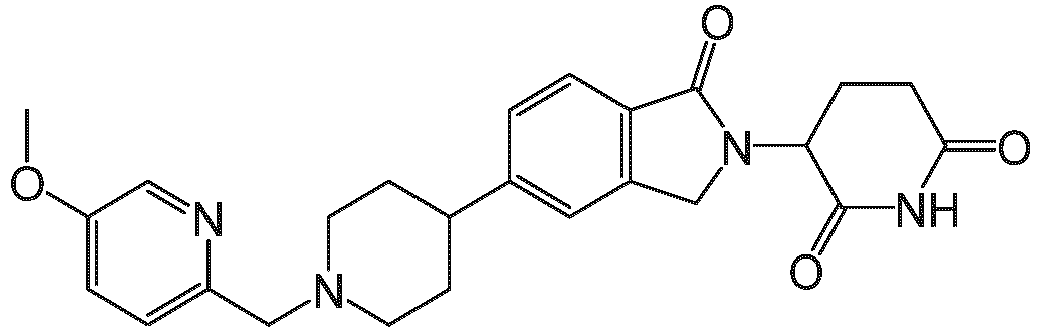
3-(5-(1-((5-methoxypyridin-2-yl)methyl)piperidin-4-yl)-1-oxoisoindolin-2-yl)piperidine-2,6-dione; I-7 
3-(5-(1-((6-methoxypyridin-3-yl)methyl)piperidin-4-yl)-1-oxoisoindolin-2-yl)piperidine-2,6-dione; I-8 
3-(5-(1-((6-ethoxypyridin-3-yl)methyl)piperidin-4-yl)-1-oxoisoindolin-2-yl)piperidine-2,6-dione; I-9 
3-(5-(1-((5-methyl-1H-imidazol-4-yl)methyl)piperidin-4-yl)-1-oxoisoindolin-2-yl)piperidine-2,6-dione; I-10 
3-(5-(1-((4-(fluoromethyl)cyclohexyl)methy 1)piperidin-4-yl)-1-oxoisoindolin-2-yl)piperidine-2,6-dione; I-11 
3-(5-(1-(2-(1H-pyrazol-1-yl)ethyl)piperidin-4-yl)-1-oxoisoindolin-2-yl)piperidine-2,6-dione; I-12 
3-(5-(1-((4-methylpyrimidin-5-yl)methyl)piperidin-4-yl)-1-oxoisoindolin-2-yl)piperidine-2,6-dione; I-13 
3-(5-(1-((4-methylcyclohex-3-en-1-yl)methyl)piperidin-4-yl)-1-oxoisoindolin-2-yl)piperidine-2,6-dione; I-14 
3-(1-oxo-5-(1-(pyrazin-2-ylmethyl)piperidin-4-yl)isoindolin-2-yl)piperidine-2,6-dione; I-15 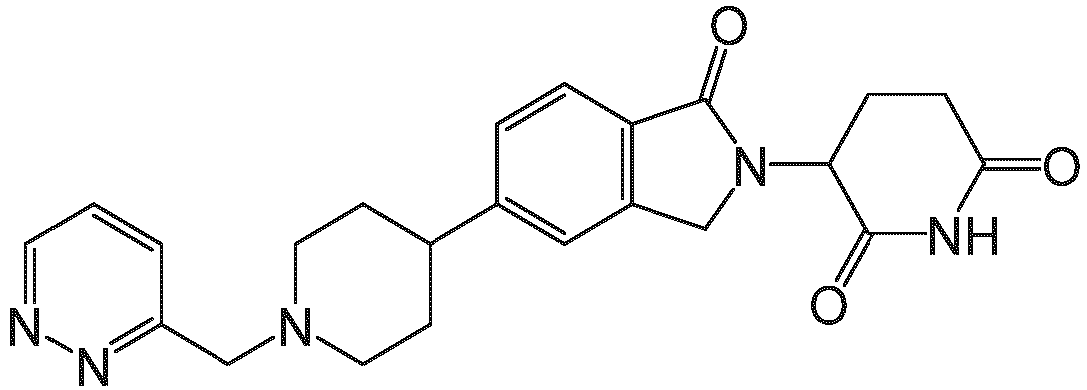
3-(1-oxo-5-(1-(pyridazin-3-ylmethyl)piperidin-4-yl)isoindolin-2-yl)piperidine-2,6-dione; I-16 
3-(1-oxo-5-(1-(pyrimidin-4-ylmethyl)piperidin-4-yl)isoindolin-2-yl)piperidine-2,6-dione; I-17 
3-(5-(1-((2-methylpyrimidin-5-yl)methyl)piperidin-4-yl)-1-oxoisoindolin-2-yl)piperidine-2,6-dione; I-18 
3-(1-oxo-5-(1-(pyridazin-4-ylmethyl)piperidin-4-yl)isoindolin-2-yl)piperidine-2,6-dione; I-19 
3-(5-(1-benzyl-4-hydroxypiperidin-4-yl)-1-oxoisoindolin-2-yl)piperidine-2,6-dione; I-20 
3-(5-(1-benzyl-4-methoxypiperidin-4-yl)-1-oxoisoindolin-2-yl)piperidine-2,6-dione; I-21 
3-(5-(1-benzyl-4-fluoropiperidin-4-yl)-1-oxoisoindolin-2-yl)piperidine-2,6-dione; I-22 
1-benzyl-4-(2-(2,6-dioxopiperidin-3-yl)-1-oxoisoindolin-5-yl)piperidine-4-carbonitrile; I-23 
3-(5-(4-amino-1-benzylpiperidin-4-yl)-1-oxoisoindolin-2-yl)piperidine-2,6-dione; I-24 
3-(5-((1R,4S)-2-benzyl-2-azabicyclo[2.2.2]octan-5-yl)-1-oxoisoindolin-2-yl)piperidine-2,6-dione; 1-25 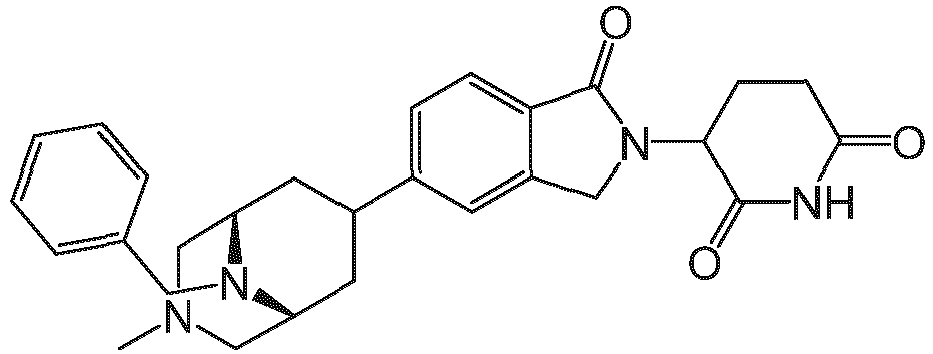
3-(5-((1R,5S)-9-benzyl-3-methyl-3,9-diazabicyclo[3.3.1]nonan-7-yl)-1-oxoisoindolin-2-yl)piperidine-2,6-dione; I-26 
3-(5-((1R,5S)-9-benzyl-3-oxa-9-azabicyclo[3.3.1]nonan-7-yl)-1-oxoisoindolin-2-yl)piperidine-2,6-dione I-27 
3-(5-((1R,5S)-9-benzyl-3,9-diazabicyclo[3.3.1]nonan-7-yl)-1-oxoisoindolin-2-yl)piperidine-2,6-dione; I-28 
3-(5-((1S,4S)-2-benzyl-2-azabicyclo[2.2.1]heptan-5-yl)-1-oxoisoindolin-2-yl)piperidine-2,6-dione; I-29 
3-(5-((1R,5S)-9-ethyl-3-methyl-3,9-diazabicyclo[3.3.1]nonan-7-yl)-1-oxoisoindolin-2-yl)piperidine-2,6-dione; I-30 
3-(1-oxo-5-(1-(1-(tetrahydro-2H-pyran-4-yl)ethyl)piperidin-4-yl)isoindolin-2-yl)piperidine-2,6-dione; I-31 
3-(5-(1-(1-(1-ethyl-1H-pyrazol-4-yl)ethyl)piperidin-4-yl)-1-oxoisoindolin-2-yl)piperidine-2,6-dione; I-32 
3-(5-(1-(1-(1-ethyl-1H-pyrazol-4-yl)propyl)piperidin-4-yl)-1-oxoisoindolin-2-yl)piperidine-2,6-dione; I-33 
3-(1-oxo-5-(1-(1-(pyrazin-2-yl)propyl)piperidin-4-yl)isoindolin-2-yl)piperidine-2,6-dione; I-34 
3-(1-oxo-5-(1-(1-(pyridazin-4-yl)propyl)piperidin-4-yl)isoindolin-2-yl)piperidine-2,6-dione; I-35 
3-(5-(1-(6,7-dihydro-5H-cyclopenta[b]pyridin-5-yl)piperidin-4-yl)-1-oxoisoindolin-2-yl)piperidine-2,6-dione; I-36 
3-(5-(1-(4-methoxycyclohexyl)piperidin-4-yl)-1-oxoisoindolin-2-yl)piperidine-2,6-dione; I-37 
3-(1-oxo-5-(1-(2-(pyridin-4-yl)propan-2-yl)piperidin-4-yl)isoindolin-2-yl)piperidine-2,6-dione; I-38 
3-(1-oxo-5-(1-((2-oxo-1,2-dihydropyridin-3-yl)methyl)piperidin-4-yl)isoindolin-2-yl)piperidine-2,6-dione; I-39 
3-(5-(3-benzyl-3-azabicyclo[4.1.0]heptan-6-yl)-1-oxoisoindolin-2-yl)piperidine-2,6-dione; I-40 
3-(5-(3-(((1r,4r)-4-methoxycyclohexyl)methyl)-3-azabicyclo[4.1.0]heptan-6-yl)-1-oxoisoindolin-2-yl)piperidine-2,6-dione; I-41 
3-(5-(4-fluoro-1-(((1r,4r)-4-methoxycyclohexyl)methyl)pipe ridin-4-yl)-1-oxoisoindolin-2-yl)piperidine-2,6-dione; I-42 
3-(5-(4-hydroxy-1-(((1r,4r)-4-methoxycyclohexyl)methyl)pipe ridin-4-yl)-1-oxoisoindolin-2-yl)piperidine-2,6-dione; I-43 
3-(5-(4-methoxy-1-(((1r,4r)-4-methoxycyclohexyl)methyl)pipe ridin-4-yl)-1-oxoisoindolin-2-yl)piperidine-2,6-dione; I-44 
3-(5-(4-amino-1-(((1r,4r)-4-methoxycyclohexyl)methyl)pipe ridin-4-yl)-1-oxoisoindolin-2-yl)piperidine-2,6-dione; and I-45 
4-(2-(2,6-dioxopiperidin-3-yl)-1-oxoisoindolin-5-yl)-1-(((1r,4r)-4-methoxycyclohexyl)methyl)pipe ridine-4-carbonitrile. - In another embodiment of the invention, the compounds of the present invention are enantiomers. In some embodiments the compounds are the (S)-enantiomer. In other embodiments the compounds are the (R)-enantiomer. In yet other embodiments, the compounds of the present invention may be (+) or (-) enantiomers.
- It should be understood that all isomeric forms are included within the present invention, including mixtures thereof. If the compound contains a double bond, the substituent may be in the E or Z configuration. If the compound contains a disubstituted cycloalkyl, the cycloalkyl substituent may have a cis- or trans configuration. All tautomeric forms are also intended to be included.
- Compounds of the invention, and pharmaceutically acceptable salts, hydrates, solvates, and stereoisomers, thereof may exist in their tautomeric form (for example, as an amide or imino ether). All such tautomeric forms are contemplated herein as part of the present invention.
- The compounds of the invention may contain asymmetric or chiral centers and, therefore, exist in different stereoisomeric forms. It is intended that all stereoisomeric forms of the compounds of the invention as well as mixtures thereof, including racemic mixtures, form part of the present invention. In addition, the present invention embraces all geometric and positional isomers. For example, if a compound of the invention incorporates a double bond or a fused ring, both the cis- and trans-forms, as well as mixtures, are embraced within the scope of the invention. Each compound herein disclosed includes all the enantiomers that conform to the general structure of the compound. The compounds may be in a racemic or enantiomerically pure form, or any other form in terms of stereochemistry. The assay results may reflect the data collected for the racemic form, the enantiomerically pure form, or any other form in terms of stereochemistry.
- Diastereomeric mixtures can be separated into their individual diastereomers on the basis of their physical chemical differences by methods well known to those skilled in the art, such as, for example, by chromatography and/or fractional crystallization. Enantiomers can be separated by converting the enantiomeric mixture into a diastereomeric mixture by reaction with an appropriate optically active compound (e.g., chiral auxiliary such as a chiral alcohol or Mosher's acid chloride), separating the diastereomers and converting (e.g., hydrolyzing) the individual diastereomers to the corresponding pure enantiomers. Also, some of the compounds of the invention may be atropisomers (e.g., substituted biaryls) and are considered as part of this invention. Enantiomers can also be separated by use of a chiral HPLC column.
- It is also possible that the compounds of the invention may exist in different tautomeric forms, and all such forms are embraced within the scope of the invention and chemical structures and names. Also, for example, all keto-enol and imine-enamine forms of the compounds are included in the invention.
- All stereoisomers (for example, geometric isomers, optical isomers, and the like) of the present compounds (including those of the salts, and solvates, of the compounds), such as those which may exist due to asymmetric carbons on various substituents, including enantiomeric forms (which may exist even in the absence of asymmetric carbons), rotameric forms, atropisomers, and diastereomeric forms, are contemplated within the scope of this invention, as are positional isomers (such as, for example, 4-pyridyl and 3-pyridyl). (For example, if a compound of Formula (I) or a compound of Embodiment 17 incorporates a double bond or a fused ring, both the cis- and trans-forms, as well as mixtures, are embraced within the scope of the invention. Also, for example, all keto-enol and imine-enamine forms of the compounds are included in the invention.) Individual stereoisomers of the compounds of the invention may, for example, be substantially free of other isomers, or is admixed, for example, as racemates or with all other, or other selected, stereoisomers.
- The chiral centers of the compounds of the invention can have the S or R configuration as defined by the IUPAC 1974 Recommendations. In certain embodiments, each asymmetric atom has at least 50% enantiomeric excess, at least 60% enantiomeric excess, at least 70% enantiomeric excess, at least 80% enantiomeric excess, at least 90% enantiomeric excess, at least 95% enantiomeric excess, or at least 99% enantiomeric excess in the (R)- or (S)- configuration. Substituents at atoms with unsaturated double bonds may, if possible, be present in cis-(Z)- or trans-(E)- form.
- The use of the terms "salt", "solvate", and the like, is intended to equally apply to the salt, and solvate, of enantiomers, stereoisomers, rotamers, tautomers, positional isomers, racemates, of the inventive compounds.
- The compounds of the invention may form salts which are also within the scope of this invention. Reference to a compound of the Formula herein is generally understood to include reference to salts thereof, unless otherwise indicated.
- The compounds and intermediates may be isolated and used as the compound per se. Any formula given herein is also intended to represent unlabeled forms as well as isotopically labeled forms of the compounds. Isotopically labeled compounds have structures depicted by the formulas given herein except that one or more atoms are replaced by an atom having a selected atomic mass or mass number. Examples of isotopes that can be incorporated into compounds of the invention include isotopes of hydrogen, carbon, nitrogen, oxygen, phosphorous, fluorine, and, such as 2H, 3H, 11C, 13C, 14C, 15N, 18F, 31P, 32P, respectively. The invention includes various isotopically labeled compounds as defined herein, for example those into which radioactive isotopes, such as 3H, 13C, and 14C, are present. Such isotopically labelled compounds are useful in metabolic studies (with 14C), reaction kinetic studies (with, for example 2H or 3H), detection or imaging techniques, such as positron emission tomography (PET) or single-photon emission computed tomography (SPECT) including drug or substrate tissue distribution assays, or in radioactive treatment of patients. In particular, an 18F, 11C or labeled compound may be particularly desirable for PET or SPECT studies.
- Further, substitution with heavier isotopes, particularly deuterium (i.e., 2H or D) may afford certain therapeutic advantages resulting from greater metabolic stability, for example, increased in vivo half-life, reduced dosage requirements, reduced CYP450 inhibition (competitive or time dependent) or an improvement in therapeutic index. For example, substitution with deuterium may modulate undesirable side effects of the undeuterated compound, such as competitive CYP450 inhibition, time dependent CYP450 inactivation, etc. It is understood that deuterium in this context is regarded as a substituent in compounds of the present invention. The concentration of such a heavier isotope, specifically deuterium, may be defined by the isotopic enrichment factor. The term "isotopic enrichment factor" as used herein means the ratio between the isotopic abundance and the natural abundance of a specified isotope. If a substituent in a compound of this invention is denoted deuterium, such compound has an isotopic enrichment factor for each designated deuterium atom of at least 3500 (52.5% deuterium incorporation at each designated deuterium atom), at least 4000 (60% deuterium incorporation), at least 4500 (67.5% deuterium incorporation), at least 5000 (75% deuterium incorporation), at least 5500 (82.5% deuterium incorporation), at least 6000 (90% deuterium incorporation), at least 6333.3 (95% deuterium incorporation), at least 6466.7 (97% deuterium incorporation), at least 6600 (99% deuterium incorporation), or at least 6633.3 (99.5% deuterium incorporation).
- Isotopically-labeled compounds of the present invention can generally be prepared by conventional techniques known to those skilled in the art or by carrying out the procedures disclosed in the schemes or in the examples and preparations described below using an appropriate isotopically-labeled reagent in place of the non-isotopically labeled reagent.
- Pharmaceutically acceptable solvates in accordance with the invention include those wherein the solvent of crystallization may be isotopically substituted, e.g., D2O, d6-acetone, d6-DMSO.
- The present invention relates to compounds which are modulators of IKZF2 protein levels. In one embodiment, the compounds of the present invention decrease IKZF2 protein levels. In yet one embodiment, the compounds of the present invention reduce IKZF2 protein levels. In another embodiment, the compounds of the present invention are degraders of IKZF2.
- The present invention relates to compounds, which are modulators of IKZF2 and IKZF4 protein levels. In one embodiment, the compounds of the present invention decrease IKZF2 and IKZF4 protein levels. In yet one embodiment, the compounds of the present invention reduce IKZF2 and IKZF4 protein levels. In another embodiment, the compounds of the present invention are degraders of IKZF2.
- In some embodiments, the compounds of the invention are selective over other proteins. As used herein "selective modulator", "selective degrader", or "selective compound" means, for example, a compound of the invention, that effectively modulates, decreases, or reduces the levels of a specific protein or degrades a specific protein to a greater extent than any other protein. A "selective modulator", "selective degrader", or "selective compound" can be identified, for example, by comparing the ability of a compound to modulate, decrease, or reduce the levels of or to degrade a specific protein to its ability to modulate, decrease, or reduce the levels of or to degrade other proteins. In some embodiments, the selectivity can be identified by measuring the AC50, EC50, or IC50 of the compounds.
- In some embodiments, the compounds of the present application are selective IKZF2 modulators. As used herein "selective IKZF2 modulator", "selective IKZF2 degrader", or "selective IKZF2 compound" refers to a compound of the application, for example, that effectively modulates, decrease, or reduces the levels of IKZF2 protein or degrades IKZF2 protein to a greater extent than any other protein, particularly any protein (transcription factor) from the Ikaros protein family (e.g., IKZF1, IKZF3, IKZF4, and IKZF5).
- A "selective IKZF2 modulator", "selective IKZF2 degrader", or "selective IKZF2 compound" can be identified, for example, by comparing the ability of a compound to modulate IKZF2 protein levels to its ability to modulate levels of other members of the Ikaros protein family or other proteins. For example, a substance may be assayed for its ability to modulate IKZF2 protein levels, as well as IKZF1, IKZF3, IKZF4, IKZF5, and other proteins. In some embodiments, the selectivity can be identified by measuring the EC50 of the compounds. In some embodiments, the selectivity can be identified by measuring the AC50 of the compounds. In some embodiments, a selective IKZF2 degrader is identified by comparing the ability of a compound to degrade IKZF2 to its ability to degrade other members of the Ikaros protein family or other proteins.
- In certain embodiments, the compounds of the application are IKZF2 degraders that exhibit at least 2-fold, 3-fold, 5-fold, 10-fold, 25-fold, 50-fold or 100-fold selectivity for the degradation of IKZF2 over other proteins (e.g., IKZF1, IKZF3, IKZF4, and IKZF5). In various embodiments, the compounds of the application exhibit up to 1000-fold selectivity for the degradation of IKZF2 over other proteins.
- In certain embodiments, the compounds of the application exhibit at least 2-fold, 3-fold, 5-fold, 10-fold, 25-fold, 50-fold or 100-fold selectivity for the degradation of IKZF2 over the other members of the Ikaros protein family (e.g., IKZF1, IKZF3, IKZF4, and IKZF5). In various embodiments, the compounds of the application exhibit up to 1000-fold selectivity for the degradation of IKZF2 over the other members of the Ikaros protein family (e.g., IKZF1, IKZF3, IKZF4, and IKZF5).
- In certain embodiments, the compounds of the application exhibit at least 2-fold, 3-fold, 5-fold, 10-fold, 25-fold, 50-fold or 100-fold selectivity for the degradation of IKZF2 over IKZF1. In various embodiments, the compounds of the application exhibit up to 1000-fold selectivity for the degradation of IKZF2 over IKZF1.
- In certain embodiments, the compounds of the application exhibit at least 2-fold, 3-fold, 5-fold, 10-fold, 25-fold, 50-fold or 100-fold selectivity for the degradation of IKZF2 over IKZF3. In various embodiments, the compounds of the application exhibit up to 1000-fold selectivity for the degradation of IKZF2 over IKZF3.
- In certain embodiments, the compounds of the application exhibit at least 2-fold, 3-fold, 5-fold, 10-fold, 25-fold, 50-fold or 100-fold selectivity for the degradation of IKZF2 over IKZF4. In various embodiments, the compounds of the application exhibit up to 1000-fold selectivity for the degradation of IKZF2 over IKZF4.
- In certain embodiments, the compounds of the application exhibit at least 2-fold, 3-fold, 5-fold, 10-fold, 25-fold, 50-fold or 100-fold selectivity for the degradation of IKZF2 over IKZF5. In various embodiments, the compounds of the application exhibit up to 1000-fold selectivity for the degradation of IKZF2 over IKZF5.
- In certain embodiments, the compounds of the application exhibit at least 2-fold, 3-fold, 5-fold, 10-fold, 25-fold, 50-fold or 100-fold selectivity for the degradation of IKZF2 and IKZF4 over the other members of the Ikaros protein family (e.g., IKZF1, IKZF3, and IKZF5). In various embodiments, the compounds of the application exhibit up to 1000-fold selectivity for the degradation of IKZF2 and IKZF4 over the other members of the Ikaros protein family (e.g., IKZF1, IKZF3, and IKZF5).
- In certain embodiments, the compounds of the application exhibit at least 2-fold, 3-fold, 5-fold, 10-fold, 25-fold, 50-fold or 100-fold selectivity for the degradation of IKZF2 and IKZF4 over IKZF1. In various embodiments, the compounds of the application exhibit up to 1000-fold selectivity for the degradation of IKZF2 and IKZF4 over IKZF1.
- In certain embodiments, the compounds of the application exhibit at least 2-fold, 3-fold, 5-fold, 10-fold, 25-fold, 50-fold or 100-fold selectivity for the degradation of IKZF2 and IKZF4 over IKZF3. In various embodiments, the compounds of the application exhibit up to 1000-fold selectivity for the degradation of IKZF2 and IKZF4 over IKZF3.
- In certain embodiments, the compounds of the application exhibit at least 2-fold, 3-fold, 5-fold, 10-fold, 25-fold, 50-fold or 100-fold selectivity for the degradation of IKZF2 and IKZF4 over IKZF5. In various embodiments, the compounds of the application exhibit up to 1000-fold selectivity for the degradation of IKZF2 and IKZF4 over IKZF5.
- In some embodiments, the degradation of IKZF2 is measured by AC50.
- Potency of can be determined by AC50 value. A compound with a lower AC50 value, as determined under substantially similar degradation conditions, is a more potent degrader relative to a compound with a higher AC50 value. In some embodiments, the substantially similar conditions comprise determining degradation of protein levels in cells expressing the specific protein, or a fragment of any thereof.
- The invention is directed to compounds as described herein and pharmaceutically acceptable salts, hydrates, solvates, stereoisomers, or tautomers thereof, and pharmaceutical compositions comprising one or more compounds as described herein, or pharmaceutically acceptable salts, hydrates, solvates, stereoisomers, or tautomers thereof.
- The compounds of the present invention may be made by a variety of methods, including standard chemistry. Suitable synthetic routes are depicted in the Schemes given below.
- The compounds of the present invention may be prepared by methods known in the art of organic synthesis as set forth in part by the following synthetic schemes. In the schemes described below, it is well understood that protecting groups for sensitive or reactive groups are employed where necessary in accordance with general principles or chemistry. Protecting groups are manipulated according to standard methods of organic synthesis (T.W. Greene and P.G.M. Wuts, "Protective Groups in Organic Synthesis", Third edition, Wiley, New York 1999). These groups are removed at a convenient stage of the compound synthesis using methods that are readily apparent to those skilled in the art. The selection processes, as well as the reaction conditions and order of their execution, shall be consistent with the preparation of Compounds of Formula (I) or compounds (I-1), (I-2), (I-3), (I-4), (I-5), (I-6), (I-7), (I-8), (I-9), (I-10), (I-11), (I-12), (I-13), (I-14), (I-15), (I-16), (I-17), (I-18), (I-24), (I-25), (I-26), (I-27), (I-28), (I-29), (I-30), (I-31), (I-32), (I-33), (I-34), (I-34), (I-36), (I-37), and (I-38). Those skilled in the art will recognize if a stereocenter exists in the compounds of the present invention. Accordingly, the present invention includes both possible stereoisomers (unless specified in the synthesis) and includes not only racemic compounds but the individual enantiomers and/or diastereomers as well. When a compound is desired as a single enantiomer or diastereomer, it may be obtained by stereospecific synthesis or by resolution of the final product or any convenient intermediate. Resolution of the final product, an intermediate, or a starting material may be affected by any suitable method known in the art. See, for example, "Stereochemistry of Organic Compounds" by E.L. Eliel, S.H. Wilen, and L.N. Mander (Wiley-Interscience, 1994).
- The compounds described herein may be made from commercially available starting materials or synthesized using known organic, inorganic, and/or enzymatic processes.
- The compounds of the present invention can be prepared in a number of ways well known to those skilled in the art of organic synthesis. By way of example, compounds of the present invention can be synthesized using the methods described below, together with synthetic methods known in the art of synthetic organic chemistry, or variations thereon as appreciated by those skilled in the art. Preferred methods include but are not limited to those methods described below.
- Compounds of the present invention can be synthesized by following the steps outlined in General Schemes I to IV which comprise different sequences of assembling intermediates 1-a to 1-g, 2-a, 2-b, 2-c, 3-a, 4-a, and 4-b. Starting materials are either commercially available or made by known procedures in the reported literature or as illustrated.
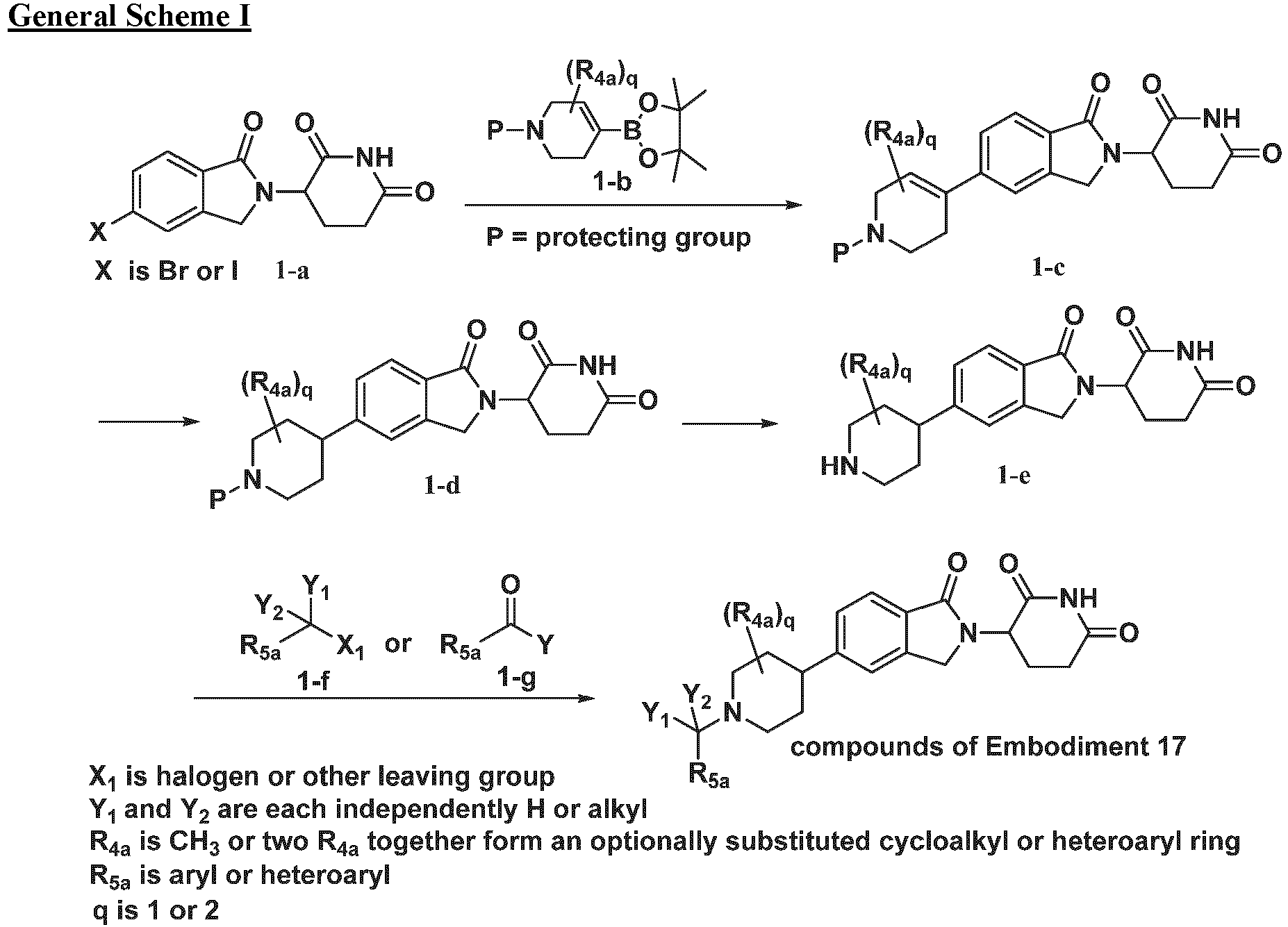
- The general way of preparing compounds of Embodiment 17 (e.g., (I-1)-(I-18) and( (I-24)-(I-38)), by using intermediates 1-a, 1-b, 1-c, 1-d, 1-e, 1-f, and 1-g is outlined in General Scheme I. Coupling of 1-a with boronic ester 1-b using a catalyst (e.g., Pd(dppf)Cl2•DCM), and a base (e.g., cesium carbonate (Cs2CO3)), in a solvent (e.g., N,N-dimethylformamide (DMF)) at elevated temperature yields 1-c. Hydrogenation of 1-c in the presence of a suitable catalyst (e.g., Pd/C or PtO2) in a solvent (e.g., DMF) and under an atmosphere of hydrogen gas provides 1-d. Removal of the amine protecting group (e.g., tert-butyloxycarbonyl (Boc)) on intermediate 1-d can be accomplished using a strong acid such as trifluoroacetic acid (TFA) or hydrochloric acid (HCl) in a solvent (e.g., tetrahydrofuran (THF), 1,2-dichloroethane, dioxane or dichloromethane (DCM)) optionally at elevated temperature to provide I-e. Reductive amination of 1-e with aldehyde or ketone 1-g provides the desired product. Alternatively, compounds of Embodiment 17 where X1 is CH and R2 is a substituted alkyl can be obtained by alkylation of I-e with an alkyl halide 1-f in the presence of a base (e.g., triethyl amine (TEA), cesium carbonate (Cs2CO3), etc.), in a solvent (e.g., DCM, DMF, etc.), and optionally at elevated temperature.

- The general way of preparing compounds of Formula (I) wherein R1 is OH by using intermediates 2-a, 2-b, and 2-c is outlined in General Scheme II. Alkylation of ketone 2-a with 2-b in the presence of a strong base (e.g., n-butyl lithium (n-BuLi), tert-butyl lithium (t-BuLi), sec-butyl lithium (s-BuLi)) in a solvent (e.g., tetrahydrofuran (THF), diethyl ether (Et2O)), optionally at cold temperatures provides 2-c. Removal of the glutarimide protecting group (e.g., para-methoxybenzyl (PMB) or [2-(Trimethylsilyl)ethoxy]methyl acetal (SEM)) can be accomplished in the presence of strong acid (e.g., HCl or TFA) optionally in a solvent (e.g., THF, 1,2-dichloroethane, dioxane, or dichloromethane (DCM)) and optionally followed by treatment with a base (e.g., TEA) in a solvent and in the presence of N1,N2-dimethylethane-1,2-diamine (when P1 is SEM) provides the desired compound of Formula (I) wherein R1 is OH.

- The general way of preparing compounds of Formula (I) wherein R1 is F, CN or OMe by using intermediates 2-c and 3-a is outlined in General Scheme III. Treatment of 2-c with a fluorinating agent (e.g., diethylaminosulfur trifluoride (DAST)) in a solvent (e.g., DCM) optionally at cold temperatures followed by removal of the glutarimide protecting group as described above for General Scheme II provides the desired compound of Formula (I) wherein R1 is F. Alternatively, treatment of 2-c with trimethylsilyl cyanide (TMSCN) and a Lewis Acid (e.g., zinc(II) iodide (ZnI2), scandium(III) triflate (Sc(OTf)3), tin(IV) chloride (SnCl4), indium(III) chloride (InCl3), or titanium montmorillonite) in a solvent (e.g., DCM) optionally at cold temperatures followed by removal of the glutarimide protecting group as described above for General Scheme II provides the desired compound of Formula (I) wherein R1 is CN. Furthermore, compounds of Formula (I) wherein R1 is OMe can be obtained by the treatment of 2-c with a methylating agent (e.g., diazomethane (CH2N2), trimethyloxonium tetrafluoroborate ([Me3O]+[BF4]-, methyl triflate (MeOTf)) in a solvent (e.g., DCM, MeCN, THF) optionally in the presence of base (N,N-diisopropylethylamine (i-Pr2NEt), sodium hydride (NaH)) and optionally at cold temperatures followed by removal of the glutarimide protecting group.

- The general way of preparing compounds of Formula (I) wherein R1 is NH2 by using intermediates 4-a, 2-b, and 4-b is outlined in General Scheme IV. Alkylation of ketone 4-a with 2-b in the presence of a strong base (e.g., n-butyl lithium (n-BuLi), tert-butyl lithium (t-BuLi), sec-butyl lithium (s-BuLi)) in a solvent (e.g., tetrahydrofuran (THF), diethyl ether (Et2O)), optionally at cold temperatures provides 4-b. Removal of the glutarimide protecting group (e.g., para-methoxybenzyl (PMB) or [2-(Trimethylsilyl)ethoxy]methyl acetal (SEM)) can be accomplished in the presence of strong acid (e.g., HCl or TFA) optionally in a solvent (e.g., THF, 1,2-dichloroethane, dioxane or dichloromethane (DCM)) and optionally followed by treatment with a base (e.g., TEA) in a solvent and in the presence of N1,N2-dimethylethane-1,2-diamine (when P1 is SEM) provides the desired compound of Formula (I) wherein R1 is NH2.
- A mixture of enantiomers, diastereomers, and cis/trans isomers resulting from the process described above can be separated into their single components by chiral salt technique, chromatography using normal phase, reverse phase or chiral column, depending on the nature of the separation.
- Any resulting racemates of compounds of the present invention or of intermediates can be resolved into the optical antipodes by known methods, e.g., by separation of the diastereomeric salts thereof, obtained with an optically active acid or base, and liberating the optically active acidic or basic compound. In particular, a basic moiety may thus be employed to resolve the compounds of the present invention into their optical antipodes, e.g., by fractional crystallization of a salt formed with an optically active acid, e.g., tartaric acid, dibenzoyl tartaric acid, diacetyl tartaric acid, di-O,O'-p-toluoyl tartaric acid, mandelic acid, malic acid, or camphor-10-sulfonic acid. Racemic compounds of the present invention or racemic intermediates can also be resolved by chiral chromatography, e.g., high pressure liquid chromatography (HPLC) using a chiral adsorbent.
- Any resulting mixtures of stereoisomers can be separated on the basis of the physicochemical differences of the constituents, into the pure or substantially pure geometric or optical isomers, diastereomers, racemates, for example, by chromatography and/or fractional crystallization.
- It should be understood that in the description and formula shown above, the various groups Rx, R2, R3 and n and other variables are as defined above, except where otherwise indicated. Furthermore, for synthetic purposes, the compounds of General Schemes I to IV are merely representative with elected radicals to illustrate the general synthetic methodology of the Compounds of Formula (I) as defined herein.
- In another aspect, the present invention relates to a compound of Formula (I), or a pharmaceutically acceptable salt, hydrate, solvate, stereoisomer, or tautomer thereof, or a composition comprising a compound of Formula (I), or a compound of formula (I-1), (I-2), (I-3), (I-4), (I-5), (I-6), (I-7), (I-8), (I-9), (I-10), (I-11), (I-12), (I-13), (I-14), (I-15), (I-16), (I-17), (I-18), (I-24), (I-25), (I-26), (I-27), (I-28), (I-29), (I-30), (I-31), (I-32), (I-33), (I-34), (I-34), (I-36), (I-37), or (I-38), or a pharmaceutically acceptable salt, hydrate, solvate, stereoisomer, or tautomer thereof, for use in the treatment of cancer.
- In another aspect, the present invention relates to a compound of Formula (I), or a pharmaceutically acceptable salt, hydrate, solvate, stereoisomer, or tautomer thereof, or a composition comprising a compound of Formula (I), or a compound of formula (I-1), (I-2), (I-3), (I-4), (I-5), (I-6), (I-7), (I-8), (I-9), (I-10), (I-11), (I-12), (I-13), (I-14), (I-15), (I-16), (I-17), (I-18), (I-24), (I-25), (I-26), (I-27), (I-28), (I-29), (I-30), (I-31), (I-32), (I-33), (I-34), (I-34), (I-36), (I-37), or (I-38), for use in the treatment of an IKZF2-dependent cancer.
- Another aspect of the invention relates to a compound of Formula (I), or a pharmaceutically acceptable salt, hydrate, solvate, stereoisomer, or tautomer thereof, or a composition comprising a compound of Formula (I), or a compound of formula (I-1), (I-2), (I-3), (I-4), (I-5), (I-6), (I-7), (I-8), (I-9), (I-10), (I-11), (I-12), (I-13), (I-14), (I-15), (I-16), (I-17), (I-18), (I-24), (I-25), (I-26), (I-27), (I-28), (I-29), (I-30), (I-31), (I-32), (I-33), (I-34), (I-34), (I-36), (I-37), or (I-38), for use in the treatment of an IKZF2-dependent disease or disorder.
- Another aspect of the invention relates to a compound of Formula (I), or a pharmaceutically acceptable salt, hydrate, solvate, stereoisomer, or tautomer thereof, or a composition comprising a compound of Formula (I), or a compound of formula (I-1), (I-2), (I-3), (I-4), (I-5), (I-6), (I-7), (I-8), (I-9), (I-10), (I-11), (I-12), (I-13), (I-14), (I-15), (I-16), (I-17), (I-18), (I-24), (I-25), (I-26), (I-27), (I-28), (I-29), (I-30), (I-31), (I-32), (I-33), (I-34), (I-34), (I-36), (I-37), or (I-38), for use in the treatment of a disease or disorder that is affected by the reduction of IKZF2 protein levels.
- The compounds of the present invention can be used for the treatment, of a disease or disorder selected from liposarcoma, neuroblastoma, glioblastoma, bladder cancer, adrenocortical cancer, multiple myeloma, colorectal cancer, non-small cell lung cancer, Human Papilloma Virus-associated cervical, oropharyngeal, penis, anal, thyroid, or vaginal cancer or Epstein-Barr Virus-associated nasopharyngeal carcinoma, gastric cancer, rectal cancer, thyroid cancer, Hodgkin lymphoma or diffuse large B-cell lymphoma. the cancer is selected from prostate cancer, breast carcinoma, lymphomas, leukaemia, myeloma, bladder carcinoma, colon cancer, cutaneous melanoma, hepatocellular carcinoma, endometrial cancer, ovarian cancer, cervical cancer, lung cancer, renal cancer, glioblastoma multiform, glioma, thyroid cancer, parathyroid tumor, nasopharyngeal cancer, tongue cancer, pancreatic cancer, esophageal cancer, cholangiocarcinoma, gastric cancer, soft tissue sarcomas, rhabdomyosarcoma (RMS), synovial sarcoma, osteosarcoma, rhabdoid cancers, cancer for which the immune response is deficient, an immunogenic cancer, and Ewing's sarcoma. In one embodiment, the IKZF2-dependent disease or disorder is a disease or disorder is selected from non-small cell lung cancer (NSCLC), melanoma, triple-negative breast cancer (TNBC), nasopharyngeal cancer (NPC), microsatellite stable colorectal cancer (mssCRC), thymoma, carcinoid, and gastrointestinal stromal tumor (GIST). In another embodiment, the cancer is selected from non-small cell lung cancer (NSCLC), melanoma, triple-negative breast cancer (TNBC), nasopharyngeal cancer (NPC), microsatellite stable colorectal cancer (mssCRC), thymoma, carcinoid, acute myelogenous leukemia, and gastrointestinal stromal tumor (GIST). In another embodiment, the IKZF2-dependent disease or disorder is a disease or disorder is selected from non-small cell lung cancer (NSCLC), melanoma, triple-negative breast cancer (TNBC), nasopharyngeal cancer (NPC), and microsatellite stable colorectal cancer (mssCRC).
- The compounds of the invention can be administered in effective amounts to treat or prevent a disorder and/or prevent the development thereof in subjects.
- Administration of the disclosed compounds can be accomplished via any mode of administration for therapeutic agents. These modes include systemic or local administration such as oral, nasal, parenteral, transdermal, subcutaneous, vaginal, buccal, rectal or topical administration modes.
- Depending on the intended mode of administration, the disclosed compositions can be in solid, semi-solid or liquid dosage form, such as, for example, injectables, tablets, suppositories, pills, time-release capsules, elixirs, tinctures, emulsions, syrups, powders, liquids, suspensions, or the like, sometimes in unit dosages and consistent with conventional pharmaceutical practices. Likewise, they can also be administered in intravenous (both bolus and infusion), intraperitoneal, subcutaneous or intramuscular form, and all using forms well known to those skilled in the pharmaceutical arts.
- Illustrative pharmaceutical compositions are tablets and gelatin capsules comprising a compound of the invention and a pharmaceutically acceptable carrier, such as a) a diluent, e.g., purified water, triglyceride oils, such as hydrogenated or partially hydrogenated vegetable oil, or mixtures thereof, com oil, olive oil, sunflower oil, safflower oil, fish oils, such as EPA or DHA, or their esters or triglycerides or mixtures thereof, omega-3 fatty acids or derivatives thereof, lactose, dextrose, sucrose, mannitol, sorbitol, cellulose, sodium, saccharin, glucose and/or glycine; b) a lubricant, e.g., silica, talcum, stearic acid, its magnesium or calcium salt, sodium oleate, sodium stearate, magnesium stearate, sodium benzoate, sodium acetate, sodium chloride, and/or polyethylene glycol; for tablets also; c) a binder, e.g., magnesium aluminum silicate, starch paste, gelatin, tragacanth, methylcellulose, sodium carboxymethylcellulose, magnesium carbonate, natural sugars such as glucose or beta-lactose, corn sweeteners, natural and synthetic gums such as acacia, tragacanth or sodium alginate, waxes, and/or polyvinylpyrrolidone, if desired; d) a disintegrant, e.g., starches, agar, methyl cellulose, bentonite, xanthan gum, algic acid or its sodium salt, or effervescent mixtures; e) absorbent, colorant, flavorant and sweetener; f) an emulsifier or dispersing agent, such as Tween 80, Labrasol, HPMC, DOSS, caproyl 909, labrafac, labrafil, peceol, transcutol, capmul MCM, capmul PG-12, captex 355, gelucire, vitamin E TGPS or other acceptable emulsifier; and/or g) an agent that enhances absorption of the compound such as cyclodextrin, hydroxypropyl-cyclodextrin, PEG400, PEG200.
- Liquid, particularly injectable, compositions can, for example, be prepared by dissolution, dispersion, etc. For example, the disclosed compound is dissolved in or mixed with a pharmaceutically acceptable solvent such as, for example, water, saline, aqueous dextrose, glycerol, ethanol, and the like, to thereby form an injectable isotonic solution or suspension. Proteins such as albumin, chylomicron particles, or serum proteins can be used to solubilize the disclosed compounds.
- The disclosed compounds can be also formulated as a suppository that can be prepared from fatty emulsions or suspensions; using polyalkylene glycols such as propylene glycol, as the carrier.
- The disclosed compounds can also be administered in the form of liposome delivery systems, such as small unilamellar vesicles, large unilamellar vesicles, and multilamellar vesicles. Liposomes can be formed from a variety of phospholipids, containing cholesterol, stearylamine or phosphatidylcholines.
- In some embodiments, a film of lipid components is hydrated with an aqueous solution of drug to a form lipid layer encapsulating the drug, as described in
U.S. Pat. No. 5,262,564 . - Disclosed compounds can also be delivered by the use of monoclonal antibodies as individual carriers to which the disclosed compounds are coupled. The disclosed compounds can also be coupled with soluble polymers as targetable drug carriers. Such polymers can include polyvinylpyrrolidone, pyran copolymer, polyhydroxypropylmethacrylamide-phenol, polyhydroxyethylaspanamidephenol, or polyethyleneoxidepolylysine substituted with palmitoyl residues. Furthermore, the disclosed compounds can be coupled to a class of biodegradable polymers useful in achieving controlled release of a drug, for example, polylactic acid, polyepsilon caprolactone, polyhydroxy butyric acid, polyorthoesters, polyacetals, polydihydropyrans, polycyanoacrylates, and cross-linked or amphipathic block copolymers of hydrogels. In one embodiment, disclosed compounds are not covalently bound to a polymer, e.g., a polycarboxylic acid polymer, or a polyacrylate.
- Parental injectable administration is generally used for subcutaneous, intramuscular or intravenous injections and infusions. Injectables can be prepared in conventional forms, either as liquid solutions or suspensions or solid forms suitable for dissolving in liquid prior to injection.
- Another aspect of the invention is directed to pharmaceutical compositions comprising a compound of Formula (I), and a pharmaceutically acceptable carrier. The pharmaceutical acceptable carrier may further include an excipient, diluent, or surfactant.
- Another aspect of the invention is directed to pharmaceutical compositions comprising a compound of (I-1), (I-2), (I-3), (I-4), (I-5), (I-6), (I-7), (I-8), (I-9), (I-10), (I-11), (I-12), (I-13), (I-14), (I-15), (I-16), (I-17), (I-18), (I-24), (I-25), (I-26), (I-27), (I-28), (I-29), (I-30), (I-31), (I-32), (I-33), (I-34), (I-34), (I-36), (I-37), or (I-38), and a pharmaceutically acceptable carrier. The pharmaceutical acceptable carrier may further include an excipient, diluent, or surfactant.
- Compositions can be prepared according to conventional mixing, granulating or coating methods, respectively, and the present pharmaceutical compositions can contain from about 0.1% to about 99%, from about 5% to about 90%, or from about 1% to about 20% of the disclosed compound by weight or volume.
- In one embodiment, the invention provides a kit comprising two or more separate pharmaceutical compositions, at least one of which contains a compound of the present invention. In one embodiment, the kit comprises means for separately retaining said compositions, such as a container, divided bottle, or divided foil packet. An example of such a kit is a blister pack, as typically used for the packaging of tablets, capsules and the like.
- The kit of the invention may be used for administering different dosage forms, for example, oral and parenteral, for administering the separate compositions at different dosage intervals, or for titrating the separate compositions against one another. To assist compliance, the kit of the invention typically comprises directions for administration.
- The dosage regimen utilizing the disclosed compound is selected in accordance with a variety of factors including type, species, age, weight, sex, and medical condition of the patient; the severity of the condition to be treated; the route of administration; the renal or hepatic function of the patient; and the particular disclosed compound employed. A physician or veterinarian of ordinary skill in the art can readily determine and prescribe the effective amount of the drug required to prevent, counter or arrest the progress of the condition.
- Effective dosage amounts of the disclosed compounds, when used for the indicated effects, range from about 0.5 mg to about 5000 mg of the disclosed compound as needed to treat the condition. Compositions for in vivo or in vitro use can contain about 0.5, 5, 20, 50, 75, 100, 150, 250, 500, 750, 1000, 1250, 2500, 3500, or 5000 mg of the disclosed compound, or, in a range of from one amount to another amount in the list of doses. In one embodiment, the compositions are in the form of a tablet that can be scored.
- The compounds of the invention can be administered in therapeutically effective amounts in a combinational therapy with one or more therapeutic agents (pharmaceutical combinations) or modalities, e.g., non-drug therapies. For example, synergistic effects can occur with other cancer agents. Where the compounds of the application are administered in conjunction with other therapies, dosages of the co-administered compounds will of course vary depending on the type of co-drug employed, on the specific drug employed, on the condition being treated and so forth.
- The compounds can be administered simultaneously (as a single preparation or separate preparation), sequentially, separately, or over a period of time to the other drug therapy or treatment modality. In general, a combination therapy envisions administration of two or more drugs during a single cycle or course of therapy. A therapeutic agent is, for example, a chemical compound, peptide, antibody, antibody fragment or nucleic acid, which is therapeutically active or enhances the therapeutic activity when administered to a patient in combination with a compound of the present invention.
- In one aspect, a compound of formula (I), or (I-1), (I-2), (I-3), (I-4), (I-5), (I-6), (I-7), (I-8), (I-9), (I-10), (I-11), (I-12), (I-13), (I-14), (I-15), (I-16), (I-17), (I-18), (I-24), (I-25), (I-26), (I-27), (I-28), (I-29), (I-30), (I-31), (I-32), (I-33), (I-34), (I-34), (I-36), (I-37), or (I-38), or a pharmaceutically acceptable salt, hydrate, solvate, stereoisomer, or tautomer thereof, can be combined with other therapeutic agents, such as other anti-cancer agents, anti-allergic agents, anti-nausea agents (or anti-emetics), pain relievers, cytoprotective agents, and combinations thereof.
- In some embodiments, the compounds of the invention, or a pharmaceutically acceptable salt, hydrate, solvate, stereoisomer, or tautomer thereof of the present invention are administered in combination with one or more second agent(s) selected from a PD-1 inhibitor, a PD-L1 inhibitor, a LAG-3 inhibitor, a cytokine, an A2A antagonist, a GITR agonist, a TIM-3 inhibitor, a STING agonist, and a TLR7 agonist, to treat a disease, e.g., cancer.
- In other embodiments, the compounds of the invention, or a pharmaceutically acceptable salt, hydrate, solvate, stereoisomer, or tautomer thereof, are used in combination with one or more other anti-HER2 antibodies, e.g., trastuzumab, pertuzumab, margetuximab, or HT-19 described above, or with other anti-HER2 conjugates, e.g., ado-trastuzumab emtansine (also known as Kadcyla®, or T-DM1).
- In other embodiments, the compounds of the invention, or a pharmaceutically acceptable salt, hydrate, solvate, stereoisomer, or tautomer thereof, are used in combination with one or more tyrosine kinase inhibitors, including but not limited to, EGFR inhibitors, Her3 inhibitors, IGFR inhibitors, and Met inhibitors, for treating a disease, e.g., cancer.
- In another embodiment, the compounds of the invention are used in combination with one or more proliferation signaling pathway inhibitors, including but not limited to, MEK inhibitors, BRAF inhibitors, PI3K/Akt inhibitors, SHP2 inhibitors, and also mTOR inhibitors, and CDK inhibitors, for treating a disease, e.g., cancer.
- In yet another embodiment, the compounds of the invention, or a pharmaceutically acceptable salt, hydrate, solvate, stereoisomer, or tautomer thereof, are used in combination with one or more pro-apoptotics, including but not limited to, IAP inhibitors, BCL2 inhibitors, MCL1 inhibitors, TRAIL agents, CHK inhibitors, for treating a disease, e.g., cancer.
- In a further embodiment, the compounds of the invention, or a pharmaceutically acceptable salt, hydrate, solvate, stereoisomer, or tautomer thereof, are used in combination with one or more immunomodulators (e.g., one or more of an activator of a costimulatory molecule or an inhibitor of an immune checkpoint molecule), for treating a disease, e.g., cancer..
- In one embodiment, the combination disclosed herein is suitable for the treatment of cancer in vivo. For example, the combination can be used to inhibit the growth of cancerous tumors. The combination can also be used in combination with one or more of: a standard of care treatment (e.g., for cancers or infectious disorders), a vaccine (e.g., a therapeutic cancer vaccine), a cell therapy, a radiation therapy, surgery, or any other therapeutic agent or modality, to treat a disorder herein. For example, to achieve antigen-specific enhancement of immunity, the combination can be administered together with an antigen of interest.
- The invention is further illustrated by the following examples and synthesis schemes, which are not to be construed as limiting this invention in scope to the specific procedures herein described. It is to be understood that the examples are provided to illustrate certain embodiments and that no limitation to the scope of the invention is intended thereby.
- Compounds of the present invention may be prepared by methods known in the art of organic synthesis. In all of the methods it is understood that protecting groups for sensitive or reactive groups may be employed where necessary in accordance with general principles of chemistry. Protecting groups are manipulated according to standard methods of organic synthesis (T.W. Green and P.G.M. Wuts (1999) Protective Groups in Organic Synthesis, 3rd edition, John Wiley & Sons). These groups are removed at a convenient stage of the compound synthesis using methods that are readily apparent to those skilled in the art.
- Unless otherwise noted, reagents and solvents were used as received from commercial suppliers. Proton nuclear magnetic resonance (NMR) spectra were obtained on either Bruker Avance spectrometer or Varian Oxford 400 MHz spectrometer unless otherwise noted. Spectra are given in ppm (δ) and coupling constants, J, are reported in Hertz. Tetramethylsilane (TMS) was used as an internal standard. Chemical shifts are reported in ppm relative to dimethyl sulfoxide (δ 2.50), methanol (δ 3.31), chloroform (δ 7.26) or other solvent as indicated in NMR spectral data. A small amount of the dry sample (2-5 mg) is dissolved in an appropriate deuterated solvent (1 mL). The chemical names were generated using ChemBioDraw Ultra v12 or v17 from Cambridge Soft.
- Mass spectra (ESI-MS) were collected using a Waters System (Acquity UPLC and a Micromass ZQ mass spectrometer) or Agilent-1260 Infinity (6120 Quadrupole); all masses reported are the m/z of the protonated parent ions unless recorded otherwise. The sample was dissolved in a suitable solvent such as MeCN, DMSO, or MeOH and was injected directly into the column using an automated sample handler. The analysis is performed on Waters Acquity UPLC system (Column: Waters Acquity UPLC BEH C18 1.7µm, 2.1 x 30mm; Flow rate: 1 mL/min; 55°C (column temperature); Solvent A: 0.05% formic acid in water, Solvent B: 0.04% formic acid in MeOH; gradient 95% Solvent A from 0 to 0.10 min; 95% Solvent A to 20% Solvent A from 0.10 to 0.50 min; 20% Solvent A to 5% Solvent A from 0.50 to 0.60 min; hold at 5% Solvent A from 0.6 min to 0.8 min; 5% Solvent A to 95% Solvent A from 0.80 to 0.90 min; and hold 95% Solvent A from 0.90 to 1.15 min.
-
- AC50
- half maximal active concentration
- aq.
- aqueous
- br
- broad
- Cs2CO3
- cesium carbonate
- cat.
- catalyst
- d
- doublet
- DAST
- Diethylaminosulfur trifluoride
- di-tBu-bipy
- 4,4'-di-tert-butyl-2,2'-dipyridyl
- dd
- doublet of doublets
- ddd
- doublet of doublet of doublets
- ddq
- doublet of doublet of quartets
- ddt
- doublet of doublet of triplets
- dq
- doublet of quartets
- dt
- doublet of triplets
- dtd
- doublet of triplet of doublets
- DCM
- dichloromethane
- DMA
- N,N-dimethylacetamide
- DME
- 1,2-Dimethoxyethane
- DMF
- N,N-dimethylformamide
- DMSO
- dimethylsulfoxide
- dppf
- 1,1'-Bis(diphenylphosphino)ferrocene
- EC50
- half maximal effective concentration
- Et2O
- diethyl ether
- Et3N
- triethylamine
- EtOAc
- ethyl acetate
- HCl
- hydrogen chloride
- hept
- heptet
- HPLC
- high performance liquid chromatography
- h or hr
- hour
- HRMS
- high resolution mass spectrometry
- g
- gram
- IC50
- half maximal inhibitory concentration
- K2CO3
- potassium carbonate
- KI
- potassium iodide
- K3PO4
- tripotassium phosphate
- LCMS
- liquid chromatography mass spectrometry
- LiHMDS
- Lithium bis(trimethylsilyl)amide
- m
- multiplet
- MeCN
- acetonitrile
- MeOH
- methanol
- mg
- milligram
- MgCl2
- magnesium chloride
- MHz
- megahertz
- min
- minutes
- mL
- milliliter
- mmol
- millimole
- M
- molar
- MS
- mass spectrometry
- NaBH(OAc)3
- sodium triacetoxyborohydride
- NaHCO3
- sodium bicarbonate
- Na2SO4
- sodium sulfate
- NiBr2·DME
- nickel (II) bromide ethylene glycol dimethyl ether complex
- NiI2
- nickel (II) iodide
- NMR
- Nuclear magnetic resonance
- Pd(dppf)Cl2•DCM
- [1,1' -Bis(diphenylphosphino)ferrocene]dichloropalladium(II), complex with dichloromethane
- PtO2
- platinum (IV) oxide
- q
- quartet
- qd
- quartet of doublets
- quint
- quintet
- quintd
- quintet of doublets
- rt
- room temperature
- Rt
- retention time
- s
- singlet
- t
- triplet
- TEA
- triethylamine
- td
- triplet of doublets
- tdd
- triplet of doublet of doublets
- THF
- tetrahydrofuran
- Ts
- tosyl
- tt
- triplet of triplets
- ttd
- triplet of triplet of doublets
- TLC
- thin-layer chromatography
- UPLC
- ultra-Performance Liquid Chromatography
- XPhos Pd G2
- chloro(2-dicyclohexylphosphino-2',4',6'-triisopropyl-1,1'-biphenyl)[2-(2'-amino-1,1'-biphenyl)]palladium(II)
-

- Intermediate 1a was prepared as reported in U.S. Patent Application
US 2009/0142297 . - To a stirred solution of methyl 4-bromo-2-(bromomethyl)benzoate (1a, 15 g, 48.7 mmol) in DMF (150 mL) was added 3-aminopiperidine-2,6-dioneHCl salt (1b, 6.9 g, 53.6 mmol) and K2CO3 (20.2 g, 146.1 mmol). The resulting mixture was stirred at 70 °C for 16 h after which time the reaction mixture was cooled to rt and then concentrated to dryness. To the resulting residue, water was added and the mixture stirred at rt for 30 min. The resultant solid was filtered and washed with ether and ethyl acetate. The solid was dried under vacuum filtration to afford 1c (10.6 g, 32.9 mmol, 67% yield). MS [M+H]+ = 323.0. 1H NMR (400 MHz, DMSO-d6 ) δ 10.99 (s, 1H), 7.91-7.88 (m, 1H), 7.72 (dd, J = 8.1, 1.6 Hz, 1H), 7.67 (d, J = 8.0 Hz, 1H), 5.11 (dd, J = 13.3, 5.1 Hz, 1H), 4.47 (d, J = 17.7 Hz, 1H), 4.34 (d, J = 17.7 Hz, 1H), 2.98-2.83 (m, 1H), 2.65-2.55 (m, 1H), 2.45-2.29 (m, 1H), 2.01 (dtd, J = 12.7, 5.3, 2.3 Hz, 1H).
- A solution of 1c (1.80 g, 5.60 mmol) in DMF (10 mL) in a sealed tube was purged with argon for 5 min prior to addition of 3,6-dihydro-2H-pyridine-1-tert-butoxycarbonyl-4-boronic acid pinacol ester (1d, 2.2 g, 7.2 mmol), K3PO4 (1.42 g, 6.7 mmol) and Pd(dppf)Cl2•DCM (227 mg, 0.28 mmol). The reaction mixture was again purged with argon for 5 min and then stirred at 90 °C for 16 h. After this time the reaction mixture was cooled to rt and then concentrated under reduced pressure. Water was added to the residue, which was then extracted with EtOAc. The organic layer was washed with brine, dried over Na2SO4, filtered, and then concentrated under a reduced pressure. The crude compound was purified by silica gel chromatography, eluting with 70-80% of EtOAc in hexanes, to afford 1e as a light brown solid (1.0 g, 2.4 mmol, 42% yield). MS [M+H]+ = 426.3.
- To a stirred solution of 1e (1.0 g, 2.35 mmol) in DMF (20 mL) was added 10% Pd/C (150 mg) and the mixture was stirred under a hydrogen atmosphere (balloon) at rt for 6 h. The reaction mixture was then filtered through a bed of Celite® filter aid. The filtrate was concentrated under reduced pressure affording 1f as an off-white solid (0.85 g, 1.97 mmol, 84% yield). MS [M-tBu+H]+ = 372.3. 1H NMR (400 MHz, CDCl3) δ 8.40 (s, 1H), 7.81 (d, J = 7.9 Hz, 1H), 7.32 (d, J = 8.0 Hz, 1H), 7.29 (s, 1H), 5.22 (dd, J = 13.3, 5.1 Hz, 1H), 4.46 (d, J = 16.0 Hz, 1H), 4.31 (d, J = 16.1 Hz, 1H), 4.27 (d, J = 16.2 Hz, 2H), 2.97-2.67 (m, 5H), 2.41-2.26 (m, 1H), 2.23-2.13 (m, 1H), 1.83 (d, J = 12.6 Hz, 2H), 1.71-1.55 (m, 2H), 1.48 (s, 9H).
- To a stirred solution of 1f (0.85 g, 2.0 mmol) in dioxane (10 mL) was added 4M HCl in dioxane (5.0 mL). The reaction mixture was then stirred at rt for 2 h. The reaction mixture was concentrated under reduced pressure to afford the HCl salt of desired compound INT-G as an off-white solid (0.65 g, 1.8 mmol, 90% yield, hydrochloride salt). MS [M+H]+ = 328.3. 1H NMR (400 MHz, DMSO-d6 ): δ 10.99 (s, 1H), 9.28 (s, 1H), 7.70 (d, J = 7.8 Hz, 1H), 7.46 (s, 1H), 7.39 (d, J = 8.0 Hz, 1H), 5.74 (s, 1H), 5.11 (dd, J = 13.3, 5.2 Hz, 1H), 4.46 (d, J = 17.3 Hz, 1H), 4.32 (d, J = 17.3 Hz, 1H), 3.36 (d, J = 11.5 Hz, 2H), 3.10-2.86 (m, 4H), 2.61 (d, J = 14.8 Hz, 1H), 2.39 (qd, J = 13.2, 4.3 Hz, 1H), 2.14-1.79 (m, 5H).
-

- A mixture of 1c (41 mg, 0.125 mmol) and XPhos Pd cycle G2 (15 mg, 0.019 mmol) in THF (1.5 mL) was purged with nitrogen prior to addition of (1-(tert-butoxycarbonyl)piperidin-4-yl)zinc(II) iodide (1g, 142 mg, 0.376 mmol) in THF (0.7 mL). The resulting mixture was stirred at 50 °C for 1 h after which time the reaction was cooled to rt, quenched with brine, and extracted with EtOAc. The organic layer was passed through a phase separator and concentrated. The crude material was purified by silica gel chromatography (eluting with 0-100% EtOAc in heptane) to afford 1f as a white solid (30 mg, 0.070 mmol, 56% yield).
-

- To crude 1c (84% pure, 34 mg, 0.088 mmol), tert-butyl 4-(tosyloxy)piperidine-1-carboxylate (1i, 38 mg, 0.11 mmol), NiBr2·DME (2.7 mg, 8.8 µmol), di-t-Bu-bipy (2.4 mg, 8.8 µmol), KI (15 mg, 0.09 mmol) and manganese powder (10 mg, 0.18 mmol) in DMA (0.50 mL) was added 4-ethylpyridine (10 µL, 0.088 mmol) and the reaction mixture was stirred vigorously at 75 °C for 5 h. The reaction mixture was filtered through a short pad of Celite® filter aid and eluted with MeCN. The obtained solution was concentrated by azeotroping with heptane. The crude product was purified via chromatography on silica gel eluting with MeOH in DCM to afford 1f (21.7 mg, 0.051 mmol, 57% yield) as a white solid.
-

- To 29d (48 mg, 0.13 mmol), tert-butyl 4-(tosyloxy)piperidine-1-carboxylate (1i, 55 mg, 0.16 mmol), NiBr2•DME (4.0 mg, 0.013 mmol), di-t-Bu-bipy (3.5 mg, 0.013 mmol), KI (22 mg, 0.13 mmol) and manganese powder (14 mg, 0.26 mmol) in DMA (0.67 mL) was added 4-ethylpyridine (0.015 mL, 0.14 mmol) and the reaction mixture was stirred vigorously at 75 °C for 5 h. The reaction mixture was filtered through a short pad of Celite® filter aid and eluted with MeCN. The obtained solution was concentrated by azeotroping with heptane. The crude product was purified via chromatography on silica gel eluting with MeOH in DCM to afford 1f (33.3 mg, 0.078 mmol, 60% yield) as a white solid.
-

- To a stirred solution of INT-G (200 mg, 0.55 mmol) and 1-(tetrahydro-2H-pyran-4-yl)ethan-1-one (2-1, 210 mg, 1.64 mmol) in DMSO (10 mL), was added titanium isopropoxide (310 mg, 1.09 mmol). The resulting mixture was stirred at rt for 16 h and then NaBH3(CN) (69 mg, 2.0 mmol) was added and stirring was continued at rt for an additional 16 h. Upon complete consumption of the starting materials, the reaction mixture was quenched with aq. NaHCO3 and extracted with EtOAc (2 x 50 mL). The combined organic extracts were washed with brine, dried over Na2SO4, filtered, and concentrated under reduced pressure. The obtained crude material was purified by silica gel column chromatography eluting with 7% MeOH in DCM to afford I-30 as an off-white solid (110 mg, 0.25 mmol, 46% yield). MS [M+H]+ = 440.1. 1H NMR (300 MHz, DMSO-d6 ): δ 10.99 (s, 1H), 7.63 (d, J = 7.2 Hz, 1H), 7.48 (s, 1H), 7.38 (d, J = 7.8 Hz, 1H), 5.08 (dd, J = 13.2, 4.8 Hz, 1H), 4.34 (d, J= 17.2 Hz, 1H), 4.19 (d, J = 17.2 Hz, 1H), 3.86-3.83 (m, 2H), 3.45-3.25 (m, 2H), 2.98-2.85 (m, 1H), 2.78-2.55 (m, 5H), 2.45-2.15 (m, 3H), 2.08-1.82 (m, 2H), 1.72-1.51 (m, 6H), 1.18-1.04 (m, 2H), 0.89 (d, J = 6.9 Hz, 3H).
-

- To a stirred solution of INT-G (400 mg, 0.09 mmol) and 3-1 (303 mg, 2.20 mmol) in DMSO (20 mL), was added titanium isopropoxide (1.24 g, 4.40 mmol). The resulting mixture was stirred at rt for 16 h and then NaBH3(CN) (138 mg, 2.20 mmol) was added and stirring was continued at rt for an additional 16 h. Upon complete consumption of the starting materials, the reaction mixture was quenched with aq. NaHCO3 and extracted with EtOAc (2 x 75 mL). The combined organic extracts were washed with brine, dried over Na2SO4, filtered, and concentrated under reduced pressure. The obtained crude material was purified by silica gel column chromatography eluting with 7% MeOH in DCM to afford I-31 as an off-white solid (170 mg, 0.38 mmol, 34% yield). MS [M+H]+ = 450.5. 1H NMR (400 MHz, DMSO-d6 ): δ 10.99 (s, 1H), 7.63 (d, J = 7.6 Hz, 1H), 7.58 (br s, 1H), 7.46 (s, 1H), 7.36 (d, J = 8.0 HZ, 1H), 7.32 (br s, 1H), 5.09 (dd, J = 13.2, 4.8 Hz, 1H), 4.42 (d, J = 17.2 Hz, 1H), 4.27 (d, J = 17.2 Hz, 1H), 4.09-4.06 (m, 2H), 3.70 (br s, 1H), 2.90-267 (m, 3H), 2.60-2.32 (m, 4H), 1.99-1.96 (m, 3H), 1.79-1.62 (m, 3H), 1.37-1.23 (m, 6H).
-

- To a stirred solution of INT-G (400 mg, 0.09 mmol) and 4-1 (333 mg, 2.19 mmol) in DMSO (10 mL), was added titanium isopropoxide (993 mg, 3.29 mmol). The resulting mixture was stirred at rt for 16 h and then NaBH3(CN) (138 mg, 2.20 mmol) was added and stirring was continued at rt for an additional 16 h. Upon complete consumption of the starting materials, the reaction mixture was quenched with aq. NaHCO3 and extracted with EtOAc (2 x 75 mL). The combined organic extracts were washed with brine, dried over Na2SO4, filtered, and concentrated under reduced pressure. The obtained crude material was purified by silica gel column chromatography eluting with 7% MeOH in DCM to afford I-32 as an off-white solid (170 mg, 0.36 mmol, 34% yield). MS [M+H]+ = 464.3. 1H NMR (400 MHz, DMSO-d6 ): δ 10.75 (s, 1H), 7.65-7.62 (m, 2H), 7.44 (s, 1H), 7.37-7.35 (m, 2H), 5.06 (dd, J = 13.2, 4.8 Hz, 1H), 4.42 (d, J = 17.2 Hz, 1H), 4.32 (d, J = 17.2 Hz, 1H), 4.15-4.10 (m, 2H), 3.68-3.85 (m, 1H), 3.20-3.19 (m, 3H), 2.93-2.84 (m, 2H), 2.67-2.09 (m, 4H), 2.04-1.82 (m, 2H), 1.90-1.65 (m, 4H), 1.39 (t, J = 7.6 Hz, 3H), 0.86 (t, J = 7.2 Hz, 3H).
-

- To a stirred solution of INT-G (400 mg, 0.09 mmol) and 5-1 (298 mg, 1.34 mmol) in DMSO (15 mL), titanium isopropoxide (1.24 g, 4.38 mmol) was added. The resulting mixture was stirred at rt for 16 h and then NaBH3(CN) (137 mg, 2.20 mmol) was added and stirring was continued at rt for an additional 16 h. Upon complete consumption of the starting materials, the reaction mixture was quenched with aq. NaHCO3 and extracted with EtOAc (2 x 75 mL). The combined organic extracts were washed with brine, dried over Na2SO4, filtered, and concentrated under reduced pressure. The obtained crude material was purified by silica gel column chromatography eluting with 7% MeOH in DCM to afford I-33 as an off-white solid (100 mg, 0.22 mmol, 20% yield). MS [M+H]+ = 448.1. 1H NMR (400 MHz, DMSO-d6 ): δ 10.98 (s, 1H), 8.65-8.63 (m, 2H), 8.54 (d, J = 2.4 Hz, 1H), 7.61 (d, J = 7.6 Hz, 1H), 7.45 (s, 1H), 7.35 (d, J= 8.4 Hz, 1H), 5.09 (dd, J= 13.2, 4.8 Hz, 1H), 4.40 (d, J= 17.2 Hz, 1H), 4.26 (d, J = 17.2 Hz, 1H), 3.69-3.65 (m, 1H), 3.06-2.87 (m, 3H), 3.60-2.35 (m, 4H), 2.08-1.92 (m, 5H), 1.73-1.61 (m, 3H), 0.78 (t, J= 7.6 Hz, 3H).
-

- To a solution of 6-1 (1.0 g, 7.5 mmol) in MeOH (20 mL) was added NaBH4 (541 mg, 14.3 mmol) in small portions at 0 °C and the resulting mixture was stirred at rt for 2 h. Upon complete consumption of the starting materials, the reaction mixture was quenched with water and extracted with 10% MeOH in DCM (3 x 75 mL). The combined organic extracts were dried over Na2SO4, filtered, and concentrated under reduced pressure. The obtained crude material was purified by silica gel column chromatography eluting with 7% MeOH in DCM to afford compound 6-2 (750 mg, 5.55 mmol, 74% yield). 1H NMR (400 MHz, CDCl3): δ 8.33-8.31 (m, 1H), 7.69-7.66 (m, 1H), 7.11-7.07 (m, 1H), 5.27-5.21 (m, 1H), 3.05-2.98 (m, 1H), 2.86-2.81 (m, 1H), 2.51-2.48 (m, 1H), 1.97-1.93 (m, 1H).
- To a solution of 6-2 (750 mg, 5.55 mmol) in DCM (30 mL) was added SOCl2 (5 mL) drop wise at 0 °C and the resulting mixture was stirred at 50 °C for 4 h. Upon complete consumption of the starting materials, the reaction mixture was cooled to rt, diluted with DCM (20 mL), and washed with aq. NaHCO3 (2 x 50 mL). The combined organic extracts were dried over Na2SO4, filtered, and concentrated under reduced pressure to afford crude 6-3 (750 mg), which was used in the next step without further purification. MS [M+H]+ = 153.95.
- To a solution of INT-G (500 mg, 1.52 mmol) in DMF (10 mL) was added Et3N (0.64 mL, 4.6 mmol) followed by crude 6-3 (350 mg) in DCM (2 mL) at 0 °C and the resulting mixture was stirred at 80 °C for 16 h. Upon complete consumption of the starting materials, the reaction mixture was quenched with water and extracted with DCM (3 x 75 mL). The combined organic extracts were washed with brine, dried over Na2SO4, filtered, and concentrated under reduced pressure. The obtained crude material was purified by silica gel column chromatography eluting with 8% MeOH in DCM to afford I-35 as brown colored solid (200 mg, 0.45 mmol, 30% yield). MS [M+H]+ = 445.2. 1H NMR (400 MHz, DMSO-d6 ): δ 10.75 (s, 1H), 10.05 br s, 1H), 8.48 (br s, 1H), 7.66 (d, J = 7.6 Hz, 1H), 7.46 (s, 1H), 7.39 (d, J = 7.6 Hz, 1H), 7.26 (br s, 1H), 5.05 (dd, J = 13.2, 4.8 Hz, 1H), 4.44 (d, J= 17.2 Hz, 1H), 4.33 (d, J = 17.2 Hz, 1H), 3.1-3.02 (m, 5H), 2.94-2.85 (m, 3H), 2.67-2.34 (m, 2H), 2.05-2.00 (m, 3H), 1.91-1.21 (m, 5H).
-

- To a stirred solution of INT-G (450 mg, 1.23 mmol) and 7-1 (517 mg, 3.69 mmol) in DMSO (15 mL) was added titanium isopropoxide (698 mg, 2.46 mmol) was added. The resulting mixture was stirred at rt for 16 h and then NaBH(OAc)3 (1.3 g, 6.15 mmol) was added and stirring was continued at rt for an additional 16 h. Upon complete consumption of the starting materials, the reaction mixture was quenched with aq. NaHCO3 and extracted with EtOAc (2 x 75 mL). The combined organic extracts were washed with brine, dried over Na2SO4, filtered, and concentrated under reduced pressure. The obtained crude material was purified by silica gel column chromatography eluting with 7% MeOH in DCM to afford I-36 as an off-white solid (100 mg, 0.23 mmol, 19% yield). MS [M+H]+ = 440.3. 1H NMR (400 MHz, DMSO-d6 ): δ 10.99 (s, 1H), 7.63 (d, J = 8.0 Hz, 1H), 7.48 (s, 1H), 7.39 (d, J = 7.6 Hz, 1H), 5.09 (dd, J = 13.2, 4.8 Hz, 1H), 4.42 (d, J= 17.2 Hz, 1H), 4.27 (d, J = 17.2 Hz, 1H), 3.20 (s, 3H), 2.94-2.88 (m, 4H), 2.67-2.37 (m, 6H), 2.05-1.72 (m, 6H), 1.68-1.23 (m, 7H).
-

- To a solution of INT-G (150 mg, 0.41 mmol) and 8-1 (89 mg, 0.62 mmol) in DMF (7.5 mL), was added NaBH(OAc)3 (261 mg, 1.23 mmol) at 0 °C and the resulting mixture was stirred at rt for 16 h. Upon complete consumption of the starting materials, the reaction mixture was quenched with ice-cold water and extracted with EtOAc (2 x 50 mL). The combined organic extracts were washed with brine, dried over Na2SO4 and concentrated under reduced pressure. The obtained crude material was purified by silica gel column chromatography eluting with 5% MeOH in DCM. The obtained material was further purified by prep HPLC (ZORBAX XDB C18, (21.2mm x 150mm), Mobile phase: 0.1% TFA in H2O (A): MeCN (B), Flow: 20 mL/min, Time/%B: 0/20, 2/30, 9/40) to afford I-10 as an off-white solid (5 mg, 0.01 mmol, 6% yield, TFA salt) and I-14 as an off-white solid (22 mg, 0.05 mmol, 23% yield, TFA salt). I-10: MS [M+H]+ = 436.4. 1H NMR (400 MHz, DMSO-d6 ): δ 10.98 (s, 1H), 7.68 (d, J = 7.6 Hz, 1H), 7.44 (s, 1H), 7.36 (d, J = 7.6 Hz, 1H), 5.08 (dd, J = 13.2, 4.8 Hz, 1H), 4.44-4.40 (m, 2H), 4.30-4.26 (m, 2H), 4.18-4.16 (m, 1H), 3.59-3.56 (m, 2H), 3.16-2.85 (m, 6H), 2.64-2.46 (m, 2H), 1.98-1.60 (m, 10H), 1.02-0.96 (m, 4H). I-14: MS [M+H]+ = 456.4. 1H NMR (400 MHz, DMSO-d6 ): δ 10.99 (s, 1H), 7.63 (d, J = 7.6 Hz, 1H), 7.49 (s, 1H), 7.39 (d, J = 8.0 Hz, 1H), 5.34 (br s, 1H), 5.08 (dd, J = 13.2, 4.8 Hz, 1H), 4.42 (d, J= 17.2 Hz, 1H), 4.28 (d, J = 17.2 Hz, 1H), 2.95-2.91 (m, 3H), 2.61-2.18 (m, 5H), 1.99-1.71 (m, 13H), 1.60 (s, 3H), 1.21-1.19 (m, 1H).
-

- To a stirred solution of INT-G 150 mg, 0.41 mmol) and Et3N (0.18 mL, 2.06 mmol) in DMF (5 mL), was added 9-1 (85 mg, 0.45 mmol) in DMF (5 mL) was added at 0 °C and the resulting mixture was stirred at rt for 16 h. Upon complete consumption of the starting materials, the reaction mixture was quenched with ice-cold water and extracted with EtOAc (2 x 50 mL). The combined organic extracts were washed with brine, dried over Na2SO4, filtered, and concentrated under reduced pressure. The obtained crude material was purified by silica gel column chromatography eluting with 8% MeOH in DCM to afford I-12 as an off-white solid (75 mg, 0.17 mmol, 42% yield). MS [M+H]+ = 434.4. 1H NMR (400 MHz, DMSO-d6 ): δ 10.98 (s, 1H), 8.93 (s, 1H), 8.55 (s, 1H), 7.63 (d, J = 7.6 Hz, 1H), 7.50 (s, 1H), 7.40 (d, J = 8.0 Hz, 1H), 5.09 (dd, J = 13.2, 4.8 Hz, 1H), 4.42 (d, J = 17.2 Hz, 1H), 4.27 (d, J = 17.2 Hz, 1H), 3.53 (s, 2H), 2.94-2.87 (m, 3H), 2.69-2.32 (m, 6H), 2.19-2.13 (m, 2H), 2.00-1.96 (m, 1H), 1.80-1.66 (m, 4H).
-

- To a stirred solution of INT-G (250 mg, 0.68 mmol) and Et3N (0.18 mL, 2.06 mmol) in DMF (7 mL) was added 10-1 (106 mg, 0.82 mmol), dissolved in DMF (5 mL), at 0 °C and the resulting mixture was stirred at rt for 16 h. Upon complete consumption of the starting materials, the reaction mixture was quenched with ice-cold water and extracted with EtOAc (2 x 75 mL). The combined organic extracts were washed with brine, dried over Na2SO4, filtered, and concentrated under reduced pressure. The obtained crude material was purified by silica gel column chromatography eluting with 10% MeOH in DCM to afford I-15 as pale brown solid (110 mg, 0.26 mmol, 36% yield). MS [M+H]+ = 420.1. 1H NMR (400 MHz, DMSO-d6 ): δ 10.99 (s, 1H), 9.15-9.13 (m, 1H), 7.76-7.63 (m, 3H), 7.49 (s, 1H), 7.40 (d, J= 8.0 Hz, 1H), 5.10 (dd, J = 13.2, 4.8 Hz, 1H), 4.42 (d, J = 17.2 Hz, 1H), 4.28 (d, J = 17.2 Hz, 1H), 3.84 (s, 2H), 2.93-2.90 (m, 3H), 2.67-2.32 (m, 3H), 2.24-2.18 (m, 2H), 2.01-1.98 (m, 1H), 1.71-1.65 (m, 4H).
-

- To a stirred solution of INT-G (250 mg, 0.68 mmol) and Et3N (0.18 mL, 2.06 mmol) in DMF (7 mL) was added 11-1 (140 mg, 0.82 mmol), dissolved in DMF (5 mL), at 0 °C and the resulting mixture was stirred at rt for 16 h. Upon complete consumption of the starting materials, the reaction mixture was quenched with ice-cold water and extracted with EtOAc (2 x 75 mL). The combined organic extracts were washed with brine, dried over Na2SO4, filtered, and concentrated under reduced pressure. The obtained crude material was purified by silica gel column chromatography eluting with 10% MeOH in DCM to afford I-14 as an off-white solid (120 mg, 0.28 mmol, 42% yield). MS [M+H]+ = 420.3. 1H NMR (400 MHz, DMSO-d6 ): δ 10.99 (s, 1H), 8.72 (d, J = 1.2 Hz, 1H), 8.60-8.58 (m, 1H), 8.54 (d, J = 2.4 Hz, 1H), 7.64 (d, J = 8.0 Hz, 1H), 7.50 (s, 1H), 7.41 (d, J = 8.4 Hz, 1H), 5.10 (dd, J = 13.2, 4.8 Hz, 1H), 4.41 (d, J = 17.2 Hz, 1H), 4.28 (d, J = 17.2 Hz, 1H), 3.71 (s, 2H), 2.98-2.92 (m, 3H), 2.67-2.32 (m, 3H), 2.21-2.19 (m, 2H), 2.01-1.98 (m, 1H), 1.78-1.75 (m, 4H).
-

- To a stirred solution of INT-G (250 mg, 0.68 mmol) and Et3N (0.18 mL, 2.06 mmol) in DMF (7 mL) was added 12-1 (89 mg, 0.68 mmol), dissolved in DMF (5 mL), at 0 °C and the resulting mixture was stirred at rt for 16 h. Upon complete consumption of the starting materials, the reaction mixture was quenched with ice-cold water and extracted with EtOAc (2 x 75 mL). The combined organic extracts were washed with brine, dried over Na2SO4, filtered, and concentrated under reduced pressure. The obtained crude material was purified by silica gel column chromatography eluting with 8% MeOH in DCM to afford I-16 as an off-white solid (150 mg, 0.36 mmol, 52% yield). MS [M+H]+ = 420.1. 1H NMR (400 MHz, DMSO-d6 ): δ 10.99 (s, 1H), 9.10 (d, J = 1.2 Hz, 1H), 8.77-8.76 (m, 1H), 7.66-7.60 (m, 2H), 7.51 (s, 1H), 7.42 (d, J = 8.0 Hz, 1H), 5.10 (dd, J = 13.2, 4.8 Hz, 1H), 4.43 (d, J = 17.2 Hz, 1H), 4.29 (d, J = 17.2 Hz, 1H), 3.65 (s, 2H), 2.96-2.87 (m, 3H), 2.68-235 (m, 3H), 2.25-2.19 (m, 2H), 2.05-1.98 (m, 1H), 1.80-1.75 (m, 4H).
-

- To a stirred solution of INT-G (250 mg, 0.68 mmol) and 13-1 (147 mg, 1.36 mmol) in DMF (10 mL), was added NaBH(OAc)3 (432 mg, 2.04 mmol) at 0 °C and the resulting mixture was stirred at 60 °C for 16 h. Upon complete consumption of the starting materials, the reaction mixture was cooled to rt, quenched with ice-cold water and extracted with EtOAc (2 x 75 mL). The combined organic extracts were washed with brine, dried over Na2SO4, filtered, and concentrated under reduced pressure. The obtained crude material was purified by silica gel column chromatography eluting with 5% MeOH in DCM to afford I-18 as an off-white solid (74 mg, 0.18 mmol, 27% yield). MS [M+H]+ = 420.2. 1H NMR (400 MHz, DMSO-d6 ): δ 10.98 (s, 1H), 9.21 (s, 1H), 9.18-9.15 (m, 1H), 7.65-7.62 (m, 2H), 7.50 (s, 1H), 7.40 (d, J = 8.0 Hz, 1H), 5.10 (dd, J = 13.2, 4.8 Hz, 1H), 4.42 (d, J = 17.2 Hz, 1H), 4.28 (d, J = 17.2 Hz, 1H), 3.61 (s, 2H), 2.88-2.87 (m, 3H), 2.67-2.32 (m, 3H), 2.16-2.12 (m, 2H), 1.99-1.95 (m, 1H), 1.78-1.76 (m, 4H).
-

- To a stirred solution of INT-G (250 mg, 0.68 mmol) and 12-1 (147 mg, 1.36 mmol) in DMF (10 mL), was added NaBH(OAc)3 (432 mg, 2.04 mmol) at 0 °C and the resulting mixture was stirred at 60 °C for 16 h. Upon complete consumption of the starting materials, the reaction mixture was cooled to rt, quenched with ice-cold water and extracted with EtOAc (2 x 75 mL). The combined organic extracts were washed with brine, dried over Na2SO4, filtered, and concentrated under reduced pressure. The obtained crude material was purified by silica gel column chromatography eluting with 5% MeOH in DCM to afford I-17 as an off-white solid (74 mg, 0.18 mmol, 27% yield). MS [M+H]+ = 434.1. 1H NMR (400 MHz, DMSO-d6 ): δ 10.98 (s, 1H), 8.62 (s, 2H), 7.63 (d, J = 8.0 Hz, 1H), 7.49 (s, 1H), 7.38 (d, J = 8.0 Hz, 1H), 5.10 (dd, J= 13.2, 4.8 Hz, 1H), 4.42 (d, J = 17.2 Hz, 1H), 4.28 (d, J = 17.2 Hz, 1H), 3.52 (s, 2H), 2.92-2.85 (m, 3H), 2.65-2.58 (m, 2H), 2.60 (s, 3H), 2.48-2.38 (m, 1H), 2.12-1.96 (m, 3H), 1.75-1.65 (m, 4H).
-

- To a stirred solution of INT-G (150 mg, 0.41 mmol) and 15-1 (76 mg, 0.62 mmol) in DMF (10 mL) was added NaBH(OAc)3 (262 mg, 1.23 mmol) at 0 °C and the resulting mixture was stirred at 60 °C for 16 h. Upon complete consumption of the starting materials, the reaction mixture was cooled to rt, quenched with ice-cold water and extracted with EtOAc (2 x 75 mL). The combined organic extracts were washed with brine, dried over Na2SO4, filtered, and concentrated under reduced pressure. The obtained crude material was purified by silica gel column chromatography eluting with 5% MeOH in DCM to afford I-1 as an off-white solid (70 mg, 0.16 mmol, 39% yield). MS [M+H]+ = 435.2. 1H NMR (400 MHz, DMSO-d6 ): δ 11.45 (s, 1H), 10.99 (s, 1H), 7.63 (d, J = 8.0 Hz, 1H), 7.49 (s, 1H), 7.42-7.38 (m, 2H), 7.22 (s, 1H), 6.31 (d, J= 9.2 Hz, 1H), 5.10 (dd, J = 13.2, 4.8 Hz, 1H), 4.41 (d, J = 17.2 Hz, 1H), 4.27 (d, J = 17.2 Hz, 1H), 3.23 (s, 2H), 2.91-2.89 (m, 3H), 2.65-2.55 (m, 3H), 2.41-2.38 (m, 1H), 2.05-1.98 (m, 2H), 1.78-1.65 (m, 4H).
-

- To a stirred solution of INT-G (150 mg, 0.41 mmol) and 16-1 (152 mg, 1.23 mmol) in DMF (10 mL), was added NaBH(OAc)3 (261 mg, 1.23 mmol) at 0 °C and the resulting mixture was stirred at 60 °C for 16 h. Upon complete consumption of the starting materials, the reaction mixture was cooled to rt, quenched with ice-cold water and extracted with EtOAc (2 x 75 mL). The combined organic extracts were washed with brine, dried over Na2SO4, filtered, and concentrated under reduced pressure. The obtained crude material was purified by silica gel column chromatography eluting with 5% MeOH in DCM to afford I-38 as an off-white solid (50 mg, 0.11 mmol, 28% yield). MS [M+H]+ = 435.3. 1H NMR (400 MHz, DMSO-d6 ): δ 11.55 (s, 1H), 10.99 (s, 1H), 7.64 (d, J = 8.0 Hz, 1H), 7.50 (s, 1H), 7.47-7.38 (m, 2H), 2.28-7.22 (m, 1H), 6.21-6.18 (m, 1H), 5.10 (dd, J = 13.2, 4.8 Hz, 1H), 4.41 (d, J = 17.2 Hz, 1H), 4.28 (d, J= 17.2 Hz, 1H), 2.98-2.85 (m, 3H), 2.68-2.55 (m, 2H), 2.48-2.32 (m, 2H), 2.15-1.98 (m, 4H), 1.70-1.65 (m, 4H).
-
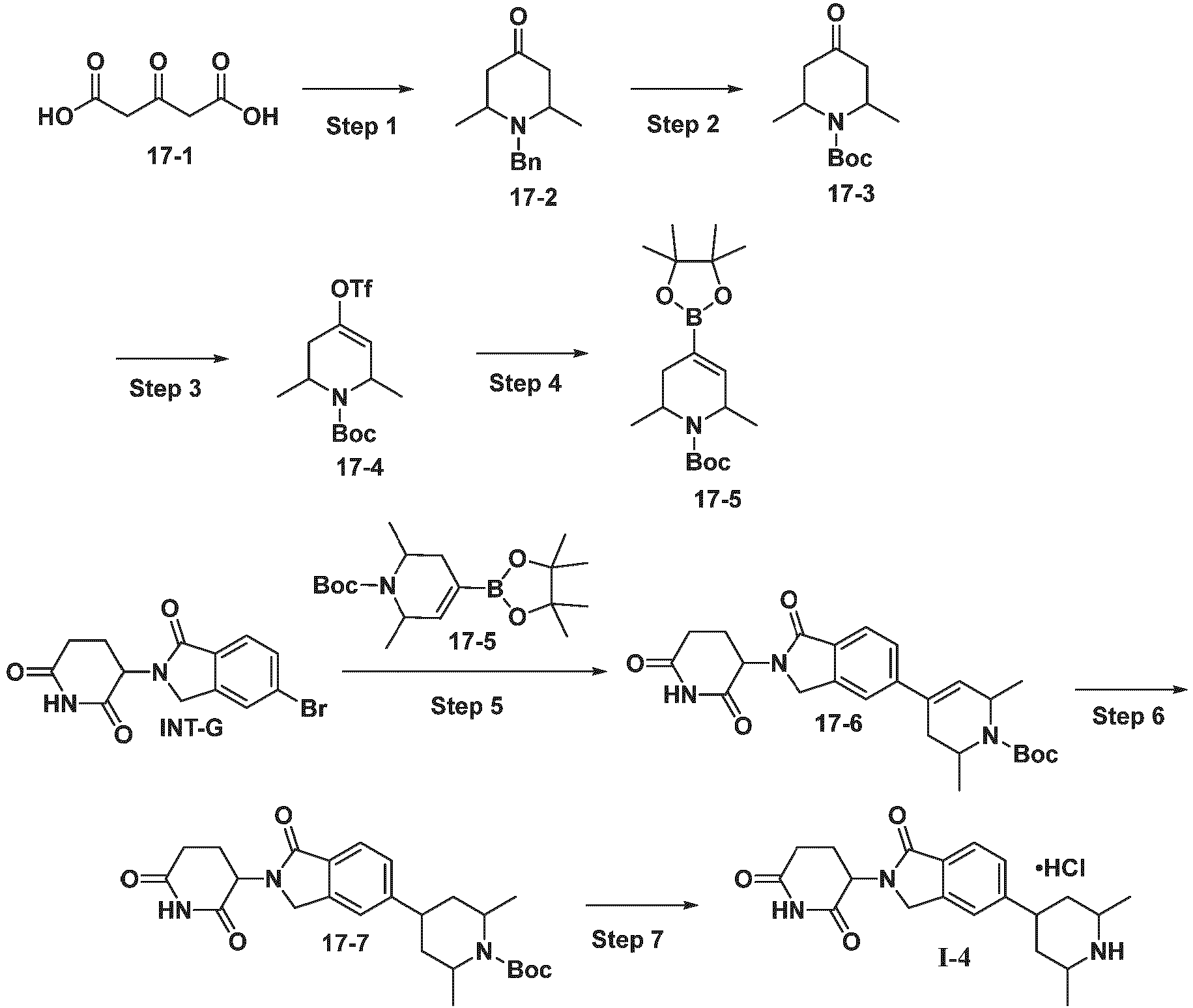
- To a solution of 17-1 (10.0 g, 68.5 mmol) and acetaldehyde (7.73 mL, 137 mmol) in water (50 mL) was added benzyl amine (7.48 mL, 68.5 mmol) dropwise at 10 °C (vigorous gas evolution was observed) and stirred at rt for 72 h. After completion of the reaction, pH was adjusted to 2 by adding 1M aq. HCl and stirred at rt. After 1 h, pH was neutralized with sat. aq. NaHCO3 and extracted with DCM (3x150 mL). The combined organic extracts were washed with brine, dried over Na2SO4 and concentrated under reduced pressure. The obtained crude material was purified by silica gel column chromatography eluting with 20% EtOAc in hexanes to afford 17-2 (4.1 g, 18.87 mmol, 27% yield) as an off-white solid. MS [M+H]+ = 218.1.
- To a solution of 17-2 (1.2 g, 5.5 mmol) and Boc2O (2.43 mL, 11.0 mmol) in EtOH (50 mL) was added 10% Pd/C (300 mg) and stirred under hydrogen atmosphere for 24 h in parr apparatus. After completion of the reaction, the reaction mixture was filtered through a small pad of Celite® was washed with EtOH. The combined filtrates were concentrated to dryness and the obtained crude material was purified by silica gel column chromatography eluting with 15% EtOAc in hexanes to afford 17-3 (850 mg, 3.74 mmol, 68% yield) as white solid. 1H NMR (300 MHz, CDCl3): δ 4.40-4.35 (m, 2H), 2.88-2.80 (m, 2H), 2.40-2.33 (m, 2H), 1.49 (s, 9H), 1.24 (d, J = 6.6 Hz, 6H).
- To a solution of 17-3 (600 mg, 2.64 mmol) in THF (25 mL) was added LiHMDS (3.17 mL, 3.17 mmol, 1M in THF) dropwise at -78 °C and the obtained reaction mixture was stirred at the same temperature for 1 h. N-(5-chloropyridin-2-yl)-1,1,1-trifluoro-N-((trifluoromethyl)sulfonyl)methanesulfonamide (1.34 g, 3.43 mmol), dissolved in THF (10 mL), was added dropwise and the reaction mixture was stirred at 0 °C for 3 h. The reaction mixture was quenched with sat. aq. NH4Cl and extracted with EtOAc (3x50 mL). The combined organic extracts were washed with brine, dried over Na2SO4 and concentrated to dryness. The obtained crude material was purified by silica gel column chromatography eluting with 10% EtOAc in hexanes to afford 17-4 (500 mg, 1.39 mmol, 53% yield) as pale-yellow liquid. 1H NMR (300 MHz, CDCl3): δ 5.80-5.78 (m, 1H), 4.39-4.30 (m, 2H), 2.88-2.80 (m, 1H), 2.20-2.13 (m, 1H), 1.48 (s, 9H), 1.36 (d, J= 5.8 Hz, 3H), 1.23 (d, J= 6.3 Hz, 3H).
- To a solution of 17-4 (500 mg, 1.39 mmol) in dioxane (20 mL) were added bis(pinacolato)diboron (389 mg, 1.53 mmol) and KOAc (409 mg, 4.17 mmol) and degassed for 10 min with argon. Then, PdCl2(dppf)•DCM (56 mg, 0.07 mmol) and dppf (38 mg, 0.07 mmol) were added and the reaction mixture was stirred at 90 eC for 16 h. The reaction mixture was allowed to cool to rt, filtered through a small pad of Celite® was washed with dioxane. The combined filtrates were evaporated under reduced pressure to afford crude 17-5 (950 mg) as an off-white solid, which was used in the next step without further purification. 1H NMR (400 MHz, CDCl3): δ 6.58-6.55 (m, 1H), 4.25-4.15 (m, 2H), 2.40-2.35 (m, 1H), 2.19-2.14 (m, 1H), 1.47 (s, 6H), 1.27-1.24 (m, 21H).
- To a solution of INT-G (500 mg, 1.54 mmol) and crude 17-5 (940 mg) in DMF (10 mL), was added K2CO3 (640 mg, 4.64 mmol) and the resulting mixture was degassed for 15 min with argon. Then, PdCl2(dppf)•DCM (94 mg, 0.11 mmol) was then added and the reaction mixture was stirred at 100 °C for 16 h. The reaction mixture was cooled to rt and filtered through a small pad of Celite® and washed with DMF (20 mL). Ice-cold water was added to the filtrate and the obtained solid was filtered. The obtained crude material was purified by silica gel column chromatography eluting with 5% MeOH in DCM to afford 17-6 as an off-white solid (530, 1.17 mmol, 75% yield). MS [M+H]+ = 454.4.
- To a solution of 17-6 (530 mg, 1.17 mmol) in DMF (20 mL) was added Pd/C (10 wt%, 200 mg) and the resulting mixture was stirred at rt under an atmosphere of hydrogen (in parr apparatus, 60 psi) for 16 h. Upon complete consumption of the starting material, the reaction mixture was filtered through a pad of Celite® and washed with DMF. The filtrate was quenched with water and extracted with EtOAc (2 x 100 mL). The combined organic extracts were washed with brine (50 mL), dried over Na2SO4, filtered, and concentrated under reduced pressure to afford 17-7 as an off-white solid (290 mg, 0.64 mmol, 55% yield). MS [M-tBu+H]+ = 400.1.
- To a solution of 17-7 (290 mg, 0.64 mmol) in dioxane (10 mL) was added drop wise 4M HCl in dioxane (3 ml) at 0 °C and the resulting mixture was stirred at rt for 16 h. Upon complete consumption of the starting materials, the solvent was evaporated under reduced pressure. The crude material was triturated with diethyl ether and dried under reduced pressure to afford I-4 as an off-white solid (150 mg, 0.38 mmol, 60% yield). MS [M+H]+ = 356.2. 1H NMR (400 MHz, DMSO-d6 ): δ 11.00 (s, 1H), 8.82 (br s, 1H), 7.70 (d, J = 8.0 Hz, 1H), 7.47 (s, 1H), 7.38 (d, J = 8.8 Hz, 1H), 5.11 (dd, J = 13.2, 4.8 Hz, 1H), 4.44 (d, J = 17.2 Hz, 1H), 4.31 (d, J = 17.2 Hz, 1H), 3.79-3.78 (m, 1H), 3.50-3.47 (m, 1H), 3.27-3.21 (m, 1H), 2.96-2.87 (m, 1H), 2.67-2.50 (m, 1H), 2.41-2.34 (m, 1H), 2.07-1.94 (m, 3H), 1.80-1.77 (m, 1H), 1.66-1.60 (m, 1H), 1.42 (d, J = 6.8 Hz, 3H), 1.27 (d, J = 6.8 Hz, 3H).
-

- To a stirred solution of I-4 (100 mg, 0.25 mmol) and Et3N (0.11 mL, 0.76 mmol) in DMF (5 mL) was added benzyl bromide (0.04 mL, 0.30 mmol) at 0 °C and the resulting mixture was stirred at rt for 16 h. Upon complete consumption of the starting materials, the reaction mixture was quenched with ice-cold water and extracted with EtOAc (2 x 50 mL). The combined organic extracts were washed with brine, dried over Na2SO4, filtered, and concentrated under reduced pressure. The obtained crude material was purified by silica gel column chromatography eluting with 6% MeOH in DCM to afford I-2 as an off-white solid (30 mg, 0.07 mmol, 26% yield). MS [M+H]+ = 446.1. 1H NMR (400 MHz, DMSO-d6 ): δ 10.99 (s, 1H), 7.65 (d, J = 7.6 Hz, 1H), 7.51 (s, 1H), 7.41-7.20 (m, 6H), 5.11 (dd, J = 13.4, 4.8 Hz, 1H), 4.45 (d, J= 17.2 Hz, 1H), 4.28 (d, J = 17.2 Hz, 1H), 3.93-3.89 (m, 1H), 3.48-3.45 (m, 1H), 3.10-2.85 (m, 4H), 2.65-2.35 (m, 2H), 2.03-1.45 (m, 5H), 1.08-1.05 (m, 6H).
-

- To a stirred solution of INT-G (150 mg, 0.41 mmol) and 19-1 (85 mg, 0.62 mmol) in DMF (10 mL), was added NaBH(OAc)3 (262 mg, 1.23 mmol) at 0 °C and the resulting mixture was stirred at 60 °C for 16 h. After completion of the reaction, the mixture was allowed to cool to rt, quenched with ice-cold water and extracted with EtOAc (2 x 75 mL). The combined organic extracts were washed with brine, dried over Na2SO4, filtered, and concentrated under reduced pressure. The obtained crude material was purified by silica gel column chromatography eluting with 7% MeOH in DCM to afford I-6 as an off-white solid (40 mg, 0.09 mmol, 22% yield). MS [M+H]+ = 449.2. 1H NMR (400 MHz, DMSO-d6 ): δ 10.99 (s, 1H), 8.20-8.19 (m, 1H), 7.63 (d, J = 8.0 Hz, 1H), 7.49 (s, 1H), 7.41-7.35 (m, 3H), 5.10 (dd, J = 13.2, 4.8 Hz, 1H), 4.42 (d, J = 17.2 Hz, 1H), 4.28 (d, J = 17.2 Hz, 1H), 3.81 (s, 3H), 3.56 (s, 2H), 2.94-2.75 (m, 3H), 2.66-2.33 (m, 3H), 2.14-1.96 (m, 3H), 1.77-1.66 (m, 4H).
-
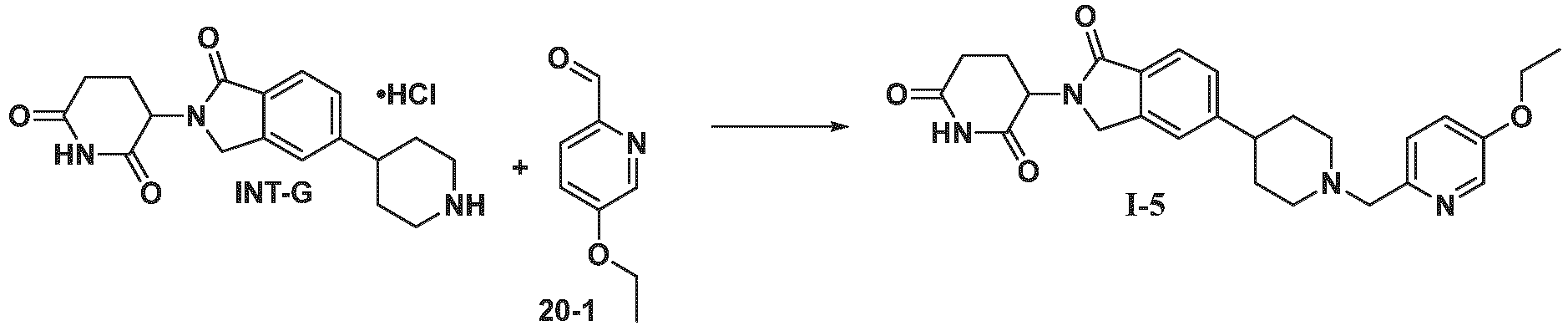
- To a stirred solution of INT-G (150 mg, 0.41 mmol) and 20-1 (93 mg, 0.62 mmol) in DMF (10 mL) was added NaBH(OAc)3 (262 mg, 1.23 mmol) at 0 °C and the resulting mixture was stirred at 60 °C for 16 h. After completion of the reaction, the mixture was allowed to cool to rt, quenched with ice-cold water and extracted with EtOAc (2 x 75 mL). The combined organic extracts were washed with brine, dried over Na2SO4, filtered, and concentrated under reduced pressure. The obtained crude material was purified by silica gel column chromatography eluting with 7% MeOH in DCM to afford I-5 as an off-white solid (60 mg, 0.13 mmol, 32% yield). MS [M+H]+ = 463.2. 1H NMR (400 MHz, DMSO-d6 ): δ 10.99 (s, 1H), 8.18-8.17 (m, 1H), 7.63 (d, J = 8.0 Hz, 1H), 7.49 (s, 1H), 7.41-7.33 (m, 3H), 5.09 (dd, J = 13.2, 4.8 Hz, 1H), 4.42 (d, J= 17.2 Hz, 1H), 4.26 (d, J = 17.2 Hz, 1H), 4.08 (q, J = 6.8 Hz, 2H), 3.55 (s, 2H), 3.04-2.86 (m, 3H), 2.66-2.33 (m, 3H), 2.14-1.96 (m, 3H), 1.77-1.66 (m, 4H), 1.33 (t, J = 6.8 Hz, 3H).
-

- To a stirred solution of INT-G (150 mg, 0.41 mmol) and 21-1 (147 mg, 0.82 mmol) in DMF (10 mL) was added NaBH(OAc)3 (262 mg, 1.23 mmol) at 0 °C and the resulting mixture was stirred at 60 °C for 16 h. After completion of the reaction, the mixture was allowed to cool to rt, quenched with ice-cold water and extracted with EtOAc (2 x 50 mL). The combined organic extracts were washed with brine, dried over Na2SO4, filtered, and concentrated under reduced pressure. The obtained crude material was purified by silica gel column chromatography eluting with 4% MeOH in DCM to afford I-7 as pale brown solid (70 mg, 0.15 mmol, 34% yield). MS [M+H]+ = 449.1. 1H NMR (400 MHz, DMSO-d6 ): δ 10.99 (s, 1H), 8.07 (s, 1H), 7.66-7.62 (m, 2H), 7.48 (s, 1H), 7.39 (d, J = 8.0 Hz, 1H), 6.80 (d, J = 8.0 Hz, 1H), 5.09 (dd, J = 13.2, 4.8 Hz, 1H), 4.42 (d, J = 17.2 Hz, 1H), 4.27 (d, J = 17.2 Hz, 1H), 3.83 (s, 3H), 3.45 (br s, 2H), 2.94-2.87 (m, 3H), 2.61-2.32 (m, 3H), 2.05-1.98 (m, 3H), 1.79-1.67 (m, 4H).
-

- To a stirred solution of INT-G (150 mg, 0.41 mmol) and 22-1 (93 mg, 0.62 mmol) in DMF (10 mL) was added NaBH(OAc)3 (262 mg, 1.23 mmol) at 0 °C and the resulting mixture was stirred at 60 °C for 16 h. After completion of the reaction, the mixture was allowed to cool to rt, quenched with ice-cold water and extracted with EtOAc (2 x 50 mL). The combined organic extracts were washed with brine, dried over Na2SO4, filtered, and concentrated under reduced pressure. The obtained crude material was purified by silica gel column chromatography eluting with 8% MeOH in DCM to afford I-8 as an off-white solid (40 mg, 0.08 mmol, 21% yield). MS [M+H]+ = 463.1. 1H NMR (400 MHz, DMSO-d6 ): δ 10.97 (s, 1H), 8.03 (d, J = 2.0 Hz, 1H), 7.65-7.62 (m, 2H), 7.48 (s, 1H), 7.39 (d, J = 8.0 Hz, 1H), 6.76 (d, J = 8.4 Hz, 1H), 5.09 (dd J = 13.2, 4.8 Hz, 1H), 4.41 (d, J = 17.2 Hz, 1H), 4.30-4.24 (m, 3H), 3.44 (s, 2H), 2.94-2.87 (m, 3H), 2.67-2.32 (m, 3H), 2.07-1.95 (m, 3H), 1.77-1.65 (m, 4H), 1.30 (t, J = 7.2 Hz, 3H).
-

- To a stirred solution of INT-G (150 mg, 0.41 mmol) and Et3N (0.17 mL, 1.23 mmol) in DMF (10 mL) was added 23-1 (142 mg, 0.82 mmol) at 0 °C and the resulting mixture was stirred at rt for 16 h. Upon complete consumption of the starting materials, the reaction mixture was quenched with ice-cold water and extracted with EtOAc (2 x 75 mL). The combined organic extracts were washed with brine, dried over Na2SO4, filtered, and concentrated under reduced pressure. The obtained crude material was purified by silica gel column chromatography eluting with 6% MeOH in DCM to afford I-11 as an off-white solid (110 mg, 0.26 mmol, 63% yield). MS [M+H]+ = 422.3. 1H NMR (400 MHz, DMSO-d6 ): δ 10.99 (s, 1H), 7.75 (d, J = 2.0 Hz, 1H), 7.63 (d, J = 8.0 Hz, 1H), 7.48 (s, 1H), 7.42-7.38 (m, 2H), 6.22-6.21 (m, 1H), 5.09 (dd, J = 13.2, 4.8 Hz, 1H), 4.42 (d, J = 17.2 Hz, 1H), 4.30-4.22 (m, 3H), 2.99-2.86 (m, 3H), 2.75-2.55 (m, 3H), 2.42-2.31 (m, 2H), 2.15-1.92 (m, 3H), 1.78-1.62 (m, 4H).
-

- To a stirred solution of INT-G (150 mg, 0.41 mmol) and Et3N (0.17 mL, 1.23 mmol) in DMF (10 mL) was added 24-1 (99 mg, 0.49 mmol) at 0 °C and the resulting mixture was stirred at rt for 16 h. Upon complete consumption of the starting materials, the reaction mixture was quenched with ice-cold water and extracted with EtOAc (2 x 75 mL). The combined organic extracts were washed with brine, dried over Na2SO4, filtered, and concentrated under reduced pressure. The obtained crude material was purified by silica gel column chromatography eluting with 6% MeOH in DCM to afford I-3 as an off-white solid (30 mg, 0.07 mmol, 16% yield). MS [M+H]+ = 449.2. 1H NMR (400 MHz, DMSO-d6 ): δ 10.99 (s, 1H), 7.63 (d, J = 8.0 Hz, 1H), 7.49 (s, 1H), 7.39 (d, J = 8.0 Hz, 1H), 5.09 (dd, J = 13.2, 4.8 Hz, 1H), 4.41 (d, J= 17.2 Hz, 1H), 4.27 (d, J = 17.2 Hz, 1H), 3.34-3.28 (m, 2H), 3.29-2.87 (m, 3H), 2.67-2.32 (m, 3H), 2.10-2.09 (m, 2H), 2.08-1.93 (m, 5H), 1.80-1.66 (m, 5H), 1.53-1.45 (m, 3H), 0.90-0.86 (m, 2H).
-

- To a solution of compound 25-1 (5.00 g, 48.0 mmol) in Et20 (100 mL) was added MeMgBr (3M in THF, 48.0 mL, 144 mmol) at 0 °C and the reaction mixture was stirred at room temperature for 30 minutes. To the reaction mixture was added Ti(OiPr)4 (14.2 mL, 48.0 mmol) and stirred at 50 °C for 16 h. After completion of the reaction, the reaction mixture was quenched with 1M aq. NaOH and extracted with Et2O (3 x 100 mL). The combined organic extracts were washed with brine, dried over Na2SO4 and concentrated under reduced pressure. The obtained crude material was purified by silica gel column chromatography eluting with 5-10% MeOH in DCM to afford compound 25-2 (1.80 g, 13.2 mmol, 28%) as a viscous yellow liquid. 1H NMR (400 MHz, DMSO-d6 ): δ 8.46-8.45 (m, 2H), 7.50-7.49 (m, 2H), 1.96 (brs, 2H), 1.33 (s, 6H)
- To a solution of compound 25-3 (5.0 g, 26 mmol) in acetone (100 mL), MeI (2.0 mL, 32 mmol) was added. The reaction mixture was stirred at room temperature for 16 h. After completion of the reaction, the reaction mixture was filtered, washed with acetone and dried reduced pressure to afford compound 25-4 (4.0 g, 12 mmol, 46%) as a white solid. 1H NMR (300 MHz, DMSO-d6 ): δ 7.56-7.55 (m, 5H), 4.73 (s, 2H), 3.85-3.62 (m, 4H), 3.14 (s, 3H), 2.89-2.75 (m, 2H), 2.60-2.72 (m, 2H).
- To a solution of compound 25-2 (2.0 g, 6.0 mmol) in EtOH:H2O (v/v = 3:2) (30 mL) was added compound 25-4 (1.20 g, 9.05 mmol) and K2CO3 (125 mg, 0.90 mmol). The reaction mixture was stirred at 100 °C for 12 h. After completion of the reaction, the reaction mixture was diluted with water and extracted with EtOAc (3 x 50 mL). The combined organic extracts were washed with brine, dried over Na2SO4 and concentrated under reduced pressure. The obtained crude material was purified by silica gel column chromatography eluting with 50% EtOAc in Hexane to afford compound 25-5 (0.60 g, 2.7 mmol, 46%) as brown liquid. 1H NMR (600 MHz, CDCl3): δ 8.56-8.55 (d, J = 6.0 Hz, 2H), 7.50-7.49 (d, J = 4.8 Hz, 2H), 2.75-2.73 (t, J = 6.0 Hz, 4H), 2.42-2.40 (t, J = 6.0 Hz, 4H), 1.38 (s, 6H).
- To a solution of 25-5 (232 mg, 1.06 mmol) in MeOH (3 mL) was added NaBH4 (48 mg, 1.3 mmol) portion wise at 0 °C. The reaction mixture was stirred for 30 min at rt. The reaction mixture was quenched with sat. aq. NaHCO3 and extracted with DCM (x3). Combined organic phases were dried over Na2SO4, filtered and concentrated to dryness to afford compound 25-6 (233 mg, 1.06 mmol, 100 % yield) as a colorless oil. The product was used in the next step without further purification. MS [M+H]+ = 221.4. 1H NMR (400 MHz, Chloroform-d) δ 8.54 (d, J = 5.3 Hz, 2H), 7.47 (d, J = 5.2 Hz, 2H), 3.79 - 3.57 (m, 1H), 2.77 - 2.63 (m, 2H), 2.25 (t, J = 10.2 Hz, 2H), 1.94 - 1.81 (m, 2H), 1.61 - 1.51 (m, 2H), 1.34 (s, 6H).
- To a solution of 25-6 (233 mg, 1.06 mmol), DIPEA (0.28 mL, 1.6 mmol), DMAP (13 mg, 0.11 mmol) in DCM (10 mL) was added TsCl (121 mg, 1.06 mmol) and reaction mixture was stirred for 1 h at 0 °C and then overnight at rt. The reaction mixture was quenched with sat. aq. NaHCO3 and extracted with DCM (x3). The combined organic phases were dried over Na2SO4, filtered, and concentrated to dryness to afford crude 25-7 (390 mg, assumed quantitative yield) as a brown oil. The obtained crude product was used in the next step without further purification.
- To a suspension of NiBr2(glyme) (7.2 mg, 0.023 mmol), picolinimidamide HCl salt (3.7 mg, 0.023 mmol), KI (77 mg, 0.46 mmol) and manganese powder (43 mg, 0.77 mmol) in DMA (0.2 mL) was added a mixture of 1c (50 mg, 0.16 mmol) and crude 25-7 (174 mg, 0.465 mmol), dissolved in DMA (1 mL) under nitrogen atmosphere. The reaction mixture was then stirred vigorously at 75 °C for 7 hours under atmosphere of nitrogen. The reaction was filtered and the filter was washed with MeCN. The reaction mixture was then concentrated. The crude product was purified by RP HPLC (eluting with MeCN/H2O with 0.1% NH3 as a modifier) using collecting into tubes containing ~2 drops of HCOOH. Fractions containing desired product were concentrated by lyophilizer to afford the formate salt of compound I-37 (6.9 mg, 0.014 mmol, 9% yield) was obtained as a white solid. MS [M+H]+ = 447.5. 1H NMR (400 MHz, CD3CN:D2O (v/v = 1:1)) δ 8.61 (d, J = 5.9 Hz, 2H), 8.33 (s, 1H), 7.74 - 7.68 (m, 1H), 7.64 (d, J = 5.3 Hz, 2H), 7.43 (d, J = 3.8 Hz, 1H), 7.38 (d, J = 8.3 Hz, 1H), 5.12 - 4.94 (m, 1H), 4.50 - 4.27 (m, 2H), 3.32 (d, J = 11.7 Hz, 2H), 2.93 - 2.69 (m, 5H), 2.47 - 2.30 (m, 1H), 2.18 - 2.08 (m, 1H), 1.72 (s, 6H). Missing protons are overlapping with residual acetonitrile or H2O solvent peaks.
- The activity of a compound according to the present invention can be assessed by the following in vitro methods.
- The Prolabel system from DiscoverX was used to develop high-throughput and quantitative assays to measure changes in IKZF1 and IKZF2 protein levels in response to compounds. The prolabel tag was derived from the alpha fragment of beta galactosidase and has the following protein sequence: mssnslavvlqrrdwenpgvtqlnrlaahppfaswrnseeartdrpsqqlrslnge. The complementary fragment of beta-galactosidase (from DiscoverX), is added to the prolabel tag to form an active beta galactosidase enzyme whose activity can be precisely measured. In this way, the levels of a fusion protein with the prolabel tag can be quantified in cell lysates.
- Lentiviral vectors, based on the Invitrogen pLenti6.2/V5 DEST backbone, were constructed that placed the prolabel tag upstream of IKZF1, IKZF2 or GSPT1 and expressed the fusion protein from a CMV promoter.
- To ensure moderate and consistent expression of the prolabel fusion proteins across all cells in the population, stable cell lines were constructed from cells expressing a single copy of the construct. Lentivirus packaged with the constructs was made using the Virapower kit from Invitrogen. Strongly adherent 293GT cell, GripTite 293 MSR cells from Thermo Fisher Scientific (Catalog number: R79507), were infected with the virus at low multiplicity of infection and selected by 5 µg/mL blasticidin for 2 weeks.
- The levels of prolabel tagged fusion proteins in compound treated cell lines were measured as follows:
- Day 1, Cells were diluted to 1.0 x 10⁶ cells/ml in normal growth medium. 17.5 µL of cells were plated in each well of a solid white 384 well plate. Plates were incubated overnight in a 37 °C tissue culture incubator.
- Day 2, Serial dilutions of compounds were made in 384 well plates from 10 mM stocks. 15 µL of DMSO was added to each well of a 384 well plate. In the first column, 15µL of stock compound was added. The solution was mixed and 15 µL was transferred to the next column. This was repeated until 20 two-fold dilutions were prepared. 2.5 µL of diluted compounds were transferred into 60 µL of cell culture medium in another 384 well plate, and mixed well. 2.5 µL of this mixture was added to the plated cells. The final DMSO concentration was 0.5% and the highest concentration of compound was 50 µM. Plates were incubated overnight (e.g., about 14 h, 18 h, or 24 h) in a 37 °C tissue culture incubator.
- Day 3, Plates were removed from the incubator and allowed to equilibrate at rt for 30 minutes. Prolabel substrate (DiscoverX PathHunter Prolabel Detection Kit, User manual: 93-0180) was added as described by the manufacturers protocols. Plates were incubated at rt for three hours and luminescence was read using an Envision reader (Perkin Elmer) Data was analyzed and visualized using the Spotfire software package.
- Table 14 shows Helios (IKZF2), Ikaros (IKZF1) and G1 to S phase transition 1 protein (GSPT1) degradation activity of compounds of the invention in Pro-label assays in 293GT cells, (% degradation is at 10 µM). Pomalidomide was tested as the control.
TABLE 14: IKZF2 and IKZF1 Activity Cmpd No. IKZF2 IKZF1 AC50 (µM) AC50 (µM) % protein reduction at 10 µM, 24 h I-1 2.2 70% >30 I-2 - 35% at 30uM >30 I-3 0.089 60% >30 I-4 - 30% at 30uM >30 I-5 0.025 60% >30 I-6 0.009 50% >30 I-7 0.024 80% >30 I-8 0.014 70% >30 I-10 0.017 75% >30 I-11 0.14 60% >30 I-12 - - >30 I-13 0.012 80% >30 I-14 2.86 55% >30 I-15 1.87 40% >30 I-16 13.1 50% >30 I-17 1.73 50% >30 I-18 10.0 40% >30 I-30 0.020 80% >30 I-31 0.079 70% >30 I-32 0.092 62% >30 I-33 0.064 62% >30 I-35 0.019 80% >30 I-36 0.038 74% >30 Control >50 0.05 (80% degradation at 10 µM) - Human buffy coats are obtained from BioreclamationIVT, in the USA. CD4+ T cells are isolated from said buffy coats using the RosetteSep Human CD4+ T cell enrichment Cocktail (Stemcell technologies, USA) and gradient centrifugation over Ficoll Paque Plus (GE HealthCare LifeSciences, USA) as per manufacturer's recommendations. Cells are resuspended in RPMI medium supplemented with 1% penicillin-Streptomycin solution, 10% Fetal Bovine Serum, HEPES (10 mM), MEM NEAA (100 nM), sodium pyruvate (1 mM) (all supplements from Thermo Fisher Scientific, USA), thereafter referred to as complete RPMI (cRPMI), and rested overnight at 37 °C, 5% CO2 in the presence of 2U/mL rhIL-2 (Proleukin, Novartis). Cells are collected and resuspended in autoMACS Running Buffer supplemented with BSA (Miltenyi Biotec, USA) and labelled using CD4-FITC antibody (clone RPA-T4), CD25-APC antibody (clone M-A251) (Biolegend) and CD25 Microbeads (Miltenyi Biotec, USA). CD25-enriched cells are then isolated using the autoMACS Pro Separator. A highly purified population of Treg cells is then obtained by further sorting CD4+ CD25Hi cells using a Sony SH800 cell sorter. The resulting Treg cell population is routinely above 90% pure according to FOXP3 expression.
- Purified Treg cells are plated in cRPMI in 96-well, round-bottom plates at a density of 25000-50000 cells per well and activated in the presence of 500 U/mL rhIL2, and Treg expander Dynabeads (Thermo Fisher Scientific, USA) according to manufacturer's recommendations, in the presence or absence of 100 µM rapamycin (Thermo Fisher Scientific, USA). The compounds of the present invention are then added at a final concentration of 10 µM and DMSO was added as a vehicle control. Cells are incubated at 37 °C, 5% CO2 for a total of 12-14 days. The compound and rhIL2 are replenished every 48h during the entirety of the culture.
- Cell are collected and counted and the fold expansion is calculated as (number of cells recovered)/(number of cells plated). A fraction of the cells is fixed and permeabilized using the eBioscience Foxp3 staining Buffer kit (eBioscience, Thermo Fisher Scientific, USA) and stained with Helios-PECyanine7 antibody (Clone 22F6). To determine IL2-expression, expanded Treg cells are further incubated in the presence of the eBioscience Cell Stimulation Cocktail with Protein inhibitors (Thermo Fisher Scientific) for 4 hours, followed by fixation and staining with IL2-BV711 antibody (clone MQ1-17H12) (Biolegend, USA). Cells are acquired on an LSRFortessa (Becton Dickinson, USA) and analysis was performed using the FlowJo software (TreeStar, USA).
- Primary human PBMCs are obtained from freshly prepared buffy coats (BioReclamationIVT) using gradient centrifugation over Ficoll Paque Plus as per manufacturer's recommendations. Cells are then labelled with CFSE (5(6)-Carboxyfluorescein diacetate N-succinimidyl ester, Sigma-Aldrich, USA) and plated in triplicates cRPMI in round bottom 96-well plates, alone or with expanded Treg cells at a 1:2 PBMC:Treg ratio. The compounds of the present invention are then added at a final concentration of 10 µM and DMSO is added as a vehicle control. Cells are activated using soluble anti-CD3 antibody (clone OKT3) (eBioscience, ThermoFisher Scientific, USA) at a final concentration of 100 ng/ml. Cells are incubated at 37 °C, 5% CO2 for a total of 4-5 days. At the end of the culture, cells are stained using the Live/dead Blue viability stain (Thermo Fisher Scientific, USA) as per manufacturer's instructions, followed by staining with CD4-BUV737 (Clone SK3) (BDBiosciences, USA) and CD8-BV711 (clone RPA-T8) (Biolegend, USA). Cells are acquired on an LSRFortessa (Becton Dickinson, USA) and analysis is performed using the FlowJo software (TreeStar, USA). Proliferation is assessed in each population as the proportion of cells having diluted CFSE. Suppression is assessed for each condition in comparison to the responders plated alone.
Claims (15)
- A compound of Formula (I):
 R1 is (C1-C6)alkyl, (C1-C6)alkoxy, (C1-C6)haloalkyl, (C1-C6)haloalkoxy, (C1-C6)hydroxyalkyl, halogen, -OH, -(CH2)0-2NH2, -(CH2)0-2NH(C1-C6)alkyl, -(CH2)0-2N((C1-C6)alkyl)2, -C(O)NH2, -C(O)OH or CN;each R2 is independently (C1-C6)alkyl, (C1-C6)haloalkyl, (C1-C6)hydroxyalkyl, CN, or halogen, orR1 and R2 together with the carbon atoms to which they are attached form a (C3-C7)cycloalkyl or a 4- to 6-membered heterocycloalkyl ring comprising 1 to 3 heteroatoms selected from O, N, and S, ortwo R2 together with the carbon atoms to which they are attached form (C3-C7)cycloalkyl or a 4- to 6-membered heterocycloalkyl ring comprising 1 to 3 heteroatoms selected from O, N, and S;R3 is (C1-C6)alkyl, (C6-C10)aryl, 5- or 6-membered heteroaryl comprising 1 to 3 heteroatoms selected from O, N, and S, (C3-C8)cycloalkyl, or 4- to 7-membered heterocycloalkyl comprising 1 to 3 heteroatoms selected from O, N, and S, wherein the alkyl is optionally substituted with one or more R4; and the aryl, heteroaryl, cycloalkyl, and heterocycloalkyl are optionally substituted with one or more R5, orR2 and R3, when on adjacent atoms, together with the atoms to which they are attached form a 5- or 6-membered heterocycloalkyl ring;each R4 is independently selected from -C(O)OR6, -C(O)NR6R6', -NR6C(O)R6', halogen, -OH, -NH2, CN, (C6-C10)aryl, 5- or 6-membered heteroaryl comprising 1 to 4 heteroatoms selected from O, N, and S, (C3-C8)cycloalkyl, and 4- to 7-membered heterocycloalkyl ring comprising 1 to 3 heteroatoms selected from O, N, and S, wherein the aryl, heteroaryl, cycloalkyl, and heterocycloalkyl groups are optionally substituted with one or more R7;each R5 is independently selected from (C1-C6)alkyl, (C2-C6)alkenyl, (C2-C6)alkynyl, (C1-C6)alkoxy, (C1-C6)haloalkyl, (C1-C6)haloalkoxy, (C1-C6)hydroxyalkyl, halogen, -OH, -NH2, CN, (C3-C7)cycloalkyl, 5- to 7-membered heterocycloalkyl comprising 1 to 3 heteroatoms selected from O, N, and S, (C6-C10)aryl, and 5- or 6-membered heteroaryl comprising 1 to 3 heteroatoms selected from O, N, and S, ortwo R5, when on adjacent atoms, together with the atoms to which they are attached form a (C6-C10)aryl ring or a 5- or 6-membered heteroaryl ring comprising 1 to 3 heteroatoms selected from O, N, and S, optionally substituted with one or more R10, ortwo R5 together with the atoms to which they are attached form a (C3-C7)cycloalkyl ring or a 4- to 7-membered heterocycloalkyl ring comprising 1 to 3 heteroatoms selected from O, N, and S optionally substituted with one or more R10;R6 and R6' are each independently H, (C1-C6)alkyl, or (C6-C10)aryl;each R7 is independently selected from (C1-C6)alkyl, (C2-C6)alkenyl, (C2-C6)alkynyl, (C1-C6)alkoxy, (C1-C6)haloalkyl, (C1-C6)haloalkoxy, -C(O)R8, -(CH2)0-3C(O)OR8, -C(O)NR8R9, -NR8C(O)R9, - NR8C(O)OR9, -S(O)pNR8R9, -S(O)pR12, (C1-C6)hydroxyalkyl, halogen, -OH, -O(CH2)1-3CN, -NH2, CN, -O(CH2)0-3(C6-C10)aryl, adamantyl, -O(CH2)0-3-5- or 6-membered heteroaryl comprising 1 to 3 heteroatoms selected from O, N, and S, (C6-C10)aryl, monocyclic or bicyclic 5- to 10-membered heteroaryl comprising 1 to 3 heteroatoms selected from O, N, and S, (C3-C7)cycloalkyl, and 5- to 7-membered heterocycloalkyl comprising 1 to 3 heteroatoms selected from O, N, and S, wherein the alkyl is optionally substituted with one or more R11, and the aryl, heteroaryl, and heterocycloalkyl are optionally substituted with one or more substituents each independently selected from halogen, (C1-C6)alkyl, (C1-C6)haloalkyl, and (C1-C6)alkoxy, ortwo R7 together with the carbon atom to which they are attached form a =(O), ortwo R7, when on adjacent atoms, together with the atoms to which they are attached form a (C6-C10)aryl ring or a 5- or 6-membered heteroaryl ring comprising 1 to 3 heteroatoms selected from O, N, and S, optionally substituted with one or more R10, ortwo R7 together with the atoms to which they are attached form a (C5-C7) cycloalkyl ring or a 5- to 7-membered heterocycloalkyl ring comprising 1 to 3 heteroatoms selected from O, N, and S, optionally substituted with one or more R10;R8 and R9 are each independently H or (C1-C6)alkyl;each R10 is independently selected from (C1-C6)alkyl, (C1-C6)alkoxy, (C1-C6)haloalkyl, (C1-C6)haloalkoxy, (C1-C6)hydroxyalkyl, halogen, -OH, -NH2, and CN, ortwo R10 together with the carbon atom to which they are attached form a =(O);each R11 is independently selected from CN, (C1-C6)alkoxy, (C6-C10)aryl, and 5- to 7-membered heterocycloalkyl comprising 1 to 3 heteroatoms selected from O, N, and S, wherein the aryl and heterocycloalkyl are optionally substituted with one or more substituents each independently selected from (C1-C6)alkyl, (C1-C6)alkoxy, (C1-C6)haloalkyl, (C1-C6)haloalkoxy, (C1-C6)hydroxyalkyl, halogen, -OH, -NH2, and CN;R12 is (C1-C6)alkyl, (C1-C6)haloalkyl, (C6-C10)aryl, or 5- to 7-membered heterocycloalkyl comprising 1 to 3 heteroatoms selected from O, N, and S;Rx is H or D; andn is 0, 1, 2, or 3;
or a pharmaceutically acceptable salt, hydrate, solvate, stereoisomer, or tautomer thereof. - The compound according to claim 1, wherein Rx is H.
- The compound according to claim 1 or 2, wherein R1 is (C1-C6)alkoxy, halogen, -OH, -(CH2)0-2NH2, or CN.
- The compound according to any one of claims 1-3, wherein R3 is (C1-C6)alkyl optionally substituted with one to three R4, optionally wherein R3 is (C1-C6)alkyl substituted with one to three R4.
- The compound according to any one of claims 1-4, wherein R4 is selected from (C6-C10)aryl and 5- or 6-membered heteroaryl comprising 1 to 4 heteroatoms selected from O, N, and S, wherein the aryl and heteroaryl are optionally substituted with one to three R6, optionally wherein R4 is phenyl optionally substituted with one to three R6.
- The compound according to any one of claims 1-5, wherein n is 0.
- The compound of claim 1, having a Formula (Ia) or Formula (Ib):

- The compound according to claim 7, wherein R3 is (C1-C6)alkyl optionally substituted with one to three R4, optionally wherein R3 is (C1-C6)alkyl substituted with one to three R4.
- The compound according to any one of claims 7-8, wherein R4 is selected from (C6-C10)aryl and 5- or 6-membered heteroaryl comprising 1 to 4 heteroatoms selected from O, N, and S, wherein the aryl and heteroaryl are optionally substituted with one to three R6, optionally wherein R4 is phenyl optionally substituted with one to three R6.
- The compound according to claim 1 selected from:


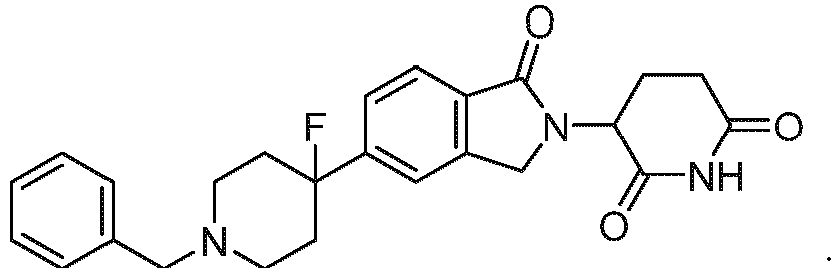


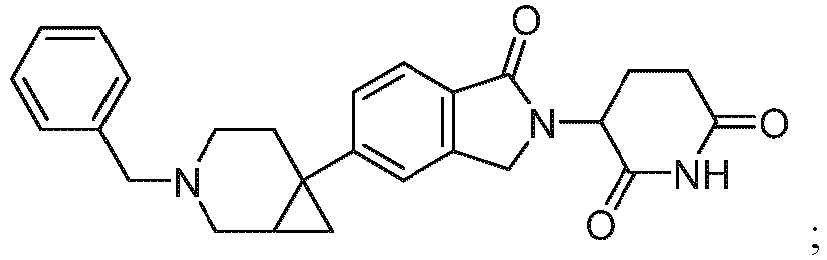
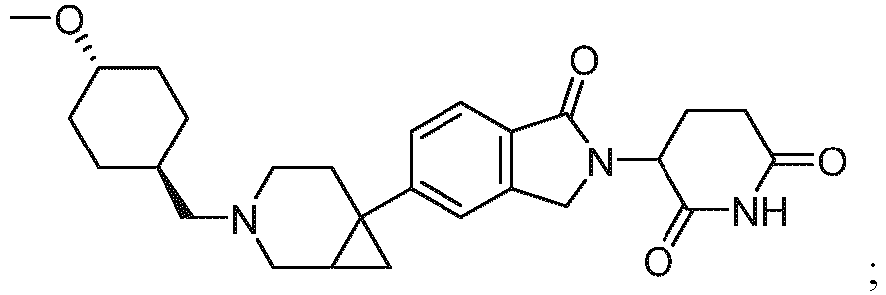
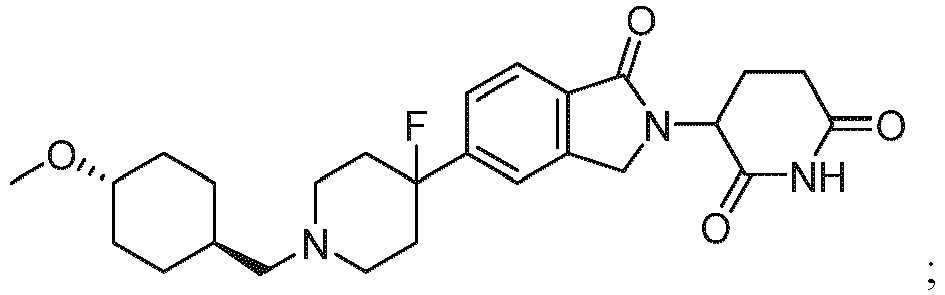


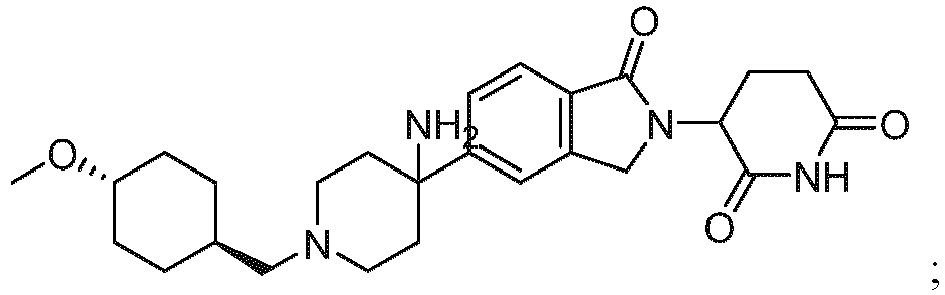

- A compound selected from:


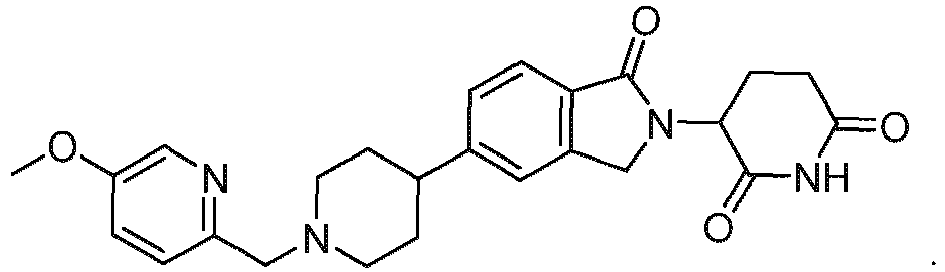
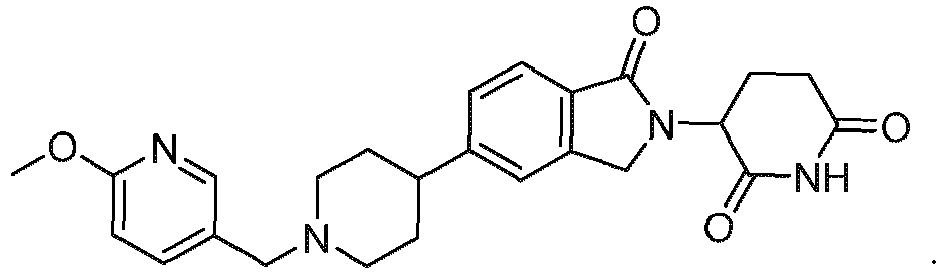

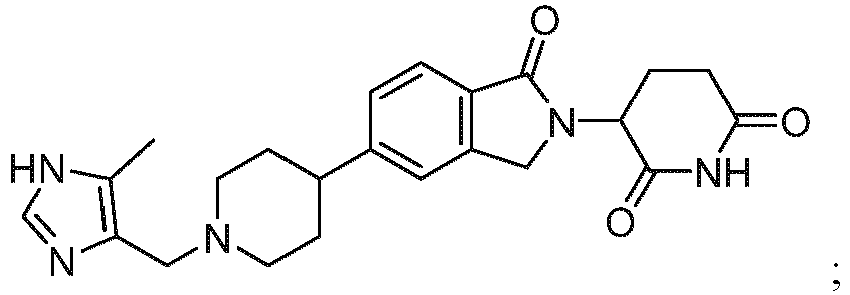


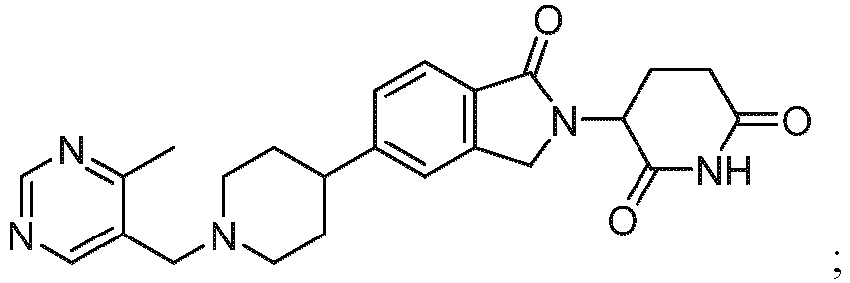

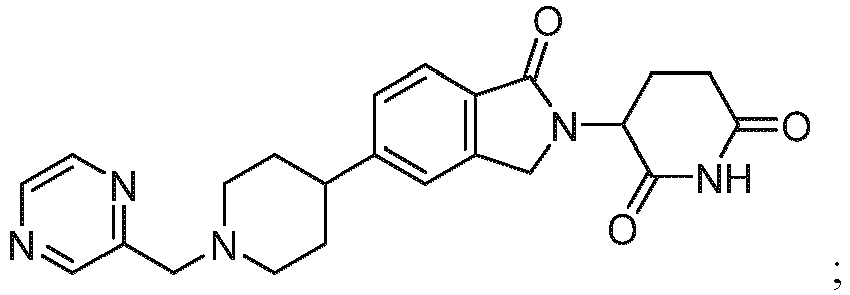
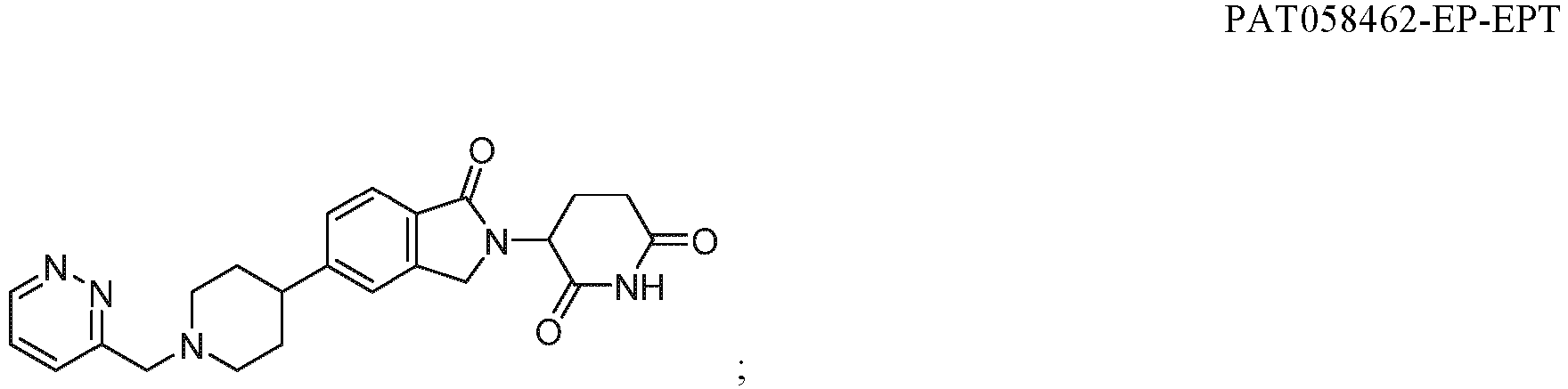
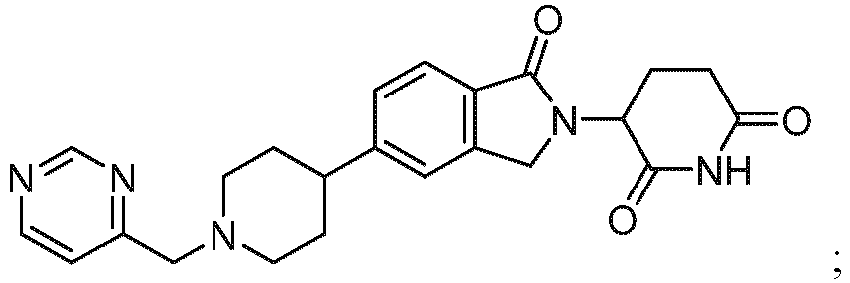


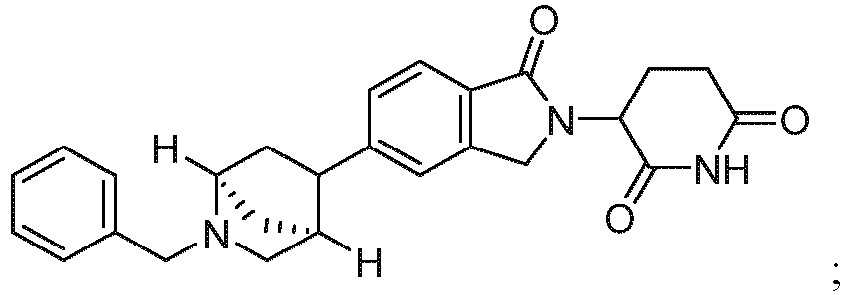
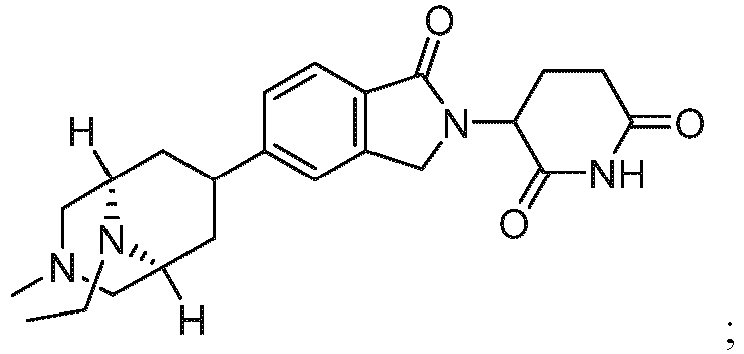


- A pharmaceutical composition comprising a therapeutically effective amount of a compound according to any one of the claims 1-11, or a pharmaceutically acceptable salt, hydrate, solvate, stereoisomer, or tautomer thereof, and a pharmaceutically acceptable carrier or excipient, optionally further comprising at least one additional pharmaceutical agent.
- The pharmaceutical composition according to claim 12 for use in the treatment of a disease or disorder that is affected by the reduction of IKZF2 protein levels.
- A compound according to any one of claims 1-11, or a pharmaceutically acceptable salt, hydrate, solvate, stereoisomer, or tautomer thereof, for use in the treatment of a disease or disorder that is affected by the reduction of IKZF2 protein levels.
- The compound for use according to claim 14, wherein the disease or disorder is selected from non-small cell lung cancer (NSCLC), melanoma, triple-negative breast cancer (TNBC), nasopharyngeal cancer (NPC), microsatellite stable colorectal cancer (mssCRC), thymoma, carcinoid, acute myelogenous leukemia, and gastrointestinal stromal tumor (GIST).
Applications Claiming Priority (2)
| Application Number | Priority Date | Filing Date | Title |
|---|---|---|---|
| US201962806140P | 2019-02-15 | 2019-02-15 | |
| PCT/IB2020/051205 WO2020165833A1 (en) | 2019-02-15 | 2020-02-13 | 3-(1-oxo-5-(piperidin-4-yl)isoindolin-2-yl)piperidine-2,6-dione derivatives and uses thereof |
Publications (2)
| Publication Number | Publication Date |
|---|---|
| EP3924054A1 EP3924054A1 (en) | 2021-12-22 |
| EP3924054B1 true EP3924054B1 (en) | 2025-04-02 |
Family
ID=69726654
Family Applications (1)
| Application Number | Title | Priority Date | Filing Date |
|---|---|---|---|
| EP20708198.5A Active EP3924054B1 (en) | 2019-02-15 | 2020-02-13 | 3-(1-oxo-5-(piperidin-4-yl)isoindolin-2-yl)piperidine-2,6-dione derivatives and uses thereof |
Country Status (12)
| Country | Link |
|---|---|
| US (2) | US20220144807A1 (en) |
| EP (1) | EP3924054B1 (en) |
| JP (1) | JP7483732B2 (en) |
| KR (1) | KR20210129671A (en) |
| CN (1) | CN113490528B (en) |
| AU (1) | AU2020222345B2 (en) |
| BR (1) | BR112021015783A2 (en) |
| CA (1) | CA3124935A1 (en) |
| EA (1) | EA202192019A1 (en) |
| ES (1) | ES3032659T3 (en) |
| MX (1) | MX2021009763A (en) |
| WO (1) | WO2020165833A1 (en) |
Families Citing this family (23)
| Publication number | Priority date | Publication date | Assignee | Title |
|---|---|---|---|---|
| CN113490495B (en) | 2018-12-03 | 2024-09-27 | 达纳-法伯癌症研究公司 | Small molecule degradation agents from HELIOS and methods of use thereof |
| US11458149B1 (en) | 2019-05-31 | 2022-10-04 | Ikena Oncology, Inc. | TEAD inhibitors and uses thereof |
| BR112021024108A2 (en) | 2019-05-31 | 2022-03-22 | Ikena Oncology Inc | Tead inhibitors and uses thereof |
| WO2021087093A1 (en) * | 2019-10-30 | 2021-05-06 | Dana-Farber Cancer Institute, Inc. | Small molecule degraders of helios and methods of use |
| JP7863100B2 (en) * | 2020-10-14 | 2026-05-20 | シーフォー セラピューティクス, インコーポレイテッド | Tricyclic ligands that degrade IKZF2 or IKZF4 |
| IL301690A (en) * | 2020-10-16 | 2023-05-01 | Dana Farber Cancer Inst Inc | Small compounds based on piperidine that decompose helium and methods of use |
| CN116669769A (en) * | 2020-10-16 | 2023-08-29 | 达纳-法伯癌症研究所公司 | Piperidinyl small molecule degradation agent and method of use of HELIOS |
| WO2022120355A1 (en) * | 2020-12-02 | 2022-06-09 | Ikena Oncology, Inc. | Tead degraders and uses thereof |
| EP4320125A1 (en) * | 2021-04-05 | 2024-02-14 | Bristol-Myers Squibb Company | Pyridinyl substituted oxoisoindoline compounds for the treatment of cancer |
| PE20231941A1 (en) * | 2021-04-06 | 2023-12-05 | Bristol Myers Squibb Co | PYRIDINYL SUBSTITUTED OXOISOINDOLINE COMPOUNDS |
| EP4329746A4 (en) * | 2021-04-29 | 2025-03-19 | Dana-Farber Cancer Institute, Inc. | PHTHALIMIDO-CERBLON COMPLEX BINDER AND TRANSCRIPTION FACTOR DEGRADER AND METHOD OF USE |
| US20240239785A1 (en) * | 2021-04-29 | 2024-07-18 | Neomorph, Inc. | Substituted 2-(2,6-dioxopiperidin-3-yl)-5-(1-piperidin-4-yl)isoindoline-1,3-dione derivatives and uses thereof |
| TW202317546A (en) | 2021-07-09 | 2023-05-01 | 美商普萊克斯姆公司 | Aryl compounds and pharmaceutical compositions that modulate ikzf2 |
| JP2024539269A (en) * | 2021-10-22 | 2024-10-28 | グルータクス セラピューティクス (シャンハイ) カンパニー、リミテッド | CRBN E3 ligase ligand compound, protein decomposition agent developed based on said ligand compound, and their applications |
| CN118488948A (en) * | 2021-12-22 | 2024-08-13 | 吉利德科学公司 | IKAROS zinc finger family degraders and their uses |
| CN116640122A (en) * | 2022-02-16 | 2023-08-25 | 苏州国匡医药科技有限公司 | IKZF 2 Degradation agent, pharmaceutical composition containing degradation agent and application of degradation agent |
| PL4245756T3 (en) | 2022-03-17 | 2025-02-17 | Gilead Sciences, Inc. | Ikaros zinc finger family degraders and uses thereof |
| WO2024064358A1 (en) | 2022-09-23 | 2024-03-28 | Ifm Due, Inc. | Compounds and compositions for treating conditions associated with sting activity |
| WO2024096753A1 (en) * | 2022-11-02 | 2024-05-10 | Captor Therapeutics S.A. | Nek7 degraders and methods of use thereof |
| WO2024173646A1 (en) * | 2023-02-16 | 2024-08-22 | Innovo Therapeutics, Inc. | Cyclin-dependent kinase degrading compounds |
| WO2025067466A1 (en) * | 2023-09-28 | 2025-04-03 | 杭州多域生物技术有限公司 | Heterocyclic compound, and composition and use thereof |
| WO2025097090A1 (en) * | 2023-11-02 | 2025-05-08 | Neomorph, Inc. | Substituted (piperidin-4-yl)-1,5-naphthyridine and (piperidin-4-yl)quinoline derivatives and uses thereof |
| CN121895289A (en) * | 2026-03-23 | 2026-04-21 | 四川大学 | Piperidine-2, 6-diketone compound, pharmaceutical composition, and preparation method and application thereof |
Family Cites Families (362)
| Publication number | Priority date | Publication date | Assignee | Title |
|---|---|---|---|---|
| US2779780A (en) | 1955-03-01 | 1957-01-29 | Du Pont | 1, 4-diamino-2, 3-dicyano-1, 4-bis (substituted mercapto) butadienes and their preparation |
| US4261989A (en) | 1979-02-19 | 1981-04-14 | Kaken Chemical Co. Ltd. | Geldanamycin derivatives and antitumor drug |
| US4433059A (en) | 1981-09-08 | 1984-02-21 | Ortho Diagnostic Systems Inc. | Double antibody conjugate |
| US4444878A (en) | 1981-12-21 | 1984-04-24 | Boston Biomedical Research Institute, Inc. | Bispecific antibody determinants |
| US4851332A (en) | 1985-04-01 | 1989-07-25 | Sloan-Kettering Institute For Cancer Research | Choriocarcinoma monoclonal antibodies and antibody panels |
| US5869620A (en) | 1986-09-02 | 1999-02-09 | Enzon, Inc. | Multivalent antigen-binding proteins |
| US5114946A (en) | 1987-06-12 | 1992-05-19 | American Cyanamid Company | Transdermal delivery of pharmaceuticals |
| US4818541A (en) | 1987-08-19 | 1989-04-04 | Schering Corporation | Transdermal delivery of enantiomers of phenylpropanolamine |
| JPH021556A (en) | 1988-06-09 | 1990-01-05 | Snow Brand Milk Prod Co Ltd | Hybrid antibody and production thereof |
| DE3920358A1 (en) | 1989-06-22 | 1991-01-17 | Behringwerke Ag | BISPECIFIC AND OLIGO-SPECIFIC, MONO- AND OLIGOVALENT ANTI-BODY CONSTRUCTS, THEIR PRODUCTION AND USE |
| WO1991003493A1 (en) | 1989-08-29 | 1991-03-21 | The University Of Southampton | Bi-or trispecific (fab)3 or (fab)4 conjugates |
| US5273743A (en) | 1990-03-09 | 1993-12-28 | Hybritech Incorporated | Trifunctional antibody-like compounds as a combined diagnostic and therapeutic agent |
| GB9012995D0 (en) | 1990-06-11 | 1990-08-01 | Celltech Ltd | Multivalent antigen-binding proteins |
| US5582996A (en) | 1990-12-04 | 1996-12-10 | The Wistar Institute Of Anatomy & Biology | Bifunctional antibodies and method of preparing same |
| DE4118120A1 (en) | 1991-06-03 | 1992-12-10 | Behringwerke Ag | TETRAVALENT BISPECIFIC RECEPTORS, THEIR PRODUCTION AND USE |
| US6511663B1 (en) | 1991-06-11 | 2003-01-28 | Celltech R&D Limited | Tri- and tetra-valent monospecific antigen-binding proteins |
| US5637481A (en) | 1993-02-01 | 1997-06-10 | Bristol-Myers Squibb Company | Expression vectors encoding bispecific fusion proteins and methods of producing biologically active bispecific fusion proteins in a mammalian cell |
| CA2078539C (en) | 1991-09-18 | 2005-08-02 | Kenya Shitara | Process for producing humanized chimera antibody |
| US5932448A (en) | 1991-11-29 | 1999-08-03 | Protein Design Labs., Inc. | Bispecific antibody heterodimers |
| CA2128511C (en) | 1992-01-23 | 2006-11-07 | Andreas Pluckthun | Monomeric and dimeric antibody-fragment fusion proteins |
| CA2372813A1 (en) | 1992-02-06 | 1993-08-19 | L.L. Houston | Biosynthetic binding protein for cancer marker |
| US5646253A (en) | 1994-03-08 | 1997-07-08 | Memorial Sloan-Kettering Cancer Center | Recombinant human anti-LK26 antibodies |
| CA2135408A1 (en) | 1992-05-08 | 1993-11-25 | Peter C. Keck | Chimeric multivalent protein analogues and methods of use thereof |
| US6005079A (en) | 1992-08-21 | 1999-12-21 | Vrije Universiteit Brussels | Immunoglobulins devoid of light chains |
| CA2145278C (en) | 1992-09-25 | 2009-03-10 | Commonwealth Scientific And Industrial Research Organisation | Target binding polypeptide |
| GB9221657D0 (en) | 1992-10-15 | 1992-11-25 | Scotgen Ltd | Recombinant bispecific antibodies |
| US5262564A (en) | 1992-10-30 | 1993-11-16 | Octamer, Inc. | Sulfinic acid adducts of organo nitroso compounds useful as retroviral inactivating agents anti-retroviral agents and anti-tumor agents |
| CA2126967A1 (en) | 1992-11-04 | 1994-05-11 | Anna M. Wu | Novel antibody construct |
| GB9323648D0 (en) | 1992-11-23 | 1994-01-05 | Zeneca Ltd | Proteins |
| ATE199392T1 (en) | 1992-12-04 | 2001-03-15 | Medical Res Council | MULTIVALENT AND MULTI-SPECIFIC BINDING PROTEINS, THEIR PRODUCTION AND USE |
| US6476198B1 (en) | 1993-07-13 | 2002-11-05 | The Scripps Research Institute | Multispecific and multivalent antigen-binding polypeptide molecules |
| US5635602A (en) | 1993-08-13 | 1997-06-03 | The Regents Of The University Of California | Design and synthesis of bispecific DNA-antibody conjugates |
| WO1995009917A1 (en) | 1993-10-07 | 1995-04-13 | The Regents Of The University Of California | Genetically engineered bispecific tetravalent antibodies |
| EP0679660A4 (en) | 1993-11-16 | 2000-08-16 | Pola Chem Ind Inc | Antihuman tyrosinase monoclonal antibody |
| US5635388A (en) | 1994-04-04 | 1997-06-03 | Genentech, Inc. | Agonist antibodies against the flk2/flt3 receptor and uses thereof |
| WO1995029193A2 (en) | 1994-04-22 | 1995-11-02 | The Government Of The United States Of America Represented By The Secretary, Department Of Health And Human Services | Melanoma antigens |
| US5786464C1 (en) | 1994-09-19 | 2012-04-24 | Gen Hospital Corp | Overexpression of mammalian and viral proteins |
| JP3659261B2 (en) | 1994-10-20 | 2005-06-15 | モルフォシス・アクチェンゲゼルシャフト | Targeted heterojunction of a recombinant protein to a multifunctional complex |
| ATE186745T1 (en) | 1995-01-18 | 1999-12-15 | Roche Diagnostics Gmbh | ANTIBODIES TO CD30 THAT PREVENT PROTEOLYTIC CLEAVAGE AND RELEASE OF THE MEMBRANE-BOND CD30 ANTIGEN |
| US5731168A (en) | 1995-03-01 | 1998-03-24 | Genentech, Inc. | Method for making heteromultimeric polypeptides |
| WO1996037621A2 (en) | 1995-05-23 | 1996-11-28 | Morphosys Gesellschaft Für Proteinoptimierung Mbh | Multimeric proteins |
| US5989830A (en) | 1995-10-16 | 1999-11-23 | Unilever Patent Holdings Bv | Bifunctional or bivalent antibody fragment analogue |
| WO1997025068A2 (en) | 1996-01-05 | 1997-07-17 | The Government Of The United States Of America, Represented By The Secretary, Department Of Health And Human Services | Mesothelin antigen and methods and kits for targeting it |
| DE19608769C1 (en) | 1996-03-07 | 1997-04-10 | Univ Eberhard Karls | Monoclonal antibody BV10A4H2 specific for human FLT3/FLK2 receptor |
| WO1997038102A1 (en) | 1996-04-04 | 1997-10-16 | Unilever Plc | Multivalent and multispecific antigen-binding protein |
| US6114148C1 (en) | 1996-09-20 | 2012-05-01 | Gen Hospital Corp | High level expression of proteins |
| US6365712B1 (en) | 1996-10-25 | 2002-04-02 | The United States Of America As Represented By The Secretary Of The Department Of Health And Human Services | Methods and compositions for inhibiting inflammation and angiogenesis comprising a mammalian CD97 α subunit |
| US6323322B1 (en) | 1997-04-30 | 2001-11-27 | Enzon, Inc. | Single-chain antigen-binding proteins capable of glycosylation, production and uses thereof |
| US20030207346A1 (en) | 1997-05-02 | 2003-11-06 | William R. Arathoon | Method for making multispecific antibodies having heteromultimeric and common components |
| US20020062010A1 (en) | 1997-05-02 | 2002-05-23 | Genentech, Inc. | Method for making multispecific antibodies having heteromultimeric and common components |
| AU736707B2 (en) | 1997-06-11 | 2001-08-02 | Anaphore, Inc. | Trimerising module |
| DK1027439T3 (en) | 1997-10-27 | 2010-05-10 | Bac Ip Bv | Multivalent antigen-binding proteins |
| DE69833459T2 (en) | 1997-12-01 | 2006-08-17 | The Government Of The United States Of America, As Represented By The Secretary, Department Of Health And Human Services | ANTIBODIES, FV MOLECULES, AND IMMUNOCONJUGATES HAVING HIGH BINDING SAFFINITY FOR MESOTHELIN AND METHODS FOR THEIR USE |
| EP1049787B1 (en) | 1998-01-23 | 2004-11-24 | Vlaams Interuniversitair Instituut voor Biotechnologie | Multipurpose antibody derivatives |
| HUP9900956A2 (en) | 1998-04-09 | 2002-04-29 | Aventis Pharma Deutschland Gmbh. | Single-chain multiple antigen-binding molecules, their preparation and use |
| DE19819846B4 (en) | 1998-05-05 | 2016-11-24 | Deutsches Krebsforschungszentrum Stiftung des öffentlichen Rechts | Multivalent antibody constructs |
| GB9812545D0 (en) | 1998-06-10 | 1998-08-05 | Celltech Therapeutics Ltd | Biological products |
| US6803448B1 (en) | 1998-07-22 | 2004-10-12 | Vanderbilt University | GBS toxin receptor |
| ES2207278T3 (en) | 1998-07-28 | 2004-05-16 | Micromet Ag | HETEROMINICBODIES. |
| US6333396B1 (en) | 1998-10-20 | 2001-12-25 | Enzon, Inc. | Method for targeted delivery of nucleic acids |
| JP2002532415A (en) | 1998-12-16 | 2002-10-02 | ワーナー−ランバート・カンパニー | Treatment of arthritis with MEK inhibitors |
| US6528481B1 (en) | 1999-02-16 | 2003-03-04 | The Burnam Institute | NG2/HM proteoglycan-binding peptides that home to angiogenic vasculature and related methods |
| US7527787B2 (en) | 2005-10-19 | 2009-05-05 | Ibc Pharmaceuticals, Inc. | Multivalent immunoglobulin-based bioactive assemblies |
| US7534866B2 (en) | 2005-10-19 | 2009-05-19 | Ibc Pharmaceuticals, Inc. | Methods and compositions for generating bioactive assemblies of increased complexity and uses |
| HK1043608B (en) | 1999-08-17 | 2007-12-07 | Biogen Ma Inc. | Baff receptor (bcma), an immunoregulatory agent |
| WO2001023432A1 (en) | 1999-09-30 | 2001-04-05 | Kyowa Hakko Kogyo Co., Ltd. | Human type complementarity determining region transplantation antibody against ganglioside gd3 and derivatives of antibody against ganglioside gd3 |
| ES2586850T3 (en) | 1999-11-29 | 2016-10-19 | The Trustees Of Columbia University In The City Of New York | Isolation of five novel genes encoding new Fc receptor-type melanomas involved in the pathogenesis of lymphoma / melanoma |
| CA3016482A1 (en) | 1999-11-30 | 2001-06-07 | Mayo Foundation For Medical Education And Research | B7-h1, a novel immunoregulatory molecule |
| GB0000313D0 (en) | 2000-01-10 | 2000-03-01 | Astrazeneca Uk Ltd | Formulation |
| US20040002068A1 (en) | 2000-03-01 | 2004-01-01 | Corixa Corporation | Compositions and methods for the detection, diagnosis and therapy of hematological malignancies |
| ATE510855T1 (en) | 2000-03-06 | 2011-06-15 | Univ Kentucky Res Found | USE OF AN ANTIBODIES OR AN IMMUNOTOXIN THAT RESPECTIVELY THAT SELECTIVELY BINDS TO CD123 TO IMPAIR HEMATOLOGICAL CANCER PROGENIC CELLS |
| PT2857516T (en) | 2000-04-11 | 2017-08-28 | Genentech Inc | Multivalent antibodies and uses therefor |
| AU2001264946A1 (en) | 2000-05-24 | 2001-12-03 | Imclone Systems Incorporated | Bispecific immunoglobulin-like antigen binding proteins and method of production |
| AU2001270609A1 (en) | 2000-06-30 | 2002-01-14 | Vlaams Interuniversitair Instituut Voor Biotechnologie Vzw | Heterodimeric fusion proteins |
| AU7349801A (en) | 2000-07-19 | 2002-01-30 | Warner Lambert Co | Oxygenated esters of 4-iodo phenylamino benzhydroxamic acids |
| EP1309705B1 (en) | 2000-07-25 | 2012-02-15 | Immunomedics Inc. | Multivalent target binding protein |
| GB0020685D0 (en) | 2000-08-22 | 2000-10-11 | Novartis Ag | Organic compounds |
| WO2004007529A2 (en) | 2002-07-15 | 2004-01-22 | The Trustees Of Princeton University | Iap binding compounds |
| CN1308447C (en) | 2000-10-20 | 2007-04-04 | 中外制药株式会社 | Low molecular weight agonist antibody |
| US7090843B1 (en) | 2000-11-28 | 2006-08-15 | Seattle Genetics, Inc. | Recombinant anti-CD30 antibodies and uses thereof |
| US6995162B2 (en) | 2001-01-12 | 2006-02-07 | Amgen Inc. | Substituted alkylamine derivatives and methods of use |
| US7829084B2 (en) | 2001-01-17 | 2010-11-09 | Trubion Pharmaceuticals, Inc. | Binding constructs and methods for use thereof |
| WO2002072635A2 (en) | 2001-03-13 | 2002-09-19 | University College London | Specific binding members |
| CN1294148C (en) | 2001-04-11 | 2007-01-10 | 中国科学院遗传与发育生物学研究所 | Single-stranded cyctic trispecific antibody |
| US6770622B2 (en) | 2001-06-08 | 2004-08-03 | Gary A. Jarvis | N-terminally truncated galectin-3 for use in treating cancer |
| JP4303105B2 (en) | 2001-06-28 | 2009-07-29 | ドマンティス リミテッド | Dual specific ligands and their use |
| US6833441B2 (en) | 2001-08-01 | 2004-12-21 | Abmaxis, Inc. | Compositions and methods for generating chimeric heteromultimers |
| ES2732276T3 (en) | 2001-08-23 | 2019-11-21 | Rsr Ltd | Regions of the thyrotropin receptor (TSH) epitope, uses thereof and antibodies thereto |
| ATE346866T1 (en) | 2001-09-14 | 2006-12-15 | Affimed Therapeutics Ag | MULTIMERIC, SINGLE CHAIN, TANDEM FV ANTIBODIES |
| US7786269B2 (en) | 2001-12-04 | 2010-08-31 | Dana-Farber Cancer Institute, Inc. | Antibody to latent membrane proteins and uses thereof |
| US20030211078A1 (en) | 2001-12-07 | 2003-11-13 | Heavner George A. | Pseudo-antibody constructs |
| EP1478648B1 (en) | 2002-02-01 | 2014-04-30 | ARIAD Pharmaceuticals, Inc. | Phosphorus-containing compounds and uses thereof |
| US20040018557A1 (en) | 2002-03-01 | 2004-01-29 | Immunomedics, Inc. | Bispecific antibody point mutations for enhancing rate of clearance |
| CA2478065C (en) | 2002-03-08 | 2013-01-08 | Eisai Co. Ltd. | Macrocyclic compounds useful as pharmaceuticals |
| SG2013013339A (en) | 2002-03-13 | 2014-12-30 | Array Biopharma Inc | N3 alkylated benzimidazole derivatives as mek inhibitors |
| EP1500665B1 (en) | 2002-04-15 | 2011-06-15 | Chugai Seiyaku Kabushiki Kaisha | METHODS FOR CONSTRUCTING scDb LIBRARIES |
| TWI275390B (en) | 2002-04-30 | 2007-03-11 | Wyeth Corp | Process for the preparation of 7-substituted-3- quinolinecarbonitriles |
| US7446190B2 (en) | 2002-05-28 | 2008-11-04 | Sloan-Kettering Institute For Cancer Research | Nucleic acids encoding chimeric T cell receptors |
| DE60334303D1 (en) | 2002-07-03 | 2010-11-04 | Tasuku Honjo | IMMUNO-POTENTIAL COMPOSITIONS |
| GB0215823D0 (en) | 2002-07-09 | 2002-08-14 | Astrazeneca Ab | Quinazoline derivatives |
| AU2003291002A1 (en) | 2002-11-15 | 2004-06-15 | Chiron Corporation | Methods for preventing and treating cancer metastasis and bone loss associated with cancer metastasis |
| DE50306067D1 (en) | 2002-11-26 | 2007-02-01 | Brahms Ag | DETECTION OF TSH RECEPTOR AUTOANTIC BODIES WITH AFFINITY-CLEANED ANTIBODIES |
| ES2367430T3 (en) | 2002-12-23 | 2011-11-03 | Wyeth Llc | ANTIBODIES AGAINST PD-1 AND ITS USES. |
| CA2512000C (en) | 2002-12-26 | 2011-08-09 | Eisai Co., Ltd. | Selective estrogen receptor modulator |
| GB0230203D0 (en) | 2002-12-27 | 2003-02-05 | Domantis Ltd | Fc fusion |
| GB0305702D0 (en) | 2003-03-12 | 2003-04-16 | Univ Birmingham | Bispecific antibodies |
| WO2004087758A2 (en) | 2003-03-26 | 2004-10-14 | Neopharm, Inc. | Il 13 receptor alpha 2 antibody and methods of use |
| US20050003403A1 (en) | 2003-04-22 | 2005-01-06 | Rossi Edmund A. | Polyvalent protein complex |
| CU23403A1 (en) | 2003-04-23 | 2009-08-04 | Centro Inmunologia Molecular | RECOMBINANT ANTIBODIES AND FRAGMENTS RECOGNIZING GANGLIOSIDE N-GLICOLIL GM3 AND ITS USE FOR DIAGNOSIS AND TUMOR TREATMENT |
| CN1833020A (en) | 2003-06-27 | 2006-09-13 | 迪亚德克瑟斯公司 | Pro104 antibody compositions and methods of use |
| US7700097B2 (en) | 2003-06-27 | 2010-04-20 | Biogen Idec Ma Inc. | Purification and preferential synthesis of binding molecules |
| CA2531118C (en) | 2003-07-01 | 2013-01-08 | Immunomedics, Inc. | Multivalent carriers of bi-specific antibodies |
| US7696322B2 (en) | 2003-07-28 | 2010-04-13 | Catalent Pharma Solutions, Inc. | Fusion antibodies |
| CA2534659A1 (en) | 2003-08-05 | 2005-02-17 | Morphotek, Inc. | A variant cell surface molecule associated with cancer |
| US7399865B2 (en) | 2003-09-15 | 2008-07-15 | Wyeth | Protein tyrosine kinase enzyme inhibitors |
| JPWO2005035586A1 (en) | 2003-10-08 | 2007-11-22 | 協和醗酵工業株式会社 | Fusion protein composition |
| JPWO2005035577A1 (en) | 2003-10-08 | 2007-11-22 | 協和醗酵工業株式会社 | Antibody composition that specifically binds to ganglioside GD3 |
| US7435596B2 (en) | 2004-11-04 | 2008-10-14 | St. Jude Children's Research Hospital, Inc. | Modified cell line and method for expansion of NK cell |
| WO2005062916A2 (en) | 2003-12-22 | 2005-07-14 | Centocor, Inc. | Methods for generating multimeric molecules |
| GB0329825D0 (en) | 2003-12-23 | 2004-01-28 | Celltech R&D Ltd | Biological products |
| US20050266425A1 (en) | 2003-12-31 | 2005-12-01 | Vaccinex, Inc. | Methods for producing and identifying multispecific antibodies |
| ES2689328T3 (en) | 2004-01-07 | 2018-11-13 | Novartis Vaccines And Diagnostics, Inc. | M-CSF-specific monoclonal antibody and uses thereof |
| BRPI0506883A (en) | 2004-01-16 | 2007-05-29 | Univ Michigan | conformational compressed smac mimetics and their uses |
| CN1933847A (en) | 2004-01-16 | 2007-03-21 | 密歇根大学董事会 | SMAC peptidomimetics and the uses thereof |
| US8383575B2 (en) | 2004-01-30 | 2013-02-26 | Paul Scherrer Institut | (DI)barnase-barstar complexes |
| MXPA06008700A (en) | 2004-02-06 | 2007-01-19 | Morphosys Ag | Anti-cd38 human antibodies and uses therefor. |
| US7345081B2 (en) | 2004-03-23 | 2008-03-18 | Genentech, Inc. | Azabicyclo-octane inhibitors of IAP |
| PL2253614T3 (en) | 2004-04-07 | 2013-03-29 | Novartis Ag | Inhibitors of IAP |
| NZ551180A (en) | 2004-06-01 | 2009-10-30 | Genentech Inc | Antibody drug conjugates and methods |
| KR100883289B1 (en) | 2004-06-11 | 2009-02-11 | 니뽄 다바코 산교 가부시키가이샤 | 5-amino-2,4,7-trioxo-3,4,7,8-tetrahydro-2H-pyrido [2,3-D] pyrimidine derivatives and related compounds for cancer treatment |
| KR100926203B1 (en) | 2004-07-02 | 2009-11-09 | 제넨테크, 인크. | Inhibitors of IAP |
| WO2006010118A2 (en) | 2004-07-09 | 2006-01-26 | The Regents Of The University Of Michigan | Conformationally constrained smac mimetics and the uses thereof |
| BRPI0513310A (en) | 2004-07-12 | 2008-05-06 | Idun Pharmaceuticals Inc | tetrapeptide analogs |
| JP5230865B2 (en) | 2004-07-15 | 2013-07-10 | テトラロジック ファーマシューティカルズ コーポレーション | IAP binding compound |
| EP1786918A4 (en) | 2004-07-17 | 2009-02-11 | Imclone Systems Inc | Novel tetravalent bispecific antibody |
| WO2006028936A2 (en) | 2004-09-02 | 2006-03-16 | Genentech, Inc. | Heteromultimeric molecules |
| US7999077B2 (en) | 2004-09-30 | 2011-08-16 | The United States Of America As Represented By The Secretary Of The Department Of Health And Human Services | IRTA2 antibodies and methods of use |
| EP1802291B1 (en) | 2004-10-04 | 2011-12-07 | Regents Of The University Of Minnesota | Calixarene-based peptide conformation mimetics, methods of use, and methods of making |
| MX2007007195A (en) | 2004-12-20 | 2007-10-08 | Genentech Inc | Pyrrolidine inhibitors of iap. |
| MY146381A (en) | 2004-12-22 | 2012-08-15 | Amgen Inc | Compositions and methods relating relating to anti-igf-1 receptor antibodies |
| EP1846449A4 (en) | 2005-01-12 | 2009-07-08 | Medarex Inc | Irta-2 antibodies and their uses |
| CA2597098C (en) | 2005-02-08 | 2016-08-02 | Steven R. Ledbetter | Antibodies to tgfbeta |
| EP2322560B1 (en) | 2005-03-10 | 2013-09-04 | Morphotek, Inc. | Anti-mesothelin antibodies |
| JP5238936B2 (en) | 2005-03-25 | 2013-07-17 | ジーアイティーアール,インク. | GITR binding molecules and uses thereof |
| KR101374454B1 (en) | 2005-03-31 | 2014-03-17 | 추가이 세이야쿠 가부시키가이샤 | Methods for producing polypeptides by regulating polypeptide association |
| CA2604032C (en) | 2005-04-06 | 2017-08-22 | Ibc Pharmaceuticals, Inc. | Methods for generating stably linked complexes composed of homodimers, homotetramers or dimers of dimers and uses |
| JP5838021B2 (en) | 2005-04-15 | 2015-12-24 | マクロジェニクス,インコーポレーテッド | Covalently bonded diabody and its use |
| EP3530736A3 (en) | 2005-05-09 | 2019-11-06 | ONO Pharmaceutical Co., Ltd. | Human monoclonal antibodies to programmed death 1 (pd-1) and methods for treating cancer using anti-pd-1 antibodies alone or in combination with other immunotherapeutics |
| US20060263367A1 (en) | 2005-05-23 | 2006-11-23 | Fey Georg H | Bispecific antibody devoid of Fc region and method of treatment using same |
| EP1726650A1 (en) | 2005-05-27 | 2006-11-29 | Universitätsklinikum Freiburg | Monoclonal antibodies and single chain antibody fragments against cell-surface prostate specific membrane antigen |
| BRPI0611800A2 (en) | 2005-06-15 | 2008-12-09 | Schering Corp | stable antibody formulation |
| KR101704734B1 (en) | 2005-07-01 | 2017-02-09 | 이. 알. 스퀴부 앤드 선즈, 엘.엘.씨. | Human monoclonal antibodies to programmed death ligand 1(pd-l1) |
| JP4557003B2 (en) | 2005-07-01 | 2010-10-06 | 株式会社村田製作所 | MULTILAYER CERAMIC SUBSTRATE, MANUFACTURING METHOD THEREOF, AND COMPOSITE GREEN SHEET FOR PRODUCTION OF MULTILAYER CERAMIC SUBSTRATE |
| TWI424147B (en) | 2005-07-04 | 2014-01-21 | 尼康美景股份有限公司 | Distance measuring device |
| MX2008002114A (en) | 2005-07-21 | 2008-04-17 | Ardea Biosciences Inc | N-(arylamino)-sulfonamide inhibitors of mek. |
| US7612181B2 (en) | 2005-08-19 | 2009-11-03 | Abbott Laboratories | Dual variable domain immunoglobulin and uses thereof |
| KR20140053410A (en) | 2005-08-19 | 2014-05-07 | 아보트 러보러터리즈 | Dual variable domain immunoglobulin and uses thereof |
| EP1757622B1 (en) | 2005-08-26 | 2009-12-23 | PLS Design GmbH | Bivalent IgY antibody constructs for diagnostic and therapeutic applications |
| WO2007044887A2 (en) | 2005-10-11 | 2007-04-19 | Transtarget, Inc. | Method for producing a population of homogenous tetravalent bispecific antibodies |
| EP1962961B1 (en) | 2005-11-29 | 2013-01-09 | The University Of Sydney | Demibodies: dimerisation-activated therapeutic agents |
| EA017491B1 (en) | 2005-12-08 | 2012-12-28 | Медарекс, Инк. | HUMAN MONOCLONAL ANTIBODIES TO FUKOSIL-GM1 AND METHODS OF APPLICATION OF ANTIFUKOSIL-GM1 ANTIBODIES |
| EP1806365A1 (en) | 2006-01-05 | 2007-07-11 | Boehringer Ingelheim International GmbH | Antibody molecules specific for fibroblast activation protein and immunoconjugates containing them |
| EP2366787B1 (en) | 2006-01-13 | 2019-12-11 | The Government Of The U.S.A, As Represented By The Secretary, Dept. Of Health And Human Services | Codon optimized IL-15 and IL-15R-Alpha genes for expression in mammalian cells |
| CA2638794A1 (en) | 2006-02-15 | 2007-08-23 | Imclone Systems Incorporated | Functional antibodies |
| EA015992B1 (en) | 2006-03-17 | 2012-01-30 | Байоджен Айдек Эмэй Инк. | Stabilized antibody and multivalent antibinding molecule based thereon, methods for making thereof and use such stabilized antibody |
| ATE509033T1 (en) | 2006-03-20 | 2011-05-15 | Univ California | ENGINEERED ANTI-PROSTATE STEM CELL ANTIGEN (PSCA) ANTIBODIES FOR CANCER TARGETING |
| DK1999154T3 (en) | 2006-03-24 | 2012-12-03 | Merck Patent Gmbh | MANUFACTURED HETERODIMERED PROTEIN DOMAINS |
| WO2007112362A2 (en) | 2006-03-24 | 2007-10-04 | The Regents Of The University Of California | Construction of a multivalent scfv through alkyne-azide 1,3-dipolar cycloaddition |
| US8603466B2 (en) | 2006-03-29 | 2013-12-10 | King's College London | Agonist antibodies against TSHR |
| JP5144499B2 (en) | 2006-03-31 | 2013-02-13 | 中外製薬株式会社 | Antibody modification method for purifying bispecific antibodies |
| KR101464385B1 (en) | 2006-04-19 | 2014-11-21 | 노파르티스 아게 | 6-o-substituted benzoxazole and benzothiazole compounds and methods of inhibiting csf-1r signaling |
| TWI395754B (en) | 2006-04-24 | 2013-05-11 | Amgen Inc | Humanized c-kit antibody |
| US20090304657A1 (en) | 2006-05-03 | 2009-12-10 | The United States Of America, As Represented By The Secretary, Dept. Of Health And Human Services | Chimeric t cell receptors and related materials and methods of use |
| WO2008011216A2 (en) | 2006-05-16 | 2008-01-24 | Pro-Pharmaceuticals, Inc. | Galactose-pronged polysaccharides in a formulation for antifibrotic therapies |
| EP2799449A1 (en) | 2006-05-25 | 2014-11-05 | Bayer Intellectual Property GmbH | Dimeric molecular complexes |
| US20070274985A1 (en) | 2006-05-26 | 2007-11-29 | Stefan Dubel | Antibody |
| CN105837690A (en) | 2006-06-12 | 2016-08-10 | 新兴产品开发西雅图有限公司 | Single-chain multivalent binding proteins with effector function |
| AU2007285763B2 (en) | 2006-08-18 | 2011-12-15 | Armagen Technologies, Inc. | Agents for blood-brain barrier delivery |
| CA2660546A1 (en) | 2006-08-21 | 2008-02-28 | Genentech, Inc. | Aza-benzofuranyl compounds and methods of use |
| US8877780B2 (en) | 2006-08-30 | 2014-11-04 | Celgene Corporation | 5-substituted isoindoline compounds |
| EP2471816A1 (en) | 2006-08-30 | 2012-07-04 | Genentech, Inc. | Multispecific antibodies |
| JP2010505775A (en) | 2006-10-04 | 2010-02-25 | クーベンハヴンス・ユニヴェルシテット | Production of cancer-specific immune response against MUC1 and cancer-specific MUC1 antibody |
| FR2906808B1 (en) | 2006-10-10 | 2012-10-05 | Univ Nantes | USE OF MONOCLONAL ANTIBODIES SPECIFIC TO THE O-ACETYLATED FORMS OF GANGLIOSIDE GD2 IN THE TREATMENT OF CERTAIN CANCERS |
| WO2008140477A2 (en) | 2006-11-02 | 2008-11-20 | Capon Daniel J | Hybrid immunoglobulins with moving parts |
| GEP20125658B (en) | 2006-11-22 | 2012-10-10 | Incyte Corp | Imidazotriazines and imidazo pyrimidines as kinase inhibitors |
| CN101573359A (en) | 2006-11-23 | 2009-11-04 | 诺瓦提斯公司 | 5-sulfanylmethyl-pyrazolo [1,5-A] pyrimidin-7-ol derivatives as CXCR2 antagonists |
| AU2007323335A1 (en) | 2006-11-23 | 2008-05-29 | Novartis Ag | Pyrimidines and their use as CXCR2 receptor antagonists |
| CA2670202A1 (en) | 2006-11-23 | 2008-05-29 | Novartis Ag | 5-sulfanylmethyl-[1,2,4] triazol[1, 5-a] pyrimidin-7-ol derivatives as cxcr2 antagonists |
| WO2008101234A2 (en) | 2007-02-16 | 2008-08-21 | Sloan-Kettering Institute For Cancer Research | Anti ganglioside gd3 antibodies and uses thereof |
| WO2008103645A2 (en) | 2007-02-19 | 2008-08-28 | Wisconsin Alumni Research Foundation | Prostate cancer and melanoma antigens |
| CA2682093A1 (en) | 2007-03-29 | 2008-10-09 | Technion Research & Development Foundation Ltd. | Antibodies, methods and kits for diagnosing and treating melanoma |
| EP2626372B1 (en) | 2007-03-29 | 2018-03-21 | Genmab A/S | Bispecific antibodies and methods for production thereof |
| WO2008127735A1 (en) | 2007-04-13 | 2008-10-23 | Stemline Therapeutics, Inc. | Il3ralpha antibody conjugates and uses thereof |
| CA2682605A1 (en) | 2007-04-18 | 2008-10-30 | Zymogenetics, Inc. | Single chain fc, methods of making and methods of treatment |
| EP1987839A1 (en) | 2007-04-30 | 2008-11-05 | I.N.S.E.R.M. Institut National de la Sante et de la Recherche Medicale | Cytotoxic anti-LAG-3 monoclonal antibody and its use in the treatment or prevention of organ transplant rejection and autoimmune disease |
| NZ598890A (en) | 2007-04-30 | 2013-10-25 | Genentech Inc | Inhibitors of iap |
| US9244059B2 (en) | 2007-04-30 | 2016-01-26 | Immutep Parc Club Orsay | Cytotoxic anti-LAG-3 monoclonal antibody and its use in the treatment or prevention of organ transplant rejection and autoimmune disease |
| EP2388266B1 (en) | 2007-05-11 | 2014-04-23 | Altor BioScience Corporation | Fusion molecules and IL-15 variants |
| JP2010190572A (en) | 2007-06-01 | 2010-09-02 | Sapporo Medical Univ | Antibody directed against il13ra2, and diagnostic/therapeutic agent comprising the antibody |
| PT2170959E (en) | 2007-06-18 | 2014-01-07 | Merck Sharp & Dohme | ANTIBODIES FOR THE PD-1 PROGRAMMED DEATH HUMAN RECEPTOR |
| AU2008282863A1 (en) | 2007-07-31 | 2009-02-05 | Merck Sharp & Dohme Corp. | IGF-1R specific antibodies useful in the detection and diagnosis of cellular proliferative disorders |
| CN101952312A (en) | 2007-07-31 | 2011-01-19 | 米迪缪尼有限公司 | Multispecific epitope binding proteins and uses thereof |
| CA2696263C (en) | 2007-08-15 | 2017-06-13 | Bing Liu | Monospecific and multispecific antibodies and method of use |
| BRPI0816769A2 (en) | 2007-09-12 | 2016-11-29 | Hoffmann La Roche | combinations of phosphoinositide 3-kinase inhibitor compounds and chemotherapeutic agents, and methods of use |
| HRP20150074T1 (en) | 2007-10-01 | 2015-03-13 | Bristol-Myers Squibb Company | Human antibodies that bind mesothelin, and uses thereof |
| EP2044949A1 (en) | 2007-10-05 | 2009-04-08 | Immutep | Use of recombinant lag-3 or the derivatives thereof for eliciting monocyte immune response |
| WO2009055730A1 (en) | 2007-10-25 | 2009-04-30 | Genentech, Inc. | Process for making thienopyrimidine compounds |
| KR101559599B1 (en) | 2007-11-26 | 2015-10-12 | 바이엘 인텔렉쳐 프로퍼티 게엠베하 | Anti-mesothelin antibodies and uses therefor |
| CA2706425A1 (en) | 2007-11-27 | 2009-06-04 | Ablynx N.V. | Method for obtaining polypeptide constructs comprising two or more single domain antibodies |
| TW200944231A (en) | 2007-11-30 | 2009-11-01 | Glaxo Group Ltd | Antigen-binding constructs |
| TWI441820B (en) | 2007-12-19 | 2014-06-21 | Genentech Inc | 5-anilinoimidazopyridines and methods of use |
| US20090162359A1 (en) | 2007-12-21 | 2009-06-25 | Christian Klein | Bivalent, bispecific antibodies |
| US9266967B2 (en) | 2007-12-21 | 2016-02-23 | Hoffmann-La Roche, Inc. | Bivalent, bispecific antibodies |
| US8242247B2 (en) | 2007-12-21 | 2012-08-14 | Hoffmann-La Roche Inc. | Bivalent, bispecific antibodies |
| US8227577B2 (en) | 2007-12-21 | 2012-07-24 | Hoffman-La Roche Inc. | Bivalent, bispecific antibodies |
| EP3663318A1 (en) | 2008-01-07 | 2020-06-10 | Amgen Inc. | Method for making antibody fc-heterodimeric molecules using electrostatic steering effects |
| PT2242773T (en) | 2008-02-11 | 2017-09-15 | Cure Tech Ltd | Monoclonal antibodies for tumor treatment |
| EA201001359A1 (en) | 2008-02-26 | 2011-04-29 | Новартис Аг | HETEROCYCLIC COMPOUNDS AS CXCR2 INHIBITORS |
| US8168757B2 (en) | 2008-03-12 | 2012-05-01 | Merck Sharp & Dohme Corp. | PD-1 binding proteins |
| AR071891A1 (en) | 2008-05-30 | 2010-07-21 | Imclone Llc | ANTI-FLT3 HUMAN ANTIBODIES (THIROSINE KINASE 3 RECEPTOR HUMAN FMS TYPE) |
| US8168784B2 (en) | 2008-06-20 | 2012-05-01 | Abbott Laboratories | Processes to make apoptosis promoters |
| GB0906579D0 (en) | 2009-04-16 | 2009-05-20 | Vernalis R&D Ltd | Pharmaceuticals, compositions and methods of making and using the same |
| UA103198C2 (en) | 2008-08-04 | 2013-09-25 | Новартис Аг | Squaramide derivatives as cxcr2 antagonists |
| AR072999A1 (en) | 2008-08-11 | 2010-10-06 | Medarex Inc | HUMAN ANTIBODIES THAT JOIN GEN 3 OF LYMPHOCYTARY ACTIVATION (LAG-3) AND THE USES OF THESE |
| AU2009284098B2 (en) | 2008-08-22 | 2012-03-29 | Astex Therapeutics Ltd. | Pyrrolopyrimidine compounds as CDK inhibitors |
| EA201500417A1 (en) | 2008-08-25 | 2015-11-30 | Эмплиммьюн, Инк. | ANTAGONIST COMPOSITIONS PD-1 AND APPLICATIONS |
| WO2010098788A2 (en) | 2008-08-25 | 2010-09-02 | Amplimmune, Inc. | Pd-i antagonists and methods for treating infectious disease |
| AU2009290544B2 (en) | 2008-09-12 | 2015-07-16 | Oxford University Innovation Limited | PD-1 specific antibodies and uses thereof |
| JP2012503203A (en) | 2008-09-19 | 2012-02-02 | ユニバーシティ オブ ピッツバーグ − オブ ザ コモンウェルス システム オブ ハイヤー エデュケイション | Monoclonal antibody against CSPG4 for diagnosis and treatment of basal breast cancer |
| WO2010036959A2 (en) | 2008-09-26 | 2010-04-01 | Dana-Farber Cancer Institute | Human anti-pd-1, pd-l1, and pd-l2 antibodies and uses therefor |
| WO2010063802A1 (en) | 2008-12-05 | 2010-06-10 | Novartis Ag | 3, 4-di-substituted cyclobutene- 1, 2 -diones as cxcr2 receptor antagonists |
| MX356367B (en) | 2008-12-09 | 2018-05-25 | Genentech Inc | Anti-pd-l1 antibodies and their use to enhance t-cell function. |
| EP2210891A1 (en) | 2009-01-26 | 2010-07-28 | Domain Therapeutics | New adenosine receptor ligands and uses thereof |
| WO2010089411A2 (en) | 2009-02-09 | 2010-08-12 | Universite De La Mediterranee | Pd-1 antibodies and pd-l1 antibodies and uses thereof |
| SI2408775T1 (en) | 2009-03-20 | 2015-08-31 | Sigma-Tau Industrie Farmaceutiche Riunite S.P.A. | Oxidated derivatives of triazolylpurines useful as ligands of the adenosine a2a receptor and their use as medicaments |
| PE20120877A1 (en) | 2009-04-01 | 2012-08-06 | Genentech Inc | ANTI-FcRH5 ANTIBODIES AND IMMUNOCONJUGATES |
| MA33256B1 (en) | 2009-04-01 | 2012-05-02 | Genentech Inc | Antibody ,,, fcrh5 and methods of use |
| US9067986B2 (en) | 2009-04-27 | 2015-06-30 | Oncomed Pharmaceuticals, Inc. | Method for making heteromultimeric molecules |
| ES2550639T3 (en) | 2009-04-27 | 2015-11-11 | Kyowa Hakko Kirin Co., Ltd. | Anti-IL-3Ralpha antibody for use in the treatment of a blood tumor |
| JO3257B1 (en) | 2009-09-02 | 2018-09-16 | Novartis Ag | Vehicles and installations as TLR |
| IN2015DN02826A (en) | 2009-09-03 | 2015-09-11 | Merck Sharp & Dohme | |
| EP3279215B1 (en) | 2009-11-24 | 2020-02-12 | MedImmune Limited | Targeted binding agents against b7-h1 |
| EP2504028A4 (en) | 2009-11-24 | 2014-04-09 | Amplimmune Inc | Simultaneous inhibition of pd-l1/pd-l2 |
| CA3040276A1 (en) | 2009-12-02 | 2011-06-09 | Imaginab, Inc. | J591 minibodies and cys-diabodies for targeting human prostate specific membrane antigen (psma) and methods for their use |
| US8440693B2 (en) | 2009-12-22 | 2013-05-14 | Novartis Ag | Substituted isoquinolinones and quinazolinones |
| ES2573642T3 (en) | 2009-12-23 | 2016-06-09 | Synimmune Gmbh | Anti-FLT3 antibodies and methods of using them |
| ES2579949T3 (en) | 2010-02-05 | 2016-08-17 | Heptares Therapeutics Limited | 1,2,4-triazin-4-amine derivatives |
| CN105777907B (en) | 2010-02-24 | 2020-03-17 | 伊缪诺金公司 | Folate receptor 1 antibodies and immunoconjugates and uses thereof |
| CN102892786B (en) | 2010-03-11 | 2016-03-16 | Ucb医药有限公司 | Pd-1 antibody |
| ES2365960B1 (en) | 2010-03-31 | 2012-06-04 | Palobiofarma, S.L | NEW ANTAGONISTS OF ADENOSINE RECEPTORS. |
| PT2560993T (en) | 2010-04-20 | 2024-09-16 | Genmab As | FC HETERODIMERIC ANTIBODY CONTAINING PROTEINS AND METHODS FOR THEIR PRODUCTION |
| EP3205648A1 (en) | 2010-06-10 | 2017-08-16 | Seragon Pharmaceuticals, Inc. | Estrogen receptor modulators and uses thereof |
| CN103079644B (en) | 2010-06-11 | 2017-02-15 | 协和发酵麒麟株式会社 | Anti-TIM-3 antibody |
| US9242014B2 (en) | 2010-06-15 | 2016-01-26 | The Regents Of The University Of California | Receptor tyrosine kinase-like orphan receptor 1 (ROR1) single chain Fv antibody fragment conjugates and methods of use thereof |
| US8853423B2 (en) | 2010-06-17 | 2014-10-07 | Seragon Pharmaceuticals, Inc. | Indane estrogen receptor modulators and uses thereof |
| US9163087B2 (en) | 2010-06-18 | 2015-10-20 | The Brigham And Women's Hospital, Inc. | Bi-specific antibodies against TIM-3 and PD-1 for immunotherapy in chronic immune conditions |
| NZ603581A (en) | 2010-06-19 | 2015-05-29 | Sloan Kettering Inst Cancer | Anti-gd2 antibodies |
| US8907053B2 (en) | 2010-06-25 | 2014-12-09 | Aurigene Discovery Technologies Limited | Immunosuppression modulating compounds |
| EP2614143B1 (en) | 2010-09-08 | 2018-11-07 | Baylor College Of Medicine | Immunotherapy of non-small lung cancer using genetically engineered gd2-specific t cells |
| GB2483736B (en) | 2010-09-16 | 2012-08-29 | Aragon Pharmaceuticals Inc | Estrogen receptor modulators and uses thereof |
| PY1147875A (en) | 2010-11-08 | 2015-08-03 | Novartis Ag | CHEMOKINE RECEPTOR BINDING POLYPEPTIDES |
| PH12013501201A1 (en) | 2010-12-09 | 2013-07-29 | Univ Pennsylvania | Use of chimeric antigen receptor-modified t cells to treat cancer |
| JOP20210044A1 (en) | 2010-12-30 | 2017-06-16 | Takeda Pharmaceuticals Co | Anti-CD38 . antibody |
| ES2785081T3 (en) | 2011-04-01 | 2020-10-05 | Memorial Sloan Kettering Cancer Center | Bispecific T-cell receptor-like antibodies specific for a WT1 peptide presented by HLA-A2 |
| CA2833636A1 (en) | 2011-04-20 | 2012-10-26 | Amplimmune, Inc. | Antibodies and other molecules that bind b7-h1 and pd-1 |
| AR086044A1 (en) | 2011-05-12 | 2013-11-13 | Imclone Llc | ANTIBODIES THAT SPECIFICALLY JOIN A C-KIT EXTRACELLULAR DOMAIN AND USES OF THE SAME |
| EP2714737A1 (en) | 2011-05-27 | 2014-04-09 | Glaxo Group Limited | Bcma (cd269/tnfrsf17) -binding proteins |
| EP2714735B1 (en) | 2011-06-03 | 2021-07-21 | XOMA Technology Ltd. | Antibodies specific for tgf-beta |
| EP2537933A1 (en) | 2011-06-24 | 2012-12-26 | Institut National de la Santé et de la Recherche Médicale (INSERM) | An IL-15 and IL-15Ralpha sushi domain based immunocytokines |
| WO2013006490A2 (en) | 2011-07-01 | 2013-01-10 | Cellerant Therapeutics, Inc. | Antibodies that specifically bind to tim3 |
| BR112014002353B1 (en) | 2011-08-01 | 2022-09-27 | Genentech, Inc | USES OF PD-1 AXIS BINDING ANTAGONISTS AND MEK INHIBITORS, PHARMACEUTICAL COMPOSITIONS, AND KIT |
| WO2013030803A1 (en) | 2011-09-02 | 2013-03-07 | Novartis Ag | Choline salt of an anti - inflammatory substituted cyclobutenedione compound |
| KR20140060541A (en) | 2011-09-16 | 2014-05-20 | 더 트러스티스 오브 더 유니버시티 오브 펜실바니아 | Rna engineered t cells for the treatment of cancer |
| EP3692794A1 (en) | 2011-09-16 | 2020-08-12 | Baylor College of Medicine | Targeting the tumor microenvironment using manipulated nkt cells |
| ITMO20110270A1 (en) | 2011-10-25 | 2013-04-26 | Sara Caldrer | A MODELED EFFECTIVE CELL FOR THE TREATMENT OF NEOPLASIES EXPRESSING THE DISIALONGANGLIOSIDE GD2 |
| IN2014CN03887A (en) | 2011-10-27 | 2015-10-16 | Genmab As | |
| US9272002B2 (en) | 2011-10-28 | 2016-03-01 | The Trustees Of The University Of Pennsylvania | Fully human, anti-mesothelin specific chimeric immune receptor for redirected mesothelin-expressing cell targeting |
| WO2013074916A1 (en) | 2011-11-18 | 2013-05-23 | Board Of Regents, The University Of Texas System | Car+ t cells genetically modified to eliminate expression of t- cell receptor and/or hla |
| BR112014012819B1 (en) | 2011-11-28 | 2022-08-16 | Merck Patent Gmbh | ANTI-PD-L1 ANTIBODY OR ANTIGEN BINDING FRAGMENT AND COMPOSITION |
| US9439768B2 (en) | 2011-12-08 | 2016-09-13 | Imds Llc | Glenoid vault fixation |
| UY34591A (en) | 2012-01-26 | 2013-09-02 | Novartis Ag | IMIDAZOPIRROLIDINONA COMPOUNDS |
| EP2814846B1 (en) | 2012-02-13 | 2020-01-08 | Seattle Children's Hospital d/b/a Seattle Children's Research Institute | Bispecific chimeric antigen receptors and therapeutic uses thereof |
| CA3285826A1 (en) | 2012-02-22 | 2026-03-02 | The Trustees Of The University Of Pennsylvania | Compositions and methods for generating a persisting population of t cells useful for the treatment of cancer |
| CA2868121C (en) | 2012-03-23 | 2021-06-01 | The United States Of America, As Represented By The Secretary, Department Of Health And Human Services | Anti-mesothelin chimeric antigen receptors |
| KR20150006000A (en) | 2012-05-01 | 2015-01-15 | 제넨테크, 인크. | Anti-pmel17 antibodies and immunoconjugates |
| US9328174B2 (en) | 2012-05-09 | 2016-05-03 | Novartis Ag | Chemokine receptor binding polypeptides |
| EP2850106B1 (en) | 2012-05-18 | 2022-03-23 | Aptevo Research and Development LLC | Bispecific scfv immunofusion (bif) binding to cd123 and cd3 |
| WO2013179174A1 (en) | 2012-05-29 | 2013-12-05 | Koninklijke Philips N.V. | Lighting arrangement |
| US9175082B2 (en) | 2012-05-31 | 2015-11-03 | Sorrento Therapeutics, Inc. | Antigen binding proteins that bind PD-L1 |
| WO2013192294A1 (en) | 2012-06-20 | 2013-12-27 | Boston 3T Biotechnologies, Inc. | Cellular therapies for treating and preventing cancers and other immune system disorders |
| AR091649A1 (en) | 2012-07-02 | 2015-02-18 | Bristol Myers Squibb Co | OPTIMIZATION OF ANTIBODIES THAT FIX THE LYMPHOCYTE ACTIVATION GEN 3 (LAG-3) AND ITS USES |
| CN111499755A (en) | 2012-08-03 | 2020-08-07 | 丹娜法伯癌症研究院 | Anti-PD-L1 and PD-L2 double binding antibody single reagent and method of use |
| LT2884999T (en) | 2012-08-20 | 2021-04-12 | Fred Hutchinson Cancer Research Center | Method and compositions for cellular immunotherapy |
| JP6415437B2 (en) | 2012-09-17 | 2018-10-31 | ガレクティン・セラピューティクス・インコーポレイテッドGalectin Therapeutics, Inc. | Methods to improve specific immunotherapy in the treatment of cancer |
| BR112015007672A2 (en) | 2012-10-04 | 2017-08-08 | Dana Farber Cancer Inst Inc | human monoclonal anti-pd-l1 antibodies and methods of use |
| US20150359853A1 (en) | 2012-10-24 | 2015-12-17 | Admune Therapeutics Llc | Il-15r alpha forms, cells expressing il-15r alpha forms, and therapeutic uses of il-15r alpha and il-15/il-15r alpha complexes |
| TW201425336A (en) | 2012-12-07 | 2014-07-01 | Amgen Inc | BCMA antigen binding proteins |
| AR093984A1 (en) | 2012-12-21 | 2015-07-01 | Merck Sharp & Dohme | ANTIBODIES THAT JOIN LEGEND 1 OF SCHEDULED DEATH (PD-L1) HUMAN |
| JP6636803B2 (en) | 2013-02-05 | 2020-01-29 | エンクマフ エスアーエールエル | Method for selection of antibodies to BCMA |
| NZ710385A (en) | 2013-02-19 | 2016-10-28 | Novartis Ag | Benzothiophene derivatives and compositions thereof as selective estrogen receptor degraders |
| WO2014130635A1 (en) | 2013-02-20 | 2014-08-28 | Novartis Ag | Effective targeting of primary human leukemia using anti-cd123 chimeric antigen receptor engineered t cells |
| SG11201505896YA (en) | 2013-02-20 | 2015-09-29 | Novartis Ag | Treatment of cancer using humanized anti-egfrviii chimeric antigen receptor |
| US20160046718A1 (en) | 2013-03-14 | 2016-02-18 | Csl Limited | Agents that neutralize il-3 signalling and uses thereof |
| WO2014138805A1 (en) | 2013-03-14 | 2014-09-18 | Csl Limited | Anti il-3r alpha agents and uses thereof |
| RS60538B1 (en) | 2013-03-15 | 2020-08-31 | Glaxosmithkline Ip Dev Ltd | Anti-lag-3 binding proteins |
| US9657105B2 (en) | 2013-03-15 | 2017-05-23 | City Of Hope | CD123-specific chimeric antigen receptor redirected T cells and methods of their use |
| AR095374A1 (en) | 2013-03-15 | 2015-10-14 | Amgen Res Munich Gmbh | UNION MOLECULES FOR BCMA AND CD3 |
| UY35468A (en) | 2013-03-16 | 2014-10-31 | Novartis Ag | CANCER TREATMENT USING AN ANTI-CD19 CHEMERIC ANTIGEN RECEIVER |
| EP3789487A1 (en) | 2013-04-03 | 2021-03-10 | Memorial Sloan Kettering Cancer Center | Effective generation of tumor-targeted t-cells derived from pluripotent stem cells |
| RS61400B1 (en) | 2013-05-02 | 2021-02-26 | Anaptysbio Inc | Antibodies directed against programmed death-1 (pd-1) |
| CA3175360C (en) | 2013-05-31 | 2024-05-28 | Sorrento Therapeutics, Inc. | Antigen binding proteins that bind pd-1 |
| TWI725931B (en) | 2013-06-24 | 2021-05-01 | 美商建南德克公司 | Anti-fcrh5 antibodies |
| WO2014209804A1 (en) | 2013-06-24 | 2014-12-31 | Biomed Valley Discoveries, Inc. | Bispecific antibodies |
| AR097306A1 (en) | 2013-08-20 | 2016-03-02 | Merck Sharp & Dohme | MODULATION OF TUMOR IMMUNITY |
| TW201605896A (en) | 2013-08-30 | 2016-02-16 | 安美基股份有限公司 | GITR antigen binding proteins |
| SMT202300039T1 (en) | 2013-09-13 | 2023-03-17 | Beigene Switzerland Gmbh | Anti-pd1 antibodies and their use as therapeutics and diagnostics |
| US10202454B2 (en) | 2013-10-25 | 2019-02-12 | Dana-Farber Cancer Institute, Inc. | Anti-PD-L1 monoclonal antibodies and fragments thereof |
| WO2015081158A1 (en) | 2013-11-26 | 2015-06-04 | Bristol-Myers Squibb Company | Method of treating hiv by disrupting pd-1/pd-l1 signaling |
| CR20160319A (en) | 2013-12-12 | 2016-11-08 | Jiangsu Hengrui Medicine Co | ANTIBODY PD-1, FRAGMENT OF UNION TO THE ANTIGEN OF THIS AND MEDICAL USE OF THIS |
| ES2918501T3 (en) | 2013-12-19 | 2022-07-18 | Novartis Ag | Human mesothelin chimeric antigen receptors and uses thereof |
| LT3094351T (en) | 2014-01-15 | 2022-04-11 | Kadmon Corporation, Llc | IMMUNITY MODULATING AGENTS |
| WO2015112534A2 (en) | 2014-01-21 | 2015-07-30 | Medimmune, Llc | Compositions and methods for modulating and redirecting immune responses |
| TWI681969B (en) | 2014-01-23 | 2020-01-11 | 美商再生元醫藥公司 | Human antibodies to pd-1 |
| TWI680138B (en) | 2014-01-23 | 2019-12-21 | 美商再生元醫藥公司 | Human antibodies to pd-l1 |
| UA122479C2 (en) | 2014-01-24 | 2020-11-25 | Дана-Фарбер Кенсер Інстітьют, Інк. | Isolated ANTIBODY MOLECULE BINDS TO HUMAN PROGRAMMED DEATH-1 (PD-1) PROTEIN |
| WO2015116539A1 (en) | 2014-01-28 | 2015-08-06 | Bristol-Myers Squibb Company | Anti-lag-3 antibodies to treat hematological malignancies |
| PL3099717T3 (en) | 2014-01-31 | 2019-10-31 | Novartis Ag | Antibody molecules to tim-3 and uses thereof |
| MA39740A (en) | 2014-03-13 | 2017-01-18 | Hoffmann La Roche | Methods and compositions for modulating estrogen receptor mutants |
| EA201691765A1 (en) | 2014-03-14 | 2016-12-30 | Новартис Аг | ANTIBODY MOLECULES AGAINST LAG-3 AND THEIR APPLICATIONS |
| CN122399016A (en) | 2014-03-15 | 2026-07-17 | 诺华股份有限公司 | Treatment of cancer using chimeric antigen receptor |
| LT3148579T (en) | 2014-05-28 | 2021-05-25 | Agenus Inc. | ANTI-GITR ANTIBODIES AND THEIR USES |
| US9885721B2 (en) | 2014-05-29 | 2018-02-06 | Spring Bioscience Corporation | PD-L1 antibodies and uses thereof |
| PL3151921T3 (en) | 2014-06-06 | 2020-02-28 | Bristol-Myers Squibb Company | Antibodies against glucocorticoid-induced tumor necrosis factor receptor (gitr) and uses thereof |
| WO2015195163A1 (en) | 2014-06-20 | 2015-12-23 | R-Pharm Overseas, Inc. | Pd-l1 antagonist fully human antibody |
| TWI693232B (en) | 2014-06-26 | 2020-05-11 | 美商宏觀基因股份有限公司 | Covalently bonded diabodies having immunoreactivity with pd-1 and lag-3, and methods of use thereof |
| TWI726608B (en) | 2014-07-03 | 2021-05-01 | 英屬開曼群島商百濟神州有限公司 | Anti-pd-l1 antibodies and their use as therapeutics and diagnostics |
| AU2015292744C1 (en) | 2014-07-21 | 2021-01-21 | Novartis Ag | Treatment of cancer using humanized anti-BCMA chimeric antigen receptor |
| BR112017000939A2 (en) | 2014-07-21 | 2017-11-14 | Novartis Ag | cancer treatment using a cll-1 chimeric antigen receptor |
| JP6831777B2 (en) | 2014-07-21 | 2021-02-17 | ノバルティス アーゲー | Treatment of cancer using the CD33 chimeric antigen receptor |
| EP3172231B1 (en) | 2014-07-24 | 2021-05-05 | Bluebird Bio, Inc. | Bcma chimeric antigen receptors |
| EP3712171A1 (en) | 2014-08-19 | 2020-09-23 | Novartis AG | Treatment of cancer using a cd123 chimeric antigen receptor |
| JO3663B1 (en) | 2014-08-19 | 2020-08-27 | Merck Sharp & Dohme | Anti-lag3 antibodies and antigen-binding fragments |
| RU2017115315A (en) | 2014-10-03 | 2018-11-08 | Дана-Фарбер Кэнсер Инститьют, Инк. | ANTIBODIES TO A GLUCCORTICOID-INDUCED TUMOR NECROSIS FACTOR (GITR) RECEPTOR AND METHODS OF APPLICATION |
| MA41044A (en) | 2014-10-08 | 2017-08-15 | Novartis Ag | COMPOSITIONS AND METHODS OF USE FOR INCREASED IMMUNE RESPONSE AND CANCER TREATMENT |
| SG11201702401RA (en) | 2014-10-14 | 2017-04-27 | Novartis Ag | Antibody molecules to pd-l1 and uses thereof |
| MY193661A (en) | 2014-11-06 | 2022-10-24 | Hoffmann La Roche | Anti-tim3 antibodies and methods of use |
| EP3789403A1 (en) | 2014-11-11 | 2021-03-10 | MedImmune Limited | Therapeutic combinations comprising anti-cd73 antibodies and a2a receptor inhibitor and uses thereof |
| TWI595006B (en) | 2014-12-09 | 2017-08-11 | 禮納特神經系統科學公司 | Anti-PD-1 antibodies and methods of using same |
| US20160200815A1 (en) | 2015-01-05 | 2016-07-14 | Jounce Therapeutics, Inc. | Antibodies that inhibit tim-3:lilrb2 interactions and uses thereof |
| AU2016229189A1 (en) | 2015-03-06 | 2017-09-21 | Sorrento Therapeutics, Inc. | Antibody therapeutics that bind TIM3 |
| PL3277321T3 (en) | 2015-04-01 | 2024-11-18 | Anaptysbio, Inc. | Antibodies directed against t cell immunoglobulin and mucin protein 3 (tim-3) |
| EP3304079B1 (en) | 2015-06-03 | 2020-06-03 | Bristol-Myers Squibb Company | Anti-gitr antibodies for cancer diagnostics |
| EP3325512B1 (en) | 2015-07-23 | 2023-09-06 | Inhibrx, Inc. | Multivalent and multispecific gitr-binding fusion proteins |
| WO2017025918A1 (en) | 2015-08-11 | 2017-02-16 | Novartis Ag | 5-bromo-2,6-di-(lh-pyrazol-l-yl)pyrimidin-4-amine for use in the treatment of cancer |
| JP2018522571A (en) | 2015-08-12 | 2018-08-16 | メディミューン リミテッド | GITRL fusion protein and use thereof |
| CN108137641B (en) | 2015-08-13 | 2022-04-01 | 默沙东公司 | Cyclic dinucleotide compounds as sting agonists |
| SI3526202T1 (en) * | 2016-10-11 | 2025-04-30 | Arvinas Operations, Inc. | Compounds and methods for the targeted degradation of androgen receptor |
| IL266842B (en) * | 2016-12-01 | 2022-09-01 | Arvinas Operations Inc | Tetrahydronaphthalene and tetrahydroisoquinoline derivatives as estrogen receptor degraders |
| IL300417A (en) * | 2017-01-26 | 2023-04-01 | Arvinas Operations Inc | Bifunctional benzthiophene compounds, compositions comprisng them and their use in treatment |
| TWI793151B (en) * | 2017-08-23 | 2023-02-21 | 瑞士商諾華公司 | 3-(1-oxoisoindolin-2-yl)piperidine-2,6-dione derivatives and uses thereof |
| SG11202003415XA (en) * | 2017-10-18 | 2020-05-28 | Novartis Ag | Compositions and methods for selective protein degradation |
| AR116109A1 (en) * | 2018-07-10 | 2021-03-31 | Novartis Ag | DERIVATIVES OF 3- (5-AMINO-1-OXOISOINDOLIN-2-IL) PIPERIDINE-2,6-DIONA AND USES OF THE SAME |
-
2020
- 2020-02-13 EP EP20708198.5A patent/EP3924054B1/en active Active
- 2020-02-13 KR KR1020217028319A patent/KR20210129671A/en not_active Ceased
- 2020-02-13 WO PCT/IB2020/051205 patent/WO2020165833A1/en not_active Ceased
- 2020-02-13 CA CA3124935A patent/CA3124935A1/en active Pending
- 2020-02-13 US US17/430,473 patent/US20220144807A1/en not_active Abandoned
- 2020-02-13 BR BR112021015783-2A patent/BR112021015783A2/en not_active Application Discontinuation
- 2020-02-13 ES ES20708198T patent/ES3032659T3/en active Active
- 2020-02-13 EA EA202192019A patent/EA202192019A1/en unknown
- 2020-02-13 MX MX2021009763A patent/MX2021009763A/en unknown
- 2020-02-13 AU AU2020222345A patent/AU2020222345B2/en not_active Ceased
- 2020-02-13 JP JP2021547350A patent/JP7483732B2/en active Active
- 2020-02-13 CN CN202080014181.7A patent/CN113490528B/en active Active
-
2025
- 2025-02-13 US US19/052,946 patent/US20250289802A1/en active Pending
Also Published As
| Publication number | Publication date |
|---|---|
| WO2020165833A1 (en) | 2020-08-20 |
| US20250289802A1 (en) | 2025-09-18 |
| AU2020222345B2 (en) | 2022-11-17 |
| JP2022520811A (en) | 2022-04-01 |
| JP7483732B2 (en) | 2024-05-15 |
| KR20210129671A (en) | 2021-10-28 |
| US20220144807A1 (en) | 2022-05-12 |
| BR112021015783A2 (en) | 2021-10-05 |
| ES3032659T3 (en) | 2025-07-23 |
| MX2021009763A (en) | 2021-09-08 |
| AU2020222345A1 (en) | 2021-07-08 |
| EA202192019A1 (en) | 2021-11-02 |
| CN113490528A (en) | 2021-10-08 |
| EP3924054A1 (en) | 2021-12-22 |
| CA3124935A1 (en) | 2020-08-20 |
| CN113490528B (en) | 2024-12-03 |
Similar Documents
| Publication | Publication Date | Title |
|---|---|---|
| EP3924055B1 (en) | Substituted 3-(1-oxoisoindolin-2-yl)piperidine-2,6-dione derivatives and uses thereof | |
| ES3032659T3 (en) | 3-(1-oxo-5-(piperidin-4-yl)isoindolin-2-yl)piperidine-2,6-dione derivatives and uses thereof | |
| ES2940448T3 (en) | 3-(1-oxoisoindolin-2-yl)piperidin-2,6-dione derivatives and uses thereof | |
| EP3820574B1 (en) | 3-(5-amino-1-oxoisoindolin-2-yl)piperidine-2,6-dione derivatives and their use in the treatment of ikaros family zinc finger 2 (ikzf2)-dependent diseases | |
| CN117355299A (en) | Substituted 2-(2,6-dioxopiperidin-3-yl)-5-(1-piperidin-4-yl)isoindoline-1,3-dione derivatives and uses thereof | |
| KR20190112265A (en) | Tetrahydro imidazo [4,5-C] pyridine derivatives as PD-L1 internalization inducers | |
| KR20180094939A (en) | Polycyclic TLR7 / 8 antagonists and their use in the treatment of immune disorders | |
| AU2015238296B2 (en) | Substituted 4,5,6,7-tetrahydro-pyrazolo[1,5-a]pyrazine derivatives and 5,6,7,8-tetrahydro-4H-pyrazolo[1,5-a][1,4]diazepine derivatives as ROS1 inhibitors | |
| JP2020506957A (en) | Imidazopyrazine compounds, their production methods and applications | |
| KR20150133765A (en) | Macrocyclic RIP2 kinase inhibitors | |
| BR112016021507B1 (en) | SUBSTITUTED 4,5,6,7-TETRAHYDRO-PYRAZO[1,5-A]PYRIMIDINE DERIVATIVES AND 2,3-DIHYDRO-1HYMIDAZO[1,2-B]PYRAZOLE DERIVATIVES AS ROS1 INHIBITORS AND PHARMACEUTICAL COMPOSITION THAT COMPRISES THEM | |
| CN120187731A (en) | Heterobifunctional compounds and methods for treating diseases | |
| CN107793399A (en) | CDK4/6 inhibitor and its preparation method and application | |
| EP4618755A1 (en) | Inhibitors and degraders of pip4k protein | |
| WO2025103489A1 (en) | Hpk1 degradation agent and use thereof in field of medicine | |
| HK40027566A (en) | 3-(1-oxoisoindolin-2-yl)piperidine-2,6-dione derivatives and uses thereof | |
| HK40027566B (en) | 3-(1-oxoisoindolin-2-yl)piperidine-2,6-dione derivatives and uses thereof | |
| RU2795850C2 (en) | 3-(1-oxoisoindolin-2-yl)piperidine-2,6-dione derivatives and variants of their use | |
| WO2025117881A1 (en) | Compounds and methods for inhibiting autophagy | |
| JP2026513938A (en) | IRAK4 PROTAC | |
| HK40063198A (en) | Thienopyridine inhibitors of ripk2 |
Legal Events
| Date | Code | Title | Description |
|---|---|---|---|
| STAA | Information on the status of an ep patent application or granted ep patent |
Free format text: STATUS: UNKNOWN |
|
| STAA | Information on the status of an ep patent application or granted ep patent |
Free format text: STATUS: THE INTERNATIONAL PUBLICATION HAS BEEN MADE |
|
| PUAI | Public reference made under article 153(3) epc to a published international application that has entered the european phase |
Free format text: ORIGINAL CODE: 0009012 |
|
| STAA | Information on the status of an ep patent application or granted ep patent |
Free format text: STATUS: REQUEST FOR EXAMINATION WAS MADE |
|
| 17P | Request for examination filed |
Effective date: 20210915 |
|
| AK | Designated contracting states |
Kind code of ref document: A1 Designated state(s): AL AT BE BG CH CY CZ DE DK EE ES FI FR GB GR HR HU IE IS IT LI LT LU LV MC MK MT NL NO PL PT RO RS SE SI SK SM TR |
|
| DAV | Request for validation of the european patent (deleted) | ||
| DAX | Request for extension of the european patent (deleted) | ||
| STAA | Information on the status of an ep patent application or granted ep patent |
Free format text: STATUS: EXAMINATION IS IN PROGRESS |
|
| 17Q | First examination report despatched |
Effective date: 20220811 |
|
| GRAP | Despatch of communication of intention to grant a patent |
Free format text: ORIGINAL CODE: EPIDOSNIGR1 |
|
| STAA | Information on the status of an ep patent application or granted ep patent |
Free format text: STATUS: GRANT OF PATENT IS INTENDED |
|
| INTG | Intention to grant announced |
Effective date: 20241021 |
|
| P01 | Opt-out of the competence of the unified patent court (upc) registered |
Free format text: CASE NUMBER: APP_61016/2024 Effective date: 20241114 |
|
| GRAS | Grant fee paid |
Free format text: ORIGINAL CODE: EPIDOSNIGR3 |
|
| GRAA | (expected) grant |
Free format text: ORIGINAL CODE: 0009210 |
|
| STAA | Information on the status of an ep patent application or granted ep patent |
Free format text: STATUS: THE PATENT HAS BEEN GRANTED |
|
| AK | Designated contracting states |
Kind code of ref document: B1 Designated state(s): AL AT BE BG CH CY CZ DE DK EE ES FI FR GB GR HR HU IE IS IT LI LT LU LV MC MK MT NL NO PL PT RO RS SE SI SK SM TR |
|
| REG | Reference to a national code |
Ref country code: GB Ref legal event code: FG4D |
|
| REG | Reference to a national code |
Ref country code: CH Ref legal event code: EP |
|
| REG | Reference to a national code |
Ref country code: IE Ref legal event code: FG4D |
|
| REG | Reference to a national code |
Ref country code: DE Ref legal event code: R096 Ref document number: 602020048674 Country of ref document: DE |
|
| REG | Reference to a national code |
Ref country code: ES Ref legal event code: FG2A Ref document number: 3032659 Country of ref document: ES Kind code of ref document: T3 Effective date: 20250723 |
|
| REG | Reference to a national code |
Ref country code: NL Ref legal event code: MP Effective date: 20250402 |
|
| PG25 | Lapsed in a contracting state [announced via postgrant information from national office to epo] |
Ref country code: NL Free format text: LAPSE BECAUSE OF FAILURE TO SUBMIT A TRANSLATION OF THE DESCRIPTION OR TO PAY THE FEE WITHIN THE PRESCRIBED TIME-LIMIT Effective date: 20250402 |
|
| REG | Reference to a national code |
Ref country code: AT Ref legal event code: MK05 Ref document number: 1780714 Country of ref document: AT Kind code of ref document: T Effective date: 20250402 |
|
| PG25 | Lapsed in a contracting state [announced via postgrant information from national office to epo] |
Ref country code: PT Free format text: LAPSE BECAUSE OF FAILURE TO SUBMIT A TRANSLATION OF THE DESCRIPTION OR TO PAY THE FEE WITHIN THE PRESCRIBED TIME-LIMIT Effective date: 20250804 Ref country code: FI Free format text: LAPSE BECAUSE OF FAILURE TO SUBMIT A TRANSLATION OF THE DESCRIPTION OR TO PAY THE FEE WITHIN THE PRESCRIBED TIME-LIMIT Effective date: 20250402 |
|
| REG | Reference to a national code |
Ref country code: LT Ref legal event code: MG9D |
|
| PG25 | Lapsed in a contracting state [announced via postgrant information from national office to epo] |
Ref country code: GR Free format text: LAPSE BECAUSE OF FAILURE TO SUBMIT A TRANSLATION OF THE DESCRIPTION OR TO PAY THE FEE WITHIN THE PRESCRIBED TIME-LIMIT Effective date: 20250703 Ref country code: NO Free format text: LAPSE BECAUSE OF FAILURE TO SUBMIT A TRANSLATION OF THE DESCRIPTION OR TO PAY THE FEE WITHIN THE PRESCRIBED TIME-LIMIT Effective date: 20250702 |
|
| PG25 | Lapsed in a contracting state [announced via postgrant information from national office to epo] |
Ref country code: PL Free format text: LAPSE BECAUSE OF FAILURE TO SUBMIT A TRANSLATION OF THE DESCRIPTION OR TO PAY THE FEE WITHIN THE PRESCRIBED TIME-LIMIT Effective date: 20250402 |
|
| PG25 | Lapsed in a contracting state [announced via postgrant information from national office to epo] |
Ref country code: BG Free format text: LAPSE BECAUSE OF FAILURE TO SUBMIT A TRANSLATION OF THE DESCRIPTION OR TO PAY THE FEE WITHIN THE PRESCRIBED TIME-LIMIT Effective date: 20250402 |
|
| PG25 | Lapsed in a contracting state [announced via postgrant information from national office to epo] |
Ref country code: HR Free format text: LAPSE BECAUSE OF FAILURE TO SUBMIT A TRANSLATION OF THE DESCRIPTION OR TO PAY THE FEE WITHIN THE PRESCRIBED TIME-LIMIT Effective date: 20250402 |
|
| PG25 | Lapsed in a contracting state [announced via postgrant information from national office to epo] |
Ref country code: AT Free format text: LAPSE BECAUSE OF FAILURE TO SUBMIT A TRANSLATION OF THE DESCRIPTION OR TO PAY THE FEE WITHIN THE PRESCRIBED TIME-LIMIT Effective date: 20250402 |
|
| PG25 | Lapsed in a contracting state [announced via postgrant information from national office to epo] |
Ref country code: RS Free format text: LAPSE BECAUSE OF FAILURE TO SUBMIT A TRANSLATION OF THE DESCRIPTION OR TO PAY THE FEE WITHIN THE PRESCRIBED TIME-LIMIT Effective date: 20250702 |
|
| PG25 | Lapsed in a contracting state [announced via postgrant information from national office to epo] |
Ref country code: IS Free format text: LAPSE BECAUSE OF FAILURE TO SUBMIT A TRANSLATION OF THE DESCRIPTION OR TO PAY THE FEE WITHIN THE PRESCRIBED TIME-LIMIT Effective date: 20250802 |
|
| PG25 | Lapsed in a contracting state [announced via postgrant information from national office to epo] |
Ref country code: LV Free format text: LAPSE BECAUSE OF FAILURE TO SUBMIT A TRANSLATION OF THE DESCRIPTION OR TO PAY THE FEE WITHIN THE PRESCRIBED TIME-LIMIT Effective date: 20250402 |
|
| REG | Reference to a national code |
Ref country code: DE Ref legal event code: R097 Ref document number: 602020048674 Country of ref document: DE |
|
| PG25 | Lapsed in a contracting state [announced via postgrant information from national office to epo] |
Ref country code: SM Free format text: LAPSE BECAUSE OF FAILURE TO SUBMIT A TRANSLATION OF THE DESCRIPTION OR TO PAY THE FEE WITHIN THE PRESCRIBED TIME-LIMIT Effective date: 20250402 Ref country code: DK Free format text: LAPSE BECAUSE OF FAILURE TO SUBMIT A TRANSLATION OF THE DESCRIPTION OR TO PAY THE FEE WITHIN THE PRESCRIBED TIME-LIMIT Effective date: 20250402 |
|
| PG25 | Lapsed in a contracting state [announced via postgrant information from national office to epo] |
Ref country code: CZ Free format text: LAPSE BECAUSE OF FAILURE TO SUBMIT A TRANSLATION OF THE DESCRIPTION OR TO PAY THE FEE WITHIN THE PRESCRIBED TIME-LIMIT Effective date: 20250402 |
|
| PG25 | Lapsed in a contracting state [announced via postgrant information from national office to epo] |
Ref country code: EE Free format text: LAPSE BECAUSE OF FAILURE TO SUBMIT A TRANSLATION OF THE DESCRIPTION OR TO PAY THE FEE WITHIN THE PRESCRIBED TIME-LIMIT Effective date: 20250402 |
|
| PG25 | Lapsed in a contracting state [announced via postgrant information from national office to epo] |
Ref country code: SK Free format text: LAPSE BECAUSE OF FAILURE TO SUBMIT A TRANSLATION OF THE DESCRIPTION OR TO PAY THE FEE WITHIN THE PRESCRIBED TIME-LIMIT Effective date: 20250402 Ref country code: RO Free format text: LAPSE BECAUSE OF FAILURE TO SUBMIT A TRANSLATION OF THE DESCRIPTION OR TO PAY THE FEE WITHIN THE PRESCRIBED TIME-LIMIT Effective date: 20250402 |
|
| PLBE | No opposition filed within time limit |
Free format text: ORIGINAL CODE: 0009261 |
|
| STAA | Information on the status of an ep patent application or granted ep patent |
Free format text: STATUS: NO OPPOSITION FILED WITHIN TIME LIMIT |
|
| REG | Reference to a national code |
Ref country code: CH Ref legal event code: L10 Free format text: ST27 STATUS EVENT CODE: U-0-0-L10-L00 (AS PROVIDED BY THE NATIONAL OFFICE) Effective date: 20260211 |
|
| 26N | No opposition filed |
Effective date: 20260105 |
|
| PGFP | Annual fee paid to national office [announced via postgrant information from national office to epo] |
Ref country code: GB Payment date: 20260128 Year of fee payment: 7 |
|
| PGFP | Annual fee paid to national office [announced via postgrant information from national office to epo] |
Ref country code: ES Payment date: 20260311 Year of fee payment: 7 |
|
| PGFP | Annual fee paid to national office [announced via postgrant information from national office to epo] |
Ref country code: DE Payment date: 20260121 Year of fee payment: 7 |
|
| PGFP | Annual fee paid to national office [announced via postgrant information from national office to epo] |
Ref country code: IT Payment date: 20260128 Year of fee payment: 7 |
|
| PGFP | Annual fee paid to national office [announced via postgrant information from national office to epo] |
Ref country code: FR Payment date: 20260121 Year of fee payment: 7 |
|
| PG25 | Lapsed in a contracting state [announced via postgrant information from national office to epo] |
Ref country code: LT Free format text: LAPSE BECAUSE OF FAILURE TO SUBMIT A TRANSLATION OF THE DESCRIPTION OR TO PAY THE FEE WITHIN THE PRESCRIBED TIME-LIMIT Effective date: 20250402 |
|
| PG25 | Lapsed in a contracting state [announced via postgrant information from national office to epo] |
Ref country code: SE Free format text: LAPSE BECAUSE OF FAILURE TO SUBMIT A TRANSLATION OF THE DESCRIPTION OR TO PAY THE FEE WITHIN THE PRESCRIBED TIME-LIMIT Effective date: 20250402 |